
This year’s Disability History Month theme is Disability Livelihood and Employment. Disability History Month (DHM) runs from 14th November to 20th December 2024.
Read more on DHM.
Get tickets to the online launch event here.
If you are being migrated from ESA to UC you DO NOT have to provide a ‘fit note.’ For more advice on what to do in this situation see [link to website].
Website text
ESA TO UC MANAGED MIGRATION AND FIT NOTES
THE ISSUE
Many ESA claimants who are being moved onto Universal Credit under ‘managed migration’ are being asked to provide a new ‘fit note’ (med 3 certificate).
This is NOT correct.
YOUR RIGHTS
Regulation 19 of the Universal Credit Transitional Provisions Regulations 2014 states that ESA claimants in the Work Related Activity Group (WRAG) or support group, are to be given the same treatment under UC.
This means there is no need for a fit note. A fit note is only required if you are in the initial ‘assessment stage’ of making either an ESA claim or UC claim on the basis of ill health.
WHAT TO DO
To assert your rights in this situation, we recommend you post the following text in your UC journal for the attention of a Work coach:
‘I do not need to provide a fit note as I have already been assessed as having Limited Capability for Work/Limited Capability for Work and Work-related Activity, (delete as appropriate).
Regulation 19 of the Universal Credit Transitional Provisions Regulations 2014 applies. It states that my LCW/RA status under ESA should transfer to the Universal Credit claim without the need for a new Work Capability Assessment and the LCW/RA element should be paid from the first UC payment.
Instead of supplying a fit note, the Universal Credit Service Centre should use a MGP1 process to action the LCW/RA element in my UC claim.’
The new Labour government’s policy on social security reform is in chaos after it issued contrasting statements and briefings on budget day about whether – and how – it would press ahead with planned Conservative cuts to spending on out-of-work disability benefits.
Disabled activists warned that the government’s refusal to clarify the position on reforms to the work capability assessment (WCA) would only add to the distress being felt by hundreds of thousands of claimants.
The confusion surrounds whether the government would implement controversial reforms announced by the last government that would tighten the WCA.
The changes would be introduced next year and would see 424,000 disabled people lose their entitlement to extra support of up to £4,900 a year by 2028-29.
It came as a high court “disclosure hearing” is due to take place today (Thursday) as part of a legal challenge into whether last year’s consultation on these changes to the WCA were lawful.
The full hearing of the legal challenge, taken by disabled activist and author Ellen Clifford, will take place on 10 and 11 December.
Yesterday’s chaos started with comments by chancellor Rachel Reeves, who was delivering her first budget speech.
She spoke of the need to “reduce the benefits bill” and “ensure that welfare spending is more sustainable”, and told MPs that Labour had “inherited the last government’s plans to reform the work capability assessment”.
She said: “We will deliver those savings as part of our fundamental reforms to the health and disability benefits system that [work and pensions secretary Liz Kendall] will bring forward.”
Although many disabled activists assumed she was referring to the plans to tighten the WCA – as did mainstream media and charities – there was no mention of any such cost savings in the budget documents.
When Disability News Service asked the Treasury why no savings were mentioned in the budget report and to clarify Reeves’ comments, a spokesperson claimed the chancellor was referring to “the government’s already-stated intention to reform or replace the work capability assessment”.
He added: “We’re taking the time to review this in the round before setting out next steps on our approach in the coming months.”
It then emerged that social security and disability minister Sir Stephen Timms had been briefing some disability organisations about the budget after the Reeves speech.
Reports from those who attended the briefings suggest that the government has not yet decided whether to go ahead with Conservative plans to tighten the WCA.
Sir Stephen reportedly said that a similar level of savings on social security would have to be made, but not necessarily by reforming the WCA in the way proposed by the last government.
But he is also reported to have said in another briefing that he would not go ahead with the Conservative WCA plans.
The chaos follows months of confusing and misleading statements from the new government on its plans for reform of disability benefits and disability employment.
Only last week, employment minister Alison McGovern appeared to quash claims made by Kendall – her boss – in a BBC interview that she was planning to send work coaches onto mental health wards.
And earlier this month, DWP refused to clarify comments by the prime minister which suggested that all claimants of long-term sickness benefits would be expected to look for work under Labour’s social security reforms.
Disabled People Against Cuts (DPAC) expressed anger at the confusion and lack of clarity on the government’s plans, and at the apparent commitment to further cuts to disability support.
Bob Ellard, a member of DPAC’s national steering group, said: “Disabled people are scared and angry, having waited too long for the budget expecting the burden of government failure to fall yet again on us.
“We’ve been led to expect better from Labour, only to find their attitude is just as uncaring and vicious as before.
“Our needs have been ignored as usual, and now more of us will suffer and more of us will die due to Reeves’ callousness.”
Rick Burgess, a spokesperson for Greater Manchester Coalition of Disabled People, said: “The lack of clarity on the WCA causes distress, as does the messaging around benefits that ministers have engaged in.
“The savings the government envisage logically can only come from fewer people getting disability benefits, yet disabled people are not reducing in numbers, we are increasing – not least due to long Covid – so this can only mean disabled people will be refused the support they have a right to while being hounded and spied upon by the state.”
Caroline Collier, from Inclusion Barnet’s Campaign for Disability Justice, said a “cloud of uncertainty still hangs over disabled people and the financial support they are entitled to expect”.
She said: “The sooner that cloud is lifted, the better – and we shall be holding the government to its word that disabled people will be fully consulted.
“And this absolutely needs to be an agenda that allows all disabled people a decent standard of living, provides genuine employment opportunities without compulsion and treats disabled people with respect.”
Labour’s first budget for 15 years has failed to do enough to address the “systemic challenges” faced by disabled people across society, user-led organisations have warned the Treasury.
The first budget speech of chancellor Rachel Reeves included no serious attempt to address the crises in accessible housing, adult social care and inclusive education – although there was some new funding – or the huge barriers in accessible transport.
Instead, there was a clear focus on “cracking down” on benefit fraud and investing in new schemes to push “inactive” disabled people into work.
Reeves mentioned the government’s fraud, error and debt bill, which the chancellor said would provide “direct access to bank accounts to recover debt”, strengthening the powers of the Department for Work and Pensions (DWP).
The budget report highlights how the bill will also introduce “new powers to check benefits are being paid correctly using data shared by banks and financial institutions”, which disabled campaigners have warned will see DWP ordering banks to “spy” on the accounts of benefit claimants.
Reeves also confirmed that next April’s annual increase in working-age benefits would be just 1.7 per cent, because of the low rate of inflation in September.
The only direct mention of disabled people in her speech was when she said ministers would deliver the cuts to out-of-work disability benefits planned by the last government, although her comments sparked huge confusion among activists, disabled people’s organisations, charities and the media (see separate story).
Despite the failure to place any focus on disability equality, Reeves did announce a £1 billion increase in spending on special educational needs (SEN), a real terms increase of six per cent; and £600 million extra in grant funding for social care, although it is not yet clear if this is solely for adult social care.
Her speech came just days after a report published by the government found that tens of thousands more disabled children could have their needs met in a mainstream setting rather than a special school, if there were major improvements to the SEN system (see separate story).
The budget report also reveals an £86 million increase in spending on the Disabled Facilities Grant (DFG), which will support “around 7,800” more adaptations to disabled people’s homes, although Reeves made no mention of this in her speech.
That figure suggests DFG spending – which currently helps to adapt about 50,000 homes a year – will rise by nearly 14 per cent in 2025-26.
The budget report makes clear that work and pensions ministers plan to set out their plans for reforming disability benefits early in 2025.
Reeves said the government would soon publish its Get Britain Working white paper, which she said would take “an integrated approach across health, education and welfare” to addressing the “root causes of inactivity”.
The budget report says the government is providing “record levels of capital investment in health” to help reduce NHS waiting-lists and “thereby supporting people into work”.
And it says the white paper will show how the government will “test new approaches and collect robust evidence on how to tackle the root causes of ill-health related inactivity”.
It will set up eight “trailblazer” areas across England and Wales that bring together health, employment and skills services to “improve the support available to those who are inactive due to ill health and help them return to work”.
This will include NHS England “health and growth accelerators” in at least three areas to “develop evidence of the impact of targeted action on the top health conditions driving economic inactivity”.
The government will also spend £115 million next year on a new supported employment programme, Connect to Work.
From 2026-27, the Connect to Work programme will support nearly 100,000 disabled people a year, with councils able to “tailor their delivery” of the scheme “in ways that meet their local needs”.
In total, the budget report says, the government will spend more than £800 million on disability employment support in 2025-26.
The budget report also says the government will spend £120 million in 2025-26 to support the purchase of new electric vans and support the manufacture of wheelchair-accessible electric vehicles.
In response to the budget, DPO Forum England – whose members include nearly 50 disabled people’s organisations, such as Greater Manchester Disabled People’s Panel, Inclusion London and Buckinghamshire Disability Service – has written to the Treasury to express its concern at the measures announced by Reeves.
It said the budget “fails to address the level of poverty experienced by disabled people” and that it saw the focus on getting the “economically inactive” back to work as “targeting vulnerable groups like the sick, disabled, and young people with mental health issues”.
It told the Treasury: “The increases in disability benefits, social care, and special educational needs funding are a drop in the ocean compared to the actual funding shortfalls, which are estimated to be much higher.”
The forum said the budget had failed to “adequately address” the “systemic challenges” around inclusive education, carers’ support, and the institutionalisation of disabled children.
And it said the budget “appears to further the troubling regression of disabled people’s rights, falling short of the support required to rectify these issues and build a genuinely inclusive society”.
Julia Modern, senior policy and campaigns manager at Inclusion London, said the budget was “a huge missed opportunity to reset the relationship with disabled people”.
She said: “The chancellor claims her budget shows ‘no return to austerity’; she really should have added ‘except for disabled people’.
“While we are pleased to see modest increases in some budgets for essential services like the NHS and an additional £600 million for local government-provided social care (a drop in the ocean compared to the scale of crisis in the £28 billion a year system), there is nothing in the budget to address the huge rates of poverty among disabled people.
“Instead, our social security is being eroded.”
Disability Rights UK (DR UK) said the budget represented “a failure to make real change”.
A DR UK spokesperson said: “Despite the minimal uplift in spending to fund our crumbling public services, the budget doesn’t give disabled people the confidence that the services we rely on every day will tangibly get better.
“At the end of the day, the biggest announcement was one our community had been expecting: more disabled and working-class people seeing their benefits cut whilst there will be no real difference in our local services.”
Gabrielle Johnson, communications and membership manager for National Survivor User Network, said there was frustration “at the ongoing neglect of appropriate social security for those most in need of state support” and the government’s decision to “reinforce harmful rhetoric” through measures in its fraud, error and debt bill.
They said the bill would give DWP “access to benefit recipients’ financial records without their consent, criminalising disabled people and creating fear and anxiety around penalisation”.
And they said the Get Britain Working white paper evoked “familiar and damaging messaging around the inherent value of human life as a tool to economic productivity”.
Johnson said: “Seriously ill and disabled people, including those with lived experience of mental ill-health, distress and trauma, deserve dignity, care and personalised support, but our government seems unable to meet even the very basic needs of those made vulnerable by the policies they continue to implement.”
Tens of thousands more disabled children could have their needs met in a mainstream setting rather than a special school, if there were major improvements to the special educational needs (SEN) system, a report published by the government has found.
The report, commissioned under the last government, summarises the first phase of the Delivering Better Value in SEND programme, which aims to find ways to improve “outcomes” for children and young people with special educational needs and disabilities (SEND) across 54 local authorities.
Each of the 54 councils received a £1 million grant to support their work.
The stories of more than 1,650 children and young people with SEND were analysed, leading to the conclusion that if the system was improved, 65 per cent of those children and young people could have had their needs met in a more effective way.
Such an improvement could lead to 35,000 more children having their needs met in a mainstream setting rather than a specialist placement, the report says.
The report concludes that the proportion of children and young people with SEND in mainstream schools would ideally increase from 42.3 per cent to 49.9 per cent, with those in resourced provision* and SEN units attached to mainstream schools increasing from 2.3 per cent to 12.9 per cent, and those in special schools falling from 37.9 per cent to 21.8 per cent.
The research also highlights 17 ways in which changes to the local education system had the biggest impact on outcomes for children and young people with SEND.
Nearly all of them related to improvements made by mainstream schools.
These included providing teaching assistants; adapting the curriculum; other children being inclusive of disabled children; disabled children being able to access after school clubs; making secondary schools a more welcoming environment for disabled children; and improving training for mainstream school staff in how to support disabled children.
The research was published as a National Audit Office (NAO) report concluded that, if left unreformed, the SEN system was “financially unsustainable”.
The NAO report also found that, since 2014, the Department for Education (DfE) has been aiming for mainstream schools to be more inclusive, but there was “limited evidence of progress”.
DfE said earlier this year that just 69 per cent of primary school and 73 per cent of secondary school leaders were confident that their schools could effectively support pupils with SEN.
NAO said DfE had increased high-needs funding, with a 58 per cent real terms increase between 2014-15 and 2024-25 to £10.7 billion, but “the system is still not delivering better outcomes for children and young people or preventing local authorities from facing significant financial risks”.
The Alliance for Inclusive Education (ALLFIE), which submitted evidence to the NAO study, welcomed the report, and said it did not “shy away from the broken state of the SEN system and the urgent need for change”.
Michelle Daley, ALLFIE’s director, said DfE must take “concrete action to build public confidence in a system that truly serves all children and young people”, including those in under-resourced areas and for families of disabled children from marginalised communities.
And she said this action must include “phasing out funding for segregated provisions and establishing clear, sustainable, and long-term goals for inclusive education in mainstream settings”.
Dr Edmore Masendeke, ALLFIE’s policy and research lead, said the NAO report showed how government polices “continue to favour segregated provisions over inclusive education in mainstream settings” and highlighted how DfE had failed to make a “clear commitment” to define “inclusive education” or to set “specific, measurable outcomes for mainstream settings to support disabled pupils effectively”.
He said the NAO report suggested that DfE wanted to develop more segregated units attached to mainstream schools, which ALLFIE strongly opposed because it would perpetuate disablism and discrimination.
Daley said the NAO report highlighted a “troubling narrative” that blamed disabled children and young people for high spending on SEN and lowering school performance “rather than addressing the systemic inequities within the education system”.
She said this “scapegoating” diverted attention from the systemic failings within the SEN system, and the disablism in the assessment systems that hindered disabled pupils’ academic progress.
Despite the NAO report, Catherine McKinnell, the minister for school standards, said the Delivering Better Value in SEND research was “light at the end of the tunnel”.
She told MPs that it suggested that if the SEND system was “extensively improved through early intervention and better resourcing in mainstream schools”, it would mean tens of thousands fewer education, health and care plans would be needed, and tens of thousands more children would be educated in mainstream settings rather than special schools.
She said: “That can pave the way for a sustainable system in which schools cater for all children, and special schools cater only for those with the most complex needs.”
She said government measures to improve the system would include strengthening how schools are held to account over inclusion; improving SEND training for early years staff “to ensure that children’s needs can be identified at the earliest point”; a review of the curriculum and assessments; and changes to Ofsted inspections.
McKinnell told MPs that the current system had “totally lost the confidence of families” and that families and disabled children were “being failed on every measure”.
Munira Wilson, the Liberal Democrat education spokesperson, said the NAO report had confirmed that the SEND system was “in crisis and on the brink”.
She said: “The last Conservative government’s abject failure to tackle the systemic problems facing SEND provision has been laid bare for all to see.”
Wilson said MPs had been “inundated with casework from concerned and often desperate parents who just want to know that their children will receive the support they need without waiting for months or years”.
*Resourced provision is where a disabled child has a place at a mainstream school, but also has some support from specialist services based at the school
Disabled politicians have welcomed the government’s pledge to scrap the ban on councillors attending meetings online, which should see an end to some of the discrimination they face when trying to play a role in local government.
Labour’s deputy prime minister, Angela Rayner, has promised to change the law to allow disabled councillors and other elected members to take part in meetings remotely if they face barriers to attending in person.
Ministers believe that granting local authorities the power to allow councillors to attend hybrid or remote meetings* would both increase the diversity of local councillors and “enhance the resilience” of local authorities in the face of local or national emergencies.
They also believe it would “modernise democratic engagement, raise standards and widen the range of candidates standing for council by removing unnecessary barriers”.
The last Conservative government repeatedly rejected pleas to scrap rules that currently prevent disabled representatives and others from taking part in council meetings remotely, despite some Conservative MPs and peers urging them to change the law.
During the early stages of the pandemic, emergency regulations allowed council meetings to be held online – or in a hybrid combination of in-person and online attendance – but they were scrapped in May 2021.
Since then, it has been illegal for councils in England to hold hybrid or virtual meetings, although the Welsh government passed laws allowing remote meetings three years ago, while Scottish local authorities have been able to do so for 20 years.
Angela Rayner, who is deputy prime minister and secretary of state for local government, has now launched an eight-week consultation on plans that would allow both “remote attendance” and “proxy voting” at local authority meetings in England.
Proxy voting would allow an elected member to give their vote to a colleague to use on their behalf if they are unable to attend a meeting, for example during maternity, paternity or adoption leave.
Rayner said in a speech to the Local Government Association last Thursday that the measures would make it possible “for people from all walks of life to have a stake in local democracy, whether they have caring responsibilities or aren’t able to make it to the town hall in person because of illness or disability”.
Ministers say they believe the new laws “will encourage a wider diversity of people willing and able to stand and actively participate in local democracy by creating improved conditions where meetings are accessible and inclusive”.
Disabled former councillor Blossom Gottlieb welcomed the government’s announcement.
She was elected as a Green councillor for East Hampshire District Council in October 2021 but did not stand for re-election in May 2023 because of the current laws preventing councillors taking part in meetings remotely.
She was not allowed to vote or speak at meetings because she could not attend in person.
She helped the Green party campaign for a change in the law.
She told Disability News Service: “This ableist law did stop me from continuing as a councillor, which was exceptionally disappointing.
“I am utterly delighted change has finally been made, and am proud of the part I played.
“It will benefit so many people, not only increasing inclusivity in local politics by making it more accessible to the disabled population, but also to anyone who has caring responsibilities, such as those looking after their parents or children, or anyone experiencing temporary mobility issues.
“I had almost lost hope for my political career, but this news might just reignite it, who knows.”
Another former disabled councillor, Nico Reznick, also welcomed the government announcement, but only if it was a first step towards “meaningful” inclusion in society for disabled people and Labour did not use it as “a smokescreen to try and cover a larger issue”.
She became disabled after contracting Covid early in the pandemic while working in a care home, and was left clinically extremely vulnerable.
Wanting to continue to serve her local community, she became a member of her town council but was faced with “token” efforts to ensure access and inclusion, with meetings “cramped, poorly ventilated affairs, with no requirements for attendees to stay away if ill”.
Although she was allowed to attend meetings virtually, she was not allowed to table motions or vote unless she was physically present, even if she sat in an empty office in the same building.
She was told that the ban on remote attendance applied nationally, while her local Conservative MP refused to lobby on her behalf.
She eventually stopped taking part in council meetings as the experience was “just too demoralising”, and a waste of her time and limited energy.
She said the discrimination, apathy and lack of compassion she faced added to her sense of “exclusion, isolation and mounting depression”, when all she had wanted was “a way to serve my community within my limitations”.
Although she welcomed the announcement, she said: “The government needs to do far, far more to include disabled people in the conversations that end up deciding so much about our lives.
“The pandemic (still ongoing, if ignored) is creating more disabled people every day, and the last few years have seen us increasingly vilified in the media as burdensome scroungers and fakers.”
She pointed particularly to concerns around messaging on social security and the potential legalisation of assisted suicide.
Reznick said inclusion for disabled people had to be improved “at all levels of local and national government”.
She said: “We want and deserve a voice.
“Hopefully, this move will be the first step of many that will help disabled individuals take their rightful place in society.”
Another to welcome the announcement was Mike Jewkes, Labour’s disability officer for North Warwickshire and Bedworth, who said the current rules were one of the key reasons he did not seek to stand in the last county council elections.
He told DNS: “I felt I couldn’t stand in the county elections as public transport accessibility in rural areas is abysmal and for me it would be a trip of two or three trains or four buses with a mobility scooter to attend.
“I feel that [if hybrid meetings are allowed] not only will this assist in better representation from the disabled community but also will assist parents to be more involved, along with carers and anyone who leads a busy life but wants to add something to their community.”
*Remote meetings are those where everyone attends online; with hybrid meetings, some attend online and others attend in person
Disabled activists have called on Labour ministers to reverse the position of the last government on adapting to climate change, following a high court setback.
The high court ruled on Friday that the last government’s climate adaptation plan was lawful.
Doug Paulley, and fellow disabled campaigner Kevin Jordan, had joined with Friends of the Earth to challenge the UK government’s failure to protect people, property and infrastructure from climate change’s foreseeable impacts.
Their lawyers had argued that the current version of the government’s National Adaptation Programme (NAP) breached both the Climate Change Act and the Human Rights Act.
Paulley, Jordan and their lawyers are now considering an appeal against the ruling*.
Paulley had argued that disabled people were disproportionately affected by the impacts of climate change but had been “badly let down” by the last government’s NAP.
He said the Conservative government’s NAP completely failed to address the threats disabled people face from extreme weather, such as flooding and heatwaves, and power cuts during storms.
The legal case also argued that searing summer temperatures significantly impacted him because of long-term health conditions that make him susceptible to over-heating, causing distress and discomfort, and risking serious harm.
Jordan was made homeless shortly before last Christmas, when his house in Hemsby, Norfolk, was demolished after coastal erosion fuelled by rising sea levels and severe storms caused by climate change put it in severe danger of falling into the sea.
Friends of the Earth wants the new Labour government to agree that the NAP is inadequate and to amend it along the lines of recommendations from the statutory Climate Change Committee, the government’s independent climate advisor.
Paulley called on the new government to “ensure they include disabled people and our needs in all policy development from the beginning”.
He told Disability News Service: “Only by involving us and our organisations from the start can our experiences, expertise and needs be properly included.
“Climate change is happening, people are suffering, disabled people are always first against the wall in any crisis or emergency, and we need the government to do what it can to mitigate the impact and protect us as much as possible.”
He pointed to the disproportionate impact on disabled people of natural disasters caused by climate change, such as flooding in Germany in 2021 and Hurricane Katrina in the US.
Paulley, who praised the collaboration between environmentalists, disabled people and lawyers, added: “Climate change is an existential threat to disabled people.”
Jordan said he was “extremely disappointed” by the judgment.
He said: “Without a tougher set of government policies to protect us, more people will face the horror of seeing their homes, lives and livelihoods threatened by the growing impacts of our rapidly changing climate.
“It’s bad enough that communities like mine have already lost so much through the lack of foresight and planning for the foreseeable effects of climate breakdown.
“I don’t want anyone else to endure what we’ve been through. But many undoubtedly will, unless the government strengthens its adaptation plans.”
DEFRA declined to provide a statement on the new government’s position; on whether it would work with disabled people on this and other policies that would impact them; and on why the new government continued to fight the legal case when it appeared to align with Labour’s election manifesto promises.
But DEFRA said it understood that preparing for the future would mean tackling the climate and nature emergencies, but also adapting to the changes they will bring.
It welcomed the court’s judgment that the NAP was lawful but said it was committed to strengthening the approach to climate resilience and would bring forward plans in due course.
*Although they lost the case, the court ruled that the last government had breached the Equality Act’s public sector equality duty, but as it carried out an equality impact assessment after being notified of the legal case – even though this did not lead to a change in policy – it was found to have retrospectively met its legal duties
The care regulator’s annual assessment of “the state of health and care” in England includes almost no discussion of the quality and safety of adult social care services, analysis of the report has revealed.
Large sections of the Care Quality Commission’s State of Care report are devoted to discussion of the quality of care in the NHS, including in mental health services, cancer care, maternity care, dementia care, and services for children.
But there is no analysis or discussion of the safety and quality of a wide sweep of long-term adult social care services, such as home care and residential home provision, other than a small section that praises the work of the minority of “outstanding providers”.
A Care Quality Commission (CQC) press release says the report is supposed to look at “the quality of care over the past year”, but at no point in the 180-page report does CQC discuss the overall quality and safety of adult social care services in England, even though it should have access to that information through its programme of inspections.
Instead, the report’s adult social care section focuses on the number of requests for council support, the number of people waiting for care services, the number of delayed discharges, staff vacancies, recruitment of care staff, and bed occupancy rates in care homes.
In the report’s appendix, there are two tables which provide figures for how adult social care services were rated, but there is no comparison with previous years.
The report does discuss the safety and quality of intermediate care – short-term services usually provided by a mix of health and social care professionals.
And there is a section on “restrictive practice” in services for autistic people and people with learning difficulties, which includes concerns about the inappropriate use of chemical restraint and about “closed cultures” where staff do not speak up about abuse.
The report says that CQC analysis of information provided by care homes found that in settings where more than half of residents were recorded as autistic or having learning difficulties, the incidence of restraint was on average nearly 12 times higher than in care homes where nobody was recorded as being autistic or having learning difficulties.
Earlier this month, a review ordered by the last government found “significant failings” within the CQC.
The review of the effectiveness of the commission found an “urgent need” for a rapid turnaround in the way it operates, with the proportion of health and care settings that had never received a rating rising from 13 per cent to 19 per cent over the last five years.
The State of Care report found that, in 2022-23, the number of new requests for council-funded adult social care support that did not result in a service being provided had increased by 27 per cent since 2017-18.
And it said that people in black or black British ethnic groups were over three-and-a-half times more likely to be detained under the Mental Health Act than people in white ethnic groups.
The report also raised concerns over the increasing number of people who need the protection provided by the Deprivation of Liberty Safeguards (DoLS) system.
The safeguards were introduced nearly 20 years ago and were designed to protect the human rights of adults in care homes and hospitals who do not have the capacity to consent to their care arrangements and need to be deprived of their liberty.
The report says: “Too many people are waiting too long for a DoLS authorisation, while variation in the level of knowledge of staff means that others may not have a DoLS authorisation in place when they need one.
“For many, the current DoLS system is not providing the vital safeguards they need.
“After a decade of chronic and widely documented issues, urgent action is required to ensure the system does not continue to fail people in the future.”
In response to concerns raised by Disability News Service about the report, a CQC spokesperson said: “This year our State of Care report focuses on the urgent issues facing care services for children.
“The report builds upon findings from previous years’ reports of which adult social care was a main focus.
“On adult social care we draw attention to the fragility of the sector, highlighting the delays in local authority support and the impact this can have on care.
“The report includes experiences of those living with and supporting people with dementia, as well as the impact workforce pressures are having on the sector.
“We also highlight significant concerns in the care provided to those with learning disability and autism, emphasising inadequate support, and the need for improved safety and quality of services.
“We continue to closely monitor adult social care services and the level of care being provided.”
The commission said it was working to improve and develop its approach to assessments, and was unable to compare ratings with previous years as they are in a transition period.
A disabled people’s organisation has called on MPs to try to change the “misleading” and “argumentative” title of a bill that aims to legalise assisted suicide.
Labour MP Kim Leadbeater’s terminally ill adults (end of life) bill is set to be debated by MPs, and voted on, at the end of November.
But Buckinghamshire Disability Service (BuDS) believes the short title of Leadbeater’s private members’ bill does not accurately describe what the legislation would do if passed into law.
Whereas the bill’s short title suggests that the proposed legislation will assist with palliative care and other arrangements for those who are terminally-ill, in fact it would legalise assisted suicide in England and Wales for the first time.
BuDS has written to the speaker of the House of Commons, Sir Lindsay Hoyle, to ask him to intervene in the naming of the bill.
In the letter, BuDS says that parliamentary rules are clear that the title of a bill should not be misleading or “argumentative”.
BuDS says the long title makes it clear that the bill is “concerned solely with providing assistance to terminally ill adults to take their own life”, so the short title is “misleading”.
It also says that the use of a “euphemistic” phrase like “end of life” is “both argumentative and sloganistic”.
BuDS suggests in the letter that a more “factual and straightforward” title for the bill might be the assisted suicide (terminally ill adults) bill.
Disability News Service has been told by the Commons that the “orderliness” of a bill’s title is considered by officials acting under the speaker’s authority before its first reading, but that it can also be debated during the bill’s passage through parliament.
MPs will have the opportunity to table an amendment to change the title of the bill at its second reading on Friday 29 November.
BuDS has also written to Leadbeater to ask her to withdraw the bill so the issue of legalisation can be considered in depth by a Royal Commission or a select committee inquiry.
Andrew Clark, chair of BuDS, said: “As a large network of disabled people, we continue to strongly feel that a private members’ bill is not an appropriate way to deal with such an important issue as assisted suicide.
“We have written to Kim Leadbeater MP asking her to withdraw her bill so that the issue of assisted suicide can be considered by Royal Commission or similar.
“Government legislation could then be brought forward to implement the commission’s recommendations, should it be necessary.
“However, if the lobby in favour of assisted suicide is determined to try to rush the legislation through in the form of a private members’ bill, we do think that the bill should at least be honest about its content.
“The long title of the bill (already published) makes it clear that it is not about general end of life issues.
“On the contrary, it deals only with assisting terminally ill adults to end their life.
“That is ‘assisted suicide’, and the bill should be called an assisted suicide bill.”
Leadbeater had not responded to a request for a comment by noon today (Thursday).
Meanwhile, opposition to the bill among MPs – or at least to plans by its supporters to rush it through parliament – appears to be growing.
The Guardian reported this week that there was anger among new Labour MPs “about the speed of the bill” and “a strong feeling that the vote should not take place until the government can show significant improvements to the state of the NHS”.
Among senior figures in the government who have raised concerns about the bill and plan to vote against it are health secretary Wes Streeting and justice secretary Shabana Mahmood, both of whom would have key responsibilities for implementing any new law.
The Guardian also reported that work and pensions secretary Liz Kendall and culture secretary Lisa Nandy are both in favour of the bill.
This week, Streeting told BBC Breakfast (watch from one hour 40 minutes) that it was “an incredibly difficult and complicated issue” and a “finely-balanced judgement”.
He said: “We are all wrestling with this across the political divide.
“I’ve made it clear that I’ll be voting against… that’s mainly because I don’t think that palliative care/end of life care is where it needs to be to give people a real choice.
“I am concerned about the risk of people being coerced into taking their lives sooner than they would have liked, or feeling – even without pressure from their families – sometimes guilt-tripped, feeling like a burden, and I’ve had to weigh up all of those issues.”
The earnings limit placed on people who claim government support for taking care of disabled, sick and elderly loved ones will rise by £45 a week, the chancellor has announced, after a six-month Guardian investigation into the carer’s allowance scandal. The changes will enable full-time unpaid carers who provide care for at least 35 hours a week to earn up to £196 a week from next April without forfeiting carer’s allowance benefit, currently £81.90 a week: https://www.theguardian.com/society/2024/oct/30/carers-earnings-limit-to-rise-by-45-a-week-in-wake-of-allowance-scandal
A woman whose nine-year-old daughter became the first person in the UK to have air pollution recognised as a factor in her death has settled legal action against the government for an undisclosed amount. Rosamund Adoo-Kissi-Debrah’s daughter Ella had a fatal asthma attack in 2013. In 2020, Southwark Coroner’s Court found air pollution “made a material contribution” to Ella’s death: https://www.bbc.co.uk/news/articles/c5yx6leg4nqo
News provided by John Pring at www.disabilitynewsservice.com
We understand that many Disabled benefit claimants will be very anxious following today’s Autumn budget.
We were told that the government will be going ahead with changes to the Work Capability Assessment in order to make savings.
We were told there will be a white paper coming out in the Autumn with proposals for how to get more people off out of work benefits and into work.
We were told there will be a new law brought in to give the Department for Work and Pensions more powers so they can directly access claimants’ bank accounts.
But we don’t have the details.
There were some positive such as more money for Disabled Facilities Grants, support for Disabled children in school and a rise in the minimum wage.
But there was no mention of any increased funding for social care. This means that the new money announced for health will be limited in its impact. And the social care situation is desperate now.
While Labour MPs cheered the budget and Tory commentators decried impacts on small business and tax rises, Disabled people are left feeling scared and angry.
We want to remind people that many of the changes will not be coming in yet and we have to find out what they will actually mean.
The legal challenge against the inadequate consultation carried out for the Work Capability Assessment changes is still going ahead with a disclosure hearing in the high court happening today (31 October) from 11.15am.
This will be limited to discussion of case law around disclosure (disclosure is where a government department defending a legal challenge hands over documents to help the claimant’s legal team prepare their case). We will then need to wait for a judgment telling both sides what papers do and don’t need to be disclosed. We will post an update after the hearing.
The full hearing will not go ahead until 10 and 11 December 2024. It will then be a while – weeks maybe longer – to wait until the judgment is handed down. This will tell us whether the consultation has been found lawful or unlawful. We won’t find out the date for the judgment until usually just a few days in advance.
If the consultation is found lawful then the government can just go ahead with layng the regulations and starting to bring in the changes.
If the consultation is found unlawful the government will have to hold a new consultation before they can go ahead.
Meanwhile Disabled People Against Cuts and our allies will carry on campaigning against cuts to social security payments.
We will carry on working with our allies including PCS union to raise awareness among politicians, the media and the public about the dangers of cutting benefits and pushing Disabled people into unsuitable work.
And we will make it clear what we think of those who do.
For anyone who is experiencing worry and anxiety please know you are not alone. Please do not suffer on your own.
You can call the Samaritans at any time: Talk to us on the Phone | Samaritans
SOS Silence of Suicide also provides suicide prevention and emotional well-being helpline.
We are currently experiencing problems with the DPAC email so it may be a good idea to copy any messages you send to mail@dpac.uk.net to dispplprotest@gmail.com. But please be aware that we are all volunteers living with disablement and we cannot guarantee an immediate response.
– with thanks to Megan Thomas
Summary:
WCA and Health and Disability Reforms:
In speech to HoC, Rachel Reeves commits to delivering the savings from the previous Government’s WCA proposals.
In the Budget Paper, it specifically lists that changes to “health and disability policy” will be set out in 2025. This will likely include the WCA changes and the language mirrors that of the Health and Disability White Paper proposed by the Conservatives. Predict we will see similar proposals to that of the Conservatives although it does not list much additional information and we will have to wait to see what comes from Liz Kendall.
Maintaining the Welfare Cap:
Committed to maintaining the Welfare Cap brought in in 2014. To be reviewed by Office for Budget Responsibility at first fiscal event of the next Parliament, initial margin rises by 0.5% to 5% by 2029-30.
Universal Credit (UC)- Some proposed changes:
Acceleration of moving people from Employment and Support Allowance (ESA) to UC, £90 million investment for legacy benefits to be decommissioned by 2026.
Fair Repayment Rate, will cap the amount that can be deducted from Universal Credit payments to repay loans and debts at 15% of standard allowance. Government saying that those affected be better off by £420 a year and to affect around 1.2 million households on UC.
Uprate of working- age benefits:
1.7%, same as most recent figures on UK inflation, but matching inflation to payment that isn’t anywhere near enough.
State pensions:
Maintaining triple-lock on pensions and state pensions uprated by 4.1%.
Fraud and Error:
Big talking point in both the speech and the written paper. Rachel Reeves specially attributed this to “criminal gangs” and they seem to be trying to distance from the fact that it is disabled people predominantly affected/ claiming these. No mention of disabled people or disability until proposals for supporting people into work.
3,180 new fraud and error staff across DWP and HMRC, stated savings £800 million 2029-30, new investment to verify changes to UC £250 million in 2029-20, Targeted Case Reviews stated savings £2.5 billion by 2029-30.
Fraud, Error and Debt Bill:
New powers to ‘tackle welfare fraud and error’. Gov prediction of savings (in 2029-30):
Commitment to collaborate with HMRC, Home Office and Department for Science, Innovation and Technology. Major concern, huge impact on disabled people’s rights and invasion of privacy. Particularly concerned about the emphasis on collaboration with the Home Office.
Get Britain Working White Paper:
Will cost £240 million, eight “trailblazer” areas across England and Wales bringing together health, employment and skills services targeted at people out of work due to “ill health”, to include NHS England Health and Growth Accelerators in at least three Integrated Health Systems to develop evidence of impact of targeted action.
Carer’s Allowance:
Weekly earnings limit to be raised “to support them into work or to work more hours if they choose.” Increase to the equivalent of 16 hours at National Living Wage, specifically points out that 70% of recipients are women.
Government also doing a review into overpayment of Carer’s Allowance and specifically looking at what more can be done to get carers into work.
Minimum Wage:
National Living Wage to increase by 6.7% to £12.21 an hour for people aged 21+, change to be in place from April 2025. Budget states Government intention to create a single adult wage rate, it does not state a date that this will be done by. The current proposal increases National Minimum Wage for 18-20 year olds to £10 an hour, which is a increase of 16.3%. The National Minimum Wages for under-18s and apprentices to increase to £7.55 an hour and the Accommodation Offset rate will increase to £10.66 a day.
Disabled Facilities Grant:
Budget proposes £86 million increase to Disabled Facilities Grant, states that this will support 7,800 more adaptations to homes.
Special Educational Needs and Disabilities System (SEND)
Core schools budget increased by £2.3 billion, increases funding per pupil in real terms. Budget states that £1 billion of this funding specifically for SEND. Equivalent of 6% growth in real terms.
This policy is England-only, but there may be Barnett consequentials. [Barnett consequentials are changes to the block grants given by Westminster to the devolved administrations that have arisen from changes in UK government departments’ spending.]
Independent Age, a national charity that supports older people in poverty, are coordinating a campaign where community groups across the country hand in the testimonies of people struggling with water bills to their local water company. Water companies are intending to raise prices significantly over the next five years, and Independent Age have heard from many older people who are very concerned. They’ve heard from lots of disabled older people in particular who have high essential water use who were very concerned about potential price rises and who were not getting support from their water company.
Independent Age are coordinating this campaign to put pressure on water companies to do more to support all customers who are struggling with high bills. The hand-in will take place on 19 November at a time that suits you, and the location would be at the head office of your local water company. Independent Age will provide all the resources and can cover any travel costs. If your group would like to be involved, please contact chris.mcfarlane@independentage.org.
⚠️TW⚠️ Assisted Dying
Read this post from Not Dead Yet UK on seven things you can do to help oppose the assisted dying bill
https://ndyuk.blogspot.com/2024/10/what-you-can-do-to-oppose-assisted.html?m=1
Click on the link above for more detail. Ways to support this campaign include:
Write to your MP
Make a video to share on social media
Watch Liz Carr’s documentary ‘Better Off Dead?’ https://www.bbc.co.uk/programmes/m001z8wc
Save the 29th November in your diary – this is the date of the 2nd reading of the Terminally Ill Adults (End of Life) Bill
FOR IMMEDIATE RELEASE: 0.00 MONDAY 28 OCTOBER 2024
Disability organisations and trade unions have today written to Secretary of State for Work and Pensions Liz Kendall and Chancellor Rachel Reeves, calling for a rethink over government plans to cut out of work benefits for severely Disabled benefit claimants by more than 50% as part of the £3 billion welfare budget savings Reeves is looking to make in Wednesday’s budget.
The letter signed by 24 disability organisations and trade unions states:
“The consequences of these measures will be devastating for the Disabled people affected. They will also add to already unreasonable workloads and working conditions for frontline [Department for Work and Pensions] staff.”
Media reports published on 18 October indicated that the government plans to go ahead with changes to the Work Capability Assessment, first proposed by the previous Conservative government, as part of Reeves’ package of savings, with 453,000 Disabled people estimated to be affected by 2028/29.
Martin Cavanagh, National President of PCS, the union that represents the workers who will be expected to deliver the changes, said:
“PCS has long argued for a fairer, more compassionate social security system that helps people, lifts them out of poverty, and treats them with dignity. The changes to WCA will do nothing to achieve these aims and will plunge more Disabled people into despair. Forcing Disabled people into the labour market to take up unsuitable jobs that worsen their conditions or risk losing their benefits altogether is not the change that is needed.”
The vast majority (93 per cent) of those affected will see their awards drop by £416 per month (or £4,990 per year, in 2024-25 prices) compared to a world where the changes did not happen.
Around 290,000 of these will be subject to conditionality, where they are expected to engage in work search activity or risk having their benefits stopped.
According to official figures, only 15,400 of the 453,000 affected will be able to move into paid employment.
The letter says:
“It is clear that these measures will do nothing to address current labour shortages.
“They will however increase levels of entrenched deprivation.”
Paula Peters, who sits on the National Steering Group for the campaign group Disabled People Against Cuts, said:
“According to the Office for Budget Responsibility, only 3% of those affected will move into work while the rest are left in deep poverty. We urge the government to rethink these horrendous proposals, to listen to Disabled people and co-produce a social security system that provides a genuine safety net for those that need it.”
Megan Thomas, speaking on behalf of the UK Deaf and Disabled People’s Coalition, said:
“Wales, with its already existing history of deprivation, has borne the brunt of over a decade of Austerity, leaving over 20% of working-age adults and 30% of children in Wales living in poverty. The upcoming Budget needs to right the historical wrongs done to Wales and work with Disabled people and social security recipients to create a social security system that is better for everyone. To do anything else risks the lives and livelihoods of people in this country.”
One key concern for the signatories, which also include Disability Rights UK, Advice UK, Disability Law Service and the mental health charity Mind, is the prospect of more benefit deaths occurring as a direct result of the cuts.
One of the two main groups of Disabled people affected are those in the “substantial risk” group.
These are people living with such severe mental distress they are assessed by medical professionals to be in serious danger of harm to themselves if forced to engage in work search activity. They include victims of childhood abuse and people living with suicidal ideation.
John McArdle, a benefit claimant in the substantial risk group, said:
“Thinking how this would affect me personally is hard. Emotionally. All I know is that with more pressures on me to engage, I’d probably just fall. The effects of the loss of income on me would be catastrophic. Deadly. The inadequacy of benefit payment levels mean I am already finding it hard to keep my head above water right now. I honestly don’t think I’ll be able to survive. I cannot believe they are doing this to us.”
The letter also questions the economic wisdom behind the proposals, pointing to long-term impacts such as increased pressures on the NHS, mental health and social care services.
Ellen Clifford, who is the claimant in a legal challenge against the adequacy of the government consultation on the WCA changes, said:
“The combination of these cuts – entailing a dramatic drop in income inflicted on those who are too disabled to escape poverty through paid work – alongside the attempt to legalise suicide through Kim Leadbeater’s Private Members’ Bill is terrifying for Disabled people. We’ve seen how in Canada, access to assisted dying has become the default answer to poverty and to gaps in support services. Both these measures coming at once feels like an assault on our right to exist. What sort of a society does that make Britain today?”
For more information or to speak to more people who may be personally affected by the changes contact: 07505144371
Notes
260,000 are people with mobility impairments
163,000 are people in the “substantial risk group
Also another 33,000 with mobility impairments will be exposed to more intensive work search demands.
For DWP analysis of numbers impacted see: https://www.gov.uk/government/publications/work-capability-assessment-reform-estimated-number-of-claimants-affected/work-capability-assessment-reform-update-to-estimated-number-of-claimants-affected
https://www.gov.uk/government/statistics/below-average-resources-developing-a-new-poverty-measure
A report by the United Nations Committee on the Rights of Disabled People published in March 2024 called for reparations to be made to the families of benefit death victims.
Benefit deaths are also the subject of a new book by John Pring entitled The Department: How a Violent Government Bureaucracy Killed Hundreds and Hid the Evidence.
FROM: Disabled People Against Cuts, UK DDPO CRDP Monitoring Coalition, PCS union and others
Dear Rt Hon Liz Kendall MP, Secretary of State for Work and Pensions
cc Rt Hon Rachel Reeves MP, Chancellor of the Exchequer
We are writing in response to contradictory media reports about whether the measures to tighten the Work and Capability Assessment (WCA) changes announced by the previous government in November 2023 will or will not be going ahead.
The consequences of these measures will be devastating for the Disabled people affected.
They will also add to already unreasonable workloads and working conditions for frontline DWP staff.
In March 2024, the United Nations Committee on the Rights of Disabled People condemned further planned cuts to social security for Disabled people.
According to the Office for Budget Responsibility, the proposed changed to the WCA will have affected more than 450,000 new Disabled claimants by 2028-29. Many of these will lose hundreds of pounds a month with only around 15,400 able to escape into paid work.
It is clear that these measures will do nothing to address current labour shortages.
They will however increase levels of entrenched deprivation.
Poverty rose dramatically among Disabled people even before the cost-of-living crisis, as evidenced by DWP figures published in January 2024. 58% of all poverty in the UK was linked to disability in 2021-2022.
The planned changes will also unquestionably lead to more benefit deaths, a characteristic of the UK social security system which is the subject of an ongoing inquiry by the Equality and Human Rights Commission.
163,000 of those affected by the changes will be people in the “substantial risk” group.
These are not people with “mild” mental health conditions, as portrayed in sections of the media.
These are people at substantial risk of harm if coerced into looking for work. They include victims of child and sexual abuse and those carrying severe trauma.
Under the proposals, this group will lose income but not be expected to engage in mandatory work search activity.
However, expectations on this group to engage with job centres will increase.
This is entirely inappropriate; it takes years of specialist training for counsellors and therapists to learn how to engage safely with this group of people which work coaches do not have. The new measures will unquestionably cause additional incidences of self-injury and attempted suicide among claimants while contributing to the mental health and recruitment crises among DWP staff.
The social security system has become dominated by a climate of hostility, anxiety and fear. It moves claimants further from employment while turning the role of the work coach from helping to dehumanising.
Tightening the WCA will produce some short-term savings, although savings will be off-set by increased numbers of benefit appeals.
It will also have long-term cost implications through increased pressures on the NHS, on social care and mental health services and on Access to Work as well as through creating additional poverty among Disabled people and their families. Joseph Rowntree Foundation has found that dealing with the effects of poverty already costs the UK £78bn a year.
We can find no justification for the proposed measures.
Analysis shows that rates of out of work disability claimants have remained broadly stable over the past decade.
Projections that they are set to rise indicate rising disability prevalence, within which falling living standards across the UK are a major factor.
Intensification of labour and worsening employment conditions pushing Disabled people out of the workforce are additional factors, as is the inadequacy of current benefit payment levels which means that more of those who are unemployed and Disabled need to apply for additional components to top up their standard Universal Credit allowance.
Instead of pandering to populist narratives that deny disability and demonise Disabled claimants, we urge the government to:
Signed
Linda Burnip, co-founder, Disabled People Against Cuts [DPAC]
The Right Honourable John McDonnell MP for Hayes and Harlington
Martin Cavanaugh, President, PCS Union
Liz Carr, actor-activist
Sarah Hughes, Chief Executive Officer, MIND
Sarah Woolley, General Secretary, Bakers Food and Allied Workers Union (BFAWU)
Andy Mitchell, Cut Sanctions Not Incomes Campaign, Unite the Union
Kamran Mallick, Chief Executive Officer Disability Rights UK
Megan Thomas, UK DDPO CRPD Monitoring Coalition
Rhian Davies, Chief Executive, Disability Wales
Dorothy Gould, Founder and Coordinator, Liberation
John McArdle, Co-Founder, Black Triangle Campaign in Defence of Disability Rights
Angela Grant, DWP Group President, PCS Union
Lee Starr-Elliott, Founder Deaf DPAC, CWU Union
Paula Peters, Co-founder Bromley and Croydon DPAC and Chair of London and Eastern Unite Community Campaign Forum
Caroline Collier, Chief Executive Officer, Inclusion Barnet
Sally Callow, Managing Director, Stripy Lightbulb CIC
Sabine Goodwin, Director, Independent Food Aid Network
Dermot Devlin, Co-Founder, DPAC NI
Equity Trade Union
Disability Law Service
Transport for All
Interpreters of Colour Network
National User Survivor Network
Kidney Care UK
Advice UK
Write to your MPEmail your MP to ask if they’ve read it
DRUK
Disabled Activists Deliver Book Exposing Deaths At Hands of DWP To Every Member of Parliament
Disabled Activists Host Sit-In Outside Parliament After They Were Refused Entry To Meet With MPs
Guardian
Labour MPs to be given book about the ‘enormous suffering’ caused by Tory welfare reform
DNS
Crowdfunder will pay for 400 books to educate every Labour MP on decades of DWP violence
Crowdfunder’s final push could see book on ‘violent’ DWP sent to politicians across the country
Commons confirms MPs received DWP ‘violence’ book, as Reeves warns of ‘difficult’ decisions on ‘welfare’
Big Issue
DWP says there’s ‘more learning to do’ as every MP given book on deaths of disabled benefit claimantshttps://www.bigissue.com/news/activism/dwp-benefits-disabled-people-mps-book-the-department/‘I’m going to die and I’m still not sick enough for PIP’: The reality of DWP disability benefits system
https://www.bigissue.com/news/social-justice/dwp-disability-benefits-pip-claim-james-oliver/
The Canary
Disabled people stage SIT-IN at parliament as security BLOCK delivery of DWP exposé ‘The Department’
https://www.thecanary.co/trending/2024/09/02/dwp-protest-parliament/
Morning Star
Disabled activists to deliver a book for every MP on austerity’s impact on their community
Socialist Worker
The state’s benefit ‘negligence’ causes deaths, misery and fear
ITV News
Mum of woman who took own life after benefits stopped ‘wants answers’ from government
Podcasts
Pod Save the UKIs Britain’s benefits system broken? w/ Caroline Selman and John Pring
https://www.crooked.com/podcast/is-britains-benefits-system-broken-w-caroline-selman-and-john-pring/
Radicals in ConversationThe Department: How a Violent Government Bureaucracy Killed Hundreds and Hid the EvidenceReviews
Reproduced by kind permission of Crippen
They’re at it again, claiming that billions of pounds are being lost to fraudulant benefit claims, which includes those by people on long term sick and those who are disabled.

Crippen asks again “Fraud – What Fraud?!”
Where they get these figures from is a real mystery as the last government’s own figures showed that benefit fraud was at its lowest ever at less than 3.5%, much of which could be attributed to DWP error.
And you’ll remember it was ex-PM Rishi Sunak who claimed that millions were being fraudulantly claimed through Personal Independent Payments (PIP) at the same time that DWP figures, released just days before Rishi Sunak called a general election, showed that overpayment of PIP due to fraud had dropped to Zero per cent, a fall from 0.2 per cent the previous year.
So, where are they getting this misleading information from? Or, are they just making it all up? But why?
Perhaps it’s something about finding a scapegoat for the shambles that exists called ‘government’ and the billions of pounds that are lost, mis-appropriated or mis-managed by initially the Tory party and then the Labour party. The two words ‘piss-up’ and ‘brewery’ come to mind!
Or is it, as has been recently announced by Labour, just an excuse to access the bank accounts of all those who claim benefits? Just another example of the carrot being replaced by the stick once again?
Contents
DWP destroyed recordings that would have proved link to daughter’s suicide, says grieving mum1
Wheelchair-user ‘humiliated’ after driver bans him from coach for complaining about safety and discrimination3
‘Our members are raging’: Shock and anger as Scottish government’s ‘sham’ co-production leads to ‘weak’ disability plan6
Disabled activists and unions come together to fight threatened cuts to benefits in Labour’s first budget8
Minister casts fresh doubt on Kendall’s ‘I’ll send work coaches into mental health wards’ claim11
Chair of government’s ‘economic inactivity’ board says he wants to ‘ramp down’ use of benefit sanctions and strict conditions on sick and disabled people12
Charity Commission launches second inquiry into disabled people’s organisation14
Other disability-related stories covered by mainstream media this week16
DWP destroyed recordings that would have proved link to daughter’s suicide, says grieving mum
The Department for Work and Pensions (DWP) breached its own rules by destroying recordings that would have shown how a work coach told a traumatised disabled woman to attend a face-to-face jobcentre meeting, days before she took her own life.
DWP’s rules say it must keep recordings of phone calls with benefit claimants for at least 14 months – and even longer if the claimant has taken their own life – but it has admitted thatrecordings of conversations with the woman’s work coach were not retained.
The call took place on 8 April 2022, just seven days beforeRebecca* died.
DWP had been told repeatedly of her mental distress, suicidal thoughts and fear of the department and the universal credit system.
Although Rebecca had been given a six-month “fit note” by her doctor that explained she was not well enough to work, she was still expected to have regular appointments with a work coach until her fitness for work could be assessed.
Following intervention from a mental health service, DWP agreed that her appointments could take place on the phone.
But on 8 April, Rebecca – who had multiple sclerosis and weighed less than five stone at the time she died – was told by the work coach: “We have let you off this time, but you will have to come to the jobcentre next time.”
An entry in her universal credit online journal stated that there would be a meeting in the jobcentre on 22 April, her mothersays.
Seven days after the phone call, on 15 April, she ended her life by suicide.
Her mother, Debra*, has spent more than two years since her death trying to obtain records that would show DWP’scontacts with her daughter.
She and her son – the executor of his sister’s will – approached the jobcentre where the work coach was based in February 2023, 10 months after Rebecca’s death, to ask for the recordings.
They were told that all phone conversations from the jobcentre were recorded.
But the recordings were never provided and when Debra’s MP contacted DWP to ask for them again, he was told they had “not been retained”.
They also asked for a copy of the secret internal process review (IPR) the department had carried out into Debra’s death.
But despite DWP telling Disability News Service in September 2022 that IPRs could be released “with the signed written consent of the administrator or executor of thedeceased person’s will”, the department refused to release the IPR to Debra’s son.
Now Debra has accused DWP of a cover-up.
Last week, she received a report from the Independent Case Examiner into her complaint about DWP’s actions.
But the report includes no discussion of DWP’s failure to provide the recordings of the work coach’s phone calls; of what took place during the 8 April call; and of whether DWP had arranged a face-to-face jobcentre meeting to take place on 22 April; and no mention of the contents of DWP’s own secret review into Rebecca’s death, or that DWP’s refusal to release the review to the family was in breach of its own promise.
Instead, Joanna Wallace, the Independent Case Examiner, failed to uphold Debra’s complaint and concluded that DWP “did as they should in [your daughter’s] case, and properly investigated your allegation that their actions were a contributing factor to [her] taking her own life in April 2022”.
Debra told DNS this week: “I think it’s a cover-up, I think the whole thing is a cover-up.
“Why would you destroy recordings if there is nothing incriminating on them?
“Why they haven’t addressed that [in the ICE report], I don’t know.”
Debra has previously told DNS that the idea of always having to be under the surveillance of DWP and its universal credit system left her daughter in despair.
She would shake and cry every time she had to log onto her universal credit “journal”, which she was forced to do every weekday to avoid having her benefits sanctioned.
Rebecca had told her mother: “They will always want to know where I am going, how much money I have got. They will always be in my life, they will always want to know.”
She was so concerned that she might make an error and have her benefits sanctioned by DWP that she did not turn on the central heating in her house for the last two months of her life, and she would not allow her parents to pay her heating bill in case DWP saw the payment in her bank account.
It is not the first evidence of DWP destroying records that implicate the department in the death of a claimant.
Only four months ago, DNS revealed how senior DWP civil servants destroyed vital documents relating to the case of Michael O’Sullivan – who had taken his own life in September 2013 after being wrongly found fit for work – months after a coroner linked his death with DWP’s work capability assessment.
The latest revelations should add to pressure on the new Labour government to order a public inquiry into the links between DWP and the deaths of countless disabled claimants**.
They add to years of evidence of systemic negligence by the department, a culture of cover-up and denial, and a refusal to accept it has a duty of care to those disabled people claiming support through the social security system.
DWP refused this week to explain why it destroyed the recordings and why it failed to pass the IPR to the family.
It also refused to comment on: why the ICE report included no discussion of DWP’s failure to provide the recordings of the work coach’s phone calls; why it included no discussion of what took place during the 8 April call, when the work coach said Rebecca would have to attend a meeting in the jobcentre; why it included no discussion of whether DWP had arranged a face-to-face jobcentre meeting to take place on 22 April; and why it ignored the contents of DWP’s IPR into Rebecca’sdeath, and DWP’s refusal to release the review to the family in breach of its own promise to do so to such families.
But a DWP spokesperson said: “Our sincere condolences remain with the family in this case.
“We have noted the Independent Case Examiner’s report and its conclusions.”
*Not their real names. For family reasons, Debra has asked for their names not to be used until an inquest takes place
**The Department: How a Violent Government Bureaucracy Killed Hundreds and Hid the Evidence, John Pring’s book on the deaths linked to DWP, is published by Pluto Press
24 October 2024 ‘
Wheelchair-user ‘humiliated’ after driver bans him from coach for complaining about safety and discrimination
A wheelchair-user was left “humiliated” after a coach driver refused to allow him to board his vehicle, and then told him he was a “liability” and “banned” because he had previously complained about discrimination and safety issues.
Arriva Midlands has already had to make two payments of compensation to wheelchair-user Charley Jonstone-Brent, from Coventry, because its drivers repeatedly failed to strap him in safely.
In August, Arriva paid him £6,500 after Disability News Service (DNS) reported how he had been left with a broken ankle and two broken wrists and had to complain at least 15 times about the failure of drivers to ensure his wheelchair was safely attached to the floor and strapped in.
But its drivers have continued to discriminate against him and put his safety at risk on his journeys to Leicester, and Arriva agreed last month to pay him another £3,500 compensation.
In one incident, the driver failed to strap him down and said he did not know how to do it, while on another occasion the driver failed to strap him in correctly, and then – when Jonstone-Brent said his wheelchair was moving about – told him not to worry about it.
Now the company is facing yet another hefty payout after one of its drivers recognised him from pictures believed to have been circulating on a drivers’ WhatsApp group, and refused to allow him to board the coach.
Arriva has told DNS that the driver has been suspended pending an internal investigation, and that it is providing “refresher training for staff”.
It has described the treatment Jonstone-Brent received as “unacceptable”.
Jonstone-Brent, who is autistic, had been planning to travel on from Leicester to East Midlands Airport to enjoy a few hours of plane–spotting.
He had arrived early for the 10.20am coach service last Thursday and was first in the queue, but he said the driver immediately recognised him.
He said: “He opened his door and huffed and puffed and said, ‘You’re the guy who keeps putting complaints in.’”
The driver said the safety harnesses were not on board – which would have been unlawful – and then wrongly suggested that Jonstone-Brent and his wheelchair would be too heavy for the lift, which had a capacity of 300 kg (more than 47 stone).
A video of the incident taken by his partner Chloe Child shows the driver telling them: “I am very sorry but unfortunately I am unable to serve you, sir.
“You are free to call the depot and report this, you have the bus number, everything.
“This is a technical issue because there is a weight limit. You can call me on discrimination, whatever… it is for my own safety.”
He eventually closed the door of the coach and drove off, making no alternative arrangements for the pair’s journey.
Jonstone-Brent said: “I felt humiliated, especially because he was shouting all this business in front of at least 20 to 30 passengers.
“He had a full coach and they were all filming and taking photos.”
He said the treatment he continued to receive from Arriva was “disgusting” and the driver’s behaviour had been “completely toxic”.
The incident is particularly embarrassing for Arriva because its executives had invited Jonstone-Brent to one of their depots next month to explain how the company was failing on access and safety.
But he said: “I have no faith in them now. Each time they say, ‘We will make sure it never happens again.’ And then it does.”
Disabled activist Doug Paulley, who has supported Jonstone-Brent with his case, and tested the route and experienced the same safety failings, said: “This is blatant victimisation of Charley for daring to sit down for his rights to travel on public transport like everybody else, with something like the same safety and ease and lack of fuss that non-disabled people expect, and that Arriva is legally obliged to provide to Charley.
“The unprofessionalism, DARVO (deny, accuse, reverse victim and offender), labelling and blaming, the private discussions on WhatsApp, are all so wearily familiar, so off-putting and have such a massive emotional toll, especially where Charley is still reliant on the bus company.
“It is truly disgraceful.
“Hats off to Charley for what he’s done and doing, and shameon those who behave so terribly.”
Ryan Dunne, area director for Arriva Midlands, told DNS this week: “We’re aware of an upsetting incident in which a customer was wrongly refused access to our X6 service.
“As soon as the incident was brought to our attention, we contacted the customer to apologise for the unacceptable way in which they were treated, which fell a long way short of the service all our customers rightly expect and deserve.
“The driver involved has been suspended pending the outcome of an internal investigation, and we are also providing refresher training for staff to help prevent a similar situation from happening again.”
It updated the statement this morning (Thursday) to say that the driver “no longer works for Arriva”.
Arriva said it does “not endorse WhatsApp” and does not issue its drivers with mobile phones or communicate with staff through their mobile phones.
A spokesperson said: “We are investigating what’s happened here and a possible line of inquiry will be whether our social media policy may have been breached.
“We’re investigating why this has happened and we’re working with the customer, our drivers and depot management so we can try and make things better in the future.
“As part of our plans to try and get things right going forward, we are rolling out more refresher training to drivers, plus printed guides.”
24 October 2024
Our members are raging’: Shock and anger as Scottish government’s ‘sham’ co-production leads to ‘weak’ disability plan
Three national disabled people’s organisations (DPOs) have attacked the Scottish government over a “sham” process of co-production that has led to a “weak” and “diluted” Disability Equality Plan for Scotland.
Disability Equality Scotland, Glasgow Disability Alliance (GDA) and Inclusion Scotland say they spent 20 months working “tirelessly” with the Scottish government, investing “considerable time and energy”, in developing a “bold” plan that would change lives.
But they say their collaboration – which began “as a genuine attempt at co-design” – has now ended in a “collapse of all promises and ambition”.
They believe the SNP government has failed to deliver on its promises.
And they say they have been left “struggling to defend” their involvement to their disabled members because of what has “turned out to be a sham process”.
The three DPOs have now launched a two-week campaign – #DisabledPeopleDemandJustice – to ask for justice and equality for disabled people, and they have written to first minister John Swinney to demand an urgent meeting.
They say disabled people are in the middle of a “perfect storm”, as austerity measures; cuts to services, benefits and budgets; and the Covid pandemic, have had a disproportionate effect on disabled people.
They have backing from other Scottish DPOs, including Glasgow Centre for Inclusive Living, Lothian Centre for Inclusive Living, Self Directed Support Scotland, and the mental health network VOX Scotland.
Tressa Burke, GDA’s chief executive, said they had seen a draft version of the new Disability Equality Plan but were unable to endorse it because it offered “no commitment to meaningful action and no progress towards disabled people’s equality”.
She said: “After 20 months we are really struggling to justify involvement in the working group because the plan is weak, it’s not got meaningful action, it’s really diluted in ambition… and it’s all apparently been justified because of resources.
“We weren’t asking for the world. We were asking for a progressive plan with steps.
“We are angry. Our members are raging, they feel like they have been led up the garden path.”
She said the DPOs were shocked at how bad the draft plan was, and that the Scottish government “have not taken on board anything we said”.
She said progress had “stagnated” and “stalled” over the last year.
She added: “We are shocked and we feel that disabled people have been betrayed and we feel in turn that we would be betraying our members if we went along with it.
“I think it’s really clear that every time there is a social or economic challenge, disabled people are relegated to the bottom.
“We are at the back of the queue, at the bottom of the pile, and it’s shocking and it’s shameful.”
The three DPOs say disabled people have experienced increasing poverty and inequality and regression in their rights and have been “forgotten” and “left behind” by those in power.
They called this week on the Scottish government to take “urgent and bold action so that disabled people get the essential support we are entitled to”.
They are demanding immediate funding to improve the accessibility of projects to provide information and support on welfare rights and debt; an end to social care charges; and an investment in the country’s DPOs.
They point to a survey carried out this summer by GDA, and published earlier this month, which found that 97 per cent of disabled people who responded were concerned they had been forgotten about by the government when it was setting priorities and plans.
The survey also found that 71 per cent of more than 600 disabled people who were surveyed said they did not have enough money to meet their needs.
In response to their concerns, Scottish social justice secretary Shirley-Anne Somerville said in a statement: “We recognise the multiple barriers disabled people face every day and we are working collaboratively to tackle them.
“This week, we launched our pension age disability payment, which will be worth between £290 and £434 a month to people of state pension age and over who are disabled or have a long-term health condition.
“We are committing a record £6.1 billion for benefits expenditure this year – including £300 million additional investment in adult disability payment, and the reopening of the Independent Living Fund will help up to 1,000 more disabled people to access the support needed to lead independent lives.
“We continue to call on the UK government to introduce a social tariff for those who need the most support with energy costs and we have established a working group, which includes disabled people’s organisations, to help demonstrate how this policy could work.
“The Disability Equality Plan is the first phase of a wider strategy.
“We have made difficult decisions to ensure that what is set out in the plan can be achieved in the challenging economic situation Scotland faces.
“It has been developed with dedicated input from disabled people’s organisations.
“The Scottish government recognises the aspirations of disabled people and their organisations lie beyond what could be achieved in this first phase of the plan.
“We greatly value their commitment to continue to work with us as we lay the necessary foundations to ensure accountability and pave the way for systemic change.”
The government said the first minister met with DPOs to discuss their concerns in August, and would respond to their letter in due course.
A Scottish government spokesperson added: “We have engaged with DPOs throughout every stage of the development of this plan and continue to do so, as this is only the first phase of a wider strategy.
“We are committed to delivering what we can achieve within our budgetary constraints and the limits of devolved powers.
“We will continue to work with disabled people’s organisations to progress disability equality and build towards a fairer Scotland.”
24 October 2024
Disabled activists and unions come together to fight threatened cuts to benefits in Labour’s first budget
Disabled activists and unions have come together to fight what they fear will be a renewed, hostile attack on disabled people who rely on social security at next week’s budget.
A parliamentary meeting this week heard disabled campaigners and senior union figures discuss how to fight cuts to social security that – it has been widely predicted – will form a key part of the first budget of Labour chancellor Rachel Reeves.
They say disabled people are again being scapegoated for the country’s financial problems, just as they were in the 1990s, the 2000s, the 2010s and by the last Conservative government.
They say that this hostile rhetoric, which is yet again “demonising” claimants of out-of-work disability benefits, is “contributing to a narrative that is miles away from the reality” of disabled people’s lives.
And, they say, it encourages disability-related hostility and hate crime.
Monday’s meeting was supported by the coalition of disabled people’s organisations (DPOs) that is monitoring the implementation of the UN disability convention in the UK.
Among the unions who have promised to play a key role in the new campaign is PCS, which represents many frontline Department for Work and Pensions (DWP) workers.
Paula Peters, from Disabled People Against Cuts, who chaired the meeting, said disabled activists were “scared, anxious, burnt-out and tired from fighting” but were “still fighting”, and she said there were now even more people who were angry than there were in 2010.
She said: “We will take the fight to the government, we won’t give in, we won’t give up, and we will never, never stop resisting… we will take the fight to Labour.”
She said the campaign would have to build “a massive anti-austerity movement that brings everybody with us”.
She pointed out that further cuts to disabled people’s support were being discussed as a backbench Labour MP, Kim Leadbeater, is introducing a bill to legalise assisted suicide, which will be debated and voted on by MPs next month.
Peters said: “If they bring that bill into law, what’s to say[they won’t tell us], ‘You don’t need social security, you don’t need housing, you don’t need healthcare, because you can have this instead.’”
Disabled campaigners later discovered that Leadbeater and fellow campaigners were about to hold a meeting to discuss her bill in the adjoining committee room in Portcullis House.
Martin Cavanagh, DWP group president for PCS, told Monday’s meeting that there had been a return to the harsh narrative of the pre-pandemic years in which claimants were seen as “workshy” and “sponging off the taxpayer”.
If anything, he said, “it’s actually getting more hostile now” than it was before the pandemic.
He said he believed Labour’s first budget in 15 years would see a “continuation of the Tories’ cuts to the benefit system” with “the same oppressive, punishing regime that the Tories have administered over the past 15 years”.
He said that unless there is a “seismic sea change… then our campaigning has to continue” and “we have to build the biggest coalition that we possibly can”.
Cavanagh told the meeting: “We are long past the time where we can just tinker round the edges of the benefits system.
“We believe we need a fundamental review of the benefits system, one that places dignity and respect at the heart of the system rather than the punitive regime that we have come to expect, sadly, over the past two decades or so.”
He added: “We know as a fact that where we as a union are better organised, and we have a stronger membership density… the conditionality and sanctions regime is nowhere near as brutal as it is in other parts of the country where our membership density is significantly reduced.”
He said PCS would continue to work with DPAC and other unions such as Unite, Unite Community and Equity – which were represented at the meeting – to campaign for a “better and fairer system”.
John McDonnell, Labour’s shadow chancellor under Jeremy Corbyn, who hosted the meeting and is currently sitting as an independent MP, said the campaign coalition would need to “dominate” any debate on the consequences of cuts or reforms that would impose “further pressure” on benefit claimants.
He said: “It is true that it is a toxic inheritance from the Tories, there’s no doubt about that.”
But he said the argument “must be that there is no need for any cuts in welfare” and what they should be doing is “halting Tory proposals” from the last government, particularly those that are set to tighten the work capability assessment (WCA)from next April.
He said there had been contradictory briefings from the government but “from the rhetoric that we have heard so far around welfare benefits, they might well continue on with the Tory reforms”.
He said campaigners needed to be able to explain how disabled people’s “wellbeing, suffering and even survival” could be at stake.
John McArdle, co-founder of Black Triangle Campaign, who travelled to Westminster from Edinburgh for the meeting, said he believed disabled people needed to “prepare ourselves for the worst” and consider legal action if any cuts wereproposed, because they would lead to “hundreds of deaths”.
He said: “I think we have demonstrated through our campaign work over the last 14 years how lethal the system is.”
Other organisations represented at the meeting included Disability Rights UK, WinVisible, London Unemployed Strategies and the Commission on Social Security.
Meanwhile, disabled activist Ellen Clifford – who helped co-ordinate the campaign meeting – is awaiting a judicial review that will hear her claim that the last government acted unlawfully when it announced plans to tighten the WCA.
The case will be heard in the Royal Courts of Justice on 11 and 12 December.
Clifford said last year that a DWP consultation on the plans to tighten the assessment process appeared to have been used as a “smokescreen for cuts”.
She also argued that the eight-week consultation period on the changes – which are due to be implemented in April – was too short and that the consultation was not accessible to many disabled people.
The Resolution Foundation said this month that the changes would save DWP an estimated £1.3 billion in 2028-29.
According to DWP, the changes will mean 424,000 disabled people will lose their entitlement to extra support of up to £4,900 a year – and will start being subject to conditionality and sanctions – by 2028-29 as they are moved out of theuniversal credit limited capability for work and work-related activity group.
The reforms will increase employment by just 15,400 by 2028-29, the Office for Budget Responsibility has estimated(PDF).
It is not yet clear whether these cuts will be implemented by the new Labour government.
An answer to that question is likely to emerge at next week’sbudget.
24 October 2024
Minister casts fresh doubt on Kendall’s ‘I’ll send work coaches into mental health wards’ claim
A minister has cast fresh doubt on claims by work and pensions secretary Liz Kendall that she is planning to send work coaches onto mental health wards to push people in severe mental distress off benefits and into work.
The response by employment minister Alison McGovern to a written parliamentary question appears to quash claims made in a BBC interview by Kendall, which caused anger and concern among disabled activists last week.
Kendall told the BBC – although some of her comments were later removed from the article – that the roll-out of existing projects which already see work coaches sent into mental health hospitals would form part of her drive to cut spending on disability benefits, and that existing schemes had produced “dramatic results”.
Following the BBC article, and the anger that followed, Labour’s Clive Lewis asked Kendall in a written question to “publish the evidential basis supporting her statement that trials of employment advisers giving CV and interview advice in hospitals has produced dramatic results”.
In a written response on Tuesday, McGovern pointed to evidence on the Individual Placement and Support (IPS)scheme, which provides “intensive, individually tailored support to help people to choose and find the right job, with ongoing support for the employer and employee to help ensure the person sustain their employment”.
McGovern made no mention of IPS schemes sending work coaches into hospitals, and she claimed that “people who receive Individual Placement Support show employment rates of 30-40 per cent compared to rates in the control group of 10-12 per cent”.
She said the government’s “severe mental illness Individual Placement Support programme aims to support an additional 140,000 people living with severe mental illness to access the services by 2028-29”.
One research report has evaluated Work Well, an IPS-type scheme that was run in conjunction with South London and Maudsley NHS Foundation Trust.
A campaigner has secured confirmation from the trust that this was the scheme Kendall was referring to in her BBC interview, and that employment specialists on the scheme “do not visit inpatient wards”.
Although the Work Well report suggests the scheme had some success in supporting some people into work – 10 per cent sustained employment for 26 weeks or more – it says it worked with “unemployed or economically inactive people who were experiencing common mental health problems such as anxiety and depression”, some of whom were not receiving any mental health services.
Meanwhile, research last year by the Department for Work and Pensions (DWP) cast doubt on the effectiveness of IPS schemes.
As Disability News Service (DNS) reported 14 months ago, reports on two IPS-type trials showed they had had “no discernible impact” on helping people with “mild-to-moderate mental and physical health conditions” into work.
The research found that the intensive support provided through the scheme had no impact on employment or earnings for those who began the programme out of work, andconcluded that – despite the intensive support – those who took part “continued to face major barriers to finding work”.
These barriers included persistent health problems “which continued to be challenging in a work context and which respondents did not always feel were helped by being in work”.
The research also found that – contrary to DWP’s expectations – those who took part did not experience work “as a therapeutic outcome”.
DWP declined to add to McGovern’s written response.
24 October 2024
Chair of government’s ‘economic inactivity’ board says he wants to ‘ramp down’ use of benefit sanctions and strict conditions on sick and disabled people
The academic tasked by ministers with leading efforts to tackle “spiralling” levels of “economic inactivity” has said he wants to “rethink welfare” by “ramping down” the use of strict conditions and sanctions on sick and disabled people.
The comments by Professor Paul Gregg, who is chairing the government’s new Labour Market Advisory Board, may ease the concerns of some disabled activists after recent comments by work and pensions secretary Liz Kendall.
When she announced his appointment, Kendall made it clear that the board’s key aim was tackling the “spiralling inactivity” caused by a record number of people out of work due to long-term sickness.
She has spoken recently of sending work coaches into mental health wards (see separate story), and has also confirmed that the government’s plans for a new fraud bill – ordering banks to “spy” on the bank accounts of benefit claimants – would be based on draft laws prepared by the last government.
She also shared a platform at Labour’s annual conference with an outsourcing giant linked to the deaths of disabled benefit claimants.
And prime minister Sir Keir Starmer recently suggested in an interview with the BBC that all claimants of long-term sickness benefits would be expected to look for work under Labour’s social security reforms.
But Gregg, who was delivering an online lecture yesterday (Wednesday) on Understanding and Reducing Economic Inactivity, stressed that he wanted to focus on “ramping down conditionality”.
He was responding to a question from Disability News Service (watch from 43 minutes), which asked why his lecture had not yet covered the issue of safeguarding of disabled people on out-of-work disability benefits, highlighting the “disastrous” impact of the coalition government’s post-2010 efforts to push disabled claimants off those benefits.
Gregg, who is director of the Centre for the Analysis of Social Policy at the University of Bath and has studied the UK labour market for several decades, said: “Conditionality is part of the problem we have here.
“I’m not wanting to say that what we’re doing is going to move lots of sick and disabled people into a highly conditioned, conditional, sanctioning kind of welfare system.
“That’s totally not what I think needs to go on.
“The sanctioning conditionality system is part of the problem here. It’s definitely not part of the solution.
“So we need to rethink welfare in terms of that intense pressure. Yes, safeguarding, yes, yes, there needs to be some.”
Gregg conducted a review of personalised support and conditionality in the social security system for DWP in 2009 and helped design employment and support allowance (ESA), but he was later highly critical of the work capability assessment (WCA), the test used to determine eligibility for ESA and which was linked with hundreds, and probably thousands, of deaths.
He said yesterday that there needed to be “fast tracking”, so claimants are “put into places which [are] appropriate for the health conditions they have”.
But he said the government also needed to “develop a system that’s built around the needs, capabilities, and desires of the individual, not waving a big stick”.
He said that being out of work was “extremely damaging to people” and was “often damaging to their health and… it’s certainly damaging to their earnings capacity and living standards, and if you’re young, then that’s really extreme in terms of the damage it does”.
But he said that that “doesn’t mean that you’re forcing people to work”.
He also suggested that there needed to be an “integrated package” that was “engaging people in terms of thinking about work, offering supports in terms of workplace, offering support in terms of health conditions, and connecting people with employers who are potentially sympathetic enough to accommodate people with health conditions”.
He said earlier in the lecture that the number of economically inactive people had increased by almost one million since just before the start of the pandemic, so it had now risen from about 20 per cent of the working age population to almost 25 per cent, with a significant proportion of this increase people who were “inactive” due to long-term health problems.
Much of this, he said, was due to young people (those under 35), with “big increases in people being economically inactive for reasons of mental health, principally anxiety and depression”, while increases in the state pension age were“pulling older people into the working-age population”.
He said the low proportion of young people returning to work after health-related issues was “potentially writing off a section of society from the workplace”, which was “very, very scary” and was “sort of driving the concerns now that we need to do something quite radical to try and change this”.
The lecture was part of a series hosted by the centre-right thinktank Bright Blue, which had close links to the last Conservative government.
24 October 2024
Charity Commission launches second inquiry into disabled people’s organisation
The Charity Commission has launched a second inquiry into a disabled people’s organisation (DPO) over “serious concerns” about the way it is being run.
Leicestershire Centre for Integrated Living (LCIL) was already being investigated over its failure to meet its statutory reporting requirements, with an inquiry launched in 2022, after it was identified as being “persistently late in filing its accounting information”.
But the Charity Commission has now opened a much wider inquiry after “serious concerns arose regarding its general management and governance”.
Among its concerns is how LCIL’s trustees are complying with their legal duties relating to the administration, governance and management of the charity, and its accounts.
But the Charity Commission said it was now also concerned about whether trustees have the necessary “financial and strategic oversight”, including over the management and supervision of staff, and whether the charity is “operating for the public benefit” and is being managed correctly.
LCIL’s website was this week displaying a message stating that it was “under construction”.
But information about LCIL on Leicestershire County Council’s website suggests that the organisation is thriving, while a member of staff confirmed this week that it was still operating.
LCIL, which is based in Leicester, describes itself as a user-led organisation that works to support disabled people to “exercise choice and control for independent living”, and is run and controlled by disabled people.
It hosts a disability hate crime reporting centre, and says it runs legal surgeries in partnership with Irwin Mitchell Solicitors, and Nottingham-based barristers at Ropewalk Chambers.
Neither Irwin Mitchell nor Ropewalk had commented on the inquiry or their work with LCIL by noon today (Thursday).
The council website says that LCIL also runs a UK-wide independent living roadshow, Choice Unlimited, and a consultancy that offers its “expertise on a wide range issues faced by organisations across the private, public and voluntary sectors to respond to disability equality”.
In past years, LCIL played a crucial role in exposing the failure of Leicestershire police to take disability hate crime seriously in the years before a woman was driven to kill herself and her disabled daughter in October 2007, followinga sustained campaign of harassment.
And from the early months of the pandemic, it was part of the Our Voices group of DPOs that promoted disabled people’s interests and provided mutual support.
Disability News Service contacted LCIL for a comment, but it had not responded by noon today.
24 October 2024
Other disability-related stories covered by mainstream media this week
The bill for special needs education in England has hit £10billion a year, with the number of children and young people entitled to government support in the form of education, health and care plans set to double to one million within a decade, a report has found. The investigation by the National Audit Office found that despite record levels of spending there had been no signs of improvement in the lives of children with special educational needs: https://www.theguardian.com/education/2024/oct/24/special-educational-needs-bill-england-10bn-school-council-funding
A “catalogue of failures” led to the death of two wheelchair-users after a boat capsized in a Devon lake, marine accident investigators said. Alison Tilsley, 63, and Alex Wood, 43, drowned after being thrown from a wheelchair-accessible boat, at Roadford Lake, near Okehampton, on 8 June 2022. In its investigation report, the Marine Accident Investigation Branch found South West Lakes Trust, which owned the activity centre that ran the boat trip, had not maintained the vessel or considered the risks: https://www.bbc.co.uk/news/articles/clyzl0x186zo
Health secretary Wes Streeting will vote against changing the law on assisted suicide, the BBC has confirmed. Labour MP Kim Leadbeater has put forward a bill proposing that terminally–ill adults nearing the end of their lives get the right to choose to shorten their deaths if they wish. But in a meeting of Labour MPs on Monday, Streeting said he did not believe the palliative care system was good enough to support assisted suicide: https://www.bbc.co.uk/news/articles/cx2lyl8jrvlo
Senedd members, including first minister Eluned Morgan and health secretary Jeremy Miles, have voted against a motion calling for a new law to allow assisted suicide in Wales and England. Miles had earlier warned of “huge ramifications” for Wales if the law changed. In total, 19 Senedd members voted in favour of the motion, with 26 against and nine abstentions. The Senedd does not have the power to change the law on assisted suicide in Wales, so the vote was symbolic: https://www.bbc.co.uk/news/articles/ce8912eld73o
24 October 2024
News provided by John Pring at www.disabilitynewsservice.com
Reproduced by kind permission of Crippen
Written by Bob Williams-Findlay October 2024
“In this post, I want to cover a number of tensions and contradictions which I believe run through ‘disability politics’. As ever, I define disability politics as being the social and political action required to end the imposition of disablement and its prime agency, disablism. Together they create the conditions whereby disabled people are excluded from and/or marginalised within mainstream social activity. Hence our Movement argued that we are ‘disabled by society’. I share this slick mantra, but at the same time believe we need greater clarity.

Crippen shares an article by Bob Williams Findlay
“I have previously argued that one of the biggest contradictions within early disability politics and more modern times is that disabled people want to be included in a society which actively excludes them. Capitalism is directly responsible for disablement, however, at differing points the needs of Capital requires society to adjust the unequal and differential treatment disabled people encounter. Here is another contradiction: welfarism cushioned the experience of social exclusion, on the one hand, whilst maintaining it on the other.
“It is understandable that disabled people have pushed for deinstitutionalisation and social inclusion; but to what extent is that feasible? Capitalist social relations rely heavily on the ability of the lower classes to sell their labour. Disabled Marxists tend to argue that this ‘need’ underpins the creation of disablement and the legitimising of it through disablism – the negative evaluation of impaired bodies which justified our social exclusion. Yet, as I have stated already, at times these evaluatons are watered down to encourage or force more groups of disabled people into the labour market. The neoliberal agenda since 2010 has adopted the carrot and stick approach.
“There is much to discuss about ‘work’, what it is, alongside exploring the various benefits and detriments involved. I can’t address these issues here. There is a view that ‘work’ means a degree of security, improved health for some and greater spending power. For me the issue is not about whether or not disabled people can/should work, but rather the impact of disablism on people who are of working age – how are they being both judged and treated.
“In the film, “When Barbara Met Alan”, one of the slogans heard was: ‘we want, what you got’. This raises many issues in my opinion and relates to what I call the ‘disability dialectic’. Disabled people cannot fit into the status quo; if we could, then we would not be ‘disabled by society’. So we fight to ‘transform’ society which means going up against the interests of Capital. We have always fought for ‘betterment’; making our lives better, but only through overthrowing the status quo will it be possible to build an inclusive society.
“So the last contradiction I want to pose is: what does ‘nothing about us, without us’ actually mean in the context of opposing discrimination and oppression? Some want a seat at Liz Kendall’s Taskforce table; to do what exactly? Disabled people were not included in the agenda setting; it is highly unlikely that agenda will address institutional disablism in the labour market. When Rachel Hurst and I promoted political coproduction [the meaning of NAU,WU] it was not only agitational, it was underpinned by the demand for a shift in power relations. As a Trotskyist, I view ‘nothing about us, without us’ as a transitional demand because it challenges the existing oppressive relationships we are subjected to.
“I am not conviced the current disability politics practiced by today’s activists adequately address the structural nature of disablement when they go cap-in-hand demanding “Rights”. Rights are meaningless without the power to enforce them.
“The reason I co-founded DPAC was the unquestionable belief that we, disabled people, had to build a new social movement, foster a sense of community, and build alliances with allies. Over the last 15 years we have not made serious inroads because disability politics have lost their radical vision. Equally does not mean ‘sameness’; it is about people’s lives having ‘equal value’ and capitalism can never deliver that.
Reproduced by kind permission of Crippen
Disabled activists warned that a bill to allow assisted suicide for people with a terminal illness would pressure disabled people to end their lives prematurely, and that too little time had been set aside to understand its “far-reaching” implications.

Crippen warns about the UK End of Life Bill
Disabled people’s organisations (DPOs) from across England and Wales have united to warn of the grave risks of proposed new legislation that would allow assisted suicide for people with a terminal illness. They believe parliament’s focus should be on improving access to health, care and other services. And they have outlined their ethical and human rights concerns in a briefing sent to MPs.
Kim Leadbeater’s terminally ill adults (end of life) bill received its first reading in the House of Commons yesterday (Wednesday) and is now set to be debated by MPs on 29 November. The bill would “allow adults who are terminally ill, subject to safeguards and protections, to request and be provided with assistance to end their own life”.
Ellen Clifford, co-ordinator of the UN monitoring coalition, told Disability News Service (DNS):
“Parliament only gets one go at this and if they get it wrong the consequences will be very dangerous both for individual people vulnerable to abuse and society as a whole. Our support services – palliative care, the NHS, social care and mental health – are currently broken. The government must get on and fix the foundations, so we all have the chance to live with dignity.”
Not Dead Yet UK (NDY UK), a grassroots group of disabled activists who campaign against legalisation, said laws introduced in other countries have started with “relatively strict parameters” but then “expand and expand”.
Phil Friend, co-convenor of NDY UK, explained:
“ … in a world where there is growing awareness of coercive control, and where we know that many do not receive adequate or appropriate medical care, pain management or social care, we are creating the conditions for people to find themselves agreeing that, yes, they should probably die, including to avoid feeling like a burden.”
Paula Peters, a member of the national steering group of Disabled People Against Cuts (DPAC), said the proposed bill had caused “deep concern and alarm for many disabled people”. She added:
“It is impossible to put strong enough safeguards in place to prevent coercion and feeling that we have become a burden on our families and the state. We fear that non-disabled people will be making choices about what is best for us and that our voices will be dismissed as they often are.”
Members of the UN Monitoring Coalition include The Alliance for Inclusive Education, All Wales People First, Disabled People Against Cuts, Disabled People Against Cuts Northern Ireland, Disability Rights UK, Disability Wales, Greater Manchester Coalition of Disabled People, Liberation and The Omnibus Partnership in Northern Ireland
DPOs who have spoken out against the Bill include Not Dead Yet UK (NDY UK), Disability Rights UK, All Wales People First, Liberation, Disabled People Against Cuts (DPAC), Disability Wales and the Coalition of UK DPOs that monitor implementation of the UN Disability Convention.
Anger and confusion over Kendall’s comments on sending work coaches into mental health hospitals 3
Disabled artists ‘facing Access to Work cuts, backlogs and inflexibility’ 8
Other disability-related stories covered by mainstream media this week 16
Disabled people’s organisations (DPOs) from across England and Wales have united to warn of the grave risks of proposed new legislation that would allow assisted suicide for people with a terminal illness.
Not Dead Yet UK, Disability Rights UK, All Wales People First, Liberation, Disabled People Against Cuts, Disability Wales and the coalition of UK DPOs that monitor implementation of the UN disability convention, all spoke out yesterday (Wednesday) to oppose the bill.
Kim Leadbeater’s terminally ill adults (end of life) bill received its first reading in the House of Commons yesterday (Wednesday) and is now set to be debated by MPs on 29 November.
The bill would “allow adults who are terminally ill, subject to safeguards and protections, to request and be provided with assistance to end their own life”.
It is not yet clear whether the bill will restrict assisted suicide to those with a maximum of six months to live.
Disabled activists warned yesterday that the bill would pressure disabled people to end their lives prematurely, and that too little time had been set aside to understand its “far-reaching” implications.
They believe parliament’s focus should be on improving access to health, care and other services.
And they have outlined their ethical and human rights concerns in a briefing sent to MPs.
Ellen Clifford, co-ordinator of the UN monitoring coalition*, said: “Parliament only gets one go at this and if they get it wrong the consequences will be very dangerous both for individual people vulnerable to abuse and society as a whole.
“Our support services – palliative care, the NHS, social care and mental health – are currently broken.
“The government must get on and fix the foundations, so we all have the chance to live with dignity.”
Not Dead Yet UK (NDY UK), a grassroots group of disabled activists who campaign against legalisation, said laws introduced in other countries have started with “relatively strict parameters” but then “expand and expand”.
Phil Friend, co-convenor of NDY UK, said: “While we are assured there will be ‘safeguards’, in reality these safeguards are virtually impossible to implement effectively.
“Even the idea that doctors can accurately predict when a person has six months left to live does not reflect reality.
“And in a world where there is growing awareness of coercive control, and where we know that many do not receive adequate or appropriate medical care, pain management or social care, we are creating the conditions for people to find themselves agreeing that, yes, they should probably die, including to avoid feeling like a burden.”
Kamran Mallick, chief executive of Disability Rights UK, said MPs should recognise the “chilling echoes” of the pandemic, where disabled people had “do not attempt resuscitation” (DNAR) notices imposed on them without their consent.
He said: “These actions demonstrated a shocking disregard for our lives and autonomy, exposing the prevailing societal belief that disabled lives are less valuable.
“Legalising assisted suicide would exacerbate these deeply concerning attitudes, normalising the idea that disabled people are better off dead than living in a society that fails to provide adequate support.”
Joe Powell, chief executive of All Wales People First, also pointed to the pandemic, where many people with learning difficulties had DNAR notices imposed on them without their knowledge.
He said: “We are concerned that this legislation may impact on many people with learning disabilities because of misunderstandings about their quality of life.”
Dorothy Gould, founder of the user-led, rights-based organisation Liberation, highlighted how people with mental health diagnoses were “already dying needlessly” in psychiatric institutions, because of “a flawed service model and the use of disability-based detention”.
She said assisted suicide legislation could lead to a “very real risk” that “yet more of us will then die because we feel so hopeless about receiving the help we actually need”.
Paula Peters, a member of the national steering group of Disabled People Against Cuts, said the proposed bill had caused “deep concern and alarm for many disabled people”.
She said: “It is impossible to put strong enough safeguards in place to prevent coercion and feeling that we have become a burden on our families and the state.
“We fear that non-disabled people will be making choices about what is best for us and that our voices will be dismissed as they often are.”
Rhian Davies, chief executive of Disability Wales, said her organisation also opposed the bill.
She said: “We acknowledge the lived experience of pain, suffering and distress on both sides of this debate; nevertheless, we are deeply concerned at the far-reaching implications of this bill, both for individuals and society as a whole.
“Given the dire impact of austerity, COVID-19 and the cost-of-living crisis on disabled people, including in Wales, we fear that this bill would further devalue disabled lives and undermine their very right to life.”
*Members of the coalition include The Alliance for Inclusive Education, All Wales People First, Disabled People Against Cuts, Disabled People Against Cuts Northern Ireland, Disability Rights UK, Disability Wales, Greater Manchester Coalition of Disabled People, Liberation and The Omnibus Partnership in Northern Ireland
17 October 2024
Disabled activists have reacted angrily to “horrific” government plans that could see work coaches being sent into mental health hospitals to help push people in severe mental distress off benefits and into work.
Liz Kendall made the comments in an interview with BBC News ahead of the government’s first budget later this month, and an expected employment white paper.
But DWP policy under the new Labour government has yet again become mired in confusion, after the department refused to clarify her comments.
Most activists and commentators assumed Kendall was suggesting sending Department for Work and Pensions (DWP) work coaches into hospitals – rather than people working for DWP contractors – but the department refused to say if this was what she meant.
But it also emerged today that at least one of the existing projects to support people in mental health hospitals into work do not arrange for work coaches to visit wards, as Kendall appeared to claim in the BBC article.
A recording of the interview does not appear to be available on the BBC.
The BBC initially reported Kendall as saying: “We really need to focus on putting those employment advisers into our mental health services. It is better for people. It is better for the economy.
“We just have to think in a different way.”
But these comments do not appear in a later version of the story, although they had by then been reported by more than one organisation.
Kendall also said in her BBC interview that the roll-out of existing projects which already see work coaches sent into mental health hospitals would form part of her drive to cut spending on disability benefits, and that existing schemes had produced “dramatic results”.
The confusion over Kendall’s comments is just the latest example of DWP’s chaotic and hostile communications policy under the new Labour government.
Earlier this month, DWP refused to clarify comments by the prime minister which suggested that all claimants of long-term sickness benefits would be expected to look for work under Labour’s social security reforms.
And social security and disability minister Stephen Timms criticised the department for “absurdly” refusing to comply with freedom of information requests under the last government, but then weeks later refused to release three documents that link the department with the deaths of benefit claimants.
DWP has also caused confusion and anxiety among disabled people by refusing to state if it will take on any of the last government’s proposals on reform of personal independence payment and the work capability assessment.
Kendall’s comments angered activists who have fought for the last decade to fend off attempts by DWP to encroach on healthcare settings – and vice versa – and have warned of the potentially fatal impact of such policies.
It has been widely assumed this week that Kendall intends to send DWP work coaches into mental health hospitals, although DWP has refused to confirm this.
Activists warned this week of the potential to repeat the harm – including countless deaths of claimants – that followed reforms aimed at cutting spending on disability benefits in the post-2010 austerity years.
But there are also concerns over whether work coaches are equipped to carry out such work safely.
In May, a survey carried out by the Commons work and pensions committee found that two-thirds of DWP staff did not have enough time to deal with safeguarding concerns “carefully” and “correctly”.
When questioned for the survey, 67 per cent of DWP staff who had direct contact with claimants either disagreed or strongly disagreed with the statement: “I have enough time in my day to deal with safeguarding concerns carefully, correctly and in a timely manner.”
The chair of the committee at the time, Labour’s Sir Stephen Timms, is now DWP’s minster for social security and disability.
The grassroots, user-led mental health group Recovery in the Bin (RiTB) said this week that disabled people were being “scapegoated to distract from the rich getting richer while all our services are privatised”.
An RiTB spokesperson said: “This, along with the weight loss injections announcements, indicate that there has been no change in governance on social security despite a change of government.
“We question the supposed evidential claims being made by ministers; they cite no independently verifiable sources.
“Secondly the distress this is causing is simply more cruelty, when you are in crisis you need safety and support, not DWP pen pushers evangelising about some mythical cure-all miracle called ‘work’.
“This is both infantilising and victimising.
“The DWP remain a threat to our lives and this only gives them more weapons to assault us with.”
Paula Peters, a member of the national steering group of Disabled People Against Cuts, said: “People in mental distress in an in-patient mental health psychiatric unit are in deep distress, in crisis and suicidal in many cases.
“To place work coaches in a mental health in-patient psychiatric unit is cruel, callous and incredibly dangerous.
“This will cause further worsening of suicidal symptoms and distress and trauma.
“We urge Labour to rethink this horrific policy and allow people in mental distress and in traumatic crisis to get the support they need.
“Labour need to be looking at funding for mental health services, crisis support and suicide prevention, as mental health services have been grossly underfunded for decades.”
John McArdle, co-founder of Black Triangle, said the proposals amounted to “a war on people with mental health issues” and were “utterly unethical”.
He said: “If I was a psychiatrist I would tell the ‘job coaches’ to ‘get the hell out my ward’ and call security to have them escorted off the premises.
“This is a recipe for real avoidable harm to patients. The last thing they need is to be policed by DWP goons pressuring them into work whilst they are being treated for an acute or chronic psychiatric illness.”
Mikey Erhardt, policy and campaigns officer for Disability Rights UK, said the move was “hugely inappropriate”
He said: “It is ridiculous to try and turn a hospital, a place of care and support, into a business setting.”
He added: “It’s difficult to see how generic work coaches with limited knowledge of health and disability and the huge barriers disabled people face, ranging from inaccessible workplaces to employer attitudes, will even be able to provide anything of value to a disabled person who would want this sort of support in a hospital setting.
“A government serious about supporting those who want to into work would focus on the disproportionate barriers to accessing work and staying in work we face.
“The systemic reasons for this are many, including discrimination in the workplace and societal barriers such as inadequate transport, lack of training and a lack of support for those who become disabled while in work.
“This sort of support should be offered to prepare for work without any threat to people’s entitlements.”
A DWP spokesperson refused to confirm if Kendall was quoted accurately by the BBC, or to provide any information about the plans, other than sharing a link to a speech she made in July, and saying that further details would be announced in due course.
17 October 2024
Disabled people have reacted with alarm to “stigmatising”, “damaging” and “inaccurate” comments about mental health and autism by Kemi Badenoch, the right-wing Conservative MP who could soon be the next leader of her party.
The comments were made in a pamphlet (PDF) published on the Renewal 2030 website, which Badenoch is using to spearhead her leadership campaign.
Although Badenoch is not credited as the author of the Conservatism in Crisis paper, she wrote its introduction and is certain to have played a major part in drafting the document.
There will be fears that, if she wins the leadership contest, these beliefs will provide the backbone to Conservative policies for years to come, while also potentially dragging the Labour government to the right.
But it appears likely that policies under Robert Jenrick, her opponent in the leadership run-off, will be similarly hostile to disabled people.
He gave a speech yesterday (Wednesday) in which he spoke about “misuse” of disability benefits, and claimed the country was “medicalising normal human stress, signing off as incapable those for whom work could be a valuable source of support and self-esteem”, and said he would cut £12 billion from spending on working-age benefits.
In the Conservatism in Crisis paper, Badenoch and her colleagues criticise the “constant focus” on supporting “the ‘marginalised’, the ‘oppressed’, ‘victims’ and ‘the vulnerable’” and “group identities” such as “the disabled or neuro-diverse”.
They write: “Being diagnosed as neuro-diverse was once seen as helpful as it meant you could understand your own brain, and so help you to deal with the world.
“It was an individual focused change. But now it also offers economic advantages and protections.”
They also claim that an autism diagnosis provides protection from workplace discrimination, free transport to school, and generous benefits.
They add: “In short, whereas once psychological and mental health was seen as something that people should work on themselves as individuals, mental health has become something that society, schools and employers have to adapt around.”
Badenoch and her colleagues also claim that “the rise in welfare claims related to mental health, in the UK at least, has outpaced any conceivable clinical explanation”.
They conclude that a class of super-powerful bureaucrats have plotted to replace the free market with an endless assault on “unfair oppressive structures”, in an attempt to support groups such as “those with fragile mental health”.
This, they say, is “gumming up capitalism”.
Dr James Cusack, chief executive of the autism research organisation Autistica, who is himself autistic, said Badenoch’s comments were “unhelpful and stigmatising” and “part of a damaging and, unfortunately, growing trend where people attempt to use issues like autism and neurodiversity to gain political capital by making overly simplistic and ignorant assumptions”.
He said: “Not only has Badenoch completely misapplied the terminology around neurodiversity, these arguments don’t reflect the nuanced situation that we currently face, nor do they reflect the growing injustices that autistic people face.”
Amy Wells, senior communications and membership manager for National Survivor User Network, a user-led network of groups and people with experience of mental ill-health, distress, and trauma, said the “disgraceful” comments displayed a “cold and ruthless attitude towards disabled people”.
She said: “We all knew this hostility existed, but here it may as well be stated outright that we are a burden, that we are not deserving of the (meagre and barrier-ridden) support that is on offer, and that ‘society, schools, and employers’ should not have to ‘adapt’ to our needs.”
Wells said the comments were “rooted in a complete misunderstanding of neurodivergence and mental ill-health, distress, and trauma”.
She added: “The idea that receiving a diagnosis related to mental ill-health or neurodivergence offers ‘economic advantages and protections’ would be laughable if it wasn’t so sinister.
“It is so obvious, given disabled people’s extensive accounts of the punitive and totally inadequate social security system, or their experiences of discrimination in settings such as the workplace, that this is far from the truth.”
Dr Jay Watts, a disabled activist and writer, and a consultant clinical psychologist and psychotherapist, said it was “hard not to overstate how fast and loose Kemi Badenoch plays with ‘facts’ in Conservatism in Crisis”.
In reality, said Watts, discrimination law has been developing for half a century, and disabled people have “always sought help” to “escape unbearable lives and avoid burdening loved ones”.
She said: “Badenoch implies that we – disabled folk peculiarly lumped together as neurodivergent, whether we have anxiety or are autistic – have only recently prioritized social support over individual resilience.
“But this notion ignores the long-established social model of disability.”
She said society had, in fact, “become more individualized, with less social infrastructure”.
She said: “Without proper support, we become more disabled, with growing neurodivergence awareness simply allowing us to articulate this more clearly.
“She claims we’ve abandoned resilience for social support, but the truth is the reverse: neoliberal individualism has stripped away our safety nets, leaving people isolated and vulnerable.”
Dr Hannah Belcher, an autistic lecturer on user-led research at King’s College London, who focuses on autism in her work, told Badenoch on Twitter that her comments “belittle the struggles of autistic people, implying we have adopted some identity to gain advantages above others”.
She said Badenoch’s claim that a diagnosis provides autistic people with an advantage at school and work was “completely inaccurate” and that such misinformation “perpetuates the stigma autistic people face on a daily basis”.
Belcher, author of Taking Off the Mask, said most autistic people cannot work because most workplaces do not make the adjustments they need, and even when adjustments are made, they do not provide an advantage, but “merely create a slightly less hostile working environment”.
Many others are too scared to disclose their autism diagnosis at work, with many driven out of work by bullying and harassment, while autistic people are “at a greater risk of mental health issues, being hospitalised, and death by suicide”, she said.
17 October 2024
Disabled people working in the creative and cultural sectors are increasingly seeing cuts to the support they receive through the Access to Work (AtW) scheme, campaigners have warned.
Disabled artists have reported payments being stopped, cut or suspended by the Department for Work and Pensions (DWP), even as ministers are calling for more disabled people to be supported into work.
The concerns have led the disabled-led arts and culture consultancy BAP! to appeal for case studies of disabled people in the creative industries who have been affected by AtW problems.
That appeal came as employment minister Alison McGovern said there were currently about 55,000 AtW applications yet to be dealt with, in a response to a written question from Liberal Democrat work and pensions spokesperson Steve Darling.
Tom Ryalls, founder and director of BAP!, said DWP appeared to struggle with the “gig economy” that disabled freelancers rely on, with unpredictable income and jobs.
They have already raised the issue with Labour’s arts and creative industries minister, Sir Chris Bryant, at a roundtable event, when they told him of “the importance of Access to Work in terms of disabled-led culture in England”.
Ryalls said Access to Work was a “cornerstone” in ensuring disabled people can have a say in “shaping national arts and culture”.
They said: “I think there’s a huge risk that if we see Access to Work increasingly reduce/reject applicants in the arts disproportionately, this money will have to come from elsewhere.
“The Equality Act won’t stop existing. In a sector where organisations are struggling for funding as it is, people are already talking about how we might need to turn to Arts Council England to cover more access costs for employment.”
This could reduce the funding available for project budgets for disabled artists, they said.
Ryalls said they hoped to use the case studies to “demonstrate the importance of AtW to disabled artists, arts workers, and the whole of the creative industries” and ensure the Department for Culture, Media and Sport (DCMS) and DWP “understand the impact any destabilisation of AtW might have on disabled-led arts and culture” as the new government drafts its cultural policy.
They said: “In the cultural sector we’ve worked really hard to reinforce the importance of disabled people leading art and culture, instead of being positioned solely as consumers or participants.
“Destabilising Access to Work puts this progress under threat, and it feels like a clear signal that the agency and national contribution of disabled artists is not valued.”
They said that even disabled people running arts organisations were “losing significant amounts of the support they need to work”, putting their jobs and those of their employees at risk.
Ryalls said: “Decisions feel illogical, and it is incredibly difficult to communicate with AtW about any decision they make.”
They warned that undermining AtW “threatens the economic stability of the wider sector”, which would have to meet more of the bill for access measures required by law, or might decide to employ fewer disabled people, even though that is now a criteria often assessed in funding applications.
They said: “Access to Work is a unique programme in that it keeps people in work; I can’t see why any government serious about growth in the creative industries wouldn’t unequivocally support it.
“It will become incredibly difficult to make sure public investment in the arts is representative of the UK population without an effective Access to Work system, and action needs to be taken now before we get to that point.”
The concerns raised by BAP! have been echoed by other disabled artists and disability arts organisations.
Jess Thom, co-artistic director of Touretteshero, said Access to Work was “a vital equalising scheme” and allowed her “to do the job I love and am good at”.
But she said: “Right now, Access to Work isn’t working for disabled artists or creative organisations.
“In addition to the huge backlog of new applications, changes of circumstances and renewals are taking six to eight months to process.
“There’s also a worrying pattern of decisions that suggest not all types of work are being valued equally.
“These issues are putting huge pressure on disabled artists, pressure our non-disabled peers don’t have to consider.
“While the issues surrounding Access to Work are deeply troubling, the silence from the wider sector, creative press and funders makes this feel like an issue disabled professionals are facing alone.”
On a personal level, Thom has been waiting for more than three months just to speak to AtW about replacing the specialist wheels she needs for her wheelchair.
She said: “I don’t need additional funding, just the permission to use some of my existing award slightly differently.
“It should go without saying that as an artistic director who uses a wheelchair, wheels are fundamental to me being able to work.
“I should be focusing my energy on leading our company rather than spending huge amounts of time and energy on whether I’m going to have wheels or not.”
Zoe Partington, interim chief executive of disability arts organisation DaDa, said the government was “a long way off” ensuring that AtW was flexible enough to provide the additional support disabled artists need to deliver their performances, workshops and exhibitions.
She said AtW had the potential to do much more to support change but that would require “honest dialogue” with the government.
She said: “Generally, AtW is set as a defined monthly support and fails to understand the nature of artistic work, the intense schedule in contrast to the research process, and some artists require more support some months than others.
“DaDa tries to support disabled artists’ access requirements, as we know AtW doesn’t provide enough for them.”
This need for disability-led arts organisations to spend more on accessibility than other arts organisations can lead to a “sense of responsibility, tiredness, forever fighting for change”, she said.
DaDa is currently preparing for next year’s DaDaFest International 40 festival, and it will need to share some of the “weight” of ensuring accessibility for disabled artists appearing at the festival, which will inevitably impact on the festival’s budgets, quality and staff and how many disabled artists DaDa will be able to support.
Calum Perrin, a disabled artist and musician, and currently a musician in residence with Paraorchestra, said AtW was important because it is “more generous and requires less evidence and hoop-jumping” than disability benefits, and does not require “a horrible assessment process and they don’t invade your privacy trying to police every aspect of how your funding is used”.
He said: “They are flexible and I am able to use whoever I want as a support worker, which is really essential being an artist, and someone who works across disciplines.”
And he said time sheets for support workers can now be submitted online rather than sent through the post, while it is also possible to check online how much funding is left.
But he said communicating with AtW was “incredibly difficult”, with emails left unanswered and 90-minute waits for calls to be answered.
DWP refused to comment on the concerns this week, although it claimed in a background briefing note that all AtW grants were tailored towards supporting the needs of disabled applicants, which included taking account of their field of work.
DCMS had failed to comment by noon today (Thursday).
17 October 2024
The number of disability hate crimes recorded by police has fallen by nearly 20 per cent in a year, Home Office figures have revealed, but the number of prosecutions has also continued to drop.
The figures show the number of disability hate crimes recorded by police in England and Wales dropped by 18 per cent over the last year to 11,719 offences, from 14,285 in 2022-23.
Most of the offences were for allegations of stalking and harassment (41 per cent), public order (30 per cent), and violence (17 per cent).
But the proportion of offences tagged as disability hate crimes that resulted in the alleged perpetrator being charged or summonsed to appear before a court has again remained worryingly low.
Just one per cent of offences of violence against the person, two per cent of public order offences, and two per cent of criminal damage and arson offences resulted in a charge or summons, according to the Home Office.
The Crown Prosecution Service (CPS) stressed that it can only consider charging a suspect if cases are referred to it by police.
It is now the sixth year that Disability News Service (DNS) has been raising concerns about the low number of cases being passed to the CPS by police, and how few disability hate crime prosecutions are taking place, despite huge numbers of recorded offences.
In 2023-24, just 338 disability hate crime cases were referred to CPS by police – despite 11,719 recorded offences – although this was an increase on the 269 referred in 2022-23.
CPS figures* also show that in the year to April 2024, prosecutors completed just 306 prosecutions for offences tagged as disability hate crimes, a fall from 311 last year.
As recently as 2016-17, CPS was completing 1,009 prosecutions of disability hate crimes.
Successful prosecutions also continued to fall, with convictions dropping from 245 in 2022-23 to 233 last year.
The Home Office and CPS reports mean that in 2016-17, there were about 5,400 disability hate crime offences recorded by police and 1,009 prosecutions (prosecutions making up 18.7 per cent of offences), compared with 11,719 offences and 306 prosecutions in 2023-24 (just 2.6 per cent of offences).
Both CPS and the National Police Chiefs’ Council have been promising to improve their performance on providing justice for victims of disability hate crime since 2022.
Dr David Wilkin, a disabled activist, researcher, author** and support worker for victims of disability hate crime, said: “Unfortunately, whilst there has been a slight downturn in hate crime occurrences in England and Wales, this seems to fly in the face of the behaviours that we have witnessed over the summer of 2024 which have caused distress to many of us who are considered to be in a minority or vulnerable.
“The continuing concern is the small number of cases being referred to the CPS for summons or charge.
“There may be many reasons for this, including a lack of evidence, no witnesses to the incident or the CPS judging the case not to be in the public interest to pursue.
“It also might be indicative of the amount of time and preparation undertaken by the police to present that case to the CPS.
“Whichever the reason, the victim, having used courage and taken the time to report the hate crime, is seemingly not being allowed to travel further along the road to justice.
“We need to find out why.”
As part of Hate Crime Awareness Week, Inclusion London released an open letter to the prime minister this week, calling on him to “foster ‘respect and equality for all’ by ensuring justice for Disabled victims of hate crime”.
The letter calls for disabled people to be included in the “development and implementation of more neighbourhood policing, tougher sentencing, and reform of the UK’s hate crime legislation during this parliamentary term”.
Organisations can add their names to the letter.
Louise Holden, senior policy officer on disability and crime for Inclusion London, said: “It has been a cause of major concern to our work that the low conviction rates have not improved despite our continuing efforts.”
She said there was “a sense of the whole system at the brink of collapse”.
She added: “We know that the official figures for hate crime against disabled people do not reflect our daily experience.
“Despite agencies working to improve reports and prosecutions, we are seeing a fall in reported figures for the first time.
“I am certain that disability hate crime has not fallen. The system is failing us, what has been tried is not working.
“We are in an increasing hostile and volatile society, where hate crimes are rising overall.
“The perpetrators of hateful acts operate in a society that allows disabled people to be demonised and inhumanly treated.
“We need more than a tweak to the law. We need a national plan, and resources to address the systemic issues that allow hate crimes against disabled individuals to persist.”
CPS refused – as it did last year – to suggest an explanation for the failure to increase the number of prosecutions for disability hate crime.
But a CPS spokesperson said in a statement: “Hate crimes against disabled people are despicable.
“We bring charges in nearly eight out of every 10 cases referred to us by the police and more than three quarters of these prosecutions result in a conviction.
“We do not hesitate to prosecute where there is enough evidence to do so, and we encourage anyone who has been a victim of a hate crime to report incidents to the police.”
But CPS said it would soon publish a guide on disability hate crime, for prosecutors and police officers, which will include advice on recognising, responding to, investigating and prosecuting disability hate crimes.
The National Police Chiefs’ Council refused to comment, as it did last year.
*See Prosecution Crime Type Data Tables, tables 8.4 and 9.1
**Disability Hate Crime: Perspectives for Change, was published by Routledge last month
17 October 2024
A review ordered by the last government has found “significant failings” within England’s care and health regulator.
The final report into the effectiveness of the Care Quality Commission (CQC) was published this week, and it found an “urgent need” for a rapid turnaround in the way CQC operates.
Analysis of the commission’s own figures by the review found that, over the last five years, the proportion of health and care settings that had never received a rating had risen from 13 per cent to 19 per cent.
And the average age of a rating (the time since it was published) had almost doubled, from two years in 2020 to three years and 11 months in 2024.
By the end of July this year, it was taking on average 132 days for social care settings to be re-inspected after receiving a rating of “inadequate”.
In 2023, there were just 6,700 inspections and assessments, compared with nearly 15,800 in 2019.
The concerns about CQC have focused on a new strategy – announced three years ago – which led to the implementation of a new assessment framework.
The framework was intended to “make the assessment process simpler and more insight driven by drawing on a wide range of data about quality of care, with the ability to prioritise assessments and inspections”.
But the review found that many people within CQC tried to raise concerns about the new framework and other changes, but “did not feel listened to” by the regulator.
The review found seven concerns with the new framework.
Among its other conclusions, the review found that “poor operational performance is impacting CQC’s ability to ensure that health and social care services provide people with safe, effective and compassionate care, negatively impacting the opportunity to improve health and social care services, and, in some cases, for providers to deliver services at all”.
It also concluded that the Department of Health and Social Care, the government department that monitors CQC’s work, “could do more to ensure that CQC is sponsored effectively”.
Dr Penny Dash, who led the independent review, said she had spoken to hundreds of people in the sector and nearly all raised “considerable concerns about the functioning of the organisation”.
Her review concluded: “The review has found significant failings in the internal workings of CQC, which have led to a substantial loss of credibility within the health and social care sectors, a deterioration in the ability of CQC to identify poor performance and support a drive to improve quality – and a direct impact on the capacity and capability of both the social care and the healthcare sectors to deliver much-needed improvements in care.”
It offered seven key recommendations for improvement, including action to improve the “quality and timeliness of reports”; to rebuild “expertise” within the organisation; and to make the results of inspections more transparent.
Health and social secretary Wes Streeting said he supported the seven recommendations.
He said: “Patient safety is the bedrock of a healthy NHS and social care system.
“That’s why we are taking steps to reform the CQC, to root out poor performance and ensure patients can have confidence in its ratings once again.”
CQC welcomed the review and accepted its recommendations.
Among the steps it is taking, it will appoint “at least” three chief inspectors to lead on regulation and improvement of hospitals, primary care, and adult social care services.
It will also “modify” its new assessment framework to “make it simpler and ensure it is relevant to each sector”.
Ian Dilks, CQC’s chair, said: “We welcome the final part of Dr Penny Dash’s review – we accept the findings and we will address the recommendations with urgency.
“We are committed to rebuilding trust in CQC’s regulation and are taking action to make sure we have the right structure, processes, and technology in place to help us fulfil our vital role of helping people get good care and supporting providers to improve.”
The concerns over how CQC operates have been long-standing.
Five years ago – before the pandemic – Disability News Service obtained freedom of information figures which showed that nearly one in five adult social care settings had not been inspected by the care regulator in the previous two years.
The figures had been requested after it emerged that a care home run by the National Autistic Society – Mendip House, in Somerset – where autistic people were taunted, abused and ill-treated by staff, had itself not been inspected by CQC for more than two years when whistleblowers came forward and exposed the abusive regime in 2016.
17 October 2024
A cut in the number of personal assistants (PAs) in the adult social care workforce is a “significant concern”, a sector body has said. The Social Care Institute for Excellence issued the warning after Skills for Care’s annual report on the workforce showed the number of PAs working in England fell from 130,000 to 123,000 (a 5.4 per cent fall) from 2022-23 to 2023-24, the largest decrease of any role over this time: https://www.communitycare.co.uk/2024/10/14/cut-in-number-of-personal-assistants-a-significant-concern-warns-sector-body/
The government has announced an independent review into carer’s allowance overpayments, after families were forced to pay back thousands of pounds which pushed many into debt and financial distress. Earlier this year it was revealed the government was seeking to recover money from more than 134,000 carers in the UK: https://www.bbc.co.uk/news/articles/c20jln81w72o
Last month’s surprise fall in UK inflation lands with bad timing for millions of people who receive state benefits linked to the figure, who can now expect their payments to rise by just 1.7 per cent next April. A number of benefits, including universal credit, are increased each tax year in line with the cost of living figure for the previous September: https://www.theguardian.com/society/2024/oct/16/surprise-fall-inflation-badly-timed-uk-benefit-recipients
A coroner is to call for action after an inquest heard an autistic man died from head injuries after banging his head repeatedly over three days. Declan Morrison had been placed at the 136 suite at Fulbourn Hospital, in Cambridge, after being sectioned under the Mental Health Act. His inquest found he repeatedly hit his head and fell over before being discovered unresponsive in the early hours of 18 March 2022: https://www.bbc.co.uk/news/articles/c5ywq2e188go?s=03
Britain’s only specialist respite holiday provider for disabled people and their carers is to close because of financial difficulties, in an example of the UK’s growing social care crisis. Revitalise, a charity that runs unique state-of-the-art respite stays, offering 24-hour care at two adapted hotels, said local authority cuts, combined with increased running costs and a fall in donations, meant it was no longer viable: https://www.theguardian.com/society/2024/oct/11/uk-charity-revitalise-respite-holidays-severely-disabled-people-carers-closure
Too many young disabled people are being “written off” and told they can never succeed, a parliamentary report has found. Young disabled people were fully capable of thriving in work with appropriate support, the House of Lords public services committee said. The report found disabled people faced continuous barriers to securing long-term employment, which began when they started nursery school: https://www.bbc.co.uk/news/articles/c9842k027ygo
17 October 2024
News provided by John Pring at www.disabilitynewsservice.com
Disability activists are urging MPs to vote against legislation that would place disabled people under pressure to prematurely end their lives.
Kim Leadbeater MP’s Private Members’ Bill on assisted suicide is due for its First Reading in the House of Commons on the 16th October.
Deaf and Disabled People’s Organisations (DDPOs) fear that not enough time has been given to fully understand the far-reaching implications of the Bill.
Prime Minister Keir Starmer has allowed a free vote. Disability campaigners urge all MPs to vote against the Bill and instead focus on improving access to services, instead of assuming that an early death is the only way to provide dignity at the end of life.
In a briefing sent to MPs today, the ethical and human rights concerns of the legislation are outlined. These include the need for safeguarding against abuse, proper scrutiny of the Bill and fixing services, including palliative care, so that terminally ill people have a genuine choice at the end of life.
Evidence from around the world shows that initial good intentions to provide choice at the end of life can lead to disabled people without terminal illnesses being pushed to an early death because the support to live with dignity is not available.
Ellen Clifford, co-ordinator of the UK DDPO CRDP Monitoring Coalition said, “It is absolutely essential that Parliamentarians get to hear the voices of Deaf and Disabled People’s Organisations on this extremely complex and difficult subject. Parliament only gets one go at this and if they get it wrong the consequences will be very dangerous both for individual people vulnerable to abuse and society as a whole. Our support services – palliative care, the NHS, social care and mental health – are currently broken. We must not create a system like Canada where assisted suicide plugs gaps in services, or Oregon where young women with anorexia can end their lives before they find the support they need. The government must get on and fix the foundations so we all have the chance to live with dignity.”
Phil Friend, Not Dead Yet UK member said, “We have seen, again and again, across the world, that laws that begin with relatively strict parameters, such as terminal illness, expand and expand. While we are assured us there will be “safeguards”, in reality, these safeguards are virtually impossible to implement effectively. Even the idea that doctors can accurately predict when a person has six months left to live does not reflect reality.
“And in a world where there is growing awareness of coercive control, and where we know that many do not receive adequate or appropriate medical care, pain management or social care, we are creating the conditions for people to find themselves agreeing that yes, they should probably die, including to avoid feeling like a burden.
What if good care stopped us from wanting to die? Where are the proposed laws to provide everybody with compassionate and appropriate care instead?”
Campaigners highlight how disabled people’s lives are devalued in the UK, and fear that the legislation will exacerbate this.
Kamran Mallick, CEO of Disability Rights UK said, “As CEO of Disability Rights UK, I implore Parliamentarians to recognise the chilling echoes of the COVID-19 pandemic, where Disabled people were unjustly subjected to Do Not Resuscitate orders without their consent. These actions demonstrated a shocking disregard for our lives and autonomy, exposing the prevailing societal belief that Disabled lives are less valuable. Legalising assisted suicide would exacerbate these deeply concerning attitudes, normalising the idea that Disabled people are better off dead than living in a society that fails to provide adequate support.”
Joe Powell, Chief Executive of All Wales People First said, “All Wales People First stand in solidarity with Disabled People Against Cuts with their concerns regarding the proposed ‘assisted suicide legislation’. We are concerned that this legislation may impact on many people with learning disabilities because of misunderstandings about their quality of life. This was particularly evident during the Covid 19 pandemic when many people with learning disabilities were served, inappropriately with do not resuscitate notices. This makes people with learning disabilities particularly vulnerable at this time.”
Dorothy Gould of Liberation said, “People given mental health diagnoses are already dying needlessly, because of a flawed service model and the use of disability-based detention in psychiatric institutions. If assisted suicide legislation is enacted, there is a very real risk that it will spread to us and that yet more of us will then die because we feel so hopeless about receiving the help we actually need”.
Disabled people fear that safeguarding against abuse is not possible and in the longer term, people who are not intended to be included in the scope of the legislation will find themselves without the support needed to live well.
Paula Peters from Disabled People Against Cuts said, “The proposed assisted dying bill about to be laid in Parliament causes deep concern and alarm for many disabled people. It is impossible to put strong enough safeguards in place to prevent coercion and feeling that we have become a burden on our families and the state. We fear that non-disabled people will be making choices about what is best for us and that our voices will be dismissed as they often are.
“This bill is a danger to disabled people’s human rights. Disabled people already feel devalued and we lack support to live life with dignity and have control and choice over our own lives.
“That there are many MPs who wish to widen the bill to include something as subjective as ‘incurable suffering’ is absolutely terrifying. Give us dignity in life and allow us choice and control over our lives.”
Rhian Davies, chief executive of Disability Wales said, “Disability Wales opposes the assisted suicide private members bill. We acknowledge the lived experience of pain, suffering and distress on both sides of this debate nevertheless we are deeply concerned at the far-reaching implications of this bill both for individuals and society as a whole. Given the dire impact of austerity, Covid-19 and the cost of living crisis on disabled people including in Wales, we fear that this bill would further devalue disabled lives and undermine their very right to life.
“Disability Wales advocates for better support to ensure dignity and independent living, rather than offering assisted suicide as a solution to the challenges in the system that disabled people face daily.”
There are concerns that disabled people outside England and Wales could also be affected.
Michael Lorimer of Disabled People Against Cuts Northern Ireland said, “Although the Bill does not apply in Northern Ireland, the potential exists for people to travel to England and Wales. DPAC NI does not believe it is possible to ever safely legislate for assisted suicide. We do not accept that a Private Member’s Bill provides sufficient scrutiny for such a fundamental change. We call on our MPs to vote against the Bill and support the proper resourcing of services including palliative care.”
Editor’s notes:
The Deaf and Disabled People’s Organisations’ Coalition briefing on ‘Choice at the End of Life’ [ATTACHED]
The DDPO Coalition includes Alliance for Inclusive Education, All Wales People First, Disabled People Against Cuts, Disabled People Against Cuts Northern Ireland, Disability Rights UK, Disability Wales, Greater Manchester Coalition of Disabled People, Liberation, Omnibus Partnership.
Media contact: Ellen Clifford 07505144371; livingwithdignity@hotmail.com
END
**** The link to the zoom meeting we previously published will no longer work please, register via eventbrite below ****
#BetterOffDead?
DPAC & Allies Campaign Strategy Meeting

#BetterOffDead?
To campaign against Kim Leadbetter Private Members Bill on Assisted Dying
Sunday 20th October 2024
2.30pm to 5pm
Meeting will be on zoom
Meeting will be BSL and have zoom captions
Eventbrite link to register https://www.eventbrite.co.uk/e/betteroffdead-dpac-allies-strategy-meeting-against-assisted-dying-tickets-1048161789127
You will receive a Link to the zoom meeting 48 hours before the meeting
You can watch Liz Carr in ‘Better Off Dead’ via YouTube with captions
Equality watchdog was told six years ago to launch inquiry into benefit deaths, but ignored advice 1
Disabled activists raise serious concerns over ‘toxic’ assisted suicide plans 7
Tories silent on why their ministers ‘sat on’ DWP research for six years 9
Other disability-related stories covered by mainstream media this week 19
The equality watchdog was first told by a senior member of staff six years ago that it needed to launch an inquiry into deaths linked to the Department for Work and Pensions (DWP), Disability News Service (DNS) can reveal.
But despite being shown significant evidence that the work capability assessment process and the sanctions system were linked with multiple deaths of disabled people claiming benefits, the Equality and Human Rights Commission (EHRC) refused to act.
Instead, senior figures spent months discussing a proposal for an inquiry, and asking for that proposal to be redrafted.
A former senior EHRC staff member has told DNS this week that an inquiry was “never prioritised” by the commission when it clearly should have been.
DNS has spoken to Julie Jarman, who led on EHRC’s social security policy between November 2017 and March 2019, before later becoming its head of strategy.
It was her idea, after she joined EHRC, to launch an inquiry into deaths linked to DWP’s assessments and sanctions, particularly those claimants who had taken their own lives.
She believes the commission had all the evidence it needed to launch an inquiry in 2018, and that it could have forced DWP to produce secret reports that would have exposed the multiple flaws in the system that have continued to lead to deaths over the last six years.
Among that evidence would have been the secret peer reviews (later renamed internal process reviews) that DWP carries out when its actions are associated with the death of a claimant.
Between 2012 and 2022, DWP carried out more than 250 of these reviews, each of them written by DWP civil servants with access to the detailed circumstances in which a claimant had died.
The commission would have been able to analyse these reviews, as well as reports by coroners, evidence from families of those who died, and testimony from DWP civil servants and ministers.
Jarman said: “We knew about the peer reviews, and we knew we would have been able to access them.
“A statutory inquiry has a right to access that material.”
But Jarman told DNS that when she produced a written proposal to carry out an inquiry, she was repeatedly asked to redraft it.
She said: “I kept rewriting it and it kept being tossed backwards and forwards, and I would reword it again.
“At that time, that’s what they did if they didn’t really want to do something but they couldn’t find a good reason not to do it.”
She was never told that this was due to pressure from the Conservative government – which had by then appointed all the commission’s board members, and its chair – but she told DNS that senior staff were “nervous about rocking the boat”.
She said she was “really concerned” at the time because she knew from the evidence – much of it produced by DNS – that the links between DWP and the deaths of claimants were clear and needed full investigation.
Asked by DNS if an inquiry should have been prioritised by the commission in 2018, she said: “Of course it should have been. People were dying.”
In early 2019, the commission scrapped its work on social security, the area Jarman had been recruited to work on, and she moved instead into work on transport and education policy, before becoming the commission’s head of strategy.
EHRC was then prompted to look again at a possible inquiry in early 2020 after DNS reported on the death of Errol Graham, who starved to death after his employment and support allowance was wrongly stopped by DWP.
A few months later, the Covid pandemic meant EHRC had to put plans for an inquiry on hold and focus on health and social care, including the disproportionate impact of the pandemic on disabled people and other groups, such as people from an ethnic minority.
Jarman’s evidence means EHRC was being asked to launch an inquiry by its own policy expert a year before it began to receive letters from Labour MP Debbie Abrahams in 2019 to ask it to investigate deaths linked to its disability assessment processes.
It also confirms the commission’s continuing resistance to launching a proper, in-depth inquiry into the years of deaths linked to DWP’s actions and systems.
Jarman was a delegate to last month’s Labour party conference.
She asked Sir Stephen Timms, the party’s new social security and disability minister, at a conference fringe event if he believed there should be an independent regulator and service standards for the social security system, taking the role that Ofsted plays in education.
She told DNS this week that there was a shocking contrast between the expectations of service-users in the NHS and education and those in social security.
She said: “You have a sense that they have a duty to provide you with as good a service as they can – and that they have a duty of care – in education and the NHS, and that is simply not the case when it comes to welfare.”
Jarman welcomed the commission’s decision, earlier this year, finally to launch an investigation into DWP’s alleged unlawful treatment of benefit claimants under the Equality Act through the way it carries out work capability assessments and assessments for personal independence payment.
But she said: “The shame is that this could and should have been done six years ago, and action taken then might have prevented subsequent deaths.”
After seeing Jarman’s evidence, Linda Burnip, co-founder of Disabled People Against Cuts, told DNS: “It is disgusting that a commission supposed to protect the human rights of disabled people behaved in such an underhand way to avoid investigating deaths caused by DWP’s actions.
“They really aren’t fit for purpose.”
Mark Harrison, a member of the Reclaiming Our Futures Alliance (ROFA) steering group, said: “ROFA has been demanding the EHRC takes legal action against the DWP for the last four years for benefit-related deaths.
“Instead of taking decisive action to prevent more unnecessary and preventable deaths the EHRC have fobbed us off saying they were negotiating a section 23 agreement with DWP.
“We believed this was nothing more than a smokescreen for doing nothing and preventing any information being released.
“We suspected that the DWP would never sign such an agreement, we told the EHRC this, and we have been proved right.
“This demonstrates that the EHRC cannot be trusted to protect the rights of disabled people.
“We need a complete reset of our equalities legislation and accountable bodies.
“We need an independent human rights organisation which actually holds government to account.
“The jury is very much out if we will see any change in the EHRC or the DWP or progress under the new Labour administration.”
Activists have criticised the commission because the investigation it launched earlier this year will not take evidence from families, and it will only focus on events from January 2021 onwards.
The focus on just the last three-and-a-half years will mean the investigation may not consider evidence relating to some of the most high-profile and disturbing deaths linked to DWP’s failures, such as those of Philippa Day (September 2019), Jodey Whiting (February 2017), Michael O’Sullivan (September 2013), Roy Curtis (November 2018) and Errol Graham (spring 2018).
And it is also likely to mean a focus on the actions of just three work and pensions secretaries: Therese Coffey, Chloe Smith (who was in post for less than two months in 2022) and Mel Stride, who was in post at the time of July’s general election.
EHRC refused to comment this week on its failure to launch an inquiry in 2018, or on whether it regretted failing to act at the time.
But an EHRC spokesperson said in a statement: “In May 2024 we launched an investigation into the Department for Work and Pensions, due to concerns that the department may be failing to make reasonable adjustments for disabled people with learning disabilities or long-term mental health conditions during health assessment determinations.
“We are also assessing the department’s compliance with the public sector equality duty using our powers under section 31 of the Equality Act 2006.
“The investigation’s call for evidence closed in August and our investigators are now carefully assessing all the evidence received.
“We are grateful to all those that shared their evidence with us.
“As an independent and evidence-led regulator, we have a duty to assess all the information available to us.
“An investigation is the strongest possible action we can take and is not undertaken lightly.
“We have been working on this matter for a number of years, but in line with section six of the Equality Act 2006, details of our interactions with the DWP prior to and during the investigation are confidential.”
*The Department: How a Violent Government Bureaucracy Killed Hundreds and Hid the Evidence, John Pring’s book on the deaths linked to DWP, is published by Pluto Press
10 October 2024
A minister is refusing to release three documents that link the Department for Work and Pensions (DWP) with the deaths of benefit claimants, despite criticising DWP only last month for “absurdly” refusing to comply with similar freedom of information requests.
Sir Stephen Timms, Labour’s minister for social security and disability, is defending his decision to keep secret a critically-important report on the impact of DWP errors on disabled claimants, and two other documents that link his new department with multiple deaths.
His decision not to release the information comes less than a month after he told Disability News Service (DNS) at Labour’s party conference that the new government needed to “open up what is going on in the Department for Work and Pensions to public scrutiny”.
He told DNS last month: “The department has absurdly refused to answer lots of the [freedom of information] questions that you have asked and that is something that we want to change… because public scrutiny is a good thing, and it puts pressure on ministers and on civil servants to have the consequences of what they are doing known about publicly.”
Both he and Liz Kendall, the work and pensions secretary, criticised successive Conservative governments this week for hiding 31 DWP research papers, some of them for up to six years (see separate story).
Kendall told MPs that under her leadership DWP would “be honest about the problems that the country faces”, while Sir Stephen said the decision to release the papers was “a vital first step in rebuilding the trust in the department that was so shattered by the culture of secrecy, obfuscation and cover-up by Conservative ministers”.
He made those comments even though he is preventing the release of three key documents that link his new department with the deaths of disabled claimants.
Among those documents is a secret report, produced in 2022 by the previous government, that details the impact of DWP errors on “vulnerable customers”.
The report contains “worst case scenario” information about the impact of DWP’s errors, which it is desperate to keep hidden from the public as it could have “a negative reputational impact” on the department.
The information commissioner ordered DWP to release the report last November, arguing that there was a “strong public interest in understanding DWP’s approach to preventing future errors and safeguarding issues”.
DWP appealed that decision, and the case will now be heard by the information rights tribunal.
Despite his criticism of the department’s lack of transparency under Conservative leadership, Sir Stephen has dismissed the information commissioner’s ruling and insists there are “good public interest reasons” for refusing to release the report.
He is refusing to order DWP to halt the tribunal, which will cost thousands of pounds of public money, but he now plans to contact the commissioner about the case.
The second document contains recommendations made between 2020 and 2023 by DWP’s secret internal process reviews, following deaths linked to its actions and failings and connected to its much-criticised universal credit system.
DWP appealed against a decision in July this year by the information commissioner that it should release the recommendations.
The department has previously argued that the “ad hoc release” of the information would “only serve to increase” the “misconceptions” and “incorrect views” held by the “general public”.
Sir Stephen has suggested that DWP will release this information “hopefully by the end of the year” – the department made a similar argument last December when it claimed it intended to publish them “at a future date” – but he has refused to halt the tribunal, a decision that will again cost thousands of pounds of public money.
And in a third transparency failure, he has refused to order his department to release information that would show what recommendations have been made to improve the work capability assessment (WCA) in the last five years, following the deaths of claimants.
He offered no defence of this decision, stating only: “I note you will be seeking a final review.”
The information about the WCA and its links with claimant deaths will be crucial as the new Labour government is likely soon to publish its own plans for the assessment, either in the next few weeks or in the spring.
When DNS asked DWP to explain the three refusals, in the light of Sir Stephen’s comments at the Labour conference, the department refused to comment.
But it did provide a background briefing note which said Sir Stephen was requesting that DNS clarifies the remarks he made at the conference to make it clear that he was referring to the previous government and not to DWP.
When DNS pointed out that his remarks had clearly referenced both “the department” and DWP “civil servants”, Sir Stephen said in an email that he was “referring to what the department was doing under the instructions of former Ministers”.
That was not made explicit in the comments he made at the conference.
Backtracking further from his conference comments, he then claimed that it “makes no sense to criticise the department when its decisions are made by Ministers”.
DNS pointed out that documents uncovered by DNS editor John Pring from the National Archives showed clearly how senior civil servants have been right at the heart of the “bureaucratic violence” inflicted on disabled claimants of benefits over the last three decades*.
DWP had not apologised for the incorrect briefing by noon today (Thursday).
*The Department: How a Violent Government Bureaucracy Killed Hundreds and Hid the Evidence, by John Pring, is published by Pluto Press
10 October 2024
Disabled activists have raised serious concerns about “toxic” and “outrageously cruel” plans to bring forward a bill to legalise assisted suicide in England and Wales.
Labour MP Kim Leadbeater announced that she would soon be introducing a bill to the House of Commons that will seek to legalise assisted suicide for those who are terminally-ill.
As she came first in the ballot to introduce private members’ bills, she will be given priority with making progress with her proposed legislation, which will be introduced on Wednesday (16 October).
This could mean MPs being given a free vote on her bill by the end of the year.
But even as Leadbeater dismissed concerns that her bill could lead to a “slippery slope”, which would see it expanded to other groups, it emerged that more than 50 cross-party MPs are already pushing for eligibility to be widened to those who are “incurably suffering”.
Opposition to Leadbeater’s bill is already mounting among disabled people.
Among them is Freya Papworth, who supported legalised euthanasia before she became disabled, and considered it “nothing more than an individual’s right to choose their own death if faced with terminal pain and suffering”.
But she added: “Now that I am disabled and have spent time with other disabled people campaigning for basic rights, I cannot support the rather euphemistic ‘assisted dying’ bill.
“This country has been found to have committed human rights abuses against its disabled population due to the terrible consequences of decades of cuts to social welfare and social care.
“There is no safety net to provide an alternative to pain and suffering and so there is not a chance that disabled people won’t be coerced into this.
“As we have seen in other countries, it is mostly disabled women – already at double the risk of domestic violence – who are ‘choosing’ to die this way and yet no-one is offering a robust solution to how we safeguard against medical and familial coercion.”
Not Dead Yet UK (NDY UK), which leads disabled people’s opposition to legalisation in the UK, said it was “deeply concerned about the upcoming debate on the private members’ bill that would legalise assisted suicide in the United Kingdom.
“While proponents argue that this legislation would provide individuals with greater autonomy and choice at the end of life, we believe it poses significant risks to disabled people and other vulnerable populations.”
Among its concerns, NDY UK pointed to the risk of “coercion and pressure on disabled individuals to end their lives prematurely”; the impossibility of ensuring watertight safeguards; the need instead to focus on provision of universal access to high-quality palliative and social care; and how legalisation would “undermine trust in the doctor-patient relationship, particularly for disabled individuals and others who already feel their lives are undervalued by society”.
NDY UK also warned of the “slippery slope” argument, as several other states and countries that have introduced assisted suicide initially only for those who were terminally-ill have later expanded it to allow it for people “with chronic illnesses, disabilities, anorexia and mental health conditions”.
Dr Miro Griffiths, co-director of the Centre for Disability Studies at the University of Leeds, although not speaking for the centre, said: “Any bill that proposes assisted suicide remains toxic and detrimental to the realisation of accessible and inclusive societies.”
Griffiths, speaking on behalf of the Better Way campaign, which opposes legalising assisted suicide, said Leadbeater could have used the opportunity of coming top of the ballot to try to improve provision of palliative care and hospice resources.
Focusing on assisted suicide instead, he said, would “further compound inequalities experienced by disabled people’s communities and individuals with health conditions.
“It will, also, destabilise approaches to suicide prevention.
“The state should never have a role in facilitating and – arguably – accelerating one’s death.”
The disabled people’s organisation Buckinghamshire Disability Service (BuDS) called on Leadbeater to withdraw her bill once it has had its first debate in the Commons, so there can be a Royal Commission on assisted suicide before any legislative changes are considered.
Andrew Clark, chair of BuDS, said: “As things stand, BuDS on behalf of disabled people strongly opposes any change to the law around assisted suicide.
“What we are seeing is a rush to change the law driven entirely by a multi-million-pound lobbying campaign by two or three organisations with a very strong ideological commitment to assisted suicide.
“Social media is full of slick statements; assisted suicide lobbyists attended all the party conferences; and MPs are being bombarded with campaign letters supporting assisted suicide.
“This is not the way to make a profound and difficult change to the law on murder and assisted suicide.”
He added: “BuDS, like many other organisations, demands a more thorough and comprehensive examination of all the issues around assisted suicide, and proper research into how people feel about it.
“The views of disabled people, who are most likely to be the victims of assisted suicide, have to be clearly heard and given due weight.”
Others expressing their opposition have included disabled Labour MP Marsha de Cordova, who said on Twitter: “Disabled activists urge Parliament to vote against the Assisted Dying Bill.
“Their real and legitimate fears must not be ignored.”
Disabled actor-activist Liz Carr, whose critically-acclaimed documentary about assisted suicide, Better Off Dead?, was broadcast on BBC1 in May, said on Twitter: “I made my BBC documentary Better Off Dead? to explain why me and many other disabled people oppose legalising assisted suicide.
“Some of us have very real fears based on our lived experience and based on what has happened in other countries where it’s legal.”
Disabled People Against Cuts also attacked the idea of the bill on Twitter, saying that pushing such legislation before the new Labour government had even talked publicly about disabled people and disability benefits was “outrageously cruel”.
And disabled journalist and author Lucy Webster said on Twitter: “Labour might want to think about the fact that the first thing it’s doing about disabled people is debate whether the state should be allowed to help us die.”
Last month, Labour’s health and social care secretary Wes Streeting said he did not believe that end-of-life care in England and Wales was good enough that terminally-ill people would not feel “coerced by the lack of support available” if assisted suicide was legalised.
Meanwhile, politicians in Scotland, Jersey and the Isle of Man are also considering legalising assisted suicide.
10 October 2024
The Conservative party has refused to explain why its former ministers “sat on” vital research papers for up to six years while running the Department for Work and Pensions (DWP).
Labour’s new work and pensions secretary, Liz Kendall, this week published 31 papers that had been commissioned by DWP under Conservative-led governments, but which she said were “hidden” and never released.
The papers covered key issues such as benefit assessments, universal credit, and pensions.
Many of the reports drew clear conclusions that the last two governments would not have wanted to be publicised.
One paper that has been “sat on” by DWP examines the barriers faced by universal credit (UC), employment and support allowance (ESA) and personal independence payment (PIP) claimants in accessing support with their health.
This paper found that mental ill-health was “the biggest apparent unmet health support need for this group”.
It found that claimants “without reliable support networks reported challenges in managing their health effectively”, but it warned that any support offered or signposted by DWP “must have no strings attached – it should be entered into voluntarily and not be seen to have any sway over an individual’s benefit claim”.
It concluded that it was “clear from the research” that parts of the claims process – the application and the assessment – “can cause challenges for claimants, which can have an impact on their health”.
A paper by the social research agency NatCen, which analysed the “health, social and economic profile” of ESA claimants, used data from the government’s 2014 Adult Psychiatric Morbidity Survey dataset.
It found that ESA claimants in 2014 “were worse off than people in employment across almost every aspect of life examined”, while the findings “highlight the importance of awareness among Jobcentre Plus staff that this is a population reporting high levels of stress, in which confidence was low and anxiety high”.
More than half of the ESA claimants struggled with performing three or more activities of daily living, such as being able to wash, dress, take medications and get out and about.
And most ESA claimants were so poor that they were not able to save £10 a month, the report found.
The paper, which is believed to be more than four years old – and therefore preceded both the pandemic and the cost-of-living crisis – found that about one in five ESA claimants reported being cold at home during the winter, and that ESA claimants were more than three times more likely to experience this than people in employment.
A research paper that examined the experiences of disabled people who applied for PIP, but received zero points after being assessed for their eligibility, exposed how the “degrading” system and dishonest and unfair assessments left them “broken”, “numb” and “fuming” (see separate story).
Another paper suppressed by DWP examined why some people chose not to claim universal credit when they were eligible.
The paper, which is likely to be about two years told, found that for almost half (44 per cent) of those on “legacy” benefits such as ESA “paid work will not be a realistic goal even with support”.
It also found: “Those who are not currently able to work also fear that UC would result in them being pushed into work they are not ready for.”
One piece of research, probably about two years old, looked at UC claimants and those on legacy benefits such as ESA who had non-DWP debts.
Many of those interviewed had regularly borrowed money from friends and family to pay for food and bills, the report found.
The average amount of debt owed by UC claimants was about £4,700, with nearly all those in debt saying they had experienced anxiety and stress as a result, and many “specifically mentioning suicidal thoughts”.
Another report showed that using healthcare professionals with specialised knowledge about a claimant’s particular impairment or health condition – which is not currently standard practice – led disabled people “to report that they would feel more at ease during their health assessments”.
And a paper reviewing the effectiveness of the digitalisation of services – probably completed in 2022 – warns that such processes “may lead to more inequality” among claimants, while “DWP should ensure that vulnerable populations at the precarious end of the digital divide are not further excluded from the services that they were using prior to digitalisation”.
Another paper, probably hidden from public view for about a year, describes how the application and assessment process for disability benefits could be improved for claimants with fluctuating conditions.
Asked why Conservative ministers stopped releasing many DWP research papers from 2018 onwards – under work and pensions secretaries Esther McVey, Amber Rudd, Therese Coffey, Chloe Smith and Mel Stride – the party had failed to comment by noon today (Thursday) and refused to even acknowledge emails from Disability News Service requesting a comment.
Sir Stephen Timms, Labour’s new social security and disability minister, said the policy of the last government had been to publish all commissioned research reports within 12 weeks of receiving them.
He told MPs: “That policy was complied with until 2018, when ministers stopped complying with it, so we have had to publish all these reports today.”
He said Kendall’s announcement was “a vital first step in rebuilding the trust in the department that was so shattered by the culture of secrecy, obfuscation and cover-up by Conservative ministers”.
But his comments were overshadowed this week by his own refusal to release three separate sets of written information linked to the deaths of disabled benefit claimants (see separate story).
Asked by Disability News Service to explain why it stopped publishing many research papers within 12 weeks of receiving them, from 2018 onwards, a DWP spokesperson refused to comment.
10 October 2024
Research suppressed by the last government exposed how the “degrading” personal independence payment (PIP) system and its dishonest and unfair assessments left disabled people “broken”, “numb” and “fuming”.
The research, commissioned by the Department for Work and Pensions (DWP), examined the in-depth experiences of 29 disabled people who received zero points after being assessed for their PIP eligibility.
The report, by the research agency Basis Social, which was probably delivered to DWP about a year ago, is one of 31 research papers received by DWP over the last six years but not published by previous Conservative-led governments (see separate story).
The PIP report found that the most common reaction from the disabled people interviewed to beginning an application for the extra-costs disability benefit was one of feeling “overwhelmed”.
One of those interviewed, who had ME, and spent all but half an hour every day in bed, took three months to fill out his PIP claim form, but he said that when he tried to explain more about his case to the assessor, he was “cut off”.
Like all the interviewees, he was given zero points and so was found ineligible for any support with his disability-related costs.
Another of those interviewed was given no advance notice of her assessment and had to complete it outside the fast-food restaurant where she worked.
She had experienced historic trauma, but the assessor only asked her about her anxiety.
On learning she had received zero points, despite opening up about her traumatic past and the impact it had had on her mental health, she told researchers that she felt “numb” and that none of the information on her PIP form had been taken into account.
A disabled man with multiple sclerosis, who again received zero points, told researchers: “I felt personally that by me being completely open and honest about bad and good days I really thought that I would get a fair assessment out of it.
“They [the assessor] gave me the perception that they understood that, and it would be taken into consideration; but clearly it wasn’t.”
A woman with PTSD told the researchers: “The whole process is degrading. It feels like people are judging you and that the system is set up to refuse people.”
Another disabled person awarded zero points told the researchers that he would not appeal the zero points decision because he had been left feeling “broken”.
An autistic woman said the zero points had left her “fuming”.
She said: “I went down there, gave an interview and in confidence told her that I struggle with basic things and then for her to say I don’t need any support was kind of like a slap in the face.”
Another interviewee said he had struggled to communicate how being autistic, with depression and anxiety, impacted his day-to-day life, because the assessor had been “unsympathetic and intimidating”.
He said he had been “furious” when the decision letter arrived.
He believed the assessment report contradicted the medical evidence he had submitted.
The researchers concluded: “When reflecting on what they wished they had done differently, participants wished that they had sought support, provided (more) evidence, made their case fully, and were more directive in their assessment.
“They also wished for the ability to choose the channel of their assessment (eg phone, video or face-to-face), and to speak with someone throughout the process.”
Asked why Conservative ministers stopped releasing many DWP research papers from 2018 onwards – under work and pensions secretaries Esther McVey, Amber Rudd, Therese Coffey, Chloe Smith and Mel Stride – the party had failed to comment by noon today (Thursday) and refused to even acknowledge emails from Disability News Service requesting a comment.
Liz Kendall, announcing the publication of the PIP paper and 30 others on Monday, told MPs they had been “sat on by the previous government”.
Asked by Disability News Service to explain why it failed to publish the 31 papers under the last government, a DWP spokesperson refused to comment.
10 October 2024
Comments by Labour’s work and pensions secretary have confirmed that “farcical” and “prejudicial” plans for a new fraud bill – ordering banks to “spy” on the bank accounts of benefit claimants – will be based on draft laws prepared by the last government.
A comparison between a written statement on anti-benefit fraud measures made this week by Liz Kendall, and a press release issued by the Conservative government in November 2023, shows striking similarities.
Disabled activists warned yesterday (Wednesday) that the government’s plan “upends presumption of innocence and our privacy rights” and “does not respect the privacy of benefit claimants”.
They warned earlier this year that the Conservative plans would treat disabled people like criminals and further erode trust in the Department for Work and Pensions (DWP).
Those measures – which would almost certainly have involved the use of artificial intelligence – would have given DWP powers to force banks to scan all their accounts to find people receiving benefits.
The banks would then have had to report anyone who triggered what were seen as potential indicators of fraud to DWP.
Under current rules, DWP can only request details of a bank account holder’s transactions if there are reasonable grounds to suspect them of fraud.
Kendall told MPs this week in a written statement of Labour’s plans for a new fraud, error and debt bill.
This statement appears to confirm fears by disabled activists and allies such as Big Brother Watch that Labour’s plans would replicate those of the last government.
Kendall told MPs that the new bill would “require banks and financial institutions to examine their own data sets to highlight where someone may not be eligible for the benefits they are being paid”, which would “help DWP identify incorrect payments, prevent debts from accruing for the claimant and help identify where there may be fraudulent activity”.
And she insisted that banks “will only share very minimal information, and this will only be used by DWP to support further inquiry, if needed, into a potential overpayment”.
Last November, a Conservative-led government’s press release said its legislation would “allow regular checks to be carried out on the bank accounts held by benefit claimants to spot increases in their savings which push them over the benefit eligibility threshold”, which would “help identify fraud [and] take action more quickly”.
The government insisted then that “only a minimum amount of data will be accessed and only in instances which show a potential risk of fraud and error”.
Kendall also said this week that the measures would be “legal, proportionate and targeted” and would “safeguard taxpayers’ money”.
Last November, Sir John Whittingdale, the minister for data and digital infrastructure, told MPs that the Conservative proposals were “targeted and limited” and would enable DWP to “save the taxpayer a significant amount of money”.
Yesterday, Rick Burgess, a spokesperson for Greater Manchester Coalition of Disabled People (GMCDP), which campaigned against the last government’s proposals, said: “We reject the idea that mass algorithmic spying on people receiving benefits is proportionate.
“It also upends presumption of innocence and our privacy rights.
“It is treating disabled people on benefits as an already suspect population which is clearly a prejudicial perspective.
“The DWP remains an unsafe institution; that is the prime issue the secretary of state should be addressing.”
Caroline Collier, from Inclusion Barnet’s Campaign for Disability Justice, said Kendall’s statement “seems to confirm our earlier concerns”.
She said: “It does not respect the privacy of benefit claimants, who are disproportionately likely to be disabled.
“It is an intrusive and unnecessary measure – and bound to be error-prone, causing benefit suspension, hardship and debt.
“The basic right to privacy expected by people in the UK should be respected unless there are reasonable grounds to believe that an offence has been committed.
“Random fishing expeditions are unacceptable.”
The civil liberties campaign organisation Big Brother Watch, which has led opposition to the proposals of both the Conservative and Labour governments, said it appeared from Kendall’s statement that Labour’s plans would closely mirror those of the last government.
Susannah Copson, legal and policy officer for Big Brother Watch, said: “Liz Kendall’s statement does nothing to assuage concerns over Labour’s resurrection of Tory plans to spy on the nation’s bank accounts – plans they resisted in opposition just months ago.
“However, this U-turn puts Labour on course to decimate privacy rights in the UK.
“Millions of innocent people will be dragged into the net of algorithmic surveillance but it’s particularly disabled people, carers and countless others on the poverty line that will face the threat of intrusive investigations and even wrongful benefit suspension when these systems go wrong.
“The government should learn lessons from the Horizon scandal, not risk replicating it with those in our social security system – they must drop these surveillance plans for good.”
Mikey Erhardt, policy and campaigns officer for Disability Rights UK, said it was “farcical for the Labour government to be resurrecting Conservative legislation that was roundly defeated during the last parliament.
“The minister’s statement confirms that yet again, we are living under a government pursuing ever more surveillance of our lives, another government happy to gamble [with] our lives by subjecting us to increased benefit sanctions and reduced rights.
“Disabled and working-class people deserve better than the risk of our vital support being wrongfully suspended, forcing us to deal with laborious appeals processes.
“The problems with this new bill go far beyond the reach of any new technology – they come directly from how those working in Westminster look at our social security system.
“Instead of seeing the social security system as an essential public service they see costs that, unlike disabled people, they can avoid paying.”
10 October 2024
A disability arts organisation that became an “international game-changer” is to celebrate its 40th anniversary with a “rage”-filled international festival programme, to demonstrate how disabled people still often face neglect and discrimination.
DaDa has chosen “RAGE” as the theme for next year’s DaDaFest International 40 festival, after disabled artists spoke of their frustration at the “continued uphill battle for equity and inclusion”.
Zoe Partington, DaDa’s interim chief executive, said too many decisions were “still taken without involving disabled people”, who were often “neglected, ignored and discriminated against at the highest levels”.
She pointed to “huge” waiting-lists for Access to Work; the lack of accessible transport; a failure to provide mental health support for people with chronic health conditions; and continuing problems with disability benefits assessments.
But she also pointed to failures within the arts and culture sector, which was “still not employing disabled people at every level”, and had funding systems so “onerous you need a PhD to fill the forms in”.
Partington said disabled artists and disabled communities were “raging that the gaps in society are still so wide, and we are still so far from equity and representation at all levels in art, culture and heritage”.
DaDa is now celebrating 40 years of “artistic excellence, activism, advocacy, creativity, collaboration, conversation and celebration”, she said.
Liverpool-based DaDa was founded by John McGrath and Mandy Colleran in 1984 as Arts Integrated Merseyside, then a branch of Shape Arts, before it became the independent North West Disability Arts Forum (NWDAF) in 1986 and was then renamed DaDa in 2008.
DaDaFest was launched in 2001 to promote disabled artists in mainstream venues and present their work as having equal artistic value and political and social impact, and featured artists from across the UK, and soon also attracted international artists.
It also worked to remove barriers for disabled audience members by offering British Sign Language translation, audio description, and support with transport to and from venues.
Among its successes have been supporting Liverpool City Council on policies around access to services and transport; helping ensure the redevelopment of Liverpool’s Everyman led to it becoming one of the most accessible theatres in the country; working with the city’s Unity Theatre for more than 20 years on changing perceptions of disabled artists; and sharing expertise internationally, most recently on projects in Indonesia and Brazil.
Ruth Fabby, the charity’s former long-serving chief executive and artistic director, and now a DaDa patron, said DaDaFest had caused a “cultural shift” across Liverpool’s arts venues, but also “quickly became an international game changer for disability and Deaf arts”.
She told Disability News Service that DaDaFest allowed “great and risky work informed by the living experience of disability, with the underlining principle that ‘no-one’ should be unable to access the arts”, with “effort, planning and budget” invested to ensure access was “a creative priority”.
Fabby, now an arts consultant, performer and writer, said: “The festival showcased the work of artists who were unable to get into the usual venues, creating opportunities for so many, from [actor and broadcaster] Liz Carr, [comedian and writer] Laurence Clark to [dancer and choreographer] Claire Cunningham.
“I didn’t realise how we led with this until I visited another [US] disability arts festival and saw access was by and large not even considered.”
Across 13 DaDaFests since 2001, other artists featuring in the festivals have included musician Dame Evelyn Glennie, comedian Francesca Martinez, poet Amina Atiq, theatre-maker and comedian Jess Thom, artists Tony Heaton and Rachel Gadsden, and artist-activists Bobby Baker and Liz Crow.
International artists have come from countries such as Indonesia, India, Mali, Congo and South Africa.
Partington said DaDa wanted its festival to “continue to provide an equal, radical and open space for artists to flourish, share work and debate the solutions to the issues we face together through artistic excellence, expression and engagement, to offer valuable networking opportunities for disabled artists… [and] provide a high-profile UK platform exclusively for new and existing work by disabled artists and activists”.
DaDaFest International 40 will run from 8 to 31 March 2025.
10 October 2024
Disabled people who receive any kind of tax credits will only have until next April to transfer onto universal credit, the Department for Work and Pensions (DWP) confirmed this week.
The department announced this week that all claimants of “legacy” income-related benefits who receive tax credits – including child tax credits – will have three months from when they receive a migration notice to lodge a claim for universal credit.
But it also warned that all tax credit “customers” would have to move onto universal credit by 5 April next year, when tax credits will close for good.
Many of these claimants will receive child tax credits as well as other “legacy” benefits such as income-related employment and support allowance (ESA), jobseeker’s allowance or income support.
Although all these legacy claimants will be given three months to make a claim for universal credit, DWP has previously made it clear that it will extend the deadline for individual claimants if they can provide a good reason.
But those deadlines will not extend past 5 April 2025.
DWP made it clear to Disability News Service (DNS) this week that all such claimants – including many who receive both ESA and child tax credits – would have to meet the 5 April deadline.
But DWP also confirmed that the migration process would be slower for those not receiving any form of tax credits.
It said it did not plan to finish issuing migration notices to all claimants of legacy benefits until December 2025, with a final deadline for all households to move to universal credit by March 2026, about 18 months away.
Sir Stephen Timms, Labour’s social security and disability minister, called on claimants of legacy benefits to not “delay with responding to your migration notice”.
He said: “We are committed to ensuring a smooth transition and customers will have the full support of DWP staff to help manage this change.”
The continuing push to complete the final migration of legacy benefit claimants onto universal credit comes as concerns continue to mount about the new system’s safety.
This week, work and pensions secretary Liz Kendall released 31 DWP research papers that were “sat on” by the last government.
They include research, likely to be about two years old, which showed that those eligible for universal credit who chose not to claim it “fear that UC would result in them being pushed into work they are not ready for”.
The concerns about universal credit include reports by coroners following two deaths of claimants that were both linked to flaws in the system, and particularly the pressure it puts on people in mental distress and those with mental ill-health.
The PCS union has described universal credit as a “dangerously flawed system” in which “the most vulnerable continue to slip through its cracks”.
DNS reported in May how a survey by the Commons work and pensions committee – then chaired by Sir Stephen – found two-thirds of DWP staff still do not have enough time to deal with safeguarding concerns “carefully” and “correctly”, despite years of deaths of benefit claimants linked with the department’s actions and failings.
And last month, Sir Stephen told DNS at Labour’s annual conference that there were “features of universal credit which are problematic, and they need to be fixed”.
He said there were problems with universal credit that DNS was “rightly highlighting, and that you have highlighted very consistently over a lengthy period now and have frequently been denied by the department, but they have carried on happening”.
He added: “I think you’ve been onto something very important.”
10 October 2024
It is “high time” to axe outdated language and contradictory rules from laws on disabled children’s social care, according to a minster. The Law Commission, which was asked by the government to review the laws in England, has now launched a consultation. Children and families minister Janet Daby said: “It’s high time that outdated and offensive language and confusing and contradictory rules are axed from our legal system for good – saving social workers hugely valuable time that can be better spent improving families’ experiences.”: https://www.localgov.co.uk/Time-to-axe-contradictory-care-laws-minister-says/61258
Almost all the care homes shut down for endangering children or “vulnerable” adults were run to make a profit, according to a study examining the long-term impact of outsourcing care to the private sector. Research published by Oxford University reveals that 98 per cent (804 out of 816) of the adult care homes closed by the Care Quality Commission in England to protect disabled, mentally-ill and older people from harm between 2011 and 2023 were operated by private companies. Only 12 homes were run by either local authorities or charities: https://www.theguardian.com/society/2024/oct/06/private-firms-ran-almost-all-care-homes-forced-to-shut-for-breaches-in-england
10 October 2024
News provided by John Pring at www.disabilitynewsservice.com
Tuesday 22 October, 9:50am-5:30pm
Venue: 81 Chancery Lane London WC2A 1DD
The conference sessions will cover a wide range of topics to include essential updates and an overview of this year’s most challenging cases.
Agenda
Session 1 – Keynote: Asserting and Enforcing Disability Rights
Session 2 – Update on Key Community Care Law Cases from the Last Year
Session 3 – Breakout 1 (choose one)
Session 4 – Community of Practice Update
Session 5 – Law Commission Review on Disabled Children’s Social Care – Connor Johnston (Law Commission & Garden Court Chambers) & Alex Ruck Keene KC
Session 6 – Breakout 2 (choose one)
Session 7 – Breakout 3 (choose one):
Session 8 – Making Lawful Decisions Launch: How to Avoid Making an Unlawful Decision
Reproduced by kind permission of Crippen
Remember how Labour decided to ignore disabled people when it sent out invitations for people to join their new Labour Market Advisory Board?
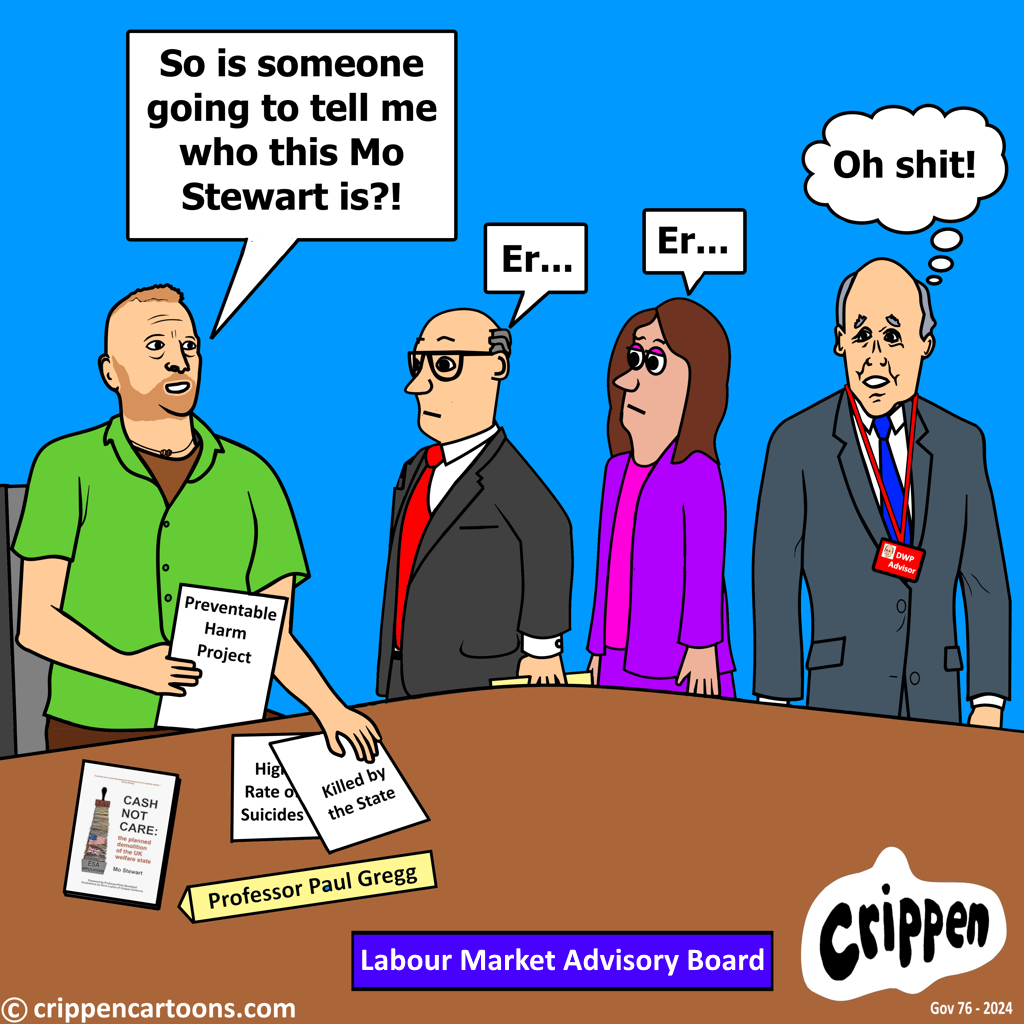
Crippen hears how Mo Stewart informs the new Advisory Board
Well, our good friend disabled researcher Mo Stewart has now been invited to provide information to the Advisory Board regarding the identified public health crisis and preventable harm created by UK social policy primary legislation. Certainly a step in the right direction eh?!
The sort of information that Mo will be providing is well documented, mostly from her own work as research lead of the preventable harm project and from her many publications including ‘The public health crisis created by UK social policy reforms’.
Mo addresses her concerns to Professor Paul Gregg, Chair of the new Advisory Board and also Professor of Economic and Social Policy in the Dept of Social and Policy Sciences, University of Bath. She has kindly shared these concerns with me, which, with her permission I will now share with you.
Mo notes that the Advisory Board boasts significant members but no disabled member, and certainly no one with any expertise regarding the identified government induced public health crisis now ongoing in the UK. This crisis is negatively impacting on the health, wellbeing and survival of many of the chronically ill and disabled community who are unable to work.
It is also linked to a disturbing number of suicides of some of those in greatest need following relentless intimidation by the Department for Work and Pensions (DWP) when adopting the politics of fear using the fatally flawed Work Capability Assessment (WCA) to restrict disability benefit access. This was also identified by Professor Jonathan Portes as ‘one of the biggest social policy failures in the past 20-30 years.’
She also notes that Liz Kendall, the Secretary of State for Work and Pensions for the Labour administration, has invited the involvement of the new Advisory Board when working towards her planned White Paper. However, her comments since taking office demonstrates the same disturbing commentary as the previous Conservative administration regarding the numbers of people who claim disability benefits. This continuing demonisation of chronically ill and disabled people who are not in paid employment, is based on fake news and right-leaning ideology.
Mo tells Professor Gregg that, whilst she fully comprehends that he has a job to do, he should also consider that there has never been any evidence of vast numbers of fake disability benefit claims. That the hostile political rhetoricattacking disability benefit claimants adopted since 2010 by the various governments has worked well, as indicated by the rise in prosecuted disability hate crimes which climbed by 213% during the Coalition government‘s term in office (2010-15). All this of course aided by the tabloid press.
Mo concludes by reminding Professor Gregg that we are living in very dark and dangerous times since the adoption of neoliberal politics in the UK. This, coupled with the influence of corporate America with UK social policy reforms since 1992, and the adoption of social policies introduced using a fiscal priority whilst disregarding the health, wellbeing and survival of those in greatest need, has guaranteed that many people would be ‘killed by the state’ with no-one held to account.
Further, there is a disturbing history of preventable harm against those in greatest need created by successive UK neoliberal administrations and identified by a multitude of academics from a variety of universities, which is detailed in published evidence routinely disregarded by the DWP.
Well, that should give Professor Gregg and his colleagues on the Advisory Board food for thought. … Let’s see what they do with it?
NB: What’s also worrying is that years later, Sir Iain Duncan Smith, the former Secretary of State for Work and Pensions for the Coalition administration is still attacking the disabled community ‘languishing on benefit’ in his column in the Telegraph, without providing any evidence. It would appear that this man has a habit of using false statistics to gain attention to his hostile rhetoric and has even been challenged by the UK Statistics Authority who identified his many claims advising that they were ‘unsupported by the official statistics’. It’s also worrying that he now appears to be an advisor to the Labour government.

ESNEFT STRIKE MARCH & RALLY SATURDAY 19 OCTOBER 10:00 AM
Cleaners, caterers, porters, housekeepers and other East Suffolk and North Essex support staff are striking to stay in the NHS. They want to defend the quality of services as well as their own pay and conditions. Join them as they march through Colchester to say: In House is Best!
NO NHS SELL-OFF
March and rally:
Saturday 19 October
Assemble 10 am outside Colchester Hospital on Turner Road for a march at 10.30am to Castle Hill
ESNEFT:
IN-HOUSE IS BEST
UNISON

SOS NHS NATIONAL CONFERENCE SATURDAY 2 NOVEMBER
Join SOS NHS in Central London on 2 November to examine the state of the NHS, and how we might go about saving it.
Our core demands are simple: emergency funding for the NHS; fully public, free, healthcare, guaranteed for future generations; and for NHS staff to be paid properly.
We want to exert maximum pressure on the government to urgently resolve the crisis in the NHS.
We’ll be hearing from
Look out for more information soon about live streaming, speakers and event details soon!
Book Via Eventbright
| BOOK NOW – SOS NHS |
Disabled Journalist Jasmine Andersson who works for Yahoo news would like to speak to people about their fears around changes to PIP and spying on bank accounts. She says first names are usually used but is checking whether people could be totally anonymous.
She would also be interested in speaking to people about their experience of health assessments by the new provider HAAS. These are for PIP, WCA and UC.
If you’re willing to speak to Jasmine please email her jasmine.andersson@yahooinc.com
The government has refused to clarify comments by the prime minister which suggested that all claimants of long-term sickness benefits will be expected to look for work under Labour’s social security reforms.
The refusal came as Mims Davies, the last Conservative minister for disabled people before July’s election defeat, told Disability News Service (DNS) that she would never have gone as far as Sir Keir Starmer did in his interview with the BBC.
He told the Today programme last week (listen from two hours, 10 minutes) that, “in relation to long-term sickness, which is at very high levels, then of course people need to look for work”.
After being asked – by the BBC’s Nick Robinson – if he believed that “those who are out of work, who may think that they can’t work, that the country has a right to expect that they look for work, they do everything they can to get work” and that this was “the sacrifice they need to make”, Sir Keir said: “Well, yes, of course.”
He also said that the “basic proposition, that you should look for work, is right”.
He added: “There will be hard cases. But the way I would do it is to say, yes, that’s the basic proposition.”
Although the DNS story accurately reported his comments, some Labour supporters suggested he was mis-reported or did not mean what he said, although many more disabled people were appalled by his words.
In an attempt to clarify what the prime minister meant, DNS approached the Labour party, Number 10 and the Department for Work and Pensions (DWP) this week.
Labour said it was a matter of government policy, even though the comments came at a party conference, and referred the query to Number 10 and DWP.
But instead of clarifying Sir Keir’s comments, a DWP spokesperson merely provided quotes from a speech made by work and pensions secretary Liz Kendall more than two months ago, in which she expressed the need to move away from blaming people for being out of work, and to focus instead on supporting them.
Sir Keir’s comments also contrasted with those made by Kendall last week, as she attempted at the party conference in Liverpool to stress that she would focus on providing “more positive support in the community” and would take a “completely different approach from the Conservatives”.
DNS asked the government this week what the prime minister had meant and whether he really believed that all disabled people and those with long-term health conditions should be looking for work.
But other than the background notes, DWP refused to comment or even mention the prime minister.
When DNS asked the former minister for disabled people, Mims Davies, what she thought of Sir Keir’s comments – after a fringe meeting at the Conservative party conference in Birmingham this week – she said: “Well, you would never have heard that from me, so he needs to answer for himself.”
If Sir Keir’s comments translated into government policy, they would demonstrate a significant tightening of the rules on out-of-work disability benefits.
There are currently more than 1.5 million disabled people on universal credit who are not expected to carry out any work-related activity because of a significant impairment or health condition, and about 1.3 million more in the equivalent employment and support allowance support group.
Sir Keir appeared to be suggesting – although it is possible that he misrepresented government policy – that every one of those people should be looking for work.
The deaths of countless disabled claimants of out-of-work benefits have been linked to attempts to force them into work or work-related activity over the last 15 years.
One of them was Alan McArdle, who died from a fatal heart attack in August 2015 after being told DWP was threatening to sanction his benefits.
The US outsourcing giant Maximus had reported him for failing to attend appointments intended to move him towards work, despite being told about his severe ill-health.
Another who died was Roy Curtis, who took his own life in November 2018, six days after being told to attend a work capability assessment, despite DWP being repeatedly warned its actions had made him suicidal.
Under the current rules, DWP accepts that many disabled people are not able to work or even carry out work-related activity or look for work, and they are provided with extra financial support to recognise the extra barriers they face.
3 October 2024
The last Conservative minister for disabled people has dodged questions on whether her government failed to address flaws in the universal credit system that led to the deaths of disabled claimants.
There have been increasing concerns about universal credit, including by coroners following two deaths of claimants that were both linked to flaws in the system, and particularly the pressure it puts on people in mental distress and those with mental ill-health.
Although the PCS union has described it as a “dangerously flawed system” in which “the most vulnerable continue to slip through its cracks”, the Department for Work and Pensions (DWP) began to roll out universal credit to claimants of income-related employment and support allowance last month.
Mims Davies – whose title in government was minister for disabled people, health and work – was asked about these concerns by Disability News Service (DNS), days after Labour’s new social security and disability minister Sir Stephen Timms said there were “problematic” features of the universal credit system that “need to be fixed”.
Davies is now the Conservative shadow minister for women and equalities, and its shadow disability minister.
She said there was now a “chance for many people who criticise universal credit and others to go and have a forensic look at it”.
Asked if she believed there should be such a “forensic look” at universal credit, she said: “Well, they’re in government now, so I’ll be looking at what they get up to.
“The reality is that I’m not a minister there anymore, I haven’t got any further details, but I know that some of the people who have either been shadowing and looking at the department or indeed were there may years ago are now back in charge, so I think these are probably questions you will need to address to them.”
She insisted that she was “never the minister in charge of universal credit” and claimed that “safeguarding and supporting people was always my focus”.
She also pointed to comments she made to the Commons work and pensions committee in March (PDF), when she said the “narrative around DWP’s treatment of vulnerable people has been incredibly unhelpful” and was “not roundly correct”, although “we recognise that in some areas improvements can be made”.
She said this week: “All I can say is that DWP is a learning department, 80,000 civil servants across all different communities, with very many different needs… sometimes with hidden needs, and you can only work and act on what people share with you.
“I know that we boosted the visiting officers and the outreach… in my time there it was very much about tailored individual needs, and understanding the challenges.”
After DNS told her that documents from the National Archives linked DWP and its predecessor, the Department of Social Security (DSS), to the deaths of claimants as far back as 1996*, and in early 1997, in the last months of the Conservative government – therefore casting into doubt whether DWP was a “learning organisation” – she said that Sir Stephen was a social security minister “not long after that”.
He was a DSS minister from July 1998 to July 1999 before returning to DWP in 2005 for a year, and again for another nine months in 2008.
Davies was minister for disabled people, health and work for the last six months of the Conservative government, until July’s election, but had been a work and pensions minister between July 2019 and July 2022, and again from October 2022.
*These documents are described in The Department: How a Violent Government Bureaucracy Killed Hundreds and Hid the Evidence, by DNS editor John Pring, published by Pluto Press
3 October 2024
All four of the candidates to be the next Conservative leader have ignored disabled people in their pitches to party members.
None of the quartet – Kemi Badenoch, James Cleverly, Robert Jenrick, and Tom Tugendhat – discussed how they would address any of the barriers facing disabled people, in their speeches yesterday (Wednesday).
Issues such as social care, accessible housing and transport, and social security were almost completely absent from their speeches, although all four briefly mentioned the NHS.
Jenrick did mention “welfare” twice, once to claim that the Conservatives had created “a fairer welfare system” and then confusingly to argue that the “welfare system” was one of the parts of the public sector that was not “working as it should”.
All four spoke about cutting migration and taxes, defence (except Badenoch), and reducing regulation.
Badenoch and Jenrick both launched attacks on human rights laws, while Badenoch said her “plan” would target both the Equality Act and the use of judicial reviews.
She promised a “comprehensive plan to reprogramme the British state” that would examine the Equality Act, but she did not provide further details on how she would reform equality laws.
She appeared to promise a new wave of attacks on what she called “identity politics” if she became Conservative leader.
And she claimed that “class warfare” had been promoted “under the banner of equality”, and that Conservative governments had “allowed ourselves to be bound by aggressive identity politics”.
She told party members: “Ministers need to be able to make decisions that aren’t endlessly challenged in the courts.
“If people don’t like those decisions, there are elections.”
Jenrick’s approach was even further to the right of Badenoch’s.
He promised to scrap the Human Rights Act, leave the European Convention on Human Rights, and end “the age of mass migration”, arguing that “the sheer scale and the lack of integration is sapping at our culture and our national cohesion”.
And he said his “new Conservative party… must stand for our nation and our culture, for our identity and our way of life”.
Cleverly promised to “build more homes”, reduce the cost of childcare, and “cut red tape, so we can build the energy and transport infrastructure we need, but more cheaply and quickly”.
He said his party needed to “make sure that work always pays” and be the party of “free markets and freedom, of business and enterprise”.
Tugendhat called for a legal cap on net migration at 100,000 and said he would “fix migration by fixing the gaps in education and skills, in transport and housing, so we can recruit at home and not abroad”.
He said he would “end the cap on apprenticeships and use the immigration skills charge to invest in further education and train our own people”.
None of the four candidates had responded by noon today (Thursday) to requests from Disability News Service to describe the policies they are putting forward to address the barriers faced by disabled people.
3 October 2024
The new government has been accused of a “slapdash and chaotic” response to a request from disabled people’s organisations (DPOs) to provide a vital consultation document on planning policy in accessible formats.
The Ministry of Housing, Communities and Local Government (MHCLG) had already angered DPOs by failing to mention the accessible housing crisis in its consultation on reforms to the National Policy Planning Framework in England.
But they were also shocked that the department failed to publish the document in an easy-read format, or in British Sign Language (BSL), and only allowed eight weeks for responses, while also making it difficult for users of screen-reading software to read the document.
When DPOs contacted MHCLG to express alarm at its actions, the department agreed to provide an easy-read version, but it was only published on 24 September, the day the consultation was due to end.
MHCLG extended the consultation by just two weeks, but even then it failed to make that clear on the consultation web page.
And it still refused to provide a BSL version, apparently on cost grounds.
The framework sets out the government’s planning policies and how these should be applied by local authorities in England.
Manchester Disabled People’s Access Group (MDPAG) and Greater Manchester Coalition of Disabled People (GMCDP) both complained about the access concerns.
They described the government’s response to these concerns as incompetent, “chaotic” and “slapdash”.
They also said in their response to the consultation – along with Bristol Disability Equality Forum, and High Peak Access – that they were “extremely concerned” about the government’s failure to make any recommendations on accessible housing, such as ensuring that all new housing is built to the stricter M4(2) standard of accessibility, and that at least 10 per cent of all new housing is built to the M4(3) standard, which makes a home suitable for wheelchair-users.
Inclusion London also criticised the failure to include any recommendations on accessible housing in its response to the consultation.
Inclusion London said the NPPF “sets the tone and direction for local planning policies” and so it was concerned that the proposed reforms “fail to address the housing needs of Disabled people and do not explicitly encourage the delivery of accessible, adaptable housing and wheelchair accessible housing, of which we are in great need”.
It added: “We are disappointed that the Government’s current proposals do not make any reference to the link between the lack of accessible housing in the country, including the shortage of wheelchair accessible homes, and the rise in health inequalities among older and Disabled people and therefore do not contain any proposals to address this issue.”
Luke Beesley, co-chair of GMCDP, said: “The housing crisis is a pressing issue for disabled people all over the country, and it is absolutely essential that our insights and concerns are listened to at every stage of policy making.
“The slapdash and chaotic response of the department to being asked for very basic access adaptations is deeply worrying.
“Neurodivergent people and people with learning difficulties have been left in the dark even about how to contribute to this discussion – with the clear implication that the government doesn’t care what they have to say.
“We are also very worried, and very angry, about the department’s attitude towards the Deaf community.
“Deaf citizens speak a legally-recognised British language, and it is absurd and insulting that the government refuses to publish official documents in it.
“Community organisations, schools, and religious congregations provide British Sign Language translations despite the costs involved; and frankly it is inexcusable that a government department feels that they can opt out – especially on an issue that is so clearly related to social equality.”
The department told Disability News Service that it believed it responded as quickly as it could to the concerns and that it had made efforts to understand the barriers that disabled people were facing.
But an MHCLG spokesperson failed to respond to the concerns about the lack of a BSL version, and about only giving another two weeks for disabled people to respond after the easy-read version was published, and then not publicising this extension on the consultation page.
The spokesperson said in a statement: “We will always listen to how we can make our documents more accessible.
“That is why the page was made to be accessible to screen readers, and we commissioned an easy-read version as soon as it was requested.”
3 October 2024
A government department has blamed the pandemic for a five-year delay in publishing a report that suggested major changes to the public transport system would be needed to address the barriers faced by disabled people with invisible impairments.
The report by Ipsos MORI was handed to the Conservative-led Department for Transport (DfT) in October 2019, but it was only published last Thursday, when it was released quietly on the DfT website.
Ipsos MORI had interviewed 20 people with non-visible impairments, including autistic people, people with learning difficulties and people with mental ill-health.
The research showed the importance of public transport, and how it provided independence and confidence, and helped interviewees with their social lives.
But many of those interviewed said they experienced barriers when using public transport, causing anxiety, stress and a lack of self-confidence, particularly when travelling alone.
The most frequent problems came on bus journeys, despite their potential importance in enabling local trips, which meant that many of those interviewed travelled by car instead.
Barriers faced by those interviewed for the research included the anxiety caused by communicating with transport staff, particularly on buses, where drivers are “generally perceived as unhelpful and inconsiderate towards passenger needs”.
Other barriers included the difficulty of planning bus journeys in advance because of a “lack of cohesive information”; a lack of real-time information; overcrowded peak-time buses; concerns about personal safety and being targeted because of their impairment; and cost.
Trams “were viewed positively as a reliable mode of transport, with no unpredictable changes to routes or timetables”, while cars, walking and taxis all provided “more flexibility and control over journeys”.
Coping methods included the use of journey planning mobile phone apps, travelling with someone, and making a journey at quieter times.
Ideas for making public transport easier included the use of assistance cards that identify someone as having an invisible impairment; greater clarity on bus fares; wider use of cashless payment on buses; a greater emphasis on passenger safety on buses and in taxis; and wider use of companion bus passes.
DfT had commissioned the research to try to address a “large evidence gap” concerning accessibility for people with invisible impairments, and what impact different policies might have on them.
The aim had been to provide evidence ahead of more detailed research into how barriers could be addressed.
The report concluded that future research “should focus on using local buses in particular as these could be used more widely for short, regular, frequent trips”.
Asked why it had delayed publishing the report for five years, DfT refused to provide a statement, offering only some background points in response.
It claimed that work on the report was paused because of the Covid-19 pandemic, while the report was then finalised and prepared for publication this year, but was delayed again because of the general election.
DfT denied that its publication was delayed because of the cost of addressing the barriers outlined in the report.
It said the report’s findings would be considered when developing future policy.
Meanwhile, new regulations that came into force on Tuesday (1 October) should make it easier for some disabled people to use local bus and coach services.
The Public Service Vehicles (Accessible Information) Regulations 2023 require operators of local bus and coach services to provide audio and visual information about the route, the direction of travel and each upcoming stop, and they apply to England, Wales and Scotland.
The deadline means all vehicles first used on local services since 1 October 2019 must now comply with the regulations, while there is a “staggered deadline” for older vehicles through to 2026, and vehicles that are “partially compliant” must be fully compliant by 2031.
3 October 2024
A disabled journalist has called on the trade union movement to do more for disability rights and has promised to fight discrimination across the media, if she is elected to be the next leader of her union.
Dr Natasha Hirst said she believed the trade union movement needed to be “much stronger” in challenging the “negative rhetoric” about disabled people, particularly when it comes to social security.
Hirst has spent years campaigning for equality for disabled people both within journalism and across the disabled people’s movement.
She is currently president of the National Union of Journalists (NUJ)* and is now hoping to be elected as its new general secretary, after the long-serving Michelle Stanistreet announced in June that she would be stepping down.
She is standing against just one other candidate, Laura Davison, who is currently a full-time NUJ official, leading the union’s broadcasting sector, having previously worked for BBC local radio.
Hirst told Disability News Service (DNS) this week: “Although we are trade unions and our role is to represent workers, we should show more solidarity with the wider disabled people’s movement in protecting those who can’t work and those who would like to work but can’t find supportive employers or suitable work.”
She also said she was “continually appalled by the lack of empathy and understanding” within government and its “willingness to scapegoat and punish disabled people who need support”.
She said that both the Access to Work scheme and jobcentres were “chronically under-resourced and riddled with systemic ableism”, while the “punitive” social security system “destroys lives”.
Hirst also told DNS that unions should be doing more for members with long Covid, and “should be attacking the hypocrisy of not supporting workers (and freelances) with long Covid” and the failure to do enough preventative work to keep infection rates down.
She said: “Changes to working patterns [during the pandemic] could have opened up more accessible and safer ways of working to create inclusion and opportunities for disabled workers and it is bitterly disappointing and dangerous for us that we are witnessing the ongoing disregard for our human rights.”
Hirst also told DNS that she believed there were too few disabled people reaching senior levels within the union movement.
She praised her own union for its efforts to ensure access for her to key meetings and events “without fuss”, while NUJ’s greater use of online meetings since the pandemic had made its democratic processes “much more accessible for me”.
She said: “My presence and self-advocacy educates those around me and is slowly changing the culture of the union.
“There’s still a way to go, but without this support, I couldn’t have taken up the opportunities as an activist that led to me being president and thus in a position to stand for general secretary.
“It takes years to develop the skills and experience to go for a role like this.
“It demonstrates that it can be done but begs the question as to why there aren’t more disabled activists reaching the top across our union movement.”
One of her pledges is to push for increased NUJ membership by appealing to a “wider diversity” of potential members, such as disabled freelance journalists, and to show that the union understands the barriers faced by disabled freelances “and that we are serious about tackling those barriers”.
She also wants to address the barriers some disabled journalists face when trying to become an NUJ member, usually because of their low income and irregular work.
Her union activism in journalism has included involvement in the campaign to persuade the Independent Press Standards Organisation to extend protection from media discrimination for disabled people.
She believes her industry needs to “scrutinise government policies more effectively and deconstruct negative and distorted rhetoric about disabled people” and build “wider solidarity for a campaign against discriminatory reporting”.
Hirst says more must be done to educate journalists and on “tackling those who own the media and shape the editorial lines” when it comes to disability equality “and the complexities of navigating barriers in every area of life”.
She said: “A disabled person leading the NUJ has a better chance of pushing those messages out to challenge the status quo and prevent disabled people from being ‘othered’ by the union movement and by the media industry.”
She has also led the union’s #InclusivePressAccess campaign, which aims to persuade political parties, and now also sports bodies, to make their events and press conferences accessible to disabled journalists.
And she led on organising and delivering NUJ’s first mental health conference, following her experience of being homeless, having complex PTSD, and being unable to work as a freelance due to domestic abuse.
She says it was the support she received from the union that “helped me to get my life and career back”.
She is currently leading on the co-production of new disability reporting guidelines with Disability Wales, with which she was previously a trustee.
Among her roles outside NUJ, Hirst has been a member of the Welsh government’s Disability Rights Taskforce, was part of the delegations of disabled people’s organisations that travelled to Geneva to hold the last government to account on the UN disability convention, and she currently chairs Disability Arts Cymru.
*John Pring, editor of DNS, is an NUJ member
3 October 2024
One of the few disabled MPs in the last parliament has called for significant access improvements to the House of Commons.
Robert Halfon, who was Conservative MP for Harlow for 14 years and served as an education minister, stepped down before July’s election.
He told Disability News Service (DNS) on Tuesday that although Commons staff were “the most lovely people you’ll ever meet”, the facilities were “appalling”.
Speaking at a fringe meeting hosted by LTE Group at the Conservative party conference in Birmingham, Halfon said “the lifts always break”, while “the loos are always broken and then they take weeks to fix them… weeks and weeks and weeks”.
Halfon, who has a mobility impairment, said the doors in the Palace of Westminster are “always shut”, while non-disabled people frequently use the accessible toilets.
He said the Commons was “both the best place and the worst place”, because of the “wonderful staff” but “appalling” facilities.
DNS had asked him about figures obtained through a freedom of information request from the House of Commons that showed 43 out of the 650 MPs had discussed the possibility of having disability-related adjustments made for them, after every MP was approached with an offer of support by Commons authorities when they were elected in July.
Halfon said he believed the figures showed that the system of support for disabled MPs was now “working properly”.
Other than supportive staff, and an office near the Commons division lobby, he said he was offered “nothing” by way of adjustments when he became an MP in 2010.
It was not until 2017 that he saw an advert for a four-wheel upright scooter, the RollerScoot, which allowed him to travel around the parliamentary estate much more easily and which he said “changed my life”, because “walking around the Commons is like walking round a football pitch 10 times over”.
He said: “If I’d had that from the beginning, I think it would have been a huge difference, but no-one suggested it. I didn’t even know they existed. No one had asked me.”
He said in his final speech in parliament in May that the House of Commons is “a terrible place for people who have difficulties”.
He told MPs: “There is just not enough understanding.
“Everybody should be able to access this place easily and comfortably, whatever their background, so I urge the new parliament, you, Mr Deputy Speaker, Mr Speaker and the other Deputy Speakers to make that happen once and for all.”
Halfon, who had two spells as an education minister, and also chaired the education select committee, focused for much of his time in parliament on championing apprenticeships and skills.
He was the first MP to employ an apprentice in his parliamentary office, and eventually took on six.
He said his party had brought about “an apprenticeship and skills revolution in our country”, where there were now apprenticeships in more than 70 per cent of occupations, including degree-level apprenticeships.
He said he had not yet decided who to vote for in the Conservative leadership election.
Halfon said the problems with his party were “one, that people don’t know what our values are; two, they don’t trust us; and three, that we are not seen as a social justice party”.
3 October 2024
The social care watchdog is increasingly finding fault with council decision-making in relation to social care assessments and care planning. The Local Government and Social Care Ombudsman upheld 80 per cent of complaints it investigated relating to assessment and care planning in 2023-24, up from 67 per cent in 2022-23. Complaints upheld included cases of councils delaying assessments, not making reasonable adjustments during the assessment process, and not meeting a person’s eligible needs when required to do so: https://www.communitycare.co.uk/2024/09/30/watchdog-increasingly-finding-fault-with-councils-on-social-care-assessments-and-plans/
The family of a disabled woman whose dead body lay in her social housing flat unnoticed for more than three years had raised concerns about her welfare two months before she was discovered, an inquest has heard. Laura Winham’s remains were found by her brother in her flat in Woking, Surrey, in May 2021, after the family asked police to break in. An inquest into her death opened at Surrey coroner’s court on Tuesday: https://www.theguardian.com/uk-news/2024/oct/01/family-of-woman-who-lay-dead-for-three-years-had-raised-alarm-inquest-hears
Ministers have been urged not to resurrect Conservative plans to tackle social security fraud by launching mass algorithmic surveillance of bank accounts. Disability rights, poverty, pensioner and privacy groups fear the government is poised to deliver a “snooper’s charter” by using automation and possibly artificial intelligence to crack down on benefit cheats and mistakes which cost £10 billion a year. In a letter this week to Liz Kendall, the work and pensions secretary, they say they fear it will mean a “huge blow for privacy in the UK”: https://www.theguardian.com/world/2024/oct/01/monitoring-uk-bank-accounts-for-benefits-would-be-huge-blow-to-privacy
A rail company operating across the north of England will introduce sign language announcements on all its services. Northern has trialled technology which means interpreters appear on trains’ on-board screens, for example to let passengers know about the next stop. The system, piloted on trains between Manchester, Leeds and York last year, will be introduced across the fleet next year: https://www.bbc.co.uk/news/articles/c1l48jveq56o
A council received almost 1,200 complaints about its services for children with special educational needs and disabilities in a year. Lancashire County Council received the complaints during the 12 months to July 2024: https://www.bbc.co.uk/news/articles/cqjrynj40v2o
Parents of children with Tourette’s syndrome are warning that a lack of support and understanding in schools could wreck their chances of an education. The BBC spoke with 18 parents from the south of England, most of whom shared similar stories. Almost all complained their children had been shouted at for movements and sounds they could not control, and in some cases that had led to them avoiding school for weeks at a time: https://www.bbc.co.uk/news/articles/cm29dkv9v3mo
3 October 2024
News provided by John Pring at www.disabilitynewsservice.com