

Reproduced by kind permission of Crippen
They’re at it again, claiming that billions of pounds are being lost to fraudulant benefit claims, which includes those by people on long term sick and those who are disabled.

Crippen asks again “Fraud – What Fraud?!”
Where they get these figures from is a real mystery as the last government’s own figures showed that benefit fraud was at its lowest ever at less than 3.5%, much of which could be attributed to DWP error.
And you’ll remember it was ex-PM Rishi Sunak who claimed that millions were being fraudulantly claimed through Personal Independent Payments (PIP) at the same time that DWP figures, released just days before Rishi Sunak called a general election, showed that overpayment of PIP due to fraud had dropped to Zero per cent, a fall from 0.2 per cent the previous year.
So, where are they getting this misleading information from? Or, are they just making it all up? But why?
Perhaps it’s something about finding a scapegoat for the shambles that exists called ‘government’ and the billions of pounds that are lost, mis-appropriated or mis-managed by initially the Tory party and then the Labour party. The two words ‘piss-up’ and ‘brewery’ come to mind!
Or is it, as has been recently announced by Labour, just an excuse to access the bank accounts of all those who claim benefits? Just another example of the carrot being replaced by the stick once again?
Reproduced by kind permission of Crippen
Written by Bob Williams-Findlay October 2024
“In this post, I want to cover a number of tensions and contradictions which I believe run through ‘disability politics’. As ever, I define disability politics as being the social and political action required to end the imposition of disablement and its prime agency, disablism. Together they create the conditions whereby disabled people are excluded from and/or marginalised within mainstream social activity. Hence our Movement argued that we are ‘disabled by society’. I share this slick mantra, but at the same time believe we need greater clarity.

Crippen shares an article by Bob Williams Findlay
“I have previously argued that one of the biggest contradictions within early disability politics and more modern times is that disabled people want to be included in a society which actively excludes them. Capitalism is directly responsible for disablement, however, at differing points the needs of Capital requires society to adjust the unequal and differential treatment disabled people encounter. Here is another contradiction: welfarism cushioned the experience of social exclusion, on the one hand, whilst maintaining it on the other.
“It is understandable that disabled people have pushed for deinstitutionalisation and social inclusion; but to what extent is that feasible? Capitalist social relations rely heavily on the ability of the lower classes to sell their labour. Disabled Marxists tend to argue that this ‘need’ underpins the creation of disablement and the legitimising of it through disablism – the negative evaluation of impaired bodies which justified our social exclusion. Yet, as I have stated already, at times these evaluatons are watered down to encourage or force more groups of disabled people into the labour market. The neoliberal agenda since 2010 has adopted the carrot and stick approach.
“There is much to discuss about ‘work’, what it is, alongside exploring the various benefits and detriments involved. I can’t address these issues here. There is a view that ‘work’ means a degree of security, improved health for some and greater spending power. For me the issue is not about whether or not disabled people can/should work, but rather the impact of disablism on people who are of working age – how are they being both judged and treated.
“In the film, “When Barbara Met Alan”, one of the slogans heard was: ‘we want, what you got’. This raises many issues in my opinion and relates to what I call the ‘disability dialectic’. Disabled people cannot fit into the status quo; if we could, then we would not be ‘disabled by society’. So we fight to ‘transform’ society which means going up against the interests of Capital. We have always fought for ‘betterment’; making our lives better, but only through overthrowing the status quo will it be possible to build an inclusive society.
“So the last contradiction I want to pose is: what does ‘nothing about us, without us’ actually mean in the context of opposing discrimination and oppression? Some want a seat at Liz Kendall’s Taskforce table; to do what exactly? Disabled people were not included in the agenda setting; it is highly unlikely that agenda will address institutional disablism in the labour market. When Rachel Hurst and I promoted political coproduction [the meaning of NAU,WU] it was not only agitational, it was underpinned by the demand for a shift in power relations. As a Trotskyist, I view ‘nothing about us, without us’ as a transitional demand because it challenges the existing oppressive relationships we are subjected to.
“I am not conviced the current disability politics practiced by today’s activists adequately address the structural nature of disablement when they go cap-in-hand demanding “Rights”. Rights are meaningless without the power to enforce them.
“The reason I co-founded DPAC was the unquestionable belief that we, disabled people, had to build a new social movement, foster a sense of community, and build alliances with allies. Over the last 15 years we have not made serious inroads because disability politics have lost their radical vision. Equally does not mean ‘sameness’; it is about people’s lives having ‘equal value’ and capitalism can never deliver that.
Reproduced by kind permission of Crippen
Disabled activists warned that a bill to allow assisted suicide for people with a terminal illness would pressure disabled people to end their lives prematurely, and that too little time had been set aside to understand its “far-reaching” implications.

Crippen warns about the UK End of Life Bill
Disabled people’s organisations (DPOs) from across England and Wales have united to warn of the grave risks of proposed new legislation that would allow assisted suicide for people with a terminal illness. They believe parliament’s focus should be on improving access to health, care and other services. And they have outlined their ethical and human rights concerns in a briefing sent to MPs.
Kim Leadbeater’s terminally ill adults (end of life) bill received its first reading in the House of Commons yesterday (Wednesday) and is now set to be debated by MPs on 29 November. The bill would “allow adults who are terminally ill, subject to safeguards and protections, to request and be provided with assistance to end their own life”.
Ellen Clifford, co-ordinator of the UN monitoring coalition, told Disability News Service (DNS):
“Parliament only gets one go at this and if they get it wrong the consequences will be very dangerous both for individual people vulnerable to abuse and society as a whole. Our support services – palliative care, the NHS, social care and mental health – are currently broken. The government must get on and fix the foundations, so we all have the chance to live with dignity.”
Not Dead Yet UK (NDY UK), a grassroots group of disabled activists who campaign against legalisation, said laws introduced in other countries have started with “relatively strict parameters” but then “expand and expand”.
Phil Friend, co-convenor of NDY UK, explained:
“ … in a world where there is growing awareness of coercive control, and where we know that many do not receive adequate or appropriate medical care, pain management or social care, we are creating the conditions for people to find themselves agreeing that, yes, they should probably die, including to avoid feeling like a burden.”
Paula Peters, a member of the national steering group of Disabled People Against Cuts (DPAC), said the proposed bill had caused “deep concern and alarm for many disabled people”. She added:
“It is impossible to put strong enough safeguards in place to prevent coercion and feeling that we have become a burden on our families and the state. We fear that non-disabled people will be making choices about what is best for us and that our voices will be dismissed as they often are.”
Members of the UN Monitoring Coalition include The Alliance for Inclusive Education, All Wales People First, Disabled People Against Cuts, Disabled People Against Cuts Northern Ireland, Disability Rights UK, Disability Wales, Greater Manchester Coalition of Disabled People, Liberation and The Omnibus Partnership in Northern Ireland
DPOs who have spoken out against the Bill include Not Dead Yet UK (NDY UK), Disability Rights UK, All Wales People First, Liberation, Disabled People Against Cuts (DPAC), Disability Wales and the Coalition of UK DPOs that monitor implementation of the UN Disability Convention.
Reproduced by kind permission of Crippen
Remember how Labour decided to ignore disabled people when it sent out invitations for people to join their new Labour Market Advisory Board?
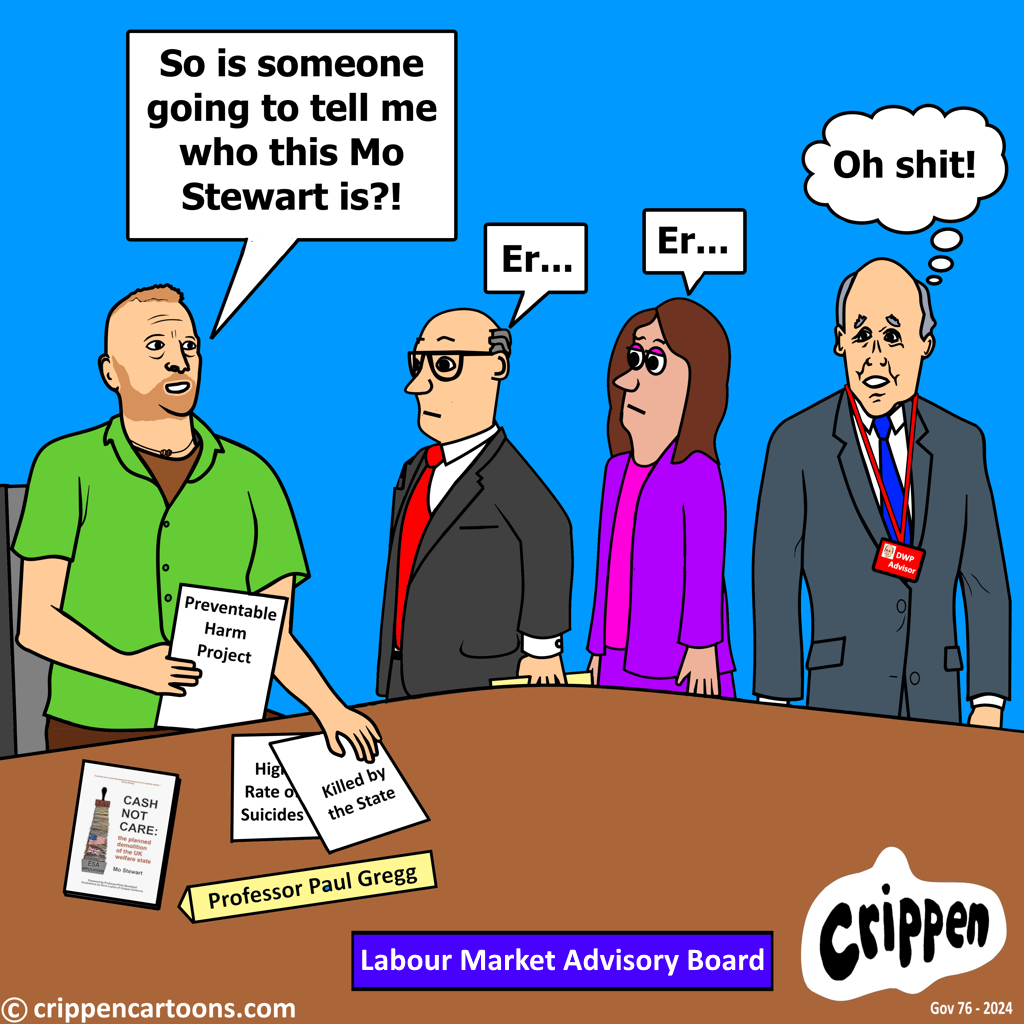
Crippen hears how Mo Stewart informs the new Advisory Board
Well, our good friend disabled researcher Mo Stewart has now been invited to provide information to the Advisory Board regarding the identified public health crisis and preventable harm created by UK social policy primary legislation. Certainly a step in the right direction eh?!
The sort of information that Mo will be providing is well documented, mostly from her own work as research lead of the preventable harm project and from her many publications including ‘The public health crisis created by UK social policy reforms’.
Mo addresses her concerns to Professor Paul Gregg, Chair of the new Advisory Board and also Professor of Economic and Social Policy in the Dept of Social and Policy Sciences, University of Bath. She has kindly shared these concerns with me, which, with her permission I will now share with you.
Mo notes that the Advisory Board boasts significant members but no disabled member, and certainly no one with any expertise regarding the identified government induced public health crisis now ongoing in the UK. This crisis is negatively impacting on the health, wellbeing and survival of many of the chronically ill and disabled community who are unable to work.
It is also linked to a disturbing number of suicides of some of those in greatest need following relentless intimidation by the Department for Work and Pensions (DWP) when adopting the politics of fear using the fatally flawed Work Capability Assessment (WCA) to restrict disability benefit access. This was also identified by Professor Jonathan Portes as ‘one of the biggest social policy failures in the past 20-30 years.’
She also notes that Liz Kendall, the Secretary of State for Work and Pensions for the Labour administration, has invited the involvement of the new Advisory Board when working towards her planned White Paper. However, her comments since taking office demonstrates the same disturbing commentary as the previous Conservative administration regarding the numbers of people who claim disability benefits. This continuing demonisation of chronically ill and disabled people who are not in paid employment, is based on fake news and right-leaning ideology.
Mo tells Professor Gregg that, whilst she fully comprehends that he has a job to do, he should also consider that there has never been any evidence of vast numbers of fake disability benefit claims. That the hostile political rhetoricattacking disability benefit claimants adopted since 2010 by the various governments has worked well, as indicated by the rise in prosecuted disability hate crimes which climbed by 213% during the Coalition government‘s term in office (2010-15). All this of course aided by the tabloid press.
Mo concludes by reminding Professor Gregg that we are living in very dark and dangerous times since the adoption of neoliberal politics in the UK. This, coupled with the influence of corporate America with UK social policy reforms since 1992, and the adoption of social policies introduced using a fiscal priority whilst disregarding the health, wellbeing and survival of those in greatest need, has guaranteed that many people would be ‘killed by the state’ with no-one held to account.
Further, there is a disturbing history of preventable harm against those in greatest need created by successive UK neoliberal administrations and identified by a multitude of academics from a variety of universities, which is detailed in published evidence routinely disregarded by the DWP.
Well, that should give Professor Gregg and his colleagues on the Advisory Board food for thought. … Let’s see what they do with it?
NB: What’s also worrying is that years later, Sir Iain Duncan Smith, the former Secretary of State for Work and Pensions for the Coalition administration is still attacking the disabled community ‘languishing on benefit’ in his column in the Telegraph, without providing any evidence. It would appear that this man has a habit of using false statistics to gain attention to his hostile rhetoric and has even been challenged by the UK Statistics Authority who identified his many claims advising that they were ‘unsupported by the official statistics’. It’s also worrying that he now appears to be an advisor to the Labour government.
Reproduced by kind permission of Crippen

Crippen asks “Fraud – What Fraud?!
Well, having got rid of the Tory’s, we now have a labour government that has decided to continue with the harmful rhetoric that the DWP continue to pump out to a gullible public through the national press. But how did this attack against disabled people start, especially those claiming benefits because they cannot find accessible employment?
You’ll remember the Coalition administration elected in 2010? Well, it was this administration that started to change the public’s perception of disabled people. They vehemently challenged the integrity of the chronically ill and disabled community and routinely accused disability benefit claimants of fraud while failing to produce evidence to support their claims. Their often hostile rhetoric encouraged a 213 percent increase in prosecuted disability hate crimes, with successive administrations disregarded the thousands of deaths directly linked to the Work Capability Assessment (WCA).
And what with recent stats from the Home Office revealing that disability hate crime has risen by 43%. It doesn’t take much of a leap to connect this to the vitriol being pumped out by the DWP.
If you’ve read Mo Stewart’s book you’ll know how the WCA “ … was adopted using a discredited and dangerous biopsychosocial model of assessment to restrict access to long-term disability benefit. Influenced by corporate America since 1992, the UK social policy reforms guaranteed that many of those in greatest need were destined to die when, covertly, killed by the State.”
Sounds a bit dramatic, doesn’t it? “Killed by the state”. But this has exactly what has been happening since Margaret Thatcher started her devotion to neoliberal politics, which is the ideology that supports free market competition with an emphasis on minimal State intervention, would eventually be identified as being at ‘the root of all our problems’ (Monbiot, 2016).
Thatcher’s well-documented insistence that the welfare state was an unacceptable financial burden on the public purse, opened the door to the influence of corporate America with UK social policy reforms and the ‘planned demolition of the UK welfare state’ (Stewart, 2016).
Incidentally, every 30 years confidential Cabinet Papers from past UK governments are released into the public domain. In 2012, the 1982 Cabinet Papers from the first Thatcher administration (1979–83) were released, offering evidence demonstrating the political expectation to eventually demolish the UK welfare state, including the National Health Service (NHS).
It’s all there folks, you just have to dig for it as John Pring, disabled Editor of Disability News Service (DNS) and Mo Stewart, disabled researcher and lead on the Preventable Harm project, have done. Mo writes:
“Thatcher’s social policy right-leaning neoliberal legacy has been continued by every successive administration. This included introducing American corporate influence for the development of UK social policy reforms by the Major administration (1990–97) (Stewart, 2018); the adoption of American social and labour market policies by the Blair administration (1997–2007) (Daguerre, 2004; Daguerre and Taylor-Gooby, 2004); the adoption of the Work Capability Assessment in 2008 to limit access to the new Employment and Support Allowance (ESA) disability benefit by the Brown administration (2007–10) (Gentleman, 2011); and the increased use of sanctions, which removed all income to successfully intimidate disability benefit claimants, and to starve some of them to death (Pring, 2020a), by the Cameron-Clegg Coalition administration (2010–15).”
In the Independent Living review of John Pring’s book they comment that: “As demonstrated in the ‘Department’, a disturbing number of chronically ill disability benefit claimants committed suicide, linked in no small measure to persecution by the DWP, and to the fear instilled by the relentless threat of sanctions that meant the total loss of their only income which guaranteed destitution.”
Reproduced by kind permission of Crippen
Our friends at Disabled People Against Cuts (DPAC) have been monitoring the language being used by the government recently.

Crippen discovers why we’re all so punch drunk!
Phrases like “punching down” and “hostile environment” appear amongst the usual retoric, along with the carbon copies of speeches once used by the Tory party.
Of course, I couldn’t resist using one of these phrases for a cartoon!
Interested in joining DPAC? Here’s the link.
Reproduced by kind permission of Crippen
Remember when Labour’s general election manifesto stated that it was “committed to championing the rights of disabled people and to the principle of working with them, so that their views and voices will be at the heart of all we do”.

Crippen hears that Labour has sidelined disabled people from DWP ‘inactivity’ board
Well, you’ll be forgiven for thinking that another party won the election because everything that they claimed to do on our behalf seems to have gone right out of the window!
As reported in Disability News Service (DNS), Disabled Rights activists have criticised the Labour government’s “hugely disappointing” and “exclusionary” decision to set up a board of experts to examine “economic inactivity” without appointing a single representative of a disabled people’s organisation.
Work and pensions secretary Liz Kendall appears to have failed to appoint any disabled experts to the Labour Market Advisory Board, even though she made it clear that its key aim was tackling the “spiralling inactivity” caused by a record number of people out of work due to long-term sickness.
But the eight members of the board, labour market experts from across business, industrial relations and academia, do not appear to include any disabled experts and certainly do not include representatives of any disabled people’s organisations (DPOs).
Disabled researcher Stef Benstead, author of Second Class Citizens, which describes the harm caused to disabled people by a decade of cuts and reforms, said: “It should not be thinkable for any modern government department to have an advisory board that does not include representatives of the community impacted by the policy proposals.”
Dan White, policy and campaigns officer for Disability Rights UK, said it was “hugely disappointing that not one disabled people’s organisation or disabled people’s expert representative” was on the board, despite Labour’s past commitments to involving disabled people in developing policy. Would any other group be left out of an expert board that is focused on their future?”
Inclusion London said it was “extremely concerned” that disabled people were “once again missing from an important forum where programmes targeting us will be shaped” with their senior policy and campaigns manager Julia Modern adding that:
“Under the UN Convention on the Rights of Persons with Disabilities, the government is obliged to consult with disabled people”.
Reproduced by kind permission of Crippen
Recently reported in an article published in the Big Issue Anela Anwar, chief executive of anti-poverty charity Z2K has set out why the new government must scrap cruel and dangerous plans to cut payments for seriously ill and disabled people. They said:
“Since the election of the Labour government in July there has been something of a change in tone when it comes to social security and disability. Speaking to the Observer last month, Liz Kendall vowed to end the blame culture targeted at people out of work and stop the ‘salami slicing’ of the benefits bill that we saw under previous Conservative governments. You might think, given this rhetoric, that the new government will mark a clear break from previous governments’ approaches to health and disability benefits.”
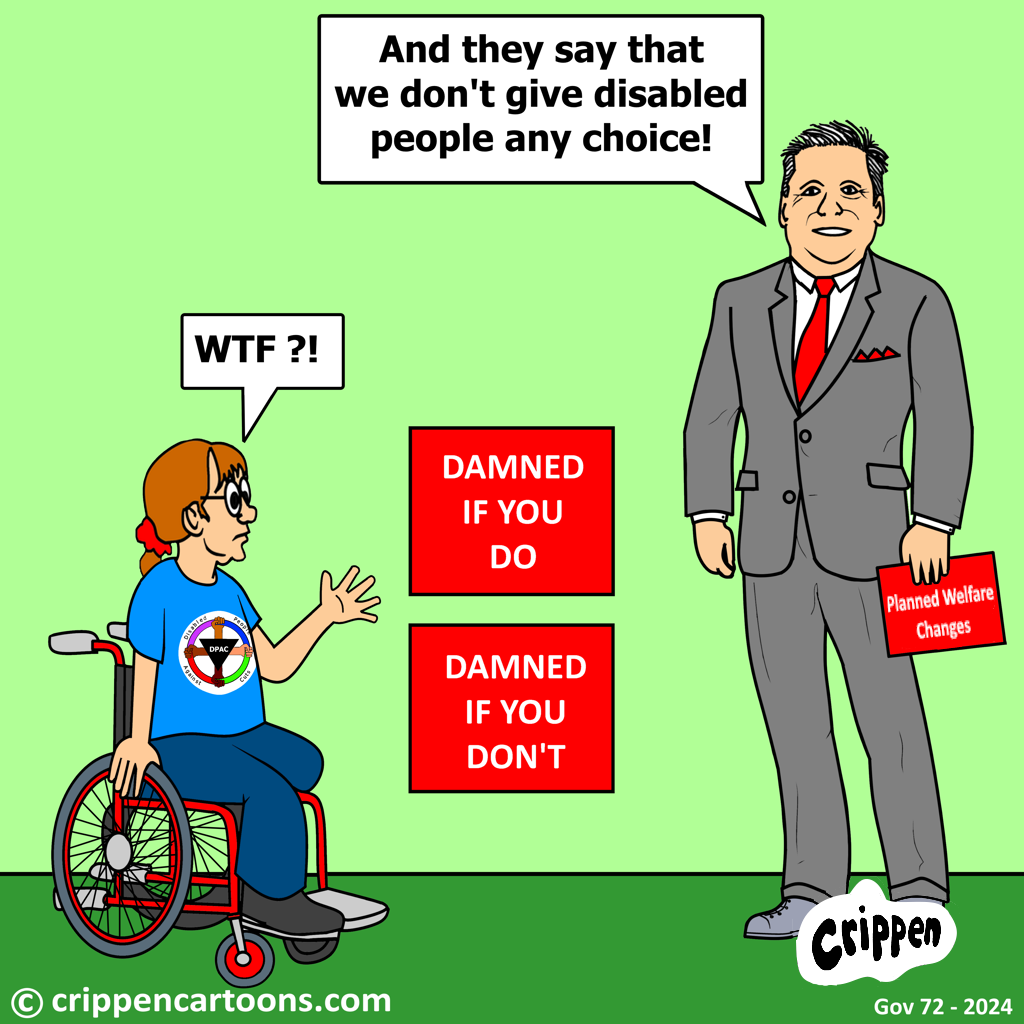
Crippen agrees that cuts to disability benefits in autumn budget would plunge disabled people into deeper poverty
However, since then the chancellor has changed her tune and as reported in my previous blogs she has told parliament recently that within the autumn budget she intended ‘taking difficult decisions’ on social security, and said she ‘will look closely at our welfare system, because if someone can work, they should work’.
Many disabled people already face a system that is threadbare, where financial support is regularly cut or removed altogether as a result of bad decision-making. For most, the prospect of further cuts to financial support is terrifying.
Anela comments further:
“Much has been made of the previous government’s ill-conceived proposals to make radical changes to personal independence payment (PIP). Among a raft of troubling proposals was a suggestion that PIP cash payments could be replaced with vouchers. Labour has yet to set out its intentions with regards to PIP, but notably have said that they are ‘reviewing the responses people have made to the previous government’s consultation’.
“The new government has also been worryingly silent about its plans for the work capability assessment (WCA). Its manifesto said that the WCA ‘needs to be reformed or replaced’, but Labour has so far failed to provide much detail about what this would mean in practice.”
The basic rate of universal credit is just £91 per week for a single person. It’s hard enough living on this if you’re in good health and able to look for work: Trussell Trust polling released last week found that almost half of those on universal credit ran out of food in the past month. But imagine being seriously ill for months on end, and potentially for life, and having to live off this meagre amount.
The Office for Budget Responsibility analysed the previous government’s plans to encourage people to enter work and predicted that only 3% of those affected by the cuts would move into work as a result of these reforms. That leaves the remaining 97% having to survive on the lowest rate of benefits for an indefinite period.
That’s even before we consider that there is an active legal case against the consultation on which the plans are based. The disability activist Ellen Clifford, supported by Public Law Project and backed by Z2K, is bringing a claim against the rushed and unfair consultation on these plans, due to be heard on 10-11 December. If successful, the action could make the justification for bringing forward these plans even shakier.
Anela adds: “The new government has a real opportunity to reset the relationship between disabled people and the DWP. Bringing forward these poorly thought-out and dangerous proposals would taint these efforts before they’ve even begun. We need to see a health and disability benefits system that provides security and support, not one that pushes disabled people into deep poverty and leaves them at risk of sanctions.”
Anela Anwar is chief executive of anti-poverty charity Z2K.
Reproduced by kind permission of Crippen
The UK Disabled People’s Movement mourns the sad passing of Micheline Mason, disabled activist, author, artist and founder of The Alliance for Inclusive Education (ALLFIE).

Crippen remembers Micheline Mason
In a moving tribute by her colleagues at ALLFIE, Micheline is remembered as a remarkable activist who dedicated her life to campaigning for inclusive education and the rights of all Disabled people to be educated in mainstream settings. As a Disabled mother of a Disabled child, Micheline was determined that her daughter, Lucy, now an adult, would attend her local mainstream school rather than be segregated from society, as this was her own experience within the education system.
Micheline often explained how she formed ALLFIE around her kitchen table, alongside a group of parents determined to ensure their children were educated equally, and formed the pivotal inclusive education group, Parents for Inclusion. She said:
“I started the Alliance for Inclusive Education 30 years ago now. At the time I was a parent of a Disabled child who was 4. Who was coming up to school age. Having been educated myself for 14 years at home on the sofa and then 3 years in a special boarding school which brought great problems to me when I left. I was so determined as a mother that my daughter wasn’t gonna follow the same path as me. And ever feel excluded from her local community. I felt she deserved to have all the same opportunities as any other child, possibly even more because she needed, she would have limited choices because of her impairments.”
All her life, Micheline, alongside other activists, drove forward the inclusive education movement, it is now a global campaign that remains one of the most powerful tools in combating societal inequalities and discriminatory practices. Micheline played a crucial role in supporting other parents of Disabled children in advocating for their child’s right to attend a mainstream school. She was instrumental in introducing national policy changes and reshaping the language around inclusive education.
She will be sadly missed by her family, friends, colleagues at ALLFIE and Parents for Inclusion and also fellow disabled activists from around the world.
You are invited to leave your own tribute to Micheline on the ALLFIE web site.
Reproduced by kind permission of Crippen
Disabled activists and allies defied bureaucrats to ensure that the delivery of 650 copies of John Pring’s ‘DWP violence’ book was delivered to MPs.
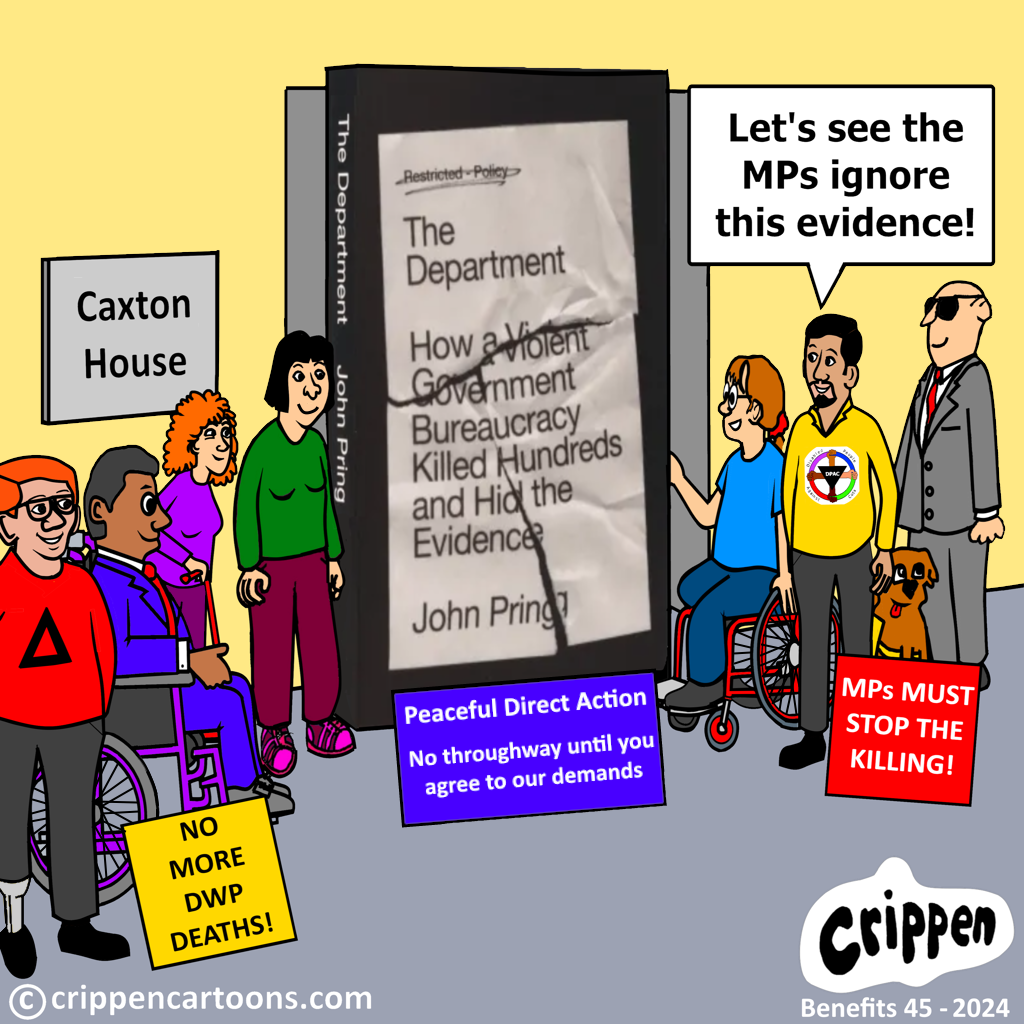
Crippen and the Caxton House protest
Although they had been assured weeks in advance – both by the House of Commons Post Office and Commons security – that they would be allowed to bring in the copies through the security scanners at Portcullis House, managers refused to allow them to bring in the sealed envelopes, each addressed to an individual MP.
Using negotiation and peaceful direct action, activists – led by Disabled People Against Cuts and Black Triangle – used the books to block the public entrance to the building for more than an hour. Their action ensured that every MP received a copy of The Department, which details how DWP’s actions eventually led to the deaths of hundreds, if not thousands, of disabled people in the post-2010 austerity years.
After meeting outside DWP’s Caxton House offices last week, activists – including relatives of two of the disabled benefit claimants who died – carried all 650 copies across Westminster to Portcullis House, where many MPs and the House of Commons Post Office are based.
Among those who supported the event were Gill Thompson – whose brother David Clapson died in July 2013, three weeks after having his jobseeker’s allowance sanctioned – and her husband Mike. She said that the crowdfunding and action had been “quite an achievement … We have had our obstacles, but we got there in the end. That book has given me David back, it’s put him in a human light and given him back his dignity that [DWP] took away from him.”
Another supporting the action was Joy Dove, whose daughter Jodey Whiting took her own life in February 2017, 15 days after she had her out-of-work disability benefits wrongly stopped for missing a work capability assessment.
She said: “These MPs need to see the stories in the book, how each and every family has suffered the life-changing loss of a loved one. There needs to be change now there’s a new Labour government.”
She said she was encouraged that her new Labour MP, Chris McDonald, asked to meet her outside Portcullis House, and supported her campaign for justice.
The project has been led by disabled activists, including Black Triangle Campaign, DPAC and the UK Deaf and Disabled People’s Organisations’ Coalition, and supported by disabled people’s organisations, allies and families of those who have lost their lives, as well as Pluto Press, which has published The Department.
Among the organisations supporting the campaign are Disabled People Against Cuts, Greater Manchester Coalition of Disabled People, Inclusion London, Disability Rights UK, Recovery in the Bin and the radical working-class media organisation The Canary.
John McArdle, co-founder of Black Triangle Campaign, whose idea it was to launch a crowdfunder that paid for the purchase of the books, said: “The Department provides a casebook of how not to run a social security system. The current disability benefit assessment system is making people even sicker. Pushing disabled people into work that medical experts say we cannot do won’t address labour shortages and more disability benefit cuts, as the government has planned, are not a common-sense strategy for ‘fixing the foundations’.
“Instead, Deaf and disabled people and our organisations call upon the government to sit down with us to co-produce a safe and efficient disability benefit system that provides a genuine safety net to those who need it.”
Author and activist Ellen Clifford, from the UK Deaf and Disabled People’s Organisations’ Coalition, who has helped lead the project, said: “The success of the crowdfunder shows how important it is to people outside the Westminster bubble that our elected politicians finally address the grave injustice of DWP attacks on Deaf and disabled people. Across the UK, there is growing concern about the impact of yet more cuts. It is apparent that lessons from the past are being deliberately ignored.”
Read the full story in Disability News Service.
Note: I urge you to purchase a copy of John’s book. It contains a blow by blow account of how the DWP has affected the lives of thousands of disabled people by their use of “bureaucratic violence”.
The Department: How a Violent Government Bureaucracy Killed Hundreds and Hid the Evidence, by DNS editor John Pring, was published by Pluto Press last month.
Reproduced by kind permission of Crippen

Crippen and John Pring’s important new book
The book, entitled The Department: How a Violent Government Bureaucracy Killed Hundreds and Hid the Evidence, by Disability News Service (DNS) editor John Pring, was published by Pluto Press on Tuesday 20th August 2024.
It describes John’s 10-year investigation into how the actions of DWP, spurred on by politicians and the outsourcing industry, led to the deaths of hundreds, and probably thousands, of disabled people, and how they covered up their role in those deaths.
It includes new documents obtained from the National Archives that show how the violence inflicted on benefit claimants built slowly from the late 1980s until it exploded in the post-2010 austerity years.
It also tells the stories of some of those who lost their lives because of that bureaucratic violence, following years of dehumanisation and destitution, and the impact on their families and friends.
At the time of this blog going out the crowdfunder had reached its fundraising goal of £7,000. The original aim was to raise £3,500, enough money to send a copy of The Department to every Labour MP in the House of Commons. But the campaign was so successful that the target was doubled, and the aim extended to MPs from other parties.
Now organisers of the campaign hope to raise enough to provide copies of the book to other leading politicians across the country, including some members of the legislative assembly in Northern Ireland (MLAs), Welsh assembly members, members of the Scottish parliament (MSPs) and other key figures such as elected mayors.
They also plan to use some of the funds to organise a campaign event in parliament on 2 September, the day MPs return from their summer break and the same day the books are due to be delivered to the House of Commons.
Among the organisations supporting the campaign are Disabled People Against Cuts, Greater Manchester Coalition of Disabled People (GMCDP), Inclusion London, Recovery in the Bin and the radical working-class media organisation The Canary.
Rick Burgess, a GMCDP spokesperson, said: “While the DWP dictates policy from Westminster, the devastating and harmful effects are felt everywhere. It’s fantastic the crowdfunder has reached its stretch goal.”
The idea for the crowdfunder came from John McArdle, co-founder of the disabled people’s grassroots group Black Triangle, who is leading the project with fellow disabled activist and author Ellen Clifford, who leads the coalition of disabled people’s organisations monitoring the UK implementation of the UN’s disability rights convention.
John Mc said: “Politicians across the country need to know the devastating impact of austerity on disabled people, so they can use that information when making their own decisions on vital local services. Successive Conservative-led governments used austerity as a justification for cutting disabled people’s support. This book shows how they did that and how it led to countless deaths.
Ellen Clifford has described it as “an expertly crafted, vigorously researched response to the gas-lighting endured by disabled benefit claimants at the hands of government and the DWP for the past 14 years” and “a powerful call to arms for all decent human beings”.
Read the full story in Disability News Service
Reproduced by kind permission of Crippen
As we suspected, the first report of the UK Covid-19 Inquiry has shown how successive governments displayed a “criminally negligent” attitude towards protecting disabled people and other groups at risk from pandemics.

Crippen hears how first Covid inquiry report shows criminal neglect
Disabled people’s organisations, speaking to Disability News Service (DNS) said this week that it was no surprise that the report concludes that years of pre-pandemic planning exercises had failed to take enough account of people with pre-existing health conditions, those living in deprivation, and those from minority ethnic communities.
The report says that emergency planning “generally failed to account sufficiently for the pre-existing health and societal inequalities and deprivation in society”.
And it says there was a failure to “appreciate the full extent” of the impact of government measures and long-term risks from the Covid pandemic on minority ethnic communities and those with “poor health or other vulnerabilities”.
It concludes: “When the pandemic struck, many of those who suffered and many of those who died were already vulnerable.
“The evidence from several voluntary, community and social enterprise organisations was that both the disease and the response to the emergency had a disproportionate impact on vulnerable people.”
The report says it will be “critical” now to “identify which groups of vulnerable people are likely to be hardest hit by a pandemic and the reasons why”.
You can read the full story in DNS.
Reproduced by kind permission of Crippen
Disabled people are back “in the firing line” on spending cuts, disabled activists have warned, following decisions announced by Labour’s new chancellor, Rachel Reeves.
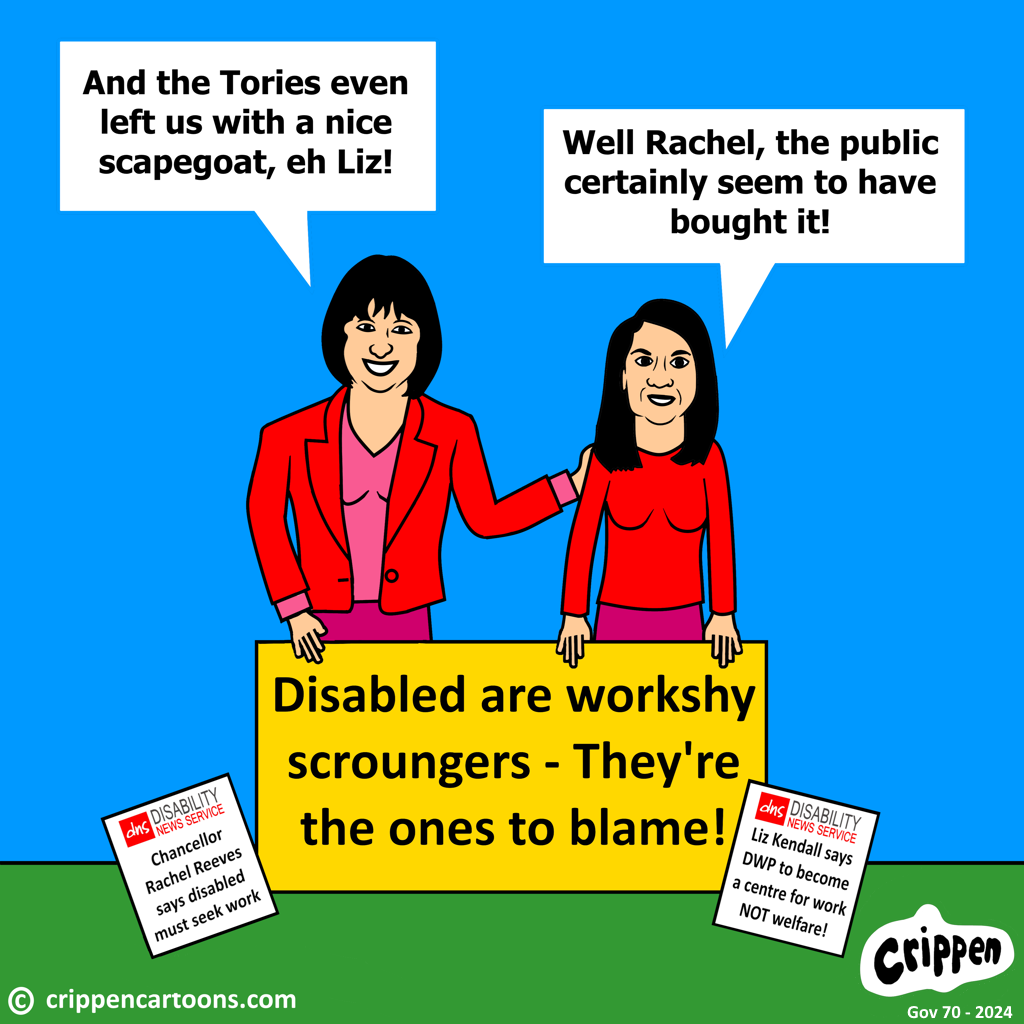
Crippen – Disabled people ‘back in the firing line’ on cuts
Reeves told MPs that there would be cuts to social care and winter fuel payment to address what she described as a “£22 billion hole in the public finances” left by the previous Tory government.
Reeves also warned that she would “look closely at our welfare system, because if someone can work, they should work”.
As reported in Disability News Service (DNS) she told MPs: “We will ensure that the welfare system is focused on supporting people into employment, and we will assess the unacceptable levels of fraud and error in our welfare system and take forward action to bring that down.”
Her comments mirrored those by work and pensions secretary Liz Kendall, who suggested last week that she wanted to increase pressure on disabled people to move off benefits and into work, while disregarding risks to their health, and that she wanted the Department for Work and Pensions (DWP) to move from being “a department for welfare” to becoming “a genuine department for work”.
Also among a series of other measures, she also appeared to suggest that cuts to benefits would be announced later in the year, and that it would “not be possible” to take forward reforms to adult social care charging that were repeatedly delayed by successive Conservative governments.
The announcement came just days after a report by the disabled people’s organisation Disability Law Service showed that disabled people across England were continuing to face unlawful discrimination and inequality on an “unparalleled” scale due to “unjust” social care charging policies.
Disabled campaigners have also raised serious concerns about Reeves’ announcements and comments.
Fazilet Hadi, head of policy at Disability Rights UK, said the chancellor’s comments on economic inactivity “were interchangeable with those of the previous government”.
She said: “The reasons for more people being unable to work due to disability and ill health isn’t down to a poor work ethic, it’s because of an ageing workforce, high levels of mental distress, lack of NHS treatments, a failing social care system and negative employer attitudes and behaviours. We heard nothing about tackling these underlying drivers of ill health and disability … This was a truly shocking move from a new UK government, which purports to be on the side of the most disadvantaged people.”
Linda Burnip, of Disabled People Against Cuts (DPAC), said she had expected the new Labour government to be “awful” but it had so far been even worse than she could have imagined.
She added that this new Labour government did not appear to recognise the “holistic” approach that would need to be taken if it wanted more disabled people in work, including funding free social care, fixing the NHS and the mental health system, and ensuring a well-functioning Access to Work programme, accessible transport and flexible working hours.
Linda said the announcement suggested Reeves wanted those disabled people who could not work to be left without any support at all, or even deported to Rwanda.
She said: “I dread to think what else she’ll try to cut. Older and disabled people will be in the firing line, though, from the looks of things so far.”
Rick Burgess, a spokesperson for Greater Manchester Coalition of Disabled People (GMCDP), said of the Reeves comments on benefits spending: “This hostile rhetoric is all too familiar to us. Not only does this approach fail to solve the long-standing problems of our social security system, it is also lethal.”
You can read the full story in DNS.
Reproduced by kind permission of Crippen

Crippen hears how Labour intend to follow previous Tory policy
And what have we here?
Yet another example of Labour’s intention to follow the lead of the previous Tory government. This time it’s their plan to increase pressure on disabled people to move off benefits and into work, completely disregarding risks to their health!
Set around a controversial report by the Pathways to Work Commission which makes a call for Department for Work and Pension (DWP) to become a “department for work” Liz Kendall, in her new role as Secretary of State for Work and Pensions, announced this week that she wanted the DWP to move from being “a department for welfare” to becoming “a genuine department for work”.
It is one of several similarities between the report and comments made by Kendall as reported in Disability News Service (DNS).
Although she did not formally endorse the commission’s recommendations, she called it a “pioneering” report and welcomed many of its conclusions, and there will be concerns that its work has already influenced her plans to reform DWP.
The report focuses strongly on the need to push more people with long-term health conditions into work and includes a controversial recommendation for DWP to introduce a “duty to engage” with employment support.
It says this should apply to all those who currently receive benefits and are “economically inactive”, which it suggests will “support more of them into work”.
This would mean disabled people who currently do not have to engage with the department and its work coaches – for health or disability-related reasons – would be forced to do so.
Is it me or isn’t that what her Tory predecessor was saying?!
You can read the full story in DNS.
Description of cartoon for those using screen reading software
This cartoon takes place in the Department of Work and Pensions (DWP). A sticker sits across the department sign and reads ‘Work NOT Welfare’. A DWP clerk sits at a desk with a laptop computer. He is saying to a young disabled woman in a recliner wheelchair: “Have you thought about what job you’d like?”. She replies: “How about a politician – I can bullshit with the best of them!” Standing alongside of them is a caricature of Liz Kendall. She is saying: “And there we have it – Labour’s new initiative to get disabled people off benefit and into work!”

"Atos don't give a toss"
On the last Day of Action Against Benefit Cuts protests, actions and demonstrations were organised in Dundee, Edinburgh, Westminster, Leeds, Liverpool, Bristol, Newcastle, Brighton, Glasgow, Poole, Burnley, Islington, Kensington, Cardiff, Poole and Truro. This time we’ve got all week!
Disability activists, claimant groups and anti-cuts campaigners have called a week of action against poverty pimps Atos Origin beginning on Monday 9th May with a picnic and party in Triton Square*, home of their head office, at 2pm.
Atos Origin have just begun a £300 million contract by the Con-dem Government to carry out ‘work capability assessments’ on all of those claiming Incapacity Benefit.
It is claimed assessments are to test what people can do rather than what they can’t. The real purpose is to strip benefits from as many people as possible.
This testing system has already led to people with terminal illnesses and severe medical conditions being declared fit for work and having benefits cut. GP’s are ignored in favour of decisions made by Atos Origin’s computer.
Plans announced for the scrapping of Disability Living Allowance have also revealed that this intrusive testing is likely to be extended to everyone on some form of disability or health related benefit.
To date around 40% of appeals against Atos Origin’s decisions have been successful.
On the 24th January claimants from around the country demonstrated outside Atos Origins premises, with many choosing to close for the day rather than face their ‘clients’. We call on all groups around the UK to take action against these parasites who have been dubbed ‘the racial purity and euthanasia arm of the DWP’
A list of Atos Origin’s corporate offices and testing centres can be found via: https://benefitclaimantsfightback.wordpress.com/2011/04/15/national-week-of-action-against-atos-origin-begins-monday-9th-may/
If you are holding an event, protest or action in your home town please add details on the wall below to have your event added to this page and the website. Alternatively contact us at: notowelfarecuts@yahoo.co.uk
*Triton Square is on the North side of Euston Road, just over the road from Warren Street tube and less than five minutes from Euston/Euston Square or Great Portland Street tube stations.
facebook event at: https://www.facebook.com/event.php?eid=121624627914913
Supporting groups (please contact us to be added to the list)
Supported by:
o Armchair Army
o Anti-Benefit Cuts Glasgow
o Black Triangle Anti-Defamation Campaign
o Brighton Benefits Campaign
o Cardiff’s Unemployed Daytime Disco
o Carer Watch
o Carer Watch fb page
o Crippen – Disabled Cartoonist
o Diary of a Benefit Scrounger
o Disabled People Against Cuts (DPAC)
o Dundee Unemployed Workers
o East Lancs Right to Work
o Edinburgh Coalition Against Poverty (ECAP)
o Free London Listings
o Goldsmiths in Occupation
o Haringey Solidarity Group
o Ipswich Unemployed Action
o Islington Deaf and Disabled People Against Cuts (IDPAC)
o Islington Hands Off Our Public Services (IHOOPS)
o Islington Poverty Action
o Kilburn Unemployed Workers Group
o Lancaster and Morecambe Against the Cuts
o London Coalition Against Poverty (LCAP)
o London Foodbank
o Mad Pride
o Medway Against The Cuts
o Mental Health Resistance Network
o Norfolk Community Action Group
o Nottingham Claimants’ Union
o Nuneaton Against Benefit Cuts
o Oxford Save Our Services
o Squattastic
o Tyneside Claimants Union
o Welfare Action Hackney
o Welfare Rights 4 u (UK)
o Work Programme & Flexible New Deal Scandal
o World Homeless Day