Oct 062026
 
DPAC Logo with text underneath "Disabled People Against Cuts" and then web address dpac.uk.net
A graphic urging people to write to their MP. It says "The Timms Review" in the Government's font on a blue background, and beside has the word "Rebellion" in the style of cut up newspaper letters. Also pictured are three women with a red flag and a placard. One of the women is a wheelchair user. "Write to your MP" is in bold rounded text overflowing a comic-book style yellow star shoutout.

Benefits and Work is urging readers to begin challenging the Timms review right now, rather than waiting until its final report is published.

We’ve carried the full article below.

Afterwards, we’ve provided some template/example letters that you might find helpful. There are also more template/example letters in the comments on the original article from Benefits and Work.

You can jump straight to our template/example letters here.


Benefits and Work said:

Benefits and Work is urging readers to begin challenging the Timms review right now, rather than waiting until its final report is published.  We’re providing some suggestions about issues you can raise with your MP.

Many people feel that it is best not to speculate about what will be in the final Timms review and only respond when we see what it recommends.  But there is a danger of leaving things too late if this approach is taken, for at least three reasons

Backbench opinion is changing

Firstly, it is clear that the government have been working hard to move backbench opinion in favour of welfare reform, having learnt the hard lessons of their disastrous four-point PIP proposal.  Some of the MPs who were at the forefront of the rebellion last year are now talking much more positively about benefits change.

As far back as June of this year, Meg Hillier – a leading rebel against the PIP four-point plan – said that Alan Milburn’s interim report on youth unemployment was a “game-changer” and that opinion in the Labour party on welfare reform is “worlds apart” from last year.

Louise Haigh, another leading welfare rebel, who the Guardian calls “an influential adviser to Burnham”, said  on the eve of the release of the Timms review interim report that welfare reform is essential to tackle the ballooning welfare budget.

Lack of real detail

Secondly, it seems increasingly possible that the final report will tell us very little more than we already know about two of the most important issues:  assessment pathways and disability-related costs.

With so little time left after the current workshops conclude, it is now looking more likely that the Timms review will only set out the broad principles of a wholly new disability benefit.  The details of how it will actually work – where pathways will lead, how eligibility for PIP or its replacement will be decided and how disability-costs will be calculated – may be left to the DWP to decide later, perhaps with some token consultation.

There is no point in waiting for a detailed report that may never appear.

Failure to consult

Thirdly, there is no need to even address the possible recommendations of the Timms report.  The utter failure to genuinely consult with disabled claimants, let alone co-produce the report, is grounds for objections right now.

Once the final report is out, attention will be on what is in it, rather than how it was created. The opportunity to question the whole legitimacy of the report may be lost once it is published.

Challenge now

So, we are encouraging claimants to begin contacting MPs now, in order to challenge the legitimacy of the whole Timms review process before it is complete.

Because we can be certain that the Timms review final report will insist that disabled people have been involved at every stage of the review.  This is one of the major ways they will aim to get backbench support.

This slide, shown to participants of the September to October workshops, demonstrates the kind of claims they will make.

It lists:

  • A Call for Evidence submitted by 38,713 people
  • A national survey with disabled people
  • DWP administrative data
  • Workshop in a box submissions
  • Sessions with experts and resources shared by SG [steering group] members

This is the kind of evidence that the DWP will be thrusting at MPs, but the reality is very different.

Above all, the DWP will claim that the report was co-produced with disabled people and Disabled People’s Organisations. Timms himself gave repeated undertakings to co-produce the review with disabled people, such as:

“The Timms Review will be co-produced with disabled people, the organisations that represent them and other experts to ensure that expertise from a wide range of perspectives is drawn upon. This means the Government will share ownership and responsibility for how the Review runs and what it recommends.”

(Stephen Timms, Parliamentary written answer. 20 October 2025)

“Hearing from disabled people across the UK is vitally important to inform the Review.

“That is why we are co-producing this review with disabled people every step of the way — to make sure that PIP is truly fair and fit for the future.”

(New engagement toolkit puts disabled people at the heart of the Timms Review 8 June 2026)

In reality, there is overwhelming evidence that this level of shared ownership and co-production never happened.  Below are some of the issues we think are worth raising with MPs.

Co-chairs were recruited by an unexplained process

The two co-chairs were appointed by the DWP using a process that was never open to scrutiny, with no published selection criteria or account of how they were selected or by whom.  That is secrecy, not co-production.

The steering group member selection criteria ruled out most PIP claimants

The Timms review steering group members were selected by Timms and the co-chairs using criteria that were always likely to rule out many ordinary PIP claimants who had much lived experience of the benefit, but not of policy or strategic engagement.  One of the essential criteria was that applicants needed:

“Experience being involved in strategic engagement on matters relating to disability, long-term health conditions or social security-related issues.”

This was always likely to rule out most applicants, as the DWP would have been aware.

The steering group members are not representative of most PIP claimants

Because of the criteria used to select steering group members, they are extremely unrepresentative of the majority of PIP claimants.  Around 80% of PIP claimants are not in employment, although many will have been employed in the past.

Yet the review steering group is made up of high-achieving Paralympians, company directors, academics, policy specialists and entrepreneurs.  There is no reason why such people should not be on the steering group, but there is every reason for them not to make up the entire steering group.

Only two of the steering group members could be regarded as welfare benefits specialists, according to the biographies published by the DWP.

One of these, Jean-André Prager, was a Downing Street special adviser covering the DWP in 2024, when Rishi Sunak’s Conservative government published their infamous Modernising Support for Independent Living Green Paper, which called for a disability-costs based PIP system with some cash payments being replaced by vouchers, equipment or services.

He is also the lead author of a report published this October by a right-leaning think tank calling for savage cuts to reduce the number of children getting DLA for mental health, learning difficulties and neurodevelopmental conditions by up to 70%.

The other benefits specialist is Professor Ben Geiger who was seconded to the DWP in 2015-16 and who had already told Timms years before the review that the DWP should “have a look at the extra costs that people face and how those match up to the assessment”.  If the DWP already had in mind a disability-related costs-based replacement for PIP, these are two experts they would have been happy to have on the review.

There has been no general consultation with disabled people

There has been no general consultation with disabled claimants about the September proposals for cost-based assessment system.

There was a confusing Call for Evidence with just four questions, including some extremely complex ones, such as:

“Does the PIP assessment, including the assessment criteria, effectively capture the impact of long-term health conditions and disability in the modern world, and provide fair access to the right support at the right level across the benefits system?”

The DWP have made much of the fact that the Call for Evidence received over 38,000 responses.  But this was not a consultation and it did not set out options for change and ask respondents to say which they preferred.

The review also commissioned a survey of 2,000 working-age disabled people which allegedly asked for their views on welfare reform.  But the survey ended on 17 August 2026, before the review unveiled its costs-based PIP awards recommendation in September, and absolutely no details of the questions or results have so far been made public.

Disabled People’s Organisations (DPOs) were not involved in creating the Timms review recommendations.

DPOs were not given any opportunity to shape the recommendations of the Timms review, according to Disability Rights UK, they are only being asked to comment on them now they have been published:

Sophia Kleanthous, Campaigns and Policy Officer at Disability Rights UK said:

“The Government has consistently failed to properly include Disabled People’s Organisation’s in decisions and processes that affect us, including a lack of notice of significant updates and decisions during the Timms Review process, and not co-producing any part of the Review with DPOs despite promises to do so. The next stage is for the draft Review recommendations to be considered by Disabled people, DPOs and charities at a number of round tables, to gain feedback on the draft Review recommendations”

DRUK have produced a briefing paper for disabled people who want to challenge the Timms review, which you can download from this page.

The Timms review workshops were not co-produced and the Timms review has admitted this.

The Timms review scheduled a series of workshops between 15 September and 7 October.

However, these were not co-produced with disabled people, as the DWP admitted in the slides sent out to attendees which explained:

“The steering group recognise that these workshops have not been co-produced but are important opportunities to hear directly from people who interact with PIP.”

The Timms review workshops asked for responses to proposals that were meaningless because of lack of detail.

Disabled people have never had an opportunity to give their opinions about the final proposals because these have never been set out in sufficient detail to be able to assess them.

On the massively important issue of PIP awards being calculated on the basis of disability-related costs in the future, the only information given at workshops was:

“The award will contribute fairly to the extra costs that arise from disability and long-term health conditions and reflect fluctuating and cumulative impacts.

“Cost categories used to discuss the person’s circumstances, and therefore determine their award, could include: equipment and aids; mobility and transport; clothing and bedding.”

It is nonsensical to claim that such scant information could form the basis of a genuine consultation, let alone co-production.

It’s also worth noting that when we put these few details to Benefits and Work readers, 80% of over 5,000 respondents did not support the idea of a disability-costs related award.

The DWP only wanted to fund Timms initiatives it selected

The DWP awarded £1 million to a private sector company, The Public Service Consultants (PSC), for assistance in the co-production of the Timms review. PSC facilitated the workshops at which attendees were asked to put counters on a stripey sheet of paper to show their degree of support for different proposals.  Funding was provided to ensure venue accessibility, pay transport and support costs and make payments to each individual attendee.

By contrast, when it came to the “Workshop in a box” initiative in which disability groups were given access to some slides and other material to run their own workshops, the DWP initially failed to provide any funding whatsoever.

After protests, the DWP agreed to fund some “Workshop in a box” events, but only “up to 50” organisations selected by the Timms review itself and “proactively contacted by the DWP”.

In other words, these were not even necessarily the organisations that had initially wanted to run the workshops.  Instead, cash-strapped organisations not hand-picked by the Timms review were left to cover all the costs of organising and facilitating the events themselves – or not run them at all.

The Commons Work and Pensions Committee (WPC) has concerns about the degree of co-production by the review.

On 17 September 2026, the WPC wrote to the Timms review asking a series of questions.  The WPC said they were concerned that the review’s approach to co-production “does not ensure, for example, disabled members of the Review have shared power in decision-making”.

In other words, MPs are worried that even Timms steering group members may not have real power to decide how the review is run or what recommendations it makes.

Tellingly, the letter also asks for information about “how many of the 63 UK DPOs were engaged in the review” and “when you will publish proposals on assessment criteria and descriptors”

Contact your MP

It is overwhelmingly clear that disabled people and their organisation did not “share ownership and responsibility for how the Review runs and what it recommends”.

It is also the case that no detailed proposals will have been consulted on – they probably won’t even have been published – prior to the final report being passed to the secretary of state.

You might want to raise some or all of the issues above with your MP.

Or you may just want to tell your MP that you don’t consider that there has been any real effort to consult with disabled people about the actually recommendations of the Timms review and you want your MP to be clear about this when the Timms review final report is published.

There’s more on how to contact your MP here

If you do contact your MP, please consider posting a copy of what you wrote below – removing any personal details – to give other readers ideas and encouragement. It may be worth trying to avoid using AI to write your email, as MPs are probably getting very adept at spotting AI generated content and may pay it less attention. Something short and from the heart may be more effective.

And if you do get a response, we’d love to see that too.

Comments can be posted on the original article by Benefits and Work


Here are some template/example letters by DPAC:

How to contact your MP here

It is always better to use your own words, but these may help give you some ideas.

Always be respectful in your email, because otherwise the MP will have an excuse to not even read it.

Always give your postcode. Ideally give your full address. MPs will not respond if they cannot check you are their constituent.


Template/example 1

Dear [MP’s name],

The Government is looking at the money given to Disabled people. This is called the Timms Review.

The Government said it would listen to disabled people and we would work together to write the review. This is called coproduction.

But this has not happened properly. Disabled people are worried that some of the changes will be bad.

Please stand up for Disabled people like me. Tell the Government to listen to us. Don’t let the Government lie about coproduction.

From

[Name and address]


Template/example 2

Dear [MP’s name],

I am writing as your constituent about the Timms Review and potential cuts and changes to disability benefits like PIP.

Sir Stephen Timms promised that the review would be coproduced with Disabled people and our organisations. I want you to be clear that this has not happened at all.

Instead, £1 million of public money went to private consultants to manage us.

I hope that you will vote against any future disability cuts, even if purely on the principle that the promise that Mr. Timms made to MPs like you in parliament should mean something.

PIP needs to change, but please don’t support short-sighted proposals designed over the objections of Disabled people.

When PIP was first introduced, it was intended to save 20%. Instead, it delivered a punitive system that ended up costing even more.

I’m worried the same thing is going to happen again.

We need a genuine review, led independently by Disabled people and our organisations. That’s the only way we will create a better system that works for everyone.

Yours sincerely,

[Name and address]

Jan 152026
 
DPAC Logo with text underneath "Disabled People Against Cuts" and then web address dpac.uk.net

The words "We want an Independent PIP Review" in bold and black text, with Independent highlighted in red. On the left there is a tear-out effect of a greyscale photo of a disability protest, and a red-tinted photo of Stephen Timms, the disability minister.

As the UK Government review into the Personal Independence Payment (PIP) gets underway, a disability campaign group in Wales has today launched an open appeal to the panel members.

The ‘Timms review’, named for the Minister of State for Social Security and Disability Sir Stephen Timms, could affect more than 275,000 people in Wales claiming the disability benefit.

Disabled People Against Cuts Cymru (DPAC Cymru) have, however, raised a number of concerns over the fairness of the review.

They say there are longstanding unaddressed concerns with the way the Pathways to Work consultation was carried out last year, particularly in Wales, and they want the review to examine this to make sure those mistakes aren’t repeated.

They say they are also appealing to the panellists to make sure that the review is genuine, that the outcome is not predetermined, and are calling for participation to be widened.

DPAC Cymru’s call for an independent review, democratically led by disabled people and their organisations, received wide support in Wales from disability groups, trade union organisations, and politicians.

At a lobby of the Senedd late last year, Sioned Williams MS, Plaid Cymru, said “Plaid Cymru backs their call for an independent review of PIP, led by disabled people.”

Dr. Atlaf Hussain MS, Shadow Cabinet Secretary for Equalities & Social Justice, Conservative, also said “I fully support Disabled People Against Cuts Cymru (DPAC Cymru) and their call for an independent, disabled-led review of Personal Independence Payment (PIP).”

Click here to read the letter to the panel members.

Click here for the Easy Read version.

A graphic of the DPAC Cymru logo. There is the main DPAC logo to the left, which is a red, pink, blue, and green circle being held by four hands of different skin tones, with the words "disabled people against cuts" surrounding it, and an upside-down black traingle in the middle bearing the letters D P A C. On the right is the word Cymru (pronounced cum ree) (C Y M R U) in large letters, and the background of the letters are cutouts of the Welsh flag. Above Cymru (pronounced cum ree) is written the words Disabled People Against Cuts. Below Cymru (pronounced cum ree) are the words Rights, not charity, and the equivilant phrase translated into the Welsh language.

The six “headline” asks of the appeal letter are that:

1. The review should examine how disabled people in Wales were treated unfairly by the UK Government last year, and make sure those mistakes aren’t repeated.

2. The review must be genuine, not predetermined.

3. The review must be independent, democratically led by disabled people and our organisations.

4. The review must have wide participation.

5. The review needs a wider scope for it to be successful.

6. The review must engage with the 1.4 million disabled workers organised democratically in their trade unions.

No matter what the review concludes, the final say rests with ministers. DPAC Cymru will do our part to ensure that disabled people & carers are prepared to defeat the Government again if necessary.

Sep 132025
 
DPAC Logo with text underneath "Disabled People Against Cuts" and then web address dpac.uk.net

Calls for an independent PIP review with UK minister under fire

A Welsh disability group is calling for an independent review of Personal Independence Payments (PIP).

Disabled People Against Cuts Cymru (DPAC Cymru) has accused the disability minister Stephen Timms of failing to properly lead his own review into the disability benefit, saying that “co-production is not taking place as promised.”

Speaking exclusively to LBC’s Welsh Correspondent Caitlin Parr, the group’s comments follow the Minister of State for Social Security and Disability, Sir Stephen Timms MP, meeting with the Welsh Government Disability Equality Forum on Tuesday 2nd.

LBC news reported that DPAC Cymru had long fought for disabled people’s voices to be heard in changes to welfare reforms, but were concerned that the minister, despite promises to engage widely over the summer, had so far left Welsh disabled people out of discussions around the review, outside of those forum meetings.

DPAC Cymru claims that Timm’s attendance at those recent forum meetings is “far too little and far too late for Welsh disabled people after months of stonewalling from Timms,” and said they were frustrated by “more promises but no action.”

Ben Golightly, from Swansea, is a coordinator for DPAC Cymru. He told LBC, “he [Timms] agreed in that meeting that it was important for Welsh disabled people and Welsh disabled people’s organisations to be heard. He was meant to talk about how he was delivering co-production. It was his job to do it. And he had no real update, because he hasn’t been doing that job.”

Despite promises from government ministers, DPAC Cymru say that co-production has not taken place, and they are “back to square one.”

Ben said, “We had hoped that after a major defeat in parliament that when he [Timms] promised co-production with disabled people, that we wouldn’t have to go through all of this again. There is so little trust in the way the government has treated disabled people that we need an independent review, led by disabled people, and Stephen Timms and the government should turn up and listen, but they should have no say over how it’s run because they’ve shown, throughout several months, that they’re unable to do it.”

Lee Ellery, an independent disability activist and lead press coordinator for DPAC Cymru, who has Cerebral palsy quadriplegic, agreed, telling LBC news it’s time more Welsh voices were heard.

Lee said, “people with disabilities, particularly in Wales, are left to the bottom of the pile so to speak, and we should be at the forefront of everything. I’m worried about what the result of the [PIP] review might come out to say, if the person who’s leading it doesn’t understand the whole process.”

LBC news reported that “the Timms review into PIP assessments is expected to conclude in Autumn 2026, when changes already decided on for new PIP claimants will come into force.”

DPAC Cymru’s calls for an independent review, made in an open letter released last Monday, has already received wide support, collecting 600 signatures and the support of representatives of more than twenty-five organisations.

Comments collected from respondents talk about their feelings of hurt, being “belittled,” “completely disregarded and isolated,” and the “harm and loss of trust” caused by Timms and the government.

Signatures on the open letter are open until the end of September.

Sign here

A notice graphic with a red tinted photograph of Stephen Timms as the background. Title text to the left of him reads: "We want an independent PIP review" with emphasis on the independent. A divider then separates the next header text that reads: "Nothing about us, without us!", followed by another divider. Body text then reads: "Please sign and share our open letter!" with an arrow pointing to a link: "bit.ly/independent-pip-review". The DPAC Cymru logo sits at the bottom of the screen.
Sep 012025
 
DPAC Logo with text underneath "Disabled People Against Cuts" and then web address dpac.uk.net

The words "We want an Independent PIP Review" in bold and black text, with Independent highlighted in red. On the left there is a tear-out effect of a greyscale photo of a disability protest, and a red-tinted photo of Stephen Timms, the disability minister.

This is an open letter from DPAC Cymru, produced with feedback from six Disabled People’s Organisations.

Disclaimer: DPAC Cymru didn’t have time to reach 100% agreed wording with DPAC UK, as we would have liked to. Even within DPAC Cymru, the letter wording is somewhat of a compromise. However, for important tactical reasons in Wales, we felt it was important to publish without delay. DPAC have therefore agreed to share the letter with this disclaimer.

Click here for the Easy Read version.

To:

The Welsh Government,

The Scottish Government,

The Northern Ireland Executive,

The UK Government,

1st September 2025

After a major, if partial, defeat in parliament over disability cuts, the disability minister Stephen Timms promised MPs that the PIP benefit review would be co-produced by disabled people and their organisations.

There is widespread skepticism if this will genuinely be the case. Promises to “engage widely over the summer” have not been met, and there has been no transparency over Timms’ plans for “ten people” to have “a lot of sway”. His comments reveal that he does not understand what co-production means. Timms has also repeatedly declined to acknowledge the many serious failures of the Pathways to Work green paper consultation process, particularly felt in Wales.

We counterpose this to the Disability Rights Taskforce, initiated in partnership with the Welsh Government, which brought together 350 stakeholders and 200 policy experts, as a model of what co-production can look like. However, many Taskforce participants were frustrated that much of their work was ultimately missing from the Welsh Government draft plan. This is a lesson that even co-produced policy will fall flat without accountability. Disabled people’s organisations must be given the necessary resources and powers to carry out the implementation and monitoring of decisions.

[Some of us] cautiously welcome[d] the announcement of the Government’s new Independent Disability Advisory Panel. This panel is separate to, but will feed into, the Timms review of PIP. However, trust remains very low, and the terms – of “up to 10” people – have already been set for us. [See update, below]

We the undersigned demand that:

• The new Independent Disability Advisory Panel must be genuinely independent, representative, transparent, and have real powers of oversight.

• The UK government must acknowledge its failures in delivering the Pathways to Work consultation and legislative process, as a precondition to rebuilding trust and ensuring those mistakes are not repeated.

• The PIP review must be independently led by disabled people and our organisations, inviting the views of carers, volunteers, and workers in health, social care, housing, transport, and welfare.

• Any review of welfare reform must also, in a process led by disabled people, involve trade unions as democratic organisations representing 1.4 million disabled workers as well as representing the workers responsible for the day-to-day delivery of services that disabled people rely on.

• The scope of the PIP review must be widened to all aspects of welfare and employment for disabled people, guided by the principle: from each according to their ability, to each according to their need.

• Dedicated funding must be provided to Disabled Peoples Organisations to support outreach, accessible engagement, and the collection of views from disabled people, including those without internet access or digital skills.

• The devolved governments of Wales, Scotland, and Northern Ireland, and councils, should recognise and support this independent review even if the UK government refuses to.

• The UK government must immediately halt all cuts to disability and incapacity benefits for the duration of the review, and urgently fix Access to Work.

• Parliament must be given time to properly scrutinise any new legislation.

• The UC bill should be repealed. It is flawed, and was rushed through in an abnormal and undemocratic way.


[Update 4th September] Statement from DPAC Cymru regarding the “Independent Disability Advisory Panel”:

“The recently published terms for the so-called Independent Disability Advisory Panel, including the requirement to sign a non-disclosure agreement, are completely unacceptable. We are going to go back to a full consultation with all of our members and allies and take time for discussion to correct the weakness in our compromise wording of ‘cautiously welcome’ and come back united, realigned on the strongest possible response. We hope you will continue to support the demand for an independent PIP review, led by disabled people, and support this letter with your signature.”


For a full list of signatures and footnotes, see here.

To add your support to the letter, add your signature here

Here are short URLs for sharing the letter:

Non-Easy Read: Bit.Ly/independent-pip-review

Easy Read: Bit.Ly/easy-read-independent-pip-review

Jul 012025
 
DPAC Logo with text underneath "Disabled People Against Cuts" and then web address dpac.uk.net

Stephen Timms, the Minister of State for Social Security and Disability, has now replied to the letter from Disabled People Against Cuts sent three weeks ago.

Our letter raised serious concerns with the quality and fairness of the so-called “consultation” being carried out on disability benefit cuts. We asked for the consultation to be extended, and for urgent action to address the failings.

Stephen Timm’s reply, available here, does not address any of the concerns, and he refuses to extend the consultation process.

The minister has not yet replied to the letter from DPAC Cymru, also sent three weeks ago, requesting a meeting following the failures of the DWP in organising the only in-person consultation on the disability cuts in Wales. That letter said:

We are concerned you still do not understand the failures of your department. We have had no indication from you, or the DWP, whatsoever, in any statement, that you understand that the consultation was organised in a way that was unsuitable for disabled people.

Given Timm’s lack of understanding of his department’s failures, we have no confidence in him leading a wider review into PIP.

Jun 272025
 
DPAC Logo with text underneath "Disabled People Against Cuts" and then web address dpac.uk.net

Dear Liz Kendall Secretary of State for Work and Pensions,
(For the attention of all MPs and ministers)

We the undersigned are trade unionists opposed to the Universal Credit and Personal Independence bill, designed to restrict access to PIP and to reduce the sickness element (LCWRA) of UC. We believe this is shameful anti-worker and anti-working class legislation.

We represent union members, advisers, caseworkers, officers, housing workers, work coaches, local government and charity workers, finance sector workers, and other roles who work with those on the sharp edge of the disability benefits system. Some of us are also disabled members or carers across our unions, with the double whammy of working in these organisations and being financially impacted. Over a decade of austerity has forced disabled people into even greater poverty, and these cuts will only exacerbate the underlying barriers and widespread discrimination that still shut disabled people out of the workplace.

Our experiences and knowledge of this sector can provide vital insight into the catastrophic impact the proposed welfare cuts are likely to have. The benefit system is already a punitive, degrading, and impoverishing system that has cost lives through assessments, sanctions, and disallowance of benefits. These cuts will only worsen that reality. Cuts kill – particularly as hundreds of thousands more are pushed into poverty.

Not only will these cuts cause increased financial hardship for some of those made vulnerable by a disabling society, but will also add considerable expenses and a much increased workload to workers in several sectors. This is because more people will be plunged into debt. More people will be served with eviction notices (as they won’t be able to pay their rent/bedroom Tax/service charges). In many cases, disabled workers will be faced with the possibility that they will lose PIP and no longer be able to afford to service the additional needs that enable them to remain in the workforce. Cutting incomes will push people further from work, just as sanctions do. This will create misery and resentment in addition to requiring further public services & resources.

The Disability Policy thinktank forecast that the cuts will lead to £1.2bn in extra costs for the NHS and local care services provided by councils, raising the alarm for both councillors and MPs whether the cuts will backfire even on their own economic terms.

More people:

  • won’t be able to afford food or bills, with 4 million already using foodbanks and limited or cut off energy supplies, whilst those industries’ bosses increase their profits off the back of us all.

  • will have their linked benefits stopped, including carer’s allowance and the carer element of UC, disproportionately impacting unpaid carers, women and children when child poverty and homelessness are already at record levels

  • will be excluded from work or forced into unsuitable work which worsens health, with many working families who rely on UC to top up poor wages also to be hit by the reforms.

Benefit cuts harm all working class people, increasing conditionality and forcing us to tolerate exploitative work and accept poorer terms and conditions. The scapegoating of benefit claimants intensifies division and competition and weakens solidarity in our communities.

Local government departments have faced cut after cut and already struggle to have enough staff or resources to support more in need. The voluntary sector has been needed to act up for several years to plug gaps due to Tory austerity, and currently struggles to meet demand.

Funding for debt advice has been reduced and there is insufficient support to help the current number of people with debt and advice.

Access to Work already sees delays of around a year for decisions to enable disabled people to take equal part in work. This is not being resourced as needed.

The proposed cuts by a Labour government will make all of this considerably worse:

  • It will further strain the already overburdened third and public sector. Staff stress will increase, when many already suffer anxiety and poor well-being in the third and public sector because of understaffing and excessive workloads.

  • Communities will be further demoralised and disenfranchised, or will turn to alternatives that do not represent working class interests.

  • The Trade Union movement should not only fight to defend the social security system from cuts, but also demand a transformative alternative that centres human dignity, regardless of ability to work.

  • DPAC and many others have argued for a welfare system that works for us all, removing the private sector involvement and its punitive measures.

With over £20 billion unclaimed, these cuts and the disproportionate targeting of disabled people do not add up. An FOI request found that 87% of those in receipt of the standard rate of PIP daily living, and nearly half of PIP claimants overall, could stand to lose out under the cuts – the scale is much more significant than the Government is letting on.

CPAG also estimated that the benefit bill has been held down by £36 billion annually as a result of caps, freezes and cuts since the 2010s, including the 2-child limit, bedroom tax and benefit cap. Means-tested benefits have been squeezed for over a decade, plunging people into poverty and worsening their health.

Our welfare spending is relatively low as a share of GDP compared to other European countries, even accounting for the increase in PIP claims, simply reflecting worsening health, increases in retirement age, and record waiting lists. Fraud in the PIP system is negligible. Amnesty have stated the inadequacy of benefits violates human rights, and that the system is consciously cruel – it does not need to be made even more restrictive. Civil society, third sector and disabled people’s organisations have been unanimous in their opposition to these ruthless cuts, with Citizen’s Advice condemning the reforms in a ‘Pathways to Poverty’ report and calling for them to be cancelled.

The proposals on unemployment insurance are a further mockery of this being about ‘making work pay’ – severing the link between national insurance credits someone has earned and their ability to rely on an indefinite sickness benefit if they become unable to work, even when made ill by work itself. The cuts are putting cart before horse: investment in employment support is set to have a minimal impact on getting people into work, with job vacancies falling and the Employment Rights Bill not yet implemented.

The consultation has been focused on a few of the changes, and Wales has not had an accessible consultation. That alone should mean this bill should go no further. The changes are being rushed through Parliament to make savings within rigid fiscal rules rather than improve work prospects, and MPs will not have had the chance to review the consultation responses before voting. At every stage the due democratic process and co-production with disabled people, as the Work and Pensions Committee has also called for, has been sidestepped. This concerns us all as trade unionists striving for a more equitable and democratic society.

Instead of balancing the books on the backs of those who can least afford it, Labour should be making the political choice to tax extreme wealth in society, redressing the runaway inequality that has seen the 50 richest families in Britain own more wealth (over £500bn) than half of the rest of the population. We commend the MPs that have submitted an amendment to Parliament to decline a second reading of the bill, and those who have pledged to vote against the bill. We demand that the Government withdraws these cuts, or the Labour Party will be turning its back on workers and working-class communities across the country.

Signatures: (add yours here)

Luke Dukinfield, Unite, Senior Workplace Rep, NEYH CYNfP RISC & Young Members Committee
Ben Golightly, Prospect member (Tech Workers’ Branch).
Arti Dillon Unite 524 branch CYNfP sector & Southwark Trades Council
Helena Navarrete Plana, Unite the Union
Amelia Bradley-Newby, Unison
Rachel eborall
Clara Paillard, Unite the Union, National Industrial Sector Committee (Not For Profit)
Irene McNally, Unite the Union
Clive Walder, Unite
Dara FitzGerald. Vice-Chair Unite Digital and Tech branch
Eric Segal Kent Retired members (SE100R1) branch committee member
Michael Agboh-Davison, Unite
Sean Brogan Chair Unite Community Plymouth and South Devon
Ben Goldstone, Unite LE1111 Housing Workers branch – Equality Officer and Workplace Rep
Jamie Sims, Unite, former workplace rep
Michael Harrison, Unite The Union, Chair of Unite Community Wales and vice chair of Unite Community National Campaign Forum.
James Clements, PCS
Rob Williams chair Unite LE/1228 branch
Charlotte Powell, Unison and UCU Steward
Joseph Meldau, Equalities Office, Unite the Union, Bristol City Council Branch, & a member of Unite South West Disabled Members Committee
Helen Dunster, Unison Representative
Alistair Tice , Unite Community member
Mike Moore, Birmingham University UNISON, Joint Branch Secretary
David Reid (Treasurer, Cardiff General Unite)
Vicki Morris, UNISON University of Nottingham branch secretary, Higher Education Service Group Executive
Mike Vaughan UNISON Branch Secretary
Catherine mcdonagh
Andrea Gilbert GMB Accompanying Rep
James Brackley, UCU
Ioana Cerasella Chis, University of Birmingham UCU & UNISON branch member
Gurbinder Gill, RMT
Steve Merriman, South Yorkshire Retired Members Branch
Mark Sage, Unite Community member
Sacha Ismail, UNISON, FBU
Jackie Lederer Unite Community Branch Secretary
Sally Heier, UCU, University of Leeds Branch Committee Member
Kevin protheroe
Millie Wild, Unite
Karen Drysdale, Unison
Tanis Belsham-Wray. Secretary of Unite NE/403/15 (Community, Youth and Not4Profit).
Tamsila Tauqir, UWE UNISON, Vice-Chair
Stephanie Tailby UCU South West Retired Members Branch
Sarah Horton, Unison
Christine Thomas, Unison
Rob Prince, UNISON, Branch treasurer
Serenity baskett, Unite the union, union rep, lgbt committee member
Jonathan Golding, Branch Secretary, Unite Community, Cardiff & Area
Deborah Butt ASLEF Branch Secretary and Union Learning Representative
Celine Petitjean, Bristol UCU, Membership secretary
Jamie Strudwick, member of Unite
Pauline Brady, Unison, Equalities Officer
Kevin Daws, Treasurer of Gloucester & District Trades Union Council, Branch Equalities Officer of Gloucester SW/007 Branch, UCU South West Regional Equalities Officer
VC – UCU UWE
Bev Keenan Unite Community branch secretary
Barbara Hulme, Unite Community
Sue Wilbraham, Cumbria UCU, Environment rep
Ajit Chuhan UCU Bristol
George Gray
Leisa Taylor, Unite
Ian Townson, Unite Community, Equalities Officer
Lee Starr-Elliott CWU Bristol and District Amal vice chair, equality officer and SW regional disability officer
Pippa Dowswell, Joint Secretary, Islington NEU
Elane Heffernan, UCU Kent Equalities Officer (and PIP claimant)
Eleanor Lisney, NUJ member.
Elizabeth Mawle, Unite
Gwen Vardigans activist Unite community
Katharine Johnston, UCU
Sandra Wyman Unite Community
Zarria Phillips Bristol & Glos area Unite Community
H.Benjafield
Stephanie Mulrine, UCU North East Regional Committee
Steve Jones. CWU Senior Field Official. Convenor Haringey Community Action Network
Matthew D Smith. UCU Treasurer, University of Cumbria
Mark Evans Retired members secretary Carmarthenshire County Unison and member of Carmarthenshire County Unison branch committee
Penny Foskett, NEU, retired
James Jackson Unite Community
Gemma Southgate, TSSA Executive Committee Member for Wales & Western Division
Mathew John, Branch Chair, Carmarthenshire County Unison Branch
Melissa Heywood, TSSA President
Trevor Jones (Unite the Community)
Kevin Pattison, unite community, chair Leeds, Wakefield & York
Samuel Coxson, Unite
Monique Buchli
Gary Clark CWU retired member former branch secretary
J. Losh, Worcestershire Unison
Andrew Kilmister, UCU, member of Oxford Brookes University UCU Executive
Cllr Alexi Dimond, Sheffield City Council, Unite – Not For Profit
Emma Cotton, Social Security and Tax Officer, Equity
Jeni Hunneyball Unite
Jane Carter NEU
Marco Tesei, UCU vice-chair West London College, UCU NEC UK-elected
Chloe Cheeseman, UNISON member
Martin Cavanagh, PCS National President
Saul Cahill, PCS NEC member
Lucy Burke. UCU vice chair, Manchester Metropolitan University
Jennifer Forbes, UCU branch Chair,
Bee Hughes, secretary LJMU UCU
Deji Olayinka UTAW-CWU Chair
Philip Furnivall, Unite, Bristol City Council Senior Craft Workplace Rep – Local Authorities National Industrial Sector Committee
Roland Rance, Treasurer East London Unite Community
Jade Brown, Unison
Amber Williams Unite, co. Vice secretary Bristol city Council branch
Pat Freeman; University of Cumbria UCU H&S rep
Rachael Tomlinson, Unite Community, Humber
Rada Daniell, East London Unite Community member
Ellen Robottom, Unite, former therapeutic counsellor
Fennelia MacCallum, City of Bristol College, LGBT+ Rep
Lisa Lonsdale (Prospect)
Sue Mew – East London Unite Community
Adi Kuntsman, Manchester Metropolitan University
Andy Mitchell, Unite South West Regional Community Forum chair
John Pearson, Unite Community member, former PIP and WCA support worker
Demaine Boocock, UNISON
Elisa Middleditch Unite
Alex Moore President Plymouth NEU
Jan Egan, GMB and Unite Community
Mark King, GMB
Carole Vincent, TULO East London Unite Community & delegate to Waltham Forest Trades Council
Duncan Davis, CWU, UTAW Branch Secretary
Doreen Mcnally. Unite the union
Jan Pritchard
Julie Connolly UCU
Robbie Woodland President BFAWU kernow (Cornwall)
William Kerr, UCU
Vince Martin, Greater Manchester Unite Community, former Branch Secretary
Eddie Hyndes, Musicians’ Union
Neil Terry NUJ
John Fones, UCU.
Tony Staunton, President, Plymouth Trades Union Council
Dave Robertson Unite Community Leeds Wakefield York
Gerry Lavery, Unite Community, Leeds, Wakefield & York.Branch.
Phil Maxwell, Unite Community (branch equalities officer).
Darren James CWU
Jenny Atkinson, UNISON, UWE International Relations Officer
Steve Wilkins Vice Chair Kent Unite Community Branch Secretary Medway TUC
Ryan Aldred Usdaw Assistant Secretary
Chris Bligh, RMT Trades Council rep
Catherine Hughes. Unite Community
Paul Grunnill Unite NW 567 Branch Secretary
Gareth Boyce Unite Union shop steward
Kate Hunter Unite Community
Duncan Moore, UCU National Executive Committee and Secretary of Torbay and South Devon Trades Council
Ian Hanton, Unite Rep
Lady Lola Oyewusi Unison
Mads Hodgson IWGB Disability Officer, Charity Workers Branch
Adrian Jackson Unison .northern regional disabled members deputy co-chair branch disabled members officer northern regional rep national disabled members committee
Scott machin unite member
Gordon Waring
Megan Archer, IWGB Charity Workers Branch
Andrew MIles, NE/COM/5, Unite the Union Leeds, Wakefield and York Community Branch
Miguel Saona. MMU-UCU. LGBT+ Officer.
Alan Theasby, Unite Community
Brian Lennie
Gail Ward Hands2Mouth Project, Unite Community
Cecile Remy, UCU, IWGB
Minesh Parekh, IWGB member (charity worker), Labour and Co-operative Councillor in Sheffield
Ross Maidment, Unite member
Laura Louise Hullah, Musicians’ Union, UCU
Open University UCU Exec
Liam Sewell, UCU, Nottingham College Branch Chair
David Eatock Unite
Patrick Shǐ Timmer, IWGB
Susan Pashkoff, Unite Community, Easr London, Chair
Cllr Jakob Williamson, Unite Member
Kat Down, Vice Chair of NASUWT Disabled Teachers Advisory Committee
Claire Rose, Unite member
Michelle Rogers
Janine Booth, NEU Disabled Members’ Organising Forum; Neurodivergent Labour
Diana Neslen unite the community
Cllr Stan Bates Wakefield MDC Unite member
Dean Darley, Springfield Allotment Community Klub Chair
Beth Wright – NASUWT
David Lowe , Secretary Wigan Trades Council
Steve Handford NEU. International Solidarity Officer.
Nick Parker, PCS, Department for Business and Trade Group Organiser
Kerry Wilks, Unite Community National Chair
Tina Harvey UCU Chair University of Cumbria
Jenifer Devlin Unite Community
Ros Garrick UCU
Addele Lynas NASUWT Belfast Association Secretary
Eeva Sointu, UCU
Sean Kelly Northumberland NEU Branch Secretary
Jon Woods, Portsmouth City UNISON Branch Chair
Elinor Hewitt, Unison LTHT Treasurer and Comms Officer
Claire Inglis, UCU, vice chair at UoC branch
Scott Inglis UCU Branch vice chair
Molly Holland, Unite
Jennifer Jamieson unison member
“Richard stallard
Unite community
Unite plymouth activist committee plymouth trade Council ”
Luciano Sgarbi, IWGB Game Workers member
Mark Blacklock, National Union of Journalists; University and College Union
Mary Currell, Unite member
Mark Fogg, Unite, Branch Officer
Alan Short Unite Community Sth Wales
Linda Burnip, Unison
David Kirk, UNISON
John Ingleson UNISON Branch Chair
Pauline Bailey Unison
Rachel Mills, UNISON Member
Valerie Jackson Unison Retired
Fran Amery, Equality Officer, University of Bath UCU
George Newth, Bath UCU
Alex Charnley, UCU postgraduate rep, Bath university
James Bonner, Unite Community Berkshire, Oxfordshire & Buckinghamshire Branch Treasurer
Caroline Corbin. Unison Health Branch Chair
Denis Bangura, Unison
Philip Bayes
Mark Toovey Lead union learning, deputyearly shift rep, CWU
Wolfgang Bailey. Workplace Representative and Welfare Officer for UNHAC Branch
Tam Laidler, NEU
Debra Willis, unison rep LTHT NHS
David Moon (UCU, branch caseworker, former Branch President, University of Bath)
Darren Robinson Unite The Union Branch Chair / Convenor
Paula Peters Chair of London and Eastern Unite community Campaign Forum & Chair of Bromley & Croydon Unite Community Branch
B.Mootu Unison Equality Officer H&S Representative
Darren Cogavin – UCU
Naomi Pennington, UCU
Stephen Hackett, Unite Workplace Representative, CYNFP RISC delegate
Jon Farley, Secretary, Unite Community Leeds Wakefield and York branch.
Mike Bird, Unite
Kev Conway Unite community member
Cecily Blyther, UCU, Chair at Petroc, Co-chair on Anti-casualisation Committee, member of Disabled Members’ Committee.
Dr Nicholas Lalvani of Unison
Daniel Edmondson, UCU, York St John UCU Branch Equalities Rep
Andy Richards UNISON
Jay Coward, Equity London South, Branch Committee
Richard Stanforth, Unite Union rep in a charity working to stop domestic poverty
Jemma Russell, Unison
Michael k usdaw
Nicola Jones Unison Steward
Dan Edge, Equity, Deaf and Disabled Members Councillor
Elizabeth Lawrence, UCU Regional Secretary Yorkshire and Humberside
Thomas Rudman, Unite LE127
Retired Members Plus section of Unite the Union Cardiff, Activist. Senedd Member for Scope since last September 2024, and an Independent for Cardiff North Labour Party and Activist within Cardiff Central and Cardiff North.
Cecilia Wee, UCU National Executive Committee, co-Chair Royal College of Art UCU
Steven Baugh, Unite
Lesley Bratty, UCU
Andrea Abbas UCU.
Paul Kershaw, chair, Unite LE1111 housing workers branch
Eve Miller, UNISON George Eliot Hospital Branch, Assistant Branch Secretary
Ellie Judge, UTAW-CWU, Tech Sector Support Co-ordinator
Dave Barter (Joint District Secretary, Rochdale NEU)
Kim Wheeler, IWGB
Michael Suter – Rotherham Unison LG Shop Steward and International Officer
Leon Highmoor-Bayes, UTAW
Kevin Ritchie, Unite, Cllr Bramley & Stanningley Ward Leeds City Council
Felix Ricketts-mason, UTAW-CWU
Derek Fraser Manchester NEU
Steve Skinner, Bradford College UCU, Green Rep
Graham Cooper, ASLEF Bletchley branch trustee
Graham Croucher, Branch Secretary and Union Learning Rep, Bletchley Branch
Morgan Rhys Powell, UCU
Bill Smith, Secretary Alice Arnold Unite Community WM5105
Russell Hickman, Unite Community Branch Chair, Northants TUC Chair
Judy White, chair Bradford branch of Unite Community
George Lloyd-Burman, IWGB (Game Workers) Regional Organising Officer
Sue Ghany Unite member
Natalie Amber chair of Equity Deaf and Disabled members committee
louise alldridge UCU Equality Rep
Steve Preddy Unite Southwest
Brett Sparkes, Disabled People Against Cuts Trade Union Group Founder
Ian Hodson, Bakers, Food and Allied Workers Union National President
Jo Grady, General Secretary – University and College Union
Adrian Lister, Unite
Ken Fish, Unite
Ash Stokoe, UCU
Skye Cormier, Unite the Union.
Leanne Hubbard Unite the Union
Kevin Green Unite member
April Ashley, Southwark UNISON Branch Secretary & Black Members UNISON NEC (personal capacity)
Ian Clements, Unite LE1111 Housing Workers Branch Workplace Rep, LE Disabled Members Committee, Chair Hounslow Trades Council.
Matthew Watkins, UNITE
Ian Woolcomb
Rosina Siddique Unite Member
Liz Thompson Unite Community Leeds, Wakefield,York
Corinna Herr , Community Union , Caiwu Union , GMB UNION
Ailig Garth-Dòmhallach of Unite the Union (West of Scotland Community SC/100C9)
Joseph Jones Unison
Elie Sharp, UCU
Katie Reilly, Unite, VC of National Young Members
Stuart Hellingsworth, Unite
Matt Bridges, Workplace Rep, Branch Equalities Officer, NW DWC Committee Member, RISC (Finance and Legal) Disability Representative
Christina Malley, UCU Member for UWL, Former Chair of LIPA UCU
Shaun Topen-Cooper Primary School Teacher FT and Ley Local Secretary P&K NASUWT
Benjamin Cross, British Veterinary Union in Unite
Sandy Simmons – Unite – Equalities Officer
Mary Mullen UCU
Alison Campbell, UNISON, Steward.
Dave Nellist, Unite the Union and former (expelled) Labour MP
Polina Sparks, NUJ, Disabled Members Council deputy chair, welfare and training officer, Manchester & Salford
Justyna Borkowska-Rozanska, VMD, MRCVS, Unite, Reading
Mark Findlay, Unite
Ajay Kumar Bristol Palestine Alliance chair
Sharon-Theresa Calvert, Caseworker, NASUWT
Harry Stamp – UCU London Representative / Committee Member YSJ
Florence Allaway presedent of Haringey trade council
Neil Moore Unite workplace rep Peterborough
Paul Couchman, branch secretary, Surrey County UNISON
Damian Cosgrove, Chair, Unite Not For Profit SE Region SE/6290
Ruairí Lewis, UNISON Local Government Branch, Senior Steward
Jane Fernandes Unite the Union London
Ben Radley, UCU Rep, University of Bath
PCS ARMS Treasurer SW
Dr. Alex Marshall, UCU Hallam Rep
Steve Wright – General Secretary, Fire Brigades Union
Bob Monks, General Secretary – United Road Transport Union
Caroline Clarke, Unite, Sheffield
Sarah Boden BVU Unite member Liverpool
Harriet Knafler, Prospect, South Yorkshire
Ellie Wood, Unite London & Eastern Disabled Members’ Committee and Vice Chair London & Eastern CYWNFP Regional Industrial Sector Committee
Sam Dennehy, Unite Member
Julen Puertas Baños, IWGB, Bromley
Candice George IWGB
Alan Burgess Chair Portsmouth and District Unite community
Rowena Fehilly PCS ARMS
Dave Vincent PCS ARMS
Cllr Cien Elan Butler, Billericay West – Unison Member
John Sweeney Unison London
D Fearn Unison West Midlands
Cathy Meadows UNITE Nottingham
Chris Jackson
Brian Birtwell PCS Lancashire
Elaine Fullaway, Unite, Secretry, Southampton
Holly Notcutt, unite, Great Yarmouth
Michael Lehane – NEU member, President Coventry & Warks BPTU&AA
Gareth Bromhall, Secretary – Swansea Trades Council, GMB Wales and South West Regional Council, TUC Cymru General Council
Teresa MacKay, Branch Secretary, Unite Retired Members National Committee
Anne Boden Work Place Representative Unite the Union
Lesley Pollock, TSSA, Chair, West of Scotland Branch 850
Jacob Goddard, Unite
Tony O’Hara, Unite Member, London
Declan Clune. Secretary Southampton & South West Hampshire Trades Union Council
Jan Underwood, retired, ex-UCU, secretary Arfon Access, Bangor
Mick Morgan Unite N/W community forum chair Lancashire
Jamie Johnson, member CAIWU
Lesley Jones, PCS, Emp Relations Representative, Devon
Jenifer Devlin Unite Community Leeds, Wakefield and York
Mary, Liverpool Unite Member
Caroline Martin UCU Manchester
Zoey Corker Welfare Officer Leeds UNISON
Ekua Bayunu Unite Community Manchester
IAN LOVEGROVE, UK CITIZEN
Stephanie Spierling ARMS member
Dot Tomkinson Disabled members officer Salford City Unison and Co Chair of the North West disabled members committee.
Nixon Tod, UNISON, ex chair National Further Education Committee, retired member, Manchester
Adam Harmsworth, Napo National Vice-Chair
Marcela Leite, Unison Hackney, Green Rep
Suzanna Hudson-Cooke, Chair, British Veterinary Union in Unite
Pete Keenlyside CWU National Honorary Member, Greater Manchester Branch
Sarah Woolley General Secretary BFAWU
Hannah Fyson, UNISON retired member, Manchester
Douglas Stephen Pearce, Usdaw Branch Chair A216 Weston-super-Mare
Colin Carter, RMT, LDC rep Bristol & Area H&S rep Bristol
Louise Branch UNISON, SW
Nathan Lee Davies, UNITE, Wrexham
Steve Gillan General Secretary POA
Helen Thornton, UNISON Steward, Bristol
Jenny Lennon-Wood, Secretary of Dorset Trades Union Council
Joyce Rutherford, Unite Community member
Dave Murphy, Unite Community Teesside and Durham Branch Chair
Nick Caines, UNISON, Branch Chair, North Somerset
Nicola Kingaby RCN
Michael Braithwaite – Unison Member – Weymouth.
Lee Norman, ASLEF Branch Secretary and H&S representative, Darlington
Trevor Saint, Unite Bournemouth branch
Leigh Hodgson, GMB, Gateshead
Alison Hann, UNISON, Bristol LG
Lady Walker. Retired RAF Squadron Leader. East Midlands
Zeal Machin, BFAWU, Branch 547, West Yorkshire, FTW Representative
David Bird
Richard Holland, Salford City Unison Steward
Secretary of Unite retirement branch. Dorset and Bournemouth.
Jane Haden – Treasurer of Unite Community South Devon Branch
Jane Nellist, President of Coventry TUC and member of NEU
Siobhan Strode, Unite Community, Devon
Paul Hunt, branch chair, Coventry City UNISON and delegate to Coventry TUC
Linda Gates, Unite Community member
Julian Wilson, PCS, MoJ Group EC, Chair, Royal Courts of Justice and First Avenue House Branch.
James Foster, Unite Community, Orpington
Phil Watts – Branch Secretary Unite Northants Retired Members
Andy Hunter-Rossall, BFAWU member
Carole Vallelly GMB member
Stephe Meloy – Musicians’ Union member
Dave Levy – GMB London Regional Council
Michael Torrens, Unite, Equalities and Communications Officer
Mark Colpus, UCU
Dave Ray, CWU, Industrial Relations Rep & Chair NE Political Committee, Nort East
Dave Gorton, Unite LE372 branch publicity officer
Fredy Velez – BFAWU Rep Suma Wholefoods Branch
Stephen Brown, GMB & MU
Anna – FDA, senior policy advisor in Civil Service and enhanced PIP recipent
Jackie Owen Unite Community, Equalities Officer NE Wales
Lucy Fyson GMB member
Alice Tibbs, CAC Portsmouth
Jackie Lederer, Unite Community, Portsmouth and District Branch, S E Region
Kathleen Sowden unite south devon
Christine Wilson Bristol Bath & Gloucester branch Unite Community
Felix Manocha-Seymour, NEU Portsmouth
Lynne Batty, NEU, Leeds
David Kersey – Communications Officer- Coventry City Council
Peter ROBERTS, NEU, Hampshire
Stephen Lennon-Patience Unite Health member Dorset
Ben Willis, USDAW,North Somerset
Catherine Crowther Unite Community Member
Willow Tyers, NEU, Southampton
Heather Juno Libertine Rennie, Prospect
Naomi Byron, UNISON, London
Teresa MacKay, LE/2116 Branch Secretary, NRMC
Sarah Sanford, Branch Equalities Officer Suffolk Unite Community & former Welfare Rights Adviser Ipswich TUC UWC
Rebecca Short: Equity Union Member, Portsmouth UK
Mehreen Begg NEU Executive London
Pete Bloomer, Unite Community, social media officer, Birmingham.
Joy Bazeley, Southsea, Unison
Ben Jackson OT & GMMH UNISON Branch Secretary
Andrew Thompson, Unite, former national convenor CGL, Birmingham
Tim Cutter Unite 524 branch
Bee Tidbury
Nancy Taaffe, Workplace rep,Unite
Alexandra Summerson, National Education Union, Northern Region Disabled Members Organising Forum Rep, NYH TUC Executive
Des Merritt, treasurer, UNISON.
Mélusine Lenoir, London, Equity Member
Pam Wortley – Unite
Bill Smith -Secretary of the Alice Arnold Unite Community Branch Coventry and Warwickshire
Wyn Turner, GMB member
Hayleigh Marks Talabis, FBU East Midlands Regions 6 Control Rep & Political Organiser, Northamptonshire Control Branch Secretary & Northamptonshire Fairness at Work Rep
John Whittall, Unite Retired Members, Northampton Branch.
Chairman: Respect for the Unemployed & Benefit Claimants
Sadia Mirza, Unite the Union, Equalities Representative
Holly Donovan, National Forum rep for the East Midlands, Unite Community
michael jewkes, equalities officer tom mann branch, disability officer North Warks and Bedworth labour clp,
Moe Muhsin Manir – Unite Activist London, Former Representative
Jeff aherne independant
Claire Newland, Suffolk, Unite member – disabled.
David Greenhalf
Sue sanders NEU
Councillor Andy Wilson Unite Community Branch Liverpool
Debby Monkhouse, Unite member
Matt Pinnell West Yorkshire BFAWU member
Joanne Shaftoe, CWU North East Regional Chairperson
Carol Duerden, Unite Community Bradford Branch.
Jean Crocker, Unite Community and UCU retired members, North East England
Cllr Paul R Kimber Labour — Dorset Council.
Ruth Pitman, Dorset
John Shortell, Head of EDI, Musicians’ Union
Charlotte Bjorndal, UNISON – Leeds
Peter Ashmore, Leeds, Unison. (only working due to PIP payments assisting me to get to work. I will lose these and employment if changes go ahead)
Richard Tulloch, Unison, Leeds
Emma Emmerson, Unison, Leeds
“Mark Taylor-Thomas
Unison member, Leeds Branch”
Donna Padget, unison, Leeds
Amy Smith, Leeds
Kathleen Walpole – Unison member – local authority worker and DLA claimant – Leeds
M Kerr, Unison Member, Leeds
Sue Taylor Unison Leeds
Laura Topping, Unison, Leeds
Kimberley White -Unison -Leeds
Eleanor Hastwell, Unison, Leeds
Joseph Babalola,union member,christian,Leeds
Kathryn Russell, Leeds, Unison Member
Angela Stocks Leeds
Uyi Dickson & Yorkshire – Humberside Region
Dwain reid union west yorkshire
Lee Paton, Leeds.
Lee Paton, Unison, Leeds.
Ruth Armitage, Unison member, Leeds Local Government
Shirley Norman UNISON Yorkshire and Humber Leeds
Phil Marsden,West Yorkshie Unison
Jordon newton leeds
Freddie Found, UNISON
Farzana Kauser unison member
Joanne, unison, leeds
Ali Phillips – Unison Member – Leeds
Charlie Lowe
Eugene Okwei. Unison. Leeds. West Yorkshire
Dave Roberts, Leeds Unison
Mr Raafat Musa / West Yorkshire-Leeds
Matthew Hawkins, Unison Rep for Leeds Federated Housing
Charles Aninaquah Boadi,Unison Leeds branch member
Tania Boulongne, Unison, Leeds
Dave Roberts, Leeds Unison
Carol Spivey Unison Member
Mariam Boadi Owusu, Unison Leeds branch member
Richard Thackwray unison
Cheryl Ferris Stewart Unison member
Krystie Harris-Winstanley, Unison, Leeds, Otley
Cristian Robu Unison Leeds
Elizabeth Morrison, UNISON member, Leeds
Claire Ray – Behaviour Support Worker – Unison member
Izabela Zolnowska, Unison, Nursery Assistant, Leeds
Olivia Carlton, UNISON
Aishah I, Rotherham, Unison member
Barry barker leeds
MR MOHAMMED ASIM HARAF
Steven Elbourne , Unison , Leeds
Elaine Francis-Truett, Unison, West Yorkshire
Sari Sohanpaul Unison Member Leeds
Alex Moore Presldent Plymouth NEU
Nick Redding, Unison, Shop Steward, Leeds
Stephen Linnecor, unison , Leeds.
Rachel O’Gorman, Unison, Leeds
Luke Glossop, Unison member, Leeds
Martin Forsyth Unison Manchester
Pauline Bailey Unison Chair retired members Leeds
Kaal Rosser, Unite Community, -, Plymouth
Janek Poklad-Retired Unison member and former Steward
Steve dobie unison Leeds
Theresa Falkingham, Unison, West Yorkshire
Jasper Shaw, UNISON member
Irene Oriakhi Osunde. Unison. Leeds
Lulu Spargo, Unison
Simon Beaumont, Unison member, Leeds
Hanna Ayisi, UNISON, Yorkshire and Humber, Leeds
N Hadi – Unison Leeds
Alison Greenwood – Unison – Steward – Leeds
Stephen parsons Leeds
Ciaran O’Se
John Whetton, Unison Member, Leeds
Lorraine Bull unison Leeds
Andrew Sutcliffe, Unison, steward, Yorkshire and Humber
Mehnaz Ali, NEU, Disabled Members Committee member, Rochdale
Richard Tindall, Unison, Leeds
Andy silverman Leeds unison
Sarah Nattrass, Unison member, Leeds
Ann McKelvey UNISON ULR Leeds
NEU Regional Council Member
Angela Marshall Leeds Unison
John Vasey
Raymond Hill, UNISON, Leeds
Martin Tolley Unite member
Elaine Summerscales Unison
lesley greenfield unison
Ganiyat Mosunmola Salami. Leeds
Stephen Taylor, Woodlesford, Leeds
Natasha Clarke, Leeds
Mercedes Potter Unison Leeds Children Social Care
Keisha King, Leeds
Aliya Vasylenko, Unison, Leeds
Kehinde Adewale, UNISON member, Leeds
Matthew Lishman, Unison, Leeds
Bernadette Bidmead Steward Unison ( FE)
Jennifer Fairley Unison member, West Yorkshire
Tim snell unison still working at 68 from Leeds
Samantha Gill unison
Victoria Thain ex social worker Leeds
Lisa Jowett Leeds Union
Lisa Birdsall, Ls14 2hz
Mark Greig : UNISON : Adult Social Care, Leeds.
Tom Baker, Unison, Leeds City Council
Emily uden, unison,leeds
Michelle green
Jacqueline Clifford, Unite
Morag Cumming, Unison
Cynthia Harding unison
Sarah Wilson, Unite Member
Mick Heath Bradford
Danielle Steel – Unison Member
Lindsey mara, unison, Mental Health Homeless Team, Leeds City Council
Gary Murphy Yorkshire and Humberside Member
Yvonne Elliott Unison. Leeds
Nigel Jones – Shop Steward UNISON LCC.
Steve Withers unison
Lynn Gunnigle Unite Community Member
Jason Knowles = Leeds Unison Steward – Leeds Adult Social Care – Social worker
Richard smith Unison Leeds
Ushirika Quashie. Unison. Leeds

Jun 222025
 
DPAC Logo with text underneath "Disabled People Against Cuts" and then web address dpac.uk.net
A graphic of the DPAC Cymru logo.

There is the main DPAC logo to the left, which is a red, pink, blue, and green circle being held by four hands of different skin tones, with the words "disabled people against cuts" surrounding it, and an upside-down black traingle in the middle bearing the letters D P A C.

On the right is the word Cymru (pronounced cum ree) (C Y M R U) in large letters, and the background of the letters are cutouts of the Welsh flag. Above Cymru (pronounced cum ree) is written the words Disabled People Against Cuts. Below Cymru (pronounced cum ree) are the words Rights, not charity, and the equivilant phrase translated into the Welsh language.

The first vote in parliament is 1st July. Here’s a helpful guide to some things people in Wales can do NOW to help defeat the welfare cuts bill.

These actions are specifically customised for people in Wales, and includes lobbying the Welsh government. However, people not living in Wales might still find the resources useful with small adaptations.

Print out a window poster

Stick it in your window, or on workplace or community noticeboards.

Ready-made

Make your own!

Send yours in!

Contributions welcome! Please send it in to swaneadpac@gmail.com and/or dpaccardiffandvalleys@gmail.com


  1. Write to ALL of your elected representatives.

Follow each link for instructions and template letters.


  1. Write to the press


  1. Get involved!

Here are some ideas (there are many more ways to get involved in addition to those listed here):

  • Share this resource!

    • Bit.Ly/DPAC-Cymru-Defeat-The-Bill
  • Research joining a political party that aligns with your views.


Jun 192025
 
DPAC Logo with text underneath "Disabled People Against Cuts" and then web address dpac.uk.net

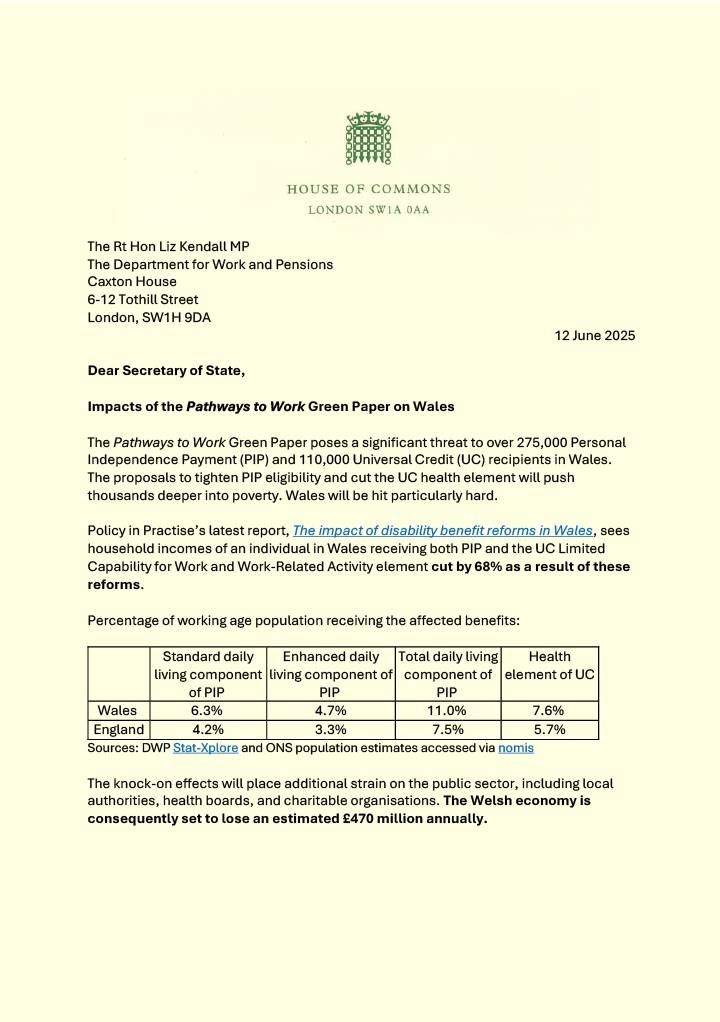
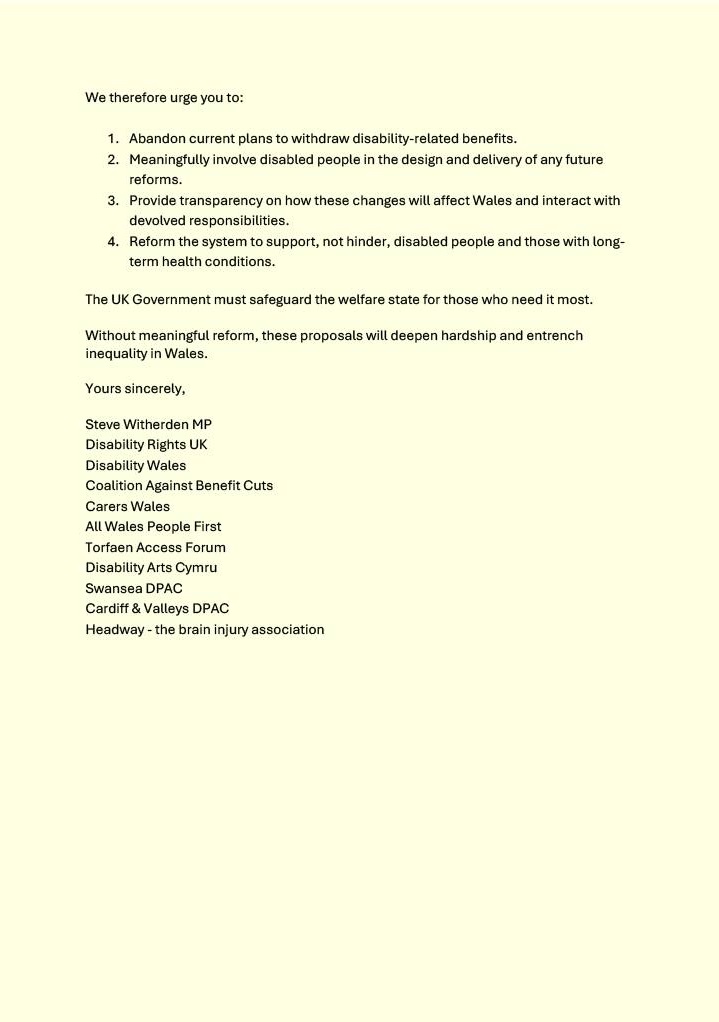
Below is an extract of a letter from Steve Witherden MP, which was co-signed and enthusiastically supported by unanimous democratic votes of Swansea and Cardiff & Valleys Disabled People Against Cuts groups, calling for the disability benefit cuts to be abandoned, and for disabled people to be involved in the reform of the welfare system.

Dear Secretary of State,

Impacts of the Pathways to Work Green Paper on Wales

The Pathways to Work Green Paper poses a significant threat to over 275,000 Personal Independence Payment (PIP) and 110,000 Universal Credit (UC) recipients in Wales.

The proposals to tighten PIP eligibility and cut the UC health element will push thousands deeper into poverty. Wales will be hit particularly hard.

Policy in Practise’s latest report, The impact of disability benefit reforms in Wales, sees household incomes of an individual in Wales receiving both PIP and the UC Limited Capability for Work and Work-Related Activity element cut by 68% as a result of these reforms.

The knock-on effects will place additional strain on the public sector, including local authorities, health boards, and charitable organisations. The Welsh economy is consequently set to lose an estimated £470 million annually.

We therefore urge you to:

1. Abandon current plans to withdraw disability-related benefits.

2. Meaningfully involve disabled people in the design and delivery of any future reforms.

3. Provide transparency on how these changes will affect Wales and interact with devolved responsibilities.

4. Reform the system to support, not hinder, disabled people and those with long-term health conditions.

The UK Government must safeguard the welfare state for those who need it most.

Without meaningful reform, these proposals will deepen hardship and entrench inequality in Wales.

Yours sincerely,

Steve Witherden MP
Disability Rights UK
Disability Wales
Coalition Against Benefit Cuts
Carers Wales
All Wales People First
Torfaen Access Forum
Disability Arts Cymru
Swansea DPAC
Cardiff & Valleys DPAC
Headway – the brain injury association

The letter on Facebook

The letter on X (Twitter)


A letter on house of commons paper.

A letter on house of commons paper.

Jun 102025
 
DPAC Logo with text underneath "Disabled People Against Cuts" and then web address dpac.uk.net
Portrait of Stephen Timms MP
Disabled People Against Cuts (DPAC) has today written to Stephen Timms, the Minister of State for Social Security and Disability, to raise our serious concerns with the quality and fairness of the so-called “consultation” being carried out on disability benefit cuts.
We are asking for the consultation to be extended, and for urgent action to address the failings.
We urge the government start again on welfare reform, listening to disabled people and carers in a genuine process of co-production.
This is what we said in our letter:
Dear Stephen Timms,

I am writing to you on behalf of Disabled People Against Cuts (DPAC) to urgently raise concerns regarding the accessibility of the consultation on the benefits cuts proposed in the March 2025 Green Paper. In light of the limited time available for the consultation which is due to close on 30 June 2025, you are asked to take urgent action to address our concerns, confirm what steps are being taken and to extend the time available for disabled people to engage with the consultation given the accessibility issues they have faced to date. In order for the consultation to fulfil its purpose. Disabled people who are likely to be affected by proposed benefits changes, must have a proper and meaningful opportunity to engage with the consultation and accessible arrangements must therefore be urgently made to facilitate their proper participation in the consultation.

Our concerns

The face-to-face consultation in Cardiff on the 3rd June was cancelled less than two days after the venue was announced, with only one working day left before the event.

The DWP has claimed that the Cardiff venue cancelled the meeting at the last minute yet the venue itself was already inaccessible to disabled people. No transport to the venue was offered by the DWP for those who wanted to take part.

The booked venue was only revealed at the last minute. This was despite disabled people asking multiple times, over weeks, for information so that they could plan journeys, accommodation, and access requirements. The venue was far out of the centre of Cardiff, and completely inaccessible for many disabled people, especially at such short notice. It would have meant a wheelchair user travelling 1.6 miles unassisted. Shockingly this was the only face-to-face consultation event for the whole of Wales.

People at other DWP consultations in England have had similarly poor experiences. For example, lack of accessibility of the venue led to only 9 out of 15 people managing to attend the in-person consultation event in the South West.

The in-person consultations did not cover the North of England – Carlisle and Newcastle were completely missed out. For Wales, the North and South are poorly connected so any meaningful consultation would require not just an event in the South but another in the North.

In Northern Ireland no face-to-face consultations appear to be taking place at all and the date of the online consultation was only announced last week.

We have also received concerning feedback about the online consultations and the understanding of those conducting the meeting. One attendee reported:

It was also clear that not all participants fully understood the consultation questions or their implications, particularly those without background knowledge of the benefits system. This raises significant concerns about the quality and reliability of the feedback being gathered. At one point, the facilitator was unable to explain New Style ESA or JSA, and I had to step in to clarify how these benefits work, especially for those who do not qualify for income-related support. It was concerning to witness such a knowledge gap from someone facilitating a consultation on welfare reform.

Although we were told that all feedback would be recorded — even on topics not officially included in the consultation — it is unclear how that information will be used or whether it will influence policy development in any meaningful way.

The impact of the failure to make arrangements for accessible and meaningful consultation meetings

Only having online consultations and/or not having sufficient and/or accessible face-to-face consultations is unacceptable because, as I’m sure you’re aware, at least one-third of disabled people do not have access to the internet or the skills needed to take part in an online meeting. This obviously means that many people who will be most affected by the Government’s planned cuts to social security payments will be totally excluded from taking part in any consultation events.

We are concerned that the consultation not only doesn’t deal with many of the policies that are most likely to affect disabled people (as it only deals with 12 out of 22 policies) but fails to properly engage disabled people on those limited topics. We are also concerned that full impact assessments which would inform engagement with the consultation are not available and will not be made available during the course of the consultation.

The whole process to date seems inaccessible, chaotic and incomplete and given how few people are being consulted, both virtually and in person, we are extremely concerned about how representative this process is and whether it meets even the most basic standards of engagement with disabled people and their advocates.

Furthermore it is DPAC’s view that the whole process is flawed and is non-compliant with Articles 4 (3) and 33.3 of the UN CRPD and General Comment 7.  It also violates the Gunning Principles and the requirements to make reasonable adjustments under the Equality Act and is therefore potentially unlawful.  The only meaningful remedy is to withdraw the proposals and meaningfully engage with disabled people and our representative organisations to ensure all government proposals are compliant with the UN CRPD and equality legislation and ensure progressive realisation of the articles as well as compliance with equality duties.  Failure to address these flaws may result in legal action and sanction from the disability committee of the UN.

It is essential that the government start again on welfare reform, listening to disabled people and carers in a genuine process of co-production.

In light of the concerns outlined above and the limited time available, we invite you within 7 days i.e.  by June 16th to confirm:

1.     What steps are being taken to ensure that online and in-person consultation events are accessible and available to affected disabled people across all relevant regions. This should include ensuring accessible venues, across a range of regions as well as adequate notice to allow for attendance arrangements to be made.;

2.     That the time for engagement with the consultation will be extended by at least 4 weeks, to reflect the delays in making accessible arrangements and allow meaningful engagement with disabled people.

We look forward to your response by June 16th.


Linda Burnip

On behalf of the DPAC steering group

c.c. Debbie Abrahams, Chair of the Work and Pensions Select Committee,

Katie Farrington, Director General Social Security, Disability and Pensions

Helga Swindenbank, Head of Disability Services

Jun 032025
 
DPAC Logo with text underneath "Disabled People Against Cuts" and then web address dpac.uk.net

The DWP have cancelled the only in-person consultation event on the disability cuts for the whole of Wales, and do not plan to run another.

They did this after announcing an inaccessible venue at the last minute, in what we believe to be a clear example of disability discrimination.

The consultation was always going to be unfair, given half the proposals – the most important half – were off the table for discussion on day one.

We are demanding that there must be no vote in the House of Commons on disability cuts until a full and genuine public consultation has been carried out in Wales.

Please sign our open letter, and ask your MP or Member of the Senedd (Welsh Parliament) to sign too. You can sign, and ask your MP to sign, even if you don’t live in Wales.

Below is a template letter for contacting your MP or MS.

Find your MP or MS using WriteToThem, Find your MP, and/or Find a Member of the Senedd (in Wales)


Template letter

[Please use this template as a starting point and use your own words as much as possible.]

Dear [MP or member of the Senedd]


I am writing as your constituent to ask that you support an open letter demanding that there must be no disability benefit cuts vote in the House of Commons until Wales has had a full and genuine consultation – #NoVoteWithoutWales

The DWP have now cancelled the only in-person consultation event on the disability cuts for the whole of Wales, and have communicated that they do not plan to run another. Instead they are suggesting an online-only event at the end of the month, probably after any vote has already happened. This isn’t good enough.

The DWP cancelled the consultation after announcing an inaccessible venue at the last minute, in what could only be described as a clear example of disability discrimination.

Given the DWP’s failures, any consultation must now be run independently by Welsh disabled people’s organisations.

Please read and sign here:

https://Bit.Ly/No-Vote-Without-Wales

No vote without Wales! #NoVoteWithoutWales

Kind regards,

[Name]

[Postcode]

[Phone number]

Feb 122018
 
DPAC Logo with text underneath "Disabled People Against Cuts" and then web address dpac.uk.net

Letter-from-the-Chair-to-SoS-for-Department-of-Work-and-Pensions-relating-to-PIP-appeal-data-9-February-2018

Work and Pensions Committee

14 Tothill Street, London SW1H 9NB

Tel 020 7219 5831 Email

workpencom@parliament.uk

Website www.parliament.uk/workpencom


From the Chair


9 February 2018


Rt Hon Esther McVey

Secretary of State

Department for Work and Pensions


PIP appeal data

During our inquiry on PIP and ESA assessments, your Department kindly provided to us

estimated unit costs of MRs and Appeals. This indicated that different costs are attached to

PIP appeals depending on whether they relate to new or reassessed claims.

Seeking to understand the financial implications of appeals for the Department, Committee

staff inquired on 30 January:

Of the 170,000 PIP appeals since 2013, how many were for new claims and how

many were reassessments?

We were duly informed:

The information on the number of PIP appeals is from HMCTS published statistics

and this information is not available from HMCTS for new claims and reassessments

We were therefore unable to estimate the full cost of appeals to your Department, although

the Ministry of Justice informed us that in 2016/17 its appeals expenditure was £103 million.

(Cost of Social Security and Child Support appeals, of which the majority relate to PIP/ESA.)


It was with some surprise, therefore, that we today received data released in response to an

FOI request. This provided estimated costs per month spent on PIP appeals broken down

by new and reassessed claims.


You will be aware that we are shortly due to publish our report. That this data was provided

in response to an FOI request, but not for our Report, is doubly regrettable since the key

theme of our report is the need to introduce much greater trust and transparency into the PIP

and ESA systems.


Might you please explain how this occurred?


Best wishes,

Rt Hon Frank Field MP

Chair


 Posted by at 20:24
Mar 312015
 
DPAC Logo with text underneath "Disabled People Against Cuts" and then web address dpac.uk.net

With thanks to John Slater for this – follow him on twitter : @AmateurFOI

This post contains guidance about what to do if you need more time to fill in your forms for ESA/WCA or you are unable to make your WCA within the DWP Time Limits.

Parts 1 & 2 of the post give the legal basis for the advice, parts 3 onwards give practical advice on what claimants need to do, and part 9 gives 3 template letters that you can copy and paste or download, and then amend for your own circumstances and send to DWP.

Table of Contents (click on the title to go directly to each section)

  1. ESA Deadlines and Rules
  2. Legislation and DWP Decision Makers Guides
  3. What Does This Mean For Claimants?
  4. ESA Questionnaire Deadline of 4 Weeks
  5. Only Reschedule WCA for a Maximum of 4 Weeks and Only Reschedule WCA Once
  6. Possible reasons for not being able to meet conditions
  7. Sending Information to the DWP in the Post
  8. “Belt and Braces” Approach
  9. Letter Templates
    9.1 Responding to receiving ESA Questionnaire in the post
    9.2 Need to reschedule a WCA for more than 4 weeks (first time)
    9.3 Need to reschedule a WCA having done so previously

1. ESA Deadlines and Rules

If you have had to claim Employment and Support Allowance (“ESA”) you may have come across two deadlines and one rule that you were told you had to abide by. For the purposes of this article these will be referred to as the “Conditions”. These are:

You must return your ESA application form within 4 weeks.

You can only defer your Work Capability Assessment (“WCA”) for a maximum of 4 weeks.

You can only defer your WCA once.

The legislation (primary and secondary) that specifies how ESA works does not mention any time limits and doesn’t state that WCA can only be deferred once.

The DWP and Atos Healthcare (and no doubt Maximus will do the same) have always presented the Conditions as having a statutory basis and that if you don’t follow them to the letter you could have your claim refused. Are we being told the whole truth?

I don’t think we are. The Conditions are actually just internal DWP policies. This means that someone in the DWP simply invented them and imposes them on ESA claimants.

In response to an FOIA request made on 30th December 2012 the DWP stated:

“Appointments may be deferred for up to four weeks from the date of request, for any circumstance, including the non-availability of recording equipment. After this time the case will be withdrawn from the system by Atos Healthcare and returned to DWP to make a decision.”

https://www.whatdotheyknow.com/request/143605/response/352517/attach/html/2/Slater%205188%20Response.pdf.html

When challenged that it hadn’t explained how it came up with the 4 week deadline it eventually responded:

“… the 4 week deferment was simply a concession made by the Department to acknowledge that claimants may have a pre-existing appointment or commitment which may prevent them from attending the original appointment.  This was an operational not ministerial decision and documentation on how this four week period was derived is not available.”

https://www.whatdotheyknow.com/request/143605/response/360746/attach/html/2/IR%200078%20Mr%20Slater%20Final%20Response.pdf.html

It seems that whoever made this Condition up within the DWP didn’t bother to document the reason why 4 weeks was selected. It’s appalling that one of the biggest Government Departments makes and documents decisions that have such a huge impact on people in such an unprofessional manner.

The following was found on the Atos Healthcare Blog web site:
“If you’re not able to make your appointment, you can call us to rearrange it, but it’s important to note that we aren’t allowed to rearrange your appointment more than once. If for any reason you’re not able to attend your rearranged appointment, we’ll need to send your information back to Jobcentre Plus. They will then let you know whether or not you can rearrange your appointment a second time.”

https://blog.atoshealthcare.com/tag/employment-and-support-allowance/page/2/

The following section looks at what the legislation and the DWP own Decision Makers Guides (“DMG”) says about the DWP imposition of the three Conditions. This is important as departments such as the DWP are reliant on legislation to prescribe the powers that they operate by.

2. Legislation and DWP Decision Makers Guides

For people that may not be familiar with DMG, they are the official DWP publications that tell DWP Decision Makers what the law is and how they should apply it. Using the DWP own words the DMG are “… for DWP staff who make decisions about benefits and pensions. It helps them make decisions that are accurate and consistent.”

DMG are published online and can be found at the following link:

https://www.gov.uk/government/collections/decision-makers-guide-staff-guide

Without boring you by repeating lines of legislation, ESA claimants can be required to provide information and evidence to determine that they have limited capability for work (“LCW”) and/or limited capability for work related activity (“LCWRA”). You would expect this to be the case as that’s how applications are made for ESA.

Claimants can also be required to attend and submit themselves to a medical examination to determine their capabilities against criteria defined in legislation.

The DMG are very illuminating in respect of the Conditions. The table below shows the relevant clauses taken from Volume 8 (amendment 4 February 2010). Each clause in the DMG usually refers to the specific legislation that allows the DWP to behave in specific ways. For example clause 42222 below cites the Employment and Support Allowance Regulations 2008 No. 794  (using the abbreviation “ESA Regs”).  However, as we see later, in respect of the conditions being discussed this isn’t always the case.

Emphasis to text in the table below (bold and colour) has been added in by the author. Please note that the grammatical and typographical errors which appear below in this table are not mine! They appear in the original DWP documents.

Table 1: Extracts from volume 8 of the DMG

Clause Guidance
42221 A claimant can be treated as not having LCW if1.     they fail without good cause to provide information, attend or submit to examination (see DMG 42224)
42222 A claimant can be required to1.    provide certain information asked for by the DM including the return of the questionnaire (see DMG 42224)
42224 A claimant who is subject to the LCWA can be asked to provide information relating to their ability to perform activities referred to in Appendix 1. This information is usually asked by sending the claimant a questionnaire.
42227 A claimant is treated as not having LCW for failure to return the questionnaire without good cause if the Secretary of State can show that1.     the questionnaire was sent and2.    there is no response after six weeks to the first requests for the information       from the day following the date of issue and3.    a further request was sent at least four weeks after the first letter and at leasttwo weeks have passed since then and4.    good cause has not been accepted for delay beyond the period stated in 2. and

3. above.


42228 The DM needs to make sure that the Secretary of State has complied with the duty set out in the legislation to send the questionnaire and the reminder to the claimant. The DM can accept that it has been sent if there is a record of issue and no indication that it was not properly addressed, stamped and posted.
42232 As in DMG 42228 the law imposes time limits on the Secretary of State in relation to the sending of the questionnaire and the reminder. However, there is no law imposing a time limit on the claimant for the return of the questionnaire. Sometimes the questionnaire is returned after the time limit imposed on the Secretary of State but before the DM has considered whether there was good cause for the earlier failure to return the questionnaire. In these circumstances, the determination cannot be made because it cannot be held that the claimant has failed to return the questionnaire. Instead, normal WCA action should resume.
42247 Only one rescheduled appointment can be offered during a WCA referral. If the claimant cannot attend the rescheduled appointment, medical services will record that the claimant failed to attend. The DM will have to consider the reasons why the claimant cannot attend and consider good cause (see DMG 42261).End of ClauseComment by the AuthorSurprisingly this entry in the DMG does not refer to any primary or secondary legislation. This seems to support the view presented here that imposing a single reschedule for a WCA is nothing more than a DWP internal policy. However, it seems sensible to get the DWP to clarify if its approach is backed by specific legislation or it just decided to impose the condition. Therefore, the following FOI request was submitted:https://www.whatdotheyknow.com/request/rescheduling_wca_more_than_once#incoming-622625
42261 When a claimant fails to return the questionnaire of fails to attend or submit to examination, consideration of good cause includes1. whether the claimant was outside GB at the relevant time and2. the claimant’s state of health at the relevant time and3. the nature of any disability the claimant hasNote: this is not exhaustive (see DMG 42262-42276 for further guidance on good cause)

The abbreviations used for primary and secondary legislation within the actual DMG are defined in the documents that can be found here:

https://www.gov.uk/government/publications/decision-makers-guide-abbreviations-staff-guide

So, in respect of the deadline to submit your ESA questionnaire the DMG is very helpful. It explicitly confirms that there is no law imposing a time limit on the claimant for the return of the questionnaire.

In respect of only being able to defer a WCA for a maximum of 4 weeks the DMG is completely silent. This supports that this is an arbitrary limit imposed by the DWP.

In the matter of only being able to reschedule a WCA once the DWP response to the FOI request (at same link as given above) confirmed that only allowing a WCA to be rescheduled once is simply a DWP policy (one that apparently dates back to the days of Incapacity Benefit).  This raises the question about how lawful it is for the DM to treat people as ‘failing to attend a WCA’ simply for wanting to reschedule a WCA more than once. Interestingly the DWP attempted to side step this part of the FOI request. An internal review request has been submitted to see if the DWP can provide any information to support its view that by asking for a WCA to be rescheduled more than once a person is ‘failing to attend a WCA’. I suspect this will turn out to be another example of the DWP simply imposing Conditions which it has invented

3. What Does This Mean For Claimants?

If these Conditions imposed by the DWP are not prescribed in law does that mean we can simply ignore them? The answer is no, we can’t. If a case came before a Tribunal dealing with these conditions it is highly likely that it would look at what is reasonable in that particular case. It would also consider the actions of the person claiming ESA. If you simply ignored the DWP whilst being in a position of being able to contact them I doubt the Tribunal would be particularly sympathetic to your case.

However, if you did everything that could reasonably be expected of someone in your position to engage with the DWP and your specific circumstances meant that the conditions imposed by the DWP were not reasonable, then it is highly likely that the Tribunal would find in your favour.

However, the best outcome would be to avoid having to take your case to a Tribunal in the first place. The following sections look at the sort of actions you could take to protect yourself if you can’t meet the DWP imposed Conditions.

4.     ESA Questionnaire Deadline of 4 Weeks

As soon as you receive the questionnaire in the post you need to do something, don’t just ignore it.

Make an appointment to see your GP, Practice Nurse or other Healthcare Professional that you normally deal with and explain what is going on and the negative impact the situation is having on your health. Ask them to make a note about the situation in your health record and ideally see if they will give you a letter/note explaining that the 4 week deadline is unreasonable. If you can’t get an appointment with your GP or others, then ask one or two people (family or close friends) to write you a letter (signed and dated) explaining how unwell you are and why the 4 week deadline is unreasonable for your particular circumstances.

Write back immediately (including copies of any letters supporting your position) explaining that you won’t be able to meet the 4 week deadline and that you have made an appointment to see your GP/Nurse/Other Healthcare Professional as receiving the questionnaire has made you feel so unwell. Personally I wouldn’t try to do this over the telephone as it is much harder to prove what you said.

Be totally clear that you are not refusing to provide the requested information. Explain that you will comply with your statutory obligations within fair and reasonable timescales that are appropriate to your specific circumstances.

Explain why the 4 week deadline isn’t reasonable for your circumstances (see later for possible examples).

Explain that you are aware that the law does not impose a deadline on the return of the questionnaire (you could cite the relevant DMG clause 42232 if you feel comfortable doing so).

Suggest your own deadline. If you do this it needs to be reasonable and most important of all you need to be able to meet it. Don’t replace their unreasonable deadline with another one of your own.

Explain why your deadline is fair and reasonable for your specific circumstances.

State that unless the DWP challenges your revised deadline in writing within 7 calendar days of posting your letter it will have been deemed to have accepted it.

Keep a copy of all letters you send along with proof of postage (see section about writing to the DWP later).

5.     Only Reschedule WCA for a Maximum of 4 Weeks and Only Reschedule WCA Once

As soon as you receive the questionnaire in the post you need to do something, don’t just ignore it.

Make an appointment to see your GP, Practice Nurse or other Healthcare Professional who you normally deal with and explain what is going on and the negative impact the situation is having on your health. Ask them to make a note about the situation in your health record and ideally see if they will give you a letter/note explaining that the 4 week limit / only one reschedule is unreasonable. If you can’t get an appointment with your GP or others, then ask one or two people (family or close friends) to write you a letter (signed and dated) explaining how unwell you are and why the 4 week limit is unreasonable for your circumstances.

As soon as you know that you cannot attend your WCA you should write (including copies of any letters supporting your position) to the appropriate organisation (Maximus) to notify them that you cannot attend. If the date of the WCA is a week or less away it would be sensible to notify them by telephone (you or someone you authorise) and explain that an explanatory letter will follow shortly. Regardless of whether you are able to comply with the DWP imposed conditions, it is always sensible to notify changes in writing in order to protect yourself. It is important to make a written record of when the telephone call took place (date and time), the name of the person you spoke to and what, if anything, was agreed.

Be absolutely clear that you are not refusing to attend or submit to a WCA. Explain that you will comply with your statutory obligations within fair and reasonable timescales that are reasonable and appropriate for your specific circumstances.

Explain why you need to reschedule your WCA and why rescheduling is fair and reasonable for your specific circumstances (see later for examples).

Explain that you are aware that the law does not impose a maximum limit of 4 weeks for rescheduling a WCA or set a limit of only one reschedule (as appropriate to your circumstances).

Suggest your own revised date and time, if it is appropriate for your condition, for the rescheduled WCA. If you do this your suggestion needs to be reasonable and most important of all you need to be able to meet it. Don’t replace their unreasonable deadline with another one of your own.

Explain why your deadline is fair and reasonable for your specific circumstances.

State that unless the DWP challenges your revised deadline in writing within 7 calendar days of posting your letter it will have been deemed to have accepted it.

Keep a copy of all letters you send along with proof of postage (see section about writing the DWP later).

6. Possible reasons for not being able to meet conditions

Whatever reason(s) you cite you need to be able to explain why it is appropriate to your specific circumstances, e.g.

  • The current state of your health is such that it is not reasonable to expect you to comply with the relevant Condition imposed by the DWP.
  • Your specific condition means that the imposed deadlines are unreasonable. For example:
  • Mental health conditions that make it hard to complete the questionnaire.
  • Side effects of medication mean it takes you longer to complete the questionnaire.
  • Aspects of your physical condition, e.g. pain, exhaustion etc, mean it takes you longer to complete the questionnaire.
  • You are in hospital or receiving treatment that means that it is not reasonable to expect you to comply with the deadline imposed by the DWP.
  • You will be out of the country or on holiday within the UK at the time of the appointment or during the 4 week deadline to complete the questionnaire.
  • Attempting to comply with the deadline will exacerbate your condition and therefore cause you actual physical and/or psychological harm.
  • You need to be accompanied to attend the WCA and it isn’t possible to get someone within the current timescales.
  • You need help to complete the questionnaire (e.g. the CAB, other organisation or family member) and that won’t be available to you in adequate time to allow you to meet the deadline.
  • You have other appointments (e.g. treatments, seeing Consultants, tests etc) which clash with the imposed dates.
  • It could be that you are suffering from something unrelated to your health condition such as the flu.
  • You are waiting for the results of tests that will be key evidence for your ESA claim and want to be able to include them in your questionnaire or present them at your WCA.

By refusing to change the deadline or reschedule WCA the DWP places you at a significant disadvantage and could be breaching of your human rights. This is likely to be applicable alongside the other reasons.

7. Sending Information to the DWP in the Post

A common problem when dealing with the DWP seems to be information going missing. This includes information delivered by hand to JCP buildings and documents sent through the post. The scale of the problem via the postal route suggests that there is something else going on other than the odd letter going missing. I am aware of letters being ignored (or not arriving at the right person’s desk!) until they are resent using the very expensive Royal Mail Special Delivery Guaranteed® service which means a signature must be obtained. It seems that using the much cheaper Royal Mail Signed For® service doesn’t guarantee that your letter is ‘signed for’.

It’s not reasonable to expect people to pay over £5 to be sure a letter is delivered to the DWP. Is there anything you can do to protect yourself? I think there is. Once again the DWP DMG has been helpful. When addressing proof that letters from the DWP have been sent it refers to the Interpretation Act 1978. Clause 7 states:

“Where an Act authorises or requires any document to be service by post. Served by post (whether the expression “serve” or the expression ” give ” or ” send ” or any other expression is used) then, unless the contrary intention appears, the service is deemed to be effected by properly addressing, pre-paying and posting a letter containing the document and, unless the contrary is proved, to have been effected at the time at which the letter would be delivered in the ordinary course of post.”

In plain English this means that if it can be shown that the envelope was properly addressed, contained the letter in question and the correct stamp was applied then the law considers the letter delivered unless it can be proved otherwise. If this is good enough for the DWP then it is good enough for the rest of us.  So how do we do this is practice?

Keep a copy of all documents you send to the DWP

It is always good practice to keep copies of everything you send to the DWP as it does have an unfortunate habit of losing things! This is relatively easy if you have access to a computer, printer and a scanner. If you don’t have access to such computer equipment then your smartphone or digital camera can help. Take photographs of every page of each document you send to the DWP and try to store it in a location where it won’t get deleted accidentally. Many smartphones allow you to write to memory cards so you could use one of these to store photographs of your correspondence with the DWP. You could also ask family or friends for help if they own a computer and a scanner.

Properly addressed and correct postage

If you are not sure about the correct postage you can use a set of digital kitchen scales to weigh your letter and you can find the correct stamp rates on the Royal Mail website. Another alternative is to take your letter to the post office and ask them to weigh it for you. You can then take a photograph of the envelope with the correct address and stamp.

Once you have addressed the envelope and affixed the stamp either scan it or take a photograph. You can also include the front page of your letter in the picture or scan to show a clear link between the letter and the completed envelope.

Proof that it has been posted

Whilst it costs money to send letters using the Royal Mail’s special delivery services it doesn’t cost you anything to get proof of postage at the Post Office. If you take your letter to your local Post Office they will print you off a proof of postage receipt. This serves two purposes. It proves you actually sent the letter and it shows that you put the correct value stamp on (otherwise the Post Office counter would not accept it).

One thing to be aware of is that the receipts may be printed on heat sensitive paper and these fade over time or turn black if left in sunlight. When you have your proof of postage always make a copy by using your scanner or your camera.

8. “Belt and Braces” Approach

If you want to adopt a “belt and braces” approach to corresponding with the DWP then you might consider the following. The next time you write to the DWP explain that you are aware of clause 7 of the Interpretation Act 1978 and that you always retain copies of any documents sent to the DWP along with proof that the correct address was used, the correct postage affixed and proof of postage. You could always add that you retain the right to seek financial compensation if due to the negligence of the DWP (i.e. losing your correspondence) you suffer financial loss. This would amount to the costs for paper, ink, envelopes, stamps etc.

9. Letter Templates

9.1 Responding to receiving ESA Questionnaire in the post.

Your Name
Address
Town/City
County
Post Code

Name of Person or Organisation
Address
Town/City
County
Post Code

Date: <DATE>
Ref: <Your NINO>

Dear Sir/Madam,
Submission of ESA50 Questionnaire

I received an ESA50 questionnaire on <DATE RECEIVED>. I understand that the DWP imposes an internal policy of a 4 week deadline for the return of the questionnaire. I am aware that in the DWP own decision makers guide, clause 42232 states “… there is no law imposing a time limit on the claimant for the return of the questionnaire.”

For my circumstances this internal policy is manifestly unreasonable for the following reasons:

<Explain the reason(s) why it is not reasonable to expect you to meet the 4 week deadline here. Include that you have made an appointment(s) to see your GP, Nurse, etc due to the impact of receiving the questionnaire. If you are going to include letters from people supporting you say so here.>

I believe that the <Enter Date> is a reasonable date for me to submit the completed questionnaire given my particular circumstances. Unless I hear to the contrary within 7 calendar days of posting this letter, the DWP will be deemed to have accepted my proposed submission date. My proposed submission date is appropriate to my circumstances for the following reasons:

<Enter the reasons why your proposed submission date is fair and reasonable given your circumstances>

I wish to be absolutely clear that I am not refusing to complete and return the questionnaire and will always comply with the legal obligations arising out of my ESA claim. I am aware that should a DWP Decision Maker seek to obtain “Good Cause” from me in this matter they are likely to be acting unlawfully as they will be acting in their own cause, i.e. judging against an internal DWP policy. The relevant precedent in this matter is R v Sussex Justices, Ex parte McCarthy ([1924] 1 KB 256, [1923] All ER Rep 233).

Failing to give me reasonable time to submit evidence via the questionnaire could constitute a breach of my human rights.

Please be aware that I have retained a copy of this letter (including the address used) and proof of postage.

Yours faithfully

Your Name


You can download a copy of this letter in word document format here Template Letter 1 – Responding to receiving ESA Questionnaire in the post


9.2 Need to reschedule a WCA for more than 4 weeks (first time).


Your Name
Address
Town/City
County
Post Code

Name of Person or Organisation
Address
Town/City
County
Post Code

Date: <DATE>
Ref: <Your NINO>

Dear Sir/Madam,
Rescheduling of Work Capability Assessment

I need to reschedule my Work Capability Assessment (“WCA”) that is currently arranged for <enter date & time> at <enter location>. I understand that the DWP imposes an internal policy of only permitting a WCA to be rescheduled for a maximum of 4 weeks and that this has no statutory basis.

For my circumstances this internal policy is manifestly unreasonable for the following reasons:

<Explain the reason(s) why it is not reasonable to expect you to attend a WCA within the next 4 weeks. Include that you have made an appointment(s) to see your GP, Nurse, etc due to the impact of the date of the WCA. If you are going to include letters from people supporting you say so here.>

I believe that the <Enter Date> at <Enter Time> is a reasonable date and time for me attend for a WCA given my particular circumstances. Unless I hear to the contrary within 7 calendar days of posting this letter the DWP will be deemed to have accepted my proposed date for my WCA. My proposed date is appropriate to my circumstances for the following reasons:

<Enter the reasons why your proposed date to attend for a WCA is fair and reasonable given your circumstances>

I wish to be absolutely clear that I am not refusing to attend and submit to an examination (WCA) and will always comply with the legal obligations arising out of my ESA claim. I am aware that should a DWP Decision Maker seek to obtain “Good Cause” from me in this matter they are likely to be acting unlawfully as they will be acting in their own cause, i.e. judging against an internal DWP policy. The relevant precedent in this matter is R v Sussex Justices, Ex parte McCarthy ([1924] 1 KB 256, [1923] All ER Rep 233).

Failing to give me the opportunity to attend a WCA to present relevant evidence within a timescale that is appropriate for my particular circumstances could constitute a breach of my human rights.

Please be aware that I have retained a copy of this letter (including the address used) and proof of postage.

Yours faithfully

Your Name


You can download a copy of this letter in word document format here Template Letter 2 – reschedule a WCA for more than 4 weeks (first time)


9.3 Need to reschedule a WCA having done so previously.

Your Name
Address
Town/City
County
Post Code

Name of Person or Organisation
Address
Town/City
County
Post Code

Date: <DATE>
Ref: <Your NINO>

Dear Sir/Madam,
Rescheduling of Work Capability Assessment

I need to reschedule my Work Capability Assessment (“WCA”) that is currently arranged for <enter date & time> at <enter location>. I understand that the DWP imposes an internal policy of only permitting a WCA to be rescheduled once and that this has no statutory basis.

For my circumstances this internal policy is manifestly unreasonable for the following reasons:

<Explain the reason(s) why it is not reasonable to allow you to reschedule your WCA again. Include that you have made an appointment(s) to see your GP, Nurse, etc due to the impact of the date of the WCA. If you are going to include letters from people supporting you say so here.>

I believe that the <Enter Date> at <Enter Time> is a reasonable date and time for me attend for a WCA given my particular circumstances. Unless I hear to the contrary within 7 calendar days of posting this letter the DWP will be deemed to have accepted my proposed date for my WCA. My proposed date is appropriate to my circumstances for the following reasons:

<Enter the reasons why your proposed date to attend for a WCA is fair and reasonable given your circumstances>

I wish to be absolutely clear that I am not refusing to attend and submit to an examination (WCA) and will always comply with the legal obligations arising out of my ESA claim. I am aware that should a DWP Decision Maker seek to obtain “Good Cause” from me in this matter they are likely to be acting unlawfully as they will be acting in their own cause, i.e. judging against an internal DWP policy. The relevant precedent in this matter is R v Sussex Justices, Ex parte McCarthy ([1924] 1 KB 256, [1923] All ER Rep 233).

Failing to give me the opportunity to reschedule my WCA such that I can attend to present relevant evidence within a timescale that is appropriate for my particular circumstances could constitute a breach of my human rights.

Please be aware that I have retained a copy of this letter (including the address used) and proof of postage.

Yours faithfully

Your Name


You can download a copy of this letter in word document format here Template Letter 3 – reschedule a WCA having done so previously


 Posted by at 13:01
Mar 012015
 
DPAC Logo with text underneath "Disabled People Against Cuts" and then web address dpac.uk.net

Please read below, a letter from Anthony Kletzander’s Parents to Mark Lever of the National Autistic Society

Dear Mr Lever,You were made aware of the abuse of our son Anthony in Nua Healthcare in July 2014. We contacted you because NUA had Autism Accreditation and we felt confident that on receiving this information, you would immediately have the abuse investigated.

Prior to this, we had understood that you were the association representing and supporting people with autism and their families which is stated on your website. We asked you on two occasions to meet Anthony and us his parents so that you could learn more about the abuse being carried out by Nua, which is extremely difficult for Anthony as he has to endure the abuse on a daily, ongoing basis. In other words Anthony has to live this abuse. You now mention that Nua asked you to meet Anthony, you never told us this until now and we would like to know why and when Nua asked you to meet Anthony, please send us a copy of that correspondence.

If you had turned down an offer from Nua to visit Anthony, why did you not inform us of this request at that time?

Nua Healthcare had used the Autisim Accreditation on their website as a generic endorsement, until very recently.  It was not true the Autism Accreditation logo was only associated with certain centres. The letter from Noel Dunne at Nua in December 2014 again did not specify that NAS approval was related to named centres, such a statement is a distraction and is disingenuous.

We would like to read your correspondence which suggests that you have sought assurances that investigations into the allegations of abuse have been carried out? If this was done why did you never inform us of such an intervention

We were horrified and shocked, when rather than temporarily, urgently withdrawing Autism Accreditation from Nua until the abuse was investigated and Anthony rescued from the unbearable situation he is in, NAS supported Nua in carrying out an interim internal review of their accredited services in October 2014, THREE MONTHS after the abuse was reported to you. We were only made aware that this interim review had taken place when Noel Dunne, Chief Operating Officer, Nua used this information in an effort to reassure families after abuse in another care home was made public. For us, as Anthony’s parents reading about the very positive NAS review in Noel Dunne’s letter to us and other families, knowing that Anthony continues to be abused there and that you are fully aware of Anthony’s abuse in Nua came as a complete shock. We were disgusted and realised that there was no option but to protest at your award ceremony. There is no other way that you will listen and for Anthony’s sake we cannot allow you to ignore us any longer. His health and safety is at risk, and we Anthony’s parents need to protect him as best we can.

Anthony wants to return to independent living, we fully support him.

He is drugged with Antipsychotic medication, he is denied his communication, and he is forced to undertake farm labour, which he hates. NAS accreditation gives licence to this abuse.

There has been no independent investigation to the specific allegations made. NAS have given renewed accreditation without any reference to these allegations.

We consider NAS remains culpable, whilst accreditation for Nua continues.

We are asking you to suspend Autism Accreditation, until an independent investigation is complete.

Sincerely,

Mr and Mrs Kletzander

 Posted by at 14:09
Feb 062015
 
DPAC Logo with text underneath "Disabled People Against Cuts" and then web address dpac.uk.net

Below we publish the response from Kate Green shadow minister for disabled people to an inquiry from Brian Hilton, ILF Campaigner, on Labour’s position on the closure of the ILF.

From: “GREEN, Kate [Email Address Redacted]Date: 3 February 2015 08:28:26 GMTTo: Brian [Surname and Email Address Redacted]

Subject: RE: Ed Miliband statement yesterday on future of ILF

Dear Brian

Thank you for our further email, and apologies for not getting back to you before now on the English, Welsh and Scottish  material you sent me, which in fact I have been considering very carefully – particularly, as you suggest, the options being considered by the Welsh Assembly Government.

I do need to start by being clear that it’s not Labour’s position to retain the ILF. That’s because I believe that there is now a real opportunity, and indeed a pressing need, to develop a sustainable model of provision for the most severely disabled people within the integrated health and social care landscape that Andy Burnham and Liz Kendall have been articulating, rather than continuing with a standalone fund. I say this not least because an incoming government will immediately embark on a full review to set three year spending plans, and I think it’s vital that the spending review process has the concept of independent living at its heart. I’m therefore working closely with colleagues in the shadow health and CLG teams to establish the principles that will govern our approach.

We of course want to ensure recipients continue to be supported once the ILF has closed, which our proposed guidance to local authorities is intended to address, but our wider purpose is to ensure a sustainable model of provision that protects people’s ability to live independently in the way that they choose. I am really keen to stay in touch with you as we develop our thinking, and perhaps we could have a further conversation about this over the next few weeks.

Best wishes

Kate

Just in case anyone is in any doubt:

We are not taking No for an answer, however many times it is said.

We are not backing down on this, we are not going to give in and we will not give up.

We have right on our side, and we have determination in our hearts.

This campaign is not over, there is more to come, watch this blog for details.

#SaveILF

We’re asking for as many DDPOs and individuals to sign up to an e-action to send an email directly to their MP

https://www.pcs.org.uk/savetheilf

and also a petition to Ed Miliband and Ed Balls

https://you.38degrees.org.uk/petitions/save-the-independent-living-fund-1

And Finally – our response to Kate Green’s letter?  Its in the form of a song by @RockinPaddy – Which side are you on?

And if you enjoyed that , here is another@RockinPaddy song to get you up and ready to fight to #SaveILF: The Battle of Whilehall Continues

 Posted by at 16:32
Jul 242014
 
DPAC Logo with text underneath "Disabled People Against Cuts" and then web address dpac.uk.net


Joint statement by Black Triangle Campaign, CarerWatch, Disabled People Against Cuts, Mental Health Resistance Network, Pats Petition, #NewApproach and WOWPetition

The WCA presumes that there are too many people on disability benefits because disabled people are too lazy or too comfortable living on benefits to work.

It is founded in the idea that disabled people need to be harassed and hounded out of their comfortable life into finding work under the threat of loss of benefits.

No one is comfortable living on benefits. Disabled people are no more lazy that the rest of the population.

The real reason that there are so many people on benefits is that society does not include disabled people.

We do not have the same access to education, transport, housing and jobs.

Social attitudes ensure that disabled people in the workplace are seen as a problem, rather than an equal opportunity.

And there are large numbers of disabled people who simply can not work. Why should they be harassed? Why should they be hounded?. Why should they have to live in fear?.

We know, and this report confirms, that many people have wrongly been found “fit for work” when they can’t work.

We also know and the UK courts have confirmed WCA discriminates against claimants with mental health impairments.

The Work and Pensions Committee report recommends “improvements” to make the system more workable and less harmful.

This is pointless, because it would not make the WCA any less wrong or any more useful

We call once again on Labour to commit to scrapping the WCA and to address the real problems that disabled people on benefits face in society.

We call once again on the British Medical Association to send guidance on DWP rules “29 and 35” which allows doctors to prevent foreseeable harm being done to ‘at risk’ patients.

They didn’t improve slavery, they abolished it, because it was wrong.

They didn’t amend Apartheid , they ended it because it was wrong

The WCA is wrong, and it needs to be abolished

Signed

Andy Greene, Disabled People Against Cuts
Annie Howard, Disabled People Against Cuts
Bob Ellard, Disabled People Against Cuts
Debbie Jolly, Disabled People Against Cuts
Denise McKenna, Mental Health Resistance Network
Jane Bence, #NewApproach
Eleanor Firman, Disabled People Against Cuts
Ellen Clifford, Disabled People Against Cuts
Gail Ward, Disabled People Against Cuts
John James McArdle, Black Triangle Campaign
Katy Marchant, Disabled People Against Cuts
Linda Burnip, Disabled People Against Cuts
Michelle Maher, WOWPetition
Nick Dilworth, #NewApproach
Pat Onions, Pats Petition
Paula Peters, Disabled People Against Cuts
Rick Burgess, #NewApproach
Roger Lewis, Disabled People Against Cuts
Rosemary O’Neil, Carerwatch
Roy Bard, Disabled People Against Cuts
Wayne Blackburn, #NewApproach
 
 Posted by at 14:47
Aug 262013
 
DPAC Logo with text underneath "Disabled People Against Cuts" and then web address dpac.uk.net

Copy and paste below or download from link-your MP can be found at

   https://findyourmp.parliament.uk/ 

Dear MP,

I am writing as one of your constituents to invite you to attend the launch of the UK Disabled People’s Manifesto: Reclaiming Our Futures on 4th September 5 – 6pm in the House of Commons Committee room 9.

Current government policy on disability is in crisis with disabled people collectively feeling under attack from their own government; research shows that disabled people are being disproportionately impacted by the cuts with those with the most complex levels of support need being hit by austerity nineteen times harder than the average person (‘A Fair Society? How the cuts target disabled people’ by Simon Duffy).

With around 1 in 5 of the population being disabled and many more affected by disability as family, friends and carers or simply as citizens who care about social justice, policy and pledges on disability will be a key concern of many voters as we approach the next election.

Disabled people and our organisations have come together across the UK to develop a UK Disabled People’s manifesto setting out the key principles, demands and commitments that are important to Deaf and disabled people and our allies.

I hope you are able to join us on the 4th to explore what is needed to achieve a society where disabled people can live, work and participate as equal citizens. Copies of the manifesto will be available from Inclusion London (www.inclusion.co.uk or contact ellen.clifford@inclusionlondon.co.uk / 02072373181).

Yours sincerely,

Link to download letter in Word Dear MP

Mar 112013
 
DPAC Logo with text underneath "Disabled People Against Cuts" and then web address dpac.uk.net

DPAC Logo 3 amendment 1 (Small)  enil logo

11 March 2013 – On 7 March, the Conference of Presidents[1] agreed to place an oral question on the impact of austerity on the living conditions of disabled people on the agenda of the European Parliament.

The question debated and adopted by the Employment and Social Affairs Committee last month, is based on a proposal by the European Network on Independent Living (ENIL) and cooperating European organisations. ENIL welcomes the debate, scheduled to take place in the plenary meeting on 12 March, but notes with regret that the Conference of Presidents missed this opportunity to vote on a Resolution on the same issue. We see this as a clear sign of the lack of understanding by MEPs for the precarious situation of disabled EU citizens brought on by the cuts in public spending.

 The European Network on Independent Living (ENIL) launched the Proposal for a Parliament Resolution in September 2009, when a range of cuts to services and benefits for disabled people was first announced in many Member States. Today, disabled people are feeling the effects of these cuts. Their support to live independently, in the community, is being reduced or taken away and the threat of institutionalisation, or re-institutionalisation, is a reality for many.[2]

 An increasing number of voices in Europe and internationally, including DPAC, are pointing to the disproportionate effect of the financial crisis on disabled people, and warning about the long-term consequences for the entire society. ENIL and DPAC have been working with a number of European and national organisations[3] over the past 18 months, as well as with some MEPs, in order to ensure an adequate response of the European Parliament and the European Commission to austerity measures imposed by the Member States.

 The oral question to the European Commission, which will be debated on Tues 12th March, is an opportunity to get the worsening situation of disabled people in the EU on the political agenda. It is the first step towards a Resolution of the European Parliament, which can ensure that the Member States take concrete steps to reconsider and reverse the measures which are negatively affecting the rights of disabled people. ENIL and DPAC believe that a Parliament Resolution will send a strong signal to the Member States, and will continue campaigning for its adoption in the coming months.

 To support ENIL’s Resolution on the effect of cuts in public spending, please write to your MEP today! Together, we can make MEPs from all political groups aware of the impact of austerity measures on the lives of people they are representing and ask them to take immediate action.  Thank you for your support!

 To follow the debate in the European Parliament on 12 March, please use this link, select ‘Live’ and ‘Current debate’, and then click on the desired language. An estimated starting time will be shown on the website at 16:00 GMT, with the debate likely to take place in the evening.

 Background information

 Text of the oral question 

 Subject: The impact of austerity on the living conditions of people with disabilities  
In the European Union, evidence shows that persons with disabilities, including people with intellectual disabilities, are to a disproportionate degree affected by cuts in public spending and by a resulting loss of support measures – such as personal assistance and direct payments – that are essential if they are to live independently in the community

.1. Austerity policies will lead to an increase in the number of people living in long-term institutional care in many Member States, and to the further social exclusion of persons with disabilities. What steps does the Commission intend to take to remedy and reverse this trend?

2. It is of paramount importance for people with disabilities that austerity measures do not affect primary and daytime care, which, on the contrary, should be expanded further. At the same time, the provision of home care should be enhanced. What concrete steps does the Commission plan to take to encourage the organisation of these community-based services?

3. The EU’s commitments to prevent discrimination when it comes to access to employment and occupation, and to promote the social inclusion of persons with disabilities, are not being met. There is still poor awareness of the enormous potential for improving the integration of disabled people into the labour market, which would also contribute to the employment target set in the framework of EU 2020. What recommendations or good practices can guide the Member States in their efforts to promote the participation of people with disabilities in the society, and in the labour market, and to promote a more sustainable society?

4. Parliament’s resolution of 25 October 2011 on mobility and inclusion of people with disabilities(1) and the European Disability Strategy 2010-2020 stress the need for further action in several areas. What steps does the Commission intend to take to implement the European Disability Strategy 2010-2020 and to ensure that the EU fulfils its obligations under the UN Convention on the Rights of Persons with Disabilities?


(1) Text adopted P7_TA(2011)0453.

 Click on the links below to:

 Find your MEP

Download Template letter from link below 

https://www.dpac.uk.net/wp-content/uploads/2013/03/MEP-template-letter.doc

ENIL

–       Information about ENIL’s Campaign against the Cuts

–       Action Toolkit

–       Study of the European Foundation Centre on the impact of austerity measures on people with disabilities

–       Contact: mail@dpac.uk.net


[1] The Conference of Presidents consists of the President of Parliament and the chairmen of the political groups (who may arrange to be represented by a member of their group)

[2] For more information, please see Hauben, H. et al. (2012) Assessing the impact of European governments’ austerity plans on the rights of people with disabilities – European report. European Foundation Centre. Available at: https://www.enil.eu/wp-content/uploads/2012/12/Austerity-European-Report_FINAL.pdf

[3] AGE Platform Europe, Autism Europe, European Anti-Poverty Network (EAPN), European Association of Service Providers for Persons with Disabilities (EASPD), European Disability Forum (EDF), Inclusion Europe, European Network of Users and Survivors of Psychiatry, Mental Health Europe (MHE), European Foundation Centre (EFC), Disabled People Against the Cuts (DPAC), UK and Onafhankelijk Leven, Belgium

Feb 252013
 
DPAC Logo with text underneath "Disabled People Against Cuts" and then web address dpac.uk.net

DPAC has been passed a letter from Ed on WCA/Atos which we’ve been asked to share. While reading please remember that it was New Labour that first contracted Atos and Ed has done some visits to them too- no, not  joining DPAC, or disabled  people in  protests outside Atos offices in direct actions against the 72 deaths a week of those being put through this inhuman regime. But as a kind of badly advised PR exercise. He seems to have stopped that now.

The letter says:

              ‘We appreciate and share the concerns that have been expressed by many charities, disability groups and health care professionals regarding the WCA …’

Would these be the same multi-million big disability charities that sat at the table with Atos in the working groups on the construction of the WCA we wonder? And is Ed really talking about HCPs here? Ed’s  letter continues:

             ‘….and we agree that the government need to move quickly to remedy the problems. A large number of charities and disabled people have reported serious shortcomings with the assessment process and there is clear evidence that the WCA is not working….’

A slight understatement? Then there’s a bit of a disclaimer about previous New Labour government and what they intended for the WCA which was for it to work with applicants ‘fairly, quickly and compassionately’ with ‘appropriate support’.  Ah so no plans to scrap this inhumane disaster and start looking at it all again then? Back to Ed:

           ‘…It is clear, however, that the current Government have been too slow to adapt the Work Capability Assessment in the light of experience, and in view of the much bigger job it is now being asked to do…’

Actually they have been adapting it, mobilising distance for example has been reduced several times to make even more difficult to score those elusive Atos points removing more people from any support. Then we have a paragraph on Professor Malcolm Harrison’s independent reports and lack of progress. Let’s also remember Prof Harrison was sacked/resigned/came to the end of his appointment, apparently after appearing on Panorama citing the disaster of the WCA and Atos. But moving on:

       ‘…We would like to see the Government move much faster-for example in acting on the recommendations made by charities on dealing with mental health problems and fluctuating conditions-and to reduce the current bureaucracy of the current system. Atos healthcare also have questions to answer about the effectiveness of the current assessment process…’

        ‘..We are also very concerned that the scale of the cuts to disability benefits and social care introduced by this Government-which will total 8.6 billion over the parliament-will have a very serious impact on many disabled people..’

Isn’t it over 9 billion?

     ‘…Mr Miliband and the Shadow Frontbench will continue to press the Government on the need to put right the serious problems with the WCA…’

Cheers Ed and let us add that the work of Labour’s John McDonnell, Michael Meacher and others in bringing this Atos horror and the links between Atos and Unum in running ‘Government’ from the inside are much appreciated.

You can download the full letter from link below

 https://www.dpac.uk.net/wp-content/uploads/2013/02/Letter-From-Ed-Milliband-Mp2.jpg

Jul 232012
 
DPAC Logo with text underneath "Disabled People Against Cuts" and then web address dpac.uk.net


Dear Remploy strikers,

 We send our heartfelt support to you for your strike days against the closure of Remploy factories.  Every one of us who is disabled has a right not to have our disability used against us, and that includes the right to a decent job with a living wage. Remploy factories shouldn’t close, and wages should be higher.  Workers organising themselves into unions at Remploy helped get better wages and working conditions.  Closing the factories is an attempt to punish workers with disabilities for having the impudence to organise together.  How dare a government of millionaires tell us our workplaces are too expensive while they give billions to bankers and corporations in subsidies, and bonuses to Remploy management with our tax money?  We are determined to defend everything we’re entitled to and which we (and those who care for and about us) fought hard to get – benefits, decent wages and working conditions, high-quality services, accessible transport and more. 

 The government is criticising “segregated employment” in order to take away what gives us some equity — our hard-won disability concessions based on recognition of the added difficulties and discrimination we face in an inaccessible society.  These include Remploy and the welfare state.  They give huge contracts to companies like Atos to carry out “work capability assessments” in order to justify cutting our benefits.  They want us dead or begging on the street.  Thousands of sick and disabled people found fit for work are having to fight to keep our benefits.  Many of us, reliant on benefits, are refusing workfare – disabled people, mums (many are disabled or looking after disabled children), people of colour, people who have problems with reading and writing.

 We condemn prominent disabled people who claim to represent our best interests, but who are prepared to leave us with no wages at all, as they provide cover for the brutality of the government policy of Remploy factory closures — like Liz Sayce (whose report recommended ending “segregated employment”) and Mike Smith of the Equality and Human Rights Commission (who said on Channel 4 News that closing the factories is in the best interests of disabled people).   Some of these disability ‘leaders’ are happy to take government money for themselves and their own organisations while helping to throw the rest of us out of a job.  Scabs!

 We also condemn disability charities which do the government’s dirty work, running workfare programmes that get them cheap labour, and specialised schemes for sick and disabled people forced into “work-related activity” which is contributing to early deaths. 

 Despite the onslaught, we take courage from your strike and from any victory we are having: at least 40% of appeals against Atos are being won and there is increased support for our demands – the BMA recently voted to end the work capability assessment.  

 All of us are workers, waged and unwaged, campaigning together to defend our rights. As part of the movement against the cuts, we are determined to support each other so we can all win. 

 Keep Remploy!  Keep our benefits!

WinVisible (women with visible and invisible disabilities)  

win@winvisible.org

020 7482 2496

Payday men’s network

payday@paydaynet.org

020 7267 8698


Jun 082012
 
DPAC Logo with text underneath "Disabled People Against Cuts" and then web address dpac.uk.net

The closure of the Remploy factories has ignited a wealth of media attention and strong feeling as well as differences of opinion between disabled people, and Disabled Peoples’ Organisations (DPOs) on the position of disabled Remploy factory workers. The now infamous Sayce report called for closure of the factories in the ironically titled: ‘Getting in, staying in and getting on: disability employment support fit for the future’. This was followed by a consultation exercise in July 2011 to which DPAC responded outlining the impact of the closure of the factories and urging that they remain open.

Since then, DPAC, DPOs, Unions, disabled workers, disabled and non-disabled people have been active on the proposed closures in a number of ways which have been publicised on the DPAC site. DPAC have invited Liz Sayce to comment, but she has not responded to our request.

Most recently the Sayce report has been accused of doing the Governments ‘dirty work’, as elitist and a part of the cuts agenda at the TUC Disabled Peoples’ conference. 

There was overwhelming support at the annual TUC Disabled Workers’ Conference for the campaign to fight the planned closure of the Remploy factories.

The government announced in March that 36 of the 54 remaining Remploy factories across the UK would close by the end of 2012, with the loss of more than 1,500 disabled people’s jobs, while there would be further consultation over the future of the other 18 factories.

The announcement was part of the government’s response to a consultation on last year’s review of employment support by Liz Sayce, chief executive of Disability Rights UK (DR UK).

Sayce called in her report for funds currently used to subsidise the factories to be ploughed into more personalised forms of employment support for disabled people, including the Access to Work (AtW) scheme.

But Mandy Hudson, from the National Union of Teachers, told the conference that the Sayce report had “gone about doing the government’s dirty work”.

And she criticised “the completely cavalier way that Liz Sayce’s report sets adrift a whole set of disabled workers”.

The disabled peer Lord [Colin] Low also criticised Sayce’s report, and said its “highly individualised approach… seems to smack of elitism”.

Read more of the article by John Pring including the Remploy protest outside the offices of DR UK by Remploy workers and UKUncut here  

 Opening up the debate

Since the government announced the closures, some DPOs have backed its plans, arguing that the move was one towards the inclusion of disabled people.

But Tracey Lazard, chief executive of Inclusion London, said:

This is a cut. It isn’t about inclusion. We shouldn’t let the government justify this in the name of inclusion.

She accepted that the disability movement has been divided on whether to support the closures, but she said:

What we need is a dialogue. This is us putting an alternative view forward which hopefully will get a debate going. That’s what we need. Read more

Letter to the Guardian

The publication of a letter against Remploy closures was published in both on-online and print versions of the Guardian on May 10. The letter was composed by Inclusion London, DPAC and unions. Many DPOs and disabled people signed in support of the Remploy workers. The letter was shortened and some names and DPOs were reduced due to space restrictions by the Guardian. This link  will take you to the letter with a link to the original letter’s wording. DPAC will be updating the names and DPOs that were left off the printed and online versions shortly. We asked Liz Sayce to comment, but she did not respond.

However, a response article to the letter was issued by DPO Breakthrough UK claiming that while they agreed with many aspects of our letter they could not join other DPOs in signing it and wanted to open up debate on the Remploy issue.

We agree with opening the debate, and provide a link to the thoughtful piece by disabled activist and comedian Laurence Clark published in the Independent: Remploy Closures: right in theory but where does it leave disabled employees?

Sean McGovern a former Remploy factory worker responded directly to the Breakthrough article

and Les Woodward a GMB convener and worker at the Swansea Remploy factory said of the Breakthrough article:

This article, unfortunately is typical of the “Politically Correct” brigades attitude to Supported Employment and the language they use to try and justify their positions…

Another unfortunate slant of this article is that it totally fails to take into account the effect on the workers themselves or indeed other disabled workers who given the present economic climate would give their eye teeth for a job any job. They would sell their soul for a job in Remploy that can provide skilled work, training and other support that employment in Remploy offers.

 I have said it many times and I will say it a lot more. No-one ever forced a gun to my head to work in Remploy, over the 28 years I have been employed by the Company, I have been free to leave at any time I wanted, just like any other worker in any other workplace.

 Of course whether or not I exercise that choice to leave is dependant not least on economic circumstances that I have found myself in and whether or not the alternative employment was viable in terms of remuneration or terms and conditions. No employment opportunities that can match those that I am on in Remploy have presented themselves as yet.

 No one would disagree with the aspirations of a fully inclusive society, and I for one would absolutely love to see the day when Remploy really was old fashioned and there would be no need for Remploy because we would have a fully inclusive society that caters for everyone. Unfortunately we live in a rather different world which is going further and further away from inclusion and equality of opportunity over the last 18 months or so rather than moving more towards inclusion and equal opportunity. The reason for this is that we are now governed by the rich for the rich and of the rich, while we get poorer and poorer.

 The ultimate shame in all this is that organisations such as the one who authored this article are wittingly or unwittingly collaborating with this Government in implementing cuts in the living standards of some of the very people they purport to support.

 Thanks a million to everyone that signed the letter, we really appreciate it and appreciate the support that you give us.

 Les

 We will provide more responses soon….

Previous pieces from DPAC and others

DPAC has always been transparent in its connections, actions and thoughts on the Remploy closures, which have been published on the DPAC web site, some of which we list here. We also include pieces by other groups

Remploy Closures: no segregated employment translates to unemployment for up to 2000 workers

DPAC Remploy Workers meeting London March 20th

Right to Work Pledges Support for Remploy workers

London meeting unites resistance to Remploy Closures

Furious workers hit out at Boss whose report led to Remploy factories getting the Axe

Demo for Remploy workers April 20th

Independent: Betrayed Disabled Workers protest against Remploy Closures

Fight the Remploy Closures

Remploy Public Meeting Thursday 26th April

Government accused of Hijacking Disability Equality Language to Justify Remploy Closures

The closure of Remploy factories is about cuts and cannot be justified by a misguided language of inclusion in a time when disabled people are facing the worse attacks on their inclusion, human rights and equality in UK history. Disabled people and DPOs need to support the Remploy workers rather than engaging in forms of ideological bullying that refuse to take into account the impacts on disabled peoples’ lives. Nor should they be so arrogant as to suggest that these workers shouldn’t have choice in where they chose to work. Less than 5% of Remploy workers in the last set of closures found alternative jobs, with some committing suicide-is this really something that we want to support for up to 2000 more disabled people under a flimsy Tory rhetoric of inclusion?


Jan 032012
 
DPAC Logo with text underneath "Disabled People Against Cuts" and then web address dpac.uk.net

DPAC logoTo add your signature please email mail@dpac.uk.net 

07.01.12


Thousands of disabled people rely on funding from the Independent Living Fund to enable them to live independently with choice and control over their lives. ILF users have been left shocked and extremely anxious since it was announced in 2010 that it would be closed down by government in 2015. Already closed to new applicants since May 2010 this decision was taken with no evidence of an equality impact assessment having taken place nor any consultation carried out with current and potential beneficiaries of the fund.

 “The Independent Living Fund is a ring fenced resource, for a priority group of disabled people with high support needs that can provide a better lifestyle and outcomes for service users whose full needs would not be met by local authority funding. “ 

The Local Authorities have had their resources severely reduced and therefore now only provide basic personal care. Without this extra funding ILF user’s only options will be placement in residential care or more responsibilities being placed on already over stretched family carers, that’s if the disabled person has family support.

Either option will have huge cost implications to government as residential care costs far more than assisting a disabled person to stay in the community and family carers would have to leave employment and manage on very low Carers Allowance and other benefits.

 Since  2010 the Minister for Disabled people, Maria Miller, has assured users we would be consulted on this issue initially in 2010 then early 2011, but  as users of the ILF fund we have heard little since. Maria Miller issued a speedy statement (5th December) saying that ILF will be discussed in Spring 2012 in context of the reform of the Care and Support system- Yet, ILF is too important to be discussed as a side issue.

 Leaving severely disabled people in such anxiety over their lives is violating our human rights to be involved in decisions that may affect us and indicates a total ignorance of how important this funding is for severely disabled people to live with some quality of life. In addition, ILF users have not received any increase in funds since 2010 meaning they cannot increase pay to P.A.s

The United Nations Convention on the Rights of Persons with Disabilities and in particular

Article 19: “Living independently and being included in the community”, states that “disabled people have a right to live in the community; with the support they need and can make choices like other people do”.

It also says they should be included in things that other people in the community do. Countries, like theUK, who agree to the rights, have to make this happen. Two of the things they must do are:

Make sure that disabled people get the help they need to live in the community, this means things like getting personal assistance

Make sure that disabled people can choose to do things in the community along with other people

Article 4 states; the general obligation on government to consult with disabled people, before not after decisions or policies are changed.

Article 17 states; we are to be treated with inherent dignity

In addition, the United Nations International Covenant on Economic, Social and Cultural Rights (CESCR) states that we have the right to enjoy the highest attainable standard of physical and mental health and the right to an adequate standard of living. TheUK has a duty to work progressively, to the maximum extent of its available resources, to deliver these rights even in a period of economic downturn.

The changes in the ILF priority system have obvious implications for theUK’s chances of meeting all such obligations, in terms of the resources available to do so as well as in the actual delivery of them e.g. ILF offers disabled people the flexibility to “choose to do things in the community”.

We have heard ministers state that funding disabled people is ‘unsustainable’ yet we see millions of pounds ‘found’ to fund whatever programs the government finds politically appropriate yet not severely disabled people?

We ask that the government continues to provide care and support for those with the most complex needs via the ILF. 

The Independent Living Fund must be retained and reopened to new applicants with adequate funding for this.

It should not be restricted to only those in employment as this means those who cannot sustain paid work, but can contribute to society in others ways, will be unable to participate in their communities, families or faith activities.

 The funding must NOT be given to local authorities; it is meant to meet the needs of severely disabled people which means that there may be more in one region compared to another. Also the LA will use the funding as they wish, it will not be ring fenced, and we suspect it will not be directed appropriately for the particular disabled people it is meant to be.

 We wish to have input into the design of the consultation process and assurances that the 21,000 already in receipt of ILF will be assured of continued funding.

 We the undersigned believe this arbitrary decision to close the ILF without assessing the impact this will have on current and potential users, and without consultation, violates the Human Rights of disabled people who depend on ILF to live.

 Cases that give examples of impact of losing or not getting ILF

 A – 55 year old lady has 35 hrs allocated from LA and 36 hrs from ILF per week, if she loses the ILF and the LA does not find funds to continue support she will lose the following aspects of her life; Volunteering, faith activities, visiting grandchildren, unable to get out of home, do her own shopping, no social activities, trapped. She was awarded an MBE by the Queen this year 2011 for her initiatives raising awareness of disability hate crime and helping disabled peoples organisations, all such activities will cease with no ILF funding. She feels her life will have no purpose if she loses the support ILF gives.

 B – “My Son’s care package comes to over £50,000 per year of which the ILF package makes up over £23,000. The Local Authorities “Indicative Budget” maximum level for someone living at home is £31,094 so without ILF his total care package would be slashed by almost 50% and leave it impossible for him to manage to live at home”.e slashed by almost 50% & probably leave it impossible for him to manage to live at home. e slashed by almost 50% & probably leave it impossible for him to manage to live at home.

C –  25 year old man with ILF funding has been able to live independently for 7 years and get a 2:1 in Politics and International Relations plus an MA with merit in Journalism. As part of his degree course he spent almost a year working unpaid as a senior researcher for an MP. He has also worked on a self-employed basis and is now working in the media industry, in spite of being placed in the Support group for ESA previously due to his physical limitations. Without ILF funding none of this would have been possible and he would not be contributing to the economy as he is now doing. He would never have had the chance to go to university like his peers and would no doubt instead be incarcerated and abandoned by society in a residential care home costing the taxpayer much more.

D –  “As half my care package is ILF I would first have no control over my toilet needs, this may result in me being catheterised. I am not unable to get out of bed or in bed myself, nor can I dress myself.  I need support in all personal care needs, including keeping clean etc. I would not be able to attend any meetings when various government and NGOs ask me to be part of their various consultation plans. I would have no control over what time I got up or what time I went to bed therefore I would have no social life whatsoever. When ILF finishes in 2015 I will not have any social life. This will mean I will not be able to visit friends, attend the cinema or theatre, go to my bridge club or attend a primary school to assist children to read.  I will no longer be able to use my car for shopping taking my dog to the woods etc. Having campaigned for the last 26 years this will end as I need support to do this. I regularly attend course on photography and employment issues – these will not be possible without ILF funding.”

E.  “I am 27 years old female, and I currently live in my own flat, with 24 hour PA’s who I have directly employed. I have had various levels of funding from ILF, ever since becoming an adult. It has meant that I was able to live on campus at theUniversity ofWarwick, where I completed a BA in History and an MA in Modern British History. I was then forced to move back to my family home, because I did not have the high level of support that I need, and I have only recently been able to start living independently in the community, with funding from my local authority and ILF.  This amount was not as much as would have previously been the case because a freeze was put on the amount that they, ILF, could contribute to disabled people’s care packages in April last year, before my current care package was agreed. As  a result, I was only entitled to receive the same level of funding that I had been awarded in my previous, much less expensive, care package. This meant that my local authority was put under increased pressure to fund my entire care package, and after the ILF is abolished, it seems very likely that all local authorities will find it difficult to provide care for severely disabled people living in the community. I have had to really fight against my local County Council in order to get funding for my current care package, but what scares me is that although I will always be disabled (and actually, my needs will increase in time), there is no kind of guarantee that I will receive my current care package even past my next review. ”

F.  I am a  44 year old digital artist/editor & film maker, a lot of time is spent travelling to locations for shoots, I can’t imagine how I would manage without ILF which funds a third of my care package.. to lose such vital funding will probably change my life in a way presently I do not want to think about, however, as the government is pushing this legislation through regardless, I have to consider my position. Ultimately I fear that any real & significant control in my life and how I presently choose to live my life will be significantly curtailed. I know in this present political climate, any changes will be presented to the general public in a way that suggests no “significant” change, “the disabled” are worrying needlessly etc, but the reality has to be heard. I will have to make my PA’s redundant, relying on goodwill of friends or volunteers would not be feasible. I would lose control of my life.

H. I am a 40 year old ex archaeologist, living in busyEast London, and it would be impossible to manage if I lost my ILF. This funds 50% of my care package, so the loss of ILF would mean that I would lose my independence. At the moment I live independently and use my ILF to maximise my independence, to access the community, to do voluntary work in three different places. This government has pushed legislation through in a way which challenges human rights. Without ILF I would lose my home and my independence and would be forced to rely on my aged father and sleep on his floor as his house is inaccessible.

 I. I am 39 years old and my ILF contributes roughly 25% to my 24/7 package. It is thanks to the ILF that I have been able to study at University, become involved in voluntary work and, more recently, have been able to hold down a full time job in a disability organisation, helping other people make the most of their care packages. The ILF has allowed me to contribute financially to the economy yet there are many more people who, thanks to the ILF have made contributions to society that are every bit as important, and often times more, than my one contribution. In a time where disabled people are classed as undeserving scroungers it is vital to point out these invaluable contributions and also to not that, without ring-fenced funding that affords people more than survival care we will be forced into a position were we can’t give back to society. I have already seen this in my line of work where people who would have benefited so much from funding from the ILF are just left with a couple of visits a day – literally for “feeding, watering and toileting” – of course there is no willingness by Social service to put that extra little bit in any more, as they know that the ILF won’t be there to part fund! This is a real disgrace. Personally, any negative change to my care package will have not only a severe affect on me, but also on the 6 people that I employ as Personal Assistants. The loss of the ILF really is a return to the dark ages!

 J.  Jane has Downs Syndrome.   In some ways she appears to be quite a capable lady, but has a severe learning disability and also and most importantly has severe health problems which could prove life threatening if not handled immediately and in the correct manor.

Karen has a profound mental and physical impairment.   She is mostly a happy lady but with no means of communication other than her body language.

Jane and Karen’s families have come together with the help of their local learning disability team and have enabled them to live in an apartment together, for the past 4 years, with the care of personal assistants 24/7, employed directly by them using funding from the Independent Living Fund.   The ladies both live very productive and worthwhile lives together accessing activities in the community and interacting with everybody they come into contact with.

This is exactly what the Independent Living Fund was intended for and Jane and Karens lives have improved considerably.   They have a future to look forward to rather than spend the rest of their lives in a care home

Now it appears that the Independent Living Fund is going to be withdrawn at the end of the present parliament, with no promise of anything to replace it with.  How will Jane and Karen continue their lives living independently in the community?

 Signatures at 07.01.12

 ILF Users 39

Alan Robson

Alison Barrett – ILF user, Peer support Coordinator Wiltshire Centre for Independent Living

Anne Novis MBE, ILF user, Trustee UKDPC

Anne Pridmore – ILF user and director ‘Being the Boss’

Anne Whitehurst – ILF user

Andrew Hardy, ILF user

Brian Hilton, ILf user

Cath Gibson, ILF user

Elizabeth Baily – ILF user

Francesca Digiorgio – ILF User

Gabrielle Pepper – ILF user

Glynis Dawes – ILF user

Ian Burnip- ILF user

Henry Langen – ILF user

Jenny Hurst – ILF user

John Evans, OBE-ILF user

Katherine Arienello – ILF user,Comedian

Kevin Caulfield – ILF user

Laurence Clark –  ILF user, Comedian and Writer

Lianne Bayliss – ILF user

Lisa Morrison- ILF user

Liz Carr – ILF user, Comedian and broadcaster

Lucy Trengrove – ILF user

Mark Williams – ILF user and DEF Co Chair

Natalie Meadows – ILF user

Nicki Myers – ILF user

Noor Homayoun – ILF user

Peergawsan Lotun – ILF User

P.J. Banyard MA (cantab) –  ex CEO international Spinal Research trust, ILF user

Penny Pepper – ILF user

Roxanne Homayoun- ILF user

Ruth Bashall – ILF user

Sarah Morrison – ILF user

Sean Mc Govern – ILF user

Shabaaz Mohammed – ILF user

Sue Elsegood – ILF user

Terry Egan – ILF user

Terry Rothwell – ILF user

Trevor Palmer – ILF user and small business owner

 Parents of ILF users – 13

Barbara Horsewood – Mother of ILF user

Kay Raisey

Laura Scott – Mother of two ILF users

Linda Burnip- disabled mother of ILF user

Margaret Jones – Mother of ILF user

Pam Robinson – mother of ILF user

Paul Taylforth – parent of ILF user

Rebecca Trengrove

Rosemary Homayoun

Dr Saddi Chillingworth -Parent of ILF user

Tracey Hattley

Tricia Tsatsoulis

Vincent Lloyd Jones – Father of ILF user

 Disability Organisations – 55

– Access Dorset – CE, Jonathan Waddington-Jones

– AgeUK- Mary Cox

-Alliancefor Inclusive Education – CEO Tara Flood

– Atos Victims Group – Paul Smith

– After Atos ‘Counting the Disabled Back In’ – K. James/J.Knight

– Being the Boss – Sheila Blair

– Black Triangle campaign group –  John McCardale

– BreakthroughUK– Elaine Astley, Policy and Research assistant

– Broken ofBritain- Kaliya Franklin

– Carer Watch – Rosemary O’Neill

– Carmarthenshire Disabled Access group – Chairman F.R. Allen MBE

-ChesterAdult Phab Social Club – Chair Person Lynda Hesketh

– Choices and Rights Coallition – Chair Mark Baggley

-CornerstoneChurchproject – Ann Whitmore

– Different Strokes – Debbie Wilson, Chief Executive

– DisabilityCornwalland Isles of Scilly – Theo Blackmore

– Disability Equality ForumBristol

– Disability Equality LTD –  CEO, Melanie Close

– Disability Hate Crime Network – Coordinator, Stephen Brookes MBE

– Disabilty Wales – Chief Executive, Rhian Davies

– DPAC – Disabled Peoples against the Cuts

– DPAC Islington – Julia Cameron

– DPAC Lambeth, Roger Lewis

– DPAC,Brighton, Jill Goble

– DPAC,Chester-  Lynda Hesketh

– GAD (GreenwichAssociation of Disabled People) – CEO, Joanne Munn

– GreaterManchesterCoalition of Disabled People –  GMCDP, Brian Hilton

– Green Party Trade Union Group – Alan Wheatley Disability Spokesperson

– Hammersmith and Fulham Coalition against Community Care Cuts – HAFCAC

– InclusionLondon- Chair, Kirsten Hearn, CEO Tracey Lizard

– InclusionScotland- Manager, Bill Scott

– Jubilee Sailing Club – CE  Alex Lochrane

– Kensington Centre for Independent Living –  CEO, Theo Harris

-KingstonCarers Network – Director, Kate Dudley

– Limbcare – Gordon McFadden, Chief Officer of Policy, CEO and Chair, Ray Edwards MBE

– IpswichMencap – Chair,  Barbara Thorn
– Norfolk Coalition of Disabled People – CEO, Mark Harrison

– NorthEdinburghFights Back

– National Centre for Independent Living, NCIL –  CEO Sue Bott

– Ouch Too online disabled peoples organisation

– Public and Commercial ServicesUnion(PCS) at the ILF – Branch Secretary, Paul Martin

– Remploy Trade Union National Convener – Les Woodward

– Shaping Our Lives network – Chair, Professor Peter Beresford OBE,BrunelUniversity

– Sisters of Frida, cooperative of disabled women – MD, Maria G Zedda

– Social Work Action NetworkLondon– Dan Morton, Rich Moth Deputy National Convenor

– The Forgotten Heroes – Trustee, Charley Downey

-United KingdomDisabled Peoples Council- UKDPC – CEO, Jaspal Dhani

– VoiceUK– CEO Kathryn Stone OBE C. Dir FLoD

-WalesCampaign for Fair Society – Chair, Paul Swann

-WalesCouncil for the Blind – Director, Phil Stevens

– West Norfolk Disability Information service

– Wheels in Motion,Birmingham- Tracy Veck

– Where’s the Benefit

– Wiltshire CIL – Director, Geraldine Bentley

-YorkIndependent Living Network – Lyn Jeffries  

 European/national Disability Organisations/professionals – 6

– European Network of Independent Living (ENIL) –  Exc.Dir.Jamie Boiling

– Expertise Centre Independent Living – Peter Lambreghts

– Independent Living Slovenia – Elena Pecaric

– Kapka Panayotova CIL – Sofia,BULGARIACEO

– YHD – Association for Theory for Theory and culture of Handicapped,Slovenia– Klaudija Poropat President

-Koblenz,Germany– Local Ombudsman, Christian Bayerlein

 Academics – 5

Colin Barnes, Professor of Disability Studies, University ofLeeds

Dr Charlotte Pearson

Jenny Slater, ManchesterMetropolitanUniversity

Professor Peter Beresford OBE,BrunelUniversity

Dr Alison Wilde

 Disabled People – 186

Adam Lotun

Ahmed Bagi

Alan Holdsworth

Alan Wheatley – Disability spokesperson, Green Party Trade Union Group

Alec Middleton

Alex Lochrane – Chief Exec Jubilee Sailing Trust

Alice Wedderburn

Alison Binns – Fundraiser, Different Strokes

Andrew Hubbard

Ann Whitmore -CornerstoneChurchproject

Anne Callanan

Anne Isaac

Anne McDonald

Annie Wiltcher   

13

Barbara Hulme

Barbara Thorn – Chair person Ipswich Mencap

Beverley Rawsthorn

Beverley Smith

Bill Cox

Bill Scott – Manger InclusionScotland

Brian Hilton

Brian Phillips

Bob Williams-Findlay – former Chair of British Council of Disabled People 

9

Caroline Mace

Catherine MacArthur

Charley Downey – Trustee, The Forgotten Heroes

Chris Walsh

Christian Bayerlain – ombudsman

Cindy Albright

Coover Mistry –  member of KCIL

Craig Lundie  

 9

D.H.Kelly

Danka Gordon

Dave Stamp

DavidBridge

David Churchley

David Gillon, Disability Rights Activist and Blogger

Debbie Wilson – CE, Different Strokes

Deborah Williams

Diana Harrison

Debbie Jolly – Co-Founder DPAC and Director Thaedis

Diane Harrison

Dora Kostiuk 

Donna Kelsey

13

Eileen Gambrell – Service Manager, Different Strokes

Elysabeth McCaig-Scot

Elane Heffeman

Eleanor Firman – Composer, teacher and Music Director

Eleanor Lisney – cofounder of DPAC

Ellen Clifford – Sisters of Frida

Elena Pecaric   -YHD Slovenia

Eric Day Equality and Disability LCIL  

7

F.R. Allen MBE

Fred Williams – excluded from ILF

Frieda Van de Poll – Artist

3

Gabriel Pepper

Gail Ward

Gaynor Jenkins

Geraldine Bentley – Director, Wiltshire CIL

George Lamb

GordonAmes

Gordon McFadden – CEO, Limbcare     

7

Helen Sims

Holly Meiszner               

2

Jamie Bolling-executive director ENIL

Jan Turner – excluded from ILF

Jane Heath

Jaspal Dhani – CEO UKDPC

Jean Goodrich

Jennifer Ames

Jenny Morris – author

Jerry Johnson – Finance Manager, Different Strokes

Jill Goble – DPAC,Brighton

Jo Lewis – Fundraising Administrator, Different Strokes

Joanne Hayes

Joanna Munn – CEO, GAD (GreenwichAssociation of Disabled People)

Jodie Mickleburgh – Office Manager, Different Strokes

John Hargrave

John Kelly

John James McCardale

John McGovern

John Newman

John W Smith

John Smith – GMCDP

Jonathan Hughes –

Jonathan Lee

Jonathan Toye

Jonathan Waddington-Jones

Judith Bond

Judith McNamara –DisabilityInclusionWorker PembrokeshireCountyCouncil

Julia Cameron – DPAC Islington

Julie kennedy

June Knight

29

Kay Trujillo

Kapka Panayotova-founder/director of CIL Sofia

Karen James

Karen Pointin

Kate Robinson

Kaliya Franklin – Broken ofBritain

Kenneth Hill

Kenny Bee

Kevin James

Kev Towner

Kirsten Hearn – Chair InclusionLondon

Klaudija Poropat-President of YHD Slovenia

13

Laurence Robb – MS Research, and standup4MS.blogspot.com- excluded from ILF

Les Woodward

Lianne Figg

Linda Burnip- co founder of DPAC

Lindsay Lotun

Lisa Egan – disabled daughter of ILF user

Liz Silver

LorraineAyres – Group Development Manager, Different Strokes

LydiaJ. Roe

Lyn Jeffries -YorkIndependent Living Network

Lyn Valentine

Lynda Hesketh– excluded from ILF, Chair Person, Chester Adult Phab Social Club

11

Magg Lauppen

Maria Zedda – Vice Chiar London 2012 disabilities Communities Engagement Group

Marion Lowther –South Walesdevelopment officer, Contact the Elderly

Mark Baggley – Chair, Choices and Rights Coalition

Mark Harrison –  CEO,NorfolkCoalition of Disabled People

Mark Newman

Mark Wilson

Mathew Wheatley

Martin Williams

Martine Miel – Sisters of Frida

Mary Fox

Maureen Vogels – member Black Triangle

Melanie Banton – Executive assistant, Council of Disabled people, Warwickshire andCoventry

Melanie Close – CEO Disability Equality Ltd

Michael Bricknell

Michelle Daley – Disability Equality Trainer

Moira McCall

Moira M Smith

18

Naomi Jacobs

Nirmala.G.Jivan

Neil Fergusan

3

Paul Martin –  PCS at ILF, Branch Secretary

Pat Onions disabled person and carer

Paul Smith – Atos Action group

Paul Swann – Policy Officer Disability Wales

Pauline Latchem

Penny Goring

Peter John Farrington

Peter Lambreghts – Expertise Centre Independent Living

Peter Lockheart

Phil Lockwood

Phil Stevens – Director Wales Council for the Blind

Phillipa Willitts

12

Rachel Huskisson

Ray Edwards MBE – Chair Limbcare

Rhian Davies – Chief executive, Disability Wales

Rhys Handley

Robin Bray- Hurran

Roger Lewis – DPAC Lambeth

Rosena McKeown

Rosemary O’Neil – Carer Watch

Roxanne Faulks – DP services manager, WECIL

Rudi Vogels – member Black Triangle

11

Sarah Coleman – Volunteer coordinator GAD CIL

Sarah Ismail

Sarah Simpson

Sasha Callaghan –  PastPresidentUniversityand CollegeUnion

Sedley Bryden

Sheila Blair

Sophie Partridge

Stacy Hoare

Stephen Brookes MBE – Coordinator DHCN

Stephen Hodgekins

Steve Burge

Steve Grinter – Education Secretary ITGLWFUKoffice

Sue Bott – CEO NCIL

Sue Fortune

Sue Marsh

Svetlana Kotava – Lawyer on Human Rights

15

Tanya Doolin

Tara Flood OBE- CEO, ALFIE

Theo Blackmore – DisabilityCornwalland Isles of Scilly

Theo Harris – CEO, Kensington Centre for Independent Living

Tina Coleman – mental health activist

Tracey Lizard – CEO Inclusion London

Tracey Veck – Wheels in Motion,Birmingham

7

Vicky Ayech

Victor Oliver

Vivienne Heuerman

3

Whalley Gordon

Willow Jacky – Carer and disabled person

Winston Thomas – Carmarthenshire Disabled Access group

3

Zoubeidah Lotun

1

 Family Carers/Personal Assistants – 33

Alicia Walker – PA

Anna Fitzpatrick – PA

Billy Ward – Parent carer

D. Gilligan – Carer

D.Ridley – Carer

Gemma Novis

Henry Bruce – Carer

J. Abdu – Carer

J. McCullough – Carer

J. Robson – Carer

J. Rymell – Carer

Jacqui Armston -PA

Jane Blake – PA

Jean Milne

John R Caley

Jonathan Novis

Kate Dudley – Kingston Carers network

Laura McKenna

Linda Dickenson

Marion Beazley – PA

Michelle Allen – PA

Mike Spinney

Nicole Bilsden – PA

S. O’Neill – Carer

Simone Meiszner

Steffanie Cook – PA

Steven Preace –Carers Circle

Terrine Johnson – PA

Trev Burnip

Veronica Birley

W. Coyle – Carer

Wendy Mortimer – PA

Vin West – unpaid Carer for ILF User and member of Wales Association for Citizen Directed Support

 Other supporters – 21

Amal Jama – OBAC- Supporting the Independence of People with disability.

André Keil

D. McGee

Dan Morton – SWAN

David Robertson Support Worker (Recovery Across Mental Health)

Gordon Eagling

Jo Walker

Jon Staley – Support Worker & Trainer

K. McGee

Kathryn Stone MBE – Director VoiceUK

Keithley Wilkinson – NHS Wales

Linda Lawty – Senior Advocate People FirstCumbria

Linzi Calvert

Lyn Whiteside BSc(hons) SRN

Natalya Dell

Rich Moth – Deputy National Convenor SWAN

Rosita Wilkins

S. Buttress

Shaaba Lotun

Tansy Feltis

Tehya Lotun

 Councillors/officials -2

– Alan Hunt – Access officer, Pembrokeshire County Council

– Cllr Roger Robinson- Camden Council;Chair- Camden Council’s Disability Scrutiny Panel &former CEO-Artsline

 Wales Assembly members -3

– Keith Davies – Assembly member

– Mike Hedges – Assembly Member forSwanseaEast

– Rebecca Evans – Assembly Member for Mid and WestWales

 MPs

Dave Anderson – Labour MP for Blaydon

Jim Sheridan – Labour MP forPaisleyand Refrewshire


Dec 062011
 
DPAC Logo with text underneath "Disabled People Against Cuts" and then web address dpac.uk.net

To add your signature please email mail@dpac.uk.net or linda_burnip@yahoo.co.uk

07.01.12

 Thousands of disabled people rely on funding from the Independent Living Fund to enable them to live independently with choice and control over their lives. ILF users have been left shocked and extremely anxious since it was announced in 2010 that it would be closed down by government in 2015. Already closed to new applicants since May 2010 this decision was taken with no evidence of an equality impact assessment having taken place nor any consultation carried out with current and potential beneficiaries of the fund.

 “The Independent Living Fund is a ring fenced resource, for a priority group of disabled people with high support needs that can provide a better lifestyle and outcomes for service users whose full needs would not be met by local authority funding. “

 The Local Authorities have had their resources severely reduced and therefore now only provide basic personal care. Without this extra funding ILF user’s only options will be placement in residential care or more responsibilities being placed on already over stretched family carers, that’s if the disabled person has family support.

 Either option will have huge cost implications to government as residential care costs far more than assisting a disabled person to stay in the community and family carers would have to leave employment and manage on very low Carers Allowance and other benefits.

 Since  2010 the Minister for Disabled people, Maria Miller, has assured users we would be consulted on this issue initially in 2010 then early 2011, but  as users of the ILF fund we have heard little since. Maria Miller issued a speedy statement (5th December) saying that ILF will be discussed in Spring 2012 in context of the reform of the Care and Support system- Yet, ILF is too important to be discussed as a side issue.

 Leaving severely disabled people in such anxiety over their lives is violating our human rights to be involved in decisions that may affect us and indicates a total ignorance of how important this funding is for severely disabled people to live with some quality of life. In addition, ILF users have not received any increase in funds since 2010 meaning they cannot increase pay to P.A.s

The United Nations Convention on the Rights of Persons with Disabilities and in particular

Article 19: “Living independently and being included in the community”, states that “disabled people have a right to live in the community; with the support they need and can make choices like other people do”.

It also says they should be included in things that other people in the community do. Countries, like theUK, who agree to the rights, have to make this happen. Two of the things they must do are:

Make sure that disabled people get the help they need to live in the community, this means things like getting personal assistance

Make sure that disabled people can choose to do things in the community along with other people

Article 4 states; the general obligation on government to consult with disabled people, before not after decisions or policies are changed.

Article 17 states; we are to be treated with inherent dignity

In addition, the United Nations International Covenant on Economic, Social and Cultural Rights (CESCR) states that we have the right to enjoy the highest attainable standard of physical and mental health and the right to an adequate standard of living. TheUK has a duty to work progressively, to the maximum extent of its available resources, to deliver these rights even in a period of economic downturn.

The changes in the ILF priority system have obvious implications for theUK’s chances of meeting all such obligations, in terms of the resources available to do so as well as in the actual delivery of them e.g. ILF offers disabled people the flexibility to “choose to do things in the community”.

We have heard ministers state that funding disabled people is ‘unsustainable’ yet we see millions of pounds ‘found’ to fund whatever programs the government finds politically appropriate yet not severely disabled people?

We ask that the government continues to provide care and support for those with the most complex needs via the ILF.

 The Independent Living Fund must be retained and reopened to new applicants with adequate funding for this.

 It should not be restricted to only those in employment as this means those who cannot sustain paid work, but can contribute to society in others ways, will be unable to participate in their communities, families or faith activities.

 The funding must NOT be given to local authorities; it is meant to meet the needs of severely disabled people which means that there may be more in one region compared to another. Also the LA will use the funding as they wish, it will not be ring fenced, and we suspect it will not be directed appropriately for the particular disabled people it is meant to be.

 We wish to have input into the design of the consultation process and assurances that the 21,000 already in receipt of ILF will be assured of continued funding.

 We the undersigned believe this arbitrary decision to close the ILF without assessing the impact this will have on current and potential users, and without consultation, violates the Human Rights of disabled people who depend on ILF to live.

 Cases that give examples of impact of losing or not getting ILF

 A – 55 year old lady has 35 hrs allocated from LA and 36 hrs from ILF per week, if she loses the ILF and the LA does not find funds to continue support she will lose the following aspects of her life; Volunteering, faith activities, visiting grandchildren, unable to get out of home, do her own shopping, no social activities, trapped. She was awarded an MBE by the Queen this year 2011 for her initiatives raising awareness of disability hate crime and helping disabled peoples organisations, all such activities will cease with no ILF funding. She feels her life will have no purpose if she loses the support ILF gives.

 B – “My Son’s care package comes to over £50,000 per year of which the ILF package makes up over £23,000. The Local Authorities “Indicative Budget” maximum level for someone living at home is £31,094 so without ILF his total care package would be slashed by almost 50% and leave it impossible for him to manage to live at home”.e slashed by almost 50% & probably leave it impossible for him to manage to live at home. e slashed by almost 50% & probably leave it impossible for him to manage to live at home.

C –  25 year old man with ILF funding has been able to live independently for 7 years and get a 2:1 in Politics and International Relations plus an MA with merit in Journalism. As part of his degree course he spent almost a year working unpaid as a senior researcher for an MP. He has also worked on a self-employed basis and is now working in the media industry, in spite of being placed in the Support group for ESA previously due to his physical limitations. Without ILF funding none of this would have been possible and he would not be contributing to the economy as he is now doing. He would never have had the chance to go to university like his peers and would no doubt instead be incarcerated and abandoned by society in a residential care home costing the taxpayer much more.

D –  “As half my care package is ILF I would first have no control over my toilet needs, this may result in me being catheterised. I am not unable to get out of bed or in bed myself, nor can I dress myself.  I need support in all personal care needs, including keeping clean etc. I would not be able to attend any meetings when various government and NGOs ask me to be part of their various consultation plans. I would have no control over what time I got up or what time I went to bed therefore I would have no social life whatsoever. When ILF finishes in 2015 I will not have any social life. This will mean I will not be able to visit friends, attend the cinema or theatre, go to my bridge club or attend a primary school to assist children to read.  I will no longer be able to use my car for shopping taking my dog to the woods etc. Having campaigned for the last 26 years this will end as I need support to do this. I regularly attend course on photography and employment issues – these will not be possible without ILF funding.”

E.  “I am 27 years old female, and I currently live in my own flat, with 24 hour PA’s who I have directly employed. I have had various levels of funding from ILF, ever since becoming an adult. It has meant that I was able to live on campus at theUniversity ofWarwick, where I completed a BA in History and an MA in Modern British History. I was then forced to move back to my family home, because I did not have the high level of support that I need, and I have only recently been able to start living independently in the community, with funding from my local authority and ILF.  This amount was not as much as would have previously been the case because a freeze was put on the amount that they, ILF, could contribute to disabled people’s care packages in April last year, before my current care package was agreed. As  a result, I was only entitled to receive the same level of funding that I had been awarded in my previous, much less expensive, care package. This meant that my local authority was put under increased pressure to fund my entire care package, and after the ILF is abolished, it seems very likely that all local authorities will find it difficult to provide care for severely disabled people living in the community. I have had to really fight against my local County Council in order to get funding for my current care package, but what scares me is that although I will always be disabled (and actually, my needs will increase in time), there is no kind of guarantee that I will receive my current care package even past my next review. ”

F.  I am a  44 year old digital artist/editor & film maker, a lot of time is spent travelling to locations for shoots, I can’t imagine how I would manage without ILF which funds a third of my care package.. to lose such vital funding will probably change my life in a way presently I do not want to think about, however, as the government is pushing this legislation through regardless, I have to consider my position. Ultimately I fear that any real & significant control in my life and how I presently choose to live my life will be significantly curtailed. I know in this present political climate, any changes will be presented to the general public in a way that suggests no “significant” change, “the disabled” are worrying needlessly etc, but the reality has to be heard. I will have to make my PA’s redundant, relying on goodwill of friends or volunteers would not be feasible. I would lose control of my life.

H. I am a 40 year old ex archaeologist, living in busyEast London, and it would be impossible to manage if I lost my ILF. This funds 50% of my care package, so the loss of ILF would mean that I would lose my independence. At the moment I live independently and use my ILF to maximise my independence, to access the community, to do voluntary work in three different places. This government has pushed legislation through in a way which challenges human rights. Without ILF I would lose my home and my independence and would be forced to rely on my aged father and sleep on his floor as his house is inaccessible.

 I. I am 39 years old and my ILF contributes roughly 25% to my 24/7 package. It is thanks to the ILF that I have been able to study at University, become involved in voluntary work and, more recently, have been able to hold down a full time job in a disability organisation, helping other people make the most of their care packages. The ILF has allowed me to contribute financially to the economy yet there are many more people who, thanks to the ILF have made contributions to society that are every bit as important, and often times more, than my one contribution. In a time where disabled people are classed as undeserving scroungers it is vital to point out these invaluable contributions and also to not that, without ring-fenced funding that affords people more than survival care we will be forced into a position were we can’t give back to society. I have already seen this in my line of work where people who would have benefited so much from funding from the ILF are just left with a couple of visits a day – literally for “feeding, watering and toileting” – of course there is no willingness by Social service to put that extra little bit in any more, as they know that the ILF won’t be there to part fund! This is a real disgrace. Personally, any negative change to my care package will have not only a severe affect on me, but also on the 6 people that I employ as Personal Assistants. The loss of the ILF really is a return to the dark ages!

 J.  Jane has Downs Syndrome.   In some ways she appears to be quite a capable lady, but has a severe learning disability and also and most importantly has severe health problems which could prove life threatening if not handled immediately and in the correct manor.

Karen has a profound mental and physical disability.   She is mostly a happy lady but with no means of communication other than her body language.

Jane and Karen’s families have come together with the help of their local learning disability team and have enabled them to live in an apartment together, for the past 4 years, with the care of personal assistants 24/7, employed directly by them using funding from the Independent Living Fund.   The ladies both live very productive and worthwhile lives together accessing activities in the community and interacting with everybody they come into contact with.

This is exactly what the Independent Living Fund was intended for and Jane and Karens lives have improved considerably.   They have a future to look forward to rather than spend the rest of their lives in a care home

Now it appears that the Independent Living Fund is going to be withdrawn at the end of the present parliament, with no promise of anything to replace it with.  How will Jane and Karen continue their lives living independently in the community?

 Signatures at 07.01.12

 ILF Users 39

Alan Robson

Alison Barrett – ILF user, Peer support Coordinator Wiltshire Centre for Independent Living

Anne Novis MBE, ILF user, Trustee UKDPC

Anne Pridmore – ILF user and director ‘Being the Boss’

Anne Whitehurst – ILF user

Andrew Hardy, ILF user

Brian Hilton, ILf user

Cath Gibson, ILF user

Elizabeth Baily – ILF user

Francesca Digiorgio – ILF User

Gabrielle Pepper – ILF user

Glynis Dawes – ILF user

Ian Burnip- ILF user

Henry Langen – ILF user

Jenny Hurst – ILF user

John Evans, OBE-ILF user

Katherine Arienello – ILF user,Comedian

Kevin Caulfield – ILF user

Laurence Clark –  ILF user, Comedian and Writer

Lianne Bayliss – ILF user

Lisa Morrison- ILF user

Liz Carr – ILF user, Comedian and broadcaster

Lucy Trengrove – ILF user

Mark Williams – ILF user and DEF Co Chair

Natalie Meadows – ILF user

Nicki Myers – ILF user

Noor Homayoun – ILF user

Peergawsan Lotun – ILF User

P.J. Banyard MA (cantab) –  ex CEO international Spinal Research trust, ILF user

Penny Pepper – ILF user

Roxanne Homayoun- ILF user

Ruth Bashall – ILF user

Sarah Morrison – ILF user

Sean Mc Govern – ILF user

Shabaaz Mohammed – ILF user

Sue Elsegood – ILF user

Terry Egan – ILF user

Terry Rothwell – ILF user

Trevor Palmer – ILF user and small business owner

 Parents of ILF users – 13

Barbara Horsewood – Mother of ILF user

Kay Raisey

Laura Scott – Mother of two ILF users

Linda Burnip- disabled mother of ILF user

Margaret Jones – Mother of ILF user

Pam Robinson – mother of ILF user

Paul Taylforth – parent of ILF user

Rebecca Trengrove

Rosemary Homayoun

Dr Saddi Chillingworth -Parent of ILF user

Tracey Hattley

Tricia Tsatsoulis

Vincent Lloyd Jones – Father of ILF user

 Disability Organisations – 55

– Access Dorset – CE, Jonathan Waddington-Jones

– AgeUK- Mary Cox

-Alliancefor Inclusive Education – CEO Tara Flood

– Atos Victims Group – Paul Smith

– After Atos ‘Counting the Disabled Back In’ – K. James/J.Knight

– Being the Boss – Sheila Blair

– Black Triangle campaign group –  John McCardale

– BreakthroughUK– Elaine Astley, Policy and Research assistant

– Broken ofBritain- Kaliya Franklin

– Carer Watch – Rosemary O’Neill

– Carmarthenshire Disabled Access group – Chairman F.R. Allen MBE

-ChesterAdult Phab Social Club – Chair Person Lynda Hesketh

– Choices and Rights Coallition – Chair Mark Baggley

-CornerstoneChurchproject – Ann Whitmore

– Different Strokes – Debbie Wilson, Chief Executive

– DisabilityCornwalland Isles of Scilly – Theo Blackmore

– Disability Equality ForumBristol

– Disability Equality LTD –  CEO, Melanie Close

– Disability Hate Crime Network – Coordinator, Stephen Brookes MBE

– Disabilty Wales – Chief Executive, Rhian Davies

– DPAC – Disabled Peoples against the Cuts

– DPAC Islington – Julia Cameron

– DPAC Lambeth, Roger Lewis

– DPAC,Brighton, Jill Goble

– DPAC,Chester-  Lynda Hesketh

– GAD (GreenwichAssociation of Disabled People) – CEO, Joanne Munn

– GreaterManchesterCoalition of Disabled People –  GMCDP, Brian Hilton

– Green Party Trade Union Group – Alan Wheatley Disability Spokesperson

– Hammersmith and Fulham Coalition against Community Care Cuts – HAFCAC

– InclusionLondon- Chair, Kirsten Hearn, CEO Tracey Lizard

– InclusionScotland- Manager, Bill Scott

– Jubilee Sailing Club – CE  Alex Lochrane

– Kensington Centre for Independent Living –  CEO, Theo Harris

-KingstonCarers Network – Director, Kate Dudley

– Limbcare – Gordon McFadden, Chief Officer of Policy, CEO and Chair, Ray Edwards MBE

– IpswichMencap – Chair,  Barbara Thorn
– Norfolk Coalition of Disabled People – CEO, Mark Harrison

– NorthEdinburghFights Back

– National Centre for Independent Living, NCIL –  CEO Sue Bott

– Ouch Too online disabled peoples organisation

– Public and Commercial ServicesUnion(PCS) at the ILF – Branch Secretary, Paul Martin

– Remploy Trade Union National Convener – Les Woodward

– Shaping Our Lives network – Chair, Professor Peter Beresford OBE,BrunelUniversity

– Sisters of Frida, cooperative of disabled women – MD, Maria G Zedda

– Social Work Action NetworkLondon– Dan Morton, Rich Moth Deputy National Convenor

– The Forgotten Heroes – Trustee, Charley Downey

-United KingdomDisabled Peoples Council- UKDPC – CEO, Jaspal Dhani

– VoiceUK– CEO Kathryn Stone OBE C. Dir FLoD

-WalesCampaign for Fair Society – Chair, Paul Swann

-WalesCouncil for the Blind – Director, Phil Stevens

– West Norfolk Disability Information service

– Wheels in Motion,Birmingham- Tracy Veck

– Where’s the Benefit

– Wiltshire CIL – Director, Geraldine Bentley

-YorkIndependent Living Network – Lyn Jeffries  

 European/national Disability Organisations/professionals – 6

– European Network of Independent Living (ENIL) –  Exc.Dir.Jamie Boiling

– Expertise Centre Independent Living – Peter Lambreghts

– Independent Living Slovenia – Elena Pecaric

– Kapka Panayotova CIL – Sofia,BULGARIACEO

– YHD – Association for Theory for Theory and culture of Handicapped,Slovenia– Klaudija Poropat President

-Koblenz,Germany– Local Ombudsman, Christian Bayerlein

 Academics – 5

Colin Barnes, Professor of Disability Studies, University ofLeeds

Dr Charlotte Pearson

Jenny Slater, ManchesterMetropolitanUniversity

Professor Peter Beresford OBE,BrunelUniversity

Dr Alison Wilde

 Disabled People – 186

Adam Lotun

Ahmed Bagi

Alan Holdsworth

Alan Wheatley – Disability spokesperson, Green Party Trade Union Group

Alec Middleton

Alex Lochrane – Chief Exec Jubilee Sailing Trust

Alice Wedderburn

Alison Binns – Fundraiser, Different Strokes

Andrew Hubbard

Ann Whitmore -CornerstoneChurchproject

Anne Callanan

Anne Isaac

Anne McDonald

Annie Wiltcher   

13

Barbara Hulme

Barbara Thorn – Chair person Ipswich Mencap

Beverley Rawsthorn

Beverley Smith

Bill Cox

Bill Scott – Manger InclusionScotland

Brian Hilton

Brian Phillips

Bob Williams-Findlay – former Chair of British Council of Disabled People 

9

Caroline Mace

Catherine MacArthur

Charley Downey – Trustee, The Forgotten Heroes

Chris Walsh

Christian Bayerlain – ombudsman

Cindy Albright

Coover Mistry –  member of KCIL

Craig Lundie  

 9

D.H.Kelly

Danka Gordon

Dave Stamp

DavidBridge

David Churchley

David Gillon, Disability Rights Activist and Blogger

Debbie Wilson – CE, Different Strokes

Deborah Williams

Diana Harrison

Debbie Jolly – Co-Founder DPAC and Director Thaedis

Diane Harrison

Dora Kostiuk 

Donna Kelsey

13

Eileen Gambrell – Service Manager, Different Strokes

Elysabeth McCaig-Scot

Elane Heffeman

Eleanor Firman – Composer, teacher and Music Director

Eleanor Lisney – cofounder of DPAC

Ellen Clifford – Sisters of Frida

Elena Pecaric   -YHD Slovenia

Eric Day Equality and Disability LCIL  

7

F.R. Allen MBE

Fred Williams – excluded from ILF

Frieda Van de Poll – Artist

3

Gabriel Pepper

Gail Ward

Gaynor Jenkins

Geraldine Bentley – Director, Wiltshire CIL

George Lamb

GordonAmes

Gordon McFadden – CEO, Limbcare     

7

Helen Sims

Holly Meiszner               

2

Jamie Bolling-executive director ENIL

Jan Turner – excluded from ILF

Jane Heath

Jaspal Dhani – CEO UKDPC

Jean Goodrich

Jennifer Ames

Jenny Morris – author

Jerry Johnson – Finance Manager, Different Strokes

Jill Goble – DPAC,Brighton

Jo Lewis – Fundraising Administrator, Different Strokes

Joanne Hayes

Joanna Munn – CEO, GAD (GreenwichAssociation of Disabled People)

Jodie Mickleburgh – Office Manager, Different Strokes

John Hargrave

John Kelly

John James McCardale

John McGovern

John Newman

John W Smith

John Smith – GMCDP

Jonathan Hughes –

Jonathan Lee

Jonathan Toye

Jonathan Waddington-Jones

Judith Bond

Judith McNamara –DisabilityInclusionWorker PembrokeshireCountyCouncil

Julia Cameron – DPAC Islington

Julie kennedy

June Knight

29

Kay Trujillo

Kapka Panayotova-founder/director of CIL Sofia

Karen James

Karen Pointin

Kate Robinson

Kaliya Franklin – Broken ofBritain

Kenneth Hill

Kenny Bee

Kevin James

Kev Towner

Kirsten Hearn – Chair InclusionLondon

Klaudija Poropat-President of YHD Slovenia

13

Laurence Robb – MS Research, and standup4MS.blogspot.com- excluded from ILF

Les Woodward

Lianne Figg

Linda Burnip- co founder of DPAC

Lindsay Lotun

Lisa Egan – disabled daughter of ILF user

Liz Silver

LorraineAyres – Group Development Manager, Different Strokes

LydiaJ. Roe

Lyn Jeffries -YorkIndependent Living Network

Lyn Valentine

Lynda Hesketh– excluded from ILF, Chair Person, Chester Adult Phab Social Club

11

Magg Lauppen

Maria Zedda – Vice Chiar London 2012 disabilities Communities Engagement Group

Marion Lowther –South Walesdevelopment officer, Contact the Elderly

Mark Baggley – Chair, Choices and Rights Coalition

Mark Harrison –  CEO,NorfolkCoalition of Disabled People

Mark Newman

Mark Wilson

Mathew Wheatley

Martin Williams

Martine Miel – Sisters of Frida

Mary Fox

Maureen Vogels – member Black Triangle

Melanie Banton – Executive assistant, Council of Disabled people, Warwickshire andCoventry

Melanie Close – CEO Disability Equality Ltd

Michael Bricknell

Michelle Daley – Disability Equality Trainer

Moira McCall

Moira M Smith

18

Naomi Jacobs

Nirmala.G.Jivan

Neil Fergusan

3

Paul Martin –  PCS at ILF, Branch Secretary

Pat Onions disabled person and carer

Paul Smith – Atos Action group

Paul Swann – Policy Officer Disability Wales

Pauline Latchem

Penny Goring

Peter John Farrington

Peter Lambreghts – Expertise Centre Independent Living

Peter Lockheart

Phil Lockwood

Phil Stevens – Director Wales Council for the Blind

Phillipa Willitts

12

Rachel Huskisson

Ray Edwards MBE – Chair Limbcare

Rhian Davies – Chief executive, Disability Wales

Rhys Handley

Robin Bray- Hurran

Roger Lewis – DPAC Lambeth

Rosena McKeown

Rosemary O’Neil – Carer Watch

Roxanne Faulks – DP services manager, WECIL

Rudi Vogels – member Black Triangle

11

Sarah Coleman – Volunteer coordinator GAD CIL

Sarah Ismail

Sarah Simpson

Sasha Callaghan –  PastPresidentUniversityand CollegeUnion

Sedley Bryden

Sheila Blair

Sophie Partridge

Stacy Hoare

Stephen Brookes MBE – Coordinator DHCN

Stephen Hodgekins

Steve Burge

Steve Grinter – Education Secretary ITGLWFUKoffice

Sue Bott – CEO NCIL

Sue Fortune

Sue Marsh

Svetlana Kotava – Lawyer on Human Rights

15

Tanya Doolin

Tara Flood OBE- CEO, ALFIE

Theo Blackmore – DisabilityCornwalland Isles of Scilly

Theo Harris – CEO, Kensington Centre for Independent Living

Tina Coleman – mental health activist

Tracey Lizard – CEO Inclusion London

Tracey Veck – Wheels in Motion,Birmingham

7

Vicky Ayech

Victor Oliver

Vivienne Heuerman

3

Whalley Gordon

Willow Jacky – Carer and disabled person

Winston Thomas – Carmarthenshire Disabled Access group

3

Zoubeidah Lotun

1

 Family Carers/Personal Assistants – 33

Alicia Walker – PA

Anna Fitzpatrick – PA

Billy Ward – Parent carer

D. Gilligan – Carer

D.Ridley – Carer

Gemma Novis

Henry Bruce – Carer

J. Abdu – Carer

J. McCullough – Carer

J. Robson – Carer

J. Rymell – Carer

Jacqui Armston -PA

Jane Blake – PA

Jean Milne

John R Caley

Jonathan Novis

Kate Dudley – Kingston Carers network

Laura McKenna

Linda Dickenson

Marion Beazley – PA

Michelle Allen – PA

Mike Spinney

Nicole Bilsden – PA

S. O’Neill – Carer

Simone Meiszner

Steffanie Cook – PA

Steven Preace –Carers Circle

Terrine Johnson – PA

Trev Burnip

Veronica Birley

W. Coyle – Carer

Wendy Mortimer – PA

Vin West – unpaid Carer for ILF User and member of Wales Association for Citizen Directed Support

 Other supporters – 21

Amal Jama – OBAC- Supporting the Independence of People with disability.

André Keil

D. McGee

Dan Morton – SWAN

David Robertson Support Worker (Recovery Across Mental Health)

Gordon Eagling

Jo Walker

Jon Staley – Support Worker & Trainer

K. McGee

Kathryn Stone MBE – Director VoiceUK

Keithley Wilkinson – NHS Wales

Linda Lawty – Senior Advocate People FirstCumbria

Linzi Calvert

Lyn Whiteside BSc(hons) SRN

Natalya Dell

Rich Moth – Deputy National Convenor SWAN

Rosita Wilkins

S. Buttress

Shaaba Lotun

Tansy Feltis

Tehya Lotun

 Councillors/officials -2

– Alan Hunt – Access officer, Pembrokeshire County Council

– Cllr Roger Robinson- Camden Council;Chair- Camden Council’s Disability Scrutiny Panel &former CEO-Artsline

 Wales Assembly members -3

– Keith Davies – Assembly member

– Mike Hedges – Assembly Member forSwanseaEast

– Rebecca Evans – Assembly Member for Mid and WestWales

 MPs

Dave Anderson – Labour MP for Blaydon

Jim Sheridan – Labour MP forPaisleyand Refrewshire


Nov 272011
 
DPAC Logo with text underneath "Disabled People Against Cuts" and then web address dpac.uk.net

The following is a letter of complaint to BBC led by Mad Pride and supported by the other signatories

We are writing to complain about a lack of balance in the BBC’s coverage and programming in relation to the government’s proposals for welfare reforms and benefits, and their implications.

Disabled people, unwaged carers, trade unions, low-paid workers and unemployed people have raised serious concerns about ‘mandatory work’ programmes that force people on benefits to work without pay. These pose a direct threat to the basic minimum wage, restrictions on working hours  and rules on unfair dismissal, and therefore to the pay and conditions of people in paid work. These implications have not even been mentioned, let alone been properly aired.

Instead we have a torrent of programmes aimed at stigmatising and demonising benefit claimants by highlighting benefit fraud, especially for incapacity benefit (“Britain on the Fiddle”, Panorama 3 November) and the ‘feckless’ who supposedly don’t want to work.  An impact of this wholly disproportionate misrepresentation of claimants as frauds and scroungers by some sections of the media has been cited as a direct cause of a reported increase in assaults and other abuse on disabled people, and to appearances parallel The Department of Work and Pensions own  propensity for distortion, itself criticised for the way it has released misleading figures and statistics that have been used to feed this biased propaganda.

Reality here is for the best part skewed by the BBC. Rates of fraud for disability benefits are the lowest – 0.3% to 1.9% — and are insignificant compared to the low amounts people are expected to live on, and the billions in underclaimed benefits.  People who can work should be entitled to a reasonable living wage and decent and safe working conditions.
https://statistics.dwp.gov.uk/asd/asd2/fem/fem_oct09_sep10.pdf

Many disabled people are not able to work. Many fear they will be wrongly ruled ‘fit for work’ by the revised ‘work capability assessment’ that has been much criticised. And for the many made unemployed through no fault of their own by the effects of the economic downturn – or passed over to unemployment benefit via assessment! –  they now face being forced into ‘mandatory’ work with no pay.

Our very real and legitimate concerns are not being aired. We have not been given an opportunity to make ourselves heard and understood.

Is it right that the BBC is part of this propaganda? Should a publicly-funded body engage in what is tantamount to the promotion of hate crime?

The BBC’s charter says it must show proper balance in its reporting and programming and should not be politically biased. It seems to us that there has been no proper balance and that the programmes aired show a political bias to promote and defend the government’s welfare reform, while hiding the views of those who will be directly affected by them.

We insist on our right to have our concerns properly heard and we demand the right to a full and effective ‘right to reply’ to help to counter the weight of the prejudicial propaganda put out by the BBC.

Disabled benefit claimants, unwaged carers and unemployed people are also licence payers, and we have as much right as people who are in paid employment to have a say in the content and conduct of the BBC.

We look forward to a response to start a process by which BBC Directors and programme makers can redress this current bias as soon as possible. This is a matter of urgent concern for thousands of people who have been barely managing to survive and are now faced with destitution or worse.

Claire Glasman- WinVisible
Ellen Cifford – Disabled People Against the Cuts
Joanna Long – Boycott Workfare
Dave Skull -Mad Pride
Johnny Void -Benefit Claimants Fight Back
Andy Greene – Islington Disabled People Against the Cuts
Paul Smith – Atos Vic tims Group
Richard Rieser- Co-ordinator UK Disability History Month
Warren Clarke – Boycott Workfare

The response received from the BBC goes as follows –

We have received a wide range of feedback about this programme and feel it is worth highlighting that considerable correspondence to us has been generated by online lobby activity. Bearing in mind the pressure on resources, the response below strives to address the majority of concerns raised but we apologise in advance if not all of the specific points you have mentioned have been answered in the manner you prefer. Please be assured we have raised your concerns with the programme and have done our best to issue a substantive response.

Panorama’s ‘Britain on the Fiddle’ looked at a number of issues surrounding public sector fraud, including benefit fraud, the nature and extent of the unlawful subletting of council properties, the issue of identity fraud and the misuse of blue badges. The programme also followed the work of some local authority fraud investigators and by doing so revealed how time consuming and costly inquiries into suspected fraud can be.

The programme made it clear that fraud effectively takes money from all of us, especially those in genuine need. On benefit fraud, including incapacity benefit specifically, the programme stressed that most people on benefits really need them and don’t cheat the system.

Far from concentrating on the economically deprived, the programme featured, for example, the case of a man claiming benefits to pay for a council flat whilst owning and running a pub business many miles away – travelling between both destinations in a luxury car.

Furthermore, the film featured fraud investigators tackling the misuse of blue badges. Many people have since written to Panorama to express their gratitude to the programme for highlighting the problem which causes them distress and much inconvenience.

We don’t agree that the cases featured in our film were extreme or were not broadly indicative of instances of benefit fraud. That is not the experience of the local authority fraud investigators who were kind enough to allow us to film their work. Dr Mark Button, from the Centre for Counter Fraud Studies said in the programme:

“I think a lot of organisations are not realistic about the levels of fraud that they face because in any organisation there are large levels of fraud that are undetected. So if they rely on detected levels of fraud they are not getting the picture of the levels of fraud within their organisation.”

Emphasising this, it is important to note that just recently the Audit Commission released its most up to date figures for detected fraud against local government which explains that these figures are only the tip of a very large iceberg.

We believe the programme explored a subject which is clearly in the public interest and did so in a fair and impartial manner.

Thanks again for taking the time to contact us.
Kind Regards
BBC Complaints

Nov 012011
 
DPAC Logo with text underneath "Disabled People Against Cuts" and then web address dpac.uk.net

At the beginning of the conference on 29th October a number of apologies were given, one of which was Maria Miller MP (Minister for Disabled People).

She sent a quite lengthy response that said very little to decline her invitation and a number of points she raised provided much amusement to the people who attended the conference.

She started by saying that “the Government is fully committed to enabling disabled people to have the same opportunities and choices as non-disabled people”. As you can imagine that caused a stir in the room straightaway.

She then went on to say “over the past year I have made it a personal priority to regularly meet with disabled people, their families and the organisations that represent them.” She spoke about organisations that “are already working closely with the government to help shape welfare reforms”.

To view the full letter that was received, follow the link below –

Maria MillerMP Letter pg 1, Maria Miller letter pg 2 (PDF)

Oct 142011
 
DPAC Logo with text underneath "Disabled People Against Cuts" and then web address dpac.uk.net

Mike Higgins kindly allowed us to re post his letter here – first published on the DISABILITY-RESEARCH@JISCMAIL.AC.UK listserv.

An anonymous and perhaps facetious call out today was made for DIAL staff across the UK to attend the Disabled People Against the Cuts (DPAC) annual conference at the end of October and, as the old comedy series had it: “take it from here”. For a less cryptic clue, e-mail me off-list.

Cynics like me will of course say “I told you so”. Spookily enough, SCOPE (yet again) appears to have hoodwinked a section of our movement controlled by Disabled People, stolen its clothes, money, reputation, good will and status (or as SCOPE would have it: it’s ‘branding’). Lock, stock and both barrels, SCOPE hijacked the DIAL network a couple of years ago, subsuming it within SCOPE’s monopoly. This meant that  with a couple of chews, a gulp,  swallow and suppressed burp, SCOPE could enhance its pretension to be part of the Disabled People’s Movement.

In-line with its providing space for window dressing (such as the project led by Andy Rickell and others) and the subsequent office space it gave to Disability LIB, SCOPE has ended its short-term whoring with DIAL. Having slept with DIAL, it is now administering the morning after pill to the DIAL network. Closing down DIAL’s national office and sacking all of DIAL’s nationally employed staff as of next month, November 2011, is just one of the ways in which SCOPE is ensuring that any established expertise in network support for Disabled Peoples’ Organisations is expunged.

SCOPE has abolished the national trustee body for DIAL and is instead imposing a SCOPE-appointed (i.e. unelected) steering group with responsibility for SCOPE dis-information services. As part of its declared ‘regionalisation’, SCOPE nationally is appointing a top-heavy management structure with an emphasis upon recruiting people with backgrounds in health and social care services (rather than in the Disabled People’s Movement). Staff at a national level within DIAL, including many disabled staff, are apparently surplus to requirements. The new ‘regionalised’ version of SCOPE will in reality compete directly with DIAL groups for funding. As we know from all too bitter experience, SCOPE has the power and resources to play dirty and win contracts away from local Disabled People’s Organisations. It seems to me at least extremely likely that this will happen as part of the latest moves by SCOPE  – thinly veiled as ‘restructuring’ – to silence and suppress the only self-organised groups to be associated with it.

Just in case you’re thinking, is this about money? The answer from SCOPE is ‘no’. Of course it is! It is about taking money from Disabled People’s Organisations. It is not however about a cash shortage within SCOPE, according to their own official propaganda about this ‘change’.

Please circulate this information to anyone you know who is involved with a DIAL group so that their network can discuss openly how to respond to this predictable attack upon its integrity and viability. I personally am not involved with DIAL UK (or SCOPE) but would hope that as a minimum the DIAL network will decide to dissociate itself from SCOPE and refuse to lend it any further credibility, publicising this decision as widely as possible. Whilst DIAL UK national staff are under strict instructions from their erstwhile employer not to share information about the attempted back door abolition by SCOPE of the DIAL UK network, I am under no such restrictions or constraints. The National DIAL office has also made it clear that whilst SCOPE is attempting to tie their hands, they will not avoid answering direct questions put to them by interested parties. Those who want the inside track on these developments could therefore call the national office directly to discuss strategy for resisting these attacks on telephone:             01302 310 123      .

This is also perhaps a chance for a timely reminder to those in bed with SCOPE, through for example such networks as the Disability Benefits Consortium and other public campaigns, that the hardest hit appear to include SCOPE’s disabled staff, a number of whom are being made redundant. In passing, didn’t something similar happen to Leonard Cheshire’s latest pretend network of User-Led forra about a year ago when they also sacked a swathe of Disabled People?

I would say that Disabled People’s Organisations need (again) publicly to dissociate themselves from SCOPE and the latest in its long and chequered series of attacks on our Movement. SCOPE continues to pretend to be a friend of Disabled People’s Organisations as part of its long-term cynical endeavour to plan the decimation of organisations run and controlled by Disabled People and their replacement with a consortium of unaccountable charity businesses in their own image, like Sue Ryder and Leonard Cheshire et al.

I will leave it to others to formulate demands and a strategy as regards dealing with the immediate fallout from this latest debacle, as I am proudly ignorant of the internal workings, structures and mechanisms for putting pressure onto SCOPE. Suffice to say, from my perspective as an activist, this latest news simply reinforces the vital need to rebuild our Movement from the grass roots up (for the avoidance of doubt, I mean the Disabled Peoples’ Movement of organisations run and controlled by Disabled People) perhaps starting with the excellent example being set by DPAC.

Best wishes,

Mike Higgins (in a personal capacity)