May 182026
 
DPAC Logo with text underneath "Disabled People Against Cuts" and then web address dpac.uk.net

We are disappointed with the TUC statement on PIP today calling for reform on PIP by linking PIP with work.

General secretary Paul Nowak says: “The Government has a vital opportunity to support more disabled people into work through the Timms Review…. Only a genuine reform of Pip will ensure that disabled people who can work receive the support they need to move into and stay in work.”

But PIP is paid to people who work and who don’t work.  It is not paid on the basis of work – it is paid on the basis of daily living and mobility/getting around.  Work does not come into the assessment, nor should it. It may help people to access work, but that is not the primary purpose of it.

The TUC statement suggests that PIP reform and the Timms review is justified and should involve consideration of work. It is now being reported in the media as ‘PIP rules should be changed to get disabled people into work.’


DPAC member Bill Scott says: ‘I’m a lifelong trade union member and long time activist but I feel utterly betrayed by what Paul Nowak has said and so will hundreds of thousands of other disabled people. Honestly I’ve spent over 20 years trying to build bridges between the trade union movement and disabled people and I feel as though I’ve totally wasted my time as all the suspicions that disabled people had about them are borne out.’

DPAC member Lee Starr Elliot  moved a motion at the CWU conference calling on the TUC to do better when it comes to the gov attack on social security for deaf and disabled people: Recommitting to Action Against Disability Cuts. It was passed unanimously. Video and text below.

I stand before you today because we are witnessing a coordinated, systemic attack on disabled workers – an attack that is being dressed up as “reform” but feels like a declaration of war on our class.  Last year, at the TUC Congress, we stood together. Motions 38 and 39 were passed unanimously. The entire trade union movement pledged coordinated and sustained action against disability cuts. The CWU was at the heart of that fight.

But today, there is a dangerous silence coming from Congress House.

The TUC leadership has suggested that because of minor concessions on PIP, the “emergency” has passed. They claim they no longer need to implement the actions we voted for.

Conference, they are wrong.

These concessions are a sticking plaster on a gaping wound. They are temporary, lasting only until the conclusion of the Timms Review. And let’s be clear: the promised “co-production” with disabled people is a sham. We aren’t being consulted; we are being managed.
While the TUC waits, our members are suffering. Cuts to Motability, the gutting of Access to Work, and the squeezing of the Universal Credit Health Element are not “policy adjustments” – they are life-altering emergencies.

And it’s not just the Department for Work and Pensions. Decades of austerity and the systematic underfunding of local councils have decimated social services, transport, and education. When a council can’t provide a bus or a carer, it is the disabled worker who is imprisoned in their own home.

Perhaps most sickening is the targeting of the next generation. Through the Milburn and Streeting reviews, we see a government obsessed with “over-diagnosis” and “work-readiness.” They are threatening to abolish Education, Health and Care Plans (EHCPs) and forcing 55,000 young disabled people into compulsory placements under the shadow of sanctions.

This is not “support.” This is state-sponsored bullying.

That is why this motion is vital. We are instructing our NEC to stop the TUC from dragging its feet. We are calling for:

1.  *A coordinated movement-wide campaign* that exposes the cumulative impact of these cuts.

2.  *An accessible, static demonstration* and a mass lobby of Parliament. We need to show them our faces and our strength.

3.  *A weekend demonstration against Labour’s austerity plans.* We must send a message to this government: You cannot balance the books on the backs of disabled workers.

4.  And finally, we demand an *independent disability review* – one led democratically by disabled people and trade unions, not by Whitehall bureaucrats working for the benefit of their mates and their pockets.

Conference, we don’t just want a seat at the table; we want to change the menu.

The TUC must recommit and be led by the disability community not the politicians. We must support the movement to  move united and We must stand with our disabled members, not just in words, but in struggle. I move. Solidarity


Dec 112025
 
DPAC Logo with text underneath "Disabled People Against Cuts" and then web address dpac.uk.net

Contents

McFadden brags about cutting disability benefits, just as his own strategy warns of ‘deep material poverty’ 1

Minister misleads MPs as mystery deepens over new £2 billion cuts to disability benefits 3

Duty to disabled passengers in railways bill is ‘too vague’ and must be strengthened, MPs are told 5

Peers urged to ‘err on the side of caution’ and raise minimum age limit in assisted suicide bill 7

Scottish and UK governments are failing to uphold disability rights, says watchdog 9

Thousands of disabled people in one county should benefit from care charging legal case victory 11

Other disability-related stories covered by mainstream media this week 14


McFadden brags about cutting disability benefits, just as his own strategy warns of ‘deep material poverty’

The work and pensions secretary has bragged about cutting disabled people’s support, three days after launching a child poverty strategy which warned that more than a million children in families where someone was disabled were living in “deep material poverty”.

Pat McFadden told the BBC’s Laura Kuenssberg on Sunday that his government had halved the health element for new claimants of universal credit because “under the Tory system we inherited, people got double the money for declaring themselves unfit for work”.

And he said he did not rule out further cuts to benefits.

But his comments on Sunday morning came three days after his Department for Work and Pensions (DWP), alongside the Department for Education and the prime minister, had launched Labour’s new Child Poverty Strategy.

The strategy’s evidence pack states that “single parent families and families where someone has a disability (are) particularly overrepresented in deep material poverty”.

In 2023-24, according to the strategy, there were 1.3 million children in a family where someone is disabled (22 per cent of those children) who were in “deep material poverty”.

The evidence pack points to disabled people’s “high additional living expenses such as transport, home adaptations, or specialist equipment”, while “caring responsibilities or accessibility issues can mean that it is difficult or not possible to find work that suits [those families’] requirements”.

The report itself says that “deep material poverty is especially pronounced for children in single parent families and children in families with disability”.

And it adds: “There are parents who may not be able to work, for example due to severe disability, or who fall on difficult times outside of their control.

It is not right that we have a system where children are penalised through no fault of their own.”

Three days later, McFadden boasted to Kuenssberg about doing exactly that by slashing the health element of universal credit for most new claimants by about £50 a week from next April.

Announcing the Child Poverty Strategy, the government said it would lift about 550,000 children out of poverty by 2030 and tackle the “root causes of poverty by cutting the cost of essentials, boosting family incomes, and improving local services”.

Measures include making it easier for new parents who receive universal credit to return to work by extending eligibility for upfront childcare costs to those returning from parental leave; ending the unlawful placement of families in bed and breakfasts beyond the six-week limit; introducing a new legal duty for councils to notify schools, health visitors, and GPs when a child is placed in temporary accommodation; and taking measures to help families buy more affordable infant formula.

The government had already announced at last month’s budget that it was removing the universal credit two-child limit that was imposed by the last government in 2017.

Asked by Disability News Service (DNS) to respond to McFadden’s comments, and to say whether he would apologise for his misleading statement about claimants “declaring themselves unfit for work” – when there is a lengthy and harsh “fitness for work” assessment process – a government spokesperson said: “We are reforming the broken system we inherited by tackling perverse incentives around sickness claims, increasing face-to-face assessments, and investing £1 billion to help sick and disabled people into good, secure jobs.

We want a welfare state that supports those who need it while helping people into work and delivering fairness to the taxpayer.

That’s why we’ve launched the Timms Review to make PIP fair and fit for the future, while Alan Milburn’s investigation into young people and inactivity will help us tackle the key barriers behind youth unemployment.

Thanks to our decision to scrap the two-child limit and introduce a wider package of measures for families we will lift 550,000 children out of poverty by the end of this parliament.”

This week, McFadden also released a written statement updating MPs on his department’s plans to improve its record on safeguarding benefit claimants.

It details a series of actions taken since a report on “safeguarding vulnerable claimants” was published by the Commons work and pensions committee in May.

Much of the statement had already been included in a letter he wrote to the committee on 18 November, on which he was questioned by the committee the following day.

McFadden admitted in this week’s statement that an assessment of DWP’s safeguarding approach had found “some good practice, but also variation in awareness, skills, and accountability”.

He said the first year of a new five-year DWP strategy would focus on “raising staff awareness of safeguarding responsibilities, building capability through training, and strengthening relationships with local authorities, health services, and voluntary organisations”.

He will publish a DWP safeguarding policy framework next year, setting out the department’s “comprehensive approach”.

McFadden said DWP “remains open to adopting a statutory duty” to safeguard claimants, one of the key recommendations in the committee’s report.

But there was no mention in his statement of the committee’s call for a new independent body to investigate cases where claimants have been seriously harmed by DWP’s actions.

DNS has previously shown how senior civil servants and ministers spent more than a decade covering up evidence that linked DWP’s actions with hundreds, and probably thousands, of deaths of disabled people who relied on the social security system*.

Documents secured through freedom of information requests, inquest reports, and investigations by bereaved family members show how DWP destroyed incriminating records, failed to share crucial evidence with its own independent reviewers and grieving relatives, and even lied to a coroner.

*The Department: How a Violent Government Bureaucracy Killed Hundreds and Hid the Evidence, DNS editor John Pring’s book on the years of deaths linked to DWP’s actions and failings, is published by Pluto Press

11 December 2025


Minister misleads MPs as mystery deepens over new £2 billion cuts to disability benefits

The disability minister has refused to apologise after misleading MPs about concerns over nearly £2 billion in new cuts to disability benefits.

The Department for Work and Pensions (DWP) has added to these transparency concerns by itself providing misleading information about the cuts, and again refusing to clarify how many disabled claimants will be affected, and how much they will lose.

Two weeks on from the budget, it is still unclear how DWP and its ministers intend to cut £85 million next year, £310 million in 2027-28, £520 million in 2028-29, £580 million in 2029-30 and £455 million in 2030-31, from spending on disability benefits.

Treasury documents, published on the day of the budget, show the cuts are connected with increasing DWP’s “capacity” to carry out reassessments of claimants through the work capability assessment (WCA), increasing the number of face-to-face benefit assessments, and “extending Personal Independence Payment [PIP] award reviews periods”.

The budget costings document says these changes will “ensure people receive the right health or disability benefit and the system is sustainable”.

But it is unclear from budget documents exactly how these changes will cut spending on disability benefits, and how any cuts will be split between disabled claimants of PIP and universal credit.

Last week, Disability News Service (DNS) reported the government’s refusal to explain how it will cut spending through these measures, despite repeated requests for clarity.

Following the DNS story, the Liberal Democrat work and pensions spokesperson, Steve Darling, asked in Commons work and pensions questions for an explanation of how disabled people would be impacted by the cuts, which he said had been “quietly sneaked into the budget the other week”.

DNS has been seeking clarification on the cuts from DWP and the Treasury since 26 November, the day of the budget.

And on 1 December, DNS copied in Sir Stephen Timms – the minister for social security and disability – to an email to DWP’s press office, highlighting concerns that he was breaching the post-election pledge he made 14 months ago to improve transparency within DWP.

The email asked for an explanation of how the £1.95 billion in cuts would be achieved.

But responding in parliament on Monday (8 December) to Darling’s question about the DNS report, Sir Stephen told him: “I do not know what the honourable gentleman is referring to.

I will happily look into the report he has spoken of.”

When DNS then asked if Sir Stephen would apologise for misleading Darling and fellow MPs, the DWP press office itself produced a misleading statement.

It said: “The £1.9 billion in welfare savings were announced by the chancellor at the budget and set out in full in the budget document.

This will be delivered through measures such as tightening eligibility for overseas pension accrual, reforming Motability, and reducing duplication in benefit administration.”

This is not correct.

The budget costings document makes no mention of the Motability tax changes or pensions in its brief section on the £1.95 billion cuts to “health and disability benefits”.

Instead, the document refers to “operational improvements to health assessments”, including the WCA, “changing the frequency of Personal Independence Payment (PIP) award reviews”, and plans to “increase the number of face-to-face health assessments conducted across both PIP and the WCA”.

Asked why it had provided further misleading information on top of Sir Stephen’s misleading answer to Darling, DWP had not responded by 11.30am today (Thursday).

Meanwhile, Liberal Democrat MP John Milne asked Sir Stephen on Monday if he agreed that the widely-ridiculed claim by Tory shadow work and pensions secretary Helen Whately that “millions are getting benefits for anxiety or ADHD along with a free Motability car” was “clearly nonsense” and “one of the least accurate claims ever made by a politician”.

Sir Stephen said he agreed, although he said that “choosing the most misleading claim is a tough contest”.

Another minister was asked by Liberal Democrat MP Caroline Voaden why one of her constituents in South Devon had spent “nearly two weeks calling the DWP every day to find out why his employment and support allowance had been stopped without warning”, but “each time he called, he waited for over an hour, only for the line to be cut off with no reply”.

DWP minister Andrew Western said such service was “unacceptable” and he promised to “look into it on her behalf”.

The SNP’s Chris Law asked Sir Stephen what action he was taking after nearly 1,000 new and existing claimants had a work capability assessment cancelled by private sector contractor Maximus since 9 September 2024.

He said a whistleblower had told him cancellations were “a regular occurrence, largely because of IT services provided by the DWP”, with one of his Dundee constituents having their WCA cancelled five times.

Sir Stephen said he would be “happy to look into the details”.

11 December 2025


Duty to disabled passengers in railways bill is ‘too vague’ and must be strengthened, MPs are told

A statutory duty in the new railways bill to ensure ministers and public bodies promote the needs of disabled passengers is “too vague” and must be strengthened as the legislation passes through parliament, MPs were told yesterday (Wednesday).

The transport select committee was hearing evidence from experts a day after the government’s railways bill passed its second reading in the House of Commons.

Emma Vogelmann, co-chief executive of the disabled people’s organisation Transport for All (TfA), welcomed the inclusion in the bill of a statutory duty that will force those in charge of the railways to take account of “the needs of disabled persons”.

Labour had previously dropped plans to ensure there was a statutory duty on accessibility in the bill.

But Vogelmann told MPs on the committee that the duty’s wording was “very vague” and “too unenforceable” and “doesn’t guarantee improvements for disabled passengers”, despite the “desperate change that is needed in terms of accessibility”.

She said TfA wanted the bill strengthened so there was a duty to “actively and continuously improve accessibility across the rail network” and ensure there are “measurable outcomes” that show what progress is being made every year.

The bill currently says that ministers, Great British Railways (GBR) and the Office of Rail and Road will have a duty to carry out their roles – alongside other statutory duties – in “the manner best calculated to promote the interests of users and potential users of railway passenger services including, in particular, the needs of disabled persons”.

But Vogelmann told the MPs the legislation should be strengthened to “make sure that accessibility is enforceable and that it is an over-riding, consistent priority for Great British Railways as opposed to at the moment where we feel it is potentially not given enough enforcement power and it is subject to political will in some instances”.

She said the current wording of the duty was “almost purposefully vague”, which risked perpetuating the “tick box” culture and lack of meaningful action on accessibility across the rail system.

She added: “The lack of enforceable standards, the lack of enforceable actions, is really why disabled people feel excluded from the rail network at the moment and why many of us face so many barriers.”

The previous day, a string of MPs had highlighted the need for meaningful improvements to accessibility on the railways, during the bill’s second reading.

The bill will create GBR, a new publicly-owned company that will bring together management of passenger services and rail infrastructure.

The government also plans to use the bill to introduce a stronger passenger watchdog and to simplify fares and tickets.

Transport secretary Heidi Alexander told MPs the bill would “sweep away the fragmentation and dysfunction that have plagued the railway for too long and will bring the 17 organisations involved in running the railway together into one public body, Great British Railways, which is the directing mind that this industry has long called for”.

Many MPs in the debate called for improvements to the government’s Access for All programme, which funds access improvements at rail stations.

Conservative MP Mark Pritchard said “more needs to be done on step-free access” because there was “currently very little in the bill that suggests that more will be done, particularly for rural stations such as Cosford, Shifnal or Albrighton in Shropshire.

If it cannot be done at every station, and there is no money for that, there at least needs to be step-free access and improved disability access somewhere along inter-county railway lines.”

Adam Dance, the Liberal Democrat MP for Yeovil, said: “Too many rural railway stations are not accessible for disabled people.

Without support staff, constituents in Yeovil have had serious accidents at railway stations.

Although the government’s accessibility priorities, which we are debating today, are welcome, does my honourable friend agree that we need a strengthened Access for All programme?”

Keir Mather, a junior transport minister, told MPs he had “heard the calls from colleagues across the house about the importance of the Access for All scheme”, and that the government was continuing to fund the scheme.

Disability News Service reported last month that the government’s new “roadmap to an accessible railway” – covering England, Scotland and Wales – appeared to suggest a reduction in real spending on the Access for All programme, with the roadmap promising a future commitment to only spend “up to” £70 million a year.

Conservative and Liberal Democrat MPs voted against the bill receiving a second reading, but it was easily passed by 329 votes in favour to 173 votes against.

11 December 2025


Peers urged to ‘err on the side of caution’ and raise minimum age limit in assisted suicide bill

Peers have been urged to “err on the side of caution” and raise the minimum age limit for an assisted death from 18 to 25, as part of a controversial bill that aims to legalise the practice.

As the House of Lords again debated some of the hundreds of amendments proposed to the terminally ill adults (end of life) bill, peers were told that a minimum age of 18 was “contrary to the mounting evidence of when the brain is fully formed”.

Labour peer Baroness [Luciana] Berger told fellow peers last Friday (5 December) that social media had become “a powerful driver of harm” and that research showed young people in vulnerable situations were “disproportionately exposed to posts that glamorise suicide or present suicidal thoughts as normal, appealing or even fashionable”.

She said she was “haunted” by the words of a young disabled woman who had said in evidence at an earlier stage of the bill: “I’m in care. I’ve got disabilities. The government will pay for me to die under this bill, but it won’t pay for me to live.”

Baroness Berger reminded peers that the children’s commissioner, Dame Rachel de Souza, had said she would “far rather that we erred on the side of caution, protecting those who have had terrible lives, terrible experiences, have been abused, have had their families turn them out, protecting those [with] extreme mental illness, protecting those with special educational needs and disabilities, protecting anorexic children who are heading into adulthood”.

Baroness Berger said: “I am clear that we must continue to say to children and young people: ‘Yes, your life matters. Even if it will be a short life, it matters.’”

Labour peer Lord Falconer, who is sponsoring the bill in the Lords, said he believed 18 was still the right age, but that “maybe the answer is some assurance that there is a more intense assessment for people aged between 18 and 25”.

The issue is likely to be debated again at the bill’s report stage.

Meanwhile, the disabled Conservative peer Lord [Kevin] Shinkwin warned of a further attempt to “weaken” the bill’s protections after Lord Falconer proposed an amendment that would affect the adjustments that must be made for those with language and literacy barriers, including people with learning difficulties.

The bill currently states that doctors assessing someone for an assisted suicide “must first ensure the provision of adjustments for language and literacy barriers”.

But Lord Falconer suggested in his amendment that doctors should instead “take all reasonable steps to ensure… effective communication”.

Lord Shinkwin said he failed to see how the change would “do anything other than weaken this bill” and would “fundamentally weaken one of the bill’s safeguards, such as they are”.

He said the bill “makes a mockery” of the Labour party’s “fine, noble and honourable tradition” of “advancing disability rights”.

He said: “It shreds a tradition that deserves to be preserved, not sacrificed in such a profoundly cynical and misleading way as to make out, as the amendment does, that this is somehow only a drafting change.

There is a reason why not one organisation of or for disabled people supports the bill; they know that disabled people need the bill like a hole in the head.

I marvel that the noble and learned lord does not seem to realise that the bill is dangerous enough already without the removal of provisions that would at least acknowledge the obligation to first ensure that communication adjustments were made; for example, for people with learning disabilities or users of British Sign Language.”

There was also criticism of Lord Falconer’s proposed amendment by Baroness [Nuala] O’Loan, the human rights expert and former police ombudsman for Northern Ireland, who said his amendment would introduce “a far less specific test, and consideration must be given to setting standards for the level of communication which is required”.

She asked Lord Falconer whether his amendment would “inadvertently disadvantage those with specific learning difficulties and similar vulnerable groups”.

Lord Falconer insisted that the amendment was “not a watering down at all” but he said he would discuss Lord Shinkwin’s concerns with him before the next stage of the bill, although “at the moment, it looks to me to offer just as good, if not better, protection”.

Peers have now dealt with only six groups of amendments, out of the – currently – 84 they will need to get through to move onto the next stage of the bill in the Lords, with further debate planned tomorrow (Friday).

The Hansard Society said this week that if the Lords continued at its current pace it would “far fall short of what is needed to complete the remaining groups in time”, with parliament’s current session due to end in the spring, probably in May.

11 December 2025


Scottish and UK governments are failing to uphold disability rights, says watchdog

The Scottish and UK governments are both failing to uphold the rights of disabled people in key areas, according to an annual report by Scotland’s human rights watchdog.

Two of the 10 areas of “urgent concern” highlighted by the Scottish Human Rights Commission in its State of the Nation 2025 report focus on continued breaches of disabled people’s rights.

The report – presented this week to the Scottish parliament – says the support for people with learning difficulties and autistic people to live in their own homes is “inadequate”, with many forced to live in accommodation that is “institutional, inappropriate, and not in the area that they would call home”.

The Scottish government has failed to put in place the necessary community-based support to deliver the right to independent living, it says.

It also points to the lack of “transparency and monitoring” to ensure action in this area meets human rights requirements.

The report also warns that disability benefits fail to provide a “decent standard of living” and are at risk of being cut, even though disabled people are more likely to live in poverty than people living in households where no-one is disabled.

Disabled people and disabled people’s organisations told the commission last year that social security payments that are meant to cover additional disability-related costs for daily living “are in fact being used to cover basic household expenses such as food”.

Disabled people are “going without enough income to meet costs” and facing rising debt, and are often unable to pay for fuel, including the cost of charging their medical equipment.

The report adds: “Despite these impossible choices, UK politicians have been actively considering further cuts and changes to disability support.”

And, it says, some of the proposed policy choices “actively undermine the rights of disabled people”.

It particularly highlights the £50-a-week cut to the health element of universal credit for most new claimants, from next April, which is happening at a time when disabled people “are struggling to make ends meet”.

The cut, it says, “is particularly inconsistent” with the UK government’s obligation to realise rights progressively under the UN International Covenant on Economic, Social and Cultural Rights.

Despite the UK government failing to rule out future cuts to spending on personal independence payment (PIP), the Scottish government – which is now responsible for its own version of the extra costs benefit, adult disability payment (ADP) – has “indicated that it does not intend to change ADP to reduce spending”, the report says.

But it says that the Scottish government has still not demonstrated that it has taken a human rights approach to budgeting “that both aims to ensure there is no worsening of disability-related poverty” and, where there is such poverty, to reduce it.

It adds: “Devolution is no excuse for failing to respect, protect and fulfil human rights.”

Derek, a disabled person interviewed for the report, says: “It feels like a lot of the human rights are being chipped away.

We keep working away to make sure disabled people’s voices are being heard, but sometimes it can be disheartening, and I feel like I don’t have the energy.”

He has been supported by Glasgow Disability Alliance, and he told the commission: “My confidence came, not as an individual but from being involved in and as an ally to a movement.

The barriers affect so many areas of life. It took me 20 years of fighting my local housing authority to get information in an accessible format, never mind accessible housing.”

Among the report’s calls for action from the Scottish government, it says the necessary housing and social care support must be in place to ensure a right to independent living.

And it says ADP and “other forms of social security and financial support to cover the costs of disability” must “meet those specific needs”, in line with the UN Convention on the Rights of Persons with Disabilities.

Other areas of concern highlighted by the report include healthcare provision; the housing crisis that is denying people across Scotland access to “safe, affordable and adequate housing”; high levels of food insecurity and unaffordability; and changes to the UK social security system that “disadvantage the most marginalised people and families”.

Professor Angela O’Hagan, chair of the Scottish Human Rights Commission, said: “People are struggling to heat their homes, feed their families, or access basic services, and this is fuelling real frustration and tension across our communities.

At times like these, human rights matter more than ever. They provide the framework that requires public bodies to act fairly, protect people’s dignity, and direct resources to those who need them most.

The most effective way to rebuild trust and reduce anger is to make these rights a lived reality for everyone.”

She added: “This report is a clear call to action.

We urge the Scottish parliament and all public bodies to use its findings to make better decisions about legislation, budgeting and service delivery.

Human rights set the minimum standards that people in Scotland should be able to depend on, especially during tough times.”

Meanwhile, the Equality and Human Rights Commission (EHRC) has warned the UK government it is failing to uphold “fundamental” human rights, including access to healthcare for disabled people, the right to peaceful protest, and freedom from exploitation for migrant workers.  

In a new report, published on Human Rights Day, the commission assessed progress on some of the 302 recommendations (PDF) made by other UN member states at the UK’s Universal Periodic Review in November 2022.

The EHRC report says successive government disability strategies and action plans have failed to focus on improving health services for disabled people, despite data showing disabled people in England face greater barriers to healthcare and are more often on NHS hospital waiting-lists than non-disabled people.  

11 December 2025


Thousands of disabled people in one county should benefit from care charging legal case victory

Hundreds, or even thousands, of service-users in Kent should benefit from a legal case taken by a disabled woman who spent years over-paying care charges because the county council failed to tell her about crucial rules.

Kent County Council – which is now run by the right-wing Reform UK party after a landslide election victory earlier this year – has now backed down and agreed to do more to tell disabled people in the county how calculating their disability-related spending could reduce their care charges.

A disabled woman known as PXA had been forced to cancel her council-funded support because she could not afford the higher charges imposed in September 2024 when the council changed its charging policy, leading to her and thousands more disabled people in the county seeing sharp increases in their weekly care charges.

After seeking legal advice, she learned that she had been overpaying her care charges for years because her disability-related expenses had never been assessed.

PXA won permission for a judicial review of the council’s actions, but the local authority backed down and settled the case, days before a trial was due to begin last week.

The case revolved around the council’s failure to do enough to tell disabled people about the disability-related expenditure (DRE) system.

When calculating a person’s social care charges, a local authority must – if it treats their disability benefits as income – deduct what that person spends in DRE.

But Kent County Council’s policy since 2003 had been to deduct a standard amount for DRE and only to carry out an assessment of their actual spending if the disabled person asked for one.

The council set this standard amount at £21 in 2003, and reduced it to £17 in 2011, failing to increase it to allow for inflation for the next 14 years.

Legal firm Gold Jennings, which represents PXA and three other claimants, found that between them they had overpaid tens of thousands of pounds in care charges.

The firm believes there are “hundreds if not thousands” of other disabled people in Kent who were unaware that they should request an assessment of DRE to try to reduce their care charges.

The council’s own statistics show that, of about 16,000 individuals paying for their care in the county, only a few hundred had requested a DRE assessment.

Gold Jennings said PXA’s case was assisted by “compelling” evidence from the disabled people’s organisation Inclusion London, which used its virtual DRE assistant to highlight how disability-related spending for many people was likely to be significantly more than the £17 per week used by Kent County Council.

Even the council’s own figures – using individual assessments carried out in the 11 months after the September 2024 policy change – put average DRE at £55.46 per week.

Disabled people with this average level of DRE would have been overpaying care charges by nearly £2,000 per year.

PXA provided evidence that she had “never properly been told about DRE or that she could request an assessment”, said Gold Jennings.

The council has now agreed to make significant changes to its policy, including referring to DRE in its annual charging letters; providing clearer guidance in its DRE factsheet; and changing guidance to ensure council staff tell claimants about DRE and its importance in cutting charges.

It has also agreed to credit a “goodwill” amount to PXA to reduce her future care charges.

Svetlana Kotova, director of campaigns and justice at Inclusion London, said: “We are pleased with the outcome of this legal challenge and sincerely hope the changes that Kent agreed to make will enable many disabled people who use social care to keep more of their money.

This case shows very powerfully the problems in practice with the DRE assessment process, which in theory allows disabled people to prove their extra disability costs so that they can keep more of their disability benefits, but is often unworkable.

People don’t know about DRE and the process of claiming it is very complicated and often demeaning.

It is wrong that people with very high support needs end up being overcharged for the essential care they need.

This just pushes disabled people into deeper poverty.

This is why Inclusion London have been campaigning to scrap care charging altogether.”

Clare Jennings, head of public law at Gold Jennings, said the consequences of the council’s actions were that her clients had been overpaying by thousands of pounds a year for their care, for many years.

She said: “I am deeply concerned that my clients’ situation is not unique and that there will be hundreds, if not thousands, of others like them in Kent, and thousands more in other local authority areas who operate similar policies, who have overpaid for their care, enriching local authorities by tens of millions of pounds.”

A council spokesperson said: “Faced with increasing demands for complex care, rising costs of care and a lack of adequate funding from central government, we are having to take tough decisions to make sure future essential services are sustainable.

Unlike a number of other UK councils, Kent County Council delayed using powers given to local authorities under 2014’s Care Act to take into account higher, or enhanced, rates of disability benefits when assessing how much people should contribute to the cost of their care.

Following public consultation in 2024, the decision to change this policy and increase the amount some people contribute to the cost of their care was not taken lightly and we included a £900,000 contingency in the budget to help with increased disability-related expenses.”

11 December 2025


Other disability-related stories covered by mainstream media this week

Health secretary Wes Streeting is launching an independent review into rising demand for mental health, ADHD and autism services in England. It will look at both whether there is evidence of over-diagnosis and what gaps in support exist: https://www.bbc.co.uk/news/articles/ce8q26q2r75o (this confirms the launch of a review that DNS first reported on two months ago: https://www.disabilitynewsservice.com/alarm-over-governments-choices-to-lead-over-diagnosis-review-that-could-help-ministers-cut-benefits/)

The Conservatives have begun a policy review to slash the scope and cost of the benefits system, with Kemi Badenoch saying an “age of diagnosis” for “low-level mental conditions” was fast making it unaffordable. While it is up to the review to come up with specific policies, the Conservative leader hinted that some payments could become time-limited, saying one element would examine “at what stage support should come in, and how long it should last”: https://www.theguardian.com/society/2025/dec/09/badenoch-announces-tory-review-of-which-conditions-qualify-for-benefits

Senior Scottish politicians fear there could be a risk of “death tourism” from terminally-ill people travelling from other parts of the UK to end their lives in Scotland. A cross-party group of MSPs, including deputy first minister Kate Forbes, said the looser controls on eligibility written into an assisted dying bill for Scotland could attract people who are unhappy with stricter rules planned for England and Wales. The Scottish bill is expected to have its final vote in February: https://www.theguardian.com/society/2025/dec/10/scotlands-looser-rules-on-assisted-dying-could-lead-to-death-tourism-say-senior-politicians

A new strategy focusing on disabled people in Northern Ireland will go out for public consultation. Communities minister Gordon Lyons outlined details of the draft plan on Tuesday in the assembly. Disabled People Against Cuts has already issued a briefing paper spelling out the draft strategy’s “failures”: https://www.bbc.co.uk/news/articles/cm21zg3jlxdo

One of the most senior civil servants in the Department for Work and Pensions (DWP) has placed the blame for the carer’s allowance benefits crisis on victims, many of whom have been left with life-changing debts. In an internal blogpost written for Whitehall colleagues, Neil Couling, director general of DWP services, said individual failings by carers were “at the heart” of the issue that has been likened to the Post Office Horizon scandal: https://www.theguardian.com/society/2025/dec/06/senior-dwp-civil-servant-blames-victims-for-carers-allowance-scandal

Scottish Labour’s education spokesperson has quit over her friendship with a convicted sex offender. Disabled MSP Pam Duncan-Glancy resigned after the Daily Record approached her and her party about her links to disgraced former councillor Sean Morton: https://www.dailyrecord.co.uk/news/politics/scottish-labour-education-spokeswoman-quits-36358285

11 December 2025


News provided by John Pring at www.disabilitynewsservice.com


Nov 182025
 
DPAC Logo with text underneath "Disabled People Against Cuts" and then web address dpac.uk.net

A vector graphic with an arm holding a wine-coloured megaphone. A spikey speech bubble points to the microphone and says, in all caps, "protest the budget"


Saturday 29th November

1pm @ Swansea Castle

With Disabled People Against Cuts Cymru (DPAC Cymru) and others.

No disability cuts.

Hands of Motability.

Living wages.

Pension justice.

Rent control.

Trade union rights.

No to hate & division.

Make the rich pay.


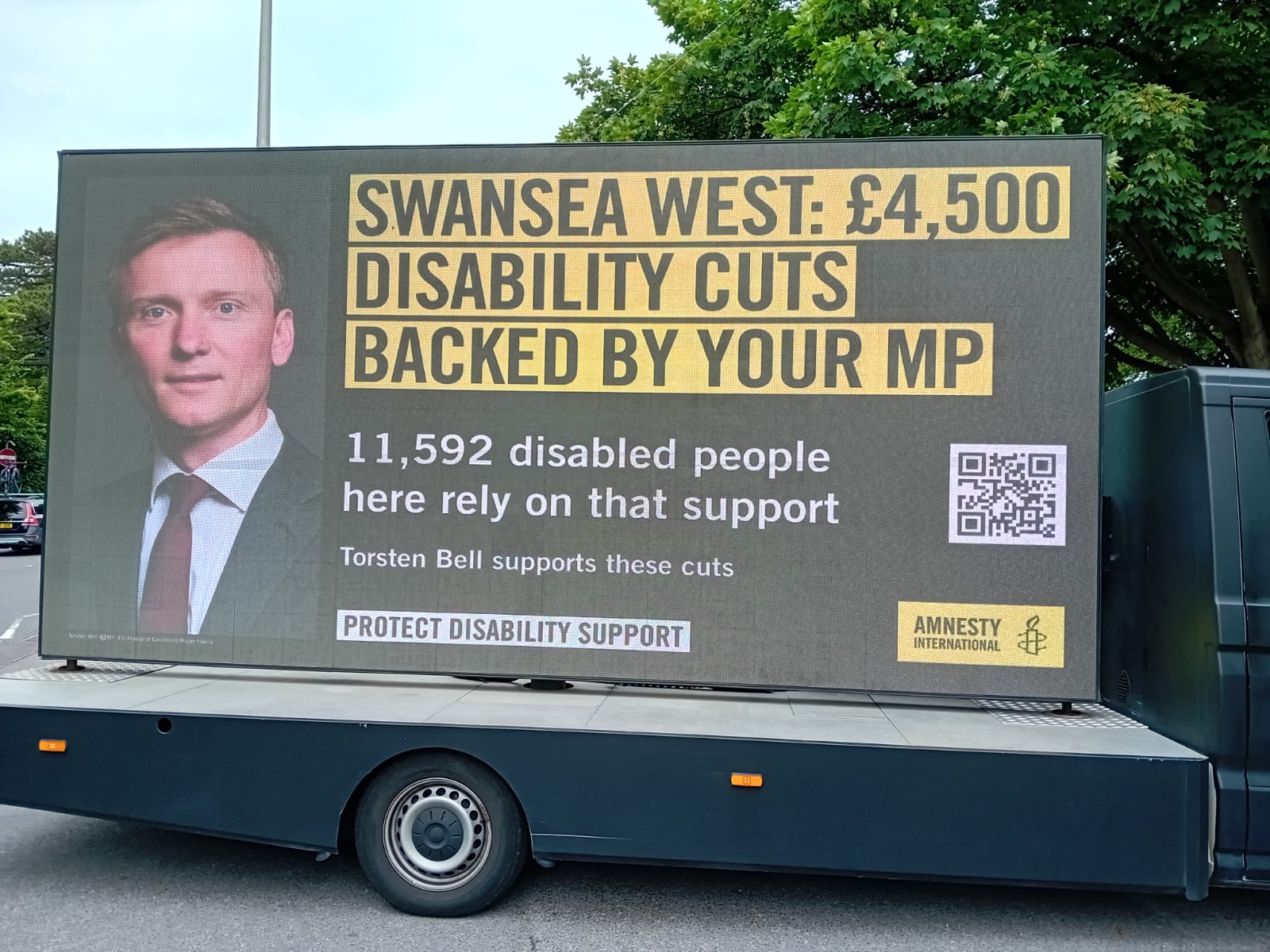
The budget is being written by the Swansea West MP.

A photo of a mobile billboard featuring the face of the Torsten Bell MP. Text, in black on yellow, says: "Swansea West: £4,500 disability cuts backed by your MP." Text, in white on black says "11,592 disabled people here rely on that support. Torsten Bell supports these cuts. Protest disability support." At the bottom-right is the Amnesty International logo, which is black on yellow.

Disabled people defeated his Spring Statement & PIP disability cuts. Now he’s back with another anti-working-class budget. We will defeat him again.

First Bus workers are on strike over low pay.

65 student nurses have been told there are no vacancies when they graduate.

£25 million of job cuts at Swansea University.

Disabled people are still fighting cuts and Swansea women are still fighting for pension justice.

Politicians try to divide us by blaming migrants, low-paid workers, trans people & disabled people.

“An injury to one is an injury to all”


We want to co-organise a protest with everyone affected by the budget.

Contact Disabled People Against Cuts Cymru (DPAC Cymru)

Swansea – Protest the budget (PDF for printing)

A graphic of the DPAC Cymru logo. There is the main DPAC logo to the left, which is a red, pink, blue, and green circle being held by four hands of different skin tones, with the words "disabled people against cuts" surrounding it, and an upside-down black traingle in the middle bearing the letters D P A C. On the right is the word Cymru (pronounced cum ree) (C Y M R U) in large letters, and the background of the letters are cutouts of the Welsh flag. Above Cymru (pronounced cum ree) is written the words Disabled People Against Cuts. Below Cymru (pronounced cum ree) are the words Rights, not charity, and the equivilant phrase translated into the Welsh language.

This is a graphic advertising a protest in Swansea on the 29th November.

There are striped green and red corners with the text "Swansea" along the diagonal.

A speech bubble that says "protest the budget" is exiting a megaphone.

There are three clasped hands of different skin tones and the text "an injury to one is an injury to all" curves around them.

Large text says "Saturday 29th November. 1pm at Swansea Castle, S A 1, 1 D W." Smaller text says "With Disabled People Against Cuts (D P A C) and others."

Beneath, with a ripped paper effect, is text that says "no disability cuts. Hands off motability. Living wages. Pension justice. Rent control. Trade union rights. No to hate & division. Make the rich pay."

This is a graphic advertising a protest in Swansea on the 29th November.

There are striped green and red corners with the text "Swansea" and "Protest" along the diagonals, and the text "budget" in the center.

Beneath, in all-caps, is the text "Sat. 29 November. 1pm @ Swansea Castle."

In the centre of the leaflet is text that starts in bold with "The budget is being written by the Swansea West MP."

The text continues: "Disabled people defeated his Spring Statement & PIP disability cuts. Now he’s back with another anti-working-class budget. We will defeat him again."

There are then five bullet points that say: "First Bus workers are on strike over low pay. 65 student nurses have been told there are no vacancies when they graduate. £25 million of job cuts at Swansea University. Disabled people are still fighting cuts and Swansea women are still fighting for pension justice. Politicians try to divide us by blaming migrants, low-paid workers, trans people & disabled people."

At the bottom, with a ripped paper effect and a pink background, is the D P A C Cymru logo - a red, green, blue and pink wheel being held by four hands of different skin tones. To the right is a blue box that asks "Your org's logo here?" and text that says "We want to co-organise a protest with everyone affected by the budget", the email D P A C dot C Y M R U at gmail.com and the website "D P A C hyphen C Y M R U dot C A R R D dot C O."
Nov 072025
 
DPAC Logo with text underneath "Disabled People Against Cuts" and then web address dpac.uk.net

Contents

New official figures expose how politicians and media have repeatedly lied about social security spending 1

Ministers listen to disabled campaigners and return key accessibility duty to railways bill 3

Government review calls for ‘safer, more supportive’ workplaces for disabled people 7

DWP refuses to rule out cuts to PIP next year 10

Safeguarding probe launched after veteran disabled activist reports ‘terrifying’ care home experience 12

Tens of thousands tell government: We reject any plans to cut PIP 14

Other disability-related stories covered by mainstream media this week 16


New official figures expose how politicians and media have repeatedly lied about social security spending

New official figures – hidden by government and opposition parties – have exposed months of lies by politicians and the media about “spiralling” spending on social security and the need to cut benefits.

The updated statistics from the Office for Budget Responsibility (OBR) show that, rather than “spiralling out of control”, social security spending is predicted to be lower in 2029-30 than it is this year.

Previous figures published by OBR in October 2024 showed that the share of GDP* taken by social security spending was stable, and even predicted to fall from 11.1 per cent to 11.0 per cent in 2027-28 and 2028-29, before rising slightly back to 11.1 per cent in 2029-30.

Despite those figures, it appears to have become an accepted fact across the mainstream media – and particularly right-wing publications – that social security spending is out of control.

But the new OBR figures**, published in March this year but apparently not reported on by the media, show predicted spending to be even lower than previously forecast.

They show that social security spending is predicted to be 10.9 per cent of GDP this year, then 11 per cent in 2026-27, 10.8 per cent in 2027-28, 10.7 in 2028-29 and 10.8 per cent in 2029-30, when it will be 0.2 percentage points lower than next year’s expected level.

The figures – which may be adjusted again later this month by OBR – highlight the repeated dishonesty of politicians and media commentators who insist that chancellor Rachel Reeves must act in this month’s budget to curb what they claim is rapidly-rising spending on social security.

Although spending on personal independence payment (PIP) has been rising quickly, and is predicted to rise further – likely due to the combined impact of the pandemic on long-term health, the rise in mental ill-health, lengthy NHS waiting-lists after 15 years of austerity, greater awareness of PIP, the rising state pension age, and the cost-of-living crisis – the OBR figures show overall social security spending to be stable and even predicted to fall slightly.

This week, Disability News Service (DNS) approached the Treasury, the Department for Work and Pensions (DWP), the Conservative party, the Labour party and Reform UK, asking why they have repeatedly stated that social security spending was spiralling and needed to be cut when it was now set to fall over the next few years.

By noon today (Thursday), Labour, the Conservatives and Reform UK had all failed to comment on the figures or even acknowledge the approach.

The Treasury passed the questions to DWP.

A response from DWP ignored the questions asked by DNS and so is included as a footnote to this article***.

The last few days have seen Tory leader Kemi Badenoch and Reform UK leader Nigel Farage both calling for cuts to social security spending.

Badenoch said in a speech on Tuesday that she had a plan to “cut welfare”, and “reduce eligibility for lower-level mental health issues”, repeatedly conflated PIP with out-of-work disability benefits, misleadingly claimed that “sickness benefits pay more than the minimum wage”, and attacked the Motability car scheme.

Two months ago, she said the social security system was “out of control”.

Last week, Reform UK’s work and pensions spokesperson Lee Anderson said his party would cut £3.2 billion a year from PIP spending by “fully [removing] those with anxiety disorders, but not serious psychiatric disorders, from PIP eligibility”.

And this week, Reform UK leader Nigel Farage wrongly claimed that the benefits bill had “ballooned” this year, while he also claimed – again wrongly – that the million lowest-paid workers would “all be better off if they claimed to have mild anxiety”.

Chancellor Rachel Reeves was more subtle in her “scene setter” speech ahead of the budget, describing welfare spending on Tuesday misleadingly as one of the “pressures on the public finances”.

Last month, she repeated the false claim that welfare spending was spiralling, telling Channel 4 News: “We can’t get to the end of this parliamentary session and have done nothing, because if more and more of our money that we spend as a government is spent on welfare, you’ve got less for the NHS, you’ve got less for schools.”

Meanwhile, the harm caused by previous efforts to cut spending on disability benefits was highlighted on Tuesday by a protest outside DWP’s Caxton House headquarters by disabled artist, writer and filmmaker Dolly Sen.

Sen – who declared the building a “crime scene” because of the “structural violence built into the welfare system” – was joined by campaigners Joy Dove and Ian Briggs.

One of their aims was to call on the government to “prioritise the safety, dignity and lives of claimants in all welfare policy”.

Dove’s daughter Jodey Whiting died in February 2017, and in June a second inquest into her suicide – following her mother’s eight-year campaign for justice and accountability – found that her “deteriorating” mental health had been “precipitated” by the withdrawal of her out-of-work disability benefits after she missed a work capability assessment.

Briggs has campaigned for justice for five years over his claims that the actions of the Child Maintenance Service – part of DWP – contributed to Gavin’s decision to take his own life.

Sen said: “They call it welfare; I call it warfare.

The DWP wages war on the poor, the disabled, and the already-broken.

It’s a ministry of cruelty that has turned suffering into policy, despair into a spreadsheet.

Behind every tick box is a human being who didn’t survive the paperwork.”

She added: “We will continue to campaign until the state stops treating life as a cost to cut.”

Dove said: “I want to show I am not going away. I want a public inquiry and justice for Jodey, if that’s the last thing I do.

The coroner said the DWP triggered Jodey to kill herself, and I think someone should be held accountable.

I am also doing this for the other families who have lost loved ones due to the DWP.”

*Gross domestic product, the size of the country’s economy in a particular year

**Chapter five of OBR’s Economic and Fiscal Outlook – March 2025, chart 5.2, shows welfare spending as a percentage of GDP: https://obr.uk/efo/economic-and-fiscal-outlook-march-2025/

***A DWP spokesperson said: “We’re shifting our focus from welfare to work, skills, and opportunities, so more people can move out of poverty and into good, secure jobs as part of our Plan for Change. We’re also modernising jobcentres, delivering a youth guarantee, and funding local programmes like Connect to Work so people get the skills to thrive, and businesses get the workforce they need.”

6 November 2025


Ministers listen to disabled campaigners and return key accessibility duty to railways bill

The government has restored accessibility to the heart of its planned rail reforms, in a victory for disabled campaigners and allies who fought plans to remove a key measure from new legislation.

Labour had previously dropped plans to ensure there was a statutory duty to ensure accessibility was central to all policy decisions made by the new Great British Railways (GBR).

This led to disabled campaigners and allies accusing transport secretary Heidi Alexander of scrapping commitments on accessibility made by the last Conservative government.

But when the government published its new railways bill yesterday (Wednesday), it included a “passenger and accessibility” duty.

In its response to a consultation on the bill, also published yesterday, the Department for Transport (DfT) said it would “include a passenger and accessibility duty in primary legislation to ensure GBR factors in the needs and interests of disabled passengers when carrying out its statutory functions”.

It said it was taking this step “in line with the feedback and strong support outlined in responses to the consultation”.

The bill says that GBR, ministers and the regulator must all “exercise their functions” in “the manner best calculated to promote the interests of users and potential users of railway passenger services including, in particular, the needs of disabled persons”.

The bill will create GBR, a new publicly-owned company that will bring together management of passenger services and rail infrastructure.

The government also plans to use the bill to introduce a stronger passenger watchdog and simplify fares and tickets.

DfT said this watchdog would have “an explicit role in accessibility by monitoring how services are delivered to disabled passengers and advocating for improvements where issues arise”.

Ministers have also published a new “roadmap to an accessible railway”.

The roadmap – which covers England, Scotland and Wales – promises that GBR “will embed accessibility into the heart of the railway”.

But despite a series of pledges in the roadmap to improve the railway’s accessibility, questions are already being asked about the government’s commitment to funding the cost of transforming the railway’s infrastructure to ensure it is accessible to disabled passengers.

The roadmap says £373 million will be spent over the next five years on the Access for All station improvement programme, but it admits that this will only increase the proportion of rail stations across Britain that are step-free from pavement to platform from 56 per cent to 58 per cent.

But the roadmap also promises that reforms to the Access for All programme will lead to a future commitment to only spend “up to” £70 million a year.

This appears to be a reduction in spending, once inflation is accounted for, as the Department for Transport (DfT) previously allocated £350 million for the scheme from 2019 to 2024, although only £285 million of that was eventually spent over those five years.

Among other measures in the roadmap – and following years of calls from campaigners, particularly the Campaign for Level Boarding – the government promises a “comprehensive study of level boarding to identify and scope practical, cost-effective solutions for achieving level boarding across prioritised locations on the rail network”. 

A strategy next year will include the government’s approach to “improving level boarding and setting out what is needed from trains and infrastructure in the future, to allow people to board with greater ease”.

The roadmap also promises that Network Rail will deliver a plan to improve the reliability and performance of lifts and escalators at stations across the rail network.

And it says improvements will be made over the next 16 months to the much-criticised Passenger Assist – which allows disabled passengers to book assistance in advance of their journey – that will be aimed at making it “more reliable and consistent”.

On customer information on station accessibility, among the improvements planned are the introduction of “virtual 3D walkthroughs” of 250 of the country’s busiest and most complex stations, and improvements to live information on facilities such as lifts, escalators and accessible toilets.

And eligibility for a disabled persons railcard will be expanded to “cover a wider range of disabilities”.

There will also be a new, “comprehensive” disability equality training programme for rail staff, which will be co-produced and delivered in partnership with disabled people and rolled out across the rail network, with the possibility of a new British Standard for “inclusive service”, which will apply to train companies as they are nationalised.

A new National Accessibility Panel will “oversee and advise on nationally significant issues affecting disabled passengers across the UK”, with membership including disabled people and representatives from disabled people’s organisations, as well as the Disabled Persons Transport Advisory Committee and the Mobility and Access Committee for Scotland.

Emily Sullivan, co-founder of the Association of British Commuters, and a disabled researcher in equality and human rights, said: “After eight months of campaigning, it is a real victory to get core duties for accessibility and socioeconomic value back into the plan for Great British Railways.

Our next task is to make sure these duties are even stronger, and that there is a much better, rights-based framework for regulating accessibility.

There is also an urgent need to secure more funding – with slow progress on Access for All and signs of more austerity policies ahead, such as railway destaffing.”

She said the roadmap was “very short-term” but included some “valuable suggestions”, particularly the commitment to develop a new system of accessibility panels, which “could be transformative for disabled people’s representation” if the system was independent, transparent, and engaged with the public, and co-created with disabled people’s organisations.

But she said there were some “serious omissions”, with “no mention whatsoever of equality or rights-based standards, which should be the foundation of everything else”.

And she said it was “appalling” that there was no “mention or aspiration” towards disabled people’s right to “turn up and go” on the rail network.

Sullivan also said it was “hugely concerning” that the private sector Rail Delivery Group would be developing technologies like Passenger Assist until at least 2027, when it “should have been removed from the area of accessibility years ago”.

She said: “It is important to watch this closely in case the focus on pre-booking technologies is being used once again as a way to destaff the network.”

The disabled people’s organisation Transport for All said the railways bill was “a once-in-a-generation opportunity to rebuild Britain’s railways with accessibility for everyone embedded from the ground up”, but that it must lead to “concrete, enforceable change across the rail network”.

It said it would be closely monitoring developments with the bill and GBR’s licence “to ensure that disabled people’s experiences are central in shaping the next era of Britain’s railways”.

Emma Vogelmann, co-chief executive of Transport for All, said: “This bill is a once-in-a-generation opportunity to rebuild Britain’s railways with accessibility for everyone embedded from the ground up.

We welcome the government’s commitment to include disabled passengers in the new passenger interest duty and to give the passenger watchdog a clear role in monitoring accessibility.”

But she added: “These promises must lead to real, measurable improvements for disabled people who rely on rail.

Accessibility for everyone must be a priority for public transport and a defining principle as Great British Railways takes shape.”

A DfT spokesperson told Disability News Service: “We are fully committed to improving accessibility across the network, and the railways bill includes a statutory duty requiring key bodies in the sector to support all passengers, particularly the needs of disabled people.

Alongside the railways bill, today we published an accessibility roadmap, which is a practical plan to deliver real, measurable change and expanded eligibility for the disabled persons railcard.”

Labour’s Ruth Cadbury, who chairs the Commons transport committee, gave a cautious welcome to the roadmap.

The committee’s Access Denied report on transport accessibility argued for a long-term plan with concrete timescales to address the barriers faced by disabled travellers, with the committee later describing the government’s response to its report as lacking “urgency” and disabled campaigners warning that it left the future of disabled people’s right to travel in “grave danger”.

Cadbury said: “We will take a close look at the roadmap and its implementation to ensure that it delivers on this need.”

She welcomed some of the contents of the roadmap but stressed that “funding needs to be equal to the scale of the challenge”.

She said: “We will be looking closely in the future at whether the roadmap’s ambitions transform the experience of getting around on the rails in practice.”

Rail minister Lord [Peter] Hendy described the roadmap as a “turning point” for disabled rail passengers and said it was “a practical plan to deliver real, measurable change, ahead of the establishment of Great British Railways”.

He said: “We know there is more work to do, but the roadmap lays the foundations for a longer-term transformation under GBR, because an accessible railway isn’t just better for disabled people – it’s better for us all, and this is the start of building one together.”

6 November 2025


Government review calls for ‘safer, more supportive’ workplaces for disabled people

A government review has called for action by employers and ministers to ensure “safer, more supportive, inclusive workplaces” and to address the barriers faced by sick and disabled people in and out of work.

The final report of the Keep Britain Working review focuses on what employers and government can do to address links between ill-health and economic inactivity.

But it almost completely ignores the views of sick and disabled people, and the risks of forcing someone back into work when they are not well enough, particularly when many of the available jobs are “poorly-paid, strenuous and insecure” and likely to make someone unwell again, as Disability Rights UK pointed out this week.

It also appears to suggest that employers should be given more power in deciding when an employee should return to work, with less say given to GPs, through reforms to the “fit note” system.

The report points to an estimated gain of up to £18 billion a year to employers, government, and the wider economy, if the suggested reforms are introduced.

The review says the UK has been “sliding into an economic inactivity crisis driven in large part by ill-health and by barriers to work faced by disabled people” and it lays out a seven-year plan to “radically improve results in managing health and disability in work”.

In contrast to the months and years of targeted attacks by politicians and right-wing media, in which sick and disabled people have been blamed for the country’s economic problems (see separate story), the review places the responsibility for addressing the “crisis” largely on employers.

  1. It says: “Disabled people describe repeatedly having to self-advocate for workplace adjustments, often with anxiety about whether support will be given or withdrawn in future.
  2. As many conditions are dynamic and fluctuating, this becomes a recurring burden.
  3. It also makes changing roles or employers much harder.”

The 10-month review, led by Sir Charlie Mayfield, former chair of John Lewis Partnership and of the British Retail Consortium, was commissioned last year by the government.

The review says the aim is to “re-humanise the workplace, raise standards, improve access to support, and transform the visibility of data”.

The review was told by ill and disabled employees that they “fear disclosing health conditions or disabilities, and are worried about stigma, discrimination, or damage to career prospects”.

Although Sir Charlie emphasises the risk of “disengaging from work and potential support, or relying on welfare as an alternative to work”, almost all his report calls for action by employers and government and mostly avoids blaming sick and disabled people.

In a letter to work and pensions secretary Pat McFadden and business and trade secretary Peter Kyle, Sir Charlie says: “With the right approach, many more people could stay in work, recover faster, and live healthier, more secure lives.”

The review calls for a “fundamental shift from a model where health at work is largely left to the individual and the NHS, to one where it becomes a shared responsibility between employers, employees and health services”.

Among its recommendations, the review calls for significant reform of the fit note, which is issued by healthcare professionals to provide evidence of their advice on a person’s fitness for work.

It suggests that a new employer-funded system would “offer support and advice, early intervention, good case management, and targeted early-stage treatment pathways”, with this eventually “reducing – or even replacing – the need for the current fit note”, a recommendation that may alarm many campaigners concerned at the power this may give employers over unwell employees.

It also calls for the development of “stay in work” and “return to work” plans, faster access to support, and a new certified “healthy working” standard for employers.

Publishing the report, the government announced a list of about 80 employers that have pledged to become part of the “vanguard” of organisations that will be “early adopters” of the new approach to workplace health.

There are already significant concerns being expressed about the report.

As well as concern over the apparent move towards giving employers more power in deciding an employee’s fitness for work, there is likely to be alarm about the report’s failure to discuss those sick and disabled people who cannot work or even move towards work, and the risks of pressuring them to do so.

There is likely to be disquiet among many disabled people that the list of enthusiastic “vanguard” employers includes Capita, Maximus and Unum, all of which have been linked closely to activity by the Department for Work and Pensions that has caused countless deaths of disabled claimants over the last three decades.

Many will also highlight the government’s continuing cuts to disabled people’s Access to Work packages – with more cuts believed likely in the coming months – and its decision to cut the health element for most new claimants of universal credit who cannot work for disability-related reasons, supposedly as an “incentive”, from April 2026.

The new work and pensions secretary, Pat McFadden, is also expected to take action to prevent most sick and disabled people under the age of 22 from accessing the health element of universal credit.

Another potential concern is that there is little or no mention in the report of working with disabled people and DPOs to implement the review’s recommendations.

Instead, the report talks of the need for a “phased approach… working with willing employers and providers to develop and prove what works, before embedding and extending it across the wider economy over the next 3-7 years.”

But McFadden said yesterday in a written statement to MPs that a new “vanguard taskforce”, to be co-chaired by Sir Charlie, will “bring together representatives from business, disabled people, workers representatives and health experts to shape and deliver this work”.

He did not make it clear how many of the report’s recommendations the government accepted, but he said ministers planned to “work with businesses and disabled people to pilot and develop improvements and reform”.

He said the government was “already piloting innovative approaches to the fit note and we are committed to further reform so that it works better for patients, employers and the health system”.

There are only fleeting mentions in the report of the Access to Work scheme – currently plagued by delays and cuts – and its importance to disabled people in finding and maintaining jobs.

And the review is dismissive of Disability Confident, the much-criticised scheme introduced more than a decade ago by Conservative work and pensions secretary Iain Duncan Smith.

It says: “Schemes such as Disability Confident and Access to Work have several positive features and good intent, but we heard regularly across the review that they were not delivering effectively in practice, with Disability Confident lacking accountability and ‘teeth’ and Access to Work facing long delays and delivery challenges.”

McFadden said: “Business is our partner in building a productive workforce – because when businesses retain talent and reduce workplace ill-health, everyone wins.”

Kyle added: “Many more people could remain in work if they receive the right support – and that’s exactly what today’s action is about.

We believe that when people are treated with dignity and care, businesses flourish.”

6 November 2025


DWP refuses to rule out cuts to PIP next year

The Department for Work and Pensions (DWP) has refused to rule out spending cuts to personal independence payment (PIP) when it completes a year-long review that is being headed by the disability minister.

Misleading reports in right-wing media last week suggested that updated terms of reference for the review showed ministers had ruled out any cuts to PIP spending.

But the terms of reference suggest exactly the opposite: that spending will not be allowed to be higher than the “projections” published by the Office for Budget Responsibility (OBR) but could be lower.

The terms of reference say: “The purpose of the Review is to ensure that PIP is fair and fit for the future rather than to generate proposals for further savings.

However, the sustainability of the system is an important consideration and so the Review will operate within the OBR’s projections for future PIP expenditure, to ensure it is there to support generations to come.”

This second sentence has been added since the original terms of reference were published in June.

The following sentence has also been added to the terms of reference since June: “We want to ensure public money is spent as effectively as possible in supporting disabled people to live independent and fulfilling lives.”

This week, DWP refused to clarify what it meant by these two sentences, and whether the review could lead to cuts to PIP spending.

Instead, a DWP spokesperson said: “We want a welfare state that is there for those who need it and supports people into work, while delivering fairness to the taxpayer.

That’s why we’re launching the Timms Review to make sure PIP is fair and fit for the future.

We’re shifting our focus from welfare to work, skills and opportunities so more people can move out of poverty and into good, secure jobs as part of the Plan for Change.”

Last week, DWP announced the names of the two disabled people – Dr Clenton Farquharson and Sharon Brennanwho will co-chair the review with Sir Stephen Timms, the minister for social security and disability.

Brennan is a former director of policy and external affairs at National Voices, a coalition of English health and social care charities, and a former member of the Disabled Persons Transport Advisory Committee

Farquharson is a consultant, associate director at Think Local Act Personal, and a board member of both Disability Rights UK and the Race Equality Foundation.

DWP has also launched a recruitment process for the 12 members of the PIP review’s steering group.

The majority of the steering group will be disabled people or representatives of disabled people’s organisations.

These positions will be paid, with a daily fee of £300 for up to five days a month until autumn 2026.

As the Benefits and Work website pointed out, this is likely to mean the steering group will have only about 55 days to complete its work.

It also pointed out that steering group members will not need to sign a gagging clause, although they will be expected to “maintain the confidentiality of information shared in confidence”.

There was shock and alarm this summer when DWP imposed a gagging order – which was later removed – on members of its new Independent Disability Advisory Panel.

In a parliamentary written statement, Sir Stephen said the PIP review would be the first time the government had undertaken co-production with disabled people “on this scale”.

But the terms of reference make it clear that final decisions on any changes will be made by Labour’s new work and pensions secretary, Pat McFadden.

Meanwhile, Benefits and Work also highlighted a string of errors, concerning statements and misleading claims made by Reform UK in a press conference last week on the party’s plans to slash PIP and target the Motability scheme.

6 November 2025


Safeguarding probe launched after veteran disabled activist reports ‘terrifying’ care home experience

A veteran activist, who has spent her life campaigning for disability rights, has called on the government to fix the “rotten to the core” social care system, after experiencing “terrifying” treatment during a short stay in a care home.

Rachel Hurst, now 86, is hoping to give evidence about her experience to Baroness Casey’s social care commission, which has been set up by the government to examine the crisis in adult social care.

For 12 days last month as a temporary resident at Miranda House in Royal Wootton Bassett, she says she was frequently left in wet and soiled pads – sometimes all day – and had to remind staff to bring her the medication she needed to take every morning.

Sheets were not changed, she was left in bed for hours at a time during the day, there was little communication from staff, some of whom were “rude” and uncaring, she says, and the home did not have the hoist needed to allow her to use the toilet safely, while there was no monitoring of her fluid intake.

She said the care provided was “dire”, even though the home itself was clean and her room was mainly well-equipped, and she was left with an infection which she believes was caused by the failure to change her pads.

Wiltshire Council has now launched a safeguarding investigation into her experience at the home.

Miranda House is owned and run by Aria Care Group, which operates more than 60 homes across England, Scotland and Jersey.

Hurst is a former director of the international disability rights network Disability Awareness in Action (DAA) and former vice-chair of Disabled Peoples’ International, and she was heavily involved in lobbying the United Nations (UN) for nearly 20 years to introduce a disability rights convention, receiving letters from disabled people all over the world about her campaign, which she shared with the UN.

The UN Convention on the Rights of Persons with Disabilities was eventually adopted in 2006 and entered into force in 2008.

A former chair of the British Council of Disabled People and Greenwich Association of Disabled People in the 1980s, she has fought for disabled people’s rights throughout her adult life.

She has always been known as a forthright, formidable, and charismatic campaigner – she once heckled prime minister Tony Blair at an event in 10 Downing Street – and says she now wants to use her final years to highlight the appalling state of social care.

She spent 12 days in the care home while her support needs were being assessed.

Hurst, who was awarded a CBE in 2008, said: “I felt impotent and lonely and depressed. It was terrible.”

She said she contacted Disability News Service (DNS) about her “dreadful” and “terrifying” experience because she wanted to publicise the impact of the social care crisis on disabled people who rely on care and support.

Hurst, who nearly died last Christmas from sepsis, pneumonia and flu, told DNS: “I am very angry; the whole of the social care system is engineered to discriminate.

I am hoping you will write a story, but I want to make sure it gets to people who will then do something.

This must get on the radio or television, so people begin to talk about the treatment of disabled people.

I don’t care about me anymore, but I do care about other disabled people.

I don’t want something done about my situation, I want something done about social care, even if it’s the last thing I do.

I want people to understand how terrible things are. The discrimination against us is quite unbelievable.

I travelled the world visiting residential homes, but I am shocked that in Britain today we are treating people in the way we are in these homes and in social care and in our own homes.”

She is now living back at home in Wiltshire, but still relies on 24-hour care, with her health and care needs funded by an NHS Continuing Healthcare package from Bath and North East Somerset, Swindon and Wiltshire Integrated Care Board.

The family’s concerns have been passed on by the care board to Wiltshire Council.

Cllr Gordon King, the council’s cabinet member for adult social care, said: “Everyone has the right to expect the highest standards of care and support when staying in a care home.

When concerns are raised and we are made aware, Wiltshire Council will carry out a safeguarding investigation and support a thorough review of the issues.

We have initiated a safeguarding investigation based on the information that has been shared.

Where care is funded by health services, the integrated care board and Wiltshire Council work closely together to respond to concerns, ensuring they are properly addressed and that the individual raising them is kept informed throughout the process.”

A spokesperson for Miranda House said: “There is nothing more important to us than the health and wellbeing of the people in our home.

While we were sorry to receive this feedback from Ms Hurst, her account differs to our records and is in stark contrast to the typical positive comments we receive from residents and their loved ones.

The home has a 9.5 rating on the independent comparison website carehome.co.uk and is often complimented for our caring and supportive staff team.

Throughout her 12 days in our home, we had been in close communication with NHS Bath and North East Somerset, Swindon and Wiltshire Integrated Care Board, who organised Ms Hurst’s care.

We are confident our team did everything they could to respond to her unique needs with compassionate care.”

Bath and North East Somerset, Swindon and Wiltshire Integrated Care Board refused to comment directly on the complaint made by Rachel Hurst due to patient confidentiality, even though she had made it clear she was happy for DNS to report her case and for the board to discuss it with DNS.

Instead, it released the following statement: “As commissioners of local health and care services, we expect our provider partners – including those outside of the NHS, such as care home residences – to maintain the highest possible standards, and to treat all patients with kindness, dignity and respect.

Where care falls below the expectations of patients and their families, we will investigate and work alongside providers to implement tangible improvements which not only benefit the individual, but also prevent similar situations from occurring.

We strongly encourage any patients who have concerns about their care to reach out to us through our Patient Advice and Liaison Team as early as possible so that we can step in and take action without delay.”

6 November 2025


Tens of thousands tell government: We reject any plans to cut PIP

Tens of thousands of disabled people and allies have made clear to the government that they reject any plans to cut spending on personal independence payment (PIP) and other disability-related support.

The views came in response to a public consultation on March’s Pathways to Work green paper, with the government publishing its summary of those responses on 30 October.

The consultation, which ran until the end of June, received nearly 48,000 responses, including nearly 900 organisations.

Out of nearly 15,000 direct responses to a consultation question on the government’s original plans to cut PIP entitlement – which were later dropped after a backbench rebellion – more than half (52 per cent) called for the current criteria to be maintained, while 37 per cent highlighted the financial impact of losing PIP, and 18 per cent pointed to the mental health impacts of such a loss.

It is not possible from the document to measure how many respondents in total opposed cuts to PIP because of the way the Department for Work and Pensions (DWP) produced its report.

But in addition to the 15,000 direct responses, DWP also received more than 33,000 other responses – coordinated by three outside organisations – which did not reply directly to the questions posed in the consultation.

Again, DWP did not attempt to calculate how many of these responses opposed cuts to PIP, but it said there was “broad opposition to changes to the value or eligibility of PIP”.

It said these responses also opposed stopping disabled people under 22 from receiving the health element of universal credit, another reform proposed in the Pathways to Work green paper.

Opposition to this change was also overwhelming among those who responded directly to the consultation questions, with more than 42 per cent saying support should be based on need, not age, and more than 12 per cent highlighting that delaying access to the health element would cause financial hardship for young people and increase their risk of poverty.

The document appears to suggest that just four per cent of respondents backed delaying the payments until 22.

Elsewhere in the government’s consultation response, thousands of disabled people and allies made clear to DWP that if it wanted to improve its “current approach to safeguarding people who use our services”, it should abandon any cuts, ensure “financial stability”, and reform the assessment process to ensure “fair, transparent, unintrusive, individualised assessments delivered by trained medical professionals”.

Meanwhile, the government has all but confirmed that it has dropped its plans for a white paper based on many of the Pathways to Work proposals and has decided to proceed instead by announcing future proposals individually.

In response to last week’s Disability News Service (DNS) report that the white paper had been dropped, DWP eventually produced the following statement: “Today, we published the response to the Pathways to Work Green Paper and have already put in place the equivalent of over 1,000 full-time Pathways to Work advisers across Britain to help disabled people into work, as well as investing £1 billion a year for employment support by the end of the decade.

We have also launched the Timms Review to ensure PIP is fair and fit for the future and are increasing the number of health assessments that are being conducted in person.

We will be bringing forward other policy updates in due course.”

Following a DNS briefing last week, the Liberal Democrat work and pensions spokesperson Steve Darling asked Sir Stephen when the white paper would be published.

In his written response on Monday – which mirrored the statement given to DNS – Sir Stephen failed to mention the white paper but instead said DWP had appointed new Pathways to Work advisers and launched his PIP review (see separate story), adding: “We will be bringing forward other policy updates in due course.”

Further evidence that the white paper has been scrapped came in updated terms of reference for the PIP review.

The original terms of reference (PDF) made two mentions of the white paper, but both of these have been removed from the updated terms of reference.

The Benefits and Work website said the backbench rebellion over PIP appeared to have “put ministers off the idea of launching another full scale attack on benefits” and instead seemed to have persuaded them to “switch to guerilla tactics, choosing smaller individual targets which they believe will be easier to achieve”.

6 November 2025


Other disability-related stories covered by mainstream media this week

Sickness benefits claimants will no longer be able to access subsidised luxury cars under planned changes to the Motability scheme, it has been reported. Rachel Reeves is expected to announce sweeping reforms to the car scheme, which will mean benefits claimants will no longer be able to access high end models, such as BMWs, Mercedes and Audis. The chancellor will also cut back perks offered under the programme, including overseas breakdown cover and insurance that covers up to three different drivers: https://archive.ph/EcI44

Lancashire’s Reform-run council has been accused of “selling off the family silver” through its plans to save £4 million a year by closing five council-run care homes and five day centres and moving residents into the private sector. Questions are also being asked about a potential conflict of interest involving Reform’s cabinet member for social care, who owns a private care company with his wife: https://www.theguardian.com/politics/2025/nov/05/lancashires-reform-run-council-plans-to-close-care-homes-to-save-4m-a-year

6 November 2025


News provided by John Pring at www.disabilitynewsservice.com


Oct 302025
 
DPAC Logo with text underneath "Disabled People Against Cuts" and then web address dpac.uk.net

Contents

DWP’s plans ‘in tatters’ as McFadden scraps white paper on further disability cuts 1

Shocking’ figures show parents linked to DWP service face death rates up to three times higher 3

Former detective exposes culture of disability discrimination within ‘institutionally disablist’ Met 6

Committee calls cuts bill ‘discriminatory’, even though all its Labour MPs voted for it 10

Disabled people warn of ‘severe’ consequences if chancellor removes Motability VAT exemption 13

Disabled people face ‘systemic’ barriers in accessing community equipment, parliamentary inquiry finds 16

Regulator’s annual report shows impact of social care crisis on disabled people 18

Other disability-related stories covered by mainstream media this week 19


DWP’s plans ‘in tatters’ as McFadden scraps white paper on further disability cuts

Ministers have dumped plans for a major white paper containing a swathe of further cuts and reforms to disability benefits, following months of activism by disabled people and allies that forced the government into a major U-turn this summer.

Work and pensions secretary Pat McFadden, who only took on the role last month, confirmed the move in a meeting with representatives of disabled people’s organisations (DPOs) earlier this month.

One DPO said yesterday (Wednesday) that the admission was a “major success” for disabled people who fought the summer cuts bill.

But DPOs also warned that activists would need to keep up the pressure on ministers because McFadden had made it clear that, despite abandoning the white paper – which is likely to have significant political implications for the Labour government – individual measures would be taken forward.

He insisted in the meeting – first revealed this week by Greater Manchester Coalition of Disabled People – that further reforms would go ahead, but they would be introduced individually rather than all together in a white paper.

The white paper was set to be based on many of the measures outlined in the Pathways to Work green paper, and responses to a subsequent public consultation.

The results of that consultation should be published before the end of this year.

The decision to bin the white paper means that many of the reforms suggested in March’s green paper – including removing the health element of universal credit for those under 22; reform, and possibly cuts, to Access to Work; a time-limited replacement for contributory employment and support allowance; scrapping the work capability assessment; and changes to the safeguarding, conditionality and sanctions regimes – are likely to be announced separately over the coming months.

Some – but not all – of the reforms will still require legislation.

McFadden’s admission that he had dumped the white paper was made in a meeting on 14 October with Fazilet Hadi and Svetlana Kotova from umbrella organisation DPO Forum England.

Hadi, head of policy for Disability Rights UK, told Disability News Service (DNS): “I definitely think that the amazing campaigning from disabled people and our allies against the PIP cuts has left the government feeling very bruised.

The change of heart in publishing a DWP white paper, and the delay in launching the SEND white paper, bear this out.

Having said this, Pat McFadden has been moved to DWP to drive through cuts to social security, so the lack of a white paper doesn’t mean that there won’t be further threats to the benefits of disabled people.

It just means that those threats won’t all come at once.”

Kotova, director of campaigns and justice at Inclusion London, agreed.

She said: “There is a pause, but it does not mean reforms won’t be coming.

And we need to keep the pressure and persuade or force the government to switch its focus from cutting benefits or ‘fixing us’ to be more work ready to putting resources and its attention to making workplaces more inclusive.”

Among their arguments in the meeting, she said, was for the government to move money from employment support towards the Access to Work scheme.

Steve Darling, the Liberal Democrat work and pensions spokesperson, has lodged a parliamentary question about the “deeply disturbing” situation after being alerted by DNS.

He said: “At the time of a cost-of-living crisis, it is concerning that the secretary of state could be moving away from a more thoughtful, considered approach, to one more driven by cuts than by strategy.

This will only add to the stress and uncertainty that disabled people are facing with the threat of more cuts to disability benefits next year.

I have therefore asked the secretary of state a named day parliamentary question to find out when (if at all!) the white paper will be published, to try to shed some light on this fraught situation.”

Rick Burgess, from Greater Manchester Coalition of Disabled People, who first revealed publicly that the white paper had been dumped, told DNS: “They are not confident that they will get a big piece of legislation through parliament anymore.

It shows we really scared them. It’s a huge embarrassment for them. All their plans are in tatters, and they are afraid of losing another showdown in parliament.

A Starmer government couldn’t survive another drubbing.”

But he said he did not think ministers had changed their attitudes towards welfare reform, only that they were not confident they could push a large bill through parliament.

And he said it would be much harder for disabled people to stop a stream of smaller reforms, and that “keeping track of them is going to be really tricky”.

Linda Burnip, co-founder of Disabled People Against Cuts, said the government’s move to drop the white paper was “obviously a major success for disability rights activists and the many months of campaigning”.

But she said it appeared likely that ministers would use secondary legislation to “sneak things through in dribs and drabs and hope changes won’t be noticed”.

McFadden told Fazilet Hadi and Svetlana Kotova at the meeting that no decisions had yet been taken on barring under-22s from the health component of universal credit, and that it was a priority of his to get more young people into work.

They said he seemed to indicate that time-limiting contributory benefits would be taken forward relatively soon.

Hadi said: “We emphasised the need for government to join up its policies on disabled people and to coproduce solutions with us.

We urged him to move funding to the Access to Work scheme from the additional money being spent on employment support.”

Reforms – and almost certainly cuts – to personal independence payment are expected to follow next autumn, following a review being headed by Sir Stephen Timms, the minister for social security and disability.

Sir Stephen today (Thursday) launched the review, and announced his disabled co-chairs – Dr Clenton Farquharson and Sharon Brennan – as well as a recruitment process for the 12 members of a steering group that will jointly lead the review.

He said the majority of this steering group would be disabled people or representatives of DPOs.

DWP had not commented on McFadden’s admission by noon today (Thursday).

30 October 2025


Shocking’ figures show parents linked to DWP service face death rates up to three times higher

Parents who pay to support a child through the Department for Work and Pensions (DWP) and its Child Maintenance Service (CMS) face death rates up to three times higher than others the same age, according to “shocking” and “deeply troubling” new figures.

Analysis by Disability News Service (DNS) has shown that, for every age group between 20 and 54, those who use the service – known as “paying parents”* – face a much higher rate of death than those of the same age who do not have to deal with the CMS.

DNS carried out the analysis using figures obtained from DWP through a freedom of information request.

The request followed concerns raised by campaigners who have called for an inquiry into the deaths of parents driven to take their own lives by DWP’s refusal to correct errors in child support demands.

The figures, which are particularly exaggerated for younger age groups, have been passed to the Commons work and pensions committee, which is at the early stages of an inquiry into concerns about CMS.

Among the inquiry’s aims will be how to “improve the way it deals with families”, and concerns over how CMS calculates payments, and enforcement of its decisions.

The DNS analysis shows that, for all those aged 20 to 24 in England and Wales, the rate of deaths in 2024 was 0.04 per cent, compared with 0.13 per cent for CMS paying parents (more than three times higher).

For those aged 25 to 29, the rate of death was more than twice as high for paying parents, and for those 30 to 34 it was twice as high (0.12 per cent versus 0.06 per cent).

The difference in death rates narrows for older age groups, but there is still a substantial difference for every group analysed by DNS, with CMS paying parents aged 50 to 54 facing a death rate of 0.46 per cent in 2024, compared with 0.34 per cent for all adults in that age group.

Results for 2022 and 2023 show similar, striking differences.

Over those three years, there is not a single age group between 20 and 54 – the only groups examined in the analysis – where the death rates are not higher for paying parents than for all adults in England and Wales.

Although the figures do not show how many of these deaths were suicides, they do add strong evidence to the claims of campaigners who believe the higher rates of death for paying parents are at least partly caused by errors by CMS and its toxic culture, including its refusal to correct its mistakes. 

DWP said this week that it was carrying out reforms aimed at streamlining CMS but that it did not “recognise” the DNS figures or any suggestion of a causal link between the actions and culture of CMS and the deaths of paying parents, although it did not point out any errors in the DNS calculations.

Ian Briggs, from research and campaign group STOPS (StopSuicides UK), which focuses on the harm caused by CMS, said: “I, and many others, have long known that the CMS and the DWP have been responsible for driving many parents to suicide.

For years we have tried to highlight this to the DWP, yet every attempt is met with the same denial – that there is no link between the CMS and suicides.

Even when presented with clear and credible evidence gathered by the STOPS group, the official response from ministers has remained one of outright dismissal.”

His son Gavin took his own life five years ago.

The coroner at Gavin’s inquest refused to investigate his father’s claims that the actions of the CMS had contributed to his decision to take his own life, even though the agency had wrongly claimed he owed £16,000 in support payments, after claiming his income was £76,000 rather than the £26,000 it was in reality.

Ian Briggs said this week: “The mortality rates recently revealed through John’s** research and exposed by Disability News Service cannot all be explained away as coincidence.

While not every death may be due to suicide, these figures reveal a deeply troubling pattern that demands urgent scrutiny.

At some point, there must be a full and independent public inquiry into these disturbing facts and the systemic failures within the CMS and DWP that continue to destroy lives and families.

I would like to personally thank John and Disability News Service for… exposing these shocking mortality rates, and for giving a voice to the countless families – like mine – who have suffered unimaginable loss.”

Craig Bulman, who was left with PTSD after the Child Support Agency mishandled his case – the agency, the predecessor of CMS, eventually paid him a £5,000 consolatory payment – said the figures uncovered by DNS were “shocking”.

He told DNS: “Even allowing for statistical margins, the death rates you’ve calculated are deeply disturbing and point to something seriously wrong within the Child Maintenance Service.”

The Child Support Agency’s failings left Bulman homeless, triggered a mental breakdown, and caused the loss of his job.

He said this week: “These figures confirm what families have been warning for years – that the Child Maintenance Service is operating without proper oversight or duty of care.

Death rates among paying parents are up to three times higher than the national average, and yet the DWP has failed to investigate or publish these findings. 

This now warrants an independent inquiry under the Inquiries Act 2005.”

In January 2023, during the final session of a previous inquiry into CMS by the Commons work and pensions committee, Labour MP Debbie Abrahams told of a paying parent whose arrears had been inaccurately assessed “and the frustration that he found ultimately led to him taking his life”.

She said his mother had previously written to DWP “expressing real concerns about mental health” but there had been no reply.

She added: “This is not the first time. We had a panel before Christmas that also provided data about the suicides of paying parents who were inaccurately assessed in terms of the arrears that they owed.

This is tens of thousands of pounds that they said that they owe, leaving literally pounds for them to exist on.”

She asked Tory work and pensions minister Viscount Younger at the time if DWP collected data on suicides of paying parents.

He told her: “Could I just say that, being new into the department, I am already aware, having seen some of the correspondence that I have had to look at and sign off on, of some absolutely tragic cases?

It is absolutely appalling that cases can lead to people taking their own lives.

That is dreadful and we must look at all ways in which we can avoid that or have systems and processes that do not lead to that.”

Despite those comments, a DWP spokesperson said this week: “Over 780,000 people engage with the Child Maintenance Service, many of whom are experiencing a difficult time in their lives, and all staff are trained to support vulnerable customers.

We do not recognise this data or suggestions of a causal link between the CMS and deaths among parents.”

*Child maintenance covers how a child’s living costs are paid when one of the parents does not live with the child

**DNS editor John Pring

***The following organisations are among those that might be able to offer support if you have been affected by the issues raised in this article:  MindPapyrusRethinkSamaritans, and SOS Silence of Suicide

30 October 2025


Former detective exposes culture of disability discrimination within ‘institutionally disablist’ Met

A culture of institutional disability discrimination within the Metropolitan police is exposed today by the former head of its disabled staff association.

Dave Campbell, who retired this year after serving 32 years as a police officer, has told Disability News Service (DNS) that he believes disability discrimination within the force is rampant and that the Met is institutionally disablist.

He believes this “corporate culture” impacts how the force engages with disabled members of the public.

Campbell was chair of the Met’s Disabled Staff Association (DSA) for six years, and he was also vice-president of the Disabled Police Association of England and Wales.

His disclosures come only days after DNS revealed that prosecutions of disability hate crime across the country were continuing to plummet, with police forces in England and Wales passing on just a tiny proportion of recorded cases to prosecutors.

For six years, Campbell repeatedly tried to persuade the Metropolitan Police Service (MPS) to act on his concerns, before his retirement earlier this year.

It was his intervention that ensured the recent Casey review of the force’s internal culture and standards of behaviour examined the treatment of disabled people, when its initial focus was on racism, sexism and homophobia.

He believes the review provided an “alarming insight into how disabled people feel about their place in the organisation”, as he told Met commissioner Sir Mark Rowley in a letter last year.

He has told DNS that the upper levels of the Met have made it clear through their actions and inflexible policies – which he says marginalise disabled staff, and stem from outdated attitudes – that they do not want people who become disabled to continue serving as police officers in the force.

He says several disabled officers and staff have left the force because of their disability-related treatment and have written directly to the commissioner expressing their “despair and concerns”, without receiving any acknowledgement.

Over the four years between 2019 and 2023, he says, more than 200 disability discrimination employment tribunal claims were taken against the Met, including a significant number which included claims of race or gender discrimination.

The Casey review found an even higher number – 358 – in the five years between 2017-18 and 2021-22, but it was criticised by disabled campaigners for concluding that MPS was institutionally racist, sexist and homophobic, but not that it was institutionally disablist.

Campbell believes the number of disability discrimination tribunal cases increased after the Casey review by up to 60 per cent in 2023-24 compared to the previous year, while the DSA received hundreds of emails from distressed colleagues about the way they were being treated by their managers.

He has told Sir Mark that disability-led internal grievances are also at a high level, while many of his members had “no confidence or trust in the grievance management process” or in the ability of the Culture, Diversity and Inclusion directorate – set up after the Casey review – to produce change.

In the wake of Casey’s report, Campbell – as DSA chair – commissioned an independent review of disability inclusion and workplace adjustments in the force, by the Business Disability Forum (BDF), which reported its findings in September 2024.

Disabled colleagues in the DSA were asked if they had witnessed or personally experienced unfair treatment at work through disability-related harassment, bullying or discrimination, and 358 of the 775 who responded to the survey said yes (46 per cent), and another 123 (16 per cent) said maybe, a total of 62 per cent.

Of 504 police officers, 49 per cent said yes, and 15 per cent said maybe, a total of 64 per cent.

Of the 775 responses from disabled officers and civilian staff, less than 20 per cent (160) agreed with the statement: “MPS is an organisation that recognises and values disabled people.”

And just 65 (eight per cent) agreed that “feedback and complaints are listened to”.

One respondent said: “If you treated any of the other protected characteristics as you did disability then there would be uproar and heads would roll.”

Campbell believes the BDF report supports the view that MPS is institutionally disablist.

He told Sir Mark in last year’s letter: “In my experience Disability discrimination in the MPS is viewed less significantly and addressed differently in comparison to Race, Homophobia, Gender or any other type of Discrimination…”

In an earlier letter to Sir Mark, in 2022, Campbell told him: “There needs to be a change in attitudes [towards disabled officers] and an end to conscious labelling, as sick, lame, lazy, shirker, which are all derogatory terms yet seemingly acceptable…”

He has yet to receive any “tangible” response to the concerns he raised in last year’s letter and the survey report.

Campbell, a detective sergeant before his retirement, has himself twice taken successful action against the Met for disability discrimination, winning the first case at tribunal and then securing an MPS settlement before the start of a tribunal for the second case.

He describes himself as a person of ethnic origin, and has experienced intersectional discrimination, which he says is widespread in the Met.

He said the same complaints are being made “time and time again” at tribunal and through the force’s internal grievance process, which shows there is a “systemic” problem and failure to address these issues through an absence of “corporate memory” and a lack of “morality”.

Currently, about 3,500 police officers have adjustments made for them to allow them to continue in their roles, he said, out of about 36,000 officers in total across the force.

Campbell believes the number of MPS disabled officers and civilian staff may be as high as 10,000 – almost a quarter of the workforce – because many staff do not share their impairment with the force “due to concerns of how they will be treated”.

The Met’s DSA has more than 6,500 members and has 37 peer-to-peer support networks for disabled staff.

Campbell says he has increasingly been coming across incidents where the force’s occupational health department is making recommendations for adjustments to be made for officers who become disabled – often caused by their duties – but managers are refusing to agree to these adjustments.

Instead, officers are often told: “If you cannot do the job then you should just leave,” or: “This isn’t the right job for you.”

He told DNS: “We are just hitting a brick wall. This is about holding the police to account for systemic behaviour both internally and externally.

If these attitudes exist towards disabled people in the workforce, what hopes do disabled people have when they become victims of crime?”

Louise Holden, Inclusion London’s senior policy officer for disabled people and crime, said: “I admire Dave Campbell and his tireless work within a disablist organisation.

I share Mr Campbell’s concerns about how the Met treat disabled victims when their attitude to their own disabled staff is so appalling.

Things have gotten worse since the A New Met for London plan following the Casey review.

The work Inclusion London was involved in stopped and the new structure is a closed shop.

Community confidence is at an all-time low.

There has been no follow-up to the Casey review and with the Met decision to stop investigating non-hate crime incidents, without any consultation, it’s clear the Met is just not interested in disability issues.

There has been no radical reform, only half-baked gestures and platitudes that amount to nothing.

We are calling for renewed engagement with us, so we can support the Met with our expert knowledge on these issues.

I hope the Met is ashamed of how they have behaved since the Casey review and want to work with us again.”

Commander Simon Messinger, the Met’s professionalism and senior lead for disability, said: “We are fully committed to driving positive change across the Met and fostering a culture of inclusion, and have taken significant steps to improve how we support disabled colleagues.

This progress has helped us to achieve Disability Confident level three status, the highest level of recognition within that scheme, which reflects our determination to improve how we recruit, retain, and support our staff.

We know there is much more to be done and will continue to work with the Met police Disabled Staff Association, and partners such as the Business Disability Forum, to drive further progress.”

A spokesperson for the mayor of London said: “The mayor is clear there is no place for harassment or discrimination in the workplace and is committed to working with the Met police to deliver a New Met for London where everyone can thrive.

Since the Baroness Casey review in 2023 the Met has implemented a number of improvements for disabled employees, including the introduction of disability passports, Disability Smart assessments and the force is now a Disability Confident employer, improving how they recruit, retain and develop disabled staff.

But there is more to do and the Met is working closely with the Disability Independent Advisory Group and the new chair of its Disabled Staff Association to listen and act on concerns to deliver a fairer and more inclusive Met.”

*If you have information about a police officer or member of staff who works for the Met and is corrupt or abusing their position and power, you can call the force’s anti-corruption and abuse hotline anonymously on 0800 085 0000

30 October 2025


Committee calls cuts bill ‘discriminatory’, even though all its Labour MPs voted for it

A Labour-led committee of MPs has called the government’s universal credit cuts act “discriminatory” and warned that it will push disabled people into poverty, despite every one of its Labour members voting for the legislation in July.

The Universal Credit Act will see the health element of universal credit halved for most new claimants from 6 April next year, from £105 to £54 a week.

All seven Labour MPs on the committee* voted for this cut in July.

But Labour’s Debbie Abrahams, who chairs the committee, said this week: “This is not only discriminatory, but without mitigations, will potentially push more people with disabilities and health conditions into poverty, exacerbating their condition and pushing them further away from the labour market.”

She was commenting on the publication of the government’s response to the committee’s report on the Pathways to Work green paper.

Her committee’s report had called on the government to delay the cut to the health element until it had carried out an “independent and comprehensive assessment of the impact the change could have on disabled people”.

But in this week’s response, the Department for Work and Pensions (DWP) dismissed those concerns.

Instead, it pointed to the “sustained, above inflation increase” to the standard allowance of universal credit (UC), which will also be introduced through the bill.

It said that this, together with the cut to the health element, would address “perverse incentives in the UC system and better encourages those who can work to enter or return to employment”.

Asked why she had voted for the cut to the health element when she thought it was discriminatory and would push more disabled people into poverty, Abrahams told Disability News Service (DNS) in a statement: “I worked very hard to secure major concessions on removing the cuts to PIP and people currently on UC health in the welfare bill.

The bill isn’t perfect, and that was reflected in the work and pensions Pathways to Work report and its recommendations.

However, voting against the bill would have meant that the increase in the standard allowance wouldn’t have gone ahead, and that was seen as a major positive aspect of the bill.

This increase is not just for this year, but for each year until the end of this parliament.

I am still continuing to work hard on securing mitigations around the reduction in support for newly disabled people from April next year and I remain committed to ensuring disabled people across the country have access to the support they need.”

Meanwhile, DWP has refused to explain to the committee what assessment it made of the bill’s impact on safeguarding, before the legislation was introduced to parliament earlier this year.

The bill had originally included steep cuts to personal independence payment (PIP), before a backbench Labour rebellion – following three months of activism from disabled people and allies – led to those measures being removed.

But there has been almost no discussion in parliament – and little or no information from ministers – on the bill’s potential impact on safeguarding claimants.

In its response to the committee’s report, DWP has made no mention of safeguarding, although it said that it had carried out an equality impact assessment for the bill.

But the impact assessments published on parliament’s website make no reference to safeguarding.

Asked by DNS why it failed to respond properly to the committee’s recommendation to release its assessment of the bill’s impact on safeguarding, and whether it did assess the safeguarding implications of the original bill, DWP said it was looking to improve its safeguarding approach, which included a review of the green paper consultation responses.

A DWP spokesperson said: “Our welfare reforms package was appropriately advised and numerous protections were baked into our plans.

We are shifting our focus from welfare to work, skills, and opportunities, so more people can move out of poverty and into good, secure jobs as part of our Plan for Change – backed by £1 billion a year for employment support by the end of the decade.”

Grassroots groups of disabled people, such as Black TriangleDisabled People Against Cutsthe Mental Health Resistance Network, and the Spartacus network, spent years highlighting deaths linked to DWP’s actions.

Concerns have also been raised by relatives who have called for action after the deaths of their family members.

Some of the evidence linking DWP with the deaths of benefit claimants has come through prevention of future deaths reports written by coroners, several of which only emerged years after they were written.

Other evidence of persistent DWP safeguarding flaws has emerged through freedom of information requests to the department, which have revealed how hundreds of recommendations for improvements have been made by DWP’s own secret reviews into the deaths of claimants.

Some of these reviews showed DWP staff continuing to make the same fatal errors, year after year.

The evidence collected by DNS and others, stretching back more than a decade, has shown how DWP repeatedly ignored recommendations to improve the safety of its disability benefits assessment system, leading to countless avoidable deaths.

It also shows how DWP hid evidence from independent reviews, and how the department failed to keep track of the actions taken in response to recommendations made by its own secret reviews.

Evidence also demonstrates that the cultural problems within DWP extend far beyond the assessment system, touching all aspects of its dealings with disabled people in the social security system.

The evidence, compiled over the last decade by DNS and other journalists, academics and activists, shows systemic negligence by DWP, a culture of cover-up and denial, and a refusal to accept that the department has a duty of care to those disabled people claiming support through the social security system.

Much of that evidence has been brought together in a detailed timeline, as part of the Deaths by Welfare project headed by Dr China Mills and supported by Healing Justice Ldn, which works with marginalised and oppressed communities.

*Debbie Abrahams; Johanna Baxter; Damien Egan; Gill German; Amanda Hack; Frank McNally; and David Pinto-Duschinsky

**The Department: How a Violent Government Bureaucracy Killed Hundreds and Hid the Evidence, DNS editor John Pring’s book on the years of deaths linked to DWP’s actions and failings, is published by Pluto Press

30 October 2025


Disabled people warn of ‘severe’ consequences if chancellor removes Motability VAT exemption

Disabled people have warned of “severe” consequences if the chancellor goes ahead with reported plans to remove the Motability car scheme’s VAT exemption in next month’s budget.

Disability News Service (DNS) reported last week how the company that runs the scheme, Motability Operations, had warned that removing the VAT tax break entirely could impose an upfront cost of at least £3,000 on even the cheapest cars it offers.

There is no certainty that the chancellor will go ahead with removing the tax exemption entirely – which was revealed by the Times – and she may abandon the plans completely.

But the minister for social security and disability, Sir Stephen Timms, failed to deny plans to target the VAT exemption when asked by disabled Labour MP Emma Lewell on Monday about potential cuts to the scheme.

Instead, Sir Stephen said again that there would be no changes to personal independence payment until next autumn.

Yesterday, a Reform UK press conference on the party’s plans to slash disability benefits – particularly personal independence payment (PIP) – saw the party target the Motability scheme.

The party’s work and pensions spokesperson in the Commons, Lee Anderson, said the scheme had “got completely out of hand” and was “an absolute scandal”, and he suggested that all those receiving Motability cars should only be able to secure a “blue three-wheeler”*.

He said: “What’s wrong with that? Let’s go back to that.”

Meanwhile, disabled people who rely on Motability to maintain their independence have told DNS this week of the drastic impact that increased costs could have on their ability to afford a car through the scheme, and how this would affect their ability to work, enjoy leisure opportunities, and attend medical appointments.

Julia Dalton, a Motability customer for more than 40 years, relies on an adapted vehicle, which she says has allowed her “to work for over four decades, contribute taxes, and live independently” in east Yorkshire.

As an electric wheelchair-user, she needs a large vehicle with a hoist to lift her wheelchair into the car.

She said: “Without Motability, I could never have afforded a suitable vehicle.

It is not possible for me to use a cheap second-hand car because if it breaks down, I cannot simply use a hire car that is not adapted for my needs.

Without a reliable vehicle I would not have been able to get to work and would likely have lost my job.

This scheme has protected my independence, wellbeing, and ability to contribute”.

She says that advance payments – on top of contributing the enhanced rate mobility component of PIP every month – have risen significantly in recent years.

Her latest vehicle in March cost her £4,000 in an advanced payment as well as £1,500 for essential adaptations.

She said: “I am managing financially, but even I would struggle to pay thousands more on top.

If someone like me is at risk of coming off the scheme, what happens to those with less support?

The consequences are severe: disabled people stuck at home; people losing work because they cannot travel; missed medical appointments; isolation.

Motability is not a luxury. It is a lifeline.”

She added: “If exemptions are removed or costs continue to rise, we risk destroying a system that enables disabled people to live, work, and participate fully in society.

I am deeply grateful for Motability. I want to see it protected for the future, so others can have the same opportunities that I had.”

Emma, from Leicester, told DNS that her Motability wheelchair-accessible vehicle (WAV) – which needed an advance payment of £4,500 – had made “a huge positive difference” to her life, and allowed her to continue to visit her dad after he had a stroke, firstly while he was in hospital, and then at home.

She said: “WAV taxis are expensive and difficult to arrange, and using public transport would have been impossible for me health-wise.

Without that access, he might have declined further or needed residential care.

The scheme has literally kept our family connected and independent.”

She said the knock-on effects of removing the VAT exemption – and the insurance premium tax, which is reportedly also being considered – would “make it even harder for disabled people to stay mobile”.

She said: “The knock-on effects would be huge — more reliance on carers, increased pressure on health and social care services, and greater difficulty getting to appointments or even maintaining social contact and contributions to society.

If the tax relief were removed, I simply wouldn’t be able to afford a vehicle and would be stuck in my house even more.”

Richard, a Motability-user for 30 years, from the West Midlands, told DNS that the scheme was vital as a wheelchair-user living in inaccessible housing, and that he and many others would be forced to leave the scheme because it would become unaffordable if its VAT exemption was removed.

He has a progressive, neurological muscle-wasting condition and uses his Motability car to drive to a pool to swim, which allows him to keep the strength in his shoulders that he needs to pull himself up and down the stairs of his home.

Without the car, he would not be able to use the stairs and would end up in expensive extra care housing or a nursing home.

He said: “Being stuck at home would be very detrimental to my mental health.

It will have similar effects on many, especially those who would have to give up work due to unaffordable initial payments.”

April, who has been a Motability customer for 15 years and lives in Lancashire, said the scheme has allowed her to maintain her independence and job and “gets me to and from my workplace safely and stress free”.

She has a small automatic hatchback which now requires a £1,000 advanced payment, when previously there was no advance payment required.

She said: “I fear these government proposals will make Motability pass these costs on to the scheme users – to the detriment of those struggling on low incomes and those needing larger adapted vehicles.

The scheme must be preserved for those of us that need it to maintain our independence, to work, attend appointments, and to live decently, with dignity and safety.”

Michael Newbold, from Staffordshire, a Motability customer for more than 20 years, said the scheme was “essential” for him and his disabled wife.

He said: “I need a car for appointments and shopping, also for leisure.”

They have already had to cope with the council stopping paying for a personal alarm, and for the insurance on his stairlift.

He said: “It’s like little by little they are taking all the things that make life easier.

Most people, in my opinion, will not be able to afford the VAT rise if they are in a similar position as me.”

Another customer, Phil, told DNS that he and his wife Kath would be “totally screwed” without their Motability vehicle.

They are both disabled, but it is Kath who is the Motability customer as she uses a powerchair following a spinal stroke, so she needs a WAV.

Phil said: “We had to find a £4,000 down payment for our WAV and when it has to go back [at the end of the lease] we’ll have to find the same if not more for the next vehicle.

Adding VAT on top would make it unaffordable for us.”

Without the car, he said, they would be “totally isolated”, and they already both struggle with their mental health.

He said: “I can only believe others in the disabled community will be affected in the same way.

My wife and I are from Bristol and it’s a city with an awful bus service so another reason the Motability scheme is so vital for us.”

*A reference to the Invacar that was provided by the government to disabled people up until the late 1970s, when it was replaced by the Motability scheme

**Motability Foundation, the charity that oversees the car scheme, is a DNS subscriber

30 October 2025


Disabled people face ‘systemic’ barriers in accessing community equipment, parliamentary inquiry finds

A cross-party group of MPs and peers has called on the government to draw up a national strategy to address the “deeply troubling” and “systemic” barriers that prevent disabled people accessing the equipment they need to live independently.

Hundreds of disabled people and professionals across the UK fed into the inquiry by the all-party parliamentary group for access to disability equipment, which found an “inconsistent” community equipment system that was in crisis due to fragmentation, underinvestment, and a lack of leadership.

The inquiry heard of disabled children missing school because the correct hoists had not arrived; disabled adults unable to live independently and forced out of their jobs because repairs to equipment were taking months; and carers driven to “physical and emotional exhaustion”.

It found too many disabled people faced long delays, unsuitable equipment and “a lack of joined up support” within the system, which provides equipment such as grab rails, hoists, wheelchairs, ramps, specialist mattresses, and assistive technology.

The group’s report includes findings of a survey from more than 600 users of equipment, carers, professionals and equipment-providers.

More than half of equipment-users who took part (55 per cent) said they believed services were worsening.

The same proportion said they did not have access to the equipment they needed.

One equipment-user told the inquiry that the support offered “barely scrapes the barrel of what people actually need to live their everyday lives.”

More than a fifth of those surveyed (22 per cent) said they had waited more than two months to receive their equipment once it had been approved.

The report heard of the experience of Rhys Porter, who has cerebral palsy, and went without essential equipment, including a hoist and home adaptations, for two years.

His parents had to help him use a commode seat in his bedroom and drag him into the family bathroom on a towel once a week.

He was only able to go ahead with vital surgery because the charity Newlife provided him with a portable hoist.

The report calls for a “cohesive” national strategy; funding reform of the current “fragmented” model; action to address lengthy waiting-times for assessments and equipment; improved communication with equipment-users and between local authorities, health bodies, and government departments; a national advisory board with service-user representation; and action to improve reuse and recycling of equipment.

Labour MP Daniel Francis, chair of the all-party group, said: “Across hundreds of testimonies, one message came through loud and clear: the system designed to support disabled children and adults is failing them.

It is failing to deliver equipment on time, failing to provide the right support, and failing to listen to the very people it exists to serve.

Under the current system we’re seeing children missing school, adults being forced out of work and carers injuring themselves.

It’s failing patients, carers, and the sector alike, and it’s high time for the government to get a grip.

Access to community equipment is not privilege, it’s a daily necessity.

We need a national strategy for community equipment and clear leadership and accountability in its delivery.

Ensuring everyone is given the right support at the right time is simply a matter of political will and commitment.”

The Department of Health and Social Care was unable to comment on the report by noon today (Thursday).

30 October 2025


Regulator’s annual report shows impact of social care crisis on disabled people

An annual report by the care regulator has highlighted how the continuing social care crisis is impacting disabled and older people who need support in their own homes.

The Care Quality Commission said in its annual State of Care report that the health and social care system remained “fragmented and under severe strain”.

It said that demand for local authority-funded support had continued to rise, while the job vacancy rate in adult social care was still three times higher than in the wider employment market.

And it said that more community services were “urgently needed” to support people to stay in their own homes for longer.

The report includes evidence from members of CQC’s Experts by Experience group, which has come from their own experiences of care and support and from talking to other service-users during CQC inspections.

Living in a rural area can particularly affect alternative options if a homecare agency is providing poor care, the report says.

One of the Experts by Experience told CQC: “The only other agency down the road hasn’t got any space for me. Where do you expect me to go?

I’m telling you what’s wrong and the things I’m not happy with, but I don’t feel like I’ve necessarily got a choice to change that.”

CQC’s Experts by Experience said disabled people had told them how they had been “left to sit or lie in soiled or wet clothing for hours while waiting for their care worker to arrive”.

The report says: “As local authorities around the country increasingly look to make savings, it seems likely more will signpost people to support in the community, ration the care they do provide, and reduce the provision of other statutory and non-statutory services.

As well as negatively affecting the health and wellbeing of those in need of social care support, this could increase the pressure on the health and care system and the voluntary, community and social enterprise sector, and further increase the burden on unpaid carers.”

As CQC only began implementing its new single assessment framework in January 2024, it is not possible to directly compare the latest ratings from its inspections with previous years.

Inspections have been focused on services where CQC information suggested people might be at risk.

The ratings produced through the framework for about 3,000 adult social care services (out of a total of about 20,000 services across England) show four per cent were rated inadequate, another 26 per cent were seen as requiring improvement, 67 per cent were rated good, and two per cent were seen as outstanding.

Professor Sir Mike Richards, CQC’s chair, said: “The Casey Commission will be an important step in reforming social care – but it won’t solve the core funding problem.

We continue to call for long-term, sustainable funding for adult social care.”

30 October 2025


Other disability-related stories covered by mainstream media this week

Reform UK’s draconian plans to scrap the personal independence payment (PIP) for people with anxiety were last night labelled “cruel, heartless and reprehensible”. At a press conference in London, the party vowed to end PIP for claimants with “non-serious anxiety disorders” and introduce more regular reassessments for those who qualify: https://www.mirror.co.uk/news/politics/reform-uks-plans-rip-up-36150700

Journalist and former BBC presenter Mark Mardell was left feeling “humiliated” after he was told he could not board a Turkish Airlines flight due to having Parkinson’s disease and no doctor’s report. The broadcaster was unaware of this requirement and was shocked when he could not board his flight home from Istanbul to Gatwick: https://www.bbc.co.uk/news/articles/ce9dx4zgzjzo

30 October 2025

News provided by John Pring at www.disabilitynewsservice.com


Oct 232025
 
DPAC Logo with text underneath "Disabled People Against Cuts" and then web address dpac.uk.net

Contents

Chancellor’s reported plans to impose VAT on Motability could add £3,000 to even the cheapest cars 1

Psychologists’ charity fails to raise concerns over job coaches in surgeries, weeks after £640K DWP contract 3

Peers derail government plans to hand some DWP staff powers to use force against benefit claimants 5

Reeves refuses to apologise for repeating false claim that social security spending is spiralling 7

Timms goes back on his word by refusing to provide crucial evidence of Access to Work cuts 8

Disabled people describe impact of ‘very unfair’ extra costs caused by DWP’s universal credit migration 9

Ministers’ refusal to raise limit on accessible housing grants is discriminatory, secret reports admits 11

Ministers finally announce progress on ‘liberty safeguards’, but also challenge vital definition 14

Other disability-related stories covered by mainstream media this week 16


Chancellor’s reported plans to impose VAT on Motability could add £3,000 to even the cheapest cars

The chancellor’s reported plans to target the Motability car scheme for new taxes in next month’s budget by removing its VAT exemption could impose an upfront cost of at least £3,000 on even the cheapest cars it offers, the company has calculated.

Motability Operations spoke out after an article in the Times – which has strong contacts within Whitehall – suggested that Rachel Reeves would be “dramatically reducing an exemption by which cars leased under the scheme do not have to pay VAT or insurance premium tax”.

The Times said that VAT tax breaks “worth about £1 billion a year are set to be scrapped in the budget”.

But targeting the Motability car scheme in next month’s budget by completely removing its VAT exemption would add thousands of pounds every three years to the bills of some of the poorest disabled people in the country.

The potential tax-raising measure – which would be aimed squarely at disabled people – follows months of mounting hostility aimed at disabled people and the Motability scheme in the right-wing media and on social media.

But Motability Operations, the company that runs the scheme, said this week that removing VAT relief “would make cars unaffordable for most disabled people, leaving only the wealthiest able to access the scheme – a result that would fundamentally undermine its purpose”.

It confirmed to Disability News Service (DNS) that, if Reeves placed VAT at 20 per cent on all Motability cars – and assuming no changes elsewhere in the scheme – it would increase the overall cost of a lease over three years by £3,000 for the cheapest cars it offers.

This would mean disabled people would have to find an advance payment of £3,000 for even the cheapest models, on top of having to contribute all their enhanced mobility component of personal independence payment (PIP) to fund their monthly lease payments.

It would mean the scheme would instantly become unaffordable to tens of thousands of disabled people seeking independent mobility.

Motability Operations said the median household income of a disabled person using the scheme is just £18,500, half the UK average.

Graham Footer, chief executive of Disabled Motoring UK (DMUK), told DNS: “DMUK is concerned by the recent reports in the national media that the chancellor is considering making changes to the Motability scheme, including removing the tax breaks.

The fact this is even on the table for consideration is a worry.

If the chancellor goes ahead with the changes, it will have a significant detrimental impact on Motability customers and for many it will put the scheme financially out of reach.”

A Motability Operations spokesperson said: “The scheme operates at scale, allowing bulk purchasing and strong manufacturer discounts.

Removing the zero-rating would erode this efficiency and undermine the social purpose of enabling independence and affordable mobility.

There would also be a knock-on impact to jobs in the automotive sector.”

Motability Foundation*, the charity that oversees the car scheme, has described some of the “recent, misinformed commentary” about the scheme as “profoundly disheartening” and said that it “unfairly stigmatises disabled people”.

It said the scheme “provides a vital service to disabled people, helping them to overcome significant mobility barriers” and “a foundation of independence which also helps to address the transport equity gap”.

Earlier this year, Motability Foundation’s disabled boss hit back at months of “hostile”, “harmful” and inaccurate media reports and online comments about how the scheme is run and its disabled customers.

Chief executive Nigel Fletcher said then that he believed the “climate of stigmatisation” of disabled people “risks rolling back decades of progress in promoting disability inclusion and understanding”.

He told DNS: “It creates an environment where disabled people are scrutinised and made to feel they must justify their right to mobility and participation. This is unacceptable.”

Coverage has included reports of comments made by Conservative leader Kemi Badenoch, who claimed that new Motability vehicles were being leased by people with food intolerances.

Other reports have suggested that Motability vehicles are handed out “free” – rather than in exchange for most or all of the higher rate mobility element of PIP, and sometimes an additional advance payment – and with few if any checks on eligibility, misleading statements that were repeated today (Thursday) by Conservative shadow work and pensions secretary Helen Whately.

There have also been widespread reports in the media and on social media attacking Motability customers and accusing them of abusing the scheme.

*Motability Foundation is a DNS subscriber

23 October 2025


Psychologists’ charity fails to raise concerns over job coaches in surgeries, weeks after £640K DWP contract

The national charity representing psychologists failed to speak out about the serious risks caused by placing work coaches in GP surgeries, just weeks after it was awarded a £640,000 contract by the Department for Work and Pensions (DWP).

There was alarm among many disabled people when DWP announced earlier this month that it was expanding a programme to “embed” job advisers in GP surgeries, mental health services and other healthcare settings.

They believe that for many disabled claimants of out-of-work benefits, particularly those with mental distress, ill-health and trauma, the idea of facing a DWP officer in a healthcare setting, at a time when they need support rather than pressure to discuss work, would be “horrifying”.

Among those speaking out was Dr Jay Watts, a disabled activist and herself a consultant clinical psychologist, who said: “It’s really dangerous for the government to put work coaches in GP surgeries.”

She said many mental health claimants already find it “scary” to visit their GPs because they “tend not to be believed”, while surveys show a substantial proportion of them are “absolutely terrified of the DWP”.

She said she feared the DWP scheme would prevent many claimants accessing healthcare.

Despite these concerns, the British Psychological Society (BPS) – which represents psychologists – appeared to be broadly supportive of the DWP scheme, in a statement it issued last Thursday (16 October).

It appeared to suggest that the scheme could be useful, given the right training for the job advisers, saying: “While a job adviser could act as an incentive and offer support to those with mental health problems to return to work, it is vital this isn’t to the detriment of a person’s recovery by adding further stress and anxiety.

Ideally, all job advisers should be psychologically informed and work to identify a person’s strengths and support them in managing change.”

But it has now emerged that this statement was published just four weeks after DWP awarded BPS a £641,000 four-year contract to carry out accreditation of the department’s in-house work psychologists.

BPS yesterday (Wednesday) denied any connection between the award of the contract and its statement on the DWP scheme.

But one campaigner, who first spotted the contract award, told Disability News Service this week: “The BPS’s views on employment advisers are totally compromised by this and should not be regarded as objective.”

The grassroots, user-led mental health group Recovery in the Bin (RiTB) added: “The BPS have betrayed every person in need of mental healthcare and social security.

We are being treated like livestock who either produce or are sent to the abattoir.

The NHS will be polluted with work fetishism and people will not trust anything medical professionals do, as everything will be corrupted to a work outcome, instead of what is best for the person.”

Another disabled activist said the BPS response was “appalling” and “completely unethical”.

They said: “I would be terrified if I had to face a DWP officer in my GP surgery, or worse, during an inpatient admission under the Mental Health Act.

The thought of anyone being in that situation when they need care, not pressure to discuss work, is horrifying.

Health professionals should protect lives, not enable harm.”

A spokesperson for the British Psychological Society said: “There is no connection between the awarding of the Department for Work and Pensions (DWP) contract and the British Psychological Society’s (BPS) stance on the government’s roll-out of work advisers in GP surgeries.

The BPS is an independent professional membership body, and our positions are shaped by our members, the best available evidence, and our ethical standards as set out in our charter.

Contract negotiations between the DWP and BPS remain ongoing and as such it would be inappropriate for us to comment further.

The BPS retains editorial and public independence and will continue to raise awareness where psychological evidence calls for challenge.”

There has been controversy for nearly a decade over DWP’s attempts to blur the lines between the health and employment systems by embedding work advisers in surgeries.

In March 2016, the Mental Health Resistance Network organised a protest about a year-long DWP pilot scheme which saw private sector job coaches placed in six GP surgeries in Islington, north London.

Denise McKenna, co-founder of MHRN, said at the time that the network would “never accept this scheme and we will never give up until it is abandoned”, and described it as a “drastic move” that would cause some people to stop seeing their GPs.

23 October 2025


Peers derail government plans to hand some DWP staff powers to use force against benefit claimants

Government plans under controversial new legislation to give some Department for Work and Pensions (DWP) staff “morally dubious” powers to use force against benefit claimants have been derailed by peers.

The public authorities (fraud, error and recovery) bill was set to give authorised DWP staff the same powers of search, entry and seizure as the police.

But unlike powers granted to the Public Sector Fraud Authority, the bill was also set to allow these officers to use “reasonable force” against benefit claimants when exercising their new powers.

Until now, one of the bill’s most controversial measures was that it is set to force banks to examine the accounts of claimants of means-tested benefits for potential breaches of benefit eligibility rules and then pass that information to DWP.

But a string of crossbench and opposition peers also raised concerns about the “reasonable force” measure on Tuesday during the bill’s report stage.

The crossbench hereditary peer Lord Vaux told the Lords: “This would make it lawful for a DWP officer – not a police officer, but a civil servant – to enter your home, seize your belongings and forcibly hold you down while doing so.”

He said this would be used against benefit recipients, a part of the population who are more likely to be disabled and are “more vulnerable” than the general population.

He said: “The use of physical force marks a far more serious infringement than the powers of search, entry and seizure alone.”

He was supported by Conservative peer Lord [Mark] Harper, a former minister for disabled people, who urged ministers to “not give power to use reasonable force to people who are not trained to use it and do not have proper oversight”.

The Liberal Democrat peer Lord Palmer said that “any exercise of physical powers must surely rest with the police.

Are we going to train a new breed of DWP officers who have to be tough and able to act as police? It is quite nonsensical.”

Baroness [Claire] Fox, a non-affiliated peer and former Brexit Party MEP, added: “I do not want DWP civil servants, who might have been on a minor training course, to have that power. I think it is wrong.

For them to have that power of physical force aimed at people on benefits seems wholly wrong and morally dubious.”

The Conservative shadow work and pensions minister Viscount Younger – a former DWP minister – said the government had “yet to offer a convincing explanation of why DWP officials need this power at all”.

He said Conservatives were “deeply concerned” by the new powers being granted to DWP investigators through the bill, and said the measures raise “profound questions about the limits of state power and the safeguards that ought to accompany it”.

Work and pensions minister Baroness Sherlock accepted that the bill would give authorised and trained DWP officers powers to use reasonable force against individuals, but she told fellow peers that the intention was for them “to be able to use that against property, not against people”.

And she said the search, entry and seizure powers would only be used for “serious organised criminality” and “where the DWP has a reasonable belief that someone has intentionally committed sophisticated, often high-value fraud against the DWP” and not against “an average benefit claimant who has accidentally overclaimed by £20”.

She said the “intention is that reasonable force will be used only against things, not people”, which “will be made clear in guidance and training”, and that the powers “will enable DWP-authorised investigators to use reasonable force to access locked cabinets and digital devices once they are lawfully on a premises”.

She said the law would also require that any application to the courts for a warrant to access a property would have to include “information about any vulnerable individuals who may be present on the premises”.

But an amendment proposed by Lord Vaux to remove from the bill the power to use reasonable force against individuals was approved by peers by 212 votes to 144.

Among the disabled peers voting in favour of Lord Vaux’s amendment were Liberal Democrats Baroness [Celia] Thomas and Lord Addington, and Conservatives Lord [Kevin] Shinkwin and Lord [Chris] Holmes.

No Labour peers voted in favour of his amendment.

It is not yet clear whether DWP ministers will attempt to re-introduce these powers into the legislation before the bill becomes law.

A DWP spokesperson said this morning (Thursday): “The amendment is subject to parliamentary process and will be discussed in the house in the next stages of the bill.”

The bill is due to return to the Lords today for its third reading, before it returns to the Commons for discussion of amendments made by peers.

23 October 2025


Reeves refuses to apologise for repeating false claim that social security spending is spiralling

Chancellor Rachel Reeves has refused to withdraw a misleading and inaccurate statement that scapegoated disabled people and other benefit claimants for the country’s economic problems.

In an interview with Channel 4 News, Reeves repeated the false claim that welfare spending was spiralling out of control.

She told the programme: “We can’t get to the end of this parliamentary session and have done nothing, because if more and more of our money that we spend as a government is spent on welfare, you’ve got less for the NHS, you’ve got less for schools.”

It came as government sources briefed the Times newspaper that Reeves was intending to raise revenue from the Motability disabled people’s vehicle scheme by £1 billion a year in the budget by attacking its VAT and insurance premium tax exemptions (see separate story).

Disability News Service (DNS) told the Treasury this week that Reeves should be aware that her statement on “welfare” was highly misleading.

This is because figures from the Office for Budget Responsibility reported last autumn* that welfare spending was stable as a proportion of GDP, and that it was lower than it was in 2015-16.

DNS shared figures with the Treasury that showed that the share of GDP was predicted to be 11.1 per cent in 2024-25; the same in 2025-26 and 2026-27; to fall to 11.0 per cent in 2027-28 and 2028-29; and to rise to 11.1 per cent again in 2029-30.

The Treasury, Department for Work and Pensions, and political parties, including Labour and the Conservatives, have been repeatedly shown these figures by DNS, and yet senior figures across the parties continue to claim that spending on social security is “spiralling”.

Last week, the Financial Times agreed with months of reports and analysis from DNS, academics and disabled campaigners, and concluded: “Costs are not spiralling.

Projected total welfare payments, at around 11 per cent of national income a year, are lower than when David Cameron was prime minister even though there are more pensioners.”

Chris Giles, the paper’s economics commentator, added in his article: “The welfare system is far from perfect but it cannot be blamed for your taxes rising in November’s Budget.”

The Treasury this week refused to comment on why Reeves and fellow ministers repeatedly claim that social security spending is spiralling out of control when it is not, and whether she would apologise.

*Chapter five of OBR’s Economic and Fiscal Outlook – October 2024, chart 5.2, shows welfare spending as a percentage of GDP: https://obr.uk/efo/economic-and-fiscal-outlook-october-2024/

23 October 2025


Timms goes back on his word by refusing to provide crucial evidence of Access to Work cuts

The disability minister has gone back on his word by refusing to provide crucial information that would help expose a “perverse”, secret programme to restrict grants made by the Access to Work disability employment scheme.

Sir Stephen Timms told Disability News Service (DNS) at Labour’s annual conference late last month that he would provide the date on which he approved an order from senior civil servants for Access to Work (AtW) staff to be more “scrupulous” in how they applied guidance.

Now, three weeks on, he is refusing to reveal this date.

This will make it harder to secure the order through a freedom of information request.

Instead of responding to an email from DNS seeking the information, Sir Stephen forwarded the message to the Department for Work and Pensions (DWP) press office.

But DWP’s press office also failed to provide the information.

It said in a statement: “No changes have been made to Access to Work policy.”

Instead of providing the date of the order, it provided background information which failed to clarify when, or if, Sir Stephen approved a document about the guidance, but suggested that the changes were put into effect through additional training for AtW case managers.

The briefing did confirm that Sir Stephen had been made aware that this work was taking place.

The DWP press office had failed to clarify the information it provided by noon today (Thursday).

Last week, DNS reported how official government figures revealed the first signs that ministers had been engaged in a “perverse” programme to secretly restrict AtW grants.

The DWP figures showed that the number of people who had any AtW provision approved fell by more than 10 per cent in the year to March 2025.

The figures also showed that the number of disabled people who had AtW requests for aids and equipment approved plunged by 16 per cent on the previous year, while approvals for support for travel to work fell by 14 per cent, and the number of approvals for mental health support dropped by seven per cent.

Figures from the last six months – not due to be published for another 12 months – will eventually show how the cuts to essential funding are “far more severe” than those shown in last week’s DWP figures, one disabled expert has predicted.

In the interview at the Labour conference in Liverpool last month, Sir Stephen admitted that he had seen a submission, which he had approved, which stated that AtW guidance would now be “scrupulously applied”.

He said he could not remember when he saw the submission, but his special adviser told DNS: “I think we need to check.”

Sir Stephen then said he would check in DWP records when this took place, and he added later in the conversation: “But what I can check, John*, is when this happened.”

*DNS editor John Pring

23 October 2025


Disabled people describe impact of ‘very unfair’ extra costs caused by DWP’s universal credit migration

Disabled people have described their anger with the Department for Work and Pensions (DWP) for failing to warn them of the significant hidden costs – which can be more than £2,400 a year – of transferring onto universal credit from their old “legacy” benefits.

They have come forward to share how the unexpected hit to their finances caused by moving onto universal credit from employment and support allowance (ESA) has impacted their ability to cope with the cost-of-living crisis.

They are facing extra costs from their local authority as a result of the move, even though DWP has previously insisted that they would – at least initially – be no worse off on universal credit than on their previous benefits once they were forced onto the new system through the “migration” process.

But Disabled People Against Cuts (DPAC) revealed last week that it had been hearing from disabled people who have been hit hard in two different ways by this process.

Some disabled people have seen their care charges to their local council increase, sometimes by more than £50 a week.

Other disabled people are receiving a much lower discount under their local council tax reduction scheme after migrating onto universal credit.

DPAC said this week that disabled people had continued to come forward to describe the extra costs they were facing, which appear to vary across the country.

DPAC is hoping a legal action might be possible, and it is still looking for disabled people who are eligible for legal aid and might be willing to take a legal challenge with DPAC’s support.

It also encouraged those affected to complain to their MPs, and to continue to share their stories with DPAC.

Linda Burnip, DPAC’s co-founder, said: “Many people are losing over £200 a month which is more than £2,400 a year from already meagre social security payments and that has to be wrong.

DPAC demand DWP explain what it knew and when about this added cost to the migration process.”

This week, disabled people have described to Disability News Service (DNS) the impact of the unexpected costs of migrating to universal credit from ESA.

Mark Catlin, from Hertfordshire, is now having to pay £30 a month in council tax – rather than nothing – after he was moved onto universal credit from ESA in May this year.

He assumed it was a mistake when he received the bill but when he called the council he was told that the council tax reduction for those on ESA was 100 per cent but was just 75 per cent if the same person moved to universal credit.

Catlin told DNS it was “not easy” to cope with the extra monthly cost.

He said he believed DWP did not care about the extra payments, and that most of its advisors were “not even aware of these changes; if they are, they’re not making people aware of them”.

And he said he was “pretty disgusted” with the council.

He said: “I don’t understand how they can justify the reduction change just because the name of the benefit changes, when there’s been no change in financial entitlement, especially with the cost of living being so changeable.”

Another disabled claimant, Lisa, from Plymouth, moved onto universal credit in June.

She told DNS: “I heard all the government statements saying those moving from legacy benefits would have their entitlement protected and income would stay the same.”

But she found out that the change meant her council expected her to pay 40 per cent of council tax charges, rather than the previous level of 20 per cent, which means an extra £41 a month.

Lisa, who has long-term health conditions, said the extra charge was “very unfair”.

She said: “It’s becoming more difficult to cover expenses and costs to just pay bills and food each month.

It has become clear the DWP and government ministers have wiped their hands of any responsibility of this extra charge, saying it’s up to the individual councils what rates they set their council tax levels at.”

Labour’s Debbie Abrahams, who chairs the Commons work and pensions committee, was not available to comment on the concerns this week.

Meanwhile, DWP has again refused to say if and when it became aware of the issue, whether it was concerned, or if it would take any action.

Last week, it issued the following statement: “We support millions of people through universal credit every year – including those who have moved from ESA – and it’s a top priority for us to ensure that people receive the help they are entitled to.”

23 October 2025


Ministers’ refusal to raise limit on accessible housing grants is discriminatory, secret reports admits

The continuing refusal of ministers to raise the upper limit on a scheme that helps disabled people make access improvements to their homes is discriminating against some of those with higher support needs, a secret government report has admitted.

The internal review into how the upper limit on disabled facilities grants (DFG) is working was obtained by Disability News Service (DNS) through a freedom of information request, after care minister Stephen Kinnock refused to publish it.

The DFG scheme helps councils in England fund access improvements to disabled people’s homes, but the upper limit of £30,000 was set in 2008.

Councils have a legal duty to provide adaptations for disabled people, subject to a needs assessment, eligibility criteria and a means test, and can also provide funding above the upper limit at their own discretion.

Adaptations can include stair-lifts, level access showers, widening doors, ramps, grab rails, raised toilets, access to gardens, height-adjusted kitchens, heating systems, loft conversions and home extensions.

Seven years ago, an independent review commissioned by the government recommended increasing the limit in line with inflation, and introducing regional variations.

Last year, shortly before the general election, a report by the cross-party levelling up, housing and communities committee highlighted “many shortcomings” in the DFG system, and called on ministers to review the £30,000 upper limit and set new regional upper limits which took account of inflation and construction costs.

Now an equality impact assessment carried out as part of a secret internal review has found that the upper limit of £30,000 is “likely to be adversely impacting small numbers of disabled people in some groups, including children with complex needs and working-age adults”.

It also found that disabled people of all ages “with severe conditions such as multiple sclerosis, Parkinson’s disease or those suffering from acquired brain injuries are also disproportionately negatively impacted by the current upper limit”.

It found that disabled people affected by the upper limit can see vital adaptations delayed as they seek additional funds for the work, “or in the worst cases, the adaptations are not provided”, which can have a “significant detrimental impact on disabled people and their families”.

But it concluded that this discrimination was “proportionate to achieving the aims of the upper limit” because it allowed councils to manage their DFG budgets and support “the majority of eligible individuals to receive an adaptation”.

The secret report added: “In reality, given the benefits of having an upper limit, it [is] unlikely that the DFG will ever be a suitable means of funding the entirety of high cost adaptations.

There is always likely to be some impact on that high cost cohort, which is always likely to require some additional funding from alternative sources.”

The report concluded that ministers needed to “continually keep the policy under review and improve our evidence and analysis”, particularly to fill “evidence gaps” on disabled people who have “dropped out of applying for a DFG or experienced delays because of the upper limit”.

It also concluded that there were “clear benefits for keeping an upper limit in place” because it “provides a mechanism that helps ensure proper conversations are held about alternatives to adapting the home, and to control costs”.

But it said the government should decide “whether the current level of the upper limit is still appropriate and whether it should be raised”.

Mikey Erhardt, policy lead for Disability Rights UK, said: “The continued refusal of successive governments to raise the upper limit is as frustrating as it is counterproductive.

Given the state of local authority finances, meaning top-up payments are unlikely, disabled people with the highest needs, whose lives could be changed by adaptations, will likely not get the changes they need to live safely in their own homes.

The government’s continued housing policy of prioritising the needs of developers, private landlords, and big business necessitates the continued use of systems like the disabled facilities grant.

Simply put – there are no accessible homes, and those actors have no intention to build them, so we need DFG to create them.

This report makes clear the goals of the government: short-term cost saving and cost saving alone.

The report makes clear the dangers of not raising the DFG ceiling.

We are calling on the government to do the right thing and raise the ceiling and link it to inflation so no more disabled people have to live in dangerous, inaccessible homes.”

Svetlana Kotova, director of campaigns and justice at Inclusion London, also criticised the government for failing to increase the upper limit.

She pointed to Inclusion London’s Barriers at Home report, which found earlier this year that one in three people with mobility impairments do not have level access in their own homes.

She said the government’s failure to raise accessibility standards on new homes and its failure to increase the upper limit on DFGs meant that “new, inaccessible homes will be built, and the adaptations we need won’t be fully funded”.

She said: “It is a scandal that in our country, disabled and older people now have to fundraise to ensure they can access the bathroom, bedroom or get out of the house.

The government can change this: make sure everyone who needs adaptations can get them, and raise minimum accessibility standards for new homes, so that 10 per cent meet the M4(3) wheelchair-user standard, and the rest meet the M4(2) accessible and adaptable standard.”

The government’s internal review found that most DFGs above the upper limit went to working-age adults (40 per cent) and disabled children (43 per cent), according to reports by councils from 2023-24, with older people receiving another 16 per cent.

The average cost of a high-value adaptation ranged from £47,206 in the north-east of England to £56,685 in the south-west.

The most expensive DFG to be reported by local authorities cost £159,000.

The average cost of a DFG in 2023-24 was about £10,000.

Landlords, the NHS and social services rarely contribute to higher-cost adaptations, so any additional funding must usually come from either the local authority or the disabled occupant.

Most councils told the government that their current budget was either not big enough to meet demand for DFGs, or that they would need to reduce their discretionary grants if budgets do not increase in the future.

DNS requested a copy of the internal review from the Department of Health and Social Care (DHSC) after care minister Stephen Kinnock told Liberal Democrat MP David Chadwick last month that the report would not be published.

Last October’s budget saw an £86 million increase in central government spending on DFGs, which was set to reach £711 million in 2025-26.

DHSC and the Ministry of Housing, Communities and Local Government (MHCLG) share responsibility for DFG policy.

They agreed to review the upper limit after a judicial review claim challenged its legality.

DHSC had failed to comment on the internal review by noon today (Thursday).

23 October 2025


Ministers finally announce progress on ‘liberty safeguards’, but also challenge vital definition

The government is set to push ahead with a long-delayed new system of safeguards that could have a significant impact on service-users who are unable to consent to restrictions placed on their liberty in health or social care settings.

There have been years of delays to the introduction of Liberty Protection Safeguards (LPS), which will replace the current Deprivation of Liberty Safeguards (DoLS) in England and Wales.

But care minister Stephen Kinnock finally announced this week that there will be a new consultation on the new LPS system “in the first half of next year”.

The announcement came as the Supreme Court this week heard a case brought by the Northern Ireland attorney general, which is examining the definition of “deprivation of liberty”.

The case challenges two 2014 rulings by the Supreme Court – one of which became known as the Cheshire West ruling – which significantly widened the definition of who would be protected by the DoLS system.

The Cheshire West ruling found that a disabled person was being deprived of their liberty if they were obliged to live in a particular place “under continuous supervision and control”, and they were not free to leave their homes or move away without permission, and they could not consent to decisions about their welfare.

It also found that such people needed “a periodic independent check on whether the arrangements made for them are in their best interests”.

But the Department of Health and Social Care has been heavily criticised for intervening in this week’s case and for asking the Supreme Court to set aside the Cheshire West ruling.

The 2014 rulings led to an increase in referrals from 13,700 in 2013-14 to 322,455 in 2023-24 and a backlog of 123,790 cases.

The rulings eventually led to the drawing up of the LPS system, based on a report by the Law Commission.

The last government had originally planned to bring in LPS in October 2020, but its implementation was repeatedly delayed by Conservative ministers.

The Department of Health and Social Care said this week that the new system would “deliver improved protection and an easier and improved system”.

It said the current DoLS system was “bureaucratic and complex” and led to “poor understanding and application of the law by professionals, unacceptable distress for families” and the lengthy backlog, which placed pressure on the social care system.

Kieran Lewis, rights and migration policy manager at National Survivor User Network (NSUN), said: “We urge the Department of Health and Social Care and the Ministry of Justice to treat their consultation on the Liberty Protection Safeguards with the care it deserves, making it genuinely accessible and actively seeking out people subject to deprivations of liberty, as well as their families and carers, to shape it.

We also echo calls to defend the Cheshire West judgement and ensure that any changes in the law around deprivation of freedom are made in close collaboration with disabled people and their organisations.

This is the bare minimum, considering the complete lack of trust that disabled people now have in this government, which continues to demonstrate its lack of real concern for them.”

Kinnock said the consultation was about “fixing a broken system by hearing directly from those with lived experience and their families”.

He said: “There is currently a shameful backlog in the system of unprocessed cases under the current system which means that people’s rights are not being protected.

At the same time, we know that many people in the system and their families find these intrusive assessments distressing.

This is about ensuring we are fully focused on the most vulnerable people in our society and their families – understanding their needs, ending the maze of referrals and paperwork, and delivering the best protections and safeguards possible.”

The responses from next year’s consultation will inform a new code of practice to the 2005 Mental Capacity Act, which will be laid before parliament.

23 October 2025


Other disability-related stories covered by mainstream media this week

Families with children left disabled by long Covid have told a national inquiry “it’s almost as if we don’t exist”. Thousands of children have been left disabled and often bedbound due to the post-viral syndrome which their parents say much of the NHS still refuses to recognise. They told the Mirror of their shock at discovering from the UK Covid-19 Inquiry that medics were told during the pandemic not to “label” children with long Covid – meaning thousands have never been properly diagnosed: https://www.mirror.co.uk/news/uk-news/covid-19-inquiry-reveals-forgotten-36115749

Placing debt and benefits advisers in GP surgeries could ease pressure on the NHS and improve patients’ health across the country, a pilot scheme has shown. The Financial Shield project, run across 34 GP practices in south London, found that more than half of participants reported improvements in their physical or mental health after receiving tailored financial support, with around one in three saying they needed fewer GP appointments afterwards. The scheme has government backing: https://archive.ph/tbQWL

Teachers, not councils, will take a greater role in assessing children with special educational needs and disabilities, the education secretary has revealed in an interview with The i Paper. Bridget Phillipson insisted that “formal assessment processes” would still take place but signalled plans to shift responsibility from local authorities to schools and teachers as she seeks to bring in higher overall standards of support in mainstream schools: https://archive.ph/AKoZj

Long-awaited plans to overhaul the crisis-hit special educational needs and disabilities system have been delayed. The schools white paper had been due to be published this autumn but will now be released next year. The decision is understood to have been made extremely recently, with education secretary Bridget Phillipson having given a speech on the white paper just last week: https://www.mirror.co.uk/news/politics/long-awaited-send-plans-delayed-36116454

Decades of efforts by mainstream politicians to roll back welfare programmes have given rise to an “extremely dangerous” discourse that has helped fuel the rise of the far right and right-wing populists in countries around the world, a top UN expert has told the Guardian: https://www.theguardian.com/world/2025/oct/21/welfare-cuts-have-fuelled-rise-of-far-right-and-populism-top-un-expert-says

One in 12 secondary pupils report being put into school isolation rooms at least once a week where they often spend in excess of eight hours, missing more than a full day of lessons, according to research. Children with special educational needs were more than twice as likely to be placed in isolation, otherwise known as internal exclusion, while students from low-income backgrounds were also disproportionately affected: https://www.theguardian.com/education/2025/oct/23/one-in-12-secondary-pupils-put-in-isolation-rooms-at-least-once-a-week-study-finds

An autistic man who volunteered for four years at Waitrose has lost his role after his mum asked if he could be paid. Tom Boyd stacked shelves and emptied stock cages at a branch in Cheadle Hulme, Greater Manchester, while being accompanied by a support worker. He began in 2021 and has now racked up more than 600 hours of volunteering: https://www.mirror.co.uk/news/uk-news/waitrose-sacks-autistic-volunteer-after-36106706

23 October 2025


News provided by John Pring at www.disabilitynewsservice.com