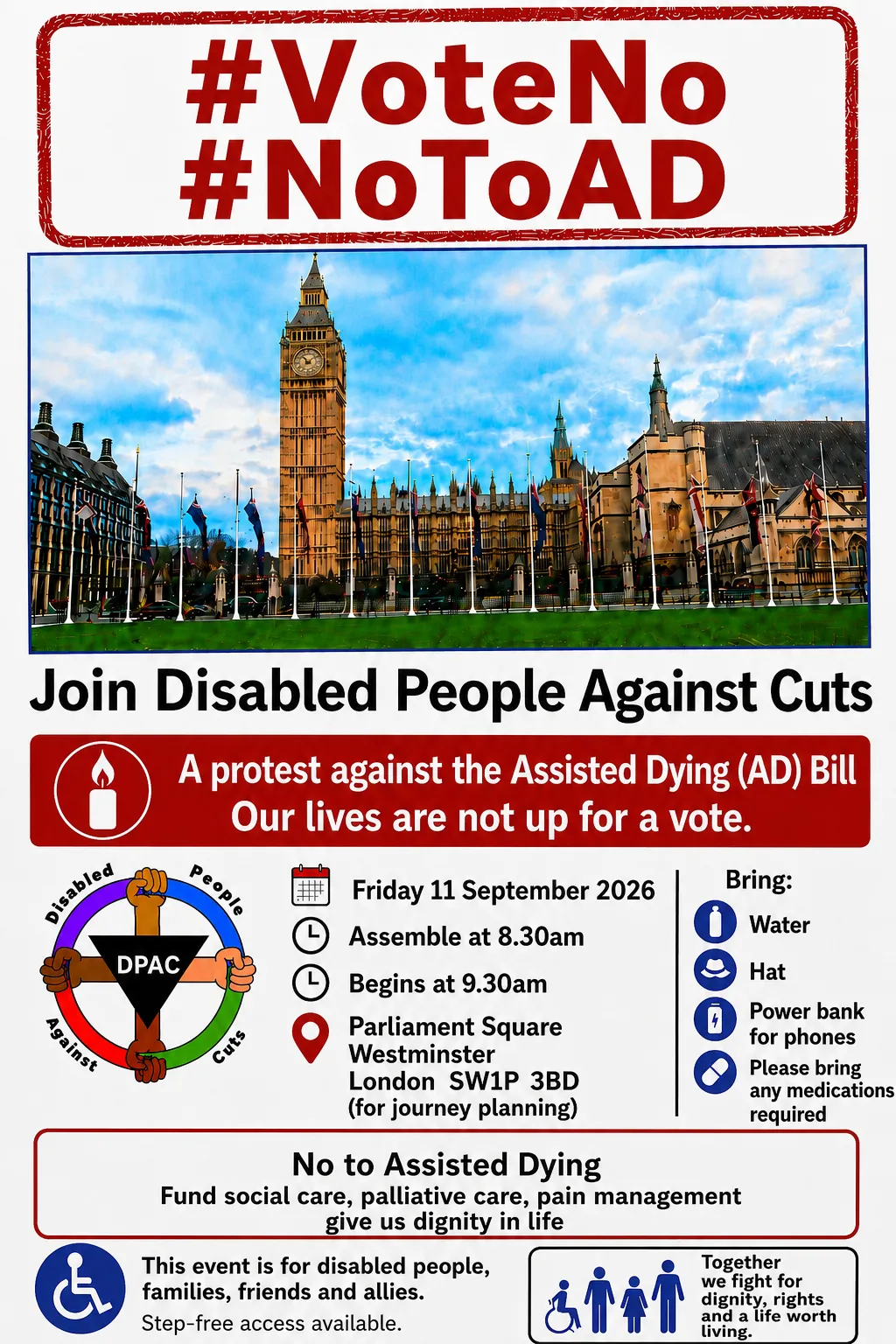
We are a secular, human rights network of organisations run and controlled by Deaf and Disabled people (DDPOs) from across the UK.[1] We monitor and campaign for implementation of the UN Convention on the Rights of Disabled People, promoting the interests of 16.1 million Disabled people.[2] This includes those who are terminally ill and who live with progressive, life-threatening conditions.
The debate around legalisation of assisted suicide[3] (AS) requires profound sensitivity and compassion. On both sides of the argument are lived experience of pain, suffering and distress.
The implications of this Private Members’ Bill (PMB) are far-reaching with serious potential consequences. There is no straightforward way to legalise AS and the issues involved are complex. There are no clear lines, only blurred boundaries.
This is why no DDPO in the UK is in favour of legalisation. Additionally, all medical bodies remain opposed or neutral on the subjects. Doctors working in specialities such as oncology, geriatrics and palliative care, those where they are most likely to work with dying people, are the most opposed.[4]
We urge Parliamentarians to rigorously engage with all perspectives and the evidence base on which they rest.
Our key concerns are as follows:
- LIMITING ELIGIBILITY AND SAFEGUARDING
- Need to consider in detail lessons from other jurisdictions where AS is legal.
- Pressures to extend eligibility. This has happened in ALL jurisdictions where it has been legalised so far. Legal experts warn the same will happen here. Pressure is already being exerted to within Westminster and by the main campaigning organisations in favour.
- Risk of abuse and need to consider whether AS can ever be safely legislated for.
NEED FOR PROPER SCRUTINY
- Legalisation entails a fundamental shift in society but a PMB gives little scope for scrutiny.
- Need for extensive pre-legislative work by an independent commission.
- Inadequacy of the health and social care select committee inquiry as a basis for legislation.
- Need to question unconscious assumptions about quality of life.
FIX THE FOUNDATIONS FIRST
- Palliative care is in crisis. Choice at the end of life must include the choice to die at home and to die naturally in as little pain as current medical knowledge can provide for.
- Services (NHS, social care, mental health) to support those who live in pain and distress are broken. Assisted suicide must not become a replacement for public services.
For more detail on the above see the following pages / go to: https://dpac.uk.net/2024/10/choice-at-the-end-of-life-bill-briefing-from-uk-ddpo-crdp-monitoring-coalition/
1) LIMITNG ELIGIBILITY AND SAFEGUARDING
These two issues are of fundamental importance to the question of legalisation. There are no easy answers to either.
Any legislation must robustly safeguard against abuse. The risks are too big to disregard.
Those who are well-intentioned often under-estimate the capacity of others to take advantage of those whose situations make them vulnerable. Harsh reality is evidenced by the fact that Disabled people are statistically more likely to be victims of crime and abuse than non-Disabled people. We are three times more likely to be the victims of domestic abuse.[5]
Consideration of adequate safeguarding must be informed by a full understanding of the factors involved in abuse and exploitation of those at the end of life, of the complex dynamic between carers and those needing support and of established difficulties not only spotting but also addressing abuse.
Examples of abuse from other jurisdictions where AS is legal must be carefully explored including reports of coercion pushing individuals to end their lives against their wishes[6] and the situation in Canada where AS has been linked to human rights concerns.[7]
Widening of the original eligibility has occurred in ALL jurisdictions where AS has been legalised.
Eligibility is a complex issue to begin with. It is not possible for doctors to give an accurate prognosis of how much longer a person has left to life. This makes it difficult to limit eligibility to those with only a set time left to live naturally and makes legislation vulnerable to extension.
In Oregon, the list of diagnoses covered by the definition of terminal illness under AS legislation has grown and now includes, for example, anorexia,[8] and diabetes.[9]
In 2021, the Canadian Parliament voted to extend their Medical Assistance in Dying (MAiD) programme to people with mental health conditions.[10] The introduction of this expansion has been paused until 2027.[11] Meanwhile, from 30 October, the Canadian province of Quebec started allowing people with incurable diseases or in the early stages of dementia to make advance directives specifying conditions under which they could receive medical assistance in dying without giving further consent.[12]
In four out of eight of the jurisdictions where AS is legal, young people living with mental distress who might otherwise have lived decades have been granted euthanasia. One study found that the majority of people labelled with personality disorders who have been granted EAS (euthanasia or assisted suicide) had not received any relevant evidence-based treatment.[13]
With wider eligibility, one of the areas of greatest concern involves questions of mental capacity, coercion and abuse of advance directives.
KC Alex Ruck Keene, who is a legal expert in mental health and mental capacity law and who represented Noel Conway, a man with Motor Neurone Disease who took his legal challenge fighting for the right for assisted suicide to the Supreme Court, says the idea that capacity is straightforward is “hopelessly naïve” and stresses that Parliament has to be aware that working it through is not immediately straightforward.[14]
In the Netherlands, there have been cases where people labelled as not having capacity have been held to advance directives made at a different time in their lives and forcibly killed against their wishes. There is one report from the Netherlands of a person being physically restrained by relatives, in order for the physician to administer the lethal dose.[15]
It is also not uncommon for patients to use physical conditions to access euthanasia or AS while motivated by reasons that are outside the eligibility criteria such as depression, loneliness[16] or homelessness.[17]
The percentage of those granted AS in Oregon who cite financial concerns as one of the reasons for their decision has been steadily rising over recent years.[18]
Inadequate pain control remains as an end of life concern for only around one third with loss of autonomy and inability to participate in enjoyable activities scoring highest.[19] Figures for those citing that they “feel a burden” remains at around one half.[20]
Autonomy and being a burden are distinctly different concepts from end-of-life pain.
They are also ones with which Disabled people are extremely familiar.
We understand that there is no inevitable connection between reliance on assistance to live and a desire to die.
If given the chance, and with the right support, people can and do adapt to circumstances they once imagined they would find intolerable.[21]
We have read reports of lobbying by MPs who support legalisation for the PMB to include those who are “incurably suffering”[22].
Many of those campaigning for the right to take their lives through assisted suicide will not qualify under Leadbeater’s bill so legal challenges on the grounds of discrimination will inevitably follow any passage of the bill into legislation.
A dozen human rights barristers and legal scholars have warned that the Leadbeater bill could breach the European Court of Human Rights by denying some groups access to AS while granting it to others.[23]
We urge Parliamentarians to seriously consider whether AS can be safely legislated for in any form; and, not to allow any legislation to pass that is both without adequate safeguards against abuse and against future widening of eligibility beyond the original intention.
2) NEED FOR PROPER SCRUTINY
The question of AS legalisation requires time for extensive study, evidence-based discussion and heavy scrutiny.
Legislation will turn an abstract idea into a reality with enormous implications, impacting the lives and deaths of millions of individuals as well as touching the lives of all those who care what happens to them.
Anecdotally, we know of family members of those who have chosen to have their lives ended through the MAiD programme in Canada left bereft that they never had a chance to try to change their lived ones’ minds.[24]
“…none of her immediate family knew that Ms. [Wilma] Hertgers had been approved for medical assistance in dying, let alone set a date. Not her 88-year-old mother, whom she called twice a day. Not her older brother, who lived one town over. And not Mr. Hertgers, 61, [her other brother] who had only that Friday, after driving the four hours to Chilliwack, B.C., shared a pot of tea at Wilma’s kitchen table.”[25]
It will change the essential nature of the role of the physician.
At the same time, it represents a fundamental shift in society from one where State intervention in the lives of its citizens is concerned with saving and extending life to one where it also provides for assistance to end one’s life.
KC Alex Ruck Keene has warned:
“That’s the thing I think is very difficult in this space to think about. Because you have individual stories which are very, very powerful, and we’ve got lots of other individual stories out there in the public domain at the moment. But the law can’t operate for individuals. The law has to operate for everybody.”[27]
Parliament will only be able to do this ONCE.
Any gaps or oversights will have profound consequences.
Professor of Health Care Ethics, Theo Boer, who was originally in favour of AS legalisation when it was passed in the Netherlands and is now a strong critic, has warned:
“We [in the Netherlands] have put in motion something that we have now discovered has more consequences than we ever imagined.”[28]
It is welcome that the second reading of this bill is scheduled for later than anticipated on 29 November 2024. However, the timeframe for adequate consideration of the many complex facets of this question is still inappropriately tight.
The Government has made it clear that it will not take any steps towards legalisation and this will only happen through Parliament, should its members choose to.
It remains the case that the more limited Parliamentary scrutiny given to PMBs makes this an unsuitable mechanism for enacting legislation on this issue.
It feels extremely unfair for new Parliamentarians to be asked to vote on an issue of this magnitude while they are still finding their feet.
A law of this nature requires extensive pre-legislative work by an independent, properly resourced commission.
The inquiry undertaken by the health and social care select committee in 2023 does not provide an adequate basis for legislation and does not negate this need.[29]
The committee’s aim was to publish a report to serve as a basis for discussion and debate in future Parliaments, and not to inform the drafting of actual legislation.
The conclusion to the report states:
“The debate on AD/AS is not new, and our report is not intended to provide a resolution to it.”[30]
Those with decision making-powers on this question must have the chance to reflect on unconscious assumptions about quality of life and what makes a life worth living that may influence their ideas on the subject.
There are people in the same situations, living with the same levels of pain, distress, physical limitations and/or degenerative conditions as those campaigning for legalisation who are opposed to it.
It is important to understand the different perspectives.
Nicki Myers, a Disabled woman who lives in Cambridge, said:
“I’ve been a Disabled person for my entire life but I was diagnosed with a terminal condition in 2017. I have almost died so many times and then I’ve rallied. I did not expect to still be alive now. I’ve been able to support my children and grandchildren, paint portraits from my bed, spend time with friends. My view on assisted suicide has never wavered, despite some very difficult times. In the UK, we do not have sufficient health and social care support or adequate palliative care or hospice services for legalisation to be safe. I have been reassured by the doctor at my hospice about my last days. Everyone should be able to access services to give them a good death.”
We urge Parliamentarians to ensure they have adequate time and information to give due scrutiny to legislation of such a profound nature.
3) FIX THE FOUNDATIONS FIRST
AS must not become a way of plugging gaps left by broken services.
The UK must not follow in Canada’s foot-steps where human rights experts continue to express “alarm about the significant human rights concerns” presented by inadequate safeguards and the proposed expansion of MAiD.[31]
The Canadian Human Rights Commission is particularly concerned about reports that Disabled people are applying for and being granted MAiD because:
“ they cannot access the basic supports and services they need to live with dignity.”[32]
They have stated that:
“MAiD cannot be a default for Canada’s failure to fulfill its human rights obligations”[33]
This is a situation that could very easily happen here under current conditions.
Dr Bob Gill, a family doctor for over 20 years, said:
“I strongly oppose the concept of assisted dying because there is a great risk that the patient’s decision is shaped by many external factors including the sense of guilt and anticipation of suffering… Our fight should be for better funding and access social services, restoration of benefit payments and high-quality public service.”
More than 3,400 NHS staff have warned against putting an added burden on the ‘broken’ NHS by legalising assisted suicide.[34]
In the letter, 2,038 doctors, 905 nurses, and 462 other healthcare workers expressed their concerns, saying:
“The thought of assisted suicide being introduced and managed safely at such a time is remarkably out of touch with the gravity of the current mental health crisis and pressures on staff.”[35]
The letter added that the:
“Any change would threaten society’s ability to safeguard vulnerable patients from abuse; it would undermine the trust the public places in physicians; and it would send a clear message to our frail, elderly and disabled patients about the value that society places on them as people.”[36]
Palliative care is in crisis and increasingly unable to meet the needs of those requiring support to die with dignity and with as little pain as possible.
The Association for Palliative Medicine opposes any change in the law that could lead to the supply or administration of lethal medications to deliberately end a person’s life.[37]
84% of respondents to a survey carried out by the British Medical Association who work in palliative care said they would not be willing to actively participate in the process of prescribing life-ending drugs.[38]
A survey carried out by King’s College London found that over 100,000 people in the UK die each year needing palliative care but do not receive it, and inequalities in accessing care, including among people from ethnic minority groups, are common.”
Professor Katherine Sleeman, from the Florence Nightingale Faculty of Nursing, Midwifery & Palliative Care at King’s College London said:
“The shocking gap in the public’s understanding of palliative and end of life care also needs to be addressed… It is essential that we address the disparities that create additional barriers for people to access the care that they need.” [39]
Palliative care has long been chronically under-funded with hospices relying on charity for the majority of their income.
According to data published by Hospice UK in September 2023, England’s adults’ hospices experienced a real-terms cut in their Government funding of £47m in the preceding two years.[40] None received any uplift in line with inflation over that period.[41]
Toby Porter, CEO of Hospice UK said:
“On average, only one third of adult hospice income comes from the state, leaving hospices to rely on charitable donations to pay for the majority of their vital work. With the cost of living crisis affecting everyone, many hospices are increasingly concerned that their local communities will not be able to continue to give as generously.”[42]
Many palliative care professionals fear that AS legalisation will lead to further reductions in funding justified on the basis that money will be saved through elimination of support costs for those opting to end their lives early.
This will mean increased denial of palliative care services to those who want and need them.
Anecdotally, we know of State funded palliative care services making frontline redundancies due to funding cuts. Staff working in the community fear they will be the first to go, removing patients’ choice to die at home.
Choice at the end of life is only meaningful if it includes the choice to access palliative care support right up until a natural end.
It also requires adequate support to continue living where there is no immediate terminal prognosis.
Sadly, the situation in the UK is far removed from this.
The Prime Minister has described the NHS as broken.[43] Social care and mental health services are in the same desperate state.[44] [45] There is also a housing crisis[46] and figures show that poverty rose dramatically among Disabled people even before the cost-of-living crisis.[47]
In 2016, an unprecedented special inquiry by the United Nations Committee on the Rights of Disabled People found the UK government guilty of grave and systematic rights violations. Two of the three areas on which the inquiry focused were support to live in the community, and income and adequate social protection.
Disabled people have direct and often very distressing lived experience of the impact of inadequate service levels, staff shortages and long waiting lists not just on our own lives but also on those of loved ones left to take the strain.
Nathan Lee Davies, a Disabled man with Friedreich’s Ataxia, a progressive genetic condition of the nervous system said:
“The median age of death for someone with my condition is 35. I am 47. None of us know what is around the corner and this is why I passionately oppose assisted suicide.
“We all have a role to play in society. The main problem now is that people with impairments are overlooked and denied the services we need to express our creativity and be part of our communities. I have written three books and produced art works and there is more I passionately want to do.
“But I am currently tied up in a battle with my Local Authority who would rather tie me up in red tape. I haven’t seen a social worker in the past year and a half. I have a continual nightmare recruiting suitable Personal Assistants. Without support I am unable to eat, drink, use the toilet or wash, I can’t write or reply to emails from friends. I should be enjoying the final years of my limited life but instead I am trapped inside my bungalow.”
Disabled people in the UK are in urgent need of adequate support to meet our most basic needs.
In jurisdictions where eligibility has widened beyond terminal illness, our peers are choosing to end their lives not because of pain but because they are not able to access support to participate and contribute to society.
There are also anecdotal reports of Disabled people being inappropriately offered, pressured or made to feel guilty by professionals because they are choosing to carry on living and not opting to kill themselves.[48]
We urge Parliamentarians to be on the side of real and meaningful choice – not only over the deaths of individuals who live with pain and distress but also over the right of millions of Disabled and older people to live.
For more information contact: mail@dpac.uk.net
Additional resources
Documentary
Better Off Dead? A documentary on assisted suicide, authored by actor and disability rights activist Liz Carr.
Journal articles and research
Assisted death in eating disorders: a systematic review of cases and clinical rationales – https://www.frontiersin.org/journals/psychiatry/articles/10.3389/fpsyt.2024.1431771/full
Assisted dying: Quebec allows advance directives, defying federal ban – https://www.bmj.com/content/386/bmj.q2029
Euthanasia and assisted suicide in patients with personality disorders: a review of current practice and challenges – https://bpded.biomedcentral.com/articles/10.1186/s40479-020-00131-9
Oregon Death with Dignity Act access: 25 year analysis – https://spcare.bmj.com/content/early/2024/04/05/spcare-2023-004292
Psychiatric euthanasia, suicide and the role of gender – https://www.cambridge.org/core/journals/the-british-journal-of-psychiatry/article/psychiatric-euthanasia-suicide-and-the-role-of-gender/936B360C6B2AEF2CA5360357ED8CF020
Terminal anorexia nervosa is a dangerous term: it cannot, and should not, be defined – https://jeatdisord.biomedcentral.com/articles/10.1186/s40337-022-00599-6
The Dangers of Physician Assisted Suicide in Eating Disorders – https://static1.squarespace.com/static/58e4b708f5e2312cc949b8b4/t/66e828dde88bf757b8f0acc3/1726490860329/Assisted+Suicide+in+Eating+Disorders+Report+-+US+Version.pdf
Lived Experience
Canada – https://living-with-dignity.ca/remembering-lives-lived/
Media articles and press releases
Assisted dying/assisted suicide: Too many “complicating factors” to be safely implemented, says British public in new poll
https://www.bbc.co.uk/news/world-us-canada-68120380
https://www.chrc-ccdp.gc.ca/en/resources/ending-ones-life-must-be-a-true-and-informed-choice
https://www.dailymail.co.uk/news/article-14067911/Doubts-Assisted-Dying-Bill-grow-doctors-nurses-warn-added-pressures-broken-NHS-campaigners-insist-people-hope.html
https://www.hospiceuk.org/latest-from-hospice-uk/hospice-funding-falls-short-ps47m
https://www.independent.co.uk/news/world/americas/canada-euthansia-maid-gofundme-homeless-b2228890.html
https://www.kcl.ac.uk/news/65-of-adults-are-worried-about-access-to-palliative-care
https://www.politicshome.com/thehouse/article/alex-ruck-keene-kc-assisted-dying-parliamentarians-radically-unsupported
https://www.telegraph.co.uk/politics/2024/10/05/widen-access-to-assisted-dying-say-labour-mps/
https://www.telegraph.co.uk/politics/2024/11/09/assisted-dying-echr-discrimination-human-rights/
https://www.theguardian.com/news/2019/jan/18/death-on-demand-has-euthanasia-gone-too-far-netherlands-assisted-dying
https://www.theguardian.com/society/2023/jul/13/anorexia-right-to-die-terminal-mental-health
https://www.theguardian.com/world/2024/feb/25/canada-assisted-dying-laws-in-spotlight-as-expansion-paused-again
Position statements and briefings
Association for Palliative Medicine [APM] – https://apmonline.org/wp-content/uploads/APM-Position-Statement-on-Assisted-Dying-October-2024-v2.pdf
BMA – https://www.bma.org.uk/advice-and-support/ethics/end-of-life/physician-assisted-dying/physician-assisted-dying-survey
Joint Statement Against Assisted Suicide For Eating Disorders – https://www.eatbreathethrive.org/joint-statement-assisted-suicide
Reports
Report from the health and social care select committee inquiry into assisted suicide: https://publications.parliament.uk/pa/cm5804/cmselect/cmhealth/321/report.html
Written evidence submitted to health and social care select committee inquiry:
Professor of Palliative Care, Baroness Finlay
Professor of Health Care Ethics, Theo Boer
Ministry of the Solicitor General | Office of the Chief Coroner MAiD Death Review Committee Report 2024 – 3 2024 Navigating Vulnerability in Non-Reasonably Foreseeable Natural Deaths
Website
https://notdeadyetuk.co.uk/ The website of Not Dead Yet UK, a UK-based network who are part of a global alliance of disabled people, who oppose euthanasia and assisted suicide.