Nov 012024
 
DPAC Logo with text underneath "Disabled People Against Cuts" and then web address dpac.uk.net

If you are being migrated from ESA to UC you DO NOT have to provide a ‘fit note.’ For more advice on what to do in this situation see [link to website].

Website text

ESA TO UC MANAGED MIGRATION AND FIT NOTES

THE ISSUE

Many ESA claimants who are being moved onto Universal Credit under ‘managed migration’ are being asked to provide a new ‘fit note’ (med 3 certificate).

This is NOT correct.

YOUR RIGHTS

Regulation 19 of the Universal Credit Transitional Provisions Regulations 2014 states that ESA claimants in the Work Related Activity Group (WRAG) or support group, are to be given the same treatment under UC.

This means there is no need for a fit note.  A fit note is only required if you are in the initial ‘assessment stage’ of making either an ESA claim or UC claim on the basis of ill health.

WHAT TO DO

To assert your rights in this situation, we recommend you post the following text in your UC journal for the attention of a Work coach:

‘I do not need to provide a fit note as I have already been assessed as having Limited Capability for Work/Limited Capability for Work and Work-related Activity, (delete as appropriate). 

Regulation 19 of the Universal Credit Transitional Provisions Regulations 2014 applies. It states that my LCW/RA status under ESA should transfer to the Universal Credit claim without the need for a new Work Capability Assessment and the LCW/RA element should be paid from the first UC payment.

Instead of supplying a fit note, the Universal Credit Service Centre should use a MGP1 process to action the LCW/RA element in my UC claim.’

 Posted by at 10:22  Tagged with: ,
Oct 262024
 
DPAC Logo with text underneath "Disabled People Against Cuts" and then web address dpac.uk.net

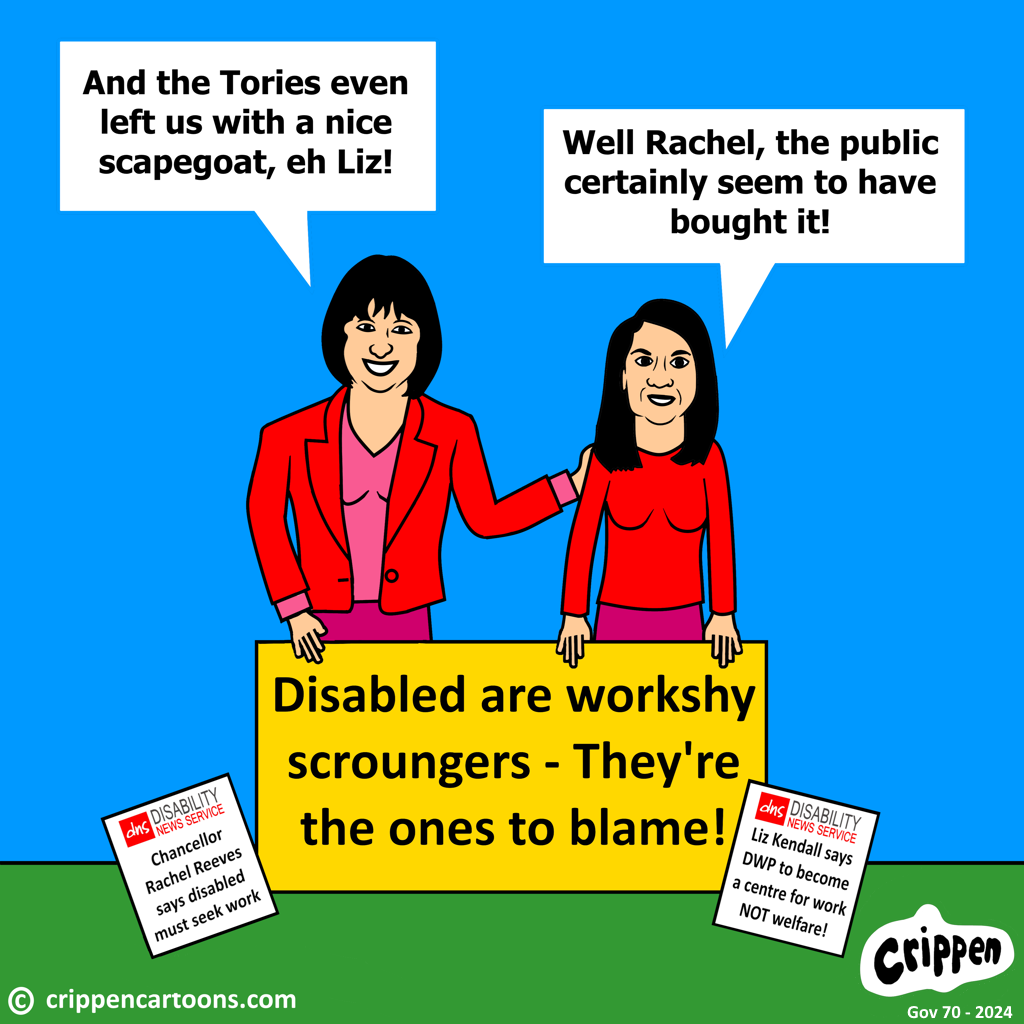
Reproduced by kind permission of Crippen

They’re at it again, claiming that billions of pounds are being lost to fraudulant benefit claims, which includes those by people on long term sick and those who are disabled.

Keir Starmer is standing behind a BBC microphone holding in his hand a script with the words ‘Billions stolen on benefits’. Other pieces of paper are spewing out of a printer behind him with ‘Fraud, fraud, fraud’, ‘Disabled are all workshy scroungers’ and ‘disabled costing billions in fraudulant claims’. Sitting at a computer is Labour MP Liz Kendall who is saying: “I wonder what they’ll say if they ever find out that we’re just recycling old Tory lies?!”. Starmer replies: “Don’t start thinking Liz – just keep with the programme!”.

Crippen asks again “Fraud – What Fraud?!”

Where they get these figures from is a real mystery as the last government’s own figures showed that benefit fraud was at its lowest ever at less than 3.5%, much of which could be attributed to DWP error.

And you’ll remember it was ex-PM Rishi Sunak who claimed that millions were being  fraudulantly claimed through Personal Independent Payments (PIP) at the same time that DWP figures, released just days before Rishi Sunak called a general election, showed that overpayment of PIP due to fraud had dropped to Zero per cent, a fall from 0.2 per cent the previous year.

So, where are they getting this misleading information from? Or, are they just making it all up? But why?

Perhaps it’s something about finding a scapegoat for the shambles that exists called ‘government’ and the billions of pounds that are lost, mis-appropriated or mis-managed by initially the Tory party and then the Labour party. The two words ‘piss-up’ and ‘brewery’ come to mind!

Or is it, as has been recently announced by Labour, just an excuse to access the bank accounts of all those who claim benefits? Just another example of the carrot being replaced by the stick once again?

Oct 242024
 
DPAC Logo with text underneath "Disabled People Against Cuts" and then web address dpac.uk.net

Contents

DWP destroyed recordings that would have proved link to daughter’s suicide, says grieving mum1

Wheelchair-user ‘humiliated’ after driver bans him from coach for complaining about safety and discrimination3

‘Our members are raging’: Shock and anger as Scottish government’s ‘sham’ co-production leads to ‘weak’ disability plan6

Disabled activists and unions come together to fight threatened cuts to benefits in Labour’s first budget8

Minister casts fresh doubt on Kendall’s ‘I’ll send work coaches into mental health wards’ claim11

Chair of government’s ‘economic inactivity’ board says he wants to ‘ramp down’ use of benefit sanctions and strict conditions on sick and disabled people12

Charity Commission launches second inquiry into disabled people’s organisation14

Other disability-related stories covered by mainstream media this week16

DWP destroyed recordings that would have proved link to daughter’s suicide, says grieving mum

The Department for Work and Pensions (DWP) breached its own rules by destroying recordings that would have shown how a work coach told a traumatised disabled woman to attend a face-to-face jobcentre meeting, days before she took her own life.

DWP’s rules say it must keep recordings of phone calls with benefit claimants for at least 14 months – and even longer if the claimant has taken their own life – but it has admitted thatrecordings of conversations with the woman’s work coach were not retained.

The call took place on 8 April 2022, just seven days beforeRebecca* died.

DWP had been told repeatedly of her mental distress, suicidal thoughts and fear of the department and the universal credit system.

Although Rebecca had been given a six-month “fit note” by her doctor that explained she was not well enough to work, she was still expected to have regular appointments with a work coach until her fitness for work could be assessed.

Following intervention from a mental health service, DWP agreed that her appointments could take place on the phone.

But on 8 April, Rebecca – who had multiple sclerosis and weighed less than five stone at the time she died – was told by the work coach: “We have let you off this time, but you will have to come to the jobcentre next time.”

An entry in her universal credit online journal stated that there would be a meeting in the jobcentre on 22 April, her mothersays.

Seven days after the phone call, on 15 April, she ended her life by suicide.

Her mother, Debra*, has spent more than two years since her death trying to obtain records that would show DWP’scontacts with her daughter.

She and her son – the executor of his sister’s will – approached the jobcentre where the work coach was based in February 2023, 10 months after Rebecca’s death, to ask for the recordings.

They were told that all phone conversations from the jobcentre were recorded.

But the recordings were never provided and when Debra’s MP contacted DWP to ask for them again, he was told they had not been retained”.

They also asked for a copy of the secret internal process review (IPR) the department had carried out into Debra’s death.

But despite DWP telling Disability News Service in September 2022 that IPRs could be releasedwith the signed written consent of the administrator or executor of thedeceased person’s will”, the department refused to release the IPR to Debra’s son.

Now Debra has accused DWP of a cover-up.

Last week, she received a report from the Independent Case Examiner into her complaint about DWP’s actions.

But the report includes no discussion of DWP’s failure to provide the recordings of the work coach’s phone calls; of what took place during the 8 April call; and of whether DWP had arranged a face-to-face jobcentre meeting to take place on 22 April; and no mention of the contents of DWP’s own secret review into Rebecca’s death, or that DWP’s refusal to release the review to the family was in breach of its own promise.

Instead, Joanna Wallace, the Independent Case Examiner, failed to uphold Debra’s complaint and concluded that DWP “did as they should in [your daughter’s] case, and properly investigated your allegation that their actions were a contributing factor to [her] taking her own life in April 2022”.

Debra told DNS this week: “I think it’s a cover-up, I think the whole thing is a cover-up.

“Why would you destroy recordings if there is nothing incriminating on them?

“Why they haven’t addressed that [in the ICE report], I don’t know.”

Debra has previously told DNS that the idea of always having to be under the surveillance of DWP and its universal credit system left her daughter in despair.

She would shake and cry every time she had to log onto her universal credit “journal”, which she was forced to do every weekday to avoid having her benefits sanctioned.

Rebecca had told her mother: “They will always want to know where I am going, how much money I have got. They will always be in my life, they will always want to know.”

She was so concerned that she might make an error and have her benefits sanctioned by DWP that she did not turn on the central heating in her house for the last two months of her life, and she would not allow her parents to pay her heating bill in case DWP saw the payment in her bank account.

It is not the first evidence of DWP destroying records that implicate the department in the death of a claimant.

Only four months ago, DNS revealed how senior DWP civil servants destroyed vital documents relating to the case of Michael O’Sullivan who had taken his own life in September 2013 after being wrongly found fit for work – months after a coroner linked his death with DWP’s work capability assessment.

The latest revelations should add to pressure on the new Labour government to order a public inquiry into the links between DWP and the deaths of countless disabled claimants**.

They add to years of evidence of systemic negligence by the department, a culture of cover-up and denial, and a refusal to accept it has a duty of care to those disabled people claiming support through the social security system.

DWP refused this week to explain why it destroyed the recordings and why it failed to pass the IPR to the family.

It also refused to comment on: why the ICE report included no discussion of DWP’s failure to provide the recordings of the work coach’s phone calls; why it included no discussion of what took place during the 8 April call, when the work coach said Rebecca would have to attend a meeting in the jobcentre; why it included no discussion of whether DWP had arranged a face-to-face jobcentre meeting to take place on 22 April; and why it ignored the contents of DWP’s IPR into Rebecca’sdeath, and DWP’s refusal to release the review to the family in breach of its own promise to do so to such families.

But a DWP spokesperson said: “Our sincere condolences remain with the family in this case.

We have noted the Independent Case Examiner’s report and its conclusions.”

*Not their real names. For family reasons, Debra has asked for their names not to be used until an inquest takes place

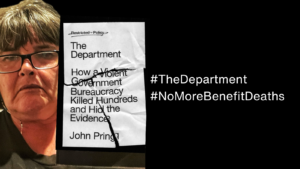
**The Department: How a Violent Government Bureaucracy Killed Hundreds and Hid the Evidence, John Pring’s book on the deaths linked to DWPis published by Pluto Press 

24 October 2024 ‘

Wheelchair-user ‘humiliated’ after driver bans him from coach for complaining about safety and discrimination

A wheelchair-user was left “humiliated” after a coach driver refused to allow him to board his vehicle, and then told him he was a “liability” and “banned” because he had previously complained about discrimination and safety issues.

Arriva Midlands has already had to make two payments of compensation to wheelchair-user Charley Jonstone-Brent, from Coventry, because its drivers repeatedly failed to strap him in safely.

In August, Arriva paid him £6,500 after Disability News Service (DNS) reported how he had been left with a broken ankle and two broken wrists and had to complain at least 15 times about the failure of drivers to ensure his wheelchair was safely attached to the floor and strapped in.

But its drivers have continued to discriminate against him and put his safety at risk on his journeys to Leicester, and Arriva agreed last month to pay him another £3,500 compensation.

In one incident, the driver failed to strap him down and said he did not know how to do it, while on another occasion the driver failed to strap him in correctly, and then – when Jonstone-Brent said his wheelchair was moving about told him not to worry about it.

Now the company is facing yet another hefty payout after one of its drivers recognised him from pictures believed to have been circulating on a drivers’ WhatsApp group, and refused to allow him to board the coach.

Arriva has told DNS that the driver has been suspended pending an internal investigation, and that it is providing “refresher training for staff”.

It has described the treatment Jonstone-Brent received as “unacceptable”.

Jonstone-Brent, who is autistic, had been planning to travel on from Leicester to East Midlands Airport to enjoy a few hours of planespotting.

He had arrived early for the 10.20am coach service last Thursday and was first in the queue, but he said the driver immediately recognised him.

He said: He opened his door and huffed and puffed and said, ‘You’re the guy who keeps putting complaints in.

The driver said the safety harnesses were not on board – which would have been unlawful – and then wrongly suggested that Jonstone-Brent and his wheelchair would be too heavy for the lift, which had a capacity of 300 kg (more than 47 stone).

A video of the incident taken by his partner Chloe Child shows the driver telling them: “I am very sorry but unfortunately I am unable to serve you, sir.  

“You are free to call the depot and report this, you have the bus number, everything.

“This is a technical issue because there is a weight limit. You can call me on discrimination, whatever… it is for my own safety.”

He eventually closed the door of the coach and drove off, making no alternative arrangements for the pair’s journey.

Jonstone-Brent said: “I felt humiliated, especially because he was shouting all this business in front of at least 20 to 30 passengers.

“He had a full coach and they were all filming and taking photos.

He said the treatment he continued to receive from Arriva was “disgusting” and the driver’s behaviour had been “completely toxic”.

The incident is particularly embarrassing for Arriva because its executives had invited Jonstone-Brent to one of their depots next month to explain how the company was failing on access and safety.

But he said: “I have no faith in them now. Each time they say, ‘We will make sure it never happens again.’ And then it does.

Disabled activist Doug Paulley, who has supported Jonstone-Brent with his case, and tested the route and experienced the same safety failings, said:This is blatant victimisation of Charley for daring to sit down for his rights to travel on public transport like everybody else, with something like the same safety and ease and lack of fuss that non-disabled people expect, and that Arriva is legally obliged to provide to Charley.

The unprofessionalism, DARVO (deny, accuse, reverse victim and offender), labelling and blaming, the private discussions on WhatsApp, are all so wearily familiar, so off-putting and have such a massive emotional toll, especially where Charley is still reliant on the bus company.

It is truly disgraceful.

Hats off to Charley for what hes done and doing, and shameon those who behave so terribly.

Ryan Dunne, area director for Arriva Midlands, told DNS this week: “We’re aware of an upsetting incident in which a customer was wrongly refused access to our X6 service.

As soon as the incident was brought to our attention, we contacted the customer to apologise for the unacceptable way in which they were treated, which fell a long way short of the service all our customers rightly expect and deserve.

The driver involved has been suspended pending the outcome of an internal investigation, and we are also providing refresher training for staff to help prevent a similar situation from happening again.”

It updated the statement this morning (Thursday) to say that the driver “no longer works for Arriva”.

Arriva said it does not endorse WhatsApp and does not issue its drivers with mobile phones or communicate with staff through their mobile phones.

A spokesperson said: “We are investigating what’s happened here and a possible line of inquiry will be whether our social media policy may have been breached.

We’re investigating why this has happened and we’re working with the customer, our drivers and depot management so we can try and make things better in the future.

As part of our plans to try and get things right going forward, we are rolling out more refresher training to drivers, plus printed guides.

24 October 2024

Our members are raging’: Shock and anger as Scottish government’s ‘sham’ co-production leads to ‘weak’ disability plan

Three national disabled people’s organisations (DPOs) have attacked the Scottish government over a “sham” process of co-production that has led to a “weak” and “diluted” Disability Equality Plan for Scotland.

Disability Equality Scotland, Glasgow Disability Alliance (GDA) and Inclusion Scotland say they spent 20 months working “tirelessly” with the Scottish government, investing “considerable time and energy”, in developing a “bold” plan that would change lives.

But they say their collaboration – which began “as a genuine attempt at co-design” – has now ended in a “collapse of all promises and ambition”.

They believe the SNP government has failed to deliver on its promises.

And they say they have been left “struggling to defend” their involvement to their disabled members because of what has “turned out to be a sham process”.

The three DPOs have now launched a two-week campaign – #DisabledPeopleDemandJustice – to ask for justice and equality for disabled people, and they have written to first minister John Swinney to demand an urgent meeting.

They say disabled people are in the middle of a “perfect storm”, as austerity measures; cuts to services, benefits and budgets; and the Covid pandemic, have had a disproportionate effect on disabled people.

They have backing from other Scottish DPOs, including Glasgow Centre for Inclusive Living, Lothian Centre for Inclusive Living, Self Directed Support Scotland, and the mental health network VOX Scotland.

Tressa Burke, GDA’s chief executive, said they had seen a draft version of the new Disability Equality Plan but were unable to endorse it because it offered “no commitment to meaningful action and no progress towards disabled people’s equality”.

She said: “After 20 months we are really struggling to justify involvement in the working group because the plan is weak, it’s not got meaningful action, it’s really diluted in ambition… and it’s all apparently been justified because of resources.

“We weren’t asking for the world. We were asking for a progressive plan with steps.

“We are angry. Our members are raging, they feel like they have been led up the garden path.”

She said the DPOs were shocked at how bad the draft plan was, and that the Scottish government have not taken on board anything we said”.

She said progress had “stagnated” and “stalled” over the last year.

She added: “We are shocked and we feel that disabled people have been betrayed and we feel in turn that we would be betraying our members if we went along with it.

“I think it’s really clear that every time there is a social or economic challenge, disabled people are relegated to the bottom.

“We are at the back of the queue, at the bottom of the pile, and it’s shocking and it’s shameful.”

The three DPOs say disabled people have experienced increasing poverty and inequality and regression in their rights and have been “forgotten” and “left behind” by those in power.   

They called this week on the Scottish government to take “urgent and bold action so that disabled people get the essential support we are entitled to”.

They are demanding immediate funding to improve the accessibility of projects to provide information and support on welfare rights and debt; an end to social care charges; and an investment in the country’s DPOs.  

They point to a survey carried out this summer by GDA, and published earlier this month, which found that 97 per cent of disabled people who responded were concerned they had been forgotten about by the government when it was setting priorities and plans.

The survey also found that 71 per cent of more than 600 disabled people who were surveyed said they did not have enough money to meet their needs.

In response to their concerns, Scottish social justice secretary Shirley-Anne Somerville said in a statement: “We recognise the multiple barriers disabled people face every day and we are working collaboratively to tackle them.

“This week, we launched our pension age disability payment, which will be worth between £290 and £434 a month to people of state pension age and over who are disabled or have a long-term health condition.

“We are committing a record £6.1 billion for benefits expenditure this year – including £300 million additional investment in adult disability payment, and the reopening of the Independent Living Fund will help up to 1,000 more disabled people to access the support needed to lead independent lives.

“We continue to call on the UK government to introduce a social tariff for those who need the most support with energy costs and we have established a working group, which includes disabled people’s organisations, to help demonstrate how this policy could work.

“The Disability Equality Plan is the first phase of a wider strategy.

We have made difficult decisions to ensure that what is set out in the plan can be achieved in the challenging economic situation Scotland faces.

It has been developed with dedicated input from disabled people’s organisations.

“The Scottish government recognises the aspirations of disabled people and their organisations lie beyond what could be achieved in this first phase of the plan.

We greatly value their commitment to continue to work with us as we lay the necessary foundations to ensure accountability and pave the way for systemic change.”

The government said the first minister met with DPOs to discuss their concerns in August, and would respond to their letter in due course.

A Scottish government spokesperson added: “We have engaged with DPOs throughout every stage of the development of this plan and continue to do so, as this is only the first phase of a wider strategy.

“We are committed to delivering what we can achieve within our budgetary constraints and the limits of devolved powers.

 “We will continue to work with disabled people’s organisations to progress disability equality and build towards a fairer Scotland.”

24 October 2024

Disabled activists and unions come together to fight threatened cuts to benefits in Labour’s first budget

Disabled activists and unions have come together to fight what they fear will be a renewed, hostile attack on disabled people who rely on social security at next week’s budget.

A parliamentary meeting this week heard disabled campaigners and senior union figures discuss how to fight cuts to social security that it has been widely predicted will form a key part of the first budget of Labour chancellor Rachel Reeves.

They say disabled people are again being scapegoated for the country’s financial problems, just as they were in the 1990s, the 2000s, the 2010s and by the last Conservative government.

They say that this hostile rhetoric, which is yet again “demonising” claimants of out-of-work disability benefits, is “contributing to a narrative that is miles away from the reality” of disabled people’s lives.

And, they say, it encourages disability-related hostility and hate crime.

Monday’s meeting was supported by the coalition of disabled people’s organisations (DPOs) that is monitoring the implementation of the UN disability convention in the UK.

Among the unions who have promised to play a key role in the new campaign is PCS, which represents many frontline Department for Work and Pensions (DWP) workers.

Paula Peters, from Disabled People Against Cuts, who chaired the meeting, said disabled activists were “scared, anxious, burnt-out and tired from fighting” but were “still fighting”, and she said there were now even more people who were angry than there were in 2010.

She said: “We will take the fight to the government, we won’t give in, we won’t give up, and we will never, never stop resisting… we will take the fight to Labour.”

She said the campaign would have to build a massive anti-austerity movement that brings everybody with us.

She pointed out that further cuts to disabled people’s support were being discussed as a backbench Labour MP, Kim Leadbeater, is introducing a bill to legalise assisted suicide, which will be debated and voted on by MPs next month.

Peters said: “If they bring that bill into law, what’s to say[they won’t tell us], ‘You don’t need social security, you don’t need housing, you don’t need healthcare, because you can have this instead.

Disabled campaigners later discovered that Leadbeater and fellow campaigners were about to hold a meeting to discuss her bill in the adjoining committee room in Portcullis House.

Martin Cavanagh, DWP group president for PCS, told Monday’s meeting that there had been a return to the harsh narrative of the pre-pandemic years in which claimants were seen as “workshy” and “sponging off the taxpayer”.

If anything, he said, “it’s actually getting more hostile now” than it was before the pandemic.

He said he believed Labour’s first budget in 15 years would see a “continuation of the Tories’ cuts to the benefit system” with “the same oppressive, punishing regime that the Tories have administered over the past 15 years”.

He said that unless there is a “seismic sea changethen our campaigning has to continue” and “we have to build the biggest coalition that we possibly can”.

Cavanagh told the meeting: “We are long past the time where we can just tinker round the edges of the benefits system.

“We believe we need a fundamental review of the benefits system, one that places dignity and respect at the heart of the system rather than the punitive regime that we have come to expect, sadly, over the past two decades or so.”

He added: “We know as a fact that where we as a union are better organised, and we have a stronger membership density… the conditionality and sanctions regime is nowhere near as brutal as it is in other parts of the country where our membership density is significantly reduced.

He said PCS would continue to work with DPAC and other unions such as Unite, Unite Community and Equity – which were represented at the meeting – to campaign for a “better and fairer system”.

John McDonnell, Labour’s shadow chancellor under Jeremy Corbyn, who hosted the meeting and is currently sitting as an independent MP, said the campaign coalition would need to “dominate” any debate on the consequences of cuts or reforms that would impose “further pressure” on benefit claimants.

He said: “It is true that it is a toxic inheritance from the Tories, there’s no doubt about that.

But he said the argument “must be that there is no need for any cuts in welfare and what they should be doing is “halting Tory proposals from the last government, particularly those that are set to tighten the work capability assessment (WCA)from next April.

He said there had been contradictory briefings from the government but “from the rhetoric that we have heard so far around welfare benefits, they might well continue on with the Tory reforms”.

He said campaigners needed to be able to explain how disabled people’s “wellbeing, suffering and even survival” could be at stake.

John McArdle, co-founder of Black Triangle Campaign, who travelled to Westminster from Edinburgh for the meeting, said he believed disabled people needed to “prepare ourselves for the worst” and consider legal action if any cuts wereproposed, because they would lead to “hundreds of deaths”.

He said: “I think we have demonstrated through our campaign work over the last 14 years how lethal the system is.”

Other organisations represented at the meeting included Disability Rights UK, WinVisible, London Unemployed Strategies and the Commission on Social Security.

Meanwhile, disabled activist Ellen Clifford – who helped co-ordinate the campaign meeting – is awaiting a judicial review that will hear her claim that the last government acted unlawfully when it announced plans to tighten the WCA.

The case will be heard in the Royal Courts of Justice on 11 and 12 December.

Clifford said last year that a DWP consultation on the plans to tighten the assessment process appeared to have been used as a “smokescreen for cuts”.

She also argued that the eight-week consultation period on the changes – which are due to be implemented in April – was too short and that the consultation was not accessible to many disabled people.

The Resolution Foundation said this month that the changes would save DWP an estimated £1.3 billion in 2028-29.

According to DWP, the changes will mean 424,000 disabled people will lose their entitlement to extra support of up to £4,900 a year – and will start being subject to conditionality and sanctions – by 2028-29 as they are moved out of theuniversal credit limited capability for work and work-related activity group.

The reforms will increase employment by just 15,400 by 2028-29, the Office for Budget Responsibility has estimated(PDF).

It is not yet clear whether these cuts will be implemented by the new Labour government.

An answer to that question is likely to emerge at next week’sbudget.

24 October 2024

Minister casts fresh doubt on Kendall’s ‘I’ll send work coaches into mental health wards’ claim

A minister has cast fresh doubt on claims by work and pensions secretary Liz Kendall that she is planning to send work coaches onto mental health wards to push people in severe mental distress off benefits and into work.

The response by employment minister Alison McGovern to a written parliamentary question appears to quash claims made in a BBC interview by Kendall, which caused anger and concern among disabled activists last week.

Kendall told the BBC – although some of her comments were later removed from the article – that the roll-out of existing projects which already see work coaches sent into mental health hospitals would form part of her drive to cut spending on disability benefits, and that existing schemes had produced “dramatic results”.

Following the BBC article, and the anger that followed, Labour’s Clive Lewis asked Kendall in a written question to “publish the evidential basis supporting her statement that trials of employment advisers giving CV and interview advice in hospitals has produced dramatic results”.

In a written response on Tuesday, McGovern pointed to evidence on the Individual Placement and Support (IPS)scheme, which provides “intensive, individually tailored support to help people to choose and find the right job, with ongoing support for the employer and employee to help ensure the person sustain their employment”.

McGovern made no mention of IPS schemes sending work coaches into hospitals, and she claimed that “people who receive Individual Placement Support show employment rates of 30-40 per cent compared to rates in the control group of 10-12 per cent”.

She said the government’s “severe mental illness Individual Placement Support programme aims to support an additional 140,000 people living with severe mental illness to access the services by 2028-29”.

One research report has evaluated Work Well, an IPS-type scheme that was run in conjunction with South London and Maudsley NHS Foundation Trust.

A campaigner has secured confirmation from the trust that this was the scheme Kendall was referring to in her BBC interview, and that employment specialists on the scheme “do not visit inpatient wards”.

Although the Work Well report suggests the scheme had some success in supporting some people into work – 10 per cent sustained employment for 26 weeks or more – it says it worked with “unemployed or economically inactive people who were experiencing common mental health problems such as anxiety and depression”, some of whom were not receiving any mental health services.

Meanwhile, research last year by the Department for Work and Pensions (DWP) cast doubt on the effectiveness of IPS schemes.

As Disability News Service (DNS) reported 14 months ago, reports on two IPS-type trials showed they had had “no discernible impact” on helping people with “mild-to-moderate mental and physical health conditions” into work.

The research found that the intensive support provided through the scheme had no impact on employment or earnings for those who began the programme out of work, andconcluded that – despite the intensive support – those who took part “continued to face major barriers to finding work”.

These barriers included persistent health problems “which continued to be challenging in a work context and which respondents did not always feel were helped by being in work”.

The research also found that – contrary to DWP’s expectations – those who took part did not experience work “as a therapeutic outcome”.

DWP declined to add to McGovern’s written response.

24 October 2024

Chair of government’s ‘economic inactivity’ board says he wants to ‘ramp down’ use of benefit sanctions and strict conditions on sick and disabled people

The academic tasked by ministers with leading efforts to tackle “spiralling” levels of “economic inactivity” has said he wants to “rethink welfare” by “ramping down” the use of strict conditions and sanctions on sick and disabled people.

The comments by Professor Paul Gregg, who is chairing the government’s new Labour Market Advisory Board, may ease the concerns of some disabled activists after recent comments by work and pensions secretary Liz Kendall.

When she announced his appointment, Kendall made it clear that the board’s key aim was tackling the “spiralling inactivity” caused by a record number of people out of work due to long-term sickness.

She has spoken recently of sending work coaches into mental health wards (see separate story), and has also confirmed that the government’s plans for a new fraud bill – ordering banks to “spy” on the bank accounts of benefit claimants – would be based on draft laws prepared by the last government.

She also shared a platform at Labour’s annual conference with an outsourcing giant linked to the deaths of disabled benefit claimants.

And prime minister Sir Keir Starmer recently suggested in an interview with the BBC that all claimants of long-term sickness benefits would be expected to look for work under Labour’s social security reforms.

But Gregg, who was delivering an online lecture yesterday (Wednesday) on Understanding and Reducing Economic Inactivity, stressed that he wanted to focus on “ramping down conditionality”.

He was responding to a question from Disability News Service (watch from 43 minutes), which asked why his lecture had not yet covered the issue of safeguarding of disabled people on out-of-work disability benefits, highlighting the “disastrous” impact of the coalition government’s post-2010 efforts to push disabled claimants off those benefits.  

Gregg, who is director of the Centre for the Analysis of Social Policy at the University of Bath and has studied the UK labour market for several decades, said: “Conditionality is part of the problem we have here.

“I’m not wanting to say that what we’re doing is going to move lots of sick and disabled people into a highly conditioned, conditional, sanctioning kind of welfare system.

“That’s totally not what I think needs to go on.

“The sanctioning conditionality system is part of the problem here. It’s definitely not part of the solution.

So we need to rethink welfare in terms of that intense pressure. Yes, safeguarding, yes, yes, there needs to be some.”

Gregg conducted a review of personalised support and conditionality in the social security system for DWP in 2009 and helped design employment and support allowance (ESA), but he was later highly critical of the work capability assessment (WCA), the test used to determine eligibility for ESA and which was linked with hundreds, and probably thousands, of deaths.

He said yesterday that there needed to be “fast tracking”, so claimants are “put into places which [are] appropriate for the health conditions they have”.

But he said the government also needed to “develop a system thats built around the needs, capabilities, and desires of the individual, not waving a big stick”.

He said that being out of work was “extremely damaging to people” and was “often damaging to their health and… it’s certainly damaging to their earnings capacity and living standards, and if you’re young, then that’s really extreme in terms of the damage it does”.

But he said that that “doesn’t mean that you’re forcing people to work”.

He also suggested that there needed to be an “integrated package” that was “engaging people in terms of thinking about work, offering supports in terms of workplace, offering support in terms of health conditions, and connecting people with employers who are potentially sympathetic enough to accommodate people with health conditions”.

He said earlier in the lecture that the number of economically inactive people had increased by almost one million since just before the start of the pandemic, so it had now risen from about 20 per cent of the working age population to almost 25 per cent, with a significant proportion of this increase people who were “inactive due to long-term health problems.

Much of this, he said, was due to young people (those under 35), with “big increases in people being economically inactive for reasons of mental health, principally anxiety and depression”, while increases in the state pension age were“pulling older people into the working-age population”.

He said the low proportion of young people returning to work after health-related issues was “potentially writing off a section of society from the workplace”, which was “very, very scary” and was “sort of driving the concerns now that we need to do something quite radical to try and change this”.

The lecture was part of a series hosted by the centre-right thinktank Bright Blue, which had close links to the last Conservative government.

24 October 2024

Charity Commission launches second inquiry into disabled people’s organisation

The Charity Commission has launched a second inquiry into a disabled people’s organisation (DPO) over “serious concerns” about the way it is being run.

Leicestershire Centre for Integrated Living (LCIL) was already being investigated over its failure to meet its statutory reporting requirements, with an inquiry launched in 2022, after it was identified as being “persistently late in filing its accounting information”.

But the Charity Commission has now opened a much wider inquiry after “serious concerns arose regarding its general management and governance”.

Among its concerns is how LCIL’s trustees are complying with their legal duties relating to the administration, governance and management of the charity, and its accounts.

But the Charity Commission said it was now also concerned about whether trustees have the necessary “financial and strategic oversight”, including over the management and supervision of staff, and whether the charity is “operating for the public benefit” and is being managed correctly.

LCIL’s website was this week displaying a message stating that it was “under construction”.

But information about LCIL on Leicestershire County Council’s website suggests that the organisation is thriving, while a member of staff confirmed this week that it was still operating.

LCIL, which is based in Leicester, describes itself as a user-led organisation that works to support disabled people to “exercise choice and control for independent living”, and is run and controlled by disabled people.

It hosts a disability hate crime reporting centre, and says it runs legal surgeries in partnership with Irwin Mitchell Solicitors, and Nottingham-based barristers at Ropewalk Chambers.

Neither Irwin Mitchell nor Ropewalk had commented on the inquiry or their work with LCIL by noon today (Thursday).

The council website says that LCIL also runs a UK-wide independent living roadshow, Choice Unlimited, and a consultancy that offers its “expertise on a wide range issues faced by organisations across the private, public and voluntary sectors to respond to disability equality.

In past years, LCIL played a crucial role in exposing the failure of Leicestershire police to take disability hate crime seriously in the years before a woman was driven to kill herself and her disabled daughter in October 2007, followinga sustained campaign of harassment.

And from the early months of the pandemic, it was part of the Our Voices group of DPOs that promoted disabled people’s interests and provided mutual support.

Disability News Service contacted LCIL for a comment, but it had not responded by noon today.

24 October 2024

Other disability-related stories covered by mainstream media this week

The bill for special needs education in England has hit £10billion a year, with the number of children and young people entitled to government support in the form of education, health and care plans set to double to one million within a decade, a report has found. The investigation by the National Audit Office found that despite record levels of spending there had been no signs of improvement in the lives of children with special educational needs: https://www.theguardian.com/education/2024/oct/24/special-educational-needs-bill-england-10bn-school-council-funding

A catalogue of failures led to the death of two wheelchair-users after a boat capsized in a Devon lake, marine accident investigators said. Alison Tilsley, 63, and Alex Wood, 43, drowned after being thrown from a wheelchair-accessible boat, at Roadford Lake, near Okehampton, on 8 June 2022. In its investigation report, the Marine Accident Investigation Branch found South West Lakes Trust, which owned the activity centre that ran the boat trip, had not maintained the vessel or considered the risks: https://www.bbc.co.uk/news/articles/clyzl0x186zo

Health secretary Wes Streeting will vote against changing the law on assisted suicide, the BBC has confirmed. Labour MP Kim Leadbeater has put forward a bill proposing that terminallyill adults nearing the end of their lives get the right to choose to shorten their deaths if they wish. But in a meeting of Labour MPs on Monday, Streeting said he did not believe the palliative care system was good enough to support assisted suicide: https://www.bbc.co.uk/news/articles/cx2lyl8jrvlo

Senedd members, including first minister Eluned Morgan and health secretary Jeremy Miles, have voted against a motion calling for a new law to allow assisted suicide in Wales and England. Miles had earlier warned of huge ramifications for Wales if the law changed. In total, 19 Senedd members voted in favour of the motion, with 26 against and nine abstentions. The Senedd does not have the power to change the law on assisted suicide in Wales, so the vote was symbolic: https://www.bbc.co.uk/news/articles/ce8912eld73o

24 October 2024


News provided by John Pring at www.disabilitynewsservice.com


 Posted by at 18:55
Oct 202024
 
DPAC Logo with text underneath "Disabled People Against Cuts" and then web address dpac.uk.net

Reproduced by kind permission of Crippen

Written by Bob Williams-Findlay October 2024

“In this post, I want to cover a number of tensions and contradictions which I believe run through ‘disability politics’. As ever, I define disability politics as being the social and political action required to end the imposition of disablement and its prime agency, disablism. Together they create the conditions whereby disabled people are excluded from and/or marginalised within mainstream social activity. Hence our Movement argued that we are ‘disabled by society’. I share this slick mantra, but at the same time believe we need greater clarity.

A caricature of Bob Williams-Findlay stands alongs side a large stone edifice wielding a large sledge hammer. The edifice comprises of large stone blocks, each block representing the points he has made in the accompanying article about oppression by capitalism. Bob is saying: “Let’s show these oppressors the real use of disability politics and smash this edifice to the ground!”

Crippen shares an article by Bob Williams Findlay

“I have previously argued that one of the biggest contradictions within early disability politics and more modern times is that disabled people want to be included in a society which actively excludes them. Capitalism is directly responsible for disablement, however, at differing points the needs of Capital requires society to adjust the unequal and differential treatment disabled people encounter. Here is another contradiction: welfarism cushioned the experience of social exclusion, on the one hand, whilst maintaining it on the other.

“It is understandable that disabled people have pushed for deinstitutionalisation and social inclusion; but to what extent is that feasible? Capitalist social relations rely heavily on the ability of the lower classes to sell their labour. Disabled Marxists tend to argue that this ‘need’ underpins the creation of disablement and the legitimising of it through disablism – the negative evaluation of impaired bodies which justified our social exclusion. Yet, as I have stated already, at times these evaluatons are watered down to encourage or force more groups of disabled people into the labour market. The neoliberal agenda since 2010 has adopted the carrot and stick approach.

“There is much to discuss about ‘work’, what it is, alongside exploring the various benefits and detriments involved. I can’t address these issues here. There is a view that ‘work’ means a degree of security, improved health for some and greater spending power. For me the issue is not about whether or not disabled people can/should work, but rather the impact of disablism on people who are of working age – how are they being both judged and treated.

“In the film, “When Barbara Met Alan”, one of the slogans heard was: ‘we want, what you got’. This raises many issues in my opinion and relates to what I call the ‘disability dialectic’. Disabled people cannot fit into the status quo; if we could, then we would not be ‘disabled by society’. So we fight to ‘transform’ society which means going up against the interests of Capital. We have always fought for ‘betterment’; making our lives better, but only through overthrowing the status quo will it be possible to build an inclusive society.

“So the last contradiction I want to pose is: what does ‘nothing about us, without us’ actually mean in the context of opposing discrimination and oppression? Some want a seat at Liz Kendall’s Taskforce table; to do what exactly? Disabled people were not included in the agenda setting; it is highly unlikely that agenda will address institutional disablism in the labour market. When Rachel Hurst and I promoted political coproduction [the meaning of NAU,WU] it was not only agitational, it was underpinned by the demand for a shift in power relations. As a Trotskyist, I view ‘nothing about us, without us’ as a transitional demand because it challenges the existing oppressive relationships we are subjected to.

“I am not conviced the current disability politics practiced by today’s activists adequately address the structural nature of disablement when they go cap-in-hand demanding “Rights”. Rights are meaningless without the power to enforce them.

“The reason I co-founded DPAC was the unquestionable belief that we, disabled people, had to build a new social movement, foster a sense of community, and build alliances with allies. Over the last 15 years we have not made serious inroads because disability politics have lost their radical vision. Equally does not mean ‘sameness’; it is about people’s lives having ‘equal value’ and capitalism can never deliver that.

Oct 202024
 
DPAC Logo with text underneath "Disabled People Against Cuts" and then web address dpac.uk.net

Reproduced by kind permission of Crippen


Disabled activists warned that a bill to allow assisted suicide for people with a terminal illness would pressure disabled people to end their lives prematurely, and that too little time had been set aside to understand its “far-reaching” implications
.

A balding, white male wheelchair user is travelling through a cemetery. A small sign in front of him says ‘Plots for Sale’. A larger sign alongside of him reads ‘Special discount – government discount for those disabled people who apply to take their plot earlier by signing a ‘do-not-resuscitate’ notice’

Crippen warns about the UK End of Life Bill

Disabled people’s organisations (DPOs) from across England and Wales have united to warn of the grave risks of proposed new legislation that would allow assisted suicide for people with a terminal illness. They believe parliament’s focus should be on improving access to health, care and other services. And they have outlined their ethical and human rights concerns in a briefing sent to MPs.

Kim Leadbeater’s terminally ill adults (end of life) bill received its first reading in the House of Commons yesterday (Wednesday) and is now set to be debated by MPs on 29 November. The bill would “allow adults who are terminally ill, subject to safeguards and protections, to request and be provided with assistance to end their own life”.

Ellen Clifford, co-ordinator of the UN monitoring coalition, told Disability News Service (DNS):

“Parliament only gets one go at this and if they get it wrong the consequences will be very dangerous both for individual people vulnerable to abuse and society as a whole. Our support services – palliative care, the NHS, social care and mental health – are currently broken. The government must get on and fix the foundations, so we all have the chance to live with dignity.”

Not Dead Yet UK (NDY UK), a grassroots group of disabled activists who campaign against legalisation, said laws introduced in other countries have started with “relatively strict parameters” but then “expand and expand”.

Phil Friend, co-convenor of NDY UK, explained:

“ … in a world where there is growing awareness of coercive control, and where we know that many do not receive adequate or appropriate medical care, pain management or social care, we are creating the conditions for people to find themselves agreeing that, yes, they should probably die, including to avoid feeling like a burden.”

Paula Peters, a member of the national steering group of Disabled People Against Cuts (DPAC), said the proposed bill had caused “deep concern and alarm for many disabled people”. She added:

“It is impossible to put strong enough safeguards in place to prevent coercion and feeling that we have become a burden on our families and the state. We fear that non-disabled people will be making choices about what is best for us and that our voices will be dismissed as they often are.”

Read the full story in DNS

Members of the UN Monitoring Coalition include The Alliance for Inclusive Education, All Wales People First, Disabled People Against Cuts, Disabled People Against Cuts Northern Ireland, Disability Rights UK, Disability Wales, Greater Manchester Coalition of Disabled People, Liberation and The Omnibus Partnership in Northern Ireland

DPOs who have spoken out against the Bill include Not Dead Yet UK (NDY UK), Disability Rights UK, All Wales People First, Liberation, Disabled People Against Cuts (DPAC), Disability Wales and the Coalition of UK DPOs that monitor implementation of the UN Disability Convention.

Oct 142024
 
DPAC Logo with text underneath "Disabled People Against Cuts" and then web address dpac.uk.net

**** The link to the zoom meeting we previously published will no longer work please, register via eventbrite below ****


#BetterOffDead?

DPAC & Allies Campaign Strategy Meeting

shows Houses of Parliament with a light blue background. With BBC logo in black text top left hand side and in red text I player top right hand side Woman in a wheelchair sits with a concrete wall behind her she is wearing a pink dress and a blue cardigan over the top and sits with her hands clasped. She has short black hair and wears a pair of black glasses on the top of her head

#BetterOffDead?

To campaign against Kim Leadbetter Private Members Bill on Assisted Dying

Sunday 20th October 2024
2.30pm to 5pm
Meeting will be on zoom
Meeting will be BSL and have zoom captions

Eventbrite link to register https://www.eventbrite.co.uk/e/betteroffdead-dpac-allies-strategy-meeting-against-assisted-dying-tickets-1048161789127 

You will receive a Link to the zoom meeting 48 hours before the meeting

You can watch Liz Carr in ‘Better Off Dead’ via YouTube with captions

Oct 072024
 
DPAC Logo with text underneath "Disabled People Against Cuts" and then web address dpac.uk.net

Reproduced by kind permission of Crippen

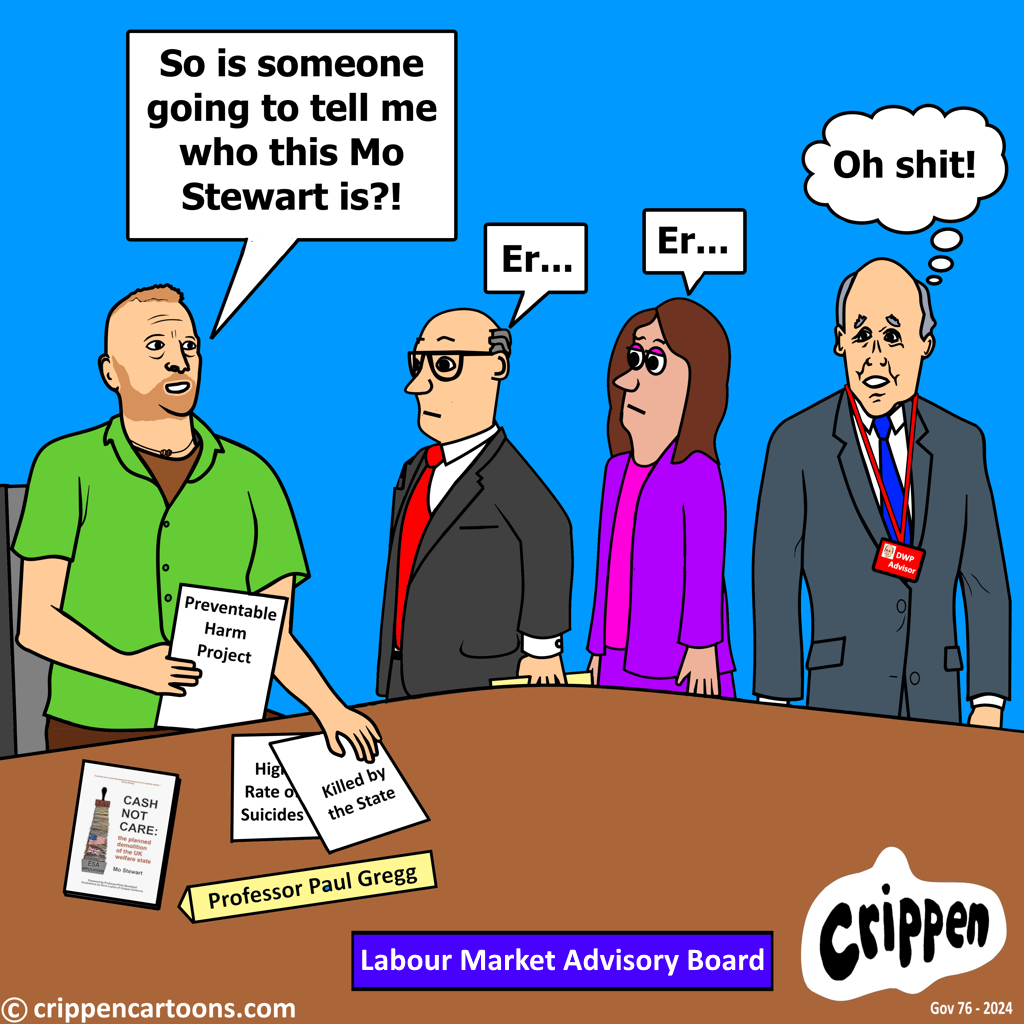
Remember how Labour decided to ignore disabled people when it sent out invitations for people to join their new Labour Market Advisory Board?

Professor Paul Gregg, Chair of the new Labour Market Advisory Group is sat at a large table. He is wearing informal clothing and is holding a document that says ‘Preventable harm project’ whilst on the table in front of him are other documents reading ‘Killed by the state’ and ‘High rate of suicide’. Alongside of him are a suited man and a woman and also Iain Duncan Smith (IDS) who is wearing an ID badge with ‘DWP Advisor’ printed upon it. Gregg is asking: “So is someone going to tell me who this Mo Stewart is?!”. The man and the woman are both saying; “Er …” whilst IDS is thinking: “Oh shit!”

Crippen hears how Mo Stewart informs the new Advisory Board

Well, our good friend disabled researcher Mo Stewart has now been invited to provide information to the Advisory Board regarding the identified public health crisis and preventable harm created by UK social policy primary legislation. Certainly a step in the right direction eh?!

The sort of information that Mo will be providing is well documented, mostly from her own work as research lead of the preventable harm project and from her many publications including ‘The public health crisis created by UK social policy reforms’.

Mo addresses her concerns to Professor Paul Gregg, Chair of the new Advisory Board and also Professor of Economic and Social Policy in the Dept of Social and Policy Sciences, University of Bath. She has kindly shared these concerns with me, which, with her permission I will now share with you.

Mo notes that the Advisory Board boasts significant members but no disabled member, and certainly no one with any expertise regarding the identified government induced public health crisis now ongoing in the UK. This crisis is negatively impacting on the health, wellbeing and survival of many of the chronically ill and disabled community who are unable to work.

It is also linked to a disturbing number of suicides of some of those in greatest need following relentless intimidation by the Department for Work and Pensions (DWP) when adopting the politics of fear using the fatally flawed Work Capability Assessment (WCA) to restrict disability benefit access. This was also identified by Professor Jonathan Portes as ‘one of the biggest social policy failures in the past 20-30 years.’

She also notes that Liz Kendall, the Secretary of State for Work and Pensions for the Labour administration, has invited the involvement of the new Advisory Board when working towards her planned White Paper. However, her comments since taking office demonstrates the same disturbing commentary as the previous Conservative administration regarding the numbers of people who claim disability benefits. This continuing demonisation of chronically ill and disabled people who are not in paid employment, is based on fake news and right-leaning ideology.

Mo tells Professor Gregg that, whilst she fully comprehends that he has a job to do, he should also consider that there has never been any evidence of vast numbers of fake disability benefit claims. That the hostile political rhetoricattacking disability benefit claimants adopted since 2010 by the various governments has worked well, as indicated by the rise in prosecuted disability hate crimes which climbed by 213% during the Coalition government‘s term in office (2010-15). All this of course aided by the tabloid press.

Mo concludes by reminding Professor Gregg that we are living in very dark and dangerous times since the adoption of neoliberal politics in the UK. This, coupled with the influence of corporate America with UK social policy reforms since 1992, and the adoption of social policies introduced using a fiscal priority whilst disregarding the health, wellbeing and survival of those in greatest need, has guaranteed that many people would be ‘killed by the state’ with no-one held to account.

Further, there is a disturbing history of preventable harm against those in greatest need created by successive UK neoliberal administrations and identified by a multitude of academics from a variety of universities, which is detailed in published evidence routinely disregarded by the DWP.

Well, that should give Professor Gregg and his colleagues on the Advisory Board food for thought. … Let’s see what they do with it?

NB: What’s also worrying is that years later, Sir Iain Duncan Smith, the former Secretary of State for Work and Pensions for the Coalition administration is still attacking the disabled community ‘languishing on benefit’ in his column in the Telegraph, without providing any evidence. It would appear that this man has a habit of using false statistics to gain attention to his hostile rhetoric and has even been challenged by the UK Statistics Authority who identified his many claims advising that they were ‘unsupported by the official statistics’. It’s also worrying that he now appears to be an advisor to the Labour government.

Oct 072024
 
DPAC Logo with text underneath "Disabled People Against Cuts" and then web address dpac.uk.net
NO NHS SELL-OFF
March and rally:
Saturday 19 October
Assemble 10am outside Colchester Hospital on Turner Road for a march at 10.30am to Castle Hill
ESNEFT:
IN-HOUSE IS BEST
UNISON

ESNEFT STRIKE MARCH & RALLY SATURDAY 19 OCTOBER 10:00 AM

Cleaners, caterers, porters, housekeepers and other East Suffolk and North Essex support staff are striking to stay in the NHS. They want to defend the quality of services as well as their own pay and conditions. Join them as they march through Colchester to say: In House is Best!

NO NHS SELL-OFF
March and rally:
Saturday 19 October
Assemble 10 am outside Colchester Hospital on Turner Road for a march at 10.30am to Castle Hill
ESNEFT:
IN-HOUSE IS BEST
UNISON

 Posted by at 10:53
Oct 072024
 
DPAC Logo with text underneath "Disabled People Against Cuts" and then web address dpac.uk.net
SOS NHS National Conference 10 am 2.11.24
13 Mabledon Place, WC1H9BD SOSNHS.org

SOS NHS NATIONAL CONFERENCE SATURDAY 2 NOVEMBER 

Join SOS NHS in Central London on 2 November to examine the state of the NHS, and how we might go about saving it.

Our core demands are simple: emergency funding for the NHS; fully public, free, healthcare, guaranteed for future generations; and for NHS staff to be paid properly.

We want to exert maximum pressure on the government to urgently resolve the crisis in the NHS.

We’ll be hearing from

  • Dr Andrew Meyerson, A&E Doctor
  • Holly Turner, Nurse, co-founder NHS Workers Say No
  • John Rees, founding member People’s Assembly Against Austerity
  • Phill Clarke, National President of the NEU
  • Dr Tony O’Sullivan, co-chair Keep Our NHS Public
  • ESNEFT UNISON striking workers
  • Trade unionists, politicians, campaigners and many more tba

Look out for more information soon about live streaming, speakers and event details soon!

Book Via Eventbright

BOOK NOW – SOS NHS
 Posted by at 10:44
Oct 042024
 
DPAC Logo with text underneath "Disabled People Against Cuts" and then web address dpac.uk.net

Disabled Journalist Jasmine Andersson who works for Yahoo news would like to speak to people about their fears around changes to PIP and spying on bank accounts. She says first names are usually used but is checking whether people could be totally anonymous.

She would also be interested in speaking to people about their experience of health assessments by the new provider HAAS. These are for PIP, WCA and UC.

If you’re willing to speak to Jasmine please email her jasmine.andersson@yahooinc.com

 Posted by at 16:09
Oct 012024
 
DPAC Logo with text underneath "Disabled People Against Cuts" and then web address dpac.uk.net

Reproduced by kind permission of Crippen

The PM Keir Starmer and a Civil Servant are standing each side of a large Labour Part Press Release statement hung on the wall. It reads ‘Disabled benefits claimants are all work-shy scroungers with most of them fiddling the system and taking your hard earned money!’ On a table in front of them are four other cards. One reads: ‘Benefit fraud at its lowest rate ever’, another reads: ‘PIP fraud at zero!’, the third one reads ‘Disability hate crime up 43%’, and the final card reads: ‘DWP ignores research re 600 suicides linked to WCA’. The civil servant is asking the PM: “But Sir – what about the facts?!” whilst pointing at the cards upon the table. Starmer replies: “Facts – when have they ever played a part in politics?!”

Crippen asks “Fraud – What Fraud?!

Well, having got rid of the Tory’s, we now have a labour government that has decided to continue with the harmful rhetoric that the DWP continue to pump out to a gullible public through the national press. But how did this attack against disabled people start, especially those claiming benefits because they cannot find accessible employment?

You’ll remember the Coalition administration elected in 2010? Well, it was this administration that started to change the public’s perception of disabled people. They vehemently challenged the integrity of the chronically ill and disabled community and routinely accused disability benefit claimants of fraud while failing to produce evidence to support their claims. Their often hostile rhetoric encouraged a 213 percent increase in prosecuted disability hate crimes, with successive administrations disregarded the thousands of deaths directly linked to the Work Capability Assessment (WCA).

And what with recent stats from the Home Office revealing that disability hate crime has risen by 43%. It doesn’t take much of a leap to connect this to the vitriol being pumped out by the DWP.

If you’ve read Mo Stewart’s book you’ll know how the WCA “ … was adopted using a discredited and dangerous biopsychosocial model of assessment to restrict access to long-term disability benefit. Influenced by corporate America since 1992, the UK social policy reforms guaranteed that many of those in greatest need were destined to die when, covertly, killed by the State.”

Sounds a bit dramatic, doesn’t it? “Killed by the state”. But this has exactly what has been happening since Margaret Thatcher started her devotion to neoliberal politics, which is the ideology that supports free market competition with an emphasis on minimal State intervention, would eventually be identified as being at ‘the root of all our problems’ (Monbiot, 2016).

Thatcher’s well-documented insistence that the welfare state was an unacceptable financial burden on the public purse, opened the door to the influence of corporate America with UK social policy reforms and the ‘planned demolition of the UK welfare state’ (Stewart, 2016).

Incidentally, every 30 years confidential Cabinet Papers from past UK governments are released into the public domain. In 2012, the 1982 Cabinet Papers from the first Thatcher administration (1979–83) were released, offering evidence demonstrating the political expectation to eventually demolish the UK welfare state, including the National Health Service (NHS).

It’s all there folks, you just have to dig for it as John Pring, disabled Editor of Disability News Service (DNS) and Mo Stewart, disabled researcher and lead on the Preventable Harm project, have done. Mo writes:

“Thatcher’s social policy right-leaning neoliberal legacy has been continued by every successive administration. This included introducing American corporate influence for the development of UK social policy reforms by the Major administration (1990–97) (Stewart, 2018); the adoption of American social and labour market policies by the Blair administration (1997–2007) (Daguerre, 2004Daguerre and Taylor-Gooby, 2004); the adoption of the Work Capability Assessment in 2008 to limit access to the new Employment and Support Allowance (ESA) disability benefit by the Brown administration (2007–10) (Gentleman, 2011); and the increased use of sanctions, which removed all income to successfully intimidate disability benefit claimants, and to starve some of them to death (Pring, 2020a), by the Cameron-Clegg Coalition administration (2010–15).”

In the Independent Living review of John Pring’s book they comment that: “As demonstrated in the ‘Department’, a disturbing number of chronically ill disability benefit claimants committed suicide, linked in no small measure to persecution by the DWP, and to the fear instilled by the relentless threat of sanctions that meant the total loss of their only income which guaranteed destitution.”

Sep 282024
 
DPAC Logo with text underneath "Disabled People Against Cuts" and then web address dpac.uk.net

Reproduced by kind permission of Crippen

Our friends at Disabled People Against Cuts (DPAC) have been monitoring the language being used by the government recently.

Kier Starmer PM is seen holding up a small wheelchair user by the scruff of his neck. Starmer is wearing a large boxing glove and the disabled person has a prominent black eye. Starmer is saying: “It’s what we refer to in the Labour Party as punching down!”

Crippen discovers why we’re all so punch drunk!

Phrases like “punching down” and “hostile environment” appear amongst the usual retoric, along with the carbon copies of speeches once used by the Tory party.

Of course, I couldn’t resist using one of these phrases for a cartoon!

Interested in joining DPAC? Here’s the link.

Sep 252024
 
DPAC Logo with text underneath "Disabled People Against Cuts" and then web address dpac.uk.net

Reproduced by kind permission of Crippen

Remember when Labour’s general election manifesto stated that it was “committed to championing the rights of disabled people and to the principle of working with them, so that their views and voices will be at the heart of all we do”.

Labour politicians Starmer, Reeves and Kendall are attending the Labour Party Conference 2024. Reeves is holding a card that reads ‘Disabled are scroungers’. Starmer’s card reads ‘Recycled Tory Speeches’ whilst Kendall’s card reads ‘DWP work not welfare’. Two disabled activists representing GMCDP and DPAC are in front of them looking angry. One is holding a card that reads ‘UN Convention – Government is obliged to consult with disabled’ whilst the other one is saying: “So not only DON’T they consult with us – they’re also peddling the same Tory lies about us!”

Crippen hears that Labour has sidelined disabled people from DWP ‘inactivity’ board

Well, you’ll be forgiven for thinking that another party won the election because everything that they claimed to do on our behalf seems to have gone right out of the window!

As reported in Disability News Service (DNS), Disabled Rights activists have criticised the Labour government’s “hugely disappointing” and “exclusionary” decision to set up a board of experts to examine “economic inactivity” without appointing a single representative of a disabled people’s organisation.

Work and pensions secretary Liz Kendall appears to have failed to appoint any disabled experts to the Labour Market Advisory Board, even though she made it clear that its key aim was tackling the “spiralling inactivity” caused by a record number of people out of work due to long-term sickness.

But the eight members of the board, labour market experts from across business, industrial relations and academia, do not appear to include any disabled experts and certainly do not include representatives of any disabled people’s organisations (DPOs).

Disabled researcher Stef Benstead, author of Second Class Citizens, which describes the harm caused to disabled people by a decade of cuts and reforms, said: “It should not be thinkable for any modern government department to have an advisory board that does not include representatives of the community impacted by the policy proposals.”

Dan White, policy and campaigns officer for Disability Rights UK, said it was “hugely disappointing that not one disabled people’s organisation or disabled people’s expert representative” was on the board, despite Labour’s past commitments to involving disabled people in developing policy. Would any other group be left out of an expert board that is focused on their future?”

Inclusion London said it was “extremely concerned” that disabled people were “once again missing from an important forum where programmes targeting us will be shaped” with their senior policy and campaigns manager Julia Modern adding that:

“Under the UN Convention on the Rights of Persons with Disabilities, the government is obliged to consult with disabled people”.

You can read the full article in DNS.

Sep 182024
 
DPAC Logo with text underneath "Disabled People Against Cuts" and then web address dpac.uk.net

Reproduced by kind permission of Crippen

Recently reported in an article published in the Big Issue Anela Anwar, chief executive of anti-poverty charity Z2K has set out why the new government must scrap cruel and dangerous plans to cut payments for seriously ill and disabled people. They said:

“Since the election of the Labour government in July there has been something of a change in tone when it comes to social security and disability. Speaking to the Observer last month, Liz Kendall vowed to end the blame culture targeted at people out of work and stop the ‘salami slicing’ of the benefits bill that we saw under previous Conservative governments. You might think, given this rhetoric, that the new government will mark a clear break from previous governments’ approaches to health and disability benefits.”

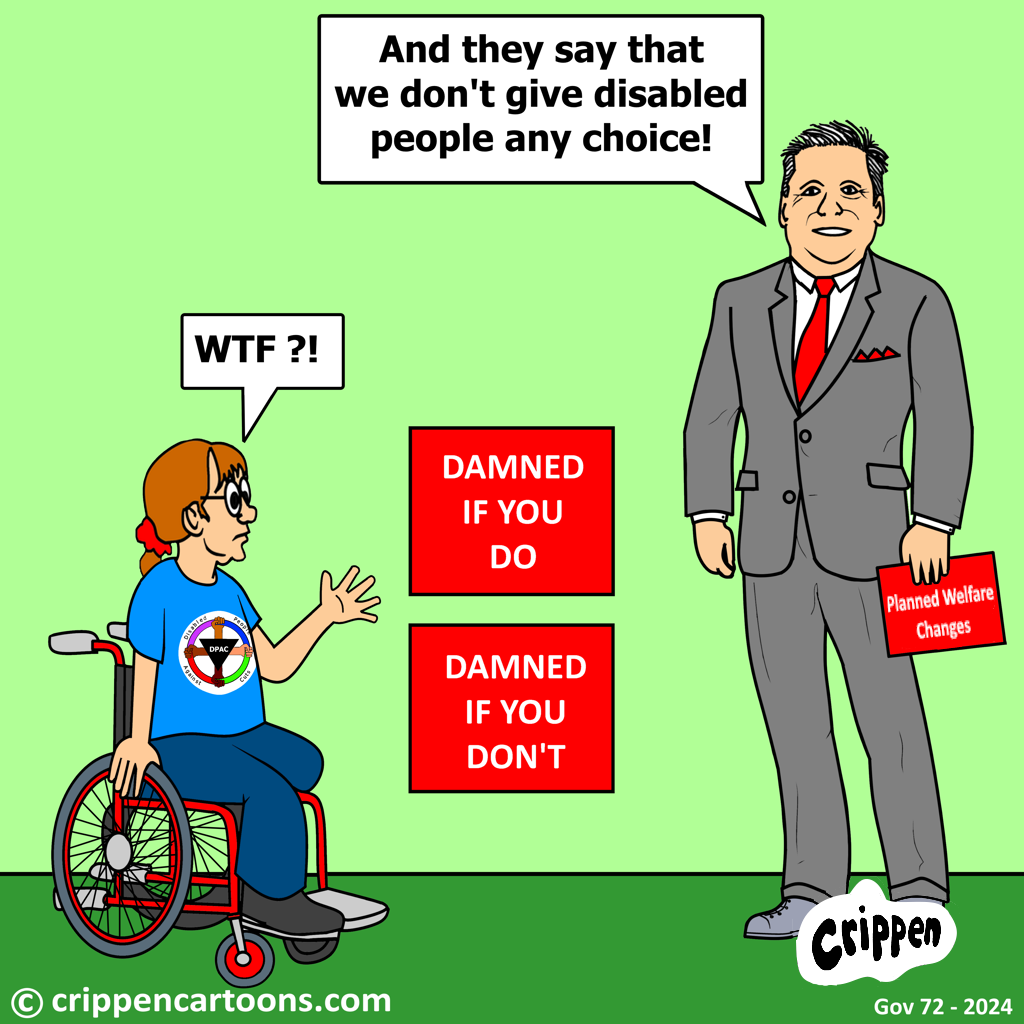
The prime minister is holding a sign that reads ‘Planned Welfare Changes’ and is standing alongside two placards which read ‘Damned if you do’ and ‘Damned if you don’t’. He is saying “And they say that we don’t give disabled people any choice!”. A wheelchair user wearing a Disabled People Against Cuts (DPAC) T-shirt is looking at him with a perplexed expression and is saying “WTF?!”.

Crippen agrees that cuts to disability benefits in autumn budget would plunge disabled people into deeper poverty

However, since then the chancellor has changed her tune and as reported in my previous blogs she has told parliament recently that within the autumn budget she intended ‘taking difficult decisions’ on social security, and said she ‘will look closely at our welfare system, because if someone can work, they should work’.

Many disabled people already face a system that is threadbare, where financial support is regularly cut or removed altogether as a result of bad decision-making. For most, the prospect of further cuts to financial support is terrifying.

Anela comments further:

“Much has been made of the previous government’s ill-conceived proposals to make radical changes to personal independence payment (PIP). Among a raft of troubling proposals was a suggestion that PIP cash payments could be replaced with vouchers. Labour has yet to set out its intentions with regards to PIP, but notably have said that they are ‘reviewing the responses people have made to the previous government’s consultation’.

“The new government has also been worryingly silent about its plans for the work capability assessment (WCA). Its manifesto said that the WCA ‘needs to be reformed or replaced’, but Labour has so far failed to provide much detail about what this would mean in practice.”

The basic rate of universal credit is just £91 per week for a single person. It’s hard enough living on this if you’re in good health and able to look for work: Trussell Trust polling released last week found that almost half of those on universal credit ran out of food in the past month. But imagine being seriously ill for months on end, and potentially for life, and having to live off this meagre amount.

The Office for Budget Responsibility analysed the previous government’s plans to encourage people to enter work and predicted that only 3% of those affected by the cuts would move into work as a result of these reforms. That leaves the remaining 97% having to survive on the lowest rate of benefits for an indefinite period.

That’s even before we consider that there is an active legal case against the consultation on which the plans are based. The disability activist Ellen Clifford, supported by Public Law Project and backed by Z2K, is bringing a claim against the rushed and unfair consultation on these plans, due to be heard on 10-11 December. If successful, the action could make the justification for bringing forward these plans even shakier.

Anela adds: “The new government has a real opportunity to reset the relationship between disabled people and the DWP. Bringing forward these poorly thought-out and dangerous proposals would taint these efforts before they’ve even begun. We need to see a health and disability benefits system that provides security and support, not one that pushes disabled people into deep poverty and leaves them at risk of sanctions.”

Anela Anwar is chief executive of anti-poverty charity Z2K.

Read the full article in The Big Issue

Sep 122024
 
DPAC Logo with text underneath "Disabled People Against Cuts" and then web address dpac.uk.net

Reproduced by kind permission of Crippen

The UK Disabled People’s Movement mourns the sad passing of Micheline Mason, disabled activist, author, artist and founder of The Alliance for Inclusive Education (ALLFIE).

caricature of Micheline Mason from the waist up shows her smiling with a purple band holding back her white hair. A pink scalf over a purple top completes her dress.

Crippen remembers Micheline Mason

In a moving tribute by her colleagues at ALLFIE, Micheline is remembered as a remarkable activist who dedicated her life to campaigning for inclusive education and the rights of all Disabled people to be educated in mainstream settings. As a Disabled mother of a Disabled child, Micheline was determined that her daughter, Lucy, now an adult, would attend her local mainstream school rather than be segregated from society, as this was her own experience within the education system.

Micheline often explained how she formed ALLFIE around her kitchen table, alongside a group of parents determined to ensure their children were educated equally, and formed the pivotal inclusive education group, Parents for Inclusion. She said:

“I started the Alliance for Inclusive Education 30 years ago now. At the time I was a parent of a Disabled child who was 4. Who was coming up to school age. Having been educated myself for 14 years at home on the sofa and then 3 years in a special boarding school which brought great problems to me when I left. I was so determined as a mother that my daughter wasn’t gonna follow the same path as me. And ever feel excluded from her local community. I felt she deserved to have all the same opportunities as any other child, possibly even more because she needed, she would have limited choices because of her impairments.”

All her life, Micheline, alongside other activists, drove forward the inclusive education movement, it is now a global campaign that remains one of the most powerful tools in combating societal inequalities and discriminatory practices. Micheline played a crucial role in supporting other parents of Disabled children in advocating for their child’s right to attend a mainstream school. She was instrumental in introducing national policy changes and reshaping the language around inclusive education.

She will be sadly missed by her family, friends, colleagues at ALLFIE and Parents for Inclusion and also fellow disabled activists from around the world.

You are invited to leave your own tribute to Micheline on the ALLFIE web site.

Sep 102024
 
DPAC Logo with text underneath "Disabled People Against Cuts" and then web address dpac.uk.net

Reproduced by kind permission of Crippen

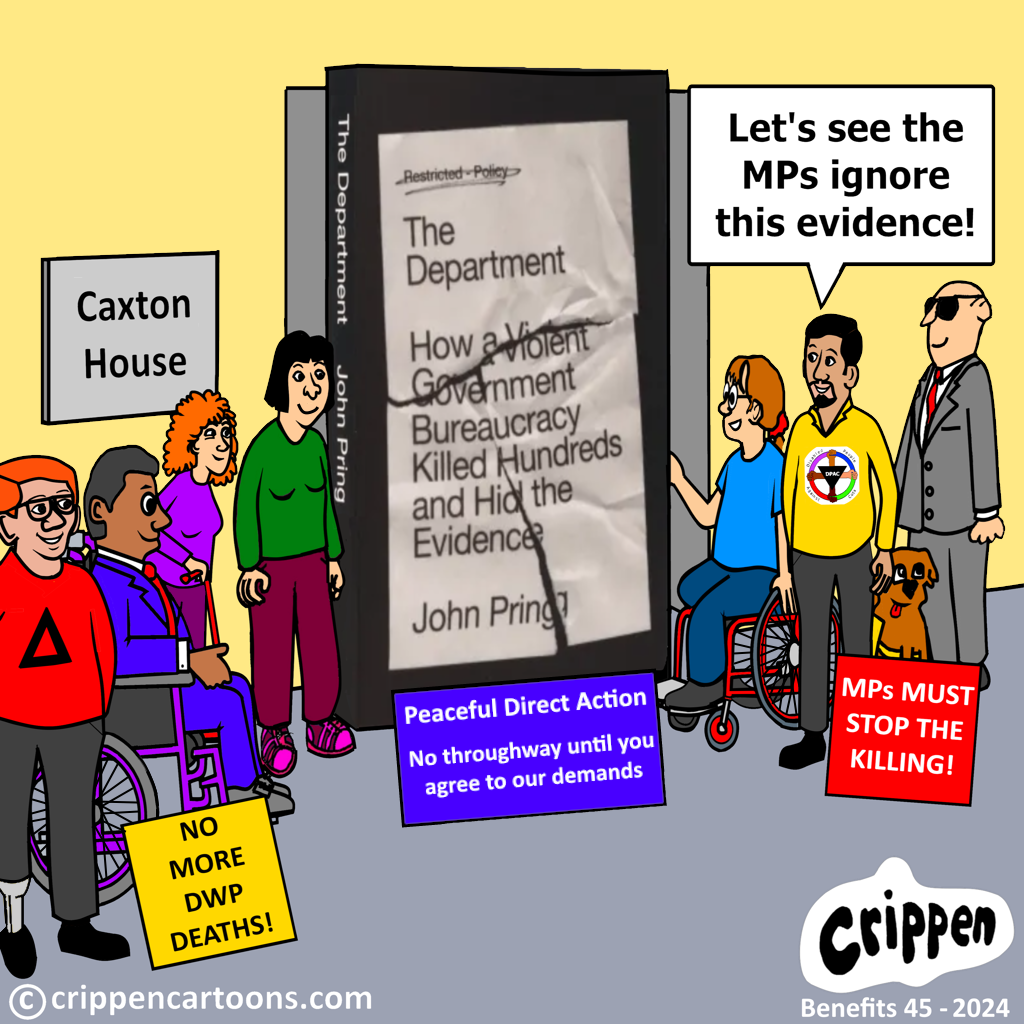
Disabled activists and allies defied bureaucrats to ensure that the delivery of 650 copies of John Pring’s ‘DWP violence’ book was delivered to MPs.

The entrance to Caxton House is blocked by a giant copy of John Pring’s book ‘The Department’. A crowd of disabled people complete the blockade along with placards that read ‘No more DWP deaths’, ‘MP’s must stop the killing’ and ‘Peaceful Direct Action – no throughway until you agree to our demands’. One protester is saying: “Let’s see the MPs ignore this evidence!”.

Crippen and the Caxton House protest

Although they had been assured weeks in advance – both by the House of Commons Post Office and Commons security – that they would be allowed to bring in the copies through the security scanners at Portcullis House, managers refused to allow them to bring in the sealed envelopes, each addressed to an individual MP.

Using negotiation and peaceful direct action, activists – led by Disabled People Against Cuts and Black Triangle – used the books to block the public entrance to the building for more than an hour. Their action ensured that every MP received a copy of The Department, which details how DWP’s actions eventually led to the deaths of hundreds, if not thousands, of disabled people in the post-2010 austerity years.

After meeting outside DWP’s Caxton House offices last week, activists – including relatives of two of the disabled benefit claimants who died – carried all 650 copies across Westminster to Portcullis House, where many MPs and the House of Commons Post Office are based.

Among those who supported the event were Gill Thompson – whose brother David Clapson died in July 2013, three weeks after having his jobseeker’s allowance sanctioned – and her husband Mike. She said that the crowdfunding and action had been “quite an achievement … We have had our obstacles, but we got there in the end. That book has given me David back, it’s put him in a human light and given him back his dignity that [DWP] took away from him.”

Another supporting the action was Joy Dove, whose daughter Jodey Whiting took her own life in February 2017, 15 days after she had her out-of-work disability benefits wrongly stopped for missing a work capability assessment.

She said: “These MPs need to see the stories in the book, how each and every family has suffered the life-changing loss of a loved one. There needs to be change now there’s a new Labour government.”

She said she was encouraged that her new Labour MP, Chris McDonald, asked to meet her outside Portcullis House, and supported her campaign for justice.

The project has been led by disabled activists, including Black Triangle Campaign, DPAC and the UK Deaf and Disabled People’s Organisations’ Coalition, and supported by disabled people’s organisations, allies and families of those who have lost their lives, as well as Pluto Press, which has published The Department.

Among the organisations supporting the campaign are Disabled People Against CutsGreater Manchester Coalition of Disabled PeopleInclusion LondonDisability Rights UKRecovery in the Bin and the radical working-class media organisation The Canary.

John McArdle, co-founder of Black Triangle Campaign, whose idea it was to launch a crowdfunder that paid for the purchase of the books, said: “The Department provides a casebook of how not to run a social security system. The current disability benefit assessment system is making people even sicker. Pushing disabled people into work that medical experts say we cannot do won’t address labour shortages and more disability benefit cuts, as the government has planned, are not a common-sense strategy for ‘fixing the foundations’.

“Instead, Deaf and disabled people and our organisations call upon the government to sit down with us to co-produce a safe and efficient disability benefit system that provides a genuine safety net to those who need it.”

Author and activist Ellen Clifford, from the UK Deaf and Disabled People’s Organisations’ Coalition, who has helped lead the project, said: “The success of the crowdfunder shows how important it is to people outside the Westminster bubble that our elected politicians finally address the grave injustice of DWP attacks on Deaf and disabled people. Across the UK, there is growing concern about the impact of yet more cuts. It is apparent that lessons from the past are being deliberately ignored.”

Read the full story in Disability News Service.

Note: I urge you to purchase a copy of John’s book. It contains a blow by blow account of how the DWP has affected the lives of thousands of disabled people by their use of “bureaucratic violence”.

The Department: How a Violent Government Bureaucracy Killed Hundreds and Hid the Evidence, by DNS editor John Pring, was published by Pluto Press last month.

Sep 052024
 
DPAC Logo with text underneath "Disabled People Against Cuts" and then web address dpac.uk.net

Workshops for Individual Employers and those receiving Direct Payments

A series of FREE online sessions on Zoom delivered by Iggy Patel and Anne Pridmore, supported by Bringing Us Together and Adult Social Care Warriors.

Understanding how the law works and using the Care Act for maximising your budget
Thursday 26th September 2024,  1.00pm to 3.00pm 

PA recruitment, interviews, contracts
Wednesday 30th October 2024, 1.00pm to 3.00pm

Care planning for main carer/Guardian when they can no longer provide care
Thursday 28th November 2024, 1.00pm to 3.00pm

Personal Health Budgets 

Wednesday 29th January 2025, 1.00pm to 3.00pm

Better working with the local authority building confidence for meetings and reviews (the ‘care net’)
Wednesday 26th February 2025, 1.00pm to 3.00pm

Staying Well Whilst Being the Boss
Wednesday 26th March 2025, 1.00pm to 3.00pm

Funded by Skills for Care, our bespoke workshops are designed to provide youwith the information, knowledge and confidence to be the best boss whilst taking away some of the burden we all feel.

We will be sharing tips and ideas on looking after yourself whilst being the boss and managing PAs.  Workshops are delivered by an experienced team of trainers who are all employers of Direct Payments and active in the world of independent living.  We provide a safe place for you to share experiences, learn with others and find solutions.  All workshops are recorded for those unable to make the dates.  2023.

All workshops are recorded for those unable to make the dates. 

For further information and booking email: karen@bringingustogether.org.uk .

Further information about this course:

Training will be delivered on line on zoom
You will have access to helpful templates and resources
Training will be inclusive and accessible for all
All attendees will receive a survey to complete before the end of the session
Each session will be recorded
Recordings will be sent out to everyone who has signed up
Those who have not been able to attend or want to do the learning in their own time, will receive a separate email with learning outcomes andsurvey to complete.
All learners will receive a certificate upon completion

Understanding how the law works and using the Care Act for maximising your budget
Thursday 26th September 2024   1.00pm – 3.00pm

This session is designed to help you understand the basics of law, the history of law and how laws are made.  This will include looking at the difference between acts, regulations, orders, statutory and normal polices and Judicial reviews.

We will be looking at the tools used by the courts in making decisions and how this affects the law, making it work for you in health and care.

PA recruitment, interviews, contracts
Wednesday 30th October – 1.00pm to 3.00pm

The complete how to deal with employing carers using direct payments, from recruitment, contracts, dealing with issues, leave, sick, redundancy and any other tips and tricks relating to the management and paperwork involved.

Care planning for main carer/Guardian when they can no longer provide care
Thursday 28th November – 1.00pm to 3.00pm

Guide to what you need to consider and plan ahead,for when you can no longer take on the responsibilities. Including carers rights and care planning. This workshop will also include looking atalternatives when thinking of the future needs of the person you care for.

Personal Health Budgets
Wednesday 29th January 2025 – 1.00pm to 3.00pm

Everything you need to know about personal health budgets from health criteria, decision planning tools used by continuing health needs, assessments, plans, option of care, direct payments for health and care including making clear the differences between the two

Better working with the local authority – building confidence for meetings and reviews (the ‘care net’)
Wednesday 26th February 2025 – 1.00pm to 3.00pm

How to find out what your Local Authority is doing in relation to care, years in advance. How to go aboutstarting a local group online and bring matters to the attention of the Local Authority. How to challenge decisions using legislation such as the Equality Actand Care Act and how to make sure youre heard. Steps that can be taken when you haven’t been heard. This workshop will also include group funded challenges.

Staying Well Whilst Being the Boss
Wednesday 26th March 20251.00pm to 3.00pm

This part of the course will focus on what we can do to look after ourselves whilst dealing with all the challenges we face whilst ‘being the boss’.  This will include looking at what self-care and self-compassion means in practice and how we can develop these.  We will also be looking at how to cope with anxiety, how physical and mental health affect each other and what we can do to stay well.  This will include different types of support available for staying well including coaching and peer advocacy.


Meet the ‘Being the Boss’ Team!

Anne Pridmore founded ‘Being the Boss’ 14 years ago.

A recipient of 24 hr funding to buy in her support needs, Anne never imagined the sole responsibility would be on herself. Many disabled people have never been employed let alone been employees. It can be a very daunting task especially when things go wrong. Anne’s website aims to take some weight off disabled employers and contains lots of forms and information about what it means to be an employer. Anne also runs a helpline so people have access to support.

Iggy runs a voluntary advocacy service independently. He offers advice and solutions in to all areas of health and care. He has written over 150 blogs all relating to this topic. He tries to offer a unique insight as a user of health and care services for his disability, with a practical understanding of the legal framework.

Giselle, a single parent and carer for her disabled son, is a passionate advocate and campaigner for disabled people and unpaid carers rights. She founded the ‘Adult Social Care Warriors’ Facebook group, dedicated to campaigning, advocacy and mutual support. Giselle actively collaborates with various groups, including Bringing Us Together and is part of the Scrap Care Charges Coalition.

Katie has worked for over 30 years with families and disabled people across the country. She has set up two charities and is co-founder of Bringing Us Together. Katie is the mum to six adult children and is a foster carer.

Tony has worked for over 20 years as an advocate and ally with disabled people and their families.  A former CEO, Tony now works as a coach, mindfulness and self-compassion facilitator, writer and trainer. He also designs flyers and mailouts for us.

We hope you find our workshops useful and look forward to working with you!

for info and booking email: karen@bringingustogether.org.uk Understanding how the law works and using the Care Act for maximising your budget - Thursday 26th September 2024, 1.00pm to 3.00pm - PA recruitment, interviews, contracts Wednesday 30th October 2024, 1.00pm to 3.00pm - Care planning for main carer/Guardian when they can no longer provide care Thursday 28th November 2024, 1.00pm to 3.00pm - Personal Health Budgets - Wednesday 29th January 2025, 1.00pm to 3.00pm - Better working with the local authority - building confidence for meetings and reviews (the 'care net') Wednesday 26th February 2025, 1.00pm to 3.00pm Staying Well Whilst Being the Boss - Wednesday 26th March 2025, 1.00pm to 3.00pm

Being The Boss


 Posted by at 13:36
Sep 052024
 
DPAC Logo with text underneath "Disabled People Against Cuts" and then web address dpac.uk.net

Urgent! 

The Government’s decision to take the Winter Fuel Allowance from pensioners who are not in receipt of Pension Credit (or some other means tested allowance) will have a terrible effect on all pensioners who have depended on it in the past to heat their homes during winter. But it would be especially disastrous for disabled pensioners who are often struggling to make ends meet even during the summer.

Excess winter deaths due to living in cold homes in 2023 were 4,950 (ONS stats for England and Wales). That’s 4,950 older and disabled people who should never have died.

Meanwhile MPs between 2018 and 2023 claimed over £1 million for heating their second homes.

https://www.opendemocracy.net/en/dark-money-investigations/parliament-mps-claim-expenses-on-energy-bills-for-second-homes/

Although Poor Rachel Reeves who is happy for older people to freeze to death only claimed £1,296 for accommodation fuel costs

https://www.reuters.com/fact-check/uks-reeves-does-not-have-3400-pound-heating-allowance-contrary-online-claims-2024-08-06/

Please ask your MP to vote against this decision on Tuesday 10th of September. This means there are only a few days left, so please contact your MP urgently.

We need you to contact your MP and ask them to attend this meeting.

If you are not sure who your MP is, you can find them by putting your postcode in the They Work for You website

Link here
https://www.theyworkforyou.com/mp/

Please send them an email now.

 Posted by at 12:24
Sep 032024
 
DPAC Logo with text underneath "Disabled People Against Cuts" and then web address dpac.uk.net

Reproduced by kind permission of Crippen

WTF?!

Labour are once again preparing to roll out policies which are basically those started by the Tory government. These include reinstating contractors for health and work assessments such as Capita, Serco and Ingeus UK and the possible merging of benefit assessments and/or the scrapping of the Work Capability Assessment (WCA) along with further changes to Personal Independent Payment (PIP).

Labour’s new chancellor Rachel Reeves is standing alongside an old car wreck which has a large sold sign upon it. Written on the car is ‘Old Tory policies’, which is crossed out and replaced by ‘New labour policies’. Rishi Sunak is standing at the other side of the car with a wad of money in his hand. He is saying to Reeves: “There you go Rachel – a lick of paint and no one will know the difference!”

Crippen looks at Labour’s Old for New

These assessment companies will take over from disgraced DWP PIP contractor Atos. However, as reported in the Canary, these private outsourcing firms, particularly Serco and Maximus have a long history of harm towards chronically ill and disabled people.

In Maximus’s case, it has overseen some of the government’s WCAs with often fatal effect, including running the process leading to the deaths of multiple people. On top of this, Serco, Maximus, and Ingeus have all run a key government back to work programme. Not only have they failed to meet low government-set targets, but they’ve also harmed chronically ill people in the process.

If Labour stick to the Tory plan, these changes will be used as a pretext setting the stage for other harmful DWP reforms which significantly the new Labour government has failed to rule out.

Crucially though, these changes are set to deny hundreds of thousands of chronically ill and disabled claimants their vital benefits. This is because, as policy adviser Ken Butler at Disability Rights UK told the Disability News Service (DNS):

“The health element proposals will mean that around 632,000 disabled people who receive the employment and support allowance or universal credit support component will lose this as they do not receive PIP or DLA.”

Specifically, as the Canary’s Steve Topple detailed, this will most likely impact chronically ill people and those living with mental health conditions. He explained that the reason for this is that many of these people:

“Do not fit into PIP’s rigid criteria box!”

Despite calls from disability rights campaigners for the new government to ditch the Tories’ plans, Labour has yet to signal it will indeed do this. To the contrary, it has in fact somewhat rebutted their efforts to challenge the former government’s reforms.

Significantly, as the Disability New Service (DNS) revealed, government lawyers are still planning to appeal the information commissioners order to release the previous government’s assessment on its plans to do away with the WCA. Therefore, as DNS noted:

“This could add to fears that the new government has no plans to scrap Conservative work and pensions policies such as abolishing the WCA, tightening the assessment in the short term, or reforming PIP.”

Moreover, we still don’t know if Labour will continue with the merging of benefit assessments and/or the scrapping of the WCA.

Topple also pointed out how the then Tory government might use this to push chronically ill people into work. Critically, he wrote that:

“There are now over 360,000 more people who are chronically ill and not working than before the coronavirus (Covid-19) pandemic. The government classes these people as “economically inactive”. It’s currently on a drive to get some of the nine million people who are economically inactive into work.”

Given this, he suggested that:

“By removing the WCA and just relying on PIP entitlement, the DWP will be able to strip some of these economically inactive people of their entitlements. This will leave many with little choice but to try and work.”

Of course, this rhetoric now neatly aligns with DWP PIP boss Liz Kendall’s back to work agenda which will affect 2.8 million “economically inactive” people off work due to long-term sickness.

So, it’s unclear whether any of the other Tory-instigated plans will continue. But given Labour’s rhetoric, they may well do.

Watch this space!

You can read the full story in the Canary.

 Posted by at 10:21
Sep 022024
 
DPAC Logo with text underneath "Disabled People Against Cuts" and then web address dpac.uk.net

Disabled activists will on Monday (2 SEPTEMBER) deliver 650 copies of a new book on the DWP to the House of Commons – one copy for every MP.

The Department: How a Violent Government Bureaucracy Killed Hundreds and Hid the Evidence exposes how the actions of the Department for Work and Pensions (DWP) led to the deaths of hundreds, if not thousands, of disabled people in the post-2010 austerity years.

A crowdfunder set up by disabled activists originally aimed to raise enough money to buy a copy of the book for every Labour MP, but it was so successful that they will now deliver a copy to all 650 MPs on Monday, as the House of Commons returns from the summer recess.

The activists from across the UK, including actor-activists Cherylee Houston (Coronation Street) and Lisa Hammond (Eastenders 2014 – 2018), will meet outside Caxton House, the Westminster-based HQ of DWP, at 11.15am on Monday.

They will be joined by relatives of those who have died or taken their own lives as the direct result of disability benefit cuts and whose tragic stories are covered in the book.

Between them, dressed in black, they will carry the books to Parliament. They decided to launch the crowdfunder because the new Labour government will soon be introducing a series of reforms to disability benefits.

Activists believe it is vital that MPs are aware of DWP’s history, which stretches back more than 30 years to its previous life as the Department of Social Security (DSS). The book details how the actions of the DSS and DWP over those years eventually led to countless deaths.

The project has been led by disabled activists, including Black Triangle, the UK Deaf and Disabled People’s Organisations’ Coalition, and supported by allies and the families of those who have lost their lives.

Among the organisations supporting the campaign are Disability Rights UK, Inclusion Scotland, All Wales People First, Disabled People Against Cuts (DPAC), Greater Manchester Coalition of Disabled People, Inclusion London, Recovery in the Bin, DPAC Northern Ireland and the radical working-class media organisation The Canary.

John McArdle, co-founder of Black Triangle Campaign, whose idea it was to launch the crowdfunder, said: “The Department provides a casebook of how not to run a social security system. The current disability benefit assessment system is making people even sicker.

“Pushing disabled people into work that medical experts say we cannot do won’t address labour shortages and more disability benefit cuts, as the government has planned, are not a common-sense strategy for ‘fixing the foundations’. Long term-costs to the economy increase exponentially by failing to provide a stitch in time and save lives. There are alternative fiscal policies that could be adopted which won’t lead to more DWP created avoidable harm and death.

“Instead, Deaf and Disabled people and our organisations call upon the government to sit down with us to co-produce a safe and efficient disability benefit system that provides a genuine safety net to those who need it.”

Ellen Clifford, from the UK Deaf and Disabled People’s Organisations’ Coalition, who has helped lead the project, said: “The success of the crowdfunder shows how important it is to people outside the Westminster bubble that our elected politicians finally address the grave injustice of DWP attacks on Deaf and disabled people. Across the UK, there is growing concern about the impact of yet more cuts. It is apparent that lessons from the past are being deliberately ignored.”

Versuchka Selbach, Managing Director of Pluto Press said: “We are very proud to be publishing John’s book. It is an exceptional work of investigative journalism that is both heart-breaking and shocking. We are also extremely honoured to be participating in this action to ensure that all MPs get a copy of the book. These stories can’t be ignored any longer.”

The book is strongly evidence-based, and relies on documents from the 1990s and early 2000s that have been unearthed from the National Archives, as well as more recent coroners’ reports, academic research and government documents, and the research and testimony of disabled activists and relatives of those whose deaths have been linked to DWP’s actions.

The activists have reminded the MPs in a letter that will accompany the books (see attached) that the UK government was found guilty of ‘grave’ and ‘systematic’ violations of the UN Convention on the Rights of Persons with Disabilities in 2016, thanks almost entirely to the actions of the DWP. The UN committee on the rights of disabled people found earlier this year that no significant progress had been made in correcting those breaches.

They and other disabled activists – and the book’s author, John Pring, editor of Disability News Service – continue to call for an independent inquiry into the deaths linked to DWP’s actions over the last 15 years, for a police investigation of misconduct in public office by senior civil servants and DWP ministers, and for compensation for the families of those who have died.

It is certain that the new government will be announcing reforms to personal independence payment, benefit sanctions, universal credit and the work capability assessment in the coming months. All these areas of DWP policy have been strongly linked to tragic deaths of claimants, and they believe this will continue to happen if the government does not take the necessary steps to build a new, safer culture within DWP.

They hope the MPs – or a member of their staff – will read the book before deciding their position on the reforms.

In the covering letter sent with the books, McArdle and Clifford say: ‘It is certain that the new government will be announcing reforms to personal independence payment, benefit sanctions, universal credit and the work capability assessment in the coming months.

‘All these areas of DWP policy have been strongly linked to tragic deaths of claimants over the last 15 years, and we believe this will continue to happen if the government does not take the necessary steps to build a new, safer culture within DWP.

‘All we ask is that you read this book before deciding your position.’

Actor-activist Cherylee Houston said: “PIP is an absolute lifeline for disabled people. The proposals to change to, for example, vouchers, aren’t accessible for most disabled people and will be catastrophic.”

Actor-activist Lisa Hammond said: “I wouldn’t have been able to be where I am today in life and career if it wasn’t for the support of disabled people. All of my disabled friends are the same. We are not scroungers or chancers or scum. We are just trying to live our lives. Being disabled in a society that is not set up for us is inherently more expensive. Accessible financial support is crucial to help us with extra costs.

“MPs must read this book. They need to know the devastation the DWP has cause in the past in order not to repeat the same mistakes.

Adam Gabsi, Chair of Deaf and Disabled People’s Organisation, Inclusion London, said: “Disabled people deserve better. John Pring’s book documents unnecessary deaths that are likely to be much higher in number. It is right for these wrongdoings to be exposed and for the hostile treatment of disabled people by the Department for Work and Pensions to end.”

ENDS

Contact details:

UK and England: Ellen Clifford 07505 144 371 [SMS/whatsapp]; ellenclifford277@gmail.com

UK and Scotland: John McArdle 07379 612 778 [SMS/whatsapp]

Wales: Joe Powell 07972 516 328

Northern Ireland: Michael Lorimer 07528 464 350

 Posted by at 00:01
Sep 012024
 
DPAC Logo with text underneath "Disabled People Against Cuts" and then web address dpac.uk.net

#TheDepartment
#NoMoreBenefitDeaths

Monday 2nd September 2024

As Parliament convenes after summer recess; Activists from Black Triangle, DPAC, Greater Manchester Coalition of Disabled People, Recovery in the Bin and members of the group UK Coalition of Disabled People and family members who have tragically lost loved ones due to benefit cuts are hosting a parliamentary meeting in Parliament hosted by Actor-Activist Cherylee Houston.

There will be speakers to discuss the findings from the newly published book by The Department by John Pring and to discuss further social security austerity cuts by the new Labour Government.

We need you to contact your MP and ask them to attend this meeting.

If you are not sure who your MP is, you can find them by putting your postcode in the They Work for You website

Link here
https://www.theyworkforyou.com/mp/

Please send them an email.

Copies of John Pring’s Book are being posted to all MPs in the House of Commons.

The Parliamentary meeting is taking place here:
The Grimrod Room
Portcullis House
1 Victoria Embankment
London
SW1A 2JR

2.30 -3.50pm

If you wish to attend this meeting please allow extra time to get through security procedures at Portcullis House

The nearest accessible London Underground Station is
Westminster
Bridge Street
London
SW1A 2JR

(Jubliee line is step free from platform to lift. There is a lift that goes to street level). From the lift turn left go 100 yards to end of pavement, turn left and portcullis House will be on left hand side.)
Buses 3, 11, 12, 24, 53, 87, 88, 149, 211, 453 all stop near by

If you can’t attend the parliamentary meeting and wish to support online
We are asking you to use the hashtags and a black heart

#TheDepartment
#NoMoreBenefitDeaths

If you have a copy of John Pring’s book take a photo of you with the book, or a picture of your hand and the book. As Larry the Cat is important in number 10 – our pets have supported us in our campaigning activities and our lives so post a picture of your cat, dog, budgie, hamster, your goldfish with a copy of the book.

Tweet what you thought about the book; your concerns about further austerity cuts and what we can do to resist austerity cuts going forwards

#TheDepartment #NoMoreBenefitDeaths

#TheDepartment #NoMoreBenefitDeaths

Parliamentary Meeting Monday 2nd September Grimrod RoomPortcullis House 2pm Chaired by Cherylee Houston Right hand side is an image of Parliament with a disability icon next to the building #TheDepartment #NoMoreBenefitDeaths Parliamentary Meeting Monday 2nd September Grimrod RoomPortcullis House 2pm Chaired by Cherylee Houston Right hand side is an image of Parliament with a disability icon next to the building #TheDepartment #NoMoreBenefitDeaths

Meeting Details

Black background with white icons and text On the left, a wheelchair accessibility symbol next to a crumpled paper showing the book title The Department: How a Violent Government Bureaucracy Killed Hundreds and Hid the Evidence by John Pring. In the center an arrow pointing to the right with the date 02/09/24 On the right, icons representing a stack of books the UK Parliament building and three people with MP written on one. Hashtags #TheDepartment' and #NoMoreBenefitDeaths' are at the bottom

September 2nd 2024

woman sits . She has brown short hair and is wearing black rimmed glasses and wearing a black t shirt. She holds a black and white book text of book says The Department How a Violent Government Bureaucracy killed hundreds and hid the evidence John Pring #TheDepartment #NoMoreBenefitDeaths

Example Post for X, Instagram, Threads and Facebook of a selfie with John Pring Book – You can use your hand, or Pet with #TheDepartment #NoMoreBenefitDeaths

 Posted by at 15:41
Sep 012024
 
DPAC Logo with text underneath "Disabled People Against Cuts" and then web address dpac.uk.net

Reproduced by kind permission of Crippen

The image is the front cover of John Pring’s book which has a torn and crumpled piece of paper on it baring the legend ‘How a Violent Government Bureaucracy killed hundreds and hid the evidence’.

Crippen and John Pring’s important new book

The book, entitled The Department: How a Violent Government Bureaucracy Killed Hundreds and Hid the Evidence, by Disability News Service (DNS) editor John Pring, was published by Pluto Press on Tuesday 20th August 2024.

It describes John’s 10-year investigation into how the actions of DWP, spurred on by politicians and the outsourcing industry, led to the deaths of hundreds, and probably thousands, of disabled people, and how they covered up their role in those deaths.

It includes new documents obtained from the National Archives that show how the violence inflicted on benefit claimants built slowly from the late 1980s until it exploded in the post-2010 austerity years.

It also tells the stories of some of those who lost their lives because of that bureaucratic violence, following years of dehumanisation and destitution, and the impact on their families and friends.

At the time of this blog going out the crowdfunder had reached its fundraising goal of £7,000. The original aim was to raise £3,500, enough money to send a copy of The Department to every Labour MP in the House of Commons. But the campaign was so successful that the target was doubled, and the aim extended to MPs from other parties.

Now organisers of the campaign hope to raise enough to provide copies of the book to other leading politicians across the country, including some members of the legislative assembly in Northern Ireland (MLAs), Welsh assembly members, members of the Scottish parliament (MSPs) and other key figures such as elected mayors.

They also plan to use some of the funds to organise a campaign event in parliament on 2 September, the day MPs return from their summer break and the same day the books are due to be delivered to the House of Commons.

Among the organisations supporting the campaign are Disabled People Against CutsGreater Manchester Coalition of Disabled People (GMCDP)Inclusion LondonRecovery in the Bin and the radical working-class media organisation The Canary.

Rick Burgess, a GMCDP spokesperson, said: “While the DWP dictates policy from Westminster, the devastating and harmful effects are felt everywhere. It’s fantastic the crowdfunder has reached its stretch goal.”

The idea for the crowdfunder came from John McArdle, co-founder of the disabled people’s grassroots group Black Triangle, who is leading the project with fellow disabled activist and author Ellen Clifford, who leads the coalition of disabled people’s organisations monitoring the UK implementation of the UN’s disability rights convention.

John Mc said: “Politicians across the country need to know the devastating impact of austerity on disabled people, so they can use that information when making their own decisions on vital local services. Successive Conservative-led governments used austerity as a justification for cutting disabled people’s support. This book shows how they did that and how it led to countless deaths.

Ellen Clifford has described it as “an expertly crafted, vigorously researched response to the gas-lighting endured by disabled benefit claimants at the hands of government and the DWP for the past 14 years” and “a powerful call to arms for all decent human beings”.

Read the full story in Disability News Service

Aug 282024
 
DPAC Logo with text underneath "Disabled People Against Cuts" and then web address dpac.uk.net

Reproduced by kind permission of Crippen

As we suspected, the first report of the UK Covid-19 Inquiry has shown how successive governments displayed a “criminally negligent” attitude towards protecting disabled people and other groups at risk from pandemics.

Three people are sat at a large table on which is a sign that reads ‘COVID Enquiry’. They are each holding up a placard that reads consecutively: ‘Vulnerable People failed’ and ‘Criminally negligent’ and ‘Total Government Failure’. On the floor is a copy of Disability News Service (DNS) which has the headline: “Report from COVID 19 enquiry that governments failed with their emergency planning”

Crippen hears how first Covid inquiry report shows criminal neglect

Disabled people’s organisations, speaking to Disability News Service (DNS) said this week that it was no surprise that the report concludes that years of pre-pandemic planning exercises had failed to take enough account of people with pre-existing health conditions, those living in deprivation, and those from minority ethnic communities.

The report says that emergency planning “generally failed to account sufficiently for the pre-existing health and societal inequalities and deprivation in society”.

And it says there was a failure to “appreciate the full extent” of the impact of government measures and long-term risks from the Covid pandemic on minority ethnic communities and those with “poor health or other vulnerabilities”.

It concludes: “When the pandemic struck, many of those who suffered and many of those who died were already vulnerable.

“The evidence from several voluntary, community and social enterprise organisations was that both the disease and the response to the emergency had a disproportionate impact on vulnerable people.”

The report says it will be “critical” now to “identify which groups of vulnerable people are likely to be hardest hit by a pandemic and the reasons why”.

You can read the full story in DNS.

Aug 172024
 
DPAC Logo with text underneath "Disabled People Against Cuts" and then web address dpac.uk.net

Reproduced by kind permission of Crippen

Disabled people are back “in the firing line” on spending cuts, disabled activists have warned, following decisions announced by Labour’s new chancellor, Rachel Reeves.

Caricatures of Rachel Reeves (Labour Chancellor) and Liz Kendall (Sec DWP) can be seen holding a large placard with ‘Disabled are workshy scroungers – they’re the ones to blame! Reeves is saying: “And the Tories even left us with a nice scapegoat … eh Liz?!” Kendall replies: “Well Rachel, the public certainly seem to have bought it!” On the floor are two copies of the Disability News Service. One headline reads ‘Chancellor Reeves says disabled must seek work’ the other one reads ‘Kendall says DWP should become a centre for work and not welfare’.

Crippen – Disabled people ‘back in the firing line’ on cuts

Reeves told MPs  that there would be cuts to social care and winter fuel payment to address what she described as a “£22 billion hole in the public finances” left by the previous Tory government.

Reeves also warned that she would “look closely at our welfare system, because if someone can work, they should work”.

As reported in Disability News Service (DNS) she told MPs: “We will ensure that the welfare system is focused on supporting people into employment, and we will assess the unacceptable levels of fraud and error in our welfare system and take forward action to bring that down.”

Her comments mirrored those by work and pensions secretary Liz Kendall, who suggested last week that she wanted to increase pressure on disabled people to move off benefits and into work, while disregarding risks to their health, and that she wanted the Department for Work and Pensions (DWP) to move from being “a department for welfare” to becoming “a genuine department for work”.

Also among a series of other measures, she also appeared to suggest that cuts to benefits would be announced later in the year, and that it would “not be possible” to take forward reforms to adult social care charging that were repeatedly delayed by successive Conse­­­­­­rvative governments.

The announcement came just days after a report by the disabled people’s organisation Disability Law Service showed that disabled people across England were continuing to face unlawful discrimination and inequality on an “unparalleled” scale due to “unjust” social care charging policies.

Disabled campaigners have also raised serious concerns about Reeves’ announcements and comments.

Fazilet Hadi, head of policy at Disability Rights UK, said the chancellor’s comments on economic inactivity “were interchangeable with those of the previous government”.

She said: “The reasons for more people being unable to work due to disability and ill health isn’t down to a poor work ethic, it’s because of an ageing workforce, high levels of mental distress, lack of NHS treatments, a failing social care system and negative employer attitudes and behaviours. We heard nothing about tackling these underlying drivers of ill health and disability … This was a truly shocking move from a new UK government, which purports to be on the side of the most disadvantaged people.”

Linda Burnip, of Disabled People Against Cuts (DPAC), said she had expected the new Labour government to be “awful” but it had so far been even worse than she could have imagined.

She added that this new Labour government did not appear to recognise the “holistic” approach that would need to be taken if it wanted more disabled people in work, including funding free social care, fixing the NHS and the mental health system, and ensuring a well-functioning Access to Work programme, accessible transport and flexible working hours.

Linda said the announcement suggested Reeves wanted those disabled people who could not work to be left without any support at all, or even deported to Rwanda.

She said: “I dread to think what else she’ll try to cut. Older and disabled people will be in the firing line, though, from the looks of things so far.”

Rick Burgess, a spokesperson for Greater Manchester Coalition of Disabled People (GMCDP), said of the Reeves comments on benefits spending: “This hostile rhetoric is all too familiar to us. Not only does this approach fail to solve the long-standing problems of our social security system, it is also lethal.”

You can read the full story in DNS.


Aug 112024
 
DPAC Logo with text underneath "Disabled People Against Cuts" and then web address dpac.uk.net

Reproduced by kind permission of Crippen

This cartoon takes place in the Department of Work and Pensions (DWP). A sticker sits across the department sign and reads ‘Work NOT Welfare’. A DWP clerk sits at a desk with a laptop computer. He is saying to a young disabled woman in a recliner wheelchair: “Have you thought about what job you’d like?”. She replies: “How about a politician – I can bullshit with the best of them!” Standing alongside of them is a caricature of Liz Kendall. She is saying: “And there we have it – Labour’s new initiative to get disabled people  off benefit and into work!”

Crippen hears how Labour intend to follow previous Tory policy

And what have we here?

Yet another example of Labour’s intention to follow the lead of the previous Tory government. This time it’s their plan to increase pressure on disabled people to move off benefits and into work, completely disregarding risks to their health!

Set around a controversial report by the Pathways to Work Commission which makes a call for Department for Work and Pension (DWP) to become a “department for work” Liz Kendall, in her new role as Secretary of State for Work and Pensions, announced this week that she wanted the DWP to move from being “a department for welfare” to becoming “a genuine department for work”.

It is one of several similarities between the report and comments made by Kendall as reported in Disability News Service (DNS).

Although she did not formally endorse the commission’s recommendations, she called it a “pioneering” report and welcomed many of its conclusions, and there will be concerns that its work has already influenced her plans to reform DWP.

The report focuses strongly on the need to push more people with long-term health conditions into work and includes a controversial recommendation for DWP to introduce a “duty to engage” with employment support.

It says this should apply to all those who currently receive benefits and are “economically inactive”, which it suggests will “support more of them into work”.

This would mean disabled people who currently do not have to engage with the department and its work coaches – for health or disability-related reasons – would be forced to do so.

Is it me or isn’t that what her Tory predecessor was saying?!

You can read the full story in DNS.

Description of cartoon for those using screen reading software

This cartoon takes place in the Department of Work and Pensions (DWP). A sticker sits across the department sign and reads ‘Work NOT Welfare’. A DWP clerk sits at a desk with a laptop computer. He is saying to a young disabled woman in a recliner wheelchair: “Have you thought about what job you’d like?”. She replies: “How about a politician – I can bullshit with the best of them!” Standing alongside of them is a caricature of Liz Kendall. She is saying: “And there we have it – Labour’s new initiative to get disabled people  off benefit and into work!”