ellen

Jun 172026
 
DPAC Logo with text underneath "Disabled People Against Cuts" and then web address dpac.uk.net

Statement for Press – return of assisted dying bill co-sponsorship by Marie Tidball MP

From Disabled People Against Cuts

FOR IMMEDIATE RELEASE

17.06.26

Lauren Edwards, MP for Rochester and Strood, has announced her intention to uphold Parliamentary democracy through returning the Terminally Ill Adults (End of Life) private member’s bill to Parliament, claiming the House of Lords blocked the will of the Commons in failing to pass the bill earlier this year.

Disabled People Against Cuts [DPAC] joins Deaf and Disabled People’s Organisations [DDPOs] across the UK in fearing this move.

She has stated her plan not to allow the Commons to amend the bill this time around.

The bill’s previous passage through the Commons was beset with multiple breaches of democratic principle, none of which she has any plans to address.

These breaches prevented Deaf and Disabled people including those with terminal illness and our representative organisations from having our concerns heard over the content and quality of the bill as well as the process by which it was passing until it reached the House of Lords.

Our concerns were not motivated by an opposition to the principle of assisted dying nor by any lack of ability to understand the bill nor by mistaken beliefs that the bill would impact us, as supporters of the bill regularly claimed.

There are many ways in which the bill would impact Deaf and Disabled people – not least because many of us are Disabled by terminal conditions and also because Deaf and Disabled people die from terminal conditions too – in fact we are statistically more likely to die earlier and from preventable illness.

Legislation dealing with terminal illness therefore has an arguably even greater significance to us than to non-Disabled people.

We are extremely anxious – indeed distressed – at the prospect of another attempt to legalise assisted suicide via Private Member’s Bill and in particular via the same seriously flawed attempt at legislation as before.

We are not at all reassured by co-sponsorship of the bill with Marie Tidball MP, herself an openly Disabled member of Parliament.

We see this as nothing short of a cynical attempt to gas light DDPOs and terminally ill people with concerns about legislation.

This is the same role played by Tidball in the passage of the previous bill when her involvement in the Commons’ public bill committee served to block amendments that would have provided greater safeguards.

Opposition to the bill in the House of Lords was primarily motivated by the fact that the bill itself is not fit for purpose. In its current form it will undoubtedly serve to remove choice and control from terminally ill people and shorten the lengths of time that they are able to live from the point of diagnosis.

Terminally ill people cited by bill proponents and featured in the media who voice support for legalisation only ever comment on the principle of assisted dying and never on the specific concerns with the content of the bill which DDPOs and professional bodies have raised.

Using their voices to discredit the voices of DDPOs and concerned individual terminally ill people is another example of the gas lighting we have endured.

If Lauren Edwards MP had a genuine concern for democracy and had even the vaguest interest in Parliamentarians appropriately fulfilling their responsibilities as legislators and duties of scrutiny, she would not be attempting to bring in such a monumental legislative change via a process that is unfit for this purpose, she would instead be looking to legislate for provision of a Royal Commission into the issue.


For more information contact:

Disabled People Against Cuts – mail@dpac.uk.net

Ellen Clifford – 07505 144371


END


Notes for Editor

  1. Disabled People Against Cuts is a UK-wide grassroots campaign group set up to oppose the brutal and disproportionate impact of austerity and welfare reform on Deaf and Disabled people. The context of continuing cuts and regression of our rights is directly relevant to the level of threat which the Terminally Ill Adult (End of Life) poses to our lives.
  2. There is not a single Deaf and Disabled People’s Organisation [DDPO]across the whole of the UK who supports the TIA bill. DDPOs are organisations run and controlled by Deaf and Disabled people.
  3. Below is a list of democratic failures of previous bill which we call on Lauren Edwards MP to remedy with the new bill. Although these are not legal requirements for a private member’s bill, the magnitude of the legislative change that such a bill would require makes these essential in order to avoid breaching the human rights of Deaf and Disabled people. The role of a Disabled MP as co-sponsor is not an adequate substitute for provision of the below.
      • Timescales need to be much longer at ALL stages of the bill. For example, the first draft of the TIA bill was produced less than three weeks in advance of the second reading debate. This was not only inadequate for MPs but also prevented DDPOs and Deaf and Disabled people with terminal conditions from accessing the draft with time to lobby their constituent MPs with any concerns.
      • Bill materials including draft text of the bill itself to be available in accessible formats including easy read and BSL.
      • Impact assessments including equality impact assessment to be published at the outset including in accessible formats. EIA to be fit for purpose and actually address potential adverse impacts on all equalities groups rather than just focusing on ensuring good access to the assisted dying service. Timely publication to allow for DDPOs to raise any problems with the quality of the EIA.
      • Call for written evidence to be available in accessible formats and to be publicly announced with targeted outreach to DDPOs.
      • Targeted outreach by the bill sponsor to hear the voices of people with terminal conditions within scope of the bill who have concerns about the bill.
      • Assurance of no messaging to MPs or the media that the bill does not affect/is not relevant to Deaf and Disabled people to discourage consideration of our views and concerns.

4. Issues which the majority of terminally ill people cited by politicians and featured in media have not seemed to be aware of: Big savings to health and social care budgets associated with introduction of a new voluntary assisted dying service as included in the bill impact assessment.

  • The reasons why the vast majority of palliative care professionals are opposed to legalisation including the threat it poses to investment in palliative care services, especially within the context of inadequate investment in and ongoing cuts to palliative care services and how the combined impact will be to reduce choice for terminally ill people in a far more substantial way than legalisation will increase it.


  • The fact that, according to experienced palliative care consultants, only a tiny proportion of terminally ill patients need to die in pain. Stories of individuals dying in pain put forward by supporters of the bill are, in the most case, situations that could have been avoided by access to adequate palliative care early enough. Supporters of the bill openly acknowledge that legalisation will inevitably mean wrongful deaths. We would ask how many members of the public would want assisted dying rather than palliative care for a loved one if pain were not an issue when the latter would mean longer with them?


  • Safety issues with the drugs currently used for assisted suicide in other jurisdictions and occurrences/risk of unpleasant and/or prolonged deaths.


  • Resistance by bill supporters to safeguard against people with terminal conditions choosing to end their lives not because they want to but because of: financial considerations of others; inadequate social care support; coercion by overstretched carers; quality of life judgements by medical professionals [amendments on all of which were voted down].


  • Lack of provision for identification of changes to a terminally ill person’s life able to alter their wish to end their life prematurely, for example through access to counselling, palliative care, social care or peer support.


  • Legal loophole passed in the Commons regarding promotional advertising of assisted dying.


  • Range of vested market interests in legalisation of assisted dying.


  • Implications for those with anorexia who are covered via a loophole in the bill.


  • Significant professional opinion that the mental capacity test used in the bill is inappropriate and fails to provide sufficient protections within the context of the bill.


  • Concerns raised by the Equality and Human Rights Commission as well as disability groups and organisations throughout passage of the bill, none of which were adequately addressed and most of which were dismissed out of hand by supporters of the bill. In addition to DDPOs, concerns were raised by groups and organisations representing, for example, people with anorexia, people with Down’s Syndrome, Mencap, and domestic abuse survivors.


  • Terrible inadequacy of the bill Equality Impact Assessment not only with respect to disability issues but also with regards to potential adverse implications for women experiencing domestic abuse and people from radicalised minorities.


  • Unwillingness by bill supporters to learn from the experiences of people with terminal illness/Deaf and Disabled people to improve the bill, for example the statistically evidenced role of fear over reality for new diagnoses and ways to alleviate that fear without recourse to premature ending of one’s life.


  • Implications for Deaf and Disabled people in Scotland and Northern Ireland due to interesting legislation, for example where Westminster has power over NHS provision of expensive life-saving treatment drugs to which Disabled campaigners have to fight for access.


  • The fact that data and research from jurisdictions where assisted suicide or euthanasia and assisted suicide are legalised (both are distinct forms of assisted dying) is severely limited but in every one, the original eligibility criteria for legalisation has widened.


  • The impact of legalisation on overall suicide rates. Evidence from other jurisdictions shows that the rate of overall non-assisted suicides does not reduce when assisted suicide is legalised but instead indicates that this rate increases. This is due to the normalising impact it has on suicide within wider society and because most suicides of terminally ill people occur straight after diagnosis rather than closer to death within a timeframe that comes within scope of legislation. This is an especially important concern for legalisation within the current UK context given the ongoing and only worsening crisis in mental health services. It is also a concern voiced by the UK Suicide Prevention Tsar, Professor Louis Appleby, and again disregarded by supporters of the bill.
Jul 092025
 
DPAC Logo with text underneath "Disabled People Against Cuts" and then web address dpac.uk.net

Subject line: UC bill: crucial amendments

Dear MP,

I am writing as a constituent to ask that you vote today to make the UC bill the best it can be.

That means voting in favour of amendments NC8, NC11 and 38

We welcome Government amendments that will:

  • Remove cuts to Personal Independence Payment (PIP) from the bill
  • Make provisions to both increase the Standard Allowance of UC above inflation and to annually uprate the LCWRA component
  • Apply the above to Northern Ireland

However the choice of selected amendments for debate means there is no chance to prevent:

  • 830,000 Disabled people losing essential income by 2029/30
  • An additional 50,000 Disabled people pushed into poverty[1]
  • Additional unsustainable pressures on our already broken public services
  • Disabled people becoming trapped in benefit dependency in a new “severe conditions” group

It is a huge relief that the Government has put forward amendments to remove the cuts to PIP and remove the freezing of the LCWRA component of UC.

But there are other cuts to disability benefits in the bill.

These include:

  • Halving UC LCWRA for new claimants
  • Freezing UC LCW for pre April 2017 claimants

These cuts will hit large numbers of Deaf and Disabled people across the UK.

The majority of these are people with limited capability for work and work related activity – often referred to as “unfit for work”.

The employment outcomes for this group will be negligible although that information will not be available until October 2025.

The government has not published any disaggregated poverty impacts so with the PIP cuts removed, we do not know what the poverty impacts of the measures left in the bill will be.

We do not believe that MPs should vote on legislation without all the information they need to make informed decisions on issues as serious as those that affect the lives and well-being of hundreds of thousands of Disabled people, our families and our communities.

We urge you to vote against the bill in order to prevent these cuts or at the very least to vote in favour of the above amendments in an attempt to mitigate the impending damage and increased benefit deaths that will undoubtedly be the result of this terrible piece of legislation.

Regards,

UK DDPO CRDP Monitoring Coalition


Coalition Against Benefit Cuts


Disabled People Against Cuts


[1] The Government assessment that claims 50,000 will be lifted out of poverty has been calculated on the basis of deducting the number of Disabled people who would have been pushed into poverty by WCA changes proposed by the previous government that never happened. The reality figure is 50,000 into poverty.

 Posted by at 00:32
Jul 092025
 
DPAC Logo with text underneath "Disabled People Against Cuts" and then web address dpac.uk.net

UC Bill briefing – in detail

The selection of amendments for debate in today’s Committe of the whole house means there is no way to prevent massive cuts impacting over 800,000 Deaf and Disabled people across the UK by 2029/30 and pushing at least 50,000 into poverty.

Despite the potential devastating impacts to people’s lives, this bill has been rushed through without proper engagement from Deaf and Disabled people or a chance fo MPs to adequately exercise their role of legislative scrutiny. The bill is now unrecognisable from the original draft with changes happening too quickly for MPs to keep up with. The proposals will have only negligible employment impacts, instead pushing Deaf and Disabled people further from employment and into entrenched disadvantage and destitution.

There are a few amendments selected for debate that can make things slightly less worse, although it is now too late to prevent the cuts going without a big enough rebellion against the Government.

We ask that all MPs vote for amendments NC8, NC11 and 38.

Key Points:

  • The remaining cuts to Universal Credit (UC) will still impact over 800,000 people and leave Disabled people in poverty
  • Even with Government concessions, proposals to cut UC will entrench inequality among Disabled people who are already most at risk of poverty and destitution
  • The new Severe Conditions Criteria (SCC) is too restrictive, covering just 8% of those found to have Limited Capability for Work and Work related Activity (LCWRA – often commonly referred to as “unfit for work”). This will leave people at substantial risk exposed to sanctions and trap others away from accessing work at all.There has not been enough information provided for MPs to make an informed decision and the process has been too quick for meaningful engagement with Deaf and Disabled people and our organisations
  • This Bill has been rushed through, is unrecognisable from it’s original version and requires more scrutiny
  • We urge all MPs to vote against Government amendment 2 to ensure tha as many Deaf and Disabled people as possible will not be adversely affected by this bill.


Proposals still in the bill

There are a number of proposals remaining in the bill which will massively harm Deaf and Disabled people. Even with the removal of the PIP eligibility criteria, at least 50,000 people will be in poverty as a result of these proposals. We are particularly concerned about:

  • Halving out of work disability benefit payments for new claimants found unfit for work. Under proposals in the bill, the “health” element of UC for new claimants found to have Limited Capability for Work and Work Related Activity (LCWRA) will be cut for new claimants from the current rate of £423.27 per month to just £217.26 per month from April 2026. Although they will benefit from the increase in the standard allowance, they will still lose an average of £2735 per year from this cut.[1] Existing claimants found to have LCWRA will meanwhile carry on getting the full rate, creating a two tier system. This cut will impact 754,000 Disabled people by 2029/30 according to the government’s own figures.[2]


  • Setting up a new “severe conditions” group and additional premium. To be found to have a “severe condition”, new LCWRA claimants will have to prove their condition is “constant”. Claimants in this group, or who access UC through special measures for those with terminal illness at the end of life, will be eligible for an additional premium on top of their “health” element of UC. This will give them the same amount per month as existing LCWRA claimants. This is expected to protect just 10% of those who are found unable to work due to disability.[3]


  • Freezing the “health” element on top of the standard allowance payments for Disabled people found to have Limited Capacity for Work (LCW) before 1 April 2017. This is significant because prior to this date there were to different levels of UC “health” element: the LCW and the LCWRA. Claimants were allocated to these groups according to the outcome of their Work Capability Assessment. This will impact 76,000 Disabled people.[4]

Trapping in poverty

It is unlikely that new LCWRA claimants impacted will be able to make up the significant financial loss proposed in the bill regardless of how much disability employment support they receive due to:

  • Frequency and duration of untreatable levels of pain, distress and fatigue
  • Hours each week spent of necessity in medical appointments, therapy and self-management each week
  • Frequency of illness, hospitalisations and operations exceeding employers’ staff performance rules
  • Lack of treatment and support essential in order to engage in paid work, due, for example, to NHS waiting times, lack of available social care and mental health support, and the Access to Work backlog
  • Lack of available and suitable jobs with employers able to meet the support needs of Disabled employees

Currently 50% of Disabled people who receive LCWRA but not PIP are unable to meet basic needs and 89% are in a low income household. Even a freeze on their benefits over time becomes a cut to their income and risks further entrenching poverty.[5]

Work is no longer a secure route out of poverty in the UK. Reports show that there are high levels of in-work poverty in the UK. Those particularly at risk are people in either part-time or freelance employment, where Disabled workers are overrepresented.

It is unlikely that any Deaf and Disabled people in the LCWRA group will be able to earn enough through paid employment to move off benefits altogether. Employment outcomes attached to this bill will not be published until October 2025.

The perversity of a “severe conditions” group

The creation of a new “severe conditions” group will trap Disabled people in benefit dependency in a way that the current system doesn’t.

Under the current system, Disabled claimants in the LCWRA group are able to try flexible part time hours of working on a self-employment basis. This involves reporting hours and income each month. The Department for Work and Pensions calculates monthly UC payments accordingly.

Under the new system, anyone in the severe conditions group will be unable to even try any hours of work or work related activity. Because if they did, it would disprove their eligibility to be in the group. Inadequate benefit payments for new claimants in the LCWRA group will lead to deterioration and higher levels of support need for many. In this way they may end up meeting the severe conditions criteria and then not have a way back to accessing paid work.

Crucial, missing information

These proposed cuts have not had the attention they deserve because of the understandable focus on PIP.

Key information relating to impacts and wider cost implications of the proposed cuts is dangerously lacking.

The only information that has been provided on poverty impacts of these cuts are predicated on previous Conservative policy going through, which it did not.

We still do not know what the poverty impacts of cutting the incomes of some of the poorest will have.

There is still no estimation of employment outcomes and therefore no indication of how this would impact poverty levels.

These measures in themselves could be very costly.

We have received no information on the projected costs of increased Mandatory Reconsiderations and appeals. In 2022, appeals were estimated to cost the Government over £1,000 per appeal[6] and in 2025 it was found that since 2013 over £14 million had been spent on staffing costs alone to address appeals alone.[7]

With widespread reassessments likely to result in large-scale appeals it is a major oversight to not include estimated costs of the appeals process.

We are also concerned there will also be additional cost pressures on public services and local authorities.

We know that poverty results in poorer health outcomes and a lack of access to support services can result in requiring more expensive care down the line, however, there has been no information provided by the Government on the potential financial implications of public services having to take up the slack to provide for Deaf and Disabled people who have lost access to the full health element of UC.[8]


Why MPs should not be afraid to vote for and against the amendments that will best benefit Deaf and Disabled people across the UK

Last minute Government concessions have left this bill unrecognisable from what was proposed and the Chancellor will be required to rethink her approach to these reforms. The speed of these changes has left many Deaf and Disabled people unable to engage with the process and there has not been meaningful consultation with us or our organisations to inform the bill. The Green Paper consultation process has been heavily criticised and the simultaneous green paper consultation and UC Bill has left people confused about what is being consulted on and what proposals are in which bill.

Even though this bill could have a devastating impact on over 700,000 disabled people across the UK, MPs have not had the time or resources to be able to properly scrutinise this bill. There is no reliable information on what the impact of this bill will be on poverty, no information on employment outcomes, the specifics of the bill is confusing and has been changed by last minute concessions and there has not been enough meaningful engagement with Deaf and Disabled people and our organisations.

However, there is one chance to put this right.

And that is to vote in support of the combination of amendments that we recommend.


[1] Average loss of £3000 per year minus average gain of £265 per year. See p. 6 https://assets.publishing.service.gov.uk/media/67e3fbe29c9de963bc39b4b5/spring-statement-2025-health-and-disability-benefit-reforms-equality-analysis.pdf


[2] p. 3 https://publications.parliament.uk/pa/bills/cbill/59-01/0267/hcb267_ia_may2025.pdf


[3] Table 6. https://publications.parliament.uk/pa/bills/cbill/59-01/0267/hcb267_ia_may2025.pdf


[4] p.10 https://publications.parliament.uk/pa/bills/cbill/59-01/0267/hcb267_ia_may2025.pdf


[5] Factsheet: Health-related benefit cuts | Joseph Rowntree Foundation


[6] £1,000 cost per benefits appeal is a massive money saver for DWP


[7] DWP blows £400 million in taxpayer cash on fighting PIP appeals – Birmingham Live


[8] MPs are being expected to vote without the figures for these. Poverty impacts of all green paper proposals combined were at least 400,000. The reported number of 250,000 households including 50,000 children as quoted in the Pathways to Work impacts paper was calculated by deducting from the total the number of 150,000 households who it was estimated would have been pushed into poverty by the changes to the WCA proposed by the previous government that never went ahead.

 Posted by at 00:28
Jun 232025
 
DPAC Logo with text underneath "Disabled People Against Cuts" and then web address dpac.uk.net

On Wednesday 18 June the government published the Universal Credit (UC) and Personal Independence Payment (PIP) bill.

Proposals in the bill

It includes the planned cuts to PIP – where a person will need to score 4 points in at least one daily living area in order to qualify for the daily living component.

More than 1.3 million current PIP daily living claimants did not meet this criteria at their last assessment.

The government has calculated that only 370,000 of these should end up losing their daily living after reassessment before 2029/2030 on account of what they call “behaviour changes”. These “behaviour changes” include more appeals and Mandatory Reconsiderations.

The Office for Budget Responsibility calls this a “highly uncertain judgement”.

We also don’t have information about how the impact of these “behaviour changes” have been calculated.

The cuts to PIP are not part of the consultation on the Pathways to Work green paper taking place.

The bill also includes changes to UC including:

  • Increasing the standard allowance of Universal Credit that everyone gets
  • Freezing for four years the additional component of UC that is given to claimants who have been found to have Limited Capability for Work-Related Activity (LCWRA) / are in the Employment and Support Allowance (ESA) support group. This means the amount will not go up in line with inflation.
  • Halving the LCWRA component for new claimants.

The green paper consultation does include questions on UC although it does not ask specific questions about these proposals.

That consultation will close on 30 June.

Concessions

The bill contains what the government is calling a “concession” to opponants who are worried about the impacts of the bill on poverty.

The bill extends the time that PIP claimants will carry on getting the benefit after an assessment has found them no longer eligible.

Through the bill, this will increase from 4 – 13 weeks.

The government is describing this as “protections for millions of vulnerable people on benefits“.

Money Resolution

The bill requires a money resolution. (See para. 150 of the Explanatory Notes)

This applies to bills dealing with issues relating to State finances and expenditure in order to get them through Parliament with less scrutiny than is usual for new legislation.

It means the bill will go through Parliament much more quickly and that the House of Lords will not get to have a say.

The bill was introduced to Parliament by Liz Kendall on 18 June.

The next stage – the “second reading” – is where MPs will debate the principles behind the bill before voting on it.

That has been scheduled for 1 July.

If it passes that vote, the next stage will be a “Committee of the Whole House”.

This has been scheduled to take place on Wednesday 9th July.

This will take place in the Commons and only MPs will be able to take part (technically on behalf of the whole of Parliament).

This will be where amendments to the bill can be debated.

Report stage (where amendments are voted on) and a final debate and vote on the bill have also been scheduled to be squeezed in on 9th July.

If the bill passes third reading it then becomes law.

Reasoned Amendment (RA)

13 out of 15 select committee chairs were behind an amendment trying to block the bill.

In the end there were 162 signatories including 129 Labour MPs.

The amendment called for the bill to be stopped and not debated at second reading, saying that among other issues with it, Disabled people have not been properly consulted.

Instead the amendment called for a pause so that further consultation can take place and support put in place before any further cuts are made.

Reasoned amendments are often symbolic but they have more chance of being selected for debate by the Speaker if other parties sign.

Major concession

After days of negotiations with the leaders of the Reasoned Amendment, Starmer announced that major concessions had been agreed which will be proposed as an amendment to the bill by the Secretary of State for Work and Pensions, Liz Kendall.

The details are still unclear but it appears that under this amendment existing claimants will be exempt from the proposed changes, investment in employment support for Disabled people will be brought forward, and the PIP review proposed in the green paper will be undertaken in coproduction with Deaf and Disabled People’s Organisations (DDPO).

DDPO’s and Deaf and Disabled people led campaign groups have been clear that we still oppose the bill and that we are united in our opposition.

What can we do?

We do not have long to act.

The most impactful things we can do are:

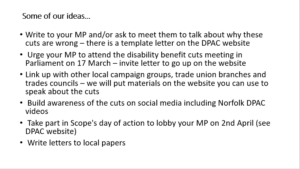
Write to your MP – there are template letters available but personalised letters with information about how you will be personally impacted are the strongest. Even if they reply with the standard party line, it does make a difference what volume of correspondence they get on different issues.

Publicise the rally outside Parliament on 30 June – encourage all those who can to get there and for those at home to support online. Hashtag #WelfareNotWarfare. This is the last day of the green paper consultation.

Organise and take part in local actions against the bill on 1 July – this is the day that second reading of the bill has been scheduled to take place on. We want to raise awareness about the bill, about how devastating the cuts will be, how the proposals in it have not been consulted on and how MPs are being expected to vote on it with lots of information missing. Local media can be a good way to get attention for protests and issues that MMS ignores.

What do we want?

We want the bill withdrawn and new social security policy to be co-produced with Deaf and Disabled people as Labour promised in their election manifesto.


Jun 192025
 
DPAC Logo with text underneath "Disabled People Against Cuts" and then web address dpac.uk.net

The UK Deaf and Disabled People’s Monitoring Coalition is a secular network of user-led Deaf and Disabled People’s Organisations across the United Kingdom.

This paper sets out the reasons why we are not able to support the Terminally Ill Adults (End of Life) Bill following the Report Stage.

Many of our concerns echo those voiced by the Royal College of Psychiatrists[1], Royal College of Physicians[2] and Association of Palliative Medicine[3].

We do not believe the Bill has received sufficient scrutiny for legislation that will so fundamentally impact the relationship between doctor and patient.

For the Abortion Act there were months of engagement prior to introducing the Bill, and for the Human Fertilisation and Embryology Act there was the Warnock Commission[4].

For this Bill there has been no direct consultation with marginalised groups and the speed and inaccessibility of the passage of the Bill has been a barrier to engagement.

The Equalities Impact Assessment is frighteningly lacking and there has been insufficient consideration of adverse equalities impacts in jurisdictions where it is legal.

For example, a lawsuit is being brought against California’s End of Life Option Act[5] on the grounds that it puts disabled people at greater risk of being coerced into seeking assisted suicide.

At the same time, the opinions of professionals with the most relevant expertise have been largely ignored.

Below we set out our key concerns with the Bill as it now stands, a list of the amendments we supported which would have improved safeguards but which were voted down and a list of amendments that have been held up as safeguards but which fail to allay our fears.

This paper concludes with our recommendations for MPs.

KEY CONCERNS

No guaranteed access to palliative care. The Bill places a duty on the Secretary of State to guarantee access to assisted dying but not to palliative care. Where deaths in pain do occur, the person has not accessed specialist palliative care or accessed it too late or for too short a time. One in four people who need palliative care do not get it. Palliative care provision across the country is patchy and facing cuts with hospice care under-funded[6].

No emphasis on suicide prevention. This is one key reason why the Royal College of Psychiatrists are against this Bill. Suicidal ideation and hopelessness are treatable including for people with terminal illness. There is no mandatory psychological assessment as part of the application process and people who both meet the eligibility criteria for the Bill and have mental health diagnoses are not excluded.

Inaccurate prognoses. People who are terminally ill with six-month prognoses may have many months and even years left to live[7]. According to figures from the Department for Work and Pensions, one in five benefit claimants given less than 6 months to live are still alive three years later[8]. This makes it less inevitable that people with terminal illness should want to end their lives.

Inappropriate use of Mental Capacity Act as a safeguard. The MCA was not designed for this purpose and has a presumption of capacity. It is possible to be assessed under the MCA as having capacity and yet having impaired judgement due to for example, depression, malnutrition or coercive control. Doctors will be trained in coercive control but psychiatrists and other professionals report how difficult this is to detect even with many years of experience.

Insufficient provision for keeping people alive. Changes to a person’s circumstances can change their wish to die. The place for a multi-disciplinary team assessment is at the very beginning of the process with the aim of identifying options to improve the person’s situation. Instead, the Bill has a multi-disciplinary panel at the end of the process rubber-stamping applications for assisted dying with no requirement to meet the person.  There is no requirement for a doctor to consult a specialist in the patient’s condition or for the patient to have a meeting with a palliative care specialist. Patients will be able to access assisted dying more quickly and easily than social care, mental health support or suitable housing[9].

No requirement to include family members. Evidence from jurisdictions where assisted dying is legal demonstrates how traumatic it can be for family members to lose their loved ones in this way, especially if they do not find out until after and especially if their loved one made their decision when experiencing impaired judgement. There is no right to appeal assisted dying decisions for family members.

Safety concerns about assisted dying drugs. Death by assisted suicide can be very unpleasant. The patient needs to swallow a large number of pills which the body may reject resulting in vomiting. The drugs used are the same as used for death row prisoners and have been linked to, for example, experiences of dry drowning[10]. The Bill Impact Assessment says the “safety and efficacy” of substances used for assisted dying is “currently difficult to assess”[11].

Fear that assisted dying will replace access to services for terminally ill and disabled people wanting to live. The Impact Assessment shows savings that will be made to both health and social care budgets through this Bill. This has increased concerns that the choice to live will be removed for those of us who cost more in support. One care home group finance manager messaged colleagues about savings they could realise through “aggressive promotion” of assisted dying as an option for residents. The voting down of an amendment to limit advertising of the assisted dying service alongside costs in the impact assessment for an NHS education campaign is concerning.

Insufficient attention to equalities impacts. The Equality Impact Assessment accompanying the Bill was not published until after Committee Stage and is unfit for purpose. It concentrates on equal access to the assisted dying service and omits many key risks in terms of adverse inequalities impacts, ignoring data on for example low levels of awareness and access to palliative care services by racialised minorities and those facing socio-economic disadvantage.

Increasing non-assisted suicide rate. There is no evidence that legalisation of assisted dying reduces non-assisted suicides. Research on the contrary shows a rise in the overall suicide rate even after accounting for those deaths by assisted dying[12]. This is likely due to suicide contagion. This risk needs to be understood within the current UK context of escalating levels of mental distress and already increasing suicide rates[13]. There has been no discussion of this or proposal of measures to mitigate this risk.

Too great a reliance on Henry VIII powers. A worrying amount in the Bill delegates powers to Ministers to make secondary legislation without full Parliamentary scrutiny. This is even more concerning for a Bill that will prompt the founding Act of the NHS to be opened up. Deaf and Disabled people are disproportionately reliant on the NHS and potentially at significant risk from this Bill. This aspect of the Bill is therefore of great concern to us.

PROPOSED SAFEGUARDING CONCERNS THAT WERE VOTED DOWN

To close the anorexia loophole. The Bill gives eligibility to people where the physical condition that meets the criteria is either the result of a mental health condition or of Voluntary Stopping Eating and Drinking. This is a huge concern within the context of a mental health system unable to cope with demand where young women with severe and enduring eating disorders are routinely labelled as “hopeless cases” and transferred onto palliative instead of receiving the support they need to live. In other jurisdictions Voluntary Stopping Eating and Drinking (VSED) is used by people who don’t otherwise meet the eligibility criteria to gain access to assisted dying[14][15].

To exclude from eligibility people with who are homeless and prisoners. Disabled people are over-represented among both, as are self-harm and suicidal ideation. Homelessness and conditions in prisons are growing problems. These amendments would have protected against people choosing assisted dying because of adverse external factors rather than the “clear, settled and informed wish to die” that is part of the eligibility criteria within the Bill.

Doctors to ensure that there are no remediable suicide risk factors before proceeding to the initial discussion about assisted dying and for psychosocial assessments to be conducted at the start of the process. These amendments would have provided a safeguard against people with impaired judgement seeking assisted dying due to a mental health condition and/or suicidal ideation.

To exclude from eligibility those seeking assisted dying for the benefit of others. This could include financial concerns. This amendment would have been an important safeguard against coercion.

To exclude from eligibility those seeking assisted dying because they feel like a burden. This is particularly relevant within the context of inadequate social care support services so that family members and friends experience greater strain. Around one half of those seeking assisted dying in Oregon consistently cite being a burden as a primary reason compared to one third concerned about pain[16].

To replace use of the Mental Capacity Act to assess capacity to make a “clear, settled and informed wish to die” with a new ability test to assess ability to make a clear, settled and informed wish to die free from impaired judgement.

For doctors not to be able to raise assisted dying with patients unless they mention it first. This is a major concern for disabled people due to the prevalence of negative medical attitudes towards disabled people’s quality of life and the risk of medical coercion. This risk is evidenced by experiences during COVID when Do Not Resuscitate orders were unlawfully placed on the medical notes of disabled people without their consent[17] as well as a weight of evidence concerning discrimination and medical negligence within the health system. An amendment not to permit doctors to raise assisted dying with children was voted down at Committee Stage but accepted at Report Stage.

To prevent doctors from raising assisted dying as an option with people with learning disabilities and people who are autistic. Instead, Clause 20 provides access to independent advocates for people in this situation.

Inclusion of a 28-day period between a terminal diagnosis and the start of the assisted suicide process. This is important because fear and depression are common responses to terminal diagnoses. Practitioners in other jurisdictions told the Committee at oral evidence how giving patients the option of assisted dying when first diagnosed calms their fears and that many never end up taking the drugs because their fears over pain never materialise. As proven by the lived experience of our members, the same can be achieved by better support accompanying diagnosis, including, crucially, peer support.

AMENDMENTS THAT FAIL TO ALLAY CONCERNS

Training for doctors in coercive control.

According to professional opinions shared with the Committee, it is very difficult even for those with many years of experience to detect coercive control.

Much stronger safeguards would have involved making psychological assessments mandatory as part of the application process and excluding from eligibility those feeling a burden and those acting for the benefit of others.

Provision of independent advocates for “qualifying persons” including “those with learning disabilities, mental disorders, autism or other ‘substantial difficulties’ in understanding processes or information”.

The focus of this clause is on access to information rather than protection from coercion. As a safeguard it is limited in that those willing to act as independent advocates will likely be in favour of assisted dying and may therefore have a bias towards ensuring access to the service that clouds their alertness from detecting coercion.

It is unclear from where the independent advocates for this role will be sourced.

New multi-disciplinary panel including a psychiatrist and social worker.

This will replace the role of the High Court Judge in rubber stamping approvals at the end of the application process and with no requirement to meet the person or involve their family.

The proper place for this panel is at the beginning of the process.

Multi-disciplinary team involvement is good practice when needing to identify holistic solutions for improving a person’s situation.

The role of the multi-disciplinary panel as prescribed by the bill represents a mis-use of MDT involvement. It will not enable the psychiatrist or social worker to utilise their expertise.

Professionals willing to be on these panels will likely be in favour of assisted dying and may therefore have a bias that limits their ability to detect coercion.

It is also unclear how these panels will be resourced given shortages within both psychiatry and social work.

RECOMMENDATION

We urge MPs to vote against this Bill at third reading. A Private Members Bill is not the way to legislate on such a complex issue and one that puts large groups of the most disadvantaged members of society at significant risk for the benefit of a small minority. A Royal Commission where objective scrutiny can take place and that hears equally from all sides of the debate is needed. Due to insufficient transparency in jurisdictions where assisted dying is legal there is a dearth of evidence. Attempts to remedy this and to plug research gaps must also happen.

[1] https://www.rcpsych.ac.uk/news-and-features/latest-news/detail/2025/05/13/the-rcpsych-cannot-support-the-terminally-ill-adults-(end-of-life)-bill-for-england-and-wales-in-its-current-form

[2] https://www.rcp.ac.uk/policy-and-campaigns/policy-documents/rcp-position-statement-on-the-terminally-ill-adults-end-of-life-bill-9th-may-2025/

[3] https://apmonline.org/wp-content/uploads/APM-Position-Statement-on-Assisted-Dying-October-2024-v2.pdf

[4] https://www.hfea.gov.uk/media/2608/warnock-report-of-the-committee-of-inquiry-into-human-fertilisation-and-embryology-1984.pdf

[5] https://californiahealthline.org/news/article/california-physician-assisted-death-disability-rights-lawsuit/

[6] https://www.mariecurie.org.uk/globalassets/media/documents/policy/marie-curie-parliamentary-briefing-better-end-of-life-2024.pdf

[7] https://www.mariecurie.org.uk/media/press-releases/doctors-frequently-inaccurate-when-predicting-survival-for-terminal-illnesses/144959

[8] https://www.telegraph.co.uk/news/2025/01/21/assisted-dying-row-terminally-ill-patients-live-longer/

[9] https://www.independent.co.uk/news/world/americas/canada-euthansia-maid-gofundme-homeless-b2228890.html

[10] https://www.bmj.com/content/372/bmj.n147/rr-0

[11] https://pmc.ncbi.nlm.nih.gov/articles/PMC9270985/

[12] https://www.bmj.com/content/377/bmj.o1014/rr-7

[13] https://www.samaritans.org/scotland/about-samaritans/research-policy/suicide-facts-and-figures/latest-suicide-data/

[14] https://www.newstatesman.com/comment/2025/06/the-loophole-in-the-assisted-dying-bill-that-no-one-wants-to-talk-about

[15] https://www.frontiersin.org/journals/psychiatry/articles/10.3389/fpsyt.2024.1431771/full

[16] https://www.oregon.gov/oha/PH/PROVIDERPARTNERRESOURCES/EVALUATIONRESEARCH/DEATHWITHDIGNITYACT/Documents/year19.pdf

[17] https://www.bbc.co.uk/news/articles/cd98vpxgp7ko

Apr 092025
 
DPAC Logo with text underneath "Disabled People Against Cuts" and then web address dpac.uk.net

#WelfareNotWarfare

Call protests now over the parliamentary recess 8-22 April.

While lavishing money on the military the Labour government is continuing to pursue its attack on support for Deaf and disabled people announced in Rachel Reeves’ Spring statement.

We are calling for DPAC groups and supporters to call local protests across the country to demand the damaging cuts to social security for Deaf and Disabled people are stopped.

We want MPs to commit now to vote against these cuts which will drive people into poverty.

Local protests are a chance to reach Deaf and Disabled people who are worried about the cuts and isolated – we need to turn fear into anger and action.

We can raise awareness of the true scale and impact of these vicious cuts and build the solidarity in our communities needed to defeat them.

  • The scale of cuts is over £9bn – a majority of people are against the cuts based on the earlier figures which underestimated this by almost half.
  • Changes to PIP (Personal Independence Payments) alone will hit 1.5million Deaf and disabled people.
  • The attempt to rush these cuts through means that the Labour government is expecting MPs to vote the attacks through without being fully informed as to the impact.
  • Despite all the lies about how these cuts will get people into work there has been no assessment of employment outcomes from the proposed cuts – the first vote is expected Summer but these figures from the OBR (Office for Budgetary Responsibility) are not due to be published until October 2025.
  • Employment impacts will be negligible. A lack of suitable employment will prevent people moving into work while many will be forced out of jobs by the impact of the cuts both personally and on the wider economy.
  • The cuts will cause destitution, add huge additional pressures to local authorities, our NHS and mental health support services. They will take a significant amount out of the economy as disabled people’s spending power is reduced.
  • There has been no assessment of impacts of the abolition of the WCA (Work Capability Assessment) combined with the PIP cuts as government failed to provide enough detail to the OBR before the Spring Statement.
  • No costings have been made for the increased number of appeals predicted by the OBR – this is awaiting assessment by the Ministry of Justice.


What we are calling for:

Local protests over parliamentary recess 8-22 April 2025.

Where possible target MPs strategically. See our list here: https://dpac.uk.net/2025/04/mps-who-support-disability-benefit-cuts/

Many MPs no longer operate public offices or surgeries – where this is the case could you protest at local Constituency Labour Party meetings, Town Halls or local events where MPs will be attending. Even if the MP isn’t in attendance it makes the point but please do be aware that we want Labour Party members onside so we are protesting the position their MP has taken and not protesting against them.

As always, we encourage the use of creativity to make protests inclusive and attention grabbing.

Make sure there are options for people to take part and be involved even if they can’t attend in person. National DPAC is about to produce this online engagement toolkit but local groups should look to produce your own options for members.

If you are protesting outside an MP’s office please follow these guidelines: https://dpac.uk.net/2025/04/guidelines-for-protesting-specific-mps/We want to make our point but do not prevent people who need to see their MP for help with benefits appeals, asylum applications or other urgent needs from doing so.

Where May Day rallies, Stop the War and We Demand Change events are being organised in your area reach out now to organisers to request someone from your DPAC group can speak to raise the fight against benefit cuts – an attack on the whole working class.

If you have an MP who has come out against the cuts do something to positively acknowledge this – letters to the local press on why they are right to reject the cuts can help our message reach a wider audience. You can find a list here: https://labourlist.org/2025/04/spring-statement-welfare-reforms-liz-kendall-rachel-reeves-labour-rebels/

And keep up the letter writing and most importantly every DPAC member should try to arrange a face to face meeting with your MP. These do make a difference even if the MP doesn’t appear to be listening and/or just trots out the party line. Make them give up their time for you. Make them see how many people this matters to and how it will impact their majorities if they follow Starmer, Reeves and Kendall in their performative cruelty.

Resources

Norfolk DPAC has created a resource deposit with template materials that local groups can share and use. Link coming soon!


Apr 092025
 
DPAC Logo with text underneath "Disabled People Against Cuts" and then web address dpac.uk.net

Protesting individual MPs is an important tactic, but has to be done carefully to minimise the risk to people in hard situations who may be seeking help.

Constituents visiting an MP’s office are often at the end of their options, and include refugees needing help dealing with the Home Office, disabled people needing assistance dealing with support systems and the DWP, people struggling with housing or care, and other traumatic and desperate situations.

Here are some things to keep in mind to avoid causing unintentional damage.

This isn’t about respectability or civility – it’s about keeping other people in bad situations safe.

1 – Only directly protest MPs who have defended the cuts. If you don’t have one of those MPs nearby, you could picket a CLP meeting, protest outside a Labour-run council or choose your area’s most public space to demonstrate and reach members of the public.   

2 – If you have one of the MPs who has defended cuts, check to see if there is an event you could picket or disrupt before demonstrating at their office. Be mindful about which event you choose (eg. local business events are good targets, but women’s shelter events are not). Events often have the added bonus of extra press around. 

3 – If you are only left with their constituency office:

Don’t block the doorway, bang on the windows, or act in ways which could intimidate constituents seeking help. If you see people approaching the office, be welcoming and kind. Have flyers to hand out if you can, explaining why you’re picketing and what this particular MP has done. Bear in mind how your group might appear to people who are coming to the office for help. 


Disruption and civil disobedience are important forms of protest. We are not saying protest should be convenient or quiet. Just keep in mind the members of our communities who will be using services we’re protesting and see if there are ways to do it without putting them at further risk. 


Apr 092025
 
DPAC Logo with text underneath "Disabled People Against Cuts" and then web address dpac.uk.net

Please let us know any MPs we are missing from this list.

In terms of local protests, DPAC is for this time discouraging protests against MPs who voted in opposition to the Terminally Ill Adults (End of Life) bill at second reading. Report stage is currently scheduled for 16 May. The next vote could be scheduled for the same day or a later date. We will keep members updated. Every vote against the bill will be needed. You can see how your MP voted here: https://uk.news.yahoo.com/assisted-dying-vote-result-bill-mp-092154497.html


Cabinet:

Prime Minister Keir Starmer (Kid Starver)

Chancellor Rachel Reeves (Robber Reeves)

Secretary of State for Work and Pensions (Killer Kendall)

Publicly defended the cuts:

Torsten Bell

Darren Jones

Pat McFadden

Get Britain Working Group

Dabid Pinto-Duschinsky

Luke Akehurst

Bayo Alaba

Jas Athwal

Danny Beales

Rachel Blake

Nesil Caliskan

Luke Charters

Shaun Davies

Jim Dickson

Helena Dollimore

Graeme Downie

Damien Egan

Allison Gardner

Amanda Hack

Gurinder Singh Josan

Andy MacNae

Blair McDougal

Frank McNally

Samatha Niblett

Jon Pearce

Gregor Poynton

Connor Rand

Steve Race

Joani Reid

Mike Reader

Jake Richards

Tom Rutland

Mark Sewards

Sarah Smith

Mike Tapp

Fred Thomas

Dan Tomlinson

Jo White

Shaun Woodcock

Steve Yemm


For MPs who have comes out against the disability benefit cuts see: https://labourlist.org/2025/04/spring-statement-welfare-reforms-liz-kendall-rachel-reeves-labour-rebels/

Mar 262025
 
DPAC Logo with text underneath "Disabled People Against Cuts" and then web address dpac.uk.net

Some ways to get involved from home

  1. Follow The Canary’s livestream and social media commentary from the protest – @TheCanaryUK on all social media channels
  2. Watch the Spring Statement and comment on social media – hashtag #WelfareNotWarfare
  3. Use statistics, facts and figures from our briefing to highlight on social media the impact of the proposed cuts: https://dpac.uk.net/2025/03/disability-benefit-cuts-facts-stats-and-figures/
  4. Write to your MP. Template letter are available here: https://thecorbynproject.com/no-cuts
  5. Download and print our campaign poster below and use on social media

You can also follow DPAC on social media:

@Dis_PPL_Protest
@dis-ppl-protest@bsky.social

 Posted by at 11:33
Mar 262025
 
DPAC Logo with text underneath "Disabled People Against Cuts" and then web address dpac.uk.net

What do we know about the planned Spring Statement cuts so far

  • The Government has not published the equality impact assessment for the Green Paper proposals. These are expected to be available after the Chancellor has given the Spring Statement. Until then we can only speculate how many hundreds of thousands of Disabled people will be affected and how badly.
  • It is estimated that through the Government’s proposed Personal Independence (PIP) cuts, between 800,000 and 1.2 million Disabled people will lose between £4200 and £6300 a year by 2029 to 2030 (Resolution Foundation, 2025).
  • Claimants and their families who lose eligibility for PIP will also lose eligibility for Carer’s Allowance and other passported entitlements.
  • According to the proposals, from 2028-29, getting PIP will be the factor that determines whether you get the health element of UC – meaning there will be no support specifically for Disabled people unable to work. Those who would otherwise qualify for the health element of UC – but not PIP (currently 600,000 people) – will therefore not get the element and be worse off by £2,400 per year (today’s prices; assuming they are new claimants who would otherwise have got the reduced health element
  • If the cuts to PIP are taken together with the Government’s proposals to scrap the Work Capability Assessment and replace current out of work disability benefits with a new “health” component of Universal Credit with eligibility tied to PIP, some claimants risk losing £9600 per year.
  • The current PIP fraud figures are 0% according to the DWP’s Fraud and Error in the Benefits System Annual Report of 2024, so the government’s crackdown on benefit fraud and its impact is inconsistent with the figures and very low rates of PIP fraud.
  • According to the Purple Pound, whose report into the true cost in accessing retail services for Disabled people, in 2024, UK retail sales reached £517 billion, £274 billion of this was spent by Disabled people and their families, so over 50% of the total retail sales in the UK.

DISABILITY AND SOCIAL SECURITY – THE REAL PICTURE

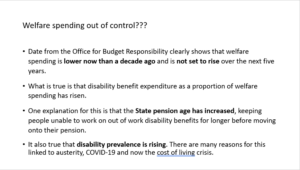
Welfare spending is not out of control


  • What is true is that disability benefits as a share of overall welfare spending has risen. This is due to many factors, one being the increase in State pension age, but also NHS and mental health support waiting lists, the effects of Long Covid, and escalating mental distress among young people: see research by academic Ben Geiger These are all very real issues which we need the government to address.


  • Nearly £23 billion worth of social security and social tariffs currently goes unclaimed due to lack of awareness, stigma and the complexity of the UK social security system. See Missing out 2024: £23 billion of support is unclaimed each year | Policy in Practice. Unclaimed social security includes universal credit, pension credit, child benefit, carers allowance and housing benefit for pensioners. Social tariffs include council tax support (a rebate, not a payment/benefit), free school meals, free TV licence and various energy/broadband support schemes.


Actual benefit fraud requires a court of law to establish that a claimant knowingly or dishonestly claimed benefit. Only 820 people were convicted on this basis in 2023.  The DWP statistical definition of fraud is much less rigorous – it is an assessment by the DWP of those who were not entitled to benefit but could ‘reasonably be expected to know.’ DWP estimate that rates for this type of overpayment were 2.8% (£7.4 bn) in 2024.  Rates of overpayment for claimant error were put at 0.6% (£1.6bn) and DWP official error at 0.3% (£0.8bn).  See Fraud and error in the benefit system, Financial Year Ending (FYE) 2024 – GOV.UK.


Tests for eligibility for disability benefits are not too easy

  • Deaf and Disabled people who need disability benefits are too often found ineligible by assessments that are arduous, harrowing, frequently inadequate and result in arbitrary decisions. These are the same assessments that Labour criticised when in opposition and which were the subject of a number of highly critical Work and Pensions Committee reports: Health assessments for benefits – Committees – UK Parliament


  • The rate of assessment decisions over-turned at appeal is at an all-time high. Currently around two-thirds of PIP appeals are overturned in favour of the claimant compared to around half of universal credit and ESA appeals: Tribunals statistics quarterly: October to December 2024 – GOV.UK.However, many give up either before or after Mandatory Reconsideration stage because they cannot face the battle and due to lack of welfare advice and support to challenge unfair decisions.


  • Recent research demonstrates that people claiming benefits for reasons of mental health are living with high levels of mental distress: Mental distress among people receiving benefits: new evidence. This is in contrast to deliberate misrepresentations contained within political rhetoric and media reporting of people supposedly found eligible for benefits who have low levels of anxiety or depression.


  • This picture is further supported by OBR’s calculations that of the 163,000 benefit claimants with mental distress impacted by the proposals to change the WCA, only 3% would be able to find and undertake paid work.


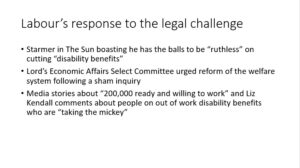
  • Recent media headlines about 200,000 claimants found unfit for work who are ready and willing to work now were deeply misleading. The survey question to which these claimants responded was whether they could work now with the “right job” and the “right support”. There was no follow up question about the likely availability of either. The 200,000 figure was extrapolated from a much smaller claimant sample. People who have learning disabilities and/or are autistic were twice as likely to respond yes to this question. 49% of respondents felt they would never be able to work or work again. 62% of these customers were over the age of 50, and 66% felt their health was likely to get worse in the future: Work aspirations and support needs of health and disability customers: Interim findings – Department for Work and Pensions


Disability benefits do not act as a disincentive to work

  • Disability benefits keep Deaf and Disabled people out of absolute poverty.


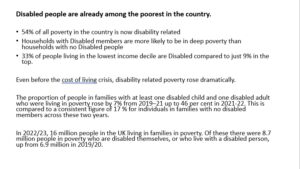
  • In 2022/23, 16 million people in the UK living in families in poverty. Of these there were 8.7 million people in poverty who are Disabled themselves, or who live with a Disabled person, up from 6.9 million in 2019/20. 33% of people living in the lowest income decile are Disabled compared to just 9% in the top.


  • Even if you receive both out of work disability benefits and the higher rates of both the mobility and care components of PIP – currently on 2024/25 £783.16 pm ESA support group and £1400.50 pm UC LCWRA)- this is just 33% or 60% respectively % of the Minimum Income Standard (£28k pa) for a single adult.


  • The rate that Universal Credit standard allowance is paid at is deliberately set to be too low to survive on for anything but a very short, temporary amount of time. For those unable to earn a living through paid work, an out of work disability benefit component is essential in addition to the standard allowance.


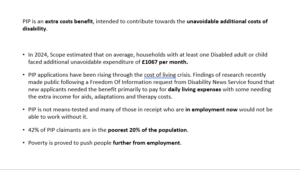
  • Personal Independence Payment is a non-means tested extra costs benefit intended to contribute to the additional unavoidable expenditure that Deaf and Disabled people face. Scope estimates that Disabled people face on average extra costs of £1067 per month compared to non-Disabled people: Disability Price Tag 2024 | Disability charity Scope UK


  • Claimants in receipt of out of work disability benefits have the highest levels of support need. These include people with terminal illness and neurodegenerative conditions and people with profound and complex needs. Many claimants in this category spend a considerable amount of time in too much pain or distress or fatigue to function. Time during the week is taken up with medical and therapeutic appointments, accessing drugs and treatment and with assessments and monitoring linked to the services and support we rely on.


  • Many PIP claimants will not be able to continue in work if they lose access to this benefit. This is because engaging in paid work places extra demands on us that can exacerbate our conditions which in turn increases our unavoidable disability related expenditure. It also gives us less time on top of managing our impairments and illnesses to be able to function in other necessary areas of our lives such as domestic tasks. The OBR states that one sixth of PIP claimants are in work: Trends in working-age disability benefit onflows – Office for Budget Responsibility


  • Cutting disability benefits will push more households into poverty. Reports we are hearing say the cuts to be announced will impact a million Disabled people. The charities fear that 700,000 additional households containing a Disabled person will be pushed into poverty as a result of these cuts.


  • Disability-related poverty had increased dramatically even before the cost of living crisis:


  • 54% of all poverty in the country is now disability related.
  • The proportion of people in families with at least one Disabled child and one Disabled adult who were living in poverty rose by 7% from 2019–21 up to 46% in 2021-22. This is compared to a consistent figure of 17% for individuals in families with no Disabled members across these two years. [LINK]


Cuts to disability benefits will cost the economy more in the long-term


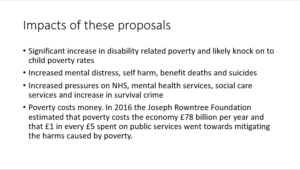
  • Cuts will cause substantial additional pressures on the NHS, mental health services, and social care services and will lead to an increase in survival crime. They are entirely inconsistent with the government’s pledge to reduce shoplifting! Disabled people impacted by cuts may be forced to find paid work in unsuitable jobs such as sex work.


What we need from government

  • Research and improved data collection to build an evidence-base for the amount needed to support Deaf and Disabled people to have a decent standard of living.
  • Investment in public services to improve health and well-being, bringing Deaf and Disabled people closer to employment.
  • Investment instead of the planned cuts to Access to Work to fix the problems and reduce the backlog. As of the end of 2024 there were a reported 55,500 unresolved cases: Written questions and answers – Written questions, answers and statements – UK Parliament
  • Work with employers to increase the availability of suitable jobs with decent pay and working conditions and with ultimate flexibility for employees with unpredictable and fluctuating conditions.
  • Work with DDPOs to identify bureaucratic issues with the social security system and engagement with DWP that push claimants further from employment.


Mar 262025
 
DPAC Logo with text underneath "Disabled People Against Cuts" and then web address dpac.uk.net

Disabled People Against Cuts: Press Release #WelfareNotWarfare Protest

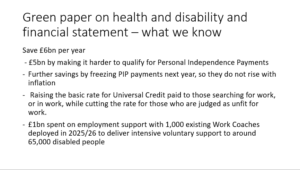
On Wednesday 26th March Disabled People Against Cuts, Deaf and Disabled benefit claimants from across the country will descend on London as part of National Action to demand “Welfare Not Warfare” in protest against the Spring Statement and proposed £5bn cut to welfare spending outlined by the Department for Work and Pensions in their Green Paper ‘Pathways to Work: Reforming Benefits and Support to get Britain Working’ Green Paper’.

Linda Burnip, Co-Founder of Disabled People Against Cuts (DPAC), said “Labour should be ashamed of their proposed cuts which will push Disabled people into even greater poverty and destitution and cause many more to kill themselves. Disabled people will not allow themselves to be made scapegoats for Robber Reeves cuts while millionaires remain untouched by cuts.”

The London protest, titled “Balls to the Spring Statement” is being organised by Disabled People Against Cuts (DPAC), Inclusion London and Stop the War Coalition and supported by many other campaign groups and trade unions will meet outside Downing Street in Whitehall at 11 am before marching towards Parliament to join up with a protest organised by Homes for All.

Actors Cherylee Houston (Izzy Armstrong in Coronation Street) and Lisa Hammond (Vera and previously in Eastenders) will address the protest along with campaigners, trade unionists and politicians. There will also be music from John Kelly who sang at the Paralympic Games opening ceremony in London in 2012.

The London protest is part of national action led by Deaf and Disabled people and allies that includes protests in Edinburgh, Cardiff, Derry, Norwich, Manchester, Exeter, Leeds, Bristol and many other locations across the country. There will also be online protest activities for those unable to leave their homes.

Published on Tuesday 18th March 2025, the “reforms” proposed in Green Paper will cut essential income from millions of the poorest Deaf and Disabled people and our families.

The Rt Hon John McDonnell who is the Independent MP for Hayes and Harlington and a long time supporter of DPAC who will be speaking at the protest said, “Disabled people are facing the biggest cuts to their benefits in a decade, causing immense harm. Full support to DPAC which is standing up against this attack.

The Secretary of State Liz Kendall has justified the cuts by saying they will incentivise more people into employment. However, the majority of the savings attached to the cuts will affect Personal Independence Payment (PIP) which is a non-mean-tested benefit. Disabled people in work say cuts to PIP will force them to stop work.

Actor Cherylee Houston said: “There are over 16 million Disabled people in the UK. Just over three million of those currently receive PIP. These are those who are most in need from my community. PIP is used by many of us to stay in work and cover the extra costs that disability causes. My community is terrified that the Government is taking away the most basic support that those most in need rely on. The majority of unpaid carers are also Disabled and they rely on Carer’s Allowance which is linked to PIP to survive and this saves the Government a huge amount. It makes no sense to take away the basic supports that enable Disabled people to contribute to society. These cuts will trap more people in poverty. I am already hearing from friends that they fear they will no longer be able to work if these cuts go ahead.”

Other savings attached to the proposals will be achieved through cuts to out of work disability benefits for those officially found unfit for work.

Proposals to change the Work Capability Assessment proposed by the previous government, quashed through a successful legal challenge against a consultation ruled by the high court to have been “rushed”, “misleading” and “unfair”, would have hit 457,000 Disabled people by 2028/9, pushing another 100,000 Disabled households into absolute poverty while moving only 3% of those affected into employment.

Kirsty Blackman, MP for Aberdeen North, “The UK Government should be listening to the lived experience and voices of Disabled people. They know best the hardship they are facing and the devastating impact these cuts will have. As the cost-of-living sky rockets, cutting money from Disabled people is the worst decision the Government can take. They must think again and we will use every method we can to ensure they do so.”

Clive Lewis Labour MP for Norwich South, who has been vocally against the reforms said immediately after Kendall’s speech in Parliament announcing the cuts: “When she made the decision to go down this route did they understand the pain and difficulty this will cause for millions of people who are using food banks and social supermarkets, people who are on the brink. These 5 billion cuts will impact them more than I think her department is giving credit for… As things stand my constituents, my family, my friends are very angry about this.” 

Campaigners believe that the £5bn per year in savings targeted by the government through the cuts will be difficult to achieve and may well end up costing more in the long run, leading to heavy additional pressures on the NHS and on mental health, homelessness and social care services.

Arun Veerappan, Interim Director of Research at the Disability Policy Centre said, “As it stands, the Government’s sums don’t add up and these reforms are unlikely to both help disabled people and save the taxpayer money… Tightening PIP eligibility, for example, has been tried before by previous Governments and proposals have either been ruled unlawful, proved too complex or abandoned as unworkable.”

Campaigners have also questioned whether the impact on the economy of such large-scale costs have been properly thought through.

Ellen Clifford, Co-Ordinator of the UK Deaf and Disabled People’s Organisations Monitoring Coalition said: “Everything given to Disabled people in benefits goes straight back into the economy because we spend everything we are given on essentials. The scale of these cuts are simply and terrifyingly enormous. The consequences for society will be immense and the human cost will be devastating. Labour is making an unimaginably big mistake and it’s the poorest and most disadvantaged of us who will be left paying for it generations to come.”

Campaigners are calling on the Government to scrap their plans and to work in co-production with benefit claimants and PCS union which represents frontline DWP workers tasked with implementing any changes to the social security system.

Sophia Kleanthous from the Deaf and Disabled People’s Organisation Inclusion London said: “Despite the Labour Party pledge for years to “work in co-production with Disabled people in developing policy” in Summer last year they dropped this from their manifesto. We are concerned from the released Pathways to Work Green Paper consultation that this has not been co-produced with Disabled people’s organisations and Disabled people.”

Martin Cavanagh, National President of PCS union said: “PCS are absolutely behind DPAC and other campaign groups in their fight to oppose these cruel cuts to disability benefits. The government should be investing in social security, not slashing the benefits bill for those most in need.”

The Welfare Not Warfare protest will be demanding no more attacks on Disabled people, no increase in military spending and social security and homes for all.

Morag Gillie, Chair of Homes for All (HfA) says: “The scale of the housing emergency and the failure to build council housing has created shameful hardship and substandard housing. We are shocked that a labour government is now attacking disabled people who are facing savage cuts to disability benefits. We believe that the fight for housing & disability rights are inextricably linked, and this united action on March 26 helps to build the urgent opposition that we need.”

Chris Nineham, from Stop the War Coalition said that, “This budget means a drive to war abroad and a war against the most disadvantaged by society at home. It has to be challenged openly, energetically and on all fronts.”

END

Contact details:
UK and England: Ellen Clifford 07505 144 371 [SMS/whatsapp]; ellenclifford277@gmail.com
UK and Scotland: John McArdle 07379 612 778 [SMS/whatsapp]
Wales: Joe Powell 07972 516 328
Northern Ireland: Michael Lorimer 07528 464 350


Notes for Editors

  • Scope estimates that Disabled people on average face additional unavoidable disability-related expenditure of £1067 per month. PIP is a non means-tested benefit designed to contribute towards these extra costs.
  • The Government has not published the equality impact assessment for the Green Paper proposals. These are expected to be available after the Chancellor has given the Spring Statement. Until then we can only speculated how many hundreds of thousands of Disabled people will be affected and how badly.
  • It is estimated that through the Government’s proposed Personal Independence (PIP) cuts, between 800,000 and 1.2 million Disabled people will lose between £4200 and £6300 a year by 2029 to 2030 (Resolution Foundation, 2025).
  • Claimants and their families who lose eligibility for PIP will also lose eligibility for Carer’s Allowance and other passported entitlements.
  • According to the proposals, from 2028-29, getting PIP will be the factor that determines whether you get the health element of UC – meaning there will be no support specifically for Disabled people unable to work. Those who would otherwise qualify for the health element of UC – but not PIP (currently 600,000 people) – will therefore not get the element and be worse off by £2,400 per year (today’s prices; assuming they are new claimants who would otherwise have got the reduced health element
  • If the cuts to PIP are taken together with the Government’s proposals to scrap the Work Capability Assessment and replace current out of work disability benefits with a new “health” component of Universal Credit with eligibility tied to PIP, some claimants risk losing £9600 per year.
  • The current PIP fraud figures are 0% according to the DWP’s Fraud and Error in the Benefits System Annual Report of 2024, so the government’s crackdown on benefit fraud and its impact is inconsistent with the figures and very low rates of PIP fraud.
  • According to the Purple Pound, whose report into the true cost in accessing retail services for Disabled people, in 2024, UK retail sales reached £517 billion, £274 billion of this was spent by Disabled people and their families, so over 50% of the total retail sales in the UK.
  • The full list of campaigns and trade unions supporting the Welfare Not Warfare national action include: Acorn, Black Triangle campaign, Disability Rights UK, Disabled People Against Cuts, DPAC Northern Ireland, Equity, Free Our People campaign, Fuel Poverty Action, HFL Tenants, Homes for All, Housing Inclusion Hackney, Inclusion London, Keep Our NHS Public, London Renters’ Union, Manchester RAPAR, National Education Union, National Union of Journalists, Not Dead Yet UK, PCS union, People’s Assembly, Shape, Social Housing Action Group, Stand up to Racism, Stop the War Coalition, TUC Disabled Workers’ Committee, UK Deaf and Disabled People’s Organisations (DDPO) Monitoring Coalition, We Demand Change, Winvisible


Mar 102025
 
DPAC Logo with text underneath "Disabled People Against Cuts" and then web address dpac.uk.net

Below are the slides used for the talk Ellen Clifford gave to the Hands Off Disability Benefits! meeting on 9 March 2025.

Apologies that we are not able to upload the powerpoint itself and in a way that is accessible to screen readers – we hop to have this fault fixed soon.

For those who can access these slides please feel free to use to raise awareness of the impending cuts and what they will mean for Deaf and Disabled people.


Opening slide

Slide 2

 Slide 3

Slide 5


Slide 6
Slide 7
Slide 8
Slide 9
Slide 10
Slide 11
Slide 12

 Slide 14


Jan 282025
 
DPAC Logo with text underneath "Disabled People Against Cuts" and then web address dpac.uk.net

The Committee overseeing evidence gathering on the Terminally Ill Adults (End of Life) Bill has given in to pressure to include a Deaf and Disabled People’s Organisation (DDPO) on their list of witnesses giving oral evidence this week.

The UK Deaf and Disabled People’s Monitoring Coalition welcomes the decision to include Disability Rights UK (DR UK), but believes the move has come too late in a process that has been inaccessible and dismissive of Deaf and Disabled people’s concerns.

Ellen Clifford, UK Coalition co-ordinator said, “It’s good news that the Committee will be able to hear the perspective from organisations run and controlled by Deaf and Disabled people. Our organisations have expertise in a number of the very complex and difficult issues at the heart of this bill.

“These are key issues that MPs need to understand before they can be expected to vote in an informed way, for example the lack of any clear line between terminal illness and disability, the difficulties that even very
experienced professionals have in detecting coercion, issues about capacity and so on.

“It is vital that the Committee does not look at legalisation of assisted dying as an abstract question but fully considers the range of evidence that could be at their disposal about the workability of the bill and its implications.

“We are disappointed with the Committee’s decision not to hear from any organisations with frontline experience of working with victims of domestic abuse given the importance of ensuring the bill has rigorous safeguards.”

Disability Rights UK is a DDPO that advocates for 350 organisations and is an active
member of the Coalition.

Kamran Mallick, Chief Executive of DR UK, said: “It’s welcome that the Committee has revised its decision and now included DDPOs within the list of witnesses giving oral evidence over the next few days.

“No DDPO in the UK is in favour of Assisted Suicide. That isn’t some dogmatic, entrenched position. Disability Rights UK only recently changed our position from neutral to against. This is on the basis of Deaf and Disabled
people’s lived experiences backed up by robust evidence and expertise in disability issues.”

One such example is that of Kevin Caulfield who in his early thirties was diagnosed with a ‘terminal’ HIV-related neurological condition with a prognosis of less than 6 months to live. He was in a desperate situation both physically and mentally.

He freely admits he was so desperate he may well have jumped at the opportunity of ‘assisted dying’, meeting all the criteria of the proposed Bill, but 27 years later he is still here.

Sharing his story, Kevin Caulfield said, “At the time I was desperate and may well have jumped at the chance of the choice of “assisted suicide”. But it would have been a very loaded choice, not a choice at all in my opinion.

“Why? Because I was scared, I felt I had no control, losing functions by the day or enough relevant support. Assisted dying would have given me a focus when what I needed was more time with loved ones and frank conversations
about how to deal better with multiple symptoms.

“That’s why it’s so critical to listen to and take seriously Disabled people with relevant experience. Morally that is the right thing to but that takes time and resources to really involve us in accessible ways.

“Anyone with a terminal diagnosis is a Disabled person in law and yet we are not as Disabled people being treated with equity in this rapid process. It’s important that Parliament does really engage with Disabled Peoples
Organisations otherwise they risk getting this very wrong.”

The Call for Evidence doesn’t give clear information and many Deaf and Disabled people’s organisations, let alone individuals potentially impacted by the bill, have missed it entirely

The process and progression of the bill is not subject to the Equality Act 2010 in the same way as a public bill introduced by the government would be. It is therefore exempt from duties to make sure Deaf and Disabled people have the same opportunities to engage with it as non-disabled people. Without the same chance to
receive information and views from us as from non-disabled people, this limits the ability of the bill Committee to thoroughly interrogate the potential risks and safety of the proposed legislation.

Tracey Lazard, CEO of Inclusion London said, “We are relieved that a DDPO will now be heard from by MPs on the Committee. However, our concerns about lack of engagement are much wider than just oral evidence. The bill is travelling through Parliament at a speed that is completely inaccessible to Deaf and Disabled people. Private Member’s Bills are not subject to the same Equality Act requirements that apply to government bills such as a duty to make reasonable adjustments to allow Deaf and Disabled people the same chance to engage as other groups.

“To our dismay the cards appear powerfully stacked against Deaf and Disabled people having the opportunity to share our expertise with MPs as they scrutinise such an important bill.

“This is unacceptable – given the relevance of this Bill to our community the committee must in the name of fairness ensure it follows the principles and practice of the Equality Act and proceed in a way that gives Deaf and Disabled people a genuine opportunity to have our voice heard on this critical issue.”

The call for evidence for written submissions to the Committee went out at the start of January but it has not been provided in accessible formats and there was no clear information about the deadlines for submitting evidence to the Committee in time for amendments to be made.

The lack of targeted outreach and resistance to including a DDPO representative has made it unjustifiably difficult for disabled people to inform the Committee of their concerns and fears about the Bill.

The Bill affects Deaf and Disabled people
Deaf and Disabled people in the UK are disproportionately affected by inequality. This includes a greater likelihood of living in poverty. We are also disadvantaged which poorer life chances as a result of increasingly restricted access to social care support, mental health services and timely medical care.

The options and support for Deaf and Disabled people to live our lives well are extremely limited, meaning that we do not have equal chances if we become terminally ill.

Arguments that the Bill is not about Deaf and Disabled people shows an alarming lack of understanding of what disability is and of the potential equalities impacts for Deaf and Disabled people who have terminal or progressive conditions and for those of us who become terminally ill.

Paula Peters, spokesperson for Disabled People Against Cuts said, “We needour voices to be heard about what life is like for disabled people, especially after a decade and a half of austerity. Anyone who is disabled who becomes
terminally ill or those with progressive conditions are experiencing that within a context of cuts to all the vital services we rely on to survive.

“In 2016 the United Nations found the UK government guilty of grave and systematic violations of disabled people’s rights. Since then, things have got much worse. According to the new government’s plans things are set to get
much worse still. You can’t give disabled people an equal choice to die until you give us more of an equal choice to live. There are more than 16.1 million of us across the UK so the equalities impacts on should not be an insignificant
consideration.”

More detail on how the Bill affects disabled people can be found here:
https://dpac.uk.net/2024/11/why-the-terminally-ill-adults-end-of-life-bill-does-affect-
disabled-people/

Editors’ notes:
Deaf and Disabled People’s Organisations (DDPOs) consist of disabled people including those with terminal illness and people with progressive conditions that will become terminal. DDPOs have expertise in disability and the issues that go to the heart of the Bill, including medical coercion, mental capacity and where the line is drawn between disability and terminal illness. Under the Equality Act 2010, people with terminal illness are counted as disabled.

The UK DDPO CRDP Monitoring Coalition co-ordinates written and oral evidence from UK DDPOs for examinations and inquiries by the UN Committee on the Rights of Disabled People. The Coalition includes: Alliance for Inclusive Education, All Wales People First, Black Triangle campaign; Disability Rights UK, Disability Wales,
Disabled People Against Cuts, DPAC Northern Ireland, Inclusion London, Inclusion Scotland, Liberation, Reclaiming Our Futures Alliance.

DPAC briefing on the Bill: https://dpac.uk.net/2024/11/choice-at-the-end-of-life-bill-briefing-from-uk-ddpo-crdp-monitoring-coalition-2/

#AssistUsToLive

END

Dec 052024
 
DPAC Logo with text underneath "Disabled People Against Cuts" and then web address dpac.uk.net

Time: 9am

Date: Tuesday 10 December 2024

Place: outside the Royal Courts of Justice, Strand, London WC2A 2LL

The legal challenge against the consultation on changes to the Work Capability Assessment (WCA) will be heard in the high court on 10 and 11 December.

DPAC is holding a vigil outside the Royal Courts of Justice in solidarity with the case on the morning of the first day of the hearing. The hearing is open to public and we have asked for a wheelchair accessible court room. The vigil will finish in time for those who want to listen to the hearing to go in.

We can cover reasonable travel expenses for DPAC members able to attend, as well as accommodation for those otherwise unable to get there for the early start.

Please bring banners and placards (although these will need to be left at security if you want to come in to the hearing.)

We are disappointed that Labour has chosen to defend the case in order to push ahead with the same changes proposed by the Tories.

An interim hearing in the case held in November heard that no evaluation of equality/disability impacts or employment outcomes was carried out on the proposals either before or during the consultation – only policy costings were worked out.

The consultation documents justified the proposed changes on the grounds that they would support more disabled people into employment. No information was given about the reduction in benefit rates that the changes would entail.

The claimant in the case alleges that the consultation was therefore flawed.

Just a few weeks after the close of the consultation the proposed changes were included in the Autumn 2023 budget as a way of making savings.

A forecast from the Office for Budget Responsibility showed that only 3% of the 453,000 disabled people predicted to lose out by 2028/9 as a result of the changes will be able to move into employment.

The changes will only apply to new benefit claimants – although existing claimants will be affected if they come off benefits and then reapply.

The two groups of claimants who will be impacted are those with mobility impairments and those in the “substantial risk” group, who are those deemed to be at risk of self injury and/or suicide if forced to look for work.

Around 424,000 claimants will as a result of the changes only be able to access out of work benefits at 47% of the rate existing claimants do.

Those with mobility impairments will have to undertake mandatory work search activity and be subject to conditionality and sanctions.

Those in the substantial risk group will not have mandatory work search activity. However, there are increasing expectations in terms of engagement with the Department for Work and Pensions.

These changes will lead to deeper poverty among disabled people and unquestionably to more benefit deaths.

The proposed changes also ignore the findings and recommendations from the special inquiry under the Convention on the Rights of Disabled People carried out by the United Nations Disability Committee which found the UK guilty of grave and systematic of violations of Disabled People’s rights due to austerity and welfare reform.

If you are unable to attend the vigil but want to show solidarity please take to social media using the hashtag #NoMoreDeathsFromBenefitCuts.

Please also contact your MP to ask for their support in opposing disability benefit cuts and to tell them what you think the consequences of these cuts will be.

Nov 292024
 
DPAC Logo with text underneath "Disabled People Against Cuts" and then web address dpac.uk.net

For those wanting to watch the debate on the second reading of the Terminally Ill Adults (End of Life) bill with peer support or just to be with fellow Disabled people, allies and campaigners while the debate and vote are happening, there will be an informal session on zoom to join from 9.30 – 4.30pm Friday 29 November 2024.

Join Zoom Meeting
https://us06web.zoom.us/j/81264773667?pwd=I4gqMvFbnJA5rgHCD3Tt0rKkfjGauA.1

Meeting ID: 812 6477 3667
Passcode: 259439


 Posted by at 01:27
Nov 282024
 
DPAC Logo with text underneath "Disabled People Against Cuts" and then web address dpac.uk.net
  • People with terminal illness and people living with mental distress are not mutually exclusive groups. We die too

We also die earlier, largely due to preventable physical illnesses.[1] People living with “Severe Mental Illness” face one of the greatest health equality gaps in England. Our life expectancy is 15–20 years shorter than that for the general population. We are also more likely than non-Disabled people to be socially isolated and to live in poverty. Research has shown that financial reasons for seeking assisted suicide are climbing among patients in Oregon.[2] Current government plans are specifically targeting those living with severe mental distress for dramatic disability benefit cuts.[3] There is evidence from jurisdictions where euthanasia and assisted suicide [EAS] are legal of people exaggerating their physical symptoms to access EAS when motivated by factors such as depression, loneliness and homelessness.[4]


  • Introducing a system for assisted suicide will divert resources at a crucial time

Our mental health services are part of a broken NHS. They desperately need extra investment in order to meet both existing need and escalating demand.[5] Introducing physician assisted suicide will require investment. We are concerned that this will divert resources from priority areas and delay fixing a mental health system where avoidable patient deaths are now systemic.


  • Non-assisted suicide rates are higher in jurisdictions where physician assisted suicide is legal

In Oregon, the suicide rate has increased by nearly one-third (32%) since the legalisation of assisted suicide.[6] The impact on non-assisted suicide rates are even more concerning when we consider the context of rising demand for mental health services that far out-strips capacity. Much more needs to be done in this country to tackle suicide prevention. For example, wider understanding about the links between peri-menopause and suicidal ideation/increased suicidal ideation.[7]


  • Mental distress is overlooked in both the proposed bill and in evidence from other jurisdictions

The proposed UK bill does not require persons undergo a mental health evaluation to assess for co-occurring depression or suicidality, leaving individuals with untreated or undiagnosed mental distress.  In Canada, only 6.7% of persons who died by EAS in 2021 were referred for psychiatric assessment prior to their request being granted.[8] In Oregon referrals for psychiatric assessments have decreased considerably from happening in over 31% of cases in the first year, 1998 to just over 1% of cases by 2022.[9] With three-quarters of those seeking assisted suicide reporting loneliness and 60% experiencing clinical depression, it is evident that mental health factors are being overlooked.

  • Disabled women including those living with mental distress are at higher risk of coercion.

Provisions in the bill are not adequate to safeguard against situations where patients with terminal illness are coerced to end their lives. It is very difficult for even well-trained professionals to spot coercive control. Disabled people are nearly three times as likely to experience domestic violence as non-Disabled people.[10] Groups of women with characteristics linked to certain mental health diagnoses are particularly susceptible to targeting by partners who exert coercive control.


  • The current wording of the bill allows for broad interpretation of “terminal illness,” and people with eating disorders could be deemed eligible.

Evidence shows that assisted dying laws have led to preventable deaths of young people with eating disorders in multiple countries.[11] At least 60 individuals with eating disorders have died through assisted death, including in jurisdictions where eligibility is restricted to terminal conditions. One-third were women under 30. The proposed UK bill aims to restrict eligibility to terminal illness, but its wording mirrors Oregon’s law, which allows any conditions expected to cause death within six months if untreated to qualify. In Oregon, this has allowed non-terminal conditions like diabetes to be considered terminal if the patient elects to forego life-extending treatments such as dialysis. This has led to deaths in cases of anorexia, arthritis, and hernias.


  • There is no guarantee that, once passed, legislation will not be extended to other groups of people through legal challenges.

Respected, senior human rights lawyers and experts have warned that this is a very real possibility.  It would be highly irresponsible to rule out. Many of those personally affected who are lobbying for legalisation will not be covered by the current bill and will push for a widening of its scope to include those “incurably suffering” which can be interpreted to include those living with mental distress. Mental health categories are not static and universally accepted. They can be amended to fit definitions of terminal illness as we have seen with anorexia.


  • Evidence from other jurisdictions shows physician assisted suicide and euthanasia [EAS] disproportionately impacts women.

A recent systematic review found that 100% of persons with eating disorders who died through assisted death were women.[12] Women also account for the majority (69–77%) of those who request and receive euthanasia for mental distress. In the Netherlands, 76% of individuals diagnosed with a personality disorder who die by euthanasia are women, many with histories of suicide attempts (47%), self-harm (27%), and trauma (36%). Alarmingly, 28% had never received psychotherapy. Given the current challenges in mental health services in England and Wales, extending legislation to cover mental distress would likely lead to a similar pattern.

[1] https://www.england.nhs.uk/long-read/improving-the-physical-health-of-people-living-with-severe-mental-illness/

[2] spcare.bmj.com/content/early/2024/04/05/spcare-2023-004292

[3] https://www.resolutionfoundation.org/publications/cutbacks-ahead/

[4] theguardian.com/news/2019/jan/18/deathon-demand-has-euthanasia-gone-too-farnetherlands-assisted-dying ; https://www.documentcloud.org/documents/25238359-canada-euthanasia-3

[5] https://www.inclusionlondon.org.uk/wp-content/uploads/2023/08/UK-DDPO-CRDP-Special-Inquiry-Shadow-Report-final.docx

[6] https://usafacts.org/answers/how-many-people-die-by-suicide/state/oregon/

[7] https://www.theguardian.com/society/2023/jan/12/not-just-hot-flushes-how-menopause-can-destroy-mental-health

[8] https://www.cambridge.org/core/journals/palliative-and-supportive-care/article/realities-of-medical-assistance-in-dying-in-canada/3105E6A45E04DFA8602D54DF91A2F568

[9] https://blogs.bmj.com/medical-ethics/2023/10/27/twenty-five-years-of-the-oregon-model-of-assisted-suicide-the-data-are-not-reassuring/

[10] communitycare.co.uk/2021/02/25/disabled-people-nearly-three-times-likely-experience-domestic-abuse-non-disabled-study-finds/

[11] static1.squarespace.com/static/58e4b708f5e2312cc949b8b4/t/66e828dde88bf757b8f0acc3/1726490860329/Assisted+Suicide+in+Eating+Disorders+Report+-+US+Version.pdf

[12] cambridge.org/core/journals/thebritish-journal-of-psychiatry/article/psychiatriceuthanasia-suicide-and-the-role-of-gender/936B360C6B2AEF2CA5360357ED8CF020

Nov 282024
 
DPAC Logo with text underneath "Disabled People Against Cuts" and then web address dpac.uk.net
  • People with terminal conditions are by Disabled by definition.


  • Disabled people make up nearly one in four of the population and we die too. We are more likely to live in pain, to die early and to die from preventable illnesses.


  • Disabled people are disproportionately reliant on public services including the NHS, social care support and mental health support services – services that are broken and which we urgently need fixed. The cost and disruption of establishing an assisted suicide service will further delay improvements in these services. Delays will cost our lives. We are also concerned that terminally ill Disabled people will apply for assistance to end their lives early due to a lack of adequate support to live.


  • Disabled people are more likely to live in poverty and deprivation. 300 people die in poverty every single day in the UK. We are concerned that terminally ill Disabled people will apply for assistance to end their lives early by reason of poverty.


  • The most common reasons behind assisted suicide in Oregon are not pain – pain is only cited in around one third of cases – but lack of autonomy, not being able to enjoy the same activities and feeling a burden. These are all reasons linked to disability.


  • Non-terminally ill people with suicidal ideation are eligible for mental health support and treatment. We are concerned that assisted suicide will replace treatment for suicidal ideation among those who are terminally ill.


  • The wording of the bill is open to inclusion of people with anorexia as occurs now in US States where assisted suicide is legalised. We already have a working definition of terminal anorexia within our mental health services here.


  • Legalisation does not decrease non-assisted suicides. It does not even decrease non-assisted suicides of those with terminal illness. Data from jurisdictions where AS is legal suggest that legalisation increases non-assisted suicides. At a time when mental distress rates are rocketing, and when disability benefits cuts are being targeted specifically on claimants with suicidal ideation, we are concerned about the impact of normalising suicide within our society.


  • Disabled people are at risk of medical coercion not to continue with our lives linked to quality of life judgements. We have extensive lived experience of this through pressure to agree to DNRs (by no means limited to during the pandemic) and the Liverpool Care Pathway. The unequal value placed on our lives results in unequal access to healthcare services including life saving treatment. We are concerned that doctors will suggest assisted suicide as an option to Disabled people with terminal illness based on quality of life judgements and that this will be experienced as a form of coercion whether intended or otherwise.


  • Disabled people are more likely to experience coercive control. We are three times more likely to experience domestic abuse. Disabled people who are terminally ill are more at risk from inadequate safeguards in the bill.


  • Once passed, the legislation will be open to expansion to cover Disabled people and those deemed to be “incurably suffering”. The courts previously ruled that they would not legalise AS before a Parliamentary decision to do so. Once legalised, a discrimination case could lead to a ruling that the law is incompatible with the European Convention on Human Rights. It would be a government decision – not a Parliamentary one – to amend the law to remove this incompatibility. Evidence from other jurisdictions shows Disabled people seeking assisted suicide without access to adequate support and treatment and for socio-economic reasons.
Nov 272024
 
DPAC Logo with text underneath "Disabled People Against Cuts" and then web address dpac.uk.net

On Friday 29 November MPs will vote on whether they agree in principle with the Terminally Ill Adults (End of Life) bill.

If it passes, this will mean Parliament having voted in favour of the principle of the State supporting people to take their own lives.

Disabled people are experts in the issues at the heart of this bill: pain, death, health services and disablism.

We have studied other jurisdictions where AS is legal.

Many of us have studied the proposed bill in depth.

Yet we keep getting told this bill doesn’t affect us.

We know this untrue.

We also seem to have a lot of information about this bill and what it means that many MPs are either choosing to disregard or haven’t had time and space to find out.

The difficulty is getting our views, our knowledge and our expertise to them when they are so overwhelmed with information, meetings and events on the subject and when they are hearing so many contradictory messages in the media.

It seems the vote is going to come down to the wire.

Which means that every single vote will count.

The most useful thing we can do at this stage is to try and get through to our own MPs, especially if they are as yet undecided on their position, and to try and get the ear of any MPs we have links with. If one MP listens and finds our information convincing they will pass this on within their MP networks. Information shared among trusted allies and friends seems to be what is making the most difference to them.

The situation is far from ideal and not a kind of campaigning that sits comfortably for DPAC but we have no choice.

We didn’t choose to be in this position and the stakes are too high not to get involved.

So, ahead of the vote on Friday, please, please, please contact your MP if you haven’t already. Even if you already have, there may be new information you want to share with them. Even if they are in Scotland or Northern Ireland, the passage of legislation in England and Wales will influence the situation across the whole of the UK.

MPs are less likely to be influenced by blanket letters but feel free to use information from our briefing documents available on our website.

Also be very clear in the subject line what the email is about and your position.

On Friday itself we are supporting Not Dead Yet UK’s vigil outside Parliament for the duration of the debate from 9.30 – 2.30pm. Some people will be arriving earlier from 8am. Please wrap up warm if you are planning to join us. DPAC will cover reasonably travel and accommodation for our members. Email mail@dpac.uk.net to find out more.

If you are unable to attend in person join the discussion on social media. Hashtag #AssistUsToLive. There are around 100MPs down to speak within the five hours allowed for this debate.

For those at home and needing peer support after the debate – whatever the outcome of the vote – we have members looking into setting up a meeting. Details of that to come.

This has been a long campaign with hugely triggering content for Disabled people. Thanks to all the amazing campaigners who have given so much time and energy, including at times when the odds against us seemed overpowering.

Most importantly please take time and remember to look after yourselves and each other.

If the law passes on Friday, rest assured, we will keep fighting.

Love and solidarity to all.


Nov 192024
 
DPAC Logo with text underneath "Disabled People Against Cuts" and then web address dpac.uk.net

Please contact your MP by email or on twitter and ask them to attend the meeting on Mental Health and Assisted Suicide happening 6.30 – 8.30pm in Committee Room 17 in Parliament. This meeting is being run by DPAC, the UK DDPO CRDP Monitoring Coalition and Eat Breathe Thrive. It is a closed meeting so that MPs can feel safe to ask questions and discuss the sensitive issues they are being forced to consider due to this Private Members Bill. 

Template letter as below.

Chelsea Roff, founder of Eat Breathe Thrive says:

“A recent study found that anorexia nervosa has been classified as a terminal illness for assisted death in states like Oregon, Colorado, and California. Among 60 documented cases, a third described the deaths of young women in their teens or twenties. All were female. Many patients had high rates of depression (89%), suicidal thoughts (58%), and previous suicide attempts (37%), raising concerns about whether mental distress played a role in their requests to die.

There has also been a rise in cases where patients were prescribed lethal medication due to severe malnutrition. Colorado’s latest report includes 12 cases where “severe protein-calorie malnutrition” was listed as a terminal condition. It is unclear if these patients had anorexia, but malnutrition is not typically seen as a terminal illness, which raises important questions about how these laws are being applied.

Nearly all medical complications of eating disorders (with the exception of osteoporosis) are reversible with refeeding and weight restoration. In some of the cases we reviewed, patients who were described as terminal had never even received a full course of inpatient treatment nor fully restored their body weight. Anorexia nervosa is not a terminal illness, yet this has not prevented physicians in other countries from treating it as such, and citing the physical complications of a mental illness as terminal, contrary to a large body of scientific evidence.”


Dear MP,

As Parliament prepares for the second reading of the Terminally Ill Adults (End of Life) Bill on 29 November, there is an urgent need to consider its very real potential impact on individuals with mental health conditions, including eating disorders and those living with suicidal ideation and self-injury.

While debates on assisted dying often focus on matters of principle, the realities of implementing safeguards within the NHS are less frequently discussed.

This briefing will examine how broad definitions of ‘terminal illness’ could make young women with treatable eating disorders eligible for assisted dying, the difficulty of distinguishing voluntary requests from suicidal ideation, and the disproportionate risks faced by individuals living with suicidal ideation and self-injury.

We invite you to join us for a special briefing on these issues, sponsored by James Frith MP and co-organised by Ellen Clifford of UK Coalition of Deaf and Disabled People’s Organisations [DDPOs]* and Chelsea Roff of Eat Breathe Thrive*.

The briefing will take place on Tuesday, 19th November, 6:30-8:30pm, in Committee Room 17, House of Commons.

Speakers to include: Dr Annabel Price, Royal College of Psychiatrists; Professor Lars Mehlum, Founding director of the National Centre for Suicide Research and Prevention at the Institute of Clinical Medicine; Dr Agnes Ayton, Consultant Psychiatrist; Dr Ali Ibrahim, eating Disorder Consultant; Chelsea Roff. Eating Disorder Researcher and advocate; James Downs, Researcher and Eating Disorder Campaigner; Ellen Clifford, Disabled Activist and author. More to be announced.

Briefings and presentation hand-outs will be available on the day and sent electronically after the event to attendees. Please let us know of any access requirements.

We look forward to seeing you on Tuesday. Please RSVP to: chelsea@eatbreathethrive.org


*Eat Breathe Thrive is a nonprofit organization that works to prevent and help people recover from eating disorders through yoga.

* UK DDPO Convention on the Rights of Disabled People [CRDP] Monitoring Coalition is a network of used led organisations established to monitor implementation of the CRDP and lobby government on shared priorities for Deaf and Disabled people across the UK.


Oct 312024
 
DPAC Logo with text underneath "Disabled People Against Cuts" and then web address dpac.uk.net

We understand that many Disabled benefit claimants will be very anxious following today’s Autumn budget.

We were told that the government will be going ahead with changes to the Work Capability Assessment in order to make savings.

We were told there will be a white paper coming out in the Autumn with proposals for how to get more people off out of work benefits and into work.

We were told there will be a new law brought in to give the Department for Work and Pensions more powers so they can directly access claimants’ bank accounts.

But we don’t have the details.

There were some positive such as more money for Disabled Facilities Grants, support for Disabled children in school and a rise in the minimum wage.

But there was no mention of any increased funding for social care. This means that the new money announced for health will be limited in its impact. And the social care situation is desperate now.

While Labour MPs cheered the budget and Tory commentators decried impacts on small business and tax rises, Disabled people are left feeling scared and angry.

We want to remind people that many of the changes will not be coming in yet and we have to find out what they will actually mean.

The legal challenge against the inadequate consultation carried out for the Work Capability Assessment changes is still going ahead with a disclosure hearing in the high court happening today (31 October) from 11.15am.

This will be limited to discussion of case law around disclosure (disclosure is where a government department defending a legal challenge hands over documents to help the claimant’s legal team prepare their case). We will then need to wait for a judgment telling both sides what papers do and don’t need to be disclosed. We will post an update after the hearing.

The full hearing will not go ahead until 10 and 11 December 2024. It will then be a while – weeks maybe longer – to wait until the judgment is handed down. This will tell us whether the consultation has been found lawful or unlawful. We won’t find out the date for the judgment until usually just a few days in advance.

If the consultation is found lawful then the government can just go ahead with layng the regulations and starting to bring in the changes.

If the consultation is found unlawful the government will have to hold a new consultation before they can go ahead.

Meanwhile Disabled People Against Cuts and our allies will carry on campaigning against cuts to social security payments.

We will carry on working with our allies including PCS union to raise awareness among politicians, the media and the public about the dangers of cutting benefits and pushing Disabled people into unsuitable work.

And we will make it clear what we think of those who do.


For anyone who is experiencing worry and anxiety please know you are not alone. Please do not suffer on your own.

You can call the Samaritans at any time: Talk to us on the Phone | Samaritans

SOS Silence of Suicide also provides suicide prevention and emotional well-being helpline.

We are currently experiencing problems with the DPAC email so it may be a good idea to copy any messages you send to mail@dpac.uk.net to dispplprotest@gmail.com. But please be aware that we are all volunteers living with disablement and we cannot guarantee an immediate response.

Oct 312024
 
DPAC Logo with text underneath "Disabled People Against Cuts" and then web address dpac.uk.net

  – with thanks to Megan Thomas


Summary: 

  • Keeping WCA reforms, no mention of PIP and these reforms aren’t listed in the specific policies, commitment in the written Budget for health and disability reforms to be published 2025 
  • Papers proposed: Fraud Error and Debt Bill, Get Britain Working White Paper
  • Welfare fraud being framed as about “criminal gangs” obscuring the impact on Disabled claimants
  • Carer’s allowance, allows for more hours, but unsure on the benefit for carers who would not be able to work those additional hours and we are worried this is about forcing people with informal support responsibilities into unsuitable jobs 
  • Pushing on with accelerated migration of people from legacy benefits to Universal Credit. There are lots of issues people are experiencing with migration which this will compound 
  • National Living Wage to increase by 6.7% to £12.21 an hour for people aged 21+
  • £86 million increase to Disabled Facilities Grant
  • Core schools budget increased by £2.3 billion, increases funding per pupil in real terms
  • Fair Repayment Rate, will cap the amount that can be deducted from Universal Credit payments to repay loans and debts at 15% of standard allowance


WCA and Health and Disability Reforms: 

In speech to HoC, Rachel Reeves commits to delivering the savings from the previous Government’s WCA proposals. 

In the Budget Paper, it specifically lists that changes to “health and disability policy” will be set out in 2025. This will likely include the WCA changes and the language mirrors that of the Health and Disability White Paper proposed by the Conservatives. Predict we will see similar proposals to that of the Conservatives although it does not list much additional information and we will have to wait to see what comes from Liz Kendall.  


Maintaining the Welfare Cap: 

Committed to maintaining the Welfare Cap brought in in 2014. To be reviewed by Office for Budget Responsibility at first fiscal event of the next Parliament, initial margin rises by 0.5% to 5% by 2029-30.


Universal Credit (UC)- Some proposed changes: 

Acceleration of moving people from Employment and Support Allowance (ESA) to UC, £90 million investment for legacy benefits to be decommissioned by 2026. 

Fair Repayment Rate, will cap the amount that can be deducted from Universal Credit payments to repay loans and debts at 15% of standard allowance. Government saying that those affected be better off by £420 a year and to affect around 1.2 million households on UC. 


Uprate of working- age benefits: 

1.7%, same as most recent figures on UK inflation, but matching inflation to payment that isn’t anywhere near enough. 


State pensions: 

Maintaining triple-lock on pensions and state pensions uprated by 4.1%. 


Fraud and Error: 

Big talking point in both the speech and the written paper. Rachel Reeves specially attributed this to “criminal gangs” and they seem to be trying to distance from the fact that it is disabled people predominantly affected/ claiming these. No mention of disabled people or disability until proposals for supporting people into work. 

3,180 new fraud and error staff across DWP and HMRC, stated savings £800 million 2029-30, new investment to verify changes to UC £250 million in 2029-20, Targeted Case Reviews stated savings £2.5 billion by 2029-30.


Fraud, Error and Debt Bill: 

New powers to ‘tackle welfare fraud and error’. Gov prediction of savings (in 2029-30): 

  • £475 million, on new powers to “ensure welfare being paid correctly” by data sharing with banks and financial institutions 
  • £260 million, strengthening DWP powers to recover debt 


Commitment to collaborate with HMRC, Home Office and Department for Science, Innovation and Technology. Major concern, huge impact on disabled people’s rights and invasion of privacy. Particularly concerned about the emphasis on collaboration with the Home Office. 


Get Britain Working White Paper: 

Will cost £240 million, eight “trailblazer” areas across England and Wales bringing together health, employment and skills services targeted at people out of work due to “ill health”, to include NHS England Health and Growth Accelerators in at least three Integrated Health Systems to develop evidence of impact of targeted action. 

  • £115 million in 2025-26 on Connect to Work, new employment support programme targeted at matching disabled people with vacancies and supporting them in their roles. Estimated reaching nearly 100,000 people a year 
  • Budget specifically mentions disabled people as targeted by this policy
  • Health is devolved to Wales, no information yet on how this will work with devolution. There is a Senedd election in 2026, with a newer, more proportional proposed electoral system, need more information on the longevity of this policy should a new Government be elected. 


Carer’s Allowance:

Weekly earnings limit to be raised “to support them into work or to work more hours if they choose.” Increase to the equivalent of 16 hours at National Living Wage, specifically points out that 70% of recipients are women. 

Government also doing a review into overpayment of Carer’s Allowance and specifically looking at what more can be done to get carers into work. 


Minimum Wage: 

National Living Wage to increase by 6.7% to £12.21 an hour for people aged 21+, change to be in place from April 2025. Budget states Government intention to create a single adult wage rate, it does not state a date that this will be done by. The current proposal increases National Minimum Wage for 18-20 year olds to £10 an hour, which is a increase of 16.3%. The National Minimum Wages for under-18s and apprentices to increase to £7.55 an hour and the Accommodation Offset rate will increase to £10.66 a day. 


Disabled Facilities Grant: 

Budget proposes £86 million increase to Disabled Facilities Grant, states that this will support 7,800 more adaptations to homes. 


Special Educational Needs and Disabilities System (SEND) 

Core schools budget increased by £2.3 billion, increases funding per pupil in real terms. Budget states that £1 billion of this funding specifically for SEND. Equivalent of 6% growth in real terms. 

This policy is England-only, but there may be Barnett consequentials. [Barnett consequentials are changes to the block grants given by Westminster to the devolved administrations that have arisen from changes in UK government departments’ spending.]


Oct 282024
 
DPAC Logo with text underneath "Disabled People Against Cuts" and then web address dpac.uk.net

FOR IMMEDIATE RELEASE: 0.00 MONDAY 28 OCTOBER 2024


Disability organisations and trade unions have today written to Secretary of State for Work and Pensions Liz Kendall and Chancellor Rachel Reeves, calling for a rethink over government plans to cut out of work benefits for severely Disabled benefit claimants by more than 50% as part of the £3 billion welfare budget savings Reeves is looking to make in Wednesday’s budget.

The letter signed by 24 disability organisations and trade unions states:

“The consequences of these measures will be devastating for the Disabled people affected. They will also add to already unreasonable workloads and working conditions for frontline [Department for Work and Pensions] staff.”

Media reports published on 18 October indicated that the government plans to go ahead with changes to the Work Capability Assessment, first proposed by the previous Conservative government, as part of Reeves’ package of savings, with 453,000 Disabled people estimated to be affected by 2028/29.

Martin Cavanagh, National President of PCS, the union that represents the workers who will be expected to deliver the changes, said:

“PCS has long argued for a fairer, more compassionate social security system that helps people, lifts them out of poverty, and treats them with dignity. The changes to WCA will do nothing to achieve these aims and will plunge more Disabled people into despair. Forcing Disabled people into the labour market to take up unsuitable jobs that worsen their conditions or risk losing their benefits altogether is not the change that is needed.”

The vast majority (93 per cent) of those affected will see their awards drop by £416 per month (or £4,990 per year, in 2024-25 prices) compared to a world where the changes did not happen.

Around 290,000 of these will be subject to conditionality, where they are expected to engage in work search activity or risk having their benefits stopped.

According to official figures, only 15,400 of the 453,000 affected will be able to move into paid employment.

The letter says:

“It is clear that these measures will do nothing to address current labour shortages.

“They will however increase levels of entrenched deprivation.”

Paula Peters, who sits on the National Steering Group for the campaign group Disabled People Against Cuts, said:

“According to the Office for Budget Responsibility, only 3% of those affected will move into work while the rest are left in deep poverty. We urge the government to rethink these horrendous proposals, to listen to Disabled people and co-produce a social security system that provides a genuine safety net for those that need it.”

Megan Thomas, speaking on behalf of the UK Deaf and Disabled People’s Coalition, said:

“Wales, with its already existing history of deprivation, has borne the brunt of over a decade of Austerity, leaving over 20% of working-age adults and 30% of children in Wales living in poverty. The upcoming Budget needs to right the historical wrongs done to Wales and work with Disabled people and social security recipients to create a social security system that is better for everyone. To do anything else risks the lives and livelihoods of people in this country.”

One key concern for the signatories, which also include Disability Rights UK, Advice UK, Disability Law Service and the mental health charity Mind, is the prospect of more benefit deaths occurring as a direct result of the cuts.

One of the two main groups of Disabled people affected are those in the “substantial risk” group.

These are people living with such severe mental distress they are assessed by medical professionals to be in serious danger of harm to themselves if forced to engage in work search activity. They include victims of childhood abuse and people living with suicidal ideation.

John McArdle, a benefit claimant in the substantial risk group, said:

“Thinking how this would affect me personally is hard. Emotionally. All I know is that with more pressures on me to engage, I’d probably just fall. The effects of the loss of income on me would be catastrophic. Deadly. The inadequacy of benefit payment levels mean I am already finding it hard to keep my head above water right now. I honestly don’t think I’ll be able to survive. I cannot believe they are doing this to us.”

The letter also questions the economic wisdom behind the proposals, pointing to long-term impacts such as increased pressures on the NHS, mental health and social care services.

Ellen Clifford, who is the claimant in a legal challenge against the adequacy of the government consultation on the WCA changes, said:

“The combination of these cuts – entailing a dramatic drop in income inflicted on those who are too disabled to escape poverty through paid work – alongside the attempt to legalise suicide through Kim Leadbeater’s Private Members’ Bill is terrifying for Disabled people. We’ve seen how in Canada, access to assisted dying has become the default answer to poverty and to gaps in support services. Both these measures coming at once feels like an assault on our right to exist. What sort of a society does that make Britain today?”


For more information or to speak to more people who may be personally affected by the changes contact:  07505144371


Notes

  1. Of those whose benefits will be reduced:

260,000 are people with mobility impairments

163,000 are people in the “substantial risk group

Also another 33,000 with mobility impairments will be exposed to more intensive work search demands.

For DWP analysis of numbers impacted see: https://www.gov.uk/government/publications/work-capability-assessment-reform-estimated-number-of-claimants-affected/work-capability-assessment-reform-update-to-estimated-number-of-claimants-affected


  1. The changes will only apply to new claimants. Existing claimants will however be affected if their out of work benefits are stopped for any reason, for example if they are unable to comply with DWP demands or they take up paid work, and they then need to reapply.


  1. The Resolution Foundation has looked at the likely impacts of the WCA changes: https://www.resolutionfoundation.org/publications/cutbacks-ahead/


  1. Poverty rose dramatically among Disabled people even before the cost-of-living crisis, as evidenced by DWP figures published in January 2024: in 2021-22, 58% of all poverty in the UK was linked to disability.

https://www.disabilitynewsservice.com/dwps-truly-shocking-disability-poverty-stats-are-terrible-indictment/

https://www.gov.uk/government/statistics/below-average-resources-developing-a-new-poverty-measure


  1. Office for Budget Responsibility supplementary forecast information release: https://obr.uk/docs/dlm_uploads/UC-WCA-employment-effects-supplementary-release.pdf


  1. In June 2024, the Equality and Human Rights Commission (EHRC) launched an inquiry into treatment of Disabled benefit claimants by DWP. Alongside the inquiry, the EHRC will also assess whether the Secretary of State for Work and Pensions has failed to comply with equality duties. EHRC to investigate DWP’s safeguarding failures leading to benefit-related deaths | Disability Rights UK


A report by the United Nations Committee on the Rights of Disabled People published in March 2024 called for reparations to be made to the families of benefit death victims.


Benefit deaths are also the subject of a new book by John Pring entitled The Department: How a Violent Government Bureaucracy Killed Hundreds and Hid the Evidence.


  1. New claimants in the substantial risk group will not be forced to engage in mandatory work search activity but with a cut to their out of work benefits of 53%, it is likely more from this group will want support to find paid employment. There will also be increased expectations on them to maintain contact with work coaches and DWP.


  1. An expert committee reviewing euthanasia deaths in Ontario this month identified several cases where non-terminally ill patients asked to be killed in part for social reasons such as isolation, fears of homelessness and inadequate income.

https://apnews.com/article/canada-euthanasia-deaths-doctors-nonterminal-nonfatal-cases-cd7ff24c57c15a404347df289788ef6d


  1. The legal challenge will be heard in the high court 10 – 11 December 2024. A disclosure hearing for the case is scheduled from 10.30am this Thursday 31 October. https://www.disabilityrightsuk.org/news/government-be-taken-court-over-work-capability-assessment-reforms
 Posted by at 03:24
Oct 162024
 
DPAC Logo with text underneath "Disabled People Against Cuts" and then web address dpac.uk.net

We are a secular, human rights network of organisations run and controlled by Deaf and Disabled people (DDPOs) from across the UK.[1] We monitor and campaign for implementation of the UN Convention on the Rights of Disabled People, promoting the interests of 16.1 million Disabled people.[2]   This includes those who are terminally ill and who live with progressive, life-threatening conditions.

The debate around legalisation of assisted suicide[3] (AS) requires profound sensitivity and compassion. On both sides of the argument are lived experience of pain, suffering and distress.

The implications of this Private Members’ Bill (PMB) are far-reaching with serious potential consequences.  There is no straightforward way to legalise AS and the issues involved are complex. There are no clear lines, only blurred boundaries.

This is why no DDPO in the UK is in favour of legalisation. Additionally, all medical bodies remain opposed or neutral on the subjects. Doctors working in specialities such as oncology, geriatrics and palliative care, those where they are most likely to work with dying people, are the most opposed.[4]

We urge Parliamentarians to rigorously engage with all perspectives and the evidence base on which they rest.

Our key concerns are as follows:

  • LIMITING ELIGIBILITY AND SAFEGUARDING
  • Need to consider in detail lessons from other jurisdictions where AS is legal.
  • Pressures to extend eligibility. This has happened in ALL jurisdictions where it has been legalised so far. Legal experts warn the same will happen here. Pressure is already being exerted to within Westminster and by the main campaigning organisations in favour.
  • Risk of abuse and need to consider whether AS can ever be safely legislated for.


NEED FOR PROPER SCRUTINY

  • Legalisation entails a fundamental shift in society but a PMB gives little scope for scrutiny.
  • Need for extensive pre-legislative work by an independent commission.
  • Inadequacy of the health and social care select committee inquiry as a basis for legislation.
  • Need to question unconscious assumptions about quality of life.


FIX THE FOUNDATIONS FIRST

  • Palliative care is in crisis. Choice at the end of life must include the choice to die at home and to die naturally in as little pain as current medical knowledge can provide for.
  • Services (NHS, social care, mental health) to support those who live in pain and distress are broken. Assisted suicide must not become a replacement for public services.

For more detail on the above see the following pages / go to: https://dpac.uk.net/2024/10/choice-at-the-end-of-life-bill-briefing-from-uk-ddpo-crdp-monitoring-coalition/


1)         LIMITNG ELIGIBILITY AND SAFEGUARDING

These two issues are of fundamental importance to the question of legalisation. There are no easy answers to either.

Any legislation must robustly safeguard against abuse. The risks are too big to disregard.

Those who are well-intentioned often under-estimate the capacity of others to take advantage of those whose situations make them vulnerable. Harsh reality is evidenced by the fact that Disabled people are statistically more likely to be victims of crime and abuse than non-Disabled people. We are three times more likely to be the victims of domestic abuse.[5]  

Consideration of adequate safeguarding must be informed by a full understanding of the factors involved in abuse and exploitation of those at the end of life, of the complex dynamic between carers and those needing support and of established difficulties not only spotting but also addressing abuse.

Examples of abuse from other jurisdictions where AS is legal must be carefully explored including reports of coercion pushing individuals to end their lives against their wishes[6] and the situation in Canada where AS has been linked to human rights concerns.[7]

Widening of the original eligibility has occurred in ALL jurisdictions where AS has been legalised.

Eligibility is a complex issue to begin with. It is not possible for doctors to give an accurate prognosis of how much longer a person has left to life. This makes it difficult to limit eligibility to those with only a set time left to live naturally and makes legislation vulnerable to extension.

In Oregon, the list of diagnoses covered by the definition of terminal illness under AS legislation has grown and now includes, for example, anorexia,[8] and diabetes.[9]

In 2021, the Canadian Parliament voted to extend their Medical Assistance in Dying (MAiD) programme to people with mental health conditions.[10] The introduction of this expansion has been paused until 2027.[11] Meanwhile, from 30 October, the Canadian province of Quebec started allowing people with incurable diseases or in the early stages of dementia to make advance directives specifying conditions under which they could receive medical assistance in dying without giving further consent.[12]

In four out of eight of the jurisdictions where AS is legal, young people living with mental distress who might otherwise have lived decades have been granted euthanasia. One study found that the majority of people labelled with personality disorders who have been granted EAS (euthanasia or assisted suicide) had not received any relevant evidence-based treatment.[13]

With wider eligibility, one of the areas of greatest concern involves questions of mental capacity, coercion and abuse of advance directives.

KC Alex Ruck Keene, who is a legal expert in mental health and mental capacity law and who represented Noel Conway, a man with Motor Neurone Disease who took his legal challenge fighting for the right for assisted suicide to the Supreme Court, says the idea that capacity is straightforward is “hopelessly naïve” and stresses that Parliament has to be aware that working it through is not immediately straightforward.[14]

In the Netherlands, there have been cases where people labelled as not having capacity have been held to advance directives made at a different time in their lives and forcibly killed against their wishes. There is one report from the Netherlands of a person being physically restrained by relatives, in order for the physician to administer the lethal dose.[15]

It is also not uncommon for patients to use physical conditions to access euthanasia or AS while motivated by reasons that are outside the eligibility criteria such as depression, loneliness[16] or homelessness.[17]

The percentage of those granted AS in Oregon who cite financial concerns as one of the reasons for their decision has been steadily rising over recent years.[18]

Inadequate pain control remains as an end of life concern for only around one third with loss of autonomy and inability to participate in enjoyable activities scoring highest.[19] Figures for those citing that they “feel a burden” remains at around one half.[20]

Autonomy and being a burden are distinctly different concepts from end-of-life pain.

They are also ones with which Disabled people are extremely familiar.

We understand that there is no inevitable connection between reliance on assistance to live and a desire to die.

If given the chance, and with the right support, people can and do adapt to circumstances they once imagined they would find intolerable.[21]

Scope for wider eligibility is given by the title “Choice at the End of Life”, which does not limit the legislation to just one group of people, unlike the PMB it superseded (Lord Falconer’s Assisted Dying for Terminally Ill Adults bill).

This aligns with reports of lobbying for the PMB to include those who are “incurably suffering[22] and would significantly broaden eligibility beyond Kim Leadbeater’s original intention of legalising only for those with terminal illness.

Many of those campaigning for the right to take their lives through assisted suicide will not qualify under Leadbeater’s bill so legal challenges on the grounds of discrimination will inevitably follow any passage of the bill into legislation.

A dozen human rights barristers and legal scholars have warned that the Leadbeater bill could breach the European Court of Human Rights by denying some groups access to AS while granting it to others.[23]

We urge Parliamentarians to seriously consider whether AS can be safely legislated for in any form; and, not to allow any legislation to pass that is both without adequate safeguards against abuse and against future widening of eligibility beyond the original intention.


2)         NEED FOR PROPER SCRUTINY

The question of AS legalisation requires time for extensive study, evidence-based discussion and heavy scrutiny.

Legislation will turn an abstract idea into a reality with enormous implications, impacting the lives and deaths of millions of individuals as well as touching the lives of all those who care what happens to them.

Anecdotally, we know of family members of those who have chosen to have their lives ended through the MAiD programme in Canada left bereft that they never had a chance to try to change their lived ones’ minds.[24]

“…none of her immediate family knew that Ms. [Wilma] Hertgers had been approved for medical assistance in dying, let alone set a date. Not her 88-year-old mother, whom she called twice a day. Not her older brother, who lived one town over. And not Mr. Hertgers, 61, [her other brother] who had only that Friday, after driving the four hours to Chilliwack, B.C., shared a pot of tea at Wilma’s kitchen table.”[25]

It will change the essential nature of the role of the physician.

At the same time, it represents a fundamental shift in society from one where State intervention in the lives of its citizens is concerned with saving and extending life to one where it also provides for assistance to end one’s life.

KC Alex Ruck Keene has warned:

“That’s the thing I think is very difficult in this space to think about. Because you have individual stories which are very, very powerful, and we’ve got lots of other individual stories out there in the public domain at the moment. But the law can’t operate for individuals. The law has to operate for everybody.”[27]

Parliament will only be able to do this ONCE.

Any gaps or oversights will have profound consequences.

Professor of Health Care Ethics, Theo Boer, who was originally in favour of AS legalisation when it was passed in the Netherlands and is now a strong critic, has warned:

“We [in the Netherlands] have put in motion something that we have now discovered has more consequences than we ever imagined.”[28]

It is welcome that the second reading of this bill is scheduled for later than anticipated on 29 November 2024. However, the timeframe for adequate consideration of the many complex facets of this question is still inappropriately tight.

The Government has made it clear that it will not take any steps towards legalisation and this will only happen through Parliament, should its members choose to.

It remains the case that the more limited Parliamentary scrutiny given to PMBs makes this an unsuitable mechanism for enacting legislation on this issue.

It feels extremely unfair for new Parliamentarians to be asked to vote on an issue of this magnitude while they are still finding their feet.

A law of this nature requires extensive pre-legislative work by an independent, properly resourced commission.

The inquiry undertaken by the health and social care select committee in 2023 does not provide an adequate basis for legislation and does not negate this need.[29]

The committee’s aim was to publish a report to serve as a basis for discussion and debate in future Parliaments, and not to inform the drafting of actual legislation.

The conclusion to the report states:

“The debate on AD/AS is not new, and our report is not intended to provide a resolution to it.”[30]

Those with decision making-powers on this question must have the chance to reflect on unconscious assumptions about quality of life and what makes a life worth living that may influence their ideas on the subject.

There are people in the same situations, living with the same levels of pain, distress, physical limitations and/or degenerative conditions as those campaigning for legalisation who are opposed to it.

It is important to understand the different perspectives.

Nicki Myers, a Disabled woman who lives in Cambridge, said:

“I’ve been a Disabled person for my entire life but I was diagnosed with a terminal condition in 2017. I have almost died so many times and then I’ve rallied. I did not expect to still be alive now. I’ve been able to support my children and grandchildren, paint portraits from my bed, spend time with friends. My view on assisted suicide has never wavered, despite some very difficult times. In the UK, we do not have sufficient health and social care support or adequate palliative care or hospice services for legalisation to be safe. I have been reassured by the doctor at my hospice about my last days. Everyone should be able to access services to give them a good death.”

We urge Parliamentarians to ensure they have adequate time and information to give due scrutiny to legislation of such a profound nature.


3)          FIX THE FOUNDATIONS FIRST

AS must not become a way of plugging gaps left by broken services.

The UK must not follow in Canada’s foot-steps where human rights experts continue to express “alarm about the significant human rights concerns” presented by inadequate safeguards and the proposed expansion of MAiD.[31]

The Canadian Human Rights Commission is particularly concerned about reports that Disabled people are applying for and being granted MAiD because:

              “ they cannot access the basic supports and services they need to live with dignity.”[32]

They have stated that:

“MAiD cannot be a default for Canada’s failure to fulfill its human rights obligations”[33]

This is a situation that could very easily happen here under current conditions.

Dr Bob Gill, a family doctor for over 20 years, said:

“I strongly oppose the concept of assisted dying because there is a great risk that the patient’s decision is shaped by many external factors including the sense of guilt and anticipation of suffering…  Our fight should be for better funding and access social services, restoration of benefit payments and high-quality public service.”

More than 3,400 NHS staff have warned against putting an added burden on the ‘broken’ NHS by legalising assisted suicide.[34]

In the letter, 2,038 doctors, 905 nurses, and 462 other healthcare workers expressed their concerns, saying:

“The thought of assisted suicide being introduced and managed safely at such a time is remarkably out of touch with the gravity of the current mental health crisis and pressures on staff.”[35]

The letter added that the:

“Any change would threaten society’s ability to safeguard vulnerable patients from abuse; it would undermine the trust the public places in physicians; and it would send a clear message to our frail, elderly and disabled patients about the value that society places on them as people.”[36]

Palliative care is in crisis and increasingly unable to meet the needs of those requiring support to die with dignity and with as little pain as possible.

The Association for Palliative Medicine opposes any change in the law that could lead to the supply or administration of lethal medications to deliberately end a person’s life.[37]

84% of respondents to a survey carried out by the British Medical Association who work in palliative care said they would not be willing to actively participate in the process of prescribing life-ending drugs.[38]

A survey carried out by King’s College London found that over 100,000 people in the UK die each year needing palliative care but do not receive it, and inequalities in accessing care, including among people from ethnic minority groups, are common.”

Professor Katherine Sleeman, from the Florence Nightingale Faculty of Nursing, Midwifery & Palliative Care at King’s College London said:

“The shocking gap in the public’s understanding of palliative and end of life care also needs to be addressed… It is essential that we address the disparities that create additional barriers for people to access the care that they need.” [39]

Palliative care has long been chronically under-funded with hospices relying on charity for the majority of their income.

According to data published by Hospice UK in September 2023, England’s adults’ hospices experienced a real-terms cut in their Government funding of £47m in the preceding two years.[40] None received any uplift in line with inflation over that period.[41]

Toby Porter, CEO of Hospice UK said:

“On average, only one third of adult hospice income comes from the state, leaving hospices to rely on charitable donations to pay for the majority of their vital work. With the cost of living crisis affecting everyone, many hospices are increasingly concerned that their local communities will not be able to continue to give as generously.”[42]

Many palliative care professionals fear that AS legalisation will lead to further reductions in funding justified on the basis that money will be saved through elimination of support costs for those opting to end their lives early.

This will mean increased denial of palliative care services to those who want and need them.

Anecdotally, we know of State funded palliative care services making frontline redundancies due to funding cuts. Staff working in the community fear they will be the first to go, removing patients’ choice to die at home.

Choice at the end of life is only meaningful if it includes the choice to access palliative care support right up until a natural end.

It also requires adequate support to continue living where there is no immediate terminal prognosis.

Sadly, the situation in the UK is far removed from this.

The Prime Minister has described the NHS as broken.[43] Social care and mental health services are in the same desperate state.[44] [45] There is also a housing crisis[46] and figures show that poverty rose dramatically among Disabled people even before the cost-of-living crisis.[47]

In 2016, an unprecedented special inquiry by the United Nations Committee on the Rights of Disabled People found the UK government guilty of grave and systematic rights violations. Two of the three areas on which the inquiry focused were support to live in the community, and income and adequate social protection.

Disabled people have direct and often very distressing lived experience of the impact of inadequate service levels, staff shortages and long waiting lists not just on our own lives but also on those of loved ones left to take the strain.

Nathan Lee Davies, a Disabled man with Friedreich’s Ataxia, a progressive genetic condition of the nervous system said:

“The median age of death for someone with my condition is 35. I am 47. None of us know what is around the corner and this is why I passionately oppose assisted suicide.

“We all have a role to play in society. The main problem now is that people with impairments are overlooked and denied the services we need to express our creativity and be part of our communities. I have written three books and produced art works and there is more I passionately want to do.

“But I am currently tied up in a battle with my Local Authority who would rather tie me up in red tape. I haven’t seen a social worker in the past year and a half. I have a continual nightmare recruiting suitable Personal Assistants. Without support I am unable to eat, drink, use the toilet or wash, I can’t write or reply to emails from friends. I should be enjoying the final years of my limited life but instead I am trapped inside my bungalow.”

Disabled people in the UK are in urgent need of adequate support to meet our most basic needs.

In jurisdictions where eligibility has widened beyond terminal illness, our peers are choosing to end their lives not because of pain but because they are not able to access support to participate and contribute to society.

There are also anecdotal reports of Disabled people being inappropriately offered, pressured or made to feel guilty by professionals because they are choosing to carry on living and not opting to kill themselves.[48]

We urge Parliamentarians to be on the side of real and meaningful choice – not only over the deaths of individuals who live with pain and distress but also over the right of millions of Disabled and older people to live.


For more information contact: mail@dpac.uk.net


Additional resources

Documentary

Better Off Dead? A documentary on assisted suicide, authored by actor and disability rights activist Liz Carr.

Journal articles and research

Assisted death in eating disorders: a systematic review of cases and clinical rationales – https://www.frontiersin.org/journals/psychiatry/articles/10.3389/fpsyt.2024.1431771/full

Assisted dying: Quebec allows advance directives, defying federal ban – https://www.bmj.com/content/386/bmj.q2029

Euthanasia and assisted suicide in patients with personality disorders: a review of current practice and challenges – https://bpded.biomedcentral.com/articles/10.1186/s40479-020-00131-9

Oregon Death with Dignity Act access: 25 year analysis – https://spcare.bmj.com/content/early/2024/04/05/spcare-2023-004292

Psychiatric euthanasia, suicide and the role of gender – https://www.cambridge.org/core/journals/the-british-journal-of-psychiatry/article/psychiatric-euthanasia-suicide-and-the-role-of-gender/936B360C6B2AEF2CA5360357ED8CF020

Terminal anorexia nervosa is a dangerous term: it cannot, and should not, be defined – https://jeatdisord.biomedcentral.com/articles/10.1186/s40337-022-00599-6

The Dangers of Physician Assisted Suicide in Eating Disorders – https://static1.squarespace.com/static/58e4b708f5e2312cc949b8b4/t/66e828dde88bf757b8f0acc3/1726490860329/Assisted+Suicide+in+Eating+Disorders+Report+-+US+Version.pdf

Lived Experience

Canada – https://living-with-dignity.ca/remembering-lives-lived/

Media articles and press releases

Assisted dying/assisted suicide: Too many “complicating factors” to be safely implemented, says British public in new poll

https://www.bbc.co.uk/news/world-us-canada-68120380

https://www.chrc-ccdp.gc.ca/en/resources/ending-ones-life-must-be-a-true-and-informed-choice

https://www.dailymail.co.uk/news/article-14067911/Doubts-Assisted-Dying-Bill-grow-doctors-nurses-warn-added-pressures-broken-NHS-campaigners-insist-people-hope.html

https://www.hospiceuk.org/latest-from-hospice-uk/hospice-funding-falls-short-ps47m

https://www.independent.co.uk/news/world/americas/canada-euthansia-maid-gofundme-homeless-b2228890.html

https://www.kcl.ac.uk/news/65-of-adults-are-worried-about-access-to-palliative-care

https://www.politicshome.com/thehouse/article/alex-ruck-keene-kc-assisted-dying-parliamentarians-radically-unsupported

https://www.telegraph.co.uk/politics/2024/10/05/widen-access-to-assisted-dying-say-labour-mps/

https://www.telegraph.co.uk/politics/2024/11/09/assisted-dying-echr-discrimination-human-rights/

https://www.theguardian.com/news/2019/jan/18/death-on-demand-has-euthanasia-gone-too-far-netherlands-assisted-dying

https://www.theguardian.com/society/2023/jul/13/anorexia-right-to-die-terminal-mental-health

https://www.theguardian.com/world/2024/feb/25/canada-assisted-dying-laws-in-spotlight-as-expansion-paused-again

Position statements and briefings

Association for Palliative Medicine [APM] – https://apmonline.org/wp-content/uploads/APM-Position-Statement-on-Assisted-Dying-October-2024-v2.pdf

BMA – https://www.bma.org.uk/advice-and-support/ethics/end-of-life/physician-assisted-dying/physician-assisted-dying-survey

Joint Statement Against Assisted Suicide For Eating Disorders – https://www.eatbreathethrive.org/joint-statement-assisted-suicide

Reports

Report from the health and social care select committee inquiry into assisted suicide: https://publications.parliament.uk/pa/cm5804/cmselect/cmhealth/321/report.html

Written evidence submitted to health and social care select committee inquiry:

Professor of Palliative Care, Baroness Finlay

Professor of Health Care Ethics, Theo Boer

Ministry of the Solicitor General | Office of the Chief Coroner MAiD Death Review Committee Report 2024 – 3 2024 Navigating Vulnerability in Non-Reasonably Foreseeable Natural Deaths

Website

https://notdeadyetuk.co.uk/ The website of Not Dead Yet UK, a UK-based network who are part of a global alliance of disabled people, who oppose euthanasia and assisted suicide.

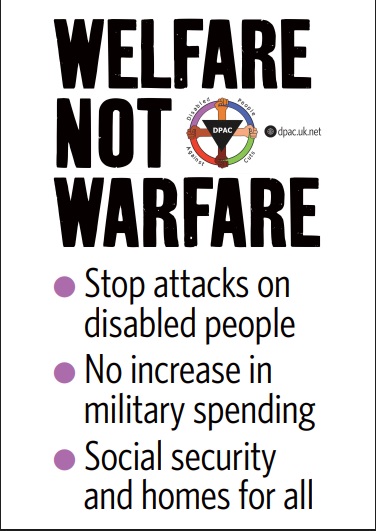


Oct 162024
 
DPAC Logo with text underneath "Disabled People Against Cuts" and then web address dpac.uk.net

Disability activists are urging MPs to vote against legislation that would place disabled people under pressure to prematurely end their lives.


Kim Leadbeater MP’s Private Members’ Bill on assisted suicide is due for its First Reading in the House of Commons on the 16th October.


Deaf and Disabled People’s Organisations (DDPOs) fear that not enough time has been given to fully understand the far-reaching implications of the Bill.


Prime Minister Keir Starmer has allowed a free vote. Disability campaigners urge all MPs to vote against the Bill and instead focus on improving access to services, instead of assuming that an early death is the only way to provide dignity at the end of life.


In a briefing sent to MPs today, the ethical and human rights concerns of the legislation are outlined. These include the need for safeguarding against abuse, proper scrutiny of the Bill and fixing services, including palliative care, so that terminally ill people have a genuine choice at the end of life.


Evidence from around the world shows that initial good intentions to provide choice at the end of life can lead to disabled people without terminal illnesses being pushed to an early death because the support to live with dignity is not available.


Ellen Clifford, co-ordinator of the UK DDPO CRDP Monitoring Coalition said, “It is absolutely essential that Parliamentarians get to hear the voices of Deaf and Disabled People’s Organisations on this extremely complex and difficult subject. Parliament only gets one go at this and if they get it wrong the consequences will be very dangerous both for individual people vulnerable to abuse and society as a whole. Our support services – palliative care, the NHS, social care and mental health – are currently broken. We must not create a system like Canada where assisted suicide plugs gaps in services, or Oregon where young women with anorexia can end their lives before they find the support they need. The government must get on and fix the foundations so we all have the chance to live with dignity.”


Phil Friend, Not Dead Yet UK member said, “We have seen, again and again, across the world, that laws that begin with relatively strict parameters, such as terminal illness, expand and expand. While we are assured us there will be “safeguards”, in reality, these safeguards are virtually impossible to implement effectively. Even the idea that doctors can accurately predict when a person has six months left to live does not reflect reality.


“And in a world where there is growing awareness of coercive control, and where we know that many do not receive adequate or appropriate medical care, pain management or social care, we are creating the conditions for people to find themselves agreeing that yes, they should probably die, including to avoid feeling like a burden.

What if good care stopped us from wanting to die? Where are the proposed laws to provide everybody with compassionate and appropriate care instead?”


Campaigners highlight how disabled people’s lives are devalued in the UK, and fear that the legislation will exacerbate this.


Kamran Mallick, CEO of Disability Rights UK said, “As CEO of Disability Rights UK, I implore Parliamentarians to recognise the chilling echoes of the COVID-19 pandemic, where Disabled people were unjustly subjected to Do Not Resuscitate orders without their consent. These actions demonstrated a shocking disregard for our lives and autonomy, exposing the prevailing societal belief that Disabled lives are less valuable. Legalising assisted suicide would exacerbate these deeply concerning attitudes, normalising the idea that Disabled people are better off dead than living in a society that fails to provide adequate support.”


Joe Powell, Chief Executive of All Wales People First said, “All Wales People First stand in solidarity with Disabled People Against Cuts with their concerns regarding the proposed ‘assisted suicide legislation’. We are concerned that this legislation may impact on many people with learning disabilities because of misunderstandings about their quality of life. This was particularly evident during the Covid 19 pandemic when many people with learning disabilities were served, inappropriately  with do not resuscitate notices. This makes people with learning disabilities particularly vulnerable at this time.”


Dorothy Gould of Liberation said, “People given mental health diagnoses are already dying needlessly, because of a flawed service model and the use of disability-based detention in psychiatric institutions. If assisted suicide legislation is enacted, there is a very real risk that it will spread to us and that yet more of us will then die because we feel so hopeless about receiving the help we actually need”.


Disabled people fear that safeguarding against abuse is not possible and in the longer term, people who are not intended to be included in the scope of the legislation will find themselves without the support needed to live well.


Paula Peters from Disabled People Against Cuts said, “The proposed assisted dying bill about to be laid in Parliament causes deep concern and alarm for many disabled people.  It is impossible to put strong enough safeguards in place to prevent coercion and feeling that we have become a burden on our families and the state.  We fear that non-disabled people will be making choices about what is best for us and that our voices will be dismissed as they often are.


“This bill is a danger to disabled people’s human rights. Disabled people already feel devalued and we lack support to live life with dignity and have control and choice over our own lives.


“That there are many MPs who wish to widen the bill to include something as subjective as ‘incurable suffering’ is absolutely terrifying.  Give us dignity in life and allow us choice and control over our lives.”


Rhian Davies, chief executive of Disability Wales said, “Disability Wales opposes the assisted suicide private members bill. We acknowledge the lived experience of pain, suffering and distress on both sides of this debate nevertheless we are deeply concerned at the far-reaching implications of this bill both for individuals and society as a whole. Given the dire impact of austerity, Covid-19 and the cost of living crisis on disabled people including in Wales, we fear that this bill would further devalue disabled lives and undermine their very right to life.


“Disability Wales advocates for better support to ensure dignity and independent living, rather than offering assisted suicide as a solution to the challenges in the system that disabled people face daily.”


There are concerns that disabled people outside England and Wales could also be affected.


Michael Lorimer of Disabled People Against Cuts Northern Ireland said, “Although the Bill does not apply in Northern Ireland, the potential exists for people to travel to England and Wales. DPAC NI does not believe it is possible to ever safely legislate for assisted suicide. We do not accept that a Private Member’s Bill provides sufficient scrutiny for such a fundamental change. We call on our MPs to vote against the Bill and support the proper resourcing of services including palliative care.”


Editor’s notes:

The Deaf and Disabled People’s Organisations’ Coalition briefing on ‘Choice at the End of Life’ [ATTACHED]


The DDPO Coalition includes Alliance for Inclusive Education, All Wales People First, Disabled People Against Cuts, Disabled People Against Cuts Northern Ireland, Disability Rights UK, Disability Wales, Greater Manchester Coalition of Disabled People, Liberation, Omnibus Partnership.


Media contact: Ellen Clifford 07505144371; livingwithdignity@hotmail.com


END

Jul 032024
 
DPAC Logo with text underneath "Disabled People Against Cuts" and then web address dpac.uk.net

With the election this Thursday, finally all the parties in Northern Ireland have their manifestos available for you to read and to win your vote. What do their manifestos have on offer for disabled voters?

DPAC NI are not endorsing any parties running for election, but are merely giving you all the information they have provided in their manifestos, so you can make an informed choice as a deaf and disabled people when voting.

The core demands from DPAC NI are:

Legislate to fully incorporate the UN Convention on the Rights of Persons with Disabilities (UNCRPD) into UK law

  • A “triple lock” on annual benefit rate increases
  • Legal Right to Independent Living with a National Independent Living Service
  • Introduce a national requirement for all new build homes to be accessible and 10% to be wheelchair accessible
  • A right to mainstream education and to education in fluent British Sign Language / Irish Sign Language for Deaf and Disabled students
  • A fully integrated, fully accessible, affordable publicly owned transport system for all
  • A right of disabled access to built and natural environments
  • Introduce mandatory two-week timeframe for reasonable adjustments and an enforcement framework which does not fully depend on an individual.
  • An independent public inquiry into the deaths and maltreatment of disabled children and adults incarcerated in mental health institutions
  • Legislate to abolish forced detention and treatment of people on mental health grounds
  • No Assisted Dying
  • Adequate provision of technical aids and equipment, eg wheelchairs, and adaptive communication aides for people who are nonverbal

Lets look at each party and pick out what they have to say and what core demands they are going to deliver for our community

Sinn Féin sinnfein.ie

Building a Society for All

“There can be no place for sectarianism, racism, misogyny, homophobia, age or disability discrimination in our society.” – Page 9

“We want a society that values and celebrates the diversity of our identities, religious or none, sexual orientation, gender, disability, age, or ethnic origin.” – Page 9

Full Sinn Fein manifesto: Click Here

DUP mydup.com

Down’s Syndrome given Minority Status

“DUP Parliamentarians have been a committed and consistent voice for people with disabilities. One of our MPs co-sponsored the Down Syndrome Act 2022, the world’s first piece of legislation recognising people with Down’s syndrome as a specific minority group.” – Page 10

Department for Communities Outcomes Delivered

“Progress on a Disability and Work Strategy, ensuring no one who wants to work is prohibited from doing so because of their disability” – Page 12

Defending Our Most Vulnerable

“supported legal action by disability campaigner Heidi Crowter against legislation allowing the abortion of babies with Down’s Syndrome up until birth” – Page 39

Disabilities

“The DUP is committed to ensuring those with disabilities can live full and active lives. We will continue to advocate for better access to, and provision of, vital services that can help ensure they can play a stronger role in their local communities and the labour market.” – Page 39

“support a wide-ranging audit of central and local government facilities to ensure they are accessible to those with disabilities” – Page 39

“work with the Inclusive Mobility and Transport Advisory Committee (IMTAC) in future transport projects” – Page 39

“promote close collaboration between IMTAC, the Disabled Persons Transport Advisory Committee (DPTAC) in England and Wales and Mobility and Access Committee for Scotland” – Page 39

“support the introduction of further resident parking zone schemes” Page 39

“encourage government departments, public bodies and local authorities across the UK to join Access Able or require them to provide comparable information on disability access and services” – Page 39

“invest more in community transport, including services that provide a lifeline to older people” – Page 39 

Full DUP manifesto: Click Here

Alliance Party allianceparty.org

Victim and Survivors

“We have long supported the introduction of a pension for victims and survivors of the Troubles, and Justice Minister Naomi Long MLA took the lead in implementing the Troubles Permanent Disablement Pension Scheme when other executive ministers refused” – Page 13

Levelling Up and Shared Prosperity

“There has been a significant reduction in funding to Northern Ireland, coupled with the imposition of unnecessary and costly bidding competitions, short-termism, uncertainty as to the areas of activity that will be supported, plus duplication in some areas and gaps in others. Many core services, including apprenticeship, labour market inclusion measures, disability employment, regeneration and economic development measures are in jeopardy.” – Page 23

Equality and Justice

“The domestic incorporation of the UN Convention on the Rights of Persons with Disabilities (UNCRPD).” – Page 34

“The delivery of a Northern Ireland Bill of Rights to supplement the ECHR and Human Rights Act.” – Page 34

Global Justice and International Development

“We want to build a fair, sustainable world: reducing poverty and inequality, addressing the climate crisis, and ensuring that the most marginalised groups, such as women, girls, people with disabilities and the LGBT+ community, are at the forefront of international development and humanitarian assistance policy.” – Page 43

Full Alliance Party Manifesto: Click Here

SDLP sdlp.ie

Disability Rights

“The SDLP believes in a society where disabled people have full and equal access to public services, including through the full implementation of the UN Convention on the Right of Persons with Disabilities.” – Page 40

“In a myriad of ways, disabled people have been hit hardest by the cost-of-living crisis and the impact of the pandemic and require intervention and investment to address that impact. Robust action is required at all levels of government to tackle the inequalities faced by people with disabilities, including by closing the disability employment gap. We must also invest in public services and the built environment of our local communities to ensure that homes, schools, leisure and sporting facilities and public transportation are fully accessible to disabled people. We believe in a welfare system that upholds the rights of all disabled people, treating them with dignity and compassion.” – Page 40

“Alongside these important reforms, the SDLP will continue to campaign for a society that breaks down the negative attitudes and discrimination that affect disabled people, including through addressing disability hate crime. Public policy must be co-designed with disabled people and the organisations that represent them to ensure that it fully accounts for the needs of disabled people” – Page 40

Human Rights

“The SDLP remains unwavering in its commitment to advancing and upholding human rights. We believe that every individual, regardless of their nationality, ethnicity, disability, gender, sexual orientation or belief, are entitled to the same fundamental rights which are enshrined in international law.” – Page 43

Full SDLP manifesto: Click Here

Ulster Unionist Party uup.org

Disabilities

“Across the UK, around 16 million people have a recognised disability, which constitutes about 24% of the total population. This includes 11% of children, 23% of working-age adults, and 45% of pension-age adults (Disability, accessibility and blue badge statistics, England, 2022 to 2023 – GOV—UK; Disability facts and figures | Disability charity Scope UK.) “ – Page 16

“In Northern Ireland, approximately 21% of the population reported having a disability according to the most recent surveys, a figure that mirrors trends across other regions of the UK, indicating a rise in the proportion of people living with disabilities.” – Page 16

“These statistics emphasise the significant portion of the population living with a disability, highlighting the crucial need for policies and initiatives aimed at enhancing their quality of life.” – Page 16

“Ulster Unionist Party MPs will advocate for the next Government to not only acknowledge the high proportion of the population living with disabilities but also to proactively develop policy interventions that improve services and the overall quality of life for these citizens.” – Page 16

“We firmly believe that the most effective way to ensure these policies is by ensuring that individuals with lived experience are not just included, but are at the forefront of creating these policy interventions. Their unique perspectives and challenges are invaluable in shaping policies that truly meet their needs”. -Page 16

“Additionally, your Ulster Unionist Party MPs will work to hold the next Government to account if they fail in their duty to support our citizens living with disabilities in having active and fulfilling lives. This support must include recognising that Personal Independence Payment and other social security payments are crucial in this regard, and any attempt to scale back this support will have a far-reaching and devastating impact.” – Page 16

“We will advocate for the next Government to acknowledge the high proportion of the population living with disabilities and to proactively develop policy interventions that improve services and the overall quality of life for these citizens. This will include pressing for the incorporation of the United Nations Convention on the Rights of Persons with Disabilities into UK law, ensuring that the rights of individuals with disabilities are fully protected and promoted.” – Page 16

Supporting Young People with Disabilities

“We are committed to creating equal opportunities for young people with disabilities. To achieve this, we will:

Secure funding and resources for post-secondary education and training for young people with disabilities or learning disabilities.

Develop pathways to further learning and employment opportunities that are on par with those available to mainstream school leavers.

Ensure that all young people in Northern Ireland have access to the support and opportunities they need to succeed, regardless of their abilities.” – Page 18

People Before Profit pbp.ie

Full 5 page policy available on disability. Mostly Republic of Ireland related

Legislative Changes

“People Before Profit stands in solidarity with disability rights activists, and calls for the complete ratification of the UNCRPD, along with all other relevant legislation – a process that should include as a rule the full and decisive oversight of people with a lived experience of disability. As a matter of urgency, the government must:

Ensure that the ratification of the UNCRPD and all other relevant legislation, involving oversight by persons with a lived experience of disability.” – Page 3

Full People Before Profits manifesto: Click Here

Green Party Northern Ireland greenpartyni.org

Fund Reforms By Taxing the Wealthy

“Make pension tax relief equal to the basic rate of income tax – helping to fund adequate social care which centres the dignity of all elderly and disabled people regardless of income.” – Page 14

Make Government More Representative and More Local

“To enable diversity across politics, we will implement measures that support the candidacy of underrepresented groups, including women, ethnic minorities, and people with disabilities. Diverse political representation leads to policies that better reflect the needs of all citizens. We will also continue to advocate for devolution of powers to local levels, including reform of the Barnett formula and the funding package to Northern Ireland and the extension of powers and resources to Local Authorities.” – Page 15

Enhance Work Life

Address pay gaps for all people from protected groups, including those with a disability or chronic health condition, those from racialised or religious minorities, women and carers, and LGBTQ+ people.” – Page 19

Full Green Party Northern Ireland manifesto: Click Here

 Posted by at 22:07