Oct 012024
 
DPAC Logo with text underneath "Disabled People Against Cuts" and then web address dpac.uk.net

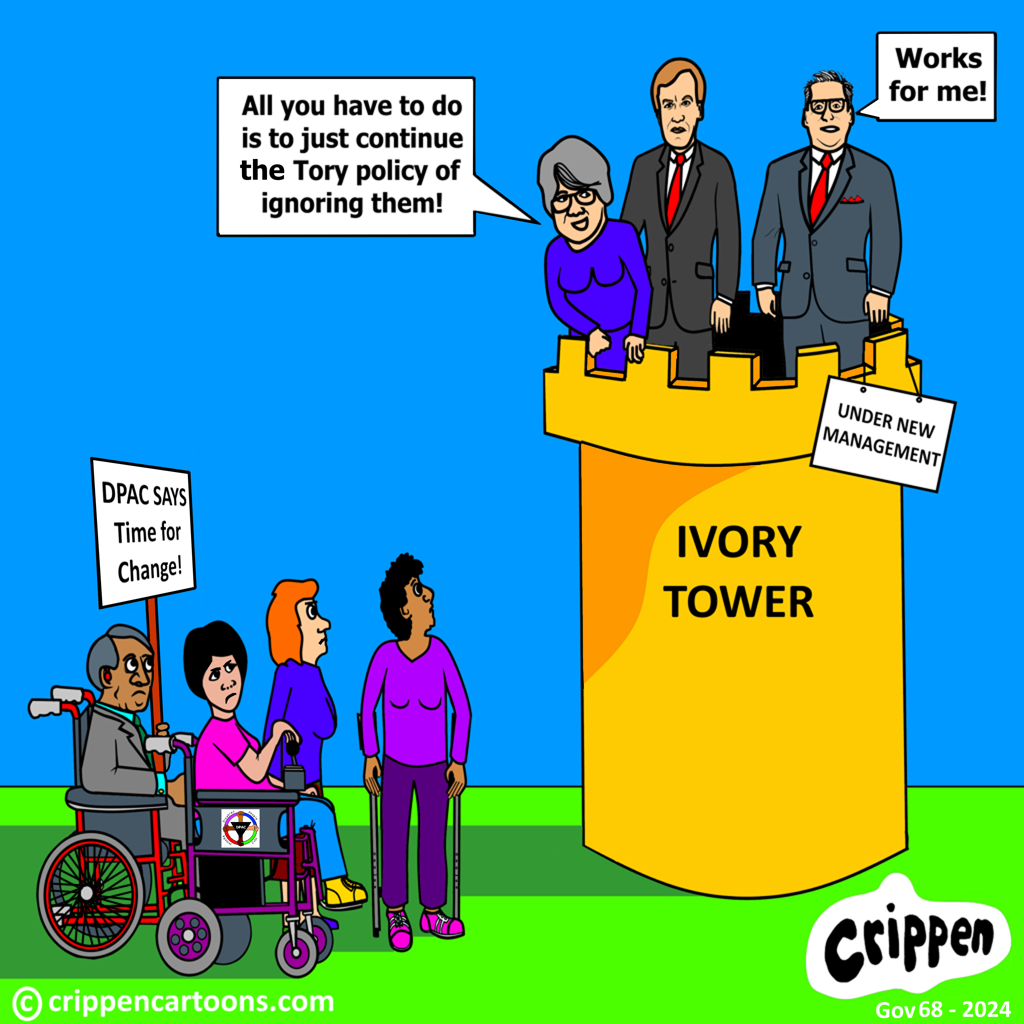
Reproduced by kind permission of Crippen

The PM Keir Starmer and a Civil Servant are standing each side of a large Labour Part Press Release statement hung on the wall. It reads ‘Disabled benefits claimants are all work-shy scroungers with most of them fiddling the system and taking your hard earned money!’ On a table in front of them are four other cards. One reads: ‘Benefit fraud at its lowest rate ever’, another reads: ‘PIP fraud at zero!’, the third one reads ‘Disability hate crime up 43%’, and the final card reads: ‘DWP ignores research re 600 suicides linked to WCA’. The civil servant is asking the PM: “But Sir – what about the facts?!” whilst pointing at the cards upon the table. Starmer replies: “Facts – when have they ever played a part in politics?!”

Crippen asks “Fraud – What Fraud?!

Well, having got rid of the Tory’s, we now have a labour government that has decided to continue with the harmful rhetoric that the DWP continue to pump out to a gullible public through the national press. But how did this attack against disabled people start, especially those claiming benefits because they cannot find accessible employment?

You’ll remember the Coalition administration elected in 2010? Well, it was this administration that started to change the public’s perception of disabled people. They vehemently challenged the integrity of the chronically ill and disabled community and routinely accused disability benefit claimants of fraud while failing to produce evidence to support their claims. Their often hostile rhetoric encouraged a 213 percent increase in prosecuted disability hate crimes, with successive administrations disregarded the thousands of deaths directly linked to the Work Capability Assessment (WCA).

And what with recent stats from the Home Office revealing that disability hate crime has risen by 43%. It doesn’t take much of a leap to connect this to the vitriol being pumped out by the DWP.

If you’ve read Mo Stewart’s book you’ll know how the WCA “ … was adopted using a discredited and dangerous biopsychosocial model of assessment to restrict access to long-term disability benefit. Influenced by corporate America since 1992, the UK social policy reforms guaranteed that many of those in greatest need were destined to die when, covertly, killed by the State.”

Sounds a bit dramatic, doesn’t it? “Killed by the state”. But this has exactly what has been happening since Margaret Thatcher started her devotion to neoliberal politics, which is the ideology that supports free market competition with an emphasis on minimal State intervention, would eventually be identified as being at ‘the root of all our problems’ (Monbiot, 2016).

Thatcher’s well-documented insistence that the welfare state was an unacceptable financial burden on the public purse, opened the door to the influence of corporate America with UK social policy reforms and the ‘planned demolition of the UK welfare state’ (Stewart, 2016).

Incidentally, every 30 years confidential Cabinet Papers from past UK governments are released into the public domain. In 2012, the 1982 Cabinet Papers from the first Thatcher administration (1979–83) were released, offering evidence demonstrating the political expectation to eventually demolish the UK welfare state, including the National Health Service (NHS).

It’s all there folks, you just have to dig for it as John Pring, disabled Editor of Disability News Service (DNS) and Mo Stewart, disabled researcher and lead on the Preventable Harm project, have done. Mo writes:

“Thatcher’s social policy right-leaning neoliberal legacy has been continued by every successive administration. This included introducing American corporate influence for the development of UK social policy reforms by the Major administration (1990–97) (Stewart, 2018); the adoption of American social and labour market policies by the Blair administration (1997–2007) (Daguerre, 2004Daguerre and Taylor-Gooby, 2004); the adoption of the Work Capability Assessment in 2008 to limit access to the new Employment and Support Allowance (ESA) disability benefit by the Brown administration (2007–10) (Gentleman, 2011); and the increased use of sanctions, which removed all income to successfully intimidate disability benefit claimants, and to starve some of them to death (Pring, 2020a), by the Cameron-Clegg Coalition administration (2010–15).”

In the Independent Living review of John Pring’s book they comment that: “As demonstrated in the ‘Department’, a disturbing number of chronically ill disability benefit claimants committed suicide, linked in no small measure to persecution by the DWP, and to the fear instilled by the relentless threat of sanctions that meant the total loss of their only income which guaranteed destitution.”

Sep 282024
 
DPAC Logo with text underneath "Disabled People Against Cuts" and then web address dpac.uk.net

Reproduced by kind permission of Crippen

Our friends at Disabled People Against Cuts (DPAC) have been monitoring the language being used by the government recently.

Kier Starmer PM is seen holding up a small wheelchair user by the scruff of his neck. Starmer is wearing a large boxing glove and the disabled person has a prominent black eye. Starmer is saying: “It’s what we refer to in the Labour Party as punching down!”

Crippen discovers why we’re all so punch drunk!

Phrases like “punching down” and “hostile environment” appear amongst the usual retoric, along with the carbon copies of speeches once used by the Tory party.

Of course, I couldn’t resist using one of these phrases for a cartoon!

Interested in joining DPAC? Here’s the link.

Sep 262024
 
DPAC Logo with text underneath "Disabled People Against Cuts" and then web address dpac.uk.net

Contents

Minister admits fatal flaws in universal credit ‘need to be fixed’ and tells DNS: ‘You’ve been onto something very important’ 1

Prime minister suggests all those on sickness benefits should look for work 3

Labour’s DWP fraud bill ‘will be recipe for abuse and miscarriages of justice’ 5

Kendall ignores question on why she shared platform with company linked to DWP deaths 7

Streeting dodges care charges question for four minutes and 25 seconds 10

We want a full-time minister for disabled people’, Labour conference meeting is told 12

Disabled MP’s passionate call for action over ‘scandal of locked settings’ 13

Silence again from Labour ministers on accessible housing, despite new announcements 15

Labour accused of treating conference delegate like third-class citizen, after banning her service dog 17

DWP minister dodges question on Kendall’s ‘exclusionary’ decision to sideline disabled people 20

Other disability-related stories covered by mainstream media this week 21


Minister admits fatal flaws in universal credit ‘need to be fixed’ and tells DNS: ‘You’ve been onto something very important’

The minister for social security has admitted there are serious safety concerns with universal credit, following coroners’ reports that linked the working-age benefits system with the suicides of two disabled claimants.

Sir Stephen Timms is the first minister of any political party to accept the fatal flaws within universal credit and to promise to fix them.

Although he dismissed any possibility that universal credit itself would be scrapped, he told Disability News Service (DNS) that there were “problematic” features of the system and “they need to be fixed”.

He was speaking at Labour’s party conference in Liverpool at a fringe meeting on poverty organised by the Centre for Social Justice, the centre-right thinktank founded by former work and pensions secretary Iain Duncan Smith, which was responsible for the original design of universal credit.

DNS editor John Pring had told the meeting of the increasing concerns about universal credit, including by coroners following two suicides of claimants whose deaths were both linked to flaws in the system and the pressure it puts on people in mental distress.

He said universal credit was now being rolled out to claimants of employment and support allowance.

Pring pointed out that the PCS union had described universal credit in June as a “dangerously flawed system” in which “the most vulnerable continue to slip through its cracks”.

He asked Sir Stephen if he accepted the concerns and what he would do about them.

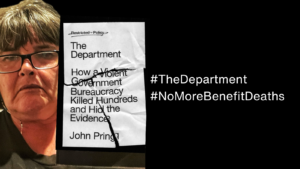
Pring also highlighted the publication of his book The Department*, about years of deaths linked to the Department for Work and Pensions (DWP), mostly relating to disability benefits, and told him: “I do not want to [have to write a] follow-up in 10 years’ time”.

Sir Stephen said there were problems with universal credit that DNS was “rightly highlighting, and that you have highlighted very consistently over a lengthy period now and have frequently been denied by the department, but they have carried on happening”.

And he added: “I think you’ve been onto something very important.”

But he said he did not believe these deaths and other harm were happening because universal credit was introduced, but because of flaws in the system.

He said: “I do think there are features of universal credit which are problematic, and they need to be fixed, but I don’t think they are inherent problems.

I think we’ve got to change the system we’ve got to do a better job, and to avoid these problems.”

But he also said he wanted to open DWP up to greater public scrutiny.

Sir Stephen told Pring: “One of the things we need to do is open up what is going on in the Department for Work and Pensions to public scrutiny, and John, you are one of the most prolific applicants for freedom of information requests to the department, and quite right too.

The department has absurdly refused to answer lots of the questions that you have asked and that is something that we want to change… because public scrutiny is a good thing, and it puts pressure on ministers and on civil servants to have the consequences of what they are doing known about publicly.

And that’s an area that I’m working on and which the secretary of state may have something to say about in her speech later in the week [Liz Kendall did not mention transparency in her speech yesterday (Wednesday)].

Yes, we do need to make some very big changes to the way things work, but I don’t believe that scrapping universal credit… would be the answer.”

And he said universal credit had done a “really powerful and good job during the pandemic” when the old system “would have just collapsed” under the weight of new claims.

A Labour delegate, Julie Jarman, asked Sir Stephen whether there should be a “proper independent regulator” and “publicly accessible service standards” for the social security system, playing the role that Ofsted plays in education, so “people in receipt of benefits, as with other public services, can actually hold the service providers to account”.

But he said he was “not convinced” that having a separate regulator outside DWP would “deal with these problems”.

Andy Burnham, the Labour mayor of Greater Manchester, told the meeting that he believed that there needed to be a national “housing first” scheme – as there is in Greater Manchester, and Finland – so that everyone is guaranteed a “good, secure home”.

He said this is based on the idea that “any other public spending is wasted unless you’ve sorted out the housing first” and that such a policy would result in “so much less” spending on “the cost of social failure”.

He also said the government needed to “completely rethink how we support people, and we’ve got to make it positive not punitive”, particularly through devolution of employment support to local authorities.

He said: “If I had my way, I would rename every Jobcentre Plus in Greater Manchester a ‘live well centre’, and rather than spending the employment support budget through large corporate entities, who don’t actually care much for our communities, we would spend that money through our local community and voluntary sector.”

He said the system should be “about helping people move forward and not trying to trip them up and sanction them.

Shock revelation: that doesn’t get people into work.

If somebody goes into a Jobcentre Plus in one door and comes out feeling worse 20 minutes later after the consultation, that is not building them up to get back to a position where they can go into work.

That is doing the opposite, it’s taking people away further from work.”

*The Department: How a Violent Government Bureaucracy Killed Hundreds and Hid the Evidence, by John Pring, is published by Pluto Press 

26 September 2024


Prime minister suggests all those on sickness benefits should look for work

The prime minister has suggested that all claimants of long-term sickness benefits will be expected to look for work under his government’s plans to reform social security.

Sir Keir Starmer made his comments in a BBC interview that was broadcast yesterday (Wednesday), and if they translated into government policy they would demonstrate a significant tightening of the rules on out-of-work disability benefits.

There are currently more than 1.5 million disabled people on universal credit who are not expected to carry out any work-related activity because of a significant impairment or health condition, and about 1.3 million more in the equivalent employment and support allowance support group.

Sir Keir appeared to be suggesting – although it is possible that he misrepresented his party’s policy – that every one of these people should be looking for work.

Labour ministers, including the prime minister, should already be aware that the deaths of countless disabled claimants of out-of-work benefits have been linked to attempts to force them into work or work-related activity over the last 15 years.

Just one example is Alan McArdle.

He died from a fatal heart attack in August 2015 after being told DWP was threatening to sanction his benefits.

The US outsourcing giant Maximus had reported him for failing to attend appointments intended to move him towards work, despite being told about his severe ill-health.

Another example is Roy Curtis, who took his own life six days after being told to attend a WCA, despite DWP being repeatedly warned its actions had made him suicidal.

Sir Keir was responding to a question from the BBC’s Nick Robinson, who asked if he believed that “those who are out of work, who may think that they can’t work, that the country has a right to expect that they look for work, they do everything they can to get work” and that this was “the sacrifice they need to make”.

In response, the prime minister said: “Well, yes, of course. 

In relation to long-term sickness, which is at very high levels, then of course people need to look for work. But they also need support.”

He also said that the “basic proposition, that you should look for work, is right”.

He added: “There will be hard cases. But the way I would do it is to say, yes, that’s the basic proposition.”

Under the current rules, DWP accepts that many disabled people are not able to work or even carry out work-related activity, and they are provided with extra financial support to recognise the extra barriers they face.

Sir Keir’s comments appear to contrast with those made by his own work and pensions secretary, Liz Kendall, who attempted at conference to stress that she would focus on providing “more positive support in the community” and would take a “completely different approach from the Conservatives”.

She told a fringe meeting earlier in the week (see separate story) that she wanted to change the “culture of fear” among claimants that they could lose their benefits if a job did not work out.

She told the event: “What the Tories did was write people off, blame them to grab an easy headline and then make their lives miserable.

They talked about shirkers, and it seems to be the only people shirking their responsibility were the Tories.

If what they did was successful, we wouldn’t have a record number of people out of work due to long-term sickness.”

26 September 2024


Labour’s DWP fraud bill ‘will be recipe for abuse and miscarriages of justice’

Disabled campaigners have warned that plans to give the government sweeping powers to carry out financial surveillance on benefit claimants are “a recipe for abuse and miscarriages of justice”.

Prime minister Sir Keir Starmer told the Labour conference in Liverpool on Tuesday that his government would “legislate to stop benefit fraud”.

The Department for Work and Pensions (DWP) confirmed the same day that this referred to plans to bring forward a new fraud, error and debt bill that would “crack down on fraud in the social security system”.

It said this would “require banks and financial institutions to share data that may show indications of potential benefit overpayments”.

But it is believed that – as with powers proposed by the last Conservative government – this will mean giving DWP powers to force banks to scan their accounts to find account-holders receiving benefits, as well as people connected with those accounts.

They would then have to report anyone who triggers what are seen as potential indicators of possible fraud to DWP.

Under current rules, DWP can only request details of a bank account holder’s transactions if there are reasonable grounds to suspect them of fraud.

The bill will also give new powers to DWP fraud investigators and – if, again, it follows plans put forward earlier this year by the last Conservative government – could also introduce a new civil penalty for benefit fraud with a “lower burden of proof”.

Labour’s plans on financial surveillance have been heavily criticised this week by disabled people’s organisations.

Rick Burgess, a spokesperson for Greater Manchester Coalition of Disabled People (GMCDP), which campaigned against the last government’s proposals, said the announcement of the new bill was “disappointing” but “not surprising”.

He said: “Labour promised change, but we find ourselves having to fight the same unfair policy that we previously opposed under the Tory government of Rishi Sunak.

Just because you receive a benefit from the DWP does not mean you should have fewer rights; our financial affairs should not be spied upon by the DWP.

The DWP should not get greater powers, as this department has already shown it does not exercise its existing powers humanely, transparently, or honestly.

This is a recipe for more abuse and potential miscarriages of justice that would make the Post Office Horizon scandal look tiny in comparison.”

Mikey Erhardt, policy and campaigns officer for Disability Rights UK, said the bill would subject millions of claimants to “untested, unscrutinised, and potentially unlimited powers”.

He said: “The government’s latest plans are essentially a digital sledgehammer to crack the tiniest nut.

These new powers would see millions deprived of the presumption of innocence, adding to the criminalisation we already face in a punitive welfare system that often seeks to sanction people into work, whether we are able to or not.”

He added: “This speech could have been a moment to announce a social security system built on respect, dignity, and support that enables us to live the lives we deserve – not spending millions to create an uncontrollable digital panopticon.”

A spokesperson for National Survivor User Network (NSUN) said: “Many people – particularly those who are racialised – live with trauma related to surveillance.

This will only be exacerbated by the knowledge that the DWP may soon be able to access banking records without account holders’ knowledge.

Money management is also a source of great distress for many, and an area in which people who experience mental ill-health are often infantilised through lack of control over their own finances.

The threat of financial surveillance would be yet another obstacle to contend with.”

And Caroline Collier, from Inclusion Barnet’s Campaign for Disability Justice, said the announcement was “very concerning” and that the plans were “both intrusive and unnecessary” and would have a “disproportionately large effect on disabled people”.

She said: “It is inevitable that automated surveillance will throw up erroneous overpayment or fraud alerts, causing possibly lengthy benefit suspension while things are sorted out, with all the associated hardship, debt and stress that entails. 

It also disregards people’s basic right to privacy, which should be respected unless there are reasonable grounds to think that an offence has been committed. 

This is a miss-step, and I very much hope government will reconsider.” 

A DWP press release about the new bill insisted that it would include safeguarding measures to “protect vulnerable customers”, that DWP staff would be “trained to the highest standards on the appropriate use of any new powers”, while there would be “oversight and reporting mechanisms, to monitor these new powers”. 

It added: “DWP will not have access to people’s bank accounts and will not share their personal information with third parties.” 

The new bill is likely to be based on two sets of proposals put forward by the last Conservative government.

The first is the data protection and digital information bill, which the last government failed to get through parliament before July’s election, and which was hugely controversial.

It is also likely to be based on a DWP policy paper released in May – Fighting Fraud in the Welfare System: Going Further – which led to DWP facing questions over why it ignored concerns raised by a coroner about a disabled woman who died following a “targeted” review of her universal credit claim.

26 September 2024


Kendall ignores question on why she shared platform with company linked to DWP deaths

Work and pensions secretary Liz Kendall has ignored a question on why she shared a platform at her party’s annual conference with an outsourcing giant linked to the deaths of disabled benefit claimants.

Kendall was speaking at the fringe event on “the future for work”, hosted by the discredited US multinational Maximus and the centre-left thinktank, the Fabian Society.

Maximus has been closely linked to the deaths of claimants over the last 10 years, including those of Jodey Whiting, Alan McArdle, Philip Pakree and Roy Curtis*.

Towards the end of Monday’s fringe event, Disability News Service (DNS) asked Kendall whether – in the light of such deaths – Maximus was the right company to be telling the government and Labour party members about the future of work.

But instead of asking Kendall to respond, Andrew Harrop, general secretary of the Fabians, who was chairing the event, said he would ask Maximus UK president Dr Paul Williams to “very quickly respond” instead.

After Williams had spoken, Kendall was asked by Harrop for her “closing comments”.

She did not answer the Maximus question, even though DNS had made it clear it was directed at her.

In his response, Williams had said: “I’m not sure that I recognise that characterisation.”

He insisted that Maximus were “credible partners” because of their work supporting “people with disabilities” through Remploy.

He said Maximus had carried out assessments for about 10 million people in the last decade and took “tremendous pride in the way we seek to personalise those assessments, make them detailed and thorough where needed and try to support people through the process”.

He said: “I think we have actually got a wonderful track record for that, and I am very proud of my team.”

After the event, Harrop insisted that – despite his asking Maximus to comment on the question and then not asking Kendall to answer it – she had had “the opportunity to do so”.

There have been many concerns raised about Maximus since it took over delivering work capability assessments (WCAs) from Atos in 2015, in addition to its links to a number of deaths.

In August 2015, Alan McArdle died from a fatal heart attack after being told DWP was threatening to sanction his benefits.

Maximus had reported him for failing to attend appointments intended to move him towards work, as part of the government’s Work Programme, despite being told about his severe ill-health.

Maximus also failed to act on a request from Jodey Whiting for her WCA to be carried out at home, even though it knew of her history of significant mental distress; she later took her own life after her benefits were stopped when she missed her assessment.

A third death linked to Maximus was that of Philip Pakree, who died on Boxing Day 2020.

Maximus had been warned of his serious health conditions but told him he would have to be assessed or it would affect his benefits, telling his partner: “It’s been delayed once, we are not delaying it again.”

He died in his sleep after becoming nearly hysterical with distress.

Comments about Maximus were also scrawled in red ink on official letters found after the suicide of Roy Curtis in late 2018.

A folder of letters found in Curtis’s flat after his body was discovered in August 2019 showed he had written desperate messages about his disability benefits “nightmare”.

In 2016, Labour MP Louise Haigh – now the transport secretary – attacked the track record, ethics and even criminal behaviour of Maximus in delivering public contracts in the US, during a debate on the WCA.

Haigh also highlighted what she described as a “disconcerting pattern of behaviour” by Maximus in the UK since taking over the WCA contract from Atos the previous year, with “an alarming trend of cases being rejected based on factual errors or even – I hesitate to say this – falsification”.

From this month, Maximus has become one of four outsourcing companies that will carry out both WCAs and personal independence payment assessments across the country, after DWP awarded the quartet £2.8 billion-worth of contracts under the last government.

Kendall did not provide any fresh insights this week into how Labour intends to reform employment support.

Two months ago, she announced that she wanted her department to move from being “a department for welfare” to becoming “a genuine department for work”.

She made those comments while helping to launch a report that focused strongly on the need to push more people with long-term health conditions into work and which included a controversial recommendation for DWP to introduce a “duty to engage” with employment support.

Labour will publish an employment white paper this autumn, and it is set to reveal its plans for disability benefits next spring.

Kendall told Monday’s fringe meeting that she believed that “there is clear evidence that good work is good for mental health”.

She said the government needed to “turn the tide on the fact that we are a sicker nation, which we are”, and that “work, health, skills are all joined up and I think that has absolutely got to be done at the local level”.

She said the last government “reduced welfare reform to a story about cuts to benefits and what the tapers are”, and she added: “We have got a completely different approach from the Conservatives.

Just as in the NHS, you end up spending too much on the consequences of failure, failure to intervene early or the failure to provide more positive support in the community, the same as is happening in DWP.

We are paying the price for not having put in place better systems of support for people.”

She also spoke of the “culture of fear” of losing benefits if a job does not work out.

She added: “I am under no illusions about how hard it could be to change the culture.

What the Tories did was write people off, blame them to grab an easy headline and then make their lives miserable.

They talked about shirkers and it seems to be the only people shirking their responsibility were the Tories.

If what they did was successful, we wouldn’t have a record number of people out of work due to long-term sickness.”

*The Department: How a Violent Government Bureaucracy Killed Hundreds and Hid the Evidence, by DNS editor John Pring, is published by Pluto Press 

26 September 2024


Streeting dodges care charges question for four minutes and 25 seconds

Health and social care secretary Wes Streeting has refused to say when the new Labour government will address the care charging crisis that is leading disabled people to face unlawful discrimination and inequality on an “unparalleled” scale.

Despite being asked several times by Disability News Service (DNS) when the government would act to scrap care charges for disabled people, he gave no timeframe for when or if that might happen.

Instead, he referred twice to the “£22 billion black hole in the public finances” and said it would “take time to deal with the mess we have inherited from the Conservatives”.

Speaking after a fringe meeting at the Labour party conference in Liverpool, Streeting said: “Give us time, we’re two months in… I recognise the challenge on charging, but it does come down to money, too.”

But despite repeated questions from DNS over more than four minutes, as he and his aides walked along Royal Albert Dock to his next meeting, he failed to say when a Labour government might act on care charges.

Asked about the tens of thousands of disabled people falling into debt every year because of care charges, he said: “I absolutely recognise the challenge, but it is going to take time to deal with the mess we have inherited from the Conservatives; part of that has got to be rebuilding our economy so we can invest in our public services, and charging reform itself.”

The interview started just yards from where Streeting promised DNS two years ago – when asked what a Labour government would promise on care charges during its first term in government – that Labour was “working on it”.

But Streeting was unable on Sunday to point to any progress since he made that pledge two years ago.

He said: “We recognise the challenge and we’re determined to meet the needs of both disabled people and older people in social care.

I wish I could promise an overnight fix, I wish this was an issue I could fix in the first eight weeks of a Labour government, but it is going to take time, and I am asking people to bear with us.”

His comments came two months after Disability Law Service (DLS) published research which found that disabled people across England were continuing to face unlawful discrimination and inequality on an “unparalleled” scale because of “unjust” social care charging policies.

DLS suggested that the proportion of disabled adults being charged for their non-residential care was increasing year by year and that local authorities were incurring “significant” and increasing costs of collecting these charges, with most of those charged paying “extortionate amounts” to local authorities.

Research by disabled campaigners showed in 2022 that tens of thousands of disabled people across the country every year were having debt collection action taken against them by their local authorities over unpaid care charges.

Streeting had earlier told the Future Social Care Coalition fringe event that the government would need to recognise “as we think about the NHS crisis that so many of the challenges and pressures driving that NHS crisis are because of the crisis in social care.

There is no fixing the crisis in the NHS unless we address the crisis in social care.”

But he said social care was important “in and of itself, not just as a means of NHS improvement, it’s important today when there is so much unmet need”.

He said: “We owe it to disabled people to make sure that you get the care and the support you need to enable you to fully participate in every aspect of life, and to feel the same sense of security and the same opportunities and quality of life as everyone else.”

And he stressed that when he talked about social care he was thinking about older people and disabled people.

He told the meeting that both reform and investment would be needed to “deliver results”.

Streeting said that Labour, the Conservatives, the Liberal Democrats and the SNP had all been in government over the last 20 years and none of them had delivered the long-term “change” and “solutions” that the country was “desperately crying out for”.

He said: “There is a quiet determination at the centre of our team in the Department of Health and Social Care – and more broadly the government – to make sure that we get this right… for the benefit of people who need care, their families and the care workforce.

I actually feel really optimistic and hopeful that this will be the parliament that really grips social care, that deals with the crisis confronting us now and also signs up to the longer-term reform agenda we need.”

He said the “low hanging-fruit” was building a national standards framework and “holding care providers to account”, stabilising the workforce, “sorting out the Care Quality Commission”, and setting out a 10-year plan for social care.

The care minister, Stephen Kinnock, had earlier said that the government was “drawing a line under the kicking the can down the road” plan of the previous government.

He said the government was working on a fair pay agreement for care workers and would be “setting the ball rolling on that” within weeks.

He said the government knew that the system needed “huge reform and improvement” but that the changes needed to be “sustainable”, and he pledged that the government would be “listening to people with lived experience” and care workers and providers.

He said: “I share your frustration that we can’t move more quickly but I guarantee that we are absolutely putting this at the heart of the government’s priorities going into the coming weeks, months and years.”

26 September 2024


We want a full-time minister for disabled people’, Labour conference meeting is told

Disabled campaigners say they want more than a “part-time minister” for disabled people under the new Labour government.

A fringe meeting at Labour’s annual party conference in Liverpool heard of concerns that Sir Stephen Timms had too many responsibilities as the minister for social security and disability.

Activists pointed to how Labour had worked in opposition, with a dedicated shadow minister for disabled people, Vicky Foxcroft.

But after Labour won power in July, Foxcroft was appointed to a role in the government whips office, and Sir Stephen was given the new role of minister for social security and disability in the Department for Work and Pensions (DWP).

The concerns about the lack of a dedicated disability minister were highlighted by Lady Lola Oyewusi, who sits on UNISON’s national disabled members’ committee.

She told the meeting, hosted by Disability Labour: “When we were in opposition, we had a shadow minister for disability.

Now we are in government, we haven’t got a minister for disability, it has been lumped together with the DWP.

It can’t be lumped together. We know exactly how the Tories persecuted people with disabilities, labelling them… lazy, not wanting to work, wanting to turn PIP* into vouchers, demonising people when you’re applying for PIP.

We need a minister who will speak up for disabled people.

Please, help us get a minister for disabled people.”

Kathy Bole, Disability Labour’s chair, said: “We have told the government that we are not happy about the fact that there is no single minister for disability.”

She said the appointment of a minister for social security and disability was a “step backwards” and added: “It is absolutely going to be something that we are raising again and again and again.

We don’t deserve a part-time minister. We deserve a full-time, fully engaged minister and we won’t stop until we get one.”

After the event, Bole told Disability News Service that the government should correct the “retrograde step”.

There’s so much that needs to be done on social security. [Sir Stephen] has enough on his hands.

We need a dedicated minister because he could then concentrate on social security and we could get somebody who was concerned with all of the stuff that’s going on for disabled people [across government].

Social security needs to be dealt with, but it’s such a big thing on its own.

I’m getting sick and tired of disabled people ending up at the bottom rung with just crumbs left behind.

We need a minister for disabled people.”

*Personal independence payment

26 September 2024


Disabled MP’s passionate call for action over ‘scandal of locked settings’

A disabled Labour MP has delivered a passionate call for action over the number of autistic people and people with learning difficulties who are “imprisoned” in inpatient mental health units.

Jen Craft told a fringe meeting at Labour’s annual party conference in Liverpool that the detention of people in such units for long periods of time in “completely unsuitable” environments was a “national scandal”.

The meeting was held to discuss the detention of autistic people and people with learning difficulties in locked NHS settings.

A report in May found there were still 2,045 such people detained in mental health hospitals at the end of March 2024, just a 30 per cent reduction in nine years. 

Craft, who was elected as MP for Thurrock for the first time in July, told the meeting that there was a “real urgency” about the need to “end the scandal of people in locked settings”.

She said: “I think for people that are experiencing this right now, change can’t come soon enough.”

She also pointed to the ongoing impact on a disabled person after they have left a locked unit, because of the damaged trust in services felt by them and their family after such an “incarceration”, which means it is “almost impossible” to recover from such “wrongful imprisonment”.

She said: “How can you, if you’re an individual that has experienced that, how can you trust someone that’s coming in and saying, ‘These are the things you need to do, this is how I’m going to help you’?”

She and others attending the meeting had watched a video of an autistic woman, Bethany, whose past detention in a locked unit has previously been highlighted in the media.

Her dad, Jeremy, says in the video that the family were told that the unit his daughter was going to be placed in would be “therapeutic” and that she would have the chance to take part in “animal therapy, music therapy, drama therapy”.

Instead, she was “tormented” by her surroundings and deliberately behaved in a way that meant she was placed in seclusion.

He said: “The periods of seclusion went from half an hour to an hour to half a day to a day, and eventually they stopped opening the door.”

The room was just 12 feet by 18 feet and had nothing but a mattress on the floor.

Jeremy said the “brutal” conditions led to a “spiral of descent into distress” for his daughter.

He said: “The impact of that is a person is left in a setting that’s distressing them, and it makes them even more ill, so they get more medication.

Their opportunity to engage in therapy isn’t there, but also, their state of mind doesn’t enable them to engage.”

Craft was visibly distressed by what she saw and heard on the video, and she said she had been “deeply impacted” by the “incredibly powerful” video.

She said she had a disabled child herself and it filled her with “absolute dread” when she heard such stories of parents who have unwittingly sent their child to “a kind of hell” when they thought they were making the best decision for them.

Sir Stephen Timms, minister for social security and disability, said the government’s mental health bill – which is likely to be based on the draft legislation brought forward by the previous Conservative government – would provide “greater choice, autonomy, better rights, and support”.

He said: “We intend to shift the power toward the patient, I think.

That’s been part of the problem up until now, and it will explicitly limit the scope for detaining people with a learning disability, and with autism.”

He added: “We’ve said that people in the future will only be detained where it’s strictly necessary and where there’s a reasonable prospect of therapeutic benefit from compulsory hospital treatment.”

He read out a briefing from the Department of Health and Social Care, which stated that its proposed reforms to the Mental Health Act would “help ensure people get the support they need in the community, improving care, keeping people out of hospitals.

The number of people with a learning disability and autistic people in mental health hospitals is unacceptable.

There are still too many people being inappropriately detained.”

The fringe meeting was hosted by the Voluntary Organisations Disability Group (VODG), whose members are mostly non-disabled-led charities that provide services to disabled people.

Dr Rhidian Hughes, VODG’s chief executive, told the meeting: “The system has been seemingly incapable of making any change at any scale or any meaningful pace.

And thinking about Beth’s story there, I think it would be hard to imagine any other circumstances in this country where we would tolerate a British citizen being detained indefinitely by the state without trial and where the government has explicitly acknowledged that the conditions for their detention are, for the majority, inappropriate and should be ended.”

Disability News Service had intended to ask what efforts VODG and its members would take to ensure that disabled people’s organisations were right at the centre of campaigning on this issue, but was not chosen to ask a question by the meeting’s chair.

26 September 2024


Silence again from Labour ministers on accessible housing, despite new announcements

Labour ministers have again failed to make any commitment to toughening standards on accessible homes, despite announcing a string of new housing measures at their annual party conference.

Deputy prime minister Angela Rayner, who is also the housing secretary, told the conference of plans to build “decent homes for working people”, and she said a new planning framework would “provide the biggest boost to social and affordable housing in a generation”.

Rayner is leading on delivering the government’s pledge to build 1.5 million new homes over the next five years.

She also told the conference that Labour’s renters’ rights bill would “rebalance the relationship between tenant and landlord and end no fault evictions”, while it will also “clamp down on damp and mouldy homes by bringing in Awaab’s Law in the social rented sector”.

And the government will consult this autumn on a new “Decent Homes Standard” for the social rented and private rented sectors.

Rayner also said that a new national planning policy framework this autumn would “unlock the door to affordable homes and provide the biggest boost to social and affordable housing in a generation”.

But there was no mention in her speech of the accessible housing crisis.

The prime minister, Sir Keir Starmer, also spoke on Sunday of new “planning passports” that he said would “turbocharge housebuilding in urban areas after 14 years of stagnation and blockage” and “accelerate urban densification by setting high standards for design and quality”.

But he also omitted any mention of the need to build more accessible homes.

After Disability News Service questioned the party on the failure of ministers to mention the accessible housing crisis, a Labour spokesperson said: “Accessibility in new homes and accessibility standards for buildings in general are a key concern for many people.

Housing is one of this government’s top priorities and everyone deserves to live in a decent home in which they feel safe.

The government will set out its policies on accessible new build housing shortly.”

In July, Inclusion London led a protest about the accessible housing crisis outside the gates of Downing Street.

The protest was timed to coincide with the second anniversary of a pledge by the last (Conservative) government – which was never fulfilled – to take action to address the shortage of accessible homes.

Chants at the protest were aimed at Rayner and the new prime minister.

A day after the protest, Rayner delivered a speech to MPs about the government’s plan to “get Britain building” and “breathe life back into towns and cities” without once mentioning disabled people and the accessible housing crisis.

Now, at this week’s conference in Liverpool, she repeated that omission during her speech, which received a standing ovation from party delegates.

Inclusion London said in July that an estimated 400,000 wheelchair-users were living in unsuitable homes, while more than 100,000 disabled people were on council waiting-lists for accessible and adaptable homes.

Protesters later delivered a letter to Number 10, calling on the prime minister to take “immediate and decisive action”.

The letter called on the government to strengthen guidance so all new homes will have to be built to the stricter M4(2) “accessible and adaptable” standard, and a minimum of 10 per cent of new homes meet the M4(3) standard, which means they would be suitable for a wheelchair-user.

It is now more than two years since the last government announced it would strengthen these standards, and nearly four years since the policy was first consulted on.

26 September 2024


Labour accused of treating conference delegate like third-class citizen, after banning her service dog

Labour has been accused of treating one of its own disabled delegates like a “third-class citizen”, after refusing to allow her to enter its party conference with her assistance dog.

It is the latest example of years of disability discrimination by Labour, which has frequently left the party on the verge of being sued by its own disabled members under the Equality Act.

Disabled campaigner Anna Morell later raised her concerns from the main stage of the conference in Liverpool.

Morell, who has an energy-limiting impairment, had made her access requirements known to the party weeks before the conference began.

But when she arrived in Liverpool on the eve of the conference, she was asked in a call from a regional party officer if her dog, Rex, was trained and registered.

She replied that he was trained but that there was no such register.

She arrived at the conference with Rex the next day (Saturday), but staff prevented them entering the conference, even though she explained that he played a key health and safety role for her.

After 90 minutes lying on the floor of the security tent at the entrance, because staff could not find an accessible chair – leaving her “shaking with exhaustion and stress and cold” – she was taken to a nearby room.

She was then told that Labour’s conference policy did not allow service dogs entry without accreditation, registration, or formal training, and that only dogs registered with charities such as Guide Dogs and Canine Partners were allowed in.

Morell was offered a taxi back to her accommodation or her Kent constituency to ease her “distress”.

She was forced to return to the accommodation, where a neighbour offered to look after Rex for a few hours.

She returned to the conference that afternoon to challenge the decision, with support from Ellen Morrison, who represents Labour’s disabled members on its national executive committee (NEC).

They were told it would not be fair to reconsider the decision as other disabled people had been refused permission to bring their “unaccredited” dogs to conference.

This appears to be a clear breach of the Equality Act.

The Equality and Human Rights Commission has made it clear in guidance – updated this month – that there is no legal requirement for an assistance dog to be trained, that assistance dogs “can also be trained by their owners”, and that the law “does not require the dog to wear a harness or jacket to identify it as an assistance dog”.

Labour managers told Morell that other delegates with self-trained assistance dogs had been told they would not be allowed to attend conference “due to the impact on other attendees”.

The row meant she missed the whole of the Labour women’s conference on Saturday, at which she was supposed to be a delegate.

The next day, Sunday, she was told in an email from the secretary to Labour’s conference arrangements committee (CAC) that, after “careful consideration, and with consultation with the venue, the decision remains that you will not be able to bring your dog into the Conference site”.

The email added: “The Labour Party is committed to providing a fully accessible Annual Conference.”

Morell said the failure to accept her access needs had severely impacted her pain and energy levels, because Rex helped her manage her impairments.

It also meant she had to pay for dog-sitting for Rex.

She told Disability News Service (DNS): “They have not been able to produce the documentation that this policy is apparently based on.

They have come up with an arbitrary rule.

They don’t trust disabled people. That’s the vibe I get.

I thought this was a party of equity and equality, and I can’t get through the door. I am gobsmacked and deeply exasperated.”

When she asked a question on Tuesday morning in the main conference hall (watch from five minutes), she listed a series of access failures.

They included the party’s refusal to allow “non-registered” service dogs to enter the event, but also lifts breaking down – she had spent nearly an hour stuck in a lift with two other disabled people the previous day – failures in delivering alternative format documents, an “almost complete lack of meaningful signage around and between the venues”, and inaccessible doors and toilets.

Morell also asked why the party had not engaged with access professionals and disabled leaders within the party on how to “transform access at conference so it is accessible to all of us”.

She said disabled people “need a place at conference where our voices can be represented”.

Lynne Morris, the CAC chair, said in reply: “We work hard to ensure conference is as accessible as possible for all delegates.”

She said a CAC member was “working closely with our accessibility stewards and… Disability Labour to find a solution to any issues”, and she invited Morell to a meeting later that day to “get a full picture of what the problems are so that we can try and resolve them, if not this year, then certainly for next year”.

Ellen Morrison told DNS that disabled members were facing issues with accessibility at the Labour conference every year, with some resolved in time for the following year’s conference.

But she said she had been “disappointed” that there was a disabled member and delegate who had “faced such significant issues with being able to engage with and participate in our conference”.

Morrison said she was still “unclear” as to why Morell had been denied permission to bring Rex into the conference, and that her experience highlighted the party’s lack of a policy on assistance dogs, and the lack of training for staff and role-holders on disability and access.

She added: “I will be taking these issues up with [Labour’s] general secretary, and trust they will be addressed for future years.

I have already raised these points with the NEC at a meeting here in Liverpool, to get the assurances this will come back as points for the whole NEC to consider.”

Kathy Bole, chair of Disability Labour, which is affiliated to the party, said she believed the party had discriminated against Anna Morell, and had treated one of their own disabled delegates “like a third-class citizen”.

She said the party appeared to believe that those disabled people with more complex access needs were not welcome at conference.

Bole said she believed the party “seemed to be going backwards” on dealing with discrimination against its disabled members.

She added: “They clearly don’t have any real idea of what the Equality Act says and their duties.”

Morell told DNS: “Until Labour gets its head around the social model of disability and applying equality law fully, accurately and meaningfully, it is going to continue to discriminate against its disabled members.”

Labour had not responded by noon today (Thursday) to a request to comment on the refusal to allow Morell’s service dog into the event.

It is the latest in years of incidents of discrimination by Labour, which has frequently seen disabled members on the brink of taking legal action against their own party.

Last year, a wheelchair-user could easily have lost his life in front of hundreds of delegates at the same venue, after the party ignored years of safety warnings about the ramp used to access the speakers’ platform.

And less than two years ago, Labour was warned that it faced possible legal action over years of disability discrimination, after reneging on plans to hold a national disability conference and set up a committee of disabled members.

26 September 2024


DWP minister dodges question on Kendall’s ‘exclusionary’ decision to sideline disabled people

A minister has failed to explain why his boss set up a board of experts to examine “economic inactivity” without appointing a single representative of a disabled people’s organisation (DPO).

Sir Stephen Timms was asked about the decision of his boss, Liz Kendall, not to include any experts with lived experience of disability on her new Labour Market Advisory Board.

Kendall has made it clear that the key aim of the board is tackling the “spiralling inactivity” caused by a record number of people out of work due to long-term sickness.

But when asked on Monday about its membership, Sir Stephen failed to explain why there were no DPOs represented on the board, or apparently any disabled board members at all.

Disability News Service (DNS) told Sir Stephen that Labour had “repeatedly promised over the years that it would co-produce policy with disabled people and yet Liz Kendall failed to appoint any DPOs or experts with declared lived experience” to the new board.

DNS added: “It has been described as exclusionary. What has happened to that promise Labour made?”

Sir Stephen said Labour had made a “manifesto commitment to put the views and voices of disabled people at the heart of everything we do… and it is my job as the minister for disability, with a cross-government responsibility, not just responsibility in the DWP, to deliver on that commitment”.

He said he had had a number of engagements with “disabled people’s organisations”, and mentioned a meeting with Scope – which DNS pointed out was a disability charity and not a DPO – and planned to meet with the Voluntary Organisations Disability Group, whose members are nearly all service-providers and disability charities.

But he failed to address the issue of the membership of Kendall’s Labour Market Advisory Board.

Last week, disabled researcher Stef Benstead, author of Second Class Citizens, said it “should not be thinkable for any modern government department to have an advisory board that does not include representatives of the community impacted by the policy proposals”.

Catherine Hale, consultant researcher at King’s College London and founder of Chronic Illness Inclusion, described Kendall’s decision as “frustrating”, and Julia Modern, from Inclusion London, said that without disabled people’s input, the new board would be “as ineffective as it is exclusionary”.

26 September 2024


Other disability-related stories covered by mainstream media this week

Unions have won a non-binding vote at the Labour party conference calling on the government to reverse its cuts to winter fuel payments. In an impassioned speech to Labour activists, Unite general secretary Sharon Graham said she “did not understand” how the new Labour government could target pensioners while leaving “the super-rich untouched”. “This is not what people voted for. It’s the wrong decision and it needs to be reversed,” she told the hall: https://www.bbc.co.uk/news/articles/cdd4ejq32pdo

The parents of a student with chronic anxiety who killed herself ahead of a university presentation have welcomed new guidance for disabled students. University of Bristol student Natasha Abrahart was found dead in her flat in April 2018. The Equality and Human Rights Commission has published new guidance – contributed to by Ms Abrahart’s family – setting out what universities must do to comply with the Equality Act: https://www.bbc.co.uk/news/articles/cj31xj1enllo

A “devoted” mum and her “severely disabled” eight-year-old daughter found dead in a house in Salford in a suspected murder-suicide have been named by police. 40-year-old Martina and daughter Eleni were discovered at a home on South Radford Street on Monday, after emergency services were called over concerns for their welfare: https://www.mirror.co.uk/news/uk-news/breaking-mum-severely-disabled-daughter-33737057

26 September 2024


News provided by John Pring at www.disabilitynewsservice.com


 Posted by at 14:05
Sep 252024
 
DPAC Logo with text underneath "Disabled People Against Cuts" and then web address dpac.uk.net

Reproduced by kind permission of Crippen

Remember when Labour’s general election manifesto stated that it was “committed to championing the rights of disabled people and to the principle of working with them, so that their views and voices will be at the heart of all we do”.

Labour politicians Starmer, Reeves and Kendall are attending the Labour Party Conference 2024. Reeves is holding a card that reads ‘Disabled are scroungers’. Starmer’s card reads ‘Recycled Tory Speeches’ whilst Kendall’s card reads ‘DWP work not welfare’. Two disabled activists representing GMCDP and DPAC are in front of them looking angry. One is holding a card that reads ‘UN Convention – Government is obliged to consult with disabled’ whilst the other one is saying: “So not only DON’T they consult with us – they’re also peddling the same Tory lies about us!”

Crippen hears that Labour has sidelined disabled people from DWP ‘inactivity’ board

Well, you’ll be forgiven for thinking that another party won the election because everything that they claimed to do on our behalf seems to have gone right out of the window!

As reported in Disability News Service (DNS), Disabled Rights activists have criticised the Labour government’s “hugely disappointing” and “exclusionary” decision to set up a board of experts to examine “economic inactivity” without appointing a single representative of a disabled people’s organisation.

Work and pensions secretary Liz Kendall appears to have failed to appoint any disabled experts to the Labour Market Advisory Board, even though she made it clear that its key aim was tackling the “spiralling inactivity” caused by a record number of people out of work due to long-term sickness.

But the eight members of the board, labour market experts from across business, industrial relations and academia, do not appear to include any disabled experts and certainly do not include representatives of any disabled people’s organisations (DPOs).

Disabled researcher Stef Benstead, author of Second Class Citizens, which describes the harm caused to disabled people by a decade of cuts and reforms, said: “It should not be thinkable for any modern government department to have an advisory board that does not include representatives of the community impacted by the policy proposals.”

Dan White, policy and campaigns officer for Disability Rights UK, said it was “hugely disappointing that not one disabled people’s organisation or disabled people’s expert representative” was on the board, despite Labour’s past commitments to involving disabled people in developing policy. Would any other group be left out of an expert board that is focused on their future?”

Inclusion London said it was “extremely concerned” that disabled people were “once again missing from an important forum where programmes targeting us will be shaped” with their senior policy and campaigns manager Julia Modern adding that:

“Under the UN Convention on the Rights of Persons with Disabilities, the government is obliged to consult with disabled people”.

You can read the full article in DNS.

Sep 192024
 
DPAC Logo with text underneath "Disabled People Against Cuts" and then web address dpac.uk.net

Contents

Hundreds of thousands face ‘starve or freeze’ decision after winter fuel payments cut, say disabled activists 1

Lib Dem conference: Government ‘should consider criminalising disability discrimination’, says disabled MP 3

Labour makes ‘unthinkable’ and ‘exclusionary’ decision to sideline disabled people from DWP ‘inactivity’ board 4

Co-production ‘will not be possible without funding from government’ 7

Lib Dem conference: Party pushes for assisted suicide despite concerns over lack of ‘watertight’ safeguards 9

Lib Dem conference: Party ‘must campaign to save social care and NHS like our lives depend on it’ 12

Discrimination court win over UK’s ‘worst’ station for assistance ‘shows need for reform and culture change’ 14

Lib Dem conference: Rising star calls on their party to ‘walk the walk’ on disability 16

Other disability-related stories covered by mainstream media this week 18


Hundreds of thousands face ‘starve or freeze’ decision after winter fuel payments cut, say disabled activists

Disabled activists say Labour’s plans to means-test winter fuel payments will leave many current recipients having to decide “whether to starve or freeze”, after the government admitted that 1.6 million disabled people were likely to lose their entitlement.

Government figures showed that its plans to means-test the payment would disproportionately affect disabled people.

Although two brief assessments of the impact of the changes on disabled people and other groups were released on Friday, the government has refused to carry out a broader impact assessment of the policy because it said it could see no “significant” impact on the private, public or voluntary sectors.

The Disability Poverty Campaign Group (DPCG), which is led by Disability Rights UK and Inclusion London, said this conclusion was “thoroughly inadequate”, and it called for the cuts to be reversed, and for a full national equality impact assessment of all recent social security cuts and reforms.

It said this would “expose the cumulative impact of repeated cuts on disabled people” and other groups protected under the Equality Act.

DWP released the equality impact assessment of the policy on Friday in response to a freedom of information request.

It concluded that about 71 per cent (1.6 million) of disabled people who currently receive the annual payment would now lose that entitlement.

In a response to a separate freedom of information request, the Treasury released its own equality impact assessment, which it said was “part of advice provided to the Chancellor of the Exchequer ahead of her decision to target the Winter Fuel Payment”.

It concluded that the measure would “disproportionally negatively” affect disabled people, as pensioners “are more likely to have a disability than the rest of the population (54 per cent vs 13 per cent)”.

Disabled People Against Cuts (DPAC) yesterday (Wednesday) pointed to the expenses claimed by two ministers at the heart of the decision, chancellor Rachel Reeves and work and pensions secretary Liz Kendall.

The expenses claimed by Reeves from the Independent Parliamentary Standards Authority for energy costs at her second home reached nearly £1,500 in 2023-24.

Kendall claimed even more, with official figures showing she claimed £3,104 for energy costs at her second home in 2023-24, more than 10 times the annual winter fuel payment for those over 80.

The payment is currently a “universal” benefit, paid every November or December to everyone over the state pension age, with £200 paid to people aged between 66 and 79 and £300 to those aged 80 and over.

But Reeves announced in July that the government would restrict the payment to those receiving pension credit, and some other income-related benefits available to older people.

Earlier this month, the Department for Work and Pensions (DWP) launched a campaign to encourage take-up of pension credit, with up to 880,000 pensioners currently not claiming the benefit – worth an average £3,900 per year – despite being entitled to it.

About 780,000 of these older people are expected to be eligible for pension credit but to continue not to claim it, and will therefore also miss out on winter fuel payment.

Bob Ellard, a member of DPAC’s national steering group, said: “Removing the winter fuel payment from older people who are currently just about able to cope, will push them into the trap of deciding whether to starve or freeze.

As has been widely commented, many people who are eligible for pension credit, don’t claim, not least because of the length and complexity of the forms needed to apply.

This is Labour punching down to people who can’t fight back; it will end up with people dying in destitution.

It’s disgusting, revolting, and Starmer, Reeves and all of Labour ought to be ashamed.”

DPCG said yesterday that it was “extremely concerned that such a major change to policy was pushed through so quickly, without adequate scrutiny”.

It said the changes would be “extremely regressive” because people experiencing digital exclusion and loneliness were likely to find it particularly hard to apply for pension credit in time to receive the winter fuel payment, as would older people with learning difficulties or mental distress.

DPCG said the policy would lead to increased winter deaths among older people, more hospitalisations, and probably an increase in non-payment of fuel bills and demand for food and energy banks.

19 September 2024


Lib Dem conference: Government ‘should consider criminalising disability discrimination’, says disabled MP

One of parliament’s new disabled MPs has suggested that the government should consider criminalising disability discrimination, because of the difficulty disabled people face in enforcing the Equality Act.

Liberal Democrat Steve Darling was speaking to Disability News Service (DNS) at his party’s annual conference in Brighton this week.

As a guide dog-user, with a wife who also has a guide dog, he has experienced repeated discrimination when trying to access services such as hotels, restaurants and taxis, including when trying to hire a taxi in Brighton on the way to the conference.

Although he said the Equality Act was “great in principle”, he said it relies on disabled people taking legal action themselves to enforce it – as he has himself – and they often do not have the resources to take a case forward.

He is planning to ask questions in parliament to try to probe how well the Equality Act is working.

Although he is not yet ready to call for criminalisation of discrimination, he says “it has got to be on the agenda”.

He wants the new government to “give some serious consideration as to how people can be supported in this area, and whether that includes criminalisation”.

He was speaking before Liberal Democrat party leader Ed Davey appointed him yesterday (Wednesday) as the party’s new work and pensions spokesperson.

Although he told DNS that championing his local community – Torbay – would be the “backbone” of his work and that he did not want to be “defined by my disability”, he also said he would be “quite happy to stand up and be counted on certain issues”, and has already spoken up publicly on discrimination by hotels against guests with guide dogs.

Darling, who was leader of Torbay council in Devon between 2019 and 2023, said his campaigning priorities in parliament were likely to be keeping sewage out of the sea – as a keen sea kayaker and swimmer, and MP for the “English Riviera” – the NHS and social care, and the cost-of-living crisis.

But, he said, one of the things that “gets me up in the morning is affordable housing, and the desperate need for social rented housing” – in Torbay, there is a significant shortage – while he told DNS he would hope to ask questions in parliament on accessible housing, and on the “serious issue” of safeguarding concerns around universal credit.

Another issue he said was “really important” and “close to my heart”, as someone who was adopted as a baby in Birmingham and 15 years ago tracked down his birth mother – who by coincidence had also moved to south Devon, just six miles away from where he lived – is children’s services, including fostering and adoption.

When leading Torbay council, he improved children’s services from “failing” to “good” in just two years.

And having a “bit of a messy background” means that care-experienced young people and issues around supporting families “are really important to me”, he said.

His experience of running Torbay council for four years and being a local councillor for 30 years means he is “immersed” in the area and knows “an awful lot of people in Torbay” and the “key players”, so he believes he will be able to “hit the ground running as the new MP”.

Darling is highly complimentary about the work of the “really helpful” House of Commons staff and their “very, very strong” customer service ethos, and he said the parliamentary authorities had “bent over backwards” to support him as a new disabled MP.

Despite that support, he said there were still access issues within parliament, such as the lack of clear signage.

He compares the experience of being a new MP to being “shot off into space” with only “half the controls around you, if that” while “there might be a wheel missing off the aircraft, and probably half a wing”.

He had hoped to be settled in and up to date with casework by the middle of August but now fears it could take him until Christmas, thanks to delays with appointing staff, finding a flat in London, and sorting out support workers, while also dealing with the daily “deluge of emails”.

Darling also said he believed figures obtained by DNS through a freedom of information request – which showed at least 43 out of a total of 650 MPs had discussed the possibility of having disability-related adjustments made for them – were “extremely helpful”.

He said: “It’s so important that elected representatives reflect our communities, but it’s also important that there are people, whether on local authorities or in parliament, who have a lived experience and can bring their experiences to bear on legislation or reports that are being discussed.”

19 September 2024


Labour makes ‘unthinkable’ and ‘exclusionary’ decision to sideline disabled people from DWP ‘inactivity’ board

Campaigners have criticised the Labour government’s “hugely disappointing” and “exclusionary” decision to set up a board of experts to examine “economic inactivity” without appointing a single representative of a disabled people’s organisation.

Work and pensions secretary Liz Kendall appears to have failed to appoint any disabled experts to the Labour Market Advisory Board, even though she made it clear that its key aim was tackling the “spiralling inactivity” caused by a record number of people out of work due to long-term sickness.

Kendall said: “The board’s knowledge, expertise and insight will help us to rebuild Britain as we deliver our growth mission, drive up opportunity and make every part of the country better off.”

But the eight members of the board, labour market experts from across business, industrial relations and academia, do not appear to include any disabled experts and certainly do not include representatives of any disabled people’s organisations (DPOs).

In its general election manifesto, Labour said it was “committed to championing the rights of disabled people and to the principle of working with them, so that their views and voices will be at the heart of all we do”.

But disabled campaigners contacted this week by Disability News Service were united in their frustration at the failure to include any representatives of DPOs, and apparently any disabled people, on the board.

Disabled researcher Stef Benstead, author of Second Class Citizens, which describes the harm caused to disabled people by a decade of cuts and reforms, said: “It should not be thinkable for any modern government department to have an advisory board that does not include representatives of the community impacted by the policy proposals.”

Catherine Hale, consultant researcher at King’s College London and founder of Chronic Illness Inclusion, said: “It’s clear that people with long-term physical and mental health conditions are the key target of this initiative and that their ‘inactivity’ is being framed as the problem.

For a start, as someone with lived experience of labour market exclusion who is trying to cut through the noise with new research and policy proposals, it is frustrating that this board appears to be made up exclusively of non-disabled economists and policy professionals.

On top of being marginalised from work, and from society, I and others find ourselves also marginalised from debates about work and our place in it.”

Dan White, policy and campaigns officer for Disability Rights UK, said it was “hugely disappointing that not one disabled people’s organisation or disabled people’s expert representative” was on the board, despite Labour’s past commitments to involving disabled people in developing policy.

He said: “With the government turning its back on lifting people out of poverty and ill health through investing in social security, education, health, social care or social housing, it’s very unlikely that employment programmes alone will work.

Nevertheless, surely disabled people should be the first port of call for ideas, experience and delivery of programmes.

Would any other group be left out of an expert board that is focused on their future?”

At its first meeting, the new members of the board apparently offered “new approaches to shape government work on economic inactivity, tackling the root causes for people remaining out of work such as poor physical and mental health, and how the group can help the government reach its ambition of an 80 per cent employment rate”.

Inclusion London said it was “extremely concerned” that disabled people were “once again missing from an important forum where programmes targeting us will be shaped”.

Julia Modern, Inclusion London’s senior policy and campaigns manager, said that, under the UN Convention on the Rights of Persons with Disabilities, the government is obliged to consult with disabled people.

She said: “Doing so also makes policies more likely to succeed – people who experience barriers to work are the best placed to identify them and propose solutions.

Without our input, the new board will be as ineffective as it is exclusionary.”

Despite the concerns about the lack of involvement of disabled people, there was support for the appointment of Professor Paul Gregg, who has studied the UK labour market for several decades, as chair of the new board.

Gregg conducted a review of personalised support and conditionality in the social security system for the Department for Work and Pensions in 2009 and helped design employment and support allowance (ESA), but was later highly critical of the work capability assessment (WCA), the test used to determine eligibility for ESA and linked with hundreds, and probably thousands, of deaths.

Kaliya Franklin, who was a leading member of the grassroots Spartacus Network in the post-2010 years, and spent years researching the flawed WCA, said: “The new government’s focus on labour market participation is to be welcomed after years where the primary policy focus has been how to increase conditionality and punitive sanctions on people with complex, intersectional barriers to work.

It is positive to see the range of expertise on the board includes people such as Paul Gregg.

Harnessing the true potential of the labour market is a laudable ambition, particularly given the low rates of employment for disabled people.

However, the failure to include representation on the board from disabled people, those with caring responsibilities, organisations of or even for disabled people is deeply disappointing.

It is difficult to see how it will be possible to fulfil that potential when the perspective and expertise of disabled people has been excluded from the very board aiming to address economic inactivity driven by impairment and poor health.”

Professor Ben Baumberg Geiger, co-lead on the work, welfare reform and mental health programme for the ESRC* Centre for Society and Mental Health at King’s College London, who has also welcomed Gregg’s appointment, told DNS: “The Labour Market Advisory Board is a really positive development – a way of getting independent advice from knowledgeable, committed people.

But it would have been better if the government had included a disabled people’s representative on the board.

Not only would this be an important signal of listening to disabled people’s voices, but it would have provided crucial expertise to help the board’s work too.

It’s not too late to fix this.”

In its response to concerns about the make-up of the board, DWP refused to explain why there was no disabled people’s representative on the board.

Instead, a spokesperson said: “We are committed to championing the rights of disabled people so their views and voices are at the heart of all we do.”

*The Economic and Social Research Council

19 September 2024


Co-production ‘will not be possible without funding from government’

The leading disabled people’s organisation (DPO) in Wales has warned the Welsh and UK governments that co-production of policy with disabled people will not be possible if they fail to provide the funding that they and other DPOs need to survive.

Disability Wales spoke out after it reported a “significant” cut in the funding it receives from the Welsh government, which has contributed to its decision to cut the equivalent of two full-time jobs and launch a restructuring process.

Its equality and inclusion grant from the Welsh government has remained “static” for the last six years, but it has also lost additional funding which effectively doubled its grant and enabled it to carry out specific projects, such as responding to the cost-of-living crisis and promoting understanding of the social model of disability.

Rhian Davies, chief executive of Disability Wales, told Disability News Service that a “bruising” decade and more of austerity, the Covid pandemic and the cost-of-living crisis had left her organisation and many local DPOs across the country struggling to survive.

She said: “There is a risk that all the rights we thought we secured 20-odd years ago could slip further back.”

The Welsh government and other public bodies have repeatedly stressed their support for engagement and co-production with disabled people and their organisations.

But Davies said her organisation needed to send a strong message to both the Welsh and UK governments, and other public bodies and funders, that this co-production of policy is not possible without proper funding.

She said: “I think there needs to be that recognition that this engagement with disabled people isn’t going to happen if it is not resourced.”

Because of the funding cuts, Disability Wales now has the equivalent of five full-time members of staff, down from 12 during the pandemic when there was funding for several short-term projects.

As well as a review of its structure, Disability Wales plans to survey its members to ask for their views on how they engage with the organisation and what they think its campaign priorities should be.

Davies urged the Welsh government “to acknowledge the crucial role of disabled people’s organisations and commit to providing essential financial support as a key component” in the draft disability action plan it is set to publish and consult on this autumn.

The action plan follows the work of the Disability Rights Taskforce, set up by the Welsh government following the 2021 publication of the groundbreaking Locked Out report on the discrimination experienced by disabled people in Wales, particularly during the pandemic.

Nearly 40 per cent of disabled people in Wales live in poverty, and nearly seven in 10 of those who died Covid-related deaths during the pandemic were disabled people, compared with about six in 10 in England and Wales.

Disability Wales has played a key role on the Disability Rights Taskforce, with Davies herself chairing its independent living working group, and disabled people making up the majority of the 300-plus people who took part in its work examining barriers in areas such as housing, health and transport.

Davies said she hoped there would be positive announcements on co-production in the draft action plan, and a recognition that Disability Wales and other DPOs need to be funded for the vital work they do.

She added: “Public bodies support co-production, but they don’t invest in it, they don’t recognize that it needs to be resourced to enable people to participate equally, and I think that’s the problem.

Obviously we’ve been trying to raise these issues through the taskforce, and I would want to see that recognised in the action plan, but this is all set against quite a bleak financial landscape.”

But Davies said that without well-funded DPOs, individual disabled people would not be able to access their rights or influence disability-related policy.

She said: “In order for disabled people to exercise the rights they have, they need to be empowered, they need to know what those rights are, they need to have access to resources that enable them to make those rights a reality.

That is often the role of DPOs, to provide peer support, to provide information.

And if that structure is not there, then where do individual disabled people turn?”

*Disability Wales is one of the DPOs that subscribe to Disability News Service

19 September 2024


Lib Dem conference: Party pushes for assisted suicide despite concerns over lack of ‘watertight’ safeguards

Legalising assisted suicide is “the next great Liberal reform”, party members have been told, as the Liberal Democrats appear set to try to force through a change in the law in the coming months, despite continuing concerns over safeguards.

Despite significant anxiety – raised as an issue by Disability News Service and others in a fringe meeting – about the safety of any new laws, there appears to be strong support for such a move within the party.

More than 100 party members who attended the fringe event at the conference in Brighton heard Liberal Democrat MP Christine Jardine compare legalising assisted suicide to other Liberal-led reforms such as legalising abortion and same-sex marriage.

Jardine, the party’s spokesperson on women and equalities, said she wanted to be part of a “historic” moment by helping to force legislation through parliament.

One party member said the fringe meeting was “the most important event” he had attended at the conference, despite the Liberal Democrats celebrating the election of 72 MPs in July.

The campaigning organisation Dignity in Dying insists that it only wants to legalise assisted suicide – which it calls assisted dying – for those who are terminally-ill, but party members at the meeting still questioned why people with dementia or mental distress could not be included under a new law.

Three disabled people did ask questions about safeguards and the fears held by many disabled people about legalisation.

One disabled party member asked: “What are the safeguards in the bill that no mistakes will be made in the decision process between the doctor and the patient?”

Jardine committed herself to supporting new legislation only if the safeguards were “watertight”.

Disability News Service (DNS) pointed out that some supporters of a change in the law had accepted that no safeguards could be watertight, and so some people would inevitably die when they did not actually want to, if the law was introduced.

Professor Tom Shakespeare, a disabled academic who supports legalisation, has previously told DNS that safeguards were “very important” but that “even the best safeguard is not infallible” and “any law can be bypassed”.

When DNS asked the panel of speakers how many such deaths they thought would be acceptable, Jardine promised that she would “not work to get a law through the House of Commons that left any possibility that people’s lives could be lost without their actual consent.

I don’t think any member of parliament would… go down that route with any bill that comes before us.

We will not accept the possibility of a law which allows people to die against their will. That won’t happen.

You have to be very, very careful that it is about individuals themselves, it’s about their will and that the law is absolutely watertight. Otherwise, it’s not acceptable.”

Concerns were also raised by Katharine Macy, who chairs the Liberal Democrat Disability Association (LDDA).

Although Macy is “incredibly, incredibly supportive of assisted dying”, they said many LDDA members “are terrified of this”.

They told DNS later that they had “always felt very strongly [about legalisation] because everyone I love who has died, has died of cancer, and I still have nightmares that my fiancé is alive and still dying”.

They said they were only in favour of assisted suicide for those who were terminally-ill, and that they “a hundred per cent see why most of my members are scared”, because “it feels very close to eugenics” and “if you are disabled, people think your life is not worth living”.

As an autistic person, their PhD is about “how autistic people are vital to our evolution”.

Macy said that the genetics that create the potential for autism have been around for 30 million years.

They said: “We won’t go anywhere, but if some people had their way, we would. And at what point does someone look at someone like me and decide that I’m not worth it?”

They also said that “we cannot allow assisted dying to be legalised without palliative care being good enough that you actually have an option”.

And they said that “disabled people know how awful the social care is, how awful healthcare and how awful palliative care is”.

But they said they still believed that legalising assisted suicide “will do more good than harm”.

The fringe meeting focused strongly on people who are terminally-ill with cancer.

Sophie Blake, a former Sky Sports reporter and a Dignity in Dying campaigner, described her experience of stage four incurable secondary breast cancer, and told the meeting: “A terminal diagnosis is devastating and overwhelming enough but the fear of suffering at the end adds even more trauma.”

She said she had lost family and friends to cancer and told the meeting that the current “dreadful laws” were “outdated and archaic”.

Professor Aneez Esmail, professor of general practice at Manchester University and a Dignity in Dying board member, said he believed assisted suicide should be “just one component of palliative care”.

Rabbi Dr Jonathan Romain, chair of Religious Alliance for Dignity in Dying, who chaired the meeting, repeatedly claimed that the bill did not affect disabled people, apparently suggesting that terminally-ill people are not disabled.

He attacked those who oppose legalisation – which includes many disabled people – telling the meeting that it was “sheer arrogance for one group of people to use their views to determine that other people should [continue living] in pain”.

Jardine said she believed that most of her party’s MPs were “committed to making sure we are at the heart of this”.

But her party’s leader, Sir Ed Davey, has expressed concerns about legalisation, and said this week that he was “a sceptic”.

As a teenager, he cared for his mother when she was dying from bone cancer, and he told Sky News that through nursing and palliative care she was able to “enjoy life” while terminally-ill.

He also raised concerns that older people could feel pressure to seek an assisted suicide because they think they are “a burden”.

His views came as reports suggested that Labour’s prime minister, Sir Keir Starmer, wanted to fast-track a private members’ bill that legalised assisted suicide through the Commons, perhaps before Christmas.

In response to those reports, disabled academic Dr Miro Griffiths, from the campaign group Better Way, which opposes legalisation, said: “Reports at the weekend that the government is considering ‘fast-tracking’ an assisted suicide bill through parliament are deeply concerning.

A change in the law would have profound moral and social implications for the UK. No law should be rushed, and especially a law of this nature.

If these reports are accurate, we urge the prime minister not to rush through legislation on this matter and meet with a wide range of stakeholders.

This proposal is particularly concerning to groups representing vulnerable adults, disabled people, and those working tirelessly to prevent suicide.

We will continue to fight their corner.”

19 September 2024


Lib Dem conference: Party ‘must campaign to save social care and NHS like our lives depend on it’

The Liberal Democrats’ deputy leader has told her party to campaign to save social care and the NHS “like our lives depend on it”.

Daisy Cooper told her party’s annual conference that good health and social services “transform people’s lives” and that the top priority in parliament for Liberal Democrat MPs would be championing “local health and care services”.

Rather than attacking the Labour government’s failure to act on social care funding since winning power in July, she focused her criticism on the Conservatives.

She said successive Conservative governments had broken their promise to fix social care.

She was speaking as her party’s health and social care spokesperson, but was moved to the Treasury role yesterday (Wednesday) and will be replaced by Helen Morgan.

Cooper said her party had put health and care at the forefront of its successful general election campaign – which led to a record-breaking 72 Liberal Democrat MPs – because “decent health and care services are the bedrock of a liberal society”.

She said this was why the Liberal Democrats were calling on the Labour government to “make the autumn budget a budget to save the NHS and care”.

She told the conference: “We Liberal Democrats must continue to campaign to save our NHS and care like our lives depend on it.

Because I know, and we know, that so many people’s lives really do.”

She said health was about individual freedom and “you don’t have freedom, if you’re ready to leave hospital and go home, but you’re discharged instead to a care home miles away – losing mobility, independence and connection – for the sole reason that there aren’t the care workers to help you recover at home”.

Cooper spoke in detail publicly for the first time about how, 12 years ago, an aggressive form of Crohn’s disease had left her four days from dying, but how the NHS saved her life and “the people who make the NHS what it is gave me my life back”.

The previous day, party members had overwhelmingly backed a motion that called – as the party had during the election campaign – for free personal care, action to support unpaid carers, and a social care workforce plan.

The motion, which included several measures to “save the NHS”, also called again for cross-party talks on sustainable social care funding, and for funding for local authorities to cover the increased costs resulting from these social care measures.

Prue Bray, deputy leader of Wokingham Council and chair of the Association of Liberal Democrat Councillors, said there was a need to “inject enough backbone” into both Labour and the Conservatives to tackle the social care crisis.

She said it was not possible to “fix the NHS without fixing social care”, which “requires cross party commitment to a national funding solution”.

Bray said the cost of adult social care was “one of the main factors cited by councils who feel themselves heading for the cliff edge on a section 114 notice, the equivalent of declaring bankruptcy”.

North Cornwall MP Ben Maguire said Liberal Democrats in parliament “must be more than just a critical friend to this Labour government, who have already demonstrated that social care reform is not top of their agenda” and “must step into the void that the Conservatives have left us while they tear themselves apart”.

Simon Lepori, a councillor with Trafford council, who stood for the party in Wythenshawe and Sale East at the general election and has worked in health and social care for 23 years, supported the motion.

But he said he wanted the party to develop a separate social care motion in time for the next annual conference, rather than one combined with NHS issues, because social care was “a forgotten service”.

Daisy Cooper told the debate that when YouGov polled the popularity of policies in parties’ general election manifestos, the top three were Liberal Democrat policies, and one of them was the pledge to introduce free personal care.

She said the Conservatives had spent their time in government “driving our NHS and care into the ground”.

She added: “Labour have made a start, and we appreciate that their inheritance is dire, but with social care and health services in crisis, more is needed.

It is now our job to make sure that Labour sticks to the job of repairing the damage and delivering quality care for patients.

That starts by pressuring them to fix our crumbling hospitals and to end the crisis in social care.”

19 September 2024


Discrimination court win over UK’s ‘worst’ station for assistance ‘shows need for reform and culture change’

A judge has ordered Network Rail to compensate an access campaigner who was abandoned in a waiting-area after booking assistance at a station known among disabled passengers for providing the country’s worst assisted travel service.

Euston, the gateway for services from London to Birmingham, Liverpool, Manchester, Edinburgh and Glasgow, developed a reputation for assistance failures that was so bad that disabled people began using the hashtag #EustonWeHaveAProblem.

Doug Paulley, a leading campaigner on disability rights and accessible transport, won his case against Network Rail this week – and compensation of £1,325 – after taking a case for disability discrimination to the county court.

He and others have been raising concerns about Euston for years, with other disabled passengers branding it “the worst station for assistance in the country”, and an “absolute disgrace”.

Leeds County Court heard that Paulley had booked assistance to help him with his luggage, finding his seat and boarding the sleeper service from Euston to Fort William in Scotland, on the evening of 6 March 2023.

But assistance staff failed to collect him from the first-class lounge, where he had said when booking assistance that he would be waiting, and where disabled passengers staying in accessible rooms on the sleeper service are allowed to wait*.

As a result, he had to make his own way through the crowded station and managed to board with support from the train operator Caledonian Sleeper with just a few minutes to spare before its departure.

Network Rail later claimed that no-one had let their assistance team know that Paulley was waiting, even though he had watched staff call the team from the lounge, and the details of where he would be waiting were included in his booking.

Network Rail had admitted that the much-criticised Passenger Assist mobile phone app and the “conduct” of the passenger assistance team at Euston had “created scope for confusion” over the booking, but it initially denied that its assistance team had been told of his arrival in the first-class lounge.

It eventually admitted during the court hearing that – contrary to what it had claimed in its defence – disabled people who have booked assistance do not have to report to the Euston assisted travel lounge.

Network Rail also eventually admitted that phone calls from the first-class lounge were made to the assistance staff at Euston, and that it had breached its duty to make reasonable adjustments under the Equality Act.

The court found that Network Rail had discriminated against Paulley, and that the incident had “undoubtedly caused stress, anxiety and loss of confidence”, although it found insufficient evidence of a “systemic failing” at Euston.

District judge Royle awarded Paulley £1,325 damages for injury to feelings, due to the discrimination he had experienced through Network Rail failing to escort him to the Caledonian Sleeper.

Paulley told Disability News Service: “It is the busiest station for assistance in the country and it seems to have more than its fair share of unacceptable failures.

What bothered me wasn’t so much the hassle on the day of waiting for assistance that didn’t arrive and of having to make my own way down to the platform, it was the failure, once again, of the system.

That system is there solely to supposedly ensure that disabled travellers can have some confidence in being able to travel with comparative ease and in safety.

We all know that it frequently doesn’t work on the UK rail network, as demonstrated by Tanni the other week, and as so many of us experience in Euston.

So I felt a dreaded sense of ‘here we go again’ with yet another repeat experience of failed assistance booking at Euston.”

He said he now hoped Network Rail would accept and explain its failure.

But he said what was really needed was “full reform”, with the introduction of level boarding, “scrapping Euston and starting again”, and a culture change so that a breach of passenger assistance is seen as “as much a critical incident as passing a signal at danger”.

But he added: “That won’t happen any time soon, though, so in the meantime, I’m looking forward to seeing their cheque; as I will every time they do an assistance fail.”

Network Rail had not responded to requests to comment on the case by noon today (Thursday).

*Disabled passengers are allowed to wait in the lounge because it includes an accessible shower, whereas the showers on the Caledonian Sleeper are all inaccessible

19 September 2024


Lib Dem conference: Rising star calls on their party to ‘walk the walk’ on disability

A disabled rising star in the Liberal Democrats has spoken of their plans to ensure their party does more to draw on the creativity and unique contribution that disabled people can make to politics.

Among their plans, Katharine Macy is hoping to push their party towards drawing up a wide-ranging disability policy paper, and to fund training for disabled members who want to become MPs.

Macy, who chairs the Liberal Democrat Disability Association (LDDA), played a significant role in developing the party’s policies on carers that were central to this summer’s successful general election campaign.

They are now hoping to help put together a policy paper on disability in time for next autumn’s conference.

Speaking at this week’s party conference in Brighton, Macy said they hope some of the extra funding the party now has because of its election success – with 72 MPs elected in July – is “directed to diversity” and ensures the party are “putting their money where their mouth is”.

They told Disability News Service (DNS): “We talk the talk, and we need to make sure that we’re going to walk the walk.

It’s been a really good conference, and I think everyone is really eager to go, ‘what next?’ but not just in terms of the basic political successes, but in terms of making sure we are more diverse.”

Macy, who stood for the party in Colne Valley at the general election, said the policies in any disability paper would have to be “realistic”, fully-costed, “Liberal”, and “radical and forward-thinking”.

Some of them are certain to focus on benefits.

They said: “If we sort the benefits system out, a lot of disabled people who are on benefits will be able to have the safety and security to start exploring getting into work, if that’s what they are able to do.”

Macy drafted the party’s original young carers policy in 2019, at a Young Liberals event, which later led to them thanking Ed Davey – who himself had been a young carer as a teenager when his mother was terminally-ill with cancer – for writing an article about the motion when it was debated at a national level by the party.

That motion kickstarted Davey’s focus on care and was a cornerstone of the party’s manifesto at the last election.

Macy said: “It was lovely to hear there was an MP who understands what it’s like being a carer.

And then the 2024 election was all about that, and words that I had written at the age of 21 were directly copied and pasted into the manifesto.”

They wrote the party’s young carers’ policy and helped amend the overall carers’ policy that followed later, which included a call in the election manifesto for carers to be protected under the Equality Act, which Macy said was “something I’ve been pushing for for years”.

There are also crucial intersectional issues they have been able to draw attention to, as carers are far more likely to be disabled themselves than the general population.

They are full of praise for their party leader, who they say is “incredibly brave to be so vulnerable, to be so honest” about his own experiences as a carer for both his mother and now his disabled son.

Macy has previously told DNS – in a profile published shortly before the general election – of their own experience, from the age of about 10, of growing up with an undiagnosed neurodivergent mother who was unable to work.

They have been using their time at conference this week to “really push disability, ensure that I’m talking to the right people, and getting ideas on how to make sure the party is held to account” on disability issues and that disabled members “are being taken seriously”.

One aspect is pushing for there to be a disabled representative on all the party’s policy working groups “to ensure we’re represented”.

They said: “We aren’t just people that are living on benefits and go to healthcare centres.

We get educated, we work, we go and have fun sometimes, and we need to be remembered.

I do think the Lib Dems are the best party on this, but… that doesn’t mean we can’t get better. And we will get better, if I’ve got anything to do about it.”

Macy added: “I’d really like to focus on how disabled people can bring something unique to politics.

We see the world differently, partly sometimes because we physically have to… but also because we have to be creative, and creativity in politics is vital.”

One of their hopes is to reach out to disabled people who are not currently party members.

Another key focus is developing training for disabled members who want to become MPs, emulating a “gender balance” scheme that has trained 28 of the 32 women who are Liberal Democrat MPs.

Macy said: “Obviously, there are a lot more literal barriers with disabled people.

It’s not as simple as building confidence and teaching how to manage discrimination, but I’m going to give it a go.”

19 September 2024


Other disability-related stories covered by mainstream media this week

An attempt by Nadine Dorries to block a statutory inquiry into thousands of mental health deaths cost more lives, a bereaved mother has told the hearing. Melanie Leahy campaigned for years for a public inquiry into the death of her 20-year-old son, Matthew, and hundreds of other people failed by mental health care in Essex. It finally began last week after a long battle with ministers, including Dorries when she was a health minister in the last government: https://www.theguardian.com/politics/2024/sep/17/mother-tells-hearing-nadine-dorries-caused-mental-health-deaths-by-blocking-inquiry

Children with special educational needs (SEN) in England have slipped further behind their peers in reading, writing and maths, despite recent legislation and advances in teaching making their education a high priority. School leaders described the results as “incredibly disheartening”, and called for better specialist support and funding to avoid the collapse of England’s SEN system: https://www.theguardian.com/education/2024/sep/19/incredibly-disheartening-decline-in-special-needs-pupil-attainment-in-england

19 September 2024


News provided by John Pring at www.disabilitynewsservice.com


 Posted by at 13:16
Sep 182024
 
DPAC Logo with text underneath "Disabled People Against Cuts" and then web address dpac.uk.net

Reproduced by kind permission of Crippen

Recently reported in an article published in the Big Issue Anela Anwar, chief executive of anti-poverty charity Z2K has set out why the new government must scrap cruel and dangerous plans to cut payments for seriously ill and disabled people. They said:

“Since the election of the Labour government in July there has been something of a change in tone when it comes to social security and disability. Speaking to the Observer last month, Liz Kendall vowed to end the blame culture targeted at people out of work and stop the ‘salami slicing’ of the benefits bill that we saw under previous Conservative governments. You might think, given this rhetoric, that the new government will mark a clear break from previous governments’ approaches to health and disability benefits.”

The prime minister is holding a sign that reads ‘Planned Welfare Changes’ and is standing alongside two placards which read ‘Damned if you do’ and ‘Damned if you don’t’. He is saying “And they say that we don’t give disabled people any choice!”. A wheelchair user wearing a Disabled People Against Cuts (DPAC) T-shirt is looking at him with a perplexed expression and is saying “WTF?!”.

Crippen agrees that cuts to disability benefits in autumn budget would plunge disabled people into deeper poverty

However, since then the chancellor has changed her tune and as reported in my previous blogs she has told parliament recently that within the autumn budget she intended ‘taking difficult decisions’ on social security, and said she ‘will look closely at our welfare system, because if someone can work, they should work’.

Many disabled people already face a system that is threadbare, where financial support is regularly cut or removed altogether as a result of bad decision-making. For most, the prospect of further cuts to financial support is terrifying.

Anela comments further:

“Much has been made of the previous government’s ill-conceived proposals to make radical changes to personal independence payment (PIP). Among a raft of troubling proposals was a suggestion that PIP cash payments could be replaced with vouchers. Labour has yet to set out its intentions with regards to PIP, but notably have said that they are ‘reviewing the responses people have made to the previous government’s consultation’.

“The new government has also been worryingly silent about its plans for the work capability assessment (WCA). Its manifesto said that the WCA ‘needs to be reformed or replaced’, but Labour has so far failed to provide much detail about what this would mean in practice.”

The basic rate of universal credit is just £91 per week for a single person. It’s hard enough living on this if you’re in good health and able to look for work: Trussell Trust polling released last week found that almost half of those on universal credit ran out of food in the past month. But imagine being seriously ill for months on end, and potentially for life, and having to live off this meagre amount.

The Office for Budget Responsibility analysed the previous government’s plans to encourage people to enter work and predicted that only 3% of those affected by the cuts would move into work as a result of these reforms. That leaves the remaining 97% having to survive on the lowest rate of benefits for an indefinite period.

That’s even before we consider that there is an active legal case against the consultation on which the plans are based. The disability activist Ellen Clifford, supported by Public Law Project and backed by Z2K, is bringing a claim against the rushed and unfair consultation on these plans, due to be heard on 10-11 December. If successful, the action could make the justification for bringing forward these plans even shakier.

Anela adds: “The new government has a real opportunity to reset the relationship between disabled people and the DWP. Bringing forward these poorly thought-out and dangerous proposals would taint these efforts before they’ve even begun. We need to see a health and disability benefits system that provides security and support, not one that pushes disabled people into deep poverty and leaves them at risk of sanctions.”

Anela Anwar is chief executive of anti-poverty charity Z2K.

Read the full article in The Big Issue

Sep 122024
 
DPAC Logo with text underneath "Disabled People Against Cuts" and then web address dpac.uk.net

Contents

DWP admits ‘shocking’ and ‘negligent’ five-year failure to appoint a chief medical adviser 1

Hospitals would not initially be protected from electricity cuts in a ‘national power outage’, government admits 3

Disability justice project hopes to secure support across the country 6

London Assembly gives unanimous backing to DPO’s call for a disability equality champion for the capital 8

Disabled campaigners call on government to take seven key steps in response to final Grenfell report 10

Risk of serious harm’ if council goes ahead with telecare charges, say disabled campaigners 12

Commons confirms MPs received DWP ‘violence’ book, as Reeves warns of ‘difficult’ decisions on ‘welfare’ 13

Other disability-related stories covered by mainstream media this week 16


DWP admits ‘shocking’ and ‘negligent’ five-year failure to appoint a chief medical adviser

The Department for Work and Pensions (DWP) has admitted that it failed to appoint a chief medical adviser for more than five years, at a time when its policy decisions were causing countless deaths of disabled benefit claimants.

The department failed even to appoint a medical professional to fill the post in an interim capacity between July 2017 and November 2022.

The failure to fill the post – described as “criminally negligent” and “absolutely shocking” by disabled activists this week – has only emerged in response to a freedom of information request from Disability News Service (DNS).

Following the departure of Dr Bill Gunnyeon – who “retired” from the post in 2014, and then waited just six months before joining the US outsourcing giant Maximus to work on both its work capability assessment (WCA) and Fit for Work contracts – DWP appointed Dr Pui Ling Li.

She was in post until July 2017.

But DWP admitted this week that from July 2017 to November 2022 “there was no Chief Medical Adviser in DWP”.

A job listing for the position* from the summer of 2021 said the successful candidate would “ensure expert clinical advice informs policy, legislation and delivery decisions on social security and employment benefits and services – including the Personal Independence Payment [PIP] and Employment and Support Allowance”.

During the five-year period without a chief medical adviser, a series of high-profile deaths were closely linked to DWP’s actions and failures, including those of Errol Graham, Roy Curtis, James Oliver, Philippa Day, Christian Wilcox, Philip Pakree, Ker Featherstone, and Kevin Gale, who took his own life on 4 March 2022 after he became overwhelmed by the universal credit application process.

It was also a period when DWP’s own figures showed the number of its secret internal process reviews into deaths of benefit claimants more than doubled over three years; and the Commons work and pensions committee found the benefits assessment system to be undermined by a “pervasive culture of mistrust”

During these five years, DWP also secretly abandoned work on a £106 million plan that was supposed to prevent suicides and other deaths of benefit claimants, learn from its mistakes, and deliver reform “for the most vulnerable in society”.

In November 2022, the department finally made an interim appointment, with Dr Emily Pikett taking up the role until last September, when DWP appointed the current chief medical adviser, Dr Gail Allsopp, who does not provide her surname on her LinkedIn profile – describing herself as Gail A – and does not appear to be mentioned anywhere on the DWP website.

A spokesperson for the grassroots, user-led mental health group Recovery in the Bin, said: “This is another criminally negligent act by the DWP, while not being unusual across the shambolic government of the last 15 years.

It simply emphasises that they truly did not think they had a duty of care and were completely careless as to what harm they did.

Actions speak louder than words and this says loudly they do not consider us as human beings deserving of rights and respect.

It also shows the fake medical show trials the WCA and PIP assessments really are.” 

Paula Peters, a member of the national steering group of Disabled People Against Cuts, said DWP’s failure to ensure it had a chief medical adviser was “absolutely shocking and appalling” and “downright negligent”.  

She said: “Yet again this shows the callous disregard the department has for claimants’ lives and safety and the total lack of empathy the department has towards families when they know that disabled people are dying as a result of their cruel and callous policies.

They must be held to account for this and hard-hitting questions must be put to ministers to explain why there was no chief medical officer in post at the DWP for five years.”

DWP had not been able to comment by 1pm today (Thursday) on the failure to appoint a chief medical adviser for five years, despite a request being emailed to its press office by DNS on Tuesday morning.

DNS editor John Pring had submitted the freedom of information request to check on a claim made during an interview with DWP’s former chief medical adviser, Professor Sir Mansel Aylward.

During the interview in March 2023 for Pring’s book, The Department*, Professor Aylward promised to contact the current holder of the role with questions about the WCA.

Professor Aylward, who died on 29 May this year after a long illness, promised in the interview that he would investigate why the assessment – which was based on the “all work test” he developed in the early 1990s – had been linked to hundreds of suicides between 2010 and 2013.

He told Pring last year: “I have to do some background reading, obviously, but I don’t want something that I was associated with in developing being a cause of so much stress that people commit suicide.”

He promised to contact DWP’s current chief medical adviser to ask them about the training given to those who now carry out WCAs, how their work is monitored, and “why there are so many deaths”.

He said: “Because he must know, mustn’t he? Well, we want to look into it so you can, you know, put that element into your book as well.”

Professional Aylward had long been a controversial figure among disabled activists for his role in developing the all work test, and his links to the biopsychosocial model of health – which has played a hugely influential role in the department’s assessment systems – and the US disability insurance giant Unum.

Soon after last year’s interview, he became seriously ill with pancreatic cancer.

When Pring spoke to his wife in July 2023, she said he probably had just months or even weeks to live but still wanted to “set the record straight”.

She asked Pring to email some follow-up questions, but Professor Aylward never responded to them.

As well as asking for details of all DWP’s chief medical advisers since Gunnyeon’s retirement, Pring asked DWP in the freedom of information request whether Professor Aylward had written to the current chief medical adviser, as he had promised to do.

In response to the request, DWP said: “Following a search of our paper and electronic records, we have established that the information you requested is not held by this Department and advise that Professor Sir Mansel Aylward died in May 2024.”

*Although this post is described as “head medical practitioner”, it is believed to be the same role as chief medical adviser

**The Department: How a Violent Government Bureaucracy Killed Hundreds and Hid the Evidence, by John Pring, is published by Pluto Press 

12 September 2024


Hospitals would not initially be protected from electricity cuts in a ‘national power outage’, government admits

Hospitals and other “priority customers” would not be protected from power cuts in the first days of an unplanned “national power outage”, according to new information from a secret government report on the possible impact on disabled people.

The information – previously redacted by the Department of Health and Social Care (DHSC) – is part of an internal “scoping paper”*, produced in July 2023, which examined the possible impact of such national power emergencies on disabled people who rely on medical equipment at home.

The new information still does not provide a full picture of how the government would protect this group, and it appears that they would be expected to have made their own plans for such an emergency.

DHSC only released the redacted information after being told to do so by the information commissioner, following a complaint by Disability News Service (DNS).

The commissioner concluded in a decision notice that the department’s arguments for preventing the release of the redacted information were outweighed by the public interest in disclosing it to DNS.

The new information released by DHSC suggests that, in a “reasonable worst-case scenario” and in the first 48 to 72 hours of a national power outage, “no sites would be protected from power outages”, including hospitals.

Only after an electricity supply emergency code (ESEC) was implemented, which could take three days, would “priority customers”, including “certain hospitals”, be protected from “rolling outages”, although there would still be “no domestic exceptions”.

The scoping paper also reveals how – as well as disabled people reliant on medical equipment being subject to these rolling power cuts, probably in three-hour blocks – the national power outage would have numerous “secondary impacts” on “vulnerable people”, including on water, food, communications, transport, fuel and healthcare settings.

It warns of “severe impacts to the majority of water and sewage treatment sites… and therefore regions served by the sites impacted will not have a guaranteed continuous clean water supply”, while local disruption to food supply could affect the public’s ability to “maintain adequate food supplies”.

The public would not be able to call the 999 emergency service from most landline phones, while mobiles could only be used to call 999 if they had been adequately charged.

The paper also warns of “the potential sudden need for emergency admissions to hospitals and the burden this would put on an already stretched service, both in terms of bed capacity, staffing and the knock-on effect to other services”.

It suggests there are between 70,000 and 250,000 people who depend on electricity supply for medical equipment at home, but these numbers appear to rely on power industry figures and are likely to be an under-estimate.

DHSC stressed this week that the redacted information was taken from “worst-case scenario planning assumptions” that were “not a forecast or prediction but a standard tool to support prudent resilience and contingency planning for a wide range of scenarios, even those unlikely to occur”.

It added: “The UK has a secure and diverse energy system which has demonstrated its reliability over the past two years by delivering gas and electricity supplies when needed amidst a period characterised by high energy prices.

The outlook for the coming winter is positive.”

The scoping paper was drawn up to consider what advice was available for disabled people who rely on mains-powered medical devices at home and whether there was a need for DHSC to issue its own guidance.

But DHSC decided not to draw up any guidance and to leave it to individual disabled people and their “care teams” to draw up plans for “how they can prepare for and respond to loss of power to their home”.

Information previously released by DHSC and reported by DNS showed the paper suggesting that such disabled people should “take individual responsibility for their own preparedness”.

That conclusion was reached even though the document makes clear that some disabled people could be “at very high risk of catastrophic deterioration” if the power cut was unexpected or continued for longer than their equipment’s batteries lasted.

The paper also admitted that there were significant flaws with the system of local priority services registers (PSRs), which are supposed to ensure energy companies provide “enhanced support to their more vulnerable customers”.

Those who sign up can be warned in some circumstances when their power is about to be cut off and can be signposted to support, but they are not exempt from blackouts, and if they need a continuous supply of electricity for medical reasons they are told to “seek advice from their local health service provider”.

The DHSC paper also warned that there were “barriers” that prevented many of those eligible from signing up to a PSR, while there was “an issue” with knowing how many devices supporting those with “the more critical conditions” were being used in people’s homes.

The scoping paper also admitted that “in a national power outage scenario it would not be possible to notify PSR households pre-emptively” that they were about to lose electricity.

And it stated that in a “reasonable worst-case scenario” in at least some types of “national power outage”, services such as providing emergency power to those on the PSR who rely on “at home medical equipment” would “not be available due to the scale and complexity of the outage”.

The attempt to secure the missing information from the scoping paper was the latest effort by DNS over the last two years – in the face of resistance from the last Conservative government – to find out what plans ministers had put in place to protect people who rely on equipment such as ventilators, oxygen concentrators and dialysis machines in the event of a major blackout.

DHSC declined to say this week if it believed the risks facing disabled people who use medical equipment at home had changed since the scoping study was produced last year, or if the new government was comfortable with the concerns raised about the risks they would face in the first two to three days of a national power outage.

It also declined to say if the new government believed that preparations for this group of disabled people were now adequate, in the event of a national power emergency this winter.

But a DHSC spokesperson said in a statement: “The UK has a secure and diverse energy system, and we remain confident that the gas and electricity system operators have the tools they need to effectively balance supply and demand in a wide range of scenarios, as they have done in previous years.

We prepare for a wide range of risks, even those unlikely to occur, as set out in the National Risk Register.

We launched the Prepare campaign in May to help the public take simple and effective steps to be more prepared for risks, which includes information for what to do in a power cut and advice for users of medical devices.”

The Prepare website includes advice for disabled people and information on what to do in a power outage.

But the website includes no new information for disabled people who need to use medical equipment at home, relying instead on DHSC’s previous position that they should “make a plan” in advance with their “care provider, clinical care team and/or equipment supplier”.

*Rolling Power Outages: Medical Equipment and Vulnerable People

12 September 2024


Disability justice project hopes to secure support across the country

A disabled people’s organisation is hoping its new disability justice project will draw support from across the country and create change in both government policy and public attitudes, as well as addressing the sense of “inevitability” around disability poverty.

One of Inclusion Barnet’s early targets will be to persuade the new Labour government to scrap proposed changes to personal independence payment that were included in a consultation document by the Conservative government shortly before July’s general election.

Inclusion Barnet says 14 years of austerity have been “disastrous” for disabled people, while the “skiver versus striver” rhetoric promoted by successive governments has been used to justify cuts to disability support and funding.

It hopes its Campaign for Disability Justice – launched today (Thursday) – will convince disabled people and their allies to sign up as supporters on its new website.

Caroline Collier, Inclusion Barnet’s chief executive, told Disability News Service: “It always astounds me that we are so accepting as a society of disability poverty and bad outcomes for disabled people.”

She pointed to last year’s report by the Joseph Rowntree Foundation that suggested there were more than two million disabled people who experienced destitution in 2022.

She said: “There is a really disproportionate number of disabled people living in deep poverty, and there’s just not enough awareness of the issues.

It should make the headlines.”

She also highlighted the countless deaths of disabled people linked to the actions of the Department for Work and Pensions.

She said: “People are literally dying and still nothing is done.

It’s almost like people think that there’s an inevitability: that if you’re disabled, it’s sad, but suffering is inevitable.

It doesn’t have to be that way at all.”

Collier hopes the new campaign – initially funded from Inclusion Barnet’s reserves – will help change public attitudes towards disabled people, end disablist rhetoric, and help to move towards a society where all disabled people enjoy a decent standard of living.

She also hopes it will help to build a society that “respects and values us”, and also support the development of disabled people’s organisations.

The campaign has already secured backing from disabled people’s organisations, allies and networks such as Inclusion London, Inclusion Scotland, National Survivor User Network, Disability Rights UK and Disability Law Service, as well as Learning Disability England, Turn2us, AdviceUK, Association of Mental Health Providers,  Mencap, The Trussell Trust, Scope, and the National Association for Voluntary and Community Action.

One of Collier’s targets is to find a way with the campaign to move beyond disabled people and allies who are already “converted” to the need for disability justice and “reach the people who might be sympathetic if you talk to them in the right way”.

She added: “Ultimately, the dream is to break the link between disability and poverty. Obviously, that’s a huge goal, but that link should not exist.

I’d encourage all Disability News Service readers to join the campaign, follow us at @CampaignFDJ, spread the word and help make the case for change.”

12 September 2024


London Assembly gives unanimous backing to DPO’s call for a disability equality champion for the capital

Members of the London Assembly have unanimously backed a call for the mayor to take a “strategic” approach to improving the lives of disabled Londoners and appoint a new champion for disability equality across the capital.

They voted for a motion that was drawn up by the disabled people’s organisation (DPO) Inclusion London and Liberal Democrat assembly member Hina Bokhari and which received cross-party support.

The motion (PDF) called for the mayor, Sadiq Khan, to ensure that disabled people are involved in co-producing disability-related policy, and to appoint a disability equality champion who would lead the development of a new London Disability Action Plan and on making “London a better place to live for Disabled Londoners”.

Such a plan could cover energy policy, climate change, technology, health, housing, transport, the environment, police and emergency planning.

The motion also confirmed the London Assembly’s support for the social model of disability, which recognises that disability is created by the way society is organised.

Inclusion London welcomed the unanimous support for the motion from London Assembly members, and said disabled Londoners were “tired of empty commitments” and urgently need “real meaningful action”.

It said the mayor needed to appoint a disabled person to coordinate and develop policies that address the barriers faced by the 1.2 million disabled Londoners.

Bokhari had told Thursday’s assembly session: “At a transport committee meeting recently, we heard from charities, advisers and academics that disabled people are often only consulted by decision-makers once policies have already been developed, resulting in policies that discriminate and perpetuate structural inequalities.

Our proposal would eliminate that problem, develop a model of co-creation of policy with disabled Londoners and their organisations, and the GLA* can and should be trailblazers with policy-making in this way.”

Assembly members also agreed an amendment to the motion, which called on the mayor to order an independent review of the use of floating bus stops in the capital.

Disabled campaigners have warned that floating bus stops (otherwise known as bus stop bypasses) – where a cycle lane is placed between the bus stop and the pavement – put blind and partially-sighted people, and others, at risk of colliding with cyclists when they exit a bus.

Adam Gabsi, Inclusion London’s chair, said disabled people were “tired of empty commitments” and “urgently need a real meaningful action”.

He said disabled people had been one of the groups that were hardest hit by austerity, the Covid pandemic and the cost-of-living crisis, and were disproportionately living in poverty, while public transport, technology, housing, street space, cultural and sports venues and activities “remain inaccessible for many of us”.

He said: “As a disabled Londoner I live those barriers every day, and so do 1.2 million other disabled Londoners.”

Gabsi said: “Meaningful co-production is an essential part of improving the lives of disabled people in London.

Having a disability equality champion who would be responsible for overseeing the development of the Disability Action Plan would be extremely beneficial in achieving the much-needed necessary improvements.

We welcome this motion and are grateful to Hina Bokhari for working with us and championing it and to all assembly members for supporting it.

Now the ball is in the mayor’s corner and we urge him to engage with us, listen to us and to take more strategic and proactive steps to improving our lives.”

A spokesperson for the mayor said in a statement: “The mayor is committed to creating a more equal, accessible and inclusive city, and works closely with Deaf and disabled people’s organisations to ensure that City Hall is considering their needs across all aspects of its work.

This includes launching the Equity in Motion plan to ensure London’s transport network is welcoming, inclusive and accessible to all Londoners, as well as internal guidance and support for GLA teams to ensure inclusivity.”

He said the mayor had signed the British Sign Language Charter, while his deputy mayor for communities and social justice chaired both a Deaf and disabled people’s organisations forum, and an equality, diversity and inclusion advisory group.

He added: “The mayor will continue to do all he can to support disabled Londoners, and will respond to the assembly’s motion in due course.”

On floating bus stops, another spokesperson for the mayor said they were “in line with government guidance and are a nationally recognised approach for avoiding the dangers of cyclists going around buses into oncoming traffic”.

She said the mayor had asked Transport for London to review their safety, and its report found “very few collisions have occurred at bus stop bypasses and that they have not led to a reduction in bus stop use by older or disabled customers.

However, we recognise the concerns that some people have when using this infrastructure and we are actively working with disabled people and accessibility groups to look at improvements to design and the behaviour of road users to ensure that this infrastructure is as safe as possible for everyone.”

*Greater London Authority, which is led by the mayor

12 September 2024


Disabled campaigners call on government to take seven key steps in response to final Grenfell report

Disabled people’s organisations (DPOs) have called on the government to take seven key steps in response to the final report of the Grenfell Tower Inquiry, which they believe would lead to a “sea change” in housing law and policy for disabled residents.

They spoke out after the inquiry told the government last week to take urgent action to prioritise the safety of disabled people and other “vulnerable” residents who live in high-rise residential buildings.

This week’s call came from four DPOs – Inclusion London, Disability Rights UK, Harrow Association of Disabled People and Spinal Injuries Association – and the campaigning disabled people’s leaseholder group Claddag.

The Grenfell Tower fire, which began in the early hours of 14 June 2017, led to the deaths of 72 people, and analysis of the final report suggests about 20 of them were disabled.

The inquiry’s chair, Sir Martin Moore-Bick, has criticised the “persistent failure to give sufficient importance to the demands of fire safety, particularly the safety of vulnerable people”.

The five organisations said this week that disablism and racism were both “strong contributors” to the events that led to the fire, “including the many ways in which the views and complaints of residents were devalued, disregarded and ignored”.

They want the government to implement the inquiry’s recommendation – made nearly five years ago – to impose a duty on owners or managers of high-rise residential buildings to prepare a personal emergency evacuation plan (PEEP) for all residents who might find it difficult to “self-evacuate”.

They welcomed the new government’s apparent commitment to meet this recommendation, which they contrasted with previous Conservative governments that “unforgivably and repeatedly” avoided implementing it.

They also called on the new government to “act immediately” on the report’s recommendation that it should “urgently” review the definition of a “higher-risk building” so that it depends partly on whether there are disabled residents who might find it difficult to evacuate in an emergency, rather than just depending on the building’s height.

The five organisations want the government to extend the PEEPs requirement to all residential buildings covered by the fire safety order, the main piece of legislation governing fire safety in buildings in England and Wales.

And they say the government should implement recommendations in the inquiry report that highlight the importance of taking account of the risks to disabled people, when drawing up a fire safety strategy.

This week’s statement also makes it clear that DPOs should be involved “from the outset” in developing any proposals to improve the safety of disabled residents.

Last week’s inquiry report found that concerns that new fire safety guidance in 2011 did not include advice on evacuating disabled people from high-rise buildings were “simply brushed aside” because the coalition government at the time “considered it too difficult to find a solution to the problem”.

The five organisations say the rights and risks to life of disabled people were dismissed by the government and viewed as “too difficult”, reflecting a “culture of indifference in the years leading up to the fire” which was enabled by “the consistent failure” to involve DPOs, disabled people and specialists when developing proposals.

They called on the new government to “stand against the neglect, indifference, and discrimination of the past” by collaborating with disabled people.

Elspeth Grant, a fire safety and disability specialist, from consultancy Triple A Solutions, who raised concerns about the guidance in 2011, has backed this week’s statement.

The statement also highlights the need for the government to take action on the accessible housing crisis, including the introduction of laws to ensure all new housing is built to the M4(2) standard of accessibility, with 10 per cent built to the wheelchair-accessible M4(3) standard*.

And they say there should be regular, fully accessible consultation with all disabled people living in residential blocks on issues affecting the safety and repair of those buildings.

Their final call is for a legal right to “wrap around support” for disabled residents when the buildings they live in are subject to “disruptive and distressing” building improvements, such as the removal of dangerous cladding.

*Homes built to the M4(2) standard have 16 accessible or adaptable features, similar to the Lifetime Homes standard developed in the early 1990s, to make homes more easily adaptable for lifetime use, while M4(3) homes are those that are supposed to be fully wheelchair-accessible

12 September 2024


Risk of serious harm’ if council goes ahead with telecare charges, say disabled campaigners

Disabled people will be left at risk of serious harm if a council goes ahead with plans to introduce new charges for one of its “vital” care services, a disabled people’s organisation has warned.

Difference North East has told Hartlepool council that it has failed to assess the “full implication and impact” of the planned charges.

They believe many disabled people will be forced to give up the council’s telecare service, even though it keeps them “safe and independent in their own homes”.

The telecare service provides body-worn devices which can trigger a call for help, and other assistive technology such as fire and gas alarms that activate a warning to a response centre in an emergency.

The service is currently available free to disabled people who qualify for support under the Care Act.

But from next month the council plans to bring in charges of between £5 and £12 a week* – up to £624 a year – for the service, plus a one-off charge of about £50 to install a key safe.

The council admitted in a report last year that it believed “some people currently benefitting from the service at no charge will opt out when the charges are introduced”.

Difference North East (DNE) wants the council to scrap the charges, or at least pause them so it can carry out a proper consultation.

It believes the council has carried out “little to no consultation” with existing telecare-users and other local people about the changes.

In an open letter to the council, DNE says: “We are concerned that the full implication and impact of these new charges has not been assessed properly; that local people will be left at risk if they cannot afford, or refuse to pay, these charges. 

These extra costs mean Disabled people have less money in their pocket than non-disabled people, or they go without.”

The letter adds: “Social care is not a luxury, it is a human right.”

It also calls on the council to learn from the London borough of Hammersmith and Fulham, the only council in England where non-residential care is free.

Claire Andrews, DNE’s development manager, said: “This is not the right time to introduce charges without a full and meaningful consultation and we are worried that the wider impact of this decision has not been assessed properly.

Local people tell us they cannot afford to pay, they tell us that they plan to unplug the device and go without, leaving themselves at risk of serious harm and that’s not right.

This runs the risk of creating two-tier care systems; care being offered to those who can afford to pay and denied to those who can’t.

Disabled people are already facing some of the biggest cuts to their income and this will inevitably put further strain on unpaid carers, local charities and other health and social care services.”

DNE also points to a report from Disability Law Service (DLS), which found that rising home care charges were having a negative effect on the physical, mental and emotional well-being of disabled adults and their family members.

The DLS report also found that “very few” councils were fulfilling their public sector equality duty when imposing charges, for example by failing to assess the costs and benefits of their charging policy; not using discretion in waiving charges; and failing to consult disabled people and disabled people’s organisations.

A Hartlepool Borough Council spokesperson said in a statement: “We welcome the feedback provided by Difference North East and a written response has been provided.

Unfortunately, it is not possible for the council to continue providing telecare services free of charge due to increasing demands for the service, rising costs of equipment and staffing, and the significant financial pressures all councils are facing.

The majority of councils in the north-east, and across the country, have already been charging for these services for a number of years.

We understand that people are concerned about the introduction of charges for telecare services, and in response to the comments we have received from existing service-users we have taken a number of actions to minimise the impact for those affected including introducing a discount for couples, delaying the implementation date and offering support for people to access the benefits they are entitled to.”

*The actual charges are £6 for a basic service or £14.40 for an enhanced service, including VAT, but the council says disabled people are exempt from paying the VAT, so they would pay £5 or £12 per week

12 September 2024


Commons confirms MPs received DWP ‘violence’ book, as Reeves warns of ‘difficult’ decisions on ‘welfare’

The House of Commons has met its promise to distribute hundreds of copies of a book about Department for Work and Pensions (DWP) “bureaucratic violence” to MPs, just as Labour’s chancellor was warning of difficult decisions on “welfare” in the budget.

Disabled activists raised thousands of pounds to buy 650 discounted copies of The Department through a crowdfunder so the book could be delivered to every MP in the new parliament.

They believe it is vital that all MPs – particularly those on the Labour backbenches – are aware of how decades of “slow bureaucratic violence” by the Department of Social Security, and then DWP, eventually led to countless deaths of disabled benefit claimants in the post-2010 austerity years.

One disabled activist said yesterday (Wednesday) that reading the book would help MPs understand “the human cost of poor policy-making” on social security, particularly for disabled people.

The House of Commons confirmed to Disability News Service this week that the vast majority of the books have been delivered to MPs.

The only books that have not yet been delivered are to those MPs who have asked for their mail to be held back until they have a parliamentary office.

There had been concerns among some disabled people who contributed to the crowdfunder about whether the books would reach MPs.

Activists had been assured weeks in advance – both by the Commons Post Office and its security department – that they would be allowed to bring in the copies through the security scanners at the parliamentary building Portcullis House, but managers refused to allow them to bring in the sealed envelopes, each addressed to an individual MP.

In protest, activists – led by Disabled People Against Cuts and Black Triangle Campaign – used the books to block the public entrance to the building for more than an hour on 2 September.

After negotiations with security and police, Commons managers eventually agreed to collect all 650 copies – without charge – and take them to be scanned by their outsourced security contractors, before delivering them to MPs.

The Commons press office has now confirmed that nearly every envelope has been delivered to MPs, while the remaining handful will receive theirs when they are allocated a parliamentary office.

The confirmation came as chancellor Rachel Reeves told the BBC that next month’s budget would involve “difficult decisions” on tax, spending and social security.

She was speaking as Labour won a vote in the Commons on Tuesday over its plans to start means-testing winter fuel payments for older people, although one Labour MP voted against the plans and more than 50 did not vote.

Reeves told the BBC: “I’ve been really clear that the budget on 30 October will require difficult decisions on tax, on spending, and on welfare.”

The new social security and disability minister, Sir Stephen Timms, has said previously that the Labour government is “committed to reforming or replacing the Work Capability Assessment, alongside putting in place a proper plan to support disabled people into work” and has also said the government “will be considering our own approach to social security in due course”.

The project to raise funds for the books and to deliver them to MPs has been led by disabled activists, including Black Triangle Campaign and the UK Deaf and Disabled People’s Organisations’ Coalition, and supported by disabled people’s organisations, allies and families of those who have lost their lives, as well as Pluto Press, which has published The Department.

John McArdle, co-founder of Black Triangle Campaign, whose idea it was to launch the crowdfunder, thanked the House of Commons for confirming that nearly all of the books have been delivered.

He said: “We hope that these MPs now read this book, learn its lessons, and work to address the awful failures in government policy that it describes, and which led to these tragic deaths in our social security system.

They must never happen again, and we hope these MPs will ensure that they do not.

We also hope the government will wake up and realise that cutting the social security budget is not the way to fix the foundations of our country or our economy.”

He added: “We want to thank everyone who donated to our fundraiser, mostly in £5 and £10 donations.

It was truly a demonstration of people power, people joining together to speak truth to power and demand our human rights be restored and upheld.”

Mark Baggley, manager of Choices and Rights Disability Coalition in Hull, said: “I think it’s vitally important that MPs read their copy of The Department, particularly when looking at the future of welfare benefits.

I understand that there were over 16,000 responses to the recent consultation over the previous government’s proposals [on personal independence payment] and these will take some time to wade through.

But I think before any action is taken, the government need to read the book and consult with disabled people before making any changes.”

Disabled campaigner Ben Scott said: “I am relieved that MPs are being made aware of the critical messages in The Department.

I read the book in one sitting on the day it was published, staying up until 3.40am the following morning.

As an autistic individual who faced PIP refusals and sanctions three times between 2016 and 2021, I understand all too well the harm caused by bureaucratic failures.

I won my cases each time, despite struggling with suicidal thoughts, and this is why I became an autism and disability advocate in 2022 and an ambassador for the National Autistic Society (Wales)… to fight for our right to live.

With Labour set to propose their own disability benefit reforms, it’s more important than ever that MPs understand the human cost of poor policy-making.

By reading this book, they could help ensure future reforms prioritise dignity, rights, and well-being for disabled people.

We cannot afford another system that harms us instead of offering the support we desperately need.”

James Kelly, publicity and social media manager for Pluto Press, said: “We welcome the news that copies of The Department have been successfully delivered to members of parliament.

Activists have been working around the clock to make sure that their voices are heard.

We hope that MPs take this opportunity to engage with the material and the reality of human suffering that’s driven by austerity.”

Among the organisations that have supported the campaign are Disabled People Against CutsGreater Manchester Coalition of Disabled PeopleInclusion LondonDisability Rights UKRecovery in the Bin and the radical working-class media organisation The Canary.

The Department: How a Violent Government Bureaucracy Killed Hundreds and Hid the Evidence, by DNS editor John Pring, was published by Pluto Press last month

12 September 2024


Other disability-related stories covered by mainstream media this week

The chair of an inquiry into more than 2,000 mental health-related deaths has said “we may never know” the true number of people who died. The Lampard Inquiry has got under way, examining deaths at NHS-run children and adult inpatient units in Essex between 2000 and 2023. Baroness Lampard, who is leading proceedings, said the inquiry was “of the gravest concern and significance”. She warned the number of deaths was expected to be “significantly in excess” of the 2,000 figure previously reported: https://www.bbc.co.uk/news/articles/c15gjpde7q4o

Britain’s Paralympians have called on prime minister Keir Starmer to ensure disabled children have equal access to school sport. As the British team returned from the Paralympics in Paris – having finished second in the medal table behind China, with 124 medals, including 49 golds – an open letter from ParalympicsGB to the government said only one in four disabled children regularly takes part in school sport. Its Equal Play campaign calls on the government to ensure “every child has the same access to PE at school, rather than leaving them sidelined”: https://www.bbc.co.uk/sport/articles/c07e3520nvko

There are no quick fixes to problems faced by families with children with special educational needs and disabilities, the schools minister has said. Catherine McKinnell said the government was determined to reform the special educational needs system. Some children are waiting years to find out if they qualify for support from councils, which are struggling to meet demand. MPs called for urgent action to help families, in a packed-out debate in parliament last Thursday: https://www.bbc.co.uk/news/articles/c9wj011wd57o

Hundreds of children with special educational needs (SEN) are completely missing from education in England, analysis suggests. Children with SEN make up 22 per cent of the 2,900 children not enrolled at a school or being suitably educated elsewhere – which is disproportionately high, the report says. Children’s commissioner Dame Rachel de Souza said provision for children with SEN was “the number one thing that needs sorting out alongside attendance to make sure our kids can go to school”. The Department for Education said the report showed “far too many children falling through the cracks”: https://www.bbc.co.uk/news/articles/c9qg94d45zxo

A man with learning difficulties who was jailed for life in 1991 for the murder of a shopkeeper in London has had his conviction quashed by the Court of Appeal. Oliver Campbell spent 11 years in prison for murder and robbery following a fatal shooting at an off-licence in Hackney that killed Baldev Hoondle in July 1990. He was 21 when convicted by an Old Bailey jury, despite evidence that another man had been named as the gunman: https://www.independent.co.uk/news/uk/crime/oliver-campbell-murder-appeal-conviction-overturned-b2610799.html

An app that immediately translates train announcements into British Sign Language has been launched. South Western Railway is trialling Signapse, which uses AI generated images to deliver information to Deaf passengers. The trial is currently running on services between Basingstoke, London, Salisbury and Exeter, with hopes to extend the initiative. Developers hope the app will make train journeys less stressful and plan to introduce the app in all public places: https://www.bbc.co.uk/news/articles/c0qej3qe2k3o

A disabled activist was prevented from boarding a Eurostar service to London because she had not booked a ramp – even though her ticket was for a wheelchair space. Sam Jennings, who uses an electric wheelchair, said staff at Gare du Nord station in Paris had “watched me queue to check in, then turned me round when I got to the front and sent me away to the office” to book a ramp. After she tweeted Eurostar on X/Twitter, a ramp was eventually provided, but she said the incident had been “infuriating” and had added to a stressful trip to the Paralympics: https://www.bbc.co.uk/news/articles/cz73xy4djvno

12 September 2024


News provided by John Pring at www.disabilitynewsservice.com


 Posted by at 13:29
Sep 122024
 
DPAC Logo with text underneath "Disabled People Against Cuts" and then web address dpac.uk.net

Reproduced by kind permission of Crippen

The UK Disabled People’s Movement mourns the sad passing of Micheline Mason, disabled activist, author, artist and founder of The Alliance for Inclusive Education (ALLFIE).

caricature of Micheline Mason from the waist up shows her smiling with a purple band holding back her white hair. A pink scalf over a purple top completes her dress.

Crippen remembers Micheline Mason

In a moving tribute by her colleagues at ALLFIE, Micheline is remembered as a remarkable activist who dedicated her life to campaigning for inclusive education and the rights of all Disabled people to be educated in mainstream settings. As a Disabled mother of a Disabled child, Micheline was determined that her daughter, Lucy, now an adult, would attend her local mainstream school rather than be segregated from society, as this was her own experience within the education system.

Micheline often explained how she formed ALLFIE around her kitchen table, alongside a group of parents determined to ensure their children were educated equally, and formed the pivotal inclusive education group, Parents for Inclusion. She said:

“I started the Alliance for Inclusive Education 30 years ago now. At the time I was a parent of a Disabled child who was 4. Who was coming up to school age. Having been educated myself for 14 years at home on the sofa and then 3 years in a special boarding school which brought great problems to me when I left. I was so determined as a mother that my daughter wasn’t gonna follow the same path as me. And ever feel excluded from her local community. I felt she deserved to have all the same opportunities as any other child, possibly even more because she needed, she would have limited choices because of her impairments.”

All her life, Micheline, alongside other activists, drove forward the inclusive education movement, it is now a global campaign that remains one of the most powerful tools in combating societal inequalities and discriminatory practices. Micheline played a crucial role in supporting other parents of Disabled children in advocating for their child’s right to attend a mainstream school. She was instrumental in introducing national policy changes and reshaping the language around inclusive education.

She will be sadly missed by her family, friends, colleagues at ALLFIE and Parents for Inclusion and also fellow disabled activists from around the world.

You are invited to leave your own tribute to Micheline on the ALLFIE web site.

Sep 052024
 
DPAC Logo with text underneath "Disabled People Against Cuts" and then web address dpac.uk.net

Contents

Grenfell: Inquiry calls for urgent action to prioritise safety of disabled residents of high-rise flats 1

Grenfell: Housing managers repeatedly rejected calls to improve safety of disabled residents 3

Labour’s decision to drop Tory DWP appeal reveals impact of scrapping ‘fitness for work’ test 5

Disabled activists and allies defy bureaucrats to ensure delivery of 650 copies of ‘DWP violence’ book to MPs 6

Ofsted’s plans to reform inspections ‘will continue to enable discrimination’ 10

Eye-opening’ report calls for action on ‘inconsistent and unpredictable’ bus services for disabled passengers 13

Other disability-related stories covered by mainstream media this week 15


Grenfell: Inquiry calls for urgent action to prioritise safety of disabled residents of high-rise flats

The final report of the Grenfell Tower Inquiry has told the government to take urgent action to prioritise the safety of disabled people and other “vulnerable” residents who live in high-rise residential buildings.

The 1,700-page report was published yesterday (Wednesday) and made a series of recommendations to improve the protection of disabled residents, following years of “persistent indifference” among those responsible for their safety at Grenfell Tower.

The report found that “matters affecting the safety of life were ignored, delayed or disregarded” by the Conservative-led government in the years after the Lakanal House fire in 2009, due to a “deregulatory agenda” which was “enthusiastically supported” by ministers.

Concerns that new fire safety guidance did not include advice on evacuating disabled people from high-rise buildings were “simply brushed aside”, the report says, because the coalition government at the time “considered it too difficult to find a solution to the problem”.

The Grenfell Tower fire, which began in the early hours of 14 June 2017, led to the deaths of 72 people, and initial analysis of the final report suggests about 20 of them were disabled.

The inquiry’s chair, Sir Martin Moore-Bick, said the deaths “were all avoidable and that those who lived in the tower were badly failed over a number of years and in a number of different ways by those who were responsible for ensuring the safety of the building and its occupants”.

Those who failed them included successive governments, Kensington and Chelsea Tenant Management Organisation (KCTMO) – which took over management of Kensington and Chelsea council’s housing in 1995 – the council, London Fire Brigade, the construction industry, and a string of companies involved in a refurbishment of Grenfell Tower before the fire.

Sir Martin criticised the “persistent failure to give sufficient importance to the demands of fire safety, particularly the safety of vulnerable people”.

He said KCTMO had “failed to maintain a reasonably accurate record of those residents of the tower who were vulnerable for one reason or another and likely to need help to escape if a fire occurred” (see separate story).

The report’s summary says the council and KCTMO were jointly responsible for the management of fire safety at Grenfell Tower, and the years between 2009 and 2017 “were marked by a persistent indifference to fire safety, particularly the safety of vulnerable people”.

Among the report’s recommendations, it says the definition of a “higher-risk building” should be reviewed “urgently” so it depends partly on whether there are disabled residents who might find it difficult to evacuate in an emergency, rather than just depending on the building’s height.

Guidance on preparing for emergencies should place greater emphasis on the need to identify “vulnerable” people and be consistent with the Equality Act, it says.

The report also recommends a change to guidance around the “stay put” policy – where residents are advised to stay in their flat if there is a fire in another flat in the building, as long as the heat or smoke is not affecting them – so it includes the need for an evaluation of the time disabled residents need to evacuate from a building.

And it repeats recommendations from the inquiry’s first report, in 2019, that owners and managers of high-rise residential buildings should be legally required to prepare a personal emergency evacuation plan (PEEP) for all residents who may find it difficult to “self-evacuate”, and to include current information about those residents and their PEEPs in an information box that can be accessed by firefighters.

The inquiry calls for “further consideration” of the PEEPs recommendations by the government.

The new Labour government appears to have accepted at least part of these recommendations, as it had already announced it would bring forward proposals relating to PEEPs this autumn to “improve the fire safety and evacuation of disabled/vulnerable residents in high-rise and higher-risk residential buildings in England”.

Rushanara Ali, the junior minister for building safety and homelessness, said disabled people would be entitled to “a person-centred risk assessment to identify appropriate equipment and adjustments to aid their fire safety/evacuation, as well as a ‘Residential PEEPs statement’ that records what vulnerable residents should do in the event of a fire”.

She said the government would provide funding next year for social housing providers “to begin this important work”.

5 September 2024


Grenfell: Housing managers repeatedly rejected calls to improve safety of disabled residents

The Grenfell Tower Inquiry’s final report has revealed how opportunities to produce evacuation plans for disabled residents of Grenfell – and other high-rise buildings in the same London borough – were repeatedly rejected by those responsible for their safety.

The report was published yesterday (Wednesday), with the inquiry’s chair, Sir Martin Moore-Bick, describing “a persistent failure to give sufficient importance to the demands of fire safety, particularly the safety of vulnerable people”.

The fire, in the early hours of 14 June 2017, led to the deaths of 72 people, and analysis of the final report suggests about 20 of those who died were disabled.

The report – which reaches nearly 1,700 pages, across seven volumes – raises repeated concerns in volumes one and three about the failure to protect disabled people and others who were particularly vulnerable in such emergencies.

Evidence in volume three of the report provides repeated evidence of how Kensington and Chelsea Tenant Management Organisation (KCTMO) – which took over management of Kensington and Chelsea council’s housing in 1995 – repeatedly failed to ensure the safety of its disabled tenants.

It also details how Kensington and Chelsea council failed to ensure those duties were carried out.

It describes how Robert Black, KCTMO’s chief executive, misled the council’s executive director of housing in 2010 about plans to produce personal emergency evacuation plans (PEEPs) for disabled tenants.

He told her that KCTMO intended to produce PEEPs for its disabled residents, but only two were ever prepared between 2010 and 2017, and neither of those residents lived in Grenfell Tower.

The following year, in 2011, Janice Wray, KCTMO’s head of health and safety, “gave similar assurances that the TMO* intended to identify vulnerable and disabled residents who required PEEPs”.

But the council failed to check on whether those PEEPs were completed. It later admitted to the inquiry that this had been “a failure of oversight on its part”, says the report.

London Fire Brigade (LFB) also asked KCTMO to prepare a list of vulnerable residents that could be easily accessed in an emergency.

But, the report says, KCTMO “did not create a system to collect information about residents with additional needs that could be made available to the LFB in the event of a fire”.

At one point in 2012, Carl Stokes, a former firefighter turned fire safety consultant who had been appointed as KCTMO’s fire risk assessor, advised Wray to lie to LFB and tell them she was not aware of any vulnerable people who might be suitable for a fire brigade initiative to install sprinklers.

The report says: “He did so in order to avoid any questions being asked about why anyone who might qualify had not been identified in the fire risk assessments or received a PEEP.”

It adds: “The truth is that he knew that PEEPs were required for vulnerable residents, that the TMO had produced only two, and that his fire risk assessments had not recommended any additional fire safety measures for vulnerable people.

His advice amounted to a suggestion that she should lie to the LFB.”

The report says that neither Stokes nor Wray were “able to provide a clear explanation for their failure to ascertain the number of vulnerable people” living in KCTMO properties.

And it concludes that “the fire risk assessments carried out by Mr Stokes that we examined, including those relating to Grenfell Tower, were inaccurate and out of date in relation to the presence of vulnerable persons”.

The report also reveals that KCTMO’s fire safety strategy made provision for PEEPs for its own disabled staff members but “contained no reference to PEEPs for vulnerable residents”.

And it says that no disabled residents were ever told that they could ask to be assessed for a PEEP “and the possibility was not drawn to their attention in any of the literature they were given”.

The report concludes that the Grenfell Tower fire “revealed the importance of ensuring that the responsible person collects sufficient information about any vulnerable occupants to enable PEEPs to be prepared, when appropriate, and, in the event of a fire, appropriate measures to be taken to assist their escape (see separate story).

The TMO’s failure to collect such information illustrates a basic neglect of its obligations in relation to fire safety.”

*Tenant management organisation

5 September 2024


Labour’s decision to drop Tory DWP appeal reveals impact of scrapping ‘fitness for work’ test

People with mental distress are “significantly more likely” to be affected by plans to scrap the work capability assessment than claimants with physical impairments, documents released after a freedom of information battle have revealed.

The Department for Work and Pensions (DWP) has abandoned plans by the last Conservative government to fight an order to release a draft equality impact assessment (EIA) of the proposals, in the first tentative sign of increased transparency from a Labour-run DWP.

The information rights tribunal had been due to hear DWP’s appeal against a ruling by the information commissioner that it should release to Disability News Service (DNS) the draft EIA, and a draft “costing note” which detailed early estimates of how much the Conservative government hoped to save through its plans.

The hearing had been due to take place on Monday (9 September), but DWP decided that it would now release the two documents, “due to the passage of time”.

Under plans outlined by the last Conservative government to scrap the work capability assessment (WCA) – which the new government has yet to abandon – the extra payment for those currently assessed as having limited capability for work and work-related activity (LCWRA) would be awarded instead to anyone who receives both universal credit and personal independence payment (PIP).

This would mean eligibility for the new “health element” of universal credit being decided through the much-criticised PIP assessment.

Those found not eligible for PIP would not receive the health element.

DWP has claimed that those who saw their benefits cut would receive “transitional protection”, but this would be eaten away over time by inflation, and would not apply to new claimants, who would lose out on nearly £400 a month at current benefit rates.

Disabled activists have previously said the “heartless” reforms – the centrepiece of the last government’s Transforming Support white paper – “defy logic” and pose significant risks to sick and disabled people who cannot work.

One concern is that life-changing decisions on whether a disabled person must carry out work-related activity would be taken by jobcentre work coaches, who would almost certainly have no healthcare-related qualifications.

Another of the key concerns, which is confirmed by the EIA now released by DWP, is that scrapping the WCA would also remove regulations 29 and 35 (and its universal credit equivalents).

These regulations provide a vital safety net that protects those who face a “substantial risk” of harm if found “fit for work” or able to carry out work-related activity.

Although ministers have weakened regulations 29 and 35 over the years, they are still believed to have saved countless lives by allowing such claimants to be found eligible for employment and support allowance (ESA) and its universal credit equivalent, even if they fail to reach the necessary number of points through a WCA.

But the draft EIA warns that “men are more likely to be impacted by the change than women, older people are more likely to be impacted than younger people and, because of the exclusion of the ‘risk’ group… claimants with mental health impairments are significantly more likely to be impacted than claimants with physical health impairments”.

It admits that DWP would “need a robust justification to exclude the ‘risk’ group from the new top up and we may need to offer concessions as the Bill goes through Parliament”.

It also claims that the government would mitigate this impact on claimants at risk of harm from being found fit for work or work-related activity “through better access to mental health services and improved employment support, and by the application of conditionality appropriate to their circumstances”.

This “application of conditionality” would be decided by unqualified work coaches who could potentially not even have a single GCSE.

The draft costing note, which is likely to be out-of-date now because of further decisions taken under the last government, suggests that scrapping the WCA would save about £23 million in 2026-27 and £82 million in 2027-28.

DWP has told DNS that the information it has finally released was developed for the previous government at a specific point in time, and was only drawn up for internal policy development.

DWP is still fighting the release of other internal documents, including a secret report that describes the impact of its errors on “vulnerable” benefit claimants, which it admits could have a “negative” impact on its reputation if it was released; and information that would show how many secret internal process reviews were carried out into the deaths of universal credit claimants over the last four years of a Conservative-run DWP.

5 September 2024


Disabled activists and allies defy bureaucrats to ensure delivery of 650 copies of ‘DWP violence’ book to MPs

Disabled activists and allies used negotiation and peaceful direct action to ensure that hundreds of copies of a book about decades of Department for Work and Pensions (DWP) “bureaucratic violence” will reach MPs this week.

Their action ensured that every MP will receive a copy of The Department, which details how DWP’s actions eventually led to the deaths of hundreds, if not thousands, of disabled people in the post-2010 austerity years.

The project was crowdfunded by nearly 350 supporters, who raised almost £7,300.

After meeting outside DWP’s Caxton House offices on Monday, activists – including relatives of two of the disabled benefit claimants who died – carried all 650 copies across Westminster to Portcullis House, where many MPs and the House of Commons Post Office are based.

Although they had been assured weeks in advance – both by the Post Office and Commons security – that they would be allowed to bring in the copies through the security scanners at Portcullis House, managers refused to allow them to bring in the sealed envelopes, each addressed to an individual MP.

In protest, activists – led by Disabled People Against Cuts and Black Triangle – used the books to block the public entrance to the building for more than an hour.

After negotiations with security and police, House of Commons managers eventually agreed to collect all 650 copies – without charge – and take them to be scanned by their outsourced security contractors, before delivering them to MPs.

Among those who supported the event were Gill Thompson – whose brother David Clapson died in July 2013, three weeks after having his jobseeker’s allowance sanctioned – and her husband Mike.

She said the crowdfunding and action had been “quite an achievement”.

She said: “We have had our obstacles, but we got there in the end.

That book has given me David back, it’s put him in a human light and given him back his dignity that [DWP] took away from him.”

Another supporting the action was Joy Dove, whose daughter Jodey Whiting took her own life in February 2017, 15 days after she had her out-of-work disability benefits wrongly stopped for missing a work capability assessment.

She said: “These MPs need to see the stories in the book, how each and every family has suffered the life-changing loss of a loved one.

There needs to be change now there’s a new Labour government.”

She said she was encouraged that her new Labour MP, Chris McDonald, asked to meet her outside Portcullis House, and supported her campaign for justice.

Jodey’s daughter Emma also travelled to London to support her at the action.

She told Disability News Service (DNS) afterwards: “It massively opened my eyes speaking to different people who have also lost their family members.

I feel like the MPs should read the book as it’s not just my mam’s story.

There are there so many families in the book and over a decade of evidence is not something to be ignored.

It was an amazing day, and it made me want to join another and fight more with my amazing nana Joy.”

Among disabled activists who helped take copies of the book – written by DNS editor John Pring – to Portcullis House were actors Cherylee Houston and Lisa Hammond.

Asked why it was important for MPs to read the book, Hammond said: “How do you ever learn anything if you don’t learn from what’s happened before?

The DWP has been a disaster and absolutely devastating. If the MPs don’t know what has happened historically, how can they work to change what is about to come?”

She said she had enjoyed being part of the protest with other members of her disabled community.

She said it was “important to turn up and have peaceful protests” as “so many of us cannot fight financially, physically or [because of their] mental health”.

Houston, who travelled from Manchester to attend the event, said she was “very glad” to be helping to defend her community by taking part in the protest.

She said delivering the book to MPs was important “so they can see the lived experience of disabled people, what benefits mean to people and what benefit cuts mean to people and what that is in true life experiences”.

She said: “There are so many I know who are on their knees already. How the hell can you put any more pressure on them?”

Asked for her message to the Labour MPs who might now be able to influence the government’s future social security reforms, Houston said: “Talk to us and find out what you need to reinstate. Please don’t cut anything else.”

Another disabled activist who helped take the books to Portcullis House was Carole Vincent, who for 10 years has been part of a group of volunteers who help claimants fill in their benefit forms.

She said: “Delivering the books is essential because there has been an absolute failure by the previous governments to acknowledge that we have a broken system.

It’s essential reading for them because people have died because the system doesn’t work.

They need to fix it properly.”

Another disabled activist, Jenny, said it was important that MPs read the book.

She added: “I wanted to be here as part of the fightback – anything that will get the issue out to the public.”

The project has been led by disabled activists, including Black Triangle Campaign and the UK Deaf and Disabled People’s Organisations’ Coalition, and supported by disabled people’s organisations, allies and families of those who have lost their lives, as well as Pluto Press, which has published The Department.

Among the organisations supporting the campaign are Disabled People Against Cuts, Greater Manchester Coalition of Disabled People, Inclusion London, Disability Rights UK, Recovery in the Bin and the radical working-class media organisation The Canary.

John McArdle, co-founder of Black Triangle Campaign, whose idea it was to launch the crowdfunder, said: “The Department provides a casebook of how not to run a social security system.

The current disability benefit assessment system is making people even sicker.

Pushing disabled people into work that medical experts say we cannot do won’t address labour shortages and more disability benefit cuts, as the government has planned, are not a common-sense strategy for ‘fixing the foundations’.

Long term-costs to the economy increase exponentially by failing to provide a stitch in time and save lives.

There are alternative fiscal policies that could be adopted which won’t lead to more DWP-created avoidable harm and death.

Instead, Deaf and disabled people and our organisations call upon the government to sit down with us to co-produce a safe and efficient disability benefit system that provides a genuine safety net to those who need it.”

Author and activist Ellen Clifford, from the UK Deaf and Disabled People’s Organisations’ Coalition, who has helped lead the project, said: “The success of the crowdfunder shows how important it is to people outside the Westminster bubble that our elected politicians finally address the grave injustice of DWP attacks on Deaf and disabled people.

Across the UK, there is growing concern about the impact of yet more cuts.

It is apparent that lessons from the past are being deliberately ignored.”

Veruschka Selbach, managing director of Pluto Press, said: “We are very proud to be publishing John’s book.

It is an exceptional work of investigative journalism that is both heart-breaking and shocking.

We are also extremely honoured to be participating in this action to ensure that all MPs get a copy of the book. These stories can’t be ignored any longer.”

In a covering letter to MPs sent with the books, McArdle and Clifford say: “It is certain that the new government will be announcing reforms to personal independence payment, benefit sanctions, universal credit and the work capability assessment in the coming months.

All these areas of DWP policy have been strongly linked to tragic deaths of claimants over the last 15 years, and we believe this will continue to happen if the government does not take the necessary steps to build a new, safer culture within DWP.

All we ask is that you read this book before deciding your position.”

The Department: How a Violent Government Bureaucracy Killed Hundreds and Hid the Evidence, by DNS editor John Pring, was published by Pluto Press last month

5 September 2024


Ofsted’s plans to reform inspections ‘will continue to enable discrimination’

Disabled campaigners have raised serious concerns about plans by the education watchdog to reform the way it inspects and assesses schools.

Ofsted promised this week to place more “focus and scrutiny” on how schools in England meet the needs of disabled children, following a public consultation that was heavily critical of its current approach.

But although The Alliance for Inclusive Education yesterday (Wednesday) welcomed the proposed changes to the inspection system, it also said Ofsted needed to do far more to address the systemic discrimination faced by disabled children and young people.

It warned that the changes proposed by Ofsted would allow the education system to “continue to enable discriminatory practices that allow schools to exclude disabled children and young people, rather than taking meaningful action to support their inclusion”. 

The largest consultation in the education watchdog’s history resulted in widespread criticism of its failure to hold schools and other education and skills providers to account for the quality of their special educational needs and disability (SEND) provision.

Only about half of respondents agreed that Ofsted currently holds providers to account on SEND provision.

Parents said its inspections do not scrutinise SEND closely enough, and that schools that were failing children with SEND should be rated as failing overall.

Ofsted is the Office for Standards in Education, Children’s Services and Skills, and it inspects services that provide education and skills for learners of all ages in England, as well as inspecting and regulating services that care for children and learners.

In its report on the consultation, Ofsted said respondents had called for schools to be praised for “inclusivity” and for measuring disabled children’s progress based on their individual starting points “rather than solely on their academic outcomes”.

Ofsted’s reports on schools should show how they ensure disabled pupils and others with SEND are included in all aspects of school life, the regulator was told.

Nearly three-fifths of respondents (58 per cent) believed that mainstream schools suspend, off-roll or place off-site pupils with SEND as an “unintended consequence” of Ofsted inspections.

Ofsted describes off-rolling as removing a child from a school’s list of pupils without permanently excluding them, “when the removal is primarily in the best interests of the school, rather than in the best interests of the pupil”.

This includes pressuring a parent to remove their child from a school.

Respondents also called on Ofsted to improve how it engages with disabled pupils, their parents and school staff, and to produce more “nuanced and detailed” evaluations of SEND provision.

And they described the current inspection system as “overly politicised, outdated, and ineffective in addressing the needs of children and learners with SEND”.

Many of those who took part in the consultation called on Ofsted to consider the impact of funding restrictions on the availability and quality of specialist support staff, and the level of support and services provided by local authorities.

As a response to the consultation, Ofsted promised to introduce a “report card” from next September that would provide a “more nuanced and detailed” assessment of how schools and other providers are performing.

Education secretary Bridget Phillipson announced this week that the current single-word headline grade for schools will be removed from inspections from this month.

As part of these changes, Ofsted will consult early next year on its new “specific focus” on inclusion in report cards.

It promised to put disabled children and others with special educational needs (SEN) and from disadvantaged backgrounds at “the heart” of its reforms.

But ALLFIE’s chair, Navin Kikabhai, said it was about time Ofsted “seriously engaged” with disabled children and young people and recognised their diversity, and framed their mainstream experiences “within a context of rights and entitlements to inclusive education”.

He also called on Ofsted to introduce measures that would assess its own policies, culture, practices and staff diversity. 

He said: “For far too long, disabled children and young people and individuals labelled as having SEN have been framed within a deficit-needs-based system that has all too often led to their systematic exclusion into segregated provision.

We remain deeply concerned about the harmful approach that persists.

This is an education system rooted in grouping and ranking children which perpetuates societal inequalities and discrimination.”

He also said ALLFIE was disappointed that Ofsted and the Department for Education had not worked with disabled people’s organisations to develop a system “rooted in the foundation of inclusive education as defined by the UN Convention on the Rights of Persons with Disabilities (UNCRPD)”.

He said: “This was a missed opportunity to deliver on the government’s obligation under the UNCRPD to progressively realise the right of disabled people to mainstream education as a human right.”

ALLFIE’s goal of creating an inclusive and equitable educational system for every child is outlined in its Inclusive Education for All manifesto

Ofsted received more than 20,000 responses to its open online consultation, including more than 4,000 from children, while independent researchers commissioned by Ofsted surveyed another 8,000 parents and members of the public, and more than 7,000 professionals working across education and children’s social care.

Ofsted admitted that last year’s death of head teacher Ruth Perry – who took her own life after learning her primary school was to be branded “inadequate” by Ofsted – was the “catalyst” for the changes.

Sir Martyn Oliver, Ofsted’s chief inspector, said: “This is the beginning of a new chapter for Ofsted as we reset our priorities, refine our practices and rebuild our relationships.

We want to retain the confidence of the children, parents and carers we work for, and regain the respect of the committed professionals we work with.

The tragic death of Ruth Perry was a catalyst for this change, but the case for change has been building for years.

We recognise the growing challenges facing education and social care, particularly since the pandemic. We don’t want to add to this pressure.

Many of the changes we are introducing are aimed at reducing the pressure on those we inspect.”

5 September 2024


Eye-opening’ report calls for action on ‘inconsistent and unpredictable’ bus services for disabled passengers

An “eye-opening” report has called for action to address the “inconsistent, unpredictable and sometimes inaccessible services” that disabled bus passengers have to put up with.

The report is based on research that aimed to understand the main challenges faced by different groups of disabled bus passengers, and how they could be addressed.

The report, by the campaigning charity Bus Users UK, details the experiences of 32 disabled bus passengers across England, Scotland and Wales.

Each of them documented their bus journeys in a two-week diary, while they also took part in interviews with researchers.

The report, Why Are We Waiting?, describes barriers relating to inaccessible bus stops; the design of buses; the attitudes of bus drivers and fellow passengers; and timetables and other audio and visual information.

Among particular barriers the passengers have faced are a lack of seating or shelter at bus stops; obstacles such as high kerbs and bins around bus stops; wheelchair spaces that face away from live information displays; and outdated timetable information.

Data collected by Bus Users UK shows that 4.5 per cent of all bus complaints in 2022-23 were related to disability or accessibility.

One of the disabled passengers who took part in the research, Clara*, described how standing for longer than five minutes means she can feel too tired to complete the rest of her journey.

She told researchers: “If there’s a seat at that stop, I’d probably sit down and stay – if the next one was due in 10 minutes, I’d wait… but if there was no seat and it wasn’t due quite quickly, I’m going home and that’s it, I’m done.

If I’m going for an appointment, I’m cancelling it. If I was due somewhere, I’ll send my apologies.”

Most of the wheelchair-users who took part said they had been in situations where people with pushchairs or buggies would not willingly give up the space on a bus assigned for wheelchair-users.

Many of those who took part in the research said they had had negative experiences with bus drivers, often because of communication problems.

Katya, from Southport, told the researchers she had regularly tried to take the bus but stopped because drivers would make excuses for refusing to let her on board in her powered wheelchair.

She said: “They’d say that I had to have insurance to be in a wheelchair and that I had to be on the road.

They would say their ramp wasn’t working. They would say there was a pram in the space so I couldn’t get on, all of that.

And it just became that you couldn’t go anywhere.”

Grant, from Wales, said he was worried about the “floating” bus stops that have been introduced locally.

He is visually-impaired and said the design – where a cycle lane is placed between the bus stop and the pavement – puts people at risk of colliding with cyclists when they exit the bus.

Many of those who took part said audio and visual information on buses tended to be ineffective because of malfunctions, displaying the wrong information, or because it was hard to view for those in the priority and wheelchair spaces.

Ruth, who has a physical impairment, said the unreliability of buses meant she could no longer rely on them for important events such as hospital appointments, so she had to spend more money on taxis.

The report concludes: “Efforts to improve accessibility and inclusion have had to balance the needs of passengers with the demands on operators to deliver commercially viable services.

The result for disabled passengers has been inconsistent, unpredictable and sometimes inaccessible services as operators and local authorities have at times had to make the difficult decision to run sub-standard services over no service at all.

This needs to change.”

Among its recommendations, the report calls for collaboration between government, the transport industry, local authorities and disabled people.

But it also calls for the government to set stricter standards, provide greater clarity around existing legislation, and increase funding.

And – among other recommendations – it says local authorities should improve infrastructure and consultation with disabled people, while bus operators should improve engagement and collaboration with disabled bus passengers and staff training.

Claire Walters, chief executive of Bus Users UK, said that, despite recent advances in legislation, staff training and vehicle design, “buses are still far from fully accessible and this research highlights, in their own words, the many challenges facing disabled passengers”.

She said the report demonstrated the importance of the industry working with disabled passengers to overcome the barriers they face.

She said: “What we need now is a sustained commitment, collaboration, and funding to ensure that bus travel offers a genuinely reliable, accessible and environmentally-friendly option for everyone.”

Motability Foundation, which funded the research, described the report as “eye-opening”.

Stephen Brookes, transport policy adviser for Disability Rights UK, welcomed the report, and said: “We are pleased to collaborate with Bus Users UK and in our work we agree with and reinforce the simple but critical fact that it is vital to involve disabled people in the design and procurement stages of bus and service design to try to ensure consistent bus designs across different regions, which otherwise hinders accessibility and independence.”

*The names of passengers who took part in the research are all pseudonyms

5 September 2024


Other disability-related stories covered by mainstream media this week

A vital lifeline for struggling families has been extended until next April. There was growing alarm over whether the Household Support Fund, which was set to end on September 30, would continue. But now the government has confirmed it won’t be scrapped. The fund allows local authorities to distribute cash to those struggling with the cost of energy, food and water. Ministers announced a £421 million extension in England, with a further £79 million for devolved administrations in Scotland, Wales and Northern Ireland: https://www.mirror.co.uk/news/politics/breaking-vital-household-support-fund-33582232

Almost half of people on universal credit ran out of food in the last month and didn’t have money to buy more, a report has found. The Trussell Trust also found nearly seven in 10 working people receiving the benefit had gone without essentials in the last six months. It estimates that 1.6 million people who claim universal credit have used food banks in the past year, as it warned of a “crisis of hardship” across the UK: https://www.mirror.co.uk/news/politics/bombshell-universal-credit-survey-finds-33582007

Firefighter, disability and Grenfell groups have criticised the existence of a “dangerous postcode lottery” as data revealed an “inconsistent rollout” of emergency evacuation plans for vulnerable people across London. The Guardian submitted freedom of information requests to all London councils on how many personal emergency evacuation plans (PEEPs) had been issued since 2017. Of the 33 London councils, 29 responded. The data found five London councils – Hounslow, Islington, Lewisham, Hackney and Tower Hamlets – had not issued any PEEPs: https://www.theguardian.com/society/article/2024/sep/01/evacuation-plans-vulnerable-london-dangerous-postcode-lottery-grenfell

5 September 2024


News provided by John Pring at www.disabilitynewsservice.com


 Posted by at 14:17
Sep 052024
 
DPAC Logo with text underneath "Disabled People Against Cuts" and then web address dpac.uk.net

Workshops for Individual Employers and those receiving Direct Payments

A series of FREE online sessions on Zoom delivered by Iggy Patel and Anne Pridmore, supported by Bringing Us Together and Adult Social Care Warriors.

Understanding how the law works and using the Care Act for maximising your budget
Thursday 26th September 2024,  1.00pm to 3.00pm 

PA recruitment, interviews, contracts
Wednesday 30th October 2024, 1.00pm to 3.00pm

Care planning for main carer/Guardian when they can no longer provide care
Thursday 28th November 2024, 1.00pm to 3.00pm

Personal Health Budgets 

Wednesday 29th January 2025, 1.00pm to 3.00pm

Better working with the local authority building confidence for meetings and reviews (the ‘care net’)
Wednesday 26th February 2025, 1.00pm to 3.00pm

Staying Well Whilst Being the Boss
Wednesday 26th March 2025, 1.00pm to 3.00pm

Funded by Skills for Care, our bespoke workshops are designed to provide youwith the information, knowledge and confidence to be the best boss whilst taking away some of the burden we all feel.

We will be sharing tips and ideas on looking after yourself whilst being the boss and managing PAs.  Workshops are delivered by an experienced team of trainers who are all employers of Direct Payments and active in the world of independent living.  We provide a safe place for you to share experiences, learn with others and find solutions.  All workshops are recorded for those unable to make the dates.  2023.

All workshops are recorded for those unable to make the dates. 

For further information and booking email: karen@bringingustogether.org.uk .

Further information about this course:

Training will be delivered on line on zoom
You will have access to helpful templates and resources
Training will be inclusive and accessible for all
All attendees will receive a survey to complete before the end of the session
Each session will be recorded
Recordings will be sent out to everyone who has signed up
Those who have not been able to attend or want to do the learning in their own time, will receive a separate email with learning outcomes andsurvey to complete.
All learners will receive a certificate upon completion

Understanding how the law works and using the Care Act for maximising your budget
Thursday 26th September 2024   1.00pm – 3.00pm

This session is designed to help you understand the basics of law, the history of law and how laws are made.  This will include looking at the difference between acts, regulations, orders, statutory and normal polices and Judicial reviews.

We will be looking at the tools used by the courts in making decisions and how this affects the law, making it work for you in health and care.

PA recruitment, interviews, contracts
Wednesday 30th October – 1.00pm to 3.00pm

The complete how to deal with employing carers using direct payments, from recruitment, contracts, dealing with issues, leave, sick, redundancy and any other tips and tricks relating to the management and paperwork involved.

Care planning for main carer/Guardian when they can no longer provide care
Thursday 28th November – 1.00pm to 3.00pm

Guide to what you need to consider and plan ahead,for when you can no longer take on the responsibilities. Including carers rights and care planning. This workshop will also include looking atalternatives when thinking of the future needs of the person you care for.

Personal Health Budgets
Wednesday 29th January 2025 – 1.00pm to 3.00pm

Everything you need to know about personal health budgets from health criteria, decision planning tools used by continuing health needs, assessments, plans, option of care, direct payments for health and care including making clear the differences between the two

Better working with the local authority – building confidence for meetings and reviews (the ‘care net’)
Wednesday 26th February 2025 – 1.00pm to 3.00pm

How to find out what your Local Authority is doing in relation to care, years in advance. How to go aboutstarting a local group online and bring matters to the attention of the Local Authority. How to challenge decisions using legislation such as the Equality Actand Care Act and how to make sure youre heard. Steps that can be taken when you haven’t been heard. This workshop will also include group funded challenges.

Staying Well Whilst Being the Boss
Wednesday 26th March 20251.00pm to 3.00pm

This part of the course will focus on what we can do to look after ourselves whilst dealing with all the challenges we face whilst ‘being the boss’.  This will include looking at what self-care and self-compassion means in practice and how we can develop these.  We will also be looking at how to cope with anxiety, how physical and mental health affect each other and what we can do to stay well.  This will include different types of support available for staying well including coaching and peer advocacy.


Meet the ‘Being the Boss’ Team!

Anne Pridmore founded ‘Being the Boss’ 14 years ago.

A recipient of 24 hr funding to buy in her support needs, Anne never imagined the sole responsibility would be on herself. Many disabled people have never been employed let alone been employees. It can be a very daunting task especially when things go wrong. Anne’s website aims to take some weight off disabled employers and contains lots of forms and information about what it means to be an employer. Anne also runs a helpline so people have access to support.

Iggy runs a voluntary advocacy service independently. He offers advice and solutions in to all areas of health and care. He has written over 150 blogs all relating to this topic. He tries to offer a unique insight as a user of health and care services for his disability, with a practical understanding of the legal framework.

Giselle, a single parent and carer for her disabled son, is a passionate advocate and campaigner for disabled people and unpaid carers rights. She founded the ‘Adult Social Care Warriors’ Facebook group, dedicated to campaigning, advocacy and mutual support. Giselle actively collaborates with various groups, including Bringing Us Together and is part of the Scrap Care Charges Coalition.

Katie has worked for over 30 years with families and disabled people across the country. She has set up two charities and is co-founder of Bringing Us Together. Katie is the mum to six adult children and is a foster carer.

Tony has worked for over 20 years as an advocate and ally with disabled people and their families.  A former CEO, Tony now works as a coach, mindfulness and self-compassion facilitator, writer and trainer. He also designs flyers and mailouts for us.

We hope you find our workshops useful and look forward to working with you!

for info and booking email: karen@bringingustogether.org.uk Understanding how the law works and using the Care Act for maximising your budget - Thursday 26th September 2024, 1.00pm to 3.00pm - PA recruitment, interviews, contracts Wednesday 30th October 2024, 1.00pm to 3.00pm - Care planning for main carer/Guardian when they can no longer provide care Thursday 28th November 2024, 1.00pm to 3.00pm - Personal Health Budgets - Wednesday 29th January 2025, 1.00pm to 3.00pm - Better working with the local authority - building confidence for meetings and reviews (the 'care net') Wednesday 26th February 2025, 1.00pm to 3.00pm Staying Well Whilst Being the Boss - Wednesday 26th March 2025, 1.00pm to 3.00pm

Being The Boss


 Posted by at 13:36
Sep 052024
 
DPAC Logo with text underneath "Disabled People Against Cuts" and then web address dpac.uk.net

Urgent! 

The Government’s decision to take the Winter Fuel Allowance from pensioners who are not in receipt of Pension Credit (or some other means tested allowance) will have a terrible effect on all pensioners who have depended on it in the past to heat their homes during winter. But it would be especially disastrous for disabled pensioners who are often struggling to make ends meet even during the summer.

Excess winter deaths due to living in cold homes in 2023 were 4,950 (ONS stats for England and Wales). That’s 4,950 older and disabled people who should never have died.

Meanwhile MPs between 2018 and 2023 claimed over £1 million for heating their second homes.

https://www.opendemocracy.net/en/dark-money-investigations/parliament-mps-claim-expenses-on-energy-bills-for-second-homes/

Although Poor Rachel Reeves who is happy for older people to freeze to death only claimed £1,296 for accommodation fuel costs

https://www.reuters.com/fact-check/uks-reeves-does-not-have-3400-pound-heating-allowance-contrary-online-claims-2024-08-06/

Please ask your MP to vote against this decision on Tuesday 10th of September. This means there are only a few days left, so please contact your MP urgently.

We need you to contact your MP and ask them to attend this meeting.

If you are not sure who your MP is, you can find them by putting your postcode in the They Work for You website

Link here
https://www.theyworkforyou.com/mp/

Please send them an email now.

 Posted by at 12:24
Sep 032024
 
DPAC Logo with text underneath "Disabled People Against Cuts" and then web address dpac.uk.net

Reproduced by kind permission of Crippen

WTF?!

Labour are once again preparing to roll out policies which are basically those started by the Tory government. These include reinstating contractors for health and work assessments such as Capita, Serco and Ingeus UK and the possible merging of benefit assessments and/or the scrapping of the Work Capability Assessment (WCA) along with further changes to Personal Independent Payment (PIP).

Labour’s new chancellor Rachel Reeves is standing alongside an old car wreck which has a large sold sign upon it. Written on the car is ‘Old Tory policies’, which is crossed out and replaced by ‘New labour policies’. Rishi Sunak is standing at the other side of the car with a wad of money in his hand. He is saying to Reeves: “There you go Rachel – a lick of paint and no one will know the difference!”

Crippen looks at Labour’s Old for New

These assessment companies will take over from disgraced DWP PIP contractor Atos. However, as reported in the Canary, these private outsourcing firms, particularly Serco and Maximus have a long history of harm towards chronically ill and disabled people.

In Maximus’s case, it has overseen some of the government’s WCAs with often fatal effect, including running the process leading to the deaths of multiple people. On top of this, Serco, Maximus, and Ingeus have all run a key government back to work programme. Not only have they failed to meet low government-set targets, but they’ve also harmed chronically ill people in the process.

If Labour stick to the Tory plan, these changes will be used as a pretext setting the stage for other harmful DWP reforms which significantly the new Labour government has failed to rule out.

Crucially though, these changes are set to deny hundreds of thousands of chronically ill and disabled claimants their vital benefits. This is because, as policy adviser Ken Butler at Disability Rights UK told the Disability News Service (DNS):

“The health element proposals will mean that around 632,000 disabled people who receive the employment and support allowance or universal credit support component will lose this as they do not receive PIP or DLA.”

Specifically, as the Canary’s Steve Topple detailed, this will most likely impact chronically ill people and those living with mental health conditions. He explained that the reason for this is that many of these people:

“Do not fit into PIP’s rigid criteria box!”

Despite calls from disability rights campaigners for the new government to ditch the Tories’ plans, Labour has yet to signal it will indeed do this. To the contrary, it has in fact somewhat rebutted their efforts to challenge the former government’s reforms.

Significantly, as the Disability New Service (DNS) revealed, government lawyers are still planning to appeal the information commissioners order to release the previous government’s assessment on its plans to do away with the WCA. Therefore, as DNS noted:

“This could add to fears that the new government has no plans to scrap Conservative work and pensions policies such as abolishing the WCA, tightening the assessment in the short term, or reforming PIP.”

Moreover, we still don’t know if Labour will continue with the merging of benefit assessments and/or the scrapping of the WCA.

Topple also pointed out how the then Tory government might use this to push chronically ill people into work. Critically, he wrote that:

“There are now over 360,000 more people who are chronically ill and not working than before the coronavirus (Covid-19) pandemic. The government classes these people as “economically inactive”. It’s currently on a drive to get some of the nine million people who are economically inactive into work.”

Given this, he suggested that:

“By removing the WCA and just relying on PIP entitlement, the DWP will be able to strip some of these economically inactive people of their entitlements. This will leave many with little choice but to try and work.”

Of course, this rhetoric now neatly aligns with DWP PIP boss Liz Kendall’s back to work agenda which will affect 2.8 million “economically inactive” people off work due to long-term sickness.

So, it’s unclear whether any of the other Tory-instigated plans will continue. But given Labour’s rhetoric, they may well do.

Watch this space!

You can read the full story in the Canary.

 Posted by at 10:21
Sep 022024
 
DPAC Logo with text underneath "Disabled People Against Cuts" and then web address dpac.uk.net

Disabled activists will on Monday (2 SEPTEMBER) deliver 650 copies of a new book on the DWP to the House of Commons – one copy for every MP.

The Department: How a Violent Government Bureaucracy Killed Hundreds and Hid the Evidence exposes how the actions of the Department for Work and Pensions (DWP) led to the deaths of hundreds, if not thousands, of disabled people in the post-2010 austerity years.

A crowdfunder set up by disabled activists originally aimed to raise enough money to buy a copy of the book for every Labour MP, but it was so successful that they will now deliver a copy to all 650 MPs on Monday, as the House of Commons returns from the summer recess.

The activists from across the UK, including actor-activists Cherylee Houston (Coronation Street) and Lisa Hammond (Eastenders 2014 – 2018), will meet outside Caxton House, the Westminster-based HQ of DWP, at 11.15am on Monday.

They will be joined by relatives of those who have died or taken their own lives as the direct result of disability benefit cuts and whose tragic stories are covered in the book.

Between them, dressed in black, they will carry the books to Parliament. They decided to launch the crowdfunder because the new Labour government will soon be introducing a series of reforms to disability benefits.

Activists believe it is vital that MPs are aware of DWP’s history, which stretches back more than 30 years to its previous life as the Department of Social Security (DSS). The book details how the actions of the DSS and DWP over those years eventually led to countless deaths.

The project has been led by disabled activists, including Black Triangle, the UK Deaf and Disabled People’s Organisations’ Coalition, and supported by allies and the families of those who have lost their lives.

Among the organisations supporting the campaign are Disability Rights UK, Inclusion Scotland, All Wales People First, Disabled People Against Cuts (DPAC), Greater Manchester Coalition of Disabled People, Inclusion London, Recovery in the Bin, DPAC Northern Ireland and the radical working-class media organisation The Canary.

John McArdle, co-founder of Black Triangle Campaign, whose idea it was to launch the crowdfunder, said: “The Department provides a casebook of how not to run a social security system. The current disability benefit assessment system is making people even sicker.

“Pushing disabled people into work that medical experts say we cannot do won’t address labour shortages and more disability benefit cuts, as the government has planned, are not a common-sense strategy for ‘fixing the foundations’. Long term-costs to the economy increase exponentially by failing to provide a stitch in time and save lives. There are alternative fiscal policies that could be adopted which won’t lead to more DWP created avoidable harm and death.

“Instead, Deaf and Disabled people and our organisations call upon the government to sit down with us to co-produce a safe and efficient disability benefit system that provides a genuine safety net to those who need it.”

Ellen Clifford, from the UK Deaf and Disabled People’s Organisations’ Coalition, who has helped lead the project, said: “The success of the crowdfunder shows how important it is to people outside the Westminster bubble that our elected politicians finally address the grave injustice of DWP attacks on Deaf and disabled people. Across the UK, there is growing concern about the impact of yet more cuts. It is apparent that lessons from the past are being deliberately ignored.”

Versuchka Selbach, Managing Director of Pluto Press said: “We are very proud to be publishing John’s book. It is an exceptional work of investigative journalism that is both heart-breaking and shocking. We are also extremely honoured to be participating in this action to ensure that all MPs get a copy of the book. These stories can’t be ignored any longer.”

The book is strongly evidence-based, and relies on documents from the 1990s and early 2000s that have been unearthed from the National Archives, as well as more recent coroners’ reports, academic research and government documents, and the research and testimony of disabled activists and relatives of those whose deaths have been linked to DWP’s actions.

The activists have reminded the MPs in a letter that will accompany the books (see attached) that the UK government was found guilty of ‘grave’ and ‘systematic’ violations of the UN Convention on the Rights of Persons with Disabilities in 2016, thanks almost entirely to the actions of the DWP. The UN committee on the rights of disabled people found earlier this year that no significant progress had been made in correcting those breaches.

They and other disabled activists – and the book’s author, John Pring, editor of Disability News Service – continue to call for an independent inquiry into the deaths linked to DWP’s actions over the last 15 years, for a police investigation of misconduct in public office by senior civil servants and DWP ministers, and for compensation for the families of those who have died.

It is certain that the new government will be announcing reforms to personal independence payment, benefit sanctions, universal credit and the work capability assessment in the coming months. All these areas of DWP policy have been strongly linked to tragic deaths of claimants, and they believe this will continue to happen if the government does not take the necessary steps to build a new, safer culture within DWP.

They hope the MPs – or a member of their staff – will read the book before deciding their position on the reforms.

In the covering letter sent with the books, McArdle and Clifford say: ‘It is certain that the new government will be announcing reforms to personal independence payment, benefit sanctions, universal credit and the work capability assessment in the coming months.

‘All these areas of DWP policy have been strongly linked to tragic deaths of claimants over the last 15 years, and we believe this will continue to happen if the government does not take the necessary steps to build a new, safer culture within DWP.

‘All we ask is that you read this book before deciding your position.’

Actor-activist Cherylee Houston said: “PIP is an absolute lifeline for disabled people. The proposals to change to, for example, vouchers, aren’t accessible for most disabled people and will be catastrophic.”

Actor-activist Lisa Hammond said: “I wouldn’t have been able to be where I am today in life and career if it wasn’t for the support of disabled people. All of my disabled friends are the same. We are not scroungers or chancers or scum. We are just trying to live our lives. Being disabled in a society that is not set up for us is inherently more expensive. Accessible financial support is crucial to help us with extra costs.

“MPs must read this book. They need to know the devastation the DWP has cause in the past in order not to repeat the same mistakes.

Adam Gabsi, Chair of Deaf and Disabled People’s Organisation, Inclusion London, said: “Disabled people deserve better. John Pring’s book documents unnecessary deaths that are likely to be much higher in number. It is right for these wrongdoings to be exposed and for the hostile treatment of disabled people by the Department for Work and Pensions to end.”

ENDS

Contact details:

UK and England: Ellen Clifford 07505 144 371 [SMS/whatsapp]; ellenclifford277@gmail.com

UK and Scotland: John McArdle 07379 612 778 [SMS/whatsapp]

Wales: Joe Powell 07972 516 328

Northern Ireland: Michael Lorimer 07528 464 350

 Posted by at 00:01
Sep 012024
 
DPAC Logo with text underneath "Disabled People Against Cuts" and then web address dpac.uk.net

#TheDepartment
#NoMoreBenefitDeaths

Monday 2nd September 2024

As Parliament convenes after summer recess; Activists from Black Triangle, DPAC, Greater Manchester Coalition of Disabled People, Recovery in the Bin and members of the group UK Coalition of Disabled People and family members who have tragically lost loved ones due to benefit cuts are hosting a parliamentary meeting in Parliament hosted by Actor-Activist Cherylee Houston.

There will be speakers to discuss the findings from the newly published book by The Department by John Pring and to discuss further social security austerity cuts by the new Labour Government.

We need you to contact your MP and ask them to attend this meeting.

If you are not sure who your MP is, you can find them by putting your postcode in the They Work for You website

Link here
https://www.theyworkforyou.com/mp/

Please send them an email.

Copies of John Pring’s Book are being posted to all MPs in the House of Commons.

The Parliamentary meeting is taking place here:
The Grimrod Room
Portcullis House
1 Victoria Embankment
London
SW1A 2JR

2.30 -3.50pm

If you wish to attend this meeting please allow extra time to get through security procedures at Portcullis House

The nearest accessible London Underground Station is
Westminster
Bridge Street
London
SW1A 2JR

(Jubliee line is step free from platform to lift. There is a lift that goes to street level). From the lift turn left go 100 yards to end of pavement, turn left and portcullis House will be on left hand side.)
Buses 3, 11, 12, 24, 53, 87, 88, 149, 211, 453 all stop near by

If you can’t attend the parliamentary meeting and wish to support online
We are asking you to use the hashtags and a black heart

#TheDepartment
#NoMoreBenefitDeaths

If you have a copy of John Pring’s book take a photo of you with the book, or a picture of your hand and the book. As Larry the Cat is important in number 10 – our pets have supported us in our campaigning activities and our lives so post a picture of your cat, dog, budgie, hamster, your goldfish with a copy of the book.

Tweet what you thought about the book; your concerns about further austerity cuts and what we can do to resist austerity cuts going forwards

#TheDepartment #NoMoreBenefitDeaths

#TheDepartment #NoMoreBenefitDeaths

Parliamentary Meeting Monday 2nd September Grimrod RoomPortcullis House 2pm Chaired by Cherylee Houston Right hand side is an image of Parliament with a disability icon next to the building #TheDepartment #NoMoreBenefitDeaths Parliamentary Meeting Monday 2nd September Grimrod RoomPortcullis House 2pm Chaired by Cherylee Houston Right hand side is an image of Parliament with a disability icon next to the building #TheDepartment #NoMoreBenefitDeaths

Meeting Details

Black background with white icons and text On the left, a wheelchair accessibility symbol next to a crumpled paper showing the book title The Department: How a Violent Government Bureaucracy Killed Hundreds and Hid the Evidence by John Pring. In the center an arrow pointing to the right with the date 02/09/24 On the right, icons representing a stack of books the UK Parliament building and three people with MP written on one. Hashtags #TheDepartment' and #NoMoreBenefitDeaths' are at the bottom

September 2nd 2024

woman sits . She has brown short hair and is wearing black rimmed glasses and wearing a black t shirt. She holds a black and white book text of book says The Department How a Violent Government Bureaucracy killed hundreds and hid the evidence John Pring #TheDepartment #NoMoreBenefitDeaths

Example Post for X, Instagram, Threads and Facebook of a selfie with John Pring Book – You can use your hand, or Pet with #TheDepartment #NoMoreBenefitDeaths

 Posted by at 15:41
Aug 222024
 
DPAC Logo with text underneath "Disabled People Against Cuts" and then web address dpac.uk.net

In response to Liz Kendall’s article, highlighting the blame culture, led by the previous work and pension secretaries, it’s notable she is still using the term “economically inactive” which is both degrading and problematic.

The call to action is to gather information and present it to government to highlight the need for better support for disabled people both working and those who would like to.

To anyone looking from the outside in, we are just lazy and don’t want to help ourselves.

Therefore, I would like to collaborate with disabled people to create a CV, not a full CV just an honest paragraph of how your illness affects you and the adjustments that would need to be put in place for you to enter the workplace.

If you are currently utilising Access to Work or are waiting for Access to work, what adjustments has your employer been prepared to put in place for you.

Consider how your illness affects you, how you do, or would manage appointments or sick leave. Is there a disciplinary process this falls under.

I also encourage you to provide feedback on the support you currently experience from employers and colleagues.

You must be brutally honest as there are so many things they won’t have dreamt of, that are stopping us.
 www.acccessiblerach.co.uk

Any details you provide will be anonymous and shared on www.acccessiblerach.co.uk and my various social media channels incl YouTube and my Podcast.

I hope that this collaboration will lead to meaningful change and better support for disabled people to either enter the workplace or stay in the workplace.

Thank in anticipation and I look forward to receiving your responses email:


Rachael
Accessible Rach
X.com

Instagram

TikTok


22nd August

 Posted by at 17:24
Aug 152024
 
DPAC Logo with text underneath "Disabled People Against Cuts" and then web address dpac.uk.net
[From Law for Life, with thanks]
Join us for a free training course for those supporting Disabled people living in the private rented sector! The course will run 10am to 12pm and cover:
Tenancies and other housing arrangements 16/09/24
Benefits and housing 17/09/24
Poor housing conditions 23/09/24
Section 21 eviction notices 24/09/24
The sign up link is here: https://www.advicenow.org.uk/lawforlife/news/sign-our-housing-rights-course-private-renting-disabled-people
 Posted by at 15:22
Aug 152024
 
DPAC Logo with text underneath "Disabled People Against Cuts" and then web address dpac.uk.net

Contents

House of Commons has many more disabled MPs than previously thought, ‘heartening’ new figures show 1

Labour fails another transparency test, as DWP appeals order to release information on universal credit deaths 3

Crowdfunder’s final push could see book on ‘violent’ DWP sent to politicians across the country 5

Government ordered to release redacted parts of document on power cuts and disabled people 7

National network will provide new voice for disabled people battling councils over social care 9

Retired Paralympian calls for multi-billion Motability reserves to fund more grants for high-cost vehicles 11

Other disability-related stories covered by mainstream media this week 14


House of Commons has many more disabled MPs than previously thought, ‘heartening’ new figures show

Positive” new figures show there are far more disabled MPs in the House of Commons than previously thought, and possibly as many as 40.

Even after the addition of at least three new disabled MPs after July’s general election – Labour’s Dr Marie Tidball and Jen Craft, and Liberal Democrat Steve Darling – it was thought there was still only a handful.

Disability News Service (DNS) estimated last month that there were about nine MPs who identify as disabled people, compared to possibly as few as five in the last parliament.

But figures obtained this week under the Freedom of Information Act by Disability News Service (DNS) show there are far more than that in the new parliament.

They show that 43 out of a total of 650 MPs had discussed the possibility of having disability-related adjustments made for them, after every MP was approached with an offer of support by House of Commons authorities when they were elected in July.

The figures show that, by 14 July, in response to this approach, 43 MPs had said they would like to discuss workplace adjustments.  

Of those 43, 28 subsequently had workplace adjustments agreed, although five said they no longer required any support.

The other 10 had been contacted and provided with information by the House of Commons team, although adjustments had not been agreed by 14 July.

Although not all of those who have requested adjustments will self-describe as a disabled person, the figures show a huge increase on the seven MPs who had workplace adjustments agreed in the last parliament.

Among the adjustments provided were voice recognition software and arrangements for documents to be provided in large print and other accessible formats, as well as dyslexia and dyspraxia assessments and subsequent job analysis and coaching.

Other support included having an office in an appropriate location, technological assistance, and other support provided by the House of Commons diversity and inclusion team.

The House of Commons said it had been working with the Business Disability Forum and had appointed a workplace adjustment case manager to be a point of contact for disabled colleagues.

Fazilet Hadi, head of policy at Disability Rights UK, said: “This is really positive news.

It’s heartening to know that 28 MPs, four times as many as in the previous parliament, have received workplace adjustments, with more requests in the pipeline.

Whilst there were more disabled MPs in the previous parliament than the five who officially stated they were in 2019, this step-up in numbers is very welcome.

The changes in work practise following Covid may be playing some part, as requests for flexibilities and adjustments are now more normalised.”

But she said the representation of disabled people in parliament remained far too low, despite the new figures.

Hadi said: “Despite the positive increase in disabled MPs, the representation of disabled people remains low, given almost one in four of us has a disability.

We would urge all MPs with a disability or long-term health condition, whether they need a workplace adjustment or not, to speak out about it.

We need diversity of lived experience in the House of Commons.

Disabled people need to be confident that our concerns are heard and represented.”

Asked whether the figures showed there were more disabled MPs in the current parliament than the last, or if there were just more MPs requesting adjustments, a parliamentary spokesperson said: “It is vital that parliament is accessible to all.

The House of Commons has offered proactive adjustment support for newly-elected MPs, who were asked upon election whether they anticipated that they would require any adjustments or had a health condition or disability that may require support.

We understand that there is more to be done to ensure that disabled people do not face unnecessary difficulties when working in or visiting parliament – and we are committed to making further essential adjustments, ensuring that all our staff are trained in disability awareness.”

The Inclusion and Diversity Strategy 2023-27 published by the House of Commons and the Parliamentary Digital Service describes the intention to address structural barriers, minimise delays to making repairs or adjustments, and ensure more accessible, appropriate shared working environments.

15 August 2024


Labour fails another transparency test, as DWP appeals order to release information on universal credit deaths

Labour’s Department for Work and Pensions (DWP) has failed its latest test on transparency after appealing against a regulator’s decision that it should release vital information from secret reports into the deaths of universal credit claimants.

The information will show how many internal investigations were carried out into the deaths of universal credit claimants over the last four years of a Conservative-run DWP.

Disability News Service (DNS) has been trying since last November to secure the information, which would show the number of internal process reviews (IPRs) carried out following the death of a universal credit claimant, and what recommendations for improvements were made by the civil servants who carried out those reviews.

DWP has previously insisted that it intends to publish the information “at a future date”.

It has also argued that the “ad hoc release of the requested information into the public domain could engender public distrust in the DWP” and would “only serve to increase” the “misconceptions” and “incorrect views” held by the “general public”.

Despite those arguments, the information commissioner ordered DWP last month to release the information.

But the Information Commissioner’s Office confirmed to DNS this week that DWP has lodged an appeal against that decision.

It will now be left to the information rights tribunal to decide if the information should be released, but it is likely to be many months before that hearing takes place.

Earlier this month, DNS reported how the Labour-run DWP was also blocking the release of information about IPRs carried out into the work capability assessment (WCA) under the last government, as well as information about Conservative plans to scrap the WCA.

There had been hopes that the appointment of Labour’s Sir Stephen Timms as minister for social security and disability would herald a new culture of transparency within the department.

As chair of the Commons work and pensions committee in the last parliament, he had frequently attempted to hold the Conservative government to account over the lack of transparency within DWP and its failure to release crucial reports.

Two years ago, he wrote to work and pensions secretary Therese Coffey (PDF) to tell her his committee was concerned that her department’s “lack of transparency” could undermine public trust in DWP’s work.

Among nine examples of this lack of transparency, he pointed to the failure to publish information from IPRs, and a report on support for “vulnerable claimants” of universal credit.

But his department has now approved the decision to prevent the release of the information requested by DNS.

Only last week, DNS reported that three deaths of disabled people who took their own lives were linked to flaws within the universal credit system, despite DWP previously dismissing fears about the safety of “vulnerable” claimants as “misplaced” and deciding not to implement a recommendation by civil servants working for the prime minister that it should test that a “minimum level of support” for vulnerable claimants was available across jobcentres.

DNS reported in May how a survey by Sir Stephen’s work and pensions committee found two-thirds of DWP staff still do not have enough time to deal with safeguarding concerns “carefully” and “correctly”, despite years of deaths of benefit claimants linked with the department’s actions and failings.

Last December, a dossier of evidence submitted by the PCS union to DWP showed the department to be a failing organisation in a “state of crisis” and facing a “near collapse” of its benefits systems, with staff accusing DWP of “deliberate neglect” and revealing that claimants in vulnerable situations were “falling through the gaps” in the system.

The rollout of universal credit to the hundreds of thousands of disabled people still receiving income-related employment and support allowance (ESA) will begin next month.

DWP declined to comment this week on its decision or to confirm whether Sir Stephen was aware of the move to appeal.

But the department confirmed that it had appealed the commissioner’s decision to the information rights tribunal.

Meanwhile, new DWP figures show that of more than 800,000 people sent a “migration notice” – between July 2022 and February 2024 – telling them they must move onto universal credit, more than a third (34 per cent) had not moved across and therefore had their claim closed.

By February 2024, about 530,000 people had moved across but about 280,000 had not claimed universal credit and had their existing “legacy” claim closed.

Most of these receiving a migration notice will have been receiving tax credits, rather than out-of-work disability benefits, although many will still have been disabled people.

Next month, the universal credit rollout will see claimants of income-related ESA starting to receive their own migration notices.

DWP stressed in this week’s release that the likelihood of tax credit recipients deciding to claim universal credit “may be different” to those on legacy benefits such as ESA.

But significant concerns were raised about the DWP figures on social media.

Labour’s John McDonnell, the party’s former shadow chancellor, described the figures as “extremely worrying”.

He said: “We need a speedy inquiry to clarify what is happening as this could mean many of the poorest are losing all support.”

Greater Manchester Welfare Rights Advisers Group said on Twitter that some of the reasons for so many people failing to claim universal credit were a lack of access to the internet, low levels of digital literacy, and the “appalling” reputation of universal credit, as well as DWP and its Help to Claim service – provided by Citizens Advice and Citizens Advice Scotland – “simply not doing what they say they will do”.

Others on Twitter spoke of the “hoops u need to jump through”, DWP making “any process stressful and inhumane”, and the “very difficult” and “really stressful” process of claiming universal credit.

Another claimant of benefits, a carer for two disabled children, said: “Had my migration letter, not claiming it, when my income support stops we’re gonna manage with what we have coming in, yes we’ll be worse off but I can’t take anymore of the benefits system, the constant letters, the constant examining of our lives, I wanna feel free.”

15 August 2024


Crowdfunder’s final push could see book on ‘violent’ DWP sent to politicians across the country

Disabled activists are hoping a final push with their crowdfunding campaign will allow copies of a new book about the “violent” history of the Department for Work and Pensions (DWP) to be sent to key politicians across the country.

By this morning (Thursday), the crowdfunder was just £500 short of its “stretched” fundraising goal of £7,000.

The original aim was to raise £3,500, enough money to send a copy of The Department to every Labour MP in the House of Commons.

But the campaign was so successful that the target was doubled, and the aim extended to MPs from other parties.

Now organisers of the campaign hope to raise enough to provide copies of the book to other leading politicians across the country, including some members of the legislative assembly in Northern Ireland (MLAs), Welsh assembly members, members of the Scottish parliament (MSPs) and other key figures such as elected mayors.

They also plan to use some of the funds to organise a campaign event in parliament on 2 September, the day MPs return from their summer break and the same day the books are due to be delivered to the House of Commons.

Among the organisations supporting the campaign are Disabled People Against Cuts, Greater Manchester Coalition of Disabled People (GMCDP), Inclusion London, Recovery in the Bin and the radical working-class media organisation The Canary.

Rick Burgess, a GMCDP spokesperson, said: “While the DWP dictates policy from Westminster, the devastating and harmful effects are felt everywhere. 

It’s fantastic the crowdfunder has nearly reached its stretch goal. 

Hopefully this means books could also be sent to key leaders around the country, such as Andy Burnham and the other Metro mayors and key council leaders.

Local and regional leaders can play a role in bringing this shameful era to an end. 

Mr Burnham’s support for the Hillsborough Law is important too.

When passed, it will mean any public inquiry will put a duty of candour on public authorities and officials and provide legal representation for survivors and bereaved friends and family.”

Scottish disability rights campaigner Bill Scott, until recently a senior policy advisor for Inclusion Scotland, but speaking personally, said: “I think that all policy professionals working on disability and health-related issues and every MSP should read this harrowing account of how DWP policy-makers have fashioned policies that have taken hundreds, perhaps thousands, of disabled people’s lives.

We have to ensure that both reserved and devolved benefits policy-makers not only stop punishing disabled people but instead secure their rights to an adequate income.

I can’t recommend it more highly.”

The idea for the crowdfunder came from John McArdle, co-founder of the disabled people’s grassroots group Black Triangle, who is leading the project with fellow disabled activist and author Ellen Clifford, who leads the coalition of disabled people’s organisations monitoring the UK implementation of the UN’s disability rights convention.

Among other campaigners supporting the crowdfunder is Anne-Marie O’Sullivan, who has fought for justice for more than a decade for her father Michael, who took his own life in 2013 after being wrongly found fit for work.

In their letter to MPs, which will accompany the book, they will tell them: “It is certain that the new government will be announcing reforms to personal independence payment, benefit sanctions, universal credit and the work capability assessment in the coming months.

All these areas of DWP policy have been strongly linked to tragic deaths of claimants over the last 15 years, and we believe this will continue to happen if the government does not take the necessary steps to build a new, safer culture within DWP.

All we ask is that you read this book before deciding your position.”

McArdle said: “Politicians across the country need to know the devastating impact of austerity on disabled people, so they can use that information when making their own decisions on vital local services.

Successive Conservative-led governments used austerity as a justification for cutting disabled people’s support.

This book shows how they did that and how it led to countless deaths.

Metro mayors, MSPs, MLAs and Welsh assembly members all need to concentrate on how they can make the UK a country fit for all to live in.

This means, above all, tackling the grinding poverty which is shortening lives.

These lessons must be learned locally and nationally.

There is a better way to deal with the mess we’re in than to persevere with the failed policy of cuts and austerity which strangles our future wellbeing and has cost lives and caused misery to millions.

It has failed and been shown to have failed, and disabled people have borne the brunt.”

The Department: How a Violent Government Bureaucracy Killed Hundreds and Hid the Evidence, by DNS editor John Pring, will be published by Pluto Press on Tuesday (20 August).

It describes Pring’s 10-year investigation into how the actions of DWP, spurred on by politicians and the outsourcing industry, led to the deaths of hundreds, and probably thousands, of disabled people, and how they covered up their role in those deaths.

It includes new documents obtained from the National Archives that show how the violence inflicted on benefit claimants built slowly from the late 1980s until it exploded in the post-2010 austerity years.

It also tells the stories of some of those who lost their lives because of that bureaucratic violence, following years of dehumanisation and destitution, and the impact on their families and friends.

Clifford has described it as “an expertly crafted, vigorously researched response to the gas-lighting endured by disabled benefit claimants at the hands of government and the DWP for the past 14 years” and “a powerful call to arms for all decent human beings”.

15 August 2024


Government ordered to release redacted parts of document on power cuts and disabled people

The Department of Health and Social Care (DHSC) has been ordered to release missing parts of a document that warned national power cuts could cause “catastrophic deterioration” in some disabled people who rely on medical equipment in their own homes.

Although the department released parts of the unfinished report earlier this year, it redacted significant parts of the document and then refused to release those sections when Disability News Service (DNS) complained*.

Now the information commissioner has ordered DHSC to release the missing parts of Rolling Power Outages: Medical Equipment and Vulnerable People, which the government describes as an “internal scoping paper”.

It has 30 days to release the information, although it could still appeal to the information rights tribunal.

The scoping paper considered what advice was available for disabled people who rely on mains-powered medical devices at home and whether there was a need for DHSC to issue its own guidance.

But DHSC decided not to draw up any guidance and to leave it to individual disabled people and their “care teams” to draw up plans for “how they can prepare for and respond to loss of power to their home”, with the paper suggesting they should “take individual responsibility for their own preparedness”.

That conclusion was reached even though the document makes clear that some disabled people could be “at very high risk of catastrophic deterioration” if the power cut was unexpected or continued for longer than their equipment’s batteries lasted.

The paper also admitted that there were significant flaws with the system of local priority services registers (PSRs), which are supposed to ensure energy companies provide “enhanced support to their more vulnerable customers”.

It warned that there were “barriers” that prevented many of those eligible from signing up to a PSR, while there was “an issue” with knowing how many devices supporting people with “the more critical conditions” were being used in people’s homes.

The scoping paper also admitted that “in a national power outage scenario it would not be possible to notify PSR households pre-emptively” that they were about to lose electricity.

And it stated that in a “reasonable worst-case scenario” in at least some types of “national power outage”, services such as providing emergency power to those on the PSR who rely on “at home medical equipment” would “not be available due to the scale and complexity of the outage”.

The attempt to secure the missing information from the scoping paper was the latest effort by DNS over the last two years – in the face of resistance from the last Conservative government – to find out what plans ministers had put in place to protect people who rely on equipment such as ventilators, oxygen concentrators and dialysis machines in the event of a major blackout.

It is not yet clear if the new Labour-run DHSC will take a different position in response to these efforts.

DHSC released only a redacted version of the paper earlier this year, arguing that it was unfinished, and that parts of it were “intended for internal use and taken out of context or in isolation are open to misinterpretation which could cause misunderstanding”.

Although it admitted that there was a public interest argument for releasing the redacted information, it said this was outweighed by other factors, including the need to protect internal communications.

It also argued that releasing the missing information “could lead to a chilling effect between officials as they collaborate across government to develop plans for risks”, and it said that redacted figures provided by Ofgem were “more than 18 months old” and had “not been quality assured”.

And it said it had launched a new website to support the public in planning for emergencies, which included advice for disabled people and information on what to do in a power outage.

But the website includes no new information for disabled people who rely on medical equipment at home, relying instead on DHSC’s previous position that they should “make a plan” in advance with their “care provider, clinical care team and/or equipment supplier”. 

Despite DHSC’s arguments, the information commissioner, John Edwards, concluded in his decision notice that the department’s arguments for preventing the release of the redacted information were outweighed by the public interest in disclosing it to DNS.

He said there were “significant public interest arguments in favour of disclosure” at the time the request was made in January.

DHSC had not commented on the decision notice by 11am today (Thursday) or said if it would release the redacted information.

*The complaint was dealt with under the Environmental Information Regulations, rather than the Freedom of Information Act

15 August 2024


National network will provide new voice for disabled people battling councils over social care

Disabled people and allies are hoping that a new national network will support service-users who are constantly battling their local authority over their social care packages.

The Care Net is particularly focusing on disabled people who use direct payments to arrange support in their own homes.

It is hoping to act as an umbrella network for local groups of disabled people who want to come together as “one strengthened voice” to campaign for better support from their local authority.

The network was the idea of Iggy Patel, a direct payments-user and managing director of advice, training and advocacy consultancy Halo Able Tec.

He finally decided to act after seeing Disability News Service (DNS) coverage of a report by Disability Law Service, which found that disabled people across England were continuing to face unlawful discrimination and inequality on an “unparalleled” scale due to “unjust” social care charging policies.

That report also showed that few councils were consulting with disabled people and their organisations when taking decisions on care charges.

Halo Able Tec is backed by the user-led organisation Being the Boss, which supports disabled people who employ personal assistants (PAs), and two grassroots carers’ organisations, Adult Social Care Warriors and Bringing Us Together.

Together, they hope to support and develop a network of local groups of direct payments-users around the country who will be able to speak out locally – and eventually nationally – to promote and protect the rights of disabled people who rely on direct payments, which currently “are constantly forgotten about”.

The immediate campaigning priorities are to secure improved support for the direct payments system and higher pay for PAs.

Patel told DNS: “The people we speak to regularly say they feel alone, unsupported, and that no one listens to them in local authorities or the government.

We have already been working with small groups locally; we want to expand this so everywhere has a group, and the voices of all these groups can be amplified.

The larger the voice, the more likely it will be heard.”

He added: “Talking to people every day there is a lot more knowledge with disabled people than in the care system.

Working with each other as peer supporters can get rid of the loneliness people feel and share knowledge and resources.”

Among these resources is the disability-related expenditure guide, which has been accessed more than 12,000 times.

The Care Net argues that a properly supported system of direct payments allows choice, independence and control, but is also a much cheaper option because it cuts out the profits demanded by private sector care agencies.

Patel said that his own local authority refused to provide a pay-rise for his PAs, which meant for two years he could not recruit the care workers he needed.

Instead, the council suggested he use an agency to fill the gaps, which would have cost far more than allowing his PAs a pay rise.

He said: “We keep hearing about austerity and that local authorities have no money, yet a lot of money is spent unnecessarily.”

He said local authorities could also take other measures to cut costs, such as allowing self-assessments, and streamlining paperwork, instead of cutting social care budgets.

He said: “Anyone on a direct payment knows this, but individually our voices are too small, and have little power.

We hope The Care Net can amplify these voices and try and get a more commonsense approach to social care.”

The network wants to hear from disabled people around England who are interested in setting up their own local organisation of users of direct payments.

15 August 2024


Retired Paralympian calls for multi-billion Motability reserves to fund more grants for high-cost vehicles

A retired Paralympian has called for the charity that oversees the Motability scheme to use some of its huge financial reserves to allow more disabled people with high support needs to drive independently.

Zoe Dunklin believes that Motability Foundation’s policies on awarding grants that allow customers to lease more expensive vehicle conversions are discriminating against her and many other disabled people who need expensive drive-from-wheelchair adaptations.

She believes some of the billions of pounds of reserves held by the charity and by Motability Operations, the company that runs the scheme on its behalf, should be used to provide more grants for what the Motability scheme calls “complex driving solutions” (CDSs).

Motability Operations currently holds £4.2 billion in reserves, although it insists that nearly all of this is held in the form of vehicles, rather than cash.

Motability Foundation* held nearly £1.8 billion in reserves on 31 March 2023, although it says only about £500 million of this was available to spend on grant-making.

Dunklin is a double amputee and powerchair-user and competed for Britain at the 1996 Paralympics in Atlanta in wheelchair basketball – as Zoe Dickinson – and before that represented her country in swimming.

She has been a Motability customer for more than 30 years.

For more than a decade, Motability rules on awarding grants have prioritised support for disabled people in paid work, volunteering, education, and in caring roles, although there are exceptions made for those whose “circumstances make the use of a complex vehicle conversion essential for… everyday mobility”.

Until recently, Dunklin had a health condition that meant she could not drive, but she is now in a position where she can drive again.

She still has other ongoing health conditions that mean she needs to make regular trips to hospital, while she is also concerned about her husband’s health after a recent heart scare saw them being told they would have to wait more than three hours for an ambulance to take him to hospital.

She may soon be starting voluntary work with a charity, but even if she secures that role she will not meet the Motability criteria of working at least 12 hours a week, and she says she was told by Motability Foundation that “people say they will get volunteer work and [then] don’t”.

Although Dunklin currently has a Motability vehicle, it is only her husband who can drive it.

The only option they could afford would be to lease a vehicle that allowed her to drive but would rely on her husband to load her wheelchair into the back of the vehicle after she had transferred into the driver’s seat, and do the reverse at the other end of the journey.

Instead, she wants Motability Foundation to help fund a van she could drive from her wheelchair, using hand controls, which would allow her independent mobility, but if she paid for it herself would likely mean an advance payment of more than £20,000.

When she complained about the refusal of her application for a grant, she was told: “Due to the high overall cost of the solution, there is a strict criteria in place which every application is assessed and considered against.

This is to ensure that we remain fair and consistent when making decisions – as you know, sadly we are unable to award a charitable grant to every applicant of a CDS vehicle.”

She was told that Motability Foundation had concluded “there were not sufficient exceptional circumstances for us to be able to fund a CDS vehicle for you” and that the charity was “confident that the correct decision has been made in line with our funding priorities and principles, and programme criteria”.

The charity also concluded that it had “found no evidence of discrimination” against her.

But Dunklin told Disability News Service: “I feel am being directly and indirectly discriminated against by the one organisation I believed to be about freedom and independence.”

She believes that Motability Foundation and Motability Operations should work together more closely and provide more funding for the grants programme, and “listen more to their disabled applicants”.

She said: “Individuals’ changes in circumstances like mine are not being met. 

As we are getting older, our situations are increasing too.

My husband has a heart condition, and I want to know I can get him to his appointments and in an emergency to the hospital if an ambulance is going to be a long wait.

It would be interesting to know how many others cannot or do not think they can fight these decisions.” 

A Motability Foundation spokesperson told DNS: “Motability Operations currently subsidise the cost of all wheelchair accessible vehicles leased through the scheme.

Those who need additional conversions and adaptations can apply to the Motability Foundation for grant funding.

Complex vehicles that can be driven from a wheelchair are some of the most expensive solutions that the Motability Foundation awards grants towards, costing between £20,000 and £70,000 a vehicle.

As a charity, we must focus our funding on meeting people’s mobility needs to ensure they get a suitable vehicle, but also to ensure that we are able to help as many people as possible with the funds available.

To do this we set funding priorities, which in the case of vehicles that can be driven from a wheelchair, include the vehicle being essential to support the applicant with various activities such as work, education and volunteering.”

She added: “Following an application and several appeals, Zoe Dunklin could not demonstrate that she meets the current funding priorities for a complex driving solution and therefore we cannot fund the vehicle she would like at this time.

We have, however, offered alternatives which whilst we understand do not enable her to drive independently, will offer alternative mobility to the vehicle she currently leases.

We are sorry that we are not able to help Zoe at this point in time.

However, when she has been in her voluntary role for six months and can demonstrate that it meets the criteria set at that point in time, we would gladly consider a new grant application.”

She said the charity held a high level of financial reserves – equivalent to several years of grant funding – because its primary source of income was donations from the “surplus capital” of Motability Operations, which was “unpredictable”, with “no guarantee from year to year that a donation will be received”.

She said Motability Foundation spent £113 million on charitable spending in 2022-23, compared with £78 million in 2021-22, and expected to have seen a further rise in 2023-24.

A Motability Operations spokesperson said: “We work together with the Motability Foundation to support our disabled customers and keep them moving.

We are in contact with Zoe about her current vehicle and her future options.”

She said that holding £4.2 billion in capital reserves allowed it to reduce the amount it borrows and so reduce costs for its customers by £650 per lease.

She said it also protected customers from the risk of fluctuations in the changing costs of new vehicles, insurance and breakdowns, and the changing value of used vehicles, while allowing it to support customers with affordability.

There are long-standing concerns over the rules for awarding Motability grants, with previous suggestions that they could discriminate against some disabled drivers with high support needs.

Nine years ago, Motability defended the rules – introduced in 2014 – arguing that it had a “finite amount of money”, that the new criteria “allow us to approach applications in a consistent manner”, and that “the complexity and cost of the [drive from wheelchair] vehicles makes it inevitable that some criteria will be applied to prioritise applications for support”.

It is more than five years since high-profile concerns were raised about the levels of financial reserves held by Motability Operations, and over the company’s excessive profits and executive pay.

Those concerns led to parliamentary debates and a critical report by the National Audit Office.

*Motability Foundation is a DNS subscriber

15 August 2024


Other disability-related stories covered by mainstream media this week

Children and adults with type one diabetes faced “appalling” treatment at London Stansted Airport and were made to feel like criminals, according to a number of complaints made to the BBC. One mum from Lowestoft, in Suffolk, claimed her teenage son was “adamant he won’t fly again” after feeling “bullied” into going through an X-ray scanner that could damage his medical devices. Others described being taken to a room to be searched while their essential equipment was kept at the security desk: https://www.bbc.co.uk/news/articles/c4ngn8pp39eo

The number of parents claiming disability benefits for children has surged by 200,000 since lockdown, new government figures show. Some 714,000 children are forecast to be in receipt of disability living allowance this financial year. This is up 45 per cent from the 494,000 children who were the subject of claims in the financial year 2020-21, figures published by the Department for Work and Pensions show: https://www.independent.co.uk/news/uk/home-news/children-disability-benefits-dwp-allowance-b2596221.html

15 August 2024


News provided by John Pring at www.disabilitynewsservice.com

 

 Posted by at 15:15
Aug 082024
 
DPAC Logo with text underneath "Disabled People Against Cuts" and then web address dpac.uk.net

Contents

DWP told PM’s civil servants fears about universal credit safety were ‘misplaced’… then three claimants died 1

Crowdfunder success means every MP will receive copy of book that lays bare decades of DWP violence 3

Government silence over missing £65 million of rail access funding 5

Disabled tribunal member takes step towards legal action against DWP over years of ‘persecution’ 6

Accessibility standards at airports slump, despite regulator claiming they have improved 8

Social model support scheme that tackles barriers secures nearly £600,000 funding 11

Coffee shops must act to end ‘pervasive humiliation’, says stammering charity 12

Other disability-related stories covered by mainstream media this week 14


DWP told PM’s civil servants fears about universal credit safety were ‘misplaced’… then three claimants died

Three deaths of disabled people who took their own lives were linked to flaws within the universal credit system, despite the Department for Work and Pensions (DWP) previously dismissing fears about the safety of “vulnerable” claimants as “misplaced”.

A report by the Prime Minister’s Implementation Unit (PMIU) in 2019 had recommended that DWP should check that a “minimum level of support” for vulnerable claimants was available across jobcentres, and that it should test that its staff were aware of policy changes.

But DWP told the unit in 2019 that these concerns were only being raised by “stakeholders” and that “the evidence for problems was weak and driven from a campaigning perspective, not an evidence based one”.

Work on the PMIU report was then postponed by the pandemic, and DWP decided later – probably sometime in 2021 – that the “performance” of universal credit during the Covid crisis had shown that “the fears for vulnerable customers were misplaced”.

This meant that DWP did not carry out the “assurance exercises” that would have tested the minimum level of support for disabled claimants in vulnerable situations.

In the next two years, the deaths of at least three disabled claimants of universal credit were linked to safeguarding flaws within universal credit.

On 4 March 2022, Kevin Gale took his own life after becoming overwhelmed by the universal credit application process.

The following month, a woman took her own life after being harassed by DWP over her claim.

And in June 2023, the death of Naz Anderson – due to complications following an overdose –followed six missed opportunities by DWP to record her vulnerability.

Her case had been randomly selected for a “performance measurement review” of her universal credit claim, and she was told she owed nearly £13,000 in back-payments following her husband’s death.

The deaths of Kevin Gale and Naz Anderson led to coroners sending prevention of future deaths reports to DWP, while the inquest of the other woman has not yet been held.

DWP’s comments were revealed in a decision notice (PDF) issued by the information commissioner, following a complaint made by Owen Stevens, from Child Poverty Action Group.

Stevens had been seeking the results of the assurance exercises, but the commissioner concluded that they were not carried out by DWP.

Disability News Service (DNS) revealed last year that the PMIU report had revealed significant flaws at the heart of the universal credit system and in how DWP supported claimants it saw as vulnerable.

In the last year, repeated concerns have been raised about the safety of universal credit, but neither the Conservatives nor Labour mentioned it in their election manifestos.

The new work and pensions secretary, Liz Kendall, has shown no public interest in the concerns reported by DNS.

DNS reported in May how a survey by the Commons work and pensions committee found two-thirds of DWP staff still do not have enough time to deal with safeguarding concerns “carefully” and “correctly”, despite years of deaths of benefit claimants linked with the department’s actions and failings.

Last December, a dossier of evidence submitted by the PCS union to DWP showed the department to be a failing organisation in a “state of crisis” and facing a “near collapse” of its benefits systems, with staff accusing DWP of “deliberate neglect” and revealing that claimants in vulnerable situations were “falling through the gaps” in the system.

The rollout of universal credit to the remaining hundreds of thousands of disabled people still receiving income-related employment and support allowance (ESA) will begin next month.

DWP refused this week to say if it now regretted not carrying out the assurance exercises, and whether it believed that the lives of the three claimants might have been saved if it had done so.

It also declined to say when the decision was taken not to carry out the assurance exercises, or to comment on Kendall’s apparent lack of interest in the ongoing universal credit safeguarding concerns.

But it said it had taken measures to improve safeguarding since the PMIU report was completed, including setting up a new customer experience directorate; introducing a new team responsible for “understanding, mitigating, and resolving barriers” faced by universal credit claimants; and “reinstating” a team focused on supporting DWP staff with issues around “complex needs, vulnerabilities, and individual requirements”.

It said it had also introduced advanced customer support senior leaders, who work with colleagues to support their most “vulnerable” customers and build relationships with outside organisations in the local community.

The department said it was developing a strategy to move the remaining two million households receiving “legacy” income-related benefits like ESA onto universal credit and was continuing to test how best to support claimants with this, including asking claimants about their concerns and barriers through “user researchers”.

A DWP spokesperson said in a statement: “We are committed to ensuring all customers receive the support they need from our staff and services.

Since this report in 2019, the department has made significant changes in the support it provides to all individuals, particularly those who are vulnerable.”

Meanwhile, the new government has repeated its pre-election position on reform of the work capability assessment (WCA).

In response to a written parliamentary question, the new disability and social security minister, Sir Stephen Timms, failed to say whether the government planned to scrap the WCA.

He also provided no information on whether the government planned to press ahead with Conservative plans to cut spending on out-of-work disability benefits by tightening the WCA.

But he told Labour MP Mary Kelly Foy: “The government is committed to reforming or replacing the work capability assessment, alongside putting in place a proper plan to support disabled people into work.

We will also give disabled people the confidence to start working without fear of an immediate benefit reassessment if it does not work out.

More disabled people and those with health conditions will be supported to enter and stay in work, by devolving more power to local areas so they can shape a joined-up work, health, and skills offer that suits the needs of the people they serve.”

8 August 2024


Crowdfunder success means every MP will receive copy of book that lays bare decades of DWP violence

Thanks to the success of a crowdfunding initiative, every MP is to receive a copy of a book that investigates how the Department for Work and Pensions (DWP) caused countless deaths of disabled benefit claimants over the last 14 years.

Organisers of the crowdfunder had hoped to raise enough money to send a copy of The Department to every Labour MP on their return from their summer break, but it has been so successful that they can now afford to send a copy to all MPs.

If the crowdfunder reaches the final “stretch” target of £7,000, they will also be able to send copies to other influential figures, educating them on “the human cost of benefit cuts”.

And they plan to use some of the funds to organise an event in parliament that will discuss the implications of the book for future social security policy and will focus on fighting the implementation of social security cuts announced by the last Conservative government.

The idea for the crowdfunder came from John McArdle, co-founder of the disabled people’s grassroots group Black Triangle, who is leading the project with fellow disabled activist and author Ellen Clifford.

They are being supported by other members of the delegation of activists from disabled people’s organisations and unions, and allies, who visited Geneva in March to hold the government to account over repeated breaches of the UN Convention on the Rights of Persons with Disabilities.

Among those from the Geneva delegation who have been supporting the crowdfunding campaign is Anne-Marie O’Sullivan, who has fought for justice for more than a decade for her father Michael, who took his own life in 2013 after being wrongly found fit for work.

The campaigners have warned that the new Labour government is now planning its own social security reforms, after years of harm caused by successive Conservative-led governments.

They want to educate MPs about DWP’s history ahead of those reforms.

They particularly want to ensure there is parliamentary pressure on the government to design a social security system that respects the lives of disabled people and other benefit claimants and “does not treat us with contempt and hostility and does not kill us and then hide the evidence”.

Among the comments from those who contributed to the crowdfunder, Christopher Shaw said: “Being disabled myself, I totally get what you’re trying to do, and I really hope it will be successful.

The DWP has virtually terrorised the disabled community for years with threats and scaremongering, and it has to stop!”

Elijah-Aaron Rowan said: “MPs are often ignorant of many disabled people’s issues within the welfare system. It is often cruel and dehumanising.

I think demanding they read what’s happening is a fantastic idea.”

And Kerensa Gaunt wrote: “This book should be required reading for Labour MPs. If we don’t remember our history, we will repeat it.”

Only this week, Disability News Service (DNS) reports how flaws within the universal credit system were linked to three deaths of disabled people who took their own lives, despite DWP previously telling civil servants that fears about the safety of “vulnerable” claimants were “misplaced” (see separate story).

The Department: How a Violent Government Bureaucracy Killed Hundreds and Hid the Evidence, by DNS editor John Pring, will be published by Pluto Press on 20 August.

It describes Pring’s 10-year investigations into how the actions of DWP, spurred on by politicians and the outsourcing industry, led to the deaths of hundreds, and probably thousands, of disabled people, and how they covered up their role in those deaths.

It includes new documents obtained from the National Archives that show how the violence inflicted on benefit claimants built slowly from the late 1980s until it exploded in the post-2010 austerity years.

It also tells the stories of some of those who lost their lives because of that bureaucratic violence, following years of dehumanisation and destitution, and the impact on their families and friends.

Dr China Mills, lead on disability justice for Healing Justice Ldn (HJL), and on HJL’s Deaths by Welfare project, has described the book as “a dark whodunnit, where a government department is the killer”.

She says it shows “how policy signed off in Whitehall can end someone’s life miles away in distance and time” and is “an essential history and a call for action and solidarity right now”.

8 August 2024


Government silence over missing £65 million of rail access funding

Both the government and Network Rail have refused to say what will happen to £65 million of funding that was allocated to improving access at rail stations over the last five years, but was never spent.

Disability News Service (DNS) revealed last week that Network Rail had apologised after admitting that the £65 million was not spent in the railway system’s last five-year “control period”, which ended in April.

Network Rail – which owns, repairs and develops the railway infrastructure in England, Scotland and Wales – had originally delayed releasing the figures until after the general election, claiming this was due to “the complexity and volume of the information requested”.

The figures, released in response to a freedom of information request, show that the Department for Transport (DfT) allocated £350 million for 2019-2024 for the Access for All programme, but only £285 million was spent over those five years.

Access for All was launched by the last Labour government in 2006, and funds access improvements at stations across Britain.

Last week, DfT left it to Network Rail to comment on the Access for All figures.

Disability News Service (DNS) approached DfT on Monday morning to ask it to clarify what would happen to the unspent money, and for a guarantee that the funding would now not be lost.

But despite repeated attempts at securing a response from the department, it refused to answer those questions or produce a statement about the missing £65 million.

Instead, it insisted – as background information – that it was committed to improving access to the rail network and would eventually provide updates on the Access for All programme.

Last week, Network Rail said it had “experienced challenges with some of the more complex improvements, which means some schemes have taken longer than planned, and we were not able to spend all of the funding in the last five years”.

But this week, Network Rail has refused to clarify what will happen to the missing £65 million.

Instead, a Network Rail spokesperson said in a statement: “We are carrying out a comprehensive review into our accessibility schemes with the Department for Transport so we can better deliver for our passengers.

We are so sorry for the delays and we know the impact this has had on people.

We are working as hard as we can to get them back on track, using funding from the government’s Access for All pot and Network Rail’s existing budgets.”

In 2022, a report by the government’s advisers on accessible transport, the Disabled Persons Transport Advisory Committee, concluded: “At current annual rates of investment spend on station accessibility, it will take around 100 years to make the entirety of the station estate step-free to new-build standards.”

Also in 2022, rail operators told a research organisation that only “major” government funding would solve the accessibility problems at stations across the country.

8 August 2024


Disabled tribunal member takes step towards legal action against DWP over years of ‘persecution’

A disabled woman who sits on a social security tribunal is set to take legal action against the Department for Work and Pensions (DWP) for breaching the Human Rights Act, after years of “persecution” over her benefits.

Katherine*, who continues to sit on the tribunal, decided her only option was to prepare a legal claim against DWP for its repeated and “significant failures” that have left her in significant mental distress and have driven her repeatedly to the brink of suicide.

She has now sent a legal letter of claim to the department as the first formal step towards legal proceedings.

She claims the department is responsible for “inhuman and degrading treatment”, discrimination, and a breach of her right to a private and family life under the act.

In its latest move, part of what she is believes is – at best – a “catalogue of incompetence”, or even a campaign of “persecution”, the department has stopped all her benefits, without telling her what it had done.

She has repeatedly told DWP of her history of suicidal ideation and suicide attempts, as well as her diagnosis of PTSD due to domestic violence. 

But she says the department keeps making mistakes over the simple rule that covers benefit claimants who sit on tribunals, despite her informing them repeatedly that she is “actively suicidal”. 

In May, a DWP spokesperson told DNS that it apologised for any distress it had caused, but it has never apologised directly to her.

Katherine, who has a law degree and has passed the legal practice course, was a justice of the peace (a lay magistrate) for 15 years and applied for a position as a disability qualified member of the social security tribunal in 2017. 

Since 2014, she has been in the support group of employment and support allowance (ESA), which would usually place a strict limit on how much she can earn every week under its permitted work rules. 

But because she is a tribunal member, those rules do not apply to her.

She lives in the south-west of England and started working as a disability qualified panel member of the first-tier tribunal in December 2018, sitting on a panel with a judge and a medical member and hearing benefit appeals. 

She initially wrote to DWP before she started working with the tribunal to check if the part-time tribunal role was allowed under permitted work and what impact it would have on her ESA if she took it up, but the department never replied to her letter.

She was soon told by her judicial mentor about a DWP regulation that allowed ESA claimants working as tribunal members to work a maximum of one full day or two half days a week, and still receive their full ESA entitlement. 

Ever since, she has kept strictly under that limit. 

But within weeks, DWP was sending her letters telling her she had exceeded the permitted work limits – which appeared to be based on a fundamental misunderstanding of their own rules – deducting money from her ESA payments and fining her £50.

In a period of just over a year, she was sent 15 different entitlement, overpayment and civil penalty decisions by DWP. 

All but one of these decisions were later conceded by DWP or set aside by the first-tier tribunal, she says.

Since DNS reported on her case in May, DWP has continued to insist that Katherine is mistaken in her reading of the law, despite the regulations – and two tribunal judgments – apparently making it clear that she is correct.

Now, just two months after the article, DWP has removed her ESA, despite promising not to do this until the dispute over the regulation was resolved.

She only found out what it had done through a call from her local council, which left her “shaking”.

She said: “I feel sick as I don’t know how I will be able to get my income back and I am on my own. It takes years to go through appeal.”

She said DWP’s actions had forced her to take a formal step towards legal action under the Human Rights Act.

She said: “How else can I end DWP’s persecution against me?

I just want them to stop causing me so much harm and to treat me in accordance with the law.”

A DWP spokesperson said: “We are currently reviewing the details of this case.”

*She has asked to remain anonymous 

8 August 2024


Accessibility standards at airports slump, despite regulator claiming they have improved

Accessibility standards at airports across the UK have slumped over the last year – and in comparison with pre-pandemic levels – despite the regulator claiming they have improved.

The UK Civil Aviation Authority (CAA) issued an annual report yesterday (Wednesday) that showed that 11 airports were rated “very good” for accessibility, 12 airports were rated “good”, and five airports were rated as “needs improvement”.

It claimed that this showed “standards increasing” as no airports had been given a “poor rating”, while a senior executive said its report showed that “progress is being made” and the headline of the press release stated: “Improvements in airport accessibility continues since pandemic…”

But because of the impact of the pandemic, CAA was unable to produce figures that would allow a direct comparison with last year’s figures.

Last year’s report showed only how every airport had been assessed in each quarter, without offering a rating for the whole year.

And those figures show that, in the last quarter of 2022-23, every one of the airports assessed – apart from London Heathrow – was given a “very good” rating, although passenger numbers were lower than this year.

In this year’s report, only 11 of 28 airports were rated “very good”.

And of those rated in both 2019-20 and 2023-24, eight had a lower rating this year, while just three had a better rating than four years ago.

The report does note that demand for assistance at airports has increased, with 1.69 per cent of passengers now seeking support from staff in airports to help them travel, compared with 0.94 per cent in 2010 and 1.35 per cent in 2019.

This, combined with a post-pandemic increase in passenger numbers, means the number of requests for assistance from passengers departing, arriving, or connecting at a UK airport has risen from 3.68 million passengers in 2022-23 to 4.45 million in 2023-24.

The five airports said to need to improve accessibility were London Gatwick, Bristol, Cardiff Wales, Liverpool and Norwich.

CAA also included results from its 2023 aviation consumer survey, which showed satisfaction with the overall travel experience falling by eight per cent for disabled people between November 2019 and October 2023, with just 74 per cent of disabled passengers now satisfied.

And, the report added, the gap in satisfaction between disabled passengers and non-disabled passengers has increased since 2019 “at every single customer journey touchpoint except passport control and immigration”.

The report was published alongside three “deep dive accessibility assessments”, which were carried out at Heathrow, London Stansted, and London Luton.

Heathrow and Luton had been rated in the main report as “good”, while Stansted was rated “very good”.

But despite those ratings, the deep dive assessments found multiple failures at each airport.

Among the concerns at Heathrow was the failure to provide relief areas for assistance dogs within terminals two and four.

It also found that 15 of the call points that are used by disabled passengers to request assistance were out of order; there were no “out of order” signs on the call points, but there was a notice with a phone number to call the assistance provider.

And when CAA examined a sample of 20 complaints made by disabled passengers, none of those that reached “deadlock” were referred by Heathrow to the Centre for Effective Dispute Resolution, as they should have been.

There were also no low-level counters at Heathrow’s assistance desks.

At Stansted, which was rated “very good”, among the concerns raised by CAA was that the assistance dog relief areas were not signposted, and “multiple” call points did not have seating nearby in case disabled passengers needed to wait for assistance to arrive.

As with Heathrow, deadlocked complaints were not “routinely” referred to the Centre for Effective Dispute Resolution.

Among the concerns at Luton – which was rated “good” – there was no quiet route for neurodivergent passengers to avoid the busy duty-free area, while CAA could not find information on the airport’s website on how to obtain replacement mobility equipment if a passenger’s has been damaged or lost.

CAA’s failure to call out the industry for its deteriorating performance on accessibility comes less than a fortnight after a Channel 4 documentary exposed the repeated discrimination faced by disabled air passengers.

That documentary, presented by disabled broadcaster Sophie Morgan, investigated the abuse, dehumanising treatment, damaged equipment and even physical harm experienced by wheelchair-users who travel by air.

CAA did not comment on the documentary after it was broadcast.

The concerns over accessibility will come as no surprise to disabled people who have repeatedly reported their own concerns about air travel in recent years, often on social media.

Two years ago, two prominent disabled campaigners were failed by assistance services at Gatwick and Manchester within 24 hours.

In the same month, two British Airways cabin crew who worked on flights in and out of Heathrow described passenger assistance services at the airport as an “absolute shambles”, with waits of up to 90 minutes for disabled passengers who wanted to leave their plane.

The previous month, Gatwick had to apologise to disabled journalist Victoria Brignell after she was left on a plane for more than 90 minutes after it landed.

At the time, CAA refused to comment on those and other failures.

8 August 2024


Social model support scheme that tackles barriers secures nearly £600,000 funding

A peer support scheme that has helped hundreds of disabled people in a single borough with the barriers they face in their daily lives has secured nearly £600,000 in funding over the next five years to continue its work.

Inclusion Barnet’s Touchpoint Peer Support scheme provides disabled people with one-to-one support from other disabled people to help them with up to five goals they want to achieve.

Up to last August, the north London scheme had helped more than 750 disabled people access education, social care, access to the local community or other support, with even more helped in the last year.

Now the extra funding is set to help another 800 people in the borough over the next five years.

In contrast with some traditional mental health peer support schemes, which tend to focus on “recovery”, Touchpoint is based on a social model approach that focuses on “dismantling barriers and helping people access the local services or community resources they need”.

The peer support worker works one-to-one with the disabled person over 12 weeks to help them address the barriers preventing them reaching their goals.

The service – which is open to anyone living, working or studying in Barnet – has been running since 2018, with financial support from the National Lottery and Barnet council.

Caroline Collier, Inclusion Barnet’s chief executive, said: “It’s reaching a whole cohort of disabled people who might not necessarily hit the thresholds for statutory support, but might equally not find what they need within universal services.

So there’s a kind of group in the middle, who could otherwise end up really under-served.”

Others who benefit are those with higher support needs, who have tried and failed to engage with services, often because of the attitudinal barriers they are confronted with.

Among those who have benefited from Touchpoint are a disabled person with a learning difficulty who did not think they could access further education but was supported to take a college course.

Others have been helped with their benefits, or to leave bed and breakfast accommodation and find stable and accessible housing.

Sometimes, it is as simple as signposting someone to support they were not aware of within the community.

Another disabled person would never leave his home alone and never wanted to, but now – thanks to support from Touchpoint – he enjoys a daily walk around his neighbourhood.

Keely Parnaby, Inclusion Barnet’s head of peer services, said: “It can be as simple as that; enjoying the kind of rights the rest of us – who don’t face the same barriers – expect to have.”

In June, the scheme heard that The Henry Smith Charity had agreed three years’ funding worth nearly £180,000.

And the National Lottery has now confirmed another £395,000 funding for Touchpoint over five years.

The two awards, as well as continuing smaller-scale funding from the council, will guarantee Touchpoint’s survival.

Collier said Inclusion Barnet was grateful to the National Lottery, Henry Smith, and the council.

8 August 2024


Coffee shops must act to end ‘pervasive humiliation’, says stammering charity

A disabled people’s organisation is calling on coffee shops to do more to avoid the “pervasive humiliation” faced by many customers who stammer when they try to place their order.

Many people who stammer can be rushed, ignored and even mimicked when they try to order a coffee, says STAMMA.

The charity wants coffee shops to overhaul their practices, train their staff and provide alternative ways of ordering that are accessible to people who stammer.

More than 1,500 people (including 700 who stammer) responded to a STAMMA survey earlier this year about their experiences of customer service in cafes and restaurants.

Those who stammer were nearly twice as likely as non-stammerers to say that they sometimes do not order what they want to eat or drink.

And of this group, 90 per cent said the main reason was their speech.

A key barrier they face is being asked for their name so staff can call it out when the order is ready.

The survey found that 83 per cent of those who stammer said they found it hard to say their name on demand.

Being asked to say your name when you order a coffee is standard practice in Starbucks.

One person who stammers told the charity: “Having to order coffee in Starbucks because family wanted to go!

They always ask for a name, which for a lot of people who stammer is a nightmare.

On my own I can potentially give a different name, but with family and friends I don’t feel comfortable doing so.

I struggle to get my name out, get something odd written on the cup, and then hear them laughing and making comments to a colleague, which just makes my embarrassment even worse.”

Another said: “I was ordering my usual from my local café: an oat milk latte.

Oat can be a tricky word for me and this time, I struggled with it. The staff member snorted with laughter until I finally managed to say the word.”

And another person who stammers told the charity: “I wanted to order a new coffee which had been advertised and a brownie from behind the glass counter.

I knew I would struggle asking for both items so instead ordered an americano and grabbed a pre-packed cake that I didn’t need to ask for.”

Jane Powell, STAMMA’s chief executive, said: “We’re calling on the major brands to make such a mundane task accessible for people who stammer.

We’re looking for basic training to be put in place so that coffee shop staff can recognise when someone is stammering and don’t behave in a manner which is potentially litigious.”

STAMMA has produced a new guide for managers in coffee shops to help them provide a better experience for customers who stammer, or have other speech disfluencies, such as people whose speech has been affected following a stroke or due to Parkinson’s.

It is also keen to hear from more people who stammer about their coffee shop experiences.

The latest action is part of STAMMA’s Space to Stammer campaign, which aims to create a culture where customer-facing companies and businesses naturally consider stammering.

Neither Starbucks nor Costa Coffee had responded by 11am today (Thursday) to requests to comment on the campaign.

8 August 2024


Other disability-related stories covered by mainstream media this week

Growing numbers of vulnerable people receiving care are challenging deprivation of liberty (DoL) orders that can mean they are locked up or kept under restrictive supervision. DoL orders are meant as a last resort but campaigners say the increase shows that too often people’s freedoms are restricted as a cheaper option. DoL challenges for adults made to the court of protection in England jumped to 653 in the first quarter of 2024, a 31 per cent rise on 2023, according to Ministry of Justice figures: https://www.theguardian.com/society/article/2024/aug/04/deprivation-of-liberty-orders-england-cuts-public-services

The system set up to support children in England who have special educational needs and disabilities (SEND) is in “utter disarray” and requires a complete overhaul, the local government ombudsman has said. In an interview with the Guardian, Amerdeep Somal, whose role is to investigate complaints about council services, including SEND, said: “The system is simply not working for children, families or local authorities”: https://www.theguardian.com/education/article/2024/aug/04/special-educational-needs-system-england-utter-disarray-ombudsman-amerdeep-somal

A campaigner has described a decision to cut a disability allowance in Norfolk as “sad and depressing”. Norfolk County Council has agreed to reduce the minimum income guarantee, which is the amount disabled people can have before they pay for their care. The move, which will save more than £1m a year, has been introduced with a “really heavy heart”, according to the Conservative-led authority: https://www.bbc.co.uk/news/articles/clynnky2m28o

A primary school headteacher with multiple sclerosis has been paid damages in a landmark disability discrimination case against Ofsted, after it refused her request to postpone an inspection following a relapse in her symptoms. Kelly Vaughan, the head at Pool Hayes primary school in Willenhall, accused England’s schools watchdog of failing to put in place reasonable adjustments. Ofsted apologised for the distress caused and has since agreed to introduce mandatory equality, diversity and inclusion training for inspectors and other staff: https://www.theguardian.com/education/article/2024/aug/01/headteacher-kelly-vaughan-disability-discrimination-case-ofsted

A woman whose job offer with Police Scotland was withdrawn because she was taking antidepressants is taking her case to an employment tribunal this month. Laura Mackenzie, from Inverness, had been sent for a medical and was due to be fitted for a uniform before the provisional offer for her “dream job” was withdrawn: https://www.bbc.co.uk/news/articles/c28e9gl3wy3o

8 August 2024


News provided by John Pring at www.disabilitynewsservice.com

 Posted by at 14:41
Aug 042024
 
DPAC Logo with text underneath "Disabled People Against Cuts" and then web address dpac.uk.net

Reproduced by kind permission of Crippen

Well, that started to go pear shaped pretty quickly didn’t it?

A group of disabled people carrying a DPAC banner are in the shadow of an ivory tower. They are looking very unhappy. At the top of the tower is Therese Coffey, Sir Stephen Timms and Kier Starmer. A large sign hanging from the top of the tower reads ‘under new management’. Coffey, who is looking down on the disabled people is saying to the two Labour politicians: “All you have to do is to just continue the Tory policy of ignoring them!” Starmer is saying: “Works for me!”

Crippen discovers how things are not really changing under this new government

Only a few days after Sir Stephen Timms as the new minister for disabled people stated that he would:  “… ensure disabled people’s views and voices are at the heart of all we do”, we’re already getting a strong indication that this isn’t the case.

The first example concerns The Disability Action plan which was launched in February by Mims Davies, the then Tory minister for disabled people, following a 12-week public consultation. This, they claimed would improve the lives of disabled people’s throughout the UK.

Now the new Labour government is refusing to release information that would confirm how little the last government was planning to spend on this much-criticised short-term plan.

As stated in a recent Disability News Service (DNS) article, the refusal is important, because it adds to evidence collected by them that the new Labour government is set to continue the Conservative policy of refusing to release key information about its policies to address disability inequality.

The Conservative government claimed earlier this year that its plan set out the “immediate action” it would take in 2024 to “improve disabled people’s lives, laying the foundations for longer term change, and complementing the long-term vision set out in [its National Disability Strategy]”.

However, all 32 actions outlined in the Plan appeared to be low – or zero-budget measures, and the plan was described by disabled people’s organisations as “lacklustre”, “weak”, and just a list of “empty promises”.

Hmm … empty promises, just like those made by Sir Timms earlier?!

You can read the full story in DSN.

Description of cartoon for those using screen reading software

A group of disabled people carrying a DPAC banner are in the shadow of an ivory tower. They are looking very unhappy. At the top of the tower is Therese Coffey, Sir Stephen Timms and Kier Starmer. A large sign hanging from the top of the tower reads ‘under new management’. Coffey, who is looking down on the disabled people is saying to the two Labour politicians: “All you have to do is to just continue the Tory policy of ignoring them!” Starmer is saying: “Works for me!”

 Posted by at 10:21
Aug 012024
 
DPAC Logo with text underneath "Disabled People Against Cuts" and then web address dpac.uk.net

Contents

Disabled people ‘back in the firing line’ on cuts after ‘hostile’ Reeves statement1

Network Rail apologises after failing to spend £65 million put aside to improve access at stations4

Crowdfunder will pay for 400 books to educate every Labour MP on decades of DWP violence6

Protesters’ message to new government: ‘We are tired of being ignored on accessible housing’9

Care charges mean disabled people are facing unlawful discrimination on ‘unparalleled’ scale, says report12

Four weeks into a Labour government and DWP blocks release of more info on deaths from secret reports14

Disabled man ‘left with broken bones’ after company repeatedly fails to strap him in safely on coach journeys16

Other disability-related stories covered by mainstream media this week18


Disabled people ‘back in the firing line’ on cuts after ‘hostile’ Reeves statement

Disabled people are backin the firing line” on spending cuts, activists have warned,following a trio of decisions announced by Labour’s new chancellor, Rachel Reeves, this week.

Reeves told MPs on Monday that there would be cuts to social care and winter fuel payment to address what she described as a “£22 billion hole in the public finances” left by the previous government.

But among a series of other measures, she also appeared to suggest that cuts to benefits would be announced later in the year.

Reeves told MPs that it would “not be possible” to take forward reforms to adult social care charging that were repeatedly delayed by successive Conservative governments.

The reforms – although widely seen as regressive and unfair – would have introduced a lifetime cap of £86,000 on how much anyone pays for social care in England.

The reforms were based on some of the recommendations made by the 2011 Dilnotcommission on care funding.

A Treasury document this week said the previous government had committed to introduce the reforms in October 2025 but did not put money aside for them”.

Scrapping the reforms will save £30 million this year and £1.075 billion in 2025-26.

The announcement came just days after a report by the disabled people’s organisation Disability Law Service showed that disabled people across England were continuing to face unlawful discrimination and inequality on an “unparalleled” scale due to “unjust” social care charging policies (see separate story).

Among other cuts, Reeves announced that winter fuel payment – worth between £250 and £600 every winter to those over pension age will now only be available to those who also receive pension credit, universal credit, income support, income-based jobseeker’s allowance or income-related employment and support allowance.

Further decisions on tax and spending will be announced at the new government’s first budget, on 30 October.

But Reeves warned that she would “look closely at our welfare system, because if someone can work, they should work.

She said that “welfare spending ballooned” under the last government, while inactivity has risen sharply in recent years.

She told MPs: “We will ensure that the welfare system is focused on supporting people into employment, and we will assess the unacceptable levels of fraud and error in our welfare system and take forward action to bring that down.

Her comments mirrored those by work and pensions secretary Liz Kendall, who suggested last week that she wanted to increase pressure on disabled people to move off benefits and into work, while disregarding risks to their health, and that she wanted the Department for Work and Pensions (DWP) to move from being “a department for welfare” to becoming “a genuine department for work”.

Disabled campaigners have raised serious concerns about Reeves’ announcements and comments.

Fazilet Hadi, head of policy at Disability Rights UK, said the chancellor’s comments on economic inactivitywere interchangeable with those of the previous government”.

She said: The reasons for more people being unable to work due to disability and ill health isn’t down to a poor work ethic, it’s because of an ageing workforce, high levels of mental distress, lack of NHS treatments, a failing social care system and negative employer attitudes and behaviours.

We heard nothing about tackling these underlying drivers of ill health and disability.

She also criticised the removal of winter fuel payment from millions of pensioners, many of them disabled people who were living on the margins of poverty and needed more heat and energy to manage their health conditions and charge their healthrelated equipment.

She said: “This was a truly shocking move from a new UK government, which purports to be on the side of the most disadvantaged people.

Hadi said that, even though the new government had made it clear that “fixing social care” was not one of its early commitments, it had now confirmed that even the “very modest Conservative proposal of capping care charges at £86,000 would not go ahead.

She said: “It would be good to know that this measure was cut because there are more radical plans to invest in social care and remove care charges in the pipeline, but this is in no way guaranteed.”

Linda Burnip, co-founder of Disabled People Against Cuts, said she had expected the new Labour government to be “awful” but it had so far been even worse than she could have imagined.

She said the government did not appear to recognise the “holistic” approach that would need to be taken if it wanted more disabled people in work, including funding free social care,fixing the NHS and the mental health system, and ensuring a well-functioning Access to Work programme, accessible transport and flexible working hours.

Burnip said the announcement suggested Reeves wanted those disabled people who could not work to be left without any support at all, or even deported to Rwanda.

She said: “I dread to think what else shell try to cut.  

Older and disabled people will be in the firing line, though, from the looks of things so far.

Rick Burgess, a spokesperson for Greater Manchester Coalition of Disabled People, said of the Reeves comments on benefits spending: “This hostile rhetoric is all too familiar to us.

Not only does this approach fail to solve the longstanding problems of our social security system, it is also lethal.

Keir Starmer’s election slogan was Change’; we see no change.

We need both language to change and actions to match.

A spokesperson for Disability Law Service said: “In our recent report, Ending the charging system for non-residential care for Disabled adults in England, we made reference to the fact that the new UK government had committed to implement the reform of capping lifetime care costs at £86,000 from October 2025.

Whilst we did not believe that these reforms went anywhere near far enough, they would have been an improvement on the current home care charging policy.

We are therefore very disappointed by the UK government’s decision to go back on its commitment.

For all future decisions, we urge the government to fully involve disabled people at each and every step of the decision-making process.”

Meanwhile, the new disability minister, Sir Stephen Timms, said in response to a written parliamentary question from Labour’s Cat Smith that DWP had received more than 16,000 responses to the last government’s consultation on reforming personal independence payment(PIP), which closed last week.

He said DWP would now “review those responses” and added: “The proposals in this Green Paper were developed by the previous government.

We will be considering our own approach to social security in due course.

The Modernising Support for Independent Living green paper, published on 29 April, included possible plans to make it harder to claim PIP and even replace cash payments with vouchers or one-off grants, and was described as a “brutal, ideological attack” on disabled people’s support.

1 August 2024


Network Rail apologises after failing to spend £65 million put aside to improve access at stations

Network Rail has today apologised after admitting that it failed to spend £65 million of funding allocated to improving access at rail stations.

The admission came after Disability News Service (DNS) secured figures through a freedom of information request which showed spending on the Access for All scheme over the last eight years.

Network Rail – which owns, repairs and develops the railway infrastructure in England, Scotland and Waleshad originally delayed releasing the figures until after the general election, claiming this was due to “the complexity and volume of the information requested”.

But the figures show for the first time how spending on improving access at rail stations has fluctuated wildly over the last eight years, while £65 million allocated for improvements over the last five years has been left unspent.

The figures show that spending fell to as little as £15 million in 2017-18 but rose to more than £120 million last year.

Despite that increase, the figures show that the Department for Transport (DfT) allocated £350 million for 2019-2024, but only £285 million was spent over those five years.

Access for All was launched by the last Labour government in 2006, and funds access improvements at stations across England, Scotland and Wales.

The figures released to DNS by Network Rail show that spending rose from just £19 million in 2020-21, to £50 million the next year, then £66 million in 2022-23 and £121 million last year.

Despite the increases, £65 million of the £350 million allocated to the scheme – nearly 20 per cent – has not been spent over the last five years.

It is not yet clear how much the new Labour government plans to spend on Access for All over the next five years, or what action it will take over the unspent funding.

The figures also show that – in six of the last eight years – spending on improving access at rail stations was lower under Conservative-led governments than in the last year of the last Labour government (2009-10, when it was £54 million).

Apart from the £81 million spent in 2013-14, it is only in the last two years that annual Access for All spending has risen above £54 million since Labour left power.

The freedom of information release also confirms that DfT allocated £135 million for the scheme across the years 2014-19, but this was cut to just £87 million following a report in 2016 by the chair of Network Rail, Sir Peter Hendy.

That report called for £50 million in funding to be carried over to the next five-year period, 2019-24.

Hendy, now Lord Hendy, is Labour’s new rail minister – with responsibility for rail accessibility* – in the House of Lords.

A Network Rail spokesperson said this morning (Thursday): “Access for All schemes are so important to making rail travel easy for everyone and we are so sorry we have not delivered what we promised.

“We have experienced challenges with some of the more complex improvements, which means some schemes have taken longer than planned, and we were not able to spend all ofthe funding in the last five years.

“We have carried out a comprehensive review into the programme and we will complete the schemes as soon as we can.”

Caroline Stickland, chief executive of the disabled-led campaigning organisation Transport for All (TfA), speaking before Network Rail’s admission on the unspent funding, said: “Currently, Access for All funding is allocated through competitive bids and bidding wars.

It’s time consuming and ineffective – and it appears that the last set of funding wasn’t fully spent.

Access for All grants have made more rail stations accessible for more people, and that’s great, but the funding is not enough to bridge the transport accessibility gap on rail, meaning disabled people can’t use trains as much as non-disabled people.  

Most disabled people roughly one in four of the UK population are either unhappy or extremely unhappy about making journeys.

That should make any government stop and think.  

Transport for All calls on the Department for Transport to increase funding for making stations accessible, make sure investment gets to where it’s needed to benefit disabled people, and make sure funds are spent quickly and effectively so that more of the transport system becomes accessible to all.

Julian Vaughan, chair of Bedfordshire Rail Access Network, a train driver, and a Labour parliamentary candidate in 2017 and 2019, said Network Rail’s freedom of information response had revealed “the meagre and wholly inadequate government funding for accessibility on the UK rail network”.

Also speaking before Network Rail’s admission, he said he was concerned that Network Rail was not able to confirm the funding for the next five-year “control period”, from 2024-29.

He said: “There needs to be a complete culture change around accessibility on our public transport, which too often is seen as a favour, not as a right.

“Investing in an accessible rail network is not just morally the right thing to do, it makes sound economic sense too.

“The new Labour government has to date been silent on how they are going to improve accessibility across our rail network.

“I would urge them to set out a roadmap for the rollout of accessible stations and to involve disabled people at every stage of railway station improvements.”

He said Network Rail continued to fail disabled people.

Vaughan also said that some stations awarded Access for All funding in 2014 were still waiting for step-free improvements, which he said was “inexcusable”.

In 2022, a report by the government’s advisers on accessible transport, the Disabled Persons Transport Advisory Committee, concluded: “At current annual rates of investment spend on station accessibility, it will take around 100 years to make the entirety of the station estate step-free to new-build standards.”

And two years ago, rail operators told a research organisation that only “major” government funding would solve the accessibility problems at stations across the country.

*Local transport minister Simon Lightwood has been given responsible for local transport accessibility and “cross-cutting transport accessibility”

1 August 2024


Crowdfunder will pay for 400 books to educate every Labour MP on decades of DWP violence

Disabled activists have launched a bid to raise enough funds to send every Labour MP a copy of a book that exposes the decades of “bureaucratic violence at the heart of the Department for Work and Pensions (DWP).

They need to raise £3,500 to buy 412 discounted copies of The Department: How a Violent Government Bureaucracy Killed Hundreds and Hid the Evidence, which will be published by Pluto Press later this month.

They have launched a crowdfunding bid to raise the money, and if they manage to do so, they plan to deliver all 412 copies to the House of Commons on 2 September, the day MPs return from their summer break.

The idea for the crowdfunder came from John McArdle, co-founder of the disabled people’s grassroots group Black Triangle, who has often worked closely with Disability News Service(DNS) over the last decade to expose the harms caused by DWP.

He is leading the fundraising project with fellow disabled activist and author Ellen Clifford, whose support helped find a publisher for The Department.

Clifford has been coordinating work by the coalition of UK disabled people’s organisations that monitors implementation of the UN Convention on the Rights of Persons with Disabilities (UNCRPD).

Labour’s former shadow chancellor, John McDonnell, has said the book written by DNS editor John Pring – provides “definitive proof of how government austerity hasn’t just harmed disabled people, it has killed them”.

Disabled journalist and author Frances Ryan has described The Department as a “must-read exposé of one of Britain’s biggest hidden scandals” and says that “every politician, civil servant and journalist in the country should have this on their bookshelf”.

And freelance financial journalist Paul Lewis, who presents Money Box on BBC Radio 4, says the “disturbing” book shows “how successive Conservative, Labour, and Coalition governments have not only failed to provide the money, help, resources, and understanding that disabled people need, they have gone to great lengths to hide the truth about what they have done”.

But Clifford and McArdle say they cannot be sure that everyone who needs to read the book will do so.

They believe Labour MPs need to understand the enormous suffering caused by the social security reforms of successive Conservative-led governments, and that the plans proposed by the Conservatives before they lost power last month would “unquestionably cause more deaths and social devastation if the new government decides not to scrap them.

They point to the conclusions of the UN committee on the rights of disabled people, which found in November 2016 that the UK government was guilty of “grave and systematic violations” of UNCRPD, mostly due to DWP policies.

Earlier this year, more than seven years on from that finding, the committee concluded thatnot only had the government made no significant progress in addressing their concerns, but there had also been further regression of disabled people’s rights in key areas.

McArdle and Clifford said the new Labour government must now be held to account overputting right those breaches and designing a new social security system that respects the lives of disabled people and other benefit claimants and “does not treat us with contempt and hostility and does not kill us and then hide the evidence.

McArdle said the aim of the project was to educate Labour MPs, so none of them can “plead ignorance.  

He said: “There are so many who just won’t know a thing about this. Therell be some who are completely ignorant.

“Our job now is to influence enough MPs to change the direction of travel.”

He said: “It is the duty of every member of parliament, not only Labour, to face up to the facts, because the book is above all factual and free of any kind of ideology.

“People must now ask themselves, based on the facts, what sort of country they want Britain to be for themselves and their children.

“They’re in power now so they have the power to change everything, if they wish.

“They have to be informed and well-educated about where weve come from over the past 14 years, where we are now, and where we need to go.

“Let’s build a country that complies with its international human rights obligations, that is compassionate and one in which people dont live in fear.”

Lee Starr-Elliott, a Deaf trade unionist and disability activist, said: “While I hope a Labour government will bring about change for disabled people, we activists cannot take the foot off putting pressure on the government, whoever is in power.

“We need change to the abusive attacks on all fronts against Deaf and disabled people, including changes to the DWP after 14 years of its systematic attacks and sanctions.

“We shouldn’t need to fundraise to send every Labour MP a book about how DWP has failed our community, but we have to do that to ensure they hear our stories.

“We need our voices to be heard.”

Neda Tehrani, who edited the book for Pluto Press, said: “Pluto Press is proud to be publishing The Department at a time when it is more important than ever to hold our government to account.

This crowdfunder will encourage newly elected Labour MPs to reckon with the devastating history of welfare reforms in this country, and to learn from the people directly impacted by years of negligence and harm, in the hope that different decisions will be made today by those in power.

Pring said: “I don’t blame Labour MPs for not being aware of the shocking history of this government department, but it is vital that as many of them as possible now know what happened over the last 35 years.

“They need to know how DWP has spent decades denying the harm of its policies and hiding the evidence of that harm.

“Successive waves of social security reforms eventually led to countless deaths of claimants in the post-2010 austerity years.

All of this is evidenced in my book.

He added: “The new Labour-led DWP is about to embark on a series of major reforms around employment and disability benefits, which will have a significant and life-altering impact on hundreds of thousands of disabled people.

The actions and comments of Liz Kendall, Labour’s new work and pensions secretary, and her repeated failure to address concerns about deaths linked to universal credit and other safeguarding issues, suggest that she could be about to take some reckless and negligent steps that risk repeating the terrible harm of the Conservative years.

“It is absolutely vital that her MPs know DWP’s history, so they are equipped to challenge her plans if needed.”

For more information about The Department, visit TheDepartmentBook.com

1 August 2024


Protesters’ message to new government: We are tired of being ignored on accessible housing

Scores of disabled people took their demand for the new Labour government to act onaccessible housing to the gates of Downing Street on Monday.

They say accessible housing is the “cornerstone of independent living” and that hundreds of thousands of disabled and older people are living in unsuitable and unaffordable homes.

The protest, which began in Parliament Square, opposite the House of Commons, was timed to coincide with the second anniversary of a pledge by the last government – which was never fulfilled – to take action to address the shortage of accessible homes.

Chants were aimed at prime minister Keir Starmer and deputy prime minister Angela Rayner, who as housing secretary is leading on delivering the government’s pledge to build 1.5 million new homes over the next five years.

But just a day after the protest, Rayner delivered a speech to MPs about the government’s plan to “get Britain building” and “breathe life back into towns and cities” without once mentioning disabled people and the accessible housing crisis.

Inclusion London, which organised the protest, told campaigners in Parliament Square that an estimated 400,000 wheelchair-users are living in unsuitable homes, while it says that more than 100,000 disabled people are on council waiting-lists for accessible and adaptable homes.

Protesters later delivered a letter to Number 10, calling on the prime minister to take “immediate and decisive action” to address the shortage of accessible and affordable homes.

The letter calls on the government to strengthen guidance so all new homes will have to be built to the stricter M4(2) “accessible and adaptable” standard, and a minimum of 10 per cent of new homes meet the M4(3) standard, which means they would be suitable for a wheelchair-user.

But Inclusion London and its campaign allies also want most of these accessible new homes to be built in the social rented sector.

More than 40 disabled people’s organisations, and allies, signed the letter, and many of them were represented at Monday’s protest.

Laura Vicinanza, policy and stakeholder engagement manager at Inclusion London, told the protest:Hundreds of thousands of disabled people and older people in this country are living in homes which are inaccessible, unsafe and unaffordable.

This is unacceptable.

She said disabled people were “tired of being ignored” and now expected “action”.

She said: “We are here to send an important message to the new Labour government: make accessible housing a priority.

Adam Gabsi, Inclusion London’s chair, told protesters under the shadow of the statue of Mahatma Gandhi in Parliament Square: “Injustice anywhere is a threat to justice everywhere, and the lack of accessible housing is an extreme injustice that the new government needs to address.

“Living comfortably, safely and independently is a fundamental human right.

“All new-build homes should be safe, affordable and accessible.”

Wheelchair-user Osayuki Igbinoba, who herself lives in an inaccessible home which means she cannot cook independently or push herself freely in her wheelchair stressed the importance of enforcing the new standards if they are introduced.

She told protesters: “Every disabled person has the right to live independently in a home that is suitable for them.

“It’s time for our voices to be heard and our needs to be met.”

Angie Airlie, chief executive of Stay Safe East, a user-led organisation which provides advocacy and support to disabled Londoners who have survived domestic and sexual violence, hate crime and other abuse, said: “Because there are not enough accessible properties to meet the needs of the disabled community, when the home is no longer a safe place, due to abuse, harassment, or crime, there is often no place for the victim to go.”

She said she had often made the argument to the last government that safe accommodationfor disabled people in such situations was “almost mythical”.

“It is far more likely that the choice is between unsafe accommodation, or not particularly safe, and this isn’t good enough.”

She said that raising accessible housing standards could mean “a very real potential for creating a network of safe accommodation provision for disabled people to leave their homes”.

Among those supporting the protest was Ben Coleman, former deputy leader of Hammersmith and Fulham council – currently the only council in England that does not charge for social care – and now the new Labour MP for Chelsea and Fulham.

He told Disability News Service (DNS) it was too early to say what action the new government would take, but he said the 1.5 million homes would need to be accessible.

He said it was the kind of issue that he and other backbench MPs would be looking to raise with ministers.

On the demands made in the letter to the prime minister, he said: “I’m personally in favour of more homes being accessible.

I think it sounds reasonable, but I just want to look at it more, I want to understand it more.”

He said it would be crucial to ensure that local councils had the capacity to enforce any new measures that were introduced, after years of “terrible cuts” to their funding, while any new regulations would need to be accompanied by “an implementation plan to make it stick”.

After the letter was delivered to 10 Downing Street, Svetlana Kotova, director of campaigns and justice for Inclusion London, told DNS: “I think we just need to build more pressure.”

She said the government had “no excuse” for not accepting their demands, as it was “so easy to do” if the government wanted to “deliver change”.

She said: “It’s just that someone needs to pay attention to this and make it a priority. It’s an easy win.

“We will put pressure on them. We will build a coalition in parliament to push them.  

“We need to raise standards now, today. Don’t kick it into the long grass like the previous government.”

A Ministry of Housing, Communities and Local Government spokesperson said: “Housing is one of the government’s top priorities.

Everyone deserves to live in a decent, accessible home they feel safe in.

“We will set out policies on accessible housing in due course.”

1 August 2024


Care charges mean disabled people are facing unlawful discrimination on ‘unparalleled’ scale, says report

Disabled people across England are continuing to face unlawful discrimination and inequality on an “unparalleled” scale due to “unjust” social care charging policies, according to deeply concerning” new research.

The research by disabled people’s organisation Disability Law Service (DLS)* suggests that the proportion of disabled adults who are being charged for their non-residential care is increasing year by year.

The report** also suggests that local authorities are incurring “significant” and increasing costs of collecting these charges.

Most of those charged are paying “extortionate amounts” to local authorities who fail to take their individual needs into consideration, the report says.

Its publication came just days before the new Labour chancellor, Rachel Reeves, told MPs that it would “not be possible” to take forward reforms to adult social care charging that were repeatedly delayed by successive Conservative governments (see separate story).

The DLS research – which included freedom of information requests to local authorities, questionnaires, and focus groups – concludes that rising home care charges are having a negative effect on the physical, mental and emotional well-being of disabled adults and their family members.

It also found that “very few” councils – just three of the 40 sampled – were fulfilling their public sector equality duty when imposing charges on disabled adults, for example by failing to assess the costs and benefits of their charging policy; not using discretion in waiving charges; and failing to consult disabled people and disabled people’s organisations.

DLS said the point of the research was to make the case for the abolition of home care charges for disabled adults in England.

Results from a DLS questionnaire filled in by nearly 100 disabled adults who pay for home care across England showed they are sometimes unable to afford their basic needs, such as food and heating, because of home care charges, and are falling deeper into debt.

Nearly half of respondents said they were sometimes unable to afford to meet their basic needs because of home care charges.

And of those who had not fallen into debt, it was mostly because their family had covered the shortfall, supporting them financially while they live at home.

Nearly three-quarters of those who responded to the questionnaire said increasing home care charges had had a negative impact on their lives.

One respondent said they “felt suicidal”, as if they were “going mad with stress”.

Another said they had been “left with less money to enjoy independence such as leisure activities”, and a third respondent said they had experienced “stress and sleepless nights”.

The research, carried out over the last three years, also compared the experiences of disabled people in local authorities that charge for care, with the one English council that does not, Hammersmith and Fulham in London.

The decision by Hammersmith and Fulham, taken in 2015, had allowed disabled people to live more independently, the report says.

It found that removing charges in the borough has had profound positive outcomes” for those who have benefited, providing them with greater financial resources to spend as they wish and reducing the negative physical and mental health effects associated with charges.

The report adds: “It has transformed their lives for the better, granting them greater independence and freedom.

The report includes several case studies of disabled people who describe the impact of care charges on their lives.

One disabled woman, Aneta, describes in the report how she now has to rely on her family to provide her with care because she could not afford the charges she was asked to pay.

She no longer has a daily bath; sometimes she has to skip meals because of the pain caused by preparing food; and she can only leave the house in the evenings because that is when her family are available to support her.

She says: “I must live my whole life in pain, in a cold home, with no help, alone. Before, at least I had some help, which improved my mental health.

“I am not suicidal currently, but I recognise suicidal symptoms returning.

If care charges were abolished, life would be much easier. I could have my daily bath, my warm meal, I could go outside, because otherwise I do not get fresh air or sun in my room.

The report contrasts her experience with that of Victoria, who works as a radio producer, and lives in Hammersmith and Fulham, receiving 24-hours-a-day support – free of care charges – from a team of personal assistants.

She says: “Abolition made me feel more integrated in society. Now that I no longer have toendure financial assessments, my quality of life has improved.

“For me, it is morally wrong to charge Disabled people for a service that is absolutely vital to their quality of life.

“Social care is not a luxury. It is a human right.

“Without social care, some Disabled people will have no quality of life whatsoever.

“If you charge Disabled people for their care, you are taking away resources from them and driving them further into poverty, reducing their independence.”

She adds: “Many politicians say they want Disabled people to improve their lives but, at the same time, they still put these barriers in place for Disabled people to do just that.

“Charging Disabled people for their care is effectively a tax on disability.”

*DLS provides free legal advice, casework and representation for disabled people and carers across community care, employment, housing, discrimination, public law and social security.

**Ending the charging system for non-residential care for Disabled adults in England

1 August 2024


Four weeks into a Labour government and DWP blocks release of more info on deaths from secret reports

The Labour-run Department for Work and Pensions (DWP) has blocked the release of information that would show how often the “fitness for work” test has been linked to suicides and other deaths and harm over the last five years.

It is the second time in consecutive weeks that DWP has refused to release information about the operation of the work capability assessment (WCA) under the previous Conservative government.

Disability News Service (DNS) requested the information to check how many secret internal process reviews (IPRs) into deaths and harm caused to claimants have mentioned the assessment, nearly 16 years after it was first introduced, and how many reviews made recommendations for improvements to the WCA.

Since its launch in 2008, countless deaths have been linked to the WCA, while DWP has a record of repeatedly denying the damage caused by the assessment and hiding the evidence of that harm.

The new Labour government has so far refused to say whether it will continue with the policy of the last Conservative government to tighten the WCA, and eventually scrap it.

Chancellor Rachel Reeves suggested this week that she would push for cuts to spending on social security.

Only last week, comments by work and pensions secretary Liz Kendall, and her support for a controversial report, suggested she wanted to increase pressure on disabled people to move off benefits and into work, while disregarding risks to their health and safety.

Now DWP has rejected – for the second time – a request by DNS to reveal how many concerns about the WCA are being highlighted by its civil servants.

It previously argued that it could not release the information because it intended to publish the figures itself, although it told DNS that it accepted that the information could provide some increase in the transparency of the work the Department is undertaking in learning from its serious cases, and that it could also improve the public understanding of how the role of continuous improvement is employed by the Department.

But it claimed that releasing the information could also provide a “misrepresentation of the true situation” and “could engender public distrust in the DWP, because the information is totally disassociated from the circumstances around which it relates.

DNS asked DWP to reconsider this refusal to release the figures, arguing that the department had never published such information previously and would likely not start doing so now.

It also argued that it was “wrong and unlawful for the department to assume that DNS would publish a news story that would mislead readers about what the figures showed.

After DNS asked it to reconsider the refusal to release the figures, DWP came up with a new excuse.

It is now arguing that it would be too expensive to check how many IPRs mention the WCA in each of the last five years, and how many recommendations mention the assessment process in each of those years.

There would only be about 300 IPRs to check for mentions of the WCA, but DWP is apparently arguing that it would take more than 24 hours to carry out these quick checks*.

Last week, DNS reported that DWP was set to continue with an appeal against a decision by the information commissioner that it should release vital information about the last government’s plans to scrap the WCA.

The commissioner has also ordered DWP to release information that would show how many IPRs have been carried out into the deaths of universal credit claimants, and what recommendations they made for improvements.

That decision came just three days after the appointment of Labour’s new disability minister, Sir Stephen Timms.

It is not yet clear whether he will release that information, despite his track record of challenging DWP secrecy while chair of the Commons work and pensions committee.

DWP had not commented by noon today (Thursday), despite being asked for a response on Tuesday morning.

*Regulations state that a government department does not need to comply with a freedom of information request if the cost would exceed £600, which guidance says is the equivalent of 24 hours at £25 an hour

1 August 2024


Disabled man left with broken bones after company repeatedly fails to strap him in safely on coach journeys

A disabled man claims he was left with a broken ankle and two broken wrists after a bus company’s drivers repeatedly failed to strap him into a wheelchair space properly over the course of two years.

Charley Jonstone-Brent, from Coventry, says he has complained at least 15 times to Arriva Midlands after drivers failed to ensure his wheelchair was safely attached to the floor and strapped in as he travelled to hospital appointments in Leicester.

He has also been told to travel without a seatbelt on multiple occasions when travelling on the X6 route, which includes stretches of the M6 and M69 motorways.

Because of these failings, his chair can spin 90 degrees when the coach turns, crosses a roundabout or hits a bump in the road, and he is often forced to hold onto the seat in front of him.

The safety failings have led to his wheelchair slipping off the raised platform it is perched onand into the aisle.

Drivers have admitted not being trained properly and have even complained when he asked for his wheelchair to be attached properly to the floor.

He told Disability News Service (DNS) how it felt travelling on the coach: “I’m flying everywhere. I’m not secured.

“It’s not very comfortable. Im trying to grab on to anything I can, but there’s nowhere for me to grab onto.

He has also been subjected to other passengers laughing and taking photos of him on their phones – or complaining about the delay – because drivers are unable to strap him in properlyor cannot operate the ramp.

One response from Arriva, in November 2022, admitted that its coaches on the X6 route “do not have any wheelchair restraints due to the nature of the route and the low wheelchair usage this route has”.

Now he is taking legal action against Arriva, which has admitted at least some of its failings.

In a legal letter sent to Arriva’s solicitors, he said: As a wheelchair user, public transportation is crucial for maintaining my independence and carrying out daily activities.

Unfortunately, your company has consistently failed to provide the necessary safety harnesses and equipment to secure my wheelchair properly during transit.

This negligence has resulted in several injuries to myself and significant damage to my wheelchair, which is my lifeline.

Without the proper restraints, my wheelchair has been thrown about during transit, leading to physical harm and damage to my essential mobility device.

The absence of these safety measures is not just an oversight but a blatant disregard for the safety and well-being of disabled passengers.

He said his numerous complaints were met with “indifference” until he produced video evidence of one of his journeys.

In response, Arriva has accepted responsibility for safety failings on just one journey.

Arriva admitted: He was placed in the coach’s wheelchair space and should have been secured with straps and a lap seat belt, but he wasn’t.

As a result, the wheelchair moved around during the journey.”

It also admitted that “there had not been proper training for their drivers at the time on securing wheelchairs, which it said was a failure to make a reasonable adjustment under the Equality Act.

Jonstone-Brent thinks the company only made the admission because – for the first time – he had filmed footage of the journey.

On one journey in 2022, he says, his wheelchair tipped over, trapping his ankle and breaking it.

When he complained after this incident, Arriva’s solicitors apologised for the inconvenience and promised it would not happen again.

Since that apology, it has happened another 14 times.

He told DNS: “I just felt angry and that they don’t care about their disabled customers.

He is also furious that Arriva will not admit damage that he says was caused to his wheelchair.

He said he had been treated with no respect and “total disregard”.

The last time he used the service, last month, the driver refused to allow him to board, and claimed he did not “feel comfortable” boarding him and that Arriva would provide him with a “special” minibus instead.

He had to wait an hour for the minibus that drove him and his partner to Leicester.

This meant he missed his appointment.

He said: “I felt very humiliated. I felt I was being victimised for making a complaint.

His partner, Chloe Child, who accompanies him on his trips to Leicester, has had to help him after he has fallen out of his wheelchair, broken his ankle and twice broken his wrist.

She said: “It’s quite distressing because every turn and movement the coach makes, he juts forward slightly, or sometimes, when were on the motorway, hell sort of catapult fromwhere he’s supposed to be into the seat in front.

“Sometimes he has been launched out of his chair, or has been left sitting on the floor, or he just about catches himself before falling out.

“Sometimes other people have commented and said that shouldn’t happen, but others are sort of laughing, and kids are laughing and taking photos.

Jonstone-Brent has been assisted in bringing his case by fellow disabled activist Doug Paulley, who tested the route and experienced the same safety failings.

Paulley congratulated Jonstone-Brent for the phenomenal admission he had already secured from Arriva, which he said was “against the odds of facing “discriminatory providers and discriminatory and inadequate enforcement systems”.

He said: “It’s disgraceful that Arriva routinely committed this dangerous criminal offence.

Other passengers get to travel in a seat attached to the chassis and with a seatbelt.

Drivers are under a criminal law obligation to give wheelchairusers the same basic treatment, yet when Charley raised this he got victimised by the company.

I have experienced the same dangerous treatment on their services.

And where is the Driver and Vehicle Standards Agency (DVSA) in this?

Do they not care when wheelchairusing passengers lives are put at risk?

Why is this company not up before the Traffic Commissioners?”

An Arriva spokesperson said: Unfortunately, we are unable to comment on any ongoing litigation claims as it could prejudice the ongoing proceedings.

DVSA declined to comment on Paulley’s concerns, but it claimed in a statement that it “takes disability access issues extremely seriously and will investigate reports of non-compliance and take appropriate action when warranted.

1 August 2024


Other disability-related stories covered by mainstream media this week

An assisted suicide bill which would allow terminallyill adults with six months or fewer to live to get medical help to end their own lives has been introduced in the House of Lords, by former Labour justice secretary Lord Falconer. Private members’ bills introduced in the Lords rarely become law, but the peer said he hoped a backbench MP would introduce a similar bill in the Commons, where it would have a greater chance of success: https://www.bbc.co.uk/news/articles/c3g9yvdrxzzo

1 August 2024


News provided by John Pring at www.disabilitynewsservice.comD

 Posted by at 14:33
Jul 302024
 
DPAC Logo with text underneath "Disabled People Against Cuts" and then web address dpac.uk.net

Reproduced by kind permission of Crippen

So it’s finally happened. Having limped along for a few more miles, the Tory Party has eventually imploded taking with it the various members who had been awarded the meaningless title of Minister for Disabled People. Meaningless, in that not one of them had displayed any interests in working with the 16 million disabled people who currently reside in the UK, choosing to ignore our voices and allowing institutions like the Department for Work and Pensions (DWP) to put the boot in whenever we were at our most vulnerable.

The cartoon depicts a man in a suit with a sign that says "Disabled - what Disabled?!" standing next to a trash can filled with discarded drawings of various political figures. The man is being pointed at by a hand holding a pencil. There are two speech bubbles: The speech bubble near the pencil says: "Same old upper class people with the same old policies ..." The speech bubble near the man says: "Just means that I'll be creating the same old cartoons but with different heads!" The cartoon is signed "Crippen" and has the website "crippencartoons.com" in the corner. The background is yellow. The message appears to be a critique of the lack of real change in political leadership, suggesting that new leaders are merely replacements for old ones without any significant difference in their policies. The reference to disability implies a disregard for issues affecting disabled people.

Crippen prepares for more of the same

So, what’s going to change? Well, if the past record of the Labour Party and its lack of interest in anything that related to disability is anything to go by, nothing! When even the Labour Party’s own Disabled Members Council reported on being ignored at Conference when they had repeatedly tried to challenge the lack of access, we can expect to be disregarded in the same way.

So, what are we going to do about it?

If you’re available on Thursday 18th July at 12 noon and would like to join a day of action in Parliament Square, London organised by various Disabled People’s Organisations including Disabled People Against Cuts (DPAC), Recovery in the Bin, Bromley & Croydon Unite Community then here’s where you’ll get your voice heard.

Here’s your chance to join with other disabled people to both challenge the incoming government and demand our rightful place at the heart of rebuilding our society and also celebrate our history and culture with an afternoon of music, art, theatre and more.

If you, your group, organisation or campaign would like to join with others in presenting your own policy solutions or demands in a creative way – If you are a disabled creative – an artist, musician or performer, and you would like to join in then please get in touch with event facilitator DPAC.

Description of cartoon for those using screen reading software

A large hand holding a drawing pen is putting the finishing touches to a caricature of Sir Keir Starmer. The lower body is coloured in, whilst the head is newly created in plain black ink. In a waste bin at Starmer’s feet are caricatures of Tory ministers Rishi Sunak, Iain Duncan Smith, Tom Pursglove and Therese Coffey, each with a large red cross across their face. Starmer is holding a card which has written upon it ‘Disabled – what disabled?!’ A word bubble from Crippen (off screen) is saying: “Same old upper-class people with the same old policies … just means that I’ll be creating the same old cartoons but with different heads!”

 Posted by at 19:31
Jul 282024
 
DPAC Logo with text underneath "Disabled People Against Cuts" and then web address dpac.uk.net

Reproduced by kind permission of Crippen

Well, there we have it. Labour has finally appointed its disability ‘dream team’ with the new minister for disabled people pledging to put disabled people’s voices at heart of government’s work.

The image is a political cartoon by Crippen. It features three men in suits standing on a green background. One man is sweeping a pile of papers under a rug. The pile includes papers labeled "Tory Sleaze," "Party Gate," "Tory Cover-up," and "COVID." The second man, standing in the middle, is holding a large paper that reads "Deaths of Disabled Benefit Claimants" and is saying, "And there will be some issues that just can’t be swept away!" The third man stands passively, watching the scene. The cartoon appears to criticize attempts to cover up or ignore significant political scandals and issues, suggesting that the deaths of disabled benefit claimants cannot be ignored or hidden like the other issues.

Crippen and Labour’s New Broom


Sir Stephen Timms has been appointed the New Minister for disabled people along with Alison McGovern as minister for disability employment and Stephen Kinnock as the new minister for care in the department of Health and Social Care whoes responsibilities include adult social care, health and social care integration, and – unexpectedly – “disabilities and SEND” (special educational needs and disabilities).

Among the responsibilities of the new transport secretary, Louise Haigh, will be “ensuring the transport network is safe and accessible”, although responsibilities of her ministers have not yet been announced, so it is not clear who will lead on accessible transport.

Quickly spotted by John Pring, Editor Disability News Service (DNS) who noticed that Sir Stephen will not be responsible for disability employment within the Department of Work and Pension (DWP), after the Labour government appears to have split that policy area from social security, a decision that is likely to be welcomed by many disabled people.

As a senior MP with decades of social security experience under his belt it is hoped that he will start to shed some light upon the shambles left behind by the Tory government. He will lead on “disability policy” and will assume “cross-government responsibility for disabled people”, as well as oversight of the Disability Unit.

Amongst his responsibilities will be universal credit, personal independence payment, ESA, housing, carer’s allowance, and the serious case panel, which was set up by DWP to examine “serious cases” and “serious systemic issues”, including deaths of claimants.

This will mean he will be responsible for long-standing concerns about claimant deaths, including those linked to universal credit. Despite repeated concerns being raised in recent months about safeguarding and deaths linked to universal credit, none of the main political parties mentioned the issue in their election manifestos.

Quoted in Disability News Service, Sir Stephen said:

“I am delighted as minister for social security and disability to be taking on the government lead for disabled people.

“I will ensure disabled people’s views and voices are at the heart of all we do.”

The Department, DNS editor John Pring’s book on DWP and how its actions led to countless deaths of disabled people in the post-2010 era, will be published by Pluto Press on 20 August. Visit TheDepartmentBook.com before publication for a 50 per cent discount 

Crippen’s own book ‘Crippen and the COVID years’ is also now available from his online book store with ‘Crippen and the DWP’ due to be released next month.

Description of cartoon for those using screen reading software

The cartoon is based upon the new appointment of Labour ministers for disability matters. A caricature of Sir Stephen Timms stands alongside Stephen Kinnock MP. Another suited man is sweeping away large pieces of paper with Tory Sleaze, COVID, Party Gate and Tory Cover-up printed upon them. Timms is holding up a large card with ‘deaths of disabled benefit claimants’ on it. He is saying: “And there will be some issues that just can’t be swept away!”

 Posted by at 15:22
Jul 252024
 
DPAC Logo with text underneath "Disabled People Against Cuts" and then web address dpac.uk.net

Contents

Fresh DWP fears after Kendall helps launch report that calls for ‘duty to engage’ and cuts to disability benefits 1

High court case poses challenge to new government’s commitment to disability justice and co-production 4

First Covid inquiry report ‘shows criminally negligent’ attitude of previous governments 6

DWP claims missing stats on secret deaths investigations in annual report was just an error 10

Government silence on new flight rights laws, after documentary exposes discrimination 12

Labour’s DWP set to continue with appeal linked to scrapping of ‘fit for work’ test 14

Labour’s Cabinet Office refuses to release information on Tory Disability Action Plan 16

Other disability-related stories covered by mainstream media this week 17


Fresh DWP fears after Kendall helps launch report that calls for ‘duty to engage’ and cuts to disability benefits

Comments by new work and pensions secretary Liz Kendall, and her support for a controversial report, suggest she wants to increase pressure on disabled people to move off benefits and into work, while disregarding risks to their health.

Kendall announced this week that she wanted the Department for Work and Pensions (DWP) to move from being “a department for welfare” to becoming “a genuine department for work”.

She made her comments after travelling to Barnsley to help launch a report by the Pathways to Work Commission, which was chaired by Labour’s former health secretary Alan Milburn and makes an almost identical call, for DWP to become a “department for work”.

It is one of several similarities between the report and comments made by Kendall.

Although she did not formally endorse the commission’s recommendations, she called it a “pioneering” report and welcomed many of its conclusions, and there will be concerns that its work has already influenced her plans to reform DWP.

The report focuses strongly on the need to push more people with long-term health conditions into work and includes a controversial recommendation for DWP to introduce a “duty to engage” with employment support.

It says this should apply to all those who currently receive benefits and are “economically inactive”*, which it suggests will “support more of them into work”.

This would mean disabled people who currently do not have to engage with the department and its work coaches – for health or disability-related reasons – would be forced to do so, although the report says there would be less emphasis on “tough conditionality rules” for those with “complex barriers to overcome in order to return to work”.

Kendall made a similar commitment when she told the launch event: “Under this government there will be obligations to engage with support, look for work and to take jobs when they are offered.”

Among the commission’s other recommendations is for DWP to cut benefits for disabled people who are out-of-work – except for those with “severe disabilities” – to “close the financial gap between incapacity and unemployment benefits”.

Although Kendall did not call for cuts to out-of-work disability benefits, she did tell the launch that “spiralling economic inactivity” was “bad for our public finances”, and she pointed to steep rises in spending on “sickness and disability benefits”, adding: “Imagine what a fraction of that money could do instead.”

Despite its calls to force more disabled people into work – and to cut benefits – the report completely ignores the serious safeguarding issues within DWP, including those linked to the work capability assessment (WCA) process and universal credit and associated with efforts to pressure disabled people into work or work-related activity.

Kendall and her party have themselves repeatedly ignored the DWP safeguarding issue in the lead-up to the election, and since they won power.

Milburn’s report also calls for local health services to be “better integrated with employment support services and… focussed on the major health conditions that are driving rising rates of economic inactivity”.

Earlier this month, health and social care secretary Wes Streeting said his department would “expand its focus to boost economic growth”, while Kendall told MPs this week that she wanted local areas to have the “resources to design a joined-up work, health and skills offer… as a key part of their local growth plans”.

Disability News Service (DNS) established yesterday (Wednesday) that not a single disabled people’s organisation is listed as a contributor to the commission’s work, and that none of its 12 commissioners self-describes as a disabled person in their profiles on the commission website.

Instead, the list of “contributors” includes a swathe of employers’ organisations, thinktanks, public bodies, and businesses.

The commission was funded by Barnsley council and South Yorkshire Mayoral Combined Authority.

DNS pointed out to the council yesterday that countless deaths have been linked to DWP’s actions over the last 14 years, including suicides of universal credit claimants and those forced through the WCA process.

But despite the report calling for reform of the WCA and for “more regular reviews of work capability” through the “duty to engage”, there is no mention of the potential risks to disabled claimants.

The only mention of “safeguarding” is when it refers to “safeguarding the economic prospects of Barnsley’s residents”, and there is no reference to harm, safety, and deaths linked to DWP activity, including reports by coroners calling for action by DWP to prevent further deaths.

There are multiple mentions of “risk” in the commission’s report, but they relate to the risk of falling out of work, the risk of becoming economically inactive, and the risk of employing people who have been out of work for a long time, with no mention of the risk of harm caused by DWP’s actions.

Kendall also failed to mention the risk of harm in her speech, and she is not believed to have spoken publicly about that concern since the election.

A Barnsley council spokesperson said: “The focus of the report was primarily on understanding who is out of work, who needs help to work, and what helps people to work.

As you can imagine, a wide range of evidence on what helps people to work was considered and our commissioners worked together to simplify and identify the most critical issues in raising labour market participation.”

Asked about engagement with disabled people’s organisations (DPOs), it said that a local disability charity, DIAL Barnsley, helped it “platform the voices and concerns of disabled people through 1-1s and a focus group” – DIAL Barnsley describes itself as a user-led organisation – but DIAL is not mentioned in the report’s list of contributors.

The council said the commission did speak to more than 400 disabled residents as part of its research, and it said its commissioners were chosen by Milburn “in order to cover a broad range of professional experiences”.

On Monday, during the debate on the king’s speech, Kendall claimed that 2.8 million people were “locked out of the workplace due to poor health” and that her government would “cut NHS waiting times, improve mental health support and transform skills and childcare to tackle the root causes of the problem, and fix the foundations for work, not just paper over the cracks”.

She said DWP would “drive down economic inactivity through new local work, health and skills plans led by mayors and local areas”.

She added: “Under this government, there will be obligations to engage with support, look for work and take jobs when they are offered, as there always have been since the original Beveridge report, but there will be no more divisive, derogatory rhetoric or claiming that people just think that they are too bluesy to work.”

Labour’s Debbie Abrahams warned fellow MPs that there were many disabled people “for whom the possibility of working is unrealistic” and she said that “disabled people have been absolutely battered by consecutive Conservative governments”.

She said: “We need to ensure that the right to adequate social protection and social security is in place, and we know that is not the case at the moment.

We must do better, not just in changing the culture of the Department for Work and Pensions, but in recognising the extra costs, the fear and the poverty disabled people face and feel, because otherwise I fear that we will be seeing more deaths of disabled claimants.”

*Economically inactive people are disabled people and others, such as students and carers, who are not actively seeking work

25 July 2024


High court case poses challenge to new government’s commitment to disability justice and co-production

A disabled campaigner helped to challenge the new government in the high court this week over the impact of accelerating climate change, and its commitment to co-producing policy with disabled people and their organisations.

Doug Paulley, and fellow disabled activist Kevin Jordan, have joined with Friends of the Earth to challenge the UK government’s failure to protect people, property and infrastructure from climate change’s foreseeable impacts.

They were at the high court in London for a two-day hearing as their lawyers argued that the current version of the government’s National Adaptation Programme (NAP) was unlawful and breached both the Climate Change Act and the Human Rights Act.

A judgement is expected within weeks.

Jordan was made homeless shortly before last Christmas, when his house in Hemsby, Norfolk, was demolished after coastal erosion fuelled by sea level rise and severe storms caused by climate change put it in severe danger of falling into the sea.

Paulley is better known as a disability rights campaigner, particularly on accessible transport, but he was an environmental campaigner before he became a disability rights activist, and he has a degree in geophysics and previously worked for the Environment Agency.

He told Disability News Service, during a break on the first day of the two-day hearing, that the case would challenge the new Labour government’s pledge to put disabled people and their organisations at the heart of producing disability-related policy.

He said the change of government from Conservative to Labour was a “significant difference” since they filed the case last October.

And he said the new government had “hit the ground running” when it came to environmental policy but had so far failed to show the same commitment on disability rights.

He added: “I just hope it rubs off into some form of commitment to disability rights and justice.”

Asked for his message to Keir Starmer, the prime minister, he said: “Please rewrite the climate adaptation plan, involving disabled people properly from the start, and do it quick.

Genuine involvement, please… and proper stuff that we can hold them to [account on].”

He said: “People are suffering and dying, and disabled people disproportionately so.

It’s always the people who can least afford to adapt who have to adapt or suffer, which is disgraceful.

We saw the excess deaths from the 2022 European heatwave, and we saw what happened with Hurricane Katrina in 2005 and with Covid.”

He said disabled people were disproportionately affected by the impacts of climate change but had been “badly let down” by the last government’s NAP.

Paulley said the Conservative government’s NAP completely failed to address the threats disabled people face from extreme weather, such as flooding and heatwaves, and power cuts during storms.

He said: “The lack of planning makes me fearful that in an emergency disabled people won’t be properly protected.”

Their legal case also argues that searing summer temperatures significantly impact him because of long-term health conditions that make him susceptible to over-heating, causing distress and discomfort, and risking serious harm.

Friends of the Earth’s lawyers argued this week that the current NAP breaches the Climate Change Act and the human rights of Paulley and Jordan, and that marginalised groups – including older and disabled people – are disproportionately affected by the impacts of the climate crisis.

They also argue that the government failed to properly assess the equality impacts of its adaptation plans.

Jordan said before the hearing: “I was told my house would be safe for a century, but 14 years after moving in it had to be demolished due to the accelerating rate of coastal erosion.

The government’s adaptation plans are completely inadequate for dealing with the threat that climate change [poses] to people and the economy.

The National Adaptation Programme should be ripped up and replaced with a new plan that better protects us all from the escalating impacts of the climate crisis.”

Last week, the statutory Climate Change Committee, which advises the UK and devolved governments, called on ministers in the new government to strengthen the NAP, having previously warned that it “falls far short of what is required” and that evidence of the UK’s “inadequate response to worsening climate impacts continues to mount”. 

Friends of the Earth climate campaigner Alison Dilworth said this week: “Labour must deliver on its pre-election pledge to improve resilience and preparation by urgently drawing up a much tougher climate adaptation programme to prepare the UK for the enormous challenges of a dangerously warming planet, with those most affected involved in its planning.”

Rowan Smith, from solicitors Leigh Day, which is representing the claimants, said before the hearing: “For the first time in UK legal history, the high court will have to determine whether the government’s policy to adapt to climate change is lawful, including as to whether our clients’ human rights have been breached.

This is a truly landmark climate change case, which is likely to have far reaching implications for generations to come.” 

A spokesperson for the Department for Environment, Food and Rural Affairs said: “The climate and nature crises are the greatest long-term global challenge we face as a nation.

As we transition to become a clean energy economy and stride towards net zero, we must also take robust action to prepare for the impacts of a changing climate.

This government will ensure that the UK is prepared for these changes by strengthening resilience across government and local communities.

We will waste no time in delivering on this by improving the durability of our infrastructure, enhancing protections against flooding and planting millions of trees all while turbocharging green growth.”

He said the department could not comment further because of the ongoing court case.

Meanwhile, Paulley has praised early signs that access has improved for disabled people attending cases at the Royal Courts of Justice (RCJ) in London, where the hearing took place this week.

This compares with past “terrible experiences”, including disabled claimants being offered either a room with wheelchair access or a room with a working hearing loop, wheelchairs being taken apart by security, and assistance dogs being refused entry.

A group of disabled people had taken a legal case against RCJ, and it was settled out of court after a promise to improve access arrangements, which Paulley said it seemed to have done so far.

25 July 2024


First Covid inquiry report ‘shows criminally negligent’ attitude of previous governments

The first report of the UK Covid-19 Inquiry has shown how successive governments displayed a “criminally negligent” attitude towards protecting disabled people and other groups at risk from pandemics, according to disabled campaigners.

Disabled people’s organisations said this week that it was no surprise that the report concludes that years of pre-pandemic planning exercises had failed to take enough account of people with pre-existing health conditions, those living in deprivation, and those from minority ethnic communities.

The report says that emergency planning “generally failed to account sufficiently for the pre-existing health and societal inequalities and deprivation in society”.

And it says there was a failure to “appreciate the full extent” of the impact of government measures and long-term risks from the Covid pandemic on minority ethnic communities and those with “poor health or other vulnerabilities”.

The report also says there was “a failure to engage appropriately with those who know their communities best, such as local authorities, the voluntary sector and community groups”.

It concludes: “When the pandemic struck, many of those who suffered and many of those who died were already vulnerable.

The evidence from several voluntary, community and social enterprise organisations was that both the disease and the response to the emergency had a disproportionate impact on vulnerable people.”

The report says it will be “critical” now to “identify which groups of vulnerable people are likely to be hardest hit by a pandemic and the reasons why”.

Of the 10 recommendations made by the inquiry at the end of the first module of the inquiry – which examined the country’s resilience and preparedness for the pandemic – six mentioned “vulnerable people”.

Among its recommendations is for there to be a new UK-wide civil emergency strategy to assess the potential health, social and economic impacts of future emergencies on vulnerable people.

It says the government should also prepare research – to be launched in the event of a future pandemic – to identify “which groups of vulnerable people are hardest hit by the pandemic and why”.

And it says that future UK-wide pandemic response exercises should “consider how a broad range of vulnerable people will be helped in the event of a pandemic”.

It also calls on the government to set up a UK-wide independent body for “civil emergency preparedness and resilience”, which – among its responsibilities – should consult with the voluntary, community and social enterprise sector and directors of public health on the “protection of vulnerable people in whole-system civil emergencies”.

But the report also makes it clear that the definitions of “vulnerable” and “vulnerability” used in the government’s pandemic guidance were “were too vague to have any utility” and that there should be “a single definition of vulnerability for the UK government and devolved administrations”.

Rick Burgess, a spokesperson for Greater Manchester Coalition of Disabled People, highlighted how expert witnesses who examined a sample of 12 exercises that had been carried out into pandemic preparedness in the years before Covid struck the UK “did not find any mention of the particular needs of vulnerable people”, even though “previous pandemics had exposed and exacerbated health inequalities”.

He said the report showed the government “had for a very long time ignored its legal responsibilities towards disabled people (and other at-risk groups) in pandemic planning.

This confirms both an urgent need for a social model approach in government but also that all previous administrations treated us as disposable to a criminally negligent degree.

Will future planning be with disabled people and our organisations, and will there be legal consequences for the historic negligence by the state?” 

Kamran Mallick, chief executive of Disability Rights UK (DR UK), said: “With almost 60 per cent of Covid deaths being those of disabled people, it is hardly surprising that the Covid inquiry found that pre-pandemic planning failed to take sufficient account of those with pre-existing conditions, those living in deprivation or those from minority ethnic communities.

In addition, the inquiry recognised the slowdown in health improvement and widening health inequalities that formed the backdrop to the pandemic, along with health and social care services that were struggling even in normal times.”

He said that several of the issues that emerged during the inquiry’s first module were “extremely likely to feature in future reports” from the inquiry.

DR UK was not a core participant in the first module, but it was in the second module and it provided evidence of “the lack of cross-government planning, the lack of data and the absence of engagement with communities most affected”.

Mallick said: “Whilst we argued these points in respect of disabled people, they all emerge as general points in this first report.”

He particularly welcomed the report’s recommendation to set up an independent statutory body for “whole-system civil emergency preparedness, resilience, and response”.

And he stressed the importance of ensuring that the government consults with disabled people and disabled people’s organisations on how to implement the recommendations.

Lara Wong, founder of the support group Clinically Vulnerable Families, said the report had “starkly highlighted the nation’s insufficient pandemic preparedness, severely affecting clinically vulnerable people”.

She said: “Both clinically vulnerable and disabled people’s organisations (CVPOs and DPOs) were notably absent as core participants in this first module, undermining the representation from those most at risk in pandemics.

While a few national DPOs and CVPOs have been granted core participant status for subsequent modules, the inquiry should have considered the voices of those at most risk regarding preparedness for future pandemics.”

She said the needs of clinically vulnerable people remained “insufficiently addressed” by the inquiry.

She added: “We urgently need inclusive emergency planning that specifically considers the requirements of all vulnerable groups, ensuring equitable healthcare and support during health crises.

Clinically Vulnerable Families are keen for the inquiry’s recommendations to be implemented promptly and inclusively.

This should involve direct engagement with both clinically vulnerable and disabled communities to ensure our voices are heard and needs are prioritised in future emergency preparedness plans in order to build a more resilient and equitable public health system.”

The new Labour MP for Ealing Southall, Deirdre Costigan, asked in a Commons debate on the inquiry report about the “deep structural inequalities in the health of the nation, after years of Conservative inaction, that caused us to be less prepared for COVID-19, and that ultimately led to unnecessary deaths”.

Pat McFadden, a senior Cabinet Office minister, said he agreed that “the inequalities exposed in the pandemic made the response weaker than it might have been”.

He told MPs: “If we are to be stronger and better able to handle an emergency like this in the future, we have to address those inequalities.”

He had said earlier that the pandemic exposed “the cracks in our society”.

He said: “The inquiry’s report recommends improvements in the way whole-system risks are assessed and managed across the UK government and the devolved governments, and improvements to the leadership and oversight provided by ministers.

The government will carefully consider all the findings and recommendations, including any from the Grenfell inquiry that also have a bearing on resilience planning.

We will respond in full within six months.”

*There are accessible versions of the report’s summary available, while the inquiry says there is a PDF version of the full report that is accessible to users of assistive technology; the translation function on the inquiry’s website translates from English to 11 other languages; and the HTML version is accessible to those using assistive technology or browser accessibility features. A 20pt large print version of the report is available on request from the inquiry

25 July 2024


DWP claims missing stats on secret deaths investigations in annual report was just an error

The Department for Work and Pensions (DWP) has claimed that the omission from its annual report of potentially damaging statistics about deaths linked to universal credit was just an error.

The figures would have shown how many deaths linked to universal credit the department investigated in 2023-24 through its system of secret internal process reviews (IPRs).

Disability News Service (DNS) reported only last week that DWP had been ordered by the information commissioner to release figures showing how many IPRs – internal investigations into deaths and other serious cases linked to DWP’s actions – were carried out into the deaths of universal credit claimants over the last four years.

The information commissioner’s ruling is set to highlight the commitment to transparency of the new disability minister, Sir Stephen Timms.

He repeatedly clashed with work and pensions ministers over their failure to release critical information to the public when he was the chair of the Commons work and pensions committee.

Now he is a DWP minister himself, and responsible for IPRs and universal credit.

DWP looked set to reveal in its annual report and accounts how many cases involving universal credit claimants were accepted for an IPR during 2023-24.

The report, which was published on Monday, introduced the figures on page 80, stating: “The chart below shows the primary service lines relating to the customers’ cases accepted to IPR across 2023-24.”

But there is no chart in the report that provides that information.

This suggests that the department removed the information – perhaps following the information commissioner’s decision – and then forgot to delete the reference to the figures.

Despite the annual report and accounts detailing the performance of the department under the leadership of the previous Conservative government, the new Labour-led DWP refused this week to produce a statement on the missing figures.

But it claimed the failure to include the figures linking universal credit and other benefits with claimant deaths was just an error, and that it was hoping to add the missing data as soon as possible.

The report reveals that 53 cases were accepted for an IPR in 2023-24 – with 40 of these relating to the death of a claimant – but it does not say how many of these related to universal credit claimants.

The 400-plus page report provides further evidence of the difficulty of the task facing Timms and his fellow Labour work and pensions ministers.

The number of complaints received by DWP that related to disability services rose by 30 per cent (from 650 to 845) between the first three months of 2023 and the same period in 2024.

Meanwhile, the number of complaints about DWP received by the Independent Complaints Examiner (ICE) – the next level of the complaints process – rose by 19 per cent between 2022-23 and 2023-24 (from 4,732 to 5,634), and the number of complaints partially or fully upheld by ICE rose by 30 per cent over the same period (from 578 to 754).

The report also shows how the department is struggling to cut the delays new claimants face when applying for some benefits.

Only 3.5 per cent of claims for disability living allowance (for children) were processed within “planned timescales”, while the percentage for personal independence payment (PIP) was just 51.7 per cent within the expected 75 working days (although this was higher than the 38.4 per cent in 2022-23).

For employment and support allowance, it fell from 47.4 per cent in 2022-23 to 39.5 per cent in 2023-24.

The report claims that “continued high demand has meant that the Department’s ability to process claims consistently in a timely manner across all its services has come under considerable pressure”.

Meanwhile, a report from the National Audit Office (NAO) has added to concerns about DWP’s performance, as Labour takes control of the department after its general election victory.

The report by the public spending watchdog on DWP customer service concludes: “Faced with growing demand and a challenging operational context, DWP’s customer service has fallen short of the expected standards over recent years, particularly for certain benefits, such as PIP.

It is generally not meeting its performance benchmarks or standards for customer satisfaction, payment timeliness and answering calls to its in-house telephone lines.”

It found that the average time DWP took to answer calls to its inhouse phone lines in 2023-24 was 15 minutes and 23 seconds.

In 2023-24, NAO estimated that DWP customers spent the equivalent of 753 years waiting for their calls to be answered, with 652 years waiting on DWP’s in-house lines and 102 years on outsourced phone lines.

Despite repeated concerns being raised in recent months about safeguarding and the safety of universal credit, none of the main political parties mentioned the issue in their election manifestos.

Earlier this month, DNS described how repeated failures by DWP led to the death of a disabled woman, Nazerine Anderson, after her case was randomly selected for a “performance measurement review” of her universal credit claim.

Last November, another coroner wrote to the department after the death of Kevin Gale, to warn DWP that it needed to act to prevent flaws in the universal credit system leading to further deaths, after Gale took his own life after becoming overwhelmed by the universal credit application process.

And in November 2022, DNS reported how a disabled woman left traumatised by the daily demands of universal credit took her own life just four days after being told she would need to attend a face-to-face meeting with a work coach. Her inquest has yet to take place.

In May, DNS reported how two-thirds of DWP staff still do not have enough time to deal with safeguarding concerns “carefully” and “correctly”, despite years of deaths of benefit claimants linked to DWP’s failings.

And last December, a dossier of evidence submitted by the PCS union to DWP showed the department to be a failing organisation in a “state of crisis” and facing a “near collapse” of its benefits systems, with staff accusing DWP of “deliberate neglect” and revealing that claimants in vulnerable situations were “falling through the gaps” in the system.

The rollout of universal credit to the remaining hundreds of thousands of disabled people still receiving income-related employment and support allowance will begin in September.

*The Department, DNS editor John Pring’s book on DWP and how its actions led to countless deaths of disabled people in the post-2010 era, will be published by Pluto Press on 20 August. Visit TheDepartmentBook.com before publication for a 50 per cent discount 

25 July 2024


Government silence on new flight rights laws, after documentary exposes discrimination

The new government has refused to say if it will introduce laws aimed at improving protection for disabled air passengers, after a powerful new documentary exposed the repeated discrimination they face.

Sophie Morgan’s Fight to Fly, broadcast on Monday by Channel 4, sees the disabled television presenter investigate the abuse, dehumanising treatment, damaged equipment and even physical harm experienced by wheelchair-users who travel by air.

The Conservative government promised last year to introduce new laws that would address many of the issues raised in the programme, but only when “parliamentary time allows”.

Those laws would have removed the limit on compensation paid by airlines that damage wheelchairs or other mobility aids on domestic UK flights, and boosted the powers of the industry regulator, the Civil Aviation Authority (CAA), allowing it to impose fines for the first time.

But the Conservative government never introduced the legislation, and left it out of its election manifesto, and now Labour ministers are facing the same pressure to act.

Having also failed to include the measures in its manifesto, or this month’s king’s speech, the Labour-run Department for Transport refused to say this week if it would bring in the legislation.

Morgan makes it clear in the documentary that the key barriers she and other disabled passengers face are “attitudinal”.

She says disabled travellers are “treated like second-class citizens” and “regularly feel they’re victims of discrimination”.

She says: “I have to travel the world for my job, but almost every flight is a battle.”

The programme includes three groups of disabled activists who secretly film their experiences on flights to and from UK airports.

They are seen being abandoned on planes, forced to crawl to the toilet on a flight because there is no aisle chair provided by the airline, and being physically harmed by airport staff.

Two of the activists are delayed in an airport because their airline has lost the information they provided in advance about the size of their wheelchairs, and they are then blamed publicly once they board for delaying the flight.

Morgan attends a conference in Paris with managers responsible for “special assistance services” for disabled passengers and finds she is the only person there with a physical impairment.

She says: “These things have been going on for years without disabled people at them. It just feels a bit icky to me.”

Morgan also questions in the documentary why airlines have so far failed to design their aircraft to allow disabled people to stay in their wheelchairs on flights, and she speaks to one consortium in the US that has designed a way to make that happen, a simple design that she describes as life-changing.

She says: “The next generation of disabled people will not have to deal with the trauma and the abuse that disabled people have been dealing with for decades because of this one space on board an aircraft.

All I need to do now is convince the airlines to take action and to treat us as equals worthy of the space.”

The Department for Transport refused to comment on the documentary or say if it would take on the pledge made by the last government to introduce laws to improve the protection offered to disabled air passengers.

But transport secretary Louise Haigh said in a statement: “Everyone has the right to travel and be treated with dignity and it is vital that flying is an accessible, safe and enjoyable experience for all. 

We are committed to working closely with industry and stakeholders to make progress in enhancing the accessibility of aviation.”

CAA had not commented on the documentary or the need for new legislation by 11am today (Thursday), although it made it clear that it would like stronger enforcement powers.

It also pointed to information on its website for disabled air travellers.

25 July 2024


Labour’s DWP set to continue with appeal linked to scrapping of ‘fit for work’ test

The Department for Work and Pensions (DWP) is set to continue with an appeal against a watchdog’s decision that it should release vital information about plans to scrap the work capability assessment (WCA).

Government lawyers are set to argue in the appeal tribunal in the next couple of months that the information commissioner was wrong to order it to release the written assessment of how the decision to abolish the test will impact disabled people and other groups protected under the Equality Act.

The information commissioner decided last year that the department should release the equality impact assessment (EIA) because “the public is entitled to scrutinise a decision such as this at an early opportunity”.

Disability News Service (DNS) has been seeking the information from DWP since March 2023, after the move to scrap the WCA was announced in the 2023 spring budget, with details included in the government’s Transforming Support white paper.

But despite DWP now being run by a Labour government, there is no sign that it will release the Conservative EIA.

This could add to fears that the new government has no plans to scrap Conservative work and pensions policies such as abolishing the WCA, tightening the assessment in the short term, or reforming personal independent payment.

When DNS asked the department this week if the new disability minister, Sir Stephen Timms, agreed with the decision to waste money on fighting the decision, even though it was taken by the last government, a DWP spokesperson said the department would not be commenting on ongoing legal matters.

And when DNS asked for clarity on whether the department planned to continue fighting the information commissioner’s decision, the spokesperson said DWP had nothing further to add.

Under the last government’s plans, disabled people who cannot work will only be able to qualify for a new health element of universal credit if they also receive personal independence payment (PIP), disability living allowance, or, in Scotland, adult disability payment.

This would also mean that it would be left to DWP’s over-worked work coaches – who will usually have no health-related qualifications – to decide if a disabled person should carry out work-related activity.

The Information Commissioner’s Office (ICO) said last year that it considered that DWP “has failed to consider the strength of the public interest in the timely understanding and scrutiny of the decision to remove the Work Capability Assessment”.

It said there was “a particularly strong public interest in disclosure of information relating to disability benefits reform”.

DWP told ICO that the policy was “still in the development phase”, despite having announced that the WCA would be scrapped after the next election, and it claimed that there were “still a number of policy decisions to be made”, including how it would support disabled claimants who do not receive PIP.

DWP said it accepted that the information requested by DNS “could benefit claimants and stakeholders to help them understand what a reformed system may look like” but “considered that this would be based on incomplete and in development information, and therefore this would limit the value of the information”.

DNS had told ICO that the WCA has been “closely linked to the deaths of hundreds of disabled people” and that the plans to scrap it could lead to further deaths of disabled claimants.

The information commissioner concluded that DWP “has not provided compelling arguments regarding how the specific policy named would be undermined by disclosure of the disputed information”.

25 July 2024


Labour’s Cabinet Office refuses to release information on Tory Disability Action Plan

The Cabinet Office has refused to release information that would confirm how little the last government was planning to spend on its much-criticised short-term plan that it claimed would improve disabled people’s lives.

The plan, which contained 32 actions across 14 areas, was launched in February by Mims Davies, the Conservative minister for disabled people, following a 12-week public consultation.

But now the new Labour government is refusing to release details about how much – or how little – the Conservative government thought its Disability Action Plan would cost to implement.

The refusal is important, because it adds to evidence (see separate story) that the new Labour government is set to continue the Conservative policy of refusing to release key information about its policies to address disability inequality.

The Conservative government claimed earlier this year that its plan set out the “immediate action” it would take in 2024 to “improve disabled people’s lives, laying the foundations for longer term change, and complementing the long-term vision set out in [its National Disability Strategy]”.

But all 32 actions appeared to be low- or zero-budget measures, and the plan was described by disabled people’s organisations as “lacklustre”, “weak”, and just a list of “empty promises”.

Disability News Service (DNS) submitted a freedom of information request in February for the cost of each of the 32 policies included in the plan, but the Cabinet Office said it did not have this information.

It later admitted it had made an “initial assessment of estimated costs”.

DNS submitted a fresh request seeking this “initial assessment”, but the Cabinet Office – after initially delaying its response until after the general election – has now refused to release this information.

The now Labour-controlled Cabinet Office claimed that providing the estimated cost of the last government’s Disability Action Plan would “weaken Ministers’ ability to discuss controversial and sensitive topics free from premature public scrutiny”.

It admitted that there was “a general public interest in disclosure of information and we recognise that openness in government may increase public trust in and engagement with the government”.

But it said it had concluded that “the balance of the public interest favours withholding this information”.

DNS has now requested a review of this decision.

A spokesperson for the Cabinet Office’s Equality Hub declined to add to its freedom of information response.

25 July 2024


Other disability-related stories covered by mainstream media this week

A bill to legalise assisted suicide is to be introduced in the House of Lords tomorrow (Friday). The private members’ bill, put forward by Labour peer Lord Falconer, was selected in a ballot. The prime minister, Keir Starmer, has pledged to allow a free vote on changing the law. If the bill is passed by the Lords, Starmer has suggested he will make time for MPs to vote on it: https://www.mirror.co.uk/news/politics/breaking-assisted-dying-could-become-33283396

Isolation booths, frequent suspensions and strict behaviour regimes look set to be phased out in England as the Labour government shifts focus on how to keep the most “vulnerable” pupils in school. Education leaders close to the new government say ministers are planning to change the inspection regime so all schools are judged on whether they are representative of their local community, and are aiming to stop schools telling parents their child with special educational needs would be better off at another school, or being repeatedly suspended because they aren’t meeting strict behaviour rules: https://www.theguardian.com/education/article/2024/jul/20/english-schools-to-phase-out-cruel-behaviour-rules-as-labour-plans-major-education-changes

An “amazing” foster dad took his own life one week before he was due to be evicted after going into arrears over the bedroom tax, an inquest heard. Lee McHale’s devastated family believe his death could have been avoided. A coroner sent a prevention of future deaths report to the Department for Levelling Up, Housing and Communities the day before the general election, warning others could die in similar circumstances if it failed to take action: https://www.mirror.co.uk/news/uk-news/tragedy-beloved-dad-takes-life-33287932

A woman given the Freedom of the City of London for her disability campaigning says it is “absurd” she was unable to collect the award on stage due to not being offered an accessible ramp. Anna Landre was fighting back tears during the Mansion House ceremony on Friday. Landre, a wheelchair-using activist, researcher and consultant, said: “It’s the absolute irony to be granted the Freedom of the City but not the freedom of the room. You couldn’t make it up.”: https://www.bbc.co.uk/news/articles/cp4wjvr127wo

25 July 2024


News provided by John Pring at www.disabilitynewsservice.com


 Posted by at 13:07
Jul 182024
 
DPAC Logo with text underneath "Disabled People Against Cuts" and then web address dpac.uk.net

Disabled activists pledge ‘no hiding place’ for Labour’s new government

Disabled activists have today “thrown the gauntlet down” to the new Labour government, as more than 100 protesters gathered opposite the House of Commons to call for action to address the damage caused by 14 years of Conservative rule.

They demanded that the new government takes urgent action to address the poverty, marginalisation and isolation facing disabled people across the UK.

More than 100 disabled people and allies took part in the event in Parliament Square this afternoon (Thursday), just 24 hours after the Labour government laid out its plans for new legislation in the king’s speech (see separate story).

In contrast to the new government’s plans, which largely ignored disabled people, disabled people’s organisations have presented their own “achievable” solutions to the problems left by a decade-and-a-half of austerity.

Among their demands, set out in The Disabled People’s Manifesto, they have called for legislation to incorporate the UN Convention on the Rights of Persons with Disabilities (UNCRPD) into UK law – a pledge made and then dropped by the Labour party while in opposition.

They also want to see a legal right to independent living; action on accessible housing; a right to mainstream education; and a fully accessible transport system.

They have also called for new laws to abolish forced detention and treatment of people on mental health grounds; an independent inquiry into the deaths and maltreatment of disabled children and adults “incarcerated” in mental health institutions; and parliament to block attempts to legalise assisted suicide.

None of these measures were included in the king’s speech.

The protest and celebration of disability culture was led by Disabled People Against Cuts (DPAC), with support from organisations such as Recovery In The Bin, Bromley and Croydon Unite Community, Disability and Migrant Network, Trans Safety Network, and the People’s Assembly.

Separate events took place in Liverpool, Leeds and Manchester.

The Disabled People Demand event was described beforehand as a “statement of intent” by disabled people towards the new prime minister, Keir Starmer, and his Labour government.

Paula Peters, a member of DPAC’s national steering group, told the event that there would be “no hiding place” for the new government.

She said: “We will use our demands as a marker to measure the success or failure of the new government. Today, we throw the gauntlet down to Labour.”

Peters added: “The narrative used by successive governments under the Labour government, the coalition and the Tories to cut resources and services have seen disabled people being unjustifiably blamed for government spending.

And here’s a message to [Keir] Starmer: we will not take more of the same.

We are not to blame for austerity or the cost-of-living crisis.

These cuts to public services were not forced upon the government by disabled people or migrants; they were an ideological, political choice, and we have paid a heavy cost.

Disabled people have died, are in deep poverty, marginalised, and isolated because of government policy.”

She called for UNCRPD to be enshrined into UK law, and for a “fully independent” inquiry into deaths linked to the benefits system.

John McDonnell, the Labour MP and former shadow chancellor under Jeremy Corbyn, a long-standing DPAC member who has supported the disabled people’s anti-cuts movement for more than a decade, said the message so far to disabled people from the incoming Labour government has been “wait, wait…”.

But he said disabled people had been waiting more than a decade for action from successive governments of what is the sixth richest country in the world, while there are “disabled people and their families experiencing immense suffering, hardship, and, tragically, loss of life”.

He said: “So the message to the government is that we can’t wait anymore.

We cannot allow this suffering to go on, this hardship and this loss of life.

So we’re going to take the demands set out by DPAC today, and yes, we’ll take them into parliament, we’ll force the debate, we’ll force people to recognise the situation that people are in, but also we want to force action.

We need the resources to lift people out of poverty. We need the resources to provide people with basic human rights.

We need the resources to enable people to have an independent life.

And we need the resources to protect people from the abuse that we’ve seen in many of the institutions that are supposed to care for disabled people.”

Ben Sellers, of the People’s Assembly, told the protest there had been a “shameful erasure of disabled people” during the election campaign, with “almost complete silence” on disability-related issues.

He said: “The erasure of disabled people is often framed as pragmatism.

We’ve heard it all before: financial discipline, fiscal rules, tough choices.

It’s nonsense. What it is, in fact, is cowardice. Running from the Daily Mail, and the perceived views of the wider public, isn’t about tough choices, it’s exactly the opposite: it’s easy, lazy choices.

Real leaders seek to change reactionary views where they exist, and they challenge them and expose them where they can’t be changed.

That’s what we must tell our politicians.”

Lucy Wing, a member of ALLFIE’s Our Voice project, which aims to amplify disabled young people’s voices, called for action on inclusive education but also a “complete end” to the widespread “discrimination, abuse and torture of disabled people in segregated, institutional and residential settings”.

The celebration of disability culture that followed the speeches was set to include poetry from activists Penny Pepper and Rob Punton, music from John Kelly, and an exhibit by Disability Action Research Kollective (DARK) of its collection of zines, while artist Zita Holbourne, co-founder of Black Activists Rising Against Cuts, brought the art works she created for the Deaths by Welfare project.

18 July 2024


Labour government sidelines disabled people in first king’s speech

The first king’s speech of the new government has confirmed fears that Labour has no immediate plans to address the social care crisis or to take other decisive action on disability rights.

Although some of the new bills announced yesterday (Wednesday) included measures that could improve inclusive education, disabled people’s right to equal pay and – possibly – accessible transport and mental health, there was no reference to other critical barriers facing disabled people.

Despite the announcement of a new planning bill, there was no mention of any measures to address the accessible housing crisis, adding to the impression from the first few days of the Labour government that disabled adults are not near the top of its list of priorities.

But perhaps the most surprising element of the speech was that the government plans just one Department for Work and Pensions (DWP) bill over the next 12 to 18 months, and that will focus on pensions.

There was no mention of social security in the speech, with disabled recipients of benefits again left with no information on whether Labour plans to scrap the last government’s controversial reforms to personal independence payment and the work capability assessment, or address the urgent safeguarding concerns with universal credit (see separate story).

But some bills announced in the speech will have an impact on disabled people.

Among the nearly 40 pieces of proposed legislation that were announced by the king yesterday (Wednesday) was a mental health bill for England and Wales, which a government briefing suggests will be based on a draft bill that was examined by MPs and peers under the last Conservative government.

Disabled campaigners called last year on the government to halt these reforms until there was a public inquiry into the “appalling failings, abuse and high levels of deaths” in mental health services across England.

But the king’s speech makes no mention of such an inquiry, instead promising to modernise the Mental Health Act 1983 “and make it fit for the 21st century so that patients have greater choice, autonomy, rights and support, and make sure all patients are treated with dignity and respect throughout their treatment”.

Although plans to modernise the act have been welcomed by many campaigners, the apparent intention to re-introduce the last government’s draft mental health bill has already sparked anger from one leading disabled activist.

Dorothy Gould, founder of the user-led, rights-based organisation Liberation, said: “It will be an utter disgrace if the Labour government implements the draft mental health bill in its current form, as the king’s speech indicates.

Despite claimed ‘improvements’, the bill remains based on ill-founded concepts about risk, maintains a dominant medical model and, in complete breach of the UN Convention on the Rights of Persons with Disabilities, retains the disgraceful notion that people experiencing acute distress and trauma are entitled to fewer human rights than others.”

Questions are also likely to be asked about delays to the only other proposed legislation with a focus on disabled people.

The king’s speech stated that a bill to enshrine in law a “full right to equal pay for ethnic minorities and disabled people” – making it easier to bring equal pay claims – and to force larger employers across Britain to report on their disability and ethnicity pay gaps, would only be published in draft form.

This suggests the government wants to consult on the measures – possibly through a white paper – before publishing a final bill, which is sure to delay the introduction of any legislation.

But another bill could provide important new rights for disabled people.

The government plans to introduce what it calls a “Hillsborough law”, which could in future allow disabled people, and their families and allies, to hold DWP to account over actions and failings linked with deaths of disabled benefit claimants (see separate story).

Although the briefing did not mention DWP, the proposed bill would place a legal “duty of candour” on public servants and authorities and “address the unacceptable defensive culture prevalent across too much of the public sector”.

The government said the bill would improve “transparency and accountability” where there is “public investigation and scrutiny” of failures in delivering public services, and it would aim to reduce the “culture of defensiveness” in the public sector.

It said it would also help ensure that the “lack of candour” uncovered by reports such as those into the Hillsborough football stadium disaster and the infected blood scandal would not be repeated.

Such a duty of candour – honesty and openness – could be crucial in holding DWP to account, as the department has repeatedly misled public bodies and covered up evidence linking its actions to the deaths of countless disabled claimants.

The government said it would also act through the bill to improve assistance for bereaved families at inquests and public inquiries, so they can “fully participate” in those investigations.

Relatives of claimants who lost their lives due to DWP actions have often found themselves facing experienced barristers whose job is to defend the government, when trying to secure the truth at an inquest.

Elsewhere in the king’s speech, briefing notes on two rail bills – one of which will bring railways back into public ownership – each mentions how railways are “essential in ensuring reliable, affordable and accessible transport”.

The briefing on the railways bill, which would “create a unified and simplified rail system”, says the government would ensure the railways “deliver against six key objectives: reliable, affordable, efficient, quality, accessible and safe travel”.

An employment rights bill promises to establish a fair pay agreement for adult social care workers – the only substantial adult social care measure included in the king’s speech – but also to strengthen statutory sick pay and extend the right to flexible working.

And a children’s wellbeing bill would require all schools in England to co-operate with local authorities on the inclusion of disabled children, while an English devolution bill would give local leaders “enhanced powers” over the provision of employment support.

18 July 2024


New disability minister pledges to put disabled people’s voices at heart of government’s work

A senior MP with decades of social security experience has been appointed as the new minister with overall responsibility for disability issues, and has pledged to ensure “disabled people’s views and voices are at the heart of all we do”.

Although his title is minister of state for social security and disability, the government website makes it clear that Sir Stephen Timms will lead on “disability policy” and will assume “cross-government responsibility for disabled people”, as well as oversight of the Disability Unit.

Sir Stephen was chair of the Commons work and pensions committee in the last parliament, and he was also a Department for Work and Pensions (DWP) minister under the last Labour government.

His first spell at DWP included eight months in 2008 as minister for employment and welfare reform – at a time when the government was introducing employment and support allowance (ESA) and the work capability assessment – and two spells as pensions minister at the Department of Social Security and DWP.

Among his responsibilities will be universal credit, personal independence payment, ESA, housing, carer’s allowance, and the serious case panel, which was set up by DWP to examine “serious cases” and “serious systemic issues”, including deaths of claimants.

This will mean he will be responsible for long-standing concerns about claimant deaths*, including those linked to universal credit (see separate story).

Despite repeated concerns being raised in recent months about safeguarding and deaths linked to universal credit, none of the main political parties mentioned the issue in their election manifestos.

Sir Stephen said: “I am delighted as minister for social security and disability to be taking on the government lead for disabled people.

I will ensure disabled people’s views and voices are at the heart of all we do.

I will work with colleagues across government, and I look forward to meeting with disability organisations this week.”

DWP said the structure through which ministers in other departments would support his work would be decided soon.

But Sir Stephen will not be responsible for disability employment within DWP, after the Labour government appears to have split that policy area from social security, a decision that is likely to be welcomed by many disabled people.

Disability employment will be the responsibility of Alison McGovern, the minister for employment, who will also be responsible for Access to Work, conditionality and sanctions, and the controversial area of “addressing inactivity”, including what DWP calls its “Work and Health strategy”.

Another key ministerial appointment is that of Stephen Kinnock, the new minister of state for care in the Department of Health and Social Care.

His responsibilities include adult social care, health and social care integration, and – unexpectedly – “disabilities and SEND” (special educational needs and disabilities).

Bridget Phillipson, the education secretary, has been appointed as minister for women and equalities, with her responsibilities including children’s social care and – in her equalities brief – oversight of the Equality and Human Rights Commission and the Equality Act.

Anneliese Dodds, appointed a minister of state at the Foreign, Commonwealth and Development Office, will also be a minister for women and equalities at the Department for Education, although her responsibilities in her equalities role have yet to be announced.

Among the responsibilities of the new transport secretary, Louise Haigh, will be “ensuring the transport network is safe and accessible”, although responsibilities of her ministers have not yet been announced, so it is not clear who will lead on accessible transport.

*The Department, DNS editor John Pring’s book on DWP and how its actions led to countless deaths of disabled people in the post-2010 era, will be published by Pluto Press on 20 August. Visit TheDepartmentBook.com before publication for a 50 per cent discount 

18 July 2024


New minister’s commitment to transparency under spotlight after regulator orders DWP to release deaths info

A new Labour minister’s commitment to transparency about the safety of universal credit has immediately been placed under the spotlight, after his department was ordered by a regulator to release vital information from secret reports into claimant deaths.

As chair of the Commons work and pensions committee, Sir Stephen Timms repeatedly clashed with work and pensions ministers over their failure to release critical information to the public.

But now, just three days after his appointment as the new minister of state for social security and disability – in effect, the new minister for disabled people – the information commissioner has ordered his department to release information from internal process reviews (IPRs) over the last four years.

The documents will show how many IPRs – internal investigations into deaths and other serious cases linked to DWP’s actions – have been carried out into the deaths of universal credit claimants, and what recommendations they made for improvements.

Sir Stephen frequently attempted to hold the previous government to account when he chaired the work and pensions committee over the lack of transparency within the Department for Work and Pensions (DWP) and its failure to release crucial reports.

Two years ago, he wrote to work and pensions secretary Therese Coffey (PDF) to tell her his committee was concerned that her department’s “lack of transparency” could undermine public trust in DWP’s work.

Among nine examples of this lack of transparency, he pointed to the failure to publish information from IPRs, and a report on support for “vulnerable claimants” of universal credit.

He had earlier used his committee’s parliamentary powers to force the publication of a DWP report that found disabled benefit claimants had widespread “unmet needs”.

Among his new responsibilities will be universal credit and the serious case panel, which was set up to examine “serious cases” and “serious systemic issues” and considers sources of information such as IPRs.

Disability News Service (DNS) has been trying since last November to secure the universal credit IPR information.

DWP has previously insisted that it intends to publish the information “at a future date”.

But it has also argued that the “ad hoc release of the requested information into the public domain could engender public distrust in the DWP” because “the information may become disassociated from the circumstances around which it relates”.

It has suggested that this could “prevent vulnerable people from approaching the Department at a time when they need its help the most”.

And it has said that releasing the information in the way requested by DNS would “only serve to increase” the “misconceptions” and “incorrect views” held by the “general public”.

DNS complained to the Information Commissioner’s Office about DWP’s refusal to release the information, and warned there were “significant and ongoing flaws within the system, which have already been highlighted by at least two suicides”.

DNS argued that DWP had never previously published information on how many IPRs contained recommendations for improving universal credit and suggested that it had no intention of doing so now.

DNS also pointed out that, although DWP has published figures showing how many IPRs mentioned universal credit in 2022-23, it has not done so for previous years, so it was impossible to see how deaths linked to universal credit were either increasing or decreasing.

The information commissioner, John Edwards, has now ruled that DWP must release the information DNS has requested by 10 August.

He said that DWP had provided a “representative sample of the information it intended to publish” and having reviewed this information, and DWP’s submissions, he was “not persuaded that there was an intention to publish the requested information” and had concluded that “the information that will be published is not the information that has been requested” by DNS.

Despite repeated concerns being raised in recent months about safeguarding and the safety of the administration of universal credit, none of the main political parties mentioned the issue in their election manifestos.

Earlier this month, DNS described how repeated failures by DWP led to the death of a disabled woman, Nazerine Anderson, after her case was randomly selected for a “performance measurement review” of her universal credit claim.

Last November, another coroner wrote to the department after the death of Kevin Gale, to warn DWP that it needed to act to prevent flaws in the universal credit system leading to further deaths, after Gale took his own life after becoming overwhelmed by the universal credit application process.

And in November 2022, DNS reported how a disabled woman left traumatised by the daily demands of universal credit took her own life just four days after being told she would need to attend a face-to-face meeting with a work coach. Her inquest has yet to take place.

In May, DNS reported how two-thirds of DWP staff still do not have enough time to deal with safeguarding concerns “carefully” and “correctly”, despite years of deaths of benefit claimants linked to DWP’s failings.

And last December, a dossier of evidence submitted by the PCS union to DWP showed the department to be a failing organisation in a “state of crisis” and facing a “near collapse” of its benefits systems, with staff accusing DWP of “deliberate neglect” and revealing that claimants in vulnerable situations were “falling through the gaps” in the system.

The rollout of universal credit to the remaining hundreds of thousands of disabled people still receiving income-related employment and support allowance will begin in September.

A DWP spokesperson said: “We are considering our next steps.”

*The Department, DNS editor John Pring’s book on DWP and how its actions led to countless deaths of disabled people in the post-2010 era, will be published by Pluto Press on 20 August. Visit TheDepartmentBook.com before publication for a 50 per cent discount 

18 July 2024


Human rights watchdog ‘neutered’ by years of Tory appointments, say activists

Disabled activists have called on the new Labour government to reform the equality and human rights watchdog, after years of appointments of divisive figures to its board by Conservative ministers have left it “neutered” and unable to do its job.

The concerns were raised as the Equality and Human Rights Commission (EHRC) published its draft strategic plan for 2025-28.

Analysis by Disability News Service shows that more than half of the watchdog’s nine commissioners, including the chair, were appointed by Liz Truss when she was minister for women and equalities, before her disastrous and short-lived spell as prime minister.

Another two commissioners were appointed by Kemi Badenoch, another controversial figure from the right wing of the Conservative party.

Several of the appointments in recent years have proved controversial, including those of David Goodhart and Jessica Butcher, both appointed by Truss, and Alasdair Henderson, appointed by Penny Mordaunt.

The chair, Baroness [Kishwer] Falkner, who was also appointed by Truss, is another commissioner who has proved a divisive figure.

There are also questions over how much disability-related expertise the commission has been able to call on in preparing its draft strategic plan.

Under the Equality Act 2006, it must have a commissioner who is or has been a disabled person.

The watchdog appears to have one commissioner with a “long term disability”, but this is only mentioned in their declaration of interests, and they do not appear to publicly identify as a disabled person.

DNS asked EHRC this week for a comment on the strategic plan from this commissioner, but the watchdog had not responded by noon today (Thursday).

Last November, Disability News Service (DNS) reported how the commission struggled to explain why its major report on Britain’s “equality and human rights landscape” ignored key breaches of disabled people’s rights by the UK government.

Two years ago, DNS also reported how the watchdog secretly decided to scrap its committee of disabled advisers – its disability advisory committee – without attempting to consult on the move with disabled people and their organisations.

Mark Harrison, a member of the steering group of Reclaiming Our Futures Alliance, said he believed many of the commissioner appointments were made “to neuter the effectiveness of a human rights body”, and he questioned the credibility of commissioners appointed by Truss.

He called on the Labour government to replace them “with people who are committed to fighting for equality and human rights”.

Harrison also questioned the usefulness of a disabled commissioner who did not publicly self-identify as a disabled person or have a track record of fighting for disabled people’s human rights.

He said successive Conservative-led governments had an “appalling track record” on disability rights, including their refusal to accept recommendations made by the UN’s committee on the rights of disabled people, and treating that committee “with contempt”.

Another leading disabled activist, Rick Burgess, said there was no longer a “robust, functioning” watchdog, as it had been “deliberately sabotaged” by the last government, which was “literally anti the concept of human rights” and “engineered the commission in that image”.

He said: “The EHRC is hugely under-funded, compared to what it was.

Even if it was full of good people, it still needs to be refunded to the point where it is functioning.

It is not, at the moment, fit for purpose.”

He said the prime minister, Keir Starmer, “needs to reform the EHRC or we need a new organisation”.

The draft strategic plan sets out what the commission wants to achieve from 2025 to 2028.

It is now consulting on the draft plan until 3 October.

In addition to its core duties around equality and human rights, it plans to focus on the themes of work; participation and good relations; and justice and the balance of rights.

Among its possible priority areas around work, the draft plan mentions using EHRC’s powers to address pay and employment gaps for disabled people; workplace barriers for disabled people, including “issues related to reasonable adjustments”; and how automated recruitment processes and the increasing prevalence of home or hybrid working could risk discrimination or breaches of rights.

On participation and good relations, it suggests possible priorities such as the impact on disabled people of public services becoming “digital by default”; private sector organisations not having to meet website accessibility regulations; disabled people facing barriers to public transport; and the higher levels of school exclusions faced by disabled children.

On justice and “the balance of rights”, possible priorities include hate crime; the welfare and safety of women and girls in detention; and the risk to the right to protest caused by changes in legislation and policing.

Baroness Falkner said in a statement: “Our new three-year plan will make the best use of tight resources, focusing on those areas where we have responsibility to regulate or a unique offer to make.

You have the chance to help shape the future of the Equality and Human Rights Commission and have your say on what our primary areas of focus should be.

Our next strategic plan will be informed by the views shared in this consultation, by our assessment of data and evidence and by our extensive understanding of the equality and human rights challenges and opportunities facing people in Britain today.”

18 July 2024


England’s Euros run saw rise in ‘deeply offensive’ online comments

England’s Euro 2024 run to the final was accompanied by a “deeply concerning” rise in disablist social media posts, many of them aimed at England players and their manager, say campaigners.

The disabled-led charity Level Playing Field (LPF), which represents disabled sports fans, said such abusive comments “cannot be accepted” and were “deeply offensive to many but are often normalised in sport and wider society”.

Hundreds of disablist comments were particularly aimed at England manager Gareth Southgate and captain Harry Kane on social media.

Among them, England fans repeatedly suggested Southgate and players were disabled and called Southgate a “r****d” and “mentally disabled”.

A search by Disability News Service for posts on the social media platform Twitter that described Southgate as a “r****d” produced scores of results, while nearly as many described Kane as a “m**g”.

But LPF said such abuse had also been targeted at disabled fans online.

LPF’s chair, Tony Taylor, said: “The rises we have seen across Euro 2024 have been deeply concerning and we are thankful to the other equality groups within football that have joined us to call this out.

We are aware of disability abuse as a growing barrier to attending live sport for many disabled fans and that makes it even clearer this language cannot be tolerated.

Supporters and participants should not be expected to put up with these slurs.

We ask all fans to report incidents when they take place and Level Playing Field will always be on hand to offer support throughout the process.”

LPF’s concerns have been backed by other groups fighting for equality and fairness in sport: Kick It Out, Tackling Online Hate In Football, and Fair Game.

During the last domestic football season, Kick It Out – which campaigns against all forms of discrimination in sport – saw significant increases in the number of reports it received of disablist abuse.

And last year, LPF’s annual survey reported a “troubling” increase in the proportion of disabled fans across England, Scotland and Wales who said “disability abuse” was a barrier to them attending live sport.

This year’s annual survey was launched last week and LPF said early results suggested the level of disablist abuse was “significantly up” on last year.

The mother of Jack, a disabled supporter, has told LPF of their family’s experiences at both home and away games last season.

She described how opposition fans shouted “fucking s**z” at her son, who is a wheelchair-user and does not speak, while a fan at a home game, when asked politely to stop blocking her son’s view, told them: “I don’t give a fuck if that can’t see,” and, “It’s not my fault that thing is in a wheelchair.”

Other fans began laughing and making jokes at her son’s expense.

Although some fans attempted to defend Jack, they found themselves met with abuse and threats of violence.

A Kick It Out spokesperson said: “It’s deeply concerning to see a rise in the use of ableist slurs online during UEFA Euro 2024, which sadly mirrors an increase in ableist reports into Kick It Out this season.

Our reports suggest that discriminatory ableist language is becoming more common across all levels of the game, leaving those with a disability feeling targeted and unwelcome.

Ableist slurs are not only deeply offensive but risk alienating and isolating disabled fans.

Alongside Level Playing Field, Kick It Out has produced guidance on disability language, which is available for anyone involved in the game on our online education platform, The Academy.

We would also encourage those who experience or witness ableist abuse, either in a football setting or online, to report it to us, so that we can get the right people involved and support those affected.”

18 July 2024


New disabled MP pledges to fight for inclusive education, and praises Commons staff

One of at least three new disabled MPs to be elected to parliament at this month’s general election says she hopes to help address the “depressing and unhappy legacy” left to disabled people by 14 years of Conservative-led governments.

Dr Marie Tidball also wants to play a part in increasing the number of disabled people in parliament, fight to improve inclusive mainstream education, and improve healthcare for disabled people.

She has also praised parliamentary staff for the work they have done since her arrival as a new disabled MP to make her first days as accessible as possible.

In an interview with Disability News Service (DNS), just five days after being elected as the new MP for Penistone and Stocksbridge, in South Yorkshire, which she won with a 10 per cent increase in the vote share, she said House of Commons staff had “totally blown my expectations”, providing the best disability-related induction for a new position that she has experienced.

She received a call from the Commons workplace adjustments manager just a day after winning her seat, to discuss what support she would need.

She was allowed a temporary assistant to help with her bags on her first day, she received advice on finding an accessible parliamentary office, and staff booked temporary hotel accommodation for her near parliament.

She said: “As someone who has campaigned long and hard to try and find ways to increase the inclusion of disabled people in public life and in representation, I am really uplifted by this.

They could not have made me more welcome; they could not have given me more support.”

The Commons authorities also arranged a run-through of the swearing-in process – which all MPs must go through – to check if there were any adjustments she would need.

This led to both her and the new Liberal Democrat MP for Torbay, Steve Darling – who has an assistance dog – being given their own joint slot, just after the speaker had finished his lunch last Wednesday, so they did not have to queue for a long time.

Initially, she had been told she would not be allowed to sit in the chamber until she had been sworn in because there was “some rule that they thought meant you could lose your seat [if you did so and] hadn’t been sworn in properly”.

But she was allowed to sit as she waited for Darling to be sworn in.

She said: “Already, I think, people like Steve and I are having that impact because we’re saying, ‘Look, this isn’t going to work for us,’ and all of the staff are being so helpful.”

Even so early in the new parliament, she says, they are helping to make processes “more accessible for the disabled people that might one day want to do this”.

She is already speaking of wanting to increase the number of disabled MPs, and she says one way of doing that will be by being “visible” as a disabled person, including through media interviews.

I very much feel there are 14 million disabled people stood behind me,” she says.

There was David Blunkett when I was growing up, and a couple of other Labour MPs, but it was knowing that there was someone like David in the House of Commons at that time, who had a disability, that made me think, ‘Maybe one day I could do that.’

And I really want disabled people of all age groups to see this and go, ‘Maybe one day I could do this, too.’

I do feel that sense of duty to try and make sure that I am visible.”

Despite the efforts of Commons staff in making her first days as easy as possible, she says she will also have her “disability access hat on the whole time”, asking herself: “How can we make this process more accessible for other disabled people?”

Tidball is a disability rights activist, a legal researcher, and an experienced Labour councillor, with a law degree, a masters, and a doctorate in criminology, from the University of Oxford.

She says the impact of the last government on disabled people was “catastrophic”.

She told DNS: “There are currently four million disabled people living in poverty in the UK, and both the disability employment gap and disability pay gap are still widening.

During the pandemic – you and I worked together in that period, during the pandemic – more than 60 per cent of Covid-related deaths were disabled people and I tried to do my best to shine a light on that as much as I could at that time.”

She spoke out repeatedly in her work and to DNS during the pandemic about the disproportionate number of deaths of disabled people from Covid.

Early in the pandemic, she edited a report which showed that the government’s policy-making had breached its duties to disabled people under both the Equality Act and the UN Convention on the Rights of Persons with Disabilities (UNCRPD).

She also accused the Conservative government of failing to “fulfil its national and international human rights obligations to disabled people” and later edited another report that found that the government’s National Disability Strategy had failed to address the “urgent challenges” posed by climate change and the pandemic.

Tidball believes that disabled people have seen a “decimation of their life and living standards over the past 14 years, and that’s the legacy of the last government”.

It is, she says, a “depressing and unhappy legacy”.

As a “newbie” MP, she says she plans to focus on at least three areas of policy, after spending the last 14 years “trying to understand what we could do to make a country that treats disabled people with dignity and respect”, while more recently also working out priorities for her constituency, and what would allow her to use the experience she has gained from her professional life.

One of those is to be a champion on “SEND issues” – special education needs and disabilities – which she says came up repeatedly in casework while campaigning to win her seat.

There will be hopes that she will be an important champion for inclusive education, and of the UNCRPD, which she refers to during the interview.

She says that improving inclusion in mainstream schools will “absolutely” be an important focus of her parliamentary work, including the need to train more staff “to better understand the EHCPs [education, health and care plans] and all the rules around SEND, but also how to better support SEND children in mainstream schooling”.

Tidball, who was herself “mainstreamed in a state school”, says: “It’s really key that disabled people are adequately supported through education.

We need to make sure that mainstream schools are as inclusive as possible, and Labour’s pledges to break down barriers to opportunity will improve inclusivity for disabled children.”

Her “day job” in recent years – as coordinator of Oxford University’s Disability Law and Policy Project – has been working to ensure that the legal curriculum teaches about “disability rights, and policies relating to disabled people, and how we do research with disabled people and disabled people’s organisations”.

And with Labour pledging to broaden the school curriculum, she says she is “excited” to see how her government will do that, and she hopes they will be “thinking about the kind of things that we could be doing around teaching about the history of disabled people”.

She also confirmed that if Labour develops a new national disability strategy, she will hope to play a part in that.

She says: “Obviously that’s been my passion for the last 14 years.

I’ve done a huge amount of work around that and critiquing previous governments’ disability strategies… and so I would very much want to contribute whatever skills and experiences that I could to that if that was something that they decided to do.”

She also wants to work on access to maternity care for disabled women, because of personal experience, and because it is “something that hasn’t been talked about very much at all”.

The third area she wants to focus on is improving healthcare for older people – there is a higher-than-average number of older people in her constituency – who have acquired impairments and long-term conditions due to working in heavy industry.

She has former pit villages, a steelworks and other industries in her constituency, and she says GPs particularly are often failing to pick up conditions caused by long-term exposure to some of these industrial workplace environments.

But as well as these three areas that she hopes to focus on, she also mentions the importance of her party’s plans to bring transport “back under public control”, which will be “really important for disabled people across the country”.

And she says she is “really passionate” about “the role of social housing to protect the health of the nation”, which is “about inclusive housing, but it’s also about better quality housing for children and young people”.

18 July 2024


Other disability-related stories covered by mainstream media this week

Many disabled children are being denied the right to an education, a report by members of the Welsh Senedd has found. The Senedd’s children, young people and education committee found the education system in Wales was not doing enough to support their needs. The report found that access to education for disabled children was “patchy” across Wales, and often depended on families working hard and on individual staff: https://www.bbc.co.uk/news/articles/c8491wjwlx5o

England’s care regulator has issued a public apology over reforms to its monitoring of tens of thousands of hospitals, care homes, dentists and GPs. The apology from the Care Quality Commission came in the wake of care organisations complaining of a “hostile” inspection regime and a major new computer system failing to work properly. The watchdog’s chief executive, Ian Trenholm, abruptly quit last month midway through reforms that were supposed to improve how it assessed health and social care providers: https://www.theguardian.com/society/article/2024/jul/15/england-healthcare-watchdog-cqc-apology-regulatory-approach

A woman who campaigned throughout her life for disability rights will be honoured with a blue plaque. Mary Elsworth Greaves was born in Newcastle in 1907 and contracted polio as a child, which left her disabled. She played a key role in getting the Chronically Sick and Disabled Persons Act 1970 passed into law, which made councils responsible for the welfare and housing of disabled people. The plaque will be installed on her childhood home at 2 Lish Avenue in Whitley Bay, North Tyneside: https://www.bbc.co.uk/news/articles/czk0n7yve33o

A man experiencing mental distress had a cardiac arrest while being pinned to the floor by Morrisons staff for almost 10 minutes, an inquest heard. Simon Bonser, 53, died from a severe brain injury in hospital three days after being restrained at the store. An inquest found the length of the restraint and a lack of checking of his condition contributed to his death: https://www.mirror.co.uk/news/uk-news/mentally-ill-man-died-after-33236744

The father of a Wales rugby star must pay more than £26,000 to a female employee for deliberately coughing in her face during the pandemic. Kevin Davies, father of Wales and British Lions rugby star Gareth Davies, set out to “ridicule and intimidate” the woman over her health concerns, a tribunal heard. Davies, 62, mocked the employee of his car sales and property business in the days before lockdown, after she expressed her health fears to colleagues: https://www.bbc.co.uk/news/articles/cz7ew4ex2ypo

18 July 2024

News provided by John Pring at www.disabilitynewsservice.com


 Posted by at 18:14
Jul 152024
 
DPAC Logo with text underneath "Disabled People Against Cuts" and then web address dpac.uk.net

Press Release

For Immediate Release

14th July 2024

On Thursday 18 July at Parliament Square, a host of disability rights campaigns and allies will welcome the new Labour government into office by presenting a set of solutions to the multiple crises faced by disabled people across the UK; followed by a celebration of our culture through music, art and poetry.

Disabled People Against Cuts (DPAC) [1],Recovery In The Bin [2], Bromley & Croydon Unite Community [3], Disability and Migrant

Network (DAMN) [4] and the Trans Safety Network [5] are just some of the organisations taking part in an event titled Disabled People Demand; a day that promises to be both a creative spectacle and a statement of intent towards the newly elected Prime Minister and his party.

The narrative used by successive Labour, Coalition and Tory governments to cut resources and services have seen disabled people unjustifiably being blamed for government spending.

These cuts to public services were not forced upon the government by disabled people or migrants; they were a political choice.

Now is the time for a new chapter to be written.

But disabled people aren’t expecting the new government to come to our rescue.

We will present our solutions to these crises, solutions borne out of our shared experiences of years and of decades fighting back and challenge the new government to deliver them.

#DisabledPeopleDemand our voices are heard and we demand our rightful full participation in the rebuilding our society.

The event will start at 12 noon, with a series of speeches including from:

  • John McDonnell MP,

  • Ben Sellers of Peoples Assembly and

  • DPAC’s Paula Peters.

This will be followed by a showcase of disabled people’s creativity, including exhibitions, music, entertainment and poetry by

  • Artist Clare Patey’s “A Mile In My Shoes” project [6];

  • Billinghurst Collective’s giant playable board game based on the Game of Life [7];

  • Poets and disability rights activists Penny Pepper & Rob Punton [8&9];

  • Musician Ellese Elliott/Mada London – a rising star on the UKs music scene and lead singer of Bang Bang Bunny [10];

  • The disability movements own in-house music writer & performer over decades, Dennis Queen [11];

  • DPACs own “Rockin’ Paddy” – John Kelly [12];

  • Disability Action Research Kollective (DARK) Zine exhibition [13];

  • Zita Holbourne’s “Deaths by Welfare” exhibition [14]

And much much more.

There will also be events in Liverpool [15] and Leeds [16] on the same day, organised by local DPAC groups in those cities. For full details of these events please see our website and social media.

This is more than a protest.

Closing the door on the past doesn’t just mean closing it on the policies of the past – but also on the negative and exclusionary practices of the past too.

This day will celebrate our communities survival through austerity, benefit cuts, assessment torture, covid and cost of living crisis – and a reminder that too many of us didn’t survive them.

We have a long history of devising our own solutions to whatever crisis we find ourselves in.

That’s why we are taking this opportunity to present our solutions to political decision makers and to the rest of the people in the UK.

We are putting what we believe are both possible and achievable out there.

So, there’s no hiding place from them.

Nobody can say they didn’t know.

We will use them as a marker to measure the success or failure of the next government

A DPAC spokesperson said:

“We have a list of demands that we will campaign for and hold the new government’s feet to the fire on – for the UNCRPD to be enshrined in UK Law, for social care charges to be scrapped, for social security to be re-designed and co-produced by us and many more. ”

A Recovery In The Bin spokesperson said:

“The UK has a political and media system system that has enacted a systematic removal of our rights, increased our poverty, and overseen democide. We Demand Better.”

Disability And Migrant Network said:

“We demand the dismantling of the hostile and disabling restrictions imposed on people seeking services and support whether in the welfare system or the immigration system.”

Trans Safety Network statement said:

“Previous governments neglected the needs of trans and disabled people. They have ignored the disproportionate number of deaths within our communities. Together we can hold the new government to account and demand better for all of us.”

Join us in the streets.

18th July

12 noon

Parliament Square

Ends:-

Contact: Dermot Devlin (DPAC) 07899962209 or mail@dpac.uk.net

Links

1 Disabled People Against Cuts (DPAC ) is a user-led campaign network of disabled people https://dpac.uk.net/2024/06/disabled-people-demand-thursday-18th-july-12noon-parliament-square/

2 Recovery in the bin https://recoveryinthebin.org/

3 Bromley & Croydon Unite Community https://www.facebook.com/profile.php?id=100057169341352

4 Disability and Migration Network (DAMN) https://disability-migration.org.uk

5 Trans Safety Network https://transsafety.network/

6 https://www.empathymuseum.com/a-mile-in-my-shoes/

7 https://www.instagram.com/Billinghurst_collective/?locale=French

8 https://www.pennypepper.co.uk

9 https://advocacymatters.org.uk/20-years-of-advocacy-matters-poem-by-robert-punton/

10 https://insidednb.net/madaldn/

11 https://disabilityarts.online/directory/queen-dennis/

12 http://www.rockinpaddy.com/hompage/whole%20homepage.htm

13 https://www.radical-guide.com/new-zine-alert-disabled-radicals-by-the-disability-action-research-kollective/

14 http://www.zitaholbourne.com/About-and-Contact.php

 Posted by at 14:12