Labour MPs have voted to impose £2 billion-a-year cuts on disabled people who cannot work, despite a last-minute intervention by UN disability rights experts, and repeated warnings that the bill will cost lives.
Despite efforts to defeat the much-changed bill, or at least soften some of its remaining measures – particularly by a small group of backbench Labour MPs – the universal credit bill* was easily passed by MPs last night (Wednesday).
It will now be debated in the Lords, but peers will almost certainly not be able to make any changes to the bill, and it is now likely to become law later this month.
Disabled people and disabled people’s organisations were last night using words such as “shameful”, “cruel”, “a gut punch” and “a deep concern” to describe the bill and the process that led to it being approved by MPs.
The bill will see cuts to spending for new claimants of the universal credit health element of more than £2 billion-a-year by 2029-30.
By 2029-30, this will mean 750,000 universal credit claimants who cannot work for disability-related reasons seeing their health element addition frozen at £50 a week, compared to the £97 a week existing claimants currently receive.
Existing health element claimants and just 80,000 new claimants – less than 10 per cent of new claimants – will be protected from this cut because they are terminally-ill or qualify for Labour’s new “severe conditions” group.
Although there was some relief last week that the government withdrew planned cuts to personal independence payment (PIP) – at least until the end of a year-long review headed by social security and disability minister Sir Stephen Timms – there was still significant opposition from Labour MPs to the bill’s cuts to out-of-work disability benefits.
Disabled Labour MP Olivia Blake – who later voted against the bill – told fellow MPs that it would push many disabled people further into poverty.
She said: “Disabled people know what is best for us.
“We should be investing in people’s independence, not leaving them on the sidelines or pushing them into poverty.
“That is a matter of justice, but in the end it saves money as well.”
Nadia Whittome – who also voted against the bill – paid tribute to the disabled people whose “tireless campaigning” led to the government removing its planned cuts to PIP from the bill, but she said the legislation would still take about £3,000 a year from many disabled people in the future.
She described herself as a disabled MP – possibly for the first time in the Commons – and warned that “benefit cuts and loss of payments help to trap women experiencing domestic abuse, make children grow up in poverty and even cost lives, like that of my constituent Philippa Day”, whose death was caused by flaws in the PIP system**.
Whittome was among several MPs who pointed to a letter sent to the UK government late on Monday by the UN’s committee on the rights of persons with disabilities, expressing concerns about the bill and its apparent assault on disabled people’s rights (see separate story).
And she praised the work of DPO Forum England for helping her draft a new clause that would have ensured the government had to produce a document showing the human rights impact of the bill before it could be implemented.
Whittome said: “As a disabled MP, I have first-hand experience of the disability benefits system.
“We have all met constituents who are already not getting the support they need.
“The question today is this: do we let their number grow?”
Labour’s Alison Hume – who voted against the bill – called for an urgent change to the culture of the Department for Work and Pensions (DWP).
She mentioned the death of Jodey Whiting and the successful eight-year campaign of her “incredible” mother, Joy Dove, to prove via a second inquest that the department’s decision to wrongly stop her disabled daughter’s out-of-work benefits after a string of safeguarding failings was the “trigger” for her to take her own life.
Hume said her own experiences with her disabled son showed her that “the culture of the DWP is hostile to disabled people.
“That culture must change if we are to have any chance of building a sustainable, fair and compassionate welfare system for the future.”
Independent MP Zarah Sultana warned that MPs’ decisions on disability benefit cuts and reforms have previously led to deaths.
She also mentioned Jodey Whiting, and Errol Graham, who starved to death after his out-of-work disability benefits were wrongly removed, and she said his death was “not a tragic exception, it was a political consequence”.
She said: “These are not just names; they are the human cost of decisions made in this place.”
John McDonnell, a long-time supporter of the disabled people’s anti-cuts movements, who voted against the bill, pointed to a banner that had been brought to the House of Commons by disabled activists during the David Cameron Conservative government, which showed disabled people who had taken their own lives because of austerity cuts and reforms to disability benefits.
McDonnell, a suspended Labour MP, said: “It was one of the most distressing things I have seen in my political life, and I wept that day.
“I do not want that to happen again.
“Let us be honest, as sure as night follows day, if cuts go through on the scale proposed, people will lose their lives. People will suffer immense harm. Let us all understand that.”
Steve Darling, the disabled Liberal Democrat MP and his party’s shadow work and pensions spokesperson – who joined his party in voting against the bill – said the events surrounding the bill had been “chaotic” and “shambolic”, while it had been “irresponsibly rushed through”.
He also accused the Labour government of using Sir Stephen “as a human shield” because of the decision to appoint him to review PIP instead of carrying out immediate cuts.
Although he later voted for the bill, disabled Labour MP Liam Conlon linked the increase in the number of claimants of disability benefits with a “decade of savage cuts to our NHS and community care services”.
He said: “This country now has the lowest life expectancy in western Europe, one of the highest rates of preventable deaths among rich countries, and one of the lowest numbers of neighbourhood nurses and GPs per head among wealthy nations.
“The dismantling of preventive care has not only brought our NHS to the brink; it has done more than anything else to drive the increase that we are discussing in the number of people who are on health-related benefits and who are disabled.”
Cat Eccles, the Labour MP for Stourbridge – who voted against the bill – another who mentioned the UN letter, spoke of previously claiming universal credit after experiencing health problems.
She told MPs: “I was in receipt of universal credit for about a year, receiving £690 a month, but that did not even cover my rent and bills, and I was at risk of losing my rented home.
“Thankfully, I had friends and family to support me, but not everyone is that fortunate.
“My confidence plummeted, and the feelings of failure, rejection and uselessness at not being able to sustain myself were all-consuming. Nobody chooses this life.”
She added: “In my constituency of Stourbridge, many people have thanked me over the past few days for voting against this flawed bill last week – not just disabled people and their families and carers, but charity workers, work coaches, nurses and local authority staff.
“Nobody supports this bill: not Deaf and disabled people’s groups; not charities; and not health organisations. Not even the United Nations supports it.”
Richard Burgon, who voted against the bill, asked fellow Labour MPs whether they could support a bill that would cut the support of 750,000 disabled people who were already on low incomes.
He added: “Disabled people who come to see us in our constituency surgeries will not understand if we, as Labour people, vote for this cut to universal credit tonight or abstain.
“We will live with that vote in every single constituency surgery between now and the next general election.
“This is not a left and right issue in the Labour party; this is a right and wrong issue.”
Three other disabled MPs – Emma Lewell, Marsha de Cordova and Marie Rimmer – all voted against the bill, although they did not speak in the debate.
But some Labour MPs who had opposed the PIP cuts voted yesterday for the cuts to the universal credit health element, and measures to create a new “severe conditions” group, for claimants who are likely to have fewer requirements to engage with work coaches than others receiving the health element.
Labour MPs who have previously opposed cuts to disabled people’s support but who voted for the bill last night included Debbie Abrahams, who chairs the work and pensions committee; Vicky Foxcroft, the former shadow minister for disabled people, whose resignation as a whip helped kickstart the backbench Labour rebellion over the PIP cuts; and disabled MP Marie Tidball, who voted against the PIP cuts last week.
Another disabled Labour MP, Jen Craft, also voted in favour of the bill, as she had last week.
There was one small government concession, secured through the efforts of Tidball and others, who had called for a firmer commitment to co-production with disabled people of the Timms PIP review.
Sir Stephen promised there would be a majority of disabled people or representatives of disabled people’s organisations on a group he will set up that will “lead and deliver” and co-produce the review, but he shied away from promising that disabled people on this group would have a veto on the review’s conclusions.
Instead, he said he would “aim for a consensus among all those taking part”.
He said the outcome of the review would be “central to the legislation that follows”.
He claimed that the universal credit bill would “protect existing claimants in a powerful way, including those with fluctuating health conditions, but it will move decisively to a more proactive, pro-work system”.
And he claimed that the bill “begins to repair a broken system that holds people back, by removing work disincentives from universal credit”.
All the non-government amendments aimed at improving the bill, and which were voted on, were defeated, and the final vote on whether the bill should be approved and passed to the House of Lords was passed by 336 votes to 242.
Before yesterday afternoon’s debate, disabled activists warned that the events of the last few weeks would leave many disabled people struggling to trust Labour MPs for the final four years of this parliament.
Andy Mitchell, in parliament yesterday for a last-ditch lobby of MPs, said: “It’s such a betrayal of everything we believed Labour stood for.
“Working with Timms is going to be really difficult after what he’s done and said.”
And Megan Thomas, from the Coalition Against Benefit Cuts, who was also helping organise the lobby, told Disability News Service: “Disabled people are seeing this as a betrayal.
“This is not what we were campaigning for, it’s not what we were promised.”
*Previously named the universal credit and personal independence payment bill
**The Department: How a Violent Government Bureaucracy Killed Hundreds and Hid the Evidence, DNS editor John Pring’s book on the years of deaths linked to DWP’s actions and failings, including those of Jodey Whiting, Errol Graham and Philippa Day, is published by Pluto Press
10 July 2025
A UN committee of disabled experts has told the government that its new benefit cuts bill appears to be a fresh attack on disabled people’s rights, a year after it issued a similar warning to the Conservative government.
The letter sent to the UK government by the UN committee on the rights of persons with disabilities followed intensive efforts by disabled people’s organisations (DPOs) to provide the UN with evidence of the impact of the government’s planned cuts to out-of-work disability benefits.
The UN letter suggests the Labour government is continuing on a path laid by successive Conservative governments through their cuts and reforms to disabled people’s support since 2010.
Last year, the committee told the Conservative government it had made “no significant progress” in the more than seven years since it was found guilty of “grave and systematic” violations of the UN Convention on the Rights of Persons with Disabilities, following an inquiry sparked by a complaint by Disabled People Against Cuts (DPAC).
Now the committee has told the UK government that it has “received credible information indicating that if approved, the [bill] will deepen the signs of regression that the Committee indicated in its 2024 report on the follow-up to the inquiry.”
This week’s letter was sent by the committee to the UK government on Monday evening.
It pointed to cuts to the health element of universal credit for most new claimants; the risk of these cuts increasing disability poverty; the lack of proper consultation with disabled people’s organisations; and concerns over the use of artificial intelligence to monitor the bank accounts of universal credit claimants.
But it also highlighted “public statements” by MPs and government departments that have portrayed disabled people as “making profit” from benefits, committing benefit fraud, and “being a burden to society”.
The letter gives the government until 11 August to respond, with the committee set to examine the concerns publicly at the UN in Geneva later in August.
The initial work to compile evidence for the committee was carried out by a small group of disabled activists within DPO Forum England, which later expanded to include representatives of other disabled people’s organisations (DPOs).
These other DPOs included the coalition that monitors implementation of the UN convention in the UK, DPAC, Disability Rebellion, Crips Against Cuts, and Amnesty International UK’s disabled people’s human rights network.
Their evidence had to be redrafted after the government agreed last week to remove measures to cut billions of pounds of spending on personal independence payment from the bill.
The DPOs were convinced that the bill would still prove highly damaging to disabled people, and activists met online last Friday with Jorge Araya, secretary of the UN’s committee on the rights of persons with disabilities.
They stressed the urgency of the situation, with the government set to rush through the legislation before the summer recess on 22 July.
They managed to produce a detailed letter describing their concerns by Monday, allowing Arraya to secure the committee’s approval, and send its letter to the UK government.
Within hours, disabled activists were contacting MPs who have backed parliamentary efforts to scupper the bill, and several of those MPs mentioned the letter in yesterday’s final Commons debate on the bill before it passes to the Lords (see separate story).
Rick Burgess, co-chair of DPO Forum England, who helped put the letter together, said: “I think it’s shameful that yet again, disabled people have had to appeal for international help to defend us against our own government.
“This was meant to be a change of government, and we are having to do the same things against a similar kind of hostility.
“It’s shameful, it’s absolutely shameful.
“The Labour party needs to look at itself and they need to look at the people in charge of it and say, ‘what have we let happen here within our party?’ if they have got a shred of their integrity or principles.”
Mark Harrison, a member of the Reclaiming Our Futures Alliance steering group, said he was glad the UN committee had expressed its concerns about the legislation and the “poisonous rhetoric” of ministers in justifying the cuts.
He said: “It feels like Groundhog Day, except it is not Cameron and Osborne but a Labour government attacking us, our rights and living standards.
“This is terrible politics, a Labour government vilifying disabled people and using the Tory media to parrot their lies.
“They will live to regret this, as disabled people and the public will remember in the same way as they did with pensioners’ winter fuel payments, the two-child benefit cap and continuing austerity for local government and the NHS.”
The Department for Work and Pensions said it would respond to the UN committee’s letter in due course.
It produced the following statement: “We are changing the broken social security system we inherited so it helps people across the country to live with dignity, genuinely supporting those who can work into employment, and ensuring the safety net will always be there for the most vulnerable.
“We are putting the views and voices of disabled people at the heart of our review to ensure PIP is fit for the future, and are only making changes to the benefit once we have completed the review.”
10 July 2025
There is a race against time to force the Department for Work and Pensions (DWP) to release vital evidence about flaws in the universal credit system before parliament passes a bill that will cut billions of pounds from disabled people’s support.
The government appears set to succeed in forcing the bill through parliament before the summer recess on 22 July, after it passed its final Commons stages yesterday (Wednesday).
The bill will cut the health element of universal credit (UC) for most new claimants from £97 a week to £50 a week, from April 2026, although a small number of new claimants – less than 10 per cent – will see their health element stay at the higher rate and rise in line with inflation*.
Despite these cuts, DWP is continuing to hold back potentially damaging evidence that links universal credit with the deaths of disabled claimants.
This evidence includes a secret “critical friend” paper from 2021 on the department’s safeguarding failures; another paper that details the impact of its errors on “vulnerable customers”; and recommendations made by its own secret internal process reviews (IPRs) following deaths linked to UC, dating back as far as 2020.
It is possible that some of the IPR evidence could be included in the department’s annual report, but that is unlikely to be published before the bill becomes law.
Last year’s annual report was published on 22 July 2024.
Information secured by Disability News Service (DNS) shows there were 63 secret reviews into deaths linked to UC between January 2020 and November 2023, and another 28 IPRs into cases involving serious harm to a claimant that did not result in their death.
But DNS has also been trying for more than 18 months to secure information from DWP that would show what recommendations for improvements – relating to its “capability, culture, behaviour and process” – have been made by civil servants who carried out these IPRs.
The information rights tribunal has ruled that DWP does not need to release these recommendations to DNS because they are “intended for future publication”.
DWP previously told the tribunal that it would release the information bit by bit, beginning with recommendations from 2022-23 that would be released by 31 March 2025; recommendations from 2020-21 and 2021-22 that would be released by 30 November 2025; and recommendations from 2023-24 that would be released by 31 March 2026.
None of this information has yet been published.
Rick Burgess, from the grassroots, user-led mental health group Recovery in the Bin, said: “They are doing all this stuff without MPs having full knowledge of the problems of the system.
“Am I surprised? No, I am not surprised; it is 100 per cent a continuing cover-up.
“The whole attitude of the DWP remains utterly unchanged; I don’t know how any MP can expect that institution to do anything except cause harm.
“I think we need a new ministry of social security that administers social security and has nothing to do with work… and which is safe and says, ‘we will catch you when you fall’.
“How can you say that any functioning democratic processes are happening when you’ve got a system that has been responsible for many, many, many deaths, and that is allowed to cover-up its role in that.”
*Existing claimants of the health element and those new health element claimants meeting the severe conditions criteria (SCC) or considered under the special rules for end of life will see their UC standard allowance combined with the UC health element rise in line with inflation in the next four years. People in the SCC group will be exempt from future UC reassessments. The standard allowance of UC will rise above inflation in each of the next four years
**The Department: How a Violent Government Bureaucracy Killed Hundreds and Hid the Evidence, DNS editor John Pring’s book on the years of deaths linked to DWP’s actions and failings, is published by Pluto Press
10 July 2025
Inclusive education campaigners have called for a “complete shift in thinking” on how disabled children and young people are educated, just as the government faces public uproar over reforms to the special educational needs and disabilities (SEND) system.
There were widespread reports of another threatened backbench Labour rebellion this week, over concerns that ministers will reveal plans to restrict access to education, health and care plans (EHCPs) when they release a schools white paper in the autumn.
After years of alarm at Conservative moves to push an ever-growing number of disabled children into segregated special schools – at least until the final years of the last Conservative government – Labour’s plans appear to be aimed at ensuring more disabled children can be educated in mainstream settings.
But there are concerns that this will come at the expense of the legal rights to support provided through EHCPs, with significant doubt that the government will invest enough in the education system to provide that support.
The Alliance for Inclusive Education (ALLFIE) called on the government this week to “stop playing games with our lives”, and to provide “legally enforceable rights” to inclusive education in mainstream settings.
The EHCP issue became particularly toxic for the government this week after a letter to the Guardian newspaper from charities, family organisations and public figures.
The letter warned that “every sign from the government” suggests the white paper will remove the right to an EHCP from children attending mainstream schools.
It added: “Local authorities want EHCPs drastically reduced, or removed altogether, to relieve them of duties they often find costly and troublesome.”
The letter said about 270,000 disabled children with EHCPs are currently educated in mainstream settings, providing them with “legally enforceable” documents describing the support they are entitled to.
Among those signing the letter were non-user-led disability charities such as the National Autistic Society, Mencap, and Sense, and parent-led groups such as SEND National Crisis and Special Needs Jungle, although the disabled people’s organisation Disability Rights UK also added its support.
But ALLFIE declined to sign the letter because it said it did not support the current EHCP system, which it said was “primarily premised on resources and support that are available”, although it also did not back the government’s plans to remove or restrict access to EHCPs.
The problem, it said, was that the current system relies on “bureaucratic evaluations, eligibility thresholds, and means-testing methods resulting in dehumanising experiences”.
Its position was backed by Disability Action Haringey, which said this week that it “stands in solidarity with ALLFIE and echoes their concerns”.
ALLFIE’s chair, Navin Kikabhai, said the current “gatekeeping” system was “broken and fragmented” and was “desperately requiring a radical rethink and shift in practice”, even though EHCPs have enabled some disabled children and young people to access mainstream education.
He said: “We know that the current system pitches family against family for resources, often favouring those families who have the financial means to pursue legal representation.
“Why should a disabled child or young person need a plan to go to their local school or college alongside non-disabled peers, their friends, siblings and neighbours?
“This is a social justice and human right issue.
“We need a complete shift in thinking and practice.
“We need an Inclusive Education Act that makes it illegal for mainstream schools and colleges to refuse admission to a disabled person on the basis of their identity.”
And, he said, the government needed to remove the reservation against article 24 of the UN Convention on the Rights of Persons with Disabilities*, phase out all forms of segregated provision, and “commit to a fully inclusive education system”.
He added: “The government must stop playing games with our lives.
“The education of disabled children and young people must not depend on the goodwill or budgets of local authorities.
“Rights are not optional.”
Questioned about the government’s reforms in the Commons this week, education secretary Bridget Philippson said little about its plans, other than promising that children will “get better access to more and strengthened support with a much sharper focus on early intervention” and that Labour would be “investing more in support for children with SEND”.
She added: “The guiding principle of any reform to the SEND system that we will set out will be about better, strengthened and improved support for children both inside and outside special schools.
“We want improved inclusivity and more specialist provision in mainstream schools and absolutely to draw on the expertise of the specialist sector and create the places where we need them.
“There will always be a legal right to the additional support that children with SEND need.”
*This means the UK has reserved the right for disabled children to be educated outside their local community, while an “interpretive declaration” explains that the UK believes the convention allows it to continue to operate both mainstream and special schools
10 July 2025
A minister ignored concerns about proposed benefit cuts that were raised in a meeting by his own network of disability advisers, months before the government published its ill-fated universal credit and personal independence payment bill.
Minutes of a meeting in March show all nine chairs of the government’s regional stakeholder network (RSN) – most of whom are disabled people – raised concerns about reports of government plans for cuts and reforms to disability benefits.
The quarterly meeting of RSN chairs was held on 10 March, a week before the publication of the government’s Pathways to Work green paper, which announced billions of pounds of cuts to disability benefits, and more than three months before the bill was published.
Two chairs even told Sir Stephen that fewer of their members than usual had attended their latest network meetings because of the stigma, fear and stress around the issue.
Despite the concerns raised by his network chairs, Sir Stephen Timms, the minister for social security and disability, pushed ahead with the plans for billions of pounds of cuts to personal independence payment (PIP) and the health element of universal credit.
That refusal to listen to grassroots concerns led to last week’s backbench rebellion over the PIP cuts, and to further anger this week over cuts to the health element of universal credit that remained in the bill (see separate story).
Sir Stephen’s failure to listen to his own disabled advisers raises fresh concerns over his pledge to co-produce the review of PIP he will be leading, which is expected to report in autumn 2026.
Among those who raised concerns in the meeting, RSN South East chair Chloe Plummer warned Sir Stephen that she would not have been able to remain in work without her PIP, while media speculation and uncertainty about PIP proposals was causing “huge anxiety”*.
Justin Donne, chair of RSN East Midlands, spoke of the “fear around people being pushed back into work and the risk of losing financial help”, according to the minutes.
Louise Mckiernan, chair of RSN West Midlands, said there was a need for clarity around PIP “being a disability rather than work-related benefit” – clarity that ministers repeatedly failed to provide in the following months, while even adding to the confusion – while also pointing out that media speculation about the cuts meant disabled people feared losing their PIP.
RSN London’s Marc Goblot spoke of the “concerns about signalled PIP cuts”, while John McDonald, interim chair of RSN North East, said there was a “real sense of fear” about “potential cuts and being forced into work”.
Carl Suckling, deputising for the chair of RSN East of England, told Sir Stephen that stress caused by media speculation meant disabled people “live in fear of receiving a letter about life changing benefit cuts”.
And he said there was a need for “counter-messaging” from the government in response to the media portrayal of disabled people as “shirkers or spongers who play the system”.
Last month, Disability News Service reported how two disabled leaders had quit the RSN after months – and even years – of “inertia” and a failure to respond to their input, and raising serious concerns about the government’s commitment to listening to disabled people and about the work of the Disability Unit.
*Note: the quotes used in this article are from the government’s minutes, rather than exact comments made by the RSN chairs in the meeting
10 July 2025
Disabled campaigners have expressed their frustration with ministers after they imposed a “pause” on the most dangerous types of “floating” bus stop but refused to halt the rollout of all such installations.
The National Federation of the Blind of the UK (NFB UK) is among disabled people’s organisations that have campaigned for years to highlight the risks of floating bus stops, particularly to blind and partially-sighted bus-users.
The charity has warned that such infrastructure is “not safe or accessible for blind and visually impaired pedestrians,” and that the designs are “discriminatory”.
It has previously pointed out that the Equality Act has “failed to protect blind, deafblind and visually impaired bus passengers, as well as many other disabled and vulnerable bus passengers from unsafe bus stops”, which it said was “nothing short of a national scandal”.
The announcement of a pause was made by transport minister Simon Lightwood during debate in the committee stage of the bus services (no 2) bill last Thursday.
The government has also promised to issue guidance on the design of floating bus stops within three months of the bill becoming law, but it has ruled out banning all floating bus stops because it believes that could put the safety of cyclists at risk.
Lightwood said the government recognised that “more needs to be done to make these installations accessible to all”.
He said this was why ministers had decided to “instigate a pause on designs [in England] where passengers board and alight directly into a cycle track shared between pedestrians and cyclists”.
These bus stops are known as “shared used bus boarders”, and they expose passengers to the risk of crossing cycle lanes when either boarding or leaving a bus.
But campaigners, including many who are blind and partially-sighted, have also been calling for years for the government to ban the “bus stop bypass” type of stop, where a cycle lane is routed behind the bus stop, creating a bus stop “island”.
This type of floating bus stop also creates significant risks of collisions with cyclists for pedestrians, particularly those who are blind or partially-sighted, and, NFB UK said this week, “renders bus services inaccessible for blind people”.
Lightwood added later in the debate: “This government do not believe that a complete ban on [all] floating bus stops is appropriate, given the need to improve safety for cyclists and to enable more people to cycle.
“The requirement to publish statutory guidance, to which local authorities are required to have regard, will enable the government to set out clearly what is expected of authorities in terms of making floating bus stops accessible.”
Andrew Hodgson, an NFB UK executive council member, said: “We are very disappointed about the outcome following debate in the House of Lords and at committee stage (in the Commons).
“We had hoped for a total ban on future bus-stop bypasses of all types and that all of the existing ones would be taken out.
“We feel that the proposed review of bus-stop bypass design is flawed, as the very people who have installed them will be assessing their future design.”
But the government’s actions were also thrown into confusion when it emerged that the previous week, in answering an oral question in the House of Commons, Lightwood had appeared to promise to pause the installation of both kinds of floating bus stop.
He had told Conservative MP David Reed that ministers had committed to “writing to all local transport authorities asking them to pause the installation of a specific kind of floating bus stop, where passengers get off the bus straight into a cycle lane or an island”.
The Department for Transport told Disability News Service yesterday (Wednesday) that the government would only be pausing shared used bus boarders, but the department had refused to say by noon today if the minister would apologise for his blunder.
10 July 2025
A new report – co-produced with a disabled people’s organisation – has suggested five “big ideas” that could transform disabled people’s mobility.
The Transforming Mobility report aims to ensure disabled people are included when places “become more ambitious in transforming mobility”.
The research was led by Transport for All and disabled members of the charity Sustrans, which works to improve opportunities for walking, wheeling and cycling.
Among the report’s five big ideas is to increase the number of “side road zebra crossings” – painted white zebra strips across a junction but without the flashing lights and zig-zag approach markings – so more drivers give way to disabled people and others waiting to cross the road.
When tested in Greater Manchester, they led to 65 per cent more drivers giving way, providing disabled people and other pedestrians with the space they need to cross a road.
Another of the big ideas is to create accessible “mobility hubs” that would make it easier to walk, wheel or cycle to the bus, train or tram.
The report also suggests taking space away from cars on some streets and making it available instead for walking, wheeling, cycling, and public transport; and cutting the amount of space allocated to car parking to make room for benches, trees, bike parking, and wider pavements.
And it says disabled people should be paid to become members of local access panels, so they can “help shape local transport decisions”.
The report says that mobility in the UK is currently “neither fair nor sustainable, especially for disabled people”, with disabled people experiencing “greater barriers to mobility, including cost, accessibility and safety”.
The project surveyed disabled people across the UK and found that less than half of those who cycled, or travelled by bus or train, viewed these kinds of transport positively, while walking and wheeling was rated negatively by one in five disabled people, including around safety, accessibility and comfort.
The survey also found that four-fifths (78 per cent) of disabled people supported a public commitment from public transport providers to improve the design of trains, buses and trams.
The survey found three-fifths (58 per cent) of disabled people support cutting car use across urban areas to “reduce congestion, speed up buses, and make places more pleasant to walk, wheel and cycle in”, although the report says it is essential that any such plans ensure disabled people who rely on cars do not face barriers to making their journeys with “freedom, dignity, ease and confidence”.
The report’s findings come from a 2024 survey of more than 1,000 disabled people across the UK, carried out by researchers at More in Common, and workshops with disabled people in Birmingham, Edinburgh, and Oxford.
The research was funded by Motability Foundation*.
Dr Ruth Cumming, senior research officer at Transport for All, said: “We all need the freedom to travel – for work, for school, for shopping – and to make those journeys easily and safely.
“Disabled people are often blocked from that.
“Including disabled people as experts in transport and urban planning ensures our requirements are built into developments, creating streets, communities and cities that we can all use and enjoy.”
Tim Burns, head of research at Sustrans, said: “We know disabled people face greater barriers to getting around and accessing the things they need to live well – while also wanting to travel more sustainably.
“Our report highlights tried and tested ideas, increasingly being adopted across the UK.
“Disabled people want transport to change.
“When disabled people are represented, the outcomes are better for everyone.”
*Motability Foundation is a Disability News Service subscriber
10 July 2025
A disabled journalist has said she hopes her new book detailing the history of disability activism will show other disabled people how they can fight back against the waves of attacks on their rights and support.
Rachel Charlton-Dailey’s book, Ramping Up Rights: An Unfinished History of British Disability Activism*, was published on Thursday (3 July), just a day after MPs voted on a watered-down bill that will cut billions of pounds a year from disability benefits.
As she says in its introduction, she hopes it will allow disabled people to see “where our movement came from, and why it’s still needed in the 2020s”.
Much of the book describes the non-violent direct action that parts of the movement have used since the late 1980s to draw attention to the struggle against oppression.
In an online interview on Friday with Steve Topple, a journalist with the radical working-class media organisation The Canary, Charlton-Dailey said she believed direct action by disabled people was still essential, at a time when their rights are so clearly under attack.
Partly, she said, that is because of the widespread misinformation about disabled benefit claimants being spread by the media and government.
She said: “More than ever, we do need the disruptive action, but we also need the explaining… we do just need to talk to people and say, ‘you know that’s not true, don’t you?’”
This, she said, is why the new anti-cuts campaigns like Taking the PIP, which she is heavily-involved with, are so important, because they show what is “actually happening”.
Both direct action and campaigns like Taking the PIP are necessary, she said.
“We shouldn’t be building one up more than the other… and we should be the ones who are doing the explaining side.”
Asked by Topple for her “standout” piece of direct action, she points to the successful campaign by the Disabled People’s Direct Action Network (DAN) to ensure that former Tory MP Robert Hayward – who had wrecked an attempt to introduce a disabled people’s civil rights bill, and then lost his seat in 1992 – lost a by-election in the safe Conservative seat of Christchurch, Dorset, in 1993.
DAN activists chased Hayward around Christchurch, ensuring that his would-be constituents knew exactly how he had sabotaged attempts to bring in anti-discrimination legislation.
Charlton-Dailey said: “They chased him around for three days on the campaign trail.
“I would love to do something like that.”
She said all her conversations locally – she lives in Sunderland – were about the cuts to disability benefits, and that it was clear MPs were not listening to their constituents.
She said: “We know just how fucking scared people are, and I think they don’t realise just how much this affects pretty much everybody.
“They want us scared and they want us confused because it means we are less likely to fight back, and we are more likely to accept the bullshit when we are scared and confused and we don’t know how to fight back.”
She said her book was “giving people the ways that they can fight back and the way that they can keep going”.
Asked by Disability News Service where she saw the movement in five years’ time, she said: “Hopefully, stronger and better. I want to hope that we will not need to be where we are now, that we won’t need to be constantly fighting.
“But I think that we’ll just be going from strength to strength and hopefully that we’ll be a lot more unified.
“I’m trying to hope that we don’t need to exist, but we will always have to exist.”
Asked by Topple what the movement could do better when it comes to disability activism, she said: “A lot of it is just inclusion… making sure people are included, making sure there is more provision for a lot of people who can’t go to protests every day.
“It’s making sure we keep up the fight, and keep the pressure on.
“Basically it is just getting involved, trying to get involved as much as you can, like joining your local groups… getting involved online as much as you can, sharing, just talking to people more than anything, and just making sure that we’re getting the truth out there.”
The book – described by Kamran Mallick, chief executive of Disability Rights UK, as “a call to arms”, and by the Guardian’s Frances Ryan as a “much needed take on disability history and our power in protest” – covers events up until March 2025.
She told Topple that so much had happened since March, when she had to stop updating the book ahead of its publication, that from that point until now “it feels like we’ve lived about 20 political cycles”.
Her one regret is over her criticism in the book that there had not been much online disability activism, because in the last few months that has changed.
She said: “Since then, we have had online protests, and we’ve had online communities spring up, out of necessity.
“They needed to spring up, and we needed new life in the movement.”
Since March, she said, all that has changed, with “some really incredible action from disabled people”, and she pointed particularly to the week of action from the new Crips Against Cuts.
Charlton-Dailey said there was “lots of soul-searching” before deciding to write the book, because she questioned whether she was the right person for the task, as she “didn’t really know” about the history of the movement until she started her research.
It was appearing at an event alongside Barbara Lisicki – DAN’s co-founder – that gave her the idea to write Ramping Up Rights.
She said: “I really wanted to take people on the journey and make it as accessible as possible, and make it about the people instead of just dates, dates, dates, dates, dates…”
The book is the first time someone has attempted this kind of history of the British disability rights movement and “bring all of it together”, she said.
As disabled doctor and author Grace Spence Green says, Charlton-Dailey’s book manages to trace “disability justice across generations, yet feels so current and pressing”, and is a “damning indictment of the state’s treatment of disabled people”, while also being “an ode to our creativity, perseverance and resilience”.
Ramping Up Rights: An Unfinished History of British Disability Activism, by Rachel Charlton-Dailey, published by Hurst
10 July 2025
A frail elderly woman says she was raped after turning to strangers online for help because care was not put in place by her local council when she came out of hospital. The woman said she had requested urgent care from Hammersmith and Fulham council having been sent home from hospital: https://www.mylondon.news/news/west-london-news/elderly-london-woman-raped-after-31946194
10 July 2025
News provided by John Pring at www.disabilitynewsservice.com

Subject line: UC bill: crucial amendments
Dear MP,
I am writing as a constituent to ask that you vote today to make the UC bill the best it can be.
That means voting in favour of amendments NC8, NC11 and 38
We welcome Government amendments that will:
However the choice of selected amendments for debate means there is no chance to prevent:
It is a huge relief that the Government has put forward amendments to remove the cuts to PIP and remove the freezing of the LCWRA component of UC.
But there are other cuts to disability benefits in the bill.
These include:
These cuts will hit large numbers of Deaf and Disabled people across the UK.
The majority of these are people with limited capability for work and work related activity – often referred to as “unfit for work”.
The employment outcomes for this group will be negligible although that information will not be available until October 2025.
The government has not published any disaggregated poverty impacts so with the PIP cuts removed, we do not know what the poverty impacts of the measures left in the bill will be.
We do not believe that MPs should vote on legislation without all the information they need to make informed decisions on issues as serious as those that affect the lives and well-being of hundreds of thousands of Disabled people, our families and our communities.
We urge you to vote against the bill in order to prevent these cuts or at the very least to vote in favour of the above amendments in an attempt to mitigate the impending damage and increased benefit deaths that will undoubtedly be the result of this terrible piece of legislation.
Regards,
UK DDPO CRDP Monitoring Coalition
Coalition Against Benefit Cuts
Disabled People Against Cuts
[1] The Government assessment that claims 50,000 will be lifted out of poverty has been calculated on the basis of deducting the number of Disabled people who would have been pushed into poverty by WCA changes proposed by the previous government that never happened. The reality figure is 50,000 into poverty.

UC Bill briefing – in detail
The selection of amendments for debate in today’s Committe of the whole house means there is no way to prevent massive cuts impacting over 800,000 Deaf and Disabled people across the UK by 2029/30 and pushing at least 50,000 into poverty.
Despite the potential devastating impacts to people’s lives, this bill has been rushed through without proper engagement from Deaf and Disabled people or a chance fo MPs to adequately exercise their role of legislative scrutiny. The bill is now unrecognisable from the original draft with changes happening too quickly for MPs to keep up with. The proposals will have only negligible employment impacts, instead pushing Deaf and Disabled people further from employment and into entrenched disadvantage and destitution.
There are a few amendments selected for debate that can make things slightly less worse, although it is now too late to prevent the cuts going without a big enough rebellion against the Government.
We ask that all MPs vote for amendments NC8, NC11 and 38.
Key Points:
Proposals still in the bill
There are a number of proposals remaining in the bill which will massively harm Deaf and Disabled people. Even with the removal of the PIP eligibility criteria, at least 50,000 people will be in poverty as a result of these proposals. We are particularly concerned about:
Trapping in poverty
It is unlikely that new LCWRA claimants impacted will be able to make up the significant financial loss proposed in the bill regardless of how much disability employment support they receive due to:
Currently 50% of Disabled people who receive LCWRA but not PIP are unable to meet basic needs and 89% are in a low income household. Even a freeze on their benefits over time becomes a cut to their income and risks further entrenching poverty.[5]
Work is no longer a secure route out of poverty in the UK. Reports show that there are high levels of in-work poverty in the UK. Those particularly at risk are people in either part-time or freelance employment, where Disabled workers are overrepresented.
It is unlikely that any Deaf and Disabled people in the LCWRA group will be able to earn enough through paid employment to move off benefits altogether. Employment outcomes attached to this bill will not be published until October 2025.
The perversity of a “severe conditions” group
The creation of a new “severe conditions” group will trap Disabled people in benefit dependency in a way that the current system doesn’t.
Under the current system, Disabled claimants in the LCWRA group are able to try flexible part time hours of working on a self-employment basis. This involves reporting hours and income each month. The Department for Work and Pensions calculates monthly UC payments accordingly.
Under the new system, anyone in the severe conditions group will be unable to even try any hours of work or work related activity. Because if they did, it would disprove their eligibility to be in the group. Inadequate benefit payments for new claimants in the LCWRA group will lead to deterioration and higher levels of support need for many. In this way they may end up meeting the severe conditions criteria and then not have a way back to accessing paid work.
Crucial, missing information
These proposed cuts have not had the attention they deserve because of the understandable focus on PIP.
Key information relating to impacts and wider cost implications of the proposed cuts is dangerously lacking.
The only information that has been provided on poverty impacts of these cuts are predicated on previous Conservative policy going through, which it did not.
We still do not know what the poverty impacts of cutting the incomes of some of the poorest will have.
There is still no estimation of employment outcomes and therefore no indication of how this would impact poverty levels.
These measures in themselves could be very costly.
We have received no information on the projected costs of increased Mandatory Reconsiderations and appeals. In 2022, appeals were estimated to cost the Government over £1,000 per appeal[6] and in 2025 it was found that since 2013 over £14 million had been spent on staffing costs alone to address appeals alone.[7]
With widespread reassessments likely to result in large-scale appeals it is a major oversight to not include estimated costs of the appeals process.
We are also concerned there will also be additional cost pressures on public services and local authorities.
We know that poverty results in poorer health outcomes and a lack of access to support services can result in requiring more expensive care down the line, however, there has been no information provided by the Government on the potential financial implications of public services having to take up the slack to provide for Deaf and Disabled people who have lost access to the full health element of UC.[8]
Why MPs should not be afraid to vote for and against the amendments that will best benefit Deaf and Disabled people across the UK
Last minute Government concessions have left this bill unrecognisable from what was proposed and the Chancellor will be required to rethink her approach to these reforms. The speed of these changes has left many Deaf and Disabled people unable to engage with the process and there has not been meaningful consultation with us or our organisations to inform the bill. The Green Paper consultation process has been heavily criticised and the simultaneous green paper consultation and UC Bill has left people confused about what is being consulted on and what proposals are in which bill.
Even though this bill could have a devastating impact on over 700,000 disabled people across the UK, MPs have not had the time or resources to be able to properly scrutinise this bill. There is no reliable information on what the impact of this bill will be on poverty, no information on employment outcomes, the specifics of the bill is confusing and has been changed by last minute concessions and there has not been enough meaningful engagement with Deaf and Disabled people and our organisations.
However, there is one chance to put this right.
And that is to vote in support of the combination of amendments that we recommend.
[1] Average loss of £3000 per year minus average gain of £265 per year. See p. 6 https://assets.publishing.service.gov.uk/media/67e3fbe29c9de963bc39b4b5/spring-statement-2025-health-and-disability-benefit-reforms-equality-analysis.pdf
[2] p. 3 https://publications.parliament.uk/pa/bills/cbill/59-01/0267/hcb267_ia_may2025.pdf
[3] Table 6. https://publications.parliament.uk/pa/bills/cbill/59-01/0267/hcb267_ia_may2025.pdf
[4] p.10 https://publications.parliament.uk/pa/bills/cbill/59-01/0267/hcb267_ia_may2025.pdf
[5] Factsheet: Health-related benefit cuts | Joseph Rowntree Foundation
[6] £1,000 cost per benefits appeal is a massive money saver for DWP
[7] DWP blows £400 million in taxpayer cash on fighting PIP appeals – Birmingham Live
[8] MPs are being expected to vote without the figures for these. Poverty impacts of all green paper proposals combined were at least 400,000. The reported number of 250,000 households including 50,000 children as quoted in the Pathways to Work impacts paper was calculated by deducting from the total the number of 150,000 households who it was estimated would have been pushed into poverty by the changes to the WCA proposed by the previous government that never went ahead.


In the last few months we have come together as Disabled people and Disabled people’s organisations to fight against the benefit cuts. After this week’s vote the Government have agreed to remove PIP for now from the Bill but there are still cuts related to Universal Credit and protecting future claimants.
On Wednesday 9th July we are organising another MP lobby event at parliament on the disability benefit cuts. This one will be smaller than the mass lobby and focused on the Universal Credit bill. We need your help!
When: Wednesday 9th July from 11 30 am (the debate starts at 1 pm). Please note later time for start.
Where: Westminster Hall, House of commons
What: MP lobby on the Universal Credit cuts
How can you get involved?
We need as many people as possible to write to their MP to invite to meet constituents and attend our lobby. We are encouraging people to Green card their MP on the day to meet with them. We are particularly focused on MPs who voted for the bill on the 1st July and those who abstained. You can find a full list of MPs here: How your MP voted.
How do I get there?
We are meeting in Westminster Hall at 11am. You can find more details on how to get to Westminster here: Getting here – UK Parliament. There can be queues to get into the building, we estimate the queue time will be around 30 minutes.
Once you get to the Hall, please speak to a steward or member of staff who will tell you where you should go.
To enter Westminster Hall, you have to go through an airport-style security system. There are restrictions on what you can bring into Westminster Hall. If you are attending, we ask that you do not bring in anything containing political slogans or wear any clothing with political slogans as this may not be allowed into the building. You can find more information on security here: For more information, please go to this website: Security information – UK Parliament
There is step-free access to the Hall and lobby spaces are accessible via lifts. There are accessible toilets, including one changing places toilet available on site. For more information on accessibility, please follow this link: Accessibility – UK Parliament
Why are organising this action:
New Claimants for the Universal Credit Uplift will be subject to a £50 cut per week- this means 700,000 Disabled people will be plunged into poverty. We need to come together to protect future claimants. We need you to write to your MP and meet them to share with the harm these cuts will bring.
What is Green carding:
If your MP doesn’t meet with you or you can’t reach them we will be encouraging people to green card on the day. Stewards on the day will explain to you what this will involve – but you would need to queue up on the day at central lobby and fill in a card to the information desk which will be sent to your MP to request a meeting that day. This is a great way to get your MPs attention if you’ve struggled to hear back from them.
Want to volunteer?
We need volunteers to assist Disabled people to fill out their greencards and help them enter parliament. If you are interested in this please email mail@dpac.uk.net
Next steps:
Write to your MP today inviting them to the MP lobby on Universal Credit cuts and join us Wednesday 9th July from 9 am
End
Demo on the Disability Benefit Cuts to protect future claimants: #BinUCBill
Join us on Wednesday 9th July from 4 pm at Old Palace Yard in Westminster.
The government is continuing with its cuts to disability benefits despite mass opposition. The PIP cuts have been removed for now, but this does not mean we can stop. The Universal Credit Bill as it stands means new claimants will be subject to a £50 cut per week. This cut will leave 700,000 Disabled people plunged into poverty – this is not right. We must protect future claimants and will fight against the Government’s two-tier benefits system. The welfare bill is in tatters, but the cuts proposed will still harm us as a community.
Where: Old Palace Yard, Westminster
When: From 4 pm (the vote is at 7 pm)
What: Disability Benefit Cuts Demo #BinUCBill
We need as many people as possible to attend and show up for our community and future Disabled claimants. If you would like to help steward on the day please email mail@dpac.uk.net
End

We will be meeting at 4pm.
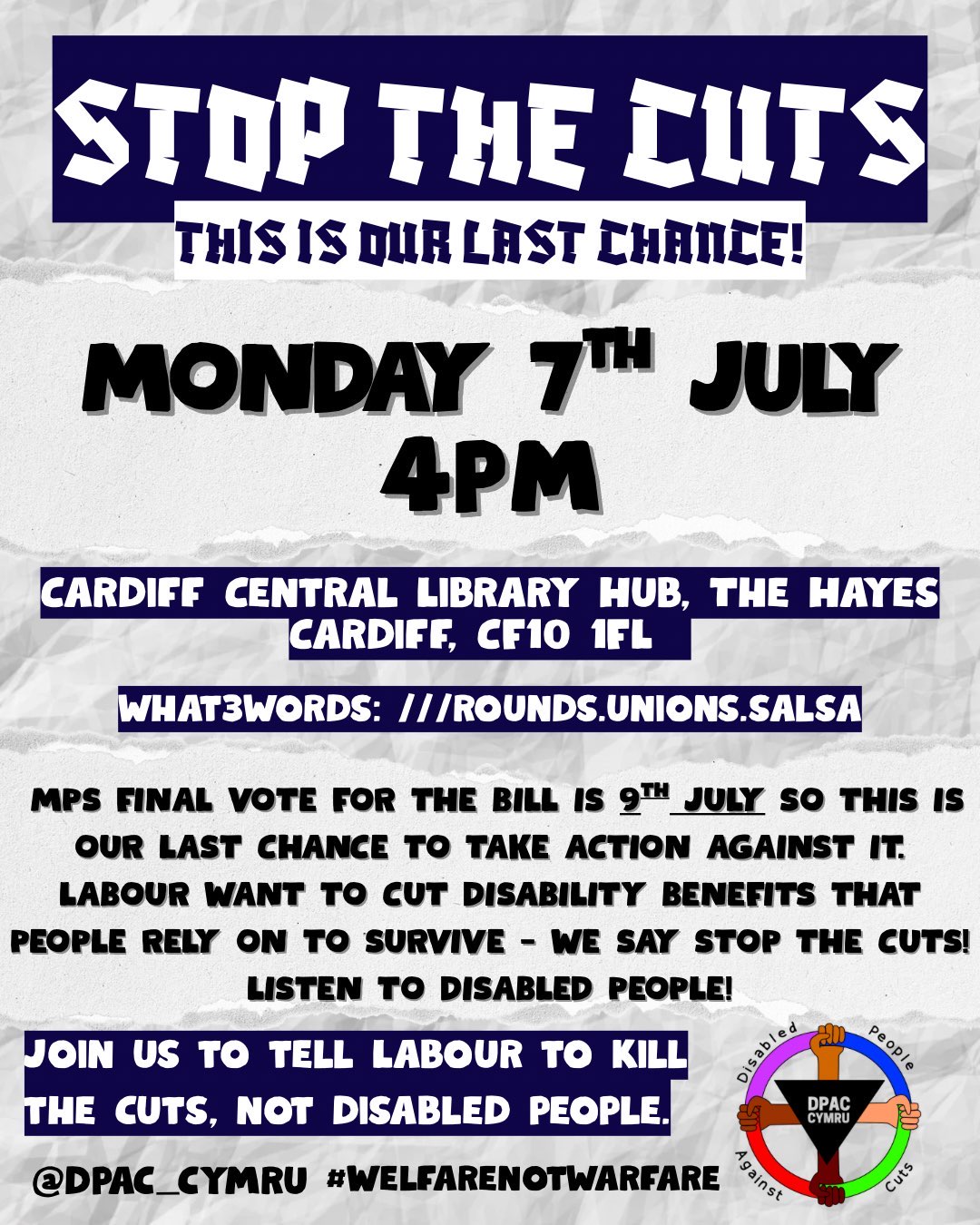
In Cardiff, meet outside Cardiff Central Library Hub.
In Swansea, meet at Castle Square.
All support is welcome! Bring friends and banners etc.
This is ahead of the vote on the bill on Wednesday 9th.
We want to defeat the Labour disability cuts bill entirely.
⚫ The victory on changes to PIP is temporary. It’s a bad bill that will mean MPs voting to approve the results of a review in advance, before it happens.
⚫ We do not trust Stephen Timms to lead the PIP review. He has not acknowledged our concerns about the failures of the original consultation process.
⚫ Under 22s still face loosing Universal Credit health component – an injury to one is an injury to all and we won’t leave anyone behind!
⚫ The bill still contains cuts to Universal Credit for new claimants.
⚫ It’s very uncertain what the bill will mean for people on ESA.
⚫ It is a rushed bill and the government is acting undemocratically.
⚫ The government must stop and listen to disabled people and carers, and consider our consultation responses.
⚫ The bill must be withdrawn and time taken to get it right!
⚫ We have gone beyond “co-production”. This government is incapable of doing it. Disabled people must lead the process of welfare reform, involving carers and the workers delivering the welfare system. Not clueless ministers seeking short-term cost savings.

‘Disastrous’ cuts bill that leaves legacy of distrust and distress ‘must be dropped’ 1
Four disabled Labour MPs stand up to government over cuts to disability benefits 4
Disabled people receiving care were ‘ignored by design’ during the pandemic, Covid inquiry hears 9
Disabled activists warn Labour MPs who vote for cuts: ‘The gloves will be off’ 12
Other disability-related stories covered by mainstream media this week 19
Disabled activists have called on the government to scrap its “dangerous” and “disastrous” disability benefits bill, despite forcing ministers into last-minute changes that scrapped all their planned cuts to personal independence payment (PIP).
Chaotic events in parliament on Tuesday, and three months of activism since the publication of the Pathways to Work green paper, have left disabled people’s organisations (DPOs) appalled, shocked, and struggling to trust the government.
Their activism, together with the efforts of a small group of backbench MPs, forced ministers into a series of U-turns and concessions on the universal credit and personal independence payment bill.
The lack of trust in the government, and in the minister for social security and disability, Sir Stephen Timms, now creates a significant barrier as he begins a year-long review of personal independence payment (PIP), including an examination of its eligibility criteria and assessment process.
A chaotic few hours in parliament on Tuesday led eventually to ministers withdrawing all their proposed cuts to PIP, at least until the end of the review next autumn.
The bill passed its second reading by 335 to 260 votes, and it will return to the Commons on Wednesday (9 July) for its committee stage, with significant cuts to the health element for most new claimants of universal credit from next April remaining in the legislation.
Disabled people’s organisations were united yesterday (Wednesday) in their call for the “sham of a bill” to be dropped, with many expressing distrust in the government.
And there was little celebration that their successful activism – led by Disabled People Against Cuts (DPAC) and other grassroots groups such as Taking the PIP – had forced the government into gutting its bill.
DPAC described the bill as a “complete and utter mess”.
Paula Peters, a member of DPAC’s national steering group, said the process had done nothing but “cause more anxiety and more distress for disabled people”.
She told Disability News Service (DNS) that she did not trust Sir Stephen as he had “shown time and again he doesn’t listen to charities, DPOs or disabled people”.
And she pointed to the concerns – expressed also by some MPs – that the government will merely introduce a new series of cuts to PIP at the end of the review, through a parliamentary mechanism that means they will not need to be approved by MPs.
Svetlana Kotova, director of campaigns and justice at Inclusion London, was also distrustful of the government’s motives.
She said: “The social security system needs reform, but not like this.
“It is clear that this was never about reform, it was about balancing the books at the expense of disabled people.
“Removing PIP cuts from the bill is a positive step, but there is no guarantee the government will be open to true co-production; more likely, they will want us to engage in ‘co-producing cuts’.
“The bill still includes deeply harmful cuts to universal credit.
“The government should admit they made a mistake, drop this harmful bill and go back to the drawing board.”
National Survivor User Network (NSUN) said the decision to gut the bill was “the direct result of tireless campaigning by disabled people and their organisations in recent weeks”.
But it said that the chaotic and confusing way it was passed showed “callous disdain for the lives of disabled people”, while the bill “should have been withdrawn in its entirety”.
An NSUN spokesperson said: “It is vital that co-production through the Timms review meaningfully involves disabled people, putting power in the hands of those whose lives will be most impacted.
“We have seen the violence of the government’s rubber-stamp consultations so far and demand genuine co-production rather than inadequate and tokenistic consultation on an already-decided course of action.”
And it said the refusal to remove the cuts to the health element of universal credit for most new claimants from the bill showed the government “remains willing to attack disabled people” and was “a shameful attempt to divide the disabled community and stifle solidarity”.
The NSUN spokesperson added: “We will continue to organise with DPO allies, push for the rights-based reform which our deadly social security system needs, and ensure there are electoral consequences for those who go after disabled people in this way.”
Disability Rights UK (DR UK) said disabled people would be “enormously relieved” that the PIP cuts had been dropped from the bill, although “serious concerns” remained about the cuts to the health element of universal credit for most new claimants, which would make hundreds of thousands of the poorest people in the country even poorer.
A DR UK spokesperson said: “We’ve known all along that the public, disabled people and our organisations have found this bill to be unjust and unfair.
“Yet the government has used every tool in its arsenal, every procedural trick, to push this dangerous bill through.”
DR UK said the government’s “floundering and chaos” was “a direct result of the steadfast work of disabled campaigners and our allies, who have made it clear that this bill is unworkable.
“Despite attempts to silence us, through our collective campaigning, we made them drop billions of pounds worth of cuts, and we will continue to resist this disastrous bill.”
Rick Burgess, campaigns lead at Greater Manchester Coalition of Disabled People, said Tuesday’s events had demonstrated the “arrogance and disrespect” of the government, and he also called for the bill to be scrapped.
He said the bill still contained cuts to the health element of universal credit, and it imposed “extremely restrictive” criteria on those who will be offered some protection through the “severe conditions criteria”.
He said disabled people would seek to stop these elements of the bill through amendments.
Burgess added: “The PIP review must be to a specified standard of coproduction agreed with our organisations and be subject to statutory public consultation.
“Given our experience to date, however, we have low confidence in the government.
“However, it must also be said, while we lost the vote, we won a victory in gutting the bill and exposing the utter shambles of Starmer’s administration.”
The grassroots, user-led mental health group Recovery in the Bin (RITB) delivered a bleak assessment last night of the impact of the government’s actions.
An RITB spokesperson told DNS: “The whole sequence of events from the announcements, to constant vilification in the media, and from ministers, especially Kendall and Timms, has caused such distress that Labour have ended any hope of support.
“They are loathed and despised, and we have no trust whatsoever in them not to attack us.”
AJ Le Brun, a disabled activist with DPAC Cardiff and Valleys, said the bill had been “rushed through” with no thought for disabled people.
She said: “The changes and promises made in the final hours before the vote may have soothed the consciences of some MPs, but we see through these shaky promises.
“The changes to universal credit will push more of us into poverty, when we are already struggling with the rising costs of aids and support needed to live with dignity.
“I do not trust Stephen Timms and his department to conduct a fair PIP review.
“They have shown us they are not listening to disabled people by only providing one face-to-face consultation for Wales, and holding the vote the day after the consultation formally closed.
“What confidence can we have that this review will be any better?”
Because of the number of changes to the original bill, DNS asked DWP to confirm exactly what the bill would now do.
Here is the list provided by the department (edited for clarity by DNS):
From April 2026:
3 July 2025
Four disabled Labour MPs stood up to their government’s attempts to reduce vital disability benefits, despite ministers’ chaotic last-ditch concessions to rebels that removed a significant chunk of their cuts bill.
Marsha de Cordova, Marie Tidball and Emma Lewell all voted against the universal credit and personal independence payment bill, and each of them delivered powerful speeches in the House of Commons on Tuesday.
Another disabled Labour MP, Marie Rimmer, also voted against the bill.
But a fifth disabled Labour MP, Vicky Foxcroft – who had played a key role in the rebellion that forced a series of government concessions – voted for the bill and its significant cuts to the health element for many new claimants of universal credit.
She and many other Labour MPs who had previously opposed the cuts bill voted with the government after the minister for social security and disability, Sir Stephen Timms, suddenly announced at 5.25pm on Tuesday – nearly four hours after the debate began and just 95 minutes before MPs voted – that there was to be another concession.
Ministers had already announced that existing PIP claimants would not now be subjected to new rules that meant they would have to be awarded at least four points on at least one “activity” to qualify for the PIP daily living component, which were to be introduced from November 2026.
Work and pensions secretary Liz Kendall had also announced the previous day that the government would no longer freeze the health element top-up for existing claimants of universal credit, and that they and new claimants who were terminally-ill or were placed in the “severe conditions group” would instead see the combined value of their universal credit standard allowance and health top-up “rise at least in line with inflation”.
But in a dramatic intervention, Timms then also announced at 5.25pm that no cuts at all to PIP would go ahead until his own review into PIP – which Kendall said would be “co-produced with disabled people, their organisations, clinicians, other experts and MPs” – was completed in the autumn of 2026.
This final concession ensured that the bill passed by 335 to 260 votes.
The committee stage of the bill will take place in just a few days, on Wednesday (9 July), but without any measures to cut PIP.
Marsha de Cordova, a former shadow minister for disabled people, was one of the few MPs in the debate to warn how previous Department for Work and Pensions (DWP) cuts and reforms had led previously to the deaths of many disabled people.
Speaking before the final concessions were announced, she pointed to the many internal process reviews into deaths linked to DWP actions, and the long-delayed second inquest into the death of Jodey Whiting, which found last month that DWP’s decision to wrongly stop her benefits after a string of safeguarding failings was the “trigger” for her to take her own life.
De Cordova told fellow MPs: “I set that out because it is important that we understand that disabled people’s lives have not been valued or respected for the last 14 years.”
She also pointed to the findings of the UN committee on the rights of persons with disabilities, which last April found successive Conservative-led governments had made “no significant progress” in the more than seven years since a finding of “grave and systematic” violations of the UN disability convention.
Marie Tidball delivered an emotional speech, in which at times she appeared close to tears, in which she told MPs she would be voting against the bill “with a heavy, broken heart”.
She said she had been in discussions with ministers since April, “making clear that I could not support the proposals on PIP”.
She added: “PIP is an in-work benefit designed to ensure that disabled people can live independently.
“Low-level support such as PIP helps to build the bridge to the deinstitutionalisation of disabled people, keeping us out of the dark corners of hospitals, prisons and social care settings.”
Tidball voted against the bill despite the late concession from Sir Stephen Timms that ruled out all PIP cuts until the end of his review.
Emma Lewell also voted against the bill, despite the late concession.
She had told MPs that past Conservative social security reforms had not led to any cost savings but instead to “an increase in poverty, an increase in suicides, strain on the NHS and other public services, and, in the long run, higher welfare spending and reduced growth”.
But two other disabled Labour MPs, Liam Conlon and Jen Craft, voted for the bill, although they did not speak during the debate.
Steve Darling, the disabled Liberal Democrat MP and his party’s work and pensions spokesperson, voted against the bill, as did the rest of his party.
He had told MPs: “We all know that rushed bills are poor bills, and the law of unintended consequences will come to haunt the government if this bill goes through.”
Rachael Maskell, who was among leaders of the rebel Labour MPs – and proposed an amendment that would have killed the bill, but was defeated by 328 to 149 votes – told MPs in another passionate speech that she was voting against the bill because it was “a matter of deep conscience, as it should be and will be for us all”.
She was another MP who highlighted the harm caused by previous cuts and reforms to disability benefits, pointing to the 600 suicides between 2010 and 2013 that were linked to the programme to reassess incapacity benefit claimants.
Maskell said: “When they are managing discomfort, despair, pain and prejudice, are isolated and lonely, or their life has spiralled out of control, disabled people want anything but this bill.
“They are already discriminated and dehumanised, so I plead that we do not leave them desperate, too.”
There was disappointment among many disabled people that among those voting for the cuts to the universal credit health element was Labour’s Debbie Abrahams, chair of the work and pensions committee, who had been outspoken about her concerns about the “dog’s breakfast of a bill”.
She had told MPs that “too many people relying on social security support to survive have died through suicide, starvation and other circumstances exacerbated by their poverty” in the last 15 years as a result of the “punitive, even dehumanising, social security system in which not being able to work has been viewed with suspicion or worse, with devastating consequences”.
But she still voted for the bill, despite its significant cuts to the rate of universal credit that will be paid to most new recipients of the health element of universal credit from next April, who will see the health element nearly halved and then frozen.
Asked last night (Wednesday) why she had voted for the bill, despite the significant cuts to disabled people’s support that it still contains, Vicky Foxcroft referred Disability News Service to a statement on her website.
She did not mention those cuts in the statement, but she said that securing the concessions was “a huge victory for Labour backbenchers” and that she voted for the bill because it was “now in a much better form than it was two weeks ago”.
She said she would only vote for the bill at its final Commons stage “if the final proposals reflect the commitments ministers have made”, and that she would be “looking for ministers to take these commitments forward and ensure we have co-production right across government”.
Because of the number of changes to the original bill, DNS asked DWP to confirm exactly what the bill would now do.
Here is the list provided by the department (edited for clarity by DNS):
From April 2026:
3 July 2025
Labour’s chair has refused to answer questions about a disabled constituent whose suicide was closely linked to flaws in the personal independence payment (PIP) system, just as her government was trying to cut PIP spending by billions of pounds a year.
Three months after an ombudsman found that failings within the Department for Work and Pensions (DWP) and its PIP system were a factor in the death of Tracie, from south London, her MP, Ellie Reeves, is still refusing to comment on that report’s findings.
Reeves is chair of the Labour party and a Cabinet Office minister, but she is also the sister of chancellor Rachel Reeves, who many disabled people blame for the government’s decision to attempt to slash spending on PIP and other disability-related benefits.
The ombudsman’s ruling was delivered to Tracie’s husband, Mustapha, just five days after Rachel Reeves announced, at the spring statement, that she would be making cuts to PIP spending of £4.5 billion a year by 2029-30.
It was Ellie Reeves, the MP for Lewisham West and East Dulwich, who referred the case to the Parliamentary and Health Service Ombudsman in December 2021, when Labour was still in opposition, and her office has supported Mustapha for nearly five years.
But since the ombudsman finally produced its report in March, Mustapha has not yet been able to discuss its contents with his MP.
He was originally told that Reeves was happy to discuss the report but had not yet received a copy, so he visited her office last month and posted a hard copy through the letterbox after an emailed copy apparently did not reach her.
Her office claims it did not receive a copy of the report until 18 June.
The ombudsman has apologised for not sending her a copy on publication, as it usually would; it finally emailed her a copy this week, but it is not clear why her office did not attempt to secure a copy of such an important report herself.
A member of her casework team has now told Mustapha that she – although not the MP – would be happy to discuss the report with him.
Mustapha has provided permission to Ellie Reeves to discuss the case with Disability News Service (DNS).
But the MP has so far failed to respond to questions from DNS, including what conclusions she has reached about the safety of the PIP system, in the context of the billions of pounds her sister has been trying to cut from PIP spending, and whether she would be taking any action on her constituent’s behalf.
Reeves has also refused to comment on the possible harm that could be caused to other disabled people like Tracie if the billions of pounds of cuts to PIP had gone ahead.
DNS first put the questions to Reeves on 7 April, nearly three months ago.
The ombudsman had concluded that DWP’s failings in dealing with Tracie’s PIP claim were a “significant contributing factor” in her decision to take her own life in March 2020.
Tracie’s mental health had been stable, but she “spiralled into a deep depression” after DWP removed the daily living part of her PIP following a review of her eligibility in July 2019.
The ombudsman concluded that DWP – which eventually admitted that its decision on her claim had been wrong – failed to consider the relevant evidence properly.
The ombudsman is now looking at whether DWP needs to make “wider changes to its service and the way it considers benefit claims”, as part of a broader piece of work which includes an investigation into the death of another disabled claimant.
Asked for an update on this work, a spokesperson for the ombudsman said: “This work involves an ongoing investigation.
“By law we investigate in private so we cannot comment further on this.”
DWP eventually decided – after her death – that Tracie should have been entitled to the enhanced daily living rate of PIP.
DWP accepted that Tracie had needed help from another person to get in and out of the bath; couldn’t wash all her body herself; relied on incontinence pads; needed assistance to take her medication; had paranoid thoughts and felt anxious when others were around; rarely left the house; avoided mixing with other people; and experienced significant mental distress and suicidal thoughts.
But despite her significant support needs, the report shows that someone with Tracie’s level of impairment would not have qualified for even the standard rate of the daily living part of PIP if the chancellor’s cuts had been implemented from November 2026.
This is because to qualify for PIP daily living, a new claimant would have needed at least four points in at least one “activity”, and the most Tracie qualified for in any single activity was three points.
The ombudsman’s findings have therefore been posing a political headache for Ellie Reeves, although that eased this week when a chaotic parliamentary debate saw ministers withdraw all cuts to PIP from the universal credit and personal independence payment bill, with future cuts not to be considered until after a ministerial review (see separate stories).
The ombudsman finally sent Reeves a copy of the report on Monday, three days after DNS had asked when the MP had received the report.
A spokesperson for the ombudsman said: “The usual procedure after a parliamentary investigation is closed is that the report would be sent to the referring MP on the same day as the complainant and organisation involved.
“In this case, human error meant the report was not sent to the MP.
“We have apologised to the complainant and MP for this error.
“We will learn from this mistake to prevent it from happening again in the future.”
*The following organisations are among those that could be able to offer support if you have been affected by issues raised in this article: Mind, Papyrus, Rethink, Samaritans, and SOS Silence of Suicide
3 July 2025
Four national disabled people’s organisations (DPOs) have told the Covid inquiry that people who receive care and support were “ignored by design” during the pandemic.
The inquiry heard on Monday that there were more than 43,000 deaths involving COVID-19 in care homes across the UK between March 2020 and July 2022, although there were no figures given for how many disabled people died in their own homes while receiving care services.
The inquiry also heard that, during the first two peaks of the pandemic, before vaccines became widely available, people with learning difficulties were seven to nine times more likely to experience a COVID-19-related death than people without learning difficulties.
And more than a quarter of all deaths from COVID-19 in 2020 were in people with dementia, even though they only made up two per cent of the total adult population.
Disability Rights UK (DR UK), Disability Action Northern Ireland, Disability Wales and Inclusion Scotland have together been granted “core participant status” in module six of the UK Covid-19 Inquiry, which is examining the impact of the pandemic on the adult social care sector across the UK.
Their opening statement for module six was delivered on Monday by barrister Danny Friedman, from Matrix Chambers.
He told the inquiry that the pandemic saw care settings become life-threatening, while “care services to sustain everyday basic quality of life were withdrawn”.
He highlighted how the Scientific Advisory Group for Emergencies (SAGE), which provides advice to government during emergencies, stated in May 2022 that no UK country was able to “routinely identify who is resident in care homes, who is receiving social care at home, and who works in or visits a care home or a person’s home”.
These data weaknesses meant the “recipients of care, the way they live, and the way that many of them died, was ignored by design”, said Friedman.
The DPOs’ opening statement said that care staff were allowed to move from care setting to care setting, spreading the virus, because those in charge knew the system would “collapse” if staff were forced to work only in one location.
Friedman said: “Care homes would go under. People would be abandoned. It was decided that the lesser of evils was hazardous movement of staff.”
The DPOs also highlighted how the “very first thing” the UK government did in the pandemic was to “legislate to take their rights away” under the Care Act.
But Friedman said that only eight local authorities in England lodged reports to show they were operating under these emergency care laws, even though the evidence showed there were “vastly reduced services across the country”, which meant local authorities must have “embarked on mass violations of the law”.
He said: “Some local authorities reduced their services to basic life and limb protection, social contact services were drastically cut, leaving people with dementia, learning disabilities and learning difficulties and mental ill-health totally isolated for long periods.
“The singular benefit of easements was that the law required reasoned, recorded, and open decision-making about withdrawal of services and disclosure of that fact to central government, but across the system, that is the one thing that local authorities near uniformly appear not to have done.
“Government then helped to misrepresent the human cost by finding false consolation that only eight reports were made.
“Rather than taking steps to enforce the law, the result is one of the singularly worst failures of accountability, and indeed illegality, across the period.”
The DPOs also highlighted that the government had focused on care homes and not domiciliary or supported care settings when it thought about issues such as providing personal protective equipment, testing for the virus, and getting hold of food.
Friedman said: “All these things were afterthoughts, grafted on to government responses far later than for hospitals and residential settings, if at all.”
The inquiry had heard earlier that its module six investigation had gathered more than 200,000 pages of evidence.
The hearings will last five weeks, and about 55 witnesses will give oral evidence.
Nearly 47,000 people have shared their experience of the care sector during the pandemic with the inquiry’s Every Story Matters listening exercise, the inquiry heard.
After the hearing, Georgia Bondy, who is working for DR UK on the inquiry, said: “The government needs to take responsibility for the fact that its lack of planning, consultation and care is part of the reason so many disabled people receiving care died and suffered during the pandemic.”
Rhian Davies, chief executive of Disability Wales, said: “Curtailing disabled people’s rights under the Social Services and Wellbeing (Wales) Act (2014) was one of the earliest decisions taken by Welsh government at the outset of the pandemic and paved the way for Wales experiencing the highest death rate from Covid-19 amongst disabled people in the UK.”
And Nuala Toman, head of accessibility at Disability Action Northern Ireland, said: “The pandemic exposed a brutal truth: disabled people were not only forgotten, they were disregarded through planning and service design failures.
“The UK and Northern Ireland’s fragmented and underfunded care system, combined with institutional ableism, led to preventable deaths and trauma.
“Unless our governments act now, we are knowingly walking into the next crisis with the same failures.”
Heather Fisken, chief executive of Inclusion Scotland, said: “If there was ever any emergency planning around these vital services and supports, disabled people were unaware and not involved.
“As a consequence, tens of thousands of disabled people lost vital support, often overnight, and were put at increased risk of contracting COVID.
“Today, some still don’t have the support they had prior to the pandemic.
“Governments need to take this learning forward and work with our organisations to ensure social care support is invested in and systems around it are strengthened and people-led so that this never happens again”.
3 July 2025
Labour MPs were given their final warning by disabled activists at a sweltering rally outside parliament on Monday that, if they vote for cuts to disability benefits, the “gloves will be off”.
Ellen Clifford, one of the key organisers of the rally and award-winning author of The War on Disabled People, warned MPs of the consequences if they voted for the cuts.
She told the #WelfareNotWarfare rally, which took place a day before MPs voted on the cuts in the universal credit and personal independence payment bill (see separate stories): “I know that disabled people will fight to the end.
“We are not going to let this through without one hell of a fight. And if it does, we are not going to forgive any Labour MPs who either vote for it or abstain.”
Paula Peters, from Disabled People Against Cuts (DPAC), said any Labour MPs who voted for the cuts would be forced from their seats.
She said: “Let’s tell these MPs: the gloves come off. We turn the anger into action and we’re not going to back off.”
John McArdle, co-founder of the Scottish grassroots group Black Triangle Campaign, warned Scottish Labour MPs – including his own MP, Ian Murray – that disabled people would “wipe the floor” with them at the next general election if they backed the cuts.
“Any of these MPs that vote for this bill… if you vote to push us into the most appalling poverty and despair, we will wipe the floor with you at the general election, we will boot you out of Scotland.”
Among the speakers was Joy Dove, who has fought for justice for eight years for her disabled daughter Jodey Whiting.
She took her own life in February 2017 after the Department for Work and Pensions (DWP) wrongly removed her out-of-work disability benefits following five missed chances to save her.
Dove read out part of the ruling given by the coroner at a long-awaited second inquest last month, which concluded that her daughter’s benefits had been “wrongly” withdrawn.
And she warned that other disabled people could die if the cuts went ahead.
She had a message for the department: “DWP, you killed my daughter, and I don’t want it to happen to anybody else.”
Dr Natasha Hirst, disabled activist and former president of the National Union of Journalists, also spoke of the harm the cuts would cause.
She said the bill would take money from disabled people “who are already struggling to survive.
“We know this will harm them, we know this bill will kill people.
“MPs need to listen to their disabled constituents. Take the money from those who can afford to pay, not those who can’t.
“We will not forget how you vote.”
Welfare rights adviser Emma Cotton told the rally of the damage already caused by 15 years of austerity.
She said: “I have seen the damage that austerity has done. I have been a witness to a near-total degradation of the UK social security system.”
Fazilet Hadi, from Disability Rights UK, was among those who mentioned the government’s pledge that it was now going to start co-producing policy with disabled people.
She said: “That is absolute rubbish. If they had wanted to co-produce with disabled people, they should have talked to us a year ago… they should have put these proposals in the green paper… they should have stopped rushing this bill through.”
She said earlier: “It is absolutely shameful what this government is doing to disabled people, and it will be shameful for Labour MPs if they vote with the government.
“Successive governments have made us poor, successive governments have put the NHS on its knees, successive governments have taken away social care, successive governments have made us a society where disabled people are becoming sicker and new disabled people are coming on stream because of homelessness, poverty, and lack of food.”
There were regular outbursts of anger among speakers, including from Mac, from Crips Against Cuts, who told the rally: “Tax the wealthy, instead of killing the crips.”
Several disabled speakers – including Clifford – also spoke of their pride in a disability community that continues to fight, despite 15 years of battling against austerity cuts.
The rally was led by DPAC, and supported by the Taking The PIP campaign and Crips Against Cuts, as well as mainstream campaign groups Stop the War Coalition, The People’s Assembly, The Trade Union Coordinating Group, and We Demand Change.
There were several speeches from members of the disabled people’s Taking the PIP anti-cuts campaign, including actors Cherylee Houston, Lisa Hammond and Cerrie Burnell.
Houston said: “How dare they try to reduce our futures, how dare they try to infer that we are of less value, a lesser part of society.
“We need to stand up and hold firm. They cannot strip away years of legacy within our community.
“I’m here alongside everyone else to say stop this bill, stop it now before more people die.”
Hammond said the concessions made by ministers were “nothing more than political spin.
“They are designed to buy off rebellion, not to protect our rights.”
Among others who warned of the consequences of the cuts was Angela Grant, president of the DWP group of the PCS union, who said: “Many of us, including me, depend on PIP to keep us in work.
“I would not be able to work if they came after PIP.”
She added: “They do not care, they are not listening, until we make them listen.
“We stand together because if we start letting them divide us, divide us in our communities, they will break us down one by one.”
Hamza spoke of the impact on fellow disabled asylum-seekers, and he told the rally: “We are here today to fight for our fundamental human rights.
“We fight to win, or we die fighting.”
The rally was temporarily disrupted by protesters from a rival rally who supported the right of Israel to continue its genocide in Palestine and to continue bombing Iran, and supported the son of Iran’s former Shah and want to see regime change in Iran.
They had edged closer and closer to the disabled people’s rally, and several of their supporters appeared intent on antagonising and intimidating disabled activists, with several reports of aggressive disablist abuse.
When disabled activists saw this begin to happen, they linked arms with allies to protect disabled people and their rally and continued to chant “welfare not warfare” until the pro-Israel protesters eventually melted away.
Although police officers had been seen dragging away at least two members of the pro-Israel rally, the Metropolitan police said afterwards that they were not aware of any arrests.
Several of the pro-Israel supporters refused to talk to Disability News Service, but one of them claimed they were opposed to Stop the War Coalition, which was supporting the anti-cuts rally, and he criticised the argument that cutting spending on bombs would allow increased spending on social security.
The disabled people’s rally also included songs from disabled activist and singer-songwriter Sophia Kleanthous, who minutes earlier had been part of the human barrier.
Her songs included a new anti-cuts anthem written for the rally: Cut Us Until We Bleed.
As she introduced the song, she told the rally: “We will not allow people to divide us.
“We will not support war, and we will not support these cuts.”
At the end of the song, activists displayed a huge new banner, which said: “You Cut We Bleed.”
A string of MPs spoke at the rally to express their solidarity with disabled people, including Labour’s Ian Lavery, Andy McDonald, Richard Burgon, Lorraine Beavers and Brian Leishman, former Labour leader – and now an Independent MP – Jeremy Corbyn, and fellow Independent MP Adnan Hussain.
Burgon told the rally: “You’re saying, and we support you, that enough is enough.
“Let’s be clear: this bill was brought to save money. This bill was brought to do that by making things worse for disabled people in this country.”
And he sent a message to fellow Labour MPs: “Certain votes in parliament define you, certain votes in parliament will be remembered not only for the rest of your political career, but probably for the rest of your life.
“It’s about time that my colleagues got an inch of the guts, an inch of the courage of disabled people outside here today, and did the right thing.
“Don’t talk to me about agonising over the vote – the people agonising are disabled people across the country who are worried about the future.
“Don’t talk to me about agonising on £93,000 a year, do the right thing for God’s sake.”
3 July 2025
A British news channel has said it has nothing to apologise for after a right-wing commentator and comedian suggested the best way to cut the number of disabled people claiming benefits was to starve, or even shoot, them.
It is just the latest example of disability hate speech broadcast and published by mainstream media organisations over the last 35 years that have run in parallel with government attempts to cut spending on disability benefits.
GB News presenter Patrick Christys had told viewers that “welfare needs to be cut” – while ignoring the evidence that working-age social security spending is stable as a proportion of GDP* – before claiming that the prime minister was not “doing much” to cut disability benefits.
He then asked his guest Lewis Schaffer how he would “get them off their backside”.
Schaffer replied: “Just starve them, that’s what people have to do, that’s what you’ve got to do to people, you can’t just give people money.”
He then added: “What else can you do? Shoot them? I mean, I’d suggest that, but I think that’s maybe a bit strong.”
Christys then replied: “Yeah, it’s just not allowed these days.”
On his X/Twitter profile, Schaffer describes himself as a “virologist, cardiologist, climatologist, historian”, but elsewhere he is described as a “comedian and broadcaster”.
One of the earliest commentators to pick up Schaffer’s comments was “Maximilien Robespierre”, who described the comments on his YouTube channel as “dangerous rhetoric”.
GB News originally refused to comment, but it eventually produced the following statement for Disability News Service (DNS): “Having reviewed the comment, which is clearly comedic, GB News does not consider there is anything that requires an apology, or further explanation.”
But Dr Natasha Hirst, disabled members’ representative for the National Union of Journalists, told DNS: “It is appalling and unacceptable for an Ofcom-regulated broadcaster to encourage and allow discriminatory and harmful commentary about disabled people.
“Suggesting violence towards disabled people is no joke and has real-life consequences by emboldening hate speech and harassment.
“We expect Ofcom to do its job as a regulator and investigate the complaints raised with a recognition of the wider context of exclusion and abuse that disabled people experience in their daily lives.”
Disabled campaigner Ben Scott called for GB News to be shut down by the broadcasting regulator Ofcom because of the “astronomically shocking” and “appalling” rhetoric.
He said Schaffer’s comments reminded him of Nazi “useless eater” rhetoric from the 1930s, which eventually led to the targeted killing of hundreds of thousands of disabled people in Germany through the Aktion T4 programme.
After Scott criticised him on X, Schaffer repeated some of his comments, posting: “I’m suggesting ‘starving’ or and then ‘shooting’ the disabled, to lower costs!”
This week, Schaffer’s website appeared to have been taken off-line, but Wikipedia describes him as “an American comedian and broadcaster” who is also a GB News presenter.
The comments come just three months after the Department for Work and Pensions drew horrified comments after publishing figures that showed the total cost to the economy of disabled people who cannot work, which was described as a “chilling” echo of the propaganda of 1930s Germany.
Ofcom confirmed that there had been complaints about Lewis Schaffer’s comments, but because there were less than 50, it was unable to say how many.
An Ofcom spokesperson said: “We are assessing complaints about this programme against our broadcasting rules before deciding whether or not to investigate.”
*Gross domestic product, the size of the country’s economy in a particular year
3 July 2025
Only one in four inspections of local services for disabled children in England last year concluded that they usually lead to “positive experiences and outcomes” for those young people, the education regulator has announced.
The findings from Ofsted showed that 28 inspections of special educational needs and disabilities (SEND) services in local areas were carried out in 2024, but only seven led to a positive report.
Six of the inspections – which do not involve inspections of schools – concluded that there were “widespread and/or systemic failings” in local services which led to “significant concerns”, while the other 15 concluded that there were “inconsistent experiences and outcomes” for children and young people with SEND.
The inspections are carried out jointly by Ofsted and the Care Quality Commission, a process which began in January 2023, with every area supposed to be inspected at least once every five years.
Only about a third of 153 local areas have been inspected so far.
Dr Edmore Masendeke, policy and research lead for The Alliance for Inclusive Education, said the figures were “not surprising” and reflected the continuing segregation and exclusion of disabled children and young people within the education system.
He said: “What ALLFIE sees is a growing investment in segregation and deliberate dismantling of any progress made towards inclusive education.”
He said this was happening in areas such as Newham, in east London, where Sir Stephen Timms, the minister for social security and disability, is MP for part of the constituency.
In January 2024, there were 576,000 children and young people aged up to 25 with an EHC plan, and another 1.2 million pupils receiving SEN support in school.
The worst-performing area since the inspections began in January 2023 is the East Midlands, where four areas were found to have “widespread/systemic failings” and just one was found to be “typically positive”.
The North West has also performed poorly so far, with four failing areas, three inconsistent, and one positive.
The best was North East, Yorkshire and the Humber, with four positive, five inconsistent and none found to be failing; London is not far behind, with three positive, six inconsistent, and just one failing.
Masendeke said: “For years, ALLFIE has repeatedly warned that disabled children and young people are being harmed by all forms and practices of segregated education, which continue across all areas of learning but does not lead to inclusive education experiences, where all students are taught together in the same classroom and settings alongside their peers.”
He added: “ALLFIE is also deeply concerned that just a third of local areas have been inspected so far.
“How many more disabled children and young people are enduring the same poor educational experiences, or worse?”
He said the findings came at a time when there were serious threats to the legal protections provided by education, health and care plans.
And he said there appeared to be a “wider move by government to disrupt inclusive education by reducing disability provision and support, redirecting funding from mainstream settings to expand segregated provisions, including building more units within mainstream schools and increasing the number of segregated schools”.
An Ofsted spokesperson said: “These statistics highlight that the outcomes and experiences of too many children with SEND are not as positive as they should be.
“We recognise the SEND system is under significant pressure; however, it is vital that improvements are made so children get the support they need.”
The inspections evaluate arrangements for all children and young people with SEND aged up to 25, including those who have an education, health and care (EHC) plan and those who receive special educational needs (SEN) support.
They examine the education, social care and health services provided to disabled children and young people in the local area, including the structure of the local education system, school attendance figures, school transport, employment data for those who have left education, provision of short breaks, transition into adult social care, and performance data on health services.
As part of the inspections, they visit schools and other settings and services, and gather the views of parents and carers, children and young people.
CQC had not commented by noon today (Thursday).
The Department for Education had also not commented by noon today.
3 July 2025
Discharging untested patients from hospitals to care homes during the Covid pandemic was the “least worst decision”, the former health secretary Matt Hancock has told a public inquiry. In his testimony to the UK Covid-19 inquiry, Hancock defended the decision – which was later ruled illegal in a high court judgment – to move hospital patients into care homes during the early weeks of the pandemic to free up space: https://www.theguardian.com/uk-news/2025/jul/02/matt-hancock-covid-inquiry-care-homes-hospital-discharge-policy
3 July 2025
News provided by John Pring at www.disabilitynewsservice.com

Stephen Timms, the Minister of State for Social Security and Disability, has now replied to the letter from Disabled People Against Cuts sent three weeks ago.
Our letter raised serious concerns with the quality and fairness of the so-called “consultation” being carried out on disability benefit cuts. We asked for the consultation to be extended, and for urgent action to address the failings.
Stephen Timm’s reply, available here, does not address any of the concerns, and he refuses to extend the consultation process.
The minister has not yet replied to the letter from DPAC Cymru, also sent three weeks ago, requesting a meeting following the failures of the DWP in organising the only in-person consultation on the disability cuts in Wales. That letter said:
We are concerned you still do not understand the failures of your department. We have had no indication from you, or the DWP, whatsoever, in any statement, that you understand that the consultation was organised in a way that was unsuitable for disabled people.
Given Timm’s lack of understanding of his department’s failures, we have no confidence in him leading a wider review into PIP.

In total, the trade union movement represents 1.4 million disabled workers.
Now a trade union representing more than 1.2 million workers has called for the entire welfare bill to be dropped and for government to start again.


Dear Liz Kendall Secretary of State for Work and Pensions,
(For the attention of all MPs and ministers)
We the undersigned are trade unionists opposed to the Universal Credit and Personal Independence bill, designed to restrict access to PIP and to reduce the sickness element (LCWRA) of UC. We believe this is shameful anti-worker and anti-working class legislation.
We represent union members, advisers, caseworkers, officers, housing workers, work coaches, local government and charity workers, finance sector workers, and other roles who work with those on the sharp edge of the disability benefits system. Some of us are also disabled members or carers across our unions, with the double whammy of working in these organisations and being financially impacted. Over a decade of austerity has forced disabled people into even greater poverty, and these cuts will only exacerbate the underlying barriers and widespread discrimination that still shut disabled people out of the workplace.
Our experiences and knowledge of this sector can provide vital insight into the catastrophic impact the proposed welfare cuts are likely to have. The benefit system is already a punitive, degrading, and impoverishing system that has cost lives through assessments, sanctions, and disallowance of benefits. These cuts will only worsen that reality. Cuts kill – particularly as hundreds of thousands more are pushed into poverty.
Not only will these cuts cause increased financial hardship for some of those made vulnerable by a disabling society, but will also add considerable expenses and a much increased workload to workers in several sectors. This is because more people will be plunged into debt. More people will be served with eviction notices (as they won’t be able to pay their rent/bedroom Tax/service charges). In many cases, disabled workers will be faced with the possibility that they will lose PIP and no longer be able to afford to service the additional needs that enable them to remain in the workforce. Cutting incomes will push people further from work, just as sanctions do. This will create misery and resentment in addition to requiring further public services & resources.
The Disability Policy thinktank forecast that the cuts will lead to £1.2bn in extra costs for the NHS and local care services provided by councils, raising the alarm for both councillors and MPs whether the cuts will backfire even on their own economic terms.
More people:
won’t be able to afford food or bills, with 4 million already using foodbanks and limited or cut off energy supplies, whilst those industries’ bosses increase their profits off the back of us all.
will have their linked benefits stopped, including carer’s allowance and the carer element of UC, disproportionately impacting unpaid carers, women and children when child poverty and homelessness are already at record levels
will be excluded from work or forced into unsuitable work which worsens health, with many working families who rely on UC to top up poor wages also to be hit by the reforms.
Benefit cuts harm all working class people, increasing conditionality and forcing us to tolerate exploitative work and accept poorer terms and conditions. The scapegoating of benefit claimants intensifies division and competition and weakens solidarity in our communities.
Local government departments have faced cut after cut and already struggle to have enough staff or resources to support more in need. The voluntary sector has been needed to act up for several years to plug gaps due to Tory austerity, and currently struggles to meet demand.
Funding for debt advice has been reduced and there is insufficient support to help the current number of people with debt and advice.
Access to Work already sees delays of around a year for decisions to enable disabled people to take equal part in work. This is not being resourced as needed.
The proposed cuts by a Labour government will make all of this considerably worse:
It will further strain the already overburdened third and public sector. Staff stress will increase, when many already suffer anxiety and poor well-being in the third and public sector because of understaffing and excessive workloads.
Communities will be further demoralised and disenfranchised, or will turn to alternatives that do not represent working class interests.
The Trade Union movement should not only fight to defend the social security system from cuts, but also demand a transformative alternative that centres human dignity, regardless of ability to work.
DPAC and many others have argued for a welfare system that works for us all, removing the private sector involvement and its punitive measures.
With over £20 billion unclaimed, these cuts and the disproportionate targeting of disabled people do not add up. An FOI request found that 87% of those in receipt of the standard rate of PIP daily living, and nearly half of PIP claimants overall, could stand to lose out under the cuts – the scale is much more significant than the Government is letting on.
CPAG also estimated that the benefit bill has been held down by £36 billion annually as a result of caps, freezes and cuts since the 2010s, including the 2-child limit, bedroom tax and benefit cap. Means-tested benefits have been squeezed for over a decade, plunging people into poverty and worsening their health.
Our welfare spending is relatively low as a share of GDP compared to other European countries, even accounting for the increase in PIP claims, simply reflecting worsening health, increases in retirement age, and record waiting lists. Fraud in the PIP system is negligible. Amnesty have stated the inadequacy of benefits violates human rights, and that the system is consciously cruel – it does not need to be made even more restrictive. Civil society, third sector and disabled people’s organisations have been unanimous in their opposition to these ruthless cuts, with Citizen’s Advice condemning the reforms in a ‘Pathways to Poverty’ report and calling for them to be cancelled.
The proposals on unemployment insurance are a further mockery of this being about ‘making work pay’ – severing the link between national insurance credits someone has earned and their ability to rely on an indefinite sickness benefit if they become unable to work, even when made ill by work itself. The cuts are putting cart before horse: investment in employment support is set to have a minimal impact on getting people into work, with job vacancies falling and the Employment Rights Bill not yet implemented.
The consultation has been focused on a few of the changes, and Wales has not had an accessible consultation. That alone should mean this bill should go no further. The changes are being rushed through Parliament to make savings within rigid fiscal rules rather than improve work prospects, and MPs will not have had the chance to review the consultation responses before voting. At every stage the due democratic process and co-production with disabled people, as the Work and Pensions Committee has also called for, has been sidestepped. This concerns us all as trade unionists striving for a more equitable and democratic society.
Instead of balancing the books on the backs of those who can least afford it, Labour should be making the political choice to tax extreme wealth in society, redressing the runaway inequality that has seen the 50 richest families in Britain own more wealth (over £500bn) than half of the rest of the population. We commend the MPs that have submitted an amendment to Parliament to decline a second reading of the bill, and those who have pledged to vote against the bill. We demand that the Government withdraws these cuts, or the Labour Party will be turning its back on workers and working-class communities across the country.
Luke Dukinfield, Unite, Senior Workplace Rep, NEYH CYNfP RISC & Young Members Committee
Ben Golightly, Prospect member (Tech Workers’ Branch).
Arti Dillon Unite 524 branch CYNfP sector & Southwark Trades Council
Helena Navarrete Plana, Unite the Union
Amelia Bradley-Newby, Unison
Rachel eborall
Clara Paillard, Unite the Union, National Industrial Sector Committee (Not For Profit)
Irene McNally, Unite the Union
Clive Walder, Unite
Dara FitzGerald. Vice-Chair Unite Digital and Tech branch
Eric Segal Kent Retired members (SE100R1) branch committee member
Michael Agboh-Davison, Unite
Sean Brogan Chair Unite Community Plymouth and South Devon
Ben Goldstone, Unite LE1111 Housing Workers branch – Equality Officer and Workplace Rep
Jamie Sims, Unite, former workplace rep
Michael Harrison, Unite The Union, Chair of Unite Community Wales and vice chair of Unite Community National Campaign Forum.
James Clements, PCS
Rob Williams chair Unite LE/1228 branch
Charlotte Powell, Unison and UCU Steward
Joseph Meldau, Equalities Office, Unite the Union, Bristol City Council Branch, & a member of Unite South West Disabled Members Committee
Helen Dunster, Unison Representative
Alistair Tice , Unite Community member
Mike Moore, Birmingham University UNISON, Joint Branch Secretary
David Reid (Treasurer, Cardiff General Unite)
Vicki Morris, UNISON University of Nottingham branch secretary, Higher Education Service Group Executive
Mike Vaughan UNISON Branch Secretary
Catherine mcdonagh
Andrea Gilbert GMB Accompanying Rep
James Brackley, UCU
Ioana Cerasella Chis, University of Birmingham UCU & UNISON branch member
Gurbinder Gill, RMT
Steve Merriman, South Yorkshire Retired Members Branch
Mark Sage, Unite Community member
Sacha Ismail, UNISON, FBU
Jackie Lederer Unite Community Branch Secretary
Sally Heier, UCU, University of Leeds Branch Committee Member
Kevin protheroe
Millie Wild, Unite
Karen Drysdale, Unison
Tanis Belsham-Wray. Secretary of Unite NE/403/15 (Community, Youth and Not4Profit).
Tamsila Tauqir, UWE UNISON, Vice-Chair
Stephanie Tailby UCU South West Retired Members Branch
Sarah Horton, Unison
Christine Thomas, Unison
Rob Prince, UNISON, Branch treasurer
Serenity baskett, Unite the union, union rep, lgbt committee member
Jonathan Golding, Branch Secretary, Unite Community, Cardiff & Area
Deborah Butt ASLEF Branch Secretary and Union Learning Representative
Celine Petitjean, Bristol UCU, Membership secretary
Jamie Strudwick, member of Unite
Pauline Brady, Unison, Equalities Officer
Kevin Daws, Treasurer of Gloucester & District Trades Union Council, Branch Equalities Officer of Gloucester SW/007 Branch, UCU South West Regional Equalities Officer
VC – UCU UWE
Bev Keenan Unite Community branch secretary
Barbara Hulme, Unite Community
Sue Wilbraham, Cumbria UCU, Environment rep
Ajit Chuhan UCU Bristol
George Gray
Leisa Taylor, Unite
Ian Townson, Unite Community, Equalities Officer
Lee Starr-Elliott CWU Bristol and District Amal vice chair, equality officer and SW regional disability officer
Pippa Dowswell, Joint Secretary, Islington NEU
Elane Heffernan, UCU Kent Equalities Officer (and PIP claimant)
Eleanor Lisney, NUJ member.
Elizabeth Mawle, Unite
Gwen Vardigans activist Unite community
Katharine Johnston, UCU
Sandra Wyman Unite Community
Zarria Phillips Bristol & Glos area Unite Community
H.Benjafield
Stephanie Mulrine, UCU North East Regional Committee
Steve Jones. CWU Senior Field Official. Convenor Haringey Community Action Network
Matthew D Smith. UCU Treasurer, University of Cumbria
Mark Evans Retired members secretary Carmarthenshire County Unison and member of Carmarthenshire County Unison branch committee
Penny Foskett, NEU, retired
James Jackson Unite Community
Gemma Southgate, TSSA Executive Committee Member for Wales & Western Division
Mathew John, Branch Chair, Carmarthenshire County Unison Branch
Melissa Heywood, TSSA President
Trevor Jones (Unite the Community)
Kevin Pattison, unite community, chair Leeds, Wakefield & York
Samuel Coxson, Unite
Monique Buchli
Gary Clark CWU retired member former branch secretary
J. Losh, Worcestershire Unison
Andrew Kilmister, UCU, member of Oxford Brookes University UCU Executive
Cllr Alexi Dimond, Sheffield City Council, Unite – Not For Profit
Emma Cotton, Social Security and Tax Officer, Equity
Jeni Hunneyball Unite
Jane Carter NEU
Marco Tesei, UCU vice-chair West London College, UCU NEC UK-elected
Chloe Cheeseman, UNISON member
Martin Cavanagh, PCS National President
Saul Cahill, PCS NEC member
Lucy Burke. UCU vice chair, Manchester Metropolitan University
Jennifer Forbes, UCU branch Chair,
Bee Hughes, secretary LJMU UCU
Deji Olayinka UTAW-CWU Chair
Philip Furnivall, Unite, Bristol City Council Senior Craft Workplace Rep – Local Authorities National Industrial Sector Committee
Roland Rance, Treasurer East London Unite Community
Jade Brown, Unison
Amber Williams Unite, co. Vice secretary Bristol city Council branch
Pat Freeman; University of Cumbria UCU H&S rep
Rachael Tomlinson, Unite Community, Humber
Rada Daniell, East London Unite Community member
Ellen Robottom, Unite, former therapeutic counsellor
Fennelia MacCallum, City of Bristol College, LGBT+ Rep
Lisa Lonsdale (Prospect)
Sue Mew – East London Unite Community
Adi Kuntsman, Manchester Metropolitan University
Andy Mitchell, Unite South West Regional Community Forum chair
John Pearson, Unite Community member, former PIP and WCA support worker
Demaine Boocock, UNISON
Elisa Middleditch Unite
Alex Moore President Plymouth NEU
Jan Egan, GMB and Unite Community
Mark King, GMB
Carole Vincent, TULO East London Unite Community & delegate to Waltham Forest Trades Council
Duncan Davis, CWU, UTAW Branch Secretary
Doreen Mcnally. Unite the union
Jan Pritchard
Julie Connolly UCU
Robbie Woodland President BFAWU kernow (Cornwall)
William Kerr, UCU
Vince Martin, Greater Manchester Unite Community, former Branch Secretary
Eddie Hyndes, Musicians’ Union
Neil Terry NUJ
John Fones, UCU.
Tony Staunton, President, Plymouth Trades Union Council
Dave Robertson Unite Community Leeds Wakefield York
Gerry Lavery, Unite Community, Leeds, Wakefield & York.Branch.
Phil Maxwell, Unite Community (branch equalities officer).
Darren James CWU
Jenny Atkinson, UNISON, UWE International Relations Officer
Steve Wilkins Vice Chair Kent Unite Community Branch Secretary Medway TUC
Ryan Aldred Usdaw Assistant Secretary
Chris Bligh, RMT Trades Council rep
Catherine Hughes. Unite Community
Paul Grunnill Unite NW 567 Branch Secretary
Gareth Boyce Unite Union shop steward
Kate Hunter Unite Community
Duncan Moore, UCU National Executive Committee and Secretary of Torbay and South Devon Trades Council
Ian Hanton, Unite Rep
Lady Lola Oyewusi Unison
Mads Hodgson IWGB Disability Officer, Charity Workers Branch
Adrian Jackson Unison .northern regional disabled members deputy co-chair branch disabled members officer northern regional rep national disabled members committee
Scott machin unite member
Gordon Waring
Megan Archer, IWGB Charity Workers Branch
Andrew MIles, NE/COM/5, Unite the Union Leeds, Wakefield and York Community Branch
Miguel Saona. MMU-UCU. LGBT+ Officer.
Alan Theasby, Unite Community
Brian Lennie
Gail Ward Hands2Mouth Project, Unite Community
Cecile Remy, UCU, IWGB
Minesh Parekh, IWGB member (charity worker), Labour and Co-operative Councillor in Sheffield
Ross Maidment, Unite member
Laura Louise Hullah, Musicians’ Union, UCU
Open University UCU Exec
Liam Sewell, UCU, Nottingham College Branch Chair
David Eatock Unite
Patrick Shǐ Timmer, IWGB
Susan Pashkoff, Unite Community, Easr London, Chair
Cllr Jakob Williamson, Unite Member
Kat Down, Vice Chair of NASUWT Disabled Teachers Advisory Committee
Claire Rose, Unite member
Michelle Rogers
Janine Booth, NEU Disabled Members’ Organising Forum; Neurodivergent Labour
Diana Neslen unite the community
Cllr Stan Bates Wakefield MDC Unite member
Dean Darley, Springfield Allotment Community Klub Chair
Beth Wright – NASUWT
David Lowe , Secretary Wigan Trades Council
Steve Handford NEU. International Solidarity Officer.
Nick Parker, PCS, Department for Business and Trade Group Organiser
Kerry Wilks, Unite Community National Chair
Tina Harvey UCU Chair University of Cumbria
Jenifer Devlin Unite Community
Ros Garrick UCU
Addele Lynas NASUWT Belfast Association Secretary
Eeva Sointu, UCU
Sean Kelly Northumberland NEU Branch Secretary
Jon Woods, Portsmouth City UNISON Branch Chair
Elinor Hewitt, Unison LTHT Treasurer and Comms Officer
Claire Inglis, UCU, vice chair at UoC branch
Scott Inglis UCU Branch vice chair
Molly Holland, Unite
Jennifer Jamieson unison member
“Richard stallard
Unite community
Unite plymouth activist committee plymouth trade Council ”
Luciano Sgarbi, IWGB Game Workers member
Mark Blacklock, National Union of Journalists; University and College Union
Mary Currell, Unite member
Mark Fogg, Unite, Branch Officer
Alan Short Unite Community Sth Wales
Linda Burnip, Unison
David Kirk, UNISON
John Ingleson UNISON Branch Chair
Pauline Bailey Unison
Rachel Mills, UNISON Member
Valerie Jackson Unison Retired
Fran Amery, Equality Officer, University of Bath UCU
George Newth, Bath UCU
Alex Charnley, UCU postgraduate rep, Bath university
James Bonner, Unite Community Berkshire, Oxfordshire & Buckinghamshire Branch Treasurer
Caroline Corbin. Unison Health Branch Chair
Denis Bangura, Unison
Philip Bayes
Mark Toovey Lead union learning, deputyearly shift rep, CWU
Wolfgang Bailey. Workplace Representative and Welfare Officer for UNHAC Branch
Tam Laidler, NEU
Debra Willis, unison rep LTHT NHS
David Moon (UCU, branch caseworker, former Branch President, University of Bath)
Darren Robinson Unite The Union Branch Chair / Convenor
Paula Peters Chair of London and Eastern Unite community Campaign Forum & Chair of Bromley & Croydon Unite Community Branch
B.Mootu Unison Equality Officer H&S Representative
Darren Cogavin – UCU
Naomi Pennington, UCU
Stephen Hackett, Unite Workplace Representative, CYNFP RISC delegate
Jon Farley, Secretary, Unite Community Leeds Wakefield and York branch.
Mike Bird, Unite
Kev Conway Unite community member
Cecily Blyther, UCU, Chair at Petroc, Co-chair on Anti-casualisation Committee, member of Disabled Members’ Committee.
Dr Nicholas Lalvani of Unison
Daniel Edmondson, UCU, York St John UCU Branch Equalities Rep
Andy Richards UNISON
Jay Coward, Equity London South, Branch Committee
Richard Stanforth, Unite Union rep in a charity working to stop domestic poverty
Jemma Russell, Unison
Michael k usdaw
Nicola Jones Unison Steward
Dan Edge, Equity, Deaf and Disabled Members Councillor
Elizabeth Lawrence, UCU Regional Secretary Yorkshire and Humberside
Thomas Rudman, Unite LE127
Retired Members Plus section of Unite the Union Cardiff, Activist. Senedd Member for Scope since last September 2024, and an Independent for Cardiff North Labour Party and Activist within Cardiff Central and Cardiff North.
Cecilia Wee, UCU National Executive Committee, co-Chair Royal College of Art UCU
Steven Baugh, Unite
Lesley Bratty, UCU
Andrea Abbas UCU.
Paul Kershaw, chair, Unite LE1111 housing workers branch
Eve Miller, UNISON George Eliot Hospital Branch, Assistant Branch Secretary
Ellie Judge, UTAW-CWU, Tech Sector Support Co-ordinator
Dave Barter (Joint District Secretary, Rochdale NEU)
Kim Wheeler, IWGB
Michael Suter – Rotherham Unison LG Shop Steward and International Officer
Leon Highmoor-Bayes, UTAW
Kevin Ritchie, Unite, Cllr Bramley & Stanningley Ward Leeds City Council
Felix Ricketts-mason, UTAW-CWU
Derek Fraser Manchester NEU
Steve Skinner, Bradford College UCU, Green Rep
Graham Cooper, ASLEF Bletchley branch trustee
Graham Croucher, Branch Secretary and Union Learning Rep, Bletchley Branch
Morgan Rhys Powell, UCU
Bill Smith, Secretary Alice Arnold Unite Community WM5105
Russell Hickman, Unite Community Branch Chair, Northants TUC Chair
Judy White, chair Bradford branch of Unite Community
George Lloyd-Burman, IWGB (Game Workers) Regional Organising Officer
Sue Ghany Unite member
Natalie Amber chair of Equity Deaf and Disabled members committee
louise alldridge UCU Equality Rep
Steve Preddy Unite Southwest
Brett Sparkes, Disabled People Against Cuts Trade Union Group Founder
Ian Hodson, Bakers, Food and Allied Workers Union National President
Jo Grady, General Secretary – University and College Union
Adrian Lister, Unite
Ken Fish, Unite
Ash Stokoe, UCU
Skye Cormier, Unite the Union.
Leanne Hubbard Unite the Union
Kevin Green Unite member
April Ashley, Southwark UNISON Branch Secretary & Black Members UNISON NEC (personal capacity)
Ian Clements, Unite LE1111 Housing Workers Branch Workplace Rep, LE Disabled Members Committee, Chair Hounslow Trades Council.
Matthew Watkins, UNITE
Ian Woolcomb
Rosina Siddique Unite Member
Liz Thompson Unite Community Leeds, Wakefield,York
Corinna Herr , Community Union , Caiwu Union , GMB UNION
Ailig Garth-Dòmhallach of Unite the Union (West of Scotland Community SC/100C9)
Joseph Jones Unison
Elie Sharp, UCU
Katie Reilly, Unite, VC of National Young Members
Stuart Hellingsworth, Unite
Matt Bridges, Workplace Rep, Branch Equalities Officer, NW DWC Committee Member, RISC (Finance and Legal) Disability Representative
Christina Malley, UCU Member for UWL, Former Chair of LIPA UCU
Shaun Topen-Cooper Primary School Teacher FT and Ley Local Secretary P&K NASUWT
Benjamin Cross, British Veterinary Union in Unite
Sandy Simmons – Unite – Equalities Officer
Mary Mullen UCU
Alison Campbell, UNISON, Steward.
Dave Nellist, Unite the Union and former (expelled) Labour MP
Polina Sparks, NUJ, Disabled Members Council deputy chair, welfare and training officer, Manchester & Salford
Justyna Borkowska-Rozanska, VMD, MRCVS, Unite, Reading
Mark Findlay, Unite
Ajay Kumar Bristol Palestine Alliance chair
Sharon-Theresa Calvert, Caseworker, NASUWT
Harry Stamp – UCU London Representative / Committee Member YSJ
Florence Allaway presedent of Haringey trade council
Neil Moore Unite workplace rep Peterborough
Paul Couchman, branch secretary, Surrey County UNISON
Damian Cosgrove, Chair, Unite Not For Profit SE Region SE/6290
Ruairí Lewis, UNISON Local Government Branch, Senior Steward
Jane Fernandes Unite the Union London
Ben Radley, UCU Rep, University of Bath
PCS ARMS Treasurer SW
Dr. Alex Marshall, UCU Hallam Rep
Steve Wright – General Secretary, Fire Brigades Union
Bob Monks, General Secretary – United Road Transport Union
Caroline Clarke, Unite, Sheffield
Sarah Boden BVU Unite member Liverpool
Harriet Knafler, Prospect, South Yorkshire
Ellie Wood, Unite London & Eastern Disabled Members’ Committee and Vice Chair London & Eastern CYWNFP Regional Industrial Sector Committee
Sam Dennehy, Unite Member
Julen Puertas Baños, IWGB, Bromley
Candice George IWGB
Alan Burgess Chair Portsmouth and District Unite community
Rowena Fehilly PCS ARMS
Dave Vincent PCS ARMS
Cllr Cien Elan Butler, Billericay West – Unison Member
John Sweeney Unison London
D Fearn Unison West Midlands
Cathy Meadows UNITE Nottingham
Chris Jackson
Brian Birtwell PCS Lancashire
Elaine Fullaway, Unite, Secretry, Southampton
Holly Notcutt, unite, Great Yarmouth
Michael Lehane – NEU member, President Coventry & Warks BPTU&AA
Gareth Bromhall, Secretary – Swansea Trades Council, GMB Wales and South West Regional Council, TUC Cymru General Council
Teresa MacKay, Branch Secretary, Unite Retired Members National Committee
Anne Boden Work Place Representative Unite the Union
Lesley Pollock, TSSA, Chair, West of Scotland Branch 850
Jacob Goddard, Unite
Tony O’Hara, Unite Member, London
Declan Clune. Secretary Southampton & South West Hampshire Trades Union Council
Jan Underwood, retired, ex-UCU, secretary Arfon Access, Bangor
Mick Morgan Unite N/W community forum chair Lancashire
Jamie Johnson, member CAIWU
Lesley Jones, PCS, Emp Relations Representative, Devon
Jenifer Devlin Unite Community Leeds, Wakefield and York
Mary, Liverpool Unite Member
Caroline Martin UCU Manchester
Zoey Corker Welfare Officer Leeds UNISON
Ekua Bayunu Unite Community Manchester
IAN LOVEGROVE, UK CITIZEN
Stephanie Spierling ARMS member
Dot Tomkinson Disabled members officer Salford City Unison and Co Chair of the North West disabled members committee.
Nixon Tod, UNISON, ex chair National Further Education Committee, retired member, Manchester
Adam Harmsworth, Napo National Vice-Chair
Marcela Leite, Unison Hackney, Green Rep
Suzanna Hudson-Cooke, Chair, British Veterinary Union in Unite
Pete Keenlyside CWU National Honorary Member, Greater Manchester Branch
Sarah Woolley General Secretary BFAWU
Hannah Fyson, UNISON retired member, Manchester
Douglas Stephen Pearce, Usdaw Branch Chair A216 Weston-super-Mare
Colin Carter, RMT, LDC rep Bristol & Area H&S rep Bristol
Louise Branch UNISON, SW
Nathan Lee Davies, UNITE, Wrexham
Steve Gillan General Secretary POA
Helen Thornton, UNISON Steward, Bristol
Jenny Lennon-Wood, Secretary of Dorset Trades Union Council
Joyce Rutherford, Unite Community member
Dave Murphy, Unite Community Teesside and Durham Branch Chair
Nick Caines, UNISON, Branch Chair, North Somerset
Nicola Kingaby RCN
Michael Braithwaite – Unison Member – Weymouth.
Lee Norman, ASLEF Branch Secretary and H&S representative, Darlington
Trevor Saint, Unite Bournemouth branch
Leigh Hodgson, GMB, Gateshead
Alison Hann, UNISON, Bristol LG
Lady Walker. Retired RAF Squadron Leader. East Midlands
Zeal Machin, BFAWU, Branch 547, West Yorkshire, FTW Representative
David Bird
Richard Holland, Salford City Unison Steward
Secretary of Unite retirement branch. Dorset and Bournemouth.
Jane Haden – Treasurer of Unite Community South Devon Branch
Jane Nellist, President of Coventry TUC and member of NEU
Siobhan Strode, Unite Community, Devon
Paul Hunt, branch chair, Coventry City UNISON and delegate to Coventry TUC
Linda Gates, Unite Community member
Julian Wilson, PCS, MoJ Group EC, Chair, Royal Courts of Justice and First Avenue House Branch.
James Foster, Unite Community, Orpington
Phil Watts – Branch Secretary Unite Northants Retired Members
Andy Hunter-Rossall, BFAWU member
Carole Vallelly GMB member
Stephe Meloy – Musicians’ Union member
Dave Levy – GMB London Regional Council
Michael Torrens, Unite, Equalities and Communications Officer
Mark Colpus, UCU
Dave Ray, CWU, Industrial Relations Rep & Chair NE Political Committee, Nort East
Dave Gorton, Unite LE372 branch publicity officer
Fredy Velez – BFAWU Rep Suma Wholefoods Branch
Stephen Brown, GMB & MU
Anna – FDA, senior policy advisor in Civil Service and enhanced PIP recipent
Jackie Owen Unite Community, Equalities Officer NE Wales
Lucy Fyson GMB member
Alice Tibbs, CAC Portsmouth
Jackie Lederer, Unite Community, Portsmouth and District Branch, S E Region
Kathleen Sowden unite south devon
Christine Wilson Bristol Bath & Gloucester branch Unite Community
Felix Manocha-Seymour, NEU Portsmouth
Lynne Batty, NEU, Leeds
David Kersey – Communications Officer- Coventry City Council
Peter ROBERTS, NEU, Hampshire
Stephen Lennon-Patience Unite Health member Dorset
Ben Willis, USDAW,North Somerset
Catherine Crowther Unite Community Member
Willow Tyers, NEU, Southampton
Heather Juno Libertine Rennie, Prospect
Naomi Byron, UNISON, London
Teresa MacKay, LE/2116 Branch Secretary, NRMC
Sarah Sanford, Branch Equalities Officer Suffolk Unite Community & former Welfare Rights Adviser Ipswich TUC UWC
Rebecca Short: Equity Union Member, Portsmouth UK
Mehreen Begg NEU Executive London
Pete Bloomer, Unite Community, social media officer, Birmingham.
Joy Bazeley, Southsea, Unison
Ben Jackson OT & GMMH UNISON Branch Secretary
Andrew Thompson, Unite, former national convenor CGL, Birmingham
Tim Cutter Unite 524 branch
Bee Tidbury
Nancy Taaffe, Workplace rep,Unite
Alexandra Summerson, National Education Union, Northern Region Disabled Members Organising Forum Rep, NYH TUC Executive
Des Merritt, treasurer, UNISON.
Mélusine Lenoir, London, Equity Member
Pam Wortley – Unite
Bill Smith -Secretary of the Alice Arnold Unite Community Branch Coventry and Warwickshire
Wyn Turner, GMB member
Hayleigh Marks Talabis, FBU East Midlands Regions 6 Control Rep & Political Organiser, Northamptonshire Control Branch Secretary & Northamptonshire Fairness at Work Rep
John Whittall, Unite Retired Members, Northampton Branch.
Chairman: Respect for the Unemployed & Benefit Claimants
Sadia Mirza, Unite the Union, Equalities Representative
Holly Donovan, National Forum rep for the East Midlands, Unite Community
michael jewkes, equalities officer tom mann branch, disability officer North Warks and Bedworth labour clp,
Moe Muhsin Manir – Unite Activist London, Former Representative
Jeff aherne independant
Claire Newland, Suffolk, Unite member – disabled.
David Greenhalf
Sue sanders NEU
Councillor Andy Wilson Unite Community Branch Liverpool
Debby Monkhouse, Unite member
Matt Pinnell West Yorkshire BFAWU member
Joanne Shaftoe, CWU North East Regional Chairperson
Carol Duerden, Unite Community Bradford Branch.
Jean Crocker, Unite Community and UCU retired members, North East England
Cllr Paul R Kimber Labour — Dorset Council.
Ruth Pitman, Dorset
John Shortell, Head of EDI, Musicians’ Union
Charlotte Bjorndal, UNISON – Leeds
Peter Ashmore, Leeds, Unison. (only working due to PIP payments assisting me to get to work. I will lose these and employment if changes go ahead)
Richard Tulloch, Unison, Leeds
Emma Emmerson, Unison, Leeds
“Mark Taylor-Thomas
Unison member, Leeds Branch”
Donna Padget, unison, Leeds
Amy Smith, Leeds
Kathleen Walpole – Unison member – local authority worker and DLA claimant – Leeds
M Kerr, Unison Member, Leeds
Sue Taylor Unison Leeds
Laura Topping, Unison, Leeds
Kimberley White -Unison -Leeds
Eleanor Hastwell, Unison, Leeds
Joseph Babalola,union member,christian,Leeds
Kathryn Russell, Leeds, Unison Member
Angela Stocks Leeds
Uyi Dickson & Yorkshire – Humberside Region
Dwain reid union west yorkshire
Lee Paton, Leeds.
Lee Paton, Unison, Leeds.
Ruth Armitage, Unison member, Leeds Local Government
Shirley Norman UNISON Yorkshire and Humber Leeds
Phil Marsden,West Yorkshie Unison
Jordon newton leeds
Freddie Found, UNISON
Farzana Kauser unison member
Joanne, unison, leeds
Ali Phillips – Unison Member – Leeds
Charlie Lowe
Eugene Okwei. Unison. Leeds. West Yorkshire
Dave Roberts, Leeds Unison
Mr Raafat Musa / West Yorkshire-Leeds
Matthew Hawkins, Unison Rep for Leeds Federated Housing
Charles Aninaquah Boadi,Unison Leeds branch member
Tania Boulongne, Unison, Leeds
Dave Roberts, Leeds Unison
Carol Spivey Unison Member
Mariam Boadi Owusu, Unison Leeds branch member
Richard Thackwray unison
Cheryl Ferris Stewart Unison member
Krystie Harris-Winstanley, Unison, Leeds, Otley
Cristian Robu Unison Leeds
Elizabeth Morrison, UNISON member, Leeds
Claire Ray – Behaviour Support Worker – Unison member
Izabela Zolnowska, Unison, Nursery Assistant, Leeds
Olivia Carlton, UNISON
Aishah I, Rotherham, Unison member
Barry barker leeds
MR MOHAMMED ASIM HARAF
Steven Elbourne , Unison , Leeds
Elaine Francis-Truett, Unison, West Yorkshire
Sari Sohanpaul Unison Member Leeds
Alex Moore Presldent Plymouth NEU
Nick Redding, Unison, Shop Steward, Leeds
Stephen Linnecor, unison , Leeds.
Rachel O’Gorman, Unison, Leeds
Luke Glossop, Unison member, Leeds
Martin Forsyth Unison Manchester
Pauline Bailey Unison Chair retired members Leeds
Kaal Rosser, Unite Community, -, Plymouth
Janek Poklad-Retired Unison member and former Steward
Steve dobie unison Leeds
Theresa Falkingham, Unison, West Yorkshire
Jasper Shaw, UNISON member
Irene Oriakhi Osunde. Unison. Leeds
Lulu Spargo, Unison
Simon Beaumont, Unison member, Leeds
Hanna Ayisi, UNISON, Yorkshire and Humber, Leeds
N Hadi – Unison Leeds
Alison Greenwood – Unison – Steward – Leeds
Stephen parsons Leeds
Ciaran O’Se
John Whetton, Unison Member, Leeds
Lorraine Bull unison Leeds
Andrew Sutcliffe, Unison, steward, Yorkshire and Humber
Mehnaz Ali, NEU, Disabled Members Committee member, Rochdale
Richard Tindall, Unison, Leeds
Andy silverman Leeds unison
Sarah Nattrass, Unison member, Leeds
Ann McKelvey UNISON ULR Leeds
NEU Regional Council Member
Angela Marshall Leeds Unison
John Vasey
Raymond Hill, UNISON, Leeds
Martin Tolley Unite member
Elaine Summerscales Unison
lesley greenfield unison
Ganiyat Mosunmola Salami. Leeds
Stephen Taylor, Woodlesford, Leeds
Natasha Clarke, Leeds
Mercedes Potter Unison Leeds Children Social Care
Keisha King, Leeds
Aliya Vasylenko, Unison, Leeds
Kehinde Adewale, UNISON member, Leeds
Matthew Lishman, Unison, Leeds
Bernadette Bidmead Steward Unison ( FE)
Jennifer Fairley Unison member, West Yorkshire
Tim snell unison still working at 68 from Leeds
Samantha Gill unison
Victoria Thain ex social worker Leeds
Lisa Jowett Leeds Union
Lisa Birdsall, Ls14 2hz
Mark Greig : UNISON : Adult Social Care, Leeds.
Tom Baker, Unison, Leeds City Council
Emily uden, unison,leeds
Michelle green
Jacqueline Clifford, Unite
Morag Cumming, Unison
Cynthia Harding unison
Sarah Wilson, Unite Member
Mick Heath Bradford
Danielle Steel – Unison Member
Lindsey mara, unison, Mental Health Homeless Team, Leeds City Council
Gary Murphy Yorkshire and Humberside Member
Yvonne Elliott Unison. Leeds
Nigel Jones – Shop Steward UNISON LCC.
Steve Withers unison
Lynn Gunnigle Unite Community Member
Jason Knowles = Leeds Unison Steward – Leeds Adult Social Care – Social worker
Richard smith Unison Leeds
Ushirika Quashie. Unison. Leeds

Disabled peers plan to ‘amend, amend, amend, amend, amend’ after assisted dying bill reaches Lords 4
Timms says cuts must go ahead, despite being reminded of risk that disabled claimants could die 10
Timms misleads MPs on DWP transparency and cover-ups, as he gives evidence on PIP review 14
Other disability-related stories covered by mainstream media this week 21
Disabled Labour MP Vicky Foxcroft has described how she was left with “no choice” but to resign as a whip over government plans to cut billions of pounds a year from disability benefits.
In her first interview since releasing her resignation letter last Thursday, she told Disability News Service (DNS) that the four years she spent as a shadow minister for disabled people had played a significant part in her decision.
And she also made it clear that the backbench rebellion over the cuts is “huge”, with many of the critics MPs who are “normally very loyal” to the government.
That became clear on Tuesday, when fellow Labour MPs – led by 11 select committee chairs – published a “reasoned amendment” which “declines to give a Second Reading” to the bill, although this is unlikely to be selected to be voted on by the speaker.
She has signed the amendment, which is currently supported by 162 MPs, including 126 other backbench Labour MPs.
Foxcroft says she was taken aback by the number of Labour MPs who approached her on Friday to share their concerns about the bill, as she came to the House of Commons chamber for the assisted dying bill debate (see separate stories).
“Many have come to me to share their concerns, to say they agreed with what I had said in my resignation letter,” she says.
“And some of these were colleagues that you wouldn’t maybe have expected to have expressed concerns.
“These are not the usual suspects from the left of the party, these are people who are normally very loyal and want to be loyal but know the government needs to change this.
“I mean, I’m the same myself, but I was left with no choice.
“I don’t want to speak out like this but the government needs to listen, so I will use my voice to amplify voices that are being ignored.”
It’s clear from Sunday’s interview that if she had thought she could effect change from within government, she would not have resigned, but she made her decision to quit when the bill was published last Wednesday, and she saw that ministers had made almost no changes since March’s green paper.
The next day, she resigned through a letter to the prime minister.
In fact, as DNS reported last week, the measures in the bill were in one respect even worse than those suggested by Pathways to Work, because of the misleading reference in the green paper to a premium for those in the “severe conditions group”, which the bill shows will only be a premium for new claimants.
This was confirmed by the minister for social security and disability Sir Stephen Timms, when he gave evidence to the Commons work and pensions committee yesterday (Wednesday).
Foxcroft’s criticisms of the bill are fuelled by her own lived experience as a disabled MP, but also by the evidence she gathered from meeting hundreds of disabled people, including many representatives of disabled-led organisations, during her time as shadow minister.
“We all know the benefit system desperately needs reform,” she says, “but PIP isn’t and has never been about getting people back to work.
“PIP is there to help disabled people with everyday needs. It’s an in-work and out-of-work benefit, and it’s wrong to deny support from someone who needs help to wash, dress, or use a toilet.
“The cuts will literally remove this basic dignity.
“I couldn’t vote for cuts that would make 800,000 people worse off, with 250,000 pushed into poverty, including 50,000 children. That’s a real human cost.
“And these cuts don’t make human needs disappear. They just shift the costs onto already over-stretched services such as the NHS, social workers and unpaid carers.
“It’s a false economy, with devastating consequences.”
She says she also understands disabled people’s concerns – evidenced in The Department*, by DNS editor John Pring – about the many deaths of claimants, including an estimated 600 from suicide during the incapacity benefit reforms, when there were similarly significant cuts and reforms to out-of-work disability benefits in the early 2010s under the Conservative-led coalition.
She is reading the book and is aware that safety and safeguarding must be a key priority with any reforms, because of the risk of unintended consequences.
During Sunday’s interview, she repeatedly stresses the crucial part played in her decision to resign by her four years as shadow minister for disabled people, leading up to last year’s general election.
She says her engagement with disabled people while she was shadow minister showed her just how badly many of them had struggled through 14 years of Conservative government, and she stresses her admiration for those she worked with, even those who “shouted” at her when her party did not go far enough on disability policy.
“They were desperate to see the change that a future Labour government would bring for them,” she says.
“I said as shadow minister that we would work with them to ensure that changes that affected them improved their lives, but that has not happened.
“These changes we’ll be voting on have not been consulted on with disabled people and disabled people’s organisations, and it’s so important to make sure that consultation happens and their voices are heard when such big changes are taking place.
“That is one of the reasons I resigned.”
She made the same point in Friday’s debate on the assisted dying bill – which she voted against – when she spoke of the “negligible” consultation there had been with disabled people about the legislation, and told MPs: “Disabled people’s voices matter in this debate, and yet as I have watched the bill progress, the absence of disabled people’s voices has been astonishing.”
She is hoping ministers will receive this subtle message: that government must engage with disabled people right from the start of any policy-making process that will affect them.
Despite several questions from DNS, she refuses to criticise work and pensions ministers, including Liz Kendall.
But asked for her message to the prime minister, she is blunt. “He needs to revisit it,” she says.
Despite that bluntness, and her high-profile decision to quit as a whip, her resignation letter makes clear that she is fiercely loyal to the government, but just intensely frustrated at the deeply harmful proposed cuts to the universal credit health element, and particularly to PIP.
She points to government policies that would allow people on out-of-work disability benefits to try work without fear of having to go through the assessment process again if it doesn’t work out; reform Access to Work; introduce disability pay gap reporting; and ensure all disabled claimants have access to a supportive work coach if they need one.
But she says: “We need to be doing those things first before we even start considering how we are going to be reforming disability benefits.
“And when we do eventually do that, we need to make sure that we do it with disabled people and organisations run by disabled people.”
She also lays a large part of the blame at the door of the Department for Work and Pensions (DWP) itself.
She knows from her time as shadow minister that many disabled people have zero trust in the department.
“This bill is most definitely not the right way to persuade disabled people to trust DWP,” she says, “and certainly not when we’ve not worked with them to ensure that we get this right.”
Speaking on Sunday morning, three days after her resignation letter was published, she says she is finally finding time to think after the “whirlwind” media storm it caused, but she insists she has no feelings of regret, although she is sad she had to take the step she did.
“I’m sad to leave my colleagues in the whips office, who I think are absolutely brilliant and do really good work,” she says.
But there is also a keen sense that she knows time is running out to persuade the government to back off, with the bill’s second reading set to take place on 1 July.
“I want to see the government change this. Desperately.
“They need to listen to what I’m saying, to what Labour MPs are saying, and what disabled people are saying.”
26 June 2025
The disabled peer who has led UK opposition to the legalisation of assisted dying for decades has pledged to work to make a bill passed by MPs so “tight” that only a very few people will be able to take advantage of it.
Baroness [Jane] Campbell said she believed that if the legislation made it easy for people to take advantage of the new laws – if they are eventually approved by parliament – then “people for whom this bill was never intended will die in their droves”.
She was speaking to Disability News Service (DNS) just minutes after MPs had voted by 314 votes to 291 on Friday afternoon to approve the terminally ill adults (end of life) bill, which will legalise assisted suicide in England and Wales for some people diagnosed with a terminal illness, in certain circumstances.
The crossbench peer, who herself has a progressive condition, said she believes her task as a member of the House of Lords – which will now examine the bill in detail – will be to “amend, amend, amend, amend, amend, so it becomes so tight that anyone would find it difficult to get it”.
She also said her task will be to ensure there is no “slippery slope” that will allow the bill to be extended to an ever wider group of people.
But she said that even if she and fellow peers were successful in amending the bill to make it safer, they were “not miracle workers”.
Baroness Campbell, founder of Not Dead Yet UK (NDY UK), which sees legalisation of assisted suicide and euthanasia as “deadly forms of disability discrimination”, said: “There will be mistakes and people will die, whom if they’d had the right support could have lived a good life until they died, but what else can we do?”
She added: “Why choose people like us to help to die when they can so easily put in support and care to help people live dignified lives at home so that they can cope with the bad times, and get through them.
“Because people do get through them and it is possible to have a good death with a progressive or terminal illness. This is what people forget.”
Her fellow disabled crossbench peer, Baroness [Tanni] Grey-Thompson, who has also spent years opposing legalisation, supports Baroness Campbell’s strategy.
She said: “There are very few safeguards in [the bill] currently. Very few amendments were voted on.”
And she said there was no protection in the bill for people with Down’s syndrome or others with learning difficulties.
Before the vote, Baroness Grey-Thompson told DNS that there would be many amendments proposed in the House of Lords, if the bill was passed by the Commons.
She said: “There’s so little safety in this bill, and so little understanding of the lives of disabled people, and the current government’s plans for welfare.”
Last week, NDY UK released polling showing that two-thirds (65 per cent) of disabled people believe that if benefits are being cut – as they are currently through the Labour government’s universal credit and personal independence payment bill – disabled people living in poverty may be likely to seek an assisted suicide instead of struggling financially.
26 June 2025
A minister has finally admitted that spending on working-age benefits is stable, and is not spiralling out of control, despite months of claims from his own department and fellow ministers.
Sir Stephen Timms made the admission as he told the Commons work and pensions committee that ministers had decided not to carry out a public consultation on the billions of pounds of cuts to personal independence payment (PIP) and the disability element of universal credit because of the “urgency of the changes needing to be made”.
He was giving evidence in the committee’s final session of its inquiry into the government’s Pathways to Work green paper.
Sir Stephen, minister for social security and disability, said that spending on PIP had risen in real terms from £12 billion in the year before the pandemic to £22 billion last year, which he said was “not a sustainable trajectory”.
But the committee’s chair, Labour MP Debbie Abrahams, asked if he accepted the evidence of Ben Geiger, professor of social science and health at King’s College London, who had told the inquiry that working-age social security spending had remained at about five per cent of GDP* for the last decade.
Abrahams also asked Sir Stephen if he accepted that the rise in the number of PIP recipients has been due to demographic change, the nation’s poor health, and the increase in the state pension age.
The minister replied: “Well, yeah, I mean, much of what you say, I completely accept.”
He added: “I think that working-age social security spending as a percentage of GDP isn’t much more now than it was before the 2008-2010 recession, but as you say, the share on disability and incapacity benefits is very substantially up.”
He said most of this increase was in the last six years, and that while the “incidence of disability” had risen by about 17 per cent since just before the pandemic, the incidence of “benefit claiming” had risen by 34 per cent.
Abrahams suggested an explanation for this was that more disabled people were needing to claim PIP because of financial pressures.
Sir Stephen agreed, and suggested that the government needed to cut spending on PIP, even though disabled people were only claiming it because they were struggling due to the cost-of-living crisis.
He said: “I think you’re absolutely right. I’m sure that the cost-of-living challenges are a very big factor in what’s happened.
“The people who may well have always been eligible but have not in the past claimed benefit are now doing, and that’s what’s driven this very substantial increase.
“As I say, the current trajectory is not a sustainable one and it is not in the interest of people who depend on PIP for it to be on a financially unsustainable trajectory.”
Disability News Service reported in February that claims by ministers, opposition politicians and the media that social security spending was “spiralling out of control” were false and “ideological”.
Last August, chancellor Rachel Reeves said the previous government had “let welfare costs spiral out of control”.
In January, the Department for Work and Pensions (DWP) said in a press release on benefit fraud that it wanted to “tackle the spiralling welfare bill”.
And in February, in a press release on disability employment, DWP claimed again that benefits spending was “spiralling”.
*Gross domestic product, the size of the country’s economy in a particular year
26 June 2025
Disabled people’s lives will be increasingly in danger because of MPs’ failure to understand the risks posed by the assisted dying bill, devastated activists warned on Friday after the legislation was approved by the House of Commons.
Disabled activists had started gathering outside parliament at 6.30am last Friday in preparation for a crucial debate on the terminally ill adults (end of life) bill before a vote that determined whether it passed to the Lords.
The bill was eventually passed by the Commons by 314 votes to 291 on Friday afternoon, although disabled MPs strongly opposed the legislation (see separate story).
Before the vote, supporters of Disabled People Against Cuts (DPAC) and Not Dead Yet UK (NDY UK) held up traffic in front of the House of Commons with a last-minute direct action, accompanied by chants of “we are not… dead yet”.
Author and activist Ellen Clifford, who has helped lead disabled people’s opposition to the bill over the last year, said she trusted the Lords to improve the bill more than MPs, some of whom she said had acted on “naked ambition” and the principle of assisted dying, rather than what was in the bill.
She said she hoped the bill’s passage through the Lords would improve the safeguards and provide opportunities “to show what a shambles the bill is”.
Among those disabled people outside the Commons was musician and activist John Kelly, who said after the vote was announced: “The truth is, our voices haven’t been listened to.
“What this does is open the door for injustice.
“To rely on a panel to decide my life of social workers, and psychiatrists, have you not read how many injustices and mistakes those people have made, how much abuse and how many rights have been denied disabled people?
“And what they have done is open the door to allow in yet more scandals, yet more abuse.”
Disabled activist Anna Landre told Disability News Service (DNS): “A lot of us are scared about the prospect of enshrining a state-funded ability to die when we don’t have properly-funded state services to live with dignity, let alone to thrive, let alone to get disabled people into work, like this government claims it wants to do.”
She said: “I most certainly don’t feel safer now.
“I think it’s going to create an atmosphere for disabled people that is increasingly unsafe, when our services are being stripped from us, when we’re going to have to fight even harder to get the basics, the scraps that we can already barely access and now in any medical, in any doctor’s office we enter, we face the prospect of being offered a death, of being offered [an assisted suicide].”
She said it was particularly unsafe for disabled people who face multiple marginalisations, including disabled women, who are more likely to be in an abusive relationship; disabled people of colour, who are more likely to be doubted by their medical practitioners; and disabled people of low socio-economic status, “who are looking at not being able to pay rent next month”.
She added: “As a disabled woman, I’ve been trying to access a cervical cancer screening for over two years.
“I wish this government would work on that rather than working on streamlining my access to suicide.”
Another leading activist, Simone Aspis, said that, as a disabled woman with learning difficulties, it was “a very sad day for our community”.
She said the bill was “really, really dangerous”.
She said she believed that, for her and other people with learning difficulties, assisted dying will become the “de facto” treatment option given to them by doctors.
She said: “The government keep saying that there is not enough money to go around, so we are going to spend money on creating an assisted dying service?
“Where is this money going to be found? It’s going to be taken away from education, from care, from housing, from anything that supports us to have good lives.”
Aspis also pointed out that people with learning difficulties had been “excluded from this debate” because the bill had not been made available in easy read.
Dermot Devlin, co-founder of DPAC Northern Ireland, said that, with the government’s cuts to disability benefits coming in, it was “a dangerous country now if you’re disabled… but we will keep fighting back.”
Chelsea Roff, a researcher and founder of the US-based charity Eat Breathe Thrive, who has fought for months to alert MPs to the risks the bill poses to people with eating disorders, said: “I’ve spent the last six months trying to raise awareness about this loophole, and hundreds of experts have warned parliament: charities, people with eating disorders, physicians, doctors, lawyers…
“I did that because I thought it was the right thing to do because I thought if MPs understood the evidence, they would act on it and amend the bill.
“I’m really disappointed and I think the evidence was minimised, it was dismissed, it was not meaningfully engaged with.”
Michael Lorimer, from DPAC Northern Ireland, said he was concerned that the bill gave ministers “massive executive powers”.
He said: “Given what they’re doing on benefit cuts, we can’t trust them to represent our best interests in terms of implementing this legislation.
“It’s getting to the stage where Labour are a clear and present danger to disabled people’s lives here because of the benefit cuts and because this bill has gone through, giving them almost unlimited powers in terms of how they shape this legislation.
“And they’ve been clear through the benefit cuts that they don’t value our lives.”
Jason de Souza said he believed the new law would be “a catalyst for a much wider agenda against disabled and vulnerable people, especially people who are in a situation where they need palliative care and support”.
Earlier, disabled activists had gathered nearby to share their final thoughts before the vote, after months of campaigning.
Devlin had told fellow protesters: “As a disabled person, this assisted dying bill breaks my heart. It terrifies me.
“It tells me that my life, already pushed to the margins, already made harder by endless cuts and cruelty is… now disposable, it [turns] the language of choice and dignity into something darker.
“I want to live, I deserve to live, but this bill makes it clear to them that lives like mine are just too expensive to bother saving.”
The disabled crossbench peer Baroness [Tanni] Grey-Thompson fought back tears as she thanked disabled activists for attending the protest “despite the discrimination they face in their daily lives and inaccessible public transport”.
She said there was “so little safety in this bill, and so little understanding of the lives of disabled people, and the current government’s plans for welfare”.
Kevin Caulfield, former chair of Hammersmith and Fulham Coalition Against Cuts, said: “The bill, and what is happening with the universal credit and personal independence payment bill, really indicates disabled people’s position in society, because we have been sidelined all the way through this process.
“People with life-limiting illnesses are disabled people and that’s in practice and in law and yet they have successfully managed to portray this bill as having very little to do with disabled people, and that’s a f*****g disgrace and it’s disgusting and the same is happening with the benefit cuts.”
Caulfield was given a terminal diagnosis 28 years ago, and says he “might well have decided to take the option” of an assisted death if it was available then “because I was a newly disabled person, I didn’t have access to other disabled people, I had no access to mental health support, and it may well have seemed like a reasonable option”.
But he said he was “still here 28 years later”, and there were “going to be many people in a similar situation to me, tens of thousands of people that will end up being dead as a by-product of this legislation”.
Disabled actor, writer and activist Liz Carr, said the number of disabled activists who had attended the protest was “amazing” in the context of spending cuts and “the struggle to survive”.
She told fellow activists: “You make me know that we’re right and that even if this goes through today and goes through to the Lords, we just keep going there because we know where this goes, we know what it means, we know how it will impact our community and other communities.”
Paula Peters, who had been the first to start the protest, at 6.30am outside parliament, said: “Whatever the outcome, we keep going, and we keep fighting, and we keep resisting… and we are not dead yet.”
Jamie McCormack, another disabled activist who refused to accept defeat, said: “We will fight on, we will fight for assistance to live, not to die.
“We will fight to our very last dying breath.”
And George Fielding told fellow activists: “Our most precious public services, and the things on which we all rely, rely on doing no harm.
“This bill will do harm; its very premise is to kill people, it’s a pre-designed process.
“We are on the right side of history, always have been, and the resistance starts as soon as we hear the result today.”
26 June 2025
The minister for social security and disability has insisted that billions of pounds a year of cuts to disability benefits must go ahead, despite the risk that they will once again cause countless deaths of disabled claimants.
Sir Stephen Timms was giving evidence yesterday (Wednesday) to the Commons work and pensions committee about plans to cut billions of pounds a year from spending on personal independence payment (PIP) and the disability element of universal credit.
He was giving evidence to the committee’s final session of its inquiry into the government’s Pathways to Work green paper.
The first question he was asked, by committee chair Debbie Abrahams, was about the health impact of the cuts on disabled people, and whether the planned new employment support and jobs would be available by the time the government begins to implement the cuts next year.
She highlighted how research in 2015 by academics at Liverpool and Oxford universities showed the reassessment of disabled people on incapacity benefit through the work capability assessment was linked to about 600 suicides between 2010 and 2013.
Unpublished research also showed how cuts in 2017 – of nearly £30 a week to payments to new claimants of employment and support allowance who were placed in the work-related activity group (WRAG) – were associated with 130,000 “new onset mental health conditions”, she said.
Conservative ministers were ridiculed when they first announced the 2017 cuts and argued that they would “incentivise” those in the WRAG to find work.
Abrahams had already asked Sir Stephen what estimates the government had made of the impact the bill would have on health, in the light of these two pieces of research, at work and pensions questions on Monday.
He said on Monday that the Department for Work and Pensions was “working very closely with the Department of Health and Social Care to ensure that the health and care needs of people who lose benefits as a result of this process are met”.
And when asked again yesterday about the risk of harm caused by the bill, Sir Stephen said the government needed to make sure that both “employment support” and “health and care support” were in place when the cuts were implemented.
He said that new investment in infrastructure and jobs would be “coming into place” in the next few years, and with “what we are proposing on all of those fronts that we will be seeing the progress that we need”.
He added: “I don’t think it would be a viable option to say, well, we’re kind of not going to do anything about the health and disability benefits for a few years and see how things go.”
The minister was also asked by Liberal Democrat MP John Milne about government plans to halve the health element for new claimants of universal credit next year from £97 per week in 2024-25 to £50 per week in 2026-27, and to freeze it at £97 for existing claimants from 2026-27.
Sir Stephen claimed there was a “very big incentive” for disabled people to “seek to be classified” as having limited capability for work and work-related activity (LCWRA), and so eligible for the health element top-up.
He said: “If they are classified as LCWRA they get a premium which is worth more than the universal credit standard allowance, and that is unavoidably a massive magnet for people.”
He pointed to a letter he had seen in which an MP’s disabled constituent had said that being classified as LCWRA – rather than as having limited capability for work – would mean they would be paid £400 a month more, which would mean they would be “comfortable”.
But Sir Stephen Timms appeared to suggest that a disabled person being financially “comfortable” on benefits was a bad thing.
He said: “And I think this is a really serious flaw in the current system, that it presents this sort of LCWRA status as a sort of something to aim for, that ‘if only I could get to that, I would be comfortable’, when the system should not be doing that to people.
“That is a very bad feature of the current system.
“What the system should be doing is encouraging people to aspire to work and providing the support to make work possible and feasible, and so, yeah, we are wanting to substantially reduce that incentive.”
He said this would partly be done by raising the standard allowance of universal credit by £5 a week, as well as reducing the health element.
But Milne suggested that the government was concentrating on “Treasury first, needs second”, when what it should be doing was focusing on “needs first, Treasury second”.
26 June 2025
Disabled MPs have voted overwhelmingly against the assisted dying bill, and warned that it poses a clear danger to disabled people if it eventually becomes law.
Although the terminally ill adults (end of life) bill was passed by the Commons by 314 votes to 291 on Friday afternoon, disabled MPs strongly opposed the bill.
By Disability News Service (DNS) calculations, those MPs who have publicly self-described as disabled people voted against the bill by seven to one.
Disabled MPs who voted against the bill were Labour’s Jen Craft, Marsha de Cordova, Vicky Foxcroft, Liam Conlon, Emma Lewell and Marie Rimmer, and Liberal Democrat Steve Darling.
The only disabled MP who voted for the bill was Marie Tidball, who spoke repeatedly in favour of the legislation during its committee stage, and whose support has likely persuaded some wavering MPs of its safety.
Of the eight disabled MPs, only Craft and Foxcroft spoke in Friday’s debate.
Craft told fellow MPs that their vote would have “real-world consequences”.
She warned that the medical establishment placed a lesser value on disabled people’s lives, and revealed that when told of her daughter’s Down’s syndrome when she was pregnant, “the first thing the midwife said to me after ‘I’m so sorry’ was, ‘I can book you a termination within 48 hours.’”
She said she could not support the bill “because we cannot legislate against discrimination and we cannot legislate out inherent bias”, and the bill did not have “the adequate safeguards in place”.
She said: “We have been told that there are panels that will provide a safeguard and take into account all of someone’s circumstances, and whether they have capacity.
“However, those panels may in exceptional circumstances – the bill does not set out what those are – opt not to even meet the person whom they are discussing.
“We know that the panels do not allow for family members and carers and those who know that person – if they have limited capacity, a learning disability or are unable to make certain decisions themselves – to play a role in that process or have any right of appeal.”
Craft said it was not the job of MPs to send a flawed bill to the Lords and then “out into the world, hoping that others will do our job for us and that it will all just come out in the wash”.
She said: “That is a dereliction of our duty as members of parliament.
“If you have any concerns about this bill, now is the time to vote against it. You must do that.
“You must not think that someone else will do your job for you. It is our decision.”
Foxcroft, who was speaking a day after resigning as a government whip over her concerns about the government’s disability benefit cuts, said she had previously been in favour of legalisation.
But she said that her four years as shadow minister for disabled people, during which she spoke to hundreds of disabled people and their organisations, showed they were “extremely fearful of assisted dying”.
She pointed to the huge numbers of disabled people who died during the pandemic, and those who had “do not attempt resuscitation” notices placed on their health records without their knowledge, which “made them fear for their lives”.
She said: “It made them fear that the authorities thought that their lives were worth less. It also made them fearful of what would happen if assisted dying was brought forward.”
She said disabled people “need the health and social care system fixing first” and “want us as parliamentarians to assist them to live, not to die”.
She said: “Disabled people’s voices matter in this debate, and yet as I have watched the bill progress, the absence of disabled people’s voices has been astonishing.
“They have wanted to engage. Indeed, they have been crying out to be included, yet the engagement has been negligible.
“I believe that only one disabled people’s organisation was given the opportunity to provide [oral] evidence to the committee.”
She also pointed to the failure to provide the bill in accessible formats, including easy read and British Sign Language.
She told MPs: “I will finish by saying that I am not opposed to the principle of assisted dying, but until we have a system that supports the right to life, I cannot support it.
“Until we ensure that all safeguards are in place, I cannot support it.
“And until the vast majority of disabled people and their organisations support the legislation that is being brought forward, I cannot support it.”
She added: “We are not voting on principles today.
“This is real and we have to protect those people who are susceptible to coercion, who already feel like society does not value them, who often feel like a burden to the state, society and their family.”
26 June 2025
The social security and disability minister has misled MPs after suggesting he has ushered in a new era of openness and transparency in the Department for Work and Pensions (DWP).
Sir Stephen Timms told members of the work and pensions committee yesterday (Wednesday) that DWP was being “much more open” than under successive Conservative-led governments.
He had been asked by the committee’s chair, Labour MP Debbie Abrahams, about the review of personal independence payment (PIP) that he will shortly be leading.
He was giving evidence to the committee’s final session of its inquiry into the government’s Pathways to Work green paper, which will see billions of pounds a year cut from disability benefits.
Abrahams highlighted how the department had previously failed to share its own secret reviews into deaths linked to the benefits system with independent experts commissioned by ministers.
Disability News Service had exposed how the department failed to share both peer reviews – now known as internal process reviews (IPRs) – and coroners’ reports with the experts commissioned to review the work capability assessment between 2010 and 2014.
Abrahams asked Sir Stephen to reassure the committee that data on deaths associated with PIP assessments would be available to whoever led the review.
He told the committee: “I’ll be undertaking the review, so yes, the information will be available to me, and actually, you know, we are being – not least thanks to your work, chair – much, much more open about all of this now than was the case in the past.”
He said the department “want people to see what’s going on”.
He said: “There isn’t any benefit for the department in hiding these things.
“They were hidden too often in the past. And I think that’s one reason why the trust in the department deteriorated so badly, because people can see that things were being covered up and hidden and it shouldn’t have been happening.
“And I’m determined that it won’t happen in the future.”
But despite his comments, the department is continuing to hide crucial information about deaths linked to the disability benefits system.
This week, Disability News Service (DNS) submitted written evidence to DWP’s safeguarding review to highlight how DWP was still hiding crucial information that would expose its past actions and failings.
Last month, DNS reported how DWP had unlawfully failed to respond to a freedom of information request to see a secret “critical friend” paper from 2021 on the department’s safeguarding failures.
It is also continuing to refuse to release recommendations made by IPRs following deaths linked to universal credit, dating back as far as 2020.
DWP is also appealing a decision made by the information commissioner that the department should release to DNS “a paper detailing the impact of errors on vulnerable customers” that was discussed at the 12 October 2022 meeting of the department’s serious case panel.
And the department is continuing to refuse to release a transcript of a training session on human rights law given to DWP staff employed on working-age benefits.
These are just some of the reports being hidden by DWP; there are likely to be countless other reports and data being kept from other disabled campaigners and allies.
Sir Stephen said he hoped the terms of reference for the PIP review would be released before MPs rise for their summer recess on 22 July.
26 June 2025
The government is considering whether to strengthen disability hate crime laws even further, after ministers agreed to make a long-awaited improvement that will mean longer sentences for offenders.
Home Office minister Diana Johnson announced last week that the government would act to extend the law so that standalone “aggravated offences” would
apply to disability hate crime and hate crime motivated by sexual orientation or transgender identity.
She said the government would add an amendment to the crime and policing bill to make this change when it reached its committee stage in the House of Lords, keeping a pledge made in Labour’s general election manifesto last year.
This would mean an offender could be charged with an offence – such as assault, harassment or criminal damage – that was aggravated by hostility towards a disabled person, and they would then face a tougher sentence if convicted.
At present, aggravated offences only apply to racial and religious hostility, and a disability hate crime can only be addressed by a court during sentencing, where the sentence can be increased if prosecutors can prove the offence was motivated by disability-related hostility.
The move was proposed in an amendment to the crime and policing bill by Labour’s Rachel Taylor, who told fellow MPs last week that the current discrepancy “cannot be right”.
She said: “We cannot say, as a society, that some forms of hatred are more evil than others.”
The amendment was supported by disabled Labour MP Marie Tidball, who said the “opportunity to legislate to strengthen the law on hate crime offences must be seized”.
Disabled campaigners have been calling for the change for more than a decade.
But one leading campaigner said the government needed to go much further.
The aggravated offences change was recommended by the Law Commission in December 2021, but it also made two other key recommendations to strengthen disability hate crime laws.
It called for existing offences of stirring up hatred, which only apply to race and religion, to be extended to disabled and LGBT+ victims.
And the Law Commission also said an offender should be found guilty of a disability hate crime offence if they had been “motivated” by “hostility or prejudice” towards disabled people, rather than – at present – only by hostility.
Dr David Wilkin, a disabled activist, researcher, author* and support worker for survivors of disability hate crime, welcomed the move to extend aggravated offences.
But he was critical of the continuing refusal – following years of resistance from Conservative governments – to implement the two other Law Commission recommendations.
He said: “Now, with the perfect opportunity to bring disabled people into the 21st century by establishing legislative equality, they are choosing once again to make sure that disabled people are treated differently, with their hopes and needs once again relegated.
“Hate crime campaigners have looked forward to disabled people being offered the same rights as other protected groups in new legislation.
“But now, having reached this timely and convenient critical moment, the Labour government are deliberately excluding those with the greatest needs from attaining simple, fair, and much needed equality.”
The Home Office has told Disability News Service that it will be considering these two further recommendations carefully.
A Home Office spokesperson said: “This government has committed to making our streets safer for everyone and nobody should ever be harmed because of who they are.
“Criminals motivated by racial or religious hate already get tougher sentences.
“Now we are making sure thugs who carry out vile attacks against someone based on their sexual orientation, transgender identity or disability will also spend longer behind bars.”
*Disability Hate Crime: Perspectives for Change, is published by Routledge
26 June 2025
A transport minister has told peers that it would be “counter-productive” – and take too long – to draw up rules that would ensure all pilot schemes of self-driving taxis are accessible to disabled people.
Labour’s rail minister Lord [Peter] Hendy was responding to concerns from disabled peer Baroness [Sal] Brinton, who had asked whether the government would make sure disabled people could use the self-driving vehicles when the pilots begin in England next spring.
The former president of the Liberal Democrats told Disability News Service (DNS) earlier this month that she was “very, very concerned” that the government was planning to allow companies to launch self-driving taxis and minibuses even if their vehicles were not accessible to disabled people.
She told fellow peers that the launch of driverless vehicles was a “once in an era moment”, and that contracts with providers should ensure that ramps and audio and visual announcements are “designed in right from the start”.
She said: “The government need to ensure that taxis and bus-like taxis will have accessibility designed into them.
“Otherwise, it will be like everything else for disabled people: reasonable adjustments after the event that are expensive for the manufacturer and never perfect for the user.”
Lord Hendy told her the government would be subject to equality laws in deciding how granting a permit could “improve understanding of how these services should best be designed for and provided to disabled and older passengers”.
And he said permits could enforce certain conditions, while “accessibility considerations” would be set out in guidance.
But he said: “It would be counterproductive to specify detailed requirements in regulation for innovative new services.”
He said it was likely that the first driverless vehicles would be “the same sort of vehicles” already used for taxis and private hire vehicles.
He added: “In the medium term, clearly there will be new designs, and there are already some that are suitable for wheelchairs and people with disabilities.
“We have to acknowledge that automated vehicles are part of an exciting future, but they have to be implemented safely, and she is right that they have to be implemented to benefit all parts of the community.”
He said he had “great sympathy” with Baroness Brinton “striving to make sure that disability is treated in the mainstream, but if we are going to do this quickly, we have to recognise that the early adoption under this act is likely to be using the same sorts of vehicles as are used now”.
He said: “What we are looking for in the medium-term future is new designs, which should have the facilities such as audio-visual equipment and facilities for people in wheelchairs that she would expect.”
Lord Hendy said the government needed to “design in – as far as we can – facilities for disabled people among this”, but the government “have to get going with this, because it is such an exciting future”.
But another disabled peer, the Conservative Lord [Kevin] Shinkwin, pointed out that deputy prime minister Angela Rayner had spoken of the importance of getting disabled people into work, and he questioned how “the retro, ad hoc inclusion of disabled people facilitates the realisation of that worthy goal”.
Baroness Brinton told DNS afterwards that Lord Hendy’s response was “very disappointing” and that she would now seek a private meeting with him to discuss her concerns.
Transport for All (TfA), the disabled-led accessible transport charity, said the government’s plans, which could exclude disabled people from the pilot schemes, were “unacceptable”.
Megan Barnett, TfA’s policy and public affairs officer, said: “Equal access to transport allows us to be part of society.
“If self-driving vehicles are allowed to develop without disabled people, they will only deepen existing inequalities.
“We need a strong national policy to ensure that the design and rollout of this exciting new technology includes disabled people from the start, so our whole community can benefit from driverless vehicles, now and in the future.”
The Department for Transport announced earlier this month that firms would be able to pilot small-scale “taxi- and bus-like” services without being monitored or controlled by a human for the first time next spring, before a potential wider rollout when the Conservative government’s Automated Vehicles Act is implemented in the second half of 2027.
The government believes self-driving vehicles could help reduce deaths and injuries on the roads, add new public transport options in rural areas, and have the potential to improve mobility, accessibility and independence for those who cannot drive, including many disabled and older people.
26 June 2025
There must be “meaningful participation” of disabled people in the initial stages of developing new digital assistive technology, if its potential for supporting their independence is to be realised, according to a new report.
The Royal Society concluded that tech companies, researchers and governments should do more to remove barriers and engage disabled people in the design of digital assistive tools and services.
Among the recommendations made by the Digital Technology report*, launched this week, is that governments should not consider smartphones as any less a form of assistive technology than hearing aids, manual wheelchairs, or white canes.
But it also warns that many disabled people globally experience lower levels of income compared with non-disabled people, so digital assistive technology needs to be affordable if it is to be useful.
It calls on governments, technology companies and research funders to explore ways to ensure affordability.
As part of the research, the Royal Society – the UK’s national academy of sciences – commissioned the Research Institute for Disabled Consumers to survey a panel of 850 disabled people.
Three-fifths (62 per cent) of them said they used digital assistive technology, with more than half of this group doing so throughout the day.
The survey found that more than half of users of digital assistive technology (53 per cent) said they could not live the way they did without it.
The report defines digital assistive technology as “any technology that processes information to help make people’s lives easier”, such as audio-to-text apps, wayfinding and navigation apps, wearable health devices, smart home devices, sight assistance apps, and screen-reading software.
The report also calls for statistics bodies to collect more data on the daily barriers many disabled people experience with their sight, mobility, and memory, rather than solely focusing on their self-reported disability identity.
Sir Bernard Silverman, emeritus professor of statistics at the University of Oxford and chair of the report’s steering committee, said: “As a statistician, I would particularly stress that the data we record, and how we categorise it, affects everything and everyone.
“Data on the functional challenges experienced by disabled people would help researchers and providers to ensure that digital products and services, especially in the AI age, are genuinely responsive to their needs.”
The report was developed by a committee of international researchers and technology experts, several of whom are themselves disabled.
Dr Hamied Haroon, a research fellow at the University of Manchester and a member of the Royal Society’s diversity and inclusion committee’s disabled scientists subgroup, said: “We shouldn’t be developing assistive technologies or policies without disabled people being front and centre of the process.
“How do you capture the day-to-day challenges faced by disabled people, or ensure you’re offering solutions that actually work, unless you talk to disabled people?”
Dr Haroon, a member of the report’s steering committee, added: “These assistive technologies are fundamental to the workplace and our daily tasks – but they can be prohibitively expensive or unusable in some settings.
“We need to look at removing these barriers, whether that’s costs, additional training, or infrastructure improvements – like addressing patchy mobile data services that can cut off disabled people in rural and deprived areas.”
*Disability Technology: How data and digital assistive technologies can support independent, fulfilled lives
26 June 2025
Nearly 100,000 adults have been denied government-funded social care because of a decade’s worth of spending cuts, a Guardian analysis has revealed. The figures highlight how a range of government cuts have put so much pressure on the English social care service that it is leaving tens of thousands of people without the access to long-term care that they would have received 15 years ago: https://www.theguardian.com/society/2025/jun/25/adults-england-denied-state-social-care-due-to-cuts
Heathrow “needs improvement” in how it assists disabled passengers, a regulator has found. The Civil Aviation Authority, which conducted the assessment, also gave the same rating to Edinburgh and Glasgow Prestwick airports. It said the three airports have “clearly more to do” in their provision of additional support. Fourteen UK airports were rated as “good” and 11 as “very good”. None were rated “poor”: https://www.independent.co.uk/news/uk/home-news/heathrow-civil-aviation-authority-frank-gardner-edinburgh-terminal-b2776464.html
The mayor of London has said the government must think again about its plans to cut benefits for disabled people. Sir Sadiq Khan said the proposed changes would “destroy” the financial safety net of many disabled and disadvantaged Londoners: https://www.bbc.co.uk/news/articles/cn9y3q7eergo
Downing Street’s disability cuts will have a “devastating” impact on women’s health and dignity and could breach equality laws, the government has been warned: https://www.theguardian.com/world/2025/jun/24/labours-benefit-cuts-may-discriminate-against-disabled-women-say-charities
26 June 2025
News provided by John Pring at www.disabilitynewsservice.com

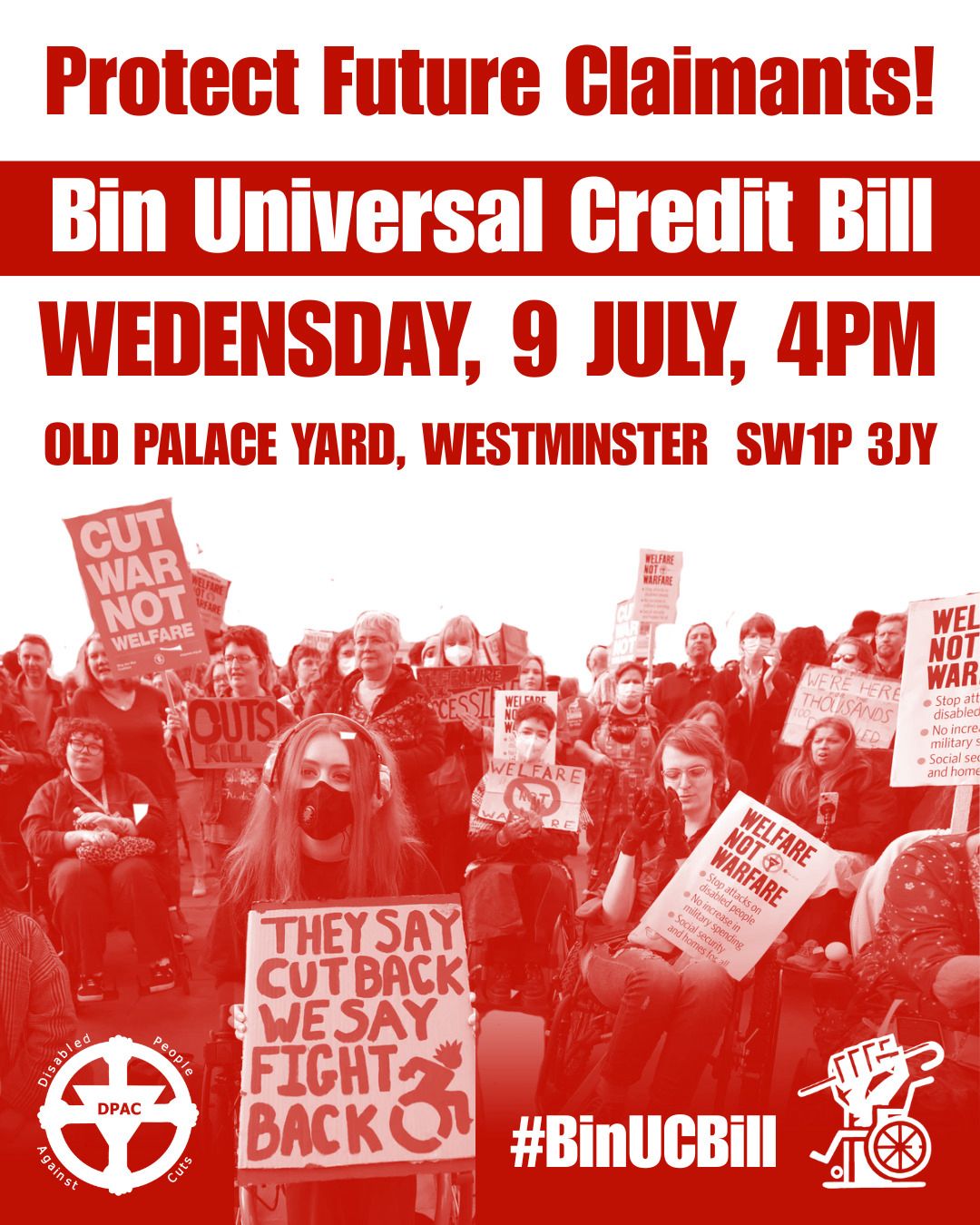
The UK Deaf and Disabled People’s Monitoring Coalition is a secular network of user-led Deaf and Disabled People’s Organisations across the United Kingdom.
This paper sets out the reasons why we are not able to support the Terminally Ill Adults (End of Life) Bill following the Report Stage.
Many of our concerns echo those voiced by the Royal College of Psychiatrists[1], Royal College of Physicians[2] and Association of Palliative Medicine[3].
We do not believe the Bill has received sufficient scrutiny for legislation that will so fundamentally impact the relationship between doctor and patient.
For the Abortion Act there were months of engagement prior to introducing the Bill, and for the Human Fertilisation and Embryology Act there was the Warnock Commission[4].
For this Bill there has been no direct consultation with marginalised groups and the speed and inaccessibility of the passage of the Bill has been a barrier to engagement.
The Equalities Impact Assessment is frighteningly lacking and there has been insufficient consideration of adverse equalities impacts in jurisdictions where it is legal.
For example, a lawsuit is being brought against California’s End of Life Option Act[5] on the grounds that it puts disabled people at greater risk of being coerced into seeking assisted suicide.
At the same time, the opinions of professionals with the most relevant expertise have been largely ignored.
Below we set out our key concerns with the Bill as it now stands, a list of the amendments we supported which would have improved safeguards but which were voted down and a list of amendments that have been held up as safeguards but which fail to allay our fears.
This paper concludes with our recommendations for MPs.
KEY CONCERNS
No guaranteed access to palliative care. The Bill places a duty on the Secretary of State to guarantee access to assisted dying but not to palliative care. Where deaths in pain do occur, the person has not accessed specialist palliative care or accessed it too late or for too short a time. One in four people who need palliative care do not get it. Palliative care provision across the country is patchy and facing cuts with hospice care under-funded[6].
No emphasis on suicide prevention. This is one key reason why the Royal College of Psychiatrists are against this Bill. Suicidal ideation and hopelessness are treatable including for people with terminal illness. There is no mandatory psychological assessment as part of the application process and people who both meet the eligibility criteria for the Bill and have mental health diagnoses are not excluded.
Inaccurate prognoses. People who are terminally ill with six-month prognoses may have many months and even years left to live[7]. According to figures from the Department for Work and Pensions, one in five benefit claimants given less than 6 months to live are still alive three years later[8]. This makes it less inevitable that people with terminal illness should want to end their lives.
Inappropriate use of Mental Capacity Act as a safeguard. The MCA was not designed for this purpose and has a presumption of capacity. It is possible to be assessed under the MCA as having capacity and yet having impaired judgement due to for example, depression, malnutrition or coercive control. Doctors will be trained in coercive control but psychiatrists and other professionals report how difficult this is to detect even with many years of experience.
Insufficient provision for keeping people alive. Changes to a person’s circumstances can change their wish to die. The place for a multi-disciplinary team assessment is at the very beginning of the process with the aim of identifying options to improve the person’s situation. Instead, the Bill has a multi-disciplinary panel at the end of the process rubber-stamping applications for assisted dying with no requirement to meet the person. There is no requirement for a doctor to consult a specialist in the patient’s condition or for the patient to have a meeting with a palliative care specialist. Patients will be able to access assisted dying more quickly and easily than social care, mental health support or suitable housing[9].
No requirement to include family members. Evidence from jurisdictions where assisted dying is legal demonstrates how traumatic it can be for family members to lose their loved ones in this way, especially if they do not find out until after and especially if their loved one made their decision when experiencing impaired judgement. There is no right to appeal assisted dying decisions for family members.
Safety concerns about assisted dying drugs. Death by assisted suicide can be very unpleasant. The patient needs to swallow a large number of pills which the body may reject resulting in vomiting. The drugs used are the same as used for death row prisoners and have been linked to, for example, experiences of dry drowning[10]. The Bill Impact Assessment says the “safety and efficacy” of substances used for assisted dying is “currently difficult to assess”[11].
Fear that assisted dying will replace access to services for terminally ill and disabled people wanting to live. The Impact Assessment shows savings that will be made to both health and social care budgets through this Bill. This has increased concerns that the choice to live will be removed for those of us who cost more in support. One care home group finance manager messaged colleagues about savings they could realise through “aggressive promotion” of assisted dying as an option for residents. The voting down of an amendment to limit advertising of the assisted dying service alongside costs in the impact assessment for an NHS education campaign is concerning.
Insufficient attention to equalities impacts. The Equality Impact Assessment accompanying the Bill was not published until after Committee Stage and is unfit for purpose. It concentrates on equal access to the assisted dying service and omits many key risks in terms of adverse inequalities impacts, ignoring data on for example low levels of awareness and access to palliative care services by racialised minorities and those facing socio-economic disadvantage.
Increasing non-assisted suicide rate. There is no evidence that legalisation of assisted dying reduces non-assisted suicides. Research on the contrary shows a rise in the overall suicide rate even after accounting for those deaths by assisted dying[12]. This is likely due to suicide contagion. This risk needs to be understood within the current UK context of escalating levels of mental distress and already increasing suicide rates[13]. There has been no discussion of this or proposal of measures to mitigate this risk.
Too great a reliance on Henry VIII powers. A worrying amount in the Bill delegates powers to Ministers to make secondary legislation without full Parliamentary scrutiny. This is even more concerning for a Bill that will prompt the founding Act of the NHS to be opened up. Deaf and Disabled people are disproportionately reliant on the NHS and potentially at significant risk from this Bill. This aspect of the Bill is therefore of great concern to us.
PROPOSED SAFEGUARDING CONCERNS THAT WERE VOTED DOWN
To close the anorexia loophole. The Bill gives eligibility to people where the physical condition that meets the criteria is either the result of a mental health condition or of Voluntary Stopping Eating and Drinking. This is a huge concern within the context of a mental health system unable to cope with demand where young women with severe and enduring eating disorders are routinely labelled as “hopeless cases” and transferred onto palliative instead of receiving the support they need to live. In other jurisdictions Voluntary Stopping Eating and Drinking (VSED) is used by people who don’t otherwise meet the eligibility criteria to gain access to assisted dying[14][15].
To exclude from eligibility people with who are homeless and prisoners. Disabled people are over-represented among both, as are self-harm and suicidal ideation. Homelessness and conditions in prisons are growing problems. These amendments would have protected against people choosing assisted dying because of adverse external factors rather than the “clear, settled and informed wish to die” that is part of the eligibility criteria within the Bill.
Doctors to ensure that there are no remediable suicide risk factors before proceeding to the initial discussion about assisted dying and for psychosocial assessments to be conducted at the start of the process. These amendments would have provided a safeguard against people with impaired judgement seeking assisted dying due to a mental health condition and/or suicidal ideation.
To exclude from eligibility those seeking assisted dying for the benefit of others. This could include financial concerns. This amendment would have been an important safeguard against coercion.
To exclude from eligibility those seeking assisted dying because they feel like a burden. This is particularly relevant within the context of inadequate social care support services so that family members and friends experience greater strain. Around one half of those seeking assisted dying in Oregon consistently cite being a burden as a primary reason compared to one third concerned about pain[16].
To replace use of the Mental Capacity Act to assess capacity to make a “clear, settled and informed wish to die” with a new ability test to assess ability to make a clear, settled and informed wish to die free from impaired judgement.
For doctors not to be able to raise assisted dying with patients unless they mention it first. This is a major concern for disabled people due to the prevalence of negative medical attitudes towards disabled people’s quality of life and the risk of medical coercion. This risk is evidenced by experiences during COVID when Do Not Resuscitate orders were unlawfully placed on the medical notes of disabled people without their consent[17] as well as a weight of evidence concerning discrimination and medical negligence within the health system. An amendment not to permit doctors to raise assisted dying with children was voted down at Committee Stage but accepted at Report Stage.
To prevent doctors from raising assisted dying as an option with people with learning disabilities and people who are autistic. Instead, Clause 20 provides access to independent advocates for people in this situation.
Inclusion of a 28-day period between a terminal diagnosis and the start of the assisted suicide process. This is important because fear and depression are common responses to terminal diagnoses. Practitioners in other jurisdictions told the Committee at oral evidence how giving patients the option of assisted dying when first diagnosed calms their fears and that many never end up taking the drugs because their fears over pain never materialise. As proven by the lived experience of our members, the same can be achieved by better support accompanying diagnosis, including, crucially, peer support.
AMENDMENTS THAT FAIL TO ALLAY CONCERNS
Training for doctors in coercive control.
According to professional opinions shared with the Committee, it is very difficult even for those with many years of experience to detect coercive control.
Much stronger safeguards would have involved making psychological assessments mandatory as part of the application process and excluding from eligibility those feeling a burden and those acting for the benefit of others.
Provision of independent advocates for “qualifying persons” including “those with learning disabilities, mental disorders, autism or other ‘substantial difficulties’ in understanding processes or information”.
The focus of this clause is on access to information rather than protection from coercion. As a safeguard it is limited in that those willing to act as independent advocates will likely be in favour of assisted dying and may therefore have a bias towards ensuring access to the service that clouds their alertness from detecting coercion.
It is unclear from where the independent advocates for this role will be sourced.
New multi-disciplinary panel including a psychiatrist and social worker.
This will replace the role of the High Court Judge in rubber stamping approvals at the end of the application process and with no requirement to meet the person or involve their family.
The proper place for this panel is at the beginning of the process.
Multi-disciplinary team involvement is good practice when needing to identify holistic solutions for improving a person’s situation.
The role of the multi-disciplinary panel as prescribed by the bill represents a mis-use of MDT involvement. It will not enable the psychiatrist or social worker to utilise their expertise.
Professionals willing to be on these panels will likely be in favour of assisted dying and may therefore have a bias that limits their ability to detect coercion.
It is also unclear how these panels will be resourced given shortages within both psychiatry and social work.
RECOMMENDATION
We urge MPs to vote against this Bill at third reading. A Private Members Bill is not the way to legislate on such a complex issue and one that puts large groups of the most disadvantaged members of society at significant risk for the benefit of a small minority. A Royal Commission where objective scrutiny can take place and that hears equally from all sides of the debate is needed. Due to insufficient transparency in jurisdictions where assisted dying is legal there is a dearth of evidence. Attempts to remedy this and to plug research gaps must also happen.
[1] https://www.rcpsych.ac.uk/news-and-features/latest-news/detail/2025/05/13/the-rcpsych-cannot-support-the-terminally-ill-adults-(end-of-life)-bill-for-england-and-wales-in-its-current-form
[2] https://www.rcp.ac.uk/policy-and-campaigns/policy-documents/rcp-position-statement-on-the-terminally-ill-adults-end-of-life-bill-9th-may-2025/
[3] https://apmonline.org/wp-content/uploads/APM-Position-Statement-on-Assisted-Dying-October-2024-v2.pdf
[4] https://www.hfea.gov.uk/media/2608/warnock-report-of-the-committee-of-inquiry-into-human-fertilisation-and-embryology-1984.pdf
[5] https://californiahealthline.org/news/article/california-physician-assisted-death-disability-rights-lawsuit/
[6] https://www.mariecurie.org.uk/globalassets/media/documents/policy/marie-curie-parliamentary-briefing-better-end-of-life-2024.pdf
[7] https://www.mariecurie.org.uk/media/press-releases/doctors-frequently-inaccurate-when-predicting-survival-for-terminal-illnesses/144959
[8] https://www.telegraph.co.uk/news/2025/01/21/assisted-dying-row-terminally-ill-patients-live-longer/
[9] https://www.independent.co.uk/news/world/americas/canada-euthansia-maid-gofundme-homeless-b2228890.html
[10] https://www.bmj.com/content/372/bmj.n147/rr-0
[11] https://pmc.ncbi.nlm.nih.gov/articles/PMC9270985/
[12] https://www.bmj.com/content/377/bmj.o1014/rr-7
[13] https://www.samaritans.org/scotland/about-samaritans/research-policy/suicide-facts-and-figures/latest-suicide-data/
[14] https://www.newstatesman.com/comment/2025/06/the-loophole-in-the-assisted-dying-bill-that-no-one-wants-to-talk-about
[15] https://www.frontiersin.org/journals/psychiatry/articles/10.3389/fpsyt.2024.1431771/full
[16] https://www.oregon.gov/oha/PH/PROVIDERPARTNERRESOURCES/EVALUATIONRESEARCH/DEATHWITHDIGNITYACT/Documents/year19.pdf
[17] https://www.bbc.co.uk/news/articles/cd98vpxgp7ko

Ministers are secretly considering means-testing PIP, DWP admits, despite pledge in green paper 1
Rebel Labour MPs send final warning to ministers before disability cuts bill is published 16
Other disability-related stories covered by mainstream media this week 19
Labour ministers are considering whether to start means-testing personal independence payment, which is likely to cut billions of pounds a year more from benefits spending, new information secured from the Department for Work and Pensions (DWP) has revealed.
The highly controversial idea would mean payments contributing to extra disability-related costs in future only going to those with less than a certain level of income, savings and investments.
It comes as the government’s new universal credit and personal independence payment bill, which aims to restrict eligibility to personal independence payment (PIP) and cut the disability element of universal credit, received its first reading in the Commons (see separate story).
That bill does not include any measures to means-test PIP, and the Pathways to Work green paper, published in March, insists that “PIP will remain an important non-means tested benefit for disabled people and people with long-term health conditions”.
But behind that pledge, ministers, special advisers and civil servants have been discussing whether PIP should soon be merged with universal credit.
The new information came in a response to a freedom of information request from welfare rights expert Finn Keaney, who had asked DWP for copies of reports produced since Labour came to power last July that discussed the possibility of making PIP a means-tested benefit.
He had noticed that various members of Labour’s cabinet, including work and pensions secretary Liz Kendall, had repeatedly linked PIP to work, even though it is available to disabled people both in and out of employment.
When DWP responded to his request, it admitted that it “holds information relevant to your request”.
But it refused to release the documents, taking advantage of a Freedom of Information Act exemption that “protects the private space within which Ministers and their policy advisers can develop policies without the risk of premature disclosure”.
It admitted there was “a legitimate public interest in understanding the rationale behind proposed changes to disability benefits, including whether and how the Department has considered the option of means-testing PIP”.
It then added: “The information requested includes early-stage analysis and internal advice that is directly informing live policy development.
“Releasing this material prematurely would risk distorting public understanding of the policy direction, especially where proposals are still evolving and subject to change.
“It could also lead to undue pressure on decision-makers or misinterpretation of ideas that have not been finalised or endorsed.”
It also noted that PIP reform was “highly sensitive and subject to ongoing public and Parliamentary scrutiny” and that it believed, on balance, that “withholding the information at this stage better serves the public interest by ensuring that policy is developed rigorously, responsibly, and with the benefit of full and frank internal deliberation”.
Keaney said: “Over the last year there has been a pattern of cabinet ministers describing cuts to PIP as being part of a strategy to get people back into work.
“It is tempting to think of this as nothing more than individuals being woolly on the details, but when you have the DWP’s own secretary of state making this mistake four times in 23 minutes you have to wonder: what is going on here?
“I am really concerned that between these repeated ‘mistakes’ and the DWP’s recent proposal to merge the PIP and work capability assessments, we are witnessing the government laying the foundations for eventually means-testing PIP by bringing it under the umbrella of universal credit.
“Means-testing PIP would unfairly punish disabled people and would do nothing to help anyone to live independent lives in or out of the workforce.”
There has been mounting evidence over the last four years that DWP civil servants are keen to cut spending on disability benefits by means-testing PIP.
Two years ago, Disability News Service (DNS) was told that participants in focus groups had been asked questions about which people “deserve” various benefits and what they think about the idea of means-testing “extra cost” benefits.
Questions about the “extra cost benefit” ended with participants being asked whether it should be means-tested on the grounds of “affordability”, although it was never clear who had funded the focus groups.
Two years earlier, the Conservative government had published its Shaping Future Support green paper, which suggested that ministers could create a “new single benefit” to simplify the disability benefits application and assessment process, which could “provide support for disabled people and people with health conditions on low income and with extra costs”.
Work and pensions secretary Therese Coffey later told DNS at a fringe meeting at the party’s annual conference in October 2021 that merging PIP with universal credit was “on the table”.
Just a month later, DNS reported how a DWP civil servant had told a disability charity that the government planned to merge PIP with universal credit, although not for at least six years.
This would suggest that such a merger could be introduced from as early as 2027.
The response to Keaney’s freedom of information request shows yet again how the key elements of DWP policy over the last 30 years remain almost unchanged behind the scenes when political power shifts from Conservative to Labour, to Conservative, and back to Labour.
It suggests, as demonstrated in The Department*, by DNS editor John Pring, that the course of policy development within DWP is decided mainly by civil servants, with ministers playing only a minor role.
*The Department: How a Violent Government Bureaucracy Killed Hundreds and Hid the Evidence, John Pring’s book on the years of deaths linked to DWP’s actions and failings, is published by Pluto Press
19 June 2025
Disabled activists say they “will not give a single inch” in their resistance to billions of pounds of cuts confirmed yesterday by the Labour government in its new universal credit and personal independence payment bill.
Other than minor concessions by work and pensions secretary Liz Kendall, the short “two topic” bill shows ministers are determined to plough ahead with cuts to personal independence payment (PIP) and the disability element of universal credit.
There was little that was new in the bill and the other documents published by the government yesterday (Wednesday), and it is still far from clear exactly how many hundreds of thousands of disabled people will eventually lose out and by how much.
There are also further cuts and reforms to disability benefits that will be introduced by work and pensions ministers in the next year in the wake of a public consultation that ends later this month, and other reviews being carried out by the department.
The contents of the bill – all of which will apply to England, Wales and Northern Ireland, and much of it to Scotland – saw no change to the most controversial aspect of the cuts, which will mean all claimants will have to be awarded at least four points on at least one “activity” to qualify for the PIP daily living component*.
Kendall confirmed yesterday that all those who lose their PIP daily living component after being reassessed in the months and years after November 2026 will continue to receive that support for 13 weeks, which she claimed would give them time to “adapt, access new, tailored employment support, and plan for their future”.
Kendall faced ridicule and anger from disabled activists in response to this and when she said in a press release: “This legislation represents a new social contract and marks the moment we take the road of compassion, opportunity and dignity.”
She also said the bill would put “welfare spending on a more sustainable path”, when she knows that Office for Budget Responsibility (OBR) figures show total spending on social security as a proportion of GDP was predicted not to increase at all this year**, and then to stay at the same level for the next four years, even before the cuts announced in March.
Kendall is also now facing at least one allegation of misleading MPs and voters.
Ministers had originally suggested in March’s Pathways to Work green paper that universal credit claimants who are terminally ill with 12 months or less to live, or have “the most severe and lifelong health conditions or disabilities”, would not face future reassessments and would receive an “additional premium”.
But the bill’s explanatory notes include no mention of an “additional premium” and instead state that claimants assessed as being part of this “severe conditions” group will receive the same health element top-up as others found to have limited capability for work and work-related activity (LCWRA).
This means that their health element top-up will be frozen at this year’s rate until at least April 2030, so members of the severe conditions group will not receive any extra “premium” after all.
The only benefit for them being in the severe conditions group will be that they will “not be routinely reassessed”.
It is only new claimants assessed as being terminally-ill or in the severe conditions group who will benefit from the “additional premium”.
They would otherwise have received only the reduced LCWRA rate for new claimants, which is being cut from £97 per week in 2024-25 to £50 per week in 2026-27.
The bill says claimants will qualify for the “severe conditions” group if they are assessed as having LCWRA, and that the limitation “constantly applies”, will last for “the rest of the claimant’s life”, and has been diagnosed by a health care professional through NHS services.
Asked if ministers had misled MPs and disabled people about the “premium”, DWP had not commented by noon today.
Disabled people’s grassroots groups yesterday warned Labour MPs who voted with the government on the bill that they would hold them to account with voters.
Disabled People Against Cuts (DPAC) urged disabled people and allies to join its #WelfareNotWarfare rally outside parliament – and online – on Monday 30 June.
This is the day the government’s Pathways to Work consultation – which they have called a “consult-a-sham” – comes to an end.
DPAC will also lead a national day of action on 3 July, when the second reading of the bill – and a vote by MPs – is expected to take place.
Paula Peters, a member of DPAC’s national steering group, warned MPs that “we will continue to pile the pressure on them to vote ‘No’ to disability benefit cuts.
“If they vote with the government, we will hold them to account.”
She warned that the cuts would cause many deaths, and said the freezing of the UC health element for four years would cause “increasing hardship as bills rise”, leaving disabled people “robbing Peter to pay Paul or going in debt”, while the PIP cuts were “devastating”.
The Scottish-based group Black Triangle warned that if Labour backbenchers did not rebel and defeat the bill, their fate would be “written in stone” and they would lose their seats at the next general election.
Caroline Collier, from Inclusion Barnet’s Campaign for Disability Justice, said: “This bill contains no real surprises, but we are disappointed that there hasn’t been a radical rethink in the face of the widespread concerns that have been voiced by disabled people’s organisations and others since the green paper was published.
“We share the government’s ambition to see more disabled people having opportunities to work, although we believe this should be led by when people feel able to do so, but we are in total opposition to the PIP and universal credit cuts.
“We fear the consequences could be far more serious than anticipated, with a raft of bad outcomes for disabled people, and we sincerely hope that future debates and votes will force a rethink.”
Rick Burgess, a spokesperson for Greater Manchester Coalition of Disabled People, said: “The architects of these policies have two disablist beliefs, that the state should spend less on disabled people and that any benefit for people unable to work incentivises people to claim it, so that must be eliminated.
“These are nothing but cuts that will lead to more deaths and the gaslighting by ministers is continuing the long history of abusers who tell disabled people that they know best what is good for us.
“But these sadistic cuts are not a done deal; right now, everyone must talk to their MP and tell them they must vote against this bill.
“We will not give a single inch in our resistance to this assault on our community.”
Svetlana Kotova, director of campaigns and justice at Inclusion London, said: “Pushing people who are ill into poverty and destitution does not bring them closer to work.
“If the government were willing to improve disabled people’s lives, it would invest in removing the barriers we face in the workplace and society.
“Instead, they choose to cut essential benefits and support.
“This is not the time to be passing legislation.
“The consultation on the green paper is still open, the government has not published a full impact assessment, and no details are yet available about the employment support that is supposed to mitigate the horrendous impacts of the cuts.
“MPs cannot make an informed decision on this basis.
“We are calling on MPs to look at the evidence, listen to their disabled constituents, and vote against this bill.
“We are also calling on our community and everyone else who cares about equity and justice to stand together and oppose the bill.”
Mark Harrison, a member of the Reclaiming Our Futures Alliance steering group, suggested that disabled people should make the cuts “Starmer’s Poll Tax”.
He said: “After 14 years of Tory austerity, Labour is now carrying on where they left off and stepping it up to a new level.
“The only concrete commitment in their manifesto was to consult and coproduce disability policy with disabled people’s organisations.
“It took them less than a year to trash this pledge and do the opposite.”
He called on ministers to withdraw the bill and the other Pathways to Work proposals, and suggested that failure to address the flaws and engage with disabled people and disabled people’s organisations could lead to action in the courts and by the UN.
He said: “We will not let up until these proposals are overturned.
“The winter fuel payments debacle shows they are politically inept and haven’t learnt anything.
“We are putting all Labour MPs who vote for these cuts on notice that they will regret it when they are defeated at the ballot box.”
Mikey Erhardt, campaigns and policy officer for Disability Rights UK, said: “The government’s bill cutting the level of universal credit payments for disabled people and unjustifiably narrowing the eligibility for PIP is simply asking MPs to make indiscriminate and dangerous cuts that will massively worsen the lives of millions of disabled people.
“No minor mitigations or concessions can make these cuts safe.
“Disabled people are going to end up losing thousands of pounds per year that we rely on to survive.
“Ultimately, any MP who thinks it’s OK to vote through these cuts because of a tapering-off period of support is being taken for a ride by the government.”
And Disabled People Against Cuts Cymru, which has fought against the government’s “blatantly discriminatory and inadequate” consultation process in Wales, said: “There is no economic or moral argument, no matter how convincing, that will sway the government on this matter.
“They aren’t interested in evidence, because they are cynically treating us as a political football for votes.
“The proposals are utterly flawed, by every measure.
“They must be withdrawn, and the government must start again on welfare reform, in a process led by disabled people, carers, and the workers who deliver the health, care, and welfare system.”
*This aspect does not apply to Scotland
**See chapter five of OBR’s Economic and Fiscal Outlook – October 2024, chart 5.2
19 June 2025
Disabled activists say vital new polling shows that it is not safe to legalise assisted suicide when the government is preparing to cut billions of pounds a year from spending on disability benefits.
The findings were released yesterday (Wednesday) on the day the government published its new universal credit and personal independence payment bill (see separate story), which will implement many of the cuts, and two days before MPs vote on Labour MP Kim Leadbeater’s terminally ill adults (end of life) bill.
Tomorrow’s vote is thought to be the critical moment that will decide whether assisted suicide eventually becomes law in England and Wales, despite being widely and fiercely opposed by the disabled people’s movement.
In a final effort to persuade MPs of the dangers posed by legalisation, Not Dead Yet UK (NDY UK) yesterday released polling that showed two-thirds (65 per cent) of disabled people agree that if benefits are being cut, disabled people living in poverty may be likely to seek assisted suicide instead of struggling financially.
Three-fifths (59 per cent) of the more than 2,000 British adults who were polled by Whitestone Insight for NDY UK either agreed or strongly agreed with the statement.
Phil Friend, NDY UK convener, said: “This polling proves what we’ve been saying – you cannot safely introduce assisted suicide while so many disabled people live in poverty, and especially when the government is cutting some disabled people’s benefits.
“Our research shows 65 per cent of disabled people think those facing poverty and benefit cuts will be pushed toward assisted suicide.
“That’s coercion, not choice.
“The assisted dying (terminally ill adults) bill must be stopped.
“Parliament cannot pass this legislation while simultaneously dismantling some of the support systems that support disabled people.”
But there were also other worrying findings from the polling.
More than two-thirds (67 per cent) of disabled people polled agreed that some disabled people may feel a sense of responsibility to access an assisted death if they feel they are a burden on family, friends or society.
More than six in 10 (63 per cent) of all those polled agreed or strongly agreed with this statement.
And more than two-thirds of all those polled (67 per cent) agreed that parliament should prioritise improving access to care for disabled people before legalising assisted suicide.
Mike Smith, an NDY UK spokesperson and former disability commissioner for the Equality and Human Rights Commission, said: “Too many MPs are considering this legislation in the context of reducing some individual’s suffering at the end of life without having regard to the many thousands more whose lives will be threatened because of it.
“We have to consider not just the detail of the bill, but the environment and reality into which it will be introduced.”
Baroness [Jane] Campbell, founder of NDY UK, said: “Many of my parliamentary colleagues tell me their number one concern about legalising ‘assisted dying’ is the potential for coercion of vulnerable people by families or others, whether it’s conscious or unconscious, to seek an early death rather than become a burden or die in intolerable circumstances.
“Parliamentarians are right to be concerned.
“It is guaranteed that some people seeking an assistive death will die because they believe what society reinforces every day, that dying early is the only way to avoid such fears becoming a reality.
“Coercion is hard to detect, and the current bill offers no effective safeguards to prevent coerced applicants dying as a result.
“This is terrifying.”
19 July 2025
A tribunal has allowed ministers to continue to hide vital information from scores of secret reports into deaths of universal credit claimants, just as they publish a new bill that will have a major impact on the working-age benefits system.
The new universal credit and personal independence payment bill, published yesterday (Wednesday), will cause fresh safeguarding concerns for hundreds of thousands of disabled people who pass through the universal credit system.
But the decision of the information rights tribunal means MPs debating the bill will be prevented from seeing recommendations made by 63 secret reviews into deaths linked to universal credit between January 2020 and November 2023.
Disability News Service (DNS) has been trying for more than 18 months to secure information from DWP that would show what recommendations for improvements were made by civil servants who carried out these internal process reviews (IPRs), dating back to the early months of the pandemic.
These could have been critically-important, both for disabled campaigners and MPs, as the new bill will impose sweeping cuts to universal credit, with further reforms and cuts to come in future months (see separate story).
The information commissioner decided in July 2024 that DWP should release the information to DNS, after the department initially refused to do so, following a freedom of information request.
But DWP appealed that decision to the information rights tribunal.
And despite the same tribunal ruling in April 2016 that similar information must be released by the department, it has now supported DWP’s appeal and its claim that it did not need to release the information to DNS because it “was intended for future publication”.
The three-person panel reached this conclusion even though it is now five years since the first of the IPRs was completed, and more than 18 months since DNS requested the information.
There is still no sign of the information being released, and in nearly a decade since it was first forced to release recommendations made by its secret reviews – then called peer reviews – it is believed that DWP has never published the kind of detail requested without it being demanded through a freedom of information request.
It is highly unlikely that DWP will release such potentially damaging information in the next few months, as the Labour government will be trying to push controversial and unpopular cuts to the disability element of universal credit through parliament in its new bill.
Wendy Stubbs, who leads DWP’s advanced customer support transformation team, told the tribunal in a written statement that IPRs “provide an internal review of a customer’s interactions with the department and whether the correct processes were followed”.
The information commissioner previously argued that it did not consider it “reasonable to delay the release of the IPR recommendations” to DNS.
But Stubbs claimed in her witness statement in January 2025 that DWP would publish the information bit by bit, beginning in the last quarter of 2024-25.
No such information has yet been published.
She claimed that DWP would publish the IPR information from 2022-23 by 31 March 2025, the information for 2020-21 and 2021-22 by 30 November 2025, and the information from 2023-24 by 31 March 2026.
This will mean the full information requested by DNS in November 2023 – if DWP does publish it – will not be published for more than two years after it was requested, with some of the information from 2020-21 not published until more than five years after those IPRs were completed.
The information commissioner supported DNS in the case because it concluded that DWP would not publish all the information requested.
DNS continues to share that view.
The tribunal appeared to believe – wrongly – that the information to be published by DWP would identify the deceased claimants, as it argues in its ruling that “releasing the information after a period of time would be fairer on and cause less distress to the families of the deceased than immediate disclosure upon request”.
DWP has argued for years that it would be unlawful for it to publish any information from IPRs that identifies deceased claimants.
DWP declined to comment this week on why ministers believed it was right to continue to hide such crucial information as parliament is about to start debating a new bill that will include significant cuts and reforms to universal credit.
But it claimed it would publish the recommendations in due course in a managed way which accounts for the sensitive and personal information that IPRs can contain.
19 June 2025
Two disabled leaders have quit the “stakeholder network” set up to ensure that the voices of disabled people are at the heart of the government’s work, after months – and even years – of “inertia” and a failure to respond to their input.
They have spoken out to raise serious concerns about the work of the Disability Unit and the current government’s commitment to listening to disabled people.
They have both described to Disability News Service (DNS) how the government’s Disability Unit repeatedly failed to even acknowledge information they provided about the barriers disabled people are facing in the north-east of England over months and years.
In her letter resigning as a member of the north-east regional stakeholder network (RSN) last Thursday, Claire Andrews said she and the disabled people’s organisation she works for “no longer believe this government is listening or meaningfully consulting with us”.
Andrews, a development manager for Difference North East, has been a member of the network – whose members are not paid for their work – since last July.
She wrote in her resignation letter that Difference North East did not believe that “the government’s current way of involving disabled people in decision-making is fit for purpose.
“We think it is inaccessible, unprofessional, and unresponsive and more importantly, it does not represent the needs, issues or wishes of disabled people.”
She told DNS that the RSN was “tokenistic”.
She said: “It feels as a disabled person very disrespectful of lived experience and our local knowledge that it’s just not being considered at all, particularly because members give so much time to it.
“For local people and organisations to be so willing to share feedback and share local expertise, and to have it entirely disregarded, it goes against what this network was supposed to achieve; but it feels very representative of the current political agenda towards disabled people.
“We are stood there saying we will work with you, we want this to be better, but I honestly feel they are not listening.”
She added: “There are big things going on that are impacting disabled people in the north-east, and there are no updates, there is no transparency.
“This network’s main purpose is to champion the rights of disabled people, it’s supposed to centre their voices and views to make sure they are at the heart of UK government, and right now there are huge proposals going on and we have no updates, we haven’t been considered.”
In the last eight months, the web page showing details of quarterly meetings between RSN chairs and Sir Stephen Timms, the minister for social security and disability, has been updated just once, with the minutes from the December meeting – which focused exclusively on employment – added on 10 April.
The north-east RSN has had a temporary chair since the last permanent chair resigned in December, but Andrews stressed that the problems are being caused by the Disability Unit, although the failure to appoint a permanent chair has not helped.
She has emailed the chairs of all nine RSNs to call on them to consider their own positions and join her in resigning.
She also told DNS there had not been a single in-person consultation event in the north-east on the government’s much-criticised Pathways to Work green paper, with the nearest events taking place in Leeds and Glasgow.
Members of the north-east RSN have not received a single update on Pathways to Work, despite the national consultation, which closes next week, she said.
Difference North East is now setting up a new disabled-led group (PDF) that Andrews hopes will provide a much-stronger voice for disabled people in the north-east, and one that she hopes the government will have to listen to.
Another member of the north-east RSN, Jo Cole, who had been a member since the RSN was set up by the Conservative government in 2019, resigned her membership in February in response to the growing “inertia and lethargy” she had witnessed over the years.
Cole, co-founder of disability charity Neuro Key, which carries out research and provides information, advocacy and peer support to neurodivergent people and those with neurological impairments in the north-east, said she believed the Disability Unit was simply ignoring the input of RSN members, and certainly those from the north-east.
She told DNS that the Disability Unit had been “controlling the agenda” and ignoring the information RSN members were sending them.
She said: “It’s all well and good holding online meetings, but what are you going to do about the issues, and there was never any response, never any feedback, absolutely nothing.
“The regional stakeholder network was set up as a tick-box exercise and I do not engage with tick-box exercises.”
She believes the network is “defunct” and was “deliberately made that way” and that the new Labour government realised almost immediately after winning power “how appalling it was”.
Cole has been sending case studies and briefings to the Disability Unit since soon after she joined the network in 2019, but she said she never received so much as an acknowledgement, let alone a response to her evidence.
Much of that evidence concerned the “untenable” level of harm being caused to disabled people by the social security system and the inaccessibility of the public transport system.
Other members, including Andrews, have also sent information to the Disability Unit without receiving a response.
Just hours after DNS asked the government to comment on their concerns, and the lack of an in-person consultation event in the north-east, the Department for Work and Pensions quietly announced that there would now be one next Thursday (26 June), which was announced with just eight days’ notice.
A government spokesperson said in a statement: “We are committed to championing the rights of disabled people and working with them so that their views and voices are at the heart of everything we do.
“The Regional Stakeholder Network (RSN) is integral to ensuring that disabled people are able to regularly share their regional insights with the government on disability issues.
“We remain committed to working collaboratively with the RSN to make sure disabled people’s voices are fed into the work of the government.”
19 June 2025
The government’s “weak” response to a major report on the inaccessibility of the transport system has left the future of disabled people’s right to travel in “grave danger”, campaigners warned this week.
Although there were some pledges of action from the Department for Transport in its response, accessible transport campaigners criticised the overall lack of commitment to addressing the “long-standing litany of accessibility failures familiar to disabled passengers” across the public transport system.
The government was responding to the damning Access Denied report by the Commons transport committee, which called on ministers and the industry in March to “urgently” recognise that the “regularity and severity” of public transport access failures was a human rights issue.
But disabled campaigners said this week that the government’s response suggests anything but urgent action on these access failures.
The government did promise a review of laws on accessible transport, but it refused to draw up an inclusive transport strategy.
It insists instead in its response that accessibility “should be incorporated as a key area of focus” within its overall approach to improving the transport network.
Transport for All (TfA), the disabled-led campaigning organisation, said the government’s response was “weak” and “lacks commitment” and was “an overdue late nod to a longstanding issue” which “perpetuates inaccessibility”.
On regulation, instead of the call to assess whether there should be a single, central regulator to protect and enforce accessibility across all public transport, TfA said the government had proposed “a piecemeal approach of unenforceable charters and internal letters”.
It said this would “leave a spiderweb of legal loopholes, and allow transport providers to continue failing disabled people”.
Despite the committee’s demand for urgent action, TfA said the government’s response “repeatedly avoids setting clear deadlines for action, and glosses over time frames”.
The Association of British Commuters (ABC) said the government’s response showed disabled people’s right to travel was in “grave danger”.
In February, ABC and representatives of Disabled People Against Cuts, National Pensioners Convention and National Federation of the Blind of the UK accused the government of “betrayal” after it dropped plans to put accessibility at the heart of its plans for the new Great British Railways.
Emily Sullivan, ABC co-founder and a disabled researcher in equality and human rights, said the government response to the Access Denied report showed it “has no intention of doing anything” to address the “regulatory and investment crises in rail accessibility”.
As a result of the government’s response, she has now asked the Equality and Human Rights Commission – which in March chose addressing barriers to key public services, including public transport, as one of its priorities over the next three years – to take action on clear breaches of the UN Convention on the Rights of Persons with Disabilities (UNCRPD).
Sullivan pointed to the government’s continuing failure to ensure a right to spontaneous travel by denying disabled people the right to “turn up and go” across the rail network; its refusal to promise a national action plan on how to achieve “full rail accessibility”; the failure to consult disabled people on some of the key rail issues affecting them; and a deeply flawed regulatory system.
Accessible transport activist Sam Jennings, who runs the campaigning website Disabled By the Railway, was also highly critical of the government’s response.
She said the response to the report was “a nonsense word salad, and from my experience deliberately vague so that the status quo of inaction can be maintained.
“Enough is enough. No rail investment should be signed off unless it’s accessible and inclusive.
“After all, ‘turn up and go’ is an explicit legal right and the failure to uphold our rights is a breach of UNCRPD.
“We need strong leadership now from transport secretary Heidi Alexander, not word salads.
“Successive governments have had three decades to put this right since the first Disability Discrimination Act, and we are still screaming into the void about the basics.”
Disabled activist Doug Paulley, another influential accessible transport campaigner, welcomed the commitment to reforming the “complicated and opaque” legislation on accessible transport, much of which he has highlighted by taking legal action against the industry.
But he said the lack of commitment to improving enforcement of disabled people’s right to accessible public transport was “really disappointing”.
He said: “The existing model doesn’t work, and there’s no reason to believe that further exhorting regulators to do their jobs in this regard will make any material difference.
“Regulators are already subject to the public sector equality duty and have been for many years, as have licensing bodies, yet as noted in the select committee report that hasn’t resulted in reliable effective enforcement.
“It is really disappointing that the government has made no commitments whatsoever to change in that direction, and it completely undermines the whole point of the report.”
He added: “If government really cared about disabled people’s transport rights, they would make it simple and effective to report accessibility failures to a competent body who routinely takes effective action to enforce for disabled people.
“It also doesn’t work unless the government puts their money where their mouth is.
“This response, whilst espousing their commitment to accessible travel, is undermined by the government’s intent on forever delaying and limiting its expenditure on Access for All, failure to ensure purchase of rail vehicles suitable for level boarding, failure to challenge destaffing of public transport, and so many issues.”
Labour MP Ruth Cadbury, who chairs the transport committee, said of the government’s response: “There are warm words and some promising signs in this response to our report.
“But taken together, there is a disappointing lack of urgency to deliver real, lasting progress and improve the daily lives of disabled people – to close the gap between rights and reality.”
She added: “Our inquiry heard so much evidence from disabled people about how their ability to work, access services and socialise is denied by transport services that fail to live up to the promises of equality legislation and policies. This can’t go on.
“We need a zero-tolerance approach to discrimination and inadequacies in our transport services.”
19 June 2025
Rebel Labour MPs delivered their final warnings to the government this week, ahead of yesterday’s publication of a government bill that will cut billions of pounds a year from spending on disability benefits.
A group of 15 Labour backbenchers took part in a photo-call organised by Disability Rights UK (DR UK) and DPO Forum England to show their opposition to the cuts proposed in the government’s Pathways to Work green paper.
The following day, the government published its new universal credit and personal independence payment bill (see separate story).
One of the Labour MPs, Nadia Whittome, said: “With one in 10 of my working-age constituents in receipt of these disability benefits, I am concerned that these cuts will further devastate my community after 14 years of brutal austerity by the previous Conservative government.
“Poverty is a political choice. I will not choose to make my disabled constituents poorer when we could be choosing to tax the super-rich instead.”
Another MP, Neil Duncan-Jordan, who has helped lead backbench Labour opposition to the cuts, said: “The facts are undeniable: these cuts won’t create jobs, they’ll only push three million people deeper into hardship.
“After 14 years of Tory cuts, the benefits system is already driving disabled people into destitution.
“Another wave of cuts won’t clean up their mess, it’ll make things worse.
“I urge ministers to pause, withdraw these cuts, and work with disabled people’s organisations to redesign a fairer benefits system.”
Georgia Bondy, from DPO Forum England, said after the photo-call: “We are glad to see there are MPs who understand just how essential it is to vote against disability benefits cuts for the 24 per cent of the population who are disabled.
“However, we need more MPs to join them in stopping this catastrophic legislation if we are to avoid devastation to disabled people’s lives, carers’ income and local councils’ financial stability.”
Mikey Erhardt, DR UK’s campaigns and policy officer, said the photocall was “a strong demonstration that the government’s minor concessions have failed to convince MPs that these cuts are anything except dangerous, ill-thought-out and needless.
“Despite promising a consultative process, the government is trying to force through a vote on proposals it won’t even share detailed information about.
“Rather than delivering change, this government is attempting to implement cuts that are even more severe than those of the austerity years.”
The MPs were speaking on the day that some of them took part in a parliamentary debate on disabled people in poverty.
Richard Burgon, one of those who took part in the photo-call, told the Westminster Hall debate that the “immoral” package of cuts would become “a millstone around the necks of not just the Labour government but every MP who fails to vote against it”, as thousands of their constituents are “thrown into hardship”.
Disabled MP Steve Darling, the Liberal Democrat work and pensions spokesperson, warned of the impact of the cuts on deprived communities.
He told fellow MPs: “I represent the most deprived community with a Liberal Democrat representative, Torbay, and I am concerned that the cuts to PIP will see cash sucked out of some of our most deprived communities across the country.
“That is money that would go to people doing support work such as cleaning, helping people to go shopping, taxis and so on being sucked out of what are already our most impoverished communities.”
Labour’s Rachael Maskell, who took part in the photo-call, told ministers: “The diagnosis is wrong and the treatment is no cure; all these cuts will do is to displace the cost and displace the problem.
“It was not disabled people who broke the NHS waiting-lists.
“It was not disabled people who removed the access to mental health services.”
She said: “It is the system, which has failed them for 14 years, that has done that to them – which is why we must change direction and not progress with these cuts.”
Duncan-Jordan, who secured the debate, said he believed the government was “rushing these proposals through” and he reminded fellow MPs that PIP was not an out-of-work benefit, “so cutting it is likely to undermine efforts to get people into employment, rather than supporting them into gainful work”.
He argued that the rise in the number of PIP claimants, which the government has repeatedly highlighted, was “largely the result of declining public health in this country combined with the increased financial hardship that disabled people are facing”.
Danny Kruger, a Conservative shadow work and pensions minister, said he did not believe Labour’s cuts would lead to “significant savings” because “the costs will be shunted elsewhere in the system”, such as onto local authorities and the NHS.
He admitted that the benefit reforms introduced by his own party in government over 14 years meant “the axe fell disproportionately” on some groups, although he claimed that “some genuinely positive measures were introduced”.
Labour’s Bell Ribeiro-Addy, said the briefing she received from the disabled people’s organisation Disability Advice Service Lambeth had “only deepened my conviction that the cuts are wrong and deeply damaging”.
She said the government should instead be looking for savings by slashing the profits of the multinationals “that make a profit off the humiliating PIP assessments”, with Maximus, the US firm that carries out many DWP assessments, recently reporting a 23 per cent rise in profits.
In her response to the debate, employment minister Alison McGovern spoke about the action taken by the government on issues such as wealth taxes, the child poverty strategy, free school meals, the NHS, and employment support, but she said almost nothing about the many concerns raised by MPs about the PIP cuts.
She said that the level of poverty among disabled people “demands our attention and action” and that disabled people “have the right to dignity, the right to work and the right to have power, choice and control over their lives.
“When someone is in poverty, regardless of whether they are disabled, they are robbed of the opportunity to choose how to live their own life, which is why the situation we face today is so very shameful.”
Meanwhile, disabled activists and allies have warned that the government’s cuts would also have a significant negative impact on disabled people who menstruate.
They say that PIP applicants with conditions like endometriosis and fibroids face a much lower than average award rate, with their debilitating symptoms often dismissed as “just a period” and the PIP process failing to account for the “cyclical exacerbation” of their symptoms and support needs.
The open letter, prepared by activist Hat Porter, hosted by menstrual justice charity Irise, and supported by other menstrual justice and disability organisations, calls on the government to reverse its “catastrophic” cuts.
It warns that tightening the PIP eligibility criteria “would make it even harder for people with conditions and support needs which fluctuate on a daily basis and through their menstrual cycle”.
The letter says the cuts would “further entrench the longstanding failures of the UK disability benefits system to recognise the ways in which symptoms, challenges, and support needs can fluctuate throughout the menstrual cycle or be intrinsically linked to menstrual and gynaecological health”.
And it calls on the government to engage with disabled people to consider how the PIP system can meet the needs of disabled people who menstruate, take better account of the experiences of people with fluctuating conditions and impairments, and adapt the PIP system to “explicitly recognise managing menstruation as an activity of daily living”.
19 June 2025
The government’s welfare plans have to be pushed through, Keir Starmer has said, indicating that there will be no further concessions in the face of a potentially significant Labour rebellion over cuts to disability benefits. Speaking to reporters on his way to the G7 summit in Canada, the prime minister set out his determination to get the plans through parliament, after ministers warned mutinous MPs about the consequences of voting against the government: https://www.theguardian.com/politics/2025/jun/15/welfare-plans-keir-starmer-labour-rebellion-disability-benefit-cuts
People with anorexia could be allowed to die by assisted death under a proposed bill, more than 250 campaigners have warned, urging MPs to vote down the legislation when it returns to the Commons. A letter to MPs, signed by 268 people who have had eating disorders, warned: “If this bill had been law during the years many of us were struggling, we would have used it to end our lives.”: https://www.independent.co.uk/news/uk/politics/assisted-dying-anorexia-kim-leadbeater-b2767857.html
Disabled people could lose more than £10,000 a year through Sir Keir Starmer’s benefit cuts, a group of MPs has warned. In a damning report, the all-party group on poverty said some claimants who will be made ineligible for personal independence payment face losing £886 per month: https://www.independent.co.uk/news/uk/politics/starmer-welfare-benefits-pip-cuts-b2769631.html
Nearly one in five pupils in England are receiving support for special educational needs in the classroom, according to government statistics. It comes as separate statistics show a sharp rise in the number of tribunals concerning special educational needs support, as parents challenge the support on offer for their child: https://www.bbc.co.uk/news/articles/c23mdz2728zo
A 16-year-old wheelchair-user has described being “petrified” at being left on his own in an upstairs room when a fire broke out in his school. Lucas, from Tameside, Greater Manchester, said the experience in November inspired him to launch the #NoStudentLeftBehind campaign to improve fire safety for disabled students and make evacuation chairs compulsory in schools: https://www.bbc.co.uk/news/articles/cz9kwpy152wo
Guardian writer Frances Ryan has been named one of Vogue magazine’s 25 women “defining Britain”, stating her work covering the rights of disabled people had become “essential reading”. The publication said Ryan’s efforts to spotlight the lives of disabled people were “needed more than ever”, with official statistics suggesting that a quarter of people in the UK report some kind of disability: https://www.theguardian.com/world/2025/jun/15/guardian-writer-frances-ryan-named-one-of-vogues-25-women-defining-britain
19 June 2025
News provided by John Pring at www.disabilitynewsservice.com
Government offers three clues that it is set to plough ahead with cuts to disability benefits 1
Insurance industry silent over whether it lobbied DWP to cut disability benefits 8
Disabled students set to protest over cuts in support 18
Other disability-related stories covered by mainstream media this week 21
Labour appears set to plough ahead with billions of pounds of cuts a year to disability benefits, after this week’s spending review failed to offer any suggestion of a U-turn.
The government had already given two other major signs that it was not intending to reverse the cuts, even before yesterday’s spending review.
In her statement to MPs, chancellor Rachel Reeves confirmed the government’s U-turn on cuts to winter fuel payments for older people, but she made no mention of disability benefits, and did not mention disabled people or disability.
The Treasury’s spending review document – which sets out the budgets for government departments for day‑to‑day spending until 2028‑29, and until 2029‑30 for capital investment – mentions disabled people or disability just six times in about 43,000 words, and only in connection with planned reforms to the special educational needs and disabilities (SEND) system and in confirming increases in employment support for disabled people.
Asked by Disability News Service whether the chancellor’s failure to mention disability benefits meant there would be no U-turn on the cuts, the Treasury had not commented by noon today (Thursday).
Even before Reeves delivered her statement, the prime minister had misled MPs about the planned cuts to personal independence payment (PIP).
He had been asked in prime minister’s questions by Labour MP Richard Burgon why a Labour government was planning to “balance the books on the backs of disabled people”.
Burgon said that “people who need assistance to cut up their food, to wash themselves, to dress themselves and to go to the toilet will lose the personal independence payments that they currently receive”, and he asked Sir Keir Starmer to “drop these disability benefit cuts”.
But instead of responding to the concerns about cuts to PIP, the prime minister said Labour’s cuts and reforms would be based on the principle that “those who can work should work, that those who want to work should be supported so that they can do so, and that we must protect those with the most severe disabilities who will never be able to work”.
PIP is not an out-of-work benefit, and it can be claimed by disabled people who are in or out of work.
Only last month, work and pensions secretary Liz Kendall misled MPs four times in just 23 minutes by suggesting that the cuts to PIP were linked to supporting disabled people into work.
And in a third sign that the government has no intention of making a U-turn on the cuts laid out in the Pathways to Work green paper, Kendall wrote to the work and pensions select committee this week to confirm that she believes she was right to cut billions from disabled people’s support.
In Monday’s letter to the committee’s Labour chair, Debbie Abrahams – which was published on the day of the chancellor’s statement – Kendall defended the cuts to PIP and said again that the increase in the number of claimants was “not sustainable if we want our welfare safety net to exist for those who need it in future”.
She also referred to the “urgently needed changes to the PIP eligibility criteria”.
Kendall also made it clear that her position had not changed on the planned cuts to the universal credit disability payment, because of the “perverse incentives” in the system.
She said at the end of the letter: “We will not avoid or delay the decisive action needed to transform the system, so it helps people in the best way possible and ensures our welfare state is sustainable for the future.”
Meanwhile, the spending review document says the Department for Education will set out the government’s “intended approach to SEND reform” in a schools white paper in the autumn.
It says this will “make the system more inclusive and improve outcomes for all children and young people”.
It is looking increasingly likely that these will be major reforms, with The Law Society Gazette reporting yesterday that SEND tribunal judges “have been told their services will not be needed in future”.
Although not mentioned in the chancellor’s speech, the spending review document also mentions an increase of more than £4 billion a year in funding for adult social care by 2028-29, compared with this year, with further details to be announced “shortly”.
But the Liberal Democrats said the spending review document had revealed “a potential black hole for social care”.
Daisy Cooper, the party’s Treasury spokesperson and deputy leader, said: “This spending review was a missed opportunity to repair the damage done by the Conservatives and finally deliver on the promise of change.
“Behind the smoke and mirrors is a potential black hole for social care as local government budgets remain at breaking point.
“Putting more money into the NHS without fixing social care is like pouring water into a leaky bucket.”
Her party said the spending review document showed that, while local government has a statutory responsibility to provide social care, the Ministry of Housing, Communities and Local Government was facing a 1.4 per cent real terms cut over the course of the spending review.
12 June 2025
Fresh concerns have emerged about the government’s commitment to solving the accessible housing crisis after the chancellor announced a £39 billion investment in social and affordable homes, but ignored disabled people’s urgent needs.
Chancellor Rachel Reeves stressed in her spending review that these would be “homes built for working people”, in a statement that failed to mention disabled people.
The spending review document says the new funding will provide “the biggest boost to social and affordable housing investment in a generation”, with £39 billion for a successor to the Affordable Homes Programme over the 10 years from 2026-27 to 2035-36.
It also says: “A major shortage of housing is one of the country’s biggest blockers to growth, limiting people’s ability to access well-paid jobs and constraining the growth of the country’s most productive towns and cities.”
But there is no mention of what measures the government will take to ensure these homes will be accessible to disabled people, and whether a significant proportion will be built to be suitable for wheelchair-users.
Last July, in one of the Labour government’s first major announcements, the Ministry of Housing, Communities and Local Government failed to mention the accessible housing crisis in its consultation on reforms to England’s National Policy Planning Framework.
And Labour ministers – including housing secretary and deputy prime minister Angela Rayner – failed to make any commitment to toughening accessibility standards on new-build homes, despite announcing a string of new housing measures, at their annual party conference last September.
Labour promised Disability News Service at the conference that it would set out its policies on accessible housing “shortly”, but nearly nine months later it has failed to do so.
It is now nearly three years since a pledge by the last Conservative government – which was never fulfilled – to take action to address the shortage of accessible homes.
It had promised to consult on new rules that would have forced all new homes to be built to the M4(2)* standard of accessibility, except for cases where this was “impractical and unachievable”.
Mikey Erhardt, campaigns and policy officer for Disability Rights UK (DR UK), said: “The promise of a huge injection of cash is welcome, but without the government committing to improving the accessibility standards of new-build homes, there’s a real danger that disabled people won’t benefit.
“The promise to build new homes is not enough; it fails to tackle the here and now of cold, inaccessible and expensive homes.
“The spending review also made clear that the government will continue to force thousands of disabled people into the most dangerous of choices: heating or eating, paying rent with their social security payments and risking going without to keep a roof over their heads.”
Erhardt said the government had “no serious plans” to bring down the cost of “ever-spiralling rents”.
He said: “How much will local authorities have to fork out to private landlords to pay to house people in temporary accommodation, as a consequence of the government’s failure to build accessible homes?”
And he said DR UK continued to be shocked that, while “talking up its investment in housing”, the government was moving forward with cuts to the financial support that disabled people rely on.
These include government plans to cut the disability element of universal credit by almost £50 a week for new claimants and freeze it for current recipients, and increase thresholds for PIP eligibility, which he said will “undoubtedly drive disabled people into even deeper poverty and put us at risk of homelessness”.
Inclusion London welcomed the increased funding for the Affordable Homes Programme (AHP) but said it remained “deeply concerned that the programme does not go far enough to address the acute shortage of accessible, social rent housing in London and across the country”.
An Inclusion London spokesperson said: “The AHP does not only provide grant funding to support housing providers to build social rent homes but also other so-called ‘affordable’ tenures such as shared ownership housing which is not affordable for the majority of disabled Londoners.
“The government must significantly invest in building the social rent homes that Deaf and disabled people need.
“We are also concerned that the government has agreed to allow social housing rents to raise annually by one per cent above [inflation] for the next 10 years, doubling the amount announced last year.
“Disabled people are reliant on social rent due to the security and affordability this tenure provides.
“Increasing social rent in the same year the government is proposing devastating disability benefit cuts, will disproportionately impact disabled people and push many of us even further into poverty.”
She added: “Currently, one in five disabled people in social housing and one in three in private rented housing are living in inaccessible homes.
“The announcement today fails to address this.
“We once again call on the government to take national action and ensure that all new-build homes have to meet the M4(2) adaptable and accessible homes baseline standard, and that at least 10 per cent of all new-build homes have to meet the wheelchair-user standard M4(3).
“Without doing so, any large-scale house building programme will fail to meet current and future housing requirements and will build inaccessibility into England’s housing stock.”
The Treasury had failed to comment by noon today (Thursday) on why there was no mention of the accessible housing crisis in the spending review statement and document.
*Homes built to the M4(2) standard have 16 accessible or adaptable features, similar to the Lifetime Homes standard developed in the early 1990s to make homes more easily adaptable for lifetime use, while M4(3) homes are those that are supposed to be fully wheelchair-accessible
12 June 2025
Companies will be allowed to launch self-driving taxis and minibuses in pilot schemes in England as early as next spring even if the vehicles are not accessible to disabled people, the government has suggested.
A disabled peer who raised concerns about the issue in the Lords last year, Baroness [Sal] Brinton, said yesterday (Wednesday) that she was “very, very concerned” and planned to question the government about its position.
She spoke out after the Department for Transport (DfT) announced that it had brought forward the launch of pilot projects of self-driving vehicles to next spring, subject to a consultation on regulations later this summer.
But the press release announcing the move said the “key priorities” of the pilots would be “cutting-edge innovation, regulation and road safety”.
It made no mention of accessibility, including access for wheelchair-users, the need for on-board audio-visual announcements, the accessibility of apps used to book journeys, and physical infrastructure such as kerbs and drop-off points.
DfT said firms would be able to pilot small-scale “taxi- and bus-like” services without being monitored or controlled by a human for the first time, before a potential wider rollout when the Conservative government’s Automated Vehicles Act is implemented in the second half of 2027.
The act, which became law last year, provides a legal and safety framework for the introduction of automated vehicles.
The government believes self-driving vehicles could help reduce deaths and injuries on the roads, add new public transport options in rural areas, and have the potential to improve mobility, accessibility and independence for those who cannot drive, including many disabled and older people.
But there were only two fleeting mentions of accessibility in this week’s DfT announcement.
Last year, two disabled peers – Liberal Democrat Baroness Brinton and Conservative Lord [Chris] Holmes – warned that the act must not be allowed to create new access barriers for disabled people.
When asked this week by Disability News Service (DNS) why the key priorities of the pilot schemes did not include accessibility, and what measures ministers were taking to ensure that the pilots would be accessible to all disabled people, DfT initially declined to produce a statement.
DfT did say that operators had taken a range of different approaches to ensure accessibility in trials with a safety driver, but it did not say what those approaches were.
The government also said that conditions – which can include references to accessibility – can be attached to the permits that will be needed to operate automated passenger services.
And once the permit has been granted, the transport operator will have to publish reports showing the steps taken to meet the needs of older or disabled passengers.
But these reports will only be published after the permit has been granted.
The department claimed it was working with a range of stakeholders and experts, including the Disabled Persons Transport Advisory Committee, and would carry out further engagement with disabled people and representative groups through a consultation this summer.
After DNS asked why there was no obligation for the pilots to be accessible and why reports on accessibility will only be completed after a permit is granted, DfT produced a statement.
A spokesperson said: “Before pilots deploy a passenger carrying service, the secretary of state must consider, in deciding whether to grant a permit, how the service will help lead to improving understanding of how these services should best be designed and operated for older and disabled people.
“Improving transport for disabled and older people is one of our key priorities, and self-driving vehicles will help boost mobility, accessibility and independence for those unable to drive.
“We will learn from these pilots to better understand what good accessibility looks like for these services.”
DfT also said that more details on guidance for the pilots – including accessibility expectations – would be published in due course.
Baroness Brinton said she and Lord Holmes had failed in their efforts to persuade the Conservative government to amend the automated vehicles bill before it became law to ensure that accessibility was built in from the beginning of any schemes.
Baroness Brinton told DNS, before DfT issued its statement: “I am very, very concerned because the whole point of our amendments was to make sure that accessibility was built in from the start.”
She said the government’s admissions suggested this was now not going to happen.
And she said Labour had followed the last government in appearing to say that they “cannot stop the tech companies” because they are so important to growth.
She will now try to put an emergency question to ministers in the Lords about the government’s announcement.
She said: “I am extremely frustrated because our argument was that now, before they do anything, is the best time to describe what these vehicles must have, because if it’s built in from the start, like with black cabs, then everybody just knows that it has to be accessible.”
Transport for All (TfA), the disabled-led campaigning organisation, said it was concerned by the government’s apparent failure to put accessibility right at the heart of these new pilots.
Emma Vogelmann, TfA’s head of policy, public affairs and campaigns, said: “Department for Transport statistics show only 61 per cent of disabled people hold a full driving licence.
“Our own research found that a lack of a driver is a key barrier to many of us travelling by car.
“Autonomous vehicles are an incredible opportunity to create a transport system that includes disabled people from the start and is accessible to everyone.
“The last government excluded disabled people from the development of self-driving vehicles.
“We refuse to be shut out of yet another transport system.
“It’s imperative that the trials being planned include disabled people, to ensure we can all travel easily and confidently now and in the future.”
12 June 2025
Major insurance companies – including one that spent years lobbying the government to tighten eligibility for out-of-work disability benefits – have refused to say if they pushed the government to introduce controversial cuts to one of those benefits.
Not one of the seven companies approached by Disability News Service (DNS) agreed to answer questions over the last month on whether they welcomed planned reforms to contributory benefits, including to new-style employment and support allowance (NS ESA).
One of the companies, Unum, spent years pushing reforms that would later be closely linked to the deaths of many ESA claimants and to harming the health of countless others.
Disabled researchers and activists showed in the early 2010s how Unum spent years undermining the social security system to try to boost the market for its own income protection insurance policies.
The government’s Pathways to Work green paper proposes replacing new-style jobseeker’s allowance (NS JSA) and NS ESA – benefits that are only open to those with a certain period of national insurance credits – with a new unemployment insurance, paid at the current ESA rate.
But unemployment insurance will be time-limited, which will mean that disabled people who would currently receive contributory ESA indefinitely – if assessed as having limited capability for work and work-related activity – will only be able to receive the new benefit for a limited period.
After that period has ended – the green paper suggests this could be after six months – they will have to claim universal credit, which is itself being reformed to make the disability-related top-up less generous (although details have yet to be confirmed), and where nearly all disabled recipients are set to face conditions and potential sanctions.
The government says these reforms will make the contributory system “simpler and significantly more pro-work” by removing the difference in treatment between jobseekers and those considered unable to work for health or disability reasons, but also removing the “financial incentive to be considered unable to work”.
It will also mean that “almost all disabled people and people with long-term health conditions” who receive the new unemployment insurance would have to take part in “tailored employment support”, although it claims there will be “appropriate exemptions”.
But the introduction of these reforms, and the greater pressure on newly-disabled people to engage with the Department for Work and Pensions (DWP), are likely to increase demand for disability insurance (otherwise known as income protection) policies sold by some of the country’s biggest insurance companies.
These policies provide a regular income if someone is unable to work due to disability, illness or injury.
It is likely that at least some insurance companies will have pushed Labour and previous governments to introduce these reforms, something DWP failed to deny this week.
But when DNS approached seven prominent insurance companies selling these policies in the UK, none of them would discuss the government’s reforms or say whether they had lobbied DWP ministers or civil servants to introduce such policies.
Unum said that it “won’t be able to provide commentary for your article” as its communications team was “pretty swamped at the moment”.
Aviva said it was “not something that we would comment on”.
Royal London said it had “not been able to find someone to cover these questions for you”.
A Zurich spokesperson said: “As far as I’m aware we haven’t engaged with any lobbying.”
When asked to check this with senior people in the organisation, and to comment on the reforms, she did not respond further.
Legal & General did not respond to repeated requests to comment.
Vitality said that it would “not be able to share any comments this time”.
And LV= Life and Pensions did not respond to repeated requests to comment.
This week, DWP refused to say if it was lobbied by the insurance industry to introduce the changes, or if it believed the industry would benefit from its cuts and reforms to contributory benefits.
But the department did insist that it had not been influenced by insurance companies.
It is also unclear what will happen to existing claimants of NS ESA and NS JSA.
Asked in a written question by SDLP MP Claire Hanna how many current recipients of contributory ESA ministers expected to transfer to the new unemployment insurance, Sir Stephen Timms, the minister for social security and disability, said this week: “No decisions have yet been made about transitioning existing claimants of NS ESA and NS JSA to the proposed Unemployment Insurance and therefore an estimate cannot be provided at this stage.”
Edward, a wheelchair-user who took part in Fight4Life’s anti-cuts “die-in” protest outside Tate Modern in London this week (see separate story), and who relies on NS ESA, said the idea that it was going to be replaced was “really scary” and would be “toxic and painful” for a lot of disabled people.
He said it made “perfect sense” that the insurance industry would have been pushing for such changes to contributory ESA.
Disabled researcher Mo Stewart, who did most to raise concerns about Unum’s influence on welfare reform in the early 2010s, said the green paper would “cause a great deal of preventable harm for the chronically ill and disabled community who are unable to work”.
Stewart, who has continued her work through her Preventable Harm Project, following the publication of her book Cash Not Care in 2016, said she believed the consequences of the green paper would be “an increase in the purchase of private income replacement health insurance policies now that the past psychological security of the welfare state has been demolished by successive UK governments”.
She said: “Given that Unum insurance was instrumental in guiding previous social policy reforms… it can’t be much of a surprise to learn that Unum and other corporate health insurance giants refuse to comment on the DWP green paper which guarantees an increase in their profit margins.
“I suspect they will never admit to lobbying for government reforms to line their pockets, but it’s hard to imagine that they would resist the opportunity to influence more social policy reforms which are guaranteed to continue the government-induced public health crisis negatively impacting on those in greatest need.”
Stewart is now working on a new book, Social Policy Abused: The Creation of Preventable Harm, a collection of articles, research papers and reports she says will demonstrate “the government-induced public health crisis generated to move the UK to welfare funded by insurance”.
Ellen Clifford, a member of the national steering group of Disabled People Against Cuts, and award-winning author of The War on Disabled People, said: “Important research by John Pring, Mo Stewart and others has meant we have clear evidence of the role the insurance industry has played in the welfare reform agenda.
“It seems unthinkable that they would have stopped now given the effort put in over the decades and now that the UK government is taking such dramatic steps to destroy the social security system for out-of-work disability benefits, which can only be to their advantage.
“The lack of transparency is an indictment on our so-called democracy and refusal to comment can only fuel fears that big business is pulling the strings and doing their best to ensure politicians put profit before people.”
Unum’s links with the UK government date back to the 1990s, when Peter Lilley, social security secretary in John Major’s Conservative government, hired senior Unum executive John LoCascio to offer advice on how to cut the number of claimants of long-term sickness benefits*.
A submission to the Commons work and pensions committee in 2002 by a director of Unum – then known as UnumProvident – called on the Labour government to “ensure both that work always pays more than benefits, and more importantly that it is clearly seen to do so”.
In 2011, Unum launched a major UK marketing campaign to promote the need for income protection insurance policies, just as the Conservative-led coalition began its three-year programme to reassess about 1.5 million existing claimants of old-style incapacity benefit through the new work capability assessment (WCA).
Research by public health experts from the Universities of Liverpool and Oxford later linked that reassessment programme with about 600 suicides in just three years.
Unum has previously dismissed claims that it pushed the government to introduce the WCA system.
*The Department: How a Violent Government Bureaucracy Killed Hundreds and Hid the Evidence, DNS editor John Pring’s book on the years of deaths linked to DWP, is published by Pluto Press
12 June 2025
Disabled people have warned the Labour government that they will “not go quietly” and plan to keep fighting its plans to cut spending on their benefits by billions of pounds a year, as they staged a dramatic “die-in” outside a London landmark.
The protest outside the Tate Modern art gallery on the south bank of the Thames – led by disabled actors and artists – was held to remember all those who have died because of cuts and all those who might die if the government’s cuts go ahead.
There was also a parallel protest online, with disabled people contributing pictures of their own die-ins with homemade placards.
Disabled writer and actor Polly Wiseman, one of the organisers of the Fight4Life protest, told activists gathered outside Tate Modern on Tuesday that they had all gathered there in “fear and sorrow and solidarity, but mostly in anger”.
She said the lives of disabled people were at risk from the “most heinous disability cuts any of us have ever seen”.
The Fight4Life campaign was set up by disabled people who will be directly affected by the cuts to universal credit and PIP and are determined to fight back.
Tamm Reynolds, who performs as Midgitte Bardot, told protesters that she believed disabled people had so far been “a bit too polite and a bit too understanding” and needed to “start being unreasonable” and “start kicking back”.
Another disabled activist, Priscilla Eyles, said the government had failed to “reckon with how we will fight back” and that Labour had proved to be even worse than the last Conservative government.
She said the cuts were “an intersectional issue”, and that the government’s cuts to Access to Work “shows you all you need to know about how much they care about whether we actually work or not”.
Ian Jones, co-founder of the WOWpetition, spoke of the demands he and others had made of the coalition government in the 2010s to carry out a cumulative assessment of the impact of the austerity cuts on disabled people.
He said Labour had supported those campaigns, and he said it was also important to remember that disability benefit deaths had started under a Labour government, and he pointed to the suicide of Stephen Carré in January 2010.
He said: “The first coroner’s report landed on Yvette Cooper’s* desk.
“Labour started the cull of us, let’s stop them finishing it.”
Another disabled activist, Michael, said he would no longer be entitled to personal independence payment (PIP) if the government cuts become law.
He said the “meagre amount of £290 a month makes my life go from a miserable no-reason-to-exist to being able to do little things that give glimmers of hope”.
Daniel Hooks told the protest that cuts to disability support “cost lives” and that many disabled people have been “marginalised and separated from society, but we won’t go quietly”.
Paul Atherton, who said he had been fighting DWP’s systems for more than 20 years, including a successful two-year judicial review battle to force the department to communicate with him by email, said it had been hugely expensive for the government to fight his case.
He said: “If the government is serious about cutting costs, look after us, don’t fight us.”
Edward, a wheelchair-user, said the cuts were “absolutely disgusting”.
He said: “The government is coming after disabled people in a big way.”
And he said disabled people were struggling to survive even before the cuts, and there was an “enormous gap” between what is provided through PIP and the much higher disability-related costs disabled people face.
He said: “If you take away vital money from people… it will only force more people into poverty.”
Edward said he used his PIP for medication that costs hundreds of pounds a month, which he would not be able to afford if he lost his PIP, and this would leave him unable to consider working.
Arti Dillon, a member of the Unite union and Disabled People Against Cuts, said disabled people had lost so much over the last 15 years and “we have to keep standing up, and it’s so tough”.
She said the knock-on effects of the cuts would worsen the crises in social care and homelessness.
She said: “This is the worst and barbaric side of capitalism.
“They are dividing us racially, disability, trans brothers and sisters and comrades, as much as they can.
“The concentration of wealth is continuing, and they are doing it on the backs of us.”
*Cooper was Labour’s work and pensions secretary from June 2009 until the general election in May 2010
**The Department: How a Violent Government Bureaucracy Killed Hundreds and Hid the Evidence, DNS editor John Pring’s book on the years of deaths linked to DWP, is published by Pluto Press
12 June 2025
The Labour government has refused to explain why more than a third of the members of a new steering group that will target the barriers to elected office faced by disabled people have close links to the Conservative party.
Nearly a year after Labour won a landslide general election, the steering group is one of the first non-employment-related steps the new government has taken to try to improve disabled people’s lives.
The government also announced it will set up a new fund to help with the disability-related costs faced by disabled people who want to achieve elected office, particularly as MPs and councillors.
The cross-party steering group will advise the government on how to boost opportunities for disabled people in seeking to enter elected office and ensure the new fund “is effective in increasing disability representation in future elections”.
But the announcement failed to explain that four of the 13 members of the steering group have played key roles within the Conservative party, while another has a senior role within a thinktank closely linked to the party.
Just two members of the steering group appear to have links to the Labour party and two to the Liberal Democrats, while others have links with smaller parties or no apparent party political links.
One member, Chloe Schendel-Wilson, is a former head of outreach for the Conservative party and co-founder of the party’s Ability2Win campaign, which was designed to help more disabled Conservatives into elected office.
Another, Barry Ginley, is a former Conservative councillor and deputy chair and former chair of the Conservative Disability Group.
Celia Chartres-Aris is former executive of the Conservative Disability Group and former manager of Richmond Park and North Kingston Conservatives.
And the fourth member linked to the party, Dr Mustafa Mohammed, is co-chair of Ability2Win and chair and founder of Genix Healthcare; he donated more than £400,000 to the Conservative party between 2013 and 2019, either personally or through companies he controls.
Schendel-Wilson, Chartres-Aris and Mohammed are all current or former directors of the Disability Policy Centre (DPC) – and were its three founding directors – although the centre has never disclosed its funding sources.
After the thinktank launched, it had to remove the publications page from its website after a disabled campaigner pointed out that the only links on the page were to articles published on the Conservative Home website.
Schendel-Wilson claimed again this week that DPC was a “cross-party, independent think tank, and [is] not affiliated with any political party”.
A fifth member of the government’s new steering group, Dr Mark Carew, is an assistant professor at the International Centre for Evidence in Disability at the London School of Hygiene and Tropical Medicine, but he is also a non-executive director at the Disability Policy Centre, although Schendel-Wilson stressed that he has no affiliation with the Conservative party.
Asked why a Labour government had appointed so many disabled people with links to the Conservative party to the steering group, a spokesperson for the Department for Work and Pensions (DWP) refused to comment and suggested that Disability News Service contact the Labour party.
DWP also refused to say how much money the government expects the fund to receive every year, and when it expects the fund to go live.
And it refused to say if the Disability Policy Centre had disclosed the source of its funding to the government.
Kathy Bole, chair of Disability Labour and another member of the steering group, said she was “dismayed” to hear that there were so many members with Conservative links, which she said “does feel a bit strange”.
She said many disabled people with current or former links to Labour “would not run for office as they don’t trust in the direction which the party is going in” because the party “has strayed from its long-held set of values”.
She said: “If this steering group is incompatible with my ideals on how things have to change, I will step down.
“I am hoping this project has the ability to create positive change, but I will wait to be convinced.”
David Buxton, a Liberal Democrat member of the steering group, said he was “surprised” by the number of Conservatives on the steering group.
He said: “It would be good to see a natural and sensible approach from the Labour government minister, one that ensures fair and equal representation of disabled people from each main political party.”
But he said he was “very pleased” that the government had resurrected the Access to Elected Office Fund.
He assisted a Liberal Democrat minister during the coalition government in setting up the first Access to Elected Office Fund in 2012, following Liberal Democrat pressure on its Conservative coalition partner.
The fund was scrapped by the Conservatives after the 2015 general election, and was replaced in 2018 with the temporary EnAble fund in response to legal action taken by Buxton and two other disabled politicians who had warned that the failure to reopen it breached the Equality Act.
EnAble eventually covered the 2019 English local elections, the May 2020 local and police and crime commissioner elections, which were postponed to 2021 because of the pandemic, and retrospective funding for applicants who stood in the 2019 elections to the European Parliament.
The last government had been promising to set up a replacement for three years until it lost power at the general election last July.
Buxton said there was now a “genuine opportunity to sit down and have a proper, constructive discussion on establishing the fund as a permanent resource, no longer a pilot or temporary measure”.
When he stood for parliament in East Hampshire in December 2019, he spent more than £5,000 on British Sign Language interpreters, mostly out of his own pocket, with some help from family and friends.
He said: “This is not the kind of financial burden candidates should bear.
“Candidates should be able to spend their funds on campaign resources to reach voters, not on accessibility costs.
“This must stop once and for all.
“I hope the steering group will work together to establish new funding criteria and availability, enabling Deaf and disabled candidates to confidently stand for public office without financial barriers related to their impairments.
“They should be able to compete on equal footing with non-disabled candidates.”
12 June 2025
Scores of disabled students are to demonstrate next week in protest at their university’s “discriminatory” decision to secretly introduce cuts to their support.
They say the University of Derby has removed the entitlement to support from many of the disabled students who started their studies in autumn 2024, but it has yet to issue a formal policy explaining its new rules.
The university appears to have told many disabled students starting undergraduate or masters degrees this year that they will no longer be entitled to reasonable adjustments such as extra time in exams or extensions to deadlines.
And campaigners say the university has also told students they will not receive support packages if they only have a single specific learning difficulty such as dyslexia, dyspraxia and dyscalculia.
Despite the concerns, there is still no clarity on the university’s policy on support for disabled students, and how it has changed.
The university – which is believed to be £120 million in debt – is using its commitment to Universal Design for Learning principles to justify its cuts to individual support, arguing that because it is committed to an inclusive learning environment there is less need for many individual packages of support.
This is allowing it to cut the number of individual support packages and save money, at a time when it is facing significant financial challenges.
There are also concerns about the university’s decision to introduce charges for its “Unibus” university bus service – which was previously free – which could have a major impact on disabled students, particularly those with mobility impairments.
The bus service connects the university’s halls of residence and teaching sites across Derby.
Disabled students at the university concerned about the changes have started the Independent Disabled Students Network (IDSN).
More than 60 disabled students – including some who have been forced to leave their course because of the lack of support – have raised concerns about the cuts with the network.
They say the university’s new policies are a clear breach of its duties to provide reasonable adjustments under the Equality Act and are damaging disabled students’ wellbeing, health and academic progress.
And they say the university’s response to the concerns has been marked by “delay, dismissal, or silence”.
A petition calling on the university to “reconsider and reverse this new discriminatory policy” has already secured more than 1,400 signatures, mostly from University of Derby students.
IDSN is set to lead a protest outside the main campus next Friday (20 June) during one of the university’s open days.
James Eames, disability officer for the University of Derby Students’ Union and founder of IDSN, told Disability News Service he started receiving emails from disabled students after he was appointed to the post.
Some of them had had their support cut after they had already started their course at Derby, he said.
Eames, a mental health nursing student who is autistic and has ADHD, said the extensions he had been allowed on assignments were the reason he had not had to repeat a year on his course while he was having to cope with repeated shortages of ADHD medication.
He said: “Almost all of the students this is affecting are coming straight out of school.
“What the university is teaching them is that they shouldn’t stand up for themselves, they don’t deserve equal opportunity and equal access, and they won’t be listened to if they raise concerns, and those lessons are going to stay with them.
“Some of the lessons can’t be unlearned when it’s drilled into people that, at any point, whether it’s your education provider, workplace, or Capita, they can just decide you no longer have access to the support, you no longer have access to the service, and no matter what you do that won’t change.”
One disabled student, Ben White, was told before he started his degree that he would be given a week extra to write his essays, due to being autistic and having long-term mental distress.
When he started the course, he was told the support plan might look different, but it took him six months to discover that the extension had been removed before the start of the year.
He said: “So far, the new policy has meant disabled students at the University of Derby face further pressure, not less.
“We’re expected to spend our time arranging and attending extra meetings with staff who don’t know how to support us and have no options of how to even if they did.
“It’s shameful that a university is happy to put disabled students further behind in life.”
Another disabled student, Logan, who has just finished the first year of his degree, said he had been assured before starting the course by the student support team that the university would fully accommodate his needs as a student with multiple chronic conditions that cause pain, limit his mobility and cause fatigue, and who has experience of mental distress.
But the support he has experienced has been poor quality, and at the start of the academic year he learned the university would only consider allowing him extra time and extended deadlines if he started to struggle with his work.
He said the changes have had “a massive physical and mental effect”, including worsening fatigue, migraines and joint issues, which have led to worsening attendance.
And by April, the lack of support meant he was no longer able to live independently and had to leave student accommodation to live with his partner.
He said the bus changes would “reduce attendance by disabled students and may even contribute to widening the attainment gap between disabled and non-disabled students”, while he was dreading the personal impact as he cannot walk to university and cannot afford to pay for the bus.
In response to the concerns raised by its disabled students, the university said it provided “adjustments in line with our duties under the Equality Act as our learning and teaching is inclusive by design, and the requirements of the Equality Act are built into everything we do”.
It said it “sent information to new and current students between July and September 2024, and we held a Q&A Forum on the changes in February 2025, alongside the union of students, for students to voice concerns and ask questions”.
It insisted that it had not removed any support for its “students with disabilities” and that its students were “at the heart of everything we do”.
But it later said that the “removal of blanket extensions is only applicable to new students”.
And it said that “agreed extended deadlines may be applied for any student if the diagnosis, assistive technology, and disabled students’ allowance will not bridge the gap”.
Although it did not confirm that it was £120 million in debt, it said today that it had “not cut any services, in fact we have invested heavily in our disability services”, and that its debt was “a reflection of the strategic investment in our estate” and was “balanced by cash and investments totalling over £150 million”.
A spokesperson had said earlier: “Historically we applied a blanket approach whereas now we are improving our support and providing a bespoke service which aims to ensure each student has what they need to thrive.
“This ensures our students receive enhanced support, tailored in line with their individual needs.
“The option of providing extensions to deadlines or extra time in exams, remains for those students with a disability for whom this is an appropriate support mechanism.
“All of the changes introduced were co-designed with students and informed by best practice from across the sector.
“It is early days, but current data indicates that the change has been successful in delivering improved outcomes for students with a disability.”
She said the decision to re-introduce charges for the Unibus service was “developed following consultation with our students and… will help towards our environmental sustainability goals”, while the bus costs £2 a journey.
She said: “This change brings us in line with other universities and incentivises walking the short distances between campuses for those who are able.
“Disabled students may be entitled to support with travel via certain government benefits and can contact our disability advisers who can provide advice and guidance on how to access this.
“We are working with the Union of Students to ensure that all those in need of support understand what is available and how to access it.”
12 June 2025
Tens of thousands more people will be pushed into poverty by the government’s social security cuts than previously feared, a major foodbank charity has warned. Trussell has claimed that 340,000 people in disabled households will be forced into severe hardship by the end of the decade: https://www.mirror.co.uk/news/politics/disability-cut-impact-could-even-35357184
Parents are demanding answers over how a paedophile was able to abuse potentially dozens of disabled children while working as a teaching assistant. Daniel Clarke may have targeted “well over 81” vulnerable young people over a decade, according to detectives overseeing a major West Midlands Police investigation: https://www.bbc.co.uk/news/articles/c989qrd648go
MSPs have unanimously passed legislation which will allow people in care homes to receive visits from a named loved one, even in restricted measures. The care reform (Scotland) bill will also introduce changes to social care procurement and a new right to breaks for unpaid carers. Plans to introduce a national care service, which were initially part of the bill, were dropped in January after unions withdrew support and a number of health boards and care organisations expressed concerns: https://www.bbc.co.uk/news/articles/cje78kqnj1jo
Disability benefit cuts planned by the UK government will disproportionately impact people in Wales, campaigners have said. Research has estimated that 190,000 people – six per cent of the population – could have their incomes slashed by up to 60 per cent by the end of this parliament if eligibility for personal independence payment is tightened as proposed: https://www.theguardian.com/uk-news/2025/jun/08/disability-benefit-cuts-will-affect-wales-disproportionately-campaigners-say
Thousands of people have marched through central London calling for an end to public service and social security cuts. People’s Assembly, which organised the demonstration, called on the government to “tax the rich and their hidden wealth to fund public services”. It brought together trade unionists, health, disability, housing and social security campaigners with community organisations under the slogan: No More Austerity 2.0: https://www.theguardian.com/business/2025/jun/07/anti-austerity-march-london-labour-starmer-cuts
12 June 2025
News provided by John Pring at www.disabilitynewsservice.com

They are not even waiting for the sham “consultation” to end on 30th of June.
More details to follow but it is essential that as many people as possible attend these events.
Some funding is available for travel and other essential costs. Email mail@dpac.uk.net

Dear Stephen Timms,I am writing to you on behalf of Disabled People Against Cuts (DPAC) to urgently raise concerns regarding the accessibility of the consultation on the benefits cuts proposed in the March 2025 Green Paper. In light of the limited time available for the consultation which is due to close on 30 June 2025, you are asked to take urgent action to address our concerns, confirm what steps are being taken and to extend the time available for disabled people to engage with the consultation given the accessibility issues they have faced to date. In order for the consultation to fulfil its purpose. Disabled people who are likely to be affected by proposed benefits changes, must have a proper and meaningful opportunity to engage with the consultation and accessible arrangements must therefore be urgently made to facilitate their proper participation in the consultation.
Our concerns
The face-to-face consultation in Cardiff on the 3rd June was cancelled less than two days after the venue was announced, with only one working day left before the event.
The DWP has claimed that the Cardiff venue cancelled the meeting at the last minute yet the venue itself was already inaccessible to disabled people. No transport to the venue was offered by the DWP for those who wanted to take part.
The booked venue was only revealed at the last minute. This was despite disabled people asking multiple times, over weeks, for information so that they could plan journeys, accommodation, and access requirements. The venue was far out of the centre of Cardiff, and completely inaccessible for many disabled people, especially at such short notice. It would have meant a wheelchair user travelling 1.6 miles unassisted. Shockingly this was the only face-to-face consultation event for the whole of Wales.
People at other DWP consultations in England have had similarly poor experiences. For example, lack of accessibility of the venue led to only 9 out of 15 people managing to attend the in-person consultation event in the South West.
The in-person consultations did not cover the North of England – Carlisle and Newcastle were completely missed out. For Wales, the North and South are poorly connected so any meaningful consultation would require not just an event in the South but another in the North.
In Northern Ireland no face-to-face consultations appear to be taking place at all and the date of the online consultation was only announced last week.
We have also received concerning feedback about the online consultations and the understanding of those conducting the meeting. One attendee reported:
It was also clear that not all participants fully understood the consultation questions or their implications, particularly those without background knowledge of the benefits system. This raises significant concerns about the quality and reliability of the feedback being gathered. At one point, the facilitator was unable to explain New Style ESA or JSA, and I had to step in to clarify how these benefits work, especially for those who do not qualify for income-related support. It was concerning to witness such a knowledge gap from someone facilitating a consultation on welfare reform.
Although we were told that all feedback would be recorded — even on topics not officially included in the consultation — it is unclear how that information will be used or whether it will influence policy development in any meaningful way.
The impact of the failure to make arrangements for accessible and meaningful consultation meetings
Only having online consultations and/or not having sufficient and/or accessible face-to-face consultations is unacceptable because, as I’m sure you’re aware, at least one-third of disabled people do not have access to the internet or the skills needed to take part in an online meeting. This obviously means that many people who will be most affected by the Government’s planned cuts to social security payments will be totally excluded from taking part in any consultation events.
We are concerned that the consultation not only doesn’t deal with many of the policies that are most likely to affect disabled people (as it only deals with 12 out of 22 policies) but fails to properly engage disabled people on those limited topics. We are also concerned that full impact assessments which would inform engagement with the consultation are not available and will not be made available during the course of the consultation.
The whole process to date seems inaccessible, chaotic and incomplete and given how few people are being consulted, both virtually and in person, we are extremely concerned about how representative this process is and whether it meets even the most basic standards of engagement with disabled people and their advocates.
Furthermore it is DPAC’s view that the whole process is flawed and is non-compliant with Articles 4 (3) and 33.3 of the UN CRPD and General Comment 7. It also violates the Gunning Principles and the requirements to make reasonable adjustments under the Equality Act and is therefore potentially unlawful. The only meaningful remedy is to withdraw the proposals and meaningfully engage with disabled people and our representative organisations to ensure all government proposals are compliant with the UN CRPD and equality legislation and ensure progressive realisation of the articles as well as compliance with equality duties. Failure to address these flaws may result in legal action and sanction from the disability committee of the UN.
It is essential that the government start again on welfare reform, listening to disabled people and carers in a genuine process of co-production.
In light of the concerns outlined above and the limited time available, we invite you within 7 days i.e. by June 16th to confirm:
1. What steps are being taken to ensure that online and in-person consultation events are accessible and available to affected disabled people across all relevant regions. This should include ensuring accessible venues, across a range of regions as well as adequate notice to allow for attendance arrangements to be made.;
2. That the time for engagement with the consultation will be extended by at least 4 weeks, to reflect the delays in making accessible arrangements and allow meaningful engagement with disabled people.
We look forward to your response by June 16th.
Linda Burnip
On behalf of the DPAC steering group
c.c. Debbie Abrahams, Chair of the Work and Pensions Select Committee,
Katie Farrington, Director General Social Security, Disability and Pensions
Helga Swindenbank, Head of Disability Services

Artists and campaigners are hosting an online discussion on textile art, on Wednesday 11th June at 3.30pm, with particular reference to the DWP Deaths Make Me Sick shrouds. Details on this simple poster. Share with anyone you think might be interested.

DWP hides truth from coroner on exactly what happened in lead-up to Jodey Whiting’s suicide 1
Call for public inquiry into deaths after coroner rules suicide was ‘triggered’ by DWP 3
Beresford’s book shows how disability movement can be part of ‘antidote’ to neoliberalism 14
Other disability-related stories covered by mainstream media this week 17
The Department for Work and Pensions (DWP) has hidden the truth from a coroner about its role in a disabled woman’s suicide, allowing ministers to avoid having to explain how they would prevent more benefit claimants taking their own lives.
Helga Swidenbank, DWP’s director for accessibility, disability services and disputes resolution, was chosen by the department to give evidence on its behalf this week in the long-awaited second inquest into the death of Jodey Whiting in February 2017.
The inquest found that DWP’s wrongful decision to stop Whiting’s benefits – along with a string of safeguarding failures – was the “trigger” for her to take her own life.
Coroner Clare Bailey found that Whiting’s “deteriorating” state of mental health had been “precipitated” by the withdrawal of her out-of-work disability benefits (see separate story).
But Swidenbank’s evidence helped persuade Bailey not to write a prevention of future deaths (PFD) report, which would have obliged DWP to explain in writing how it would prevent further such tragedies.
During the inquest, Swidenbank, who only joined DWP in 2022, failed to answer key questions from barrister Jesse Nicholls, who was representing Whiting’s family.
DWP has refused to tell the family, and their legal team, whether it ever carried out a secret internal process review (IPR) into the circumstances leading up to the death, even though its guidance suggests it almost certainly will have done so.
But when Swidenbank was asked by Nicholls on Monday to confirm if an IPR was carried out into Whiting’s death, she said she didn’t know and would have to ask colleagues.
During Monday’s inquest, at Middlesbrough’s Teesside Justice Centre, Swidenbank declined to comment several times when asked key questions about Whiting’s case and the procedures in place at the time of her death.
Asked why both DWP and Maximus – the private sector contractor paid to carry out work capability assessments – had failed to deal with Whiting’s request for a work capability assessment to be carried out in her home, she said: “I’m not able to comment on that.”
Asked by Nicholls if anyone had ever asked the DWP decision-makers and call-handlers who dealt with Whiting’s benefit claim “how this happened”, she said she didn’t know.
And asked if DWP had identified if there were problems at the time with the “decision-makers’ guide” – the guidance for DWP staff who make decisions on benefit claims – she said: “I can’t comment on that.”
Swidenbank said she believed there had been a “culture shift” within DWP since 2017 towards becoming “much more compassionate” rather than being “process-driven” at the time of Whiting’s death, although she said the department still had “more work to do”.
She said DWP was “deeply sorry” for its failings at the time, and accepted the findings of an Independent Case Examiner report that found in 2019 that the department had failed five times to follow its own safeguarding rules in the weeks leading up to her death.
Swidenbank also said DWP had launched new customer experience standards – which were set up in 2023 – to “test how our teams are working”.
But she failed to tell the inquest that an internal survey last year of how they were being applied found that DWP staff were failing in two out of five cases to meet those standards.
Jonathan Dixey, the barrister representing DWP, said there was “a lot of work going on” within the department, including a public consultation on whether DWP should have a statutory safeguarding duty.
He said the department accepted that further improvements could be made, and that it would be responding to a new report by the Commons work and pensions select committee on “safeguarding vulnerable claimants” within DWP.
But Nicholls later told the coroner that even though it was more than eight years since Jodey Whiting’s death, there were a “substantial” number of matters that caused “ongoing concern” about the risk of future deaths linked to DWP.
He said: “There still remains ongoing concerns about the risks of vulnerable benefits claimants dying on the termination of their benefits and related processes.”
He said a number of Swidenbank’s replies were either that an answer was “not one that I can give you” or that DWP was “awaiting the outcome of the department’s response to the select committee’s investigation”.
He said: “That is not a basis for not making a PFD report. Quite the opposite.”
But Bailey told Monday’s inquest that she would not be sending a PFD report to DWP.
She said she had heard of “many changes” made by DWP since Whiting’s death, and had been told that actions were still being taken, with new structures being put in place “to support vulnerable claimants”.
And she said the committee’s report would be “keeping this issue front and central for the DWP”.
She said that for these reasons she believed “sufficient steps will be taken”, so there was no need to write a PFD report.
Bailey is not the first coroner to be convinced by DWP’s insistence in a court hearing that it is already addressing failures that have caused the death of a disabled claimant.
Six years ago, two senior DWP civil servants persuaded a coroner not to write a PFD report following the death of Errol Graham – who starved to death when DWP wrongly stopped his out-of-work disability benefits – after providing her with misleading information about a safeguarding review.
More than a decade of evidence now links the department with hundreds – and probably thousands – of suicides and other deaths of claimants.
Bailey was probably unaware that DWP’s chief medical adviser had told MPs in January that PFD reports are crucial in persuading DWP to act on safeguarding issues.
Dr Gail Allsopp said in January that she focuses on PFDs – rather than IPRs – when it comes to learning lessons from suicides and other deaths.
*The Department: How a Violent Government Bureaucracy Killed Hundreds and Hid the Evidence, DNS editor John Pring’s book on the years of deaths linked to DWP, including those of Jodey Whiting and Errol Graham, is published by Pluto Press
**The following organisations are among those that might be able to offer support if you have been affected by the issues raised in this article: Mind, Papyrus, Rethink, Samaritans, and SOS Silence of Suicide
5 June 2025
The mother of a disabled woman who took her own life after the Department for Work and Pensions (DWP) wrongly stopped her benefits has called for a public inquiry into the years of deaths linked to the department’s actions.
Joy Dove was speaking to Disability News Service (DNS) after a long-awaited second inquest into the death of her daughter, Jodey Whiting, from Stockton-on-Tees, concluded that DWP’s decision to stop her out-of-work benefits after a string of safeguarding failures was the “trigger” for her to take her own life on 21 February 2017.
But both Dove and her ex-husband, Eric Whiting, told DNS that they do not trust the department to make the changes needed to prevent further deaths of disabled people like Jodey.
Dove said yesterday (Wednesday) that she “100 per cent” supported calls for a public inquiry into the hundreds, and probably thousands, of deaths linked to DWP’s actions and failings, and hoped to carry on campaigning for other disabled people.
She said it was difficult to trust DWP to make the necessary changes after everything they have done over the eight years since Jodey died.
Her message to DWP has not changed, she told DNS: “It should never have happened.”
Dove said she was growing increasingly concerned that many more disabled people would die – just as her daughter had – due to the Labour government’s planned cuts of billions of pounds to disability benefits.
She said: “It’s hard to think that everything is done and dusted in other people’s eyes after the coroner’s decision, but I will always feel the same.
“It’s never going to bring her back. I still miss her so much.”
She is now thinking of writing a second book about her campaigning.
Coroner Clare Bailey concluded on Monday that Jodey Whiting’s “deteriorating” state of mental health had been “precipitated” by the withdrawal of her benefits.
A DWP director told the inquest that there had been a “culture shift” since 2017 towards becoming “much more compassionate” rather than being “process-driven” at the time of her death, although DWP still had “more work to do”.
She said DWP was “deeply sorry” for its failings at the time, and accepted the findings of an Independent Case Examiner report that found in 2019 that DWP had failed five times to follow its own safeguarding rules in the weeks leading up to Jodey Whiting’s death.
The coroner said she had heard of “many changes” made by DWP since her death, and that actions were still being taken by the department, with new structures being put in place “to support vulnerable claimants”.
And she said a new report by the Commons work and pensions select committee on “safeguarding vulnerable claimants” would be “keeping this issue front and central for the DWP”.
She said that for these reasons she believed “sufficient steps will be taken”, and so there was no need to write a prevention of future deaths report, to which the department would have had to respond (see separate story).
The coroner’s ruling follows Dove’s eight-year campaign for justice.
She also worked with DNS for years to campaign for a public inquiry into DWP deaths, including a parliamentary petition in 2019 that secured more than 55,000 signatures.
She and her ex-husband told DNS on Monday that they did not trust DWP to make the changes it had promised to make during the inquest.
Dove said after the inquest: “I have always known that the failings of the DWP led to Jodey’s death and now this has been confirmed by this inquest.
“I feel like I’ve got justice for Jodey, but I still need to carry on.
“I have got my Justice for Jodey page and I am sure people will keep getting in touch.”
She said many others had also lost their lives due to DWP failings, and she said she believed it would “get worse” because of the Labour government’s cuts to disability benefits.
The first inquest in 2017 lasted just 37 minutes and Dove had to fight for years through the high court and the court of appeal for a second inquest, with the support of solicitors Leigh Day.
The coroner at the first inquest had failed to examine DWP’s role in her death or take evidence from any DWP witnesses, and failed to criticise the department.
Dove began her quest for justice even before the first inquest, after approaching the local paper, the Gazette.
She said on Monday that Jodey had been “a perfect daughter” and “would help anyone in need or with problems”.
She said she had always believed that DWP caused her daughter’s death and that it should not have taken an eight-year fight to secure “justice for Jodey”.
She said it had been an “uphill battle trying to get answers and accountability”.
Eric Whiting told the inquest that Jodey “always put others before herself” and was like a “pied piper” because she always had children around her.
He told DNS that the way DWP had conducted themselves had been “appalling”.
He said: “They say time heals. I am still waiting.
“I just hope that the DWP have learnt a few things and start to make a lot of changes so other people and families don’t go through what our family have and are still going through.”
He said the family felt “cheated” and that Jodey “touched the hearts of everyone she knew” and that her smile could “brighten the darkest room”.
He said later that DWP had tried to “sweep things under the carpet and hide this for the last eight years” but today “it has all come out”.
The family’s solicitor, Merry Varney, from Leigh Day, said DWP had been the cause of many deaths.
She said: “Today’s conclusion shows the importance of thorough inquests that properly investigate how a death occurred.
“Without them, the dangerous and sometimes deadly way that those unable to work due to ill-health or disability are treated by the DWP will remain covered up and unchecked.”
She said Joy Dove’s efforts had not only secured “justice for Jodey” but had “shone a light for many others that must now lead to change to prevent further deaths and further families being broken by the acts and the omissions of the DWP”.
*The Department: How a Violent Government Bureaucracy Killed Hundreds and Hid the Evidence, DNS editor John Pring’s book on the years of deaths linked to DWP, including Jodey Whiting’s, is published by Pluto Press
**The following organisations are among those that might be able to offer support if you have been affected by the issues raised in this article: Mind, Papyrus, Rethink, Samaritans, and SOS Silence of Suicide
5 June 2025
A coroner has found that the decision of the Department for Work and Pensions (DWP) to wrongly stop a disabled woman’s benefits after a string of safeguarding failings was the “trigger” for her to take her own life.
Coroner Clare Bailey found that Jodey Whiting’s “deteriorating” mental health had been “precipitated” by the withdrawal of her out-of-work disability benefits after she missed a work capability assessment (WCA).
The decision of the coroner follows an eight-year campaign for justice by the family of Jodey Whiting – who died on 21 February 2017 – led by Jodey’s mother, Joy Dove.
The first inquest in 2017 lasted just 37 minutes and Dove fought for years through the high court and the court of appeal for a second inquest, with the support of solicitors Leigh Day.
She also worked with Disability News Service for years to campaign for a public inquiry into DWP deaths, including a parliamentary petition in 2019 that secured more than 55,000 signatures.
The coroner at the first inquest had failed to examine DWP’s role in Whiting’s death, or take evidence from any DWP witnesses, and had failed to criticise the department.
Although the new coroner at this week’s second inquest declined to send a prevention of future deaths report to DWP (see separate story), she became one of the few coroners in the last 15 years to conclude that the department’s actions had triggered the suicide of a benefit claimant.
That conclusion particularly echoes the inquest into the death of Michael O’Sullivan in September 2013, and a coroner’s ruling that the trigger for his suicide was being found fit for work by the department.
Bailey concluded at the end of Monday’s long-awaited second inquest, at Middlesbrough’s Teesside Justice Centre, that Whiting had taken her own life.
She said: “Her actions were in the context of her benefits having been wrongly withdrawn by the DWP in circumstances where there had been five missed opportunities to avoid the significant errors.
“This had the effect of negatively impacting upon her mental health and was the trigger to her [decision to take her own life].”
She said the context of her suicide was “a deteriorating mental state precipitated by the withdrawal of state benefits”, and she concluded that she had probably intended to take her own life.
She had told the inquest that Whiting’s life “was all about her family” and that she had “just loved being a mum”.
The inquest heard that she was the mother of nine adult children and six grandchildren, and that eight years after her death – at the age of 42 – she was still “deeply missed by all of her large family” (see separate story).
Whiting, from Stockton-on-Tees, had multiple health conditions, including chronic pain and longstanding mental distress – including a diagnosis of emotionally unstable personal disorder – and was on eight different medications, including two lots of morphine, a tranquiliser, anti-anxiety medication, and two anti-depressants.
By the time of her death, she was rarely able to leave her flat and was unable to afford a mobility scooter because DWP had cut her personal independence payment.
She had missed a WCA in January 2017 because she had recently come out of hospital for treatment for pneumonia and a cyst on her brain, was not coping well with her correspondence, and had not opened the appointment letter from Maximus, the private sector contractor paid by DWP to carry out assessments.
DWP wrote to her that month to ask her why she missed the assessment.
But Maximus and DWP had both failed to consider her request for the WCA to take place in her own home, while DWP then failed to phone her to check why she missed the assessment, and failed to consider a safeguarding visit, and failed to contact her GP for more information about her health.
On 6 February 2017, Whiting received a second letter from DWP, telling her she had provided no good reason for missing her face-to-face assessment and therefore would be considered fit for work and her employment and support allowance (ESA) would be stopped on 17 February, while her housing benefit and council tax benefit would also stop.
DWP made this decision, even though it had been told in 2014 of her suicidal thoughts, that in October 2016 she had made it clear she was seeing a psychiatrist and was under the care of a mental health crisis team and could not cope with work or looking for work, and that a “vulnerability” red flag had been placed against her name on DWP’s system.
Her mother described to the inquest how her daughter had been left “shocked and distressed” and “felt desperate” and “looked as though she had lost all hope” because she believed she would be left destitute.
On 20 February 2017, the jobcentre rebuffed Dove’s attempt to help her daughter, and when she told her what had happened, she said she saw the hope fading from her eyes and said: “Mum, what am I going to do? I can’t walk out the door, I can’t go and sign on, I can’t breathe.”
The following day, concerned that her daughter was not answering her phone, Dove rang the police and then she and two of Whiting’s daughters – Emma and Amy, who were also concerned – visited her flat and were let in by the concierge.
They found her dead on the sofa, next to a notebook of individual messages she had left for each of her children, and for Joy, and other notes which the coroner said showed “how desperate Jodey felt about her financial situation and her inability to pay her bills”.
Just weeks after she died, on 31 March, in response to an appeal lodged by Dove, DWP overturned the decision to stop her benefits and admitted that she did have good reason not to attend the assessment and had been entitled to ESA.
Dove took up the fight for justice, and complained to the Independent Case Examiner (ICE), which two years later concluded that her benefits should never have been stopped and that DWP had failed five times – a conclusion supported by the coroner – to follow its own safeguarding rules in the weeks leading to her death.
A DWP director told the inquest that the department was “deeply sorry” for its failings at the time and that it accepted the ICE findings.
Psychiatrist Dr Trevor Turner, who was commissioned originally by the family’s solicitors and then by the court, concluded in his second report that DWP’s failings had “substantially affected” Jodey’s mental health and decision to end her own life.
He found that the decision to cut her benefits would have had an “acute and pervasive effect” on her mental state and could be seen to some degree as “the straw that broke the camel’s back”.
He said the key factors affecting her mental state were the psychiatric diagnosis, her chronic pain condition, and the withdrawal of her “necessary benefits”, and that “her mental state at the time of her death, in particular the negative and depressive conditions, would have been substantially enhanced by the experience of her benefits being withdrawn and the seemingly insurmountable difficulties that would present in her day-to-day life”.
Dove said on Monday that Whiting had been “a perfect daughter” and “would help anyone in need or with problems”.
She said she had always believed that DWP caused her daughter’s death and that it should not have taken an eight-year fight to secure “justice for Jodey”.
She said it had been an “uphill battle trying to get answers and accountability”.
Whiting’s father Eric told the inquest that his daughter “always put others before herself” and was like a “pied piper” because she always had children around her.
He told DNS that the way DWP had conducted themselves had been “appalling”.
He said: “I just hope that the DWP have learnt a few things and start to make a lot of changes so other people and families don’t go through what our family have and are still going through.”
He said that DWP had tried to “sweep things under the carpet and hide this for the last eight years” but today “it has all come out”.
The family’s solicitor, Merry Varney, from Leigh Day, said DWP had been the cause of many deaths.
She said: “Today’s conclusion shows the importance of thorough inquests that properly investigate how a death occurred.
“Without them, the dangerous and sometimes deadly way that those unable to work due to ill-health or disability are treated by the DWP will remain covered up and unchecked.”
*The Department: How a Violent Government Bureaucracy Killed Hundreds and Hid the Evidence, DNS editor John Pring’s book on the years of deaths linked to DWP, including those of Jodey Whiting and Michael O’Sullivan, is published by Pluto Press
**The following organisations are among those that might be able to offer support if you have been affected by the issues raised in this article: Mind, Papyrus, Rethink, Samaritans, and SOS Silence of Suicide
5 June 2025
Disabled union activists repeatedly challenged a Labour minister at a conference this week on the government’s plans to cut billions of pounds a year from spending on disability benefits.
There was prolonged applause when one disabled delegate, Mark Anthony Bastiani, from the Communication Workers Union, asked Sir Stephen Timms why a Labour government was targeting “the most vulnerable in society” with its cuts rather than “super-rich tax evaders”.
Delegates were questioning the minister for social security and disability – who appeared online rather than in-person – at the annual TUC Disabled Workers’ Conference in Bournemouth.
A delegate from the retail trade union USDAW challenged Sir Stephen to justify the huge cuts to disabled people’s income when one charity had estimated that a maximum of three per cent of disabled people having their benefits cut would benefit from £1 billion in new funding for employment support.
Another delegate, Pat Roche, from the University and College Union, asked what steps Sir Stephen would take to stop the demonisation of disabled people as “lazy, workshy and benefit scroungers”.
And a UNISON delegate asked him if the government had estimated how many disabled people would lose their jobs through plans to tighten eligibility for the daily living part of personal independence payment (PIP), which will mean only those who receive at least four points in at least one of the activities claimants are assessed on will continue to receive it.
In his responses, Sir Stephen mostly repeated previous government lines on the cuts, including the insistence that only 10 per cent of those receiving PIP in November 2026, when DWP starts to review claims under the new rules, will have lost it by 2029-30.
He said the Learning and Work Institute had told DWP that the government’s plans to boost employment support could increase the number of disabled people in work by 165,000.
Sir Stephen described the government’s plans as “bold”.
He said it was a “very fair point” that many disabled people used PIP to stay in work, but he insisted again that “the numbers that are going to be affected by these changes are a good deal less than some people are suggesting”.
Sir Stephen said far fewer disabled people would lose PIP than those who currently do not receive four points in any activity because there would be “a good deal of behaviour change”.
He said this would be at least in part because the healthcare professionals carrying out PIP assessments for the companies contracted by DWP would “reflect” the importance of four points.
He said: “So, there is going to be much more focus on that, the assessors are going to reflect that.”
This suggests that disabled people should trust those working for companies such as Maximus and Capita, which have both been associated with poor quality assessments, the deaths of claimants, and – in Capita’s case – countless dishonest PIP assessments.
In the case of Maximus, its link to the death of Jodey Whiting was exposed again this week during the long-awaited second inquest into her suicide (see separate stories).
Sir Stephen also repeated the government’s position that the increase in PIP spending was “unsustainable”.
He said: “If it is unsustainable then in the end it is going to be the people claiming the benefit who lose out.
“I appreciate that it doesn’t always feels like that but that is actually what is motivating this and the reason it is so important.”
But he failed to explain the logic behind his statement, which appears to suggest that cutting benefits from disabled people receiving PIP now will benefit those people because it will prevent them having their benefits cut in the future.
He also claimed that the government wanted to “tackle head on that kind of demonisation that you were talking about”, and suggested Labour may introduce new legislation to address it, telling the conference: “It is completely wrong, and, you know, it may need some legal changes to improve the position.”
And he insisted that Labour had already taken several steps to increase taxes on the wealthy, including introducing VAT on private schools and private jets, cutting exemptions on inheritance tax, doubling the stamp duty on second homes, and increasing capital gains tax.
He added: “And as you know, we have abolished non-dom tax status.
“We’re told that a few people have left the UK in response to that. I think we will manage without them.”
But there are also questions this week over whether Sir Stephen asked the TUC (Trades Union Congress) to ensure that his speech to the conference, and the question-and-answer session, were not livestreamed.
Key parts of previous conferences, including last year’s speech by Labour’s then shadow disability minister Vicky Foxcroft, have been livestreamed by the TUC.
And until questions were asked of the TUC by Disability News Service (DNS) this week, there was a message on the conference webpage stating that its public sessions, including keynote speakers, would be streamed online.
That message was then removed from the TUC website.
One delegate told DNS that they had been informed by a TUC staff member that the ban on livestreaming was introduced at Sir Stephen’s request.
But the TUC has strongly denied that Sir Stephen requested that his session should not be streamed live.
It insists that it told DWP the conference would be a closed event with only delegates in attendance, and that the message had been placed on the conference webpage by mistake.
It says that none of its equalities conferences have been livestreamed this year, although DNS has found this speech that appears to have been filmed openly with TUC approval and streamed at the TUC Black Workers’ Conference in April.
A TUC spokesperson said in a statement: “Disabled Workers’ Conference is a closed event for TUC delegates.
“No TUC equalities conferences have been live streamed this year.
“The chair of the disabled workers’ committee reminded delegates that there should be no filming of the conference, which is to ensure delegates feel able to speak freely about personal testimonies.”
DWP had refused to say by noon today (Thursday) if the minister had requested that his speech and question-and-answer session should not be livestreamed, but a spokesperson said: “This was a private event which the minister attended virtually due to diary pressures.”
5 June 2025
Disabled activists are considering taking legal action against the Department for Work and Pensions (DWP) after it scrapped the only event due to take place in Wales as part of the consultation on its disability benefits green paper.
They say MPs should not be allowed to vote on the government’s plans – with a bill due to be published within days – until there has been a “full and genuine” public consultation.
They spoke out after DWP cancelled a consultation event on the Pathways to Work green paper just days before it was due to take place at a hotel in north Cardiff on Tuesday.
Disability News Service (DNS) has seen an email sent by DWP which blamed “an unexpected last minute cancellation by the venue”.
But the email also offered those who had been due to attend “a priority space on our other virtual events in place of this cancelled event”, or a place at “a new Wales-only online event for the end of June on the entire consultation”.
It would have been the only face-to-face consultation event on the green paper in the whole of Wales, although disabled activists had already complained about the inaccessible location of the hotel venue in north Cardiff.
They are now considering “all options”, including legal action, due to the discriminatory way the consultation event had been organised, and the failure to carry out a genuine consultation process in Wales.
Disabled People Against Cuts Cymru (DPAC Cymru) went ahead with a planned protest on Tuesday – outside Cardiff Central rail station – even though the consultation event had been cancelled.
DPAC Cymru said: “We are not surprised that private venues do not want to be seen hosting a toxic consultation on proposals to take more than £5 billion away from disabled people.”
DPAC Cymru said it was now possible that MPs could be voting on many of the proposals in the green paper by the time the replacement event had taken place.
It called for a “full and genuine public consultation in Wales” that is run by Welsh disabled people’s organisations with DWP attending only as observers, and called for supporters to sign an open letter backing their demands.
Among those who have signed the open letter, and attended Tuesday’s protest, was Plaid Cymru MS Sioned Williams, who raised the concerns in the Senedd later the same day.
DPAC Cymru is still calling for Swansea West MP Torsten Bell – a work and pensions minister – to debate the green paper publicly with DPAC.
Disability Wales said it was “aghast” at DWP’s decision to cancel the only in-person consultation event in Wales.
It said: “The decision silences disabled people across Wales – those who would be most affected by these devastating changes.
“An online alternative is no substitute for meaningful, accessible, face-to-face engagement.
“Cancelling the in-person meeting effectively cancels our right to be heard and erases lived experience from the conversation.”
DWP had refused by noon today (Thursday) to confirm if there would be a replacement face-to-face consultation event in Wales before the consultation finishes at the end of this month.
Instead, a spokesperson said in a statement: “We will never compromise on protecting people who need our support, and our reforms will mean the social security system will always be there for those who will never be able to work, and that their income is protected.
“We are working to rearrange the event in Wales as part of a series of face to face and virtual consultations, so the views and voices of sick and disabled people are at the heart of our reforms.”
It is just the latest setback for DWP since it launched the consultation on the green paper, including disabled activists gate-crashing a “sham” consultation event in Manchester and persuading civil servants to let them put questions that ministers had not wanted to be asked.
The DWP consultation process is only seeking views on 10 of the 22 controversial proposals in the green paper, including ducking questions on Labour’s plans to cut billions of pounds from spending on personal independence payment (PIP) and the health element of universal credit.
In April, leading disabled people’s organisations wrote to work and pensions secretary Liz Kendall to express “serious concerns” about the human rights implications of her “incredibly dangerous” plans to cut spending on disability benefits.
Last week, Disability News Service reported how disabled activists had been left shocked after Sir Stephen Timms, the social security and disability minister, was accused of walking past and ignoring a disabled woman who had collapsed on the floor at the end of a small consultation meeting with a charity.
Meanwhile, a group of disabled actors and artists who will be directly affected by the cuts will be leading a protest outside Tate Modern art gallery in London on Tuesday (10 June) at 2pm.
The protest will include a “die-in” – with activists invited to lie on the ground in a symbolic gesture “to remember all those who have died because of cuts and all those who might die if more cuts go ahead” – followed by a minute’s silence.
A disabled actor will then read out statements submitted by disabled people from across the UK, highlighting the consequences of these policies, followed by contributions from other protesters who wish to speak.
A spokesperson for Fight4Life, the new campaign group organising the action, said: “We hate the fear and despair the announcement of these cuts has caused disabled people, their carers and loved ones by our so-called Labour government.
“If they go ahead, it will be at the cost of many lives. We are determined to fight back.
“So we’re asking disabled people and our allies to stand up against these cuts by lying down at a public ‘Die In’ to symbolise the lives that will be lost if the cuts go ahead.”
Fight4Life is encouraging supporters to attend the protest.
To contribute a statement or for details on how to take part, including organising your own #Fight4Life event or contributing from your home, visit the Fight4Life website.
5 June 2025
A new book by a leading disabled academic-activist explores how people-powered movements – including the disability movement – can end the dominance of the “man-made disaster” that is neoliberalism.
Professor Peter Beresford has been at the heart of the movement and wider battles for rights for more than 30 years, and his new book – The Antidote – charts how people-powered movements could offer an “effective route” to ending the global dominance of an ideology that has championed deregulation and the slashing of state support.
His book, published last week, explains how these movements can provide an antidote to the “global catastrophe” that is neoliberalism, which has brought staggering profits for a tiny minority, and, for others, “insecurity, threat and disaster”, including isolation, inequality, poverty, disease and environmental crisis.
The Antidote makes a case for a new politics based on principles such as inclusion, support for user-led organisations, sustainability, empowerment and valuing lived experience.
And it includes an examination of how the national disabled people’s organisation he co-chairs, Shaping Our Lives, found ways to address the barriers to communication that can prevent disempowered groups from challenging neoliberalism.
It also hears from Dr Sally Witcher, former chief executive of Inclusion Scotland and founder of the social enterprise Inclusive New Normal, about how she witnessed a new grassroots community-led movement spring up among those who are clinically at very high risk from COVID-19, or who have long Covid.
Beresford told Disability News Service: “As the book highlights, disabled people long facing many routine exclusions themselves have organised to lead the struggle for physical, cultural, communication and digital access and equality which has benefited many other groups.
“They saw large-scale reforms they’d been told weren’t possible, for example, for home and distanced working, implemented wholesale post-Covid.
“Yet they’ve also increasingly been cast in the role of benefit cheats by neoliberal politics and ideology in its efforts to cut public services and divide and rule.
“There’s a powerful message here to highlight minorities within minorities and build equal alliances, seeing disabled women lacking access to anti-domestic violence provision and disabled gypsies, Roma and travellers (GRT) facing additional barriers because of their community’s longstanding fears of officialdom.”
The book builds a case for the disabled people’s movement to work with other oppressed groups by gaining an understanding of the links between their “different experience and identities rather than just emphasising the differences”.
Beresford says the “breakthrough issue” is to “recognise our common oppression and develop lines of action that build on this”.
He says in the book: “The lone teenage mother and refugee, the homeless person oppressed by the welfare benefits system and the trans person struggling to get through the bureaucratised gender reassignment process may not only be one and the same person, but they’re also people with a crucial thing in common – and that’s the discrimination they face under neoliberalism.”
He says that movements that unite with each other in a “genuine and transparent” way “are likely to exert much more strength and solidarity than those that continue to plough a lone furrow”.
Among those praising his book, human rights campaigner Peter Tatchell says it “explains how personal politics and new social movements forge human connections that can be harnessed to transform society and shape a future beyond neoliberalism”.
The Antidote: How People-Powered Movements Can Renew Politics, Policy and Practice, by Peter Beresford, is published by Policy Press
5 June 2025
There are fewer staff at stations and ticket counters and increased ticket prices since the emergence of the Covid pandemic and the cost-of-living crisis, disabled rail passengers have told researchers for a government report.
Some of those interviewed for the research* said they believed rail travel had become less accessible, which left them feeling “less inclined” or less able to travel frequently.
There were also “frequent reports” of disabled passengers who met with “negative attitudes and inconsiderate behaviours” from both train staff and other passengers, the report found.
And disabled interviewees told researchers that staff who could support them “were not always easily identified” and were often “busy or preoccupied”.
Those using wheelchairs or mobility scooters reported a “carriage space lottery”, because of the limited availability of suitable spaces, and said they often found their reserved spaces already occupied by other wheelchair- and mobility scooter-users or blocked by prams and luggage.
This usually left them with no choice but to wait for the next train.
They also described feeling they could not trust staff to be “understanding and compassionate”, or even to turn up in time, to support them in boarding and leaving trains.
One wheelchair-user told researchers: “The amount [of people] that I see in the disabled forums who are [saying] there wasn’t anyone there, or they didn’t turn up, or saying [that] because I wasn’t 10 minutes early for my train, although they’re there with the ramp, they wouldn’t let me get on.
“I [personally] have had a woman with a pushchair tell me that she’s not moving [because] there’s nowhere else for her to go with the pushchair.
“I’ve had luggage there [in the wheelchair space] and there’s no one around.
“Both of those times I’ve asked the conductor to help me, and they’ve said no.”
Reports of the Passenger Assist scheme – which allows disabled passengers to book assistance in advance by telephone, email and online – were mixed.
Those who used it successfully said they valued it highly and saw it as a “crucial source of support”, with experiences “for the most part extremely positive”, but users “often felt that the service was under resourced, and most reported instances of service failure”.
One wheelchair-user with a visual impairment said: “Often, they say we’ve radioed ahead and they’re expecting you.
“But then no one comes with the ramp, and you get left on the train.”
The Department for Transport commissioned the research last year from agency Verian to examine how disabled people’s travel behaviour had changed post-2020 following the emergence of the pandemic and cost-of-living pressures.
Researchers carried out 60 online interviews with disabled rail users and non-users, and also carried out 10 accompanied journeys with disabled passengers.
*Disabled People’s Experiences of Rail: Qualitative Research Findings
5 June 2025
More than 2,500 figures from the arts, including leaders at the National Theatre and the Royal Shakespeare Company, have signed an open letter stating that the government’s proposed changes to the Access to Work scheme could “risk disabled people being excluded from the workforce entirely” and would have a “devastating impact” on disability employment rates in the cultural sector: https://www.theguardian.com/world/2025/jun/04/labour-plans-risk-excluding-disabled-people-uk-arts-access-to-work
Nearly four in 10 disabled workers have experienced bullying, discrimination and harassment at work, polling has shown. The Trades Union Congress warned disabled people are facing “pervasive” mistreatment at work. This includes being the butt of offensive jokes or “banter” and being subjected to intrusive questioning about their disability: https://www.mirror.co.uk/news/politics/disabled-workers-face-pervasive-abuse-35325282
5 June 2025
News provided by John Pring at www.disabilitynewsservice.com

The DWP have cancelled the only in-person consultation event on the disability cuts for the whole of Wales, and do not plan to run another.
They did this after announcing an inaccessible venue at the last minute, in what we believe to be a clear example of disability discrimination.
The consultation was always going to be unfair, given half the proposals – the most important half – were off the table for discussion on day one.
We are demanding that there must be no vote in the House of Commons on disability cuts until a full and genuine public consultation has been carried out in Wales.
Please sign our open letter, and ask your MP or Member of the Senedd (Welsh Parliament) to sign too. You can sign, and ask your MP to sign, even if you don’t live in Wales.
Below is a template letter for contacting your MP or MS.
Find your MP or MS using WriteToThem, Find your MP, and/or Find a Member of the Senedd (in Wales)
[Please use this template as a starting point and use your own words as much as possible.]
Dear [MP or member of the Senedd]
I am writing as your constituent to ask that you support an open letter demanding that there must be no disability benefit cuts vote in the House of Commons until Wales has had a full and genuine consultation – #NoVoteWithoutWales
The DWP have now cancelled the only in-person consultation event on the disability cuts for the whole of Wales, and have communicated that they do not plan to run another. Instead they are suggesting an online-only event at the end of the month, probably after any vote has already happened. This isn’t good enough.
The DWP cancelled the consultation after announcing an inaccessible venue at the last minute, in what could only be described as a clear example of disability discrimination.
Given the DWP’s failures, any consultation must now be run independently by Welsh disabled people’s organisations.
Please read and sign here:
https://Bit.Ly/No-Vote-Without-Wales
Kind regards,
[Name]
[Postcode]
[Phone number]

The only face-to-face consultation for the whole of Wales has now been cancelled, after blatant and unlawful disability discrimination by the DWP in arranging such an inaccessible venue at the last minute.
The Cardiff disability cuts consultation on the 3rd was always going to be unfair, with half the proposals, the most important half, completely off the table for discussion.
According to DWP email communications, there will now not be any in-person consultation on the disability cuts in Wales.
We demand that any house of commons vote on the proposals must not go ahead until we have had a full and genuine public consultation in Wales.
The DWP are now only offering an online-only event at the end of June. This is not acceptable. It is possible that MPs will already have voted by then.
DPAC are sticking with our existing plans to protest.
Meet us outside the front of Cardiff Central train station at noon on the 3rd.
The DWP have shown themselves to be incapable of organising a fair consultation. Disabled People Against Cuts will hold our own.
Fortunately, we no longer have to worry about transport to an inaccessible location, and we will hold our protest at our original meeting point.
We invite everyone to join us and have their say. We demand that the DWP turn up and listen.
Updated plans for the day are available on our LinkTree: LinkTr.ee/SwanseaDPAC
The Swansea West MP, Torsten Bell, a DWP minister, who defends the cuts, has insulted us and has refused to debate with us. His excuse was that a public consultation is taking place. Now that there is no public consultation taking place for the whole of Wales, Torsten must stop dodging and finally accept our invitation to debate his policies with Swansea Disabled People Against Cuts. We have written to him once again to ask for a fair and respectful public debate.
Dear Torsten Bell MP,
As you are aware, Disabled People Against Cuts (DPAC) members in Swansea have repeatedly invited you to publicly debate with us on the issue of disability benefit cuts, which you have defended on Newsnight.
The only face-to-face consultation for the whole of Wales has now been cancelled, after blatant and unlawful disability discrimination by the DWP in arranging such an inaccessible venue at the last minute.
At 6pm on Friday 25 April, responding to our request for a debate, and after press attention over your lack of reply, you told us that you “have to politely decline given the Department is carrying out a public consultation with public events on this issue.”
Given your stated reason for declining, and given (according to the DWP) that there will now be no Wales in-person consultation, Swansea DPAC expect you to now “politely accept” our invitation, as supported in an open letter signed by more than 250 individuals and organisations, including a national Labour-affiliated trade union. (bit.ly/swansea-dpac-debate-
invite) We would ensure that the debate is carried out fairly, respectfully, and in an orderly fashion. Please let us know when you are available and we will book a venue.
We also seek a public retraction and apology for your repeated public accusations of dishonesty against Swansea Disabled People Against Cuts. We robustly defend claims we have made about your language and refusal to engage with us as asked. Given your accusations, we are putting this letter on the record, copying to journalists, and we will publish any reply, so that the public can judge.
Kind regards,
Swansea Disabled People Against Cuts
The proposals are fatally flawed, and the “pathways to work” green paper must be retracted.
The government must start again on welfare reform, listening to disabled people and carers in a genuine process of co-production. It cannot be an excuse for short-term budget cuts.
Above: Swansea Disabled People Against Cuts protesting
Notes:
Disabled People Against Cuts (DPAC) Cymru is a group of disabled people from across Wales. It is made up of Swansea DPAC, Cardiff and Valleys DPAC, and individual members in West, North, and Mid Wales. We are affiliated to Disabled People Against Cuts nationally.
Disabled People Against Cuts Cymru are releasing a full press statement on Monday morning. Press queries can be sent to swanseadpac@gmail.com
We also invite anyone interested in coming to our fortnightly meetings, or receiving our meeting minutes and email updates, to please get in touch.

The disability minister has been accused of a “shocking lack of empathy” after walking past a disabled woman who collapsed on the floor at the end of a meeting about government plans to cut disability benefits by billions of pounds.
Representatives of the Christian charity Church Action on Poverty (CAP) were left stunned after Sir Stephen Timms, the minister for social security and disability, failed to express any concern about the woman’s wellbeing, and simply walked around her and left the room.
He later failed to send her a message to check if she had recovered.
Three disabled activists who work with the social justice charity had joined its chief executive Niall Cooper for the half-hour meeting at Caxton House, the Westminster headquarters of the Department for Work and Pensions (DWP), as part of the government’s consultation on its Pathways to Work green paper.
Cooper had been accompanied by a staff member and disabled activists Stef Benstead and Mary Passeri, while another disabled campaigner, Sydnie Corley, joined online.
But towards the end of a meeting at which Sir Stephen defended the billions of pounds of cuts announced by his government in March’s green paper, Passeri began to feel unwell.
She told Disability News Service (DNS): “It had been a long journey and I was so angry that he wouldn’t just stop and listen to us.
“I could see tears of frustration building in Stef’s eyes and running down her face, and I felt myself getting shaky and falling in Stef’s direction.”
Benstead saw that Passeri’s arms and legs had started shaking and she helped her onto the floor.
By this time, Passeri had passed out, which is not unusual because of her health conditions.
The two women were lying in front of the meeting-room door and the minister had to walk from the other side of the table and around Passeri and Benstead to leave the room.
Sir Stephen, who is leading the government’s work on its disability benefits reforms, made no attempt to check on Passeri and instead edged around the table without saying a word and then left the room with a member of staff.
Another member of DWP staff with first aid experience arrived soon afterwards.
A civil servant took a DWP laptop with them as they left the room, cutting off the connection with Corley, who knows Passeri well and had been offering advice on how to support her.
Corley said: “Mary has a lot of mini-strokes and strokes, and I didn’t know whether she had taken her meds, or whether it was a diabetic coma, or a mild seizure, or if it was hospital level.
“I was the only one who could tell the difference and I said, ‘don’t cut me off, I need to make sure she is OK.’”
But the DWP staff member cut off the connection and the CAP staff member had to call Corley on her phone.
Sir Stephen failed to contact Passeri afterwards to check if she was OK.
Passeri, who had travelled three hours by train from York to attend the meeting, said: “I feel it was utterly callous.
“He’s a minister, representative of his government, and it illustrates how the government feels about disabled and vulnerable people. We are in the way.”
Benstead, who had been talking to Passeri and asking her if she was OK and needed water, said: “The minister just left.
“If he had just stopped to say, ‘What can I do to help, I think we would all have said, ‘No, there’s nothing you can do, we know you have a meeting to go to, please go to the meeting.’
“But he should have asked. You ask, you don’t just walk out. That’s the bit I don’t understand.
“Maybe he spoke to one of his staff and maybe he was responsible for sending the first-aider, I don’t know, but he didn’t speak to any of us, he didn’t say goodbye, he just left.”
Corley said the minister’s behaviour – which she watched before the online connection was broken – was “really odd”.
She said: “If they treat us like that, how do they treat the rest of the people in the consultation?”
Sir Stephen openly talks about his Christan faith, and he is Labour’s Faith Envoy and a former chair of Christians on the Left.
Benstead said: “I am so completely thrown that someone who by all accounts has always been a very decent man and is a very experienced politician, and knows this area really well, is taking the stance he is taking and also didn’t stop to ask what he could do for Mary.
“If there’s a medical emergency of some sort going on, you stop to ask. He was the most senior person in the room. I just don’t understand it at all.”
Both Passeri and Corley receive the daily living element of personal independence payment, but they are among the hundreds of thousands of disabled people likely to lose their eligibility at some point after 2026 because they do not receive four points for any of the activities claimants are assessed on.
Passeri, who has several long-term health conditions, and was a further education lecturer and ran a community arts business for about 20 years before she became too ill to work, said: “PIP allows us to get taxis and the special diets and without the PIP we will still have the needs, we just won’t be able to do it.”
She said Sir Stephen’s behaviour was “a good indication of how removed he is from disabled people”.
He had told them that the cuts to benefits would cause a “cultural change in disabled claimants”.
Passeri said: “When we asked him what he meant, he said: ‘People like yourselves, with support, you could go to work.’”
A few minutes later, Passeri was lying passed out on the meeting-room floor.
She said: “He had no idea what to do with this woman lying on the floor who he had just told to get a job.”
She was fired from three jobs in further education because she kept collapsing, and has now reluctantly concluded that she will not be able to work again, other than occasional voluntary work with CAP.
She told DNS: “To hear him just say I can just get a job is heart-breaking, because I have had to give up so much already.
“It left Stef and I almost having to justify being alive.
“There was no acknowledgement from Timms that he understood or accepted that we were speaking to him from a place of fear.
“We were desperate to get over to Timms that the cuts in benefits won’t ‘cure’ disabled people and suddenly make us employable.
“Coupled with the cuts in the Access to Work budget, which helps disabled people to work, it shows that the cuts were never about getting disabled people into work.”
The three of them later wrote a blog about the meeting for Church Action on Poverty
|
.
Benstead told DNS they had expected Sir Stephen to be “really conflicted” about the cuts because “he’s going to know it’s really bad, he’s going to know that they shouldn’t be making these cuts”.
Instead, he insisted that the government’s plans for employment support would be transformative, that it was wrong that sick and disabled people receive so much more in out-of-work benefits than non-disabled people, and that spending on PIP was unsustainable.
She said: “I honestly don’t know if he does believe it because I just find it so hard that he could look at the data and believe it, but he came across as genuinely believing that this was the right thing to do because they are going to get so many sick and disabled people into work.”
She told him that he could not tell disabled people that PIP was unsustainable because that was the same as telling disabled people that they are unsustainable, and she said it was the government’s responsibility to ensure there was money available to support them.
Corley said the minister had gone into the meeting “with his foot stamped down” and when he was challenged with difficult questions he became “abrupt and defensive”.
She said: “There was no expression of warmth, there was no sitting and listening; he was expressionless.
“There was no change in his expression, that was what was odd.
“He just kept saying, ‘It’s going to work, it’s going to work,’ like a child.”
She said she asked him to resign as minister to “make a stand and stop the cuts” and told him they were speaking on behalf of so many more disabled people just like them who had already shared their concerns.
In response to the concerns about Sir Stephen’s behaviour, a DWP spokesperson said in a statement: “At the heart of our welfare reforms is a mission to give people a better life – by helping disabled people into work where they can and protecting the most vulnerable.
“As we take these reforms forward we are listening to a wide range of views, and Minister Timms is grateful to Church Action on Poverty for the time and effort they took to come and share their thoughts with him.
“He and his team were present when a member of the group collapsed, and he was deeply concerned for her wellbeing.
“He ensured she was being well cared for before leaving.”
But Niall Cooper, chief executive of Church Action on Poverty, told DNS yesterday (Wednesday): “The severe proposed cuts are hugely harmful to many people’s lives and to UK society as a whole, yet the government seems unable or unwilling to grasp just how terrifying this situation is for disabled people.
“I have been working alongside activists to challenge poverty for 28 years but was shocked by the lack of empathy in this meeting and afterwards.
“Church Action on Poverty will be writing to the minister shortly to reiterate our dismay, but also to continue to press for a rethink on these immoral proposals.”
[From Disability News Service https://www.disabilitynewsservice.com/shock-of-activists-as-disability-minister-ignores-disabled-woman-who-collapsed-on-floor-after-cuts-meeting/ ]