May 292025
 
DPAC Logo with text underneath "Disabled People Against Cuts" and then web address dpac.uk.net

Contents

Shock of activists as disability minister ignores disabled woman who collapsed on floor after cuts meeting 1

Access to Work cuts risk ‘decimating’ disability arts movement, disabled artists and consultants warn 5

Access to Work showed me a working life was still possible… now Keir Starmer has put that at risk’ 8

Benefit cap could see countless PIP claimants left homeless after cuts, but DWP has no idea how many 11

Anger at Network Rail for ‘shocking’ exclusion of scooter-users from ‘future of railways’ exhibition 14

Overwhelming response’ to letter to PM from high-profile disabled figures on Labour’s ‘catastrophic’ cuts 16

Other disability-related stories covered by mainstream media this week 18


Shock of activists as disability minister ignores disabled woman who collapsed on floor after cuts meeting

The disability minister has been accused of a “shocking lack of empathy” after walking past a disabled woman who collapsed on the floor at the end of a meeting about government plans to cut disability benefits by billions of pounds.

Representatives of the Christian charity Church Action on Poverty (CAP) were left stunned after Sir Stephen Timms, the minister for social security and disability, failed to express any concern about the woman’s wellbeing, and simply walked around her and left the room.

He later failed to send her a message to check if she had recovered.

Three disabled activists who work with the social justice charity had joined its chief executive Niall Cooper for the half-hour meeting at Caxton House, the Westminster headquarters of the Department for Work and Pensions (DWP), as part of the government’s consultation on its Pathways to Work green paper.

Cooper had been accompanied by a staff member and disabled activists Stef Benstead and Mary Passeri, while another disabled campaigner, Sydnie Corley, joined online.

But towards the end of a meeting at which Sir Stephen defended the billions of pounds of cuts announced by his government in March’s green paper, Passeri began to feel unwell.

She told Disability News Service (DNS): “It had been a long journey and I was so angry that he wouldn’t just stop and listen to us.

I could see tears of frustration building in Stef’s eyes and running down her face, and I felt myself getting shaky and falling in Stef’s direction.”

Benstead saw that Passeri’s arms and legs had started shaking and she helped her onto the floor.

By this time, Passeri had passed out, which is not unusual because of her health conditions.

The two women were lying in front of the meeting-room door and the minister had to walk from the other side of the table and around Passeri and Benstead to leave the room.

Sir Stephen, who is leading the government’s work on its disability benefits reforms, made no attempt to check on Passeri and instead edged around the table without saying a word and then left the room with a member of staff.

Another member of DWP staff with first aid experience arrived soon afterwards.

A civil servant took a DWP laptop with them as they left the room, cutting off the connection with Corley, who knows Passeri well and had been offering advice on how to support her.

Corley said: “Mary has a lot of mini-strokes and strokes, and I didn’t know whether she had taken her meds, or whether it was a diabetic coma, or a mild seizure, or if it was hospital level.

I was the only one who could tell the difference and I said, ‘don’t cut me off, I need to make sure she is OK.’”

But the DWP staff member cut off the connection and the CAP staff member had to call Corley on her phone.

Sir Stephen failed to contact Passeri afterwards to check if she was OK.

Passeri, who had travelled three hours by train from York to attend the meeting, said: “I feel it was utterly callous.

He’s a minister, representative of his government, and it illustrates how the government feels about disabled and vulnerable people. We are in the way.”

Benstead, who had been talking to Passeri and asking her if she was OK and needed water, said: “The minister just left.

If he had just stopped to say, ‘What can I do to help, I think we would all have said, ‘No, there’s nothing you can do, we know you have a meeting to go to, please go to the meeting.’

But he should have asked. You ask, you don’t just walk out. That’s the bit I don’t understand.

Maybe he spoke to one of his staff and maybe he was responsible for sending the first-aider, I don’t know, but he didn’t speak to any of us, he didn’t say goodbye, he just left.”

Corley said the minister’s behaviour – which she watched before the online connection was broken – was “really odd”.

She said: “If they treat us like that, how do they treat the rest of the people in the consultation?”

Sir Stephen openly talks about his Christan faith, and he is Labour’s Faith Envoy and a former chair of Christians on the Left.

Benstead said: “I am so completely thrown that someone who by all accounts has always been a very decent man and is a very experienced politician, and knows this area really well, is taking the stance he is taking and also didn’t stop to ask what he could do for Mary.

If there’s a medical emergency of some sort going on, you stop to ask. He was the most senior person in the room. I just don’t understand it at all.”

Both Passeri and Corley receive the daily living element of personal independence payment, but they are among the hundreds of thousands of disabled people likely to lose their eligibility at some point after 2026 because they do not receive four points for any of the activities claimants are assessed on.

Passeri, who has several long-term health conditions, and was a further education lecturer and ran a community arts business for about 20 years before she became too ill to work, said: “PIP allows us to get taxis and the special diets and without the PIP we will still have the needs, we just won’t be able to do it.”

She said Sir Stephen’s behaviour was “a good indication of how removed he is from disabled people”.

He had told them that the cuts to benefits would cause a “cultural change in disabled claimants”.

Passeri said: “When we asked him what he meant, he said: ‘People like yourselves, with support, you could go to work.’”

A few minutes later, Passeri was lying passed out on the meeting-room floor.

She said: “He had no idea what to do with this woman lying on the floor who he had just told to get a job.”

She was fired from three jobs in further education because she kept collapsing, and has now reluctantly concluded that she will not be able to work again, other than occasional voluntary work with CAP.

She told DNS: “To hear him just say I can just get a job is heart-breaking, because I have had to give up so much already.

It left Stef and I almost having to justify being alive.

There was no acknowledgement from Timms that he understood or accepted that we were speaking to him from a place of fear.

We were desperate to get over to Timms that the cuts in benefits won’t ‘cure’ disabled people and suddenly make us employable.

Coupled with the cuts in the Access to Work budget, which helps disabled people to work, it shows that the cuts were never about getting disabled people into work.”

The three of them later wrote a blog about the meeting for Church Action on Poverty.

Benstead told DNS they had expected Sir Stephen to be “really conflicted” about the cuts because “he’s going to know it’s really bad, he’s going to know that they shouldn’t be making these cuts”.

Instead, he insisted that the government’s plans for employment support would be transformative, that it was wrong that sick and disabled people receive so much more in out-of-work benefits than non-disabled people, and that spending on PIP was unsustainable.

She said: “I honestly don’t know if he does believe it because I just find it so hard that he could look at the data and believe it, but he came across as genuinely believing that this was the right thing to do because they are going to get so many sick and disabled people into work.”

She told him that he could not tell disabled people that PIP was unsustainable because that was the same as telling disabled people that they are unsustainable, and she said it was the government’s responsibility to ensure there was money available to support them.

Corley said the minister had gone into the meeting “with his foot stamped down” and when he was challenged with difficult questions he became “abrupt and defensive”.

She said: “There was no expression of warmth, there was no sitting and listening; he was expressionless.

There was no change in his expression, that was what was odd.

He just kept saying, ‘It’s going to work, it’s going to work,’ like a child.”

She said she asked him to resign as minister to “make a stand and stop the cuts” and told him they were speaking on behalf of so many more disabled people just like them who had already shared their concerns.

In response to the concerns about Sir Stephen’s behaviour, a DWP spokesperson said in a statement: “At the heart of our welfare reforms is a mission to give people a better life – by helping disabled people into work where they can and protecting the most vulnerable.

As we take these reforms forward we are listening to a wide range of views, and Minister Timms is grateful to Church Action on Poverty for the time and effort they took to come and share their thoughts with him.

He and his team were present when a member of the group collapsed, and he was deeply concerned for her wellbeing.

He ensured she was being well cared for before leaving.”

But Niall Cooper, chief executive of Church Action on Poverty, told DNS yesterday (Wednesday): “The severe proposed cuts are hugely harmful to many people’s lives and to UK society as a whole, yet the government seems unable or unwilling to grasp just how terrifying this situation is for disabled people.

I have been working alongside activists to challenge poverty for 28 years but was shocked by the lack of empathy in this meeting and afterwards.

Church Action on Poverty will be writing to the minister shortly to reiterate our dismay, but also to continue to press for a rethink on these immoral proposals.”

29 May 2025


Access to Work cuts risk ‘decimating’ disability arts movement, disabled artists and consultants warn

Cuts and reforms to the Access to Work system pose an “existential threat” and risk “decimating” the disability arts movement in Britain, disabled artists, companies and consultants are warning this week.

As pressure grows on the Labour government over its Pathways to Work green paper, a series of leading disabled figures have spoken out to urge ministers to pay attention to the threat to more than 40 years of progress within the disability arts sector.

Their concerns have won support from Arts Council England (ACE), which told Disability News Service yesterday (Wednesday) that it was “deeply concerned” about what it was hearing from disabled artists of their struggles with Access to Work (AtW).

Evidence continues to mount that the Department for Work and Pensions (DWP) has already begun to implement significant cuts to AtW support, even though it insists it is still consulting on the future of the disability employment programme.

Labour ministers say their Pathways to Work green paper – and its billions of pounds of cuts to disability benefits – is focused on helping disabled people find work and stay in employment.

The consultation on the green paper, including possible Access to Work reforms, does not close until 30 June.

But this week, Jess Thom, founder of the award-winning, disabled-led arts company Touretteshero, announced that she had been forced to stop working by the “devastating” and “destructive” cuts to AtW (see separate story).

Thom has had to halt her job as co-artistic director of Touretteshero after her support package was cut by 61 per cent, a decision she received while recovering from major heart surgery to replace a pacemaker.

DNS reported earlier this month that DWP insiders fear an AtW cost-cutting drive could destroy the scheme and lead to disabled people being forced to quit their jobs.

This week has seen Decode – a partnership between Disability Arts Online and Cathy Waller Company that supports disabled people in the arts and creative sector with AtW – release the results of research showing how the 117 disabled people it has supported with AtW applications over the last 15 months have been severely impacted by cuts to support.

Decode said DWP was making “significant policy changes” to who it supports and what assistance it provides, and that a new wave of cuts in September will “pose a serious threat to the livelihoods and independence of disabled people” and will “risk cutting off access entirely for hundreds of thousands of disabled people who are either in work or trying to enter the workforce”.

The Decode report found that, even after reconsiderations [internal appeals], only 16 per cent of the applicants it supported had their grants renewed in full as requested.

Of the 74 per cent of claimants who complained about their award, half of them (49 per cent) received an apology and an admission from AtW that it was at fault.

The average wait for a self-employed worker’s application to be referred to a case manager was more than a year (55 weeks), and the average wait for a final decision after being referred to an AtW case manager was another 26 weeks.

One disabled creative said the cut to their grant had led to them being admitted to hospital with acute stress; another, who had built a career over two decades, had been forced to lay off employees, and had lost their independence and “a huge chunk of my income”.

A third disabled creative lost £10,000 of work, with five months of stress caused by AtW leaving them “more disabled and needing more support than I did before”.

The disabled-led arts and culture consultancy BAP! has been investigating the impact of AtW problems on disabled people in the creative industries for the last year.

Tom Ryalls, founder and director of BAP!, said: “Changes in Access to Work are now causing the removal of artistic directors, and disability arts organisations are having to do impact assessments to understand whether they can survive these changes.

These changes really are an existential threat to disability arts practice, and to the wider employment of disabled people across the whole cultural sector.

It has taken decades of progress to get to the point where only nine per cent of ACE’s National Portfolio Organisation workforce are disabled; these changes risk wiping all of that progress.”

Jess Thom said it was “100 per cent” a dangerous moment for disabled people’s involvement in the cultural sector, which is already “massively in turmoil”.

She said: “If Access to Work make the changes that have been leaked, it would decimate disability arts and culture.

It would take us back decades in my view. It would prevent new disabled artists and new disabled talent developing or emerging.”

She added: “The impact on disabled-led organisations is going to be huge because if you have a number of disabled people working who require support, and all of that support goes, well of course those organisations are going to go.”

She said that any move towards AtW no longer funding any support workers other than interpreters and job coaches – as suggested by the leaked information earlier this month – would discriminate against disabled people with higher support needs.

Thom said the government’s apparent AtW strategy “fundamentally doesn’t make sense”, which was why it was so important to speak out publicly.

She said: “I need Keir Starmer to make it make sense to me. I need politicians at a senior level to engage with this, because it’s not making sense.

My worry is, based on 14 years of experience, that disabled people are rarely listened to and so our knowledge and expertise and the leadership we can offer with that will be ignored.

If what they say they want to do is really what they want to do, then they need to listen to disabled people because we have the skills and expertise to achieve that.”

She added: “There’s no doubt in my mind that if we lose Access to Work, we are immediately losing disability arts and culture as we understand it in this country.”

Darren Henley, chief executive of Arts Council England, told Disability News Service (DNS) yesterday: “We’re deeply concerned to hear artists describe their struggle with the benefits system.

Thanks to the pioneering work of disabled leaders, the proportion of disabled people working in Arts Council-funded organisations has risen from five to nine per cent of the workforce.

But we need more progress for our sector to properly reflect society.

Putting new barriers in place risks taking representation backwards, risks injustice for individuals and ultimately means we all miss out on ambitious, enriching, exciting work.”

Graeae Theatre Company also spoke out this week about the “broken” Access to Work system – as well as raising other concerns about the Pathways to Work green paper – with delays with processing claims of its disabled employees of up to 10 months, “misinformation and confusion” from AtW on a daily basis, and a refusal by AtW to pay support workers more than minimum wage, or to pay for equipment costs.

Graeae said in a statement: “Our community cannot and should not take this further assault on civil liberties.

We are seriously concerned that these changes will decimate the disability arts movement [which] started in 1980 and is respected around the world.”

Asked about the cuts to disabled people’s support, a DWP spokesperson said: “We are consulting on Access to Work as we want to find the right balance between helping people access employment and helping them stay in work while also supporting employers to provide reasonable adjustments as part of their legal duties.

We encourage people to have their views and voices heard on how they think the programme and the welfare system could be improved as part of our Plan for Change.”

But Cathy Waller, co-founder of Decode, told DNS yesterday: “The ongoing systemic failures of AtW, persisting for over a year, have already created a deeply damaging environment for disabled workers in the creative industries.

Yet, if that weren’t dire enough, the changes proposed for phase two of ATW’s reform, scheduled for September 2025, pose an even more serious threat to the livelihoods and independence of disabled people.

These proposed reforms don’t just build on existing failures; they risk completely severing access for hundreds of thousands of disabled individuals who are either working or striving to enter the workforce.

If implemented, these changes will cause irreversible harm, stripping away vital support and devastating the ability of disabled people to work, contribute, and thrive.

In the arts, where funding structures are already incredibly fragile, the consequences will be particularly acute.

The aggressive reduction in AtW support will lead to fewer disabled people in the workforce, undermine the sustainability of disabled-led organisations, and heavily reduce the presence of disabled artists, leaders, and accessible work for disabled audiences.

This is not just a funding issue, it’s an existential threat to inclusion, representation, and equity in the creative sector.”

29 May 2025


Access to Work showed me a working life was still possible… now Keir Starmer has put that at risk’

A leading disabled artist has been forced to stop working by “devastating” and “destructive” cuts to the Labour government’s Access to Work disability employment programme.

Jess Thom has had to halt her work with Touretteshero after AtW cut her support package by 61 per cent, a decision she received while recovering from major heart surgery to replace a pacemaker.

Since 2011, ATW has funded a full-time support worker to assist her with her mobility and manage her daily seizure-like episodes.

Without this support, she cannot run the organisation she founded – she is co-artistic director – which has become a multi-award-winning, disabled-led creative arts company with an international reputation and an annual turnover of nearly £1 million.

Because of the “huge” AtW backlogs (see separate story), she submitted a renewal application last July, even though her award was not due to expire until late last month.

But when she finally received notification from AtW on 7 May that her award had been approved, she realised her package had been cut by nearly two-thirds, that the hourly rate for her support worker meant she would have to pay them less than the minimum wage, and that AtW had ignored key parts of her request.

Because of her impairment, she cannot work without a support worker.

Her immediate reaction to the notification from AtW had been to burst into tears, as she knew it put her career, and everything she has built at Touretteshero, at risk.

She told DNS: “Without support, I can’t work. It’s as fundamental as that. I need someone with me. It’s way beyond what is a reasonable adjustment.

Touretteshero makes huge reasonable adjustments for me, but beyond that I need skilled support to do my job.”

She has appealed the decision, with support from consultancy Decode, and has taken legal advice, but it could take 17 weeks until AtW responds to her appeal through the “reconsideration” process.

She said the decision on her claim appears to confirm a DNS report earlier this month which revealed that the government had launched a new AtW cost-cutting drive, aimed at making it significantly harder for disabled people to secure support.

The cuts come as Labour ministers continue to insist that their Pathways to Work green paper – and its billions of pounds of cuts to disability benefits – is focused on helping disabled people find work and stay in employment.

But the consultation on the green paper, including possible Access to Work reforms, does not close until 30 June.

Thom said: “It’s hard not to feel like they are starting to implement something that they haven’t finished consulting on, which then makes it really hard to take that consultation seriously.”

Thom – who posted a blog about the cuts to her support last week – said the government’s AtW policy made no sense.

She said: “The cuts are preventing people who have been successful from working as disabled people.

I don’t understand how Keir Starmer can hold the position that they are the party of work while also preventing disabled people working by cutting Access to Work.

It’s hard not to read it as an attack on disabled people and it just doesn’t make sense.

The planned cuts would be so destructive to the working lives of disabled people.

It does feel like it’s ideologically driven, but it’s not an ideology that I recognise.”

But many other disabled people are in the same situation as Thom.

Since posting her blog, she has been contacted by 17 other disabled people who have reported cuts of a similar scale to their own AtW packages, which are affecting their working lives.

Some of them have reported cuts that were even bigger than the ones made to Thom’s package, with cuts of between 45 and 80 per cent, although not all in the last few months.

A similar number of “terrified” disabled people who are waiting for decisions on their AtW packages have also contacted her.

Asked yesterday (Wednesday) what guidelines had been used to justify the cuts to the AtW packages of Jess Thom and other disabled people, and how the cuts aligned with its disability employment strategy, a DWP spokesperson said: “We are consulting on Access to Work as we want to find the right balance between helping people access employment and helping them stay in work while also supporting employers to provide reasonable adjustments as part of their legal duties.

We encourage people to have their views and voices heard on how they think the programme and the welfare system could be improved as part of our Plan for Change.”

The cuts to Thom’s package now threaten the work Touretteshero has been funded to do by Arts Council England as one of its National Portfolio Organisations.

She is due to meet ACE this week to discuss the AtW situation, but ACE has already expressed its concern and support for disabled artists affected by AtW struggles (see separate story).

Thom stressed the importance that AtW had played in her career since her impairments “changed suddenly” 15 years ago.

She said: “I didn’t think that work and a working life was something that I could continue. It felt that everything was falling apart around me.

Within two weeks, Access to Work had intensified my support and Access to Work was key in showing me that a working life was still possible.

Everything Touretteshero has achieved in the last 15 years has been built on me having the skilled support funded by Access to Work.

It’s absolutely that important, and as soon as it stops, I stop.”

She said: “To have worked to grow an organisation like Touretteshero, and then to have to be forced to not do a job that I’m very capable of doing and to have to back out of projects because of a DWP decision made under Keir Starmer’s watch, is just devastating.”

She said she was even more concerned about what the cuts will mean for other working disabled people, and particularly younger disabled people and those with newly-acquired impairments.

Thom said: “It was Access to Work that showed me what good support looked like.

I had an independent life at work before I had an independent life at home.

If you want to support young disabled people, you need to invest in Access to Work, you need to broaden it, you need to make sure it is personalised, and you need to make sure it is quick and it is responsive.”

She added: “If Access to Work is not providing [support for disabled people] then either we will lose disabled people from public life, and from creative life, and we will lose disability arts and culture, or that funding will have to be replaced from somewhere and disabled people’s support will have to come from somewhere.”

29 May 2025


Benefit cap could see countless PIP claimants left homeless after cuts, but DWP has no idea how many

Thousands of disabled people could lose out on thousands of pounds a year in housing benefit – and face eviction – because of the government’s cuts to disability benefits, but ministers have no idea how many will lose out and risk homelessness.

Almost nothing has so far been said or written about the impact of the cuts to personal independence payment (PIP) on disabled people who are currently exempt from the benefit cap.

The benefit cap imposes a limit – currently about £22,000 for couples and lone parents outside Greater London – on the total amount of benefits working-age claimants can receive.

But those who receive some benefits – including PIP and the limited capability for work and work-related activity element of universal credit – are exempt from the cap.

This means that the cuts announced in March’s Pathways to Work green paper – which will eventually reduce spending on PIP by more than £4.5 billion a year – could have a huge extra impact on many of those who lose their PIP.

Under the new rules proposed by Labour ministers, all claimants will have to be awarded at least four points on at least one “activity” to qualify for the PIP daily living component.

This will apply to new PIP claims and those having their awards reviewed from November 2026 onwards.

Joe Halewood, a supported housing consultant, warned last month that some current claimants who lose out could lose thousands of pounds a year on top of the amount they lose in PIP, because their housing benefit* will be cut by hundreds of pounds a month when they are no longer protected by the benefit cap.

He believes this could lead to thousands of disabled people being evicted from social housing and left homeless.

After reading the post and contacting Halewood, Disability News Service (DNS) submitted a freedom of information request to the Department for Work and Pensions (DWP) to ask how many current PIP claimants it believed would no longer be exempt from the benefit cap due to its planned cuts.

DNS also asked how many would lose certain amounts from their housing benefit every month due to no longer being exempt from the benefit cap.

And it asked for any documents that have been shown to ministers that deal with the benefit cap issue and which discuss how the government can avoid widespread evictions.

But in response, the department said it would be too expensive to provide the information because it would take more than the equivalent of 24 staff hours to produce it as it would “require new and complex data matching across multiple data sources”.

This means civil servants have not yet discussed the issue with ministers, or estimated how many disabled people will lose out, and by how much.

Inclusion London, which has campaigned for action on accessible housing and disability poverty, said it was shocked that DWP had failed to research how many disabled people would lose their benefit cap exemption and face possible eviction.

Svetlana Kotova, director of campaigns and justice at Inclusion London, said: “We are extremely concerned about the devastating impact that losing PIP will have on disabled people’s housing.

The impact will be particularly severe in London, with its extortionately high housing costs and the biggest number of disabled people who rent privately.

PIP exempts people from the benefits cap and it also helps to pay higher housing costs.

Losing this will expose people to eviction, move more into costly temporary accommodation, and ultimately force many to opt for homes that do not meet their needs.

Our research shows that one in four Londoners who need an accessible home already can’t access basic facilities in their home.

This move will not only cost more for the public purse, it will devastate the lives of many thousands of people.

We urge the government to stop and rethink these harmful reforms.”

Caroline Collier, from Inclusion Barnet’s Campaign for Disability Justice (CDJ), said the “vital issue” had so far been “profoundly under-recognised and under-explored” since the green paper was published.

She said: “It will undoubtedly have an impact on homelessness, and all the issues that go with that.

We are very concerned, therefore, that the DWP has not already produced data for politicians outlining the number of disabled people who will be affected.

It is hard to avoid the suspicion that none of the ramifications of these very unwise and unjust proposals have been properly thought through.

It is clear that the effects will be appalling, and any proper impact assessment would highlight the likely huge increase in mental health issues, homelessness, breakdown in caring arrangements and utter desperation that would likely follow their implementation.”

In its submission to the green paper consultation – and in a briefing to the London mayor’s office – CDJ has warned that the PIP changes would affect exemptions from both the benefit cap and the shared accommodation rate of housing benefit, which means that under-35s only receive enough for a single room in shared accommodation.

Collier said these issues will be “particularly acute in London due to the high housing costs”.

DWP’s press office was unable to explain why the department had not worked out how many PIP claimants would be hit by the new four-point rule and lose their benefit cap exemption, or why ministers had not even discussed this issue with civil servants.

But a DWP spokesperson said in a statement: “The majority of people who are currently getting PIP will continue to receive it.

We have also announced a review of the PIP assessment, and we will be working with disabled people and key organisations representing them to consider how best to do this as we deliver on our Plan for Change.”

The department said it had published some information on the impact of its cuts and would be publishing more in the coming months, and that it was consulting on how best to support those impacted by the new PIP eligibility changes, while also reviewing the PIP assessment process.

Meanwhile, Richard Burgon, who is among the Labour MPs on the left of the party who are opposing the cuts to disability benefits, has asked whether the government department responsible for housing issues has examined the issues raised by the PIP cuts and the benefit cap.

He asked what estimate the Ministry of Housing, Communities and Local Government has made of the potential costs of the Pathways to Work cuts.

But local government minister Jim McMahon told him in a written answer on Friday that Pathways to Work was still out to consultation and so was “not current policy, and a full assessment will be made in the usual way at the appropriate time”.

Burgon said on Twitter/X: “The disability benefit cuts will push many into homelessness.

So I asked the Government the expected cost of this higher homelessness. They’ve not even bothered to look at this yet!

Yet the vote is expected next month. Totally irresponsible. These cruel cuts must be dropped.”

*Or the housing element of universal credit

29 May 2025


Anger at Network Rail for ‘shocking’ exclusion of scooter-users from ‘future of railways’ exhibition

An exhibition that will travel the country to celebrate the “past, present and future” of the railways will be inaccessible to many disabled people who use mobility scooters, because Network Rail has used carriages that are more than 30 years old.

The Railway 200 project will celebrate 200 years since the opening of the Stockton and Darlington Railway on 27 September 1825.

As part of Railway 200, an exhibition train will tour the country, with its carriages displaying innovations in railway history, offering hands-on activities to explore the science and engineering behind railways, and encouraging those interested in a career in rail.

But many disabled people will not be able to access the exhibition because Network Rail and its project partner the National Railway Museum are using ancient rail carriages that were built years before the implementation of the first Disability Discrimination Act, which became law in 1995.

Users of standard mobility scooters will not be able to visit the Inspiration exhibition train, with its website admitting – in its “answers to questions” section – that although it is wheelchair-accessible, it is “not designed for mobility scooters”.

Instead, many scooter-users will have to content themselves with a “virtual visitor experience”.

Among the destinations the train will be visiting this summer will be Severn Valley Railway, Birmingham Moor Street station, Euston and Waterloo stations in London, Bluebell Railway in Sussex, Lowestoft station, the National Railway Museum, and Locomotion museum, near Darlington.

Tony Jennings, co-chair of a rail accessibility panel and co-founder of the Campaign for Level Boarding, who highlighted the failure this week and had been planning to visit the exhibition, said Network Rail’s discrimination “did not come as a surprise” as “all too often they appear to be normalising excluding disabled people within their organisation”.

He said: “It is symbolic that with the Railway200 exhibition, which purports to celebrate the past as well as a future modern railway, inclusive design is an unacceptable afterthought.

Ironically, it is a sad reflection of today’s railway, where the government has not made commitments, or indeed a plan, to deliver rolling programmes for level boarding or step free stations, which at the current rate will take 100 years.”

He said the current situation for mobility scooter-users on the railway was “a diabolical mess”, with scooter-users “unreasonably expected to know every train operators’ Accessible Travel Policy, and whether they require a separate scooter permit for individual operators”.

Jennings, whose campaigning has led to both Northern Trains and ScotRail lifting their mobility scooter bans, said the variety of rules leaves scooter-users “at risk of being stranded” when taking a journey that uses more than one train operating company.

He added: “Mobility scooters are a mobility aid, yet unbelievably there are still operators which require mobility scooter-users to fold up and stow their scooter as luggage.”

A Network Rail spokesperson said: “The exhibition train has been procured and designed to be as safe and accessible as possible, to as many people as possible.

During the procurement process, no carriages compatible with mobility scooters were available.

The four carriages being used are modified Mark 3 coaches, originally designed and constructed before current accessibility regulations were introduced.

They were the only suitable rolling stock available at the time that met the operational, heritage and touring requirements for the train’s 12-month tour of Britain.

Every effort has been made to improve accessibility within the constraints of the original design, including a modification to the vestibule entrance to one of the carriages to allow wheelchair entry in every carriage.

Specifically, the internal layout and door widths of the Mark 3 carriages, even after modification, do not provide sufficient space safely to accommodate standard mobility scooters.

Visitors in wheelchairs can board, with staff assistance and via ramps, and can turn around within the exhibition space.

However, the size, turning radius and weight of mobility scooters exceed what the carriage interiors and entryways can safely manage.”

The spokesperson added: “The National Accessibility Advisory Group, which includes members who use both wheelchairs and mobility scooters, was consulted during development.

Its helpful insights, gleaned from across the transport sector, were instrumental in shaping mitigations, including the planned virtual visitor experience to ensure broader inclusion.”

Despite the Network Rail statement, and its admission that the exhibition is not accessible to scooter-users, a National Railway Museum spokesperson said: “The National Railway Museum is fully committed to being open and accessible to everybody, including mobility scooter users.

Inspiration’s carriages were designed to be fully accessible by wheelchair users, and wheelchairs will be available for the public to use during the train’s stay at the museum.”

Flick Williams, a disability rights campaigner and retired disability equality trainer and access consultant, told Disability News Service: “I just think it’s shocking. Network Rail never seem to learn.

We know they can’t get transport right, but even with the visitor experience they don’t seem to want to make any effort.

It shows that we are absolutely not headed in the right direction at all.

I just wonder what it will take to change the culture within Network Rail.”

She added: “It’s no surprise to me that knowing what an awful culture there is within Network Rail towards accessibility, they just don’t treat it as a civil right, as a human right.

My fear is, with the advance of new technologies like virtual reality, they are going to use that as a ‘fob off’ to tell people, ‘we can’t give you access, but put this headset on and you can have a virtual tour.’

It’s absolutely not the same at all.

It just worries me that this new technology is going to be used to exclude disabled people in all sorts of ways.”

29 May 2025


Overwhelming response’ to letter to PM from high-profile disabled figures on Labour’s ‘catastrophic’ cuts

Disabled public figures behind a new campaign to persuade the government to back down on its “inhumane and catastrophic” plans to cut billions of pounds from disability benefits say they are overwhelmed by the response since its launch.

Tuesday’s launch saw 100 disabled actors, artists, journalists, academics and activists publish an open letter to prime minister Sir Keir Starmer.

The letter led to widespread publicity, including national newspaper coverage and broadcast interviews.

The disabled activists at the centre of the #TakingThePip campaign said last night that the response to the campaign had been “overwhelming”, with many more disabled public figures already adding their names to the letter.

They said: “We came together to highlight all of the proposed cuts to disability benefits – support that is vital for disabled people to live, work and thrive.

There are already so many incredible organisations, movements, and individuals who’ve spent years fighting tirelessly for the rights of disabled people.

As public figures, our role is to amplify those efforts, shine a spotlight on these proposed cuts, and bring as much mainstream attention to these issues as possible.

We are united in this fight and the more of us who raise our voices, the louder we become.”

The campaign follows protests across Britain, disabled-led campaign coalitions, research, and last week’s mass lobby of MPs, in the two months since Labour’s Pathways to Work green paper was published.

The letter particularly focuses on the billions of pounds of cuts to personal independence payment and the disability element of universal credit, and it warns that the government’s plans will “deepen social exclusion and increase disability-related deaths”, and lead to homelessness.

It says the cuts have caused “tears and sleepless nights”, with disabled people “unsure how they will survive”.

The letter demands that the government “immediately” withdraws the cuts and instead engages “meaningfully” with disabled people and disabled-led organisations to “co-design a fair, compassionate, and sustainable benefits system that supports, not punishes, disabled lives”.

Among those who signed the letter are award-winning writer Jack Thorne, comedian Rosie Jones, actors Rose Ayling-Ellis, Liz Carr, Ruth Madeley, Mat Fraser, Cherylee Houston and Lisa Hammond, musician Dame Evelyn Glennie, scriptwriter William Mager, and comedians Jack Carroll and Lee Ridley.

The campaign’s website provides sample posts that can be shared on social media, parliamentary petitions to sign, and letter templates to allow disabled people and allies to write to their MPs.

29 May 2025


Other disability-related stories covered by mainstream media this week

Hundreds of thousands of children with special needs could lose their legal entitlement to extra support in schools in England under plans being considered by ministers, a move that campaigners warn could force thousands more pupils out of mainstream education. The reforms relate to education, health and care plans, statutory documents families have relied on for more than a decade to guarantee their children’s right to support: https://www.theguardian.com/education/2025/may/24/children-with-special-needs-in-england-may-lose-legal-right-to-school-support

Plans for NHS staff to restrain and detain people experiencing a mental health crisis, instead of the police doing so, are “dangerous”, doctors, nurses and psychiatrists have warned. The former prime minister Theresa May has proposed legislation in England and Wales that would change the long-established practice for dealing with people who may pose a risk to themselves or others because their mental health has deteriorated sharply: https://www.theguardian.com/society/2025/may/26/plans-for-nhs-staff-to-restrain-those-in-mental-health-crisis-dangerous-medics-say

The British arm of a US contractor that profits from testing whether some people in the UK should receive disability benefits has paid £10 million in dividends to its investors. Maximus, a Virginia-based business, reported a 23 per cent rise in pre-tax profit for its UK arm, from £23.6 million to £29.1 million, in its financial year to the end of September, accounts lodged at Companies House show: https://www.theguardian.com/society/2025/may/29/us-firm-maximus-that-tests-eligibility-for-uk-disability-benefits-pays-out-10m-in-dividends

Jobcentres will no longer force people into “any job” available, the employment minister has said, promising there will be long-term, personalised career support for those losing out due to welfare cuts. Alison McGovern said she was ending the Conservative policy under which jobseekers were obliged to take any low-paid, insecure work and that the service would now be focused on helping people to build rewarding careers: https://www.theguardian.com/society/2025/may/29/jobcentres-alison-mcgovern-employment-support-policy

29 May 2025


News provided by John Pring at www.disabilitynewsservice.com


 Posted by at 16:23
May 222025
 
DPAC Logo with text underneath "Disabled People Against Cuts" and then web address dpac.uk.net

#WelfareNotWarfare #TaxTheRich

People’s Assembly National Demonstration on Saturday 7th June 2025

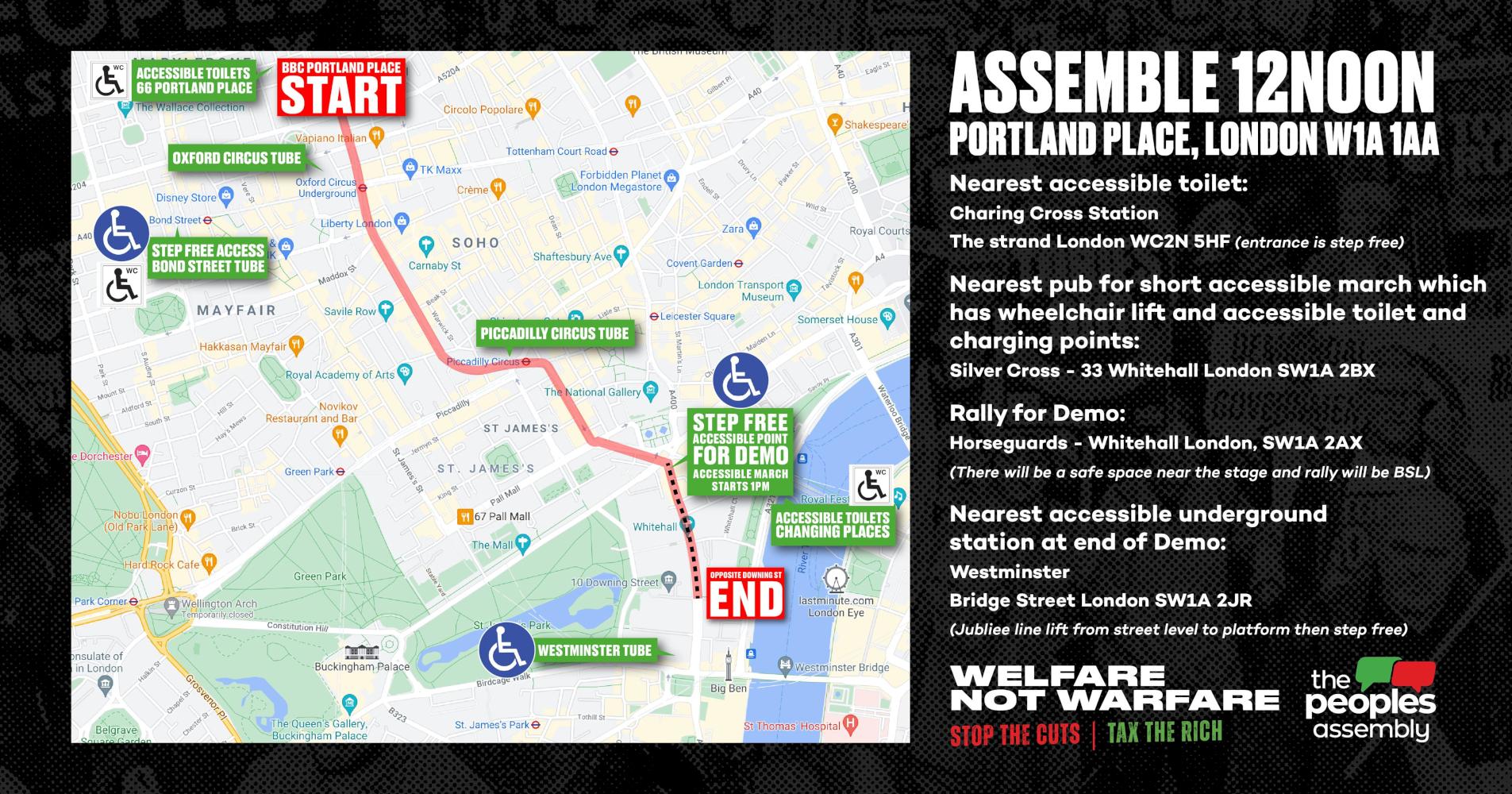
DPAC has been working with People’s Assembly on the accessibility information for the London demonstration.

There is a long march and a short march for accessibility.

Please see all the information below and graphics. There’s also a PDF copy for printing: peoples-assembly-7-june-2025-accessible

Note: Short accessible March will be assembling at 1:30pm (not 1pm as in the graphics)

To plan your journey to London and either the long or short accessible demo; Transport For London link is here: https://tfl.gov.uk/plan-a-journey/


Changing Places Toilets

For nearest changing places toilets on the day which are accessible, the address and times of opening are here:

Changing places toilets
9 Victoria Embankment
London WC2N 5AQ
Open on Saturday 7am to 8.30pm


Long March

The long march will assemble at 12 noon

Outside BBC HQ, Portland Place, London W1A 1AA

Disabled people will be leading the long March should they chose to do that and it will be in front of the banner so plenty of room to move and set the pace

Please assemble there and stewards will lead disabled people to the front of the stewards box for the demo.

Nearest Accessible underground Station for Main March for Portland Place is

Bond Street Underground Station
Oxford Street
London W1C 1JB

(Both Jubliee and Elizabeth line stop there. Step free from train to platform lifts from platform to street level)

Nearest Accessible toilet & cafe for main march:

66 Portland Place
London W1B 1AD
(Accessible toilets are located in the basement & sixth floor of building)

Cafe entrance is step free
(Cafe is open 10 am to 5pm on a Saturday)


Short March

Short accessible March will be assembling at 1:30pm

Assemble at:

North End of Whitehall near Trafalgar Square
Whitehall London SW1A 2HQ

Nearest accessible toilet is Charing Cross Station step free from street.
Need a Radar Key or contact station staff to access:
Charing Cross Station
The Strand London WC2N 5HF

(Main march will pause to allow short march to join and lead demo to rally will be at Horseguards Whitehall London SW1A 2AX

Rally will have a safe space in front of the stage for disabled people to access

Rally will be BSL


If you need to charge mobility scooter/power wheelchair or need access to accessible toilet :

Silver Cross Pub
33 Whitehall
London SW1A 2BX

Pub has wheelchair lift at entrance to access.

Accessible toilet is near the bar and access is a radar key


Getting home

Nearest accessible underground station for end of Demo is:

Westminster Underground Station
Bridge street
Westminster
London
SW1A 2JR

May 222025
 
DPAC Logo with text underneath "Disabled People Against Cuts" and then web address dpac.uk.net

Contents

Disabled MP drops support for assisted dying bill over ‘broken’ social care and health services 1

Mass lobby of MPs marks ‘important’ moment in fight against Labour’s benefit cuts 3

Welsh government’s disability rights plan ‘is a smokescreen’ to hide lack of teeth and targets 6

DWP’s unlawful silence on ‘critical friend’ report raises questions over minister’s transparency pledge 9

Equality watchdog must investigate ‘urgent threat’ posed by Labour policies, say DPOs 10

Most employers have had zero contact with DWP, report shows, in blow to green paper plans 11

Disabled peers speak of ‘daily fight’ against access barriers in House of Lords 13

Other disability-related stories covered by mainstream media this week 15


Disabled MP drops support for assisted dying bill over ‘broken’ social care and health services

A disabled MP has dropped his support for the assisted suicide bill, largely because of concerns that “broken” social care and palliative care services could push terminally-ill people into seeking an assisted death.

Steve Darling told Disability News Service (DNS) this week that he had not yet decided how he would vote on the bill’s third reading, which is likely to take place next month, but he said he had moved from being “marginally in favour” of the bill at its second reading last November, to now being “marginally against”.

He said this was because of growing concerns about the lack of safeguards and the broken health and care system, and that he now had “more concerns than I did then”.

Darling, the Liberal Democrats’ work and pensions spokesperson, said he believed that, after talking to fellow MPs, the momentum in the Commons was shifting against the bill.

Although he did not speak in Friday’s debate, during the first day of the bill’s report stage, DNS noticed that Darling had voted with opponents of the bill – along with most other disabled MPs, such as Labour’s Jen Craft, Liam Conlon, Marsha de Cordova, Emma Lewell, Marie Rimmer and the party’s former shadow disability minister, Vicky Foxcroft – whereas in November he had voted with the bill’s supporters.

Darling said he had been influenced by conversations with two senior consultants at a hospice in his Torbay constituency.

He told DNS that he wanted to see “appropriate funding” for palliative care so terminally-ill people would have a “genuine choice” at the end of life between palliative care and an assisted death.

And he said that the clearer it becomes that the health and care systems are “broken”, the “more challenging it is to feel that people are able to make good decisions about how they should end their lives” if assisted dying is legalised.

Darling said legalisation could lead terminally-ill people to “feel that because of the lack of systems being appropriate for them… they’re pushed in that direction rather than actually being able to have a proper informed choice.

I think a lot of my concerns around the assisted dying bill are making sure that there’s properly-funded services so people can have proper, informed decisions.”

He said the hospice consultants had made it clear that the social care system also needed to be properly funded.

But he said health and social care secretary Wes Streeting had kicked the reform of the social care system “into the long grass… which is horrific, because getting social care properly sorted could help the acute care system massively”.

He added: “In principle, I am supportive of assisted dying.

However, there need to be appropriate safeguards, and I’m getting more worried that the appropriate safeguards are not appearing as clearly as I would wish to see in the emerging bill.”

He also voted on Friday to express his concern that only a small proportion of those MPs who had wanted to speak in Friday’s debate had been able to do so.

And he is concerned that the bill’s committee stage – which was led by supporters of the bill – had granted too many powers to ministers to change the bill if it becomes law, using so-called “Henry VIII powers”.

His comments were welcomed by Not Dead Yet UK (NDY UK), which leads disabled people’s opposition to the bill.

Mike Smith, a spokesperson for NDY UK and former disability commissioner of the Equality and Human Rights Commission, said: “NDY are aware of an increasing number of MPs who have reservations about this legislation, whether it’s that the safeguards aren’t strong enough, or the process has been rushed and flawed, or simply that it’s dangerous in the context of current social care and health provision.

During the debate last Friday, we heard some MPs dismiss disabled people’s concerns as not valid. This is completely unacceptable.

NDY do not know of a single disability organisation that supports this bill, and many disabled voices are campaigning against it.

It’s really important disabled MPs use their insight, gained from personal understanding of the structural disadvantages disabled people face, to better explain the consequences of this badly conceived bill.

We would encourage more disabled MPs to educate their colleagues on why this bill, as drafted, will lead to the unnecessary deaths of many in our society.

Having choice is only valid if it’s a meaningful choice, and for many disabled people we strongly fear it won’t be.”

22 May 2025


Mass lobby of MPs marks ‘important’ moment in fight against Labour’s benefit cuts

Disabled people from across the UK converged on parliament yesterday to challenge their MPs in face-to-face meetings about the government’s proposed cuts to disability benefits.

Disabled activists travelled from Northern Ireland, from Wales – including a group of Disability Wales members – and from Scotland for the opportunity to express their anger and distress about the billions of pounds of cuts to support announced by the Labour government in March.

So many disabled people travelled to Westminster for the event that the parliamentary authorities at one point had to introduce a “one in, one out” rule to ease overcrowding in 900-year-old Westminster Hall.

Notes taken by Disability News Service (DNS) during the event yesterday (Wednesday) suggest that as many as 40 MPs – and possibly more – may have held meetings with disabled constituents during the mass lobby over the cuts laid out in March in the Pathways to Work green paper.

Among those who made time for meetings with constituents were former Conservative work and pensions secretary Sir Iain Duncan Smith; Daisy Cooper, deputy leader of the Liberal Democrats; and former Green party leader Sian Berry.

But other MPs dodged meetings with constituents.

Among those who sent messages to constituents during the lobby that they were not available to meet to discuss the cuts was Ellie Reeves, chair of the Labour party and sister of chancellor Rachel Reeves.

Last month, DNS reported that an ombudsman had linked the 2020 suicide of one of Ellie Reeves’ constituents with the flawed personal independence payment (PIP) system, with the report completed just as her sister announced £4.5 billion cuts to PIP spending.

The mass lobby was organised by the Coalition Against Benefit Cuts, Disabled People Against Cuts, Disability Rights UK and Well Adapt.

Nancy Kelley, from Brighton, reported a “very positive” and “supportive” meeting with her MP, Sian Berry.

She told DNS she had raised her “really profound concern” that the cuts were being made to “already inadequate benefits” and would push hundreds of thousands of disabled people into poverty, as well as damaging people’s health and wellbeing.

She had also highlighted the “moral unacceptability” of the cuts.

Kelley said she had urged Berry to “keep speaking out” about the cuts following questions she has already asked in parliament, including in prime minister’s questions.

She said: “Overall, it was a very positive conversation from an MP who I felt was quite engaged and very open to doing more.”

She added: “I think it matters when MPs see disabled people showing up to advocate for our rights to live in dignity; it matters for us to be so visible here.

It will affect [MPs], whether they meet us, whether they have been requested a meeting and dodged it, or whether they are just walking past.”

But John Ley, a management committee member of METRO GAD in Greenwich, waited in vain for several hours to speak to his MP, housing minister Matthew Pennycook.

Pennycook had not responded to an email request to attend the lobby or to a “green card” request submitted on the day of the lobby.

Ley said: “I am not very impressed with Matthew at all.”

Dermot Devlin, co-founder of DPAC Northern Ireland, had flown to London from Northern Ireland on Tuesday to attend the event, and had to undergo medical tests to check that it was safe for him to fly, while the trip is likely to have a significant impact on his health in the weeks to come.

He said: “That shows how important it is that people back home are being represented here today.”

Although the Pathways to Work green paper and its associated billions of pounds of cuts do not apply to Northern Ireland, the Northern Ireland Executive’s finance minister, John O’Dowd, said earlier this month that it was “becoming increasingly difficult, if not impossible” to mitigate against spending decisions made in Westminster.

Devlin said: “It will affect us too. We need to show our faces too. It will impact us.”

He said he believed the biggest influence of the mass lobby would be the “visual impact” of so many disabled people gathered in the House of Commons to lobby their MPs.

Daisy Cooper, deputy leader of the Liberal Democrats, said her party hoped the government would revise its plans for the PIP cuts, just as the prime minister had announced hours earlier at prime minister’s questions that he would look again at Labour’s cuts to winter fuel payments.

But she said that, as the government’s plans stand, the Liberal Democrats were “very likely” to vote against the PIP cuts when legislation is presented to parliament, probably next month.

She told DNS: “It’s abundantly clear to me that there is already a huge amount of distress that is being caused to people with disabilities and their carers as well, and if the government is serious about getting people into work, or helping people in work stay in work, then cutting the support that helps them do that is not the way to do it.

I have spoken to a number of people who are here today as part of this rally to lobby their MPs and what I can hear is that people are angry and people are scared.”

She said people rely on PIP “just to keep their head above water for day-to-day life, or keep them in work”.

One of her constituents told her he is desperate to stay in work, and that PIP allows him to do that by contributing to his travel costs.

She said: “It’s hard enough to get PIP as it is, and making it even harder is really tough.”

Neil Duncan-Jordan, who sponsored the event with fellow Labour MP Richard Burgon, told DNS he believed momentum was growing against the cuts among Labour MPs.

He said: “I think you’re getting more and more MPs feeling uncomfortable about what they are being asked to vote for, particularly because they are probably going to be asked to vote for it prior to actually having any real detail in front of them about the impact of that.

Let’s get disabled people in front of MPs, let’s get the arguments out there, let’s see the MPs respond and see whether or not they are persuaded. I hope they will be.”

He added: “It’s important that disabled people meet their MPs directly and lay out in front of them what these cuts are going to mean on a day-to-day basis, how it’s going to affect them, how it’s going to affect their lives.

Being an MP in Westminster, it’s easy to feel disconnected from the real world; it’s important that we start connecting again with ordinary people and that they tell us how our actions affect their daily lives, and that’s what I think this lobby is about.”

The mass lobby took place as the Commons work and pensions committee sent a letter to work and pensions secretary Liz Kendall calling on her to delay cuts to PIP and to the universal credit (UC) health element, and to co-produce new measures with disabled people.

It also called on her to carry out an “independent, comprehensive analysis of the impact of the proposed cuts in UC health support on employment, poverty and health outcomes”.

Tracey Lazard, chief executive of Inclusion London, said the mass lobby was “an important moment in what’s going to be a long struggle”.

She said: “It’s not the last time that we will be mobilising.

What we are facing is so devastating. Effectively, we are looking at the dismantling of disability benefits as we know it.

It makes no policy sense, it makes no political sense, and it definitely doesn’t make any ethical justice sense.”

And she said that comments by Liz Kendall, in a speech yesterday at the IPPR think tank, that the welfare state might not survive without the cuts to disability benefits, were “desperate” and “absurd”, particularly because social security spending was stable.

DPAC’s Andy Greene, whose MP Dame Emily Thornberry sent a message during the event to say she could not attend the lobby, said he believed Labour’s plan in government had been “just not to engage” with disabled people.

But he said it was “really encouraging” to see so many new faces among the disabled people who attended the event, which “bodes well for the struggle ahead”.

He said: “It’s really important that disabled people take every opportunity they have to get together.

Secondly, it’s an embarrassment for the government when a lot of people turn up to say ‘look at this’ and they are too afraid to show their faces.

These people are making these decisions but are then not willing to engage.”

DNS editor John Pring attended a meeting with his MP, Matt Rodda, as part of the lobby, but as Rodda is parliamentary private secretary to Northern Ireland secretary Hilary Benn, he was not able to give an interview about his views. But Rodda requested a written briefing from Pring, and promised to read it

22 May 2025


Welsh government’s disability rights plan ‘is a smokescreen’ to hide lack of teeth and targets

The Welsh government has been accused of putting up a “smokescreen” after publishing a draft disability rights plan that lacks “teeth” and is full instead of pledges to carry out reviews and produce guidance while offering no new money.

The 10-year Draft Disabled People’s Rights Plan aims to improve the rights of disabled people in Wales, but there are no significant promises on key areas such as social care, accessible housing and transport, and disability poverty.

The Labour plan is also short of concrete targets, which means it would be almost impossible for disabled people to hold the Welsh government to account on progress.

Instead, the 61-page document, which is now out for a 12-week consultation, mostly offers descriptions of the barriers disabled people already face in housing, transport, access to justice, social care, education and employment.

Alongside the plan is a separate document listing 48 short-term actions.

They include a promise to work with local authorities to improve accessible housing; a pledge to collaborate with disabled people’s organisations to “design and deliver a new funding stream that addresses social care needs”; and plans for a public campaign to “challenge ableism” and focus on the UN Convention on the Rights of Persons with Disabilities.

Despite the lack of concrete targets, the draft plan says the Welsh government’s Disability Disparity Evidence Unit will “set out a model which explains how change is expected to follow the actions set out and the evidence needed to measure change”.

Jane Hutt, the Welsh government’s social justice secretary, said the draft plan was based on the work of the Disability Rights Taskforce and its 10 working groups.

The taskforce was set up by the Welsh government following the 2021 publication of the groundbreaking Locked Out report on the discrimination experienced by disabled people in Wales, particularly during the pandemic.

But there was half-hearted support for the draft plan this week, and even outright criticism from some of the disabled people who chaired the working groups.

Damian Joseph Bridgeman, a disabled adviser and campaigner, who chaired the taskforce’s housing and community working group but also worked on other areas of the plan, said the document was “a smokescreen” rather than a plan.

He said it was a “collection of vague intentions dressed up as progress”, and he added: “No targets. No teeth. No real-world accountability.”

He also pointed to the absence of new money and no mechanism to track delivery of the action plan.

He said: “So what are we actually committing to? Awareness-raising? Reviews? Guidance updates?

Disabled people have been reviewed to death. What we need is action – and there’s none of that here.”

He said he feared the plan had “already been quietly kicked into the long grass”.

Bridgeman said some of the most practical, necessary recommendations that came out of the co-production phase of the process “never even made it into the final plan” because the government “doesn’t know how to deliver them”.

He said: “In the current political landscape – with the DWP ramping up sanctions, Access to Work collapsing under its own weight, and social care in crisis – this strategy feels like yet another reminder that disabled people don’t matter.”

He called for a new Welsh Disability Office to “embed disability inclusion across all policy portfolios”, and a disability rights commissioner for Wales, as well as “real funding, hard timelines, legislative reform, and meaningful power”.

Joe Powell, chief executive of All Wales People First – which receives funding from the Welsh government – who chaired the taskforce’s access to justice working group, was also unenthusiastic about the draft plan.

He said in a statement that the plan was “a positive step forward in the sense that disabled people across Wales have worked in co-production to envisage a better future for disabled people in Wales.

However, in order for this plan to succeed we need the appropriate investment into the infrastructure and services to make this aspiration a reality.

We need clear targets about how we are going to achieve this.

Without these, it is very difficult to see how the plan will make a difference to disabled people in Wales.”

Dr Natasha Hirst, a disabled activist who chaired the taskforce’s access to services working group, said a “key concern” was the lack of a mechanism for scrutinising and holding the Welsh government to account, as well as the lack of “clear and robust targets” and no new funding for implementing the actions.

Although the taskforce had involved “a groundbreaking process of coproduction”, she said the action plan itself was not co-produced and many of the recommendations from the working groups were not included in the consultation document.

She said: “It’s vital that disabled people and their organisations respond to the consultation to highlight areas that are missing or not meeting expectations.”

And she called on political parties in Wales to make clear manifesto commitments to “supporting, implementing and extending the action plan over the long term”.

She said the Welsh government has “shown better leadership on the issue of disability rights and inclusion” than the UK government, and there was now an “important opportunity to embed this approach in the longer-term political infrastructure of Wales”.

But she added: “Everything that the plan aspires to do will be undermined and impossible to implement if the UK government’s proposed PIP cuts go through.

Wales has higher levels of poverty and a larger proportion of disabled people and not enough resources to mitigate the cuts and attacks on disabled people’s rights coming from Westminster.”

Asked why there was no funding announced alongside the plan, why there was no significant action to tackle key issues such as social care, accessible housing and transport, and disability poverty, and why the plan was short of concrete targets, a Welsh government spokesperson released the following statement.

We are committed to ensuring disabled people can fully participate in Welsh society, and our draft 10-year plan – shaped by lived experience through the Disability Rights Taskforce – demonstrates our long-term commitment to meaningful change.

We are holding a 12-week consultation on the draft plan, which seeks views from individuals and organisations, with a particular emphasis on hearing directly from disabled people about their priorities.

Disability rights will become part of every department’s core budget, creating a lasting commitment, with disabled people helping shape priorities through our new External Advisory Board.

Alongside the actions we will take now, our progress report demonstrates the many positive actions already being taken to advance positive outcomes for disabled people in Wales.

We have focused on creating the right governance structure, placing disabled people at its centre, and the External Advisory Board will work with us to ensure we are delivering change to improve disabled people’s lives.”

22 May 2025


DWP’s unlawful silence on ‘critical friend’ report raises questions over minister’s transparency pledge

The Department for Work and Pensions (DWP) has unlawfully failed to respond to a request to see a secret paper on the department’s safeguarding failures, casting doubt on a minister’s pledge to open DWP to “public scrutiny”.

The “critical friend” paper was written four years ago by Conservative minister Baroness Neville-Rolfe and appears to be a report analysing the department’s safeguarding strategy.

It is likely to discuss the links between the department’s actions, policies and practices and the deaths and other harm caused to countless disabled benefit claimants.

But despite Disability News Service (DNS) submitting a request for a copy of the report on 1 April, DWP’s freedom of information team has not even responded to the request, or to a follow-up email on 12 May.

Both emails received automated confirmations that they had been received.

Public bodies have a legal duty to respond to freedom of information requests within 20 working days (about a month).

DWP’s actions have cast further doubt on the pledge of Sir Stephen Timms, Labour’s minister for social security and disability, that he would “open up what is going on in the Department for Work and Pensions to public scrutiny”.

Despite Sir Stephen’s transparency pledge, his department continues to prevent the release of vital documents.

It is fighting at least two information rights tribunal cases, one involving recommendations made about the flawed universal credit system by DWP’s secret internal process reviews, and another seeking the release of a DWP paper “detailing the impact of errors on vulnerable customers”.

DWP is also fighting the release of a transcript of a training session on human rights law delivered to DWP staff by a government lawyer in November 2023.

The existence of the “critical friend” paper only emerged when DNS obtained a memo that proved it was former Conservative work and pensions secretary Therese Coffey who banned her department from using the term “safeguarding” in February 2021.

That memo was titled “Readout of meeting with the SoS department’s response to Baroness Neville Rolfe’s critical friend paper”.

Among those who attended the meeting were senior civil servants with responsibility for service excellence, customer experience and safeguarding strategy.

Baroness Neville-Rolfe worked in John Major’s policy unit when he was prime minister and was more recently a Conservative minister in departments including the Cabinet Office and the Treasury.

Baroness Neville-Rolfe had not responded to a request to comment by noon today (Thursday).

DWP had also not responded by noon today.

22 May 2025


Equality watchdog must investigate ‘urgent threat’ posed by Labour policies, say DPOs

More than 50 disabled people’s organisations (DPOs) have called on the equality watchdog to investigate the “urgent threat” to the equality and human rights of disabled people posed by the new Labour government.

In a letter to the chief executive of the Equality and Human Rights Commission, John Kirkpatrick, they say the “disproportionate impact” of the policies taken together breaches the Human Rights Act.

And they criticise the government’s failure to consult with DPOs on its cuts and reforms to disability benefits before publishing its Pathways to Work green paper in March.

They also call on the watchdog to carry out the same “cumulative” assessment of the impact of all the government’s cuts that it carried out into policies implemented by successive Conservative governments from 2010 to 2018.

The letter warns that Labour’s cuts to benefits will push many disabled people into poverty; that the cuts will cause “many more deaths” of claimants; and that “negative, misleading and false statements” about disabled people and benefits, made by prime minister Sir Keir Starmer, chancellor Rachel Reeves and work and pensions secretary Liz Kendall, are increasing disability hate crime.

It also points out that the government has failed to address the concerns raised last year by the UN’s committee on the rights of persons with disabilities.

The committee found that the Conservative government had “failed to take all appropriate measures to address grave and systematic violations of the human rights” of disabled people.

Among the cuts announced by the Labour government since last July’s general election victory, the letter points to billions of pounds of reductions in spending on personal independence payment (PIP) and cuts to the health element of universal credit, including plans to remove eligibility for the health element from disabled people under the age of 22.

But the letter also highlights concerns in areas other than social security, including “ongoing cuts to NHS and mental health services disguised as efficiency savings” and the impact on adult social care of “ongoing austerity budgets for local authorities”.

And they point to the impact on disabled people and DPOs of tax rises faced by NHS and social care service-providers.

Among the DPOs to sign the letter were Disabled People Against Cuts, Recovery in the Bin, The Alliance for Inclusive Education, All Wales People First, Inclusion London, WOW Campaign, West of England Centre for Inclusive Living, Deaf Ethnic Women’s Association and National Survivor User Network.

An EHRC spokesperson said: “We have received this letter from several Deaf and disabled people’s organisations.

We will carefully consider the concerns raised and respond in due course.”

22 May 2025


Most employers have had zero contact with DWP, report shows, in blow to green paper plans

Most employers had no contact with the Department for Work and Pensions (DWP) in the previous year, according to new DWP research, highlighting the task facing the government as it tries to boost the number of disabled people in work.

The results of the DWP Employer Survey 2024 show four-fifths of employers (79 per cent) had not been in contact with DWP in the previous 12 months.

Just 11 per cent of employers had received support through the Access to Work (AtW) scheme.

And only 21 per cent of employers were even aware of AtW, a sharp drop compared with 26 per cent in 2022.

The survey results also showed that just one per cent of employers had been in contact with the department about its much-criticised Disability Confident scheme, another of the foundations of DWP’s efforts on disability employment.

Earlier this month, Disability News Service (DNS) reported that AtW was under attack from the government, with the launch of a new cost-cutting drive that insiders fear could destroy the scheme and lead to disabled people being forced to quit their jobs.

These cuts come as Labour ministers continue to insist that their Pathways to Work green paper – and its billions of pounds of cuts to disability benefits – is focused on helping disabled people find work and stay in employment.

DNS reported in February that four work and pensions ministers had failed to sign up to Disability Confident, six months after Labour won power at the 2024 general election.

In November 2016, DWP itself was declared a Disability Confident “leader” – the highest of the scheme’s three levels – days before it was found guilty of grave and systematic violations of the UN Convention on the Rights of Persons with Disabilities.

The new DWP survey results also show that just under three in 10 (29 per cent) employers collect information on whether their employees are disabled or have long-term health conditions.

Only about a quarter of employers (26 per cent) said they currently employ any disabled people, while only 89 per cent of organisations with at least 250 staff say they employ at least one disabled member of staff.

The report shows the results of a survey of about 8,000 employers across Britain.

The research examined employers’ attitudes, behaviour and provisions around staff health, sickness and disability.

But it showed that confidence in recruiting disabled people and people with long-term health conditions was low, with only 35 per cent of employers saying they were confident in doing so.

Asked if the research showed DWP was under-performing when it comes to engaging with employers, that the government has a huge task in persuading employers to increase disability employment, and whether ministers saw the results as a setback for their Pathways to Work plans, a DWP spokesperson said: “We are determined to create a welfare system that supports people into work and out of poverty.

At the heart of our reforms is a £1 billion scheme to help the long-term sick or disabled find good, secure jobs.

This is on top of our Get Britain Working white paper, which set out the biggest employment reforms in a generation, to drive up employment and opportunity and grow the economy.”

DWP also said it was consulting on the future of Access to Work.

22 May 2025


Disabled peers speak of ‘daily fight’ against access barriers in House of Lords

Disabled peers have told a committee of MPs that they face a “daily fight” just to be able to do their job, because of their continuing battle against the access barriers within the House of Lords.

Members of the Commons modernisation committee heard how disabled peers and civil servants had to confront both physical and attitudinal barriers in their daily work in the Lords.

The committee – which is carrying out an inquiry into the accessibility of the Commons and its procedures – had heard from disabled MPs last month that the Lords was “aeons ahead” of the Commons on providing an accessible working environment for parliamentarians.

But the evidence given by four disabled peers on Tuesday suggested the Lords was far from being a beacon of equality and accessibility.

Labour’s Lord [David] Blunkett, crossbench peer Baroness [Tanni] Grey-Thompson, Liberal Democrat frontbencher Baroness [Sal] Brinton and Conservative peer Lord [Kevin] Shinkwin all spoke of the daily frustrations they face in trying to do their jobs in the House of Lords.

Baroness Brinton said she was no longer able to open the doors in the corridors of the Lords because they are too heavy and are kept shut for “security reasons”.

She said she was nearly at the point of needing a personal assistant to allow her to move around the Lords.

And she spoke of the battle she had as a user of an electric wheelchair to be able to manoeuvre in and out of one of the accessible toilets.

She said: “And that day-to-day experience, multiplied across virtually every disabled toilet in this place, except the Changing Places one, is really infuriating, and you just feel you are doing a battle with the building every day.”

She told the MPs: “We respect the history and tradition in our House, which goes back way beyond yours… but we are a functioning parliament and we need to have a House that can actually work effectively, and sometimes I’m afraid the building does get in the way.”

She spoke of the long-delayed plans to renovate the Palace of Westminster, and said it was currently impossible for a wheelchair-user to speak as a minister from the despatch box in the House of Lords.

She said: “I don’t think the consultants who are doing the design work understand these issues fully, and it will be outrageous if we came back to a brand-new building that presumably is expected to last for 200 years, and there is nothing to make sure that a politician in a wheelchair could use either despatch box [in the Lords or the Commons] or be the Speaker or the Lord Speaker… or a senior clerk.”

Lord Blunkett told the committee: “I just think that there’s goodwill about modernisation, but there’s not good practice.

It has taken a long time before, for instance, those operating IT have the least idea how to cope with variations and requirements for those who have got special needs.

It’s getting there and there’s some very good people trying very hard, but it’s taken a long time.”

Asked about the balance between tradition and the need for adjustments for disabled people, he said: “I’m an out and out modernizer, I believe that tradition is often used as an excuse for inaction.”

And he said that the financial supplements that some disabled peers receive to support them with their assistance requirements are only available when the House of Lords is sitting.

He said: “I can live with that because I’m very fortunate, I have outside earnings and I can afford to top that up together with my own daily allowance to pay my assistant, who’s brilliant, who I couldn’t do anything without, but other people can’t.”

He added: “I do resent the feeling that they’re doing people a favour.

I think that is the worst feature of some of the attitudes in this place, and I’ve been here 37 years, man and boy, the supercilious pretence of being understanding whilst actually being patronizing and not understanding at all.

And in the Lords, finance are the worst.”

Baroness Grey-Thompson, a retired multi-gold-medal-winning wheelchair athlete, said that new carpets laid in the House of Lords were “virtually impossible for me to push on”.

She said: “You can’t push in a straight line because the way they’re laid it sends your wheelchair in all sorts of odd directions.

Considering that the House of Lords has a reasonable number of people who have some form of disability or impairment, it’s actually just hard to kind of do your daily business.

It shouldn’t be a daily fight just to do your job.

I’m not sure whether it’s because I’m getting older, but it does feel that it takes more and more energy just to be able to do the things that maybe others take for granted.”

Lord Shinkwin said that a meeting held last week by the Lord Speaker [who presides over the House of Lords] to examine access issues did not provide a palantypist, so a peer with a hearing impairment was unable to understand what was being said.

He said he believed that disabled peers were facing cultural and attitudinal problems.

He said: “Every time I come into work… I’m reminded that this is an institution that was designed and built by non-disabled people for non-disabled people, and it’s still run by non-disabled people for non-disabled people.”

He said he did not understand why the authorities did not appoint a disabled person at a senior level to address “so many of the issues that we’re encountering”.

Lord Shinkwin said: “In the time I’ve been here, we must have had three or four disability access audits that have simply gathered dust on some shelf, but after probably hundreds of thousands of taxpayers’ money has been spent on having them done.”

He told the committee: “There’s no real recognition that as a body that passes laws on disability discrimination and equality, we might just have a duty to be a beacon of best practice.”

22 May 2025


Other disability-related stories covered by mainstream media this week

Rachel Reeves’ local Labour party will call for the chancellor to abandon her plans to cut disability benefits, as rebellion among MPs over the policy grows. The Leeds West and Pudsey constituency Labour party, which campaigned to return Reeves to parliament last year as its MP, has agreed to write to her “as soon as possible” to make clear it does not support the cuts: https://www.theguardian.com/politics/2025/may/17/rachel-reeves-labour-leeds-disability-benefits

A wheelchair-user missed her train when staff refused to assist her with a ramp and called her “rude” after she complained. Anna Landre had planned to travel to Cambridge from London Liverpool Street on Sunday, but was forced to cancel her plans when station staff were “too busy” to help her onto the train: https://www.independent.co.uk/news/uk/home-news/wheelchair-travel-train-staff-ramp-anna-landre-b2754235.html

22 May 2025


News provided by John Pring at www.disabilitynewsservice.com


 Posted by at 15:36
May 162025
 
DPAC Logo with text underneath "Disabled People Against Cuts" and then web address dpac.uk.net

Disabled people in Swansea insulted by Torsten Bell MP

Swansea Disabled People Against Cuts (DPAC) members have reacted strongly to public statements made on BlueSky by Swansea West MP Torsten Bell. The Labour MP has claimed that the group is “spreading falsehoods” and has made an allegation that they are “entirely falsely” attributing language to him.

A spokesperson for the group said, “being called liars is just the latest in a growing line of insults from this MP. He is welcome to argue that his remarks are taken out of context. We would invite the public to judge. However, following questions on the matter from the press, the MP has instead chosen to delete a post and the ‘edit history’. He is the one who has deleted the context, not us.”

The group has also highlighted offensive remarks made by other Labour MPs, such as Rachel Reeves MP, who defended plans to cut disability benefits by comparing it to “children’s pocket money”.

Politicians refuse to listen to disabled people

In an open letter signed by more than 250 people and organisations, including a national Labour-affiliated trade union, Swansea DPAC has made an appeal for a fair and respectful public debate with MPs over the issues. The group says it is now at a stalemate following the MP’s refusal to take part, but says it intends to host the debate regardless.

A Swansea DPAC spokesperson added, “we do not want a personal exchange of insults. We want to defeat the disability cuts (that Torsten defends) politically. We want an end to the offensive and upsetting language being used by many Labour MPs. We want a structured public debate, not a public spat carried out over social media. Unfortunately, despite our best efforts, that’s all we’re getting from Torsten.”

“Disabled people are certainly not getting anything close to a fair debate from an inaccessible so-called ‘public consultation’ that refuses to consult on half the issues, and repeatedly fails to respond to disabled people with access requirements. We are fighting to be heard.”

Stop the disability cuts

The group is calling for the proposed cuts to be scrapped, and for the government to start again, genuinely listening to disabled people and carers from day one in a process of co-production.


At a protest, wrapped in a rainbow pride flag, stands a young man with blue hearing aids. he is holding a placard in blue, pink and white trans pride colours. The placard says "Stand together" and has a picture of the Welsh dragon on it. Below the dragon is the Disabled People Against Cuts logo. The logo is a circle being held by four hands of different skin tones. The logo has an upside-down black triangle in the centre bearing the letters D P A C
May 152025
 
DPAC Logo with text underneath "Disabled People Against Cuts" and then web address dpac.uk.net

Contents

Kendall refuses to apologise after misleading MPs four times in 23 minutes about PIP cuts 1

Parliament security confiscates ‘political’ book on DWP deaths from activists before PIP cuts debate 3

DWP must finally act on ‘deficient’ approach to safeguarding with a duty of care, say MPs 5

Two terminally-ill women to complain to UN over passage of assisted dying bill through parliament 8

Shocked disabled campaigners vow to fight on after MSPs vote for Scottish assisted dying bill to progress 11

Mind faces discrimination claims after internal probe calls for multiple improvements on equality 13

Network Rail to spend £8 million on building an inaccessible footbridge that will last 120 years 15

Crowdfunder in memory of Krissi Hunt could educate coroners on links between DWP and claimant deaths 17

London theatre to host installation that exposes how DWP austerity measures led to countless deaths 19

Other disability-related stories covered by mainstream media this week 21


Kendall refuses to apologise after misleading MPs four times in 23 minutes about PIP cuts

Work and pensions secretary Liz Kendall has refused to apologise after repeatedly misleading MPs by suggesting that her planned cuts of billions of pounds to personal independence payment (PIP) were linked to supporting disabled people into work.

On four occasions in just 23 minutes during work and pensions questions in the Commons on Monday, Kendall replied to questions about her plans to cut spending on PIP by £4.5 billion a year – laid out in March in the Pathways to Work green paper – by speaking about Labour’s plans for disability employment.

Sir Stephen Timms, the minister for social security and disability, also answered a question about the PIP cuts by talking about employment support.

Both ministers will be aware that PIP is not an out-of-work benefit, and that it can be claimed by disabled people who are in or out of work.

But Labour ministers have repeatedly responded to criticism of the planned cuts to PIP, since they were announced in March, by speaking instead about their plans for disability employment.

On Monday, Labour’s Imran Hussain asked Kendall at 2.36pm about the 41,000 disabled people in Bradford who were “rightly horrified” by the PIP cuts, which “has the potential to devastate the lives of tens of thousands of people in Bradford overnight”.

But in reply, Kendall said: “We want to improve people’s chances and choices by supporting those who can work to do so and by protecting those who cannot.”

When Conservative MP Sir Roger Gale, who himself has a long-term health condition, asked about the PIP cuts, Kendall said the government would be “consulting with disabled people about how to build our £1 billion a year employment support programme, and we will make sure that those who can never work will be protected”.

She was then asked by Labour’s Rachael Maskell about the impact of the PIP cuts on public services, particularly adult social care, but told her: “We have clear evidence that being in work is good for people’s health: good work is good for people’s physical and mental health.”

And when Green MP Sian Berry suggested that the PIP cuts were “cruel and wrong”, Kendall told her – at 2.59pm – that “disabled people who are out of work and economically inactive are more likely than non-disabled people to say they want to work, and if they are in work, they are half as likely to be poor”.

When Sir Stephen was asked by Liberal Democrat work and pensions spokesperson Steve Darling about the “300,000 people set to be plunged into poverty” by the PIP cuts, he joined Kendall in misleading MPs by telling him: “The crucial thing is to improve the employment support for people who are out of work on health and disability grounds.”

He then added: “At the moment there are 200,000 people out of work on health and disability grounds who say they would like to be in a job now, and could be in a job now, if they had the support they need.”

Asked by Disability News Service why Kendall repeatedly misled MPs, and whether ministers were refusing to engage honestly with questions about the PIP cuts because they realised the devastation it would cause to hundreds of thousands of disabled people, a DWP spokesperson refused to comment.

Kendall also announced during work and pensions questions on Monday that the government had started its review of the PIP assessment process.

She said the government was now beginning the review’s “first phase”, and that Sir Stephen was “inviting in stakeholders this week to develop the scope and terms of reference of this review”.

Sir Stephen appeared to suggest later that the review could lead to further cuts to support as he told MPs it would “consider whether the assessment criteria effectively target the right people at the right level”, and would “look at the descriptors and consider the points allocated to them”.

In the green paper, the government had said the work capability assessment would be scrapped, and that the PIP assessment would – from 2028 – assess eligibility for both PIP and the health element of universal credit.

The green paper made it clear that the government planned significant changes to the assessment process, which it said needed “modernising” as it was more than a decade since PIP was introduced.

It pointed to “significant shifts in the nature of long-term conditions and disability, as well as changes in wider society and the workplace”, with increases in the number of people receiving PIP with “mental health or neurodiverse conditions as their primary condition”, while “increases in disability have been more marked among younger adults than older people”.

It also said the review would “shape a system of active support that helps people manage and adapt to their long-term condition and disability in ways that expand their functioning and improve their independence”.

And it warned that the review would “provide an opportunity to consider how to extend the goals and approach” of the green paper, which suggests that it could assist the government in further tightening eligibility for benefits.

15 May 2025


Parliament security confiscates ‘political’ book on DWP deaths from activists before PIP cuts debate

Parliament has refused to criticise a security officer who confiscated a book about benefit deaths because it was “too political” as three disabled activists arrived to watch a debate on disability benefit cuts, and quizzed them about their medication.

The three activists were astonished when the security officer confiscated political leaflets and a copy of The Department*, a book that exposes links between the Department for Work and Pensions and countless deaths of disabled benefit claimants.

The trio – Paula Peters, Andy Mitchell and Anna** – were left shocked and shaken as they were passing through House of Commons security, after the security officer questioned two of them about why they needed their medication, and even examined the contents of their notebooks after searching their bags.

The security officer pointed to the book, and told Anna she could not take it inside parliament because it was “too political”.

She also confiscated a Disabled People Against Cuts (DPAC) “welfare not warfare” badge, copies of a DPAC anti-cuts leaflet, a pro-Palestine leaflet, a bag of DPAC badges Mitchell was planning to take to a trade union conference, and a leaflet about the left-wing We Demand Change alliance, all because they were “political”.

All three had checked the list of banned materials on the parliament website before their visit, and the items confiscated were only covered by the list because they appear to have been seen by the security officer as “political or offensive slogan materials”.

Anna said the book – written by Disability News Service (DNS) editor John Pring – was particularly important because they had wanted to show it to MPs after the debate.

She said: “It was literally what we were going to hear MPs talk about.”

She said she was now worried about returning to the House of Commons.

Anna said: “They were asking us why we were taking our medication. I said: ‘I’m not telling you.’ It was so invasive.

I have been an activist for a long time and I have never experienced anything like it before.”

She added: “I am really concerned that this kind of behaviour is going to increase, and this policing of language and activism is just going to get worse.”

Peters, a member of DPAC’s national steering group, told the security guard: “We are disabled people, disability activists, and you’re treating us like criminals. This is not OK.”

The three activists had been heading to watch MPs debate the government’s planned multi-billion pound cuts to personal independence payment (PIP).

The security checks are carried out by both police officers and parliamentary security staff.

Peters told Pring: “They really got irate when they saw your book.

They said: ‘Oh no, you can’t bring that in here. That’s political.’

It was just a horrible experience. It was the heavy arm of the state. They are trying to gag the truth about the impact of austerity.

They can take all the leaflets and badges and books they like, but it won’t stop us; we have a right to be in parliament and lobby MPs.

They know the impact of 15 years of austerity, they know disabled people have died as a result of the impact of benefit cuts, they know about Philippa Day, they know about Jodey Whiting, they know about David Clapson.

DWP knows, past and present ministers know, they know what the impact of these cuts will be, they know.”

She said she had been attending parliamentary events for more than 15 years, and had not experienced anything like this level of hostility.

That morning, the three activists had passed easily through security at another parliamentary building, Portcullis House, with the same possessions.

After last Wednesday’s debate on cuts to PIP, secured by veteran Labour MP Diane Abbott, the trio were escorted by the security guard and a police officer to the House of Commons exit after collecting their confiscated belongings.

Parliament’s press office confirmed to DNS that some items were confiscated by security staff and later returned.

It said that “political or offensive slogan materials” are included on the list of items that are viewed as “restricted”, but that there are no rules preventing reading materials being brought into parliament, although security staff and police officers may use their discretion in taking action.

It later confirmed that there had been no recent changes to its policy on what items can be brought into parliament.

But it declined to say if parliament condoned the actions of the security officer, and declined to provide an on-the-record statement about the decision to confiscate the book and the leaflets.

Instead, a spokesperson for parliament said in a statement: “We recognise the importance of democratic access to the Houses of Parliament and facilitate the visits of thousands of people to the estate each week.

Security staff and officers work within publicly available guidance to decide on what items may be brought onto the estate, and we welcome feedback from visitors on their experiences to help us make improvements to our services.”

The Metropolitan police had not commented on the incident by noon today (Thursday).

The debate on the PIP spending cuts saw angry Labour MPs attack their own government for its proposed cuts to PIP spending.

Abbott had told the debate: “The only certain way that cutting PIP saves the billions of pounds that the government want is by making PIP recipients live on less, and this is something that ministers claim they do not want to do.”

Fellow Labour MP Rachael Maskell said: “After 14 years of battling, here we are, with Pathways to Work, taking away money, agency, dignity, independence and the essence of life itself.

I fear, like many do, that people will take their lives, once again crushed by a system that fails to believe and points the finger rather than offering the hand, turning hope to despair.

Poverty, dependency and harm – if not physical, most definitely psychological – await.

Colleagues, we are better than this. Let us vow to stop such pernicious cuts and rewrite the story with the voices, experiences and hope of disabled people.”

Sir Stephen Timms, the minister for social security and disability, had defended the PIP cuts.

He said the government would “make the costs of PIP sustainable and address the unsustainable increases that have led to an almost doubling of the real-terms cost of the benefit, from £12 billion to £22 billion, since the year before the pandemic.

Last year alone, it increased by £2.8 billion beyond inflation. I think everybody who has spoken would recognise that we simply cannot let that trend carry on.”

*The Department: How a Violent Government Bureaucracy Killed Hundreds and Hid the Evidence, DNS editor John Pring’s book on the years of deaths linked to DWP, is published by Pluto Press

**Not her real name

15 May 2025


DWP must finally act on ‘deficient’ approach to safeguarding with a duty of care, say MPs

A report from MPs today calls on the Department for Work and Pensions (DWP) to introduce a new legal duty for it to safeguard “vulnerable” claimants of benefits, after decades of deaths and other harm linked to its policies and procedures.

The long-awaited report on safeguarding vulnerable claimants, by the Commons work and pensions committee, also calls today (Thursday) for a deep-rooted cultural change across the department so it can address its current “deficient” approach to safeguarding.

And it suggests a new independent body should be set up to investigate cases where claimants have been seriously harmed by DWP’s actions.

Debbie Abrahams, the committee’s Labour chair, said: “Deep-rooted cultural change of the DWP is desperately needed to rebuild trust and put safeguarding at the heart of policy development.”

She said a statutory duty to safeguard vulnerable claimants would “help to focus minds from the top-down, ensuring that safeguarding is everyone’s business”.

The committee says in its report that the introduction of an “overarching statutory duty is necessary to bring about the fundamental change that is required” and it points to a current approach that “lacks coherence and direction”.

The work of the safeguarding inquiry stretched across two parliaments, and many of its recommendations are likely to be welcomed by those who have fought for years for comprehensive reform of the department and its culture.

The committee heard evidence during its inquiry from disabled people’s grassroots groups, disabled researchers, and bereaved relatives of claimants whose deaths were linked closely to DWP’s actions and policies, as well as academics, welfare rights experts and charities and Conservative and Labour ministers.

Among those who gave evidence was Anne-Marie O’Sullivan, whose father Michael O’Sullivan took his own life in September 2013 after DWP spent more than a year trying to harass him into a job when he was too unwell to work.

In her written evidence, she described her father as “a deeply anxious man who simply could not cope with all the DWP chose to throw at him”, and she wrote of DWP’s “thirst to find unwell people fit for work”.

She called for DWP to be subjected to a statutory duty of care and for DWP finally to accept responsibility for her father’s death.

But despite the report’s recommendations, there may be concerns that Abrahams refused this week to issue any warning to her government that its planned cuts of billions of pounds to disability benefits could lead – if those recommendations are not accepted and implemented – to a new wave of deaths.

And she refused to say whether she believed that lives would be saved if there was a statutory safeguarding duty, an independent body to investigate DWP harms, and deep-rooted cultural change within the department.

Instead, she told Disability News Service (DNS): “The key change we want is to ensure everyone in the DWP sees safeguarding claimants as their responsibility; culture change is key.

The statutory safeguarding duty we would like to see placed on the department, which will be held by the secretary of state, highlights how seriously this is being taken.

Together with independent oversight through the independent body examining deaths and harms of claimants, this will hopefully rebuild trust.”

The committee also refused to call for DWP to be obliged to share its secret internal process reviews (IPRs) into claimant deaths with the families of those who have died, something DNS has been demanding for many years.

Abrahams did not explain why the committee had not made this recommendation, although she said it was “an area we looked at” and “something DWP is actively working on at the moment”.

The report says that, since 2020-21, there have been 240 IPRs into cases of serious harm where there was a suggestion or allegation that DWP’s actions or omissions may have contributed to a claimant’s death or harm, although the number of cases where DWP contributed to serious harm experienced by claimants was probably “much higher than this”.

Among other recommendations, the committee calls on DWP to set up a group of people with lived experience of the benefit system – similar to the successful Greater Manchester Disabled People’s Panel – “to help shape safeguarding policy”.

It says DWP should add a question to all benefit claim forms that asks claimants if they would like to disclose anything about their personal circumstances, including medical or mental health concerns, which mean they might need additional support.

And the report says DWP staff should provide claimants with detailed information about the additional support available to them, when they first apply for benefits and when their claims are reviewed.

It also calls for DWP to carry out a series of surveys to understand how its staff feel about the department’s safeguarding policies and practices and their overall workload, after a survey by the committee found last year that two-thirds of DWP staff still did not have enough time to deal with safeguarding concerns “carefully” and “correctly”, despite years of deaths of benefit claimants linked with DWP’s actions.

And it says the department should work with coroners to find a way to record all cases of serious harm and deaths where the individual was receiving working-age benefits, and then publish this information every year.

The inquiry began nearly two years ago under the last government, when the committee was chaired by the current minister for social security and disability, Sir Stephen Timms.

DWP said it was considering the report and would respond fully in due course.

A DWP spokesperson said: “This government is committed to protecting the people who use our services and fixing the broken welfare system we inherited so it works for those who need it.

That’s why we are currently consulting on a new safeguarding approach, and our reforms will improve people’s lives and rebuild trust, by establishing an approach that genuinely supports vulnerable people.

As we deliver our Plan for Change, we encourage people to have their voices heard through our consultation so we can build a safeguarding approach that works better for all.”

*The Department: How a Violent Government Bureaucracy Killed Hundreds and Hid the Evidence, DNS editor John Pring’s book on the years of deaths linked to DWP, is published by Pluto Press

15 May 2025


Two terminally-ill women to complain to UN over passage of assisted dying bill through parliament

Two terminally-ill disabled women are to lodge a complaint with the United Nations that the passage of a private members’ bill that aims to legalise assisted suicide breaches the UN disability convention.

Nicki Myers and Nicola Waters believe key aspects of the way the terminally ill adults (end of life) bill has passed through the House of Commons have violated the UN Convention on the Rights of Persons with Disabilities.

Disabled People Against Cuts (DPAC), Disability Rights UK (DR UK), and Not Dead Yet UK are among disabled people’s organisations (DPOs) that have submitted witness statements in support of their complaint.

They believe the way the legislation has been dealt with has breached the articles on accessibility and the participation of disabled people in political and public life, with the seriousness of these breaches enhanced by the “very serious threat” posed by the bill to disabled people’s right to life.

The complaint is likely to be submitted to the UN committee on the rights of persons with disabilities tomorrow (Friday), as the bill is set to begin its report stage in the House of Commons.

DPOs hope the UN will declare that the way the bill has been considered by parliament is in breach of the convention, and that it will also call for a review of private members’ bill procedures.

They believe such bills should meet the same human rights and equalities requirements as government legislation, and – in DPAC’s view – should stop being used to “sneak through legislation without proper scrutiny” and without disabled people’s voices being heard when their voices may be seen as “inconvenient”.

Other DPOs supporting the complaint to the UN include All Wales People First, Disability Wales, DPAC Northern Ireland, and the coalition of DPOs that monitors implementation of the convention in the UK*.

The complaint focusses on the barriers experienced by disabled people and their organisations in attempting to engage with the bill.

They point to the speed with which the bill is passing through parliament; the failure to publish key documents in accessible formats; the refusal to recognise the importance of engaging with DPOs on the bill; and the failure to carry out scrutiny and consultation on the bill before parliament began to consider it.

Nicki Myers, from Cambridge, has pulmonary fibrosis and was given five years to live seven years ago.

She says she lives life to the full, with the help of NHS continuing healthcare funding, and says she “would not cope” without support from her local hospice, and has an advance directive which records her wish to be legally prescribed sedatives that will slightly speed up her death when she reaches her final days, which provides comfort that she will not die in pain.

She was motivated to join the complaint because she believes the way the bill was introduced meant the voices of people in her position – “those who want to keep living as well as possible for as long as possible, and with good quality services” – had been ignored.

She said yesterday, at an online press conference to launch their complaint: “If anything goes wrong with my care, my medication, the level of isolation increases, my ability to do activities I enjoy, my financial stability is affected, my mental health suffers.

Perhaps if I was asked about assisted dying at those low times, maybe I would say yes because the fundamental things I need aren’t in place.

So many people have never had those fundamental needs met and I strongly believe the UK should not be asking these questions about assisted dying until every system we rely on and service we need has been provided.”

She said she also worried that the bill would negatively affect her relationship with her doctors, and that she would “constantly be questioning whether or not they wanted to treat me.

Disabled, sick and dying people already know that healthcare is being rationed and further cuts to essential services have just been announced, including to palliative care.

We have to be such strong advocates for ourselves and for each other already.”

She added: “At the very least, our hope is that the complaint will raise awareness about how helpless and devastated disabled people feel about this bill.

If there is a political will to fix the fundamental services and support structures that palliative care patients rely on, then maybe one day it will be ethical and safe to have a national conversation about assisted dying, but that time is not now.”

Nicola Waters, from Essex, who is terminally-ill with motor neurone disease and has lived with that diagnosis for six years, relies on a “quite extensive” package of support from her local council and hospital to provide her with a “very good quality of life”.

She believes the bill will see people with terminal illness “being offered suicide rather than the care and treatments we need to live”, while many amendments that would have made the bill safer had been voted down during the bill’s committee stage.

She said yesterday: “I have been horrified at the complete lack of consultation on this private members’ bill.

It is completely the wrong process to bring a bill of this magnitude.

If this bill was passed, every meeting I have with a medical professional I might be offered assisted dying.

How would that make me feel? How would that make me trust the people that were looking after me?”

Ailidh Musgrave was diagnosed with anorexia at the age of 13 and was repeatedly hospitalised over the next 13 years, and has now, at the age of 28, been in recovery for two years.

She has provided an individual witness statement in support of the complaint and how she would have been personally affected by the bill.

She said yesterday: “This proposed assisted dying bill frightens me because I know that if a legal framework was in place six years ago, I could and would have accessed it to end my life.

I am so grateful to be alive, to be able to say that I have overcome anorexia.

Thinking about this bill and how so many people might not be able to say the same thing breaks my heart because for so long I truly believed my entire life would be spent in and out of hospital and eventually suicide would be the death of me.”

She believes those behind the bill erected barriers “almost purposefully” to prevent opposition to the bill “from those who would most be adversely affected”.

Ellen Clifford, a member of DPAC’s national steering group and co-chair of the UN monitoring coalition, said she hoped the complaint could influence some of those MPs who have previously voted in favour of legalisation to alter their vote.

She said the lack of “objective scrutiny” of the bill meant MPs were not sure “who to trust and who to listen to”.

Changing the law to make assisted dying legal is a momentous decision.

Every possible mechanism to explore views and hear from a broad range of disabled people should have been employed, but have been sadly lacking with this bill.”

Bethany Bale, DR UK’s policy and campaigns officer, said: “The rushed, flawed, and inaccessible process of this bill so far highlights that now is not the time for this legislation.

Safeguards have been weakened, amendments that could have protected us have been voted down, and the private members’ bill process will not give parliament enough time to properly scrutinise the bill.

There are significant risks to pushing on with inadequate legislation, especially for disabled people who are at a higher risk of experiencing coercion.”

*The coalition published a briefing document explaining its concerns about the bill last November

15 May 2025


Shocked disabled campaigners vow to fight on after MSPs vote for Scottish assisted dying bill to progress

Disabled campaigners say they are shocked, angry and “confounded” by a vote by the Scottish parliament in favour of legalising assisted suicide in Scotland, but they have vowed to keep fighting to defeat the proposals.

Members of the Scottish parliament voted 70 to 56 in favour of the assisted dying for terminally ill adults (Scotland) bill on Tuesday, despite scores of disabled people protesting against the plans outside parliament.

The member’s bill has been drafted by Liberal Democrat MSP Liam McArthur, but Tuesday’s vote – just three days before similar proposals for England and Wales will be debated by MPs – was only on the bill’s general principles, as the final part of stage one of its parliamentary scrutiny.

The bill will now enter stage two, where amendments can be proposed and voted on by a committee of MSPs.

On the day of the vote, the disabled people’s organisation Not Dead Yet UK published the results of polling it commissioned which showed 62 per cent of Scots believe that disabled people who struggle to access the health, social care and other support they need could be more likely to seek assisted suicide if it is legalised, rising to 71 per cent of disabled people.

Two-thirds of Scots (66 per cent) agree that the Scottish parliament should prioritise improving access to care and support for disabled people before considering whether to introduce assisted suicide, with this proportion rising to 76 per cent of disabled people.

And nearly six in 10 (59 per cent) Scots agree that disabled people who feel they are a burden on family, friends or society could feel a sense of responsibility to access an assisted death if it is legalised, rising to two-thirds (66 per cent) of disabled people.

Among disabled people’s organisations that oppose the bill are Disability Equality Scotland, Inclusion Scotland, Glasgow Centre for Inclusive Living, Glasgow Disability Alliance, People First (Scotland) and Self Directed Support Scotland.

Tressa Burke, chief executive of Glasgow Disability Alliance, told Disability News Service (DNS) she had been left “confounded” after sitting through almost five hours of debate on Tuesday.

She said it was “bewildering” that MSPs had repeatedly “given primacy” to the experiences of their own loved ones and constituents over “so much evidence about the vulnerability of disabled people, the poverty and inequality and the barriers, the exclusion, and the social isolation” they face.

She said: “When you look at the reasons people give for choosing assisted suicide, they cite things like lack of access to services, lack of housing and social isolation.

So what I’m confounded by is they are picking and choosing the lived experience that they are giving primacy to, as legislators, and I find that utterly staggering.”

She said she was “devastated” by the vote but would “100 per cent” continue to fight to “build understanding and insight into the lived reality of disabled people’s lives, which is very low”.

Inclusion Scotland also pledged to continue to oppose the bill.

Heather Fisken, Inclusion Scotland’s chief executive, said: “Despite the fear and anger that disabled people feel and the clear and unwarranted risks to our lives, we are shocked that so many members of the Scottish parliament voted for it.

We will continue to fight this, and other denial of our human rights, until MSPs take note of the social and political context disabled people are forced to endure, including mounting unmet social care needs and cuts to services, higher costs of living amidst a cost of living crisis, and the hugely detrimental cuts to benefits proposed in the UK government’s Pathways To Work green paper – all of which can lead to untimely death, and opportunity for coercion.”

Disabled actor, writer and activist Liz Carr, whose award-winning BBC documentary about assisted suicide, Better Off Dead?still available to watch – explains the dangers of legalisation, was at the Scottish parliament on Tuesday, and joined other disabled people protesting against the bill.

She told DNS that, despite Tuesday’s vote, she believed the bill would not be voted into law.

She said both MSPs and MPs now want to hear the arguments on both side of the debate.

Carr said she spoke to many undecided MSPs on Tuesday who said they had questions and concerns about the bill and wanted to “hear a bit more”, and that she had been impressed by their “level of thinking” on the issue.

She said that some of the MSPs she spoke to did not feel they could justify voting against the bill at this stage but now needed to examine whether legalisation could work.

She said she hoped that once there has been further examination of the bill, MSPs will be able to vote again – and vote no – “in a more informed, legitimate way”.

She said: “I was disappointed [by the vote], but I was not surprised at all.

I expected, from what I witnessed in the 24 hours I was there, that it would go through narrowly, which it did.

But do I think it will get voted in? No, I don’t.”

15 May 2025


Mind faces discrimination claims after internal probe calls for multiple improvements on equality

A disabled woman has accused Mind of discrimination after an internal investigation recommended that the mental health charity make multiple improvements to how it treats staff protected by the Equality Act.

Kuziva Punungwe-Mutandiro has spoken to Disability News Service (DNS) after complaints she made against her former employer were upheld by the charity’s internal grievance procedures.

She is now taking a claim for disability discrimination to an employment tribunal, and believes the charity is guilty of multiple breaches of the Equality Act, including a failure to make reasonable adjustments, disability discrimination, indirect discrimination, and an unfair consultation process.

She also believes she was victimised after complaining about the way she was treated.

Punungwe-Mutandiro, who has multiple sclerosis, says she was the only member of her team who had to be interviewed for a role after a restructuring process last autumn.

During the consultation process, blood tests revealed that she may have a rare and potentially fatal brain infection, which left her so distressed she was sent home.

Her therapist advised her she was not well enough to attend the interview on Friday 29 November, because of the blood test results and severe suicidal ideation and mental distress.

But Mind gave her a new interview date just one working day later, on Monday 2 December.

The interview went ahead while she was still suicidal and distressed and she was not offered a job, one of five members of Mind staff who were made redundant.

Despite complaining about her treatment to the charity’s chief executive, Sarah Hughes, she was eventually made redundant in March, even though complaints of failing to provide reasonable adjustments, and failing to provide adequate support to a disabled employee, were both upheld by the internal grievance process.

An internal investigation into the way she was treated concluded that, given that a manager was aware of her distress and the potentially fatal brain infection, the delay of one working day did not seem “a reasonable step” and that “more should have been done to make reasonable adjustments” through the process.

It also found no evidence that she was proactively offered support, despite the seriousness of her health problems.

The investigation made seven recommendations, including that Mind should improve its reasonable adjustments policy, review its health and wellbeing policy – particularly its guidance on supporting colleagues in a mental health crisis – and examine whether the redundancy process had a disproportionate impact on disabled people, people of colour, and other groups protected under the Equality Act.

Punungwe-Mutandiro, who had worked as a workplace wellbeing client services officer, told DNS she wanted to speak out because Mind “presents itself as a champion of mental health and equity”.

She said: “I’ve experienced prolonged isolation, retaliatory silence, and a deterioration in my mental and physical health as a direct result of Mind’s actions.

As a queer, Black, disabled woman, I feel entirely failed by an organisation that publicly claims to champion people like me.

Internally, they perpetuate ableism, discrimination, and a culture of avoidance when confronted with legal and ethical failings.”

She added: “This is no longer just about me. It’s about protecting others from facing the same systemic harm.

They hoped I would disappear, as disabled people are often expected to do.”

A Mind spokesperson said: “We are aware of the allegations that have been made by a former employee and their intention to bring the matter before an employment tribunal.

Mind takes all concerns raised by current and former employees extremely seriously.

We are committed to fostering an inclusive, respectful, and fair working environment where everyone feels safe and supported.

We do not tolerate discrimination of any kind.

We will fully cooperate with any formal process, but as this matter may be subject to legal proceedings, it is not appropriate to comment further at this stage.”

15 May 2025


Network Rail to spend £8 million on building an inaccessible footbridge that will last 120 years

Network Rail’s decision to spend nearly £8 million building a new footbridge that will be inaccessible to many disabled people has been labelled an “appalling contradiction” of the government’s commitment to improving the accessibility of the public transport system.

The footbridge will be built to last 120 years, and although lifts could be added at a later stage, that is thought unlikely to happen with so many competing demands on the railway network.

It is just the latest example of the public body spending millions of pounds on building footbridges that cannot be used by wheelchair-users, other passengers with mobility impairments, and parents with pushchairs and buggies.

Network Rail, which owns and runs most of the country’s rail infrastructure, has previously insisted that it has no idea how many inaccessible footbridges it is planning to build across Britain.

Announcing that work was due to start this week on the £7.9 million replacement footbridge at Harlington station, near Luton, it said the new structure was “designed to last for 120 years” and would “enhance reliability and safety for passengers for years to come” and “provide passengers with a modern, reliable footbridge that will serve the community for more than a century”.

But the announcement made no mention of the impact on disabled passengers at the station, which has no step-free access.

Tony Jennings, co-chair of a rail accessibility panel and co-founder of the Campaign for Level Boarding, said it was an “appalling contradiction of the government’s accessibility commitments and undermines disabled people’s trust in the government and Network Rail”.

He pointed to the “warm words” of the prime minister, Sir Keir Starmer, at last summer’s Paralympics in Paris, in which he responded to a rail access failure experienced by Baroness [Tanni] Grey-Thompson by telling Channel 4: “Whether it’s trains or other forms of transport, you shouldn’t be able to carry people from place to place if you haven’t got the facilities to ensure everybody can get safely on and off the train or plane or whatever it may be.”

Jennings said: “Only installing an inaccessible footbridge suggests short-term cost-saving over long-term equity and is discriminatory, excluding wheelchair- and mobility scooter-users, and doesn’t future proof for an older demographic or take account of socioeconomic benefits.”

He added: “As a mobility scooter-user, Network Rail have failed miserably.

I’m not asking for much; my minimum standard is simply an accessible station – it’s not unreasonable when £7.9 million is spent on a footbridge for the station to be step free.”

He called for Network Rail to stop using the “discriminatory loophole” that is Appendix B of the Department for Transport’s National Technical Specification Notice on accessibility.

Appendix B states that stations with an average of 1,000 or fewer passengers a day do not need to “have lifts or ramps where these would otherwise be necessary to provide a step free route”, as long as they include “provisions for the future installation of a lift and/or ramps” and there is a step-free station within 50 km on the same route.

Concerns about Harlington and Appendix B were originally raised last November by Julian Vaughan, a train driver, chair of Bedfordshire Rail Access Network, and a Labour parliamentary candidate in 2017 and 2019.

He has called on X/Twitter for Appendix B to be removed and for a “complete culture change within the rail industry towards accessibility”.

Two years ago, Network Rail admitted to Disability News Service that it kept no central records of how many footbridges it builds that are not accessible to disabled people and others who cannot use steps.

This week, Network Rail refused to say if it accepted that its plans would breach the Equality Act and whether it still has no record of how many inaccessible footbridges it plans to build.

Asked why it was building new infrastructure that will bake in inaccessibility for generations to come, a Network Rail spokesperson said: “We know how important an accessible railway is for our passengers, and we’re committed to making the network as inclusive and accessible as possible.

The existing bridge at Harlington is life expired and needs to be replaced.

Due to current budget constraints, we took the difficult decision to install a stepped only bridge at this time.

However, the design of the new bridge will allow for lifts to be added if additional funding becomes available.”

Network Rail said it was also carrying out minor works at the station to improve accessibility, including replacing worn tactile paving, resurfacing parts of the platform, and repainting yellow lines.

15 May 2025


Crowdfunder in memory of Krissi Hunt could educate coroners on links between DWP and claimant deaths

Lawyers and a bereaved family behind a crowdfunding initiative hope it will highlight to coroners across the country the links between the Department for Work and Pensions (DWP) and countless deaths of benefit claimants.

They set up the crowdfunder as a way of remembering 31-year-old Krissi Hunt, from Stockport, who took her own life in November 2023 after she was left in despair when DWP’s actions left her hundreds of pounds in debt.

Her family, and the lawyers and welfare rights advisers who supported them, want to raise enough funds to send a copy of John Pring’s The Department* – a book which investigates and explains how DWP’s actions have led to countless deaths of disabled claimants over the last 30 years – to every coroner in the country.

They believe many coroners fail to understand the fatal impact that DWP’s actions can have on claimants, who can be thrown into despair by the loss of their disability benefits, the imposition of benefit sanctions, wrongful accusations of fraud, or months of harassment from DWP’s bureaucracy.

This lack of understanding means that inquests often fail to probe these factors in the deaths of benefit claimants.

The team behind the crowdfunder hope that reading The Department will inform coroners about the potential for violence within the DWP bureaucracy and the need to investigate potential links between claimant deaths and the social security system.

The idea for the crowdfunder came from barrister Ciara Bartlam, from Garden Court North Chambers in Manchester, who had stepped in to represent the family at the inquest into Krissi’s death, after the last-minute intervention of Greater Manchester Law Centre and solicitors Leigh Day.

Bartlam told Disability News Service: “If we manage to get a copy of the book out to every coroner, at least we are starting a dialogue.

It’s not a criticism of this coroner, who took time to understand what had gone wrong and how that had impacted Krissi, but what we see time and time again is that coroners do not understand not only the intricacies of welfare benefits but the extent of safeguarding responsibilities on different organisations.

What I have noticed in inquests is the extent to which local authorities, partner organisations and statutory services all have a safeguarding responsibility, and understand it really well, but they just don’t implement it really well.

DWP had no problem accepting they had a safeguarding policy for vulnerable claimants, and accepting that key decisions they made could have had a negative impact on a vulnerable person’s mental state and cause them to feel suicidal.”

Jenny Barrow, whose husband was Krissi’s step-father and herself has a long-term health condition, said: “From being involved in Krissi’s inquest, it is evident that all coroners must read John’s book.

Our family is so grateful to Greater Manchester Law Centre for arranging the crowdfunding, and we want to ensure that all coroners understand how harmful our social security system can be for so many people who claim benefits, and especially those who are vulnerable.

If we had not raised our concerns about DWP with the coroner, they would not have been called to give evidence at Krissi’s inquest and their failings would have remained hidden.

So while we urgently call for and need to ensure people can access the benefits they need and for safeguarding measures to be in place across all of the DWP departments and their contractors, we want to ensure that prior to an inquest, a coroner will question if a person had been known to the DWP, had received, stopped or been denied benefits, or was subject to sanctions before they died, and whether there is a need to seek evidence on these matters.

As painful as it is for our family and Krissi’s friends to learn about the failings of DWP through a public inquest, we must ensure there is accountability for the harms she endured, and push for change.”

Dan Manville, welfare rights supervisor at the law centre, said: “Krissi’s passing was an avoidable tragedy.”

He said they had decided to launch the crowdfunder because they feared many coroners across the country were not aware of the links between DWP and the deaths of benefit claimants, and they hoped that reading the book would help their understanding of those links.

He said: “As a welfare rights worker for many years, I’ve seen countless examples of DWP treating people in such a way as to make them question whether their life is worth living and clients have often told me they’ve been driven to suicidal thoughts.

I am lucky that our work is here to prevent more deaths.”

It was only due to the family’s persistence that the coroner examined the role in Krissi’s death played by DWP and other agencies that they believed had failed her.

Coroner Andrew Bridgman concluded last month that DWP’s actions and failings had contributed to the decline in her mental health.

Among the factors that probably led to her decision to end her life, he found, were DWP’s decision to mistakenly impose a £50 fine on her for working too many hours under the permitted work system; its wrongful insistence that she repay a week’s employment and support allowance, despite numerous and distressing calls she made over many months to try to convince the department of its errors; and more than £800 in housing benefit Stockport council was asking her to repay because of DWP’s errors.

The coroner also pointed to Krissi’s history of self-harm; her diagnoses of long-term mental health conditions; a relapse into drug misuse; the stress of returning to work for the first time in 13 years in a physically demanding job as a care worker; the need to repay a £345 DWP loan; and being left penniless.

But he failed to examine in depth the role played by DWP’s threat to stop her personal independence payment claim if she failed to attend a face-to-face assessment, having twice failed to attend assessments in the days before she took her own life.

Barrow said she was still “haunted” by the way in which DWP wrongly punished Krissi when she first started work after 13 years, which she said showed its “disregard for her wellbeing”.

She also stressed the importance of legal representation for families when fighting to uncover the truth about DWP’s actions at an inquest.

She said: “Prior to having legal representation, we were struggling to navigate and understand the legal process of an inquest.

Without the expertise of our barrister Ciara to advise us as a family, examine evidence and represent us at the inquest, including the questioning of DWP’s witness, we doubt the coroner would have made the same conclusions.

We feel so grateful to have had a legal team behind us, including Leigh Day and Greater Manchester Law Centre, and realise there is a need to ensure other bereaved families are able to have legal representation.”

*The Department: How a Violent Government Bureaucracy Killed Hundreds and Hid the Evidence, DNS editor John Pring’s book on the years of deaths linked to DWP, is published by Pluto Press

**The following organisations are among those that could be able to offer support if you have been affected by the issues raised in this article:  MindPapyrusRethinkSamaritans, and SOS Silence of Suicide

15 May 2025


London theatre to host installation that exposes how DWP austerity measures led to countless deaths

A major London theatre is to host an installation that exposes how Department for Work and Pensions (DWP) austerity measures caused countless deaths of benefit claimants, just as the new government tries to push through a new wave of spending cuts.

It will be the first time the award-winning mixed reality installation Museum of Austerity has been shown at a London theatre.

It was announced by The Young Vic Theatre yesterday (Wednesday) as part of its 2025-26 season, with Nadia Fall, the theatre’s new artistic director, describing Museum of Austerity as “an emotional and necessary work”.

Museum of Austerity uses the verbal testimony of family members and state-of-the-art technology to recreate the circumstances that led to the deaths of disabled claimants of benefits in the post-2010 decade of austerity.

The installation uses recorded interviews and ground-breaking “volumetric capture” techniques that have produced high-quality, three-dimensional images.

It focuses on the stories of claimants whose deaths have all previously been linked by Disability News Service (DNS) to flaws in DWP’s assessments, sanctions and safeguarding systems.

A number of supporting events will accompany the run, including an event with Imogen Day and Dr China Mills from the Deaths by Welfare project at Healing Justice Ldn.

Imogen Day’s sister Philippa, whose story is featured in the installation, died in October 2019.

A coroner later concluded that flaws in the disability benefits system were “the predominant factor and the only acute factor” that led to her taking her own life.

Other claimants whose stories are featured include Faiza Ahmed, whose suicide in 2014 exposed flaws in DWP’s safeguarding system, and David Clapson, who died after being left destitute when his benefits were sanctioned.

Museum of Austerity will run in The Young Vic’s Maria Studio between 5 December and 16 January 2026.

The installation is a co-production of English Touring Theatre, the National Theatre’s Immersive Storytelling Studio, and Trial & Error Studio.

It was a finalist in the XR History Awards, nominated for Best Digital Innovation at the UK Theatre Awards and won International Documentary Festival Amsterdam’s Best Immersive Production.

*John Pring, editor of DNS, is specialist advisor and co-editor of Museum of Austerity

15 May 2025


Other disability-related stories covered by mainstream media this week

Unions and care providers have accused the government of putting services at risk after it confirmed plans to shut down the overseas care worker visa route. The long-awaited immigration white paper includes measures to ban new recruitment from abroad for care roles, as part of a wider effort to reduce legal migration and prioritise UK-based workers: https://www.theguardian.com/society/2025/may/11/labour-axing-care-worker-visa-will-put-services-at-risk-say-unions-and-care-leaders

Hundreds of thousands of disabled pupils will get better access to PE lessons. Teachers will get expert training in creating and delivering lessons that meet the diverse needs of all pupils – including those with physical, sensory, cognitive, communication or social and emotional needs: https://www.mirror.co.uk/news/politics/pupils-special-educational-needs-disabilities-35224920

15 May 2025


News provided by John Pring at www.disabilitynewsservice.com


 Posted by at 16:26
May 142025
 
DPAC Logo with text underneath "Disabled People Against Cuts" and then web address dpac.uk.net

John Kirkpatrick

CEO

EHRC

john.kirkpatrick@equalityhumanrights.com and ceo@equalityhumanrights.com

cc

Valentine Murombe-Chivero

Head of Corporate Communications at The Equality and Human Rights Commission

valentine.murombe-chivero@equalityhumanrights.com


10 May 2025


Dear John

Complaint against the Labour Government and request for the EHRC to investigate the urgent threat to the equality and human rights of disabled people by a raft of policy announcements and planned legislation.

We are asking the EHRC to investigate the urgent threat to the equality and human rights of disabled people by a raft of policy announcements and planned legislation by the UK Government.  The disproportionate impact on disabled people if these measures go ahead need investigation for the following reasons:

  • the proposed cuts to welfare benefits for disabled people will push many into and further into poverty and are discriminatory relative to the rest of the population
  • ongoing austerity budgets for local authorities, impacting adult social care which many disabled people rely on for their independence
  • Ongoing cuts to NHS and mental health services disguised as efficiency savings
  • Safeguarding concerns and risks of harm and deaths – there is evidence from DWP that austerity cuts are associated with countless deaths, and with the level of mental distress. It is inevitable that further cuts will cause many more deaths. People continue to die as a result of DWP failings as it is. These cuts will make that even worse.
  • the impact of tax rises on NHS and social care service providers for disabled people and disabled people’s organisations (DPOs)
  • the impact of negative, misleading and false statements made by Keir Starmer, Rachel Reeves and Liz Kendall about disabled people and benefits and the impact this has on hate crime against disabled people
  • the disproportionate impact of the proposed changes to PIP and Universal Credit on people with learning disability, mental health conditions, autism and neuro-diverse conditions (see Big Issue story)[1]
  • the disproportionate impact on families with a disabled person who are already the poorest in society
  • the failure of the government to consult or coproduce with DPOs in shaping policy and legislation in violation of the CRPD and domestic legislation
  • the failure to carry out a comprehensive impact assessment ahead of the policy announcements and the publication of the Green Paper
  • MPs are going to be asked to vote on legislation before the OBR analysis is published in the Autumn


We are calling for this action by the EHRC under pillar two of your current strategic plan, where you commit to:  ‘act with speed and precision when responding to the most significant and urgent threats to equality and human rights’.

The Government has failed and refused to carry out any effective analysis of the impact of this proposed legislation and policy changes.  Therefore, we are asking EHRC to do a human rights analysis of the Green Paper and the anticipated Bill, in line with your responsibilities to uphold the Human Rights Act and as part of UKIM for monitoring the CRPD.

We are also requesting the EHRC to urgently carry out a cumulative impact assessment to evidence the erosion of our rights and living standards by the new Labour Government.  There is precedent for you to carry out such an analysis, as you commissioned a cumulative impact assessment under the previous government, as published in 2018: The cumulative impact of tax and welfare reforms | EHRC

These proposed cuts, which amount to ongoing austerity for disabled people, do not address the concerns and recommendations from the UN CRPD committee in 2024 and in fact represent further regression of rights for our disabled population in the UK:

The UN Committee on the Rights of Persons with Disabilities published a report, after looking at the UK government’s progress since 2016. This was when the same committee found that austerity and welfare policies were leading to grave and systematic violations of Disabled People’s Human Rights.  The UN Committee did not see any progress in addressing those violations, moreover, it documented evidence of retrogression.

You can read the UN’s report here (DOCX).

Key quotes from the report

“The Committee concludes that no significant progress has been made … The Committee also notes that while some measures have been taken to address its recommendations … there are also signs of regression”

“The Committee finds that the State party has failed to take all appropriate measures to address grave and systematic violations of the human rights of persons with disabilities”.

The government does not consult with Disabled people and our organisations as it is obliged to (73) and uses a “rhetoric that devalues disabled people and undermines their human dignity” (74).

3 articles were mentioned in particular:

Article 19: Right to live independently and be included in the community

Disabled people are offered “bare subsistence” instead of “full enjoyment of the right to live independently and in the community” (77).

More and more disabled people are stuck in institutions with no plans to end “disability-based detention and compulsory treatment” (78-79).

Article 27: Right to work and employment

The “Work Capability Assessment (WCA) process is complex and onerous” and the “assessors are inexperienced and/or unqualified” (82).

Article 28: Right to an adequate standard of living and social protection

PIP is insufficient and its eligibility criteria are “contrary to the human rights model of disability” (76).

In 2023 UK was in violation of international law in not providing social protection which ensured an adequate standard of living, including for disabled people (86)


Here is a summary of the proposed changes to welfare benefits that will disproportionately affect disabled people relative to the non-disabled population:

  • It is estimated that through the Government’s proposed Personal Independence (PIP) cuts, between 800,000 and 1.2 million Disabled people will lose between £4200 and £6300 a year by 2029 to 2030 (Resolution Foundation, 2025).
  • According to DWP own calculation as well as the 250,000+ households the Green Paper cuts will push into poverty, the cuts are also forecast to hit 700,000 families that are already in poverty, many of whom are households with a disabled person.
  • The DWP’s modelling shows about 2.4m people in poverty gaining from the reforms will almost certainly be non-disabled UC claimants benefitting from the small rise in the standard allowance whilst disabled people will experience cuts.
  • Because PIP is a gateway benefit disabled people and their families who lose eligibility for PIP will also lose eligibility for Carer’s Allowance, council tax reduction and other passported entitlements.
  • According to the proposals, from 2028-29, getting PIP will be the factor that determines whether you get the health element of UC – meaning there will be no support specifically for Disabled people unable to work. Those who would otherwise qualify for the health element of UC – but not PIP (currently 600,000 people) – will therefore not get the element and be worse off by £2,400 per year (today’s prices; assuming they are new claimants who would otherwise have got the reduced health element
  • If the cuts to PIP are taken together with the Government’s proposals to scrap the Work Capability Assessment and replace current out of work disability benefits with a new “health” component of Universal Credit with eligibility tied to PIP, some claimants risk losing £9600 per year.
  • There will be no health element in UC for under 22s. Many disabled students rely on it to go to university so the knock on impact to future employment prospects of not going will be catastrophic for this group.
  • The current PIP fraud figures are 0% according to the DWP’s Fraud and Error in the Benefits System Annual Report of 2024, so the government’s crackdown on benefit fraud and its impact is inconsistent with the figures and very low rates of PIP fraud.


DISABILITY AND SOCIAL SECURITY – THE REAL PICTURE

Welfare spending is not out of control

  • What is true is that disability benefits as a share of overall welfare spending has risen. This is due to many factors, one being the increase in State pension age, but also NHS and mental health support waiting lists, the effects of Long Covid, and escalating mental distress among young people: see research by academic Ben Geiger These are all very real issues which we need the government to address.
  • Nearly £23 billion worth of social security and social tariffs currently goes unclaimed due to lack of awareness, stigma and the complexity of the UK social security system. See Missing out 2024: £23 billion of support is unclaimed each year | Policy in Practice. Unclaimed social security includes universal credit, pension credit, child benefit, carers allowance and housing benefit for pensioners. Social tariffs include council tax support (a rebate, not a payment/benefit), free school meals, free TV licence and various energy/broadband support schemes.

Actual benefit fraud requires a court of law to establish that a claimant knowingly or dishonestly claimed benefit. Only 820 people were convicted on this basis in 2023.  The DWP statistical definition of fraud is much less rigorous – it is an assessment by the DWP of those who were not entitled to benefit but could ‘reasonably be expected to know.’ DWP estimate that rates for this type of overpayment were 2.8% (£7.4 bn) in 2024.  Rates of overpayment for claimant error were put at 0.6% (£1.6bn) and DWP official error at 0.3% (£0.8bn).  See Fraud and error in the benefit system, Financial Year Ending (FYE) 2024 – GOV.UK.

Tests for eligibility for disability benefits are not too easy

  • Deaf and Disabled people who need disability benefits are too often found ineligible by assessments that are arduous, harrowing, frequently inadequate and result in arbitrary decisions. These are the same assessments that Labour criticised when in opposition and which were the subject of a number of highly critical Work and Pensions Committee reports: Health assessments for benefits – Committees – UK Parliament


  • The rate of assessment decisions over-turned at appeal is at an all-time high. Currently around two-thirds of PIP appeals are overturned in favour of the claimant compared to around half of universal credit and ESA appeals: Tribunals statistics quarterly: October to December 2024 – GOV.UK.However, many give up either before or after Mandatory Reconsideration stage because they cannot face the battle and due to lack of welfare advice and support to challenge unfair decisions.


  • Recent research demonstrates that people claiming benefits for reasons of mental health are living with high levels of mental distressMental distress among people receiving benefits: new evidence. This is in contrast to deliberate misrepresentations contained within political rhetoric and media reporting of people supposedly found eligible for benefits who have low levels of anxiety or depression.


  • This picture is further supported by OBR’s calculations that of the 163,000 benefit claimants with mental distress impacted by the proposals to change the WCA, only 3% would be able to find and undertake paid work.


  • Recent media headlines about 200,000 claimants found unfit for work who are ready and willing to work now were deeply misleading. The survey question to which these claimants responded was whether they could work now with the “right job” and the “right support”. There was no follow up question about the likely availability of either. The 200,000 figure was extrapolated from a much smaller claimant sample. People who have learning disabilities and/or are autistic were twice as likely to respond yes to this question. 49% of respondents felt they would never be able to work or work again. 62% of these customers were over the age of 50, and 66% felt their health was likely to get worse in the future: Work aspirations and support needs of health and disability customers: Interim findings – Department for Work and Pensions


Disability benefits do not act as a disincentive to work

  • Disability benefits keep Deaf and Disabled people out of absolute poverty.


  • In 2022/23, 16 million people in the UK living in families in poverty. Of these there were 8.7 million people in poverty who are Disabled themselves, or who live with a Disabled person, up from 6.9 million in 2019/20. 33% of people living in the lowest income decile are Disabled compared to just 9% in the top.


  • Even if you receive both out of work disability benefits and the higher rates of both the mobility and care components of PIP – currently on 2024/25 £783.16 pm ESA support group and £1400.50 pm UC LCWRA)- this is just 33% or 60% respectively % of the Minimum Income Standard (£28k pa) for a single adult.


  • The rate that Universal Credit standard allowance is paid at is deliberately set to be too low to survive on for anything but a very short, temporary amount of time. For those unable to earn a living through paid work, an out of work disability benefit component is essential in addition to the standard allowance.


  • Personal Independence Payment is a non-means tested extra costs benefit intended to contribute to the additional unavoidable expenditure that Deaf and Disabled people face. Scope estimates that Disabled people face on average extra costs of £1067 per month compared to non-Disabled people: Disability Price Tag 2024 | Disability charity Scope UK


  • Claimants in receipt of out of work disability benefits have the highest levels of support need. These include people with terminal illness and neurodegenerative conditions and people with profound and complex needs. Many claimants in this category spend a considerable amount of time in too much pain or distress or fatigue to function. Time during the week is taken up with medical and therapeutic appointments, accessing drugs and treatment and with assessments and monitoring linked to the services and support we rely on.


  • Many PIP claimants will not be able to continue in work if they lose access to this benefit. This is because engaging in paid work places extra demands on us that can exacerbate our conditions which in turn increases our unavoidable disability related expenditure. It also gives us less time on top of managing our impairments and illnesses to be able to function in other necessary areas of our lives such as domestic tasks. The OBR states that one sixth of PIP claimants are in work: Trends in working-age disability benefit onflows – Office for Budget Responsibility


  • Cutting disability benefits will push more households into poverty. Reports we are hearing say the cuts to be announced will impact a million Disabled people. The charities fear that 700,000 additional households containing a Disabled person will be pushed into poverty as a result of these cuts.


  • Disability-related poverty had increased dramatically even before the cost of living crisis:


  • 54% of all poverty in the country is now disability related.
  • The proportion of people in families with at least one Disabled child and one Disabled adult who were living in poverty rose by 7% from 2019–21 up to 46% in 2021-22. This is compared to a consistent figure of 17% for individuals in families with no Disabled members across these two years. [LINK]


  • Poverty moves people further from employment. In 2021–22, the poverty rate for individuals in a household in receipt of a disability benefit was 20%: Benefit levels in the UK – Work and Pensions Committee.
  • The research suggested the “main triggers” for applying for PIP were health deterioration, financial hardship and employment concerns.


Cuts to disability benefits will cost the economy more in the long-term


  • Cuts will cause substantial additional pressures on the NHS, mental health services, and social care services and will lead to an increase in survival crime. They are entirely inconsistent with the government’s pledge to reduce shoplifting! Disabled people impacted by cuts may be forced to find paid work in unsuitable jobs such as sex work.


Here is a summary of the impact of the local government finance settlement 2025/2026 on adult social care from Association of Directors of Adult Social Services (ADASS):

“While this additional funding is welcome, there remains a funding gap of over £1bn for adult social care to even standstill next year, which means councils won’t be able to fully meet people’s care and support needs.  This means that fewer people will be able to draw on care and support to help them stay independent and well, such as transport to go shopping, a regular cooked meal or support for family carers.

“Limiting the number of people who can access adult social care creates a vicious cycle; too many people reach crisis point and end up in hospital unnecessarily because they aren’t receiving low level care at home, and they can’t leave hospital because there isn’t enough support to return home safely.

“To get people home from hospital quicker and prevent them from needing to go there in the first place, the Government must commit to a long-term, fully funded plan for social care, to make care at home and in the community the default option for everybody.”

Melanie Williams, President of the Association of Directors of Adult Social Services


We hope this evidence of continuing violations of disabled people’s rights by the new Labour government, since its election last July, following 14 years of ‘grave and systematic violations’ of disabled people’s rights will mean you will act on this complaint, investigate and carry out the cumulative impact assessment as requested.


Yours sincerely

(final list of signatories TBC)


DPAC

[1] DWP figures released in response to an FOI request from the Benefits and Work website show how many people with different disabilities and illnesses currently receive the PIP daily living allowance having scored under four points in all categories. They include:

  • 214,000 claimants with arthritis – that’s 77% of all arthritis claimants receiving the daily living allowance
  • 38,000 with cardiovascular diseases – 62%
  • 45,000 with respiratory diseases – 55%
  • 38,000 with multiple sclerosis and neuropathic diseases – 48%
  • 23,000 with cancer – 33%
  • 11,000 with cerebral palsy and neurological muscular diseases – 24%
  • 26,000 with psychotic disorders – 23%


May 122025
 
DPAC Logo with text underneath "Disabled People Against Cuts" and then web address dpac.uk.net
Fuel Poverty Action logo. Fuel and poverty are in light blue. Action is in bold pink.

Fuel Poverty Action / Energy For All are inviting you to their continuing political education series

May 22, 6.30PM
They say:
This month, we’re building on the local elections with a session aimed at inspiring neighbours to organise and take on their local politicians.
With the dramatic results emboldening some representatives and unnerving others, now’s the time to get together to call on local politicians to listen and act.

Fuel For Thought, from fuel poverty to climate change

Session Eighteen | Build Local Power, Win Local Change. Thursday, 22 May, 6.30PM.

Local elections done, now’s the time to challenge Councillors and Mayors to listen and back up their words with action. This month, on Fuel For Thought, we’re looking at how you can work with your neighbours to improve yours and your area’s prospects. Drawing on success stories of collective action on housing, energy, food & more.

Confirmed speakers include:
  • Matt Kerr | Labour Councillor for Cardonald on Glasgow City Council
  • Marianne Brown | Bristol Energy Co-op
  • Katrina Eastgate | ACORN organiser for Knowle West, Bristol
  • Chia Harrington | Former organising lead at FPA
  • Alfie Prothero Political Lead at Hope For the Future
May 082025
 
DPAC Logo with text underneath "Disabled People Against Cuts" and then web address dpac.uk.net

The Guardian is asking for people to complete their online form about Labour’s proposed changes to social security. DPAC encourages people to complete this form and to copy and paste your response to mail@dpac.uk.net

https://www.theguardian.com/politics/2025/may/08/tell-us-how-will-labours-planned-disability-welfare-cuts-affect-you?fbclid=IwY2xjawKJtmxleHRuA2FlbQIxMQBicmlkETA5T09jNm1wbnNJMmFPRE1EAR6Thnzg1hiXQ3UkQo0Jiaqrpkb0PmLbl27fVA2mH-N0vjbMpjnNK-BbngIptg_aem__SyipwK15syITu5ht6b6tg

May 082025
 
DPAC Logo with text underneath "Disabled People Against Cuts" and then web address dpac.uk.net

Contents

DWP helped cause mental distress of poverty-stricken benefit claimant who took her own life, says coroner 1

Second wave of cuts could lead to ‘decimation’ of Access to Work scheme, but DWP refuses to comment 4

Sinister’ government analysis of assisted dying bill adds weight to fears of financial incentives for deaths 7

Disabled activists gate-crash DWP event and send message to ministers: ‘Your consultation is a sham’ 10

Cuts to disability benefits will exert pressure on services, and likely lead to more deaths, MPs are told 12

Reports send separate warning shots to English and Scottish governments on social care reform 14

Activist’s legal threat set to lead to more generous compensation for rail passenger assistance failures 17

Other disability-related stories covered by mainstream media this week 19


DWP helped cause mental distress of poverty-stricken benefit claimant who took her own life, says coroner

Department for Work and Pensions (DWP) failings contributed to the mental distress of a disabled woman who took her own life after being left with less than three pounds in her bank accounts, a coroner has concluded.

An inquest in Stockport has found that DWP’s actions were one of the factors that contributed to a decline in the mental health of 31-year-old Krissi Hunt before her suicide on 23 November 2023.

By the time she died, she was underweight, had almost no food left in her flat, and was not due to be paid for another five days.

Her family have now warned the Labour government that its planned cuts of billions of pounds to spending on disability benefits will cause further such tragedies by placing similar intense levels of pressure on disabled claimants with significant levels of mental ill-health.

And they point to tragic echoes of other deaths linked to DWP’s actions over the last 15 years*, including those of David Clapson, Mark Wood, Philippa Day, Errol Graham and Sophia Yuferev.

The inquest had originally been due to take place last June and last just three hours, but Krissi’s family asked the coroner to take a detailed look at the actions of DWP, other local agencies and her workplace, and it was twice adjourned until a three-day inquest finally took place last week.

The inquest in Greater Manchester had heard that Krissi, who had a diagnosis of bipolar disorder, was claiming both personal independence payment (PIP) and employment and support allowance (ESA), and had not worked for 13 years.

But she started working less than 15 hours a week as a fundraiser under DWP’s permitted work system, which allows those on ESA to work for up to 16 hours and earn a maximum of £167 a week while still receiving their out-of-work disability benefits.

On 26 June 2023, she informed the ESA team she had started work and would not work more than 16 hours a week.

The next day, HM Revenue and Customs told DWP’s anti-fraud team she had started a job.

The anti-fraud team assumed she had not informed DWP because her call to the ESA team had not been recorded properly.

The ESA team then sent her a letter about alleged fraud and a permitted work form to complete within 14 working days.

The following month, the DWP anti-fraud team analysed information which mistakenly showed she had earned above the permitted work limit.

She was fined £50 for failing to inform DWP she had started work, and she was told she had now been overpaid £149.

Krissi was repeatedly told by the DWP that she needed to repay the ESA overpayment and the £50 fine.

DWP then told her local council that her ESA had been stopped for one week.

The council wrongly concluded that her ESA had stopped entirely, and told her she owed £828 in housing benefit.

DWP’s errors and her mounting debts led to her mental health spiralling downwards, and she repeatedly tried to resolve the dispute and clear her debts.

She made repeated calls to DWP to try to resolve the errors, without success.

In her final call to DWP, which a relative has listened to, and which was discussed during the inquest, Krissi was clearly in distress, but DWP agreed that its telephone agent failed to check on her welfare.

By now, Krissi had taken a full-time, high-pressure job at a care home, working 12-hour shifts with two hours’ travel a day, which her family believe may have been an attempt to clear her debts.

Her family say the physical demands of the job – including an incident at work in which her laptop charger was stolen, leading to a work meeting the day before her death – led to her becoming increasingly unwell.

She took her own life less than two months after starting the job.

Her family and friends described her as a bright, vivacious young woman who cared deeply about other people and who aspired to be a nurse.

Her family’s own circumstances, including her step-father’s wife, Jenny Barrow, having long Covid, meant they had not been able to keep as close an eye on Krissi’s life as they had wanted to.

At the inquest, DWP accepted that the £50 charge should never have been issued and the overpayment should have been rescinded because her average income over a five-week period was within the rules, even without the error in calculating how much she had earned.

The coroner, Andrew Bridgman, found that DWP’s failures contributed to the decline in Krissi’s mental health, along with other factors, including harassment from a neighbour and the strain of beginning full-time work with an intense shift pattern.

But the coroner said it was not possible to say whether these factors contributed to her decision to take her own life.

He concluded that she died by suicide.

The inquest had also heard that Krissi’s PIP claim was being reviewed, and that she had twice been unable to attend assessments, on 16 and 22 November, because of her new job.

She had been told that unless she attended a reassessment, her PIP would be stopped.

Although the coroner did not include this as one of the factors that impacted her mental health, her family believed it had done so.

DWP did not rescind the fine and the overpayment until July 2024, eight months after Krissi’s death, and only after her family had requested a mandatory reconsideration and review into the department’s actions.

Jenny Barrow and her husband fought after her death for the coroner to ensure a detailed examination of the agencies that the family believed had failed her.

Jenny said Krissi’s death showed again the “significant concerns regarding the safeguarding of people in receipt of DWP benefits, especially those with poor mental ill-health”.

Now she is desperate to warn MPs that countless more disabled people are likely to die if the government pushes ahead with its cuts to PIP and universal credit described in its Pathways to Work green paper (see separate story).

And she wants DWP to change its procedures so that it takes more account of inquest findings that do not lead to prevention of future deaths reports, as such reports are so rare.

She said: “We must ensure that the DWP has effective safeguards for all people in receipt of benefits.

It’s very concerning thinking about what might happen to so many disabled people with the current proposed cuts to benefits and known harms to people’s health and well-being, including suicidal ideation.”

She said the family “cannot comprehend the safeguarding failings across many of the agencies involved with Krissi brought to light over the three days of the inquest”.

And she praised the work of their solicitors, Leigh Day, and Greater Manchester Law Centre, which introduced the family to their barrister, Ciara Bartlam, from Garden Court North Chambers.

Colin Barrow, Krissi’s stepfather, said: “Knowing Krissi, she would have felt the pressures of the DWP reported debts.

Even with the positive aspects of her new job she would have been in a panic.

She would have thought her flat would be in jeopardy. But she continued with her new job and looking positive.

All the stresses she experienced close to her death would have been too much for her and she would have put on a brave face that she wanted people to see, especially at work.”

Leanne Devine, a partner at Leigh Day, said: “The desperately sad deterioration in Krissi’s mental health was contributed to by failings at the Department for Work and Pensions.

No family should have to hear that DWP failings contributed to a spiral in their loved one’s mental health, yet in our legal work we hear this kind of narrative again and again.

For that reason, it is incredibly disappointing that Krissi’s family were not granted legal aid for legal representation at her inquest, despite the fact that all of the other parties including the DWP were legally represented and funded by the public purse.”

She said it was only through the tenacity of Krissi’s family that the events leading to her death were fully investigated.

The inquest ruling comes as the Commons work and pensions committee is set to publish a report next week on how DWP safeguards “vulnerable” claimants.

DWP said it was reviewing the approach it takes to safeguarding.

A DWP spokesperson said: “Our sincerest condolences are with Ms Hunt’s family and friends in this tragic case.

Our aim is always to provide the best possible support to those who need it, ensuring they can access the appropriate services.”

*The Department: How a Violent Government Bureaucracy Killed Hundreds and Hid the Evidence, DNS editor John Pring’s book on the years of deaths linked to DWP, is published by Pluto Press

**The following organisations are among those that could be able to offer support if you have been affected by the issues raised in this article:  MindPapyrusRethinkSamaritans, and SOS Silence of Suicide

8 May 2025


Second wave of cuts could lead to ‘decimation’ of Access to Work scheme, but DWP refuses to comment

The Labour government has launched a new cost-cutting drive aimed at Access to Work, which insiders fear could destroy the scheme and lead to disabled people being forced to quit their jobs.

Leaked information from multiple sources suggests the Department for Work and Pensions (DWP) is planning two waves of cost-cutting that will make it significantly harder for disabled people to secure support through the disability employment programme.

The cuts come as Labour ministers continue to insist that their Pathways to Work green paper – and its billions of pounds of cuts to disability benefits – is focused on helping disabled people find work and stay in employment.

One disabled expert who works in the sector told Disability News Service (DNS) this week that the changes will “directly undermine” the government’s disability employment agenda.

DWP had refused to comment on the leaks by noon today (Thursday), nearly three days after DNS requested a response.

There will be significant alarm among disabled people that the cuts are being introduced while proposed changes to Access to Work (AtW) are currently being consulted on as part of the green paper, with that process not due to end until the end of next month.

The AtW scheme is already under huge pressure, with lengthy delays for new claimants and renewals, and frequent complaints about funding decisions made by case managers.

DNS and disability consultant Alice Hastie – who specialises in providing AtW advice – were separately contacted last week by DWP insiders with information about changes to AtW “operational delivery”.

Both sources said ministers were introducing cuts this week that would reduce the range of equipment that AtW will fund.

This will mean AtW no longer funding items such as headsets, voice recorders, software for reading and writing, back supports, footrests, and chairs, desks and keyboards, even if they are ergonomic, as they will be seen as “standard business items”.

AtW will also introduce a strict cap on the hourly rates it pays support workers.

Hastie’s source said AtW was also now taking a stricter view of the kind of tasks that support workers are allowed to carry out if they are funded as “job aides”.

Tasks such as typing emails and notetaking will only be funded for a maximum of 20 per cent of a disabled person’s working hours, as such tasks will be seen as “replacement” rather than “enablement”.

Hastie said DWP was likely to explain the new measures as “a clarification of existing rules” rather than a new policy.

But she added: “What it’s actually saying is cuts, cuts, cuts.”

In a post on LinkedIn, Hastie said of this week’s cuts: “Overall, in my opinion, these changes will directly undermine the Government’s stated aims of getting more disabled people working and off disability benefits.”

She told DNS the impact of the cuts would be hugely significant, particularly for self-employed disabled people, many of whom have started working for themselves as their last attempt at staying in work, often because of their high support needs and unsupportive employers.

She said: “There are some good points. Employers need to take more responsibility for standard business costs, particularly big employers such as the NHS and big universities who need to provide reasonable adjustments.

But my biggest worry is the impact on the self-employed and small businesses.

These costs could be completely unmanageable for them.

I suspect people will struggle on for a while, and their health and mental health will get worse.

I suspect in the medium term, people will stop working.

And at the same time, there are all the worries about personal independence payment being taken away (see separate story). It’s a nightmare for people.”

But on top of the changes taking place this week, DNS has also been told of a “second wave” of cuts that will be introduced later this year, probably in August or September.

These appear to be even harsher cuts, with the government moving to “tear up Access to Work as we know it”, as the DNS anonymous source described the measures.

AtW grants will be reduced from three years to just one – although in practice most grants are now already restricted to one year – forcing disabled people to re-apply annually for support.

Ministers will also introduce a new maximum of 35 hours-a-week funding for support workers.

This may pose particular problems for Deaf recipients of AtW funding who need an interpreter with them throughout a regular 40-hour week.

But the measure most likely to alarm AtW recipients and those in the disability sector is that from later this year – DNS has been told – DWP will stop funding any support workers other than interpreters and job coaches.

This would mean that disabled people with significant physical impairments would no longer be able to secure funding from AtW to pay for support workers to help them with physical tasks such as operating office equipment or completing paperwork.

Hastie said this second wave of cuts was “really quite alarming” and together with the first wave would “lead to the decimation of the scheme as we know it”.

Her source told her yesterday (Wednesday) that case managers believed that this second wave of cuts “will be stronger and focussed on travel support and support workers”.

Hastie said: “They have been told that people will be unhappier with that wave coming in autumn.”

The source of the DNS leak said in an email: “It is unclear under what logic DWP have decided to make this huge decision to hack away at support.”

Another source, who works regularly with AtW, said some of the measures being announced to DWP staff this week were already standard practice.

She said it was already difficult to secure AtW funding for support workers, which are “the last thing they will give you”, while most support packages are being cut by between 40 and 60 per cent when they are up for renewal.

She said: “They are systematically cutting people’s grants.”

And she said the “ultimate outcome” of the cuts would be a higher benefits bill and greater costs for the NHS.

She added: “Keir Starmer wants to get people working; this is doing the opposite to that.”

The government’s Pathways to Work green paper is currently consulting on the future of Access to Work, and it suggests that ministers want to cut future spending on the scheme, which is set to increase from £142 million in 2019-20 to £385 million this year.

Sir Stephen Timms, the minister for social security and disability, said in a written answer in March that ministers were “keen to ensure that… we can demonstrate the value for money delivered through a new [Access to Work] model as well as the positive impact it is having”.

8 May 2025


Sinister’ government analysis of assisted dying bill adds weight to fears of financial incentives for deaths

A “sinister” government analysis of the impact of a bill to legalise assisted suicide suggests it could eventually save public bodies more than £100 million a year in health and social care costs, benefits and pensions.

The figures – which the government warned were “uncertain”, and could be even higher – were published just two weeks before MPs are set to vote on the terminally ill adults (end of life) bill at its crucial report stage.

They will add weight to fears that some cash-strapped public bodies might be tempted to suggest the option of an assisted suicide to a terminally-ill patient or service-user as a cheaper option than continuing to provide them with expensive health and social care services.

The impact assessment makes it clear that the “monetised impact” of legalisation in England and Wales is “for the most part uncertain” and the “upper bound of these ranges should not be interpreted as maximum values”.

A separate equality impact assessment (EIA) warns of the “scarcity of evidence” on the impact of assisted suicide legislation in the 25 states and countries that have introduced some form of legalisation and regulation of the process.

But the impact assessment says the potential savings could reach £59.6 million a year in “unutilised healthcare” by the 10th year of the law’s introduction, in addition to £18.3 million in unpaid pensions, £6.2 million in unpaid attendance allowance, and £3.17 million in unpaid personal independence payment, as well as £10.5 million in unpaid care homes fees and £8.69 million in unpaid domiciliary care fees*.

The assessment points out that there would also be significant costs of legalising assisted suicide, including staff costs in delivering the assisted suicide service at up to £11.5 million a year by the 10th year, and the costs of running an assisted suicide commissioner’s office at £10 million a year and another £3.6 million to run a panel to approve each suicide.

The assessment estimates that nearly 5,000 people a year in England and Wales could opt for an assisted suicide by year 10.

Baroness [Jane] Campbell, who for years has led the fight against legalisation as co-founder of Not Dead Yet UK (NDY UK), told Disability News Service (DNS) this week that she found the “narrative surrounding a cost benefit analysis of assisted suicide quite sinister”.

She said: “Having surveyed assisted suicide legislation in other jurisdictions across the globe, I believe it will subtly incentivise doctors, inheritance beneficiaries or other public health and social care services to see an assistive early death as a positive treatment option for all concerned.”

She remembers telling fellow peers in July 2009, when they were debating a bid by Labour peer Lord Falconer to legalise assisted suicide, that such a move would “place a new and invidious pressure on disabled and terminally ill people who think that they are close to the end of their lives.

Some will consider death as preferable to fighting for support to live with dignity. It will be the cheapest, quickest and simplest option.”

She told DNS that, 16 years later, nothing had changed, and that those diagnosed with a terminal or progressive illness or long-term medical condition were even in a “more precarious position due to deterioration in our NHS and social care public services”.

Her fellow disabled activist Liz Carr, whose award-winning BBC documentary about assisted suicide, Better off Dead?still available to watch – explains the dangers of legalisation to a mainstream audience, said she was shocked by how the government’s equality impact assessment “was so focussed on ensuring equal access to assisted suicide for all rather than equal protection for all under the law”.

She said: “There’s no recognition, for example, of the inherent discrimination in a bill that offers ill, older and disabled people suicide support rather than offering them suicide prevention like everyone else.

That is not equality, that is discrimination – deadly discrimination.

But no, instead, the equality impact assessment’s focus is on ensuring reasonable adjustments are made so information about assisted suicide is in accessible formats.”

Mike Smith, an NDY UK spokesperson, said the two assessments had only heightened concerns about the bill.

He said: “We already know that disabled people ‘cost money’ when it comes to decent social care.

It’s chilling that the impact assessment talks about potential cash savings.

So in a world where resources are already constrained, another way of saving money could be to encourage disabled people to opt for assisted suicide.

Whether that was explicit, or just implied, it still puts disabled people’s lives at risk.”

He said the EIA “spends more time explaining how disabled people might be excluded from accessing assisted suicide because of their impairments, with only a passing reference to coercion and pressure.

It is focused entirely on the provisions of the bill alone, missing out the wider issues in society into which the bill will be introduced.”

Smith said NDY UK was equally concerned** about the assisted dying for terminally ill adults (Scotland) bill, which will be debated in the Scottish parliament on 13 May, and is “in many ways… an even more dangerous piece of legislation”, as it has a broader definition of terminal illness.

The impact assessment for the England and Wales legislation points out that one of “the main reported disbenefits” of legalisation for people who are terminally-ill is that they “may feel pressured into have an assisted death”.

In the US state of Oregon, which has similar laws to those that could be introduced in England and Wales, research last year found that 42 per cent of terminally-ill adults reported feeling a “burden on family, friends/caregivers” before their assisted suicide, with nine per cent reporting concerns about the “financial implications of treatment”.

The equality impact assessment says evidence suggests disabled people “may be more susceptible to feeling as though they are a burden on those around them” and “may feel subtle pressure due to attitudinal barriers or a lack of alternative appropriate services and support”.

It also points out that disabled people are twice as likely as non-disabled people to be victims of domestic abuse, which includes coercive behaviour, while evidence suggests healthcare professionals lack training and education on domestic abuse and may be “unwilling to engage in conversations about domestic abuse”.

And it says the Equality and Human Rights Commission has highlighted how older people “may feel subtly pressured to end their lives prematurely”, and that regional variations in the provision of palliative care could be another reason for some patients to consider an assisted death.

*The assessment suggests that local authorities will not gain financially because if they are no longer funding the care of someone who has had an assisted suicide “they would instead pay for someone else”

**NDY UK has organised email and postcard campaigns for people in England, Wales and Scotland to highlight their concerns with their MPs and MSPs

8 May 2025


Disabled activists gate-crash DWP event and send message to ministers: ‘Your consultation is a sham’

Disabled activists gate-crashed one of the government’s “sham” consultation events on its disability benefits green paper, and persuaded civil servants to let them put questions that ministers had not wanted to be asked.

The direct action, led by Manchester Disabled People Against Cuts, saw activists gather outside and occupy the foyer of the four-star Crowne Plaza hotel in Manchester city centre.

They refused to leave the hotel until they were allowed to address the handful of disabled people who were taking part in the consultation event.

Despite a police presence, there appear to have been no arrests.

Activists were angry that the consultation event, and others taking place around the country, are only seeking views on 10 of the 22 controversial proposals in the Pathways to Work green paper, including ducking questions on Labour’s plans to cut billions of pounds from spending on personal independence payment (PIP).

After an hour-long stand-off, the activists eventually persuaded Department for Work and Pensions (DWP) civil servants to allow one of them, Rick Burgess, to address the disabled people taking part in the consultation.

He asked those present to vote on whether they wanted to give their views on the whole of the green paper, and not just the questions selected by ministers.

When they voted strongly in favour of giving their views on all the questions in the green paper, about a dozen disabled activists filled up the rest of the tables and Manchester DPAC took over the event from DWP and posed all the questions the government had not wanted to be asked, with DWP staff taking notes of the contributions made in response.

This meant that those attending the consultation were asked what they thought of government plans to scrap the work capability assessment and create a single assessment to decide on eligibility for both personal independence payment (PIP) and the universal credit health element.

They were also asked about the government’s plans to freeze the value of the health element of universal credit until 2029-30, with new claimants seeing their weekly premium almost halved to £50 in 2026-27.

And they were asked about the green paper’s most controversial proposal: to cut spending on PIP by more than £4.5 billion by requiring all claimants to be awarded at least four points on at least one “activity” to qualify for the PIP daily living component.

To end the event, they asked those attending whether they approved of the green paper as a whole. All of them rejected it.

Burgess said: “Our position was this was a sham of a consultation, so all the disabled people here want to come in and we want to tell you what we think of the green paper, and not the questions you prepared.

We didn’t budge, and we said we weren’t leaving.

We told the senior civil servant that our message to the minister was to abandon the green paper.

Our message to the public is to find out where the consultation events are, go along, and if they won’t let you in to talk about all the issues then try and shut it down, because they are an absolute sham.

Unless they are letting all the disabled people in to talk about all of the problems the green paper is going to make worse, then it’s just like asking us to co-operate in our own abuse.

The consultation takes the form of: ‘We are going to do this terrible thing, how should we do this terrible thing, and how do we help the few people that might survive it?’

We are not answering that, we are not doing that.

I hope the message is loud and clear that we do not accept this consultation, we do not accept the green paper, and that disabled people should demand the other consultations are open to everybody who wants to go, and they get to talk about every part of the green paper they want to talk about.”

Burgess said the government’s restricted version of a consultation was “an anti-democratic trick by ministers and we are just not going to accept it.

What they are attempting to do is bypass genuine democracy.

They don’t want the voices of disabled people who disagree with them, which as far as we can tell is all disabled people.”

Another disabled activist who took part, Luke Beesley, said: “The message from Manchester DPAC is that anyone can do this.

You don’t need loads of experience, you don’t need hundreds of people behind you, just disabled people showing up, being gobby and being assertive; that can get you in the room.

Now it’s happened once, it can happen whenever.”

Dennis Queen, another disabled activist, said they “took control back”.

We need to show the government and the DWP that we are not going to put up with this and we are not just going to sit there and tell them which knife it’s OK to cut us with and how deep.

We’re not going to do that.”

Asked if DWP welcomed the action by Manchester DPAC and if it would now extend its other consultation events so those attending would be asked about all the issues in the green paper, a DWP spokesperson said in a statement: “We’re determined to fix the fundamentally broken system we inherited, and encourage sick and disabled people to have their voices heard through our consultation to help build a system that works better for all.

As part of our Plan for Change, we’re creating a sustainable welfare system that will always be there to protect those who need it most and genuinely supports sick and disabled people into work – backed by our £1 billion employment support offer.”

8 May 2025


Cuts to disability benefits will exert pressure on services, and likely lead to more deaths, MPs are told

The government’s multi-billion pound cuts to disability benefits will cause huge pressure on services, make it harder for disabled people to find work, and likely lead to more deaths of claimants, disabled campaigners have told a cross-party committee of MPs.

They were giving evidence to the Commons work and pensions committee, as part of its inquiry into the government’s Pathways to Work green paper.

The evidence given yesterday (Wednesday) by Ellen Clifford and Mikey Erhardt repeatedly dismantled the arguments offered by Labour ministers for proposals laid out in the highly-controversial policy document.

But they also warned of the serious consequences of those policies.

The government announced billions of pound of cuts to disabled people’s support in its Pathways to Work green paper in March, particularly through £4.5 billion a year cuts to personal independence payment (PIP), and billions more from disabled people’s out-of-work benefits, although it has yet to reveal the true extent and likely impact of the cuts.

Clifford, a member of the national steering group of Disabled People Against Cuts, told the committee that it was “quite difficult to fathom” how the government justified taking the social security safety net away from “huge numbers of people”.

Erhardt, campaigns and policy officer for Disability Rights UK, warned that the spending cuts would probably increase the pressure caused by the current benefit assessment system, and likely lead to further fatalities, following many years of suicides and other deaths linked to DWP’s actions.

He said: “The assessments will get harder, the stress will be higher, and there is no way of sugarcoating that.”

Clifford told MPs she was not aware of any evidence for the government’s claim that the current disability benefits system disincentivises people from working, a claim it is using to justify cutting the universal credit health element.

This will see the health element cut for new claimants from £97 per week currently to £50 per week in 2026-27, while freezing it for existing claimants until 2029-30.

Clifford said the disincentive argument does “not seem to take into account the very real barriers that people face”.

She said: “I don’t think there’s an evidence base for this, and it’s certainly nothing that I’ve ever witnessed.”

Erhardt said the green paper seemed to suggest that people are only “deserving of support if you are working, and if not, you are in some ways a different class of citizen”, which was “incredibly distressing” and something that “loads of disabled people I speak to all the time already experience”.

He said the green paper was “just opening that up for more and more people”.

And he said workplaces are often “hostile to disabled people and our needs, they are pressurized, competitive in a lot of cases, in some ways dangerous and destabilizing environments”.

He added later: “You can’t cut people’s support and then think that that’s just going to lead to people going into work.

It’s just fundamentally not how it works. We’re going to have more and more people feeling at risk, not getting the kind of support that we need.”

Clifford said she believed there would be a “huge additional pressure” placed on services by the billions of pounds of cuts to PIP.

She said: “If people have their PIP reduced, it’s going to mean that the amount that local authorities can charge for social care is going to be reduced.”

She added: “Where people are consigned to a life in poverty, there’s no hope for people, and when people don’t have hope, then they turn to drugs and alcohol.

I really worry for our communities and the impact that these cuts will have.”

And she said the cuts would also create pressure on mental health services because of the impact on claimants who may not even end up losing their PIP.

Clifford said it would also likely see hundreds of thousands more people going through the benefit appeals system, which will create even more trauma for claimants.

She said that those who do not end up losing their PIP will still be traumatised because “the points awarded at assessment is done in such an arbitrary manner, so nobody is going to feel safe at all, and that means much wider impact than just talking about those who are going to lose it”.

She added: “There is huge amounts of information which is missing, and this isn’t something that MPs should be voting on when they don’t have that information.”

Erhardt said the cuts to PIP – even though it is not an out-of-work benefit – would also “make it potentially harder for people to find work, to have the solid base that you might need to feel that you can push on”.

James Taylor, executive director of strategy, impact and social change at the disability charity Scope, told the committee he believed the government’s plan to prevent those under the age of 22 from accessing the health element of universal credit would have “disastrous consequences” and risked “increased poverty, loss of independence, and barriers to employment”.

He said that, like many of the measures in the green paper, “a lot of the impact and detail is not there… and we’re sort of clutching at straws as to what the intent is”.

Jonathan Andrew, head of public affairs at the mental health charity Rethink, told the committee the government appeared to be working from the “strange logic” that “if you just take things away from people, they will realize they weren’t really ill and go back to work.

It doesn’t work like that.”

Erhardt said the decision to remove the health element from younger disabled people was “completely arbitrary” and “really dangerous” and “fails to acknowledge all the reasons that young disabled people end up in a scenario where they might not be going on to further education or to work”.

Clifford said the damage this could cause young disabled people was likely to lead to “longer term negative life outcomes, which then require intervention and support throughout people’s lives”.

8 May 2025


Reports send separate warning shots to English and Scottish governments on social care reform

Separate reports have highlighted how years of failed government promises on reform have left broken adult social care systems in both England and Scotland.

In England, MPs on the Commons health and social care committee published a report this week warning of the “human and financial cost of inaction” on reform of a “failing system”.

And in Scotland, two disabled people’s organisations (DPOs) and four umbrella bodies have combined in a new paper to raise concerns about the “debacle” of Scottish attempts at reform since an independent review was published more than four years ago, which have left adult social care in an “increasingly perilous state”.

The health and social care committee called on the UK government to commission research that would quantify the “cost of doing nothing on adult social care reform”, including the costs to disabled and older people, carers and care workers, local authorities, care providers, the NHS and the wider economy.

It said this research would enable the government to “start building the public and political support it will need to guarantee the longevity of reform”.

And the report called on the government to publish an annual assessment of the level of unmet care needs for both older people and working-age disabled adults in England.

The report says: “The Government needs to fundamentally change how it views the social care sector, seeing it as an enabler and talking about it in those terms in the public debate – both for the invaluable service it provides to so many people and also as a driver of economic growth.”

It also criticises the government’s lack of official data and its apparent ignorance of the potential benefits of a reformed system, while it continues to pay £32 billion a year for “a broken system”. 

And it says that every £1 invested in social care would generate a £1.75 return to the economy, while an extra £1 billion spent on social care would create 50,000 jobs across the country.

Layla Moran, the committee’s Liberal Democrat chair, said the social care sector had “enormous potential to contribute to the government’s wider agenda on economic growth and employment”.

Health and social care secretary Wes Streeting told MPs on Tuesday that he would “look carefully” at the committee’s report.

The report was published days after the Department of Health and Social Care (DHSC) published the terms of reference for the three-year independent commission into adult social care, which is being chaired by Baroness [Louise] Casey.

The first phase, to report next year, will examine how to implement a National Care Service by taking a “data-driven deep-dive into the current system”.

It will examine the support needs of older people and working-age disabled people separately.

DHSC said the commission should produce “tangible, pragmatic recommendations that can be implemented in a phased way over a decade” and aim to make the system “more productive, preventative and to give people who draw on care, and their families and carers, more power in the system”.

The commission’s second phase, reporting in 2028, should make “longer-term recommendations for the transformation of adult social care”, DHSC said.

Meanwhile, six organisations have warned in a discussion paper that the Scottish government’s need to “grip the problem” of adult social care is greater than ever.

DPOs Glasgow Disability Alliance and Inclusion Scotland worked on the paper with Coalition of Carers in Scotland, Coalition of Care and Support Providers in Scotland, Health and Social Care Alliance Scotland, and Scottish Care.

They spoke out to raise concerns about the lack of progress on reform of care and support since the publication of the Independent Review of Adult Social Care in Scotland.

The review, published in February 2021, was authored by Derek Feeley, the Scottish government’s former director general for health and social care, and it was commissioned by the Scottish government.

They say in the paper that disabled and older people who receive care and support, and carers, have been “left to look on from the margins”, with their needs and rights not being met, while the sustainability of social care in Scotland “has slid into an increasingly perilous state”.

In January, the Scottish government scrapped its plans for a National Care Service, which had already been scaled back and delayed, and which the paper says was a “fundamental pillar” of the reforms.

The six organisations say they are “profoundly disappointed” at the government’s failure to secure consensus on its reforms, which led to the “jettisoning” of much of its planned legislation at a “critical time for social care support”.

And they express “dismay” in their paper at the “debacle” of the last four years of attempted reform.

The Feeley review had called for a human rights-based approach to social care through a new National Care Service on an equal footing with NHS Scotland, with accountability for social care moving from local government to Scottish government ministers.

But the new paper highlights the lack of progress since the Feeley review and warns: “Four years later we are scarcely any further forward.”

It says the passage of proposed legislation was dominated by disagreement between the Scottish government and the Convention of Scottish Local Authorities, and that the “protection of vested interests” prevented the culture change necessary to achieve the necessary reform.

Although it welcomes some of the measures that are set to proceed through the Scottish government’s care reform (Scotland) bill, the paper warns that “the reform required to meet need and respect, protect and fulfil people’s rights to independent living and provide access to timely, acceptable and quality social care support, cannot be delivered through piecemeal changes”.

The paper calls on the Scottish government to focus on developing consensus on the purpose of a human rights-based National Care Service; the importance of oversight and accountability at a national level, probably through an arms-length government agency; ethical commissioning and procurement of care and support services; and the need for transparency on funding and investment.

8 May 2025


Activist’s legal threat set to lead to more generous compensation for rail passenger assistance failures

Rail companies are likely to be forced to provide more generous compensation when they fail to assist disabled passengers, thanks to the actions of an accessible transport campaigner.

The Office of Rail and Road (ORR) has written to train and station operators to tell them it plans to strengthen guidance on how they should compensate disabled passengers for failed assistance.

It has taken the action after disabled activist Doug Paulley threatened legal action because rail operators were basing compensation for failed assistance on the price of the rail ticket.

This has meant that disabled passengers who have experienced significant and upsetting discrimination and major disruption to their travel plans have received just the price of their ticket by way of compensation.

Paulley pointed out to ORR that the compensation available through the courts, when taking a case for discrimination under the Equality Act, was often many times higher than that offered by the operators.

He has already exposed how compensation cases taken to the Rail Ombudsman have been leading to “ridiculously low” awards when compared with county court actions.

Now ORR has written to train and station operators to warn them that it plans to reconsider its guidance on how they should draw up their own Accessible Travel Policies (ATPs)*.

It plans to draft new guidance that will tell operators to consider future compensation claims “on a case-by-case basis, informed by an assessment of the circumstances and the impact on the passenger, and in consideration of all relevant legislation”.

The regulator said it was acting after Paulley’s legal threat, and court and ombudsman decisions that showed that in some situations “significant” financial compensation can be appropriate.

It also pointed out that, in 2023-24, less than one in four disabled passengers whose assistance had failed had sought compensation.

Paulley welcomed the ORR decision to draft new guidance.

He told Disability News Service: “For far too long, train and station operators have failed to treat assistance failures as what they are: incidents of illegal discrimination which have a profound effect on disabled travellers.

Instead, they treat them as a minor customer services failure.

As a result, compensation has been equivalent to ‘delay repay’, as opposed to the thousands that may rightly be awarded in court.

It is good to see that the courts, then the ombudsman, and now the ORR, may finally recognise appropriate compensation levels.

I hope that as many disabled people as possible demand appropriate compensation for their distress at every incident.

It may well concentrate the minds of rail companies – given the moral imperative hasn’t reduced frequency of these incidents, perhaps the financial cost might.”

But Paulley said he was worried that the changes only apply to booked assistance, and he called on ORR and the train and station operators to give “equivalent consideration” to those disabled passengers who try to “turn up and go” without booking assistance in advance.

Stephanie Tobyn, ORR’s director of strategy, policy and reform, said: “Our work with industry is first and foremost to ensure they deliver assistance to passengers that need it.

But when assistance isn’t delivered it is important there is fair redress in place.

We’ve listened to affected passengers and we believe it is right to review redress policies for failed passenger assistance.

This will help ensure that train and station operators assess all passenger claims for redress on a case-by-case basis.”

*All train and station operators must establish and comply with an ATP – and have it approved by ORR – as a condition of their licence, setting out the services they will provide for disabled people

8 May 2025


Other disability-related stories covered by mainstream media this week

Two disabled activists who say they are being failed by the UK’s flawed response to climate breakdown are taking their case to Europe’s top human rights court. Doug Paulley and Kevin Jordan say their lives have been ruined by the rising temperatures and extreme weather caused by the climate crisis, and that the government’s response fails to respect their human rights: https://www.theguardian.com/environment/2025/may/05/two-britons-to-challenge-uk-weak-response-to-climate-crisis-in-european-echr-court

A number of Labour MPs have said they will vote against the government’s proposed cuts to disability benefits. Nine Labour MPs voiced concern over the government’s plans to make it harder for people with less severe conditions to claim disability payments during a debate on Wednesday: https://www.bbc.co.uk/news/articles/c5y4yrq013yo

The government’s planned disability benefit cuts will hit 700,000 families who are already in poverty, according to internal Department for Work and Pensions forecasts obtained by the Guardian. The figures, sourced under the Freedom of Information Act, are in addition to the projected 250,000 people who will be newly driven below the poverty line by the cuts, as set out by the government’s impact assessment in March: https://www.theguardian.com/society/2025/may/07/disability-benefit-cuts-to-hit-700000-families-already-in-poverty-dwp-forecasts-show

Ministers have been accused of hiding behind EU law to avoid having to fit lifts at train stations. Disability campaigners have been told that small stations do not need to be made step-free because of an obscure clause in an EU regulation that the UK adopted in 2014: https://www.thetimes.com/article/26aede8c-89b9-4884-b849-fdfcd7d82f31?shareToken=67f02a45c9daf0fd422ad1254049e777

Macmillan Cancer Support is to scrap its £14 million-a-year specialist advice service, which helps tens of thousands of people every year, in what has been described as a betrayal of “vulnerable” patients: https://www.theguardian.com/society/2025/may/05/macmillan-cancer-support-charity-specialist-benefits-advice-services

The crisis in special educational needs provision appears to be worsening, with nine out of 10 school leaders finding it harder to meet pupils’ needs than they did a year ago, according to a survey. Almost all (98 per cent) of the respondents to a National Association of Head Teachers’ poll covering England, Wales and Northern Ireland said they did not have the resources to meet the needs of all their pupils with special educational needs and disabilities: https://www.theguardian.com/education/2025/may/02/headteachers-england-wales-northern-ireland-send-schools-survey

8 May 2025

News provided by John Pring at www.disabilitynewsservice.com


 Posted by at 15:43
May 042025
 
DPAC Logo with text underneath "Disabled People Against Cuts" and then web address dpac.uk.net

Local DPAC Groups 2025

This is an updated list of local Disabled People Against Cuts groups. If there isn’t one in your area, contact mail@dpac.uk.net and we may be able to put you in touch with supporters or a regional group.

Wales

Swansea – dpac.cymru+swansea@gmail.com

Cardiff & Valleys – dpac.cymru+cardiffandvalleys@gmail.com

North Wales – dpac.cymru+northwales@gmail.com

Rest of Wales and the border – via dpac.cymru@gmail.com

Scotland

North Scotland – via mail@dpac.uk.net

West of Scotland dpacwestofscotland@gmail.com

Ireland

Northern Ireland – dpacnireland@gmail.com

England

Birmingham via mail@dpac.uk.net

Brighton – via mail@dpac.uk.net

Cambridge and Essex – cambsessexdpac@gmail.com

Kirklees – dpackirklees@outlook.com

Exeter – dpacexeter@gmail.com

Leeds – leedsdpac@gmail.com

Lincolnshire – lincsdpac@gmail.com

Lewisham dpaclewisham@gmail.com

Manchester – manchesterdpac@gmail.com

Merseyside – dpacmerseyside@gmail.com

Milton Keynes -via mail@dpac.uk.net

New Forest – via mail@dpac.uk.net

Norfolk – mark@socialaction.info 

North East – Jharrisondpac@gmail.com

North Staffordshire- via mail@dpac.uk.net

Oxford- via mail@dpac.uk.net

Preston – prestondpac@gmail.com

Salford – salforddpac@outlook.co.uk

South West and Bristol bristoldpac@proton.me, dpacsouthwest@gmail.com

Suffolk – dpacsuffolk@yahoo.com

Sheffield- dpacsheffield@gmail.com

Telford and Staffordshire – Mark.greenpartydisabilitytw@gmail.com

West Midlands DPAC – via mail@dpac.uk.net

London

Bromley via mail@dpac.uk.net

Croydon via mail@dpac.uk.net

Greenwich – greenwichdpac@gmail.com

Hammersmith and Fulham – via mail@dpac.uk.net

Lewisham & SE London DPAC – dpaclewisham@gmail.com

Newham – rslorach13@gmail.com

Tower Hamlets – via mail@dpac.uk.net

Southwark – via mail@dpac.uk.net

Waltham Forest – norwichpete@hotmail.co.uk

May 042025
 
DPAC Logo with text underneath "Disabled People Against Cuts" and then web address dpac.uk.net

“If you live in Newham and are interested in getting involved in local activities over the disability benefit cuts, we are planning for a DPAC demo targeting Social Security and Disability Minister Stephen Timms – the public face of the cuts and also our local MP. The protest will take place in Stratford on Saturday 31st May. If you’d like to help organise the demo or to find out more, please get in touch with Roddy Slorach at rslorach13@gmail.com or 07989 994840″

May 042025
 
DPAC Logo with text underneath "Disabled People Against Cuts" and then web address dpac.uk.net

Shared from Manchester DPAC website:

Con-sul-ta-SHAM!!! We are protesting the DWP consultation- DWP Pathways to Work Green Paper public consultation event Wed 7th May Assemble 12:00 noon Angel Meadows Park, Angel Street There will be a short slow walk, under 500m. Sign up to the Facebook Event Defend PIP! Stop the Cuts! Fight Against Labour’s attacks on Disabled People.

DWP are holding a Con-sul-ta-SHAM!!! to ask Disabled People & Carers what they think of attacks on PIP. They know what we think, they do not care. This is an open attack and pretending to listen to us is an insult! All the big cuts they refuse to consult on, this is a SHAM! A ConsultaSHAM!

May 032025
 
DPAC Logo with text underneath "Disabled People Against Cuts" and then web address dpac.uk.net

Information shared by Sisters of Frida:

The Women’s Budget Group (a feminist economics think tank) and Sisters of Frida (a Disabled women and non-binary people’s collective) are conducting analysis of how the changes to disability benefits and work support announced by the Government in March 2025 will affect Disabled women specifically. We will use the findings from this research to put pressure on MPs, politicians and policymakers, to reconsider these reforms and protect Disabled women, and Disabled people in general, from poverty and socio-economic hardship. We are using national statistics to describe the impact these reforms will have on Disabled women. We are also doing interviews with women with lived experience of disability to better understand how these reforms will affect their lives, and the effects the announcement of cuts is already having on women’s health and wellbeing.

If you agree to take part, we will ask you to share your experiences of disability and state support by answering the questions below. Your participation is voluntary, and you do not need to answer any questions you don’t want to, and you can stop completing the survey at any point if you wish to. Your responses will be used to illustrate how disability reforms are expected to impact Disabled women. We may use excerpts of your answers in our briefing. It will be anonymised so that the information cannot be linked to you. Your personal information will be kept securely and destroyed at the end of the study. Your participation will be anonymous – your name will not be used in any reports or publications resulting from the study.

Link to the google form here

Please complete this form by Wednesday 7th May.

May 012025
 
DPAC Logo with text underneath "Disabled People Against Cuts" and then web address dpac.uk.net

Lobby your MP against Welfare Cuts! On the 21st May 2025, disabled people will be going to Parliament to call on their representatives to reject the dangerous welfare cuts and we need your help.

These reforms are predicted to cause 350,000 people, including 50,000 children, to fall into poverty, 800,000 people are facing losing their PIP and removing Limited Capacity for Work or Work Related Activity will leave disabled people at risk of facing sanctions.

We are calling on disabled people to arrange meetings with their MPs and join us in Westminster Hall to mass lobby their MPs to reject these cuts. Meetings will be held on the 21st May, between 1-4pm in Westminster Hall. You don’t need to be an expert, we will support you to make sure that MPs are hearing directly from disabled people across the UK. All you need to do is register to join our lobby for more information.

If you can’t make it, we recommend still emailing your MP and telling them why they need to vote against these cuts, you can use Inclusion London’s tool to help.


Template letter for mass lobby

You can find information on contacting your MP here: https://www.parliament.uk/get-involved/contact-an-mp-or-lord/contact-your-mp/

Dear [MP],

I’m writing to request a meeting with you on the 21st May, to discuss the welfare cuts proposed in the Pathways to Work Green Paper.

The upcoming welfare cuts proposed in the Pathways to Work Green Paper could have devastating consequences for disabled people across the UK. The reforms are estimated to cause over 3 million disabled people to lose payments and push at least 350,000 people into poverty, including 50,000 children. The proposed cuts could see disabled people losing on average £1720 a year. These proposals will also impact carers, with 150,000 carers expected to lose payments.

On the 21st May, disabled people from across the UK will meet their MPs to discuss how the proposed changes will impact us. The meetings will be taking place in Westminster Hall between 1-4pm. If you are available, please let us know as soon as possible.

Kind regards,
[Name]
[Address/ postcode]


Sign the petition

Abandon DWP Pathways to Work Green Paper & create National Disability Strategy


May 012025
 
DPAC Logo with text underneath "Disabled People Against Cuts" and then web address dpac.uk.net

Contents

Petition aims to unite opposition to disability benefits green paper and force MPs to debate all cuts 1

Ministers could face legal action over ‘homes not hospitals’ failure after treating activists ‘with utter contempt’ 2

Protest brings anger at failure to act on ‘homes not hospitals’ plea to government’s front door 4

Cover-up allows DWP and other public bodies to avoid detailed probe into disabled woman’s death 9

Ministers are clueless on impact of PIP cuts on disability poverty, DWP admits 13

Minister dismisses warning of ‘Orwellian’ mass surveillance of claimants, as MPs pass fraud bill 14

Ofcom silent over contrast between ‘parasites’ decision and 2010 rulings on offensive language 17

Reform silence after Farage suggests again that he favours sweeping cuts to disability benefits 19

Other disability-related stories covered by mainstream media this week 20


Petition aims to unite opposition to disability benefits green paper and force MPs to debate all cuts

A new petition backed by disabled people’s organisations (DPOs) aims to unite opposition to the government’s “devastating” disability benefit cuts and reforms by calling for every one of the measures to be abandoned.

While a string of petitions have focused on individual parts of the Pathways to Work green paper since its launch in March, the Greater Manchester Coalition of Disabled People (GMCDP) petition targets the whole government strategy.

As the GMCDP petition has been lodged on the UK parliament website, it should lead to a parliamentary debate if at least 100,000 people sign it.

The petition, launched this week and supported by key parts of the disabled people’s movement, also calls on the government to work with disabled people to draw up a national disability strategy in line with the UK’s international disability rights treaty obligations.

It calls on the government to drop the green paper proposals “and instead begin a process of co-production with disabled people’s representative organisations to create a whole government disability strategy”.

Such a strategy, it says, would ensure the labour market, employment rights and social security reforms necessary for an adequate standard of living for disabled people, in line with the UN Convention on the Rights of Persons with Disabilities.

It also calls on the government to “protect the income of disabled people from further shocks”.

The petition has been endorsed by DPO Forum England, whose 40-plus members include GMCDP, Disabled People Against Cuts (DPAC), Disability Rights UK, Inclusion London and National Survivor User Network.

Linda Burnip, co-founder of DPAC, said it was “the first petition we feel able to support, as it rejects all of the horrific proposals in the green paper”, rather than those that have targeted specific measures in the green paper, an approach which risks dividing disabled people’s opposition to the cuts and reforms.

Last month, the forum wrote to work and pensions secretary Liz Kendall to express “serious concerns” about the human rights implications of her “incredibly dangerous” plans to cut spending on disability benefits, and described her consultation on the Pathways to Work green paper as a “sham”.

Its members argued then that the green paper contained 22 policy proposals but DWP was only consulting on 11 of them, with the most harmful proposals being introduced instead in a new government bill, without any consultation.

Rick Burgess, who posted the petition on behalf of GMCDP, said he believed petitions were only valuable as part of wider campaigns that use tactics such as protests, lobbying and legal action.

Disability News Service reported last month that at least three legal firms were examining ways in which they could support disabled people and their organisations to challenge parts of the green paper in the courts.

In late March, more than 1,000 disabled people and allies protested outside Downing Street over the green paper cuts and reforms.

And the Coalition Against Benefit Cuts, DPAC, Disability Rights UK and Well Adapt are planning a mass lobby of parliament later this month – on 21 May – which will give disabled people and allies the opportunity to try to persuade their MPs to oppose the planned cuts.

Burgess said he believed the most important thing disabled people and allies can do is to secure a face-to-face meeting with their MP to demand they oppose the government’s plans, while also joining virtual and in-person protests, signing and sharing the petition, writing to their MP, and engaging in campaigning on social media and in the local media.

He said: “We need a full spectrum of opposition to this attack on disabled people.”

1 May 2025


Ministers could face legal action over ‘homes not hospitals’ failure after treating activists ‘with utter contempt’

Ministers could face legal action over their “absolutely disgraceful” refusal to meet people with learning difficulties and autistic people to discuss the failure of the mental health bill to protect them from being locked away in psychiatric hospitals.

Disabled protesters outside the Department of Health and Social Care’s offices were shocked on Tuesday when a member of the ministerial team of civil servants refused to accept a letter requesting a meeting.

Members of the Bring People Home from Psychiatric Hospital network, including several autistic people and people with learning difficulties with personal experience of long-term detention under the Mental Health Act, had marched from Parliament Square to the department’s offices in Victoria Street on Tuesday to deliver the letter.

They wanted to arrange a meeting with care minister Stephen Kinnock and mental health minister Baroness [Gillian] Merron to discuss their concerns about the government’s mental health bill, which is awaiting its second reading in the House of Commons.

But after initially agreeing to accept the letter in person, a member of the minister’s team changed her mind and refused to meet with the protesters.

Some of the network members then began blocking the entrance to the building in protest.

Two campaigners with learning difficulties were eventually escorted inside by a pair of police officers so they could hand over the letter to the building manager.

Simone Aspis, Free Our People Now campaign manager for Inclusion London and one of the two activists who delivered the letter, told protesters outside afterwards: “This is not the last they are going to hear from us.”

She said the government’s failure to engage with disabled people’s organisations – despite meeting with a “whole list of charities” – meant it was breaching its duties under the Equality Act.

She said: “If they don’t listen to us, they might listen to some lawyers.”

She said the government’s attitude towards disabled people was “disgraceful and shameful”.

Aspis told DNS later that there were ongoing discussions about possible legal action, and that this appeared to be “the only language they understand”.

She said: “The contempt they showed for disabled people’s organisations was absolutely disgraceful, it was complete and utter contempt.”

Tracey Lazard, Inclusion London’s chief executive, said there had been a lack of “respect and decency” from civil servants in the minister’s office.

She told DNS: “I am shocked by the level of defensiveness and the lack of respect, that means that nobody from Baroness Merron’s office has even deigned to come down to take a letter from us.

Now they have called the police. It is total overkill.

When you have a government effectively dismantling disability benefits and not engaging with us in any meaningful way, you would think they would grasp the opportunity.

They have obviously no intention of engaging with disabled people, which is making a mockery of Starmer’s commitment before the election to make sure disabled people were at the heart of the issues.”

The Department of Health and Social Care claimed later to DNS that usual procedures had been followed for in-person requests to share letters with ministers, which need to be handed over initially to the building security team.

The department pointed to an NHS England target for 2025-26 that reliance on “mental health inpatient care for people with a learning disability and autistic people” should be cut by at least 10 per cent.

It also pointed to measures in the mental health bill that mean it will no longer be possible to detain someone with a learning disability or an autistic person if they do not also have a mental health condition that meets the act’s detention criteria, although these changes will only be implemented when there are strong community services in place.

A spokesperson for the department said: “The number of autistic people and people with a learning disability in mental health hospitals is unacceptable, and there are still too many people being detained who could be supported in their communities.

Through our proposed reforms to the Mental Health Act we want to help ensure people get the support they need in the community, improving care and keeping people out of hospitals.

We are grateful for stakeholders’ contributions on the bill to date, including through the public consultation.

The mental health bill is now undergoing parliamentary scrutiny and we will further engage with expert stakeholders, including people with lived experience, to inform how the bill will be implemented.”

It is the third time the Bring People Home from Psychiatric Hospital network has attempted to arrange a meeting with ministers to discuss the bill.

The network believes there are important ways the legislation can be improved.

They want the government to use the bill to keep people with learning difficulties and autistic people out of hospital and living in the community; to ensure their right to “decent lives” with support in their communities, rather than being locked up in mental health hospitals; and to take action against those responsible for badly-run hospital services that have led to cruelty, abuse and even deaths.

Although ministers have discussed the bill with many charities that are not run and controlled by disabled people – such as Mind, Mencap and the National Autistic Society – they have refused to meet the network and groups run by autistic people and people with learning difficulties.

1 May 2025


Protest brings anger at failure to act on ‘homes not hospitals’ plea to government’s front door

The Labour government has “betrayed” autistic people and people with learning difficulties who have been abused and abandoned in mental health institutions, activists told a protest in front of the Houses of Parliament this week.

Disabled people with experience of detention spoke of their anger at the government’s failure to listen to their concerns about the new mental health bill.

Members of the Bring People Home from Psychiatric Hospital network – which organised the action – believe there are clear ways the bill can be improved.

They believe the bill will not do enough to keep people with learning difficulties and autistic people out of mental health hospitals, or protect them from badly-run hospital services that have led to cruelty, abuse, and even deaths.

As part of Tuesday’s protest, members of the network marched from Parliament Square to the Department of Health and Social Care’s nearby offices in Victoria Street to deliver a letter calling for a meeting with care minister Stephen Kinnock and mental health minister Baroness [Gillian] Merron (see separate story).

Although ministers have discussed the bill with many charities that are not run and controlled by disabled people – such as Mind, Mencap and the National Autistic Society – they have refused to meet the network and groups run by autistic people and people with learning difficulties.

Disabled people’s organisations including Free Our People Now, My Life My Choice, and All Wales People First spoke at Tuesday’s protest of their anger and frustration at the government’s plans and the refusal of ministers to address their concerns about the bill.

Five disabled people who have been detained in psychiatric hospitals spoke about their own experiences.

Ava, an autism trainer, speaker and activist from Brighton, said she was speaking on behalf of the many autistic people and people with learning difficulties who are being detained and mistreated by the care system in England.

She said her care package was cut from 24 hours-a-day and one-to-one support to just eight hours a day – without her input – after her support package broke down, leaving her in crisis and detained in a mental health hospital for a year.

She said: “During my time in hospital I was pinned down by mental health staff and injected with lorazepam and I also got sexually assaulted and I was also abused in many other ways.”

Because of the trauma she experienced, she now needs two-to-one support.

She told fellow protesters: “All of these restrictive practices, you wouldn’t treat a criminal like that, so why are the most vulnerable people being treated like that?”

She said: “Our Labour government had said they would support the vulnerable.

They have betrayed us people… they have gone against everything they said they would.

If our government are focusing on stopping people from going into hospitals, where are they going to put these people?

There is no investment in community care or any pathways to support with living in a place they call home.”

She said her own experience showed that cutting people’s support could be “deeply damaging”.

Ady Chappell, from the Oxfordshire self-advocacy organisation My Life My Choice, described how he was sectioned in a mental health institution after a breakdown when he was 12 years old.

He said: “Putting an autistic person in a loud ward, with lots of lights, is sensory hell.”

He was mistreated by staff, who lied to his parents about the care he received, and none of his needs or rights were met.

He said: “Even now I never take for granted basic things like being able to walk out of my door at home or being allowed to make a phone call.

Now I have my own flat… I can get up when I want. I no longer have the fear that someone is going to stick a needle in me if I do something they don’t like.”

He added: “The government need to get off their backside and do something.

This has to stop. We can’t lock people away just for being disabled or behaving in a different way.”

Another autistic campaigner, Alexis Quinn, who has previously given evidence about mental health law reform in the House of Commons, described how she was detained as an inpatient in hospital for four years and felt “very, very alone”.

She said: “I was locked in solitary confinement for many days, weeks, and months, I was sat next to my excrement, I was fed on the floor, I was eating with my hands; this is not OK for anybody.”

She said she did not believe the government’s mental health bill would bring the change that was needed, but that “nobody is listening”.

She said: “I hear the government say they are going to improve services, mental health services, services for autistic people, services for learning disabilities, and I would ask: what services?

What services are there, because I haven’t seen any?”

Sophie Hinksman, co-chair of All Wales People First, who was twice detained in a mental health hospital, said: “If the right support for my learning disability had been there from the start, I would not have been put into hospital, and I certainly wouldn’t have needed a second hospital stay.

The problems started from a lack of understanding about learning disability.

Nobody should have to call those places home.

People with learning disability need the right support, close to their family and friends. We need homes not hospitals.”

Leslie Hunt, from My Life My Choice, described how he had been locked away in a long-stay mental health hospital for 21 years.

He said he was hit, abused and restrained by staff, and locked up as a punishment, and did not trust any of the nurses.

He said: “I hated the system all the way through.

Life locked away in a mental health unit is hard, but this does not need to happen.”

He is now living in the community, and he told the protest: “I can get up when I want to get up. I have good staff to support me.

I can make my own decisions. I can be my own person.”

He told the protest: “I want the government to make sure people are no longer punished like this, and locked away.

They must stop these places from treating people in horrible ways.

The government needs to hear us rather than telling us to be quiet.

We need to shout for our rights, until they listen.”

Simone Aspis, Free Our People Now campaign manager for Inclusion London, told fellow protesters on Tuesday: “The mental health bill will do nothing to move us out of hospital and into our own homes.

Government ministers refuse to meet us and hear our voice.”

She said the government had showed “complete contempt” for organisations led by people with learning difficulties and autistic people, including those with lived experience of hospital detention.

Joe Powell, chief executive of All Wales People First, said that “people with a learning disability should not have to be incarcerated like prisoners because the services they are entitled to cannot be provided”.

He said the people who were being “incarcerated” in long-stay institutions were “really suffering and the places they are being put into are not just inappropriate, they are also very harmful for their wellbeing; the appropriate support they need is not being provided and many are suffering from great anxiety and distress”.

Samantha Johnson, from People First (Self-Advocacy), said: “It’s not fair that people like us are being locked up in hospitals for a long time.

Many of us are kept in these places even when we don’t need to be there.

That means we are taken away from our homes and loved ones, not allowed to live in our community, kept far from our families and friends.

Being locked away like this takes away our freedom and rights.

We are people, we matter, and we deserve to be treated like everyone else. It’s time to change the system.

We want to be respected and treated like people. We want to be supported to live in homes and not locked up like animals.”

The user-led, rights-based organisation Liberation, which is run by people with mental health diagnoses, offered its full support for the campaign.

Dorothy Gould, Liberation’s founder, told the protest: “The government’s continuing support for involuntary detention in psychiatric hospitals and forced treatment is a complete disgrace. It’s disability discrimination.

No one else is subjected to this sort of coercion.

The government’s mental health bill was a golden opportunity to bring these forms of coercion to an end once and for all. But does it do that? No.

Those of us given mental health diagnoses are told that the coercion has to continue to prevent us being a risk to ourselves and others.

But there is no adequate research evidence that locking us up in hospital and forcibly treating us is even effective in preventing risk.

The World Health Organisation itself has clearly stated that.”

She said that detention and forced treatment leaves many people with mental health diagnoses “intensely traumatised” and many lose their lives as a result, something which “so nearly” happened to her.

And she questioned why the mental health bill did not put “a complete end to detention and forced treatment” for those with mental health diagnoses, people with learning difficulties and autistic people.

She said: “Why is the government not putting its focus instead on the many community-based alternatives that are genuinely healing and genuinely effective?”

Other disabled people’s organisations, including The Alliance for Inclusive Education and WinVisible, were also at this week’s action to offer their support to the campaign.

The government said this week that the number of inpatients with a learning disability or who were autistic and were subject to the Mental Health Act had fallen from 2,500 in March 2015 to 1,875 in February 2025.

The Department of Health and Social Care (DHSC) pointed to an NHS England target for 2025-26 that reliance on “mental health inpatient care for people with a learning disability and autistic people” should be cut by at least 10 per cent.

It also pointed to measures in the mental health bill that mean it will no longer be possible to detain someone with a learning disability or an autistic person if they do not also have a mental health condition that meets the act’s detention criteria, although these changes will only be implemented when there are strong community services in place.

A DHSC spokesperson said: “The number of autistic people and people with a learning disability in mental health hospitals is unacceptable, and there are still too many people being detained who could be supported in their communities.

Through our proposed reforms to the Mental Health Act we want to help ensure people get the support they need in the community, improving care and keeping people out of hospitals.

We are grateful for stakeholders’ contributions on the bill to date, including through the public consultation.

The mental health bill is now undergoing parliamentary scrutiny and we will further engage with expert stakeholders, including people with lived experience, to inform how the bill will be implemented.”

1 May 2025


Cover-up allows DWP and other public bodies to avoid detailed probe into disabled woman’s death

A local council, police and NHS have helped cover up the failures that led to a disabled woman’s body being found in her flat months after her benefits had been removed, Disability News Service (DNS) has discovered.

Havering council told DNS three years ago that the death of Sophia Yuferev, a talented artist who lived with significant mental distress and a diagnosis of paranoid schizophrenia, had been referred to the local safeguarding board for a possible safeguarding adult review (SAR).

The Care Act 2014 states that there should be an SAR if there is concern over the way local agencies worked together to safeguard an adult who died due to abuse or neglect.

Sophia had been living on a sandwich a day for the last few months of her life, and may essentially have starved to death after both her employment and support allowance (ESA) and her personal independence payment (PIP) were stopped.

Her body was discovered by police in her flat in Hornchurch, Essex, in November 2011, weeks after she had died.

Her electricity had been cut off months earlier for non-payment of bills.

Two months before she died, Havering council sent her a summons for non-payment of council tax, and the previous year she had faced eviction by her housing association for non-payment of rent.

The council was not aware of her “vulnerability”, it later confirmed to DNS.

Although her family alerted her mental health team to the financial problems caused by DWP cutting off her benefits, they say nothing was done to help her.

But despite all these multi-agency failures, Havering council confirmed to DNS this week that its local safeguarding board – whose members include representatives of the council, local NHS, and the Metropolitan police – had decided not to carry out a review.

But it also confirmed that it had failed to inform Sophia’s family of this decision.

Sophia’s mother, Maria Stockdale, who is also disabled, said the failure to carry out a safeguarding review showed that public bodies “just cover up for each other”.

She said: “The law has to protect people like us, but it looks as though it works against people like us.”

She said DWP and the other public bodies “are not just destroying my daughter, they are destroying the whole family”.

And she said it seemed as though the family would never have answers to what happened to Sophia.

She said: “That is the worst situation, because I have no answer, I have no justice, I have no satisfaction.

I don’t even know the date that she died, we don’t know why she died.

They just cover up for each other; there is nothing for people like me at all.”

An inquest in July 2022 concluded that Sophia’s death was due to ketoacidosis of “unknown” cause, although DWP was not asked to give evidence to the inquest.

The inquest had heard that one of the causes of ketoacidosis is starvation, and Sophia had told her mother that she had been living throughout the last summer of her life on one sandwich a day from a local café.

After her death, her family discovered documents that showed how DWP had hounded Sophia over her benefit claims for several years, with the first documented removal of her ESA dating back to 2014, and evidence of a PIP removal in July 2017, with documents showing both her PIP and ESA being repeatedly removed and then eventually reinstated.

DWP should have been aware of Sophia’s history of suicide attempts and detentions under the Mental Health Act.

She had been sectioned on numerous occasions, including on 27 November 2019, just 10 days after DWP wrote to tell her that her PIP was ending because she had failed to return a review form on time.

Three months later, Swan Housing Association threatened her with eviction because of non-payment of rent.

It is believed this was because her ESA had again been stopped by DWP.

Documents suggest that her PIP was eventually reinstated in January 2020, and her ESA later that year, but her PIP was then removed again in February 2021 and her ESA removed again in April 2021.

Days after she is believed to have died, in October 2021, DWP wrote to her to say that it was reinstating her PIP.

Sophia, who was 37 when she died, had a diagnosis of paranoid schizophrenia, and during her frequent periods of psychosis she would turn on her mother, who lived nearby, accusing her of collaborating with the police.

On several occasions she had run away – to local woodland, where she had lived for several months, to Siberia, in the middle of winter, and to Israel – to escape those she believed were conspiring against her.

During 2019, Sophia had accused her mother and female neighbours of being witches, and she once accused a woman walking her dog of sending messages to the police.

But despite her enduring and significant mental distress, and inability to cope with day-to-day life, her benefits were still repeatedly stopped and then reinstated by DWP.

DWP told DNS three years ago that it carried out its own secret internal process review (IPR) into the circumstances surrounding Sophia’s death and her benefit claims, although – as with all IPRs – this was kept secret and was not shared with her family.

Because of the decision not to carry out a safeguarding review, the information from the IPR has not been assessed by an independent safeguarding expert.

After living with her mother and step-father for many years, Sophia had moved into nearby sheltered accommodation for two years, but was moved to a filthy and “uninhabitable” housing association flat yards from the A127 dual carriageway without – her family say – any assessment of her needs being carried out by the local mental health trust, North East London Foundation NHS Trust (NELFT)*.

Her family believe the rapid fluctuations in her blood sugar levels caused by periods of near-starvation were linked to her death.

She was being given injections of flupenthixol – a powerful anti-psychotic, which is linked to an increased risk of diabetes – every two weeks, but the family say the trust had failed for two years to ensure she received the three-monthly blood tests she needed.

They believe that the rapid fluctuations in her blood sugar levels, caused by not having enough money for a proper diet after her benefits were cut, led to the ketoacidosis and caused her death.

In late September 2021, Sophia had another psychotic episode and again cut off contact with her mother.

After 3 October, when Maria told Sophia that her grandmother had died, there was no reply to further messages, but NELFT refused to respond to Maria’s repeated calls raising concerns about her daughter.

The inquest heard that the trust had been significantly under-staffed, and the family believe that, because of staff sickness, Sophia did not have anyone acting as her care coordinator for months, with the trust relying on temporary staff who did not know the details of her case.

None of this will now be examined in detail by a safeguarding review.

The council confirmed this week that a safeguarding review should take place following the death of an adult with care or support needs, whose death may have resulted from abuse or neglect, and there was reasonable cause for concern about how local agencies worked together to safeguard that person.

All of those elements appear to have been satisfied.

But the council confirmed that no safeguarding review had been ordered and the family had not been informed.

A council spokesperson said: “The Safeguarding Adult Board considered the safeguarding adult review (SAR) referral in 2022.

It concluded that this case, whilst very tragic, did not pass the statutory threshold for an SAR.

We apologise to the family that they were not contacted but families would usually only be told about an SAR once it has been agreed to proceed.

An independent reviewer is then appointed and it is only then that the family would be contacted and invited to participate.

Therefore, in this case the council did not have any contact with the family in relation to a SAR or prior to Sophia’s death.”

*NELFT’s actions are currently being examined as part of The Lampard Inquiry into more than 2,000 deaths of mental health inpatients in Essex between 2000 and 2023

1 May 2025


Ministers are clueless on impact of PIP cuts on disability poverty, DWP admits

Ministers have no idea how much impact their cuts to disabled people’s benefits will have on levels of disability poverty, the Department for Work and Pensions (DWP) has admitted.

DWP published figures in March that showed that the government’s decision to tighten eligibility for personal independence payment (PIP) will drag a quarter of a million working-age adults into both relative and absolute poverty* by 2030.

Another measure, to cut the health element of universal credit for new claimants from £97 per week currently to £50 per week in 2026-27, while freezing it for existing claimants until 2029-30, is estimated to drag another 50,000 working-age adults into relative poverty by 2030.

But even though the measures are aimed squarely at disabled people, nowhere in the publication did DWP state how disability poverty would be affected by the two measures.

Because of this omission, Disability News Service (DNS) asked DWP in a freedom of information request for the impact of each of the measures in the Pathways to Work green paper solely on disabled people.

But DWP admitted this week that it had not been able to calculate their impact on disability poverty.

It claimed that it “does not hold information on the specific poverty impacts of the changes on disabled people, disaggregated from everyone else”.

It said this was because it had produced the poverty figures in March using its own policy simulation model (PSM) and its definitions of disability in this model were different from those used in its households below average income (HBAI) poverty statistics.

It added: “It has therefore not been possible to estimate the impact of the package on the level of poverty amongst individuals living in families with a disabled person, as this requires an estimate to be made using the HBAI definition.”

The failure to calculate the impact of its cuts on levels of disability poverty adds to mounting concerns about the way ministers – particularly work and pensions secretary Liz Kendall and social security and disability minister Sir Stephen Timms – have failed to be transparent about the impact on disabled people of the whole package of cuts.

It is still unclear how much in total will be cut from spending on disability benefits once all the government’s Pathways to Work measures are implemented, including those on personal independence payment, universal credit and employment and support allowance.

In answer to questions from MPs on the overall impact of the Pathways to Work cuts and reforms, Sir Stephen has repeatedly said that information “will be published in due course”, while a “further programme of analysis to support development of the proposals in the Green Paper will be developed and undertaken in the coming months”.

This week, employment minister Alison McGovern provided a similar answer to an MP to the one her department had provided to DNS.

She told Liberal Democrat Martin Wrigley in the written answer that it had “not been possible to estimate the impact of the [overall] package on the level of poverty amongst individuals living in families with a disabled person, as this requires an estimate to be made using the HBAI definition.

However, given the balance of the package we would expect much of the increase in poverty to be focused amongst individuals in this family type.”

McGovern also told the independent – former Labour – MP Apsana Begum that the government had not calculated how many PIP recipients who live with a child and are already in poverty will lose their PIP daily living component as a result of the government’s changes.

But she said DWP had calculated that 50,000 families with children who were already estimated to be in relative poverty (after housing costs) will lose income as a result of the PIP cuts in 2029-30.

And McGovern told Begum, in response to another question, that DWP had also failed to calculate how many disabled people who receive PIP and are already living in poverty will no longer be eligible for the PIP daily living component after the cuts.

But she said that 250,000 families already in relative poverty (after housing costs) will lose income as a result of the PIP cuts in 2029-30.

*Households in absolute poverty are those earning below 60 per cent of the average (median) income in 2010-11, adjusted for inflation; those in relative poverty are those earning less than 60 per cent of the current median household income

1 May 2025


Minister dismisses warning of ‘Orwellian’ mass surveillance of claimants, as MPs pass fraud bill

A Labour minister has dismissed a disabled MP’s warning that new anti-fraud legislation will open the door to “Orwellian levels of mass surveillance” of millions of people on means-tested benefits.

Liberal Democrat Steve Darling, his party’s work and pensions spokesperson, told MPs on Tuesday that the public authorities (fraud, error and recovery) bill risked amplifying the challenges faced by disabled people who rely on social security.

He called instead for a DWP “culture change” which would involve “working with people who are benefits claimants and people with disabilities to make sure that the system is a better fit and more fit for purpose”.

Darling was among several opposition and Labour MPs who highlighted concerns about the bill’s impact on those in poverty.

The bill’s most controversial measure will force banks to examine the accounts of claimants of means-tested benefits for potential breaches of benefit eligibility rules and then pass that information to the Department for Work and Pensions (DWP).

The government currently plans to use the new powers to focus on claimants of universal credit, pension credit, and employment and support allowance.

Labour’s Neil Duncan-Jordan – who has been prominent among the party’s MPs in raising concerns about the government’s proposed disability benefit cuts – told the Commons it was the “very poorest”, including many disabled people, who would “effectively have fewer rights to privacy than everyone else” under the government’s plans.

He proposed an amendment to the bill, which would have restricted the new powers to cases where a benefit recipient was suspected of wrongdoing, but it was defeated by 238 to 85 votes.

Among the 11 Labour MPs who voted for his amendment were Dianne Abbott, Richard Burgon and Mary Kelly Foy, as well as the suspended Labour MP John McDonnell, Conservative David Davis and 45 Liberal Democrats, including Darling.

Burgon had told MPs: “Along with the proposed tightening of eligibility for personal independence payment, it moves us towards a hostile environment for benefit claimants, particularly disabled benefit claimants.

We will end up treating them as suspects automatically.”

Duncan-Jordan said the government risked an “Horizon-style scandal on a massive scale, given the sheer volume of accounts that will be scanned”, with the new powers stripping benefit recipients of “the presumption of innocence”.

He added: “The last government stripped our welfare state to the bone during 14 years of deep cuts.

Disabled people are already far more likely to be in destitution and to rely on food banks, but spying on millions of people or piling cuts on to a failed system will not repair our welfare model.

The government must pause for thought, meet representatives of disability organisations, and build a fairer system with their consent and confidence.”

McDonnell said the bill was “adding a bit more stigma” to receiving benefits, which would act as a further disincentive to those who should be coming forward to claim them.

He said: “It is that terror of making an error, that fear of risking being penalised for claiming a benefit they may not be entitled to, or of being paid too much.

Most of the constituents who come to our constituency surgeries have tried everything else by the time they get to us.

They are the ones with the most chaotic lives, and they are the ones who get sanctioned time and again, not because of any deliberate act, but often because they have mental health issues, or because something in their life prevents them from attending that interview, or from applying for enough jobs in time.

What will happen to them? They will be dragged into this system again.”

Liberal Democrat John Milne pointed to DWP’s worrying track record.

He said: “The implicit assumption is that we should trust in the DWP as a completely error-free organisation across the entirety of its massive operation.

But the DWP does make mistakes. It makes mistakes all the time. And even when it knows that it has made a mistake, and it has been told so, it is very capable of making the same mistake all over again.”

He added: “Yes, there are some checks and balances within this legislation, but what is really needed is a profound cultural change within the DWP, and that is much harder to achieve.

The common experience of people who have to deal with the DWP on a daily basis is that they feel that it is always looking to catch them out.

Years and years of inflammatory rhetoric under a succession of Conservative governments have convinced people to regard the DWP as their enemy, not their friend.

If anything, the bill digs that hole a little deeper.”

Andrew Western, the work and pensions minister for transformation, said the bill was “part of the biggest crackdown on fraud against the public purse in a generation” and that ministers were “supporting those who need the social security safety net, not the fraudsters who pick holes in it”.

He said Duncan-Jordan’s amendment would undermine the eligibility verification measure “entirely”.

He said: “The DWP must look into why the account has been flagged by the bank and ascertain whether an incorrect payment has been made.

That is why, following receipt of the information from banks, the DWP will make further inquiries to determine whether a benefit has been incorrectly paid and whether that is due to fraud or error.

It would be impossible for the DWP to suspect fraud before it has even established that a benefit has been incorrectly paid.”

And he disputed any similarities with the Post Office Horizon scandal.

Western told MPs: “The Horizon scandal emerged because evidence was taken from a single source. That will not be the case here.

We will receive flagged information from banks of a potential breach of eligibility criteria.

However, that will not be a sufficient source of evidence to prove fraud.

That will trigger a look at the account, and if there is not an obvious reason why somebody is potentially in breach of eligibility criteria, a human investigation will be triggered that looks at a range of sources of evidence to establish the reason.

Only then would there be any suggestion that fraud or error has occurred.”

Earlier this year, disabled activist Rick Burgess warned MPs that they could set in train the greatest miscarriage of justice in British history, if parliament approved the new surveillance powers.

Burgess, from Greater Manchester Coalition of Disabled People, told the Commons committee examining the bill that the proposed new powers were adding to an “absolutely enormous” level of “anger and distress in the disabled community”.

He said the bill appeared to be motivated by “ableist assumptions about how disabled people run their lives, or whether they’re more or less honest, or whether they’re more or less genuine than people who are not disabled”.

The public authorities (fraud, error and recovery) bill completed its Commons report and third reading stages on Tuesday and now passes to the House of Lords.

1 May 2025


Ofcom silent over contrast between ‘parasites’ decision and 2010 rulings on offensive language

The broadcasting watchdog has refused to explain why it appears to have become so much more reluctant to stand up against disability hate speech in the media over the last 15 years.

Ofcom was accused of failing millions of disabled people when Disability News Service (DNS) revealed last month that it had refused to investigate two television programmes over claims of disability discrimination and causing offence.

Concerns were raised about its treatment of complaints about a Channel 4 Dispatches documentary, Britain’s Benefits Scandal.

But the contrast with Ofcom’s past actions is particularly stark in how it dealt with complaints about comments made by journalist Isabel Oakeshott, who had demanded a “crackdown” on young people who were “supposedly too sick to work and being supported by the state”, in an interview on TalkTV.

Oakeshott, TalkTV’s international editor, said last autumn’s budget had removed resources from those who work “in order to keep on sustaining those who frankly can’t be bothered to get out of bed and get themselves out… to… any kind of job and prefer to just sit on the sofa and order their Deliveroo and drive their Motability free vehicle and take everything that the state can offer”.

The former political editor of The Sunday Times told presenter Kevin O’Sullivan on 31 October last year that “people like you and me and our very many listeners” were “grafting just to try to make ends meet, and basically these people are frankly parasites”.

But despite receiving 24 complaints about her comments, Ofcom decided not to “pursue” the complaints, claiming that although her words “had the potential to cause offence to some viewers”, its rules allowed for “the broadcast of controversial and provocative opinion… which regular viewers would expect from this programme”.

But DNS has now compared this response with Ofcom’s actions 15 years ago.

In 2010, the regulator ruled that broadcaster Jeremy Clarkson had made “discriminatory” comments when he told Top Gear viewers that the Ferrari F430 Especial should instead have been called the “430 Speciale Needs” because its “smiling front end” made it “look like a simpleton”.

Ofcom told the BBC that the comments had “the potential to be very offensive to some viewers, as it could be seen to single out certain sections of society in a derogatory way because of their disability”.

It concluded that Clarkson’s comments “were capable of causing offence” and “could easily be understood as ridiculing people in society with a particular physical disability or learning difficulty”.

Five months earlier, Ofcom had overturned another ruling and condemned the use of similarly offensive, disablist language on Channel 4’s Celebrity Big Brother’s Big Mouth.

Nine people with learning difficulties – and other campaigners – had protested at Ofcom’s original decision not to uphold complaints about actor Vinnie Jones “joking” that presenter Davina McCall walked “like a re**rd”.

DNS asked why describing a car as “speciale needs” and a presenter as walking “like a re**rd” were offensive, but describing young disabled people who were unable to work as “parasites” was not, an Ofcom spokesperson failed to answer the question.

Instead, she said the regulator assesses complaints about offensive content on “whether what has been broadcast raises issues warranting investigation in terms of generally accepted standards”, and that it takes “careful account of the contextual factors in each case”.

She said that Ofcom’s broadcasting code “takes account of the rights of broadcasters and audiences to freedom of expression” and does not prevent “the broadcast of content that may be offensive or controversial”.

She added: “We look at each case on its facts and therefore each decision we make is unique to the content and the particular circumstances.”

Eight of Ofcom’s 11 board members, including its chair, Lord Grade, were appointed by Conservative-led governments between 2016 and February 2024.

1 May 2025


Reform silence after Farage suggests again that he favours sweeping cuts to disability benefits

The right-wing populist party Reform UK has given a rare glimpse of its disability policies, after its leader Nigel Farage suggested he was strongly in favour of cuts to disabled people’s benefits.

The party’s supporters have attempted to make political capital in recent months by feeding off anger aimed at the Labour government’s planned cuts of billions of pounds to disability benefits.

But comments made by Farage at a press conference late last week suggest he is himself strongly in favour of sweeping cuts to disability benefits, and that he has been poorly briefed about how the benefits and special educational needs and disabilities (SEND) systems work.

He described young disabled people who received out-of-work benefits as “victims” and claimed there was “massive” overdiagnosis of mental health conditions and “other general behavioural disabilities”.

Farage said: “I have to say, for my own money, when you get to 18 and you put somebody on a disability register, unemployed, with a high level of benefits, you’re telling people aged 18 that they’re victims.

And if you are told you are a victim, and you think you’re a victim, you are very likely to stay as a victim.”

He claimed that many eligibility tests for SEND support and disability benefits were carried out by “the family GP” over Zoom, which he said was “a massive mistake” and was “creating a class of victims in Britain who will struggle ever to get out of it and that is not good for them and it’s not good for us”.

Reform UK has said little about its own disability policies since its last general election manifesto suggested it would save £15 billion a year by forcing “1 million plus back to work”, and that it would “ensure those who can work do work”.

It also stated in the manifesto that work was “critical to improving mental health” and that “all job seekers and those fit to work” would have to find employment within four months or accept a job after two offers, or “benefits are withdrawn”.

Farage’s latest comments – despite his errors – suggest those policies have not changed.

Disability News Service contacted both Reform UK’s press office and Farage’s parliamentary office about his comments, but neither responded to the questions.

Reform UK does not appear to have a functioning press office, other than a single email address, or even a publicly-available phone number.

1 May 2025


Other disability-related stories covered by mainstream media this week

Britain’s welfare system is “consciously cruel” and pushing claimants beyond the brink, says a report by Amnesty International: https://www.mirror.co.uk/news/politics/dwp-benefit-claimants-give-verdict-35112047

The government’s multi-billion pound programme of disability benefits cuts will disproportionately hit people living in Wales and northern England “entrenching deprivation”, according to new analysis: https://www.theguardian.com/society/2025/apr/24/wales-and-north-of-england-face-disability-cuts-double-whammy

Scope expects to cut more than a fifth of its staff this year amid mounting financial pressures, with about a third of those affected to be disabled employees: https://www.theguardian.com/world/2025/apr/25/disability-charity-scope-job-cuts-disabled-employees-hit-hardest

More than 150 organisations have warned that the supported housing sector is on the precipice of a financial crisis that could plunge tens of thousands of “vulnerable” people into homelessness: https://www.theguardian.com/society/2025/apr/25/supported-housing-in-england-on-brink-of-financial-crisis-charities-warn

1 May 2025


News provided by John Pring at www.disabilitynewsservice.com


 Posted by at 14:18
Apr 282025
 
DPAC Logo with text underneath "Disabled People Against Cuts" and then web address dpac.uk.net

The environmental campaign group Not1More are advertising a paid freelance job contract.

Fee: £800 total (freelance contract)
Location: Remote + in-person one day event in London (travel and expenses covered)
Time commitment: Approx. 5–6 days from June-July
Apply by: 15th May
Event date: 18th June. Full attendance on this day is essential. Please do not apply if you cannot attend this date.

Are you someone who enjoys writing, designing, or storytelling? Do you care about justice, truth, and helping communities navigate complicated systems?

We’re looking for someone creative, curious, and politically engaged to attend our upcoming one-day conference on Public Inquiries and create a zine afterwards. This zine will be a practical, honest, accessible guide to help others figure out whether pursuing a Public Inquiry could be the right move for their campaign or community.

No job titles or degrees needed—just bring your full self, your voice, and your ability to listen, observe and communicate clearly.

For full details, see the attached PDF: Callout for a Creative Documenter

Apr 282025
 
DPAC Logo with text underneath "Disabled People Against Cuts" and then web address dpac.uk.net
DAMN Borders. End Barriers! Disability and Migration Justice Conference. 28th June 2025. Collaborative activist conference between the Disability and Migration Network (DAMN) and the DPAC Crip tank. Understanding, resisting and building alternatives to territorial and internal borders that divide us and reduce our lives. Picture of a mural created by Andrew Bolton together with Disabled people seeking asylum. On the left there is a person falling from a building with a police car below. A wheelchair user is chained. A man is holding his head. A small figure is tending a grave. A fence divides these people from people sitting outside a large house. Guards with their fingers in their ears are guarding the fence. The sun is shining on that side. At the top a small row of figures is pulling the fence away.

Disability and Migration Justice Conference

DAMN Borders. End Barriers!

28th June 2025, North London.

Collaborative activist conference between the Disability and Migration Network (DAMN) and the DPAC Crip tank.

Understanding, resisting and building alternatives to territorial and internal borders that divide us and reduce our lives.

The UK asylum and immigration system is disabling. People are restricted from meeting essential needs. The result is to further disable people with existing impairments as well as to create new impairments in the asylum system.

You can register for the event on EventBrite.

To find out more, visit the Disability and Migration website.

Apr 252025
 
DPAC Logo with text underneath "Disabled People Against Cuts" and then web address dpac.uk.net

Date: 21st May 2025 Time: 12-4pm Organised by: Coalition Against Benefit Cuts, Disabled People Against Cuts, Disability Rights UK, WellAdapt Co-Sponsors: Richard Burgon MP and Neil Duncan Jordan MP
Location: Westminster Lobby, Jubilee Room

Timeline:
12-1pm – Organisers and Stewards arrive to set up in Westminster Hall
1-4pm – Lobby takes place

If you can attend this event please complete this form 

What is a Mass Lobby?

A Mass Lobby is where a group arranges a large number of meetings between constituents and MPs for the same time. This is an opportunity to push MPs to vote against these cuts, to show the strength of support and to take up visible space in Westminster.

How will this work?

You have a link to find your MP and their contact details. We ask that you arrange a meeting with your MP for the 21st of May between 1 and 4 p.m. Once you have arranged the meeting, we have provided a form (above) for you to fill in so we know who is meeting who, when, and where.

On the day, you will arrive to Westminster where stewards will show you how to get to the lobby registration desk. We will provide you with a briefing of the proposals and some key messages. From here, yourself and potentially others from your constituency will meet with your MP wherever arranged.

If you cannot attend on the 21st May:

We strongly encourage everyone possible to try to attend in person as it is important to have a strong presence, however if this is not possible we will still send you the same resources if you need to arrange a meeting on a different day/ meet in your Constituency/ try to organise an online meeting.

Resources provided

You will be provided with the following resources:
– A lobby pack (including a briefing and guide on getting to Westminster Hall)
– Short briefing of key asks for MPs
– We are arranging for communications support to be available on the day

How to Participate

To participate, all you need to do is get in contact with your local MP and arrange a meeting in Westminster Hall on the 21st May, between 1-4pm. Then fill out the form/ get in touch with us to let us know that you have a meeting arranged.

To find out who your MP is, you can use your postcode to search for them using this website: https://members.parliament.uk/FindYourMP

You can find information on contacting your MP here: https://www.parliament.uk/get-involved/contact-an-mp-or-lord/contact-your-mp/

For more information, please contact us at meganniahthomas@gmail.com

Apr 182025
 
DPAC Logo with text underneath "Disabled People Against Cuts" and then web address dpac.uk.net

Purple text over clouds. Text reads: Welfare not warfare: lobby your MP. Warfare is in white grungy text over a black background. In the background there is a falling bomb. In the top-left corner are three silhouettes of workers wearing medical face masks.

Ask your MP to back Diane Abbott’s call for Welfare Not Warfare

It only takes 30 seconds – lobby your MP here and spread the word today!

As Diane Abbott has argued here, “The government seems to be in denial about its own actions. It is clearly implementing austerity and doing at a time when they are very significantly increasing military spending. It is a cliché that to govern is to choose, but it should be clear with these policies that the government is making all the wrong choices.”

For this reason, there is an easy online tool where you can ask your MP to back a Parliamentary motion tabled by Diane, Jeremy Corbyn, Richard Burgon & others for welfare not warfare.


Apr 182025
 
DPAC Logo with text underneath "Disabled People Against Cuts" and then web address dpac.uk.net

A digital graphic by Disabled People Against Cuts promoting a protest. The bold text reads ‘Protest Outside Disability Cuts Consultation - Cardiff’ followed by smaller text that reads ‘Labour's public consultation on disability benefit cuts is unfair and misleading. The most controversial proposals are not even up for discussion - tell the UK government this is unacceptable. Meet outside the front of Cardiff Central train station, bring friends and placards, 12:00pm noon to 4pm, June 3rd 2025’. There is a graphic of a megaphone in the bottom right, and the DPAC logo in the bottom left. A Link to the DPAC Swansea Linktree is at the bottom of the page with following URL: https://linktr.ee/swanseaDPAC

DPAC Swansea are calling for a protest outside the disability cuts consultation in Cardiff.

Meet outside the front of Cardiff Central train station (The government has not yet announced the exact location).

Assemble 12:00pm on Tuesday 3rd June 2025.

Labour’s public consultation on disability benefit cuts is unfair and misleading. We have almost zero faith in a consultation process that starts, on day one, by outlining all the areas it will not be consulting on. The most controversial proposals are not even up for discussion. There is one, and only one, in-person consultation event for the whole of Wales. Our MPs are ignoring our letters.

Facebook event: https://www.facebook.com/events/662898879779901/ Please bring friends and placards.

Important: Some people will still want to engage with the consultation protest and we want to respect that. We are considering how best to manage our intervention.

Can you help organise the protest in Cardiff?

We want your help – get in touch with Swansea Disabled People Against Cuts: https://linktr.ee/swanseaDPAC


Apr 162025
 
DPAC Logo with text underneath "Disabled People Against Cuts" and then web address dpac.uk.net

Stop the government cuts – Welfare Not Warfare

Public meeting

Tuesday 29th April 7pm

Pelican House, Cambridge, Heath Road, London, E1 5QJ

(Also online; please get in touch for link details)

There will be speakers from Disabled People Against Cuts (DPAC), PCS trade union, local, and national campaigners.

More information: thtcsec@yahoo.com, 07411 557 097

Disabled People Against Cuts

Tower Hamlets Trades Union Council

A protestor, wearing a mask and ear protection, in a wheelchair, holds a sign that reads "Death by a thousand cuts".

In white on red, text says: stop attacks on Disabled People

In white on black, text says: Tax the rich

Text, with red bullet points, says: 
The Labour government has launched a vicious attack on people with disabilities, proposing billions of pounds in cuts to welfare benefits.

Up to 1.2 million people could lose £4,200 to £6,300 a year in Personal Independence Payments (PIP).

If you lose PIP you could also lose Carers Allowance.

Others could lose the health element of Universal Credit.

Disabled people under 22 expected to live on £70 a week.

At least 250,000, probably more, will be forced into poverty.

Defend our NHS and Welfare State. Tax the rich to pay for them.

These cuts are unnecessary and unjustifiable, and we are building a united local campaign to oppose them.

In red, text says:

Join in - come to the public meeting - find out more and get involved.

In white on black, text says: More information: thtcsec@yahoo.com, 07411 557 097

Stop attacks on Disabled People – Tax the rich

The Labour government has launched a vicious attack on people with disabilities, proposing billions of pounds in cuts to welfare benefits.

  • Up to 1.2 million people could lose £4,200 to £6,300 a year in Personal Independence Payments (PIP).
  • If you lose PIP you could also lose Carers Allowance.
  • Others could lose the health element of Universal Credit.
  • Disabled people under 22 expected to live on £70 a week.
  • At least 250,000, probably more, will be forced into poverty.
  • Defend our NHS and Welfare State. Tax the rich to pay for them.

These cuts are unnecessary and unjustifiable, and we are building a united local campaign to oppose them.

Join in – come to the public meeting – find out more and get involved.

White text on red: Stop the government cuts

White text on black: Welfare Not Warfare

White text on red: Public meeting

In Bold: Tuesday 29th April 7pm, Pelican House, Cambridge, Heath Road, London, E1 5QJ

Aside: (Also online: please get in touch for link details)

In red, and in bold: Speakers from Disabled People Against Cuts (DPAC), PCS trade union, local, and national campaigners.

White text on black: More information: thtcsec@yahoo.com, 07411 557 097

Disabled People Against Cuts circle logo with pink, blue, red, green circle held by four hands of different skin colours. In the center is a black triangle bearing the letters DPAC in white.

Tower Hamlets Trades Union Council text, surrounded by different colour hands in a circle.


Apr 152025
 
DPAC Logo with text underneath "Disabled People Against Cuts" and then web address dpac.uk.net

Upcoming Glasgow Action – Anas Sarwar MSP, Friday,   April 18th

Friday, 18th April at Anas Sarwar’s Office at Brunswick House, 51 Wilson Street, Glasgow, G1 1UZ.  We will be gathering at 12 noon.

Sarwar has made it explicitly clear that he is in support of the proposed Labour cuts to welfare and disability benefits – offering no viable alternative to disabled people in Scotland if Westminster’s cuts are successful.  Successive Scottish and UK Governments have failed us.

We will be highlighting the real impact that his party’s cuts will have on people in Scotland, and the rest of the UK, of which he seems painfully unaware.

Please share widely, if you would like to speak or propose someone to speak, please let me know.

DPAC West of Scotland  dpacwestofscotland@gmail.com


Swansea event, date to be confirmed

Labour MPs: no more insults – disabled people demand a debate!

Tired of being ignored, Swansea DPAC will soon be hosting a public debate, with or without our MPs.

We have zero faith in a so-called consultation process that starts out, on day one, outlining all the areas that it won’t be consulting on. There is one, and only one, public consultation process for the whole of Wales. Our MPs are not responding to our repeated attempts to contact them as constituents or as disabled people’s organisations.

We are particularly keen to publicly debate the Swansea West MP Torsten Bell, who has defended the cuts on Newsnight as a DWP minister, and who has been quite rude. From his keyboard, he has called disabled people “keyboard warriors” and a “burden”. We demand a “right of reply” – in person!

We thank our trade union friends for all of their support so far. At our last meeting, we were honoured to accept an invitation from Swansea Trades Council to speak at their May Day rally (see https://www.facebook.com/SwanseaTradesCouncil).

Disabled people know that we are not the only ones targeted by the government, as Reeves and Starmer take the hatchet to jobs, pay, and services everywhere.

Swansea Disabled People Against Cuts   swanseadpac@gmail.com


Swansea May Day rally – Swansea DPAC to speak

DPAC Swansea raises high the trade union motto “an injury to one is an injury to all”

DPAC Swansea thanks our friends at Swansea Trades Council for the invitation. We know that we are not the only ones targeted by the government, as Reeves and Starmer take the hatchet to jobs, pay, and services everywhere.

We hope everyone will join us on 3rd May in Swansea.

Trades Union Councils: Swansea

  • Fight for a public sector Pay Rise!
  • Welfare not warfare!
  • Jobs, homes and services, not racism!

Join Swansea Trades Council for our annual May Day rally

Saturday 3rd May, 12 Noon Castle Square – Swansea

Hear speakers from across the movement

  • Trade Unionists
    Anti-Racism Organisers
    Disability Rights Activists
    Community Campaigners

Bring members, family, friends, and your banners and placards.

BFAWU – CWU – Disabled People Against Cuts (DPAC) – Swansea – GMB – Unite – PCS – Unison – NASUWT

https://www.facebook.com/SwanseaTradesCouncil

Trades Union Councils: Swansea

The logo has different colour hands around it in a circle.

Fight for a public sector Pay Rise!
Welfare not warfare!
Jobs, homes and services, not racism!

Join Swansea Trades Council for our annual May Day rally

Saturday 3rd May, 12 Noon Castle Square - Swansae

Hear speakers from across the movement:

Trade Unionists
Anti-Racism Organisers
Disability Rights Activists
Community Campaigners

Bring members, family, friends, and your banners and placards.

Logo for the Bakers Food and Allied workers Union (BFAWU), which has a stylised icon of grain.

Logo for CWU The Communications Union, which is a circle and two waves.

Logo for Disabled People Against Cuts Swansea - Abertawe, which is a circle being held by four hands, with a black triangle in the middle bearing the letters DPAC.

Logo for GMB Union, which is a square.

Logo for Unite the union, which looks like it has a flame or a flag rising from it.

Logo for PCS, the Public and Commercial Services Union, which has the letters PCS appear large, bold, and in lowercase.

Logo for Unison, the public service union, which looks like it has a ribbon running through it.

Logo for NASUWT, the teachers' union.


Apr 102025
 
DPAC Logo with text underneath "Disabled People Against Cuts" and then web address dpac.uk.net

Contents

Labour minister faces questions over sister’s move to cut PIP by billions, after ombudsman’s DWP death ruling 1

RNIB has ‘washed its hands’ of braille users after ending free service, says blind campaigner 3

Motability Operations stays silent over how much high street banks benefit from disabled people’s car scheme 5

Three firms of solicitors working with disabled people on possible benefit cuts legal cases 10

Disabled people’s organisations tell Kendall benefit cuts are ‘incredibly dangerous’ and consultation is a ‘sham’ 12

Angry response from campaigners as rail minister seeks to reassure MPs about government’s access plans 14

Starmer faces disabled people’s fears as senior MPs quiz him over benefit cuts 17

MP warns prime minister his social care delays risk reform being ‘kiboshed’ at next general election 19

Tory councillors silent over death of disabled man whose PIP was stopped, as council refers case for possible review 21

Other disability-related stories covered by mainstream media this week 23


Labour minister faces questions over sister’s move to cut PIP by billions, after ombudsman’s DWP death ruling

A Labour minister – the sister of chancellor Rachel Reeves – is facing difficult questions after an ombudsman’s ruling linked a constituent’s suicide with the flawed personal independence payment (PIP) system, just as her sister announced £4.5 billion cuts to PIP spending.

Ellie Reeves, MP for Lewisham West and East Dulwich and a Cabinet Office minister and chair of the Labour party, had referred her constituent’s case to the Parliamentary and Health Service Ombudsman in December 2021.

Late last month, the ombudsman produced its long-delayed final investigation report, and it concluded that the failings of the Department for Work and Pensions (DWP) in dealing with the disabled woman’s PIP claim were a “significant contributing factor” in her decision to take her own life in March 2020.

But the ombudsman’s ruling was delivered to the woman’s widower just five days after Ellie Reeves’ sister Rachel, the chancellor, had announced huge cuts to PIP spending of £4.5 billion a year by 2029-30.

Only last month, a report by Disability News Service (DNS) of the death of another PIP claimant – also linked to the review process – led to warnings of the harm to come if the government goes ahead with its planned cuts.

Those cuts will affect hundreds of thousands of disabled people just like Tracie*, Ellie Reeves’ constituent, who died in March 2020, with DWP’s own figures suggesting 250,000 working-age people will be dragged into absolute poverty.

DWP eventually decided – after Tracie’s death – that she should have been entitled to the enhanced daily living rate of PIP.

DWP accepted that she needed help from another person to get in and out of the bath; couldn’t wash all her body herself; relied on incontinence pads; needed assistance to take her medication; had paranoid thoughts and felt anxious when others were around; rarely left the house; avoided mixing with other people; and experienced significant mental distress and suicidal thoughts.

But the ombudsman’s report shows that even someone with Tracie’s level of support needs would not qualify for the daily living part of PIP once the chancellor’s cuts to PIP are introduced from November 2026 onwards.

This is because to qualify for PIP daily living, a claimant will need at least four points in at least one “activity”, and the most Tracie qualified for in any single activity was three points.

Disability News Service contacted Ellie Reeves on Monday morning, and asked if she thought the PIP system was safe; if she had concerns about the harm that will be caused to other disabled people if the £4.5 billion cuts to PIP go ahead; and if she would now be taking action, such as writing to DWP with any concerns.

Reeves had not responded to the questions by noon today (Thursday), although it appears she may not yet have received a copy of the ombudsman’s report.

The ombudsman found that Tracie had had significant mental ill-health, including anxiety and depression, for many years but had been “doing extremely well mentally” before DWP’s decision to review her claim.

But in the run-up to her PIP review, she told mental health staff she was anxious about the process and the outcome, and her mental health then “began to deteriorate significantly” after DWP’s incorrect decision in July 2019 to remove her eligibility for the daily living element of PIP.

DWP confirmed its original decision on 12 September 2019 after Tracie requested a mandatory reconsideration.

A tribunal hearing was postponed in February 2020 because of her ill-health, and she took her own life the following month.

*Her widower, Mustapha, has asked DNS not to use their surnames, partly to protect their son

10 April 2025


RNIB has ‘washed its hands’ of braille users after ending free service, says blind campaigner

A disabled campaigner claims the disability charity RNIB has “washed its hands” of those with the most significant levels of visual impairment, after scrapping its long-established free braille transcription service.

Connor Scott-Gardner, a blind campaigner from Leeds, has accused RNIB of hypocrisy and discrimination after it called on other services earlier this year to do more to provide information in braille, and criticised the government’s cuts to disability benefits, but then removed its own free braille service.

More than 900 people have already signed an open letter which calls on RNIB to reverse its “devastating” decision, as part of a new Save Our Braille campaign.

Blind people were previously entitled to an annual allowance of free transcription into braille, audio, or large print.

But last week, RNIB quietly announced it would now be outsourcing its braille provision, and was scrapping the free braille allowance, although provision of large print would remain free.

In his open letter, Scott-Gardner describes RNIB’s actions as “deeply harmful and discriminatory” as RNIB is now providing a free service for those with higher levels of vision who need large print, but making those who have a higher level of impairment and rely on braille pay for that service.

Only three months ago, RNIB marked World Braille Day and the 200th anniversary of the development of the tactile reading and writing system by calling for “UK organisations, businesses and services to review and improve their provision of braille in this anniversary year”.

It has also campaigned against government cuts to disability benefits, following the publication of last month’s Pathways to Work green paper.

But it is now cutting its own braille service, which supports about 500 blind people a year, and although it will subsidise the service after it is outsourced, this will only be for “a short period of time to support the transition”.

Scott-Gardner has been passed an internal briefing document – written by the charity’s chief executive, Matt Stringer – by several RNIB staff.

Stringer tells staff in the memo that providing the service was “resource-intensive, and costly to maintain” and “very heavily reliant on volunteers”.

Scott-Gardner told the VI Talk podcast on Sunday that there were “many, many” RNIB staff who were unhappy at the charity’s decision.

And he said he had not ruled out organising a march to London to protest at the charity’s decision, which he said was taken by non-disabled people working for RNIB.

He said at leadership level there had been a “massive almost neglect of the community they should be serving”, and he called for blind people to be “trusted to lead our own community”, which would “resolve many, many of the issues we are seeing”.

He told Disability News Service: “This year, the RNIB has concentrated much of its social media output on two areas: celebrating 200 years of braille through Braille200, and speaking out against proposed cuts to disability benefits, which would disproportionately affect blind and partially-sighted people who face extra daily costs.

It is deeply hypocritical for the organisation to publicly affirm that braille matters while simultaneously cutting the only free national transcription service available to blind people.

You cannot claim to champion braille and then close one of the only accessible routes to obtaining it.

At a time when disabled people are already under threat from government cuts, we need organisations like RNIB to protect the essential services that enable us to live independently and access information on equal terms.”

RNIB did not respond to his claims of hypocrisy and discrimination.

But in a statement, Stringer confirmed the changes to the braille service, which he claimed were part of the charity’s new strategy which was “designed to inspire and drive even more meaningful change for people with sight loss” and aimed to “reach more people and deliver more impact, in a sustainable way”.

He said: “We understand that these changes will be disappointing for people who have enjoyed our personal transcription service over the years.

The new approach to the bespoke personal transcription service will offer an improved customer experience where people can email or phone our trusted provider with their specific requirements.

We’re continuing to listen to feedback from blind and partially-sighted people and digesting the comments on the petition to ensure this transition is as seamless as possible.

We’re taking this very seriously and considering how we can best support the provision of personal braille transcription in the future.

We’ll continue to advocate, support and campaign for blind and partially sighted people to ensure they receive accessible information in the format they require.”

He said RNIB would continue to provide other braille services, through RNIB Bookshare, which provides educational materials and textbooks; its library collection, which has access to more than 11,000 braille books; RNIB Newsagent, which has braille versions of magazines and newspapers; and its music library, which has one of the largest collections of accessible format music for blind and partially-sighted musicians.

But Scott-Gardner said there were probably only about 20,000 people in the UK who read braille, and this group are more likely than other people with sight loss to be out of work and struggling financially.

He said that being able to call or email the new “bespoke personal transcription service” was no different to the existing service offered by RNIB.

He said: “We aren’t getting a better deal, we’re getting the same deal except now we’ll have to pay commercial prices for it.”

He said RNIB’s statement raised “serious questions about who is representing the needs of those of us who have total or near total, permanent blindness.

It seems as though they’ve decided that impact should only be measured on the number of people who use the service, rather than the very real barriers that those with the most significant levels of visual impairment face.”

He added: “Effectively, they have washed their hands of us because we are too expensive and difficult to support.”

10 April 2025


Motability Operations stays silent over how much high street banks benefit from disabled people’s car scheme

The company that runs Motability has repeatedly refused to say how much money the four high street banks that own the business are making from the £7 billion-a-year disabled people’s vehicle leasing scheme.

Motability Operations, which is owned by Barclays, Lloyds, NatWest and HSBC, reported nearly £7 billion in revenue last year, but it has never been clear how much the four banks make from their long-standing ownership of the company.

Analysis of the company’s accounts suggests the banks receive tens of millions of pounds every year in fees, charges and interest, but Motability Operations declined to comment on that estimate this week.

Disability News Service (DNS) provided the company with four opportunities to clarify how much the four banks made from the scheme, but it had failed to do so by noon today (Thursday).

Motability Operations said the banks had allowed their dividends to be invested back into the scheme, and that they had cancelled about £10 million-worth of preference shares.

It also said that the banking services it used were subject to competitive pricing, and that the four banks were consistently the most effective at enabling access to the capital markets, while its funding and capital model had been independently reviewed.

It said the prices it paid to secure funding for the disabled people’s vehicle scheme were “commercial, arm’s-length and competitively tendered”.

A Motability Operations spokesperson said: “Like any organisation accessing capital markets for investment, we pay banking and financing fees on a competitive basis.

These fees are not profits – there will be a cost associated with providing these services.”

The scheme – which plays a vital role in providing mobility to hundreds of thousands of disabled people across the UK – has come under increasing scrutiny from the mainstream media in recent months, particularly from right-wing newspapers that have used their articles as part of continuing attacks on the level of government spending on disability benefits.

But disabled campaigners have also raised concerns about the scheme over the years, including concerns over the size of the company’s reserves, and the level of bonuses and salaries paid to its senior executives, although these appear to have fallen significantly in recent years.

They continue to call for more to be done to reduce the advance payments many disabled people have to make to lease vehicles through the scheme, particularly wheelchair-accessible vehicles, and to increase the number of grants given to disabled customers.

Many of the scheme’s wheelchair-accessible vehicles, particularly drive-from-wheelchair vehicles, are unaffordable without such grants.

About 86 per cent of Motability’s customers lease a standard production car, but seven per cent need adaptations to their vehicle and four per cent take a wheelchair-accessible car or van, while three per cent lease a powered wheelchair or scooter.

There are also concerns about the impact of proposed government cuts to disability benefits on the scheme.

While disabled people who receive the mobility component of personal independence payment have been protected so far from the proposed cuts, Labour is planning annual cuts of £4.5 billion a year to the daily living element of personal independence payment (PIP) by 2029-30.

Motability Foundation*, the charity that oversees the operation of the scheme, told DNS this week that some disabled customers could have to return their vehicles because of the cuts so they can use their PIP mobility payment** to cover some of their daily living expenses instead.

A spokesperson for the charity said: “It is possible that some people may need to reassess how they use the enhanced rate mobility component of their PIP award and make the difficult decision to stop using the Motability scheme, therefore the number of people using the scheme could fall.” 

Motability Operations declined to comment on the impact of the PIP cuts on the scheme, other than to say that there would be no immediate changes in how the scheme works or who is eligible.

A spokesperson said: “We do not publish forecasts or analysis of potential growth.” 

Paul***, a disabled campaigner who has spent weeks examining the financial and governance structure of Motability Operations, is highly critical of the scheme and believes it has become “a financial ecosystem using disabled people as a delivery mechanism for private sector profit.

Disabled people are not customers with choice: Motability has a monopoly on benefit-linked car leasing, and users cannot seek alternative providers.”

He said the scheme also provided almost guaranteed demand for car manufacturers, and played a “significant role” in supporting the motor industry, with reports suggesting that one in five new cars sold in the UK every year are bought by the scheme.

Motability Operations said this week that it was for the government to decide if introducing competition would allow disabled people to continue to access the vehicle options that are currently open to them through the scheme.

But advance payments are continuing to rise, with wheelchair-users having to pay at least £4,000 to lease a vehicle, in addition to their monthly PIP mobility payments.

Paul said this has put a financial strain on many disabled people.

Motability Operations said it spent £85 million last year subsidising the price of wheelchair-accessible vehicles (WAVs), which are more expensive than standard vehicles, while the charity spent more than £27 million in grants to WAV customers.

Motability Foundation said rising motoring costs, inflation and changes in the car market had meant some advance payments had risen, particularly for the more expensive vehicles, although Motability Operations said the payments had not increased by as much as competitors.

Paul also highlighted the continuing increase in the level of Motability Operations’ capital reserves, which are now at £4 billion, and are held through ownership of nearly a third of its £14 billion fleet of vehicles.

Motability Operations said this level of reserves allows it to obtain different sources of funding, manage its risks – such as falls in the value of used cars – and reduce borrowing to fund the vehicles on the scheme, and are “essential to keeping the scheme stable, affordable, and open to more people”.

Seven years ago, when the company was at the centre of a political storm over its management and levels of executive pay, Motability Operations was criticised by the National Audit Office for holding £2.62 billion in reserves.

NAO called for it then to “hold a lower level of reserves and increase the level of funds available to distribute to the charity”.

Motability Operations said this week that the number of people accessing the scheme had increased by more than 30 per cent since 2018, and that its reserves were “independently set”.

But the level of reserves has increased by more than 50 per cent since 2018, much higher than the increase in customers.

The company said the risk associated with fluctuating used car prices had “increased significantly since 2018, particularly following the pandemic, supply chain issues and the transition to electric vehicles.

We reported a £564.6 million loss in our 2024 annual report, in part due to changes in the residual values of vehicles on the scheme.”

Motability Foundation said any profits from the company are re-invested back into the scheme, or donated to the charity, which provides grants to individuals who need help to access the scheme, as well as funding research, innovation and grants to other charities.

Motability Foundation’s own level of general reserves – separate from an endowment set up in 2019-20 – were reported as £430 million 12 months ago, which was about four times the level of grants it hands out every year.

Its key source of income for its grants is from Motability Operation’s profits, but because of its loss last year the company did not make a donation in 2024, while the charity says further donations in the “near future” are “unlikely”.

A Motability Foundation spokesperson said: “We have sufficient funds to cover the next five years at current spend levels, which includes using investment income generated by the endowment during that time.

Beyond 2030, if we do not receive a donation from Motability Operations we would need to reduce grant-making and use the money invested in the endowment to fund grants, reducing future income and potentially damaging future sustainability of the Foundation’s work.”

Motability Foundation said the size of the scheme, “alongside the universal access it affords, ensures that we are able to secure discounts from manufacturers to make the scheme as affordable as possible, whilst also supporting customers with more extensive needs through cross-subsidy”.

A Motability Operations spokesperson said: “The Motability scheme gives 815,000 disabled people the freedom to get to work, school, and medical appointments – helping them live independently and play an active role in society.

We’re committed to ensuring the sustainability of the scheme during this period of change.

Our business model is set up to ensure that our operations can adjust to any changes in demand and that we continue to keep people connected now and in the long term.”

Among critics of the scheme is Ian Jones, a Motability customer and co-founder of the WOWpetition, although speaking in a personal capacity.

He called on Motability Foundation to do more to support disabled people in the lead-up to the cuts in PIP, even though they will not affect the mobility component.

Jones said he believed that both Motability Operations and Motability Foundation should be doing more to make the scheme affordable.

And he said he had serious concerns about the transparency of Motability Operations, and that it was “worrying” that it was refusing to release information showing how much the banks were making from the scheme.

He said: “Disabled people feel like they’re being attacked and scapegoated again by the government, so I would expect the charity to be talking about how they will help people keep their cars.

This is being portrayed by the government as a short-term financial crisis.

If that is correct, why shouldn’t Motability Foundation and Motability Operations use these substantial reserves to help the people they are supposed to help?”

Paul fears that public funds meant to uphold disabled people’s rights are instead being “channelled into a closed system of financial accumulation — with no transparency, no competition, and no public control”.

He said: “The scheme has evolved away from its original purpose of directly supporting disabled people’s mobility needs.

It now operates as a complex financial structure in which the role of disabled people is primarily as the mechanism through which public funds are channelled to private sector beneficiaries.”

*Motability Foundation is a Disability News Service subscriber

**Only those receiving the enhanced rate of PIP mobility, and other mobility benefits, can lease a vehicle through the scheme

***Not his real name

10 April 2025


Three firms of solicitors working with disabled people on possible benefit cuts legal cases

At least three legal firms are examining ways in which they could support disabled people and their organisations to challenge some of the government’s proposed cuts to disability benefits in the courts.

Public Law Project (PLP), Leigh Day and Bhatt Murphy – all of which have previously supported disabled people’s organisations (DPOs) to challenge the government – are examining the possibility of taking legal action.

The discussions follow last month’s Pathways to Work green paper, and the subsequent spring statement, which have proposed billions of cuts to disabled people’s support, particularly through £4.5 billion a year cuts to personal independence payment, and billions more from disabled people’s out-of-work benefits.

Some of these measures will now be consulted on, including plans to delay access to the health element of universal credit until a claimant has reached the age of 22, deciding which disabled people should be exempt from universal credit work-related requirements, and delaying the move from disability living allowance to PIP until the age of 18 (from 16 at present).

But other measures, including the £4.5 billion cuts to PIP, and cuts to the health element of universal credit, will not be consulted on – which will make it harder to challenge them in the courts – and will instead be included in a bill to be debated in parliament in the coming weeks.

Disabled People Against Cuts (DPAC) has been in discussions with PLP, the legal firm which acted for disabled activist and author Ellen Clifford in a groundbreaking high court victory that saw the last Conservative government’s consultation on plans to make “substantial” cuts to out-of-work disability benefits declared unlawful.

Linda Burnip, DPAC’s co-founder, said she was “certain” that there will be a legal challenge to the consultation, “given how dire the green paper’s layout is and the fact that accessible formats have only just become available”.

But she said there could also be a human rights challenge to any legislation that is taken through parliament, which could put pressure on the government to amend it.

Georgia Bondy, DPO Forum England’s secretariat – which is funded by Disability Rights UK – said the forum was “exploring a legal challenge to stop the incredibly harmful legislation proposed in the green paper.

Labour failed to meaningfully engage with disabled people when putting together the green paper, despite the DPO forum’s continual attempts to facilitate co-production, starting from before they were elected.

They continue to fail to engage meaningfully with disabled people, given that half the points in the proposed legislation are not part of the consultation.

In no way does this represent Labour’s own commitment to ‘championing the rights of disabled people and to the principle of working with them, so that their views and voices will be at the heart of all we do’.

Prior to the publication of the green paper, the DPO forum made it clear to the disability minister that no cuts to disability benefits would be in line with supporting disabled people to have a minimum quality of life. This has been ignored.

We will fight the proposed cuts every way we can.”

Leigh Day solicitor Carolin Ott said: “We have been approached by both affected people and organisations that support affected individuals and… they have all expressed serious concerns.

They are very concerned by the scale and depth of the cuts proposed, particularly the changes to PIP which will inevitably impact the most vulnerable in society.

We will be looking very carefully as the details are unveiled and considering whether legal action can be pursued.”

Jessie Brennan, from Bhatt Murphy Solicitors, said: “We are exploring all available legal avenues, having been approached about a number of significant concerns arising from the changes announced by the government that have left many feeling scared and anxious at the impact these cuts will have.”

And Aoife O’Reilly, from PLP, said: “We are disappointed that the government has opted not to consult on key welfare benefit cuts set out in the green paper.

The government says that many of these proposals will be implemented via primary legislation.

Parliamentarians must therefore ensure that they properly scrutinise the details of any draft bill, and we consider that MPs would be in a much better position to do this if they had the benefit of the output of a comprehensive consultation process, which sought views of those Deaf and disabled people who will be directly impacted.

We also call on the government to be transparent about the labour market impacts, given that its stated motive for many of these reforms is the fact that it will lead to more people entering the labour market and not being reliant on benefits.”

The 12-week consultation on the green paper was officially launched this week, after DWP finally published accessible versions of the document, in British Sign Language, large print, audio, and easy read, as well as Welsh and large print Welsh versions.

Accessible versions of the green paper’s equality analysis and impact assessment have yet to be published.

Physical copies of the consultation can be ordered, including in braille, large print, audio and easy read.

The consultation applies to England, Scotland and Wales, although not all the proposals apply to Scotland and Wales.

DWP has also announced the dates and locations for nine in-person consultation events across England, Scotland and Wales in April, May and June, and six virtual events in May and June.

Meanwhile, the government has published a call for evidence of pay discrimination on the basis of race and disability, enforcement of the public sector equality duty, and other areas of equality policy, ahead of the publication of its draft equality (race and disability) bill.

10 April 2025


Disabled people’s organisations tell Kendall benefit cuts are ‘incredibly dangerous’ and consultation is a ‘sham’

Leading disabled people’s organisations (DPO) have written to work and pensions secretary Liz Kendall to express “serious concerns” about the human rights implications of her “incredibly dangerous” plans to cut spending on disability benefits.

They say in the letter that her consultation on the Pathways to Work green paper, launched officially this week after the long-awaited publication of accessible versions of the document, is a “sham”.

And they have called on her to withdraw the consultation, postpone imminent legislation – due within weeks – until all the proposed measures can be subjected to proper and accessible consultation, and provide accessible versions of all documents relating to the proposals.

The letter comes as the social security and disability minister, Sir Stephen Timms, told a Labour MP yesterday (Wednesday) that the Department for Work and Pensions (DWP) is carrying out research into the disability-related needs of disabled people who receive personal independence payment (PIP).

But the research is not expected to “produce findings” until the autumn, months after a new bill that will allow the government to cut PIP spending by £4.5 billion a year is set to be introduced to parliament.

Labour’s Neil Duncan-Jordan, who has won praise for asking multiple questions of work and pensions ministers about the impact of their reforms, had asked what assessment Kendall had made in the green paper of the adequacy of sickness and disability benefits.

Sir Stephen told him: “DWP pays close attention to estimates of the extra costs faced by disabled people; including academic research, analysis by Scope, and DWP’s own commissioned research on the Uses of Health and Disability Benefits from 2019.

In order to improve the evidence in this area, DWP is now undertaking a new survey of Personal Independence Payment customers to understand more about their disability related needs.

It is expected to produce findings in Autumn 2025.”

This week’s letter, drafted by DPO Forum England, has been signed by 21 DPOs – including Disability Rights UK, Greater Manchester Coalition of Disabled People, Manchester Disabled People Against Cuts and Spectrum – and Amnesty International.

They argue that the green paper contains 22 policy proposals – which will force more than 400,000 people into poverty – but that DWP is only consulting on 11 of them.

The most harmful proposals are being introduced instead in the new government bill, without any consultation.

This bill will include measures to scrap the work capability assessment (WCA); create a single assessment for personal independence payment (PIP) and the universal credit health element; freeze the value of the health element of universal credit until 2029-30, with new claimants seeing their weekly premium almost halved to £50 in 2026-27; introduce “harsh” changes to the PIP daily living assessment criteria from November 2026; and restart WCA reassessments until the WCA is eventually scrapped.

These changes, the letter says, will cut the number of people receiving the PIP daily living component by 1.5 million, with an average loss of almost £4,500 a year; while 2.25 million recipients of the universal credit health element will lose £500 per year; and 730,000 future recipients of the health element will lose an average of £3,000 per year.

The DPOs say in the letter that the way the measures have been introduced “completely undermines Disabled people’s rights to participate in decisions affecting our lives, with the government likely to swiftly bring a bill to the house, with the whipping process for MPs removing Disabled people’s right to engage their local representatives”.

They said there were “striking similarities” to Ellen Clifford’s high court victory in January, which saw the court find that a consultation on a set of cuts proposed by the last government was unlawful.

The letter also criticises the delayed publication of accessible versions of the green paper, which were only made available this week, nearly three weeks after the green paper was published.

It says that disabled people with accessible information needs, who are “highly likely to be disproportionately impacted” by the proposals, have so far been “excluded from public debate and left with fears about their future”.

The DPOs also point out that there are still no accessible versions of the green paper’s equality analysis and impact assessment.

And they say the government has published its green paper without a “comprehensive” assessment of its equality and human rights impacts.

Meanwhile, in response to a written question from Labour MP Richard Burgon, the minister for social security and disability has suggested that disabled people who lose their PIP daily living eligibility could manage their needs “with small interventions or the addition of aids or appliances”.

The suggestion by Sir Stephen Timms caused anger on social media, with one disabled campaigner calling it “disgraceful”.

Burgon had asked ministers why it was their policy that people should no longer be eligible for the PIP daily living component if they still needed support with activities such as getting out of a bath, washing their hair, and cutting up their food.

Sir Stephen replied: “A high number of people get PIP by having multiple but low-level functional needs across several activities.

These could individually be managed with small interventions or the addition of aids or appliances.

This change will focus PIP more on those with the greatest needs, ensuring those who are unable to complete activities at all, or who require more help from others to complete them, still get support.

Through the Green Paper we are consulting on how best to support those who may lose any entitlement because of this change.”

10 April 2025


Angry response from campaigners as rail minister seeks to reassure MPs about government’s access plans

Disabled activists have delivered an angry and dismissive response to a government minister who has tried to justify dropping plans to put accessibility at the heart of rail reforms from a critically-important public consultation.

In a letter to the Commons transport committee, Lord [Peter] Hendy appeared to dismiss evidenced concerns about the consultation that had been raised by accessible transport campaigners.

In February, the Association of British Commuters (ABC) spotted that a consultation on the government’s plans for rail reform failed to include any mention of a statutory accessibility duty or an environment duty.

And they realised it had dropped a key commitment that the introduction of Great British Railways (GBR) – which will eventually run both Britain’s rail infrastructure and its passenger services – would “maximise social and economic value”.

The Department for Transport also allowed only eight weeks for responses to the consultation, which closes on Tuesday (15 April).

But in his letter to the transport committee, Lord Hendy claimed the government was not “downgrading” its commitment to accessibility and the environment, and that it was “consulting openly on the new regulatory framework” and that the consultation document was “clear that accessibility will be central to GBR”.

He added: “Given the need to strike the right balance between getting the views of interested stakeholders and delivering improvements at pace, we feel that eight weeks is the appropriate length of time for this consultation.”

Emily Sullivan (née Yates), a disabled researcher in equality and human rights, and ABC’s co-founder, described the letter as “manipulative” and evasive.

She said it avoids any mention of the “all-important” socio-economic duty, which would have made public interest values the “primary factor” in decision-making by GBR and the Office of Rail and Road regulator.

This, she said, would have been the “best legislative route possible to both rights-based regulation and national investment plans for full infrastructure accessibility”.

She emphasised the difference between including the public interest duties in primary legislation, and the “only tangible commitment” now mentioned in Lord Hendy’s letter – that the details of the GBR license will eventually be subject to a separate consultation.

She said: “These commitments were supposed to be at the level of primary legislation.

But this letter says that any such requirements will now drop down to the level of the GBR license. That’s leagues below what was originally promised.”

Sullivan said she and other campaigners now expect the government to “rush through the draft bill straight after this consultation”, which would mean “downgrading of accessibility in the best-case scenario, and deregulation and removal of duties in the worst”.

She said: “It needs to be said as loudly as possible: the government has pre-decided on a deregulated model of GBR and in removing all other options from the consultation has already manipulated the end result.”

Accessible transport activist Sam Jennings, who runs the campaigning website Disabled By the Railway, said the Department for Transport (DfT) appeared to have “returned to its obsession with deregulation”.

She said the duties must be “settled as essential core rights at the centre of the new railway model” through primary legislation and “not some deferred promise”.

She said: “We can’t let them start the GBR legislative process without these duties being consulted on – this is now a huge danger.

I am also appalled to see Peter Hendy apparently controlling the GBR process, an unelected and unaccountable former Network Rail chair parachuted in as rail minister.

Where was the actual transport secretary Heidi Alexander when disabled people were getting sold out by this consultation?

Continuing in this way also means the government is brazenly ignoring the recent intervention of the transport select committee – the ‘Access Denied’ report.

If we let them get away with stripping down GBR in this way, we can say goodbye to putting the right to ‘turn up and go’ at the centre of law and regulation.”

Doug Paulley, another influential accessible transport campaigner, said Lord Hendy’s “assurances are not a replacement for firm written commitments to accessibility set out in writing.

His claim about the consultation being shortened to eight weeks for alacrity in achieving the change is ridiculous, given how long it has and is taking.

As long as he has responsibility for the transition, accessibility will never be a genuine priority.”

Andrew Hodgson, an executive council member of National Federation of the Blind of the UK, said his organisation was “appalled to see such a complex consultation limited to just eight weeks” at a time when primary legislation is “being sped through for both rail and buses”.

He said: “The truth is the DfT is just not interested in our views, which is why all accessibility questions were cut out of this consultation in the first place.

The lack of public interest questions and focus on a deregulated model shows they want GBR to go forward without such duties laid down in law.

In other words, they are saying ‘trust us, we know better than you’, but how can we possibly trust them seeing the onslaught against disabled people in all areas of policy right now?

This response to the transport committee will be a real test to see how much the committee is willing to challenge the government on its excuses.

We hope the committee writes back to Lord Hendy explaining his justifications are not acceptable and demanding that all passenger and access issues be consulted on properly before the draft legislation.

Otherwise, Great British Railways cannot be considered fit for purpose.

It is imperative that outreach events are organised online and in person so disabled people get the opportunity to properly understand, question and feedback on this consultation.

If that means starting it again, then so be it.”

Paula Peters, a member of the national steering group of Disabled People Against Cuts, also said an eight-week consultation was “not acceptable”.

She said it showed “blatant disregard and contempt for disabled people” at a time when “ticket office opening times on various rail networks are being reduced, impacting on disabled people’s access needs and right to travel and taking away disabled people’s right to turn up and go”.

10 April 2025


Starmer faces disabled people’s fears as senior MPs quiz him over benefit cuts

The prime minister has been forced to face the fears of disabled people who are unable to work and have been left feeling “full of panic” and “physically sick” at the thought of benefit cuts that could leave future claimants £3,000 a year worse off.

Sir Keir Starmer was appearing in front of the Commons liaison committee* on Tuesday when Labour’s Sarah Owen told him about some of the emails she had received from disabled people since the Pathways to Work green paper was published last month.

She highlighted that potentially 730,000 future members of the universal credit limited capability for work-related activity group could be £3,000 a year worse off under the plans.

She told the prime minister of three disabled people who had contacted her.

One said: “I am beyond stressed with anticipation of losing money. I have £700 to live on this month.”

Another told Owen: “The proposed cuts to disability benefits have left me feeling full of panic about the future and extremely let down.”

And a third disabled person said: “I feel so sick, physically sick. The whole process is horrid. Please represent me.”

Owen, who chairs the Commons women and equalities committee, asked Sir Keir what he would say to these three disabled people.

But although the prime minister said the question of “how people feel and values is really important”, he then defended the policy without expressing any empathy for the fears the three disabled people had expressed.

He said the “guiding principles” of the reforms were “really important, which is those people that do need support and protection should get support and protection, [and] those that want to bridge into work should be supported by the government to bridge into work” and that “those that can work should work”.

He added later that the government would stop reassessing those disabled people who will never be able to work “because certainly that’s something I’ve picked up as a constant cause of anxiety”.

Although the Pathways to Work green paper did announce a new “additional premium” for “those with the most severe, life-long health conditions, who have no prospect of improvement and will never be able to work”, there is no suggestion yet of how many will qualify for that group and how much the premium will be.

Owen also suggested that it would have made more sense for the government to address issues such as “medical misogyny” and the crisis in women’s health – including conditions such as heavy periods, painful periods, endometriosis, fibroids and ovarian cysts – which costs the UK economy nearly £11 billion every year, before cutting disability benefits.

She said it currently takes an average of eight to 10 years for an endometriosis diagnosis, which is “eight to 10 years that a woman is potentially out of the workplace”.

She said: “If we are looking at effective ways to get people into work, perhaps there are other areas that we should be exploring as well.”

Sir Keir said he agreed that the delays were “completely unacceptable” and that this was one of the areas “the health service needs to be better set up to deal with”.

Labour’s Debbie Abrahams, chair of the work and pensions committee, asked the prime minister how the government would avoid causing similar increases in mental ill-health and disability poverty to those caused by the 2017 reforms introduced by the Conservative government.

Those cuts saw new claimants of employment and support allowance placed in the work-related activity group having their support cut by nearly £30 a week.

In his response, Sir Keir did not mention the risks to mental health or increased disability poverty, but instead he told Abrahams that he believed the government’s measures “could make a huge difference”, including the right to try work without a disabled person needing a reassessment if that was not successful and they needed to restart their universal credit claim.

Abrahams also asked the prime minister if he would promise not to implement measures set to be introduced in the government’s planned legislation until there had been a proper assessment of their impact on those affected, because “otherwise, potentially, we will have policy that won’t work and could actually do harm”.

The bill, set to be introduced to parliament in the coming weeks, will include measures that will cut spending on personal independence payment (PIP) by £4.5 billion a year by 2029-30, and reduce the health element of universal credit.

The rate of the health element will be cut from £97 per week in 2024-25 to £50 per week in 2026-27 for new claimants, while it will be frozen for existing claimants until 2029-30.

But Sir Keir told her: “We need an evidence base, but we also need to get on with the work that we need to get on to.

So I’m not going to make commitments in relation to timetabling, but I absolutely take the point you put to me.”

*The liaison committee is made up of the chairs of Commons committees and usually questions the prime minister three times a year

10 April 2025


MP warns prime minister his social care delays risk reform being ‘kiboshed’ at next general election

The prime minister has been warned by a senior MP that his decision to delay reform of adult social care in England risks Labour’s plans being “kiboshed” at the next general election.

Sir Keir Starmer was appearing in front of the Commons liaison committee* on Tuesday when he was questioned about the delay by Layla Moran, the Liberal Democrat chair of the Commons health and social care committee.

Disabled campaigners reacted with despair and exasperation in January when the government announced it was setting up a commission to examine the future of social care, under former civil servant Baroness [Louise] Casey.

Although the first phase of the new commission will report next year, the second phase, with recommendations for longer-term reform, will not be completed until 2028.

Moran told Sir Keir: “When we’ve had social care reforms be kiboshed in the past, it has been during election campaigns.

Surely the way to solve this would be to get this done and dusted during this parliament, not kick it into the long grass so that it can then be kiboshed at the next election?”

The prime minister said he understood her frustration at previous delays but the government needed to “take time to get it right” and ensure there was cross-party support for its plans.

He said it had already taken some initial steps, including a fair pay agreement for adult social care workers and measures to support carers.

And he confirmed that the government planned to take further steps after Baroness Casey published her first report next year.

He told the committee that the government had announced £3.7 billion additional funding for local authorities with social care responsibilities in 2025-26, including an £880 million increase in the social care grant.

But Moran told him that that £880 million would be swallowed up by the need for care providers to meet the increases in national insurance, announced at last year’s budget, so the extra funding “isn’t actually going to deliver anything new, it’s just going to pay you”.

She said: “The issue here is that we’re trying to shift a dial and the money that you are talking about is always welcome, but it’s barely shifting that dial.

Do you recognize that there is a cost to not reforming the system as well, both in human costs, but also to getting people in work and keeping them in work?”

Sir Keir replied: “Yes. That’s why I want to reform the system.”

But Moran said the government had “barely looked at” the adult social care crisis from that perspective, which her committee is examining through an inquiry on the “cost of inaction” on adult social care reform.

She said: “So perhaps an undertaking from you to look at it through that lens would help the Treasury to see what you and I clearly both see, which is that social care is worth investing in.”

The prime minister replied: “I’ve always approached this on the basis that the health service and social care are important for physical and mental health and the support people need throughout their lives, but they’re also hugely important to the economy.”

*The liaison committee is made up of the chairs of Commons committees and usually questions the prime minister three times a year

10 April 2025


Tory councillors silent over death of disabled man whose PIP was stopped, as council refers case for possible review

Conservative councillors responsible for housing, social care, public health and safeguarding have all refused to comment on the death of a disabled man who was found dead in distressing conditions after the wrongful removal of his disability benefits.

David*, from Salisbury, was found dead in his home in Salisbury in February, just weeks after his personal independence payment (PIP) had been stopped when he failed to return a review form.

David, who lived on the ground floor of a two-storey council house, had left a handwritten note describing his deteriorating health and state of desperation, and how he had fallen over eight times since the start of the year.

It is believed he may have been left without enough credit on his mobile phone to call for help, and that he had not had enough money to fix his broken mobility scooter, after his PIP was removed in January.

David’s sister Susan* believes her brother was too ill to return his PIP review form, and that the Department for Work and Pensions (DWP) may have failed to make the necessary safeguarding checks before removing his PIP.

But she also believes Wiltshire Council must have known that her brother was living in vulnerable circumstances.

Although the council has refused to comment on the circumstances of David’s death, it has referred his case for a possible multi-agency safeguarding review.

The council initially declined to take any action, until Disability News Service (DNS) pointed out that Susan had twice phoned social services with concerns about her brother and was told they would not investigate his needs because he had to request support himself.

Susan also said David had lived in a council house for 20 years, that the council should have been aware of his status as a PIP claimant, and that it had installed hand railings in his bathroom after he had fallen several times.

She believes the council was aware of his status as a “vulnerable adult” and may have failed in its duty of care after his PIP was stopped.

DNS also told the council of concerns over the local actions of DWP and the NHS.

And it passed on the concerns raised by Debbie Abrahams, chair of the Commons work and pensions committee, who described David’s story last week as “a harrowing account of the social security system at its most inhumane”.

Abrahams had questioned why his PIP was removed, what help DWP had provided with his review, and whether the department had flagged him as a vulnerable claimant.

After being passed this information, Wiltshire Council agreed to refer David’s death to Wiltshire Safeguarding Vulnerable People Partnership (SVPP) for a possible multi-agency safeguarding adult review.

Under the Care Act, the partnership must carry out a safeguarding review “when an adult in its area dies as a result of abuse or neglect, whether known or suspected, and there is concern that partner agencies could have worked more effectively to protect the adult”.

Caroline Collier, from Inclusion Barnet’s Campaign for Disability Justice, which played a key role in exposing the tragedy, said: “I am pleased to hear that the Wiltshire Safeguarding Vulnerable People Partnership are considering a safeguarding adults review, and very much hope that this goes ahead.

It’s vital that lessons are learned from David’s untimely and tragic death, and the terrible circumstances in which he died.

I hope the authorities in Wiltshire will appreciate that there is a huge public interest in a proper understanding of this case, and that, as a society, we all have a stake in ensuring that such deaths are prevented in the future.”

The council declined to comment this week on why it had referred David’s death for a possible review.

A council spokesperson said: “We’ve made a referral and it will be a partnership decision regarding next steps.”

Emma Legg, the council’s corporate director of care and wellbeing, had said earlier: “Our thoughts are with the family of [David] and we send our condolences at this time.

We are not able to comment on individual cases, however as a member of the safeguarding adults board (SVPP) we would always fully participate in any multi-agency safeguarding adult review process.”

Following the council’s refusal to comment on the case, and the serious safeguarding concerns, DNS asked for comments from the council’s leader, Richard Clewer; Phil Alford, its cabinet member for housing; Ian Blair-Pilling, its cabinet member for public health; Jane Davies, its cabinet member for adult social care; and Peter Hutton, its portfolio holder for safeguarding.

None of them had responded to DNS by noon today (Thursday).

All of them – except Hutton – are seeking re-election in the local elections on 1 May.

Salisbury’s Conservative MP, John Glen, refused to comment this week on the death of his constituent.

He refused to say if he was concerned about the circumstances of David’s death; refused to promise to contact DWP to seek reassurance over those circumstances; refused to support calls for a safeguarding review; and refused to comment on whether David’s death provided a warning of what could happen if the Labour government pushed ahead with plans for billions of pounds of cuts to PIP.

Instead, a spokesperson for Glen said it was “not something we have had prior awareness of, so John does not feel it is appropriate to give a speculative comment without having direct knowledge of the full circumstances”.

His office made no request to be put in touch with the family to obtain that information.

10 April 2025


Other disability-related stories covered by mainstream media this week

The next Commons debate on the assisted suicide bill has been postponed to allow MPs more time to consider their positions, following controversy over amendments. Kim Leadbeater, the Labour MP who introduced the bill, has sent letters to all 650 MPs saying the next debate will now take place on 16 May, instead of 25 April: https://news.sky.com/story/assisted-dying-debate-delayed-after-controversy-over-bill-amendments-13344574

Members of the Welsh Senedd are to get a vote over whether controversial Westminster legislation to legalise assisted suicide should apply to Wales. Senedd members will have to decide whether to give consent for Labour MP Kim Leadbeater’s legislation to apply in Wales, should it be agreed by the UK parliament: https://www.bbc.co.uk/news/articles/cwy00n7w80po

Disabled people and their families have told ITV News that they fear lives are being put at risk by one of the UK’s largest private care companies. An ITV News investigation has found allegations of neglect across multiple residential and supported living homes run by Lifeways, the UK’s biggest provider of complex care in the community for people with learning difficulties: https://www.itv.com/news/2025-04-08/its-a-life-or-death-situation-new-allegations-of-neglect-at-care-company

Hundreds of thousands of seriously ill and disabled people will become “invisible” and cut adrift from local support services as a result of the government’s programme of disability benefit cuts, experts have warned. Claimants who do not qualify for personal independence payment or incapacity benefits would lose a “marker of need” with local councils and NHS bodies, making it “nearly impossible” for them to access help, said a consultancy: https://www.theguardian.com/society/2025/apr/08/ill-disabled-people-uk-benefit-cuts-policy-in-practice

A disabled man says he was kicked off an easyJet flight at Manchester Airport as he couldn’t walk to the toilet: https://www.manchestereveningnews.co.uk/news/greater-manchester-news/manchester-airport-easyjet-flight-man-31374208

10 April 2025

News provided by John Pring at www.disabilitynewsservice.com


 Posted by at 16:33
Apr 092025
 
DPAC Logo with text underneath "Disabled People Against Cuts" and then web address dpac.uk.net

Please let us know any MPs we are missing from this list.

In terms of local protests, DPAC is for this time discouraging protests against MPs who voted in opposition to the Terminally Ill Adults (End of Life) bill at second reading. Report stage is currently scheduled for 16 May. The next vote could be scheduled for the same day or a later date. We will keep members updated. Every vote against the bill will be needed. You can see how your MP voted here: https://uk.news.yahoo.com/assisted-dying-vote-result-bill-mp-092154497.html


Cabinet:

Prime Minister Keir Starmer (Kid Starver)

Chancellor Rachel Reeves (Robber Reeves)

Secretary of State for Work and Pensions (Killer Kendall)

Publicly defended the cuts:

Torsten Bell

Darren Jones

Pat McFadden

Get Britain Working Group

Dabid Pinto-Duschinsky

Luke Akehurst

Bayo Alaba

Jas Athwal

Danny Beales

Rachel Blake

Nesil Caliskan

Luke Charters

Shaun Davies

Jim Dickson

Helena Dollimore

Graeme Downie

Damien Egan

Allison Gardner

Amanda Hack

Gurinder Singh Josan

Andy MacNae

Blair McDougal

Frank McNally

Samatha Niblett

Jon Pearce

Gregor Poynton

Connor Rand

Steve Race

Joani Reid

Mike Reader

Jake Richards

Tom Rutland

Mark Sewards

Sarah Smith

Mike Tapp

Fred Thomas

Dan Tomlinson

Jo White

Shaun Woodcock

Steve Yemm


For MPs who have comes out against the disability benefit cuts see: https://labourlist.org/2025/04/spring-statement-welfare-reforms-liz-kendall-rachel-reeves-labour-rebels/

Apr 012025
 
DPAC Logo with text underneath "Disabled People Against Cuts" and then web address dpac.uk.net

As well as contacting your own MP about the proposed benefits cuts, you may be able to get your message to other MPs of all parties, if there is  an All Party Parliamentary Group (APPG) which covers your condition.

The race to try to persuade MPs that the Green Paper provisions will be a disaster for many claimants is likely to be a short one.

There are growing reports that Labour aim to introduce a bill in May and, if it certified as a money bill, the Lords will not be able to amend or delay it for more than a month, meaning the PIP and UC cuts could be  on the statute book by the end of July, ready to be implemented next year.

So, the more MPs who hear from claimants who are going to suffer real harm from the changes, the better.

APPGs consist of members of both Houses of Parliament, from all parties, who share an interest in a particular topic.  A number of these groups relate to different health conditions.

We’ve listed some of the ones we think are most relevant below, but you can see a complete list of all APPGs here.

You should probably email the person listed as the Public Enquiry Point first and ask them to forward your concerns about the effects of the cuts to all members of the group.

As always, emails need to be polite and short enough that people will read them.  In this case, MPs should want to be informed about whether people with the condition they meet about are likely to be affected by the Green Paper cuts.

Acquired Brain Injury

Ageing and Older People

Autism

Brain Tumours

Carers

Deafness

Debt and Financial Inclusion

Dementia

Diabetes

Down Syndrome

Dyslexia

Eating Disorders

Endometriosis

Eye Health and Visual Impairment

Food Banks

Genetic, Rare and Undiagnosed Conditions

Health

Homelessness

Less Survivable Cancers

Liver Disease and Liver Cancer

Long Covid

Mental Health

Motor Neurone Disease

Multiple Sclerosis

Myalgic Encephalomyelitis (ME)

Obesity

Obstructive Sleep Apnoea

Osteoporosis and Bone Health

Parkinson’s

Prostate Cancer

Respiratory Health

Special Educational Needs and Disabilities

Spinal Cord Injury

Suicide and Self-Harm Prevention

Usher Syndrome

Vascular and Venous Disease

 Posted by at 16:31