Nov 102016
 
DPAC Logo with text underneath "Disabled People Against Cuts" and then web address dpac.uk.net

It is with great sadness that we have to tell you one of our co-founders, Debbie Jolly has died following a short hospital stay. As disabled people everywhere we’ve lost a friend and advocate and a fighter for our movement.

Debbie has played a hugely influential part in the development of DPAC since 2010 and she and I have worked together virtually every day since dealing with the day-to-day things that needed to be done to make DPAC the successful campaign group we have become.

Debbie was one of the main people involved in initiating the UN inquiry into the UK’s grave and systematic violation of disabled people’s human rights which will be a lasting testimony to her life and work.

Debbie was a warrior and tireless campaigner for disabled people’s human rights and most of all she never wanted to be hailed as a heroine or praised by others for the work that she did.

All of the steering group and our allies from Black Triangle campaign are in deep shock and I have felt very lost in the past few weeks without Debbie to support me and be by my side. Many thanks to those who have responded to my requests for help during this time.

However we know Debbie would want us to gather ourselves together and fight on so we are asking that people join us in her memory to protest next Wednesday, November 16th at parliament. Meet Old Palace Yard at 5.30 pm highlight the damning findings of the UN report.

We will also now use all means at our disposal to toxify the Tory “brand” so thoroughly that they will be remembered for generations as the party that perpetrated grave and systematic violations of disabled people’s human and civil rights and we will not rest until this government is no more than a terrible part of our history.

Linda and all of the DPAC steering group


 Posted by at 13:27
Nov 032016
 
DPAC Logo with text underneath "Disabled People Against Cuts" and then web address dpac.uk.net

Following the receipt of several requests for support from people which included phrases such as “my benefits have been cut because we give too much money to immigrants” or “if we didn’t waste so much money on food aid our benefits wouldn’t be cut” this is just a quick reminder to everyone that DPAC campaign from a non-racist, non-homophobic, non-sexist position.


We do not agree with hate fuelled rhetoric against any group of people, pedalled by the likes of the Daily Mail and Express, and do not support the divisions into ‘them’ and ‘us’ which allow the government to weaken any joint fight back against attacks to claimants and others.

Neither do we support the scapegoating of migrants and refugees


If you do hold a racist, homophobic, ageist, or sexist viewpoint please seek support elsewhere. We’re sure your local UKIP branch would be happy to welcome you.

 Posted by at 17:30
Oct 312016
 
DPAC Logo with text underneath "Disabled People Against Cuts" and then web address dpac.uk.net

If you are in receipt of Housing Benefit or Universal Credit and have to use readymade meals cooked in a microwave because a lack of lack of social care and support or personal assistance please let me know by emailing me on Henrietta.doyle@inclusionlondon.org.uk.  If your children also have to eat the readymade meals please highlight this.

Inclusion London is intending to write Frank Field MP to alert him that Disabled people are not given enough support to prepare and cook fresh food. We are doing this because Frank Field has sponsored a ‘Housing Standards’ private members Bill, available at:  https://services.parliament.uk/bills/2016-17/housingstandardspreparationandstorageoffoodbytenantsinreceiptofuniversalcreditorhousingbenefit.html

Frank Field says:  ‘For some families, regardless of whether they rent privately or through a housing association, the only cooking facility available at home is a microwave. It is nigh on impossible to feed a hungry family in those circumstances. My bill therefore seeks to equip every household in the country with the basic equipment they need to prepare meals.’ Read more at: https://www.frankfield.co.uk/latest-news/press-releases/news.aspx?p=1021354 

Frank Field also chair an All Party Parliamentary Group on Hunger, information is available at: https://www.frankfield.com/campaigns/feeding-britain-appg-hunger.aspx

We wish to inform Frank Field that it is not only the lack of equipment that prevents access to freshly prepared cooked food. We wish to highlight that a lack of social care and support or personal assistance can force Disabled people and their children to be dependent on microwaved readymade meals.

 Posted by at 21:31
Oct 312016
 
DPAC Logo with text underneath "Disabled People Against Cuts" and then web address dpac.uk.net

Wanted - Damien Green - For Crimes Against Disabled PeopleToday Damien Green announced a consultation into the Work Capability Assessment a toxic and lethal test of disabled peoples’ ability to work. DPAC have consistently called for this to be completely scrapped as in spite of numerous attempts to reform the tick box computer tests they are still not fit for purpose. How many times do you keep trying to fix the unfixable?

It comes as no surprise either that Disability Charities welcome the changes which are being consulted on – why wouldn’t they after all there’s likely to be lots of financial pickings for them from the further misery of disabled claimants. Already Tom Pollard previously Campaign and Policy Manager for MIND has taken his thirty pieces of silver and moved to work for the DWP.

Overview and what these changes might mean

Now like Lord Freud the banker who wrote the guidelines for welfare reform for New Labour in 3 weeks and without any previous experience of our social security system Damien Green today has said “In the long run there is nothing more expensive than saying to someone, ‘Here’s a benefit you can have for the rest of your life…” Not that I’m sure what he means by that since this does not happen and disabled people face continuous repeat assessments to ensure they haven’t grown back any limbs or had a miraculous cure.

The consultation announced today places an emphasis on getting all disabled people back into work as fast as possible on the false assumption that working in a zero hours or low paid dead end jobs may somehow improve people’s health outcomes. Green seems to particularly single out forcing people with Mental Health and Musculoskeletal conditions back into work as fast as possible for as long as possible. Musculoskeletal conditions include osteoarthritis, rheumatoid arthritis and fibromyalgia.

This is against a background of massive cuts to MH services to help those with a MH condition receive the support they need. Added to which there are caps to the Access to Work budget , social care funding has been slashed, to access train services in many cases disabled people have to book 24 or 48 hours in advance, Disabled Students’ Allowance has been cut making it more difficult if not impossible for young disabled people to gain qualifications, and people are being forced to give up work as they lose entitlement to PIP and their Motability vehicles are taken away.

Further between 2011 and 2015 the number of Jobcentres employing a full-time advisor to help disabled people navigate the support system and find employment fell by over 60 per cent from 226 to just 90, with reductions in every recorded year.

Does Damien really not understand that without the right support services in place disabled people even if they want to cannot work? Is it really too complex for politicians to grasp that support services must be available to allow disabled people to work if they want to and feel able to. Do they really not understand that for some disabled people working is not and never will be an option?

And what of employers?  of course they’re queuing up to retain and employ disabled people and all workplaces are accessible as we all know. The much lauded Disability Confident campaign resulted in a whopping 40 private firms signing up in 3 years.

But not just Damien also Jeremy Hunt, the much trusted health secretary also suggests getting people back to work had major health benefits. He is reported to say that as it cost £7bn a year to treat long-term health conditions that kept people out of work, and employment could be a part of recovery.

Duncan Selbie, chief executive of Public Health England, said “People in work generally have better health.” Something that I would have thought is obvious as people not in work often have long term health conditions or impairments which prevent them from working. Thus an utterly meaningless statement if ever I’ve heard one.

One particularly worrying statement is “No one wants a system where people are written off and forced to spend long periods of time on benefits when, actually, with the right support they could be getting back into work.” Which we feel means they plan to scrap the Support group.

This would certainly fit in with the announcement on October 1st when Damien Green announced there would be an end to repeat WCA assessments for people with permanent or progressive conditions. There was little detail on the announcement with more questions being raised that answers given (such as which conditions would be excluded from repeat assessments) The DWP promised to release guidelines to clarify exactly what this change means – to date no such clarification has appeared.

My Challenge to Damien Green and why these proposals are a crock of  ****

Dear Damien find an employer for this person. I know having to work as well as survive will help her wellbeing. Please note Damien at the moment she has no money to feed herself or her family due to the barbaric and flawed WCA assessment.

“I am writing this email as I feel desperate and alone after I had a phone call today saying I scored 0 points on my esa assessment. I don’t know where to turn or what to do.

I will start from the beginning. From being young I have had hip disabilities and went through many many operations between the ages of 12 and 19. In my early twenties I broke my left hip 4 times. Also in my early 20’s my spine started to deteriorate and to date I have had 3 emergency operations to try to correct this. During one operation I was left with that much damage and scar tissue I have loss of feeling and severe foot drop in my left foot.

Due to my hip problems I have arthritis in both hips and I am awaiting hip replacements in both hips. Due to my left femur being broken 4 times it is no longer straight meaning the hip replacement surgery will be very difficult which is why my surgeon is trying to leave it as long as possible as the surgery could end very badly.

I have suffered with chronic pain all my life but have always worked until earlier this year when I had my contract ended by work as I was no longer fit to do my job due to my disabilities. This is when I started claiming ESA.

Recently I have had major changes to my health leaving me doubly incontinent. I have to self catheterise twice daily. I am experiencing that much pain I am taking copious amounts of medication including morphine every 3 hours. My mobility is very restricted and my partner has had to give up work to care for me. I can’t cook, clean, go to the shop. My emotional and mental health is suffering terribly and I am on anti depressant medication.

I attended my ESA assessment last week and the decision maker telephoned me today telling me that I had not scored any points at all during the assessment and my benefits have been stopped.

Because my partner has come out of work our tax credits claim was ended and we have had to re apply meaning we are not receiving any money from tax credits at the moment. The only money we had support us and our two children was the ESA payments of £72 per week and £36 per week child benefit.

When the advisor phoned me with the news today I broke down in the phone. I feel as though I am on the verge of a nervous breakdown. I can not go to work as I am too unwell. I spend a lot of my time feeling sleepy and not with it due to my medication, I can not control my bowels, I am in constant severe pain, my mobility is limited, my bladder does not empty itself so I have to self catheterise, I have short term memory loss and confusion due to medication, the list is endless. As the rent is now not being paid and with our previous arrears which I was paying off before this I am terrified my kids are going to lose their home. I can’t put food in the cupboards, gas and electric on. I feel hopeless and desperate.

I don’t know how this works. I have always worked I am not trying to get anything under false pretences. If I could work I would. I have lost my independence and I feel that the DWP are taking away my dignity along with it by making me beg to be able to live.

I am unsure why I have sent you this email but I don’t know where to turn. I am so sorry if this makes no sense. ”
What you can do

Write or email Damien to let him know what you think

ministers@dwp.gsi.gov.uk or Caxton House, 12, Tothill Street, London,SW1H

also please respond to the consulation

Full consultation here

https://www.gov.uk/government/consultations/work-health-and-disability-improving-lives

take part in consultation here

https://consultations.dh.gov.uk/workandhealth/consult/


 Posted by at 18:51
Oct 252016
 
DPAC Logo with text underneath "Disabled People Against Cuts" and then web address dpac.uk.net

The Sustainability and Transformation Plans

Reblogged from National Health Action Party with thanks.

Sustainability and Transformation Plans (STPs) – the biggest threat to the NHS since the Coalition’s Health & Social Care Act (2012)

The STP programme was launched in December 2015.

It splits England into 44 areas called ‘Footprints’ which will be the basis for how the NHS will be run in future. They are taking the ‘N’ out of the NHS.

This is designed to drive forward the 5 Year Forward View. It takes as its central point that there will never be funding for the NHS at any point in the future sufficient to fund it to current levels of service. On this basis the NHS will be reduced. Jeremy Hunt has said it will be on a ’10 year diet’.

This dismantling emphasises ‘out of hospital care’ using technology to replace face-to-face contact and moving people out of hospitals into community care. But funding for social care and public health have both been savagely cut.

Among other things the STPs rely on reducing the number of A&Es, selling ‘surplus’ land and assets to fund the STPs themselves and changing the skills mix of NHS staff. This means that people will no longer see doctors as a matter of course. The new system is based around patients using vouchers and personal health budgets, a form of ‘self-pay’.

In 2013 we had 140 full A&E hospitals in England. When the STPs are complete there will only be between 40 and 70 left.

According to the STPs, to make the NHS affordable and sustainable we, the public, must get used to longer ambulance journeys for emergency care, longer waiting times for treatment and the possibility of paying extra to be seen by a doctor. And we must learn to look after ourselves. This was planned in 2013, but shelved until after the 2015 election as being ‘politically sensitive’. In other words, the Tories knew they would have lost the election. THE PLANS SHOULD HAVE BEEN IN PLACE BY JUNE 30th 2016., but were delayed as so few of the ‘footprints’ could achieve it.

To sign a petition and find out what else you can do to stop this destruction of our NHS visit  https://nhap.org/the-biggest-attack-on-the-nhs/

Or sign the petition here https://you.38degrees.org.uk/petitions/stop-the-plans-to-dismantle-our-nhs


 Posted by at 16:18
Oct 242016
 
DPAC Logo with text underneath "Disabled People Against Cuts" and then web address dpac.uk.net

I’m Martyn and I sit on the NUS (National Union of Students) Disabled Students Committee.

This Wednesday (26th October) from 1pm, we will be launching a new campaign where we will be fighting the high prescription costs that the NHS has been charging over the last few years. While this area of work will mainly be focusing on students, we will also be looking at the impact that these prescription costs have on the general public as well as fighting the charges to either have them scrapped or heavily reduced.

The current cost of an NHS prescription is £8.40; and in the last five years alone medication costs have increased over £1. When you are on no or a limited income, this is a charge that is not needed and can result in an even greater financial pressure for us to just maintain a basic level of health. Furthermore it is bad enough when you have to pay this once, but when you have to pay this every month for several items the cost soon mounts up. Add on other costs such as optical and dental charges and this annual total can be too much for people on a decent income to afford, let alone disabled people.

Even though there are some financial options for saving money such as pre-payment certificates, this is still not enough. Similarly a few of us are lucky to be exempt from these charges for a variety of reasons, however the majority of us don’t qualify for this. With the increasing cuts that the government are placing on us, this is becoming even harder to get.

As such, we are launching and running the cut prescription costs campaign and it will be great if as many of you can support us as much as you can. From 1pm this Wednesday, it would be amazing if you could take to social media using the hashtag #freeprescriptions to both promote the campaign and share your experiences of prescription costs and having an impairment. There will also be further information coming shortly on the different things that we will be doing and working on in order to fight the prescription charges and have them cut. This will also be an indirect fight at the cuts that the government have been imposing on people like us who are disabled. Again, it will be great if you could support us and get involved with it. The more people there are, the stronger we can be and the more likely it is that we will win.

Furthermore, on November 19th, NUS and UCU will be marching through London against many different issues that we are facing. Disabled people’s issues such as these will be at the forefront of the demo. For further information, see NUS National Demo on Facebook or Google search it.

If anyone has any questions, wants more information or wants to be kept in the loop with what we are doing, feel free to drop me an email at: M.Brown18@uni.brighton.ac.uk

Our website is https://www.prescriptionchargescoalition.org.uk/

I will be keeping DPAC notified of everything that we are doing so that you don’t miss out on this campaign including any information and so that you can get involved with what we are doing.

I hope that many of you can get involved in some way. It will be amazing if you can take to social media from Wednesday at 1pm of promote our campaign AND share your experiences!


 Posted by at 18:28
Oct 212016
 
DPAC Logo with text underneath "Disabled People Against Cuts" and then web address dpac.uk.net

As some of you will know there were changes in Blue Badge entitlement as a result of the introduction of PIP which meant that anyone who could walk regardless of other impairments such as Autism, MH or visual impairment were no longer able to qualify for a Blue Badge.

This change affected one of our supporters whose son had previously been entitled to a Blue Badge for around 30 years and the Local Authority involved refused to renew their badge when it ran out earlier this year. The result of that has been that the person became virtually housebound as he frequently had meltdowns and his PAs needed to be able to get him into the car quickly.

We referred this person to one of the solicitors we often work with Louise Whitfield of Deighton Pierce Glynn and we are delighted to report a very successful outcome.

Not only have the Local Authority backed down and renewed the Blue Badge but even without the case having to go to court The Department for Transport have agreed to carry out a review of the entire Blue Badge policy and its approach towards people with “non-physical disabilities.

The DfT have said: “I can confirm that the review process has now begun internally. The Department’s Blue Badge policy team is undertaking the review. They intend to involve the Department for Work & Pensions, Department for Health, lawyers, local authorities, DPTAC, disability organisations and mental health experts.  

They will look at how the scheme works for people with non-physical disabilities, with a view to ensuring that equalities issues are addressed and that the scheme continues to be sustainable for disabled people. Following the initial work, a public consultation is likely. Local authorities are also likely to need fresh guidance. It is not possible to give timescales at this stage but further information on the review will be provided in due course.”


 Posted by at 20:38
Oct 012016
 
DPAC Logo with text underneath "Disabled People Against Cuts" and then web address dpac.uk.net

For those who were able to come to our conference on September 10th  I’m sure you all remember the absolutely harrowing video from Greece which was shown of disabled children being bound into cots and beds. For anyone who missed it you can see it again here

https://dpac.uk.net/2016/09/greeces-shocking-secretthe-work-of-zero-tolerance/

In a solidarity action with our OCAP allies in Toronto we plan to deliver a letter to the Greek Embassy in the UK. (below) demanding changes in Greece and human rights for disabled people there.

Meet Wednesday, October 5th at 10.30am outside the embassy at 1A Holland Park, London, W11 3TP


For those of you not able to attend in person please join in on twitter #GreeceSolidarity and tweet to @GreeceinUK or email  gremb.lon@mfa.gr using the below as a template.

Dear Mr. : This letter is being hand delivered by a delegation from Disabled People Against Cuts. We are here in solidarity with the Emancipation Movement of People with Disabilities: Zero Tolerance in Greece. In November of last year, they occupied a centre for disabled children and young adults in the town of Lechaina and exposed conditions of neglect and cruelty that clearly constituted an abuse of their human rights. This went to lengths of prolonged confinement in tiny spaces and the tying down of children to their beds round the clock. You may be aware that Human Rights Watch has taken up this matter and spoken in the clearest terms on the enormity of the abuses involved. You may also be aware that the horrors being perpetrated at the Lechaina centre are simply the tip of the iceberg. It is estimated that eighty five such centres are operating throughout Greece and that a huge and appalling abuse of the rights of disabled people is being perpetrated. Your Country is, of course, facing an externally imposed agenda of the most brutal austerity. Regrettably, your Government has decided to accept the logic of this agenda and embrace the infamous notion that ‘there is no alternative.’ With regard to the disgusting treatment of these disabled children, we wish to convey to Mr. Tsipras and his colleagues that an alternative must be found and the obscene warehousing of human beings that has been exposed here must come to an end. DPAC wishes to join with the Emancipation Movement of People with Disabilities: Zero Tolerance, Ontario Coalition Against Poverty and with many others internationally in demanding decent, adequate and humane conditions and services for these children and all disabled people in Greece. Thank you for your attention to this matter and we await your response. Yours truly, Ellen Clifford on behalf of the DPAC steering group

 Posted by at 20:35
Oct 012016
 
DPAC Logo with text underneath "Disabled People Against Cuts" and then web address dpac.uk.net

CEO and President of Maximus Scramble to Dump Their Shares – Going Fast and Cheap.

Is the May government and Damien Green really going to deliver the promise that they would be different to a Cameron government well no I really don’t think so as both voted through swingeing welfare cuts when part of that government including voting to take away £30 a week from disabled people not fit for work to ‘incentivise’ them to get non-existent jobs. They voted also in favour of the discredited and hugely costly Universal Credit, the Bedroom Tax, the Benefit Cap, and limiting the annual rise in social security payments to 1%. They gleefully voted through the closure of the Independent living Fund a ring-fenced pot of funding to help disabled people to live independently in the community.

They still plan to steam full speed ahead with cuts of £96 billion from tax credits from the working poor and working age social security payments. None of which sound humane to me.

Having heard the news that Damien Green was promising something more humane for a minority of disabled people and that at long last the Tories seem to have at last grasped what campaigners have been saying for years that retesting people with long term impairments or chronic conditions was a waste of money my suspicions as to why were immediately raised and so I decided to delve a little further into the murky world and finances of the Maximus the American corporation carrying out ESA assessments. A further question of course is why if ending retesting is the humane thing to do then why not also end costly retesting of disabled people for Personal Independence Payments. Many of those people retested for this additional payment to meet the extra costs of being disabled were previously awarded Disability Living Allowance for life as they have conditions that will not improve.

Anyhow back to Maximus who will be paid £1.6 billion over 3 years to carry out these assessments. Way back in September 2015 the share value of Maximus plummeted by 26% as they were failing to keep to their agreed targets to assess disabled people. Between November 2015 and the following January the CEO of Maximus Richard Montoni and the President Bruce Caswell are reputed to have sold between them  £11.4 million worth of shares and a quick google shows that since then most months one or the other has continued to sell off a sizeable number of shares, together with a number of other high level employees. Obviously those on the inside within Maximus can’t wait to offload their shares in the company.

In the meantime between 2014 and 2015 the average staff cost rose from £26,000 to £44,000 per annum and half of those hired never completed their training. Together with a more than 100% increase in the average wage the cost of each assessment rose by £85 each to a staggering £190. At the same time the national Audit Office found that there was a backlog of  280,000 claims with many new claimants waiting over 6 months for assessment and in fact the situation was so bad that all retesting had to be halted as Maximus could not mange to carry out the assessments.

So I think what we need to ask ourselves is whether Green’s announcement is the start of something good for disabled people or just another cover up of the failings of Maximus and cheap political propaganda?


 Posted by at 17:41
Sep 262016
 
DPAC Logo with text underneath "Disabled People Against Cuts" and then web address dpac.uk.net

As well as general demands for improved rights of disabled people DPAC, Mental Health Resistance Network and Recovery in the bin have drawn up a set of specific demands for Mental Health.

After decades of oppression we believe that disabled people must be afforded self determination from the grass roots level. “Nothing About Us Without Us” must become a reality.

No Longer will we tolerate large disability charities which see us as nothing more than marketable commodities from which to make profits for their own benefit speaking for us and deciding our futures. We expect a Labour Party which claims to support disabled people’s rights to ensure that it is our voices that are listened to and not the empty voices of our oppressors. Without this guarantee DPAC cannot approve of the disability policies of any political party.

DPAC priorities for setting Mental Health  Disability Policies.

We deplore the appropriation of the Recovery Model by statutory services and government departments in order to justify the withdrawal of services and benefits from people who need them. 

Compulsory MH Training for Professionals in Various Fields

  1. Mental health training should be compulsory for all health care professionals, including doctors and nurses, and suicide awareness training should be given to all health care professionals. Such training should be kept up to date.
  2. All Police Forces should have full mental health awareness training, stop using section 136, and acknowledge that custody suites and lock-ups in police cells are not safe places.
  3. Mental health awareness training and crisis awareness training should be available for all teaching staff in primary and secondary schools, and further education institutions.
  4. A person suffering from mental distress should be treated with respect, courtesy, dignity, and consideration at all times as should and their families and friends.

Treatment Changes

 We demand the abolition of forced treatment and Compulsory Treatment Orders (CTOs).

  1. All treatment should be with the full agreement of the person being treated and with their full understanding of the side effects of treatment, both pharmaceutical and psychological.

7.We demand the right to refuse treatment as it is ratified under the United Nations Convention Rights People with Disabilities (UNCRPD)

8.We want recognition of the link between abuse and trauma, and mental distress. The British Psychological Society has already made this link.

9.We demand the recognition that child abuse prevention is also mental distress prevention.

  1. We want the abolition of the medical model of mental distress to be replaced with an acceptance that mental distress is part of the human condition and is a normal response to adverse events and circumstances. Appropriate care and support should be the right for all people suffering from mental distress.
  2. Long term psychological treatments should be provided freely to all who need them and talking therapies should not be restricted to short term interventions. We recognise that not everyone wants talking treatments and this should be respected.
  3. The person experiencing mental distress should decide their care and always have their wishes respected.
  4. There should be a recognition that the use of alcohol and drugs are a form of self medication for many in mental distress. Drugs should therefore be decriminalised.

14.Access to detox and drug rehab programmes should be available to everyone.

15.We demand recognition that many social values that are common place, such as competition being intrinsic to human relationships, are erroneous and cause harm to people’s mental health.

  1. Bereavement counselling should be made available for all children who lose a parent or supporting person. 

Financial Needs – Individual and Other Support

  1. We demand recognition that the WCA and PIP assessment processes are detrimental to people’s mental health and should be scrapped. The money saved by not paying Private Companies to carry out these assessments should be re-invested into better services.
  2. We demand guaranteed financial security and appropriate housing for everyone experiencing mental distress.
  3. No aspect of the social security system should cause distress or deterioration in a claimant’s mental health condition.
  4. Funding should be provided for Crisis Care to be made available for help and support 24 hours a day, 365 days of the year.
  5. Funding should be made available for the setting up of Crisis Houses as safe spaces. Access to these should be every person’s right and should include ‘sitters’ who will be there to support people throughout these times.
  6. We want hospital beds to be replaced with beds in settings similar to domestic environments.
  7. More provision of services for children and young adults. 1 in 10 children are being denied mental health service support which is having a huge impact on the family and schools.
  8. Concessionary travel passes should be made available to all people living with mental distress to enable independence in the community and to attend appointments with health care professionals, thus aiding mental wellbeing.
  9. We want special support centres for young men who are suicidal and a paradigm shift away from the “norms” which are set as ideals of masculinity and may contribute to the high rate of suicide in young men.

26.Funding should be made available for research into mental health care that is based on a Social Model of mental distress; such funding should at least equal the current amount of money available for pharmaceutical research.

27.We demand the provision of special support for people with mental distress to ensure their children remain with them as a family.

  1. We demand a holistic approach to care – where a person has both a physical and a mental health problem, such impairments should be treated equally with respect and with dignity and with full understanding that a physical impairment can impact on a mental health impairment and vice versa.
  2. We want specialist support to be made available for ALL armed forces veterans who experience mental distress and for housing to be made available to them.
  3. We deplore the underfunding of mental health services in the NHS and the current practice of discharging people with mental health problems from secondary care into primary care where their needs cannot be met. These services should be properly funded.


Other

  1. Any crime against someone with a mental health condition should be treated as a hate crime.
  2. We want an ongoing campaign to end all bullying in schools and work places and within families and general society where such bullying is linked to mental distress.
  3. Action should be taken to end the ongoing discrimination against LGBT people as such discrimination can lead to mental distress.

Further Investigations Needed 

  1. We demand a full investigation into the effects of long term use of psychiatric medications and demand that mental health professionals treat reports of side effects of medication seriously.
  2. We want a full investigation into the appropriateness of the continuous use of medication as the main form of treatment for people in mental distress.


  1. We demand a full public inquiry into the impact on people in mental distress of being detained in Prison Environments.
  2. We want a full investigation into why so many people from BME communities are being diagnosed with a mental health condition.
  3. We want an investigation into the harmful effects of E.C.T.
  4. We demand an inquiry into the success or otherwise of the use of personal budgets for day care provision for people living with mental health problems.
  5. We demand a full public inquiry into the significantly shortened life expectancy of people with mental health conditions and a full report produced with recommendations which should be implemented.


Disabled People Against Cuts (DPAC)

www.dpac.uk.net

mail@dpac.uk.net

@dis_ppl_protest

 Posted by at 21:47
Sep 262016
 
DPAC Logo with text underneath "Disabled People Against Cuts" and then web address dpac.uk.net

This is what we have asked the Labour Party to support and will also be asking others as soon as possible to do the same.

After decades of oppression we believe that disabled people must be afforded self determination from the grass roots level. “Nothing About Us Without Us” must become a reality.

No Longer will we tolerate large disability charities which see us as nothing more than marketable commodities from which to make profits for their own benefit speaking for us and deciding our futures. We expect a Labour Party which claims to support disabled people’s rights to ensure that it is our voices that are listened to and not the empty voices of our oppressors. Without this guarantee DPAC cannot approve of the disability policies of any political party.


The UNCRDP and our human and civil rights must be fully implemented, promoted and enforced.

Disabled people are affected by the cuts 9 times more than everybody else. People with the most severe disabilities are affected by the cuts 19 times more than everybody else. This discrimination against disabled people must end.


DPAC priorities for setting disability policies  – Policy Pledges we are seeking from Labour


A Legal Right to Independent Living and Self-Determination:

The creation of a specific independent living law: a legal right that fully enacts and enforces, as domestic law, the UNCRPD incorporating the 12 pillars of independent living as its key goals and ensures provision of independent living support is free at the point of need and paid from general taxation.


A continuing right for disabled people to receive a Direct Payment to fund their own care and support and have a right to choose what option they wish to use to provide that care and support.


There should be a single nationally transportable social care system and an end to localism and the current postcode lottery that exists. Funding for care should return to a 4 tier rather then a 2 tier system with low and moderate needs being met for all as well as substantial and critical. This would, as in the past, act as a preventative measure which would allow disabled people to retain independence and dignity longer.


Set up an Independent living task force, co-produced with disabled people to review independent living in order to identify how best to improve, develop and extend independent living support building on the successful model of ILF provision.


Legislation to end 15 minute home care visits and any move to replace face-to-face visits with telecare options.


Conduct a cost-benefit analysis of the use of agencies to provide home care provision with a view of bringing home-care (where provided as a service) back into local authority control.


An end to zero hour contracts for home care staff. Local Authorities to provide sufficient funding for those using Direct payments to meet all their financial responsibilities as an employer.


Serious changes should be made to how family carers are better supported both financially and practically.


Access to Health and Support Services: NHS funding must be protected and all forms of privatisation of our NHS should end with immediate effect.


Funding for mental health services including crisis teams should be protected and where necessary increased to former and safer levels. There should be an end of rationing of primary MH care services and treatment tailored to needs.


More funding investment is needed for children’s adolescent mental health services.


GP and nurse training should include compulsory training on mental health conditions and treatment.


There must be changes made to the Mental Capacity Act which is failing people it is supposed to protect. The Best Interests concept means that substitute decision making has become the default position rather than supporting people who are disabled or have Learning Difficulties to make their own decisions.


Welfare Support : There must be a publicly run welfare system and an end to paying private firms massive amounts of public money to carry out disability assessments badly. Instead that money should be invested into providing decent, liveable benefit levels.


An end to the Work Capability Assessment which is too flawed to amend. No aspect of the social security system should cause distress or deterioration in a claimant’s health condition.


An end to replacing Disability Living Allowance with Personal Independence Payments where assessment processes are in complete chaos. Flawed assessments are depriving many disabled people of the support they need to get to work or to take part in society.


A full public, independent inquiry into deaths of social security claimants   leading where appropriate to criminal proceedings against ministers, civil   servants, and employees of service providing companies, ATOS, Maximus Capita who were found to have broken any laws with respect to this


Engagement with any back to work services must be optional for all claimants.


An immediate end to benefit sanctions which have led to deaths and increasing poverty. Ensure that there is no conditionality of JSA or ESA WRAG on seeking treatments and no linkage with treatment and receipt of benefits.
There must be a statutory right ensuring all people have ‘enough to live on’  and no-one is left destitute without money for food and fuel as a very minimum.


A total rethink on any move to Universal Credit and instead serious consideration to be given working with disabled people and DPOs to a move to a single system of welfare support based on the concept of a disabled person’s citizen’s income.


Policy recognition that there will always be disabled people who are unable or too ill to work. These individuals must be supported by a publically funded system.


Housing:

A strategic and sustained programme of building social housing to the standards of universal design and accessibility is carried out.


An end to bedroom tax and the Benefit Cap.


Until there are adequate levels of social housing available an increase in LHA rates to fully reflect the real costs of housing to meet the needs of disabled people and disabled children.


Access, Inclusion and taking part in society:

The creation of legal status for British Sign Language, and disabled people’s access on an equal basis with others to the physical environment, to transportation, justice, family life, the arts, to accessible information and all forms of information technology.


Enact and maintain a fully accessible public transport system with free transport available for disabled people.


Fully Inclusive Education:

Education is the key to creating an inclusive society. This can only be achieved by having one fully inclusive mainstream education system, funded by the state. Without inclusive education you will not get an inclusive society


Cuts to Disabled Students’ Allowance should be reversed


All Disabled People have a right to Work and get a Job:

A comprehensive plan of action is developed with disabled people and our organisations to tackle the discrimination and exclusion disabled people face in work and employment.


Access to Work (AtW) must be extended to include unpaid voluntary positions and recent changes that limit and reduce the support provided through AtW should be reversed.


The recently introduced (August 2013) fees for taking an employer to Employment Tribunal must be repealed.


Ensure that all government contracts, at a national, regional and local level, are only awarded to companies that are fulfilling measurable targets for the employment of disabled people.


Access to Justice:

All legal aid changes must be repealed and disabled people’s rights to access justice must be restored.


Disability Hate Crime laws and sentencing must be strengthened.


Reversal of the watering down of disabled people’s rights with the move from DDA to the Equality Act.


Restoration of funding for advice advocacy services such as CABs.


Legislation to prevent assisted dying.


Local Authority Statutory Services:

There must be no redefining of Local Authority Statutory Services to reduce their obligations even further.


Real and Effective Co-Production with user-led Deaf and Disabled People’s Organisations across the UK:

Ensure meaningful, well-resourced and accessible co-production with disabled people and their organisations at local, regional and national levels on all issues affecting us.


Disabled People Against Cuts (DPAC)

www.dpac.uk.net

mail@dpac.uk.net

@dis_ppl_protest


After decades of oppression we believe that disabled people must be afforded self determination from the grass roots level. “Nothing About Us Without Us” must become a reality.

No Longer will we tolerate large disability charities which see us as nothing more than marketable commodities from which to make profits for their own benefit speaking for us and deciding our futures. We expect a Labour Party which claims to support disabled people’s rights to ensure that it is our voices that are listened to and not the empty voices of our oppressors. Without this guarantee DPAC cannot approve of the disability policies of any political party.


The UNCRDP and our human and civil rights must be fully implemented, promoted and enforced.

Disabled people are affected by the cuts 9 times more than everybody else. People with the most severe disabilities are affected by the cuts 19 times more than everybody else. This discrimination against disabled people must end.


DPAC priorities for setting disability policies  – Policy Pledges we are seeking from Labour


A Legal Right to Independent Living and Self-Determination:

The creation of a specific independent living law: a legal right that fully enacts and enforces, as domestic law, the UNCRPD incorporating the 12 pillars of independent living as its key goals and ensures provision of independent living support is free at the point of need and paid from general taxation.


A continuing right for disabled people to receive a Direct Payment to fund their own care and support and have a right to choose what option they wish to use to provide that care and support.


There should be a single nationally transportable social care system and an end to localism and the current postcode lottery that exists. Funding for care should return to a 4 tier rather then a 2 tier system with low and moderate needs being met for all as well as substantial and critical. This would, as in the past, act as a preventative measure which would allow disabled people to retain independence and dignity longer.


Set up an Independent living task force, co-produced with disabled people to review independent living in order to identify how best to improve, develop and extend independent living support building on the successful model of ILF provision.


Legislation to end 15 minute home care visits and any move to replace face-to-face visits with telecare options.


Conduct a cost-benefit analysis of the use of agencies to provide home care provision with a view of bringing home-care (where provided as a service) back into local authority control.


An end to zero hour contracts for home care staff. Local Authorities to provide sufficient funding for those using Direct payments to meet all their financial responsibilities as an employer.


Serious changes should be made to how family carers are better supported both financially and practically.


Access to Health and Support Services: NHS funding must be protected and all forms of privatisation of our NHS should end with immediate effect.


Funding for mental health services including crisis teams should be protected and where necessary increased to former and safer levels. There should be an end of rationing of primary MH care services and treatment tailored to needs.


More funding investment is needed for children’s adolescent mental health services.


GP and nurse training should include compulsory training on mental health conditions and treatment.


There must be changes made to the Mental Capacity Act which is failing people it is supposed to protect. The Best Interests concept means that substitute decision making has become the default position rather than supporting people who are disabled or have Learning Difficulties to make their own decisions.


Welfare Support : There must be a publicly run welfare system and an end to paying private firms massive amounts of public money to carry out disability assessments badly. Instead that money should be invested into providing decent, liveable benefit levels.


An end to the Work Capability Assessment which is too flawed to amend. No aspect of the social security system should cause distress or deterioration in a claimant’s health condition.


An end to replacing Disability Living Allowance with Personal Independence Payments where assessment processes are in complete chaos. Flawed assessments are depriving many disabled people of the support they need to get to work or to take part in society.


A full public, independent inquiry into deaths of social security claimants   leading where appropriate to criminal proceedings against ministers, civil   servants, and employees of service providing companies, ATOS, Maximus Capita who were found to have broken any laws with respect to this


Engagement with any back to work services must be optional for all claimants.


An immediate end to benefit sanctions which have led to deaths and increasing poverty. Ensure that there is no conditionality of JSA or ESA WRAG on seeking treatments and no linkage with treatment and receipt of benefits.
There must be a statutory right ensuring all people have ‘enough to live on’  and no-one is left destitute without money for food and fuel as a very minimum.


A total rethink on any move to Universal Credit and instead serious consideration to be given working with disabled people and DPOs to a move to a single system of welfare support based on the concept of a disabled person’s citizen’s income.


Policy recognition that there will always be disabled people who are unable or too ill to work. These individuals must be supported by a publically funded system.


Housing:

A strategic and sustained programme of building social housing to the standards of universal design and accessibility is carried out.


An end to bedroom tax and the Benefit Cap.


Until there are adequate levels of social housing available an increase in LHA rates to fully reflect the real costs of housing to meet the needs of disabled people and disabled children.


Access, Inclusion and taking part in society:

The creation of legal status for British Sign Language, and disabled people’s access on an equal basis with others to the physical environment, to transportation, justice, family life, the arts, to accessible information and all forms of information technology.


Enact and maintain a fully accessible public transport system with free transport available for disabled people.


Fully Inclusive Education:

Education is the key to creating an inclusive society. This can only be achieved by having one fully inclusive mainstream education system, funded by the state. Without inclusive education you will not get an inclusive society


Cuts to Disabled Students’ Allowance should be reversed


All Disabled People have a right to Work and get a Job:

A comprehensive plan of action is developed with disabled people and our organisations to tackle the discrimination and exclusion disabled people face in work and employment.


Access to Work (AtW) must be extended to include unpaid voluntary positions and recent changes that limit and reduce the support provided through AtW should be reversed.


The recently introduced (August 2013) fees for taking an employer to Employment Tribunal must be repealed.


Ensure that all government contracts, at a national, regional and local level, are only awarded to companies that are fulfilling measurable targets for the employment of disabled people.


Access to Justice:

All legal aid changes must be repealed and disabled people’s rights to access justice must be restored.


Disability Hate Crime laws and sentencing must be strengthened.


Reversal of the watering down of disabled people’s rights with the move from DDA to the Equality Act.


Restoration of funding for advice advocacy services such as CABs.


Legislation to prevent assisted dying.


Local Authority Statutory Services:

There must be no redefining of Local Authority Statutory Services to reduce their obligations even further.


Real and Effective Co-Production with user-led Deaf and Disabled People’s Organisations across the UK:

Ensure meaningful, well-resourced and accessible co-production with disabled people and their organisations at local, regional and national levels on all issues affecting us.


Disabled People Against Cuts (DPAC)

www.dpac.uk.net

mail@dpac.uk.net

@dis_ppl_protest


 Posted by at 21:41
Sep 192016
 
DPAC Logo with text underneath "Disabled People Against Cuts" and then web address dpac.uk.net

Contact a Family have advised the following for anyone who has a disabled child or is a carer for an older adult. We think this advice should also apply to anyone who might qualify for PIP and who hasn’t yet claimed.


Over the next ten days the Department for Work and Pensions (DWP) will write to all those families who are going to be affected by changes to the household benefit cap in November. These letters will be sent out between 19 and 29 September.

The good news is you are exempt from the benefit cap if you have a dependent child who is on either Disability Living Allowance (DLA) or Personal Independence Payment (PIP)

If you have a disabled child but haven’t claimed DLA/PIP for them yet, think about doing so now. Getting an award of DLA or PIP at any rate will mean you don’t have to worry about the benefit cap hitting your family.

If you are disabled and think you may qualify even for the lowest rates of PIP please apply now.
What is the household benefit cap?

The household benefit cap limits the total amount of benefits that an out of work family can receive. At the moment the cap is £500 a week for lone parents and couples.

However, from 7 Nov 2016 the government intends to lower this figure to £442 in London and to £384.62 elsewhere for couples and single parents with children living with them. For single people without children the cap will limit overall weekly payments to £296.35 in London and £256.69 outside Greater London.

An extra 88,000 households are expected to be affected by this lower cap. If your benefit income is above the cap then the excess amount is cut from your housing benefit, or from your Universal Credit if you get this instead. The cap is lower for single people without children.

Are families with disabled children exempt from the household benefit cap?

All families with a dependent child on DLA or PIP are exempt from the cap. It doesn’t matter what rate of DLA or PIP your child gets – even if they only get the lowest rate you will still be exempt from the cap.

Am I still protected from the cap if my son or daughter stops being treated as a dependent child?

If a disabled child aged 16 or above either leaves education, turns 20 or claims certain benefits such as Employment and Support Allowance, they stop being treated as a dependent. This means that their parent may then lose their exemption from the benefit cap.

However, the government has said in the autumn it will change the benefit cap rules so that you are also exempt if you are entitled to Carer’s Allowance or get a carer element in your Universal Credit. These changes to the rules for carers will help some parents who care for a disabled young person to remain exempt from the cap despite their child no longer being a dependent. These changes for carers have already been introduced in Northern Ireland.

Benefits included in the cap

The cap applies to the total amount people in your household (you, your partner and any children living with you) get from the following benefits:

Payments towards carer’s costs in Universal Credit won’t be affected by the benefit cap from autumn 2016.

Benefits that aren’t included

You’re not affected by the cap if anyone in your household qualifies for Working Tax Credit or gets any of the following benefits:

If you have adult children or non-dependants living with you and they qualify for any of these benefits, you may be affected by the cap. This is because they’re not usually included in your household.


 Posted by at 20:45
Aug 142016
 
DPAC Logo with text underneath "Disabled People Against Cuts" and then web address dpac.uk.net

Support the DPAC #RightsNotGames Week of Action by signing up to the Thunderclap

DPAC Week of Action Logo with "DPAC Week of Action, September 4-10th 2016" underneath

At the end of last year the UK became the first country in the world to be investigated by the United Nations for grave and systematic violations of Disabled people’s rights.

This is as a direct result of the disproportionate impact of austerity on Disabled people and ideological attacks waged by the Tory government that have seen Disabled people and the poorest members of society hit by cut after cut after cut.

In 2012 DPAC in partnership with UK Uncut were able to use the media interest around the London Paralympics to draw attention to the disgraceful practices of Atos, one of the Paralympic sponsors and the company responsible for carrying out the notorious Work Capability Assessment that has caused so much harm and suffering. Two years later Atos pulled put of the contract to run the WCA which had become unworkable due to the success of the campaign against them.

This September DPAC will be using the interest surrounding the 2016 Paralympic Games in Rio to draw attention to the cumulative impact of the cuts on Disabled people that are taking Disabled people’s rights back decades with attacks in every area of our lives from education to independent living to employment to income.

Whilst we will not be protesting against the Games themselves, we will be using this opportunity to raise awareness of the increasing numbers of Disabled people whose access not only to sport and recreation but also to basic human rights such support to eat, drink and use the toilet is being taken away as a result of the cuts.

Below are the events we have planned but please do organise your own and let us know so we can publicise.

Week of Action


Woman standing in front of an exhibition. She is holding a poster which says "Cut your crap not our lifelines"

Photo: Christopher John Ball

Sunday 4th September 2016
#Art4Rights Exhibition

To kick off our week of action Disabled People Against Cuts, PCS Culture Sector and allies will be launching an exhibition by Disabled artists to highlight the impact of austerity on Disabled people felt through the devastating range and scale of cuts experienced since 2010.

The exhibition will be popping up in a central London location and simultaneously launched on-line at art4rightsdpac.wordpress.com from 2pm.


Man at protest holding NO ILF NO LIFE placard

Photo: DPAC

Monday 5th September 2016
Demanding the Right to Independent Living #Right2IL

Join Independent living campaigners in Parliament for the launch of ‘One Year On: a report into the impact of the closure of the Independent Living Fund’ by Inclusion London. For access info or to book a place please contact ellen.clifford@inclusionlondon.org.uk

2-4pm Committee Room 21, House of Commons. BSL provided.


Protest against cuts to legal aid outside Norwich City Hall

Photo by Roger Blackwell

Monday 5th September 2016
#Right2IL Pop-Up Street Theatre

Join the DPAC crew for a unique show paying homage to Independent Living with poetry, spoken word & performance art plus Masterclasses by the artists at one of the worlds most iconic venues.

Meet outside the Houses of Parliament Exit at 5pm.


The 'Atos Miracle Cure' -'Atos's own Reverend' blesses and lays his hand on the head of a man in a wheelchair at the Closing Atos Ceremony by DPAC & UK Uncut outside Atos's offices.

Photo: Peter Marshall

Tuesday 6th September 2016
National day of action for #RightsNotGames

DPAC is calling on campaigners across the UK to come out onto the streets in protest against the many different cuts and attacks with campaigners choosing local targets reflecting the issues that
are affecting Disabled people locally. Please get in touch if you are planning anything to: mail@dpac.uk.net

For more information about where protests are taking place, and resources for local protests see https://dpac.uk.net/2016/08/rightsnotgames-week-of-action-national-day-of-action-tuesday-september-6th/


People with banners at a protest which say NO MORE DEATHS FROM BENEFIT CUTS

Photo: Peter Marshall

Wednesday 7th September 2016
No More Benefit Deaths #CutsKill

12pm. Meet outside Downing Street to remember the victims of welfare reform during the first Prime Minister’s Questions after Parliament comes back from recess. We will be calling on the new Prime Minister to make public the findings of the UN investigation into the UK for violations of Deaf and Disabled people’s rights, to scrap the Work Capability Assessment and commit to preventing future benefit-related deaths. Please bring white flowers. Mourning dress optional.


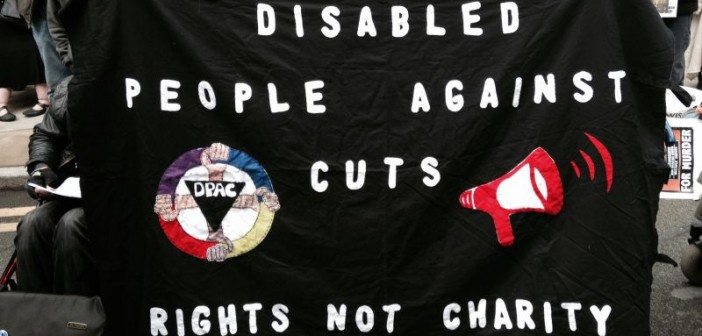
DPAC banner which says Disabled People Against Cuts: Rights not Charity

Photo: Disabled Go

Wednesday 7th September 2016
#RightsNotGames virtual protest

From 9.30pm. To coincide with the Paralympics opening ceremony we invite campaigners from across the world to join with us in a virtual protest against the disproportionate impact of global austerity on Deaf and Disabled people using a groundbreaking online tool developed for us by students at the Royal College of Arts. For more information see https://dpac.uk.net/2016/08/rightsnotgames-online-day-of-action-thursday-september-8th/


People walking in front of the Resource for London building

Photo: Resource for London

Saturday 10th September 2016
Conference: DPAC Disabled Peoples’ Resistance: building beyond borders #GlobalResistance

Join us for a one day conference bringing together perspectives and allies in the fight against austerity and neo-liberalism from the UK, Europe and Canada to look at geographic resistance and independent living. Speakers include John Clarke (Canada), Antonois Rellas (Greece), Catriona Kenny (Ireland), Kapka Panayotova (Bulgaria), The ak MoB (Germany) and John McDonnell MP. For more info or to book a place contact mail@dpac.uk.net.


Lizz Carr with placard which says ASSISTED SUICIDE IS NOT THE SOLUTION

Saturday 10th and Sunday 11th September 2016
Assisted Suicide: The Musical

To celebrate the end of the week of action we will be kicking back and enjoying ‘Assisted Suicide: The Musical’ by writer/actor/activist Liz Carr which is being performed at the Southbank Centre on 10th and 11th September.

For more information go to: https://unlimited.southbankcentre.co.uk/events/assisted-suicide-the-musical


Online actions

Throughout the week there will be a range of online actions that campaigners can take part in.
For more information see www.dpac.uk.net.

Travel costs

If you would like to take part in one of the events above but need help with reasonable travel costs please contact: mail@dpac.uk.net

Access

For access needs please contact mail@dpac.uk.net or 07505144371 (text only)

Donations

All donations however small to help make the week of action happen are extremely valuable. To donate you can go through the paypal button on the DPAC website or to make a direct transfer contact mail@dpac.uk.net


Download the PDF flyer here:

#RightsNotGames Week of Action single page flyer - A5

#RightsNotGames Week of Action single page flyer – A5

Rights not Games Flyer

Support the DPAC #RightsNotGames Week of Action by signing up to the Thunderclap


 Posted by at 21:58
May 172016
 
DPAC Logo with text underneath "Disabled People Against Cuts" and then web address dpac.uk.net

By Ian

On the 3rd of May I was one of the 300 people who shut down the UK’s largest coal mine; a place called Ffos-y-fran in South Wales. Going on any action can cause its share of trepidations—even if you don’t identify with the ‘disabled’ tag; but the decision to take action against coal, for the local community, and ultimately for the future was actually a joy to take.

Facilitated with the Reclaim the Power network, who had set-up camp on the commons above Merthyr Tydfil, we then proceeded to have five days of action-planning, skilling-up, networking and ultimately connecting with others. I was amazed by the truly multinational scope of the camp, with people from all over Europe, America, India and beyond. The local resistance organisation UVAG (United Valleys Action Group) provided us with support and a vital personal perspective on their ten-year long struggle against the opencast mine.

Walking over the narrow hillpath and down into the mine and seeing the small communities nestled cheek-by-jowl nearby it saddened me how these people were being treated with such callous disregard; unfortunately, a familiar feeling for any who experience long-term health conditions.

A tiny bit of history then: The Ffos-y-Fran ‘Land Reclamation Scheme’ is the UK’s largest coal mine, and proposed to become much bigger if the developing company Miller Argent get their way. Locally and nationally controversial, the Welsh Assembly has already called for a moratorium on opencast coal mining in 2015, but Miller Argent ignored them. They proposed to build another huge mine at the adjacent site of Nant Llesg, and despite being rejected by the County Council, then raised the threat of legal actions should they be refused!

The actions of the day were many; from those of us who could making our way, column-style, down into the mine itself (following a gigantic red-dragon from Wales!), with other affinity groups already locking on to machinery, or blockading the front gates. Despite any reservations we might have had; there was a carnival atmosphere that day, as the space was transformed from a dull and poisonous wound, to the feeling of a spontaneous summer party.

I am aware of how lucky I am of being able to be there. My disability is (mostly?) an invisible one—a mental health condition that has curtailed my activism over the years, during the different seasons of mood that I can go through. Knowing that action-camp life can sometimes be strenuous (especially the come-down after the action) I took the opportunity of going to the Well-Being Tent run by the camp’s Tranquillity Team. This was a quiet, supportive place where people could catch a few hours’ sleep, a cup of tea, or have just simple and supportive conversations should they need it. Unlike the clinical care that I have received in the past, this space felt entirely different: you didn’t have to be mad to go there, just as you didn’t have to be ‘ill’. No judgements were passed you were allowed to sit and read, or zone-out, talk, or whatever you needed to. This actually felt very supportive and self-led care rather than the mainstream ‘top-down’ approach to care. I also took time to speak with GBC (Green and Black Cross, a legal advisory group for activists) about the possibility of being arrested and what to expect as a disabled person, the pros and cons of carrying medicine on me etc — more on that in another action-report.

Sometimes there can be a sense of wariness over disability and activism, as if one might preclude the other. From what I saw at the Reclaim the Power camp (I saw at least one wheelchair user there as well) this view is entirely outdated. Disability rights and access to safer spaces is a vital part of the climate struggle, just as the climate struggle is a key part of disability rights here and abroad. The right to live visibly and with dignity is the right to a safer space for all of us: the right to live on a world which is not being destroyed under our feet and over our heads! Fuel Poverty Action (a campaigning group also represented at the camp) state on their website that as well as polluting our environment, fossil fuels are also increasing in cost.” Unconventional and extreme fossil fuels such as opencast mining, deep-sea drilling and fracking are all driving up the costs of heating our homes, as well as endangering our planet. Academics from the Universities of Leicester and York found back in 2015 that disabled people in the UK [and the world] bear a much higher burden of fuel poverty, and a much higher risk of climate change due to substandard housing, inefficient insulation, and institutionalized economic poverty.

I’m coming to the view that direct action is actually good for the heart, just as acts of civil disobedience are good for civil society (where would we be without the Suffragette movement, without the chartists, the bus-boycotter’s and the peace campaigners?). Despite how my Impairment might define me in some ways, they did not impede me taking action to defend our planet—and being a part of a community taking action was joyous.


 Posted by at 17:36
Jan 292016
 
DPAC Logo with text underneath "Disabled People Against Cuts" and then web address dpac.uk.net

Following the winning of two Bedroom Tax cases this week by the grandparents of a young disabled man and the survivor of domestic violence in the Court of Appeal the government announced within hours that it intended to appeal against this decision and has allocated an unlimited amount of our money to defend their totally unjust policies.

You can read the full  so-called justification for this from the so-called minister for disabled people, Justin Torysnake in this link here
Under-occupancy Penalty (28 Jan 2016)
https://www.theyworkforyou.com/debates/?id=2016-01-28a.415.0&s=%22housing+benefit%22#g424.0
“Justin Tomlinson: We are not ignoring the ruling; we are appealing it.
We are doing that because we feel that discretionary housing payment is
the correct way to do it. Reforms take time to come in, as I said
earlier. *Housing benefit* cost £24.4 billion this year. Had we not
brought in reforms, every single one of which was opposed by the Labour
party, it would have cost £26 billion this year.”…..


Until this appeal has been heard in the Supreme Court anyone currently appealing against a bedroom tax decision will have their appeal ‘parked’ pending the outcome however in the meantime the government has produced new guidance for anyone affected specifying that their extra costs should be met from a Discretionary Housing Payment.

Bulletin for HB staff HB U1/2016, effective from 28 January 2016

The important point is that this states very clearly that any additional costs incurred in meeting disability related housing needs should be met by a DHP. The bulletin states -:

Court of Appeal judicial review decision concerning the maximum rent (social sector)

  1. Yesterday the judgment of the Court of Appeal was handed down in the joined judicial review cases R v. Secretary of State for Work & Pensions, ex parte Rutherford and R v. Secretary of State for Work & Pensions, ex parte A. The full judgment is available at: https://www.bailii.org/ew/cases/EWCA/Civ/2016/29.html


  1. The Court has found that the claimants have suffered discrimination contrary to A14 of the European Convention on Human Rights. However, the Court of Appeal repeated the finding at first instance that the Secretary of State had complied with the Public Sector Equality Duty.


  1. The Court has granted the Secretary of State permission to appeal the decision to the Supreme Court, and it is the Secretary of State’s intention to appeal.


  1. No action needs to be taken by local authorities following this judgment. It has not changed the applicability of the maximum rent (social sector) provisions and no action should be taken to re-assess the Housing Benefit (HB) of claimants in the appellants’ situation.


  1. The Department remains of the view that Discretionary Housing Payments (DHPs) are the appropriate means of protecting HB claimants in the appellants’ circumstances.


  1. Provided below are some Q&A to enable you to respond to any enquiries you might receive.


Q&A


  1. Is the government going to appeal?


  1. The Court of Appeal granted permission to appeal and it is the government’s intention to appeal.


  1. What does this mean for claimants with panic rooms or a disabled child who requires overnight care?


  1. The maximum rent (social sector) must continue to be applied to all claimants as before yesterday’s judgment.


  1. As a local authority should we continue to apply the maximum rent (social sector) in these cases?


  1. Yes, the legislation underpinning the size criteria remains in force. DHPs remain the appropriate mechanism for providing support where there is an under-occupancy deduction because of a panic room or a bedroom used to accommodate an overnight carer for a disabled child.


Applying for and Being refused a DHP

We know that although DHPs should be being made to people this is yet another post-code lottery and whether or not you get one and how long it is for varies from one LA to another.

We know that some LAs take DLA into account as available income when they should not do so.

You can’t appeal against being refused a DHP but you can still challenge it being refused through a Judicial Review. DPAC would encourage anyone who is refused a DHP to seek legal advice with regard to making a legal challenge against being refused and also they should apply again. (It is possible to have more than one JR against refusals at the same time).


Why discretionary DHPs are not an adequate replacement for rights

Disabled people need Rights not Charity or Discretionary Payments and access to this right was proven in a previous case relating to Local Housing Payments using right enshrined in article 14 of the European Convention of Human Rights. In particular the arguments used by the solicitor representing Trengrove vs Walsall Metropolitan Borough Council are particularly relevant in arguing this.

https://ukhumanrightsblog.com/2012/05/19/housing-benefit-system-discriminated-against-disabled-people-rules-court-of-appeal/


 Posted by at 20:05
Jan 252016
 
DPAC Logo with text underneath "Disabled People Against Cuts" and then web address dpac.uk.net

With thanks for reblog to Johnny Void

https://johnnyvoid.wordpress.com/2016/01/25/big-disability-rides-to-the-rescue-with-too-little-much-too-late/

Big Disability Rides To The Rescue With Too Little Much Too Late

Posted on January 25, 2016 by johnny void |

In an unprecedented show of absolutely fuck all, members of the Disability Benefits Consortium – which includes some of the UK’s largest disability charities – have written a stern letter to Iain Duncan Smith asking him not to cut disabled people’s benefits.

goofy-on-horse

In the Welfare Reform and Work Bill, due to be debated in the House of Lords next week, plans have been announced to slash some out of work sickness and disability benefits by almost a third.  New claimants in the so-called Work Related Activity Group, meaning people assessed as likely to be fit for work at some point in the future, will receive just over £70 a week – the same amount as those currently on the dole.  People in this group include those with degnerative or progressive diseases such as Multiple Schlerosis, Parkinson’s disease or cancer.  This vicious benefit cut is not being done to save money, but to ‘incentivise’ people to find a job.  It is about as vile as anything that Iain Duncan Smith has done so far, and he’s done a lot.

In response the Disability Benefits Consortium have written a letter, which only half of their members bothered to sign, and which was published in the Daily Mirror over the weekend.  Big fucking deal.

According to their website the Disability Benefits Consortium (DBC) is a“national coalition of over 60 different charities and other organisations committed to working towards a fair benefits system.”  They include Disability Rights UK, an organisation who have recently been handed a huge contract to work for Maximus – the shady US conglomerate who carry out the despised Work Capability Assessments which will be used to decide which disabled people face a benefit cut under the new rules.  Other charities involved in pretending to defend social security are MIND, RNIB, Leonard Chesire and Mencap – all of whom happily accepted lucrative sub-contracts to run Iain Duncan Smith’s  mandatory Work Programme which disabled people are forced to attend under the threat of vicious benefit sanctions.  Also on the list are the workfare supporting Papworth Trust, along with Age UK who in 2013 were accused of running a ‘workfare warehouse’ in East Sussex.  Citizen’s Advice, who welcomed the introduction of the Claimant Commitment under which unemployed people are forced into pointless jobsearch for 35 hours a week under threat of benefit sanctions, are also included in this fight for a fairer benefits system.

Despite the vast resources possessed by the 60 charities who make up the Disability Benefits Consortium (DBC), their website is hosted for free on wordpress.com.  It looks like someone knocked it up on a cheap smartphone during their fag break.  Last year this group of fearless campaigners made a total of 12 posts on their blog – and I thought I was getting slack.  According to the website they have not been arsed to contribute to a government consultation on welfare reform since 2012.

Compare this to the now defunct Disability Works campaign – launched with a glitzy House of Lords reception by many of the DBC charities and used to lobby the government to hand them juicy welfare-to-work contracts and you see the true priority of these organisations.  Money.

The very worst thing that could happen is big disability charities hijacking the fight against welfare reforms, although there is little danger of that.  The fucking awful Hardest Hit demonstration they organised in 2011 was little more then a march to protect disability charity funding, not disabled people’s benefits.  And it’s been downhill ever since.  For every statement released by charities condemning social security cuts a story emerges of them quietly sidling up to the DWP in the hope of lucrative contracts. Until disability charities form a united stance of complete non co-operation with this government then their words mean fuck all when their actions are complicit in destroying the lives of sick and disabled people.Follow me on twitter @johnnyvoid

And just to illustrate what Johnny means for anyone with any doubts.

Action for Children unions ballot for industrial action in pay dispute


High-handed action by bosses over pay at the charity Action for Children has prompted Unite and UNISON to ballot their members for industrial action.


The unions said that management intends to impose a one per cent pay award for 2015/16, with no cost of living rise for 40 per cent of the 5,000 strong workforce. They also intend to remove contractual pay increments for new starters, refuse to pay the UK living wage of £8.25 (£9.40 in London) and cut mileage rates.


Both unions’ ballots for industrial action short of a strike and/or strike action open on Tuesday 26 January and close on Tuesday 16 February.


The charity’s chief executive Sir Tony Hawkhead has refused the unions’ request to involve the conciliation service Acas to resolve the dispute and has stated his intention to impose the pay offer overwhelmingly rejected by the joint union membership in consultative ballots.


While squeezing the pay of the workforce, the number of senior executives at the charity earning over £70,000 a year increased from 16 to 21, and there is now an additional member of the management team on £120,000.


The unions said that in the last three years Action for Children has made an average surplus (profit) of £5.4m each year, while it would have cost about £2m a year to have given each member of staff a cost of living pay rise in line with inflation.


Unite national officer for the not for profit sector Sally Kosky said“What we have here is an all too common case of a profitable organisation, with highly paid executives, unwilling to give a decent pay rise to our members. Average pay of the workforce has fallen in real terms by 52 per cent since 2010/11.


“The management is behaving in a high-handed manner trying to bulldoze a wholly inadequate pay offer onto our members and point blank refusing to involve Acas in the dispute. Just because people work for a charity they don’t deserve the prospect of poverty wages.


“The organisation has a healthy surplus and some of these reserves should be used to fairly reward its hard-working staff.”


UNISON national voluntary sector officer Simon Watson said: “The dedicated staff who work for Action for Children are without doubt its best resource. Every year they help thousands of vulnerable families in communities up and down the country.


“Action for Children claims that it is strapped for cash, yet it has managed to find the money to increase the number of its highest paid managers. Meanwhile staff haven’t had a pay rise in six years.


“The decision to move to a ballot for action is always a reluctant one, but despite over a year of negotiations, the charity still refuses to see sense. As a result many employees are being forced into extreme hardship. Some are having to use the same food banks as the families they are trying to help. It’s still not too late to prevent action, and we hope the charity uses the coming weeks to think carefully about its next steps.”


ENDS


For more information please contact:

Unite: Alex Flynn on 020 3371 2066 or 07967 665869

UNISON: Liz Chinchen on 0207 121 5463 or 07778 158175

Some further information on Action for Children’s funding. You can see their charity return here –


https://apps.charitycommission.gov.uk/Showcharity/RegisterOfCharities/CharityWithPartB.aspx?RegisteredCharityNumber=1097940&SubsidiaryNumber=0


In short they brought in £173,070,000 last year, and spent £159,887,000. That’s a surplus of £13,183,000. And, like the unions say, they make a surplus year on year, often over £10M –


https://apps.charitycommission.gov.uk/Showcharity/RegisterOfCharities/FinancialHistory.aspx?RegisteredCharityNumber=1097940&SubsidiaryNumber=0


There are many questions that go with these sorts of incomes, including –


–       What do they do with the surplus? Is it sitting in a bank somewhere making someone loads of interest?

–       Why are they not spending this surplus – as a charity they are not meant to sit on money, while they are continuing to raise new money from the public.

–       Does the public know they are not spending this money? And if they are not spending it why not? The money is raised to help children, presumably, which is not doing if it is sitting in a bank.


To deny their staff the living wage is a scandal.

If we look at the charity sector as a whole this very quickly adds up to unimaginable amounts of money. And yet they’re still opening charity shops and rattling tins


 Posted by at 18:22
Jan 212016
 
DPAC Logo with text underneath "Disabled People Against Cuts" and then web address dpac.uk.net

We need people who would be willing to speak to the press who are in ESA WRAG about the £30 a week cut to funding which is being proposed and how this would affect you.


We also need to have anyone living in Supported Housing who will be affected by the cuts to Housing Benefit and the amount allowed being restricted to LHA rates.


If you would be willing to help with either of these things please email us at mail@dpac.uk.net


 Posted by at 19:44
Dec 222015
 
DPAC Logo with text underneath "Disabled People Against Cuts" and then web address dpac.uk.net

Would you be willing to take part in a focus group to discuss these experiences?

My name is Rosa Morris and I am doing research on:

changes over time in the way the government defines ‘disability’ for the purposes of employment-related disability benefits how this definition compares with disabled people’s lived experiences.

As part of the research I want to find out about:

disabled people’s experiences of the Work Capability Assessment how well they think the WCA reflects and understands their experience of impairment and disability.

I am a disabled person myself with experience of applying for Incapacity Benefit and Employment and Support Allowance. I hope this research will give a greater voice to disabled people and their experiences.


First focus group looking for disabled people to take part on Wednesday 27th January 2016, 2-4pm


Second focus group Wednesday 3rd February 2016, 2-4pm


I am particularly keen to include the experiences of people with mental health difficulties in the research, in order to explore:

  • people’s experiences of the Work Capability Assessment
  • how well they think the WCA reflects and understands their experiences.


Both meetings will be at at 336 Brixton Road, London SW9 7AA.

All travel and access expenses will be reimbursed – please contact me if you have any access requirements to be able to take part.

All participants’ details will be kept anonymous. You will be able to withdraw your consent at any time before or during the focus group and for up to 3 months after participation. All focus group participants will be asked to respect other participants’ confidentiality.

If you are interested in taking part and/or would like to speak to me, in confidence, to find out more information please email me at ss10rm@leeds.ac.uk

Thanks very much for reading this.


 Posted by at 18:29
Dec 082015
 
DPAC Logo with text underneath "Disabled People Against Cuts" and then web address dpac.uk.net

Seeing the light…

Introducing Switched On London, a new campaign coalition demanding clean, affordable and democratic energy in the capital through publicly owned energy and supported by DPAC.

www.switchedonlondon.org.uk | @SwitchedOnLDN

The floods in Cumbria are a reminder of how close to home the impacts of climate change are being felt. Three once-in-a-hundred year floods in ten years aren’t an indication of terrible misfortune, but of a new baseline. As leaders and business executives meet in Paris with the outcome uncertain, in London the fight for clean, affordable energy is being taken in a new direction.

In the face of a cartel of energy companies whose turn to renewables is far too slow — and whose profit-hungry business model leaves thousands struggling between heating and eating in the winter — Switched on London is a new campaign launching to build energy democracy in London. We demand that the GLA (Greater London Authority) sets up a new public energy company that works for people, not for profit.

The needs for clean energy and for affordable energy are deeply connected. We have already waited far too long for the private sector to ride to the rescue and deliver renewables.The big energy companies’ commitment to fossil fuels is as profound as their drive to make enormous profits, which have increased ten-fold since 2007. We need to democratise our approach, including people in decisions about their own energy, and giving the public sector the capacity to invest in new sources of clean power and energy efficiency.

In spite of the Tory government’s bizarre attack on the community energy sector, there remain some tools open to the public sector to challenge the dominance of the Big Six. An announcement last year indicated that the Mayor of London had seemed to be using one of these – called ‘Licence Lite’ – to step in to provide a route between public and small-scale energy producers and big consumers such as Transport for London. ‘Licence Lite’ could have given the GLA the chance to break the Big Six’s control over energy supply.

Sources within the GLA this week, however, have revealed that Boris Johnson, far from doing this, has signed off yet another contract with one of the big energy companies themselves, RWE nPower. They will run the scheme, providing billing and administration; tasks they’ve proved singularly bad at in their own business.

This is another blown opportunity by this mayor. After decades of flawed competition and rising prices, over one million Londoners are in fuel poverty, thousands die every year from air pollution, and the commitment to deliver renewable energy is falling short. While major European cities like Munich and Copenhagen are committing to 100% clean power, London is lagging behind. It doesn’t have to be this way.

Switched On London is putting forward a proposal that could help the Greater London Authority become the tap-root of a new energy system in our city. We’re a broad coalition of community organisations, trade unions and NGOs coming together to propose a bold but achievable vision of a very different energy future: one geared around ordinary Londoners, not powerful business executives.

We want a new non-profit company that offers fair, affordable prices, reinvesting in energy efficiency and tackling fuel poverty. By taking public control we could directly drive investment in the 21st century renewable energy sources London needs. With a range of democratic mechanisms – from elected board-members to open borough assemblies and public referenda on important issues – we could truly shift power to people’s hands.

This is a perfectly realistic goal. London could start moving rapidly by divesting its £4.8bn pension pot from fossil fuels. It could launch municipal bonds to fund new clean energy sources, as it did for Crossrail.

Local authorities like Nottingham and Bristol have already taken steps in the direction of public energy along with dozens of cities across Europe. Londoners have had to live with a broken energy system too long, and it’s time to change it.

www.switchedonlondon.org.uk | @SwitchedOnLDN


 Posted by at 15:05
Dec 032015
 
DPAC Logo with text underneath "Disabled People Against Cuts" and then web address dpac.uk.net

A full list of Labour MPs who backed vote for airstrikes in Syria, has been released.

Labour MPS who voted Yes:

Labour

ALEXANDER, Heidi, Ms

AUSTIN, Ian, Mr

BAILEY, Adrian, Mr

BARRON, Kevin, Sir

BECKETT, Margaret,

BENN, Hilary,

BERGER, Luciana, Ms

BLENKINSOP, Tom, Mr

BRADSHAW, Ben,

BRYANT, Chris, Mr

CAMPBELL, Alan,

CHAPMAN, Jenny, Ms

COAKER, Vernon, Mr

COFFEY, Ann, Ms

COOPER, Yvette,

COYLE, Neil, Mr

CREAGH, Mary, Ms

CREASY, Stella, Ms

DANCZUK, Simon, Mr

DAVID, Wayne, Mr

DE PIERO, Gloria, Ms

DOUGHTY, Stephen, Mr

DOWD, Jim, Mr

DUGHER, Michael, Mr

EAGLE, Angela, Ms

EAGLE, Maria, Ms

ELLMAN, Louise, Ms

FIELD, Frank, Rt Hon.

FITZPATRICK, Jim, Mr

FLETCHER, Colleen, Ms

FLINT, Caroline,

HARMAN, Harriet,

HODGE, Margaret,

HOWARTH, George,

HUNT, Tristram, Mr

JARVIS, Dan, Mr

JOHNSON, Alan,

JONES, Graham, Mr

JONES, Helen, Ms

JONES, Kevan, Mr

JONES, Susan Elan, Ms

KENDALL, Liz, Ms

KYLE, Peter, Mr

LESLIE, Chris, Mr

LYNCH, Holly, Ms

MCDONAGH, Siobhain, Ms

MCFADDEN, Pat,

MCGINN, Conor, Mr

MCGOVERN, Alison, Ms

PHILLIPSON, Bridget, Ms

POWELL, Lucy, Ms

REED, Jamie, Mr

REYNOLDS, Emma, Ms

ROBINSON, Geoffrey, Mr

RYAN, Joan, Ms

SMEETH, Ruth, Ms

SMITH, Angela, Ms

SPELLAR, John,

STUART, Gisela, Ms

THOMAS, Gareth, Mr

TURLEY, Anna, Ms

UMUNNA, Chuka, Mr

VAZ, Keith,

WATSON, Tom, Mr

WILSON, Phil, Mr

WOODCOCK, John, Mr

 Posted by at 20:30
Dec 032015
 
DPAC Logo with text underneath "Disabled People Against Cuts" and then web address dpac.uk.net

DPAC/Public Interest Research Unit study on work-place discrimination: request for information on your experiences.

Do you think that you might have experienced disability discrimination at work?

Did the new £1,250 fee (introduced in July 2013), to take your case to an employment tribunal, put you off making a discrimination claim against the employer?

If so, and you think that you might be prepared to provide more details for DPAC/PIRU’s study, please email rgbharwood@hotmail.com or mail@dpac.uk.net.

Any information you provide will be anonymised, so as to hide your identity.

 Posted by at 19:53
Nov 082015
 
DPAC Logo with text underneath "Disabled People Against Cuts" and then web address dpac.uk.net

by Bob Williams Findlay

It’s often said that history only remembers the victors. Recently, the Equality and Human Rights Commission produced a video to, and I quote, “Celebrate twenty years since the passing of the Disability Discrimination Act in 1995.” For disabled people who were involved in the struggle to have the inequalities we face acknowledged and addressed, I doubt there are many of us who will be putting the flags out or popping champagne corks in celebration of the Act itself.

The bulk of us who were actively involved remain true to the belief that the passing of the Disability Discrimination Act (DDA) was a significant defeat for disabled people and the struggle against social oppression. This is not to say the passing of the DDA had no positive impact upon disabled people’s lives or had no influence on social change, it did, but acknowledging this shouldn’t detract us from recognising the fact the DDA restricted our progress, was of limited use to disabled people and was never likely to challenge the status quo.

It is impossible to produce a balance sheet of the DDA’s true impact because all kinds of external factors operate to mask the truth. It can be argued that the overall struggle for anti-discrimination legislation and specific actions such as the Campaign for Accessible Transport were more instrumental in bringing about organic social change. Over the last twenty years the whole of society has radically changed, and how disabled people have been both seen and treated have been part of that process whether that’s been via Tony Blair’s “rights and responsibilities” agenda or the neoliberal business case for ‘including disabled people’.

To fully appreciate our position on the DDA it is necessary to strip away the sugar coated presentation of this historic piece of legislation in order to reveal how the collective voice of disabled people and their many allies were silenced by acts of betrayal and brute force. The real story isn’t really about the twenty years since the passing of this piecemeal, ineffectual and oppressive Act, but rather it is about how the Civil Rights Bill and the ideas contained within it were buried both physically and politically by those who felt threatened by the potential impact it would’ve had on society.

The aim here is not to romanticise the campaign for full civil and human rights for disabled people, but instead to recall the major events that led up to the Tories introducing their own Disability Discrimination Bill in order to head off the Private Member’s Bill on Civil Rights Bill and why the passing of the DDA should be viewed as a significant and negative watershed in our emancipation struggle. Neither is it possible to critique the nature or merits of the Disabled People’s Movements campaign, although there’ll be signposts to various opinions on it.

Over the last twenty years we have seen various ‘interpretations’ of the struggle for our emancipation and many of these place tremendous emphasis on the fact that legislation was adopted to give disabled people ‘rights’. Here is a lengthy quotation from one such interpretation:

‘The Disabled People’s ‘Rights Now!’ campaign had a rich and diverse membership, including representation from many trade unions. It encompassed direct action, mass lobbies of parliament, petitions and awareness-raising campaigns to support civil rights for disabled people, and the issue was raised in Parliament on 14 separate occasions. The campaign won over a number of MPs and Peers, including Alf Morris, Roger Berry, Tom Clarke and Harry Barnes, who provided much needed political support and sponsored various Disabled People’s Civil Rights Private Members Bills.

The campaign reached a turning point in 1994 when the Conservative Government and the then Minister for Disabled People Nicholas Scott were found to have misled Parliament by stating that the cost of implementing civil rights legislation for disabled people would be greater than the sum previously calculated by civil servants.

In 1995, the Disability Discrimination Act (DDA) became law and although it was a watered-down version of what disabled people wanted, it was nevertheless a huge victory for the Rights Now! campaign.’ (Aspis, 2011:3)

There are many aspects of this account that needs to be placed in a wider context and, as a consequence, it can then be viewed differently. Let’s begin by looking at important historical moments as a backdrop to the Rights Now campaign. Barnes and Oliver remind us that:

…the move by disabled people to form their own organisations…
fostered a growing collective consciousness amongst disabled people…. [which] began a process of reformulating the problems of disability, shifting the focus away from the functional limitations of impaired individuals towards contemporary social organisation with its plethora of disabling barriers. It also set in train a political divergence between organisations for the disabled and organisations of disabled people. (Barnes and Oliver,1991: 4)

The political divergence spoken about here between organisations for the disabled (sic) and organisations of disabled people permeates right through the history of the struggle for anti-discrimination legislation and beyond. Significantly, Barnes and Oliver go on to say:

Many of the traditional organisations for the disabled had advised the government that discrimination was not a problem for disabled people and that legislation was unnecessary. Yet in 1979, the Silver Jubilee Access Committee drew attention to a number of ‘blatant acts of discrimination against disabled people. The official committee which investigated the allegations was unequivocal in its findings: discrimination against disabled people was widespread and legislation was essential. (Barnes and Oliver,1991: 5)

Ian Bynoe picks up the story when he writes:

….1992 marks the tenth anniversary of the publication of the Report of the Committee on Restrictions against Disabled People
(CORAD).This is the only report on disability and discrimination ever to have been received by a UK government. It found discrimination to be commonplace in the experience of disabled people and recommended anti-discrimination legislation. Its
proposals were dismissed by the government of the day and there has since been no evidence of a change of mind to revive hopes that the CORAD proposals might be implemented. (Bynoe, 1991: 1)

For the record the CORAD committee defined discrimination as: ‘the unjustifiable withholding whether intentional or not, of some service, facility or opportunity from a disabled person because of that person’s disability’ (Large, 1982:7)

The stark reality is that since the early 1980s there were no less than fourteen attempts to introduce anti-discrimination legislation via Private Members Bills largely introduced, but not exclusively, by backbench Labour MPs. Not only did each fail, they nearly all followed a similar pattern where in Parliament the Tory spokesperson would state that, ‘there was nothing but good will towards the disabled’, and of course, ‘education was better than legislation’ if any problems were to exist. On the other hand, the supporters of the various bills would mainly focus upon employment issues. Meanwhile outside of Parliament there was the ritualised farce of the big disability charities shipping in bus loads of disabled people to parade around Parliament Square before sending them home again.

Barnes and Oliver inform us that:

The formation of Voluntary Organisations for Anti-
Discrimination Legislation (VOADL) was a sign that many organisations for the disabled had been converted to views articulated by disabled people themselves. However, there
remain, perhaps inevitably, significant differences between the
philanthropic and liberationist elements of the disability lobby.
(Barnes and Oliver,1991: 5)

Those of us who were involved with VOADL and later, Rights Now, might take issue with the view that the “for” organisations were actually ‘converted’ to the views held by disabled people. Their practice then and since would cast a long shadow over this assumption. An alternative view is that for a long time disabled people’s organisations were only granted observer status within VOADL however the growing momentum behind the British Council for Disabled People’s campaign for anti-discrimination legislation (ADL), began to shift both the focus and the exercising of power and so this ‘conversion’ by the charities had more to do with their fear of being outflanked by BCODP than [it did to] any serious commitment to disability politics.

John Evans provides us with information on BCODP’s campaign when he says:

It was 1991 when BCODP (British Council of Disabled People) which is the national, representative and democratic organisation of disabled people in the UK launched its ADL campaign as its future main objective. (Evans, 1996: 2)

There are two important points raised here. Firstly, the fact BCODP made this their main campaign has been debated off and on within the Disabled People’s Movement ever since and it’s an issue that continues to divide opinion. This article isn’t the place to unpack the issues, however, the significance of the decision will be returned to later. Secondly, a major contribution to the launch of BCODP’s ADL campaign was the publishing of commissioned research undertaken by Colin Barnes into discrimination against disabled people in the UK. Evans points out that “Discrimination and Disabled People in Britain” was so comprehensive ‘…. it provided more than enough evidence supporting the whole case for ADL and it became a very useful tool in the campaign and a symbol for empowerment and inspiration. It was the first authoritative piece of research done in this area and was carried out by disabled researchers and disabled experts.’ (Evans, 1996: 2)

The momentum generated by BCODP’s campaign and the emergence of the Disability Action Network (DAN) made VOADL look staid and stuffy. As mentioned previously the differences between the philanthropic and liberationist elements of the disability lobby became increasingly marked. The Executive Committee of BCODP recommended that VOADL had a make-over and with a bloodless coup, Rights Now was launched under the stewardship of the Disabled People’s Movement. John Evans again broadly captures the period between 1992 and 1994 when he writes:

Direct action no doubt heightened the profile for the need for civil rights legislation in the eyes of the general public and did a lot to shake up the politicians complacency on the issue but it could never be enough by itself. Without the lobbying of parliament and meetings with politicians putting forward constructive arguments based on available evidence of discrimination and seeking their support the cause would have been lost. Any changes in the law have to be done through Parliament so you have to get some politicians fighting for your cause. At the same time disabled experts and lawyers have to work alongside other lawyers and politicians in writing up the Bill. This work was co-ordinated by a group called the Rights Now…. which was a coalition of about 50 disability organisations and charities who were formed to work together to help bring about ADL. (Evans, 1996: 3)

Two central features mark the difference between VOADL and Rights Now. Disabled people drove the agenda and increased the public profile of the ADL campaign, but at the same time worked directly with members of parliament to put together the Civil Rights Bill. Many of us believe that this displacement of the ‘big six’ disability charities resulted in them watering down their commitment to full and comprehensive legislation and a growing willingness to accept compromise as the price of regaining their power position over disabled people. This watershed moment sees the birth of what has subsequently become ‘Janus politics’ – where the charities look back towards the radical language and concepts from the Disabled People’s Movement, but actually creates ‘new meaning’ which transforms them into tools which then help maintain their status. For example, the concepts ‘independent living’ and ‘choices and rights’ now employed by organisations such as Scope and Disability Rights UK are a million miles from their original meaning.

Mike Oliver noted that:

Speaker after speaker from non-representative organisations for disabled people claimed the social model as their own in the Trafalgar Square demonstrations of 1994. Additionally, the Disability Rights Commission established in 1997 by the New Labour Government declares that it is guided in everything it does by the social model of disability. (Oliver, 2004: 28)

Caroline Gooding and Bob Findlay advised the opposition parties on behalf of Rights Now, including writing a briefing paper on the social model and the definition of disability. Once in power New Labour set up a Disability Task Force, but this body steadfastly declined to change the traditional definition of disability to one in keeping with the social model.

Stepping back a little, the first test for the new wave militancy and Parliamentary campaigning came when Harry Barnes tried to push through the Civil Rights (Disabled Persons) Bill.

Ian Parker, in an article called ‘SPITTING ON CHARITY’ which appeared in the Independent, wrote:

In May 1994, however, a private member’s bill, the Civil Rights (Disabled Persons) Bill, was killed messily by the Government, and the minister for disabled people, Nicholas Scott, eventually had to resign. (Parker, 2011: unpaged)
This caused an outcry and came about because as Parker acknowledged:

Last year – another Great Leap Forward – the civil rights argument was won. At some point, legislation may follow. (Parker, 2011: unpaged)

Parliament was finally ready to pass ADL, but the Tories and big business weren’t prepared to see the Civil Rights (Disabled Persons) Bill go through. As Lorraine Gradwell states, ‘… the Tory government were so concerned about the increasing popularity of anti discrimination legislation that they brought forward this fudge of a compromise’.(2015)

Their only course of action was to head off our Bill by introducing the weaker Disability Discrimination Bill led by William Hague. This was eventually passed into law twenty years ago as the Disability Discrimination Act.

What followed was a two horse handicapped chase. Roger Berry picked up the gauntlet and re-introduced the Civil Rights Bill, but Hague had the advantage of proposing a Bill supported by the Conservative John Major government. It was under these conditions that the ‘big six’ charities made their move.

Parker reports:
Thanks to his position at the head of a fairly well-funded “for” organisation, and thanks to his support for incremental methods, and thanks to his recent claim to see some (flawed) virtue in the Government’s Disability Discrimination Bill, Massie is regarded with great hostility by many “fundamentalists”. Rachel Hurst, a radical with a sharp political sense, says, “Our voice has been shut out by the established charities. Some staff at Radar I’ve got more time for than I can say. [But] I wouldn’t mind shooting the man at the top. He is an Uncle Tom, Mr Massie… He actually doesn’t care a toss about the rights of disabled people.” (Parker, 2011: unpaged)
Evans also recalls in 1996 that:

The DDA took only 6 months from beginning to end in becoming law.

Unfortunately the DDA was flawed from the start as being a weak piece of legislation which was unenforceable and was considered a drop in the ocean, as it was certainly not going to protect disabled people from the many forms of discrimination which existed. It outraged the disability movement because it denied them the fully comprehensive civil rights legislation which they had worked so hard campaigning for and consequently they refused to have anything to do with it. (Evans, 1996: 4)

Perhaps even more forcibly Marian Corker wrote in ‘The UK Disability Discrimination Act – disabling language, justifying inequitable social participation’:

What has been ‘achieved’ is a legal instrument that has variously been described as ‘confusing, contorted and unsatisfactory’ (Gooding 1996); ‘a dissembling law not an enabling statute’ (Doyle 1997: 78); and ‘one of the most ill-conceived pieces of legislation ever to reach the statute books’ (Corker 1998: 115). This is the Disability Discrimination Act 1995 (DDA) (Corker, 2000)

She went on to say:

However, there is little doubt that the DDA represents a muddled combination of prohibition, justifiable discrimination and reasonable adjustment that can themselves act as a barrier to claimants who may be ‘isolated, possibly ill-informed and under-resourced’ (Gooding 1996: 6). Further, because the DDA legally justifies direct discrimination on the grounds of ‘disability’ in what Gooding (1996: 6) describes as ‘dangerously vague’ terms, and fails to incorporate a notion of the indirect discrimination experienced by disabled people, it seems an ineffective legal instrument for tackling the institutionalised oppression of disabled people. (Corker, 2000)

The DDA, unlike the Civil Rights Bill, wasn’t designed to tackle the institutionalised oppression of disabled people. Any hope of repealing and replacing the DDA with the Civil Rights Bill when New Labour came to power was quickly dashed. First, Labour’s Tom Clarke refuted BCODP’s claim that Labour in opposition had promised to do just that. Second, the Task Force already mentioned was hand-picked with more radical elements of the Disabled People’s Movement blacklisted throughout Labour’s terms in office. Margaret Hodge in 2000 when Minister for Disabled People, instructed the BBC to ‘edit out’ criticism of the DDA in its Disabled Century TV program. Third, Labour looked towards the new ‘Disability Movement’ driven by the charities and DPOs willing to buy into Blair’s ‘Third Way’ and the neoliberal market economy. Finally, it was New Labour who brought in Atos to hound sick and disabled people.

So, when we’re told the DDA was a victory, what does this mean? There has been a paradoxical development; just at the moment when inadequate legal rights were established for disabled people, the movement for emancipation was outflanked by the big disability charities and made an outcast by successive governments. Since 1995 the Disabled People’s Movement has gone into decline. Internal division and criticism followed the defeat of the Civil Rights Bill, with senior disabled activists accusing BCODP of ‘putting all its eggs in one basket’ by having ‘legislation’ as its prime focus and failing to cultivate grassroots structures and organisation.

Does this look like a victory? Merely getting legal recognition that disabled people have limited rights not to be discriminated against? Are they saying we should be celebrating being granted crumbs from their table? In 2005 the Public Interest Research Unit reported, ‘Ten years of the Disability Discrimination Act: Anniversary research indicates qualified failure.’

The DDA gave individual rights, but simply asked for employers and service providers to behave ‘reasonably’. The last five years in particular has witnessed savage attacks on both disabled people’s rights, services and lifestyles. A reverse of disabled people’s fortunes added to by the threat of legalised ‘assisted suicide’ is the reality, not this empty rhetoric of ‘equal citizenship’. Disabled people have been silenced and sidelined for the majority of the last twenty years apart from piecemeal changes in the social environment and attempts at tokenistic ‘inclusion’ here and there.

Now the whitewash begins. We see video clips from the Equality and Human Rights Commission and Scope on 20 years of the DDA, producing ‘false history’ via safe narratives and the worst of all, the Heritage Lottery Fund supporting Leonard Cheshire’s empire to write ‘disability history’ (sic). Ellis’s piece for the HLF on the DDA is another example of revisionism with a dash of criticism thrown in.

Those of us who lived and fought through the 1980s and 1990s see no cause to celebrate. Politically, we were defeated in 1995; our slogan, “Nothing About Us, Without Us”, has still to be realised. Although the last twenty years has been an uphill struggle to keep the fight for emancipation alive, we are seeing yet again a new wave of determination among disabled people; people who believe in freedom and social justice. These green shoots are what we should be celebrating today, not the results of the falsification of history written by our oppressors and shameful or misguided collaborators.

Notes:

Aspis, S. (2011:3) Campaigns in Action – Disabled People’s struggle for Equality
www.allfie.org.uk/docs/campaigns%20in%20action%20text%20only.doc

Barnes, C. and Oliver, M. (1991) ‘DISCRIMINATION, DISABILITY AND WELFARE: FROM NEEDS TO RIGHTS’ in Bynoe, I. et al.,
Equal Rights for Disabled People: A Case for a new law – IPPR.

Bynoe, I. (1991) THE CASE FOR ANTI-DISCRIMINATION LEGISLATION in Bynoe, I. et al., Equal Rights for Disabled People: A Case for a new law – IPPR.

https://disability-studies.leeds.ac.uk/files/library/bynoe-equal-rights-for-disabled-people.pdf

Large, P., (1982) Report of the Committee on Restrictions
Against Disabled People

Evans, J. (1996) ‘THE U.K. CIVIL RIGHTS CAMPAIGN AND THE DISABILITY DISCRIMINATION ACT’

https://disability-studies.leeds.ac.uk/files/library/evans-ADLWIEN.pdf

Oliver, M. (2004) ‘The Social Model in Action: if I had a hammer’, in Implementing the Social Model of Disability: Theory and Research edited by Colin Barnes and Geof Mercer (2004); Leeds: The Disability Press, pp. 18-31

https://pf7d7vi404s1dxh27mla5569.wpengine.netdna-cdn.com/files/library/Barnes-implementing-the-social-model-chapter-2.pdf

Parker, I. (2011) ‘SPITTING ON CHARITY’ from the Independent,

https://www.independent.co.uk/arts-entertainment/spitting-on-charity-1614885.html

Gradwell, L. (2015) Comment on her Facebook page, 4th November.

Corker, M. (2000) ‘The UK Disability Discrimination Act – disabling language, justifying inequitable social participation’, in: The 10tk Anniversary of the Americans with Disabilities Act, edited by Anita Silvers and Leslie Francis, Routledge

https://pf7d7vi404s1dxh27mla5569.wpengine.netdna-cdn.com/files/library/Corker-UKDDA.pdf

Additional material used as research:

Corker, M. (1998) Deaf and Disabled or Deafness Disabled? Buckingham: Open University Press

Doyle, B. (1997) Enabling legislation or dissembling law? -The Disability Discrimination Act 1995. Modern Law Review, 64

Gooding, C. (1996) Blackstone’s guide to the Disability Discrimination Act 1995, London: Blackstone, in association with RADAR

Public Interest Research Unit (2005) ‘Ten years of the Disability Discrimination Act: Anniversary research indicates qualified failure’

https://www.piru.org.uk/press-releases/ten-years-of-dda

Ellis, L. (2015) ’20 Years of the DDA’, Heritage Lottery Fund

https://www.hlf.org.uk/about-us/news-features/20-years-disability-discrimination-act

 Posted by at 12:55
Sep 122015
 
DPAC Logo with text underneath "Disabled People Against Cuts" and then web address dpac.uk.net

Below is a response to Tomlison’s piece in Able magazine published earlier this week

The Minister for the Disabled People says:

“We should do everything we can to give people the dignity of a job, the opportunity to achieve their career aspirations and the security of a pay cheque. The focus should always be on what a person can do, giving them every opportunity to fulfil their potential. No-one should be written off to a life on disability benefits and it should always pay to work.”

The ‘help’ I have received to get work has been pitiful. I was on Incapacity Benefit due to degenerative disc disease and osteoarthritis – there is no cure, I won’t get better. I am in constant pain and have mobility problems. However, I was found ‘Fit For Work’ and now receive Job Seekers’ Allowance. I am £30 per week less well off, I can no longer afford taxis when I need them, can no longer afford better quality food, can no longer afford to pay my heating bills so spent the early (cold) part of this year with the heating off. This new-found poverty has impacted directly on my physical and mental health. 

I now have to attend the Work Programme five days per week to ‘Job Search’. I am constantly exhausted, constantly in pain. After eight months on the Work Programme I have had no practical help in finding employment, unskilled and ignorant ‘advisers’ have in fact hindered my efforts. Their suggestions on how to get back to work have been risible and amateur. They have ignored my qualifications and experience and attempted to force me into unpaid work in completely inappropriate fields. Being subject to a hostile sanctions regime has had an impact on my blood pressure and I now suffer from stress and insomnia. Despite many hours of searching for work in the areas I have been mandated to search by the Job Centre, I have had no replies to my letters and CV – in EIGHT MONTHS. 

Clearly, your definitions of ‘dignity’ ‘opportunity’ and ‘security’ come from a different dictionary than mine. I cannot afford new clothing, new shoes and I cannot even afford to put credit on my phone. My household is sliding into debt fast. I am dreading the winter. On the Work Programme I am in the company of many, many others in exactly my situation. They, too, are still disabled and unemployed months or even years after being declared ‘Fit For Work’. The only dignity we have is in our shared experience and defiance of your government’s attacks on us. 

Minister, in short, disabled people can well do without your ‘help’ in finding us work. 

Samantha Shelley

BA(Hons) PGCE


 Posted by at 16:59
Sep 082015
 
DPAC Logo with text underneath "Disabled People Against Cuts" and then web address dpac.uk.net

We have received lots of emails from the UK, Europe and internationally asking us about the UNCRPD inquiry what it really means and what DPAC actually did. We set out the main questions and answers below:

What is the UNCRPD?

UNCRPD stands for the United Nations Convention on the Rights of Persons with Disabilities. The Convention includes a set of Articles or points on the rights of disabled people.  You can see the full text HERE

The Westminster Parliament signed up to respect those rights included in the convention, they also ratified the Optional Protocol 8th June 2009. The Optional Protocol is a very important route for people to challenge any violation of rights by governments or authorities against the UNCRPD


What does the UK ratifying the UNCRPD Optional Protocol mean?

It means that the UK (state party) accepted the competence of the UNCRPD committee to conduct inquiries into the violation of the articles of the UNCRPD. So while anyone in any country can challenge governments through the UNCRPD –an inquiry by the UNCRPD committee can only be conducted under the Optional Protocol and only if that country (or state party) has ratified it. DPAC used the Optional Protocol to initiate the current inquiry into the UK because we saw violations of the rights enshrined in the UNCRPD and that disabled peoples’ rights were going backwards (retrogression of rights)


How was the inquiry initiated?

DPAC initiated the UNCRPD Inquiry using Article 6 of the Optional Protocol meaning that a formal process was carried out by DPAC to submit complaints and submissions. This process meant that documents needed to be written in a particular way with attention to specific Articles within the UNCRPD and that strong evidence needed to be framed accordingly. The use of the UNCRPD Optional Protocol is always a formal process with strict guidelines. It’s not something that people can do by accident or by sending through lists of media articles.


Is the UK inquiry really the first of its kind ever?

Yes, it is the first of its kind against a state party through Article 6 of the Optional Protocol, although inquiries have been conducted for individual complaints previously in other countries this is the first to be against a state party for grave and systematic violations. Also it’s useful to note that individual complaints to the UNCRPD must have first exhausted all domestic channels. That is they need to have exhausted the countries court mechanisms before making a complaint to the UNCRPD.


When did DPAC start doing this?

DPAC first contacted the UNCRPD in 2012. DPAC made it first submission to the UNCRPD committee in 2013 to attempt to initiate the process of inquiry, since then we have been providing further reports and submissions. We had to prove to the committee that there were grave (severe) and systematic (continuous and built into system of welfare ‘reform’ policies) violations (breaking) of rights enshrined in the UNCRPD. We also had to provide strong evidence of retrogression for the inquiry process to happen.


Does the government know about the inquiry?

Yes, they were given official notice of the inquiry in January 2014. They had also made their own submissions to the inquiry process attacking evidence that DPAC had put forward from 2013. However, the UNCRPD committee accepted DPAC’s evidence which is why the inquiry is happening. The devolved governments of Scotland, Northern Ireland and Wales are also aware. However the most punitive policies come from Westminster and the Westminster government. The UK as a whole is treated as a state party under the UNCRPD


Who wrote the submissions and produced the evidence for the inquiry?

Three of us wrote the submissions: Debbie Jolly, Linda Burnip and Anita Bellows. We are grateful for the additional input and guidance of Nick Dilworth, Louise Whitfield, Dr David Webster and a person who wishes to remain anonymous who provided excellent admin and other support throughout.


Why didn’t DPAC tell people about the UNCRPD inquiry sooner?

We were told we must keep everything confidential or the inquiry would be halted. We didn’t want that to happen because we knew the inquiry was needed. It was only after the Scottish Herald produced the full details that we decided we needed to step in to stop some of the misconceptions and misunderstandings that were starting around the inquiry.


Early Press stories said that it was the Just Fair report that started the inquiry…

DPAC had also submitted evidence to the 2014 Just Fair report. But this report dealt with a different convention which was the International Covenant on Economic, Social and Cultural Rights (ICESCR) People that submit reports under other conventions do not automatically somehow initiate an inquiry-it was quoted in early press pieces that the Just Fair report had somehow kick started an Inquiry by the UNCRPD. But this kind of thing just does not happen if you write a report on one convention ( there are several), it doesn’t suddenly set off a process on another Convention such as the CRPD or any other, despite its wealth of evidence or importance-formal processes need to be followed to initiate an inquiry, as we said earlier.

The Daily Mail has been attacking the inquiry process and says the UNCRPD people are meddling…

What else can we expect from the Mail? As we said the government have been aware of this process since 2013 so the inquiry is no surprise to them. The UK signed up to the UNCRPD and is therefore bound by its contents. There are processes and procedures that the UNCRPD committee must follow and that the government must follow which result in official procedural cooperation between the two. We also saw with the 2013 visit from Raquel Rolink (on the ‘bedroom tax’) that the Mail quoted MPs who said she had come uninvited to ‘interfere’ along with some more colourful accusations against her- again because of international procedures and protocols no person from any UN committee can come to the UK without government knowledge or acceptance first-again the Mail lied and inflamed the proper process of accountability.

Lots of people have written, blogged and raised the issues facing disabled people don’t they deserve credit?

Of course, lots of people have been fighting in lots of different ways and everyone deserves credit for raising the issues consistently-it’s something we must all keep doing

What does DPAC think will be gained through the inquiry?

Because it’s the first of its kind we can’t say –unfortunately we don’t think that things will suddenly return to the way they were in 2009. We don’t want people to think that the inquiry will solve everything because that would be creating false hope. We need to be realistic but also positive-what is happening is that the Conservatives are finally being held to account for their actions

We also hope that the publication and knowledge of the inquiry will aid other countries affected by austerity/ low levels of support to disabled people and the widespread disproportionate impacts on disabled people’s human rights.

We hope it will be of use in bringing other Governments (State Parties) to account through the use of the UNCRPD Optional Protocol. We would like it to provide hope and assistance to active grassroots organisations, where traditional disability organisations and big disability charities fail to act for fear of Government reprisals and/or funding cuts.

DPAC refuses any funds that limit our independence and we always will-we will also fight this and any other government where they destroy disabled peoples’ rights through punitive cuts, policies or actions


 Posted by at 21:26
Aug 282015
 
DPAC Logo with text underneath "Disabled People Against Cuts" and then web address dpac.uk.net

Since the publication of the Sayce Report (2011), employment support for Deaf and Disabled people and in particular, Access to Work, has been under attack. The last coalition government and the current Tory government, seem determined to change Access to Work from being one of this countries “best kept secret”, to a scheme that no longer meets need, is discriminatory to those with high support needs and causes misery to Deaf and disabled people’s lives. Our lives. Rather than support us into work, the scheme has become a barrier and has resulted in both job losses and demotion.


Iain Duncan Smith recently announced that he wants to “get disabled people back into work”, yet the support that we need is being cut.


Just last week yet another person was forced out of work by the changes to the Access to Work programme: https://www.youtube.com/watch?v=sxtYrCB7OJc


We’ve had enough!


Join us on Saturday the 26th September and march for Access to Work. We will be meeting at Old Palace Yard at 12pm and marching to Number 10 Downing Street, where we will deliver our petition. Please help us by signing and sharing this as widely as possible.


https://you.38degrees.org.uk/petitions/stop-changes-to-access-to-work


For more information about the march see: https://stopchanges2atw.com/march-with-us/


 Posted by at 18:03