Ben Golightly

Editor / Swansea DPAC.

Oct 082025
 
DPAC Logo with text underneath "Disabled People Against Cuts" and then web address dpac.uk.net

4pm to 4.15pm

Tuesday 14th October

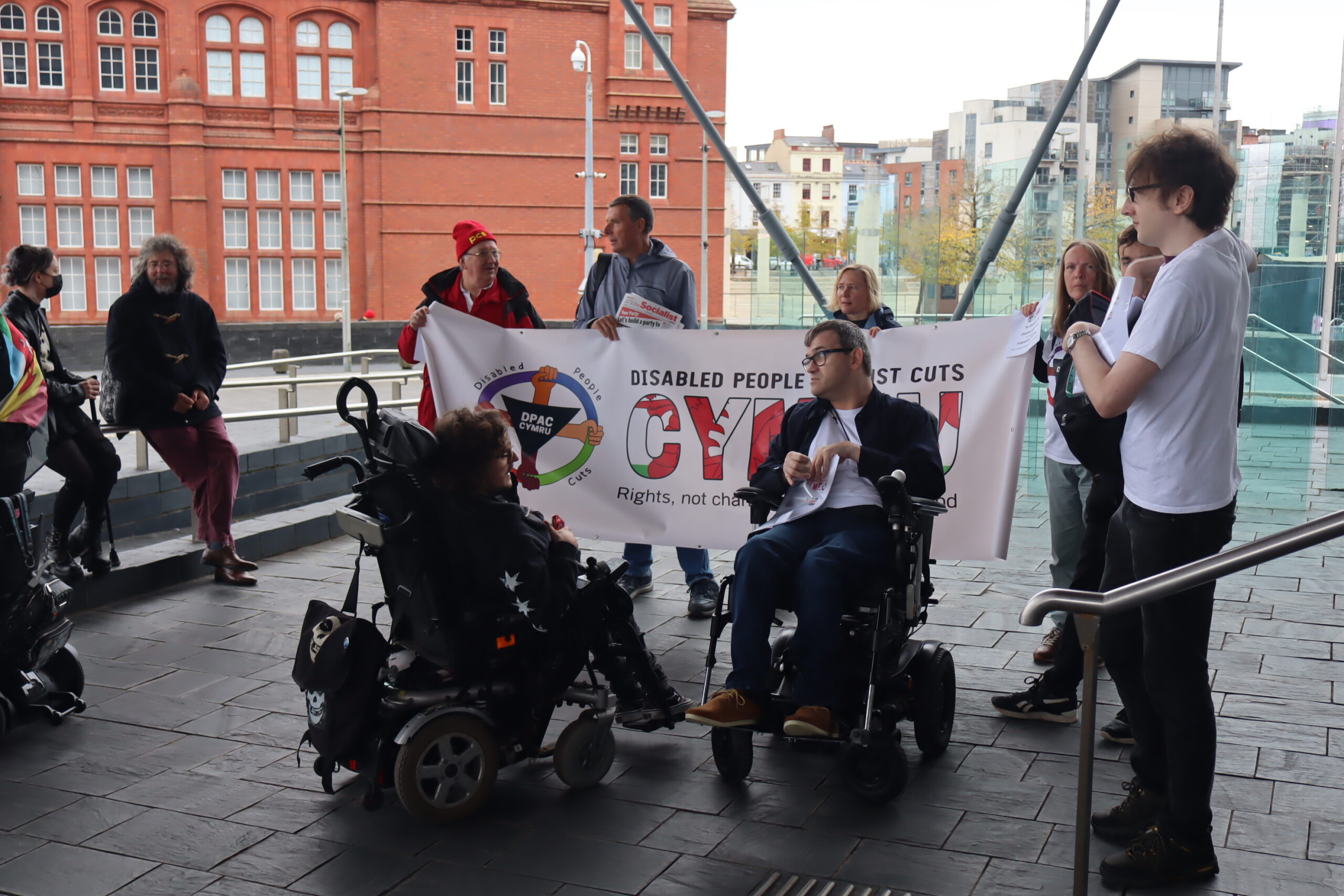
Outside the Senedd (Welsh Parliament) in Cardiff


The words "We want an Independent PIP Review" in bold and black text, with Independent highlighted in red. On the left there is a tear-out effect of a greyscale photo of a disability protest, and a red-tinted photo of Stephen Timms, the disability minister.

The Disability Minister Stephen Timms was forced to promise UK parliament that there would be no more PIP disability cuts until a review had been co-produced with disabled people.

He has broken this promise.

Disabled people want to run our own, independent, and democratic PIP review.

Disabled People Against Cuts Cymru (DPAC Cymru) will be handing in our open letter with 700 signatures from individuals and organisations. We are calling on the Welsh government to do its part and practically support Disabled People’s Organisations to carry out the review.

Placards, in English and Welsh, with the Disabled People Against Cuts Cymru logo, will say:

“No disability cuts! Disabled people want to run our own independent PIP review. We’re asking the Welsh Government to do its part!”


If you are able to, would you consider…

Joining us at the lobby in person on Tuesday 14th.

This will involve: being outside for 15 minutes with placards and possibly a megaphone.

Ask your Senedd member to meet us there.

Let people knowour Google Drive has bilingual social media graphics and placard text, as well as alt text for social media graphics accessibility.

We welcome all support!


Access requirements

Is there anything that would help you take part? Is there anything we can do better? Do you have any access requirements? Let us know! Email <dpac.cymru@gmail.com>

A limited number of PPE masks will be available for free.


Social media graphics

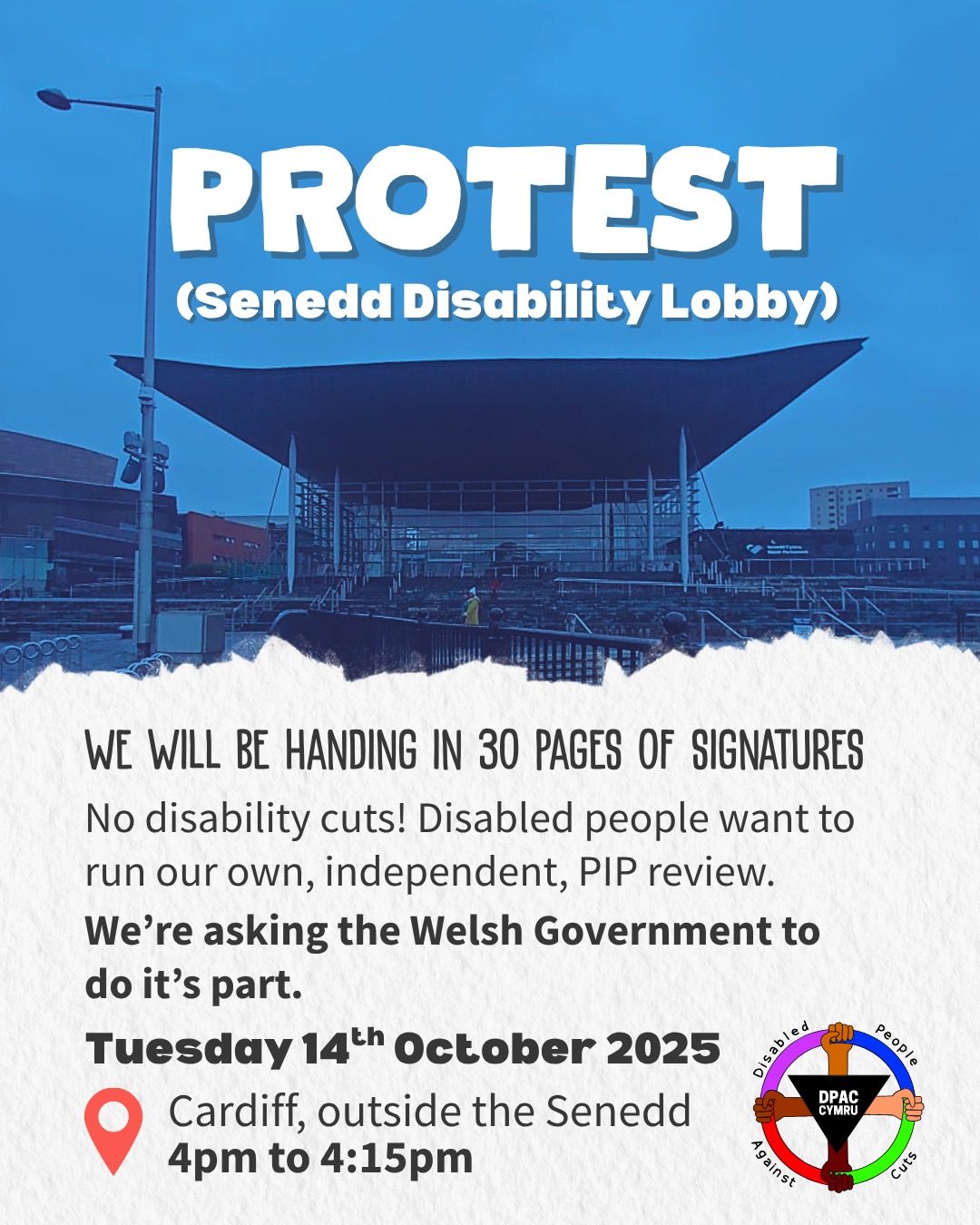
This is a graphic advertising a protest. The top half of the image is a picture of the Welsh Government building (the Senedd) with a blue tint, and the bottom half is a ripped paper effect. Text on the top half, in big letters, says: “Protest (Senedd Disability Lobby)”. On the bottom half, text says: “We will be handing in 30 pages of signatures. No disability cuts! Disabled people want to run our own, independent, PIP review.” In bold, it says “We’re asking the Welsh Government to do its part. Tuesday 14th October 2025.” Next to a red map pin, it says: “Cardiff, outside the Senedd, 4pm to 4:15pm”. To the right is the Disabled People Against Cuts Cymru logo, which is a red, pink, blue, green wheel being held by four hands of different skin tones. At the center of the logo is an upside-down black triangle bearing the letters D P A C and the word Cymru.
A graphic of the DPAC Cymru logo. There is the main DPAC logo to the left, which is a red, pink, blue, and green circle being held by four hands of different skin tones, with the words "disabled people against cuts" surrounding it, and an upside-down black traingle in the middle bearing the letters D P A C. On the right is the word Cymru (pronounced cum ree) (C Y M R U) in large letters, and the background of the letters are cutouts of the Welsh flag. Above Cymru (pronounced cum ree) is written the words Disabled People Against Cuts. Below Cymru (pronounced cum ree) are the words Rights, not charity, and the equivilant phrase translated into the Welsh language.
Oct 022025
 
DPAC Logo with text underneath "Disabled People Against Cuts" and then web address dpac.uk.net

Contents

Minister admits signing off on order that led to widespread cuts to Access to Work 1

All the evidence from Labour conference points in one direction: More cuts to disability benefits 2

DWP paid nearly £90,000 to disabled claimant left homeless and at risk of harm after years of errors 6

Disability minister struggles to point to any significant achievements in his first year in post 8

Labour ignores disabled people and accessible housing crisis – again – as it announces plans for new towns 10

Labour uses conference to sideline disabled people… unless they are working 11

Labour’s attacks on rights ‘have led to massive resurgence’ in disability movement, protest hears 12

Minister asks DWP to consider releasing secret reports on deaths to grieving relatives 15

No 10 meeting sees Labour hold out olive branch to disabled activists after breakdown of trust over cuts 17

Activist tells conference meeting: Hostile rhetoric under Labour has left me feeling hounded and unsafe 19

Disability Labour priced out of conference after cash-strapped party withdraws financial support 20

Other disability-related stories covered by mainstream media this week 23


Minister admits signing off on order that led to widespread cuts to Access to Work

The disability minister has admitted signing off on orders that have led to widespread cuts to disabled people’s Access to Work support packages since Labour came to power.

Disabled campaigners have been warning for more than a year of DWP cuts and inconsistent decisions on their Access to Work (AtW) claims, while there have also been mounting concerns about lengthening waiting-lists for decisions on claims.

But when social security and disability minister Sir Stephen Timms was challenged by an MP on the apparent cuts earlier this summer, he insisted that no changes had been made to Access to Work policy, although work was “underway to improve Scheme decision-making by applying the guidance with greater consistency”.

He still insists that ministers have made no changes to AtW policy.

But Sir Stephen has admitted to Disability News Service (DNS) that he signed off on an order for Access to Work (AtW) staff to apply the guidance more “scrupulously”, after being presented with a “proposal” from civil servants which they submitted to him to approve.

The confusion over who was responsible for the move began when DNS asked him who in the Department for Work and Pensions (DWP) had asked AtW civil servants to carry out the demand to be more “scrupulous” in applying the guidance.

He replied: “Well, the department, I guess.”

Asked if it was definitely not him, he said: “I’m not sure… I don’t want to give you a misleading answer.”

But when asked by DNS why he thought AtW staff were suddenly following guidance more scrupulously, he said he had no “no doubt seen a submission, which I have said ‘OK’ to, saying that it’ll be scrupulously applied, to achieve consistency apart from anything”.

He added: “The way things work is a proposal goes into a submission, which comes to me, and I say, ‘OK,’ and it’s very likely that I’ve been advised that we are going to apply the guidance more scrupulously.”

During the interview at Labour’s annual party conference in Liverpool, Sir Stephen said he could not remember when he signed off on the order, but that he would find out.

But when DNS suggested it would then be possible to secure this order through a freedom of information request, he suggested that DWP would resist this request because such an order would have been “advice to ministers” – which would not have to be released under the Freedom of Information Act – even though the instructions would then have been sent out to all relevant AtW staff.

Just minutes earlier, he had claimed that Labour DWP ministers were “very substantially changing the culture of the department in a pro-transparency direction” (see separate story).

Sir Stephen then claimed that the order to AtW staff might not have been written down, and that it might only have been passed on through “a conversation, a staff meeting; who knows how it’s promulgated”.

He later declined several opportunities to welcome the increase in AtW claims, which he called a “huge surge in the number of applications”.

He said the increase meant “people are having to wait longer” to have their claims dealt with, which was “a big part of why we need to reform Access to Work and why we’re consulting on it”.

Asked again if it was a good thing that more disabled people were applying to AtW, he said: “I think there’s a lot to be said for Access to Work and the opportunities it opens up to people.

But we’ve got to have a system that works efficiently and does not keep people waiting for weeks and weeks and weeks.

And that’s the aim of our reform that we consulted on in the [Pathways to Work] green paper.”

The government’s decisions on AtW reform are set to be announced later this year.

2 October 2025


All the evidence from Labour conference points in one direction: More cuts to disability benefits

Information from Labour ministers and other party sources has shown beyond any doubt that the government is preparing for further attempts to cut spending on disability benefits over the next 12 months.

As disabled people who rely on benefits await the publication of a disability benefits white paper in the next couple of months, it became clear at the party’s annual conference in Liverpool that further cuts are being planned.

Disability News Service (DNS) has this week interviewed the minister for social security and disability; spoken to disabled party members; attended fringe events; spoken (briefly) to a former employment minister; and listened to speeches by the prime minister and the new work and pensions secretary, Pat McFadden.

DNS has also received a Labour briefing; read articles by other journalists with better government connections than DNS; and listened to a broadcast interview with Sir Keir Starmer, in which he said there was a “moral case” for reducing the number of young people with “mental health issues” on benefits.

The weight of this evidence makes it clear that – despite this summer’s government U-turn over billions of pounds of cuts to personal independence payment (PIP) – further cuts to disabled people’s support are on the way.

Two key targets for cuts are likely to be PIP and the health element of universal credit, and almost certainly one focus will be on those receiving support on the grounds of mental distress and trauma, particularly younger people.

On Monday, the chancellor, Rachel Reeves, announced new details of a “youth guarantee” – first announced last year – through which every 18-to-21-year-old in England would be guaranteed either a place in college or university, an apprenticeship, or one-to-one support to find a job.

Any young person still out of work, education or training after 18 months would be given a paid work placement.

The party later confirmed to DNS that there would be “conditionality” – which is likely to mean their benefits would be cut or stopped if the placement was turned down – although there would be “exemptions”, likely to include some sick and disabled young people.

Details on whether those forced onto these placements would receive at least the minimum wage will not be announced until next month’s budget.

McFadden strongly linked “dignity” with work in his speech to the conference, and he said he wanted an “opportunity welfare state” rather than a “dependency welfare state”.

Opportunity, he said, “starts with work”, and he added: “Make work the pathway to dignity, security, and pride.”

McFadden had already alarmed many disabled people before the conference, when he claimed there were “incentives” in the system for people to declare themselves unfit for work so they can “double their money”, and also claimed people were “declaring themselves long-term sick”.

Asked about those earlier comments this week, Sir Stephen Timms, the minister for social security and disability, said he thought McFadden was “onto something here” and had not made a mistake with those comments.

He pointed to the increase in the universal credit basic allowance and the cut in the “health premium” which he said were designed to prevent “quite a serious problem in the current system that is forcing people to aspire to be designated LCWRA* as a kind of destination” so they receive more benefits.

But he did insist that Labour ministers “have the backs of disabled people who can’t work”.

He said: “We are determined to open up opportunities for those who can work, but also to make sure that those who cannot work, and there will always be people who cannot possibly work, and we well understand that, that they will be properly supported.”

He insisted that government ministers had not “dialled up the rhetoric” on disabled claimants, were “making a very good fist of managing a challenging situation”, and that they were not scapegoating disabled people.

He said: “That is not our intention, and I don’t think that’s what we’re doing.

What we are wanting to do is opening up opportunities for disabled people who for too long have been barred from opportunities they ought to be able to take advantage of.”

But Ellen Morrison, one of the most influential disabled activists in the party, as the representative of disabled members on Labour’s national executive committee, told DNS this week that McFadden had been “hinting at the worrying direction that this is going to take”, which looks like “increased conditionality”.

She said: “They are consistently making young people the target. We have to be really careful in the disabled people’s movement not to allow young people to become the target.”

In combination with the existing cuts to the universal credit health element, to be implemented for new claimants from next April, she said the government’s new policies suggest there will be “people who might be forced into either taking inaccessible or unsuitable work, or they are going to be faced with sanctions or destitution.

I don’t think you give people the support that they need by punishing them.”

She said this was combined with the government’s failure to commit to increased funding for the Access to Work disability employment scheme (see separate story).

Morrison said: “I don’t think it’s really about supporting people into work at all.

I don’t believe that’s the motive behind this. It’s to get people off benefits and off any kind of financial support. It’s really short-term thinking.

It’s going to be young people first and there’s more to come for disabled people. A lot more to come.”

The i Paper reported that McFadden was working with Reeves to “craft changes to the welfare system” as a replacement for the cuts the government had to abandon over the summer, and that they would be “laid out step by step over time rather than launched in one big package, in a bid to minimise the risks of a major political backlash once again”.

It also reported that Reeves told a conference fringe event on Tuesday: “A thousand people are going onto PIP claims a day, the majority of those are young people going on to disability benefits with mental health problems.

I’m not denying there are mental health problems; there are massive mental health problems, especially post-Covid.

But I would prefer to be using money to help support people to get into work and to get that treatment in the health service than to pay people to be on benefits and often have them trapped out of work without the support that they need.

I didn’t win that argument, we didn’t win that argument this year, but we can’t go on like this and keep adding to welfare costs.”

The concerns that the government plans to target young people with mental distress were further heightened by the prime minister in an interview yesterday (Wednesday) with BBC Radio Four’s Today programme.

Sir Keir Starmer was asked by the BBC’s Nick Robinson if he was “prepared to say, as prime minister, that being anxious, even being depressed, is a terrible thing to have, but it’s not a good enough reason to stop looking for work”.   

In response, the prime minister made it clear that cuts were coming and he suggested that the government wanted to provide support services for those with mental distress instead of – as highlighted by at least one concerned disabled activist – both benefits and support.

He told Robinson: “I think we need to look again at this issue of mental health and ask ourselves a fundamental question, which is: would we not be better putting our money in the resources and support that is needed for mental health than simply saying it’s to be provided in benefits.

And we’re not saying you shouldn’t have benefits for mental health issues, but I do think we need to examine this quite carefully.”

He said he was “particularly concerned about young people” and the number of young people who are on benefits for mental health reasons.

He said that was “wrong” because “if you are on benefits in your 20s, it is going to be extremely difficult to get off benefits for the rest of your life”, adding: “So there’s a moral case for changing that that I’m perfectly prepared to make.”

The government’s reluctance to reassure those unable to work was demonstrated by a brief exchange between DNS and former employment minister Alison McGovern, now a minister for local government and homelessness, who was speaking in a fringe meeting on the “dignity of work”.

Asked what her message was to those disabled people unable to work because they were not well enough to do so, and about the shortage of jobs that are available and suitable for sick and disabled people, she offered only half-hearted reassurance.

She said: “My message to disabled people is we believe in their right to work, like everybody else.

All the discussions we have been having [are] about trying to make that work suitable and appropriate.

We must always protect people who can’t work, but through new technology and forms of work I think that opens up chances and opportunities for disabled people and others and I want to make sure that people are able to take up those opportunities.”

After the meeting, DNS tried twice to engage with McGovern to ask her to provide further reassurance for sick and disabled people concerned about the government’s policy, but she twice declined to comment further, even briefly, saying she had another engagement to attend.

During the event she had heard from the non-profit organisation Timewise, which has just published research showing that only 2.5 per cent of sick and disabled people who are off work long-term move back into work in any given year.

Of the few that do, more than half (57 per cent) go into jobs that are physically demanding and are associated with higher levels of unpredictable, inflexible and excessive hours.

This contributes to another finding, that more than half of the jobs taken by those who were formerly “inactive or long-term sick” do not last for more than four months.

*Limited capability for work-related activity

2 October 2025


DWP paid nearly £90,000 to disabled claimant left homeless and at risk of harm after years of errors

A disabled person was left with “ongoing risks” of harm for more than five years – and was even left homeless – after the Department for Work and Pensions (DWP) missed multiple opportunities to provide them with the benefits they were entitled to.

It took the intervention of the Independent Case Examiner to correct the years of errors with their various claims, which led to them receiving a payment of £55,000, as well as compensation of £3,000 for the “hardship” DWP had caused.

They had already received an arrears payment of nearly £30,000 in 2023, after their state pension had been wrongly stopped for four years.

The case was discussed in the annual report from the Independent Case Examiner, Joanna Wallace, who deals with complaints about DWP, and she revealed that years of errors by the department had caused “ongoing risks” to the claimant, who had “very poor physical health and housing problems”.

Her report shows DWP made at least nine significant errors with the case from 2018 – including multiple missed opportunities to rectify its mistakes – when it started the process to move the claimant from disability living allowance to personal independence payment (PIP).

The errors included a missed opportunity to consider if the claimant needed extra support with their PIP claim; failing to act on a letter explaining they had moved home; and failing to follow up a letter that was returned unopened.

DWP also failed to act in 2020, when the claimant asked why they had not been receiving any pension or benefits since the previous year.

Even when the claimant contacted DWP in 2023 to explain that the lack of benefits had caused a significant deterioration in their physical and mental health, which had left them homeless, the department “continued to miss putting things right” and failed to consider any reasonable adjustments for a new attendance allowance claim.

It also failed to review the claimant’s suspended pension payments.

It was only when the claimant contacted DWP again later in 2023 that their state pension was reinstated, and arrears of nearly £30,000 were paid.

But there was no evidence of an apology, and DWP still failed to consider the suspended pension credit claim, while making a further error with a new pension credit claim later that year.

Eventually, ICE was notified of the case, and it “took the exceptional step of reaching out to DWP immediately so we could work together urgently to put things right for our customer”.

This led to DWP making a payment of nearly £55,000 in connection with the claimant’s DLA, state pension and pension credit claims.

Wallace also recommended a “consolatory payment” of a further £3,000 because of “the errors and lack of vital support to an extremely vulnerable customer, which had clearly exacerbated the long-term issues with their health and their housing situation” while DWP had “continued to miss opportunities to put things right”.

Asked this week if the case showed there were still multiple problems with the benefits system, and how one claimant could have faced so many errors, DWP said it had introduced thorough procedures to investigate and learn lessons from cases where mistakes were made.

It also said that it used sources such as internal process reviews (see separate story) and its Serious Case Panel to identify and address systemic issues, as well as ICE’s reports.

A DWP spokesperson said: “We regret the mistakes that were made in this case and we are determined to learn from them.

We support millions of people every year and our top priority is they get the benefits to which they are entitled as soon as possible, and to ensure they receive a supportive and compassionate service.”

The report says ICE cleared 2,232 complaints in 2024-25, of which 1,514 were investigated, 567 were resolved (an agreement reached before evidence in the case is requested), 97 were settled (an agreement reached after evidence is submitted but before any investigation is carried out), and 54 were withdrawn.

Of the 1,514 that were investigated, 892 (59 per cent) were fully or partially upheld, 618 (41 per cent) were not upheld and in four cases (less than one per cent) ICE was unable to reach a finding.

Of 205 cases relating to disability benefits that were dealt with in 2024-25, 73 were resolved or settled to the complainant’s satisfaction, 121 ICE investigation reports were issued, and 11 were withdrawn.

Of the 121 investigation reports, 53 (44 per cent) were upheld or partially upheld, 66 (55 per cent) were not upheld and in two cases ICE was unable to reach a finding.

*The Department: How a Violent Government Bureaucracy Killed Hundreds and Hid the Evidence, DNS editor John Pring’s book on the years of deaths linked to DWP, is published by Pluto Press

2 October 2025


Disability minister struggles to point to any significant achievements in his first year in post

The minister for social security and disability has struggled to point to any significant achievements on disability equality after more than a year in post, but he insisted that the government does not need a separate minister for disabled people.

The Labour government has been consistently criticised for not appointing a stand-alone minister for disabled people and instead combining that role with the social security brief under Sir Stephen Timms.

But in an interview with Disability News Service (DNS) at this week’s annual Labour conference in Liverpool, Sir Stephen struggled to point to any significant achievements in the 14 months since his appointment, excluding employment and work and pensions issues.

Asked for three key achievements, he pointed first to the publication in July of new five-year plans to improve the use of British Sign Language (BSL) by government departments.

This followed the British Sign Language Act, a private members’ bill introduced under the last Conservative government, which legislated for the government to report on how departments use BSL in their communications.

He also pointed to the government signing the Solfagnano Treaty (PDF) – a watered-down version of the UN disability convention – during a G7 ministerial meeting in Italy last October.

The treaty appears to have been mentioned just once in parliament – last December – since it was signed, and has been almost completely ignored by politicians, the media, and disabled people.

Sir Stephen also highlighted the “preparations” the government was making for a “cross-government plan” on disability.

Asked why there did not appear to have been any discussions with disabled people’s organisations about this plan, he said: “Internally, there’s been lots of discussion, and the fruits of that will become apparent in the coming months.”

Asked about the lack of progress in his role as disability minister, he said: “I think a lot’s been done, actually.

And I’m hoping that the fruit of that will become increasingly apparent as time goes on.”

He said he did not believe his job – with responsibility for both social security and disability – was too extensive, and he said predecessors under Conservative governments also had responsibilities that were “actually quite wide” and extended outside the “strict disability group”.

But disabled activists at the conference – and outside it – repeated the long-standing calls for a separate minister for disabled people.

Emily Pomroy-Smith, a member of Disability Labour’s executive committee, told DNS that disabled people had been calling repeatedly for a separate minister to cover disability, which was a “very, very important” demand.

She said: “The brief is massive, and it is too big for one person to do on their own.

We would [also] prefer it wasn’t sat under the Department for Work and Pensions.”

Disabled activist Klint Durham, who took part in a Disabled People Against Cuts protest outside the conference on Monday (see separate story), said he would also like to see a stand-alone minister for disabled people.

He said the remit of that post would need to cover areas across government, including housing, transport, employment and community engagement.

2 October 2025


Labour ignores disabled people and accessible housing crisis – again – as it announces plans for new towns

Labour has again ignored disabled people when making a major housing announcement, after revealing plans for a “new generation of new towns” but refusing to explain how it will ensure they are designed to be accessible to disabled people.

Housing secretary Steve Reed told his party’s annual conference in Liverpool on Sunday that the 12 new towns across England would include GP surgeries, libraries, schools, green spaces and transport links.

Building work on three of the new towns will begin before the next general election, with the government working with “world class architects”.

Reed said he would do “whatever it takes” to build the homes.

But Labour this week failed to make any pledge that accessibility would be central to the design of the new towns.

Asked for Reed’s promise to disabled people on the new towns, the Labour party had refused to comment by noon today (Thursday), three days after Disability News Service (DNS) asked the question.

Nearly 15 months after the general election, disabled people are still waiting for the new government to say whether it will introduce stricter minimum accessibility standards for new-build homes in England, three years after a pledge by the last Conservative government – which was never fulfilled – to take action to address the critical shortage of accessible housing.

At last year’s conference, after DNS questioned the party on the failure of ministers to mention the accessible housing crisis, a Labour spokesperson had promised that the government would “set out its policies on accessible new build housing shortly”.

A year on, and disabled people are still waiting for that promise to be fulfilled.

Reed was also the latest Labour minister to say the government was fighting for “hard working people”, apparently ignoring those who are unable to work, including many disabled people who need accessible homes.

He was speaking as an independent report – commissioned by the government – recommended 12 potential locations for new towns across England, with at least 10,000 new homes in each location.

But a brief search through the 135-page report appears to show no mentions of disabled people or the accessible housing crisis, although there is a brief reference to the need for “homes for older people, as well as specialist housing built to accessible and adaptable standards”.

Emily Pomroy-Smith, a member of Disability Labour’s executive committee, said the new towns appeared to be a “really exciting opportunity to set the benchmark for accessibility” and it was crucial for disabled people to be involved in those plans from the beginning.

She said there was no reason why accessibility could not be built into the foundations of the programme.

Disabled activist Flick Williams, a retired disability equality trainer and access consultant, who was in Liverpool to take part in a Disabled People Against Cuts protest outside the conference (see separate story), said she was not at all optimistic about the new towns announcement.

She said the “signs were there” when there was no mention of the accessible housing crisis in last autumn’s National Planning Policy Framework.

She said: “We are just missing from everything they do.”

She said her message to Reed was: “If you want disabled people to be active in the labour market, you need to build us accessible homes.”

2 October 2025


Labour uses conference to sideline disabled people… unless they are working

The Labour party has used its annual conference to stress – once again – that its focus is on supporting “working people”, rather than disabled people who are unable to work.

In his 6,300-word speech to the conference on Tuesday, the prime minister did not mention disabled people once, other than in relation to the work of carers, care workers and volunteers, and a brief mention of his late disabled brother who he said was “badly failed by the education system”.

In contrast, he mentioned “working people” 17 times, including telling the conference audience that the state will be “accountable to working people”, that he wanted to see “working people in control of their public services”, and arguing that it was “working people who paid the price of Tory decline”, while stressing that “Labour is the party for working people” and that he would “fight for working people”.

The concerns about Sir Keir Starmer’s focus on “working people” date back to 2022 and a speech he made to Scottish Labour’s annual conference, at which he declared publicly that Labour was “the party of working people”.

His chancellor, Rachel Reeves, has an even longer troubling track record, having said 10 years ago that Labour did not want to be seen as “the party to represent those who are out of work” and that it was “not the party of people on benefits”.

In his own speech, earlier on Tuesday, health and social care secretary Wes Streeting stressed his determination to build a National Care Service “worthy of the name”.

Labour’s only significant social care announcement was the first ever fair pay agreement for care workers, with an initial £500 million in funding to deliver “better pay, terms and conditions” for adult care workers across England.

In contrast to the prime minister’s speech, Streeting mentioned disabled people three times, highlighting how many disabled people were now surviving with conditions “that would have cut their lives short thanks to breakthroughs in medical science that allows them to not only survive, but to thrive”.

He said that “if we want to match longer lives with better lives, then we must build a social care system to meet their needs”.

And he highlighted the government’s decision to provide more funding for disabled facilities grants, which has provided “safety, dignity, independence and quality of life”, as well as “the biggest uplift in carers’ allowance since the 1970s”.

It has been clear since at least 2022 that Labour’s priority in government would be lifting the pay of care workers before any moves to reduce or scrap care charges.

Any firm decisions on long-term reform will wait for the conclusions of an independent commission, led by former civil servant Baroness [Louise] Casey.

The first phase of the commission will report next year, but the second phase, with recommendations for longer-term reform, will not be completed until 2028.

Last year, Disability Law Service published research which found that disabled people across England were continuing to face unlawful discrimination and inequality on an “unparalleled” scale because of “unjust” social care charging policies.

2 October 2025


Labour’s attacks on rights ‘have led to massive resurgence’ in disability movement, protest hears

The Labour government’s attack on disabled people’s support has led to a “massive resurgence” in the disabled people’s movement in the last year, a protest outside the party’s annual conference has heard.

Monday’s protest highlighted Labour’s failure to stop the “slow violence” that has led to the killing of countless disabled benefit claimants at the hands of the Department for Work and Pensions (DWP), and the government’s refusal to act on the genocide in Gaza.

The Genocide Abroad, Democide at Home protest was held just outside the boundary fence of Labour’s annual conference in Liverpool.

The speeches were at one point being watched by nearly 100 protesters and passers-by.

The aim of the protest was to draw parallels and links between the genocide in Gaza and the “democide at home”, with activists believing that thousands of disabled people have been killed by Department for Work and Pensions (DWP) state violence in the last 15 years.

But it also expressed solidarity with trans rights activists and called for links between the three movements.

The protest began with a recording of the names of more than 100 disabled people who had lost their lives through DWP’s actions and failings, including Errol Graham, Jodey Whiting,  Stephen Carré, Roy Curtis and Faiza Ahmed and more recent victims of DWP bureaucratic violence such as Tracie, Kevin Gale, and David.

The protest was organised by Disabled People Against Cuts (DPAC) branches from Merseyside, Leeds, Manchester and York.

Rick Burgess, from Manchester DPAC, said the Labour government had not tried to reverse the Conservative cuts to disability support but instead “attempted to push farther and further”.

He said the attempted cuts to personal independence payment would have led “to many more deaths”, but disabled people forced the government to back down.

He said: “We did that. We started the end of this absolutely pathetic and failed Starmer government.”

He then led a chant of “no more benefit deaths”.

Burgess added later: “We still have a political system that absolutely denies disabled people’s right to live a good life on equal terms with everyone else.

We need social security, we need social care, and we need social justice.”

Referring to Gaza, he said: “If governments see genocide is a viable policy solution, they will start thinking about using it elsewhere.”

Billie Gibson, from Crips Against Cuts Merseyside, led a series of chants, including “Keir Starmer, disabled harmer” and “don’t cut PIP, tax the rich”, before telling the protest that the “warfare on disabled people needs to stop”.

Dr China Mills, who leads the Deaths by Welfare project at Healing Justice Ldn, told protesters: “Disabled people have been telling us for well over a decade that the welfare system is killing people, and Labour, from New Labour to now, have cooked up many of the policies that kill people.

People are being killed because the government doesn’t think that disabled people matter or have any value and because to them work equals worth.

We think that these killings go deeper than mistakes or flaws in the system.

The system isn’t broken; it is functioning exactly as it was designed.”

Jessica Ryan, from Disability Rebellion, which helped promote the protest online for those who could not attend in person, highlighted the impact of Labour’s cuts on the next generation of disabled people, and the unfairness of the government’s treatment of disabled people.

Rhi, from Merseyside DPAC, but also a researcher for the Trans Safety Network, said: “This is a government that seems extremely determined to be remembered for its genocidal foreign policy and its democidal domestic policy, as well as attacking our right to protest.

As a disabled and trans person, I have long insisted that disabled people’s liberation and trans people’s liberation will be one and the same fight, and that our oppression is built with the same tools, but these last few years have made this increasingly clear to more and more of us.

It is a terrifying time to be a disabled person in the UK right now and it is a terrifying time to be a trans person here, too.

Disabled people and trans people are under attack but when we join together to fight back, we are much, much stronger.”

Emma Hewitt, from Leeds DPAC, said she had been a disability rights activist for 20 years but it had only been in the last 18 months that she had “really seen the attacks on us”.

She said: “It’s not just the fact that they are cutting our services, it’s the fact that they are attacking us, they are attacking our right to live.

It’s so painful that not only do they not care about us, but they are quite happy to spend the money that we need for our support on genocide (in Gaza).

There has been a massive resurgence in the disabled people’s movement, and it just fills me with so much hope.

Every town in this country, every city, has got a disability rights group, not just Disabled People Against Cuts, we’ve got Crips Against Cuts, who are this amazing new group, Disability Rebellion, you guys are my heroes, you’ve been finding new ways for us to be able to campaign so no-one gets left behind, so everyone has a voice.”

Disabled activist Flick Williams, from York DPAC, said it was “so important” to be at the protest because the imminent DWP white paper – which is expected to include a series of further cuts to benefits – will be published later this year.

She said she had been struck by the names of those who had been killed due to DWP “slow violence”.

She said: “I just thought: there are going to be so many more.”

Another disabled activist, Klint Durham, told DNS he had travelled to Liverpool from Leeds to show his “contempt for the Labour government and its attack on disabled people and the welfare cuts”.

After 14 years of Conservative austerity, he said, he could not believe that a Labour government “would think to introduce more cuts”, and that it was “very clear” that the Labour-run DWP needed to “listen to organisations of disabled people and not charities”.

*The Department: How a Violent Government Bureaucracy Killed Hundreds and Hid the Evidence, DNS editor John Pring’s book on the years of deaths linked to DWP, is published by Pluto Press

2 October 2025


Minister asks DWP to consider releasing secret reports on deaths to grieving relatives

A minister has asked the Department for Work and Pensions (DWP) whether it could release secret reports to families whose relatives’ deaths have been linked to DWP’s actions and failings.

Ever since Disability News Service (DNS) first revealed the existence of the secret reviews in October 2014, DWP has repeatedly refused to even alert the families of those who have died that an investigation has been carried out.

The department has insisted – as it did last week when it again refused to tell lawyers for the family of Jodey Whiting whether it carried out a probe into her case – that such reviews are “internal retrospective investigations focused on organisational learning, not public accountability”.

The probes were previously known as peer reviews but are now called internal process reviews (IPRs).

The only IPRs ever to be released to grieving relatives have come after orders made by a coroner or a judge.

DNS is aware of only two such cases, including the IPR ordered to be released by the coroner who heard the 2021 inquest into the death of Philippa Day.

But DNS told the social security and disability minister Sir Stephen Timms this week that safeguarding adults reviews and domestic homicide reviews are released to families and are published, although the identities of the subjects of the reviews are disguised.

DNS also pointed to the eight-year campaign for justice and accountability led by Jodey Whiting’s mother, Joy Dove, and her struggle to secure the IPR she believes was carried out into the circumstances surrounding her daughter’s death.

Speaking during an interview with DNS at Labour’s annual conference in Liverpool, Sir Stephen said: “Internal process reviews are what the name implies, they are for internal consumption within the DWP to look at where we got things wrong and how are we going to put them right.

So that is kind of the nature of them, so I don’t think it’s surprising inherently that they are not shared more widely.”

But he then said that DNS was “raising a very reasonable issue here, and particularly asking whether families should, in certain circumstances, be able to see them”.

He said he had asked DWP civil servants “to take a look at this, and I am going to be receiving some advice on that subject”, although he said it was “difficult and there is a duty of confidentiality that the department owes to people”, even after they have died.

He added: “There might be a need to change the law here.

Anyway, I’ve asked officials to have a look at this and to come back to me.”

His comments came after Steve Darling, the Liberal Democrat work and pensions spokesperson, told DNS last week that he was hoping to use the government’s new Hillsborough Law to force DWP to release IPRs to relatives.

During Sunday’s interview, Sir Stephen admitted that it was only because of a DNS news story that he became aware that a report – commissioned by Conservative work and pensions secretary Therese Coffey in 2020 – had called for DWP to reduce suicides of benefit claimants and other “very bad cases”.

The Complaints, Suicides and Other Matters report was written by Tory peer Baroness [Lucy] Neville-Rolfe, but DWP has told DNS that it would be too expensive to find out what happened in response to the 11 recommendations she made five years ago.

Among her recommendations was for DWP to set up a new register of “very bad cases”; to review its safeguarding system, including an analysis of its effectiveness in reducing suicides; and to review the IPR system.

Sir Stephen said on Sunday: “I actually did not know that Baroness Neville-Rolfe had done a report for the DWP until my office told me that you were likely to ask me about it.

That’s the first time I was aware of this report having been done.”

DNS has been writing news stories about the report since May this year, but it appears that no-one in DWP briefed him on the report or those stories until the lead-up to the conference.

Sir Stephen said he would now ask civil servants what happened in response to the 11 recommendations made in the report.

He said: “I will find out about it.”

He said Labour ministers were now “very substantially changing the culture of the department in a pro-transparency direction.

I’m not claiming that we’ve entirely got there yet, but we’ve made a lot of headway.”

Sir Stephen also confirmed that the disabled members of his new independent disability advisory panel would no longer be expected to sign non-disclosure agreements, following a backlash over the “completely unacceptable” measure.

Instead of an NDA, DWP said it would “collaboratively agree the confidentiality arrangements as part of the terms of engagement with the panel once the membership is confirmed”.

The deadline for applications has now been extended by two weeks to 13 October.

*The Department: How a Violent Government Bureaucracy Killed Hundreds and Hid the Evidence, DNS editor John Pring’s book on the years of deaths linked to DWP, is published by Pluto Press

2 October 2025


No 10 meeting sees Labour hold out olive branch to disabled activists after breakdown of trust over cuts

Senior figures in the Labour party pledged to try to rebuild trust with disabled people at a meeting with activists earlier this month at 10 Downing Street, Disability News Service can reveal.

The 90-minute meeting between a delegation of seven disabled people and senior figures within the Labour administration took place on 2 September.

It came after a text message from Joe Watkinson, deputy vice chair of Disability Labour, to Claire Reynolds, who was at the time the party’s political director in Downing Street, but is now Labour’s executive director of stakeholder relations.

Watkinson had suggested the need for a meeting to try to rebuild Labour’s relationship with disabled people after the damage caused by the government’s attempts – later abandoned – to cut billions in spending from personal independence payment, and the cuts that will be introduced through its Universal Credit Act, and to ensure disabled people “have a voice and can be heard in a constructive way”.

He told Disability News Service (DNS) at this week’s Labour conference in Liverpool: “Disabled people cannot afford a Reform government.

The only hope we have is via a Labour government. We need to reset the relationship with disabled members and that’s at the core of everything we need to do.”

Among the disabled people who attended the meeting were representatives of the Co-operative Party – where Watkinson is chair of the party’s disability network – union activists and representatives of Disability Labour (DL), including Kathy Bole, DL’s chair, and Emily Pomroy-Smith, another member of DL’s executive committee.

As well as Reynolds, other Labour representatives at the meeting included a work and welfare special adviser, and a representative of the party’s general secretary.

It is not yet clear what promises the party will make to those who attended the meeting, other than a pledge to hold further such meetings.

But Watkinson said: “It was a very constructive meeting. It was taken seriously. It was a very frank and honest discussion.

For the majority of the meeting, they sat there and listened.”

Pomroy-Smith said: “It was about using our lived experience to inform what they were doing. They were ready and listening.

Claire really did fight for this. She really fought for the meeting to happen, and she’s continuing that in her new role.”

She said the government representatives they met were aware of the level of anger among disabled people at the way the PIP and universal credit cuts had been handled earlier this year.

She said: “What we were coming with was solutions. The focus was how can we rebuild and what does that look like.

It was about moving forward. How do we prevent it from happening again.”

Among the issues raised were the kind of language used by ministers, and inaccurate briefings on social security reform.

Pomroy-Smith added: “At the moment there is a real need to amplify the voices of disabled people and not be spoken about.”

2 October 2025


Activist tells conference meeting: Hostile rhetoric under Labour has left me feeling hounded and unsafe

One of the only disabled activists to speak at Labour’s annual conference has delivered a powerful rebuke to ministers who have failed to do anything to curb the rising levels of disability-related hostility.

Fingers, a disabled RAF veteran who campaigns with Crips Against Cuts and the new group Disabled Resistance, told a fringe event on Monday how her car had been attacked and she had been called a “scrounger” after a young man saw her blue parking badge on the dashboard.

She told an Amnesty International UK fringe event on fixing the broken social security system: “What the language of the last 18 months has done to me is, for the first time in my life… I feel hounded, I feel unsafe.”

She said she felt as though the hostile rhetoric directed at disabled people had turned her into “a non-person”.

She said: “You’re looking at someone who is unsustainable. Why do I have to be a unit of productivity in this country?

The words we use are fundamentally important. Not one newspaper has run an editorial or article about how these words are making us feel.

I fought for the country, I worked for the NHS, and now I am effectively a ‘useless eater’.”

Fingers, who also used to chair a mental health charity, told Disability News Service (DNS) after the meeting that four young men had walked past her car as she was waiting at traffic lights in Loughborough about a month ago.

They had seen her blue badge and one of them then bounced on the bonnet of her car and shouted: “Bloody scrounger!”.

She wound down the window and gave them a “stream of obscenities and invective”, but later her anger turned to fear for her safety and that of other disabled people.

She told DNS: “The rhetoric surrounding people who require support because of ill-health has become positively threatening.

It has been encouraged tacitly by the government.

It dehumanises people who can’t work and there has been not one shred of fightback by the government about the knock-on effects of their rhetoric.

It has given a licence for anybody at all to pick on and say hateful things about disabled people, and it’s everywhere, and that makes me feel unsafe.”

The former Labour member, who joined the party to vote for Jeremy Corbyn as party leader and left when he was replaced by Sir Keir Starmer, said she had expected this kind of rhetoric from a Conservative government, but it was “shocking” that it had continued under a Labour government, which had even made the situation worse.

She was also critical that the fringe event had been held on an inaccessible stage without a ramp, as highlighted by Daily Mirror columnist Susie Boniface, who chaired an event in the same location within ACC Liverpool.

Although she is not a wheelchair-user, Fingers has a physical impairment and struggled with the inaccessible stage, which she said was “shameful for Labour”.

Because of the lack of chairs in the conference centre, she had already been forced to resort to sitting in the accessible toilet to prepare for her presentation at the fringe event.

She said: “I was in quite a bit of pain when I left that conference. It would have been alleviated if I had had anything other than a disabled loo to sit on.”

DNS reports elsewhere this week that Disability Labour – which often provides free access advice to the party at its annual conference – was priced out of attending this year’s event by the party.

Meanwhile, disabled Labour MP Nadia Whittome told the Amnesty fringe event that she was “really proud” to have played a small part in the backbench rebellion that led to the government withdrawing its planned cuts of billions of pounds to spending on personal independence payment.

But she pointed out that cuts to the health element of universal credit for most new claimants are still going ahead next spring.

She said campaigners must continue to fight against further government cuts to disability benefits, and against disability discrimination, and for investment in public services.

She echoed Fingers’ comments on the political rhetoric and told the fringe event: “People’s worth is not determined by their economic contribution.”

2 October 2025


Disability Labour priced out of conference after cash-strapped party withdraws financial support

The campaigning organisation that represents disabled people within Labour had to cancel plans to attend this week’s conference in Liverpool after the party asked it to pay thousands of pounds in fees.

Members of Disability Labour appealed for last-minute financial help during a visit to 10 Downing Street earlier this month (see separate story) but were told the party could no longer afford to help it cover its costs at conference.

For the first time since 2018, Disability Labour – which has spent years providing free advice to the party on access issues – was asked to pay for a space for a stand at Labour’s annual conference, but it was told this would cost £2,500.

Disability News Service (DNS) has been told that other Labour-affiliated socialist societies have also had to pull out of attending the conference this week because they could no longer afford the increasing cost and because of the lack of financial support from the party.

The party has told DNS that the changes to financial arrangements at the conference were applied equally to all 21 socialist societies and were not unique to Disability Labour.

Disability Labour said this week that it did not believe it had been singled out.

Last year, it had to pay only a few hundred pounds to cover the cost of electricity and other costs, including hiring a small stand where its members could provide advice to other disabled party members and use as a base to lobby politicians and delegates on disability issues.

It would likely have had to pay thousands more to hire a venue at the conference for a fringe event, and hundreds of pounds more for accommodation in Liverpool.

Emily Pomroy-Smith, a member of Disability Labour’s executive committee, said the party “did express regret” that it had not been able to offer the same support as in recent years, and Disability Labour was now in discussions with the party about future support.

She said: “We want to work with the party to get us back here.

We are asking the party to meet us halfway and work with us so next year we can be back. It’s really important.

In a year where we have seen difficulties and damaged relationships with disabled people and communities, it’s really important that we see a willingness to rebuild that, which we have had.

Obviously, it’s disappointing that we are not able to be here in our normal capacity.

The Disability Labour stand is a hub for disabled people. We end up supporting disabled members and visitors’ access issues and signposting them [to support].

We do provide a service.”

She added: “Conference is getting more and more expensive. That’s not just for Disability Labour.”

Local hotels have increased prices by as much as six times their usual rates, she said.

Joe Watkinson, deputy vice chair of Disability Labour, said: “Disabled members need us to be here. It’s important that we are here.”

Pomroy-Smith and Watkinson were only able to attend because the independent transport trade union TSSA covered many of their expenses, paying for Pomroy-Smith’s accommodation and travel, and travel for Watkinson.

Kathy Bole, Disability Labour’s chair, said they were told at the No 10 meeting in early September that the party’s financial problems meant it could not support Disability Labour at this year’s conference.

Bole said Disability Labour executives had reluctantly decided not to use a large chunk of the society’s limited funds to hire a stand and host a fringe event.

Disability Labour is a socialist society affiliated to the Labour party, but has members from across the Labour spectrum, although its leadership and membership have traditionally supported causes on the left of the party.

It has a long history of acting as a “critical friend” of the party at its annual conference, raising concerns about access, policy and the need for co-production.

It has also spent years lobbying Labour to do more to address disability discrimination within the party.

Last year, it was critical of the new Labour government’s decision to appoint only a part-time disability minister, and supported a disabled delegate who was refused entry to the conference with her assistance dog.

In September 2022, its members supported calls for the party to do more on eliminating the barriers faced by its own disabled members.

It raised similar concerns the previous year, prompting a pledge from the party’s general secretary that he would put an end to the years of discrimination experienced by disabled party members.

And, as part of the party’s online conference in September 2020 – in the early months of the pandemic – Disability Labour pushed the party for a stronger commitment to plans drawn up by disabled people that would solve the social care crisis by setting up a co-produced National Independent Living Service.

Disability Labour has also hosted important fringe events, and in September 2023 its event was attended by four shadow ministers.

This event drew the promise from shadow disability minister Vicky Foxcroft that, if Labour won power, “every single one of our ministers will be ministers for disabled people”.

A Labour party spokesperson said in a statement this week: “We are committed to providing a safe and accessible environment at conference for disabled people.

There are more accessibility stewards working at conference this year compared to last year, and we have also provided these stewards with an increased level of training.

We also continuously engage with Disability Labour on a wide range of issues, including greater celebration of Disability History Month which the party has begun work on.”

2 October 2025


Other disability-related stories covered by mainstream media this week

The family of a disabled man who died after not being given any food for nine days while being treated in an NHS hospital has told ITV News, “we thought he was having nutrition… but as it turns out, they were starving him.” This comes as an ITV News investigation has revealed a crisis in the care of people with learning difficulties and autistic people. Bereaved families have told ITV News they believe their children died due to failures in NHS care: https://www.itv.com/news/2025-10-01/i-dont-want-to-die-downs-syndrome-man-starved-to-death-in-hospital

2 October 2025


News provided by John Pring at www.disabilitynewsservice.com

Sep 262025
 
DPAC Logo with text underneath "Disabled People Against Cuts" and then web address dpac.uk.net

A graphic on a black background, using white and mint green text. At the top, in a large font, is the text “hashtag No Sham Panel. Online Disability Protest.” This is followed by text that says “The government says it’s setting up a group of disabled people to give advice. They are calling this the Independent Disability Advisor Panel. But we are worried because it looks like the panel won’t be fair. The government only wants a panel that will agree with them.”

A graphic on a black background, using white and mint green text. There are two headings in mint green that ask “when” and “how.” Underneath “when” is the text “Saturday 27th and Sunday 28th September 2025.” Underneath “how” is the text “follow our guide at: bit.ly/panel-protest for instructions.” Below, in a large font, is the text in white and all-caps “then spread the word!”, followed in green by “hashtag No Sham Panel.”

A graphic on a black background, using white and mint green text. At the top, in a large font, is the text “hashtag No Sham Panel. Online Disability Protest.” This is followed by a speech bubble containing the text “I’ve send in my application to the sham government disability panel. I’m letting them know that I refuse to accept their unfair rules. You can do it too!” Underneath is the Disabled People Against Cuts Wales logo and the Disability Rebellion logo. There are two headings in mint green that ask “when” and “how.” Underneath “when” is the text “Saturday 27th Sunday 28th September 2025.” Underneath “how” is the text “follow our guide at: bit.ly/panel-protest for instructions.”


Take part at bit.ly/panel-protest


Plain text:


#NoShamPanel Online Disability Protest:

The government says it’s setting up a group of disabled people to give advice.

They are calling this the Independent Disability Advisory Panel.

But we are worried because it looks like the panel won’t be fair.

The government only wants a panel that will agree with them.


When?

Saturday 27th and Sunday 28th of September 2025.


How?

Follow our guide at bit.ly/panel-protest for instructions.


Then spread the word! #NoShamPanel

Tell everyone:

I’ve sent in my application to the sham government disability panel.

I’m letting them know that I refuse to accept their unfair rules.

You can do it too!

You can also share our social media graphics with Alt text from our Google Drive folder.


Organised by

Disabled People Against Cuts Cymru (DPAC Cymru) and Disability Rebellion

Sep 252025
 
DPAC Logo with text underneath "Disabled People Against Cuts" and then web address dpac.uk.net

Contents

Davey stirs up hostility towards disabled claimants, as Lib Dem spokesperson links similar attacks to far right 1

Lib Dems want to use new Hillsborough Law to force DWP to release secret reports into deaths 3

Darling accuses DWP of ‘absolutely shameful’ cover-up over Access to Work changes 4

Disabled activists working with peers to address serious flaws in ‘dangerous’ assisted dying bill 5

UN calls for human rights assessment of government’s benefit cuts bill and mental health reforms 8

DWP is ‘dysfunctional’ and needs major review, says Lib Dem Steve Darling 11

Lib Dems insist they are still focused on social care, despite leader concentrating again on carers 13

New publications ask how disabled people and allies can hold the state to account for welfare state killings 15

Mother left ‘disgusted’ by DWP’s silence over secret report into Jodey Whiting’s death 17

Anger and frustration after DWP’s latest jobcentre announcement and McFadden’s ‘incentives’ comment 19

Other disability-related stories covered by mainstream media this week 21


Davey stirs up hostility towards disabled claimants, as Lib Dem spokesperson links similar attacks to far right

Liberal Democrat leader Sir Ed Davey has whipped up hostility towards disabled people by suggesting there is widespread fraud among claimants of personal independence payment (PIP), despite his own work and pensions spokesperson linking similar unfounded attacks to the far right.

In an interview with Times Radio at the Liberal Democrat party conference in Bournemouth, Sir Ed suggested the reduction in face-to-face assessments had led to “quite a lot of fraud” among the recent increase in PIP claimants since the start of the pandemic.

But the latest figures from the Department for Work and Pensions (DWP) estimate that just 0.4 per cent of PIP spending in 2024-25 was due to fraud, while the previous year’s estimate had been zero per cent.

Despite these facts, Sir Ed said: “There’s a real suggestion in those numbers, by the way the Conservatives managed the system, that there’s quite a lot of fraud there and surely everyone can agree we should go after the fraud to make sure that people who need the benefits that people who are really disabled can still get them.”

But Sir Ed’s comments came on the same morning (Sunday) that his own work and pensions spokesperson, disabled MP Steve Darling, told Disability News Service that far-right activists were launching similar attacks on disabled claimants using dubious figures on economic inactivity.

Darling said: “My real fear is that in our now Trumpian world, [the far right] don’t need the facts to add up to make outlandish claims.”

He said it was disturbing how “the far right will just make up narratives for their own purposes, and demonising others is part of their playbook and sadly people with disabilities and quite often people with hidden disabilities are in their crosshairs.

It’s part of that push back against the far right [and what] we need to be doing is unpicking that, because otherwise that half-truth will be built on by the far right to demonise people with disabilities.”

Sir Ed also mirrored claims by right-wing politicians when he claimed in the Times Radio interview that it was vital to reduce spending on social security, despite widely-available official figures showing that expenditure is stable as a proportion of GDP*.

His comments on PIP were particularly embarrassing because he focused in his main conference speech on Tuesday on attacking Reform UK and its leader, Nigel Farage, warning repeatedly of the “Trump-inspired country Farage wants us to become”.

Asked about his leader’s comments, Darling declined to say if he agreed with them, but yesterday (Wednesday) he issued a statement through his party’s press office.

He said: “Liberal Democrats are proud champions for the most vulnerable in society.

We led the charge against the government’s ill-thought welfare cuts bill and played an instrumental role in defeating plans to slash PIP.

We will always stand up for disabled people and their carers.

Ed rightly pointed out that the Conservative party’s move to telephone assessments has damagingly undermined public trust in the welfare system.

A fair system of in-person assessments, where possible, is vital to make sure this crucial support is there for people who need it.

More broadly, Liberal Democrats have long argued the best way to reduce welfare spending is to tackle the root causes of the rising welfare bill – by seriously investing in health and care, and making it easier for disabled people to access the world of work.”

Sir Ed’s speech to the conference included just two mentions of disabled people, but neither in relation to his own party’s policies.

Instead, he mentioned family carers like himself 10 times in Tuesday’s speech, without once mentioning the adult social care charging crisis, which sees tens of thousands of disabled people falling into debt every year because of those charges (see separate story).

*Gross domestic product, the size of the country’s economy in a particular year

25 September 2025


Lib Dems want to use new Hillsborough Law to force DWP to release secret reports into deaths

The Liberal Democrats are set to try to use the government’s new Hillsborough Law to force the Department for Work and Pensions (DWP) to release secret reports into the deaths of disabled benefit claimants.

For years, the department has refused to hand bereaved relatives the internal process reviews (IPRs) it carries out into deaths that have been linked to its actions and failures.

It releases reviews only when ordered to do so by a coroner, or a court, or very rarely on other occasions – there is no record of it doing so in such circumstances – because it insists they are intended for learning purposes within the department.

This week, Disability News Service (DNS) has reported DWP’s latest refusal to release an IPR – or even to say if such a review was carried out – to a family, this time following the death of Jodey Whiting (see separate story).

Her mother, Joy Dove, is in her ninth year of campaigning for justice for her daughter, who took her own life in February 2017.

In a letter to Dove, DWP said IPRs were “internal retrospective investigations focused on organisational learning” and “often contain sensitive personal information about claimants” and so “could be considered a breach of privacy”, even though the claimant is dead.

The letter, from the Government Legal Department, said DWP was “working towards a more open approach to sharing findings and learning from IPRs”, but this is believed to refer only to anonymised recommendations made by the reviews rather than the facts they uncover.

DNS reported in June that a DWP director who gave evidence at the second inquest into Jodey Whiting’s suicide claimed she didn’t know whether an IPR had been carried out and would have to ask colleagues.

The minister for social security and disability, Sir Stephen Timms, came into his post last year pledging to increase transparency within the department.

But he has so far refused to change the department’s position, even though adult safeguarding reviews – sometimes examining the same deaths as IPRs – are released to relatives, and are published anonymously.

Now Steve Darling, the Liberal Democrat work and pensions spokesperson, has pledged to use the government’s new public office (accountability) bill, otherwise known as the Hillsborough Law, to force DWP to publish IPRs and release them to families.

This is because the new bill includes a legal duty on public authorities and public officials “to act with candour, transparency and frankness”.

In an interview with DNS at his party’s annual conference in Bournemouth, Darling said he wanted the bill to produce a “culture change” within DWP and the whole of Whitehall, and that he intends to ask parliamentary questions about how the release of IPRs should be part of that.

He said it should be the same approach as in the aviation industry when there are near misses and “things have gone wrong”.

Otherwise, he said, “how can you expect the rest of the organisation to learn from it and the rest of society to learn where things have gone wrong?”

*The Department: How a Violent Government Bureaucracy Killed Hundreds and Hid the Evidence, DNS editor John Pring’s book on the years of deaths linked to DWP, is published by Pluto Press

25 September 2025


Darling accuses DWP of ‘absolutely shameful’ cover-up over Access to Work changes

The Department for Work and Pensions (DWP) has been accused of an “absolutely shameful” cover-up, after refusing to release documents that should show why disabled people across the country have faced cuts to their Access to Work support.

Disabled campaigners have been warning for the last 18 months of DWP cuts and inconsistent decisions on their Access to Work (AtW) claims.

But when social security and disability minister Sir Stephen Timms was challenged on these apparent cuts this summer, he insisted that no guidance had been issued to reduce support, and he said: “No changes have been made to Access to Work policy.”

In his response to a written parliamentary question from Liberal Democrat work and pensions spokesperson Steve Darling in July, he said instead that guidance was “now being more consistently applied” and that “work has been underway to improve [AtW] decision-making by applying the guidance with greater consistency, to provide a fairer process”.

He said: “This may mean that some awards change at the point of renewal, but there has been no change in Scheme policy, or instruction to reduce support levels.”

But Sir Stephen added: “Any updates to operational guidance are reflected through the published version available online at GOV.UK.”

Disability News Service (DNS) subsequently submitted a freedom of information request for DWP to provide all the changes to AtW “operational guidance” in the last 24 months.

But DWP has now replied to say that, although it holds this information, it would take more than three-and-a-half working days to determine “whether the Department holds the information, and locating, retrieving and extracting it”, so it is not obliged to seek the documents under freedom of information laws.

The DWP freedom of information team said this was because “the time period you have chosen is very wide and the topic you ask about is very broad” and suggested instead that DNS should “narrow your request to the latest version of a specific section of a particular topic within Access to Work that you are interested in”.

Speaking to DNS at the Liberal Democrat conference in Bournemouth this week, Darling said this lack of transparency from DWP was “absolutely shameful”.

He said: “We need to have that transparency about what is going on, because the evidence we have has demonstrated that there have been significant changes [to people’s AtW support packages].”

He said he was convinced that cuts were being enacted by DWP even if they were coming through operational changes rather than alterations in policy.

He told DNS that he has heard from disabled people made redundant from disability charities who have been offered much lower levels of support when they applied for AtW support with their new job.

He said: “What was taken as a given with their previous employment, [AtW] are shrinking it down, whether it’s travel to work or the level of support workers, or the way support workers are employed.

It is just absolutely perverse.

I’m sure there are cuts; there are cost savings happening there and I’m sure the Treasury are delighted with it being sucked back into the system.”

A consultation on the future of the AtW scheme has now closed.

Work and pensions minister Baroness Sherlock said, in a written answer to the disabled Liberal Democrat peer Baroness [Celia] Thomas earlier this month, that DWP was now “reviewing all aspects of the Scheme now that the consultation has closed”.

25 September 2025


Disabled activists working with peers to address serious flaws in ‘dangerous’ assisted dying bill

Disabled activists who are working with sympathetic peers to address the serious risks posed by the assisted dying bill believe there is also still a chance that the legislation could eventually be thrown out by the House of Lords.

Not Dead Yet UK (NDY UK) said there were grounds for “hope” after the completion of the first two days of debate on the terminally ill adults (end of life) bill in the Lords.

Friday’s debate saw speakers opposed to the bill outnumbering supporters by about two to one.

NDY UK said the campaign was “in the best place it could have been, because we can’t kill the bill at this stage.

While NDY UK continues to oppose the bill in principle, it recognises the need to engage with the legislative process to help ensure, if the bill does pass, it contains the strongest possible safeguards to protect disabled people.”

Almost two-thirds of peers who spoke during the debate on Friday (19 September) were opposed to the current version of the bill, while a little over a third were in favour, a similar proportion to the first day of the debate the previous Friday (12 September).

Of 15 Labour peers who spoke on 19 September, nine were in favour, five were against, and one – speaking for the government – was neutral.

But of 29 Conservative speakers, just seven were in favour and 22 were opposed to the bill in its current form.

Liberal Democrat peers were split, with two on each side, while of 11 crossbench speakers, five were in favour and six were against, while seven non-affiliated peers spoke against the bill and just one in favour.

George Fielding, a member of NDY UK’s coordinating group, who watched both days of the second reading debate from the floor of the Lords – as he is a wheelchair-user – said he was “genuinely moved by the quality of the debate, by the nature of the debate”.

He said NDY UK and other opponents of legalisation had formed “a hotchpotch alliance” among cross-party and crossbench peers.

He said: “We are building a network and a consensus across the Lords and I think that is emblematic of the fact that this bill will touch pretty much every corner of our society, and every corner of the House of Lords has people we have found are sympathetic to our views.”

Fielding said NDY UK was convinced that the bill would be “significantly amended” by peers “because the consensus is, at the very, very least, that this is a dangerous bill, it will foreshorten lives.

At the very least, this is going to be one of the most significantly-amended bills in parliamentary history.”

He said NDY UK was “working closely with cross-party peers and allies to propose amendments aimed at closing loopholes and reducing risks, especially around coercion, eligibility, and judicial oversight.”

Fielding said there was an “incredible effort going in the Lords” – with input from NDY UK – to make the bill safer through amendments, because it was currently “unworkable”.

NDY UK welcomed the decision on Friday to set up a select committee of peers that will take expert oral evidence from ministers, professional bodies and legal experts, which Fielding said would be “another public opportunity” for peers to probe the bill’s weaknesses and to “demonstrate how dangerous this bill is”.

He added: “NDY UK plans to contribute evidence and research to inform the committee’s understanding of how disabled people may be affected by the bill.”

This committee will hold six evidence sessions over three weeks, beginning in the week of 20 October.

The committee stage will then follow, with its clause-by-clause examination of the bill.

Among those who spoke in Friday’s debate was disabled Conservative peer Lord [Kevin] Shinkwin, who said the bill would “prise open” a “Pandora’s box” that would be “the stuff of nightmares”.

He said the bill “gives the state a licence to kill the wrong type of people.

I am the wrong type. This bill effectively puts a price on my head.”

He told fellow peers that, if the bill’s scope was expanded over time, he faced “the realistic possibility, as a severely disabled person, of being killed as a result of legislation passed by [the House of Lords]”.

And he pointed out that no organisation of or for disabled people supported the bill.

Another disabled Conservative peer, Lord [Craig] Mackinlay, who became disabled in 2023, said he had found the “joyous, tear-flecked celebrations” by some MPs when the “unwholesome” bill was passed in the Commons to be “quite bizarre and chilling”.

Among his concerns was the risk of coercion, and he told peers: “I am professionally trained and licensed to do probate work through the Institute of Chartered Accountants; believe me, post-death battles over inheritance can get very ugly.

I am fearful of the coercion of the elderly and the vulnerable. It is so obvious.”

Baroness [Luciana] Berger, a former Labour MP and minister, recalled her shock when hearing a constituent speak of wanting their family member dead.

She said she had also not forgotten “the words and realities of too many former constituents: people isolated and abused in their own homes, sometimes for decades, in fear for their own lives; people who felt like a burden because of long-term illness or serious mental health conditions, especially the elderly; and people treated as though their lives were worth less because they had a disability.

Many were from low-income backgrounds, facing not only poor health but the crushing stress of unaffordable care costs.”

She was another peer to point out that there was “no organisation of or for disabled people in this country that supports the bill”, and she added: “In considering who the bill might benefit by giving them more autonomy, we must equally consider who it may harm by taking their autonomy away.”

The former Conservative minister for disabled people, Lord [Mark] Harper, told fellow peers that many of the disabled people he had met as minister and shadow disability minister were “profoundly concerned by what the bill will do to society’s view of people who have challenges thrown in front of them”.

He said the bill was “not supported by a single organisation in this country that represents disabled people – not a single one – and we should listen to their views and take them very seriously”.

The Liberal Democrat peer Lord Beith said: “I have this fear – this instinct – that this is one of those big decisions that society may one day regret. There will be no way back.”

Lord Falconer, the Labour peer sponsoring the bill in the Lords, told fellow peers: “One of the features of this debate was the personal experience that so many people have had of how, had that option been available, it would have ended terrible suffering.

That suffering is not often about the pain but about the lack of dignity and the profound desire to keep control, because that is what people want.

I believe, from my own experience and from talking to so many people, that having that option is important.”

NDY UK argues instead – with many other disabled-led organisations – that the bill risks embedding discrimination into end-of-life law, “especially at a time when many disabled and terminally-ill people still struggle to access basic care and support”.

Lord Falconer also apologised for not declaring in the first day’s debate that he had benefited from an assistant funded by Bernard Lewis – founder of high street retail chain River Island and a supporter of legalisation of assisted suicide – to support him with his work on the bill, and that literature he had sent to fellow peers had been funded by the pro-legalisation organisation Dignity in Dying.

25 September 2025


UN calls for human rights assessment of government’s benefit cuts bill and mental health reforms

Disabled experts from the United Nations have told the UK government to carry out a “comprehensive” assessment of the human rights impact of its universal credit cuts bill, further plans to reform disability benefits, and its mental health reforms.

The UN’s committee on the rights of persons with disabilities (CRPD) had previously raised concerns about the impact on disabled people of the Universal Credit Act, the mental health bill, and further reforms laid out in March’s Pathways to Work green paper.

It wrote to the government after being alerted to the implications of its plans by DPO Forum England and the user-led, rights-based organisation Liberation.

Now, after assessing the government’s response, and evidence provided by disabled people’s organisations, the committee has called on the UK government to act.

It says it should assess the impact of its reforms, and ensure – in “close consultation” with disabled people – that its future plans do not cause any further “retrogression” in their rights, following years of attacks by successive governments.

The UN committee calls for a comprehensive human rights assessment of both the Universal Credit Act and Pathways to Work, before implementing the cuts and reforms to disability benefits expected in this autumn’s white paper.

And it calls on work and pensions ministers to take measures to “eliminate and reduce” the negative impact of the Universal Credit Act on disabled people, and to carry out a full assessment of its impact after its measures have been implemented.

It should then – again, in close consultation with disabled people – set out a plan to mitigate the impact of the act to ensure disabled people have access to the support they need to fulfil their rights to live independently, be included in the community, obtain work and have an adequate standard of living.

And it says that government plans to scrap the work capability assessment must be “designed and implemented” with the “close consultation and active involvement” of disabled people, and that they should not lead to any further assault on disabled people’s rights.

It calls for action to ensure, after months of concerns about Labour’s plans to force banks to carry out mass surveillance of claimants through its “Orwellian” public authorities (fraud, error and recovery) bill – currently approaching its final parliamentary stages – that those banks are not able to access claimants’ personal and private information.

The committee also calls for a comprehensive human rights assessment of the government’s mental health bill, which has been approved by the House of Lords and reaches the report stage in the Commons on 14 October, to ensure it is “fully aligned” with the UN Convention on the Rights of Persons with Disabilities (UNCRPD).

And it says the government should improve its procedures for measuring the impact of new laws on the rights of disabled people.

Rick Burgess, co-chair of DPO Forum England, said: “We are grateful to the UN for recommending the UK government make a full human rights assessment of the impact of its social security policies, introduce mitigations to protect us from further harm, protect us from bank spying, and remind the government they should be consulting closely with disabled people and our organisations.

It illustrates again that the UK government remains hostile to disabled people, and evades its treaty and legal obligations, but we will not relent in defending our rights and lives.”

Dorothy Gould, Liberation’s founder, said she was “absolutely delighted” that the committee’s response “cuts right through” the government’s attempts to justify its mental health bill, and she praised its “vital” intervention and “refutation of the government’s stance”.

She said the government’s earlier response to the committee had “utterly failed either to acknowledge the continuing, highly discriminatory nature of this bill, or to set out any plans for the fundamental changes that are needed” and had “misleadingly claimed” the bill was compatible with UNCRPD.

And she said it was a “complete disgrace” that the government had “yet again tried to justify the bill’s continuing treatment of people in acute mental distress and people with learning difficulties, or autistic people, as second-class citizens”, and had “again tried to argue that involuntary hospitalisation and forced treatment are not disability-based discrimination”.

Gould said the government was also still failing to make the committee’s Deinstitutionalisation Guidelines “its baseline for ensuring that we can instead live independently in the community, just like anyone else”, while also claiming it was making good use of consultation with user-led groups and individuals with lived experience “in the teeth of contrary evidence”.

Asked if the UK government accepted the committee’s recommendations, and if it would act on them, a DWP spokesperson failed to mention the recommendations in its statement, although it insisted the government was committed to implementing the convention.

In its statement, DWP said: “We’re changing the welfare system so sick or disabled people have the opportunities to move into good, secure work and out of poverty as part of our Plan for Change.

The views of disabled people remain at the heart of our decision making, including through the consultation earlier this year and the Timms Review, which will be co-produced with disabled people and their organisations.

Our reforms will rebalance the rates of universal credit to reduce the perverse incentives that trap people out of work, while giving people the genuine support they need through our £3.8 billion employment support package.”

Asked if the Department of Health and Social Care (DHSC) accepted the committee’s recommendations, and if it would act on them, a DHSC spokesperson also failed to mention the committee in its statement.

Instead, it said: “The Mental Health Act is there to protect people when they are at their most vulnerable, and in many cases, it has saved lives.

But it is hugely outdated and has not kept pace with evolving understanding of mental health, learning disability and autism.

Through our mental health bill, this government is now one step closer to bringing forward the essential reforms that will transform the care of some of our most vulnerable people, providing them with more dignity, choice and voice.

The 10 Year Health Plan sets out ambitious plans to boost mental health support across the country so people can access the right support at the right time in the right place.

This includes ensuring more people get the support they need in the community, closer to where they live.”

25 September 2025


DWP is ‘dysfunctional’ and needs major review, says Lib Dem Steve Darling

The Department for Work and Pensions (DWP) is “dysfunctional” and needs to be the subject of a major review, according to the disabled MP who speaks for the Liberal Democrats on work and pensions.

Steve Darling said his first year as an MP and as the party’s spokesperson had convinced him of the major problems within DWP and the “broken” social security system.

He said a review would need to engage with disabled people and others with lived experience of the benefits system, and academics, because the benefits system should be co-designed with claimants.

In an interview with Disability News Service at his week’s Liberal Democrat party conference in Bournemouth, Darling also raised concerns about the new work and pensions secretary, Pat McFadden.

He said McFadden appeared to be a “take no prisoners” and “driven” politician and an “enforcer”, and he raised concerns about his past comments about financial support for people with mental distress.

McFadden told Times Radio in March that he wanted benefit claimants with “mental health and depression and anxiety” to be “given support but not financial support”.

Darling also said that McFadden appeared to be a career politician who was lacking in “empathy and engagement and passion for people”, and that he seemed to be “a bit of a SPAD*-spawned apparatchik” who would “probably take no prisoners in driving forward with Starmer’s plans”.

He said he believed that the right-wing Reform UK was “worrying [the government] massively and I fear that they may lose their humanity for fear of Reform”.

Darling also said he had serious concerns about DWP forcing its disabled advisers to sign non-disclosure agreements (NDAs).

He said he and his wife had been forced to sign an NDA after winning a disability discrimination legal case and he said: “I really hate NDAs. They are meant to be there to protect intellectual property of commercial interests.

One of the things that we need to see change on is the culture of DWP and having a more open and transparent approach.”

He said that “slapping NDAs on those who they are engaging with” sends a “negative” message.

Darling also called for the Commons work and pensions committee to investigate the unreliability of DWP statistics on “economic inactivity”.

DNS reported last week that the proportion of working-age disabled people in England who are “economically inactive” was not “spiralling” and may even have fallen over the last nine years, according to new official government statistics.

The new figures came from the Office for Health Improvement and Disparities, just as a leading expert, Professor Ben Baumberg Geiger, from King’s College London, published a blog which showed that DWP’s “raw statistics” on all out-of-work benefits – not just relating to disabled people – were “wildly misleading”.

Darling said he was “keen to suggest” an inquiry by the work and pensions committee into the use of these statistics.

He said an investigation would “either debunk” the figures used by DWP or prove their accuracy.

He said: “My real fear is that, in our now Trumpian world, [the far right] don’t need the facts to add up to make outlandish claims.

The far right will just make up narratives for their own purposes and demonising others is part of their playbook and sadly people with disabilities and quite often people with hidden disabilities are in their crosshairs.”

He said that “unpicking” the claims and counter-claims behind the figures on economic inactivity should be “part of that push back against the far right that we need to be doing” because “otherwise that half-truth will be built on by the far right to demonise people with disabilities”.

*A SPAD is a ministerial special adviser

25 September 2025


Lib Dems insist they are still focused on social care, despite leader concentrating again on carers

Senior Liberal Democrat MPs have insisted they are still committed to social care reform and want to move towards eliminating all care charges, despite the party saying little or nothing about the issue during its annual conference this week.

Liberal Democrat leader Sir Ed Davey focused again on improving support for “family carers” – he is one himself – but said nothing in his main speech about disabled people who rely on care and support, other than saying he wanted to see a country that “properly values care” and one “where we take care seriously”.

He mentioned family carers like himself 10 times in Tuesday’s speech, without once mentioning the adult social care crisis, which sees tens of thousands of disabled people falling into debt every year because of care charges.

Last year, Disability Law Service published research which showed that disabled people across England were continuing to face unlawful discrimination and inequality on an “unparalleled” scale due to “unjust” social care charging policies.

Earlier in the conference, Dr Danny Chambers, the party’s mental health spokesperson, told Disability News Service (DNS) that he was in favour of moving towards free social care.

He said disabled people were “inadvertently sort of being punished for having a disability because of the changes in personal independence payment and all that kind of stuff, so if it ends up giving people more independence and allowing them to live a much more fulfilling life, it actually ends up costing the taxpayer less anyway.”

At last year’s general election, the party promised to offer free personal care to all adults, although it would not scrap charges for other support such as housework, shopping, laundry and engaging with the local community.

During a Health Foundation and Ipsos fringe event, Dr Chambers said the party was “absolutely focusing” on social care.

The Winchester MP said that, at any one time, the Royal Hampshire County Hospital in Winchester had between 160 and 200 people “who would be better off cared for with a social care package than stuck in a hospital bed”.

But, he said, it costs more than £850 a night to keep someone in a hospital bed and only a fraction of that to fund a social care package.

This may save a council money from its social care budget, he told the meeting, but “as a tax-payer, you don’t care which silo it comes out of, it’s costing us £850 a night to keep these hundreds of people in a hospital bed that don’t need it.

Our mantra has been, ‘You can’t fix the NHS without fixing social care.’”

He said his party had been “genuinely disappointed and quite annoyed” that the new Labour government had so far placed “so little emphasis on social care”, including in the NHS 10 Year Health Plan for England, and the NHS workforce plan, due this autumn, and extra funding provided to the NHS.

He said: “None of it is focusing on social care.

They are pouring money into a leaky bucket, and if you do not plug those holes it doesn’t matter how much money or how much you try and reform other parts of the NHS, it means there’s always going to be this huge drain that means you cannot unblock these huge problems.”

At a question-and-answer session, also attended by Dr Chambers, the party’s health and care spokesperson, Helen Morgan, told DNS that she came away from a cross-party roundtable meeting on social care reform feeling “reasonably optimistic”.

The long-awaited meeting was held to discuss the work of the government’s Independent Commission on Adult Social Care, which is chaired by the crossbench peer Baroness [Louise] Casey.

It was attended by senior representatives from the Labour, Conservative, Liberal Democrat, Green and Reform UK parties, including health and social care secretary Wes Streeting.

Asked by DNS whether she was encouraged by the attitudes of the other parties on social care, Morgan said on Monday that she came away feeling “reasonably optimistic”.

But she said she made clear in the meeting that the Liberal Democrats believed that the timetable set by the government, which will not see the commission produce a final report until 2028, was “too late”.

But she said: “At least we had that first discussion, and we had that opportunity to point out the urgency of delivering.

It was an introductory discussion; it was trying to find the points of similarity between the different manifestos.

I wouldn’t say there were any particular breakthroughs in the first discussion.

At least we had that first discussion, and we had that opportunity to point out the urgency of delivering.”

Dr Chambers said earlier in the week that the government’s decision to wait until 2028 for the commission’s final report suggested it was “playing for time”.

He said: “We don’t need to wait until 2028 to say something needs to be done and then start the process of implementing something.”

At another fringe meeting, hosted by the Liberal Democrat Disability Association (LDDA), Dr Katharine Macy, LDDA’s chair, called for the party to do more to focus on social care.

They wrote the young carers motion to the party conference in 2019 which kickstarted Davey’s focus on carers.

And they told the fringe meeting that the party’s public statements on care can sometimes suggest that disabled people are “a burden”.

Dr Macy, a disabled person and carer themself, said: “There are times when it has crossed the line. There are times when it very much skirts the line.”

They said their party needed to be aware that there were more disabled people than carers, although the emphasis in its public statements also reflected a culture where caring is seen as noble and being disabled is seen as being a burden “and that is where we can start to change things”.

Dr Macy said the party needed to address its focus on caring rather than social care, but that the Liberal Democrats needed to do that by saying more about social care rather than less about caring.

25 September 2025


New publications ask how disabled people and allies can hold the state to account for welfare state killings

A new series of resources examines ways in which disabled people and allies can find ways to hold the state to account for the deaths of hundreds – and probably thousands – of claimants it has killed through welfare state violence.

The three resources are being released as part of the Deaths by Welfare project at Healing Justice Ldn, which has previously created a timeline charting 30 years of evidence linking the systemic violence of the Department for Work and Pensions with the killing of countless disabled claimants of benefits through state violence.

The Deaths by Welfare project has also produced an exhibition, podcasts, and more than 50 interviews with disabled activists and bereaved family members.

Healing Justice Ldn hopes the new resources* – written by Dr China Mills – will inspire activists to find new ways to secure welfare justice and work towards new, “life affirming” systems of support.

The first resource to be published, Deaths by Design, asks whether the social security system was actually “deadly by design” rather than being a system riddled with flaws and mistakes by DWP staff.

It points to the coroner who concluded at the end of an inquest into the death of Philippa Day that there were systemic flaws in the personal independence payment system.

As disabled activist and author Ellen Clifford said in one of the Deaths by Welfare podcasts: “They created a system that’s deliberately designed to push people into poverty because our lives are worth less to them than other people’s.”

And it quotes fellow disabled activist Rick Burgess, in another Deaths by Welfare interview, who said: “We’re now 14 years into this process; that’s not an accident, that’s not a passing fad – that’s a cultural democide against a demographic, that demographic being disabled people benefit claimants.”

Deaths by Design asks the question: “If systems are harmful by design then we need to campaign beyond ‘cuts’.

If we only mobilise around ‘cuts’ to welfare, we might overlook how harmful the foundation of welfare can be.”

And it concludes: “People want to build a different welfare system but it’s hard to get specific about what we want… when all we’ve known is a violent bureaucratic system.”

Another of the resources, Evidence, examines how disabled people and bereaved fam­ilies have produced evidence of state harm; how to use that evidence in ways that do not dehumanise disabled people; and how disabled people have used direct action to alert the public to this evidence.

It points out that constantly being asked to provide evidence of the harm the system is causing “mirrors the violence” of claimants being forced to prove they are disabled so they can receive the support they need to survive.

One of the questions it asks is: how many people must die through DWP violence before those in power listen and act?

The third resource, Accessing Justice, co-written by Dr Mills and Imogen Day – whose sister took her own life due to DWP’s actions and failings – examines how families bereaved by DWP killings have sought justice.

It looks at the experiences of relatives Joy Dove, Alison Burton and Imogen Day – each of them disabled people themselves – after the deaths of their daughter, father-in-law and sister through DWP violence.

It also hears from the mothers of Seni Lewis and Komang Jack Susianta, who were both killed by non-DWP state violence.

While Accessing Justice accepts that some activists want to see those guilty of complicity in the state killings face criminal justice, HJL also questions whether justice for those killed can ever be secured through the criminal justice system, and whether there are other ways of holding those responsible accountable.

*DNS editor John Pring was involved in editing the resources and was co-editor of the Deaths by Welfare timeline

25 September 2025


Mother left ‘disgusted’ by DWP’s silence over secret report into Jodey Whiting’s death

The Department for Work and Pensions (DWP) has refused to release any information about a secret report into the death of a disabled woman, despite a coroner ruling that its actions had been the “trigger” for her suicide.

DWP has even refused to tell lawyers for the family of Jodey Whiting whether it carried out an internal process review (IPR) into her death.

It claimed in the letter that releasing an IPR to her family could breach her privacy, even though she died more than eight years ago.

It said IPRs were “internal retrospective investigations focused on organisational learning, not public accountability” and that they “often contain sensitive personal information about claimants, including health, benefit history, and interactions with DWP staff”.

It added: “The disclosure of such information, even to close family members, could be considered a breach of privacy.”

Disability News Service (DNS) reported in June that a second inquest into Jodey Whiting’s death – which only happened because of her mother’s eight-year campaign for justice and accountability – found that her “deteriorating” mental health had been “precipitated” by the withdrawal of her out-of-work disability benefits after she missed a work capability assessment.

But DNS also showed in June how DWP hid the truth from the coroner about its role in Jodey Whiting’s suicide, including by failing to confirm if an IPR was carried out.

Joy Dove, Jodey Whiting’s mother, told DNS this week that she was “really disgusted” by DWP’s refusal to release the IPR – or even to say whether one was carried out – after campaigning for more than eight years to discover the truth about DWP’s role in her daughter’s death, and for justice for her and countless other disabled people whose deaths were caused by DWP.

She said: “We were forced to give documents to the coroner, we had to do what we were told, so why the heck can’t they?

What’s the problem? We know she’s dead because of them. What are they hiding?

They don’t care. To them, Jodey is just a number. It’s not personal to them. They are not bothered.”

In the letter, a solicitor in the Government Legal Department – writing on behalf of DWP – made it clear that DWP “fully accepts the coroner’s conclusions” in the second inquest, and “accepts that the withdrawal of Jodey’s Employment and Support Allowance precipitated her deteriorating mental state”.

But further anguish was caused to the family by the Government Legal Department mis-spelling Jodey’s name in a brief one-line apology included in the letter, saying: “Please do pass on this heartfelt and sincere apology from DWP to Jodie’s family.”

Dove said she was annoyed at this lack of care and respect and said she did not consider it a “proper apology”.

She is now considering a complaint to the Parliamentary and Health Service Ombudsman over DWP’s actions and its role in her daughter’s death.

The letter came as Steve Darling, the Liberal Democrat work and pensions spokesperson, told DNS that he was hoping to use the government’s new Hillsborough Law to force DWP to release IPRs to relatives.

This is because Labour’s public office (accountability) bill includes a new legal duty on public authorities and public officials “to act with candour, transparency and frankness”.

In an interview with DNS at his party’s annual conference in Bournemouth, Darling said he wanted the bill to produce a “culture change” within DWP and the whole of Whitehall, and that he intends to ask parliamentary questions on how the release of IPRs will be part of that.

The solicitor for Jodey Whiting’s family, Merry Varney, from Leigh Day, said yesterday (Wednesday): “Joy has fought for many years to secure recognition that Jodey’s death was caused by DWP failings.

The second inquest into Jodey’s death confirmed that earlier this year and during the hearing the DWP witness was unable to confirm whether an internal process review had been competed following Jodey’s death.

Joy had hoped that a full and frank apology, together with disclosure of information about any internal process review, would come from the DWP.

The response indicates a continued unwillingness of the DWP to be fully transparent and to admit, in clear unequivocal terms, that their acts and omissions cause deaths.”

A DWP spokesperson said: “We continue to offer our sincerest condolences to Jodey Whiting’s family and are deeply apologetic for the misspelling of her name.”

The Department: How a Violent Government Bureaucracy Killed Hundreds and Hid the Evidence, DNS editor John Pring’s book on the years of deaths linked to DWP, including Jodey Whiting’s, is published by Pluto Press

25 September 2025


Anger and frustration after DWP’s latest jobcentre announcement and McFadden’s ‘incentives’ comment

Sick and disabled people have raised serious concerns about the latest Department for Work and Pensions (DWP) announcement on its strategy to persuade more claimants receiving out-of-work sickness and disability benefits to consider moving towards employment.

Many reacted angrily to DWP’s announcement that every jobcentre in England, Scotland and Wales now has “specialist” Pathways to Work advisers who will offer skills and employment support to claimants receiving out-of-work disability benefits.

DWP said it has redeployed 1,000 existing jobcentre staff to provide voluntary help to people on universal credit who have “no requirement to look for work or engage with job help because of their condition”.

Disabled people highlighted concerns this week about safeguarding and the lack of evidence for such a strategy, and they questioned why a Labour government did not do more to focus on cutting NHS waiting-lists and addressing barriers in the workplace.

Their anger and frustration only increased when new work and pensions secretary Pat McFadden claimed in an interview that there were currently “incentives” in the system for people to declare themselves unfit for work so they can “double their money”, and also claimed that people were “declaring themselves long-term sick”.

McFadden will have been aware that claimants cannot declare themselves “long term sick” but instead must go through the harsh work capability assessment process in order to be found not fit for work, and he should also have been aware that this system has led to countless deaths.

Researcher and writer Sue Jones responded on X/Twitter: “Progressive, incurable illnesses are not ‘perverse incentives’ you vicious man, and no amount of lying about people and inventing ‘incentives’ and motives will change the fact that many of us can no longer work, simply because we are too ill and disabled.”

DWP said it hoped its Pathways to Work advisers would help 65,000 people found to have limited capability for work and work-related activity (LCWRA) by the end of 2025-26.

DWP claimed this kind of “additional work coach support” was “proven to help people into work” and that research had found LCWRA claimants who accepted this support were a third more likely to be in work a year later.

However, the research it referenced, published by DWP in March*, showed the proportion of those in the LCWRA group in work rose from just eight per cent to 11 per cent, a year after the provision of “additional work coach support”.

The department said more than 10,000 people had taken up the voluntary offer and had had at least one appointment since April 2025.

It said it would not contact claimants with “the most severe and lifelong health conditions” – which DWP later confirmed will match the “severe conditions criteria” described in schedule one of the new Universal Credit Act – or those who receive support through the “special rules” for those with less than 12 months to live.

But there was significant concern among sick and disabled people on social media after the announcement.

Disabled People Against Cuts said on its Facebook page: “The question that’s in the back of our minds is, how long before it’s mandatory?”

Many warned that even a voluntary approach would cause serious safeguarding issues.

The anti-cuts grassroots group Disability Rebellion said on X/Twitter: “Here we go again – DWP are now going to ask thousands of UC claimants with no requirement to look for work to attend ‘work conversations’.

No thought given to safeguarding or how unwell this could make people.”

Another grassroots group, Recovery in the Bin, said: “We don’t need f*****g skills. We need healthcare, housing, enforceable legal rights.

Want to improve disabled people’s access to work? Make legal aid more widely available for disability discrimination cases.”

Others pointed out that such initiatives “barely make a dent in employment rates”, because the reasons sick and disabled people are not in work are not “lack of coaching, confidence, etc”.

Many suggested that the government would do better to focus on improving access to NHS services and investing in treatment for conditions such as long Covid and ME, and addressing discrimination by employers.

Similar points were raised by those who said the barriers they faced were not those that could be addressed by DWP Pathways to Work advisers.

One of those who responded to the announcement said: “I worked for Goldman Sachs, UBS, Deutsche Bank, Standard Chartered, etc over the course of my career.

I do not need more skills or experience. I am TOO ILL to work.”

Another said: “I’m chronically ill and mostly bedbound. I’m a fully skilled plater/welder.

I also have qualifications in carpentry, hedge laying, dry stone walling, and also have chainsaw licence to fell medium sized trees.

My problem isn’t skills. It’s illness.”

*DWP did not provide a link to this research in its press release

25 September 2025


Other disability-related stories covered by mainstream media this week

MPs have warned the Government of a “showdown” over reforms to the special educational needs system they fear will cut support for disabled children. Labour members say they are gearing up to vote against any changes that “take away services” or “reduce support, financial or otherwise” for pupils with special educational needs and disabilities. Backbenchers say their red lines would also include children losing their legal rights to funding and provision – currently set out through education health and care plans: https://inews.co.uk/news/education/starmer-collision-course-mps-send-reforms-austerity-3930632

Trafford Council’s new council tax reduction scheme must be quashed after a high court judge ruled it unfairly discriminated against two “vulnerable” residents who discovered they had to pay the full bill when previously they had to pay nothing because they were on benefits. A judge ruled the council’s working-age local council tax reduction scheme for 2025-26 was both unlawfully adopted and discriminatory against disabled people and carers on certain benefits: https://www.manchestereveningnews.co.uk/news/greater-manchester-news/high-court-slams-obviously-unfair-32514179

More than 1,000 disabled children across the UK are waiting for wheelchairs and mobility equipment that could transform their lives, according to charity Whizz Kidz. The charity, which helps wheelchair-users up to 25 years old, has been forced to close its specialist wheelchairs waitlist for the first time in its 35-year history. It says escalating costs and squeezed NHS budgets are creating a “huge demand” for its service, leading to long delays: https://www.bbc.co.uk/news/articles/cm2zwm8m41mo

25 September 2025

News provided by John Pring at www.disabilitynewsservice.com
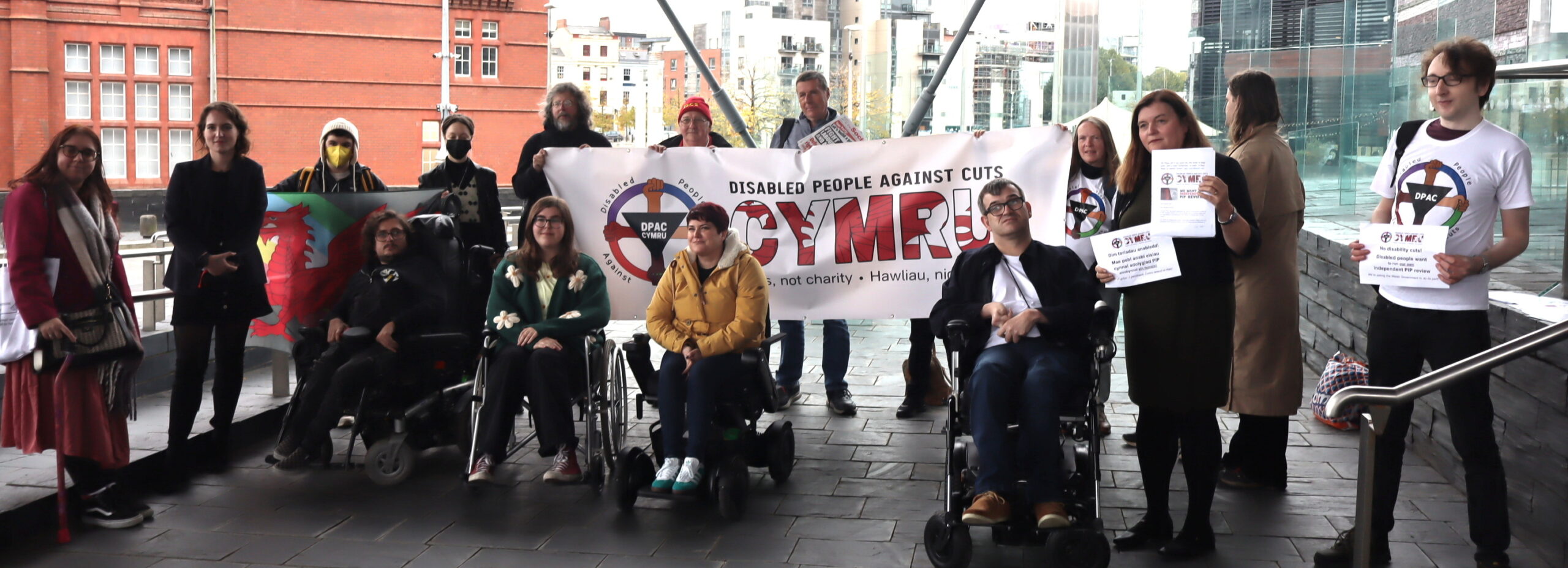
 

Sep 132025
 
DPAC Logo with text underneath "Disabled People Against Cuts" and then web address dpac.uk.net

Calls for an independent PIP review with UK minister under fire

A Welsh disability group is calling for an independent review of Personal Independence Payments (PIP).

Disabled People Against Cuts Cymru (DPAC Cymru) has accused the disability minister Stephen Timms of failing to properly lead his own review into the disability benefit, saying that “co-production is not taking place as promised.”

Speaking exclusively to LBC’s Welsh Correspondent Caitlin Parr, the group’s comments follow the Minister of State for Social Security and Disability, Sir Stephen Timms MP, meeting with the Welsh Government Disability Equality Forum on Tuesday 2nd.

LBC news reported that DPAC Cymru had long fought for disabled people’s voices to be heard in changes to welfare reforms, but were concerned that the minister, despite promises to engage widely over the summer, had so far left Welsh disabled people out of discussions around the review, outside of those forum meetings.

DPAC Cymru claims that Timm’s attendance at those recent forum meetings is “far too little and far too late for Welsh disabled people after months of stonewalling from Timms,” and said they were frustrated by “more promises but no action.”

Ben Golightly, from Swansea, is a coordinator for DPAC Cymru. He told LBC, “he [Timms] agreed in that meeting that it was important for Welsh disabled people and Welsh disabled people’s organisations to be heard. He was meant to talk about how he was delivering co-production. It was his job to do it. And he had no real update, because he hasn’t been doing that job.”

Despite promises from government ministers, DPAC Cymru say that co-production has not taken place, and they are “back to square one.”

Ben said, “We had hoped that after a major defeat in parliament that when he [Timms] promised co-production with disabled people, that we wouldn’t have to go through all of this again. There is so little trust in the way the government has treated disabled people that we need an independent review, led by disabled people, and Stephen Timms and the government should turn up and listen, but they should have no say over how it’s run because they’ve shown, throughout several months, that they’re unable to do it.”

Lee Ellery, an independent disability activist and lead press coordinator for DPAC Cymru, who has Cerebral palsy quadriplegic, agreed, telling LBC news it’s time more Welsh voices were heard.

Lee said, “people with disabilities, particularly in Wales, are left to the bottom of the pile so to speak, and we should be at the forefront of everything. I’m worried about what the result of the [PIP] review might come out to say, if the person who’s leading it doesn’t understand the whole process.”

LBC news reported that “the Timms review into PIP assessments is expected to conclude in Autumn 2026, when changes already decided on for new PIP claimants will come into force.”

DPAC Cymru’s calls for an independent review, made in an open letter released last Monday, has already received wide support, collecting 600 signatures and the support of representatives of more than twenty-five organisations.

Comments collected from respondents talk about their feelings of hurt, being “belittled,” “completely disregarded and isolated,” and the “harm and loss of trust” caused by Timms and the government.

Signatures on the open letter are open until the end of September.

Sign here

A notice graphic with a red tinted photograph of Stephen Timms as the background. Title text to the left of him reads: "We want an independent PIP review" with emphasis on the independent. A divider then separates the next header text that reads: "Nothing about us, without us!", followed by another divider. Body text then reads: "Please sign and share our open letter!" with an arrow pointing to a link: "bit.ly/independent-pip-review". The DPAC Cymru logo sits at the bottom of the screen.
Sep 122025
 
DPAC Logo with text underneath "Disabled People Against Cuts" and then web address dpac.uk.net

A diverse group of people are photographed holding artistic signs about disability outside of where they live.

Visit the 2025 Shape Open exhibition: Rights Cuts Action!

The Shape Open is back for its twelfth consecutive year with Rights Cuts Action: the creativity of disabled resistance, placing the work of contemporary artists in conversation with archival photography from Keith Armstrong, disabled activist, artist, and writer. The exhibition is set against a backdrop of ongoing cuts to benefits and vital support systems and the continual fight to protect disability rights.

Exhibiting artists: Emma Bentley Fox, Anna Berry, Elora Kadir, Fae Kilburn, Vince Laws, Zoe Milner, Guy Morris, Déa Neile-Hopton, Kristin Rawcliffe, Ivan Riches, Benedict Robinson, and Kim Waine-Thomas.


Where and when?

Rights Cuts Action will be open to the public at the Engine Shed, Station Approach, Crendon Street, High Wycombe, HP13 6NE, from 6 October – 5 November 2025.


Accessibility

The venue is step-free and there are accessible toilets on site. The nearest transport link is High Wycombe train station, less than a minute away.

The exhibition will be audio described and all information about the artworks will be available in audio and BSL. A Braille guide will be available on-site, as well as an Easy Read guide to the show.

If you have any questions about accessibility at the exhibition, please get in touch.


For more info see Rights Cuts Action


The Emergent project

Emergent is a project aimed at addressing and tackling the entrenched marginalisation and under-representation of disabled people in the arts sector and wider society. The main focus is creatives at an early stage in their career (including re-emerging artists) who need support in order to continue.

For more info see Emergent 2025

Sep 122025
 
DPAC Logo with text underneath "Disabled People Against Cuts" and then web address dpac.uk.net

This is a graphic with a background of a protest in pop art style. In large white text with an orange background it says: Trump not welcome. To the right, with black text on a white background, it says in all-caps: national demonstration against Trump's state visit. London. Wed 17 Sept. Assembly 2pm Portland Place, Rally 5pm Parliament Square.

Disgracefully, Keir Starmer has invited Donald Trump for a second state visit to Britain in September. Trump is an authoritarian whose support for Israel has been central to its continuing genocide against the Palestinian people. He praises Putin and attacks Zelenskyy. He is fuelling the climate crisis, rigging the system for the ultra-rich and attacking democracy.

We are joining with a wide range of campaigns and civil society groups to say Trump – and Trumpism – are not welcome here.

Join us on 17th September in London  as part of the 

National Demonstration against the State Visit.

While plans are laid for Trump to enjoy lavish meals at Windsor Castle, Palestinians are being bombed and deliberately starved to death with his support.

Trump’s mass deportations confirm he is a racist authoritarian at home and a warmongerer abroad. He has subjected his own citizens to huge cuts in spending on essential services, including healthcare, he has attacked minorities and women’s rights, scrapped climate and environmental protections and trampled on democratic norms.

These are not things we should be honouring.

Disabled People Against Cuts will be protesting as part of a broad coalition against Trump in London on Wednesday 17 September, the day that he arrives.

Please join us and help show the world that the British public reject Trump’s politics. 

Assemble at 2pm from Portland Place, London, W1B 3DA. A rally will be held in central London from 5pm.


Accessible Route

The short, accessible version of the route assembles at the top of Whitehall (SW1A 2DY) at 4.30pm to march to Parliament Square for 5pm. You may also prefer to just join the rally directly at Parliament Square.


Local Actions

There are some local actions planned around the country too.

Sep 062025
 
DPAC Logo with text underneath "Disabled People Against Cuts" and then web address dpac.uk.net

Trade unionists look after people at work and in the community. There are 1.4 million disabled trade unionists. There is a big trade union meeting starting Sunday and ending Wednesday called the TUC (Trades Union Congress)

That meeting is discussing lots of different things (motions) and voting on them. If you are a member of a trade union you might know someone who is going, called your delegate. You might want to talk to them about the following:


Sunday 7th, 1pm

National Shop Stewards Network lobby – The Old Ship Hotel, Brighton, BN1 1NR.

One of the speakers is from Disabled People Against Cuts and the lobby is asking the TUC to support disability motions. More info.


Tuesday 9th (scheduled late morning)

Motion 38 – Disabled workers oppose welfare reforms

from the

TUC Disabled Workers Conference


Tuesday 9th (scheduled late morning)

Motion 39 – Oppose disability benefits cuts emergency

from the

TUC Trades Councils Conference


See what’s being discussed

https://www.tuc.org.uk/Congress2025/programme-business-congress-2025


Watch live or recorded sessions

https://www.tuc.org.uk/Congress2025/congress-live

Sep 052025
 
DPAC Logo with text underneath "Disabled People Against Cuts" and then web address dpac.uk.net
Fuel Poverty Action logo. Fuel and poverty are in light blue. Action is in bold pink.

From Fuel Poverty Action. Protest Labour party conference on Wednesday 1st October 2025. There’s also a disability protest on Monday 29th September by DPAC.

You might have heard the news that our energy bills are due to rise AGAIN next month. Our policy expert Jonathan Bean has been on the news taking aim at how spectacularly Labour has broken their manifesto promise to bring down bills.

But anyone who knows FPA knows we won’t take it lying down. In fact, we’re taking the call right to Labour Conference!

On the same day your bills rise again, October 1st, Keir Starmer is due to give his big closing speech to Conference. With the spotlight on Liverpool and hundreds of MPs, press and camera crews gathering, we’re going to make some noise of our own.

It’s time to raise your voice for Energy For All.

I’ll join the protest in Liverpool

With incomes squeezed and support barely touching the edges, 1 in 5 of us are struggling to heat our homes or use life-saving medical equipment.

We know that this is a political choice. It’s far from impossible for this government to bring down bills, in fact energy pricing is rigged and driving us into poverty while firms like Centrica and SSE profit.

Labour could deliver Energy For All and meet everyone’s needs:

– Stop the gas rip off by delinking the price of cheap, renewably generated electricity from the much higher cost of gas

– Distribute excess power from the wind and sun for use by people who need it

– Improve homes to slash energy bills with proper heating systems, insulation and access to free solar generation


Join us to protest at the Labour Party Conference on Wednesday 1st October

Assemble from: 09:30 at the Wheel of Liverpool for a photocall

Main demonstration: 12:00, ahead of Keir Starmer’s speech

Expect guests, allies, speeches and songs demanding our fair share of cheap, clean energy from our wind and sun, to guarantee essential heating, hot water, washing, lighting and cooking for everyone.


https://actionnetwork.org/events/protest-the-labour-party-conference-energy-for-all-now

Sep 012025
 
DPAC Logo with text underneath "Disabled People Against Cuts" and then web address dpac.uk.net

The words "We want an Independent PIP Review" in bold and black text, with Independent highlighted in red. On the left there is a tear-out effect of a greyscale photo of a disability protest, and a red-tinted photo of Stephen Timms, the disability minister.

This is an open letter from DPAC Cymru, produced with feedback from six Disabled People’s Organisations.

Disclaimer: DPAC Cymru didn’t have time to reach 100% agreed wording with DPAC UK, as we would have liked to. Even within DPAC Cymru, the letter wording is somewhat of a compromise. However, for important tactical reasons in Wales, we felt it was important to publish without delay. DPAC have therefore agreed to share the letter with this disclaimer.

Click here for the Easy Read version.

To:

The Welsh Government,

The Scottish Government,

The Northern Ireland Executive,

The UK Government,

1st September 2025

After a major, if partial, defeat in parliament over disability cuts, the disability minister Stephen Timms promised MPs that the PIP benefit review would be co-produced by disabled people and their organisations.

There is widespread skepticism if this will genuinely be the case. Promises to “engage widely over the summer” have not been met, and there has been no transparency over Timms’ plans for “ten people” to have “a lot of sway”. His comments reveal that he does not understand what co-production means. Timms has also repeatedly declined to acknowledge the many serious failures of the Pathways to Work green paper consultation process, particularly felt in Wales.

We counterpose this to the Disability Rights Taskforce, initiated in partnership with the Welsh Government, which brought together 350 stakeholders and 200 policy experts, as a model of what co-production can look like. However, many Taskforce participants were frustrated that much of their work was ultimately missing from the Welsh Government draft plan. This is a lesson that even co-produced policy will fall flat without accountability. Disabled people’s organisations must be given the necessary resources and powers to carry out the implementation and monitoring of decisions.

[Some of us] cautiously welcome[d] the announcement of the Government’s new Independent Disability Advisory Panel. This panel is separate to, but will feed into, the Timms review of PIP. However, trust remains very low, and the terms – of “up to 10” people – have already been set for us. [See update, below]

We the undersigned demand that:

• The new Independent Disability Advisory Panel must be genuinely independent, representative, transparent, and have real powers of oversight.

• The UK government must acknowledge its failures in delivering the Pathways to Work consultation and legislative process, as a precondition to rebuilding trust and ensuring those mistakes are not repeated.

• The PIP review must be independently led by disabled people and our organisations, inviting the views of carers, volunteers, and workers in health, social care, housing, transport, and welfare.

• Any review of welfare reform must also, in a process led by disabled people, involve trade unions as democratic organisations representing 1.4 million disabled workers as well as representing the workers responsible for the day-to-day delivery of services that disabled people rely on.

• The scope of the PIP review must be widened to all aspects of welfare and employment for disabled people, guided by the principle: from each according to their ability, to each according to their need.

• Dedicated funding must be provided to Disabled Peoples Organisations to support outreach, accessible engagement, and the collection of views from disabled people, including those without internet access or digital skills.

• The devolved governments of Wales, Scotland, and Northern Ireland, and councils, should recognise and support this independent review even if the UK government refuses to.

• The UK government must immediately halt all cuts to disability and incapacity benefits for the duration of the review, and urgently fix Access to Work.

• Parliament must be given time to properly scrutinise any new legislation.

• The UC bill should be repealed. It is flawed, and was rushed through in an abnormal and undemocratic way.


[Update 4th September] Statement from DPAC Cymru regarding the “Independent Disability Advisory Panel”:

“The recently published terms for the so-called Independent Disability Advisory Panel, including the requirement to sign a non-disclosure agreement, are completely unacceptable. We are going to go back to a full consultation with all of our members and allies and take time for discussion to correct the weakness in our compromise wording of ‘cautiously welcome’ and come back united, realigned on the strongest possible response. We hope you will continue to support the demand for an independent PIP review, led by disabled people, and support this letter with your signature.”


For a full list of signatures and footnotes, see here.

To add your support to the letter, add your signature here

Here are short URLs for sharing the letter:

Non-Easy Read: Bit.Ly/independent-pip-review

Easy Read: Bit.Ly/easy-read-independent-pip-review

Aug 272025
 
DPAC Logo with text underneath "Disabled People Against Cuts" and then web address dpac.uk.net

This might be scary, so it’s good to know in advance.

This is just a test, so it is nothing to be worried about.

It will help keep you safe if there is a real emergency.

Some people, for example, victims of domestic abuse with a concealed phone, may need to opt out of the alert system.

What will happen at 3pm

All mobile phones and tablets that use 4G and 5G will get the test alert. You do not need to do anything. This is a test to make sure the alerts work. Your mobile phone or tablet might make a loud sound, even if it is set to silent. It might vibrate, or read out a message.

Important: If you are driving when you get an alert,
you should carry on driving. Do not pick
up the phone.

More information in different formats

Emergency alerts – Easy Read, Audio, and BSL video info

Emergency alerts – factsheets in different languages

Aug 222025
 
DPAC Logo with text underneath "Disabled People Against Cuts" and then web address dpac.uk.net

From Merseyside DPAC:


Join Disabled People Against Cuts to protest against the Labour policies killing disabled people outside the Labour Party conference in Liverpool 29/09/2025 at 12pm. We will assemble near the Wheel of Liverpool on Keel Wharf L3 4FN.

We encourage those who can to a mask in order to protect immunocompromised members of our community and will have some masks available for those who do not have their own. We ask that political parties do not bring branded placards.

#GenocideAbroadDemocideAtHome #WelfareNotWarfare


"Text over a dark background with the disability pride colours. Text reads "Genocide abroad, democide at home is Labour policy. 12:00 September 29th, the Wheel of Liverpool L3 4FN"

Beneath the text is an inverted black triangle with the text "DWP stop killing us" and a black and white photo of a group of protesters with a Merseyside DPAC banner.

Jul 182025
 
DPAC Logo with text underneath "Disabled People Against Cuts" and then web address dpac.uk.net

Contents

Liz Kendall stops herself just in time from lying about PIP cuts, as she argues with disabled MP 1

New analysis shows disabled people’s strongest allies among MPs 4

Government’s ‘weak’ evacuation plans for disabled high-rise residents ‘fail to learn the lessons of Grenfell’ 6

Air travel accessibility report could lead to ‘tangible’ improvements, but progress depends on industry 8

Reviews into deaths and other harm linked to universal credit nearly double… as MPs vote for billions in cuts 11

Regulator’s report on rail assistance ‘shows it is still failing to acknowledge right to turn up and go’ 12

Badenoch silence after ‘ticking time bomb’ claim is exposed as a lie by official figures 14

Other disability-related stories covered by mainstream media this week 16


Liz Kendall stops herself just in time from lying about PIP cuts, as she argues with disabled MP

Work and pensions secretary Liz Kendall was on the verge of lying to MPs yesterday as she argued with a disabled MP about misleading comments she made in parliament on disability benefit cuts.

Steve Darling, the Liberal Democrat work and pensions spokesperson, had asked Kendall (watch from 9.43am) why she had repeatedly suggested to MPs in parliament that personal independence payment (PIP) was a work-related benefit.

But Kendall told the Commons work and pensions committee yesterday (Wednesday) that she had never done that.

Darling interrupted her and said: “You said it in the chamber.”

Two months ago, Disability News Service reported how Kendall had refused to apologise after repeatedly misleading MPs by suggesting that her planned cuts of billions of pounds to PIP – cuts that were later withdrawn – were linked to supporting disabled people into work.

On four occasions in just 23 minutes during work and pensions questions in the Commons in May, Kendall had replied to questions about her plans to cut spending on PIP by speaking about Labour’s plans for disability employment.

On one occasion, she was asked about the potentially devastating PIP cuts and told MPs: “We want to improve people’s chances and choices by supporting those who can work to do so and by protecting those who cannot.”

She then replied to three further questions about PIP in a similar way.

But yesterday she came within a moment of lying to committee members about those misleading comments.

Darling had told her she had promised last November, in an earlier evidence session with the committee, that there would be “genuine engagement” over her disability benefit reforms and that she would not be “led by cuts”.

But she then published the Pathways to Work green paper in March which he said would have introduced the “highest level of cuts in the last 10 years”.

He asked her what happened between November and March that led to an “abandonment of those core principles that you had in November? What went wrong?”

Kendall insisted she had “never started with pound signs or spreadsheets, I’ve always started with what I believe can help people with long-term health conditions and disabled people build a better life for themselves.

Our reforms are based on helping those who can work to do so, instead of writing them off and then denying them any support.”

But Darling interrupted her and told her that PIP was “not to do with work”.

He added: “All throughout this narrative, it’s been suggested that PIP is an out-of-work benefit, when it’s not.”

Kendall replied: “I’ve never suggested that.”

Darling said: “I think you’ve given that impression, when responding to colleagues and myself in the chamber.”

Kendall replied: “I have never given that…” but then suddenly halted her denial, before saying: “Well, I have never believed it, because it’s not true, and that is not the argument I made.

The argument I did make was that this absolutely crucial benefit is sustainable for the future, and that a doubling of the number of people on PIP over the last decade, if that were to continue into the future, that my real concern, is that the benefit, which is absolutely vital for people, won’t continue in future.

Where we’ve ended up I think is a good position, where we will make sure that we work with disabled people, the organisations that represent them, to take a really good, long-term look at this benefit, to make sure that it really is there for those who need it.”

She said the terms of reference for the PIP review being carried out by Sir Stephen Timms, the minister for social security and disability, take account of “the big changes that we’ve seen in disability, in society, in the world of work, since PIP came into place over a decade ago”.

Darling then asked her why she had chosen not to consult on the cuts to PIP that were announced in March’s Pathways to Work green paper.

She replied that ministers were instead “consulting with parliament” on the cuts as they were included in the universal credit and personal independence payment bill, and she said consultation was taking place on other parts of the green paper, including measures on employment support.

But Darling said: “But on PIP, you didn’t consult, is that right? There was no consultation on the cuts to PIP.”

Kendall said: “Well, there was with parliament, and parliament took a different view.”

Darling replied: “But you said in November that you wanted to consult with disabled people and then it comes to the biggest cuts in a decade…”

Interrupting Darling, Kendall said they were consulting on other aspects of the green paper.

He asked her again why she chose not to consult on the PIP cuts, and she said they had taken those measures through parliament.

When he then asked her: “Why did you ignore disabled people, please?” she said: “Well, I have answered that question, you may not like the answer, but the answer is because we were consulting with parliament, parliament took a different view.”

Darling replied: “That’s not disabled people, why did you ignore disabled people?”

Kendall told him: “We are not ignoring disabled people, they will be at the heart of the Timms review.”

He tried one final time: “You ignored them in March, can you explain why?”

She said that, in the days after publication of the green paper, she and Sir Stephen had “roundtables with disabled people and the organisations that represent them, so we will just have to agree to disagree on this.

I do not believe that we have failed to consult disabled people on the Pathways to Work green paper, and going forward we are going to be co-producing the review of PIP in the longer term.”

Meanwhile, the work and pensions committee has launched a new inquiry into employment support for disabled people.

The committee’s chair, Labour MP Debbie Abrahams, said yesterday: “The statistics show us that disabled people face higher barriers to getting into work, and they are more likely to fall out of work. There are also considerable differences across the country.

This is a worrying trend given the impact it could have on people living in poverty and their health and wellbeing.

The government has made getting more people into work a core policy focus, and has promised more funding for employment support for those affected by recent benefit changes.

Its promise of more funding for employment support is an important opportunity to improve the prospects of disabled people, which the government must seize.

We want to understand the root causes of the persistent disability employment gap and a way to hear ideas for making the routes into work smoother.”

She added: “We’re looking for help from the academic community, employment support providers, advocate groups and people with lived experience to submit evidence so that we can make reasoned recommendations to the government to help improve job prospects for disabled people.”

To submit evidence, visit the inquiry’s evidence submission page by 4pm on 29 September.

17 July 2025


New analysis shows disabled people’s strongest allies among MPs

New analysis shows a pool of just 28 MPs who have shown themselves to be the strongest allies to disabled people when voting on crucial disability rights legislation in the last month.

The group of 28 allies includes three Labour MPs – Brian Leishman, Chris Hinchliff and Rachael Maskell – who were yesterday (Wednesday) suspended by the Labour party for campaigning and voting against cuts to disability benefits.

Two others from the group of allies – Dr Rosena Allin Khan and Bell Ribeiro-Addy – were stripped of their trade envoy roles.

To compile the list, Disability News Service (DNS) has examined the voting records of MPs on the assisted dying bill and the universal credit and personal independence payment bill.

The disabled people’s movement has been strongly united in opposing both the private members’ bill that will legalise assisted suicide, and the government bill that was originally set to cut billions of pounds a year from both personal independence payment (PIP) and universal credit (UC) but will now cut billions only from the health element of UC.

The analysis shows just a small core of 21 Labour MPs on the left of the party, as well as one Plaid Cymru MP, and six Independent MPs, who voted to protect disabled people’s rights to the maximum extent possible across four Commons votes on 20 June, 1 July and 9 July.

DNS checked whether MPs voted against the terminally ill adults (end of life) bill at its third reading on 20 June; voted against the universal credit and personal independence payment bill at its second reading on 1 July; voted against a Conservative amendment to the bill on 9 July that called for harsher cuts for those with “less severe mental health conditions” and to remove entitlement for disability benefits from “foreign nationals”; and voted against the cuts bill at its third reading on 9 July.

The list of Labour allies who opposed all four includes three disabled MPs: Marsha de Cordova, Emma Lewell, and Marie Rimmer.

A handful of other MPs – including disabled Liberal Democrat MP Steve Darling, Independent MP Jeremy Corbyn, and Alliance MP Sorcha Eastwood – did not quite make it onto the list of allies because they voted against the assisted dying bill and against the government’s cuts to disability benefits but abstained on the Conservative cuts amendment, rather than voting against it.

The list of allies may make it easier for disabled activists and lobbyists to know which MPs are likely to be open to further approaches around disability rights in the coming months.

Linda Burnip, co-founder of Disabled People Against Cuts, said: “It’s shocking how few MPs are on this list and we are grateful to those who have supported disabled people in the last month, but hugely disappointed in those that haven’t.”

Among those not on the list, she particularly highlighted former Labour shadow ministers for disabled people Vicky Foxcroft and Debbie Abrahams, who she said “know only too well what problems we face” but failed to vote against the government on the cuts bill.

Lindsey Ni Aodha, a key organiser with Crips Against Cuts, said: “Disabled people tell us how distressed they are that their pleas to their MPs have been ignored, or how betrayed they feel in having MPs who have chosen to vote for legislation many disabled people view as a death sentence.

I feel deeply grateful to see my own MP’s name listed as an ally, but the low numbers of MPs voting to protect disabled people, despite widespread public outcry nation-wide, illustrates a picture of a political elite moving further and further right, whilst becoming increasingly detached from the realities of everyday life for the people of this country.”

She said the list was full of some of the “fiercest advocates for our rights” who are “MPs who have made it clear that the people of this country should always come before party politics”.

She added: “When disability rights are protected, so are workers’ rights, so are children’s rights, so are our rights to healthcare, so are women’s rights, so are the rights of people of colour – creating a society that is safer and fairer for all who live in it.”

The votes analysed by DNS only cover the two pieces of legislation on assisted suicide and cuts to disability benefits, with a much wider range of legislation likely to come before the House of Commons in the coming months and years, on issues such as accessible housing and transport, adult social care and inclusive education.

The full list of allies is: Diane Abbott (Labour); Dr Rosena Allin-Khan (Labour); Richard Burgon (Labour); Ian Byrne (Labour); Marsha De Cordova (Labour); Mary Kelly Foy (Labour); Mary Glindon (Labour); Chris Hinchliff (Labour); Imran Hussain (Labour); Ian Lavery (Labour); Brian Leishman (Labour); Emma Lewell (Labour); Rebecca Long Bailey (Labour); Rachael Maskell (Labour); Andy McDonald (Labour); Abtisam Mohamed (Labour); Grahame Morris (Labour); Margaret Mullane (Labour); Bell Ribeiro-Addy (Labour); Marie Rimmer (Labour); Jon Trickett (Labour); Ann Davies (Plaid Cymru); Shockat Adam (Independent); Iqbal Mohamed (Independent); Apsana Begum (Independent); Zarah Sultana (Independent); Ayoub Khan (Independent); and Adnan Hussain (Independent).

17 July 2025


Government’s ‘weak’ evacuation plans for disabled high-rise residents ‘fail to learn the lessons of Grenfell’

New post-Grenfell regulations designed to ensure disabled people can safely evacuate from high-rise residential buildings will instead continue to put their lives in grave danger, the government has been told.

Inclusion London said it was “deeply concerned” that lives would be lost because of the new approach, and that it “fails to learn the lessons of Grenfell”, as well as failing disabled people.

The warning came after the Ministry of Housing, Communities and Local Government (MHCLG) confirmed that it will introduce a watered-down version of a recommendation made by the Grenfell Tower Inquiry.

The Grenfell Tower fire, which began in the early hours of 14 June 2017, led to the deaths of 72 residents, and analysis of the inquiry’s final report suggests about 20 of them were disabled people.

The subsequent inquiry called for a legal right to a personal emergency evacuation plan (PEEP) for all disabled residents who might find it difficult to “self-evacuate” from a high-rise residential building.

But the new regulations show that the government is instead introducing new residential personal emergency evacuation plans (residential PEEPs), a watered-down version of PEEPs.

Inclusion London called on the government to scrap the regulations, and co-produce “new, robust evacuation plans” with disabled people’s organisations.

It said the new duties were “weak, inconsistent and risk becoming a tick box exercise, and are not a way to ensure all disabled people can escape to safety”.

And it said they were “a significant step backwards in the fight for equitable fire safety and disability justice”.

Under residential PEEPs, the owner or manager in charge of a high-rise building – known as the responsible person (RP) – will have to take “reasonable endeavours” to identify vulnerable residents.

After carrying out a “person-centred fire risk assessment” with a resident, the RP must then use “reasonable endeavours” to agree an “emergency evacuation statement” with the resident, while the RP will have an “ongoing duty” to review the assessment and statement.

The RP will also have to share basic information about the disabled resident with the local fire and rescue service, including what assistance they might need to evacuate the building.

The government has made clear that it would be up to the RP to decide what measures are “reasonable and proportionate”, while the disabled resident may have to pay for some of those measures.

But Inclusion London said that any safety system “where only those who can afford to pay get protection is a two-tier safety system”, and that this was “not only unreasonable, it is inhumane”, as well as being discriminatory.

Inclusion London also accused the government of promising that RPs would have to use their “best endeavours” to identify residents who need an evacuation plan, but that this has been downgraded in the regulations to “reasonable endeavours”, which “fundamentally alters the responsibility expected of building owners and managers”.

It is also concerned that the new process will create too many hurdles for the resident to clear to secure a residential PEEP.

And it said the regulations should apply to all buildings where disabled people live, and not just those of a certain height.

Adam Gabsi, co-chair of Inclusion London, said: “We are extremely disappointed with what we see in the new regulations.

This is not what the Grenfell inquiry has called for, and not what we have campaigned for.

These are not PEEPs. They are tick-box exercises that shift responsibility away from those in power and onto individuals at risk.

This will cost disabled people’s lives.”

He added: “This is another attack on our rights, along with proposed changes to disability benefits and assisted dying.

We had hoped that PEEPs would finally serve as an example of fairness, safety, and equality being placed at the heart of government policy.”

But he said the regulations were instead “another reminder of how disabled lives are too often seen as optional, costly, disposable, or unworthy of protection.

We cannot and will not support regulations that we believe will lead to disabled people falling through the cracks and dying.”

Caroline Collier, from Inclusion Barnet’s Campaign for Disability Justice, said: “Your home should be a place of ultimate safety and refuge.

Yet, for disabled people living in high-rise flats, this has been fundamentally undermined by this watered-down version of the PEEPs regulations.

With 1.8 million disabled people facing up to a 40-year wait for accessible homes and the lack of choice forcing many into dangerous high-rise flats, this tick-box approach to regulations is wrong and irresponsible.

To ignore legitimate safety recommendations made by the inquiry is nothing short of discrimination.

Disabled people absolutely must be involved in co-producing plans to ensure that everyone’s lives are valued and protected, and disabled people being required to pay for basic safety measures is utterly unacceptable.”

MHCLG had not commented by noon today (Thursday).

17 July 2025


Air travel accessibility report could lead to ‘tangible’ improvements, but progress depends on industry

Recommendations for widespread improvements to the way the air travel industry treats disabled passengers could make a “tangible real-world difference” to their experiences with airports and airlines, but only if the measures are implemented.

The Aviation Accessibility Task and Finish Group (AATFG) was set up last autumn by the Department for Transport (DfT) and is chaired by disabled crossbench peer Baroness [Tanni] Grey-Thompson.

It produced its report yesterday (Wednesday) with 19 recommendations for improvements across the industry, and the group will continue to monitor how they are implemented, with annual reports to DfT.

Its membership includes several disabled people with expertise in accessible transport, and representatives from across the air travel industry.

The report says the group found examples of “poor and inappropriate service, passengers being left onboard aircraft for long periods, damaged mobility aids, and discriminatory behaviour”, despite some improvements in recent years.

It also highlights “inconsistent” training of staff, and points to limited awareness of invisible impairments which contributes to “unintentional exclusion and undignified treatment”.

The report makes multiple recommendations for improvements across the industry, but one member of the group, accessible transport adviser and disability rights advocate Tony Jennings, warned that there was currently no budget to implement these recommendations, and no plans for government legislation, so progress now was “dependent on the goodwill of the aviation industry”.

He said the involvement of disabled people, with their lived experience and accessible transport expertise, in collaboration with representatives of the industry, had been “fundamental” to delivering the report’s “inclusive” recommendations.

He told Disability News Service that implementing the recommendations would place accessibility “at the heart of aviation” and would make a “tangible real-world difference” to the experience of disabled air passengers, as well as delivering much-needed cultural change across the industry.

He said these changes, if implemented, would “break down the barriers disabled people encounter when travelling by air and give them more confidence to fly and be treated with dignity and respect”.

He said: “Improving the culture within the aviation industry, treating disabled people with respect and dignity, improving airports’ accessibility information and access to assistance throughout the journey, will give me more confidence to fly.”

Baroness Grey-Thompson, herself a wheelchair-user, says in the report that the experience of flying as a disabled person can be “ad hoc, inconsistent and sometimes catastrophic”.

She says: “What became clear is that there was no pattern of good and poor performances and while many journeys occur perfectly well there are still too many gaps and poor experiences.”

The issues her group uncovered include missed flights, lack of empathy from staff, use of “non-inclusive” language, mobility equipment being broken or lost, and disabled passengers facing extended waits to board or leave their flight.

In her introduction to the report, Baroness Grey-Thompson also highlights problems with the complaints system, while she says booking assistance is “not as simple as it could be”, and points to a lack of accurate data on disabled passengers’ experiences.

Among the report’s recommendations are calls for all airport and airline staff to receive basic disability and accessibility awareness training, and for that to be co-produced with disabled people; for better accessibility information to be provided by airports and airlines; for improved access to assistance throughout the disabled passenger’s journey through the airport; and for clear and accessible information on passenger rights.

It also calls for improvements to the way the industry captures the assistance needs of its disabled passengers; for clearer communication with disabled passengers about the handling of their mobility aids; for improvements to the “airworthiness” design of mobility aids; and for better oversight of the industry by the regulator, the Civil Aviation Authority, and improvements to its guidance to airports.

Jennings said that, as a mobility scooter-user, improving the way the industry collects information about access needs and uses it to provide personalised assistance, could ensure that assistance for him through the airport is booked and delivered, and he is then transferred appropriately onto a plane through the use of a “hi-lift” and to an aisle wheelchair, and is then transferred to his seat.

He highlighted the need for investment to ensure there are enough hi-lifts “in the right place at the right time to help reduce the length of time disabled people wait for assistance”.

He added: “I can’t stress enough just how important airport and airline staff training, co-developed with disabled people, is to improve the experience for disabled people.

From ground handlers to airline crew, to security and assistance providers and retail, it touches every part of our journey and is critical to get that right.”

He said his nine months’ work on the group had convinced him the industry was “working hard to improve accessibility services to make them more inclusive” but that he “recognises there is more work to be done, and this is just the start and the hard work of delivering the changes starts now”.

Baroness Grey-Thompson said in a statement: “This report is the next critical step in making air travel more inclusive for disabled people.

I’m grateful for the commitment the industry has shown to making change and breaking down barriers in aviation for everyone, bringing freedom to travel, whether for leisure or work, and to connect with friends and family.

We know there’s more work to be done, and I look forward to seeing these recommendations turned into action which truly puts accessibility at the heart of aviation.”

Transport secretary Heidi Alexander welcomed the report and its findings.

She said: “I know industry is working hard to make services more inclusive for all and I look forward to seeing these proposals becoming a reality with the support of the group.

Now is the time for action and to make a real difference so that people can travel with confidence.”

The report was also welcomed by AirlinesUK, AirportsUK and Aviation Services UK, which were all represented on AATFG.

Meanwhile, the Baywatch campaign has launched a new survey of the abuse of disabled people’s parking bays in supermarket carparks.

The campaign is run by Disabled Motoring UK (DMUK), which is calling on disabled motorists, and those travelling with them, to complete its survey every time they visit a supermarket between 21 July and 15 August.

The campaign – supported by organisations such as Disability Rights UK, Transport for All, and Phab – focuses on Tesco, Sainsbury’s, Asda, Morrisons, Aldi, and Lidl.

The last time the campaign ran, in 2022, DMUK received more than 1,000 survey responses.

17 July 2025


Reviews into deaths and other harm linked to universal credit nearly double… as MPs vote for billions in cuts

The number of internal reviews into deaths and other harm linked to universal credit nearly doubled last year, according to figures released just hours after ministers pushed through billions of pounds of cuts to part of the working-age benefits system.

The number of “serious cases” accepted for a secret internal process review (IPR) in which the claimant was receiving universal credit (UC) rose from 31 in 2023-24 to 55 last year.

In all, the Department for Work and Pensions (DWP) agreed that 90 serious cases should be examined through an IPR in 2024-25, of which 59 followed a claimant’s death, compared with a total of 53 IPRs the previous year.

The figures were released through DWP’s annual report, published this week, which says that 42 of the IPRs involved personal independence payment (an increase from 27 the previous year), and 21 involved an employment and support allowance claimant (an increase on 15 in 2023-24).

DWP claims in the report that the increased number of IPRs followed “awareness sessions across the Department to increase understanding of IPRs and the learning process from serious cases”.

The report was published on 10 July, just hours after MPs had voted through the new universal credit bill that will cut the health element of UC for most new claimants from £97 a week to £50 a week, from April 2026.

There is no mention of these cuts in the introduction to the report by work and pensions secretary Liz Kendall, who instead says the department is “showing how an active government changes people’s lives for the better” and how it is “supporting struggling families, helping people to get into and get on at work, [and] giving disabled people the dignity they deserve or ensuring security in retirement”.

It is possible that some MPs might have voted differently last week if they had known how many “serious cases” involving universal credit claimants were being probed by DWP while they were being asked to vote for cuts to that support.

Disability News Service (DNS) reported last week that DWP was refusing to release recommendations from universal credit IPRs dating back as a far as 2020, despite telling the information rights tribunal that it would release at least some of that information by 31 March this year.

DWP has been promising for months that the reason it will not release the IPR information to DNS is because it is “intended for future publication”.

DNS understands that some of this information could be published later today (Thursday).

Asked why the IPR figures were released just hours after the cuts bill was voted through the Commons, and whether this was a coincidence, or if ministers had deliberately held back publication until the bill was passed by MPs, DWP had failed to comment by noon today.

*The Department: How a Violent Government Bureaucracy Killed Hundreds and Hid the Evidence, DNS editor John Pring’s book on the years of deaths linked to DWP’s actions and failings, is published by Pluto Press

17 July 2025


Regulator’s report on rail assistance ‘shows it is still failing to acknowledge right to turn up and go’

The rail regulator has been asked why it has failed to do more in an annual report to stress disabled people’s right to “turn up and go” when accessing the railway network.

The Office of Rail and Road (ORR) released new figures this week which showed that satisfaction with booked passenger assistance on the rail network had plateaued, with one in 10 disabled passengers still not even being met at the station after booking help.

The proportion of passengers who received all the assistance they booked also remained stable in 2024-25 at just 78 per cent.

This was even lower for passengers with a “learning, concentrating or remembering disability” (73 per cent); with mental health conditions (72 per cent); those who are neurodivergent (72 per cent); and passengers with a communication impairment (73 per cent).

There were also figures showing what proportion of passengers were satisfied with the assistance they received, with the booking process, and with the helpfulness and attitude of staff.

But there were no similar figures to show the levels of satisfaction for disabled passengers who turn up at a rail station and request assistance with their journey without booking it in advance, which is their legal right.

The report on disabled people’s experiences of Passenger Assist was released alongside ORR’s Annual Rail Consumer Report.

Accessible transport campaigners have been highlighting for years the failure of the rail industry and successive governments to ensure disabled people’s right to spontaneous travel by denying their right to turn up and go (TUAG) across the rail network.

The ORR annual report appears to underline that failure by focusing on pre-booked passenger assistance.

It says only that it is “working with industry to strengthen the quality of data on turn up and go assistance requests”, and that it expects the “quality and completeness to improve over time”.

The only TUAG figures released by ORR this week show the number of TUAG requests made in 2023-24 and 2023-24 (about 312,000 in 2023-24 and about 491,000 in 2024-25), although notes published alongside these figures show they are likely to be unreliable*.

It is the first time such TUAG figures have been published.

Doug Paulley, one of the disabled activists who has highlighted the right to TUAG in his campaigning, said he had a “significant concern” about ORR’s “concentration on assistance booking rather than TUAG” in its “uninspiring” report.

He said ORR did not have reliable or useful statistics on how well rail companies were doing on TUAG.

He said: “Everything they measure or do is about booked assistance: satisfaction with booked assistance, recompense for failed booked assistance…

It feels like they try to avoid mentioning or acknowledging our right to turn up and go.”

He said this was a “disturbing and counter-productive trend”.

Responding to these concerns, ORR said it was exploring with rail operators “how we might get a better picture of the experience of passengers who request assistance on demand”, including the potential for TUAG passengers to be asked to take part in its existing passenger survey of experiences of assistance.

ORR released figures in the Passenger Assist report that ranked each rail operator on their performance on booked passenger assistance.

It showed that Northern Trains was the worst performer, with only 70 per cent of disabled passengers who were met at the station then receiving all the assistance they had booked, with Transport for Wales (74 per cent) and West Midlands Trains (74 per cent) also performing poorly.

The best performer was London North Eastern Railway (85 per cent).

The annual report notes how ORR has raised concerns through the year about passenger assistance; the reliability of help points at stations; communications between staff at boarding and destination stations when arranging passenger assistance; the reliability of passenger lifts at stations; the provision of accessible rail replacement vehicles; and the complaints process for disabled passengers.

The report points to annual data that shows a 42 per cent increase in the number of faults across the rail network that put lifts out of service for over a week, in 2024-25 compared with the previous year.

Commenting on the report, Stephanie Tobyn, ORR’s director of strategy, policy and reform, said: “Ensuring that disabled passengers consistently receive the support they need to travel by train requires clear focus, collaboration and a commitment to continuous improvement.

Our latest survey shows that overall passenger satisfaction has plateaued, and we know that, in some instances, assistance failures can leave passengers feeling powerless and frustrated.”

She said that a new rating system on passenger assistance would “help us target our efforts and use resources effectively, focusing on working with those operators where improvement is most needed to deliver better outcomes for passengers”.

*ORR says in its notes that the only TUAG requests recorded are those noted by staff via the Passenger Assist system, while not all rail operators are yet using this system to record TUAG requests, and any requests booked less than two hours before departure are treated as TUAG

17 July 2025


Badenoch silence after ‘ticking time bomb’ claim is exposed as a lie by official figures

Conservative leader Kemi Badenoch has refused to explain why she whipped up hostility against disabled people by warning of the “ticking time bomb” caused by increased benefits spending, when social security expenditure has been stable for years.

Badenoch delivered a speech last Thursday that attacked claimants and was full of misleading statements about disability benefits.

But despite the string of misleading statements, neither the Labour party nor the Department for Work and Pensions (DWP) were willing this week to point out the errors, criticise the hostility, or stand up for disabled people on benefits.

Labour did put out a press release to journalists, but instead it attacked Badenoch for not promising to keep the pensions triple lock.

Delivering the speech at the Centre for Social Justice (CSJ) – founded by former Conservative work and pensions secretary Sir Iain Duncan Smith – Badenoch claimed the economy would “collapse” if the government did not address the “ticking time bomb” of increased spending on social security.

Her party – and the Labour government – have been repeatedly reminded that Office for Budget Responsibility (OBR) figures show that “welfare” spending is set to be lower this year – as a proportion of GDP* – than it was in 2015-16 and 2010-11, and is even set to fall slightly in 2027-28**.

And social security and disability minister Sir Stephen Timms admitted to the Commons work and pensions committee last month that working-age social security spending as a percentage of GDP “isn’t much more now than it was before the 2008-2010 recession”.

Even though Badenoch and her party will be aware of these figures, she still whipped up hostility towards disabled people in her speech, focusing on the rising number of claimants of disability benefits.

She attacked the increase without referencing the pandemic, increased NHS waiting-lists, the cost-of-living crisis, and the “dismantling” of preventive NHS care under successive Conservative governments.

She wrongly suggested that it was possible to claim benefits like personal independence payment (PIP) by “self-certification”, and she also misled her audience by suggesting that every disabled person in the country claims disability benefits.

She also pointed to new research by CSJ which found that disabled people receiving the health element of universal credit and PIP could receive £2,500 more a year than a worker on the national living wage, without pointing out that PIP was designed by a Conservative government to contribute to the extra disability-related costs a disabled person faces.

She claimed rising spending on disability benefits was “immoral” and supported the “brilliant” CSJ research, which suggests cutting disability benefits for those with mental distress by £9 billion a year.

The CSJ report suggests withdrawing PIP and the universal credit health element from the 1.09 million claimants with “milder” anxiety, depression or ADHD (the 69 per cent of claimants with these conditions who do not receive an enhanced rate of PIP).

And it suggests cutting health-related benefits for the remaining 31 per cent by £80 to just £103.10 a week, the equivalent of the standard rate of PIP for those receiving both the daily living and mobility elements.

Badenoch also attacked the rising number of disabled people on the Motability car scheme, claiming that new cars are handed out to people with food intolerances.

She also suggested that “eight weeks of retraining and physiotherapy, and getting them back into work, is a better solution for everyone than allowing them to languish on benefits”.

Asked by Disability News Service whether the OBR figures showed that Badenoch’s “ticking time bomb” was imaginary, a Conservative party press officer said: “I don’t think we are going to provide further comment.”

Instead of attacking Badenoch’s misleading comments and hostility towards disabled people, Labour instead blamed successive Conservative governments for causing the “broken system”.

A Labour spokesperson said: “The Tories broke the welfare system. The failures that they describe are their own and last week they voted to keep this broken system as it is and maintain the status quo.

You can’t take anything they say seriously.”

DWP made no attempt to correct Badenoch’s claims on Motability, other than pointing out that disabled people can use some of their PIP to lease a vehicle through the scheme, which is run by Motability Operations, although it did point out that the scheme was provided at no extra costs to taxpayers.

A DWP spokesperson said: “People in receipt of an eligible benefit can choose to join the Motability scheme.

Any misuse of the scheme is a matter for Motability and, where appropriate, the police.”

*Gross domestic product, the size of the country’s economy in a particular year

**See chapter five of OBR’s Economic and Fiscal Outlook – October 2024, chart 5.2

17 July 2025


Other disability-related stories covered by mainstream media this week

The health secretary is under mounting pressure to release a long-delayed report into the deaths of learning disabled and autistic people in England. The Department of Health and Social Care is being accused of “dragging their feet” and “sitting on” the findings by parliamentarians and disability campaigners, who describe the delay as “appalling”: https://www.itv.com/news/2025-07-16/government-accused-of-sitting-on-delayed-report-into-learning-disabled-deaths

A decision to provide assisted dying services in the Welsh NHS would not come until after the next Senedd election in May 2026, a minister has said. A committee heard on Tuesday that if the UK parliament decides to legalise the practice, the Senedd would have to vote on whether the service is available in the public sector. Health secretary Jeremy Miles said a “significant amount of work” will be needed to prepare, with most of it falling to the next Welsh government: https://www.bbc.co.uk/news/articles/cz6gv00lwvzo

Five-year-olds with special educational needs in England are lagging a record 20 months behind their peers, according to a report that says the country’s youngest learners face a “deepening crisis”, five years after the pandemic. Since Covid closed schools, disrupting learning and triggering falls in attendance, there has been widespread concern about the growing attainment gap that leaves disadvantaged pupils and those with special educational needs significantly behind their peers: https://www.theguardian.com/education/2025/jul/15/five-year-olds-in-england-with-special-educational-needs-20-months-behind-peers-report

17 July 2025


News provided by John Pring at www.disabilitynewsservice.com


Jul 032025
 
DPAC Logo with text underneath "Disabled People Against Cuts" and then web address dpac.uk.net

A poster about a protest. On a marble blue background with black bold text. It says: Disabled People Against Cuts Cymru. Disability Protest. Swansea - Cardiff. Below that is an image of three women protestors. One is in a wheelchair. They have a red flag, a red sheet, and a purple placard. They are dressed in red and purple. To the right is a red megaphone graphic. To the left is the DPAC logo. It is a red, pink, blue, green wheel being held by four hands of different skin tones. In the center is an upside down black triangle bearing the letters D P A C. Below, the text says: Cardiff - Monday 7th July. Meet 4pm outside Cardiff Central Library Hub. Swansea - Tuesday 8th July. Meet 4pm at Castle Square, Swansea. Organiser: 07410 303 652.

Disabled people in Wales will be protesting in Cardiff on Monday 7th, and in Swansea on Tuesday 8th.

We will be meeting at 4pm.

In Cardiff, meet outside Cardiff Central Library Hub.

In Swansea, meet at Castle Square.

All support is welcome! Bring friends and banners etc.

This is ahead of the vote on the bill on Wednesday 9th.

We want to defeat the Labour disability cuts bill entirely.


Why we are still protesting

⚫ The victory on changes to PIP is temporary. It’s a bad bill that will mean MPs voting to approve the results of a review in advance, before it happens.

⚫ We do not trust Stephen Timms to lead the PIP review. He has not acknowledged our concerns about the failures of the original consultation process.

⚫ Under 22s still face loosing Universal Credit health component – an injury to one is an injury to all and we won’t leave anyone behind!

⚫ The bill still contains cuts to Universal Credit for new claimants.

⚫ It’s very uncertain what the bill will mean for people on ESA.

⚫ It is a rushed bill and the government is acting undemocratically.

⚫ The government must stop and listen to disabled people and carers, and consider our consultation responses.

⚫ The bill must be withdrawn and time taken to get it right!

⚫ We have gone beyond “co-production”. This government is incapable of doing it. Disabled people must lead the process of welfare reform, involving carers and the workers delivering the welfare system. Not clueless ministers seeking short-term cost savings.


Swansea and Cardiff protest graphics for social media

A graphic of the DPAC Cymru logo. There is the main DPAC logo to the left, which is a red, pink, blue, and green circle being held by four hands of different skin tones, with the words "disabled people against cuts" surrounding it, and an upside-down black traingle in the middle bearing the letters D P A C. On the right is the word Cymru (pronounced cum ree) (C Y M R U) in large letters, and the background of the letters are cutouts of the Welsh flag. Above Cymru (pronounced cum ree) is written the words Disabled People Against Cuts. Below Cymru (pronounced cum ree) are the words Rights, not charity, and the equivilant phrase translated into the Welsh language.
Stop the Cuts This is our last chance! Date: Tuesday 8th July 2025 Time: 4:00pm Meeting point: Castle Square, Swansea, SA1 3PP what3words: ///bunny.extend.error MPs final vote for the Bill is 9th July so this is our last chance to take action against it. Labour want to cut disability benefits that people rely on to survive – we say stop the cuts! Listen to disabled people! Join us to tell Labour to kill the cuts, not disabled people. @DPAC_CYMRU #WelfareNotWarfare
Stop the Cuts This is our last chance! Date: Monday 7th July 2025 Time: 4:00pm Meeting point: Cardiff Central Library Hub, The Hayes, Cardiff, CF10 1FL what3words: ///rounds.unions.salsa MPs final vote for the Bill is 9th July so this is our last chance to take action against it. Labour want to cut disability benefits that people rely on to survive – we say stop the cuts! Listen to disabled people! Join us to tell Labour to kill the cuts, not disabled people. @DPAC_CYMRU #WelfareNotWarfare

A poster about a protest. On a marble blue background with black bold text. It says: Disabled People Against Cuts Cymru. Disability Protest. Swansea - Cardiff. Below that is an image of three women protestors. One is in a wheelchair. They have a red flag, a red sheet, and a purple placard. They are dressed in red and purple. To the right is a red megaphone graphic. To the left is the DPAC logo. It is a red, pink, blue, green wheel being held by four hands of different skin tones. In the center is an upside down black triangle bearing the letters D P A C. Below, the text says: Cardiff - Monday 7th July. Meet 4pm outside Cardiff Central Library Hub. Swansea - Tuesday 8th July. Meet 4pm at Castle Square, Swansea. Organiser: 07410 303 652.

A poster about a protest. On a marble blue background with black bold text. It says: Disabled People Against Cuts Cymru. Disability Protest. Swansea - Cardiff. Below that is an image of three women protestors. One is in a wheelchair. They have a red flag, a red sheet, and a purple placard. They are dressed in red and purple. To the right is a red megaphone graphic. To the left is the DPAC logo. It is a red, pink, blue, green wheel being held by four hands of different skin tones. In the center is an upside down black triangle bearing the letters D P A C. Below, the text says: Cardiff - Monday 7th July. Meet 4pm outside Cardiff Central Library Hub. Swansea - Tuesday 8th July. Meet 4pm at Castle Square, Swansea. Organiser: 07410 303 652.

Jul 032025
 
DPAC Logo with text underneath "Disabled People Against Cuts" and then web address dpac.uk.net

Contents

Disastrous’ cuts bill that leaves legacy of distrust and distress ‘must be dropped’ 1

Four disabled Labour MPs stand up to government over cuts to disability benefits 4

Silence from MP sister of Rachel Reeves over suicide linked to PIP flaws, just as government was seeking cuts 7

Disabled people receiving care were ‘ignored by design’ during the pandemic, Covid inquiry hears 9

Disabled activists warn Labour MPs who vote for cuts: ‘The gloves will be off’ 12

GB News says it has nothing to apologise for, after guest suggests starving disabled benefit claimants 15

SEND inspections find services in just one in four areas usually lead to ‘positive’ outcomes for disabled children 17

Other disability-related stories covered by mainstream media this week 19


Disastrous’ cuts bill that leaves legacy of distrust and distress ‘must be dropped’

Disabled activists have called on the government to scrap its “dangerous” and “disastrous” disability benefits bill, despite forcing ministers into last-minute changes that scrapped all their planned cuts to personal independence payment (PIP).

Chaotic events in parliament on Tuesday, and three months of activism since the publication of the Pathways to Work green paper, have left disabled people’s organisations (DPOs) appalled, shocked, and struggling to trust the government.

Their activism, together with the efforts of a small group of backbench MPs, forced ministers into a series of U-turns and concessions on the universal credit and personal independence payment bill.

The lack of trust in the government, and in the minister for social security and disability, Sir Stephen Timms, now creates a significant barrier as he begins a year-long review of personal independence payment (PIP), including an examination of its eligibility criteria and assessment process.

A chaotic few hours in parliament on Tuesday led eventually to ministers withdrawing all their proposed cuts to PIP, at least until the end of the review next autumn.

The bill passed its second reading by 335 to 260 votes, and it will return to the Commons on Wednesday (9 July) for its committee stage, with significant cuts to the health element for most new claimants of universal credit from next April remaining in the legislation.

Disabled people’s organisations were united yesterday (Wednesday) in their call for the “sham of a bill” to be dropped, with many expressing distrust in the government.

And there was little celebration that their successful activism – led by Disabled People Against Cuts (DPAC) and other grassroots groups such as Taking the PIP – had forced the government into gutting its bill.

DPAC described the bill as a “complete and utter mess”.

Paula Peters, a member of DPAC’s national steering group, said the process had done nothing but “cause more anxiety and more distress for disabled people”. 

She told Disability News Service (DNS) that she did not trust Sir Stephen as he had “shown time and again he doesn’t listen to charities, DPOs or disabled people”.

And she pointed to the concerns – expressed also by some MPs – that the government will merely introduce a new series of cuts to PIP at the end of the review, through a parliamentary mechanism that means they will not need to be approved by MPs.

Svetlana Kotova, director of campaigns and justice at Inclusion London, was also distrustful of the government’s motives.

She said: “The social security system needs reform, but not like this.

It is clear that this was never about reform, it was about balancing the books at the expense of disabled people.

Removing PIP cuts from the bill is a positive step, but there is no guarantee the government will be open to true co-production; more likely, they will want us to engage in ‘co-producing cuts’.

The bill still includes deeply harmful cuts to universal credit.

The government should admit they made a mistake, drop this harmful bill and go back to the drawing board.”

National Survivor User Network (NSUN) said the decision to gut the bill was “the direct result of tireless campaigning by disabled people and their organisations in recent weeks”.

But it said that the chaotic and confusing way it was passed showed “callous disdain for the lives of disabled people”, while the bill “should have been withdrawn in its entirety”.

An NSUN spokesperson said: “It is vital that co-production through the Timms review meaningfully involves disabled people, putting power in the hands of those whose lives will be most impacted.

We have seen the violence of the government’s rubber-stamp consultations so far and demand genuine co-production rather than inadequate and tokenistic consultation on an already-decided course of action.”

And it said the refusal to remove the cuts to the health element of universal credit for most new claimants from the bill showed the government “remains willing to attack disabled people” and was “a shameful attempt to divide the disabled community and stifle solidarity”.

The NSUN spokesperson added: “We will continue to organise with DPO allies, push for the rights-based reform which our deadly social security system needs, and ensure there are electoral consequences for those who go after disabled people in this way.”

Disability Rights UK (DR UK) said disabled people would be “enormously relieved” that the PIP cuts had been dropped from the bill, although “serious concerns” remained about the cuts to the health element of universal credit for most new claimants, which would make hundreds of thousands of the poorest people in the country even poorer.

A DR UK spokesperson said: “We’ve known all along that the public, disabled people and our organisations have found this bill to be unjust and unfair.

Yet the government has used every tool in its arsenal, every procedural trick, to push this dangerous bill through.”

DR UK said the government’s “floundering and chaos” was “a direct result of the steadfast work of disabled campaigners and our allies, who have made it clear that this bill is unworkable.

Despite attempts to silence us, through our collective campaigning, we made them drop billions of pounds worth of cuts, and we will continue to resist this disastrous bill.”

Rick Burgess, campaigns lead at Greater Manchester Coalition of Disabled People, said Tuesday’s events had demonstrated the “arrogance and disrespect” of the government, and he also called for the bill to be scrapped.

He said the bill still contained cuts to the health element of universal credit, and it imposed “extremely restrictive” criteria on those who will be offered some protection through the “severe conditions criteria”.

He said disabled people would seek to stop these elements of the bill through amendments.

Burgess added: “The PIP review must be to a specified standard of coproduction agreed with our organisations and be subject to statutory public consultation.

Given our experience to date, however, we have low confidence in the government.

However, it must also be said, while we lost the vote, we won a victory in gutting the bill and exposing the utter shambles of Starmer’s administration.”

The grassroots, user-led mental health group Recovery in the Bin (RITB) delivered a bleak assessment last night of the impact of the government’s actions.

An RITB spokesperson told DNS: “The whole sequence of events from the announcements, to constant vilification in the media, and from ministers, especially Kendall and Timms, has caused such distress that Labour have ended any hope of support.

They are loathed and despised, and we have no trust whatsoever in them not to attack us.”

AJ Le Brun, a disabled activist with DPAC Cardiff and Valleys, said the bill had been “rushed through” with no thought for disabled people.

She said: “The changes and promises made in the final hours before the vote may have soothed the consciences of some MPs, but we see through these shaky promises.

The changes to universal credit will push more of us into poverty, when we are already struggling with the rising costs of aids and support needed to live with dignity.

I do not trust Stephen Timms and his department to conduct a fair PIP review.

They have shown us they are not listening to disabled people by only providing one face-to-face consultation for Wales, and holding the vote the day after the consultation formally closed.

What confidence can we have that this review will be any better?”

Because of the number of changes to the original bill, DNS asked DWP to confirm exactly what the bill would now do.

Here is the list provided by the department (edited for clarity by DNS):

  • The bill will make changes to universal credit (UC) from April 2026
  • It will not bring forward any changes to the PIP eligibility criteria

From April 2026:

  • The standard allowance of UC will rise above inflation in each of the next four years
  • The health element of UC for new claimants will be reduced to £50 per week
  • Existing claimants of the health element and those new health element claimants meeting the severe conditions criteria (SCC) or considered under the special rules for end of life (SREL) will see their UC standard allowance combined with the UC health element rise in line with inflation in the next four years
  • People in the SCC group will be exempt from future UC reassessments

3 July 2025


Four disabled Labour MPs stand up to government over cuts to disability benefits

Four disabled Labour MPs stood up to their government’s attempts to reduce vital disability benefits, despite ministers’ chaotic last-ditch concessions to rebels that removed a significant chunk of their cuts bill.

Marsha de Cordova, Marie Tidball and Emma Lewell all voted against the universal credit and personal independence payment bill, and each of them delivered powerful speeches in the House of Commons on Tuesday.

Another disabled Labour MP, Marie Rimmer, also voted against the bill.

But a fifth disabled Labour MP, Vicky Foxcroft – who had played a key role in the rebellion that forced a series of government concessions – voted for the bill and its significant cuts to the health element for many new claimants of universal credit.

She and many other Labour MPs who had previously opposed the cuts bill voted with the government after the minister for social security and disability, Sir Stephen Timms, suddenly announced at 5.25pm on Tuesday – nearly four hours after the debate began and just 95 minutes before MPs voted – that there was to be another concession.

Ministers had already announced that existing PIP claimants would not now be subjected to new rules that meant they would have to be awarded at least four points on at least one “activity” to qualify for the PIP daily living component, which were to be introduced from November 2026.

Work and pensions secretary Liz Kendall had also announced the previous day that the government would no longer freeze the health element top-up for existing claimants of universal credit, and that they and new claimants who were terminally-ill or were placed in the “severe conditions group” would instead see the combined value of their universal credit standard allowance and health top-up “rise at least in line with inflation”.

But in a dramatic intervention, Timms then also announced at 5.25pm that no cuts at all to PIP would go ahead until his own review into PIP – which Kendall said would be “co-produced with disabled people, their organisations, clinicians, other experts and MPs” – was completed in the autumn of 2026.

This final concession ensured that the bill passed by 335 to 260 votes.

The committee stage of the bill will take place in just a few days, on Wednesday (9 July), but without any measures to cut PIP.

Marsha de Cordova, a former shadow minister for disabled people, was one of the few MPs in the debate to warn how previous Department for Work and Pensions (DWP) cuts and reforms had led previously to the deaths of many disabled people.

Speaking before the final concessions were announced, she pointed to the many internal process reviews into deaths linked to DWP actions, and the long-delayed second inquest into the death of Jodey Whiting, which found last month that DWP’s decision to wrongly stop her benefits after a string of safeguarding failings was the “trigger” for her to take her own life.

De Cordova told fellow MPs: “I set that out because it is important that we understand that disabled people’s lives have not been valued or respected for the last 14 years.”

She also pointed to the findings of the UN committee on the rights of persons with disabilities, which last April found successive Conservative-led governments had made “no significant progress” in the more than seven years since a finding of “grave and systematic” violations of the UN disability convention.

Marie Tidball delivered an emotional speech, in which at times she appeared close to tears, in which she told MPs she would be voting against the bill “with a heavy, broken heart”.

She said she had been in discussions with ministers since April, “making clear that I could not support the proposals on PIP”.

She added: “PIP is an in-work benefit designed to ensure that disabled people can live independently.

Low-level support such as PIP helps to build the bridge to the deinstitutionalisation of disabled people, keeping us out of the dark corners of hospitals, prisons and social care settings.”

Tidball voted against the bill despite the late concession from Sir Stephen Timms that ruled out all PIP cuts until the end of his review.

Emma Lewell also voted against the bill, despite the late concession.

She had told MPs that past Conservative social security reforms had not led to any cost savings but instead to “an increase in poverty, an increase in suicides, strain on the NHS and other public services, and, in the long run, higher welfare spending and reduced growth”.

But two other disabled Labour MPs, Liam Conlon and Jen Craft, voted for the bill, although they did not speak during the debate.

Steve Darling, the disabled Liberal Democrat MP and his party’s work and pensions spokesperson, voted against the bill, as did the rest of his party.

He had told MPs: “We all know that rushed bills are poor bills, and the law of unintended consequences will come to haunt the government if this bill goes through.”

Rachael Maskell, who was among leaders of the rebel Labour MPs – and proposed an amendment that would have killed the bill, but was defeated by 328 to 149 votes – told MPs in another passionate speech that she was voting against the bill because it was “a matter of deep conscience, as it should be and will be for us all”.

She was another MP who highlighted the harm caused by previous cuts and reforms to disability benefits, pointing to the 600 suicides between 2010 and 2013 that were linked to the programme to reassess incapacity benefit claimants.

Maskell said: “When they are managing discomfort, despair, pain and prejudice, are isolated and lonely, or their life has spiralled out of control, disabled people want anything but this bill.

They are already discriminated and dehumanised, so I plead that we do not leave them desperate, too.”

There was disappointment among many disabled people that among those voting for the cuts to the universal credit health element was Labour’s Debbie Abrahams, chair of the work and pensions committee, who had been outspoken about her concerns about the “dog’s breakfast of a bill”.

She had told MPs that “too many people relying on social security support to survive have died through suicide, starvation and other circumstances exacerbated by their poverty” in the last 15 years as a result of the “punitive, even dehumanising, social security system in which not being able to work has been viewed with suspicion or worse, with devastating consequences”.

But she still voted for the bill, despite its significant cuts to the rate of universal credit that will be paid to most new recipients of the health element of universal credit from next April, who will see the health element nearly halved and then frozen.

Asked last night (Wednesday) why she had voted for the bill, despite the significant cuts to disabled people’s support that it still contains, Vicky Foxcroft referred Disability News Service to a statement on her website.

She did not mention those cuts in the statement, but she said that securing the concessions was “a huge victory for Labour backbenchers” and that she voted for the bill because it was “now in a much better form than it was two weeks ago”.

She said she would only vote for the bill at its final Commons stage “if the final proposals reflect the commitments ministers have made”, and that she would be “looking for ministers to take these commitments forward and ensure we have co-production right across government”.

Because of the number of changes to the original bill, DNS asked DWP to confirm exactly what the bill would now do.

Here is the list provided by the department (edited for clarity by DNS):

  • The bill will make changes to universal credit (UC) from April 2026
  • It will not bring forward any changes to the PIP eligibility criteria

From April 2026:

  • The standard allowance of UC will rise above inflation in each of the next four years
  • The health element of UC for new claimants will be reduced to £50 per week.
  • Existing claimants of the health element and those new health element claimants meeting the severe conditions criteria (SCC) or considered under the special rules for end of life (SREL) will see their UC standard allowance combined with the UC health element rise in line with inflation in the next four years
  • People in the SCC group will be exempt from future UC reassessments

3 July 2025


Silence from MP sister of Rachel Reeves over suicide linked to PIP flaws, just as government was seeking cuts

Labour’s chair has refused to answer questions about a disabled constituent whose suicide was closely linked to flaws in the personal independence payment (PIP) system, just as her government was trying to cut PIP spending by billions of pounds a year.

Three months after an ombudsman found that failings within the Department for Work and Pensions (DWP) and its PIP system were a factor in the death of Tracie, from south London, her MP, Ellie Reeves, is still refusing to comment on that report’s findings.

Reeves is chair of the Labour party and a Cabinet Office minister, but she is also the sister of chancellor Rachel Reeves, who many disabled people blame for the government’s decision to attempt to slash spending on PIP and other disability-related benefits.

The ombudsman’s ruling was delivered to Tracie’s husband, Mustapha, just five days after Rachel Reeves announced, at the spring statement, that she would be making cuts to PIP spending of £4.5 billion a year by 2029-30.

It was Ellie Reeves, the MP for Lewisham West and East Dulwich, who referred the case to the Parliamentary and Health Service Ombudsman in December 2021, when Labour was still in opposition, and her office has supported Mustapha for nearly five years.

But since the ombudsman finally produced its report in March, Mustapha has not yet been able to discuss its contents with his MP.

He was originally told that Reeves was happy to discuss the report but had not yet received a copy, so he visited her office last month and posted a hard copy through the letterbox after an emailed copy apparently did not reach her.

Her office claims it did not receive a copy of the report until 18 June.

The ombudsman has apologised for not sending her a copy on publication, as it usually would; it finally emailed her a copy this week, but it is not clear why her office did not attempt to secure a copy of such an important report herself.

A member of her casework team has now told Mustapha that she – although not the MP – would be happy to discuss the report with him.

Mustapha has provided permission to Ellie Reeves to discuss the case with Disability News Service (DNS).

But the MP has so far failed to respond to questions from DNS, including what conclusions she has reached about the safety of the PIP system, in the context of the billions of pounds her sister has been trying to cut from PIP spending, and whether she would be taking any action on her constituent’s behalf.

Reeves has also refused to comment on the possible harm that could be caused to other disabled people like Tracie if the billions of pounds of cuts to PIP had gone ahead.

DNS first put the questions to Reeves on 7 April, nearly three months ago.

The ombudsman had concluded that DWP’s failings in dealing with Tracie’s PIP claim were a “significant contributing factor” in her decision to take her own life in March 2020.

Tracie’s mental health had been stable, but she “spiralled into a deep depression” after DWP removed the daily living part of her PIP following a review of her eligibility in July 2019.

The ombudsman concluded that DWP – which eventually admitted that its decision on her claim had been wrong – failed to consider the relevant evidence properly.

The ombudsman is now looking at whether DWP needs to make “wider changes to its service and the way it considers benefit claims”, as part of a broader piece of work which includes an investigation into the death of another disabled claimant.

Asked for an update on this work, a spokesperson for the ombudsman said: “This work involves an ongoing investigation.

By law we investigate in private so we cannot comment further on this.”

DWP eventually decided – after her death – that Tracie should have been entitled to the enhanced daily living rate of PIP.

DWP accepted that Tracie had needed help from another person to get in and out of the bath; couldn’t wash all her body herself; relied on incontinence pads; needed assistance to take her medication; had paranoid thoughts and felt anxious when others were around; rarely left the house; avoided mixing with other people; and experienced significant mental distress and suicidal thoughts.

But despite her significant support needs, the report shows that someone with Tracie’s level of impairment would not have qualified for even the standard rate of the daily living part of PIP if the chancellor’s cuts had been implemented from November 2026.

This is because to qualify for PIP daily living, a new claimant would have needed at least four points in at least one “activity”, and the most Tracie qualified for in any single activity was three points.

The ombudsman’s findings have therefore been posing a political headache for Ellie Reeves, although that eased this week when a chaotic parliamentary debate saw ministers withdraw all cuts to PIP from the universal credit and personal independence payment bill, with future cuts not to be considered until after a ministerial review (see separate stories).

The ombudsman finally sent Reeves a copy of the report on Monday, three days after DNS had asked when the MP had received the report.

A spokesperson for the ombudsman said: “The usual procedure after a parliamentary investigation is closed is that the report would be sent to the referring MP on the same day as the complainant and organisation involved.

In this case, human error meant the report was not sent to the MP.

We have apologised to the complainant and MP for this error.

We will learn from this mistake to prevent it from happening again in the future.”

*The following organisations are among those that could be able to offer support if you have been affected by issues raised in this article:  MindPapyrusRethinkSamaritans, and SOS Silence of Suicide

3 July 2025


Disabled people receiving care were ‘ignored by design’ during the pandemic, Covid inquiry hears

Four national disabled people’s organisations (DPOs) have told the Covid inquiry that people who receive care and support were “ignored by design” during the pandemic.

The inquiry heard on Monday that there were more than 43,000 deaths involving COVID-19 in care homes across the UK between March 2020 and July 2022, although there were no figures given for how many disabled people died in their own homes while receiving care services.

The inquiry also heard that, during the first two peaks of the pandemic, before vaccines became widely available, people with learning difficulties were seven to nine times more likely to experience a COVID-19-related death than people without learning difficulties.

And more than a quarter of all deaths from COVID-19 in 2020 were in people with dementia, even though they only made up two per cent of the total adult population.

Disability Rights UK (DR UK), Disability Action Northern Ireland, Disability Wales and Inclusion Scotland have together been granted “core participant status” in module six of the UK Covid-19 Inquiry, which is examining the impact of the pandemic on the adult social care sector across the UK.

Their opening statement for module six was delivered on Monday by barrister Danny Friedman, from Matrix Chambers.  

He told the inquiry that the pandemic saw care settings become life-threatening, while “care services to sustain everyday basic quality of life were withdrawn”.

He highlighted how the Scientific Advisory Group for Emergencies (SAGE), which provides advice to government during emergencies, stated in May 2022 that no UK country was able to “routinely identify who is resident in care homes, who is receiving social care at home, and who works in or visits a care home or a person’s home”.

These data weaknesses meant the “recipients of care, the way they live, and the way that many of them died, was ignored by design”, said Friedman.

The DPOs’ opening statement said that care staff were allowed to move from care setting to care setting, spreading the virus, because those in charge knew the system would “collapse” if staff were forced to work only in one location.

Friedman said: “Care homes would go under. People would be abandoned. It was decided that the lesser of evils was hazardous movement of staff.”

The DPOs also highlighted how the “very first thing” the UK government did in the pandemic was to “legislate to take their rights away” under the Care Act.

But Friedman said that only eight local authorities in England lodged reports to show they were operating under these emergency care laws, even though the evidence showed there were “vastly reduced services across the country”, which meant local authorities must have “embarked on mass violations of the law”.

He said: “Some local authorities reduced their services to basic life and limb protection, social contact services were drastically cut, leaving people with dementia, learning disabilities and learning difficulties and mental ill-health totally isolated for long periods.

The singular benefit of easements was that the law required reasoned, recorded, and open decision-making about withdrawal of services and disclosure of that fact to central government, but across the system, that is the one thing that local authorities near uniformly appear not to have done.

Government then helped to misrepresent the human cost by finding false consolation that only eight reports were made.

Rather than taking steps to enforce the law, the result is one of the singularly worst failures of accountability, and indeed illegality, across the period.”

The DPOs also highlighted that the government had focused on care homes and not domiciliary or supported care settings when it thought about issues such as providing personal protective equipment, testing for the virus, and getting hold of food.

Friedman said: “All these things were afterthoughts, grafted on to government responses far later than for hospitals and residential settings, if at all.”

The inquiry had heard earlier that its module six investigation had gathered more than 200,000 pages of evidence.

The hearings will last five weeks, and about 55 witnesses will give oral evidence.

Nearly 47,000 people have shared their experience of the care sector during the pandemic with the inquiry’s Every Story Matters listening exercise, the inquiry heard.

After the hearing, Georgia Bondy, who is working for DR UK on the inquiry, said: “The government needs to take responsibility for the fact that its lack of planning, consultation and care is part of the reason so many disabled people receiving care died and suffered during the pandemic.”

Rhian Davies, chief executive of Disability Wales, said: “Curtailing disabled people’s rights under the Social Services and Wellbeing (Wales) Act (2014) was one of the earliest decisions taken by Welsh government at the outset of the pandemic and paved the way for Wales experiencing the highest death rate from Covid-19 amongst disabled people in the UK.”

And Nuala Toman, head of accessibility at Disability Action Northern Ireland, said: “The pandemic exposed a brutal truth: disabled people were not only forgotten, they were disregarded through planning and service design failures.

The UK and Northern Ireland’s fragmented and underfunded care system, combined with institutional ableism, led to preventable deaths and trauma.

Unless our governments act now, we are knowingly walking into the next crisis with the same failures.” 

Heather Fisken, chief executive of Inclusion Scotland, said: “If there was ever any emergency planning around these vital services and supports, disabled people were unaware and not involved.

As a consequence, tens of thousands of disabled people lost vital support, often overnight, and were put at increased risk of contracting COVID.

Today, some still don’t have the support they had prior to the pandemic.

Governments need to take this learning forward and work with our organisations to ensure social care support is invested in and systems around it are strengthened and people-led so that this never happens again”.

3 July 2025


Disabled activists warn Labour MPs who vote for cuts: ‘The gloves will be off’

Labour MPs were given their final warning by disabled activists at a sweltering rally outside parliament on Monday that, if they vote for cuts to disability benefits, the “gloves will be off”.

Ellen Clifford, one of the key organisers of the rally and award-winning author of The War on Disabled People, warned MPs of the consequences if they voted for the cuts.

She told the #WelfareNotWarfare rally, which took place a day before MPs voted on the cuts in the universal credit and personal independence payment bill (see separate stories): “I know that disabled people will fight to the end.

We are not going to let this through without one hell of a fight. And if it does, we are not going to forgive any Labour MPs who either vote for it or abstain.”

Paula Peters, from Disabled People Against Cuts (DPAC), said any Labour MPs who voted for the cuts would be forced from their seats.

She said: “Let’s tell these MPs: the gloves come off. We turn the anger into action and we’re not going to back off.”

John McArdle, co-founder of the Scottish grassroots group Black Triangle Campaign, warned Scottish Labour MPs – including his own MP, Ian Murray – that disabled people would “wipe the floor” with them at the next general election if they backed the cuts.

Any of these MPs that vote for this bill… if you vote to push us into the most appalling poverty and despair, we will wipe the floor with you at the general election, we will boot you out of Scotland.”

Among the speakers was Joy Dove, who has fought for justice for eight years for her disabled daughter Jodey Whiting.

She took her own life in February 2017 after the Department for Work and Pensions (DWP) wrongly removed her out-of-work disability benefits following five missed chances to save her.

Dove read out part of the ruling given by the coroner at a long-awaited second inquest last month, which concluded that her daughter’s benefits had been “wrongly” withdrawn.

And she warned that other disabled people could die if the cuts went ahead.

She had a message for the department: “DWP, you killed my daughter, and I don’t want it to happen to anybody else.”

Dr Natasha Hirst, disabled activist and former president of the National Union of Journalists, also spoke of the harm the cuts would cause.

She said the bill would take money from disabled people “who are already struggling to survive.

We know this will harm them, we know this bill will kill people.

MPs need to listen to their disabled constituents. Take the money from those who can afford to pay, not those who can’t.

We will not forget how you vote.”

Welfare rights adviser Emma Cotton told the rally of the damage already caused by 15 years of austerity.

She said: “I have seen the damage that austerity has done. I have been a witness to a near-total degradation of the UK social security system.”

Fazilet Hadi, from Disability Rights UK, was among those who mentioned the government’s pledge that it was now going to start co-producing policy with disabled people.

She said: “That is absolute rubbish. If they had wanted to co-produce with disabled people, they should have talked to us a year ago… they should have put these proposals in the green paper… they should have stopped rushing this bill through.”

She said earlier: “It is absolutely shameful what this government is doing to disabled people, and it will be shameful for Labour MPs if they vote with the government.

Successive governments have made us poor, successive governments have put the NHS on its knees, successive governments have taken away social care, successive governments have made us a society where disabled people are becoming sicker and new disabled people are coming on stream because of homelessness, poverty, and lack of food.”

There were regular outbursts of anger among speakers, including from Mac, from Crips Against Cuts, who told the rally: “Tax the wealthy, instead of killing the crips.”

Several disabled speakers – including Clifford – also spoke of their pride in a disability community that continues to fight, despite 15 years of battling against austerity cuts.

The rally was led by DPAC, and supported by the Taking The PIP campaign and Crips Against Cuts, as well as mainstream campaign groups Stop the War Coalition, The People’s Assembly, The Trade Union Coordinating Group, and We Demand Change.

There were several speeches from members of the disabled people’s Taking the PIP anti-cuts campaign, including actors Cherylee Houston, Lisa Hammond and Cerrie Burnell.

Houston said: “How dare they try to reduce our futures, how dare they try to infer that we are of less value, a lesser part of society.

We need to stand up and hold firm. They cannot strip away years of legacy within our community.

I’m here alongside everyone else to say stop this bill, stop it now before more people die.”

Hammond said the concessions made by ministers were “nothing more than political spin.

They are designed to buy off rebellion, not to protect our rights.”

Among others who warned of the consequences of the cuts was Angela Grant, president of the DWP group of the PCS union, who said: “Many of us, including me, depend on PIP to keep us in work.

I would not be able to work if they came after PIP.”

She added: “They do not care, they are not listening, until we make them listen.

We stand together because if we start letting them divide us, divide us in our communities, they will break us down one by one.”

Hamza spoke of the impact on fellow disabled asylum-seekers, and he told the rally: “We are here today to fight for our fundamental human rights.

We fight to win, or we die fighting.”

The rally was temporarily disrupted by protesters from a rival rally who supported the right of Israel to continue its genocide in Palestine and to continue bombing Iran, and supported the son of Iran’s former Shah and want to see regime change in Iran.

They had edged closer and closer to the disabled people’s rally, and several of their supporters appeared intent on antagonising and intimidating disabled activists, with several reports of aggressive disablist abuse.

When disabled activists saw this begin to happen, they linked arms with allies to protect disabled people and their rally and continued to chant “welfare not warfare” until the pro-Israel protesters eventually melted away.

Although police officers had been seen dragging away at least two members of the pro-Israel rally, the Metropolitan police said afterwards that they were not aware of any arrests.

Several of the pro-Israel supporters refused to talk to Disability News Service, but one of them claimed they were opposed to Stop the War Coalition, which was supporting the anti-cuts rally, and he criticised the argument that cutting spending on bombs would allow increased spending on social security.

The disabled people’s rally also included songs from disabled activist and singer-songwriter Sophia Kleanthous, who minutes earlier had been part of the human barrier.

Her songs included a new anti-cuts anthem written for the rally: Cut Us Until We Bleed.

As she introduced the song, she told the rally: “We will not allow people to divide us.

We will not support war, and we will not support these cuts.”

At the end of the song, activists displayed a huge new banner, which said: “You Cut We Bleed.”

A string of MPs spoke at the rally to express their solidarity with disabled people, including Labour’s Ian Lavery, Andy McDonald, Richard Burgon, Lorraine Beavers and Brian Leishman, former Labour leader – and now an Independent MP – Jeremy Corbyn, and fellow Independent MP Adnan Hussain.

Burgon told the rally: “You’re saying, and we support you, that enough is enough.

Let’s be clear: this bill was brought to save money. This bill was brought to do that by making things worse for disabled people in this country.”

And he sent a message to fellow Labour MPs: “Certain votes in parliament define you, certain votes in parliament will be remembered not only for the rest of your political career, but probably for the rest of your life.

It’s about time that my colleagues got an inch of the guts, an inch of the courage of disabled people outside here today, and did the right thing.

Don’t talk to me about agonising over the vote – the people agonising are disabled people across the country who are worried about the future.

Don’t talk to me about agonising on £93,000 a year, do the right thing for God’s sake.”

3 July 2025


GB News says it has nothing to apologise for, after guest suggests starving disabled benefit claimants

A British news channel has said it has nothing to apologise for after a right-wing commentator and comedian suggested the best way to cut the number of disabled people claiming benefits was to starve, or even shoot, them.

It is just the latest example of disability hate speech broadcast and published by mainstream media organisations over the last 35 years that have run in parallel with government attempts to cut spending on disability benefits.

GB News presenter Patrick Christys had told viewers that “welfare needs to be cut” – while ignoring the evidence that working-age social security spending is stable as a proportion of GDP* – before claiming that the prime minister was not “doing much” to cut disability benefits.

He then asked his guest Lewis Schaffer how he would “get them off their backside”.

Schaffer replied: “Just starve them, that’s what people have to do, that’s what you’ve got to do to people, you can’t just give people money.”

He then added: “What else can you do? Shoot them? I mean, I’d suggest that, but I think that’s maybe a bit strong.”

Christys then replied: “Yeah, it’s just not allowed these days.”

On his X/Twitter profile, Schaffer describes himself as a “virologist, cardiologist, climatologist, historian”, but elsewhere he is described as a “comedian and broadcaster”.

One of the earliest commentators to pick up Schaffer’s comments was “Maximilien Robespierre”, who described the comments on his YouTube channel as “dangerous rhetoric”.

GB News originally refused to comment, but it eventually produced the following statement for Disability News Service (DNS): “Having reviewed the comment, which is clearly comedic, GB News does not consider there is anything that requires an apology, or further explanation.”

But Dr Natasha Hirst, disabled members’ representative for the National Union of Journalists, told DNS: “It is appalling and unacceptable for an Ofcom-regulated broadcaster to encourage and allow discriminatory and harmful commentary about disabled people.

Suggesting violence towards disabled people is no joke and has real-life consequences by emboldening hate speech and harassment.

We expect Ofcom to do its job as a regulator and investigate the complaints raised with a recognition of the wider context of exclusion and abuse that disabled people experience in their daily lives.”

Disabled campaigner Ben Scott called for GB News to be shut down by the broadcasting regulator Ofcom because of the “astronomically shocking” and “appalling” rhetoric.

He said Schaffer’s comments reminded him of Nazi “useless eater” rhetoric from the 1930s, which eventually led to the targeted killing of hundreds of thousands of disabled people in Germany through the Aktion T4 programme.

After Scott criticised him on X, Schaffer repeated some of his comments, posting: “I’m suggesting ‘starving’ or and then ‘shooting’ the disabled, to lower costs!”

This week, Schaffer’s website appeared to have been taken off-line, but Wikipedia describes him as “an American comedian and broadcaster” who is also a GB News presenter.

The comments come just three months after the Department for Work and Pensions drew horrified comments after publishing figures that showed the total cost to the economy of disabled people who cannot work, which was described as a “chilling” echo of the propaganda of 1930s Germany.

Ofcom confirmed that there had been complaints about Lewis Schaffer’s comments, but because there were less than 50, it was unable to say how many.

An Ofcom spokesperson said: “We are assessing complaints about this programme against our broadcasting rules before deciding whether or not to investigate.”

*Gross domestic product, the size of the country’s economy in a particular year

3 July 2025


SEND inspections find services in just one in four areas usually lead to ‘positive’ outcomes for disabled children

Only one in four inspections of local services for disabled children in England last year concluded that they usually lead to “positive experiences and outcomes” for those young people, the education regulator has announced.

The findings from Ofsted showed that 28 inspections of special educational needs and disabilities (SEND) services in local areas were carried out in 2024, but only seven led to a positive report.

Six of the inspections – which do not involve inspections of schools – concluded that there were “widespread and/or systemic failings” in local services which led to “significant concerns”, while the other 15 concluded that there were “inconsistent experiences and outcomes” for children and young people with SEND.

The inspections are carried out jointly by Ofsted and the Care Quality Commission, a process which began in January 2023, with every area supposed to be inspected at least once every five years.

Only about a third of 153 local areas have been inspected so far.

Dr Edmore Masendeke, policy and research lead for The Alliance for Inclusive Education, said the figures were “not surprising” and reflected the continuing segregation and exclusion of disabled children and young people within the education system.

He said: “What ALLFIE sees is a growing investment in segregation and deliberate dismantling of any progress made towards inclusive education.”

He said this was happening in areas such as Newham, in east London, where Sir Stephen Timms, the minister for social security and disability, is MP for part of the constituency.

In January 2024, there were 576,000 children and young people aged up to 25 with an EHC plan, and another 1.2 million pupils receiving SEN support in school. 

The worst-performing area since the inspections began in January 2023 is the East Midlands, where four areas were found to have “widespread/systemic failings” and just one was found to be “typically positive”.

The North West has also performed poorly so far, with four failing areas, three inconsistent, and one positive.

The best was North East, Yorkshire and the Humber, with four positive, five inconsistent and none found to be failing; London is not far behind, with three positive, six inconsistent, and just one failing.

Masendeke said: “For years, ALLFIE has repeatedly warned that disabled children and young people are being harmed by all forms and practices of segregated education, which continue across all areas of learning but does not lead to inclusive education experiences, where all students are taught together in the same classroom and settings alongside their peers.”

He added: “ALLFIE is also deeply concerned that just a third of local areas have been inspected so far.

How many more disabled children and young people are enduring the same poor educational experiences, or worse?”

He said the findings came at a time when there were serious threats to the legal protections provided by education, health and care plans.

And he said there appeared to be a “wider move by government to disrupt inclusive education by reducing disability provision and support, redirecting funding from mainstream settings to expand segregated provisions, including building more units within mainstream schools and increasing the number of segregated schools”.

An Ofsted spokesperson said: “These statistics highlight that the outcomes and experiences of too many children with SEND are not as positive as they should be.

We recognise the SEND system is under significant pressure; however, it is vital that improvements are made so children get the support they need.”

The inspections evaluate arrangements for all children and young people with SEND aged up to 25, including those who have an education, health and care (EHC) plan and those who receive special educational needs (SEN) support.

They examine the education, social care and health services provided to disabled children and young people in the local area, including the structure of the local education system, school attendance figures, school transport, employment data for those who have left education, provision of short breaks, transition into adult social care, and performance data on health services.

As part of the inspections, they visit schools and other settings and services, and gather the views of parents and carers, children and young people. 

CQC had not commented by noon today (Thursday).

The Department for Education had also not commented by noon today.

3 July 2025

Other disability-related stories covered by mainstream media this week

Discharging untested patients from hospitals to care homes during the Covid pandemic was the “least worst decision”, the former health secretary Matt Hancock has told a public inquiry. In his testimony to the UK Covid-19 inquiry, Hancock defended the decision – which was later ruled illegal in a high court judgment – to move hospital patients into care homes during the early weeks of the pandemic to free up space: https://www.theguardian.com/uk-news/2025/jul/02/matt-hancock-covid-inquiry-care-homes-hospital-discharge-policy

3 July 2025


News provided by John Pring at www.disabilitynewsservice.com
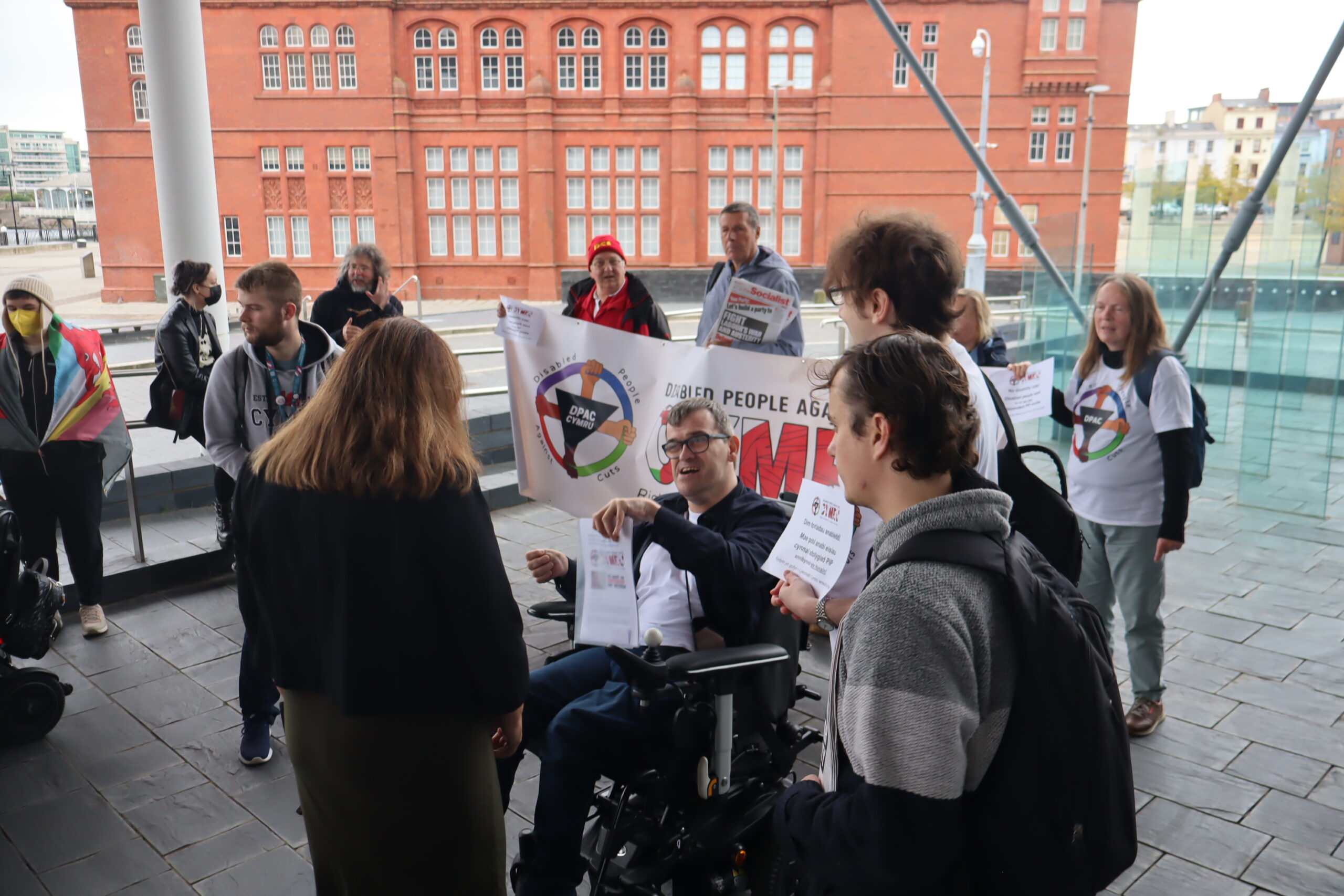
 

Jul 022025
 
DPAC Logo with text underneath "Disabled People Against Cuts" and then web address dpac.uk.net

On 9 July, MPs have a final vote on the Universal Credit and Personal Independence Payment Bill.

In spite of the concessions made by Labour yesterday, we are still recommending that you contact your MP and ask them to vote against the bill at third reading.

We know that only 49 Labour MPs rebelled in the end. But we also believe, given the speeches being made in the Commons yesterday, that a lot more would have rebelled if Timms had not announced at the last hour that they were going to remove the 4-point rule from the bill.
It may be, if your MP voted in favour of the bill, that after they have had time to consider things they will wonder if they made the wrong decision in the heat of the moment.
Below are some of the reasons you might want to give for voting against the amended bill, or you may have some of your own. The important thing is that you make it clear, if you believe it is the case, that the bill still harms disabled people and it should not go ahead.

Hundreds of thousands of future disabled claimants still be harmed by their UC health element being almost halved, compared to current claimants, and then frozen.

The severe conditions criteria are extremely hard to meet. The requirement that claimants meet them “constantly” rather than “for the majority of the time” is unreasonable and harsh. Claimants with degenerative conditions such as Parkinson’s, multiple sclerosis and muscular dystrophy generally follow a slow path of decreasing ability, with periods of remission. Long after it is clear they will never work again they will have periods of remission. At the moment, a claimant in these circumstances would get the full health element. But from April 2026, new claimants in the same position will only get around half this amount.

Claimants have not been consulted on the changes in the current bill at all.

The Bill has become a confusing shambles with little resemblance to the original text. MPs will have very little time to study the ever changing government amendments before they vote.

A committee process that should take weeks or even months, looking at amendments and getting advice from experts, will all be done in a single afternoon on 9 July, as the government rushes the bill through.
Jul 012025
 
DPAC Logo with text underneath "Disabled People Against Cuts" and then web address dpac.uk.net

Stephen Timms, the Minister of State for Social Security and Disability, has now replied to the letter from Disabled People Against Cuts sent three weeks ago.

Our letter raised serious concerns with the quality and fairness of the so-called “consultation” being carried out on disability benefit cuts. We asked for the consultation to be extended, and for urgent action to address the failings.

Stephen Timm’s reply, available here, does not address any of the concerns, and he refuses to extend the consultation process.

The minister has not yet replied to the letter from DPAC Cymru, also sent three weeks ago, requesting a meeting following the failures of the DWP in organising the only in-person consultation on the disability cuts in Wales. That letter said:

We are concerned you still do not understand the failures of your department. We have had no indication from you, or the DWP, whatsoever, in any statement, that you understand that the consultation was organised in a way that was unsuitable for disabled people.

Given Timm’s lack of understanding of his department’s failures, we have no confidence in him leading a wider review into PIP.

Jun 292025
 
DPAC Logo with text underneath "Disabled People Against Cuts" and then web address dpac.uk.net

In total, the trade union movement represents 1.4 million disabled workers.

Now a trade union representing more than 1.2 million workers has called for the entire welfare bill to be dropped and for government to start again.

An image of Sharon Graham with a quote overlaid. The quote says: The government needs to drop its entire welfare bill and start again with the principle of social justice and helping people into work at its heart. Sharon Graham Unite General Secretary. At the bottom is the Unite the Union logo, which is blue text and a red flag.

Government Welfare plans create unfair two-tier system, say Unite

Unite, the UK’s leading union, has warned that the government’s U-turn on welfare cuts would create an unfair two-tier system and will prevent disabled people in future entering work, college and university.
However, Unite believes that the planned changes in fact create greater injustice. The proposal to limit Personal Independence Payments (PIP) to new claimants will create a two-tier workforce and will create a massive barrier to work for newly disabled people.
Unite is further concerned that reducing PIP payments for younger people as currently planned will mean that they will be effectively excluded from university and colleges as they can’t access the funding needed to offset the higher costs they generate in order to study.
Unite general secretary Sharon Graham said: “Why do Labour keep making the same mistakes, attacking the most vulnerable in our society.  The government’s latest plans for disabled benefits cuts are divisive and sinister. Creating a two-tier system where younger disabled people and those who become disabled in the future will be disadvantaged and denied access to work and education, is morally wrong.
 
“We need a system which ensures that disabled people get the support they need to enter the workplace and receive an education, the government’s plans specifically prevent this happening.
 
“The government needs to drop its entire welfare bill and start again with the principle of social justice and helping people into work at its heart.”

Unite for a Workers’ Economy said:

These changes were not in Labour’s manifesto – in fact they flatly contradict what Labour promised: “Labour is committed to championing the rights of disabled people and to the principle of working with them, so that their views and voices will be at the heart of all we do.”
Jun 292025
 
DPAC Logo with text underneath "Disabled People Against Cuts" and then web address dpac.uk.net

1st July 15:00 to 17:00. Bedford Square, Exeter.

This is a poster for a protest in Exeter.

At the top is the DPAC logo, a red, pink, blue, green wheel held by four hands of different skin tones, with an upside-down black triangle in the center bearing the word Exeter.

Underneath, on a red and white stripe design, is large text that says Kill the Bill Before it Kills Us. Above and below it says: Bust Cards, chants, satements for Starmer, Myth-busting, speeches, community first.

Underneath are two QR codes. The one on the left is labelled Email templates for your MP and the speaker of the house. The one on the right is labelled Facebook event page.

Underneath is large text that says 1st July 15:00 to 17:00. Bedford Square.

In medium text, it says that Masks are requried for those who are able to use them, limited spare masks and bottles of water provided.

Kill the Bill Before it Kills Us!

Bust Cards, chants, statements for Starmer, Myth-busting, speeches, community first.
Masks are required for those who are able to use them, limited spare masks and bottles of water provided.

Links

Facebook event

Email templates for your MP and the speaker of the house.

Jun 272025
 
DPAC Logo with text underneath "Disabled People Against Cuts" and then web address dpac.uk.net
Coventry TUC is organising a protest on Tuesday, 1st July, at 5 PM in Broadgate, Coventry, coinciding with the discussion of the welfare cuts bill in Parliament.
They have also contacted the three Coventry MPs to voice their opposition.
If anyone would like to speak at the demo, they would be most welcome.
A poster with a white background and red text and graphics. It says, in very big letters: stop. Disability benefit cuts. Tuesday, 1st July, 5 PM. Broadgate, Coventry (to oppose Labour's Welfare Cuts Bill due to be voted on at 7pm). Hashtag Welfare not Warfare. There is then a poster of protestors holding placards. Several placards say Welfare Not Warfare. One says no genocide, no cuts, no war. One says They Say Cut Back We Say Fight Back. Underneath, in black, says: Organised by Coventry TUC and local campaigning organisations - further info 07970 294 237.
Jun 272025
 
DPAC Logo with text underneath "Disabled People Against Cuts" and then web address dpac.uk.net

Dear Liz Kendall Secretary of State for Work and Pensions,
(For the attention of all MPs and ministers)

We the undersigned are trade unionists opposed to the Universal Credit and Personal Independence bill, designed to restrict access to PIP and to reduce the sickness element (LCWRA) of UC. We believe this is shameful anti-worker and anti-working class legislation.

We represent union members, advisers, caseworkers, officers, housing workers, work coaches, local government and charity workers, finance sector workers, and other roles who work with those on the sharp edge of the disability benefits system. Some of us are also disabled members or carers across our unions, with the double whammy of working in these organisations and being financially impacted. Over a decade of austerity has forced disabled people into even greater poverty, and these cuts will only exacerbate the underlying barriers and widespread discrimination that still shut disabled people out of the workplace.

Our experiences and knowledge of this sector can provide vital insight into the catastrophic impact the proposed welfare cuts are likely to have. The benefit system is already a punitive, degrading, and impoverishing system that has cost lives through assessments, sanctions, and disallowance of benefits. These cuts will only worsen that reality. Cuts kill – particularly as hundreds of thousands more are pushed into poverty.

Not only will these cuts cause increased financial hardship for some of those made vulnerable by a disabling society, but will also add considerable expenses and a much increased workload to workers in several sectors. This is because more people will be plunged into debt. More people will be served with eviction notices (as they won’t be able to pay their rent/bedroom Tax/service charges). In many cases, disabled workers will be faced with the possibility that they will lose PIP and no longer be able to afford to service the additional needs that enable them to remain in the workforce. Cutting incomes will push people further from work, just as sanctions do. This will create misery and resentment in addition to requiring further public services & resources.

The Disability Policy thinktank forecast that the cuts will lead to £1.2bn in extra costs for the NHS and local care services provided by councils, raising the alarm for both councillors and MPs whether the cuts will backfire even on their own economic terms.

More people:

  • won’t be able to afford food or bills, with 4 million already using foodbanks and limited or cut off energy supplies, whilst those industries’ bosses increase their profits off the back of us all.

  • will have their linked benefits stopped, including carer’s allowance and the carer element of UC, disproportionately impacting unpaid carers, women and children when child poverty and homelessness are already at record levels

  • will be excluded from work or forced into unsuitable work which worsens health, with many working families who rely on UC to top up poor wages also to be hit by the reforms.

Benefit cuts harm all working class people, increasing conditionality and forcing us to tolerate exploitative work and accept poorer terms and conditions. The scapegoating of benefit claimants intensifies division and competition and weakens solidarity in our communities.

Local government departments have faced cut after cut and already struggle to have enough staff or resources to support more in need. The voluntary sector has been needed to act up for several years to plug gaps due to Tory austerity, and currently struggles to meet demand.

Funding for debt advice has been reduced and there is insufficient support to help the current number of people with debt and advice.

Access to Work already sees delays of around a year for decisions to enable disabled people to take equal part in work. This is not being resourced as needed.

The proposed cuts by a Labour government will make all of this considerably worse:

  • It will further strain the already overburdened third and public sector. Staff stress will increase, when many already suffer anxiety and poor well-being in the third and public sector because of understaffing and excessive workloads.

  • Communities will be further demoralised and disenfranchised, or will turn to alternatives that do not represent working class interests.

  • The Trade Union movement should not only fight to defend the social security system from cuts, but also demand a transformative alternative that centres human dignity, regardless of ability to work.

  • DPAC and many others have argued for a welfare system that works for us all, removing the private sector involvement and its punitive measures.

With over £20 billion unclaimed, these cuts and the disproportionate targeting of disabled people do not add up. An FOI request found that 87% of those in receipt of the standard rate of PIP daily living, and nearly half of PIP claimants overall, could stand to lose out under the cuts – the scale is much more significant than the Government is letting on.

CPAG also estimated that the benefit bill has been held down by £36 billion annually as a result of caps, freezes and cuts since the 2010s, including the 2-child limit, bedroom tax and benefit cap. Means-tested benefits have been squeezed for over a decade, plunging people into poverty and worsening their health.

Our welfare spending is relatively low as a share of GDP compared to other European countries, even accounting for the increase in PIP claims, simply reflecting worsening health, increases in retirement age, and record waiting lists. Fraud in the PIP system is negligible. Amnesty have stated the inadequacy of benefits violates human rights, and that the system is consciously cruel – it does not need to be made even more restrictive. Civil society, third sector and disabled people’s organisations have been unanimous in their opposition to these ruthless cuts, with Citizen’s Advice condemning the reforms in a ‘Pathways to Poverty’ report and calling for them to be cancelled.

The proposals on unemployment insurance are a further mockery of this being about ‘making work pay’ – severing the link between national insurance credits someone has earned and their ability to rely on an indefinite sickness benefit if they become unable to work, even when made ill by work itself. The cuts are putting cart before horse: investment in employment support is set to have a minimal impact on getting people into work, with job vacancies falling and the Employment Rights Bill not yet implemented.

The consultation has been focused on a few of the changes, and Wales has not had an accessible consultation. That alone should mean this bill should go no further. The changes are being rushed through Parliament to make savings within rigid fiscal rules rather than improve work prospects, and MPs will not have had the chance to review the consultation responses before voting. At every stage the due democratic process and co-production with disabled people, as the Work and Pensions Committee has also called for, has been sidestepped. This concerns us all as trade unionists striving for a more equitable and democratic society.

Instead of balancing the books on the backs of those who can least afford it, Labour should be making the political choice to tax extreme wealth in society, redressing the runaway inequality that has seen the 50 richest families in Britain own more wealth (over £500bn) than half of the rest of the population. We commend the MPs that have submitted an amendment to Parliament to decline a second reading of the bill, and those who have pledged to vote against the bill. We demand that the Government withdraws these cuts, or the Labour Party will be turning its back on workers and working-class communities across the country.

Signatures: (add yours here)

Luke Dukinfield, Unite, Senior Workplace Rep, NEYH CYNfP RISC & Young Members Committee
Ben Golightly, Prospect member (Tech Workers’ Branch).
Arti Dillon Unite 524 branch CYNfP sector & Southwark Trades Council
Helena Navarrete Plana, Unite the Union
Amelia Bradley-Newby, Unison
Rachel eborall
Clara Paillard, Unite the Union, National Industrial Sector Committee (Not For Profit)
Irene McNally, Unite the Union
Clive Walder, Unite
Dara FitzGerald. Vice-Chair Unite Digital and Tech branch
Eric Segal Kent Retired members (SE100R1) branch committee member
Michael Agboh-Davison, Unite
Sean Brogan Chair Unite Community Plymouth and South Devon
Ben Goldstone, Unite LE1111 Housing Workers branch – Equality Officer and Workplace Rep
Jamie Sims, Unite, former workplace rep
Michael Harrison, Unite The Union, Chair of Unite Community Wales and vice chair of Unite Community National Campaign Forum.
James Clements, PCS
Rob Williams chair Unite LE/1228 branch
Charlotte Powell, Unison and UCU Steward
Joseph Meldau, Equalities Office, Unite the Union, Bristol City Council Branch, & a member of Unite South West Disabled Members Committee
Helen Dunster, Unison Representative
Alistair Tice , Unite Community member
Mike Moore, Birmingham University UNISON, Joint Branch Secretary
David Reid (Treasurer, Cardiff General Unite)
Vicki Morris, UNISON University of Nottingham branch secretary, Higher Education Service Group Executive
Mike Vaughan UNISON Branch Secretary
Catherine mcdonagh
Andrea Gilbert GMB Accompanying Rep
James Brackley, UCU
Ioana Cerasella Chis, University of Birmingham UCU & UNISON branch member
Gurbinder Gill, RMT
Steve Merriman, South Yorkshire Retired Members Branch
Mark Sage, Unite Community member
Sacha Ismail, UNISON, FBU
Jackie Lederer Unite Community Branch Secretary
Sally Heier, UCU, University of Leeds Branch Committee Member
Kevin protheroe
Millie Wild, Unite
Karen Drysdale, Unison
Tanis Belsham-Wray. Secretary of Unite NE/403/15 (Community, Youth and Not4Profit).
Tamsila Tauqir, UWE UNISON, Vice-Chair
Stephanie Tailby UCU South West Retired Members Branch
Sarah Horton, Unison
Christine Thomas, Unison
Rob Prince, UNISON, Branch treasurer
Serenity baskett, Unite the union, union rep, lgbt committee member
Jonathan Golding, Branch Secretary, Unite Community, Cardiff & Area
Deborah Butt ASLEF Branch Secretary and Union Learning Representative
Celine Petitjean, Bristol UCU, Membership secretary
Jamie Strudwick, member of Unite
Pauline Brady, Unison, Equalities Officer
Kevin Daws, Treasurer of Gloucester & District Trades Union Council, Branch Equalities Officer of Gloucester SW/007 Branch, UCU South West Regional Equalities Officer
VC – UCU UWE
Bev Keenan Unite Community branch secretary
Barbara Hulme, Unite Community
Sue Wilbraham, Cumbria UCU, Environment rep
Ajit Chuhan UCU Bristol
George Gray
Leisa Taylor, Unite
Ian Townson, Unite Community, Equalities Officer
Lee Starr-Elliott CWU Bristol and District Amal vice chair, equality officer and SW regional disability officer
Pippa Dowswell, Joint Secretary, Islington NEU
Elane Heffernan, UCU Kent Equalities Officer (and PIP claimant)
Eleanor Lisney, NUJ member.
Elizabeth Mawle, Unite
Gwen Vardigans activist Unite community
Katharine Johnston, UCU
Sandra Wyman Unite Community
Zarria Phillips Bristol & Glos area Unite Community
H.Benjafield
Stephanie Mulrine, UCU North East Regional Committee
Steve Jones. CWU Senior Field Official. Convenor Haringey Community Action Network
Matthew D Smith. UCU Treasurer, University of Cumbria
Mark Evans Retired members secretary Carmarthenshire County Unison and member of Carmarthenshire County Unison branch committee
Penny Foskett, NEU, retired
James Jackson Unite Community
Gemma Southgate, TSSA Executive Committee Member for Wales & Western Division
Mathew John, Branch Chair, Carmarthenshire County Unison Branch
Melissa Heywood, TSSA President
Trevor Jones (Unite the Community)
Kevin Pattison, unite community, chair Leeds, Wakefield & York
Samuel Coxson, Unite
Monique Buchli
Gary Clark CWU retired member former branch secretary
J. Losh, Worcestershire Unison
Andrew Kilmister, UCU, member of Oxford Brookes University UCU Executive
Cllr Alexi Dimond, Sheffield City Council, Unite – Not For Profit
Emma Cotton, Social Security and Tax Officer, Equity
Jeni Hunneyball Unite
Jane Carter NEU
Marco Tesei, UCU vice-chair West London College, UCU NEC UK-elected
Chloe Cheeseman, UNISON member
Martin Cavanagh, PCS National President
Saul Cahill, PCS NEC member
Lucy Burke. UCU vice chair, Manchester Metropolitan University
Jennifer Forbes, UCU branch Chair,
Bee Hughes, secretary LJMU UCU
Deji Olayinka UTAW-CWU Chair
Philip Furnivall, Unite, Bristol City Council Senior Craft Workplace Rep – Local Authorities National Industrial Sector Committee
Roland Rance, Treasurer East London Unite Community
Jade Brown, Unison
Amber Williams Unite, co. Vice secretary Bristol city Council branch
Pat Freeman; University of Cumbria UCU H&S rep
Rachael Tomlinson, Unite Community, Humber
Rada Daniell, East London Unite Community member
Ellen Robottom, Unite, former therapeutic counsellor
Fennelia MacCallum, City of Bristol College, LGBT+ Rep
Lisa Lonsdale (Prospect)
Sue Mew – East London Unite Community
Adi Kuntsman, Manchester Metropolitan University
Andy Mitchell, Unite South West Regional Community Forum chair
John Pearson, Unite Community member, former PIP and WCA support worker
Demaine Boocock, UNISON
Elisa Middleditch Unite
Alex Moore President Plymouth NEU
Jan Egan, GMB and Unite Community
Mark King, GMB
Carole Vincent, TULO East London Unite Community & delegate to Waltham Forest Trades Council
Duncan Davis, CWU, UTAW Branch Secretary
Doreen Mcnally. Unite the union
Jan Pritchard
Julie Connolly UCU
Robbie Woodland President BFAWU kernow (Cornwall)
William Kerr, UCU
Vince Martin, Greater Manchester Unite Community, former Branch Secretary
Eddie Hyndes, Musicians’ Union
Neil Terry NUJ
John Fones, UCU.
Tony Staunton, President, Plymouth Trades Union Council
Dave Robertson Unite Community Leeds Wakefield York
Gerry Lavery, Unite Community, Leeds, Wakefield & York.Branch.
Phil Maxwell, Unite Community (branch equalities officer).
Darren James CWU
Jenny Atkinson, UNISON, UWE International Relations Officer
Steve Wilkins Vice Chair Kent Unite Community Branch Secretary Medway TUC
Ryan Aldred Usdaw Assistant Secretary
Chris Bligh, RMT Trades Council rep
Catherine Hughes. Unite Community
Paul Grunnill Unite NW 567 Branch Secretary
Gareth Boyce Unite Union shop steward
Kate Hunter Unite Community
Duncan Moore, UCU National Executive Committee and Secretary of Torbay and South Devon Trades Council
Ian Hanton, Unite Rep
Lady Lola Oyewusi Unison
Mads Hodgson IWGB Disability Officer, Charity Workers Branch
Adrian Jackson Unison .northern regional disabled members deputy co-chair branch disabled members officer northern regional rep national disabled members committee
Scott machin unite member
Gordon Waring
Megan Archer, IWGB Charity Workers Branch
Andrew MIles, NE/COM/5, Unite the Union Leeds, Wakefield and York Community Branch
Miguel Saona. MMU-UCU. LGBT+ Officer.
Alan Theasby, Unite Community
Brian Lennie
Gail Ward Hands2Mouth Project, Unite Community
Cecile Remy, UCU, IWGB
Minesh Parekh, IWGB member (charity worker), Labour and Co-operative Councillor in Sheffield
Ross Maidment, Unite member
Laura Louise Hullah, Musicians’ Union, UCU
Open University UCU Exec
Liam Sewell, UCU, Nottingham College Branch Chair
David Eatock Unite
Patrick Shǐ Timmer, IWGB
Susan Pashkoff, Unite Community, Easr London, Chair
Cllr Jakob Williamson, Unite Member
Kat Down, Vice Chair of NASUWT Disabled Teachers Advisory Committee
Claire Rose, Unite member
Michelle Rogers
Janine Booth, NEU Disabled Members’ Organising Forum; Neurodivergent Labour
Diana Neslen unite the community
Cllr Stan Bates Wakefield MDC Unite member
Dean Darley, Springfield Allotment Community Klub Chair
Beth Wright – NASUWT
David Lowe , Secretary Wigan Trades Council
Steve Handford NEU. International Solidarity Officer.
Nick Parker, PCS, Department for Business and Trade Group Organiser
Kerry Wilks, Unite Community National Chair
Tina Harvey UCU Chair University of Cumbria
Jenifer Devlin Unite Community
Ros Garrick UCU
Addele Lynas NASUWT Belfast Association Secretary
Eeva Sointu, UCU
Sean Kelly Northumberland NEU Branch Secretary
Jon Woods, Portsmouth City UNISON Branch Chair
Elinor Hewitt, Unison LTHT Treasurer and Comms Officer
Claire Inglis, UCU, vice chair at UoC branch
Scott Inglis UCU Branch vice chair
Molly Holland, Unite
Jennifer Jamieson unison member
“Richard stallard
Unite community
Unite plymouth activist committee plymouth trade Council ”
Luciano Sgarbi, IWGB Game Workers member
Mark Blacklock, National Union of Journalists; University and College Union
Mary Currell, Unite member
Mark Fogg, Unite, Branch Officer
Alan Short Unite Community Sth Wales
Linda Burnip, Unison
David Kirk, UNISON
John Ingleson UNISON Branch Chair
Pauline Bailey Unison
Rachel Mills, UNISON Member
Valerie Jackson Unison Retired
Fran Amery, Equality Officer, University of Bath UCU
George Newth, Bath UCU
Alex Charnley, UCU postgraduate rep, Bath university
James Bonner, Unite Community Berkshire, Oxfordshire & Buckinghamshire Branch Treasurer
Caroline Corbin. Unison Health Branch Chair
Denis Bangura, Unison
Philip Bayes
Mark Toovey Lead union learning, deputyearly shift rep, CWU
Wolfgang Bailey. Workplace Representative and Welfare Officer for UNHAC Branch
Tam Laidler, NEU
Debra Willis, unison rep LTHT NHS
David Moon (UCU, branch caseworker, former Branch President, University of Bath)
Darren Robinson Unite The Union Branch Chair / Convenor
Paula Peters Chair of London and Eastern Unite community Campaign Forum & Chair of Bromley & Croydon Unite Community Branch
B.Mootu Unison Equality Officer H&S Representative
Darren Cogavin – UCU
Naomi Pennington, UCU
Stephen Hackett, Unite Workplace Representative, CYNFP RISC delegate
Jon Farley, Secretary, Unite Community Leeds Wakefield and York branch.
Mike Bird, Unite
Kev Conway Unite community member
Cecily Blyther, UCU, Chair at Petroc, Co-chair on Anti-casualisation Committee, member of Disabled Members’ Committee.
Dr Nicholas Lalvani of Unison
Daniel Edmondson, UCU, York St John UCU Branch Equalities Rep
Andy Richards UNISON
Jay Coward, Equity London South, Branch Committee
Richard Stanforth, Unite Union rep in a charity working to stop domestic poverty
Jemma Russell, Unison
Michael k usdaw
Nicola Jones Unison Steward
Dan Edge, Equity, Deaf and Disabled Members Councillor
Elizabeth Lawrence, UCU Regional Secretary Yorkshire and Humberside
Thomas Rudman, Unite LE127
Retired Members Plus section of Unite the Union Cardiff, Activist. Senedd Member for Scope since last September 2024, and an Independent for Cardiff North Labour Party and Activist within Cardiff Central and Cardiff North.
Cecilia Wee, UCU National Executive Committee, co-Chair Royal College of Art UCU
Steven Baugh, Unite
Lesley Bratty, UCU
Andrea Abbas UCU.
Paul Kershaw, chair, Unite LE1111 housing workers branch
Eve Miller, UNISON George Eliot Hospital Branch, Assistant Branch Secretary
Ellie Judge, UTAW-CWU, Tech Sector Support Co-ordinator
Dave Barter (Joint District Secretary, Rochdale NEU)
Kim Wheeler, IWGB
Michael Suter – Rotherham Unison LG Shop Steward and International Officer
Leon Highmoor-Bayes, UTAW
Kevin Ritchie, Unite, Cllr Bramley & Stanningley Ward Leeds City Council
Felix Ricketts-mason, UTAW-CWU
Derek Fraser Manchester NEU
Steve Skinner, Bradford College UCU, Green Rep
Graham Cooper, ASLEF Bletchley branch trustee
Graham Croucher, Branch Secretary and Union Learning Rep, Bletchley Branch
Morgan Rhys Powell, UCU
Bill Smith, Secretary Alice Arnold Unite Community WM5105
Russell Hickman, Unite Community Branch Chair, Northants TUC Chair
Judy White, chair Bradford branch of Unite Community
George Lloyd-Burman, IWGB (Game Workers) Regional Organising Officer
Sue Ghany Unite member
Natalie Amber chair of Equity Deaf and Disabled members committee
louise alldridge UCU Equality Rep
Steve Preddy Unite Southwest
Brett Sparkes, Disabled People Against Cuts Trade Union Group Founder
Ian Hodson, Bakers, Food and Allied Workers Union National President
Jo Grady, General Secretary – University and College Union
Adrian Lister, Unite
Ken Fish, Unite
Ash Stokoe, UCU
Skye Cormier, Unite the Union.
Leanne Hubbard Unite the Union
Kevin Green Unite member
April Ashley, Southwark UNISON Branch Secretary & Black Members UNISON NEC (personal capacity)
Ian Clements, Unite LE1111 Housing Workers Branch Workplace Rep, LE Disabled Members Committee, Chair Hounslow Trades Council.
Matthew Watkins, UNITE
Ian Woolcomb
Rosina Siddique Unite Member
Liz Thompson Unite Community Leeds, Wakefield,York
Corinna Herr , Community Union , Caiwu Union , GMB UNION
Ailig Garth-Dòmhallach of Unite the Union (West of Scotland Community SC/100C9)
Joseph Jones Unison
Elie Sharp, UCU
Katie Reilly, Unite, VC of National Young Members
Stuart Hellingsworth, Unite
Matt Bridges, Workplace Rep, Branch Equalities Officer, NW DWC Committee Member, RISC (Finance and Legal) Disability Representative
Christina Malley, UCU Member for UWL, Former Chair of LIPA UCU
Shaun Topen-Cooper Primary School Teacher FT and Ley Local Secretary P&K NASUWT
Benjamin Cross, British Veterinary Union in Unite
Sandy Simmons – Unite – Equalities Officer
Mary Mullen UCU
Alison Campbell, UNISON, Steward.
Dave Nellist, Unite the Union and former (expelled) Labour MP
Polina Sparks, NUJ, Disabled Members Council deputy chair, welfare and training officer, Manchester & Salford
Justyna Borkowska-Rozanska, VMD, MRCVS, Unite, Reading
Mark Findlay, Unite
Ajay Kumar Bristol Palestine Alliance chair
Sharon-Theresa Calvert, Caseworker, NASUWT
Harry Stamp – UCU London Representative / Committee Member YSJ
Florence Allaway presedent of Haringey trade council
Neil Moore Unite workplace rep Peterborough
Paul Couchman, branch secretary, Surrey County UNISON
Damian Cosgrove, Chair, Unite Not For Profit SE Region SE/6290
Ruairí Lewis, UNISON Local Government Branch, Senior Steward
Jane Fernandes Unite the Union London
Ben Radley, UCU Rep, University of Bath
PCS ARMS Treasurer SW
Dr. Alex Marshall, UCU Hallam Rep
Steve Wright – General Secretary, Fire Brigades Union
Bob Monks, General Secretary – United Road Transport Union
Caroline Clarke, Unite, Sheffield
Sarah Boden BVU Unite member Liverpool
Harriet Knafler, Prospect, South Yorkshire
Ellie Wood, Unite London & Eastern Disabled Members’ Committee and Vice Chair London & Eastern CYWNFP Regional Industrial Sector Committee
Sam Dennehy, Unite Member
Julen Puertas Baños, IWGB, Bromley
Candice George IWGB
Alan Burgess Chair Portsmouth and District Unite community
Rowena Fehilly PCS ARMS
Dave Vincent PCS ARMS
Cllr Cien Elan Butler, Billericay West – Unison Member
John Sweeney Unison London
D Fearn Unison West Midlands
Cathy Meadows UNITE Nottingham
Chris Jackson
Brian Birtwell PCS Lancashire
Elaine Fullaway, Unite, Secretry, Southampton
Holly Notcutt, unite, Great Yarmouth
Michael Lehane – NEU member, President Coventry & Warks BPTU&AA
Gareth Bromhall, Secretary – Swansea Trades Council, GMB Wales and South West Regional Council, TUC Cymru General Council
Teresa MacKay, Branch Secretary, Unite Retired Members National Committee
Anne Boden Work Place Representative Unite the Union
Lesley Pollock, TSSA, Chair, West of Scotland Branch 850
Jacob Goddard, Unite
Tony O’Hara, Unite Member, London
Declan Clune. Secretary Southampton & South West Hampshire Trades Union Council
Jan Underwood, retired, ex-UCU, secretary Arfon Access, Bangor
Mick Morgan Unite N/W community forum chair Lancashire
Jamie Johnson, member CAIWU
Lesley Jones, PCS, Emp Relations Representative, Devon
Jenifer Devlin Unite Community Leeds, Wakefield and York
Mary, Liverpool Unite Member
Caroline Martin UCU Manchester
Zoey Corker Welfare Officer Leeds UNISON
Ekua Bayunu Unite Community Manchester
IAN LOVEGROVE, UK CITIZEN
Stephanie Spierling ARMS member
Dot Tomkinson Disabled members officer Salford City Unison and Co Chair of the North West disabled members committee.
Nixon Tod, UNISON, ex chair National Further Education Committee, retired member, Manchester
Adam Harmsworth, Napo National Vice-Chair
Marcela Leite, Unison Hackney, Green Rep
Suzanna Hudson-Cooke, Chair, British Veterinary Union in Unite
Pete Keenlyside CWU National Honorary Member, Greater Manchester Branch
Sarah Woolley General Secretary BFAWU
Hannah Fyson, UNISON retired member, Manchester
Douglas Stephen Pearce, Usdaw Branch Chair A216 Weston-super-Mare
Colin Carter, RMT, LDC rep Bristol & Area H&S rep Bristol
Louise Branch UNISON, SW
Nathan Lee Davies, UNITE, Wrexham
Steve Gillan General Secretary POA
Helen Thornton, UNISON Steward, Bristol
Jenny Lennon-Wood, Secretary of Dorset Trades Union Council
Joyce Rutherford, Unite Community member
Dave Murphy, Unite Community Teesside and Durham Branch Chair
Nick Caines, UNISON, Branch Chair, North Somerset
Nicola Kingaby RCN
Michael Braithwaite – Unison Member – Weymouth.
Lee Norman, ASLEF Branch Secretary and H&S representative, Darlington
Trevor Saint, Unite Bournemouth branch
Leigh Hodgson, GMB, Gateshead
Alison Hann, UNISON, Bristol LG
Lady Walker. Retired RAF Squadron Leader. East Midlands
Zeal Machin, BFAWU, Branch 547, West Yorkshire, FTW Representative
David Bird
Richard Holland, Salford City Unison Steward
Secretary of Unite retirement branch. Dorset and Bournemouth.
Jane Haden – Treasurer of Unite Community South Devon Branch
Jane Nellist, President of Coventry TUC and member of NEU
Siobhan Strode, Unite Community, Devon
Paul Hunt, branch chair, Coventry City UNISON and delegate to Coventry TUC
Linda Gates, Unite Community member
Julian Wilson, PCS, MoJ Group EC, Chair, Royal Courts of Justice and First Avenue House Branch.
James Foster, Unite Community, Orpington
Phil Watts – Branch Secretary Unite Northants Retired Members
Andy Hunter-Rossall, BFAWU member
Carole Vallelly GMB member
Stephe Meloy – Musicians’ Union member
Dave Levy – GMB London Regional Council
Michael Torrens, Unite, Equalities and Communications Officer
Mark Colpus, UCU
Dave Ray, CWU, Industrial Relations Rep & Chair NE Political Committee, Nort East
Dave Gorton, Unite LE372 branch publicity officer
Fredy Velez – BFAWU Rep Suma Wholefoods Branch
Stephen Brown, GMB & MU
Anna – FDA, senior policy advisor in Civil Service and enhanced PIP recipent
Jackie Owen Unite Community, Equalities Officer NE Wales
Lucy Fyson GMB member
Alice Tibbs, CAC Portsmouth
Jackie Lederer, Unite Community, Portsmouth and District Branch, S E Region
Kathleen Sowden unite south devon
Christine Wilson Bristol Bath & Gloucester branch Unite Community
Felix Manocha-Seymour, NEU Portsmouth
Lynne Batty, NEU, Leeds
David Kersey – Communications Officer- Coventry City Council
Peter ROBERTS, NEU, Hampshire
Stephen Lennon-Patience Unite Health member Dorset
Ben Willis, USDAW,North Somerset
Catherine Crowther Unite Community Member
Willow Tyers, NEU, Southampton
Heather Juno Libertine Rennie, Prospect
Naomi Byron, UNISON, London
Teresa MacKay, LE/2116 Branch Secretary, NRMC
Sarah Sanford, Branch Equalities Officer Suffolk Unite Community & former Welfare Rights Adviser Ipswich TUC UWC
Rebecca Short: Equity Union Member, Portsmouth UK
Mehreen Begg NEU Executive London
Pete Bloomer, Unite Community, social media officer, Birmingham.
Joy Bazeley, Southsea, Unison
Ben Jackson OT & GMMH UNISON Branch Secretary
Andrew Thompson, Unite, former national convenor CGL, Birmingham
Tim Cutter Unite 524 branch
Bee Tidbury
Nancy Taaffe, Workplace rep,Unite
Alexandra Summerson, National Education Union, Northern Region Disabled Members Organising Forum Rep, NYH TUC Executive
Des Merritt, treasurer, UNISON.
Mélusine Lenoir, London, Equity Member
Pam Wortley – Unite
Bill Smith -Secretary of the Alice Arnold Unite Community Branch Coventry and Warwickshire
Wyn Turner, GMB member
Hayleigh Marks Talabis, FBU East Midlands Regions 6 Control Rep & Political Organiser, Northamptonshire Control Branch Secretary & Northamptonshire Fairness at Work Rep
John Whittall, Unite Retired Members, Northampton Branch.
Chairman: Respect for the Unemployed & Benefit Claimants
Sadia Mirza, Unite the Union, Equalities Representative
Holly Donovan, National Forum rep for the East Midlands, Unite Community
michael jewkes, equalities officer tom mann branch, disability officer North Warks and Bedworth labour clp,
Moe Muhsin Manir – Unite Activist London, Former Representative
Jeff aherne independant
Claire Newland, Suffolk, Unite member – disabled.
David Greenhalf
Sue sanders NEU
Councillor Andy Wilson Unite Community Branch Liverpool
Debby Monkhouse, Unite member
Matt Pinnell West Yorkshire BFAWU member
Joanne Shaftoe, CWU North East Regional Chairperson
Carol Duerden, Unite Community Bradford Branch.
Jean Crocker, Unite Community and UCU retired members, North East England
Cllr Paul R Kimber Labour — Dorset Council.
Ruth Pitman, Dorset
John Shortell, Head of EDI, Musicians’ Union
Charlotte Bjorndal, UNISON – Leeds
Peter Ashmore, Leeds, Unison. (only working due to PIP payments assisting me to get to work. I will lose these and employment if changes go ahead)
Richard Tulloch, Unison, Leeds
Emma Emmerson, Unison, Leeds
“Mark Taylor-Thomas
Unison member, Leeds Branch”
Donna Padget, unison, Leeds
Amy Smith, Leeds
Kathleen Walpole – Unison member – local authority worker and DLA claimant – Leeds
M Kerr, Unison Member, Leeds
Sue Taylor Unison Leeds
Laura Topping, Unison, Leeds
Kimberley White -Unison -Leeds
Eleanor Hastwell, Unison, Leeds
Joseph Babalola,union member,christian,Leeds
Kathryn Russell, Leeds, Unison Member
Angela Stocks Leeds
Uyi Dickson & Yorkshire – Humberside Region
Dwain reid union west yorkshire
Lee Paton, Leeds.
Lee Paton, Unison, Leeds.
Ruth Armitage, Unison member, Leeds Local Government
Shirley Norman UNISON Yorkshire and Humber Leeds
Phil Marsden,West Yorkshie Unison
Jordon newton leeds
Freddie Found, UNISON
Farzana Kauser unison member
Joanne, unison, leeds
Ali Phillips – Unison Member – Leeds
Charlie Lowe
Eugene Okwei. Unison. Leeds. West Yorkshire
Dave Roberts, Leeds Unison
Mr Raafat Musa / West Yorkshire-Leeds
Matthew Hawkins, Unison Rep for Leeds Federated Housing
Charles Aninaquah Boadi,Unison Leeds branch member
Tania Boulongne, Unison, Leeds
Dave Roberts, Leeds Unison
Carol Spivey Unison Member
Mariam Boadi Owusu, Unison Leeds branch member
Richard Thackwray unison
Cheryl Ferris Stewart Unison member
Krystie Harris-Winstanley, Unison, Leeds, Otley
Cristian Robu Unison Leeds
Elizabeth Morrison, UNISON member, Leeds
Claire Ray – Behaviour Support Worker – Unison member
Izabela Zolnowska, Unison, Nursery Assistant, Leeds
Olivia Carlton, UNISON
Aishah I, Rotherham, Unison member
Barry barker leeds
MR MOHAMMED ASIM HARAF
Steven Elbourne , Unison , Leeds
Elaine Francis-Truett, Unison, West Yorkshire
Sari Sohanpaul Unison Member Leeds
Alex Moore Presldent Plymouth NEU
Nick Redding, Unison, Shop Steward, Leeds
Stephen Linnecor, unison , Leeds.
Rachel O’Gorman, Unison, Leeds
Luke Glossop, Unison member, Leeds
Martin Forsyth Unison Manchester
Pauline Bailey Unison Chair retired members Leeds
Kaal Rosser, Unite Community, -, Plymouth
Janek Poklad-Retired Unison member and former Steward
Steve dobie unison Leeds
Theresa Falkingham, Unison, West Yorkshire
Jasper Shaw, UNISON member
Irene Oriakhi Osunde. Unison. Leeds
Lulu Spargo, Unison
Simon Beaumont, Unison member, Leeds
Hanna Ayisi, UNISON, Yorkshire and Humber, Leeds
N Hadi – Unison Leeds
Alison Greenwood – Unison – Steward – Leeds
Stephen parsons Leeds
Ciaran O’Se
John Whetton, Unison Member, Leeds
Lorraine Bull unison Leeds
Andrew Sutcliffe, Unison, steward, Yorkshire and Humber
Mehnaz Ali, NEU, Disabled Members Committee member, Rochdale
Richard Tindall, Unison, Leeds
Andy silverman Leeds unison
Sarah Nattrass, Unison member, Leeds
Ann McKelvey UNISON ULR Leeds
NEU Regional Council Member
Angela Marshall Leeds Unison
John Vasey
Raymond Hill, UNISON, Leeds
Martin Tolley Unite member
Elaine Summerscales Unison
lesley greenfield unison
Ganiyat Mosunmola Salami. Leeds
Stephen Taylor, Woodlesford, Leeds
Natasha Clarke, Leeds
Mercedes Potter Unison Leeds Children Social Care
Keisha King, Leeds
Aliya Vasylenko, Unison, Leeds
Kehinde Adewale, UNISON member, Leeds
Matthew Lishman, Unison, Leeds
Bernadette Bidmead Steward Unison ( FE)
Jennifer Fairley Unison member, West Yorkshire
Tim snell unison still working at 68 from Leeds
Samantha Gill unison
Victoria Thain ex social worker Leeds
Lisa Jowett Leeds Union
Lisa Birdsall, Ls14 2hz
Mark Greig : UNISON : Adult Social Care, Leeds.
Tom Baker, Unison, Leeds City Council
Emily uden, unison,leeds
Michelle green
Jacqueline Clifford, Unite
Morag Cumming, Unison
Cynthia Harding unison
Sarah Wilson, Unite Member
Mick Heath Bradford
Danielle Steel – Unison Member
Lindsey mara, unison, Mental Health Homeless Team, Leeds City Council
Gary Murphy Yorkshire and Humberside Member
Yvonne Elliott Unison. Leeds
Nigel Jones – Shop Steward UNISON LCC.
Steve Withers unison
Lynn Gunnigle Unite Community Member
Jason Knowles = Leeds Unison Steward – Leeds Adult Social Care – Social worker
Richard smith Unison Leeds
Ushirika Quashie. Unison. Leeds

Jun 262025
 
DPAC Logo with text underneath "Disabled People Against Cuts" and then web address dpac.uk.net
A graphic with a light blue background and a megaphone. Beaming from the megaphone, as if it is the sound, is a yellow background. On the yellow background are the words in red: Act now. Speak Up. Fight Cuts. In black are the words: Write to your MP about Welfare Cuts.

Dear DPAC members and supporters,

The vote on the welfare cuts bill is next week, we need to make sure MPs know – do not vote for these cuts!

We need as many people as possible to be emailing their MP and telling them exactly why they should vote against the bill next week and reject any concessions. They need to know, no concession is enough, the only option is to vote Against the bill next week.

Inclusion London have put together a template letter that anyone can use to email their MP, all you need to do is put on your name and postcode and it will send it for you.

To find the letter, please go to this website: https://www.inclusionlondon.org.uk/campaigns-and-policy/act-now/stand-up-against-cuts-to-disability-benefits-write-to-your-mp-today/

These cuts are a cruel attack on disabled people, that would push 350,000 of us into even further poverty, we’re telling MPs: vote against these cuts and join the reasonable amendment!

Jun 262025
 
DPAC Logo with text underneath "Disabled People Against Cuts" and then web address dpac.uk.net

Contents

Disabled MP who quit government over benefit cuts tells DNS: ‘The consequences will be devastating’ 1

Disabled peers plan to ‘amend, amend, amend, amend, amend’ after assisted dying bill reaches Lords 4

Minister finally admits that working-age benefits spending is stable, despite months of ‘spiralling’ claims 5

This bill opens the door to scandal, abuse and injustice, disabled activists say after assisted dying bill vote 7

Timms says cuts must go ahead, despite being reminded of risk that disabled claimants could die 10

Absence of disabled people’s voices from assisted dying bill has been ‘astonishing’, says disabled MP 12

Timms misleads MPs on DWP transparency and cover-ups, as he gives evidence on PIP review 14

Ministers are considering further extension to disability hate crime laws, after pledge on ‘aggravated’ offences 16

Making all self-driving pilot schemes accessible would be ‘counter-productive’ and slow us down, says minister 17

Involve disabled people ‘meaningfully’ from the start when developing digital assistive tech, says report 19

Other disability-related stories covered by mainstream media this week 21


Disabled MP who quit government over benefit cuts tells DNS: ‘The consequences will be devastating’

Disabled Labour MP Vicky Foxcroft has described how she was left with “no choice” but to resign as a whip over government plans to cut billions of pounds a year from disability benefits. 

In her first interview since releasing her resignation letter last Thursday, she told Disability News Service (DNS) that the four years she spent as a shadow minister for disabled people had played a significant part in her decision.

And she also made it clear that the backbench rebellion over the cuts is “huge”, with many of the critics MPs who are “normally very loyal” to the government.

That became clear on Tuesday, when fellow Labour MPs – led by 11 select committee chairs – published a “reasoned amendment” which “declines to give a Second Reading” to the bill, although this is unlikely to be selected to be voted on by the speaker.

She has signed the amendment, which is currently supported by 162 MPs, including 126 other backbench Labour MPs.

Foxcroft says she was taken aback by the number of Labour MPs who approached her on Friday to share their concerns about the bill, as she came to the House of Commons chamber for the assisted dying bill debate (see separate stories).

“Many have come to me to share their concerns, to say they agreed with what I had said in my resignation letter,” she says. 

“And some of these were colleagues that you wouldn’t maybe have expected to have expressed concerns. 

“These are not the usual suspects from the left of the party, these are people who are normally very loyal and want to be loyal but know the government needs to change this.

“I mean, I’m the same myself, but I was left with no choice.

“I don’t want to speak out like this but the government needs to listen, so I will use my voice to amplify voices that are being ignored.”

It’s clear from Sunday’s interview that if she had thought she could effect change from within government, she would not have resigned, but she made her decision to quit when the bill was published last Wednesday, and she saw that ministers had made almost no changes since March’s green paper.

The next day, she resigned through a letter to the prime minister.

In fact, as DNS reported last week, the measures in the bill were in one respect even worse than those suggested by Pathways to Work, because of the misleading reference in the green paper to a premium for those in the “severe conditions group”, which the bill shows will only be a premium for new claimants.

This was confirmed by the minister for social security and disability Sir Stephen Timms, when he gave evidence to the Commons work and pensions committee yesterday (Wednesday).

Foxcroft’s criticisms of the bill are fuelled by her own lived experience as a disabled MP, but also by the evidence she gathered from meeting hundreds of disabled people, including many representatives of disabled-led organisations, during her time as shadow minister.

“We all know the benefit system desperately needs reform,” she says, “but PIP isn’t and has never been about getting people back to work. 

“PIP is there to help disabled people with everyday needs. It’s an in-work and out-of-work benefit, and it’s wrong to deny support from someone who needs help to wash, dress, or use a toilet.

“The cuts will literally remove this basic dignity.

“I couldn’t vote for cuts that would make 800,000 people worse off, with 250,000 pushed into poverty, including 50,000 children. That’s a real human cost. 

“And these cuts don’t make human needs disappear. They just shift the costs onto already over-stretched services such as the NHS, social workers and unpaid carers.

“It’s a false economy, with devastating consequences.”

She says she also understands disabled people’s concerns – evidenced in The Department*, by DNS editor John Pring – about the many deaths of claimants, including an estimated 600 from suicide during the incapacity benefit reforms, when there were similarly significant cuts and reforms to out-of-work disability benefits in the early 2010s under the Conservative-led coalition. 

She is reading the book and is aware that safety and safeguarding must be a key priority with any reforms, because of the risk of unintended consequences.

During Sunday’s interview, she repeatedly stresses the crucial part played in her decision to resign by her four years as shadow minister for disabled people, leading up to last year’s general election.

She says her engagement with disabled people while she was shadow minister showed her just how badly many of them had struggled through 14 years of Conservative government, and she stresses her admiration for those she worked with, even those who “shouted” at her when her party did not go far enough on disability policy.

“They were desperate to see the change that a future Labour government would bring for them,” she says.

“I said as shadow minister that we would work with them to ensure that changes that affected them improved their lives, but that has not happened.

“These changes we’ll be voting on have not been consulted on with disabled people and disabled people’s organisations, and it’s so important to make sure that consultation happens and their voices are heard when such big changes are taking place.

“That is one of the reasons I resigned.”

She made the same point in Friday’s debate on the assisted dying bill – which she voted against – when she spoke of the “negligible” consultation there had been with disabled people about the legislation, and told MPs: “Disabled people’s voices matter in this debate, and yet as I have watched the bill progress, the absence of disabled people’s voices has been astonishing.”

She is hoping ministers will receive this subtle message: that government must engage with disabled people right from the start of any policy-making process that will affect them.

Despite several questions from DNS, she refuses to criticise work and pensions ministers, including Liz Kendall.

But asked for her message to the prime minister, she is blunt. “He needs to revisit it,” she says.

Despite that bluntness, and her high-profile decision to quit as a whip, her resignation letter makes clear that she is fiercely loyal to the government, but just intensely frustrated at the deeply harmful proposed cuts to the universal credit health element, and particularly to PIP.

She points to government policies that would allow people on out-of-work disability benefits to try work without fear of having to go through the assessment process again if it doesn’t work out; reform Access to Work; introduce disability pay gap reporting; and ensure all disabled claimants have access to a supportive work coach if they need one.

But she says: “We need to be doing those things first before we even start considering how we are going to be reforming disability benefits. 

“And when we do eventually do that, we need to make sure that we do it with disabled people and organisations run by disabled people.”

She also lays a large part of the blame at the door of the Department for Work and Pensions (DWP) itself.

She knows from her time as shadow minister that many disabled people have zero trust in the department.

“This bill is most definitely not the right way to persuade disabled people to trust DWP,” she says, “and certainly not when we’ve not worked with them to ensure that we get this right.”

Speaking on Sunday morning, three days after her resignation letter was published, she says she is finally finding time to think after the “whirlwind” media storm it caused, but she insists she has no feelings of regret, although she is sad she had to take the step she did.

“I’m sad to leave my colleagues in the whips office, who I think are absolutely brilliant and do really good work,” she says. 

But there is also a keen sense that she knows time is running out to persuade the government to back off, with the bill’s second reading set to take place on 1 July.

“I want to see the government change this. Desperately. 

“They need to listen to what I’m saying, to what Labour MPs are saying, and what disabled people are saying.”

26 June 2025


Disabled peers plan to ‘amend, amend, amend, amend, amend’ after assisted dying bill reaches Lords

The disabled peer who has led UK opposition to the legalisation of assisted dying for decades has pledged to work to make a bill passed by MPs so “tight” that only a very few people will be able to take advantage of it.

Baroness [Jane] Campbell said she believed that if the legislation made it easy for people to take advantage of the new laws – if they are eventually approved by parliament – then “people for whom this bill was never intended will die in their droves”.

She was speaking to Disability News Service (DNS) just minutes after MPs had voted by 314 votes to 291 on Friday afternoon to approve the terminally ill adults (end of life) bill, which will legalise assisted suicide in England and Wales for some people diagnosed with a terminal illness, in certain circumstances.

The crossbench peer, who herself has a progressive condition, said she believes her task as a member of the House of Lords – which will now examine the bill in detail – will be to “amend, amend, amend, amend, amend, so it becomes so tight that anyone would find it difficult to get it”.

She also said her task will be to ensure there is no “slippery slope” that will allow the bill to be extended to an ever wider group of people.

But she said that even if she and fellow peers were successful in amending the bill to make it safer, they were “not miracle workers”.

Baroness Campbell, founder of Not Dead Yet UK (NDY UK), which sees legalisation of assisted suicide and euthanasia as “deadly forms of disability discrimination”, said: “There will be mistakes and people will die, whom if they’d had the right support could have lived a good life until they died, but what else can we do?”

She added: “Why choose people like us to help to die when they can so easily put in support and care to help people live dignified lives at home so that they can cope with the bad times, and get through them.

“Because people do get through them and it is possible to have a good death with a progressive or terminal illness. This is what people forget.”

Her fellow disabled crossbench peer, Baroness [Tanni] Grey-Thompson, who has also spent years opposing legalisation, supports Baroness Campbell’s strategy.

She said: “There are very few safeguards in [the bill] currently. Very few amendments were voted on.”

And she said there was no protection in the bill for people with Down’s syndrome or others with learning difficulties.

Before the vote, Baroness Grey-Thompson told DNS that there would be many amendments proposed in the House of Lords, if the bill was passed by the Commons.

She said: “There’s so little safety in this bill, and so little understanding of the lives of disabled people, and the current government’s plans for welfare.”

Last week, NDY UK released polling showing that two-thirds (65 per cent) of disabled people believe that if benefits are being cut – as they are currently through the Labour government’s universal credit and personal independence payment bill – disabled people living in poverty may be likely to seek an assisted suicide instead of struggling financially.

26 June 2025


Minister finally admits that working-age benefits spending is stable, despite months of ‘spiralling’ claims

A minister has finally admitted that spending on working-age benefits is stable, and is not spiralling out of control, despite months of claims from his own department and fellow ministers.

Sir Stephen Timms made the admission as he told the Commons work and pensions committee that ministers had decided not to carry out a public consultation on the billions of pounds of cuts to personal independence payment (PIP) and the disability element of universal credit because of the “urgency of the changes needing to be made”.

He was giving evidence in the committee’s final session of its inquiry into the government’s Pathways to Work green paper.

Sir Stephen, minister for social security and disability, said that spending on PIP had risen in real terms from £12 billion in the year before the pandemic to £22 billion last year, which he said was “not a sustainable trajectory”.

But the committee’s chair, Labour MP Debbie Abrahams, asked if he accepted the evidence of Ben Geiger, professor of social science and health at King’s College London, who had told the inquiry that working-age social security spending had remained at about five per cent of GDP* for the last decade.

Abrahams also asked Sir Stephen if he accepted that the rise in the number of PIP recipients has been due to demographic change, the nation’s poor health, and the increase in the state pension age.

The minister replied: “Well, yeah, I mean, much of what you say, I completely accept.”

He added: “I think that working-age social security spending as a percentage of GDP isn’t much more now than it was before the 2008-2010 recession, but as you say, the share on disability and incapacity benefits is very substantially up.”

He said most of this increase was in the last six years, and that while the “incidence of disability” had risen by about 17 per cent since just before the pandemic, the incidence of “benefit claiming” had risen by 34 per cent. 

Abrahams suggested an explanation for this was that more disabled people were needing to claim PIP because of financial pressures.

Sir Stephen agreed, and suggested that the government needed to cut spending on PIP, even though disabled people were only claiming it because they were struggling due to the cost-of-living crisis.

He said: “I think you’re absolutely right. I’m sure that the cost-of-living challenges are a very big factor in what’s happened.

“The people who may well have always been eligible but have not in the past claimed benefit are now doing, and that’s what’s driven this very substantial increase.

“As I say, the current trajectory is not a sustainable one and it is not in the interest of people who depend on PIP for it to be on a financially unsustainable trajectory.”

Disability News Service reported in February that claims by ministers, opposition politicians and the media that social security spending was “spiralling out of control” were false and “ideological”.

Last August, chancellor Rachel Reeves said the previous government had “let welfare costs spiral out of control”.

In January, the Department for Work and Pensions (DWP) said in a press release on benefit fraud that it wanted to “tackle the spiralling welfare bill”.

And in February, in a press release on disability employment, DWP claimed again that benefits spending was “spiralling”.

*Gross domestic product, the size of the country’s economy in a particular year

26 June 2025


This bill opens the door to scandal, abuse and injustice, disabled activists say after assisted dying bill vote

Disabled people’s lives will be increasingly in danger because of MPs’ failure to understand the risks posed by the assisted dying bill, devastated activists warned on Friday after the legislation was approved by the House of Commons.

Disabled activists had started gathering outside parliament at 6.30am last Friday in preparation for a crucial debate on the terminally ill adults (end of life) bill before a vote that determined whether it passed to the Lords.

The bill was eventually passed by the Commons by 314 votes to 291 on Friday afternoon, although disabled MPs strongly opposed the legislation (see separate story).

Before the vote, supporters of Disabled People Against Cuts (DPAC) and Not Dead Yet UK (NDY UK) held up traffic in front of the House of Commons with a last-minute direct action, accompanied by chants of “we are not… dead yet”. 

Author and activist Ellen Clifford, who has helped lead disabled people’s opposition to the bill over the last year, said she trusted the Lords to improve the bill more than MPs, some of whom she said had acted on “naked ambition” and the principle of assisted dying, rather than what was in the bill.

She said she hoped the bill’s passage through the Lords would improve the safeguards and provide opportunities “to show what a shambles the bill is”.

Among those disabled people outside the Commons was musician and activist John Kelly, who said after the vote was announced: “The truth is, our voices haven’t been listened to. 

“What this does is open the door for injustice. 

“To rely on a panel to decide my life of social workers, and psychiatrists, have you not read how many injustices and mistakes those people have made, how much abuse and how many rights have been denied disabled people?

“And what they have done is open the door to allow in yet more scandals, yet more abuse.”

Disabled activist Anna Landre told Disability News Service (DNS): “A lot of us are scared about the prospect of enshrining a state-funded ability to die when we don’t have properly-funded state services to live with dignity, let alone to thrive, let alone to get disabled people into work, like this government claims it wants to do.”

She said: “I most certainly don’t feel safer now.

“I think it’s going to create an atmosphere for disabled people that is increasingly unsafe, when our services are being stripped from us, when we’re going to have to fight even harder to get the basics, the scraps that we can already barely access and now in any medical, in any doctor’s office we enter, we face the prospect of being offered a death, of being offered [an assisted suicide].”

She said it was particularly unsafe for disabled people who face multiple marginalisations, including disabled women, who are more likely to be in an abusive relationship; disabled people of colour, who are more likely to be doubted by their medical practitioners; and disabled people of low socio-economic status, “who are looking at not being able to pay rent next month”. 

She added: “As a disabled woman, I’ve been trying to access a cervical cancer screening for over two years. 

“I wish this government would work on that rather than working on streamlining my access to suicide.”

Another leading activist, Simone Aspis, said that, as a disabled woman with learning difficulties, it was “a very sad day for our community”.

She said the bill was “really, really dangerous”.

She said she believed that, for her and other people with learning difficulties, assisted dying will become the “de facto” treatment option given to them by doctors.

She said: “The government keep saying that there is not enough money to go around, so we are going to spend money on creating an assisted dying service? 

“Where is this money going to be found? It’s going to be taken away from education, from care, from housing, from anything that supports us to have good lives.”

Aspis also pointed out that people with learning difficulties had been “excluded from this debate” because the bill had not been made available in easy read. 

Dermot Devlin, co-founder of DPAC Northern Ireland, said that, with the government’s cuts to disability benefits coming in, it was “a dangerous country now if you’re disabled… but we will keep fighting back.”

Chelsea Roff, a researcher and founder of the US-based charity Eat Breathe Thrive, who has fought for months to alert MPs to the risks the bill poses to people with eating disorders, said: “I’ve spent the last six months trying to raise awareness about this loophole, and hundreds of experts have warned parliament: charities, people with eating disorders, physicians, doctors, lawyers…

“I did that because I thought it was the right thing to do because I thought if MPs understood the evidence, they would act on it and amend the bill.

“I’m really disappointed and I think the evidence was minimised, it was dismissed, it was not meaningfully engaged with.”

Michael Lorimer, from DPAC Northern Ireland, said he was concerned that the bill gave ministers “massive executive powers”.

He said: “Given what they’re doing on benefit cuts, we can’t trust them to represent our best interests in terms of implementing this legislation. 

“It’s getting to the stage where Labour are a clear and present danger to disabled people’s lives here because of the benefit cuts and because this bill has gone through, giving them almost unlimited powers in terms of how they shape this legislation. 

“And they’ve been clear through the benefit cuts that they don’t value our lives.”

Jason de Souza said he believed the new law would be “a catalyst for a much wider agenda against disabled and vulnerable people, especially people who are in a situation where they need palliative care and support”.

Earlier, disabled activists had gathered nearby to share their final thoughts before the vote, after months of campaigning.

Devlin had told fellow protesters: “As a disabled person, this assisted dying bill breaks my heart. It terrifies me. 

“It tells me that my life, already pushed to the margins, already made harder by endless cuts and cruelty is… now disposable, it [turns] the language of choice and dignity into something darker.

“I want to live, I deserve to live, but this bill makes it clear to them that lives like mine are just too expensive to bother saving.”

The disabled crossbench peer Baroness [Tanni] Grey-Thompson fought back tears as she thanked disabled activists for attending the protest “despite the discrimination they face in their daily lives and inaccessible public transport”.

She said there was “so little safety in this bill, and so little understanding of the lives of disabled people, and the current government’s plans for welfare”.

Kevin Caulfield, former chair of Hammersmith and Fulham Coalition Against Cuts, said: “The bill, and what is happening with the universal credit and personal independence payment bill, really indicates disabled people’s position in society, because we have been sidelined all the way through this process. 

“People with life-limiting illnesses are disabled people and that’s in practice and in law and yet they have successfully managed to portray this bill as having very little to do with disabled people, and that’s a f*****g disgrace and it’s disgusting and the same is happening with the benefit cuts.”

Caulfield was given a terminal diagnosis 28 years ago, and says he “might well have decided to take the option” of an assisted death if it was available then “because I was a newly disabled person, I didn’t have access to other disabled people, I had no access to mental health support, and it may well have seemed like a reasonable option”.

But he said he was “still here 28 years later”, and there were “going to be many people in a similar situation to me, tens of thousands of people that will end up being dead as a by-product of this legislation”.

Disabled actor, writer and activist Liz Carr, said the number of disabled activists who had attended the protest was “amazing” in the context of spending cuts and “the struggle to survive”.

She told fellow activists: “You make me know that we’re right and that even if this goes through today and goes through to the Lords, we just keep going there because we know where this goes, we know what it means, we know how it will impact our community and other communities.”

Paula Peters, who had been the first to start the protest, at 6.30am outside parliament, said: “Whatever the outcome, we keep going, and we keep fighting, and we keep resisting… and we are not dead yet.”

Jamie McCormack, another disabled activist who refused to accept defeat, said: “We will fight on, we will fight for assistance to live, not to die. 

“We will fight to our very last dying breath.”

And George Fielding told fellow activists: “Our most precious public services, and the things on which we all rely, rely on doing no harm. 

“This bill will do harm; its very premise is to kill people, it’s a pre-designed process. 

“We are on the right side of history, always have been, and the resistance starts as soon as we hear the result today.”

26 June 2025


Timms says cuts must go ahead, despite being reminded of risk that disabled claimants could die

The minister for social security and disability has insisted that billions of pounds a year of cuts to disability benefits must go ahead, despite the risk that they will once again cause countless deaths of disabled claimants.

Sir Stephen Timms was giving evidence yesterday (Wednesday) to the Commons work and pensions committee about plans to cut billions of pounds a year from spending on personal independence payment (PIP) and the disability element of universal credit.

He was giving evidence to the committee’s final session of its inquiry into the government’s Pathways to Work green paper.

The first question he was asked, by committee chair Debbie Abrahams, was about the health impact of the cuts on disabled people, and whether the planned new employment support and jobs would be available by the time the government begins to implement the cuts next year.

She highlighted how research in 2015 by academics at Liverpool and Oxford universities showed the reassessment of disabled people on incapacity benefit through the work capability assessment was linked to about 600 suicides between 2010 and 2013.

Unpublished research also showed how cuts in 2017 – of nearly £30 a week to payments to new claimants of employment and support allowance who were placed in the work-related activity group (WRAG) – were associated with 130,000 “new onset mental health conditions”, she said.

Conservative ministers were ridiculed when they first announced the 2017 cuts and argued that they would “incentivise” those in the WRAG to find work.

Abrahams had already asked Sir Stephen what estimates the government had made of the impact the bill would have on health, in the light of these two pieces of research, at work and pensions questions on Monday.

He said on Monday that the Department for Work and Pensions was “working very closely with the Department of Health and Social Care to ensure that the health and care needs of people who lose benefits as a result of this process are met”.

And when asked again yesterday about the risk of harm caused by the bill, Sir Stephen said the government needed to make sure that both “employment support” and “health and care support” were in place when the cuts were implemented.

He said that new investment in infrastructure and jobs would be “coming into place” in the next few years, and with “what we are proposing on all of those fronts that we will be seeing the progress that we need”.

He added: “I don’t think it would be a viable option to say, well, we’re kind of not going to do anything about the health and disability benefits for a few years and see how things go.” 

The minister was also asked by Liberal Democrat MP John Milne about government plans to halve the health element for new claimants of universal credit next year from £97 per week in 2024-25 to £50 per week in 2026-27, and to freeze it at £97 for existing claimants from 2026-27.

Sir Stephen claimed there was a “very big incentive” for disabled people to “seek to be classified” as having limited capability for work and work-related activity (LCWRA), and so eligible for the health element top-up.

He said: “If they are classified as LCWRA they get a premium which is worth more than the universal credit standard allowance, and that is unavoidably a massive magnet for people.”

He pointed to a letter he had seen in which an MP’s disabled constituent had said that being classified as LCWRA – rather than as having limited capability for work – would mean they would be paid £400 a month more, which would mean they would be “comfortable”.

But Sir Stephen Timms appeared to suggest that a disabled person being financially “comfortable” on benefits was a bad thing.

He said: “And I think this is a really serious flaw in the current system, that it presents this sort of LCWRA status as a sort of something to aim for, that ‘if only I could get to that, I would be comfortable’, when the system should not be doing that to people.

“That is a very bad feature of the current system. 

“What the system should be doing is encouraging people to aspire to work and providing the support to make work possible and feasible, and so, yeah, we are wanting to substantially reduce that incentive.”

He said this would partly be done by raising the standard allowance of universal credit by £5 a week, as well as reducing the health element.

But Milne suggested that the government was concentrating on “Treasury first, needs second”, when what it should be doing was focusing on “needs first, Treasury second”.

26 June 2025


Absence of disabled people’s voices from assisted dying bill has been ‘astonishing’, says disabled MP

Disabled MPs have voted overwhelmingly against the assisted dying bill, and warned that it poses a clear danger to disabled people if it eventually becomes law.

Although the terminally ill adults (end of life) bill was passed by the Commons by 314 votes to 291 on Friday afternoon, disabled MPs strongly opposed the bill.

By Disability News Service (DNS) calculations, those MPs who have publicly self-described as disabled people voted against the bill by seven to one.

Disabled MPs who voted against the bill were Labour’s Jen Craft, Marsha de Cordova, Vicky Foxcroft, Liam Conlon, Emma Lewell and Marie Rimmer, and Liberal Democrat Steve Darling.

The only disabled MP who voted for the bill was Marie Tidball, who spoke repeatedly in favour of the legislation during its committee stage, and whose support has likely persuaded some wavering MPs of its safety. 

Of the eight disabled MPs, only Craft and Foxcroft spoke in Friday’s debate.

Craft told fellow MPs that their vote would have “real-world consequences”.

She warned that the medical establishment placed a lesser value on disabled people’s lives, and revealed that when told of her daughter’s Down’s syndrome when she was pregnant, “the first thing the midwife said to me after ‘I’m so sorry’ was, ‘I can book you a termination within 48 hours.’”

She said she could not support the bill “because we cannot legislate against discrimination and we cannot legislate out inherent bias”, and the bill did not have “the adequate safeguards in place”.

She said: “We have been told that there are panels that will provide a safeguard and take into account all of someone’s circumstances, and whether they have capacity. 

“However, those panels may in exceptional circumstances – the bill does not set out what those are – opt not to even meet the person whom they are discussing. 

“We know that the panels do not allow for family members and carers and those who know that person – if they have limited capacity, a learning disability or are unable to make certain decisions themselves – to play a role in that process or have any right of appeal.”

Craft said it was not the job of MPs to send a flawed bill to the Lords and then “out into the world, hoping that others will do our job for us and that it will all just come out in the wash”.

She said: “That is a dereliction of our duty as members of parliament. 

“If you have any concerns about this bill, now is the time to vote against it. You must do that. 

“You must not think that someone else will do your job for you. It is our decision.”

Foxcroft, who was speaking a day after resigning as a government whip over her concerns about the government’s disability benefit cuts, said she had previously been in favour of legalisation.

But she said that her four years as shadow minister for disabled people, during which she spoke to hundreds of disabled people and their organisations, showed they were “extremely fearful of assisted dying”.

She pointed to the huge numbers of disabled people who died during the pandemic, and those who had “do not attempt resuscitation” notices placed on their health records without their knowledge, which “made them fear for their lives”.

She said: “It made them fear that the authorities thought that their lives were worth less. It also made them fearful of what would happen if assisted dying was brought forward.”

She said disabled people “need the health and social care system fixing first” and “want us as parliamentarians to assist them to live, not to die”.

She said: “Disabled people’s voices matter in this debate, and yet as I have watched the bill progress, the absence of disabled people’s voices has been astonishing. 

“They have wanted to engage. Indeed, they have been crying out to be included, yet the engagement has been negligible. 

“I believe that only one disabled people’s organisation was given the opportunity to provide [oral] evidence to the committee.”

She also pointed to the failure to provide the bill in accessible formats, including easy read and British Sign Language.

She told MPs: “I will finish by saying that I am not opposed to the principle of assisted dying, but until we have a system that supports the right to life, I cannot support it. 

“Until we ensure that all safeguards are in place, I cannot support it. 

“And until the vast majority of disabled people and their organisations support the legislation that is being brought forward, I cannot support it.”

She added: “We are not voting on principles today. 

“This is real and we have to protect those people who are susceptible to coercion, who already feel like society does not value them, who often feel like a burden to the state, society and their family.”

26 June 2025


Timms misleads MPs on DWP transparency and cover-ups, as he gives evidence on PIP review

The social security and disability minister has misled MPs after suggesting he has ushered in a new era of openness and transparency in the Department for Work and Pensions (DWP).

Sir Stephen Timms told members of the work and pensions committee yesterday (Wednesday) that DWP was being “much more open” than under successive Conservative-led governments.

He had been asked by the committee’s chair, Labour MP Debbie Abrahams, about the review of personal independence payment (PIP) that he will shortly be leading. 

He was giving evidence to the committee’s final session of its inquiry into the government’s Pathways to Work green paper, which will see billions of pounds a year cut from disability benefits.

Abrahams highlighted how the department had previously failed to share its own secret reviews into deaths linked to the benefits system with independent experts commissioned by ministers.

Disability News Service had exposed how the department failed to share both peer reviews – now known as internal process reviews (IPRs) – and coroners’ reports with the experts commissioned to review the work capability assessment between 2010 and 2014.

Abrahams asked Sir Stephen to reassure the committee that data on deaths associated with PIP assessments would be available to whoever led the review.

He told the committee: “I’ll be undertaking the review, so yes, the information will be available to me, and actually, you know, we are being – not least thanks to your work, chair – much, much more open about all of this now than was the case in the past.”

He said the department “want people to see what’s going on”. 

He said: “There isn’t any benefit for the department in hiding these things. 

“They were hidden too often in the past. And I think that’s one reason why the trust in the department deteriorated so badly, because people can see that things were being covered up and hidden and it shouldn’t have been happening.

“And I’m determined that it won’t happen in the future.”

But despite his comments, the department is continuing to hide crucial information about deaths linked to the disability benefits system.

This week, Disability News Service (DNS) submitted written evidence to DWP’s safeguarding review to highlight how DWP was still hiding crucial information that would expose its past actions and failings.

Last month, DNS reported how DWP had unlawfully failed to respond to a freedom of information request to see a secret “critical friend” paper from 2021 on the department’s safeguarding failures.

It is also continuing to refuse to release recommendations made by IPRs following deaths linked to universal credit, dating back as far as 2020.

DWP is also appealing a decision made by the information commissioner that the department should release to DNS “a paper detailing the impact of errors on vulnerable customers” that was discussed at the 12 October 2022 meeting of the department’s serious case panel. 

And the department is continuing to refuse to release a transcript of a training session on human rights law given to DWP staff employed on working-age benefits. 

These are just some of the reports being hidden by DWP; there are likely to be countless other reports and data being kept from other disabled campaigners and allies.

Sir Stephen said he hoped the terms of reference for the PIP review would be released before MPs rise for their summer recess on 22 July.

26 June 2025


Ministers are considering further extension to disability hate crime laws, after pledge on ‘aggravated’ offences

The government is considering whether to strengthen disability hate crime laws even further, after ministers agreed to make a long-awaited improvement that will mean longer sentences for offenders.

Home Office minister Diana Johnson announced last week that the government would act to extend the law so that standalone “aggravated offences” would 

apply to disability hate crime and hate crime motivated by sexual orientation or transgender identity.

She said the government would add an amendment to the crime and policing bill to make this change when it reached its committee stage in the House of Lords, keeping a pledge made in Labour’s general election manifesto last year.

This would mean an offender could be charged with an offence – such as assault, harassment or criminal damage – that was aggravated by hostility towards a disabled person, and they would then face a tougher sentence if convicted.

At present, aggravated offences only apply to racial and religious hostility, and a disability hate crime can only be addressed by a court during sentencing, where the sentence can be increased if prosecutors can prove the offence was motivated by disability-related hostility.

The move was proposed in an amendment to the crime and policing bill by Labour’s Rachel Taylor, who told fellow MPs last week that the current discrepancy “cannot be right”. 

She said: “We cannot say, as a society, that some forms of hatred are more evil than others.”

The amendment was supported by disabled Labour MP Marie Tidball, who said the “opportunity to legislate to strengthen the law on hate crime offences must be seized”.

Disabled campaigners have been calling for the change for more than a decade.

But one leading campaigner said the government needed to go much further.

The aggravated offences change was recommended by the Law Commission in December 2021, but it also made two other key recommendations to strengthen disability hate crime laws.

It called for existing offences of stirring up hatred, which only apply to race and religion, to be extended to disabled and LGBT+ victims.

And the Law Commission also said an offender should be found guilty of a disability hate crime offence if they had been “motivated” by “hostility or prejudice” towards disabled people, rather than – at present – only by hostility.

Dr David Wilkin, a disabled activist, researcher, author* and support worker for survivors of disability hate crime, welcomed the move to extend aggravated offences.

But he was critical of the continuing refusal – following years of resistance from Conservative governments – to implement the two other Law Commission recommendations.

He said: “Now, with the perfect opportunity to bring disabled people into the 21st century by establishing legislative equality, they are choosing once again to make sure that disabled people are treated differently, with their hopes and needs once again relegated. 

“Hate crime campaigners have looked forward to disabled people being offered the same rights as other protected groups in new legislation. 

“But now, having reached this timely and convenient critical moment, the Labour government are deliberately excluding those with the greatest needs from attaining simple, fair, and much needed equality.”

The Home Office has told Disability News Service that it will be considering these two further recommendations carefully.

A Home Office spokesperson said: “This government has committed to making our streets safer for everyone and nobody should ever be harmed because of who they are.

“Criminals motivated by racial or religious hate already get tougher sentences. 

“Now we are making sure thugs who carry out vile attacks against someone based on their sexual orientation, transgender identity or disability will also spend longer behind bars.”

*Disability Hate Crime: Perspectives for Change, is published by Routledge

26 June 2025


Making all self-driving pilot schemes accessible would be ‘counter-productive’ and slow us down, says minister

A transport minister has told peers that it would be “counter-productive” – and take too long – to draw up rules that would ensure all pilot schemes of self-driving taxis are accessible to disabled people.

Labour’s rail minister Lord [Peter] Hendy was responding to concerns from disabled peer Baroness [Sal] Brinton, who had asked whether the government would make sure disabled people could use the self-driving vehicles when the pilots begin in England next spring.

The former president of the Liberal Democrats told Disability News Service (DNS) earlier this month that she was “very, very concerned” that the government was planning to allow companies to launch self-driving taxis and minibuses even if their vehicles were not accessible to disabled people.

She told fellow peers that the launch of driverless vehicles was a “once in an era moment”, and that contracts with providers should ensure that ramps and audio and visual announcements are “designed in right from the start”.

She said: “The government need to ensure that taxis and bus-like taxis will have accessibility designed into them. 

“Otherwise, it will be like everything else for disabled people: reasonable adjustments after the event that are expensive for the manufacturer and never perfect for the user.”

Lord Hendy told her the government would be subject to equality laws in deciding how granting a permit could “improve understanding of how these services should best be designed for and provided to disabled and older passengers”.

And he said permits could enforce certain conditions, while “accessibility considerations” would be set out in guidance.

But he said: “It would be counterproductive to specify detailed requirements in regulation for innovative new services.”

He said it was likely that the first driverless vehicles would be “the same sort of vehicles” already used for taxis and private hire vehicles.

He added: “In the medium term, clearly there will be new designs, and there are already some that are suitable for wheelchairs and people with disabilities. 

“We have to acknowledge that automated vehicles are part of an exciting future, but they have to be implemented safely, and she is right that they have to be implemented to benefit all parts of the community.”

He said he had “great sympathy” with Baroness Brinton “striving to make sure that disability is treated in the mainstream, but if we are going to do this quickly, we have to recognise that the early adoption under this act is likely to be using the same sorts of vehicles as are used now”. 

He said: “What we are looking for in the medium-term future is new designs, which should have the facilities such as audio-visual equipment and facilities for people in wheelchairs that she would expect.”

Lord Hendy said the government needed to “design in – as far as we can – facilities for disabled people among this”, but the government “have to get going with this, because it is such an exciting future”.

But another disabled peer, the Conservative Lord [Kevin] Shinkwin, pointed out that deputy prime minister Angela Rayner had spoken of the importance of getting disabled people into work, and he questioned how “the retro, ad hoc inclusion of disabled people facilitates the realisation of that worthy goal”.

Baroness Brinton told DNS afterwards that Lord Hendy’s response was “very disappointing” and that she would now seek a private meeting with him to discuss her concerns.

Transport for All (TfA), the disabled-led accessible transport charity, said the government’s plans, which could exclude disabled people from the pilot schemes, were “unacceptable”.

Megan Barnett, TfA’s policy and public affairs officer, said: “Equal access to transport allows us to be part of society. 

“If self-driving vehicles are allowed to develop without disabled people, they will only deepen existing inequalities.

“We need a strong national policy to ensure that the design and rollout of this exciting new technology includes disabled people from the start, so our whole community can benefit from driverless vehicles, now and in the future.”

The Department for Transport announced earlier this month that firms would be able to pilot small-scale “taxi- and bus-like” services without being monitored or controlled by a human for the first time next spring, before a potential wider rollout when the Conservative government’s Automated Vehicles Act is implemented in the second half of 2027.

The government believes self-driving vehicles could help reduce deaths and injuries on the roads, add new public transport options in rural areas, and have the potential to improve mobility, accessibility and independence for those who cannot drive, including many disabled and older people.

26 June 2025


Involve disabled people ‘meaningfully’ from the start when developing digital assistive tech, says report

There must be “meaningful participation” of disabled people in the initial stages of developing new digital assistive technology, if its potential for supporting their independence is to be realised, according to a new report.

The Royal Society concluded that tech companies, researchers and governments should do more to remove barriers and engage disabled people in the design of digital assistive tools and services.

Among the recommendations made by the Digital Technology report*, launched this week, is that governments should not consider smartphones as any less a form of assistive technology than hearing aids, manual wheelchairs, or white canes.

But it also warns that many disabled people globally experience lower levels of income compared with non-disabled people, so digital assistive technology needs to be affordable if it is to be useful.

It calls on governments, technology companies and research funders to explore ways to ensure affordability.

As part of the research, the Royal Society – the UK’s national academy of sciences – commissioned the Research Institute for Disabled Consumers to survey a panel of 850 disabled people.

Three-fifths (62 per cent) of them said they used digital assistive technology, with more than half of this group doing so throughout the day.

The survey found that more than half of users of digital assistive technology (53 per cent) said they could not live the way they did without it.

The report defines digital assistive technology as “any technology that processes information to help make people’s lives easier”, such as audio-to-text apps, wayfinding and navigation apps, wearable health devices, smart home devices, sight assistance apps, and screen-reading software.

The report also calls for statistics bodies to collect more data on the daily barriers many disabled people experience with their sight, mobility, and memory, rather than solely focusing on their self-reported disability identity. 

Sir Bernard Silverman, emeritus professor of statistics at the University of Oxford and chair of the report’s steering committee, said: “As a statistician, I would particularly stress that the data we record, and how we categorise it, affects everything and everyone.

“Data on the functional challenges experienced by disabled people would help researchers and providers to ensure that digital products and services, especially in the AI age, are genuinely responsive to their needs.”

The report was developed by a committee of international researchers and technology experts, several of whom are themselves disabled.

Dr Hamied Haroon, a research fellow at the University of Manchester and a member of the Royal Society’s diversity and inclusion committee’s disabled scientists subgroup, said: “We shouldn’t be developing assistive technologies or policies without disabled people being front and centre of the process.

“How do you capture the day-to-day challenges faced by disabled people, or ensure you’re offering solutions that actually work, unless you talk to disabled people?”

Dr Haroon, a member of the report’s steering committee, added: “These assistive technologies are fundamental to the workplace and our daily tasks – but they can be prohibitively expensive or unusable in some settings.

“We need to look at removing these barriers, whether that’s costs, additional training, or infrastructure improvements – like addressing patchy mobile data services that can cut off disabled people in rural and deprived areas.”

*Disability Technology: How data and digital assistive technologies can support independent, fulfilled lives

26 June 2025

Other disability-related stories covered by mainstream media this week

Nearly 100,000 adults have been denied government-funded social care because of a decade’s worth of spending cuts, a Guardian analysis has revealed. The figures highlight how a range of government cuts have put so much pressure on the English social care service that it is leaving tens of thousands of people without the access to long-term care that they would have received 15 years ago: https://www.theguardian.com/society/2025/jun/25/adults-england-denied-state-social-care-due-to-cuts 

Heathrow “needs improvement” in how it assists disabled passengers, a regulator has found. The Civil Aviation Authority, which conducted the assessment, also gave the same rating to Edinburgh and Glasgow Prestwick airports. It said the three airports have “clearly more to do” in their provision of additional support. Fourteen UK airports were rated as “good” and 11 as “very good”. None were rated “poor”: https://www.independent.co.uk/news/uk/home-news/heathrow-civil-aviation-authority-frank-gardner-edinburgh-terminal-b2776464.html 

The mayor of London has said the government must think again about its plans to cut benefits for disabled people. Sir Sadiq Khan said the proposed changes would “destroy” the financial safety net of many disabled and disadvantaged Londoners: https://www.bbc.co.uk/news/articles/cn9y3q7eergo 

Downing Street’s disability cuts will have a “devastating” impact on women’s health and dignity and could breach equality laws, the government has been warned: https://www.theguardian.com/world/2025/jun/24/labours-benefit-cuts-may-discriminate-against-disabled-women-say-charities 

26 June 2025


News provided by John Pring at www.disabilitynewsservice.com

Jun 262025
 
DPAC Logo with text underneath "Disabled People Against Cuts" and then web address dpac.uk.net
With the first vote on the disability cuts bill due Tuesday 1st July, we need maximum pressure.
One way to do this is to print out a DPAC window poster demanding that your MP votes against!
DPAC Cymru (DPAC Wales) have produced templates for you to print out at home. They have also produced some versions with some MP’s names already on.
Download a template or a poster from Bit.Ly/DPAC-Cymru-Window

Don’t forget to email your MP. Why not email them a picture of the poster in your window!

A window poster.

In large, bold black text, it says: defeat The Labour Disability Cuts Bill.

Labour is written in dark red.

It then has a line to write your MP's name.

Underneath this it says "Vote no to show that you care". No is in red. Care is underlined in red.

To the left is the DPAC logo. It is a red, pink, blue, green circle being held by four hands of different skin tones. In the center is an upside-down black triangle bearing the letters D P A C. Around the circle are the words Disabled People Against Cuts.

Underneath, it says: Download your window poster at Bit.Ly/DPAC-Cymru-Window

DPAC Cymru social media:

Facebook: Disabled People Against Cuts – Cymru
Facebook: Swansea DPAC:
Instagram: dpac_cymru
Bluesky: @dpac-cymru.bsky.social