Ben Golightly

Editor / Swansea DPAC.

Jun 252025
 
DPAC Logo with text underneath "Disabled People Against Cuts" and then web address dpac.uk.net

From Transform:

As part of our focus on developing community groups that will be ready to join a mass party of the left, Transform comrades in Leicester along with allies on the left are hosting a citizens assembly. If you are in Leicester or Leicestershire, please register and come along. Your voice matters.

We need a people-powered politics that can win real, lasting, transformative change in our communities.

Whether you’re a lifelong activist or just beginning to find your voice, this event is for you.

We’ll listen, learn, and organise together – for a future built by and for the people.

Shockat Adam and Claudia Webb have agreed to speak at the event – don’t miss it. Be part of the Leicester Assembly of Resistance. Use the link below to register.

Register here

If you can’t make it on the day, or are not from Leicester or Leicestershire, you can still help make this event a success by sharing the details of this event with any comrades or residents you know may be interested.

For those of you who would like to do something similar in your area, please either contact Anwarul at organiser@transformpolitics.uk or click on the link below to complete the form:

Community Action Form


Alt text not supplied by Transform

Image alt text not supplied by Transform.


Jun 222025
 
DPAC Logo with text underneath "Disabled People Against Cuts" and then web address dpac.uk.net
A graphic of the DPAC Cymru logo.

There is the main DPAC logo to the left, which is a red, pink, blue, and green circle being held by four hands of different skin tones, with the words "disabled people against cuts" surrounding it, and an upside-down black traingle in the middle bearing the letters D P A C.

On the right is the word Cymru (pronounced cum ree) (C Y M R U) in large letters, and the background of the letters are cutouts of the Welsh flag. Above Cymru (pronounced cum ree) is written the words Disabled People Against Cuts. Below Cymru (pronounced cum ree) are the words Rights, not charity, and the equivilant phrase translated into the Welsh language.

The first vote in parliament is 1st July. Here’s a helpful guide to some things people in Wales can do NOW to help defeat the welfare cuts bill.

These actions are specifically customised for people in Wales, and includes lobbying the Welsh government. However, people not living in Wales might still find the resources useful with small adaptations.

Print out a window poster

Stick it in your window, or on workplace or community noticeboards.

Ready-made

Make your own!

Send yours in!

Contributions welcome! Please send it in to swaneadpac@gmail.com and/or dpaccardiffandvalleys@gmail.com


  1. Write to ALL of your elected representatives.

Follow each link for instructions and template letters.


  1. Write to the press


  1. Get involved!

Here are some ideas (there are many more ways to get involved in addition to those listed here):

  • Share this resource!

    • Bit.Ly/DPAC-Cymru-Defeat-The-Bill
  • Research joining a political party that aligns with your views.


Jun 222025
 
DPAC Logo with text underneath "Disabled People Against Cuts" and then web address dpac.uk.net

There are two upcoming events in Oxford.

  1. Oxford We Demand Change – People’s Question Time 2pm Sunday 29th June Rose Hill Community Centre
  2. Oxford DPAC Launch Meeting – 7pm Wednesday 2nd July online

Oxford We Demand Change

Oxford People’s Question Time: How can we turn the tide on despair?

  • Sunday 29 June ⏰2 – 4pm
  • Rose Hill Community Centre, Carole’s Way, OX4 4HF
  • Book tickets via eventbrite bit.ly/OxfordPQT (free)

Speaker panel

Andrew Feinstein – Anti Apartheid campaigner
Sophia Kleanthous – Disabled People Against Cuts
Lewis Nielsen – We Demand Change
Jabu Nala Hartley – Oxford Community Socialists
Ahmed Murad – Oxford Palestine Solidarity Campaign
Keir Starmer’s government has disappointed so many of us. Instead of bringing change it has brought in more attacks on working class people – from removing the fuel poverty payment to the benefit cut.
And all of this has been done hand in hand with loyal support for Israeli genocide and the racist scapegoating of migrants and refugees. The combination of austerity and racism is paving the way for Nigel Farage and far right Reform UK.
But it doesn’t have to be this way. Millions have taken to the streets for Palestine. We came out in our thousands when far right riots took to the streets. And massive numbers of people want a genuine left alternative to Starmer’s continuation of Tory policies.
How can the left turn the tide? Join this People’s Question time to ask questions to the panel, take part in the debate and discuss how we can build a movement of hope
This event is supported by: Oxford Stand Up To Racism, Strike Map, Disabled People Against Cuts (DPAC), Strike Map, Oxford Palestine Solidarity Campaign, Oxford Stop the War Coalition, Oxford & District Trades Council, DWP PCS Oxon and Bucks, South Central Postal CWU, Oxfordshire Unison Health with more support expected. https://wedemandchange.uk/


Oxford DPAC Launch Meeting

Oxford Trades Council is supporting the formation of a new Disabled People Against Cuts (DPAC) group in Oxford to fight the brutal cuts to disabled people’s benefits and services.

*Our first meeting will be on 2 July at 7:00pm*.

For more info, suggestions, etc please email oxforddpac@gmail.com.
A graphic advertising a meeting.

With a pink background and white text, it says "We Demand Change".

With a white background and blue text, and a large question mark on a pink multi-pointed star, it says, in large letters: "How can the left turn the tide?" and "Oxford People's question time".

In smaller text, it says: "Sunday 29 June 2pm, Rose Hill Community Centre, OX4 4HF".

With a pink background and white text, it has a list of names:

Andrew Feinstein, campaigner 
Sophia Kleanthous, DPAC
Ahmed Murad - Oxford Palestine Solidarity
Lewis Nielsen - We Demand Change
Jabu Nala Hartley - Oxford Community Socialists

With a white background, there are multiple organlisation logos. They are Stand Up to Racism, the Disabled People Against Cuts logo, the Stop the War Coalition logo, a logo that says PSC, a logo that says Strike Map, the PCS union logo, the CWU union logo, the UNISON union logo, and a logo that is a black circle with a yellow center and has a red cow and a red flag on it.


Jun 192025
 
DPAC Logo with text underneath "Disabled People Against Cuts" and then web address dpac.uk.net

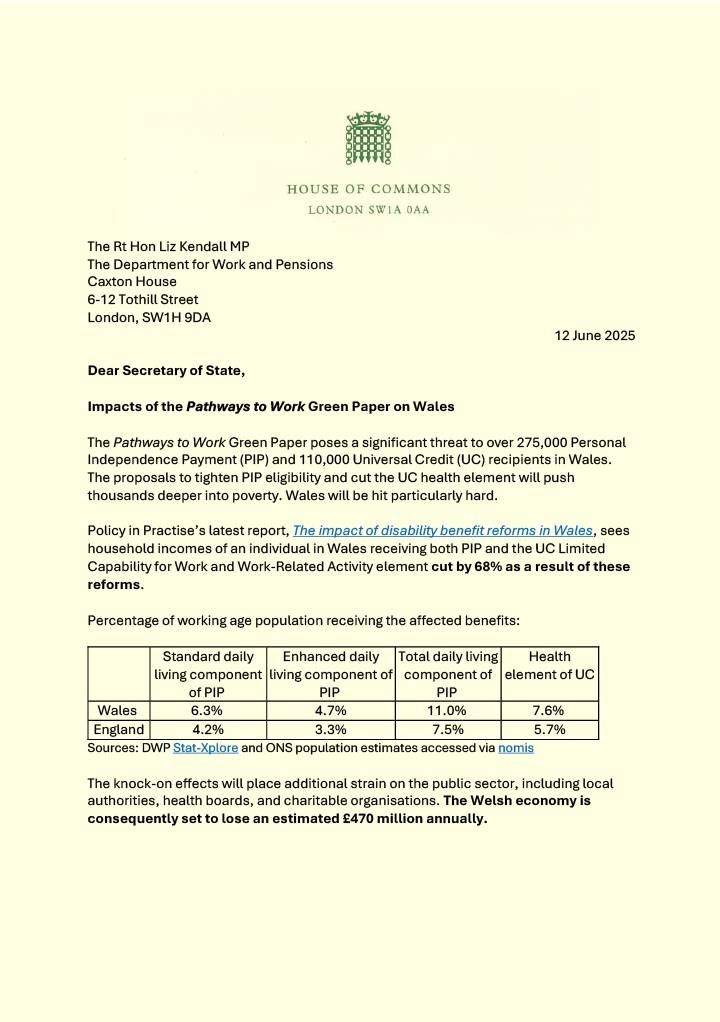
Below is an extract of a letter from Steve Witherden MP, which was co-signed and enthusiastically supported by unanimous democratic votes of Swansea and Cardiff & Valleys Disabled People Against Cuts groups, calling for the disability benefit cuts to be abandoned, and for disabled people to be involved in the reform of the welfare system.

Dear Secretary of State,

Impacts of the Pathways to Work Green Paper on Wales

The Pathways to Work Green Paper poses a significant threat to over 275,000 Personal Independence Payment (PIP) and 110,000 Universal Credit (UC) recipients in Wales.

The proposals to tighten PIP eligibility and cut the UC health element will push thousands deeper into poverty. Wales will be hit particularly hard.

Policy in Practise’s latest report, The impact of disability benefit reforms in Wales, sees household incomes of an individual in Wales receiving both PIP and the UC Limited Capability for Work and Work-Related Activity element cut by 68% as a result of these reforms.

The knock-on effects will place additional strain on the public sector, including local authorities, health boards, and charitable organisations. The Welsh economy is consequently set to lose an estimated £470 million annually.

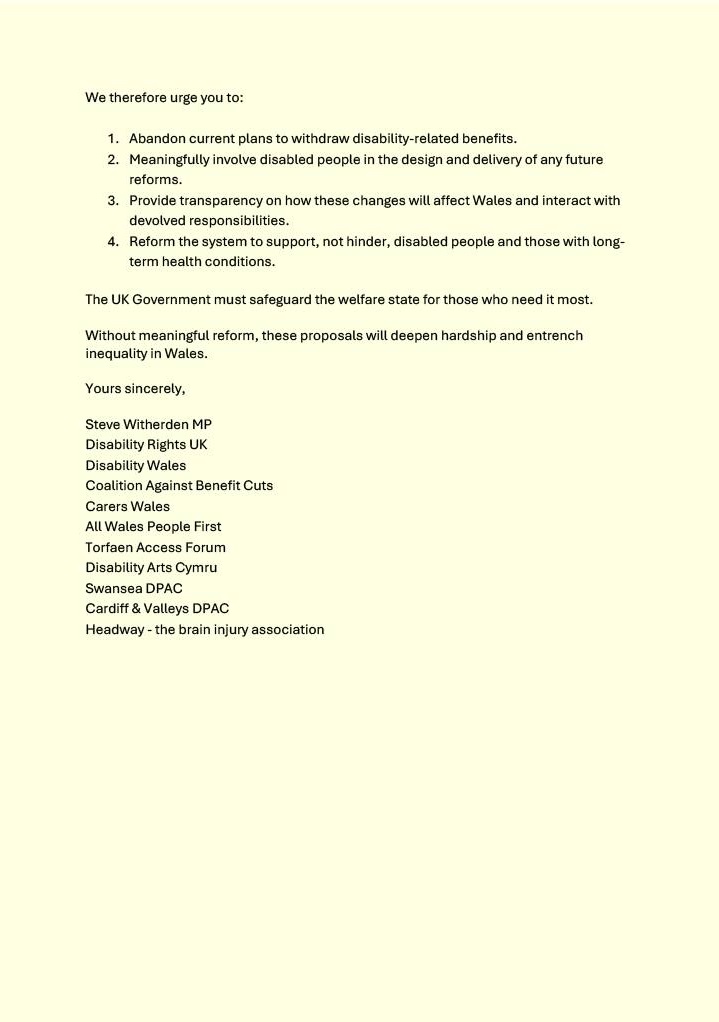
We therefore urge you to:

1. Abandon current plans to withdraw disability-related benefits.

2. Meaningfully involve disabled people in the design and delivery of any future reforms.

3. Provide transparency on how these changes will affect Wales and interact with devolved responsibilities.

4. Reform the system to support, not hinder, disabled people and those with long-term health conditions.

The UK Government must safeguard the welfare state for those who need it most.

Without meaningful reform, these proposals will deepen hardship and entrench inequality in Wales.

Yours sincerely,

Steve Witherden MP
Disability Rights UK
Disability Wales
Coalition Against Benefit Cuts
Carers Wales
All Wales People First
Torfaen Access Forum
Disability Arts Cymru
Swansea DPAC
Cardiff & Valleys DPAC
Headway – the brain injury association

The letter on Facebook

The letter on X (Twitter)


A letter on house of commons paper.

A letter on house of commons paper.

Jun 182025
 
DPAC Logo with text underneath "Disabled People Against Cuts" and then web address dpac.uk.net

UK Deaf and Disabled People’s Monitoring Coalition

The UK Deaf and Disabled People’s Monitoring Coalition is a secular network of user led Deaf and Disabled People’s Organisations across the United Kingdom.

This paper sets out the reasons why we are not able to support the Terminally Ill Adults (End of Life) bill following report stage.

Many of our concerns echo those voiced by the Royal College of Psychiatrists, Royal College of Physicians and Association of Palliative Medicine.

We do not believe the bill has received sufficient scrutiny for legislation that will so fundamentally impact the relationship between doctor and patient.

For the Abortion Act there was months of engagement prior to introducing the bill and for the Human Embryology and Fertilisation Act, there was the Warnock Commission.

For this bill there has been no direct consultation with marginalised groups and the speed and inaccessibility of the passage of the bill has been a barrier to engagement.

The equalities impact assessment is frighteningly lacking and there has been insufficient consideration of adverse equalities impacts in jurisdictions where it is legal.

For example, a lawsuit is being brought against California’s End of Life Option Act on the grounds that it puts disabled people at greater risk of being coerced into seeking assisted suicide.

At the same time, the opinions of professionals with the most relevant expertise have been largely ignored.

Below we set out our key concerns with the bill as it now stands, a list of the amendments we supported which would have improved safeguards but which were voted down and a list of amendments that have been held up as safeguards but which fail to ally our fears.

This paper concludes with our recommendations for MPs.

KEY CONCERNS

No guaranteed access to palliative care. The bill places a duty on the Secretary of State to guarantee access to assisted dying but not to palliative care. Where deaths in pain do occur, the person has not accessed specialist palliative care or accessed it too late or for too short a time. One in four people who need palliative care do not get it. Palliative care provision across the country is patchy and facing cuts with hospice care under-funded.

No emphasis on suicide prevention. This is one key reason why the Royal College of Psychiatrists are against this bill. Suicidal ideation and hopelessness are treatable including for people with terminal illness. There is no mandatory psychological assessment as part of the application process and people who both meet the eligibility criteria for the bill and have mental health diagnoses are not excluded.

Inaccurate prognoses. People who are terminally ill with six month prognoses may have many months and even years left to live. According to figures from the Department for Work and Pensions, one in five benefit claimants given less than 6 months to live are still alive three months later. This makes it less inevitable that people with terminal illness should want to end their lives.

Inappropriate use of Mental Capacity Act as a safeguard. The MCA was not designed for this purpose and has a presumption of capacity. It is possible to be assessed under the MCA as having capacity and yet having impaired judgement due to for example, depression, malnutrition or coercive control. Doctors will be trained in coercive control but psychiatrists and other professionals report how difficult this is to detect even with many years of experience.

Insufficient provision for keeping people alive. Changes to a person’s circumstances can change their wish to die. The place for a multi-disciplinary team assessment is at the very beginning of the process with the aim of identifying options to improve the person’s situation. Instead, the bill has a multi-disciplinary panel at the end of the process rubber-stamping applications for assisted dying with no requirement to meet the person. There is no requirement for a doctor to consult a specialist in the patient’s condition or for the patient to have a meeting with a palliative care specialist. Patients will be able to access assisted dying more quickly and easily than social care, mental health support or suitable housing.

No requirement to include family members. Evidence from jurisdictions where assisted dying is legal demonstrates how traumatic it can be for family members to lose their loved ones in this way, especially if they do not find out until after and especially if their loved one made their decision when experiencing impaired judgement. There is no right to appeal assisted dying decisions for family members.

Safety concerns about assisted dying drugs. Death by assisted suicide can be very unpleasant. The patient needs to swallow a large number of pills which the body may reject resulting in vomiting. The drugs used as the same as used for death row prisoners and have been linked to, for example, experiences of dry drowning. The bill impact assessment says the “safety and efficacy” of substances used for assisted dying is “currently difficult to assess”.

Fear that assisted dying will replace access to services for terminally ill and disabled people wanting to live. The impact assessment shows savings that will be made to both health and social care budgets through this bill. This has increased concerns that the choice to live will be removed for those of us who cost more in support. One care home group finance manager messaged colleagues about savings they could realise through “aggressive promotion” of assisted dying as an option for residents. The voting down of an amendment to limit advertising of the assisted dying service alongside costs in the impact assessment for an NHS education campaign is concerning.

Insufficient attention to equalities impacts. The equality impact assessment accompanying the bill was not published until after Committee stage and is unfit for purpose. It concentrates on equal access to the assisted dying service and omits many key risks in terms of adverse inequalities impacts, ignoring data on for example low levels of awareness and access to palliative care services by racialised minorities and those facing socio-economic disadvantage.

Increasing non-assisted suicide rate. There is no evidence that legalisation of assisted dying reduces non-assisted suicides. Research on the contrary shows a rise in the overall suicide rate even after accounting for those deaths by assisted dying. This is likely due to suicide contagion. This risk needs to be understood within the current UK context of escalating levels of mental distress and already increasing suicide rates. There has been no discussion of this or proposal of measures to mitigate this risk.

Too great a reliance on Henry VIII powers. A worrying amount in the bill delegates powers to Ministers to make secondary legislation without full Parliamentary scrutiny. This is even more concerning for a bill that will prompt the founding Act of the NHS to be opened up. Deaf and Disabled people are disproportionately reliant on the NHS and potentially at significant risk from this bill. This aspect of the bill is therefore of great concern to us.

PROPOSED SAFEGUARDING CONCERNS THAT WERE VOTED DOWN

To close the anorexia loophole. The bill gives eligibility to people where the physical condition that meets the criteria is either the result of a mental health condition or of Voluntary Stopping Eating and Drinking. This is a huge concern within the context of a mental health system unable to cope with demand where young women with severe and enduring eating disorders are routinely labelled as “hopeless cases” and transferred onto palliative instead of receiving the support they need to live. In other jurisdictions Voluntary Stopping Eating and Drinking (VSED) is used by people who don’t otherwise meet the eligibility criteria to gain access to assisted dying.

To exclude from eligibility people with who are homeless and prisoners. Disabled people are over-represented among both as are self-harm and suicidal ideation. Homelessness and conditions in prisons are growing problems. These amendments would have protected against people choosing assisted dying because of adverse external factors rather than the “clear, settled and informed wish to die” that is part of the eligibility criteria within the bill.

Doctors to ensure that there are no remediable suicide risk factors before proceeding to the initial discussion about assisted dying and for psychosocial assessments to be conducted at the start of the process. These amendments would have provided a safeguard against people with impaired judgement seeking assisted dying due to a mental health condition and/or suicidal ideation.

To exclude from eligibility those seeking assisted dying for the benefit of others. This could include financial concerns. This amendment would have been an important safeguard against coercion.

To exclude from eligibility those seeking assisted dying because they feel like a burden. This is particularly relevant within the context of inadequate social care support services so that family members and friends experience greater strain. Around one half of those seeking assisted dying in Oregon consistently cite being a burden as a primary reason compared to one third concerned about pain.

To replace use of the Mental Capacity Act to assess capacity to make a “clear, settled and informed wish to die” with a new ability test to assess ability to make a clear, settled and informed wish to die free from impaired judgement.

For doctors not to be able to raise assisted dying with patients unless they mention it first. This is a major concern for disabled people due to the prevalence of negative medical attitudes towards disabled people’s quality of life and the risk of medical coercion. This risk is evidenced by experiences during COVID when Do Not Resuscitate orders were unlawfully placed on the medical notes of disabled people without their consent as well as a weight of evidence concerning discrimination and medical negligence within the health system. An amendment not to permit doctors to raise assisted dying with children was voted down at Committee stage but accepted at Report stage.

To prevent doctors from raising assisted dying as an option with people with learning disabilities and people who are autistic. Instead, clause 20 provides access to independent advocates for people in this situation.

Inclusion of a 28-day period between a terminal diagnosis and the start of the assisted suicide process. This is important because fear and depression are common responses to terminal diagnoses. Practitioners in other jurisdictions told the Committee at oral evidence how giving patients the option of assisted dying when first diagnosed calms their fears and that many never end up taking the drugs because their fears over pain never materialise. As proven by the lived experience of our members, the same can be achieved by better support accompanying diagnosis, including, crucially, peer support.

AMENDMENTS THAT FAIL TO ALLAY CONCERNS

Training for doctors in coercive control.

According to professional opinions shared with the Committee, it is very difficult even for those with many years of experience to detect coercive control.

Much stronger safeguards would have been making psychological assessments mandatory as part of the application process and excluding from eligibility those feeling a burden and those acting for the benefit of others.

Provision of independent advocates for “qualifying persons” including “those with learning disabilities, mental disorders, autism or other ‘substantial difficulties’ in understanding processes or information”.

The focus of this clause is on access to information rather than protection from coercion. As a safeguard it is limited in that those willing to act as independent advocates will likely be in favour of assisted dying and may therefore have a bias towards ensuring access to the service that clouds their alertness from detecting coercion.

It is unclear from where the independent advocates for this role will be sourced.

New multi-disciplinary panel including a psychiatrist and social worker.

This will replace the role of the high court judge in rubber stamping approvals at the end of the application process and with no requirement to meet the person or involve their family.

The proper place for this panel is at the beginning of the process.

Multi-disciplinary team involvement is good practice when needing to identify holistic solutions for improving a person’s situation.

The role of the multi-disciplinary panel as prescribed by the bill represents a mis-use of MDT involvement. It will not enable the psychiatrist or social worker to utilise their expertise.

Professionals willing to be on these panels will likely be in favour of assisted dying and may therefore have a bias that limits their ability to detect coercion.

It is also unclear how these panels will be resourced given shortages within both psychiatry and social work.

RECOMMENDATION

We urge MPs to vote against this bill at third reading. A Private Members Bill is not the way to legislate on such a complex issue and one that puts large groups of the most disadvantaged members of society at significant risk for the benefit of a small minority. A Royal Commission where objective scrutiny can take place and that hears equally from all sides of the debate is needed. Due to insufficient transparency in jurisdictions where assisted dying is legal there is a dearth of evidence. Attempts to remedy this and to plug research gaps must also happen.

Jun 182025
 
DPAC Logo with text underneath "Disabled People Against Cuts" and then web address dpac.uk.net

By the UK DDPO Monitoring Coalition June 2025

Introduction

    1. The Equality Impact Assessment for the Terminally Ill Adults (End of Life) bill was published alongside the impact assessment on 2 May 2025.
    1. For a bill that proposes such fundamental changes to the practice of medicine in England and Wales, this was inexcusably late on in its passage through Parliament.
    1. Due regard for equalities impacts should occur at the beginning of any new initiative and inform the development of that initiative. An EqIA should not be treated as a bolt on extra.
    1. We have significant concerns about the content of this EqIA and agree with commentators who have raised concerns about its adequacy.1
    1. It takes at face value safeguards contained within the bill despite concerns raised by numerous professional bodies, organisations and individual witnesses as to their lack of strength.
    1. It also misses a number of potentially significant adverse equalities impacts and therefore also fails to propose measures to mitigate the risk of those.
    1. A criticism of the passage of the bill shared by doctors and Deaf and Disabled People’s Organisations (DDPOs) is the lack of engagement and account taken of our respective views, informed by expert opinion and lived experience, as well as those of other marginalised groups.2
    1. The EqIA is one example where our input would have been beneficial.

Summary of concerns

    1. Lateness of publication – the EqIA was published on 2 May, more than a month after the end of Committee stage and just two weeks before the first report stage debate.
    1. Coercion – the EqIA gives an inadequate assessment of risks of coercion and the strength of safeguards contained within the bill.
    1. Capacity – the EqIA fails to note question marks regarding the appropriateness of the bill’s use of the Mental Capaity Act (MCA) as a safeguard.
    1. Lack of disability understanding – mental health is inappropriately included as a separate category distinct from disability.
    1. Adverse equalities impacts gaps and omissions – there are a number of potential adverse equalities impacts relevant to the bill that are not included within the EqIA.
    1. These include:
      1. Disability – risk due to inadequate services to live
      1. Disability – risk of medical coercion
      1. Disability – risk from failure to exclude anorexia and voluntary stopping of eating and drinking
      1. LGBTQ+ – risk from fear of accessing palliative care services due to discrimination
      1. Racialised communities – lack of awareness and lower referral levels for end of life services
      1. Socio-economic disadvantage – risk of seeking assisted dying as a response to poverty
      1. Women – risk of coercion owing to inability to continue care-giving roles within the family
      1. Intersectional impacts for Disabled people experiencing socio-economic disadvantage; members of the LGBTQ+ community living with mental distress; women experiencing socio-economic disadvantage who are therefore at higher risk of domestic abuse
      1. Wider societal impacts including risk of an increase in non-assisted suicide rates and increased levels of disability hostility and hate crime

7. The EqIA is unfit for purpose and increases our already significant concerns regarding the adequacy of safeguards in the bill and its potential to cause adverse equalities impacts.

Jun 182025
 
DPAC Logo with text underneath "Disabled People Against Cuts" and then web address dpac.uk.net

Protest outside Cardiff disability cuts consultation

Cymraeg (Welsh) : Protest tu allan ymgynghoriad toriadau anabledd Caerdydd


Important update

The DWP have rescheduled their consultation on the disability cuts. The venue is now much more accessible and has better transport links.

This was the result of disabled voices calling out the injustices of the previous event.

The consultation is still unfair with the most controversial proposals not up for discussion.

Protest information

Outside Ty William Morgan, 6 Central Square, Cardiff, CF10 1EP

12:45 – 16:00 *

Monday the 23rd of June

* Please do not feel you have to stay for the full time.

It’s important that those wanting to attend the consultation are not prevented from doing so.


Protest outside Cardiff consultation Breaking - important update The DWP have rescheduled their consultation on the disability cuts. The venue is now much more accessible and has better transport links. This was the result of disabled voices calling out the injustices of the previous event. The consultation is still unfair with the most controversial proposals not up for discussion. Protest information Outside Ty William Morgan, 6 Central Square, Cardiff, CF10 1EP 12:45 - 16:00 Monday the 23rd of June Please do not feel you have to stay for the full time. It’s important that those wanting to attend the consultation are not prevented from doing so.

Protest! Disabled People Against Cuts Wales

The government want to take money and help away from disabled people.

Disabled people are worried and angry.

The government have a meeting with us in Wales.

Not many people are allowed to go to the meeting.

It is an unfair meeting.

We want people to protest outside the meeting.

A protest will give us hope.

The protest is on Monday 23rd June 2025 in Cardiff.

The protest starts at 12:45 and ends at 4pm. You don’t have to stay the whole time. You can join at any time.

The protest is outside Ty William Morgan, 6 Central Square, Cardiff, CF10 1EP.


Protest! Disabled People Against Cuts Wales The government want to take money and help away from disabled people. Disabled people are worried and angry. The government have a meeting with us in Wales. Not many people are allowed to go to the meeting. It is an unfair meeting. We want people to protest outside the meeting. A protest will give us hope. The protest is on Monday 23rd June 2025 in Cardiff. The protest starts at 12:45 and ends at 4pm. You don’t have to stay the whole time. You can join at any time. The protest is outside Ty William Morgan, 6 Central Square, Cardiff, CF10 1EP.


Cymraeg (Welsh) version

Protest tu allan ymgynghoriad toriadau anabledd Caerdydd

Newydd – diweddariad pwysig

Mae’r DWP wedi aildrefnu eu hymgynghoriad ar y toriadau anabledd. Mae’r lleoliad newydd yn llawer haws i’w gyrraedd ac efo cysylltiadau trafnidiaeth gwell.

Mae hyn oherwydd bod pobl anabl wedi galw allan anhegwch y digwyddiad.

Mae’r ymgynghoriad dal yn anheg gan fod yr awgrymiadau mwyaf dadleuol dal ddim yn cael eu trafod

Gwybodaeth protest
Tu allan Tŷ William Morgan, 6 Sgwâr Canolog, Caerdydd, CF10 1EP

12:45 – 16:00

Dydd Llun Mehefin 23

Plȋs peidiwch a teimlo eich bod yn gorfod aros am yr amser i gyd.
Mae’n bwysig bod y rhai sydd eisiau mynychu’r ymgynghoriad ddim yn cael eu stopio rhag gwneud hynny.


Protest!

Pobl Anabl Yn Erbyn Toriadau

Mae’r llywodraeth eisiau cymryd arian a help o bobl anabl.

Mae pobl anabl yn poeni ac yn flin.

Mae’r llywodraeth yn cael cyfarfod efo ni yng Nghymru.

Does dim llawer o bobl yn cael mynd i’r cyfarfod.

Mae’r cyfarfod yn anheg.

‘Da ni eisiau pobl i brotestio tu allan i’r cyfarfod

Bydd protest yn rhoi gobaith i ni.

Mae’r brotest ar ddydd Llun 23 Mehefin 2025 yng Nghaerdydd.

Mae’r brotest yn dechrau am 12:45 ac yn gorffen am 4yp. ‘Da chi ddim yn gorfod aros am yr holl amser. Gallwch ymuno ar unrhyw adeg.

Bydd y brotest tu allan Tŷ William Morgan, 6 Sgwâr Canolog, Caerdydd, CF10 1EP


Social media:

UK:
 
X/Twitter: Disabled People Against Cuts
Facebook: DPAC (Disabled People Against Cuts)
Instagram: disabledpeopleagainstcuts
Wales:
Facebook: Disabled People Against Cuts – Cymru
Instagram: dpac_cymru
Bluesky: @dpac-cymru.bsky.social
Jun 182025
 
DPAC Logo with text underneath "Disabled People Against Cuts" and then web address dpac.uk.net
Stop Disability Benefits Cuts Bill – Liverpool Protest

⏰️ Tuesday 1st of July, 4pm [Previously 3rd July]
at the front of Lime Street Station L3 5QB

Join Merseyside DPAC and Merseyside Crips Against Cuts in a protest against the government’s planned cuts to disability benefits that will push more disabled people into poverty. This is part of a National Day of Action

Access info:
– There are steps at the front of the station with level access routes to the right hand side and a lift from pavement level at the front
– There are multiple accessible toilets inside Lime Street Station
– If you need quiet space at any point during the protest, Liverpool Central Library on William Brown Street (L3 8EW) is 500m from the station and will be open throughout
– This is a busy city centre location, please feel free to bring ear defenders, noise cancelling headphones or any other accessibility devices
– Masks encouraged to protect immuno-compromised members of our community
– If you have any further access queries, please contact this page by DM
A poster with a bloody red handprint with the word "stop!". A stamp in red says, in all-caps, UPDATE!
Text reads: national day of action. The Disability Cuts Bill. Liverpool protest. Tuesday 1st July - 4pm Front of Lime Street Station #TakingThePIP #DisabledNotDisposable #WelfareNotWarfare #NotYourScapegoat On the left is the Merseyside DPAC logo, with Disabled People Against Cuts DPAC.UK.NET written underneath. The logo is a pink, blue, red, green wheel being held by four hands of different skin tones. In the center is an upside-down black triangle bearing the letters D P A C. On the right is the Liverpool and Merseyside Crips against Cuts logo. It is a wheelchair with a giant red fist rising through it, holding a walking-stick. Crips against cuts is written in red.
Jun 122025
 
DPAC Logo with text underneath "Disabled People Against Cuts" and then web address dpac.uk.net

Save the date. Protest the disability cuts.

The government is expected to introduce the disability cuts bill on the 18th of June, and vote on it as soon as July 1st.

They are not even waiting for the sham “consultation” to end on 30th of June.

Disabled People Against Cuts and allies are organising a mass Protest of Parliament on June 30th and a national day of action on July 1st when the second reading of the bill will occur.

More details to follow but it is essential that as many people as possible attend these events.

Some funding is available for travel and other essential costs. Email mail@dpac.uk.net

If you are able to arrange a local protest on July 1st please send us details of your event.

A drawing of the politician Rachel Reeves in a robber's outfit and a sack that says Disability Benefits

Welfare Not Warfare

End Labour’s War on Disabled People

Tax the Rich, Not Crips.

The Government are lying about cuts.

  • Total planned disability benefit cuts are at least £9 billion and not the £4.8 billion being reported.

  • Number of households to be plunged into poverty by the PIP cuts alone is at least 350,000 – 4000,000 including 50,000 children.

  • 1.5 million Deaf and Disabled people will be badly impacted by the changes to PIP, not just the 800,000 being reported.

  • MPs will be forced to vote on the cuts without having all the information and based on the misleading figures that have been reported.


Image of a person at the top of a cliff pushing someone out of a wheelchair. The Labour party logo. The Department for Work and Pensions logo.

What can I do as a disabled person?

  • If you’re not already a member – join DPAC!

  • Set up a DPAC group in your area if one doesn’t exist!

  • Participate in DPAC Actions to Scrap the Benefit Cuts

  • Organise locally with other Disabled People to mobilise support for our campaign

  • Contact unions, trades councils, Labour party branches, and build a broad based movement to reverse these austerity cuts.

For more details of local groups and actions, keep checking this page!


Jun 102025
 
DPAC Logo with text underneath "Disabled People Against Cuts" and then web address dpac.uk.net
Portrait of Stephen Timms MP
Disabled People Against Cuts (DPAC) has today written to Stephen Timms, the Minister of State for Social Security and Disability, to raise our serious concerns with the quality and fairness of the so-called “consultation” being carried out on disability benefit cuts.
We are asking for the consultation to be extended, and for urgent action to address the failings.
We urge the government start again on welfare reform, listening to disabled people and carers in a genuine process of co-production.
This is what we said in our letter:
Dear Stephen Timms,

I am writing to you on behalf of Disabled People Against Cuts (DPAC) to urgently raise concerns regarding the accessibility of the consultation on the benefits cuts proposed in the March 2025 Green Paper. In light of the limited time available for the consultation which is due to close on 30 June 2025, you are asked to take urgent action to address our concerns, confirm what steps are being taken and to extend the time available for disabled people to engage with the consultation given the accessibility issues they have faced to date. In order for the consultation to fulfil its purpose. Disabled people who are likely to be affected by proposed benefits changes, must have a proper and meaningful opportunity to engage with the consultation and accessible arrangements must therefore be urgently made to facilitate their proper participation in the consultation.

Our concerns

The face-to-face consultation in Cardiff on the 3rd June was cancelled less than two days after the venue was announced, with only one working day left before the event.

The DWP has claimed that the Cardiff venue cancelled the meeting at the last minute yet the venue itself was already inaccessible to disabled people. No transport to the venue was offered by the DWP for those who wanted to take part.

The booked venue was only revealed at the last minute. This was despite disabled people asking multiple times, over weeks, for information so that they could plan journeys, accommodation, and access requirements. The venue was far out of the centre of Cardiff, and completely inaccessible for many disabled people, especially at such short notice. It would have meant a wheelchair user travelling 1.6 miles unassisted. Shockingly this was the only face-to-face consultation event for the whole of Wales.

People at other DWP consultations in England have had similarly poor experiences. For example, lack of accessibility of the venue led to only 9 out of 15 people managing to attend the in-person consultation event in the South West.

The in-person consultations did not cover the North of England – Carlisle and Newcastle were completely missed out. For Wales, the North and South are poorly connected so any meaningful consultation would require not just an event in the South but another in the North.

In Northern Ireland no face-to-face consultations appear to be taking place at all and the date of the online consultation was only announced last week.

We have also received concerning feedback about the online consultations and the understanding of those conducting the meeting. One attendee reported:

It was also clear that not all participants fully understood the consultation questions or their implications, particularly those without background knowledge of the benefits system. This raises significant concerns about the quality and reliability of the feedback being gathered. At one point, the facilitator was unable to explain New Style ESA or JSA, and I had to step in to clarify how these benefits work, especially for those who do not qualify for income-related support. It was concerning to witness such a knowledge gap from someone facilitating a consultation on welfare reform.

Although we were told that all feedback would be recorded — even on topics not officially included in the consultation — it is unclear how that information will be used or whether it will influence policy development in any meaningful way.

The impact of the failure to make arrangements for accessible and meaningful consultation meetings

Only having online consultations and/or not having sufficient and/or accessible face-to-face consultations is unacceptable because, as I’m sure you’re aware, at least one-third of disabled people do not have access to the internet or the skills needed to take part in an online meeting. This obviously means that many people who will be most affected by the Government’s planned cuts to social security payments will be totally excluded from taking part in any consultation events.

We are concerned that the consultation not only doesn’t deal with many of the policies that are most likely to affect disabled people (as it only deals with 12 out of 22 policies) but fails to properly engage disabled people on those limited topics. We are also concerned that full impact assessments which would inform engagement with the consultation are not available and will not be made available during the course of the consultation.

The whole process to date seems inaccessible, chaotic and incomplete and given how few people are being consulted, both virtually and in person, we are extremely concerned about how representative this process is and whether it meets even the most basic standards of engagement with disabled people and their advocates.

Furthermore it is DPAC’s view that the whole process is flawed and is non-compliant with Articles 4 (3) and 33.3 of the UN CRPD and General Comment 7.  It also violates the Gunning Principles and the requirements to make reasonable adjustments under the Equality Act and is therefore potentially unlawful.  The only meaningful remedy is to withdraw the proposals and meaningfully engage with disabled people and our representative organisations to ensure all government proposals are compliant with the UN CRPD and equality legislation and ensure progressive realisation of the articles as well as compliance with equality duties.  Failure to address these flaws may result in legal action and sanction from the disability committee of the UN.

It is essential that the government start again on welfare reform, listening to disabled people and carers in a genuine process of co-production.

In light of the concerns outlined above and the limited time available, we invite you within 7 days i.e.  by June 16th to confirm:

1.     What steps are being taken to ensure that online and in-person consultation events are accessible and available to affected disabled people across all relevant regions. This should include ensuring accessible venues, across a range of regions as well as adequate notice to allow for attendance arrangements to be made.;

2.     That the time for engagement with the consultation will be extended by at least 4 weeks, to reflect the delays in making accessible arrangements and allow meaningful engagement with disabled people.

We look forward to your response by June 16th.


Linda Burnip

On behalf of the DPAC steering group

c.c. Debbie Abrahams, Chair of the Work and Pensions Select Committee,

Katie Farrington, Director General Social Security, Disability and Pensions

Helga Swindenbank, Head of Disability Services

May 302025
 
DPAC Logo with text underneath "Disabled People Against Cuts" and then web address dpac.uk.net

Welsh disability cuts consultation cancelled

The only face-to-face consultation for the whole of Wales has now been cancelled, after blatant and unlawful disability discrimination by the DWP in arranging such an inaccessible venue at the last minute.

The Cardiff disability cuts consultation on the 3rd was always going to be unfair, with half the proposals, the most important half, completely off the table for discussion.


Disabled people in Wales denied a voice

According to DWP email communications, there will now not be any in-person consultation on the disability cuts in Wales.

We demand that any house of commons vote on the proposals must not go ahead until we have had a full and genuine public consultation in Wales.

The DWP are now only offering an online-only event at the end of June. This is not acceptable. It is possible that MPs will already have voted by then.

Join us for a protest in Cardiff on the 3rd June

DPAC are sticking with our existing plans to protest.

Meet us outside the front of Cardiff Central train station at noon on the 3rd.

The DWP have shown themselves to be incapable of organising a fair consultation. Disabled People Against Cuts will hold our own.

Fortunately, we no longer have to worry about transport to an inaccessible location, and we will hold our protest at our original meeting point.

We invite everyone to join us and have their say. We demand that the DWP turn up and listen.

Updated plans for the day are available on our LinkTree: LinkTr.ee/SwanseaDPAC

Labour Minister dodges debate

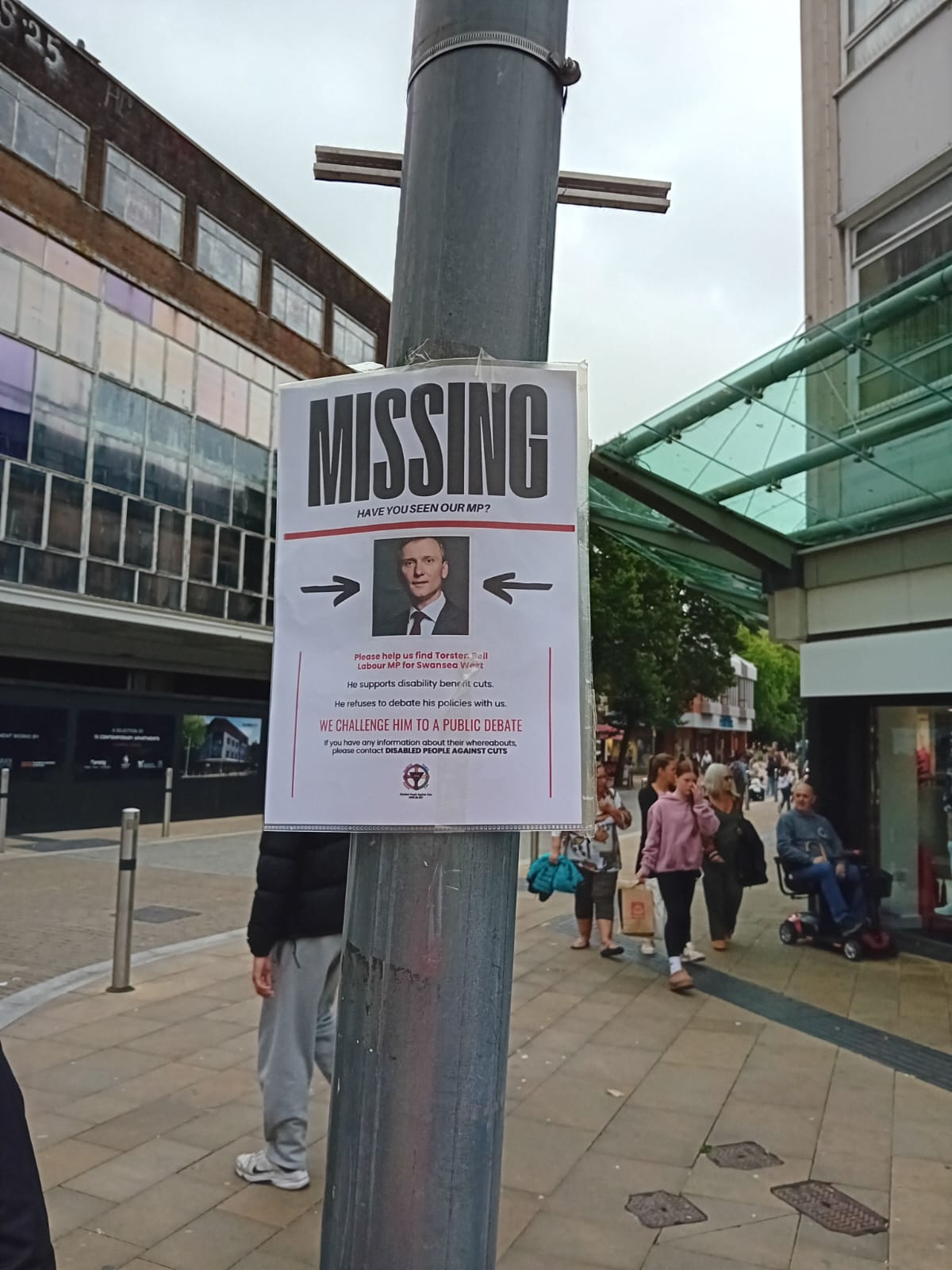
A poster on a lamppost in Swansea. It says "Missing: have you seen our MP?" and has a picture of Torsten Bell MP.
Missing: have you seen our MP?

The Swansea West MP, Torsten Bell, a DWP minister, who defends the cuts, has insulted us and has refused to debate with us. His excuse was that a public consultation is taking place. Now that there is no public consultation taking place for the whole of Wales, Torsten must stop dodging and finally accept our invitation to debate his policies with Swansea Disabled People Against Cuts. We have written to him once again to ask for a fair and respectful public debate.

Dear Torsten Bell MP,

As you are aware, Disabled People Against Cuts (DPAC) members in Swansea have repeatedly invited you to publicly debate with us on the issue of disability benefit cuts, which you have defended on Newsnight.

The only face-to-face consultation for the whole of Wales has now been cancelled, after blatant and unlawful disability discrimination by the DWP in arranging such an inaccessible venue at the last minute.

At 6pm on Friday 25 April, responding to our request for a debate, and after press attention over your lack of reply, you told us that you “have to politely decline given the Department is carrying out a public consultation with public events on this issue.”

Given your stated reason for declining, and given (according to the DWP) that there will now be no Wales in-person consultation, Swansea DPAC expect you to now “politely accept” our invitation, as supported in an open letter signed by more than 250 individuals and organisations, including a national Labour-affiliated trade union. (bit.ly/swansea-dpac-debate-invite)

We would ensure that the debate is carried out fairly, respectfully, and in an orderly fashion. Please let us know when you are available and we will book a venue.

We also seek a public retraction and apology for your repeated public accusations of dishonesty against Swansea Disabled People Against Cuts. We robustly defend claims we have made about your language and refusal to engage with us as asked. Given your accusations, we are putting this letter on the record, copying to journalists, and we will publish any reply, so that the public can judge.

Kind regards,

Swansea Disabled People Against Cuts


Stop Labour’s disability cuts

The proposals are fatally flawed, and the “pathways to work” green paper must be retracted.

The government must start again on welfare reform, listening to disabled people and carers in a genuine process of co-production. It cannot be an excuse for short-term budget cuts.

A photo of people protesting in Swansea city centre. They are holding a homemade banner that says "Disabled People Against Cuts" with the DPAC logo, which is a pink, purple, blue, green circle being held by four hands of varying skin tones. In the center is a triangle bearing the letters D P A C. Above the banner is a homemade placard that says "Betrayed and ignored by the Labour party". Beneath the banner is a placard in trans pride colours with a Welsh dragon and a DPAC logo. It says "Stand together". A young man and a young woman are holding the banner. To their left is a woman in a wheelchair holding a socialist party placard that says "stop benefit cuts". In the background is a man handing out DPAC leaflets.

Above: Swansea Disabled People Against Cuts protesting

Notes:

Disabled People Against Cuts (DPAC) Cymru is a group of disabled people from across Wales. It is made up of Swansea DPAC, Cardiff and Valleys DPAC, and individual members in West, North, and Mid Wales. We are affiliated to Disabled People Against Cuts nationally.

Disabled People Against Cuts Cymru are releasing a full press statement on Monday morning. Press queries can be sent to swanseadpac@gmail.com

We also invite anyone interested in coming to our fortnightly meetings, or receiving our meeting minutes and email updates, to please get in touch.

May 272025
 
DPAC Logo with text underneath "Disabled People Against Cuts" and then web address dpac.uk.net

A mock-up 'missing' poster for Rachel Reeves, Member of Parliament for Leeds West and Pudsey and Chancellor of the Exchequer. There are two photos of Rachel Reeves, below a heading of 'missing' in white text on a pink background. The text below the photos reads, 'Rachel, aged 46, has not been seen by any disabled constituents for several weeks. Rachel, we are here for you, any time you want to talk about your addiction to cuts, imaginary fiscal rules, discredited austerity economics and expensive corporate gifts.' 'Please email mail@dpac.org.uk if you see this member of Parliament. To help democracy please remind your MP that they must listen to you and not cut what you need to live

Picture shows image of Rachel Reeves with following text: Dear Rachel ... ACTION Leeds DPAC and Leeds, Wakefield & York Unite Community will be sharing the concerns of disabled people in West Leeds about the proposed cuts outside of Rachel Reeves MP's constituency office. Come and join us to offer your solidarity and support. Further information about the event to follow. SAT 31 MAY, 10AM-11:30am BRAMLEY CENTRE LS13 2ET

Missing – have you seen Rachel Reeves MP?

Join our action on 31st May

Leeds DPAC and Leeds, Wakefield & York Unite Community will be sharing the concerns of disabled people in West Leeds about the proposed cuts outside of Rachel Reeves MP’s constituency office.

1. we are collecting letters from people in Leeds and surrounding areas. We will be reading these out on video, and sharing them on social media on the week leading up to the action.
2.  for the action itself we will be reading out the letters (via a sound system) and holding a stall.
Come and join us to offer your solidarity and support.
Saturday 31 MAY, 10AM-11:30am
Bramley Centre LS13 2ET
Facebook event page: https://fb.me/e/2KE3gkXJh
We will be sharing the videos and other information on our Instagram account (@leedsdpac) and on facebook https://www.facebook.com/DPACLeeds
“Rachel, aged 46, has not been seen by any disabled constituents for several weeks. Rachel, we are here for you, any time you want to talk about your addiction to cuts, imaginary fiscal rules, discredited austerity economics and expensive corporate gifts.”

“Please contact Disabled People Against Cuts if you see this member of Parliament. To help democracy please remind your MP that they must listen to you and not cut what you need to live.”
May 272025
 
DPAC Logo with text underneath "Disabled People Against Cuts" and then web address dpac.uk.net

Summary of the Leeds DWP Consulta-sham 

Leeds, Marriot Hotel   Wednesday May 21st

A photo of a disability protest outside a Marriott hotel in Leeds. In the center is a large Disabled People Against Cuts banner that says 'Rights not charity'. Other placards say 'Hands off PIP', 'Welfare not warfare', 'Blood on DWP' (with two red hand prints) and 'Benefit cuts kill'. There are seven protestors in the photo. On the left in purple is a protestor in a wheelchair. On the right is a protestor with red hair and red boots and a red outfit in a wheelchair. In the background is a security guard looking stern.

6 Leeds DPAC members made their way to the Marriot Hotel to protest against the Labour Government and DWP Pathways to Work Consultation, that has now received the nation-wide moniker of Consulta-sham. One of our member was (un)lucky enough to have been given a ticket to enter the sham and the other 5 of us, made our way to the hotel steps to unfurl our banner and begin our chants. We were met by the DWP lead organiser of the event and 2 security guards who informed us we were on Hotel property and that we would have to stand in front of the steps. The DWP spokesperson tried to be polite whilst we asked why a paltry 20 people had been offered tickets to get in. He said rather confusing that if there was spare space he’d come and invite us in – this never happened although only 15 people turned up for the con-sulta-sham. 

We began our chants, “welfare, not warfare, you say cut-backs, we say fight-back!” Trevelyan Square is a busy square so plenty of people were witness to our protest. We gave out flyers about the Green Paper and explained it’s likely effects on our community. People in general were very supportive. 

We had the pleasure of being joined by activists in Unite the Union and Crips Against Cuts, who raised the volume and energy. A heartfelt thanks to them!

Our comrade inside the meeting stated:

“There were as many DWP staff as consultees in the meeting – clearly not a question of space then. We asked if our comrades could come in as there was spare space but were told that the hotel ‘security’ had blocked the entry of anyone else! The hotel said it contravened their risk assessment. We were asked pre-scripted questions. We were told that we couldn’t comment on proposed changed to the PIP scoring system despite this being the most impactful proposed change. I pointed out it was misleading to call this event ‘Pathways to Work’ given that PIP isn’t an out of work benefit. We explained that DLA and PIP are not lilke4-like so moving 16-18 years olds to PIP may lose their entitlement. I expressed concern about this group were supposed to do without life-supporting benefits, especially those no loner able to live at home or leaving care. The questions were ostensibly focused on getting people into work but I pointed out that without addressing Access to Work or any commitment from employers to step-up their reasonable adjustments the support is not fit for purpose. I stressed that DWP work coaches aren’t knowledgeable enough to understand the range of health conditions they are charged with assessing.”

Ultimately, we all felt this consultation was not fit for purpose. Only asking pre-selected questions about the less impactful changes and only consulting a tiny minority of those affected renders the process toothless. Solidarity to those fighting these poorly thought out proposals

Next action in Leeds on 31st May

Leeds DPAC are running a stall in Rachel Reeves constituency with the Unite Community Leeds, Wakefield & York Branch
1. we are collecting letters from people in leeds and surrounding areas. We will be reading these out on video, and sharing them on social media on the week leading up to the action.
2. the action itself will be
10am – 12pm
Bramley Town Centre
31st May
We will be reading out the letters (via a sound system) and holding a stall.

More info: https://www.facebook.com/events/4069198743403992/

May 222025
 
DPAC Logo with text underneath "Disabled People Against Cuts" and then web address dpac.uk.net

#WelfareNotWarfare #TaxTheRich

People’s Assembly National Demonstration on Saturday 7th June 2025

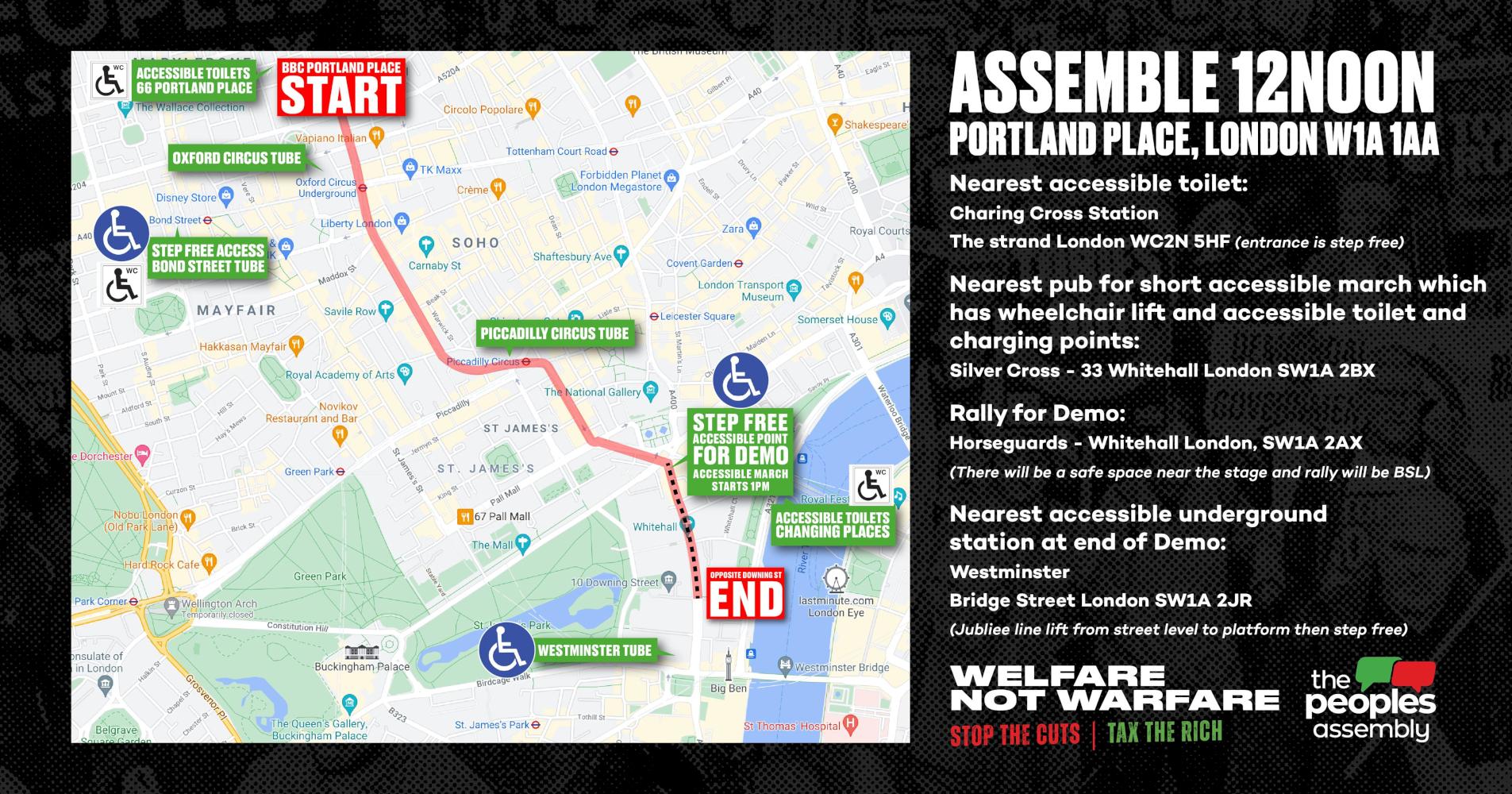
DPAC has been working with People’s Assembly on the accessibility information for the London demonstration.

There is a long march and a short march for accessibility.

Please see all the information below and graphics. There’s also a PDF copy for printing: peoples-assembly-7-june-2025-accessible

Note: Short accessible March will be assembling at 1:30pm (not 1pm as in the graphics)

To plan your journey to London and either the long or short accessible demo; Transport For London link is here: https://tfl.gov.uk/plan-a-journey/


Changing Places Toilets

For nearest changing places toilets on the day which are accessible, the address and times of opening are here:

Changing places toilets
9 Victoria Embankment
London WC2N 5AQ
Open on Saturday 7am to 8.30pm


Long March

The long march will assemble at 12 noon

Outside BBC HQ, Portland Place, London W1A 1AA

Disabled people will be leading the long March should they chose to do that and it will be in front of the banner so plenty of room to move and set the pace

Please assemble there and stewards will lead disabled people to the front of the stewards box for the demo.

Nearest Accessible underground Station for Main March for Portland Place is

Bond Street Underground Station
Oxford Street
London W1C 1JB

(Both Jubliee and Elizabeth line stop there. Step free from train to platform lifts from platform to street level)

Nearest Accessible toilet & cafe for main march:

66 Portland Place
London W1B 1AD
(Accessible toilets are located in the basement & sixth floor of building)

Cafe entrance is step free
(Cafe is open 10 am to 5pm on a Saturday)


Short March

Short accessible March will be assembling at 1:30pm

Assemble at:

North End of Whitehall near Trafalgar Square
Whitehall London SW1A 2HQ

Nearest accessible toilet is Charing Cross Station step free from street.
Need a Radar Key or contact station staff to access:
Charing Cross Station
The Strand London WC2N 5HF

(Main march will pause to allow short march to join and lead demo to rally will be at Horseguards Whitehall London SW1A 2AX

Rally will have a safe space in front of the stage for disabled people to access

Rally will be BSL


If you need to charge mobility scooter/power wheelchair or need access to accessible toilet :

Silver Cross Pub
33 Whitehall
London SW1A 2BX

Pub has wheelchair lift at entrance to access.

Accessible toilet is near the bar and access is a radar key


Getting home

Nearest accessible underground station for end of Demo is:

Westminster Underground Station
Bridge street
Westminster
London
SW1A 2JR

May 212025
 
DPAC Logo with text underneath "Disabled People Against Cuts" and then web address dpac.uk.net

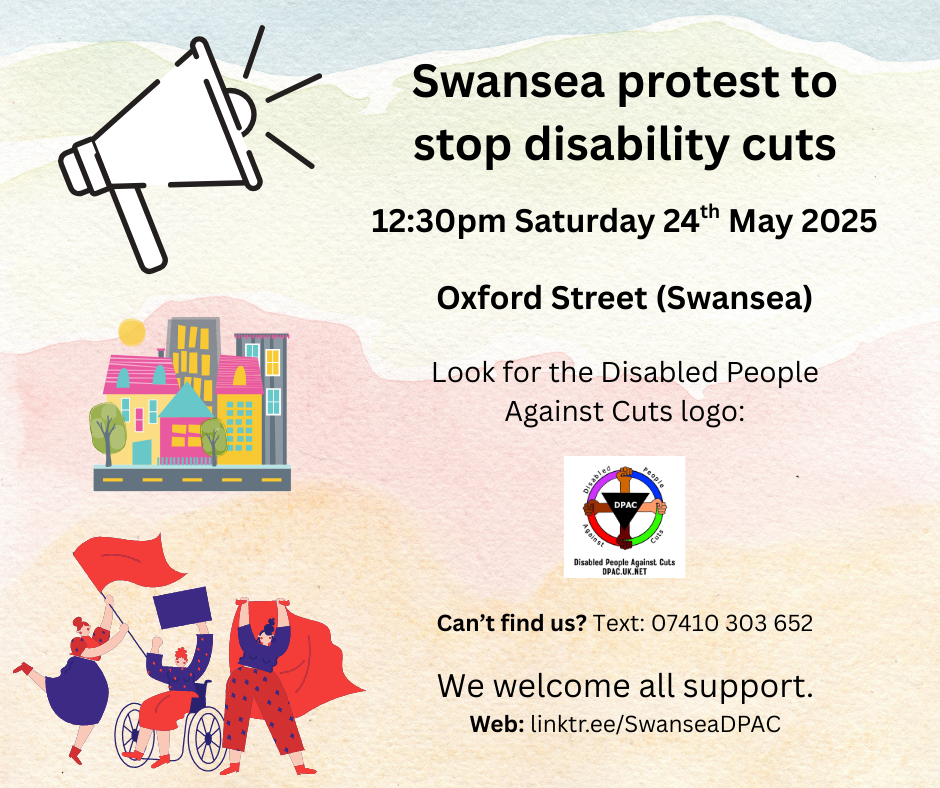
There are disability protests happening in Wales this weekend in Swansea and Cardiff.

Promotional graphics for social media are given at the end.

Swansea protest to stop disability cuts

Swansea protest - stop disability

12:30pm Saturday 24th May 2025

Oxford Street (Swansea)

Look for the Disabled People Against Cuts logo (a red, pink, blue, green wheel with a black triangle in the middle)

We welcome all support

Web: LinkTr.ee/SwanseaDPAC

Here is our leaflet for the day: swansea-dpac-leaflet (PDF)


Cardiff – Sit. Stand. Speak. Fight the benefit cuts. #WelfareNotWarfare

A poster with a person with a walking stick raising their fist and sunbeams radiating from their first. It says: Sit. Stand. Speak. Fight the Benefit Cuts. Join our protest at: Aneurin Bevan Statue, Near Cardiff Castle - Cardiff, CF10 2BU. Time: 1pm. Date: May 24th. It says to bring your signs, your voice, and your power. We stand where Bevan stood - for justice, for people, for dignity. Cut the cruelty, not our support. #WelfareNotWarfare. Partnered with: Don't Call Me Special and Cardiff People's Assembly. The Don't Call Me Special logo is a stylised wheelchair in multiple colours. The People's Assembly logo is a black circle with green and red speech bubbles.

1pm Saturday 24th May 2025

Aneurin Bevan Statue, Queen Street, Cardiff

Partnered with Don’t Call Me Special and Cardiff People’s Assembly

Members of the newly formed Cardiff & Valleys Disabled People Against Cuts (DPAC) will be showing support on the day and letting people know about the 3rd June lobby of the Cardiff disability cuts consultation.

Here is our leaflet for the day: black and white – dpac-leaflet June3demo cardiffvalleys (PDF)


Also, Disability Wales are taking part in a mass lobby at Westminster today

On Wednesday 21 May, Disability Wales and its members will travel to Westminster to take part in a mass lobby against the UK Government’s proposals to slash disability benefits — cuts that threaten the financial security and basic human rights of disabled people across the country.

Disabled people seek to make it clear that we will not be silent whilst our rights and livelihoods are dismantled.

Swansea Disabled People Against Cuts (DPAC) send our full support to the Disability Wales delegation.


Protest graphics for social media

A poster with pastel background colours, a microphone, a picture of a street, and a picture of protestors, one of which is in a wheelchair. The text reads: Swansea protest to stop disability cuts 12:30pm Saturday 24th May 2025 Oxford Street (Swansea) Look for the Disabled People Against Cuts logo (a red, pink, blue, green wheel with a black traingle in the middle) We welcome all support Web: LinkTr.ee/SwanseaDPAC


A poster with a person with a walking stick raising their fist and sunbeams radiating from their first. It says: Sit. Stand. Speak. Fight the Benefit Cuts. Join our protest at: Aneurin Bevan Statue, Near Cardiff Castle - Cardiff, CF10 2BU. Time: 1pm. Date: May 24th. It says to bring your signs, your voice, and your power. We stand where Bevan stood - for justice, for people, for dignity. Cut the cruelty, not our support. #WelfareNotWarfare. Partnered with: Don't Call Me Special and Cardiff People's Assembly. The Don't Call Me Special logo is a stylised wheelchair in multiple colours. The People's Assembly logo is a black circle with green and red speech bubbles.

A poster with red and green text and banners. It says: no disability benefit cuts. Welfare not warfare. Saturday 24 March. Aneurin Bevan Statue, Queen Street, Cardiff, CF10 ZBU. The placards read: Sit. Stand. Speak. Fight the benefit cuts.

A graphic showing multiple designs for protests. You can make out the words "No disability benefit cuts".


May 192025
 
DPAC Logo with text underneath "Disabled People Against Cuts" and then web address dpac.uk.net

We have seen a letter to Liz Kendall signed by 36 loyalist Labour MPs who have formed a group to support the disability benefit cuts.

While the prospect of a cushy junior ministerial role, or the threat of the whips, might persuade many Labour MPs to vote in favour, this list represents some of the worst MPs, who are actively campaigning for the changes.

They should be lobbied and protested. They should not receive a penny of trade union support. They should be challenged at elections. CLPs must pass no confidence votes and trigger reselection ballots.

The list is:

David Pinto-Duschinsky MP
Luke Akehurst MP
Bayo Alaba MP
Jas Athwal MP
Danny Beales MP
Rachel Blake MP
Nesil Caliskan MP
Luke Charters MP
Shaun Davies MP
Jim Dickson MP
Helena Dollimore MP
Graem Downie MP
Damien Egan MP
Allison Gardner MP
Gurinder Signh Josan MP
Andy MacNae MP
Blair McDougal MP
Frank McNally MP
Samantha Niblett MP
Jon Pearce MP
Gregor Poynton MP
Connor Rand MP
Steve Race MP
Joani Reid MP
Mike Reader MP
Jake Richards MP
Tom Rutland MP
Mark Sewards MP
Sarah Smith MP
Mike Tapp MP
Fred Thomas MP
Dan Tomlinson MP
Jo White MP
Sean Woodcock MP
Steve Yemm MP


A letter to Liz Kendell supporting the disability benefit cuts. It has been signed by 36 Labour MPs.

May 162025
 
DPAC Logo with text underneath "Disabled People Against Cuts" and then web address dpac.uk.net

Disabled people in Swansea insulted by Torsten Bell MP

Swansea Disabled People Against Cuts (DPAC) members have reacted strongly to public statements made on BlueSky by Swansea West MP Torsten Bell. The Labour MP has claimed that the group is “spreading falsehoods” and has made an allegation that they are “entirely falsely” attributing language to him.

A spokesperson for the group said, “being called liars is just the latest in a growing line of insults from this MP. He is welcome to argue that his remarks are taken out of context. We would invite the public to judge. However, following questions on the matter from the press, the MP has instead chosen to delete a post and the ‘edit history’. He is the one who has deleted the context, not us.”

The group has also highlighted offensive remarks made by other Labour MPs, such as Rachel Reeves MP, who defended plans to cut disability benefits by comparing it to “children’s pocket money”.

Politicians refuse to listen to disabled people

In an open letter signed by more than 250 people and organisations, including a national Labour-affiliated trade union, Swansea DPAC has made an appeal for a fair and respectful public debate with MPs over the issues. The group says it is now at a stalemate following the MP’s refusal to take part, but says it intends to host the debate regardless.

A Swansea DPAC spokesperson added, “we do not want a personal exchange of insults. We want to defeat the disability cuts (that Torsten defends) politically. We want an end to the offensive and upsetting language being used by many Labour MPs. We want a structured public debate, not a public spat carried out over social media. Unfortunately, despite our best efforts, that’s all we’re getting from Torsten.”

“Disabled people are certainly not getting anything close to a fair debate from an inaccessible so-called ‘public consultation’ that refuses to consult on half the issues, and repeatedly fails to respond to disabled people with access requirements. We are fighting to be heard.”

Stop the disability cuts

The group is calling for the proposed cuts to be scrapped, and for the government to start again, genuinely listening to disabled people and carers from day one in a process of co-production.


At a protest, wrapped in a rainbow pride flag, stands a young man with blue hearing aids. he is holding a placard in blue, pink and white trans pride colours. The placard says "Stand together" and has a picture of the Welsh dragon on it. Below the dragon is the Disabled People Against Cuts logo. The logo is a circle being held by four hands of different skin tones. The logo has an upside-down black triangle in the centre bearing the letters D P A C
May 122025
 
DPAC Logo with text underneath "Disabled People Against Cuts" and then web address dpac.uk.net
Fuel Poverty Action logo. Fuel and poverty are in light blue. Action is in bold pink.

Fuel Poverty Action / Energy For All are inviting you to their continuing political education series

May 22, 6.30PM
They say:
This month, we’re building on the local elections with a session aimed at inspiring neighbours to organise and take on their local politicians.
With the dramatic results emboldening some representatives and unnerving others, now’s the time to get together to call on local politicians to listen and act.

Fuel For Thought, from fuel poverty to climate change

Session Eighteen | Build Local Power, Win Local Change. Thursday, 22 May, 6.30PM.

Local elections done, now’s the time to challenge Councillors and Mayors to listen and back up their words with action. This month, on Fuel For Thought, we’re looking at how you can work with your neighbours to improve yours and your area’s prospects. Drawing on success stories of collective action on housing, energy, food & more.

Confirmed speakers include:
  • Matt Kerr | Labour Councillor for Cardonald on Glasgow City Council
  • Marianne Brown | Bristol Energy Co-op
  • Katrina Eastgate | ACORN organiser for Knowle West, Bristol
  • Chia Harrington | Former organising lead at FPA
  • Alfie Prothero Political Lead at Hope For the Future
May 042025
 
DPAC Logo with text underneath "Disabled People Against Cuts" and then web address dpac.uk.net

The word Liberty in uppercase and in green.

Liberty UK writes:

The Court of Appeal has just delivered its judgment in our vital case to defend democracy.

AND WE HAVE WON!

The anti-protest laws which the former Conservative Government sneaked onto the books by the back door – and which were later disappointingly supported by the current Labour Government – are unlawful.

This is a huge victory for democracy in the UK.

In June 2023, then-Home Secretary Suella Braverman changed the law on when police can place restrictions on protests.

Braverman changed the definition of ‘serious’ disruption to mean ‘more than minor’ disruption – which gave police almost unlimited powers to shut down protests and arrest demonstrators.

Having initially failed to get these changes approved by Parliament as part of the Public Order Act 2023 just weeks earlier, Braverman used secondary legislation – a process which gets next-to-no scrutiny and debate – to make the exact same regulations.

Liberty challenged the regulations in the High Court and won.

In May 2024, the Court said that the former Government had completely ignored the will of Parliament, “serious could not mean more than minor”, and the regulations were unlawful.

However, the former Conservative Government launched an appeal against the ruling right before calling the General Election. The new Labour Government then continued that appeal and dragged us back to court last December.

And now today, the Court of Appeal has agreed with Liberty’s legal team. These powers are unlawful.

The regulations have been declared unlawful by two separate courts. The Labour Government must now surely do the right thing: scrap them before anyone else is wrongly hauled into the criminal system and review every arrest that has been made using these powers.

May 042025
 
DPAC Logo with text underneath "Disabled People Against Cuts" and then web address dpac.uk.net

Local DPAC Groups 2025

This is an updated list of local Disabled People Against Cuts groups. If there isn’t one in your area, contact mail@dpac.uk.net and we may be able to put you in touch with supporters or a regional group.

Wales

Swansea – dpac.cymru+swansea@gmail.com

Cardiff & Valleys – dpac.cymru+cardiffandvalleys@gmail.com

North Wales – dpac.cymru+northwales@gmail.com

Rest of Wales and the border – via dpac.cymru@gmail.com

Scotland

North Scotland – via mail@dpac.uk.net

West of Scotland dpacwestofscotland@gmail.com

Ireland

Northern Ireland – dpacnireland@gmail.com

England

Birmingham via mail@dpac.uk.net

Brighton – via mail@dpac.uk.net

Cambridge and Essex – cambsessexdpac@gmail.com

Kirklees – dpackirklees@outlook.com

Exeter – dpacexeter@gmail.com

Leeds – leedsdpac@gmail.com

Lincolnshire – lincsdpac@gmail.com

Lewisham dpaclewisham@gmail.com

Manchester – manchesterdpac@gmail.com

Merseyside – dpacmerseyside@gmail.com

Milton Keynes -via mail@dpac.uk.net

New Forest – via mail@dpac.uk.net

Norfolk – mark@socialaction.info 

North East – Jharrisondpac@gmail.com

North Staffordshire- via mail@dpac.uk.net

Oxford- via mail@dpac.uk.net

Preston – prestondpac@gmail.com

Salford – salforddpac@outlook.co.uk

South West and Bristol bristoldpac@proton.me, dpacsouthwest@gmail.com

Suffolk – dpacsuffolk@yahoo.com

Sheffield- dpacsheffield@gmail.com

Telford and Staffordshire – Mark.greenpartydisabilitytw@gmail.com

West Midlands DPAC – via mail@dpac.uk.net

London

Bromley via mail@dpac.uk.net

Croydon via mail@dpac.uk.net

Greenwich – greenwichdpac@gmail.com

Hammersmith and Fulham – via mail@dpac.uk.net

Lewisham & SE London DPAC – dpaclewisham@gmail.com

Newham – rslorach13@gmail.com

Tower Hamlets – via mail@dpac.uk.net

Southwark – via mail@dpac.uk.net

Waltham Forest – norwichpete@hotmail.co.uk

May 012025
 
DPAC Logo with text underneath "Disabled People Against Cuts" and then web address dpac.uk.net

Lobby your MP against Welfare Cuts! On the 21st May 2025, disabled people will be going to Parliament to call on their representatives to reject the dangerous welfare cuts and we need your help.

These reforms are predicted to cause 350,000 people, including 50,000 children, to fall into poverty, 800,000 people are facing losing their PIP and removing Limited Capacity for Work or Work Related Activity will leave disabled people at risk of facing sanctions.

We are calling on disabled people to arrange meetings with their MPs and join us in Westminster Hall to mass lobby their MPs to reject these cuts. Meetings will be held on the 21st May, between 1-4pm in Westminster Hall. You don’t need to be an expert, we will support you to make sure that MPs are hearing directly from disabled people across the UK. All you need to do is register to join our lobby for more information.

If you can’t make it, we recommend still emailing your MP and telling them why they need to vote against these cuts, you can use Inclusion London’s tool to help.


Template letter for mass lobby

You can find information on contacting your MP here: https://www.parliament.uk/get-involved/contact-an-mp-or-lord/contact-your-mp/

Dear [MP],

I’m writing to request a meeting with you on the 21st May, to discuss the welfare cuts proposed in the Pathways to Work Green Paper.

The upcoming welfare cuts proposed in the Pathways to Work Green Paper could have devastating consequences for disabled people across the UK. The reforms are estimated to cause over 3 million disabled people to lose payments and push at least 350,000 people into poverty, including 50,000 children. The proposed cuts could see disabled people losing on average £1720 a year. These proposals will also impact carers, with 150,000 carers expected to lose payments.

On the 21st May, disabled people from across the UK will meet their MPs to discuss how the proposed changes will impact us. The meetings will be taking place in Westminster Hall between 1-4pm. If you are available, please let us know as soon as possible.

Kind regards,
[Name]
[Address/ postcode]


Sign the petition

Abandon DWP Pathways to Work Green Paper & create National Disability Strategy


May 012025
 
DPAC Logo with text underneath "Disabled People Against Cuts" and then web address dpac.uk.net

Write to your MP now to attend the Personal Independence Payment and disabled people debate in the House of Commons.

The debate is being held on 7th May between 2.30 to 4.30 pm in Westminster Hall, and was called by Diane Abbott MP.

You can use our template letter below.

Find your MP here.


Template letter

Dear [MP],

I am writing to you to ask you to attend the Personal Independence Payment and disabled people debate in the House of Commons on the 7th May at 2:30 pm. The proposed changes could have a devastating impact on disabled people without any consultation with us.

The upcoming cuts to Personal Independence Payment could result in 800,000 disabled people losing access to funds they need to meet their access requirements. Personal Independence Payments is a non-means tested benefit which provides disabled people the financial means to meet their disability-related expenses, including equipment, services and other essential forms of support. Personal Independence Payment is also a qualifying benefit for many other services, including blue badges and travel cards.

These changes are not being consulted on by the public, and disabled people’s organisations have publicly stated that they were inadequately consulted by the Government. Overall, this is an attempt to pass a proposal which could cause 800,000 people to lose access to vital support, that is part of a package of cuts which could push 350,000 people, including 50,000 children, into poverty without any proper scrutiny or input from the people it will affect.

We ask that you please attend this debate and raise our concerns that huge changes to PIP have been proposed without any consultation or engagement with the disabled people who will be affected.

Kind regards,
[Your Name]
[Your Address and/or Postcode]


Take part in a survey

This survey is to gather evidence on how disabled people use Personal Independence Payments (PIP) and how losing access to PIP may affect them.

https://www.surveymonkey.com/r/K8FMZLC