Mar 292025
 
DPAC Logo with text underneath "Disabled People Against Cuts" and then web address dpac.uk.net

Here is a YouTube playlist of the stories found in regional and other news that feature protestors from last Wednesday’s national day of action against the horrific cuts facing disabled people. There were many successful and very well attended protest in other parts of the country that we don’t have footage of.


 Posted by at 16:14
Mar 272025
 
DPAC Logo with text underneath "Disabled People Against Cuts" and then web address dpac.uk.net

Contents

Disabled man dies in poverty and squalor after DWP removes his benefits, just as Labour cuts PIP by £4.5bn 1

Labour’s cuts to PIP will drag a quarter of a million people into absolute poverty, DWP figures show 4

DPAC says ‘this is just the start’, after protest over ‘vile and cruel’ benefit cuts outside Downing Street 7

Forgotten and abandoned, young disabled people are fighting back against cuts through a new collective 9

Disabled people ‘plead for our lives’ in front of MPs and peers, as assisted suicide bill ends key stage 12

Online provider charges disabled students thousands more for same qualification in ‘blatant discrimination’ 16

DWP make tens of thousands of life-threatening errors, while planning more interaction with disabled claimants 18

DWP cannot say how many disabled people it is sanctioning, despite plans for conditions on many more claimants 20

Other disability-related stories covered by mainstream media this week 22


Disabled man dies in poverty and squalor after DWP removes his benefits, just as Labour cuts PIP by £4.5bn

The body of a disabled man was found in his flat in distressing, squalid conditions, just weeks after the Department for Work and Pensions (DWP) wrongly removed his disability benefits because he had failed to return a claim form.

His sister, his only surviving close relative, believes he may have been left without enough credit on his phone to call for help, while he had not had enough money to fix his broken mobility scooter.

David*, who was 59, had run out of pads for his incontinence, so his flat in Salisbury was covered in blood and faeces when his body was discovered by the emergency services, after his sister Susan* had grown increasingly concerned at his failure to answer her messages.

Susan believes the wrongful removal of his personal independence payment (PIP) played a significant part in his death.

She told Disability News Service (DNS): “He was already on the breadline, so I think it would have been devastating for him.”

She also believes DWP failed to make the necessary safeguarding checks before removing his PIP.

She has now warned that the death of her much-loved brother must act as a warning of the horrors to come if the government goes ahead with its planned £4.5 billion cuts to PIP.

David, who lived on the ground floor of a two-storey council house, had left a handwritten note describing his deteriorating health and state of desperation, and how he had fallen over eight times since the start of the year.

He is believed to have died on 19 February, after 25 years of ill-health which had grown considerably worse over the last year.

David had ME, fibromyalgia and diverticulitis, which left him with severe fatigue, “mental fog”, reoccurring flu and incontinence, and only able to walk a few steps.

The handwritten note described his continual incontinence and how he was losing a cup of blood a day because of the diverticulitis. 

But his PIP had been removed just weeks earlier, on 4 January, after he failed to return the lengthy form that he needed to fill out as part of a review of his claim ordered by DWP.

His sister says he would not have been well enough to walk to the post-box to post it, even if he had been able to fill it in, because he could “barely make it to his gate without falling over”.

Although DWP later wrote to him to say his PIP would be reinstated on 20 February, the notification of this decision did not arrive until two weeks after his death, and his family believe the decision was only made after the department were told of his death on 21 February.

Because he had been recovering from an eye infection, Susan believes he may not have realised his PIP had been removed until shortly before his death, as he had not mentioned it in any of his text messages in January or during their last conversation on 1 February.

She said: “It was an absolutely brutal thing to do to a vulnerable person, and I can only imagine the psychological distress that he must have felt when he actually did read the letter.”

By the time he read it, she believes, he was too ill to act and may not have been able to call for help because his phone had run out of credit.

His death has disturbing echoes of other deaths linked to DWP over the last decade – including those of Philippa Day, Jodey Whiting and Errol Graham** – and offers yet more evidence that the department is not fit for purpose.

It will also add to calls for a public inquiry into the years of deaths and other harm caused by DWP.

DWP has so far refused to comment, or answer questions about his death.

Susan, who lives in another part of the country but kept in regular contact with her brother, said this week that his death was an example of the “immense distress” and deaths that will result from Labour’s plans to cut more than £4.5 billion from PIP, which “verge on the point of barbaric”.  

Susan believes David would not have been able to cope with the 24-page form, which she believes arrived without a self-addressed envelope to return the completed form to DWP.

She knew he had been short of money even before his PIP was removed – she and her partner sent him money for a new mattress at Christmas because the old one was filthy, following months of persistent diarrhoea – and Susan believes that losing his PIP plunged him into destitution.

In an email to his sister last summer, he told her: “I get PIP, it is to give disabled people extra money to pay for a cleaner, or the cost of taxis because they are too sick to drive etc.

I get the lowest amount possible when I am entitled to the full amount possible.

The bloody gov is being so unfair and cruel to the disabled. I got an application form to fill in to show them the reality of my life.

Like some bad days when I can’t even get to the kitchen to make a cup of tea.

I simply now did not have the energy to appeal and go to a tribunal in person where three doctors question you.”

She became increasingly alarmed about her brother during February when he failed to reply to text messages and emails.

She said: “For the last few years, it can be a week, sometimes two weeks, before he replies to me, although I always become very anxious, but he does get back to me eventually.

But this time he hadn’t got back to me several times and then when I phoned him, his phone was dead – whether that was because the phone was not charged or because he ran out of money to top it up, I don’t know.”

She added: “I believe that the reduction in his PIP directly contributed to his inability to maintain his essential mobility aid and, most tragically, to access essential communication.

This tragic sequence of events suggests a systemic failure in the support provided to vulnerable individuals.

My brother’s death is not just a personal tragedy; it raises serious questions about the inadequacy and lack of humanity in the current social security system, as well as within local support systems in Salisbury.”

And she said his death should act as a warning call to the government not to plough ahead with its £4.5 billion in cuts to PIP.

She said: “My concern is how many people will be affected by cuts if people are already on the breadline and already struggling, like my brother, and already feeling suicidal.

To have what little they have taken from them, I think it would cause widespread deaths.”

Susan originally raised her concerns about her brother with members of the Disability Benefits Consortium, including Caroline Collier, from Inclusion Barnet, who passed the email – with Susan’s permission – to DNS.

Collier, speaking on behalf of Inclusion Barnet’s Campaign for Disability Justice, said: “Susan’s initial email was heartbreaking, and I’m so pleased she felt able to speak to DNS so that David’s story can be told.

I can hardly begin to imagine the difficulty and desperation of David’s final weeks, and believe that we have a duty to reflect as a society as to why we allow such tragedies to keep happening.

Firstly, I think it’s important that there is an inquest, so that the role of the DWP and other agencies in this case can be properly scrutinised.

Secondly, we need to urgently reframe the conversation around the current proposed cuts to recognise that, far from the narratives peddled by certain sections of the press, there are two million disabled people in the UK who are destitute, many of whom will be facing similar challenges to David.

This has to be addressed: literally the last thing we need is more cuts.

At the Campaign for Disability Justice, we want the government to commit to working towards a decent life for all, and to ending these appalling outcomes for disabled people.”

DNS asked DWP on Tuesday morning to answer a series of questions about David’s death but it had not responded by noon today (Thursday), other than to finally acknowledge the request last night.

DNS had asked if the department would be apologising to Susan; if it would be investigating the circumstances of David’s death; whether David had been flagged on DWP’s systems as a “vulnerable” claimant; if DWP accepted there had been a critical safeguarding failure when it appeared to have removed David’s PIP without checking he could survive without it; whether DWP only reinstated his PIP after learning of his death; and whether it would now put reforms and cuts to PIP on hold until his death has been investigated.

*Not their real names

**All three feature in The Department: How a Violent Government Bureaucracy Killed Hundreds and Hid the Evidence, John Pring’s book on the years of deaths linked to DWP, which is published by Pluto Press

27 March 2025


Labour’s cuts to PIP will drag a quarter of a million people into absolute poverty, DWP figures show

The government’s decision to tighten eligibility for personal independence payment (PIP) will drag a quarter of a million working-age people into absolute poverty* by 2030, official documents have revealed.

Although the Department for Work and Pensions (DWP) has for some reason failed to calculate the increase in disability poverty caused by the various cuts and reforms announced in last week’s disability benefits green paper, it has carried out calculations showing how many working-age people will be affected.

They show that 250,000 working-age people will be drawn into absolute poverty due to the PIP cuts, and it is certain that almost all of these will be disabled people.

The figure is just one crucial detail in several documents published yesterday (Wednesday) by DWP, the Treasury, and the Office for Budget Responsibility (OBR), alongside the spring statement delivered by the chancellor, Rachel Reeves.

An equality analysis by DWP estimates that 3.1 million households with at least one disabled member will lose out through the overall package of cuts and reforms by 2029-30, with an average loss of £1,730 a year.

Another 1.8 million households with at least one disabled member will gain, but only by an average of £560 a year.

Reeves told MPs yesterday that the government will be cutting £4.8 billion a year from spending on social security by 2029-30 – although it is not clear from the Treasury figures how she has calculated that figure.

This is because spending on PIP being cut by more than £4.5 billion, while there will also be £3 billion in cuts to the health element of universal credit**, and the impact of other measures has yet to be calculated.

The impact of the cuts on disabled people were revealed as more than 1,000 disabled people and allies protested outside Downing Street and parliament yesterday as part of a protest organised by Disabled People Against Cuts, Inclusion London and Stop the War Coalition, and supported by many other grassroots groups and unions.

Other protests took place across England, Northern Ireland, Scotland and Wales under the same #WelfareNotWarfare banner.

The actions came as Disability News Service (DNS) reports today how the body of a disabled man was found in his flat last month in distressing, squalid conditions, just weeks after DWP wrongly removed his PIP because he had failed to return a review form he was too ill to complete (see separate story).

His death highlights yet again the major concerns about DWP’s ability to cut safely billions of pounds from disabled people’s support, without risking the lives of countless claimants.

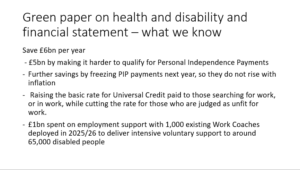
Of the cuts laid out in last week’s Pathways to Work green paper, the new documents published yesterday show the greatest impact will be caused by DWP’s decision that, from next year, PIP claimants must score a minimum of four points in at least one daily living activity to be eligible for the daily living part of the benefit.

This will see, by 2029-30, 370,000 current PIP recipients losing their daily living entitlement when their award is reviewed, and 430,000 future recipients not receiving the PIP they would otherwise have received, at an average loss of £4,500 a year.

Another measure that will have a significant impact on disabled people is the government’s decision to cut the health element of universal credit for new claimants from £97 per week currently to £50 per week in 2026-27, while freezing it for existing claimants until 2029-30.

This could see 2.25 million current recipients of the health element losing an average of £500 per year in 2029-30, and 730,000 future recipients losing an average of £3,000 per year, although they will all benefit from a small increase in the standard universal credit allowance of £5 per week above inflation by 2029-30.

There remain several important unanswered questions about the government’s reforms.

A key issue is whether OBR is correct in its estimate that 800,000 disabled people will lose the daily living element of PIP through the tightened eligibility, as opposed to the 1.5 million suggested by what it calls the “static costing” of the policy.

OBR seems to suggest the lower number is more likely because of the “strong financial incentive” to qualify for PIP, and the increased number of appeals it expects, but fears will remain that the number losing out could be even higher than 800,000.

Another key question is how many disabled people who receive universal credit and have “the most severe, life-long health conditions”, no prospect of an improvement in their health, and who “will never be able to work”, will no longer be reassessed and will receive an additional premium.

Ministers have yet to decide the size of this premium, and which groups of disabled people will be protected in this way.

OBR also says it is too early to calculate the impact of scrapping the work capability assessment and deciding eligibility for the universal credit (UC) health element through the PIP assessment instead.

Other question-marks remain over the impact of the government’s decision to review the PIP assessment, and to increase the number of face-to-face PIP assessments.

OBR also confirms in its report that the various government cuts amount to the “largest package of welfare savings since the July 2015 Budget”.

And it confirms that – before the cuts – total social security spending was stable as a proportion of GDP, as reported by DNS earlier this month, and that it is now on a “slightly downward trajectory”.

The documents also fail to assess the financial impact of preventing young disabled people claiming the health element of universal credit until they are 22, from 2027 onwards, and of plans to raise the age at which young people transition from disability living allowance to PIP from 16 to 18, a move which will also cut spending.

Meanwhile, the Equality and Human Rights Commission has confirmed to DNS that it is considering whether the measures in last week’s green paper have breached DWP’s public sector equality duty to have “due regard” to how its policies and decisions affect disabled people and other groups protected under the Equality Act.

*The number of people earning below 60 per cent of the average (median) income in 2010-11, adjusted for inflation

**It is also unclear what the final impact of changes to universal credit will be, as the standard allowance will be increased slightly in real terms and some changes to the health element are yet to be finalised

27 March 2025


DPAC says ‘this is just the start’, after protest over ‘vile and cruel’ benefit cuts outside Downing Street

Disabled people have spoken of their anger, frustration and fear – and sense of betrayal by the Labour government – over plans to cut billions of pounds from disability benefits, as they protested outside Downing Street yesterday (Wednesday).

Estimates suggest more than 1,000 disabled people and allies chanted outside the Downing Street gates or listened to speeches across the road, on the other side of Whitehall.

They later marched down Whitehall and past the Houses of Parliament, just as chancellor Rachel Reeves was delivering a spring statement that confirmed more than £4.5 billion in cuts to personal independence payment (PIP) and £3 billion in cuts to the health element of universal credit (see separate story).

The protest was organised by Disabled People Against Cuts (DPAC), Inclusion London and Stop the War Coalition, and supported by many other grassroots groups and unions, while other protests took place across England, Northern Ireland, Scotland and Wales, with reports of 100 protesters in Newcastle, a similar number in Cardiff, and more than 100 in Norfolk.

DPAC said it may have been its largest and most successful protest ever.

But it was, DPAC said last night, “just the start of our fightback” against the “deadly and disgusting cuts”.

Among those protesting, Clare Williams, a lecturer at Kent Law School, told Disability News Service (DNS) that she felt “anger and frustration that we are seeing this under a Labour government”, and she called on ministers to work with disabled people’s organisations, “think again”, and halt the cuts.

She said: “Tens of thousands of people are scared about how they are going to survive.”

Abi Palmer, from south London, said she was “terrified” about the cuts.

She said: “I rely on PIP to survive. PIP is the only thing that allows me to stay in work.

When Labour came in, it was not a Labour government I would have voted for, but I thought, ‘Thank god I will not be a target anymore, there will not be this vitriol and hatred against people like me,’ but lo and behold it is worse than ever.”

She said PIP was “the bare fucking minimum” disabled people need to cope with the barriers they face.

She said she was surprised at how many disabled people had attended the protest.

I know how much it is costing people’s bodies to be here. I have talked to people who will be knocked out for a week or a month, but this is important.”

Alimamy Bangura, a disabled refugee and a member of the Manchester-based human rights organisation RAPAR, said he was “so worried” about the planned cuts.

He told DNS: “I want to work, but I am not able to work because of my health restrictions.

We should not be treated like this.”

He was one of the disabled activists who travelled to Geneva last March to hold the last Conservative government to account over its failure to make progress after being found guilty of “grave and systematic violations” of the UN Convention on the Rights of Persons with Disabilities in 2016, mostly around its own cuts and reforms to disability benefits.

Bangura said: “There was nothing about benefits in the Labour manifesto.

I campaigned for Labour, but I will never vote for them again.”

Joel, another PIP recipient, said the government would create more barriers to work – not less – by cutting disability benefits.

He said: “I am worried about how it might affect my ability to get into work.

They are treating disabled people as if they are lazy. It’s a bizarre accusation but that is what is implied by the words of the government.”

Susie Bannister, a wheelchair-user from Surrey, said her concern about the cuts to disability benefits “keeps me up at night”.

She said: “It’s not just the person being impacted, wider society will be impacted.

Some of us can’t physically work but are able to volunteer. There are a lot of disabled people who volunteer.”

Chris, a wheelchair-user, said he had looked at the government’s planned reforms and believed he would lose the daily living part of his PIP when the cuts come in and his PIP is reviewed, although he said “it will hurt a lot of people worse than it will me”.

Zeek, who receives PIP, and is a member of London Renters Union, told DNS: “I don’t know what I would do if I didn’t have PIP.”

He added: “The cuts will make things worse for disabled households. It will push people into homelessness.

It’s going to kill people.”

Zeek is on an NHS waiting-list, and he said he cannot even consider working until he receives the treatment he needs.

John McDonnell, the former Labour shadow chancellor, who has supported DPAC for nearly 15 years and is currently sitting as a suspended Labour MP, told protesters: “It’s not austerity for the rich, it’s austerity for people living in poverty, for disabled people.”

He said the battle over PIP would “be won on the streets, like this”.

Disabled actor Cherylee Houston told DNS she was “angry and really upset and hurt” by the government’s cuts, which she said would lead to disabled people being left “prisoners in their own homes”.

She had said earlier: “PIP is used by many of us to stay in work and cover the extra costs that disability causes.

My community is terrified that the government is taking away the most basic support that those most in need rely on.

It makes no sense to take away the basic supports that enable disabled people to contribute to society.

These cuts will trap more people in poverty.

I am already hearing from friends that they fear they will no longer be able to work if these cuts go ahead.”

Natasha Hirst, president of the National Union of Journalists, and herself a disabled activist, told the protest: “These cuts will kill.”

She said: “These proposals will take away vital financial support from disabled people, without addressing the discrimination, abuse and exclusion that we experience in our daily lives.

These cuts are a political choice, not a necessity. We expected this treatment under a Conservative government, but not from Labour.

This is a vile and cruel attack on disabled people that will ultimately bring harm to everyone.”

Linda Burnip, co-founder of DPAC, said before the protest: “Labour should be ashamed of their proposed cuts which will push disabled people into even greater poverty and destitution and cause many more to kill themselves.

Disabled people will not allow themselves to be made scapegoats for Robber Reeves’ cuts while millionaires remain untouched by cuts.”

27 March 2025


Forgotten and abandoned, young disabled people are fighting back against cuts through a new collective

Hundreds of “forgotten” and “abandoned” young disabled people across the country have taken part in peaceful protests against government cuts to disability benefits, as part of a new movement of activists powered by social media.

The Crips Against Cuts (CAC) collective has grown in just a few weeks from a single disabled campaigner who felt abandoned by charities and politicians, to organising actions in more than 20 towns and cities across Britain last Saturday.

Actions were organised across England, Scotland and Wales, including Bristol, Edinburgh, Glasgow, Newcastle, Hull, Darlington, Leeds, Sheffield, London, Brighton, Portsmouth, Truro, Exeter, Bournemouth, Coventry, Cambridge, Thanet, Nottingham, Birmingham, Liverpool and Manchester.

CAC believes there were about 500 disabled people and allies at Saturday’s action in central London, on the South Bank, near London Eye and County Hall, and about 200 in most of the actions in the larger cities.

The new collective is being driven by users of the social media platform Instagram – with younger disabled people making up the bulk of its membership – and to a lesser extent other social media platforms like Bluesky and Threads.

Linsey McFadden, one of the first disabled campaigners to join CAC, told Disability News Service: “I think our success in that sort of mass mobilization really comes down to the fact that we’re tapping into that younger Instagram audience.

I think millennials and younger generally have less [money] because of the way the prolonged austerity has hit us.”

She added: “There’s a very human health toll to the more than decade of austerity that we’ve had.

There’s a very human health toll to all the money that’s been taken out of the NHS, the rate of disability from long Covid, and the impact of rising cost-of-living amid stagnating wages.

If you consider the impact that even one of those things has on mental health, it is no shock at all that we have rising mental health problems.”

McFadden said the loss of PIP would be “life-destroying”.

She said: “My best friend lives in the negative; her bank balance is always minus several hundred even when PIP hits… and she works, but it’s just not enough.

They keep saying that those of us with ‘severe disabilities’ will still keep our benefits and I’m not happy with that.”

She said she wanted all disabled people to be able to access PIP, a sentiment that “has been very well echoed across the community”.

At the London action, she said, “a lot of the speeches were very raw and emotional because it comes from such a deep place.

We were already the poorest demographic in the UK before the cost-of-living crisis hit.

We’re just kind of sat here, forgotten and suffering, and most of us aren’t receiving the treatment we need, or we don’t have our pain managed, or the barriers to accessing specialists are impossible to navigate.

It’s a very difficult feeling to describe, but I would also say that in all of that and the rawness of the emotion, there was tremendous support for each other.

All of us have been talking about how wonderful it’s been for us to connect with each other, because as disabled people, we are often so alone and isolated.

All of a sudden I’ve got all of these disabled friends, and we all want to listen to each other and we all want to amplify each other.”

The origins of the new movement are in the West Country.

CAC began with Mac, a disabled campaigner from Bristol, who relies on PIP and was frustrated at the lack of response to her concerns about the government’s proposed cuts from her MP and traditional charities.

McFadden said: “After reaching out to lots of spaces that claim they support disabled people, she just felt really abandoned and so figured that lots of us were probably feeling the same… and she was very right.”

CAC was contacted soon after it launched by Paula Peters, from Disabled People Against Cuts (DPAC), which McFadden said had “welcomed us into the crip liberation movement” and had been “very supportive”.

Both grassroots groups are now supporting each other’s actions.

McFadden said: “I think for disabled liberation, it’s really important for there to be multiple groups who are all serving different demographics to some extent, and then collaborating together to ensure that everyone’s needs are being met.”

CAC is now discussing how to move forward, developing resources, deciding what contributions members can make, with plans to allow the community to vote on what its next actions should be, and a determination to remain a non-hierarchical organisation.

They also want to work with groups from other marginalised communities, as they hope to address the intersectional nature of the oppression many disabled people face.

And although the focus of their anger is the planned cuts to PIP, they will not ignore the other cuts the government is planning, such as those to the health element of universal credit (see separate story).

McFadden said: “This is very much not going to be a sprint.

Today we’re talking about PIP, but PIP is not the be-all, end-all of cuts against disabled people.”

CAC’s actions are likely to remain peaceful, but she said: “I really feel like [the government] thought that we would be an easy target, but millennials and younger are very much in the mindset of ‘we’re not going to be quiet’.

We would really encourage both the government and British society as a whole to consider why they have so quickly jumped to using the most vulnerable population in the country as the scapegoat for our money problems, rather than looking at the very real problems that have led us here.”

The scapegoating and hate crime that disabled people are increasingly reporting was illustrated when last weekend’s action in Exeter was marred by a member of the public who threw a chair at some of the activists.

McFadden said the incident was “quickly diffused”, but she added: “I understand that quite a lot of people in the UK are angry for quite a lot of reasons.

Everyone is struggling to some extent unless you are wealthy, but really, why are we your scapegoat?”

27 March 2025


Disabled people ‘plead for our lives’ in front of MPs and peers, as assisted suicide bill ends key stage

Disabled people with progressive and terminal conditions have come to parliament to “plead for our lives” in front of MPs and peers, as a bill to legalise assisted suicide in England and Wales finishes a key stage in the Commons.

They told parliamentarians that disabled people were still “missing from the conversation” on assisted suicide, as the terminally ill adults (end of life) bill ended its committee stage.

Monday’s meeting was organised by the disabled people’s organisation Not Dead Yet UK (NDY UK), and it saw a string of disabled people attend a meeting in the House of Lords to tell their stories of how legalisation would put their lives and those of other disabled people at risk.

The disabled crossbench peer Baroness [Jane] Campbell said NDY UK believed disabled people were “a cohort of people who are missing from the conversations” on the bill.

She said: “Most of the people in the room today will be affected by the bill.

We feel that our lived experience of living with progressive and terminal conditions should be heard but not only heard but we should be at the centre of this conversation.”

But she said it was “very difficult” for disabled people opposed to the bill to get their voices heard by MPs and peers.

She said they “do not hear our voices because they meet far more people just like them.

The predominant voice… is that people like us should have a right to die.

They do not consider even for a minute that we are struggling even to have the right to live every day of our lives.

We do not enjoy coming here today to plead for our lives. It takes away our humanity and it gives us no sense of self-dignity.

For us, this is almost like the last straw. Now is about our right to breathe and survive and live and have value.”

Among the MPs who attended were Labour’s Neil Coyle, a director of policy and campaigns for Disability Rights UK before he became an MP, and senior Labour MP Dame Meg Hillier, as well as crossbench peer Baroness [Ilora] Finlay and Labour’s Baroness [Kay] Andrews.

Coyle said he would be voting against the bill and that he “shared many of the concerns” that had been outlined in the meeting.

The meeting heard from disabled actor and activist Liz Carr, whose award-winning documentary* about assisted suicide, Better off Dead? – broadcast by BBC1 last May and still available to watch – explained the dangers of legalisation to a mainstream audience.

She said disabled people were often told that the bill “will not touch us, it is not about us, and we are shut up because of that”.

But she said: “Even if the definition stays incredibly tight on this bill at the beginning, we are pretty sure, using the experience of other places, that it will extend, but even as it is now, terminally-ill people are disabled.”

She said: “Even if this bill remains as terminally-ill, our voices can show you and teach you… that there are real concerns about handing this over at this time to an NHS and social care system… that is struggling.”

Nicki Myers, who receives palliative care through NHS continuing healthcare funding, and support from her local hospice, spoke to the meeting through a video recording.

She said: “What I worry about most with this bill is that it will change my relationship with doctors and the medical profession as a whole.

I would be constantly questioning whether these people really wanted to treat me or not.”

Mike Smith, former disability commissioner of the Equality and Human Rights Commission, who has a progressive neuromuscular condition, said: “In a perfect world, I would actually like the choice if I have just got told, ‘you have six months to live’, but it’s not a perfect world and I really don’t think that my so-called right [to an assisted suicide] is more important than other people’s right to be protected from coercion.

I don’t see how we can make a decision [on legalising assisted suicide] at this moment in time with the state of palliative care, the NHS… and social care.

Knowing the challenges that the majority of disabled people face, I would be really scared if they passed this legislation, and knowing that if they do so, state-sponsored death is going to be the solution to those problems.”

Chelsea Roff, a researcher and founder of the US-based charity Eat Breathe Thrive, who had a stroke due to severe anorexia as a teenager, gave evidence to the Commons committee currently debating the bill.

She co-wrote a research paper that found that at least 60 women with eating disorders, many in their teens and twenties, had died by assisted suicide in Belgium, the Netherlands, and the United States.

This included Oregon, the US state where assisted suicide is restricted to those who are terminally-ill, just as with the bill MPs are examining.

She told Monday’s meeting: “I think eating disorders have in some ways been the canary in the coalmine to go, ‘Everything disabled people have been saying about this is true: the definition of terminal illness is very loose in practice.’”

Despite this and other evidence shown to the committee, every amendment put forward by eating disorder charities to try to ensure people with those conditions do not qualify for an assisted suicide under the bill was rejected by the committee, she said.

Roff said: “They chose not to do that, having looked at the evidence.”

She said the committee – which has a strong majority in favour of legalisation – chose to believe instead that no-one with anorexia would ever be called untreatable, even though Roff herself was pronounced untreatable as a young person and “was so close to death I could taste it”.

She said: “If this had been available to me when I was ill, I would 100 per cent have taken it.

I begged the doctors to let me die, I did not want to live, I thought I didn’t have a life worth living for anymore.

So I am very worried about this bill. I have huge doubts about the safeguards.

I am worried that those pushing it through have not looked closely at the evidence and not looked closely at the wording of the bill.”

The meeting also heard about the experiences of Rosy Bremer, from Portsmouth, who has motor neurone disease, and whose story was told by her friend, Rev Wendy May Jacobs.

She had been forced to rely on friends and family on a care rota after her local council only agreed to provide her with 12 hours of support a day, even though she could not move from her chair or eat without assistance.

They later crowdfunded more than £23,000 to pay for £8,000 of extra care a month when the rota could not be sustained.

The “shock and humiliation of being denied what she needed” left her “intensely anxious about the future” and “traumatised and deeply depressed”, and eventually she was forced to move into a care home when her condition worsened.

Rev Jacobs told the meeting: “This betrayal of Rosy by our health and our care system has taken a terrible toll.”

She said her “resilient, hilarious, gracious friend” had been left “really broken by the cruel inadequacy of our healthcare system.

For me it is horrifying hearing about the proposed assisted dying legislation when so many are not even given sufficient assistance to live in dignity and safety with all the challenges you face.”

Sophia Kleanthous, an Inclusion London trustee and a disabled campaigner who ended up in supported accommodation when she was homeless and suicidal, said she had experienced mental and verbal abuse and had seen how other disabled people had been treated within a service that is “already at breaking point”.

She said: “That’s a fear that I fundamentally have – if I had been offered [assisted suicide] when I was in that state, I don’t know if I would have said no.”

Kevin Caulfield, former chair of Hammersmith and Fulham Coalition Against Cuts, which played a key role in campaigning for an end to care charges in the borough, told the meeting that there was “systemic and societal coercion in every aspect of our lives”, while social care provision is “threadbare”, and many health services are “on their knees”.

He said access to quality end-of-life support was “extremely limited” and “for many of us that results in a feeling that we can’t afford to go on living”.

He said the bill’s safeguards were “mostly an illusion” because “in reality, society is unable to regulate against the impact of societal coercion and abuse”.

Caulfield said he had been diagnosed with a terminal condition in 1997 before his condition started to stabilise.

But he said: “If assisted dying had been on the menu and my doctor had put it on the table for discussion, I might well have gone for it.”

Dr Miro Griffiths, who is co-director of the Centre for Disability Studies at the University of Leeds and has a progressive condition, told the meeting via a recorded video message: “The danger is that if you are trying to access support or trying to access medical practitioners to support you then having a permanent question about whether you should have your death facilitated by the state or have your death accelerated by the state means that you are in a very vulnerable and dangerous position.

While there are arguments for having freedom of choice and personal autonomy to make decisions over your life, we must remember that the role of the state and the role of legislation is to protect the majority of people, and individuals do not have complete control to do what they want, when they want, because there is a need to provide safety and security for the collective.”

He said that by defeating the legislation “we can focus our attention on making sure that individuals receive sufficient support to live the best quality of life that they can as their needs progress over time”.

He added: “There is the opportunity to defeat this, and it’s important that we recognize there is an alternative world which we can build, which is more inclusive, more accessible, more participatory, and more safe for disabled people.”

The meeting came as the Guardian reported how a group of Labour MPs opposed to legalisation had called the bill “irredeemably flawed and not fit to become law” in a letter to their parliamentary colleagues, saying “significant new risks” had emerged during the committee process.

Meanwhile, the Isle of Man parliament has passed a law that will give terminally-ill adults the right to choose to end their own lives, the first British parliament to do so. The bill will now be sent for royal assent.

Under the Isle of Man bill, adults with 12 months or less to live will be given the right to choose to die, if they are over 18, and have lived on the island for five years.

*This week, she won presenter of the year award for the documentary at the Royal Television Society Programme Awards

27 March 2025


Online provider charges disabled students thousands more for same qualification in ‘blatant discrimination’

An online education provider has been accused of “blatant discrimination” after charging disabled students thousands of pounds more a year than non-disabled students for the same qualifications.

The Cambridge-based Online College of Art and Design (OCAD) describes itself as the UK’s “most established online art college”, but it has been accused of “systemic and structural ableism” over the extra fees it charges disabled students.

Its website shows it is charging disabled students thousands of pounds more to sign up for courses such as a foundation diploma in textile design, a foundation diploma in architectural design, and a certificate in art and design.

Under the Equality Act, an education provider is legally required to make reasonable adjustments for disabled students but cannot charge for those adjustments.

But prices quoted on the site show it appears to be doing exactly that.

It charges £3,999 for its level three online foundation diploma in textile design – designed for “serious career-oriented students who wish to be artists or designers” – but charges £9,000 for students with special educational needs and disabilities (SEND) studying for the same qualification.

Those enrolling on the SEND version of the course benefit from “a SENDCO, more tutor time, additional bespoke learning materials, progress reports and attendance to online meetings with local authorities”, all of which are likely to be considered reasonable adjustments under the Equality Act.

Prices are similarly inflated for SEND students on the level three foundation diploma in architectural design, as they are asked to pay £9,000, compared with £3,999 for non-SEND students.

And students studying for the level two certificate in art and design – equivalent to a GCSE – pay £999 for a two-year course, compared with £4,000 a year for SEND students studying for the same qualification.

OCAD says on its website: “For students with learning difficulties, please apply for our SEND courses. 

It is considerably more difficult and time consuming to teach these students.”

Iyiola Olafimihan, campaigns and justice lead for The Alliance for Inclusive Education, said: “This is another blatant discriminatory act on disabled people by businesses within the education industry.

We already see similar practices within the education system, which monopolises and profits from the lives of disabled people.

This is a clear example of systemic and structural ableism, enabling businesses to exploit disabled people while reinforcing segregated educational practices.

Once again, it demonstrates that the Equality Act remains meaningless when it comes to protecting the human rights of disabled people.”

OCAD is part of Cambridge Online Education, which is registered under the government’s UK Register of Learning Providers, and claims it has “built a reputation as a trusted leader in delivering high-quality, personalised online learning experiences”.

Asked about the extra charges for disabled students, Dr Troy Page, OCAD’s director and founder, said: “We have no desire to discriminate which is why we are offering courses for students with SEND.”

He told Disability News Service (DNS) the SEND courses “are not the same course even if the qualification obtained is the same” because they “offer the additional support required”.

He said: “Any student with or without disabilities may apply for any of our courses including the lower priced non-SEND courses and so no discrimination is present.

All students with or without disabilities can choose which course they wish to purchase.”

He added: “Some students prefer/need a higher number of tutor sessions, more bespoke learning materials, require progress reports, online meetings with local authorities, and the higher price of the SEND courses reflects the additional cost of paying for tutors.

It is disingenuous to say the courses are the same.”

He said he did not believe that OCAD’s behaviour was unlawful.

He told DNS: “You are conflating standard courses with SEND courses and the course description make it very clear they are different and says how they are different.”

Page said he was not aware of other parts of Cambridge Online Education that offered higher fees for SEND versions of courses.

The Equality and Human Rights Commission had not commented by noon today (Thursday).

The Department for Education also failed to comment by noon today.

27 March 2025


DWP make tens of thousands of life-threatening errors, while planning more interaction with disabled claimants

Department for Work and Pensions (DWP) staff are making tens of thousands of potentially fatal errors every month when dealing with disabled people’s universal credit claims, just as the department prepares to increase its level of interaction with claimants.

Last week’s disability benefits green paper and consultation, Pathways to Work, said DWP would change the current universal credit system from one “based on almost no contact” with disabled people found not fit for work “to one based on keeping in touch and generating opportunities to help people improve their health and employment prospects”.

But three new reports obtained by Disability News Service (DNS), following a freedom of information request, show DWP staff are already failing to keep disabled claimants of universal credit safe, and are making repeated blunders in their day-to-day work, even before the government increases their workload and responsibilities.

The reports analyse whether DWP staff are meeting 17 customer support standards (CSS), which were introduced by the last government to “improve the experience of customers with complex needs and significantly reduce instances of serious cases by providing the right support at the right time”.

The reports admit that the impact of CSS errors “can affect customer life chances” and “can negatively affect departmental reputation”.

DWP has been carrying out these checks for nearly two years, as part of its regular “quality assurance checks” on how staff are dealing with new claims, changes of circumstances and other interactions with claimants.

But the three quarterly reports – from June, September and December 2024 – also show that DWP has now made it impossible to see exactly how often DWP civil servants are making potentially fatal blunders.

Earlier versions of the reports, issued monthly, showed how many cases involving CSS were being checked every month in each category, and therefore what proportion of these checks involved safeguarding errors.

But since welfare rights expert Owen Stevens, from Child Poverty Action Group, first obtained the monthly reports under the Freedom of Information Act, DWP has now replaced the reports with quarterly versions and has stopped showing how many cases they are sampling.

This means – in DWP’s latest attack on transparency – that it is impossible to estimate how often staff are making safeguarding mistakes.

The latest report still shows 284 occasions on which DWP staff failed to record that a universal credit claimant had “complex needs” in the section showing if they need additional support.

And there were 476 failures around additional support and homelessness, while staff failed to record a summary of the claimant’s additional support needs on 143 occasions.

Although the report is not entirely clear, it appears these figures show a running total over two quarters.

The report also shows that staff failed 240 times to record that a disabled claimant had accessibility needs in the “additional support” section.

It is impossible to say from the report how large the sample was, although a previous monthly report checked a sample of 1,653 universal credit (UC) claims for CSS failings.

But it is likely that if scaled up across the country – with tens of thousands of new health and disability UC claimants every month – these blunders are likely to be happening many thousands of times a month.

DWP has previously argued that it is “misleading” to suggest that its staff are making thousands of potentially fatal errors, because in “the unlikely event an error occurs, we have safeguards in place to resolve them swiftly and take action to reduce the likelihood of it re-occurring”.

But the new figures suggest that the errors keep re-occurring, even though it is now impossible to estimate how frequently this is happening across the country.

Recent history shows DWP does not have “safeguards in place” to resolve errors “swiftly”.

The fatal impact of such errors was demonstrated two years ago by the death of Nazerine Anderson, from Melton Mowbray, Leicestershire.

Among the errors made in her case, DWP was repeatedly told of her mental distress and suicidal ideation, but her work coach failed to record her “vulnerability” on her profile, while also failing to record updated information about her repeated visits to hospital on the relevant part of the system.

Last May, DNS reported how a survey by the Commons work and pensions committee found two-thirds of DWP staff did not have enough time to deal with safeguarding concerns “carefully” and “correctly”, despite years of deaths of benefit claimants linked with DWP’s actions and failings.

And in December 2023, a dossier of evidence submitted by the PCS union to DWP showed the department to be a failing organisation in a “state of crisis” and facing a “near collapse” of its benefits systems, with staff accusing DWP of “deliberate neglect” and revealing that claimants in vulnerable situations were “falling through the gaps” in the system.

27 March 2025


DWP cannot say how many disabled people it is sanctioning, despite plans for conditions on many more claimants

The Department for Work and Pensions (DWP) has admitted it has no figures to show how many disabled people who cannot work are having their benefits “sanctioned”, just as the government announced reforms that will expose many more to strict conditions.

Although the department regularly releases data that shows how many universal credit claimants are being sanctioned for failing to follow its rules, these figures do not show how many of those in the limited capability for work (LCW) group are being sanctioned.

The LCW group is for disabled people and others with health conditions who have limited capability for work now but need to prepare for work in the future.

But last week’s disability benefits green paper and consultation, Pathways to Work, said the government planned to “change the current system from one based on almost no contact” for disabled people who have been found not fit for work “to one based on keeping in touch and generating opportunities to help people improve their health and employment prospects”.

This will include those in the LCW group but also most of those in the limited capability for work-related activity group.

DWP says this move towards “active engagement” will have the “ultimate backstop of sanctions to underpin the expectations of engagement”, although it claims this will be used “only as a last resort”.

But despite announcing these sweeping reforms, DWP has now confirmed to Disability News Service (DNS) that it cannot provide figures that show how many disabled people in the LCW group are currently having their benefits sanctioned, and for how long, and that it is too expensive to find out.

DNS had asked through a freedom of information request for versions of the latest universal credit sanctions statistics, released last month, that showed figures only for those in the LCW group.

But DWP said in its response that it would be too expensive to produce those figures.

It said the department “cannot break down any of the Universal Credit (UC) sanctions data by stage of UC health, as the UC Work Capability Assessment information, which is only available from April 2019, is held separately and not included in the sanction dataset.

To perform the complex and iterative data merging required to be able to provide any sanctions data for those in the limited capability for work group would exceed the cost limit [of the freedom of information request].”

The February figures show that, in the year to October 2024, the department made more than 600,000 decisions to sanction a universal credit claimant’s benefits, with the most common reason being a failure to attend or take part in a mandatory work-related interview.

The most frequent sanctions were those imposed for between four and 13 weeks.

But none of these figures, and others in the statistical release, show how many disabled people in the LCW group have been sanctioned.

Dr David Webster, a sanctions expert and an honorary senior research fellow at the University of Glasgow’s School of Social and Political Sciences, has been publishing regular, influential briefings on DWP sanctions for more than 11 years.

He said: “Almost nine years on from the start of universal credit rollout in May 2016, we still don’t have a suite of official statistics which is comprehensive enough to tell us how the system is working.

Data on sanctions on disabled people is only one of the obvious gaps. Information on the appeal system is another.

Given that the government now seems set on keeping universal credit, publishing fuller statistics should be a priority.”

Caroline Selman, senior researcher at Public Law Project, which is running a project on sanctions with Central England Law Centre, said: “Sanctions can push people into extreme financial hardship, poor physical and mental health and harmful spirals of debt, as we know from the work we are undertaking with Central England Law Centre, through which they have received 200 enquiries about sanctions.

Meanwhile, a DWP internal evaluation has suggested that sanctions also lead to people moving into work less quickly and earning less when they do.

It is therefore concerning if the government is making decisions about its approach to these harmful measures without understanding, or being transparent about, who is impacted by them and how.

Last year DWP started to publish data about sanctions and ethnicity for the first time.

It is important that they also publish the equivalent data that we understand they hold on disabled people who are sanctioned.”

Ministers under the last government were repeatedly told the impact of sanctions on disabled people was “harmful and counter-productive”.

Among the many deaths in which the sanctions regime has played a part was that of David Clapson, who died in July 2013 after being left destitute by having his benefits sanctioned.

Although he was on jobseeker’s allowance (JSA), DWP was aware that he had diabetes, and he died from an acute lack of insulin, three weeks after having his JSA sanctioned.

Because he had no money, he couldn’t afford to pay for electricity that would have kept the fridge where he kept his insulin working, and he had also run out of food.

27 March 2025


Other disability-related stories covered by mainstream media this week

The government expressed concerns about the timeline for implementing assisted suicide, the BBC understands, before measures were tabled to delay when it could be available. Kim Leadbeater, the Labour MP bringing the bill, said she was “disappointed” to be proposing deferring when it must be in force until 2029: https://www.bbc.co.uk/news/articles/c2er99xmjjwo

The number of people in the Netherlands who died by euthanasia increased by 10 per cent last year, figures have shown, as the official watchdog warned doctors to exercise “great caution” in cases where a person has a psychiatric illness. The Netherlands, which has one of the world’s oldest and broadest euthanasia laws, allows doctors to end a person’s life if they are “suffering unbearably, with no prospect of improvement”. They must be diagnosed with a medical condition, but this can include mental illness or dementia: https://www.theguardian.com/society/2025/mar/24/euthanasia-death-increase-netherlands

27 March 2025


News provided by John Pring at www.disabilitynewsservice.com


 Posted by at 18:41
Mar 262025
 
DPAC Logo with text underneath "Disabled People Against Cuts" and then web address dpac.uk.net

Some ways to get involved from home

  1. Follow The Canary’s livestream and social media commentary from the protest – @TheCanaryUK on all social media channels
  2. Watch the Spring Statement and comment on social media – hashtag #WelfareNotWarfare
  3. Use statistics, facts and figures from our briefing to highlight on social media the impact of the proposed cuts: https://dpac.uk.net/2025/03/disability-benefit-cuts-facts-stats-and-figures/
  4. Write to your MP. Template letter are available here: https://thecorbynproject.com/no-cuts
  5. Download and print our campaign poster below and use on social media

You can also follow DPAC on social media:

@Dis_PPL_Protest
@dis-ppl-protest@bsky.social

 Posted by at 11:33
Mar 242025
 
DPAC Logo with text underneath "Disabled People Against Cuts" and then web address dpac.uk.net

View key locations on our map:

Please click on these images to make them larger on your screen

Find us on Weds: #WelfareNotWarfare day of action in Westminster! Start here at 11am: Rally and march outside Downing Street. March route goes south down Parliament Street for 0.3 miles, ending at Old Palace Yard outside parliament. Westminster is the nearest step-free underground and is located in the middle of the march. DPAC logo, Disabled People Against Cuts, a black inverted triangle with 4 arms of different skin tones holding a multicoloured circle.

Map shows the march route, starting outside Downing Street, going south down Parliament Street for 0.3 miles, ending at Old Palace Yard outside parliament. Westminster underground has step-free access and is located in the middle of the march. Sanctuary House pub is 0.4 miles away from the end of the march on Tothill Street. It has step-free access via 2 side doors and an accessible toilet with a Radar key. Toilets are marked on the map. Standard toilets costing 50p are in Westminster underground and nearby by Westminster pier. Accessible toilets with Radar keys are in Westminster Abbey and Sanctuary House pub. Westminster Abbey is near the end of the march and has free tickets for Disabled people and a carer. Changing Places toilets are in the Palace of Westminster after security, and in St Thomas' Hospital, 0.5 miles from the end of the march, across Westminster Bridge.

Or view these locations on Google Maps

Please note that the Sanctuary House pub is 0.4 miles away from the end of the march, on Tothill Street. The best step-free entrance is via Dean Farrer Street, as the main entrance on Tothill Street has a small step/lip. The side entrance on Tothill Street is step free and goes straight to the accessible toilet (Radar key, no purchase necessary), but there is a set of double doors between this door and the main pub area. Non-accessible toilets are in the basement.

Mar 212025
 
DPAC Logo with text underneath "Disabled People Against Cuts" and then web address dpac.uk.net
#WelfareNotWarfare
My name’s Ben, I am a member of Disabled People Against Cuts (DPAC) and of the Socialist Party Disability Caucus. 13 years ago I organised a number of protests against the ATOS assessments in Swansea, covered extensively in the local paper. As a PIP benefit claimant, I’ve been in front of a judge four times in appeals, going all the way up to the upper tribunal, and I’m going through another reassessment now!

The cuts recently announced by the government are absolutely brutal – such as abolishing disability benefits entirely for under-22s – and disabled people around the country are getting ready to oppose them.

Here are two events coming up in Swansea that I hope you can attend, including a virtual planning meeting on Monday and a protest on Wednesday.
I’ve tried to pick a time that most people can make, but apologies to those that can’t. Even so, if you want to email me any information I can make sure it’s circulated to everyone in the notes afterwards.
Virtual / Zoom planning meeting – 6.30pm Monday 24th March 2025
(Instructions how to join to follow soon)
 
As a first meeting, this will be a fairly informal 45 minute planning meeting covering the following topics. You can take part by voice & video, or type in the chat, or send me an email. Everyone is welcome!
  • Introductions – if you want, introduce yourself and say why the issue is important to you
  • Preparation for the protest Wednesday
  • Plans for future meetings and protests
I really hope you can attend if possible, and I’ll take notes for people who can’t make it.
The priority for this meeting will be the protest on Wednesday, but in future meetings, we should definitely discuss:
  • Officially forming a Swansea Disabled People Against Cuts (DPAC) group
  • Election of roles
 
Protest – Swansea Castle Square – 1pm Wednesday 26th March 2025
Note – please get there early if you can!
This is to coincide with a national day of action called by DPAC.
There have been many great suggestions for protest targets – such as the Swansea West MP, Labour Party meetings, the Job Centre, and the disability assessment centre. For a first protest, I chose Castle Square because it has benches for sitting on.
I’ll send more details, promotional graphics etc. about this soon and organise a Facebook event and a link. I will also be reaching out to other organisations for support, and organising a press release.
That’s all for now so as not to overwhelm with info, but I’ll share more in the coming days, and I hope to meet you as we fight together to defeat these cruel disability cuts. Please forward this email to anyone who might be interested, and please email me if you have any information to share or any feedback.
Many thanks,
Ben
 Posted by at 19:00
Mar 212025
 
DPAC Logo with text underneath "Disabled People Against Cuts" and then web address dpac.uk.net

National Day of Action – Wednesday 26th March

—-

DPAC Aberdeen

Wednesday 26th March, 12pm

Outside Marischal College, Broad Street, Aberdeen

—-

Brighton

Wednesday 26th March, 11am-1pm

Hove Town Hall, BN3 3Bq

—-

DPAC Cambridgeshire & Essex

Wednesday 26th March Cambridge, outside Grafton Centre (Fitzroy Street) Leafleting 12:30-1:30pm

Cambridge outside the Guildhall, Rally 5:30-6:30pm

—-

Cardiff

Wednesday 26th March, 6:30pm

Office of Jo Stevens MP, Secretary of State for Wales, 116 Albany road, Cardiff, CF24 3RU

—-

Chesterfield

Wednesday 26th March, 4:30pm

Outside Chesterfield Labour Club

—-

DPAC Darlington

Wednesday 26th March, 12-2pm

Darlington Town Hall

—-

DPAC Lancaster and Morecamble

Wednesday 26th march, 6pm

Dalton Square, Lancaster

—-

DPAC Leeds

Wednesday 26th March, 11-1pm

Leeds Bus Station

More info

—-

DPAC London

Wednesday 26th March, 11am at Downing Street, Whitehall, London, SW1A 2AA

Balls to the Spring Statement

Then March to Parliament for a protest 

—-

DPAC Margate

Wednesday 26th March, 11am

Outside Polly Billington MP’s East Thanet office, 44 Northdown Road, Cliftonville, Margate, CT9 2RW

—-

DPAC Newcastle

Wednesday 26th March 12-2pm

Grey’s Monument, Newcastle

—-

DPAC Norfolk

Wednesday 26th March 12-2pm

Norwich City Hall, Norwich

—-

DPAC Northern Ireland

Wednesday 26th March 1-1:30pm

Guildhall Derry

—-

DPAC Swansea

Wednesday 26th March, 1pm

Castle Square,  Swansea  SA1 3PP

—-

Actions after 26th March:

Community Day of Action – Manchester

No Return to Austerity, No Cuts for Benefits, Energy for All

Tuesday 1st April, 12pm

Outside Boots, 32 Market Street, Manchester, M60 1TA

—-

Portsmouth

Saturday 5th April, 2-4pm

Portsmouth Guildhall

Mar 202025
 
DPAC Logo with text underneath "Disabled People Against Cuts" and then web address dpac.uk.net

Contents

DWP figures on total cost of disabled people who cannot work are ‘chilling’ echo of ‘useless eaters’ propaganda 1

PIP cuts will cause further deaths, say disabled relatives of claimants who died due to previous DWP reforms 3

Fightback begins over £5 billion disability benefits cuts, as key questions remain over Labour plans 7

Loss of key protection is ‘nightmarish’ demonstration of green paper’s bureaucratic violence, say activists 10

MPs call for urgent action on transport discrimination, and tell industry: ‘Accessibility is a human rights issue’ 12

DWP delays publication of vital PIP evidence until after green paper and spring statement 15

MPs hear from disabled people about life-threatening risks posed by ‘very, very dangerous’ cuts to benefits 17

Activists will protest over government’s refusal to engage with ‘deep-rooted’ mental health bill concerns 21

DWP issues second dodgy press release in attempt to trick media into supporting cuts to disability benefits 23

Other disability-related stories covered by mainstream media this week 24


DWP figures on total cost of disabled people who cannot work are ‘chilling’ echo of ‘useless eaters’ propaganda

The decision of the Department for Work and Pensions (DWP) to publish figures showing the total cost to the economy of disabled people who cannot work has been described as a “chilling” echo of the “useless eaters” propaganda of 1930s Germany.

The figures were included in a report* published by DWP alongside Tuesday’s green paper on disability benefits, as the government sought to justify plans for more than £5 billion in cuts to out-of-work disability benefits and personal independence payment.

Although disabled activists stressed they were not comparing DWP or the Labour government with the most extreme actions of Nazi Germany, they warned that the decision to publish the figures provided “disturbing echoes” of the early stages of oppression in the 1930s that later led to the targeted killing of hundreds of thousands of disabled people in Germany.

It is believed to be the first time DWP has ever published such a report, which it said shows “the cost to the economy and individuals of working age ill-health”.

The short report adds up the costs of lost production because of economic inactivity due to long-term or temporary sickness; lost production due to sickness absence; lost production due to carers who are unable to work; and the extra cost to the NHS when someone’s health condition causes them to move from “economically active to economically inactive”.

It also adds the lost tax and national insurance when health conditions prevent or limit employment; and the cost of benefits linked to health conditions that prevent people working.

It estimates the cost to the UK economy of working age ill-health and disability that prevents work in 2022 as between £240 and £330 billion.

Disabled film-maker and artist Liz Crow, whose work has highlighted both the human cost of austerity and the values in Nazi Germany that led to the killing of as many as 200,000 disabled people through the Aktion T4 euthanasia programme, said the publication of the figures is “chilling”, particularly when parliament is currently debating legalising assisted suicide.

She told Disability News Service (DNS) yesterday (Wednesday): “What they have done is chilling.

There are really disturbing echoes of the lead-up to Aktion T4 in 1930s Germany in the language and sentiments used.

The path to Aktion T4 was made up of stages that escalated and we should always take action when there is any movement in that direction.

This report implies that disabled people are responsible for the social and political conditions that make it hard to find employment, that make some of us too ill to work, or that underfund social care.”

She also stressed that this week’s events could not be treated “in isolation”, as they followed the “onslaught” on disabled people of 15 years of austerity.

When DNS highlighted the publication of the figures on Twitter/X, there was a horrified reaction from disabled people.

One said: “They think they can vilify and demonise us to suggest we are a burden?! Despicable!”

Several drew a comparison with the propaganda put out by the Nazi government in Germany in the 1930s in which they described disabled people as “useless eaters”.

They particularly compared the DWP publication to a notorious Nazi poster which highlighted the cost of supporting disabled people with significant impairments.

That poster said: “60,000 Reichsmarks is what this person suffering from a hereditary defect costs the People’s community during his lifetime. Fellow citizen, that is your money too.”

Many of those commenting on the DWP publication pointed to the parallels of a Labour government that is supporting parliamentary moves to legalise assisted suicide, while at the same time highlighting the cost of supporting disabled people who cannot work.

The grassroots, user-led mental health group Recovery in the Bin (RITB) told DNS: “Reducing human life to a simplistic calculation of budgetary cost to justify hostile state policy is historically associated with fascist genocidal regimes.

The UK has two successive highly critical UN reports and chooses to further intensify those abuses.

While the scale of immediate violence is not comparable, the sentiments are terrifyingly similar to that of historic regimes that engaged in mass killing of disabled people.

The point of heeding the warnings from history is not to deny these echoes, but to recognise them and act to halt further descent into the abyss.”

Gwen, a wheelchair-user and disabled campaigner, was among others alarmed by the publication of the figures.

She told DNS: “I know I might sound doom and gloom but for me it’s a strange coincidence that they are trying to push quickly the assisted dying bill and are making all those reforms.

Cynical people like me will see that it’s a new way to reduce the welfare bill, it reduces the number of disabled people.”

*The Cost of Working Age Ill-Health and Disability that Prevents Work

**The following organisations are among those that could be able to offer support if you have been affected by the issues raised in this article:  MindPapyrusRethinkSamaritans, and SOS Silence of Suicide

20 March 2025


PIP cuts will cause further deaths, say disabled relatives of claimants who died due to previous DWP reforms

Three disabled people who lost relatives as a result of past reforms to disability benefits have spoken of their horror at the Labour government’s plans to cut billions of pounds from the system.

Tuesday’s Pathways to Work green paper announced cuts of more than £5 billion from disabled people’s support, with most of that apparently coming from changes that will make it even harder to claim personal independence payment (PIP)*.

The trio of campaigners, who have each fought for justice and for a better social security system since the deaths of their family members**, all told Disability News Service (DNS) of their shock at the government’s proposed cuts.

Dave Smith’s brother James Oliver was desperately ill with chronic liver disease caused by alcohol dependency, as well as other health conditions including scoliosis, hypertension and depression, but he was twice denied PIP following assessments.

Shortly before he died in hospital, in April 2019, he told his brother: “I can’t believe it. I am dying, I am going to be dead, and I’m still not sick enough to get PIP.”

Smith receives PIP himself, and told DNS the proposed changes would make it even harder for disabled people to claim than it was for his brother.

He said: “From what I’ve seen it’s going to be virtually impossible to claim PIP at all unless you are more or less paraplegic and incontinent.”

He said he fears he would not be able to survive if his PIP was removed because of the eligibility changes, and that he could lose £3,500 a year.

He said: “My own health really doesn’t have the energy to deal with such a loss.

I don’t think I could cope financially without it. And this is without any more draconian plans they have for other welfare cuts.

Any Labour MP who supports this should hang their head in shame. This will cost lives because many will believe suicide is the only way out to protect their families.”

He said disabled people had been “made to feel like a worthless drain on society” and the government “seem intent on screwing all those with invisible conditions in particular”.

Imogen Day, whose sister Philippa’s death was caused by widespread flaws and failings in the Conservative PIP assessment system, said she believed her sister would have died months earlier if the new PIP proposals had been in place at the time because she “would have felt even more hopeless and demeaned”.

She told DNS she was “absolutely appalled” by the government’s announcements, and said it was clear there had been a lack of co-production with disabled people and their organisations.

She said she believed it was now a “defining moment in our generation about how we treat disabled people”.

And she said it was crucial for the government to acknowledge the impact of the increase in long-term health conditions brought on by the Covid pandemic on disability benefits spending.

Alison Burton, who also spoke at a parliamentary meeting on Monday (see separate story), is the daughter-in-law of Errol Graham, who starved to death in 2018 after his out-of-work disability benefits were removed.

She receives PIP herself, as does her daughter, while her son receives disability living allowance.

She told DNS that she “absolutely” does not trust DWP to implement the cuts safely, and that she had “no doubt” that more disabled people would now die as a result.

She said Labour had decided to strip money from the system and leave “people like Errol as collateral damage”.

Her autistic daughter developed severe anxiety after the death of her grandfather, and it was only through support funded by PIP that she was able to leave the house and attend university.

She told Monday’s meeting: “You take that away, you take the existence of my child away. That’s the reality of it. And that’s what they did to Errol.”

Disabled people and disabled people’s organisations also spoke of their shock and anger this week at the government’s announcements.

The proposals, announced by work and pensions secretary Liz Kendall, include plans to scrap the work capability assessment (WCA), rely on the PIP assessment to determine eligibility for the health top-up within universal credit, and cut the rate of that health element for new claimants from £97 per week in 2024-25 to £50 per week in 2026-27, while freezing it for existing claimants until 2029-30.

Tracey Lazard, chief executive of Inclusion London, said disabled people were already much more likely to be living in poverty and had been “pushed to the brink by 15 years of cuts”, and that “slashing support” from disabled people was “a political choice”.

She said it was “shocking and infuriating that these reforms are coming from the same Labour government that promised to end austerity.

The government have specifically excluded the changes to the PIP and WCA assessments, which are the elements of the green paper that will cause hundreds of thousands of disabled people to lose financial support, from the consultation.

This is unacceptable: consulting without involving us in the main financial decisions is not consultation.”

She added: “Cutting benefits won’t create growth or help people into work — it will only increase poverty, ill health, and exclusion.

We know that real change comes through investment — in health, housing, care, inclusive employment support, and accessible workplaces.”

Mikey Erhardt, policy officer at Disability Rights UK, described the cuts as “brutal and reckless” and accused the government of creating “a rhetorical smokescreen around the depth of cuts it’s going to make”.

He said: “The government intends to bar young disabled people from receiving the universal credit health component until they are 22.

That is alongside their promise to significantly increase assessments at scale without making the assessment process safer for those going through the system right now.

These measures mark dangerous cuts for all disabled people. Furthermore, altering the PIP award criteria will make it harder for those who need support to qualify.

Rising claims for PIP reflect not a problem with disabled people but rather reflect successive governments’ failure to do even the bare minimum to create a more equitable society.”

Disabled People Against Cuts (DPAC) said it had been “inundated” with membership requests since Kendall’s announcements, with “terrified and anxious” people wanting to join its Facebook group, and as many as 20 volunteers willing to take legal action against the government over what DPAC’s co-founder Linda Burnip described as the “absolutely appalling” and “despicable” actions of the Labour government.

On Wednesday (26 May), the day of the spring statement from chancellor Rachel Reeves, when further details of the cuts will be announced, DPAC is holding a national day of action in protest at the “pernicious” green paper.

Along with actions in other parts of the country, there will be a protest outside 10 Downing Street, followed by a lobby of MPs and a joint protest with other organisations outside parliament.

Disability Wales said the government’s benefits “crackdown” would “leave many disabled people in Wales considerably worse off without fundamentally tackling the systemic barriers to employment and independent living” and added: “Once again disabled people have been cruelly let down.”

Inclusion Scotland said the cuts would drive disabled people “further into poverty” and “mark a new era of cruel political choices which directly and negatively impact disabled people”.

Heather Fisken, Inclusion Scotland’s chief executive, said: “These cuts are an ideological and political choice that will cause grave harm for Scotland’s disabled people.

We are opposed to the UK government’s choice to slash the welfare budget by pushing disabled people further into poverty.”

Caroline Collier, speaking for the Campaign for Disability Justice, said: “Disabled people need genuine, accessible opportunities when we’re able to work, and a decent safety net when we’re not. 

Apart from a welcome provision to allow people to try work without penalty, this is a largely destructive and misconceived set of proposals. 

It is not benefits that are keeping people out of the workforce, but inaccessible jobs and barriers from employers. 

The green paper is therefore tackling the wrong problem, and is going to drive worse outcomes by undermining what little safety net we have. 

Also, employment support needs to be delivered by disabled people themselves, not for-profit companies. As a country, we can do better than this, and we must.” 

*See separate story for full details of the cuts and reforms described in the green paper

**All three feature in The Department: How a Violent Government Bureaucracy Killed Hundreds and Hid the Evidence, John Pring’s book on the years of deaths linked to DWP, which is published by Pluto Press

*** The following organisations are among those that could be able to offer support if you have been affected by the issues raised in this article:  MindPapyrusRethinkSamaritans, and SOS Silence of Suicide

20 March 2025


Fightback begins over £5 billion disability benefits cuts, as key questions remain over Labour plans

Disabled people are fighting back against government plans that will see more than £5 billion cut from spending on disability benefits, and which are set to push hundreds of thousands further into poverty.

The Pathways to Work green paper, published on Tuesday, left many key questions unanswered, including exactly how much the Labour government plans to cut and how many disabled people it expects to lose out.

Liz Kendall, the work and pensions secretary, repeatedly refused to release these figures until next week’s spring statement, although she told MPs the cuts would top £5 billion.

There is likely to be anger at the comments of Sir Stephen Timms, the minister for social security and disability, who claimed (watch from 11.34) – after being asked by a Liberal Democrat MP what harm the cuts would cause – that the changes would “ensure that personal independence payment is financially sustainable in the long term… and that will reassure a very large number of people for whom PIP is vitally important”.

Kendall, Sir Stephen, and other ministers also ignored the concerns of many disabled activists about the risk of harm to those affected (see separate story), with many of those activists having fought for years to highlight the devastating consequences of similar cuts and reforms in the post-2010 austerity years.

The green paper changes will only apply to England, Scotland and Wales, while key measures on personal independence payment (PIP) will not apply to Scotland, which has responsibility for its own adult disability payment – although it will be affected by the spending cuts – and some measures on employment support will not apply to Wales.

Most of the cuts to spending appear to come from PIP, where it will be made much more difficult to receive the daily living element, with these changes to be introduced from 2026 through new legislation.

DWP claimed the cuts were necessary because of the “spiralling health and disability benefits bill”.

But the lack of any justification for the PIP cuts – at a time when NHS waiting-lists have risen sharply, social care is in crisis, the retirement age has been rising, and the pandemic has had a significant impact on long-term health – was repeatedly shown by the actions of the prime minister, Kendall and other ministers when they failed to attempt to justify the PIP cuts but turned constantly to defending cuts to out-of-work benefits instead, which they described as a “moral issue”.

There was anger and fear among disabled people who contacted Disability News Service (DNS) this week, both on social media and by email and phone.

David*, a disabled person who currently receives PIP, said: “This is an existential threat. The government is coming for us, for me, for people like me. And if we lose this fight, which it seems we will, many will die.

Without PIP, without the benefits that keep me sustained, how am I supposed to pay the bills? How the hell am I supposed to buy food?

How is starving us supposed to help us work, when the systems we are forced to navigate are fundamentally hostile to our participation?”

He said it was “not a policy designed to lift people up. It’s a policy designed to crush us down, to break us, to starve us, to remove us from the balance sheet.

It is impossible to see this as anything other than eugenics by economics. If it isn’t deliberate malice, then it’s utter economic ignorance.”

Ministers also plan to scrap the work capability assessment (WCA) from 2028, and to rely instead on the PIP assessment to determine eligibility for the health element top-up within universal credit.

For new claimants, the rate of that health element will be cut from £97 per week in 2024-25 to £50 per week in 2026-27, while the health element will be frozen for existing claimants until 2029-30.

The standard allowance of universal credit will be increased, but it is not yet clear by how much this will rise above inflation.

The green paper does promise that those disabled people with “the most severe, life-long health conditions, who have no prospect of improvement and will never be able to work” will no longer be reassessed and will receive an additional premium, but there was no clue as to how much this will be and how many will receive it.

But Kendall also announced that young disabled people would not be eligible to claim the health element until they were 22, from 2027.

The government is also consulting on whether to raise the age at which young people transition from disability living allowance to PIP from 16 to 18, a move which will again cut spending.

There is also a pledge that an extra £1 billion will be spent on employment support under the Pathways to Work banner to ensure “tailored, one-to-one help alongside access to appropriate employment, health and skills support”, which will begin with an employment-focused “support conversation”.

The green paper also states that nearly every disabled person receiving the health element of universal credit will need to engage regularly with DWP “about their aspirations to work and to hear about the support available to them”, which will begin on a voluntary test basis this year.

It says this “increased level of engagement with almost everyone [will be] a key feature of the reformed system”, with “the ultimate backstop of sanctions”.

From 2028, ministers also plan to end the indefinite entitlement to contributory employment and support allowance for those with a recent work record who have been assessed as having limited capability for work-related activity.

They are consulting on how long entitlement for a new replacement benefit – unemployment insurance – should last.

Peter*, who currently receives contributory ESA and is autistic and has been unable to work for the last 16 years, said scrapping this support was “immoral”, and that the news had caused a significant deterioration in his mental health.

He said it was not yet clear how the measure would affect him but he believes that it could leave him more than £600 a month worse off.

He said: “I worked for 18 years before becoming unwell and these proposals put forward by the UK government today are not only cruel, immoral and unjustifiable, these measures need to be opposed by any means.”

The green paper also says there will be more face-to-face PIP assessments, all assessments will potentially be recorded (although there is likely to be an opt-out for those being assessed), and DWP will try to improve the quality of medical evidence provided by claimants, while the department will at some stage restart WCA reassessments.

There will also be a review of the PIP assessment.

The green paper is also consulting on the future of the Access to Work programme, although it is far from clear how each of the three “potential future approaches” would impact disabled people, although they suggest the department is considering forcing employers to take more responsibility for making workplaces accessible.

The green paper suggests – although it is not at all clear – that ministers want to cut future spending on Access to Work, which is set to increase from £142 million in 2019-20 to £385 million in 2025-26.

DWP is also consulting on “a new safeguarding approach”, but the green paper provides few details on how that might improve the department’s current approach, which has been closely linked to countless deaths of claimants over the last 15 years.

There are already serious questions being asked about the legality of the green paper – which doubles as a consultation document – with one respected advice website describing it as “entirely bogus” because it asks leading questions that assume the cuts will go ahead, and omits key information about how many disabled people will be affected.

That lack of critical information has also left many disabled people hunting for clarity online as to how the changes will affect them, with many contacting DNS and other websites and social media in significant distress.

There is also anger that some of the key proposals are not part of the consultation, and will instead be implemented by the government without consulting the public, including the plans to scrap the WCA; tighten eligibility for PIP; and cut the universal credit health element.

And there was also frustration about the delay in publishing accessible versions of the green paper.

DWP said the 12-week deadline for responding to the consultation would not be triggered until the accessible versions had been published.

The anger, fear and frustration at the cuts was highlighted by Disabled People Against Cuts (DPAC), which said it had been “inundated” with membership requests since Kendall’s announcements, with “terrified and anxious” people wanting to join its Facebook group, and as many as 20 volunteers willing to take legal action against the government over what DPAC’s co-founder Linda Burnip described as the “absolutely appalling” and “despicable” actions of the Labour government.

On Wednesday (26 March), the day of the spring statement from chancellor Rachel Reeves, when further details of the cuts will be announced, DPAC is holding a national day of action in protest at the “pernicious” green paper.

Along with actions in other parts of the country, there will be a protest outside 10 Downing Street, followed by a lobby of MPs and a joint protest with other organisations outside parliament.

Paula Peters, a member of DPAC’s national steering group, urged “all disabled people and allies to join us on the streets and online” under the #WelfareNotWarfare banner.

*Not their real names

**The following organisations are among those that could be able to offer support if you have been affected by the issues raised in this article:  MindPapyrusRethinkSamaritans, and SOS Silence of Suicide

20 March 2025


Loss of key protection is ‘nightmarish’ demonstration of green paper’s bureaucratic violence, say activists

A tiny detail in the disability benefits green paper that suggests the government will scrap a key protection for claimants at extreme risk of harm is a “nightmarish” demonstration of the bureaucratic violence being inflicted on disabled people, say activists.

The grassroots, user-led mental health group Recovery in the Bin (RITB) said the move was an example of “structural bureaucratic slow violence” and “the very definition of the banality of evil”.

They spoke out after work and pensions secretary Liz Kendall said she would scrap the work capability assessment (WCA) and rely on the personal independence payment (PIP) assessment process to decide if out-of-work disabled people are entitled to extra support on top of their basic universal credit allowance.

But scrapping the WCA, which is not likely to happen until 2028, would also mean the end of the “substantial risk” regulations that have protected countless disabled people at risk of suicide and other harm if found fit for work or work-related activity.

The Department for Work and Pensions (DWP) – and the Department of Social Security before it – has been trying to get rid of the regulations for nearly 30 years, but has twice been defeated by the courts.

But it did manage to weaken the regulations in December 2015, a move which led to far fewer people with mental distress being able to rely on their protection.

Now Kendall’s green paper – and more than £5 billion in cuts – looks set to provide a route for DWP to finally scrap the protection offered by the regulations.

It says: “We are considering how any change of this kind could affect individuals who currently meet limited capability for work and work-related activity (LCWRA) criteria due to non-functional special circumstances; for example, those affected by cancer treatment, people with short term conditions that get better, women with a high-risk pregnancy and those currently classed as having substantial risk.

Individuals in these categories may not be eligible for PIP, and therefore the UC health element, in the reformed system.”

The question-mark over substantial risk adds to many other safeguarding concerns about the green paper, including its suggestion that nearly all disabled people will now be forced to have regular contact with a work coach, even if they are never going to be able to work.

The green paper says: “Our starting point is that most people in receipt of the health element in UC should be expected in the reformed system to, as a minimum, engage in conversations from time to time about their aspirations to work and to hear about the support available to them.”

RITB, which spotted the reference to the “substantial risk” protections, said the move to scrap them along with the WCA was “emblematic of the entire approach to this apocalyptic demolition of our social security safety net”.

An RITB spokesperson said: “People who fail the redesigned harder-to-pass PIP assessment, will now instead face conditionality and much lower income on universal credit.

They will be harassed to find jobs, but employers will not be keen to take on very distressed people.

The DWP know this is a cohort of people at extreme risk of harm up to and including suicide and yet they are proceeding with removing what little protection there was.

This structural bureaucratic slow violence is the very definition of the banality of evil.

This feels like a nightmare there is no waking up from.”

*The following organisations are among those that could be able to offer support if you have been affected by the issues raised in this article:  MindPapyrusRethinkSamaritans, and SOS Silence of Suicide

20 March 2025


MPs call for urgent action on transport discrimination, and tell industry: ‘Accessibility is a human rights issue’

Disabled campaigners have welcomed a “fabulous” and “validating” report by MPs that calls on the government and industry to “urgently” recognise that the “regularity and severity” of public transport access failures is a human rights issue.

The long-awaited report by the Commons transport committee says that access failures are “commonplace” when they should be “vanishingly rare”.

The committee says there is a “very substantial gap” between the “rights and obligations that exist in theory”, and the daily experiences of disabled people who rely on pavements, buses, taxis, trains and planes.

It concludes: “A change of mindset throughout the transport system is urgently needed, recognising that accessibility is both a non-negotiable matter of human rights and discrimination, and a health and safety issue.”

The committee’s report, published this morning (Thursday), says “meaningful involvement” by disabled people which is adequately funded and planned is “central” to addressing the problems across the transport sector.

It says the current system places far too great a burden on individual disabled people to hold individual transport operators to account for their access failures due to “opaque and ineffective” complaints processes, and the frequent need to take “costly, stressful and uncertain” legal action.

Among its recommendations is for the Department for Transport (DfT) to work with disabled people’s organisations to set up a single service that would receive all accessibility complaints and ensure they reach the right operator, authority or regulator, “and follow them up if not resolved”.

The committee also says the collection of laws and regulations around accessible transport, and the organisations that are supposed to enforce them, is too “complicated and fragmented”.

And it criticises regulators for failing to take enough formal action to reflect the “regularity and severity of access failures experienced by disabled travellers on a daily basis”, which results in “operators getting away with repeated poor practice”.

It says that accessibility “urgently needs to be recognised as an issue of human rights and protection from discrimination, not as an optional customer service matter”.

The cross-party MPs call in the report for the government to take steps to ensure that transport operators know that “every instance of not meeting accessibility obligations constitutes a serious failure, for which they will be held accountable”.

They say DfT must set out a new inclusive transport strategy within 12 months, which must be backed by a “costed, practical plan that will close the gap between rights and reality” and “concrete timescales for achieving independent accessibility across the rail network”.

But they also say that the government’s starting point “must be that accessibility has to be delivered, not that it will only be delivered if other factors do not get in the way”.

They also call for a review of transport accessibility laws, with involvement from disabled people, to see how it can be “streamlined, clarified and updated”, and for a review of regulators to assess whether a single enforcement body would be “more effective at asserting disabled people’s rights”.

The committee’s inquiry was launched more than two years ago, but its completion was delayed by the general election.

Among those disabled campaigners quoted frequently in the report is Alan Benson, who died 15 months ago.

He had told the committee in his evidence: “Journeys for me are journeys that will go wrong. I expect something to go wrong. It is just how badly it goes wrong. Does it mean I am delayed 10 minutes? Does it mean I am delayed three hours?”

Another disabled campaigner quoted often by the committee is Christiane Link, a consultant and adviser on accessibility, who welcomed the report, which she said showed that “accessibility and equality need actions beyond party politics and that it’s possible if decision makers are passionate about it”.

She told Disability News Service (DNS) yesterday (Wednesday): “Now it’s time for the current government to use the recommendations in this report to drive action.

This report should be just the beginning of improving accessibility, especially in railway and public transport.

Those in charge – in politics but also operations and governmental departments – should be judged by the improvements they will deliver for disabled people and everyone who relies on accessibility.

It’s overdue. The priorities were not right for far too long.”

Emily Sullivan (née Yates), a disabled researcher in equality and human rights and co-founder of the Association of British Commuters, played a significant part in persuading the committee to launch the inquiry with campaigning through 2022 and into 2023 on key human rights issues around accessible transport.

She said: “Rail accessibility has finally been recognised as a fundamental human right, and the DfT, Office of Rail and Road, and the Equality and Human Rights Commission shamed for their years of inaction on systemic discrimination.

The publication of the report at this time is a bold move and of immense political significance.

For the committee to be this critical of the DfT and regulators while the Great British Railways consultation is underway presents an unmistakeable message: turn back now from the obsession with deregulation and build a proper equality and human rights framework for the railway.”

Doug Paulley, a high-profile accessible transport campaigner whose evidence was key to the report, said the publication was “fabulous”.

He said: “It is great to have an official publication that is so comprehensive, accurate and validating.

It can be used to challenge the individualisation, gaslighting and victimisation that we disabled people experience on a daily basis when we dare to challenge discrimination on public transport.

I’m so glad that they published it, especially after we thought the general election meant that they wouldn’t.

The timing is really interesting too, in the middle of the Great British Railways consultation which they have openly criticised as having insufficient focus on accessibility and reneging on previous commitments.

In the face of wholesale government assaults on disabled people’s rights to exist and basic human dignity, this report is really positive.

There needs to be a cultural change in government such that accessibility is treated as an essential ‘must have’ throughout public transport.

I hope that this report goes some way towards that.”

Labour’s Ruth Cadbury, who chairs the transport committee, said: “It should be a source of national embarrassment that our country’s transport services effectively treat disabled people as second-class citizens, denying them access to jobs, leisure, support networks and essential services – denying them their rights.  

This inquiry worked on the premise that people are disabled by barriers in society, not by their condition or difference, and that services should be designed to enable disabled people to travel independently, not reliant on others.”

She said that disabled people seeking redress or compensation for access failures “face a spaghetti junction of complaints processes that either fob them off or lead them on a road to nowhere.

Even when complaints are resolved, lessons aren’t learnt, changes aren’t put in place, and it’s tempting to think that the small and occasional penalties for failure are accepted by providers as a mere cost of doing business.”

Local transport minister Simon Lightwood said in response to the report: “It’s clear that accessibility has been an afterthought in developing transport services and there is more to do to ensure everyone can travel easily and with dignity.

That’s why we have clear ambitions for a transport network that works for all and have already worked quickly to put accessibility at the heart of our bus and rail reforms, as well as continuing work to make hundreds of train stations step-free and launched an accessible aviation expert group.

We continue to work closely with a range of people, including disabled people, to help us develop our policies, and we will consider these recommendations carefully and respond as soon as possible.”

20 March 2025


DWP delays publication of vital PIP evidence until after green paper and spring statement

Work and pensions ministers have delayed the publication of evidence that would have explained why spending on disability benefits has been rising, just as they are announcing £5 billion in cuts to that support.

On Tuesday, work and pensions secretary Liz Kendall announced a package of reforms that will cut spending on disabled people’s support by more than £5 billion a year by 2029-30, most if it apparently through cuts to personal independence payment (PIP).

She said the PIP cuts were needed so the government could “focus support on those with the greatest needs” and claimed the increase in new PIP claimants was “not sustainable long-term” (see separate stories).

But successive governments have now been hiding research for three years that provides clear explanations for the increase in PIP claimants.

And now the Department for Work and Pensions (DWP) has admitted that it will wait to publish the research – and a larger follow-up study – until after this week’s announcements and next week’s spring statement.

The spring statement on Wednesday is likely to reveal exactly how much the PIP cuts will save the government.

Although examining only a small sample of claimants, the DWP research showed the “main triggers” for applying for the extra costs benefit were health deterioration, financial hardship and employment concerns, with some claims triggered by a “recent decay in circumstances”.

Disability News Service (DNS) reported last month how it had obtained a copy of the report through a freedom of information request.

Three years after its completion, successive secretaries of state – Conservatives Chloe Smith and Mel Stride and Labour’s Liz Kendall – have all failed to release the report.

DWP’s decision to delay publication until after the spring statement was discovered by disabled activist Dylan Murphy, a member of the Unite Community union and Disabled People Against Cuts.

He had submitted a freedom of information request to DWP asking for a copy of the unpublished report.

But DWP told him it could not release the report, Triggers to Claiming Personal Independence Payment, because it would shortly be published.

The department told Murphy that after completing the research it had commissioned a “larger, more expansive piece of research on the same topic”, which includes a larger sample of PIP claimants and “also explores the perspectives of advisors and disabled people who have not claimed PIP”.

But it said that both Triggers to Claiming Personal Independence Payment and the follow-up report would not be published until “early April”.

When asked about the delay, DWP refused to even acknowledge the email from DNS.

It refused to explain why it was not publishing the research until after the green paper and spring statement, and refused to say whether it agreed that the decision could be seen as dishonest and lacking in transparency.

20 March 2025


MPs hear from disabled people about life-threatening risks posed by ‘very, very dangerous’ cuts to benefits

Four disabled people told MPs of the life-threatening risks that would be caused by proposed cuts to disability benefits, just a day before the government confirmed the “very, very dangerous” reforms.

About 10 MPs from Labour, the SNP, the SDLP and the Liberal Democrats attended the meeting in parliament of the Coalition Against Benefit Cuts on Monday.

They heard testimony from Alison Burton, the disabled daughter-in-law of Errol Graham, who starved to death in 2018 after his out-of-work disability benefits were removed; and from three disabled people who had each attempted to take their own lives as a result of the flawed and hostile social security system.

Burton said the government was now planning to make the system worse rather than focusing on how to stop other disabled people like Errol dying.

She said Labour had decided to strip money from the system and leave “people like Errol as collateral damage”.

And she said that, because of the failing mental health system, it was only DWP and its out-of-work disability benefits that had been keeping Errol alive.

Burton then told the meeting how her autistic daughter had developed severe anxiety after the death of her grandfather, and it was only through the support funded by personal independence payment (PIP) that she was able to leave the house and attend university.

She said: “You take that away, you take the existence of my child away. That’s the reality of it. And that’s what they did to Errol.”

Her son, who is also autistic and has ADHD, has been accepted on a business course because of the support his school was able to offer him.

She said this was “what support does”, but the government wants instead “to talk about disabled people like we are a burden on society, or we are just sucking the system dry”.

David Rollins, who tried to take his own life in his local jobcentre two years ago because of the imminent reassessment of both of his disability benefits, told the meeting that he would attempt to take his own life again if the government’s proposals looked as though they would leave him in debt.

He has multiple impairments and advocates for many other disabled people on benefits, and has had multiple phone calls and messages about Labour’s planned cuts, and “had to try to reassure people, when I personally don’t feel reassured, which is difficult”.

Two of those people told him they would take their own lives if the cuts were implemented, he said.

He added: “If this goes the way that it looks like it’s going to go, and they don’t U-turn, then potentially I could be forced into that situation.”

Osmond James described how he had tried to end his own life because of financial problems after being repeatedly turned down for PIP, which left him having to decide between paying his bills or buying some food.

He was only able to receive PIP for the first time because it was “facilitated” by the consultants in intensive care after his suicide attempt.

He said the government’s planned cuts were “draconian” and seemed like “Tory-lite” policies, so it was now necessary to “play on the consciences of the powers that be” and show that “a big contribution can made by people on benefits”.

Andy Mitchell told the meeting how he attempted to take his own life after his benefits were unfairly sanctioned and he ran out of money over Christmas and had a breakdown, and how he subsequently developed long-term health conditions he still lives with today.

He said the government’s proposals (see separate stories) would put more disabled benefit claimants at the mercy of the DWP sanctions and conditionality regime.

He said the government’s proposals “show no respect to disabled people and are completely undignified, especially from a party that claims to care about equality and fairness”, and they had left disabled people “so frightened they’re talking about suicide”.

A message was also read out from Gill Thompson, whose brother David Clapson, who had type one diabetes, died in July 2013 from diabetic ketoacidosis after being left destitute when his benefits were sanctioned, despite repeatedly trying to find work.

She said in her statement: “His money had been stopped just two weeks before he died for failing to attend an appointment.

He was not aware of this until going to the bank to draw money out, and by the 8th of July he had just £3.44 in his bank.

There was no food in the flat, his electric key had run out, and he could not chill his insulin.

The temperature at that time was in the 30s.”

She added: “David missed one or two appointments, and for that he was sanctioned and died.

If he’d been a criminal, he would have had a trial, a judge and a jury and a proper defence. He had none.”

Ellen Clifford, coordinator of the coalition of disabled people’s organisations (DPOs) monitoring the implementation of the UN disability convention in the UK, told the meeting that work and pensions secretary Liz Kendall was wrong when she kept saying that disabled people who have been found “unfit for work” are then prevented from working.

She was in that group herself and tried to work whenever she could around the severe and enduring mental distress and suicidal ideation she lives with.

She said: “What I find holds me back are constant reassessments and systems that the DWP have, which are not set up to be consistent with someone trying to work.”

When her monthly income reaches a certain level her council tax support stops, which means she is “constantly reapplying every few months, which is sometimes just too much for me to be able to do as well as trying to work, so I end up out of money”.

She said: “I just wonder why they can’t sort out those systems to begin with, before taking these very, very dangerous steps.

And I do believe that we can fight against this, because I know what we can achieve when we come together.”

Disabled People Against Cuts (DPAC) will be holding a national day of action to protest against the cuts on Wednesday (26 March), the day of the spring statement, with a London event starting outside Downing Street, followed by a lobby of MPs and a joint protest with other organisations outside parliament.

In addition to several DPAC representatives at Monday’s meeting, there were representatives from other DPOs, including Inclusion London, Disability Rights UK, WinVisible and The Alliance for Inclusive Education.

There were also members of the user-led Commission on Social Security, which will be releasing its proposals for replacing PIP at the end of April, and a representative of the London Unemployed Strategies (LUS) project, which was set up by trade unions and unemployed people.

Among the MPs who attended, some briefly to show support and some for most or all of the meeting, were Labour MPs Steve Witherden, Rachael Maskell, Andy McDonald, Mary Kelly Foy and Imran Hussain, and Labour peer Baroness Lister, the SNP’s Kirsty Blackman, former Liberal Democrat leader Tim Farron, the SDLP’s Claire Hanna, and suspended Labour MP John McDonnell, who hosted the meeting.

Others who sent staff to attend the meeting included disabled parliamentarians Steve Darling, the Liberal Democrat work and pensions spokesperson, and Baroness [Tanni] Grey-Thompson.

Two Northern Ireland MPs, the Alliance’s Sorcha Eastwood and Ulster Unionist Robin Swann, are arranging meetings with DPAC Northern Ireland, while Labour’s Richard Burgon, who has been supportive of the disabled people’s anti-cuts movement, sent his apologies for not being able to attend.

Blackman said the government’s proposals were “horrific” and there were “a significant number of us that will stand with you and do everything that we can to try and ensure that this doesn’t happen”.

She told the meeting that she had previously said she “would rather that there were people that did not deserve to get social security and got it then there was one person who deserves it that didn’t get it”.

Witherden said he had found the personal testimonies “very moving and very upsetting”.

Foy, whose late daughter was disabled, and who also has a disabled son who receives universal credit that allows him to be “in and out of work”, said she had written to chancellor Rachel Reeves to express her concerns about the government’s proposals.

She said: “It doesn’t have to be an economical contribution to society to mean that you have a place in this society.”

McDonnell said they needed to give people “hope” and to show that “we can win on this, that we can turn it around, that no matter how challenging it is tomorrow, we’re going to mobilize, and it doesn’t matter what government there is, we’re going to turn it round, and they won’t be able to sustain their position if we mobilize effectively enough”.

Paula Peters, a member of DPAC’s national steering group, who chaired the meeting, said: “What they’re planning is indefensible and it’s unfair, but this is a message to Keir Starmer: disabled people have the balls to take you on.

And we will… so let us mobilise, let us resist, and let’s take this government on and fight them back. Come on, we can do it!”

There was also a significant presence of senior union figures, showing solidarity with disabled people as part of the broad Coalition Against Benefit Cuts, including the National Union of Journalists’ president, Natasha Hirst, herself a disabled activist; Ian Hodson, president of the bakers’ union BFAWU; Ian Pope, DWP group vice-president of the PCS union; and a representative of Unite.

Hirst said disabled people “should be able to access the social security system that they’re entitled to when they need that support without being overwhelmed with bureaucracy, hostility, and in fear of punishment every time they come into contact with the state and with DWP”.

She said she had experienced herself the “difficulties, the humiliation and the fear of having to apply for benefits, to go through assessments… and having no warning that they were being pulled, and then having to scrabble and go through all of that stress that so many other disabled people have also gone through.”

Hodson said the proposed cuts were not “an issue for disabled people to fight alone” and it was the “duty of the trade union and labour movement” to support them and to “fight back against a Labour Party, a Labour Party, that’s using the language, the toxic language, of our enemies”.

He said the government’s proposals would be “stealing another five to six billion from the working class to balance the budget on the back of the poorest in our society”.

Pope said the government was “trying to pit worker against benefit claimant”.

He said PCS had been “at the forefront for as far as long as I can remember of fighting back against attacks on benefits and benefit claimants” and would “work with anybody to get where we want, for benefit claimants to be rightfully treated with dignity, respect, and fairness, and not as skivers and shirkers and demonised”.

*The Department: How a Violent Government Bureaucracy Killed Hundreds and Hid the Evidence, John Pring’s book on the years of deaths linked to DWP, including those of Errol Graham and David Clapson, is published by Pluto Press

**The following organisations are among those that could be able to offer support if you have been affected by the issues raised in this article:  MindPapyrusRethinkSamaritans, and SOS Silence of Suicide

20 March 2025


Activists will protest over government’s refusal to engage with ‘deep-rooted’ mental health bill concerns

Disabled activists are to hold a day of action in Westminster – and online – next month in protest at the government’s refusal to engage with the “deep-rooted concerns” of autistic people and people with learning difficulties about the mental health bill.

They plan to march on the Department of Health and Social Care (DHSC) to hand in a letter asking for a meeting with a minister to discuss the bill’s flaws.

They say the mental health bill – which is currently approaching the end of its passage through the House of Lords, before moving to the Commons – will not prevent autistic people and people with learning difficulties from being locked up in mental health hospitals just because they are disabled.

The day of action on 29 April is being organised by the Bring People Home from Hospital campaign, supported by Inclusion London.

Among the disabled people’s groups and organisations that are part of the campaign are Free Our People Now – backed by Inclusion London – All Wales People First; People First (Scotland); My Life My Choice; First Do No Harm; the National Autistic Taskforce; and People First (Self-Advocacy).

Free Our People Now (FOPN) was among the user-led campaign groups that gave evidence about the bill last week at a roundtable session organised by the parliamentary joint committee on human rights, which is carrying out scrutiny of the bill to “assess its compatibility with international and domestic human rights standards”.

FOPN says there has been a “lack of engagement” with people with learning difficulties and autistic people from the government, including those working on the mental health bill within DHSC.

Simone Aspis, founder of FOPN, which is led by people with learning difficulties and autistic people, said there was “no evidence whatsoever” of government engagement.

Without that engagement, she said, the bill would not “move people out of hospitals and into their own homes”, and it would not guarantee people “decent lives”.

It would also fail to address concerns about the bill’s failure to protect people from being abused in the psychiatric system, she said.

Concerns about the bill were also raised by FOPN in written evidence to the committee.

A key concern is that the bill does not stop autistic people and people with learning difficulties from being locked up because of non-criminal behaviour, which FOPN says is a breach of article 12 of the UN Convention on the Rights of Persons with Disabilities.

FOPN’s written evidence to the committee also raises concerns that the bill will fail to protect autistic people and people with learning difficulties from discrimination if they are also people of colour, women, from LGBT+ communities, or from other marginalised communities.

And it says the bill will not stop them being locked up without doing anything wrong, without a court case and without their agreement.

FOPN told the committee that one autistic person had said: “I was detained under the mental health act for almost three-and-a-half years.

I spent time in various psychiatric hospitals and an assessment and treatment unit.

The reason I was there was because I am autistic and other people, who were not experts in autism, decided I should not be allowed to leave.”

FOPN says the government has ignored criticisms of the UK made by the UN’s committee on the rights of persons with disabilities in 2017 on these and other concerns, including the use of force on people in detention, and policies to stop abuse and other inhumane and degrading treatment.

FOPN says in its written evidence that everyone “should have the same right to freedom”, and the bill will not guarantee this.

The bill’s report stage in the Lords is due to begin on 31 March, with the bill set to be debated in the Commons soon after the Easter break.

But Aspis said: “As far as I am concerned, it is never too late for the government to realise if they really want to improve the mental health bill, they need to engage with our communities.

That should have been done from the beginning.”

The Department of Health and Social Care had not responded by noon today (Thursday) to the concerns about its lack of engagement on the bill.

20 March 2025


DWP issues second dodgy press release in attempt to trick media into supporting cuts to disability benefits

The Department for Work and Pensions (DWP) has issued a second misleading press release in consecutive weeks as it tries to trick the mainstream media into supporting its controversial cuts to disability benefits.

This time, work and pensions secretary Liz Kendall included at least four misleading statements in her short press release, which was headed “Almost two million people on Universal Credit not supported to look for work”.

The press release was published five days before Kendall launched her reforms of the disability benefits system (see separate stories).

DWP stated that the number of disabled people on universal credit who were “too sick to look for work” had risen by 383 per cent since the start of the pandemic, from 363,000 to 1.8 million.

But it only managed to reach that striking calculation by ignoring those who had been found not fit for work and were still receiving employment and support allowance (ESA) in 2019-20 (of which there were nearly two million).

The only reference to ESA was in a “further information” note at the bottom of the press release, which admitted that an increase “was anticipated for reasons including people moving from legacy benefits [which include ESA] onto Universal Credit”.

The press release also claimed there were only two choices in the current “dysfunctional” system: “fit for work” or “not fit for work”.

This is not true. There is a third group for those said to have limited capability for work, who have to take part in work-related activity because they are expected to be capable of work in the future.

A third misleading statement in the press release was that disabled people found not fit for work on universal credit “get locked out of help and support”.

Again, this is not true, as they can ask DWP to provide support, including through the Access to Work scheme.

The department’s fourth misleading statement came as it claimed – again in a footnote – that 70 per cent of the increase in the number of disabled people receiving the health element of universal credit and ESA in the past five years “was not expected by the Department”.

But it failed to mention the impact of the pandemic, with research by the respected Institute of Fiscal Studies (IFS) – published the previous day – finding that “mental health has worsened since the pandemic”, which was “consistent with rising disability benefit claims for mental health”.

The IFS report found that “deaths of despair” – those attributed to alcohol, drugs and suicide – rose by 24 per cent in England and Wales in 2023, compared with the 2015-19 pre-pandemic average.

DWP refused to answer questions about the press release this week, including why Kendall believed she needed to send out misleading press releases to defend her case for the cuts, and whether she would apologise for the misleading statements and untruths.

DWP had also refused to comment last week when it was criticised for an earlier misleading release.

DWP claimed in that press release that there had been a “staggering 319 per cent increase” in the number of working-age people on the health and disability element of universal credit or receiving employment and support allowance.

The department said this showed the “alarming rate at which young and working aged people are increasingly falling out of work and claiming incapacity benefits”.

But although there had been an increase – most likely caused by the impact of growing NHS waiting-lists and the Covid pandemic, among other factors – it was likely to be about 30 to 35 per cent, if comparing 2019-20 with 2023-24.

The 319 per cent figure was quietly removed from the press release last week after DNS questioned its accuracy, but DWP failed to add a note to the website to show that the press release had been corrected, and it refused three times to respond to requests to comment on its use of the exaggerated figure.

20 March 2025


Other disability-related stories covered by mainstream media this week

A furious row has broken out after a Labour MP serving on the assisted dying bill committee was forced to leave because her hearing aid batteries had run flat. Bradford West MP Naz Shah posted on X (formerly Twitter) last night to express her frustration because the committee session had been extended, despite her warning that her hearing aids would need recharging: https://www.independent.co.uk/news/uk/politics/assisted-dying-bill-hearing-aid-naz-shah-b2717728.html

Scores of Labour MPs have voiced significant doubts about the government’s social security changes in a tense meeting with the work and pensions secretary. About 100 MPs attended a private meeting in parliament with Liz Kendall and the social security and disability minister, Sir Stephen Timms. MPs said there were grave concerns in the room about the huge hit to incomes that the changes would mean: https://www.theguardian.com/politics/2025/mar/19/scores-of-labour-mps-raise-concerns-over-welfare-changes

Parents will need to “think very differently” about government funding for children with special educational needs, the education secretary has said, as school leaders say the current system is on the brink of collapse. Speaking to the Association of School and College Leaders annual conference, Bridget Phillipson said the 2014 Children and Families Act needed to be changed to reform the current system in England that was driving local authorities towards insolvency: https://www.theguardian.com/education/2025/mar/14/different-thinking-needed-send-funding-bridget-phillipson-says

The amount of time lifts on the London Underground have been closed due to lack of staff has almost doubled in the last year, new figures reveal. Lifts were out of action for 6,197 hours in 2024 compared with 3,301 hours in 2023 and 2,480 in 2022, a freedom of information request by the Liberal Democrats shows: https://www.bbc.co.uk/news/articles/cpdep9ld5qpo

20 March 2025

News provided by John Pring at www.disabilitynewsservice.com


 Posted by at 14:26
Mar 202025
 
DPAC and allies have called a National Day Of Action across the UK  Wednesday 26th March 2025 To begin the fightback  against Rachel Reeves Spring Statement & Disability Benefit Cuts 

DPAC and allies have called a National Day Of Action across the UK 

Wednesday 26th March 2025

To begin the fightback  against Rachel Reeves Spring Statement & Disability Benefit Cuts 

Join us and help us resist what disabled people are now calling the appalling Green Paper “Labour Government  Disability Poll Tax”

London action: 

Meet at 11am at Downing Street for a rally and speakers 

Downing Street

Whitehall

London

SW1A 2AA

Then March to Parliament to link up with Homes for All and Stop The War activists for a protest at Parliament or you can lobby your MP

Nearest accessible underground Station 

Is Westminster: 

Bridge Street London SW1A 2JR

(Accessible from platform to street level ) 

TFL Journey Planner link : 

https://tfl.gov.uk/plan-a-journey/

DPAC has some limited funding available for reasonable travel and accommodation costs.  Please contact DPAC directly mail@dpac.uk.net

Mar 182025
 
DPAC Logo with text underneath "Disabled People Against Cuts" and then web address dpac.uk.net

This past 10 days we have had hundreds of people applying for membership and to join our Facebook group and we will try to process these as soon as possible, but please be patient. In the meantime please feel free to get involved

 Posted by at 19:39
Mar 172025
 
DPAC Logo with text underneath "Disabled People Against Cuts" and then web address dpac.uk.net
Hands Off Disability Benefits Online Planning Meeting
Tuesday 18th March 2025
6.30 pm to 8.30 pm
Join DPAC online to fight back against the Labour Government’s proposals for cuts to disability Benefits.
Turn the anger into action
DPAC are having a National Day of Action against disability benefit cuts on Wednesday 26th March which is the day of the spring statement
 Posted by at 11:15
Mar 132025
 
DPAC Logo with text underneath "Disabled People Against Cuts" and then web address dpac.uk.net
All Party Parliamentary Group on Poverty and Inequality: Call for Evidence
Inquiry into the Disproportionate Impact of Poverty and Inequality on Disabled People


Dear colleague,

The All-Party Parliamentary Group (APPG) on Poverty and Inequality is launching a call for evidence to examine the disproportionate impact of poverty and inequality on disabled people. This short inquiry will inform discussions around the upcoming green paper on disability benefit reform.

Scope of the Inquiry
This call for evidence seeks to explore the following key areas:
  • The risk and extent of poverty (including deep poverty) among disabled people.
  • The impact of poverty on disabled individuals and communities.
  • How do the additional costs of disability contribute to the poverty experienced by disabled people?
  • How poverty among disabled people relates to broader societal inequalities.

Evidence Submissions
We welcome contributions from individuals, academics, think tanks, charities, advocacy groups, and other stakeholders with pre-existing evidence relevant to this inquiry.

Submission Guidelines

  • We are seeking pre-existing evidence rather than newly commissioned research.
  • Submissions should be limited to a maximum of four sides of A4. (font size 12)
  • The use of bullet points is encouraged for clarity.
  • We welcome both qualitative and quantitative evidence.
  • If you would prefer to submit your evidence in a different format we will also accept; a PowerPoint presentation (no more than 5 slides) an audio recording (no more than 5 minutes) or a video recording. (no more than 5 minutes) If these options aren’t appropriate for you for whatever reason please do get in touch at info@appgpovertyinequality.org.uk


Purpose and Next Steps
We aim to publish a short report very soon after the submission deadline, so that we can help inform the debate subsequent to the publication of the green paper. We acknowledge the pressures on organisations responding to the green paper and we have therefore kept the submission process as straightforward as possible. 

Please submit all submissions to info@appgpovertyinequality.org.uk by Monday 7 April      

Kind regards, 

Rob Donnelly – Equality Trust 
Secretariat for the APPG on Poverty and Inequality

 Posted by at 13:34
Mar 132025
 
DPAC Logo with text underneath "Disabled People Against Cuts" and then web address dpac.uk.net

Contents

We can force government to back down over benefit cuts ‘if we turn anger into action’, say activists 1

DWP refuses to apologise after using ‘deeply irresponsible’ figure to exaggerate benefit claimant rise 4

Research links increase in ill-health to rising benefit claims, just as government prepares ‘catastrophic’ cuts 6

Ticket office cuts by three rail firms are just a test run for fresh round of reductions, campaigners warn 8

Self-advocates from across London send government a message of fear, concern… and anger over benefit cuts 12

Disabled author swamped by hate speech after social media post on feminism 15

Failed by the SEND system: Five young disabled campaigners tell MPs government must ‘listen to our voices’ 16

Not one electric vehicle public charging point across the UK meets government’s accessibility standard, say MPs 19

Other disability-related stories covered by mainstream media this week 21


We can force government to back down over benefit cuts ‘if we turn anger into action’, say activists

Disabled activists – and a suspended Labour MP – have told campaigners that they can win the battle to force the government into a U-turn over its planned cuts to disability benefits.

But they also warned the Disabled People Against Cuts (DPAC) online campaign meeting of the considerable harm that would be caused to disabled people if the cuts were not scrapped.

One disabled activist said the “distress and the damage” the proposals were already causing people’s mental health was “immeasurable”, and called for disabled people to “turn our anger into action”.

Another activist said there would “undoubtedly be increased mental distress, self-harm, benefit deaths and suicides” and “immense pressures on public services” if the cuts were implemented.

She called for action by disabled activists “that teaches future governments not to come for us again”.

John McDonnell, the suspended Labour MP and former shadow chancellor, who has supported DPAC for nearly 15 years, told the meeting he was “really petrified” about the potential harm that would be caused by the cuts.

But he said there was “an opportunity here for us really in campaigning terms to turn this around and defeat these proposals”.

Reports suggest that the government will soon announce cuts of more than £5 billion to disability benefits, mostly focused on personal independence payment (PIP).

But Sunday’s meeting heard that the government was vulnerable to both outside pressure and anger from within the Labour party at the proposed measures.

A planned green paper on disability benefits had apparently been set to be published this week, but it now seems to have been delayed until next week, because of the anger caused by government media briefings about the cuts.

At least 150 disabled activists and allies attended Sunday’s Hands Off Disability Benefits! online campaign meeting, to plan how to fight back against any cuts that are announced.

Ellen Clifford, coordinator of the coalition of disabled people’s organisations monitoring the implementation of the UN disability convention in the UK, told the meeting that the government’s apparent plans to cut £5 billion from spending on PIP would cause “a significant increase in disability-related poverty and there will be a knock-on to child poverty rates”.

She said: “There will undoubtedly be increased mental distress, self-harm, benefit deaths and suicides.

There will be increased pressures on the NHS, mental health services, social care services and an increase in survival crime.

This will put immense pressures on public services that are already struggling now.”

Clifford, also a member of DPAC’s national steering group and award-winning author of The War on Disabled People, added: “I know people are frightened – I’m frightened – but I think we should focus and remember what we can achieve when we come together.

We chased Atos out of the contract for the work capability assessment; we forced George Osborne to do a U-turn when he came for PIP in 2016.

We have the links, we have a memory of what worked through the last decade-and-a-half, so in some ways we are in a better position now to resist than we were then.

I know that we’re burned out, we’re fighting on multiple fronts, but we do have brilliant younger activists coming in.

I think we can do this, and more than that, I believe we can do it in such a way that teaches future governments not to come for us again.”

McDonnell told the meeting that the Conservative-led 2010 coalition had refused to monitor the impact of its cuts to social security, including the work capability assessment reforms.

But he said that the “wonderful” book by Disability News Service editor John Pring* showed that the Department for Work and Pensions “is a killer department, because so many people lost their lives as a result of the welfare benefit cuts that took place during the years of austerity under the Tories.

Well, as sure as night follows day, if this level of cuts takes place, people will be at risk and we will lose people.”

He said it had been a “hell of a shock” that the new Labour government was set to announce “another round of austerity measures”, 15 years after austerity cuts were introduced by the Conservative coalition “on a scale that we’d never seen before”.

He said both the prime minister, Sir Keir Starmer, and the chancellor, Rachel Reeves, were breaking their promises that “that there would be no further austerity, that they would end austerity”.

And he said it was “dreadfully, dreadfully shocking” that they had “decided to go down the path of cuts”, with government media briefings suggesting they were “looking at quite extensive cuts in welfare”.

McDonnell said the government would be “targeting disabled people” with these cuts.

He said it was “so like 2010, where a Conservative government thought the easiest way to get cuts through public expenditure was to target the people they thought couldn’t fight back: disabled people and the poorest”.

He said the government should instead introduce a financial transaction tax on the City of London, and a wealth tax, so the government “can start investing in the services that people need to support them to live a full and independent life”.

McDonnell told the meeting that there was “an opportunity here for us really in campaigning terms to turn this around and defeat these proposals.

And we can only do that if we mobilise effectively in these coming months, and that’s what DPAC was founded for, and that’s what all of us in DPAC now will have to do in this coming period.”

Mark Harrison, from DPAC Norfolk, said he and fellow disabled activists were taking the fight against the planned cuts “right into the heart of the Labour party” by protesting outside the next meeting of Norwich Labour party tomorrow (Friday).

He said a motion opposing the cuts from a local Labour branch would be discussed at the meeting and DPAC Norfolk was hoping to be invited into the meeting to speak to members before the motion was voted on.

There will also be a protest outside Labour-controlled Norwich City Hall on 26 March, the day of the chancellor’s spring statement.

And DPAC Norfolk has called for people to record videos of “what they think about the proposed cuts to social security and benefits and also what effect it’s having on people in terms of their mental health”.

He said the “distress and the damage it’s doing to people’s mental health is immeasurable”, with politicians and others “writing in The Sun, going on TV, and calling disabled people benefit cheats and benefit scroungers, and a drain on society”.

He said he believed there would be a revolt within the Labour party “if we step up our campaign, because people didn’t join the Labour party to screw disabled people, they didn’t vote for MPs and MPs didn’t go into parliament to vote through cuts on disabled people, so we think they’re very vulnerable”.

Harrison called on disabled people to set up local DPAC branches, contact their MPs, organise local campaigns, and approach trade unions and Labour party branches, and local and regional media, who were now “working alongside us very often because they don’t agree with this either”.

He said: “I think we have to be bold.

I think we have to turn our anger into action, into organising disabled people, people in mental distress, against the cuts, against new austerity, and against these attacks on our benefits.”

Harrison said he believed disabled people could defeat the planned cuts “because people wanted change after 14 years of Tory rule and Tory austerity and Tory attacks on disabled people. And, you know, people didn’t vote for this.

So we’re all angry, but we do need to get even. We do need to organise.”

Paula Peters, a member of DPAC’s national steering group, who chaired the meeting, said disabled people were “terrified” about the government’s plans.

She said: “This has been an especially difficult time for disabled people, with a bill going through parliament on assisted dying in England and Wales.

The context makes changes to social security even worse as it feels like we’re fighting for our rights on multiple fronts.”

Austin Harney, from the PCS union, which represents many frontline DWP workers, and a member of the TUC disabled workers’ committee, told the meeting that his fellow PCS members in DWP were being “forced against their will” to implement sanctions on disabled people and others claiming benefits, which he said was “an outrageous disgrace”.

Although he said it was not official PCS policy, he said he wanted union members to take unofficial strike action in support of how disabled people are being treated in jobcentres.

He said the government was trying to “divide and conquer” by setting non-disabled people against disabled people.

Harney told the meeting: “It is a frightening era that we’re going through; we need to raise this as a major issue for disabled people in the trade union movement.”

*The Department: How a Violent Government Bureaucracy Killed Hundreds and Hid the Evidence, John Pring’s book on the years of deaths linked to DWP, is published by Pluto Press

13 March 2025


DWP refuses to apologise after using ‘deeply irresponsible’ figure to exaggerate benefit claimant rise

The Department for Work and Pensions (DWP) has refused to apologise for massively exaggerating the rise in people claiming out-of-work disability benefits, and then tried to cover-up its actions, just as ministers are trying to justify sweeping cuts to spending.

DWP claimed in a press release last Thursday that there had been a “staggering 319 per cent increase” in the number of working-age people on the health and disability element of universal credit or receiving employment and support allowance (ESA).

The department said this showed the “alarming rate at which young and working aged people are increasingly falling out of work and claiming incapacity benefits”.

There has been an increase – most likely caused by the impact of growing NHS waiting-lists and the Covid pandemic, among other factors – but it is likely to be about 30 to 35 per cent, if comparing 2019-20 with 2023-24.

The error was spotted almost immediately by Ratigan, a disabled welfare rights campaigner.

He told Disability News Service (DNS): “It’s deeply irresponsible the DWP would publish such obviously misleading figures in an attempt to justify reforms that are striking terror into the hearts of millions of disabled people up and down the country.”

But it appears that no-one in the DWP press office, or work and pensions secretary Liz Kendall, or any of her highly-paid ministerial entourage, thought to question the figure.

Instead, the department used the figure to justify government reforms that it is believed will cut the amount paid to those receiving ESA or the health and disability element of universal credit.

The figure was quietly removed from the press release this week after DNS questioned its accuracy.

But DWP has so far failed to add a note to the website to show that the press release has been corrected.

And the department appears to have made no attempt to contact media organisations that published the inaccurate figure, including the Scottish national tabloid The Daily Record.

Labour’s social security and disability minister, Sir Stephen Timms, has repeatedly said that he wants DWP to move “towards much greater transparency about how we are doing things”.

Last month (PDF), Sir Stephen told the Commons work and pensions committee: “Things that ought to have been published and made public have been hidden, and that has contributed to a loss of trust.”

DWP has so far refused three times to respond to requests from DNS to comment on its use of the exaggerated figure.

The department’s continuing lack of transparency was further highlighted this week as DWP again refused to respond to a UN report that called on the government to take “corrective measures” to address the impact of cuts to disability benefits introduced under Conservative governments, just as Labour ministers are preparing to introduce further such cuts.

The recommendation by the UN’s committee on economic, social and cultural rights (CESCR) comes in its “concluding observations” on the UK’s progress in implementing the International Covenant on Economic, Social and Cultural Rights.

Among its recommendations, the committee called for increased spending on social security, and for the government to take “corrective measures” to address the impact of post-2010 welfare reforms on the most disadvantaged groups, including disabled people.

But DWP refused to comment on the report last week.

And when asked again this week for its response to the committee’s conclusions and whether it would act on the recommendations, it refused to answer those questions.

Instead, a DWP spokesperson produced a statement that did not refer to the UN report or its conclusions but instead referred to the “broken” social security system and the need for “meaningful, principled” reform “so that it helps long-term sick and disabled people who can work to find employment, ensuring people receive the support they need, while being fair to the taxpayer”. 

13 March 2025


Research links increase in ill-health to rising benefit claims, just as government prepares ‘catastrophic’ cuts

New research links a significant rise in sickness and mental ill-health since the start of the pandemic to an increase in the number of people claiming disability benefits, just as ministers prepare to announce significant cuts to that support.

The research provides fresh evidence for disabled people and allies fighting the cuts, which have been described this week by claimants who contacted Disability News Service (DNS) as “simply unjust” and “absolutely catastrophic”.

The report shows clear evidence of rising working-age mortality rates and levels of mental ill-health, and a huge increase in the number of sickness absence days per worker since 2019.

Its headline conclusion was: “Mental health has worsened since the pandemic. This is consistent with rising disability benefit claims for mental health.”

It found that most of the 4,400 extra deaths rates were “deaths of despair” – those attributed to alcohol, drugs and suicide – which rose by 24 per cent in England and Wales in 2023 compared with the 2015-19 pre-pandemic average.

The research also showed there had been a “big rise” in the number of people on hospital waiting-lists since 2019.

And there has been a 5.5 per cent rise in working-age mortality rates when comparing the 2015-19 average and the figures for 2023, and a 36 per cent increase in the number of people in contact with mental health services between 2019 and December 2024.

The researchers said that sickness absence days per worker were 37 per cent higher in 2022 than in 2019, which was “further evidence to support the argument that population health has worsened”.

The research was published this week by The Institute for Fiscal Studies, with support from three other respected organisations: Joseph Rowntree Foundation, The Health Foundation, and Economic and Social Research Council.

Iain Porter, senior policy adviser at Joseph Rowntree Foundation, said: “This is clear evidence of a deterioration in mental health in the population, which goes some way to explaining rising health-related benefit claims.

Greater openness about mental health has helped many people to live with conditions which were once hidden, but the rise in deaths of despair also shows that reducing stigma does not eliminate the most serious consequences of rising mental ill health.

This trend is real and growing, and we need our government to look carefully at the health of the nation, rather than relying on benefit cuts to fix the problem.”

The report, The Role of Changing Health in Rising Health Related Benefit Claims, comes just as the prime minister, Sir Keir Starmer, and other ministers have been attempting to persuade backbench Labour MPs to support plans to cut spending on personal independence payment (PIP) by £5 billion.

Most of Sir Keir’s benefit-related comments to Monday evening’s meeting of backbench MPs are believed to have focused on separate reforms and cuts to out-of-work disability benefits, rather than PIP.

But reports suggested that he also failed to respond to a Labour MP with a disabled daughter who said cuts to PIP would have a significant impact on his family.

Sir Keir has also been due to meet groups of Labour MPs in Downing Street yesterday and today (Thursday) for six “welfare roundtables”.

In prime minister’s questions yesterday, Sir Keir talked about supporting disabled claimants “back to work” when challenged by Liberal Democrat leader Ed Davey, even though the bulk of the planned cuts are to PIP, which is available to those both in and out of work.

Labour’s Richard Burgon then asked: “Instead of cutting benefits for disabled people, would not the moral thing – the courageous thing – to do be to make a real tough choice, and introduce a wealth tax on the very wealthiest people in our society?”

Sir Keir then spoke of a “moral imperative” to “help those who want to work to get back into work”, and added: “We have raised money through the energy profits levy, taxing non-doms and air passenger duty on private jets, but this is not a bottomless pit, and we must kick-start growth to secure the economic stability that we need.”

Meanwhile, disabled people have continued to contact DNS to express their concerns, anxiety and distress about the proposed cuts.

One disabled woman said, in an email to her MP that she copied to DNS: “These proposed cuts and reforms are simply unjust.

I am exhausted, and I am afraid. I feel sick with worry and I feel a total loss of control over my life. I just want to live.

One cruel push of cuts, and one stroke of bad luck, and I risk depending on already strained food banks, or simply not having enough to pay my bills.

PIP is the one thing that is giving me some actual life, and it was an awful, emotional ordeal to get. But I am grateful for it.

I don’t know where I would be without it. It has given me small pleasures in life, like a cafe date with my husband, books to read, or taxis to see family when I am able.

I do not have the fight in me that I used to have, so please know that this is me begging you to do something to prevent both these cuts and the proposed idea to make disabled benefits harder to get.”

Another disabled woman told DNS: “These cuts will be absolutely catastrophic for disability claimants, myself included.

I am utterly petrified as I rely on my disability benefits to live and manage my condition.

I go to bed at night worrying myself sick about proposed cuts.

It is significantly impacting my health.”

13 March 2025


Ticket office cuts by three rail firms are just a test run for fresh round of reductions, campaigners warn

Cuts to ticket office opening hours by three rail providers across England and Scotland are just a forerunner of further reductions to come across the country, which will have a significant impact on disabled passengers, campaigners have warned.

The warning came after months of research by the Association of British Commuters (ABC), which has examined cuts proposed and implemented by ScotRail, Southeastern and Great Western Railway (GWR).

ABC, which has already exposed the actions of Southeastern, believes the UK and Scottish governments have been pushing for cuts in ticket office hours.

Only 16 months ago, Conservative ministers scrapped proposals to shut nearly 1,000 ticket offices across England, following a huge campaign by disabled-led groups, trade unions and allies.

But at the time, the government and train operating companies refused to rule out further attempts to close rail ticket offices.

Major cuts in ticket office opening hours would have a significant negative impact on many disabled passengers and others who need support to use rail services.

But ABC says rail sources are now making it clear that the industry and governments in Scotland and Whitehall are pushing for “Ticket Office Cuts Round Two”, which they had hoped to carry out by “stealth”.

Thanks to ABC, plans by Southeastern to make drastic cuts to ticket office hours – of 555 hours a week – have been paused at 12 of 14 proposed stations in Kent, East Sussex and south-east London while the Department for Transport (DfT) decides whether they can proceed.

Those plans were described by disabled campaigners in November as “unforgivable” and “horrendous”.

Southeastern confirmed this week that its plans for cuts at the 12 stations were still on hold while it awaits a decision from DfT.

The Scottish government-owned ScotRail has previously admitted that 31 of its stations will have ticket office hours cut.

But an examination of a new version of its plans shows that nearly 100 stations will see ticket office hours cut.

The RMT union says these cuts “would see ticket office hours reduced by a staggering 2,800 per week, jeopardising safety, accessibility, and quality of service for passengers”.

Last week, RMT and other organisations, including Inclusion Scotland, Transport for All, Disability Equality Scotland, Disability Rights UK and Disabled People Against Cuts, wrote to the Scottish government about the proposed ticket office cuts at ScotRail stations.

They said the plans had previously been opposed by 98 per cent of those who took part in a public consultation three years ago.

They said they believed there was “an attempt to evade public scrutiny over this matter”.

ABC has also discovered that GWR has already carried out a programme of “stealth” cuts at 39 stations between 2022 and late 2024, with freedom of information requests and data analysis showing this led to a reduction in ticket office staffing of 344 hours per week.

Emily Sullivan (née Yates), a disabled researcher and co-founder of ABC, who carried out the latest research, believes GWR is planning a further round of cuts to ticket office hours.

She said: “Sources have informed us that ‘all eyes are on ScotRail and Southeastern’ to see if they get away with it, and if these operators succeed, similar de-staffing techniques will spread across England.

Staff cuts are being rumoured at GWR as we speak, so it is suspected to be the first in this new wave of attempts, having already served as the first ‘test’ operator in the original stealth plan.

The crucial difference to 2023 is that this time it is happening piecemeal without anyone even knowing about it.

That’s because the DfT has found a way to cut ticket office and staffing hours without consultation – as shown by the 39 ticket office cuts already completed on GWR, in total secrecy until now.

It is indisputable that the cuts go back to a DfT ‘Plan B’ hatched in 2022, when stealth regulatory changes for these three operators were first signed off.

Those very same plans are now being enacted by the UK and Scottish governments.

After the collapse of ticket office consultations in 2023, it would be completely non-credible for the DfT to shrug off responsibility for these cuts onto operators – everybody involved in the railway knows exactly who is giving the orders.”

ScotRail repeatedly refused to comment this week on ABC’s concerns, referring Disability News Service instead to a press release published last month.

In last month’s statement, Phil Campbell, ScotRail’s customer operations director, said: “The changes that will be introduced from 31 March will provide a service that is better suited for the ticket-buying habits of our customers today, rather than 30 years ago, and will create an environment that improves safety and customer support.

We have listened to colleagues, customers, and the trade unions throughout this process and have made changes to the proposals based on that feedback.

We will now redouble our efforts to grow passenger numbers and revenue as we deliver a safe, reliable, and green railway.”

Transport Scotland refused to comment on the number of ticket offices where there would be cuts to opening hours under ScotRail’s plans.

It also refused to say if it was disputing that cuts to opening hours would negatively impact disabled passengers.

But it said in a statement: “We welcome that ScotRail and the unions have engaged in consultation, and that unions were listened to during the process to influence changes.

This shows the importance of consultation and dialogue.

We expect this to continue and that the changes will not impact passengers’ convenience and facilities.

To be clear, these amendments will not see any ticket office closures.

There will be no job losses and arrangements to assist disabled travellers will not be affected.”

GWR disputed ABC’s figures but refused to say how many ticket offices had seen cuts, and for how many hours in total.

A GWR spokesperson said in a statement: “We’ve not closed any ticket offices and can only do so following public consultation under the schedule 17 regulations.

We are not aware of any national programme of cuts – stealth or otherwise.

Train operators regularly adjust ticket office hours to align with customer demand, ensuring resources are allocated effectively.

Changes have only affected offices with daily reductions of under 20 minutes or where average ticket sales are fewer than seven per hour.

No station has become unstaffed as a result of these changes. In fact, in the past year the number of station staff at our stations has actually increased.

Nothing has happened in secret – while regulations covering these minor changes don’t require a formal consultation period, we publicly display posters highlighting the proposals for 28 days ahead of any alterations.”

DfT said it was for the rail industry to decide if, and when, any changes to ticket office opening hours were required.

A DfT spokesperson said: “These claims are incorrect, there are currently no plans to introduce wholesale ticket office closures.

We recognise the vital role ticket offices and staff play in the journeys of passengers and providing face-to-face services.

Changes made in 2022 by operators like Southeastern were an industry-led decision, and we will ensure that passengers with accessibility needs continue to receive the support they need.”

Meanwhile, the Commons transport committee has written to rail minister Lord [Peter] Hendy over concerns raised by ABC last month about the government’s proposed rail reforms.

ABC had spotted that the consultation on the government’s plans for rail reform failed to include any mention of a statutory accessibility duty, despite the Conservative government pledging to introduce a legal duty on the new Great British Railways (GBR) that would ensure GBR put accessibility “at the core of its strategic decisions”.

Those concerns were backed by representatives of Disabled People Against Cuts, National Pensioners Convention and National Federation of the Blind of the UK.

They also called for the consultation to be extended from eight weeks to 12.

Ruth Cadbury, chair of the transport committee, asked in the letter to Lord Hendy for clarity on whether the government had indeed dropped the access duty – and other statutory duties – and on its decision to restrict the consultation to just eight weeks.

13 May 2025


Self-advocates from across London send government a message of fear, concern… and anger over benefit cuts

People with learning difficulties from across the capital have delivered a powerful call to the government over threatened cuts to disability benefits, and warned they could take “drastic” action if ministers do not listen to their concerns.

At a meeting of self-advocates in central London on Friday, members of the new London Campaign Network said they were already struggling to survive after years of austerity and the cost-of-living crisis.

They said services have been cut, while many of them were already struggling to secure the support they needed.

Government cuts to disability benefits could increase these pressures and make it harder to survive, they warned, particularly for those autistic people and people with learning difficulties who do not have strong support networks.

Those attending the meeting – the second held by the network since its launch last November – later described the event as “empowering”, “educational”, “exciting” and “informative”.

Leon Jordan, from the Generate Voices self-advocacy group in Tooting, compared the situation facing people with learning difficulties to the injustices faced by the Suffragettes who fought for women’s right to vote in the early years of the 20th century.

He told the meeting: “That’s what we need, we need to use that weapon of the past and bring it into the 21st century now.”

He said disabled people needed to be “challenging the government” publicly, including through peaceful demonstrations.

Jordan said he was concerned about possible cuts to employment and support allowance (ESA), disability living allowance and personal independence payment (PIP).

He said: “We are angry but not angry enough to kick-start change.”

But he added: “Uniting us as we are today is a powerful step in the right direction.

There are a lot of untold stories that need to be shared soon.

We should all come together and write one big, strong-minded letter, a very strong-worded, long letter about how we are feeling and why we are feeling that way.”

But he warned: “If that doesn’t get results, we may have to take more drastic steps.”

Among the barriers faced by people with learning difficulties in dealing with the benefits system, those at the meeting pointed to long waiting-times; the lack of reasonable adjustments; the use of jargon; delays with Access to Work; repeated reassessments; threatening letters from the Department for Work and Pensions; the lack of benefit letters and forms in an easy read format; the scapegoating of people with learning difficulties by the government; benefit rates that are too low; and the lack of communication from MPs and people in power.

Martin Wallin, part of The Elfrida Society’s Experts by Experience: Community Consultants project (PDF), had a clear message for ministers determined to push people with learning difficulties off out-of-work benefits.

He said: “How many companies out there will employ people with learning difficulties?

We have to live with these things day in day out, month to month. You should try living our lives for one day.”

Asked by Disability News Service (DNS) to rate his level of concern on a scale of one to 10, he said: “12.”

He said: “I am struggling at the moment. If they were to cut my PIP or ESA, there would not be enough to survive. It’s not just me, it’s everybody.”

Rodney, also from the Community Consultants project, said: “Services are not there. They are not there.”

He said he feared there would be a “ghost town” if there were more cuts because of the lack of support for people with learning difficulties, and he particularly pointed to the lack of social workers.

Another self-advocate, Faye, said she was already “just” surviving, with spiralling rent, food costs, gas and electricity bills, and medication costs.

She said: “There isn’t the information, advice and support services out there for benefits assessments and appointments… there isn’t the support services out there for people like us.”

Ian Roberts, from Speak Up Sutton, was another self-advocate at the meeting who told DNS that he was “concerned” about possible benefit cuts.

He said: “When they say they are going to make more cuts, you never know if it’s going to affect you personally.”

Andrew Lee, director of People First Self-Advocacy, which is run by and for people with learning difficulties and is the driving force behind the London Campaign Network, told DNS that the voices of people with learning difficulties “are not being heard” in the debate around benefit cuts.

He said: “Politicians are turning to parents and people that support us to find out what we want, what we think.”

He said the government had not been in touch with People First to discuss their planned cuts and reforms, and he warned that increasing moves to digitalise the benefits system created further barriers for people with learning difficulties.

He said: “People with learning difficulties need support to access the information, to know what’s going on.

Decisions will be made on people’s benefits because people have not been able to communicate, because everything has gone online.”

Most people with learning difficulties have old mobile phones that just allow them to send texts and make calls, he said, rather than owning smartphones with internet access.

Lee said he was concerned about the impact of cuts on people with learning difficulties who have no support network.

Much of the support that was previously available has been lost since the start of the Covid pandemic, he said.

He added: “People haven’t actually got the support to say, ‘These are my support needs and this is why I need this level of support.’”

Even Labour’s failure to rule out the hugely-controversial idea of the last government that PIP payments could be replaced with vouchers showed that Labour ministers “don’t value our lives”, he said.

And he said the government’s decision to delay reform of adult social care “by having another review” suggested “they don’t want to make a decision” on how to solve the adult social care crisis.

Lee said: “Local authorities are making cuts, so a lot of self-advocacy organisations that are people with learning difficulties’ support structure are under threat.”

Raymond Johnson, also from People First Self-Advocacy, told the meeting that the London Campaign Network had been set up to help self-advocates “to work together on campaigns that matter to us all” and to “influence the people that make decisions about us”.

He said: “We have been visiting and talking to people with learning difficulties across London.

It seems that benefits and money is the biggest concern for people right now.”

He added: “We need to stand up for our rights. Put our foot down.”

13 March 2025


Disabled author swamped by hate speech after social media post on feminism

The response to comments made by a journalist and author have exposed the disablist and dehumanising abuse disabled women often receive when they speak out publicly on controversial issues.

A social media post featuring a brief comment by Lucy Webster at a public event on the need for other feminists to accept that “disability is a women’s rights issue” – and posted the day before International Women’s Day – led to a torrent of online abuse from men.

Much of the worst abuse targeted Webster as a disabled woman, while some of it was also homophobic.

Although she eventually closed comments on the post to stop the flow of abuse, she briefly re-opened them again to allow Disability News Service (DNS) to examine the hostility she had been exposed to.

DNS found more than 20 comments that could be described as hostile and disablist, with countless others aggressively challenging her views on disability rights and feminism.

One comment said she “needs to be put in a home”, another who responded referred to her as “it”, and another described her as a “broken dishwasher”, while several described her as a “r*tard”.

Webster, whose critically-acclaimed memoir The View From Down Here was published in 2023, said afterwards that she had “never experienced hate like it”.

She said: “A large chunk of the hate comments, especially the ones involving slurs and dehumanising language, explicitly or implicitly reference my speech impediment.

I never get these comments on my written posts where people can’t hear me. We really need to talk about the link.”

But she also pointed out that, other than her own friends, it only appeared to have been disabled women like fellow journalists Frances Ryan, Rachel Charlton-Dailey and Lydia Wilkins, who had tried to defend her.

Webster said: “Sadly, this only serves to prove my point. Where’s the solidarity?”

In her response to the Instagram post, Ryan said she had also noticed “horrendous ableism – and borderline fascist – language on X about the upcoming disability cuts.

The change in algorithms has clearly shone a light on the gutter and it is deeply disturbing to see.”

Fellow disabled, queer campaigner and writer Ellen Jones, who was appearing with Webster at the event, said afterwards in another post: “Lucy’s other post (a text post) had 40k views and no hate comments – proving yet again that disabled women are attacked for simply existing in public.

It’s clear [if] Lucy had written those exact same words instead of speaking them, the abuse would have been different. She was punished for using her own voice.

This is not just ableism. It is ableism and sexism working together.

Women are already dehumanised for speaking up, and disabled people are constantly told we should be silent.”

13 March 2025


Failed by the SEND system: Five young disabled campaigners tell MPs government must ‘listen to our voices’

Five young disabled people who have been failed by the special educational needs and disabilities (SEND) system have told MPs that the government and education sector must listen to their voices if they want to fix the barriers they have faced.

Lucy Bowerman, Sarah Cobb, Joanna Hall, Katie Nellist and Madeline Thomas all gave evidence to members of the Commons education committee on Tuesday as part of its Solving the SEND Crisis inquiry.

They spoke of lengthy delays in diagnosis, failures in support during their secondary school years, the impact of these failures on their mental health, and the critical lack of resources within mainstream schools.

All of them had spent significant portions of their school years in mainstream education, but most had also spent some time in specialist settings or out of education entirely.

Lucy Bowerman said she had been “completely failed by the system”, which led to her spending “prolonged periods out of education”.

She told the MPs: “There are so many simple things that could have been done that just weren’t.

I guess it’s alright to offer somebody support, but if you’re not offering them the right support, then what’s the point in doing it, because you can actually cause further trauma and further damage to people with not doing that.”

She said schools needed to ensure there was “flexibility”, including around the curriculum, and ensure they were “listening to the person and their family”, and “remembering that every person is their own unique individual, with individual needs, individual likes and dislikes, and it’s around tailoring things to that rather than insisting that people conform to social norms and fit into silly little boxes”.

Joanna Hall said that, at secondary school in Sheffield, there was only one SEN-trained professional in a school for about 1,000 pupils.

She said education settings need to be “considerate of what works for that particular person” and not always assume that if someone is unwell it is because of “exam stress”.

She said: “Because for me, that is the only thing I’ve enjoyed about school is the academics.

Socially, I’ve struggled, communication, the sensory element of it, it was hell.”

She added: “In terms of making things better, I think having more options for people and considering what that particular person wants to do.

Mainstream school is not equipped to deal with SEN effectively, but it could be, it’s a lack of funding.”

And she said the “academic focus on league tables” in mainstream settings “is a massive issue” because “all the teachers are so stressed by it, which then bleeds into the children”.

Sarah Cobb said her support at primary school had been “absolutely brilliant”, but it was when she moved to secondary school that the “support all started to fall apart”, although it was “brilliant” while she was in the sixth form and “really good” at university, where she receives disabled students’ allowance and the university has put adjustments in place.

But she said the uncertainty of whether she would receive the support she needs had been “really anxiety-inducing” and had “taken a toll on my mental health”.

She also said she had “really struggled” with inaccessible teaching materials, and the impact of having to spend time outside the classroom during practical demonstrations in physics lessons because of her health conditions, and also outside the sports hall during PE because she couldn’t take part, which she said “felt so isolating”.

Madeline Thomas said that “flexibility and empathy” were vital, and she told the MPs how much distress she experienced by having to conform to a series of rules around a new school uniform, which became “overwhelming”.

She said: “I think that is the heart of it, just empathy and being able to recognise that despite those rules and regulations, each child is a separate individual, and each child needs to be taken into account as a whole person, rather than a statistic.”

She told the committee that she and her parents had had to “fight” for the support she eventually received after leaving mainstream education.

She said: “I do believe that, especially from how vocal I was about my experiences and how much I was struggling when I was younger, the issues that I was having could have been noticed earlier.

And I think that if they had, I possibly would have gotten much more support, and I may have been able to have stayed in mainstream education.”

Katie Nellist said the support she received had improved while she was at secondary school when she received an autism diagnosis, but she was “still unable to cope” and is now educated outside school.

Although she has an education, health and care plan (EHCP), it has changed many times because she was “moving provision a lot, because no-one could work out why I couldn’t go to school”.

She told the committee: “Every time you need to get a change with your local authority to the EHCP, you’re stuck waiting for such a long time because there’s always this back and forth and they don’t listen to you, and there’s always communication delays, and it just takes such a long time.

Even if you are in crisis right now, there’s nothing you can do, you’re just stuck waiting, and that takes such a big toll on families, because you’re having to advocate for yourself constantly.”

She also told the committee that she believed the term “inclusive” was being misused by the education sector and it was being used “as a blanket term” that “just removes the nuances and the fact that people are individuals with needs that may conflict with each other”.

She said teachers needed to “sit down and have a long chat with each pupil and kind of understand what’s going on with them, and mainstream schools just do not have the resources to do it at all”.

She said that “smaller class sizes would help some people, smaller schools overall.

School is really overwhelming, it’s just sensory overload constantly, constantly.”

Asked for their final messages for the government, all five spoke about the need for better communication and to listen to the voices of young disabled people.

Lucy Bowerman said the government needed to “listen to people like us and listen to their families and when you do that you will start getting all of the information you need”.

Madeline Thomas said the government needed “to keep young people within these conversations and to keep listening to our voices and to have us within those decisions”.

Sarah Cobb said they needed to “listen to the individual and make sure you include them in the conversation”.

Katie Nellist called on those in power to put the “youth voice at the heart of all SEND services and functions and everything including that young person” and for local authorities “to stop fighting families and start working with families and young people”.

And Joanna Hall said the government needed to ensure that they “don’t leave the working-class kids out of it” as their parents themselves often have education barriers that mean it is harder for them to advocate for their children.

13 March 2025


Not one electric vehicle public charging point across the UK meets government’s accessibility standard, say MPs

There is not a single public charging point for electric vehicles across the whole of the UK that meets the government’s own accessibility standard, a report by a committee of MPs has found.

The Commons public accounts committee said disabled drivers had been “left behind” in the rollout of public charge points.

Within 10 years, 1.35 million disabled drivers are expected to be wholly or partly dependent on public charge points.

But many charge points, or their surroundings, have features that make them inaccessible to some disabled drivers, such as being placed on kerbs or with obstructions, or due to the weight of the cable.

The Department for Transport (DfT) co-sponsored a new accessibility standard* for charge points – the world’s first national standard on the accessibility of electric vehicle (EV) charging infrastructure – alongside Motability Foundation and the British Standard Institution.

But two years on from its launch, DfT has not made its use compulsory.

Motability Foundation told the committee that there were still no charge points in the UK which were fully compliant with the standard.

DfT is currently working with the industry to review the standard to assess its implementation and understand how to improve its adoption, with the review set to conclude this spring.

The review’s findings could include examining action to align accessibility standards with other countries, which could help with the availability of components.

The Labour government has pledged to phase out new petrol and diesel car sales by 2030, with all new cars and vans to be zero emission from 2035.

But this shift to electric vehicles means a wide network of public charge points is crucial.

The committee’s report says that, while most drivers have driveways or garages where they can install a charge point for their private use, those without access to off-street parking rely on public charge points.

Public charging can cost three times as much as private charge points.

Motability Foundation told the committee that disabled people are less likely to own their own home and have access to private charging through off–street parking, so are more likely to face this financial penalty.

Graham Footer, chief executive of Disabled Motoring UK (DMUK), told Disability News Service: “The almost total lack of accessible public charging infrastructure is unacceptable and a stain on the EV industry, which has failed to make charging inclusive for all.

DMUK is working hard to shine a spotlight on this issue.

From research we have carried out, we know that 40 per cent of our members live in a dwelling that doesn’t allow for a home charger, meaning they will be totally reliant on public charging infrastructure.”

He said the failure to install accessible charging points was “appalling”.

He added: “If disabled motorists are expected to transition to electric vehicles, then accessible public charging infrastructure must be provided.

Many of our members would be happy to switch to an electric vehicle but at present they are prevented from doing so because they cannot charge them.”

Sir Geoffrey Clifton-Brown, the committee’s chair, said it was “of deep concern that the needs of disabled drivers are being ignored.

Not a single charge point in the country is currently fully accessible.

We are risking baking a serious injustice into the fabric of a major part of our national infrastructure.”

The committee also found that the government had been slow to address gaps in charge point provision, and it raised concerns about regional differences.

About 73,000 public charge points were installed in the UK by January 2025, and while the government is set to reach the 300,000 DfT believes are needed by 2030, those that have been installed are not “evenly spread across the country”, with 43 per cent of them in the south-east and London.

Sir Geoffrey said the government “must move at pace to overcome current delays and encourage take-up, while taking the time to ensure no-one gets left behind in this all-important shift to the future”.

A DfT spokesperson said: “The government is dedicated to ensuring all electric vehicle drivers, including those with disabilities, can easily access public charge points that meet their needs.

We are continuing to work with industry to increase adoption of standards for accessible EV charging infrastructure.”

*Electric Vehicles Accessible Charging Specification: PAS 1899:2022

13 March 2025


Other disability-related stories covered by mainstream media this week

The requirement for a high court judge to approve assisted dying applications has been scrapped by MPs. A committee scrutinising the terminally ill adults (end of life) bill voted on Wednesday to remove a clause which had been touted as the reason the proposed legislation for England and Wales would be the strictest in the world: https://www.independent.co.uk/news/uk/home-news/assisted-dying-bill-judge-terminally-ill-b2713943.html

Teenagers with incurable conditions are among hundreds a week being stripped of disability benefits after their 16th birthdays. Nearly a third of those who received disability living allowance in childhood had claims for personal independence payment rejected when trying to move to the adult benefit, BBC analysis has found: https://www.bbc.co.uk/news/articles/ckgn1w1jvl9o

13 March 2025


News provided by John Pring at www.disabilitynewsservice.com
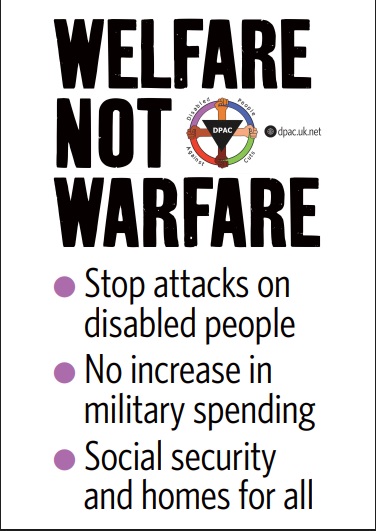


 Posted by at 13:32
Mar 102025
 
DPAC Logo with text underneath "Disabled People Against Cuts" and then web address dpac.uk.net

Below are the slides used for the talk Ellen Clifford gave to the Hands Off Disability Benefits! meeting on 9 March 2025.

Apologies that we are not able to upload the powerpoint itself and in a way that is accessible to screen readers – we hop to have this fault fixed soon.

For those who can access these slides please feel free to use to raise awareness of the impending cuts and what they will mean for Deaf and Disabled people.


Opening slide

Slide 2

 Slide 3

Slide 5


Slide 6
Slide 7
Slide 8
Slide 9
Slide 10
Slide 11
Slide 12

 Slide 14


Mar 072025
 
DPAC Logo with text underneath "Disabled People Against Cuts" and then web address dpac.uk.net

End Labour’s War on Disabled People Now!

Disabled People Demand Change Not More of the Same!


Protest at Labour Party Members Meeting

Friday 14th March

6.45pm, St Marks Church Hall, Hall Road, Norwich, NR1 3HP

  • No More Deaths from Benefit Cuts!
  • End 14 Years of Tory Cuts and Austerity!
  • Tax the Rich Not Disabled People
  • Tory and Labour Cuts Kill!
  • Nothing About Us, Without us!


 Posted by at 19:05
Mar 062025
 
DPAC Logo with text underneath "Disabled People Against Cuts" and then web address dpac.uk.net


Nurse used benefit assessment info to launch campaign of harassment that left disabled neighbour suicidal

A nurse who carried out benefit assessments on behalf of the government obtained a medical report belonging to his disabled neighbour and then used it to launch a campaign of bullying and harassment that left him suicidal.

Carlo* has told Disability News Service (DNS) that he had fallen out with his downstairs neighbour, who he knew worked as a nurse, after having to complain repeatedly to their landlord, and then the police, about cannabis fumes from his flat that were making his life a misery.

After both the landlord and police issued the nurse with a warning, contractors working in Carlo’s London flat, and neighbours, began asking him about his mental health and why he was not working.

An electrician told him this information had come from the nurse.

Carlo, who was recovering from serious illness and had developed associated mental distress, said: “He had basically said that I don’t work, I sit at home all day, that I’m on benefits, and that I was ‘mental’ and ‘crazy’.

I know he said these things to the landlord as well.”

He discovered that the nurse worked for US outsourcing giant Maximus and had been sharing deeply personal information about his mental health that had been taken from the 2017 work capability assessment (WCA) carried out by the company after he had applied for universal credit.

Carlo reported his actions to the police – as well as the other harassment he had experienced – and to Maximus.

He was told by the police that the nurse had admitted searching for his details and viewing an assessment report carried out by Maximus in 2017.

Maximus investigated the allegations, suspended the nurse, and eventually admitted to Carlo in an email that there had been an “unacceptable and egregious action taken which is contrary to all policies and the ethos of our organisation”.

Carlo told a senior Maximus executive he felt his “privacy has been totally invaded”, which had “destroyed the little confidence and self esteem I had left”.

Maximus offered Carlo a £200 “consolatory payment” as “full and final settlement of this matter”, although it continues to insist that it was not legally liable for the nurse’s actions.

By the time Maximus had completed its investigation, the nurse had transferred to Ingeus UK, which took over the Department for Work and Pensions (DWP) contract for all disability assessments in London, south-east England and East Anglia last September.

Ingeus continued the disciplinary case and sacked the nurse, and he now faces a police investigation.

But DWP and Maximus are still facing questions over how the nurse was able to access the medical details of a claimant he had not assessed himself.

Although Maximus no longer carries out assessments in London, it still has a contract to carry out PIP assessments and WCAs in northern England, as well as carrying out WCAs in Scotland.

Carlo told DNS the experience had been personally “devastating”.

He said: “I feel my privacy has been completely violated.

I am quite a strong person, but I felt suicidal. I just felt my privacy had been completely violated and nobody was taking me seriously.

The report he had access to was primarily about my mental health.

For him to read that and express it to contractors and neighbours, calling me names such as crazy and mental, is completely unbelievable.”

He said the case “opens up a can of worms” relating to the security of deeply personal information shared by disabled benefit claimants with DWP contractors.

He also fears the nurse could have accessed a later assessment report that included a further “very serious” health diagnosis he has not yet even discussed with those close to him.

He said: “These are things I don’t even tell my friends and family. To find that someone can just go in and review it so easily – it’s just unbelievable.”

Carlo lodged a complaint about the nurse’s behaviour with the Nursing and Midwifery Council (NMC), but the regulator told him: “We’ve considered the fitness to practise concern raised and we’ve decided we won’t be investigating it further at this time.”

The regulator told Carlo it was “not satisfied that we have evidence of a concern that meets our seriousness criteria as outlined in our guidance” and that there was “clear evidence that [the nurse] has addressed the concerns” and that it “can be confident there is no longer any risk to the public”.

It said the evidence suggested the nurse “accessed the customer’s record once (22 January 2024)” and that there was “no evidence” that “any actions were performed by [the nurse] in relation to the record accessed”, while the nurse had been “open and honest about his conduct at the time they occurred and demonstrated sufficient regret and remorse in respect of his actions”.

NMC said there had been “no evidence of previous concerns in relation to [the nurse’s] performance at work” and it claimed the incident “was distressing for both parties involved”, while there was evidence that the nurse “had reflected on this incident and identified things he could do differently in future”.

Carlo replied to NMC: “The letter actually makes [the nurse] sound more of a victim than me when in fact I am the only victim in all of this.

It was him who deliberately and maliciously searched and accessed my deeply personal medical information, then disclosed it to other people.

Even though the findings state he accessed my medical information only once, it only takes one time to breach someone’s privacy and cause them considerable distress.

The only thing that [the nurse] regrets is getting caught and found out by me.”

Carlo has asked DWP to investigate if the nurse might have carried out assessments while under the influence of cannabis, as he worked from home.

The Metropolitan police are also investigating the nurse for alleged unauthorised access to Carlo’s “personal medical information”, and are in touch with Maximus, and plan to interview the nurse at a police station.

The Nursing and Midwifery Council, which has a history of failing to act on complaints against nurses working for assessment companies, refused to explain why it cleared the nurse, or if it would reopen the investigation, when there was an ongoing police probe.

It also refused to explain how it concluded there was no evidence that the nurse did anything with the information he accessed, despite being told by Carlo that he had shared it with neighbours and strangers.

Instead, an NMC spokesperson said: “While we can’t comment on individual cases, we want to reassure people that we look at every concern that’s raised with us about someone on our register very carefully, in line with decision making guidance that’s published and available on our website.

Wherever necessary and possible, we will always take appropriate action to protect the public.”

Maximus declined to say if it had taken any action on data privacy as a result of the case or if it was still possible for one of its assessors to access the details of benefit claimants they are not responsible for assessing.

But a Maximus spokesperson said: “We have apologised to [Carlo] for the unacceptable actions of [the nurse] who previously worked for us.

He is no longer employed by our organisation.

We take all complaints relating to data security incredibly seriously.

Upon receiving this complaint, we took immediate action to gather the required information and a formal investigation was launched.

Our colleagues undertake regular training on information security and data protection, and we have rigorous policies in place to ensure the correct handling of personal information.

We understand this is subject to an ongoing police investigation, it would therefore be inappropriate for us to comment further.”

Ingeus declined to say if it had taken any action on data privacy as a result of the case, or if it was still possible for its assessors to access information from disabled people they are not responsible for assessing.

But an Ingeus spokesperson said: “As a result of the disciplinary process started by Maximus and completed by Ingeus, [the nurse] no longer works for Ingeus.

During his time with us, he never carried out any health assessments.

Doing all we can to protect people’s personal information is absolutely vital to us.

We have a proactive programme of mandatory training to ensure our staff know and understand our policies and process on information security and data protection.”

He confirmed later that the nurse had been sacked for “breaching data privacy”.

A spokesperson for the Metropolitan police said: “Officers received reports on Sunday 10 November of an individual’s confidential medical information having been accessed without their consent.

There have been no arrests. Enquiries are ongoing.”

Despite the police investigation, DWP refused to say if it was concerned by the case or if it was taking any action.

A DWP spokesperson said: “We cannot comment on individual cases.

We take data protection very seriously. 

We ensure all our assessment suppliers are aware of their legal responsibility, including that it is an offence to access or disclose any information obtained which relates to customers, and are required to demonstrate how they have fully met this obligation.”

*Not his real name

6 March 2025


DWP is broken and needs to be scrapped and replaced, say Liberal Democrats

The Liberal Democrats have called for the “completely broken” Department for Work and Pensions (DWP) to be scrapped and replaced with a new department that is “more supportive and inclusive” for benefit claimants.

The call has come from Steve Darling, one of the new intake of disabled MPs at last year’s general election, who speaks for his party on work and pensions issues.

He told Disability News Service (DNS) this week that it was clear that DWP was “completely broken” and could not be fixed.

He told DNS this week: “I’ve now drawn the conclusion that actually the DWP is just completely broken and we need to think about how we reshape our world, and could it be done in a different way that actually is more supportive and inclusive to people who claim benefits.”

Darling said he was clear DWP needed to be scrapped and replaced, and he was now working on “the model we replace it with, and how we can best seek change, because for many years now it has been a broken system”.

He also said he was “sympathetic” to a possible public inquiry into the links between DWP and the deaths of hundreds, and probably thousands, of deaths in the post-2010 austerity years.

But he said he wanted to examine the “full implications” of such an inquiry and “immerse myself more in it and have confidence that it would be bringing the change that we need to see” before deciding whether to call for an inquiry.

Darling said the message from The Department* – the book written by DNS editor John Pring, which exposes the “violent government bureaucracy” within DWP that has led to so many deaths since 2010 – was that the culture within DWP continued to be a concern.

He said: “Clearly what’s portrayed within your book should give major cause for concern.

One would hope that a public inquiry would result in significant change within that organisation, and hopefully even root and branch change, which I think we need to be seeing within the DWP, because it has been broken for so many years.”

He said the book showed there had also been a “toxic mix” between parts of the media and politicians “of a number of different colours” from the early 1990s onwards that led to the “demonizing of people who are on benefits when evidence clearly portrays that on a number of benefits the levels of fraud are minuscule”.

And, he said, there was “conflation between error and fraud, so that it is almost seen as the same”.

Darling has previously spoken out as a member of the Commons work and pensions committee about his concerns with the government’s Access to Work disability employment scheme.

He said he was “really worried that it is a system that is not performing”, and he pointed to a friend who is owed more than £3,000 by Access to Work for travel costs.

He also highlighted comments made by Sir Stephen Timms, the minister for social security and disability, about Access to Work, in which he suggested major changes to the scheme that would shift the cost of support towards employers and away from DWP.

Darling said he has heard from people who have attended roundtable meetings with ministers, and other sources close to the government, that although they have not used the word “cuts”, ministers appear to be planning “changes to the system where they are relying on employers to do much, much more”.

He said: “I shudder at what that actually means.

They often describe it as the best kept secret; well, make it bloody well work and then we can actually get people into work because the issue is that we know that we’ve got a real challenge with finding enough people for some of the jobs that we’ve got out there, so we need to make sure that we support employers so they can have a bit more flexibility and then people can get into work.”

As well as the government’s imminent green paper on disability benefits and the “Pandora’s box of challenges that will bring up for the disability community”, Darling said he is also focused on the government’s public authorities (fraud, error and recovery) bill, which will force banks to examine individuals’ accounts for potential breaches of benefit eligibility rules, and then pass that information to DWP.

Darling said that, although those currently in power in the UK government might be “reasonable people”, it was important to look at the recent election of Donald Trump and the subsequent “carnage” being done to government in the US.

This means there will need to be “genuine checks and balances” in the fraud and error bill, he said.

While this may go through now with reasonable people in power, in ten years’ time, who knows what the politics of the UK will be.

We need to make sure that there are genuine independent safeguards to protect people from those who have a really dodgy worldview around people with disabilities.”

Darling said he had not come into parliament as a new MP wanting to speak for his party on work and pensions issues, so the appointment last September had been a “bolt from the blue”.

But he said he believed that his personal experience of the benefits system, as a recipient of personal independence payment (PIP), and having disabled friends with similar experiences of benefits and DWP’s creaking Access to Work system, had helped equip him for the role.

6 March 2025


UN calls for ‘corrective measures’ to Tory disability benefit reforms, just as Labour prepares cuts of its own

A report by the United Nations (UN) has called on the UK government to take “corrective measures” to address the impact of cuts to disability benefits introduced under Conservative governments, just as Labour ministers prepare to introduce further such cuts.

The recommendation by the UN’s committee on economic, social and cultural rights (CESCR) comes in its “concluding observations” on the UK’s progress in implementing the International Covenant of Economic, Social and Cultural Rights.

The committee concluded that “welfare reform” measures introduced by Conservative-led governments in 2012 and 2016 had disproportionately affected disabled people, low-income families, and workers in “precarious employment”.

And it says this led to “severe economic hardship, increased reliance on food banks, homelessness, negative impacts on mental health, and the stigmatization of benefit claimants”.

Among its recommendations, it calls for increased spending on social security, and for the government to take “corrective measures” to address the impact of post-2010 welfare reforms on the most disadvantaged groups.

It also calls for the level of disability-related benefits, including personal independence payment (PIP) and employment and support allowance, to be increased so they “adequately cover additional disability-related costs”.

The report was published by the committee just as the government is set to announce new austerity measures that are expected to include significant cuts to social security spending, including disability benefits, at the spring statement on 26 March.

The government’s long-awaited green paper on disability benefits will also be published in the next three weeks, ahead of the spring statement.

The UN committee calls on the government to carry out an independent assessment of the cumulative impact of post-2010 austerity measures on disabled people and other “disadvantaged groups” and to take “all measures necessary” to reverse those impacts in areas such as social security, social care and public transport.

It also calls for wide-ranging action to address disability-related discrimination and inequality across employment, housing, education, and access to sport and culture, and to introduce targeted measures to support disabled women.

The government had failed to comment on the CESCR report by noon today (Thursday).

Last year, another UN human rights committee concluded that the UK government had made “no significant progress” in the more than seven years since it was found guilty of “grave and systematic” violations of the UN disability convention.

The committee on the rights of disabled people said last April that it had even found “signs of regression” – backward steps – in the UK’s progress towards fully realising the rights described in the UN Convention on the Rights of Persons with Disabilities.

Disabled campaigners this week called on the government to listen to CESCR and step away from any planned cuts to social security.

Ellen Clifford, a member of the national steering group of Disabled People Against Cuts and award-winning author of The War on Disabled People, said: “It’s tragically ironic that the CESCR report has been published at the same time as the government is boasting about plans to cut the welfare budget. 

CESCR is recommending that more needs to be spent on social security at exactly the same time as the chancellor is set to announce taking billions out of the system, attacking disability benefits and hitting the poorest and most disadvantaged in society to make up for her inability to fix low productivity growth.

After a decade and a half of austerity and welfare reform, such cuts will devastate our communities in ways we cannot imagine.

It’s clear this Labour government has no concern for human rights and sees the lives of disabled people as something they see no value in.

So it’s up to us to make sure we create a problem for them and make it clear they cannot get away with visiting such levels of harm on us without consequence.”

She said DPAC was holding an online campaign planning meeting on Sunday (9 March, 2 to 4pm) “to discuss how we can work together to do that”*.

Fazilet Hadi, head of policy for Disability Rights UK, said: “Just weeks away from the government publishing its proposals to cut billions from the social security budget, leading to millions of disabled people being pushed into even deeper poverty, we have a UN committee putting the spotlight on the grave injustices and inequalities faced by UK citizens, including disabled people.

In a series of hard-hitting recommendations, the committee asks that the impact of austerity be examined, that social security payments are increased, that poverty and high costs are tackled, that inadequacies in relation to health, housing and education are addressed.

But is anyone listening?

The new government is wedded to a financial strategy that gives no priority to investing in public services, to tackling poverty or to embedding disability inclusion.

Eight months after coming to power, we still have no mention of any concerted strategy to achieve disability equality.”

Carole Ford, from the WOWCampaign, said the UN findings were “particularly concerning at this time, when the government are planning further cuts to the welfare budget”.

She said the government was “likely to choose to ignore the UN, as previous Conservative governments have done”.

Mark Harrison, a member of the Reclaiming Our Futures Alliance (ROFA) steering group, said: “This report is calling for a reappraisal of the Labour government approach. 

Their adoption of planned Tory tax rises and austerity cuts to benefits and services will continue to redistribute wealth from the poor to the rich. 

Rachel Reeves’ spring statement [on 26 March] promises to bring more poverty and misery to poor and disabled people.”

He said that work and pensions secretary Liz Kendall and ministerial colleagues were “continuing to ramp up the Tory – now Labour – culture war on disabled people, labelling us as benefit scroungers and cheats. 

This government, whether they like it or not, were elected because people wanted and demanded change, not to carry on and step up the attacks on our rights and living standards. 

The UN report calls for a cumulative impact assessment of the combined measures and a change of direction in line with the UN conventions signed and ratified by the UK government. 

We are putting Starmer and his government on notice that we will fight them all the way. 

Disabled people and our organisations will not accept more of the same. 

After 14 years, we say enough is enough.”

*Click here to register

6 March 2025


Councils now only able to offer the ‘bare minimum’ of adult social care support, MPs are told

Local authorities in England are now only able to provide the “bare minimum” of services to disabled and older people who need support through the adult social care system, MPs were told yesterday (Wednesday).

Three senior local government figures were giving evidence to the Commons health and social care committee as part of its inquiry into the “cost of inaction” on adult social care reform.

Hugh Evans, executive director for adults and communities for Bristol City Council – whose council has come under repeated attack in recent years for its cuts to social care – told the committee that he and his colleagues were having to focus on the council’s financial “survival” every year.

He said his council’s ability to raise revenue through council tax was “not sufficient to meet the increased cost of adult social care”.

Evans said: “That’s certainly happened in Bristol. Spendings outpace local government funding and so we have to make savings.”

The council spent 75 per cent of its revenue on adult and children’s social care in 2023-24, compared with 56 per cent in 2017-18.

He said: “We’re having to emphasise the bare minimum of statutory services in order to be able to fulfil our duties under the Care Act.”

Melanie Williams, president of the Association of Directors of Adult Social Services and executive director of adult social care for Nottinghamshire County Council, said her local authority was focused on “just providing the minimal amount of support in their homes” for older people.

She said: “It may be that… they may take a direct payment and we would be looking at what is the minimum they would require to stay relatively well.

What we wouldn’t be able to invest in is necessarily having friendships, being able to get out and about more.

So, what somebody’s receiving probably is the basic personal care, the bare minimum, rather than what would be needed for an older adult to really enjoy a great quality of life as they age.”

She added: “That’s kind of where we are, there’s a sort of a rationing over time, if you like, because of focusing on the most immediate need.”

David Fothergill, chair of the Local Government Association’s community wellbeing board and a Conservative councillor on Somerset Council, told the committee that adult social care was now “more or less half the budget of local authorities”, and adding children’s social care increased this to “well over 70 per cent of budgets”.

He said this left “very little for the remaining services, which many of your residents and many of my residents as well depend upon, including roads and libraries and things like that”.

Fothergill said that about £24 billion in savings had been taken out of council budgets since 2010, and local government was now facing an estimated funding gap of more than 20 billion pounds in total over the next four years.

He said adult social care was “really, really putting local government under a lot of pressure”.

Last year, he said, 15 local authorities had applied for emergency funding support, and that had risen this year to 34 councils, and “most of them are driven by social care pressure”.

He said his own council had “declared an emergency financial crisis, and that is purely based upon social care pressures”.

Meanwhile, Bristol City Council has finally produced most of the details of a contract it signed last spring with a consultancy that is using locum social workers to carry out up to 1,400 “strength-based reviews” of disabled people’s care packages as a cost-saving measure, at a cost of up to £700,000.

It provided the contract details to Disability News Service in response to a freedom of information request, following intervention from the Information Commissioner’s Office.

The council has been at the centre of controversy for more than two years since it revealed proposals to offer disabled people a “residential or nursing home placement” if a care package that would allow them to remain at home “would substantially exceed the affordability of residential care”. 

The concerns about what the council called its Fair and Affordable Care Policy were first raised by the grassroots disabled people’s organisation Bristol Reclaiming Independent Living (BRIL)

The policy was eventually withdrawn, but last year the council brought forward new cuts worth millions of pounds that campaigners feared were also likely to push disabled people into residential care. 

BRIl is now “very concerned” about the council’s latest plans and this week it issued a statement about the council’s 2025-26 budget, which includes £14.6 million projected savings from adult social care.

The budget includes plans for more reviews of care and support plans that will “support approaches which focus on an individuals’ personal strengths… in order to promote their wellbeing and independence”, and reviews of people who have previously been detained under the Mental Health Act that will result in “the need for less care and therefore reduced costs”.

BRIL said there was “a real risk” that millions of pounds of planned savings would be made by “redefining needs as mere wishes, leaving disabled people without essential support”, an approach that is “alarmingly similar to the Fair and Affordable Care Policy”.

Mark Williams, BRIL’s chair, said: “Every time I have a review, I feel under attack and worried that my care will be revoked or cut back.

In one review they tried to tell me that being alone for half an hour would make me more ‘independent’.

I refused. I am not independent on my own. I am independent when I have the right to the support I need.”

6 March 2025


Extra costs evidence from grassroots group provides stark warning to ministers set to cut disability benefits

New research from disabled activists has shown the huge variety of ways in which mental health impairments can cause significant extra daily living costs, just as the government appears set to announce fresh cuts to disability benefits.

The grassroots, user-led mental health group Recovery in the Bin, which carried out the research, warned that they were the group of benefit claimants with “with the highest suicide and starvation rates” so any further cost-cutting of benefits would “cause more suffering and deaths”.

RITB said the evidence it had collected was a warning to ministers that “if you proceed with cuts, you will proceed with deaths”*.

The BBC reported yesterday (Wednesday) that the Treasury had “earmarked several billion pounds in draft spending cuts to welfare and other government departments”.

It is just the latest signal that chancellor Rachel Reeves is about to announce cuts to “welfare spending”, and particularly to disability benefits.

The news reports come despite evidence from the Office for Budget Responsibility that total spending on social security as a proportion of GDP** is predicted not to increase at all next year, and then to stay at the same level for the next four years, and is predicted to be lower this year than it was for every year from 2010-11 to 2015-16.

Last week, Disability News Service (DNS) also revealed how Labour and Conservative ministers sat on research for three years that linked the sharp increase in claims for disability benefits with a deterioration in disabled people’s health, an increase in the financial hardship they were facing, and their need for independence.

That report, Triggers to Claiming Personal Independence Payment, provided strong evidence to explain the need for increased spending on personal independence payment (PIP), and even called on the Department for Work and Pensions (DWP) to do more to increase awareness of PIP.

John McDonnell, the suspended Labour MP, has now tabled an early day motion in parliament that welcomes DNS’s efforts in securing the report and expresses concerns that the government “delayed publication of the report for so long” when it “provides strong evidence to explain the need for increased spending” on PIP.

RITB has now published the results of its own research that shows how those claiming benefits for mental health-related reasons have significant costs that justify them receiving extra support through universal credit, employment and support allowance, and PIP.

They had asked RITB members and followers about their mental health-related costs, because, they said, “the cost of living for people with mental illness/distress is no less pressing than the extra costs for people with physical illness or disability” and “benefits are essential to support a basic, acceptable standard of living”.

In response, they were told of costs to cover taxis, legal advice, extra cleaning products, health services not covered by the NHS, food deliveries, inflated utility bills, advocacy, therapy, cleaners and counselling.

Among those who provided evidence, one said: “Needing to throw out £15 worth of food because voices have changed or ruined it some way.”

Another said: “Wasting money on fresh food and then being too unwell to cook and buying takeaways is the big ongoing one.

Paying for therapy so I can get therapy that doesn’t harm me.”

A third person who contributed told RITB: “I pay £120 per week to see my (incredible, life changing) autism-informed ex NHS clinical psychologist.

It eats all of my PIP, leaves absolutely nothing, but her approach, experience and expertise has helped me more in four months than CMHT [community mental health team] has in 13 yrs.”

Another told RITB: “Stress induced psychosis spending on fixing things that don’t actually need fixing! Also heightened vulnerability to scams.”

And another said: “Extra costs because you can’t shop around, can’t access discounts, can’t remember reward cards, get sold bad deals.”

An RITB spokesperson told DNS yesterday (Wednesday): “Mental illness/distress claimants are the most stigmatised claimants, lacking support from the NHS, while professional groups exploit us as they seek power and opportunistically support government policy.

Our costs are every bit as high as for people with physical disabilities, yet political and media gaslighting are now attempting to say many of us are not even experiencing disability distress or illness.

We are the group of claimants with the highest suicide and starvation rates, any cost cutting agenda and continued austerity will cause more suffering and deaths.

This is our warning to ministers: if you proceed with cuts, you will proceed with deaths.”

The Public and Commercial Services Union, which has 46,000 members working within DWP, also spoke out yesterday about the reports of spending cuts.

PCS general secretary Fran Heathcote said: “Cutting civil service jobs will damage public service and cutting disability benefits will condemn people to poverty.

We’d have hoped we wouldn’t have to explain the damage wreaked by austerity to a Labour government.”

*The following organisations are among those that could be able to offer support if you have been affected by the issues raised in this article:  MindPapyrus, Rethink, Samaritans, and SOS Silence of Suicide

**Gross domestic product, the size of the country’s economy in a particular year

6 March 2025


Cautious welcome for Arts Council England report that shows striking increase in disabled leaders

Arts Council England (ACE) has reported a significant increase in the number of disabled people in leadership positions within the organisations it is funding, although leading figures in the disability arts world say there is still much more to do.

In its new Equality, Diversity and Inclusion Review, ACE says the proportion of arts organisations funded through its national portfolio programme who have a disabled chair has trebled in four years (from five to 15 per cent).

The proportion of funded arts bodies with a disabled chief executive has also risen, from nine per cent in 2018-19 to 13 per cent in 2022-23, while the proportion with a disabled artistic director rose from eight to 10 per cent, and the proportion of board members identifying as disabled increased from eight to 12 per cent.

ACE also reported significant increases in the proportion of its own staff and council members who identify as disabled people.

The proportion of disabled people in its workforce rose from seven to 12 per cent; the proportion of disabled directors increased from two per cent to 7.6 per cent; and the proportion of managers identifying as disabled more than trebled, from three per cent to 11.3 per cent.

The proportion of ACE area council members identifying as disabled more than quadrupled, rising from six per cent to 25 per cent, although the proportion of disabled national council members remained at seven per cent.

The proportion of disabled applicants who were successful with National Lottery-funded project grants fell from 53 per cent to 35 per cent, but the report suggests that was probably because of a significant increase in the number of applications.

The proportion of audience members identifying as disabled people also increased slightly, increasing from nine per cent in 2018-19 to 10 per cent in 2022-23.

Andrew Miller, a member of ACE’s national council, and chair of its disability advisory committee, says in the report: “Clearly there is still work to be done to improve the representation of disabled people in the sector, and that is something that we will continue to advocate and strive for.

But for the proportion of disabled people working in our creative and cultural organisations to have doubled in five years is something truly to celebrate.”

Dr Ju Gosling, artistic director of Together! 2012, a disability arts organisation which receives ACE funding through the national portfolio programme, said questions remained as to whether the figures showed an increase in the employment of disabled people and more opportunities for disabled people to engage with the arts or instead “an increase in disability rates among certain demographics as a result of Covid and an ageing population”.

She said: “Chairs, artistic directors and CEOs all tend to be middle-aged or elderly, and many arts audiences are slanted towards older people too.

We’ve also seen a lot of people departing the creative arts for economic reasons, including as board members.

Disabled people are less likely to have access to these alternative employment opportunities, so are more likely to have remained with Arts Council-funded organisations despite flatlined budgets in many areas.

Disabled people have also been less likely to be invited onto boards in the first place and are less likely to be in employment, so there is a bigger pool of people available to replace departing non-disabled volunteers.

However, outside of London there was a genuine increase in the funding of disabled-led organisations in the last round [of ACE funding], which was definitely good news.”

Gosling said she would “obviously like to see these figures continue to increase, not least because it would reflect better retention of arts workers as they age”.

But she warned that “the continued slurs on the abilities of disabled workers coming from the US, plus the rise in national insurance and the continuing squeeze on arts organisations’ budgets, makes the future picture less clear”. 

And she said cuts to arts training and work opportunities over the last 15 years “means there are already far fewer young people coming up to take over than previously”.

She added: “I’m not at all sure that mainstream organisations will be so keen now as they were 10 years ago to employ a young disabled person in a first or early career job, for the reasons above.

So we could easily see a fall over the next five to 10 years rather than a continuing increase.”

Trish Wheatley, chief executive of Disability Arts Online, another disability arts organisation which receives ACE funding, said: “It is encouraging to see an increase in disabled people in positions of leadership and in the wider arts workforce.

This progress should be celebrated because we have more people with lived experience making decisions and creating work.

However, despite the increases shown in the report, disabled people remain significantly underrepresented, so it is vital that Arts Council England continues to work with the sector to address ableism and remove barriers.”

Sir Nicholas Serota, ACE’s chair, says in the report: “The boardrooms of 2023 were far more diverse than those of 2018, with significantly higher proportions of female, Black, Asian and ethnically diverse, and disabled and LGBTQIA+ members.

The same shift was also seen in leadership roles across organisations, with a greater proportion of women and Black, Asian and ethnically diverse, and disabled people occupying the roles of chairs, chief executives and artistic directors at the end of the last Portfolio than at its beginning.

Diversity also grew across the total workforce, in each of the four protected characteristics, race, sex, sexuality and disability, that this report covers.

These changes are profound, particularly in the context of the range of challenges from the pandemic to the cost-of-living crisis, and we should all take pride in them.”

But he says there is “still much more to do to make sure that our sector is drawing on all available talents and appealing to audience members from all backgrounds”.

And he says that while the proportion of disabled people in the arts workforce “rose significantly”, it still remains below the level of disabled people in the population.

Sir Nicholas also says in the report that there is still work for ACE to do, which was why it established a disability advisory committee and a race advisory committee in 2022 and commissioned an independent review of inclusion within ACE in 2023.

He adds: “Our adoption of our own statement on the social model of disability, and the related policies we have introduced to implement it, are examples of the work we are doing in this area.”

6 March 2025


Other disability-related stories covered by mainstream media this week

A man with learning difficulties was filmed eating out of a bin after being neglected by care home staff, an investigation has found. Workers were also caught sleeping on the job and ignoring the 23-year-old after his concerned mum placed a camera in his room. The ITV News investigation said the man, Connor, is autistic and has bipolar disorder. He was living in a residential home in Coventry run by Lifeways, the UK’s largest provider of supported living for adults with learning difficulties, caring for around 4,000 people: https://www.mirror.co.uk/news/uk-news/vulnerable-care-home-resident-caught-34788125

An autistic woman with learning difficulties was wrongly locked up in a mental health hospital for 45 years, starting when she was just seven years old, the BBC has learned. The woman, who is believed to be originally from Sierra Leone, was also held on her own in long-term segregation for 25 years: https://www.bbc.co.uk/news/articles/cly43png991o

Leading disability charities have called on the government to ensure that people will continue to be able to use physical cash in shops. It comes after a government minister said that shops will not be forced to accept cash, despite concerns that millions of disabled people rely on it. Disability Rights UK and RNIB are warning that making card payments the default creates “more barriers” for disabled people: https://www.bbc.co.uk/news/articles/cp3yz40r2zyo

6 March 2025


News provided by John Pring at www.disabilitynewsservice.com


 Posted by at 15:03
Mar 022025
 
DPAC Logo with text underneath "Disabled People Against Cuts" and then web address dpac.uk.net

Time: 2-4pm

Date: Sunday 9th March 2025

Where: Online, on Zoom. Register here:

BSL interpretation and automated Zoom captions available

With the upcoming Green Paper on social security benefits, as well as the Spring statement, DPAC is holding an online meeting to plan how we campaign against any so-called ‘welfare reforms’.

We will hear from speakers to lay out the context but, most importantly, we want to hear from disabled people and our allies on how we can work effectively to fightback against an increasingly hostile environment.Register here: https://us06web.zoom.us/meeting/register/c6qNCqLqSguDQtuzVqHQgQ

Feb 272025
 
DPAC Logo with text underneath "Disabled People Against Cuts" and then web address dpac.uk.net

Contents

Family say DWP has unanswered questions over death of disabled woman whose benefits were stopped 1

Death of disabled woman failed by multiple agencies ‘must be catalyst for change’, say family 3

Research that ministers sat on for three years shows no evidence to support call for PIP cuts 7

Bank surveillance bill could lead to greatest miscarriage of justice in British history, disabled activist tells MPs 10

Government’s railways consultation has ‘betrayed’ disabled passengers, campaigners tell minister 13

Government claims of ‘spiralling’ spending on benefits are false and ‘ideological’, official figures show 14

Rayner to push ahead with evacuation plans that are ‘insult’ to disabled people who died at Grenfell 16

Labour assembly members reject plan for disability equality champion for London, despite previous backing 17

Other disability-related stories covered by mainstream media this week 19


Family say DWP has unanswered questions over death of disabled woman whose benefits were stopped

The family of a disabled woman whose body lay undiscovered in her flat for more than three years after her benefits were stopped say they have serious unanswered questions about the actions of the Department for Work and Pensions (DWP).

Laura Winham’s body was not found until May 2021, more than three-and-a-half years after she was last seen alive.

But her family say DWP appeared to have failed to carry out checks on her welfare before cutting off her benefits.

They spoke out this week at the end of an inquest and the publication of a safeguarding review into the multi-agency failures that contributed to her death.

She is believed to have starved to death in November 2017 in her council-owned flat in Sheerwater, Woking.

Her death has clear similarities with other deaths of disabled claimants, including those of Errol Graham, whose body was also discovered in his flat in June 2018 after starving to death when his benefits were removed; Mark Wood, who starved to death in his home in 2013 after being found ineligible by DWP for employment and support allowance (ESA); and Timothy Finn, who starved to death in his home in autumn 1998 after his benefits were stopped.

Laura Winham, who was living in Woking at the time of her death, had been receiving disability benefits since the age of just two, after being born with Goldenhar Syndrome and later developing several connected health conditions.

She was also diagnosed with persistent delusional disorder in 2009 and had two spells of detention under the Mental Health Act, in 2006 and 2010.

DWP wrote to her in early 2016 to say her disability living allowance claim would be ending and she would need to apply for the new personal independence payment (PIP).

But she told Woking Borough Council that she could not cope with the “invasive medical check-up” the application would involve, almost certainly a reference to the much-criticised PIP assessment process, and her DLA was stopped in March 2016.

Her ESA had been stopped three years earlier, although it is not clear why.

The coroner, Dr Karen Henderson, said there had been a “lost opportunity” to “proactively investigate” the loss of Laura’s benefits, but that it was not possible to say if this would have prevented her death.

She said DWP had since taken steps to be “more proactive” and to carry out more coordination with other agencies.

Both the inquest and the safeguarding review into her death – published this week (PDF) – stressed that she had cut her family out of her life due to her delusional disorder.

They had been forced to respect Laura’s wishes because every time they tried to contact her it caused her significant mental distress and put her safety at risk.

Over the 18 months after losing her DLA, her savings ran out, and her last food shop probably took place through a Tesco delivery on 4 September 2017. She recorded on her calendar against that day that she had no money left.

At some point, probably in early November 2017, she appears to have starved to death, although Dr Henderson concluded on Tuesday that it was impossible to determine the cause of death and recorded an open conclusion.

By the time DWP was eventually alerted to her death, several years later, many of her records had been destroyed.

The family of Laura Winham have shared with Disability News Service the secret internal process review (IPR) carried out by DWP into her death, obtained by her legal team and marked “Official Sensitive” by the department.

The case review and findings take up less than one page, with the document admitting there were “limited records of the customer’s interactions” with DWP because they had been destroyed, although it confirmed that her ESA stopped in April 2013 and her DLA in March 2016.

The records show she failed to attend two face-to-face work capability assessments (WCAs) before her ESA was stopped, so it is possible that DWP again failed to carry out safeguarding checks.

Despite the unanswered questions about DWP’s safeguarding actions, and the lack of remaining evidence, the IPR somehow concluded that DWP “acted appropriately during the customer’s benefit claims”.

This week, DWP did not challenge the suggestion that it failed to carry out any safeguarding visits when Laura Winham did not complete her PIP claim, and also when she failed to attend two WCAs.

It also did not dispute that there had been a “lost opportunity” to “proactively investigate” the loss of her benefits.

And it failed to explain how its IPR had concluded that DWP “acted appropriately during the customer’s benefit claims” when there were so many unanswered questions about its safeguarding actions, and when it had destroyed most of the relevant records.

It also failed to apologise to the family or say if it accepted the coroner’s criticism. 

It declined to issue a statement, but instead produced a series of background briefing notes which suggested that the department’s “condolences” remained with the family, and that it had introduced measures to support “vulnerable” claimants since her death, and had introduced strengthened guidance around safely stopping payments to claimants identified as vulnerable.

In a statement issued on Tuesday at the end of the inquest, Laura’s family – who described her as a “much-loved, much-missed daughter and sister” – said she had been left to “fend for herself” by agencies including DWP, Surrey County Council, Woking council, and Surrey and Borders Partnership NHS Foundation Trust (see separate story).

In a statement delivered by their solicitor, Iftikhar Manzoor, of Hudgell Solicitors, Laura’s family said: “The circumstances of Laura’s death have been absolutely devastating for her loved ones.

They are a caring and loving family who I have come to know well over the past few years.

Laura was a much-loved, much-missed daughter and sister.

Her family did everything in their power to support her as she battled her mental health struggles until it became apparent she may harm herself unless they backed away.

They believed Laura would be in the best possible hands when handing her into the care of professionals – people with much more knowledge and understanding of supporting those with serious mental health issues.

Sadly, in this instance, that was not the case.”

27 February 2025


Death of disabled woman failed by multiple agencies ‘must be catalyst for change’, say family

The family of a disabled woman whose body lay undiscovered in her flat for more than three years say her death must be a “catalyst for change”, after the failure of multiple organisations to support and protect her.

They say Laura Winham was left to “fend for herself” by agencies including Surrey County Council, Woking Borough Council, the Department for Work and Pensions (DWP), and Surrey and Borders Partnership NHS Foundation Trust.

The county council had been alerted to concerns about her “vulnerability” by the police, but all its adult social care team did was try to call her – before realising her phone was no longer working – and then send her a letter, before closing her case when she failed to respond.

In a statement issued on Tuesday at the end of an inquest into her death, her family – who described her as a “much-loved, much-missed daughter and sister” – said: “Laura was clearly a person potentially at risk, but she wasn’t deemed worthy of visiting.

She was left to fend for herself. Even her own diary entries illustrate she was unable to cope.

Had adult social care visited Laura’s home within a few days of the referral in October 2017, then Laura would be alive.”

Shortly after the end of the inquest, a local safeguarding review – commissioned by Surrey Safeguarding Adults Board – revealed widespread failings by agencies that had had contact with Laura.

It concluded that there had been “many missed opportunities” that could have helped her in the months and years before she died in her flat in Sheerwater, Woking.

Laura was born with Goldenhar Syndrome and later developed several connected health conditions, one of which led to open heart surgery when she was 18.

She was also diagnosed with persistent delusional disorder in 2009, and had two spells of detention under the Mental Health Act, in 2006 and 2010, through the Surrey and Borders trust.

But when she was discharged from mental health services in 2010, the trust provided her with no care plan, no crisis plan, and no offers of advocacy.

From 2007, she had been living in a flat on Woking’s Sheerwater estate, which was managed from 2012 by New Vision Homes on behalf of Woking council.

But in 2013, after her employment and support allowance was stopped by DWP – possibly because she had failed to attend two work capability assessments – she fell into rent and council tax arrears and was served with an eviction notice.

Her disability living allowance was also stopped, in March 2016, apparently after telling the council she would not be able to cope with the assessment process for the new personal independence payment.

DWP appears to have failed to carry out the necessary safeguarding checks, although most of the records connected with her case have now been destroyed (see separate story).

She began to receive support from Woking council, and referrals were made to her GP and the mental health trust, but she soon moved to a new GP practice, which never saw the record of her mental health referral.

By the autumn of 2017, Laura was living on her dwindling savings and obtaining food through online deliveries.

The review said she had clearly “found the outside world frightening and oppressive”, and that her family were “frequently and consistently rebuffed”, while she was “determined to exclude her family from her life”.

Although she had some money in a savings account, she felt unable to visit the high street bank in person, which would have allowed her to withdraw cash from that account.

The safeguarding review report and coroner said she had engaged for years in a one-sided email correspondence with a member of the clergy, but he failed to seek support for her and eventually contacted the police in September 2017.

As a result of his complaint, a police officer visited Laura on 7 October 2017 to ask her to stop the correspondence, which she agreed to do, but he also asked about her welfare, and she told him she was short of money and food.

He provided her with details of a local foodbank and raised concerns about her “vulnerability” and lack of access to services through an “adult at risk referral”, which was passed to Surrey County Council’s adult social care team six days later.

But after writing just one letter that offered information about local food banks and Citizens Advice, and offering further assistance if she got in touch, and trying to call her – before realising her phone was no longer working – the care team closed her case without an assessment of her needs when she failed to respond, which the coroner described as a “lost opportunity”.

Her case remained closed until the council was told of her death four years later.

Despite the council’s failures, the coroner concluded that it was not possible to conclude that this had made a “material contribution” to her death, partly because it was not possible to “speculate” on how she would have responded if the adult social care team had visited her, and because the cause of death “remains unknown”.

She also said there had been “lost opportunities” for Woking council to “flag up Laura as vulnerable”, but she again could “not find on the balance of probabilities that these lost opportunities contributed to her death”.

Evidence suggests her last food shop took place via a Tesco delivery on 4 September 2017, and she recorded on her calendar that day that she had no money left.

She crossed off the days as they passed on her calendar and the last day she marked was 1 November 2017.

Her family believe she died soon after that date, at the age of 38.

Laura’s housing benefit and council tax continued to be paid until 2021, while a gas safety certificate was issued for her flat in January 2018, although it is likely that this was not issued lawfully. Her gas supply was cut off in 2019.

Her flat and other nearby properties were due to be demolished and other neighbours gradually began to move out, and by autumn 2020 every other near neighbour had left.

But because Woking council’s housing records did not flag her “additional needs”, no attempt was made to check how she was managing during lockdown in the early months of the pandemic.

When her father became unwell the following year, her family visited her to try to let her know about his poor health, and on seeing a build-up of post behind her front door, they began checking local hospitals and contacted the council.

When her brother returned to the flat, he saw what appeared to be part of a body in the hallway and called the emergency services.

The safeguarding review said that agencies involved in her support had made changes to their practices since the events of 2017 – although not all of them as a result of her death – including the Church of England, DWP, Surrey and Borders NHS trust, and Woking council.

Surrey County Council carried out a review of its adult social care team in February 2023, which included an audit of 158 contacts received by the social care team between 2017 and 2021 “which were closed without apparent management oversight”. This review led to a “rapid improvement plan”.

The safeguarding review concluded that, as Laura “withdrew from contact with others, the extent of her challenges became less and less visible to people and agencies who might have been able to intervene.

When her mental health needs did become visible on occasions, we can see with hindsight that services did not mobilise to respond in ways that secured help for [her]*.”

The review also found that, if the adult social care team had visited Laura, it would have had an opportunity to “form a view about her mental state and the precariousness of her existence, offer an assessment and attempt to take appropriate action”.

Among its conclusions, and despite changes made since 2017, the safeguarding review’s recommendations include action for Surrey’s adult social care department, Woking council and DWP, and for the results of the review to be used to improve national safeguarding work.

The safeguarding adults board, which commissioned the review and whose members include Surrey County Council, Woking council, Surrey and Borders NHS trust, and Surrey police, said: “We fully accept the findings of the review which examined the role of agencies before and after [Laura’s] death.

The review found that there were many missed opportunities, which included the need for better communications across all agencies in order to support [Laura].

We are reassured that agencies have taken steps to address much of the learning from the events of [Laura’s] life.

We have shared the review with all relevant agencies and will hold them to account in making sure the recommendations are acted on.”

But in a statement delivered by their solicitor, Iftikhar Manzoor, of Hudgell Solicitors, Laura’s family said: “The circumstances of Laura’s death have been absolutely devastating for her loved ones.

They are a caring and loving family who I have come to know well over the past few years.

Laura was a much-loved, much-missed daughter and sister.

Her family did everything in their power to support her as she battled her mental health struggles until it became apparent she may harm herself unless they backed away.

They believed Laura would be in the best possible hands when handing her into the care of professionals – people with much more knowledge and understanding of supporting those with serious mental health issues.

Sadly, in this instance, that was not the case.”

They added: “The safeguarding review made it clear that Laura was never failed by her family.

They sought professional help, but input was lost from people who truly loved her.

Laura and her family need a system that cared enough about a vulnerable person.

Laura’s death must act as a catalyst for change.”

*The review did not use her real name

27 February 2025


Research that ministers sat on for three years shows no evidence to support call for PIP cuts

Ministers have sat on research for three years that linked the sharp increase in claims for disability benefits with a deterioration in disabled people’s health, an increase in the financial hardship they were facing, and their need for independence.

Successive governments have refused to publish the research, just as Conservative and Labour ministers – and prime ministers – and their contacts in the right-wing media have repeatedly called for action to clamp down on the “unsustainable” increase in spending on disability benefits.

But the report, Triggers to Claiming Personal Independence Payment, provides strong evidence to explain the need for increased spending on personal independence payment (PIP).

And it even says the Department for Work and Pensions (DWP) should do more to increase awareness of PIP with the public sector, charities and the general public, a suggestion that appears to have been ignored.

But successive work and pensions secretaries have hidden the report’s conclusions, which challenge the rhetoric of ministers and right-wing commentators.

The report was obtained through a freedom of information request by Disability News Service (DNS), which has been trying to discover what efforts DWP has made to research the reasons for increases in spending on disability support.

The existence of the report also raises further questions over the insistence of ministers such as Sir Stephen Timms – the minister for social security and disability – that they want to increase transparency and openness within DWP.

Earlier this month (PDF), Sir Stephen told the Commons work and pensions committee that he wanted DWP to be “much more open than has been the case in the past” and move “towards much greater transparency about how we are doing things”.

He said: “Things that ought to have been published and made public have been hidden, and that has contributed to a loss of trust.”

But the research, carried out in-house by DWP, was sat on for more than two years by Conservative ministers, and it has yet to be published nearly eight months into the new Labour government.

The continuing refusal to publish the research comes as reports suggests the government is set to announce plans to restrict future spending on PIP in next month’s disability benefits green paper.

The unpublished report suggests there are clear reasons for the increase in spending on PIP, with the “main triggers” for applying for the extra costs benefit being health deterioration, financial hardship and employment concerns, with some claims triggered by a “recent decay in circumstances”.

The research was commissioned by Conservative work and pensions secretary Therese Coffey, after she identified a “noticeable and sustained increase” in new PIP claims in October 2021, about 18 months into the Covid pandemic.

It was completed in March 2022 while Coffey was still work and pensions secretary, but she failed to publish it.

Three years after its completion, successive secretaries of state – Chloe Smith, Mel Stride and Labour’s Liz Kendall – have all failed to release the report.

The DWP researchers said: “Most of the interviewed individuals had not considered applying for PIP previously, either because of no previous need or because they were previously unaware of the benefit, although they may have been eligible.”

One of the report’s “key messages” was that disabled people were being made aware of PIP through their contact with formal services, including JobcentrePlus, and not through the media or social media.

Most of the 21 claimants interviewed by researchers – all new PIP claimants at the time – had multiple health conditions.

They spoke of daily living expenses, household costs and utilities as the “primary targets” for how they would spend their PIP, with some saying they were planning to buy aids and adaptations, or to pay for therapy or treatment.

The report said: “Most individuals cited financial support as the driving purpose of PIP, with bills and basic survival mentioned prominently.”

Many spoke of how PIP helped them maintain their independence, with some of those interviewed saying they needed it because they “felt stigma and shame associated with relying on informal care”.

One told DWP: “I didn’t realise working people could claim anything like that.”

Another said: “In a sense, DWP are helping people like me… survive.”

And a third claimant told researchers: “That’s why I applied – to try and get some of [my] independence back. I’m 31 my parents shouldn’t have to bail me out.”

Another claimant said: “I think it would make me more independent. It would allow me to get a bath or a shower without my husband having to help me.”

Paula Peters, a member of the national steering group of Disabled People Against Cuts, said the report showed again that there was “no evidential basis for these cuts to financial support”.

She said: “The Labour government will harm disabled people with their ideological austerity agenda.

Cutting financial support will lead to more poverty and marginalisation of disabled people.

How many disabled people will we lose before the end of this parliament as a result of these cuts?”

Caroline Collier, from Inclusion Barnet’s Campaign for Disability Justice, said: “Security in the face of disability or illness is something we should all be able to rely on.  

That’s why it’s so important that research like this is made public, so that we can make informed decisions as a society knowing how much benefits like PIP are needed. 

PIP allows people to live better lives, and this research demonstrates that. 

It helps people to maintain their independence and, in some cases, to manage without being driven into debt. 

At the Campaign for Disability Justice, we implore the government not to make unfair changes based on condition specific criteria, which can only lead to more uneven support, and to value PIP as the enabler of independence and security that we might all need one day.”

DWP declined to produce a statement, but it said the research would be published in due course, as well as a larger piece of work that built on the study.

It also claimed that it regularly promoted and raised awareness of the benefits that are available, while information on benefits is available through the gov.uk website.

But it refused to explain why the department has so far failed to publish the research, or whether ministers agreed with its suggestion that there are clear reasons for the increase in spending on PIP.

27 February 2025


Bank surveillance bill could lead to greatest miscarriage of justice in British history, disabled activist tells MPs

A disabled activist has told MPs that parliament could set in train the greatest miscarriage of justice in British history, if it approves new laws that would force banks to carry out mass surveillance of millions of disabled people.

Rick Burgess, from Greater Manchester Coalition of Disabled People, told a Commons committee on Tuesday that the proposed new powers were adding to an “absolutely enormous” level of “anger and distress in the disabled community”.

He said the bill appeared to be a new “attack” on disabled people and to be motivated by “ableist assumptions about how disabled people run their lives, or whether they’re more or less honest, or whether they’re more or less genuine than people who are not disabled”.

He told work and pensions minister Andrew Western, Cabinet Office minister Georgia Gould, and backbench MPs: “It’s really, really hard going for us. I have to tell you that.

Disabled people in Britain have had a decade and a half of being the scapegoat of this country. And it has to stop.

And this measure is actually making it worse, as opposed to stopping that scapegoating.”

He was giving evidence to the Commons committee examining the government’s public authorities (fraud, error and recovery) bill.

The government plans to use the bill to force banks to examine individuals’ accounts for potential breaches of benefit eligibility rules and then pass that information to the Department for Work and Pensions (DWP).

The government currently plans to use the new powers to focus on claimants of universal credit, pension credit, and employment and support allowance (ESA).

Burgess told MPs on the committee that, even if there was an error rate of just 0.1 per cent during this process, that would still mean thousands of people showing up as “false positives”, even if it just examined those on means-tested benefits.

He said: “Bear in mind, the Post Office scandal is less than a thousand people.

You are at the inception stage of something which could be the greatest miscarriage of justice in British history.”

He also warned of the impact of the new powers on people with diagnoses such as paranoia, schizophrenia, depression or anxiety, as it would add to their feeling of “being monitored, of being followed, of being surveilled, because you quite literally are being surveilled by your bank on behalf of the government”.

And he said the bill treated disabled people as “a separate population who should have lower rights to privacy than the general population” and was “further marking disabled people for additional state oppression and surveillance”.

He said: “Give that the United Nations has condemned the UK twice in a row for grave and systemic human rights abuses, this is further going in the wrong direction and failing to address those failures identified by the United Nations.”

He added: “We’ve continued to go down a road that is removing rights and not respecting them and subjecting disabled people to greater scrutiny, greater surveillance and greater tests of their basic rights to be a citizen of this country.”

Western, the minister for transformation in DWP, said he accepted that the new powers may lead to “some indirect discrimination against disabled people” because they were over-represented in the three groups subject to the new powers.

But Burgess said he believed it was even worse than that and would cause direct discrimination of disabled people, and he called for “public and transparent equality impact assessments”.

He said there was an over-representation of disabled people among the groups who will be subject to the new powers, and they were already “exhaustively monitored, reviewed, tested, having to provide proof, whether it’s for a blue badge, for PIP, for ESA, for universal credit, for a concessionary pass on public transport.

I mean, the life of a disabled person is to be constantly tested, examined, having to produce proof, and this is another step in that.”

Burgess suggested that it would be fairer – although still a significant breach of privacy – if the government applied the new laws to everyone.

This is because the tax gap – the proportion of tax owed that the government is unable to collect – is more than £39 billion a year, more than four times bigger than the benefit fraud and error the government is targeting through the bill.

He told Western: “I would suggest that the reason you don’t subject the whole country to it is because there’d be outrage because people would find their rights to privacy being completely abused.

If you’re happy to have your bank account monitored in this way, fine, but you’ve not suggested this should apply to the general population.”

In response to Burgess’s concerns, Western said that, although there were “some things there that I don’t recognize as part of the bill, but clearly that is how people are feeling and the people that you represent are feeling.

I’m very happy to ask officials to pick up a conversation to go through the detail there.”

The committee also heard from Geoff Fimister, head of policy for Inclusion Barnet’s Campaign for Disability Justice.

He said the new powers would “disproportionately affect disabled people because disabled people are more likely to be on low incomes than others”.

He also raised concerns about the risk of “false positives” when banks trawl people’s accounts.

Fimister said that “even a small percentage of a big number is a lot of people, and people being left without any income, if the technology triggers the cessation of the benefit, it’s a serious business.

Not having any income can cause hardship, death, and lots of stress.”

He called for a safeguard where benefits could not be stopped “unless and until it had been established” that there was an overpayment of benefits, rather than the proposed “shoot first and ask questions later approach” where DWP thinks there might have been fraud “because the tech spotted something”.

He told the committee: “There is a really raw feeling among disabled people that they are being targeted, and in the context of quite a lot of negative media publicity around the interface between employment and unemployment among disabled people, it is an unpleasant atmosphere for disabled people.”

27 February 2025


Government’s railways consultation has ‘betrayed’ disabled passengers, campaigners tell minister

Disabled campaigners and allies have accused the government of “betrayal” after it dropped plans to put accessibility at the heart of rail reforms from a hugely important public consultation.

In a letter to transport secretary Heidi Alexander, they warn that current plans for the new Great British Railways (GBR) now risk sacrificing the chance of a “proper equality, human rights, and climate framework for the railway”.

They say the consultation has dropped the key commitment that the introduction of GBR – which will eventually run both Britain’s rail infrastructure and its passenger services – would “maximise social and economic value”.

They have also demanded an extension of the consultation from eight weeks to 12 weeks, and for Alexander to do much more to make the consultation accessible to disabled people.

Representatives of four national campaigning organisations have signed the letter, which tells Alexander of their “shock and concern” at the consultation document’s failure to mention a legal duty that would have ensured GBR puts accessibility “at the core of its strategic decisions”.

Disability News Service reported last week that the consultation document includes only a handful of sentences about disabled passengers and the accessibility of the rail network.

The letter has been signed by Emily Sullivan (née Yates), co-founder of The Association of British Commuters; Paula Peters, member of the national steering group of Disabled People Against Cuts; Jan Shortt, general secretary of National Pensioners Convention; and Andrew Hodgson, immediate past president of National Federation of the Blind of the UK.

Last February, in The Plan for Rail (PDF), the Conservative government confirmed earlier pledges that it would introduce a statutory accessibility duty for GBR.

But the letter says that last week’s consultation, issued by the new Labour government, removed the accessibility duty, and a statutory environment duty, from these plans.

It adds: “Disabled people’s rights have been betrayed by this consultation, with most commitments relating to accessibility being dropped, and proposals for regulation noticeably confused.

There are no questions whatsoever on passenger experience, nor any of the transport policy issues of most concern to the public, for example: fare reductions; ticket office closures; or disabled people’s right to ‘Turn Up And Go’.”

The letter also raises serious concerns about the accessibility of the eight-week consultation process.

It points to the consultation’s “heavy technical jargon and absence of passenger questions”, and it says the Department for Transport (DfT) must extend the consultation to 12 weeks, and publish it in all the necessary accessible formats, provide a helpline, and carry out online and face-to-face seminars, as part of a “systematic and comprehensive engagement strategy”.

The letter also calls on the government to publish equality impact and cost assessments of the reforms.

It adds: “The Department should turn back from this new idea of a stripped down, deregulated GBR, and must not sacrifice the chance to create a proper equality, human rights, and climate framework for the railway.”

A DfT spokesperson said: “Accessibility will be a key focus under Great British Railways and we want to hear the views of disability groups to shape its future.

These duties are still under consideration, and we will set out more details once the consultation has concluded.”

DfT also claimed the consultation was clear that accessibility would be central to GBR, that GBR’s functions and duties would be informed by responses to the consultation, and that it welcomed views on whether there should be an accessibility duty.

It said it was consulting on whether a passenger watchdog should set minimum standards in areas like passenger accessibility or passenger information, with the ability to refer issues to the regulator for enforcement.

DfT claimed it had ensured the consultation was accessible for disabled people, with accessible formats for those who use assistive technologies and need large print.

It said an equality impact assessment and a broader impact assessment would be published when legislation was introduced.

27 February 2025


Government claims of ‘spiralling’ spending on benefits are false and ‘ideological’, official figures show

Official figures prove that government claims that social security spending is “spiralling out of control” are “not based on any real facts”, say disabled activists.

The Office for Budget Responsibility (OBR) figures show instead that total spending as a proportion of GDP* is predicted not to increase at all next year, and then to stay at the same level for the next four years.

It is also predicted to be lower this year, again as a proportion of GDP, than it was for every year from 2010-11 to 2015-16.

This provides a stark contrast to claims from the chancellor, Rachel Reeves, and the Department for Work and Pensions (DWP), of “spiralling” spending on benefits.

The figures were originally highlighted on Twitter/X by Ratigan, a disabled welfare rights campaigner.

He told Disability News Service: “It’s perplexing to me that the government is choosing to push a narrative that can be so easily discredited by publicly available information.

Data from the OBR clearly shows that not only is welfare spending lower than a decade ago, it’s also not forecast to rise over the next five years; saying that welfare spending is ‘out of control’ is simply false.”

Linda Burnip, co-founder of Disabled People Against Cuts, said the figures “show that the continuing attacks against disabled people are purely ideological and not based on any real facts.

Their behaviour is the cause of an increasingly hostile environment for disabled people and unlikely to facilitate people getting into work and remaining in employment.”

The government’s repeated claims of “spiralling” spending are likely to be aimed at softening up the public ahead of announcing cuts to future spending on benefits in next month’s spring statement, and DWP’s imminent green paper on disability benefits.

Caroline Collier, from Inclusion Barnet’s Campaign for Disability Justice, said: “At the Campaign for Disability Justice, we are pleased to see Disability News Service highlighting this important OBR finding, and helping it get the attention it deserves. 

This is an important counterbalance to unhelpful narratives about welfare affordability, and supports our view that a decent benefit system is a vital – and affordable – building block in ensuring that we can all access support in times of need.”

Last August, chancellor Rachel Reeves said the previous government had “let welfare costs spiral out of control”.

In January, DWP said in a press release on benefit fraud that it wanted to “tackle the spiralling welfare bill”.

And earlier this month, in a press release on disability employment, DWP claimed again that benefits spending was “spiralling”.

DWP refused to confirm that the figures were accurate, or to say if Kendall would now correct the record to show that the social security bill was not “spiralling”.

Instead, it offered figures relating to spending on disability benefits, and on total “welfare spending for Great Britain” over a different time period – and without putting it in the context of rising GDP – which it said had risen from £97.3 billion to £137.5 billion “since the pandemic” and was “expected to be” £164.6 billion by the end of the decade.

*Gross domestic product, the size of the country’s economy in a particular year

27 February 2025


Rayner to push ahead with evacuation plans that are ‘insult’ to disabled people who died at Grenfell

The government has confirmed that it will push ahead with “watered down” proposals for the emergency evacuation of disabled people who live in high-rise residential buildings, in response to the Grenfell fire inquiry.

In its “full response” to the Grenfell Tower Inquiry’s final report, the government yesterday (Wednesday) set out plans to act on the inquiry’s 58 recommendations.

One of the recommendations was for the government to further consider the inquiry’s call for a legal right to a personal emergency evacuation plan (PEEP) for all residents who might find it difficult to “self-evacuate” from a high-rise residential building.

That recommendation was made by the inquiry in October 2019.

But both the last Conservative government and the new Labour government refused to accept this recommendation in full and instead came forward with their own weakened versions of PEEPs.

Labour yesterday confirmed that it will go ahead with implementing its watered-down plans, which it calls Residential PEEPs, and which will apply to all high-rise residential buildings, and some medium-rise residential buildings.

This will impose a duty on the building owner or manager to engage with their “vulnerable and disabled residents”, consider how to improve their fire safety and evacuation, “enable” all residents to be clear on what they should do in the event of a fire, and give fire and rescue services information “in case they need to support their evacuation”.

It would be up to the building owner or manager to decide what measures are implemented, while the disabled resident may have to pay to ensure some measures “within their flat” are carried out.

The government will introduce these measures through secondary legislation later this year, and it said it would “engage widely” on producing the statutory guidance that will underpin the new requirements. 

When the plans were announced in December, Adam Gabsi, co-chair of Inclusion London, who himself is a wheelchair-user who lives on the sixth floor of a high-rise building, said the government had “gone back on its word”.

He described the plans then as “a misrepresentation of the original recommendations but also an insult to those who lost their lives at Grenfell and to all disabled people still waiting for meaningful action”.

And he said PEEPs, as recommended by the inquiry, were “an essential safeguard for disabled people, particularly those living in high-rise buildings” and would ensure that those who face barriers to evacuation are not left behind in emergencies.

The Grenfell Tower fire, which began in the early hours of 14 June 2017, led to the deaths of 72 residents, and analysis of the inquiry’s final report by Disability News Service suggested about 20 of them were disabled people.

The English Housing Survey estimates that up to three-fifths (59 per cent) of social rented households in England “contain someone with a long-term illness or disability”, the government report says.

Despite the report confirming that Labour will water down the inquiry’s PEEPs recommendation – against the wishes of disabled people – deputy prime minister Angela Rayner told MPs yesterday: “In September, the prime minister rightly said that this tragedy poses questions about what social justice means in Britain today, and whether the voices of working-class people, those with disabilities and those of colour are ignored and dismissed.

I am here to say that we will not be that country.

We will be a country where decent housing, security, safety and peace of mind are shared by all and are not just the privilege of a few.”

27 February 2025


Labour assembly members reject plan for disability equality champion for London, despite previous backing

Labour politicians have rejected plans put forward by a disabled people’s organisation that would have created a disability equality champion for London, despite backing the idea last year.

The plans were drawn up by the disabled people’s organisation (DPO) Inclusion London and Liberal Democrat London Assembly member Hina Bokhari, and received cross-party support from the assembly last September when they were voted through unanimously.

Inclusion London believes the mayor needs to appoint a disabled person to coordinate and develop policies that address the barriers faced by the 1.2 million disabled Londoners.

The plans would also have seen the development of a new London Disability Action Plan, covering policy areas such as energy, climate change, technology, health, housing, transport, the environment, police and emergency planning.

Inclusion London said last year that disabled Londoners were “tired of empty commitments” and urgently needed “real meaningful action”.

An online petition, launched in December by Inclusion London, which calls for a disability equality champion, has secured more than 1,400 signatures.

Bokhari told Tuesday’s assembly meeting – which was discussing mayor Sir Sadiq Khan’s proposed budget for 2025-26 – that appointing a disability equality champion would hold the “threads” of policy together.

She said a London disability action plan would “ensure actions are followed through and [hold] decision-makers to account and [create] a flagship model of policy co-creation”.

And she told fellow assembly members that Inclusion London had said the mayor’s existing forum of Deaf and disabled people’s organisations appeared to be “all talk and no action”, with “little scrutiny and no co-creation of policy”.

Bokhari said the new disability equality champion – who would be a disabled person – would be a “ground-breaking and transformative” position.

The assembly’s Conservative group also suggested appointing a disability champion, as part of its own proposed amendment to the budget, but it called for the position to be independent of the mayor as a non-executive director.

Both the Liberal Democrat and Conservative amendments were defeated.

Adam Gabsi, co-chair of Inclusion London, said after the vote: “Inclusion London have been working closely with the Liberal Democrats and other political groups on the assembly to get this amendment through.

Though we are disappointed by the outcome, housing, transport, the built environment, are among many things in London that continually fail to meet disabled people’s varied needs, and this is mainly down to the lack of meaningful engagement with the disabled community.

It is our hope that, despite this outcome, the mayor will take note of the amendment and ensure that disabled Londoners finally have a seat at the table, taking a leading role in policy formulation and implementation.”

A spokesperson for the mayor said he was “committed to creating a more equitable, accessible and inclusive city for all Londoners” and had “worked closely with organisations representing those with disabilities to ensure City Hall is placing their needs at the heart of its work”.

She said the mayor’s forum and his equality, diversity and inclusion advisory group, both “scrutinise policies and programmes, while representing, championing and advocating for disabled Londoners”.

She added: “The mayor will continue to do all he can to support disabled Londoners.”

Len Duvall, the London Assembly’s Labour group leader, said he welcomed ongoing discussions to strengthen the work of the forum, and he said that his group was “clear that the needs and voices of disabled Londoners must be at the heart of any decision making”.

He said: “Given ongoing conversations, it would not have been right to make changes to the budget to commit a specific amount to this issue. 

However, we will continue to work with disabled Londoners, and welcome the opportunity to work cross-party across the assembly to lobby the mayor to make sure City Hall is working to make our city accessible and open to everyone.”

27 February 2025


Other disability-related stories covered by mainstream media this week

The first round of cross-party talks on social care in England have been postponed, BBC News has learned. The meeting was due to take place on Wednesday but those due to attend were emailed on Monday evening to say it was off and would be rescheduled: https://www.bbc.co.uk/news/articles/cg5d2jg8dr1o

Ministers and councils have failed to plan effectively for the soaring numbers of pupils needing extra support in the classroom, according to a spending watchdog. Audit Scotland found around 40 per cent of Scottish pupils are now receiving additional support for learning, most of it delivered within mainstream schools. The report calls for ministers to “fundamentally rethink” how they fund and staff provision to meet demand: https://www.bbc.co.uk/news/articles/c0q1wyeevvgo

An academy trust is launching an independent investigation at a Solihull school for disabled children after the BBC contacted them about allegations of “bullying by teachers”. The Heights Academy opened in September 2023, promising a “unique educational approach” tailored to pupils who are autistic or have mental health needs. But some parents have expressed concern about the school’s culture, with one accusing bosses of “mis-selling them a dream”: https://www.bbc.co.uk/news/articles/clyze5lky7ko

27 February 2025


News provided by John Pring at www.disabilitynewsservice.com


 Posted by at 15:45
Feb 242025
 
DPAC Logo with text underneath "Disabled People Against Cuts" and then web address dpac.uk.net

We’ve had the following message:-

I received a spam SMS today from someone pretending to be the DWP as below. I wondered if dpac could publicise the scam so no one loses money from their bank account. I have screenshots if you’d like me to forward them. The first link sends you to a page mocked up as a dot gov site but it’s obviously fake. This is the text of the SMS…

DWP (Winter Heating Payment): We would like to remind you that you have not yet submitted your application for the 2024 Winter Heating Payment and therefore we are unable to pay you £300. The deadline for applications is 24 February. Please ensure that you submit your application via the link below before the deadline, if you do not complete your application by the deadline you will lose your chance to receive this subsidy [Followed by a link]


 Posted by at 14:51
Feb 202025
 
DPAC Logo with text underneath "Disabled People Against Cuts" and then web address dpac.uk.net

Contents

Anger after government appears to drop Tory plans to put accessibility at heart of new national rail body 1

Prime minister ‘should be ashamed’ after he fails to provide evidence for latest ‘fit for work’ attack 4

Years of evidence exposes minister’s claims in parliament that DWP is not to blame for deaths 7

Combined impact of different aspects of pandemic on disabled people ‘felt relentless’, Covid inquiry hears 12

Campaigners call for action to address shortage of wheelchair-accessible taxis 13

Government must set up independent panel to probe DWP deaths, says disabled researcher 16

Other disability-related stories covered by mainstream media this week 17


Anger after government appears to drop Tory plans to put accessibility at heart of new national rail body

Labour appears to have dropped the Conservative government’s pledge to place accessibility right at the heart of the new national body that will run the railways.

Concerns were raised by The Association of British Commuters (ABC) when this week’s consultation on the government’s plans for rail reform failed to include any mention of a statutory accessibility duty.

Last February, in The Plan for Rail (PDF), the Conservative government confirmed earlier pledges that it would introduce a legal duty on the new Great British Railways (GBR) that would “underpin cultural change” and ensure GBR put accessibility “at the core of its strategic decisions”.

But this week’s consultation on Labour’s plans for GBR – which will eventually run both Britain’s rail infrastructure and passenger services – includes no mention of the accessibility duty.

And when challenged on its absence from the consultation by Disability News Service (DNS), the Department for Transport (DfT) said only that the government welcomed views on whether there should be such a duty, and declined to produce a statement on why it was not mentioned in the document.

Other GBR statutory duties – on promoting rail freight and collaborating with devolved leaders – were included in the consultation.

There are just a handful of sentences in the document that relate to disabled passengers and the accessibility of the network.

It says that GBR will “take over responsibility from [train] operators and Network Rail to ensure its trains and stations are accessible” and “will also be responsible for providing information and assistance to passengers, as well as staffing at stations and on trains”.

A “powerful” new watchdog will “act as an independent voice and champion for passengers” and will have an “explicit role on accessibility by monitoring how services are delivered to disabled passengers and advocating improvements where issues arise”.

It could also take on some of the regulatory functions currently carried out by the Office of Rail and Road, including producing guidance on accessible travel policies.

But Emily Sullivan (née Yates), a disabled researcher in equality and human rights, and ABC’s co-founder, who first spotted that the accessibility duty had been omitted from the consultation document, said: “This is a huge step back from the long-standing commitment that GBR would have statutory duties on accessibility and the environment.

Both have been dropped, despite being well-acknowledged as the most urgent social justice issues in transport.

Even more worrying, the duties have been dropped in the context of extremely vague and confused proposals for regulation.

The idea that [the existing passenger watchdog] Transport Focus might produce and monitor the accessible travel policies, for example, is astounding.

What’s actually needed is much stronger regulation of accessibility – closer to the level of importance that safety is given by the railway, not absorbed into consumer rights and ‘passenger experience’ monitoring.

There is now a real danger that GBR could end up without either a statutory accessibility duty or adequate regulation – this can’t be allowed to happen.”

Sullivan said the government “must answer urgently” why it had dropped the duties at such “an historic time for public ownership” because “public ownership is the biggest opportunity we’ve ever had to establish an equality and human rights framework for the railway”. 

She said: “Why would they waste this and drop GBR’s main equality commitments when there is finally the chance to regulate in the public, not private, interest?

Moving away from equality and climate policies like this should be considered a matter of shame for a Labour government.”

She said she had studied every policy paper on GBR since the process started in 2018, and this week’s consultation was “the most incoherent plan for accessibility yet”.

She said that “rail access has been badly betrayed by this process and plans for accessibility and ticket retail are even more fragmented and regressive than the Tories’ version of GBR”.

Labour’s commitment to accessible transport has also come under attack after DfT said it would allow only eight weeks for responses to the consultation.

So far, five organisations have called for DfT to think again and extend the consultation to 12 weeks.

Sullivan described the process as “the most important rail consultation since 1994, and the most important for access ever”.

Speaking before concerns about the statutory accessibility duty emerged, disabled activists expressed their frustration and concerns at the government’s decision to restrict the consultation to less than two months.

It came just weeks after the high court ruled that an eight-week consultation on Department for Work and Pensions plans on cuts to disability benefits, under the Conservative government, had been unlawfully “rushed”.

Sullivan said there needed to be “an urgent extension to 12 weeks” for the DfT consultation.

Disabled People Against Cuts (DPAC) also called for a 12-week deadline.

Paula Peters, a member of DPAC’s national steering group, said the shorter consultation timeframe would breach the Equality Act.

She said: “We back the call from The Association of British Commuters for the government to extend the consultation time to 12 weeks and demand the Department for Transport carry out more outreach so that the consultation reaches all disabled people across Britain who will be impacted by the reforms to the rail network.

It’s the biggest reform to the rail network for decades and disabled people need to know how this will impact on them.

It is important to stress that we continue to demand that all rail ticket offices remain open, rail stations are fully staffed and the right to turn up and go remains firmly in place for disabled rail passengers.”

DPAC also raised concerns that some accessible formats of the consultation were not yet directly available on the DfT website, other than through a link to request the document in an accessible format.

The National Federation of the Blind of the UK (NFBUK), which played a key role in 2023 in defeating planned closures of nearly 1,000 ticket offices across the country, also called for a 12-week consultation.

Andrew Hodgson, an NFBUK executive council member, said: “NFBUK believe eight weeks to be an unrealistic timescale for this consultation and we would favour 12 weeks as an alternative.”

An NFBUK spokesperson added: “The short timescale and the lack of accessible formats on the website, is a sure sign the Department for Transport is failing to communicate with disabled people on the reform creating Great British Railways from the start.”

She said DfT should “swiftly organise outreach face-to-face seminars in towns and cities across the country”, and other measures including a helpline, and making watchdogs London Travel Watch and Transport Focus “an integral part of the consultation process”.

Another accessible transport campaigner, Sarah Leadbetter, said that eight weeks was “not long enough for anybody to fill in an important consultation like this”, particularly because of the extra time that many disabled people will need to secure and complete the document in alternative formats, with many needing assistance to fill in the forms.

Tony Jennings, co-chair of a rail accessibility panel and co-founder of the Campaign for Level Boarding, also backed the call for the consultation to be extended to 12 weeks.

He said: “This is a vital consultation, and disabled people need enough time to respond to it properly. Eight weeks will not be long enough.”

He added: “It is time for action and accessibility to be a central pillar of our railways, and this document does not suggest that this is going to happen.

It is time for action to deliver primary legislation, with deadlines for action, and the investment needed to deliver step-free stations and level boarding, because at the current rate of progress, this will take 100 years.

A legislative deadline of 25 years is required to deliver level boarding and step-free stations or else it won’t happen.

I also want to see a commitment to increased compensation for passenger assistance failures, in line with the campaigning efforts of Doug Paulley and Sam Jennings.”

He said there needed to be “cultural and attitudinal change from the top, rather than the watered-down change suggested in this consultation”, and that disabled people were “bored of strategies and ‘warm words’”.

The disabled-led campaigning organisation Transport for All (TfA) supported the call from other organisations for a 12-week deadline.

Emma Vogelmann, TfA’s head of policy, public affairs and campaigns, added: “Transport for All will be examining all of the proposals in depth to understand the impacts they could have on disabled passengers – both positive and negative.”

DfT declined to make a statement but claimed the consultation was clear that accessibility would be central to GBR, while the public sector equality duty would apply to the new organisation.

It told DNS that work on GBR’s functions and duties was ongoing, and would be informed by responses to the consultation, which was particularly seeking views on what mechanisms could be used to hold GBR to account.

DfT also said that its advisory body, the Disabled Persons Transport Advisory Committee – which only yesterday (Wednesday) announced the appointment of 13 new members – had been made aware of the consultation deadline ahead of its publication.

20 February 2025


Prime minister ‘should be ashamed’ after he fails to provide evidence for latest ‘fit for work’ attack

The prime minister has failed to produce any evidence to back up “baseless” and “poisonous” claims in a newspaper article that large numbers of young disabled people are pretending they are not fit enough to work.

Sir Keir Starmer made the comments in an article for The Times, and it follows multiple similar attacks on young disabled people by other politicians and media commentators from both the right and the left.

He suggested in his article that disability benefit fraud was widespread, and he attacked what he described as “worklessness as a lifestyle choice” and said Labour would “never tolerate voluntary worklessness”.

His focus was on so-called Gen Z – those currently aged between about 15 and 30 – who he said were facing a Britain where there was “less breathing space for the joy and self-discovery of youth”.

But he then wrote: “Of course, none of this means Gen Z can opt out of the rights and responsibilities we owe to each other, including the scandal of claiming benefits designed to support people with genuine illness or disability.

Make no mistake – worklessness as a lifestyle choice goes against the fundamental ethos of the Labour Party as a vehicle for the aspirations of working people.

Our reforms to employment rights are a landmark shift in restoring dignity and security at work. We will make work pay. But we will never tolerate voluntary worklessness.”

But after Disability News Service contacted 10 Downing Street to ask for the evidence behind his claims of a “scandal”, a government spokesperson was unable to provide any.

Mark Harrison, a member of the Reclaiming Our Futures Alliance (ROFA) steering group, said the prime minister “should be ashamed of himself”.

He said: “Rather than pushing unevidenced accusations he should be working out how to properly fund benefits and public services for disabled people.”

He said that disability benefits have “the lowest rate of fraud”, with DWP’s own figures showing that fraud by claimants of personal independence payment fell from 0.2 per cent in 2022-23 to 0.0 per cent in 2023-24, while fraud by disability living allowance claimants was estimated to be just 0.1 per cent. 

Harrison said: “None of this war on disabled people is necessary if Labour went after the real cheats – the tax avoiders and evaders and the billionaires just getting richer by the day just for being rich while disabled people are labelled and scapegoated for a crisis not of our making. 

They should be paying their fair share and Labour should end their phoney war on disabled people.”

Dr Jay Watts, a disabled activist and consultant clinical psychologist, who has played a key role in highlighting the impact of DWP’s actions over the last decade, said the prime minister’s claim that young disabled people were part of a “scandal” of benefit fraud “isn’t just baseless – it’s a calculated ploy to shift blame onto those already failed by austerity and crumbling public services”.

She said: “The real scandal isn’t people needing support; it’s a political class refusing to admit that low pay, insecure work, soaring living costs, NHS collapse, and gutted social care have driven more young people into illness.”

She said this illness had happened “not by choice, but because chronic stress and strain wear down the body over time, making disadvantage physically embedded, and when they seek help, NHS waiting lists leave them stranded, turning preventable conditions into chronic ones”.

She added: “Disability benefit fraud is statistically negligible, yet rather than address the systemic failures locking young people out of work, Labour peddles the lie that they are choosing not to contribute.

This isn’t about ‘voluntary worklessness’, it’s about a government abandoning its duty to ensure young people can live with dignity.

Illness thrives in neglect, in shredded safety nets, in a society that punishes vulnerability instead of protecting it.

If Labour cared about fairness, it wouldn’t scapegoat a generation without evidence – it would ask why so many are struggling and act to change it.”

The government declined to provide any evidence for Sir Keir’s claims.

Instead, a government spokesperson said: “We have been clear that the current welfare system needs reform, so it is fairer on the taxpayer and people can get the support they need to move into work.

Building on our Get Britain Working white paper, we will bring forward proposals for reforming the health and disability benefits system within weeks, and are working closely with disabled people, disability organisations, and people with health conditions so their views and voices are at the heart of our plans.”

Meanwhile, RoFA and other disabled people’s groups and allies have called on disabled people to record video messages explaining how Labour’s “poisonous rhetoric” has impacted them.

They highlighted the efforts of the prime minister, chancellor Rachel Reeves and work and pensions secretary Liz Kendall to use the media to “spin the lies about disabled people being benefit scroungers and frauds”.

They said: “This poisonous rhetoric is being used, like the Tories did over the last 14 years, to justify attacking our rights and cutting our benefits.

Tell us what the impact has been on you and your family and loved ones.”

As well as RoFA, the campaign is led by groups including Disabled People Against Cuts, the UK-wide coalition of disabled people’s organisations monitoring the implementation of the UN disability convention, and the Campaign to Save Mental Health Services in Norfolk and Suffolk.

Harrison said: “This campaign has been initiated because of the trauma caused by the constant pernicious rhetoric from Labour framing disabled people as benefit scroungers and cheats. 

This is creating mental distress on a massive scale. 

Labour were elected because people had had enough of austerity and failing public services and demanded change.   

After 14 years of a Tory war on us, Labour have come to power but have carried on where the Tories left off by adopting their policies and austerity budgets. 

This would be bad enough, but they have also stepped up the attacks. 

They refuse to invest in social care, and children’s and mental health services. 

They have also adopted the Tory target of saving £3 billion from disabled people’s benefits – hence the blaming, scapegoating and gaslighting by Starmer, Reeves and Kendall, reminiscent of Cameron and Osborne 15 years ago.    

It also coincides with millions of disabled people being forced on to universal credit where they will lose thousands of pounds a year in benefits and be subject to conditionality and sanctions, and is on top of the fear being caused by the assisted dying bill passing through parliament.

Disabled people are angry and we are putting Labour on notice that we are going to fight them all the way. 

We will challenge them on the streets, on social media, in the courts and at the United Nations.”

20 February 2025


Years of evidence exposes minister’s claims in parliament that DWP is not to blame for deaths

Years of evidence shows clearly how a “violent” culture that developed within the Department for Work and Pensions over three decades was responsible for countless deaths of disabled benefit claimants, despite a minister’s claims last week in parliament.

The evidence has been brought together by Disability News Service (DNS) to respond to claims by Sir Stephen Timms, the minister for social security and disability, that the Department for Work and Pensions (DWP) was not responsible for the harm and deaths caused to thousands of disabled people.

Sir Stephen had delayed the end of last week’s Commons work and pensions committee evidence session to deliver a statement about The Department, a book written by DNS editor John Pring which exposes the “violent government bureaucracy” within DWP that has led to hundreds, and probably thousands, of deaths since 2010.

Although Sir Stephen praised Pring’s work in highlighting DWP errors over the last 15 years, and his book’s “meticulous accounts” of some of the disabled people who died, he issued a strong defence of his department.

He argued that it was government ministers who were responsible for decisions made by DWP not to release key evidence linking the department with serious harm and deaths.

Sir Stephen pointed last week to the book’s subtitle: How a Violent Government Bureaucracy Killed Hundreds and Hid the Evidence, and he said this implied there was a DWP conspiracy.

He told the committee that the book “doesn’t produce any evidence of the conspiracy” and that he had spent five stints as a minister in the department, and four years chairing the committee, and had “never seen anything that makes me think there’s a conspiracy going on in the department”.

The Department does not claim there was a conspiracy within the department.

Instead, it provides detailed evidence, much of it from DWP’s own records, that shows how a harmful bureaucracy and culture within the Department of Social Security (DSS) and then DWP – its successor – built slowly over the years until it exploded into violence in the post-2010 austerity years.

Sir Stephen also addressed the “hiding the evidence” claim and said there was “a very strong case” for DWP being “much more open in a lot of these areas than has been the case in the past”.

But he insisted that “it wasn’t the department that hid it, ministers chose that things ought not to be open”.

In response, DNS is listing below just a small proportion of the evidence that demonstrates that Sir Stephen is wrong, and how the DWP bureaucracy and culture – including the actions of some of its civil servants – were responsible for the state violence inflicted on disabled people, the majority of it in the last 15 years.

Most of this evidence – although not all – is taken from The Department.

In June 1992, a Dr T P Scott tells fellow DSS civil servant Dr Mansel Aylward, who is leading work to develop a new assessment process for out-of-work disability benefits, of the need for a harsher approach, to “remove the GP from the equation”, and how doing so would remove the need for GPs to have “further arguments with ‘malingerers’”.

In August 1992, a DSS memo reports on a “brainstorming session” among civil servants, led by Aylward, which includes the suggestion that when a claimant fails to attend an assessment without “good cause”, their benefits should be stopped “immediately”, while GPs who allow too many incapacity claims should be identified and even face “sanctions”.

After David Holmes, from Cwmtillery, south Wales, dies from a massive heart attack in November 1996, less than a month after being found ineligible for the new incapacity benefit, Dr Moira Henderson, medical quality coordinator for the Benefits Agency Medical Service, assures colleagues that he had received “an appropriate assessment” from a “totally objective” doctor.

Years earlier, David Holmes had been told by his consultant that he should never work again because if he had “another coronary like the last one, you will never survive it”.

When the National Association of Citizens Advice Bureaux publishes a detailed, evidenced report in March 1997 that suggests many disabled people in poor health “are being caused anxiety, distress and pain” by the new assessment – the forerunner of the work capability assessment – a senior civil servant dismisses the report and tells ministers it is “largely based on anecdotal evidence” and that the issues are “sporadic/isolated”.

Asked why the Benefits Agency did not send an officer to check on the welfare of Timothy Finn, who had a diagnosis of schizophrenia and later starved to death after his benefits were removed, the agency claims in a memo in November 1998 that “this would be seen by many customers as an intrusion of privacy”.

In November 2001, a “malingering and illness deception” conference is held at Blenheim Palace, Oxfordshire, with the organisers later praising the “enthusiastic support” of Mansel Aylward and “funding from the Department for Work and Pensions”.

A book based on presentations made at the conference includes 43 mentions of the word “malinger”, 1,707 of “malingering”, 80 of “malingerer”, and 121 of “malingerers”.

In October 2005, DWP publishes The Scientific and Conceptual Basis of Incapacity Benefits, co-authored by Aylward, which pushes the line that it is not their impairments or the barriers that disabled people face in society that prevent them working, but their own faults, flaws, and unwillingness to work.

The book provides, one researcher will say later, the “intellectual framework” for the government’s welfare reform bill, which is published the following year and introduces the work capability assessment (WCA).

Research by public health experts from the universities of Liverpool and Oxford, will later show that, across England, the reassessment through the WCA of disabled people receiving the old incapacity benefit was associated with an extra 590 suicides between 2010 and 2013.

In November 2012, in evidence for a court case, Dr Bill Gunnyeon, successor to Mansel Aylward as DWP’s chief medical adviser, suggests that asking GPs to provide further medical evidence for all employment and support allowance applicants with mental health conditions would be an “unreasonable… burden”.

DWP documents show how, in 2014, senior civil servants destroy vital documents about the case of Michael O’Sullivan – in breach of the department’s own rules – months after a coroner links his suicide with the WCA.

That decision means DWP is not able to carry out an in-depth investigation – known at the time as a peer review – into the department’s role in his death.

The minister for disabled people in 2014, Mike Penning, later tells DNS that he knew nothing about the decision to destroy the records, and that these decisions were made by DWP civil servants.

Between 2012 and 2014, DWP hides secret peer reviews of deaths linked to the WCA from Professor Malcolm Harrington and Dr Paul Litchfield, the independent experts who between them carry out five reviews of the WCA.

DWP civil servants also fail to show Harrington a coroner’s prevention of future deaths (PFD) report that linked the WCA with the suicide of Stephen Carré in January 2010, and later fail to show Litchfield that report, as well as the PFD that followed Michael O’Sullivan’s inquest.

Errol Graham starves to death in 2018 after his ESA was wrongly stopped in October 2017 because he failed to attend a WCA.

But at the inquest into his death, the documents from his last WCA, in 2014, are left out of the evidence bundle by DWP. They would have shown his “active suicidal thoughts” and how he was “hearing voices in his head all the time”.

The department also fails to share the same documents with a local safeguarding review into his death in Nottingham.

The coroner does not write a PFD report at the end of the inquest because a senior DWP civil servant tells her that a review into its safeguarding procedures will be completed that autumn, with a report to follow.

DWP later admits that no such report was written.

In February 2019, a report by the Independent Case Examiner reveals that DWP failed five times to follow its own safeguarding rules in the weeks leading to the suicide of Jodey Whiting.

Also in 2019, DWP tells the Prime Minister’s Implementation Unit that safeguarding concerns about “vulnerable” claimants of universal credit are only being raised by “stakeholders” and that “the evidence for problems was weak and driven from a campaigning perspective, not an evidence based one”.

In the next two years, the deaths of at least three disabled claimants of universal credit are linked to safeguarding flaws within universal credit.

In January 2021, coroner Gordon Clow highlights 28 separate “problems” with the administration of the personal independence payment system that helped cause the death of 27-year-old Philippa Day.

In April 2022, a disabled woman, Rebecca*, takes her own life after she has been left traumatised by the daily demands of universal credit.

Her mother and brother approach the local jobcentre, 10 months later, to ask for recordings of calls between Rebecca and the jobcentre, but DWP eventually admits that these recordings have been destroyed, in breach of the department’s rules.

In November 2023, whistleblowers from Oxford jobcentre raise serious concerns about DWP safeguarding failures that are putting the lives of benefit claimants at risk.

They also describe how conditions at the jobcentre have become so stressful that 15 of those in one team of 23 work coaches quit within a 12-month period, with at least eight experiencing a significant collapse in their mental health due to a huge, sudden increase in workload in late 2021.

In January 2025, DNS reveals that DWP staff are making thousands of potentially fatal errors every month when dealing with the benefit claims of disabled people, by failing to meet 17 new standards designed to “improve the experience of customers with complex needs and significantly reduce instances of serious cases”.

Most recently, DWP’s chief medical adviser, Dr Gail Allsopp – the latest successor to Dr Mansel Aylward – has dismissed the importance of hundreds of secret DWP internal reviews into the deaths of claimants.

Even though these reviews have led to countless recommendations for local and national improvements within DWP since 2012, she tells MPs on the work and pensions select committee that she views the five deaths in the previous 16 months that have led to a coroner sending the department a PFD report as the only ones “that are associated from a DWP perspective”.

Alison Burton, daughter-in-law of Errol Graham, told DNS this week that she did not believe that it was only ministers who were responsible for DWP’s actions.

She said: “It wasn’t a minister who sat in a chair and removed Errol’s benefits, it was the DWP that made that decision.”

And she said it was civil servants who failed to share key documents with the inquest and the safeguarding review into his death, and who misled the coroner about DWP’s safeguarding work.

She said: “Essentially, the evidence doesn’t point directly to ministers, it clearly points to the civil servants.”

A former DWP work coach, Steven Da Costa, told DNS this week that his experience with DWP between 2020 and 2022 showed there was “a toxic culture that breeds bias and errors into very complex and sensitive situations”.

He said that work coaches in his jobcentre were told at one point that they could order “work capable” universal credit claimants into the jobcentre for meetings five days a week, just to improve attendance targets.

In his resignation email – nine months after he was nearly driven to try to take his own life while at work in a jobcentre, because of the bullying and discrimination he had experienced – he wrote: “The DWP certainly does not have the ‘claimant at the heart of everything we do’.

Speaking as somebody who has previously undertaken safeguarding and [health and safety] in other roles, the way we seem to be expected to operate and treat claimants is, quite frankly, frightening.”

*Not her real name

The Department: How a Violent Government Bureaucracy Killed Hundreds and Hid the Evidence, John Pring’s book on the years of deaths linked to DWP, is published by Pluto Press

20 February 2025


Combined impact of different aspects of pandemic on disabled people ‘felt relentless’, Covid inquiry hears

The impact of vaccine decisions, “do not attempt resuscitation” notices, school closures, cuts to care, and other aspects of the pandemic, had a combined effect on disabled people that “felt relentless”, three disabled people’s organisations have told the Covid inquiry.

They were making a submission to the preliminary hearing of the tenth and final module of the public inquiry, which will focus on the impact of Covid on key workers, on those considered the “most vulnerable” to the virus, and on people who were left bereaved.

It will also examine the impact on mental health and wellbeing, and of measures put in place to combat Covid.

The national disabled people’s organisations (DPOs) Disability Rights UKInclusion Scotland and Disability Action (Northern Ireland) are “core participants” in the module, although the public hearings are not due to take place until early next year.

Barrister Kate Beattie, of Doughty Street Chambers, representing the three DPOs, said the combined impact of the various aspects of the pandemic on disabled people’s mental health and wellbeing “felt relentless”.

She pointed to disproportionate mortality rates; “do not attempt resuscitation” notices; decisions on who was prioritised for vaccines; prolonged shielding by those who could not be vaccinated; the use of the so-called “clinical frailty scale” and “ceilings of care” in hospitals; school closures; and local authorities’ “easements” to their duties under the Care Act and the Children and Families Act.

She said: “For disabled people, these matters did not happen in isolation.

They were not experienced as separate events but were combined and felt relentless.”

The DPOs also called on the inquiry to examine the experiences of disabled key workers.

Beattie said disabled people with jobs were more likely to be going out to work during the pandemic rather than working from home, compared with non-disabled workers, and they worked in jobs that were more exposed to Covid.

The three DPOs also called on the inquiry to examine which safeguarding measures had been in place to protect people who were “isolated in psychiatric wards” during the pandemic.

NHS statistics suggest that from 2020 to 2021, the use of the Mental Health Act increased by about 4.5 per cent, Beattie told the inquiry.

At the same time, external monitoring of institutional settings was reduced, with the Care Quality Commission suspending onsite visits to carry out Mental Health Act monitoring reviews, which were replaced with video calls.

Visits from family, friends and advocates “were also restricted and for periods ceased totally”.

But the DPOs told the inquiry hearing that some of the “innovations” introduced during the pandemic – including more widespread use of working from home, and the use of masks to reduce the risk of infection for immunocompromised people – had reduced the “adverse impact” on disabled people.

And they called on the inquiry to examine the positive impact of DPOs co-designing policy during the crisis.

They said the inquiry should explore the use of co-design “beyond slogans, so that it can become the ordinary way in which government works and, indeed, a new way of binding state and society together”.

Kate Blackwell KC, lead counsel to the inquiry for module 10, said the pandemic had had “disproportionate effects on different parts of society”, including those who were clinically vulnerable and clinically extremely vulnerable to the virus and were required to “shield for prolonged periods, often in isolation, raising concerns about mental health, loneliness, and access to essential services”.

20 February 2025


Campaigners call for action to address shortage of wheelchair-accessible taxis

A drastic and discriminatory shortage of wheelchair-accessible taxis is causing disabled people to miss medical and dental appointments, education and work commitments, and social opportunities, disabled campaigners have warned.

They believe plans by their local council to address the shortage will fail and need to be much tougher.

They also believe that many other rural parts of the UK face similar problems with drastic shortages of wheelchair-accessible taxis, although some local authorities have taken measures to improve the numbers.

They spoke out this week as North Yorkshire Council launched a consultation on changes to the rules for licensing taxis and private hire vehicles, which closes on 30 April.

In a report published in November, the council said it had about one wheelchair-accessible taxi for every 9,000 people, compared with the best-performing rural areas of the country which have one for every 2,000 to 3,000 people.

It concluded that North Yorkshire – which covers seven borough and district councils – would need at least 200 more wheelchair-accessible taxis to “reach a similar ratio”.

The report accepted that this shortage would likely be fixed by imposing new rules that all new licences should only be granted to wheelchair-accessible vehicles, but it said it wanted to “avoid imposing unnecessary regulatory burdens where the desired outcomes could be achieved by less burdensome means”.

The number of wheelchair-accessible taxis has already fallen in the last year, from 67 on 31 March 2023 to just 64 at the end of 2024, while the number of inaccessible saloon taxis has risen from 561 to 705.

The council had proposed to bring in new rules that all new and replacement taxis should be wheelchair-accessible vehicles or zero-emission saloon-type cars.

But the council has now added the option of hybrid electric taxis, while there will be no similar restrictions for drivers of private hire vehicles.

It has also dropped plans to force drivers of taxis and private hire vehicles to replace their cars once they are 10 years old.

Disabled campaigners in North Yorkshire believe this will mean there will be no significant increase in wheelchair-accessible taxis.

North Yorkshire Disability Forum’s Accessible Transport Group and disability charity Disability Action Yorkshire are urging those taking part in the consultation to call for all new and replacement taxis to be wheelchair-accessible, which is one of the options in the consultation.

They say the shortage of wheelchair-accessible taxis in the area has been a problem for more than 25 years.

The forum believes the council’s current policies discriminate against disabled people who use wheelchairs, with wheelchair-accessible taxis in such short supply that drivers can afford to turn down bookings for short journeys.

Disabled tourists visiting the famed North Yorkshire moors, dales and coast are also affected, while bus services are “infrequent and sometimes unreliable”, with many bus stops lacking shelters to protect passengers from the rain.

Ian Lawson, who chairs the forum’s accessible transport group, recently had to wait for three hours for a wheelchair accessible taxi at a station when two rail replacement buses were not accessible.

This led to him missing his wheelchair services appointment.

Other wheelchair-users have been unable to travel just a few miles to an appointment with a GP or a dentist, or to watch a band in the evening.

Lawson told Disability News Service: “Another contact emailed me recently telling me that she wanted her life back.

She was a driver but, as her health failed and she now can no longer drive, she is now marooned in North Yorkshire, unable to live her life as she did.

These people are why I campaign.”

These concerns are backed by Disability Action Yorkshire, which is supporting the call for all new and replacement taxis to be wheelchair-accessible.

The forum believes that nearly 100 local authorities across England currently force all taxis to be wheelchair-accessible, whereas just eight per cent of taxis in North Yorkshire are wheelchair-accessible.

Cllr Greg White, NYC’s executive member for licensing, said: “We need to ensure that everyone has access to taxis across North Yorkshire, as well as striking a balance that supports users and is sustainable for the trade to adopt.

Although WAVs (wheelchair accessible vehicles) are typically lower in rural authorities than in urban areas, we know that we can do better by providing a mix of vehicles that caters for everyone, as well as having a positive impact on our carbon footprint.

The options presented in the consultation and draft policy are some proposed possibilities based on striking this balance and also research into other authorities, but they are by no means an extensive list or agreed approach. 

We want to hear everyone’s views and are keen to hear about options to increase WAVs that might not be included in our consultation.”

20 February 2025


Government must set up independent panel to probe DWP deaths, says disabled researcher

Disabled campaigners have called on the government to set up a “genuinely independent” panel that would investigate deaths linked to the actions and failings of the Department for Work and Pensions (DWP).

They say that such a panel would expose the “systemic failures” that continue to put disabled people’s lives at risk.

The call for a new independent panel is being led by Mo Stewart, who has spent 16 years researching the consequences of private sector influence on UK social security reform, through her Preventable Harm Project.

Now she has secured the support of Disability Rights UK (DR UK) and the independent MP John McDonnell, who was Labour’s shadow chancellor under the leadership of Jeremy Corbyn and has supported the disabled people’s anti-cuts movement since 2010.

Stewart said the panel would “identify the preventable harm endured by those in greatest need”.

She told Disability News Service (DNS): “For too long the chronically ill and disabled community have lived in fear of the DWP, whose culture of intimidation and cruelty knows no limits.

The DWP would finally be held to account for the public health crisis they have created when adopting social policies based on a fiscal priority and disregarding health and wellbeing.”

Kamran Mallick, DR UK’s chief executive, said he “strongly” supported the call for an “independent, transparent, and robust oversight mechanism”, which was “long overdue” and “a moral imperative”.

He said: “The evidence is overwhelming: Disabled people and those with long-term health conditions have been systematically harmed by a welfare system that prioritises cost-cutting over care, suspicion over support, and bureaucracy over basic human dignity.

For years, we have seen the devastating consequences of punitive policies, most notably the work capability assessment and the wider benefits system, which have forced people into impossible situations – pushing many into poverty, mental distress, and, tragically, even to their deaths.

Reports have repeatedly exposed the failures of the Department for Work and Pensions in safeguarding disabled people’s lives, yet accountability remains absent, and lessons are not being learned.

Instead, we see the same hostile rhetoric and damaging policies being recycled by successive governments, ignoring the real-life consequences for those most in need of support.”

He added: “The DWP cannot be left to mark its own homework, especially when the stakes are so high.

Disabled people should not have to live in fear of the very system designed to support us.

We need a panel that will ensure that every preventable death is acknowledged, that those responsible are held accountable, and that concrete actions are taken to prevent further harm.”

McDonnell told MPs earlier this month, during a debate on the government’s proposed public authorities (fraud, error and recovery) bill, that DWP’s existing serious case panel – which is not independent of the department – was “not working”.

He said the new panel suggested by Stewart could mirror the Independent Advisory Panel on Deaths in Custody, which has the “central aim of preventing deaths in custody” and would “reassure people out there that we really are looking after their interests”.

Public calls for an independent watchdog to investigate the deaths of claimants appear to have first come 10 years ago, in a report by the Commons work and pensions committee.

The committee called then for a new organisation, similar to the Independent Police Complaints Commission, that would carry out reviews of deaths linked to DWP’s actions “at the request of relatives, or automatically where no living relative remains”.

DWP had failed to comment by noon today (Thursday).

20 February 2025


Other disability-related stories covered by mainstream media this week

A historic day has been hailed for the Deaf community in Northern Ireland as a sign languages bill moved a step closer to becoming law. The bill recognises and promotes both British Sign Language and Irish Sign Language, and places duties on public bodies to take reasonable steps to ensure that the information and services they provide are fully accessible: https://www.independent.co.uk/news/uk/home-news/bill-british-sign-language-northern-ireland-assembly-northern-ireland-british-b2700345.html

A Paralympic fencer said he was not allowed to use a hotel room he had booked and paid for when staff saw he was using a wheelchair. Tokyo gold medallist Piers Gilliver was told he could not stay on the upper floors of the Ibis Rotherham East on Saturday: https://www.bbc.co.uk/news/articles/cd65ye5gv47o

20 February 2025


News provided by John Pring at www.disabilitynewsservice.com



 Posted by at 13:13
Feb 172025
 
DPAC Logo with text underneath "Disabled People Against Cuts" and then web address dpac.uk.net


Calling all disabled people to tell us about the impact on you of the Labour Government’s attacks in the media.

We need you to record a short video message telling the world what you think of Starmer, Reeves and Kendall using the media to spin the lies about disabled people being benefit scrounges and frauds. This poisonous rhetoric is being used, like the Tories did over the last 14 years, to justify attacking our rights and cutting our benefits. Tell us what the impact has been on you, your family and loved ones.

To record a video follow the following instructions:

Turn your phone on its side (to landscape) and record a short message – no more than 2 minutes – using the following questions as a guide

  1. What is the impact on you of the Labour Government and media scapegoating disabled people for the economic crisis
  2. How does the Labour Government committing themselves to cut benefits, planned by the Tories, make you feel?
  3. What would the impact on you be if they cut your benefits?
  4. What do you think about Labour carrying on with austerity in local government and failing to sort out social care?
  5. What is your message to Starmer, Reeves and Kendall?

You can make more than one video if that’s easier but keep them short. Once completed email them to: andrew@imspeechless.co.uk

Include your name in the email and put Labour War on Disabled People as the subject. Please state that you are happy for the video to be used for campaigning purposes.


 Posted by at 15:28
Feb 132025
 
DPAC Logo with text underneath "Disabled People Against Cuts" and then web address dpac.uk.net

Contents

Tory minister banned DWP from using the word ‘safeguarding’, MPs are told 1

Minister suggests cuts are coming to Access to Work scheme 3

Minister hijacks Commons inquiry to defend DWP, as he attacks book that exposed its violence 5

DWP’s chief medical adviser downplays her department’s links to countless deaths… again 7

Labour MP tells of suicide attempts and homelessness as she warns of assisted dying bill dangers 9

Legalising assisted suicide would take us into ‘tiger country’, MP warns 11

DWP research links NHS waiting-lists with rise in number of claimants of disability benefits 13

DWP ministers fail to sign up to their own disability employment scheme, seven months after election 16

Other disability-related stories covered by mainstream media this week 17


Tory minister banned DWP from using the word ‘safeguarding’, MPs are told

A Conservative minister banned the Department for Work and Pensions (DWP) from using the word “safeguarding”, despite DWP’s connection with countless deaths of disabled benefit claimants since 2010, MPs have been told.

Labour’s new social security and disability minister, Sir Stephen Timms, told the Commons work and pensions committee yesterday (Wednesday) that DWP was reviewing its “whole approach to safeguarding” and hoping to rebuild trust in the department that “has been so badly lost in the past”.

He was giving evidence to the committee in the final session of its inquiry into safeguarding vulnerable claimants.

But he also told the committee: “The department has used the word safeguarding in the past, but a former minister banned the use of the term in the department at all.

And so, you know, we are going to reintroduce it. We think it’s a good word and a word that we should be clear about what it means in the department and how we seek to deliver it.”

Evidence links DWP and its policy decisions, actions, and mistakes with the deaths of hundreds, and probably thousands, of disabled people over the last 15 years.

It also shows how senior civil servants and ministers spent more than a decade covering up evidence of those links.

Those deaths, and years of other harm caused by the department, which is still ongoing, have left a legacy of distress and distrust among claimants.

Sir Stephen told the committee that he wanted “trust in the department to be rebuilt”.

He said: “I think everybody would acknowledge that trust in the department has been at quite a low level.

I think things that ought to have been published and made public have been hidden, and that’s contributed to a loss of trust.

We need to change that, and we do need to, and we do very much want to, and we are going to, take a fresh approach to safeguarding.”

He said DWP needed to “show that it’s learning when things go wrong”.

And he said the department was “reviewing the whole approach to safeguarding” so “everybody can see what the approach we’re taking is and that will set out the support that’s available to people, how to access that support and what they can expect from us when they come to the department”.

He suggested there would be more information about this new approach in next month’s disability benefits green paper, with a “much more substantial update” in a white paper, which is likely to follow by the end of this year.

Sir Stephen said later in the session: “We do need people coming to the department feeling that it’s safe to come and that they are able to tell us what it is that they need and not feel that they are putting themselves in some kind of danger [when they do that].”

He suggested that DWP needed to do more work in the community and not restrict itself to jobcentres, although his suggestion that this should involve a presence in GP surgeries is likely to alarm many disabled activists.

He said: “We need to be in communities, we need to be in libraries, we need to be in community hubs, GP surgeries, in order to be able to do that well, and we need to be trauma aware.

We need to be properly responsive to people when they raise these concerns.”

He said the department also needed to “publish more information about the support the department can provide”, put in place reasonable adjustments for disabled people, and “strengthen the links that we’ve got in the department with organisations who speak for people who use our services”.

Liz Fairburn, DWP’s customer experience director, even suggested that the department would soon begin publishing anonymised versions of its secret internal process reviews (IPRs) into claimant deaths and serious harm linked to DWP’s actions.

She said: “It’s worth noting as well that on the point of sharing our IPRs, we often get asked through FOIs* to share IPRs, and within the next couple of months, all of our IPRs will be shared, so clearly they’ll be anonymised, but from a transparency point of view, I think that’s a good step forward.”

If that is correct, it would be a huge step towards transparency by DWP, as it would be the first time that IPRs have ever been published.

However, it is likely that Fairburn mis-spoke, and that DWP is instead planning only to publish the anonymised recommendations that have been made by IPRs, instead of releasing them in response to freedom of information requests, as it does – sometimes – at present.

DWP had not responded by noon today (Thursday) to a request for clarification on which Conservative minister banned the use of the word “safeguarding” and whether the department would soon be publishing complete IPRs, or just their recommendations.

*Freedom of information requests

13 February 2025


Minister suggests cuts are coming to Access to Work scheme

Ministers appear to be set to announce cuts to a flagship disability employment scheme, just as the government is trying to push more disabled people towards the workplace.

Sir Stephen Timms, the social security and disability minister, told MPs yesterday that the Access to Work scheme was “unlikely to be sustainable in the long term” and needed to be “better and more effective”.

He pointed to the “very high level of demand” and said ministers were looking at “whether actually employers could do more” through some “fairly significant reforms to Access to Work”.

His comments to the Commons work and pensions committee yesterday (Wednesday) suggest that ministers will take measures to cut the number of disabled people eligible for the scheme, and increase obligations on employers to make more adjustments themselves in the workplace.

Only last month, the prime minister, Sir Keir Starmer, said the government’s approach to social security would “ensure that work is accessible to as many people as possible”, including disabled people.

Sir Stephen’s comments follow years of rising numbers of recipients of Access to Work support – apart from the first year of the pandemic – and mounting backlogs and delays.

Employment minister Alison McGovern said last year that there were about 55,000 Access to Work applications yet to be dealt with on 7 October, while DWP figures later that month showed that the amount spent on assistance such as equipment, travel and support workers increased from £127 million in 2016-17 to £255 million in 2023-24, once the effects of inflation had been allowed for.

It also increased by 34 per cent in the last year, from £191 million in 2022-23 to £255 million in 2023-24, while the number of disabled people receiving Access to Work support increased from 34,800 in 2022-23 to 49,920 in 2023-24, a rise of 43 per cent.

Sir Stephen had been responding to concerns raised by disabled Liberal Democrat MP Steve Darling.

Darling said he was concerned that the backlogs in the system could be “exacerbating vulnerabilities”, and he pointed to two disabled women who had reported serious delays.

One of them, a constituent, was told she would need to wait six months for Access to Work support, while another disabled woman was facing the possibility of a job offer being withdrawn because “it had gone on for months with Access to Work failing to process the claim”.

He said: “We want to help people back into work and yet the department is part of the problem.”

Darling asked if DWP had set a 28-day target for dealing with new claims and processing payments on existing claims because disabled people can find themselves “thousands of pounds in arrears”, which he said was “impoverishing” many people.

Sir Stephen told him: “The problem is that there has been an enormous surge in applications for Access to Work.

A number of us will remember that we used to talk about Access to Work as a kind of ‘best kept secret’ because nobody really knew about it and employers didn’t know about it.

Well, that seems to have changed in the last two years and there’s been an enormous surge in applications for Access to Work and the department has done its level best to keep up.”

He said DWP had allocated more staff to deal with applications, but the system was still “not in good shape at the moment”.

He said: “So I think what we’re going to need to do and we will touch on this in the green paper [due to be published next month] as well, I think we’re going to need to make some fairly significant reforms to Access to Work, look again at the whole approach we’re taking, look at whether actually employers could do more.

There are legal obligations on employers to make reasonable adjustments. I’m wondering whether there’s more we can do there.”

He pointed to the government’s Keep Britain Working review, which is being led by Sir Charlie Mayfield, former chair of John Lewis Partnership, and will focus on understanding what employers and government can do “to increase the recruitment, retention and return to work of disabled people and people with long-term health conditions”.

Sir Stephen said the review would look “specifically at what employers should be doing and can do to improve opportunities for disabled people, people with health impairments, to get into work and stay in work and do well in work.

So I think there’s quite a big issue here and I think the current style of Access to Work is unlikely to be sustainable in the long term.

We’ve got to come up with something better and more effective given the current very high level of demand.”

13 February 2025


Minister hijacks Commons inquiry to defend DWP, as he attacks book that exposed its violence

The minister for social security and disability has publicly attacked a book that exposed decades of “bureaucratic violence” by the Department for Work and Pensions (DWP).

The Department: How a Violent Government Bureaucracy Killed Hundreds and Hid the Evidence was published last August* and describes how DWP ignored pleas to correct flaws within the social security system and covered up its role in the deaths of hundreds, and probably thousands, of deaths.

Sir Stephen Timms, the minister for social security and disability, delayed the end of a hearing yesterday (Wednesday) – in which he and senior DWP civil servants had given evidence to the Commons work and pensions committee – so he could make a public statement about the book.

It is believed to be the first time DWP has commented publicly on The Department.

Sir Stephen had been taking part as a witness in the final evidence session of an inquiry into safeguarding vulnerable claimants, which he had launched himself in the last parliament when he was chairing the committee.

The committee’s new chair, Labour’s Debbie Abrahams, was about to end yesterday’s meeting when Sir Stephen asked her: “Can I make one further point?”

He began by praising the work of the book’s author, John Pring, editor of Disability News Service (DNS).

He said he had read the book and that Pring was “entitled to a good deal of credit for drawing attention to these things over a long period through his work on the Disability News Service”.

Sir Stephen pointed out that all 650 MPs had been sent a copy of the book, thanks to a crowdfunding action last autumn by disabled activists.

He said he found the book “interesting” and praised its “meticulous accounts of 13 deaths”, adding: “There’s absolutely no doubt that the book highlights serious mistakes made in the department.”

He also said that it provided “a very important contribution to this whole debate”.

But he then claimed that The Department “doesn’t produce any evidence of the conspiracy which is implied by the ‘violent government bureaucracy’ point”.

Sir Stephen pointed out that he was a minister in the Department of Social Security (DSS) – DWP’s predecessor – 27 years ago and that this was now his fifth ministerial “stint” in the department.

He said: “I was a shadow for five years, I’ve chaired this committee for four years, and I’ve never seen anything that makes me think there’s a conspiracy going on in the department.”

He said there were “certainly” mistakes made by DWP and – when it comes to hiding evidence – there was “a very strong case for us being much more open in a lot of these areas than has been the case in the past”.

But he argued that any such cover-ups were due to the actions of ministers, and not DWP civil servants.

He said that “it wasn’t the department that hid it, ministers chose that things ought not to be open”.

He added: “The trouble is, if you think it’s a conspiracy, that sort of means you don’t have to bother with the hard graft of working out how to solve these problems, in the way the committee now is and the department is as well.

We do need that hard work. The committee, the department, we need between us to work out how to stop the mistakes that John Pring is absolutely right to draw attention to.

But I kind of want to say that I think his work has been important and valuable, but I just don’t think it’s right or helpful to give the impression that there’s some huge conspiracy going on here, because there just isn’t.”

Next week, DNS will publish a detailed rebuttal of Sir Stephen’s claims.

Pring said: “This will show clearly, with irrefutable evidence, how the countless deaths of disabled claimants, particularly over the last 15 years, were not solely due to the actions of DSS and DWP ministers in successive governments, but were largely the result of the ‘slow bureaucratic violence’ that has developed within this toxic government department over the last 30 years.

I should also point out that the word ‘conspiracy’ is not used in my book, apart from a fleeting reference to the conspiracy theories of David Icke.

The case laid out in The Department is about how a toxic culture within a government bureaucracy can slowly build over many years and eventually have significant, shocking, and violent consequences.

DNS will point to some of the evidence for that case next week and show exactly why Sir Stephen is wrong.”

*The Department: How a Violent Government Bureaucracy Killed Hundreds and Hid the Evidence, John Pring’s book on the years of deaths linked to DWP, is published by Pluto Press

13 February 2025


DWP’s chief medical adviser downplays her department’s links to countless deaths… again

The chief medical adviser for the Department for Work and Pensions (DWP) has sparked fresh anger after again publicly downplaying links between the deaths of disabled benefit claimants and her own department’s actions.

Dr Gail Allsopp, who was appointed to the role 17 months ago, caused concern last month when she dismissed the importance of hundreds of secret internal process reviews (IPRs) carried out by her own department into the deaths of claimants.

Now she has again publicly downplayed evidence that closely links countless deaths to her department, and she has even suggested that MPs should remember how many claimants die when DWP is not responsible for their deaths.

She also told MPs that it was inevitable that many claimants would die every year because of the number of people her department deals with.

She told the Commons work and pensions committee yesterday (Wednesday): “The sheer number of people that our department touches and the lives that they touch, there are, of course, going to be lots of people that die in the process, every single year, who are in touch with our department.

Sometimes there will be a trigger within the department that makes something worse, but actually there will be lots of people that die where there is no trigger within the department.”

Allsopp was giving evidence to the committee in its final session of an inquiry into safeguarding vulnerable claimants.

She had been responding to a question by disabled Liberal Democrat MP Steve Darling, who had asked how the department could improve the data it collects on serious harm and deaths of working-age benefit claimants.

Darling also asked whether coroners should be asked to record whether a claimant was a working-age benefit claimant on death certificates to “help us understand where there are challenges with systems impacting on people’s well-being”.

But Allsopp told the committee it was “really important” to say that the cause of a suicide “was never one thing” and that “some of the risk factors for suicide, particularly for working-age people and particularly for men, are loss of work and loss of income” so “of course people who are on benefits will be at risk”.

She said that that “doesn’t necessarily mean it’s the department that is the only trigger for that suicide”, and that her team takes a “holistic approach to what is going on”.

She said that the few prevention of future deaths (PFD) reports sent to DWP by coroners since starting in her role 17 months ago were “really important because that also gives us an idea of the different number of services that people are interacting with”.

She again downplayed DWP’s role in those deaths, telling the committee that “we are never the sole agency that is working with people… people that often have chaotic and very difficult lives, and I think that’s really important to take into account when we’re thinking about this”.

Two of the PFD reports sent to DWP since Allsopp’s appointment related to the deaths of Kevin Gale, and Nazerine Anderson,.

Both of their deaths were closely linked by coroners to flaws within the universal credit system, and in both cases the reports were only sent to DWP, and no other public bodies.

On 4 March 2022, Gale took his own life after becoming overwhelmed by the universal credit application process.

In June 2023, the death of Nazerine Anderson followed six missed opportunities by DWP to record her vulnerability.

Her case had been randomly selected for a “performance measurement review” of her universal credit claim, and she was told she owed nearly £13,000 in back-payments following her husband’s death.

Debbie Abrahams, the Labour chair of the committee, told Allsopp yesterday that there was a need to discover the “true scale of deaths of claimants”.

She said: “Although we know that you have investigated, I think, about 80, 90 over the past year [through IPRs], we don’t know whether that is a true reflection of the number of claimant deaths.”

And she reminded Allsopp that not all such deaths were suicides.

She told Allsopp: “Errol Graham didn’t die of suicide. He died of starvation.”

Alison Burton, daughter-in-law of Errol Graham – who starved to death after DWP wrongly removed his out-of-work disability benefits – told Disability News Service yesterday that she was appalled by Allsopp’s comments.

She said: “What she’s saying to the public is ‘no matter what we do, people are going to die anyway and you can’t hold the government responsible’.

She’s downplaying the severity of these deaths and the role the department is playing in them.

She doesn’t believe that the department has done anything wrong.”

Burton, who had watched the evidence session, said: “It’s attitudes like that that [explain] why things aren’t getting done and people aren’t getting safeguarding when they should be safeguarding them.”

Sir Stephen Timms, the social security and disability minister, had said earlier in the session that he wanted to rebuild trust and confidence in the department (see separate story), but Burton said: “You aren’t building confidence when you have [other members of the team] who aren’t on the same page.

“‘People are going to die, get over it.’ That’s the attitude. I find that very insulting.”

Last month, Allsopp told the committee (PDF) that she only viewed the five deaths in the previous 16 months that had led to a coroner sending the department a PFD report as the only deaths “that are associated from a DWP perspective”.

In fact, DWP has carried out hundreds of IPRs of deaths of claimants linked to its actions over the last decade, each one examining how the department has handled the case, and they have led to countless recommendations for local and national improvements.

But Allsopp downplayed those reviews, and instead said she believed the “key bit” was the PFD reports.

13 February 2025


Labour MP tells of suicide attempts and homelessness as she warns of assisted dying bill dangers

A Labour MP has spoken of her own experience of suicide attempts and homelessness – and her mother’s imprisonment for killing an abusive partner – to warn of the risks the assisted suicide bill would pose to prisoners and homeless people.

Naz Shah was speaking on Tuesday to the committee examining the terminally ill adults (end of life) bill, in support of amendments which would have ensured that the option of seeking an assisted suicide would not be available to those who are prisoners or are homeless.

Her efforts to increase its safeguards came as pressure mounted on the Labour MP behind the private members’ bill, Kim Leadbeater, over her decision to replace a system in which the high court would approve every application for an assisted suicide with a panel of “experts”.

Reports suggest the move could see support for the bill among MPs drop off ahead of its next parliamentary stage, with Conservative MP Danny Kruger warning on Tuesday that more than 60 MPs had voted for the bill at its second reading in November “because of that safeguard”.

The bill passed in November with a majority of just 55, so it could take less than 30 MPs to change their minds for it to be defeated.

Shah told fellow MPs on the committee on Tuesday how her mother had been imprisoned as a survivor of domestic violence, and how she herself was then left homeless.

She told the committee: “I also have experience of whilst I was homeless attempting suicide on two occasions… so I speak from a reasonable amount of experience.

From a domestic violence point of view, which is why my mother killed an abusive partner, and having been a victim of domestic abuse, I also understand the vulnerabilities, of women in particular.

The majority of women that end up in prison… are victims of domestic abuse, some kind of abuse, whether it’s sexual abuse, domestic abuse.

Yes… in an ideal world they should absolutely have equal access to healthcare, but the problem is we are not in an ideal world.”

She said the prison system was not fit for purpose, while people from a minority ethnic background have less trust in healthcare services, and do not have “equity” in accessing those services.

Shah told the committee she was trying to imagine the significant vulnerability of prisoners, particularly women prisoners.

She said: “That vulnerability for me speaks to the issue of capacity, it speaks to the issue of coercion.

I am supporting this amendment because it protects those that are vulnerable.

I would be really, really uncomfortable seeing anybody in prison being given that option [of assisted suicide].

I cannot imagine being in the position of, say, my mum… the idea of being taken away from your family, being incarcerated, rightfully or wrongfully, guilty or not guilty, and you’re in a place, and you’re in a system, and you’re in an institution.

Faced with all of that, finding out that you’ve got six months to live.”

But Conservative MP Kit Malthouse, who strongly supports the bill, said: “Their access to the service or not should be based on assessment of them as themselves, their mental capacity, their particular characteristics, their settled will, just like everybody else will be in the bill.

The fact that they are at that point a prisoner does indeed impact on the context in which their capacity is assessed, and that has to be the critical factor.

Having a blanket ban on all prisoners… seems to me cruel.”

Shah has written previously, when first campaigning for election in 2015, of how her mother was imprisoned for 14 years for killing her violent drug-dealing partner, before her daughter’s campaigning helped reduce her sentence.

The Conservative MP Danny Kruger, who proposed the amendments and opposes the bill, said he had run a charity working in London prisons for 20 years, 10 of them as chief executive, and recognised both the dignity and the vulnerability of prisoners.

He said: “It is no surprise that, with their lives in tatters, feeling completely unable to change anything for the better, that so many prisoners self-harm or attempt suicide.”

He said there were more than 40,000 incidents of self-harm in prisons in a single year.

He said: “Given their vulnerabilities, and their dependence on the state, offering assisted dying to prisoners would be fraught with hazard.”

And he added: “For someone who is homeless, or indeed a prisoner, it is surely doubtful that the choice of going for assisted dying can ever be a fully free one.”

He pointed to the comments made in oral evidence to the committee last month by Fazilet Hadi, from Disability Rights UK, who told MPs: “This isn’t an abstract exercise, this bill, it will land in a society that is rife with inequality.

I can’t suggest any way in which this bill could be strengthened, and that’s because it’s the society it will land in is the thing that needs to change, not the bill, and at the moment there’s very little likelihood of that society becoming more equal, having better public services, having less health inequality, in the next few years.”

But Malthouse said there was a “distinct moral issue about the denial of services to particular groups of individuals, based on their circumstances, particularly medical services.

We don’t deny medical services to prisoners because they are prisoners… the same is true of those homeless groups.”

The health minister, Stephen Kinnock, who is a member of the committee, said the government’s position was that the amendments could potentially breach the European Convention on Human Rights.

Kruger withdrew the amendments without asking the committee – which is heavily weighted in favour of supporters of the bill – to vote on them.

13 February 2025


Legalising assisted suicide would take us into ‘tiger country’, MP warns

A Liberal Democrat MP has warned that a bill that aims to legalise assisted suicide would take England and Wales into “tiger country” and let “tigers out into the wild”.

Sarah Olney was speaking as she attempted to persuade members of the committee examining the terminally ill adults (end of life) bill that they needed to toughen its safeguards.

It came as pressure mounts on the Labour MP behind the private members’ bill, Kim Leadbeater, over her decision to replace a system in which the high court would have to approve applications for assisted suicide with a panel of “experts”.

Reports suggest the move could see support for the bill among MPs drop off ahead of its report stage, with Conservative MP Danny Kruger warning on Tuesday that more than 60 MPs had voted for the bill on second reading in November “because of that safeguard”.

The bill passed in November with a majority of just 55, so it could take less than 30 MPs to change their minds for it to be defeated.

Olney’s amendments would particularly have strengthened the safeguards around how the capacity of someone to choose an assisted suicide would be decided.

She suggested that, rather than using the Mental Capacity Act 2005 to decide if someone had the capacity to make a decision to end their own life, they should be assessed on whether they were “fully able to understand, fully able to weigh and use the relevant information” to make a decision to ask for an assisted suicide.

This would mean a terminally-ill patient with a co-occurring mental health impairment which affected their judgement “would not be eligible for assisted dying”.

The “tiger country” phrase had been used earlier in the day by Dr Neil Shastri-Hurst – a Conservative MP and supporter of the bill – when he warned against abandoning the bill’s reliance on the Mental Capacity Act 2005.

But Olney, who does not support the bill, said: “It’s the bill itself that takes us into tiger country. This is unprecedented. This is very much new territory for legislation in this country.

That’s the tiger country right there.

And if we are going to let these tigers out into the wild, we need to make sure that the British public, and particularly the most vulnerable members of it, have the right protections.”

She said there had not been agreement among the experts who gave oral evidence to the committee last month on whether the use of the Mental Capacity Act in the bill was “a sufficient safeguard”.

Danny Kruger, another opponent of the bill, said the Voluntary Euthanasia Society, which later changed its name to Dignity in Dying and which has led the campaign to legalise assisted suicide, had lobbied behind the scenes for the Mental Capacity Act to be framed in the way that it had.

He said it had done that “because they were very conscious that when the time came to pass the law for assisted suicide, it would be very helpful to have a capacity act on statute that had this very low bar, so they were delighted when the act was passed in the way it was, and they boasted at the time of the influence they had had on the act”.

Opposing the amendment, the disabled Labour MP Dr Marie Tidball, a supporter of the bill, said the term “ability” was “not an existing concept in law” and replacing it “would create more problems than it seeks to solve”.

She said that to “unleash the tiger of an unknown and untested concept of ability into a bill that would benefit better from the well-understood, measured and principled approach of the Mental Capacity Act 2005” would not “best serve the patients” they were discussing.

She said: “The presumption of capacity in the Mental Capacity Act exists because it is considered a fundamental principle of respecting individual autonomy, meaning that every adult is assumed to have the ability to make their own decisions unless there is clear evidence proving otherwise.”

Olney’s proposed amendment was defeated by 15 votes to eight. The committee is heavily weighted in favour of supporters of the bill.

After the debate, the coalition of disabled people’s organisations that monitors implementation of the UN disability convention in the UK said: “The UK coalition supports Sarah Olney’s amendment and thanks her for putting it in.

The amendment is aimed at providing a much tighter safeguard than the bill’s proposed use of the Mental Capacity Act as a tool for assessing whether a person is making a clear, settled and informed decision to end their life.

Our concern is that terminally-ill people with depression will easily pass the capacity assessment but will nevertheless be making their decision to end their lives based on depressed thinking, and internalised assumptions about the hopelessness of their situation.

Psychological and, crucially, peer support could change their thinking and enable them to enjoy more special moments of life.”

13 February 2025


DWP research links NHS waiting-lists with rise in number of claimants of disability benefits

A government report has provided crucial new evidence that links longer NHS waiting-lists with increases in the number of disabled people on benefits.

The research shows that more than two-fifths (41 per cent) of disability benefit claimants are on a waiting-list for treatment for a health condition, with half (50 per cent) of those out of work believing their ability to get a job depends on receiving treatment.

The report, commissioned by the Department for Work and Pensions from social research agency NatCen, says the findings “indicate a link between take up of health and disability benefits and challenges in the healthcare system”.

Politicians, journalists and thinktanks have spent months demanding a tougher approach from the new government because of apparent increases in the number of claimants of disability benefits.

But the new report provides important evidence for disabled campaigners to fight any proposals in the government’s disability benefits green paper, which is set to be published next month, that tighten eligibility, cut benefits, or increase conditions and sanctions.

The report is based on a survey of 3,401 claimants of disability benefits, including those receiving personal independence payment (PIP), employment and support allowance (ESA), and universal credit.

Of those surveyed, half (49 per cent) said they believed they would never be able to work (or work again); a quarter (27 per cent) said they might be able to work in the future if their health improved; and a fifth (19 per cent) already had jobs.

Just five per cent were not in work but felt they could work “right away” if the right job or support was available.

The report says: “The main barriers to work faced by most customers were related to their health.

Most had left work due to their worsening health, and three-quarters (76 per cent) were worried that working could make their health worse.”

Of those who had previously worked and left their job because of their health condition, nearly all said this was because their health condition had worsened (94 per cent), but other reasons included unsupportive employers (26 per cent), a lack of flexibility (17 per cent), or following advice from healthcare professionals (27 per cent).

The report also demonstrated that many disabled people on out-of-work benefits would like to be able to work if they could.

It says: “Customers overwhelmingly saw work as a key part of their identity and a route to higher self-esteem, happiness and security.

For many, it was something they deeply missed, while those who had never been employed saw work as central to feeling valued and connected to society.”

Many of those surveyed expressed concern about the attitude of DWP to their situation.

They said they wanted to “feel supported rather than coerced, monitored or blamed”, while those with less visible impairments “wanted more understanding and sensitivity from staff”.

Of those claimants not in work who did not rule out work permanently, three-fifths (60 per cent) were worried that DWP would make them look for work that was not suitable for them, and half (50 per cent) were worried they would not regain their benefits if they tried a paid job and it did not work out.

Only one-third (33 per cent) of claimants surveyed said they trusted JobcentrePlus or DWP to have their health and wellbeing at heart if they engaged with them.

Some reported “negative interactions” with jobcentre staff “where they were made to feel judged, disbelieved or as though they were exaggerating their conditions”, while some said the financial support “did not outweigh the stress of claiming benefits, while others felt pressured to take on more work, even when they did not feel able”.

One female claimant, who was receiving universal credit and awaiting a work capability assessment, said: “It’s left me feeling very degraded and very defeated, and even now, working part-time and being a carer and managing the house, I’m still feeling like I’m not doing enough.”

The report also undermines widespread claims that disabled people on out-of-work benefits are refusing to work because they are so well-off on benefits.

Of those on ESA or universal credit with no work-related activity requirements – those facing the highest barriers to employment – 39 per cent had a post-tax monthly household income that was less than £1,080.

Despite the report’s findings, work and pensions secretary Liz Kendall claimed the research showed the “broken benefits system is letting down people with mental health conditions who want to work”.

She said the report found “44 per cent of people with a mental health condition expect to be able to work in future if their health improves”.

In fact, the report said that 44 per cent of this group felt they “might” be able to work again if their health improved.

Only last month, a House of Lords committee, chaired by a Conservative banker, called on ministers to impose stricter conditions, more assessments, and a more “rigorous” work capability assessment on claimants of out-of-work disability benefits, despite taking no written evidence in its inquiry into “the spiralling costs of the health benefit trap”.

That report dismissed reports that increasing claimant numbers were at least partly due to rising levels of ill-health and NHS waiting-lists since the start of the pandemic.

Now there are hopes that DWP’s NatCen report might provide ammunition for disabled activists desperate to fight back against that report and many other calls from thinktanks, politicians and right-wing media for a harsher benefits system.

13 February 2025


DWP ministers fail to sign up to their own disability employment scheme, seven months after election

Work and pensions secretary Liz Kendall – along with three of her ministerial team – failed to sign up to her own department’s disability employment scheme, a government report has revealed.

The latest version of a list of employers signed up to Disability Confident shows that neither Kendall nor her employment minister Alison McGovern had signed up to the scheme by 31 January.

Their colleagues Andrew Western and Torsten Bell* had also failed to sign up, although Sir Stephen Timms – the social security and disability minister – was a member of the scheme.

Like all MPs, the ministers employ staff to assist with their parliamentary and constituency duties, which are separate to their ministerial roles.

The much-criticised scheme, launched in 2013, aims to encourage employers to “think differently about disability and take action to improve how they recruit, retain and develop disabled people”.

Sir Stephen praised the scheme during a Commons debate in November, when he described it as a “very important resource” that “provides a strong platform, with more than 19,000 employers participating in it”.

He told MPs in November: “It promotes good, inclusive employment and recruitment practices.

It supports employers to deliver them and to become able to attract, recruit, retain and develop disabled people.”

But he did say the government would “examine how we can make the Disability Confident scheme more robust and how it can achieve more of its potential”.

Despite his praise for the scheme, four of his ministerial colleagues had failed to sign up by 31 January.

A spokesperson for Kendall thanked Disability News Service this week for “highlighting this gap to us” and added: “We are now signed up.”

A spokesperson for Western said they had “just applied to join the scheme”.

Despite these comments, DWP refused to provide a statement, and even claimed that DWP ministers were signed up to the programme.

It said work was underway to increase the sign-up of other ministers and MPs.

Neither McGovern nor Bell had commented by noon today (Thursday).

Mel Stride, the last government’s final work and pensions secretary, failed to sign up to Disability Confident when a minister, and is still not a member, while the current shadow work and pensions secretary, Helen Whately, has also not signed up. Nor has shadow work and pensions minister Danny Kruger.

Former work and pensions secretary Therese Coffey eventually signed up, after her failure to join the scheme was exposed by Disability News Service in October 2020, more than a year after she had been appointed secretary of state.

She has now apparently left the scheme after losing her seat last July.

One notable former DWP minister who has never signed up to the scheme is Iain Duncan Smith, even though he helped launch it as work and pensions secretary in 2013.

The Conservative party had not responded to requests to comment by noon today (Thursday).

In November 2016, DWP itself was declared a Disability Confident “leader” – the highest of the scheme’s three levels – days before it was found guilty of grave and systematic violations of the UN Convention on the Rights of Persons with Disabilities.

In July 2020, a company that bragged of being a Disability Confident leader sacked more than 50 disabled staff when it fell into administration, and then hired mostly non-disabled agency staff to replace them.

And in October 2018, the government-funded British Council, which is responsible for promoting the UK’s culture and education abroad, asked an employment tribunal to allow it to dodge its Equality Act duty not to discriminate against disabled people, despite being a member of Disability Confident.

In the same year, nearly 7,000 employers that signed up to Disability Confident promised to provide just 4,500 new jobs for disabled people between them, less than one per employer.

*Torsten Bell was only appointed to his ministerial position last month

13 February 2025


Other disability-related stories covered by mainstream media this week

Former patients at Scotland’s biggest children’s psychiatric hospital have spoken out about a culture of cruelty among nursing staff. Patients who were teenagers when they were admitted to Skye House, a specialist NHS unit in Glasgow, told the BBC some nurses called them “pathetic” and “disgusting” – and even mocked their suicide attempts: https://www.bbc.co.uk/news/articles/cx2kg2djkk2o

The Department for Work and Pensions has revealed how it is using AI to inform decisions on whether to approve or deny certain benefit applications. The department says it is using an AI tool called “online medical matching” to help agents make decisions on applications for employment and support allowance: https://www.independent.co.uk/news/uk/home-news/dwp-benefits-esa-artificial-intelligence-disability-b2697488.html

Successful complaints about councils’ special educational needs and disability (SEND) services in England have quadrupled in four years, in the latest evidence of the crisis facing the system. The local government and social care ombudsman, which handles complaints about English councils, upheld 1,043 cases regarding SEND provision in 2024 – nearly 40 per cent more than in 2023, and four times more than the 258 upheld in 2021: https://www.theguardian.com/education/2025/feb/09/successful-special-educational-needs-complaints-in-england-quadruple-in-four-years

13 February 2025


News provided by John Pring at www.disabilitynewsservice.com


 Posted by at 17:53
Feb 062025
 
DPAC Logo with text underneath "Disabled People Against Cuts" and then web address dpac.uk.net

Contents

Disabled man self-harms in public and dies after losing PIP, but DWP silent on 30 years of safeguarding failures 1

Disabled MP asks health and safety watchdog why it has never investigated DWP’s links to hundreds of deaths 2

Covid inquiry ‘must examine’ pandemic’s steep rise in deaths of disabled people who receive care at home 4

DWP hides updated figures on life-threatening errors, just as Kendall prepares to announce cuts and reforms 5

Disabled Londoners ‘face disaster’ if mayor and councils fail to take urgent action on accessible housing 8

Bill would force banks to carry out ‘mass surveillance’ of millions of innocent disabled people, MPs are told 11

DWP is ‘broken and not fit for purpose’, says disabled MP 15

Not one of 115 organisations supported Tory proposal to replace PIP cash with vouchers, DWP reports show 17

Watchdog shows UK has taken zero action in response to UN recommendations in six areas of disability rights 19

Other disability-related stories covered by mainstream media this week 21


Disabled man self-harms in public and dies after losing PIP, but DWP silent on 30 years of safeguarding failures

A disabled man who was plunged into poverty after his disability benefits were removed died hours after self-harming in public, apparently in protest at his treatment by the Department for Work and Pensions (DWP).

Afolabi Ojerinde, who was 48, was taken to Wythenshawe Hospital, south Manchester, after the incident but died of his injuries the following day, 5 September 2023.

Reports from an inquest into his death suggest that his mental health had deteriorated in the months leading to his death, after he lost his job and DWP stopped his personal independence payment (PIP).

This caused him to fall into arrears on his rent, and he was then forced to appear in front of magistrates, further worsening his mental health.

His death has echoes of many other tragedies, dating back nearly 30 years, that have been linked to fatal DWP errors, including those of Dermot Comiskey*, who took his own life in early 1997, weeks after his benefits were stopped; Timothy Finn, who starved to death in October 1998 after his benefits were stopped; and Errol Graham, who starved to death in 2018 after his benefits were removed.

All three were disabled people who were left with no money because of the failings of DWP or, in Comiskey’s and Finn’s cases, the Benefits Agency, which later became part of DWP.

DWP refused this week to say if it will examine the death of Afolabi Ojerinde through one of its secret internal process reviews, and refer it to its serious case panel.

It also refused to say if ministers were concerned that such fatal safeguarding failures were still taking place nearly 30 years after the death of Dermot Comiskey.

And it refused to say if such safeguarding failures showed it was not the right time to be publishing a green paper that reports suggest will further cut spending on disability benefits and increase the use of benefit sanctions (see separate story).

Instead, a DWP spokesperson said: “Our thoughts are with the family and friends of Mr Ojerinde.

Supporting claimants is a priority across the department, with support in place to ensure customers are treated with dignity and respect, and those with complex needs are given the support they need.”

Afolabi Ojerinde was described during last month’s inquest as a “warm and welcoming” and “dignified” man who “had no money for a very, very long period of time”.

He had been diagnosed with “a psychotic disorder” and was said to have “delusional beliefs” that the government was interfering in his life.

The inquest heard that those responsible for his mental health had been focusing on the “real life factors” – such as the loss of his PIP – that had been worsening his situation.

Just days before he died, he told them that his PIP had been removed.

The coroner, Zak Golombeck, said – according to a report in the Manchester Evening News – that, “as part of his delusional disorder or paranoid schizophrenia, [he] had concluded that this was as a result of government intervention in his life”.

His consultant psychiatrist said he believed he may have harmed himself as a final act against those he believed were conspiring against him.

In a narrative conclusion, Golombeck stated that this action was “likely as an act of protest of what he perceived to be interference by the government or state”.

As with many other deaths linked to DWP over the last 15 years, the coroner had not named DWP as an “interested party” for the inquest, and so no DWP civil servants appear to have been asked to give evidence.

The coroner did write a prevention of future deaths report – and copied it to DWP – but it was focused on safety concerns around the public location where Afolabi Ojerinde had self-harmed, rather than DWP’s actions in removing his benefits.

*For more details, read The Department: How a Violent Government Bureaucracy Killed Hundreds and Hid the Evidence, DNS editor John Pring’s book on the years of deaths linked to DWP, which is published by Pluto Press

6 February 2025


Disabled MP asks health and safety watchdog why it has never investigated DWP’s links to hundreds of deaths

The boss of the health and safety watchdog has been asked by a disabled MP why her organisation has never investigated the government’s “fitness for work” test, even though it was linked to nearly 600 suicides in less than three years.

Sarah Albon, chief executive of the Health and Safety Executive (HSE), was giving evidence yesterday (Wednesday) to the Commons work and pensions committee on her organisation’s work.

HSE is sponsored as a public body by the Department for Work and Pensions, which is responsible for the work capability assessment (WCA).

Its work focuses on preventing work-related death, injury and ill health and it claims to be “dedicated to protecting people and places, and helping everyone lead safer and healthier lives” while also working “to ensure people feel safe where they live, where they work and in their environment”.

This year, HSE is celebrating its 50th anniversary, but the regulator has never investigated the safety of DWP – and particularly its assessment processes – over its connection with countless deaths of disabled benefit claimants over the last 15 years.

Disability News Service (DNS) raised this concern last week with Steve Darling, a disabled MP, the Liberal Democrat work and pensions spokesperson, and a member of the work and pensions committee.

At the end of yesterday’s evidence session with HSE, Darling pointed to academic research from 2015 which found that a programme to reassess people on incapacity benefit through the work capability assessment was linked to 590 suicides in just three years.

He asked Albon to explain why HSE had never “explored that dynamic”.

She replied: “I must say that 2015 pre-dates my tenure in the HSE…”

But Darling told her: “The buck still stops with you today.”

She said: “I was going on to say that it was the first time I had heard that in such a stark way, and I need to sort of reflect further and come back to you in detail and would be very happy to arrange a meeting to talk through in detail about your concern in that area.”

Albon was sitting next to Sarah Newton, HSE’s chair, who was DWP’s minister for disabled people at a time when disabled people’s deaths were continuing to be linked closely to the department’s actions.

Among those who died while Newton was disability minister were Errol Graham, who starved to death after DWP wrongly stopped his employment and support allowance when he missed a WCA he was too unwell to attend; and Roy Curtis, who took his own life six days after being asked to attend a face-to-face WCA, despite DWP being repeatedly warned that its actions had made him suicidal.

In response to a freedom of information request submitted by DNS in September 2020, DWP has previously confirmed that it was required by HSE to put arrangements in place to control health and safety risks.

This included “assessments of the risks to employees, contractors, customers, partners, and any other people who could be affected by your activities”.

DWP later refused to release up-to-date risk assessments of its headquarters, two jobcentres, and a universal credit service centre, as it said this could provide details of safety and security measures, which could place staff and visitors “in harm’s way”.

The Department: How a Violent Government Bureaucracy Killed Hundreds and Hid the Evidence, DNS editor John Pring’s book on the years of deaths linked to DWP, is published by Pluto Press

6 February 2025


Covid inquiry ‘must examine’ pandemic’s steep rise in deaths of disabled people who receive care at home

Four national disabled people’s organisations (DPOs) have called on the Covid public inquiry to examine why there was a huge increase in deaths of disabled people receiving care in their own homes in England and Wales during the pandemic.

By May 2021, at least 28,000 people receiving domiciliary care had died in their homes, and from March to June 2020, there was a 225 per cent increase in deaths among those receiving home care.

This was a bigger proportional increase in deaths (PDF) than among care home residents (208 per cent), the DPOs told the inquiry yesterday (Wednesday).

They said the reasons for this increase were “not yet well understood”, and that this figure may even have under-reported the true number of deaths because of regulations on reporting deaths to the Care Quality Commission.

Last month, they said, the UK Covid-19 Inquiry heard evidence that domiciliary care was “arguably even more misunderstood and overlooked [during the pandemic] than the fragmented and confused situation in care homes”.

The national DPOs Disability Rights UK, Inclusion Scotland, Disability Wales and Disability Action (Northern Ireland) are “core participants” in the inquiry’s sixth module, which is focusing on adult social care.

Their statement to a preliminary hearing for the sixth module was delivered by their barrister, Dr Alice Irving, who said that disabled people had suffered “significant and disproportionate fatalities and other harms during the pandemic” and that, for many disabled people, the impact on their lives was “ongoing”.

She pointed out that the rights of disabled people had been “actively reduced by statute”, after three of the four UK nations allowed local authorities to introduce “easements” to their social care legal duties, allowing them to halt formal social care assessments and reviews, and cut provision, without breaking the law.

Irving said: “As well as the significant practical consequences, the symbolic impact of this decision – what it said about the value placed on disabled people’s lives – cannot be overstated.”

In the end, only eight local authorities – all in England – introduced such easements, but the DPOs said there was “no follow up system to disclose how, or whether, they were used, and no external monitoring of their effect”.

Disabled people who used social care in areas that did not introduce the easements still experienced “significant reductions in their care and support”, often leaving them with “their most basic needs unmet”.

The DPOs said it was vital for the inquiry to discover if reductions in provision of support were “sufficiently proportionate, transparent, or consulted upon”, and whether consultation took place with DPOs, and if the cuts to social care were monitored.

Irving also told the inquiry that disabled people who rely on social care were “at the sharp end” of the misuse of “do not attempt resuscitation” notices, another area being examined in module six.

She said the module provided “an important opportunity to address unanswered questions” about the misuse of the notices, and to examine what work has been done to prevent that happening in any future pandemic.

The sixth module will examine the impact of the pandemic on adult social care in England, Wales, Scotland and Northern Ireland.

Among the key areas it will look at (PDF) are the impact of the pandemic on care homes and care provided in people’s homes; the decisions by governments to free up capacity in hospitals by discharging patients into care homes; the steps taken in care homes to prevent the spread of COVID-19; and the capacity of the care sector to respond to the pandemic.

The inquiry will also use module six to examine the impact of the pandemic on disabled and older people who were receiving social care; and changes to the social care inspection regime during the pandemic.

It will also hear evidence about deaths related to Covid infections, including those of service-users and staff.

The main hearings for module six will take place in London between 30 June and 31 July.

6 February 2025


DWP hides updated figures on life-threatening errors, just as Kendall prepares to announce cuts and reforms

The government is hiding figures that would show how often its civil servants are making life-threatening errors when dealing with the benefit claims of disabled people, just as media reports suggest it is planning sweeping cuts and reforms.

Last Friday, The Times reported that everyone on out-of-work disability benefits could be forced to carry out work-related activity, while hundreds of thousands of disabled people could see their support cut.

The article stressed that no decisions had yet been made, but The Times is known to have highly-placed contacts within both the Department for Work and Pensions (DWP) and the Treasury, which is said to be pushing for significant spending cuts.

But just as reports suggest the government is planning major changes that could impose significant safeguarding risks for disabled claimants, and increase pressure on DWP work coaches and jobcentres, DWP has blocked the publication of updated figures that would show the number of potentially fatal errors being made by its staff.

Last month, Disability News Service (DNS) reported on the long-delayed release of figures from last April, which showed how DWP staff were making thousands of potentially fatal errors every month when dealing with the benefit claims of disabled people, particularly in relation to universal credit claims and the department’s fraud and “compliance” work.

The reports analysed whether DWP staff were meeting 17 customer support standards (CSS), which had been designed to “improve the experience of customers with complex needs and significantly reduce instances of serious cases by providing the right support at the right time”.

The standards include having to identify if a disabled person will need extra support with their benefit claim; providing reasonable adjustments; and following the department’s six-point plan, which tells staff what actions to take when claimants say they intend to self-harm or take their own lives.

The documents were obtained through a freedom of information (FoI) request by welfare rights expert Owen Stevens, from Child Poverty Action Group.

The reports showed that, of a sample of 1,653 universal credit cases checked across April last year, there were 328 errors made in meeting the standards (19.8 per cent, if taken as a proportion of cases checked*).

Among the repeated errors made by DWP staff were failures to record a claimant’s support needs; to follow guidance and instructions; and to fulfil the access needs of disabled claimants, such as providing them with a hearing loop or large print versions of documents.

These reports related to testing of the performance of DWP staff in April last year – in response to a request Stevens made in June 2024 – but their release was delayed for several months after a freedom of information battle.

Following their delayed release, DNS asked on 3 January for the department to produce updated figures, from reports “for the latest month you have available”.

This should have produced results from testing how staff followed CSS in October, or possibly November.

Instead, DWP sent results from May 2024, just a month after the previous reports it had released.

The reports show 311 errors in meeting the standards across 1,452 universal credit cases checked (21.4 per cent, if taken as a proportion of cases), which suggests performance may have worsened over the course of that month.

Among the errors made were failures to add permanent notes to the system to show that claimants had been identified with an “immediate risk to welfare”; a failure to record that a customer was “vulnerable”; and a failure to note that a claimant had “suicide and self-harm” support needs.

But these figures are now significantly out-of-date, just as ministers prepare to publish their disability benefits green paper next month, and as right-wing media, peers and Labour backbenchers loyal to the government, such as Damien Egan, appear to be trying to prepare the ground for cuts and a harsher DWP regime.

DNS asked DWP this week if it had held back the latest report because it showed performance on safeguarding continuing to deteriorate, just as work and pensions secretary Liz Kendall prepares to release her green paper.

A DWP spokesperson refused to comment on why it had hidden the latest figures on CSS errors, and said it had “nothing further to add beyond the FOI response”.

But the spokesperson said: “Supporting claimants is a priority across the department, with support in place to ensure customers are treated with dignity and respect, and claimants with complex needs are given the support they need.

Millions of people rely on our welfare system every year and it is vital that it can be accessed by all who need it.

That’s why we will work closely with people with experience and expertise on these issues to consider how to address these challenges and build a better system so that it provides the support people need and genuinely helps them back into work.”

Asked to comment on the Times news story, the DWP spokesperson said: “We don’t comment on speculation.

The proposals we will bring forward in the spring will ensure the health and disability benefit system is fit for purpose, fair on the taxpayer and delivers the right support to the right people.

We will work closely with disabled people and their organisations to get this right and ensure their voices shape any proposals we bring forward.”

DWP insists that the results detailed in the CSS reports cannot be “scaled up” because they are just a “snapshot in time from a small sample”.

But if they were scaled up, they would show that DWP staff are making thousands – and possibly tens of thousands – of serious errors every month, with many of them potentially putting the lives of claimants at risk.

The potentially fatal impact of these errors was demonstrated two years ago by the death of Nazerine Anderson, from Melton Mowbray, Leicestershire.

Among the mistakes made in her case, DWP was repeatedly told of her mental distress and suicidal ideation, but her work coach failed to record her “vulnerability” on her profile, while also failing to record updated information about her repeated visits to hospital on the relevant part of the system.

*There may have been more than one error made in some of the sample cases checked, so it is not possible to say how many universal credit cases were error-free

The Department: How a Violent Government Bureaucracy Killed Hundreds and Hid the Evidence, DNS editor John Pring’s book on the years of deaths linked to DWP, is published by Pluto Press

6 February 2025


Disabled Londoners ‘face disaster’ if mayor and councils fail to take urgent action on accessible housing

There will be “disastrous consequences” for disabled Londoners if the mayor and local authorities fail to take urgent action to increase the number of accessible homes in the capital, according to new user-led research.

The Barriers at Home report, the product of two years of research by the disabled people’s organisation Inclusion London, says some local authorities have admitted to “very limited understanding” of the accessibility standards they are supposed to monitor when new homes are being built.

And of 33 local councils across the capital, 24 of them have made no plans for the building of new affordable, accessible homes.

The report – launched at City Hall last night (Wednesday) at an event hosted by Green London Assembly member Zoe Garbett – says the mayor’s Greater London Authority (GLA), London councils and central government must “massively increase” the supply of accessible social housing.

It says the shortage of accessible and wheelchair accessible homes is “particularly acute” in the social rented sector.

And it warns that, despite the acute shortage of wheelchair-accessible homes in the capital, London’s mayor, Sadiq Khan, is failing to capture the data necessary to monitor how many accessible homes are being built.

Unless urgent action is taken, the report says, disabled people’s quality of life “will continue to drastically diminish, and health inequalities will rise”.

Among its conclusions, the report says most local planning authorities in London are not effectively assessing the housing needs of disabled residents, while most councils have limited knowledge of the accessibility of their existing housing stock.

Only two London councils were able to provide Inclusion London with a complete breakdown of how many accessible new homes they were approving across social housing and for private sale.

The data collection failures of both GLA and local authorities mean it is impossible to assess how many affordable homes are being built to accessibility standards and how many accessible homes are built for social rent or for sale on the private market, the report says.

Even though the mayor’s London Plan requires 90 per cent of new homes to be accessible and adaptable (meeting the M4(2) standard), and another 10 per cent to be suitable for wheelchair-users (meeting the stricter M4(3) standard, either because they are immediately accessible, or because they can be adapted for use by a wheelchair-user), he has failed to enforce those targets.

Data shows that the proportion of homes approved that met the M4(2) standard dropped from 58 per cent in 2018-19 to just 1.58 per cent in 2022-23, while the proportion of approvals meeting M4(3) dropped from 8.41 per cent to 3.75 per cent over the same four years.

The report makes 54 recommendations for the mayor, the capital’s 33 local authorities, and central government.

Tracey Lazard, Inclusion London’s chief executive, says in the report: “Most of the housing experiences we captured in this report reveal a stark and dire reality: too many people are living in extremely unsuitable conditions which severely impact their physical and mental health and prevent them from living independently.”

Abbi, one of the disabled Londoners who spoke to Inclusion London for its report, told the launch event last night: “When I live in an accessible home, the impact on my mental and physical health is tangible.

I am less likely to take time off work, I have lower health and care needs, I am better able to take part in social activities and access the community.

I am more likely to reach out to my own network for emotional and practical support, rather than being dependent on institutions.”

Adam Gabsi, chair of Inclusion London and a wheelchair-user and social housing tenant, told the event: “Social housing isn’t just affordable, it’s stable, and this stability is vital for disabled people.

Knowing that I have a home where all of my needs are met and where I’m not at risk of sudden rent increases or eviction gives me peace of mind to focus on living my life.

For disabled people who already feel uncertainty in other areas, secure housing provides a foundation for safety and dignity.”

He added: “We need more accessible housing, and we need more secure forms of housing within the social rented sector.

Accessible housing should be affordable, and affordable housing should be accessible.”

Garbett had said earlier: “What this report highlights so clearly is that disabled Londoners feel [the housing crisis] even more acutely and have to contend with so many additional barriers to living comfortably.”

She said the stories outlined in the report were “absolutely heart-breaking and enraging and make it impossible to come away from reading this report without recognising the injustice faced by disabled Londoners and the urgent need for reform”.

She said she hoped it was “enough to shift the narrative, get accessible housing onto the agenda and put us on track to properly reckon with the housing crisis”.

A spokesperson for the mayor said in a statement: “The mayor is committed to meeting London’s diverse housing needs and has allocated more than £100 million in funding to deliver well-designed, supported housing to enable disabled Londoners to live independently and access appropriate care.

The mayor also requires a minimum percentage of accessible and adaptable units in all new housing developments funded by his Affordable Homes Programme, helping to build a fairer and better London for everyone.”

The mayor’s office said it was the responsibility of local planning authorities to assess whether planning applications comply with the M4(2) and M4(3) requirements of the London Plan.

Before 2020, the high volumes of planning applications made it impossible for GLA to access live data and monitor compliance, the mayor’s office said.

But it said GLA had now introduced a digital approach to monitoring compliance, which has shown that the conditions required by the London Plan were not met in the past.

And it said GLA was continuing to work with local authorities to improve the quality of this data and improve compliance with the London Plan.

Of nearly 100 disabled Londoners who responded to an online survey for the Inclusion London report, a third of those with mobility impairments said they did not have level access in their homes, while a third had been forced to cut back on essentials such as food so they could afford to pay their housing costs, while a similar number had had to cut back on gas or electricity.

One in four respondents said they lacked the accessibility features they needed to use the toilet, while one in six lacked the adaptations they needed to use their bath or shower.

Cassie, one of the disabled people Inclusion London spoke to for its report, told its researchers: “When I can’t do things because my house is inaccessible, your sense of value just plummets, even though it shouldn’t.

And even though you sit there and have every understanding of my value isn’t tied to my ability to do this, when you haven’t showered for eight days because you can’t because your house isn’t accessible… boy, do you feel like a piece of shit.”

Andrew, another disabled person who spoke to Inclusion London’s researchers, said: “I just want to have an accessible home and an accessible environment.

You know, my body is wearing out quicker than most people’s. And it’s wearing out even quicker having to interact with environments that don’t suit me.”

Among the report’s recommendations, it calls on the mayor to make accessible housing a priority in his next London Plan, and in his next housing strategy, and to act urgently to ensure his existing accessible housing targets are met.

It also calls for London’s local authorities to improve the data they collect on disabled people’s housing needs and the accessibility of housing in their local area, so they can “plan and deliver the affordable accessible homes people need”.

And it calls for central government and GLA to work together to provide security of tenancy to disabled private renters and “protect them from spiralling rent costs”.

It also says that GLA and councils should “meaningfully engage” with disabled people and disabled people’s organisations to “co-produce housing policies with them”.

A consultation on the next London Plan is due to be launched in the spring.

6 February 2025


Bill would force banks to carry out ‘mass surveillance’ of millions of innocent disabled people, MPs are told

A new government bill would force banks to carry out “mass surveillance” of millions of innocent disabled people and other benefit claimants, MPs have been warned.

The measures in the bill would force banks to examine individuals’ accounts for potential breaches of benefit eligibility rules, and then pass that information to the Department for Work and Pensions (DWP).

A series of opposition MPs raised concerns about the measures on Monday during the second reading of the public authorities (fraud, error and recovery) bill.

Among disabled people’s organisations (DPOs) that have previously expressed alarm at the bank spying powers are Greater Manchester Coalition of Disabled People, National Survivor User Network and Disability Rights UK.

Although there are concerns about much of the 116-page bill, which was published less than a fortnight before Monday’s second reading, it is the measures that will force banks to spy on benefit claimants that have most alarmed DPOs and allies such as the civil liberties campaigning organisation Big Brother Watch and Public Law Project.

Work and pensions secretary Liz Kendall told MPs on Monday that the measures would force banks to provide data to “help identify incorrect benefit payments people might be getting, including fraudulently, such as if someone has too much in savings, making them ineligible for a benefit, or if they are fraudulently claiming benefits abroad when they should be living in the UK”.

But independent MP Zarah Sultana said the “algorithm-driven financial surveillance” allowed by the bill would lead to errors that would disproportionately affect disabled and older people and “those already struggling to make ends meet”, and create “a two-tier justice system”.

She said: “Even a one per cent error rate in the AI system used by banks could lead to thousands of benefit recipients being wrongly flagged, unfairly investigated and forced into lengthy appeals.”

She said the bill would allow “mass surveillance” and was “deeply unjust” and would “subject millions of innocent people – disabled individuals, carers, jobseekers, pensioners and parents – to unwarranted financial surveillance, treating them as suspects by default, simply because they receive state support”.

It would, she said, turn banks into “agents of the state”.

Another independent MP, John McDonnell, the former Labour shadow chancellor, said the government was seeking powers for a “mass surveillance exercise”.

He said: “The reason why people will feel that it is unfair is that it specifically targets people who are often in desperate need.

If there was a group of people whose accounts we would want to monitor because there has been a history of fraud, and who have had to pay money back – some have gone to prison – it would be MPs; I was here during the expenses scandal.”

He said: “The atmosphere that we now have is a climate of fear, and I am worried that this debate will add to that climate of fear.”

He pointed to academic research from 2015 which found that a DWP programme to reassess people on incapacity benefit through the work capability assessment was linked to 590 suicides in just three years.

And he highlighted how these concerns were raised in The Department*, written by John Pring, editor of Disability News Service, which exposes how DWP covered-up evidence of these and other deaths and refused to act to make its social security systems safe.

The Welsh Liberal Democrat MP David Chadwick, who spent seven years as a data protection consultant, said the bill represented “an intrusion by the state into the privacy of individual citizens” and would give the government “sweeping powers to access and monitor the personal financial records of citizens, even without any evidence of suspicious activity to justify such actions”.

He said: “Under the bill, individuals could be presumed guilty until proven innocent, with their personal data shared, investigated and scrutinised without sufficient cause or due process.

We have all seen the devastating impact of errors made by the Department for Work and Pensions on individuals.

Such a system could lead to disastrous consequences, where it falsely flags someone as fraudulent due to simple administrative errors or unintentional mistakes.”

And he said the bill “risks creating a two-tier society where certain groups are subjected to intrusive financial monitoring by the state while others are not, which would undermine the principles of equality and fairness that our society is built on”.

The Green MP Sian Berry said the heart of the bill had been retrieved by Labour from the “most dark corner” of the last Conservative government.

She said it was “based on blame and suspicion of people in need of help” and had “a focus on fraud when a far bigger issue is unclaimed and under-claimed benefits due to a lack of awareness, complexity in the system and stigma”.

She said she was most concerned about the new bank measures and called on the government to “start again with a process of genuine listening and co-production, with those who claim social security, about appropriate, fair, respectful and secure ways of ensuring that people in need of support can receive what they are entitled to”.

But Kendall told MPs: “People should not be getting benefits they are not entitled to, and the alerts will make the process of identifying potential fraudsters much simpler, quicker and easier.”

She insisted that DWP “will not be able to access people’s bank accounts or look at what they are spending” and “will not share any personal information with banks”, while “any final decision about someone’s benefits will always be taken by a human being”.

Andrew Western, the DWP minister for transformation, said he did not share concerns about the “potential erosion of data protection powers”, and said the new powers would involve “very limited data sharing”.

He said DWP was “not monitoring accounts, and we will fine banks if they overshare in that space”, and the department “will not ask banks to take decisions on whether somebody has committed fraud”.

He said: “Banks will not make decisions – a human within the DWP will carry out that investigation.”

He pointed to concerns about potential errors in this new system, and said the department intended to “scale it up in a ‘test and learn’ phase, doing so gradually so that we can get it right, but we simply cannot ignore the problem and not look to take these powers when we had a £7.4 billion problem with fraud in the DWP last year”.

Debbie Abrahams, Labour’s chair of the Commons work and pensions committee, said: “I believe that there is a genuine commitment from ministers to change the DWP’s culture and build trust with its service users, but the bill will be seen by many as more evidence not to trust the DWP and not to engage.”

She said the bill was “too important for us to mess it up and for innocent people to become the victims”.

Steve Darling, the disabled Liberal Democrat MP and shadow work and pensions spokesperson, said it was unclear what safeguards there would be around the use of artificial intelligence.

He said DWP was “a broken department” and he pointed to the research linking DWP with the 590 suicides.

He said: “I suggest to the secretary of state that, while one understands the aspirations of this bill, it is far too much of a Big Brother Bill.

It is far too much of a snoopers’ charter, and I suggest to the government that they withdraw it.”

Kendall claimed her bill would “deliver the biggest ever crackdown on fraud against the public purse” and that the measures were “tough but fair”.

She said the bill was “tough on the criminal gangs and individuals who cheat the benefit system, and it is fair to claimants who make genuine mistakes, by helping us to spot and prevent errors earlier”.

She even appeared to channel the controversial words of the former Conservative minister for disabled people, Tom Pursglove, who once promised in a heavily-criticised video posted on social media: “We will track you down. We will find you. And we will bring you to justice.”

Kendall tweaked Pursglove’s clumsy parody of a line from the violent Liam Neeson thriller Taken, warning: “We will find you. We will stop you. And we will get our money back.”

The independent MP Richard Burgon pointed out that only 0.2 per cent of personal independence payment (PIP) claims in 2022-23 were fraudulent, and that “as we pursue organised criminal gangs, it is really important that we make it clear that there cannot be a hostile approach to disabled people claiming PIP or disabled people more widely who are using the benefits system as they deserve to”.

Kendall replied: “People who are genuinely entitled to claim benefits have nothing to worry about from this bill, but we believe that the £7.4 billion wasted every year through benefit fraud must be cracked down on.”

The bill’s second reading was passed by 343 votes to 87, and it will now proceed to its committee stage.

*The Department: How a Violent Government Bureaucracy Killed Hundreds and Hid the Evidence, DNS editor John Pring’s book on the years of deaths linked to DWP, is published by Pluto Press

6 February 2025


DWP is ‘broken and not fit for purpose’, says disabled MP

A disabled MP has warned the government that the Department for Work and Pensions (DWP) is “broken” and “not fit for purpose”, and that major changes to the social security system need to be co-designed with disabled people and benefit claimants.

Steve Darling, the Liberal Democrat spokesperson on work and pensions, told MPs on Tuesday that the government needs to “lift the bonnet and redesign the system”.

He also pointed to research that showed universal credit was driving people “even deeper into poverty” because the level of payments was too low.

He was taking part in the debate on the annual order to uprate social security payments, which in April will see the state pension rise by 4.1 per cent, and most other benefits, including personal independence payment, by 1.7 per cent, increasing spending by £6.9 billion in 2025-26.

Debbie Abrahams, the Labour MP who chairs the Commons work and pensions committee, of which Darling is a member, had earlier told MPs that the “currently inadequate social security system” was driving disabled people and others into poverty because of a “steady and consistent erosion in the value of social security support”.

She said this had affected the value of universal credit, jobseeker’s allowance, employment and support allowance (ESA), income support, housing benefit, child tax credit, working tax credit and child benefit.

She said she wanted to focus her words on disability benefits because of recent “media speculation” about the government’s plans, which is likely to include last week’s article in The Times which reported that all those on out-of-work disability benefits could be forced to carry out work-related activity, while hundreds of thousands of them could see their support cut.

Abrahams said people were already “barely clinging on”, and she pointed to a report on UK benefit levels by her committee last year – when it was chaired by Labour’s new social security and disability minister, Sir Stephen Timms – that suggested benefit levels were “too low and that claimants are often unable to afford daily living costs and extra costs associated with having a health condition or disability”. 

She pointed to academic research from 2015 which found that a programme to reassess people on incapacity benefit through the work capability assessment was linked to 590 suicides in just three years.

And she highlighted the “horrific” deaths of social security claimants whose benefits had been stopped, including Errol Graham, who starved to death after his ESA was halted when he missed a face-to-face assessment.

She had begun her speech by responding to “quite dangerous” comments made by Conservative shadow work and pensions minister Danny Kruger.

Kruger had told MPs that “too many people are being consigned to a life of inactivity and dependency, especially via the categories of sickness benefit”, which he said “reflect the fact that we have bad rates of physical ill health, including obesity and, as is strongly evidenced in the statistics, bad backs because we simply do not move around enough in the day”.

He claimed the rise in “welfare claims cannot be attributed to worsening health or longer NHS waiting lists; the problem is growing far faster than that”.

He said: “People are not being incentivised to take jobs because the offer from the welfare system is better.”

He claimed that for many people “the incentives made them go the other way, further away from work into the sickness category, because that is where the good money is” and was “sometimes £3,000 more than the minimum wage” and was “big and unconditional money”.

Kruger said he was “encouraged” by “exciting hints in the media” that the government could “scrap the limited capacity for work category altogether, scrap the work capability assessment, merge employment and support allowance into the personal independence payment system, or require people on sickness benefits to engage with work coaches”.

And he called for “tougher conditions” to be imposed on disabled claimants and “a clear message to go out from the government that unless a person is so severely disabled or ill that they genuinely can never work at all, they will not have a life on benefits”.

Abrahams accused him of using “policy-based evidence” in his call for stricter conditionality.

She said research had shown there was “no evidence to support tough sanctions” and warned him that claimants had “lost their lives because of sanctions”, and that sanctioning benefits had “real-life consequences”.

Darling also disagreed with Kruger and told him that “an awful lot of people are off sick with hip problems or mental health challenges, and the challenge people have in getting back into work is the broken health system that was left by the previous Conservative government”.

Sir Stephen said the government would lay out its plans for reform of health and disability benefits this spring.

Meanwhile, more than 200 benefits claimants have been awarded between £200 and £3,000 in damages for losing out on income after being moved on to universal credit in the years leading up to January 2019.

The claimants lost out on severe disability premium (SDP), enhanced disability premium (EDP), or both, in the years before DWP changed the migration rules to ensure that disabled people no longer missed out in the move to universal credit.

The drop in income was as much as £180 a month.  

The loss of income was challenged in the high court by two claimants, known as TP and AR, represented by solicitors Leigh Day.

After the court ruled in favour of TP and AR, Leigh Day partner Ryan Bradshaw represented another 275 claimants who had experienced a similar loss of income.

DWP has now awarded compensation for stress and injury to feelings to each of these 275 claimants, and the department has until August to set up a compensation scheme that will also repay them for their loss of income.

Bradshaw believes more than 15,000 disabled people who were forced onto universal credit in 2016, 2017 and 2018 because their circumstances had changed – and experienced a sudden loss of up to £180 a month – could also be entitled to financial compensation.

He called for the government to introduce a scheme to compensate all those who have “endured discrimination at the hands of the DWP”.

6 February 2025


Not one of 115 organisations supported Tory proposal to replace PIP cash with vouchers, DWP reports show

Not a single organisation that responded to a consultation by the last government was in favour of replacing a monthly cash payment for disability benefits with vouchers or one-off grants, civil servants have finally admitted.

Documents obtained through a freedom of information request show a “consistently negative” response from disabled people and others who were asked about proposals floated by the Conservative government shortly before its defeat at last year’s general election.

More than 16,000 individuals and organisations responded to the consultation on the Modernising Support for Independent Living green paper, which was launched just before the election.

The green paper was described at the time as a “brutal, ideological attack” on disabled people’s support.

The new Labour government refused to scrap the consultation but also declined to publish its results or respond to it.

Now the Benefits and Work website has obtained reports – much of them heavily-redacted – prepared by civil servants in the Department for Work and Pensions (DWP) to sum up the responses from the consultation.

The confidential reports were sent to work and pensions secretary Liz Kendall and the minister for social security and disability, Sir Stephen Timms.

The most controversial measures proposed in the green paper had been replacing cash payments for personal independence payment (PIP) with a catalogue of equipment to choose from; with vouchers to contribute towards the cost of a disability aid; with a system forcing disabled people to claim back the cost of equipment by providing receipts to DWP; or with one-off grants for major purchases such as expensive equipment.

But the DWP reports obtained by Benefits and Work show that, of 115 named organisations that responded* – including British Deaf Association, Centre for Disability Studies at the University of Leeds, Greater Manchester Coalition of Disabled People (GMCDP), Inclusion Barnet, Disability Rights UK (DR UK), Merton Centre for Independent Living, National Survivor User Network, WECIL and WinVisible – not one of them supported any of these ideas.

Of all the named organisations that answered the question, 92 per cent were opposed to vouchers (with the others neutral), with 91 per cent opposed to using receipts, 87 per cent opposed to the catalogue, and 84 per cent opposing the use of one-off grants.

Some of them suggested the proposals could push disabled people further into poverty.

DR UK said in its response that any future changes to the support provided by PIP “should focus solely on increasing the already meagre financial support given to claimants and should be co-produced with Disabled people”.

GMCDP made similar points, telling DWP: “The current entitlement thresholds are too high, meaning people who need PIP are denied it. More people should get PIP.”

It added: “Any changes should be done in co-production with disabled people and our organisations.”

One of the DWP reports said that organisations had raised concerns that “the independence that PIP was brought in to provide will no longer be there if cash payments were replaced”.

And one individual who responded to the consultation said: “I hate the very notion of a voucher scheme for anyone, as it stigmatises people and restricts what they spend their money on. It’s treating people like second-class citizens.

I think the government should allow people (who are already stressed and ill) to spend their benefits on how they see fit.”

*DWP told Benefits and Work that a further 445 responses to the consultation had stated they were an organisation but had taken part through an online form and DWP had failed to ask for the name of the organisation on that form

6 February 2025


Watchdog shows UK has taken zero action in response to UN recommendations in six areas of disability rights

Successive UK governments – mostly Conservative-led – have failed to take any action to address six key disability rights recommendations made by the UN over the last decade, according to the human rights watchdog.

Among the areas where governments have failed to act are calls to introduce a right to independent living, to examine the overall impact of austerity on disabled people, and to do more to stop disability hate crime.

The failings emerged from a set of more than 200 assessments by the Equality and Human Rights Commission (EHRC) of whether the UK and Welsh governments have taken action to address human rights recommendations made by independent experts on UN committees.

They include recommendations made by the UN committees associated with the Convention on the Rights of Persons with Disabilities (CRPD) and other human rights treaties the UK government has signed and ratified.

The assessments examine whether the government has taken all the action recommended by the committees, significant action, some action, inconsistent action, or no action.

Analysis of the reports through EHRC’s ongoing Human Rights Tracker project shows the UK government has failed to take any action at all on six disability rights recommendations, as well as only taking some action on more than 25 recommendations linked to the rights of disabled people, such as inclusive education, benefit sanctions, and access to healthcare.

One failure to act was on the call in 2017 for the UK government to recognise in UK law disabled people’s right to live independently and be included in the community, so it can be enforced in UK courts.

Such a right was one of the demands made before the last general election by the Disabled People’s Manifesto.

EHRC said successive governments have also refused to take any action to assess the cumulative impact of austerity measures on disabled people and other marginalised groups, a recommendation first made by the UN committee on the rights of persons with disabilities in 2016.

The repeated failure to carry out such an assessment came even though the commission provided a model for how it could be done in 2018, when it published its own cumulative impact assessment of social security reforms.

That work was seen as “a vindication” of years of campaigning by grassroots groups such as WOWcampaign to persuade the government to carry out such an assessment.

Another recommendation ignored by successive UK governments is the call to incorporate CRPD into UK law, made by the UN’s committee on the rights of persons with disabilities in 2017.

Labour dropped its long-standing pledge to implement the treaty into UK law in the run-up to last year’s general election.

EHRC also pointed to the failure to act on last year’s call by the UN International Covenant on Civil and Political Rights committee for the UK government to take action to provide equal protection from hate crime to all protected groups, including disabled people.

The Law Commission called in 2021 for equal protection for all groups covered by hate crime laws, including disabled people, although the new government has pledged to review all the Law Commission’s recommendations.

The Law Commission report said the current hate crime regime was “widely seen as unfair and sends a distinctly negative message to victims of hate crimes on the basis of disability, sexual orientation and transgender identity”.

And EHRC said that both the UK government and the Welsh government had failed to create a legal duty for local authorities to fund sign language lessons for parents of Deaf children, more than seven years after the UN committee on the rights of persons with disabilities had called for action.

The EHRC assessments also show that the UK government has ignored calls from the UN committees on the Convention on the Elimination of All Forms of Discrimination Against Women (CEDAW) and the International Covenant on Economic, Social and Cultural Rights (ICESCR) to take action on intersectional discrimination.

Successive governments have refused to implement section 14 of the Equality Act on dual discrimination, the commission said.

Baroness [Kishwer] Falkner, EHRC’s chair, said: “Our Human Rights Tracker is a unique online tool which allows everyone to monitor the status of key human rights issues in the UK.”

She said the tracker would allow the UK and Welsh governments, and the public, “to keep track of what needs to be done to implement international obligations and improve human rights in Britain”.

6 February 2025


Other disability-related stories covered by mainstream media this week

A disabled tenant was confined largely to his living-room for eight years after a council failed to make his home accessible. A watchdog ordered Kingston council to pay the man £10,000 after slamming its failure to install vital adaptations, despite multiple reports from an occupational therapist recommending them. The case has been highlighted in the Housing Ombudsman’s latest “learning from severe maladministration” report, which looks at landlords’ responses to “mental and physical health needs”. The report outlines significant failings in 35 key cases where residents had asked for an adaptation to their home or a service adjustment: https://www.mylondon.news/news/south-london-news/south-london-mans-10k-payout-30930704

Social care means-testing thresholds are being frozen for a 15th consecutive year, dragging more people into having to self-fund their care. The upper and lower capital limits governing access to care in England in 2025-26 will remain at levels set in 2010, the Department of Health and Social Care said yesterday in its annual social care charging circular. This means people with assets worth more than £23,250 will continue having to fully fund their care unless their council sets a more generous threshold for services other than permanent care home placements, which very few do: https://www.communitycare.co.uk/2025/02/04/social-care-means-testing-thresholds-frozen-for-15th-consecutive-year/

Benefit claimants received £4 billion less than they were entitled to last year, putting them at increased risk of hardship, MPs have warned. The public accounts committee also said people claiming disability benefits are getting “unacceptably poor service”, as they wait on average 10 times longer for their calls to be answered. The report found underpayment rates were highest for disability benefits: https://www.mirror.co.uk/news/politics/dwp-benefit-claimants-recieved-4billion-34583901

6 February 2025


News provided by John Pring at www.disabilitynewsservice.com


 Posted by at 13:49
Feb 042025
 
DPAC Logo with text underneath "Disabled People Against Cuts" and then web address dpac.uk.net

The Commission on Social Security would like your thoughts on our proposal for an Additional Costs Disability Payment.


This would be a replacement for Personal Independence Payment (PIP). Like with the rest of the Commission’s work, we are designing proposals for a reimagined social security system that is designed by and works for those of who rely on it. It would be vastly different to the current system.


There is an increasingly hostile environment around PIP and well-founded fears about future cuts. The Commission on Social Security believes it is crucial Deaf and disabled people can access a payment that covers the additional costs we face, without facing significant barriers when applying for it. Recent research has shown how receiving disability benefits has a significant impact on an individual’s wellbeing and estimated that this provided an economic value which far outweighed the costs of providing these benefits. The same research demonstrates the negative impact of not receiving disability benefits has on disabled people who do not get them. Although receiving disability benefits may increase wellbeing, research has also shown that the assessment process often causes significant distress and the high appeal success rate suggests too many decisions are not made correctly.


With this in mind the Commission on Social Security wanted to develop a new approach to an additional costs benefit. One which understands that as disabled people we are experts in our own lives and that the additional costs and barriers we experience are not restricted to the 12 daily activities the current system uses. We are therefore proposing a framework for an Additional Costs Disability Payment.


The Commission is currently consulting on this proposal and we would like as many people to be involved in this as possible. There are two main ways to do this. One is to complete an online survey. This can be found here. If this is not accessible to you and you would prefer to email your thoughts, please let us know at: commissiononsocsec@gmail.com and we can email you our proposal to give feedback on.


As well as our online survey we are also going to be holding 6 focus groups. These will be held online via Zoom. We hope the focus groups will allow for some in depth discussions about our proposal. If you or anyone in your networks wish to take part in a focus group, please email us at: commissiononsocsec@gmail.com Focus group participants will receive £30 high street vouchers after they have taken part in a session. Two of our focus groups will have BSL interpreters, these will be on the 7th and 14th March. Information about this work can be found here.

 Posted by at 17:49
Jan 302025
 
DPAC Logo with text underneath "Disabled People Against Cuts" and then web address dpac.uk.net

Contents

Tory ministers blocked ‘unique’ research on ESA claimants from inclusion in benefit cuts green paper 1

Ministers decided to sit on critical PIP report, just days before publishing ‘brutal’ green paper 2

Activist’s ‘genius’ two-year plan opens door to more generous compensation for disabled rail passengers 4

Disabled people ‘have been betrayed’, 20 years on from groundbreaking Life Chances report 7

Jaw-dropping’ evidence from CQC bosses on safety and IT failures shocks MPs 10

Minister agrees to cross-party talks on strengthening rights for disabled renters 12

John Evans: Death of independent living pioneer leaves ‘massive gap’ and vital legacy 14

Other disability-related stories covered by mainstream media this week 17


Tory ministers blocked ‘unique’ research on ESA claimants from inclusion in benefit cuts green paper

Conservative ministers prevented research that showed disabled people on out-of-work benefits were subject to high levels of stress, debt and isolation from being included in a controversial policy paper that called for cuts to spending on those benefits.

The research had examined the “health, social and economic profile” of disabled people who received employment and support allowance (ESA).

It showed they were “a population reporting high levels of stress”, while “many faced serious debt arrears” and were “more likely to live by themselves, have a small network, and feel isolated and lonely”.

The research* was described as “a unique opportunity to gain valuable insights into the mental health and life circumstances of this group of people, and compare their experiences to those in the rest of the working age population”, as it used data from the national Adult Psychiatric Morbidity Survey.

The report described how ESA claimants in England were much more likely than the rest of the working-age population to struggle with using public transport, dealing with paperwork and managing money, while two-thirds had a common mental health condition.

The research is believed to have been completed in the early months of 2020, but DWP sat on it for more than a year before finally deciding not to publish it.

A Department for Work and Pensions (DWP) email, obtained by Disability News Service (DNS) through a freedom of information request and dated 20 May 2021, shows ministers decided not to publish the report, but also to prevent it from being included in the “health and disability” green paper that was about to be published.

That Shaping Future Support green paper said that rising spending on disability benefits “suggests there is more we can do to enable independent living and employment” and that ministers want to “explore making bigger changes to the benefits system” that will mean the system is “more affordable in the future”.

The work and pensions secretary at the time was Therese Coffey.

Ministers appear to have concluded that research demonstrating the significant barriers and challenges facing ESA claimants was unlikely to be a helpful addition to a green paper that laid the foundation for further cuts to support.

The 20 May email, copied to Coffey and the minister for disabled people, Justin Tomlinson, said: “Ministers have reviewed and are not content to publish ‘A health, social and economic profile of ESA recipients in the 2014 Adult Psychiatric Morbidity Survey’ and do not want it included in the Green Paper.”

The email was released in response to a freedom of information request by DNS, following the new Labour government’s decision last October to publish the ESA report and 30 other papers that were commissioned by DWP under Conservative-led governments, but were never released.

DNS had requested documents that showed why Conservative ministers had refused to publish the ESA research report.

In its freedom of information response, DWP said the single email was “the only recorded information we hold” on the decision by ministers not to publish the report.

The Conservative party had not responded by 11am today (Thursday) to a request to comment.

*The research was carried out for DWP by the National Centre for Social Research (NatCen)

16 January 2025


Ministers decided to sit on critical PIP report, just days before publishing ‘brutal’ green paper

Conservative ministers decided to hide a report that exposed the flaws of the “degrading” personal independence payment (PIP) system, just five days before they published proposals to replace PIP cash payments with vouchers or one-off grants, ministerial emails have revealed.

Disability News Service (DNS) has obtained copies of emails exchanged last year between ministers and advisers, which show how the minister for disabled people, Mims Davies, was asked to approve the publication of four Department for Work and Pensions (DWP) research reports in January 2024.

One of those reports showed how the dishonest and unfair PIP assessment system left disabled people “broken”, “numb” and “fuming”.

When ministers finally made a decision, three months later, on 24 April, they decided to allow publication of three of the reports, but not the PIP research, with an email sent by a member of the ministerial team stating that ministers and special advisers were “not content to agree to publication” of that report.

Five days later, work and pensions secretary Mel Stride published his hugely controversial health and disability green paper, in which he said he was “concerned” about the growth in spending on PIP, and questioned whether this was “providing value to the public”.

Among its proposals – described as a “brutal, ideological attack” on disabled people’s support – the green paper suggested making it harder to claim PIP and even replacing cash payments with vouchers or one-off grants.

Researchers for the PIP report had interviewed disabled people who had been awarded zero points after being assessed for their PIP eligibility.

One of those interviewed, who had ME, and spent all but half an hour every day in bed, took three months to fill out his PIP claim form, but he said that when he tried to explain more about his case to the assessor, he was “cut off”.

Like all the interviewees, he was given zero points and so was found ineligible for any support with his disability-related costs.

The emails were released in response to a freedom of information request from DNS, following the new Labour government’s decision in October to publish the PIP report and 30 other papers commissioned by DWP under Conservative-led governments, but which were never released.

DNS had requested documents that showed why ministers refused to publish the PIP research report.

DWP provided just three short emails to DNS.

The first email was sent to Davies on 29 January 2024, asking if she wanted to publish the PIP research report.

The response, 10 days later – either from Davies or a member of her team – suggests “we should wait as there is a lot of thinking in this area”, and then warns: “Could set hare’s [sic] running and so not to publish while in this space of policy development.”

The final decision to prevent publication of the research, apparently from a member of Davies’s team, comes two-and-a-half months later, on 24 April, just five days before the green paper’s “brutal” attack on PIP was to be published.

In its freedom of information response, DWP said the three emails were “the only recorded information we hold” on the decision by ministers not to publish the PIP report.

Neither Davies nor Stride had responded by 11am today (Thursday) to a request to comment.

16 January 2025


Activist’s ‘genius’ two-year plan opens door to more generous compensation for disabled rail passengers

A disabled activist has won praise for a successful two-year plan that has exposed the “ridiculously-low” awards handed out by the Rail Ombudsman to disabled passengers.

Doug Paulley’s efforts have led to the ombudsman issuing what appears to be its highest-ever compensation award for a failure to provide assistance, opening the door to more generous payments for countless future disabled passengers.

He began his campaign because he was frustrated at the ombudsman’s failure to award a fair level of compensation to disabled passengers who had faced discrimination when trying to obtain passenger assistance on a rail journey.

The ombudsman’s average award for a passenger assistance failure is just £146, far lower than such cases are likely to receive if a case for discrimination under the Equality Act is taken through the county court.

In an attempt to prove his argument, Paulley launched a court case and a complaint to the ombudsman at the same time, following an incident in March 2023 at Euston station in London.

This led to an award from the ombudsman of just £125, but he rejected this sum and completed the court case, rejecting multiple offers of out-of-court settlements from Network Rail until the court awarded him £1,325 in compensation.

Paulley then used the two figures – £125 and £1,325 – to persuade the ombudsman to review its framework for setting the level of awards for disability discrimination, arguing that it did not appear to meet its aim that awards were underpinned by “moral fairness” and “natural justice”.

Fellow accessible transport activist Sam Jennings also began to challenge the unfair ombudsman payouts, pointing out on her campaigning website Disabled By the Railway that average ombudsman awards for 2023 were only about £100 (PDF), even for significant acts of discrimination against disabled rail passengers that might lead to thousands of pounds of compensation under the Equality Act if taken through the civil courts.

When Paulley faced another passenger assistance failure, at Birmingham New Street station in August 2024, he lodged another complaint with the ombudsman.

This time, even though it was a less serious failure, the ombudsman awarded him £1,200, nearly 10 times the level he had been offered after the more serious Euston assistance failure.

A staff member at Birmingham New Street had failed to provide him with the assistance he had booked for a connecting train to Bristol because his incoming train had arrived late and the staff member had other assistance requests to deal with.

Paulley had to make his own way to the platform for the connecting train and position himself by the train door, to prevent its departure, until another member of staff eventually arrived with a ramp just before it was due to depart.

In its ruling, the ombudsman said legal advice it had taken suggested the assistance failure by Network Rail was “a failure to provide ‘reasonable adjustments’ in accordance with the Equality Act 2010” and although the ombudsman “does not have the same powers as a court and cannot make a declaration under the Equality Act 2010… the impact of the breach will be assessed in considering the level of compensation to award”.

Although it was “a one-off assistance failure… the incident occurred in a public place, and caused [Paulley] inconvenience and distress”, the ombudsman said.

The £1,200 awarded to Paulley is believed to be the highest amount it has ever awarded for an assistance failure.

In the five years between 2018 and 2023 (PDF), the highest the ombudsman awarded for an assistance failure was just £1,000.

This week, Paulley praised the ombudsman for listening to his concerns and making a “step change” in the level of its awards, which he told the ombudsman was “brilliant news for discriminated-against disabled people, both in comparative ease of access to justice for failures and in bringing home to rail service providers the impact of such failures”.

Paulley says he is now more likely to recommend other disabled passengers seek justice through the ombudsman, as its new approach is more likely to be in line with the UN Convention on the Rights of Persons with Disabilities, and the Equality Act.

He told Disability News Service that the ombudsman’s new approach was a “significant change”, and that hundreds of disabled passengers have previously received awards that were probably about 10 per cent of what they should have been.

He said countless other disabled people would have been dissuaded from appealing to the ombudsman because “they knew any award would be at an insulting level”.

Paulley said the low levels of ombudsman awards were “complicit with the industry’s undervaluing of disabled people’s discrimination and experiences”.

He said: “It shouldn’t have taken activism to make them do this, and it is still limited, and everything is still very far from perfect, but I think it may make a difference.”

He said that if a substantial proportion of future accessibility cases result in ombudsman awards of more than £1,000 it should make rail companies take the issue of assistance failures “a bit more seriously”.

He added: “Previously I would be more reticent to recommend the ombudsman to discriminated-against travellers but now I’m a bit happier doing so.

The rail industry needs to recognise assistance failure as a significant discrimination event rather than a customer services issue to be fobbed off with token awards.”

Jennings said Paulley’s victory had “solved a huge problem with the Rail Ombudsman, which came to light in a set of research reports published by the Office of Rail and Road last year”. 

She said: “It finally forces the ombudsman to act in line with the Vento scale – the established guide from the senior courts that is used to assess compensation due in discrimination cases.

In the year 2023, the ombudsman’s average compensation award was just £101 – just a fraction of the minimum £1,200 due under Vento banding.”

But she said there was “still a huge problem” because the ombudsman can only award a maximum of £2,500, which is near the foot of the Vento scale, whereas the highest Vento banding reaches £58,700 for the most serious cases.

And she said the ombudsman’s own reports show it is “barely even functioning for disabled people”, having received just 316 complaints in five years.

Jennings said: “I’ve personally experienced that many access fails in that time, so what about the other millions of disabled people in Britain?”

She added: “The ombudsman must be reformed to be fully compliant with the Equality Act 2010, and to make awards in line with Vento banding.”

Emily Yates, a disabled researcher in equality and human rights, and co-founder of the Association of British Commuters, said: “Doug Paulley’s two-year strategy has been proven an act of genius, and that’s no mere compliment.

He has gone through every possible step to prove the holes in the system, arguing the case for equality law compliance at each stage, and backing this up by comparison with other experiences within the same system.

It’s like a model for all campaigners of how the best legal activism should be done, and what can be achieved by it.

This has created a precedent that should, by rights, change Rail Ombudsman practices in the UK forever.

Promoting this precedent and campaigning for reform should now be a priority for all disabled people’s organisations working on rail accessibility complaints and transport discrimination.”

Asked whether it would use Paulley’s case as a precedent for future awards, a Rail Ombudsman spokesperson said in a statement: “As a general policy, the Rail Ombudsman does not comment publicly on individual cases to maintain confidentiality and fairness in our processes.”

Potential resources for other disabled people considering complaints or legal action for a failure of rail passenger assistance include this guide (PDF) by the Equality and Human Rights Commission, and this guidance (PDF) from the presidents of the Employment Tribunals in England and Wales, and in Scotland

16 January 2025


Disabled people ‘have been betrayed’, 20 years on from groundbreaking Life Chances report

Disabled experts who advised the Labour government on its ground-breaking Life Chances report – which was published 20 years ago on Sunday – say successive governments over the last 20 years have abandoned its ambitious goals.

The 20th anniversary of the report – which placed independent living at its heart – comes just days after the new Labour government announced further delays to long-term reform of the adult social care system in England.

Improving the Life Chances of Disabled People was widely viewed as a radical and ambitious report that had the language of rights embedded in its pages.

Influential disabled people played a key role in drafting the report, which used social model language and principles, and called for every local area to have its own user-led organisation modelled on centres for independent living (CILs).

It made recommendations across four key areas: independent living; early years and family support; transition to adulthood; and employment.

The report – produced by the Prime Minister’s Strategy Unit – also made an ambitious pledge: “By 2025, disabled people in Britain should have full opportunities and choices to improve their quality of life, and will be respected and included as equal members of society.”

There was optimism at the time that Life Chances could secure the “transformation in disabled people’s life chances” that prime minister Tony Blair suggested was possible in his foreword to the report.

But 20 years on, three of the disabled people who advised the government on the report have told Disability News Service (DNS) that successive governments have failed to fulfil its promises.

Baroness [Jane] Campbell and Dr Sally Witcher were both members of the project’s advisory group, while Professor Peter Beresford was a member of its independent living expert group.

Dr Witcher said the Life Chances report had brought “cause for hope”, but that reading it 20 years on showed “how far backwards we’ve gone”.

She told DNS: “In 2025 we emphatically do not have full opportunities and choices to improve our quality of life. We are not respected as equal members of society. Far from it.”

At the time it was published, she said, she could not remember any other report “being received with such enthusiasm by disabled people and their organisations”.

Her enthusiasm for the report led to her applying for, and securing, the role of deputy director of Labour’s new Office for Disability Issues, which was tasked with rolling out the recommendations across government.

But she said people who were disabled, sick, or both, were now, 20 years on, “under siege”.

She said Labour had continued the previous governments’ attacks on benefits and public services, while the disabled population “continues to swell as failure to act on Covid safety takes an ever-higher toll on the nation’s public and economic health”.

She said: “We are not responsible for long-term government and economic failure. It’s not our fault we’re disabled, sick, or both.

Do governments, including this one, seriously think anyone would choose destitution if they had any real choice?”

Dr Witcher appealed to the new government not to launch another 20-year strategy, as “strategy after strategy” had failed to deliver “lasting positive change”, but instead to work with disabled people to “assist us to live and stop making our lives ever more impossible”.

Professor Beresford said it was not difficult to see the way successive governments had failed to implement Life Chances as “a huge betrayal”, which had been led “from the front” by politicians.

He said: “Governments of all colours since have been determined to attack disabled people and treat us as fraudulent.

Life Chances was an integrated policy, led by disabled people and true in spirit to the aims of the disabled people’s movement with its commitment to truly independent living and a national network of disabled people-led organisations.

Sadly, its grasp fell far short of its reach.”

He said the continuing attacks on disabled people and disability benefits over the last two decades “constitute a crime no less than the hated pre-war poor law.

This, together with the failure to prioritise social care and disabled people’s rights and involvement, continue to besmirch our politics and any claim to challenging disability discrimination.”

Baroness Campbell said she found it “deeply disappointing” that none of the goals laid out in the report had been achieved.

She said: “In terms of living independently in one’s own home, we were promised a CIL-type organisation in every area of England.

Such local organisations would have gone some way to help prevent such a monumental crisis in social care for working-age disabled adults.”

She said disabled adults were now facing the prospect of leaving work or being forced into residential care “because they cannot afford to pay for essential care and support to remain independent citizens in the community, once provided by local authorities”. 

She said: “All this government can offer since coming to power is yet another independent commission on the issue, which won’t report fully on proposals until 2028.

This will be the fifth time I have been involved in a government exercise to reform our failing social care system.

I really can’t face going around the same roundabout, with the same outcomes, only to be told the investment costs too much.”

The message being sent to disabled people, she said, was that “only the fit and able deserve our investment; all others can wait, yet again”.

Baroness Campbell added: “Short-term plasters or delaying tactics such as this one are akin to throwing good money after bad.

When is this government and opposition going to understand that by investing in disabled and older citizens, savings will be made within the healthcare and welfare benefits systems in the longer-term.”

Asked to respond to the failure to produce the change the Labour government of the time had hoped for from the report, and whether the new government would try again with a new strategy to achieve this change, a UK government spokesperson said: “Nobody deserves to be treated unfairly because of their disability and we remain focused on championing the rights of all disabled people.

That’s why we are increasing funding to allow disabled people to stay in their homes, boosting the carer’s allowance, and working with disabled people and their representative organisations to break down barriers which prevent individuals from being fully respected and included in society.”

The increased funding relates to the extra £86 million for the disabled facilities grant scheme – which helps councils fund access improvements to disabled people’s homes – which brings total government spending on the programme for 2024-25 to £711 million and will support about 7,800 more adaptations.

16 January 2025


Jaw-dropping’ evidence from CQC bosses on safety and IT failures shocks MPs

The care regulator has admitted to shocked MPs that many service-users, relatives and care staff who have reported safeguarding concerns about a care home or hospital may still be waiting for a response five months later.

The Care Quality Commission’s outgoing chair and its new chief executive were giving evidence about the under-fire regulator’s work to the Commons health and social care committee yesterday (Wednesday).

The commission’s chief executive, Sir Julian Hartley, had been asked by disabled Labour MP Jen Craft if the regulator had the capacity to deal with the backlogs it faced in registering new providers and dealing with safeguarding reports.

He said that nearly a third (29 per cent) of new providers seeking to register with the Care Quality Commission (CQC) were waiting more than the 10-week target.

But he also told Craft that the backlog in dealing with “notifications and information of concern” was “another key priority”*.

He said this related to health and care providers “who notify us of major issues and incidents and changes” but also to “people [who] contact the CQC with major issues of concern”.

Craft said: “There’s a potential there for quite significant safeguarding issues around people flagging things early on.”

Sir Julian replied: “Exactly”.

He said there was currently a backlog of about 5,000 such concerns.

Craft said it felt as though “at the moment there is a potential for [the system of dealing with concerns] to go very badly wrong for individuals and for their families”.

Asked by Craft for the longest that people were waiting for CQC to respond to such concerns, Sir Julian said the “oldest case with no action” was from 19 August last year.

Asked if that was someone who had reported a concern and had not received a response from CQC, he said: “I believe so.”

Craft told him: “You can appreciate the level of shock that I think we felt on that.”

Sir Julian and Ian Dilks, the outgoing chair, also told the committee that the flawed IT system introduced by CQC towards the end of 2023 meant many assessment reports drafted by inspectors could not be published because they were “stuck” in the system and could not be accessed by staff.

Andrew George, a Liberal Democrat member of the committee, said his “shocked” colleagues’ “jaws were on the floor when we heard this”.

Sir Julian said he did not disagree and had “immediately” commissioned an “urgent” independent review by an IT expert to understand “what had gone wrong and why” when he heard what was happening.

The evidence session followed the publication last October of the final report into CQC’s effectiveness by Dr Penny Dash, which found an “urgent need” for a rapid turnaround in the way CQC operated.

It found that, over the last five years, the proportion of health and care settings that had never received a rating had risen from 13 per cent to 19 per cent, while the average age of a rating (the time since it was published) had almost doubled, from two years in 2020 to three years and 11 months in 2024.

In response to a question from the committee’s Liberal Democrat chair, Layla Moran, Sir Julian appeared to accept that, three months on from the report’s publication, the regulator could still not guarantee that the care homes, hospitals and other settings it inspects were safe.

After Moran asked if “patients and families” can be sure that “the care home their mother is in or the hospital their child is being treated in” were safe as a result of CQC’s inspections, Sir Julian said the Dash review “was very clear that poor operational performance is impacting our ability to ensure that health and social care services provide people with safe, effective, compassionate and high quality care”.

And he said there were “multiple issues that need urgent resolution”.

When asked by Moran for a “yes or no” answer on safety, he said: “We’re not delivering for people. I’m sorry I went round the houses on that.”

He said later that the regulator “had to get back to doing more assessments” and that it needed to “speed up registrations”.

Dilks, who was appointed three years ago, apologised for the failings exposed by the Dash review and said CQC had “not done what it should have been doing over a period of time, but most particularly over the last year to 18 months”.

He said: “I would love to be sitting here saying, as the outgoing chair, that this organisation is in a much better shape than everybody thought it was, and I can’t say that, for which I am personally very sorry.”

He also told the committee that he had not had regular meetings with the health and social care secretary or the relevant minister under the previous two governments, which Moran said after the meeting was “incomprehensible”.

Dilks said CQC had decided it needed to change in 2018, and had commissioned consultants two years later.

It then decided in 2021 to carry out “a much more ambitious strategy”.

But it was not until the end of 2023, when new technology was being deployed, “that the scale of the problems really became obvious”.

He said that some of the strategic decisions were “not the right decisions”, the strategy was “too ambitious”, the technology failed to “deliver”, and CQC failed to “engage well enough” at the beginning of the process with its own staff.

*Longcare Survivors: The Biography of a Care Scandal, by John Pring, editor of DNS, was published in 2011 and is available through the DNS website. It investigates the horrific abuse of adults with learning difficulties that took place at two residential homes in south Buckinghamshire in the 1980s and early 1990s, and how the repeated failings of the inspection and regulation system allowed the abuse to continue for so long.

16 January 2025


Minister agrees to cross-party talks on strengthening rights for disabled renters

The government has agreed to cross-party talks on strengthening the law so that landlords would have to allow “reasonable” adaptations to the homes of disabled renters.

Ministers had refused on Tuesday to back two separate attempts – by Green and Liberal Democrat MPs – to strengthen the renters’ rights bill in favour of disabled renters.

But housing and planning minister Matthew Pennycook did agree to a cross-party meeting to discuss the concerns of MPs who have highlighted how many disabled people in rented homes are faced with landlords who refuse to allow them to install adaptations such as grab rails, ramps or accessible worktops in the kitchen.

The meeting will take place before the bill begins its progress through the House of Lords.

Carla Denyer, the Green party co-leader, had proposed an amendment to the bill that would have forced landlords to give permission for home adaptations where the local council has carried out a home assessment and recommended an adaptation, if it would be considered a reasonable adjustment under the Equality Act.

Gideon Amos, the Liberal Democrat housing and planning spokesperson, had put forward a similar amendment to the bill.

Denyer told fellow MPs on Tuesday that the Equality and Human Rights Commission had found that one in three disabled people in the private rented sector lived in unsuitable accommodation, while a government survey had shown that 44 per cent of private landlords would not rent to someone who required adaptations to the property.

She said: “My amendment seeks to ensure that, if all tenants can put up shelves, disabled tenants should be allowed to put up grab rails.”

Denyer said the government had argued that the issue was already covered by the Equality Act, but she said landlords were still refusing requests, while the “hassle and delay in appealing an adaptation refusal, given the major backlog in the courts, makes it prohibitive for many and unfairly puts the onus on the tenant”.

Amos told MPs that his friend and constituent, Mike Godleman, who was disabled, had died “while recovering from major surgery and under the threat of a no-fault eviction notice, for no reason he could possibly work out”.

He said the party’s proposed amendment to the bill was partly in his memory.

Former Labour leader Jeremy Corbyn – now an independent MP – also backed Denyer’s amendment, which he said had been “widely supported” by MPs and would meet an “important and genuine need across the country”.

It was also supported by former Labour chancellor John McDonnell, currently sitting as an independent, who said he hoped the government would be able to agree an amendment that would “satisfy all concerned” if there were further discussions.

Labour’s Florence Eshalomi, who chairs the Commons housing, communities and local government committee, called on the government to address the issue.

She said: “It is not fair that disabled tenants end up with reduced access to their own homes.

The government are rightly looking at making it easier for disabled people to thrive in the workplace, but what is the point of someone thriving if they do not even have an adequate home or housing?”

She added: “Can any of us imagine being unable to have a shower in our own flat because the landlord refuses to make the necessary adaptations, or trying to cook in a kitchen when we cannot even reach the worktops?

None of us would want to live in such conditions, yet that is the reality for many disabled people in the private rented sector in 2025 in the UK.

People face such issues on a daily basis, with more challenges and blockages when trying to get private landlords to address them.”

But Pennycook told MPs that the Equality Act “already provides that landlords cannot unreasonably refuse a request for reasonable adjustments to a disabled person’s home”.

He said the bill’s abolition of no-fault evictions would “remove the threat of retaliatory eviction, empowering tenants to request the home adaptations they need and to complain if their requests are unreasonably refused”, while a new ombudsman would “have strong powers to put things right for tenants where their landlord has failed to resolve a legitimate complaint”.

But he promised the government would continue to consider “what more we may need to do to ensure that requests for reasonable adjustments cannot be unreasonably refused, including those recommended by local authority home assessments”.

And he promised a cross-party meeting to discuss the issue, and Denyer’s amendment, before the Lords began to debate the bill.

Afterwards, Denyer welcomed the minister’s offer to hold a meeting.

She said: “I’m really pleased that the minister has agreed to meet with me to discuss my renters’ rights bill amendment to give disabled people the right to adapt their home to meet their needs.

I’m not counting any chickens yet, but this is a potential big win for all those who campaigned on this, and I will continue to push this forward.”

The bill, which the Labour government says will “transform the experience of private renting in England”, passed its third reading by 440 votes to 111, and will now be debated in the Lords in the coming months.

Pennycook said the bill would “modernise the regulation of our country’s insecure and unjust private rented sector, levelling decisively the playing field between landlord and tenant” and would “empower renters by providing them with greater security, rights and protections so that they can stay in their homes for longer, build lives in their communities and avoid the risk of homelessness”.

16 January 2025


John Evans: Death of independent living pioneer leaves ‘massive gap’ and vital legacy

One of the founders of the UK’s independent living movement, John Evans, who was driven by a determination to ensure that disabled people could take control of their own lives, has died.

Since he became disabled in an accident at the age of 25, which left him needing 24-hour support, he had devoted his life to advocating for independent living.

Independent living was, he said, “a philosophy and practice of life” and “a basic human right”, and he spent nearly 50 years freeing himself from the restrictions of residential care and then supporting other disabled people to do the same.

He died early on Monday afternoon.

Even after his diagnosis with terminal cancer in September 2018, he had pledged to devote the time he had left to trying to save the independent living movement in the face of government-imposed austerity.

He told an event in April 2019 that was held to celebrate his contribution to the movement over the previous 40 years: “It is not going to be easy but we have to do it, to enable disabled people to continue to have choice and control.”

The independent living movement was, as he told Disability News Service in 2023, “too precious to lose”.

He was born in Swansea in 1950 – his wife described him this week as “a very proud Welshman” – and before he became disabled at the age of 25, he had travelled widely and helped set up a peace project in Jerusalem, before becoming disabled after an accident while living with a group of peace activists in the US state of New Mexico.

When he returned home – inspired by his contact with the US independent living movement in California – he spent time at Stoke Mandeville hospital before attempting to live independently in a cottage in the New Forest, until his relationship with his girlfriend, his main carer, broke down in 1978 after almost two years.

He was forced to move to a Leonard Cheshire residential home in Hampshire, an idea that “terrified” him.

He said in 2016: “My feeling from the beginning when I entered this home was that I was not going to spend the rest of my life there.

I was laughed at because nobody else thought anything different was possible.

I was determined to prove them wrong. I knew that there had to be a way.”

There was. He and fellow residents set up Project 81, which was aimed at securing their escape into their own homes by 1981, the UN international year of disabled people.

They eventually achieved their aim by employing their own personal assistants, with council funding, and he moved into a flat in 1983.

He said many years later: “There was no community support for people like myself at that time, so we wanted to create our own.

Once funding was agreed for me, the world was my oyster. I was free to organise my life in the way I wanted.”

He helped set up Hampshire Centre for Independent Living, and in 1989 co-founded an independent living committee to push for legislation that would make it easier for other disabled people to live independently with funds from their local authority.

In a short film he co-produced in 2023 with his wife, Jana, he explained how the committee’s work helped pave the way for the introduction of direct payments through the Direct Payments Act in 1996, and the foundation of the National Centre for Independent Living.

He was awarded an OBE in 2001 for his services to disability rights and independent living.

Evans promoted the independent living movement across Europe through the European Network on Independent Living, of which he was president for 10 years, while he also served on the board of the European Disability Forum.

He always stressed that what he achieved had been in collaboration with other disabled people.

Independent living is the cooperation, networking and collective working together of disabled people in order to be able to achieve our ultimate goals of being included in society,” he said in 2003, at the launch of the European year of disabled people.

He fought for years to persuade the government to incorporate article 19 of the UN Convention on the Rights of Persons with Disabilities – the right to independent living – into UK law, something he said would “transform everything”.

Over the last decade and more, he continued to speak out to promote the principles of independent living and co-production, and the damage caused by Brexit to the availability of personal assistants.

In 2013, he spoke about the coalition government’s plans to close the Independent Living Fund (ILF), and told a parliamentary meeting that the right to independent living needed to be enshrined in law, and should be viewed by the government as a “treasure” to be “celebrated and not taken away from us”.

The previous year, as an ILF user himself, he told another parliamentary meeting how he feared being forced back into residential care after escaping the Leonard Cheshire home: “My biggest fear ever since that day has been will I ever return to that. Right now it is looking like a reality.”

In 2016, he warned that Brexit meant disabled people risked losing access to European Union legislation and directives “which have protected our rights for the last 20 years”, as well as losing access to European funding.

He said that in 33 years of employing personal assistants, he had employed people from 12 EU member states, an option that Brexit was putting at risk.

Evans said in 2003 that it was the experience of living in an institution that inspired him “to fight and devote my life to finding an alternative”.

Such freedom of spirit is born from removing the chains of imprisonment,” he said.

This kind of experience is unforgettable and enough to fire me up in our fight for freedom.”

His wife, Jana Bleckmann-Evans, told DNS yesterday (Wednesday): “He fought for the life he loved so much for as long as he could, but in the end, he realised that there was no more energy left and that he had to let go.

I find great comfort in the fact that he was in control of his life until literally his last breath.

He looked comfortable and at ease when he passed over, and he was surrounded by warmth and love.

John leaves a massive gap in my life as well as in the lives of his family, his friends, colleagues, allies and fellow freedom-fighters.

The condolences that have started to pour in show me just how massive his legacy is – as an independent living activist and as the amazing human being that he was, loving, caring, clever, passionate, thoughtful and simply wonderful.

I will miss him forever.”

16 January 2025


Other disability-related stories covered by mainstream media this week

The crisis in special educational needs and disabilities in England risks creating a “lost generation” of children, while putting “almost half” of all councils with an education remit in danger of bankruptcy within 15 months, parliament’s spending watchdog has warned. MPs on the public accounts committee expressed frustration with the government’s lack of progress in resolving the crisis, and complained their inquiry had found “no sense of urgency” among officials: https://www.theguardian.com/education/2025/jan/15/send-crisis-in-england-risks-creating-lost-generation-of-children

Benefit claimants are being forced to wait more than three months for reviews on decisions, DWP figures have revealed. Departmental data shows the average time for mandatory reconsideration of benefit decisions rose to 71 working days in 2024, more than doubling between December 2023 and July 2024. With weekends factored in, this is a wait of 99 days on average: https://www.independent.co.uk/news/uk/home-news/dwp-benefit-delay-appeal-mandatory-reconsideration-b2676419.html

Charities providing specialist care to thousands of adults with learning difficulties and autistic adults claim they are having to “evict” residents to avoid insolvency because of tax and wage rises and local authority funding cuts. Non-profit providers say their work is in a “state of acute precarity” with many preparing to cut services, close doors to new residents, and effectively evict tenants because the fees councils pay no longer meet the cost of care: https://www.theguardian.com/society/2025/jan/14/charities-forced-to-evict-adults-in-their-care-to-stay-solvent-survey-finds

16 January 2025


News provided by John Pring at www.disabilitynewsservice.com
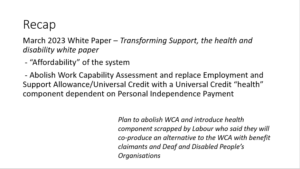
 

 Posted by at 15:21