Oct 272017
 
DPAC Logo with text underneath "Disabled People Against Cuts" and then web address dpac.uk.net

BBC Sunday Politics South East is making a news piece about the closure of Jobcentres. From next March people in the Whitstable and Herne Bay areas will have to travel to Canterbury, which can take up to an hour on public transport and cost up to £6.70. The BBC are looking for an individual or family who will be affected by these changes who would be happy to appear on TV and are available for filming on WEDNESDAY NOVEMBER 1. Filming will take around an hour. If you can help please contact the South East team on 0207 407 9292. Many thanks. 

 Posted by at 16:12
Oct 272017
 
DPAC Logo with text underneath "Disabled People Against Cuts" and then web address dpac.uk.net
Please send your experience of the ESA or PIP assessment or your experience of waiting for an assessment to Henrietta.Doyle@inclusionlondon.org.uk by the 8 November.   Suggestions to improve the assessment process are also welcome.
Inclusion London will be sending written evidence to the Work and Pensions Select Committee inquiry into PIP and ESA assessments and your evidence will be used to inform our evidence.
 Posted by at 13:22
Oct 252017
 
DPAC Logo with text underneath "Disabled People Against Cuts" and then web address dpac.uk.net

We know that Universal credit is a mess, but what about HMRC’s Real Time Information system ? The following contribution from Stephen Timms based on a Freedom of Information request is very interesting. It seems that over 5% of payments to individuals by HMRC were reported being paid late.  HMRC does not monitor the missing or incorrect payments, but we know that Universal Credit is being underpaid. So not only claimants have to contend with long waiting times, but when they are paid via RTI, over 5% are paid late, and an unknown number of claimants don’t receive anything, or an incorrect payment, mostly at their disadvantage. What experts are saying, is that 5,7% is an unacceptably high rate of late payments.  The number of late, missing and incorrect payments should be well lower than 1% if UC is going to work

Stephen Timms’ contribution comes from yesterday debate on UC

.

“Under universal credit, everybody’s monthly pay is automatically sent to Her Majesty’s Revenue and Customs through the pay-as-you-earn RTI—real-time information—system, and HMRC then sends that to the DWP so that it can do the universal credit calculation. There have been rumours for some time that the RTI system does not work very well. I have tabled questions about that, but the Minister has flatly denied that there is a problem.

It emerged last month, through a freedom of information request submitted by a member of the public, Mr John Slater, that there is a thing called the “Late, Missing and Incorrect RTI Project”. If RTI is late, missing or incorrect, we have a problem, because it is not possible to do the required universal credit calculation. I therefore tabled a question for the Minister:

“To ask…what the remit and activities of the Late, Missing and Incorrect RTI Project are.”

The Minister sent back an answer telling me that it did not exist and that there was no such thing. Fortunately, Her Majesty’s Revenue and Customs was more forthcoming on this point. I got a written answer last week from the Treasury, dated 16 October, to my written question 107309, which stated that:

“The vast majority of Real Time Information submissions are accurate and on time. However, a very small number of data quality issues create discrepancies and these can have an effect on an individual’s tax and benefits position.”

Indeed they can, because if the information is wrong, people’s benefit calculations will also be wrong.

The following day, 17 October, also from the more helpful of these two departments, the Treasury answer to my question 107475 stated that:

“during the 2016/17 tax year approximately 590m payments to individuals were reported via RTI. 5.7% of these were reported late. HMRC does not hold the information in respect of missing and incorrect reports.”

If over 5% of them were just late, never mind the ones that were missing or incorrect, we do have a serious problem.

Looking through all the submissions we received, briefing us ahead of this debate, I was struck by the one from the Child Poverty Action Group, referring to,

“difficulty making claims for universal credit, with many online claims seeming to ‘disappear’.

Universal credit being underpaid because ‘real time information’ provided by HMRC regarding income is not always reliable or accurate.

Claimants being paid the wrong amount of universal credit for no apparent reason.”

What is happening is that the IT is not doing what it is supposed to do.

My hon. Friend the Member for Brentford and Isleworth (Ruth Cadbury) referred to the anonymous report in The Independent a couple of weeks ago by someone working in a jobcentre, who talked about the grim reality of administering universal credit, rather by contrast with the enthusiasm with which Tory Members have told us that people are working on this. That writer made the point that when there is a discrepancy between what people were paid and what HMRC says they were paid—in other words, an RTI problem—it takes ages to sort that problem out. Members representing constituencies where universal credit has been fully rolled out report endless mistakes, delays and errors, which take weeks and weeks to resolve.

Another reason why this project’s roll-out should be paused and then fixed is to stop these problems being inflicted on tens of thousands more.

 Posted by at 15:54
Oct 182017
 
DPAC Logo with text underneath "Disabled People Against Cuts" and then web address dpac.uk.net

The BBC is calling for Universal Credit claimants to share their stories. The contact details can be found on their website. If you are currently claiming (or have previously claimed) Universal Credit, please consider  sharing your story. Please share this with friends and family; the more people speak out against this fiasco, and take a stand against these draconian reforms, the better.

In other news Mrs May has announced the premium-rate phone line for Universal Credit will be scrapped. MPs are currently debating a motion on pausing Universal Credit. Up to 25 Conservative MPs are expected to rebel and the DUP intend to abstain. Although the motion is purely symbolic, it will increase the pressure on the beleaguered Prime Minister.

Oct 162017
 
DPAC Logo with text underneath "Disabled People Against Cuts" and then web address dpac.uk.net

This is the first in our series of articles about Cygnet Health Care owned by yet another abominable US corporation, US Universal Health Services. This blog by Finola Moss tells how this corporation has taken over the private ownership of a very large portion of our MH services and now rakes in profits from the abuse of its victims – oh sorry that should say patients.

You may want to tweet to Cygnet @cygnethealth

https://finolamoss.wordpress.com/2016/11/25/payers-of-8-4-million-for-false-claims-universal-health-services-take-over-cygnet-health-care-for-205-million/

Payers of $8.4 million for false claims Universal Health Services take over Cygnet Health Care for £205 Million.

Cygnet Health Care is one of mainly three providers of mental health services in England.

Mental Health Services are paid over 21 billion of our 95 billion NHS budget.

In 2014 Cygnet was bought by USA’s Universal Health Services (UHS) for £205 million..
https://www.healthinvestor.co.uk/ShowArticle.aspx?ID=4285

Simons Stevens, chief executive of the group’s global division for 10 years after advising Blair on NHS public investment, is chief executive of NHS England, responsible for all NHS services commissioning.

England.https://www.theguardian.com/society/2014/oct/23/simon-stevens-nhs-chief-private-past-uk?CMP=share_btn_tw

Cygnet Health Care then increased UHS’s UK mental health footprint by a £95 million acquisition of Alpha Hospitals .

https://www.healthinvestor.co.uk/ShowArticle.aspx?ID=4274&search=Alpha

In September 2012, UHS, and its subsidiaries, Keystone Education and Youth Services LLC and Keystone Marion LLC,Keystone Marion Youth Center, agreed to pay over $6.9 million to settle allegations that they had submitted false and fraudulent claims to Medicaid.

Between October 2004 and March 2010, these subsidiaries provided substandard psychiatric counselling and treatment to adolescents in breach of Medicaid requirements.

And, the United States alleged UHS had falsely represented Keystone Marion Youth Centre, as a residential treatment facility, providing inpatient psychiatric services to Medicaid enrolled children, when in fact, it was a juvenile detention facility.

It further alleged, that neither a medical director, nor, licensed psychiatrist provided the required direction for psychiatric services or for the development of initial or continuing treatment plans.

The settlement also settled allegations, that the service providers filed false records or statements to Medicaid, when they filed treatment plans, that falsely represented the level of services that would be provided to the patients.

See below under Other Medicaid Matters p33.

https://www.justice.gov/sites/default/files/dag/legacy/2013/02/12/hcfacreport2012.pdf

In July 2002, the New York State Insurance Department fined United Health Care $1.5 million for ‘cheating patients out of money’.

Is this the sort of ethos that should now control a quarter of public, enforced, secret unaccountable services to our most vulnerable and receive a tenth of our NHS budget ?

In 2011 Cygnet was warned by the Care Quality Commission that staffing levels at Cygnet Wing Blackheath were inadequate..

https://www.cqc.org.uk/media/cqc-warns-cygnet-health-care-limited-it-failing-protect-safety-and-welfare-people-0

Improvements were still required at the CQC inspection in April 2014.

In 2013 the Care Quality Commission issued a warning to Cygnet Hospital Bierley because the service was failing to ensure that appropriate records were kept.
https://www.cqc.org.uk/node/779979

John Hughes, an American founded Cygnet in 1987 after turning the Priory around.

In 2004 Cygnet was valued at £120m in a deal with Barchester Healthcare, which earned Hughes a £19m cash windfall.

Barchester, is part-owned by John Magnier and JP McManus, the Irish racing tycoons who owned Winterbourne View’s Castlebeck,.

They bought a quarter of Cygnet’s business for £30m, and Hughes, and a fellow director took a £7m stake in Barchester.

Hughes completed a £340m buy-out in 2008, backed by Mr Wilson’s health care group Grove, which had bought a 25pc stake in Cygnet years earlier.

And would have received another windfall.

In 2014 Hughes’ sale to UHS earned him a £30 million windfall.

https://www.telegraph.co.uk/finance/newsbysector/banksandfinance/privateequity/11037997/Priory-Group-in-talks-to-buy-psychiatric-rival-Cygnet.html

Tycoons have made millions from mental health services now 87% financed by public NHS money, whilst public trusts are cash strapped and in debt.

And, are set to make far more profit from the governments drive ‘to parity with physical health’, and now have nearly a quarter of the NHS budget.

Yet from CQC reports mental health services in the UK are getting worse not better.

And the physical health of mental patients and effect of enforced medication is ignored and a report in 2013 revealed 3 a day are dying needlessly.

Robert Kehoe , psychiatrist, advertises himself, as an ‘expert witness’, is now the medical director of Cygnet, and, has apparently, advertised some of their units as being for ‘resistant service users’.

https://www.kehoemedical.co.uk/curriculum_vitae.html

https://www.cygnethealth.co.uk/news/dr-robert-kehoe/

Dr Kehoe was an NHS Consultant for nine years and Assistant Medical Director at Airedale NHS Trust and produces 80 to 100 psychiatric reports per year for Courts and Tribunals.

He is also responsible office for Cygnet Healthcare with national responsibilities for the regulation and revalidation of medical practitioners.

So, one expert, now controls the appraisals and code of conduct of all psychiatrist services and opinions, in a multimillion pound conglomerate, serving a quarter of all mental health services.

Universal Health Services and Cygnets’ overriding ethos, is to make as much profit as possible for its directors, managers and investors.

Does this not conflict with the professional independence of the psychiatrists, psychologists, practitioners, who work for Cygnet, and are subject to Cygnet’s stringent codes of conduct and continual appraisal systems ?

All hospitals and medical directors and professionals are under strict regular appraisals and uniformity.

https://www.gmc-uk.org/case_study_5.pdf_49056195.pdf

How does this promote, the diversity of opinion needed for best practice, particularly, in the uncertain arena of psychiatric medicine ?


 Posted by at 13:54
Oct 132017
 
DPAC Logo with text underneath "Disabled People Against Cuts" and then web address dpac.uk.net

National Disabled People’s Summit

Saturday 4 November 2017; 11am – 4.30pm

NUT headquarters, Hamilton House, Mabledon Place, Kings Cross, London WC1H 9BD

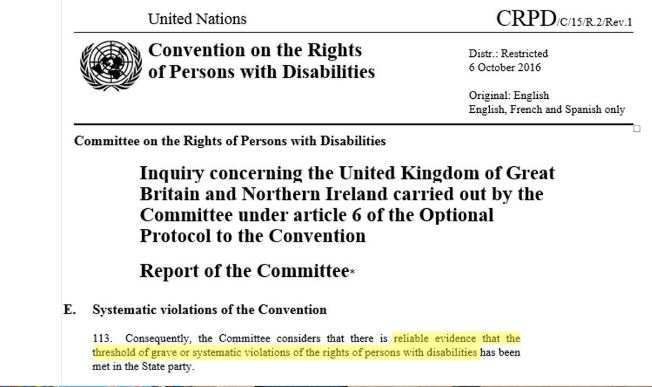
Since 2010 Disabled people have been subject to brutal attacks in every area of our lives caused by the disproportionate impact of austerity measures and the dismantling of the welfare system. In August the United Nations disability committee publicly declared that they are now more worried about the UK than any other country in the entire history of the committee and that UK Government “social cuts” have led to “human catastrophe”. This followed publication at the end of last year of the Committee’s investigation into the UK which found evidence of “grave and systematic violations” of Disabled people’s rights due to welfare reform.

Yet the Tory Government continues to deny there is a problem.

This summit will bring together Deaf and Disabled people from the trade union movement, Deaf and Disabled People’s Organisations and grassroots campaigns to explore how we can more effectively co-ordinate our resistance and organise joint campaigning in identified areas.

The event will be largely workshop based with the aim of each workshop to come up with and agree a campaigns plan that participants will go away and work together to put into action. The idea of the Summit is to inspire concrete activity that will lead to real change.

Workshops: (choose one per session)

Session 1 – Campaign priorities

  • Independent Living
  • Social security
  • Accessible transport
  • Inclusive education
  • Mental health
  • Employment

Session 2 – Organising

  • Protest and direct action
  • Legal challenges/ using the law
  • Art and protest
  • Using the media
  • Intersectionality
  • Trade union organising

The venue is wheelchair accessible, BSL interpretation will be provided and there will be a quiet room. Lunch will be provided (with thanks to the National Education Union). Please book via: https://www.eventbrite.co.uk/e/national-disabled-peoples-summit-tickets-38706991654

If you are unable to attend in person, we will be livestreaming the plenary. For more information or if you have any access queries please contact: ellen.morrison@inclusionlondon.org.uk


 Posted by at 17:38
Oct 092017
 
DPAC Logo with text underneath "Disabled People Against Cuts" and then web address dpac.uk.net

Liberty’s Human Rights Awards

Liberty has today announced the shortlist for its 2017 Human Rights Awards – nominated by the public.

Comedian Jeremy Hardy will host this year’s event on 24 October at London’s Royal Court Theatre – and will introduce a new Courageous Voice award, honouring those who have taking bold action to stand up to those in power.


The 2017 nominees are:

Courageous Voice

• Disabled People Against Cuts – for their Summer of Discontent week of action, raising awareness of issues affecting the rights of disabled people.

• Callum Tulley – for his undercover work with Panorama, which exposed chaos, violence and abuse at Brook House immigration removal centre.

• Open Whisper Systems – for their pioneering end-to-end encryption technology that keeps over one billion people’s communications private via Signal and WhatsApp.

 Posted by at 18:12
Oct 082017
 
DPAC Logo with text underneath "Disabled People Against Cuts" and then web address dpac.uk.net

https://www.turn2us.org.uk/Benefit-guides/Universal-Credit-transitional-protection/How-long-will-I-get-Universal-Credit-transitional#guide-content

What is Universal Credit (UC) transitional protection?

Transitional Protection is an extra ‘transitional’ amount which tops up your Universal Credit award so that you are not worse off when you move onto Universal Credit.

Transitional Protection is only for some people and it is not available to anybody yet.

People who are claiming Universal Credit at the moment are people who have had a change which meant they had to make a new benefit claim. These people are called ‘natural migrants’. Transitional Protection is not available to them.

Transitional Protection will only be available to people who are moved over to Universal Credit even though nothing has happened which makes them start a new benefit claim. These people are called ‘managed migrants’. There will not be any managed migrants until the Universal Credit full digital service is available in all areas. The Department for Work and Pensions (DWP) is planning to start ‘managed migration’ in July 2019.

How much Universal Credit transitional protection you will get will depend on what your income is from the benefits being replaced by Universal Credit.

Your transitional protection amount will top your Universal Credit up so that it matches your previous benefit income to ensure you are not worse off due to the move to Universal Credit.

How long will I get Universal Credit (UC) transitional protection for?

If you can get it, you may receive Universal Credit transitional protection until your Universal Credit award increases to reach the same amount you were receiving from the benefits it replaced, or until your Universal Credit entitlement decreases to nothing, or until you have a significant change of circumstance.

Your Universal Credit entitlement increases

If you have an increase in your Universal Credit entitlement, perhaps due to a fall in income, the birth of a child, or because of an annual increase in the rates for Universal Credit, the increase in your Universal Credit entitlement will be offset by a reduction in your transitional protection amount. This will continue until your transitional protection amount is reduced to nothing.

Example:

Jane and Dave currently receive £1100 per month from the benefits to be replaced by Universal Credit but their Universal Credit entitlement is only £1000 per month.

They are part of the managed migration onto Universal Credit so they receive a transitional protection amount of £100 per month to top up their Universal Credit so they are not worse off.

The following April the Universal Credit rates are increased so their Universal Credit entitlement goes up to £1020 per month.

They only need a transitional protection amount of £80 now to top them up to their previous benefit income of £1100 per month.

Although their Universal Credit entitlement has gone up £20, their transitional protection amount is reduced by £20 so they still receive £1100 per month.

They won’t see a rise in their income from Universal Credit until their Universal Credit entitlement becomes more than £1100 per month and their transitional protection amount reduces to nothing.

Your Universal Credit entitlement decreases

If you have a decrease in your Universal Credit entitlement, for example because of an increase in your earnings, your transitional protection amount will not be reduced straight away. This is to make sure that work incentives are protected.

Your transitional amount won’t be reduced until your Universal Credit entitlement falls to £0. Even then you won’t lose all your transitional protection amount at once, it will be removed at the set taper rate, currently 65%. This means you will lose 65p of your transitional protection amount for every £1 you earn.

Significant change of circumstance

If you have a significant change of circumstance which affects your Universal Credit claim you will lose your transitional protection amount immediately.

These significant changes are:

  • a partner leaves/joins your household
  • your earnings drop beneath the level expected of you in your claimant commitment (for three months in a row)
  • your Universal Credit award ends
  • you or your partner stop work


 Posted by at 20:10
Oct 072017
 
DPAC Logo with text underneath "Disabled People Against Cuts" and then web address dpac.uk.net

The DWP has published the long awaited guidance on Reassessments for claimants with the most severe and lifelong conditions, with the applicable criteria. This will only apply to claimants in the Support Group or under UC who have been found to have Limited Work Related Activity capability.  As with any decision which is discretionary, there will be no right of appeal.  Developed in conjunction with some disability charities such as DRUK, the criteria are not related to specific conditions, but to broader categories which will apply to specific conditions but will also encompass others, when all the criteria are met.

As with everything related to DWP, the implementation will be key, but there are already some questions:

Will it be a limit within a range to the number of people found to meet the criteria? A FOI request has already been made about this: https://www.whatdotheyknow.com/request/wca_management_information_sever

What if a disability assessor and a claimant’s GP or consultant disagree about the realistic prospect of recovery?  Could a disability assessor who is neither a GP nor a consultant overrule a GP or a consultant in that regard?

There will be more questions. Meanwhile the guidance and the criteria are here:

FAQs on WCA severe conditions

DWP WCA Guidance on severe conditions

Severe conditions guidance


 Posted by at 14:12
Oct 062017
 
DPAC Logo with text underneath "Disabled People Against Cuts" and then web address dpac.uk.net

David Gauke the latest in a long line of ministers of state for DWP this week refused to halt the roll out of Universal Credit despite warnings from many credible sources including his own backbenchers that it was a disaster in waiting.

As the roll out of Universal Credit proceeds more and more disabled people are likely to find that they miss out on any transitional protections and in the worst case scenario that their claim is treated as a new one they face the loss of £78.35 a week from their social security payments.

This is because in Universal credit there are no Severe Disability Premiums or Enhanced Disability Premium paid. They simply vanish into thin air.

Research has shown that the additional cost of being disabled is £550 per month extra but the nasty party are stripping claimants of most of the money they need to meet those additional costs.

We’re planning something for International Day of Disabled People with more details about this to follow but in the meantime we’re asking people to contact their MPs and ask them to justify taking £78.35 pw away from those who have the highest support needs/ are most severely disabled.

Maybe they’ll say how they manage to sleep at nights.

Please then send us a copy of your letter and their response to you. mail@dpac.uk.net

You can find your MP’s contact details at https://www.parliament.uk/mps-lords-and-offices/mps/

This recent case might be helpful to  people to challenge any cuts

https://www.leighday.co.uk/News/News-2017/October-2017/Law-firm-call-on-the-Government-to-re-consider-dec


 Posted by at 18:41
Oct 032017
 
DPAC Logo with text underneath "Disabled People Against Cuts" and then web address dpac.uk.net

The Mirror are calling for people to share their experiences of Universal Credit. The government intends to increase the amount of job centres administering the benefit despite the numerous problems; an inbuilt delay of 42 days for the first payment, rising rent arrears and soaring food bank usage. No fewer than 15 conservative MPs have called for the benefit to be paused, but their pleas were ignored.

If you (or anyone you know) has been affected by this benefit, please consider sharing your experiences (you can request anonymity) For more information click here: (you need to scroll to the bottom of the screen).

Oct 032017
 
DPAC Logo with text underneath "Disabled People Against Cuts" and then web address dpac.uk.net
Re-blogged from Morning Star

Disabled activist ‘violently dragged out of Rees-Mogg talk’

Tuesday 3rd Oct 2017

ANTI-AUSTERITY protesters were violently evicted from a public meeting attended by Tory MP Jacob Rees-Mogg yesterday.

One of the activists, who is disabled, alleged to the Star he was “slapped in the face” by a Tory activist and bundled out by security who stamped on his leg before dragging him down a corridor.

Alex Knox was at the front of the meeting and said he was “peacefully protesting” when a group of Tories tried to grab his banner and “became increasingly aggressive.”

He and Mr Rees-Mogg had been debating the impact of austerity on disabled people.

Mr Knox said: “Six burly security guards came in and jumped on me, my leg was getting injured and I’ve suffered bruising on my leg, which is in a brace.

“About eight of them took me out into a corridor and were really aggressive. I told them they were hurting me. I was in agony as they dragged me down the stairs and some of them stamped on my leg.”

Mr Knox said the police told the security guards to let him go and officers are now investigating the assault complaint.

The Star contacted the Conservative Campaign Headquarters (CCHQ) for comment but did not receive a reply before going to print.

The small protest group attended the meeting to express “disgust” at Tory austerity policies and views on abortion that are espoused by Mr Rees-Mogg, who many see as a future leader of the party.

Hundreds of Mr Rees-Mogg’s supporters attended the meeting organised by the Bruges Group for a panel discussion on Brexit.

People’s Assembly activist Shabbir Lakha spoke to him before he took to the stage. He told the MP that he was a liar for saying Tory policies have lifted people out of poverty.

Mr Lakha asked: “Really? Depending on foodbanks is making people’s lives better?”

Mr Rees-Mogg claimed that the Tories had the highest number of people in employment since the 1970s, which Mr Lakha pointed out was based on precarious employment and poverty pay.

The conversation continued until Mr Lakha was “aggressively bundled out” of the building by security.

People’s Assembly national organiser Ramona McCartney said she felt “violated” at the Manchester Town Hall event.

People’s Assembly national secretary Sam Fairbairn told the Star: “When faced with true public opinion, they bundle people out of the meeting by security because they can’t face it.”

 Posted by at 16:13
Oct 032017
 
DPAC Logo with text underneath "Disabled People Against Cuts" and then web address dpac.uk.net

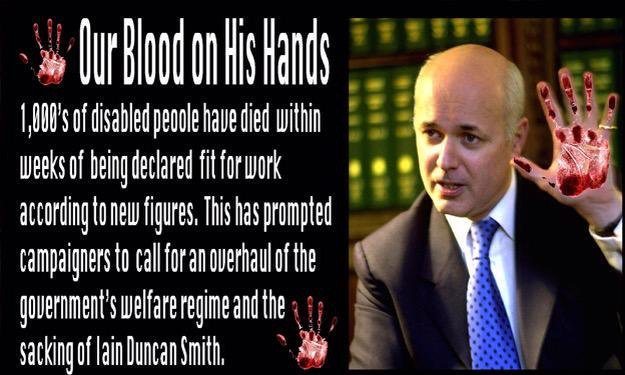
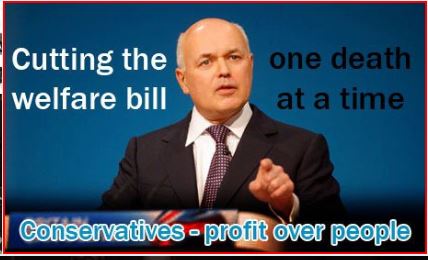
You can tweet these pictures during the Tory conference. The conference hashtag is included and you can add your own text.  The burning issue right now is Universal Credit, but we all know the problems encountered with the Work Capability Assessment, PIP, sanctions, social care, the bedroom tax etc. The list is too long to list them all.  You may want to mention the UN inquiry and the UN report, but ultimately, what you want to say to the Tory party, is that their welfare reforms did not save any money, did not simplify the benefit system, did not make work pay, but that they have hurt people, they made them poorer, even destitute and that they drove some people to an early death.  That will be the legacy of the past seven years for the Tory party.


 Posted by at 09:24
Oct 022017
 
DPAC Logo with text underneath "Disabled People Against Cuts" and then web address dpac.uk.net

At the People’s Assembly march in Manchester having allowed people into the official protest area at the Tory party Conference yesterday the police then proceeded to kettle them. DPAC activists then blocked a tram line in protest at what they saw as an unfair move by the scores of extra police who had been drafted into Manchester to protect the Tories.


Sadly the police in Manchester reacted rather aggressively to this and 2 disabled people were arrested and a veteran activist in his 80s was left badly bruised by being man-handled by them.

https://www.salfordstar.com/article.asp?id=4131


https://www.bbc.co.uk/news/amp/uk-politics-41462576

Image may contain: 2 people, people standing, child and outdoor

Image may contain: 5 people, people standing and outdoor

Rick burgess of Manchester DPAC said “DAN (Direct Action Network) veteran & MDPAC member Dennis Queen has been charged with Public Nuisance after their arrest yesterday. We reject utterly the heavy handed policing and targeting of disabled people, all to protect a government found guilty of Grave & Systemic human rights abuses. If there are any arrests to be made it is of the Conservative party government over their democide of disabled people. Whatever costs Dennis incurs we pledge to meet with a crowdfunding drive. Our community shall not be victimised like this.”

Another member Sharon Hooley has been cautioned by police for protesting yesterday. Rick said “Full respect and support for her brave stand in defiance of quisling security forces protecting an unlawful government.” At one stage Sharon another wheelchair user was surrounded by 13 police officers.


https://www.facebook.com/photo.php?fbid=10155721308715489&set=gm.1831546200399434&type=3&theater&ifg=1


Sep 292017
 
DPAC Logo with text underneath "Disabled People Against Cuts" and then web address dpac.uk.net

Please send details of your experiences to Work & Pensions Committee by November 10th. You don’t need to address all of the questions just any that are relevant. Please note we do not want you to send this information to us but directly to the Committee.

 Committee launches new inquiry into PIP and ESA assessments 

The Committee is launching a new inquiry on how the assessment processes for Employment Support Allowance (ESA) and Personal Independence Payments (PIP) are handled by DWP contractors ATOS, Capita and Maximus, and how the application, assessment and appeals processes for these two benefits are working.

In the last Parliament the Committee held an urgent one-off evidence session in the wake of the announcement of Government plans to restrict the number of people who qualify for PIP, a move which would limit the cost of PIP by £3.7 billion. Evidence taken then revealed worrying disparities between the applicants’ recall of the assessment process and the final report produced to enable DWP to make a decision. The Committee also heard concerns about the contractor assessors’ ability to understand and properly assess a wide range of physical and mental health conditions, and about the dignity and conduct of the assessment process. The latest data shows that claimants are successful in appealing against their decision in 65% of cases, for both PIP and ESA, and that there has been an 29% increase in such appeals being registered since this time last year.

Given high rates of overturn at appeal, the Committee invites evidence on the effectiveness of assessment processes used to determine eligibility for these benefits, and the experience of applicants going through it. The Committee is interested in receiving recommendations for change both on the assessment process for each benefit individually, and on common lessons that can be learned from the two processes.

Frank Field MP, Chair of the Committee, said: “The truly amazing rate of overturned ESA and PIP decisions seems to point to something being fundamentally wrong with the initial assessment and Mandatory Reconsideration stages. Quite apart from the human cost this represents – the distress and difficulty for applicants trying to get help with daily living or getting into work – it looks to be wasteful, inefficient, and a huge cost to taxpayers.

“We would like to hear from claimants – and assessors – about whether and where the system works, or is failing, and how it might be fixed.”

In particular, the Committee would welcome evidence on the following points, by 10 November 2017:

Assessors and assessments:

  • Do contractor assessors possess sufficient expertise to carry out assessments for people with a wide range of health conditions?
  • Is DWP quality control for contractors sufficient and effective?
  • Should the options for reforming the Work Capability Assessment mooted in the Government’s Improving Lives green paper be taken forward?
  • What examples of best practice in assessing eligibility for benefits are available internationally, and how transferrable are they to ESA and/or PIP?

Mandatory Reconsideration and appeal:

  • Why do claimants seek to overturn initial assessment outcomes for ESA and/or PIP?
  • Why are levels of disputed decisions higher for PIP than for ESA?
  • Is the MR process working well for claimants of ESA and/or PIP?
  • What accounts for the rate of overturned decisions at appeal for PIP and/or ESA?
  • Are there lessons that could be learned from the ESA MR and appeal process for PIP and vice-versa?
  • What changes could be made earlier in the process to ensure fewer claimants feel they need to appeal?

Claimant experiences:

  • Do prospective claimants currently understand the purpose of the assessment?
  • How could claimants be helped to better understand the assessment process?
  • Are some groups of claimants particularly likely to encounter problems with their assessments – and if so, how can this be addressed?
  • Should the assessment processes for PIP and ESA be more closely integrated? How else might the processes be streamlined for claimants?

An easy read version of these terms of reference is available on our website, and we encourage people to join the discussion on our web forum, whether you would like to submit evidence to the inquiry or not.

Committee Membership is as follows:

Frank Field – Chair (Labour), Heidi Allen (Conservative), Andrew Bowie (Conservative), Jack Brereton (Conservative), Alex Burghart (Conservative), Neil Coyle (Labour), Marsha De Cordova (Labour), Ruth George (Labour), Chris Green (Conservative), Steve McCabe (Labour), Chris Stephens (Scottish National Party) 

How to submit evidence is here

https://www.parliament.uk/business/committees/committees-a-z/commons-select/work-and-pensions-committee/inquiries/parliament-2017/pip-esa-assessments-17-19/


 Posted by at 20:41
Sep 292017
 
DPAC Logo with text underneath "Disabled People Against Cuts" and then web address dpac.uk.net

Many thanks to Inclusion London for this useful analysis.

The Court of Appeal’s decision in the Davey case: what it means for DDPOs and Disabled people

Luke’s appeal was dismissed.  This is a devastating outcome for him as he won’t only be stuck at home with minimal support he also risks losing his support team, who were with him for 18 years.  The outcome is also disappointing and worrying for other Disabled people, as this case sends a message to local authorities that they can implement whatever cuts they want as long as they follow the right process.

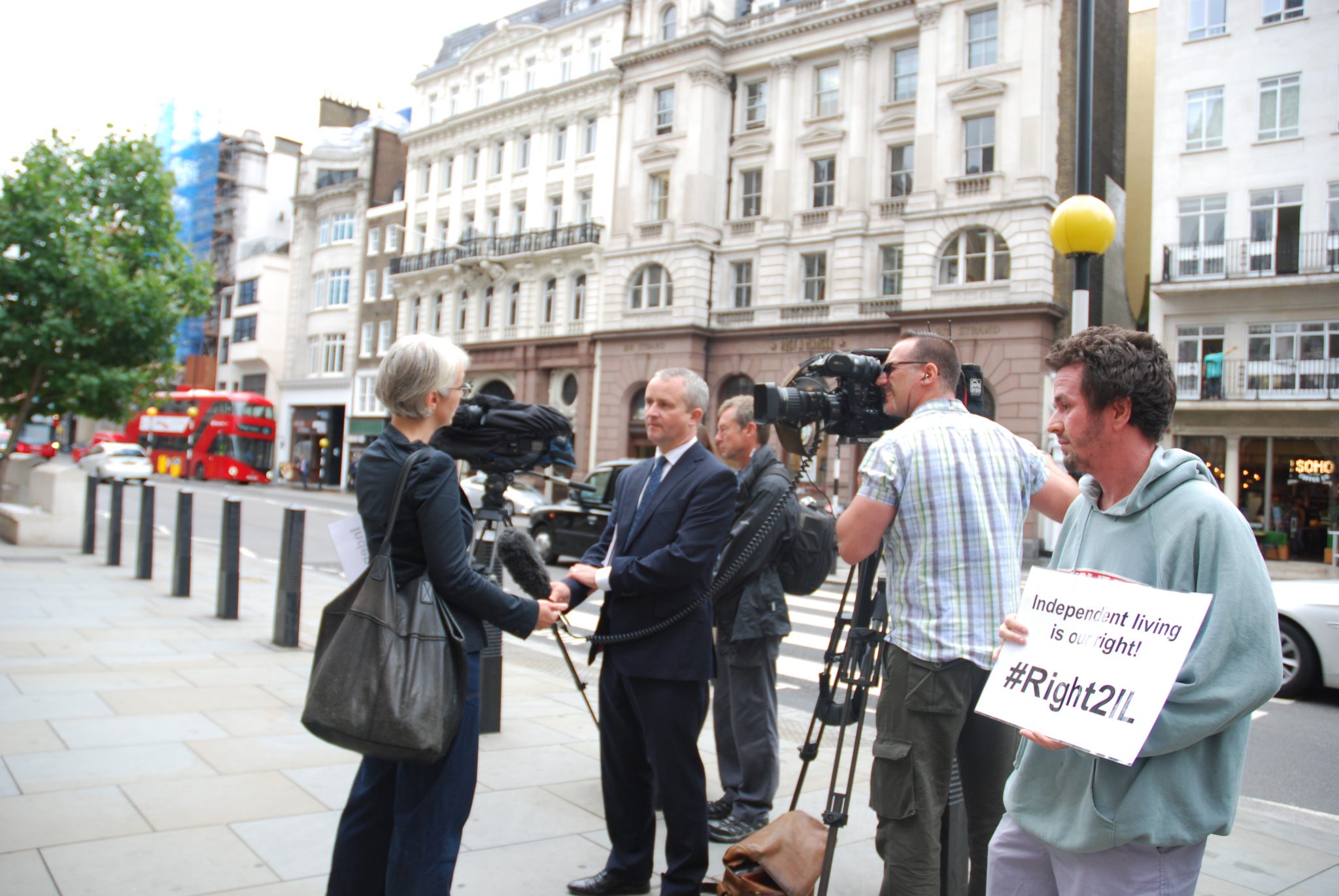
Tracey Lazard interviewed outside the Royal Courts of Justice with a man in the foreground holding a placard reading 'Right2IL'

On the 1st of September the Court of Appeal handed down its judgement in the case of Davey v Oxfordshire County Council.  In this case Luke Davey, who is a former Independent living fund recipient, challenged a 40% cut to his personal budget after the closure of the ILF.

Luke’s appeal was dismissed.  This is a devastating outcome for him as he won’t only be stuck at home with minimal support he also risks losing his support team, who were with him for 18 years.  The outcome is also disappointing and worrying for other Disabled people, as this case sends a message to local authorities that they can implement whatever cuts they want as long as they follow the right process.

To us the case also clearly demonstrated the limits of judicial review in cases where disabled people are trying to argue against professional opinions of social workers.  Judicial review does not look at whether local authority made the right decision or the best decision; it looks at whether or not the decision was lawful.

The decision

The Court of Appeal confirmed that the decision to cut Luke’s personal budget was reached as a result of a lawful process.  Largely the judges agreed with legal analyses and the findings of Mr Justice Morris, who made initial decision in the High Court. Here are some of the most important points:

  • The duty to promote wellbeing in section 1 has 2 aspects: firstly it requires local authorities to take positive steps to promote wellbeing, and secondly it requires local authorities to pay regard to circumstances listed in section 1.3 of the Care Act 2014.
  • The assessment under the Care Act 2014 is an objective assessment, done by social workers of OT’s for local authorities
  • The wishes of the disabled person may be a primary influence, but they do not amount to an overriding consideration.
  • The UN Convention on the rights of Persons with Disabilities can be used to help interpret the law (with caution), however in this case no particular ambiguity was identified and the balance between person’s wishes and LAs views has been struck in the Care Act itself.  However the Court of Appeal acknowledged that this should not prevent from this point being raised in future proceedings.
  • The judge confirmed that the council was entitled to set a pay of PAs at a lower rate as long as it reflected local market conditions and  that the law did not require it to pay for a more expensive option, which was preferred by an individual. The judges were prepared to accept social worker’s view that the rates reflected local market conditions.  This however potentially puts into questions provisions in the Care and Support Guidance which say that local authorities should choose not the cheapest option, but the one that is best value for money.  The guidance clearly says they should go for an option that better promotes wellbeing and delivers the outcomes for an individual.

Our intervention

Inclusion London intervened in this case.  We wanted to show that the case was not just about Luke’s care package.  It could have an impact on many Disabled people.  Our intervention helped to draw media attention to this case and enable us to talk about our right to independent living in mainstream media.  We also believe our intervention helped to clarify the point that local authorities have to consider what might happen in the future when there is an imminent risk of negative consequences as a result of their decisions.

Besides the fact that Luke lost and the impact this will have on his life, the biggest concern in this judgement from our point of view is the statement about intensity of judicial review in social care proceedings.  The Court of Appeal effectively warned against overzealous analyses of social care assessments.  This is worrying, because life changing decisions are made based on those assessments, and unfortunately there is no other way to properly scrutinise them.  This is why we will continue to lobby for the appeals system, which was meant to be introduced by the Care Act 2014.

The fact that local authorities at the end of the day make final decisions about our needs and how we will be supported is not new.  The law has always said this.  However many of us felt disappointed when we saw the judgement.  This firstly is because the case clearly shows that in the age of austerity, when local authorities have to find significant savings, the provisions of the Care Act about choice and control do not have teeth.  It also is disappointing for us to see how our views can so easily be overridden by professional opinions of social workers and local authorities not being properly scrutinised for some of the decisions they make.

This was the first case brought under the wellbeing duty and it clearly demonstrated the limits of this duty.  It is worth bearing in mind though that the case was mainly lost because of factual evidence. (Luke couldn’t prove that his PAs of 18 years would leave and refuse to work for less)

Lessons for DDPOs

This case clearly shows that local authorities can get away with implementing even very significant cuts if they follow the process set out in the Care Act and can give a logical explanation to their decisions as well as commiting to reviewing the situation and stepping in if things go terribly wrong.

It does not mean however the cuts cannot be challenged; we can and should do this.  Here are some of the basic things you could do to increase a chance of success in your case:

  • Know the process well and challenge when it has not been followed;
  • Ask for explanations early on, ideally with references to the law. Although local authority can submit further explanatory evidence it will be difficult to do so if it contradicts what they said before.  For example if they are suggesting a cut to your support package, ask them to explain how this will promote your wellbeing;
  • Think of evidence.  If we want to challenge cuts, the onus is on us to prove the impact.  Just a statement from a disabled person will not always be enough. The judges will most likely accept social workers view, unless it is irrational;
  • Pay attention to the assessment process, prepare and clearly explain what you mean.  Make sure to ask for a correction of all factual mistakes in the assessment document;
  • Challenge decisions: yes this case was not successful, but it cannot and should not deter others from challenging cuts to their support.

We lost this battle, but we will keep fighting.

 Posted by at 20:18
Sep 262017
 
DPAC Logo with text underneath "Disabled People Against Cuts" and then web address dpac.uk.net
Inclusion London is involved in a piece of research being carried out by a student at the University of Essex into the impact of conditionality and sanctions on Disabled people in the Employment and Support Alliance (ESA) Work Related Activity Group (WRAG).
With the Government about to roll out proposals that will extend conditionality to Disabled people in the support group we think it is all the more important that research and evaluation is carried out into the impacts of this approach to welfare.
We need people who are currently in the ESA WRAG and are happy to speak to our researcher, Jay Mehti. Interviews can be carried out by telephone or in person in London. A £20 voucher will be given to each participant to say thank you.
For more information please email ellen.clifford@inclusionlondon.org.uk or text 07505144371. If you would like to share this information with your contacts, information is on our website here: https://powerup.us7.list-manage2.com/track/click?u=bd31b88a884b7e90abc93fdcc&id=668b7ec461&e=95d2dfef3c
Ellen Clifford
Campaigns and Policy Manager
Inclusion London
336 Brixton Road, London, SW9 7AA
Tel: 020 7036 6032 (office SMS only: 0771 839 4687)
www.inclusionlondon.org.uk
 Posted by at 17:57
Sep 252017
 
DPAC Logo with text underneath "Disabled People Against Cuts" and then web address dpac.uk.net

This week the UN global nuclear weapons ban treaty opened for signatures. 51 countries have already signed, with three so far ratifying, which is a great start! CND, along with Medact and Pax Christi, delivered thousands of letters to the Prime Minister at 10 Downing Street on Wednesday, calling on the British government to sign the treaty.

No Nuclear War

A global ban of nuclear weapons is more important than ever in the context of the increasingly worrying rhetoric about nuclear weapons from Donald Trump and Kim Jong-Un. CND, along with many supporting organisations, has called a protest outside Downing Street next Thursday, September 28th, 5 – 6.30 pm Downing Street, to call on the Prime Minister Theresa May to use all diplomatic means to de-escalate tension.

All these topics will be discussed at CND’s annual conference next month. As well as our AGM, we have a one day international conference – ‘Confrontation or cooperation? Nuclear abolition in dangerous times’ taking place on Saturday, October 14thWhy don’t you come along to discuss the prospects for a new direction on nuclear weapons, and to address the wider international context too: NATO, missile defence, Trump, Korea, China, war and intervention – and what we can do about it all?

Tel: 020 7700 2393

Web: www.cnduk.org Twitter: @CNDuk Facebook: /cnduk

 Posted by at 17:07
Sep 252017
 
DPAC Logo with text underneath "Disabled People Against Cuts" and then web address dpac.uk.net

Universal Credit  – what is your experience?

Please send me you experience of Universal Credit. This could include your experience of the application process, the impact of being paid a month in arrears and there being no payment for the first seven days or any other information you would like to give.  Please send it to me on my email:  Henrietta.Doyle@inclusionlondon.org.uk  by 10 October.

The Work and Pensions Select Committee of MPs is holding an inquiry on the roll out of Universal Credit and Inclusion London  intends to send evidence to the inquiry.  Your experience would help to inform our evidence.   

More information about the inquiry is available at: https://www.parliament.uk/business/committees/committees-a-z/commons-select/work-and-pensions-committee/inquiries/parliament-2017/inquiry/

 Posted by at 16:05
Sep 252017
 
DPAC Logo with text underneath "Disabled People Against Cuts" and then web address dpac.uk.net

Frances Ryan is writing a book about disability and austerity and is looking to speak to a disabled man who is affected by fuel poverty and unable to afford to keep their home heated in winter. She would only need to use your first name but if you can help please contact her directly at francesryan.journalism@gmail.com

Also from Fuel Poverty Action

Dear friends,

We’re about to embark on a month of political party conferences, and chances are they’ll be raising energy prices as an issue.  This may be an opportunity to push for a cap so the Big Six can’t just put up prices as they like.  The most effective way of putting on the pressure would be for people to come forward who themselves are suffering from cold, damp, or debt, or going short of other essentials just to pay the bills.  Speaking out could be anonymous, or just in newspapers or online, or, if you like, you could be public.  
A year ago we asked for people to come forward about the extra cost if you pay by key or card, with a prepayment meter (PPM).   We did get a cap on PPM prices – but it’s not like what you could get on a fixed price deal, or if you could pay by direct debit or online.   It’s more in line with the “Standard Variable Tariff” that two thirds of energy customers get put on, by default.  And these Standard Variable Tariffs are outrageously, killingly, high.  So we’re looking for people to come forward again, whether you are on a PPM or pay by bills, to say how you are affected and what you think should happen.

FPA will be pressing for a universal  price cap, at an affordable level, for everyone – not just the “most vulnerable”.  There are 17 million customers on the Standard Variable Tariff.  The “consumer protection” regulator Ofgem has proposed a cap for just 2 to 3 million people who receive other heating benefits.  This is in line with the government’s standard policy of “targeting” help at “those who need it most”.  We do not agree that “targeting” is an effective way of protecting people on low incomes.  Fair prices are a right, not charity.

A cap that’s restricted to only some customers would mean that your fuel prices rise again, maybe even higher than if there were no cap, as soon as you cross the threshold eg by getting married, getting a job or an increase in pay, or getting bumped off disability benefits by the DWP and its henchmen at Maximus.  Even teachers and nurses are now dependent on food banks and fuel banks.  We don’t think the energy companies should be making a killing off anyone.  Means-testing always means that people in need lose out.

Instead of relying on the Big Six to single out vulnerable customers in their pricing, the government should reverse the violent cuts to welfare benefits, beginning with disabled people and asylum seekers who have been most savagely attacked, but also including single parents, pensioners, and people on low pay.

At the same time, we need a massive programme of insulation to provide effective, inspected, fire-safe insulation for every home.  This is a major infrastructure priority and should be done on a community-wide basis, not by spending time identifying fuel-poor households who may then move house, or who may not want to be “targeted” in the first place.  Bringing the UK’s housing up to European standards of warmth and energy efficiency will save lives and will cut down on carbon emissions — which, like fuel poverty, are killing many thousands.

Please consider if you’d like to consider putting forward your own views and experience – and get in touch with us asap, if so!

Email us at fuelpovertyaction@gmail.com

ALSO *****************************************

On Monday 2nd October, 10:10 climate action are launching a campaign that could force landlords to improve the very poorest quality uninsulated homes. Legislation was passed for this purpose, but there’s a loophole – the landlords can exempt themselves if it would cost them any money upfront!  Lives are being lost as a result, from cold homes, and from climate change as well, and FPA are supporting this attempt to close the loophole. Look out for more information about a demonstration/photocall in London on the 2nd October, plus an online tool for tenants in hard-to-heat homes to see what extra you pay.

Cold homes, fuel poverty, climate change, millions of homes in debt to their energy supplier, huge profits for the Big Six… the energy system isn’t working.
Another energy system is possible! Get behind the Fuel Poverty Action Energy Bill of Rights


 Posted by at 16:02
Sep 252017
 
DPAC Logo with text underneath "Disabled People Against Cuts" and then web address dpac.uk.net

Disabled People Against Cuts and Black Triangle Campaign are horrified to find that so-called Labour MP and Chair of the Work and Pensions Select Committee Frank Field has put forward the suggestion that disabled people do not deserve to earn the living wage and argues that they are less productive than non-disabled people. These comments have been published in a set of essays in Learning and Work.

https://www.learningandwork.org.uk/wp-content/uploads/2017/09/LW-Opp-for-All-FINAL.pdf


“One idea that has been mooted is to grant a specific

exemption to the National Living Wage to those whose

disabilities are deemed so severe that they will never

be capable of enough output to warrant payment of

the minimum wage, but who might nevertheless enjoy

significant wellbeing gains from involvement in an

appropriate workplace environment.”

Mr Field goes on to say that some disabled people might benefit from this as it would make them more attractive to employers in spite of the obvious potential for exploitation this would entail. We have news for Frank we do not wish to be paid less than non-disabled people for the same work and we are not happy to be exploited by anyone.

Both disability groups are calling for Frank Field to resign or be sacked from his role as Chair and have approached Jeremy Corbyn to insist that Field immediately withdraws this highly offensive comment. To date we’ve had no reply but will be following this up again after the Labour Party Conference has ended.

If this is allowed to pass unchecked by the Labour leadership people will then be entitled to ask whether the party really has fundamentally moved on since it introduced the catastrophic Work Capability Assessment regime under the last New Labour Government.

A DPAC spokesperson said “ This is more or less exactly what Lord Freud suggested about 3 years ago but to find the same offensive idea being pedalled by a Labour MP supposedly opposed to the abuse of disabled people’s human rights is somehow even more offensive. Frank Field’s comments are nothing short of disgraceful.”

How can Labour hope to be trusted as true champions of disability rights when they are represented on a key committee by someone with such retrogressive, Victorian views?

John McArdle from Black Triangle said “Field must now be publicly censured by the Labour Party. The suggestion that disabled people’s labour is worth less than that of other people and the Tory-set minimum – let alone a ‘living wage’ – is an affront not only  to the human dignity of every disabled person in the U.K. and is a stark betrayal of the values of fairness and equality upon which the party was founded. “

Labour still has a mountain to climb before it can convince the majority of disabled people and their friends, families and colleagues that they have truly changed. If they wish to convince us that they are now firmly set upon reversing all these barbaric, deadly cuts to our support and intend to fully comply with the spirit and the letter of the UNCRPD then they must act now to impose party discipline on Field in keeping with their stated intention. As stated elsewhere, we require Labour to now wage war with the Tory Party in defence of our human rights in order to win the next general election by the landslide it deserves. Tolerating the views of frontline Labour politicians whose views are more in accord with Tory politicians than ordinary Labour members and supporters is no longer acceptable and that uncompromising message needs to go out, loud and clear.

You can read Frank’s even more offensive response here https://www.disabilitynewsservice.com/labour-mp-told-to-quit-influential-post-after-offensive-minimum-wage-call/

And many thanks to John Pring from Disability News Service for alerting us to this.

Please let Frank Field know what you think about this idea

You can email using this contact form https://www.frankfield.co.uk/contact/contact-information.aspx

or tweet to him

@frankfieldteam


 Posted by at 15:33
Sep 252017
 
DPAC Logo with text underneath "Disabled People Against Cuts" and then web address dpac.uk.net

reposted from OCAP and signed up to by DPAC

The Neoliberal Danger of Basic Income

wolfsheep

Statement for endorsement: We have drawn up the following statement on basic income (BI). It makes the case that, progressive hopes to the contrary notwithstanding, BI is being developed as a measure of neoliberal attack that should be opposed. We invite progressive organizations and individuals who hold positions in agencies and academic institutions, who agree with our arguments, to sign onto the statement. We hope that it will raise a voice of opposition and help develop information sharing and forms of co-operation among those, internationally, who reject the notion that basic income represents any kind realistic response to the neoliberal attack.

Endorsements and other responses can be directed to us at ocap@tao.ca.

The Neoliberal Danger of Basic Income

We, the undersigned, are convinced that the emerging model of basic income, reflected in pilot projects and other initiatives in a number of countries and jurisdictions, is one that would intensify the neoliberal agenda. The hope that there is any realistic chance of ensuring a truly adequate, universal payment, that isn’t financed by undermining other vital elements of social provision, is misplaced in our view.

We are far from wanting to suggest that existing systems of income support are anywhere close to adequate.  They provide precarious sub poverty income under conditions that are marked by intrusive regulations and forms of moral policing.  Moreover, decades of neoliberal austerity have made these systems considerably worse.

However wretched and inadequate present systems may be, the assumption that basic income must or even could be an improvement on the status quo has to be tested by considering a number of factors.  Historically, income support has been provided because those in political power concluded that outright abandonment of those not in the workforce would create unacceptably high levels of unrest and social dislocation. In the far from dead tradition of the English Poor Laws, income support has been provided at levels that were low enough to maintain a supply of the worst paid workers, in forms that were as punitive and degrading as possible. Again, the neoliberal years have seen these features intensified in what we must concede has been a highly effective drive to create a climate of desperation and a plentiful supply of low paid and precarious workers.

If austerity driven governments and institutions of global capitalism are today looking favourably at basic income, it’s not because they want to move towards greater equality, reverse the neoliberal impact and enhance workers’ bargaining power. They realize that a regressive model of basic income can be put in place that provides an inadequate, means tested payment to the poorest people outside of the workforce but that is primarily directed to the lowest paid workers. This would be, in effect, a subsidy to employers, paid for out of the tax revenues and it would be financed by cuts to broader public services. Such a model would lend itself to disregarding the particular needs of disabled people and, as a “citizen’s income,” could readily be denied to many immigrants, especially those left undocumented. Under such a system, you would shop through the rubble of the social infrastructure with your meagre basic income. The kind of pilot projects and other initiatives that are emerging offer severe warnings in this regard (we include some links that provide information on several of these)*.

However, some suggest that while regressive models could be developed and may pose a danger, a progressive and even “emancipatory” form of basic income is possible and realistic as a goal. Often, this is linked to the idea of preparing for a “workless future” in which vast numbers of technologically displaced workers can be provided for. The notion is that a universal payment would be provided unconditionally and that it would be adequate enough so that paid work, if it were an option, would be a matter of choice rather than necessity. While there are a few who suggest this could be won through large scale social action, advocates for a progressive basic income more often seem to assume that capitalist support and acceptance by the state can be won by way of a vigorous lobbying effort.

In our view, a truly adequate and redistributive, let aside transformative, basic income is not possible within the confines of the current economic system. Firstly, the present balance of forces in society, after decades of neoliberalism, does not lend itself to the conclusion that a sweeping measure of social reform, that would reverse this whole agenda, is immediately likely. Beyond this, however, an income support system that removed economic coercion in a way that progressive basic income advocates suggest, would be more than turning back the neoliberal tide. It would actually mean that the state was providing the working class with an unlimited strike fund. It would undermine the very basis for the capitalist job market. It would constitute social transformation, a revolutionary change that is, to say the least, beyond the capacity of any possible social policy enactment.

If basic income as emancipation is not possible, it can only too easily take form as neoliberal intensification.  Yet, sadly, progressive advocates end up offering legitimacy to that regressive alternative but placing hopes in musings about basic income by Silicon Valley billionaires or by presenting cynical pilot projects, set up by austerity driven governments, as flawed but important first steps. However much they wish otherwise, the sow’s ear will not become a silk purse.

If faith in a progressive basic income is misplaced, we wish we could offer a shining and readily attainable alternative but this is not possible.  We are largely fighting a defensive struggle against a virulent agenda to undermine social provision and increase the rate of exploitation. We can only offer the hard slog of building stronger inclusive movements of social resistance, rejuvenating unions and building a working class political challenge to neoliberalism. As we do this, we must fight for free, expanded and accessible public services. We must win decent wages and workers’ rights. We must struggle for income support systems that are based on adequacy, full entitlement and that are purged of intrusive rules and moral policing. We must infuse all of these movements and struggles with a sense of a very different kind of society from the capitalist one we are fighting. This doesn’t have the glitter of the dream of a progressive basic income but it does accept that reality that there is no social policy way around neoliberalism or a long and hard fight against it. The progressive welcome mat for basic income is a very big mistake.

*Links:
https://recoveryinthebin.org/2017/06/25/the-neoliberal-writing-on-the-wall-ontarios-basic-income-experiment/

https://www.jacobinmag.com/2017/01/ubi-finland-centre-party-unemployment-jobs/

https://basicincome.org/news/2017/02/16732/

https://www.independent.co.uk/news/uk/home-news/universal-basic-income-scotland-week-cash-payment-life-nicola-sturgeon-first-minister-snp-a7934131.html


 Posted by at 15:16
Sep 252017
 
DPAC Logo with text underneath "Disabled People Against Cuts" and then web address dpac.uk.net

Full story here -: https://www.disabilitynewsservice.com/disabled-activist-is-fighting-for-his-life-as-he-hands-petition-to-welsh-government/

Nathan Davies is fighting a lonely battle against the closure of the Welsh Independent Living Fund and devolution of funding to Local Authorities in Wales. Sadly the influential DPO Disability Wales saying they are unable to support his fight as it is too political.

Nathan has already been told his care and support funding would be slashed by more than half once the Welsh ILF is closed from April 2018.  This would mean Nathan could no longer take part in those community activities that are essential to his wellbeing and inclusion in society.

If you can please email any Assembly Members and ask them to retain a separate Independent Living fund in Wales. Disabled Lives Matter and the UN has said in their recent response to the periodic review of the UK that central governments are ultimately responsible for ensuring adequate funding for independent living.

If you live in Wales you can find contact details of your AM here https://www.assembly.wales/en/memhome/Pages/memhome.aspx

And if not in Wales email AM leader, Carwyn Jones Carwyn.Jones@assembly.wales


 Posted by at 14:31
Sep 172017
 
DPAC Logo with text underneath "Disabled People Against Cuts" and then web address dpac.uk.net

If you can help please contact Shivani Misra who is an intern at PLP. Shivani can be contacted on 020 7239 9034 or s.misra@publiclawproject.org.uk

The questionnaire is below but Shivani also needs to interview some people in more depth. This could be an important piece of work which will hopefully help provide evidence to support an end to the vicious sanctions regime.


PLP’s Project on Benefit Sanctioning
The Public Law Project (PLP) is undertaking a three year project to develop a strategic legal response to the national issue of benefit sanctioning.
As part of that work, we are carrying out research to gather evidence of the impact of sanctioning on disabled people with a particular focus on the following:
(1) Delays at the mandatory reconsideration and appeal stages, particularly for ESA claimants who have been put into the WRAG or refused ESA altogether and/or where hardship payments are unavailable.
(2) Problems caused by failures to share relevant information about a claimant’s medical condition or disability between the Work Capability assessor, the JCP Decision Maker, and the Work Programme Provider
(3) Failures by Work Programme Providers to make reasonable adjustments for disabled claimants in the WRAG or claiming JSA
(4) Lack of/inadequate reasons for sanctioning decisions undermining appeal rights.
This research is being carried out by Shivani Misra who is an intern at PLP. Shivani can be contacted on 020 7239 9034 or s.misra@publiclawproject.org.uk
Shivani is being supervised by Alison Pickup, PLP Legal Director, who can be contacted on 020 7239 9031 or at a.pickup@publiclawproject.org.uk
Impact of Benefit Sanctioning on Disabled People
Questionnaire for claimants
Public Law Project would like to invite you to take part in a survey that will help us better understand the current use and impacts of benefit sanctioning on disabled people. The survey should take about 15 minutes to complete and we would very much value your input. Please answer the questions based on your experience of the benefit system.
We want to assure you that your responses are completely anonymous. No personally identifiable information is captured unless you voluntarily offer personal or contact information in any of the comment fields. Your responses would be summarized in a report as evidence on the impact of sanctioning, and we will do our best to ensure that you cannot be identified from any information included in the report unless you agree to being identified. The report may be published and/or used by PLP to support our work trying to improve the fairness of the benefit sanctioning system and to reduce its adverse impact on disabled people.
Any personal data that you supply in response to this survey will be held and processed in accordance with the Data Protection Act 1998 and will only be used for the purposes given above.
About your benefits
Which benefit did you apply for most recently?:
• Employment and Support Allowance (ESA)
• Job Seekers Allowance (JSA)
• Universal Credit
• Other (please say which)
If you applied for ESA or Universal Credit, have you had your Work Capability Assessment yet?
If you have had your Work Capability Assessment, what was the outcome?
– Granted ESA – placed in support group
– Granted ESA – placed in Work Related Activity Group (‘WRAG’)
– Refused ESA –found to be fit for work
– Refused ESA for another reason (please say what)
Did you agree with the outcome of your Work Capability Assessment?
If not, have you appealed the decision made after your work capability assessment?
About your sanctions
Do you know why you were sanctioned?
Have you been sanctioned more than once?
Did the Job Centre tell you about the reasons for the sanction?
When were you informed about the reasons for the sanction?
(a) When you were told that you were being sanctioned?
(b) Only after a mandatory reconsideration?
(c) Only on appeal?
(d) Not at all?
Were you given an opportunity to provide a ‘good reason’ for the failure to comply before you were sanctioned? If so, did you do so?
How long did the sanction last?
What was the amount of the sanction?
Coping with the sanction
Did you have any other income during the period of your sanction?
How did you cope financially with the sanction? Please think about how you met your essential needs such as food, toiletries, medicine, disability aids, transport, clothing, heating, light, rent. Please tick all that apply.
– Went to food banks
– Used savings
– Borrowed from friends and/or family members
– Borrowed money from bank/building society/credit union/other money lender
– Pawning/selling belongings to raise money
– Eating less
– Not topping up gas/electricity meter
– Walking instead of using car/public transport
– Other
Please give more details if you can:
Were you given any Hardship Payments by the Job Centre?
Where there any other (non-financial) consequences of the sanction? For example, did it impact on your physical or mental health?
Appealing the decision to sanction
Did you appeal against the sanction?
If yes, what was the outcome of the appeal:
(a) At the mandatory reconsideration stage?
(b) At the First-tier Tribunal?
(c)
How much time did it take for the mandatory reconsideration?
How much time did it take for the appeal to the First-tier Tribunal (if you appealed)?
What did you do to meet your needs in the period awaiting the mandatory reconsideration and/or appeal?
About you
This information will help PLP to draw conclusions about the impact of sanctioning on different groups of disabled people.
Please describe the nature of your disability:
What is your age group:
16-17
18-25
26-54
55-65
66+
Do you have any dependents?
If so, which:
– Spouse, civil partner, or other partner living with you
– Children – how many:
o Aged 0-3
o Aged 4-15
o Aged 16 or over
– Other dependent relative living with you
– Other dependent relative (not living with you)
Personal details (optional)
We would like to carry out some more detailed interviews with benefit claimants for the purposes of our research. These interviews will last approximately 30 mins and can be carried out by phone, Skype or face-to-face (depending on location). Are you willing to be interviewed for our research?
Can we contact you in future for the purposes of this research, if we need more information or to clarify or follow up on any of the information provided in your answers to the questions above?
Can we attribute your comments to you in any report of our research? If so, should we identify you by name or another means e.g. “benefit claimant, Manchester”?
If you are willing to be contacted in future, please provide your name, a contact telephone number and/or email address below. We will not publish your name or any contact details, or use this information for any purpose other than those set out above without your prior written consent.
Name:-
Contact number:-
Email:-

 Posted by at 19:56
Sep 172017
 
DPAC Logo with text underneath "Disabled People Against Cuts" and then web address dpac.uk.net

Please join us at Robertfest 2017, a celebration of the life of Robert Dellar.

When: Sunday 24th September 2017, 12.00 – 0.00

Where: Amersham Arms, 388 New Cross Road, SE14 6TY (very close to New Cross station)

Tickets: Unwaged £5, Waged £10, Full ticket £20

Booking: via Eventbrite Robertfest 2017

The event will include some of Robert’s favourite bands, including ATV, Vic Goddard, The Long Decline, The Astronauts, The Ceramic Hobbs, Dave Kusworth, Jowe Head and the Infernal Contraption, Alan Tyler, Frank Bangay, Melanie Clifford, Salad from Atlantis, Dave Russell, Paul Caton, MC Razz and special guests.

RobertFest 2017 will also host the inaugural Robert Dellar Lecture, an annual lecture building on the life, times and activism of Robert Dellar. The first Robert Dellar Lecture will be given by Prof Esther Leslie at 4.30 pm at the Amersham Arms.