Nov 142025
 
DPAC Logo with text underneath "Disabled People Against Cuts" and then web address dpac.uk.net
A graphic with a hot pink background and white text. In the background is a large pop-art style dark pink word that says "free". Over the image are the words: "Palestine film festival. West Norwood. Wednesday 19th November 2025, 7pm. Off the cuff, Herne Hill, SE24 0JN"

A selection of short films from Gaza, focusing on the impact of the genocide on Disabled Palestinians.

‘Palestine & Disability’ is part of the Palestinian Free Film Festival, the event will be closing out our festival.

You can read more about the festival here

The event will take place at the accessible venue Off the Cuff in Herne Hill (London) on 19th November, and we will be raising money for Palestinian groups, as well as paying to run this and future events.

The event is a completely free shorts film night documenting the experiences of Disabled people in Palestine, featuring three films and Q and A.

You can read more about the event/films here as well as how to get tickets here.

We are extremely excited that Q&A following the films will be led by DPAC’s very own Ellen Clifford. We feel very honoured to have her at the event.

We are really keen that Disabled people, and those involved in the disability rights movement hear the stories in these films, and are able to partake in this event and this conversation.

We are grateful for any feedback in how we can create as an inclusive space as possible.

We will shortly be promoting the event on our instagram after our second to film night.

In Solidarity,

Thomas (WN4P)

A logo that says "West Norwood for Palestine" using the number four instead of the word. The logo has an image of a watermelon slice in red and green.
Jul 032020
 
DPAC Logo with text underneath "Disabled People Against Cuts" and then web address dpac.uk.net

The final chapter of Ellen Clifford’s new book ‘The War on Disabled People: capitalism, welfare and the making of a human catastrophe’ puts forward some ideas for developing a reinvigorated social model of disability.

The social model, which DPAC follows, has proved itself to be a powerful tool for achieving progressive social change and improving the lives of disabled people. It has also been the subject of debate and criticism among disabled people and those who meet the criteria to be considered disabled but who do not identify as such. Over the past decade, disabled people have experienced the brutal impacts of having essential support taken away from us by policies underpinned by an alternative model of disability, the Waddell and Aylward biopsychosocial model.

Clifford outlines some ideas for how disabled people can reclaim and refresh the social model so that it is up-to-date and fit for purpose within current socio-economic and political contexts.

She stresses that such an initiative must be a collective enterprise taken forwards by grassroots disabled people themselves. However as a starting point she puts forward three suggestions developed with her co-thinker and disabled activist, Mark Dunk.

These can be summarised as follows:

  • Social model vs individual model of disability.

The book argues that we need to go back to the original analysis of different models of disability put forward at the time the social model was developed. According to this analysis, the model of disability that has a hold over capitalist society is the individual model. This is a way of looking at disability that blames disabled people for their own situation and places responsibility on them to change it. The individual model takes different forms at different times. In the past, many disabled people were treated badly as a result of approaches to disability grounded in the medical model. Today many disabled people are turning to the medical model to help them. For example, medical evidence and diagnoses are needed to access benefits and support; people with energy limited chronic illness have to struggle to get their conditions recognised as real medical illnesses. Meanwhile, other forms of the individual model are appearing. One example of this is the “recovery” model of mental health which puts pressure on people living with mental distress to “get better” so that support services can be cut.


  • A social model of impairment.

The social model of disability draws a difference between disability and impairment. Disability is caused by the barriers that society creates and puts in the way of disabled people. Impairments are the conditions that we live with, for example blindness, learning difficulties, mental distress…etc Some groups of people feel that society puts barriers in their way but do not call themselves “disabled” because they do not think of themselves as having an “impairment”. The word “impairment” suggests that there is something wrong with a part of your body or your brain. This does not fit with the understanding that we now have of certain conditions. For example, autistic people do not have anything “wrong” with their brains – they are just wired in a different way. We also now understand that people who live with mental distress do not have “abnormal” brains – distress arises when brains carry out their natural functions for dealing with trauma. Deaf BSL (British Sign Language) users identify as having a shared language and culture.

The book suggests that alongside a social model of disability, we should also have a social model of impairment. According to this, “impairment” would not be understood as something that is wrong with a person’s body or brain. Instead, “impairment” would refer to the disadvantage that a person faces because of how their particular condition is viewed within society. This would enable a wider range of people to identify as disabled – including Deaf people, autistic people, and people living with mental distress – to unite to fight against shared injustice.

The book also argues that under a refreshed social model of disability, it should be made clear that it is not wrong to talk about the pain and distress that some conditions cause us. The social model does not deny pain or distress, it’s just that the social model is about something different.


  • A tool for social change

The social model of disability was never meant to be a perfect theory of disability. Its power lies in its ability to unite people who face common barriers so that together they can more effectively fight for social change. Even critics of the social model admit it has helped move things forwards for disabled people. But there has also been so much debate and criticism of the social model that has become a talking point rather than a tool for collective action. This is what we need to get back to.

It may seem contradictory to call for a refreshed social model while discouraging too much talking and theorising. The aim set out in the book, is to develop a working understanding that can bring more of us together in order to present a stronger resistance and work towards building a better world.

This summary is also available in British Sign Language: https://youtu.be/FqujLo-ZpiE

An easy read version developed by People First (Self Advocacy) can be downloaded here: DPAC Social Model proposal_Easy Read

There will be an online meeting to discuss these ideas and hear perspectives from a range of disabled activists, taking place on Monday 6th July 2020 6.30 – 8.30pm. The meeting will be streamed live on DPAC’s Facebook page, twitter and YouTube channel. For more information see: https://dpac.uk.net/2020/07/reinvigorating-the-social-model-of-disability-online-meeting-6-july/

Jun 072020
 
DPAC Logo with text underneath "Disabled People Against Cuts" and then web address dpac.uk.net

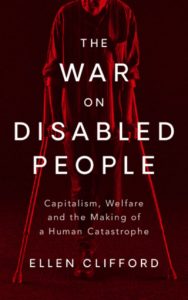
A picture of the front cover of the book titled: "The War on Disabled People: capitalism, welfare and the making of a human catastrophe by Ellen Clifford". Behind the text is the image of a man on crutches. The full background, including the image of the disabled man, is rendered in shades of red and black. The text is in white.Fighting the War against Disabled People

Event to launch release of new book “The War on Disabled People: capitalism, welfare and the making of a human catastrophe” by Ellen Clifford and to reflect o current campaign priorities for activists and allies.

6.30 – 9pm

Monday 15 June 

Facebook/twitter/YouTube live

British Sign Language interpretation and live captioning throughout the meeting plus access break.

Speakers: John McDonnell MP, Liz Carr (actor and star of Silent Witness), Linda Burnip (DPAC co-founder), Ros Wynne Jones (journalist), Professor Colin Barnes (Emeritus Professor, University of Leeds), Debbie Abrahams MP, Laura Pidcock (national secretary, People’s Assembly against Austerity), Paula Peters (DPAC), Professor Peter Beresford (Professor of Citizen’s Participation, University of Essex), John Clarke (formerly organiser of Ontario Coalition Against Poverty, now Packer Visitor in Social Justice at York University in Toronto), Ann Galpin (co-chair, TUC Disabled Workers’ Committee), Austin Harney (PCS), Mark Dunk (Unite the union – personal capacity), La Toya Grant (Deaf campaigner), Ray Johnson (self advocate and star of The Undateables), Simone Aspis (campaigner against segregation) and Nicola Field (author of Over the Rainbow: money, class and homophobia). Chair: Mandy Colleran (DPAC)

… with music from John Kelly, aka Rockinpaddy, poetry from Robert Punton and a Q and A with The War on Disabled People author Ellen Clifford facilitated by Stephanie Onamade.

Ten years ago the Tories came to power with the Coalition government. Disabled people realised from the start that this would have dire consequences for disabled people and the poorest in society. That year Disabled People Against Cuts (DPAC) was formed following a protest outside the Tory party conference.

What has happened since 2010 was worse than anything we could have anticipated. Death is now part of a benefits system designed to punish those unable to earn an adequate income through employment. Disabled people have become re-institutionalised within their own homes as a result of drastic cuts to essential daily support.

Throughout, disabled people have engaged in active struggle in an attempt to minimise the harm inflicted on our communities.

Into this picture the most right-wing government in modern British history was elected in December 2019. In 2020, Covid-19 highlighted even more starkly the growing equalities gaps within society, with official responses to the pandemic confirming that the lives of disabled people are still commonly seen as less valuable than those of non-disabled people.

On 15 June, DPAC will be hosting an event for disabled activists and allies. We will consider the current situation, following a decade of relentless attacks waged on the most disadvantaged people in society by their own government, and explore both the immediate priorities facing us and ideas for building a stronger movement for change.

The event will mark the launch of a new book, ‘The War on Disabled People: capitalism, welfare and the making of a human catastrophe’. The book, written by a disabled activist, analyses recent government disability policy within the context of the history of disabled people’s oppression. It argues that an understanding of wider political economy is necessary both to make sense of the treatment of disabled people and to formulate effective strategies for resistance.

The event will be streamed live on DPAC’s Facebook page, twitter account and YouTube channel.

@dis_ppl_protest
#WarOnDisPpl #EveryDeathCounts #BlackLivesMatter


Apr 092014
 
DPAC Logo with text underneath "Disabled People Against Cuts" and then web address dpac.uk.net

OCAP logo2DPAC_coloured_Logo_2__bigger

Reposted from the OCAP site with thanks

Austerity is Global – so is our resistance!

The Raise the Rates Campaign is excited to announce an Ontario-wide speaking tour this coming May 2014 of Ellen Clifford from Disabled People Against the Cuts (DPAC) UK.

Who is DPAC: The Cameron Government in the UK has implemented brutal cuts to programs for unemployed and disabled people. This includes a system called the Work Capability Assessment that has been used to deny benefits to thousands of people. Disabled People Against Cuts (DPAC) is an organization in the UK that has been at the forefront of challenging this situation. It has mobilized disabled people to fight back and formed alliances with community organizations and unions in resisting the austerity measures of the Cameron Government. The hated private company, Atos, that was carrying out the assessments of sick and disabled people has been forced to quit as a result of the powerful resistance DPAC and others have taken up.

Here in Ontario, we also face major attacks. Ontario Works (Welfare) and ODSP (Disability) rates are too low to enable people to pay their rent and eat properly. The Special Diet and Community Start Up have been slashed by the Ontario Liberal government. Under huge pressure from ongoing community action, the Liberals have promised not to merge OW and ODSP but the danger remains that they will bring in a UK style assessment system that would pose a huge threat to disabled people on ODSP. We need to understand what is happening elsewhere and how people are fighting back and winning against the attacks. Austerity is global – but so is our resistance.

From May 4-15th, Ellen Clifford from DPAC will be visiting Toronto, Kitchener, Sudbury, Kingston and Ottawa. She has been campaigning with the disabled people’s movement for 15 years and, since 2011, has sat on the National Steering Committee of DPAC. She is also a member of Unite the Union and works to build solidarity between workers in unions and those forced to live on social benefits.

Details of the tour, with times and places for meetings will be announced soon. Visit: raisetherates.ca for the full schedule & for more information call the Ontario Coalition Against Poverty at (416) 925-6939
Join the Raise the Rates Campaign Today!
Raise the Rates is a campaign to fight poverty by raising social assistance rates in Ontario. Jointly organized by the Ontario Coalition Against Poverty (OCAP), the Canadian Union of Public Employees (CUPE) Ontario, Sudbury Coalition Against Poverty (S-CAP), Kingston Coalition Against Poverty (K-CAP), Poverty Makes Us Sick Waterloo Region, Poverty Makes Us Sick Ottawa, OPSEU and other grassroots anti-poverty organizers and trade union allies from across Ontario. We are a growing movement united in fighting for:

• Raise Social Assistance Rates 55%: reverse the cuts, raise the rates!
• Restore Special Diet and Community Start-Up Benefits
• Stop the Attack on Disability Benefits
• Living wage for all: Raise the Minimum wage above poverty wages


For more see https://www.ocap.ca/node/1148

Visit: RaisetheRates.ca
https://www.facebook.com/RaiseTheRates
#RaisetheRates


May 292013
 
DPAC Logo with text underneath "Disabled People Against Cuts" and then web address dpac.uk.net

“The government have managed to get away with causing misery…and there hasn’t been an outcry because they’ve wrapped it up in all this language of reform”

Ahead of the national day of protest against welfare reforms this Saturday, we caught up with Ellen Clifford – one of the organisers of the Benefit Justice Campaign. In this first part of the interview, we talk about the Campaign, divisive tactics and the need for unity.

Ellen Clifford - Benefit Justice Campaign/DPAC

Ellen Clifford – Benefit Justice Campaign/DPAC

For those that don’t know, could you tell us a bit more about the Benefit Justice Campaign, how it came about and why now? 

The Benefit Justice Campaign was set up by three campaigns, DPAC – Disabled People Against Cuts, Defend Council Housing and the Right To Work Campaign. We came together in January of this year because the people that we represent were being hit on all sides by cut after cut after cut from this government and we wanted to unite together to form a campaign. So rather than disabled people campaigning on our own, we want to be with council house tenants who were going to be hit by the bedroom tax, and with unemployed workers, and we also wanted to unite with workers through the trade unions because the government has been using a lot of divisive rhetoric about benefit scroungers and the difference between strivers and skivers, and we wanted to come together and overcome a lot of those myths, that a lot of people who are being hit by the benefit cuts are actually in work. And what the government is doing affects people in work and out of work – so to provide a combined campaign to oppose it.

Why have the government been pushing this striver vs. skiver debate? 

Well it was very effective and it has been very effective over the last couple of years. People have actually thought we really need to reform the welfare state. A lot of people talk about the need to stop all these people having a lifestyle on benefits. So actually the government rhetoric has been really effective, and what they’ve managed to do is they’ve managed to get away with causing misery and pushing many, many thousands of disabled people – the poorest members of society, into poverty. That’s what they’ve been effectively doing, but they’ve got away with it and there hasn’t been an outcry because they’ve wrapped it up in all this language of reform and saying that these people are taking all the taxpayers’ money, and trying to point the finger at people that don’t really exist. There aren’t people choosing to live a lifestyle on benefits because it’s ‘such a wonderful life’.

A lot of people would say we’ve got this national debt, so there has to be cuts. ‘Everyones feeling the pinch’, so what would you say to them?

Yeah, not everyone’s feeling the pinch. There’s a certain section of society that really isn’t being affected by it. Meanwhile, there are sections of society that are being hit over and over again. So research that came out recently from the Campaign For a Fair Society, showed that the poorest members of society are being hit harder than anyone else. But they also showed that disabled people with the highest level of support needs, people with complex and severe disabilities, are being hit 19 times harder than the average person so there’s no way ‘we’re all in it together’. There are some sections of society who are being deliberately targeted harder than anyone else.

“Austerity is lining the pockets of certain sections of society.”

Meanwhile, the Sunday Times Rich List in April showed that the 1000 wealthiest UK residents increased their wealth by £35bn last year. So some people are getting richer out of this actually. Austerity is lining the pockets of certain sections of society.

So why aren’t we attacking rich people more?

I think some sections of the population are, but we mainly do that through social media, through our own blogs, or through the left wing media maybe. Certain elements of the right wing media certainly have fallen in with the government and they will reproduce the government statistics which are shown to be misrepresented most of the time.

A Previous Defend Council Housing Protest in London Image: demotix.com

A Previous Defend Council Housing Protest in London Image: demotix.com

You already have a lot of support for the campaign, but how do you get to the people who are a little more shut off? There must be people who would maybe stand with you and support you, but they aren’t aware of what is going on. How do you get to them, and how do you get them to act?  

And it’s the isolated people who are more likely to be in trouble because they’ve got no support so it’s about reaching those people. I think through social media DPAC has got quite an online presence. We’re very involved in Facebook and Twitter and social media, and people find us through that because people are looking because they don’t know where else they can turn to. So that’s one way, but of course people don’t all have access to social media and the internet, and what we’re seeing increasing is local campaigns being set up and just going around, like I was doing on Sunday, just knocking on doors in estates where people are affected – so actually meeting people in person.

At the Benefit Justice Summit a couple of weeks ago in Westminster, you had many organisations coming together for different struggles – around 37 from around the country including DPAC, Hands Off Our Homes, Manchester vs. Bedroom Tax and so on. There was a lot of talk about unity, and coming together – why is that such a strong message right now?

I think people are feeling that because we’ve been attacked for the last couple of years and we haven’t managed to change it yet. The government have done some small U-turns – for example the bedroom tax exempting children with severe disabilities. But, we’ve never got them reverse the direction of welfare reform so I think people want to come together en masse to try and mobilise, to try and fight against the bigger things that are happening – essentially to get the government out and that’s only going to happen if everyone campaigns together.

Find out more about the Benefit Justice Campaign here.

Join us for the second part of the interview on Thursday.

Follow us on Twitter/Like us on Facebook

With thanks to Real Fare please follow this excellent blog

https://realfare.wordpress.com/


Jun 032011
 
DPAC Logo with text underneath "Disabled People Against Cuts" and then web address dpac.uk.net

Indications of shock and disbelief came from all quarters of social media from watching the Panorama program Undercover Care: The Abuse Exposed. While I had to force myself to watch, it was sadly not news for me. Like the whistle blower, disabled people have long been voicing our misgivings about how people with learning difficulties[i] bear the brunt of disability hate crime. It is not so long ago that Fiona Pilkington committed suicide [ii] because she could no longer bear the abuse; she contacted the police no less than 13 times in the year of her death.

When a case such as the Panorama program highlights these real occurrences, there are knee jerk reactions and  righteous noises about the support workers – and rightly so, some of them were arrested. But these abuses are, sadly, not rare and it also misses the crux of the issues.

These support workers were working in an environment (and society) which has no respect or regard for disabled people. They see them as ‘patients’ to be restrained and vent their boredom in bullying and abusing the people in their charge to pass their time. There was no supervision, no managerial support. It’s all very well to vilify them but there are some bright ideas afloat that unemployed people should be sent ‘to serve the community and take care of disabled people’. Disabled people are held hostage by the label as the ‘most vulnerable’, as subjects to be ‘taken care of’ and also, in this scenario, as punishment. Support workers are badly paid and as we can see in the program, scarcely trained. I am fortunate enough to know many support workers who care about the people they support in the community but these sterile ghettos/ care institutions where people with learning difficulties are kept locked up are not the type of places they would chose to work given a choice. These ‘inmates’, because that’s what they are effectively are rather than patients,  are not for all intents and purposes, ill. They are disabled people. Moreover the  treatment meted out to them by being kept in such institutions causes additional mental health issues.

Clare Wrightman, Director of Grapevine, Coventry, a charity that helps people with learning disabilities to grow their lives tells us:

‘As an advocacy organisation we know that people with a learning disability are on the receiving end of abuse and ignorance, especially in the new institutions. In the Panorama expose independent advocates were completely absent. Our workers are a vital part of safeguarding the most vulnerable.
Why did we close long stay institutions run by the State as part of government policy only for local government to commission new ones from the private sector? People can be supported to live in their communities close to the people who really care about them’

Ellen Clifford, who has worked within the People First movement said:

One point I do think needs to be made is how traditionally there is such a risk averse approach to support for people with learning difficulties, favouring segregated institutional based care. This programme shows  the extent of the dangers that are faced by people placed in exactly those type of settings that are purported to be safer for them as opposed to being supported to live independently in the community.

She continues:

the Quality Care Commission (QCC)  clearly failed when it was given evidence of abuse on a plate which it ignored. There needed to be improvements in its systems. However as Panorama rightly identified, the core issue is that locked institutions should not be allowed to exist. The programme at times described people as “not being able to look after themselves” and as having the mental age of children, however that approach fails to recognize the abilities, talents and contributions which all people with learning difficulties have; as one of the programme experts said at the end, there is no reason why any of those people could not live better in the community with support.

The privatisation of care homes must be seen as a factor contributing to the existing abuse at places such as Winterbourne. Private companies are seeking to make a profit from an industry which is already severely underfunded, the outcome can only be inadequate quality of support with the subsequent incidences of abuse. Supporting people with challenging behaviour is a complex and difficult job which requires intelligence (high levels of both IQ and EQ), understanding and training. You do not get support workers with that mix of skills and attributes for the kind of wages that the the so-called care sector pays. Not when you consider the executive salaries which are also paid out to the Directors.

The coalition government is pushing for a Big Society but without state intervention and regulation to ensure people get the support they need, there is every danger, as the Panorama programme provided evidence, of cultures of abuse becoming more widespread and accepted.

The programme highlights the key value of user led organisations: one of the experts described how the staff cannot have viewed the patients as “human beings just like them” in order to have engaged in the treatment they did. Where disabled people are visibly part of service commissioning and provision we can provide a constant reminder that we are indeed people just like them. If we don’t want people in our society to be abused as seen on Panorama then society needs to invest in our organisations.

Jim Mansell from the Tizard Centre, Kent University was one of the experts in the programme. What is highlighted on the Panorama programme is already detailed in a chilling report by him and his colleagues.[iii]

What we want to know is when is this austerity driven government going to see that this privatised, institutionalised care is not cheaper but that it costs disabled people and their families dear in depriving them of their human rights to live independently with support in the communities that includes them.

—-Eleanor Lisney


[i] Disability hate crime needs to be tackled  https://www.guardian.co.uk/society/2011/jun/01/disability-hate-crime-keith-philpott

[ii] Fiona Pilkington case: police face misconduct proceedings https://www.guardian.co.uk/uk/2011/may/24/fiona-pilkington-police-misconduct-proceedings

[iii] Exploring the incidence, risk factors, nature and monitoring of adult protection alerts, Jim Mansell et al.

https://shareweb.kent.gov.uk/Documents/adult-Social-Services/adult-protection/tizard-report.pdf