Mar 012021
 
DPAC Logo with text underneath "Disabled People Against Cuts" and then web address dpac.uk.net

To coincide with today’s day of action, DPAC is publishing “#20More4All – Why the £20 per week uplift to Universal Credit must be applied to legacy benefits: testimonies, stats & facts”

The testimonies collated in the document have been collated together from three sources:

  • Responses to an online survey set up DPAC Sheffield and @ImaJSAClaimant. There were 177 respondents. 17% of these are on Universal Credit and have received the uplift. 84% reported they are in receipt of legacy benefits.
  • Responses to a survey carried out by Unite Community. 539 Community members responded. These include disabled people and unemployed workers.
  • Emails sent to Disabled People Against Cuts. These include three from legacy benefit claimants describing their everyday financial struggles and another 25 with copies of letters sent to constituency MPs asking them to support the extension of the uplift.

We have left the comments in people’s own words as we received them.

The research evidence section collates key findings from a number of recent reports that clearly evidence the need not only for the £20 uplift to be extended to legacy benefits and made permanent, but also the urgent for a new social security system that ensures a guaranteed decent income for all.

Linda Burnip, co-founder of DPAC, said: “The survey results show how necessary an uplift to legacy benefits is needed. People especially those in the WRAG who are being forced to live on a measly £74 a week are being left to starve or freeze. Even in austerity struck Tory Britain this is totally unacceptable.”

Andy Mitchell, @ImaJSAClaimant on twitter, said: “For me the comments quite clearly demonstrate how much the extra £20 is needed for the most basic of human needs. In a wealthy country, even after spending 10 years living through and being affected by austerity, it is deeply troubling that disabled people and families with dependent children are missing out on meals and cutting back on heating, As Linda rightly says, it is totally unacceptable – but it is something too many in society have turned a blind eye to for far too long.”

Jen Jones, founder of DPAC Sheffield and herself a claimant of legacy benefits, said:”I cried reading the replies, so many people who feel just like me. Forgotten, unwanted, or a burden, stated that they would wish the extra support for only the most basic necessities. To eat 3 meals a day, to be able to wash themselves and their clothes and to keep warm. We’re not asking for the moon on a stick. Support us to live.”

#20More4All – why the £20 uplift must be extended to legacy benefits – final

Feb 202021
 
DPAC Logo with text underneath "Disabled People Against Cuts" and then web address dpac.uk.net


Fight for £20 more for claimants on legacy benefits

The government is set to extend the £20 uplift to Universal Credit for another six months but we know how callous and cruel it is not to apply it to legacy benefits. 

Please do whatever you can to join our day of action on 1st March. 


Ideas for what you can do:

  • Take and share selfies on the day using the hashtags #20More4All


  • Put up and share posters and stickers. You can:

                            – make one,

                            – download a copy here: https://dpac.uk.net/wp-content/uploads/2021/02/20More4All.pdf

                            – or email mail@dpac.uk.net and ask us to post you one or some.


  • We are also looking for disabled people on legacy benefits who haven’t had the £20 uplift and are struggling to manage financially to speak to the media. If you could help us please send an outline of your situation and contact details to mail@dpac.uk.net


  • You can also have your say anonymously – about your experiences and what the uplift means to you but filling in this extremely quick and straightforward survey: https://forms.gle/Y5uB5Mp95oJfzgAg6 [Thanks to Sheffield DPAC and @imaJSAclaimant for producing this].


  • Make your own banners for local banner drops that can be done without breaking social distancing guidelines.


  • For those that can, go out and hold socially distanced protests.


Why it’s important to take action

The government increased Universal Credit by £20 per week at the start of the pandemic, when nearly two million more claimants came onto the benefit, exposing the social security system to greater scrutiny.

Many claimants never got the £20 uplift in the first place. It was only applied to Universal Credit so those still on legacy benefits and not yet moved over to Universal Credit were missed out. Many of these are disabled and their living costs have been significantly higher as a result of the pandemic and needing to shield.

Out of work benefits in the UK are well below the amount needed for a decent standard of living. All benefits need to be significantly increased, not cut.

We need people to be properly supported in these difficult times. The benefits system needs a complete overhaul. The Universal Credit system doesn’t work – it has been proven be toxic and massively harmful.

As well as fighting for a permanent uplift – we must fight for it to be scrapped and replaced with a social security system that provides a genuine safety net for all that need it.

The free school meals saga shows that when people fight back the Tories can be pushed into U-turns.

We understand that many people are still unable to leave their homes and we are NOT asking anyone to put their lives at risk or to break social distancing guidelines.

We are asking people to do just whatever you can to build support for this issue and to let claimants know there is a fightback they can get involved with.

If you are a member of a union branch or a local campaign please ask them to support the day of action on 1sr March.


Feb 072021
 
DPAC Logo with text underneath "Disabled People Against Cuts" and then web address dpac.uk.net

image with the campaign slogan "No cuts to benefits Keep the £20 uplift & fight for more" with the hash tags #2-More4All #NoCutsToBenefits

Saturday 6th February saw a widely supported day of action to demand a £20 per week uplift to legacy benefits and that the government scraps its proposals to cut Universal Credit by £20 per week. See the report back here.

But there is still more to do over the next few weeks before Chancellor Rishi Sunak gives his Spring budget on March 3.

Help us build support for these demands and force the Tories into a u-turn.

What you can do:

– Put a poster in your window. You can download one here or ask for hard copies to be sent to you by emailing mail@dpac.uk.net

– Get on social media and post selfies and videos using the hashtags #20More4All and #NoCutsToBenefits

– Write to your MP about why this issue is important to you. There is a template letter you can download here

– Raise awareness and build support for the demands from your trade union, Unite Community branch or campaign group

– Organise or support on social media, local socially distanced protests or banner drops


For reasons why this is important:

https://www.youtube.com/watch?v=RYXoV6UvzKU


Feb 072021
 
DPAC Logo with text underneath "Disabled People Against Cuts" and then web address dpac.uk.net

Dear [insert name of MP]

I am writing to ask you as my MP to call for the £20 Universal Credit uplift to be extended to legacy benefits.

This concerns/personally affects me because… [insert]

More than 2.2million claimants who have not yet been moved on to UC missed out on the £20 uplift when it was introduced in March. This is despite the fact that many of those claimants are disabled with underlying health conditions and their expenditures have significantly increased as a direct result of the pandemic and the need to shield for almost a year now.

UK social security payment levels also represent only a relatively small percentage of the Minimum Income Standard (MIS). This is the amount calculated by the Joseph Rowntree Foundation as what is needed for an acceptable standard of living. After the uplift, UC payments are just 43.4% of the MIS.

For those still on legacy benefits, as they have been throughout the pandemic, the amount they continue to receive in benefits represents just 33.9% of the MIS.

Many of the more than 2.2 million benefit claimants who have not received the uplift are disabled. Disabled people have been badly hit by increased expenditures as a direct result of the pandemic and the need to shield. Many have been self-isolating for nearly a year now. Higher spending has been caused by, for example, the need to purchase PPE for social care support workers coming in and out of their homes, costs of online food deliveries and increased energy costs.

Research carried out by the Disability Benefits Consortium found that:

  • The majority (82%) of disabled people surveyed said they had spent more than they normally would – due to greater food shopping and utility bills, as well as having to pay for taxis to attend essential appointments – since the COVID-19 crisis began.
  • Two thirds (66%) said they had to go without essentials like food, heating or medication as a result of increased costs since the pandemic started.
  • Nearly half (44%) said they had fallen behind on financial commitments like rent, mortgage payments, or household bills.

In response to this research, the government says that benefits will be increased by 37p per week in April 2021 and that claimants still on legacy benefits have the option of moving over to Universal Credit.

Neither of these points provide a suitable remedy to the situation.

The benefit increase is designed to reflect higher costs of living due to inflation, not the pandemic. It is also below the level that is realistically needed to cover inflation, being linked to the CPI and representing a mere 0.5% increase while state pensions will rise by 2.5%.

Many disabled people are financially worse off on Universal Credit which for example removes both Severe and Enhanced Disability Premia and would have more to lose than to gain by moving off legacy benefits.

There is also the question of how disabled people without access to the internet or support to navigate the benefit system are supposed to be able to make the move over to Universal Credit with the operations of welfare advice and community support organisations so heavily restricted by the pandemic.

Keeping and extending the £20 uplift is vitally important to prevent greater poverty, debt and misery and to help those currently out of work to find employment.

I look forward to hearing from you.

Yours sincerely,

[name]

[address]


Jan 312021
 
DPAC Logo with text underneath "Disabled People Against Cuts" and then web address dpac.uk.net


image with the campaign slogan "No cuts to benefits Keep the £20 uplift & fight for more" with the hash tags #2-More4All #NoCutsToBenefits

#20More4All #NoCutsToBenefits 

Say NO to the proposed £20 per week cut to Universal Credit

Fight for £20 more for claimants on legacy benefits

Disabled People Against Cuts, Homes For All Campaign and People Before Profit are calling a National Day of Action to fight plans to scrap the £20 uplift to Universal Credit.

The government increased Universal Credit by £20 per week at the start of the pandemic, when nearly two million more claimants came onto the benefit, exposing the social security system to greater scrutiny.

Now, while the pandemic is still raging, they are planning to take the £20 uplift away. This seems particularly cruel and unnecessary, especially when Johnson found enough money for a £16 in defence funding in November.

Many claimants never got the £20 uplift in the first place. It was only applied to Universal Credit so those still on legacy benefits and not yet moved over to Universal Credit were missed out. Many of these are disabled and their living costs have been significantly higher as a result of the pandemic and needing to shield.

Out of work benefits in the UK are well below the amount needed for a decent standard of living. All benefits need to be significantly increased, not cut.

We need people to be properly supported in these difficult times. The benefits system needs a complete overhaul. The Universal Credit system doesn’t work – it has been proven be toxic and massively harmful.

As well as fighting for a permanent uplift – we must fight for it to be scrapped and replaced with a social security system that provides a genuine safety net for all that need it.

The free school meals saga shows that when people fight back the Tories can be pushed into U-turns.

We understand that many people are still unable to leave their homes and we are NOT asking anyone to put their lives at risk or to break social distancing guidelines.

We are asking people to do just whatever you can to build support for this issue and to let claimants know there is a fightback they can get involved with.

If you are a member of a union branch or a local campaign please ask them to support the day of action on 6th February.

Here are a few ideas for what you can do:

– Take and share selfies on the day using the hashtags #20More4All and #NoCutsToBenefits.

– Put a poster in your window. You can make one, download one at peoplebefore-profit.com/resources or ask us at mail@dpac.uk.net to post you one.

– Write to your MP to tell them why we need the uplift. There is a template letter you can use below – remember to include information about the issue personally affects you as MPs respond better to personal rather than blanket letters.

– Make your own banners for local banner drops that can be done without breaking social distancing guidelines.

–  Use your local media to raise awareness of the issue.


Dear [insert name of MP]

I am writing to ask you as my MP to oppose the proposed cut to Universal Credit by £20 per week. This represents more than one fifth of income that claimants depend on for essentials such as food and heating.

Many claimants who have not yet been moved on to UC missed out on the £20 uplift when it was introduced in March. This is despite the fact that many of those claimants are disabled with underlying health conditions and their expenditures have significantly increased as a direct result of the pandemic and the need to shield for almost a year now.

I ask also that you support the extension of the £20 uplift to legacy benefits.

This personally affects me because… [insert]

Keeping and extending the uplift would have substantial economic and social benefits. These same outcomes will not be realised by the one-off for that has been suggested by the Chancellor as an alternative and to which claimants who have not yet been moved onto UC will be exempt.

UK social security payment levels represent only a relatively small percentage of the Minimum Income Standard (MIS). This is the amount calculated by the Joseph Rowntree Foundation as what is needed for an acceptable standard of living. After the uplift, UC payments are just 43.4% of the MIS.

For those still on legacy benefits, as they have been throughout the pandemic, the amount they continue to receive in benefits represents just 33.9% of the MIS.

One impact of an inadequate income is that it pushes people further from employability: online access, the kind of nutrition able to sustain concentration and the ability to stay clean and presentable for interviews all require a level of income that is not achievable if the £20 per week cut takes place.

Keeping and extending the £20 uplift is vitally important to prevent greater poverty, debt and misery and to help those currently out of work to find employment.

I look forward to hearing from you.

Yours sincerely,

[name]

[address]


Jun 192020
 
DPAC Logo with text underneath "Disabled People Against Cuts" and then web address dpac.uk.net


Speakers: Charlotte Hughes (The Poor Side of Life); Gail Ward (DPAC North East); Andy Mitchell (Unite Community); Mark Harrison (Reclaiming Our Futures Alliance); Fran Heathcote (National President, PCS Union); Dave Allan (TUC Disabled Workers’ Committee/Unite the union); Kate Summers (researcher, London School of Economics); Jay Mehta (clinical psychologist); Jennifer Jones (Sheffield DPAC) and with Paula Peters and Mark Dunk from DPAC.

6.30 – 8.30pm – Monday 22 June

Watch via:

https://www.youtube.com/channel/UCPiFIM4pWlJaV6Ohw_ojGoQ/videos

https://www.facebook.com/pg/disabledpeopleagainstcuts/videos/


The Covid-19 outbreak prompted millions more people to apply for UC and discover the realities of dealing with the DWP and rules such as the five week wait and savings threshold. At the same time, the government announced temporary measures on issues campaigners have been pushing for, for years. The uprating of UC has not been applied to legacy benefits, creating a two tier benefits system. Disabled campaigners were alarmed by comments from Labour’s new shadow Secretary of State for Work and Pensions suggesting that those who work should be entitled to more from the social security system than those who don’t. The fundamental problems with UC highlighted so disparagingly in 2018 by the United Nations rapporteur on Extreme Poverty Philip Alston, have not changed and DPAC continues to demand that UC is stopped and scrapped.

This meeting hosted by DPAC for disabled campaigners and our allies will be a chance to review the situation with Universal Credit and discuss how we take the Stop and Scrap campaign forward in the current climate.

#StopandScrap #WaronDisPpl

May 262020
 
DPAC Logo with text underneath "Disabled People Against Cuts" and then web address dpac.uk.net
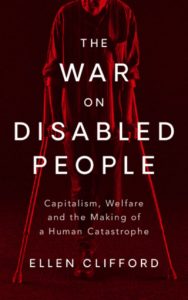
A picture of the front cover of the book titled: "The War on Disabled People: capitalism, welfare and the making of a human catastrophe by Ellen Clifford". Behind the text is the image of a man on crutches. The full background, including the image of the disabled man, is rendered in shades of red and black. The text is in white.
The War on Disabled People is now available to pre-order from Zed Books:
Zed are offering a discounted price but DPAC realises that the cost will still be beyond the reach of many people – not least because of the issues covered in the book.
We will be giving away a few free copies kindly donated by Zed to names pulled out of a hat on 15th June. To enter please email your name to mail@dpac.uk.net with ‘Book Draw’ in the subject line.
Very sadly the battle for accessible formats to be available is ongoing… watch this space.
Nov 262018
 
DPAC Logo with text underneath "Disabled People Against Cuts" and then web address dpac.uk.net

Actions against Universal Credit:
a hostile environment for women & children

Single mums challenge UC
working allowance disaster

Tues 27 & Wed 28 November 2018

High Court, Strand, London WC2A 2LL

Single mums are in court to challenge the government over the Universal Credit payment system which is inflexible and doesn’t reflect reality.  The rigid ‘assessment period’ causes wildly fluctuating benefit and debt. Part-time dinner lady Danielle Johnson from Keighley, West Yorkshire, is paid on the last working day of the month. But her monthly UC assessment periods are rigid – running from the last day of each month, meaning that if she is paid before the last day of the month, because payment falls on a weekend or non-banking day, she is assessed as having been paid twice that month, and not at all the next month (so she could be subject to the benefit cap). Claimants are unable to change their assessment period. Ms Johnson also argues that the system is discriminatory because it disproportionately affects mainly single mothers. Child Poverty Action Group and Leigh Day solicitors have joined together. See Leigh Day’s press release.  The UN Special Rapporteur on extreme poverty and human rights recently condemned UC as ‘misogynist’.

10.30am: Court case starts in Court 1.  Go into court to support the claimants.  Continues Wednesday, check court listing here

Read “Universal Credit: a hostile environment for women”, by Selma James, Solveig Francis

UC Unite call out 1 Dec 2018.JPG

UC parliament square wide photo.JPG

Saturday 1 December 2018

National day of action to STOP Universal Credit
Called by
Unite Community

London-wide 2pm: In the shadow of Grenfell Tower, meet at Ladbroke Grove tube, London W10 6HJ

UK-wide info, including England, North of Ireland, Scotland and Wales, see Unite website.

 Posted by at 17:43
Jun 082018
 
DPAC Logo with text underneath "Disabled People Against Cuts" and then web address dpac.uk.net

https://www.parliament.uk/business/publications/written-questions-answers-statements/written-statement/Commons/2018-06-07/HCWS745/

There has been some significant changes announced by the government concerning Universal Credit.  In a parliamentary statement yesterday Esther McVile says that the government intends to make the following changes-

The timetable for managed migration has been extended by 1 year.  It is now due to run from July 2019 – March 2023. Yet another delay on top of the years and many, many millions of pounds it has already taken

And transitional protection and the severe disability premium- some good news ahead of the court verdict which is expected shortly.

The Government has already made a commitment that anyone who is moved to Universal Credit without a change of circumstance will not lose out in cash terms. Transitional protection will be provided to eligible claimants to safeguard their existing benefit entitlement until their circumstances change.

Today I am announcing four additions to these rules to ensure that Universal Credit supports people into work, protects vulnerable claimants and is targeted at those who need it.

“In order to support the transition for those individuals who live alone with substantial care needs and receive the Severe Disability Premium, we are changing the system so that these claimants will not be moved to Universal Credit until they qualify for transitional protection. In addition, we will provide both an on-going payment to claimants who have already lost this Premium as a consequence of moving to Universal Credit and an additional payment to cover the period since they moved.

Second, we will increase the incentives for parents to take short-term or temporary work and increase their earnings by ensuring that the award of, or increase in, support for childcare costs will not erode transitional protection.

Third, we propose to re-award claimants’ transitional protection that has ceased owing to short-term increases in earnings within an assessment period, if they make a new claim to UC within three months of when they received the additional payment.

Finally, individuals with capital in excess of £16,000 are not eligible for Universal Credit. However, for Tax Credit claimants in this situation, we will now disregard any capital in excess of £16,000 for 12 months from the point at which they are moved to Universal Credit. Normal benefit rules apply after this time in order to strike the right balance between keeping incentives for saving and asking people to support themselves.”

The above changes will be brought in by new regulations in the Autumn (Universal Credit Managed Migration and Transitional Protection Regulations).

 Posted by at 21:29
Mar 132018
 
DPAC Logo with text underneath "Disabled People Against Cuts" and then web address dpac.uk.net

Badge saying "STOP & SCRAP Universal credit"

This Wednesday 18 April join DPAC, Single Mothers’ Self-Defence and WinVisible to call on the Government to #StopAndScrap Universal Credit. 

London Protest – meet for 11am outside the visitor’s entrance to House of Commons.

You can see details of local actions around the country on this page.

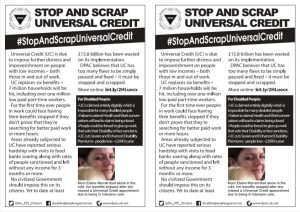
To download a flyer for use on the day click here: flyer 


Oct 182017
 
DPAC Logo with text underneath "Disabled People Against Cuts" and then web address dpac.uk.net

The BBC is calling for Universal Credit claimants to share their stories. The contact details can be found on their website. If you are currently claiming (or have previously claimed) Universal Credit, please consider  sharing your story. Please share this with friends and family; the more people speak out against this fiasco, and take a stand against these draconian reforms, the better.

In other news Mrs May has announced the premium-rate phone line for Universal Credit will be scrapped. MPs are currently debating a motion on pausing Universal Credit. Up to 25 Conservative MPs are expected to rebel and the DUP intend to abstain. Although the motion is purely symbolic, it will increase the pressure on the beleaguered Prime Minister.

Oct 032017
 
DPAC Logo with text underneath "Disabled People Against Cuts" and then web address dpac.uk.net

The Mirror are calling for people to share their experiences of Universal Credit. The government intends to increase the amount of job centres administering the benefit despite the numerous problems; an inbuilt delay of 42 days for the first payment, rising rent arrears and soaring food bank usage. No fewer than 15 conservative MPs have called for the benefit to be paused, but their pleas were ignored.

If you (or anyone you know) has been affected by this benefit, please consider sharing your experiences (you can request anonymity) For more information click here: (you need to scroll to the bottom of the screen).

Aug 152017
 
DPAC Logo with text underneath "Disabled People Against Cuts" and then web address dpac.uk.net

Many claimants will be aware that with Universal Credit there are 7 waiting days when claiming , well some good news is that there are some exceptions. While this is going to be quite daunting for many, there are small things which will help existing IR ESA ,JSA,IS claimants.


Exceptions
5 A person will not have to serve 7 waiting days where

1. a new award of UC is made2

1.1 to a single claimant where a previous award has ended when the
claimant ceased to be a member of a couple or

1.2 to joint claimants where two previous awards ended as the result of the
claimants becoming a couple or

1.3 in any other circumstances where the assessment periods for the new
award begin on the same day of each month as the assessment periods for a previous award  or

2. on the relevant date, the claimant or either of the joint claimants

2.1 is terminally ill or

2.2 has recently become a victim of domestic violence  or

2.3 is a care leaver or

2.4 is aged 16 or 17 and has no parental support  or

2.5 has been a prisoner within the month ending on the relevant date or

2.6 has been entitled to new-style JSA or new-style ESA within the 3 months
ending on the relevant date or

2.7 was entitled to old-style JSA, old-style ESA or IS at any time during the
period of 3 months ending on the relevant date and ceased to be entitled
to that benefit on starting paid work or

2.8 does not fall within paragraph 5 2.7  and was entitled to one of the
following benefits at any time during the period of one month ending on
the relevant date

2.8.a old-style JSA or

2.8.b old-style ESA or

2.8.c IS or

2.8.d HB or

2.8.e child tax credit or

2.8.f working tax credit


1 UC Regs, reg 19A(3); 2 reg 19A(3)(a); 3 reg 21; 4 reg 19A(3)(b); 5 reg 98(2); 6 reg 8(3); 7 Universal Credit
(Transitional Provisions) Regs 2014, reg 16A; UC Regs, reg 19A(3)(b)

2.7 was entitled to old-style JSA, old-style ESA or IS at any time during the
period of 3 months ending on the relevant date and ceased to be entitled
to that benefit on starting paid work or
2.8 does not fall within paragraph 5 2.7 above and was entitled to one of the
following benefits at any time during the period of one month ending on
the relevant date
2.8.a old-style JSA or
2.8.b old-style ESA or
2.8.c IS or
2.8.d HB or
2.8.e child tax credit or
2.8.f working tax credit7 .

Feb 232015
 
DPAC Logo with text underneath "Disabled People Against Cuts" and then web address dpac.uk.net

With many thanks to John Slater, for writing this article,


If you claim Universal Credit (“UC”) the DWP intends to share your most sensitive personal data with local authorities, citizens advice bureaux, credit unions, social landlords and relevant registered charities:


  • Full name (including initials)
  • Contact details including: address, email, telephone.
  • Details of others in household, in relation to the relevant Benefit Unit.
  • Type of accommodation – private / social rented, owned, none etc.
  • Gender
  • Ethnicity *.
  • National Insurance Number.
  • Date of birth / age range.
  • Employment status / earning.
  • Debts / arrears/rent payable.
  • Benefits received including: level of payment, copy of documents (e.g. claimant commitment).
  • Health conditions / disabilities *
  • Caring responsibilities.
  • Qualifications / training status.
  • Transport situation e.g. able to drive /access to car or easy access or public transport.
  • Barriers to work.
  • Languages spoken.
  • Access to financial products such as bank / building / credit union / Post Office card account / credit card.
  • Level of personal budgeting.
  • Access to computer and internet.
  • Level of digital skills.


On the 10th December 2014 the DWP quietly published a consultation document (see link below). This does seem to be a strange time to launch a consultation exercise given the proximity of the Christmas and New Year holidays. People would be forgiven for wondering if the DWP was attempting to sneak this out without anyone finding out until it was too late.


https://www.gov.uk/government/consultations/universal-credit-data-sharing-between-dwp-and-local-support-providers


Controlling and processing any personal data like that listed above is subject to the Data Protection Act 1998 (“DPA”). In the UK we have an organisation called the Information Commissioner (“ICO”) which has a statutory role in regulating the DPA. The DWP knows this as it has consulted with it on other matters. Did the DWP invite the ICO to take part in the consultation process? It probably won’t come as a surprise to many people to hear that the DWP didn’t invite the ICO to take part and as a result people would be forgiven for wondering how seriously the DWP takes its obligations under the DPA when dealing with sensitive personal data.


When I heard about the DWP proposals I sent a copy to the ICO as I wasn’t happy with the type of information being shared and the fact that the DWP included a threat against claimants if they weren’t willing to share their data. In section 4.4 of its consultation document the DWP states:


Objecting to information sharing may, of course, have the potential to undermine an individual’s claim – claimants will therefore need to be advised about the possible adverse consequences of objecting to information sharing.”


It seems that the DWP just can’t help itself. If it doesn’t get its own way it automatically wants to punish members of society who face the most barriers and disadvantages.


Despite having a huge workload, the ICO acted quickly and issued a response to the DWP consultation document (see link below):


https://ico.org.uk/about-the-ico/consultations/dwp-consultation-on-draft-regulations-universal-credit-data-sharing/


It is obvious from its response that the ICO is very unhappy about the DWP proposals and the fact that it wasn’t invited to take part in the consultation. The following extracts give you a taste:


The Information Commissioner is surprised and disappointed not to have also received a copy of this consultation or his officials alerted to the proposals given his Office’s role in regulating the Data Protection Act and also having issued a statutory code of practice on data sharing – https://ico.org.uk/media/for-organisations/documents/1068/data_sharing_code_of_practice.pdf


We have been consulted in the past on data sharing initiatives arising from the Welfare Reform Act such as the Troubled Families initiative and have worked closely with the Department and local support agencies in advising on data sharing and helping to overcome perceived barriers. Additionally the shortness of the consultation period, and falling over the holiday period, has meant that we have been unable to give as much consideration to the content of the consultation as we would have wished. We would welcome the opportunity to meet with the Department to discuss in further detail the data protection and privacy issues arising from the regulations which we note are intended to come into force on 13 February 2015 and be implemented the following month.”


The document further states that ‘objecting to the sharing may have the potential to undermine an individual’s claim and so claimants will need to be advised about the possible adverse consequences of objecting to information sharing’. The Information Commissioner’s view is that consent is not appropriate where it cannot be freely given and where the data sharing is to take place regardless of the wishes of an individual or where a sanction could be imposed if agreement is not forthcoming. In this context it is also important to clarify that there is no legal opt out under the DPA but any such arrangements should be as transparent as possible and that individuals affected should be aware that the processing will be taking place.”


With so much personal data being collected and used by large organisations these days, some people may be wondering if any of this really matters. I think it does matter and that as a society we are sleep walking into a data protection nightmare. It isn’t just companies trying to sell us goods that make use of data about us. There can be some very unpleasant consequences of allowing organisations access to our sensitive data and have free reign to do what they want with it. What about if:


  • The data being shared about you is wrong and it results in the wrong decisions being made about you? (e.g. you get refused credit, your insurance costs go up or landlords won’t rent to you).
  • It allows unscrupulous companies to target members of society who face the most barriers and disadvantages and steal from them?
  • The organisations lose your data and it enters the public domain. You could end up suffering verbal or physical abuse as this Government’s ongoing demonization of people claiming benefits makes this a sad and worrying possibility.
  • You simply don’t want these organisations to know so much about you? After all it’s your life and your data.
  • The data isn’t used solely for the purposes claimed? Sharing such sensitive information as part of your UC claim relies on you being able to trust the DWP and the organisations listed.


Only you know if you are happy to share your information so widely, which is why the DPA states that each of us must give our consent for our data to be shared. However, some of the data on the DWP is treated differently and is called sensitive personal data (“SPD”). For this to be shared the DWP needs your explicit consent. This means you have to freely agree (i.e. not subject to threat or other coercion) in unambiguous terms that you are happy for specific data to be shared for specific purposes.


The ICO data sharing code of practice defines consent as:


Consent (explicit consent for sensitive personal data) is one of the conditions the DPA provides to legitimise processing. The Data Protection Directive on which the UK’s DPA is based defines ‘the data subject’s consent’ as:


‘any freely given specific and informed indication of his wishes by which the data subject signifies his agreement to personal data relating to him being processed’.


“There must therefore be some form of active communication where the individual knowingly indicates consent. Whilst consent will provide a basis on which organisations can share personal data, the ICO recognises that it is not always achievable or even desirable. If you are going to rely on consent as your condition you must be sure that individuals know precisely what data sharing they are consenting to and understand its implications for them. They must also have genuine control over whether or not the data sharing takes place. It is bad practice to offer individuals a ‘choice’ if the data sharing is going to take place regardless of their wishes, for example where it is required by statute or is necessary for the provision of an essential service.


The DPA definition of what counts as SPD is shown below. The data items marked with an “*” in the list of data that the DWP intends to share is SPD. Other data (e.g. language spoken) could also be SPD if they also disclose information listed below:


  1. the racial or ethnic origin of the data subject,
  2. his political opinions,
  3. his religious beliefs or other beliefs of a similar nature,
  4. whether he is a member of a trade union (within the meaning of the M1TradeUnion and Labour Relations (Consolidation) Act 1992),
  5. his physical or mental health or condition,
  6. his sexual life,
  7. the commission or alleged commission by him of any offence, or
  8. any proceedings for any offence committed or alleged to have been committed by him, the disposal of such proceedings or the sentence of any court in such proceedings.


I believe that allowing organisations to have access to SPD is as much a matter of trust as anything else. Do you trust the DWP to do what it says and only use the data for what states in the consultation document? Personally I don’t trust the DWP due to its historic behaviour and how it plans to share your data with these organisations using a new IT system.


A New IT System

In section 2.8 of its consultation document is states:


Further expansion of UC will provide the opportunity to build a secure platform for the introduction of Universal Support by mobilising local partnerships nationwide and putting in place a robust infrastructure ready for all claimant groups, in particular the more complex and vulnerable.”


If I translate this from management gobbledegook into English I think it says that the DWP plans to develop yet another UC IT system to share your data. Even if we set aside the abject failure of Governments in general to deliver IT systems, UC is a special case. It has been roundly criticised by the House of Commons Public Accounts Committee, the National Audit Office, the House of Commons Work and Pensions Committee, its own suppliers, its own staff (in a leaked employee survey) and reputable media (e.g. Dispatches and Panorama).


It has spent huge sums of public money on IT development and has little to show for it. In December 2014 HM Treasury finally admitted that £663 million of spending on UC IT is likely to have to be written off as it won’t be used in the final UC system. To put this into perspective this is almost twice the cost of the Independent Living Fund that the Government is closing. This means that whilst claiming that the country can’t afford the benefits bill Iain Duncan Smith has flushed almost a billion pounds of public money down the drain.


Complex IT systems are by their very nature difficult to produce and it’s not easy to ensure that the data they hold is secure. If you look at the DWP history of IT development and the diverse nature of the organisations that the DWP wants to share your data with then it would be a brave person to simply accept that everything will be kept safe.


The DWP Can Be Trusted, Can’t it?

Can you be sure that the DWP will keep its word in respect of your data, especially your SPD? My personal view is that the DWP cannot be trusted not to abuse the powers it is granted and it has demonstrated this consistently over recent years.


The most recent example is the despicable harassment of people in the ESA Support Group by calling them to attend work focused interviews. Despite this allegedly being voluntary there is compelling evidence that people have been threatened with sanctions if they didn’t attend. Is this just a matter of a few overzealous JCP employees or something more sinister? I would argue that something more sinister is happening and that the DWP was knowingly acting unlawfully.


It simply isn’t credible that most civil servants working in the DWP don’t know that they can’t just do whatever they want. Our system of law and Government means that IDS needs permission from Parliament to administer the benefits system. This takes the form of primary legislation (e.g. the Welfare Reform Act 2012) and if IDS acts outside this “permission” he is acting unlawfully. The Welfare reform Act states the following in relation to people allocated to the ESA Support Group:


The Secretary of State may not impose any work-related requirement on a person falling within this section.”


This proves that the targeting of people in the support group to pressure them to attend work-focused interviews (“WFI”) is clearly unlawful. There is no ambiguity here as Parliament specifically forbade IDS from doing this. It doesn’t matter if letters included the word voluntary or not, if, thanks to the actions of JCP employees, the person truly believed that they had no choice but to attend a WFI then the DWP is breaking the law.


The DWP has considerable ‘form’ for using other ‘dirty tricks’ as well. If you have claimed for ESA you may have come across the DWP edict that a WCA can only be deferred for a maximum of 4 weeks. This is nothing more than an internal DWP policy but it would have you believe otherwise.


I think there is a real risk that the DWP will pressure people into ‘consenting’ to share their sensitive personal data under threat of sanctions because it seems to rely on people being too scared to fight back and not knowing what the DWP can and cannot impose


What Happens Now?

The DWP consultation is now closed and we have to wait and see what happens next. Will the DWP discuss its proposals with the ICO? Will the DWP take any notice of what the organisations that responded to the consultation say? Will it publish the responses?


When I first heard about the DWP proposals I thought I’d submit a Freedom of Information request to see what the DWP would tell me. The request and the DWP response can be found here:


https://www.whatdotheyknow.com/request/uc_wide_sharing_of_claimants_dat#incoming-617712


I respect of claimants refusing to share data the DWP appears to have had a change of mind as it said in its response:


In respect of data sharing for Universal Support provision, the legislation allows for data to be shared, this will happen following a conversation with a claimant during which they will have the opportunity to decline to share some or all of the information. If someone prefers not to share information, there is categorically no impact on their claim for Universal Credit. Giving consent will enable Universal Support partnerships to offer tailored and more holistic support more quickly this will help to ensure that people get the level of support they need. 


We will be taking steps to ensure that data sharing complies with data protection principles; that claimant confidentiality is not compromised; and that no claimant is inadvertently put at risk. We are developing procedures and guidance that will clarify this.


This response does suggest that for some of the data the DWP accepts that the claimant can refuse to share it without any threat to their UC claim. However, the response also stated that the DWP believes it doesn’t need the claimant’s consent to share some of the data.


I had a look at the Welfare Reform Act 2012 (“WFA”) and it has amended the Social Security Administration Act 1992 to allow IDS to make regulations to gather information that may be relevant to a benefit claim:


“(1A) Regulations may make provision for requiring a person of a prescribed description to supply any information or evidence which is, or could be, relevant to—

  1. a claim or award relating to a benefit to which this section applies, or
  2. potential claims or awards relating to such a benefit.”


This isn’t a surprise as it’s reasonable to allow the DWP to gather information it needs to administer benefits. The WFA also allows IDS to make regulations to specify who this information can be shared with. This explains the “draft Social Security (Information-Sharing in Relation to Welfare Services Etc.) Amendment Regulations 2015” included in the consultation document.


However, I’m still unsettled by the DWP wish to share SPD and if it still plans to do so without the explicit consent. I’m have submitted another FOIA request to see if I can find out why the DWP believes it can share some data without any consent and if it plans to share any SPD without explicit consent from UC claimants (link below).


https://www.whatdotheyknow.com/request/uc_sharing_of_claimants_data


What could you do if:

  • the DWP tells you that you must sign something agreeing to share your data and/or your SPD? or
  • you are claiming UC and the DWP wants to share your SPD with other organisations and you don’t want to?


If you are being pressured to sign something that suggests the DWP needs your consent to share your data. If your consent if required then it must be given freely and without coercion, i.e. the DWP shouldn’t be threatening you with sanctions if you don’t sign. Consent isn’t just a matter of signing a piece of paper, as you have to understand what you are agreeing to. It’s reasonable to explain that you don’t understand what is going on and that you need to get some advice about what you are being asked to sign. Explain that you want to take the document you are being asked to sign away with you and respond within a reasonable period of time (perhaps a week).


You might want to consider politely asking the following questions and if possible get answers in writing. If the person refuses to put their answers in writing then there is nothing stopping you from doing so and sending a letter to the person thanking them for their time and outlining what you asked and what they said. If they don’t challenge what you said then it would be hard for the DWP to convince anyone that your record isn’t accurate.


  1. Ask what are you agreeing to and what the DWP will do if you refuse?
  2. Ask them to explain why the DWP thinks your information needs to be shared (i.e. what’s in it for you) and why you should give your consent.
  3. Ask how sharing the data helps with the administration of your UC claim (i.e. can’t your UC claim be administered if this data isn’t shared?).
  4. Explain that it is your understanding that your explicit consent is required to share your SPD and that this cannot be coerced. If they believe otherwise ask them to explain on what basis they believe they have to power to share your SPD without your explicit consent.Show the person you are dealing with the DWP response to my FOIA request explaining that your claim shouldn’t be threatened if you decline to share your SPD.


If, despite being polite and asking reasonable questions the DWP threatens you with sanctions or your claim being refused if you don’t agree to share your SPD you need to consider what is best way forward for you personally.


You might be in a position where you are able challenge the DWP and fight the sanction/refusal through the DWP complaints process. However, you might reasonably feel that having your UC sanctioned / claim refused is not something you can risk. If this is the case then you can protect yourself by including the phrase “vi coactus” or the initials (V.C.) after your signature. This indicates that your consent has been granted under duress. You could then seek help through organisations such as the Citizen’s Advice Bureau (https://www.citizensadvice.org.uk/) or complain directly to the DWP or the ICO:


Web site:                               https://ico.org.uk/

Telephone:                           0303 123 1113 (local rate) or 01625 545 745 if you prefer to use a

national rate number.

Email:                                      casework@ico.org.uk (please include your telephone number)

 Posted by at 16:31
Feb 172015
 
DPAC Logo with text underneath "Disabled People Against Cuts" and then web address dpac.uk.net

We know that IDS’ Universal Credit has been a disaster in wasted costs and scrapped IT. The hallowed tax payer ( i.e poor people not the wealthy who have a set of schemes to avoid tax) have footed the bill for this.

We know that lives have been destroyed, people left without cash, mounting rent arrears, and have lost their homes too- the system is not fit for purpose.

Channel 4 are now doing a program on Universal Credit and how it has affected those it was supposed to help. Please let them know your experiences to give this destructive folly and its impacts a public airing.

Contact: Sarah Hay

email: sarah.hey@ninelivesmedia.co.uk

Tel: 0161 832 2007 or mobile 07976 413 823