Dec 032015
 
DPAC Logo with text underneath "Disabled People Against Cuts" and then web address dpac.uk.net

A full list of Labour MPs who backed vote for airstrikes in Syria, has been released.

Labour MPS who voted Yes:

Labour

ALEXANDER, Heidi, Ms

AUSTIN, Ian, Mr

BAILEY, Adrian, Mr

BARRON, Kevin, Sir

BECKETT, Margaret,

BENN, Hilary,

BERGER, Luciana, Ms

BLENKINSOP, Tom, Mr

BRADSHAW, Ben,

BRYANT, Chris, Mr

CAMPBELL, Alan,

CHAPMAN, Jenny, Ms

COAKER, Vernon, Mr

COFFEY, Ann, Ms

COOPER, Yvette,

COYLE, Neil, Mr

CREAGH, Mary, Ms

CREASY, Stella, Ms

DANCZUK, Simon, Mr

DAVID, Wayne, Mr

DE PIERO, Gloria, Ms

DOUGHTY, Stephen, Mr

DOWD, Jim, Mr

DUGHER, Michael, Mr

EAGLE, Angela, Ms

EAGLE, Maria, Ms

ELLMAN, Louise, Ms

FIELD, Frank, Rt Hon.

FITZPATRICK, Jim, Mr

FLETCHER, Colleen, Ms

FLINT, Caroline,

HARMAN, Harriet,

HODGE, Margaret,

HOWARTH, George,

HUNT, Tristram, Mr

JARVIS, Dan, Mr

JOHNSON, Alan,

JONES, Graham, Mr

JONES, Helen, Ms

JONES, Kevan, Mr

JONES, Susan Elan, Ms

KENDALL, Liz, Ms

KYLE, Peter, Mr

LESLIE, Chris, Mr

LYNCH, Holly, Ms

MCDONAGH, Siobhain, Ms

MCFADDEN, Pat,

MCGINN, Conor, Mr

MCGOVERN, Alison, Ms

PHILLIPSON, Bridget, Ms

POWELL, Lucy, Ms

REED, Jamie, Mr

REYNOLDS, Emma, Ms

ROBINSON, Geoffrey, Mr

RYAN, Joan, Ms

SMEETH, Ruth, Ms

SMITH, Angela, Ms

SPELLAR, John,

STUART, Gisela, Ms

THOMAS, Gareth, Mr

TURLEY, Anna, Ms

UMUNNA, Chuka, Mr

VAZ, Keith,

WATSON, Tom, Mr

WILSON, Phil, Mr

WOODCOCK, John, Mr

 Posted by at 20:30
Dec 032015
 
DPAC Logo with text underneath "Disabled People Against Cuts" and then web address dpac.uk.net

DPAC/Public Interest Research Unit study on work-place discrimination: request for information on your experiences.

Do you think that you might have experienced disability discrimination at work?

Did the new £1,250 fee (introduced in July 2013), to take your case to an employment tribunal, put you off making a discrimination claim against the employer?

If so, and you think that you might be prepared to provide more details for DPAC/PIRU’s study, please email rgbharwood@hotmail.com or mail@dpac.uk.net.

Any information you provide will be anonymised, so as to hide your identity.

 Posted by at 19:53
Nov 082015
 
DPAC Logo with text underneath "Disabled People Against Cuts" and then web address dpac.uk.net

by Bob Williams Findlay

It’s often said that history only remembers the victors. Recently, the Equality and Human Rights Commission produced a video to, and I quote, “Celebrate twenty years since the passing of the Disability Discrimination Act in 1995.” For disabled people who were involved in the struggle to have the inequalities we face acknowledged and addressed, I doubt there are many of us who will be putting the flags out or popping champagne corks in celebration of the Act itself.

The bulk of us who were actively involved remain true to the belief that the passing of the Disability Discrimination Act (DDA) was a significant defeat for disabled people and the struggle against social oppression. This is not to say the passing of the DDA had no positive impact upon disabled people’s lives or had no influence on social change, it did, but acknowledging this shouldn’t detract us from recognising the fact the DDA restricted our progress, was of limited use to disabled people and was never likely to challenge the status quo.

It is impossible to produce a balance sheet of the DDA’s true impact because all kinds of external factors operate to mask the truth. It can be argued that the overall struggle for anti-discrimination legislation and specific actions such as the Campaign for Accessible Transport were more instrumental in bringing about organic social change. Over the last twenty years the whole of society has radically changed, and how disabled people have been both seen and treated have been part of that process whether that’s been via Tony Blair’s “rights and responsibilities” agenda or the neoliberal business case for ‘including disabled people’.

To fully appreciate our position on the DDA it is necessary to strip away the sugar coated presentation of this historic piece of legislation in order to reveal how the collective voice of disabled people and their many allies were silenced by acts of betrayal and brute force. The real story isn’t really about the twenty years since the passing of this piecemeal, ineffectual and oppressive Act, but rather it is about how the Civil Rights Bill and the ideas contained within it were buried both physically and politically by those who felt threatened by the potential impact it would’ve had on society.

The aim here is not to romanticise the campaign for full civil and human rights for disabled people, but instead to recall the major events that led up to the Tories introducing their own Disability Discrimination Bill in order to head off the Private Member’s Bill on Civil Rights Bill and why the passing of the DDA should be viewed as a significant and negative watershed in our emancipation struggle. Neither is it possible to critique the nature or merits of the Disabled People’s Movements campaign, although there’ll be signposts to various opinions on it.

Over the last twenty years we have seen various ‘interpretations’ of the struggle for our emancipation and many of these place tremendous emphasis on the fact that legislation was adopted to give disabled people ‘rights’. Here is a lengthy quotation from one such interpretation:

‘The Disabled People’s ‘Rights Now!’ campaign had a rich and diverse membership, including representation from many trade unions. It encompassed direct action, mass lobbies of parliament, petitions and awareness-raising campaigns to support civil rights for disabled people, and the issue was raised in Parliament on 14 separate occasions. The campaign won over a number of MPs and Peers, including Alf Morris, Roger Berry, Tom Clarke and Harry Barnes, who provided much needed political support and sponsored various Disabled People’s Civil Rights Private Members Bills.

The campaign reached a turning point in 1994 when the Conservative Government and the then Minister for Disabled People Nicholas Scott were found to have misled Parliament by stating that the cost of implementing civil rights legislation for disabled people would be greater than the sum previously calculated by civil servants.

In 1995, the Disability Discrimination Act (DDA) became law and although it was a watered-down version of what disabled people wanted, it was nevertheless a huge victory for the Rights Now! campaign.’ (Aspis, 2011:3)

There are many aspects of this account that needs to be placed in a wider context and, as a consequence, it can then be viewed differently. Let’s begin by looking at important historical moments as a backdrop to the Rights Now campaign. Barnes and Oliver remind us that:

…the move by disabled people to form their own organisations…
fostered a growing collective consciousness amongst disabled people…. [which] began a process of reformulating the problems of disability, shifting the focus away from the functional limitations of impaired individuals towards contemporary social organisation with its plethora of disabling barriers. It also set in train a political divergence between organisations for the disabled and organisations of disabled people. (Barnes and Oliver,1991: 4)

The political divergence spoken about here between organisations for the disabled (sic) and organisations of disabled people permeates right through the history of the struggle for anti-discrimination legislation and beyond. Significantly, Barnes and Oliver go on to say:

Many of the traditional organisations for the disabled had advised the government that discrimination was not a problem for disabled people and that legislation was unnecessary. Yet in 1979, the Silver Jubilee Access Committee drew attention to a number of ‘blatant acts of discrimination against disabled people. The official committee which investigated the allegations was unequivocal in its findings: discrimination against disabled people was widespread and legislation was essential. (Barnes and Oliver,1991: 5)

Ian Bynoe picks up the story when he writes:

….1992 marks the tenth anniversary of the publication of the Report of the Committee on Restrictions against Disabled People
(CORAD).This is the only report on disability and discrimination ever to have been received by a UK government. It found discrimination to be commonplace in the experience of disabled people and recommended anti-discrimination legislation. Its
proposals were dismissed by the government of the day and there has since been no evidence of a change of mind to revive hopes that the CORAD proposals might be implemented. (Bynoe, 1991: 1)

For the record the CORAD committee defined discrimination as: ‘the unjustifiable withholding whether intentional or not, of some service, facility or opportunity from a disabled person because of that person’s disability’ (Large, 1982:7)

The stark reality is that since the early 1980s there were no less than fourteen attempts to introduce anti-discrimination legislation via Private Members Bills largely introduced, but not exclusively, by backbench Labour MPs. Not only did each fail, they nearly all followed a similar pattern where in Parliament the Tory spokesperson would state that, ‘there was nothing but good will towards the disabled’, and of course, ‘education was better than legislation’ if any problems were to exist. On the other hand, the supporters of the various bills would mainly focus upon employment issues. Meanwhile outside of Parliament there was the ritualised farce of the big disability charities shipping in bus loads of disabled people to parade around Parliament Square before sending them home again.

Barnes and Oliver inform us that:

The formation of Voluntary Organisations for Anti-
Discrimination Legislation (VOADL) was a sign that many organisations for the disabled had been converted to views articulated by disabled people themselves. However, there
remain, perhaps inevitably, significant differences between the
philanthropic and liberationist elements of the disability lobby.
(Barnes and Oliver,1991: 5)

Those of us who were involved with VOADL and later, Rights Now, might take issue with the view that the “for” organisations were actually ‘converted’ to the views held by disabled people. Their practice then and since would cast a long shadow over this assumption. An alternative view is that for a long time disabled people’s organisations were only granted observer status within VOADL however the growing momentum behind the British Council for Disabled People’s campaign for anti-discrimination legislation (ADL), began to shift both the focus and the exercising of power and so this ‘conversion’ by the charities had more to do with their fear of being outflanked by BCODP than [it did to] any serious commitment to disability politics.

John Evans provides us with information on BCODP’s campaign when he says:

It was 1991 when BCODP (British Council of Disabled People) which is the national, representative and democratic organisation of disabled people in the UK launched its ADL campaign as its future main objective. (Evans, 1996: 2)

There are two important points raised here. Firstly, the fact BCODP made this their main campaign has been debated off and on within the Disabled People’s Movement ever since and it’s an issue that continues to divide opinion. This article isn’t the place to unpack the issues, however, the significance of the decision will be returned to later. Secondly, a major contribution to the launch of BCODP’s ADL campaign was the publishing of commissioned research undertaken by Colin Barnes into discrimination against disabled people in the UK. Evans points out that “Discrimination and Disabled People in Britain” was so comprehensive ‘…. it provided more than enough evidence supporting the whole case for ADL and it became a very useful tool in the campaign and a symbol for empowerment and inspiration. It was the first authoritative piece of research done in this area and was carried out by disabled researchers and disabled experts.’ (Evans, 1996: 2)

The momentum generated by BCODP’s campaign and the emergence of the Disability Action Network (DAN) made VOADL look staid and stuffy. As mentioned previously the differences between the philanthropic and liberationist elements of the disability lobby became increasingly marked. The Executive Committee of BCODP recommended that VOADL had a make-over and with a bloodless coup, Rights Now was launched under the stewardship of the Disabled People’s Movement. John Evans again broadly captures the period between 1992 and 1994 when he writes:

Direct action no doubt heightened the profile for the need for civil rights legislation in the eyes of the general public and did a lot to shake up the politicians complacency on the issue but it could never be enough by itself. Without the lobbying of parliament and meetings with politicians putting forward constructive arguments based on available evidence of discrimination and seeking their support the cause would have been lost. Any changes in the law have to be done through Parliament so you have to get some politicians fighting for your cause. At the same time disabled experts and lawyers have to work alongside other lawyers and politicians in writing up the Bill. This work was co-ordinated by a group called the Rights Now…. which was a coalition of about 50 disability organisations and charities who were formed to work together to help bring about ADL. (Evans, 1996: 3)

Two central features mark the difference between VOADL and Rights Now. Disabled people drove the agenda and increased the public profile of the ADL campaign, but at the same time worked directly with members of parliament to put together the Civil Rights Bill. Many of us believe that this displacement of the ‘big six’ disability charities resulted in them watering down their commitment to full and comprehensive legislation and a growing willingness to accept compromise as the price of regaining their power position over disabled people. This watershed moment sees the birth of what has subsequently become ‘Janus politics’ – where the charities look back towards the radical language and concepts from the Disabled People’s Movement, but actually creates ‘new meaning’ which transforms them into tools which then help maintain their status. For example, the concepts ‘independent living’ and ‘choices and rights’ now employed by organisations such as Scope and Disability Rights UK are a million miles from their original meaning.

Mike Oliver noted that:

Speaker after speaker from non-representative organisations for disabled people claimed the social model as their own in the Trafalgar Square demonstrations of 1994. Additionally, the Disability Rights Commission established in 1997 by the New Labour Government declares that it is guided in everything it does by the social model of disability. (Oliver, 2004: 28)

Caroline Gooding and Bob Findlay advised the opposition parties on behalf of Rights Now, including writing a briefing paper on the social model and the definition of disability. Once in power New Labour set up a Disability Task Force, but this body steadfastly declined to change the traditional definition of disability to one in keeping with the social model.

Stepping back a little, the first test for the new wave militancy and Parliamentary campaigning came when Harry Barnes tried to push through the Civil Rights (Disabled Persons) Bill.

Ian Parker, in an article called ‘SPITTING ON CHARITY’ which appeared in the Independent, wrote:

In May 1994, however, a private member’s bill, the Civil Rights (Disabled Persons) Bill, was killed messily by the Government, and the minister for disabled people, Nicholas Scott, eventually had to resign. (Parker, 2011: unpaged)
This caused an outcry and came about because as Parker acknowledged:

Last year – another Great Leap Forward – the civil rights argument was won. At some point, legislation may follow. (Parker, 2011: unpaged)

Parliament was finally ready to pass ADL, but the Tories and big business weren’t prepared to see the Civil Rights (Disabled Persons) Bill go through. As Lorraine Gradwell states, ‘… the Tory government were so concerned about the increasing popularity of anti discrimination legislation that they brought forward this fudge of a compromise’.(2015)

Their only course of action was to head off our Bill by introducing the weaker Disability Discrimination Bill led by William Hague. This was eventually passed into law twenty years ago as the Disability Discrimination Act.

What followed was a two horse handicapped chase. Roger Berry picked up the gauntlet and re-introduced the Civil Rights Bill, but Hague had the advantage of proposing a Bill supported by the Conservative John Major government. It was under these conditions that the ‘big six’ charities made their move.

Parker reports:
Thanks to his position at the head of a fairly well-funded “for” organisation, and thanks to his support for incremental methods, and thanks to his recent claim to see some (flawed) virtue in the Government’s Disability Discrimination Bill, Massie is regarded with great hostility by many “fundamentalists”. Rachel Hurst, a radical with a sharp political sense, says, “Our voice has been shut out by the established charities. Some staff at Radar I’ve got more time for than I can say. [But] I wouldn’t mind shooting the man at the top. He is an Uncle Tom, Mr Massie… He actually doesn’t care a toss about the rights of disabled people.” (Parker, 2011: unpaged)
Evans also recalls in 1996 that:

The DDA took only 6 months from beginning to end in becoming law.

Unfortunately the DDA was flawed from the start as being a weak piece of legislation which was unenforceable and was considered a drop in the ocean, as it was certainly not going to protect disabled people from the many forms of discrimination which existed. It outraged the disability movement because it denied them the fully comprehensive civil rights legislation which they had worked so hard campaigning for and consequently they refused to have anything to do with it. (Evans, 1996: 4)

Perhaps even more forcibly Marian Corker wrote in ‘The UK Disability Discrimination Act – disabling language, justifying inequitable social participation’:

What has been ‘achieved’ is a legal instrument that has variously been described as ‘confusing, contorted and unsatisfactory’ (Gooding 1996); ‘a dissembling law not an enabling statute’ (Doyle 1997: 78); and ‘one of the most ill-conceived pieces of legislation ever to reach the statute books’ (Corker 1998: 115). This is the Disability Discrimination Act 1995 (DDA) (Corker, 2000)

She went on to say:

However, there is little doubt that the DDA represents a muddled combination of prohibition, justifiable discrimination and reasonable adjustment that can themselves act as a barrier to claimants who may be ‘isolated, possibly ill-informed and under-resourced’ (Gooding 1996: 6). Further, because the DDA legally justifies direct discrimination on the grounds of ‘disability’ in what Gooding (1996: 6) describes as ‘dangerously vague’ terms, and fails to incorporate a notion of the indirect discrimination experienced by disabled people, it seems an ineffective legal instrument for tackling the institutionalised oppression of disabled people. (Corker, 2000)

The DDA, unlike the Civil Rights Bill, wasn’t designed to tackle the institutionalised oppression of disabled people. Any hope of repealing and replacing the DDA with the Civil Rights Bill when New Labour came to power was quickly dashed. First, Labour’s Tom Clarke refuted BCODP’s claim that Labour in opposition had promised to do just that. Second, the Task Force already mentioned was hand-picked with more radical elements of the Disabled People’s Movement blacklisted throughout Labour’s terms in office. Margaret Hodge in 2000 when Minister for Disabled People, instructed the BBC to ‘edit out’ criticism of the DDA in its Disabled Century TV program. Third, Labour looked towards the new ‘Disability Movement’ driven by the charities and DPOs willing to buy into Blair’s ‘Third Way’ and the neoliberal market economy. Finally, it was New Labour who brought in Atos to hound sick and disabled people.

So, when we’re told the DDA was a victory, what does this mean? There has been a paradoxical development; just at the moment when inadequate legal rights were established for disabled people, the movement for emancipation was outflanked by the big disability charities and made an outcast by successive governments. Since 1995 the Disabled People’s Movement has gone into decline. Internal division and criticism followed the defeat of the Civil Rights Bill, with senior disabled activists accusing BCODP of ‘putting all its eggs in one basket’ by having ‘legislation’ as its prime focus and failing to cultivate grassroots structures and organisation.

Does this look like a victory? Merely getting legal recognition that disabled people have limited rights not to be discriminated against? Are they saying we should be celebrating being granted crumbs from their table? In 2005 the Public Interest Research Unit reported, ‘Ten years of the Disability Discrimination Act: Anniversary research indicates qualified failure.’

The DDA gave individual rights, but simply asked for employers and service providers to behave ‘reasonably’. The last five years in particular has witnessed savage attacks on both disabled people’s rights, services and lifestyles. A reverse of disabled people’s fortunes added to by the threat of legalised ‘assisted suicide’ is the reality, not this empty rhetoric of ‘equal citizenship’. Disabled people have been silenced and sidelined for the majority of the last twenty years apart from piecemeal changes in the social environment and attempts at tokenistic ‘inclusion’ here and there.

Now the whitewash begins. We see video clips from the Equality and Human Rights Commission and Scope on 20 years of the DDA, producing ‘false history’ via safe narratives and the worst of all, the Heritage Lottery Fund supporting Leonard Cheshire’s empire to write ‘disability history’ (sic). Ellis’s piece for the HLF on the DDA is another example of revisionism with a dash of criticism thrown in.

Those of us who lived and fought through the 1980s and 1990s see no cause to celebrate. Politically, we were defeated in 1995; our slogan, “Nothing About Us, Without Us”, has still to be realised. Although the last twenty years has been an uphill struggle to keep the fight for emancipation alive, we are seeing yet again a new wave of determination among disabled people; people who believe in freedom and social justice. These green shoots are what we should be celebrating today, not the results of the falsification of history written by our oppressors and shameful or misguided collaborators.

Notes:

Aspis, S. (2011:3) Campaigns in Action – Disabled People’s struggle for Equality
www.allfie.org.uk/docs/campaigns%20in%20action%20text%20only.doc

Barnes, C. and Oliver, M. (1991) ‘DISCRIMINATION, DISABILITY AND WELFARE: FROM NEEDS TO RIGHTS’ in Bynoe, I. et al.,
Equal Rights for Disabled People: A Case for a new law – IPPR.

Bynoe, I. (1991) THE CASE FOR ANTI-DISCRIMINATION LEGISLATION in Bynoe, I. et al., Equal Rights for Disabled People: A Case for a new law – IPPR.

https://disability-studies.leeds.ac.uk/files/library/bynoe-equal-rights-for-disabled-people.pdf

Large, P., (1982) Report of the Committee on Restrictions
Against Disabled People

Evans, J. (1996) ‘THE U.K. CIVIL RIGHTS CAMPAIGN AND THE DISABILITY DISCRIMINATION ACT’

https://disability-studies.leeds.ac.uk/files/library/evans-ADLWIEN.pdf

Oliver, M. (2004) ‘The Social Model in Action: if I had a hammer’, in Implementing the Social Model of Disability: Theory and Research edited by Colin Barnes and Geof Mercer (2004); Leeds: The Disability Press, pp. 18-31

https://pf7d7vi404s1dxh27mla5569.wpengine.netdna-cdn.com/files/library/Barnes-implementing-the-social-model-chapter-2.pdf

Parker, I. (2011) ‘SPITTING ON CHARITY’ from the Independent,

https://www.independent.co.uk/arts-entertainment/spitting-on-charity-1614885.html

Gradwell, L. (2015) Comment on her Facebook page, 4th November.

Corker, M. (2000) ‘The UK Disability Discrimination Act – disabling language, justifying inequitable social participation’, in: The 10tk Anniversary of the Americans with Disabilities Act, edited by Anita Silvers and Leslie Francis, Routledge

https://pf7d7vi404s1dxh27mla5569.wpengine.netdna-cdn.com/files/library/Corker-UKDDA.pdf

Additional material used as research:

Corker, M. (1998) Deaf and Disabled or Deafness Disabled? Buckingham: Open University Press

Doyle, B. (1997) Enabling legislation or dissembling law? -The Disability Discrimination Act 1995. Modern Law Review, 64

Gooding, C. (1996) Blackstone’s guide to the Disability Discrimination Act 1995, London: Blackstone, in association with RADAR

Public Interest Research Unit (2005) ‘Ten years of the Disability Discrimination Act: Anniversary research indicates qualified failure’

https://www.piru.org.uk/press-releases/ten-years-of-dda

Ellis, L. (2015) ’20 Years of the DDA’, Heritage Lottery Fund

https://www.hlf.org.uk/about-us/news-features/20-years-disability-discrimination-act

 Posted by at 12:55
Aug 282015
 
DPAC Logo with text underneath "Disabled People Against Cuts" and then web address dpac.uk.net

Since the publication of the Sayce Report (2011), employment support for Deaf and Disabled people and in particular, Access to Work, has been under attack. The last coalition government and the current Tory government, seem determined to change Access to Work from being one of this countries “best kept secret”, to a scheme that no longer meets need, is discriminatory to those with high support needs and causes misery to Deaf and disabled people’s lives. Our lives. Rather than support us into work, the scheme has become a barrier and has resulted in both job losses and demotion.


Iain Duncan Smith recently announced that he wants to “get disabled people back into work”, yet the support that we need is being cut.


Just last week yet another person was forced out of work by the changes to the Access to Work programme: https://www.youtube.com/watch?v=sxtYrCB7OJc


We’ve had enough!


Join us on Saturday the 26th September and march for Access to Work. We will be meeting at Old Palace Yard at 12pm and marching to Number 10 Downing Street, where we will deliver our petition. Please help us by signing and sharing this as widely as possible.


https://you.38degrees.org.uk/petitions/stop-changes-to-access-to-work


For more information about the march see: https://stopchanges2atw.com/march-with-us/


 Posted by at 18:03
Aug 262015
 
DPAC Logo with text underneath "Disabled People Against Cuts" and then web address dpac.uk.net

DPAC are going to Manchester and the Tory Party Conference 

Our main action will be on Monday October 5th at noon. Meet at Central Library opposite the Midland Hotel, just off St. Peter’s Square 

https://www.google.co.uk/maps/place/The+Midland/@53.4772841,-2.2451292,17z/data=!3m1!4b1!4m2!3m1!1s0x487bb1c27381b90b:0xf4daf7

The theme of this event will be

IDS Wanted for Crimes Against Disabled People

A second action together with others will be held on Wednesday October 7th from 9am.  Public meeting point is Albert square outside the Town Hall

https://www.google.co.uk/maps/place/Manchester+City+Council/@53.4791675,-2.2443142,17z/data=!3m1!4b1!4m2!3m1!1s0x487bb1c18b1ea

As usual we need donations, but only from those of you who can really afford them, to help pay for people to get to these actions. We have already set aside an amount of £2,000 to help fund our members to get to these events. However with train fares and the need for accessible accommodation that disabled people need this is likely to just be enough to fund 10- 12 people to attend.

If anyone can donate or are union members and could ask their union branch to donate you can pay through paypal or email us at mail@dpac.uk.net for BACS details or details of where to send cheques.

If any DPAC members want to apply for financial support also email us at mail@dpac.uk.net

This will be on a first come first served basis


 Posted by at 19:25
Aug 012015
 
DPAC Logo with text underneath "Disabled People Against Cuts" and then web address dpac.uk.net

We have all been disappointed over the last few days by the case of the disappearing DWP ESA Sanctions leaflet-first it was there, then it was gone.  The DWP link tells us that the leaflet is coming soon, but what happened to the original?

A few of us had seen the leaflet before it was removed and noted that the DWP were using photos and examples, apparently in an effort to appear humane ( stop laughing).

One of the examples: Sarah’s story, happily tells of her being sanctioned for two weeks because she didn’t see the value of completing her CV as ordered by the DWP Job Centre goons. Sarah is almost in raptures as she recounts how she’s learned her lesson and recognises the error of her wilful ways-she’s grateful for losing 2 weeks of her ESA and for being sanctioned- the moral is: its good to be punished and put on the right path by potential starvation when you’ve already been told you’re not fit for work after a dehumanising assessment by Maximus .  See excerpt from original leaflet below

sarah's story

But there was a problem which the DWP seems to have recognised- no, not that ESA is about being unfit for work-but that smiling Sarah with her remarkable tale of the kindly people at the job centre probably doesn’t exist other than as a stock photo. Here she is again, this time as a cover girl for the despised Universal Credit ‘standing out from the crowd’ at https://dailyjobseeker.tumblr.com/post/101666827899/standing-out-from-the-crowd

We are quite used to this kind of behaviour from the Daily Mail who use actors to pose as ‘benefit scroungers’ for their readers

but then there isn’t that much difference between the lies of the Mail and the lies of the DWP is there? See DPAC’s DWP caught giving disability propaganda to Daily Mail

Naturally DPAC has the original DWP ESA Sanctions leaflet which also features the story of Zac. It can be downloaded at the link employment-and-support-allowance-sanctions

We’d appreciate word of any sightings of Zac in TV ads, magazines or other DWP propaganda in the meantime you might like to follow Steven Preece’s Freedom of Information request on this.

..and remember DWP we’re watching you….


With thanks to Anita Bellows, Rik B and Steven Preece

 Posted by at 23:10
Jul 122015
 
DPAC Logo with text underneath "Disabled People Against Cuts" and then web address dpac.uk.net

Has your Council taken out or turned off safe street crossings to create a so-called Shared Space? As these are desperately dangerous for people with any and all impairments, Unity Law are now taking action against 5 councils.Please consider joining the action if you have a Shared Space where you live. Unity Law will represent you at absolutely no cost to yourself and the more people and places they have on board the better.

You can contact Chris Fry at Unity Law on 0114 361 0000 or info@unity-law.co.uk


 Posted by at 19:49
Jul 072015
 
DPAC Logo with text underneath "Disabled People Against Cuts" and then web address dpac.uk.net

Well attended by a diverse section of the community as well as the local council leaders , MPs, trade unions, CAMPAIGN groups such as DPAC, Palestine solidarity, asylum seekers, GLBT committee and  multi faith leaders.


The event was organised by UAF and One Sheffield many cultures- over 250 people  attended.

It was a wonderful, emotional day and very humbling.

Here are some pictures.

And here is a great speech by Jen from Sheffield DPAC as a Quicktime movie at link  https://www.dropbox.com/s/i46whiuky9jc360/jen.speech2%20%283%29.mp4?dl=0

Jul 052015
 
DPAC Logo with text underneath "Disabled People Against Cuts" and then web address dpac.uk.net

Wolverhampton South MP Rob Marris’s Assisted Dying Bill is going to be debated and voted upon in what’s known as it’s Second Reading in the House of Commons on September 11th.  This is the first time in 18 years that MPs will have had the chance to vote on an assisted suicide (AS) law.


We want to make sure that MPs vote ‘NO’ and kill the bill on September 11th. see also info about the lobby on 14th July


We need to talk to our MPs about our fears and concerns about such a bill, to find whether they’re for or against it and if the latter, we desperately need them to attend on 11th September to vote against this bill.


This information sheet is the legal one.  It details the current legal situation and looks at the details of these assisted dying bills.


The current situation


Those of us who oppose a change in the law, believe the current situation is adequate.  Under the 1961 Suicide Act, killing yourself is not illegal but encouraging or assisting another person’s suicide is and can lead to up to 14 years imprisonment.  The current law acts a deterrent to malicious or manipulative assistance with suicide.


But the Director of Public Prosecutions (DPP) also has a discretion not to prosecute if, for example, it is clear that assistance has been given reluctantly / after serious soul-searching or for ‘wholly compassionate’ reasons to ill or disabled people.  It is this discretion that has allowed the high profile assisted suicide cases to avoid prosecution.


There are a list of factors considered when deciding if the law has been broken but in reality, if a person has made it clear that they want to end their life by an assisted suicide for health / impairment reasons and a friend or family member aids them (as opposed to a medical professional) then whilst they may be investigated, it is unlikely that they will be prosecuted.  Infact less than 20 cases a year throughout the whole of England and Wales cross the desk of the DPP and few of them call for prosecution.  And yet apparently this law isn’t working?


But laws send out messages – when something is legalised, it acquires the stamp of social approval.  An assisted suicide law says, in effect, that if you are terminally ill, ending your life is an option that it is appropriate to consider.

And by putting assisted suicide into the hands of the medical profession, it’s feared it could become a treatment option.


Critics of the current law say that it’s unfair for families and friends to have to help an ill or disabled person to end their lives and not know in advance whether or not they’ll be investigated and charged.  We say the illegatlity of the assisted suicide acts as a deterrent and ensures it is not the easy option.


Supporters say that because it’s not currently legal for a Dr to assist, that people have to kill themselves with amateur means which may fail.  We say that everyone has the means to commit suicide and why should ill / disabled people be given a 100% successful method when over 90% of suicides for everyone else actually fail?


They say that dying people may have no choice but to take themselves off to somewhere like Dignitas before they’re ready to die but while the person is still well enough to travel – and that travelling to Dignitas is costly and difficult for those involved.  We say that rather bringing assisted suicide to the masses and make it an easy option,  that there should be improvements to end of life care for all people to ensure everyone can have a peaceful and pain free end to their life.


Supporters say they want the right to die.  We believe the right to die already exists for each and every one of us. What those wanting a change in the law are actually asking for is the right for someone else to kill them.


Instead of a discretionary power where very few assisted suicides are ever prosecuted, supporters of a change in the law want to lay down in advance, the situations when it is okay for a Dr to assist a person to end their life.  We say the law as it is enables the choice of a few whilst protecting the many.


What’s in the Assisted Dying Bill?


At the time of writing the text of the Marris bill is unknown but it’s likely that it will be very similar to the Lord Falconer Assisted Dying Bill that Not Dead Yet UK protested against in the previous Parliament. (Lord Falconer has also re-introduced his Assisted Dying Bill into the House of Lords so even if we defeat the Marris Bill in the Commons, we will still have to contend with Falconer at some point in the future!).  Firstly they’re calling it an assisted dying and not an assisted suicide bill.  They say it’s because it’s only for those who are actually dying but we say it’s to make the term more palatable, after all, the current campaigning group Dignity in Dying used to be called the Voluntary Euthanasia Society.


If passed, the ‘assisted dying bill’ would license doctors to supply lethal drugs to:

  • terminally ill patients with less than 6 months to live and who have,
  • a settled intent to end his or her life
  • the capacity to make such a decision and
  • are making the request voluntarily, on an informed basis and without pressure or duress


Two doctors are required to certify that these criteria have been met and their decision is to be referred to a judge of the High Court for confirmation.  There is no requirement for a psychological assessment to assess capacity.  The doctors do not have to be your regular doctors.  If approved, the person would be supplied with the lethal drugs to enable them to commit suicide.

A medical professional (but not necessarily a doctor) would remain with the person until they died but they cannot help them to take the drugs – to do so would cross the line between assisted suicide and euthanasia.


Many people who support this bill believe it is to assist those who cannot kill themselves to have the same opportunity as everyone else but in fact, if someone cannot physically ingest or do the final act themselves would not technically come under this bill.


The proposed law – unsafe to change


Critics of the bill are meant to be reassured by ‘safeguards’ to protect ‘the vulnerable’ from abuse – and ultimately murder.  So what safeguards exist to protect someone from being killed without their fully informed consent?


The proposals list a number of qualifying criteria for assisted suicide – such as settled intent, capacity to make the decision and freedom from pressure – but they do not translate these criteria into concrete safeguards.  Instead, they

propose that these issues should be dealt with by the Secretary of State in codes of practice AFTER Parliament has agreed to change the law.  SO MPs don’t even know the full extent of what they’d be voting for on September 11th. In effect, the issue of safeguarding has been side-stepped and Parliament is being asked to sign a blank cheque.


After concern about lack of safeguards was raised when the House of Lords debated the Assisted Dying Bill, Lord Falconer added a proposal that when a doctor assessing a request for assisted suicide considers that it meets the designated criteria, the decision should then be referred to a judge of the High Court for confirmation.  The bill does not, however, require the Court to undertake any investigations of its own and as such, the role envisaged for the Court is little more than that of a rubber stamp.  It is expected this will also be included in the Marris Bill.


Many aspects of a request for assistance with suicide go beyond a doctor’s professional competence.  It may be fair to ask a doctor to confirm that a patient is terminally ill, to offer a prognosis and to advise on possible treatments.  But most doctors are in no position to judge whether a request for assistance with suicide derives from a settled wish or whether there are any pressures operating in the background that could be influencing the request.  In today’s world of busy multi-partner GP practices and declining home visits doctors often know little of their patients beyond what they pick up in the consulting room and they do not have the time or resources to set about investigating such matters.


The Oregon Experience


The Oregon Death with Dignity Act has been the blue print for the Falconer Bill and will be no doubt for the Marris Bill too.  Here are some of the problems with the Oregon law:


  • Individuals seeking assisted suicide can resort to doctor shopping- visiting doctor after doctor until one agrees to write the lethal prescription.


  • Patients are often misdiagnosed as terminally ill with less than 6months to live when in fact they live for months and even years beyond what was originally expected.


  • Individuals with a new illness or disability are often faced with depression, which requires more than Oregon’s 15 day waiting period to be treated.


  • Many patients experience outside pressure to commit assisted suicide, which often goes unnoticed and unpunished.


  • Individuals are often portrayed as a burden on their families and are made to feel that their life is not as valuable.


  • In 2007, none of the individuals that requested assisted suicide in Oregon were referred for a mental health evaluation.


  • Under Oregon law, depressed or mentally ill individuals can still be considered “competent” to request assisted suicide.


  • Under Oregon law, doctors that fail to report or file incomplete or inaccurate reports face no penalties.


  • All records are sealed and all underlying data is destroyed after the annual report is published.


  • The 2013 Oregon statistics reveal that the three main reasons given for requesting an assisted suicide are loss of autonomy (93%), decreasing ability to participate in activities that make life enjoyable (88.7%) and loss of dignity (73.2%).  By comparison, inadequate pain control or concern about it was one of the least important concerns at 28.2%.


  • Assisted suicide is also legal in Washington State. The 2013 annual report has shown that 61% of all those who were supplied lethal drugs in order to commit suicide listed the feeling of being a burden on family, friends or caregivers as one of their main reasons for their request.


  • 64 year old Barbara Wagner was diagnosed with metastatic lung cancer. Her oncologist prescribed chemotherapy to slow cancer growth, reduce symptoms, and extend her life.  The Oregon Health Plan however would not cover the costs for her chemotherapy prescription, but sent her a letter saying they would instead pay for assisted suicide drugs.


Jun 272015
 
DPAC Logo with text underneath "Disabled People Against Cuts" and then web address dpac.uk.net

We were passed a letter anonymously last week. Atos the company responsible for misery and premature death now wants to help disabled people. Atos still do PIP assessments, and are in part responsible for the long delays, declared unlawful in the courts that have left people without income, food and at risk of losing their homes. This is something they share with Capita.

Yet, Atos will always be remembered for the Work Capability Assessment and ESA travesty. Their staff were filmed admitting that there were targets and saying that the job of assessing was toxic. But Atos were still laughing all the way to bank- After a prolonged campaign by DPAC and others Atos left the WCA contact early and were replaced by Maximus who seem no better.

We thought we’d publish the Atos letter in full , so that those people we receive emails  from who have no money for food, who are being threatened with eviction and whose families have broken up due to the inhumanity of welfare ‘reform’ might apply

No surprise that Atos has sent out its letter as a PDF which is inaccessible for some screen readers , so we copy the main parts here

As you are well aware Atos Healthcare is contracted to assess claimants on behalf of the Department for Work and Pensions (DWP) for the Personal Independence Payment (PIP) benefit.

We assess some of our society’s most vulnerable people on a daily basis; and we recognise their hardships and struggles. The environment we work in means that our staff frequently undertake charitable activities for a wide range of causes. In support of this effort Atos Healthcare usually matches their collections. As a result there is a fund available for charitable donation and we are looking at how best to use that to make a positive contribution to supporting and improving the day to day living of vulnerable people.

We would like to support a different selected charity for each six month period. Naturally, as the PIP benefit is intended to support people with long term conditions or disabilities we feel that a disability or condition based charity would be appropriate.

We are aware that you have strong relationships and key contacts within many charities and we would value your opinion and expertise on selecting appropriate charities.

This work is being coordinated by Saleem Jawaid who is passionate about these activities and he would welcome your views on the most effective mechanisms for doing this and any issues that you think we might face. Contact details for Saleem are given at the end of this letter.

Yours Faithfully

For anyone who’d like their ‘hardships and struggles’ recognised by Atos the number is Tel: 0118 914 9500 Ext: 18296 or if you prefer email then its : Saleem.jawaid.external@atos.net

For any disability charity taking money from Atos – we’ll find out and expose you

Rights not Charity!

Atos Open Letter – charity


 Posted by at 13:18  Tagged with:
Jun 172015
 
DPAC Logo with text underneath "Disabled People Against Cuts" and then web address dpac.uk.net

Conference

Tuesday 14 July 2015,

11-4pm,

Hotel Novotel Sheffield Centre,

50 Arundel Gate,

Sheffield, S1 2PR

Now more than ever Disabled people and our organisations and networks need to work together to protect & defend our rights and develop our own voice and policy ideas.

This conference organised by the Reclaiming Our Futures Alliance (ROFA) is inviting representatives from Disabled Peoples Organisations(DPO’s) and networks from across England to meet together to:

  •   Take stock following the election and explore likely implications of new Government policy for disabled people.
  •  Identify our disability equality campaigning priorities for the next year.
  •  Identify the policy issues our movement needs to explore and progress.
  •  Build and strengthen ROFA as a really effective network of grassroots DPOs.


The conference will include a keynote speech from Jenny Morris, plenty of time for small group discussion & Networking plus free lunch and refreshments.

To book a place at the conference:

Please email andrew.crooks@disabilitysheffield.org.uk

Or

Phone Andrew tel: 0114 2536752

The venue is fully wheelchair accessible. If you require

BSL interpreters, e note-taker, audio-loop or any other

access arrangements you must email: andrew.crooks@ disabilitysheffield.org.uk

or phone Andrew tel:0114 2536752

by 5pm on Monday 15th June 2015 as we may not be able to meet your access needs after this date

More information about the event, together with an agenda and travel information about getting to the venue will be sent once your booking has been confirmed

Jun 102015
 
DPAC Logo with text underneath "Disabled People Against Cuts" and then web address dpac.uk.net

Campaign against introduction of psychological therapies into Job Centres

MARCH ON STREATHAM JOB CENTRE – FRIDAY 26TH JUNE, 1.30 pm

MEETING POINT: STREATHAM MEMORIAL GARDENS, STREATHAM HIGH ROAD/ STREATHAM COMMON NORTH, LONDON SW16

STREATHAM JOB CENTRE PLUS: CROWN HOUSE, STATION APPROACH, LONDON SW16  6HW

* A pilot project to bring CBT (Cognitive Behavioural Therapy) into Job Centres starts at Streatham Job Centre Plus in June 2015.

* In the same month, Lambeth “Living Well Hub” for Community Mental Health Services is due to open in the same building.

*Mental Health Resistance Network is unhappy with these developments which are part of the government’s brutal “back to work” agenda.

*Mental Health Resistance Network has called a demonstration which will march on Streatham Job Centre on Friday 26th June.

*Mental Health Resistance Network is circulating an open letter to relevant individuals, charities and professional organisations stating our position and asking them to join us in our condemnation for these developments.


The text of the open letter is as follows:

Mental Health Resistance Network is organising a demonstration to take place at Streatham Job Centre Plus on Friday 26th June 2015, protesting against the opening there of Lambeth’s principal community mental  health centre  (“Living Well Network Hub”) the following Monday.

Streatham Job Centre also, from June 2015, hosts the first pilot of the DWP’s scheme to provide psychological therapies – specifically Cognitive Behavioural Therapy (CBT) – at Job Centres for people suspected of having mental health problems. This is the first of ten pilot schemes in advance of a national project planned to begin in January 2016.

We are calling on you/ your organisation to state your position on these issues, and we hope join us in our condemnation of these developments.

As mental health service users, we are extremely unhappy with these developments. We deplore the government’s brutal “back to work” agenda, which is a front for cutting disabled welfare benefits for the most vulnerable. Mental health service users are understandably terrified of Job Centres and the threat of losing their benefits through Sanctions, or degrading and unfit-for-purpose Work Capability Assessments. With the main point of access to Community Mental Health services in Lambeth on the 3rd floor of a Job Centre, many of us will feel too frightened to ask for the help and services we need, and lose contact with services altogether.

Mental health service users are already reporting higher levels of fear, anxiety and anguish as a result of the increasingly difficult welfare benefits system, which is linked to an increasing rate of suicides. This situation will be exacerbated by the new developments.

We should not be put under pressure to look for work unless we feel capable. The competitive, profit-driven and exploitative nature of the modern workplace is not suitable for people whose mental health is fragile. But the location of the Network Hub at Streatham Job Centre put us under such pressure if we try to use mental health services.

Experts agree that CBT does not work for everyone; that psychological therapies are ineffective if they are forced on people; and that they need to take place in safe, unthreatening environments. We do not think making people have CBT at Job Centres will make anyone magically “fit for work.” We are concerned that people will be Sanctioned (i.e. have their benefits stopped) if they do not co-operate with this “therapy” either out of principle or because they are not well enough. “BACK TO WORK THERAPY” IS NO THERAPY AT ALL!

Additionally, we are concerned that this amounts to an extension of the coercive powers of the 1983 Mental Health Act amended 2007. Whereas at present people can only be forced into “treatment” under in-patient Sections of this Act or by Community Treatment Orders, making welfare benefits and by extension housing conditional on agreeing to psychological treatment broadens the principle of compulsion.

We condemn the involvement of  IAPTS in this attempt to make people undergo “therapy” at Job Centres, which we believe goes against professional ethics. We are also unhappy that psychiatrists, occupational therapists, nurses, social workers and other mental health professionals are also expected to work at Streatham Job Centre, again compromising their professional ethics, and we call on individual staff and collective agencies representing them to publicly oppose this development.

For more information contact:

mentalhealthresistancenetwork@gmail.com


 Posted by at 20:54
Jun 012015
 
DPAC Logo with text underneath "Disabled People Against Cuts" and then web address dpac.uk.net
Are you excited that the election fanfare is over? Are ye of little faith that much will change? Concerned that our human rights are under attack? That the Government’s austerity regime is unnecessary and brutal and will end in tragedy? Do you want to connect, learn from, make commonalities and organise with other people challenging injustice?
 
‘Beyond The Ballot Box!’ – Creative Activism Lab
 
Sunday June 14th 2015 10am-5pm – Saint George’s Town Hall, 236 Cable Street, London E1 0BL, United Kingdom (for all accessibility requirements for the day please get in contact ASAP). Nearest station – Whitechapel or Shadwell
 
Facebook page click here
Twitter – NeverAgainUK 
RSVP to reserve (limited spaces) your space or with any enquiries or if your press – neveragaineverever@gmail.com
 

Keynote speakers so far (more to come)
  • Leah Borromeo – a journalist, filmmaker and erstwhile Space Hijacker 
  • James leadbitter – Award winning mental health activist and artist at ‘The Vacuum Cleaner’
  • Saph Mac – Anti-racist activist, presenter and recent hostess of ‘Beyond UKIP Cabaret’ 
  • John Stewart – Top environmental activist and defeater of Heathrow airports development plans. 
  • Alison Playford – Occupy organiser and member of Disabled People Against Cuts
  • Jewdas Representative – a network of left-wing Jewish activists who campaign against fascism, racism and oppression in all its forms.
  • The Sex Workers’ Opera Representative – a show by local and global Sex Workers through community art and grassroots activism
  • The Rebel Clown Army Representative – an international movement bringing silliness and play into direct action to disempower authorities and shut down evil corporations using tickling tactics, hide and seek in public spaces and police parody fancy dress. 
  • Prison reform activism – our ex-prisoner guest will discuss how he’s made prison reform relevant and interesting for the unconverted. 
With further speakers from Save our Soho and a variety of queer, housing, sex worker, human rights and anti-austerity campaigns.
 

Throughout 2015 there has been an incredible amount of creative grassroots protest against the brutal connected environmental, social, racial, and economic injustice’s and the rise of the far rights politics across Britain. Those targeted by prejudice have come together [Disability, HIV, women’s, migrant right groups and many more] and have created imaginative performance protests (such as ‘The Beyond UKIP’ cabaret) to confront these injustice’s and to create a new world beyond this inequality.

These groups are coming together again for an ‘action-lab’ where we will create a series of actions for the rest of 2015 to let the electoral politicians know that our dreams live far beyond the ballot box.

The day will involve –

  • Learning from a panel of activists from key historical moments of injustice and resistance (speaker list to follow)
  • Strategising a series of actions for the coming year.
  • Facilitate critical thinking about the injustice of the whole system and not just individual causes/campaigns/groups
  • Facilitate unity, solidarity, ongoing networking and linking up of activities through grassroots performance protest and online media.
  • Create a large protest that strengthens movements at the grassroots and encourages resistance to the divide and rule of the mainstream political system.
RSVP to reserve your space or with any enquiries or if your press – neveragaineverever@gmail.com


The training is organised by a range of grassroots social justice movements as part of the ‘Never Nie Wieder – Never Again Ever!’ campaign – A unique memorial-activism programme to pass on the legacy of Holocaust survivors today. See all information at www.neveragainever.org


If you can’t make this one there will be another action-lab on July 19th 2015 in central London.


 Posted by at 19:59
May 252015
 
DPAC Logo with text underneath "Disabled People Against Cuts" and then web address dpac.uk.net

Independent Living Fund

Frequently Asked Questions for Independent Living Fund ( ILF ) users and other people with High Support Needs

This has been written for people who do not have a legal background. However, any individual who is considering legal action in relation to problems with their support should not rely only on this guide but should seek specialist advice, including legal advice.

These FAQs have been prepared by Kate Whittaker[1] together with DPAC supporters who are ILF users, Inclusion London and Disability Sheffield Centre for Independent Living. Individuals and local groups are welcome to re-use extracts and are free to copy it and send it round by email. If extracts of the paper are used in other publications please state that the content was taken from this guide.

The full document can be downloaded from

https://www.inclusionlondon.co.uk/Independent-Living-Fund

[1] Kate is a consultant solicitor at Scott-Moncrieff & Associates, a national firm of solicitors specialising in community care, public law, mental capacity and other civil liberties work. Scott-Moncrieff & Associates have a franchise with the Legal Aid Agency to provide legal aid work in these areas.  Kate also provides independent legal consultancy and training. She specialises in cases involving disabled adults and children and others who need care and support from public bodies. As well as working as a solicitor Kate works closely with a number of disabled people’s organisations providing advocacy and other services, including Disability Sheffield where she is a trustee.

 Posted by at 20:22
May 242015
 
DPAC Logo with text underneath "Disabled People Against Cuts" and then web address dpac.uk.net

posted from https://refuted.org.uk/rights/support/

@refuted with thanks

There are reports that Jobcentres are refusing to allow people attending Jobcentre appointments to be accompanied by representatives, including family members or friends.

Below is a draft letter based upon DWP policy on ‘Working with representatives‘ and a DWP FOI response about being accompanied at Jobcentre appointments.

If you have a health or disability related reason for needing to be accompanied at a Jobcentre, you can also add to the draft letter below something like:

‘I am making this request to be accompanied and supported at the Jobcentre under the Equality Act as a reasonable adjustment, due to my health and or disability related needs’

It is recommended to attach a copy of the DWP FOI response:https://www.whatdotheyknow.com/request/taking_support_to_jobcentre_appo#incoming-486014 to your letter.

—– draft letter——-

Dear Jobcentre Plus,

RE: Support at Jobcentre appointments

I am writing to advise that I want my representative [name of supporter/organisation] to attend Jobcentre appointments with me for support and act upon my behalf with regards my benefit claim(s).

This request is in accordance with your own ‘Working with representatives‘ policy, which can be viewed at:https://www.gov.uk/government/uploads/system/uploads/attachment_data/file/355740/working-with-representatives.pdf

Attached is a letter from the DWP [Your Ref: 634] that gives a summary of your ‘Working with representatives’ policy, which confirms I can have a representative “accompany” me at Jobcentre appointments, for sake of clarification your policy says a representative can be:

– advice or welfare rights organisations
– professionals such as social workers, community nurses or doctors
– family members or friends

Yours faithfully

—-end——

Notes: When possible it is highly recommended to make a formal request, to be accompanied at a Jobcentre appointment, in advance. You could do so by phoneor email, or at an actual Jobcentre appointment and follow up the request with a letter, including a copy of the FOI response:https://www.whatdotheyknow.com/request/taking_support_to_jobcentre_appo#incoming-486014.


 Posted by at 14:23
May 202015
 
DPAC Logo with text underneath "Disabled People Against Cuts" and then web address dpac.uk.net

If you have been sanctioned for not engaging in work related activity or threatened with a sanction while on employment support allowance-we want to hear from you for a potential legal challenge. Please email us at: mail@dpac.uk.net

We all know what sanctions do to people; we all know that sanctions have led to needless, avoidable and unforgivable deaths.  With sanctions for those on employment support allowance increasing (up 25%), with 50,000 of those sanctions imposed for not engaging in a work related activity with some affecting mental health users- Its beyond time to act against this outrage

For those facing sanctions we also provide some practical info from @refuted below.

All info is up to date although stats are now out of date

https://refuted.org.uk/2014/08/06/sanctionstips/

With many thanks to refuted for the info


May 172015
 
DPAC Logo with text underneath "Disabled People Against Cuts" and then web address dpac.uk.net

If you get care funding from your local council this is often not free and you will have to have a financial assessment to see how much they will ask you to pay towards your care. In order to reduce the amount you have to pay for your care here is a list of Disability Related Expenses which they should disregard as available income, thus reducing the amount they ask you to pay.

These are not costs you can claim for.

This is not an exhaustive list and if there are any glaring omissions please let us know.

On the ILF email group we’ve been chatting about Disability Related Expenditure and I have collated people’s suggestions which have been very helpful.


It was suggested that to prove something is a “disability related expenditure”, not an expense that non – disabled people would also have, we could also give the reason why someone says that it is “disability related” e.g you could argue that a food processor is a “disability related” expense if you have an impairment which causes difficulties with chopping fruit/vegetables – by having the food processor it means that you don’t have to rely on another person to help you preparing / making meals. (although this example is useful bear in mind that it could lead to your care funding being reduced if social services decided the food processor meant you didn’t need any other support)


You could argue that, as a visually impaired person, you need a large print crossword book, which costs more than a regular crossword book. The difference in price would be the disability related expenditure.


A lot of councils will not take transport cost into account because they can’t take the mobility component into account – but if you can demonstrate that your full mobility component goes on the hire of your vehicle, then you can argue that fuel costs are a disability related expenditure as there is no other suitable alternative transport.


There are definitely many expenses that people don’t even think of, or expenses that people find hard to justify to the council – so giving a list of expenditure with reasons why they are “disability related” can often swing it.


And here are some list


Disability related expenditure list

Wheelchair insurance

Community Alarm Electric and gas 30 % ( Heating, Laundry due to arthritis/pain/health)


Electrical Gadgets – all of which use more electricity then non-disabled people would need to use

Recliner chair

Mobile – needed for safety reasons

Computer/Broadband – social/voluntary activities /computer equipment (mouse/dropped regularly and needing replacement)

NHS Bed

Stair lifts

Door opener/Intercom/remote control door opener

Two Closimat toilets

Wheel chair charging

Mobile phone charges

Adapted Car – use extra diesel for adaptations i.e. ramp, drivers seat, door openers

Health insurance


Replacement Equipment aids Costs
Heat pads

Hot water bottles

Bedding

Cushions

Lap Trays – activities/meals/computer

Pillows

Special mattress

Clothes

Wheel chair covers

Tens Machine – Batteries & Pad


PA Costs

– Hand wash

– Alcohol gel

– Toilet roll

– Hot water

– Kettle

– Drinks

– Protective/medical gloves and aprons

– Transport costs in order to escort on public transport

– Breakages

– Holiday costs of taking PA as well – 1 week allowed


 Live in Carer potential costs

New Carpet

Electric costs

Gas costs

Laundry
Showers

Bedding

Food


Heath/Medical

Travel to GP, Nurse and hospital appointments

Hospital
– Neurology

– Eye Clinic

– Euro gynaecology

– Pain clinic

– Operations

– Chiropody


– Antiseptic Creams


General Outgoings

Electric

Gas

TV costs

Shopping – internet deliveries (again be careful with this as social services may say you don’t need care to go shopping and point out you need someone to put food away for you anytime within a 2 hour delivery slot).

Food costs and dietary needs including more frequent small meals or meals which may need to be left for people to reheat.

Extra costs of things like clothes and shoes – the difference between cheap ones -from-primark and something-which-actually-works.

Extra washing powder, more expensive washing powders or fabric softeners.

Pet insurance if an assistance dog

Rent above levels paid in benefits

Mortgage payments if property is larger than a non-disabled person would need. ie. room needed for PA or equipment storage

Water rates

Household insurance for appliances relating to impairment

Servicing of any aids or equipment

Wheelchair insurance

Gardening

Decorating

Having to put money aside for future needs eg. repairs to equipment, deposit for Motability vehicle etc ( look at last 2-3 years ).


There is advice on the Age UK website, of which this is an extract:

Taking disability-related expenditure into account

If the local authority decides to take into account your disability-related benefits, it must also take into account your disability-related expenditure in the means test.

This is confirmed in Annex C of the statutory guidance where it is stated that you should be allowed to keep enough benefit to pay for necessary disability related expenditure to meet any needs that are not being met by the local authority. A similar requirement is made in the charging regulations.


Some local authorities disregard set amounts to take account of disability- related expenditure partly to avoid having to ask questions that might be considered intrusive. The amount that is disregarded varies from authority to authority. However if you consider your disability related costs are greater than this set amount you can ask for a full assessment of your costs.


The statutory guidance provides an indicative list of disability-related expenditure examples. It is not possible for the list to be comprehensive as it will vary from person to person. When being assessed to see how much you can pay, you should consider everything you have to buy because of your disability. This could, for example, include:


lextra washing, or special washing power and conditioner for delicate skin;

lcommunity alarms (pendant or wrist);
lspecial diet;
lspecial clothing or footwear (or extra wear and tear);

ladditional bedding;
lextra heating costs;
lgardening;
lhousehold maintenance (if you would normally have done it yourself);

lany cleaning (if not part of your care plan);

linternet access;
lany care that social services do not meet;
lbuying and maintaining disability-related equipment; or

Factsheet 46lApril 2015
Paying for care and support at home

22 of 48

lany transport costs (both for essential visits to the doctor or hospital, but also to keep up social contacts).


It can be difficult to prove you have extra costs if you have not actually incurred those expenses, for example, if you have not put the heating on for fear of large bills, or are not following a special diet because of the cost. Local authorities should work out an amount considered to be normal expenditure on heating, for example, for your area and type of housing to assist them in their response to if you claim disability-related expenditure in this context, or what you would spend if you weren’t avoiding it out of fear of high expenditure.


There may be other costs that should be accepted.

The courts have confirmed that local authorities should not be inflexible but should always consider individual circumstances. For example, an authority should not adopt a blanket policy of refusing to acknowledge any payments made to close relatives, as there may exceptional reasons for a particular arrangement. In one case the local authority was criticised for not properly carrying out an assessment of the person’s disability related expenditure by doing a home visit, and for rejecting some items of expenditure such as swimming lessons and paying the carer to accompany him on holiday. Such costs should be considered if they are reasonable expenditure needed for independent living.’2

https://www.ageuk.org.uk/Documents/EN-GB/Factsheets/FS46_Paying_for_care_and_support_at_home_fcs.pdf?dtrk=true

Additional suggestions

communication aid configuration, mounting , unmounting and charging up

private therapies including massage for either pain relief or anxiety

Dressings for self injury and extra water (OCD)

ready meals when unable to cook

pets – insurance and food – for acompanionship and to feel safe.


 Posted by at 21:04
May 112015
 
DPAC Logo with text underneath "Disabled People Against Cuts" and then web address dpac.uk.net

Secret Changes to Motability Grant Making Conditions – People needed for Legal Challenge

Motability have introduced changes to their grant making conditions discriminating against disabled people with the highest support needs who are unable to work for a minimum of 12 hours a week, carry out at least 12 hours voluntary work (which apparently can’t be internet based but has to be outside the home and doesn’t include travelling time), are not in education for at least 12 hours a week and who need specialised adaptations to transfer to drive or drive-from-wheelchair vehicles.

These changes have not been made publicly known or advertised to current customers in any way about who is eligible for a grant and the changes were made without any consultation.

We understand these changes were made from June 1st this year but customers are only being told about them when they enquire about a grant for a replacement vehicle.

The impact of these changes which affects those with the highest and most costly needs are potentially life-changing. It could well prevent people having contact with family (let alone friends) if they live in a rural area with little or no transport, it means anyone who can only travel with equipment like hoists. Oxygen cylinders and other bulky items won’t be able to go anywhere. It also ignores the fact that with other cuts to services people will not be able to ensure they have the physical support from someone else to drive them.

We have sought legal advice to see whether these changes can be challenged as discriminatory and now need to hear from anyone who is or would be affected by these changes in the near future and who would qualify for legal aid. In particular we want to hear from anyone who currently does not have a vehicle and has been refused the right to apply for grant funding.

If you think you might be affected by these changes and are willing to consider taking legal action then please contact us at  mail@dpac.uk.net

https://www.disabilitynewsservice.com/motability-face-court-action-discriminatory-new-rules/


 Posted by at 20:33
Apr 282015
 
DPAC Logo with text underneath "Disabled People Against Cuts" and then web address dpac.uk.net

Here are some of the pictures from the first two revenge tour dates:

April 23rd DPAC went to Wirral to Join with Wirral TUC’s Sack Esther McVey campaign:

Mary Anne (from Unite Community Ealing) with Linda Burnip, co-founder of Disabled People Against Cuts, wearing blonde wigs on Esther McVey protest in Hoylake (in Esther McVey's constituency)

Mary Anne (from Unite Community Ealing) with Linda Burnip, co-founder of Disabled People Against Cuts, wearing blonde wigs on Esther McVey protest in Hoylake (in Esther McVey’s constituency)

Outside Hoylake job centre. left to right: Andy Greene (DPAC) holding DPAC banner, Sue Taylor, Steve Higginson (Unite Community 357) branch, Alec McFaddon (Wirral TUC President) with Wirral TUC member speaking on mircophone and Laura Southern (Ealing Unite Community Member)

Outside Hoylake job centre. left to right: Andy Greene (DPAC) holding DPAC banner, Sue Taylor, Steve Higginson (Unite Community 357) branch, Alec McFaddon (Wirral TUC President) with Wirral TUC member speaking on mircophone and Laura Southern (Ealing Unite Community Member)

Outside Hoylake Conservative Club

Outside Hoylake Conservative Club

Steve Higginson (Unite 357 branch Wirral) dressed up as Jester Muckvey

Steve Higginson (Unite 357 branch Wirral) dressed up as Jester Muckvey

Pat millership (Liverpool Bedroom Tax Campaign, Laurence Clark, Comedian, with paula peters (DPAC) with don't let Esther Fester placard

Pat millership (Liverpool Bedroom Tax Campaign, Laurence Clark, Comedian, with paula peters (DPAC) with don’t let Esther Fester placard

Sack Esther McVey poster pasted onto a conservative election placard

Sack Esther McVey poster pasted onto a conservative election placard

April 25th It was Iain Duncan Smith’s turn, when DPAC had a grand day out in Chingford:

On the way to chingford wearing Iain Duncan Smith mask and holding IDS placard about the MP's expenses

On the way to chingford wearing Iain Duncan Smith mask and holding IDS placard about the MP’s expenses

Ziggy the squirrel on the IDS chingford protest as part of DPAC revenge tour Ziggy the squirrel is holding a placard which says IDS is nuts.

Ziggy the squirrel on the IDS chingford protest as part of DPAC revenge tour

Annie (DPAC) holding the line of pants to protest about Iain Duncan Smith claiming for his underwear on expenses

Annie (DPAC) holding the line of pants to protest about Iain Duncan Smith claiming for his underwear on expenses

The pants are on the move!  IDS protest on its way to chingford Conservative Constituency office

The pants are on the move! IDS protest on its way to chingford Conservative Constituency office

Martin Tolley (Ipswich and Suffolk DPAC) with Harry, and TUSC leafletter with Ipswich and Suffolk DPAC banner in Chingford

Martin Tolley (Ipswich and Suffolk DPAC) with Harry, and TUSC leafletter with Ipswich and Suffolk DPAC banner in Chingford

Paula Peters (DPAC) speaking outside Chingford IDS constituency office

Paula Peters (DPAC) speaking outside Chingford IDS constituency office

 Posted by at 17:29
Apr 132015
 
DPAC Logo with text underneath "Disabled People Against Cuts" and then web address dpac.uk.net

Remember you need to be registered to vote by April 20th.Click here for link to register

If you need a postal vote then this needs to be with your local electoral office by 21st April. You must be registered first click here for link on postal vote form

https://youtu.be/FS3ENYRDVLg

Also dont forget the DPAC revenge tour -here’s another chance to let them know what you think of them from Mcvey to IDS-please let us know if you’re arranging anything. See links on Facebook

 General Revenge Tour

Ditch the Witch

IDS the Butcher of Benefits must go

For another change sign our petition because: disabled people have had enough……every sign-up sends an email to IDS . Click here for link

Picture with campaiging banners, with the text "Disabled People have had enough"

DPAC does not support any political party-but we certainly dont support the Tories -lets make sure they’re not allowed back just because some of us didnt vote! Oh and remember a vote for UKIP is a vote for the Tories

Who 2 Vote 4 Logo

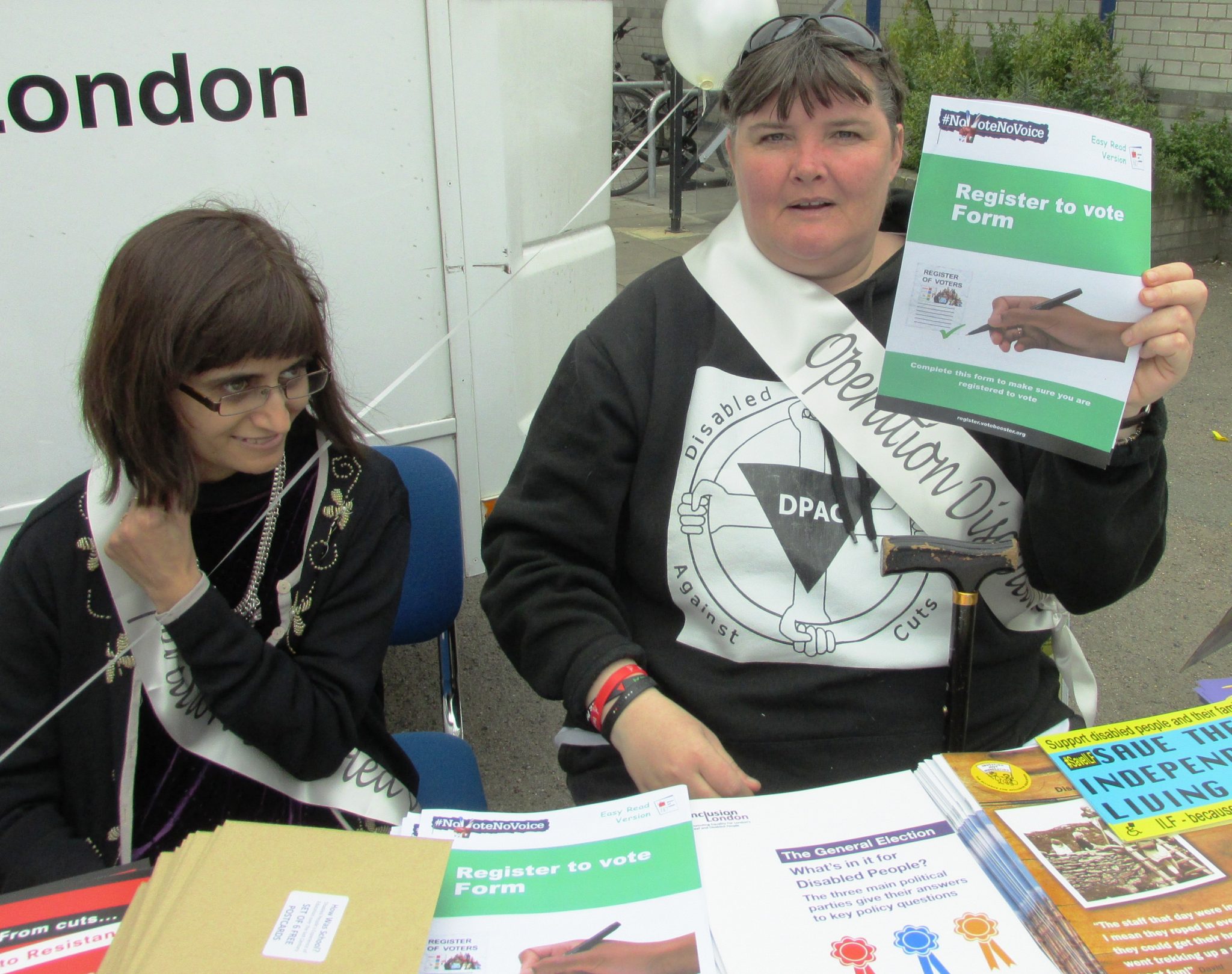
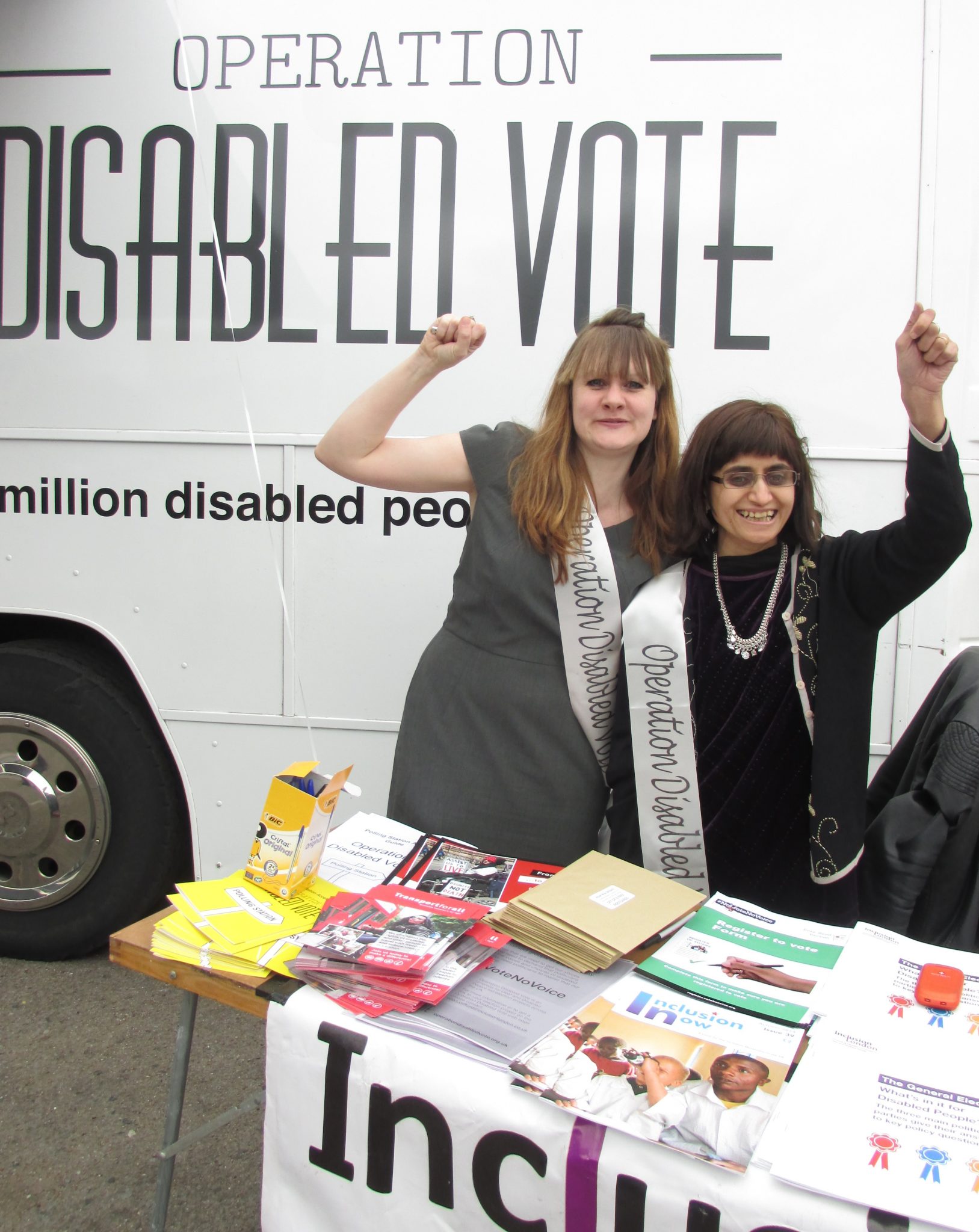
Here are some pictures from the launch of the Operation Disabled Vote London Bus Launch which took place in Brixton and Croydon on Monday 13th April.

Sabina Lahur at the information table operation disabled vote brixton.

Sabina Lahur at the information table operation disabled vote brixton.Sabina Lahur at the information table operation disabled vote brixton.

(left to right) Sabina Lahur, Paula Peters, Sandra Albery and Sean McGovern at the information table for operation disabled vote outside the operation disabled vote bus, Brixton launch)

(left to right) Sabina Lahur, Paula Peters, Sandra Albery and Sean McGovern at the information table for operation disabled vote outside the operation disabled vote bus, Brixton launch)

Sabina lahur and Paula Peters (holding a easy read version of the voter registration form at the operation disabled vote information table Brixton launch)

Sabina lahur and Paula Peters (holding a easy read version of the voter registration form at the operation disabled vote information table Brixton launch)

Staff members from People First (Brixton) left to right, Andrew Lee, Ray Johnson, Amy (Campaign and Policy officer for People First) and Stephen Asleford at the launch of Operation Disabled Vote.

Staff members from People First (Brixton) left to right, Andrew Lee, Ray Johnson, Amy (Campaign and Policy officer for People First) and Stephen Asleford at the launch of Operation Disabled Vote.

Group photo outside the Operation Disabled Vote bus at Brixton.

Group photo outside the Operation Disabled Vote bus at Brixton.

Ellen Clifford and Sabina Lahur at the information table on the Operation Disabled Vote bus launch in Brixton.

Ellen Clifford and Sabina Lahur at the information table on the Operation Disabled Vote bus launch in Brixton.

Stephen Asleford sitting in the Operation Disabled Vote bus.

Stephen Asleford sitting in the Operation Disabled Vote bus.

Roger Lewis at the launch of Operation Disabled Vote bus launch in Brixton.

Roger Lewis at the launch of Operation Disabled Vote bus launch in Brixton.

Mar 312015
 
DPAC Logo with text underneath "Disabled People Against Cuts" and then web address dpac.uk.net

Sign in support of the campaign now! 

Email Henrietta.doyle@inclusionlondon.co.uk with the name of your organisation or as an individual.

Ultimate aim of the campaign

Motability agrees to reverse the changes to eligibility criteria for Motability’s Special Vehicles Fund for Drive-from-Wheelchair/Internal Transfer (DFW/IT) vehicles used by disabled people with complex needs. 

Other aims:

·        Motability agrees to conduct a formal public consultation on the changes, including a face to face meeting with current grant users. Until this consultation is concluded and a consultation response report publicly published the changes should be immediately reversed.

·        Motability agrees to publishes  their equality impact assessment of the changes

·        Motability agrees to publish clear and full information about the changes on their website. 

Why the need for the campaign?

Motability has changed the eligibility criteria for their Special Vehicles Fund (SVF) for Drive-from-Wheelchair/Internal Transfer (DFW/IT) vehicles used by disabled people with complex needs. We believe these changes could destroy the ability to live independently and be included in the community of those affected. 

What are the changes?

From June 2014 ‘a usage test’ was introduced by Motability regarding DFW/IT vehicles.  This test applies to those applying to the SVF first time and current users when renewing their contract (see statement provided by Motability attached). Below is information on how the changes are being implemented in practice.

Current users are telephoned some months in advance of the renewal date of their contract and asked if the vehicle is to support ‘substantive employment, education, volunteer working or to enable the disabled driver to provide vital and sole care to another, for example, a school-age child or children or a disabled loved one who resides with the disabled person.’  About 12 hours a week seems to be considered ‘substantive’. It appears that those that do not fulfil this criterion are no longer eligible for a vehicle.

We are very concerned that disabled people who rely on access to such vehicles will no longer be eligible for grants from the scheme and therefore unable to replace vehicles, which are essential to their independence. These vehicles are often used by disabled people with the highest support needs, who for a range of reasons relating to their impairments, are unable to access public transport because it unavailable or not possible because of pain levels or the need to carry equipment such as hoists or oxygen or a particularly large vehicle as illustrated in the case study below:

Case study

Because of the specialised seating on my wheelchair, it is too large to travel on bus.  Only 3 weeks ago I couldn’t go to hospital Emergency A&E because the ambulances can’t take me!  I was severely dehydrated, they ended up sending a doctor to my home and doing 48-hour IV just because I couldn’t go to hospital.  

There is NO way I am every going to be employed which is depressing enough, I can’t get  voluntary work because I can’t even go and see anyone to consider it (no transport!).  I really am so depressed over these changes. 

These new changes mean I am confined to the distance of my own wheelchair with no access to public transport, and no access to Motability.

The impact

The independence given to disabled people to drive their own vehicle often means they can become involved in their community and do voluntary activities. Without a DFW/IT vehicle many disabled people will be excluded from visits to families and friends and will be unable to take part in any aspects of social, religious, community, wellbeing activities and political life.  In addition these changes will prevent disabled people getting into education, obtaining employment or volunteering unless already involved in these activities and therefore will never fulfil the new criteria for a DFW/IT vehicle.

Motability did not conduct a consultation before implementing these changes and as far as we are aware they did not carry out an Equality Impact Assessment regarding the impact of the change, also there was no public announcement or any information published concerning the changes.   Disabled people only become aware when asked the questions on the telephone. There is still only limited information given by Motability at: https://www.motability.co.uk/understanding-the-scheme/financial-help/eligibility-for-financial-help

Motability administers government funds, yet they seem to be ignoring the Equality act and the UN Convention on the Rights of Persons with disabilities, which states the duty to facilitate:

·        ‘the personal mobility of persons with disabilities in the manner and at the time of their choice’

·        access to ‘quality mobility aids’

·        disabled people’s right to ‘full inclusion and participation in the community’.   

Disabled people’s organisations are acting together with other voluntary sector organisations to ask Motability to reverses the changes to the eligibility criteria for the SVF for DFW/IT vehicles.

What can you do?

·        Sign in support of the campaign by emailing Henrietta.doyle@inclusionlondon.co.uk

·        Sign the petition at: https://www.change.org/p/stop-unfair-and-secret-changes-to-motability-grants#petition-letter   2,500 people  signed in the first 3 weeks!

·        Promote petition, email, Facebook, Twitter etc.

·        Send letter of protest and case examples to Motability.

·        Survey members on their experiences of Motability reviews

·        Contact your local MP, and relevant Ministers

Join the coalition of disabled people’s organisations and voluntary sector organisations supporting the aims of the campaign above, to do this please email Henrietta.doyle@inclusionlondon.co.uk with the name of your organisation. 

Please forward this email to your contacts. 

Many thanks,

Henrietta

Henrietta Doyle

Policy Officer

Mobile: 07703 715091

Direct line (Wednesday’s only) 020 7036 6033

Office Tel: 020 7237 3181, SMS: 0771 839 4687

www: https://www.inclusionlondon.co.uk/

 Posted by at 19:07
Mar 252015
 
DPAC Logo with text underneath "Disabled People Against Cuts" and then web address dpac.uk.net

A complaint to the United Nations was today launched on behalf of disabled people in the UK whose rights have been breached by the closure of the Independent Living Fund (ILF). The ILF, which is the subject of an on-going and desperate battle between disabled people and the Department for Work and Pensions (1), is high on the priority list for disabled people deciding how to vote at the forthcoming election. The complaint brought by Inclusion London (2) on behalf of two disabled women, Nicky Baker and Dr Melanie Wilson Jones, alleges that the government has violated Articles 17, 19, 20, 30 and 31 of the United Nations Convention on the Rights of Persons with Disabilities (UNCRPD), ratified by the UK in 2009 (3).

The Independent Living Fund was set up in 1988 to support disabled people with high support needs to live in the community when the alternative was residential care. Since then it has helped thousands to live active and full lives, contributing to their communities and participating in education, employment and volunteering, family and social life. It is an effective way to provide support with both low cost overheads and extremely high user satisfaction rates (4).

On 13 December 2010 without any consultation or impact assessment, it was announced that the ILF would be closed permanently to new applicants. A ministerial statement was made referring to “informal consultation with disability organisations” but there is no record of this consultation (5). Since then, disabled people who missed out on the Fund have been left without the support they need to take part in day to day life and disabled people’s life chances have dramatically fallen. Meanwhile the government has failed to monitor the impact of the closure.

Nicky Baker, age 30, is a qualified auditor working within a disabled people’s organisation as well as studying part time for a degree. Although eligible for support from the ILF, the Fund was closed the day after she telephoned for an application form. The social care package she receives from her Local Authority does not provide the support she needs to live an independent life, for example to go on dates with her boyfriend without having her parents there or to take part in sufficient training for the high level of powerchair football she reached.

Dr Melanie Wilson Jones received a substantial amount of support including from the ILF after sustaining a brain injury. She made such progress that her needs decreased and thus her support was reduced. However following a road traffic accident in 2011 she sustained a further brain injury requiring someone to be with her constantly. Now unable to get support from the ILF, she is reliant on her husband who works full time and her 16 year old daughter to make up the extra hours of support she needs for evenings and weekends.

Linda Burnip, co-founder of Disabled People Against Cuts, who are supporting the challenge, said: “It is the pooling of resources and collective solidarity that has allowed this to happen. We’re grateful to DPAC supporters for their financial support towards travel costs, to the solicitor and barrister who gave their time pro bono, to Inclusion London for their staffing resources and of course to the two disabled women willing to put themselves forward to make a complaint on an issue that affects all disabled people in the UK. Without all of these factors this could never have been brought to fruition.”

Tracey Lazard, CEO of Inclusion London, who authored the complaint said, “The closure of the Independent Living Fund signals the end of independent living for disabled people. It took many years for disabled people to fight their way out of the institutions and to have the same chances as anyone else to live in the community alongside family and friends. At the current time Local Authorities are simply not able to provide the level of social care support required to uphold disabled people’s fundamental human rights”.

Sophie Partridge, a current ILF recipient, said: “The ILF has played a huge part in supporting me to have equal access to an independent adult life and a level playing field alongside non-disabled people. Without the ILF being re-opened to new applicants, I worry that young disabled people will never get the same life chances as I have had.”

Solicitor Louise Whitfield, from law firm Deighton Pearce Glynn, who is representing the complainants said: “From a legal perspective, I cannot see how the UK Government can justify closing the ILF to new applicants with no consultation or consideration of the rights protected under the UN Convention. Under Article 19, those rights include the fundamental right to independent living which has clearly been breached by this decision and I hope that the UN Committee takes appropriate action to recognise these very significant breaches”.

For more information or to speak to either the complainants or other disabled people affected by the closure of the ILF contact: ellen.clifford@inclusionlondon.co.uk or call 07505144371.

Notes for editors:

1) The future of the ILF has been the subject of two legal challenges: the first was won by disabled claimants at the Court of Appeal in November 2013 and the second was lost in the High Court in December 2014. There have been continued protests and direct actions led by disabled people and their supporters since 2010, including in June 2014 the attempted occupation of the grounds of Westminster Abbey.

2) Inclusion London is a pan impairment pan London Deaf and Disabled People’s Organisation (DDPO) which provides policy, campaigning and capacity building support for London DDPOs. Inclusion London promotes disability equality and has been working with the disabled people led campaign Disabled People Against cuts to support ILF recipients in the campaign to keep the ILF open.

3) The UK is signed up to the UNCRPD Optional Protocol. This means that individuals can take complaints to the UN disability committee for breach of the UNCRPD if all domestic avenues have been exhausted. If the committee find the complaint admissible, they will investigate. and produce a set of recommendations for the State in question. One previous complaint was made to the UN disability committee but found inadmissible as the incidents in question which related to employment discrimination occurred before the UK ratified the convention. For more information about the UNCRPD: https://www.un.org/disabilities/default.asp?id=150

For more information about previous uses of the Optional Protocol: https://tbinternet.ohchr.org/_layouts/treatybodyexternal/TBSearch.aspx?Lang=en&TreatyID=4&DocTypeCategoryID=6

4)

5)

 Posted by at 21:42
Mar 222015
 
DPAC Logo with text underneath "Disabled People Against Cuts" and then web address dpac.uk.net

Press Release

Anti UKIP campaigners are staging a protest now in the local pub of UKIP leader Nigel Farage in the village of Downe, Kent.

Nigel Farage’s local pub the George & Dragon where he has been pictured many times going for a drink has been invaded by about 80 people protesting against UKIP.

Campaigners include those who have been targeted by UKIP such as migrants, HIV activists, gay people, disabled people and breastfeeding mums.

Protest organiser  said:

UKIP are a con. They pretend to be anti-establishment but this couldn’t be further from the truth. By wrongfully shifting the blame for the economic crisis onto immigrants they have let the bankers off the hook. That is why so many diverse communities have taken our cultures to the heart of where they exist – Nigel Farage’s local pub. We will not succumb to their prejudice. We will create the world we want to live in. A world beyond UKIP.

We sympathise with people who feel alienated with the political system but a vote for UKIP really is the worst thing you could do to protest about the current state of this country.

a social worker from London said:

“The alliance of people here today shows that there are clear targets of UKIPs hate filled agenda. We want to live in a society in which we are all valued and our different contributions, talents and cultures are acknowledged. 

We want politicians to stop using the language of divide and rule, xenophobia, racism and fear and instead speak up to the 99% to challenge the corporate greed and massive inequality that exists in this country and globally”.

ENDS

Notes to Editors

  • Full address of the Pub: George & Dragon, 26 High St, Downe, Orpington, BR6 7UT
  • We have photographers on the protest who will be able to provide photos in the next few hours.
 Posted by at 12:32
Mar 162015
 
DPAC Logo with text underneath "Disabled People Against Cuts" and then web address dpac.uk.net

Who 2 Vote 4 Logo

The current situation now is that England will be the only UK nation which no longer has an ILF as Scotland, Wales and Northern Ireland have pledged to open replacement ILF funds so this will lead to what can only be described as the biggest postcode lottery ever. If you are fortunate enough to live in a devolved nation then you will still be eligible for this additional funding but if you are unfortunate enough to live in England then you won’t be.

Obviously it may seem to those who have no real experience of the way the care system operates that it makes sense to devolve all funding to local authorities even if it will not be ring-fenced either to current recipients or even to the adult social care budget however ILF funding covers essential support for independent living which local authority care will not. (even with the introduction of the new care Act from April this year).

Labour says it strongly agrees that independent living is crucial to ensuring that disabled people have the same rights, choices and chances as any other citizen. They tabled an amendment during the Committee Stage of the Care Bill which would have enshrined in law the right of disabled people to live independently. Unsurprisingly the government chose to vote against and defeat this amendment. Ed Miliband has said recently Labour also opposed the government’s plans for closure of the Independent Living Fund in the absence of a comprehensive strategy for a system of social care that protects people’s ability to live independently. Yet in spite of this if Labour is elected in May it will be a Labour government that allows the ILF to close.

Kate Green/You have said “it’s not Labour’s position to retain the ILF “

We have asked Labour to commit to keeping the ILF open for current recipients even if only in the short term until something better can replace it so that a generation of disabled people do not lose the right to continue to live independently in the community.

The Labour front bench have said they will allow the ILF to close because there is a real opportunity to develop a sustainable model of provision for the most severely disabled people within the integrated health and social care landscape that Andy Burnham and Liz Kendall have been articulating rather than continuing with a standalone fund. These proposals are based on a report by the Oldham Commission which clearly states that it will take the 5 years of a new parliament and an extra £10 billion of funding to achieve these changes. In the meantime there will be no protection for disabled people in England who need their needs funding now and not at some date far into the future. For them any new integrated care system will simply be too late to help. Moreover, as respected experts in the field such as Professor Pat Thane have pointed out, the current system is simply not functioning at the necessary level. Relying on the integration of health and social care as a solution to the crisis in social care is thus an irresponsible gamble to take with people’s lives.

In the original ILF consultation over 50% of local authorities said that the loss of ILF was likely to lead to disabled people having to move from the community back into Care homes, something that is not only morally wrong but which will cost Local Authorities, who by 2015 will have had social care budgets cut by £8 billion, or by about 33%, considerably more.

Already since 2008 over 90,000 disabled people or 1 in 6 have lost their care and support for independent living.

While it is true that the fund is now being wound down, and staff numbers are already reducing it is not true that it is too late for Labour to commit to keeping the ILF open in England as well as will be the case in other parts of the UK. PCS and a former manager at ILF have both given the Labour front bench detailed reasons of why this is the case.

As the devolved funding will not be ring-fenced in any way to either individuals or adult social care budgets Ed Miliband has said that Labour will put in place guidance for Local Authorities to encourage them to meet the needs of severely disabled people in their areas but this will not be mandatory and we have no reason to believe that cash strapped councils will have either the political will nor the financial ability to implement such guidance. They are very aware of the dangers of setting precedents for providing levels and types of social care support to some individuals and not for others. A Local Authority could easily consider itself to have more to risk by following than not following the guidelines. In order to ensure equity between all adult service users they may well feel they have no choice but to level down..

As emerged from formerly undisclosed documents from DWP during one of the court cases the devolved funding for ILF recipients is only in place until April 2016 and no additional funding was requested beyond that date by DWP. What will happen to the real people stuck in the middle of this chaos then has not been addressed by any political party.

Further Labour also cite “inconsistencies” in delivery as a reason to remove the right to live independently from severely disabled people but these are the result of unequal take up between different local authorities  and is symptomatic of the failings of local authority administered social care support. As a national model of service delivery the ILF is far more successful and cost effective than local authority administered social care. The latest ILF annual report records a user satisfaction rating of 97%. Overheads for the ILF come in at just 2 % of the budget in comparison with an average of 16% for local authorities. It is in fact a model of service delivery that should be built upon rather than shut down. We understand that provisions in the Care Act are aimed at reducing inconsistencies between local authorities, nevertheless the inconsistencies Labour cite as a problem of the ILF are many times worse in the current system upon which ILF users will now be solely reliant as a result of the closure.

Since the closure to new applicants in December 2010 disabled people who missed out on the ILF have suffered dramatically worse outcomes than existing ILF recipients with equivalent support needs. We have provided Kate Green with a number of case studies showing the reality of independent living for disabled people who would have been eligible for ILF but are now only receiving LA social care support. We are not just talking about disabled people no longer being able to go to work, or ever have a holiday or go to university, we are talking about people unable to leave their homes, left without access to food or water, unable to go to the toilet and unable to wash more than a couple of times per week. We know there is also an urgent need to address this inequity, so do not believe that the right answer is to level everyone down to the lowest levels of support.

In the short term we are asking that the ILF be retained as the only way to realistically guarantee protection for existing recipients. Disabled people are aware that this is not a big ask: the ILF represents a relatively small amount of money – only £32 million and the ILF will not be wound down beyond easy repair before May 2015.

Moving on from these moral aspects of retaining the ILF the political situation now is that the Labour Party is the only main opposition party unwilling to commit to keeping the ILF open if elected. We find it very difficult to understand why Labour continues to take this position and not avail themselves of the support of the 12million plus disabled voters,and their families and friends

 Posted by at 23:06