ellen

Jul 012020
 
DPAC Logo with text underneath "Disabled People Against Cuts" and then web address dpac.uk.net

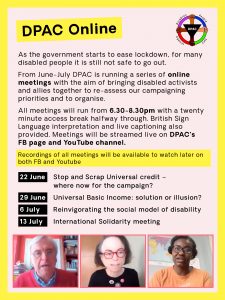
Poster advertising DPAC online meetings with screenshots from previous meetings showing John McDonnell, Liz Carr and Stephanie Onamade

DPAC Online
As the government starts to ease lockdown, for many disabled people it is still not safe to go out. From June – July DPAC is running a series of online meetings with the aim of bringing disabled activists and allies together to re-assess our campaigning priorities and to organise.
All meetings will run from 6.30 – 8.30pm with a twenty minute access break halfway through. British Sign Language interpretation and live captioning also provided. Meetings will be streamed live on DPAC’s FB page and YouTube channel.
22 June – Stop and Scrap Universal credit – where now for the campaign?
29 June – Universal Basic Income: solution or illusion?
6 July – Reinvigorating the social model of disability
13 July – Eugenics, Covid-19 and International Solidarity meeting
 Posted by at 21:48  Tagged with:
Jul 012020
 
DPAC Logo with text underneath "Disabled People Against Cuts" and then web address dpac.uk.net

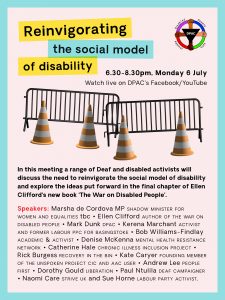
Poster for the meeting showing railings acting as barriers

Reinvigorating the social model of disability
Monday 6 July
6.30 – 8.30pm
Watch live on DPAC Facebook page, twitter account and YouTube channel
In this meeting a range of Deaf and disabled activists will discuss the need to reinvigorate the social model of disability and explore the ideas put forward in the final chapter of Ellen Clifford’s new book ‘The War on Disabled People’.
With speakers: Marsha de Cordova MP (shadow minister for Women and Equalities) tbc, Ellen Clifford (author of The War on Disabled People), Mark Dunk (DPAC), Kerena Marchant (activist and former Labour PPC for Basingstoke), Bob Williams-Findlay (academic & activist), Denise McKenna (Mental Health Resistance Network), Catherine Hale (Chronic Illness Inclusion Project), Rick Burgess (Recovery in the Bin), Kate Caryer (Founding member of the Unspoken Project CIC and AAC user) Andrew Lee (People First), Dorothy Gould (Liberation) , Paul Ntulila (Deaf campaigner), Naomi Care (Strive UK) and Sue Horne (Labour party activist).
Jun 272020
 
DPAC Logo with text underneath "Disabled People Against Cuts" and then web address dpac.uk.net

Logo of #SUCA showing a badge saying "Stop & Scrap Universal Credit"

The three month suspension of conditionality and sanctions ends on 30th June. This measure was brought in by the government during the Covid-19 outbreak. No information about how they will be restarted has been forthcoming or when job centres will be re-opened. Claimants have been left both anxious and uncertain. There is now overwhelming evidence of both the serious harm that the sanctions regime inflicts on the most disadvantaged members of society and the fact that sanctions are punitive and counter-productive to the aim of getting people off benefits and into work. 

Join the Scrap Universal Credit Alliance in our demands to:

#EndConditionality

#ScrapSanctions

#NoMoreBenefitDeaths


Ways you can get involved:

  • Get active on social media at 12 lunchtime on 1 July using the above hashtags and directed @DWP @justintomlinson @theresecoffey . You can find a list of findings, facts, stats and links for reference here: https://dpac.uk.net/2020/06/sanctions-findings-facts-stats-and-links/
  •  Write to your MP asking them to put pressure on the government not to restart conditionality and sanctions. Please let us know any responses that you get.
  • We encourage people to write to their MPs. You can find a template letter here: [to be added]
  • Write to your local paper
  • If you think you may be affected by conditionality restarting and putting your safety at risk because you still need to shield it may be worth gathering what medical evidence you have (for example if received a letter or correspondence from the NHS telling you to continue shielding until the end of July) and pro-actively sending it in to your job centre/adding it in to your Universal Credit journal. It is difficult to know what to do given the complete absence of information from the government.


Jun 272020
 
DPAC Logo with text underneath "Disabled People Against Cuts" and then web address dpac.uk.net

Please add everything we have left out in the comments below.

  • There is no clear evidence that recent high employment rates in the UK are due to sanctions, or that blunt and harsh sanctions are superior to far less harmful methods to encourage compliance with conditionality.
  • Sanctions succeed in instilling a fear and loathing of the system in many claimants.

Alston, P. (2018). Statement on Visit to the United Kingdom, by Professor Philip Alston, United Nations Special Rapporteur on extreme poverty and human rights. Office of the High Commissioner for Human Rights, [online] 16 November. Available at: https://www.ohchr.org/EN/NewsEvents/Pages/DisplayNews.aspx?NewsID=23881&LangID=E.


  • Current sanctions policy can be considered to be ‘cruel, inhuman and degrading’.

Adler, M. (2018). Cruel, Inhuman or Degrading Treatment? Benefit Sanctions in the UK. Palgrave Pivot


  • Between 2010 and 2018, over 110,000 Employment and Support Allowance (ESA) sanctions and 900,000 Jobseekers’ Allowance (JSA) sanctions of disabled people were applied with a further 140,000 ESA and 160,000 JSA sanctions of disabled people applied but later cancelled.
  • Sanctions discriminate against disabled people. Disabled people on JSA are 26 – 53% times more likely to be sanctioned that non-Disabled JSA claimants.

Baumberg Geiger, B. (2018a). A Better WCA is Possible: disability assessment, public opinion and the benefits system. London: Demos. Available at: https://www.demos.co.uk/wp-content/uploads/2018/02/2018_A_Better_WCA_is_possible_FULL-4.pdf


  • Welfare conditionality within the social security system is largely ineffective in facilitating people’s entry into or progression within the paid labour market over time.
  • Benefit sanctions do little to enhance people’s motivation to prepare for, seek, or enter paid work. They routinely trigger profoundly negative personal, financial, health and behavioural outcomes and push some people away from collectivised welfare provisions.

Dwyer, P., Jones, K., McNeill, J., Scullion, L. and Stewart, A. (2018). Final findings: welfare conditionality project 2013 – 2018. York: Welfare Conditionality Project. Available at: http://www.welfareconditionality.ac.uk/wp-content/uploads/2018/05/40414_Overview-HR4.pdf


  • The Department for Work and Pensions has limited evidence on how people respond to the possibility of receiving a sanction, or how large this deterrent effect is in practice.
  • The Department for Work and Pensions has not used its own data to evaluate the impact of sanctions in the UK… The DWP has not supported wider work to improve understanding of

sanction outcomes…[and] has rejected calls for a wider review.

  • The Department does not track the costs and benefits of sanctions… Possible wider costs include the direct impact on people who get sanctioned, such as financial hardship or depression.
  • Until the Department can show greater consistency in its use of sanctions and demonstrate that their effectiveness is proportionate to their costs we cannot conclude that the Department is achieving value for money.

National Audit Office [NAO], (2016b). Benefit sanctions. 30 November, HC 628, 2016-17. Available at: https://www.nao.org.uk/wp-content/uploads/2016/11/Benefit-sanctions.pdf


  • When David Clapson died he had no food in his stomach. Clapson’s benefits had been stopped as a result of missing one meeting at the jobcentre. He was diabetic, and without the £71.70 a week from his jobseeker’s allowance he couldn’t afford to eat or put credit on his electricity card to keep the fridge where he kept his insulin working. Three weeks later Clapson died from diabetic ketoacidosis, caused by a severe lack of insulin. A pile of CVs was found next to his body.

Ryan, F. (2014). David Clapson’s awful death was the result of grotesque government policies. The Guardian, 9 September. Available at: https://www.theguardian.com/commentisfree/2014/sep/09/david-clapson-benefit-sanctions-death-government-policies


  • Conditionality is ineffective in getting disabled people to engage in work-related activity. Instead it creates a range of perverse incentives and punishing conditions that are often negative to health.
  • The impact of sanctions is life threatening for some claimants.
  • The underlying fear instilled by the threat of sanctions means claimants live in a state of constant anxiety. This does not enable people to engage in work related activity.

Taggart, D., Mehta, J., Clifford, E. and Speed, E. (2020). ‘“They say jump, we say how high?” conditionality, sanctioning and incentivising disabled people into the UK labour market.’ Disability and Society. Available at: https://www.tandfonline.com/doi/full/10.1080/09687599.2020.1766422


  • Sanctions lead to increases in self-reported anxiety and depression.
  • There is clear evidence that increases in rates of sanctions within local authorities are associated with increases in the number of people suffering with anxiety and/or depression.
  • Increased severity of sanctions had no observable impact on flows into employment but have led to increases in both food bank usage and antidepressant prescribing.
  • The hardship payments system is insufficient and also needs to be reformed.

Williams, E. (2020). The impact of DWP benefit sanctions on anxiety and depression.  blogs.lse.ac.uk, [online] 24 June. Available at: https://blogs.lse.ac.uk/politicsandpolicy/benefit-sanctions-mental-health/


  • In the Benefit Sanctions report published by the Work and Pensions Committee, it concludes that the human cost of continuing to apply the existing regime of benefit sanctions – the “only major welfare reform this decade to have never been evaluated” – appears simply too high. The evidence that it is achieving its aims is at best mixed, and at worst showing a policy that appears “arbitrarily punitive”.
  • The Committee says the Coalition Government “had little or no understanding of the likely impact of a tougher sanctions regime” when it introduced it in 2012 with the stated aim, as the NAO describes it, that “benefits, employment support and conditions and sanctions together lead to employment.” At that point, Government promised to review the reform’s impact and whether it was achieving its aims on an ongoing basis.  But six years later, Government “is none the wiser”. What evidence there is shows that, at best, the effectiveness of sanctions is mixed. At worst, it shows them to be counterproductive.

Work and Pensions Committee [WPC], (2018c). Benefit Sanctions. 31 October, HC 955, 2017–19.

Work and Pensions Committee [WPC, (2018d). Government must urgently reassess sanctions regime. [press release] 6 November. Available at: https://www.parliament.uk/business/committees/committees-a-z/commons-select/work-and-pensions-committee/news-parliament-2017/benefit-sanctions-report-published-17-19/


Jun 252020
 
DPAC Logo with text underneath "Disabled People Against Cuts" and then web address dpac.uk.net

6.30 – 8.30 pm

Monday 29 June

Watch live on DPAC Facebook page, Twitter or YouTube channel.

Speakers: Ellen Morrison (DPAC); Grace Blakeley (British economics and politics commentator and journalist); Mark Dunk (co-author of Universal Basic Income: Reasons to be Cheerful or No Go Central?), Matt Breunig (US policy analyst and founder of the People’s Policy Project),  David Bush (Editor, Spring magazine) Simone Aspis (disabled activist), Bill Scott (Senior Policy Advisor, Inclusion Scotland), Mandy Hudson (teacher, member of the National Education Union and disability rights activist based in Ealing) and Paul Collins (vice Chair and Equalities Officer of Henley Constituency Labour Party).

Join us to debate the arguments for and against universal basic income. We will also hear from international allies about UBI pilots around the world.

Jun 212020
 
DPAC Logo with text underneath "Disabled People Against Cuts" and then web address dpac.uk.net
The below post by Miss Dennis Queen of Manchester DPAC is copied from DPAC’s Facebook page:
Please share this call out to all members of a local disabled people’s organisation (DPO), or network:
Ask your group to support local Black Lives Matter (BLM) groups, or related activism orgs. If you don’t already have these links, it’s time to forge them.
Here are some ideas of how, but I bet you can think of more, some of these can also be done as an individual:
Many of us can’t show up to protests the way we usually would – if you can, do, but many other ideas follow are below;
If you’re a protesting cell like Manchester DPAC, you can offer protest access ideas if they are welcome – eg slow down marches, have a shared static start and end point, get a BSL interpreter, have a mental well being buddy system, etc;
Donate unspent free funds to your BLM cell, or a local org – e.g. here we’ve also got Northern Police Monitoring Project and Kids of Colour (List follows) ;
Offer resources you can share such as printing (or paper, or ink), Braille, large print formats, phone calls and so on;
Pay for something – eg a pair of British Sign Language interpreters for a rally, bottles of water, anything;
Ask your group to share links to action notices, solidarity funds, legal funds and projects we can join in other ways – and don’t keep sharing traumatic links to brutality.
List new ideas below please! And share this!
Then – Tell us what you’re doing to give other groups ideas.
The world is moving forwards and we need to join in with breaking down white supremacy, first by directly supporting urgent current activism – and then by locating and dismantling it within our organisations.
Start talking about how to move from discussing  ‘involvement’ of people of colour, to how we share management and control
Jun 192020
 
DPAC Logo with text underneath "Disabled People Against Cuts" and then web address dpac.uk.net


Speakers: Charlotte Hughes (The Poor Side of Life); Gail Ward (DPAC North East); Andy Mitchell (Unite Community); Mark Harrison (Reclaiming Our Futures Alliance); Fran Heathcote (National President, PCS Union); Dave Allan (TUC Disabled Workers’ Committee/Unite the union); Kate Summers (researcher, London School of Economics); Jay Mehta (clinical psychologist); Jennifer Jones (Sheffield DPAC) and with Paula Peters and Mark Dunk from DPAC.

6.30 – 8.30pm – Monday 22 June

Watch via:

https://www.youtube.com/channel/UCPiFIM4pWlJaV6Ohw_ojGoQ/videos

https://www.facebook.com/pg/disabledpeopleagainstcuts/videos/


The Covid-19 outbreak prompted millions more people to apply for UC and discover the realities of dealing with the DWP and rules such as the five week wait and savings threshold. At the same time, the government announced temporary measures on issues campaigners have been pushing for, for years. The uprating of UC has not been applied to legacy benefits, creating a two tier benefits system. Disabled campaigners were alarmed by comments from Labour’s new shadow Secretary of State for Work and Pensions suggesting that those who work should be entitled to more from the social security system than those who don’t. The fundamental problems with UC highlighted so disparagingly in 2018 by the United Nations rapporteur on Extreme Poverty Philip Alston, have not changed and DPAC continues to demand that UC is stopped and scrapped.

This meeting hosted by DPAC for disabled campaigners and our allies will be a chance to review the situation with Universal Credit and discuss how we take the Stop and Scrap campaign forward in the current climate.

#StopandScrap #WaronDisPpl

Jun 122020
 
DPAC Logo with text underneath "Disabled People Against Cuts" and then web address dpac.uk.net

Last week, Disabled People Against Cuts wrote to Labour’s shadow Secretary of state for Work and Pensions, Jonathan Reynolds. We raised concerns about comments he made in an article for Politics Home where he suggested a new social security system is needed  – one where those who pay more in get more out. DPAC like many other disabled campaigners are concerned that this approach will disadvantage disabled people who are unable to work and thus to “pay in”.

You can see a copy of our letter here: https://dpac.uk.net/2020/06/dpacs-letter-to-jonathan-reynolds-mp-regarding-his-statement-today-that-welfare-should-reflect-what-you-put-in-to-tackle-public-mistrust/

Reynolds replied to us on 11 June. His response is below:


Dear Steering Group,


Thank you very much for your email. I hope that this can help clarify my thoughts on this matter. The first thing I would like to stress to you is that support for disabled people and those with caring responsibilities is not and never should be contributory. I emphasised this in my interview with The House last week.


Contributory benefits have been part of the UK’s social security system from the very beginning. Although their role has reduced over time, they remain a key component of the welfare state today. The state pension is the biggest example of a contributory benefit. In addition, anyone who has lost their job during this crisis and who is ineligible for Universal Credit will predominantly have to rely on Jobseeker’s Allowance (JSA).


Jobseeker’s Allowance (now called ‘new style’ Jobseekers Allowance) is also a contributory benefit. To qualify a person must have paid National Insurance for the two years preceding their claim.  It is not a marginal part of the system: between 16th March and the end of April a quarter of a million claims for Jobseeker’s Allowance were made. If a person qualifies for JSA, they are eligible for payment regardless of their partner’s income or the savings they possess (unlike Universal Credit). It is possible to be eligible for both JSA and Universal Credit at the same time, but under the way Universal Credit works any JSA would automatically be deducted from your UC claim so most people don’t bother claiming both.


Under the proposals Labour put forward at the beginning of the Covid crisis, people would both get more from Universal Credit (because we would abolish the benefit cap and the two child limit) and more people would be eligible to receive Universal Credit to begin with, because we would also suspend the savings thresholds. These thresholds – a particular severe version of the means test – exist because the Government believes if you fall on hard times you should spend your savings to support yourself regardless of the contributions you have made to date. If you have been saving for a housing deposit, or are an older person with relatively modest lifetime savings, you could be heavily penalised.


But even allowing for these changes we have called for, some people would still be relying on Jobseeker’s Allowance. The amount received is far from generous: just £74.35 for most people, and an even more miserly £58.90 if you are aged under 24. This is why we have also called for the uprating of both JSA (and ESA) in line with the increase in Universal Credit at the beginning of the crisis. However, if you compare this to a country like Sweden – widely acclaimed as one of the best systems in the world for supporting people through unemployment – you would find workers there who have paid contributions are eligible for 80% of their former earnings for 300 days in the event they lose their job, subject to a daily cap but with no means test. In addition, for those who have not paid into contributory funds the minimum provision is still considerably higher than ours. Social security systems that offer real protection for everyone tend to enjoy much higher levels of popular support and are more effective as a result.


It is a fundamental mistake to believe contribution is not still a part of our existing system or to assume contributory benefits somehow exist at the expense of universal provision. In the UK our social security has always been a combination of universal components (eg child benefit, until the Coalition Govt), means tested components (income support and now Universal Credit), and contributory benefits. This is separate to the support we have for disabled people and those with caring responsibilities. As we develop our policies to replace Universal Credit, eradicate child poverty, and develop a modern social security system that is truly fit for purpose, we need to consider what should happen to all these existing parts of the system. But I recognise we will not win support for this agenda unless we can demonstrate that the system we design will be there for everyone when they need it.


I wanted to make a final note on language. Because the UK’s current social security has so many holes in it, the consequences of not being within the remit of the furlough or self-employed scheme during this crisis are significant. For these people to then find out they are ineligible for Universal Credit, or only eligible for modest contribution-based support, causes understandable discontent. My constituents in this position tell me they feel they have contributed throughout their lives to a system that has not supported them when they most needed it. I would strongly draw a distinction between that genuine sentiment, and the language of someone like George Osborne with his rhetoric on skivers and shirkers, or the deserving or undeserving poor. We must always root our language and policies in the everyday lived experience of the public, and together build support for a system that everyone can rely on.


Thank you again for raising your concerns. I hope that this has helped allay any concerns you had. If you would like to discuss this any further, I would be more than happy to speak with you over the phone or Zoom.


With very best wishes

Jonathan


Jonathan Reynolds MP
Member of Parliament for Stalybridge and Hyde
Shadow Secretary of State for Work and Pensions

Jun 072020
 
DPAC Logo with text underneath "Disabled People Against Cuts" and then web address dpac.uk.net

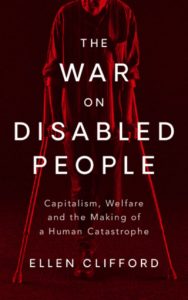
A picture of the front cover of the book titled: "The War on Disabled People: capitalism, welfare and the making of a human catastrophe by Ellen Clifford". Behind the text is the image of a man on crutches. The full background, including the image of the disabled man, is rendered in shades of red and black. The text is in white.Fighting the War against Disabled People

Event to launch release of new book “The War on Disabled People: capitalism, welfare and the making of a human catastrophe” by Ellen Clifford and to reflect o current campaign priorities for activists and allies.

6.30 – 9pm

Monday 15 June 

Facebook/twitter/YouTube live

British Sign Language interpretation and live captioning throughout the meeting plus access break.

Speakers: John McDonnell MP, Liz Carr (actor and star of Silent Witness), Linda Burnip (DPAC co-founder), Ros Wynne Jones (journalist), Professor Colin Barnes (Emeritus Professor, University of Leeds), Debbie Abrahams MP, Laura Pidcock (national secretary, People’s Assembly against Austerity), Paula Peters (DPAC), Professor Peter Beresford (Professor of Citizen’s Participation, University of Essex), John Clarke (formerly organiser of Ontario Coalition Against Poverty, now Packer Visitor in Social Justice at York University in Toronto), Ann Galpin (co-chair, TUC Disabled Workers’ Committee), Austin Harney (PCS), Mark Dunk (Unite the union – personal capacity), La Toya Grant (Deaf campaigner), Ray Johnson (self advocate and star of The Undateables), Simone Aspis (campaigner against segregation) and Nicola Field (author of Over the Rainbow: money, class and homophobia). Chair: Mandy Colleran (DPAC)

… with music from John Kelly, aka Rockinpaddy, poetry from Robert Punton and a Q and A with The War on Disabled People author Ellen Clifford facilitated by Stephanie Onamade.

Ten years ago the Tories came to power with the Coalition government. Disabled people realised from the start that this would have dire consequences for disabled people and the poorest in society. That year Disabled People Against Cuts (DPAC) was formed following a protest outside the Tory party conference.

What has happened since 2010 was worse than anything we could have anticipated. Death is now part of a benefits system designed to punish those unable to earn an adequate income through employment. Disabled people have become re-institutionalised within their own homes as a result of drastic cuts to essential daily support.

Throughout, disabled people have engaged in active struggle in an attempt to minimise the harm inflicted on our communities.

Into this picture the most right-wing government in modern British history was elected in December 2019. In 2020, Covid-19 highlighted even more starkly the growing equalities gaps within society, with official responses to the pandemic confirming that the lives of disabled people are still commonly seen as less valuable than those of non-disabled people.

On 15 June, DPAC will be hosting an event for disabled activists and allies. We will consider the current situation, following a decade of relentless attacks waged on the most disadvantaged people in society by their own government, and explore both the immediate priorities facing us and ideas for building a stronger movement for change.

The event will mark the launch of a new book, ‘The War on Disabled People: capitalism, welfare and the making of a human catastrophe’. The book, written by a disabled activist, analyses recent government disability policy within the context of the history of disabled people’s oppression. It argues that an understanding of wider political economy is necessary both to make sense of the treatment of disabled people and to formulate effective strategies for resistance.

The event will be streamed live on DPAC’s Facebook page, twitter account and YouTube channel.

@dis_ppl_protest
#WarOnDisPpl #EveryDeathCounts #BlackLivesMatter


Jun 062020
 
DPAC Logo with text underneath "Disabled People Against Cuts" and then web address dpac.uk.net

Logo for the #BoycottSchoolsReopeningInJune campaign. Red background with  a range of hands held up in a 'stop' position. Hashtag #JuneTooSoon is written across the three top hands.

The grassroots parent-led campaign ‘Boycott schools reopening in June’ have been campaigning hard to amplify the importance of the National Education Union’s five tests being met before increasing pupil numbers.


They are lobbying in the interests of school children, the people who work with them, the children of key workers and the vulnerable children who are already in school. As well as parents who are shielding.


They are clear in their message that until a robust and efficacious track and trace system is in place, it cannot possibly be safe if to reopen schools or widen pupil numbers.


They are also clear in their campaign message that they fully support teachers and school workers, as well as as those parents who have no choice but to send their children into school at the moment.


We fully support the Boycott Schools Reopening in June campaign, and we echo their sentiments and campaign messages.


SAGE and independent SAGE scientists have stated on numerous occasions over the last couple of weeks that it is too soon to admit more pupils into our school systems at the moment, because case numbers of coronavirus are still far too high, and the track and trace plans are not yet in place on a national level.


40% of children with special educational needs as well as our BAME community members are at higher risk of complications from Covid-19.


This situation is far too dangerous not to be handled adequately.


There is not yet evidence of enough risk assessment and precautions, particularly with the protection of vulnerable groups in mind, in place in our schools.


The parents are right to be concerned and we are proud to stand with them.

Please join us in supporting them. This campaign is a gateway between people being forced back into unsafe workplaces, or having the chance to stay at home a little longer in the hope of us all staying safe.

If we can keep the schools closed and the numbers down, then we can keep that gateway closed but it’s going to take all of us to achieve that.

Solidarity with all teaching staff, school workers, and parents.

Strength In Unity.

Find the campaign on Facebook here:

https://www.facebook.com/groups/657607021743154/?ref=share

Logo for the #BoycottSchoolsReopeningInJune campaign. Red background with  a range of hands held up in a 'stop' position. Hashtag #JuneTooSoon is written across the three top hands.
May 262020
 
DPAC Logo with text underneath "Disabled People Against Cuts" and then web address dpac.uk.net
A picture of the front cover of the book titled: "The War on Disabled People: capitalism, welfare and the making of a human catastrophe by Ellen Clifford". Behind the text is the image of a man on crutches. The full background, including the image of the disabled man, is rendered in shades of red and black. The text is in white.
The War on Disabled People is now available to pre-order from Zed Books:
Zed are offering a discounted price but DPAC realises that the cost will still be beyond the reach of many people – not least because of the issues covered in the book.
We will be giving away a few free copies kindly donated by Zed to names pulled out of a hat on 15th June. To enter please email your name to mail@dpac.uk.net with ‘Book Draw’ in the subject line.
Very sadly the battle for accessible formats to be available is ongoing… watch this space.
May 222020
 
DPAC Logo with text underneath "Disabled People Against Cuts" and then web address dpac.uk.net

A mother of four young children has issued a legal case against the Government after the benefit cap eliminated an increase in Universal Credit (UC) intended to help families affected by the Covid-19 pandemic.

While the Chancellor increased UC payments by about £90 a month as part of the emergency Coronavirus Act 2020, the single mother, who does not wish to be named, in fact saw her family’s monthly Universal Credit payment of £1,397.92 cut to £1,275.

Now, represented by Carolin Ott and Tessa Gregory of Leigh Day solicitors, the mother has written to the Secretary of State for Work and Pensions, Therese Coffey, with a pre-action protocol letter, making her case for judicial review.

The perverse change occurred because the benefit cap which prevents families outside of London receiving more than £20,000 a year in welfare payments is still being stringently applied. The Covid-19 increase put the mother’s combined Universal Credit and Child Benefit payments above £20,000.

Further, the mother, who lives in a small two-bedroom house with her children aged 11, six, three and one, has  been hit by the Department of Work and Pensions decision not to suspend advance payment deductions and continue to claw back an advance payment she received in 2019.
The Covid-19 UC increase meant her monthly advance payment deduction has been increased accordingly. As a result of the effect of the benefit cap and the advance payment deduction, the claimant’s Universal Credit monthly payment has been reduced by £122.96 even though it should have increased due to the Covid-19 emergency help provided.

Leigh Day makes the case on behalf of the claimant that the application of the benefit cap and the decision to continue to apply advanced payment deductions are irrational and perverse and violate the claimant’s rights under article 14 European Convention on Human Rights (ECHR) read with article 1 of Protocol 1 ECHR and/or article 8 ECHR.

The case also argues that as a single mother with children, the claimant has suffered unjustified indirect discrimination in that she has been treated the same as other people whose situation is different from hers.

The mother said: 

“The changes to benefits in the pandemic have left me worse off when in fact they were supposed to help me during this difficult time, how can that be right?

“The advance payment deductions are being made because I fell victim to fraud when someone stole my identity and claimed UC in my name last year. The loan that was applied for in my name is being treated as an advance payment and I am having to pay it back even though I never requested it and never saw any of the money. Now my children and I are suffering.

“Of course I have had to face extra costs because my 11-year-old and six-year-old aren’t in school. I am struggling to home-school them because of my reduced income. I just want to receive the additional help other Universal Credit claimants are being given.”

Leigh Day solicitor Carolin Ott said:

“The increase to the Universal Credit standard allowance was intended to help the most vulnerable in society meet the extra costs they would face because of the Covid-19 pandemic. In fact, our client has been left worse off because the Secretary of State for Work and Pensions has applied the benefit cap and advance payment deductions.

“Our client argues this is unlawful as it is irrational and discriminatory. The benefit cap is a measure intended to encourage benefit claimants into work but it is absurd for it to deprive individuals of much needed support during a time when it is entirely unrealistic for them to enter into employment.”

Leigh Day has asked the Secretary of State for Work and Pensions to reply by Wednesday, 20 May, explaining the decision to retain the benefit cap and advance payment deductions and to confirm that she will:

  • Urgently review the application of the benefits cap where it applies as result of the increase to the Universal Credit standard allowance in the 2020 regulations;
  • Pending that review, suspend the application of the benefit cap and make arrangements for payments to those affected to make up the shortfall in their April Universal Credit payments;
  • Urgently review the application of discretionary advance payment deductions in the case of those affected by the benefit cap.
May 052020
 
DPAC Logo with text underneath "Disabled People Against Cuts" and then web address dpac.uk.net

Image advertising the rally with text saying: 'People's Assembly Online Takeover National Rally The Fight For Our Lives Thursday 7 May from 6.30pm Live on People's Assembly Facebook page'

The Government’s mishandling of the coronavirus crisis has cost thousands of lives. The People’s Assembly will be hosting a huge online platform for campaigns to voice their demands to meet this emergency and for a better life after the crisis.

We will be broadcasting across a large number of social media platforms so there is the potential for an audience of tens of thousands, a social media takeover.

More than 50 organisations representing millions of people are coming together to take over social media platforms by streaming an online rally to demand:

– universal testing,

– tracking,

– PPE,

– and no return to austerity.

Key Workers, so crucial to our society deserve a pay rise, better conditions and recognition for their contribution.

We will not be made to pay for this health crisis that has been so badly managed by this Government.

Watch live on People’s Assembly Facebook page.

May 022020
 
DPAC Logo with text underneath "Disabled People Against Cuts" and then web address dpac.uk.net


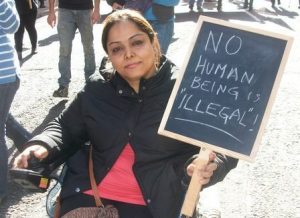
Photo of Manjeet Kaur wearing a black jacket sitting in her wheelchair holding a placard saying 'NO human is "illegal"!'

by Rebecca Yeo

Manjeet Kaur died on Saturday 25th April in Manchester. She had survived so much injustice, including many years of deliberate abuse and inhumanity of the UK asylum system. As a disabled woman she faced extra hostility and relentless barriers meeting her daily needs. But she never ever sank to their level. She remained actively committed to a better world, she was caring, compassionate, wise, loving and fun to the end.

She leaves a huge gap in my own life. I first met her in 2011 when I was working for UK Disabled Peoples Council. Manjeet was an active contributor to a mural showing the experiences of disabled asylum seekers. This was first installed in Bristol, but Manjeet was among a small group who took these messages to different parts of the country including Parliament, the Guardian newspaper, and the University of Leeds.
She contributed so much and taught me things that I will never forget. She became a good friend who I could talk to about whatever was happening. Her warmth, commitment and solidarity led her to make strong connections with people from a wide range of backgrounds in different parts of the country.

In her adopted home town of Manchester, as Dennis Queen of Manchester DPAC explains, “Manjeet made alliances that were new here, and we have a lot to thank her for. We pledge to continue Manjeet’s work, and honour her memory, by maintaining and growing the links between DPOs and asylum seekers groups in Manchester.”

Manjeet was involved in many campaigns around the country. Ellen Clifford from DPAC recalls “the first time I met Manjeet was at a national anti-bedroom tax conference in London. She had come down with campaign groups from the greater Manchester area which were notably led by disabled women. Her quiet strength, her resolute, kind spirit and her sparkle were immediately apparent. She leaves behind an enormous hole in the fight for social justice and in our hearts.”

Despite the many struggles that she faced in her own life, she contributed to many wider campaigns. Writing in a personal capacity, Mark Dunk from Unite London and Eastern disabled members committee remembers Manjeet as “an inspiration always prepared to give her time to fight for others as well as her own battles. She will be missed by the anti-racist and disabled people’s movements”.

After her daughter, Naysa, was born in 2015, Manjeet cut back on travelling to different parts of the country. Her priority was to be with her wonderful, fun-loving and vivacious daughter. She made an exception for an event in Bristol in 2018, bringing together the disabled people’s movement, the asylum sector and allies. She spoke movingly at this event, mobilising people to work together to resist the barriers faced by disabled asylum seekers. She explained, “You feel you are fighting for something you don’t deserve. You have to feel it should not be like that. Then you can make a difference”.

Her life was cut tragically short. We will miss her forever. But together we will keep Manjeet’s memory alive, remembering the compassion, love and laughter which were core to her being. We combine these with her energy, solidarity and commitment in our ongoing struggles for a better world.

We send our deepest condolences to her family and most particularly to her daughter.

(We are collecting photographs and tributes to create an album for Manjeet’s daughter. If you have anything to share, please send it to: info@rofa.org.uk with the subject line: Manjeet, by June 1st)

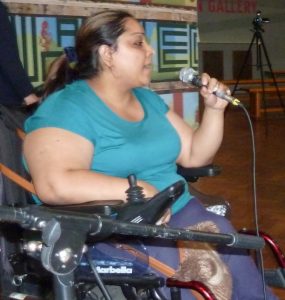
Photo of Majeet wearing a turquoise t-shirt speaking into a microphone


Apr 102020
 
DPAC Logo with text underneath "Disabled People Against Cuts" and then web address dpac.uk.net

There are a number of Parliamentary inquiries looking into how coronavirus is affecting different groups of people. Disabled people’s experiences need to be heard as a group disproportionately impacted by the pandemic and how the government has handled it. Each inquiry covers different angles depending on the remit of the Committee undertaking it.

You can submit your experiences directly or through DPAC by emailing mail@dpac.uk.net.

Department for Work and Pensions (DWP) inquiry into coronavirus
Closing date: 16 April
Purpose: to hear about how coronavirus is affecting people who need to rely on the benefits system.
For more information: https://committees.parliament.uk/work/130/dwps-response-to-the-coronavirus-outbreak/
To fill in their survey for individual benefit claimants go to: https://forms.office.com/Pages/ResponsePage.aspx?id=nt3mHDeziEC-Xo277ASzSjmyhv4Lz8tPuToBKZcY2O9UNVJNRzM0M1E1RVk3U0EzWkRDR1czQ1U3Ri4u

MPs launch online survey into coronavirus and access to food
Purpose: As part of its inquiry into food supply during the Coronavirus pandemic, the Environment, Food and Rural Affairs (EFRA) Select Committee is inviting the public to share their experiences of accessing food during the outbreak. 
Closing date: 5pm 28 April
For more information see: https://www.parliament.uk/business/committees/committees-a-z/commons-select/environment-food-and-rural-affairs-committee/news-parliament-2017/mps-launch-survey-coronavirus-chairs-comments-19-21/
To fill in the survey go to: https://forms.office.com/Pages/ResponsePage.aspx?id=nt3mHDeziEC-Xo277ASzSsdf6aRbb_hHi61kcnJ3-KJUOFFXNEhLSDlFTUZaQzU1TlNEWVkwUVhHUC4u

Women and Equalities Committee Coronavirus (Covid 19) inquiry
Purpose: to hear about the different and disproportionate impact that the Coronavirus – and measures to tackle it – is having on people with protected characteristics under the Equality Act.
Closing date: 30 April
For more information go to: https://www.parliament.uk/business/committees/committees-a-z/commons-select/women-and-equalities-committee/news-parliament-2017/coronavirus-covid-19-inquiry-aunched-19-21-/
To find out about submitting evidence go to: https://committees.parliament.uk/work/227/coronavirus-and-the-impact-on-people-with-protected-characteristics/

Apr 102020
 
DPAC Logo with text underneath "Disabled People Against Cuts" and then web address dpac.uk.net

DPAC is aware that some disabled people are not receiving essential support and resources from their local Council that they need during the pandemic.

Disabled people with certain impairments and health conditions are among those most at risk from Covid 19. At the same time, the government and medical professionals have made clear that they will not even be admitted to hospital let alone prioritised for treatment. The situation many disabled people living in the community have been left in has then put them at much greater risk, without access to food deliveries or protective equipment for the personal assistants coming in and out of their homes to provide indispensable support with fundamentally important daily tasks such as eating, drinking, using the toilet and staying clean.

Some local authorities are operating good practices such as contacting everyone in their area with disability related support needs and co-ordinating deliveries of food and other supplies.

Sadly, others are not.

Inclusion London has produced a useful template letter for individuals who have not been provided with the PPE (Personal Protective Equipment) that they need for their personal assistants.
The letter can be downloaded here: https://www.inclusionlondon.org.uk/wp-content/uploads/2020/04/template-letter-re-LA-failure-to-supply-PPE.doc

Scope has information on their website about how disabled people can access food and other essentials during the pandemic, including how to register as a “vulnerable” person with the government in order to access priority deliveries from supermarkets. Go to: https://www.scope.org.uk/advice-and-support/food-and-essentials-during-coronavirus/

The link to register with the government as “vulnerable” can be found here: https://www.gov.uk/coronavirus-extremely-vulnerable

Disabled People’s Organisations have raised concerns about the creation of a government register of “vulnerable people” including data protection implications. There are 14 Million disabled people in the UK, qualifying for reasonable adjustments of one sort or another, but this register will only assist an anticipated 10% of disabled people. Read what Chris Fry of Fry Law has to say about the register here: http://www.frylaw.co.uk/archives/articles/dont-share-the-vulnerable-people-register/

Fry Law have developed a template letter to enable disabled customers to challenge supermarkets about lack of access to online delivery services. You can download the letter here: www.dpac.uk.net/2020/04/18010

DPAC understands that provision that is in place on paper (or on websites) too often fails to translate to provision on the ground to the people that need it. We also understand that not everyone will have the energy to both battle for your survival and share your experiences, but where possible within your individual circumstances we would like to hear about any difficulties you have faced or are facing in accessing the resources and support so that we can campaign for improvements – either using the comments below or by emailing mail@dpac.uk.net.

Apr 102020
 
DPAC Logo with text underneath "Disabled People Against Cuts" and then web address dpac.uk.net

Customer Services
[address]

Complaint E-Mail – EXTREMELY URGENT

[date]
Dear Sir/Madam

Re: [Put your name Here]
Claim for Reasonable Adjustments
Disability Discrimination

I am writing this letter because I am disabled and cannot access your online service. This is causing me a real and significant risk of harm.

[Type of impairment and how this affects ability to access online service].

Your service is ideally suited to disabled people. When working effectively it is a very convenient service which allows me to lead an independent life.

What has Happened.

[Give Details as to how you have attempted to gain access] Eg:

On Monday 23rd March 2020 I called the 0800 328 1700 number to register as a disabled person 19 times but was unable to get through.

On Wednesday 25th March 2020 I got through to the Sainsburys helpline listed above, after 3 days of persistent attempts.

I was disappointed to hear only a recorded message which said that you are working with the government to assist the most vulnerable people and that I would have to register with http://gov.uk as vulnerable to qualify for priority assistance.

I went online to register at http://gov.uk online but as I had not received a letter from the Government and didn’t have the conditions listed as being extremely vulnerable I was unable to register.

I became very distressed and sent 5 tweets advising you of this and asking how I could get an online food delivery service from you. I had to publicly give details of my disabilities.

As a consequence, I have not been able to access your service to arrange for an online delivery.

My Legal Rights

I am a disabled person within the meaning of section 6 of the Equality Act 2010 (EQA) as I am registered blind (EQA s.6 & Schedule 1 Equality Act 2010 and Equality Act 2010 (Disability) Regulations 2010 s.7. ).

In providing facilities for people to buy groceries from your stores, you are providing a service within the meaning of Section 29 of the Equality Act 2010 (“the Act”). You are therefore, obliged to comply with the provisions of Section 29, including the obligation to make reasonable adjustments in accordance with Section 20 of the Act.

Under s. 19 of the EQA it is unlawful for a service provider to indirectly discriminate by applying an apparently neutral provision, criterion or practice which places disabled people at a particular disadvantage unless the service provider can show that it is a proportionate means of achieving a legitimate aim.

By refusing to allow me to buy my shopping online, and in any event to deliver my shopping within a reasonable time frame, you have discriminated against me in the following ways:

I have been treated unfavourably because of something arising directly in relation to my disabilities. In the alternative, I am treated less favourably as a consequence of my disability – my reliance upon a delivery service. I am therefore subjected to discrimination within the meaning of sections 13 of the Act and section 15 in not providing me with a service contrary to section 29(1) of the Act.

Further, in applying a provision, criterion or practice of not accepting bookings, you have caused me to face a substantial disadvantage in using your service in comparison with persons who are not disabled who are able to access supermarket stores in person. I am unable even to attend the supermarket store because I cannot locate the products I want to purchase without assistance. I am denied that assistance by virtue of the social distancing requirements. This breaches s19 of the Equality Act.

The “Equality Act 2010 Statutory Code of Practice on services, public functions and associations” at para. 5.24 gives the following example of the indirect discrimination provisions in operation:-

“Example: A provider of legal services establishes a website to enable the public to access its services more easily. However, the website has all of its text embedded within graphics. Although it did not intend to discriminate indirectly against those with a visual impairment, this practice by the provider places those with a visual impairment at a particular disadvantage because they cannot change the font size or apply text-to-speech recognition software. They therefore cannot access the website. As well as giving rise to an obligation to make a reasonable adjustment to their website, their practice will be indirect disability discrimination unless they can justify it.”

Under s. 20 of the EQA, a service provider also has a duty to make reasonable adjustments to any “provision, criterion or practice” that puts the disabled person at a substantial disadvantage when using the service. A service provider is also required to provide an auxiliary aid or service where existing arrangements place the disabled person at a substantial disadvantage. Section 20(6) states that where the adjustment duty concerns the provision of information, the steps that it is reasonable for a service provider to take include the provision of that information in an accessible format.

You should take reasonable steps to avoid that disadvantage. Such steps might include:

• Providing a space on my online account profile to allow me to notify you of my disability.
• Reviewing accessibility to your website to ensure that it is accessible to people with sight loss using assistive technology such as screen readers.
• Providing me with priority access to the online shopping space.
• Providing me with a priority delivery service.

I anticipate that you will say that the extreme demand on your online shopping facility justifies your failure to provide an accessible and priority service at this time. However, I should like to remind you that the duty to make reasonable adjustments is anticipatory in that it requires consideration of, and action in relation to, barriers disabled people face in accessing services before an individual disabled person makes use of a particular service. What is “reasonable” depends on the circumstances but it also depends on resources; this is a time of unprecedented demand and income for supermarkets and you should be putting resources in place. We imagine that your website can be quickly amended. In terms of deliveries, presumably there are those who already have online slots who are not disabled. You have no obligation to meet those commitments and should consider re-allocating them in line with your legal duties.

As the Equality Act 2010 Statutory Code of Practice on services, public functions and associations states at para. 7.21:-

“Service providers should therefore not wait until a disabled person wants to use a service that they provide before they give consideration to their duty to make reasonable adjustments. They should anticipate the requirements of disabled people and the adjustments that may have to be made for them. Failure to anticipate the need for an adjustment may create additional expense, or render it too late to comply with the duty to make the adjustment. Furthermore, it may not in itself provide a defence to a claim of a failure to make a reasonable adjustment”

Your failure to comply with your obligations under sections 15, 19 and 20 has resulted in me experiencing a detriment, contrary to section 29. This list is not exhaustive.

What I would like you to do
I would like you to give me an undertaking that you will implement the process reforms as set out above within a reasonable timeframe; which should be within the next 7 days given my nutrition and health needs.

I look forward to hearing back from you by return. If I do not hear from you within that time-frame I will instruct Fry Law to commence legal proceedings.

Yours sincerely

 Posted by at 13:21
Oct 272019
 
DPAC Logo with text underneath "Disabled People Against Cuts" and then web address dpac.uk.net

Over 150 friends, family, fellow campaigners and trade unionists attended Stephen Aselford’s funeral in Croydon on Friday 25 October, followed by a commemoration event co-ordinated by DPAC, Transport for All and People First.

Below are some of the tributes made during the day.


Remembering Steve – by Paula Peters

I have so many memories and not a lot of time
But today am going to share some memories of mine
Steve was a gentle person, with a ready smile
Out on every local DPAC Protest, always went the extra mile.

Had extensive knowledge of every Train Tram and bus route down to an art
Accessible public transport was close to his heart
Would interrupt a conversation with “guess what?”
Facts and figures shared with you whether you wanted them or not

A long time member of the GMB
Passionate about inclusion & equality
Hated Facism and Racism too
Didn’t like the Tories and all they would do

Together we set up BROMLEY and Croydon Disabled People Against Cut’s
Get local disabled people active in campaigning & kick some Tory butt
Followed Mayoral Candidate Zac Gokdsmith around Croydon Town
Banners flying high & chanting slogans we followed him around

No to ESA WRAG Cuts, we want the Tories out
Crashed his public meeting to hold him to account
Chased him up the road with a flea in his ear
Steve standing there smiling from ear to ear

Joined Unite Community in 2018
Became a passionate member & really keen
He was BROMLEY and Croydon Unite Community Equalities Officer too
He supported the branch and all we would do

Steve loved Croydon and Croydon loved Steve
He loved the community and instilled in us to believe
That we must continue to fight to unite the community together
He joined every local picket line whatever the weather

Steve loved Transport for all and people first
The fight for disabled people’s rights he was well versed
Knowledgable passionate and kind too
Always a joke and a hello Mate how are you

To honour your memory we must continue the fight
For equality inclusion and human rights
That is something we must now do
That is the best way to pay tribute to you

We miss our friend, comrade and trade union brother
But you would tell us keep strong and support each other
We will remember you at Ruskin House and on every train.
It’s heartbreaking we will not see you again

Now you leave this earthly life
Free from pain and every strife
Your spirit is now set free
That brings comfort to everyone gathered here and to me

We will see your star twinkling high in the sky
Knowing you will live on in our hearts and will never die
We will hear your voice in every summer breeze
On behalf of Bromley and Croydon DPAC and Bromley and Croydon Unite Community Branch
We miss you, we love you, our friend Steve

Rest in peace

(C) Paula


Tribute from Ellen

So, it feels strange speaking at something in Croydon without Stephen who would get me invited to the range of forums, meetings and assemblies he was involved with locally – which was a lot – to spread the word about DPAC – Disabled People Against Cuts. I could always trust that whatever important points I’d forgotten, Stephen would remember for me. Today I will just have to try my best.
I can’t remember the specific date when Stephen and I first met. We were both around the DDPO movement – that’s the movement of organisations run and controlled by Deaf and Disabled people -for many years. Stephen was involved in particular with People First and Transport for All.
But it was over two key things that Stephen and I really bonded:
– The first was DPAC which was originally founded in the Midlands following a protest outside the Tory party conference in 2010. We both got involved in the early days of DPAC, attracted to the idea that this was a campaign that not only stood up against injustice targeted at disabled people, but did so within the context of a class analysis and the aim of making links with the broader anti austerity and labour movements.
– Secondly, Stephen and I have a shared love for our home town of Croydon. That’s not something that those of you from outside the borough may understand – indeed it may well be a mystery to many of who are from Croydon – but Stephen loved Croydon – specifically the North of the borough and was very concerned about issues of inequality between the North and the South.
Having migrated East to Lewisham, I would always look forward to my invitations back to Croydon. Stephen revelled in what his co-chair of Bromley and Croydon DPAC, Paula Peters, says he called DPAC “naughtiness” and he had great ideas for stunts we could pull to try and grab attention to how government policy was adversely affecting disabled people.
One of his favourite stories was about an intervention Croydon DPAC organised when then Tory MP Gavin Barwell held a public meeting at Croydon Town Hall to justify his position on welfare reform. Members of Croydon DPAC turned up to distribute leaflets outlining the cuts Barwell had voted for and certain views he had expressed on social media. We had forgotten to put any identifying details on said leaflet. Barwell stood at the front of the room, leaflet in hand, fake aghast at our statements, threatening to sue for libel if only he knew the perpetrators – who were right there in front of him in the front row. Stephen roared with laughter every time he told that story.
There was also the time Zac Goldsmith visited Croydon on his mayoral election campaign. We were tipped off at the last minute and had an admittedly not sizeable DPAC welcoming party for him outside the event – sufficiently sizeable however for Croydon Conservatives to skirt nervously round us on their way in. Zac himself was keen to engage – which prompted him to end up in a room with Stephen, Paula and Peter. I’m not sure his gaggle of election aides have ever recovered from the experience.
One idea of Stephen’s we never got to execute was delivering an access ramp to Gavin Barwell’s inaccessible constituency office in Shirley. Before we could, Barwell was out. My partner fondly remembers time spent with Stephen in Croydon on DPAC’s 2015 General Election campaign: “Who 2 Vote 4? Not the f***ing Tories.”
Stephen had really good political insights. He was also completely non-sectarian – if you seriously cared about the same issues that really mattered to him, that was good enough for him.
He had a kindness and generosity of spirit that will be sorely missed alongside his rebellious streak and his wicked sense of humour.
The day we learned of Stephen’s passing, there was a documentary on BBC4 about eugenics featuring another awesome Croydon self-advocate, whom many of you may remember, Mabel Cooper.
I found the timing of the programme especially poignant. It reminded me of how far we have come since the days when disabled people were locked away, spending decades in horrifically abusive institutions, as did Mabel. Stephen spent his adult life living in the community he loved and I am so happy he was able to do that.
The programme spoke also to the spirit of resistance of those self advocates like Mabel and Stephen who don’t give up but who campaign for a better world.
It also reminded me how far we still have to go to get to a world where people with learning difficulties are valued equally and fully included in society. That’s the kind of society Stephen spent his life fighting for.
Stephen was pioneering in getting involved in mainstream political activity at a time when disability politics tended to be more separate. Advances in access and inclusion that others of us have since benefited from, he pushed for.
The mixture of people here today paying tribute to Stephen’s life is testament to his efforts, to his ability to bring people together, to his energy and his commitment to the struggle.
So, Stephen, from all of us at DPAC, we’ll continue the fight that was so central to your life and you comrade, can now Rest In Power.
Solidarity, mate!


A TRIBUTE TO STEPHEN ASELFORD
From Ted Knight, Croydon TUC and Croydon Assembly
25 October 2019

Friends, Comrades
I feel very privileged to have known Stephen and very honoured
that he welcomed me as a friend.
I came to know him through meetings here in Ruskin House.
Always the advocate of those without a voice.
His words would come booming across the meeting.
Do you know what is happening out there in the community, he
would demand.
He would then explain in graphic form, the suffering of a family
or a vulnerable person, at the hands of uncaring bureaucracy.
But it would not just be a horror story because he would then
tell you what steps he had taken to assist.
But what Stephen always emphasised was that no one should be
left to battle alone.
Collective support was always his message.
But not just words or letters or petitions, Stephen believed in
direct action.
That is why he was so proud of his comrades in DPAC.
Stephen knew that the establishment had power and resources,
that the role of the state was to preserve an unequal society.
But Stephen had confidence that working class people acting
together in unity could win friends and allies to overcome that
class barrier.
Whenever I met up with him he would tell me of another action
that he and his comrades had carried through.
He would chuckle, and you can hear that chuckle, as he
explained in detail how they had demonstrated or occupied,
perhaps a benefits office or surrounded a bureaucrat or saved a
family from eviction.
But Stephen also knew that it was not enough just to help and
assist people when they were under attack, but it was necessary
to remove the threat altogether.

You had to change the balance of wealth and power from those
who owned to those who were exploited.
That is why he became excited by the movement that grew
around Jeremy Corbyn.
He well understood the demand:
“From the Few to the Many”.
He was very proud to say that he was the one of the first to
support Jeremy.
Croydon TUC had invited Jeremy to speak at May Day 2015,
days before the General Election.
Stephen had his photograph taken with Jeremy holding the DPAC
banner.
That photograph has appeared many, many times on Facebook.
Then when Jeremy became candidate to be Leader of the Labour
Party, again we invited Jeremy to speak hear in Ruskin House.
Expecting a meeting of 50 or so, 500 plus turned up, together
with the world’s press.
The press surrounded Jeremy and stopped him entering the
meeting.
Stephen immediately took charge.
He moved in between the reporters and Jeremy.
And when Stephen moved in with those shoulders, they had to
get out of the way
And he then ushered Jeremy to the stage and the meeting began.
He then gave his support, awaiting the day when Jeremy and a
Labour government came to power.
Whenever I was running a meeting here at Ruskin, Stephen was
always the first, usually waiting for me to arrive, and as I paced
nervously up and down wondering whether people would come,
Stephen was always the font of absolute confidence .Calm down
Ted, he would say. They will come.

Then if, when the meeting opened, and there was any hesitancy
in discussion, that voice of his would loudly come across the
room, and another of his experiences would get people talking.
It is always hard to say goodbye to a friend, but particularly one
who has been a firm and constant fighter.
A man, who from his own experiences, understood the pain and
frustrations of those who looked to him for help.
That is what made Stephen in his own right a leader.
And as such he will be remembered and be a strong influence
for those who continue his struggle.

Oct 042019
 
DPAC Logo with text underneath "Disabled People Against Cuts" and then web address dpac.uk.net

Watch and listen below to our sessions at The World Transformed last week. Transcript of Ellen’s contribution on disabled people’s oppression also below. Many thanks to @ImaJSAclaimant for filming and to everyone who helped.


Piss on Pity: disability oppression


Independent Living


Frances Ryan’s talk on disability and oppression:


Transcript of contribution from Ellen:

Disability is an issue that powerfully exposes the true nature of capitalism as a cruel system based on exploitation and greed. It therefore isn’t surprising that the dominant ideas in society around disability are full of misperceptions and act to conceal an understanding of the true relationship between disability and capitalism.

Disability is a historical concept that did not exist in the way we understand it today before the industrial revolution and the social and economic changes that that brought. There were always people with impairments but the way labour was organised meant that people with impairments were not thought of as belonging to a separate identifiable category.

The category of disability came about as a socially created way of identifying and separating out those who are less productive within the conditions of the workplace – and it is to be noted that as those conditions change depending upon industrial changes and intensification of labour, which people are more or less productive also changes. For example research indicates that disabled people were more likely to be in employment in the 1970s than today and found it easier to fit into jobs in manual industry than the service sector.

So, disability is a historical, socially created category and yet the way it is commonly understood is as an individual problem. You still often hear people talk about disability in terms of what is “wrong” with a person.
The development of the social model of disability was ground-breaking because, without denying the pain or distress that are part of the lived experience of certain impairments, it provides a tool for explaining that far from being an individual problem, disability is a form of oppression. If we want to end the oppression and ill treatment of disabled people, we don’t need to “cure” people with impairments, we need to fundamentally change the way society is organised.

In the early twentieth century the socialist Helen Keller wrote:
“Many young women full of devotion and good-will have been engaged in superficial charities. They have tried to feed the hungry without knowing the causes of poverty. They have tried to minister to the sick without understanding the cause of disease. They have tried to raise up fallen sisters without understanding the brutal arm of necessity that struck them down…We attempt social reforms where we need social transformation.”

Disability politics are inherently radical in challenging the system we live under. It can therefore be frustrating for disabled campaigners when the issue of disabled people’s oppression remains poorly understood within the wide left among people who are supposed to be committed to social transformation.

During my research over the past couple of months I have come across complaint after complaint from disabled campaigners and academics about the lack of interest in disability theory beyond people with personal experience of it. The historian Douglas Baynton writes for example: “Disability is everywhere in history, once you begin looking for it, but conspicuously absent in the histories we write.”

While I share this frustration I also think we need to understand that this flows from a cunning concealment of the nature of disabled people’s oppression where what is really interesting about it from a political economic perspective is hidden from view. Instead of understanding disability as the deliberate exclusion of people who can’t serve the interests of profit, the dominant idea of disability in society is that it is somehow inevitable that people with impairments will experience disadvantage, that our marginalisation is somehow common sense.

Helen Keller is herself a strong example of how popular ideas concerning disability present it as an individual problem. Most people who have heard of her know that she was born deafblind. They may well have been taught as I was at school that she bravely overcame her impairment with the help of a wonderful teacher to be able to communicate with the outside world. What is less well know is that she was a fervent socialist who campaigned against the first world war and railed against US immigration laws that barred entry to disabled people thereby preventing disabled Germans and Austrians from fleeing there to escape mass murder by the Nazis. The reception her political activism got from the right wing media of her day was very similar to what Greta Thurnberg is now experiencing where her views were attributed to the “limitations of her mind” arising from her impairment.

These aren’t aspects of Helen Keller’s life that many people know because the version of her life that has been popularised is not one where she rebelled against the system but one where she overcame the “adversity” of her deafblindness in order to better conform. Her passion for collective resistance is taken out of the story and we are left with a familiar account of triumph over tragedy.

Whether it is presented as triumph or tragedy, the popular story of disability is always an individual rather than a collective one, one that is personal not political.

The oppression of disabled people is a strong and malignant force affecting millions of people – disabled people are the world’s largest minority group – and it is worth taking the time to understand it so that we can more effectively resist it and fight to build a radically different society where everyone is valued for who they are. One in the words of Karl Marx where each can contribute according to their abilities and receive according to their need.

In my experience of campaigning with DPAC one of the most effective ways of changing people’s views about disability has been when we are engaged in active struggle alongside non-disabled people who come to see disabled campaigners not as defined by our impairments but as fighters who resist the passive role society tries to thrust on us and who are less easily fooled by the system as a consequence of the brutality of our experiences of oppression.

 Posted by at 17:26
Oct 042019
 
DPAC Logo with text underneath "Disabled People Against Cuts" and then web address dpac.uk.net

Stephen smiling, doing a solidarity salute, sitting in the big wooden President's chair in the RMT head office committee room.

As many of you will have heard, Stephen Aselford, Disabled People Against Cuts stalwart and co-founder of Bromley and Croydon DPAC has very sadly and suddenly passed away. Stephen was a socialist and an activist to his core. His many friends and comrades across the disability world and the labour movement are deeply saddened but agree the best way to honour his memory is to continue the fight that was such an integral part of his life. There will be a longer tribute in next week’s DNS.

Details of an event to celebrate his life to follow.

Any condolence messages posted in the comments will be passed on to his family.

Examples of the fun DPAC had in Croydon with Stephen:

https://insidecroydon.com/2016/03/18/backzacandcraic-goldsmith-suffers-st-patricks-day-disaster/

https://thecroydoncitizen.com/politics-society/leaflets-libel-and-livetweets/

Stephen confronting Zac Goldsmith for voting in favour of the ESA WRAG cut

Stephen modelling the white DPAC t-shirt

Stephen with his DPAC bag

Stephen. Lou, Sabina and Roger at a DPAC stall in front of the Bromley and Croydon DPAC banner

Stephen smiling and wearing dark glasses inthe foreground. IN the background a packed meeting room at Ruskin House, Croydon, with a trade union banner saying "Croydon" on the wall behind.


Paula, Lou and Stephen with their Bromley and Croydon DPAC bannersCampaigners including Stephen holding a banner saying "Is this how 2 treat disabled people"


Stephen demanding "Rail Access Now!"

Sep 122019
 
DPAC Logo with text underneath "Disabled People Against Cuts" and then web address dpac.uk.net

Labour ‘on collision course with UN and EHRC over independent living’

The Labour party is on a “collision course” with the equality and human rights watchdog and the United Nations because of its failure to accept the need for a legal right to independent living, according to a national network of disabled people’s organisations (DPOs).

The Reclaiming Our Futures Alliance (ROFA) has called on Labour to join the TUC in backing its proposals for a new National Independent Living Support Service (NILSS) that would give disabled people crucial new rights to free support.

A meeting of ROFA members and supporters from across England agreed on Friday on their priorities for winning support for NILSS.

Among those priorities was to push Labour to include the plans in its next general election manifesto.

There was also “contempt” at the meeting for the Conservative-led government’s continuing failure to publish its own much-delayed plans for solving the adult social care funding crisis.

ROFA’s demands for a NILSS were first set out in January, in the Independent Living for the Future document, and backing for the plan appears to be growing.

On Friday, the Trades Union Congress passed a motion – proposed by Sean McGovern, co-chair of TUC’s disabled workers’ committee – that calls on the next Labour government to establish a NILSS.

The motion had been passed by TUC’s annual Disabled Workers’ Conference in May.
Such a service, running alongside the NHS, would provide a universal right to independent living, with support provided free at the point of need, funded by general taxation, managed by central government, and delivered locally in co-production with disabled people.

Similar motions have been passed by local Labour branches, with the hope that the proposals will be debated on the floor of the party’s annual conference in Brighton from 21 September.

And the day after Friday’s meeting, ROFA member Andrew Day passed Jeremy Corbyn a letter, when the Labour leader visited him during a visit to Norwich, in which he asked him to meet ROFA to discuss the NILSS proposals.
Mark Harrison, a ROFA member who helped draw up the strategy and took part in Friday’s meeting, said the disabled people’s movement was united behind NILSS.

He said the idea could be “transformational” if it was adopted by Labour as part of its general election manifesto.
But he said he did not believe that the party’s shadow social care minister, Barbara Keeley, had engaged with representative DPOs on social care and the right to independent living, as the party should have been doing because of principles laid out in article four of the UN Convention on the Rights of Persons with Disabilities.

Labour disputed this and insisted that Keeley had not refused to meet with RoFA, and “regularly consults with a range of stakeholders, including people with lived experience, on social care policy development”.

Harrison said Labour’s current policies on social care were “pathetic” and “neither transformational nor socialist”.
He said Labour was currently on a “collision course” with the UN committee on the rights of persons with disabilities, which has called for the UK to introduce a legal right to independent living, and the Equality and Human Rights Commission, which has also backed such a move.

Although Labour’s 2017 general election manifesto (PDF) promised to sign the UN convention into UK law, the party has since shied away from promising a legal right to independent living, which is offered by article 19 of the treaty.
Harrison said ROFA would hold the Labour party’s “feet to the fire” over independent living.

He said: “This could be a flagship commitment of a new Labour government coming to power.”

He also said there was “complete contempt” for the government at Friday’s meeting over its failure to publish its plans for social care, and for its own failure to engage with representative organisations of disabled people.

He said “momentum was building” behind the NILSS idea, and he added: “That was the good thing about Friday: the momentum is building up and people are really on it, determined that we are not going to let this one go.

“The Labour party should not be waiting. It should be engaging with us now.”

A Labour party spokesperson said: “The proposals fall across a range of government policy areas, from work and pensions and health and social care to justice.

“They will be considered carefully as part of Labour’s policy development process.”

She added: “Labour is committed to addressing the crisis in social care.

“Our plans for a National Care Service will provide dignity in older age, and independence and support for people with disabilities.

“Our plans will ensure that social care receives the funding it needs, at a time when Tory austerity has created the national crisis in social care.”

The Department of Health and Social Care had failed to comment by noon today (Thursday).

12 September 2019


Watchdog to launch project to fund legal actions on transport discrimination

The equality watchdog is to launch a new project that will provide funding for disabled and older people to take legal action when they have faced discrimination on public transport.

The fund has not yet been officially launched by the Equality and Human Rights Commission (EHRC), but it has approached disability organisations and other stakeholders about the project.

It would see EHRC providing funding to pay a solicitor or barrister to represent older or disabled people who would not otherwise be able to afford to pursue legal action against transport providers under the Equality Act.

One of EHRC’s priority aims for this year, as laid out in its annual business plan (PDF), is to ensure that public transport “supports the economic and social inclusion of disabled people and older people”.

The project is believed to be linked to this aim and its pledge to support at least 25 legal cases “which resolve issues for the individuals”, and to use information from these cases to influence its policy work.

The plans have already won support from key disabled campaigners, despite opposition from Stephen Brookes, the government’s disability champion for the rail sector and a Disability Rights UK (DR UK) ambassador.
Brookes criticised the plans in a post on the DR UK website, before later confirming his concerns to Disability News Service.

He said he had told EHRC that legal action should only be taken when all other avenues, such as complaints to the transport company, and then to the ombudsman, had failed.

He said: “Litigation should be the final recourse if you don’t get satisfaction from the normal procedures.
“I want a long-term solution and not a quick fix.”

But the post on the DR UK site was later removed, with EHRC saying it had been posted “in error”, while DR UK stressed that it supported the EHRC project.

Doug Paulley, who has taken multiple successful legal actions against public transport companies for disability discrimination, securing important gains for disabled transport-users, including one which secured a victory in the Supreme Court, also supported EHRC’s plans.

He said he “fundamentally and strongly” disagreed with Brookes.

He said: “Complaints don’t always make it to the relevant people who can actually ‘do something’ at the company.
“I can think of multiple occasions where the contracted-out customer relations system has shielded those with the power and control from the content of the complaint.

“Legal action can be effective at cutting through the customer relations barrier, to those with real management responsibilities who have often thanked me for doing so as otherwise they would be totally unaware of the passenger experience in question.”

Paulley said the rail ombudsman had only a limited role and was “very consumer oriented” and failed to achieve industry change.

He said the complaints process and the ombudsman were both “very focussed” on customer service and customer service failure.

He added: “Disability discrimination, including service failures in disability provision and other failures to make reasonable adjustments, are not failures in customer service provision.

“They are illegal and should be treated as such.”

Paulley also pointed out that going through the complaints and ombudsman processes cut into the short period of time allowed for taking a discrimination case under the Equality Act, which was usually just six months.
Kamran Mallick, DR UK’s chief executive, also welcomed EHRC’s project.

He said: “Disabled people are persistently frustrated in their efforts to use public transport, in part because of the failure of transport providers to meet their responsibilities under equalities legislation.

“We’d encourage disabled people to use all the policies and procedures available to them, such as complaints systems, if they are denied the services they should be able to use.

“That includes pointing out where there have been breaches of legislation.”

He added: “We are of course happy to have a dialogue with any transport provider seeking to improve the experience of disabled customers.

“But we’re often fobbed off with shallow excuses and lightweight apologies. It’s down to transport providers to ensure they comply with the law.

“Any individual should be able to take legal action as and when need be.”

Transport for All (TfA), the user-led charity which campaigns on accessible transport in London, also supported they new EHRC project.

Kirsty Hoyle, TfA’s chief executive, said: “Transport for All are pleased that the EHRC are taking the rights of disabled and older people to access transport seriously and commend the decision to both commit to this in their recent policy and to set up a funded project intended to support their aims.

“We work closely with the transport sector: providing training, consultancy and as a critical friend, and we believe that many issues can and are remedied without the need for legal action.

“But we also believe that it is essential that D/deaf, disabled and older people get good legal advice and support to challenge discrimination when it happens.

“This project will do exactly this and we will continue utilising all the mechanisms available to us to tackle the repeated instances of discrimination that are reported to Transport for All every day.

“This benefits the transport sector too – who we know want to understand and comply with the law and we hope want to strive to be beacons of good practice – particularly as London and the UK are starting to fall behind in terms of access to transport.

“We share concerns with others that single agenda matters can detract from the systemic issues but projects like this can be an opportunity for all stakeholders to all work together to identify the systemic issues creating barriers and to work together to remove them.”

An EHRC spokesperson declined to provide further details about the project.
But she said: “We have spoken to a variety of stakeholders and taken their comments on board. We will be releasing more details about the project soon.”

12 September 2019

Special school numbers swell, 10 years after Tories’ ‘end the bias’ election pledge

The needs of many disabled pupils in England are not being met, while councils are under growing financial pressure because more children are attending special schools, parliament’s spending watchdog has warned.
The report from the National Audit Office (NAO) says the number of pupils with special educational needs and disabilities (SEND) who attend special schools or alternative provision rose by more than a fifth between 2014 and 2018.

It comes after nine years of policies from Conservative-led governments that have been aimed at educating more of the 1.3 million pupils in England with SEND in segregated special schools.

Those policies have followed the party’s 2010 general election manifesto (PDF), which pledged to “end the bias towards the inclusion of children with special needs in mainstream schools”.

The report from NAO yesterday (Wednesday) warns that, although the Department for Education (DfE) has increased school funding, particularly for pupils with high needs, this has not kept pace with the rise in the number of pupils, while local authorities are “increasingly overspending their budgets for supporting pupils with high needs”.

It adds: “The main reason why local authorities have overspent their high-needs budgets is that more pupils are attending special schools.”

The report says there was a 2.6 per cent real terms reduction in funding for each pupil with high needs in the four years between 2013-14 and 2017-18.

At the same time, local authorities have “sharply” increased the amount they spend on independent special schools, with a real terms increase of nearly a third (32.4 per cent) between 2013-14 and 2017-18.

NAO says there are concerns that demand for special school places is growing because “the system incentivises mainstream primary and secondary schools to be less inclusive”, with mainstream schools expected to cover the first £6,000 of support for a child with SEND from their existing budgets.

Schools with high numbers of children with SEND may also appear to be performing less well academically in government performance tables.

About one-fifth of pupils with SEND have education, health and care (EHC) plans, which give them legally enforceable entitlements to support, with the other four-fifths identified as needing a lower level of SEN support at school.

The report says NAO is concerned that many pupils with SEND “are not being supported effectively, and that pupils with SEND who do not have EHC plans are particularly exposed”.

The report also points out that pupils with SEND – particularly those without EHC plans – are more likely to be permanently excluded from school than pupils without SEND.

In 2017-18, children with SEND made up 45 per cent of permanent exclusions, while survey evidence in 2019 suggested that pupils with SEND are more likely to experience off-rolling – in which mainstream schools force pupils off their books to boost their academic results – than other children.

Among its recommendations, the NAO report says the government should make changes to “encourage and support mainstream schools to be more inclusive in terms of admitting, retaining and meeting the needs of pupils with SEND”.

And it says DfE should share good practice on how mainstream schools can meet the needs of pupils with SEND who do not have EHC plans.

It also calls on DfE to assess how much it would cost to ensure proper funding of the system for supporting pupils with SEND created by the 2014 reforms that introduced EHCPs.

Last week, education secretary Gavin Williamson announced a review of support for children with SEND.

But NAO made it clear to Disability News Service yesterday that DfE had seen an early draft of its report in late July. This suggests Williamson’s decision to launch a review was heavily influenced by NAO’s concerns.

Simone Aspis, policy and campaigns coordinator for The Alliance for Inclusive Education (ALLFIE), said: “ALLFIE welcomes the NAO’s conclusion that the current SEND funding system is financially unsustainable as a result of increased spending on segregated education provision that often leaves disabled pupils with poor outcomes, and recommends that government invest in mainstream education and removes the funding bias away from segregated education.”

She said this supported the recommendations of the UN’s committee on the rights of persons with disabilities (CRPD) that the UK government should invest in a fully inclusive education system, as required under its obligations in article 24 of the UN disability convention.

She said: “The DfE have announced another SEND review. We see all these reviews as a distraction from the government’s total disregard for the continuing systematic attack on disabled pupils’ and students’ human rights to inclusive education.

“We do not need any more reviews. We need action now.”

What was needed, she said, was for the government to implement CRPD’s recommendations around removing the current “parallel education system and have one sustainable inclusive education service that includes everyone regardless of ability”.

A DfE spokesperson said yesterday that the department was not able to respond within the deadline set by DNS to questions about the report, including whether successive Tory-led governments were to blame for the rise in the number of pupils in special schools because of the “end the bias” pledge by the Conservatives in 2010.

But she said in a statement: “Helping all children and young people reach their potential is one of the core aims of this government, including those with special educational needs.

“That is why the prime minister has committed to providing an extra £700 million next year to make sure these children get an education that helps them develop and thrive as adults.

“We have improved special educational needs support to put families at the heart of the system and give them better choice in their children’s education, whether in mainstream or special school.

“Last week we launched a review of these reforms, to make sure every child, everywhere, gets an education that prepares them for success.”

12 September 2019

Charity campaigning for autistic inclusion faces autistic ex-staffer in tribunal

A disability charity which campaigns for an end to the hostility faced by autistic people in the workplace has this week been defending its actions in an employment tribunal, following allegations made by an autistic former employee.

Dave Gregson worked as a support worker for United Response in Yorkshire for more than seven years before he was dismissed.

He claims he lost the job because the charity believed his autism meant he could not carry out his duties.

In May, just a day after an employment tribunal concluded the preliminary hearing in his case, United Response launched its new Am I Your Problem? campaign, which aimed to challenge the “indifference, hidden discrimination and sometimes outright hostility faced by people with a learning disability or autism”, including in the workplace.

The charity is calling on the public in its campaign to “seriously consider how their interaction and behaviour can harm people with learning disabilities or autism, dent their confidence and at worst completely ostracise them from society”.

Tim Cooper, United Response’s chief executive, said in launching the campaign that “hidden discrimination” was taking place in businesses, workplaces and schools, and he called on non-disabled people to “become the solution, not the problem” and help create “a society which is open to all and gives everyone a fair chance in all walks of life”.

Gregson is now himself claiming disability discrimination, victimisation, sex discrimination and unfair dismissal by United Response.

As well as launching its own anti-discrimination campaign, United Response has also signed up as a “Disability Confident employer” under the government’s much-criticised disability employment scheme.

Last year, United Response was heavily criticised for choosing the head of a company closely linked with the government’s hated “fitness for work” test as its new chair.

Gregson was absent from work for 17 months from July 2017, firstly under suspension and gardening leave, following a dispute with a colleague in which he was eventually cleared of any misconduct.

Gregson says that an occupational health doctor, his mental health team and a consultant psychiatrist all said it would be better if he returned to work.

But United Response concluded that he was not able to return to work and dismissed him.

Among the issues the tribunal has been deciding this week is whether United Response made “stereotypical” assumptions about the impact of Gregson’s autism on his work, and whether it treated him less favourably than it would have treated someone who was not autistic.

A United Response spokesperson declined to comment while the tribunal was ongoing.

12 September 2019


DWP advisers demand ‘urgent action’ on UC claimant commitment health demands

The government’s own social security advisers have called for “urgent” action to stop jobcentre staff forcing claimants of universal credit (UC) to take medication or attend medical appointments in return for receiving their benefits.

The social security advisory committee (SSAC) included the “particularly concerning finding” in a new report about the effectiveness of the government’s universal credit claimant commitment.

The claimant commitment is a set of “individually tailored requirements” that a benefit claimant agrees to meet in return for UC payments, and it can include a pledge to carry out a certain number of hours looking for and applying for jobs, networking, updating a CV, or attending training.

It is supposed to be DWP policy that only work-related activities are included in the claimant commitment, but SSAC said it was “clear that this is not happening in all cases”.

The report says some of the random sample of claimant commitments the committee saw included activities relating to the claimant’s management or treatment of a health condition, including commitments “outlining that medical appointments should be attended, or that medication should be taken”.

The report says claimants are left confused as to whether medical-related activities in their claimant commitment are mandatory or voluntary.

The committee says DWP should “urgently act to ensure requirements placed on claimant commitments are just work-related and do not inappropriately include requirements related to a claimant’s health or medicine”, which “can cause real harm to claimants”.

The SSAC report was published as the prime minister appointed Therese Coffey – who was previously a minister in the Department for Environment, Food and Rural Affairs – to be the new work and pensions secretary, following Amber Rudd’s resignation over the government’s Brexit policy.

Coffey becomes the seventh work and pensions secretary in less than four years.

SSAC says in this week’s report that claimant commitments are often not tailored effectively to the individual, with claimants with physical and mental health impairments “less likely than other claimants to feel that their commitment reflected their circumstances”.

Some claimants with mental health problems find interacting with work coaches very stressful, says the committee, with one claimant saying that they just accept the commitment to enable them to “get away as quickly as possible”.
The committee also says that some people with learning difficulties may struggle to understand their claimant commitment and what they have agreed to do.

Work coaches are legally required to make reasonable adjustments for disabled claimants under the Equality Act, which could include varying the type of work they should look for and accept.

The committee says the claimant commitment is an “intrinsic” part of universal credit.

But it raises concerns in the report about how the commitment is being used and says there is a “real risk” that it could be having a “detrimental impact” on some claimants, particularly those in vulnerable circumstances.

The committee says that its findings show that work coaches “are trying their best to develop effective commitments, in what can be very challenging circumstances”, while there are “excellent examples of work coaches defining tailored requirements for claimants, including claimants with complex circumstances”.

But the committee’s interim chair, Liz Sayce, former chief executive of Disability Rights UK, says in the report that it is impossible to identify the “true scale” of the problems with the claimant commitment because DWP does not collect the right data.

Sayce said: “The claimant commitment is a central part of the government’s approach to helping people back into work.

“But the committee’s work has shown that improvements need to be made.

“Inappropriate conditions and ineffective support risks failing some benefit claimants and their families, and in some cases may cause harm.

“Getting this policy right, all the way across the country, is essential.

“DWP needs to do more, more quickly, to ensure that happens.”

In its response to the report, DWP welcomed the committee’s work.

It said that conditionality had been “a feature of benefit entitlement in the UK since the formation of the welfare state” and that the claimant commitment was “a key part of conditionality”.

It said: “As part of the continuous development and improvement of the universal credit claimant commitment a number of improvements suggested by the committee have already been introduced.”

It said further improvements were planned for this year and next year and it would carry out “additional work” based on the committee’s findings as part of this programme.

It said it would respond to the report’s recommendations this autumn after giving them “full consideration”.


DPO says plan for co-operation with two charities is not ‘precursor to a merger’

One of the country’s oldest disabled people’s organisations (DPOs) has stressed that plans for closer co-operation with two other disability charities do not mean that they are moving towards a merger.

The Spinal Injuries Association (SIA) was founded in 1974 by the disabled crossbench peer Baroness Masham, and it played a key role in the growth of the disabled people’s movement, and in the formation of the British Council of Organisations of Disabled People.

It also played a significant part in many influential campaigns during the 1980s and 1990s, for example pushing for the introduction of direct payments and for disability discrimination legislation.

SIA has now announced that it has signed a joint commitment with spinal cord injury charities Back Up and Aspire to work more closely together.

Although Back Up does not describe itself as a DPO, more than half of its trustees have a spinal cord injury, as do many of its services team, while it was also founded by someone with a spinal cord injury, Mike Nemesvary.

But Back Up describes itself as a peer-led organisation, rather than a DPO, while Aspire is also not a DPO.
The three charities say they are now committed to “coordinate their efforts” and “build a powerful and unified voice” for the more than 50,000 spinal cord injured (SCI) people across the UK.

And they say they will launch a “national conversation” this autumn, and will use the findings to “establish how they can combine their individual strengths and resources to deliver services and champion the rights of spinal cord injured people”.

Dave Bracher, SIA’s campaigns manager, said the announcement “isn’t a precursor to a merger” but was “all about the charities working better together to present a unified voice and delivering better outcomes for SCI people”.
He added: “Although the charities already work well together through some frontline services, it’s recognised this can be improved to maximise overall delivery and impact.”

Back Up also said there were no plans for a merger.

Its chief executive, Sarah Bryan, said the proposals were about working more closely together and ensuring the three organisations offered complementary services “rather than doing things that the others are doing”, as well as providing “more of a voice for people affected by spinal cord injury”.

She said Back Up had been working in partnership with Aspire for about three years and they were now bringing SIA into that partnership.

Bryan stressed that this was not a “first step” towards a merger and that Back Up had not discussed such an idea with the other two organisations, although she said she would not rule out a merger in 10 years’ time.

An Aspire spokesperson said: “There has definitely been no talk of a merger and there are no planned talks.”

The chairs of the three charities had earlier commented on their plans in a statement.
Dr Rupert Earl, SIA’s chair, said: “The opportunity for an independent life for every person paralysed by a spinal cord injury is under threat.


“As someone who has also lived with tetraplegia most of my adult working life, I am appalled that our rehabilitation and care services are increasingly failing to provide adequately for the very reasonable needs of SCI people.
“SIA’s commitment to work together with Back Up and Aspire, and campaign for all people affected by a spinal cord injury, is absolutely the right thing to do.”

Dr Saroj Patel, chair of Aspire, said: “I am delighted that Aspire is committing to working with SIA and Back Up to deliver joined up support for spinal cord injured people in their quest to live independent lives.

“Together we can maximise the individual strengths of each organisation to develop and grow vital services for our stakeholders.”

And Jo Wright, chair of Back Up, said: “Charities that work together operate more efficiently, deliver better services and save money.

“Our stakeholders are keen for us to collaborate to ensure that we respond more effectively to the needs of people affected by SCI, and today starts our shared journey towards that end.’’

12 September 2019


MPs call for overdue government action to ban pavement parking

A committee of MPs has called on the government to ban parking on pavements, after hearing how the practice was putting disabled people all over the country in stressful, inconvenient and even dangerous situations.

The Commons transport committee says in a new report that pavement parking affects disabled people who are visually-impaired, use mobility aids or are neurodiverse.

It can reduce the useable width of the pavement, and make it impossible for those using mobility aids to pass by the vehicle, while users of guide dogs can be forced into the road.

But pavement parking can also add to people’s anxiety because of the lack of predictability, particularly for those who are visually-impaired, the report says.

The committee says it is “profoundly regrettable” that the government has taken so long to take action, and criticises the lack of “concrete actions” to tackle pavement parking and “improve people’s daily lives”.

A string of disabled people told the committee during the inquiry that the impact of the growing issue of pavement parking ranged from being “inconvenient to downright dangerous”.

Vehicles parked on pavements can block wheelchair-users, forcing them into the road or to retrace their route.

One wheelchair- and mobility scooter-user told the committee: “To avoid a vehicle often means entering the highway. This may put me in danger from other road users and this solution is far from practical.

“I have to drop down a kerb and then try and remount the pavement after the vehicle. Sometimes this causes additional stress and complications for me.

“A single vehicle is very annoying but when there are several vehicles to negotiate, I find myself staying in the road for prolonged periods of time.

“Whilst my scooter has lights, my wheelchair is not designed for road use. I am very vulnerable when on the road.”
Another wheelchair-user told the committee: “I stay home a lot because the amount of times I’ve got stuck, or had my partner ‘bounce’ my wheelchair down kerbs because of cars parked on the path makes any journey difficult or longer.

“Turning a corner, seeing a car parked on the path, and no dropped kerb is worrying.

“Sometimes paths are wide enough to turn around. Doubling back to find a safe place to cross the road and a dropped kerb is both tiresome and annoying.”

A third wheelchair-user calling for action on pavement parking told the committee: “One morning with a traffic officer and a book of tickets would result in 50+ at least unsafe parked vehicles between my house and the local shops.”

The committee’s report calls on the government to introduce a nationwide ban on pavement parking – apart from in London, where it is already banned – with enforcement by local authorities, which would be able to introduce exemptions.

Among the report’s other recommendations, the committee calls for a national awareness campaign to show the negative consequences of pavement parking for pedestrians such as disabled people, older people and children.

Campaigners have been pushing for government action since at least 2015, when a private member’s bill by Conservative MP Simon Hoare was withdrawn after a government minister promised to hold a roundtable meeting to examine the issue.

In London, local authorities or Transport for London can introduce exemptions to a ban that has been in place since 1974.

The transport (Scotland) bill, which is currently going through the Scottish parliament, includes a clause that would ban pavement parking across Scotland, which again would allow exemptions.

The legal position with pavement parking in Wales is unclear, says the committee’s report.

Sue Bott, head of policy and research at Disability Rights UK, said: “Disability Rights UK welcomes this report from the transport select committee.

“Parking on pavements creates obstacles for many disabled people trying to get on with our everyday lives.

“To add insult to injury, often pavement parking also blocks the down curb.

“It’s time this anti-social behaviour was tackled.”

Lilian Greenwood, chair of the committee, said: “We are deeply concerned that the government has failed to act on this issue, despite long-standing promises to do so.

“This is a thorny problem that may be difficult to resolve to the satisfaction of all, but the government’s inaction has left communities blighted by unsightly and obstructive pavement parking and individuals afraid or unable to leave their homes or safely navigate the streets.

“In the long-term we believe the government should ban pavement parking across England – as is already the case in London.

“Local authorities could create exemptions if they choose to do so, but drivers would know that unless it was expressly permitted it was illegal to park their car on the pavement.

“We recognise that implementing a nationwide ban will take time. In the short-term we have said that the government should make it easier for local authorities to put in place parking restrictions by removing some of the bureaucratic burdens they currently have to contend with.”

The Department for Transport (DfT) carried out a review of pavement parking last year and is now considering its findings.

The committee’s report will inform that process, as will the changes included in the Scottish parliament’s bill.
A DfT spokesperson said: “We are committed to ensuring that our roads work for everyone, but we are also aware that pavement parking can cause real problems for a variety of road users.

“The department recently concluded a review to better understand the case for changing the law, and ministers will be considering our next steps over the coming months.”

12 September 2019


News provided by John Pring at www.disabilitynewsservice.com

 Posted by at 15:29
Sep 102019
 
DPAC Logo with text underneath "Disabled People Against Cuts" and then web address dpac.uk.net


In her foreword, to this book Dr Jenny Morris says:
“At a time when as Judy Hunt writes: ‘disabled people are finding many of the gains of the 1980s and 1990s being eroded’, this book is a timely reminder of where these gains came from. It is an important book, based on the experiences of someone who was there at the beginning of the struggle amongst disabled people in residential care to
have control over their lives, which gave birth to the movement for independent living.”

Based on her lifetime of campaigning along with disabled people, working in various community services, and years of dedicated research, Judy Hunt’s book will become a standard text for the disabled people’s movement for years to
come. This is more than a history book for it aims to contribute to the ongoing struggle disabled people now face to maintain some control of their lives and also caring professionals seeking to provide enlightened support in the
community. In the face of severe austerity measures this book will give greater understanding of what can be achieved by collective effort and a clear sense of direction.

The book is available as a paperback 260 pp
£19.99 – Non-fiction
ISBN 9781913148027
From: huntlimits40@gmail.com
It is also available in various formats as a PDF in 12pt and 18 pt and an audio
version, freely downloadable from https://www.gmcdp.com/no-limits.
TBR Imprint

 Posted by at 20:07
Jul 292019
 
DPAC Logo with text underneath "Disabled People Against Cuts" and then web address dpac.uk.net

Place: DWP, Caxton House, Tothill Street, London SW1H 9NA (main London event)

Date: 1st August

Time: 13.00-15.00

Bring empty lunch boxes, homemade placards and paper plates with messages on them and banners too.

Organised by: Unite Community

FB event: Fb event too https://www.facebook.com/events/1368005423355842/?ti=icl

https://unitetheunion.org/campaigns/stop-universal-credit/

campaign poster showing a knife and fork and a campaign badge saying "Stop Holiday Hunger"


 Posted by at 16:02