ellen

Nov 242020
 
DPAC Logo with text underneath "Disabled People Against Cuts" and then web address dpac.uk.net

Graphic repeating the title and date of the meeting

THURSDAY, 3 DECEMBER 2020

7 – 9pm

Facebook Live/YouTube/Twitter

with British Sign Language and live captions

On International Day of Disabled People (DPAC) and the Peoples Assembly (PA) Against Austerity will be co-hosting an extended evening of politics, conversation, music and comedy to celebrate Deaf and disabled people’s resistance from austerity and welfare reform to Covid-19 and beyond.
With speakers including: Cherylee Houston (actor), Touretteshero (comedian and campaigner), John McDonnell, Paula Peters (DPAC) and Ellen Morrison (Disabled members’ representative, Labour party NEC), Andy Mitchell (ImaJSAClaimant) and Dave Allan (TUC Disabled Workers Committee and Unite) among many others.
Comedy from Laurence Clark; Music from from RockinPaddy and Rita Resistance
Co-hosted by Ellen Clifford (DPAC and author of The War on Disabled People) and Laura Pidcock (People’s Assembly).
If ten years of grinding attacks targeted at disabled people in the name of austerity and welfare reform weren’t enough to contend with, then came Covid-19. Almost two thirds of Covid deaths have been disabled people with excess deaths on top. Alongside the fear and the grief disabled people have also had to endure a mainstream narrative that presents our deaths, like those of older people, as somehow inevitable and not counting the same as other people’s – by implication, that our lives are of lesser worth.
But disabled campaigners are not letting any of that stop us from doing what we always do during Disability History Month: celebrating Deaf, Disability and Mad Pride and reaffirming our commitment to ending all forms of oppression in the struggle for a better world.
The year 2020 marks 25 years since the passage of the Disability Discrimination Act. Its also ten years since Disabled People Against Cuts was set up to oppose the disproportionate impact of austerity and welfare reform on disabled people. This year we’ve reached out to allies in other campaigns and trade unions to join us for International Day of Disabled People and share in our anger and tears, pride, reminiscence and solidarity. We’d be delighted if you can join us too.
Whatever you do to celebrate #IDDP we’d love to hear what you’re up to – please send messages and photos to @dis_ppl_protest / @pplsassembly.
Also speaking: Sarah Woolley (General Secretary, Bakers Food and Allied Workers Union), Charlie Clarke (The World Transformed), Clara Paillard (President of PCS Culture Sector), Andy Greene and Roger Lewis (DPAC Steering group), Sabina Lahur and Raymond Johnson (People First and DPAC), Mark Dunk (DPAC member and Unite activist), Martha Foulds (DPAC), Kerena Marchant (Deaf campaigner and former Labour PPC for Basingstoke), Paul Ntulila (Deaf campaigner), Helen O’Connor (GMB) and Karen Reissman (health worker and Unison).
List of supporters: The World Transformed; Momentum; Unite; PCS union; Bakers and Allied Food Workers Union; People Before Profit; Morning Star; TUC Disabled Workers Committee
Oct 272020
 
DPAC Logo with text underneath "Disabled People Against Cuts" and then web address dpac.uk.net

Thanks to Dorothy Gould at Liberation.

1) The Mental Health Act

  • The White Paper based on the Mental Health Act Review: I haven’t received any further information about the date when we can expect the White Paper. However, as I’ve said, it’s clear that the White Paper will be based on the Review recommendations and so non-compliant with the full human rights set out in the United nations Convention on the Rights of Persons with Disabilities (UNCRPD). There will be some major issues to address therefore.
  • Easements of the Mental Health Act contained in the Coronavirus Act: The good news, as I expect you’ll now know, is that, as the Law Society itself has recommended,  the government has dropped the provisions in the Coronavirus Act which make it still easier to use compulsory powers contained in the Mental Health Act. Secondary legislation is being produced to set aside the easements. That will prevent the further breach of human rights which the Coronavirus Act brought in, but will not resolve existing human rights breaches which the Mental Health Act represents. Other human rights breaches in the Coronavirus Act also continue to be concerning.
  1. A plea against the increased use of a medical model during the coronavirus outbreak: 

One of my concerns is that much of the media and a wide range of professionals are drawing still further on a medical model during this outbreak; for them, the very understandable stress and distress caused by the coronavirus/the government’s handling of it are ‘mental illnesses’. In an article forwarded by Mad in America (Link), Lucy Johnstone helpfully challenges this whole tendency, arguing that now, more than ever before, anxiety and depression need to be understood as ‘human reactions to difficult circumstances’ not as disorders. She thinks that current talk of a ‘mental health crisis’ and the increased emphasis on ‘looking after our mental health’ run the risk of confusing natural, unhappy feelings with a mental illness. She advocates full use of the survivor slogan: ‘What has happened to you?’, in place of ‘patient with illness’.

  1. A challenge to the government about failing to address the disproportionate impact of the coronavirus on disabled people and Black, Asian and other minority ethnic communities: 

Encouraging news is that Marsha de Cordova, the shadow women and equalities secretary, has written to the Equality and Human Rights Commission (EHRC) urging the Commission to investigate the government for breaching the Equality Act in this respect. (You can find further information about this in an article from the Guardian.)

  1. An important, worldwide report stemming from the COVID-19 Disability Rights Monitor: 

The Disability Rights Monitor was developed by representatives of 7 organisations which advocate for the rights of Disabled people throughout the world. The survey on which the report is based collected information about the protection of key UNCRPD rights during the coronavirus pandemic. It focused especially on the right to life, health, independent living and inclusive education and there were additional questions about rights of people who experience particular discrimination. Most responses came from Disabled people and user-led organisations. Four major themes emerged: shocking situations faced by Disabled people in institutions, serious breakdowns of support, multiple discrimination and violations of Disabled people’s right to health, though the report authors have also highlighted practices which they thought were promising. The report authors have made a series of major recommendations, based on the UNCRPD, including the need to end institutionalisation. (Rather surprisingly, though, they mention only Article 19, not Articles 12 and 14 as well when calling for this.)  They have also emphasised the crucial need to involve Disabled people and their organisations in all decision-making and to build on the Sustainable Development Goals. I was not aware of the survey when it occurred (and it seems that has been true of quite a part of the UK), but am now asking to be kept up-to-date with all further developments.

  1. National hate crime awareness week

As you may be aware, the week of 10th -17th October was a national hate crime awareness week. During this week, Inclusion London launched an important report about disability hate crime: Still Getting Away with Murder: Disability Hate Crime in England . An easy read copy can be found at:  Still Getting Away with Murder: Disability Hate Crime in England – Easy Read (pdf) 

This report explores:

  • The extent of disability hate crime
  • The fact that we are often not believed when we raise issues
  • The role of a human rights approach in creating awareness
  • Institutional Disablism – the discrimination which we experience because of the whole structure of society
  • The effectiveness of working in partnership with Disabled people.

Because Disability hate crime so strongly needs tackling, I have also now joined  Inclusion London’s Hate Crime Partnership. The focus of this group is what can be done  to prevent Disability hate crime and to support Disabled people who  encounter it. I will be particularly contributing from a mental distress/trauma perspective. If you have information or examples which I can take to the group, or are interested in being involved in any other way, please get in touch with me.

  1. Information related to race
  • Setting up of the Narrative Black History Group:  Doreen Joseph is asking for your support with this group which has just been launched. It’s a very important initiative, still more so given the extent of racism in this country, so please support the group if you can. It has been set up in recognition of the richness, beauty and diversity of culture in the 54 countries which make up the African continent and the worldwide influence of this since the start of history.  The group’s aim is to provide high quality and dependable Black history memorabilia and fun, engaging ways in which to teach Black history and culture to both children and adults. You can follow the group and buy its products by using one of these links:

         https://instagram.com/narrativebhg?

         https://www.facebook.com/narrativebhg/

igshid=www.narrativebhg.com

          www.narrativebhg.com

  • A powerful  article from Raza Griifiths about racism in mental health services:  Raza has forwarded this for circulation among Liberation members. Sadly and despite the fact that the UK government has signed up to the UNCRPD, racism remains all too prevalent in the NHS, as Raza’s article shows all too clearly. (Article printed in Asylum 27 (3) ).
  1. Interesting international webinars
  • The International Society for Psychological and Social Approaches to Psychosis (ISPS): In case you haven’t see the information already, this is to let you know that the ISPS is putting on a webinar this Wednesday evening entitled ‘Alongside psychosis. Alternatives to psychiatric admission’. I’ve found ISPS somewhat mixed when I’ve attended its events previously and can find it too oriented to a medical model. However, this webinar looks promising. If you’re interested in a place, the web link to use is: https://www.eventbrite.co.uk/o/isps-uk-15459228362
  • The Washington College of Law in partnership with the  Academy on Human Rights and Humanitarian Law and the Special Envoy of the United Nations Secretary-General on Disability and Accessibility: a webinar this Thursday on protecting and empowering Disabled people in the context of the COVID-19 pandemic. The UNCRPD is being used as a basis for this, though, rather disappointingly, there does not seem to be a speaker with lived experience of the psychiatric system.  I’m also unsure why the webinar has not been organised from within African countries. However, there are some interesting items on the  agenda and it could be a good opportunity to raise our voices. If you’d like to attend, the relevant web link is: https://www.wcl.american.edu/news-events/events/detail/8773/
  • Joint webinar from the Commonwealth Disabled People’s Forum and Reclaiming Our Futures Alliance (UK): on Monday 2nd November. This will address the impact of COVID-19 on the fight for disability rights – in all countries, including the UK. Agreed Speakers are:Dr Sruti Mohapatra, India, Acting Vice-Chair CDPFRichard Rieser, UK, General Secretary CDPFEmile Gouws, South, Autism South Africa, Executive CDPFTracey Lazard, UK, CEO Inclusion London To book a place and get the link for the meeting you will need to register by 12 noon UK time this Friday 30th October by sending your name, email address, organisation and country to Gemma White at gemma.white@add.org.uk . For access reasons, Gemma has also asked anyone with a visual impairment to let her know about this.
  • International Sign language and Captioning is provided.
  • Michael Njenga, Users and Survivors of Psychiatry, Kenya CDPF EC
  • Abia Akram, Pakistan, CDPF Women’s Officer
  • Thandiwe Mfulo, South Africa, Vice-Chair CDPF
  1. Giving your views to the Commission on Social Security about a better benefits system

The opportunity to take part in this important consultation has now been extended because there has been such a high level of interest. As you will probably know, both UNCRPD Committee members and the UN’s Special Rapporteur on Extreme Poverty and Human Rights have also expressed huge concerns about the welfare benefit system in this country. If you would still like to take part in the consultation, you now have until this Saturday, 31st October, to reply. You can find the form to complete here.

  1. Support with an important disabled parking campaign

Kush Kanodia is campaigning for a standard and compassionate parking policy for Disabled people. I will be forwarding the information later on today – separately so that I can include more information about it. When you receive the information, please support the campaign if you can.

Oct 272020
 
DPAC Logo with text underneath "Disabled People Against Cuts" and then web address dpac.uk.net

Are you a woman making local change happen? Activate want to hear from you!

Activate seek applications from women in the UK who are campaigning and creating positive change in their communities. They provide grants to help women increase their impact and take their project or campaign to the next stage.

They’re particularly keen to hear from women from underrepresented groups or communities, including working class women, disabled women and women of colour. They are also keen to support women who have personal experience of the issue or injustice they are working to address.

Activate have 10 grants of £1000 each. Successful candidates who have a disability can request additional expenses.

Deadline for all applications: midnight Sunday 8th November 2020

https://www.timetoactivate.org/apply

Oct 272020
 
DPAC Logo with text underneath "Disabled People Against Cuts" and then web address dpac.uk.net

2020 has been an unprecedented year in human history, with the outbreak of the COVID 19 epidemic across the globe. At the centre of this as one of the most exposed groups is the disabled, with many disabled people still facing the bleak circumstances of institutionalisation despite deaths in care/residential homes being among the highest when it comes to the pandemic. In the UK this situation has been aggravated due to a decade of Tory austerity, with sweeping cuts to welfare, public transport and the closure of the independent living fund among other targeted government actions against the disabled. Running alongside this and the pandemic this year was a wave of protests by Black Lives Matter (BLM) protesting institutional racism after the killing of Brenna Taylor and George Floyd in the U.S. this has led to protests demanding an overhaul of entrenched racist practices globally, and the demand to critically examine colonial crimes committed by powers such as the U.K.

With minority groups rightfully distraught and angry at the rapidly detreating situation brought on by COVID, climate change, the far right etc. It seems to be a good time to bring some of these threads together and to discuss what strategies can be adopted for the future in order to try to bring about the change we want to see. How can the Disabled People’s Movement (DPM) sustain itself in an increasingly hostile setting? How can the DPM, BLM and other groups work together to find common ground and fight under the much needed banner of intersectionality?  These are questions that should be asked and discussed and this event hosted by Leeds Disabled People’s Organisation (LDPO) Leeds Black Lives Matter (BLM) and oversaw by Physical and Sensory Impairment (PSI) Volition, a Leeds based, third sector umbrella organisation  on Friday 4th, December, 7pm via Zoom aims to do that.

Eventbrite Link:

https://www.eventbrite.co.uk/e/fighting-the-war-strategies-for-disability-activism-in-a-post-covid-world-tickets-126810907839


Speakers and their bios:


  1. Ellen Clifford:


Ellen is a disabled activist and author of ‘The War on Disabled People: capitalism, welfare and the making of a human catastrophe’ published by Zed Books in June 2020. She sits on the Disabled People Against Cuts National Steering Group and has worked in the disability sector for over twenty years, predominantly within user led organisations. She is currently co-chair of the experts by experience Commission on Social Security.


  1. Dennis Queen:


Mx Dennis Queen is a Manchester based musician and has been involved in the disabled people’s movement for 20 years campaigning, performing and volunteering at disabled people’s organisations. Dennis is now co-chair of Disability Arts Online, and a member of the executive committee at Greater Manchester Coalition of Disabled People. Dennis also campaigns with Manchester Disabled People Against Cuts and Not Dead Yet U.K.


  1. Anzir Boodoo:


Anzir Boodoo is Treasurer of Leeds Disabled People’s Organisation and West & North Yorkshire Chair of The Chartered Institute of Logistics & Transport. His introduction to the Social Model of Disability was as a Board Member of Disability Support DS in Bradford, and as a co-founder of the Disability Action Group at the University of Leeds. He has recently worked to create accessible craft workshops and, through his Policy work with LDPO, CILT and Living Streets, in trying to improve accessibility in Leeds City Centre. He also works with Our Future Leeds on helping to develop a civic response to the Climate Emergency, and is part of the Transport and Buildings Groups at Zero Carbon Yorkshire.


  1. Marvina Ese Newton:Marvina, is the co-founder of the Leeds branch of Black Lives Matter (BLM) and a major anti-racist campaigner and organiser in Leeds, who also identifies as disabled.


  1. Michelle Daley:


Michelle is the Director of Alliance For Inclusive Education (ALFIE) and also a member of the Reclaiming Our Future Alliance (ROFA) steering group and the chair of its subcommittee ROFAIC – Reclaiming Our Future Alliance International Committee. She has set on the board of Equality 2025 – United Kingdom Advisory Network For Disability Equality and the Office For Disability Issues: Independent Living Scrutiny Group. In addition to this she sits on National Co-Production Group as an advisory member and is a Trustee of National Independent Living Alternatives. She also has an MSc from the University Of East London in NGO and Development Management.


  1. Miro Griffiths:


Miro Griffiths is a Research Fellow in Disability Studies at the University of Leeds and is interested in disability activism and social movements. Miro sits on the Disability Advisory Committee at the Equality and Human Rights Commission and is on the board of the Alliance for Inclusive Education, Independent Living Institute (Sweden), and DadaFest.


  1. Lucy Dunhill:


Lucy is the Founder of Dujo, an interdisciplinary consultancy using Architecture, Technology, Commercial & Project Management. She utilises her lived experiences as an autistic woman and her professional in Modern Methods of Construction, to enable human-centred and inclusive design. She is a Local Pathways Fellow as a part of the United Nations Sustainable Development Solutions Network – Youth. Lucy sits on the RIBA Committee for the Humber region and is a board member of the Autism Partnership Board in her city of Kingston upon Hull.


Oct 222020
 
DPAC Logo with text underneath "Disabled People Against Cuts" and then web address dpac.uk.net

Digital Benefits and Disbenefits: Improving Citizens’ Interactions with Digitised Benefit Systems (CW20)

This is CB1: Information Sheet for Citizen/Claimant/Beneficiary Participants (version 1.1, dated 14 May 2020), for Colin Watson’s Universal Credit research.

Who is the researcher and what is the research about?

My name is Colin Watson. I am a research student based at Open Lab, Newcastle University. I am the principal researcher for this study which is part of my PhD. In this research I am interested in people’s knowledge and experiences of welfare benefit services (e.g. Universal Credit, PIP), and how they get help from others (e.g. family, friends, social workers, advice agents). I want to use that information to design, prototype and trial digital and other tool(s) to assist with using welfare benefit services. This research is for the public good and the lawful basis for processing is a “task in the public interest”. The data controller is Newcastle University. Approval has been given by Newcastle University’s Faculty of Science, Agriculture and Engineering.

What are we asking you to do?

You are being asked to participate (through physical and digital focus groups, workshops, interviews, observation, questionnaires and using prototypes/interventions). I am interested in your views and opinions of benefit systems, based on your background and experience. I may also contact you again to ask if you will optionally provide feedback (through interviews, focus groups, workshops, diaries, questionnaires and trialling prototypes) or undertake trials or studies using our prototypes and other interventions. I will ask for your contact details if you want to be kept informed and involved. Participation is voluntary and you can withdraw at any time by contacting the principal researcher. If you withdraw, your de-identified data can still be used in the research.

What are the benefits of taking part?

You will be contributing to the researchers’ coursework and generate ideas for possible use by claimants/ beneficiaries and/or intermediaries (like family, advice agencies). You will not receive anything for taking part.

How will the data be used?

The information and ideas generated will be used for analysis in the research, to develop, test and trial digital and non-digital prototypes and other interventions, to assess these prototypes and interventions, to write my thesis and academic papers and articles, to assess my research by supervisors and examiners, and to be de-identified and archived for future reuse by other researchers in a research data repository.

How will data be protected?

All your data will be treated with full confidentiality and, if published, you will not be identifiable. Electronic data will be stored encrypted. Data collection, storage and processing will be GDPR compliant. Data will not be stored or processed outside the European Economic Area (EEA), unless a remote communication system (e.g. telephone, messaging, chat, video, voice, forms) is used in which case this and the risks and safeguards will be highlighted to you at the time. De-identified data will be stored for at least 10 years post study, and other data will be maintained on university equipment for as long as the researcher has access to these systems.

Are there any risks?

I do not envisage there are any negative consequences for you taking part. If you have any concerns, please raise them with me, or my supervisor (details below), at any time.

Who can I contact about this research?

If you have any questions about this research or wish to make a complaint, contact me as the principal researcher Colin Watson (c.watson8@newcastle.ac.uk) or my primary supervisor Ahmed Kharrufa (0191 208 4642 or ahmed.kharrufa@newcastle.ac.uk) or Newcastle University’s Data Protection Officer (rec-man@ncl.ac.uk).

Sep 242020
 
DPAC Logo with text underneath "Disabled People Against Cuts" and then web address dpac.uk.net

The following was sent to me by email (concerning The War on Disabled People: Capitalism, Welfare and the Making of a Human Catastrophe) and I reproduce it here with Colin’s permission. He makes an important point that I want to share with people.


“I have just finished reading your book War on Disabled People. I want to congratulate you – its a great book. I learned much l from it.
“I also want to bring to your notice an important point you make that I am clear is not correct. It concerns social care, which is my area of interest. I believe you are quite right to say the Care Act has progressive intent. I think it would be hard to put a cigarette paper between the dimensions of wellbeing in the Act and the UN definition of Independent Living. I believe you are also correct to say the Act has made absolutely no difference.
 “However, it is not correct to say that is due to failure to provide the funding required.  That is an idea sector leaders want to convey. Funding for social care has actually increased in real terms since 2010. The true reason is, at both national and local level, a fear of exposing the true level of funding required.
“The Care Act does not require councils to meet all needs for wellbeing(/independent living). That was , of course, a disappointment to service user groups. But the ACt does require them to assess and cost all needs for wellbeing(/independent living). But doing so, of course, would expose unmet need and therefore the funding gap. It would be information in the public domain. The Act also requires councils to make sure they put in place all the resources required for all to have all their needs for wellbeing(/independent living) met. Councils, with the connivance of central government, are ignoring these parts of the Act in order to perpetuate the traditional ‘needs test’. This has the effect of shaping ‘need’ according to local resources, and in the process demeaning service users who are told what their needs are by the council (use of jargon to describe the assessment such as ‘co-production’ is a cynical cover for the real experience for service users).  Consequently spend always matches budget, however inadequate the budget is to local need, whilst ensuring there is never any unmet need. That’s simply too good a formula for political and sector leaders to let go of.”
Posted by Ellen Clifford
 Posted by at 18:50
Sep 212020
 
DPAC Logo with text underneath "Disabled People Against Cuts" and then web address dpac.uk.net


Deaf BSL users are invited to take part in a workshop on the future of social security on

Thursday 1st October

2 – 3.30pm

via Zoom


The workshop is being hosted by the Experts by Experience Commission on Social Security, a user led project that is funded by Trust for London. All members of the Commission are people with their own personal experience of receiving welfare benefits.


Last year we put out a Call for Solutions and received over 900 online responses and around 100 feedback forms. Working with researchers from Warwick University and the London School of Economics we analysed the responses and put together our first ideas on what a better welfare benefits system could look like.


Now we want to go back out to Deaf and disabled people, benefit claimants and anyone with an interest in social security to get your views on our initial ideas.


This is important to us because at every stage we want to check our thinking is in line with what other people who are most affected by the benefits system think.


You can find out more about our work here: https://www.commissiononsocialsecurity.org/


To register your place for the event email ellenclifford277@gmail.com before 5pm on Friday 25th September. You will then be sent the link to join the meeting.


Sep 172020
 
DPAC Logo with text underneath "Disabled People Against Cuts" and then web address dpac.uk.net

*NEW* online meeting with British Sign Language


‘Transformative Economics Post-Covid: demanding the basics’ 

with John McDonnell MP, Apsana Begum MP, Nadia Whittome MP and Ian Byrne MP

Saturday 19 Sept 12 – 1pm

To register go to: theworldtransformed.org


Intrepreting for this meeting will now replace interpreting for the panel meeting ‘Building left power after Corbyn and Bernie’ which is not now happening as originally planned.


Also happening with BSL this weekend:

Decades of Labour and anti-racism: A history of struggle and hope

with Diane Abbott MP, Madge Dresser and Amrit Wilson

Sunday 20 September 7 – 9pm


 Posted by at 17:25
Sep 112020
 
DPAC Logo with text underneath "Disabled People Against Cuts" and then web address dpac.uk.net

Members of Disabled People Against Cuts (DPAC) are invited to take part in an online workshop on the future of social security.


Monday 19 October

7 – 8.30pm

via Zoom


The workshop is being hosted by the Experts by Experience Commission on Social Security, a user led project that is funded by Trust for London. All members of the Commission are people with their own personal experience of receiving welfare benefits.

Last year we put out a Call for Solutions and received over 900 online responses and around 100 feedback forms. Working with researchers from Warwick University and the London School of Economics we analysed the responses and put together our first ideas on what a better welfare benefits system could look like.

Now we want to go back out to Deaf and disabled people, benefit claimants and anyone with an interest in social security to get your views on our initial ideas.

This is important to us because at every stage we want to check our thinking is in line with what other people who are most affected by the benefits system think.

You can find out more about our work here: https://www.commissiononsocialsecurity.org/

To register your place for the event email ellenclifford277@gmail.com before 5pm on Friday 25th September. You will then be sent the link to join the meeting.


Aug 272020
 
DPAC Logo with text underneath "Disabled People Against Cuts" and then web address dpac.uk.net

Disabled Bolivian activists and allies of DPAC from the campaigning organisation Nueva Esperanza have been hit hard by Covid-19. A number of our friends are or have been very ill including Felizia Ali Ramos and Marcelo Vazquez Bracamonte who came over to speak at DPAC’s International Solidarity Conference in July 2018. Most recently Feliza took part in DPAC’s online meeting on Eugenics, Covid-19 and International Solidarity.

We are asking for donations to help them keep going. See below for details on how to give, plus links to films so you can see the campaigners in action.

‘Hello, im Feliza Ali.

For the past 22 years I’ve been working for the dignity and freedom of people with disabilities in Bolivia. Its been a long and steep road, but the strength of my colleagues has always kept me going.

9 years ago, I discovered the principle of Independent Living, and it has transformed my life. It gave me strength and inspired me to share this philosphy with all my colleagues.

After a massive joint effort The Centre ‘Nueva Esperanza’ (New Hope) was born.

New Hope was launched to empower us, people with disabilities, by providing practical equipment to enable independent daily living, and give us power to decide over our own lives.

We now have more than 50 colleagues who have reclaimed their dignity, self-determination and love for life, thanks to what they have learned through the centre. There are many more who have been inspired by our work.

Unfortuantely, we were about to expand our centre and work, when Covid-19 hit.

It has hit us very hard, and now the work the work of many years is about to disappear

We are a grassroots organisation that self-finances through fundraising events. The lockdown has stopped all our actvities for more than four months and the bills are piling up daily.

We are counting on you to help save our dream.

We need to raise £4500.00 UK pounds (Or $5,400 US dollars) to survive until December 2020.

Currently we are struggling to cover medications and food, as well as wages for Personal Assistants.

Your support can truly help save our lives.’


Disabled People Against The Cuts (UK) are collecting donations on behalf of Nueva Esperanza (New Hope).

If you can contribute, you can donate by bank transfer to:

Disabled People Against The Cuts

Sort Code: 08-92-99

Account No: 65454743

Or donate using Paypal at: https://dpac.uk.net/

Important: please use ‘NEW HOPE’ as a reference for any donations to Nueva Esperanza


Learn more about the roots of Nueva Esperanza  and the Disabled people’s movement in Bolivia by watching the documentry film: ‘The Fight’:

(Content warning: Scenes of police violence and references to death)


To watch DPAC’s online meeting on Eugenics, Covid-19 and International Solidarity featuring a range of disabled speakers from across the world including Feliza:


Aug 272020
 
DPAC Logo with text underneath "Disabled People Against Cuts" and then web address dpac.uk.net

On 25 August Disabled People Against Cuts co-hosted a webinar with our international allies the European Network for Independent Living (ENIL) on the subject of special investigations under the United Nations Convention on the Rights of Disabled People (UNCRPD).

The UK government was the first to be investigated under special powers of the UN Disability Committee when DPAC triggered an inquiry which took place in 2015. Now campaigners in Hungary have followed our example and in April 2020, the UN Disability Committee published a report that finds the Hungarian government is also guilty of rights violations through investment in new institutions for the warehousing of disabled people.

Like the UK government, the Hungarian government has ignored the findings.

We are asking as many of you as possible to use the below template letter to contact the Hungarian government and also the European Union at the email addresses below to let them know the international community is aware of what is happening and to urge them to implement the disability committee’s recommendations.

It is EU money that is being used to build these new institutions. The EU has said that once the institutions are built they can be inspected to check what conditions are like within them. According to the UNCRPD ALL states that are signed up to the Convention should be implementing a policy of de-institutionalisation. Use of EU funds for building more, new institutions goes directly against this. As such we think the EU should withold funding so long as the Hungarian government intend to spend it for this purpose.


Appeals should be addressed to:

Mr. Attila Fülöp

State Secretary for Social Affairs

President of the National Disability Council

E-mail: attila.fulop@emmi.gov.hu


Ms. Ursula Von der Leyen

President of the European Commission

E-mail: ec-president-vdl@ec.europa.eu


Ms. Helena Dalli

Commissioner for Equality

E-mail: cab-dalli-contact@ec.europa.eu


Subject:


Take urgent action to address grave and systematic violations of the rights of persons with disabilities in Hungary


Text of the e-mail:


Dear Mr. Fülöp,

Dear President Von der Leyen,

Dear Commissioner Dalli,


In April 2020, the United Nations Committee on the Rights of Persons with Disabilities published a report (CRPD/C/HUN/IR/1) that found Hungary responsible for “grave and systematic violations” of disabled people’s rights. As a disabled person/representative of [name of organisation]/concerned individual, from [name of country], I am writing to ask you to carefully consider the Committee’s recommendations and ensure they are implemented as a matter of priority.


I am particularly concerned about the following findings, in relation to the right to live independently and being included in the community (Article 19 of the UN Convention on the Rights of Persons with Disabilities):


  • The fact that there is no legal recognition of the right to live independently and be included in the community and that almost a hundred thousand children, adults and older people live in institutions, out of which disabled people are the second largest group.
  • The fact that 55,056 people are under guardianship, and that out of this number, 30,735 individuals have had their legal capacity fully restricted. This means, among other, that they cannot choose where and with whom to live, and are often forced to live in institutions.
  • The fact that disabled people are being moved from large- to small-scale institutions, and that the newly built facilities (also called “supported housing” or “group homes”) perpetuate the segregation and social exclusion of disabled people.
  • The fact that European Union’s Structural and Investment Funds are still being used to build, renovate and expand large and small institutions, rather than supporting genuine community-based services.
  • The fact that there is a severe lack of community-based services that support disabled people’s right to independent living, allowing them choice and control over how they live their lives.
  • The fact that personal assistance, as a key tool for independent living, is not sufficiently developed and is available only to a limited number of disabled people.
  • The fact that hundreds of children with disabilities are institutionalised, alongside adults, and are overrepresented in segregated education.


It is for these, and many other reasons, that the Committee found Hungary responsible for “grave and systematic” violations of the rights guaranteed by the UN CRPD and set out a series of recommendations.


Among other recommendations, Hungary must ensure that the right to independent living becomes “an individual and directly enforceable right”. To this end, it must “develop a system of support for living independently that includes a range of individualised support and personal assistance for persons with disabilities in the community, outside institutions”. Both Hungary and the European Commission must “reorient the investment of public funds”, including EU funds, from institutions to support in the community, and Hungary must abolish the current practice of moving people from large-scale into small-scale institutions (supported housing) “by removing all elements of institutionalisation”.


I am deeply concerned that Hungary, as a member of the European Union, is responsible for such serious human rights abuses against disabled people. It is equally distressing that funds provided by the European Union were used to fund some of these abuses. I therefore ask you to carefully consider the recommendations made in the UN report and put together a plan of action on how to implement these as a matter of priority, in close consultation with organisations of persons with disabilities.


Thank you for your consideration.


Yours sincerely,


Aug 272020
 
DPAC Logo with text underneath "Disabled People Against Cuts" and then web address dpac.uk.net

COVID-19 has radically change how we live work and organise.
As the global economy tumbles and right wing forces surge across the world. It is clear that we’re at a cross roads. History is being re-written right now and it is up to us to shape it.
At The World Transformed this year we will – imagine demand and build what happens next.
We will asses what the covid crisis teaches us about capitalism we push for a just a green response.
We will depend our knowledge of online worlds and digital organising.
We will explore how structural racism can be dismantled.
Due to social distancing measures, this year TWT will be held online for the first time ever. But don’t worry this is not going to be just another zoom conference. There will be big panels and debates, a tone of arts and culture and exciting speakers from all over the work
AND… This year we are partnering with Disabled People Against Cuts (DPAC), to provide access to some of the main events. Key events will have BSL interpreters and many will also have the option for live transcribing. We will also endeavor to make recordings and transcriptions available for as many events as possible.
To view the full programme and register for your festival pass, go to theworldtransfromed.org/register

The key sessions that will be provided in BSL are:

Opening Rally: The Struggle for a Socialist Future, Tuesday September 1st, 8-9.30pm

Solidarity and Recovery in the Cultural Sector, Saturday September 5th, 2.30-4pm
Black Lives Matter and the Left, Sunday September 6th, 7.30-9pm
Building left Power After Bernie and Corbyn, Saturday September 26th, 8-10pm
DPAC will also be running a workshops on accessibility and inclusion through Covid and beyond – however this is already fully booked!!
Aug 272020
 
DPAC Logo with text underneath "Disabled People Against Cuts" and then web address dpac.uk.net

August 27 7.30 – 9.30pm

Hello Beautiful Poetry Peeps!

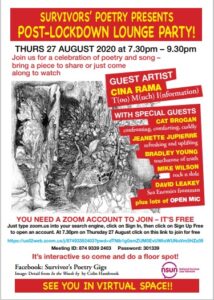
Zoom in and join us this Thursday 27 August at 7.30pm – 9.30pm at this month’s Survivors’ Poetry Post-Lockdown Lounge Party! It’s always on the 4th Thursday of the month but if you are ever in any doubt just take a peek at our facebook page Survivors’ Poetry Gigs – there are always up to date posts with info about the next event, and the flier and live link to join when they are ready.
And here is the live link for the Post-Lockdown Lounge Party on Thursday 27 August at 7.30pm – 9.30pm. Once you have downloaded zoom for free, just click on this link to join. As ever, if anyone would like a hand setting up a zoom account and going through the basics, just holler out here and we can speak.
Meeting ID 874 9339 2403
Password 301339
The amazing Dan Brady, who has been joining us from San Fransisco and who has set up the Global Virtual Venues list has sent us the link to the weekly newsletter for his poetry club Sacred Grounds Cafe – http://www.drdan.solutions/Sacred’sWeeklyNews.htm. The zoom info is in the second section of the newsletter. He asks that people please don’t share it on social media. We are all invited to zoom into his poetry club but please contact him beforehand and remember there is a 4 minute limit!
You can contact Dan directly via his web portal http://www.creativeideasforyou.com/emailpage.html.
See everyone in virtual space on Thursday to do our creative thang and enjoy some fantastic poetry and music!
love+sol Survivors’ Poetry xxx
Image of flyer with information about the event as per text above
Aug 192020
 
DPAC Logo with text underneath "Disabled People Against Cuts" and then web address dpac.uk.net
English Version:
This year we want to show ourselves again as we are: proud and beautiful!
Because of the Covid-19-pandemic we can’t gather to demonstrate on the
streets.
Still, we want to be proud, beautiful, tired, angry and militant –
together and across all borders!
Therefore this year we want to make a film together with you!
We are calling out for short videos (about 5 minutes). You can do
artwork, politics or both, for artwork can be political. You can do
spoken word performances, play or sing music or something completely
different. We are especially interested in your views on the current
situation. How does the Covid-19 pandemic affect your lives? What has
changed? What is missing in these times? What do we demand from society
and for society? We want to create a space to make your views visible.
If you have other ideas, they are welcome too.
We will compile the videos into a film and we can also pay some money
for the clips.
If you’re interested, send us your ideas in a short e-mail before
September 13th. We will answer soon afterwards. Then you’ll have one
month to complete the film.
Our e-mail-adress is pride-parade@gmx.de
Auch dieses Jahr wollen wir uns zeigen, wie wir sind: stolz und schön!
Aber, dieses Jahr können wir keine Demonstration machen.
Wir wollen aber dennoch zusammen – über die Grenzen hinaus – stolz, schön, müde, wütend und kämpferisch sein!
Deshalb machen wir dieses Jahr mit Euch zusammen einen Film!
Wir möchten aus kurzen Videos von euch diesen Film machen.
Zu Kunst oder Politik.  Oder beides Kunst kann auch politisch sein.
Im Form von gesprochenem Text, Bildern, Musik oder anderen Videos.
Uns interessieren vor allem Beiträge zu den Fragen: Was macht das Corona-Virus mit euch und uns? Was hat sich verändert? Was fehlt euch in der Corona-Zeit? Was fordert ihr von der und für die Gesellschaft? Wir wollen Sichtbarkeit dafür schaffen. Wenn ihr andere Ideen habt, freuen wir uns aber auch darauf!
Wir wollen Beiträge von jeweis etwa fünf Minuten für unseren Film sammeln.
Für die Beiträge zahlen wir eine Aufwanndsentschädigung.
Wenn ihr Interesse habt, schickt uns bis 13. September eine E-Mail mit einer Beschreibung beziehungsweise Erklärung, was ihr vorhabt.
Wir melden uns dann bald zurück. Ihr  habt dann den Oktober für die Umsetzung.
Unsere E-Mail-Adresse ist pride-parade@gmx.de.
Aug 192020
 
DPAC Logo with text underneath "Disabled People Against Cuts" and then web address dpac.uk.net

Last week, campaigners became aware that from 14 August Access to Work (AtW) was closing cases for Deaf and disabled workers still on furlough. What this means is that when furlough ends, any workers who need AtW to return to work will have to re-apply for their support package. This will increase the burden on Deaf and disabled workers on top of the many other barriers they face to staying in employment. There is no obvious reason why the Department for Work and Pensions should have to close rather than pause their furloughed caseload. We can only assume this is a cynical attempt to save money by making it more difficult for workers to claim support from AtW in the hopes that some will simply give up. Once again, we see the government stacking the decks against Deaf and disabled workers and exposing the emptiness of their rhetoric about wanting to help Deaf and disabled people into employment.

This is also just the latest example of problems with AtW that have been experienced since Covid-19 outbreak and lockdown.

StopChanges2AtW wants to hear any and all examples of difficulties with AtW since 1st March 2020 that you’ve experienced since early March 2020. These could have negatively affected Deaf and disabled workers as well as interpreters or Personal Assistants paid through AtW.

Please email or send BSL videos to: StopChanges2AtW@gmail.com

We will keep all examples we receive anonymous and use them to produce a mini report which we can use to raise awareness of the types of problems people have faced and to campaign for improvements.

Aug 182020
 
DPAC Logo with text underneath "Disabled People Against Cuts" and then web address dpac.uk.net

picture of residential institutions in Hungary with logos for ENIL and DPAC

International webinar, organised by Disabled People Against Cuts (DPAC) and the European Network on Independent Living (ENIL)

25th August 2020, 15:00 – 17:00 CEST (14:00 – 16:00 GMT)

with English captioning and International Sign

Moderated by Mandy Colleran, DPAC and Jamie Bolling, ENIL


Watch and comment online:

Twitter: @dis_ppl_protest                                    FB: https://www.facebook.com/disabledpeopleagainstcuts/videos/ Youtube: https://www.youtube.com/c/DisabledpeopleagainstCutsDPAC/videos


In 2013, Disabled People Against the Cuts (DPAC) triggered a UN inquiry into the United Kingdom under Article 6 of the Optional Protocol to the UN Convention on the Rights of Persons with Disabilities (CRPD). The inquiry, carried out by the Committee on the Rights of Persons with Disabilities, focused on the implementation of Article 19 (living independently and being included in the community), Article 27 (work and employment) and Article 28 (adequate standard of living). The report, published in 2017, found that the UK government was guilty of “grave or systematic violations of the rights of persons with disabilities”.

In Hungary, the request to launch an inquiry was submitted in 2017 by the Validity Foundation, and joined in 2018 by the European Network on Independent Living – ENIL and the Hungarian Civil Liberties Union – TASZ. The inquiry focused on the implementation of Article 12 (equal recognition before the law) and Article 19. The report, published earlier this year, also found evidence of “grave or systematic” violations of these articles. The report also looked into the role of the European Union in committing these violations, through funding the building of new institutions in the country.

The aim of the webinar is to discuss how both reports – on the UK and Hungary – can be used to challenge violations of disabled people’s rights and get Governments to uphold the rights sets out in the CRPD, with a focus on Article 19. Activists and allies from the UK will share how they’ve used the results of the 2017 inquiry to promote CRPD implementation in their country, while those from Hungary will speak about the reactions to the 2020 report and their plans for follow-up. Staff of the CRPD Committee Secretariat will explain how inquiries under the Optional Protocol are carried out and how the Committee monitors their implementation.

Speakers: Jamie Bolling (ENIL), Ellen Clifford (DPAC), Heather Fisken, (Inclusion Scotland), Rhain Davies (Disability Wales), Melinda Farago and Gabor Petri (MEOSZ), Ágota Vida (People First Association), Péter Stánicz (Office of the Commissioner for Fundamental Rights), Catherinne Pedreros, Jorge Araya and Harumi Fuentes (Secretariat of the Committee on the Rights of Persons with Disabilities at UN OHCHR)


Jul 302020
 
DPAC Logo with text underneath "Disabled People Against Cuts" and then web address dpac.uk.net

Launch of a public consultation on 

proposals for a better benefits system 

by the Commission on Social Security led by Experts by Experience


12 August 2020 – 7pm to 8.30pm  


Everyone knows current welfare benefits are failing, but what would be a better approach?

The Commission on Social Security is a project set up to find out how to improve the social security/benefits system.


The project is led by Experts by Experience. All the Commissioners have lived experience of benefits.


The Commissioners come from a range of user led organisations speaking up for people on benefits and Deaf and Disabled people.


Last year the Commission issued a Call for Solutions asking for suggestions for a better system. There were over 1,000 responses.


The Commission has now identified 8 ideas and is launching a public consultation to see what people think of them.


The online event will:

  • Unveil the Commission’s proposals
  • Explain how you can have your say
  • Provide information about getting involved in the consultation
  • Have British Sign Language interpretation and live subtitles

To join the event please register here and further details will then be sent to you nearer the time.


Jul 282020
 
DPAC Logo with text underneath "Disabled People Against Cuts" and then web address dpac.uk.net

Depression, Work and Welfare: their Interaction over Time

I am a student of University of Essex and I am looking for participants for my project
about unemployment, depression and benefits. This project is independent of
Department for Work and Pensions (DWP), Job Centres and other related agencies.

To see if you can help, please answer the next four questions.
1. Have you been unemployed (now or in the past)?
2. Are you trying to find work or are you currently working?
3. Have you experienced depression before or during your unemployment?
4. Have you needed welfare benefits (now or in the past)?

If your answer is ‘yes’ to all four questions, I would like to hear about your
experiences in relation to unemployment, benefits and depression. In this
project, I collect stories about how people tried to break out of unemployment. I hope
to learn about things that helped, and issues or barriers people experienced.
I am keen to talk to people from a variety of backgrounds, including those from
minority and marginalised groups. Participants will be mainly from a large area
between London and East Anglia.

It is important I talk to people who have good, not so good or mixed experiences. In
this project, everyone’s opinion is important.

What do I get out of participating?
– It is an opportunity for you to speak freely about your experiences. Please often find
talking about their experiences enjoyable and worthwhile.
– I will be keen to let you know about the findings, and to tell you how the findings are
shared with a wider audience.
– Your time and effort will be much appreciated, and as a ‘thank you’ you will receive a
£15 high street voucher after the interview.

If you are interested in the study, it is important that you understand the purpose of
the research and what it will involve. Please read the information below carefully and
take time to decide whether you would like to take part. I will be happy to answer any
questions you have to help your decision.

How do I sign up?
You can contact me directly via email: kn18837@essex.ac.uk

What happens next?
I will get in touch with you within a few days and will ask a few questions about you
and answer any questions you have about the research.
If you are still happy to take part, I will arrange a suitable time and mode for the
conversation. The meeting will take about one hour. We can talk via a video call or
over the telephone, whichever way you feel the most comfortable. When the
research is completed, you will receive a report about the findings, if you are
interested.

A few more things you need to know
• You need to be at least 18 years old to take part.
• Participation is voluntary. You can withdraw at any time and you do not need
to explain why you would like to stop participating. If you withdraw from the
study, you can ask the researcher to use or destroy your data and any
information you have given and not to contact you again.
• You have the right to refuse to answer or respond to any question that is
asked of you.
• Your name will not be used and will be replaced with a random name.
• Your anonymity and your identity will be kept confidential and data will be kept
secure.
• The project will be written up as a thesis dissertation at the University of
Essex. It is planned to be shared in relevant circles and published as a journal
article.
• Some of your words may be used in reports but under another name so the
readers will not know who you are.
• Participation will not affect your benefits. No information about you is shared
with Department for Work and Pensions (DWP), Job Centres, HM Revenue
and Customs (HMRC) or the agency that asked you to take part.
• This project is organised by Krisztina Nemeth, Trainee Clinical Psychologist
and is funded by the Health and Social Care Department of the University of
Essex. The title of the project is: Depression, Work and Welfare: their
Interaction over Time.
• The legal basis for processing your personally identifying data is that you
have consented to it. The data controller is the University of Essex. Essex
University’s Data Protection Officer can be contacted on dpo@essex.ac.uk .
• The proposal has been reviewed by the Faculty of Science & Health Ethics
sub-Committee.
• If you have any issues or problems with the study, please contact the
researcher (kn18837@essex.ac.uk) or the project supervisor

Jul 282020
 
DPAC Logo with text underneath "Disabled People Against Cuts" and then web address dpac.uk.net

With credible media reports this week that the government is considering taking social care back into the NHS, it is worth knowing that disabled people in the 1960s campaigned for social care to leave the NHS and to become a duty of local government, not least because it would become more accountable.

This could be our era’s defining moment for defending the social model against the medical model.

The two documents below provide background research and extensive details on the campaigns for independent living in the 60s and 70s. Please fee free to circulate them, they are both Creative Commons for that purpose.

Tony Baldwinson


Alf Morris MP and the campaigning by disabled people that led to the 1970 CSDP Act – research notes

2020-06-11 Alf Morris MP and the campaigning by disabled people … (Final 2)


To and From Grove Road: Independent living, disabled people, social care, activists fighting segregation and abuse by Maggie Davis (Hines) and Ken Davis

2019 To and From Grove Road – Maggie Davis (Hines) Ken Davis – ISBN 9781913148089

Jul 162020
 
DPAC Logo with text underneath "Disabled People Against Cuts" and then web address dpac.uk.net

Please read and add your name to the RMT statement below calling for the government to fully fund London Underground and TfL.

You can add your name to the statement by clicking here.


RMT calls on government to fully fund TfL and London Underground
TFL, including the Tube, has faced years of cuts as a self-funding model has been imposed by government and the London Mayor.

The Covid pandemic has shattered that funding model and left TFL facing a shortfall of at least £3.2bn for the current financial year.

The government’s response has been to appoint consultants KPMG to identify further cuts to TFL/London Underground’s budgets.

Already free travel for under 18s has been axed. Many projects to provide step-free access on the tube have also been abandoned.

RMT is calling on the government to fully fund TFL and London Underground. Passengers should not suffer a cut to services. Those who rely on free travel should not pay for the crisis in TFL funding. The aim of improving the accessibility of public transport in London must not be sacrificed to pay for the crisis in TFL funding. Workers who have kept the tube and other transport services in London moving throughout the Covid pandemic must not be made to pay for the crisis in TFL funding through attacks on their jobs and conditions.

You can also watch the TfL Funding rally with speeches from Paula Peters among others here:

http://www.youtube.com/watch?v=sAwkoJdmAm0&authuser=0

Jul 092020
 
DPAC Logo with text underneath "Disabled People Against Cuts" and then web address dpac.uk.net

Blog post by Colin Hampton

I have been the Coordinator of the Derbyshire Unemployed Workers’ Centres since 1985. In that time I have witnessed the course of Labour Party policy in relation to social security and on occasions, together with colleagues, met ministers and shadow ministers to express our views, concerns and policy proposals.

On reading the interview with Labour’s recently appointed Shadow Work and Pensions Secretary Jonathan Reynolds I was reminded of the decades of missed opportunities in developing social security policies that we can all campaign around.

The present pandemic has shaken up the world. One consequence of the lockdown has been the challenging of entrenched views towards low paid workers and those vulnerable within our communities. Even the most diehard Conservative, preaching self-reliance and privatisation, must have had at least a fleeting moment of reflection. We are not islands on our own, but are interdependent for our mutual survival. All those cleaners, shop assistants, delivery drivers etc have been given new status during this time, though not reflected in their wages of course. The homeless must be given shelter-so as not to infect us! People must be given furlough payments when unable to work even if only to prevent looting and social unrest.

The diehard Conservatives, like most of us, will ignore evidence that does not fit in with their strongly held views that give them comfort – but for many the lightbulb will have flickered. Those clapping our key workers will be people who have swallowed the daily diet of propaganda blaming poverty on the poor and unemployment on the unemployed themselves. Workers will be waking up to the realities of claiming benefits and finding it is not the garden of roses that they have been led to believe. I have witnessed the process many times when mass redundancies have affected Derbyshire. Experience is the greatest educator. However, we must seize the narrative to make sure that when people reflect on that experience, the conclusions they draw, enable policy changes bringing social security for all.

The Labour Party is primarily interested in winning elections. It is more interested in winning office at all levels of government rather than changing the world. Readers may disagree but for the large part, little has changed for the better during my six decades, and the situation of those out of work and claiming benefits is worse now than even under the dark days of the 1980s, and I speak from the experience of dealing with the issues on a daily basis for much of that time. This is despite a significant period of Labour government. Jonathan Reynolds will be more interested in becoming a Government Minister than battling for a better world for those dealing with the DWP on a daily basis. I do not say this with relish, it is merely a reflection of years of experience.

Social Security should be a vote winner for Labour but as each election approaches it never has a comprehensive policy plan or even a vision to give to the electorate of what it actually wants to achieve. Before the 1997 election of Tony Blair’s new Labour government a group of activists from the Unemployed Workers Centres went down to Parliament to meet the shadow ministers responsible for work and pensions issues. This was just following the introduction of the Jobseekers Allowance. Chris Smith MP and Ian McCartney MP assured us that once elected, they would alter beyond recognition, through regulation, the Jobseekers Allowance and its sanctions regime. Claimants groups would be in the midst of all policy formulation through consultation and involvement. The election happened and all that changed was the jobs of Chris Smith and Ian McCartney. Jobseekers Allowance was entrenched and the sanctions regime made harsher. The language of hard-working families was developed and each year the public attitude surveys showed the increasing lack of empathy towards claimants at the same time as benefit levels plummeted relative to wages. Despite being in a position to change things for the better for the poorest and most vulnerable, the opposite was done. No attempt was made to challenge and change the perception of those forced to claim benefits through sickness, disability or lack of opportunities in areas ravaged by unemployment. For the most part only supply-side policies were used e.g. new deal, which emphasised that unemployment and poverty were the fault of those not doing enough to find work. Casualisation of employment became entrenched. In Chesterfield there were more employment agencies than mobile phone shops and the job centre became a recruiting sergeant for the army of private sector agency job providers. Jobs had to be taken if no hours or conditions of work were advertised in the job centre. Zero hours work became normalised.

It was at this point that Jonathan Reynolds erstwhile boss James Purnell took the reins of the Department for Work and Pensions. When Mark Serwotka describes Parnell as “the worst social security minister under new Labour” It is worth taking note. Jobseekers allowance sanctions had rocketed under John Hutton’s tenure. Many now forget that benefit sanctions went through the roof under new Labour, preparing the way for the atrocities brought to bear on people following the introduction of employment and support allowance work capability assessments under Purnell and the coalition government thereafter. Some of Purnell’s ideas included charging interest of 26.8% per annum on crisis loans to the unemployed and plans that the TUC said are reminiscent of workfare, claimants being forced to work full time for their benefits after two years unemployment. National salary insurance was another of his ideas. This plan would see a trebling of jobseekers allowance rates for redundant workers to be repaid when they have found work once more. The idea was framed in the language that people in Britain do not feel that they get back from the welfare state what they put in. Sounds familiar – it should do as Jonathan Reynolds says “welfare should reflect what you put in to tackle public mistrust”. This was the headline on his June 2020 interview.

The leadership of Jeremy Corbyn was refreshing for those campaigning on issues of unemployment and poverty. For the first time in my 35 years at the Derbyshire Unemployed Workers Centre I felt that the Labour leadership, if not all of its MPs, were on the side of those facing poverty, homelessness, destitution and were not afraid to say it. My local MP told me, at the time of Ed Miliband’s leadership, not to expect support for benefit increases, elimination of sanctions or an ending of work capability assessments because the Labour Party was not going to be triangulated by the Tories as the party of the unemployed and the scrounger. I respect his honesty. Under Corbyn and McDonnell there was a huge shift in this regard and I can’t recall anyone arguing that the 2017 and 2019 election defeats where in any way down to the leadership’s antipoverty rhetoric.

It must still be pointed out that although the issue of social security was always said to be a priority of an incoming Labour government in 2019 they were very shy at offering a vision of practical policies that might be advanced. As the possibility of government became closer the policies around Social Security policy were the least developed for fear both of costing and divisions in the party and membership over universal credit/universal basic income, and associated issues around labour market policy. The manifesto reported “We will….. design a system that will treat people with dignity and respect. Our ambition in designing this system will be to end poverty by guaranteeing a minimum standard of living “.

I have been saying for the last three decades that the labour and trade union movement needs to develop this “system” whether in government or not. The Tories, when out of office for 13 years, had the hilariously named Centre for Social Justice and the development of universal credit. Similarly we must use our time out of Government to develop policy initiatives and cultivating wide support through the engagement and involvement of all those that have experience as well as a stake in the policy formation. The Unemployed Workers Centres along with Unite community, PCS, TUC and many others have already backed a Welfare Charter laying down the principles on which these policies should be developed. The major trade unions and the TUC have supported the principal of universal basic income. As a movement we need to come together with a plan. No doubt it will not suit everybody, but we have to have a plan. We cannot leave this to the Labour Party. They will want to tinker about with the present system fearing the electorate if seen to be soft on benefit claimants. I once took the Guardian’s Amelia Gentlemen to visit 6 ESA claimants who had been given zero points on the work capability assessment. These people were so obviously never likely to work ranging from a young person with special-needs to a man who was drinking morphine out of a bottle, he was in so much pain during the interview. Each one after angrily expressing their case to the journalist finished by attacking other benefit claimants on their estate saying “they are the ones who shouldn’t be getting benefits-not me!” The propaganda runs deep, but a tipping point has been reached and Corbyn and McDonnell showed that we should not be fearful in arguing for dignity and Social Security for all. It is no use any longer having ambitions and visions we need plans and policies. The Reverend Paul Nicholson, the great antipoverty campaigner died earlier this year. When Tony Blair and allies continually talked about ending child poverty by 2020 he said on many occasions “does that mean child poverty is acceptable in the meantime.” Of course it isn’t and we must not waste any more time in outlining the practical ways in which it is to be eliminated. Our job is to keep up the pressure, to understand the limitations and constraints of the Labour Party, to work with the trade unions and disability groups and organisations. In doing so public support for radical policies has to be pursued. You never know, if that happens, even Starmer’s Labour party might get on board.


Jul 092020
 
DPAC Logo with text underneath "Disabled People Against Cuts" and then web address dpac.uk.net

A Very Queer Nazi Faust is a re-imagining of the Faust legend by a 21st century disability rights campaigner and poet, Vince Laws. It began as an idea which Laws explored on an Arvon playwriting course, before he honed the plot, and committed it to the page as a comic.

Early in 2016, with support from Shape Arts, Laws sent that comic to TLC for feedback. The feedback was really useful, very specific, and although a lot of corrections and suggestions had to be filtered through the text, Laws spent the next year redrafting, before sending the redraft back to TLC to see what the same reader thought of his changes. He liked them! Bravo!

With renewed confidence in his writing, early in 2017, Laws decided to make the comic into a live performance, and put out a call for participants in the Norwich area. Thirteen local activists, some with disabilities, some without, were cast via social media, and rehearsals began, culminating in a performance at Norwich Pride in July 2017, which was met with popular and critical acclaim.

In 2018, funded by Unlimited, and the Spirit of 2012, Laws ran participatory workshops and honed the script, culminating in a sold out performance at Norwich Arts Centre in September 2018. “I bloody loved it! The show I enjoyed the most this year,” Pasco Q Devlin, Norwich Arts Centre Director. That live performance was turned into a podcast version of A Very Queer Nazi Faust available free on Soundcloud. The performance contains adult themes and language, suicidal thoughts, Lucifer, The Naked Abseilers and poetry, but no Nazis.

Laws is currently re-making A Very Queer Nazi Faust into a comic, now with a richer workshopped text.

Poet John Faust is suicidal. His benefits have been stopped without warning, the bailiffs are due to evict him, his dog is in the vets dying, his car needs a new clutch, and he can’t finish his poetic masterpiece while the voices inside his head torment him. In despair, he throws himself off Beeston Bump, Norfolk’s highest peak, clutching ‘The Tragic True Life & Deserved Death of a Benefit Scrounger by Himself’, but Lucifer won’t let John drown because she loves his work and wants a bigger part. Every time Faust throws himself into the sea, Lucifer throws him out on a different Norfolk beach….

Intro ends.

You can read a 5 page extract from the script and see 5 comic book images here:

https://literaryconsultancy.co.uk/wp-content/uploads/2020/06/Vince-Laws-Showcase.pdf

Jul 092020
 
DPAC Logo with text underneath "Disabled People Against Cuts" and then web address dpac.uk.net

Monday 13 July

6.30 – 8.50pm (GMT)

Join DPAC and our disabled international allies to discuss the worldwide pandemic and what it means for disabled people.

Speakers include Paula Peters (DPAC), Ellen Clifford (author of The war on Disabled People: Capitalism, Welfare and the Making of a Human Catastrophe), Mark Williams, Julie Jaye Charles, Janet (disabled asylum seeker and member of DPAC Bristol and South West), Andy Greene (DPAC), plus speakers from Sweden, Greece, Bolivia, Uganda, Hungary, Belgium, Bulgaria, Malaysia, Germany, Ireland and the US.

Graphic advertising the event with an image of a globe and an image of a virus

 Posted by at 21:56
Jul 032020
 
DPAC Logo with text underneath "Disabled People Against Cuts" and then web address dpac.uk.net

The final chapter of Ellen Clifford’s new book ‘The War on Disabled People: capitalism, welfare and the making of a human catastrophe’ puts forward some ideas for developing a reinvigorated social model of disability.

The social model, which DPAC follows, has proved itself to be a powerful tool for achieving progressive social change and improving the lives of disabled people. It has also been the subject of debate and criticism among disabled people and those who meet the criteria to be considered disabled but who do not identify as such. Over the past decade, disabled people have experienced the brutal impacts of having essential support taken away from us by policies underpinned by an alternative model of disability, the Waddell and Aylward biopsychosocial model.

Clifford outlines some ideas for how disabled people can reclaim and refresh the social model so that it is up-to-date and fit for purpose within current socio-economic and political contexts.

She stresses that such an initiative must be a collective enterprise taken forwards by grassroots disabled people themselves. However as a starting point she puts forward three suggestions developed with her co-thinker and disabled activist, Mark Dunk.

These can be summarised as follows:

  • Social model vs individual model of disability.

The book argues that we need to go back to the original analysis of different models of disability put forward at the time the social model was developed. According to this analysis, the model of disability that has a hold over capitalist society is the individual model. This is a way of looking at disability that blames disabled people for their own situation and places responsibility on them to change it. The individual model takes different forms at different times. In the past, many disabled people were treated badly as a result of approaches to disability grounded in the medical model. Today many disabled people are turning to the medical model to help them. For example, medical evidence and diagnoses are needed to access benefits and support; people with energy limited chronic illness have to struggle to get their conditions recognised as real medical illnesses. Meanwhile, other forms of the individual model are appearing. One example of this is the “recovery” model of mental health which puts pressure on people living with mental distress to “get better” so that support services can be cut.


  • A social model of impairment.

The social model of disability draws a difference between disability and impairment. Disability is caused by the barriers that society creates and puts in the way of disabled people. Impairments are the conditions that we live with, for example blindness, learning difficulties, mental distress…etc Some groups of people feel that society puts barriers in their way but do not call themselves “disabled” because they do not think of themselves as having an “impairment”. The word “impairment” suggests that there is something wrong with a part of your body or your brain. This does not fit with the understanding that we now have of certain conditions. For example, autistic people do not have anything “wrong” with their brains – they are just wired in a different way. We also now understand that people who live with mental distress do not have “abnormal” brains – distress arises when brains carry out their natural functions for dealing with trauma. Deaf BSL (British Sign Language) users identify as having a shared language and culture.

The book suggests that alongside a social model of disability, we should also have a social model of impairment. According to this, “impairment” would not be understood as something that is wrong with a person’s body or brain. Instead, “impairment” would refer to the disadvantage that a person faces because of how their particular condition is viewed within society. This would enable a wider range of people to identify as disabled – including Deaf people, autistic people, and people living with mental distress – to unite to fight against shared injustice.

The book also argues that under a refreshed social model of disability, it should be made clear that it is not wrong to talk about the pain and distress that some conditions cause us. The social model does not deny pain or distress, it’s just that the social model is about something different.


  • A tool for social change

The social model of disability was never meant to be a perfect theory of disability. Its power lies in its ability to unite people who face common barriers so that together they can more effectively fight for social change. Even critics of the social model admit it has helped move things forwards for disabled people. But there has also been so much debate and criticism of the social model that has become a talking point rather than a tool for collective action. This is what we need to get back to.

It may seem contradictory to call for a refreshed social model while discouraging too much talking and theorising. The aim set out in the book, is to develop a working understanding that can bring more of us together in order to present a stronger resistance and work towards building a better world.

This summary is also available in British Sign Language: https://youtu.be/FqujLo-ZpiE

An easy read version developed by People First (Self Advocacy) can be downloaded here: DPAC Social Model proposal_Easy Read

There will be an online meeting to discuss these ideas and hear perspectives from a range of disabled activists, taking place on Monday 6th July 2020 6.30 – 8.30pm. The meeting will be streamed live on DPAC’s Facebook page, twitter and YouTube channel. For more information see: https://dpac.uk.net/2020/07/reinvigorating-the-social-model-of-disability-online-meeting-6-july/