ellen

Jul 142021
 
DPAC Logo with text underneath "Disabled People Against Cuts" and then web address dpac.uk.net

The APPG on Dying Well promotes access to excellent palliative care and stands against the legalisation of assisted suicide in the UK. 

I am delighted to invite you to our next online meeting on the 15th July at 5pm.This is an unmissable event and first of its kind, which will be of interest to parliamentarians with a range of expertise. Especially those with interests in science and technology, medical innovation, mechanical engineering, human ethics and philosophy. 

Three presenters, all of whom are disabled, will consider Baroness Meacher’s Assisted Dying Private Members Bill from very different perspectives and viewpoints. Each presenter will test the arguments for a change in the current law and whether the proposed legislation stands up to rigorous public safety standards. 

Dr Peter Scott Morgan http://www.scott-morgan.com/blog/right-to-thrive/faqs-about-right-to-thrive/. Peter is the world’s leading robotics and AI scientist who was diagnosed with the severest form of MND ALS and given 2 years to live. 4 years later, Peter will show-case his new inventions and solutions which challenge commonly held beliefs regarding terminal Illness. Amongst them he will demonstrate a sophisticated avatar, which has given him his voice and expression back, having lost this capability a year ago when he became motionless as a result of MND. His work is gaining great traction globally as a result of his recent book, documentary and 2020 launch of the Scott Morgan Foundation: https://www.scottmorganfoundation.org/our-story.  

Dr Mario Griffiths https://en.wikipedia.org/wiki/Miro_GriffithsMiro is a Leverhulme Research Fellow at the University of Leeds, who has published on disability policy and politics, and is invited regularly to comment on current social issues. He is a member of the Disability Advisory Committee at the Equality and Human Rights Commission, and advises the UK Department of Health and Social Care on improving disabled people’s access to health and social care provision. He is a former strategic and confidential adviser to the UK Government and European Commission. Miro has Spinal Muscular Atrophy, which is a progressive condition that causes muscle strength deterioration throughout the body. 

Philip Friend OBE Hon DSc https://philfriend.co.uk/. Phil contracted polio as a child and is a wheelchair user. He is acknowledged as one of the UK’s foremost consultant on disability matters. He has worked on disability and diversity projects in Estonia, Romania, Poland, Germany, Canada and the USA. He was awarded an OBE in 2001 for services to equal opportunities and disabled people and made an honorary Doctor of Science (Hon DSc) in 2009 in recognition of his outstanding contribution to equality and diversity from University of Hertfordshire. He is the current chair of the Research Institute for Disabled Consumers and Vice Chair of the Activity Alliance.  

Baroness Campbell of Surbiton http://baronesscampbellofsurbiton.uk/. Baroness Campbell of Surbiton is a Cross Bench Peer and Founder of Not Dead Yet UK (NDYUK) www.notdeadyetuk.org. NDYUK is the leading organization of disabled people and those with a diagnosed progressive and terminal medical conditions campaigning against a change in the law on Assisted Suicide.

To register for a place please email: danny.kruger.mp@parliament.uk

Jul 062021
 
DPAC Logo with text underneath "Disabled People Against Cuts" and then web address dpac.uk.net
photo of Heidi addressing supporters outside the high court
Disabled People Against Cuts sends solidarity to Heidi Crowter who is taking a legal challenge against the fact that disabled foetuses can be aborted right up until the time of birth while there is a legal cut off for non-disabled foetuses. Heidi’s lawyers will argue that this is discriminatory.
DPAC was outside the high court today to show support for the first day of the hearing along with members from Inclusion London, the Reclaiming Our Futures Alliance and the Alliance for Inclusive Education. Alongside disabled campaigners including Heidi’s husband James were parents of disabled people including the actor Sally Phillips.
It is right that self-advocates such as Heidi and others supporting her whoul get their voices heatrd in highlighting the inequalities and discrimination they suffer on a daily basis. Ideas and attitudes that see disabled people, and particularly those with learning difficulties as inferior, are still sadly common in society today – they aren’t confined to right wing bigots but sit at the core of many of the services that disabled people rely on for essential support. We’re taught that the exclusion and lesser life chances of disabled people are somehow inevitable and that disabled people are a burden on others.
But this isn’t true.
There are realistic alternatives.
Access and inclusion, fairness and equality are all possible there is a will to achieve them. By embracing difference and valuing diversity society is far stronger.
DPAC therefore supports the idea that the difference in time limits provided for by the Abortion Act is discriminatory. We nevetheless firmly view the Abortion Act as a piece of progressive legislation and are opposed to any curtailment of a woman’s right to choose.
We are concerned that this legal challenge will be used to pit disabled people’s rights against women’s rights and would argue that this does not need to be the case and that both can be defended. It is important that all of us – women, disabled people and those of us who are both and everyone else who cares about social justice – are united in ending all forms of oppression.
United we can but divided we fall.
#DownwithDiscrimination #HoldHands4Equality
Photo of campaigners Simone Aspis and Michaelle Daley outside the high court supporting Heidi in front of banners from Inclusion London, Reclaiming Our Futures Alliance and DPAC
Photo of Heidi's husband James addressing supporters outside the high court
Jun 212021
 
DPAC Logo with text underneath "Disabled People Against Cuts" and then web address dpac.uk.net
DPAC and Novara

We are writing to update our members on where things have got to with our discussions with Novara Media on what we saw as a need for the media outlet to improve its understanding of disablism and the type of oppression that disabled people experience.
We apologise for the delay in updating members. This is down to capacity issues within DPAC whereas Novara have consistently been prompt in their responses to communications from us.
We are satisfied with the proposals that Novara have suggested and are already working on implementing. As such DPAC is happy to work with them going forwards.
We include below the written statement that DPAC sent to Novara following our meeting with them. During the meeting a range of disabled activists spoke about their objections to the way the interview with Peter Singer was conducted, raised general criticisms of Novara coverage with respect to disability, and made suggestions for improvement. The entire Novara staff team was in attendance and listened to us all with the utmost respect.
We also include below the suggestions we received from Novara setting out their proposals for a way forward following our meeting. This crossed with our written statement so the addendum represents their further response to that.
We are delighted to have got to this stage and consider it a significant step forwards in building both the political education of our allies and general understanding of disability as a form of oppression.
As a result of the socio-economic structures we live under, people without lived experience of disability tend to unconsciously adopt the dominant negative ideas about disability prevalent in society. As disabled campaigners we can support non-disabled allies who are open to questioning and re-evaluating their understanding of disability. These are important steps for building the unity and solidarity that we need for fundamentally changing society.
[NB we would like to note here that whilst DPAC finds Singer’s views abhorrent it is factually incorrect to call him a eugenicist – however it is also unfairly critical to pull up disabled people on technical differences between different branches of philosophy when we call out the offensiveness of views such as those Singer holds, it misses the point and is bad ally-ship. This comment reflects the experiences we are aware some disabled people have unfortunately had on social media with members of the public regarding the Singer interview.]
DPAC National Steering Group
DPAC Statement to Novara:

This statement is prompted by Novara Media’s decision to conduct and promote an interview with Peter Singer without any public acknowledgement or consideration of his well-known views on the value of disabled people’s lives. However, it also reflects a broader failure to engage in a sustained or meaningful way with disablism/ableism, with the brutal realities of disabled people’s experiences and oppression in this country today, and with disability activism and activists.

Peter Singer is a moral philosopher whose work on animal liberation is highly influential. His argument that the concept of ‘personhood’ should be extended to include primates is important. His work sets out to separate the moral category of personhood from the human. This enables him to argue that primates deserve to be recognised as moral subjects and protected. It also allows him to claim that not all humans meet the criteria he sets out for ‘personhood’ and therefore that not all humans deserve equal protection and recognition in a legal and political sense.

This argument has serious implications for disabled people and our rights.  Singer’s work promulgates the kind of view of disabled people’s lives as “unworthy of life” that provided the ideological justification for euthanasia programmes such as Aktion T4 in Germany in the 1930s. For Singer, disability is viewed only as a cause of suffering and as representing an unjustifiable social and economic burden in a world of limited resources. Fundamentally his position is that disabled lives are burdensome, unproductive (in an economic sense), and unequal in value to non-disabled lives.

It is for this reason that Singer argues not simply for the infanticide of disabled infants (such as those born with conditions such as Spina Bifida) but that there is a moral obligation to end those lives. He argues for instance:

When the death of a disabled infant will lead to the birth of another infant with better prospects of a happy life, the total amount of happiness will be greater if the disabled infant is killed. The loss of happy life for the first infant is outweighed by the gain of a happier life for the second. Therefore, if killing the haemophiliac infant has no adverse effect on others, it would, according to the total view, be right to kill him.

Throughout his work, he maintains a visceral distaste for the lives of people with learning difficulties in particular, comparing them to dogs and pigs, and most recently justifying rape on the basis that if someone is incapable of “informed consent” there is no moral harm in subjecting that person to non-consensual sex. His arguments are scaffolded by a utilitarian approach that reduces the value of a person’s life to a brutal economic logic. If you are someone who needs support in daily living, if you are someone who may not be able to engage in wage labour, if you are someone whose life is characterised by a strong difference, then, for Peter Singer, you are better off dead. (And everyone around you is better off too).

It is deeply upsetting that a left-wing media organisation such as Novara would make a decision to interview Singer without providing any counter-point to his views; by asking him about them and then letting him talk uninterrupted and unchallenged he was effectively given a platform to justify and disseminate his ideas. Novara has a reputation among disabled people both for ignoring disability-related issues and for an overall lack of disability awareness evident within general coverage.

The Singer incident was particularly unconscionable in the current context in which disabled people make up 6 out 10 deaths from Covid-19, in which 8 out of 10 recorded deaths of people with learning disabilities have been Covid-19 related, and in which conversations justifying the denial of critical care to disabled people are taking place.

Disabled people have never enjoyed equal human rights in fundamental areas such as the right to life and or the right to healthcare; in the pandemic situation the lower worth that society places on our lives has been explicitly framed and stated: blanket decisions have been taken by public bodies to exclude us from treatments on the grounds of ‘utility’ and the allocation of limited resource while an unprecedented number of unlawful DNACPRs (Do Not Attempt Cardio-Pulmonary Resuscitation orders) have been put on the medical records of autistic people and people with learning difficulties.

Any progressive movement committed to equality and social justice for all, should unequivocally challenge this logic and recognise that disablism is a structural feature of late capitalism with dire consequences for disabled and non-disabled people alike. There should always be safe spaces for rigorous debate, but to facilitate these assertions and positions without challenge further contributed towards the silencing of those most affected by these dangerous ideas.

Our recommendations:

• Novara to apologise for not having provided a platform for on which for Singer’s views to be challenged and publicly commit to improving both the general understanding of disabled people’s oppression that is embedded within the organisation and its coverage in relation to disability-related issues.

• Novara to provide a platform for criticism of Singer’s views on disabled people at the earliest opportunity and for discussion of topical right to life issues such as treatment rationing as well as the current global rush of States to legalise and expand access to assisted suicide [and we note the likelihood of a new Private Members Bill being introduced into the UK Parliament after May].

• Create in-house access guidelines so that all staff are aware of basic accessibility – for example alt text for use of any images on social media.

• Novara staff to undertake training in understanding disabled people’s oppression. There are free Disability Oppression 101 resources available on The World Transformed website. Suggested further reading is chapter 2 of The War on Disabled People: Capitalism, Welfare and The Making Of a Human Catastrophe.

• Social model of disability language guide to be disseminated around staff

• Subscribe to Disability News Service weekly news stories as well as signing up to email alerts from the DPAC website to stay in touch with disability news.

• Take up the offer of support from the NUJ on understanding the social model of disability.

• We would also be happy to send a list of disabled writers and commentators with contact details. We note Novara’s point that you have struggled to find suitable disabled writers and interviewees but would suggest that if this is the case, you think around the issue, for example a system of additional editorial time or of allocating co-writers; also undertaking access and inclusion training to learn how to interview people with different forms of communication. We are happy to answer any questions you may have on this.

• Reflect upon how the “Super Chats” system indirectly discriminates against disabled people who are statistically much more likely to be living in poverty than non-disabled people and whether there are any options for increasing access that don’t at the same time pick out disabled people/reinforce a charity model.

From Novara to DPAC:

Dear DPAC,

Thank you again for the meeting between our organisations, and for all the time and thought everyone put into it. We felt the meeting was very constructive and we were pleased to hear contributions from such a wide range of DPAC members.

Since then we have had some productive meetings about next steps and we would like to present a roadmap outlining the work we intend to do to rebuild trust with disabled people. We’re sorry to say we have also had a few staff medical absences, including for coronavirus, which has slowed down the formulation of this response.

1. Article on Peter Singer’s positions on disabled people and statement on the Singer interview video.

We would like to commission an article from a disabled writer responding to Peter Singer’s positions on disability. As well as being a worthwhile article in its own right, we would also link to the article from the Singer interview in addition to a statement added to the video post.

We take onboard the criticisms both of the interview itself and the way the topics of disability and disabled infanticide were raised and framed within the interview, and accept we didn’t sufficiently challenge Singer’s views. We fully intend to learn from the feedback we’ve received and it will inform our future editorial decisions. We have considered whether to remove the interview or edit it to remove the section where Singer’s positions on disability are raised, however it has been our policy in the past to both make our mistakes and do our learning in public; as such, we think it would be more instructive to viewers to leave the video up but to present alongside it a response article and a statement both acknowledging the hurt the interview caused to disabled people and outlining the actions which have followed the publication of the interview.

2. NUJ webinar on the social model of disability and framing stories about disability.

We really welcome the invitation from Ann Galpin, chair of the NUJ Disabled Members’ Council, to an NUJ webinar on the social model of disability and framing stories about disability and would like to take her up on the offer. We will email her in the coming weeks.

3. Improving coverage of disability issues.

We fully recognise that over a sustained period of time Novara Media has failed to live up to its mission when covering disability and topics that matter to disabled people. We are keen to rectify this on an ongoing basis. We understand this isn’t something we can set right overnight, but we are committed to improving over coverage iteratively and building up our pool of disabled contributors across our sections. We therefore commit to finding more disabled writers and guests to include in our output. Meanwhile, if there are topics, campaigns and thinkers DPAC members feel we ought to be covering, we welcome further discussion with our editors.

 4. Focus week on disability.

A ‘Focus’ is our term for a time-concentrated run of content around a defined theme, such as the future of work or climate. We would like to do a Focus on disability, which would both draw our audience’s attention to a range of disability issues within a focused period of time and seek to expand the range of disabled contributors to Novara Media. We would like to work with existing disabled contributors about curating and commissioning the content for this Focus, which would also help our editors develop coverage further into the future.

5. Accessibility.

We know there is much more we should be doing to ensure our website and social media posts are more accessible to Deaf and disabled people, and we are creating an accessibility budget and working group to make these improvements.

We have begun making some accessibility changes to the functionality of the Novara Media website and are in conversation with the digital design co-op Common Knowledge about doing an accessibility audit and developing both technical and editorial (ie best practice) recommendations, as well as testing technical changes such as making the website usable for screenreaders. Coincidentally, we are currently in the process of recruiting a digital designer and we will ensure accessibility is included within their onboarding briefing. We are also keen to improve our subtitling and transcription, and have opened a conversation about how best to do this. If you have any further specific recommendations we should follow up, please let us know.

We don’t view any of these suggested steps as a panacea for the hurt we’ve caused to disabled people, but it is our sincere hope they will put us on a path to rebuilding trust and reassuring people that disability and disabled people matter to Novara Media. We are grateful to everyone at DPAC for the generosity and comradeship with which we’ve been met, and we look forward to strengthening the working relationship between our organisations in the future.

Addendum

Dear DPAC,

Thank you for your statement and recommendations; we appreciate the time everyone in DPAC has put into this process and we’re glad to see most of the recommendations
chime with various elements of our roadmap, and other suggestions not included in our letter.

We are sorry for not having challenged Singer’s views sufficiently, and we hope the article we propose above (1) will be a medium through which criticisms of those positions can be properly explored.

We also hope points 2-4 go some way to reassuring people of our commitment to better understand disabled people’s oppression and improve our coverage of disability-related issues. In particular we’re excited to host a dedicated Focus on disability which will expand our coverage, convey the importance of disability-related issues to our audience, and provide a platform to numerous disabled writers and contributors.

We take on board the points raised about making the process of contributing to Novara Media more accessible, and as outlined in reference to our accessibility audit (5) we will make sure the process generates editorial best
practice guidelines for staff as well as technical changes.

Once again we’d like to express our thanks for the commitment and generosity DPAC has
shown to Novara Media over recent months, and we hope our actions over the coming months and years will build trust amongst disabled people.

In solidarity,

Novara Media

May 082021
 
DPAC Logo with text underneath "Disabled People Against Cuts" and then web address dpac.uk.net

The People’s Covid Inquiry has been called by campaign organisation Keep Our NHS Public.

The Inquiry has been hearing testimony from many witnesses and takes place with support from a wide variety of individuals and organisations including Disabled People Against Cuts.

The Inquiry Panel, is chaired by Michael Mansfield QC.

Find out more including how you can have a say see: Home | PeoplesCovidInquiry
The next session Profiteering from the people’s health? will be held on Wednesday 19 May from 7pm with witnesses including:

David McCoy – Professor of Global Health Medicine, Institute of Population Health Sciences, QMUL; Centre for Health and the Public Interest

Dr David Wrigley – GP in Carnforth, North Lancs, Deputy Chair BMA, co-author ‘NHS for Sale’ and ‘NHS SOS

Caroline Molloy – Editor at openDemocracy and ourNHS/openDemocracy

Dr Michelle Dawson | NHS Consultant Anaesthetist, trustee Healthcare Workers’ Foundation charity (previously ‘Heroes’)

As well as a special guest appearance by Michael Rosen – author, poet, broadcaster and former UK Children’s Laureate

You can register for this session here: Profiteering from the People’s Health? | PeoplesCovidInquiry


Disabled People Against Cuts contributed to Session 4 of the Inquiry which explored the impact of the population – Families, social care, disabled people

May 082021
 
DPAC Logo with text underneath "Disabled People Against Cuts" and then web address dpac.uk.net

The Bureau Local is a unique network of people working together to find and tell stories that matter to communities across the UK.

It includes journalists, technologists, community-minded citizens and specialist contributors who care about local accountability, transparency and public-interest journalism.

Involve yourself as little or as much as you’d like

Follow our work, contribute an idea, skill or resource, or come along to a meetup or hackday to find and tell stories with journalists and others in the network.

You don’t have to be a professional journalist to get involved.

The Bureau Local is currently carrying out an investigation into the experiences of people in receipt of personal assistance/domicilliary care in your home and would like to hear from anyone in this situation. If this applies to you, you can fill out their quick form.

Other ways you can get involved:

 Posted by at 17:56
May 082021
 
DPAC Logo with text underneath "Disabled People Against Cuts" and then web address dpac.uk.net

This is a press release from the European Network for Independent Living:

In Brussels, 5th May 2021 – Today, as we mark the 8th European Independent Living Day, we are calling for the release of Siarhei Drazdouski and Aleh Hrableuski, from the Office for the Rights of Persons with Disabilities in Belarus. Both men have been detained for over three months and are facing up to four years in prison for their work defending human rights. They must be cleared of all the charges and allowed to continue the important work of the Office for the Rights of Persons with Disabilities.

Siarhei Drazdouski and Aleh Hrableuski were detained on February 3, 2021 and taken for questioning to the Investigative Committee of the Republic of Belarus. Aleh Hrableuski was placed in pre-trial detention, where he will stay until at least August this year. Siarhei Drazdouski was placed under house arrest and has been deprived of all communication with the outside world, including letters. Prior to that, the Department of Financial Investigations searched the organisation’s office and confiscated all equipment.

At present, Siarhei’s and Aleh’s lawyers are under a nondisclosure agreement (NDA). All that is known is that they were charged with fraud, which carries a prison sentence of up to four years. In reality, Siarhei and Aleh are being targeted because the Office for the Rights of Persons with Disabilities helped people access legal assistance, which they needed after participating in protests (referred to as “unauthorized mass events”). Both Siarhei and Aleh have been recognised by the international community as political prisoners.

The European Network on Independent Living – ENIL, the European Disability Forum and the National Assembly of Persons with Disabilities, from Ukraine, wrote to the Investigative Committee of the Republic of Belarus in February, asking for the immediate release of Siarhei and Aleh from detention, and for all charges to be dropped. Front Line Defenders, the international organisation protecting human rights defenders at risk,  has launched urgent appeals for both men. Despite the international attention, the Investigative Committee continues to persecute them.

With this year’s European Independent Living Day dedicated to movement and mobility, it is worth remembering that fighting for the rights of disabled people is dangerous in many parts of the world, and can lead to imprisonment. Mary Lawlor, the UN Special Rapporteur on the situation of human rights defenders has therefore made disability rights defenders one of the priority groups for her mandate. She has been informed about the case Siarhei and Aleh, as well as that of Ana Kotur-Erkić, whose treatment by the public and the local authorities in Republika Srpska ENIL reported on earlier in the year.
The European Independent Living Day gives us an opportunity to come together and stand in solidarity with all those fighting for the rights of disabled people, and to demand full implementation of Articles 4.3 and 33.3 of the UN Convention on the Rights of Persons with Disabilities and the General Comment 7, on participation of disabled people in the implementation and monitoring of the Convention . We therefore call for the following:

  • Immediate release of Siarhei Drazdouski and Aleh Hrableuski from detention and withdrawal of all charges that are being brought against them;
  • Putting in place conditions for the Office for Persons with Disabilities, and other organisations of disabled people, to be able to safely and independently carry out their work to promote the rights of disabled people, in line with the UN Convention on the Rights of Persons with Disabilities;
  • Involvement of the EU institutions, the Council of Europe and the international community in the case of Siarhei Drazdouski and Aleh Hrableuski, and using any means at their disposal to ensure their release, as well as creating an environment where NGOs can work without state interference and danger of persecution.

Notes for editors:

Siarhei Drazdouski was born on November 24, 1973 in Minsk. Siarhei is a disabled person and a wheelchair user. He graduated from the Belarusian State Technological Institute, and later from the Academy of Management with a degree in jurisprudence. In 1997 he participated in the creation, and in 2001 headed the Association of Wheelchair Users. Since 2006, he has worked in the Belarusian Society of Disabled People. In 2011, he created the Office for the Rights of Persons with Disabilities. He graduated from the High Courses in Human Rights in Warsaw. He is one of the experts of the Council of Europe and UN organisations.

Aleh Hrableuski was born on August 15, 1976 in Orsha. Has a higher education in jurisprudence. He is an alumni of specialized programs in the field of human rights, including the High Courses in Human Rights (Warsaw). He began his career while studying as a lawyer at the Free Trade Union. At the same time, he worked as a journalist for the independent newspaper “Kutseina”. For more than 20 years, Aleh’s professional activity has been associated with civil society organizations. He provided cooperation and legal support in the consumer protection society, independent trade unions, patient, human rights organizations, for example, the Center for Legal Transformation (Lawtrend). Since 2017, he has been a lawyer in the free legal office of the Office for the Rights of Persons with Disabilities.

The Office for the Rights of Persons with Disabilities is a human rights organisation, aimed at changing the understanding of disability in Belarus. The office based its activities on the UN Convention on the Rights of Persons with Disabilities. They raised awareness about disability not being a medical issue, but a barrier in accessing human rights. Belarus has joined the Convention on the Rights of Persons with Disabilities, inter alia thanks to the enormous work of the Office for the Rights of Persons with Disabilities. For many years, the Office for the Rights of Persons with Disabilities has been advising disabled people on violations of their rights, advocating for changes in legislation, and conducting educational activities to change attitudes towards disabled people.

Ways to support Siarhei Drazdouski and Aleh Hrableuski:

You can also support Aleh by sending him a letter or postcard. His address is: Minsk, Volodarskogo str. 2, 220030, Belarus, for Aleh Glableuski [СИЗО №1, Минск, ул. Володарского 2, 220030, Буларусь, Олегу Граблевскому.]

May 012021
 
DPAC Logo with text underneath "Disabled People Against Cuts" and then web address dpac.uk.net

Disabled People Against Cuts and Extinction Rebellion are today unveiling their Virtual Reality Kill the Bill protest, as part of the National Day of Action to resist the Police, Crime, Sentencing and Courts (PCSC) bill which is currently going through Parliament.

Participants in today’s trial will be able to attend today’s central London protest remotely in a digital space designed to look exactly like the real world site. They will be able to view artwork and imagery provided by today’s organisers on billboards around the site.

They will be able to speak to representatives from some of the groups who are staffing virtual stalls within the site.

Those attending will be able to take selfies and post to social media.

Attendees in the real world site can click on a link to the game website Mozilla Hubs and join their counterparts in VR to chat and chant together.

Those onsite in the real world can also join using a VR headset provided by XR.

This will allow disabled people and others who can’t physically attend to do more than just physically watch livestreams – now they can participate and share in an experience which is as close to the real thing as has been attempted so far.

The Kill the Bill Coalition statement says that those living at the sharpest edge of state violence will be made unsafe if this bill becomes law.

This overwhelmingly includes disabled people. For decades disabled people have experienced State violence first-hand through long-stay hospitals and institutions such as Assessment and Treatment Units. Most recently, policies and legislation enacted by successive governments under the guise of austerity caused the UK government to be found guilty by the United Nations of grave and systematic violations of disabled people’s rights due to the sheer depth and scale of their adverse impacts.

Currently, a government prioritising a public finance landgrab over the health of its citizens has seen hundreds of thousands of people dead – a significant majority of them being disabled people.

The limited rights and freedoms disabled people have today were only achieved by disabled people coming together historically to take part in collective forms of protest and civil disobedience. In these ways we held a mirror up to society and challenged it to do better and forced changes that improved the lives of disabled people.

Such actions will be criminalised under the PCSC bill.

The bill targets other communities such as migrants, sex workers and the Gypsy, Roma and Traveller communities. DPAC reaffirms our solidarity with those communities and our commitment to campaign alongside them to kill this bill “with all the means at our disposal”.

To allow this bill to pass without resistance is to condemn all of us to a bleak future, and for many disabled people, no future at all.

As we move into a post-COVID world, it’s more important than ever that we create the kind of society where disabled people and other oppressed communities are drivers for cultural and systemic change. That can only be achieved by a society that is willing to include the voices from those communities – especially when they dissent. That is how inclusive societies are defined.

Technology and our emergence into the digital age bring opportunities for disabled people and other previously marginalised communities to be part of shaping social change in ways not possible before.

We must grab these opportunities.

Today, through our Virtual Reality protest we explore and ask questions about what might be possible.

Andy Greene.

Mar 252021
 
DPAC Logo with text underneath "Disabled People Against Cuts" and then web address dpac.uk.net

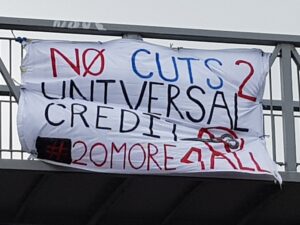
A photo of a white banner hanging from a bridge saying "No Cuts 2 Universal Credit #20More4All"

Fight for £20 more for claimants on legacy benefits

The government has extended the £20 uplift to Universal Credit for another six months but we know how callous and cruel it is not to apply it to legacy benefits, as explained in this short animation from Sheffield DPAC:

http://twitter.com/i/status/1364895702904692741


You can read DPAC’s report #20More4All – Why the £20 per week uplift to Universal Credit must be applied to legacy benefits: testimonies, stats & facts here: https://dpac.uk.net/2021/03/20more4all-testimonies-stats-facts/


Why it’s important to take action

The government increased Universal Credit by £20 per week at the start of the pandemic, when nearly two million more claimants came onto the benefit, exposing the social security system to greater scrutiny.

Many claimants never got the £20 uplift in the first place. It was only applied to Universal Credit so those still on legacy benefits and not yet moved over to Universal Credit were missed out. Many of these are disabled and their living costs have been significantly higher as a result of the pandemic and needing to shield.

Out of work benefits in the UK are well below the amount needed for a decent standard of living. All benefits need to be significantly increased, not cut.

We need people to be properly supported in these difficult times. The benefits system needs a complete overhaul. The Universal Credit system doesn’t work – it has been proven be toxic and massively harmful.

As well as fighting for a permanent uplift – we must fight for it to be scrapped and replaced with a social security system that provides a genuine safety net for all that need it.

The free school meals saga shows that when people fight back the Tories can be pushed into U-turns.

We understand that many people are still unable to leave their homes and we are NOT asking anyone to put their lives at risk or to break social distancing guidelines.

We are asking people to do just whatever you can to build support for this issue and to let claimants know there is a fightback they can get involved with.


Ideas for what you can do to support the campaign

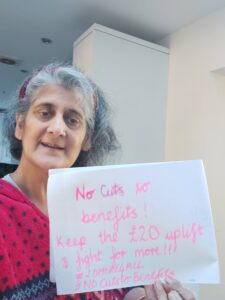
  • Take and share selfies hashtags #20More4All
  • Put up and share posters in support of the campaign. You can:

                            – make your own

                            – download a copy here: https://dpac.uk.net/wp-content/uploads/2021/02/20More4All.pdf


Mar 122021
 
DPAC Logo with text underneath "Disabled People Against Cuts" and then web address dpac.uk.net

We are issuing this statement both to reassure our members and supporters that DPAC is actively responding to this situation, and to provide some clarifications following the statement issued by Novara media yesterday.


1)    We would like it noted that it was DPAC who initially reached out to Novara following the Peter Singer interview and justifiable outrage which it provoked. Our intention was to educate Novara about disabled people’s oppression and to find a resolution agreeable to disabled people which could lead to a marked improvement in their coverage.  We received a positive response from some members of the Novara team.

2)     We have asked for a meeting with Novara in order for our members, especially those with learning difficulties, to express their dismay, hurt, and political objections to how the interview was conducted. We are pleased that this request has been accepted and await confirmation of the date we have suggested.

3)    We are disappointed that prior to this incident Novara had consistently failed to take up advice from individual DPAC members concerning the importance of acquaintance with the social model of disability and the particular form of oppression that disabled people face. This led to a situation where Singer was given a platform to express views that encourage division and hate without challenge, and at a time of rising hostility towards disabled people and the explicit devaluing of disabled people’s lives that has characterised the pandemic – which we are still living through. Either the interviewer lacked even the most basic understanding of why Singer’s views are problematic for disabled people or he chose not to deploy those arguments. We are not in a position to know which. DPAC members are currently drafting a longer statement to explain our objections which we hope to make publicly available next week.


It is important that we challenge the exclusion and marginalisation of disabled people and all the more frustrating when we have to do this among those who consider themselves to be progressive.


As upsetting as this episode is, we (literally) cannot afford to let this distract us from important activity such as continuing the fight for #20More4All. A millionaire Chancellor has just passed a budget denying disabled people the ability to bathe, do laundry, eat and heat their homes. Please continue to pressure the Tories on social media, raise the issue through relevant radio/TV phone ins and local newspapers, write to your MPs and use banners and posters to draw attention to the issue.

Mar 122021
 
DPAC Logo with text underneath "Disabled People Against Cuts" and then web address dpac.uk.net

Zero Covid Day of Action

London Action

2.30pm, Saturday 13 March
South-east corner of Westminster Bridge (near the old GLC building)
Tory Social Murder: 130,000 Dead
Pay the NHS Workers! Tax the Rich!
Some London activists will be carrying this message to the heart of government at Westminster. If you can, join us at Westminster Bridge, south-east corner, at 2.30pm this coming Saturday. We will fan out from there in small groups to unfold banners, hold up placards, and take photos to feed into the ZC online rally and ZC social-media. Bring home-made banners and cardboard placards. Be creative and imaginative. Help us get the message out.
Other London activists will be organising local protests. Tory Party offices are key targets. Go ahead and organise these through local contacts. Those at risk and shielding or otherwise unable to join street protests, display a placard, tune in to the online rally, and use your social-media feeds to spread the message.
All outdoor protests will be fully masked and socially distanced.
Best wishes,
Neil,

Zero Covid London

Banner artwork, if you can use it:


Website:

https://zerocovid.uk


Social media:

Facebook Twitter Instagram YouTube
 Posted by at 19:32
Mar 052021
 
DPAC Logo with text underneath "Disabled People Against Cuts" and then web address dpac.uk.net

On Monday 1 March disabled campaigners attempted to make a last ditch attempt to persuade the Treasury to extend the £20 Universal Credit uplift to legacy benefits.

Nearly 200 envelopes containing testimonies and concerns about the govenrment’s failure to extend the uplift were turned away from the Treasury alongside a wheelchair donated by the campaign group, Disabled People Against Cuts [DPAC], designed to help him understand the extra unavoidable costs that disabled people and carers have been hit with since March last year.

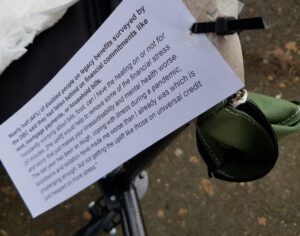
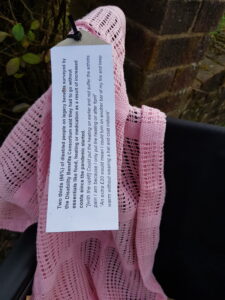
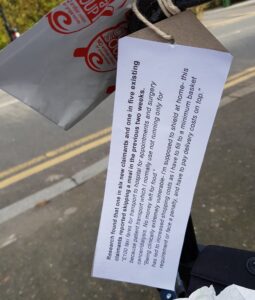
Unable to leave their homes, campaigners organised the deliveries ahead of the Spring budget later this week to communicate the desperate financial situation facing many of the 2.2 million claimants still on legacy benefits. Three quarters of these are disabled people (1). Items attached to each wheelchair referenced essentials that disabled people are having to go without, including a blanket (heating); an incontinence pad (bathing, laundry and medicines); a face mask (PPE); an empty packet of cuppa soup (nutritious food) and an empty purse (enough money to live on).

Similar deliveries were also rejected by 10 Downing Street and the Department for Work and Pensions, although the DWP did accept a letter addressed to Secretary of State for Work and Pensions, Thérèse Coffey, with a copy of a document published today by DPAC collating testimonies from benefit claimants and key findings from recent reports evidencing the need to retain and extend the uplift (2).

Given the disproportionate mortality rates for disabled people from COVID, many have been shielding for close to a full year now (3). This has driven their costs up considerably.

“I’ve only managed one meal a day and fortnightly food deliveries during lockdown because other costs (mostly PPE for my care staff and delivery costs) have gone up so much.”


“£100 taxi fares for transport to hospital for appointments and surgery because patient transport which I normally use not running only for cancer/dialysis. No money left for food.”

“Being clinically extremely vulnerable- I’m supposed to shield at home- this has led to increased shopping costs as I have to fill to a minimum basket requirement or face a penalty, and have to pay delivery costs on top.”

“Having to pay for a plumber when the Housing Association wouldn’t come out to an essential repair (broken toilet).”

“Confusion, frustration and distress… I don’t understand why only those on UC are entitled to [the uplift].”

A survey of disabled people on legacy benefits conducted by the Disability Benefits Consortium found that two thirds (66%) have had to go without essentials like food, heating or medication as a result of increased costs since the pandemic started and nearly half (44%) said they had fallen behind on financial commitments like rent, mortgage payments, or household bills (4).

Additional financial support would make an enormous difference to disabled people’s lives. Our members gave us examples of what it would mean to them if the £20 uplift was applied to legacy benefits.

“I could buy proper incontinence pads instead of sanitary pads which leak.”

“Could put the heating on earlier and not suffer the arthritis pain I am because I only put the heating on after 6pm”

“I could add credit to my phone so I could talk to someone as I haven’t spoken to anyone for months as I am shielding and do not have family.”

“I would be able to bathe more”

“On chemo..need to eat properly”

“it would make washing a permanent feature in our home”

“Help towards some of the extra expenses, deliveries more fuel bills, more everything, when you cannot go out”


“It would help me look after my child and meet the additional costs brought by the pandemic, such as extra heating, food and schooling costs, such as ink and paper.”

“It would mean a little peace of mind, not constantly worrying about bills, food, can I have the heating on or not for 20 minutes, it would help to remove some of the financial stress and worry that just makes your illness/disability and mental health worse. The last year has been so tough, coping with illness during a pandemic, lockdowns and isolation have made me worse than I already was which is challenging enough, but not getting the uplift like those on universal credit just heaped on more stress.”

The testimonies also highlight the poverty that many disabled people were living in even before the pandemic (5):


“We don’t have a washing machine – I’d like to get one but can’t afford one at the moment. £20 extra a week may help me to save quicker to buy one – given that I had a colostomy over Xmas this is now more of a necessity!”


“make a dent in my overdraft, maybe fix the kitchen tap or the broken bathroom light…it may go on our food budget or my annual haircut. …I could use it on so many things”

“I would be able to afford all the toiletries and cleaning products that I need and buy second-hand clothes to replace the ones I have with holes in them.”

The Department for Work and Pensions has said there is no need to apply the uplift to legacy claimants because benefits will be increased by 37p per week in April 2021 and because they have the option of moving over to Universal Credit.

Neither of these options help address the situation.

The 37p increase is designed to reflect higher costs of living due to inflation, not the pandemic. It represents a mere 0.5% increase while state pensions will rise by 2.5%. It isn’t enough even to buy a single protective mask.

As the DWP knows, many disabled people are financially worse off on Universal Credit due to the removal of the Disability Premia which have been the subject of judicial review. They would lose out by a move to UC.

There is also the question of how disabled people without access to the internet or support to navigate the benefit system are supposed to move over to UC with the operations of welfare advice and community support organisations so heavily restricted by the pandemic.

There is widespread support for the extension of the £20 uplift among charities, Parliamentary committees and thinktanks (6). A petition started by the Disability Benefits Consortium now has over 121,000 signatures (7). Another set up through the Parliament Petitions Committee has over 11,000 signatures (8).

A spokesperson for Disabled People Against Cuts said:

“The government often claims to protect what it calls ‘the most vulnerable’ but once again it is precisely those who are ‘most vulnerable’ whose needs are being ignored. This has created a two tier social security system, giving the distinct impression that disabled people’s suffering is of no concern to this government. We’ve heard denials that the pandemic has led to extra costs for disabled people so we thought we’d explain it in a very clear way. The response we got today demonstrates that the government has absolutely no interest in even knowing what the right thing to do for disabled people is.”

The deliveries were organised as part of a day of action called by Disabled People Against Cuts with support from People Before Profit, Homes 4 All, the People’s Assembly, Unite Community and the NEU Disabled Members’ Committee (10).

ENDS

For more information or to speak to someone directly affected by the lack of legacy uplift contact Ellen Clifford on 07505144371 or email: mail@dpac.uk.net

Notes for Editors


  • https://dpac.uk.net/2021/03/20more4all-testimonies-stats-facts/

The document contains hundreds of testimonies from benefit claimants with and without the uplift was included in the deliveries. The document also contains comments from members of the public calling for the uplift to be applied to legacy benefits as well as key findings from a number of recent reports evidencing the need for the government to take action over this issue.

The testimonies are anonymous, such is the fear that disabled people now have of retribution from the Department for Work and Pensions. In 2018, the Work and Pensions Committee found that “a pervasive lack of trust is undermining the entire operation [of the benefits system]”. https://committees.parliament.uk/committee/164/work-and-pensions-committee/news/98092/pip-esa-trust-deficit-fails-claimants-and-the-public-purse/

  • Disabled people are most at risk from coronavirus as proved by the mortality statistics: according to the Office for National Statistics, 59.5% of Covid-related deaths from January until November 2020 were disabled people.

https://www.ons.gov.uk/peoplepopulationandcommunity/birthsdeathsandmarriages/deaths/articles/coronaviruscovid19relateddeathsbydisabilitystatusenglandandwales/24januaryto20november2020

  • A report from the Equality and Human Rights Commission published in 2018 found that disabled people were nearly three times more likely to live in severe material deprivation than non-disabled people.

https://www.equalityhumanrights.com/sites/default/files/is-britain-fairer-accessible.pdf


Nearly half of all people living in poverty in the UK are affected by disability.

UK Poverty 2019/20: Social security | JRF


Even after the uplift, Universal Credit claimants are receiving just 43.4% of the Minimum Income Standard (MIS) – the amount calculated by the Joseph Rowntree Foundation as the minimum required for an acceptable standard of living. Legacy claimants are receiving just 33.9% of the MIS.

5)      https://disabilitybenefitsconsortium.com/campaign-news/

6) Including the Work and Pensions Select Committee, the All Party Parliamentary Group on Poverty and the All Party Parliamentary Group on Health in All Policies.

This position is also supported by Trust for London, the Joseph Rowntree Foundation; Action for Children; The Association of Charitable Organisations; Barnardo’s; Become; Bevan Foundation; Centrepoint; Christians Against Poverty; Church Action on Poverty; Citizens Advice; Child Poverty Action Group; Disability Benefits Consortium (a network of over 100 disability organisations); End Child Poverty Coalition; The Equality Trust; The Fawcett Society; Feeding Britain; Gingerbread; Greater Manchester Poverty Action; Homeless Link; Independent Food Aid Network; Joseph Rowntree Foundation; Lloyds Bank Foundation for England & Wales; Macmillan Cancer Support; The Mighty Creatives; Mind; Motor Neurone Disease Association; The MS Society; National AIDS Trust; National Children’s Bureau; National Education Union; National Housing Federation; Neighbourly; New Horizons; North East Child Poverty Commission; Nourish Scotland; Oxfam GB; The Poverty Alliance; Rethink Mental Illness; The Rt Revd Christopher Foster, Bishop of Portsmouth; The Rt Revd Paul Butler, Bishop of Durham; The Runnymede Trust; The Salvation Army; Save the Children; Scope; Shelter; StepChange; Transforming Lives for Good; The Trussell Trust; Trust for London; Turn2Us; UK Women’s Budget Group; Voluntary Organisations Disability Group; Wales Council for Voluntary Action / Cyngor Gweithredu Gwirfoddol Cymru; Women’s Regional Consortium Northern Ireland’ Z2K

7)      https://you.38degrees.org.uk/petitions/stop-leaving-disabled-people-behind

8)      https://petition.parliament.uk/petitions/572128

9)      https://dpac.uk.net/2021/02/next-20more4all-day-of-action-1-march/


 Posted by at 23:48
Mar 022021
 
DPAC Logo with text underneath "Disabled People Against Cuts" and then web address dpac.uk.net


Photo showing huge closed doors of the Treasury building flanked by classical columns. A lone empty wheelchair sits outside.

With so many disabled people shielding – justifiably in fear for their lives – it is a challenge to make visible the very urgent situations we are facing, marginalised and ignored as disability issues are within wider society.

And there are many, many pressing issues requiring the attentions of those in power. The fact that disabled people accounted for 59.5% of Covid-related deaths lsat year for one. Another, the subject of DPAC’s day of action today (1 March) is the fact that disabled people’s unavoidable expenditure has sharply risen as a direct result of the pandemic and yet the 2.2 million claimants still on legacy benefits – three quarters of who are disabled people – have been denied the £20 peer week uplift given to Universal Credit claimants from March last year.

There is widespread support for application of the uplift to legacy benefits but still the government has continued with its strong of excuses as to why this cannot happen. At first we were told the technicalities of setting up a system to make the extra payments would take too long. That was the start of the pandemic since when those techncialities could have been resolved many times over.

Then we were told that legacy benefits would be going up by 37p per week from April – an amount intended to reflect rising costs through inflation but representing an increase of only 0.5% while the state pension will be increasing by 2.5%.  It is also an amount that comes no where near enough to cover the additional costs of incurred by those who are shielding.

We have also been told that legacy claimants have the option to transfer over to Universal Credit when the DWP knows full well that will severely disadvantage those currently in receipt of the disability premium.

Now the line is that there are a whole package of protection measures that disabled people could/would/may have benefitted from such as mortgage holidays. Now there definitely are disabled people out there with mortgages who are financially struggling but the reality of disabled people’s lives and the oppression we experience means that for many of us owning our own home isn’t something we can even aspire to.

Given that clear mismatch between the reality of disabled people’s lives and the government’s version of how we live, we decided that some communication and education were urgently needed.

Given current limitations we attempted to do that by collating the various letters, testimonies and comments that were sent into us over the last few weeks from disabled people and carers, from those who have received the uplift and know what it means to them and from those who haven’t, as well as from decent members of the public who simply care about the issue. We did two things with these: 1) compiled a document combining lived experience with key findings from recent reports evidencing the need to retain and extend the uplift [available here: #20More4All: testimonies, stats & facts – DPAC  ]2) Printed them all out (anonymously), placed them in individual envelopes in a postage sack and arranged for a courier (paid above London Living Wage) to deliveer them to the Treasury for us.

A pile of letters in white envelopes addressed "To The Chancellor" A brown postal sack


However, we weren’t sure that even 190 letters and testimonies would get the message through.

So we created some very basic education tools in the form of wheelchairs to which we attached items and explanatory tags representing the essentials that disabled people are having to go without due to the financial pressures of the pandemic, including a blanket (heating); an incontinence pad (bathing, laundry and medicines); a face mask (PPE); an empty packet of cuppa soup (nutritious food) and an empty purse (enough money to live on).

Three wheelchairs in a row with a brown postal sack in front of them

An empty purse hanging from the arm of a wheelchair


An incontinence pad lying on the seat of a wheelchairA pink blanket on the arm of a wheelchair


 A face mask hanging from the arm of a wheelchairAn empty Cuppa Soup pack on the arm of a wheelchair


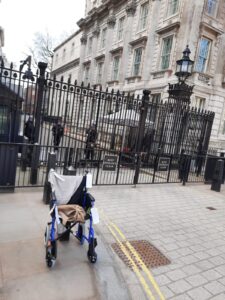
Our lovely courier attempted to deliver these for us to The Rt Hon Boris JOhnson, MP, The Prime Minister; to The Rt Hon Rishi Sunak MP, The Chancellor of the Exchequer; and to The Rt Hon Therese Coffey MP, Secretary of State for Work and Pensions.

Unfortunately neither 10 Downing St, HM Treasury or the Department for Work and Pensions would take receipt of our carefully thought out gifts. So we can only assume their ignorance continues. The Treasury refused even to accept the bag of letters from disabled people. In fairness to the DWP they did take a copy of our document compiling testimonies and statistics which they told the courier they would pass on to Coffey but we aren’t expecting a reply any time soon. The resounding impression of the afternoon is that once again the Tories are leaving disabled people out in the cold and assuming they can get away with it.

An empty wheelchair outside the gates to Downing St

A wheelchair outside the DWP


Mar 012021
 
DPAC Logo with text underneath "Disabled People Against Cuts" and then web address dpac.uk.net


Mar 012021
 
DPAC Logo with text underneath "Disabled People Against Cuts" and then web address dpac.uk.net

To coincide with today’s day of action, DPAC is publishing “#20More4All – Why the £20 per week uplift to Universal Credit must be applied to legacy benefits: testimonies, stats & facts”

The testimonies collated in the document have been collated together from three sources:

  • Responses to an online survey set up DPAC Sheffield and @ImaJSAClaimant. There were 177 respondents. 17% of these are on Universal Credit and have received the uplift. 84% reported they are in receipt of legacy benefits.
  • Responses to a survey carried out by Unite Community. 539 Community members responded. These include disabled people and unemployed workers.
  • Emails sent to Disabled People Against Cuts. These include three from legacy benefit claimants describing their everyday financial struggles and another 25 with copies of letters sent to constituency MPs asking them to support the extension of the uplift.

We have left the comments in people’s own words as we received them.

The research evidence section collates key findings from a number of recent reports that clearly evidence the need not only for the £20 uplift to be extended to legacy benefits and made permanent, but also the urgent for a new social security system that ensures a guaranteed decent income for all.

Linda Burnip, co-founder of DPAC, said: “The survey results show how necessary an uplift to legacy benefits is needed. People especially those in the WRAG who are being forced to live on a measly £74 a week are being left to starve or freeze. Even in austerity struck Tory Britain this is totally unacceptable.”

Andy Mitchell, @ImaJSAClaimant on twitter, said: “For me the comments quite clearly demonstrate how much the extra £20 is needed for the most basic of human needs. In a wealthy country, even after spending 10 years living through and being affected by austerity, it is deeply troubling that disabled people and families with dependent children are missing out on meals and cutting back on heating, As Linda rightly says, it is totally unacceptable – but it is something too many in society have turned a blind eye to for far too long.”

Jen Jones, founder of DPAC Sheffield and herself a claimant of legacy benefits, said:”I cried reading the replies, so many people who feel just like me. Forgotten, unwanted, or a burden, stated that they would wish the extra support for only the most basic necessities. To eat 3 meals a day, to be able to wash themselves and their clothes and to keep warm. We’re not asking for the moon on a stick. Support us to live.”

#20More4All – why the £20 uplift must be extended to legacy benefits – final

Feb 242021
 
DPAC Logo with text underneath "Disabled People Against Cuts" and then web address dpac.uk.net

Hellooo beautiful Poetry Peeps!

The 4th Thursday of the month is nearly upon us, so here’s the flier for the next Survivors’ Poetry Back-in-Lockdown Lounge Party for this Thursday 25 February at 7.30pm – 10pm. The live link is on the flier below, and our facebook page Survivors Poetry Gigs, and here again :
Meeting ID : 816 6827 5722
Passcode : 270157
We have a fantastic lineup for you to enjoy, plus lots of space for Open Mic so take the plunge if you feel to and bring a poem or a song to share, or just come along to watch – the more the merrier and YOU create the magic by your presence! We will celebrate our community, heal each other with our words and music, tell our stories, reach our hands out to each other in virtual space and give each other solace and solidarity and friendship. Bubble up with us!
Our featured Guest Artist on Thursday is rising star of the poetry world based in Northern Ireland, Survivor poet Mike Wilson. This is his biog :
Michael Wilson is a national award-winning published performance poet. His writing is a balance of light and shade. He is a multi national slam finalist and winner of several slams, including Cheltenham Lit UK slam and Belfast Book Festival slam. His show and book were performed during a full run at the Edinburgh Fringe Festival, gaining a five star review from Bouquets and Brickbats. His first full book, Bedlam’s Best and Finest, is an experimental poetic expose of mental illness and health.  Michael has toured the UK and Ireland extensively and last year toured central and east Canada. Michael often performs his poems along with sign language. He has been broadcast on BBC Radio regional and national as well as RTE Radio 1 in the Republic of Ireland. He has been organising events for years and cut his teeth in Manchester. He most recently won the NZ At Your Place slam. He resides in Portstewart, Northern Ireland.
We also have a fantastic array of Special Guests – Wendy Young (Misery With Oomph), Manny (imaginative journey, Be The Change), Jeanette JuPierre (be  prepared to be stunned and shaken), John Adlam (tangled up in blue), and Armorel (brave, raw and heartfelt songs), plus all the superb poets from the floor.  As usual at our events there is a real mix of more established and less experienced poets, all incredibly talented, yes that means YOU!
There will be more tributes to our dear Frank Bangay on Thursday who passed away at home on 25 January, we dedicated the night to him last month. Once Core Arts have got any handwritten poems they can find and his PC from his flat and transferred the poems he had on there to his newly-developed website and we have access to as much of his work as possible, we will have a special tribute night for him on zoom. And of course a night in his honour at the Poetry Cafe once we can get back there… If you would like to share some memories of Frank on Thursday and maybe one of his poems please feel very welcome to do so.
A note – you will have received the Special Bulletin from Survivors’ Poetry last week outlining plans etc for Frank and including obituaries that have been written for him – there was a typo in the link to Colin Hambrook’s piece in Disability Arts Online magazine – here it is again :
Finally, there was much interest in our featured artist last month, Skylar J Wynter, who has just published her first collection of poetry, Pieces of Humanity.  Here again are the links to her social media platforms and links to where you can purchase her book.
WEBSITE
FACEBOOK
INSTAGRAM
LINKEDIN
YOUTUBE
TWITTER
BOOK PURCHASE LINKS
Amazon US
Amazon UK
Amazon AUS
See y’all on Thursday!
Survivors’ Poetry
Feb 202021
 
DPAC Logo with text underneath "Disabled People Against Cuts" and then web address dpac.uk.net


Fight for £20 more for claimants on legacy benefits

The government is set to extend the £20 uplift to Universal Credit for another six months but we know how callous and cruel it is not to apply it to legacy benefits. 

Please do whatever you can to join our day of action on 1st March. 


Ideas for what you can do:

  • Take and share selfies on the day using the hashtags #20More4All


  • Put up and share posters and stickers. You can:

                            – make one,

                            – download a copy here: https://dpac.uk.net/wp-content/uploads/2021/02/20More4All.pdf

                            – or email mail@dpac.uk.net and ask us to post you one or some.


  • We are also looking for disabled people on legacy benefits who haven’t had the £20 uplift and are struggling to manage financially to speak to the media. If you could help us please send an outline of your situation and contact details to mail@dpac.uk.net


  • You can also have your say anonymously – about your experiences and what the uplift means to you but filling in this extremely quick and straightforward survey: https://forms.gle/Y5uB5Mp95oJfzgAg6 [Thanks to Sheffield DPAC and @imaJSAclaimant for producing this].


  • Make your own banners for local banner drops that can be done without breaking social distancing guidelines.


  • For those that can, go out and hold socially distanced protests.


Why it’s important to take action

The government increased Universal Credit by £20 per week at the start of the pandemic, when nearly two million more claimants came onto the benefit, exposing the social security system to greater scrutiny.

Many claimants never got the £20 uplift in the first place. It was only applied to Universal Credit so those still on legacy benefits and not yet moved over to Universal Credit were missed out. Many of these are disabled and their living costs have been significantly higher as a result of the pandemic and needing to shield.

Out of work benefits in the UK are well below the amount needed for a decent standard of living. All benefits need to be significantly increased, not cut.

We need people to be properly supported in these difficult times. The benefits system needs a complete overhaul. The Universal Credit system doesn’t work – it has been proven be toxic and massively harmful.

As well as fighting for a permanent uplift – we must fight for it to be scrapped and replaced with a social security system that provides a genuine safety net for all that need it.

The free school meals saga shows that when people fight back the Tories can be pushed into U-turns.

We understand that many people are still unable to leave their homes and we are NOT asking anyone to put their lives at risk or to break social distancing guidelines.

We are asking people to do just whatever you can to build support for this issue and to let claimants know there is a fightback they can get involved with.

If you are a member of a union branch or a local campaign please ask them to support the day of action on 1sr March.


Feb 202021
 
DPAC Logo with text underneath "Disabled People Against Cuts" and then web address dpac.uk.net

At the Spring budget on March 3rd the government are set to announce a 6 month extension to the £20 uplift to Universal Credit.

This is welcome news.

But yet again the needs of disabled people have been overlooked. The government is making a deliberate calculation that they can get away with this; while they fear a public backlash if they make the £20 cut now, they aren’t worried about a fall out over their treatment of disabled people.

And why would they be when they have got away with the grave and systematic violation of disabled people’s rights over the past decade? But we have also seen over that period how they can be pushed into making concessions when they feel enough pressure over an issue. One example of this was in March 2016 when Chancellor George Osborne was forced to make a u-turn over plans to tighten PIP eligibility for people with access to mobility aids and equipment. At that time, different campaign groups, trade unions, charities and many Parliamentarians were all united in the same demand.

We have the same situation now: whether it’s DPAC’s #20More4All campaign, the Disability Benefit Consortium’s #IncreaseDisabilityBenefits or Unite Community’s #UniveralDiscredit campaign, we are all calling for the same thing.

But we can only succeed if we ALL make an effort and do what we can however small.

We are asking all our supporters to email your MP telling them why it is important to you that the uplift is extended to legacy benefits. You can find a template letter here: https://dpac.uk.net/2021/02/email-your-mp-to-call-for-20-uplift-to-stay-be-applied-to-legacy-benefits/

Please also email a copy to us at: 20More4All@gmail.com that we can send on the both the Prime Minister and the Chancellor of the Exchequer. We want to deliver as many letters and expressions of concern on this issue as possible to before the Spring Budget on 3 March.  

You can also have your say anonymously – about your experiences and what the uplift means to you but filling in this extremely quick and straightforward survey: https://forms.gle/Y5uB5Mp95oJfzgAg6 [Thanks to Sheffield DPAC and @imaJSAclaimant for producing this].

We are also looking for disabled people on legacy benefits who haven’t had the £20 uplift and are struggling to manage financially to speak to the media. If you could help us please send an outline of your situation and contact details to mail@dpac.uk.net

Please have your say. Disabled people’s voices are too often unheard. It’s time for us to show we have voices and to use them.

Feb 072021
 
DPAC Logo with text underneath "Disabled People Against Cuts" and then web address dpac.uk.net

image with the campaign slogan "No cuts to benefits Keep the £20 uplift & fight for more" with the hash tags #2-More4All #NoCutsToBenefits

Saturday 6th February saw a widely supported day of action to demand a £20 per week uplift to legacy benefits and that the government scraps its proposals to cut Universal Credit by £20 per week. See the report back here.

But there is still more to do over the next few weeks before Chancellor Rishi Sunak gives his Spring budget on March 3.

Help us build support for these demands and force the Tories into a u-turn.

What you can do:

– Put a poster in your window. You can download one here or ask for hard copies to be sent to you by emailing mail@dpac.uk.net

– Get on social media and post selfies and videos using the hashtags #20More4All and #NoCutsToBenefits

– Write to your MP about why this issue is important to you. There is a template letter you can download here

– Raise awareness and build support for the demands from your trade union, Unite Community branch or campaign group

– Organise or support on social media, local socially distanced protests or banner drops


For reasons why this is important:

https://twitter.com/imajsaclaimant/status/1357401280751280128?s=20

https://www.youtube.com/watch?v=RYXoV6UvzKU


Feb 072021
 
DPAC Logo with text underneath "Disabled People Against Cuts" and then web address dpac.uk.net

#20More4All #NoCutsToBenefits

Thank you to everyone who joined in the day of action called by DPAC, Homes4All and People Before Profit for 6th February 2021.

People shielding joined in online while socially distanced protests also took place outside job centres up and down the country from Portsmouth to Glasgow, Cambridge to Birmingham, East London to Lancaster and many more. Below are just of the videos and images that were posted up – sorry to everyone’s that we have missed. 

See also write up by @MrTopple in the Canary with more.


Image

https://twitter.com/Cov19Glas/status/1358073569364828165?s=20


Feb 072021
 
DPAC Logo with text underneath "Disabled People Against Cuts" and then web address dpac.uk.net

Dear [insert name of MP]

I am writing to ask you as my MP to call for the £20 Universal Credit uplift to be extended to legacy benefits.

This concerns/personally affects me because… [insert]

More than 2.2million claimants who have not yet been moved on to UC missed out on the £20 uplift when it was introduced in March. This is despite the fact that many of those claimants are disabled with underlying health conditions and their expenditures have significantly increased as a direct result of the pandemic and the need to shield for almost a year now.

UK social security payment levels also represent only a relatively small percentage of the Minimum Income Standard (MIS). This is the amount calculated by the Joseph Rowntree Foundation as what is needed for an acceptable standard of living. After the uplift, UC payments are just 43.4% of the MIS.

For those still on legacy benefits, as they have been throughout the pandemic, the amount they continue to receive in benefits represents just 33.9% of the MIS.

Many of the more than 2.2 million benefit claimants who have not received the uplift are disabled. Disabled people have been badly hit by increased expenditures as a direct result of the pandemic and the need to shield. Many have been self-isolating for nearly a year now. Higher spending has been caused by, for example, the need to purchase PPE for social care support workers coming in and out of their homes, costs of online food deliveries and increased energy costs.

Research carried out by the Disability Benefits Consortium found that:

  • The majority (82%) of disabled people surveyed said they had spent more than they normally would – due to greater food shopping and utility bills, as well as having to pay for taxis to attend essential appointments – since the COVID-19 crisis began.
  • Two thirds (66%) said they had to go without essentials like food, heating or medication as a result of increased costs since the pandemic started.
  • Nearly half (44%) said they had fallen behind on financial commitments like rent, mortgage payments, or household bills.

In response to this research, the government says that benefits will be increased by 37p per week in April 2021 and that claimants still on legacy benefits have the option of moving over to Universal Credit.

Neither of these points provide a suitable remedy to the situation.

The benefit increase is designed to reflect higher costs of living due to inflation, not the pandemic. It is also below the level that is realistically needed to cover inflation, being linked to the CPI and representing a mere 0.5% increase while state pensions will rise by 2.5%.

Many disabled people are financially worse off on Universal Credit which for example removes both Severe and Enhanced Disability Premia and would have more to lose than to gain by moving off legacy benefits.

There is also the question of how disabled people without access to the internet or support to navigate the benefit system are supposed to be able to make the move over to Universal Credit with the operations of welfare advice and community support organisations so heavily restricted by the pandemic.

Keeping and extending the £20 uplift is vitally important to prevent greater poverty, debt and misery and to help those currently out of work to find employment.

I look forward to hearing from you.

Yours sincerely,

[name]

[address]


Jan 312021
 
DPAC Logo with text underneath "Disabled People Against Cuts" and then web address dpac.uk.net


image with the campaign slogan "No cuts to benefits Keep the £20 uplift & fight for more" with the hash tags #2-More4All #NoCutsToBenefits

#20More4All #NoCutsToBenefits 

Say NO to the proposed £20 per week cut to Universal Credit

Fight for £20 more for claimants on legacy benefits

Disabled People Against Cuts, Homes For All Campaign and People Before Profit are calling a National Day of Action to fight plans to scrap the £20 uplift to Universal Credit.

The government increased Universal Credit by £20 per week at the start of the pandemic, when nearly two million more claimants came onto the benefit, exposing the social security system to greater scrutiny.

Now, while the pandemic is still raging, they are planning to take the £20 uplift away. This seems particularly cruel and unnecessary, especially when Johnson found enough money for a £16 in defence funding in November.

Many claimants never got the £20 uplift in the first place. It was only applied to Universal Credit so those still on legacy benefits and not yet moved over to Universal Credit were missed out. Many of these are disabled and their living costs have been significantly higher as a result of the pandemic and needing to shield.

Out of work benefits in the UK are well below the amount needed for a decent standard of living. All benefits need to be significantly increased, not cut.

We need people to be properly supported in these difficult times. The benefits system needs a complete overhaul. The Universal Credit system doesn’t work – it has been proven be toxic and massively harmful.

As well as fighting for a permanent uplift – we must fight for it to be scrapped and replaced with a social security system that provides a genuine safety net for all that need it.

The free school meals saga shows that when people fight back the Tories can be pushed into U-turns.

We understand that many people are still unable to leave their homes and we are NOT asking anyone to put their lives at risk or to break social distancing guidelines.

We are asking people to do just whatever you can to build support for this issue and to let claimants know there is a fightback they can get involved with.

If you are a member of a union branch or a local campaign please ask them to support the day of action on 6th February.

Here are a few ideas for what you can do:

– Take and share selfies on the day using the hashtags #20More4All and #NoCutsToBenefits.

– Put a poster in your window. You can make one, download one at peoplebefore-profit.com/resources or ask us at mail@dpac.uk.net to post you one.

– Write to your MP to tell them why we need the uplift. There is a template letter you can use below – remember to include information about the issue personally affects you as MPs respond better to personal rather than blanket letters.

– Make your own banners for local banner drops that can be done without breaking social distancing guidelines.

–  Use your local media to raise awareness of the issue.


Dear [insert name of MP]

I am writing to ask you as my MP to oppose the proposed cut to Universal Credit by £20 per week. This represents more than one fifth of income that claimants depend on for essentials such as food and heating.

Many claimants who have not yet been moved on to UC missed out on the £20 uplift when it was introduced in March. This is despite the fact that many of those claimants are disabled with underlying health conditions and their expenditures have significantly increased as a direct result of the pandemic and the need to shield for almost a year now.

I ask also that you support the extension of the £20 uplift to legacy benefits.

This personally affects me because… [insert]

Keeping and extending the uplift would have substantial economic and social benefits. These same outcomes will not be realised by the one-off for that has been suggested by the Chancellor as an alternative and to which claimants who have not yet been moved onto UC will be exempt.

UK social security payment levels represent only a relatively small percentage of the Minimum Income Standard (MIS). This is the amount calculated by the Joseph Rowntree Foundation as what is needed for an acceptable standard of living. After the uplift, UC payments are just 43.4% of the MIS.

For those still on legacy benefits, as they have been throughout the pandemic, the amount they continue to receive in benefits represents just 33.9% of the MIS.

One impact of an inadequate income is that it pushes people further from employability: online access, the kind of nutrition able to sustain concentration and the ability to stay clean and presentable for interviews all require a level of income that is not achievable if the £20 per week cut takes place.

Keeping and extending the £20 uplift is vitally important to prevent greater poverty, debt and misery and to help those currently out of work to find employment.

I look forward to hearing from you.

Yours sincerely,

[name]

[address]


Jan 312021
 
DPAC Logo with text underneath "Disabled People Against Cuts" and then web address dpac.uk.net

DPAC are collecting disabled people’s experiences of how the NHS contacted you to book an appointment for the coronavirus vaccine and were your access needs met for booking, time of appointments offered and travel to vaccination centre.

We are hearing some disabled people’s experiences of only contacting the vaccination centre by email; missing phone calls and taken off the vaccination list meaning person has to make alternative arrangements with local pharmacy and offered an appointment miles away from their home with no support in place to attend the appointment.

If you have had the vaccine, how were you contacted?  did you experience experience  any barriers to book an appointment and  what support you needed to book  an appointment, having to change appointment time offered as early morning appointment times are often inaccessible for disabled people to attend due to access needs for example.

Did you feel anxious to travel to your appointment because you’re sheilding worrying about public transport or the expense to travel there? were you offered an appointment at your nearest vaccination centre or one some distance away?

Your experiences are important to us and treated confidentiality. Your experiences will be collated to be given to MPs

Please contact us here mail@dpac.uk.net

Jan 052021
 
DPAC Logo with text underneath "Disabled People Against Cuts" and then web address dpac.uk.net
Copied from: Reviewing the use of do not resuscitate decisions during COVID-19 | Care Quality Commission (cqc.org.uk)

In October, the Department of Health and Social Care (DHSC) asked CQC to review how do not resuscitate orders were used during the COVID-19 pandemic, building on concerns that we reported earlier in the year.

Person-centred, advance care planning enables people to have conversations and make informed decisions about their future care and what matters most to them. Do Not Attempt Cardiopulmonary Resuscitation (DNACPR) orders can be part of this planning and to allow people to make their wishes clearly known ahead of time.

Since the announcement we have been working with people who have experience of this issue to help shape our approach. The valuable insight shared by stakeholders, people who use services, and providers, means we can focus our attention on the things that matter to people.

What will the review look at?

By talking to a wide group of people with experience in this area, we have been able to hear examples of good practice and where decisions or processes do not appear to have been person-centred.

The review will take a national view of how these decisions were made in and across different types of services – including hospitals, GPs and care homes – using all the information available to us. By doing this it will inform national learning and support good practice development as the nation continues to respond to the pandemic.

It will include examples of best practice in this complex area, as well as times when procedures may not have always been followed so that any mistakes are learnt from.

How will the review be carried out?

We are currently analysing what we know so far from initial conversations with people who have been affected by this issue and other stakeholders, concerns raised with us, and the existing literature and guidance on this sensitive topic. Interim findings from this work will be reported later this year.

The interim findings will also provide a base for fieldwork that we will carry out in seven local Clinical Commissioning Groups across the country. This will focus (but not exclusively) on the experience of older people and people with a learning disability or autism. Doing this will allow us to explore how primary, secondary, social care and system partners have worked together in an area – including the impact of commissioning arrangements.

As well as taking into account the information shared with us, these CCGs have been selected to cover a cross-section of areas and a mix of demographics so that the lessons we learn will be of value to people in health and social care across the country, wherever they are working.

To look at a range of ways of working and experiences, the seven areas we will be looking at are:

  • NHS Birmingham and Solihull CCG
  • NHS Bristol and North Somerset CCG
  • NHS Cambridge and Peterborough CCG
  • NHS Morecambe Bay
  • NHS Sheffield
  • NHS South East London CCG with a focus on Greenwich
  • NHS Surrey Heartlands CCG with a focus on East Surrey

We expect to start fieldwork later in November and publish a final report in early 2021. We anticipate this will include recommendations on how people can be properly supported in this area and support good practice that protects people’s human rights.

How you can help

This work is being developed and carried out at pace during November, December and January. We are keen to hear from people who would like to share their experiences.

If you would like to tell us about your experience, or that of a loved one, we would be grateful if you could get in touch. Please let us know using our Give Feedback on Care service, or by contacting our National Customer Service Centre.

Survey on do not resucitate orders during the coronavirus pandemic

We’re using this survey to hear the experiences of people who have had a DNACPR or had one reviewed since the start of the pandemic in March. Share your experience of DNACPR.

Dec 092020
 
DPAC Logo with text underneath "Disabled People Against Cuts" and then web address dpac.uk.net
As part of Disability History Month TWT has teamed up with Disabled People Against Cuts (DPAC) to create this educational (BSL/subtitled) video and workshop to *encourage better awareness around disabled people’s oppression*. This is a perfect introductory resource for anyone wanting to know more about the ‘social model of disability’, the difference between deaf and disabled people, and how disability oppression manifests within our own movement…
*It would be AMAZING if:*
1) You could *share* as widely as possibly across your networks and on twitter: https://twitter.com/TWT_NOW/status/1336676363852517377?s=20
2) If possible, *organise mini workshops* with your local groups so that we can build a more inclusive and conscious movement for socialism…
Solidarity…
 Posted by at 22:21