ellen

Jan 082023
 
DPAC Logo with text underneath "Disabled People Against Cuts" and then web address dpac.uk.net
Graphic tile advertising the conference. It says: "Stand in Solidarity 
With striking workers & the trade union movement 

Join the PA Conference 
Strikes Protest Resistance Conference 

Saturday 14th January 2023 
11am to 4.30 pm 
Friends meeting House 
173-177 Euston Road 
London NW1 2BJ 

#PAConf23 Book:THEPEOPLESASSEMBLY.ORG.UK"
Saturday 14th January 2023
11 am to 4.30 pm
Friends Meeting House
173-177 Euston Road
LONDON
NW1 2BJ
Nearest underground station is Kings Cross accessible from platform to Street Level by Lift
Jan 062023
 
DPAC Logo with text underneath "Disabled People Against Cuts" and then web address dpac.uk.net
Black and white drawn image on a green background surrounded by a yello-orange border. On the left is a person with a pony tail and glasses working at a desk on a laptop. On the right is a group of disabled people with different impairments. Above them is the word "co op"

Hybrid event presenting research about disabled people and co-ops and networking for disabled people involved or interested in co-ops.

By Steve Graby https://disabledcoops.uk

When and where

Date and time: Tue, 21 February 2023, 11:00 – 17:00 GMT

Location: University of Leeds Woodhouse Lane Woodhouse LS2 9JT

This will be a one-day hybrid event (both in-person and online/remote participation possible) at the University of Leeds (assuming UCU strikes do not end up changing the venue!), including:

– presentation of my research report from the project “Work without bosses, homes without landlords, and nothing about us without us: Researching disabled people’s involvement in co-operatives in the UK”

– presentations by co-ops founded by or to meet the needs of disabled people

– discussions about the potential of co-ops of various types (housing, workers, multi-stakeholder) to overcome disabling barriers

– networking space for disabled people and allies who are involved or interested in getting involved in co-ops

– hopefully practical steps towards founding some new co-ops!

Reserve a spot here: Disabled People, Co-operatives and Co-operation Tickets, Tue 21 Feb 2023 at 11:00 | Eventbrite

Jan 062023
 
DPAC Logo with text underneath "Disabled People Against Cuts" and then web address dpac.uk.net

For copies of this information in large print or easy read contact: liberationrights@gmail.com

Liberation is a grass roots organisation led by people with experience of mental distress/trauma. Its aim is to champion implementation of the full human rights set out in the United Nations Convention on the Rights of Persons with Disabilities. We work closely with a wide range of user-led organisations. We also welcome joint action with other organisations that are supportive of the Convention.

Information about Liberation

What Liberation is
A grass-roots organisation led by people with experience of mental distress/trauma.

[This will very often, but not always be people given a mental health diagnosis.]
.

Liberation’s purpose
To speak out for people with experience of mental distress/trauma who are calling for full human rights under the United Nations Convention on the Rights of Persons with Disabilities.

Liberation’s aims
➢ To champion the full implementation of the Convention in UK law, policy, commissioning, structures, services and community settings
➢ To do so in partnership with other user-led organisations and through close work with other groups who support the Convention

Its specific objectives
These include the promotion of:
➢ A human rights approach to mental distress/trauma in place of a dominant medical model
➢ A strong emphasis on equal rights too for people in mental distress who encounter more than one form of discrimination
➢ A focus on independent living in the community and wide-ranging opportunities for community involvement
➢ Equal access to physical health services, an adequate standard of living, leisure opportunities, education, voluntary work and employment
➢ Freedom from discrimination, degrading treatment and abuse                                                                         ➢ An end to substitute decision-making, detention in psychiatric hospitals, forced treatment and community treatment orders
➢ The need for funding to make independent living a reality, with a strong emphasis on user-led, alternative, non-clinical and culturally appropriate options
➢ Awareness-raising about rights set out in the Convention, including the fundamental changes in society and its structures which will be vital, and ways of achieving these
➢ The meaningful involvement of user-led organisations at political, commissioning, structural, service and community levels.

Where Liberation operates
Liberation’s base is in England. We also link with people/groups in the rest of the UK and in other countries.

Membership
Liberation’s membership is drawn from people and organisations that support the UNCRPD.
➢ People in England with lived experience of mental distress/trauma and groups
in England led by them are invited to be direct members of Liberation
➢ People with lived experience and groups led by them in the rest of the UK and
in other countries are invited to join Liberation as allies
➢ Deaf and Disabled People’s organisations, organisations led by unpaid carers
and members of these in any country are invited to join as associate allies
➢ Other people and groups/organisations that support Liberation’s aims are
invited to join as associates.

Membership costs
➢ Membership is free, so that it is available to everyone, regardless of income
➢ Donations are welcome from people who can genuinely afford to make them.
Contact details for Liberation:
• Email address: liberationrights@gmail.com
• Contact phone number: 07565 399 422
• Postal address: PO Box 49677, London N8 8WQ
• Website: https://liberationrights.wordpress.com (pending)

Dec 072022
 
DPAC Logo with text underneath "Disabled People Against Cuts" and then web address dpac.uk.net

To celebrate disability history month and international day of disabled people the following online event has been organised:

Thursday 8 December 2022

4 – 5.30pm

Shadow Minister for Disabled People – Vicky Foxcroft

Mayor of Lewisham – Damien Egan

Speakers:       Tony Urquhart – the social model of disability

                         Ellen Clifford – the War on Disabled People

Microsoft Teams meeting
Join on your computer, mobile app or room device
Meeting ID: 398 046 647 574
Passcode: t6cV38


 Posted by at 17:27
Dec 072022
 
DPAC Logo with text underneath "Disabled People Against Cuts" and then web address dpac.uk.net

Centre for Applied Philosophy, Politics and Ethics

Interventions in Disability Politics

This year CAPPE is hosting a series of online talks on disability politics. All are welcome. The talks will take place every 4-6 weeks on Wednesday evenings 6pm-7.30pm. Please contact us if you have any accessibility requirements: z.sutherland@brighton.ac.uk 

You can join this month’s talk using the Zoom link below:

Zoom: https://us02web.zoom.us/j/89351917921?pwd=U3UwWURSUk5pUnprbXBMdkdFSE1odz09

Meeting ID: 893 5191 7921

Passcode: 157823


Wednesday 14th December:

Ellen Clifford, ‘A Reinvigorated Social Model of Disability’


Disabled people in the UK have been subject to brutal and targeted attacks from the government since 2010, largely concealed from the wider public through a concerted effort of spin, lies and strategic U-turns. In 2016 The UN found the UK government guilty of grave and systematic violations of disabled people’s rights, as a result of their austerity policies and welfare reforms. Disabled people suffered disproportionately during the pandemic and were overlooked in official responses, forcing them to lobby and threaten legal challenges to get their needs recognised, and leaving mutual aid groups, DPO’s and peer support groups to fill the gaps. At least 59% of all Covid-related deaths have been those of disabled people, with mainstream narratives on the pandemic implying that their lives were disposable: it become more acceptable to openly voice opinions on the lesser worth of disabled people’s lives. We are now facing a severe ‘cost-of-living crisis’ and another round of austerity.


Originally conceived as a tool for collective action – rather than a comprehensive theory of oppression – it would seem that the ‘social model of disability’ is more necessary than ever. The social model has been the backbone of the Disabled People’s Movement in Britain for nearly three decades, providing a self-understanding around which disabled people have organised. But a watered-down version of the social model has also come to shape institutional ideas and policies on disability. It was instrumental in informing the development of the UN’s Convention on the rights of disabled people – which promotes a human rights approach consistent with a social model – and is accepted by the UK government, Scottish and Welsh administrations, and various regional and local authorities in England. Even critics of the social model acknowledge that it has played some role in driving forward living standards for disabled people through informing policy, but there are serious questions over what has been lost from the meaning of this term in the process. At the same time, the social model has divided disabled people and been beset by controversy. Not all disabled people identify with the model, with some worrying that it doesn’t speak to the reality of the real effects of certain kinds of impairments.


Barnes and Oliver warned against expending too much energy theorising about something that was designed to be a tool for action. In The War on Disabled People: Capitalism, Welfare and the Making of a Human Catastrophe, I propose – contra Barnes and Oliver – a reinvigoration of the social model of disability. I argue for a return to the original understanding of the social model proposed by Oliver – a counter to the individualised model, underpinned by the medicalisation of disability – and for the development of an accompanying ‘social model of impairment’.

 Posted by at 00:25
Dec 022022
 
DPAC Logo with text underneath "Disabled People Against Cuts" and then web address dpac.uk.net

Date: Thursday 15th December

Photo of Roger holding a microphone

Funeral service

From 12.30pm

Lambeth Crematorium, 29 Blackshaw Road, SW17 0DH

BSL interpretation will be provided.

The funeral will also be livestreamed via the DPAC twitter account.

Dress: please wear whatever you feel comfortable in but campaign t-shirts are actively encouraged!

All welcome but please note there is limited space within the room where the service will be held with priority given to family.


Roger’s wake

From 2.30pm onwards

Tate Library, Streatham High Road, SW16 1PN

Refreshments and BSL interpretation provided.

All welcome to come and share your memories of Roger. Please do bring your campaign banners to decorate the room.


No flowers please. The family have instead requested donations to either DPAC, Stand Up to Racism or the SWP.


 Posted by at 15:58
Dec 022022
 
DPAC Logo with text underneath "Disabled People Against Cuts" and then web address dpac.uk.net

9.00 am Wednesday 7th December

Royal Courts of Justice, Strand, London WC2A 2LL

A large group of people holding campaign banners standing outside the Royal Courts of Justice

 This is an important day for the claimants for whom this case has been hanging over for a long time. The ramifications of a positive outcome could be hugely beneficial, not just for them, but for the millions of people claiming legacy benefits.  

 We want to make our presence felt and our voices heard. Like last time, the Disability Benefits Consortium and DPAC will be holding a vigil outside the Royal Courts of Justice in the Strand in London from 9am onwards on the 7th December. Please come and join us if you can to help us lend as much support as possible to this case.  

 If you are unable to join us, there are still other ways to show your support. Below are suggested tweets you could use on social media on the day, but feel free to create your own.

Suggested tweets:

1/2 Last year the High Court accepted that DWP discriminated against disabled people on legacy benefits like #ESA, when they refused to extend the £20 a week Universal Credit pandemic uplift to them. But the Court decided the discrimination was justified.


2/2 Today, we’re here at the Court of Appeal to say that it was not. The Government must pay what’s owed to those who were shut out of pandemic support  #IncreaseLegacyBenefits.


This would be a huge help for over 2 million disabled people, while the UK Government is stalling on delivering financial support.


#20MoreForAll


OR


1/2 – Over 2 million people on legacy benefits were shut out by the @DWP during the pandemic.


We’re now at the Court of Appeal calling for people on legacy benefits like #ESA to receive a backdated payment of the same amount given to those on Universal Credit.


#20MoreForAll

2/2 – In the depths of a  #CostOfLivingCrisis that is hitting disabled people the hardest, it is even more important for Government to #IncreaseLegacyBenefits and stop the discrimination.

 Posted by at 15:37
Nov 292022
 
DPAC Logo with text underneath "Disabled People Against Cuts" and then web address dpac.uk.net

Last week the world lost Roger Lewis – a committed disabled campaigner, an amazingly kind, genuine and decent human being and member of the national DPAC Steering Group.

Below is a brief outline of his life followed by tributes from family, friends and comrades. Please add your own tributes and memories in the comments section which will be passed on to his family.

Details of the funeral will be posted on the DPAC website once available.

Photo above by Pete Riches showing Roger speaking to assembled activists and passing members of the public outside the Royal Courts of Justice at a vigil held in support of the legal challenge taken against the Work Capability Assessment initiated by Mental Health Resistance Network.


Roger was born on the 1st of June 1962 near Ipswich in Suffolk. Son of Elaine and Martin Lewis, teachers, humanists and Socialists. He leaves a sister Jenny and a brother Tim.

Roger went to a rural Secondary Modern school where his mother was the headmistress but never really engaged in school and didn’t do well academically. One school report said “Roger is an enigma”!

The family all sailed on the River Orwell living right by the river and Martin was a key sailor. Tim stayed keen for the rest of his life whereas Jenny and Roger didn’t take it seriously and mucked around in races, always coming last!

The whole family were really into music. Roger started listening, mainly to the Beatles in his early teens and then got really into so many bands. At the age of 14 he sent his top 100 albums to pirate station radio Caroline. They played a track from every one in an extended 4 hour slot! Roger was so thrilled – we all were! The sublings used to go to gigs together in Ipswich and at Essex University: Ian Dury, The Stranglers, Stiff Little Fingers, The Undertones, Elvis Costello – all three of them were so excited when punk exploded on the scene.

Weirdly Roger developed a passion for Speedway! He used to cycle 10 miles on his bike at night to the other side of the river to go to the weekly speedway stadium. Whilst living in London in the eighties he became a keen cyclist and used to do extended cycling tours all over the country. Even after he became blind Roger got to cycle again with the Brixton-based charity Wheels for Well-being and feel the wind on his face.

Roger began to be interested in politics during his late teenage years. Growing up in rural Suffolk he joined the Hunt Saboteurs but came to realise his motivation was more to do with hating the rich elite than caring for foxes!

He gradually became a lover of learning from his own passions, reading voraciously and taking part in heated arguments with his peers!

Roger moved to South East London in the early eighties, sleeping on floors and living in squats with his sister at first. South London, particularly Brixton became his home for the rest of his life. He started to work for Lambeth Council as a support worker for disabled adults and joined the Socialist Workers Party.

Roger dealt with severe bouts of arthritis from his early twenties. Then, in his early thirties he started the slow process of becoming blind due to retinitis pigmentosa. He never complained or raged about either of these issues that affected his life so massively. He just got on with it, always positive, always cheerful, guided by his politics and understanding of the social model of disability.

He did hit a very low point when he became completely blind and his employer, Lambeth Council, tried to get rid of him. But in true Roger style he fought them and won and remained in their employment until his death, running community groups for visually impaired and Deaf residents. He also went on to represent many other Deaf and Disabled workers facing discrimination in his trade union capacity.

In 2011 Roger was elected to the National Steering Group of Disabled People Against Cuts (DPAC), playing a leading role in numerous direct actions and protests. He could always be counted on for a rallying speech at meetings and conferences. Behind the scenes his wisdom and level head were invaluable assets and uncomplainingly he frequently put himself forward for tasks no one else wanted.

Developments in Visual Impairment equipment – always enthusiastically embraced by Roger – opened up greater access to him especially over recent years with increasing availability of Smartphone technology and audio books. The latter allowed him to pursue his interest in astronomy and art history among other topics.

His life was also enhanced when he secured Access to Work funding to pay for a support worker to assist him at work where he faced barriers due to his sight loss. His support worker, Sharon, not only made work easier but became one of his closest friends.

After investigations for a possible heart attack in the middle of November he was found to have advanced stomach cancer that was spreading rapidly. He was lucid and cheerful to the end talking for England with his two closest friends and his brother and sister, Tim and Jenny and continually thanking the brilliant NHS staff for their exemplary care.

Roger spent his life working tirelessly for others, fighting passionately against injustice and oppression. His knowledge, humility and kindness knew no bounds.


Tributes from friends, family and comrades

Barry McDonald (co-founder of Bromley X by X and DPAC member): “Roger was a very kind person and would try and help anyone who needed it. It is a great loss to DPAC but he would be the first to say we shouldn’t stop and now we must carry on campaigning in his memory.”

Bob Ellard (another fellow member of the DPAC steering group): “I liked Roger a lot, such a lovely guy, with warmth and a cracking sense of humour, we shared a taste for awful, corny, jokes. I also had the privilege of his quiet wisdom in our discussions within the DPAC Steering Group, he had the ability to disagree gently but persuasively against a prevailing consensus, and his thoughts on an issue were always valuable. He was a steadfast colleague, friend and champion of the rights and wellbeing of our disabled community. I will miss him, but will remember him with warmth. Rest In Peace my friend.”

Denise McKenna (co-founder of Mental Health Resistance Network): “When, in 2010, the government introduced welfare reforms to restrict access to benefits for disabled people, the hitherto insular mental health survivor movement united with other disabled people to resist this. Roger welcomed us with open arms, he included our voices everywhere, fully integrating us into the wider disability movement. It went way beyond his political activism. He was eager to understand our experiences at every level and made it his business to open doors for us. As we campaigned together, he offered me kindness and real friendship which gave me strength I never knew was possible. I will remember of Roger that he gave to others, unconditionally, his positivity and hope, his wisdom, intelligence and thoughtfulness, all of these things he shared freely, asking nothing in return. He was more than a political activist; he was a man who was profoundly in touch with his humanity and with that of others. I think of Roger as someone who gave and then gave again.”

Ellen Morrison (DPAC member and disabled representative on the National Executive Council of the Labour party): “I was lucky to meet Roger when I was still new to the Disabled People’s Movement. He was the kind of person any young activist would hope to meet – welcoming, supportive and patient with me as I learned about the social model of disability and the history of our Movement. You could learn so much from him, not just about politics and theory and the policies we desperately need in the here and now, but he demonstrated kindness and decency in everything he did too. I never imagined there wouldn’t be one more trip to the pub after a day out campaigning. He fought hard for a better world but he did it with an infectious sense of joy and fun. Roger have us a lifetime of speeches and memories to treasure. Gone too soon but what an immense contribution it was.”

Geraldine O’Halloran (Deaf activist): “I got to know Roger when I started working at Inclusion London around 2011 and when the office moved to Brixton we worked together on some projects.  One of many examples was a piece of work to set up a series of consultation events for the local Deaf community.  It was decided the first group would be for Deaf women to give them the space they needed to talk and share and later a mixed groups. Two important thing came out of these events: the clear respect Roger had for the Deaf community, their issues, opinions and experiences; and the local Deaf community took to Roger and respected him for the work he was trying to do and his commitment to improving services for local Deaf people.  When he was asked to set up a local Deaf women’s group they wanted him to facilitate the group and which he did with great respect and care.  I give these examples because they demonstrate who Roger was – someone who, in this case, took time and care to understand the issues and experiences of the Deaf community and for Deaf/blind people too. He was one of the best communicators in the disabled peoples movement – from a personal perspective – he would use all sorts of communication skills to ensure you felt involved.  If there was no interpreter around he would do his very best to finger spell, use lip reading and ensure he was facing you etc.  He made you feel involved and important and that your views and opinions were valuable.   I valued his friendship, he really is going to be missed.”

Jenny Lewis (sister): “He was an incredible, inspirational man who cared more about others than himself. We have lost one of the truly good people in this world. He will be badly missed but so very very fondly remembered by the many many people whose lives he touched.”

John McDonnell (former shadow Chancellor of the Exchequer and long time supporter of DPAC): “This is such sad news. Roger was a tremendous and courageous campaigner for Disabled people. With his wonderful speeches  and by his example he inspired us all to fight for the rights of Disabled people. Roger always led from the front with determination and compassion. It was a privilege to count him as a friend and comrade. He will be so greatly missed.”

Justine Jones (co-chair of Inclusion London and co-founder for Bromley Experts by Experience): “Roger was an amazing person – in an effortless way because that’s just who he was – who will always have a special place in my heart. He was such a lovely person, who always made me feel heard and what I had to say valued. We had many chats about our shared experience of living with chronic Rheumatoid Arthritis, we compared notes about how hard it was living in constant pain, compared different treatment combinations, what didn’t work and what to try, that gave some hope of finding a treatment that would help reduce his severe flare ups. This was the only time I ever heard him really talk about his health. Despite his pain he focused on supporting others. What I admired most about him was that he was a proactive and fearless campaigner, and he will always be remembered with respect within the disability community. He will be greatly missed but never forgotten. He always had such wise words. Without him when faced with difficult questions, we will have to learn to say ourselves, ‘what would Roger say?’”

Marsh De Cordova (MP for Battersea and former shadow Minister for Disabled People): “Roger was quite something. When I worked at South East London visual Impairment Service, he would support all our events and signpost lots of blind and partially sighted people to us. He has such a legacy.”

Martha Foulds (fellow white cane user, trans rights campaigner and member of DPAC steering group)): “I never had the chance to talk with Roger directly, but I heard him speak several times – most recently as we celebrated Deaf and Disabled People’s resistance on International Day of Disabled People 2021. He spoke about the importance of solidarity amongst Disabled people and his words must never be forgotten. Every time I heard Roger speak, he furthered my politicisation as a young Disabled person and I will be forever grateful. I am only sorry I never got to tell him.”

Matthew Farrand (member of Manchester DPAC and comrade): “I first became friends with Roger in 2011 during the anti-conservative rally in Manchester. He was a wonderful talker and spoke passionately about the issues he deeply and genuinely cared about. Many fond memories of Roger have stayed in my mind, and as a great man, who will be sorely missed. This is a link to Roger speaking in Manchester:

Nicky Evans (co-founder of the National Union of British Sign Language Interpreters): “Roger was introduced to me as the person to speak to about establishing a union for BSL interpreters. He was a font of knowledge around unions and organising. He gave me so much support and encouragement and very quickly became a trusted friend; someone I could always rely on for help or advice. No matter how busy he was he would always find time for anyone who needed help. He was the definition of solidarity. He always said that helping establish NUBSLI (National Union of British Sign Language Interpreters) was one of his proudest achievements. I feel privileged to have known him and even more so to have been able to call him a friend. He will be sadly missed. Rest in power.”

Nicola Field (comrade, disabled and LGBT+ activist and author of ‘Over the Rainbow: Money, Class and Homophobia’): “Roger was a revolutionary socialist in every fibre of his heart and mind and body.  He was patient, kind, related to the best in everybody, forensic in his analysis, and somehow, so stoic, seemed able to contain everything.  He walked with me through every loathsome step of my PIP mandatory reconsideration until we won brilliantly and celebrated.  The Tories attacked him and all blind and visually impaired people with their Covid street reorganisation (WTF was that about?), driving back independent living alongside their vile cuts and divisive rhetoric.  Roger surged back.  How can we go on without him?  We have to keep doing what we do, and what he would do.  Fight, discuss, fight.”

Pat Carmody (comrade who buddied Roger for the occupation of Caxton House organised by DPAC and UK Uncut in 2012 which made prime time television news): “I was incredibly upset to learn that the stalwart Roger Lewis has left us. I first came across Roger around a dozen years ago. And just after five minutes of chatting to him I thought, where has this comrade been all my life? There is a phrase that is probably over-used in the Socialist tradition: ‘to patiently explain’. I can’t think of any other comrade better at patiently explaining a difficult concept or the immediate tasks in front of us. He had a huge wealth of knowledge that got put to use in the struggle – whether it was as a trade union militant, strategizing for the next DPAC action or his astute analysis as first and foremost a well-read and sharp revolutionary Socialist. Beautiful comrade who influenced, developed and supported so many, you are leaving a massive hole.”

Paula Peters (fellow member of the DPAC steering group): “I will remember the big roars, the little roars, and sharing his day to day experiences of visual impairment, his sense of fun and wicked sense of humour, and his sharp political perspective. We weren’t just activists, we were solidarity family and we were friends. He taught us so much, made me laugh, made me smile and gave so much to the movement of which he was such a big part.  We are all better for knowing Rog, campaigning with him and spending time over a drink and many a laugh.”

Ron Punton (comrade, disabled activist with DPAC and Disabled Action Network): “I cannot believe we have lost him so suddenly. A top comrade in DPAC and SWP, I stood, shouted and marched beside him on many marches. A friend and hero – I am lost for words – RIP Roger Lewis legend.”

Saliha Rashid (friend): “I don’t have the words, but let me try to articulate what this special individual meant to me. To the best friend I have ever had. I don’t have any photographs, or video footage of events we attended, but I have memories. Memories of endless conversation—conversation that just flows for hours on end. Memories of going from talking about something profoundly serious, to something utterly ridiculous, in a split second. Memories of having someone to turn to about anything and everything. Memories, which will be stored in the photo album of my mind, forever. As well as this, I attended meetings/talks you gave, which provided me with many opportunities to soak up as much of your knowledge and wisdom as I could. How lucky am I? This isn’t goodbye, Roger. Continue to guide not just me, but all of us, so that we may continue your legacy. For everything I am, thank you.”

Tracey Lazard (CEO of Inclusion London): “We are very sad to hear about the passing of Roger. He was a dedicated disability rights activist, a key member of DPAC and Socialist who lived by the principles of solidarity and community. He was also a really kind and lovely bloke always willing to do what he could to support and contribute to our movement. He will be greatly missed”

On the morning of 23 November, the PCS trade union Department for Work and Pensions Group Executive Committee held at a minute’s silence for Roger at their meeting. Group President, Martin Cavanagh, said: “Roger was a staunch defender of our members. He was not only an advocate of Disabled people but also a very loud and vocal supporter of our members and we thank him for his work.”


 Posted by at 00:06
Jul 152022
 
DPAC Logo with text underneath "Disabled People Against Cuts" and then web address dpac.uk.net

Disabled People Against Cuts is releasing a statement on this complex case to provide clarity on our position. 

In short we are both pro-choice and anti-discrimination, and we do not believe that removing rights from one group of people is the solution to achieving equality for another.

We salute Heidi Crowter as a disabled young woman motivated to take action against disability discrimination and at the same time do not agree with the legal action taken by herself, Maire Lea-Wilson and on behalf of
Maire Lea-Wilson’s son as the way to address the particular discrimination their case is ostensibly seeking to challenge.

We respect the work of Simone Aspis in trying to influence the #DownrightDiscrimination campaign around the legal challenge to be more inclusive of disabled people and to make links with campaigners
with Down’s Syndrome in order to introduce them to the social model of disability. Sadly, disabled people led campaigns and Deaf and Disabled People’s Organisations were too over-stretched to properly support their
efforts and build a big enough intervention to counter the pro-life agenda behind the campaign.

We do believe that the difference in time limits for pregnancy termination constitutes discrimination and encourages the view that the lives of disabled people are worth less than other people’s.  This is the result
of Changes to the Abortion Act 1967 introduced in Parliament through the Human Fertilisation and Embryology Act 1990. The time limits were lowered from 28 to 24 weeks for most cases while removing restrictions for late terminations in a cases including fetal abnormality.

 
We agree with the UN Disability Committee 2017 Concluding Observations recommendation: “that the State party amend its abortion law… Women ’ s rights to reproductive and sexual autonomy should be respected without legalizing selective abortion on the ground of fetal deficiency.” How to implement this in practice is not a simple task.

Under current legislation, late terminations of pregnancy for fetal abnormality may only be considered if there is a substantial risk that the child, if born, would “suffer physical or mental abnormalities that
would result in serious handicap.” Whether a risk will be regarded as substantial varies with the seriousness and consequences of the likely disability. Guidance on judging the seriousness of the disability drawn up in 1996 advises that medical professionals should weigh up factors including the probability of being able to live
alone and to be self-supportive as an adult and the likely level of dependency on others to stay healthy as well as the degree of suffering, self-awareness, ability to communicate with others and possibility for
treatment. 

The inclusion in this guidance of measures of dependence on others goes against disabled people’s independent living philosophy and against social model and human rights approaches to disability. According to these, disabled people have a right to support that enables us to have equal life chances with others; we should not be treated any differently because of needing support. 

Health economists have produced cost/benefit evaluations of different prenatal genetic screening technologies calculating savings to the economy through better detection of impairments resulting in more
disabled people aborted before birth. Such work is underpinned by a view of disabled people that is framed entirely in terms of deficit. The promotion of prenatal screening then encourages public perceptions of
disabled people as a burden on society. We know of disabled people who have been told by strangers that they should have been aborted before birth.
 
Whilst we are in favour of challenging disablism we are not in favour of any further restrictions to women’s hard won abortion rights. Removing rights to late terminations currently legislated for would represent a
regressive for women’s rights and is not something we support.

 
Whilst we might support the extension of abortion rights by removing any time limits and thus removing any differential treatment on the grounds of disability, this is not what the Crowter challenge seeks to do. 

The Crowter legal action challenges the current law in terms of the rights of an unborn disabled child and questions late terminations of a fetus “at a time when it is both viable and sentient”. If a judge was to find in favour of these grounds and to uphold the rights of an unborn child over those of a mother’s right to choose, this would have dangerous implications for abortion rights over all and open the way for attempts to introduce further time limitations covering abortion on any grounds. Women’s hard won right to choose is constantly under threat and must be defended.

We do not agree with arguments that pose the rights of one group against those of another. Divisions between different groups only help those who benefit from the exploitation and disadvantage of others. We welcome any disabled campaigners and allies who want to get more involved in the fight against all forms of oppression and towards a society that is fairer for all.

The case raises difficult issues that are highly emotionally charged, interweaving the oppressions of women and disabled people. If we ignore them, it makes it easier for those with agendas that aren’t in our interests to take control of the issues. With the correct analysis – one that understands the structural nature of oppression and seeks to unite all those experiencing different forms of oppression in fighting for social change – we can look at these questions without falling into division and fragmentation of our collective strength.

Jun 152022
 
DPAC Logo with text underneath "Disabled People Against Cuts" and then web address dpac.uk.net
DPAC were contacted by an individual who was having difficulties renewing his Access to Work. He had been told that their backlog meant his AtW package would not be renewed before it ran out and that in the meantime he would have to pay for his own support.
He successfully challenged this and suggested we share what he did in order to help others in similar situations for which we are grateful.
He says:
“The internal complaint being raised has resulted in my being contacted by a renewal case manager yesterday who will complete my renewal review on ahead of schedule.
 
The three important steps in my case were as follows –
 
(i) Phone call to AtW speak to staff and confirm that they advise the internal complaint route if your circumstances warrant it and show that expected delay(s) would aggravate conditions / cause detriment.  Its important to do this so you can tell the AtW staff member that you complained as a result of advice from their colleagues – this carries more weight. 
 
(ii) Submit a letter of complaint to atw.complaintsresolutionteam@dwp.gov.uk The key elements are to keep it short (1 page)  but set out the detriments linked to delay if there are any.
(iii) Phone call to AtW a couple of working days after the letter has been submitted in order to confirm they have it , then explain to the AtW staff member why you need the case escalated in this manner. This call with prompt the AtW member of staff to complete an online note of their system, creating the complaints process timetable and generating an auto-reply within 24 hours explaining the process.
 
It was within 24 hours of the last phone call I made to AtW that i was contacted by a renewal case manager to start the renewal process.”
Mar 222022
 
DPAC Logo with text underneath "Disabled People Against Cuts" and then web address dpac.uk.net

PRESS RELEASE

Responses to the pandemic have left Deaf and Disabled people feeling that their lives are seen as expendable.  That’s just one of the findings from a new report launched today by English Deaf and Disabled People’s Organisations (DDPOs). The report summarises the situation facing Deaf and Disabled people  – nearly five years on since the United Nations told the UK government that their cuts had caused a “human catastrophe”. It is essential that the forthcoming UK Covid-19 Inquiry adequately assesses the full impact on Deaf and Disabled people based on an up-to-date understanding of who Deaf and Disabled people are and the range of valuable roles we play in society.

The research team who produced the report heard from hundreds of individuals and organisations with their views about the priority issues for the Committee to consider. Unsurprisingly, COVID-19 was one of the most common issues raised.

What united many of the respondents to the call for evidence from lead organisation Inclusion London, was a feeling that society views the lives of Deaf and Disabled people as worth less than those of non-Disabled people and are happy to sacrifice them for the sake of the economy.

“Being a disabled person feels dangerous on a daily basis. I feel expendable.”

“We are considered by the government to be expendable. Second class citizens. Our lives are expensive to support, so maybe we are collateral damage. If more of us die, it will eliminate that drain on the public purse.”

“Collateral damage and are an afterthought, if at all”

“We are regarded as expendable by the UK Government in relation to Covid, we are always third or fourth thought at best.  We are regarded as a financial burden so if we die from Covid it saves the government money.”

Specific issues raised include unlawful use of Do Not Resuscitate orders on Disabled people’s medical notes, the with-holding of life-saving treatment, discharge of COVID patients into care homes at the start of pandemic, lack of access to PPE and legal easements on local authority obligations towards Disabled children and adults.

Respondents also pointed to how the UK Government declined to provide BSL interpretation for televised public briefings by the Prime Minister until forced to do so by the High Court. The legal judgment was handed down with only one public briefing to go, whilst Scottish and Welsh governments provided BSL for their public briefings from the start of the pandemic.

COVID-related deaths for Disabled people are disproportionate – a minimum of 60% of COVID-related deaths between 2 March – 14 July 2020 were of Disabled people. Media reports and public debate have emphasised the role of underlying health conditions within mortality statistics. Official analysis shows that even after accounting for age, health and poverty related factors, Disabled people died disproportionately.

Svetlana Kotova, Director of Campaigns and Justice at Inclusion London, said:

“There has been a marked absence of public and political debate concerning the disproportionate deaths of Deaf and Disabled people which have been written off as linked to underlying health conditions. The pervasive attitude is that our deaths don’t count the same as those of non-Disabled people – that the deaths of so-called fit and healthy people are the real tragedy. The role of out-right disability discrimination in our loss of life has been ignored. It’s seen as common-sense that our lives should be de-prioritised and given less value than others. Our research shows discrimination persists in many areas of our lives and there are no signs that thigs will change in the future. Beyond Covid Disabled people will not benefit from social care reforms and will be hit hard by the cost of living crisis.”

Deaf and Disabled people also suffered disproportionately during lockdowns due to factors such as lack of access to food and medicines, digital exclusion and isolation.  Supported living residents with learning difficulties/who are autistic were left in distress as family visits were cancelled with Government guidance unclear. People detained under the Mental Health Act were exempted from the entitlement to daily exercise that the rest of the population enjoyed with anecdotal reports of increases in self-harm on wards as all activities were cancelled.

Deaf and Disabled people were also over-represented in non-COVID-related deaths. Respondents highlighted lack of access to health treatment for pre-existing and new conditions as a likely factor. Reductions and suspensions to social care support provision have also been linked to excess mortalities.

Kamran Malik, CEO of Disability Rights UK said:

“The findings of this report highlight just how important it is that the independent inquiry into the Government’s handling of the pandemic fully investigates the impact on Deaf and Disabled people. We need to know how our needs were factored into key political decisions including when and how to lockdown, what monitoring went on into the impacts of those decisions and what if any emergency planning was in place pre-pandemic.

“Deaf and Disabled people are continuously marginalised within policy making and our contributions to society are rarely acknowledged. We make up 22% of the UK population and 20% of the working age population and we are over-represented among for example unpaid carers and workers in low paid, insecure jobs. We are also valued as family members, friends and neighbours. We are not some disconnected minority that can be shut away while the rest of society carries on. Lessons can only be learned for the future through an inquiry that is based on an accurate understanding of who Deaf and Disabled people are and what our needs are.”

The report, being launched today at a joint meeting of the All Party Parliamentary Groups on Disability and the United Nations, is the product of six months of research and evidence gathering by a project team based at Inclusion London. It will be submitted to the United Nations Disability Committee to inform their next examination of the UK under the UN Convention on the Rights of Disabled People, originally scheduled to begin its first stage in 2022 but delayed due to the pandemic. The report will be available on the Inclusion London website. 

ENDS

For more information or to speak to Deaf/Disabled people who shared their personal experiences with the research team contact: Ellen Clifford via email to crdp@inclusionlondon.org.uk or 07505144371

Notes for Editor

  • Deaf and Disabled People’s Organisations are organisations fully run and controlled by Deaf and Disabled people ourselves.
  • The project steering group includes representatives from the Disability Rights UK, Disabled People Against Cuts, the DPO Forum, and Reclaiming Our Futures Network as well as the Centre for Applied Human Rights at the University of York and Dr Kate Summers from London School of Economics. Inclusion London is the lead organisation.
  • Population figures taken from:

https://www.gov.uk/government/statistics/family-resources-survey-financial-year-2019-to-2020/family-resources-survey-financial-year-2019-to-2020#disability-1

https://www.gov.uk/government/statistics/the-employment-of-disabled-people-2021/the-employment-of-disabled-people-2021#populations

  • The statement that cuts had caused a “human catastrophe” was made by then Chair of the UN Disability Committee, Theresia Degener, in the closing session of the UK government’s public examination under the United Nations Convention of the Rights of Disabled People that took place in August 2017. See: https://www.disabilitynewsservice.com/uk-faces-un-examination-government-cuts-caused-human-catastrophe/
  • The research was informed by 17 consultation events attended by around 200 people, six focus groups targeted at reaching diverse communities, 109 pieces of evidence submitted by individuals and organisations from across England and 351 responses to an accessible survey.
  • Quotes from anonymous survey respondents. Many Deaf and Disabled people live in fear of being called up for reassessment of their benefits and having them stopped in retaliation for speaking out.
  • COVID-related deaths: https://www.ons.gov.uk/peoplepopulationandcommunity/birthsdeathsandmarriages/deaths/articles/coronaviruscovid19relateddeathsbydisabilitystatusenglandandwales/2marchto14july2020
  • There was a 50% rise in deaths among DDP living in the community in receipt of social care support from April 2020 – March 2021. Of the 25,000 deaths, data suggests only 8.7% were COVID-19 related.

 https://www.thebureauinvestigates.com/stories/2021-05-10/revealed-thousands-of-pandemic-deaths-in-home-care


Case studies contributed by Access to Social Care:

July 2020 – No longer able to stay in own home due to impact of family isolation – family carer unsupported and struggling to cope

We were contacted about MB’s son, LB. LB lived in supported living but was unable to cope with a lack of visits as well as staff wearing face masks (due to significant medical trauma and intervention as a child). MB had no option but to bring LB back to the family home as he was so distressed being in his supported living accommodation. MB is now receiving direct payments but is nervous about recruiting employees to care for LB in case he can return home and will not be able to take his carers with him. MB has reported significant sleep deprivation and is experiencing significant mental health

issues as a result.

August 2020 – Proposed restraint if attempting to hug family

We were contacted about AR’s daughter, J, prevented from having visitors because she is living in shared accommodation. There had been no individual risk assessment. Additionally, at the time of referral, due to J’s Downs Syndrome the provider was also denying visits on the basis that J should have been shielding. Told that if visits outdoors were allowed, J would need 2:1 care to restrain her as she would attempt to hug AR and they would not allow this.


August 2020 – Suggestion from care provider that if family continue to pursue visits, they will apply for deputyship and remove family ability to support in normal way. No previous capacity issues.

Family told that if they keep trying to arrange in person visits to support their daughter in supported living, care provider may apply for deputyship or stop involving the family in her care and support. Family felt that they would be punished if they tried to visit.


August 2020 – Uncertainty over rules – provider raising concerns

Visiting and visitors – query from provider. What to do if people are coming and going from their home – people want to visit family – including overnight. What are the rules? Can we access testing?


August 2020 – Provider raising concerns over lack of mental health support available for tenants experiencing extreme distress due to pandemic related isolation

Provider made contact with us directly as they had heard through a solicitor they approached that we were looking at this issue. He supports a cluster of accommodation 16 rooms in total and has been writing to the local MP, central government and newspapers. Some within his service had not seen family during first lockdown. He reported widespread provider confusion about what is possible for providers to facilitate, and additionally insurance concerns. Tenants suffering due to ongoing separation from family are needing additional psychological support and cannot access this.


September 2020 – Local authority refuses additional support required for an individual experiencing isolation-related distress

LA refusal to uplift 1:1 hours for shared core hours. This is needed because one of the tenants is displaying behaviours that challenge and distress due to the pandemic changes. Other tenants now at risk


November 2020 – Uncertainty over how to manage services when tenants are discharged from hospital whilst still testing positive

A provider contacted us to ask how to manage cases where local hospital are trying to discharge tenants who are COVID-19 positive back into their own homes. Hospitals are doing this before getting a negative result. They can’t see anything in the supported living guidance or regulations that helps them, only discharge to care home provision. They do not have access to testing and they are worried the virus will spread.

Mar 222022
 
DPAC Logo with text underneath "Disabled People Against Cuts" and then web address dpac.uk.net

Today Deaf and Disabled People’s Organisations from across the UK came together to launch the next round of civil socety shadow reports under the United Nations Convention on the Rights of Disabled People. We are asking you to sign up in support of the Westminster shadow report.

All reports – covering issues within the remit of Westminster, Northern Ireland, Scotland and Welsh governments – will be sent to the UN Disability Committee to inform their next examination of the UK to monitor implementation of the Convention. This was originally scheduled to start in 2022 but was delayed due to the pandemic.

 The launch of the reports are the culmination of six months of evidence gathering involving consultation events, a call for evidence and survey. Many thanks to everyone who contributed.

The Westminster report addresses a series of themes concerning implementation of the United Nations (UN) Convention on the Rights of Disabled People (CRDP) by Westminster Government. The themes were identified from evidence gathered within the earlier stages of our consultation process and then confirmed and enhanced through further consultation and data gathering.

The themes detailed within the report concern:

  1. Intersectionality: disadvantage and barriers are compounded, for example for Disabled women, Black DDP and DDP from racialised minorities, DDP who are LGBTQ+, asylum seekers, refugees or have No Recourse to Public Funds
  2. Continued retrogression: worse conditions across many aspects of DDP’s lives
  3. Institutionalisation: a specific aspect of retrogression that reinforces, and is underpinned by Theme 6 on our lives being undervalued
  4. Silencing DDP: the further marginalisation of DDP and our voices, in the face of continued retrogression
  5. Disaster Planning and Humanitarian Emergencies: failures to consider DDP in fundamental aspects of public policy development
  6. Lives less worthy: the response to the pandemic, and other policy responses that under value DDP’s lives

Key conclusions drawn from evidence across all themes are that:

  • There has been continued regression since the last public examination of the UK under the CRDP in 2017 
  • Westminster Government has adopted progressive initiatives in discrete areas but has not addressed the fundamental issues affecting DDP’s lives
  • The COVID-19 pandemic response discriminated against DDP and violated our equal right to life
  • Disability equality and human rights approaches towards disability have been further undermined since 2017
  • There is insufficient monitoring and promotion of the CRDP by Westminster Government

You can find the Westminster report here: Shadow report United Nations Convention on the Rights of Disabled People Westminster Government Civil Society Shadow Report – Inclusion London


To sign up in support please go to: UNCRDP Westminster Government civil society shadow report sign up (google.com)


For reports covering issues within the remit of the devolved governments see:

Disability Action (Northern Ireland): www.disabilityaction.org

Disability Wales: www.disabiltywales.org

Inclusion Scotland: www.inclusionscotland.org

Mar 222022
 
DPAC Logo with text underneath "Disabled People Against Cuts" and then web address dpac.uk.net

Joint meeting of All Party Parliamentary Groups on Disability and the United Nations

3 – 4pm, Tuesday 22 March 2022

Speakers from Disability Action (Northern Ireland), Disability Rights UK, Disability Wales and Inclusion Scotland

This meeting will take place remotely.

Meeting Registration link: https://us02web.zoom.us/meeting/register/tZUufumqrT8jG9M83YUvLnFDszo82FTlAO2b

BSL interpretation and speech to text will be provided.


Over the past six months Deaf and Disabled People’s Organisations (DDPOs) have been researching and collating evidence concerning the experiences of Deaf and Disabled people across the UK since 2017. This was the last time that the UK was examined by the UN Disability Committee under the Convention on the Rights of Disabled People UN CRDP.

At this joint meeting of the APPGs on Disability and the UN, DDPOs from each of the four nations will share their findings and their key asks for Parliamentarians.

Reports covering each of the four UK nations will be available on the below websites after the meeting with information about how you/your organisation can sign up in support.

Disability Action (Northern Ireland): www.disabilityaction.org

Disability Wales: www.disabiltywales.org

Inclusion London: www.inclusionlondon.org.uk/uncrdp

Inclusion Scotland: www.inclusionscotland.org

 Posted by at 01:33
Mar 182022
 
DPAC Logo with text underneath "Disabled People Against Cuts" and then web address dpac.uk.net

3 – 4pm, Tuesday 22 March 2022

Speakers from Disability Action (Northern Ireland), Disability Rights UK, Disability Wales and Inclusion Scotland

This meeting will take place remotely.

Meeting Registration link: https://us02web.zoom.us/meeting/register/tZUufumqrT8jG9M83YUvLnFDszo82FTlAO2b

BSL interpretation and speech to text will be provided

Over the past six months Deaf and Disabled People’s Organisations (DDPOs) have been researching and collating evidence concerning the experiences of Deaf and Disabled people across the UK since 2017. This was the last time that the UK was examined by the UN Disability Committee under the Convention on the Rights of Disabled People UN CRDP.

At this joint meeting of the APPGs on Disability and the UN, DDPOs from each of the four nations will share their findings and their key asks for Parliamentarians.

Reports covering each of the four UK nations will be available on the below websites after the meeting with information about how you/your organisation can sign up in support.

Disability Action (Northern Ireland): www.disabilityaction.org

Disability Wales: www.disabiltywales.org

Inclusion London: www.inclusionlondon.org.uk/uncrdp

Inclusion Scotland: www.inclusionscotland.org

 Posted by at 01:26
Nov 092021
 
DPAC Logo with text underneath "Disabled People Against Cuts" and then web address dpac.uk.net

DPAC Sheffield is taking an active part in this collective demand from the people of South Yorkshire for Better Buses for South Yorkshire.


DPAC Sheffield has a strong record of holding public transport providers to account, most notably through our active part in The South Yorkshire Freedom Ride campaign where we contributed significantly to the campaign that successfully restored free transport across the local train network to disabled people with passes.


Our experience as disabled people has exposed the unacceptable deficiencies in the present model of bus service provision and we are going to give an honest assessment of these deficiencies.


Section C of ‘Article 19 of The United Nations Convention of Rights for Persons with Disabilities. Living independently and being included in the community’ states:


“c) Community services and facilities for the general population are available on an equal basis to persons with disabilities and are responsive to their needs.”


Disabled people rely heavily on bus services to access community services and facilities: education, healthcare, visiting family and friends, employment, council services, leisure, shopping for food and clothes, and many other activities and services vital to an independent life.  Many disabled people do not own a car for various reasons, such as the prohibitive costs of owning and running a car, having a condition that means we are unable to drive or have had Motability vehicles confiscated by a cruel and punitive disability payments regime.  Yet our needs and basic human rights as disabled people using buses in South Yorkshire are most often treated as an afterthought by an apparatus working for bus companies seeking to make a profit from our patronage.


Some of the major issues that disabled people face when trying to access bus services in South Yorkshire are as follows:


Poor frequency of services or even a total lack of any bus service.   Bus timetables seem to be formulated for the convenience of bus companies rather than passengers.   This has an especially negative effect on disabled people for whom alternatives such as cycling, walking or driving are impossible.  In this situation many disabled people become reliant on car rides from family and friends, having to work around other people’s lives and needs.   Alternatively, disabled people become reliant on expensive taxi services.   This not only adds to already high volumes of car traffic but also depletes disabled people’s already inadequate means, leading to our cutting back on essentials such as food or heating.   Hence, disabled people living on underserved or non-existent routes are unable to access services and facilities on an equal basis or live independent lives.


Accessibility.  Buses are often very crowded at busy times of day when we need to access community services and facilities, including workplaces.  This is often related to the poor bus frequency mentioned previously.   Very often there is standing room only.   Disabled people who use wheelchairs too often find there is no space for their wheelchairs due to lack of provision.  This may be because the wheelchair space is being used by a parent with a pushchair or buggy.   Passengers should not have to compete for space in this way.   Travelling on a bus should not be a competition or a fight.   The needs and rights of wheelchair users and parents with buggies are equal.   On a related note, many people have ‘hidden’ disabilities which mean they need to sit down to travel.   These conditions include (but not exhaustively so) M.E, where people may not necessarily use a wheelchair but suffer from extreme fatigue and cannot stand on a bus journey, pregnant people, conditions that effect balance and coordination and the needs of autistic people who may struggle to cope with travelling on public transport.   The relationship between many bus drivers and passengers can exacerbate these situations as drivers do not appear educated in the needs of disabled people, especially those of us with hidden disabilities and are often unsympathetic or sometimes  – but very rarely – aggressive towards us.  Again, this lack of accessibility means that disabled people struggle to access services and facilities on an equal basis or live independent lives.


Lack of integrated public transport.    This is an issue that effects all passengers but has a magnified effect on disabled people.   Many routes across South Yorkshire or to neighbouring counties are underserved or not served by buses, meaning disabled people have to switch modes  and often more than once, e.g., switching from bus to train to tram.   Lack of coordinated timetables between competing service providers means that journey times become excessively long and tiring for disabled people, exacerbating health conditions.   The concentration of many services within just a few locales, e.g., specialist healthcare necessary for the effective treatment and management of disabled people’s conditions, means inadequacies in bus services and lack of integrated public transport create another barrier to disabled people trying to access services and facilities on an equal basis or live independent lives.


Cost.   Although many people have disabled people’s bus passes this not always the case.  The cruel and punitive regime of benefits payments in the UK means that disabled people very often do not get the qualifying payments necessary to get a bus pass.  This leaves us struggling or even totally unable to afford what many quite rightly consider exorbitant ticket prices across South Yorkshire from which bus companies profit.   Bus passes can only be used at off-peak times of day.  When disabled people need to access services outside those times we have to pay the full cost of a ticket, try to find a lift or try to access overstretched local council or NHS transport services.  These costs mean we are unable to access services and facilities on an equal basis or live independent lives.


Environmental and health considerations.  Emissions from buses are a major contributor towards air pollution and associated health conditions such as asthma, which disable people for life.  Most buses still run on fossil fuels that contribute significantly to global climate breakdown.   Pathetically poor, privately operated bus services have contributed to an environmentally catastrophic increase in car traffic over recent decades.  The effects of global climate breakdown affect disabled people disproportionately for many reasons as extremes of heat, cold and damp have a negative impact on disabled people’s lives in myriad ways.


That is just a summary of the experience of disabled people using buses across South Yorkshire in usual circumstances.   The effects of the COVID19 pandemic have changed matters considerably for the worse.


Hundreds of thousands of disabled people have been killed during the pandemic.   Approximately two-thirds of the 160,000 people who have so far been killed had a disability.   Despite the fact that COVID19 is an airborne pathogen, in the early days of the pandemic no mandates for social distancing or mask wearing by either drivers or passengers were introduced on buses.   This meant that disabled people who were clinically vulnerable or clinically extremely vulnerable had to face the real and horrifying risk of contracting a potentially lethal virus on their routine bus journeys whilst facing all the barriers and inadequacies previously outlined, and contribute to bus company profits for the privilege.   Although we do not know how many people have contracted COVID19 on public transport, estimates suggest that up to 69 bus drivers in the UK have died during the pandemic due to lack of protective measures and abhorrent working practices from bus companies.   We know that a key part of introducing better buses for South Yorkshire is for bus workers to take charge of their working conditions and lives; DPAC Sheffield give our solidarity to their struggle.


Although the state and local councils very belatedly – and after tens of thousands of disabled people had been killed – introduced some shielding and self-isolation measures for us, these were woefully inadequate.  Our care packages were cut to the bare and extremely inadequate minimum whilst many disabled people struggled, and still struggle to get food and essential supplies delivered to our homes.  This left many disabled people in a position where we had to use buses to get to places such as supermarkets, chemists and food banks, albeit with bus companies having introduced mandates for mask wearing and social distancing by that time.   During lockdown disabled people were left extremely isolated as the general reluctance to use public transport meant carers, friends and family also reduced their visits.


Despite the vaccine rollout proving to be partially effective at reducing COVID transmission, many disabled people are unable to have a vaccine due their specific conditions.   Meanwhile, mandates for mask wearing and social distancing have now been dropped by the state with profiteering bus companies complying.   The government has completely ended shielding support for disabled people.  Disabled people now face having to share buses with passengers who are potentially unvaccinated, unmasked, not social distancing and who may often make disabled people feel uncomfortable for continuing to wear masks and even face shields on their journeys.


Additionally, the state’s consciously cruel cut to Universal Credit means that disabled people have seen our already totally inadequate incomes slashed by £20 a week, whilst private bus companies continue to receive massive subsidies.  This means that using taxis or running a car becomes impossible; using public transport with no mandatory mitigations against COVID transmission is our only alternative.   Disabled people on so-called ‘legacy benefits’  never received any increase in our payments and now not only face the choice between ‘heating or eating’ but the prospect of living or dying; approximately 1000 people a week are dying from COVID with the numbers of dead forecast to increase greatly over the winter.   Furthermore, Long COVID is now disabling thousands of people in the region.  These people will be faced with the barriers and inadequacies faced by disabled bus passengers in South Yorkshire for many months or years to come, perhaps for the rest of their lives.


The human rights of disabled people in South Yorkshire have been breached and ignored egregiously by multiple agencies across the country and the region, including transport bodies and bus companies.


Nothing has to be this way.


DPAC Sheffield demand that bus transportation be taken into a system of public operation run entirely by and for transport workers and passengers free from the quest for profit and shareholder demands.   We demand disabled people are given all decision making powers over the needs and rights of disabled people using buses within South Yorkshire.   We demand that South Yorkshire becomes a global leader and innovator in bus provision for disabled people so that we are provided with a superlative service to be emulated by other parts of the country and the world.  Nothing about us without us.


 Posted by at 19:35
Oct 222021
 
DPAC Logo with text underneath "Disabled People Against Cuts" and then web address dpac.uk.net

Copy of letter that appeared in today’s Daily Telegraph:

SIR – We are from different political backgrounds but are united in our opposition to the attempt to change the law on assisted dying.

Baroness Meacher’s Bill would disproportionately threaten disabled people, question the value of our lives and suggest that assisted suicide is an option we “should” be considering.

Rights groups have long been concerned about pressure being put on disabled people to end their lives prematurely for fear of being a personal or financial burden on loved ones.

The legal, medical and social implications of the Bill for disabled people are enormous. They need to know that doctors are obliged to do all they can to help everyone to live a good life. The current law keeps unconscious discrimination and social bias towards disabled people in check.

Supporters of the Bill neglect to mention that none of the leading disability rights groups support a change in the law. Given Covid’s disproportionate impact on disabled people – 60 per cent of deaths – it is crucial that protection is strengthened. This Bill would weaken it, with fatal unintended consequences. We urge our colleagues to oppose the Bill.

Baroness Campbell of Surbiton (Crossbench)
Baroness Grey-Thompson (Crossbench)
Lord Shinkwin (Con)
London SW1

Oct 132021
 
DPAC Logo with text underneath "Disabled People Against Cuts" and then web address dpac.uk.net

UN Disability Treaty Online Event 

20 October 2021 6 – 7.30pm

Watch live or on demand via YouTube, Facebook and Twitter

BSL interpretation and speech to text

What is the United Nations Convention on the Rights of Disabled People (CRDP), why do we have it and how can Deaf and Disabled People’s Organisations (DDPOs) use it to advance our rights? – all these questions and more will be answered by our panel of experts as the UK gets ready to be examined again by the CRDP Committee.

Panel to include:

  • Gertrude Fefoame, current member of the CRDP Committee and Chair of both the Committee’s Working Group on Women and Girls with Disabilities and the Committee’s Task Force for developing a General comment about the right to work and employment (Article 27).
  • Catherinne Pedreros Puentes, from the CRDP Secretariat who has supported the CRPD Committee for 9 years as well as working with other UN Committees.
  • Tara Flood, UK disabled people’s rights campaigner, involved in drafting the CRDP in 2006.
  • Linda Burnip, who gave evidence to the CRDP Committee for their special investigation in 2015.

At the event, the England Shadow Report Project will also launch our call for evidence to feed into the next examination of the UK under the CRDP. Watch to find out how you can get involved.

@InclusionLondon

www.facebook.com/inclusionlondon/

https://www.youtube.com/channel/UCnzKmTH5r0MCiNWQmaajD6Q


Please note that for information about how to get involved in evidence gathering within Wales, Scotland or Northern Ireland you should contact Disability Wales, Inclusion Scotland or Disability Action Northern Ireland.

Sep 282021
 
DPAC Logo with text underneath "Disabled People Against Cuts" and then web address dpac.uk.net

On the event of the £20 a week cut to Universal Credit, protest online with DPAC’s #AudioRiot and make some noise in opposition.

DPAC is aware that many of us in our community are still isolated, shielding, or even just protecting themselves and their loved ones; and are cautious about taking part in public activism.

Join us online, in parallel to our protest opposite Downing Street, and demand that the government listens to us when we say Stop the Cuts to Universal Credit and give #20MoreForAll.

When: Thursday 30 September 2021 from 5.30pm

Where: On Twitter, Instagram, Facebook and other social media.

How: Post on social media and share why you oppose the cuts to Universal Credit. Link articles (see examples below) that detail the appalling consequences of austerity and use graphics and videos to create an eye-catching statement (see below). Make sure you use the hashtags below so your shouts can be heard!

Why: This month the UK government are reversing the £20 a week uplift to Universal Credit payments, a lifeline that thousands have been depending on during the pandemic. The decision has the potential to push 840,000 people into poverty. At the same time, disabled people on legacy benefits (such as Employment and Support Allowance) never received the uplift to begin with.

Hashtags: #AudioRiot #20MoreForAll #CancelTheCut #StopAndScrap

Article links:

#20More4All: testimonies, stats & facts – DPAC

https://nowthenmagazine.com/articles/i-predict-an-audioriot-against-universal-credit-cuts?fbclid=IwAR3moYEsJksaHgQFIycTIQpTED54NHh4tPr0QYj107C1JaHwngoZ8YEBxkE

https://www.mirror.co.uk/news/uk-news/what-universal-credit-cut-really-24936714?utm_source=facebook.com&utm_medium=social&utm_campaign=mirror_main&fbclid=IwAR3pngGRP-Pxf5DseoaikNqPY5kq9ZY93g04Ad9TfI799yC0eiGkCC8BoV4

https://dpac.uk.net/2021/09/disability-news-service-23rd-september/

https://dpac.uk.net/2021/09/disability-news-service-16th-september/

Tories refuse to accept protest letters from disabled people ahead of budget (socialistworker.co.uk)

https://www.hrw.org/sites/default/files/media_2021/09/Universal%20Credit%20-%20HRW%20Letter%20to%20MPs%20-%20September%202021.pdf

https://disabilitybenefitsconsortium.com/2021/08/26/test-post/


Links to interviews with DPAC activists about the cut to Universal Credit and our week of action:

https://www.socialistthinktank.com/podcasts/socialist-night-live-30-audioriot


Video links:

Promo film for #AudioRio week of action:

#AudioRiot opening rally:


Videos with Boris “Piffle” Johnson:

#AudioRiot #20MoreForAll DPAC Protest September 2021 – YouTube 

Graphics:

To post these images to your social media, right hand click the picture and select ‘save image as…’. Then, upload this saved graphic to your Twitter or Facebook posts via the add image option.

section of handmade banner saying "#AudioRiot" in purple
Black square with the word "#AudioRiot" outlined in white travelling diagonally across at different intervals
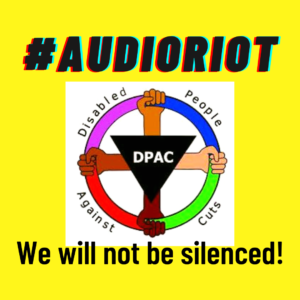
Turquoise square with "#AUDIORIOT" in black with a red shadow at the top. The DPAC logo is in the middle. A slogan in black text at the bottom says "We will not be silenced!"
White square with DPAC logo faint in the background. The word "#AUDIORIOT" in black text with a red shadow travels diagonally across the middle of the square. The same word in a black outline sits either side of this.outlined in black
Cream coloured rectangle. Slogan in brown says "Universal Credit - a crime against claimants". A chain links the capital "U" and "C"
Photo of artist-activist Vince Laws from Norfolk DPAC dressed as Boris "Piffle" Johnson standing at a lecturn with a cardboard back drop painted to look like Number 10 with the hashtag #20More4All running up the side
Section of a handmade banner showing the hashtag "#CancelTheCut~
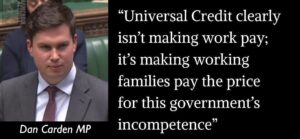
Black rectangle with a photo of Labour MP Dan Carden and a quote from him that says "Universal Credit clearly isn't making work pay; it's making working families pay the price for this government's incompetence."
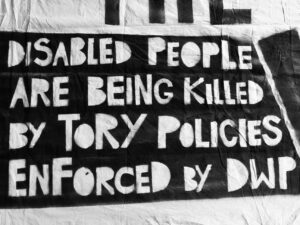
Section of a handmade banner by artist-activist Vince Laws that says "DISABLED PEOPLE ARE BEING KILLED BY TORY POLICIES ENFORCED BY DWP"
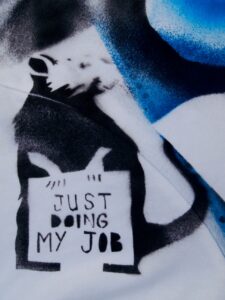
section of a handmade banner showing a rat holding a sign that says "JUST DOING MY JOB"

Painting of a skeleton with blonde hair in a suit with a forked tongue holding a knife in one hand and a Union Jack flag in another painted over an orange DPAC "No cuts to benefits" poster

Close up photo of a DPAC "STOP & SCRAP UNIVERSAL CREDIT" badge
white vertical rectangle with "TORY CUTS KILL" scrawled in red around a clever with blood on it and a DPAC logo

Black vertical rectangle. Text in white at the top says "IN WORK OR OUT OF WORK" followed by what looks like a DWP communication that says in blue "UC Universal Cruelty For the many, not the few". The slogan at the bottom says "WAKE UP BEFORE ITS TOO LATE" written over a picture of a pair of white underpants on fire
Section of a hadnmade banner. White text on purple says: "WE HAVE A BETTER PLAN". White text below this on a green background says "WWW.COMMISSIONONSOCIALSECURITY.ORG"
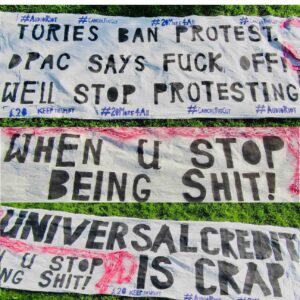
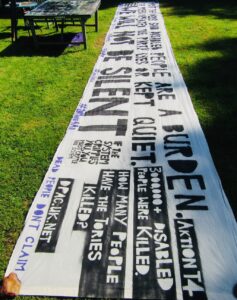
Photo of a long black and white banner laid out on grass stretching out into the distance. One of the slogans on it says "WE WILL NOT BE SILENT"

yellow square - at the top it says "#AudioRiot" above a DPAC logo, under that is says "We will not be silenced!"

Sep 282021
 
DPAC Logo with text underneath "Disabled People Against Cuts" and then web address dpac.uk.net
For immediate release

28 September 2021

For media enquiries please contact Ellen: 07505 144 371 – mail@dpac.uk.net

Disabled Activists to create an #AudioRiot in central London in defence of Universal Credit.

On:
Tuesday 28th September
11.30 AM
Kings Cross Station courtyard
London
N1 9AL

Campaign network Disabled People Against Cuts (DPAC) (1) have announced they will mark the end of COVID related support mechanisms in Universal Credit by staging an #AudioRiot in central London at the end of the month.

The direct action group, who in the past have attempted to storm the House of Commons floor during PMQ’s (2), erected a temporary protest camp under the shadow of parliament (3) and blocked several city centres around the UK (4); have organised a series of activities to coincide with both the end of the £20 uplift to Universal Credit (5).

DPAC has announced actions (6)  across the period from the end of September through to the first week in October, when the planned end to the uplift will take place.

Beginning on Saturday 25th of September where local DPAC groups nationwide will stage demonstrations in the areas.

On Tuesday 28th September they are calling on members to “bring everything you can to make noise” to an #AudioRiot where the group say they will “make noise about the devastating changes (to benefits) which will have a huge impact on millions of people, including disabled people “. Asking people to bring drums, bells, whistles, klaxons and loudhailers DPAC say they will also provide materials and ear protection for many, and have asked that people bring their own if they can. DPAC have also included a warning on their website that the demonstration will be very very loud.

And on Monday 4th October in Manchester outside the Conservative party conference, Manchester DPAC “will broadcast people’s stories from a giant mobile video screen” (7).

Research by Joseph Rowntree Foundation (8) has shown that disabled people in receipt of the Universal Credit uplift still only reach 43% of the recommended minimum income standard. For those on legacy benefits and not getting the uplift, it’s 33% of the recommended income level.   A recent report from the Equalities and Human Rights Commission (9) found that disabled people are three times more likely to live in “severe deprivation” than non disabled people.

The policy to end the uplift has been condemned across civil society, with workers, claimants groups, charities and even 6 Tory ex-Secretaries (10) of State for Work and Pensions signing a joint public statement all calling on Sunak not to end the payment, a move which the government acknowledges internally will be “catastrophic for claimants” (11).

The government has defended its decision citing the need for a “jobs led” recovery; ignoring (or at least pretending to ignore) the fact that 37% of Universal Credit claimants are in work. And that research shows thatpoverty rates for working households has reached record levels, with over half of children living in poverty in the UK coming from in-work households.


Following on from the punitive and cruel austerity programme of the last decade, and the decimation of services through the pandemic, these cuts will be felt particularly hard by disabled people who now are as unsupported and isolated as a community as we’ve ever been.

DPAC spokesperson said:

“Disabled people need this money more than ever. Everyone who gets it does. It can be the difference between heating or eating. It can be the difference between well-being and ill health. We are all living in an uncertain future but one things for sure – if you take from those who have the least they will struggle even more.”

Notes to Editors

1)
https://dpac.uk.net/

2)
https://www.google.co.uk/amp/s/news.sky.com/story/amp/disability-protesters-attempt-to-storm-pmqs-10354824

3)

https://www.google.co.uk/amp/s/amp.theguardian.com/society/2014/jun/28/occupy-westminster-disabled-people-against-cuts

4)
https://www.disabilitynewsservice.com/tory-conference-activists-criticise-heavy-handed-police-action-at-tram-protest/

5)
https://www.bigissue.com/latest/universal-credit-what-is-it-and-why-does-the-20-increase-matter/

6)
https://dpac.uk.net/2021/09/28th-september-westminster-join-the-dpac-audioriot-protest-for-20moreforall-on-the-streets-and-online-plus-local-actions-on-25th-september/

7)
https://dpac.uk.net/2021/09/disability-news-service-9-september-2021/

8)
https://www.jrf.org.uk/report/uk-poverty-2019-20-social-security

9)
https://www.equalityhumanrights.com/sites/default/files/is-britain-fairer-accessible.pdf

10)
https://www.google.co.uk/amp/s/www.independent.co.uk/money/universal-credit-ps20-uplift-should-be-permanent-say-tory-exwelfare-ministers-b1877909.html%3famp

11)
https://www.google.co.uk/amp/s/amp.ft.com/content/ea096afa-7747-4763-811f-46e79dd41990

 Posted by at 12:47
Sep 212021
 
DPAC Logo with text underneath "Disabled People Against Cuts" and then web address dpac.uk.net

5.30pm – Whitehall, Westminster, London, SW1A 2AS.

BSL interpretation will be provided

On the eve of the £20 per week cut to Universal Credit join Disabled People Against Cuts and allies to protest against the government’s removal of the £20 per week uplift to Universal Credit and to demand a fundamental overhaul of the social security system.

Speakers: Paula Peters, Disabled People Against Cuts; Austin Harney, TUC Disabled Workers Committee and PCS; Hector Wesley BARAC UK; Steve Hedley, RMT; Dzaier Neil, Chair, Green Party Disability Group; People Before Profit; Campaign against Empty Homes; IWBG; Unfair Debit Group  More to be confirmed

The government increased Universal Credit by £20 per week at the start of the pandemic. They never gave it to people on legacy benefits, meaning that more than two million disabled people and carers missed out. The uplift was also temporary and ends on 30 September 2021.

Senior Tories including six former Secretaries of State for Work and Pensions have pleaded with the government not to end the cut yet. Iain Duncan Smith and Damian Green even made a last ditch attempt to get a motion to stop the cut voted on through the Pensions uprating debate but their amendment was not chosen by the speaker.

Many claimants never got the £20 uplift in the first place. It was only applied to Universal Credit so those still on legacy benefits and not yet moved over to Universal Credit were missed out. Over three quarters are disabled and their living costs have been significantly higher as a result of the pandemic and needing to shield.

The government has consistently refused to apply the uplift to legacy benefits. When questioned by Martin Lewis on the ITV Money Show, Chancellor Rishi Sunak said the uplift was meant to be for working people.

Out of work benefits in the UK are well below the amount needed for a decent standard of living. Even after the uplift, Universal Credit is just 43.4% of the minimum income standard needed for a decent standard of living. For those on legacy benefits, their social security payments all the way through the pandemic have represented just 33.9% of the minimum income standard.

All benefits need to be significantly increased, not cut.

We need people to be properly supported in these difficult times. The benefits system needs a complete overhaul. The Universal Credit system doesn’t work – it has been proven be toxic and massively harmful.

As well as fighting for a permanent uplift – we must fight for it to be scrapped and replaced with a social security system that provides a genuine safety net for all who need it.


 Posted by at 02:51
Sep 212021
 
DPAC Logo with text underneath "Disabled People Against Cuts" and then web address dpac.uk.net

7.30 pm to 8.30pm

Watch live on YouTube, FB and Twitter.

With BSL and speech to text

You are invited to join DPAC as we launch our #AudioRiot week of action.

Speakers to include Paula Peters (DPAC and Unite Community), La Toya Grant (Commission on Social Security), Michael Pugh (New Economics Foundation) and Ellen Clifford (Author of The War on Disabled People) with solidarity messages from Jeremy Corbyn, John McDonnell, Marsha De Cordova and Ken Loach.

*Special guest appearances from Rita Resistance and Boris Piffle Johnson.*

Come to hear how you can get involved not only in DPAC’s #AudioRiot protest activities but a full array of resistance taking place over the next few weeks from allies including The World Transformed, Peoples Assembly, Manchester DPAC and the Campaign Against Empty Homes. We will also hear from the Experts by Experience Commission on Social Security and the New Economics Foundation’s Living Income Coalition about building towards a better social security system.


 Posted by at 01:59
Sep 212021
 
DPAC Logo with text underneath "Disabled People Against Cuts" and then web address dpac.uk.net

A message from Heidi:

We now have a date for the judgment!

Thank you all for your support so far. We want to invite you to come and support me, Aidan and Maire as we hear the result of the Court case . Meet outside The Royal Courts of Justice from 9am on Thursday 23rd September Make lots of noise, hold banners and support us as we hear the result and speak to the media.

Please take pictures of your hands with the date 23rd Sept and share your hands on all social media and tell everyone you know to listen out for the result.

We are so looking forward to the end of Downright Discrimination, hopefully!

See you there,

Love Heidi

https://www.facebook.com/dontscreenusout/posts/1571309719706280

From Simone

We are still waiting to hear from Heidi’s legal team about being inside the high court and access, remote court hearing availability and easy read judgement being published on the 23rd September.

I have asked Lynn Murray, Heidi’s mum’s friend to be your point of contact for this event.   Please just mention my name when you contact Lynn

Email address: brianlynnmurray@btinternet.com

Telephone number: 07840-966-736

We are still working on the ROFA’s web-pages that will be inclusive of all your wonderful contributions in support of Heidi’s campaign.

In Solidarity


Simone Aspis

 Posted by at 00:37
Sep 212021
 
DPAC Logo with text underneath "Disabled People Against Cuts" and then web address dpac.uk.net

Croydon – Universal Credit Street stall

Called by Bromley and Croydon Unite Community Branch supported by Croydon TUC, Bromley TUC, Croydon Stand Up to Racism

11.30 am to 1.30 pm

outside Box Park Nr East Croydon Station

George Street

Croydon

CR0 1LF

Facebook event link: https://facebook.com/events/s/cancel-the-cut-1130-am-130-pm/863291034580437/

Lead activist Paula Peters


Edinburgh – Protest: RESIST THE £20 CUT TO UNIVERSAL CREDIT – £20 FOR ALL

Gather 12.30pm onwards

At High Riggs Jobcentre, Tollcross, Edinburgh

#20MoreForAll

The Tory government have announced the £20 pandemic increase in Universal Credit and Working Tax Credit will be cut from the end of September. Edinburgh Coalition Against Poverty is taking up the call from Disabled People Against Cuts for UK-wide resistance.

We insist the cut be re-instated and extended to the “legacy benefits” like Job Seekers Allowance and Employment and Support Allowance. #20MoreForAll

This cut in Universal Credit and Working Tax Credits follows years of cuts as social security rates were either frozen or increased by less than inflation. It is yet another example of governments attacking the poor to benefit the rich. This brutal cut is also an attack on wages and conditions, aiming to force people to accept insecure low paid jobs.

We need to organise at the grass-roots to resist this cut, the entire austerity agenda, and the whole profit-based system which exploits people and is even endangering humanity’s existence.

Join us on the 27th, bring placards, banners, anything that makes a noise

We will be at High Riggs till approximately 1.30pm. If enough people want to continue the action we will then move to a nearby UK Government building.

Please take a lateral flow test beforehand, wear a mask if possible, use hand gel, be considerate and socially distance, thanks.

Gather High Riggs Jobcentre, 20 High Riggs Edinburgh Scotland EH3 9HU (v near Tollcross – buses to Tollcross or Lauriston Place)


Oxford – #CancelTheCut Rally

Rally called By Berkshire, Oxfordshire Buckinghamshire (BOB) Unite Community Branch, supported by NEU Oxfordshire, CWU South Central Postal Branch, UCU Oxford Brookes

2pm

Bonn Square

Oxford

Oxfordshire

OX1 1LQ

Facebook event link:

https://facebook.com/events/s/cancel-the-cut-rally/556552782127782/

Lead Activist Coral Price

 Posted by at 00:33
Sep 092021
 
DPAC Logo with text underneath "Disabled People Against Cuts" and then web address dpac.uk.net

Johnson’s social care ‘fix’ is ‘disappointing… regressive… and insulting’

Disabled campaigners have delivered a withering response to the government’s long-awaited plan to “fix social care” in England.

The proposals were announced on Tuesday by the prime minister, Boris Johnson, who claimed they would “fix social care” and the NHS treatment backlogs caused by the COVID-19 pandemic.

The first reading of a bill to introduce the levy was approved yesterday (Wednesday) by MPs.

But there was almost universal criticism across the disabled people’s movement of the inadequate level of funding, the failure to address the needs of working-age disabled people, the lack of detail, and the disproportionate impact of the plans on lower-income workers.

Where Johnson called his plans “responsible, fair, and necessary”, disabled people’s organisations and grassroots groups described them as “disappointing”, “regressive” and even “insulting”.

The plans focus on the introduction of a new 1.25 per cent national insurance levy and a similar rise in dividend tax rates, ringfenced for health and social care, but with most of the new funding put aside for the NHS, at least for the first three years.

The key social care measure – to be followed by a health and social care white paper later this year – is the introduction of a new cap of £86,000 on lifetime personal care costs and a more generous support system for those with significant assets, particularly older people who own their own homes.

But ministers have not yet been clear exactly what they mean by “personal care” (see separate story).

The initial responses to the announcement from disabled people and disabled people’s organisations were overwhelmingly negative and dismissive.

Professor Peter Beresford, co-chair of the disabled people’s and service-user network Shaping Our Lives, said the prime minister’s proposals “treat older and disabled people with contempt and they further signal his government’s primary commitment to the well off and the powerful”.

He said the national insurance rise was a “broad brush attack on lower income tax-payers”, while there was nothing to address social care employment, the “poor law principles of means and needs testing” that lie at the heart of the current social care system, or local variations in provision.

And he said there was “not even a nod in the direction” of the proposals put forward by the disabled people’s movement for a free, universal system of independent living that would be funded by progressive taxation, through a National Independent Living Support Service (NILSS).

Inclusion London was just as dismissive of the government’s proposals, and said it was “extremely disappointed” with the plans.

Svetlana Kotova, Inclusion London’s director of campaigns and justice, said the current system excludes thousands of people with support needs, and condemns many of those who do receive support “to a life of isolation” because they are trapped at home with care visits that only last 15 minutes, which “barely ensures basic survival”.

She said: “The existing structure forces disabled people, already on means-tested benefits, to pay unjust charges and makes them even poorer.

“At the same time, it pays care workers a pittance and heavily relies on unpaid carers.”

She said the increase in national insurance was “not a progressive move” and would “not fix a broken system”.

She added: “The cap won’t fix our broken care system – it won’t provide social care for many hundreds of thousands of people currently excluded from support.

“It won’t improve the quality or amount of support people currently get, which is woeful.

“It won’t stop the scandal of charging for social care that is robbing disabled people of essential disability benefits income and pushes them into extreme poverty, and it won’t improve wages or conditions of care workers or address the recruitment and vacancy crisis.

“Social care must be free at the point of need, funded through progressive taxation.

“The government needs to provide an urgent injection of funding to stabilise the system and start to actively work with disabled people to develop a social care service fit for our needs and the years to come.”

Disability Rights UK (DR UK) said the plans were “too little, too late”.

Fazilet Hadi, DR UK’s head of policy, said: “The proposed measures do not kick in for another two years.

“They may not be enough to cover care costs, they may still rely on those with minimal assets having to contribute to care costs, and they do not cover the vastly greater accommodation or food costs, known as hotel costs, for disabled people in residential care.

“We also believe it is the wrong mechanism to use national insurance contributions instead of income tax.”

The Reclaiming Our Futures Alliance dismissed the government’s proposals as a “tax without a plan”.

Mark Harrison, a member of ROFA’s steering group, said it was “a con to get working people to disproportionately bail out the private sector, who deliver inadequate social care services to disabled people for profit”.

He said Johnson’s plan was “focussed on preventing older Tory voters in the south of England from ‘losing their homes’ and will do nothing to resolve the crisis facing working-age disabled people”.

He said ROFA was instead focused on developing and implementing its NILSS plans, which would allow the government to meet its duties under article 19 of the UN Convention on the Rights of Persons with Disabilities.

And he called on Labour leader Keir Starmer to “seriously engage with ROFA members to coproduce a legal right to independent living backed by a transformational system”, rather than pushing Labour’s “out of date, 20th century solutions”.

The National Survivor User Network (NSUN) described the “inadequate” level of funding as “deeply disappointing” and criticised the government’s “regressive” solution of a levy on national insurance contributions, which it said was “not the answer to the social care crisis”.

The disabled author and Guardian columnist Frances Ryan spoke out about the plans as the BBC released Hen Night, a short drama inspired by her book Crippled, in which a young disabled teacher, Jessica, fights back after her social care is cut during the pandemic.

Ryan said: “Boris Johnson’s social care plan was effectively a plan without a plan.

“Nothing for working age disabled people drowning in care bills and unmet needs. Nothing for underpaid care staff. Nothing for family carers.

“There are hundreds of thousands of real life Jessicas out there and few of them will be helped by the government’s announcements.”

The grassroots disabled people’s organisation Bristol Reclaiming Independent Living (BRIL) said the amount of funding provided for social care was “both meaningless and insulting”.

BRIL said the only winners from the government’s announcement would be “the wealthy, and the owners of the private care companies”.

A BRIL spokesperson said the decision to unfreeze the minimum income guarantee [frozen by the government since 2015] for those paying care charges next year was “welcome, and no doubt due to the efforts of disabled activists drawing attention to this scandal”.

But he said it was “too little, too late” and “no solace for the thousands of disabled people who have been forced into debt, poverty and left without care and support for years”, while the failure to provide anything concrete on social care support for mental health service-users was “frankly unforgivable”.

Disabled People Against Cuts was another to criticise the use of national insurance to fund the proposals, and it described the minimum income guarantee offering as “a crumb rather than a slice of bread”.

Donald O’Neal, whose exposé of England’s social care system, The Lack of Care Act 2014, was published in July, said the government’s plan “says little about people of working age who live in the community” and nothing about centres for independent living and other disabled people’s organisations, “which have shown that they are best at supporting disabled people who live independently”.

O’Neal, a social care service-user for more than 35 years, said the government’s plan failed to address disabled people’s needs “beyond the basics”, such as washing, dressing and getting out of bed.

And he said the proposals read instead “like a plan that was created without disabled people around the table”.

O’Neal also said he did not believe the proposal to impose a levy on national insurance was a fair way to raise extra funds, because of the burden it imposed on low-income workers, and that he feared it would not raise enough funds to address the social care crisis.

The Disability Union was also critical of the funding solution, which it said “predominantly benefits the wealthy while being predominantly paid for by the poorest”.

9 September 2021


Government’s silence over gaping holes in plans to ‘fix social care’

The government has refused to explain why there are gaping holes in its long-awaited plans to “fix social care”, and it has even been unable to define what it means by “personal care”.

The proposals were announced on Tuesday by the prime minister, who claimed his plans would fix both social care and the NHS treatment backlogs caused by the COVID-19 pandemic.

But the paper published by Boris Johnson – Build Back Better – offers just eight pages on the government’s new plan for adult social care in England, despite the prime minister announcing more than two years ago on the steps of Downing Street that his government would “fix the crisis in social care once and for all with a clear plan we have prepared”.

The plans focus on raising revenue through a new 1.25 per cent national insurance levy and a rise in dividend tax rates, ringfenced for health and social care, but with most of the new £12 billion-a-year funding apparently put aside for the NHS, at least for the first three years.

A key aspect of the social care plan is to introduce a new lifetime limit of £86,000 on the amount an individual will have to pay for their “personal care”, starting from October 2023.

The government paper refers repeatedly to limiting lifetime “eligible personal care” costs, but it is not clear whether this only includes support with washing, dressing and getting out of bed.

If it does, disabled people who also pay towards council-funded help with housework, laundry and shopping, and support to enjoy a social life and to stay engaged in the community, will find those payments not included in the £86,000 ceiling.

But when Disability News Service asked the Department of Health and Social Care (DHSC) to explain what the prime minister meant by “personal care”, it had failed to do so by noon today (Thursday).

There are other gaping holes in the plans.

There is no mention in the proposals of the right to live independently under article 19 of the UN Convention on the Rights of Persons with Disabilities.

Johnson’s failure to discuss a legal right to independent living comes despite a call only four months ago by the Equality and Human Rights Commission for the government to introduce such a right.

The social care focus of the paper is instead on providing a more generous support system for service-users with significant assets, particularly older people.

The three case studies examining the financial impact of the plans on those needing social care all focus on service-users who are over the age of retirement.

There is no mention in the paper of working-age recipients of social care, other than when defining adult social care in the fifth paragraph of the document.

And there is almost no mention of the impact of the government’s plans on the thousands of disabled people who must currently pay significant care charges out of their monthly income, due to means-testing.

The only brief reference to means-testing is in the decision to unfreeze the minimum income guarantee for those who pay for their care, which has been frozen by the government since 2015 and will now rise again, but only by the rate of inflation, from next April.

DHSC declined to answer several questions about the proposals from Disability News Service.

The department declined to explain why there was no mention of the need for a right to independent living; why there was no mention of working-age disabled people in the three case studies; how it defines personal care; why there was almost no mention of working-age care recipients; why there was almost no discussion of the impact on people’s income, rather than their savings; and why the white paper was still not ready to be published, two years after the prime minister said he had a plan ready to go.

Instead, a DHSC spokesperson said in a statement: “This week’s announcement means that no one receiving long-term disability care and support – whether that care starts at 17 or 70 – will any longer face the catastrophic, unlimited costs they did before.

“An additional £5.4 billion is being invested in social care over the next three years, which includes an extension of the established disabled facilities grant to enable more people with disabilities to live independently in their own homes.

“We are determined to ensure the quality of care for disabled people who need it is consistently high and will work closely with disability groups as part of our work to develop the next steps in this ambitious reform programme.”

9 September 2021


Ground-breaking production will create a high-tech museum of DWP’s victims

The stories of 10 disabled people whose deaths have been linked publicly to the failings of the Department for Work and Pensions (DWP) are to be told in a ground-breaking digital production that explores the devastating human impact of austerity.

Museum of Austerity uses the verbal testimony of family members and state-of-the-art technology to recreate the circumstances that led to the deaths of 10 disabled benefit claimants in the post-2010 austerity decade.

The mixed reality production uses recorded interviews with the family members and ground-breaking “volumetric capture” techniques that have produced high-quality, three-dimensional images.

Museum of Austerity will eventually include several rooms that each demonstrate a different element of the personal and public impact of austerity.

The first room focuses on the personal stories of disabled benefit claimants, whose deaths have all previously been linked by Disability News Service (DNS) to flaws in DWP’s assessments, sanctions and safeguarding systems.

A work-in-progress version of this room will be shown publicly for the first time at next month’s BFI London Film Festival*.

It has been produced by the English Touring Theatre and the National Theatre’s Immersive Storytelling Studio, and devised and directed by critically-acclaimed theatre director Sacha Wares.

All of the relatives whose voices will be heard have previously spoken to DNS, including Mo Ahmed, the brother of Sophie (Faiza) Ahmed, whose suicide in 2014 exposed flaws in DWP’s safeguarding system; and Gill Thompson, whose brother David Clapson died after being left destitute when his benefits were sanctioned.

Other deaths covered by the exhibition include those of Mark Wood, Moira Drury, Diane Hullah and James Oliver.

It also includes testimony from Imogen Day, Joy Dove and Alison Turner, all three of whom have previously spoken to DNS to highlight DWP’s failings following the deaths of their relatives Philippa Day, Jodey Whiting and Errol Graham.

Dove said: “I need the story told for Jodey’s sake.

“Jodey’s death changed our lives forever from day one and we as a family have suffered continuing heartache.

“It has broken me. All that keeps me going is to get justice for Jodey and the other families.

“I want these stories out there. From day one of being told about this theatre project it has given me hope for justice and a hope that we can change the system.”

The Museum of Austerity team includes experienced and emerging disabled artists, including leading composer Adrian Lee – who has produced an original score in memory of those who have died – producer Meg Fozzard, assistant director Hana Pascal Keegan, and co-editor and specialist advisor John Pring**.

*Tickets are on sale from 20 September, with the exhibition open from 6 to 17 October, 11am to 9pm, at 26 Leake Street

**Eight of the 10 interviews were carried out by Pring, editor of Disability News Service, who has been working on the project for more than a year

***Museum of Austerity is supported by CreativeXR, a programme developed by Digital Catapult and Arts Council England. It is a Genesis Kickstart Fund project, supported by the Genesis Foundation; and is supported using public funding from Arts Council England, and co-commissioned by BFI London Film Festival – LFF Expanded

9 September 2021


Mobile video screen will tell delegates the ‘appalling’ truth about their Tory government

Anti-cuts activists are to hire a mobile video screen that will give disabled people the chance to tell members of the Conservative party attending their annual conference what they think of the government’s “appalling” breaches of their rights.

Manchester Disabled People Against Cuts (MDPAC) is calling on disabled people from across the country to record short video messages to the government that can be played on the mobile screen during next month’s conference in Manchester.

MDPAC hopes the action will allow disabled people who need to continue to shield from COVID-19 to express their feelings about the government’s repeated failure to protect their rights – rather than having to attend an in-person protest in Manchester – and allow those messages to be relayed to some of the Conservative delegates attending the conference.

MDPAC has hired a van with a video screen to spend several hours skirting the conference venue in the centre of Manchester on 4 October, due to take place on the day the chancellor, Rishi Sunak, delivers his set-piece conference speech.

MDPAC is now calling on disabled people to record their messages – ideally of one or two minutes – and upload them to MDPAC’s Dropbox account.

There will also be an opportunity to record messages during a Zoom meeting that will be held later this month.

Anyone who would like to contribute financially to hiring the equipment can visit a Crowdfunder page, which is already more than halfway to its £1,000 target.

An MDPAC spokesperson said: “There’s a lot of security so there is little we can do to impact on [delegates inside the conference].

“The one thing we can do is let them know that what the government is doing is not good for disabled people.

“They must never get the idea that everything is fine.

“The disability strategy and the [disability benefits] green paper have little announcements written throughout them about how great they are doing, which is a complete rejection of reality – there is no mention of the UN [which said that cuts to support for disabled people had caused “a human catastrophe”], of the welfare deaths, of the absolute collapse of social care.

“We are asking people what they want to tell the Conservative government about being a disabled person in 2021, because we don’t think they listen to disabled people.

“Wherever you are, whatever your situation, if you can find a way to get yourself on video, that would be great.”

He added: “We don’t want charities speaking for us or politicians, we will speak for ourselves, or sign for ourselves or caption for ourselves. It’s about our message.”

Tory conferences, held every two years in Manchester since the coalition came to power in 2010, have frequently been associated with DPAC protests.

Four years ago, activists from DPAC and the Disabled People’s Direct Action Network (DAN) held up Manchester city centre tram services for about 90 minutes by blocking tram lines outside the conference.

9 September 2021


Labour shadow ministers for equality and disability stay silent over party discrimination

Labour’s shadow ministers for disability and equalities have refused to comment on the party’s continuing failure to address the discrimination faced by its own disabled members.

Both Vicky Foxcroft, the shadow minister for disabled people, and Marsha de Cordova, the shadow secretary of state for women and equalities, both stayed silent this week on Labour’s ongoing refusal to address the barriers faced by disabled party members.

Their silence came after Labour’s deputy leader, Angela Rayner, failed to explain what had happened to the promise she made 18 months ago to address the issue.

Rayner called in March 2020 for Labour to do more to ensure that “disabled people’s voices are heard in politics”, and she said that the party needed “to start by looking at ourselves”.

She spoke out as part of her successful campaign to secure the deputy leadership, saying: “We need to ensure that disabled people have full access, to ensure that there are no barriers for anyone.

“I want to start by taking an honest look at what we are doing and whether we are living up to our principles.”

Rayner wrote a report in late March 2020, which included more than 20 actions that the party should carry out so it could become “the most accessible it has ever been”.

These included ending the practice of holding constituency Labour party (CLP) meetings in inaccessible venues; providing training for CLP chairs on how to deal with discrimination; all CLP disability officers to themselves be disabled people; the appointment of a national disability officer with an allocated budget; and the party to provide resources to help disabled members with the disability-related costs of standing for election.

But Disability News Service (DNS) has been unable to find evidence of any of the actions being implemented after Rayner became deputy leader.

DNS has been reporting for several years on concerns raised by disabled Labour members about the barriers created by the party’s structures, policies and actions.

At the party’s last annual conference before the pandemic, in 2019, senior Labour figures were accused of discrimination and “oppression”, while the previous year a survey of disabled party activists revealed three-quarters of those questioned believed there was disability discrimination at all levels of the party.

Kathy Bole, co-chair of Disability Labour, said this week that there was little evidence of a “true commitment” within the Labour party to addressing the long-standing discrimination.

She said: “Disability Labour has been working with different areas of the Labour Party to improve access within the party.

“However, that being said, we have had little interaction with Angela Rayner or indeed with Keir Starmer about the commitments made to disabled members during their leadership campaigns.

“We have watched as programmes have been launched with little consultation and design in mind for disabled party members.

“Despite trying to remain positive that change will come, we are faced with having a face-to-face conference in Brighton [later this month], despite being told repeatedly we would not have conference there due to the general inaccessibility of the conference venue.”

She said Disability Labour feared that the financial problems facing the party would lead to many of the gains that had been made being lost.

Bole said: “We are still willing to work with the party, but we have seen little to show a true commitment.

“With the finances as they are, it seems inevitable we will not see the level of change which needs to come for disabled members.

“Less Labour Party staff means less support for the kind of change disabled members need.

“I urge the leaders in the party to meet with us to discuss the issues we have from ableist discrimination within the party.”

This week, DNS contacted both Vicky Foxcroft and Marsha de Cordova to ask them what action they and the party had taken to address the long-standing issues of discrimination within Labour.

Neither of them had responded by noon today (Thursday).

9 September 2021


Peers criticise government for ‘objectionable’ Equality Act failure

A cross-party House of Lords committee has criticised the government for its “objectionable” failure to bring into force key anti-discrimination measures that became law more than a decade ago.

The Lords liaison committee said ministers had also failed to use their much-criticised National Disability Strategy to implement “key provisions” from the 2010 Equality Act.

A report, published today (Thursday), says the committee “finds it objectionable that parts of the Equality Act, now over 10 years old, are still not in force”, which it says is “an affront to Parliament”.

Among the areas of the Equality Act that the government has failed to improve or implement over the last decade, according to the committee, are the public sector equality duty; access to taxis and private hire vehicles; and access to sports stadiums.

The report also highlights the continued delay in implementing the provision in the Equality Act that would give tenants the right to force landlords to make reasonable adjustments to the common parts of residential buildings, such as hallways and staircases.

Ministers have repeatedly pledged to implement this provision, but there will now be further delays, with the new disability strategy promising only a consultation rather than immediate implementation.

The Lords liaison committee also calls on the government to make it easier for disabled people to take discrimination claims under the Equality Act by extending the use of a process known as Qualified One-Way Costs Shifting (QOCS).

Disabled campaigner Esther Leighton failed last year with a judicial review that aimed to force the government to extend QOCS to Equality Act cases.

The committee said it found the government’s stance on the issue “disappointing” and added: “The Government should be focusing on the impact of the current costs regime on disabled people and the fact that it is preventing disabled persons from accessing justice.”

The report follows up an inquiry by the Lords Equality Act 2010 and disability committee, which concluded in 2016 that the government was failing to protect disabled people from discrimination, and that laws designed to address disability discrimination were “not working in practice”.

An analysis by Disability News Service of the government’s response to that report, which was published later in 2016, suggested that it had accepted in full only about eight of the committee’s 55 recommendations.

Baroness Deech, who chaired the Equality Act 2010 and disability committee, said: “The government has missed a golden opportunity to tackle key issues including ensuring the public sector equality duty delivers results and improved outcomes rather than being a tick-box exercise, ensuring taxis and private hire vehicles are accessible to disabled people and ensuring sports stadiums have appropriate provision for all fans.

“Some of these provisions are already law and are just not being enforced; for the government to ignore them yet again in its national strategy means that it is not acting on what parliament has agreed.

“The government cannot expect disabled people to have confidence in its new strategy when it has consistently failed to enforce existing legislation or act on recommendations to rectify that.”

9 September 2021


Only a tiny proportion of responses to national survey were read, government suggests

Only a tiny proportion of the views expressed by the thousands of disabled people who took part in the government’s national disability survey have been read by a minister or civil servant, a freedom of information response suggests.

The new information has added fresh ammunition for disabled campaigners who believe that the National Disability Strategy – which was “informed” by the survey results and was published in July – has no legitimacy and should be withdrawn.

Most of the questions posed by the UK Disability Survey in January were restricted to multiple choice answers.

But four of them allowed “free text” answers, and the Cabinet Office says it received more than 25,000 answers from disabled people to these four questions.

A freedom of information response from the Cabinet Office now says that all 25,000 of these answers were analysed through so-called “topic modelling”, which the government has described as “a method of machine-assisted reading of text data, used to identify topics from free text responses to open format questions”.

A report on the survey responses says that only 1,200 of the 25,000 responses from disabled people were also analysed by researchers through “manual coding”, and even then, only with the aim of producing themes and sub-themes.

The freedom of information response says there is no written evidence to show how many responses were read in full by a civil servant, a minister or a researcher, with the Cabinet Office telling Disability News Service: “No information is held on the number of responses read in full by a Civil Servant, Research [sic], or Minister.”

The much-criticised survey is already being challenged by four disabled people through a high court judicial review.

Doug Paulley, one of the four taking the legal action, said: “I am unsurprised but dismayed that the government evidently doesn’t care enough about disabled people’s input into their strategy that they didn’t even bother to read most responses.

“The survey was so flawed that the strategy has no legitimacy, should be withdrawn and rewritten with disabled people.”

He said that the failure to read all the responses was not a surprise because the survey was “clearly deeply flawed from the start”.

He said: “The topics chosen were not directed by disabled people, the mechanism of survey was inaccessible to many disabled people and the restricted range of answers meant that the limited free text responses were for many the only way to put down what is really important to them.

“I spent time writing mine carefully; doubtless other disabled people did similarly – unless they were put off responding altogether due to the other issues.”

The Disability Unit declined this week to say how many of the free text responses were read by civil servants and ministers; how the government justified having the vast majority of the free text responses read only by a machine rather than a human being; and what the Disability Unit’s message was to the thousands of disabled people whose responses will not have been read by anyone, but were just “coded” by a machine.

The Disability Unit also refused to say if any of the free text responses were read by a civil servant or a minister.

But a Disability Unit spokesperson said in a statement: “All responses have been rigorously analysed and full details of the methodology for analysing the UK Disability Survey is published on GOV.UK.”

9 September 2021


Labour MP who holds DWP to account defends government appointment

The Labour chair of the committee tasked with holding the Department for Work and Pensions (DWP) to account has been accused of “total hypocrisy” after accepting a high-profile appointment from the government.

Stephen Timms, who chairs the cross-party Commons work and pensions select committee, has been appointed by the prime minister to an unpaid role as a trade envoy to Liechtenstein and Switzerland, with the aim of “helping businesses find new export and investment opportunities” and promoting UK trade.

Timms has defended himself this week from accusations that he will now find it harder to hold ministers to account.

But Paula Peters, a member of the national steering group of Disabled People Against Cuts, said his decision to accept the position was “absolutely appalling”.

She said: “This is a conflict of interest, as Stephen Timms chairs the DWP select committee and is supposed to be holding the government to account for its horrendous policies that have caused untold distress and harm towards disabled people.”

Peters said that both Switzerland and Liechtenstein had long-standing reputations for tax evasion.

She said: “How can you hold the government to account for its appalling treatment of disabled people at the hands of government policy and DWP assessments and yet represent the Tory government as a trade envoy in tax haven countries?

“This is total hypocrisy and shows Labour hand in glove with government. The rich getting richer while disabled people pay a heavy cost.”

Timms told Disability News Service that the post was “entirely unpaid”.

He said: “The rigour of my scrutiny of government policy on the select committee, and in the chamber of the Commons, will in no way be weakened by the appointment.

“One of my Labour parliamentary colleagues in the Commons has served for some years as the trade envoy to Bangladesh, and it certainly hasn’t affected her capacity to criticise the government.

“I had, of course, to ensure there was no concern in the opposition whips’ office before agreeing to take it on.”

He added: “All of us want UK trade to increase.

“It’s particularly important given the difficulties we face outside the European Union.

“I hope I will be able to make a useful contribution to increasing UK trade with Switzerland and Liechtenstein, not least in financial services, a sector which is an important source of employment to my constituents.”

The Department for International Trade (DIT) refused to comment on the concerns about a conflict of interest.

But a DIT spokesperson said in a statement: “Our new trade envoys will play a key role in delivering our ambitious global trade agenda by boosting opportunities for British businesses in some of the world’s fastest growing markets and promoting vital inward investment.

“Trade envoys are unpaid, voluntary roles chosen on the merits of their relevant skills and experience.

“All trade envoys undergo a robust due diligence process and complete a declaration of interests form before their appointment.”

9 September 2021


DPAC hopes to make some noise as it returns to the streets

Disabled activists are hoping to make some noise when they raise concerns about imminent cuts to universal credit in their first direct action since the start of the pandemic.

Disabled People Against Cuts (DPAC) is hoping its #AudioRiot protest in central London will help highlight concerns about a series of “devastating” changes to social security.

They are encouraging disabled activists and non-disabled allies to bring drums, whistles, cymbals, bells, klaxons, loudspeakers – as well as their own ear protectors – and anything else that might help to make noise as they protest about the government’s social security policies.

Among their concerns is the government’s decision to scrap – from the end of this month – the temporary £20-a-week uplift to universal credit that was introduced at the start of the pandemic.

The protest, which will gather outside King’s Cross station* at 11.30am on Tuesday 28 September, will also highlight the government’s refusal to offer recipients of so-called legacy benefits – including disabled people receiving employment and support allowance (ESA) – the same £20-a-week increase given to those on universal credit during the pandemic.

Andy Greene, a member of DPAC’s national steering group, said he believed there was a lot of pent-up energy among disabled activists who have not been able to take to the streets for more than 18 months.

He said: “People want an opportunity to come out and have the harm that has been done acknowledged.

“Pre-COVID times there were plenty of people hitting the streets and movements were growing and growing and I would certainly hope that we will give an opportunity for that to flourish.”

He said the government had made decisions during the pandemic that had led to the deaths of countless disabled people and had “got away with murder” because of the months of lockdown.

Disabled people had paid for the government’s decisions with their lives, he said, and there had been very little critical response to that, both from within parliament and outside it.

He added: “They have literally got away with it. History will look back and wonder how.

“There is no accountability. Nobody is holding anybody to account.”

The action will be the first time DPAC has taken to the streets since the start of the pandemic, and it will take COVID-19 protective measures for those activists taking part.

Greene said: “We understand that not everybody will be comfortable going back onto the streets and coming to London for direct action, which is why we will also have online actions, and we are calling for local actions as well.”

On Saturday 25 September, three days before the central London action, DPAC will be calling on members and allies to create an #AudioRiot in their local areas.

And on the day of the London protest, the high court will be hearing a judicial review being brought by two disabled ESA recipients who believe the government breached the European Convention on Human Rights by increasing the standard allowance of universal credit by £20-a-week, but not increasing the rate for 1.9 million ESA recipients by the same amount.

A vigil to support those taking the judicial review will take place outside the Royal Courts of Justice, between 9.15am and 10am on 28 September.

*DPAC has stressed that the action will not be targeting King’s Cross station

9 September 2021


News provided by John Pring at www.disabilitynewsservice.com


 Posted by at 18:32