May 022024
 
DPAC Logo with text underneath "Disabled People Against Cuts" and then web address dpac.uk.net

Contents

Minister shares post that branded her own government’s PIP reforms ‘dangerous’ 1

DWP’s ‘brutal’ green paper suggests replacing PIP with vouchers or one-off grants 2

PIP consultation: The key questions DWP is refusing to answer 5

Stride refuses to apologise for two untruths in TV interview on PIP cuts 7

PIP claimants ask government: ‘Why should we have to fight to live?’ 8

Activists ‘terrified’ as MPs debate legalising assisted suicide while government proposes PIP cuts 11

Labour confirms assisted suicide pledge, as activists protest outside parliament 13

Police still being used in ‘punitive’ NHS mental health schemes, says report 16

Other disability-related stories covered by mainstream media this week 19


Minister shares post that branded her own government’s PIP reforms ‘dangerous’

The minister for disabled people has refused to explain why she shared a social media post that described her own government’s disability benefit reforms as “dangerous” and accused ministers of “demonising” disabled people.

Mims Davies, who has been minister for disabled people for just four months, shared the post by a disability charity on Tuesday.

The previous day, her government had launched proposals for cuts and reforms to personal independence payment (PIP) that were branded a “brutal, ideological attack” on disabled people’s support (see separate story).

Under the plans for England and Wales, which are now out for consultation, ministers are considering making it harder to claim disability benefits and replacing cash-based payments with vouchers or one-off grants.

Tuesday’s Twitter post, by the disability charity Scope, which was reposted by Davies, said: “Proposals to curb Personal Independence Payments (PIP) and change how people are assessed as unfit for work are dangerous.

Disabled people and people with mental health conditions must stop being seen as the problem by this government.

Share your views, and sign the petition to tell the government to stop demonising us.”

The PIP proposals followed a speech last month by the prime minister, Rishi Sunak, which led to him being accused by activists of whipping up hostility towards disabled people, and demonising and scapegoating claimants of disability benefits.

Sunak had announced a faster rollout of universal credit to disabled people, and an end to what he called a “sicknote culture”, among other reforms to social security.

Disability News Service (DNS) contacted Davies’s parliamentary office yesterday (Wednesday), but when editor John Pring started to read out the tweet, a staff member said: “I actually don’t have much time right now, we’re really short of staff so I need to crack on with that, all right?”

When Pring said it was important, because Davies was the minister for disabled people, he said: “Yeah, but I can’t deal with it right now, right, thank you, bye,” and hung up the phone.

After DNS followed up with an email, Davies’s chief of staff, Sarah Davies, refused to comment, and wrote: “As you have written regarding Mims’ role as the Minister for Disabled People, Health and Work, your approach has been forwarded to her DWP office.”

DNS emailed back to say that by sharing a social media post that was highly critical of the government’s position she was not acting in her ministerial role, and asked if Mims Davies was about to resign as minister for disabled people.

Sarah Davies had not responded by noon today (Thursday).

A DWP spokesperson also refused to comment, but referred instead to a response to the Scope post that Mims Davies appears to have made several hours after she had shared the charity’s tweet, in which she said: “Really keen we hear all views on this consultation – its absolutely an open consultation to hear disabled people’s views & those with a health condition – its so vital this is what people hear & engage with – I know people want to be heard & understood & is whats at the heart of this.”

2 May 2024


DWP’s ‘brutal’ green paper suggests replacing PIP with vouchers or one-off grants

The government is considering making it harder to claim disability benefits and even replacing cash payments with vouchers or one-off grants, as part of its latest “brutal, ideological attack” on disabled people’s support.

The plans could see the Department for Work and Pensions (DWP) abandoning a core principle behind the disability benefits assessment system that dates back more than 30 years.

The potential options for reforming personal independence payment (PIP) in England and Wales were laid out in a new green paper, Modernising Support for Independent Living.

Its publication, and the launch of a 12-week consultation on the options, provoked an angry reaction from disabled campaigners, who called the government’s plans insulting, dangerous and dehumanising.

The proposals were announced by the government on Monday by the prime minister, Rishi Sunak, and the work and pensions secretary, Mel Stride, who said the PIP reforms would address “spiralling” costs.

The current PIP assessment is based on a “functional test”, an attempt to assess the impact an impairment or health condition has on a disabled person’s ability to “function” in daily life.

Among the options for reforming PIP, DWP is asking if it should base eligibility instead on the diagnosis given to a disabled person by a healthcare professional.

This would require “a greater emphasis on the provision of medical evidence of a diagnosis”, although the green paper admits the department would need to consider the extra workload “this would place on the NHS and health professionals”. 

With DWP already announcing plans to scrap the work capability assessment after the next election, the green paper suggests an end to DWP’s focus on functional assessments, a much-criticised principle that stretches back more than 30 years.

DWP refused to comment on that suggestion this week.

Another proposal in the green paper is to retain the current PIP assessment, but change the eligibility criteria, which currently assess how the health condition or impairment affects the disabled person’s ability to carry out 12 daily living and mobility activities.

The consultation document suggests that ministers want to tighten these criteria, as it says the aim would be to ensure that “we focus support on people with the highest needs and significant ongoing extra costs”.

It also suggests that ministers are considering lengthening the time that the impact of an impairment or health condition must have been present from its current three months, and increasing the length of time this impact is likely to continue from nine months.

DWP ministers are also suggesting replacing how the social security system contributes to a person’s extra disability-related costs – which is currently through PIP’s four-weekly cash payments – with other means of support.

This could mean offering a disabled person a list of equipment or aids to choose from; providing them with vouchers to contribute towards the cost of a disability aid; forcing them to claim back the cost of equipment by providing receipts to DWP; or offering a one-off grant for major purchases such as home adaptations or expensive equipment.

The green paper also suggests replacing PIP cash payments with improved access to support such as health care, social care or respite services.

And it suggests imposing more of a duty on cash-strapped local authorities and NHS bodies to “improve services and support for individuals”, such as equipment, personal assistance, health, respite services and contributions to utility costs, in place of all or part of PIP.

Although the statements made by ministers around the green paper stressed the increase in the number of successful PIP claims from people with mental distress – with the proportion of the working-age population who are PIP/DLA claimants with anxiety and depression more than doubling from 0.6 to 1.3 per cent between 2012 and 2023 – the consultation itself did not place a huge emphasis on mental health.

Of the 39 questions, only three explicitly refer to mental health, although one of them, question 27, does ask if some people could “benefit more” from improved “mental health provision” rather than cash payments.

Inclusion London said the government’s PIP proposals were “another brutal ideological attack on our rights, at a time when the UK’s welfare policies were yet again found by the UN to be leading to grave and systematic violations of disabled people’s rights”.

Only last month, the UN’s committee on the rights of disabled people concluded that the UK government had made “no significant progress” in the more than seven years since it was found guilty of “grave and systematic” violations of the UN Convention on the Rights of Persons with Disabilities.

In March, the committee had accused the UK government of demonising disabled people and treating them as “undeserving citizens” by preparing to fund tax cuts by slashing disability benefits.

Inclusion London said its key concerns with the new proposals were that restricting access to PIP would worsen people’s health, and that those who lost their right to PIP could also see them lose access to other support.

It also said it was “dismayed at the way the government singles out people with experience of mental distress or trauma”, which it said was “blatant discrimination”.

Justin Donne, chair of Autistic Nottingham, which is run and controlled by disabled people, said the proposals would put the lives of autistic people at risk.

He said: “Narrowing PIP eligibility for those struggling with mental illness like anxiety and depression, as the prime minister is suggesting, will directly affect autistic people as we are more likely to struggle with our mental health.”

He said Sunak was “dashing the hopes of autistics who need PIP payments to survive and insulting their dignity by saying that they are abusing the system”.

Paula Peters, a member of the national steering group of Disabled People Against Cuts, said the PIP proposals were “deeply concerning”.

She said: “We need a mass mobilisation of disabled people to resist this draconian consultation.”

And she warned that removing PIP from disabled people in work would put their jobs at risk.

She said: “If they take it away from disabled people in work, they will not be able to work. They are shooting themselves in the foot.”

Dan White, policy officer for Disability Rights UK, said: “The clear agenda of the government’s latest proposal is to reduce the number of disabled people receiving the crucial support we rely on.

Being offered vouchers is more than an insult; it is dangerous.

They will shut us off from our communities, leaving thousands without access to crucial services and support.

Their punishing approach, which is obsessed with austerity, sanctions and conditionality, has fuelled increases in disability and sickness by under-resourcing not just the social security system but also health services, social care, education, housing and transport.”

The Disability Poverty Campaign Group said in a statement that the “hostile and misleading rhetoric” being used by Conservative ministers ahead of the general election was “creating considerable distress” among disabled people at a time of “exceptional financial hardship”.

It described the suggestion that vouchers could be used instead of cash payments as “dehumanising” and said it would “use all possible avenues to challenge the implication that disabled people eligible for PIP lack the capacity to manage cash-based income”.

And it added: “We know the prime minister and his government are seeking to weaponise disabled people’s poverty with their dishonest and divisive rhetoric to hide the deficiencies of their own failed legislation and years in office.”

The 12-week consultation closes on 23 July.

2 May 2024


PIP consultation: The key questions DWP is refusing to answer

The Department for Work and Pensions (DWP) is refusing to say how many disabled people it expects to lose their disability benefits if it pushes ahead with controversial proposals for reforms and spending cuts.

The prime minister, Rishi Sunak, and the work and pensions secretary, Mel Stride, launched a 12-week consultation this week on plans for personal independence payment (PIP) in England and Wales they say would “make the disability benefits system fit for the future” and rein in the “spiralling” caseload and costs.

Sunak said: “It’s clear that our disability benefits system isn’t working in the way it was intended, and we’re determined to reform it to ensure it’s sustainable for the future, so we can continue delivering support to those who genuinely need it most.”

But despite asking the public for views on a series of possible major reforms – including making it harder to claim PIP and replacing cash-based payments with vouchers or one-off grants – neither the consultation nor its “evidence pack” include any figures showing how those changes would reduce the number of PIP claimants or spending on the benefit.

And neither Stride nor Sunak offered any clue to how much they wanted to cut spending or claimant numbers.

In contrast, the coalition government revealed in 2010 that it expected to cut the number of people claiming disability living allowance (DLA) – as well as spending on DLA – by a fifth when it announced it would be replacing it with PIP for working-age claimants from 2013.

This week’s evidence pack says the number of working-aged people receiving DLA and PIP has increased from 1.9 million in 2012-13 to 2.6 million in 2022-23, and is forecast to increase to four million in 2028-29.

But DWP declined yesterday (Wednesday) to provide any figures for how much it wanted to cut claimant numbers and spending, suggesting it was just starting a “conversation” and that its Modernising Support for Independent Living document was a consultation and not a white paper.

The department also refused to say what, if any, evidence it provided to Sunak ahead of a television interview with ITV News in which he claimed that PIP assessments were “often easily exploited and subject to unverifiable claims”.

In background information it provided to Disability News Service yesterday (Wednesday), DWP appeared to suggest that Sunak had made this comment because PIP claimants were not obliged to provide medical evidence.

But it had refused to comment further by noon today when asked again for any evidence that DWP provided to the prime minister that would show that PIP assessments were easily exploited.

Disabled people have been raising concerns for years about the harm caused by the assessment process, with a coroner reporting in January 2021 that flaws in the PIP system were “the predominant factor and the only acute factor” that led to a young disabled mother, Philippa Day, taking her own life.

DWP failed to respond this week to the suggestion that DWP civil servants can simply reject a PIP claim if a disabled person fails to provide medical evidence supporting their claim.

DWP’s own figures last year showed estimated PIP fraud was just 0.2 per cent of PIP spending in 2022-23.

The department has also refused to say why ministers believe the number of new PIP claims will continue to grow at the current rate.

DWP said the predictions of future growth in PIP claims were based on Office for Budget Responsibility (OBR) forecasts and that previous OBR forecasts had underestimated future “caseload”, but it failed to explain why OBR believed the numbers would keep on rising even though the worst of the Covid pandemic had now passed.

A DWP spokesperson said in a statement: “Fairness and compassion are at the heart of our welfare system.

That’s why we want to update PIP’s ‘one size fits all’ approach, recognising that people’s needs vary.

The consultation will look at how we can modernise PIP to better protect people with the most severe conditions and provide tailored support to help disabled people live fulfilled and independent lives.

We are inviting views from across society, including disabled people and representative organisations, so we can deliver the right support for disabled people and those with health conditions.”

But Inclusion London (see separate story) said the PIP proposals were “another brutal ideological attack on our rights, at a time when the UK’s welfare policies were yet again found by the UN to be leading to grave and systematic violations of disabled people’s rights”.

Autistic Nottingham said Sunak was “dashing the hopes of autistics who need PIP payments to survive and insulting their dignity by saying that they are abusing the system” and that his plans would put the lives of autistic people “in danger”, while Disability Rights UK said the government’s clear agenda was “to reduce the number of disabled people receiving the crucial support we rely on”.

The 12-week consultation closes on 23 July.

2 May 2024


Stride refuses to apologise for two untruths in TV interview on PIP cuts

Work and pensions secretary Mel Stride has refused to apologise for misleading viewers twice in a television interview about his plans to cut disability benefits.

On the day he launched a new green paper that described the Conservative government’s plans to reform personal independence payment (PIP) to ensure it is “targeted at those most in need”, he told the BBC that PIP claimants received “thousands of pounds a month”.

This is not true. The highest amount any PIP claimant will receive is about £800 a month (or less than £740 every four weeks) for those requiring the highest levels of support for both mobility and daily living.

Stride, a former financial secretary to the Treasury, also told the BBC on Tuesday that PIP was “a benefit that has not been reviewed for over a decade”.

This was also untrue. There were two high-profile independent reviews of PIP, with the first published in 2014 and the second reporting in 2017, just seven years ago.

When he was questioned about this in parliament, by Labour’s Neil Coyle, he appeared to add a further untruth, telling him: “It is the case that there has not been a fundamental review of PIP on the basis that that has subsequently led to a change in that benefit.”

But Stride’s own green paper makes it clear that the government made significant changes to PIP after the two reviews.

It says: “We have continued to implement the recommendations of the independent reviews as we strive to shape PIP into a modern and dynamic benefit.”

When approached about the two comments, DWP only responded to the first one, claiming that Stride “misspoke” and had meant to say “thousands of pounds a year”, which he said during other interviews that morning.

The department refused to explain why he had wrongly claimed there had been no review of PIP for over a decade, and refused to say if Stride would apologise for either statement.

Under the plans for England and Wales, which are now out for consultation, ministers are considering making it harder to claim disability benefits and replacing cash-based payments with vouchers or one-off grants.

It is not the first time Stride has misled MPs and the public about disability benefits.

It took him just six days after he was appointed in 2022 to claim wrongly that there were 2.5 million people who were “long term sick” and “economically inactive” and who wanted to work.

In fact, the Office for National Statistics figures he was quoting did say there were 2.49 million working-age people who were economically inactive and described themselves as “long term sick” in the latest quarter of that year (June to August 2022), but those figures also showed that only 581,000 (23 per cent) of this group wanted a job.

The 12-week PIP consultation closes on 23 July.

2 May 2024


PIP claimants ask government: ‘Why should we have to fight to live?’

Disabled people have described the crucial role that personal independence payment (PIP) plays in their lives, after the government announced proposals that could drastically cut support for many claimants if the Conservatives win the next general election.

Under the plans for England and Wales, which are now out for consultation, ministers are considering making it harder to claim disability benefits and replacing cash-based payments with vouchers or one-off grants.

The proposals for reforming PIP were laid out on Monday in a new green paper, Modernising Support for Independent Living.

The publication provoked an angry reaction from disabled campaigners, who called the government’s plans insulting, dangerous and dehumanising (see separate story).

One PIP claimant, Deborah, who has several health conditions and is in her 70s, told Disability News Service (DNS) that she was angry that disabled people were constantly being “attacked” by the government.

Because of her double incontinence, she needs to run her washing-machine several times a week, and due to osteoarthritis, if no-one is available to help her shop she has to pay for a taxi.

Her local council cannot afford to pay for an adaptation to her bathroom, so she has to wash sitting on the toilet.

Even with the PIP she receives, she cannot afford the walk-in shower she needs, and she has to keep her hair short because cannot always wash it herself.

She is hoping to receive physiotherapy on her arms, but she will then need her PIP for travel to and from the hospital, and if she has surgery she will need to pay someone to cook for her or will have to buy expensive takeaways.

Deborah told DNS: “Why should I have to fight to live? If you do get PIP, it is clear they are selectively leaving out the full extent of your care needs, but you don’t challenge it for fear of a reassessment.

Citizens Advice are so limited with the help available you just live on the rate and be grateful. But if they take PIP away then there is no hope.

At the moment I have that help at night to get to the toilet, but if they take away my PIP I would have to find extra money from my pension, which I couldn’t do.

I would be living in my own filth. 

At the time of my next assessment I will be nearly 80 and because of my cognitive impairment I will need to be sure the help will be there and I don’t have to fight for help.”

Another PIP claimant, Margaret Robinson, from West Yorkshire, told DNS that the government was “creating a divisive dialogue as always” and was “trying to stir up hostility” towards disabled people.

She emailed work and pensions secretary Mel Stride this week about his “inappropriate plans” and told him they could “make life increasingly miserable” for thousands of disabled people.

She told him that disabled people’s needs “go beyond adaptations and living aids”.

She told him: “This benefit is designed to support recipients living in their own homes and remain as independent as possible. 

Take PIP away, and the disabled may struggle to afford their living costs at home, especially those people who rely on other enhanced benefits associated with receiving PIP.

Household incomes may be severely reduced, increasing levels of dire poverty.

More disabled people may end up living in care home environments or sectioned as their physical and mental health breaks down, increasing spending on social care and the NHS.

Local authorities will not be able to meet demand for social care and care home places because the current state of budgets across the country is resulting in cutbacks and closures.

More disabled people may end up hospitalised as their health deteriorates. This will put further strain on NHS spending and waiting lists.

Increasing numbers of disabled people living alone may possibly die from increased isolation and neglect. Suicide and homelessness may be increased risks.”

She called on Stride to ensure there was a consultation that heard from a wide range of disabled people who receive PIP, and not just charities and representative bodies.

She told DNS that the prospect of having her income reduced to a basic level of employment and support allowance or universal credit was “deeply unsettling”.

She said: “I have considered it each time my PIP is reviewed and increasingly now the political parties have decided benefit spending is a reduction target.

My mental health deteriorates and overwhelms me to the point of inertia each time the media report another ‘initiative’.

My quality of life (which my family think is already poor) will be reduced even further if I lose PIP.

I will have no quality of life, my income won’t cover the basics and [it] will increase my vulnerability.”

She added: “The attitude towards benefits recipients is being fuelled by a hostile and divisive narrative from government and, increasingly, the opposition. 

The welfare state is a safety blanket for us all and needs evolving to reflect the fluidity of the challenges we face today.

I was a tax-payer and I felt proud to contribute to the welfare state. 

Hard work should be rewarded but… hard work doesn’t always pay off and the best of us can end up jobless, sick, disabled and on benefits – the pandemic being a case in point.”

The 12-week consultation closes on 23 July.

2 May 2024


Activists ‘terrified’ as MPs debate legalising assisted suicide while government proposes PIP cuts

Disabled activists protesting outside parliament have spoken of their horror at the government releasing new plans to cut disability benefits on the same day MPs were debating the idea of legalising assisted suicide.

There are fears that yet more cuts to the support disabled people rely on to live independently will only exert more pressure on them to take their own lives if assisted suicide is eventually legalised.

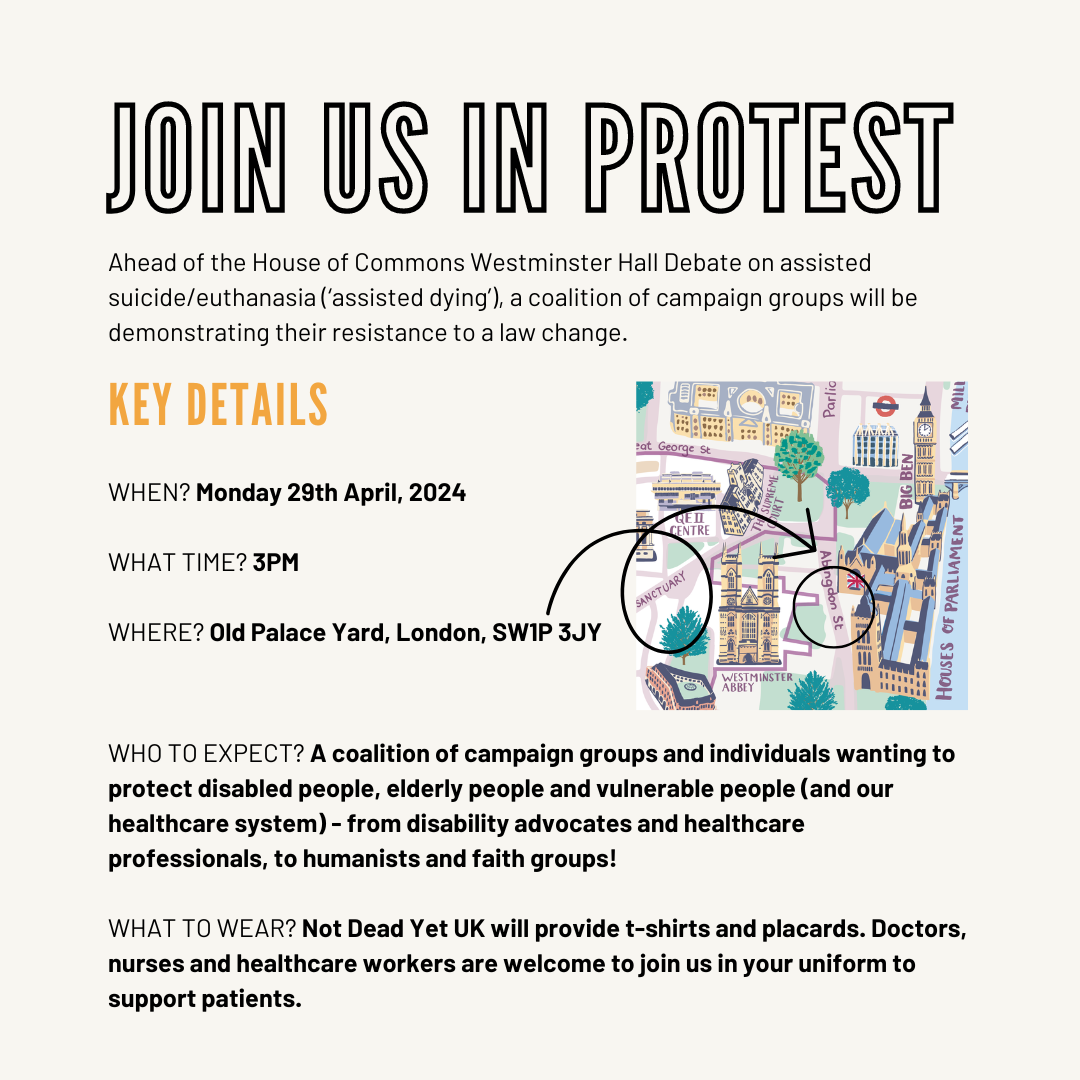
Activists from Disabled People Against Cuts (DPAC) joined Not Dead Yet UK, which leads disabled people’s opposition to legalisation in the UK, across the road from parliament on Monday, just yards from a larger rival action by those pushing for legalisation.

Actor, writer and comedian Liz Carr, whose documentary highlighting the dangers of legalisation will be broadcast on BBC1 later this month*, was one of the disabled activists raising concerns about the apparent political momentum enjoyed by those seeking new laws.

That momentum includes the announcement by Labour leader Keir Starmer last month that he was in favour of a change in the law in England and Wales, and that he would make parliamentary time for legislation to be debated – albeit with a free vote for MPs – if his party wins the next general election.

On Monday, as the two rival rallies took place across the road, MPs debated a petition that called for a parliamentary vote on the issue (see separate story).

Carr told Disability News Service (DNS) she was terrified by the government’s latest personal independence payment (PIP) proposals.

She said: “I don’t even think the other side will make the connection over how terrifying that feels to disabled people yet again.

We know disabled people have killed themselves because of DWP reforms in the past.

That’s what terrifies me: the kind of thing happening in Canada where people for socio-economic reasons are choosing to end their lives through euthanasia.”

She said she was “fed up” with the continuing complaints from those supporting legislation that parliament was not listening to them.

In February, a cross-party committee of MPs rejected attempts by a minority of its members to try to use a new report to push the government towards legalising assisted suicide in England and Wales.

Even after the committee’s report and eight failed attempts to persuade parliament to legalise assisted suicide over the last two decades, she said supporters of legalisation were still complaining that MPs and peers were “not listening”.

She said: “No, they are not giving you the answer you want.

On the same day that we are listening about PIP reform and about disabled people being labelled as scroungers, it’s more important than ever to say let’s give disabled people support in life and choice over their life.”

She added: “This is about everybody, actually, it’s about all marginalised people, not just disabled people.”

She later told other protesters opposing legalisation: “I know it’s hard being a small group of people, but I absolutely believe that if the public in general could hear our side then I think they would be far less likely to support assisted suicide.”

Andy Greene, a member of DPAC’s national steering group, said the decision to publish the PIP proposals on the same day as the assisted suicide debate was “not so subtle”.

He told DNS: “We are an easy target in terms of political targeting. We are the go-to group for cuts to services, for cuts to income, for building a narrative around, because we are seen as an easy target.

It’s a message and not so subtle a message to the public and to disabled people about where the direction of travel is.”

He said he believed the momentum towards legislation appeared to be “unstoppable, inevitable” which had left him “genuinely horrified”.

He said he had seen the “slippery slope” in other countries where assisted suicide has been legalised and has gradually been extended to more and more groups of disabled people.

He said: “That’s inevitable once it comes in. The catchment broadens and broadens and broadens every time, without fail.”

He said he had wanted to be at the protest “because it’s important disabled people are represented in this debate.

We are the people who have the most at stake here and, as history has shown us, we have the most to lose.

You feed the worst in people when you legislate for this.”

Nick Saunders, a member of the Disabled People’s Direct Action Network (DAN), said: “We want help to live, not to die. It’s a matter of life and death, nothing more, nothing less.

We fought for public transport, for independent living; now we are fighting for our own lives.”

Paula Peters, another member of DPAC’s national steering group, said the government’s move to publish its plans for further cuts to support on the day of the assisted suicide debate made her want to “throw rocks” at parliament, and had caused her “anger and huge anxiety”.

She said it would “ramp up” disabled people’s feelings that they were “a burden on society”.

She said: “To launch a consultation on PIP the day of the assisted dying debate is rubbing salt in the wounds.”

She added: “Disabled people will feel they are better off dead because they can’t afford to live.”

Peters said disabled people “need assistance to live, not to die”, including properly-funded social care and palliative care systems.

Nikki Kenward, campaign director of The Distant Voices, a user-led campaign group which opposes euthanasia and assisted suicide, told DNS she was “very concerned” at the momentum behind legalisation and now believed it would happen.

She said safeguards had failed in prisons, schools, children’s homes and within the police, so there was no reason why any safeguards would work with assisted suicide laws.

Another disabled campaigner, Nan Whitehouse, aged 91, told DNS that the idea of legalising assisted suicide was “very, very dangerous”.

She said: “Once you decide that human life is disposable, there is no halting it.”

*Better Off Dead? will air on BBC One and iPlayer on Tuesday 14 May at 9pm

2 May 2024


Labour confirms assisted suicide pledge, as activists protest outside parliament

Labour has re-affirmed its commitment to making time for MPs to “have a final say” on whether assisted suicide should be legalised, just as disabled activists were protesting about the idea outside parliament.

MPs were discussing a parliamentary petition set up by the right-wing Daily Express newspaper, which has been signed by more than 200,000 people and calls for assisted suicide for terminally-ill people to be legalised.

As they were debating the petition in Westminster Hall, disabled activists just 100 yards or so across the road outside parliament were highlighting the dangers of legalisation.

They were speaking of their horror at the government releasing new plans to cut personal independence payment on the same day MPs were debating the idea of legalising assisted suicide (see separate story).

Inside Westminster Hall, significant concerns were raised about the prospect of legalisation, although opponents were outnumbered by MPs who backed the petition.

One of the most prominent opponents was Labour’s Sir Stephen Timms, who warned that “changing the nature of the National Health Service, so that it ends people’s lives as well as sustains them, would be an absolutely fundamental change that we need to weigh very carefully indeed before introducing”.

He said: “I understand the proposition that people with a diagnosis of terminal illness should be allowed help to die, but it is clear from what happens elsewhere that if that did happen, it would not remain subject to that narrow criterion.

It would not end there. Indeed, the campaign to broaden the scope has already begun.

Matthew Parris wrote in his column in The Times that we need assisted suicide because old people cost too much.

It seems to me that legalising assisted dying would impose a terrible dilemma on frail people, elderly people and others when they are at the most vulnerable point in their lives, especially on conscientious frail people who do not want to die but do not want to be a burden.

I do not think that there is any way to avoid imposing that dilemma. The National Health Service should be there to protect those people.”

Other MPs warned of the “slippery slope” that would inevitably mean that the scope of any legislation would be widened once a law was brought in.

Conservative MP Nick Fletcher described how a 23-year-old woman with post-traumatic stress disorder was euthanised in Belgium two years ago, and how a 28-year-old woman, Zoraya ter Beek, is due to die this month in the Netherlands after seeking euthanasia due to depression.

The Conservative MP Sir Desmond Swayne pointed to the latest statistics released by the US state of Oregon, which legalised assisted suicide in 1997.

He said: “By far, the largest cohort of applicants for the service – 52 per cent – are those who say they wanted it because they did not want to be a burden, far exceeding those who wanted it to avoid pain in death.

There is a profound danger that what begins as a choice will end as an expectation.”

Labour’s Rachael Maskell told fellow MPs: “I am worried about the person who says, ‘I’m just getting in the way. My children will have a better future without me. Perhaps the savings I have put aside could be better spent by them than on me.’

It is not necessarily coercion, but the way that people feel in a society that changes the law.”

She also told MPs: “The NHS is in tatters, social care is in a dire condition and so much funding has been withdrawn from civil society.

There is much for the government to do, and they must address those reasons in order to ensure that everyone has the opportunity for a good end-of-life experience.”

Some supporters of legalisation appeared to concede that some people would be placed at risk under a new law.

Labour’s Sir George Howarth suggested that the idea of coercion was “based on an unduly pessimistic view of human nature, that people will pressure their close relative or loved one to take such a decision purely on the grounds that it might serve them well financially… or because they want to avoid caring responsibilities in the later stages of their loved one’s life.”

But he added: “I do not believe that that is how the majority of people take those decisions.”

He agreed that “some people might act in that way”, although the “overwhelming majority” would act “out of love”.

And Labour’s Tonia Antoniazzi, who moved the motion on the petition on Monday, told fellow MPs in Westminster Hall that it was “perhaps naive to suggest that any change in the law would not have wider consequences in society, beyond the individual making the choice”.

She pointed to the Danish Council on Ethics, which she said concluded last year that “the existence of an offer of assisted dying would decisively change ideas about old age, quality of life and dying, and that there was too great a risk that it would become an expectation aimed at certain groups in society”.

Ruth Cadbury, a shadow justice minister and a supporter of legalisation, confirmed that a future Labour government “would make time for a private member’s bill so that parliament can have the final say through a free vote, following a full debate and a process of amendments”.

Junior justice minister Laura Farris said the government’s position remained that “any relaxation of the law is an issue of conscience for individual parliamentarians, rather than one for government policy.

In the tradition of all conscience matters where the government maintain a neutral stance, that is typically achieved through a private member’s bill.”

Better Off Dead?, a documentary by disabled actor and activist Liz Carr that highlights the dangers of legalisation, will be broadcast on BBC One and iPlayer on Tuesday 14 May at 9pm

2 May 2024


Police still being used in ‘punitive’ NHS mental health schemes, says report

Police are still being used as part of “punitive, exclusionary and discriminatory” NHS schemes in England that criminalise mental distress, an 18-month investigation has found.

The Criminalising Distress report calls for an end to all such practices and the immediate removal of police from NHS mental health services.

The report, written by the global health charity Medact and supported by disabled activists, focuses on the “national scandal” of the Serenity Integrated Mentoring (SIM) scheme, which was only halted through a campaign by the StopSIM Coalition that exposed it as discriminatory, coercive and punitive.

The coalition’s campaign eventually persuaded NHS England (NHSE) to order local reviews by mental health trusts of how SIM had been implemented, and to admit it was wrong to endorse SIM without applying “sufficient scrutiny” and accept that this had harmed service-users.

Former members of the StopSIM coalition of service-users and allies acted as a steering committee for the Criminalising Distress project.

Hat, one of those former StopSIM members, and a survivor, researcher, activist and artist, told an online launch of the report that the coalition had eventually been forced to disband to prioritize their own health.

The coalition had worked with NHSE for 15 months on a new policy statement, only for NHSE to renege last year on a promise to publish it, and refuse to apologise or commit to change.

Hat said the hardest part of the decision to disband “was knowing that the fight to end SIM and the harmful and abusive systems and structures which allowed it to spread continued so widely, and knowing that the fight to eradicate all of that needed to continue”.

But they said that, despite StopSIM being disbanded, the survivor activism against SIM-like schemes continued.

Hat said that even though an apology would not have rectified “the real harms that continue to happen, it still felt like a huge injustice that that was never recognized, along with anyone taking accountability and responsibility for the failure and the harms”.

They also spoke about Oxevision, the system used to monitor mental health inpatients in their own bedrooms through a camera and infra-red sensor, which campaigners have described as “intrusive and dehumanizing and retraumatizing”.

They told the meeting: “We’ve spoken to people who’ve spent entire admissions sleeping on the bathroom floor, in communal areas, in the garden, just anywhere to avoid the camera.”

Hat said that Oxevision and similar surveillance systems were “being used to punish and criminalise patients”.

They pointed to similarities to SIM, with “patients and survivors” being left to “do the jobs of lawyers and detectives” and investigate what was happening, with a lack of accountability within the health system.

They said that services were “jumping on new technologies and ideas as if these can fill the gaps and failings that are created by a broken and chronically-underfunded system with deeply entrenched harms and violence”.

The SIM scheme focused on users of mental health services – often those at high risk of suicide and self-harm – who were seen as “high intensity users” of emergency services and a “troublesome burden on cash-strapped services”, with police officers embedded into community mental health teams.

But the Medact report exposes how the scheme grew and spread across England despite the false claims of its success made “aggressively” by its founder, police sergeant Paul Jennings.

The report concludes that, even though schemes named “SIM” have disappeared, there are “multiple” similar schemes that continue to criminalise distress, often led by the police.

These schemes are based on coercion and denial of potentially life-saving support, leaving some service-users to live in fear of arrest or even prosecution when in mental health crisis.

The report calls for an independent inquiry into ongoing SIM-like schemes, as well as a move towards a non-coercive, “robust and sustainable”, rights-based system of community support.

But it also says there is a need for interventions that “pre-empt crises occurring, by addressing the social determinants of mental health such as poverty, housing and employment”.

SIM was first trialled in 2013 on the Isle of Wight, but it was eventually rolled out to nearly half the mental health trusts in England.

NHSE, the NHS Innovation Accelerator, the Academic Health Science Network (now known as the Health Innovation Network) and the National Police Chiefs’ Council have all failed so far to apologise for the harm caused by SIM or the failures that led to its widespread introduction.

But the report also says that, due to the NHS culture of “blame-shifting and unaccountability, combined with its hierarchical leadership structures”, frontline staff who have spoken out against criminalisation have been punished, while there has been “no evidence of accountability” within the police.

The report also says that the NHS Innovation Accelerator has continued to push “dubious” new schemes such as Oxevision.

Research by the grassroots campaign group Stop Oxevision has confirmed that the technology is “regularly used without patients’ consent or sometimes even knowledge”, the report says.

Dr Jay Watts, a disabled activist and consultant clinical psychologist, told the report’s online launch that people she had spoken to who had been on SIM had experienced a “neglect of care” and then “kind of get attacked” and become a “scapegoat”.

She said there was “a lack of complex trauma knowledge, a lack of therapy, a lack of all the things that we know are affecting this group”, and they are viewed by the NHS as “a kind of a sucker of resources, in some dreadful way, who need to be punished”.

She said it was vital that those in need of support know they are “worthy of decent, really good care, and that’s so important to say when the system is still against you”.

And she said it was vital people looked after themselves and also “use our social power, whatever it might be”.

The Medact report concludes that SIM “was an example of a wider problem”.

It says: “Lack of compassion, failure to respect confidentiality, coercive practices, exclusion, denial of care, criminalisation and outright abuse are all far too common.

Nor can we hope to truly eradicate SIM-like practices while the NHS’s culture of blame-shifting and unaccountability at the top remains intact and whistleblowing frontline staff continue to be punished.

This same culture meant that the medical establishment waved through SIM, and it was left to people with lived experience of prior harm and injustice in the mental health system to challenge the programme.”

Patients, it says, “continue to be criminalised, neglected and used as scapegoats for a grossly inadequate system in need of radical overhaul”.

Dr Hil Aked, research and policy manager at Medact and lead author of the report, said: “The continuation and rebranding of SIM under different names shows that accountability for this harmful set of practices is still being evaded.

The government, NHS England and individual NHS trusts must recognise that people in mental distress deserve care and compassion, and should never be punished for being unwell.”

2 May 2024


Other disability-related stories covered by mainstream media this week

Staff were filmed hitting, kicking and leaving special school pupils in their own urine, the BBC has found. Despite the school proving abuse in so-called “calming rooms”, some staff are still employed there and have not been barred from working with children. Parents say they have not been allowed to see the footage and were misled about the use of isolation: https://www.bbc.co.uk/news/uk-68897335

Thousands of vulnerable people are at risk of ending up without social security payments, MPs have warned. Just under a million new claimants are being switched to the universal credit system, replacing six older payments. But the cross-party public accounts committee said the transition could see a large number of people slip through the net, causing “real-world misery”: https://www.bbc.co.uk/news/uk-politics-68897387

A celebrated deaf performer and sign-language poet has become the 16th “remarkable” Welsh woman to be recognized with a purple plaque. Dorothy “Dot” Miles was born in Rhyl, Denbighshire, in 1931 and lost her hearing aged eight due to meningitis. She became a key figure in the literary heritage of British Sign Language and the deaf community: https://www.bbc.co.uk/news/uk-wales-68907928

2 May 2024


News provided by John Pring at www.disabilitynewsservice.com
 

 Posted by at 15:03
May 012024
 
DPAC Logo with text underneath "Disabled People Against Cuts" and then web address dpac.uk.net


The last week has seen a sharp escalation in the dehumanisation targeted at people seeking asylum, Disabled people, and those who experience both forms of oppression. We come together in solidarity to condemn the government’s assault on people already marginalised.

The Rwanda bill has passed and will soon become law. This will enable the government to forcibly remove people seeking sanctuary in the UK, despite the Supreme Court ruling that this is unlawful.

This is the latest of many increasingly hostile immigration policies. The government likes to make us blame each other rather than to unite in solidarity and resistance against their policies. There was no reference to provision for people in the asylum system in the government’s submission to the United Nations Convention of the Rights of Disabled People (UNCRPD). But after receiving submissions from disabled people in the asylum system, the UN committee condemned the government’s denial of essential services for people seeking asylum or in refugee-like situations.

Each day, more and more of us are struggling to access our most basic human needs including food, housing, healthcare, and safety. During this cost of living crisis, many of us are having to choose between heating and eating.

These difficulties are not because people in small boats seek sanctuary in the UK or people use the welfare state. The position we are in is a direct consequence of government policies that fail to uphold our rights.

The rights of Disabled people and migrants are not separate issues. All too often the government tests out policies on one sector before being brought to the other. Only this week, it was proposed that disabled people get vouchers, instead of money. This policy was tested on people in the asylum system more than 20 years ago.

We can only mount effective resistance to these policies if we come together. We stand with all oppressed people and seek to build the solidarity necessary to build justice for all.

          We will not be divided. Disability justice = migrant justice

            We will build solidarity not borders

For further information

how to support people facing the threat of detention and removal to Rwanda, please see this from Action Against Detention and Deportations

https://cryptpad.fr/pad/#/2/pad/view/TpKJpOjfdUcsZ3uYO+eGBF8X9LKUENzq2Uns8nxIjI8/

DPAC is part of the Disability and Migration Network (DAMN) https://disability-migration.org.uk/network

If you would like to join other disabled people protesting in solidarity with people facing detention and potential removal to Rwanda please contact info@disability-migration.org.uk and we can try to put you in touch with others in your area.

 Posted by at 15:39
Apr 302024
 
DPAC Logo with text underneath "Disabled People Against Cuts" and then web address dpac.uk.net

This report should make any government that deserves to hold power sit up, take
notice and drastically change course. The CRDP Committee has fully recognised:
 The government’s shameful failure to make any significant progress with
human rights for disabled people
 The signs of actual regression in the government’s approach
 The government’s continuing ‘grave and systematic violations’ of disabled
people’s human rights.

An enormous strength of the report is its balance. In its coverage of disabled
people’s right to independent living, equal access to work and employment and right
to an adequate standard of living, the CRDP Committee has looked widely and
comprehensively.

As the report rightly highlights, it is an utter disgrace that many of
us are forced into institutions, continue to be locked up against our will in places
such as psychiatric hospitals and continue to be forcibly treated and abused, in
complete breach of human rights which other citizens hold. It is an utter disgrace that
the socioeconomic conditions which we face as disabled people are so
disproportionately bad and that we face heavy penalties for not working when we so
frequently lack necessary support to do so, or genuinely cannot. It is still more of a
disgrace that some of us experience multiple discrimination because of our gender,
age, ethnic origin or refugee status. It is high time that the government moves out of
denial and takes urgent reparative action.

Dorothy Gould
Founder of Liberation
E: liberationrights@gmail.com

 Posted by at 20:32
Apr 252024
 
DPAC Logo with text underneath "Disabled People Against Cuts" and then web address dpac.uk.net


Seven years on and no progress on disability rights by UK government, says UN

The UK government has made “no significant progress” in the more than seven years since it was found guilty of “grave and systematic” violations of the UN disability convention, it has been told by human rights experts.

In a report published late yesterday (Wednesday), the UN committee on the rights of disabled people said it had even found “signs of regression” – backward steps – in the UK’s progress towards fully realising the rights described in the convention.

This morning, the government said they “strongly reject” the committee’s findings.

The committee said the UK government had “failed to take all appropriate measures to address grave and systematic violations” of disabled people’s human rights and had “failed to eliminate the root causes of inequality and discrimination” since November 2016.

It particularly highlighted its failures on the rights to independent living, to work, and to an adequate standard of living and social protection, laid out in the UN Convention on the Rights of Persons with Disabilities (UNCRPD).

Last month, the committee appeared to be preparing a highly-critical report into the UK’s failures after it accused the UK government of demonising disabled people and treating them as “undeserving citizens” by preparing to fund tax cuts through slashing disability benefits.

Representatives from more than 10 disabled people’s organisations (DPOs) had travelled to Geneva to witness the UK government attempt to persuade the committee that it had made progress since being found guilty of “grave and systematic violations” of the convention in 2016.

Yesterday, the UN committee published its report, based partly on detailed evidence compiled by the UK disabled people’s movement.

DPOs that made the journey to Geneva said last night that the committee’s “damning verdict” was a vindication of those disabled people who have fought back against the rights violations of successive governments for more than a decade (see separate story).

Among its recommendations, the committee says it is “appalled” by reports of deaths linked to benefit claims that it says have a “disturbingly consistent theme”, with disabled people “resorting to suicide” following the denial of adequate support through social security.

It calls for the government to take urgent action to “prevent, review and respond to” benefit-related deaths and provide appropriate compensation for the victims’ families.

There are also calls for an urgent inquiry into the impact of the work capability assessment; stronger disability hate crime laws; and an investigation into unexplained deaths in the mental health system, particularly at Norfolk and Suffolk NHS Foundation Trust.

And just days after the prime minister launched a series of “chilling” cuts and reforms to disabled people’s social security safety net (see separate story), the committee calls on Rishi Sunak’s government to “take comprehensive measures” to ensure disabled people are “adequately supported through social security payments, benefits and allowances”.

It also calls for action to ensure that disabled people who face “multiple marginalization”, including disabled women and children, disabled people of colour, disabled migrants and asylum-seekers and those in “refugee-like situations”, can “enjoy the right to live independently and be included in the community and the right to an adequate standard of living”.

The committee says it is concerned that the UK government has left “largely unaddressed” its obligation under the UN convention to “closely consult and actively involve disabled people” through their DPOs on issues affecting their lives.

It also says it is concerned that obligations to “combat stereotypes, prejudices and harmful practices” across key parts of the convention have been “largely ignored”, while also raising “significant concerns” about plans to introduce laws through the data protection and digital information bill that would give DWP sweeping powers to carry out financial surveillance on benefit claimants through their bank accounts, using artificial intelligence.

That bill is currently passing through parliament, and was debated by peers this week.

The committee also warns of a “pervasive framework and rhetoric that devalues disabled people and undermines their human dignity” and says that benefit reforms are painting disabled people as “skiving off” and “defrauding the system”, which has led to “hate speech and hostility towards disabled people”.

The report concludes that there has been “no significant progress for disabled people throughout the UK concerning their right to living independently and being included in the community”.

And the committee says it is “deeply concerned” at evidence of “increasing rates of institutionalisation of disabled people”, and of “abuse, mistreatment and the increasing use of restraints, restrictive practices and coercive measures” in institutions.

As well as responding to the committee’s findings, the government will also now be forced to produce a follow-up report by March 2029 on how it has implemented its recommendations.

A government spokesperson said this morning: “We are grateful for the committee’s work monitoring this vital convention, but strongly reject their conclusions.

Individuals and organisations may not agree with this government’s approach, but it is a fact that we are tackling the barriers faced by disabled people, including helping one million more disabled people into jobs five years ahead of schedule, providing unprecedented health and employment support through our £2.5 billion Back to Work Plan as well as our Chance to Work Guarantee, improving the health and disability benefits system, and enhancing the accessibility of homes and transport.

In addition, our new Disability Action Plan sets out the practical actions the government is taking to improve disabled people’s daily lives, complementing the long term vision set out in the National Disability Strategy.”

25 April 2024


UN’s ‘damning verdict’ is ‘vindication’ of fightback against government’s rights violations

Disabled people’s organisations have welcomed the “damning verdict” of a UN committee on the government’s track record on key disability rights over the last seven years.

They spoke out last night (Wednesday) as the UN committee on the rights of disabled people concluded that the UK government had made “no significant progress” in the more than seven years since it was found guilty of “grave and systematic” violations of the disability convention (see separate story).

This morning, the government said they “strongly reject” the findings in the committee’s report.

Ellen Clifford, who has been coordinating work by the coalition of UK disabled people’s organisations that monitors implementation of the convention, said the committee’s verdict was “damning” and “timely”.

She said: “The UN report could not be more timely given that our government and sections of the media are currently engaged in attacks on Deaf and disabled people in direct contravention of the recommendations made by the UN disability rights committee more than seven years ago.”

She said the government’s attitude towards the UN’s inquiry was “evidence that their treatment of Deaf and disabled people is wilful and calculated” and “is reflected in the damning findings of the report”.

Last week, Clifford was granted permission to bring a judicial review of the government’s consultation on its plans to tighten the work capability assessment, which she said in December appeared to have been “a smokescreen for cuts”.

Andy Greene, a member of the national steering group of Disabled People Against Cuts (DPAC) – which spent years researching and lobbying the committee to carry out its original investigation – said of the UN report: “As ever, these inquiries capture another chapter in the story disabled people have been telling for well over a decade now. 

The most powerful service they provide though is to vindicate those who tell this and those who resist and push back against what’s going on.

The process of evidence gathering, taking witness testimony and objective scrutiny of policy and its impact, is one that’s very difficult to ridicule or dismiss.

The facts speak for themselves.”

The committee said the UK government had “failed to take all appropriate measures to address grave and systematic violations” of disabled people’s human rights and had “failed to eliminate the root causes of inequality and discrimination” since November 2016.

It particularly highlighted its failures on the rights to independent living, to work, and to an adequate standard of living and social protection, laid out in the UN Convention on the Rights of Persons with Disabilities (UNCRPD).

Among its recommendations, the committee says it is “appalled” by reports of deaths linked to benefit claims that have a “disturbingly consistent theme”, with disabled people “resorting to suicide” following the denial of adequate support.

It calls for the government to take urgent action to “prevent, review and respond to” benefit-related deaths and provide appropriate compensation for the victims’ families.

Alison Burton, who gave evidence to the UN committee and whose father-in-law Errol Graham starved to death after the Department for Work and Pensions wrongly stopped his benefits when he missed a work capability assessment, welcomed the committee’s report.

She said: “I am pleased that the report highlighted the need for proper review and monitoring of the deaths of benefit claimants.”

And she said the report also highlighted how the government’s actions and hostility towards disabled people had contributed to disability hate crime.

She said the report showed clearly that disabled people were now “at war for our rights to be treated equally”.

Rhian Davies, chief executive of Disability Wales, welcomed the committee’s findings that the UK government had “failed to take appropriate measures to address grave and systemic violations of disabled people’s rights”.

She said: “Neither the UK government or Welsh government have properly supported independent living, particularly during the cost-of-living crisis.

The UK government’s approach to this review has been utterly disrespectful and matches the contempt shown to disabled people for over a decade.

We deserve better and we demand better.”

Svetlana Kotova, director of campaigns and justice for Inclusion London, said the report was “a damning verdict on the government’s track record in upholding our human rights”.

She said: “Since the 2016 finding of ‘grave and systematic’ rights violations, the UN committee has not only seen no significant progress, they have also documented evidence of retrogression.

Moreover, the committee finds that UK welfare policy is based on a pervasive and hostile framework and rhetoric that devalues disabled people and undermines our human rights.

It is shocking that our country that positions itself as a world leader is yet again found to breach our rights on a systematic level.

It is also shocking that the government has failed to listen to the UN in the past and has actively dismissed the previous recommendations.”

She added: “We welcome the report and urge the government and the opposition to take it seriously and develop policies on welfare reform, employment and independent living that comply with the UK’s obligations under the [convention].”

Kamran Mallick, chief executive of Disability Rights UK, accused the government of a “complete disregard for international law and contempt for disabled people’s rights.”

He pointed to last week’s speech by the prime minister (see separate story), which announced an “onslaught of new policy proposals and legislation which will not only harm us but also lead to avoidable deaths”.

He said: “Despite having seven years to do so, the UK government has made no progress on improving the rights of disabled people.

Instead, our rights, access to support, and the provision of services have all deteriorated, with an increase in hostility and hate.

Under this government, the UK has lost its status as a nation that leads in disability rights to one that is actively attacking disabled people.”

John McArdle, co-founder of Black Triangle, welcomed the report.

He said: “After campaigning solidly against the inhumane work capability assessment regime for 14 years, it is life-affirming that the [committee] has officially expressed its profound shock and outrage at the tragic loss of hundreds of lives that have occurred as a direct result during this time.

In addition, the committee has called for a full investigation into the circumstances and for redress and reparations for bereaved families where appropriate.

There must be no further so-called ‘welfare reform’ until the UK has fully complied with the committee’s recommendations.”

Natasha Hirst, the disabled president of the National Union of Journalists, said the report highlighted how there had “never been a more important time for journalists and the wider media industry to tackle harmful negative rhetoric against disabled people”.

She said: “I call on journalists to take time to understand the concerns raised by the UN committee and scrutinise why the government is so keen to dismiss their failure to uphold disabled people’s human rights.

Deaf and disabled people’s organisations have thoroughly evidenced the harm caused by policy changes and cuts to services and yet the UK government is intent on pushing this even further.

Disabled people’s voices need to be heard and not drowned out and demonised by people who have never experienced the sharp end of the social security system.

As journalists, we should report ethically to hold power to account, and not be complicit in the scapegoating of disabled people.”

Dorothy Gould, founder of the user-led, rights-based organisation Liberation, said the report “should make any government that deserves to hold power sit up, take notice and drastically change course”.

She said: “Until it becomes illegal to lock disabled people up in institutions and forcibly treated, there will be continuing abuse of our human rights.

A huge strength of the report is its recognition of that.”

She added: “An enormous strength of the report is its balance.

In its coverage of disabled people’s right to independent living, equal access to work and employment and right to an adequate standard of living, the [committee] has looked widely and comprehensively.”

Dermot Devlin, from DPAC Northern Ireland, said: “The report is a shameful indictment of callous failure on the part of a government that has been found to have overseen ‘a pervasive framework and rhetoric that devalues disabled people and undermines their human dignity’.

Not only has the Committee found no evidence of progress, it has highlighted further evidence of retrogression.

The continued failure to address the ongoing grave and systematic violations of our human rights must not be allowed to continue.”

A government spokesperson said this morning: “We are grateful for the committee’s work monitoring this vital convention, but strongly reject their conclusions.

Individuals and organisations may not agree with this government’s approach, but it is a fact that we are tackling the barriers faced by disabled people, including helping one million more disabled people into jobs five years ahead of schedule, providing unprecedented health and employment support through our £2.5 billion Back to Work Plan as well as our Chance to Work Guarantee, improving the health and disability benefits system, and enhancing the accessibility of homes and transport.

In addition, our new Disability Action Plan sets out the practical actions the government is taking to improve disabled people’s daily lives, complementing the long term vision set out in the National Disability Strategy.”

24 April 2024


Sunak’s ‘chilling, threatening’ speech on benefits ‘demonised disabled people’

The prime minister has been accused of whipping up hostility towards disabled people, and demonising and scapegoating claimants of disability benefits, with a new series of “chilling” reforms that will weaken the social security safety net.

Rishi Sunak announced plans for new cuts to personal independence payment (PIP), a faster rollout of universal credit to disabled people, and an end to what he called a “sicknote culture”.

But most of the reforms will only be introduced if the Conservatives win power at the next general election, almost certain to take place within the next six months.

Sunak’s speech came only days after campaigners warned that the “dangerous” rollout of universal credit to half a million more claimants was a potential threat to the “safety and well-being” of disabled people who currently rely on so-called “legacy” benefits to survive.

Now ministers plan to accelerate that rollout so that, rather than most of them not facing the “migration” to universal credit until 2028, all those disabled people receiving income-related employment and support allowance will now receive so-called “migration notices” by the end of next year, with the process beginning within months.

Further details about the government’s plans for PIP are expected within days, but Sunak claimed the increase in successful PIP claims was “driving up the cost of the disability benefits bill at an unsustainable rate”.

He said he was “worried about it being misused” and that, in some cases, “it probably isn’t right that we’re paying an ongoing amount every year”.

He particularly focused on PIP claimants with mental distress, speaking of the need for a “more objective and rigorous approach that focuses support on those with the greatest needs and extra costs” and the need to make the system “fairer and harder to exploit”.

He said that, since 2019, the number of people claiming PIP who were citing anxiety or depression as their main condition had doubled, and he suggested that the PIP system was “undermined by the way people are asked to make subjective and unverifiable claims about their capability”.

The Disability Poverty Campaign Group described Sunak’s speech as “chilling” and “threatening” and said his words continued a trend that was “stigmatising, harmful, and inaccurate”.

On the same day as Sunak’s speech, Labour revealed figures showing the rate of suicide among 15-19-year-olds had increased by 64 per cent since 2010, while over the last 12 months, 780,000 children and young people have been in contact with mental health services, an increase of 200,000 since April 2021.

Sunak also ignored experimental figures published by the Department for Work and Pensions (DWP) earlier this year, which showed that nearly half of all individuals in families with at least one disabled child and one disabled adult in the UK were living in poverty by 2021-22.

Just four days after his speech, Sunak announced an extra £75 billion in defence spending over the next six years.

Nima Cas Hunt, in an article published by National Survivor User Network, which described the destructive impact on those with mental distress who have had their PIP removed, said Sunak’s speech was designed to “drip feed a nation with an extremely ableist rhetoric intended to radicalise, scapegoat and ostracise”.

She wrote: “We are being demonised for our suffering – and for those of us who experience mental ill-health and distress, our suffering has been openly ridiculed and minimised.”

Rhian Davies, chief executive of Disability Wales, told BBC Radio Wales (listen from 14 minutes) that the prime minister’s language was “shocking and appalling” and had “ramped up the vilification of disabled people instead of the UK government looking at the policies that it has brought in that have contributed to the high levels of stress and anxiety that people face and social exclusion”.

Sunak also announced reforms to what he repeatedly referred to as the “sick note” system –actually known as fit notes – with the prime minister calling for an end to Britain’s “sick note culture”, and announcing a call for evidence on the proposals.

He said this could see responsibility for issuing fit notes shifted away from GPs and towards “specialist work and health professionals who have the dedicated time and expertise to provide an objective assessment of someone’s ability to work and the tailored support they may need”.

There are concerns that this will mean the privatisation of fit notes, with the system outsourced to private contractors in the same way as disability benefit assessments have been outsourced to companies like Capita, Atos and Maximus.

DWP refused to say if this was what was being planned, but it did say that only registered healthcare professionals – doctors, nurses, pharmacists, physiotherapists and occupational therapists – would carry them out.

Sunak used a phrase repeated by generations of ministers – but first tested out by Labour’s Alistair Darling in 1999 – to call for a change in emphasis towards “what work you can do, not what you can’t”.

Sunak’s speech, in which he also spoke of the “unfairness” of the out-of-work disability benefits system and the “irresponsible burden” for future generations that would be caused by “spiralling increase in the welfare bill”, had clear echoes of the scapegoating of disabled people by Conservative ministers in the post-2010 austerity years.

In October 2020, prime minister David Cameron had told the Conservative party conference: “If you really cannot work, we will always look after you. But if you can work, and refuse to work, we will not let you live off the hard work of others.”

The following month, work and pensions secretary Iain Duncan Smith told The Sun newspaper that he was “appalled” at how easy it had been for people to claim incapacity benefit and cheat the system.

In response to Sunak’s speech, Fazilet Hadi, head of policy for Disability Rights UK, said: “Once again the government is targeting disabled people for a failing economy.

Yet it is government policies that have fuelled increases in disability and sickness.

Under resourcing of health services, social care, education, housing and transport, are excluding disabled people from opportunity and driving us into poverty.

Deepening poverty is driving increases in disability and sickness.

The prime minister’s approach to systemic inequalities caused by government policies and underfunding of public services, is to further penalise, punish and threaten disabled people living on inadequate benefits.”

Labour MP Debbie Abrahams raised a point of order in the Commons on Tuesday, describing Sunak’s speech as “grossly offensive” for “implying that people who are economically inactive due to ill health or disability are not genuine, but malingerers”.

She said his speech “ignored the overwhelming evidence from epidemiologists such as Professor Sir Michael Marmot, which shows that over the last 14 years we have become a sick nation, living shorter lives and less of our lives in good health”.

In his speech, delivered at the Centre for Social Justice, the right-wing thinktank founded by Duncan Smith, Sunak also confirmed plans to give DWP new powers to investigate fraud and “make seizures and arrests”.

And there was a threat for those on mainstream out-of-work benefits – which will include hundreds of thousands of disabled people – that new legislation in the next parliament would see anyone who has been on those benefits for 12 months and fails to comply with conditions set by their work coach having “their benefits removed entirely”.

It was not clear how people in those situations, which will include many disabled people unable or unwilling to follow their work coach’s orders, will be expected to cope without any benefits.

Alison Burton, whose disabled father-in-law Errol Graham starved to death after DWP stopped his benefits when he failed to turn up to a work capability assessment, said the prime minister’s speech – and particularly his “completely ignorant” comments on mental health – had felt like “a punch to my stomach”.

She said her years of campaigning and legal attempts to hold DWP to account had been focused on DWP’s lack of care and understanding of mental health, and the need for it to have a legal safeguarding duty.

She said Sunak’s words, and policies, would only cause greater mental distress to people like Errol Graham.

She said: “This government have got no care whatsoever when it comes to people like Errol.”

Inclusion London said the reforms were “clearly” driven by reducing costs and would “cost lives and unleash misery”.

It said it was “appalled that the government is yet again mounting another brutal ideological attack on disabled people, after 10 years of austerity, disproportionate Covid deaths and a cost-of-living crisis.

The social security system should be there to promote and protect our rights.

Instead of focusing on improving the inclusiveness of the workplace, the government chooses to demonise those disabled people who are not able to work.”

Labour declined to raise any concerns about the fit note plan, the universal credit announcement, the PIP review, the fraud measures, or the prime minister’s language.

Vicky Foxcroft, Labour’s shadow minister for disabled people, said that PIP “isn’t working for disabled people and needs reform”, and she said Labour would analyse the details when they were published by the government.

A three-month consultation on the PIP plans is expected to be launched within days.

She said: “A healthy nation is critical to a healthy economy, but the Tories have completely failed on both.

The chancellor, Jeremy Hunt, first proposed the exact same reforms to fit notes back in 2017, when he was health secretary.

After 14 years of failure, the Conservatives are completely out of ideas, and working people are forced to pay the price.

Labour will build a healthier nation and get people back into work, tackling the root causes of economic inactivity by bringing down NHS waiting lists, reforming social security, and supporting people into good jobs in every part of the country.”

She added: “The government have lost control of fraud in the benefits system, with benefit fraud and error skyrocketing to £8.3 billion in the last financial year, after the record high of £8.7 billion the year before.

Labour is unreservedly committed to tackling fraud. We will crack down on the criminal gangs and fraudsters who try to take money from the public purse illegally, while ensuring that those who have been victim of error in the benefits system are treated fairly.”

Meanwhile, new information released by DWP shows that the number of disabled people affected by existing plans to tighten the work capability assessment (WCA) will be even higher than previously thought.

By 2028-29, DWP’s estimate for the number who will be forced to carry-out work-related activity as part of their universal credit claim, when previously they would not have had to do so – due to removing the “mobilising” activity in the WCA and weakening the substantial risk safety net – is now 424,000, an increase of 53,000 on the original estimates released last November.

And the estimated number who will be found fit for work and placed in universal credit’s “intensive work search group” by 2028-29 – due to amending the “getting about” part of the assessment – is now 33,000, a rise of 4,000 on the previous estimates.

Last week, disabled activist Ellen Clifford was granted permission to bring a judicial review of the government’s consultation on its plans to tighten the WCA, which she said in December appeared to have been “a smokescreen for cuts”.

25 April 2024


Direct action ‘will put stake through the heart’ of government scapegoating of disabled people

Disabled activists have pledged to use direct action protests to “put a stake through the heart” of the idea that disabled people can be used as scapegoats and “whipping boys” in the run-up to general elections.

At an emergency meeting of at least 100 activists on Sunday, organised by Disabled People Against Cuts (DPAC), there were repeated pledges to fight the government’s “fundamental” assaults on their rights.

The meeting was called after the prime minister announced a series of reforms that are set to weaken the social security safety net, with his speech described by one disabled writer as designed to “drip feed a nation with an extremely ableist rhetoric intended to radicalise, scapegoat and ostracise” (see separate story).

Rishi Sunak announced plans for new cuts to personal independence payment, a faster rollout of universal credit to disabled people – despite serious concerns about the potential threat to the “safety and well-being” of disabled people – and an end to what he called a “sicknote culture”, as well as other reforms.

Sunday’s online meeting of activists heard that most of these reforms would only be introduced if the Conservatives won power at the next general election, which is almost certain to take place within the next six months.

DPAC – including some of those activists at the meeting – and other grassroots groups of disabled people have now been fighting successive Conservative-led governments over successive waves of austerity cuts for the last 14 years.

But they vowed this week to continue that fight.

As well as discussions of direct action, the meeting considered possible legal action that could derail some of the government’s planned legislation, particularly with a general election imminent.

Andy Greene, a member of DPAC’s national steering group, said: “When it comes to direct action, I think we really need to start upping our game.

I think we need to put a stake through the heart of this idea that you can constantly come back to us as the whipping boy at the run-up to an election and talk about making our lives smaller and smaller again every single time as a vote-winner.

I am sick of being used, being tied to a post, and being whipped for votes for election run-ins.

Direct action needs to drive these arguments back into the dark because we cannot keep putting up with it.

We are re-emerging as a mass movement, and direct action has always been the cutting edge of our movement.”

Ellen Clifford, a member of DPAC’s national steering group and award-winning author of The War on Disabled People, said: “What we really need is some direct action.”

She said Conservative politicians were “trying to win the next election by directly attacking disabled people”.

She added: “We need to show them what we think of them.”

John McDonnell, Labour’s former shadow chancellor and a long-standing DPAC member, told the meeting: “I think the scale of this attack is worse than in 2010 now.

I think it has gone beyond that because this is much more fundamental an assault on basic rights for disabled people, and that’s why DPAC was founded [in 2010].

We are a resistance movement, and we resist attacks, and in resisting those attacks we give a vision and hope for the future.

I am worried about people being scared and anxious about this attack, because of the scale of it, but to balance that out we are within six months maximum of a general election.”

He said he believed the government would be able to introduce very few of the reforms Sunak announced before the election.

McDonnell said that if disabled people managed to make the government’s proposals “a general election issue” they would “defeat most of this and we will come out of that much stronger” and be positioned to secure stronger commitments from an incoming Labour government.

He said he did not believe many people – particularly within parliament – realised the scale of the attack on disabled people.

He committed himself and his staff to supporting efforts to oppose the reforms, including through parliamentary questions, early day motions, debates and events within parliament.

He added: “We have to get back to direct action as well. We have to get back onto the streets.”

Clifford also called for efforts to build campaigning networks “to pull people together”.

She said: “There are people who are rightly really scared about what this means.”

She said efforts should be made to reassure people where the government’s changes will not be introduced immediately, and where existing claimants will not be impacted.

As well as DPAC activists, others at the meeting included representatives from the disabled women’s organisation WinVisible, Inclusion London, and DPAC Northern Ireland, and union activists from PCS, Unite Community and the National Union of Journalists (NUJ).

Natasha Hirst, NUJ president and a long-standing disabled activist, told the meeting that she was leading on the union’s work to support journalists to improve how they report on disability and social policy.

She said: “I know that there’s an awful lot of reporting at the moment that is absolutely abhorrent, that is appalling, and I’m working really hard with my colleagues to try to educate journalists.”

She said she was also keen to put together information that would show activists how to challenge poor reporting.

The meeting also heard of other ways that disabled people could fight back against the government’s reforms, including writing to MPs and mainstream media, contributing to local radio discussions, and posting on social media.

DPAC’s Paula Peters, who chaired the meeting, said afterwards that the mood had been “determined and angry” and that those who attended were “determined to organise, determined to mobilise, and determined to fight back”.

She said: “We have had 14 years of fighting successive governments, and we’ve got to continue to resist the draconian attacks and continue to fight for social justice and for our human rights. There’s no choice.

There are loads of ways that disabled people can support these campaigns, and we urge everyone, however they can, to join in with whatever they feel comfortable doing, because there is strength in numbers, and we’re stronger together.”

Claire Glasman, from WinVisible, who also attended, said the meeting showed that “everyone is determined to resist this attack on our benefit rights”.

She said: “In WinVisible, many of us are living with mental distress due to abuse, rape, war and other trauma.

We are asylum-seekers, refugee, immigrant and UK-born women, and some of us are LGBTQI+.

In the face of Rishi Sunak scapegoating sick and disabled people; the government wanting to give the DWP surveillance powers on the bank accounts of 22 million claimants, including pensioners; and the passing of the Rwanda bill, effectively ending the right to seek asylum and protection in the UK, we are more determined than ever to fight for our survival.”

She also said there were concerns that the government planned to privatise the fit note system, and she called on the British Medical Association to oppose any such plans, which would lead to “profiteer companies” making decisions, as with the “brutal disability benefit assessments” that have been carried out by Maximus, Atos and Capita.

*Anyone who wishes to be involved in DPAC’s work to oppose the government’s attacks on disabled people should email mail@dpac.uk.net

25 April 2024


Activists’ shock as Scope ‘sacrifices integrity’ to partner with ‘hostile’ Daily Express

Shocked disabled campaigners have questioned why the disability charity Scope has partnered with a “scaremongering” national newspaper notorious for its hostile coverage of disabled people and other marginalised groups.

The Daily Express is the official partner for Scope’s second Disability Equality Awards, which are taking place today (Thursday) in London.

The ceremony comes just days after the right-wing newspaper horrified many disabled people with its front-page headline: “PM tells sick note Britain: Get a grip and a job.”

And it comes 17 months after Scope was forced to apologise for the way it ran its inaugural Disability Equality Awards, after excluding disabled people of colour and those clinically vulnerable to Covid, while refusing to pay disabled people who were asked to join its judging panel.

Now some of the disabled activists who protested in November 2022 have expressed alarm at Scope’s decision to partner with the right-wing tabloid on the awards, which are supposed to “shine a spotlight on equality champions”.

The Express was a particular focus for anger during the early austerity years, with headlines such as “Sick benefits: 75 per cent are faking”, and the impact of its disablist coverage was highlighted in reports published by disabled people’s organisations such as Disability Rights UK and Inclusion London.

One of the original signatories of the 2022 petition that led to Scope’s apology, Azeem Ahmad, an inclusion consultant based in the north-east of England, said the Express had admitted to a parliamentary committee – following its takeover by Reach PLC – that it had “contributed to the Islamophobia that has made the lives of me, and people like me, so much more difficult.

They may argue that things have changed since the takeover, but they continue to seed division and hatred as client journalists for this government and opaquely funded ‘think-tanks’.”

He said the partnership illustrates “how far removed Scope is from their beneficiaries, and it will be very interesting to see what appears alongside the Express’s coverage of the awards”.

Yen Godden, a disability advocate who helped draw up the 2022 petition, said: “I am shocked that Scope has chosen to partner with the Daily Express, especially after the last Scope awards white-out scandal and their public commitments to do better and listen to those who are multiply marginalised.

Scope has a section on their website about reporting disability hate crimes and incidents, yet seems to miss the glaringly obvious fact that the Daily Express has consistently stirred up hatred and mistrust towards disabled people and continues to do so.

The latest front-page headline shows that the tabloid’s attempt to purple wash their reputation and make themselves look disability positive by partnering with Scope for this year’s Disability Equality Awards was superficial at best and added insult to injury for the disabled community who have borne the brunt of their headlines for years.”

Godden said the Express “consistently villainises marginalised groups such as refugees, the LGBTQIA+ community, especially trans people” to sell newspapers and generate clickbait.

She said: “In my family, my grandmother’s generation were refugees. It’s painful and distressing to hear the fear and vitriol whipped up against asylum-seekers by tabloids like the Daily Express repeated to me by people in my daily life.”

She added: “The intersectionality of the disabled community is vast and genuinely diverse. We strive for collective liberation.

We both belong to and stand with the groups who are constantly targeted by the scaremongering tabloids like the Daily Express.”

Disability advocate Sara Westrop said that, as a disabled non-binary person, they were surprised to hear of the partnership, “considering the numerous ways they have contributed towards the increasingly hostile environment in the UK directed towards disabled people and trans people.

The Express regularly shares articles painting disabled people as drains on society, resources and money.

They have hundreds of articles which paint trans people as dangerous, and they’re full of misinformation on trans healthcare.

Recent ones that come to mind are showing support for Sunak’s barbaric reformation of disability benefits and the celebration of the biased and poorly researched Cass review that led to the banning of puberty blockers for trans children.”

Accessibility consultant Julia Peyser Gutiérrez Anstey was also critical of the partnership.

They said: “The Daily Express has and continues to directly harm the disabled community by framing us as ‘benefits scroungers’ and wastes of NHS money.

The fact that they are partnering with Scope does not take back any of the immense harm they have done to disabled people.”

Despite its partnership with the Express, and the paper’s “sick note Britain” front page, Scope has now launched a petition, backed by other disability charities, calling on the government to “stop demonising us”.

Asked why the charity thought it was appropriate to partner with the Express when it had a long history of discriminatory, hostile and disablist coverage, a Scope spokesperson said: “We work with journalists from across the political spectrum, just as we work with government and all political parties, because of the influence they have on our society.

Having the Express spotlight stories from our nominees allows us to reach new audiences, and bring positive messages about disability to people that we would otherwise be unable to reach.”

He said that Scope “disagree” with last week’s “sick note Britain” front page and the term “sick note Britain”, but that the Express article “includes our quote that challenges the prevailing narrative about disability, benefits and work”.

He said the Express had not paid Scope for the partnership but had agreed to “spotlight numerous nominees”.

He said: “Partnering with the Express does not impact our independence at all.

But it does give a platform and increase the reach and voice of disabled people and many of our shortlisted nominees.”

He said the charity was not reconsidering the partnership in the light of the front page.

Ahmed said in response to Scope’s comment: “I’m astonished that Scope is sacrificing their integrity and any credibility they may have had on inclusion in exchange for ‘earned media’. 

This raises serious questions about their leadership and operational decision-making.

I think it’s time for the trustees to get a handle on the obvious cultural problems that Scope has.”

Godden warned that “spotlighting” award nominees as “inspirational figures” played into the damaging narrative “that disabled people are either a burden or an inspiration” and “was the same treatment applied to refugees and other marginalised groups by these tabloids”, when in fact “we exist as equals in society with inherent value as human beings”.

Gary Jones, editor of the Express, said this morning (Thursday): “The Express has demonstrated its commitment to supporting mental health and disability in recent years, with campaigns such as fighting to get the disabled into jobssecuring life-changing drugs for sufferers of degenerative condition PKU and our ongoing campaign for disabled people to be helped with bills during the cost of living crisis.

We are committed to bring about positive change and look forward to working with Scope to do this.”

25 April 2024


Government’s access advisers face criticism for ‘meaningless’ response on rail reform

The government’s advisers on accessible transport have been fiercely criticised for a half-hearted and “meaningless” response to the government’s planned rail reforms.

In response to a call for evidence on the draft rail reform bill, the government’s independent advisers on accessible transport, the Disabled Persons Transport Advisory Committee (DPTAC), produced a response of just 543 words.

The call for evidence came from the Commons transport select committee, following the publication in February of the government’s 30-page draft bill, alongside 29 pages of explanatory notes, a 123-page impact assessment, and a 26-page memorandum.

The draft bill lays out plans to transfer powers to Great British Railways, the new over-arching body that will – eventually – run the rail system.

The government said last year that its plans “will ensure that accessibility on the railway is improved and the experience for disabled passengers is enhanced”, although the draft bill has no chance of becoming law before the next general election.

DPTAC had previously told the government – two years ago – that it did not believe its proposals for reforming the rail system would be “sufficient to deliver cultural change or an accessible railway”.

But last year the government appointed a new DPTAC chair, Matthew Campbell-Hill, and in an interview with Disability News Service shortly after his appointment, he questioned whether it was right to release DPTAC research that exposed the discrimination faced by disabled passengers.

Campbell-Hill, a technology and media consultant and retired international wheelchair fencer, has said little else publicly about accessible transport since his appointment, despite the months of anger and activism from disabled people over plans to close nearly 1,000 ticket offices across England, which were later abandoned (see separate story).

Transport secretary Mark Harper eventually reversed the government’s previous position supporting the closures, announcing in late October that ministers had “asked train operators to withdraw their proposals”.

The response to the transport committee suggests that DPTAC has eased its criticism of the government’s rail reforms.

In its response, DPTAC says it is committed to working with the Department for Transport (DfT), calls for a “comprehensive understanding” of its own new role under the reforms, and says there needs to be “further exploration” of its proposed expanded role.

It also calls for “explicit clarification” of measures on accessibility, and praises the government’s “thorough and insightful impact assessments”, while highlighting the need for “comprehensive staff training”.

Accessible transport campaigner Doug Paulley, who has taken many influential legal actions against the transport industry for its repeated failures on accessible transport, said DPTAC’s response “simply doesn’t even begin to respond to the call for evidence, let alone advance disabled people’s enforceable and enforced rights”.

He told Disability News Service (DNS): “It is lacking in any content or meaning, there is no recognition of the discriminatory service failures we currently experience, and it doesn’t give the firm commitment to disabled people’s rights we need and deserve from our representatives.”

Tony Jennings, co-chair of a rail accessibility panel and co-founder of the Campaign for Level Boarding, also said he was disappointed by the DPTAC response, which he said “could have been written by a non-disabled person who doesn’t actually use trains regularly”.

He said DPTAC failed to note the importance of imposing deadlines for the legislation to be introduced and the need for significantly increased investment for accessible stations, as well as the need to introduce level boarding from the train to platform “or else the same barriers will exist in 100 years”.

He pointed to a 2022 report by DPTAC, which concluded: “At current annual rates of investment spend on station accessibility, it will take around 100 years to make the entirety of the station estate step-free to new-build standards.”

He told DNS: “There is no mention of discrimination or challenging the status quo and the importance of enforceable rights.”

After two years campaigning, Jennings has finally succeeded in persuading ScotRail to change its discriminatory mobility scooter policy.

He added: “DPTAC needs to be truly independent and subject to scrutiny and more transparent, as it was ominously silent over ticket office closures when disabled people needed them most.”

The disabled-led campaigning organisation Transport for All (TfA) also raised concerns about the DPTAC response.

Ezra Johnson, TfA’s campaigns and communications officer, said: “This is a major piece of legislation that will affect how the rail network is managed for many years to come.

If it’s done right, Great British Railways could address some crucial barriers disabled people face to travelling by train: standardised infrastructure, simpler complaints processes, meaningful accountability.

But at this stage, this is all hypothetical; the bill in its current form does not live up to such a promise and our fear is that, if disabled people are not built into the new rail network from the very beginning, then we could be built out of it for good.

We’re concerned that DPTAC have missed an opportunity to influence the bill given the brevity of their response, and urge them to go further to exercise the full extent of their influence on this issue, holding the government’s feet to the fire to ensure that accessibility obligations are clear and enforceable from the outset.”

Campbell-Hill told DNS: “In our response to the consultation, we emphasized our intention to engage with the Department for Transport as the rail reform bill evolves, to ensure that accessibility and the voice of disabled people are central to the legislation’s development.

Regarding public statements, our advisory role often involves confidential discussions with the department, allowing us to provide candid advice that supports effective decision-making.

This confidentiality is essential to our work but can sometimes result in fewer public communications.”

He said DPTAC had taken “significant steps to increase transparency” and had published or contributed to “at least 34 public documents, indicating a considerable increase in transparency and communication compared to previous years”. 

This includes publication of three guidance and regulation responses; three news and communication pieces; one research and statistics response; one programme of work summary; one register of members’ interests; one report on gifts and hospitality received by members; three annual reports covering 2018 to 2023; 15 sets of main committee meeting minutes, including previously unreleased minutes dating back to 2020; and six working group reports summarizing the past year’s activities.

He said these publications were “part of our ongoing commitment to transparency and accountability” and “provide evidence of our active engagement in addressing critical issues affecting transport accessibility”.

He added: “We remain dedicated to advising and supporting the Department for Transport to create a more accessible and inclusive transport network.”

25 April 2024


DWP claims it has no written evidence to show why it weakened suicide probe guidance

The Department for Work and Pensions (DWP) appears to have destroyed all written records that would have shown why it weakened guidance on when to investigate suicides of benefit claimants.

DWP previously said it had no documents about the decision that were considered by any of its directors, claiming this was because the discussions on the move were “operational in nature as opposed to policy based”.

But it has now admitted that it also has no documents held by the team that made the decision in April 2021 to weaken the rules on when to carry out an internal process review (IPR).

The previous year, DWP had told the National Audit Office (NAO) it would always carry out one of its secret reviews when it heard of a claimant’s death if they had died by suicide, even if there were no allegations that DWP’s actions had contributed to that death.

But since April 2021, after weakening the rules, DWP now only carries out an IPR following the suicide of a claimant if there is already an allegation that DWP’s actions “may have negatively contributed to the customer’s circumstances”.

After Disability News Service (DNS) asked for documents held by the team that made this change, through a freedom of information request, the department replied: “Following a search of our records, we have established that the information requested, which relates to the change in criteria for Internal Process Reviews, is not held by this Department.”

Labour’s Debbie Abrahams, who has led parliamentary efforts to secure justice for DWP’s victims and push for an independent inquiry into the countless deaths linked to its failings, said the department’s actions were “yet further evidence of the DWP’s failure to treat the deaths of social security claimants with appropriate sensitivity and rigour”.

She said: “This news will be both horrific and frankly unsurprising to the campaigners for justice on the deaths of social security claimants for many years.

The Department for Work and Pensions have admitted that the criteria to investigate all suicides following the NAO 2020 report were changed in 2021 and given both the importance and sensitivity of such a decision, it is deeply disturbing and administratively unforgivable that this was not properly recorded.”

She highlighted how DWP admitted five years ago that it was unable to find documents which would have shown if it had shared vital information relating to suicides linked to the work capability assessment with the independent reviewers of the assessment process.

The minister for disabled people at the time, Justin Tomlinson, had earlier misled Abrahams about evidence uncovered by DNS that proved the information had not been shared with one of the reviewers, Dr Paul Litchfield.

Abrahams said this week: “This is a pattern of behaviour.

It is unforgiveable that yet again, the Department for Work and Pensions, the highest-spending government department, has once again failed in basic record-keeping.

I will be following this up with the National Data Guardian.”

She said the admission “also exposes that DWP’s internal culture have led them to make decisions over claimant deaths in such a cavalier manner”, and that it placed a question-mark over DWP’s commitment to safeguarding claimants.

She said: “We deserve far better and as a member of the work and pensions select committee I will continue to push for this, including as part of our ongoing safeguarding inquiry.

Figures obtained through another freedom of information request have shown that on at least four occasions in 2022-23 – as a result of the new rules – the department failed to carry out an IPR when told of the suicide of a claimant.

For more than a decade, DNS has been revealing how DWP has covered-up evidence of links between its actions and the deaths of claimants, and how it has repeatedly tried to delay evidence of those links being released.

DWP refused to comment.

25 April 2024


Black disabled pupils face systemic barriers and injustice at school, says new report

A new report has shown how black disabled pupils in mainstream schools are exposed to “systemic and structural barriers and injustice”.

It calls for disabled people’s organisations (DPOs) and racial justice movements to work together to amplify the voices of black and global majority disabled children and young people within mainstream schools.

Pupils interviewed by The Alliance for Inclusive Education (ALLFIE) for the research* described a sense of “separation and differential treatment” in their experience of mainstream education.

They “consistently believed their voices went unheard” by their teachers, while they wanted choice and control over their support staff.

They also spoke of how disabled pupils were often placed in different parts of the school building than other pupils.

One of those interviewed described how the part of their school that was used by disabled pupils was kept locked and could only be accessed by a teacher with a security card.

Policies like this create “internalised oppression that reinforces the marginalisation of racialised and non-racialised Disabled people”, the report says.

It says the young people they spoke to wanted an end to the separation of black, disabled pupils because it “reinforces stereotypes, stigma and discriminatory behaviour” towards them.

But they also want their intersectional experiences to be recognised, to have a say in writing school rules and policy, and to feel “a sense of belonging”.

The pupils described how nuances of their impairments, such as differences in communication styles or movement habits, were often “misinterpreted as misbehaviour” and frequently led to disciplinary measures and “increased surveillance”.

The report points out that disabled and black pupils disproportionately experience disciplinary procedures and surveillance, which has led to the use of restraints, being placed in seclusion, excluded from school, and sent to alternative provision, special schools or pupil referral units.

Parents of black disabled pupils, who were also interviewed, were often concerned about racial and disability injustice within school disciplinary procedures.

They spoke of the “disproportionate use of disciplinary procedures and practices of surveillance” towards black disabled pupils, which led to “negative consequences, school exclusion or removal to alternative settings”.

The report calls for DPOs and racial justice movements to work together to “strengthen campaigns to end disciplinary procedures and acts of surveillance that lead to exclusion and discrimination”.

ALLFIE had carried out interviews with black disabled children aged from 11 to 16, and parents of black disabled children.

The pupils told ALLFIE that none of them could remember having any lessons in school that included examples of black and other global majority disabled people.

The report calls for efforts to diversify the teaching workforce, and to introduce more “diverse identities” into the curriculum, promoting learning about the intersections between disability and racial justice.

The report on the small-scale study concludes that the absence of advocacy support makes it hard for black disabled pupils and their families to “obtain knowledge, make informed decisions, and address any tensions around the intersections of ‘race’ and disability”.

The report calls for local DPOs to be funded to provide advocacy support for children and families with their education, health and care plans, to ensure they put independent living principles at their centre.

Parents interviewed for the research spoke of focusing on a school’s SEND [special educational needs and disabilities] services when choosing a school for their child, which meant they often overlooked “the complex intersections of disability, race, gender, and other experiences”.

The report says that – despite its duty to move towards a progressive realisation of the right to inclusive education under the UN Convention on the Rights of Persons with Disabilities, and the presumption of a mainstream education under the Children and Families Act – the government was “actively constructing a divided society”.

This is “perpetuating segregation” as well as disablism, racism and other forms of discrimination, says ALLFIE.

It concludes: “Inclusive education is a human rights issue; it requires the removal of barriers and the recognition of intersectionality and cross-movement working.

We have found systemic and structural barriers and injustice in the educational system.”

Dr Navin Kikabhai, ALLFIE’s chair, said the research could be “a powerful tool to drive the campaign for inclusive education forward, ensuring that no-one is left behind.

Our collective social justice efforts must confront intersectional erasure head-on.”

Michelle Daley, ALLFIE’s director and one of the report’s co-authors, added: “The writing of this report was made possible through unity and collective action of activists committed to inclusive education as a human rights issue for everyone.”

The research was supported by ALLFIE’s Disabled Black Lives Matter campaign, and funded by Runnymede Trust.

*The report, Lived Experience of Black/Global Majority Disabled Pupils and their Families in Mainstream Education, was written by Dr Navin Kikabhai, Dr Themesa Y Neckles, Tasnim Hassan, Michelle Daley, Saâdia Neilson, Iyiola Olafimihan and Okha Walcott-Johnson

25 April 2024


Watchdog backs government over secret assessment of ticket office closures

The information commissioner has backed the government’s refusal to release its assessment of how plans to close nearly 1,000 ticket offices across England would have affected disabled people and other groups protected under the Equality Act.

The Information Commissioner’s Office ruled that it was still too soon to release the document, even though the proposals have been abandoned.

Disability News Service (DNS) wrote to the Department for Transport (DfT) in November to ask for the equality impact assessment (EIA) to be released.

It was later forced to complain to the information commissioner when DfT refused to release the EIA.

DNS argued that the government’s explanation for refusing to release the assessment – that it might be used to help draw up a government policy decision on the closures – no longer applied as the decision had been made.

But DfT said that, at the time DNS made the request, it was still considering whether to take forward “many of the actions intended to mitigate the impact of ticket office closures”, even if the closures themselves had been abandoned.

And it said ministers and civil servants needed “a safe space away from public scrutiny to formulate and develop policy”, while train operating companies needed to ensure that information “was not prematurely shared” because it would probably have “resulted in negative impacts” on being able to deliver reforms that would benefit passengers and “generate efficiencies benefitting the taxpayer”.

DNS argued that it could take months or even years before DfT’s policy on rail station reform had been settled and it was vital that disabled people could see the EIA so they could make a judgement on how future reforms could affect them.

And it told the commissioner: “The interests of disabled people in being able to access public transport far outweigh the mild difficulties this might cause DfT and the rail companies.”

In his decision notice, the information commissioner said the release of the EIA would have shown “what risks DfT had identified from changes to ticket offices and how it intended to mitigate those risks”.

But he concluded that the consultation process, the EIAs produced by the train companies – which have been published – and other research data “adequately met the public interest”, so there “remained enough weight in the need for a safe space when this request was made”.

The disabled-led campaigning organisation Transport for All (TfA), which failed in an earlier attempt to secure the EIA, said this week: “We find it frustrating and concerning that, even months after the policy has been overturned, the government is continuing to withhold its analysis of how ticket office closures would impact disabled people.

Our community deserves to know how any potential rail reforms are going to affect us and how we have been accounted for in these decisions. 

If the ticket office scandal should have taught the government one thing, it is that trying to bypass disabled people will inevitably backfire.

We hope that decision-makers will heed this lesson and increase their transparency and engagement, so as not to repeat the same disastrous mistake.” 

Meanwhile, the Office of Rail and Road (ORR) has found that disabled rail passengers would be more likely to complain about rail travel if they felt it was worth their time and energy and would lead to change.

Of those who took part in the ORR research, 46 per cent said they experienced some barriers with the complaints processes of train companies and eight per cent found the complaints process to be inaccessible.

The regulator will now be writing to 10 operating companies that failed to comply with specific requirements in the complaints code of practice and the accessible travel policy guidance that are designed to secure passenger awareness and ensure that complaints processes are accessible to all disabled people.

Tony Jennings, co-chair of a rail accessibility panel and co-founder of the Campaign for Level Boarding, has written to John Larkinson, ORR’s chief executive, following the report’s publication.

He said in the email that he welcomed the report, but that ORR needed to ensure that rail operators learn from their mistakes through enforcement because “the same passenger assistance failures are regrettably repeated by operators time and time again.

Operators must proactively enforce and implement processes to address and understand the underlying reasons for the failed assistance occurring to help prevent it happening again.”

He said: “If disabled people are to have confidence that their energy expended in complaining is worthwhile, they need to see change and improvements to passenger assistance and feel they are being listened to rather than a tick box exercise.”

He said it was “critical lessons are learned when complaints are made by disabled people”.

25 April 2024


Other disability-related stories covered by mainstream media this week

People detained under the Mental Health Act are dying at three times the rate of those held in prisons, figures have revealed. A new report from a government advisory body has warned that deaths in custody remain “far too high”, with those detained under the Mental Health Act (MHA) most at risk. The Independent Advisory Panel on Deaths in Custody analysed deaths in prisons, police custody, immigration detention, and under the MHA between 2017 and 2021: https://www.independent.co.uk/news/uk/crime/deaths-custody-mental-health-act-report-b2532790.html

A new mum took her own life hours after being told her six-month-old baby might be placed for adoption, an inquest has found. Fern Foster, who was autistic, died after an email sent to her partner by his solicitor outlined the news that their child might be adopted. The baby had been placed in foster care almost a month after she was born, in January 2020, after the support Fern’s family believe she was entitled to was not put into place: https://www.mirror.co.uk/news/uk-news/young-autistic-mum-took-life-32626429

A disabled activist has been granted permission to take the government to court over its controversial plans to tighten the work capability assessment. The high court has granted Ellen Clifford permission to bring a judicial review of the public consultation: https://www.bigissue.com/news/social-justice/dwp-disability-benefits-judicial-review-ellen-clifford/

An inquest has concluded that gross neglect contributed to the death of a care home resident with Down’s syndrome. Marcus Hanlin died after choking on a conker that was part of a sensory activity for another resident. He had been left alone in a room, despite being on a support plan that required him to be supervised at all times when around food due to a choking risk and swallowing issues: https://www.bbc.co.uk/news/uk-england-bristol-68875035

London mayor Sadiq Khan has been criticised over a “staggering rise” in London Underground lift closures. A freedom of information request made by the Liberal Democrats’ candidate for mayor, Rob Blackie, has revealed that there was a fivefold increase in the amount of time lifts have been out of action between 2021 and 2022. This was solely due to a lack of trained staff at Tube stations, the party says, and increased by another 34 per cent in 2023: https://www.mylondon.news/news/transport/london-underground-stations-worst-affected-29041538

25 April 2024

News provided by John Pring at www.disabilitynewsservice.com


 Posted by at 13:47
Apr 192024
 
DPAC Logo with text underneath "Disabled People Against Cuts" and then web address dpac.uk.net

Emergency Social Security Campaigns Meeting

Sunday 21 April 2024 3 – 4.30pm

Join Zoom Meeting
https://us06web.zoom.us/j/88958156364?pwd=ah3dyMFY3y20G1HajLzZaLNVa3wKag.1

Meeting ID: 889 5815 6364
Passcode: 069808

We have called this meeting to bring together all those worried by and/or wanting to fight back against the Tories’ current all out assault on Disabled people, culminating in Rishi Sunak’s announcement today with plans to cut access to social security for millions of people.

For anyone who is worried, please remember that some of these changes may take time to roll out and others will only affect new claimants not existing ones.

For accurate information on what the key changes announced this week are see:

Tory plans: PIP no longer always cash, WCA harder to pass, UC migration sooner, no GP sick notes, DWP power to arrest and fine (benefitsandwork.co.uk)

 Posted by at 23:57
Apr 182024
 
DPAC Logo with text underneath "Disabled People Against Cuts" and then web address dpac.uk.net

Contents

Dangerous’ rollout of universal credit ‘poses threat’ to disabled claimants 1

Reforms to disabled students’ support ‘will confuse and dilute our rights’ 4

This is an existential crisis for disabled people, says campaigner after climate change court win 7

Mayor’s stats show failure to enforce his own accessible housing standards 10

Letter from DPOs accuses care cuts council of ‘inhumane’ policies 12

Tory MP brands plan to scrap WCA and allow work coaches to decide fitness for work ‘a crazy idea’ 14

Spring tour for austerity installation on DWP deaths that was inspired by war photographers 17

Other disability-related stories covered by mainstream media this week 18


Dangerous’ rollout of universal credit ‘poses threat’ to disabled claimants

The “dangerous” rollout of universal credit to half a million more claimants is a potential threat to the “safety and well-being” of disabled people who currently rely on so-called “legacy” benefits to survive, disability campaigners have warned.

Tens of thousands of disabled people will be affected by Department for Work and Pensions (DWP) plans to “migrate” claimants of certain benefits onto universal credit from this month.

Those receiving only the out-of-work disability benefit employment and support allowance (ESA), as well as claimants on ESA and housing benefit who do not receive tax credits, will not be moved across until 2028, under current government plans.

But many other disabled people, including those receiving both income-based ESA and child tax credit, will be migrated onto universal credit in the coming months as part of what DWP calls “managed migration”.

Many thousands of disabled people who receive income-based jobseeker’s allowance, housing benefit only, and other mainstream benefits, will also be affected.

Campaigners and activists have raised significant concerns about whether disabled people will be able to access the support they need to claim universal credit for the first time, and whether many of them will simply drop out of the social security system entirely.

The government’s announcement of its rollout timetable for 2024 came just days before a new report from the Resolution Foundation concluded that disabled people would on average be “among the biggest losers” from the move to universal credit.

Although many of those moving across from legacy benefits will receive so-called “transitional protection” – so their benefits remain at the same level – that protection will be eroded over time due to inflation, and can even be lost completely if their circumstances change.

The Resolution Foundation said that some single disabled people who received ESA and personal independence payment (PIP) would be about £2,800 per year worse off on universal credit in 2024-25 than on legacy benefits, once any transitional protection has been eroded or lost.

Other single ESA claimants who do not receive PIP would be £1,400 better off on universal credit.

The report says that universal credit’s “creation of winners and losers” was making disabled people “much more likely to be among the poorest, and workers less likely”.

It says that the full roll-out of universal credit will move 550,000 people in families that were previously entitled to ESA into the 10 per cent of people in the country with the lowest incomes, while 890,000 people from working families would move out of this group.

The findings echo figures secured by Disability News Service (DNS) in April 2022 – after three years of pressure on DWP – that showed that of about 1.2 million remaining ESA claimants, an estimated 600,000 would be better off on universal credit, but about 500,000 would eventually be worse off.

In total, the figures showed, about one million ESA claimants would gain from universal credit, while about one million would lose out, once the rollout had been completed.

Disabled activist Gail Ward, a long-standing member of grassroots groups Disabled People Against Cuts and Black Triangle Campaign, and founder of the Hand2MouthProject, which helps and trains those claiming universal credit on how the system works, said many disabled people were “terrified” about the latest rollout.

Some people with mental distress are already “in a panic” before even starting their claim, she said.

Ward said some claimants had told her they were going to let their claim close “rather than jump through hoops”, because of the impact on their mental health.

She said disabled people were facing significant barriers in accessing support to claim universal credit, even those trying to use the DWP-funded Help to Claim service run by Citizen’s Advice.

She added: “Forcing disabled people into work without taking into account the barriers many face will harm disabled people and we may see yet again some fall between the cracks or possibly further fatalities.”

Mikey Erhardt, policy and campaigns officer at Disability Rights UK, said: “For years, disabled people and our organisations have been sounding the alarm about the universal credit system.

It’s not just a complex maze; it’s a potential threat to our safety and well-being.

The unspoken agenda of the rollout has been to reduce the number of disabled people receiving the crucial support we rely on.

At the end of the day, we all want the right support when needed, but this dangerous rollout, if unchecked, will make the UK’s social security system, already one of western Europe’s least generous, even worse.

We need a new system underpinned by a new ethos of dignity, respect, trust and support, which focuses on supporting disabled people to live the lives we want – with no sanctions, conditionality or caps.”

Under managed migration, a claimant will have three months to make a claim for universal credit – after receiving a DWP migration notice – before their existing legacy benefit claim is terminated, although they can apply for an extension.

So far, managed migration has focused on claimants who only receive tax credits, which should have been the easier cases to move to universal credit.

But in its ongoing project that monitors the “managed migration” process, Child Poverty Action Group (CPAG) said that even some claimants on tax credits had struggled with the process.

It said earlier this year: “Through evidence collated as part of our research we know that some claimants have difficulties dealing with unfamiliar demands, uncertainty, stress and change.

Other claimants will, because of their vulnerabilities, find it difficult to open or understand their migration notice.”

CPAG said, in its February project update, that for the claimants set to be affected by the next stage of the rollout, the “stakes are much higher… as benefits will be their primary, often sole, source of income”.

It added: “Those who do not successfully move to UC may find themselves without any financial support at all – at risk of destitution or threatened with homelessness.

While many will eventually manage to make a claim for UC, they will have lost their entitlement to transitional protection and had to cope without benefit income in the interim, facing mounting debts or rent arrears.

Most concerningly, some claimants may fall out of the social security system altogether.

Situations like this could be avoided but, as things stand, the most vulnerable claimants are at the greatest risk in the face of the DWP’s plans for a sprint finish.”

The National Audit Office (NAO) warned in February that about one in five households on tax credits who received a migration notice did not claim universal credit and had their benefit stopped, although DWP said it expected only four per cent of households on other legacy benefits not to move onto universal credit after a migration notice.

NAO said in February that the migration of tax credit claimants had been “expected to be relatively straightforward”, but that DWP was “likely to face greater challenges as it moves on to claimants of other legacy benefits who are potentially more vulnerable and in need of more support”.

DNS has spoken this week to one self-employed disabled woman who previously received working tax credits and was moved onto universal credit.

Tania Howell, from Wales, received a letter telling her to make a new claim for universal credit earlier this year.

She has been a self-employed artist since 2008, but most years earns only a few hundred pounds a year.

She said: “They are telling me I have to make £1,400 a year. They want to know the ins and outs.

I worked annually before, but they want it all monthly now.

It’s hard enough when you have a brain injury. You don’t want some horrible people telling you what to do.”

Her first meeting with a work coach took place last month, and she said she had had to ask three times for a drink of water, which she needed to help with her speech.

Eventually, the work coach replied, and told her: “We don’t usually give people a drink of water because of the risk that they will throw it at us.”

This was just after she had been locked in the jobcentre toilet after the door jammed.

Howell said that universal credit had caused her considerable anxiety.

She said: “What they don’t tell you is that they are going to micro-manage your every move.”

Because she does not use the internet, she does not have to fill in the online universal credit journal, but must instead call DWP every month with all her income details. It usually takes her about an hour to get through to an adviser.

At the beginning of the process, she was receiving three text messages a day from DWP.

She said: “It was just too much. It was starting to make me feel quite ill.”

She fears the migration process will affect many disabled people.

She said: “I am quite tough, it takes quite a bit to rock my boat and upset me, but I think it will upset most disabled people.”

18 April 2024


Reforms to disabled students’ support ‘will confuse and dilute our rights’

The government is threatening to make sweeping changes to the system of support for disabled students in higher education, which would remove many individual payments and transfer further responsibility onto universities.

The plans would mean that many disabled students would no longer be entitled to funding to pay for vital support but would have to rely on their universities addressing the barriers they face.

The potential reforms are contained in a call for evidence on possible changes to the non-medical help (NMH) part of disabled students’ allowance (DSA), which covers support such as British Sign Language interpreters, specialist mentoring and one-to-one study skills for autistic students.

The reforms would only apply to students eligible to receive student finance through Student Finance England, although this includes students from England who study at universities and other higher education providers in Scotland, Wales and Northern Ireland.

Mette Anwar-Westander, chief executive of Disabled Students UK (DSUK), said this week that the continuing failure to improve the experiences of disabled university students was “a predictable consequence of a lack of government oversight”. 

Research by DSUK last year found that only 35 per cent of disabled students had the support they needed to access their education on equal terms with non-disabled students.

Anwar-Westander said: “While we welcome the interest from the Department for Education in improving non-medical help provision and the acknowledgement that disabled students are not sufficiently supported by the system as it stands, we must warn against any approach that attempts to ‘pass the buck’.” 

In 2021-22, £58.5 million was spent on NMH support for undergraduate DSA recipients.

DSA is a non-means-tested grant which helps students with the additional disability-related costs they face in higher education, such as equipment and travel, and is administered by the Student Loans Company, which determines eligibility and approves the support that can be funded.

But the Department for Education (DfE) is now suggesting that, because universities are required to make reasonable adjustments for all disabled students under the Equality Act, it should be their responsibility to provide all NMH support.

Ministers point to a lack of integration between DSA-funded support and the support provided by the student’s university, and they say the administration of NMH “is not working well for some students”, while there are sometimes not enough NMH workers available to support all the students who need that help.

They are also suggesting that there are “significant risks of poor value for money and inefficiencies” within the NMH system.

They even argue that cutting spending on DSA and passing responsibility for addressing barriers to universities would be a more “social model” approach to inequality.

And they say in the call for evidence that there is a “fundamental question as to whether an individual student should have a funding entitlement for more specialist NMH support” or whether it should be a university’s responsibility to provide this support, assisted by DfE funding.

One of the questions DfE asks in its call for evidence is: “How do you think giving [universities] overall responsibility for the whole of a student’s NMH support would affect the provision offered?”

But in the equality impact assessment section of the evidence call, DfE warns of “a risk that students whose [university] does not perform well in supporting them may have worse outcomes than if they had an individual entitlement to more specialist NMH support”.

It also warns that universities with a “significant” number of students with “very high cost NMH support needs” that are greater than the maximum currently available through DSA “could put pressure on [a university’s] budget for other types of NMH support for other students”.

The call for evidence closes on 3 July.

Previous changes to DSA introduced by the Conservative government in the 2016-17 academic year meant that lower levels of NMH support are already no longer covered by DSA and must be provided by universities.

Anwar-Westander said: “The issue with non-medical help provision within the current system is not which body is responsible for it on paper, but the fact that responsible bodies lack accountability.

We welcome attempts to simplify the administrative process, but only insofar as the body responsible can be held to account.

As such we look forward to hearing from DfE how they plan to regularly measure whether disabled students have the non-medical help they need and enforce consequences where providers fall short.”

She said last year’s survey of disabled students by DSUK showed they were “similarly insufficiently supported whether they are DSA recipients or not”, despite the reforms introduced in 2016-17, and that “this failure was a predictable consequence of a lack of government oversight”.

She added: “There is currently no body proactively evaluating whether higher education providers are providing disabled students with the support they need. 

As a consequence, it is not uncommon to come across providers with a faulty understanding of their responsibility, as evidenced by the Natasha Abrahart case [and the University of Bristol] and our survey data.”

Bethany Bale, education policy officer for Disability Rights UK, said: “We face disproportionate barriers to accessing higher education and it’s essential that any government proposals reduce this inequality.

Disabled students already face a postcode lottery when it comes to accessing support at university.

Examples like the recent case in Bristol highlight the dangerous position that this can leave us in.

This proposal will only confuse and dilute our rights.

It’s clear that this proposal does not reflect the needs of disabled people and we urge the government to co-produce effective DSA reform with disabled individuals directly.”

A report in October 2020 by Policy Connect and the Higher Education Commission, co-chaired by Lord [David] Blunkett, said the 2016-17 changes meant the amount of support students with lower-level needs received depended on which university they attended.

Sheffield University Students Union told the commission at the time that the DSA changes had “increased inequality for disabled students across the country as the level of support they receive now depends on the ability or willingness of their institution to fund aspects of their support”.

The commission said many professionals had stated “that some disabled students will always need additional support that cannot be provided solely” by their university.

18 April 2024


This is an existential crisis for disabled people, says campaigner after climate change court win

A disabled campaigner who has helped secure a significant legal victory in the fight against climate change has warned that the government’s failure to take the necessary urgent action will put the lives of countless disabled people at risk.

Doug Paulley is one of two individual claimants who have joined Friends of the Earth in seeking a judicial review of the government’s plan to protect the country from the impacts of climate change.

Last week, a high court judge ruled that there should be a two-day hearing in June into their concerns about the government’s latest National Adaptation Programme, which was published in July 2023.

The judge, Mr Justice Sheldon, said the issues raised by the claimants were “of considerable public importance”.

The other individual claimant is Kevin Jordan, who was made homeless shortly before last Christmas, when his house in Hemsby, Norfolk, was demolished after coastal erosion put it in severe danger of falling into the sea.

Last month, the statutory Climate Change Committee, which advises the UK and devolved governments, said the latest adaptation plan “falls far short of what is required” and that evidence of the UK’s “inadequate response to worsening climate impacts continues to mount”.

The claimants’ case has been boosted by a ruling by the European Court of Human Rights last week that Switzerland’s inadequate efforts to tackle climate change had breached the rights of a group of older women who cannot leave their homes and experience significant negative impacts on their health during heatwaves.

Paulley is better known as a disability rights campaigner, particularly around accessible transport issues, but he told Disability News Service this week that he was an environmental campaigner before he became a disability rights activist.

He has a degree in geophysics, comes from a family of scientists, and previously worked for the Environment Agency, and was involved in the first Climate Camp outside the Drax coal-fired power station in north Yorkshire in 2006.

It was while studying for his degree that it became “massively apparent” to him that human activity was responsible for significant global warming, and the devastation it was causing.

In highlighting the disproportionate impact on disabled people of climate change, he points to the impact of Hurricane Katrina on New Orleans in August 2005, when there were “care homes, nursing homes, where the residents had just been left abandoned to die, and their stinking corpses were pulled out days later”.

Other care home staff “were just utterly overwhelmed at trying to keep their people vaguely safe and healthy and alive. It was devastating.”

But he also highlights the impact of the Covid pandemic on disabled people, who were reliant for survival on care staff putting their lives at risk, while do not resuscitate orders were imposed on some disabled people in parts of the NHS, and people were discharged into care homes from hospital without being tested.

He said: “It just becomes immediately apparent that disabled people are among the minorities that are considered the most expendable in any form of significant catastrophe or emergency. And climate change is an emergency.

Everybody’s reliant on society for their existence, but you’re made more vulnerable and more reliant on support and assistance if you’re disabled.”

Publicity around his role in the case has so far focused on the fact that extreme summer heat has a significant impact on him because of long-term health conditions that make him susceptible to over-heating, causing him distress and discomfort, but also putting him at increased risk of serious harm.

He said this was true, but he added: “My significant major concern is more that this is a global climate emergency that is causing people to suffer and die now.

And it is always those who have got the least resources to deal with such who suffer the most, and disabled people are always among the first against the wall.”

It is, he said, an “existential crisis for humanity”, but “particularly an existential crisis for the most dispossessed and disempowered and under-resourced groups, which will include disabled people, both in this country and around the world.

People with very little resources in Bangladesh or the low-lying areas will suffer and die.

Disabled people will, too, and disproportionately; it’s been proven that we always do.”

After 14 years of austerity forced on the country by Conservative-led governments, he said his response to the “totally disgraceful” National Adaptation Programme was “a kind of weary knackeredness and unsurprise about their continuing lack of care or action on climate”.

Paulley said there was a clear danger to the lives of disabled people in the UK if the government continued to refuse to take the necessary action and strengthen the plan.

He said: “It’s already happening around the world. I have no doubt whatsoever.

There are people who are suffering and dying because of climate change now.”

Rowan Smith, from solicitors Leigh Day, which is representing the claimants, said: “Our clients have joined forces to bring this legal claim, because the adverse impacts of climate change are being felt right now, yet they believe the government’s plans to deal with those impacts are woefully inadequate.

Our clients believe that the government’s adaptation programme leaves the UK unprepared to meet the environmental challenges it is already facing as a result of climate change, in breach of clear legal requirements under both the Human Rights Act 1998 and the Climate Change Act 2008.”

Friends of the Earth campaigner Alison Dilworth said: “We’re delighted the high court has agreed to hear this crucial legal challenge.

The government’s adaptation programme – which should be a plan to protect us all from the accelerating impacts of the climate crisis – is completely inadequate and puts people’s lives at risk.

We know the most marginalised communities, including disabled people, are most at risk and largely excluded from planning and preparedness work.

​“We hope our legal challenge will lead to a robust new plan that helps safeguard people, property and infrastructure from the consequences of a rapidly warming planet.”

In response to the court’s decision, a government spokesperson said: “Our third National Adaptation Programme sets out a robust five-year plan to strengthen infrastructure, promote a greener economy, and safeguard food production in the face of the climate challenges we face.

We are investing billions to improve the UK’s climate resilience, including £5.6 billion in flood and coastal schemes, safeguarding future water supplies by accelerating £2.2 billion of investment and driving tree planting and peat restoration through the £750 million Nature for Climate Fund.

We are unable to comment further whilst legal proceedings are ongoing.”

18 April 2024


Mayor’s stats show failure to enforce his own accessible housing standards

London’s mayor has been failing for years to enforce his own London Plan, which requires 90 per cent of new homes to be accessible and adaptable, and another 10 per cent to be suitable for wheelchair-users.

Analysis by Disability News Service of the mayor’s own data shows that only three local authorities have ever reached the figure of 90 per cent in a year since 2015-16, in relation to homes given planning permission.

Accurate data on new home approvals only appears to have been collected so far to 2019-20.

Sadiq Khan’s London Plan requires 90 per cent of new-build homes to be accessible and adaptable (meeting what is known as the M4(2) standard) and the other 10 per cent to be suitable for wheelchair-users (either because they are immediately accessible or because they can be adapted for use by a wheelchair-user, and known as the M4(3) standard). 

When preparing their own local plans, London local authorities have to “demonstrate conformity” with the London Plan’s accessible housing requirements.

But concerns about the mayor’s failure to enforce his accessible homes standards emerged from last week’s electoral hustings on disability, at which Conservative candidate Susan Hall, Labour’s Sadiq Khan and Liberal Democrat Rob Blackie all failed to turn up, ahead of next month’s mayoral elections.

Laura Vicinanza, policy and stakeholder engagement manager for Inclusion London, which organised the hustings, said: “In principle, London offers better chances of finding new accessible or adaptable homes as there are higher accessibility standards and targets for new-build homes than the rest of England.

However, even in London disabled people are struggling to find accessible homes across all tenures and many of us are living in unsuitable accommodation because the supply of accessible homes is not meeting the demand.

We are extremely concerned that compliance with M4(2) and M4(3) standards has significantly dropped over the years and are urging the mayor of London to thoroughly investigate why new-build approvals and completions are consistently below the targets set out in the London Plan.”

She added: “We do not just need more homes in London, we need the right kind of homes for all, and for this to happen, local authorities have to comply with accessible housing targets.

However, standards and targets alone are not sufficient.

We believe councils should go beyond minimum standards and targets and should do so by collecting good quality data about Deaf and disabled people and their needs in their boroughs which is often scarce or non-existent.

Living in unsuitable accommodation has profound negative implications not just for us disabled people but for society at large.

Those of us living in unsuitable accommodation are less likely to be in work, are more likely to experience a deterioration in our physical and mental health, are more likely to be admitted to hospital as a result of falls, are more likely to rely on social care and, most importantly, are deprived of our right to live independently.”

The Green Party’s mayoral candidate, Zoe Garbett, did attend last week’s hustings, but her office had not commented on the accessible housing concerns by noon today (Thursday).

The mayor’s figures show that only seven London boroughs managed to ensure that at least 10 per cent of new homes approved in 2019-20 were suitable for wheelchair-users.

In Barking and Dagenham, less than four per cent of about 4,000 new homes met the wheelchair standard in that year, while less than 30 per cent were going to be accessible and adaptable and meet the M4(2) standard.

In Lewisham, only 22 per cent of 843 approvals of new homes were set to be accessible and adaptable, with only about five per cent suitable for wheelchair-users.

And in Newham, only 34 per cent were accessible and adaptable, and just four per cent met the wheelchair standard.

In all, of more than 63,000 new homes approved in 2019-20, only 47 per cent were seen as accessible and adaptable, and another seven per cent were suitable for wheelchair-users.

In 2018-19, 60 per cent of approvals were accessible and adaptable, while nine per cent were suitable for wheelchair-users.

And in 2017-18, just 57 per cent were accessible and adaptable, with only seven per cent of new homes approved suitable for wheelchair-users.

In that year, 1,879 new homes were approved in Havering, but only 24 of them (just over one per cent) were going to be accessible and adaptable, and just two (0.11 per cent) were going to be suitable for wheelchair-users.

The mayor’s data tables also show figures for new homes completed in each year.

Of new homes completed in 2022-23, less than five per cent were suitable for wheelchair-users, and 41 per cent were built to M4(2).

In 2021-22, nine per cent of those completed were suitable for wheelchair-users, while only 49 per cent met the M4(2) standard.

In 2020-21, the figures were eight per cent and 48 per cent; in 2019-20, they were seven per cent and 58 per cent; in 2018-19, they were just under 10 per cent (9.73 per cent) and 62 per cent; and in 2017-18, they were nine per cent and 53 per cent.

The mayor had not commented on the figures by noon today.

18 April 2024


Letter from DPOs accuses care cuts council of ‘inhumane’ policies

Four disabled people’s organisations have written to Bristol’s mayor to call on him to abandon “inhumane and unacceptable” social care policies that are set to breach disabled people’s right to live independently.

Disability Rights UK, Greater Manchester Coalition of Disabled People, Inclusion London and WinVisible all expressed their “deep concerns” about the proposed actions of Bristol City Council.

They have written to both the Labour mayor, Marvin Rees, and the leader of the council’s Green Party – currently its largest party – over plans that would “fail to uphold the rights of Disabled people in Bristol to receive the care and support they need based on personal choice”.

They say the policies would be a clear breach of the UN Convention on the Rights of Persons with Disabilities (UNCRPD).

The letter follows the council’s decision to withdraw its controversial draft Fair and Affordable Care Policy, which stated that disabled people could be offered a “residential or nursing home placement” if “a care package to remain at home would substantially exceed the affordability of residential care”.

But after withdrawing the draft policy, the council brought forward new cuts worth millions of pounds that are also likely to push disabled people into residential care.

The grassroots group Bristol Reclaiming Independent Living (BRIL) accused the council last month of trying to bring in the much-criticised policy “through the back door”, as it aimed to save nearly £7 million from its funding of adult care and support packages in 2024-25.

The four disabled people’s organisations (DPOs) have now told the mayor that the new proposals are “arguably worse” than the “outrageous” Fair and Affordable Care Policy.

As part of its new plans, the council will review the care packages of at least 190 disabled people with what the council calls “complex” packages of support.

The letter warns that the under-resourcing of advocacy services in Bristol will mean that the disabled people targeted for review will not be able to access the support necessary to understand or exercise their rights.

The DPOs told the mayor in the letter: “Given this budget, it’s easy to understand why so many Bristolians do not have confidence that you are genuinely committed to working with the local Disabled community to co-produce and improve the provision of care and support.”

And they said they struggled to understand how the council could justify spending £1,550,000 on a consultancy firm to carry out the reviews of care packages when these consultants would be “cutting back provision of services on commission”.

They added: “Bristolians are facing the threat of being pressured into residential homes, which for many of us is a lonely bleak future which goes against our quality of life and breaks up family life.”

They said the policy would “disproportionately affect Disabled women”, as disabled mothers with high physical support needs fear having their children taken if they are forced into a care home.

The letter says: “Cuts in homecare add to dependence on partners, relationship pressures and risk of domestic violence… [while] women who drop out of homecare due to unaffordable charges, are often exploited, including by violent men, who they are forced to rely on for help.”

Rick Burgess, a GMCDP spokesperson, said: “What is happening in Bristol is emblematic of the struggle across the country as social care staggers from crisis to crisis… [while] Westminster parties refuse to acknowledge the reality of gross long-term systemic underfunding and uncollectable care charge debts.

The urgent need is for transformation to support nationally-funded independent living in line with the UNCRPD.”

Claire Glasman, co-founder of WinVisible, said the council’s cuts and charges hurt disabled people, disabled people of colour, disabled women and family carers who are “already struggling to survive” with low income and high support needs. 

She said that government spending on social care was half what it spends “on the military and bombing”, while “council spending on ‘child protection’ – the massive fees paid to the privatised child removal industry which profits from the trauma inflicted on mothers and children, placed in institutions where abuse is rife – is swallowing extra funds for adult social care, and must go instead to supporting families”.

Fazilet Hadi, DR UK’s head of policy, said: “Getting care and support when we need it, in the way we choose and without charge, should be an absolute right, on a par with our entitlement to NHS services.

Central and local government have had decades to improve social care, as recommended by numerous reports, and yet they have allowed social care to reach crisis point.

It is not disabled people that should pay for these failings.

A radical new approach to social care is now needed.

It should be overseen by a new National Independent Living Service and delivered locally by disabled people-led organisations.

The current system just doesn’t work and totally lets down disabled citizens of all ages.”

A Bristol City Council spokesperson said: “We understand that the mayor’s office has received this letter and will be responding in due course.”

18 April 2024


Tory MP brands plan to scrap WCA and allow work coaches to decide fitness for work ‘a crazy idea’

A Conservative MP has branded government plans to scrap the work capability assessment (WCA) and hand jobcentre work coaches responsibility for deciding if someone is fit for work “a crazy idea”.

Nigel Mills made the comments as the Commons work and pensions committee was taking evidence from campaigning organisations on the government’s employment plans.

Under plans announced last spring, the WCA will be scrapped and disabled people who cannot work will only be able to qualify for a new health element of universal credit if they also receive personal independence payment (PIP), disability living allowance (DLA), or, in Scotland, adult disability payment (ADP).

But this would leave it to DWP’s over-worked work coaches – who will usually have no health-related qualifications – to decide if a disabled person should carry out work-related activity.

The WCA will not be scrapped until after the next general election and not until 2026 at the earliest, DWP has said.

Mills, a Conservative member of the committee, said yesterday (Wednesday): “My experience of constituents is they don’t generally have a great deal of time or regard for their work capability assessment medical professional.”

But he added: “The idea that I’m going to trust a work coach and share my biggest issues and concerns and seek their support and want their counselling if they’ve just told me I’m not getting the extra benefit is extraordinarily unlikely, isn’t it?

It’s just going to destroy the relationship between them and the claimant.

I just can’t imagine many work coaches are going to fancy this sort of flicking through the file and going, ‘You do get the extra money… you don’t.’

It seems like a crazy idea.”

Ken Butler, welfare rights and policy adviser for Disability Rights UK, replied: “You said it, really.”

Butler said it would be good to discover the views of work coaches about the government’s proposed reforms.

He said there was already “a great deal of mistrust” of work coaches and assessors among claimants, while work coaches were working “under extreme pressure and don’t have time to actually discuss things properly and form a working relationship”.

Mills suggested that those giving evidence to the committee yesterday might fear that the government’s “well-intended” plans to scrap the WCA “might end up making the situation worse for the people you represent”.

But Butler said: “I wouldn’t say it was well-intended necessarily. One of the most clear outcomes of it… is to save money.

Scrapping the work capability assessment has always been an aim of many disability organisations, but not scrapping it and having nothing else in its place, and replacing it with something [an assessment for PIP, DLA or ADP] which isn’t intended to be a work benefit and resulting in quite devastating income cuts as well.”

Disability News Service (DNS) is still trying to obtain a copy of the equality impact assessment carried out by the Department for Work and Pensions (DWP) on the decision to scrap the WCA.

The information commissioner decided late last year that the department should release the assessment because “the public is entitled to scrutinise a decision such as this at an early opportunity”, but DWP has appealed the decision.

DNS has been seeking the information from DWP since March 2023, when the move to scrap the WCA was announced in the spring budget, with details included in the government’s Transforming Support white paper.

Later in yesterday’s evidence session, the mental health charity Mind raised serious concerns about government reforms to tighten the WCA in the years leading to its eventual abolition.

Although ministers no longer plan to scrap the criteria that protects those seen as being at “substantial risk” of harm if found able to carry out work-related activity through the WCA, they still aim to amend this safety net so that it only applies in “exceptional circumstances”, protecting those with “the most severe mental or physical health conditions”.

Nil Güzelgün, interim head of policy and campaigns at the mental health charity Mind, raised concerns about the changes to the substantial risk criteria, and stressed how important the current protections are.

She highlighted the case of a disabled man who was found ineligible to be placed in the limited capability for work-related activity (LCWRA) group of universal credit, following a WCA.

He had both physical impairments and mental distress related to sexual abuse he suffered as a child after being abducted from a bus.

Mind supported him through a mandatory reconsideration of the decision, but DWP told him that although he was too unwell for more intensive work-related activity he could still do “light touch work-related activity”, and suggested that he research new bus routes and test out bus journeys.

A subsequent tribunal appeal was told that this suggestion would re-traumatise him, and the tribunal decided that he should be placed in the LCWRA group on the grounds of “substantial risk”.

Güzelgün said the case highlighted the “lack of understanding of mental health problems” by DWP’s work coaches and its private sector assessors.

She told the committee that the safeguards were “critical for people with mental health problems so they cannot be retraumatised or hospitalised because of activities that are required by the jobcentre or work coaches”.

She told the committee: “To weaken the LCWRA substantial risk regulation would mean that you would push people to engage in work-related activity which will deteriorate their mental health or really put them at risk, and for people with mental health problems that risk is real and they can die and some people have attempted suicide.

This is a real risk and I think it is really dangerous to introduce these changes.”

She said the substantial risk regulations played “a crucial role” in reducing harm, and the government’s proposed changes reduced that protection.

18 April 2024


Spring tour for austerity installation on DWP deaths that was inspired by war photographers

A spring tour of an award-winning installation is set to expose how the actions of the Department for Work and Pensions (DWP) caused “devastating violence” and led to countless deaths of benefit claimants in the austerity years.

The mixed reality installation Museum of Austerity is opening its spring tour this week at Live Theatre, Newcastle, before touring next month to Chatham in Kent, and then Bristol Old Vic in June.

The installation uses verbal testimony of family members and state-of-the-art technology to recreate the circumstances that led to the deaths of disabled claimants of benefits in the post-2010 decade of austerity.

The production uses recorded interviews and ground-breaking “volumetric capture” techniques that have produced high-quality, three-dimensional images.

It focuses on the stories of claimants whose deaths have all previously been linked by Disability News Service (DNS) to flaws in DWP’s assessments, sanctions and safeguarding systems.

Sacha Wares, director of Museum of Austerity, said: “Inspired by war photographers of the past who used early cameras to capture distant battlefields, Museum of Austerity employs mixed reality technologies to record the invisible, devastating violence of austerity.

Museum of Austerity is an artwork I wish we hadn’t had to make, but which needs to be seen.”

John Pring*, co-editor of Museum of Austerity and editor of DNS, said: “Museum of Austerity has found an innovative and powerful way to tell these terrible stories in a way that exposes the horror of what happened to so many disabled people during the austerity period.

This is a ground-breaking piece of work, and I’m relieved that this tour will allow more people to view the exhibition and understand how the actions of the DWP led to widespread poverty, acute distress and even the deaths of countless benefit claimants.

I hope the audience will think about the harm done, and how no-one associated with these actions has ever been held accountable for what happened and is still happening today.”

The installation is a co-production of English Touring Theatre, the National Theatre’s Immersive Storytelling Studio, and Ware’s Trial & Error Studio.

Alongside the production, there will be a programme of exhibitions and workshops led by Healing Justice LDN (HJL) and local partners.

The first workshop, Rage, Grief and Justice: Disabled People’s Resistance to Austerity, will take place at Live Theatre, Newcastle, tomorrow afternoon (Friday, 19 April).

It will feature a conversation between Dr China Mills, who leads HJL’s Deaths by Welfare project; Imogen Day, whose sister’s death was linked by a coroner to fatal flaws in the disability benefits system; and disabled activist Gail Ward, a long-standing member of grassroots groups Disabled People Against Cuts and Black Triangle Campaign.

The workshop will examine the “resistance and defiance” of disabled people and bereaved families in response to the years of life-threatening social security policies and state austerity.

It will also share information about the online Deaths by Welfare timeline, which tracks the slow, accumulated violence caused by the social security system over the last three decades.

The workshop will also examine how “rage and grief” can help create community-led approaches to social security, health, safety and justice, and honour those who have died because of austerity and welfare reform.

Museum of Austerity is at Live Theatre, Newcastle, from 17 April to 21 April; at No 1 Smithery Studio, The Historic Dockyard, Chatham, from 16 to 18 May, although tickets for the public, which are free, are only available for this leg of the tour on 18 May, and can be booked through the Gulbenkian Arts Centre box office; and at Bristol Old Vic from 12 to 15 June.

*Pring is specialist advisor and co-editor of Museum of Austerity, and co-creator of the Deaths by Welfare timeline. His book on DWP and how its actions led to countless deaths of disabled people in the post-2010 era – The Department – will be published by Pluto Press in August

18 April 2024


Other disability-related stories covered by mainstream media this week

People with learning difficulties are being “locked up” instead of receiving care in the community, according to campaign group Stolen Lives. The organisation has launched a petition urging the Welsh government to take action, and about 150 people attended a protest at the Senedd yesterday (Wednesday) to urge the Welsh government to act: https://www.bbc.co.uk/news/articles/czkvl8mmyx8o

Hundreds of thousands fewer disabled people could receive cold weather payments under the Conservatives’ planned post-election disability benefit reforms, according to an internal government report seen by the Observer. The briefing, by civil servants at the Department for Work and Pensions, says that under the plans, new applicants for disability benefits in England and Wales would only qualify for cold weather payments if they passed a much harsher assessment than exists at present: https://www.theguardian.com/society/2024/apr/14/leak-reveals-tory-plan-to-cut-cold-weather-cash-for-disabled-people

The Department for Work and Pensions is forcing a 92-year-old grandmother to pay back more than £7,000 – more than a third of her life savings – after she failed to notify it about a change in her circumstances five years ago when she was in the early stages of dementia: https://www.theguardian.com/society/2024/apr/17/injustice-92-year-old-with-dementia-told-by-dwp-to-repay-7k-in-disability-allowance

An inquest has heard how a man with Down’s syndrome died after choking on a conker that was part of a sensory activity for another resident at his home. Marcus Hanlin was left unsupervised at the time, despite his mother saying he was on a support plan that required him to be supervised at all times when around food due to swallowing issues. At the time of his death in 2022, he was a resident at Cheddar Grove Nursing Home, a specialist nursing home for people with learning difficulties in Bristol: https://www.bbc.co.uk/news/articles/ck7l14jnyg8o

A disability campaigner has travelled to London to meet a transport minister to discuss being able to use her electric scooter as a mobility aid. Ella Wakely, from Devon, has faced fines when using her scooter on public roads or public transport, as current laws mean privately-owned e-scooters are illegal to ride on such routes: https://www.bbc.co.uk/news/uk-england-devon-68826853

18 April 2024

News provided by John Pring at www.disabilitynewsservice.com
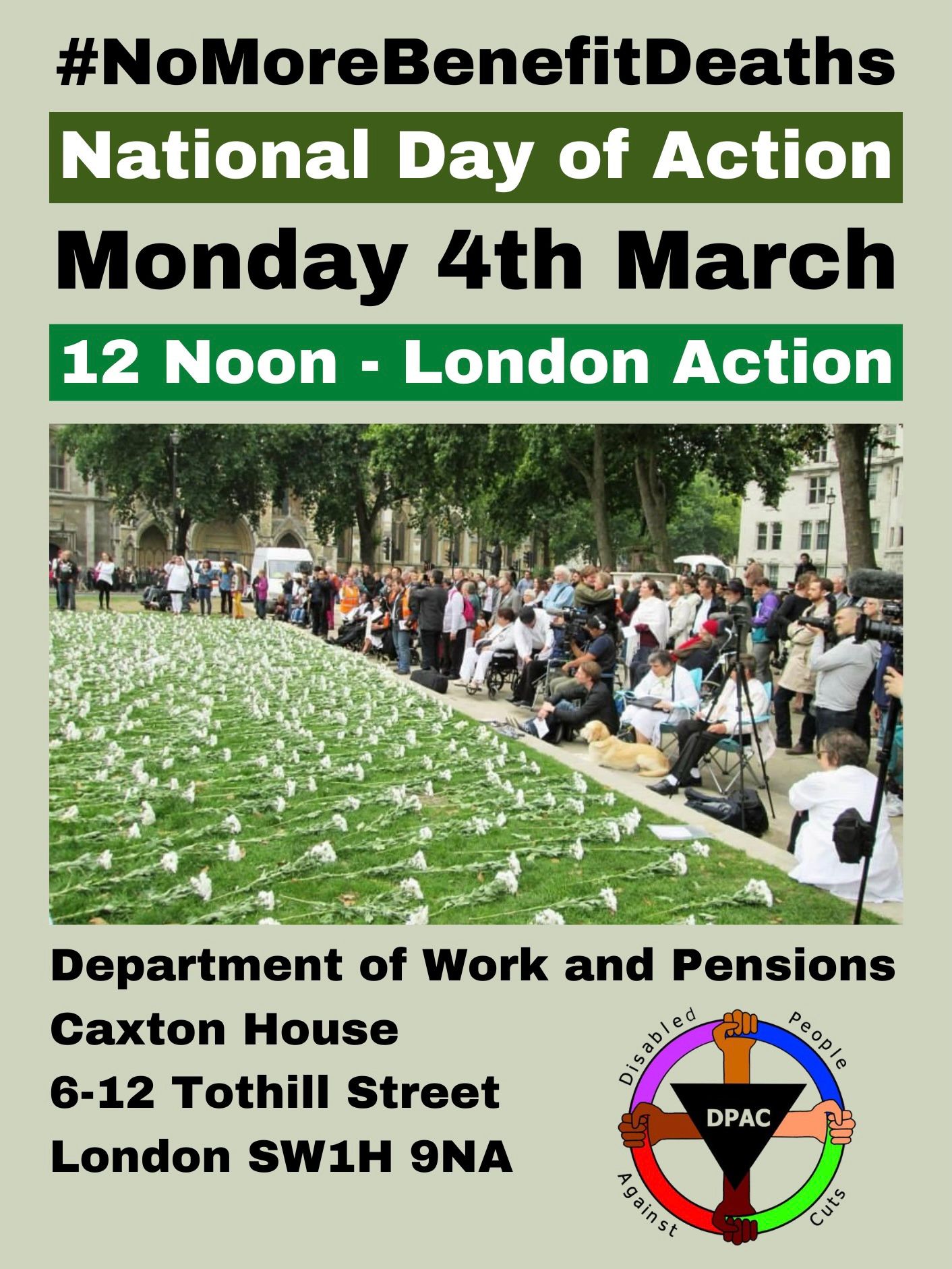
 

 Posted by at 15:12
Apr 122024
 
DPAC Logo with text underneath "Disabled People Against Cuts" and then web address dpac.uk.net

Criminalising Distress report launch
Friday 26th April @ 7pm – 8:30 pm
Online via Zoom
Free
Register: www.medact.org/event/criminalising-distress-report-launch

We’re excited to invite you to the launch of our latest report Criminalising Distress.

This is the culmination of an eighteen month primary research project conducted by Research Manager Hil Aked and the members of the Medact Research Network exploring the Serenity Integrated Mentoring (SIM) model — and exposing ongoing SIM-like practices.

Speakers will include Dr Jay Watts, former members of the Stop SIM coalition, Medact Research Network member Avani Ela and others to be confirmed.

>>> What was SIM? Has the criminalisation of distress ended?

SIM was a model which embedded police officers into community mental health teams, purportedly to “mentor” so-called “high intensity users” — often women who had experienced trauma, were at high risk of self harm or suicide, and had been diagnosed with BPD.

Following a campaign by lived experienced-led group StopSIM in 2021, NHS England told trusts to review the model. In March 2023, it said the model should end, but did not publish a policy it co-produced with StopSIM or apologise for its own role promoting SIM originally.

Our report amplifies the voices of those most impacted by SIM and SIM-like practices. Former members of the StopSIM coalition acted as a steering committee for the project, which sheds new light on the origins and impacts of SIM, highlights the dire lack of institutional accountability and examines a range of possible alternatives.

Critically, we also expose ongoing practices which continue to criminalise distress in similar ways, albeit under different names. Come and learn about our findings, and what panellists believe needs to happen to challenge the criminalisation of distress and the securitisation of mental health.

 Posted by at 14:31
Apr 122024
 
DPAC Logo with text underneath "Disabled People Against Cuts" and then web address dpac.uk.net

From: For The Many Network


1.      10th May, 6 – 7.30pm. Liverpool For the Many hub – In person meeting. The Casa Bar, Hope Street Liverpool

The last meeting prior to the hub’s AGM, members will discuss planning for the AGM and local campaigning activities in relation to support for Palestine and local independent candidates standing for election.

Please register a space via Eventbrite here for 10th May: https://www.eventbrite.co.uk/e/for-the-many-network-liverpool-hub-meeting-10th-may-2024-tickets-881474382607


2.      11th May, 12 – 2pm. In person meeting. Stop the War’s John Rees

Wigan Diggers & For the Many present discussion with Stop the War – John Rees at Sunshine House, Wigan, WN1 3SA.

Get your tickets here for the 11th May: https://www.eventbrite.co.uk/e/wigan-diggers-and-for-the-many-network-present-stop-the-wars-john-reece-tickets-876052284967


3.      15th May, 6.30 – 8 p.m. via Zoom. NHS and Social Care Webinar

Join network members as we present the first of our webinars on the Network’s 12 principles. This first session focuses on our support for Principle no 2, “National Health and Social Care Services, fully funded from progressive taxation, which employs directly all who work in them. No sub-contracting, and no out-sourcing”.We will be joined by Dr Bob Gill (NHS Doctor & activist, Producer, director & co-writer of the Great NHS Heist), Nico Csergo (long-term NHS campaigner and Socialist Health Association committee member) and Rebecca Smyth (Save Liverpool Women’s Hospital) to discuss the latest national and local campaigns on this theme and how members can learn more about the best campaigning resources and tools to help build a presence in your local area.

Please register here for a Zoom link on 15th May: https://us06web.zoom.us/j/83798280589?pwd=uEjbNpz81KSJReH2iPQNhurBCUIaaX.1


4.      20th May, 6 – 7.30 p.m. via Zoom. Hub Coordinators & Members Network meeting

Meeting for hub coordinators and members from across the national network, to link up with each other and the network team. Will include summary and discussion of how to organise and conduct meetings, hub committee role profiles, an introduction to available training and campaigning tools, including social media and communications. As we move closer towards a general election, will the expectation of a new government change anything for the people in our communities? Discuss how the Network can support activists to mobilise on the issues that matter in your communities and the Network’s 12 principles.

Please register here to make sure your voice is represented on the 20th May: https://us06web.zoom.us/meeting/register/tZ0odOmorDwpGdT9RyWKOaQGK3Xw1lrkmu_Y

5.      1 to 1 calls re: hub coordinators

Please contact the FTM network team by return email, if you would like to find out more about being a hub coordinator in your area.

 Posted by at 14:18
Apr 112024
 
DPAC Logo with text underneath "Disabled People Against Cuts" and then web address dpac.uk.net

Contents

Trio of mayoral candidates show ‘contempt’ by snubbing disability hustings 1

Met took formal action on just nine disability hate crimes in 2023, hustings is told 3

Government denies fixing Jodey Whiting inquest date to clash with Labour conference 5

Disabled people living on the streets, yards from former DWP offices 7

Government is misrepresenting workplace disability inequality, MPs are told 11

Call for volunteers to fill ‘massive gap’ in support for autistic survivors of sexual violence 13

Other disability-related stories covered by mainstream media this week 15


Trio of mayoral candidates show ‘contempt’ by snubbing disability hustings

Three candidates to be the next mayor of London have refused to explain why they failed to turn up to a packed hustings event that would have allowed disabled people from across the capital to question them on their policies.

Just one of the four candidates invited, Zoë Garbett, for the Green Party, turned up to answer questions at the sold-out event, with more than 100 people attending, and about another 100 watching or listening online.

Conservative candidate Susan Hall, Labour’s Sadiq Khan – the current mayor – and Liberal Democrat Rob Blackie all sent spokespeople to replace them rather than turning up themselves to face questions from disabled people.

Inclusion London, which organised the event, has now launched a #NoMoreNoShows campaign to ensure that candidates for the upcoming general election attend disability hustings, rather than sending replacements.

Svetlana Kotova, Inclusion London’s director of campaigns and justice, told the event as it began that she and her colleagues were “deeply disappointed” at the failure of the three candidates to attend.

She said: “We did everything we could to convince them to come.”

Kotova said their failure to attend was “really, really concerning for the democratic process; we think it’s really important that candidates talk to disabled people and hear from disabled people.”

Inclusion London has shared its own manifesto with all four candidates, with demands across equality and inclusion, transport, housing, work and study, poverty and policing.

Inclusion London’s co-chair, Adam Gabsi, who was chairing the hustings event, told Disability News Service (DNS) afterwards that Hall, Khan and Blackie had been invited in “numerous ways” but had still not attended.

He said: “Even though I am very proud of our hustings, the work that went into it and the turnout, I am deeply disappointed and frustrated that the aforementioned politicians failed to engage and sent representatives to speak on their behalf.

Hustings are an integral part of the democratic process and ignoring disabled people gives us the impression that our concerns are not worthy of being listened to and our votes are not important.

This is an election year and disabled people deserve better treatment.

We should be listened to and spoken to directly. We do not want to be ignored and a repeat of the mayoral candidates’ behaviour is unacceptable.”

Spokespeople for Hall, Khan and Blackie had not responded by noon today (Thursday) to requests from DNS to comment on their failure to attend the hustings.

But Jack Gilbert, chief executive of Real, a disabled people’s organisation (DPO) based in Tower Hamlets, east London, who attended the event and asked a question about disability hate crime (see separate story), said the trio’s failure to attend was “very disappointing”.

He told DNS: “Time and again, disabled Londoners are considered as an after-thought, whether it’s in the design of transport infrastructure, or other matters to do with housing, or policing.

The potential leaders of London had an opportunity to give a clear message that they saw disabled Londoners in a different, new light, and they missed that opportunity.”

Disabled activist Jamie McCormack, who also attended the event, said: “The supposed Big Three talk about inclusion and the importance of each voter, but when the candidates get an oh-too-rare chance to hear from Deaf and disabled Londoners they show their contempt by sending stand-ins.

This mirrors the lack of progress in creating positive change for 1.2 million Deaf and disabled Londoners.

Telling us in warm words what they think we want to hear when we know exactly how hard things are and the failures of the Greater London Authority and successive mayors in tackling the big issues, I honestly found insulting.”

He also pointed out that none of the candidates appeared yet to have created any campaign material in British Sign Language.

He added: “If they want our votes, they will have to do so, so much better, but I fear they won’t.”

Hallie Banish, campaigns manager for the DPO Ruils Independent Living, also expressed concern at the trio’s failure to attend.

She said: “We were deeply disappointed that only the Green Party candidate came to the Inclusion London hustings.

Representatives from Labour, Lib Dems and Conservative parties told us that engaging with disabled people and our organisations is a top priority for their party’s candidate, particularly from the start of any process.

Why, then, did the candidates themselves not show up and speak with us?

How are we to expect them to prioritise the views of disabled people and take action as the mayor of London, if they decline our invitation to a hustings?

We are not a tick-box exercise, and we hope the future mayor is serious about tackling entrenched ableism in the Met, the lack of accessible and genuinely affordable homes, inaccessible public transport and all other issues that affect disabled Londoners.”

Laura Vicinanza, policy and stakeholder engagement manager for Inclusion London, said: “We are deeply disappointed that of the four parties represented at hustings, only the Green Party sent their mayoral candidate. 

We heard from other candidates via their spokespeople, but we know how important it is to be able to engage directly with the candidates we’re voting for and ask for clear commitments in a way that is accessible to us.

Our rights as disabled people must be valued and upheld by all our elected representatives.

Hustings are a vital part of the democratic process – a chance for politicians to talk directly with voters.

If we don’t use our democratic rights, we will lose them, so we’re calling for all political parties to commit to #NoMoreNoShows for London-wide community hustings.”

11 April 2024


Met took formal action on just nine disability hate crimes in 2023, hustings is told

Only nine disability hate crimes in the whole of London led to significant action being taken by police last year, politicians have been told during a disabled people’s election hustings event.

Although 600 disability hate crimes were recorded by the Metropolitan police in the year to January 2024, just 1.5 per cent of them were cleared up through formal action – known as sanction detections – such as a criminal charge or a caution to the offender.

The figures were revealed by Jack Gilbert, a police adviser for two decades and chief executive of Real, a disabled people’s organisation based in Tower Hamlets, which has secured the data for a report it has yet to publish.

Gilbert has been a member of the Metropolitan Police Service’s (MPS) LGBT+ independent advisory group for more than 20 years, and has also been involved in intersectional community relations work in east and north London.

He told the London mayoral hustings event that statistics from the force on the number of disabled victims of crime suggested that the figures the MPS was collecting were not reliable.

Despite Office for National Statistics figures from the Crime Survey for England and Wales showing disabled people were far more likely to experience anti-social behaviour, domestic abuse, sexual assaults and violent crime, only about 2.5 per cent of all crimes recorded by the MPS are “tagged” to indicate they relate to a disabled victim.

Gilbert called for all the mayoral candidates to commit to drawing up a disability action plan for the MPS if they win May’s election.

The hustings event was organised by Inclusion London so the candidates for next month’s London mayoral election could be questioned by disabled Londoners.

But only one of the four candidates turned up to the event – Green candidate Zoë Garbett – while Conservative candidate Susan Hall, Labour’s Sadiq Khan and Liberal Democrat Rob Blackie all sent spokespeople in their place (see separate story).

Inclusion London’s co-chair, Adam Gabsi, who was chairing the hustings event, told the panel of speakers that too many disabled people felt unsafe in London and that they were often not “believed and supported by the police when reporting crimes”.

Gabsi asked the representatives of the four parties what their plans were to tackle disability hate crime in London, and what actions they would take to tackle disablism in the Metropolitan police, “to make sure all disabled Londoners feel they can trust the police and report crimes”.

Gilbert and Gabsi’s concerns came almost exactly a year after Baroness Casey’s review of the force’s culture and standards was heavily criticised by disabled campaigners for finding significant evidence of disability discrimination across the force, but failing to conclude that the MPS was institutionally disablist, even though she found it to be institutionally racist, sexist and homophobic.

Garbett had already told the event that she recognised that the Met was “rarely held to account on addressing the disablism within their service”, and she promised to do so if she was elected mayor.

She said she would “hold the Met to account to reform to make sure that disabled Londoners can trust that it’s a service you can report crime to, and I will make sure that there is regular training on inclusion, and I will challenge all forms of hate”.

She also promised to commit to “genuine co-production” of policies with disabled people if she was elected.

In her response to Gabsi, Garbett said she believed that “the disablism within the Met often gets erased when people talk about the homophobia, racism and misogyny” and she called for action on “rooting out the bad officers, improving recruitment” and ensuring “appropriate training”.

In response to Gilbert, she said she fully supported a disability action plan and called for it to be co-produced with disabled people, while also stressing the need for the “right data”.

Sadiq Khan, the current mayor, was one of the candidates who failed to turn up to the hustings, and his spokesperson failed to mention disablism or disability hate crime in her response to Gabsi, although she accepted that disabled Londoners “have been let down by the police and a culture change is now required to address this”.

In response to Gilbert, she said the lack of accurate statistics was “completely appalling”, and she appeared to support a disability action plan for the Met, although she was not clear on whether the mayor would implement this policy if re-elected.

Conservative candidate Susan Hall also failed to turn up to the hustings, but her spokesperson said his party would “sign-up to the disability action plan”, although again it was not clear whether this was a solid policy commitment from Hall.

He also called for “better records of the crimes against disabled people”.

Liberal Democrat Rob Blackie also failed to attend, and his spokesperson said there was “not enough data or accurate data about hate crime towards disabled Londoners”, and she agreed with the call for a disability action plan, although yet again it was unclear whether this was a policy commitment from Blackie if he became mayor.

11 April 2024


Government denies fixing Jodey Whiting inquest date to clash with Labour conference

The government has denied playing any role in deciding that a high-profile second inquest into a disabled woman’s suicide – linked closely to the actions of the Department for Work and Pensions (DWP) – will clash with the Labour party conference.

A Ministry of Justice spokesperson said Disability News Service (DNS) would be “irresponsible” if it reported concerns that the Conservative government could have played a role in ensuring the inquest took place at the same time as the Labour conference.

The family of Jodey Whiting have been waiting since March 2023 for a date for a second inquest into her death.

But they have now been told that the three-day hearing will take place on 23, 24 and 25 September, the same as the last three days of Labour’s annual conference in Liverpool.

With the general election set to take place in the following weeks, it is likely that coverage of the inquest by mainstream media will be significantly reduced because of the attention focused on the conference.

A government spokesperson told DNS: “It would be totally inaccurate and irresponsible to report that government played any role in the listing of this inquest which was, as is always the case, determined by an independent coroner.”

Jodey’s mother, Joy Dove, said she believed there would still be local coverage of the inquest, but she did not know what impact the clash with the conference would have on wider media coverage.

She has been campaigning for justice for her daughter since approaching their local newspaper, the Gazette, just days after Jodey’s death in February 2017.

She told DNS: “I don’t mind waiting, as long as I get the right result. I have worked on it for that long.

I wish she was here and I was not having to do it, but she will never be forgotten.”

She said that other disabled people were still losing their lives now, seven years after Jodey’s death.

And she thanked all those who have supported the campaigning and her family over the last seven years.

Among the new evidence that will be considered by the second inquest will be a report by the Independent Case Examiner, which concluded in February 2019 that DWP failed five times to follow its own safeguarding rules in the weeks leading up to Jodey Whiting’s suicide.

Despite this proof of the systemic flaws within DWP, Dove is not yet convinced that there will finally be justice for her daughter at the second inquest.

She still finds it impossible to forget that DWP removed her daughter’s benefits without a face-to-face assessment.

She said: “I can’t get over the fact that they had never seen Jodey’s face.

She never got to an appointment, and they took all her benefits off her. They drove her to it. They had no right to do what they did.”

The Court of Appeal ordered a second inquest into the 42-year-old’s suicide in March 2023 so there could be a public examination of the “consequences” of DWP stopping the benefits of disabled people who rely on social security.

The delay in setting a date for the second inquest may have been partly caused by the Legal Aid Agency initially refusing to provide funding for the family to have legal representation at the inquest, before it was granted after an appeal by the family’s solicitors at law firm Leigh Day.

The first inquest into the death of the mother-of-nine and grandmother, from Stockton-on-Tees, took place in May 2017.

It failed to examine DWP’s role in her death or take evidence from any DWP witnesses, and it lasted just 37 minutes.

There was no criticism of DWP by the coroner, even though Dove had told the inquest that she blamed the department for her daughter’s death, Jodey’s sister Donna had said that having her benefits stopped had been a “triggering factor” in Jodey taking her own life, and Jodey’s daughter Emma had blamed DWP for her mum’s death.

She had taken her own life in February 2017, 15 days after her employment and support allowance (ESA) was wrongly stopped by DWP for missing a work capability assessment.

She had been a long-time claimant of incapacity benefit, and then ESA, and DWP and its assessors had previously noted the severity of her mental distress, and the risk of harm if she was found fit for work, while they were aware of her long history of suicidal thoughts.

The high court rejected Joy Dove’s request for a second inquest in September 2021, despite two key pieces of new evidence.

But the Court of Appeal ruled in March 2023 that it was “in the interests of justice” for there to be another inquest.

Teesside and Hartlepool Coroner’s Service had not responded by noon today (Thursday) to a request to comment on the date set for the second inquest.

11 April 2024


Disabled people living on the streets, yards from former DWP offices

Some of the hundreds of disabled people left homeless on London’s streets have described how they came to be living in tents just yards from where the Department for Work and Pensions (DWP) used to have many of its offices.

An area behind the historic Adelphi building in central London, which looks out over the Thames, has become a temporary home for several disabled people, with a line of tents pitched in the shadow of the huge office block.

As recently as 2012, some DWP departments were based in the grade II-listed Adelphi.

One of the current tenants of the building is the Economist magazine.

When Disability News Service (DNS) visited the Adelphi late last month, there were about 10 tents pitched against a wall just yards from its back entrance.

All four of the occupants DNS spoke to were disabled people.

None of them knew of the building’s historic connection with DWP.

Iesha Muhammad, who shares her tent with her autistic husband Dominic and has the life-limiting condition ALS, said her experience with universal credit had been “appalling” even though “they understand I’m a vulnerable person”.

She said she has been given an early morning appointment by the jobcentre but when she explained that it took her longer to get up in the morning and to get to the meeting because of her health condition, she was told: “If you can survive on the streets, you can get here on time.”

She said: “We are on universal credit, but it’s less than it should be.

We have been told numerous times we cannot have crisis loans. It’s either life or death on the streets.”

Despite receiving universal credit, it has not helped the couple find housing.

Without a guarantor, she says, landlords will not accept people who claim benefits.

Another of those living in the tents, Alex, came to Britain 13 years ago and was a construction worker until he developed a heart condition and needed to have an implantable cardioverter defibrillator (ICD) fitted, while he also has a mental health condition and epilepsy.

He is forced to rely on personal independence payment (PIP), while a council key worker supports him with his long-delayed universal credit claim.

He says he receives £500 a month through PIP but that is “far away not enough” and means he cannot afford all the medicines he needs.

He said: “I am trying to stay positive. I feel sad to see so many [homeless people].”

The housing situation of his neighbour, Brian Smith, is complex and he says he does not blame DWP.

Smith has both mental health and physical impairments, including schizophrenia, and left his flat in Oxfordshire after being sectioned following his brother’s death, as he felt increasingly isolated, and due to problems with his medication.

Until his tenancy expires, he says, he won’t be able to approach DWP for financial help with his housing, although he receives both employment and support allowance and the daily living and mobility elements of PIP.

He says he enjoys the company of the other homeless people who have pitched their tents behind the Adelphi.

He said: “I have never felt better. For me too much time on your own isn’t good for you.

I need people around me. Down here you’re left alone [by the authorities].”

But he told DNS that other disabled people who live in the tents are in a more difficult situation.

He said: “Some people have got no benefits. People like us who do get benefits do try and help them out.

I can’t see one of my fellow men struggling for a sandwich or a cup of tea.

I know quite a few here don’t get benefits or have been suspended for some reason or other.”

Asked how he felt about there being so many homeless people living on the streets, he said: “I don’t like to see it in the 21st century.”

He believes about 90 per cent of those living in tents behind the Adelphi are disabled.

He receives support from the nearby St Martin-in-the-Fields day centre.

He said: “If you go there between eight and nine [in the morning] you will see them all queuing up inside.

You will realise just how many disabled people are on the street.

The big majority of the people you will talk to will be disabled people in one way or another.”

DNS approached DWP, Westminster council, St Martin-in-the-Fields and London mayor Sadiq Khan about the presence of so many disabled people on London’s streets, and whether universal credit might be worsening the situation.

A Westminster council spokesperson said: “As the centre of London, Westminster is a destination for rough sleepers from both the UK as well as abroad and the council spends far more than any other council – £7million a year – to help those arriving here.

We work with charity partners to provide outreach teams across the city.

These teams work day and night to find, and offer support to, people sleeping rough on our streets. Known gathering places are visited frequently.

We aim to assess every person on the streets based on their specific disabilities or vulnerability, with either the council or our charity partners offering support based on individual needs.

We appreciate each person has unique, complex needs and many have physical disabilities or serious mental health problems which can create barriers to accessing help.

Our staff do everything they can to accommodate these specific needs. Regrettably not all those with complex needs choose to accept support.”

The council said there was a recognised correlation between spending longer on the street and developing complex needs such as issues with mental and physical health, and that many people may not be disabled when they come onto the streets, but will almost inevitably become more disabled the longer that situation continues.

The council said that was why its goal was always to help people access support and eventually help them off the streets and into accommodation.

St Martin-in-the-Fields had not responded to requests to comment by noon today (Thursday).

Figures provided by London’s mayor Sadiq Khan to the London assembly two years ago showed there were 786 people with a “learning or physical disability” seen rough sleeping in the capital in 2021-22.

A spokesperson for the mayor, who is standing for re-election next month, said he had made tackling rough sleeping a priority since he was first elected in 2016, quadrupling London’s rough sleeping budget and delivering “record funding to homelessness charities and service providers across the capital, helping over 16,000 people off the streets”. 

She said he had also delivered “record-breaking affordable homebuilding, including the highest council homebuilding levels since the 1970s” and had “invested in specialist and supported housing programmes”.

She added: “But Sadiq is well aware that more support is needed.

Disabled people have been disproportionately affected by Tory cuts to our social security system and to council budgets, along with ministers’ continuing failure to ban ‘no fault’ evictions so that renters are secure in their homes.

This is why he has repeatedly called on the government to give London the funding it needs to carry on delivering more genuinely affordable homes.

If Sadiq is re-elected on May 2nd, he will continue to do everything he can to end street homelessness in our city and to provide support to disabled people who are homeless or at risk of homelessness.”

A government spokesperson told DNS in a statement: “We know the challenges many are facing, which is why we are increasing disability benefits by 6.7 per cent and providing an unprecedented £108 billion cost of living support package.

We are also spending £2.4 billion to help people at risk of homelessness and support rough sleepers and will continue to work with local authorities to help people off the streets for good.”

DWP declined to say whether it believed problems with universal credit could be partly to blame for the number of disabled people who were homeless in London.

But it said the number of people in families where someone was disabled and were in poverty, after housing costs, fell by 100,000 between 2022 and 2023.

DNS reported in January that the proportion of families with disabled children who were living in poverty rose by nearly a third in two years, even before the cost-of-living crisis, according to a new poverty measurement being developed by DWP.

The measurement – which aims to provide a more accurate way of calculating deprivation – showed that nearly half of all individuals in families with at least one disabled child and one disabled adult in the UK were living in poverty by 2021-22.

The new measurement, which calculates “individuals in low resources”, found the proportion of people in families with disabled children who were living in poverty increased from 33 per cent in 2019-20 to 43 per cent in 2021-22.

And the proportion of people in families with at least one disabled child and one disabled adult who were living in poverty, according to the new measure, rose from 39 per cent in 2019-20 to 46 per cent in 2021-22.

11 April 2024


Government is misrepresenting workplace disability inequality, MPs are told

A disabled people’s organisation has accused the government of misrepresenting the high levels of inequality faced by disabled people in the workplace.

In its submission to an inquiry by a Commons committee, Disability Rights UK (DR UK) pointed to research which undermined government claims to have supported more than one million disabled people into work since 2017.

The government has repeatedly been told that the figures it quotes are “meaningless” when it comes to the inequality disabled people face in the jobs market, with evidence suggesting that years of government employment policies have had little or no impact on reducing the employment discrimination disabled people face.

In its response to the Commons work and pensions committee’s inquiry into disability employment, DR UK said the government’s statistic “is a misrepresentation of employment inequality and doesn’t recognise the reality that Disabled people currently face”.

It also pointed out that the disability employment gap has remained “stubbornly at just under 30 per cent since 2019”.

DR UK told the committee that the government needed to change its approach to social security “from punitive to supportive”.

It pointed out that – only last month – the UN’s committee on the rights of disabled people accused the UK government of demonising disabled people and treating them as “undeserving citizens” by preparing to fund tax cuts by slashing disability benefits, and said the social security system and rhetoric from ministers “devalues disabled people and undermines their human dignity”.

DR UK said the government needed to address the disability employment gap by tackling systemic barriers, rather than forcing disabled people into “unsafe, unsustainable, and exploitative work”.

Among those actions, DR UK said, it should hold employers accountable for breaching the Equality Act, telling the committee: “One of the most impactful barriers to Disabled people staying in work is employers refusing to implement the reasonable adjustments required to make their workplace accessible.”

DR UK said in its response to the inquiry that enforcement of those duties was vital, saying: “It is essential that Disabled people can rely on the Equality Act being enforced, otherwise in practice it gives us no protection.”

It also called on the government to ensure that local authorities are adequately funded to meet their legal obligations to support disabled children and young people, and it said the government should address the “lack of support and mismanagement of the transition from education to employment” for young disabled people.

It also branded the government’s much-criticised Disability Confident employment scheme “unworkable” and in need of a “complete overhaul”, while highlighting the lengthy waits for disabled people seeking support through the Access to Work scheme.

DR UK also called in its response for the government to co-produce its employment support policies with disabled people and their organisations.

And it warned that the government’s plans to reform the work capability assessment would “widen” the disability employment gap.

It pointed out that the Office for Budget Responsibility reported (PDF) in November 2023 that proposals to tighten eligibility to the WCA would only lead to 10,000 more disabled people in work but would cut benefits for 370,000 disabled people.

DR UK also highlighted government plans to scrap the WCA entirely after the next election.

Under the plans, disabled people who cannot work will only be able to qualify for a new health element of universal credit if they also receive personal independence payment, disability living allowance, or, in Scotland, adult disability payment.

This would mean it would be left to DWP’s over-worked work coaches – who would usually have no health-related qualifications – to decide if a disabled person should carry out work-related activity.

DR UK said it was “extremely concerned” by these plans, which will “likely result in incorrect work conditionality commitments and the use of sanctions in decision making and will reduce accountability, certainty, and the ability of the claimant to challenge”.

It called for these reforms to be scrapped.

DR UK added: “The easiest and most constructive way to help more people into work is to ensure the workplace is inclusive.

The growing number of people who are out of work because of ill health is a reflection of demographic changes and discrimination in the workplace.

The focus needs to be on improving the workplace, not on pushing people into poverty.”

11 April 2024


Call for volunteers to fill ‘massive gap’ in support for autistic survivors of sexual violence

A new disabled-led organisation is appealing for volunteers to help it fill the “massive gap” in support for autistic survivors of sexual violence and abuse, and allow their voices to be heard more loudly and enable them to influence change.

Lotus Collaborations was founded by Dr Susy Ridout, herself an autistic survivor, who says her “dream” is for autistic volunteers to use the roles as a path towards a new career.

Although there are no reliable statistics to show how many autistic people have experienced sexual violence or abuse, she believes they are at a much higher risk than non-disabled people.

This can be because of their dependence on care workers or family members, the threat of losing support if they disclose the abuse, their social isolation, and the lack of any meaningful sex education.

She said: “So if you talk to autistic people about whether they’ve experienced abuse, most autistic people will say, yes, they have.”

It was her own experience of sexual violence – and being one of the few autistic survivors to secure a prison sentence for the perpetrator – that inspired her to set up Lotus.

She realised that mainstream services for survivors of sexual violence often do not understand the different needs of autistic people.

She said: “Our different ways of communicating, our different ways of processing information, our sensory differences, all of those factors are not necessarily understood.”

Her own “monotropic” way of thinking meant she was “very focused on the trauma” after the violence she experienced, and she found it “very difficult to shift that focus onto recovery”, a situation she believes many other autistic survivors share.

There is, she said, a “massive gap” in the availability of suitable services.

The language used by services can be “victim blaming, and autistic people very much feel blamed a lot of the time.

It’s all very, very much as though everything’s our fault, that the world’s sort of not designed for us.

So when we go to services, we’re faced with someone who is using, to put it mildly, profoundly disabling language, that can actually make us not able to talk.

It takes away our agency, it can gaslight our narrative, and it gets in the way of us explaining our needs to the people who we need to support us.”

At a police station, for example, autistic people can be confronted with “bright lights, lots of noise, lots of sudden movements, all the things that aggravate autistic people, all the things that if you’ve been exposed to a huge amount of trauma will be very, very triggering.

When autistic people present, we present very, very differently in that sort of setup. And that’s a real challenge for the police.”

These barriers, she said, are heightened by intersectionality, with the autistic person’s other identities – as a black or gay person, for example – often being “ignored”.

The four new volunteer roles Lotus is seeking to fill are all at director level: as treasurer, ambassador, website developer, and ambassador with responsibility for improving the visibility of the website and social media.

The roles will provide a unique opportunity and a safe space for autistic survivors “to be heard and to be involved” in training and other projects.

Although the roles are open to other disabled people and allies, autistic applicants will be given priority if they have the required skills.

Ridout – who paid tribute to the work of company secretary Sanya Bhasin, who joined Lotus in December 2023, and is also disabled – said she hopes the volunteer roles will eventually develop into paid positions, which she said would “absolutely be my dream”.

Lotus, a community interest company, offers education, training and consultancy services around the issues facing autistic survivors of sexual violence and abuse, such as wellbeing, heathy relationships, coercive control and consent, while it also aims to work with survivors to allow them to explore their own unique routes to recovery.

Ridout said: “What I’m absolutely passionate about is that the people who deliver this training are autistic, disabled, neurodivergent themselves.”

She has written widely on the violence experienced by autistic people, and is currently helping to train police to respond to neurodivergent survivors of sexual violence as part of the Home Office-funded Operation Soteria Bluestone.

Anyone interested in applying for one of the volunteer positions can email lotuscollaborationsuk@gmail.com

11 April 2024


Other disability-related stories covered by mainstream media this week

A council which wanted to deduct more than £2,000 a year from benefits paid to an autistic man to contribute towards his care package has agreed to review its policies, following a high court legal challenge. Michael Sherratt has a care plan and has been assessed by Bolton council as having high levels of need for which he receives additional support, covered by direct payments and benefits. Before 2022 he was not required to make a contribution towards the cost of his care, but following a financial assessment, he was told to make a contribution of £39.92 per week towards his care: https://www.theboltonnews.co.uk/news/24227122.bolton-council-court-westhoughton-mans-care-package/

Two former head teachers locked disabled pupils in “calming rooms” with bolted doors, a report has revealed. Ordran Doran, 66, and Simon Black, 62, have now been banned from teaching after a probe into concerns about their leadership at The Bridge School in Ipswich, Suffolk: https://www.mirror.co.uk/news/uk-news/headteachers-banned-locking-children-special-32519251

A multi-million-pound investment to make transport more accessible has been given to small bus operators. The £4.65 million funding will help operators install technology that provides live audio and visual updates, so passengers with visual and hearing impairments can stay informed throughout their route. The investment comes after concerns that small companies would not be able to comply with new government regulations before the October 2026 deadline: https://www.bbc.co.uk/news/articles/c6py36eey72o

The government is facing calls to make countryside walkways more accessible to disabled people and others with limited mobility. Walking charity Ramblers is calling for the removal of “unnecessary barriers” in the next five years. Ramblers said wheelchair-users, some older people, those with pushchairs and dog-walkers are hindered by unmaintained gates, stiles, steps and path surfaces, as well as a lack of public toilet facilities and seating: https://www.bbc.co.uk/news/articles/czdz8yvvwq8o

11 April 2024


News provided by John Pring at www.disabilitynewsservice.com


 Posted by at 14:20
Mar 282024
 
DPAC Logo with text underneath "Disabled People Against Cuts" and then web address dpac.uk.net

Contents

DWP ‘destroyed evidence’ on secret investigations rules, in latest ‘cover-up’ 1

Cabinet Office finally finds missing report showing difficulties facing ‘vulnerable’ universal credit claimants 2


DWP ‘destroyed evidence’ on secret investigations rules, in latest ‘cover-up’

The Department for Work and Pensions (DWP) is again facing cover-up allegations after suggesting that it has destroyed reports showing why it weakened guidance on when to investigate suicides of benefit claimants.

Disability News Service revealed last month that DWP had weakened the rules on when to carry out an internal process review (IPR) in April 2021.

The previous year it had told the National Audit Office it would always carry out one of its secret reviews when it heard of a claimant’s death if they had died by suicide, even if there were no allegations that DWP’s actions had contributed to that death.

But since April 2021, after weakening the rules, DWP now only carries out an IPR following the suicide of a claimant if there is already an allegation that DWP’s actions “may have negatively contributed to the customer’s circumstances”.

After asking DWP for any reports about this decision that were considered by DWP directors in the year up to the change in the rules, DWP said it has established that “the information you requested is not held by this Department”.

In the response to the freedom of information request, DWP suggested it had destroyed any such reports – even though the decision was taken less than three years ago – because the discussions were “operational in nature as opposed to policy based”.

The department said: “As discussions around Internal Process Reviews, their management and the criteria that relate to them, are operational in nature as opposed to policy based, there is no requirement for the Department to retain any such reports.”

Figures obtained through a freedom of information request have shown that on at least four occasions in 2022-23 – as a result of the new rules – the department failed to carry out an IPR when told of the suicide of a claimant.

For more than a decade, DNS has been revealing how DWP has covered-up evidence of links between its actions and the deaths of claimants, and how it has repeatedly tried to delay evidence of those links being released.

A DWP spokesperson declined to comment on its freedom of information response.

28 March 2024


Cabinet Office finally finds missing report showing difficulties facing ‘vulnerable’ universal credit claimants

The Cabinet Office has finally found a missing report that showed the “additional difficulties” faced by “vulnerable” universal credit claimants, despite originally claiming it could not locate the document.

The existence of the 2019 report was not known about outside government circles until DWP was forced by a tribunal to release a follow-up report late last year.

DWP had been trying to prevent the release of the follow-up report by the Prime Minister’s Implementation Unit (PMIU) since its existence was revealed in October 2021 in universal credit papers secured through a freedom of information battle by campaigner John Slater.

The follow-up report, How Effective is Support for Vulnerable Universal Credit Claimants?, revealed significant flaws at the heart of the universal credit system and how DWP supports claimants it sees as vulnerable.

Disability News Service (DNS) had been seeking a copy of the report since late 2021, alongside Slater and Owen Stevens, from Child Poverty Action Group.

The original report was also written by PMIU, which was based within the Cabinet Office, but has since been scrapped.

But when DNS tried to obtain a copy of the original report, both DWP and the Cabinet Office originally suggested it was being held by the other department.

The Cabinet Office claimed earlier this year that “following a search of our paper and electronic records, we have established that the information you requested is not held by the Cabinet Office – Equality Hub”.

But after DNS asked the Cabinet Office to “look a little harder”, it has now found the report, Experience of Claimants and Vulnerable Groups, after carrying out “further searches of additional areas” of its “records and archives”.

The report warns that “vulnerable” claimants of universal credit (UC) – which can include those with long-term conditions and other disabled people, asylum-seekers, those who are homeless and survivors of domestic abuse – “can face additional difficulties claiming UC particularly when making a claim, meeting commitments and managing finances”.

It concludes that only a “small number of vulnerable groups” are captured by the data and analysis which DWP uses to measure the “experience and outcomes” of UC claimants.

It also warns that the “experience of many groups of vulnerable claimants on UC is not currently understood”, while there is a “lack of evidence” on whether the range of support that has been introduced to help these groups is “delivered consistently and delivering the desired outcomes with efficacy”.

DNS has been trying to raise concerns about the serious flaws within universal credit, both with DWP and the Labour party, for the last 18 months.

Slater said the report did not reflect well on DWP and its universal credit team.

He said it suggested that “vulnerable” claimants would be sanctioned or lose some of their entitlement because the system could not cope with their “additional difficulties”, and that this could put their health or even their lives at risk, with staff usually “far too busy to identify vulnerable people and treat them differently”.

He also pointed to DWP research, highlighted in the 2019 report, which found that 44 per cent of claimants fell behind with bills or credit commitments or experience financial difficulties within three months of making a claim.

He said the report suggested that DWP “doesn’t understand (and doesn’t want to understand) the real world that UC claimants live in.

Unless people fit the ‘standard claimant’ model for the UC claimant the ‘UC system’ can’t cope with them.

I’m not sure that has significantly changed since this report was written.”

A DWP spokesperson declined to comment on the Experience of Claimants and Vulnerable Groups report.

28 March 2024


News provided by John Pring at www.disabilitynewsservice.com


 Posted by at 15:08
Mar 282024
 
DPAC Logo with text underneath "Disabled People Against Cuts" and then web address dpac.uk.net

A recent advert by the Alzheimer’s Society has caused significant backlash from both individuals living with dementia, those that love them and provide unpaid care, and professionals in the field of neurological support needs.

https://www.youtube.com/watch?v=m06RTgI3Oqk

The advert, titled ‘The Long Goodbye’ is narrated by a man giving a eulogy at his mum’s funeral, but instead of revelling in the life she lived, or giving a sense of how this woman spent her final years – the man says,

‘Mum first died when she couldn’t work out how to prepare her legendary roast anymore,’

and goes on to talk about how she ‘died’ when she could no longer wear colourful and fashionable clothes, and ‘died’ when she couldn’t participate in Christmas. The message is designed to ‘tug on the heart strings’, but all it does is dehumanise people with dementia and memory conditions.

Not once does it talk about how everything she loved she could still do with skilled and personalised support, or what her family did to step up when their mum was starting to find it harder to cook for them (I think it’s worth noting that we are meant to feel sorry for her family not getting cooked dinners rather than a woman getting no support).

Instead, after giving the date of her ‘final death’ a different narrator explains,

‘With dementia, you don’t just die once, you die again, and again, and again.’

While it’s clear that Alzheimer’s Society believe themselves to be ‘raising awareness’ about dementia, they are doing nothing but embed the social narrative that disabled people, those with memory and cognition support needs, and the elderly should be relegated to the rubbish bin. It does nothing to shift the narrative that people with dementia are full human beings, with passions, interests, likes and dislikes like any of us – and that if we don’t welcome them in the world we are missing out on a huge amount of good in society.

Like many, I lost a grandparent to dementia, and the toll on my family for caring for him was palpable – but it wasn’t because of him, it was because of a lack of quality services, a lack of respect for people with dementia and social stigma attached to impairment.

The response on social media was quick and firm on the issue from many impacted by dementia,

One unpaid carer’s response to the advert on social media,

‘My Mum has dementia and saw this advert on TV out of the blue today. She was visibly upset by it and kept asking me if it means she is going to die soon. You weren’t there for me to help calm her down & reassure her! Totally inappropriate advert!’

And that of a dementia specialist nurse,

‘Dear Colleague, the sentiment expressed is deeply troubling on several levels. I hold immense respect for those who articulate their experiences of watching a family member “die again and again” due to dementia. While it is a condition that limits life, each person’s experience is distinct. Providing compassionate care, understanding, and support is crucial in improving the quality of life for individuals living with dementia. From my perspective, the language used is inappropriate on many levels in this video/clip’

These comments have elicited mealy-mouthed responses from Alzheimer’s Society’s social media team, such as,

‘The ad isn’t an easy watch, but we know it shows a reality that resonates with a lot of people’ and while claiming it was co-produced by hundreds of people ‘directly affected by dementia,’

the script was in fact written by one woman about her experience losing her dad 2 years ago. The influence of people that live with dementia and those that want to support people to live fulfilling lives is markedly absent. I don’t doubt the trauma experienced by the writer – but her trauma jaded lens is no reflection of reality.

In response to the criticism – CEO of the Alzheimer’s Society, Kate Lee released a statement, doubling down on this shockingly poor advert,

‘The film tells the unvarnished truth about the devastation caused by dementia. It’s not an easy watch but it’s an important one, and by reading hundreds of responses across social media since we launched it, it’s a reality that resonates with a lot of people.’

But not once is any of the supposed ‘devastation’ centred on the impact on the individual, all on how her family became a bit sad when their mum couldn’t do things for them any more – not that their mum was let down massively by a failing social support system in this country.

The CEO’s attempts to personalise the story to her and her colleagues rings completely hollow – and her closing line of,

‘The reality is, if we carry on doing what we’re doing, nothing will change. And I need us to make this better.’

If she genuinely believed in improving the impact of Alzheimer’s Society, she wouldn’t be withdrawing a wage in excess of £150,000 while celebrating donations of £120,000 from the Football Association in 2022. Ask anyone in the field of dementia support, or families struggling to get by while providing unpaid care – we could all think of better uses of that 120k than paying 80% of the CEO’s wage. Anyone with this view of dementia should not be leading the UK’s most recognisable charity related to the condition.

This is standard dehumanising language that we’ve seen from countless charities over the years that are not led and grounded by disabled people they supposedly represent, but this advert reminiscent of horrendous level discrimination of Autism Speaks’ ‘I Am Autism’ advert,

https://www.youtube.com/watch?v=9UgLnWJFGHQ

It does nothing but make us fear impairment – not celebrate diversity in our community.

It is vital that we hold organisations to account for demonising our community – one such way to do so is to complain to the Advertising Standards Authority (ASA), who regulate television and social media advertisements in the UK, following the link below,

https://www.asa.org.uk/make-a-complaint.html

Also, complain directly to the Society by which means suit you (post, phone or digitally), we need to pressure them into representing those who they claim to serve – and use that claim to earn donations (of which frighteningly little positively impacts disabled people).

https://www.alzheimers.org.uk/about-us/contact-us/complaints


 Posted by at 11:38
Mar 212024
 
DPAC Logo with text underneath "Disabled People Against Cuts" and then web address dpac.uk.net

Contents

Government’s response to UN committee ‘was insult to disabled people’ 1

UN committee asks government: ‘Why are you demonising disabled people?’ 4

MPs undermine key government claim, days after it defended its record at the UN 7

It was emergency planning that was vulnerable during Covid, not disabled people, inquiry is told 10

Government finally set to act on housing accessibility standards 11

Maggie Davis: Tributes to pioneer, rebel and advocate 14

Underhand tactics’ could still see disabled people forced into care homes, say campaigners 18

Disabled-led business seeks new clients after being hit by rise of AI 20

Other disability-related stories covered by mainstream media this week 21


Government’s response to UN committee ‘was insult to disabled people’

Disabled people’s organisations from across the UK have described the government’s evidence to a UN disability rights committee this week as “an insult to disabled people” and full of “half-truths, untruths” and “empty assertions”.

Representatives from more than 10 disabled people’s organisations (DPOs) were in Geneva to witness the evidence given by the UK government as it attempted to persuade the committee it had made progress since being found guilty of “grave and systematic violations” of the UN Convention on the Rights of Persons with Disabilities in 2016.

But they have told Disability News Service (DNS) that the evidence provided by a delegation of civil servants from the Disability Unit, the Department for Work and Pensions and the Department of Health and Social Care failed to address key concerns raised more than seven years ago by the UN committee on the rights of disabled people.

In an initial statement on Monday afternoon, Alexandra Gowlland, deputy director of the Disability Unit, pointed to a string of recent government policies across disability strategy, social security, housing, social care and employment, nearly all of which have been widely discredited (see separate story).

She and fellow civil servants were also asked to respond to concerns and questions raised by members of the committee.

But representatives of the DPOs that had travelled to Geneva to brief the committee and watch the session say they were appalled at the evidence given by the UK government’s delegation.

Ellen Clifford, who coordinates the coalition of DPOs that monitors the implementation of the convention in the UK, told DNS that the UK government’s representatives had “avoided all of the substantive issues with which the special inquiry is concerned, and failed to answer any of the committee’s questions.

They chose instead to talk out their time on issues irrelevant to the inquiry and in a misleadingly positive light.

We felt their approach was disrespectful to the committee and showed how little they value the lives of Deaf and disabled people.”

She said the questions and comments from the UN rapporteurs – the committee members who have led investigations into the UK’s progress – “showed how well they understand the true picture of what is happening and that they had really listened to and valued the evidence we submitted and the testimonies that were shared with them by Deaf and disabled people”.

John McArdle, co-founder of the Scottish-based grassroots group Black Triangle, said the failure of the UK delegation to address the issues raised by the committee was “insulting, not only to us, but to the United Nations, the rapporteurs and the institution itself”.

He told DNS that the UK government was guilty of “whitewashing and ignoring the rock-solid evidence” and that its delegation had kept trying to “dodge the bullets” by not addressing the issues raised by committee members.

He said Gowlland had failed to respond to the significant criticisms of the work capability assessment by the committee and “how dangerous the system is, how it has cost so, so many lives”.

He said: “If they’re not addressing these issues, then they’re completely evading their responsibilities under the convention.”

Svetlana Kotova, director of campaigns and justice at Inclusion London, told DNS: “The government’s response laid bare the fact that they have done nothing to progress our rights to independent living, employment or an adequate standard of living. 

Their update was a list of empty promises or laws that don’t give people any rights; and we know they are pushing reforms which will lead to further retrogression.  

We hope the UN disability committee will see beyond this and hold them to account.” 

Kamran Mallick, chief executive of Disability Rights UK, said on Monday: “Although we are not surprised by the UK government’s response today, we still feel that their refusal to properly engage with this process is an insult to all disabled people whose experiences are reflected in the evidence we’ve provided to the UN.

Despite requesting a delay last year, they have provided us with no new evidence – instead signposting to plans and policies that create no transformative change.

The delegation shared all the ways they believe they’ve created progress for disabled people’s rights – but they know, just as we do, that no progress has been made.

In fact, we have gone backwards.”

Natasha Hirst, president of the National Union of Journalists and the disability representative on its national executive, said the UK government’s delegation had “not stood up well to the scrutiny of the committee”.

She said: “Their empty assertions of being committed to improving disabled people’s lives are in clear contrast with the daily reality of poverty, exclusion and a frequently punitive social security system.

Planned reforms and continued negative rhetoric about disabled people will only make things worse.”

Rhian Davies, chief executive of Disability Wales, also said the UK government’s evidence was “far removed from the reality of disabled people’s lives and experiences since 2016”.

She said: “We are not shocked, but appalled, by the lack of acknowledgement concerning the deaths of disabled people awaiting assessment decisions, the criticism of DDPOs* regarding recent policy such as the health and disability white paper or the harm caused by the disablist ‘benefit scroungers’ stereotyping promoted by the UK government.”

Mark Harrison, a member of the steering group of the Reclaiming Our Futures Alliance, said: “The UNCRPD committee is not fooled by the half-truths, untruths and smokescreen presented by representatives of the British government.

They know the Tories are completely hostile to human rights and equality for disabled people.

The UK delegation has presented the realities of human rights violations that demonstrate ongoing and deepening grave and systematic attacks on living standards and deaths from benefit and cuts to community support services.”

Tony O’Reilly, from Northern Ireland’s Northwest Forum of People with Disabilities, said: “Over these last months we gave our evidence to the… committee supported by facts and the strong testimony of Deaf and disabled people.

All of us together sought to shine a light on the truth of our perilous situation.

The fact that the UK government and the devolved administrations sought to hide in the dark refusing to answer directly the questions of this esteemed committee is shameful and another barrier to the full realisation of our human rights as Deaf and disabled people.”

Clifford, a member of the national steering committee of Disabled People Against Cuts, also highlighted the “size and strength” of the delegation of DPOs to Geneva, which was boosted for the first time by disabled trade unionists, and she pointed to the “hard work and support from those back in the UK”.

She said this “gave us confidence that when we come home we can build a strong resistance movement to oppose further cuts to social security and to demand a right to adequate support to live and be fully included in the community”.

Kotova also praised the “solidarity among disabled people and DPOs across UK nations”. 

She said: “If anything, this process can help us build on this as a movement as we will have to keep on fighting.”

*Deaf and disabled people’s organisations

21 March 2024


UN committee asks government: ‘Why are you demonising disabled people?’

A United Nations committee has accused the UK government of demonising disabled people and treating them as “undeserving citizens” by preparing to fund tax cuts through slashing disability benefits.

Members of the UN’s committee on the rights of disabled people provided a string of examples of how the government had continued to breach its obligations under the UN Convention on the Rights of Persons with Disabilities.

They pointed to a benefits system that traumatised claimants and led to some taking their own lives; increasing rates of institutionalisation; and a disproportionate number of disabled people who were now too poor to heat their own homes or buy food.

The committee’s Australian vice-chair, Rosemary Kayess, said the social security system and rhetoric from ministers “devalues disabled people and undermines their human dignity”, and she suggested the government had breached its treaty obligations to “combat stereotypes, prejudices and harmful practices relating to disabled people”.

Kayess told a delegation of civil servants in Geneva that there was evidence of “regression” in how the UK government was meeting its obligations under the convention.

The committee was cross-examining the delegation, which included representatives from the devolved governments of Scotland, Wales and Northern Ireland, on progress since the UK government was found guilty of grave and systematic violations of the UN convention in 2016 as a result of breaches of articles on social security, employment and independent living.

Following the session, and the “significant” amount of written and oral evidence provided by disabled people, disabled people’s organisations and allies, the committee will now prepare a report on its findings.

Kayess, a human rights lawyer and Australia’s new disability discrimination commissioner, told the UK’s delegation on Monday: “We see a reform agenda that is framed in a political narrative that demonises disabled people, including proposals to cut disability benefits to reward working people by cutting taxes, which tells disabled people they are undeserving citizens.

And this is coupled with an onerous and complex social benefit system that is the basis for trauma and preventable mental distress.”

Kayess said the committee had found a “pervasive framework and rhetoric that devalues disabled people and undermines their human dignity” within the social security system, and she suggested the government had breached its obligations under the convention to “combat stereotypes, prejudices and harmful practices relating to disabled people”.

She said: “Reforms within social welfare benefits are premised on a notion that disabled people are undeserving and skiving off and defrauding the system.

This has resulted in hate speech and hostility towards disabled people.”

She also pointed to “increasing rates of institutionalisation” of disabled people, including those “living in secure psychiatric facilities due to a lack of community-based support”, and others forced into residential homes because of inadequate care and support.

And she highlighted evidence of increased use of “restraints, restrictive practices and coercive measures” in institutions, and the shortage of safe, accessible housing.

She also questioned whether the government had failed to meet its obligations to “closely” and “actively” consult disabled people’s organisations when drawing up its National Disability Strategy.

Just as it did in 2016, the committee raised significant concerns about the “complex and onerous” work capability assessment process, and the use of “inexperienced and unqualified” assessors.

Another committee member, Professor Laverne Jacobs, a disability rights and human rights law expert from Canada, said there had been a “repeated pattern” of disabled people taking their own lives after being denied an adequate standard of living by the Department for Work and Pensions.

She asked the government what measures it would take to ensure that its benefit eligibility and work capability systems were “trauma informed so that they do not cause mental health crises, suicide, and death”.

But she also asked what “redress” it would offer to those who have experienced trauma caused by the social security and assessment systems, and to the families of those claimants who had lost their lives through this trauma.

Jacobs said the committee had heard of disabled people facing “intolerable situations, even death, while trying to comply with the eligibility requirements of the UK government’s benefit regimes”, including the work capability assessment process.

She said that evidence they had been given suggested a “significant and shameful gap” between the convention’s requirements and the lived experiences of disabled people in the UK.

And, she said, the evidence suggested a failure to provide an adequate standard of living for disabled people, including disabled women, girls and older people, with a “disproportionate” number of disabled people “living in poverty without the ability to heat their homes or purchase food”.

She also asked the UK government what measures it was taking to ensure that disabled people can enjoy their rights under the UN convention to live independently in the community, and to address the shortage of personal assistants.

And she asked what the government was doing to ensure that disabled refugees and asylum-seekers can enjoy their right to live independently and in the community in the UK.

She urged the UK government to “improve on its commitment” to the rights of disabled people and take “immediate steps to remedy the issues that we have highlighted today”.

A third committee member, human rights lawyer Miyeon Kim, from South Korea, asked the UK delegation about the “biggest death crisis in the history of the NHS”, after campaigners called last year for a criminal investigation into a mental health trust, following a report that found more than 8,400 deaths linked to the Norfolk and Suffolk NHS Foundation Trust.

There was little attempt by the UK government to answer the questions asked by the committee members, with disabled people’s organisations who were present at the evidence session describing their attempts as “half-truths, untruths and smokescreen” (see separate story).

Alexandra Gowlland, deputy director of the Disability Unit, who had earlier delivered the UK government’s opening statement to the committee (see separate story), claimed it was committed to the UN convention, and pointed to the protection offered to disabled people by the Equality Act, including the public sector equality duty.

She told the committee: “Ensuring the voice of disabled people is properly heard is something which is very important to us in the UK government.”

Jennifer Heigham, DWP’s deputy director for strategy and briefing, pointed to the £105 billion in cost-of-living support the government had provided from 2022 to 2025, but failed to point out that working-age disabled people receiving non-means-tested disability benefits received just £150 a year in 2022 and another £150 in 2023-24 in disability-related cost-of-living payments.

She claimed the government was “delivering the most ambitious disability reform agenda in a generation” and was “proud to have a proven track record of increasing disability employment, and acting on disability discrimination, providing vital protections”.

And she said the government was “committed to ensuring our welfare system encourages and supports people into work, while providing a vital safety net for those who need it most”.

She added: “In the future, removing the work capability assessment will reduce the number of assessments people need to take to access benefits, give people the confidence to try work, and enable us to provide a more personalised approach.”

David Nuttall, deputy director of neurodiversity, diversity and learning disability at the Department of Health and Social Care, said the government was “investing in better training, accredited qualifications and launching a new national career structure for the adult social care workforce”.

And he said it had given new powers to the Care Quality Commission to inspect how local authorities were delivering their duties under the Care Act.

He claimed the government had “substantially invested in adult social care funding”, while the NHS long-term plan included a “long-term aim to improve community support for people with a learning disability, autistic people and those with serious mental illness”.

He said the government’s draft mental health bill – which appears to have been dumped by the government – included plans to tighten the criteria on when someone can be detained under the Mental Health Act “to ensure detention only happens where absolutely necessary”.

Apparently in response to the question from Miyeon Kim, he said the Care Quality Commission was “the independent regulator of health and social care in England and is responsible for making sure providers adhere to the fundamental standards to ensure services are safe, effective, person centred, responsive and well led”.

21 March 2024


MPs undermine key government claim, days after it defended its record at the UN

The government tried this week to persuade the UN that it has made “progress” since being found guilty of “grave and systematic violations” of the disability rights convention, just as MPs prepared to undermine one of its key claims.

A delegation of civil servants from the UK government, and three devolved governments, were in Geneva to be cross-examined by members of the UN committee on the rights of disabled people.

They had been asked to provide evidence of progress made since a 2016 report by the committee found the UK government guilty of repeated violations of the UN Convention on the Rights of Persons with Disabilities.

That report followed the first high-level inquiry carried out by the committee and was the result of years of research and lobbying by Disabled People Against Cuts (DPAC), which sent members to Geneva this week, alongside representatives of more than 10 other disabled people’s organisations (DPOs).

The UN committee found in November 2016 that the UK government had discriminated against disabled people on the right to an adequate standard of living and social protection, employment, and independent living.

But the UK government’s attempts to claim it has made progress since 2016 were described by the DPOs who watched its evidence on Monday as “an insult to disabled people” and full of “half-truths, untruths” and “empty assertions” (see separate story).

The UK government’s lead representative in Geneva, Alexandra Gowlland, deputy director of the Disability Unit, said the government was “fully committed” to implementing the convention.

She presented a list on Monday of what the government appeared to see as its main achievements on disability rights since 2016.

One of the areas she focused on was the right to independent living, detailed in article 19 of the convention.

In late 2016, the committee concluded that the UK government’s policies had “disproportionately affected persons with disabilities and hindered various aspects of their right to live independently and be included in the community”.

Gowlland pointed this week to a 2021 white paper published by the Department of Health and Social Care, People at the Heart of Care, with its “10 year vision for adult social care”, and claimed the government wanted “everyone to access high quality care that enables choice, control, and independence”.

But yesterday (Wednesday), just two days later, the Commons public accounts committee was concluding that the UK government was “falling short” on its promise to “fix the crisis in social care”, as “chronic understaffing, rising waiting lists and patchwork funding place sustained pressure on local authorities”.

The cross-party committee also concluded that the government had “no roadmap for achieving its vision, or any targets or milestones beyond 2025, with nothing meaningful in place to demonstrate progress”.

Gowlland also failed to mention to the UN committee that research by disabled campaigners has shown how tens of thousands of disabled people across England have been left in debt because they cannot pay their care charges.

The government also tried to take credit for two “landmark” pieces of legislation, the British Sign Language Act and the Down Syndrome Act, both of which were private members’ bills eventually supported by the government but were also criticised for failing to offer any strong new rights.

She also highlighted the government’s National Disability Strategy, which she described as “ambitious and comprehensive”, and the more recent Disability Action Plan, which have both been heavily criticised by DPOs for their lack of any co-production and for being full of empty promises.

Gowlland mentioned the Transforming Support white paper, published last spring by the Department for Work and Pensions and which disabled people’s organisations have described as not fit for purpose.

Those reforms, she said, focus “on what people can do rather than what they cannot”, a phrase used repeatedly by work and pensions ministers for decades, with the earliest known use by Labour’s social security secretary Alistair Darling in 1999.

Among her claims was that the government had overseen an increase in the number of disabled people in employment of 1. 3 million between 2017 and 2022, even though that claim has been repeatedly debunked by academics, who have made clear that it is deeply misleading.

Rather than mentioning the long and repeated delays to plans to force all new homes in England to be built to a higher basic standard of accessibility, Gowlland highlighted minor measures on supported housing, which she said “plays a vital role in delivering better life outcomes, improved well-being and health and greater independence for disabled people”.

She again sought to take credit for legislation that was introduced through a private members’ bill, this time the Supported Housing (Regulatory Oversight) Act, which the government “supported”.

On disability hate crime – something which she said was “completely unacceptable” – she highlighted awareness campaigns in 2018 and 2019, but failed to mention the government’s repeated failure to introduce tougher laws, as recommended by the Law Commission more than two years ago.

Gowlland also pointed to new laws from 2022 that allowed Deaf jurors to be assisted by British Sign Language interpreters in the jury deliberation room, without mentioning that the government had only acted after a judicial review of its failure to remove a ban and more than two decades of campaigning by Deaf activists.

In its evidence to the committee on Monday, the Scottish government highlighted policies such as its introduction of the new adult disability payment and child disability payment to replace personal independence payment, its decision to reopen the Independent Living Fund to new entrants, its introduction of free personal care, and its plans for a National Care Service.

The Welsh government spoke of its commitment to incorporate the UN convention into Welsh law, and how it commissioned a study of the effects of the response to the pandemic on disabled people, led by DPOs, which became the Locked Out report, and subsequently set up a Disability Rights Taskforce.

It also spoke of the Welsh government’s commitment to embedding the social model of disability “into everything it does” and how it was working on the taskforce in co-production with disabled people.

The Northern Ireland government pointed to its work on a disability and work strategy, and a new disability strategy, and its plans for a new hate crime bill, a draft strategic plan for learning disability, and an updated autism strategy.

21 March 2024


It was emergency planning that was vulnerable during Covid, not disabled people, inquiry is told

It was the emergency planning systems that proved to be “vulnerable” during the Covid pandemic, and not disabled people, the UK Covid inquiry has been told by two national disabled people’s organisations (DPOs).

Disability Wales and Disability Rights UK (DR UK) told the inquiry, sitting in Cardiff last week as it considered the impact of the pandemic in Wales, that the systems had relied on “chaotic improvisation” rather than the “pre-planning and practice” that was needed to ensure “collective resilience”.

They said the “dedicated machinery” needed to generate resilience in devolved and regional governments had to include disabled people as “leaders and managers” rather than them too often still being “managed and led”.

The two DPOs were delivering their joint closing statement (PDF) to the section of the inquiry examining decision-making and political governance in Wales.

They called for the Welsh government, civil servants, charities and the private sector to all develop “a far greater skill” in co-production and co-design.

In disaster management, they said, the aim of co-production and co-design “is not just to be kind, but to be smart”, which ensures that scientific advice “remains grounded in social reality”.

They called for taskforces to be set up for the UK and devolved nations – with representatives of DPOs – that would co-produce emergency risk assessments and planning for disabled people, with that work “channelled into general planning at various national, devolved and regional” levels of government.

They told the inquiry: “Human rights protection of disabled people matters in pandemics because they are the people that are disproportionately affected.”

For that reason, the UN conventions on the rights of disabled people, and on the rights of the child, must be incorporated into the laws of Wales and of the UK, they said.

Barrister Danny Friedman, from Matrix Chambers, who delivered the closing statement on behalf of Disability Wales and DR UK, said there also needed to be work to address the “truly profound” gaps in data collection and its analysis and how it is used.

He said: “We are supposed to be in the midst of an information revolution, but its possibilities have not reached yet the interests of marginalised people.”

He told the inquiry that the Welsh government had not routinely collected figures during the pandemic which would have shown how many disabled people and others with characteristics protected under the Equality Act were hospitalised and received treatment in intensive care.

And even though Wales has led the UK on the importance of the social model of disability for more than 20 years, it had still failed to gather information that would show what disabled people might need during the pandemic, Friedman said.

The two DPOs also told the inquiry that the flaws in UK devolution ensured that those people who were “on the margins” of the system – including disabled people – were “rendered vulnerable” during the pandemic.

But they also pointed out that it was in Wales – and not England or Scotland – that “close and dynamic collaborative meetings” took place between DPOs and the government, starting in early April 2020.

UK government ministers did not even discuss the pandemic’s impact on disabled people until 21 May, and they did not start their short-lived meetings with DPOs until July, they said.

The two DPOs said the problem in Wales was that it was “too small not to be taken for granted by Westminster”, which meant that it had been “informed about decisions rather than being consulted upon them on numerous occasions”.

This also meant that Wales was “limited in what it could do locally to really change its outcomes”.

21 March 2024


Government finally set to act on housing accessibility standards

The government is finally taking further steps towards introducing laws that would set a higher standard of accessibility for nearly all new homes in England.

The government promised in July 2022 that it would consult on new rules that would force all new homes to be built to the M4(2)* standard of accessibility, except for cases where this was “impractical and unachievable”.

An earlier consultation on raising accessibility standards had ended in December 2020, but when ministers finally responded, in July 2022, they announced this further consultation on the detail of the changes.

Housing minister Felicity Buchan finally confirmed on Monday that the second consultation would go ahead in the next few months, as she was questioned by the Commons levelling up, housing and communities committee in the final evidence session of its inquiry on housing for disabled people.

She said the government had decided there needed to be this second “technical” consultation to decide on the detail of the changes and “any exceptions to the rule”.

Philip White, director of the new Building Safety Regulator, which will be carrying out the consultation, said the 12-week technical consultation would be launched “between April and July” this year.

Buchan repeatedly told the committee that the government believed that decisions on how many accessible homes should be built should be taken by local authorities, including whether there should be a minimum of 10 per cent of new homes to be built to the M4(3) wheelchair-accessible standard.

She told the committee: “We don’t think it’s appropriate for central government to be setting those thresholds.

It should be local housing need, local delivery plans for local people.”

Buchan said she didn’t have any figures “to hand” on how many accessible homes were being built.

Labour’s Ian Byrne said the evidence received during the committee’s inquiry was that there was “no confidence within the people that we interviewed” that leaving decisions to local authorities would produce significant numbers of wheelchair-accessible homes.

He asked if the government needed to “take a lead on this and make sure that that 10 per cent actually becomes a figure that can be achievable”.

Buchan suggested that when the government introduced M4(2) as a “base” level, it would provide “more time and resources for people to think about M4(3)” but that ministers wanted local authorities “to figure out what percentage of M4(3) they think is appropriate”.

Labour’s Nadia Whittome asked Buchan about evidence from disabled people that private sector landlords were refusing permission for tenants to make “even the most basic accessible adaptations, like installing a ramp or grab rails”.

Buchan said such permission should “not be unreasonably withheld” if it was an adaptation that “does not affect the structure of the fabric of the house”.

But Whittome said that a review commissioned by the government found only eight per cent of disabled facilities grants (DFGs) applications were from private tenants, even though about 19 per cent of disabled people lived in the private rented sector.

Buchan said this was one of the reasons the government was planning to abolish section 21 “no fault” evictions through its renters (reform) bill “so that people can ask for adaptations and those cannot be unreasonably refused”.

Whittome also told the minister that the number of social homes being built was falling under the government, with – last year – 22,000 social homes sold or demolished, and just 9,500 new ones built, with a net loss of more than 175,000 over the last 10 years.

And she said Disability Rights UK had told the committee that it did not matter how many accessible homes existed, if disabled people – who were more likely to be on low incomes –could not afford to live in them.

Whittome said the government did not have any targets for building new social housing.

She added: “Is that because you’re just not building very many?”

Buchan said the government had committed to build more social housing, but Whittome told her: “You have no target for building social homes and in the last year, which is consistent with the last 10 years, there has been a net loss of social homes.”

Conservative MP Mary Robinson had told Buchan earlier that hundreds of disabled people had engaged with the committee’s inquiry through a survey, a roundtable event and by providing written evidence, and there had been “unanimous agreement that we must build more accessible new-build homes”.

Conservative MP Tom Hunt questioned why the DFG system should be means-tested.

He said that many disabled people the committee had met felt they were “cut off from any kind of support” because they were earning too much to qualify for a DFG and were paying “a real big financial penalty” for having a physical impairment.

He said that “many people would see that there’s a sense of unfairness to that”.

He said: “I just think that many will feel… why should they have to pay for something which is completely not their fault… so I think some might ask… how is it any different from, say, access to health services?”

He added: “I couldn’t help but be moved by the conversations that I had, and I think other people on the committee feel the same way.”

Buchan said the government had spent £220 million on DFGs in 2015 which had now risen to £625 million a year, while 91 per cent of DFGs awarded were for less than £15,000.

She said: “It is a balance and clearly the reason that it is means-tested is that if someone really can pay then it’s appropriate that they should pay but it is getting that balance right and it’s making sure that we can use the money as effectively as possible because we want to be using the £625 million pounds as broadly and as effectively as we can.”

She added later: “We could certainly have a philosophical discussion on means-testing.

All I want to say is that I’m in tremendous awe of disabled people and what they do and that’s why I do want housing that is accessible, we do want to help people with adapting properties.

That’s the reason why we’ve got the grant, but I’m very much so looking forward to reading the committee’s report.”

Labour’s Mohammad Yasin asked why the government had not acted on a 2018 independent review of DFGs, which it commissioned and which recommended that the upper limit for DFGs, currently set at £30,000 in England, should rise with inflation.

He said the government had promised more than two years ago to consult on increasing the upper limit, as reported by Disability News Service last summer, but that it had so far failed to do so.

Buchan did not explain why the government had failed to meet that pledge, but she said local authorities had “flexibility” to increase the £30,000 limit in their own areas.

She also failed to explain why the government had failed to meet another promise made in 2021, to reform the DFG means test, which Yasin said was “very complex and difficult to navigate”.

Instead, she again pointed to the extra government funding, but she said the government had not ruled out making changes to the formula – nearly three years on – but that this “does require quite a lot of work” and “if you are changing a formula, there will be winners, there will be losers, there will be transitional arrangements, so we need to give it a lot of thought before we alter the formula, the test”.

*Homes built to the M4(2) standard have 16 accessible or adaptable features, similar to the Lifetime Homes standard developed in the early 1990s to make homes more easily adaptable for lifetime use, while M4(3) homes are those that are supposed to be fully wheelchair-accessible

21 March 2024


Maggie Davis: Tributes to pioneer, rebel and advocate

Some of the country’s leading disabled activists have paid tribute to the “immense” contribution of Maggie Davis, an outspoken “rebel”, a powerful advocate and a pioneer of the independent living movement, who died last week at the age of 81.

She was best known for designing – with her late husband Ken – the Grove Road housing scheme, Britain’s first integrated co-operative housing development, which was opened in 1976 in Sutton-in-Ashfield, Nottinghamshire.

But friends and fellow activists this week also remembered a string of other ground-breaking projects, as well as her vision and determination to fight social injustice and oppression, while also being “a strong advocate for the voice of women” in the disabled people’s movement.

She had struggled for nearly a decade, before moving into Grove Road, to escape from a series of segregated residential units and care homes after becoming disabled in 1967.

While setting up Grove Road, and living in accommodation in nearby Derbyshire, she and her husband came up with the idea for DIAL – the first telephone advice and information line provided by and for disabled people – because of the problems they had had searching for disability-related information.

They set up DIAL in an unused cloakroom, with a single telephone, both provided by Derbyshire County Council, and with help from disabled colleagues.

In an interview with Disability News Service (DNS) in 2019, she said of their work: “There was no time for self-congratulations, and there was no place for it, it was just something that needed to be done.

If we didn’t do it, nobody would. It was just hard work. It was a struggle for everybody, but it was galvanising at the time.”

Grove Road was a new building with three ground-floor flats designed for wheelchair-users, and three flats on the first floor for volunteer non-disabled tenants who would provide personal assistance support on a rota basis for the disabled people living on the ground floor.

She and her husband lived in the Grove Road development for six years before securing a mortgage and a grant to buy and adapt – including the installation of a through-ceiling lift – a semi-detached home of their own in Clay Cross, Derbyshire.

But the DIAL project also laid the foundations for the country’s first coalition of disabled people, Derbyshire Coalition of Disabled People, and then Derbyshire Centre for Integrated Living.

Maggie and Ken Davis had also helped set up the pioneering Union of the Physically Impaired Against Segregation (UPIAS), which played a crucial role in the development of the disabled people’s movement and what was later known as the social model of disability.

They had been among those disabled activists who responded to a letter in the Guardian written by Paul Hunt in 1972, which described how disabled people were being forced into “isolated unsuitable institutions where their views are ignored and they are subject to authoritarian and often cruel regimes”.

John Evans, a fellow independent living pioneer, described Maggie Davis as “one of the last remaining persons of the golden generation” of disabled activists, and he said her death was a “personal and historic loss”.

The contributions that she and her husband made to the independent living and disability movements were “immense”, he said.

He added: “They were both pioneers in opening the door of opportunities for other disabled people to live independently.”

Maggie and Ken Davis had joined Evans and other activists in setting up the first informal independent living network in the late 1970s, while Evans and fellow residents of a Leonard Cheshire care home in Hampshire were preparing their Project 81, which eventually secured their own escape into independent living.

He said: “We constantly stayed in touch with each other, sharing our ideas and inspiration and eventually the network grew into a wide-ranging group of independent living activists throughout the country.”

That network helped to “inspire and encourage others to do likewise as part of empowering ourselves to be more political in seeking further progress for change in the UK”, he said.

Baroness [Jane] Campbell, another independent living pioneer, from the generation that followed and learned from Maggie and Ken Davis, said the couple had provided “a blueprint” for developing centres for independent living across the country.

This blueprint also allowed the movement to start drafting a plan for laws that would eventually provide disabled people with the option to replace social services or NHS care with personal assistants, she said.

Thanks to their vision, and that of John Evans, independent living became “one of the essential components” of the British Council of Organisations of Disabled People (BCODP), said Baroness Campbell.

She said that the “vision, determination and bloody mindedness” of Maggie Davis had “spawned other younger women to join the independent living mission and develop her work liberating disabled people from residential care, or their childhood home with mum and dad with little prospect of leaving”.

Paul Hunt’s widow, Judy, a close and long-standing friend of Maggie Davis, said that when she reads articles her friend has written she is still “struck by the force of her words and power of her personality”.

She told DNS: “There was a rebel deep inside her that would not be silenced, and she put it endlessly to good use.

She was never willing to give in to oppressive administrators of institutions, or others who treated people unjustly.”

She said that the contribution of Maggie and Ken Davis to the struggle against a disabling society was “profound”, and that they had broken through “many of the housing and community care barriers” that were still keeping many disabled people trapped in institutions in the 1970s.

She said: “They travelled to Scandinavia to bring back new ideas for accessible housing with support and showed by example what could be done” through the Grove Road scheme.

And she said they had moved “from one pioneering project to the next with insatiable determination”.

Judy Hunt said: “Maggie spoke with a refreshing directness against injustice of all kinds but particularly against oppression towards disabled people and women and set out to do something about it, such as campaigning for an accessible women’s refuge because there was nowhere locally disabled women facing violence could go.”

Maggie Davis was, she said, “a fighter and a fundamental believer in collective action”, and also “a great support to many people who turned to her”.

Frances Hasler, who would later become a founder and chief executive of the National Centre for Independent Living, said it was Maggie and Ken Davis who had first introduced her to the social model of disability.

She said: “I remember Maggie being a strong advocate for the voice of women in the movement. She was also great at articulating the right to be ordinary.

She was outspoken and determined because she needed to be, in order to get an ordinary thing – a home to live in and the wherewithal to live there.

What set her apart was her willingness to share her experience and insights with other disabled women.”

In an interview with the Guardian, Davis had described the institutions she had been forced to live in after becoming disabled and before she met her husband, including years at Stoke Mandeville Hospital and in a hostel in its grounds, describing the “dehumanising” lack of any kind of privacy.

She told the Guardian: “Institutions are just tarted up poor law institutions.

Where I was I could have been in two centuries ago – all the same attitudes.

You were given pocket money – you’re impoverished, you are socially dead. It’s just an existence.”

The disabled writer and researcher Jenny Morris, who helped write the Labour government’s Improving the Life Chances of Disabled People white paper, said she hadn’t known her well, but she had “admired and learned from women like Maggie”.

She said: “The story of Maggie and Ken’s struggles and successes in living independently were an inspiration to me when I became disabled in 1983.  

They were an illustration of not only what individuals could do and change but also of the growing disability movement.”

In the 2019 DNS interview, Davis had spoken of how she feared that much of what she and her husband helped to achieve could be put at risk by the austerity policies of successive Conservative-led governments.

She said: “I think we all feel very proud of what we did but we are desolate about what we think we know is going to happen and that they will destroy it all.

If no action is taken, then we could quite easily end up where we began, being incarcerated away from society, out of sight and out of the public mind.”

She said she was “terrified” about whether she would continue to receive the funding she needed for 24-7 support.

With the constant eroding of funding, I am in constant fear of this being removed and me being forced back into institutional care, which I would not allow,” she said.

It’s just horrendous. I can see it being taken away from me and being taken away from us. Every time they come to do an assessment, they try to take a bit more off me.”

She appealed then for disabled activists to “shout their outrage from the rooftops” about the government’s austerity policies and the creeping return to segregated, institutional living.

21 March 2024


Underhand tactics’ could still see disabled people forced into care homes, say campaigners

A council has been accused of using underhand tactics to cut millions of pounds from support packages and push disabled people into residential care, despite being forced to withdraw a controversial policy that could have had the same impact.

The grassroots group Bristol Reclaiming Independent Living (BRIL) said Bristol City Council was still trying to bring in the much-criticised policy “through the back door”, as it aims to save nearly £7 million from its funding of adult care and support packages in 2024-25.

Only last month, the council was forced to withdraw its draft Fair and Affordable Care Policy, which said disabled people could be offered a “residential or nursing home placement” if “a care package to remain at home would substantially exceed the affordability of residential care”.

It withdrew the draft policy after being threatened with legal action by BRIL, which argued that the proposals breached the Care Act, the Human Rights Act, and the UN Convention on the Rights of Persons with Disabilities.

The council instead set up a new group to “consider how to build a system to fairly allocate Adult Social Care funding within the agreed budget to meet the diverse needs of the population”.

But BRIL says that budget plans published last month (PDF) show the council now intends to increase the number of reviews of anyone receiving at least 40 hours care and support a week or a package worth at least £920 a week, to ensure the council is “delivering best value”.

BRIL fears this will again raise the possibility of disabled people being forced into residential care, and that it will deliver “an identical policy, just with a different name”, and that “best value” will mean a care home placement.

There are also serious concerns that a consultancy being used by the council to carry out “strengths-based” reviews of the support packages will receive a share of all the costs they manage to cut.

And BRIL fears that the temporary “locum” social workers the council is recruiting to carry out reviews will be paid bonuses according to how much they save the council by cutting care packages, just as happened in Southampton eight years ago.

The policy will affect nearly 200 people with what the council calls “complex” packages of support, with 34 of them being identified as “overdue” an annual review.

Analysis of the council’s latest budget documents (PDF) shows the council is now aiming to save nearly £7 million from its funding of adult care and support packages in 2024-25.

This includes more than £1.2 million by reviewing more care packages to ensure disabled people are “enabled to be as independent as possible” and to “support approaches which focus on an individuals’ personal strengths”.

Another £1 million will be found by focusing on “reablement” which will mean “more people go on to achieve improved independence, resulting in the need for less care and therefore reduced costs”.

The council also plans to cut costs by £1.35 million by reviewing the packages of disabled people who have left hospital after being sectioned under the Mental Health Act, which the council says will “support and improve independence, resulting in the need for less care and therefore reduced costs”.

Another £1.785 million will be cut by reviewing housing-related support which currently “helps people stay living independently in their homes”, while £1.5 million will be saved by reducing the number of longer-term care packages by increasing reviews of people who have moved from hospital into residential or nursing care.

Mark Williams, BRIL’s co-founder, told Disability News Service (DNS) they were “very worried and very angry”.

He said: “Very worried for all disabled people in Bristol and everywhere else, as if it’s coming here, it could be the same for everywhere.”

A BRIL spokesperson added: “We can only conclude that Bristol City Council has decided not to invest in the lives and futures of disabled people and families, and instead taken a short-term and budget-led approach that will cost all of us more, in human, social and economic terms.”

Bristol City Council had failed to comment by noon today (Thursday), despite being approached by DNS last Friday.

21 March 2024


Disabled-led business seeks new clients after being hit by rise of AI

By Josephine Fay

A disabled-led business that provides work for more than 20 disabled freelancers at a time is urgently seeking new clients, and financial support, after its profits were severely hit by the rise of artificial intelligence (AI).

Academic Audio Transcription (AAT) has already raised more than £6,000 through a crowdfunder, but this is only enough to pay its overheads for a month.

Now it desperately needs to find new clients to secure its future.

The company specialises in transcribing lectures, conferences, workshops and interviews, and providing closed captioning services.

But its client base has been hit by the “problematic” rise of AI, while its biggest market, the university sector, is in “chaos”.

AAT’s founder Zara Bain believes that AI provides poorer quality transcripts than those produced by humans, failing to take account of accents or context and nearly always proving less accurate.

She said: “Whilst we’re not opposed to using technology, we believe that AI for transcription is deeply flawed.”

AI captions are also flawed and can often be inaccessible and inaccurate, failing to capture the names of people, places and organisations, she added.

She set up AAT seven years ago when she was forced to take medical leave from her PhD and needed to find a way to pay her rent and bills.

It offers work to its disabled freelancers “at the pace and capacity that people can manage”, allowing them to work remotely around their “flare-ups, crashes, relapses and remissions”.

Bain said that AAT has “transformed” the lives of its disabled freelancers.

She said: “A key part of our mission is to use our business to make fairly-paid, accessible work for predominantly disabled, chronically-ill and neurodivergent freelancers, where such work can be hard to come by, or often comes with inaccessible strings attached.”

At a time when the employment rate for disabled people remains about 30 percentage points below that of non-disabled people, with workplace discrimination still widespread, AAT’s inclusive work environment allows her team to work without the fear of discrimination or judgment, she said.

She decided to launch the company because she knew the importance of making content accessible.

She said: “People who are deaf or hard of hearing rely on captions or transcripts to access audio content like interviews, podcasts, and events.

Transcription removes the barrier of audio-only information, allowing them to participate equally.

This is also true for people who might struggle to process information through audio alone.

A written transcript allows them to follow along, read at their own pace, and revisit key points.”

But as she says on the crowdfunder: “AAT is more than a business to us, it’s a manifestation of not just our belief in equality and equity of opportunity, but our need to realise that belief as a reality to pay our bills, feed ourselves and our kids, and keep ourselves engaged with stimulating work which contributes to projects that really do make a difference.”

21 March 2024


Other disability-related stories covered by mainstream media this week

The government has brought adult social care in England “to its knees” with years of uneven funding and a “woefully insufficient plan” to fill thousands of staff vacancies, MPs have said in a damning report on a system that provides long-term care for 835,000 people. The public accounts committee said “chronic underfunding, rising waiting lists and patchwork funding” has placed sustained pressure on local authorities, and the government is falling short on Boris Johnson’s promise in 2019 to “fix the crisis in social care once and for all”: https://www.theguardian.com/society/2024/mar/20/government-has-brought-adult-social-care-in-england-to-its-knees-mps-say

Benefit levels are too low with claimants unable to afford daily living costs, according to damning evidence given to MPs. In a report published today, the work and pensions committee highlighted the surging demand for foodbanks among those on benefits in recent years. They found low levels of support received by disabled people had a “negative physical and mental health impact, which could in turn affect their ability to work”: https://www.mirror.co.uk/news/politics/dwp-benefits-too-low-people-32397711

A disabled woman who provided support to people affected by the Grenfell fire tragedy has been awarded £4.6 million compensation after getting PTSD and being sacked by a council. Rachael Wright-Turner was dismissed from her £125,000-a-year role by Hammersmith and Fulham council and sued the authority for disability discrimination and harassment. A tribunal found officers in the council had lied in its evidence, prompting the award which is thought to be highest-ever such award against a public body: https://www.mirror.co.uk/news/uk-news/grenfell-victims-helper-awarded-46-32374410

A 16-year-old girl with “significant and chronic disabilities” who died in squalor at her family home in rural mid-Wales did not have a care plan in place, a child practice review into her death has found. Kaylea Titford, who had spina bifida and used a wheelchair, was found in conditions described as “unfit for any animal” in Newtown, Powys, leading to her parents being jailed for manslaughter by gross negligence. The review said that though many professionals were involved in Kaylea’s life, her care was not coordinated by a single person or organisation: https://www.theguardian.com/uk-news/2024/mar/14/kaylea-titford-had-no-care-plan-in-place-when-she-died-review-finds

A disabled pedestrian whose actions led to the death of a 77-year-old cyclist who was riding on the pavement is to appeal her manslaughter conviction. Auriol Grey, 50, shouted an expletive and gestured aggressively towards Celia Ward, who then fell in front of a car, in Cambridgeshire in 2020. Grey, of Bradbury Place, Huntingdon, was jailed for three years in 2023. Court of Appeal judges gave the go-ahead for her to appeal her conviction at a hearing in London: https://www.bbc.co.uk/news/uk-england-cambridgeshire-68606255

A Devon woman is campaigning for blue badge holders to be able to use personal electric scooters on public land. Ella Wakley has a rare form of dwarfism which requires her to use an e-scooter, but said she risks being prosecuted when she uses it. The current law means privately-owned e-scooters are illegal to ride on public roads: https://www.bbc.co.uk/news/uk-england-devon-68574960

21 March 2024


News provided by John Pring at www.disabilitynewsservice.com


 Posted by at 13:35
Mar 192024
 
DPAC Logo with text underneath "Disabled People Against Cuts" and then web address dpac.uk.net

UN Rapporteurs Questions UK Government Over Benefits Deaths and Austerity – Press release

On 18 March 2024 the UK Government provided their oral defence to the United Nations Committee for the Rights of Disabled People, regarding the UK’s “grave and systematic” violations of the UNCRDP. This comes after they refused to attend the last evidence session in August 2023 – requesting a delay to March 2024 – when Deaf and Disabled People’s Organisations (DDPOs) outlined the harsh reality that we’re all currently living under in the UK.

Note: We refer to the convention as the Convention on the Rights of Disabled People (CRDP) rather than the given name – Convention on the Rights of People with Disabilities (CRPD) – as we follow the social model of disability. The convention allows us to do this.

The UK rapporteurs, who sit on the UN Committee for the Rights of Disabled People, accurately represented the systemic barriers and discrimination that Disabled people are facing. They consistently expressed that evidence shows violations of the UNCRDP, including a regression of Disabled people’s rights.

On social security – the committee challenged the absence of a holistic approach to delivering benefits, both across devolved Governments and individuals with intersectional experiences. They specifically highlighted those in mental distress and those who experience domestic abuse, and emphasised that the current system is “trauma inducing”. Their questions to the UK Government ranged from benefit related deaths and the violence of the current social security system, to the rise in Disabled people being institutionalised, incarcerated and the “increasing use of restraints, restrictive practice and coercion” – amongst other pressing issues.

Rapporteurs described current UK policy and practice as “a pervasive framework and rhetoric that devalues Disabled people’s lives” which “tells Disabled people that they’re undeserving citizens” and “makes [Disabled] people feel like criminals” – particularly those who are trying to access the social security system.

Despite detailed and thoughtful questions by the rapporteurs and committee members/commissioners, the UK Government’s response lacked any substantive answers – mostly repeating what was already outlined in their introductory oral evidence. They celebrated the Disability Action Plan and Disability Strategy, both of which lacked any transformative change, alongside highlighting impairment-specific actions they’d taken with the BSL Act – a largely performative piece of legislation that has no promised funding, and has not tangibly improved the rights of Deaf people. The Police, Crime, Sentencing and Courts Act was also given as an example of progress in access to justice, and specifically BSL interpretation, when the additional police powers and attack on protest rights that this legislation has provided has in practice eroded our rights and safety.

DDPOs eagerly anticipate the committee’s full report, including their follow-up recommendations, and provide their individual comments below.

If you think that the  UNCRPD should be incorporated into UK domestic legislation, then you can use our template letter to call on your MP to push for this. You can also support our Disabled People’s Manifesto.

Quotes from DDPOs: 

Kamran Mallick, CEO of Disability Rights UK – “Although we are not surprised by the UK Government’s response today, we still feel that their refusal to properly engage with this process is an insult to all Disabled people whose experiences are reflected in the evidence we’ve provided to the UN.

Despite requesting a delay last year, they have provided us with no new evidence – instead signposting to plans and policies that create no transformative change. The delegation shared all the ways they believe they’ve created progress for Disabled people’s rights – but they know, just as we do, that no progress has been made. In fact, we have gone backwards.

Accessing our basic support is not a luxury – whether that be getting a GP appointment on the day that you call, or having a social security system that works for all of us. Just because our Government refuses to take responsibility for its failure to deliver this, that doesn’t mean that it’s not unacceptable.

The world is watching, and the UK Government can no longer claim to be a leader in disability rights. We will continue to challenge these rights violations and ask that you join us by writing to your MP and supporting the Disabled People’s Manifesto.

John McArdle, Black Triangle Anti-Defamation Campaign in Defence of Disability Rights, Edinburgh –  “Fourteen years of rock solid persistence exposing the the murderous, democidal systems and policies of the British Conservative Government by Black Triangle Campaign and all our DPO allies and when challenged directly over the countless Benefit Deaths over the past 14 years they plead the ‘5th amendment’ – to borrow from the American lexicon – i.e. we refuse to comment for fear of incriminating ourselves. 

The U.K. government, by its acts and omissions has abrogated and repudiated its duties under this treaty convention. The United Nations will, we are certain, condemn the government in no uncertain terms once its report is published shortly. 

Any incoming Labour Government must pay attention to the #CRPD24 findings of fact and breach of the convention and act swiftly.”

Mark Harrison, Reclaiming Our Futures Alliance –  “The UN CRPD Committee is not fooled by the half truths,  untruths and smokescreen presented by representatives of the British government.  They know the Tories are completely hostile to human rights & equality for Disabled people. The UK delegation has presented the realities of human rights violations that demonstrate ongoing and deepening grave and systematic attacks on living standards and deaths from benefit & cuts to community support services.”

Svetlana Kotova, Inclusion London – “The UK government says it is “fully committed” to the UNCRDP, but it could not tell the UN any steps it has taken towards the UN’s recommendations given in 2017 when the UK was found to have committed grave and systematic violations of our rights. This is because there has been no progress since the government rejected those findings and all recommendations. We continue to be detained and kept in institutions, with no progress towards our right to independent living, and the government is doing nothing to lift us out of poverty caused by its punitive benefits sanction regime. We hope the UN’s further report will outline these failures and call for the government to make the drastic and urgent changes we need to enjoy our human rights like everyone else.”

Rhian Davies, Disability Wales – The evidence we heard from the UK Government is far removed from the reality of disabled people’s lives and experiences since 2016. We are not shocked, but appalled by the lack of acknowledgement concerning the deaths of disabled people awaiting assessment decisions, the criticism of DDPO’s regarding recent policy such as the Health and Disability White Paper or the harm caused by the disablist “benefit scroungers” stereotyping promoted by the UK Government. 

In Wales, although we are glad to see mention of the Disability Rights Taskforce and Locked Out report, we are disheartened that there was no mention that 68% percent of COVID-19 deaths in Wales were disabled people and that we still do not have a clear timeline on incorporation of the UNCRDP into Welsh Law. 

Disabled people deserve true accountability from their Governments and answers to the burning questions posed yesterday together with robust actions to address the harms inflicted as well as progress our rights. We thank the United Nations Committee and the UK Rapporteurs for their strong questioning and the opportunity to have shared evidence with them last August.”


Tony O’Reilly, on behalf of the Northern Irish Delegation (North West Disability Forum NI, Omnibus NI and Disabled People Against the Cuts NI) – “Over these last months we gave our evidence to the UNCDP Committee supported by facts and the strong testimony of deaf and disabled people. All of us together sought to shine a light on the truth of our perilous situation . The fact that the UK Government and the devolved administrations sought to hide in the dark refusing to answer directly the questions of this esteemed Committee is shameful and another barrier to the full realisation of our human rights as deaf and disabled people. But we know the Committee valued and respected our contribution. Our efforts will not be in vain. Our fight for justice, equality and human dignity will continue to flourish thanks to the work and support of DPAC and the wider coalition of UK DDPO’s.”

Paul Ntulila, Deaf DPAC – “In response to the government announcements about the steps they have taken to improve access for disabled people, I found it disappointing that further cuts have been made to funding, creating confusion on the actual action that has been taken and how these cuts will further impact the disabled community as a whole. Although disappointing, I feel now is the time to take action. We need to be working together to fight for the rights of all disabled people. We are fighting not only for ourselves but also future generations. It is the responsibility of our government to protect all individuals and implement the changes they have committed to provide.”

Quotes from Trade Unions:

Brett Sparkes and Andy Mitchell, Unite the Union “Unite are concerned about the effect of the government policy on our disabled members. The continued use of divisive language and the rhetoric of labelling disabled workers as lazy is not only wrong but detrimental to our members. The UK delegation to the UN CRPD has done nothing to alleviate those concerns.”  

Emma Cotton, Social Security and Tax Adviser, Equity“It is disappointing to see that the UK state did not engage with the UK rapporteurs’ questions but no surprise. For the past decade, rights to social security for Equity members, particularly the deaf and disabled, have been progressively eroded. No access to the UK safety net for the self-employed will directly impact who we see on our stages and screens.”

Natasha Hirst, President NUJ–  The UK Government has not stood up well to the scrutiny of the Committee. Their empty assertions of being committed to improving disabled people’s lives are in clear contrast with the daily reality of poverty, exclusion and a frequently punitive social security system. Planned reforms and continued negative rhetoric about disabled people will only make things worse. There is still much work to do to hold the government to account and expose the daily injustices that disabled people experience.”

Ann Galpin, TUC Disabled Workers’ Committee co-chair“The Government spokesperson talked about closing the pay gap, yet has done nothing to implement mandatory disability employment and pay gap reporting which the TUC, unions and Deaf and Disabled People’s Organisations have been campaigning for for years.”


Lee Starr-Elliot, Deaf CWU Trade Union Rep – “The responses of the U.K. government Delegation were disappointing but not surprising as they seem to be acting as if they know they will not be accountable after the next General Election. We as disabled people need reassurances that whatever happens politically in the U.K. our Government is held to account and any recommendations made will be binding going forward regardless of the Party in power. We at the CWU are also disappointed and concerned that the current U.K. government is proposing to to reintroduce Employment Tribunal fees which would majorly impact disabled workers who already face barriers in pay and other disability related costs, and urge both the U.K. Government and The UN special rapporteurs to seriously address these concerns going forward.”


 Posted by at 11:20
Mar 172024
 
DPAC Logo with text underneath "Disabled People Against Cuts" and then web address dpac.uk.net

Deaf and Disabled activists have been fighting for decades against our institutionalisation, isolation and deprivation – it’s time the world started to listen. 

The UK government will be facing the United Nations for violating disabled people’s rights. You can get involved!

Watch The Hearing!

When? Monday, March 18th, 2024

What time? 2pm-3:30pm UK time (it will be happening at 3pm on Geneva’s timezone). If you cannot watch it live, the recording should be ready afterwards on the link below.

Where? You can watch it online via UN livestream website, at this link.

The hearing will be signed in International Sign, which is different to BSL. There will also be live, embedded captions on the live stream.

How you can help

  • Watch the evidence session and scrutinise the government’s answers.
    • Share your thoughts – what do you think of what the government is saying? Are there any inaccuracies or missing information?
  • Post your own short videos and share your lived experience
    • give examples of policies you are worried about or impacted by – use the hashtag #CRDP24
  • Follow the delegation on Twitter and share our posts: https://twitter.com/i/lists/1766837090061287862
  • Write to your MP calling for the UN Convention on the Rights of Disabled People to be incorporated into UK legislation to give disabled people access to our rights (draft letter below)

Share some of the stats from the UK DDPO shadow report to challenge what the government is saying in the evidence session: crdp.org.uk

  • 590 additional suicides linked to the WCA over just three years
  • Three-quarters of disabled workers are paid less than £15 an hour
  • One in seven workers with Long Covid lose their jobs
  • Two in three workers with Long Covid experience discrimination at work
  • Over one million benefit sanctions imposed on disabled people
  • Over 230,000 disabled adults affected by loss of severe/enhance disability premium
  • Over 330,000 disabled people hit by the bedroom tax
  • 18,000 severely disabled people affected by Independent Living Fund closure
  • Around 1.2 million disabled people hit by social care cuts
  • Over 166,000 disabled people in social care debt
  • Over 66,000 disabled people subject to debt collection for social care charges
  • 2,030 autistic people and people with learning difficulties incarcerated as inpatients
  • 1,500 crimes against patients over just 6 months caught on CCTV at Muckamore Abbey
  • 2000 deaths of patients in Essex mental health hospitals
  • Over 365,000 disabled people living in unsuitable housing in England
  • Over 102,000 disabled people lost their Motability cars
  • 250,000 children in the UK denied treatment for mental distress
  • 7.2 million people in households with a disabled member are living in poverty
  • Over 430,000 disabled people currently waiting for a PIP review
  • 429,000 disabled people affected by £30 per week cut to ESA
  • 1,650,000 disabled people denied £20 per week Universal Credit pandemic uplift
  • Over 380,000 former DLA recipients turned down for PIP
  • More than 10,000 households with a disabled member hit by lowering of the benefit cap
  • Over 330,000 excess deaths in Great Britain linked to austerity welfare reform
  • 23,662 additional deaths over five years due social care cuts
  • disabled job seekers 26 – 53% more likely to be sanctioned
  • Disabled claimants twice as likely to leave benefit system & have no recorded income after a sanction
  • 75% appeals successful for both ESA and PIP June – April 2019
  • High Court ruled changes to PIP regulations were “blatantly discriminatory” December 2017
  • Quality of benefit assessment reports of “systematic poor quality”
  • “access to justice has deteriorated” in England and Wales – @EHRC
  • “In England, households with more disabilities suffer much larger losses …largely because of social care cuts” – @EHRC
  • “neither the overall scale of spending cuts in England, nor their precise impact on protected groups, was inevitable” – @EHRC
  • Benefit assessments leave dis ppl feeling worthless and “dehumanised” – @commonsworkpen
  • “[Social care] system with a growing disconnect between the care to which people are entitled, and the ability of councils to meet those needs” – @LGOmbudsman
  • “Complaints about English social care increasingly due to funding constraints” – @LGOmbudsman
  • Faults not one-off staff errors, but increasingly caused by council measures in response to squeezed resources – @LGOmbudsman
  • Percentage of cases upheld shown a relentless rise over the last decade – @LGOmbudsman

For references see the UK DDPO shadow report: https://www.inclusionlondon.org.uk/campaigns-and-policy/uncrdp/crdp23/crdp23/

——————————————————————–

Draft letter to MPs re: UN CRPD Incorporation into UK Law

Add your name and address

Dear MP….

Re: UN CRPD Incorporation into UK Law

I am writing to you as your constituent to ask you to urge the Government to enshrine the UN Convention on the Rights of Disabled People (CRPD) into UK Law. In the run-up to the next election we are asking every political party standing to make this a central feature of your manifestos and to commit to coproducing policies for disability equality with our representative Deaf and Disabled People’s organisations (DDPOs).

This is an urgent task as Disabled people’s rights, living standards and independent living are all under attack. Successive Governments since 2010 have pursued policies which led the UN Disability Committee to declare in 2016 that “grave and systematic” rights violations had taken place.

A new shadow report compiled as written evidence for a follow-up by the Committee describes how disabled people’s living standards have deteriorated further since 2016.

Continued cuts to support for disabled people living in the community have led to us becoming segregated away from society from within their own homes.

In England, more than one in four (28%) people who had asked for a social care assessment had been waiting six months or more to get one.  Delayed assessments have helped to precipitate a situation in which an estimated 2.6 million people in England aged over 50 are now living with some unmet need for care. That means millions struggling to do ordinary things like going to the toilet, eating, dressing or washing because they require some help to do so.

A recent report by a disabled people-led Commission in Lewisham found that 20% of respondents didn’t always have access to food and drink, could not wash (or be washed) regularly and couldn’t go to the toilet when needed.

Continued cuts to support for disabled people living in the community have led to disabled people becoming segregated away from society from within their own homes.

While being included in the community is much more than social care it is the crisis in social care which dominates our lives. It is the major factor that is killing Disabled people disproportionately to the rest of the UK population. Disabled people are dying on waiting lists, either waiting to be assessed or waiting for services. These deaths are caused by ongoing cuts to state support over the last 13 years. According to Age UK 28,890 older Disabled people died in 2021/22, the latest year for which figures are available, without ever receiving the care and support they were waiting for. This equates to 79 deaths a day, 554 a week, and 2408 a month. Local authorities are planning another £2.5 billion cuts over next 2 years including social care cuts of £467 million, which will exacerbate this already dire situation.

The UK Government signed and ratified the CRPD in 2008 but has failed to incorporate its articles into UK law, leaving its implementation trapped on paper. If the rights enshrined in the Convention are to be realised then it needs to pass onto the statute book with properly resourced and independent monitoring.

That’s why I am calling on you to support our campaign to have the UN CRPD incorporated into UK law.

Yours sincerely


Your name and address

——————————————————————–


Twitter posts (thread):

Watch the UN evidence session LIVE as UK govt tries to defend its actions:

Monday 18th March 2024

2-3:30pm UK time

https://t.co/Qq8O6i0aWL


We’ll be tweeting live under the hashtag #CRDP24

Stay tuned and give your views so we can #DefendOurRights together.


Post 2:

Calling all disabled people. Help us hold the government to account!

Share your thoughts with us on social media with #CRDP24

What policies most worry you?

Is the government spinning a story for the committee? What is the truth about how disabled people in the UK are treated?


Image alt text:

#DefendOurRights

Get involved!

Help us hold the government to account

#CRDP24

 Posted by at 10:19
Mar 142024
 
DPAC Logo with text underneath "Disabled People Against Cuts" and then web address dpac.uk.net

Contents

Sunak suggests he wants to lead fresh assault on disability benefits spending 1

Starmer’s ‘very alarming’ call to legalise assisted suicide 4

Government launched ‘pitiful’ Disability Action Plan without knowing how much it would cost 5

Labour’s DWP team ‘split’ over universal credit safety 7

DWP figures ‘show how rise in staff workload led to mental health crisis’ 8

UN committee set to examine UK government’s ‘absolutely shocking’ behaviour 11

Stammering charity calls on parliament to act on ‘febrile atmosphere’ in debates 12

Other disability-related stories covered by mainstream media this week 14


Sunak suggests he wants to lead fresh assault on disability benefits spending

Disabled people are facing an “existential threat” after the government suggested it was planning a further assault on disability benefits spending, while stirring up hostility towards disabled claimants.

In an interview with The Sunday Times, Rishi Sunak said he planned to pay for further cuts to national insurance contributions (NICs) in the next parliament by cutting working-age benefits.

He again appeared to suggest that disabled people were partly responsible for the country’s economic problems, and that it was not “right” that so many disabled people had been found not fit for work and did not have to carry out any work-related activity.

He told the Sunday Times: “We now have almost 2.5 million working-age people who have been signed off as unfit to work or even look for work or think about working and I don’t think that’s right.

It’s really important to me that we reward hard work and that’s why cutting NICs is the best way to do that.”

He said that “encouraging everyone who can to work” would bring “fairness to the entire system” and “make sure that we can sustainably keep cutting taxes”.

His comments came just weeks after figures released by the Department for Work and Pensions (DWP) showed that 46 per cent of people in families with at least one disabled child and one disabled adult were living in poverty in 2021-22, even before the cost-of-living crisis.

Sunday’s article referred to the government’s existing plans to tighten the work capability assessment, confirmed last November, but it said that Sunak wanted to “go further”.

Asked if the prime minister was suggesting there would be a fresh attack on benefits, or was instead referring to the proposals announced last year, a Number 10 spokesperson referred Disability News Service (DNS) to DWP.

A DWP spokesperson refused to answer the question.

Mirroring his misleading use of statistics from October’s party conference, Sunak also said: “We now sign off three times as many people to be out of work than we did a decade ago.”

After being contacted by DNS about this claim, the Office for Statistics Regulation is now examining the government’s repeated use of this comparison, and has added the complaint to its online “issues log”.

There are now serious concerns that the government could be planning yet another assault on spending on disability benefits, but also that it could be attempting to soften up the public before it gives evidence to the UN committee on the rights of persons with disabilities on Monday (18 March).

The committee will examine the government’s progress since being found guilty in 2016 of grave and systematic violations of the UN Convention on the Rights of Persons with Disabilities, with most of those treaty breaches caused by policies introduced by Conservative DWP ministers.

Ellen Clifford, who has been coordinating work by the coalition of UK disabled people’s organisations that monitors implementation of the convention, said she feared a pre-emptive government attempt to discredit the committee’s findings.

And she said the latest moves were “ramping up” hostility towards disabled people.

She said: “I think the government saw what they can get away with against disabled people during Covid, so they’re going for it now.

They are trying to push through things that they couldn’t get away with before Covid, in terms of taking away disability benefits support.”

Clifford, award-winning author of The War on Disabled People, was speaking at a webinar organised by the National Union of Journalists (NUJ) to brief journalists on the convention.

She said: “The government has never had any evidence base underpinning their welfare reform programme, the claims they make that justify it, for example that by doing this they’re getting more people into work, claims that by taking away our benefits we’ll be freed from the trap of poverty because we’ll suddenly find work, this idea that these conditions aren’t real.”

She added: “I do feel that disabled people are in a phase now where we’re facing an existential threat. I think it’s that bad. I am very concerned.”

Clifford, who will be part of a delegation of more than ten disabled people’s organisations visiting the UN to observe the government giving evidence, said: “I was already going to Geneva with concerns, and I’m even more worried now.”

Natasha Hirst, NUJ president and the disability representative on its national executive, told the webinar that the government was “quite happy to be very hostile towards disabled people, knowing that that’s going to be replicated and then consumed by the general public”.

She said the government’s narrative was “deliberately oppressive towards disabled people” and “reinforces the hostility that we experience in our day-to-day lives”.

A day before the Sunday Times interview, the Times had published a column by former Conservative MP Matthew Parris, in which he also launched an attack on claimants of disability benefits.

In a column headlined “Our disability benefits system invites abuse”, Parris claimed that autism was vastly over-diagnosed, and that he did not believe in ADHD.

Following publication of his column, the Independent Press Standards Organisation (IPSO), which regulates most of the UK’s newspapers and magazines, told DNS it was assessing 27 complaints about the article.

The autistic-led charity Autistic Nottingham described Parris’s comments as “dangerously ignorant”.

Claire Whyte, Autistic Nottingham’s chief executive, said: “Matthew Parris’s comments on autism are dangerously ignorant of the reality of how difficult obtaining a diagnosis is.

The concept of ‘all these over-diagnosed’ conditions is getting old.

We have worked hard as a society to improve diagnostics and support for people with all conditions, including those with autism and ADHD.

It is more common for people with these conditions to go through life without a diagnosis than it is to be misdiagnosed.”

She added: “With waiting-lists surpassing two years in some parts of Britain, no one is wandering into their GP surgery and walking out with a ‘fake’ diagnosis.

Parris has no understanding of how neurodiverse conditions work, how they affect the day-to-day ‘functioning’ of individuals whom he perceives as ‘on a spectrum we are all on’ or how society is not set up to adequately support those who can mostly ‘get by’.”

Ella Griffin, Autistic Nottingham’s head of public relations, said that, after she was prescribed ADHD medication, her university grades improved from 40 per cent to 70 per cent because she could “finally get over that hurdle of starting my work, regulate my anxiety enough to finish the work, and focus enough to proofread it”.

She said: “My personal experiences aside, we have multiple studies proving the ADHD brain is wired up differently to those without ADHD – perhaps Mr Parris should read some of these studies before declaring that ADHD, among other conditions, is ‘bad medical science?’”

The Times had not commented on the concerns about the Parris column by noon today (Thursday).

Meanwhile, there is continuing confusion around an announcement made in last week’s spring budget of more funding to “support the processing of disability benefit claims”, which the Treasury said would improve the system’s capacity “to meet increased demand” for personal independence payment (PIP) and to handle “both new and existing claims”.

DNS asked for further details from DWP, but the department would say only that the extra funding would enable disabled people to receive the right support in a timely manner, and would be provided from April 2024 to September 2028.

But the Treasury’s spring budget policy costings document (PDF) suggests that, although the measure will initially cost DWP £110 million in 2024-25, it will eventually save the government as much as £150 million a year by 2028-29 because “more award reviews can be completed on time” and award reviews “can lead to a reduction in award amounts as some claimants’ conditions can improve over time”.

This suggests the extra funding is aimed at cutting spending on PIP rather than improving how the service works for claimants.

14 March 2024


Starmer’s ‘very alarming’ call to legalise assisted suicide

The decision of Labour leader Keir Starmer to publicly back assisted suicide is “very alarming” and will make it “very, very difficult” for disabled campaigners to prevent its legalisation, according to those opposing a change in the law.

Starmer told ITV News this week that he was “personally in favour of changing the law” to allow assisted suicide in England and Wales.

Filmed during a telephone conversation with TV presenter and assisted suicide campaigner Esther Rantzen, who has lung cancer, he also promised to make time for parliament to vote on changing the law, if Labour wins the next general election.

His intervention came just weeks after a cross-party committee of MPs rejected attempts by a minority of its members to try to use a new report to push the government towards legalising assisted suicide in England and Wales.

That report by the health and social care select committee followed a 14-month inquiry, with more than 68,000 responses from members of the public to an online survey, more than 380 pieces of written evidence, and oral evidence from 29 experts and politicians.

Phil Friend, co-convenor of Not Dead Yet UK (NDY UK), told Disability News Service this week that he was “surprised and very worried” by Starmer’s comments.

He said the likelihood of having a prime minister openly in favour of legalisation for the first time would make it “very, very difficult” for disabled people opposing the move.

He said he did not believe Starmer understood the impact of poverty on disabled people and how that affects their feelings of being a “burden” on those around them.

He said: “Until social care and palliative care are available to everybody to a certain level, the talk about assisted suicide is really frightening, because what we know from the research is that people are likely to want to end their lives if they feel they’re a burden to others.”

Friend said he was concerned that Starmer’s Labour party did not appear to have any clear plans to improve social care and palliative care.

He said: “I would ask him to look at social care and those kinds of supports before he starts looking at legalising helping people to die.

We just believe that before we talk about helping kill people, we should be talking about how we help them to live.”

He said there had been silence from Labour and other parties on how to solve the social care crisis.

Labour has repeatedly failed to address the concerns of disabled campaigners calling for an end to social care charges, and for action on the tens of thousands of disabled people every year who are having debt collection action taken against them over unpaid care charges.

Friend also urged Starmer to pay attention to the conclusions of the health and social care committee, and its decision not to call for legalisation.

And he said that it “rankles” that Rantzen had become a “flag-bearer” for legalisation when she was speaking from “such a privileged position” and when legalisation would put disabled people without her resources in even more vulnerable positions.

He said another concern Starmer appeared to have ignored was that it was cheaper for the state to fund assisted suicide than to pay for palliative care.

A report (PDF) by Canada’s parliamentary budget officer in 2020 found that introducing the Medical Assistance in Dying (MAID) assisted suicide scheme in 2016 for those with certain conditions would save an estimated $87 million a year by 2021, while expanding access to the scheme to those whose death was “not expected in the relative near term” would save another $62 million a year.

14 March 2024


Government launched ‘pitiful’ Disability Action Plan without knowing how much it would cost

The government has admitted launching its much-criticised Disability Action Plan without a clear idea of how much – or how little – it would cost.

Disabled people’s organisations have already dismissed the short-term plan as a series of “empty promises” that fail to address the “dire situation” disabled people are facing.

The plan, which contains 32 “practical actions”, was launched by disability minister Mims Davies last month, following a 12-week public consultation.

But all 32 actions appeared to be low- or zero-budget measures, and there were no striking new policies, with apparently no new legislation or spending commitments before the general election.

Now a freedom of information (FoI) response from the Cabinet Office has underlined concerns from disabled people that the plan will make little “tangible difference” to their lives.

Disability News Service (DNS) had asked for figures showing the cost of each of the 32 policies included in the plan.

But in response to the DNS request, the Cabinet Office’s freedom of information team replied: “We are writing to advise you that following a search of our paper and electronic records, we have established that while an initial assessment of the likely costs of actions has informed actions included in the Disability Action Plan, the information you requested is not held by the Cabinet Office.”

Instead, the Cabinet Office said, the government was “currently going through budget planning for the financial year 2024-25” and “the ‘costings’ for each of the 32 actions within the Disability Action Plan will be incorporated within this process, unless funded in the 2023-24 budget”.

It is likely that the Disability Unit is determined not to repeat the embarrassment it faced in 2021 when a similar FoI request from DNS about the National Disability Strategy produced figures that showed the government was offering just £3.95 million of new funding, or 28p for every disabled person in the UK.

Fazilet Hadi, head of policy for Disability Rights UK, said the failure to produce any figures was “not a surprise”.

She said: “Almost all the actions were about holding discussions, producing guidance, integrating disability equality into existing policies and plans or taking belated action to implement the Equality Act.

Some research projects were proposed but it is likely that these can be accommodated from within the Disability Unit budget.

The Disability Action Plan, published in advance of a general election and with around an eight-month life span, was always going to be a very limited document.

Its scope and ambition fall far short of what is needed, a transformational ten-year plan to tackle systemic and deep-seated inequalities and injustices.”

Paula Peters, a member of the national steering group of Disabled People Against Cuts, said: “A Disability Action Plan with little or no additional funding in place means the action plan will never bring any improvements to disabled people’s lives.  

It shows yet again the low regard the government have for disabled people.

A pitiful plan that won’t amount to anything. Shame on them.”

Asked how the government justified not having any funding figures for its DAP actions, and why it had been able to provide figures for the National Disability Strategy but not for the Disability Action Plan, a spokesperson for the government’s Equality Hub declined to add to the FoI response.

The action plan is intended to run alongside the longer-term National Disability Strategy, which itself was heavily criticised by a cross-party committee of MPs late last year.

The Commons women and equalities committee published a follow-up report last week showing the government had accepted just two of its recommendations, and had dismissed a call to collaborate with disabled people on developing a new ten-year strategy.

The committee said in December that the National Disability Strategy was merely “a list consisting mainly of pre-existing departmental actions with minimal strategic thinking behind how those actions interact”.

14 March 2024


Labour’s DWP team ‘split’ over universal credit safety

Labour’s work and pensions team appears to be split over whether the party should pledge to act on serious concerns about the safety of the universal credit working-age benefits system.

The party’s shadow minister for disabled people, Vicky Foxcroft, told Disability News Service (DNS) this week that she was concerned about three recent deaths of disabled people linked to universal credit, and promised that Labour would “learn lessons from them”.

But she told DNS to ask her boss, shadow work and pensions secretary Liz Kendall, for a detailed response on the safety issues relating to universal credit.

But despite DNS first approaching Kendall’s office last Friday with a request to comment on the serious safety concerns around universal credit, and making repeated further attempts to secure a detailed comment, she had failed to produce one by noon today (Thursday).

Labour’s failure to take the safety issues seriously was highlighted last week when Foxcroft failed to address these concerns in a statement, despite the suicides of two disabled people that were each linked to universal credit by coroners in prevention of future deaths (PFD) reports sent to the Department for Work and Pensions (DWP).

It appears likely that party figures senior to Foxcroft prevented her mentioning universal credit in the statement Labour released in her name last week.

The first PFD report was written by a coroner who warned work and pensions secretary Mel Stride in November that he needed to act to prevent flaws in universal credit leading to further deaths, following the suicide of Kevin Gale, from Penrith, Cumbria, who had become overwhelmed by the application process.

Last month, another coroner linked DWP and universal credit with a suicide, this time following the death of Nazerine Anderson, from Melton Mowbray, with the PFD highlighting how DWP missed six opportunities to record her “vulnerability” on its IT system while it was reviewing her universal credit claim, including failing to act on the mental distress she displayed in phone calls.

DNS has also alerted Kendall to a series of other cases of significant harm associated with universal credit, including another suicide for which an inquest has yet to be held.

Kendall has also failed to express any concern about a Prime Minister’s Implementation Unit report that ministers kept hidden for four years and which revealed significant flaws at the heart of universal credit and how DWP supported “vulnerable” claimants.

Her refusal to speak out came as disabled activists prepared to travel to Geneva to try to hold the UK government – and particularly DWP – to account over its lack of progress since being found guilty of grave and systematic violations of the UN Convention on the Rights of Persons with Disabilities in 2016 (see separate story).

A member of Kendall’s staff told DNS last night (Wednesday): “The response is that it is not true that we ignore these issues. And it is not true that we don’t care about them.”

He had failed to comment further by noon today.

14 March 2024


DWP figures ‘show how rise in staff workload led to mental health crisis’

A huge increase in the workload faced by civil servants managing universal credit cases led to significant increases in how many of them took time off after experiencing mental distress and other ill-health, new government figures suggest.

The figures, secured through a freedom of information (FoI) request, show the proportion of universal credit caseload managers who took time off with a mental health condition rose from seven per cent in 2019 to 23 per cent in 2022 and 26 per cent in 2023.

Over the same period, the proportion of caseload managers who spent more than four weeks off sick during the year nearly doubled, from 14 per cent in 2019 to 23 per cent in 2022 and 27 per cent in 2023.

But the figures also show that the average number of universal credit cases each caseload manager was expected to deal with had more than doubled, from 550 in January 2020 to 1,230 in January 2023.

Although corresponding figures for work coaches did not show a similar link between an increased caseload and ill-health, they did show the proportion of work coaches taking at least four weeks off sick during the year rose from 14 per cent in 2019 to 24 per cent in 2022, and then 22 per cent in 2023.

The proportion of work coaches taking time off due to mental health concerns increased by more than three times from four per cent in 2019 to 16 per cent in 2022 and 15 per cent in 2023.

Disability News Service (DNS) requested the figures after reporting in November how whistleblowers had revealed that more than a third of work coaches on a single floor of a jobcentre in Oxford experienced a mental health crisis in less than a year, due to the “dysfunctional” Department for Work and Pensions (DWP) and its “toxic” policies.

Written and oral evidence seen by DNS showed conditions for work coaches at the jobcentre became so stressful that 15 of those in one team of 23 quit within a 12-month period.

All the Oxford resignations and episodes of mental distress followed preparations that began in November 2021 for DWP’s Way to Work Initiative, which was launched publicly in January 2022 by the then work and pensions secretary Therese Coffey.

Jake Baker*, a former work coach at the jobcentre, said the new DWP figures “irrefutably demonstrate that working conditions are causing increasingly more incidences of sickness and mental health distress for UC work coaches and especially UC case managers across the UK”.

He said: “It is now clear that the systemic abuse of DWP employees has become normalised, and acceptable, despite being predictable and as such avoidable.

The DWP’s lazy and ineffectual response of simply and continually recruiting new employees to replace their burnt out and injured predecessors is unacceptable and neglectful.”

And he said it was “abhorrent” and “extremely distressing” that the “highly dysfunctional” and “dangerous” DWP working practices that led to the “unacceptable suffering” of Oxford jobcentre work coaches remained unchallenged. 

The month after DNS exposed conditions at Oxford jobcentre, the Public and Commercial Services Union (PCS) concluded that DWP was massively under-staffed and was a “failing organisation in a state of crisis”, as it submitted a “devastating” dossier of evidence from its own staff to Peter Schofield, DWP’s permanent secretary.

PCS said the staffing crisis was “creating an epidemic of mental ill health amongst staff and failing to protect the most vulnerable citizens in society”.

The new figures secured by DNS appear to confirm the existence of that “epidemic of mental ill health” and raise concerns not only about the health of DWP staff but about the impact on disabled people who need support from work coaches and universal credit case managers.

DNS has continued to report on safety concerns within universal credit, including two coroners in just three months linking the system with the suicide of a claimant.

PCS general secretary Fran Heathcote said: “The data shared by the DWP in response to the FoI request conclusively support PCS demands for more staff and the testimonies provided by our members in November. 

The data makes it clear that excessive workloads are creating unacceptable pressure for our members which is resulting in a mental health crisis in DWP.

Despite repeated attempts by PCS to engage with DWP leadership about finding solutions to the staffing crisis we have hit a brick wall.

We have requested meetings with the secretary of state, Mel Stride, and the permanent secretary, Peter Schofield, to discuss the staffing crisis but these requests have been refused.

Rather than acknowledge the scale of the problem, DWP is burying its head in the sand.

We will use this important data to continue to press our demands for more staff to create a social security system that is fair to staff and to claimants.” 

Asked if it was worried about the increase in ill-health absence among its staff, and whether it accepted that this was linked to an increase in workload, DWP declined to answer the question.

But it said it provided a wide range of support for staff to help with their physical health and mental, social and financial wellbeing, including access to an employee assistance programme and the presence of mental health first aiders and “ambassadors for fair treatment” throughout its organisation.

It claimed it was committed to building health and wellbeing confidence across DWP by developing its leaders to recognise early signs of ill-health.

It also said it had prioritised lower-paid employees in its 2023-24 pay award, while its recruitment campaigns continued across the country.

A DWP spokesperson said: “We are committed to supporting the wellbeing of our staff and provide access to a comprehensive range of assistance for their physical and mental health.

We have recruitment plans in place to maintain key services – providing excellent opportunities for existing staff and new recruits who are playing a vital role in our next generation welfare reforms to help thousands back into jobs, grow the economy and drive down inflation.”

*Not his real name

14 March 2024


UN committee set to examine UK government’s ‘absolutely shocking’ behaviour

A delegation of disabled activists will travel to Geneva this week to help the United Nations hold the UK government to account for its continuing breaches of the UN disability convention.

Members of the delegation, representing leading disabled people’s organisations (DPOs) and allies, are likely to brief members of the UN committee on the rights of persons with disabilities on the government’s failure to meet its obligations under the treaty.

Representatives of more than 10 DPOs from across the UK, more than half of them grassroots organisations, will be joined in Geneva by representatives of five unions.

Although they will not be giving evidence publicly, they will keep a close eye on the public evidence given by the UK government during its cross-examination by the committee, to ensure its evidence is both factually correct and not misleading.

The UN committee will question the government on the progress it has made since being found guilty of grave and systematic violations of the UN Convention on the Rights of Persons with Disabilities in 2016.

It was the first such high-level inquiry carried out by the committee and was the result of years of research and lobbying by Disabled People Against Cuts (DPAC), which will be sending several of its members to Geneva.

The committee found in November 2016 that the UK government had discriminated against disabled people on the right to an adequate standard of living and social protection, work and employment, and independent living.

Ellen Clifford, who has been coordinating work by the coalition of UK disabled people’s organisations that monitors implementation of the convention, said this week: “It’s clear the United Nations are very, very upset with the UK government.

They think what they’re doing is absolutely shocking.”

She told an online event organised by the National Union of Journalists (NUJ) that the 2016 findings had been “unprecedented”.

She told the event, arranged to brief journalists on the convention ahead of next week’s session: “Disabled people felt validated by it. They felt finally that they were being listened to, but the government, of course, dismissed it.”

Clifford, award-winning author of The War on Disabled People, said the written reports already submitted to the committee by DPOs were “very, very comprehensive” and carefully researched “because the government dismisses everything it possibly can”.

The government was supposed to be examined last August on its progress but failed to send a representative.

It refused at the time to offer an explanation, with the then minister for disabled people Tom Pursglove declining three times to offer an excuse at last October’s Conservative party conference.

It was only last week, in its response to a critical report by the Commons women and equalities committee about its National Disability Strategy, that it finally produced an explanation.

It told the committee that the decision not to attend in August had been due to “competing pressures and commitments” and that “by the time we received the date of the dialogue we would have been unable to adequately prepare”.

14 March 2024


Stammering charity calls on parliament to act on ‘febrile atmosphere’ in debates

Disabled campaigners are calling on the House of Commons to address its “febrile atmosphere” and ensure that those with communication differences who take part in parliamentary debates no longer have to fear being “ripped to shreds”.

They have drawn up a petition* after a disabled politician announced he would not stand for his party at the next general election because of the rising and “intolerable” levels of hate crime directed towards him as someone with a stammer.

Chris Nelson had stood for the Liberal Democrats four times in Kettering, but he announced last month that he would not be standing at the next general election.

He is now backing a parliamentary petition* drawn up by the disabled people’s organisation STAMMA, which campaigns for people who stammer.

The petition will call for parliamentary authorities, the government and political parties to ensure that debates take place in “an inclusive environment for those who communicate differently by changing procedures and modelling behaviours where all members are treated with respect”.

It will say it is “unacceptable” that the way parliamentary debates are conducted “creates a febrile environment where people who communicate differently fear they’ll get ripped to shreds”.

The petition will say that this needs to change.

Nelson told Disability News Service: “What MPs do sets the tone for the behaviour of political activists, social media firms, the police and above all ordinary people, and too often that tone is behaviour unfit even for the school playground.

The culture of bad behaviour that the House of Commons tolerates within its ranks is a symbol of society’s continued unwillingness to get a grip on abuse.

All sides claim to condemn it, but what we walk past is what we accept.

Every single day that politicians walk past abuse, and act as though bad behaviour need only be condemned if it is done to their political friends, is another day that prejudice is normalised.”

Among organisations supporting the petition is Disability Rights UK (DR UK).

Kamran Mallick, DR UK’s chief executive, said: “Creating an inclusive society that works for everyone has to start with the government.

Their role is to set the example, ensure that different voices and experiences are heard, and create environments that value and respect difference.

Parliament should be a space to debate robustly and not a place where disabled people fear bullying and discrimination.

Our country will only benefit from diversity in political life. We stand in solidarity with STAMMA in calling for a change so that individuals who stammer can realise their ambitions of a role in public life.”

Paul Fix, STAMMA’s chair, said: “It can’t be right that people fear to stand for parliament, believing they won’t be heard or listened to because of their difference.

We want parliament to hold a debate to examine how they debate, and whether name calling, jeering and booing should be allowed.”

Paul Gerrard, director of campaigns and public affairs at the Co-op Group, said: “For nearly 30 years I have worked with parliaments and politicians across the UK and have done so with a stammer.

It isn’t something to be overcome, it’s part of me. Too many people, especially in politics, see it as a weakness or a vulnerability to be exploited.

It is hurtful, it is plain nasty, but above all else it prevents talent from entering public service, which is something we can ill afford.

This petition is asking those who represent us and make our laws to act with respect and welcome all views, not just those who sound like them.”

*The petition will be added to the UK parliament website when approved by parliamentary authorities

14 March 2024


Other disability-related stories covered by mainstream media this week

Bereaved relatives have accused ministers of dragging their feet over an inquiry into the death of almost 2,000 patients across NHS mental health trusts in Essex. The inquiry has still not started more than eight months after the announcement that it would be relaunched with beefed-up powers: https://www.theguardian.com/society/2024/mar/12/bereaved-families-continue-to-wait-for-essex-mental-health-inquiry

A charity for people with attention deficit hyperactivity disorder (ADHD) says it fears many of them have lost their jobs because they cannot get their medication. ADHD UK says many employers have lost patience with workers who have faced interruptions to their medicine supply since the autumn. The medication helps manage symptoms of the condition, which can include an inability to focus on a single task: https://www.bbc.co.uk/news/disability-68502496

14 March 2024

News provided by John Pring at www.disabilitynewsservice.com


 Posted by at 16:03
Mar 132024
 
DPAC Logo with text underneath "Disabled People Against Cuts" and then web address dpac.uk.net

Mary Ellen, Campaigner, Truth-Sharer, Artist, Singer-Songwriter and Legendary Social and Climate Justice and Disability Rights Activist from DPAC Disabled People Against Cuts.

She will talk around the time of International Women’s day – about everything from Disability Rights and Disablism to Women’s Rights, to Land and Water Rights, to Climate and Social Justice and about the connections between them all.

👉https://us02web.zoom.us/j/84585959527?pwd=K201V2QvTW03dVhxTENUaWczWmx4dz09 👈

👉 Meeting ID: 845 8595 9527

👉 Passcode: 937421

Check out Ellen Clifford’s award winning book:The War on Disabled People Capitalism, Welfare and the Making of a Human Catastrophe https://blackwells.co.uk/bookshop/product/The-War-on-Disabled-People-by-Ellen-Clifford-author/9781786996640

The full chronology of reports from DPAC, which led to the UNCRPD’s Inquiry and it’s resulting damning Report in 2016, the report which found the UK Government guilty of “Grave and systematic #HumanRightsViolations of disabled people in the UK. A report which is being followed up with another Inquiry next week. https://dpac.uk.net/2017/01/complete-set-documents-uncrpd-inquiry/

The UNCRPD report from the UK Parliament’s own website. It’s there, hidden in plain sight. https://researchbriefings.files.parliament.uk/documents/CBP-7367/CBP-7367.pdf

Canary’s report on the 4th March 2024 #NoMoreBenefitDeaths action in London: https://www.thecanary.co/uk/news/2024/03/04/dwp-protests-westminster/


Wednesday Webinar 7-8pm March 20th
Nick Hayes Author of The Book of Trespass. Will talk about the Right to Roam campaign https://www.righttoroam.org.uk
and the next book Wild Service, which seeks to introduce indigenous knowledge of kinship, belonging and guardianship into the debate about access. This will lead on to a discussion of the next book he’s currently writing, about decolonising Britain, reparations, recommoning, and the thorny issue of English indigeneity. https://www.theguardian.com/books/2020/aug/10/the-book-of-trespass-by-nick-hayes-review-a-trespassers-radical-manifesto https://www.righttoroam.org.uk
SAME ZOOM LINK

 Posted by at 13:28
Mar 072024
 
DPAC Logo with text underneath "Disabled People Against Cuts" and then web address dpac.uk.net

Cost-of-living payments scrapped as spring budget ‘completely ignores disabled people’

The government has been accused of “another missed opportunity” to support disabled people, after ending all cost-of-living payments, including the annual payment to those on disability benefits.

Disabled campaigners warned that Jeremy Hunt’s budget could lead to further cuts to disabled people’s support and that it had “completely ignored disabled people”.

Budget documents confirm there will be no payment for those on disability benefits in 2024-25, following the £150 paid in 2022 and another £150 paid in 2023-24.

Chancellor Jeremy Hunt has also ruled out extending the cost-of-living payments that were set at £600 in 2022 and £900 in 2023-24 and which provided support to those on means-tested benefits, and the pensioner cost-of-living payments made in 2022-23 and 2023-24.

Instead, the focus of the budget was on further cuts to national insurance, which will only help those in work.

Hunt announced just six months more funding – £500 million – for the Household Support Fund, which assists “vulnerable” households in England with the cost of essentials such as food and utility bills.

And he extended the repayment period from 12 months to 24 months for benefit claimants who take a universal credit advance loan, while abolishing the £90 charge for debt relief orders.

He also announced another £105 million to fund an “additional wave” of 15 segregated special free schools across England, but no extra money to fund support in mainstream schools.

Disabled people’s organisations warned the budget was likely to lead to further cuts in support.

In January, Disability News Service reported how the government’s own figures, using a new measurement of poverty, found that 46 per cent of people in families with at least one disabled child and one disabled adult were living in poverty in 2021-22, even before the cost-of-living crisis.

Svetlana Kotova, director of campaigns and justice at Inclusion London, said the budget was “another missed opportunity to support disabled people”, with Hunt providing “little droplets of good news and a scary prospect of further austerity and cuts to support”. 

Although Inclusion London welcomed the extension of the Household Support Fund, Kotova said another six months of funding was not enough, and she urged the Department for Work and Pensions and local authorities to ensure a greater proportion of households with disabled members benefited from the fund.

She said: “The cost-of-living crisis continues, and we are disappointed there were no announcements for further payments and nothing to support disabled people with high energy needs.

Instead, the budget reconfirms plans for tougher sanctions for disabled people who get benefits, including those who work.

There is no investment in social care and the only investment in education is to build more special schools.

At the time of huge gaps in funding and struggling public services, this budget is likely to lead to future cuts in the already minimal support disabled people get.”

Rick Burgess, a spokesperson for Greater Manchester Coalition of Disabled People, said: “Nothing in this budget addresses 14 years of austerity that has been condemned by the UN for its devastating impact on disabled people.”

He said that “paltry consolations” such as another six months of the Household Support Fund “only underline that social security and social care remain in crisis, they do not pay enough to live on, and rather than small funds to address the worst poverty, we need to end austerity and put tens of billions back into public services. 

This investment would then begin to rescue the economy that this chancellor has tanked.” 

Caroline Collier, chief executive of Inclusion Barnet, said it was “a huge disappointment that the chancellor has avoided saying or doing anything about poverty or the adequacy of disabled people’s incomes, in or out of work”.

She said: “In recent times, there has been some topping-up of low incomes through cost-of-living payments.

Although never a substitute for a decent benefit system, these have now stopped altogether.

The Household Support Fund has been temporarily reprieved, but only for six months.

It is also highly questionable to prioritise what are effectively tax reductions when public services are in desperate need of further support.”

Disabled People Against Cuts (DPAC) said the budget appeared to “give rich people more and poorer people nothing”.

Paula Peters, a member of DPAC’s national steering group, said Hunt had “completely ignored disabled people”.

She said: “The government failed to renew the cost-of-living payments when the cost of living is still high – high food prices, high energy costs and council tax across the UK has risen again.

Renewing the household fund for another six months is not enough. With local authorities setting tough criteria to access the support, many are turned away.”

She said 14 years of “brutal government austerity” had seen disabled people left “isolated and marginalised” and “paying a heavy price, falling into deeper poverty, freezing in cold homes, chased by bailiffs for social care costs, [and facing] punitive sanctions and stressful disability assessments”.

Peters said 14 years of “brutal Tory austerity” had seen thousands of disabled people “paying a tragic price with their lives”.

She added: “We cannot wait for a general election to hold the government to account for their failings and the tragic impact their ideological policies have had on disabled people’s lives.

That’s why we have returned to disability resistance and street action (see separate story).

We will continue to oppose austerity policy and community service cuts.”

GMCDP co-chair Dennis Queen added: “It’s essential that disabled people of all kinds keep coming together to fight back through groups like our coalition, DPAC and by joining other local campaigns fighting against the oppression faced by so many communities right now.

We didn’t gain the rights we had without fighting for our liberation together, and we’ve been losing ground for far too long now.

So please, we need more of our community to join us in the streets and behind the scenes, however you can, if you can – and if you cannot, just share everything you can and know that you are not alone.”

There were few mentions of disability in the budget documents, and no mention of disability or disabled people in Hunt’s speech.

But the budget documents do reveal more funding to “support the processing of disability benefit claims”, increasing the system’s capacity “to meet increased demand” and to handle “both new and existing claims”.

Neither the Treasury nor the Department for Work and Pensions had been able to clarify how this money would be spent by 11am today (Thursday), or to explain why they had decided to end cost-of-living payments.

The government will also underwrite the UK’s bid to host the 2027 Invictus Games in Birmingham, which it said would “ensure that injured service personnel and veterans are not forgotten” and “showcase the power of sport in recovery and rehabilitation demonstrating that there is life beyond disability”.

7 March 2024


Decade-long quest for justice ‘proves DWP was responsible for our father’s death’

Two children of a disabled man whose suicide was triggered by being wrongly found “fit for work” have told MPs how their decade-long search for justice has proved the Department for Work and Pensions (DWP) was responsible for their father’s death.

Anne-Marie and Declan O’Sullivan have told the Commons work and pensions committee that completing “what feels like a 100,000-piece puzzle”, following a 10-year investigation, has “eliminated” any uncertainty and shows clearly that DWP breached its duty of care to their father, Michael.

They have now called on MPs to demand a change in the law to ensure that a new legal duty of care is placed upon the department.

And they have told the committee they believe DWP will only be forced to take responsibility for its “actions and omissions” if the government imposes a “clear and defined” statutory duty of care on the department.

They believe DWP “cannot be trusted to act appropriately” and that imposing a statutory duty of care is the only way to protect the lives of claimants in vulnerable situations, such as their father.

They have also joined those calling for an independent inquiry into how the actions and failings of DWP can be linked to countless deaths of disabled claimants of benefits.

They submitted the written statement to the committee as part of its ongoing inquiry into safeguarding vulnerable benefit claimants, and as disabled campaigners are preparing to give evidence to the UN committee on the rights of persons with disabilities in Geneva later this month.

The UN committee will be examining the government’s progress since being found guilty in 2016 of grave and systematic violations of the UN Convention on the Rights of Persons with Disabilities, with most of those breaches caused by policies introduced by Conservative DWP ministers.

It is now more than 10 years since coroner Mary Hassell concluded in January 2014 that the “intense anxiety” that triggered the suicide of Michael O’Sullivan, from north London, had been caused by his being found fit for work by DWP.

She found that both DWP and its private sector contractor Atos had failed to seek medical evidence about his mental health from his doctor, his psychiatrist and his clinical psychologist.

He was found fit for work, despite a suicide attempt months earlier when he had been forced into work-related activity after an earlier work capability assessment (WCA) that lasted just 12 minutes.

If DWP or Atos had asked the medical experts who knew him best, they would have been told he had experienced years of significant mental ill-health, and that he was not well enough to work, and had been diagnosed with long-term depression, anxiety and panic disorder with agoraphobia.

His children told the committee in their statement that the “fit for work” finding “was causative of our father’s death; that is the unpalatable cold hard fact”.

They warn in their statement of the “danger of repeating mistakes from the past” by failing to consider “the truly harrowing impact” that reforms to the system can have on claimants like their father, who took his own life in September 2013.

They point out that DWP failed to share crucial evidence with five independent reviews into the WCA process, which took place between 2010 and 2014.

This evidence included numerous secret peer reviews carried out by the department into deaths linked to the WCA and two prevention of future deaths reports written by coroners, one written by Hassell after the inquest into their father’s death and another that followed an inquest into the death of Stephen Carré in March 2010.

They say in their statement that their evidence had been submitted in the name of their much-loved father, and in memory of welfare rights expert Nick Dilworth, who supported the family with their investigation for nearly a decade before his death last year.

They also praise the “unwavering” support they have received from their local MP, Labour leader Sir Keir Starmer, and his senior caseworker Richard Banham, and their “decency, compassion and sensitivity”.

After more than a decade of fighting for justice over their father’s death, their complaint is now being investigated by the Parliamentary and Health Service Ombudsman.

But they criticise the “inordinate” length of time that DWP and the Independent Case Examiner have taken to respond to their concerns.

They say they have wasted 11 years because of DWP’s “delaying tactics to try and wear us down and insult us”, which have “exacerbated an already difficult bereavement, prevented a natural course of grieving and blocked us from moving forward with our lives”.

They conclude: “The DWP will no doubt say to this Committee that they have learnt lessons in order to improve how they deal with their vulnerable clients, but they haven’t been able to say what they have specifically learnt from our father’s case or exactly what failings they have addressed.

We would argue that the DWP are unable to improve anything when they haven’t faced or defined their own past failings.”

7 March 2024


Council’s plans to increase care charges ‘could have devastating consequences’

A disabled people’s organisation has warned its local council that plans to increase care charges for many residents by nearly £34 a week could have “devastating consequences” and “wreak havoc” on the lives of thousands of service-users.

The proposal, which will only affect those who receive care and support at home, could increase the amount paid by disabled people in the county by £3.5 million a year.

Conservative-run Kent County Council has launched consultations on this and another measure, each of which is designed to squeeze more revenue from disabled people who rely on care and support, in a bid to help it close an £85 million funding gap.

The changes could affect many of the nearly 16,000 disabled people who receive social care in their own homes from the council.

Disability Assist said the care charge policy “threatens to significantly burden those of us who rely on these services, potentially wreaking havoc on the financial stability of thousands of Kent residents”.

It has become the latest disabled people’s organisation to raise serious concerns about proposals by a local authority to try to help address a financial crisis by increasing charges on people who use council-funded care and support services.

It is calling on disabled people across the county to join the fight against the new measures by responding to the council’s consultations.

Sophie Fournel, chief executive of Disability Assist, told Disability News Service (DNS) that the changes would increase the number of disabled people who are finding themselves in debt to the council because they cannot afford their care charges.

She said: “We are already working with people who do not understand the charges or contributions they need to make towards their care and support packages.

People who are desperate for care and are agreeing to it and then find themselves in debt, surprised when they receive invoices.

We are also aware of people who are not accessing adult social care because they do not feel that they can afford it and are, therefore, isolated and unable to lead an active life, unable to do the things that they want to do.

The proposed changes will make this worse and impact even more people.”

One of the two council proposals would see it taking into account – for the first time – the income received from the higher rate of attendance allowance (AA), the enhanced rate of the daily living element of personal independent payment (PIP), and the higher rate of the care component of disability living allowance (DLA), when deciding how much someone should pay towards their care costs.

This could mean care charges rising by nearly £34 a week for many residents.

Currently the council only takes account of the lower AA rate, the standard PIP daily living rate and the middle rate of the DLA care component.

The council’s other proposal is to introduce a one-off fee of £352 for those disabled people who can self-fund their care, but who want the council to start negotiating, arranging and managing services on their behalf. 

This measure would cost disabled people in the county in total an estimated £140,800 extra a year in council fees.

Fournel said she was “very concerned about the impact these changes could have on disabled people in Kent”.

She said: “The current cost of living means that disabled people are needing to use their income from PIP and other benefits to help cover their utility bills and everyday expenses as it is.

This will take even more from them and push people into or further into poverty.”

She said this would leave disabled people “less able to lead a full and inclusive life” and without the resources they need to be able to do the things that their non-disabled peers take for granted, “taking away their choice and control and ultimately their independence”.

She said: “We cannot stress enough the importance of local residents participating in the consultation process.

Their feedback will play a crucial role in shaping policies that directly affect the lives of all who rely on adult social care.”

In response to the consultations, Disability Assist has sent an open letter raising its concerns to Kent County Council’s head of adult social care.

In the letter, Disability Assist’s chair, Clive Bassant, warns that the charity has seen a “dramatic increase in referrals and requests for help” in the last year, even before the proposed measures are introduced.

He also sent the council comments made by disabled people in response to its proposals.

One said: “People are going without their basic needs being met, without food or heating because they can’t afford the contribution that you require.”

Another said: “Are you waiting for deaths through lack of care or potential suicides… before you will listen to our concerns?”

A third disabled person said: “Historically disabled people have fought long and hard to get changes to be considered equal members of society, which includes being allowed to live our own lives with dignity and choice.

Incredibly sadly, it’s like we are moving backwards again, not forward.”

A Kent County Council spokesperson said that 9,623 disabled people could be affected by the care charges proposals, but she refused to say if this was the number whose charges would increase, or to say how many would pay the full £34 a week.

She said it was “not possible to know how many people would be likely to pay the new self-funding fee” although there were 400 new self-funders in 2023.

She said: “The concerns raised in the open letter received from Disability Assist will be closely considered alongside all other consultation responses.”

But the council refused to explain how it justified making disabled people pay even more for their care and support in the middle of both a cost-of-living and a social care crisis.

Instead, it directed DNS to a press release, in which Dan Watkins, the council’s cabinet member for public health and adult social care, said: “We’re facing ever-increasing demands for complex care services, rising costs of care and a lack of adequate funding from central government.

It means that, along with many other councils in England, we’re having to make tough decisions and find ways to ensure our services are sustainable for the future.

2014’s Care Act gave local authorities the power to change their charging policies to take in account higher, or enhanced, rates of disability benefits when assessing the contribution some people should make towards their care – subject to consulting and carrying out an equality impact assessment.

A number of councils have subsequently since done so.

Our set-up fee for self-funding care arrangements is also among the lowest local authority fees in the country and has not been reviewed since it was introduced in 2017.”

The consultations on care charges and self-funding fees both end at midnight on 7 April.

*Formerly known as Centre for Independent Living Kent

7 March 2024


DPAC demands ‘no more deaths from benefit cuts’ outside DWP headquarters

Disabled activists have explained why they travelled from across England to protest outside the headquarters of the Department for Work and Pensions (DWP) at social security reforms they say will put the lives of even more claimants at risk.

Monday’s protest was organised by Disabled People Against Cuts (DPAC), which brought life-sized photographs of three disabled people whose deaths have been linked to DWP’s actions and failings in the last decade.

The images of Errol Graham, Jodey Whiting and David Clapson stood facing the windows of DWP’s Caxton House offices in Westminster while activists spoke about why they were protesting.

Their deaths were linked to cuts to disability benefits, reforms to the work capability assessment (WCA) and benefit sanctions introduced in the post-2010 austerity era, with the government now pledging to make these areas of the social security system even harsher.

Among those protesting was Gill Thompson, David Clapson’s sister, who was holding two photographs of her brother as she stood outside Caxton House.

He had diabetes, and died in July 2013 due to an acute lack of insulin, three weeks after having his jobseeker’s allowance sanctioned.

Because he had no money, he couldn’t afford to pay for electricity that would have kept the fridge where he kept his insulin working, and he had also run out of food.

His sister told Disability News Service (DNS) that she had wanted to attend the protest because of the government’s planned reforms, which will see an even harsher sanctions regime and an increase in the number of disabled people subject to sanctions due to a proposed tightening of the WCA.

She said she was “appalled” that she was still having to campaign more than 10 years after her brother’s death.

She said: “It has made David’s death – all these deaths – seem meaningless.

We are not criminals, we are human beings trying to survive.

Benefit sanctions and all these cuts have no place in our society. They should spend more time trying to get all the taxes that are owed.”

The DPAC action later saw activists peacefully block Victoria Street, a major route to parliament, outside Westminster Abbey, while chanting “no more deaths from benefit cuts”.

A significant police presence eventually led to officers threatening activists with arrest, before the protest ended with no-one being arrested.

The final disabled activist to leave the road was Mary-Ellen.

She told DNS: “I am here for everyone who cannot be here because they are already dead.

I don’t want to be complicit through silence or inaction in the austerity, welfare reforms and sanctions.”

She said she had found it impossible to separate her grief at the recent death of her mother from “babies being killed in Palestine and disabled people and pensioners going starving and hungry” and the countless other deaths and hunger caused by austerity.

She said: “I can’t be complicit in that. I refuse to be complicit. I have to speak. I have to be here.”

Andy Greene, a member of DPAC’s national steering group, said: “It’s really important that disabled people’s voices don’t get lost in the multitude of issues thrown up by the Tory mismanagement and culture war policies.”

He said it was “disappointing but predictable” that DPAC was still having to protest against social security cuts nearly 14 years after it was formed in 2010, while the current Labour party “offers us nothing, which is all too predictable”.

He said: “It’s good seeing that disabled people have not lost their voice and are willing to put their bodies on the line again.

We know what we are capable of when we organise collectively. We frighten the shit out of them because we are not supposed to have a voice, we are not supposed to organise, and we are not supposed to push back.

But we represent the lived experience of these failed policies.”

He said the government’s policies were “dangerous” because they had already been proved to fail over the last decade-and-a-half.

But, he added, “the harm that it’s done to our society is written large on the gravestones of those we have buried over the years”.

Disabled activist Anna Landre said she was at the protest because “so many of our friends and loved ones are suffering and dying because of the repeated cuts to disability benefits over the last several years” and because she was “very worried about further cuts”.

She said: “We are here today because of the budget coming up in two days and we hope that our elected representatives will see what we are asking for and do what is needed.”

Wheelchair-user Ari Rox, who travelled from Exeter to attend, said she was there to protest at “how unfair the benefit system is” as someone who relies on benefits.

She said disabled people were “going through hell through lack of money and lack of support”.

But she added: “This is nothing to what is coming. That’s what I feel.”

Rensa Gaunt, from DPAC Cambridgeshire, is one of the disabled activists who will be travelling to Geneva later this month as the UK government gives evidence to the UN committee on the rights of persons with disabilities.

The committee will be examining the government’s progress since being found guilty in 2016 of grave and systematic violations of the UN Convention on the Rights of Persons with Disabilities (UNCRPD), with most of those breaches caused by policies introduced by Conservative DWP ministers.

Gaunt said: “We know that there have been countless deaths attributed to DWP action or inaction, people who did not deserve to die navigating a system not built for them and in some ways made deliberately hard to navigate to cut the welfare bill.

We are heading to the UN where we are going to hear the government’s excuses on why they are yet to implement the UNCRPD.

We still don’t have all of our rights. We are here to say: enough people have died, no more deaths from benefit cuts.”

Asked why she had attended the protest, Janet Bell, from Harrow, who is herself currently in the employment and support allowance support group, told DNS that proposals to tighten the WCA “theoretically leave me unable to survive, and it’s a terrifying prospect”.

She said: “The idea of cutting down the support for those who are not able to work means we will have thousands of people who will be forced into a position where they either work themselves to death or they die without working.

There’s going to be deaths either way.”

*DNS editor John Pring’s book on DWP and how its actions led to countless deaths of disabled people in the post-2010 era – The Department – will be published by Pluto Press in August

7 March 2024


Government rejects call to work with disabled people to draft new 10-year disability strategy

The government has accepted just two of the recommendations made by a committee of MPs who delivered a powerful attack on the government’s discredited National Disability Strategy.

The Commons women and equalities committee said in December that the strategy was merely “a list consisting mainly of pre-existing departmental actions with minimal strategic thinking behind how those actions interact”.

Its cross-party members made a series of recommendations, including a call for the government to collaborate with disabled people on developing a 10-year strategy.

But the government rejected this recommendation, and said it was “fully committed” to the “long-term vision” in its existing National Disability Strategy.

Analysis by Disability News Service suggests the government rejected four of the committee’s recommendations, and accepted just two, while partially accepting two others.

The committee published the government’s response yesterday (6 March), a month after it was received, because it wanted to wait until the document was available in multiple formats, including EasyRead.

The committee had said in its report that the government’s efforts to engage with disabled people were seen as being “superficial” and that disabled people and their organisations “continue to feel excluded from having meaningful input into policies directly affecting them”.

It called on ministers to set up a new national advisory group of the DPO Forum England (whose members are all leading DPOs) and the chairs of the government’s own regional stakeholder networks to “review disability policy proposals, advise ministers on key issues, and develop, implement and monitor the NDS”.

But the government rejected this idea, saying such a move would replicate its existing arrangements, which it said had been designed to ensure that the voices of “disabled people and their communities and organisations, charities, business leaders” are “meaningfully considered”.

It said the DPO Forum England already met officials of the Disability Unit (DU) monthly and the minister for disabled people four times a year, while DU civil servants and the minister for disabled people also met regularly with the regional stakeholder network’s chairs, their own disability and access ambassadors, and the Disability Charities Consortium.

The committee had also called for the Disability Unit to have the final say on all disability policy “to ensure that the whole of government works towards the same long-term strategic objectives”, with the power to challenge ministers in other departments.

But the government said it would “not be appropriate for the DU to have the final say on all disability policy sitting in or originating from other government departments”.

The high court ruled the National Disability Strategy was unlawful in January 2022 because the government’s consultation process was unlawful, with the government then pausing 14 policies it said were directly connected to the strategy, while continuing progress on another 100.

The Court of Appeal eventually overturned the high court’s judgment last year.

The committee had called on the government to “immediately” provide an update with “specific timescales for delivery on all outstanding actions in the National Disability Strategy”.

But the government said it had already provided a “full update” to parliament last September, and it promised only to “publish further updates on progress”.

December’s report by the committee had also criticised the government’s failure to send a representative to the UN in Geneva last August for a public examination of its progress since being found guilty of grave and systematic violations of the UN Convention on the Rights of Persons with Disabilities (UNCRPD).

It will now appear before the UN’s committee on the rights of persons with disabilities later this month.

The UN committee found in November 2016 that the UK government had discriminated against disabled people on the right to an adequate standard of living and social protection, work and employment, and independent living.

The women and equalities committee’s report said in December that the government had made “little to no progress” against the UN recommendations and that its refusal to attend the meeting in Geneva was “disrespectful to both the UN committee and disabled people”, and it asked for an explanation.

In one of only two recommendations to be accepted, the government agreed to explain its absence, saying: “Due to competing pressures and commitments, by the time we received the date of the dialogue we would have been unable to adequately prepare.”

It said it recognised that “more needs to be done” to “tackle the barriers faced by disabled people” and so it had “published the Disability Action Plan, setting out the immediate action the Government will take in 2024 to improve disabled people’s lives, laying the foundations for longer term change, and complementing the long-term vision set out in the Strategy”.

The action plan was dismissed last month by DPOs as a series of “empty promises” that fail to address the “dire situation” disabled people are facing.

The government said it would outline its “further progress” to the UN committee in Geneva.

Conservative MP Caroline Nokes, chair of the women and equalities committee, declined to comment on the government accepting only two of the recommendations in full.

The committee plans to publish two further reports on its inquiry into the National Disability Strategy.

7 March 2024


Foxcroft statement suggests she failed to read coroners’ reports into claimant suicides

Labour’s shadow disability minister has been asked why she apparently failed to read two reports by coroners that raised serious safeguarding concerns about the impact of universal credit on disabled people.

Vicky Foxcroft had been asked about Labour’s failure to address concerns about the universal credit system after the suicides of two disabled people that were each linked by coroners to harm caused by the working-age benefits system.

But she ignored universal credit in her statement and spoke instead about the disability benefits assessment system, which was not mentioned by either coroner.

The questions were put to her by Disability News Service (DNS) after Foxcroft’s boss, shadow work and pensions secretary Liz Kendall, pledged to be tougher on benefits than the government, while ignoring concerns about the safety of universal credit and the risk of further deaths of disabled claimants through cuts and reforms.

In an interview with the right-wing Telegraph, Kendall said the government’s “talk about being tough on benefits” had failed, and she urged the paper’s Conservative voters to “take a look at Labour, we have changed”.

Her comments echoed Labour’s change in tone on social security in the mid-1990s, when it began to follow the Conservatives in describing benefit claimants as undeserving in a bid to mark out how “New” Labour had changed.

This paved the way for Labour’s own social security cuts and an approach to reform that mirrored Conservative policies when it won power in 1997.

Labour, and Foxcroft, have repeatedly ignored evidence of serious safeguarding issues within the Department for Work and Pensions (DWP), particularly with universal credit, including the two prevention of future deaths (PFD) reports by coroners linking universal credit with suicides.

Foxcroft has also ignored analysis shared with her by DNS that appears to show – despite ministers repeatedly suggesting otherwise – that the proportion of disabled people on out-of-work disability benefits has remained roughly stable over the last 15 years.

The first PFD report was written by a coroner who warned work and pensions secretary Mel Stride in November that he needed to act to prevent flaws in universal credit leading to further deaths, following the suicide of Kevin Gale, from Penrith, Cumbria, who had become overwhelmed by the application process.

Last month, another coroner linked DWP and universal credit with a suicide, this time following the death of Nazerine Anderson, from Melton Mowbray, with the PFD highlighting how DWP missed six opportunities to record her “vulnerability” on its IT system while it was reviewing her universal credit claim, including failing to act on the mental distress she showed in phone calls.

Foxcroft and Labour have also failed to raise concerns about a Prime Minister’s Implementation Unit (PMIU) report that ministers kept hidden for four years, which revealed significant flaws at the heart of universal credit and how DWP supports “vulnerable” claimants.

But after being asked about these safety issues with universal credit, Foxcroft’s office emailed a statement that repeatedly talked about the “assessment process” and Labour’s plans to reform it.

There is no mention of assessments in either PFD report.

Foxcroft’s statement also says Labour is committed to publishing PFD reports, when such documents are already published online.

She appears to be confusing PFD reports with DWP’s internal process reviews, which DWP refuses to publish other than in anonymised, severely-redacted versions.

Despite DNS requesting a comment about Labour’s failure to express concern about the safety of universal credit, the two recent universal credit PFD reports, and the PMIU report, Foxcroft did not mention universal credit in her statement.

Questioned by DNS, she declined to clarify her comments or explain her apparent errors.

It is likely that her statement was drafted by Labour’s press office.

But she did say that a Labour government would “ensure the NHS plays an active role in the treatment and prevention of mental illness, recruiting 8,500 more mental healthcare professionals to clear the backlog and reduce waiting lists”.

She said Labour was “committed to delivering for those disabled people who can and want to work” and that it would “provide tailored support to those who need it”, adding: “The Tory DWP is not delivering.

The culture needs to change and we know this will take time.

Most importantly, we will work with disabled people and disabled people’s organisations to ensure we get this right.”

Kendall’s comments earlier this week came as disabled activists protested outside DWP’s headquarters and blocked traffic near parliament to protest at government reforms that they believe will lead to more deaths of claimants (see separate story).

Their protest outside Caxton House was accompanied by life-sized photographs of three disabled people – Errol Graham, Jodey Whiting and David Clapson – whose deaths have been closely linked to DWP’s actions and failings.

Kendall’s interview came ahead of a speech in which she attacked the Conservatives for failing to “get to grips with welfare”.

She mirrored decades of DWP rhetoric by both parties by claiming that “good work is good for mental health”, and she repeated her party’s often-repeated – and much-criticised – line that “Labour is the party of work”.

Although she spoke briefly about the need to improve mental health and driving down waiting-lists for NHS treatment, she also mirrored many years of government hostility towards claimants, saying: “Under our changed Labour party, if you can work there will be no option of a life on benefits.”

Her speech and interview came just days after Labour described disabled people who rely on long-term incapacity benefits as being “on the scrapheap” and “languishing” on benefits.

7 March 2024


DNS was not ‘vexatious’ when asking for details of DWP contacts with Telegraph, says watchdog

The information commissioner has ruled that Disability News Service (DNS) was not being “vexatious” when it tried to find out whether the Department for Work and Pensions (DWP) tried to encourage a national newspaper to stir up hostility towards disabled people.

In a decision notice, the commissioner has found that DNS was entitled to ask the department what communications it had with the Telegraph in the months before the newspaper ran a “toxic” and “divisive” article about spending on out-of-work disability benefits.

DNS had asked DWP last July for details of all meetings, correspondence and calls between DWP ministers and special advisers and staff of the Telegraph in the previous three months.

But DWP refused to comply with the request because it claimed it was “vexatious”.

DNS had submitted the request following a series of articles which included statements such as: “Use our calculator to reveal how much of your salary bankrolls the welfare state.”

It claimed that millions were claiming benefits “without ever having to look for work”.

This led to Disability Rights UK describing its coverage as “incitement of hatred” towards disabled people and claiming the aim was “to vilify people who are too sick to work by angering those who are paying taxes that go towards Disability benefits”.

More than 300 mental health professionals signed a letter raising concerns about the “benefit calculator” story, calling it “a divisive narrative last seen at the height of austerity politics, which is likely to lead to an increase in hate crimes and have a profound impact on psychological well-being and societal cohesion”.

DNS had explained in lodging its complaint to information commissioner John Edwards that there were concerns that DWP was “engaged in a campaign to stir up hostility towards disabled claimants of benefits” to act as cover for its planned cuts and reforms which had recently been announced, which “could have fatal consequences”.

In response to the complaint, DWP told the Information Commissioner’s Office that there were five ministers and three special advisers in the department, and it would need to examine all their “various communication methods and devices” to produce the information DNS had requested.

It also argued that DNS’s motive was “to try and expose the information without the complainant knowing what was being searched for” and that DNS was simply attempting to “cast a net to try and find something”.

But the commissioner said in his decision notice that there was “a legitimate public interest in understanding the relationship between government ministers and the media”.

And he said he was “not persuaded that eight people checking their records for specified communications within a three month period is particularly onerous”.

DWP must now issue a fresh response to DNS within 35 days.

The Independent Press Standards Organisation (IPSO) received a “large volume” of complaints about the Telegraph’s “Exactly how much of your salary bankrolls the welfare state” article, but rejected claims that it discriminated against disabled people, because the article “did not relate to any specific individuals”.

It also rejected complaints of harassment and accuracy, and said the Telegraph was “entitled to give their own opinion on a topic and present a one-sided view as long as they take care not to publish inaccurate, misleading, or distorted information, and distinguish between comment, conjecture and fact”.

IPSO has told DNS there were three requests for a review of this decision, but IPSO’s review upheld the decision.

Meanwhile, IPSO has upheld a complaint against the Telegraph over another article in which it whipped up hostility against disabled claimants.

Last July, it published an article about the Motability car scheme* which it headlined “‘Disabled’ drivers claim £40k cars for free”, and then ran the sub-heading: “Fury at ‘exploitation’ of taxpayer-funded scheme to help depression sufferers with issues around mobility”.

It then claimed that “people who say they are immobilised by anxiety or depression can claim £40,000 cars on benefits”.

IPSO has ruled that the article was inaccurate and “misrepresented the basis for eligibility to the Scheme” and that the headlines it had published in print and online were “misleading or distorted”.

It concluded that the newspaper had “significantly misrepresented the conditions of and eligibility for the Motability Scheme”.

The Telegraph did not respond this week to two DNS requests to comment, although DNS did receive two automatic acknowledgements which showed the emails had been received by its press office.

*Motability, the charity which oversees the company that runs the disabled people’s car scheme, is a DNS subscriber

7 March 2024


Other disability-related stories covered by mainstream media this week

Plans for automated surveillance of millions of bank accounts to catch welfare cheats should be scrapped, 42 organisations have said. In a letter to work and pensions secretary Mel Stride, they warned the approach risks a repeat of the Post Office Horizon scandal. The Department for Work and Pensions is seeking new powers to require banks to trawl the accounts of millions of people who receive benefits. The plan is close to being passed into law by parliament and will be “fully automated”, the government said: https://www.theguardian.com/society/2024/mar/04/ministers-urged-to-scrap-plans-for-surveillance-of-benefit-claimants-bank-accounts

Disabled artists have highlighted how they are being prevented from working in many theatres around the UK because of inadequate access, with warnings that the industry is “robbing them of opportunity, dignity and independence”. The industry has also been accused of building a “barrier for talent progression”, which is resulting in few visibly disabled leaders in the sector. The conversation has been ignited after Rachel Bagshaw, artistic director of London’s Unicorn Theatre, told The Stage she would not be able to work in several other theatres because of their lack of physical access: https://www.thestage.co.uk/news/disabled-creatives-robbed-of-dignity-and-independence-by-lack-of-access

7 March 2024


News provided by John Pring at www.disabilitynewsservice.com


 Posted by at 14:42
Feb 292024
 
DPAC Logo with text underneath "Disabled People Against Cuts" and then web address dpac.uk.net

Contents

Second coroner links universal credit flaws with death of a claimant 1

Committee of MPs rejects minority bid for report to push for assisted suicide legalisation 4

Disabled peer returns to the Lords to fight for victims of infected blood scandal 6

Pandemic inquiry is asked why Welsh government’s ‘humanism’ failed to prevent ‘mass death and suffering’ 9

New questions over DWP fraud investigations after it wrongly threatens couple… over 88p 11

Access to Work waiting-list climbs again, despite DWP claims 13

Report highlights access barriers imposed by sustainability efforts at live events 14

Other disability-related stories covered by mainstream media this week 16


Second coroner links universal credit flaws with death of a claimant

A coroner has linked the Department for Work and Pensions (DWP) and its universal credit benefit system with the death of a disabled woman, after its repeated failings and missed opportunities to protect her triggered a significant increase in her anxiety.

Coroner Fiona Butler is the second coroner in just three months to raise concerns about the safety of universal credit after the death of a claimant who took their own life.

She highlighted how DWP missed six opportunities to record the “vulnerability” of Nazerine (known as Naz) Anderson on its IT system while it was reviewing her universal credit claim, including failing to act on the mental distress she showed in phone calls.

It also repeatedly failed to act on requests to direct its telephone calls and letters to her daughter.

The review of her universal credit “continued to preoccupy her thoughts” and six days after receiving the final piece of correspondence from DWP, she took an overdose.

Although she did not intend to take her own life, the overdose caused irreversible damage to her liver, and she died a month later, on 19 June 2023, while receiving palliative care at Melton Mowbray Hospital.

Following an inquest earlier this month, Butler has now sent a prevention of future deaths (PFD) report to DWP, raising serious concerns about the department’s safeguarding failures.

Disability News Service (DNS) has now reported on three deaths of disabled people that have been closely linked with the safety of universal credit and its systemic flaws.

Three months ago, another coroner sent DWP a PFD report, calling on the department to take action to prevent those flaws leading to further deaths, this time following the suicide of Kevin Gale, from Penrith, Cumbria.

And in November 2022, DNS reported how a disabled woman left traumatised by the daily demands of universal credit took her own life just four days after being told she would need to attend a face-to-face meeting with a work coach. Her inquest has yet to take place.

The concerns raised by Butler in her PFD report also suggest that DWP has failed to learn key lessons from the death of Philippa Day, who died in October 2019.

That inquest, in January 2021, also led to a PFD report, with coroner Gordon Clow calling for changes to the personal independence payment system.

Clow had called for changes to the mental health training given to DWP’s call handlers and improvements to its poor record-keeping, and highlighted repeated failures to record on Philippa Day’s file that she needed additional support with her claim, while he also pointed to the failure to respond to the mental distress she displayed when she called a DWP telephone agent. 

Naz Anderson, from Melton Mowbray, was admitted to Leicester’s Bradgate Mental Health Unit in December 2022 after a decline in her mental health that a consultant psychiatrist told the coroner was triggered by a review of her universal credit claim by DWP’s performance review team.

DWP had suggested she had been overpaid and would need to pay back the debt.

She was diagnosed with adjustment disorder, an “excessive reaction to stress that involves negative thoughts, strong emotions and changes in a person’s behaviour”.

But it took six months for the review to be completed and during that time DWP missed at least six opportunities to highlight her need for additional support on its universal credit system.

It failed to take this action “despite Naz being tearful and distressed on the telephone on more than one occasion and advising the DWP of information surrounding her mental health and her inability to cope”.

DWP also repeatedly failed to pass information between its performance review and universal credit case handling teams about the need to correspond with her daughter, a request made because “corresponding with Naz was of serous detriment to her mental health”.

Butler wrote: “This was a simple request and had been renewed by Naz during telephone calls and journal entries to the DWP.

The request which had been made in writing by Naz’s daughter sat in another DWP computer system for a period of four months but even when uploaded to the main DWP computer system was not acted upon.”

In the four weeks before her overdose, the coroner wrote, she received two telephone calls asking for detailed information, a universal credit message through her online journal that she did not understand, and three letters warning her that the amount she owed was increasing.

Butler wrote in her PFD report: “Those mental health professionals who had worked with Naz throughout seven months in which her mental health had deteriorated gave evidence to me that the recurrent and predominant cause of Naz’s increased anxiety was the DWP performance review.”

She said DWP had given evidence to the inquest of plans “to introduce a number of changes”.

But she said DWP had not told her how its staff “were going to be trained, upskilled and refreshed in their knowledge” to ensure the issues she highlighted in the PFD report were not repeated “with other vulnerable individuals”.

Imogen Day, Philippa Day’s sister, told Disability News Service that it was “upsetting” to see more people suffering in similar ways to her sister.

She said: “It takes me back to Pip asking me to promise to fight for her in the event of her death and how there is still more work to be done to fulfil that promise.”

She added: “It is clear from the PFD report of Naz Anderson that insufficient changes have been made within the DWP for vulnerable claimants since Philippa’s death in 2019.

Their cases are extremely similar, with missed opportunities to register both people as vulnerable.

I am struck by how Naz’s daughter’s simple request to be an intermediary could not be acted on.

The DWP heard extensively in Philippa’s inquest about the effect of receiving letters from the DWP on her mental health from her community psychiatric nurse and mental health team.

Disability activists and advocates are aware of the fear of the [DWP] brown envelope and the significant impact this can have on a person’s mental health.

I continue to hope for changes to prevent further suffering.”

John McArdle, co-founder of Black Triangle, said it was clear that “no lessons have been learned” by DWP, which had led to another life lost, and that PFD reports appeared to be something that DWP “can just throw in the bin”.

He said: “They don’t seem to have learned anything. They are repeating their mistakes and they are exacerbating the situation at speed.

They just carry on regardless. They reject coroners’ findings. It’s very grim.”

He said he had given up trying to convince the Conservative party after 14 years in government, but he called on Labour to “acknowledge the empirical fact that these deaths are avoidable and that not to change their policies and systems accordingly [if they win power] will make them complicit in tens of thousands of further tragedies”.

Linda Burnip, co-founder of Disabled People Against Cuts (DPAC), said: “This is yet another tragic and avoidable death of yet another disabled social security claimant.

Universal credit has always been toxic and is set to be even more dangerous for disabled claimants in the future as medically unqualified jobcentre staff will have the powers to decide what a claimant can and can’t do in relation to seeking work.

That, together with the horrific ramping up of the sanctions regime, means DPAC is convinced this will result in many more deaths of disabled people.”

She added: “DWP continue to fail disabled people and it is past time that the Equality and Human Rights Commission made them more accountable.”

DPAC is organising a protest outside DWP’s Caxton House headquarters in London at noon on Monday (4 March), in which it will call for an end to deaths connected to benefit claims.

It is part of a national day of action in opposition to the government’s “brutal and horrific social security reforms”, which will be linked to the social media hashtag #NoMoreBenefitDeaths.

DPAC hopes local groups and allies will organise actions across the UK, alongside the London protest.

DPAC said it was “gravely concerned” at government plans to intensify conditions and benefit sanctions imposed on claimants and to tighten the work capability assessment, which will see social security cuts for hundreds of thousands of disabled people and “new powers for unqualified work coaches in jobcentres”, who will decide what work-related activity should be carried out.   

A DPAC spokesperson said: “Kicking the poor – particularly those in receipt of benefits – is still somehow viewed by party policy wonks on both sides as a vote winner, while the richest in our society have seen their wealth grow by more than 20 per cent just since the pandemic.”

DWP declined to say if it now accepted the need for an inquiry into the years of deaths linked to its actions; how it could still be guilty of the systemic flaws that contributed to Naz Anderson’s death, three years after a coroner highlighted similar issues following the death of Philippa Day; and whether DWP finally accepted that there were systemic safeguarding flaws within the universal credit system.

A DWP spokesperson said in a statement: “Our thoughts are with Ms Anderson’s family at this distressing time.

We will review the coroner’s report and respond shortly.”

29 February 2024


Committee of MPs rejects minority bid for report to push for assisted suicide legalisation

A cross-party committee of MPs has rejected attempts by a minority of its members to try to use a new report to push the government towards legalising assisted suicide in England and Wales.

The report follows a 14-month inquiry, with more than 68,000 responses from members of the public to an online survey, more than 380 pieces of written evidence, and oral evidence from 29 experts and politicians to the health and social care select committee.

An appendix to the Assisted Dying/Assisted Suicide report shows how the committee rejected an attempt by two of its 11 members to call on the government to put aside time for a “full debate” on the issue.

It also rejected an attempt by the same two members to insert a conclusion in the report that the experience of states and countries that have legalised assisted suicide showed assisted suicide “can be introduced safely and successfully”.

As a result of these votes, instead of reaching a conclusion on whether the law should be changed, the committee described the report today (Thursday) as “a comprehensive basis for future debate” on assisted suicide.

In all, committee members apparently opposed to legalisation rejected three attempts to add more pro-assisted suicide content and conclusions to the report, and they also succeeded in watering down criticisms of the current law through their own amendment.

There were both Conservative and Labour MPs on both sides of the votes.

Today’s publication could be welcomed by disabled activists who oppose legalisation of assisted suicide and have raised serious concerns about the impact of legalisation in those states and countries where it has taken place.

They have warned that more than a decade of cuts to social care has stripped disabled people of their independence and would leave them at “significant risk” if parliament opted to legalise assisted suicide.

The new report includes evidence on parliament and the current law, the government’s role in the debate, international examples of where assisted suicide has been legalised, assessing eligibility and capacity to give informed consent to assisted suicide, and issues around palliative and end-of-life care.

On the key issue of capacity and safeguarding, the committee said it was clear from hearing from healthcare professionals and their representatives that there was “hesitation around whether it is possible to accurately assess capacity, and safeguard the person, in every case”.

It added that some people had argued that there was a “similar risk” with current laws on assessing capacity and safeguarding people who opt to cease treatment, or accept end-of-life care, including palliative sedation.

The report also calls for an improvement in the support and care of people managing a terminal diagnosis, and for the government to commission research into how to improve mental health support for this group of people.

Legalisation is currently being considered on both Jersey and the Isle of Man, and the committee concludes that the government should be “actively involved in discussions” on what to do if they introduce a change in the law.

It also calls for improvements to palliative and end-of-life care, even though the UK has “long been a world leader”, as it says provision is “patchy”.

But there is a question-mark over the results of the committee’s online survey, as the report fails to say what proportion of those who expressed a preference said they agreed or disagreed with the current laws on assisted suicide.

Asked if the votes taken on amendments to the report suggested that, having heard months of evidence, the committee was opposed to a change in the law on assisted suicide, a committee spokesperson said: “The report before you, Assisted Dying/Assisted Suicide, has been agreed by the health and social care committee.”

And asked why the report does not include the number and percentage of those who responded to the online form who said they broadly agreed or disagreed with the current law, the spokesperson said: “The form was a means of engaging the public with the committee in a less formal way than through written evidence.

The respondents to the survey are self-selecting and not reflective of the population overall, therefore we will not be publishing the percentage of respondents who agreed or disagreed with the current law.”

The committee’s chair, the Conservative MP Steve Brine, who did not vote on the amendments, said: “The inquiry on assisted dying and assisted suicide raised the most complex issues that we as a committee have faced, with strong feelings and opinions in the evidence we heard.

We intend the information and testimony we present in our report today to have a lasting legacy and, as we set out in the initial terms of reference, be a significant and useful resource for future debates on the issue.”

29 February 2024


Disabled peer returns to the Lords to fight for victims of infected blood scandal

A disabled peer who lost her first husband through the contaminated blood scandal has called on the government to end its repeated delays in establishing a compensation scheme for those affected.

Baroness [Jane] Campbell was speaking for the first time in the Lords since she took a year-long leave of absence due to “severe burnout” caused by her parliamentary workload.

She told the Lords that her first husband, Graham, had haemophilia and received blood products through the NHS that infected him with both hepatitis C and HIV.

He and his younger brother Anthony had been told in 1987 that they had been infected with HIV from contaminated factor eight clotting agents.

Baroness Campbell told her fellow peers on Monday: “Anthony was first to die, leaving a widow and a one-year-old daughter.

Graham endured five years of misery, a barrage of associated illnesses, including pneumocystis pneumonia, epilepsy and intermittent blindness.

He died 18 months after his brother. It must have been unbearable for him to watch what he knew was in store for him, but his courage took my breath away.”

He died on 19 December 1993.

Baroness Campbell said: “I count myself lucky. I eventually found a way to move on, enough to lead a good, purposeful life after Graham died, but the memory and the flashbacks do not fade.

Many wives of infected men lost their childbearing years. Parents and countless partners gave up jobs to care for loved ones at a time when HIV/AIDS was stigmatising and isolating.

There have been over 3,000 deaths to date, with an average of one more every four days.”

In 2017, prime minister Theresa May ordered a public inquiry into how contaminated blood transfusions infected thousands of people with hepatitis C and HIV.

Although interim payments have since been made to many of those affected, a proper compensation scheme has yet to be set up.

Baroness Campbell, a crossbench peer, said the inquiry’s chair, Sir Brian Langstaff, had expressed frustration with government delays in setting up such a scheme.

She said the government had “procrastinated”, and she called on ministers to pledge that a scheme would be ready to “go live” after the publication of the final inquiry report on 20 May.

She said: “The government accept the ‘moral case for compensation’, but these words are meaningless if actioning the inquiry’s recommendations is further delayed.

Each delay means countless more deaths without the comfort of knowing that justice has been served for the infected victims, and their affected partners and children.”

She was speaking in the Lords as peers – including her fellow disabled peer Baroness [Sal] Brinton – pressed the government to act more quickly on compensation, during the committee stage of its victims and prisoners bill.

Baroness Brinton, former president of the Liberal Democrats, called for an interim payment of £100,000 for relatives of victims who have died and whose compensation claims have not yet been recognised.

She said compensation was due to those whose lives “over the last four decades have been severely affected or destroyed by acts of the NHS, and therefore also by the government”.

She said that nearly 5,000 people with haemophilia and other bleeding disorders were infected with HIV and hepatitis through contaminated clotting factors, with some of them unknowingly infecting their partners.

Since then, 3,000 people have died and of the 1,243 infected with HIV, fewer than 250 are still alive.

Baroness Brinton said that those infected and their families “have been victimised time and again by the NHS and by governments fighting them and all other victims over the years” and sometimes this had been done “with lies and prevarication”.

Her fellow Liberal Democrat peer Baroness [Lynne] Featherstone – whose nephew Nicholas Hirsch had haemophilia and contracted hepatitis C and died aged 35 – told the Lords that she and the head of Haemophilia Wales had met with Chris Wormald, the permanent secretary of the Department of Health*, to “show him the proof of obfuscation and lies”.

She said: “He lied to us there and then, and then he lied in writing – a lie for which he later apologised in writing, and which I submitted in evidence to the inquiry.

It was shameful how many lies were told by officials to victims, as well as to the parents and families of those who were contaminated.

The very least the government can do is to act, right now, before any more victims die.”

Earl Howe, for the government, said the “story of those who received infected blood as part of their NHS care and treatment is one of unimaginable suffering and terrible tragedy over more than four decades” and it was “still not yet over”.

He said: “The government accept the will of parliament that arrangements should be put in place to ensure, as far as reasonably practicable, that the victims receive justice as quickly and efficiently as possible.”

He said a new clause had been added to the victims and prisoners bill to speed up the compensation process, and that the government was “eager to avoid more needless delay”.

He said the government would deliver a statement in response to the inquiry report within 25 parliamentary working days of its publication, and that interim payments of £440 million had already been made to infected individuals or bereaved partners registered with the existing support schemes.

He said one of the reasons for delays in announcing the details of compensation was the need for discussions with UK devolved governments, which were continuing.

The prime minister, Rishi Sunak, was asked about the compensation delays in parliament yesterday (Wednesday) by Labour’s Dame Diana Johnson.

He told MPs he was “acutely aware of the strength of feeling on this issue, and the suffering of all those impacted by this dreadful scandal” and that the government had “consistently acknowledged that justice should be delivered”. 

*Now the Department of Health and Social Care. Wormald is still permanent secretary

29 February 2024


Pandemic inquiry is asked why Welsh government’s ‘humanism’ failed to prevent ‘mass death and suffering’

Two national disabled people’s organisations have questioned why the “humanist” aspirations of the Welsh government were unable to prevent “mass death and real suffering” during the pandemic.

Disability Wales and Disability Rights UK were delivering their opening statement to the section of the UK Covid inquiry examining decision-making and political governance in Wales.

Two-thirds (68 per cent) of the people who died of Covid in Wales were disabled people, even higher than the nearly six out of 10 across the UK, while people with learning difficulties were between three and eight times more likely to die of Covid in Wales than non-disabled people.

They suggested that the higher number of disabled people who died in Wales was due to how many older Welsh people have respiratory diseases caused by working in the coal mines.

In their statement (PDF), delivered on their behalf by barrister Danny Friedman, the two disabled people’s organisations (DPOs) asked why the Welsh government failed to do more to prepare itself to protect a population that it knew was “older, poorer”.

They said the Welsh government’s pandemic plan was no better than the UK government’s, despite its commitment to comply with the UN Convention on the Rights of Persons with Disabilities.

Disability Wales and Disability Rights UK told the inquiry that the Welsh population of disabled people was “seriously compromised in its resilience” because of austerity, while Brexit “had soured relations and monopolised resources”.

The two DPOs also pointed to serious errors by the Welsh government, including mistakenly assuming at first that food packages for those who were shielding would be distributed by the UK government, and introducing testing in care homes later than other parts of the UK, even though its experts “knew that care homes would be the greatest places of risk”.

And they highlighted the limitations of devolution, telling the inquiry: “Welsh government may have political commitment to developing equality and human rights, but it is not straightforward to create those things when so much of Welsh public law and economics remain part of the law and economics of England.”

But they said the Welsh government had proved better than other parts of the UK at partnering with its people.

Civil servants from the Welsh government approached DPOs in mid-March 2020 to “find out what the government needed to learn”, with regular meetings between DPOs and Jane Hutt, the deputy first minister and chief whip, starting in early April.

They said this was “fundamentally different from what the UK government did” and also contrasted with how the Scottish government “disengaged from civil society groups in the first weeks of the crisis”.

The Welsh government also commissioned a study of the effects of the pandemic response on disabled people, led by DPOs, which became the Locked Out report, and subsequently set up a Disability Rights Taskforce following one of the report’s recommendations, action which was “unprecedented” in the UK.

Despite this, the two DPOs told the inquiry that “relying too heavily on good relations was not enough”.

Without a dedicated minister for disabled people, “what worked was left too much to chance, based on the accident that Jane Hutt was committed to make things happen, which might equally have led to different outcomes if certain core personalities, like her, were not in place”.

The statement also highlighted how a medical model approach to disability made a “considerable comeback” in Wales during the pandemic, including in the way that “do not attempt resuscitation” notices “proliferated in an unaccountable fashion”.

This was highlighted by letters issued by a GP surgery in Maesteg, which suggested to some older, frail and disabled people that it was better to use resources on the young and fit, who were said to “have a greater chance” of survival if infected.

The two DPOs concluded: “Despite awareness of the risks, the issues already seen elsewhere in the UK, including lack of access to food and essential resources, collapse of health, care and independent living services, and the suspension of disabled people’s rights, all happened here.

That lack of protection in what is otherwise a progressive state committed to the social model creates puzzles for this inquiry, including for those advocating for a change of values as important in its own right.”

Friedman told the inquiry on Tuesday: “Disabled people across the four nations have suffered because inequalities have been allowed to grow… Covid was not the great leveller of inequality and division, it was the great revealer of those things.

Disabled people constitute the lived (and deceased) evidence of that reality.”

29 February 2024


New questions over DWP fraud investigations after it wrongly threatens couple… over 88p

The Department for Work and Pensions (DWP) is facing fresh questions over how it carries out fraud investigations after it threatened to suspend the benefits of a disabled woman over a savings account it wrongly claimed belonged to her husband.

Chris Williams and his disabled wife Vicky, from Wolverhampton, were told they had just two weeks to provide information to clear their names before her income-related employment and support allowance (ESA) was suspended.

He was told in a letter earlier this month that DWP had “received information” that there was an ISA savings account and a current account in his name, with his national insurance number, address and date of birth.

Disability News Service (DNS) has seen the DWP letter, which added: “If you don’t send us the information we need by 29 February 2024 your claim will be suspended.”

But when Williams asked NatWest to provide written proof that the account was not his, so he could pass it to DWP, he was told there was nothing they could do as he was not a NatWest customer.

The DWP letter caused him and his wife significant distress.

His wife, Vicky Clarke-Williams, was diagnosed with multiple sclerosis in 1986 and now relies on care from her husband – who became her full-time carer about eight years ago – as well as two care workers and a personal assistant.

But she also experiences significant mental distress, and her husband said the DWP “put her stress levels through the roof”.

She told DNS: “I feel insecure, angry, I feel like a second-class citizen and a scrounger.

I just want to hide away from everyone, everything.

When the phone rings I go into panic mode, then just sheer anger and frustration.

I have no control over my life.”

Her husband added: “Vicky feels worthless and constantly tells me she would be better off dead because she believes that is what the government and DWP wants with people like her.

We have both had sleepless nights and cannot relax. The worry of how to pay bills if they stop our money, the worry of losing our home if the housing benefit stops.”

He added: “If I don’t provide proof our benefit will stop on 29 February and proceedings will start to recover benefit paid based on accounts I have never held.

We are at our wits’ end with this.”

When DNS contacted NatWest on the couple’s behalf, the bank said it could find no record of an account in the Wolverhampton area with his name and date of birth.

This week, DWP sent Williams a form that he can use to provide the department with written permission to approach NatWest.

After being approached by DNS, DWP admitted that because most of their ESA entitlement was not affected by capital, the total adjustment to their benefits – if they were suspended – would be just £0.88.

After hearing this, Chris Williams told DNS: “We feel angry, exhausted, and totally let down, but sadly not surprised.

It seems we are easy targets in a system that protects the billionaire tax-dodgers and hounds us down for receiving 88p.

Even some media outlets see us as scroungers trying to dodge work; the trouble is that the public seem to be pulled into the same lie.

Before the disability, Vicky was a 10-tonne press operator, 50 hours a week in a factory, and I was a lorry driver working 60-plus hours a week, keeping our country moving.

We paid our taxes, were law-abiding and contributed to society.

Now, through no fault of our own, we have no money.

We lost our house because we could no longer afford the mortgage, we get accosted in carparks by people saying, ‘you’re not disabled, they give out blue badges like smarties,’ and a government thinks this is a lifestyle choice.

Well, we certainly did not choose any of this.

We look after the most vulnerable, they say. Well, if this is looking after, we are doomed.”

Their case has also raised fresh concerns over how DWP carries out fraud investigations and its controversial use of artificial intelligence and algorithms to spot potential fraud causes, although DNS has not been able to confirm whether or how algorithms were used in this case.

It highlights again the dangers of new powers the department is seeking through the data protection and digital information bill.

Those powers would enable DWP to force banks to scan all their accounts to find those account-holders receiving benefits, as well as people connected with those accounts.

The banks would then have to report anyone who triggered what are seen as potential indicators of fraud to DWP.

But the department’s errors with this latest case raise serious questions about whether DWP could ever be trusted with such sweeping powers.

A DWP spokesperson said: “Our enquiries into this matter are ongoing and as such it would be inappropriate to comment.”

29 February 2024


Access to Work waiting-list climbs again, despite DWP claims

The number of disabled people waiting for a decision on their Access to Work (AtW) claim has continued to rise, six months after the government insisted it had improved the system and was hiring extra staff.

The Department for Work and Pensions (DWP) claimed last July that its “improvements” had seen “processing times fall in the last year” for those seeking support through the disability employment programme.

But now, unpublished DWP figures show that the number of disabled people waiting for a decision on their AtW claim has risen even further, from 23,289 on 1 June 2023 to 25,063 on 1 December.

This is another eight per cent increase in the waiting-list.

The latest figures were obtained by Labour’s shadow minister for disabled people, Vicky Foxcroft.

She told Disability News Service (DNS): “On the one hand, they say they want to support more disabled people and people with long-term health conditions into work, and then on the other hand, they don’t deal with the Access to Work backlog.”

Other figures show that the longest wait for a decision on an AtW application was 354 working days, which DWP said was “due to issues with the claimant gathering and returning the supporting evidence needed to verify details of the case before it could be further progressed”.

But Foxcroft said this response “kind of goes to where the problem is” because “it isn’t that simple for people, it isn’t always that accessible… how do they think that that is acceptable?

They really need to get a grip of it.”

A third set of figures, obtained this week by the Liberal Democrat MP Wendy Chamberlain, shows the number of civil servants employed by DWP to run Access to Work rose from 335 in December 2022 to 494 in December 2023, an increase of nearly 50 per cent in just one year.

But in another response to a written question about the scheme, Mims Davies, the minister for disabled people, told Labour’s Alex Sobel that it would be too expensive (“incur a disproportionate cost”) to provide figures showing how Access to Work applications had risen or fallen since October 2023.

DWP has told DNS that in 2022-23 more than 49,800 people received an Access to Work award, an increase of 36 per cent on 2021-22, while spending increased to £183 million, a real terms increase of 15 per cent on 2021-22.

But DWP refused this week to explain why it thought the number of disabled people on the waiting-list had risen again, and declined to say if Davies would apologise for not getting to grips with the issue.

A DWP spokesperson said in a statement: “The government is committed to supporting disabled people in work, with record numbers – nearly 50,000 people – supported by the scheme in this last financial year.

We have also recruited extra staff to deal with increased demand which, combined with our new Back to Work Plan, will break down barriers to work for over a million people.”

The concerns over Access to Work inefficiency are long-standing.

A report commissioned by Inclusion London found in 2017 that the scheme was “a cornerstone of the movement for equality and civil rights for Deaf and disabled people in the UK” but had been “beset with so much bureaucratic incompetence and obstructionism in recent years that, in many respects, Access to Work is no longer fit for purpose”.

Last summer, a report from the Commons work and pensions committee criticised Access to Work for being “highly bureaucratic in terms of the evidence and administration of paperwork required to apply for, renew or claim back costs” and described the system as “outdated”.

29 February 2024


Report highlights access barriers imposed by sustainability efforts at live events

A new report aims to ensure that efforts by organisers of festivals and other live events to address the climate crisis do not impose further access barriers on disabled people. 

The idea for the project came from Suzanne Bull, founder of the disabled-led accessible music charity Attitude is Everything (AiE), who grew concerned during the Covid pandemic that disabled people were being “left behind” in the move towards sustainability.

She felt they were being excluded from climate change conversations, and their access requirements were not being considered, which meant practical solutions to address the climate crisis often damaged access.  

The No Climate Action Without Us report and guidance has been developed by AiE and two non-profit organisations that work to provide climate change solutions for the arts and culture, Julie’s Bicycle and A Greener Future, with funding from Arts Council England.

The report highlights the key barriers that disabled people experience with sustainability initiatives, and describes some of the ways in which live events can introduce accessible solutions to combat climate change.

But the three charities warn that sometimes there might not yet be a solution that is both accessible and environmentally-friendly. 

They add: “Disabled people sometimes might require the use of single use items, cars, or additional equipment but they should never be blamed or shamed for this.”

They say their report provides “foundations for the sector to build upon”, and they are now asking venue managers, festival organisers and promoters to test their ideas.

Responses to a survey by Julie’s Bicycle found that nearly half (46 per cent) of those disabled people who took part said they felt excluded from taking part in environmental efforts at festivals and live events.

A third (34 per cent) said they felt that environmental solutions were often not easy to use and failed to meet their access needs.

One of those who responded to the survey said: “We shouldn’t have to choose between what’s best for the planet and what’s best for us.”

When it comes to travel to and from events, public transport and shuttle services can be inaccessible, with links not close enough to the venue, while initiatives to make tickets cheaper for those using public transport can penalise disabled people who cannot use those services.

With facilities, the report says, many viewing platforms lack appropriate recycling bins; recycling systems often fail to account for single use or disposable items that are a medical necessity for some disabled people; there is a shortage of accessible compost toilets; and aids such as electric wheelchairs, medical fridges and CPAP machines can make it harder for event organisers to reduce their use of electricity.

On communication and information, sustainability staff are often not trained in accessibility, while accessibility staff are not trained in sustainability; and disabled people are ignored when planning sustainability schemes.

With food and water, the report says, many water stations are not low enough for wheelchair-users to access; the design of taps can be inaccessible; and plastic-free, organic food tends to be more expensive.

Disabled musician Blaine Harrison, lead singer and songwriter with the Mystery Jets and an AiE patron, said climate justice was “perhaps the most important conversation of our time, and from a grassroots level to the mainstream I feel that solutions around the environmental impact of our industry need to feel inclusive to all”.

Bull said: “Public demand is growing for businesses to take their environmental and access responsibilities seriously, and that public includes disabled people. 

More than one billion disabled people worldwide are more impacted by climate change than non-disabled people due to the additional access requirements and health concerns many of them have when disasters strike countries and our cities become clogged with polluted air. 

My hope is that this collaboration and the toolkit will be the catalyst for change.”

29 February 2024


Other disability-related stories covered by mainstream media this week

Ambiguous interview questions and application forms are keeping autistic people out of work, a report has found. While 53.6 per cent of all disabled people are in work, only 30 per cent of autistic people are, the latest figures show. The government has urged employers to “get behind” all the recommendations set out in Sir Robert Buckland’s report on autism in the workplace: https://www.bbc.co.uk/news/uk-68381352

One in five people on legacy benefits who are invited to move to universal credit do not claim and ultimately have their benefits stopped, a new report has found. Almost all these people are receiving tax credits. By the end of 2024, the Department for Work and Pensions plans to move 900,000 people receiving means-tested “legacy benefits” onto the newer universal credit. But the shift seems to be leaving some people behind: https://www.bigissue.com/news/social-justice/universal-credit-benefits-stopped-tax-credits-dwp/

Warwickshire County Council has asked a lawyer to look into complaints against three councillors accused of making offensive comments about children with special educational needs. The councillors have faced calls to resign after a backlash over the remarks in a council meeting. The council launched an investigation after receiving hundreds of complaints about comments by councillors Jeff Morgan, Brian Hammersley and Clare Golby: https://www.bbc.co.uk/news/uk-england-coventry-warwickshire-68403821

Young people are more likely to be out of work because of ill health than people in their early 40s, a report calling for action on Britain’s mental wellbeing crisis has found. People in their early 20s with mental health problems may have not had access to a steady education and can end up out of work or in low-paid jobs, the Resolution Foundation research revealed. According to official data, 34 per cent of people aged 18 to 24 reported symptoms of mental disorder, such as depression, anxiety or bipolar disorder in 2021-22: https://www.theguardian.com/society/2024/feb/25/people-in-20s-more-likely-out-of-work-because-of-ill-health-than-those-in-early-40s

29 February 2024


News provided by John Pring at www.disabilitynewsservice.com


 Posted by at 13:29
Feb 232024
 
DPAC Logo with text underneath "Disabled People Against Cuts" and then web address dpac.uk.net

#NoMoreBenefitDeaths
National Day of Action
Monday 4th March 2024

On 19th February 2024 at the Parliament Meeting in London, DPAC and the UK Coalition have announced a united disability resistance against the Tory Government’s proposed brutal and horrific social security reforms.

We are calling for active resistance across the UK to these brutal attacks on disabled people.

We are gravely concerned that the government plans to intensify conditions and benefit sanctions imposed on claimants and tighten the Work Capability Assessment (WCA)

This would see social security cuts for hundreds of thousands of disabled people and new powers for unqualified work coaches in Job Centres who will decide what work related activity should be carried out.

We have already seen the devastation caused by previous so-called welfare reform policies. They have failed on their own terms – the OBR confirmed more than once that they were an economic disaster. We now we also have a large body of evidence laying bare the human catastrophe these policies caused; including the 2020 report ‘Health Equity in England‘  commissioned by UCL, which states that almost 150, 000 people (the vast majority from deprived areas) died as a direct result of austerity and welfare reform policies.

Kicking the poor – particularly those in receipt of benefits – is still somehow viewed by party policy wonks on both sides as a vote winner. While the richest in our society have seen their wealth grow by more than 20% just since the pandemic.

It is important to stress that we cannot wait for a general election and a potential change of government. Labour have rejoined the attacks on claimants, saying recently that disabled people will not “languish on social security sickness support but will be pushed into work.”
This is the language of Atos & Workfare all over again.

It didn’t work then, it won’t work now.

That is why we are calling for a local day of action on Monday 4th March 2024, 2 days before the spring budget, which we hope local DPAC groups and our UK coalition allies across the devolved nations will organise and participate in alongside the main London action.

The london protest will meet at 12 noon
At Department of Work & Pensions
Caxton House
6–12 Tothill Street
London SW1H 9NA

The London protest will have BSL translation of speakers

Some funding is available for travel costs; please email DPAC mail@dpac.uk.net if you need support with this

Graphic to use on social media with hashtag #NoMoreBenefitDeaths

Please use the following descriptive text with the image:

Image says
#NoMoreBenefitDeaths
National Day of Action
Monday 4th March
12 noon london action

Image depicts white flowers on the grass as disabled people and allies gather to remember disabled people we’ve lost as a result of social security reforms and austerity

Underneath image
Department of Work and Pensions
Caxton House
6-12 Tothill Street
London SW1H 9NA
DPAC logo to right hand side of address

Image says #NoMoreBenefitDeaths National Day of Action Monday 4th March 12 noon london action Image decipts white flowers on the grass as disabled people and allies gather to remember disabled people we’ve lost as a result of social security reforms and austerity Underneath image Department of Work and Pensions Caxton House 6-12 Tothill Street London SW1H 9NA DPAC logo to right hand side of address
 Posted by at 13:06
Feb 222024
 
DPAC Logo with text underneath "Disabled People Against Cuts" and then web address dpac.uk.net

Contents

DWP faces cover-up claims after secretly weakening suicide rules 1

DPAC returns to the streets for ‘active resistance’ to DWP cuts 3

Shock and dismay over Welsh government’s care charge hike 6

Government ignores access in £6 billion housing scheme 8

Disabled politician won’t fight general election after ‘intolerable’ hate crime 10

DWP’s bank snooping laws ‘would create trap’ for claimants with social care accounts 12

Concern over new DWP foodbank rules 16

One in 10 disabled people left in debt for first time by cost-of-living crisis, says survey 18

Other disability-related stories covered by mainstream media this week 19


DWP faces cover-up claims after secretly weakening suicide rules

The Department for Work and Pensions (DWP) is facing allegations of another cover-up after the minutes of a panel set up to examine “serious cases” failed to mention that rules on when to investigate benefit claimant suicides had been weakened.

The first meeting of the serious case panel took place in March 2020, just a month after the National Audit Office (NAO) revealed that DWP had strengthened its rules on when to carry out a secret internal process review (IPR).

The NAO had produced the briefing document in February 2020 after being asked to inspect DWP’s apparent failure to collect data on how many benefit claimants were taking their own lives.

The stronger new rules revealed in its briefing document meant an IPR had to be carried out when DWP became aware of any suicide of a claimant “regardless of whether there are allegations of Department activity contributing to the claimant’s suicide”.

But DWP admitted last week that the guidance was secretly weakened a year later, in April 2021.

This means the department now only examines suicides if there is already an allegation that DWP’s actions “may have negatively contributed to the customer’s circumstances”.

Disability News Service (DNS) has examined the minutes of all 14 meetings of the serious case panel, up to June 2023, and none of them mentions plans to weaken the guidance, including those meetings that took place before and after April 2021.

This is despite the panel’s terms of reference stating that it will “meet on a quarterly basis to consider serious systemic issues arising from cases and other insight” and will consider “various sources of insight” including “internal process reviews”.

Among its objectives is to “agree to recommendations for organisational learning” and “agree whether and how DWP need to take actions to improve processes and outcomes”.

But despite those terms of reference, the panel either never discussed the weakening of the IPR criteria, or it omitted those discussions from the public minutes.

For more than a decade, DNS has been revealing how DWP has covered-up evidence of links between its actions and the deaths of claimants, and how it has repeatedly tried to delay evidence of those links being released.

Academic and campaigner Dr China Mills has described this as “weaponising time”, a strategy to avoid being held accountable for those deaths, and denying justice to the relatives of those who lost their lives.

Imogen Day, whose sister Philippa’s death was caused by widespread flaws in the disability benefits system, said her family and others whose relatives had died due to DWP harm had been pushing for greater transparency and accountability by DWP.

She said DWP’s decision to weaken the IPR eligibility criteria and then cover it up was a step backwards in that campaigning and was “disappointing but unsurprising”.

She said: “How do they know what went wrong if there isn’t an IPR?”

The Day family had fought through the courts and in the inquest into Philippa’s death to obtain the IPR into her death, and they are believed to be one of only two families to have been able to see an IPR.

She said that accessing DWP’s review into Philippa’s death had given her family “unbelievable comfort”, and the decision to weaken the IPR criteria would mean other families would not be able to receive that level of “closure”.

She said: “It’s really upsetting that other families are not going to receive that comfort and that knowledge.

They will continue to wonder what it is that they could have done differently, when in reality it was the system that harmed their loved ones.”

DWP refused to comment on the latest allegations.

Paula Peters, a member of the national steering group of Disabled People Against Cuts, said it was an “absolute travesty” that DWP was “covering-up such hugely important issues” as suicides linked to its own actions and failings.

She said the cover-up was “a slap in the face of every family who grieves”.

She said: “We need to hold them to account, but also the families deserve justice.”

The National Audit Office (NAO) had failed by noon today (Thursday) to say if it was concerned that DWP had weakened the IPR criteria so soon after telling the NAO it had strengthened them.

But an NAO spokesperson said: “Our 2020 report was in response to a very specific request about the cost of collating information within DWP.

We reviewed what information DWP held and what systems DWP had in place to collate this information.

We do not currently have any plans to repeat this work.”

22 February 2024


DPAC returns to the streets for ‘active resistance’ to DWP cuts

Disabled activists have announced a fightback against a series of “horrific” government social security reforms and have called for “active resistance” to the plans, starting with a national day of action and a protest in London early next month.

A meeting in parliament this week heard that disabled people could not wait for the general election, because there was no guarantee that a Labour government would reverse the government’s proposals.

Instead, they called for a return to street protest, led by Disabled People Against Cuts (DPAC), to resist Conservative plans to cut out-of-work disability benefits and introduce other harmful social security reforms.

That resistance will begin with a day of action on 4 March, which will include a protest in central London two days before the spring budget.

Monday’s meeting was attended by leading disabled people’s organisations from across the UK, and senior figures from two major unions: PCS, which represents many frontline DWP workers, and Unite, which has close links with disabled activists.

Among DPAC’s concerns are government plans to intensify the conditions and sanctions imposed on benefit claimants, and to tighten the work capability assessment (WCA).

They also point to proposals that will eventually scrap the WCA, and rely instead on the personal independence payment (PIP) assessment.

This could see benefit cuts for hundreds of thousands of disabled people and new powers for unqualified work coaches to decide what work-related activity a disabled person should carry out.

DPAC also says that hundreds of thousands of disabled people could be at risk of having their benefits sanctioned by the government’s roll-out of so-called “in-work conditionality”*.

Ellen Clifford, of DPAC and the UK coalition of Deaf and disabled people’s organisations that monitors the implementation of the UN disability convention, said disabled people were now faced with “another set of horrific proposals in the pipeline” after 14 years of their lives becoming “harder and harder” under Conservative-led governments.

She said Labour had promised to work in co-production with disabled people on social security policy if it won power, but disabled people remembered that it was Labour that introduced the WCA “and find it difficult to trust where that co-production will go”.

She said: “The line seems to be that Labour needs to present itself as being tough on welfare reform in order to get elected.”

She added: “We simply can’t afford to wait until after an election and definitely not for a lengthy process of co-production to start fighting back against these horrific proposals.

We can’t wait for anyone else to stop them.”

Paula Peters, a member of DPAC’s national steering group, told the meeting that “strong and principled leadership” was needed to oppose the “completely unacceptable” government reforms and to raise awareness among the public about why they were wrong, but “Labour clearly isn’t going to do that”.

She said: “We need to build a united campaign that speaks loudly to say that these changes are completely unacceptable, and we need to demand instead a social security system that is fair for all, one that provides a social safety net that affords a decent living, one that we can access without having our mental health destroyed, and one that doesn’t kill us.”

She said that was why DPAC has called the national day of action for 4 March, two days before the spring budget, which will include a protest in London, and – it is hoped – other protests organised by local groups around the country, while DPAC will also suggest ways that disabled activists can take part from home.

Andy Greene, a member of DPAC’s national steering group, who has played a crucial role in past DPAC direct action, told the meeting: “I think there is a real need just to get back on the streets… and make sure we’re a street presence again, because I think that is where our strength came from previously.

I think that re-establishing that commitment to street politics is important for any campaign.”

John McDonnell, the Labour MP, DPAC member and former shadow chancellor, who hosted the meeting, said he believed the event was about the “relaunch of a resistance movement on disability” after years of “cuts, austerity, stigma, threats, and, to be frank, abuse”.

He said it was vital to “demonstrate we are back again” and that disabled people needed to “mobilise” and “ruthlessly pursue” their demands.

He said: “I just get angry about it, that we are back to where we were after all these years, and there are too many people suffering as a result of that.

So, this time we can’t allow ourselves to fail.”

Megan Thomas, policy and research officer for Disability Wales, told the meeting that disabled people and their allies “must fight these announcements with all that we have”.

She said Disability Wales research on the cost-of-living crisis had found an “extremely flawed” social security system that was “humiliating, traumatising and incredibly complicated”.

And she said the government’s proposed changes would “do nothing to support people into work and do nothing to support people out of poverty”.

Douglas Bryce, deputy chief executive of Disability Equality Scotland, said it was still unclear how the UK government reforms would impact on Scotland, as the Scottish government has introduced its own version of personal independence payment.

But he said he needed to “robustly highlight the potential danger of suicide and increased hospitalisation, particularly of those with mental health issues” if the UK government’s proposals are brought in.

Michael Lorimer, from The Omnibus Partnership, a grassroots organisation of disabled people in Northern Ireland, said: “The new proposals are brutal and will unquestionably cause more poverty, deaths and suicides if they are not stopped.

For this, we need to unite across the UK to build a strong resistance, so that whoever comes to power at the next general election knows that if they cut disability benefits and dare to try what the Tories are proposing, they will face serious, coordinated grassroots opposition.”

He said that Deaf and disabled campaigners in Northern Ireland were organising to set up a Northern Ireland branch of DPAC.

Svetlana Kotova, director of campaigns and justice at Inclusion London, said it was vital to find a way to communicate the financial distress disabled people were facing to the general public “who the Labour party probably thinks wants them to be tough on social security”.

She said: “I want to think that they don’t know the horrific situation we are in and wouldn’t support further cuts.”

She called for support from other organisations for the Disabled People’s Manifesto, which includes a call for a rights-based social security system, abolition of sanctions and a decent income for disabled people.

Marion Fellows, the SNP’s Westminster spokesperson on disability, the only MP apart from McDonnell to attend the meeting, said she had spoken frequently in parliament about the pledge made by Social Security Scotland – set up by the Scottish SNP government – to provide “dignity, fairness and respect”.

She said: “That’s what most people expect, and that’s what should be a right for disabled people.”

Ian Pope, acting vice-president of the PCS union, and its DWP vice-president, said his union represented members who “administer this awful benefits system”, with many of them also subject to that system as claimants.

He told the meeting of the dossier of evidence that was presented to DWP late last year and showed the depth of the department’s “staffing crisis”, with his members “going under at an alarming rate”.

He said: “These testimonies demonstrated that the staffing crisis at DWP is creating an epidemic of mental ill-health among staff and has failed to protect the most vulnerable citizens in society.”

He said DWP had been trying – and failing – to recruit 20,000 more staff.

He said: “Why could it be that people don’t want to come and work in the DWP?

Could it be that 25,000 admin staff at the Department for Work and Pensions, and I’m one included, are currently earning less than the national living wage?

It is an absolutely shocking state of affairs.”

He said that many of the 13,500 work coaches who joined DWP during the pandemic have left.

He added: “They told the department when they left, and they told the union when they left: ‘This isn’t what I signed up for. I thought I was joining the DWP to make a difference, to help the most vulnerable people in society, not to issue sanctions, not to issue conditionality, not to harass people into offices.’”

He also pointed to Social Security Scotland’s “dignity, fairness and respect” pledge, and said: “Imagine the Westminster DWP putting that on their website.

That has to be something we aspire to, everybody in this room, we have to aspire to, our future Labour government have to aspire to that.”

Brett Sparkes, a regional officer for Unite, which represents both workers and benefit claimants who don’t have jobs, said his union was campaigning against in-work conditionality.

He said that this and other government proposals, including changes to the WCA, “will increase the conditionality demands on disabled people to take jobs that not only do not suit them but offer no route to progression” and will keep people “in a cycle of low pay and insecure work”.

*Under in-work conditionality, those universal credit claimants who already have a paid job must still meet DWP requirements to look for further part-time jobs, increased hours from their current employer, or higher-paid jobs, or face a possible sanction

22 February 2024


Shock and dismay over Welsh government’s care charge hike

Disabled campaigners say they are “shocked and dismayed” by the Welsh government’s plans to allow local authorities to increase the maximum weekly amount that disabled people can be charged for their non-residential care by 20 per cent.

The government said in a consultation document that it was examining three options for the cap on charges – increases of £15, £20 and £25 per week – but suggested that £20 was an “appropriate” increase.

A £20 rise would increase the maximum weekly charge – currently £100 – to £120 and raise about £9.6 million extra per year for local authorities.

It claimed that if charges increased in 2024-25, “only individuals who have the financial means to pay” would do so.

But Disability Wales, the national disabled people’s organisation, which opposes all care charges, said it was “shocked and dismayed” by the announcement.

In England, there are no central government-imposed caps on care charges.

The consultation document says the Welsh government needs to address “the financial pressures on local authorities due to inflation and rising demand for care and support services”.

Currently, a third of adults in Wales who receive non-residential care and support services from their local council pay the maximum weekly charge of £100.

The announcement comes even though Welsh Labour and Plaid Cymru have expressed a “shared ambition” to set up a National Care Service that would offer free social care, with an initial implementation plan published in December 2023.

The new consultation document claims: “Whilst raising the maximum weekly cap for non-residential care and support services is an initial departure from the vision to create a National Care Service ‘free at the point of need’, the additional revenue this would raise for local authorities to continue to deliver social care and support services would ensure we can uphold our commitment to long-term, sustainable change.”

It adds: “We remain committed to our vision for the National Care and Support Service in Wales, whilst also striking the balance between immediate pressures and long-term sustainable solutions.”

Disability Wales said the “minimum income amount” that the Welsh government says service-users must not fall below after paying any care charges was already “insufficient to meet the real costs of disability in addition to daily living costs”.

It said that increasing the cap on charges would “only exacerbate this and cause greater hardship, with some potentially opting out of receiving support”.  

Rhian Davies, chief executive of Disability Wales, said: “As a member of the expert group that advised Welsh government on the development of a National Care Service that is free at the point of need, I am appalled that any consideration is being given to increasing non-residential care charges.  

It seems that the pressures on local government finances are being prioritised over the financial pressure on thousands of disabled people for whom social care support is a necessity but have limited means to pay for it. 

It is difficult to see from the proposals how Welsh government can guarantee the claim that only individuals who have the financial means to pay an increased maximum weekly charge will do so.”

Last year, Disability Wales reported that disabled people were already struggling with the cost-of-living crisis.

The Barely Surviving report found that disabled people in Wales had been “systematically” let down by the UK and Welsh governments during the “devastating” cost-of-living crisis, and that disabled people were “slipping through the cracks and struggling on their own” because of a lack of “joined up support” between the NHS, local authorities and the Welsh government.

Megan Thomas, policy and research officer for Disability Wales, highlighted the proposed increased cap on charges at a parliamentary meeting organised by Disabled People Against Cuts (see separate story), on the same day the Welsh government’s consultation was published.

She told Monday’s meeting the proposal was “something that we are fighting against”.

The consultation is due to end on 13 May.

22 February 2024


Government ignores access in £6 billion housing scheme

A £6 billion government scheme that will enable 20,000 affordable homes to be built across England does not require housing providers to build a single accessible property, the company running the programme has admitted.

Figures from three of the housing associations funded under the scheme show that just 11 of the 1,146 new homes they will be building – fewer than one per cent – will be suitable for wheelchair-users.

Last week, housing minister Lee Rowley announced a doubling of support for the government-backed loan fund, from £3 billion to £6 billion.

The Affordable Homes Guarantee Scheme, which provides low-cost loans to housing providers, is being backed by Rowley’s Department for Levelling Up, Housing and Communities (DLUHC) and was launched in 2020.

Announcing the new funding, Rowley said: “We know getting cost-effective loans can be a stumbling block for many developers building more affordable homes or upgrading their existing stock, so it is of the quality tenants deserve. 

This new round opening today will not only improve the lives of those already living in homes, but help thousands of families benefit from new, high-quality, affordable housing.”

But Disability News Service (DNS) has established that housing providers that receive backing through the fund do not need to commit to building a single accessible home with the money they secure through the scheme.

Last summer, DNS revealed that the government had failed to consult on new rules that would force nearly all new homes in England to be built to the M4(2) standard of accessibility, even though its original consultation on raising accessibility standards for new homes ended in December 2020.

Introducing the M4(2) standard as a minimum would mean that nearly all new homes would need step-free access to all entrance-level rooms, as well as facilities and other features to make the homes more easily adaptable over time.

But DLUHC has still not launched the consultation, despite the publication of the government’s much-criticised Disability Action Plan earlier this month.

The Affordable Homes Guarantee Scheme does not ask housing providers to build any homes to M4(2) standards, or to the stricter M4(3) standard for homes that are suitable for wheelchair-users.

The scheme is managed for the government by investment manager ARA Venn.

Catherine Riley, chief of staff for ARA Venn, told DNS: “The scheme rules don’t contain specific requirements for housing type beyond being for social rent, affordable rent and affordable home ownership, and the housing mix built is determined by the registered providers that borrow from us, based on their assessment of local needs.”

She pointed to government guidance for housing providers seeking funding through the scheme, which includes no mention of disabled people or accessible housing.

But she declined to say how many homes had been built so far to the M4(2) and M4(3) standards using funding from the scheme.

DNS this week contacted four housing associations that have secured funding through the scheme.

Watford Community Housing, which has funding to build 300 affordable homes under the scheme – 200 of which have already been built – said that not one of those properties would be built to the M4(2) accessible homes standard or to M4(3).

Yorkshire Housing has funding to build 428 affordable homes through the scheme, and 134 of them will be built to the basic M4(2) standard, but just two to M4(3) and therefore suitable for wheelchair-users, although these numbers could change slightly as most of the homes have yet to secure planning permission.

Middlesbrough-based Thirteen said it had secured a £100 million loan through the scheme and was likely to develop 1,022 new homes with that funding.

Of those, 418 (41 per cent) are expected to be delivered to at least M4(2) standard and just nine (less than one per cent) are expected to be delivered to M4(3). 

This means that just 11 of 1,146 new homes built by the three providers with funding under the scheme – less than one per cent – will be wheelchair-accessible, and 552 (fewer than half) will reach the M4(2) standard.

The fourth provider, Nottingham Community Housing Association, had not provided figures by noon today (Thursday).

DLUHC had failed to explain by noon today why it failed to include any requirements around accessible housing for its £6 billion scheme, and how it justified so few wheelchair-accessible homes being built with that funding.

But it confirmed that it imposed no requirements on developers other than under the scheme’s rules, as the aim of the scheme was primarily to build affordable housing, while it said it expected providers that secured funding to consider the needs of their tenants when deciding what type of housing to build.

DLUHC pointed out that government funding for its disabled facilities grant (DFG) scheme had risen from £220 million in 2015-16 to £625 million for 2024-25, helping to adapt about 50,000 homes a year.

It also pointed to its £11.5 billion Affordable Homes Programme, which runs from 2021 to 2026 and will see supported housing making up 10 per cent of the homes delivered; and the Department of Health and Social Care’s Care and Support Specialised Housing Fund, which has received £210 million from 2022-23 to 2024-25 to develop specialist affordable housing.

DNS revealed last summer that the government had abandoned its pledge to consult on three improvements to the DFG scheme.

Ministers promised in their People at the Heart of Care white paper in December 2021 to consult on the three changes “in 2022”.

But the Department of Health and Social Care admitted last summer – in response to a freedom of information request – that it had abandoned those promises.

Ministers have been repeatedly warned about the chronic shortage of accessible housing, with the Equality and Human Rights Commission warning five years ago that more than 350,000 disabled people in England had unmet housing needs, with one-third of those in rented accommodation living in unsuitable properties.

The Commons levelling up, housing and communities committee has launched an inquiry to examine what central and local government and developers are doing to ensure disabled people have access to accessible and adaptable housing in England.

22 February 2024


Disabled politician won’t fight general election after ‘intolerable’ hate crime

A disabled politician has announced he will not stand for his party at the next general election because of the rising and “intolerable” levels of hate crime directed towards him as someone with a stammer.

Chris Nelson has stood for the Liberal Democrats four times in Kettering, but he announced yesterday (Wednesday) that he would not be standing at the next general election, which will take place in the next 12 months.

He said he had been one of the few people with a stammer to have stood for parliament but could no longer accept the targeted disability-related hostility he has been subjected to, both from other local politicians – although never from any of the local MPs – and some members of the public.

He has been verbally abused, chased down the street, and had recordings of radio interviews posted online to mock his impairment.

Other politicians have made jokes about his stammer, with one describing it as an “embarrassment”, and he was told that one politician had asked a colleague at an election count: “How’s C-C-C-C-C-Chris doing?”

He said the “final straw” was an incident involving another politician that took place in a street near his home, which was later recorded by police as a disability hate incident.

He said he believed that it remained “politically acceptable” to mock people who stammer.

Nelson, a secondary school teacher, told Disability News Service yesterday: “Every time there is some person with a disability who gets abused, the people from [their] party are up in arms, and people in the opposition are looking for excuses.

Every side is guilty of hypocrisy and every party has a minority of people that are a problem.

The vast majority of people in my party have been lovely, and from other parties, but there is a minority that are abusive.”

He said that all political parties were equally guilty of such behaviour, although his party locally had been “very supportive”.

Nelson said he was “really sad” to have made the decision not to stand again, because he enjoyed the process of fighting an election, such as speaking to voters, and taking part in debates and hustings.

But he said: “It comes with a price and the price is not being able to sleep at night because of all this abuse.

It’s not constant, but it’s regular and it’s there and there’s a degree to which you just go, ‘do you know what, I can’t live with this at the minute,’ particularly when you don’t see it getting better, and particularly when it seems to be getting worse.

I feel quite sad, because my principles are such that I should keep going, but I have to put my wellbeing first.”

He said that both the media and political parties needed to address the issue of disability-related hostility.

He said: “There needs to be a culture shift within the media and the political sector in general, within political parties.”

And he pointed to the lack of people with a stammer on television, other than when they are “trying to overcome something, so we don’t have representation”.

Jane Powell, chief executive of the disabled people’s organisation STAMMA, which campaigns for people who stammer, said: “The consequences of mocking people because they talk differently can be, as in Mr Nelson’s case, career-changing. It is unacceptable.

For this to happen in a political environment, and one which seems to encourage bullying and prize fluency over content, should shame all our politicians.”

She said Nelson had been subjected to unlawful harassment, and she added: “As a society we shouldn’t devalue what people say, because of how they say it.

MPs need to model the behaviour that we want to see generally.”

She said STAMMA had set up an advocacy service to take on such complaints, to help cement its case that such behaviour was illegal.

22 February 2024


DWP’s bank snooping laws ‘would create trap’ for claimants with social care accounts

New laws that would give the government sweeping powers to carry out financial surveillance on benefit claimants would also pose a serious risk to disabled people who have set up bank accounts to pay for their social care, campaigners warn.

Measures in the data protection and digital information bill, currently being considered by the House of Lords, would give the Department for Work and Pensions (DWP) powers to force banks to scan all their accounts to find those account-holders receiving benefits, as well as people connected with those accounts.

They will then have to report anyone who triggers what are seen as potential indicators of fraud to DWP.

Under current rules, DWP can only request details of a bank account holder’s transactions if there are reasonable grounds to suspect them of fraud.

The civil liberties campaign organisation Big Brother Watch has already warned that the potential for “expansive surveillance, high rates of error, and disproportionate impact on people in vulnerable positions is huge”.

But there are now concerns that the new powers would also see disabled people with care and support needs wrongly triggering fraud indicators, having their benefits suspended and being forced into intrusive interviews by DWP fraud investigators.

This is because disabled people who receive direct payments from their local authority to fund their care must set up separate bank accounts to accept that funding, and these accounts often hold thousands of pounds.

Dr Sarah Campbell, principal co-author of the Spartacus report in late 2011, which led to the We Are Spartacus online movement, has raised concerns with her MP about potentially being caught in such a trap.

She is concerned about the automated nature of the proposed system and how it could accidentally target disabled people on direct payments.

She believes she would be flagged up as a potential benefit fraudster because of her separate care account, which is currently several thousand pounds in credit.

Rick Burgess, a spokesperson for Greater Manchester Coalition of Disabled People (GMCDP), said the new powers would subject claimants to “second class status, reverses the constitutional assumption of innocence until proven guilty, and removes our right to privacy.

It would be highly detrimental to anyone living with distress from anxiety or paranoia.”

GMCDP and the tech justice campaign group Foxglove are involved in a legal process over how the DWP uses algorithms to detect fraud, while GMCDP is also part of a coalition of rights groups convened by the civil liberties organisation Big Brother Watch, which is campaigning against the government’s proposed bank surveillance powers.

Burgess said: “We also know the DWP is highly secretive about its use of surveillance technology and that mistakes happen but are not acknowledged.

Someone on direct payments could run the risk of non-disabled system designers and technology mistaking perfectly legal transactions as signifiers of fraud, because they are not familiar with how disabled people on direct payments organise their accounts.

Furthermore, family members may find their financial privacy being compromised simply by interacting with those under DWP surveillance.”

Disability Rights UK (DR UK), which is also part of the Big Brother Watch coalition, called on the government to withdraw the “dangerous provisions”.

Fazilet Hadi, DR UK’s head of policy, said: “Whilst separate bank accounts are set up for the receipt of direct payments and to enable monitoring of payments and whilst the DWP is informed of these arrangements, the surveillance methods won’t pick up these nuances.

Instead, it is likely that benefit claimants with more than one bank account will be highlighted and targeted.

The unwarranted intrusion into people’s bank accounts is absolutely horrific and the potential for victimisation is likely to increase where there is more than one account.”

After Campbell’s MP, Dr Alan Whitehead, passed on her concerns to DWP, he received a response from the disabled Conservative MP and pensions minister Paul Maynard.

Maynard told him that “capital fraud and error, where claimants fail to declare or under declare savings, is consistently in the top four highest causes” of benefit fraud and error.

He said in the letter: “We know data exists outside the DWP which would help us tackle these losses therefore, gaining access to third-party data is an important and effective lever to help reduce benefit fraud and error.

This measure requires third-parties to look within their own data and provide relevant information to the DWP that may signal where claimants do not meet the eligibility criteria for the benefit they are receiving.

On examination, this data may suggest there is fraud or error and require a further review by the DWP, through business-as-usual processes to determine whether wrongful payments are being made.

We will only seek to obtain minimal information on claimants that have been paid a benefit to enable further enquiries.”

He claimed that DWP would not use the proposed new powers to “monitor how claimants spend their money”.

He said the measure “does not target a particular group of benefit claimant, and where the data does not signal possible fraud or error there will be no further consideration or investigation”.

Maynard also claimed that “presently, the DWP equality analysis has not identified concerns about the impact on any groups with protected characteristics”.

But Campbell told Disability News Service (DNS): “The minister says this policy doesn’t target disabled people.

A policy doesn’t have to intentionally target any one group to disproportionally affect it.

Disabled people on direct payments must have care accounts in their name which can contain thousands of pounds.

An automated system will wrongly and repeatedly assume their total personal savings are far higher than they actually are.

No other group is in this situation, putting us at far higher risk of a fraud investigation unless a system is put into place to avoid this issue.

We are already audited annually or even three-monthly on our care account. We do not need yet more scrutiny, interviews, stress and paperwork.”

Burgess said there was a “huge risk of mission creep” over DWP’s attempts to gain the new powers.

He said: “We know that once the state gains powers it invariably expands its use beyond the initial purpose.

There is simply no way this power is practical, proportionate or democratic. It must be wholly opposed by anyone who believes in human rights.”

DWP told DNS that a human would always be involved in any decisions on any cases that were flagged by the algorithm and it claimed that any signals of potential fraud or error would be examined comprehensively.

It also claimed that it would not take any action where a claimant had income that should be disregarded for deciding DWP benefits.

But DWP declined to explain how an automated system would distinguish a claimant’s social care bank account from a personal account and so avoid incorrectly flagging a claimant for a possible fraud investigation.

It also declined to say how confident it was in the algorithm that would be used by banks to flag these accounts.

Instead, a DWP spokesperson said in a statement: “Direct payments for social care from local authorities do not affect entitlement to means-tested benefits – however, claimants still need to declare these types of payments so they can be disregarded.

Our third party data measure will help modernise our fight against fraud – ensuring fairness within the system and that money goes to those who need it.

This measure will not enable DWP to access any bank accounts or see how claimants are spending their money.”

DWP declined to explain why it wanted banks to pass on details of flagged bank accounts if it was not going to examine how claimants were spending their money.

Burgess said he believed DWP was simply being “pedantic” when it claimed that the new laws would not enable it to access bank accounts to see how claimants were spending their money.

He said he believed that once DWP had been alerted to a case of potential fraud – through the new powers – the next stage of its investigation would involve examining claimants’ transactions.

He also fears that – unless specifically prohibited in the wording of the new laws –advances in technology could eventually allow DWP to carry out “real time checking or sampling of accounts”, which would mean a frightening lack of privacy from the state.

22 February 2024


Concern over new DWP foodbank rules

Disabled campaigners and union allies have raised concerns about a new Department for Work and Pensions (DWP) policy that could make it harder for claimants to access food parcels.

They spoke out after the Guardian reported that jobcentre officials had been ordered to stop referring benefit claimants to food banks because of data privacy laws.

DWP claimed this week that it never refers benefit claimants to foodbanks, and that this policy had not changed, although it confirmed that it had changed what was included on what it calls “signposting slips”.

DWP is claiming that the changes to information included on the slips – which appears to mean they will no longer include the claimant’s name and other personal details – will help it avoid breaching data privacy laws when signposting claimants to possible sources of support.

It said it was up to foodbanks whether they wished to use signposting slips as a referral.

DWP declined to say how it had changed the slips.

The Trussell Trust, which supports a nationwide network of foodbanks, confirmed that DWP had never formally referred claimants to foodbanks and had “always signposted people to food banks as well as other local sources of support as appropriate, rather than formally referring them”.

But the charity said the changes to the signposting slips were “not ideal at a time when food banks continue to experience increased pressure and more people than ever before are needing to access support”.

It said the change “may have an impact on some food banks and we are supporting our network to adapt by providing… guidance and resources to help minimise any disruption that this may cause to the food bank or the people they support”, while it was also advising its foodbanks to “discuss the situation” with their local jobcentre.

Disability Rights UK said the new policy came as DWP was seeking sweeping new powers to carry out financial surveillance on benefit claimants.

Ken Butler, DR UK’s welfare rights and policy adviser, said: “Not content with paying benefits so low that claimants have to resort to food banks, the DWP is now refusing them what is in effect claimants’ own personal information to more easily access food help.

This at the same time as seeking blanket powers to gain claimants’ bank account information without any justification of fraud suspicion (see separate story). 

In effect, we won’t give you your data but will grab yours behind your back.”

He said the new foodbank policy should be “reversed immediately to ensure no further hardship or harm is done to clients”. 

And he added: “The decision itself is yet another reason as to why the DWP should be given a statutory duty of care.”

The concerns about the signposting slips were raised at a meeting organised by Disabled People Against Cuts in parliament this week, which was held to launch resistance to the government’s latest social security reforms (see separate story).

Ann Galpin, co-chair of the TUC disabled workers’ committee, told the meeting: “A high proportion of disabled claimants, women, families, are in need of a foodbank referral, and many people will [now] struggle to access the foodbank.”

Ian Pope, acting vice-president of the PCS union, and the union’s DWP vice-president, said PCS – which represents many frontline DWP workers – had only learned of the plans in the Guardian.

He said: “We immediately wrote to the department, seeking an explanation for what is the rationale for this.

This could create another climate in our jobcentres where our members are being attacked because people are so desperate and they come to a jobcentre just to be turned away, and that cannot happen.

It’s not that long ago that Tory MPs were posting on Facebook, Twitter, anywhere you want to look, about how many foodbanks they had in their constituencies, as if this was a great thing to shout from the rooftops.

What an achievement! ‘I’ve got 10 foodbanks in my constituency.’ And now they’re not willing to send people from their own government department along to that very foodbank. An absolute disgrace.

We are taking it forward and we had a meeting this afternoon with universal credit, one of the directors, and unbelievably they didn’t want to discuss it in that meeting, but we are not letting it rest.

It cannot happen. Or members don’t want it to happen.”

Brett Sparkes, a regional officer for Unite, told the meeting: “It’s a sign of where we have got to in this country that we have got to such a low that the Tories want to take the last opportunity for children to eat out of their mouths.

How did we get to this point?”

A DWP spokesperson said: “We do not refer customers to food banks and our policy has not changed.

Our new signposting slips provide advice and guidance to vulnerable customers on local services where they can access further support.”

A Trussell Trust spokesperson said: “Now the new signposting slips are live, we will be updating the DWP on any impact that this change has had on food banks and those they are supporting.

We advise anyone seeking support to contact their local food bank to confirm the organisations who can refer them or visit our website to find out about other ways of receiving help.”

22 February 2024


One in 10 disabled people left in debt for first time by cost-of-living crisis, says survey

One in ten disabled people say they have been left in debt for the first time because of the cost-of-living crisis, according to the results of a new survey.

The survey by disability charity Euan’s Guide also found that 50 per cent of respondents were concerned about their energy bills, while 51 per cent were worried about grocery bills, with 37 per cent concerned about vehicle costs.

Half (50 per cent) of those who responded to the survey said their participation in leisure and recreation had fallen, compared to just three per cent who said it had risen.

More than 6,000 people from across the UK responded to the survey, of whom 98 per cent self-identified as a disabled person.

One disabled respondent said: “I have told my husband to turn off my oxygen, my CPAP machine and my medical bed.

We are putting at least £30 every other day on our electricity and gas and we just can’t cope or afford it. It really affects my mental health.”

Another said: “I use several machines dependent on electricity to help me function.

It feels like the government are making it harder for me to be alive, and now I have anxiety to keep me company.”

A third respondent told Euan’s Guide: “I turned my central heating off last year due to the cost. We only had it on for an hour when absolutely shivering.

We’ve cut back on everything yet are adding to our debt each month. How are families like us on benefits supposed to survive? It’s surviving not living.”

The survey also confirmed that the impact of the pandemic was still being felt, with nearly a third (31 per cent) of those who took part saying that they or someone they lived with was still taking Covid precautions when out in public.

Euan’s Guide was founded in 2013 by Euan MacDonald and his sister Kiki after he was diagnosed with motor neurone disease and encountered a lack of information about accessible bars in his home city of Edinburgh.

MacDonald, a powerchair-user, said: “It’s really saddening to see that disabled people are still being disproportionately affected by the cost-of-living crisis, with some even being forced to sell their homes to be able to survive.”

He added: “The survey results also tell us that disabled people need more disabled access information and that businesses don’t appreciate the importance of sharing their disabled access information.

Businesses are undervaluing disabled people, in both social inclusion and spending power.”

The survey was supported by Motability Operations, with 94 per cent of respondents saying that a car was their main mode of transport.

22 February 2024


Other disability-related stories covered by mainstream media this week

Hundreds of children with special educational needs have been waiting a year or longer to access support, as local authorities across England buckle under the strain of the demands placed on them. Freedom of information requests found that in some councils, children and young people have been waiting more than two years to be issued with an education, health and care plan. The results suggest that across England more than 20,000 cases were waiting longer than the 20-week limit, and as many as 3,000 for a year or more: https://www.theguardian.com/education/2024/feb/18/hundreds-of-children-with-special-needs-wait-a-year-for-support-in-england

Prisoners with severe mental ill-health are waiting too long for hospital care, says the chief inspector of prisons. A new report shows inmates are waiting an average of 85 days to be sent to hospital, with the longest wait 462 days – the threshold is 28 days. It comes a year after an inspection of a mental health unit in a prison near Bristol found it to be like “a Victorian asylum”: https://www.bbc.co.uk/news/uk-england-bristol-68299400

22 February 2024

News provided by John Pring at www.disabilitynewsservice.com


 Posted by at 13:56
Feb 152024
 
DPAC Logo with text underneath "Disabled People Against Cuts" and then web address dpac.uk.net

Contents

Report warned of ‘catastrophic deterioration’ in some disabled people, but ministers still shelved power-cut action 1

DWP secretly weakened guidance on suicides, one year after public pledge 3

Capita admits sending recording of assessment to wrong claimant 5

Young woman took her own life hours before DWP finally agreed long-delayed PIP claim 7

DWP’s ‘shocking and shameful’ duty of care refusal must be addressed, MPs are told 9

US fitness chain scraps disabled campaigner’s reasonable adjustments… then apologises for the ‘inconvenience’ 11

Access to electric vehicle charging-points ‘is treated as inconvenient afterthought’ 13

Other disability-related stories covered by mainstream media this week 15


Report warned of ‘catastrophic deterioration’ in some disabled people, but ministers still shelved power-cut action

An unfinished government report warned that national power cuts could cause “catastrophic deterioration” in some disabled people who rely on medical equipment in their own homes, but ministers still decided not to draw up plans to protect them.

The “internal scoping paper” considered what advice was available for disabled people who rely on mains-powered medical devices at home and whether there was a need for the Department of Health and Social Care (DHSC) to issue its own guidance.

But DHSC decided not to draw up any guidance and to leave it to individual disabled people and their “care teams” to draw up plans for “how they can prepare for and respond to loss of power to their home”.

That conclusion was reached even though the document makes clear that some disabled people could be “at very high risk of catastrophic deterioration” if the power cut was unexpected or continued for longer than their equipment’s batteries lasted.

It also warned of the “significant impact on vulnerable people who rely on the use of medical equipment at home for their health and care” if there were national blackouts.

Only last week, the government’s new Disability Action Plan claimed that “Government departments already consider disabled people’s needs in emergency and resilience planning”.

Those taking part in a consultation on the draft plan told the government “there should be better protection for disabled people in future emergencies”, but the action plan offered no significant new measures that would address the concerns raised in the DHSC scoping paper.

The paper also admitted that there were significant flaws with the system of local priority services registers (PSRs), which are supposed to ensure energy companies provide “enhanced support to their more vulnerable customers”.

It warned that there were “barriers” that prevented many of those eligible from signing up to a PSR.

And the paper warned of “an issue” with understanding how many devices supporting “the more critical conditions” were being used in disabled people’s homes.

It said this information “would be critical to have in the event of planned outages so that the government have a clear idea of the impact and where support is required”.

Despite these concerns and flaws within the emergency planning system, DHSC decided not to draw up any plans to protect disabled people who rely on life-saving medical equipment in their own homes in the event of a significant national power outage.

The DHSC scoping paper – Rolling Power Outages: Medical equipment and vulnerable people – was left unfinished last summer, but it has now been released to Disability News Service (DNS) following a freedom of information request.

It is just the latest attempt by DNS over the last 16 months – in the face of government resistance – to find out what plans ministers have put in place to protect people who rely on equipment such as ventilators, oxygen concentrators and dialysis machines in the event of a major blackout.

The report – significant chunks of which are redacted – admitted that “in a national power outage scenario it would not be possible to notify PSR households pre-emptively” that they were about to lose electricity.

And it also admitted that in a “reasonable worst-case scenario” in at least some types of “national power outage”, services such as providing emergency power to those on the PSR who rely on “at home medical equipment” would “not be available due to the scale and complexity of the outage”.

It stated that the “main critical medical risk relating to devices is if a power cut is unexpected or goes on longer than the internal batteries will last”, with those who depend on their equipment for “breathing, renal function, nutrition/hydration… obviously at very high risk of catastrophic deterioration”.

But despite these risks, it said the “main advice” for “people in vulnerable situations” was to register on a PSR, “speak to their care team/GP to put a plan in place to prepare their devices for an outage” and “take individual responsibility for their own preparedness”, such as making sure they “plan and test any contingency plans for critical medical equipment”.

The scoping paper also warned that it was “not clear” if patients were always given advice on power and batteries when they were first handed their medical device “and whether patients know who to contact if they have issues”.

Fazilet Hadi, head of policy for Disability Rights UK, said: “Evidence to the Covid Public Inquiry clearly shows the absence of government planning during the pandemic in respect of disabled people, as did evidence to the Grenfell Tower Inquiry, which led to the recommendation on the need to implement personal emergency evacuation plans for disabled people unable to independently exit high-rise buildings.

In both these instances, failure to plan led to the avoidable deaths of disabled people.

With this backdrop, it is incomprehensible that government isn’t prepared to act, to save disabled lives in the event of power outages.

The responsibility for staying alive should not be placed on individual disabled people or even on private sector energy companies; responsibility should squarely fall on public bodies.

It is for DHSC, NHS trusts and social care to put the processes in place that protect disabled people using life-saving equipment.

In light of the priority given to emergency planning in the Disability Action Plan, the government needs to urgently review its current policy of inaction before disabled people avoidably die.”

Despite asking DHSC early on Monday afternoon how it justified not taking action to protect disabled people in this situation, and whether this suggested that the Disability Action Plan section on emergency and resilience planning was not fit for purpose, it had not commented by noon today (Thursday).

15 February 2024


DWP secretly weakened guidance on suicides, one year after public pledge

The Department for Work and Pensions (DWP) has secretly weakened its own rules on when it should investigate the deaths of benefit claimants who take their own lives.

Four years ago, the department told the National Audit Office (NAO) that it would always carry out one of its secret reviews when it heard of a claimant’s death if they had died by suicide, even if there were no allegations that DWP’s actions had contributed to that death.

Since then, it has repeatedly insisted that it has “established procedures to investigate and learn lessons” in the “minority” of cases where deaths occur, but Disability News Service (DNS) has now established that it weakened its guidance a year after its pledge to NAO.

New figures obtained by DNS through a freedom of information (FoI) request show that on at least four occasions in 2022-23, the department failed to investigate when told of the suicide of a claimant.

When asked by DNS why these four suicides had not led to an investigation, a DWP spokesperson said the criteria was changed in April 2021, a year after it informed NAO that all suicides of claimants it heard about should lead to an internal process review (IPR) “regardless of whether there are allegations of Department activity contributing to the claimant’s suicide”.

It said the change in 2021 allowed the department to focus on cases where a claimant had died or suffered serious harm where there was also an allegation that DWP’s actions – according to a previous FoI request – “may have negatively contributed to the customer’s circumstances”.

Over the last 15 years, investigations by disabled people’s grassroots groups, journalists, academics and other organisations and campaigners have linked systemic DWP failings with hundreds, and probably thousands, of suicides of claimants.

But this week’s admission suggests that DWP has taken a significant backward step in addressing the serious and continuing risk to the lives of disabled people, particularly those who pass through its disability assessment systems.

And it comes as the Commons work and pensions committee continues an inquiry into “safeguarding vulnerable claimants” (see separate stories).

The FoI request had followed concerns raised last month by Labour’s Debbie Abrahams at a meeting of the committee, when she questioned DWP’s most senior civil servant on figures that showed how 29 requests to carry out an IPR in 2022-23 had been rejected by the department’s IPR team.

All those referrals are believed to have come from DWP civil servants.

Abrahams told Peter Schofield, DWP’s permanent secretary, that the figures suggested his department might not be “really looking at the full scale and issues of the potential harms that are happening”.

IPRs are supposed to “help inform improvement” of DWP’s “capability, culture, behaviour and processes” through an “internal, high quality, investigation that shows where the customer experience has fallen short of expected standards”, and to set out how the department can “minimise future risks”.

Following last month’s committee meeting, DNS submitted a request to DWP’s freedom of information team, asking for details of the 29 IPR referrals that had been rejected.

DWP has now revealed that of those 29 referrals, 18 related to a claimant who had died, and of those 18 deaths, four were believed to be suicides.

Of the 29 referrals, three of the claimants had been receiving disability living allowance, seven had been receiving employment and support allowance, 10 had been receiving personal independence payment, and 15 had been receiving universal credit*.

Of the 15 referrals where a claimant had been receiving universal credit, 11 related to a death, and one had been recorded as a suicide.

Abrahams said: “These latest data provide further evidence of the deep failures in DWP safeguarding.

That these cases did not lead to IPRs after the government’s commitment that all suicides would be investigated following the 2020 NAO report into DWP claimant suicides is shocking.

It also demonstrates that the department’s official figures about the deaths of social security claimants are just the tip of the iceberg.

I’m hopeful that the select committee’s safeguarding inquiry will be a start to addressing the wholly inadequate approach to safeguarding in the government’s Department for Work and Pensions.”

A DWP spokesperson said in a statement: “Anyone taking their own life is tragic and the reasons for this can be very complex.

The responsibility for determining a person’s cause of death rightfully sits with a doctor or HM Coroner – and DWP has an established channel for coroners to liaise with the department if required.”

*Some claimants will have been receiving more than one benefit

15 February 2024


Capita admits sending recording of assessment to wrong claimant

A controversial outsourcing company is facing questions over its data security procedures after it admitted sending a recording of a disabled woman being assessed for a disability benefit to another claimant.

Capita, which has faced repeated criticism over the last decade over its handling of its personal independence payment (PIP) assessment contracts, was awarded new government assessment contracts worth £565 million last September.

But now its suitability for that work, which will see it carry out hundreds of thousands of assessments a year for a range of disability benefits across the Midlands, Wales and Northern Ireland, has again been called into question.

Capita has admitted mistakenly sending the recording, but it claims – wrongly – that the blunder did not constitute a data breach because the claimant was not identified by name.

Robert Dickson, a former builder from Bromsgrove, has tried three times – unsuccessfully – to apply for PIP because of the extra costs he faces due to COPD, mental ill-health, chronic bronchitis, ADHD and fibromyalgia.

As part of his latest attempt to secure the support he needs, he was assessed by telephone last month by a Capita assessor, but when Dickson saw his assessment report, he realised the nurse he had spoken to had not accurately reported what he had told her.

But he had also asked for the assessment to be recorded, and so he requested a copy of the recording.

Just days later, Capita sent him a link to the recording – and a text message with the password to access it – but when he began to listen to his assessment, he realised he had been sent the recording of another claimant, a disabled woman, being assessed.

Eventually, after a series of phone calls, Capita asked him to delete the recording, which he has done.

But he said Capita has refused to alert the disabled woman to its error.

Although Capita admitted that he had asked for the assessment to be recorded, it told him it had been unable to find the recording.

Now he fears his own assessment might have been mistakenly shared with another claimant.

Dickson said: “I was blown away. I was thinking, ‘Why have they sent me this?’ And then I started thinking, ‘What’s happened to my recording?’ because I am quite a private person.

I think these people at Capita should be held to account. They ruin people’s lives with their actions all the time.”

Only last year, the information commissioner reported how “a large number” of organisations had reported breaches of personal data by Capita, following the company being targeted in a cyber-attack, while reports also emerged that it had been storing people’s information in a publicly-available online location.

Capita told Disability News Service (DNS) that the incident with the recording was caused by human error, and that because there was no information on the recording that could identify the disabled woman who was being assessed, it was not a data breach.

That is not correct, as the Information Commissioner’s Office told DNS that personal data can be “information about who you are, where you live, what you do and more”.

Capita said it was now introducing extra checks before audio files are shared with claimants, and it claimed that Dickson’s own assessment had not been recorded.

A Capita spokesperson said: “While no personal data was shared incorrectly, this was a regrettable error and we apologise to those impacted.

This was an isolated incident, and we are taking steps to make sure it does not happen again.”

Again, this statement appears to be incorrect, as the woman’s personal data was shared incorrectly, according to ICO’s definition.

Despite the information on ICO’s website, Capita continues to insist that it did not breach the woman’s personal data.

Capita has also been unable to explain how it can be sure this was an isolated incident.

DWP refused to say if Capita had informed it of the data breach, and whether it would investigate whether this had happened to other claimants.

It also refused to say if it believed that claimants could trust Capita with their data, including recordings of their assessments; what action it would take following the data breach; and whether it still maintained confidence in Capita, after awarding it two major assessment contracts.

15 February 2024


Young woman took her own life hours before DWP finally agreed long-delayed PIP claim

A young disabled woman took her own life nine months after submitting an application for a disability benefit, which was finally awarded just hours after she died, an inquiry by a committee of MPs has been told.

The Commons work and pensions committee has been told how the 24-year-old’s claim had been held up for months because of flaws within the application process.

Her mother has told the committee that the “mental health impact” of the “hurdles” in the application process “should not be underestimated”.

Her evidence again raises serious concerns about flaws and delays within the personal independence payment (PIP) system.

The written evidence has been published by the committee as part of its inquiry into “safeguarding vulnerable claimants”.

The young woman’s mother said she believed the Department for Work and Pensions (DWP) was “impeded in monitoring the wellbeing of vulnerable claimants”, although it is not clear from her witness statement how big a part she believes the department’s actions played in her daughter’s death.

She explains how her daughter – who was autistic, with significant experience of mental distress – had already been receiving universal credit when she applied for PIP in April 2022.

But the claim was not decided until 27 January 2023, just hours after she took her own life.

DWP also agreed – after her mother complained – that her out-of-work disability benefit had not been renewed when it should have been.

Her daughter had experienced almost constant anxiety over performing everyday tasks, severe mood swings, and also – for the last 18 months of her life – paranoid delusions and psychosis.

Following her death, DWP identified numerous errors in how her claim had been dealt with, according to the statement.

Her mother had tried to become her daughter’s appointee because she could not cope with the process herself, but – she told the committee – the process “was extremely difficult and protracted and errors have been admitted by DWP”.

She described “excessive wait times”, DWP’s failure to acknowledge documents sent by post, and the “huge delay” in being made her daughter’s appointee which meant she had been unable to advocate on her behalf.

She told the committee: “The huge delay was catastrophic in her case, meaning that her claim was not decided until the day after her death.”

She added: “In my view therefore, there are not sufficient processes in place to ensure that full awards are provided to vulnerable claimants.”

Disability News Service had not been able to verify details of the case with DWP or the committee by noon today (Thursday).

But the account is just one of the personal written testimonies sent to the committee, and now published on its website.

Another claimant with mental distress and an eating disorder told the committee in her written statement that she had lost a stone in weight because of her struggles with universal credit.

This included being unfairly sanctioned three times – which took two years and the help of her MP to remove – and had found it “impossible to get help and support”.

She wrote: “I feel like I have no future and everything has been taken away.

In my case there was no safeguarding or support. I could not find one person in the DWP who would even talk to me.”

She said the current system was “literally killing people” through the “brutality of the system, the bullying and abuse”, while messages through the universal credit online journal “can be completely ignored” by DWP.

She said dealing with DWP was “frustrating, soul destroying” and “sucks the life out of you”.

A third claimant told the committee: “My recent claim for Pip took almost 2 years and left me suicidal.

The DWP is vile, cares nothing for claimants, and offered me no help whatsoever even though I have severe mental illness.

I didn’t even know they had any kind of safeguarding policies, yet alone been offered anything… too many thousands have died already, and no, they don’t currently offer any support to claimants that I know of.”

Disability Rights UK, which based its written statement on investigative work by Disability News Service, said that that evidence “shows that the welfare and safety of Disabled people in the hands of DWP is not guaranteed”.

Among other recommendations, it called for a public inquiry to “learn the truth about what has happened in cases of benefit related deaths and serious harm”.

Bromley, Lewisham and Greenwich Mind told the committee in its statement: “Every week we see cases where our clients have ended up in unsafe situations because their benefits have stopped, and they have been too unwell to engage with the process of trying to get them reinstated.”

In its nine-page statement to the committee, DWP said it welcomed the inquiry.

It said: “Our overarching mission is to improve the day-to-day lives of our citizens and help them to build a secure and prosperous future, while supporting the most vulnerable.

This intention connects the many different services, programmes, and support that the department provides across the country.

In a challenging year when families have been feeling the pressure from cost of living increases, DWP has been at the forefront of delivering vital support at an impressive pace and scale, providing Cost of Living Payments to over seven million low-income householders, with millions of additional payments going to pensioners and disabled people.”

It added: “In this evidence submission, the department sets out the measures in place to support vulnerable claimants, how the department is developing as a learning organisation to improve and transform services for all benefit claimants as well as improving trust and transparency.”

15 February 2024


DWP’s ‘shocking and shameful’ duty of care refusal must be addressed, MPs are told

More than 20 disability and welfare rights organisations and charities have told MPs that a new legal duty must be introduced to force the Department for Work and Pensions (DWP) to safeguard the wellbeing of “vulnerable” claimants of benefits.

Every non-government organisation that answered a question on whether a statutory duty should be imposed supported such a move, as part of an ongoing inquiry by the Commons work and pensions committee.

Disability Rights UK said the department’s refusal to accept that it had a statutory safeguarding responsibility to claimants in vulnerable situations was “shocking and shameful” and also “dangerous”.

It told the committee in its written response: “It means that the safety of claimants is not at the forefront of DWP policy and procedures and that any damage caused to claimants by DWP, falls to other services such as the NHS and social care to mop up.”

The disabled women’s grassroots group WinVisible called for DWP to have a statutory safeguarding duty, but it also warned that “safeguarding vulnerable claimants is not possible without tackling the systemic hostility of the benefits system towards sick and disabled claimants, and others needing financial support to survive”.

Possibly most damaging for DWP is that the Parliamentary and Health Service Ombudsman, which independently investigates complaints about UK government departments and the NHS in England, told the committee that it had “good reason to doubt the ability of DWP and its contracted agencies to consistently recognise, respond to and take full account of the vulnerabilities of some benefits claimants”.

It said it would “welcome further consideration of the introduction of a statutory duty to safeguard the wellbeing of vulnerable claimants”.

Money and Mental Health Policy Institute, a research charity set up by Martin Lewis to break “the vicious cycle of money and mental health problems”, based its written response on a survey answered by more than 300 people with mental distress.

It said DWP was “failing to adequately identify and assist those who are in vulnerable situations – and who face challenges navigating the DWP’s systems and processes”.

And it added: “Given how many people with mental health problems depend on the social security system, the DWP should have a legal requirement to safeguard the wellbeing of people with more complex needs and who require assistance.”

The Public Law Project, which has played a significant role in fighting for the rights of disabled claimants through the courts, called for DWP to be placed under “a specific statutory duty to safeguard the wellbeing of vulnerable claimants in order to increase the accountability of its practices”.

Among other organisations that backed the introduction of a statutory duty were Child Poverty Action Group, the National Association of Welfare Rights Advisers, Rethink, The Poverty Alliance and Women’s Aid Federation of England.

Another was Bromley, Lewisham and Greenwich Mind (BLG Mind), which told the committee: “Every week we see cases where our clients have ended up in unsafe situations because their benefits have stopped, and they have been too unwell to engage with the process of trying to get them reinstated.

None of these cases are inevitable.

Often the DWP could have prevented this harm by making further enquires with statutory services or attempting to contact others who are known to the client.”

BLG Mind told the committee of one client who had his personal independence payment removed after telling his assessor he was no longer in contact with his local mental health services.

The assessor and DWP decision-maker assumed his health had improved, but he had only been discharged from mental health services because he was too unwell to attend.

He fell into rent arrears and had to access his local foodbank, before BLG Mind successfully appealed on his behalf and DWP reinstated his PIP at the highest rates.

The only organisation that argued against a statutory duty was DWP.

It told the committee: “We support millions of people every year and our top priority is they get the benefits to which they are entitled to at the right time, and to ensure they receive a supportive and compassionate service.

While the department does not have a statutory or common law duty of care, we engage with claimants and, where appropriate, direct or refer them to appropriate agencies who may owe a duty of care and can provide appropriate support.”

15 February 2024


US fitness chain scraps disabled campaigner’s reasonable adjustments… then apologises for the ‘inconvenience’

A luxury US chain that suddenly removed the reasonable adjustments that allowed a disabled campaigner to take part in its “spin” fitness classes has been accused of breaching equality laws.

Rebecca Ogbonna had been attending sessions at the Soho and Notting Hill branches of SoulCycle in London for more than a year.

But last month, SoulCycle suddenly told her it was scrapping the adjustments that had allowed her to book her favourite spin sessions early so she could reserve a bike that was close enough to the instructor for her to see the instructions.

The company offers workout classes that combine cycling machines with candlelight, carefully-selected playlists and choreography, with devotees including Akshata Murty, wife of prime minister Rishi Sunak, Michelle Obama and actor Jessica Alba.

The company’s own website brags that its workout sessions “create a space for people from all dimensions of diversity in an environment that is accepting, inclusive and free of hate”.

But Ogbonna says SoulCycle’s actions have been far from accepting and inclusive.

Because she is blind, with only limited vision, the studio had granted her a 10-minute time slot to book one of the only three bikes that are close enough to the instructor to allow her to follow the instructions.

Most of the sessions are so popular that without this reasonable adjustment, she would be stuck too far from the instructor to follow the moves.

But last month SoulCycle suddenly informed her that the adjustment would end, on 1 February, apologising for the change and describing it as an “inconvenience”.

When she questioned the move, she was told she could have five “credits” every month that would allow her to book a slot ahead of the usual time, but only if she used the company’s mobile phone app.

But the app is not accessible to her on her phone, and she often wants to attend more than five classes a month.

The company originally offered to set up a meeting with her to discuss her concerns, and told her: “We want to ensure we are providing a reasonable accommodation that works for both parties, per UK disability laws.”

But it then cancelled the meeting without an explanation.

Disability News Service (DNS) has seen an email thread in which a New York-based SoulCycle manager told Ogbonna: “Unfortunately, we will not be able to have a meeting at this time.”

The manager suggested that some classes were less popular and so Ogbonna would find it easier to book the bike she wanted for those sessions, while pointing out that she had used the app on several occasions in the past.

She added: “For these reasons we will continue with our recent accommodation stated below of 5 SoulEarly classes at the beginning of every month.

You may also call at any open business hour time during the booking window and we will do our best to book you on the preferred bike.

Thank you for understanding and have a good evening.” 

In a letter of complaint to SoulCycle, Ogbonna wrote: “I am making a complaint as I feel this is the only way to deal with the dismissive and discriminatory way I have been treated.”

She told DNS this week: “Their whole messaging is about inclusivity. It’s literally in their code of conduct.

They say their compromise of offering me five times a month to book a bike I can see from is a reasonable adjustment, but it’s not.

I just don’t understand how they can preach such inclusivity and act in a way so contradictory.

When I told them about the Equality Act, I had hoped that would be enough for them to apologise and do the right thing.”

When asked how it could justify its apparent discriminatory treatment of a disabled customer, why it cancelled the meeting with Ogbonna, and what action it planned to take to put this right, a SoulCycle spokesperson said: “We are fully committed to making appropriate accommodations to our riders and have worked toward providing that for this rider.

We are continuing to provide credits to unlock complimentary pre-booking for this rider, and anyone unable to use the app is able to reserve classes by calling the studio.”

When informed that DNS had seen the email exchange that showed SoulCycle had told Ogbonna she would have to use the inaccessible app, had restricted her to five early bookings a month, and had told her she would otherwise have to call during the normal booking window, the company failed to comment further.

15 February 2024


Access to electric vehicle charging-points ‘is treated as inconvenient afterthought’

Disabled campaigners are calling on the government to do more to ensure that public charging-points for electric vehicles are accessible to drivers with access needs.

Last week, a House of Lords committee produced a report that recommended that only a small proportion of new charging-points for electric vehicles (EVs) should be accessible.

The report referenced 2022 guidance from the British Standards Institution (BSI), which highlights the environment around charging-points, their location, design and spacing, and the information provided to users.

Among access concerns raised by disabled people are that there is often not enough room between parking spaces, instructions and sockets are being placed too high on the charging-units, while there is frequently not enough lighting, and connectors cannot be used with one hand.

The Lords environment and climate change committee says in its report that it received “significant evidence in support of ensuring that chargepoints and chargepoint bays are accessible for disabled drivers”.

Disabled Motoring UK told the committee that most charging-points that have been installed so far are not accessible, with many being installed on plinths or kerbs and surrounded by bollards.

The report says the “limited number” of accessible charging-points presents a “major barrier” for disabled motorists “in transitioning to EVs”.

But although the report says the government is “encouraging” adoption of BSI’s PAS1899 guidance and is urging councils to “incorporate accessibility” into procurement processes and applications for grants from the government’s Office for Zero Emission Vehicles (OZEV), ministers are not seeking to make the guidance mandatory for all new charging-points.

The report says it is “crucial” that disabled people can use public charging-points, but it also says it “may not be practicable for all chargepoints at every site to meet these standards, and imposing this would risk jeopardising the rollout”.

It recommends instead that “chargepoint hubs over a certain size should be required to have a proportion of accessible chargers available that meet these standards”.

But Dick Fowler, a wheelchair-user and retired auditor who has previously advised the Department for Transport, has written to the Lords committee asking it to strengthen its recommendations.

He told the committee in his letter: “Accessibility should have been designed in from the outset, but as usual is an inconvenient afterthought.”

He wants to push OZEV to make the guidance mandatory because he fears that “only a tiny fraction of the mass charge point rollout will be accessible”, which will lead to “real and severe” anxiety among disabled drivers about how far they will be able to travel in their EVs and whether they will be left “stranded”.

Fowler said that accessible charging-points need to include those provided commercially, and not just those receiving public funds, and he warned that where a charging-point hub has both accessible and inaccessible bays, non-disabled drivers, including those who drive vans and minibuses, often choose the accessible bays for convenience.

Graham Footer, chief executive of Disabled Motoring UK (DMUK), said DMUK shared Fowler’s concerns about accessible EV charging provision.

He said: “There simply aren’t enough accessible public EV charge points being installed and disabled motorists are being left behind in the transition to electric vehicles as a result.

As an organisation, we are not suggesting that every EV charge point should be PAS1899 compliant, but that a reasonable percentage of charge points should be at any given site.”

Motability Foundation*, which co-sponsored the BSI guidance with the government, said it supports the standard becoming mandatory, but favours a “phased approach” that could ensure a certain percentage of EV chargers are compliant by 2030, with that proportion increasing in future years.

A Motability Foundation spokesperson said: “Since the launch of PAS1899 in October 2022, we have focussed on raising awareness of the standard amongst chargepoint manufacturers, providers, designers and procurers (including local authorities), with the aim of promoting compliance.”

Because of “issues around interpretation” with some parts of the guidance, Motability has co-sponsored a working group with OZEV that will allow the industry to provide feedback on achieving compliance and will also engage with disabled people on their experiences with public charging.

A Department for Transport spokesperson said: “We encourage all chargepoint designs to incorporate accessibility guidance from the British Standards Institution and advise local authorities to consider accessibility as part of all grant scheme applications.

We are monitoring implementation over a two-year period and will consider whether further intervention is required.”

Last year, Disability News Service reported how the rollout of new charging-points was stripping vital pavement space away from pedestrians and wheelchair-users, and that almost none of the charging points being installed were accessible to disabled drivers.

Research across London by two campaigning organisations found that only four of London’s 32 boroughs had so far installed more charging-points on roads than on pavements.

And only nine of the councils had clear planning policies that matched best practice guidance that charging-points should be built on “kerb buildouts” in the road, and not take up vital space on pavements.

*The Motability charity is a DNS subscriber

15 February 2024


Other disability-related stories covered by mainstream media this week

More than 100 families looking after severely disabled adults and children outside hospital have told the BBC that the NHS is failing to provide enough vital support. Many got in touch after a BBC report about a mother left on her own for long periods to care for her son: https://www.bbc.co.uk/news/health-68238040

A university’s appeal against a judgement that it contributed to the death of a student by discriminating against her has been rejected. Natasha Abrahart, who had chronic social anxiety disorder, took her own life in April 2018 on the day she was due to take part in a group presentation at the University of Bristol. The high court upheld the decision that the university had failed to make reasonable adjustments for her: https://www.bbc.co.uk/news/uk-england-bristol-68284323

Mental health inpatients have been told to attend jobcentre meetings relating to their benefits claims, including one claimant who was told to turn up for a work-related appointment. Three patients at Forston clinic, an NHS mental health inpatient service near Dorchester, were told to attend meetings or risk their benefits being cut in recent months – sparking complaints from the local Citizens Advice branch, which has an adviser based at the clinic: https://www.theguardian.com/politics/2024/feb/10/seriously-ill-mental-health-inpatients-told-to-attend-jobcentre-or-risk-losing-benefits

A disabled woman was forced to crawl up a flight of stairs at a London Overground station when a lift was broken. To make things worse, staff were seen giggling as wheelchair-user Jennie Berry had to shuffle up the stairs on her bottom. By the time she reached the top, a lift technician announced the lift was fixed. Station staff at Dalston station in north-east London were heard joking that “she could use the lift if she wanted” after she finished her tiring, 15-minute climb: https://www.mirror.co.uk/news/uk-news/wheelchair-user-forced-crawl-up-32099225

15 February 2024


News provided by John Pring at www.disabilitynewsservice.com


 Posted by at 13:16
Feb 082024
 
DPAC Logo with text underneath "Disabled People Against Cuts" and then web address dpac.uk.net

Contents

DPOs’ verdict on Disability Action Plan: weak, grudging and just a list of empty promises 1

DNS analysis suggests ministers are wrong about rise in out-of-work disability benefits 5

Victory for disabled campaigners as council backs down over ‘fair care’ policy 7

MPs are told accessible housing is at breaking point… and they are partly to blame 10

Government must end years of delays and fix accessible housing crisis, MPs are told 11

Contracts reveal how companies should carry out benefit assessments over the next five years 14

Covid inquiry hears of ‘gulf between aspiration and deed’ within Scottish government 16

Other disability-related stories covered by mainstream media this week 17


DPOs’ verdict on Disability Action Plan: weak, grudging and just a list of empty promises

Disabled people’s organisations have dismissed the government’s new Disability Action Plan as a series of “empty promises” that fail to address the “dire situation” disabled people are facing.

The plan, and its 32 “practical actions”, was launched by disability minister Mims Davies on Tuesday, following a 12-week public consultation that took place last year.

All 32 actions appear to be low or zero budget measures, and there are no striking new policies, and apparently no new legislation or spending commitments before the general election.

The plan is intended to run alongside the longer-term National Disability Strategy, which was heavily-criticised by a cross-party committee of MPs last year.

That report by the Commons women and equalities committee said in December that the disability strategy was merely “a list consisting mainly of pre-existing departmental actions with minimal strategic thinking behind how those actions interact”.

Disabled people’s organisations (DPOs) this week delivered a similarly critical response to the action plan.

They described it as “weak” and said it failed to address key cost-of-living concerns, while ignoring the need for urgent action in areas such as social care, accessible housing and government reforms that are set to tighten the work capability assessment (WCA).

Only last week, the DPO Forum England called for the action plan to include wide-ranging action on the WCA, scrapping care charges, reform of the Mental Health Act, disability hate crime, accessible housing, emergency evacuation plans from high-rise buildings, and other key areas.

Rick Burgess, a spokesperson for Greater Manchester Coalition of Disabled People, a member of the forum, said: “This is a plan about what non-disabled political actors are willing to offer to disabled people, it is not based in our rights or the social model.

It is not what we need, rather it is what a disablist government think they will grudgingly offer.

We need co-produced transformation as detailed in the DPO manifesto, incorporation of the UNCRPD* into domestic law and an end to the social care crisis and the abusive DWP.

None of this will be possible under continuing austerity.” 

Among the 32 actions, the government has finally pledged to re-introduce financial support for disabled people who want to seek elected office – following two previous short-lived funds that successive Conservative-led governments set up and then scrapped – but not until after the general election.

The government’s Disability Unit will bring together academics, disabled people and “decision-makers” for a conference on disability and adapting to climate change.

It will also develop an “online information hub for families with disabled members” and “work to improve the evidence base” on disability and domestic abuse, as well as building an “online hub of information” for local authorities on how to create accessible playgrounds.

The government will “explore” a potential bid to host the 2031 Special Olympics summer games, set up a working-group to “make recommendations to the government on how to improve support for people with guide and assistance dogs”, and set up a disabled people’s experience panel to work with the Disability Unit on issues raised by the action plan consultation.

There are also pledges that 10 Downing Street will “work to provide” British Sign Language (BSL) interpreters who will be present for all its “major press conferences and briefings” from this spring, while the Disability Unit will “explore steps to set up a new survey on disabled people to address gaps in evidence”.

Reactions to the action plan from DPOs have been uniformly negative, with all those contacted by Disability News Service highlighting the government’s failure to address the major issues affecting disabled people, such as the cost-of-living crisis, social care charging, disability hate crime, a hostile Department for Work and Pensions (DWP), and inaccessible housing and transport.

Svetlana Kotova, director of campaigns and justice at Inclusion London, described the plan as “a list of research, evidence and engagement, either on issues which are not a priority or where solutions have been known for a while.

At a time when disabled people are struggling to make ends meet, hate crime on the rise, the new punitive welfare reforms are looming, care packages are cut, employers’ attitudes are not improving, when there is a shortage of accessible housing and parents of disabled children have to spend months in arguments and complaints to get minimal support, it is hard to see how any actions in the plan would make a tangible difference where it is most needed. 

We want the government to recognise that making significant improvements in our lives needs ambition and funding. We don’t see any of that in the plan.”

She said actions in the plan to make the government’s communications more accessible, including a BSL interpreter at Downing Street briefings, were “what the government should have done a long time ago to comply with the Equality Act”.

One member of the steering group of Disabled People Against Cuts (DPAC) described the document as a “disability inaction plan”.

Linda Burnip, a DPAC co-founder, said it was hard to comment on the action plan because of how little it offered.

She said it offered a “plan for councils to build accessible playgrounds but apparently no extra money for that, nothing about housing, transport, social care, accessibility generally, healthcare, or aids and adaptations people need to live independently”.

Professor Peter Beresford, chair of Shaping Our Lives, said: “This is a government which yet again has announced harsh new disability benefit restrictions as part of its populist pre-general election campaigning.

It is a government which following promise after promise still has done nothing to get crisis-ridden social care policy back on track.

It is an administration which has consistently ignored the views of disabled and older people about the care and support they need, leaving ever-increasing numbers without support, isolated and trapped.

Yet now it expects us to forget its terrible track record and sign up to the empty promises of its latest Disability Action Plan, to build up our hopes and get involved as if it is to be trusted.

Shaping Our Lives will take the government’s disability prospectus seriously when and only when it begins seriously to address the DPO forum’s programme of demands to secure older and disabled people’s rights.

Sadly, we seem as far away from that as ever.”

In a joint statement, Disability Rights UK, Inclusion London and Disability Peterborough said the actions set out in the government’s plan were “weak”, while too many “don’t go far enough”.

They said: “Despite acknowledging the dire situation for disabled people, the government has failed to include any impactful actions that could have been delivered before the general election.”

They pointed to policies that could have been announced, such as re-instating the Access to Elected Office Fund, implementing the Grenfell Tower Inquiry’s recommendations on personal emergency evacuation plans (PEEPs), implementing minimum accessibility standards for new-build homes (see separate story), scrapping the proposed changes to the WCA or committing to increase financial support for disabled people.

They said: “The Disability Action Plan is about what non-disabled policy-makers are willing to offer us, it is not a plan which protects or enhances our rights or demonstrates an understanding of the social model of disability.

It is not what we need, rather it is what a disablist government has grudgingly offered.

We need co-produced transformation as detailed in the Disabled People’s Manifesto, incorporation of the UNCRPD into domestic law, an end to the social care crisis and the inhumane DWP policies and processes.

We call on the government to deliver real transformation, and we call on everyone to take action in any way they can to call for the same.”

Amy Wells, senior communications and membership manager for National Survivor User Network, said the action plan was “very weak, with actions that don’t go nearly far enough and [have] very little potential to affect much-needed transformative change”. 

She said there was no meaningful action on the cost-of-living crisis and “no reference at all to the harm caused to disabled people, including those living with mental ill-health, trauma, and distress, by our inadequate and hostile social security system”.

She said: “Sitting alongside the flaws of the National Disability Strategy, this plan inspires no confidence that the government is willing to commit to accountability in implementing equality legislation, such as the UNCRPD, or tackling the many current policy developments that will disadvantage disabled people, including the Back to Work Plan and the proposed changes to the work capability assessment.”

NSUN called on the government to commit to the “transformative, rights-based changes set out in the Disabled People’s Manifesto”.

Vicky Foxcroft, Labour’s shadow minister for disabled people, described the action plan as “little more than tinkering around the edges”.

She told MPs on Monday: “The government have had consultation after consultation, and they have published different strategies, but it sadly remains the case that we have had nothing that actually delivers a better life for disabled people.”

Mims Davies, the minister for disabled people, told her the plan was “not just another consultation, but real, tangible action to change people’s daily lives, with 13 practical actions across 14 different areas” and was “about building a society that works for everyone”.

She said she agreed that “day-to-day life is too difficult for disabled people and their families”.

She added: “I would love to boil the ocean and to have fixed everything in the month or so I have been in the role, but I assure honourable members that irrespective of the perceived level of [my] role, I have the convening power and support across government.”

In the Lords, the disabled Liberal Democrat peer Baroness [Sal] Brinton pointed to the government’s decision not to draw up any plans to protect disabled people who rely on life-saving medical equipment in their own homes in the event of a power cut, its failure to implement the Grenfell inquiry’s PEEPs recommendations, and the action plan’s failure to address the impact of the cost-of-living crisis on disabled people.

*UN Convention on the Rights of Persons with Disabilities

8 February 2024


DNS analysis suggests ministers are wrong about rise in out-of-work disability benefits

New analysis of official figures appears to show – despite ministers repeatedly suggesting otherwise – that the proportion of disabled people on out-of-work disability benefits has remained roughly stable over the last 15 years.

Disability News Service (DNS) has been working for the last month* to examine government statements that suggest people with long-term health conditions and other disabled people have become far more likely to claim out-of-work disability benefits in recent years.

DNS has used Office for National Statistics (ONS) and Department for Work and Pensions (DWP) data, and its calculations have been checked by two leading academics, Professor Ben Baumberg Geiger and Professor Sally McManus.

Both confirm that – despite significant limitations, or caveats, with the ONS data and the DNS conclusions – the figures appear to show that the proportion of working-age disabled people on out-of-work disability benefits has remained stable over the last decade.

DNS used two separate sets of ONS data to estimate the numbers of working-age disabled people, one from its UK-wide Labour Force Survey and the other from the England and Wales Census**.

Both sets of figures – using the Labour Force Survey data and the Census results – suggest that the proportion of working-age disabled people claiming benefits such as incapacity benefit, employment and support allowance and the disability-related components of universal credit, has fluctuated slightly but has remained fairly stable.

DNS is stressing that these conclusions need further examination, but the figures strongly suggest that there has been no significant increase in the proportion of disabled people on out-of-work disability benefits since 2010.

If this conclusion is correct, it should have an important influence on policy, as it suggests that political parties should focus more on improving the health of the population than on making it ever harder for disabled people to claim benefits.

Last September, work and pensions secretary Mel Stride suggested that increasing numbers of disabled people claiming out-of-work disability benefits were “holding back the labour market and the economy”, while he announced measures to tighten the work capability assessment.

The following month, prime minister Rishi Sunak told his party’s annual conference in Manchester that supporting so many disabled people on out-of-work benefits was “not good for our economy” and “not fair on taxpayers who have to pick up the bill”, and he called it a “national scandal”.

A briefing to journalists earlier in the week of comments that would be made by chancellor Jeremy Hunt had led to a spate of stories in right-wing newspapers, claiming that Hunt would “declare war on 100,000 work-shy benefit claimants” and would “turn the screw” on people who refused to work.

In November, Stride suggested that some people on out-of-work disability benefits were “taking taxpayers for a ride”.

The figures produced by DNS using the census figures and DWP data show that, although the number of people in Britain receiving out-of-work disability benefits rose from about 2.4 million in 2010-11 to about 2.8 million in 2020-21, the number of working-age people describing themselves as disabled (in England and Wales) also rose significantly in that period.

The DNS analysis shows that the proportion of working-age disabled people on those benefits actually fell from 50.7 per cent to 48.1 per cent over the decade.

Using the Labour Force Survey (LFS) figures, both the number of disabled people and the number of them on those benefits continued to rise substantially from 2010 until 2023.

The most dependable LFS figures are likely to be those from 2013 to 2023, although again there were changes in how they were calculated which mean it is difficult to draw firm conclusions.

But they appear to show an increase in the number of UK working-age disabled adults from about 6.6 million in 2013 to about 9.6 million in 2023, while the number on out-of-work disability benefits in that period increased from about 2.3 million to about 3.4 million.

During this time, the proportion of disabled people on those benefits fluctuated between 32 per cent and just over 35 per cent, while it was 35.10 per cent in 2013 and very slightly lower than that (35.06 per cent) in 2023.

Professor Ben Baumberg Geiger, co-lead on the work, welfare reform and mental health programme for the ESRC Centre for Society and Mental Health at King’s College London, said the DNS figures were “newsworthy” and he concluded that “your point broadly holds”, despite several caveats.

He believes the rising number of people identifying as disabled could reflect changes in the benefits system.

But he added: “More and more people are saying that they have a limiting health condition/disability.

Until we get to the bottom of why this is happening, our claims about the benefits system might be nonsense – and they might lead to wrong-headed or even actively harmful policies.”

Professor Sally McManus, director of the Violence and Society Centre at City, University of London, said separate figures from the Health Survey for England – unrelated to employment or social security claims but covering the whole population – also show the proportion of people reporting bad or very bad health increased between 2011 and 2019 (especially in women), while the proportion reporting a limiting longstanding condition also increased.

She also pointed to the findings of Sir Michael Marmot, who showed four years ago that after a century of increases in health and life expectancy, these rises stalled from about 2011, while life expectancy for the first time went down among women in low-income neighbourhoods.

She said these other sources suggested that the DNS findings “of an increase in the proportion of people in the population who need disability support appears consistent with an impact of austerity measures on population health”.

She said the DNS figures suggest “a strong clear story” which appears consistent with other sources.

Despite asking to see the DNS figures, and how they were calculated, DWP has refused to comment on them, or to say if ministers now accept that the proportion of disabled people claiming out-of-work disability benefits has remained fairly stable over the last 10 to 15 years.

But it did not suggest that DNS had made any errors in its calculations.

Instead, a DWP spokesperson said in a statement: “We know one in five of those on the highest tier of health benefits want to work with the right support.

That is why we are taking long-term decisions on welfare reform to help everyone who can work to access the health and financial benefits it provides.

These include our £2.5 billion Back to Work Plan, which will help over a million people, including those with disabilities and long-term health conditions, to break down barriers to work.”

*Contact DNS if you would like to see the calculations

**The Labour Force Survey provides annual figures, while the census only takes place every 10 years, including in 2011 and 2021, although the census figures do not rely on comparatively small samples of the population, as the survey does

8 February 2024


Victory for disabled campaigners as council backs down over ‘fair care’ policy

Disabled campaigners have secured a significant victory over a local authority that threatened to force people with high support needs into residential care.

The grassroots group Bristol Reclaiming Independent Living (BRIL) had secured pro bono legal advice in its battle to persuade Bristol City Council (BCC) to abandon its draft Fair and Affordable Care Policy.

BRIL had argued that the draft policy breached the Care Act, the Human Rights Act, and the UN Convention on the Rights of Persons with Disabilities.

In its response to a council consultation, which closed last week, BRIL said the policy was “fundamentally flawed, likely unlawful, and would cause misery to many disabled people and their family and friends in Bristol”.

It said many disabled people had experienced “significant worry and distress” since BCC published its draft policy last year, when Disability News Service (DNS) first reported BRIL’s concerns.

But just days after submitting its response, and following a much-praised column written by disabled journalist Frances Ryan in the Guardian, the council abandoned its policy.

The council is Labour-run under a Labour mayor, although the Green party has the most seats.

In a letter to Bristol Disability Equality Commission (BDEC), a body set up by the council two years ago, Cllr Helen Holland, the Labour cabinet member with responsibility for adult social care, said the council’s cabinet and its mayor had decided that “the policy will not be taken forward at this time”.

Holland said in her letter that the financial crisis facing every adult social care department in England was a result of chronic underfunding caused by “central government austerity over the last 14 years, as well as the lack of progress on long promised reform”.

She said she had noted “the strong concerns that some Disabled people in our city and nationally have raised” about the council’s draft policy.

And she asked BDEC’s chair, Alun Davies, to set up a new group that would “consider how to build a system to fairly allocate Adult Social Care funding within the agreed budget to meet the diverse needs of the population”.

Davies is a former acting chair of the Equality and Human Rights Commission’s disability committee, and a former city councillor.

Mark Williams, BRIL’s co-founder, said they welcomed the withdrawal of the policy and hoped to “work in a positive way to help the council to deliver a fairer system”.

He added: “BRIL would like to thank everyone all over the country for their support and hope it will make other local authorities work in partnership with disabled people before doing anything that may harm their quality of life.”

But BRIL said it was still concerned by parts of the letter.

They pointed out that disabled people were not to blame for the financial crisis, and despite recognising the harm caused by 14 years of government cuts to local authorities, they said “councils must still make choices with communities, and decisions that are both lawful and in the interests of people they aim to serve”.

They also warned that the “allocation of support based on budgets, rather than need, may lead to unlawful decisions contrary to the Care Act 2014”.

And they said they feared that the new working group would not be independent and “genuinely co-produced with disabled people and our organisations” because its terms appeared already to have been set by the council.

BRIL also said that the decision to ask the new working group to produce a report by 1 October would pass responsibility for the decision onto whoever has control of the council after May’s local elections and will “only add to the worries of disabled people and families”.

One disabled person from Bristol told DNS that the council had failed to acknowledge the fear its consultation had caused among disabled people, and that Cllr Holland’s letter “clearly shows they haven’t accepted the concerns of disabled people, or the legal arguments made against their policy”.

He said: “Setting up an ‘inquiry’ led and controlled by themselves, with hand-picked representatives, is clearly an attempt to shut down any genuine dialogue or co-production. 

However, disabled people will not accept this. Neither will we forget that the council considered this unlawful, immoral and ableist policy was acceptable in the first place. 

By doing this they have not only kicked the issue ‘into the long grass’, but they have also laid a trap for disabled people, families, and our city as a whole, by delaying action until after the local elections.”

A Bristol City Council spokesperson said: “At the invitation of Cllr Helen Holland, Alun Davies will be forming a group to develop a framework by October to meet the diverse needs of the city’s residents while fairly allocating adult social care funding within the agreed budget.

All consultation responses received over recent months will be used to inform this work.

Like all councils, we continue to face a cost-of-operating crisis after social care costs and demand have risen significantly over recent years.

Despite this challenge, and continuing national austerity, we have delivered and will continue to deliver our duties in line with the Care Act.”

The draft policy (PDF) had said that disabled people could be offered a “residential or nursing home placement” if “a care package to remain at home would substantially exceed the affordability of residential care”, and it had warned that “exceptions” to this policy were “likely to be rare”.

If no agreement was reached about such a placement, the council would only offer funding for direct payments up to the cost of the residential care option, with the disabled person needing to make up the difference themselves to cover the rest of the support they needed to continue living independently at home.

BRIL’s response to the consultation had included a legal position based on pro bono advice from Oliver Lewis and Alice Irving, barristers at Doughty Street Chambers.

8 February 2024


MPs are told accessible housing is at breaking point… and they are partly to blame

MPs have been told that the provision of accessible housing in England is “at breaking point”, partly because of their own failure to act to end the crisis.

Members of the cross-party levelling up, housing and communities committee were hearing evidence this week from witnesses as part of their inquiry into housing for disabled people.

But Mikey Erhardt, policy and campaigns officer for Disability Rights UK, told them that decisions made in the House of Commons and by other organisations “have led to this crisis” and that disabled people had been “consistently failed”.

He said: “There is very little provision for accessible housing in this country, even less provision for accessible affordable housing, and even less provision for accessible, affordable housing in your local area.”

He said that one in five disabled people in social housing and one in three in private rented housing had an unmet housing need, while many were living with hazards such as damp, cold or mould that were exacerbating their long-term health conditions or impairments.

He told the committee: “Where we’re at now is that we are at a bit of a breaking point.

I’ve spoken to people who have lived in inaccessible temporary accommodation for decades. They can’t even get basic [adaptations] made.

They’re living trapped in housing and circumstances that mean they don’t feel like they can get out and maybe get a job, they can’t get out and be part of the local community.”

He told the committee that most of the barriers disabled people faced in accessing housing were caused by “policy failure”.

Erhardt also pointed to the “spiralling” cost of rented accommodation, and the government’s failure to implement the Grenfell Tower Inquiry’s recommendations on personal emergency evacuation plans (PEEPs).

He said: “Across the board, the barriers are self-imposed. We have made decisions in [the House of Commons] and in other areas that have led to this crisis.”

He highlighted the government’s failure to launch a consultation on rules that would force all new homes in England to be built to the M4(2) standard of accessibility, except for cases where this was “impractical and unachievable”.

Such a change would mean nearly all new homes would need step-free access to all entrance-level rooms, as well as facilities and other features to make them more easily adaptable over time.

The government announced in July 2022 that this consultation would happen, and it is now more than three years after an earlier consultation ended, in December 2020.

Erhardt said: “We’re waiting years and years and years for no movement on raising standards on new builds.

The impact is that we’re simply not building anywhere near the accessible homes that we need, and that developers have an outsized hand and role in shaping provision across the country.”

Christina McGill, director of social impact and external affairs for Habinteg Housing Association, which specialises in accessible homes, told the committee that Habinteg’s last review of local plans found only about 23 per cent of planned homes in England were set to be built to the M4(2) standard.

She said that bringing in M4(2) as the “baseline” would increase the supply of inclusive homes “dramatically”, and it would also mean that the disabled facilities grant budget would stretch further.

But she said it was also important to impose a target for homes built to the M4(3) wheelchair-accessible standard.

She said that work carried out by Habinteg in 2020 (PDF) found that only 76 local plans drawn up by councils (less than a quarter) were specifying that any homes at all should be built to the M4(3) standard, which meant there was “an enormous postcode lottery across the country”.

She said Habinteg would like to see a minimum of 10 per cent of new homes built to M4(3) “because we’re in a catch-up situation, much as London has been, and London has been working on that kind of policy principle for a long time”.

8 February 2024


Government must end years of delays and fix accessible housing crisis, MPs are told

Disabled campaigners and allies have called on the government to act urgently to fix the “broken” system of accessible housing in England, after years of delays.

They have told a committee of cross-party MPs in written evidence that it is impossible for disabled people to access accessible, affordable homes because of a “chronic shortage” of properties.

They were providing written evidence to the Commons levelling up, housing and communities committee as part of its inquiry into housing for disabled people.

Some said they believed the system was being run for the benefit of profit-making developers, rather than disabled people.

Disability Rights UK (DR UK) and Greater Manchester Coalition of Disabled People (GMCDP), in a joint written statement, told the committee: “The distribution of responsibility across government, local authorities and developers has created a broken housing system that responds only to developers’ whims and large profit margins rather than the rights of Disabled people.”

They said it had become “impossible for us to access the stable, affordable, and secure housing we need”.

Disabled campaigner Fleur Perry, who threatened the government with legal action four years ago over its failure to take action to solve the crisis in accessible housing, told the committee that the current situation was “a hustle”.

She wrote: “By building houses that do not match the accessibility needs of the population overall, developers are saving money, but harming the health and opportunities of millions, whilst creating an increased obligation on government to fund adaptations.

They are passing a cost on to the taxpayer to fix their mess and hurting people.”

Many of those who submitted written evidence to the committee called on the government to fulfil its promise to introduce stricter accessibility standards for new homes.

DR UK and GMCDP said the country was “not building anywhere near enough accessible or adaptable homes”, and they called for the “immediate implementation of the national new build accessibility standards”.

Inclusion London said in its written evidence to the inquiry that it was “disappointed” that the government had not yet fulfilled that promise.

It said: “Continued delays only mean a poorer quality of life for hundreds of thousands of Disabled people living in unsuitable housing.”

Part of the committee’s inquiry will examine progress made since the government published the findings of a consultation into raising accessibility standards for new homes in July 2022, and announced a further consultation on the detail of the changes.

Disability News Service (DNS) revealed last July how the government had been criticised for a “disgraceful” failure to keep its promise on introducing these stricter standards.

The government said in July 2022 that it would consult on new rules that would force all new homes in England to be built to the M4(2) standard of accessibility, except for cases where this was “impractical and unachievable”.

This would mean nearly all new homes would need step-free access to all entrance-level rooms, as well as facilities and other features to make the homes more easily adaptable over time.

But the Department for Levelling Up, Housing and Communities (DLUHC) has yet to launch the consultation, more than three years after an earlier consultation ended, in December 2020.

The government’s own disability and access ambassador for housing, Vanessa Dockerill, strongly implied criticism of the government in her written response to the committee’s inquiry, calling on the government to introduce the new rules “without further delay”.

She wrote: “Right now, government should implement the preparatory steps to establish the M4(2) accessible and adaptable homes standard as default regulatory baseline without delay.”

She said the lack of information on a timetable for implementing the new standards was “proving challenging for Developers to prepare and position themselves for the pending change and, as such, potentially delays the positive impact of the changes”.

Many of those who contributed written evidence to the committee also called for improvements to the disabled facilities grant (DFG) scheme.

DR UK and GMCDP said the system was “failing” and was “not fit for purpose in its current form”, while Inclusion London said disabled people’s access to adaptations through DFGs was “a postcode lottery due to the maximum grant amount being set at £30,000 in England and the arbitrary nature of the means-test”.

Inclusion London told the committee: “Issues with DFGs prevent Disabled people from living safely and independently in our homes.”

Perry said the upper limit for a DFG was “far too low to cover major works” such as an extension that would allow a wheelchair-user to have a ground-floor bedroom and bathroom.

She suggested the government should introduce a new grant that could be put towards buying an accessible house, set at the same level as a DFG and “designed to cover the gap between the costs of an accessible property and an inaccessible property in the same area”.

DNS reported last summer that the Department of Health and Social Care had admitted that three consultations on improvements to the DFG system were “not currently being taken forward”.

One consultation was to examine proposals to increase the upper limit for an individual adaptation, currently set at £30,000, although councils can increase this on a case-by-case basis.

An independent review of DFGs, commissioned by the government, recommended an increase in December 2018.

Another consultation was to examine simplifying the means test underpinning the DFG system, which the government said was “complex and can be difficult to navigate”.

And the third was to examine how DFG funding was allocated to local authorities to “help ensure better alignment with local demand so that more adaptations reach those who need them most”.

8 February 2024


Contracts reveal how companies should carry out benefit assessments over the next five years

Key details reveal how four private sector providers have been told to carry out health and disability benefit assessments over the next five years, after being awarded £2.8 billion-worth of contracts by the Department for Work and Pensions (DWP).

The contracts were awarded last year to outsourcing giants Capita, Serco, Ingeus UK and Maximus to provide “functional health assessments” from September this year across the UK.

In each of five UK areas, each contractor will be responsible for providing assessments for personal independence payment (PIP), employment and support allowance, universal credit, and 15 other “specialist” benefits.

Disability News Service has now examined the five 940-page contracts and extracted some of the most important details that will affect disabled claimants, following a freedom of information request.

As with the assessment arrangements under the much-criticised current contractors Capita, Atos – which failed to win any contracts under the new DWP bidding process – and Maximus, face-to-face assessments will have to take place within a 90-minute public transport journey from the claimant’s home, which the contracts say should be regarded as “an absolute maximum”.

Only “a small minority” of claimants should face such a journey, the contracts say.

As with current rules, all work capability assessments (WCAs) and assessments for specialist benefits in England, Scotland and Wales will be carried out on DWP premises – at no charge to the contractor – unless DWP gives permission for them to take place elsewhere.

But contractors will be allowed to carry out PIP assessments in other premises.

All assessments will have to take place in ground-floor locations, which “must be easy for all customers to reach”, unless otherwise agreed in advance with DWP.

The contracts also state that claimants will only be allowed to “fail to attend” a PIP assessment or a work capability assessment once – including those carried out by telephone or at home – with their benefit application returned by the contractor to DWP after a second failure.

Claimants can be accompanied to their assessment by a “companion”, who will be allowed to contribute evidence.

And every claimant who gives at least one day’s notice will be entitled to have their assessment audio-recorded.

The contracts also state that only occupational therapists, nurses, physiotherapists and doctors will be able to carry out assessments, while paramedics will only be allowed to carry out PIP assessments, and only “doctors or physiotherapists” who have been “trained to write clerical reports” will be able to carry out WCAs in a claimant’s home.

All four contractors have also had to promise not to do anything that “embarrasses” DWP* or brings it into “disrepute” by “engaging in any act or omission which is reasonably likely to diminish the trust that the public places” in the department.

They have also all had to agree to act with the “highest standards of ethical behaviour and professionalism”, and with “respect and integrity” when it comes to transparency, while contractors and their sub-contractors must sign up to DWP’s Disability Confident disability employment scheme**.

In every year of their contracts, the companies will have to increase the number of disabled people they employ on those contracts, and increase the proportion of disabled people working on the contracts.

The successful bidders were Maximus in northern England and Scotland***; Capita in the Midlands and Wales; Serco in south-west England; Ingeus UK in London, south-east England and East Anglia; and Capita in Northern Ireland.

All the companies – except for Capita in Northern Ireland – will also be relying on “key sub-contractors” to deliver the assessments.

*Or the Department for Communities, in Northern Ireland

**All four main contractors have signed up to the scheme

***The Scottish government will continue to take responsibility for adult disability payment and child disability payment, its replacements for PIP and disability living allowance

8 February 2024


Covid inquiry hears of ‘gulf between aspiration and deed’ within Scottish government

The Scottish government failed to deliver on the rights of disabled people during the pandemic, even though it wanted to do so, two national disabled people’s organisations have told the UK Covid inquiry.

Inclusion Scotland and Disability Rights UK (DR UK) were delivering their joint closing statement to the section of the inquiry examining decision-making and political governance in Scotland.

They said the quality of the conversation on disability rights was better in Scotland than in Westminster, as was “the level of awareness of what needed to be done”.

But they also told the inquiry: “Scotland did not show itself to be particularly progressive in the actual delivery of human rights.”

Barrister Danny Friedman, from Matrix Chambers, who delivered the closing statement on behalf of Inclusion Scotland and DR UK, said there had been “a gulf between aspiration and deed”.

He pointed to the Scottish government’s failure to create a separate Covid plan for disabled people that “anticipated and prevented hardship” and would have addressed the “foreseeable collapse in care” and the difficulty sourcing food and other resources experienced by those both on and not on the list of those seen as being at highest risk from the virus.

He told the inquiry that disabled people had been missing from the pandemic disaster management system.

He said: “The notion that no-one should be left behind was effectively thwarted before the crisis started.

That situation produced a chain reaction across all aspects of decision-making and government services, because everything that followed was reactive government, not proactive, and despite intentions, not especially collaborative.”

Despite disabled people already being in a “dire state of crisis” when the pandemic began, Inclusion Scotland and DR UK said the impact of public health and social measures on them “was not sufficiently mitigated”.

They said they had challenged how the UK government had ignored the rights of disabled people in earlier inquiry hearings, and now contrasted that with a Scottish government that “failed to deliver on their rights despite wanting to do so”.

Friedman pointed out how the Scottish government had – in the early stages of the pandemic – announced £350 million funding to support local services, and released £100 million to councils to stop social care being withdrawn or reduced.

But he told the inquiry: “Obviously these are important sums, but the money was not accompanied by sufficiently detailed programmes of how to channel it to the harder-to-reach, and how to transparently audit its effectiveness.

It was not designed with and for DPOs and disabled people who would know how to do that.

Its result was not as sufficiently redistributive or effective as it could have been.”

The two DPOs pointed out that a survey of 800 disabled people carried out by Inclusion Scotland in April 2020 showed that more than half of those who responded were no longer receiving health or care visits to their home, while one in eight had been forced to breach shielding rules to secure food or medicine.

And they highlighted the “serious shortcomings” with data collection during the pandemic.

Friedman told the inquiry that how little was known in this area was a “defining feature of residential and domiciliary care” and that, no matter the intentions, “the uncounted count for less”.

He said: “Pandemics teach us that data is absolutely an issue of human rights and humanity.”

8 February 2024


Other disability-related stories covered by mainstream media this week

A Labour government would extend the full right to equal pay that now exists for women to black, Asian and minority ethnic workers, and disabled people, for the first time under radical plans seen by the Guardian. The legal right would be phased in to give employers time to adapt to paying all their staff fairly. The change would mean that equal pay claims on the basis of ethnicity and disability were treated the same as those made by women who, under existing laws, have more stringent protections: https://www.theguardian.com/society/2024/feb/04/labour-plans-extend-equal-pay-rights-black-asian-minority-ethnic-staff

Distressed and angry” campaigners have slammed county councillors for making “offensive and ignorant” comments about disabled children in Warwickshire. At the meeting, one councillor questioned the increase in diagnoses, asking: “Is it something in the water? Why are there so many people now jumping out with these needs? Where were they when I was at school?” After being told by a council officer that many such children would have been in institutions in the 60s or 70s, he said: “They must have had better ways of dealing with them. Let’s go back to some of those ways.”: https://rugbyobserver.co.uk/news/campaigners-slam-warwickshire-councillors-offensive-and-ignorant-comments-about-children-with-special-educational-needs-and-disabilities-48224/

A man who travelled to Gloucester by train from Bristol had to then get a Bristolian taxi to pick him up due to the lack of accessible vehicles at his destination. The shortage of wheelchair accessible vehicles prompted a council meeting where others shared their experiences: https://www.bbc.co.uk/news/articles/c87npzxmd3do

Derby County have hosted a forum for disabled supporters to discuss ways of making football stadiums more accessible. About 50 delegates from football clubs around the Midlands attended the event. The forum was organised by the disabled-led charity Level Playing Field, which works to improve disabled access and facilities at sporting venues: https://www.bbc.co.uk/news/uk-england-derbyshire-68223637

8 February 2024


News provided by John Pring at www.disabilitynewsservice.com


 Posted by at 13:59
Feb 072024
 
DPAC Logo with text underneath "Disabled People Against Cuts" and then web address dpac.uk.net

DWP Fraud detection algorithms have likely operated since 2021. We need to talk to disabled people who have been investigated for fraud since 2021.
[Content notice for suicide]

But we also suspect some suicides or ‘contributed to early deaths’ of disabled people have resulted from DWP algorithm initiated fraud investigations. We are appealing to surviving friends and/or relatives of people who are deceased and who were under a DWP investigation for fraud or had been investigated shortly before their death. If you know of any such case, friends or families who would be willing to talk about it in confidence, please contact:
Rick@gmcdp.com
Text or call 07367 754 595 or Signal for encrypted comms.

 Posted by at 14:00