May 012015
 
DPAC Logo with text underneath "Disabled People Against Cuts" and then web address dpac.uk.net

Logos of supporting organisations, DPAC, Inclusion London, Equal Lives and Allfie
Four leading Disabled People’s Organisations (DPOs) have got together to produce a list of 17 things we need the new Government to implement in the first 100 days after being elected. These are based on making the British Government compliant with its obligations under the UN Convention on the Rights of Persons with Disabilities (CRPD).

Disabled people have been disproportionately affected by the Coalition Government’s austerity programme. By the 2015 election, more than 28 billion pounds in benefits and entitlements will have been taken away from disabled people. At the same time, disabled people are twice as likely to live in poverty as non- disabled people. In Austerity Britain, where the Prime Minister and Chancellor of the Exchequer continue to claim “We are all in this together”, disabled people will pay 9 times more towards reducing the budget deficit than the average citizen. Those who are severely disabled will pay nineteen times more.

Disabled people have been forced to report the UK Government to the UN CRPD committee for human rights violations. They in turn have launched an inquiry into possible grave or systemic violations of “disabled people’s human rights.”

The following demands from Equal Lives, Inclusion London, Disabled People Against Cuts and the Alliance for Inclusive Education, if implemented, will bring the UK Government back in line with its obligations to the UN CRPD and ensure disabled people enjoy equal rights with non-disabled people:

  1. Reverse the decision to close the Independent Living Fund (ILF) in June and plan to open it up again to new recipients.
  2. Abolish the Bedroom Tax.
  3. Announce the scrapping of Work Capability Assessments and suspend assessments.
  4. Work with Dis­abled People’s Organisations (DPOs) to re-focus employment of disabled people to removing disabling barriers and ensuring workforces in public and private sector reflect the diversity of the community by age, disability, race, gender, sexuality, etc.
  5. Move the Office for Disability Issues out of DWP and into the Cabinet office and appoint disabled peo­ple from Disabled People’s Organisations (DPOs) to key posts.
  6. Engage with Disabled People’s Organisations (DPOs) to co-produce an action plan to implement the UN Convention on the Rights of Persons with Disabilities (CRPD) and the Interpretative Declaration. Remove all reservations.
  7. Invite the UN inquiry team into the UK so they can carry out their investigation into human rights abuses of disabled people.
  8. Fund mental health based on parity of esteem to address the short term crisis while longer term solu­tions are sorted.
  9. Scrap benefit sanctions.
  10. Restore funding to the NHS and local authorities for children’s and adult social care to 2010 levels and up rated for inflation.
  11. Reverse cuts to Access to Work and expand its remit and scope.
  12. Stop all new Special Free Schools/Academy applications and begin a plan to revert existing Free schools and Academies to Local Authority control.
  13. Stop the plan to cut Disabled Students Allowance.
  14. Review equality legislation and work with DPOs to draft disability civil rights legislation with real scrutiny and enforcement by DPOs.
  15. Plan a programme of affordable public house building and ensure all new homes are accessible and built to Life Time homes specifications.
  16. For disabled people renting in the private sector the level of Local Housing Allowance paid must re­flect the costs of their additional needs and no longer be restricted to the 30th percentile of Broad Market Rental Area rents.
  17. Repeal changes to Legal Aid in England & Wales to ensure that Disabled people and all other groups have equal access to the justice system and all are equal under the rule of law”.

Tracey Lazard, CEO, Inclusion London said

Disabled people have been hit harder than most by austerity. We have seen the hard won progress towards our equality and inclusion systematically undermined and weakened by a plethora of cuts that are stripping away our quality of life, dignity and independence.  Meeting these 17 demands will begin to restore fairness and justice for Disabled people and mark the moment Government starts working with us and not against us “

A DPAC spokesperson said

Over the past 5 years disabled people’s human rights have been systematically destroyed by vicious and unjust ConDem policies. We are now asking for these demands to be met within the first 100 days of a new government to start the long the road to reclaiming those rights and to begin to rebuild our lives.”


 Posted by at 16:15
Apr 282015
 
DPAC Logo with text underneath "Disabled People Against Cuts" and then web address dpac.uk.net

Here are some of the pictures from the first two revenge tour dates:

April 23rd DPAC went to Wirral to Join with Wirral TUC’s Sack Esther McVey campaign:

Mary Anne (from Unite Community Ealing) with Linda Burnip, co-founder of Disabled People Against Cuts, wearing blonde wigs on Esther McVey protest in Hoylake (in Esther McVey's constituency)

Mary Anne (from Unite Community Ealing) with Linda Burnip, co-founder of Disabled People Against Cuts, wearing blonde wigs on Esther McVey protest in Hoylake (in Esther McVey’s constituency)

Outside Hoylake job centre. left to right: Andy Greene (DPAC) holding DPAC banner, Sue Taylor, Steve Higginson (Unite Community 357) branch, Alec McFaddon (Wirral TUC President) with Wirral TUC member speaking on mircophone and Laura Southern (Ealing Unite Community Member)

Outside Hoylake job centre. left to right: Andy Greene (DPAC) holding DPAC banner, Sue Taylor, Steve Higginson (Unite Community 357) branch, Alec McFaddon (Wirral TUC President) with Wirral TUC member speaking on mircophone and Laura Southern (Ealing Unite Community Member)

Outside Hoylake Conservative Club

Outside Hoylake Conservative Club

Steve Higginson (Unite 357 branch Wirral) dressed up as Jester Muckvey

Steve Higginson (Unite 357 branch Wirral) dressed up as Jester Muckvey

Pat millership (Liverpool Bedroom Tax Campaign, Laurence Clark, Comedian, with paula peters (DPAC) with don't let Esther Fester placard

Pat millership (Liverpool Bedroom Tax Campaign, Laurence Clark, Comedian, with paula peters (DPAC) with don’t let Esther Fester placard

Sack Esther McVey poster pasted onto a conservative election placard

Sack Esther McVey poster pasted onto a conservative election placard

April 25th It was Iain Duncan Smith’s turn, when DPAC had a grand day out in Chingford:

On the way to chingford wearing Iain Duncan Smith mask and holding IDS placard about the MP's expenses

On the way to chingford wearing Iain Duncan Smith mask and holding IDS placard about the MP’s expenses

Ziggy the squirrel on the IDS chingford protest as part of DPAC revenge tour Ziggy the squirrel is holding a placard which says IDS is nuts.

Ziggy the squirrel on the IDS chingford protest as part of DPAC revenge tour

Annie (DPAC) holding the line of pants to protest about Iain Duncan Smith claiming for his underwear on expenses

Annie (DPAC) holding the line of pants to protest about Iain Duncan Smith claiming for his underwear on expenses

The pants are on the move!  IDS protest on its way to chingford Conservative Constituency office

The pants are on the move! IDS protest on its way to chingford Conservative Constituency office

Martin Tolley (Ipswich and Suffolk DPAC) with Harry, and TUSC leafletter with Ipswich and Suffolk DPAC banner in Chingford

Martin Tolley (Ipswich and Suffolk DPAC) with Harry, and TUSC leafletter with Ipswich and Suffolk DPAC banner in Chingford

Paula Peters (DPAC) speaking outside Chingford IDS constituency office

Paula Peters (DPAC) speaking outside Chingford IDS constituency office

 Posted by at 17:29
Apr 132015
 
DPAC Logo with text underneath "Disabled People Against Cuts" and then web address dpac.uk.net

Remember you need to be registered to vote by April 20th.Click here for link to register

If you need a postal vote then this needs to be with your local electoral office by 21st April. You must be registered first click here for link on postal vote form

https://youtu.be/FS3ENYRDVLg

Also dont forget the DPAC revenge tour -here’s another chance to let them know what you think of them from Mcvey to IDS-please let us know if you’re arranging anything. See links on Facebook

 General Revenge Tour

Ditch the Witch

IDS the Butcher of Benefits must go

For another change sign our petition because: disabled people have had enough……every sign-up sends an email to IDS . Click here for link

Picture with campaiging banners, with the text "Disabled People have had enough"

DPAC does not support any political party-but we certainly dont support the Tories -lets make sure they’re not allowed back just because some of us didnt vote! Oh and remember a vote for UKIP is a vote for the Tories

Who 2 Vote 4 Logo

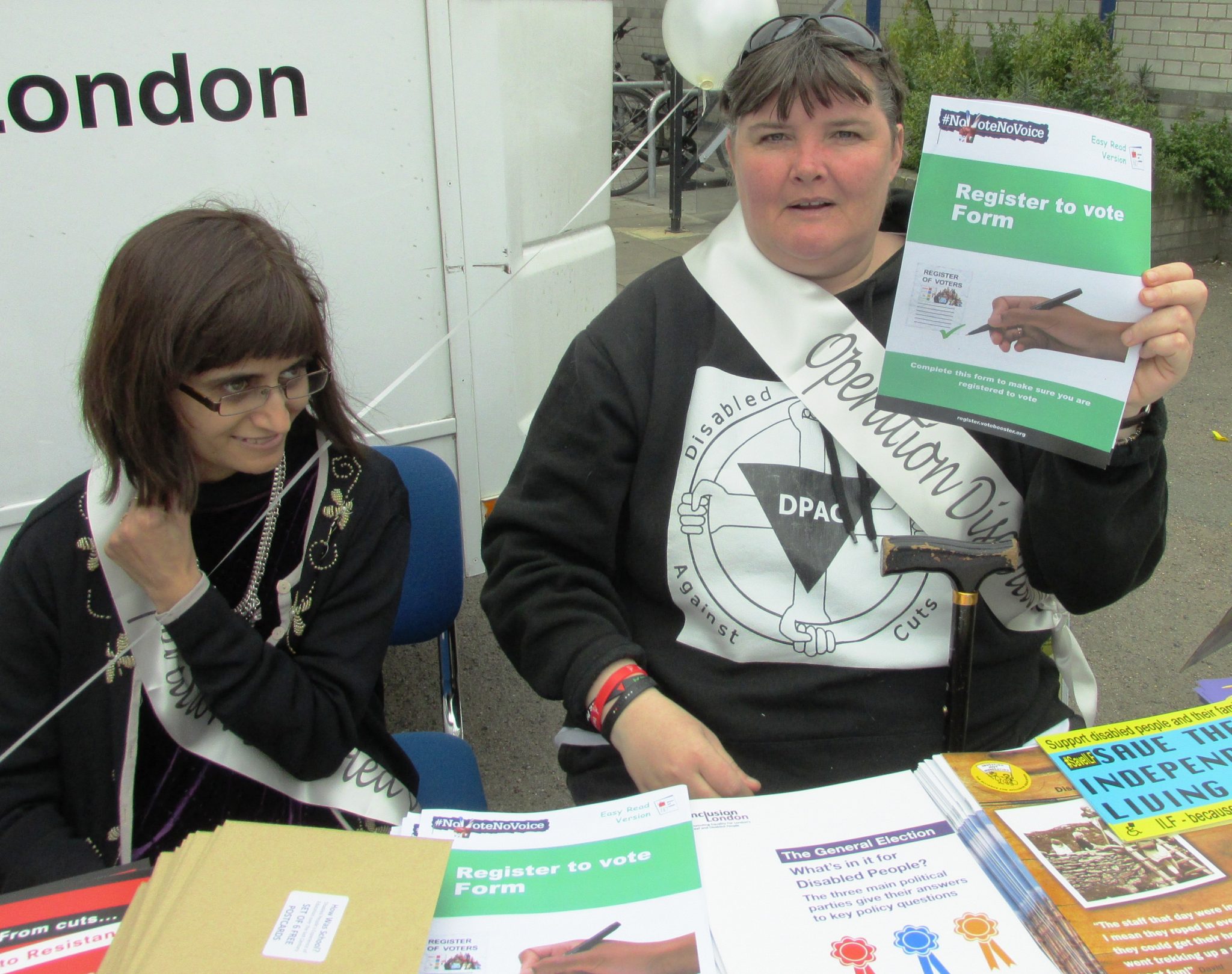
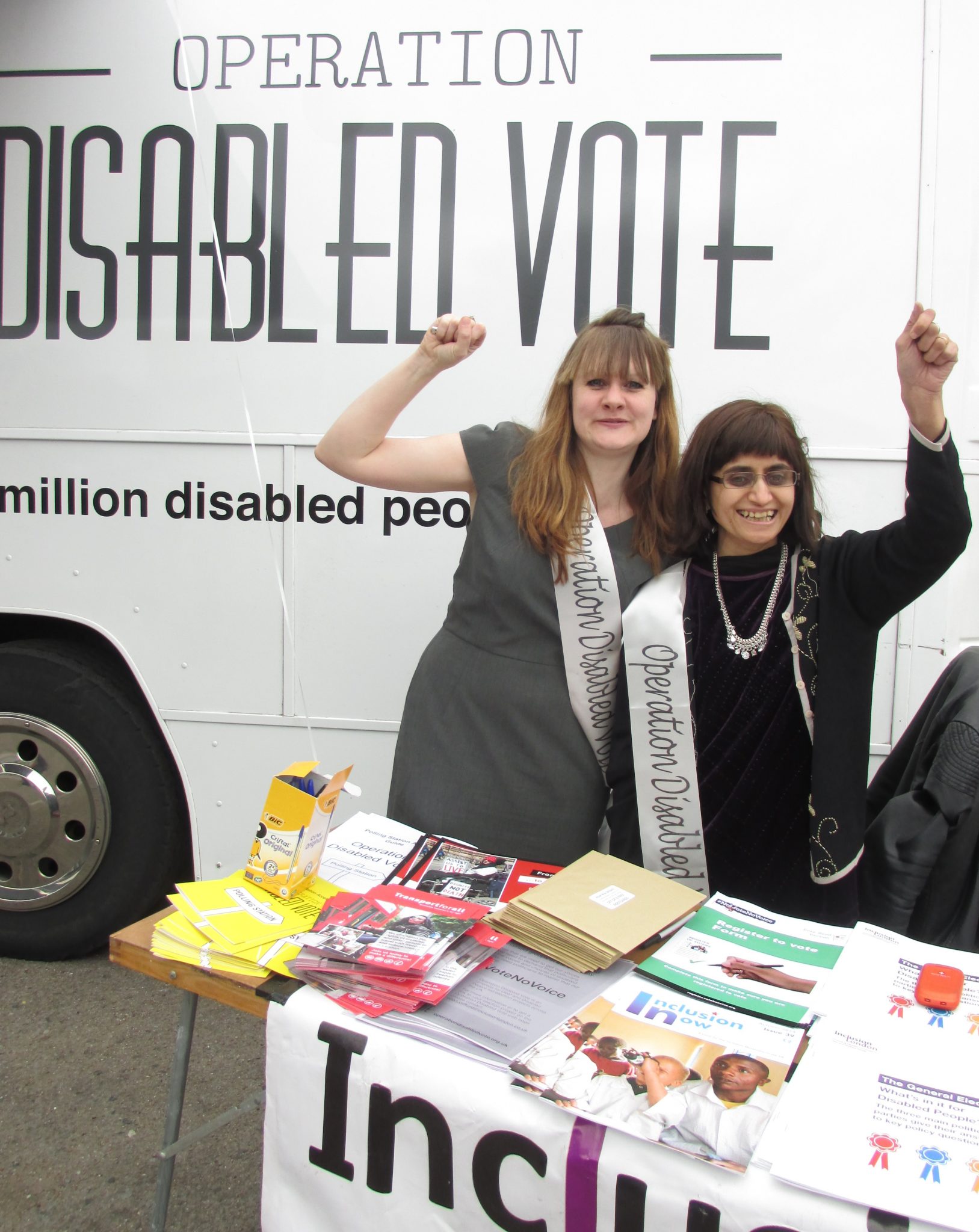
Here are some pictures from the launch of the Operation Disabled Vote London Bus Launch which took place in Brixton and Croydon on Monday 13th April.

Sabina Lahur at the information table operation disabled vote brixton.

Sabina Lahur at the information table operation disabled vote brixton.Sabina Lahur at the information table operation disabled vote brixton.

(left to right) Sabina Lahur, Paula Peters, Sandra Albery and Sean McGovern at the information table for operation disabled vote outside the operation disabled vote bus, Brixton launch)

(left to right) Sabina Lahur, Paula Peters, Sandra Albery and Sean McGovern at the information table for operation disabled vote outside the operation disabled vote bus, Brixton launch)

Sabina lahur and Paula Peters (holding a easy read version of the voter registration form at the operation disabled vote information table Brixton launch)

Sabina lahur and Paula Peters (holding a easy read version of the voter registration form at the operation disabled vote information table Brixton launch)

Staff members from People First (Brixton) left to right, Andrew Lee, Ray Johnson, Amy (Campaign and Policy officer for People First) and Stephen Asleford at the launch of Operation Disabled Vote.

Staff members from People First (Brixton) left to right, Andrew Lee, Ray Johnson, Amy (Campaign and Policy officer for People First) and Stephen Asleford at the launch of Operation Disabled Vote.

Group photo outside the Operation Disabled Vote bus at Brixton.

Group photo outside the Operation Disabled Vote bus at Brixton.

Ellen Clifford and Sabina Lahur at the information table on the Operation Disabled Vote bus launch in Brixton.

Ellen Clifford and Sabina Lahur at the information table on the Operation Disabled Vote bus launch in Brixton.

Stephen Asleford sitting in the Operation Disabled Vote bus.

Stephen Asleford sitting in the Operation Disabled Vote bus.

Roger Lewis at the launch of Operation Disabled Vote bus launch in Brixton.

Roger Lewis at the launch of Operation Disabled Vote bus launch in Brixton.

Mar 312015
 
DPAC Logo with text underneath "Disabled People Against Cuts" and then web address dpac.uk.net

Sign in support of the campaign now! 

Email Henrietta.doyle@inclusionlondon.co.uk with the name of your organisation or as an individual.

Ultimate aim of the campaign

Motability agrees to reverse the changes to eligibility criteria for Motability’s Special Vehicles Fund for Drive-from-Wheelchair/Internal Transfer (DFW/IT) vehicles used by disabled people with complex needs. 

Other aims:

·        Motability agrees to conduct a formal public consultation on the changes, including a face to face meeting with current grant users. Until this consultation is concluded and a consultation response report publicly published the changes should be immediately reversed.

·        Motability agrees to publishes  their equality impact assessment of the changes

·        Motability agrees to publish clear and full information about the changes on their website. 

Why the need for the campaign?

Motability has changed the eligibility criteria for their Special Vehicles Fund (SVF) for Drive-from-Wheelchair/Internal Transfer (DFW/IT) vehicles used by disabled people with complex needs. We believe these changes could destroy the ability to live independently and be included in the community of those affected. 

What are the changes?

From June 2014 ‘a usage test’ was introduced by Motability regarding DFW/IT vehicles.  This test applies to those applying to the SVF first time and current users when renewing their contract (see statement provided by Motability attached). Below is information on how the changes are being implemented in practice.

Current users are telephoned some months in advance of the renewal date of their contract and asked if the vehicle is to support ‘substantive employment, education, volunteer working or to enable the disabled driver to provide vital and sole care to another, for example, a school-age child or children or a disabled loved one who resides with the disabled person.’  About 12 hours a week seems to be considered ‘substantive’. It appears that those that do not fulfil this criterion are no longer eligible for a vehicle.

We are very concerned that disabled people who rely on access to such vehicles will no longer be eligible for grants from the scheme and therefore unable to replace vehicles, which are essential to their independence. These vehicles are often used by disabled people with the highest support needs, who for a range of reasons relating to their impairments, are unable to access public transport because it unavailable or not possible because of pain levels or the need to carry equipment such as hoists or oxygen or a particularly large vehicle as illustrated in the case study below:

Case study

Because of the specialised seating on my wheelchair, it is too large to travel on bus.  Only 3 weeks ago I couldn’t go to hospital Emergency A&E because the ambulances can’t take me!  I was severely dehydrated, they ended up sending a doctor to my home and doing 48-hour IV just because I couldn’t go to hospital.  

There is NO way I am every going to be employed which is depressing enough, I can’t get  voluntary work because I can’t even go and see anyone to consider it (no transport!).  I really am so depressed over these changes. 

These new changes mean I am confined to the distance of my own wheelchair with no access to public transport, and no access to Motability.

The impact

The independence given to disabled people to drive their own vehicle often means they can become involved in their community and do voluntary activities. Without a DFW/IT vehicle many disabled people will be excluded from visits to families and friends and will be unable to take part in any aspects of social, religious, community, wellbeing activities and political life.  In addition these changes will prevent disabled people getting into education, obtaining employment or volunteering unless already involved in these activities and therefore will never fulfil the new criteria for a DFW/IT vehicle.

Motability did not conduct a consultation before implementing these changes and as far as we are aware they did not carry out an Equality Impact Assessment regarding the impact of the change, also there was no public announcement or any information published concerning the changes.   Disabled people only become aware when asked the questions on the telephone. There is still only limited information given by Motability at: https://www.motability.co.uk/understanding-the-scheme/financial-help/eligibility-for-financial-help

Motability administers government funds, yet they seem to be ignoring the Equality act and the UN Convention on the Rights of Persons with disabilities, which states the duty to facilitate:

·        ‘the personal mobility of persons with disabilities in the manner and at the time of their choice’

·        access to ‘quality mobility aids’

·        disabled people’s right to ‘full inclusion and participation in the community’.   

Disabled people’s organisations are acting together with other voluntary sector organisations to ask Motability to reverses the changes to the eligibility criteria for the SVF for DFW/IT vehicles.

What can you do?

·        Sign in support of the campaign by emailing Henrietta.doyle@inclusionlondon.co.uk

·        Sign the petition at: https://www.change.org/p/stop-unfair-and-secret-changes-to-motability-grants#petition-letter   2,500 people  signed in the first 3 weeks!

·        Promote petition, email, Facebook, Twitter etc.

·        Send letter of protest and case examples to Motability.

·        Survey members on their experiences of Motability reviews

·        Contact your local MP, and relevant Ministers

Join the coalition of disabled people’s organisations and voluntary sector organisations supporting the aims of the campaign above, to do this please email Henrietta.doyle@inclusionlondon.co.uk with the name of your organisation. 

Please forward this email to your contacts. 

Many thanks,

Henrietta

Henrietta Doyle

Policy Officer

Mobile: 07703 715091

Direct line (Wednesday’s only) 020 7036 6033

Office Tel: 020 7237 3181, SMS: 0771 839 4687

www: https://www.inclusionlondon.co.uk/

 Posted by at 19:07
Mar 312015
 
DPAC Logo with text underneath "Disabled People Against Cuts" and then web address dpac.uk.net

With thanks to John Slater for this – follow him on twitter : @AmateurFOI

This post contains guidance about what to do if you need more time to fill in your forms for ESA/WCA or you are unable to make your WCA within the DWP Time Limits.

Parts 1 & 2 of the post give the legal basis for the advice, parts 3 onwards give practical advice on what claimants need to do, and part 9 gives 3 template letters that you can copy and paste or download, and then amend for your own circumstances and send to DWP.

Table of Contents (click on the title to go directly to each section)

  1. ESA Deadlines and Rules
  2. Legislation and DWP Decision Makers Guides
  3. What Does This Mean For Claimants?
  4. ESA Questionnaire Deadline of 4 Weeks
  5. Only Reschedule WCA for a Maximum of 4 Weeks and Only Reschedule WCA Once
  6. Possible reasons for not being able to meet conditions
  7. Sending Information to the DWP in the Post
  8. “Belt and Braces” Approach
  9. Letter Templates
    9.1 Responding to receiving ESA Questionnaire in the post
    9.2 Need to reschedule a WCA for more than 4 weeks (first time)
    9.3 Need to reschedule a WCA having done so previously

1. ESA Deadlines and Rules

If you have had to claim Employment and Support Allowance (“ESA”) you may have come across two deadlines and one rule that you were told you had to abide by. For the purposes of this article these will be referred to as the “Conditions”. These are:

You must return your ESA application form within 4 weeks.

You can only defer your Work Capability Assessment (“WCA”) for a maximum of 4 weeks.

You can only defer your WCA once.

The legislation (primary and secondary) that specifies how ESA works does not mention any time limits and doesn’t state that WCA can only be deferred once.

The DWP and Atos Healthcare (and no doubt Maximus will do the same) have always presented the Conditions as having a statutory basis and that if you don’t follow them to the letter you could have your claim refused. Are we being told the whole truth?

I don’t think we are. The Conditions are actually just internal DWP policies. This means that someone in the DWP simply invented them and imposes them on ESA claimants.

In response to an FOIA request made on 30th December 2012 the DWP stated:

Appointments may be deferred for up to four weeks from the date of request, for any circumstance, including the non-availability of recording equipment. After this time the case will be withdrawn from the system by Atos Healthcare and returned to DWP to make a decision.

https://www.whatdotheyknow.com/request/143605/response/352517/attach/html/2/Slater%205188%20Response.pdf.html

When challenged that it hadn’t explained how it came up with the 4 week deadline it eventually responded:

“… the 4 week deferment was simply a concession made by the Department to acknowledge that claimants may have a pre-existing appointment or commitment which may prevent them from attending the original appointment.  This was an operational not ministerial decision and documentation on how this four week period was derived is not available.”

https://www.whatdotheyknow.com/request/143605/response/360746/attach/html/2/IR%200078%20Mr%20Slater%20Final%20Response.pdf.html

It seems that whoever made this Condition up within the DWP didn’t bother to document the reason why 4 weeks was selected. It’s appalling that one of the biggest Government Departments makes and documents decisions that have such a huge impact on people in such an unprofessional manner.

The following was found on the Atos Healthcare Blog web site:
If you’re not able to make your appointment, you can call us to rearrange it, but it’s important to note that we aren’t allowed to rearrange your appointment more than once. If for any reason you’re not able to attend your rearranged appointment, we’ll need to send your information back to Jobcentre Plus. They will then let you know whether or not you can rearrange your appointment a second time.”

https://blog.atoshealthcare.com/tag/employment-and-support-allowance/page/2/

The following section looks at what the legislation and the DWP own Decision Makers Guides (“DMG”) says about the DWP imposition of the three Conditions. This is important as departments such as the DWP are reliant on legislation to prescribe the powers that they operate by.

2. Legislation and DWP Decision Makers Guides

For people that may not be familiar with DMG, they are the official DWP publications that tell DWP Decision Makers what the law is and how they should apply it. Using the DWP own words the DMG are “… for DWP staff who make decisions about benefits and pensions. It helps them make decisions that are accurate and consistent.”

DMG are published online and can be found at the following link:

https://www.gov.uk/government/collections/decision-makers-guide-staff-guide

Without boring you by repeating lines of legislation, ESA claimants can be required to provide information and evidence to determine that they have limited capability for work (“LCW”) and/or limited capability for work related activity (“LCWRA”). You would expect this to be the case as that’s how applications are made for ESA.

Claimants can also be required to attend and submit themselves to a medical examination to determine their capabilities against criteria defined in legislation.

The DMG are very illuminating in respect of the Conditions. The table below shows the relevant clauses taken from Volume 8 (amendment 4 February 2010). Each clause in the DMG usually refers to the specific legislation that allows the DWP to behave in specific ways. For example clause 42222 below cites the Employment and Support Allowance Regulations 2008 No. 794  (using the abbreviation “ESA Regs”).  However, as we see later, in respect of the conditions being discussed this isn’t always the case.

Emphasis to text in the table below (bold and colour) has been added in by the author. Please note that the grammatical and typographical errors which appear below in this table are not mine! They appear in the original DWP documents.

Table 1: Extracts from volume 8 of the DMG

Clause Guidance
42221 A claimant can be treated as not having LCW if1.     they fail without good cause to provide information, attend or submit to examination (see DMG 42224)
42222 A claimant can be required to1.    provide certain information asked for by the DM including the return of the questionnaire (see DMG 42224)
42224 A claimant who is subject to the LCWA can be asked to provide information relating to their ability to perform activities referred to in Appendix 1. This information is usually asked by sending the claimant a questionnaire.
42227 A claimant is treated as not having LCW for failure to return the questionnaire without good cause if the Secretary of State can show that1.     the questionnaire was sent and2.    there is no response after six weeks to the first requests for the information       from the day following the date of issue and3.    a further request was sent at least four weeks after the first letter and at leasttwo weeks have passed since then and4.    good cause has not been accepted for delay beyond the period stated in 2. and

3. above.


42228 The DM needs to make sure that the Secretary of State has complied with the duty set out in the legislation to send the questionnaire and the reminder to the claimant. The DM can accept that it has been sent if there is a record of issue and no indication that it was not properly addressed, stamped and posted.
42232 As in DMG 42228 the law imposes time limits on the Secretary of State in relation to the sending of the questionnaire and the reminder. However, there is no law imposing a time limit on the claimant for the return of the questionnaire. Sometimes the questionnaire is returned after the time limit imposed on the Secretary of State but before the DM has considered whether there was good cause for the earlier failure to return the questionnaire. In these circumstances, the determination cannot be made because it cannot be held that the claimant has failed to return the questionnaire. Instead, normal WCA action should resume.
42247 Only one rescheduled appointment can be offered during a WCA referral. If the claimant cannot attend the rescheduled appointment, medical services will record that the claimant failed to attend. The DM will have to consider the reasons why the claimant cannot attend and consider good cause (see DMG 42261).End of ClauseComment by the AuthorSurprisingly this entry in the DMG does not refer to any primary or secondary legislation. This seems to support the view presented here that imposing a single reschedule for a WCA is nothing more than a DWP internal policy. However, it seems sensible to get the DWP to clarify if its approach is backed by specific legislation or it just decided to impose the condition. Therefore, the following FOI request was submitted:https://www.whatdotheyknow.com/request/rescheduling_wca_more_than_once#incoming-622625
42261 When a claimant fails to return the questionnaire of fails to attend or submit to examination, consideration of good cause includes1. whether the claimant was outside GB at the relevant time and2. the claimant’s state of health at the relevant time and3. the nature of any disability the claimant hasNote: this is not exhaustive (see DMG 42262-42276 for further guidance on good cause)

The abbreviations used for primary and secondary legislation within the actual DMG are defined in the documents that can be found here:

https://www.gov.uk/government/publications/decision-makers-guide-abbreviations-staff-guide

So, in respect of the deadline to submit your ESA questionnaire the DMG is very helpful. It explicitly confirms that there is no law imposing a time limit on the claimant for the return of the questionnaire.

In respect of only being able to defer a WCA for a maximum of 4 weeks the DMG is completely silent. This supports that this is an arbitrary limit imposed by the DWP.

In the matter of only being able to reschedule a WCA once the DWP response to the FOI request (at same link as given above) confirmed that only allowing a WCA to be rescheduled once is simply a DWP policy (one that apparently dates back to the days of Incapacity Benefit).  This raises the question about how lawful it is for the DM to treat people as ‘failing to attend a WCA’ simply for wanting to reschedule a WCA more than once. Interestingly the DWP attempted to side step this part of the FOI request. An internal review request has been submitted to see if the DWP can provide any information to support its view that by asking for a WCA to be rescheduled more than once a person is ‘failing to attend a WCA’. I suspect this will turn out to be another example of the DWP simply imposing Conditions which it has invented

3. What Does This Mean For Claimants?

If these Conditions imposed by the DWP are not prescribed in law does that mean we can simply ignore them? The answer is no, we can’t. If a case came before a Tribunal dealing with these conditions it is highly likely that it would look at what is reasonable in that particular case. It would also consider the actions of the person claiming ESA. If you simply ignored the DWP whilst being in a position of being able to contact them I doubt the Tribunal would be particularly sympathetic to your case.

However, if you did everything that could reasonably be expected of someone in your position to engage with the DWP and your specific circumstances meant that the conditions imposed by the DWP were not reasonable, then it is highly likely that the Tribunal would find in your favour.

However, the best outcome would be to avoid having to take your case to a Tribunal in the first place. The following sections look at the sort of actions you could take to protect yourself if you can’t meet the DWP imposed Conditions.

4.     ESA Questionnaire Deadline of 4 Weeks

As soon as you receive the questionnaire in the post you need to do something, don’t just ignore it.

Make an appointment to see your GP, Practice Nurse or other Healthcare Professional that you normally deal with and explain what is going on and the negative impact the situation is having on your health. Ask them to make a note about the situation in your health record and ideally see if they will give you a letter/note explaining that the 4 week deadline is unreasonable. If you can’t get an appointment with your GP or others, then ask one or two people (family or close friends) to write you a letter (signed and dated) explaining how unwell you are and why the 4 week deadline is unreasonable for your particular circumstances.

Write back immediately (including copies of any letters supporting your position) explaining that you won’t be able to meet the 4 week deadline and that you have made an appointment to see your GP/Nurse/Other Healthcare Professional as receiving the questionnaire has made you feel so unwell. Personally I wouldn’t try to do this over the telephone as it is much harder to prove what you said.

Be totally clear that you are not refusing to provide the requested information. Explain that you will comply with your statutory obligations within fair and reasonable timescales that are appropriate to your specific circumstances.

Explain why the 4 week deadline isn’t reasonable for your circumstances (see later for possible examples).

Explain that you are aware that the law does not impose a deadline on the return of the questionnaire (you could cite the relevant DMG clause 42232 if you feel comfortable doing so).

Suggest your own deadline. If you do this it needs to be reasonable and most important of all you need to be able to meet it. Don’t replace their unreasonable deadline with another one of your own.

Explain why your deadline is fair and reasonable for your specific circumstances.

State that unless the DWP challenges your revised deadline in writing within 7 calendar days of posting your letter it will have been deemed to have accepted it.

Keep a copy of all letters you send along with proof of postage (see section about writing to the DWP later).

5.     Only Reschedule WCA for a Maximum of 4 Weeks and Only Reschedule WCA Once

As soon as you receive the questionnaire in the post you need to do something, don’t just ignore it.

Make an appointment to see your GP, Practice Nurse or other Healthcare Professional who you normally deal with and explain what is going on and the negative impact the situation is having on your health. Ask them to make a note about the situation in your health record and ideally see if they will give you a letter/note explaining that the 4 week limit / only one reschedule is unreasonable. If you can’t get an appointment with your GP or others, then ask one or two people (family or close friends) to write you a letter (signed and dated) explaining how unwell you are and why the 4 week limit is unreasonable for your circumstances.

As soon as you know that you cannot attend your WCA you should write (including copies of any letters supporting your position) to the appropriate organisation (Maximus) to notify them that you cannot attend. If the date of the WCA is a week or less away it would be sensible to notify them by telephone (you or someone you authorise) and explain that an explanatory letter will follow shortly. Regardless of whether you are able to comply with the DWP imposed conditions, it is always sensible to notify changes in writing in order to protect yourself. It is important to make a written record of when the telephone call took place (date and time), the name of the person you spoke to and what, if anything, was agreed.

Be absolutely clear that you are not refusing to attend or submit to a WCA. Explain that you will comply with your statutory obligations within fair and reasonable timescales that are reasonable and appropriate for your specific circumstances.

Explain why you need to reschedule your WCA and why rescheduling is fair and reasonable for your specific circumstances (see later for examples).

Explain that you are aware that the law does not impose a maximum limit of 4 weeks for rescheduling a WCA or set a limit of only one reschedule (as appropriate to your circumstances).

Suggest your own revised date and time, if it is appropriate for your condition, for the rescheduled WCA. If you do this your suggestion needs to be reasonable and most important of all you need to be able to meet it. Don’t replace their unreasonable deadline with another one of your own.

Explain why your deadline is fair and reasonable for your specific circumstances.

State that unless the DWP challenges your revised deadline in writing within 7 calendar days of posting your letter it will have been deemed to have accepted it.

Keep a copy of all letters you send along with proof of postage (see section about writing the DWP later).

6. Possible reasons for not being able to meet conditions

Whatever reason(s) you cite you need to be able to explain why it is appropriate to your specific circumstances, e.g.

  • The current state of your health is such that it is not reasonable to expect you to comply with the relevant Condition imposed by the DWP.
  • Your specific condition means that the imposed deadlines are unreasonable. For example:
  • Mental health conditions that make it hard to complete the questionnaire.
  • Side effects of medication mean it takes you longer to complete the questionnaire.
  • Aspects of your physical condition, e.g. pain, exhaustion etc, mean it takes you longer to complete the questionnaire.
  • You are in hospital or receiving treatment that means that it is not reasonable to expect you to comply with the deadline imposed by the DWP.
  • You will be out of the country or on holiday within the UK at the time of the appointment or during the 4 week deadline to complete the questionnaire.
  • Attempting to comply with the deadline will exacerbate your condition and therefore cause you actual physical and/or psychological harm.
  • You need to be accompanied to attend the WCA and it isn’t possible to get someone within the current timescales.
  • You need help to complete the questionnaire (e.g. the CAB, other organisation or family member) and that won’t be available to you in adequate time to allow you to meet the deadline.
  • You have other appointments (e.g. treatments, seeing Consultants, tests etc) which clash with the imposed dates.
  • It could be that you are suffering from something unrelated to your health condition such as the flu.
  • You are waiting for the results of tests that will be key evidence for your ESA claim and want to be able to include them in your questionnaire or present them at your WCA.

By refusing to change the deadline or reschedule WCA the DWP places you at a significant disadvantage and could be breaching of your human rights. This is likely to be applicable alongside the other reasons.

7. Sending Information to the DWP in the Post

A common problem when dealing with the DWP seems to be information going missing. This includes information delivered by hand to JCP buildings and documents sent through the post. The scale of the problem via the postal route suggests that there is something else going on other than the odd letter going missing. I am aware of letters being ignored (or not arriving at the right person’s desk!) until they are resent using the very expensive Royal Mail Special Delivery Guaranteed® service which means a signature must be obtained. It seems that using the much cheaper Royal Mail Signed For® service doesn’t guarantee that your letter is ‘signed for’.

It’s not reasonable to expect people to pay over £5 to be sure a letter is delivered to the DWP. Is there anything you can do to protect yourself? I think there is. Once again the DWP DMG has been helpful. When addressing proof that letters from the DWP have been sent it refers to the Interpretation Act 1978. Clause 7 states:

Where an Act authorises or requires any document to be service by post. Served by post (whether the expression “serve” or the expression ” give ” or ” send ” or any other expression is used) then, unless the contrary intention appears, the service is deemed to be effected by properly addressing, pre-paying and posting a letter containing the document and, unless the contrary is proved, to have been effected at the time at which the letter would be delivered in the ordinary course of post.”

In plain English this means that if it can be shown that the envelope was properly addressed, contained the letter in question and the correct stamp was applied then the law considers the letter delivered unless it can be proved otherwise. If this is good enough for the DWP then it is good enough for the rest of us.  So how do we do this is practice?

Keep a copy of all documents you send to the DWP

It is always good practice to keep copies of everything you send to the DWP as it does have an unfortunate habit of losing things! This is relatively easy if you have access to a computer, printer and a scanner. If you don’t have access to such computer equipment then your smartphone or digital camera can help. Take photographs of every page of each document you send to the DWP and try to store it in a location where it won’t get deleted accidentally. Many smartphones allow you to write to memory cards so you could use one of these to store photographs of your correspondence with the DWP. You could also ask family or friends for help if they own a computer and a scanner.

Properly addressed and correct postage

If you are not sure about the correct postage you can use a set of digital kitchen scales to weigh your letter and you can find the correct stamp rates on the Royal Mail website. Another alternative is to take your letter to the post office and ask them to weigh it for you. You can then take a photograph of the envelope with the correct address and stamp.

Once you have addressed the envelope and affixed the stamp either scan it or take a photograph. You can also include the front page of your letter in the picture or scan to show a clear link between the letter and the completed envelope.

Proof that it has been posted

Whilst it costs money to send letters using the Royal Mail’s special delivery services it doesn’t cost you anything to get proof of postage at the Post Office. If you take your letter to your local Post Office they will print you off a proof of postage receipt. This serves two purposes. It proves you actually sent the letter and it shows that you put the correct value stamp on (otherwise the Post Office counter would not accept it).

One thing to be aware of is that the receipts may be printed on heat sensitive paper and these fade over time or turn black if left in sunlight. When you have your proof of postage always make a copy by using your scanner or your camera.

8. “Belt and Braces” Approach

If you want to adopt a “belt and braces” approach to corresponding with the DWP then you might consider the following. The next time you write to the DWP explain that you are aware of clause 7 of the Interpretation Act 1978 and that you always retain copies of any documents sent to the DWP along with proof that the correct address was used, the correct postage affixed and proof of postage. You could always add that you retain the right to seek financial compensation if due to the negligence of the DWP (i.e. losing your correspondence) you suffer financial loss. This would amount to the costs for paper, ink, envelopes, stamps etc.

9. Letter Templates

9.1 Responding to receiving ESA Questionnaire in the post.

Your Name
Address
Town/City
County
Post Code

Name of Person or Organisation
Address
Town/City
County
Post Code

Date: <DATE>
Ref: <Your NINO>

Dear Sir/Madam,
Submission of ESA50 Questionnaire

I received an ESA50 questionnaire on <DATE RECEIVED>. I understand that the DWP imposes an internal policy of a 4 week deadline for the return of the questionnaire. I am aware that in the DWP own decision makers guide, clause 42232 states “… there is no law imposing a time limit on the claimant for the return of the questionnaire.”

For my circumstances this internal policy is manifestly unreasonable for the following reasons:

<Explain the reason(s) why it is not reasonable to expect you to meet the 4 week deadline here. Include that you have made an appointment(s) to see your GP, Nurse, etc due to the impact of receiving the questionnaire. If you are going to include letters from people supporting you say so here.>

I believe that the <Enter Date> is a reasonable date for me to submit the completed questionnaire given my particular circumstances. Unless I hear to the contrary within 7 calendar days of posting this letter, the DWP will be deemed to have accepted my proposed submission date. My proposed submission date is appropriate to my circumstances for the following reasons:

<Enter the reasons why your proposed submission date is fair and reasonable given your circumstances>

I wish to be absolutely clear that I am not refusing to complete and return the questionnaire and will always comply with the legal obligations arising out of my ESA claim. I am aware that should a DWP Decision Maker seek to obtain “Good Cause” from me in this matter they are likely to be acting unlawfully as they will be acting in their own cause, i.e. judging against an internal DWP policy. The relevant precedent in this matter is R v Sussex Justices, Ex parte McCarthy ([1924] 1 KB 256, [1923] All ER Rep 233).

Failing to give me reasonable time to submit evidence via the questionnaire could constitute a breach of my human rights.

Please be aware that I have retained a copy of this letter (including the address used) and proof of postage.

Yours faithfully

Your Name


You can download a copy of this letter in word document format here Template Letter 1 – Responding to receiving ESA Questionnaire in the post


9.2 Need to reschedule a WCA for more than 4 weeks (first time).


Your Name
Address
Town/City
County
Post Code

Name of Person or Organisation
Address
Town/City
County
Post Code

Date: <DATE>
Ref: <Your NINO>

Dear Sir/Madam,
Rescheduling of Work Capability Assessment

I need to reschedule my Work Capability Assessment (“WCA”) that is currently arranged for <enter date & time> at <enter location>. I understand that the DWP imposes an internal policy of only permitting a WCA to be rescheduled for a maximum of 4 weeks and that this has no statutory basis.

For my circumstances this internal policy is manifestly unreasonable for the following reasons:

<Explain the reason(s) why it is not reasonable to expect you to attend a WCA within the next 4 weeks. Include that you have made an appointment(s) to see your GP, Nurse, etc due to the impact of the date of the WCA. If you are going to include letters from people supporting you say so here.>

I believe that the <Enter Date> at <Enter Time> is a reasonable date and time for me attend for a WCA given my particular circumstances. Unless I hear to the contrary within 7 calendar days of posting this letter the DWP will be deemed to have accepted my proposed date for my WCA. My proposed date is appropriate to my circumstances for the following reasons:

<Enter the reasons why your proposed date to attend for a WCA is fair and reasonable given your circumstances>

I wish to be absolutely clear that I am not refusing to attend and submit to an examination (WCA) and will always comply with the legal obligations arising out of my ESA claim. I am aware that should a DWP Decision Maker seek to obtain “Good Cause” from me in this matter they are likely to be acting unlawfully as they will be acting in their own cause, i.e. judging against an internal DWP policy. The relevant precedent in this matter is R v Sussex Justices, Ex parte McCarthy ([1924] 1 KB 256, [1923] All ER Rep 233).

Failing to give me the opportunity to attend a WCA to present relevant evidence within a timescale that is appropriate for my particular circumstances could constitute a breach of my human rights.

Please be aware that I have retained a copy of this letter (including the address used) and proof of postage.

Yours faithfully

Your Name


You can download a copy of this letter in word document format here Template Letter 2 – reschedule a WCA for more than 4 weeks (first time)


9.3 Need to reschedule a WCA having done so previously.

Your Name
Address
Town/City
County
Post Code

Name of Person or Organisation
Address
Town/City
County
Post Code

Date: <DATE>
Ref: <Your NINO>

Dear Sir/Madam,
Rescheduling of Work Capability Assessment

I need to reschedule my Work Capability Assessment (“WCA”) that is currently arranged for <enter date & time> at <enter location>. I understand that the DWP imposes an internal policy of only permitting a WCA to be rescheduled once and that this has no statutory basis.

For my circumstances this internal policy is manifestly unreasonable for the following reasons:

<Explain the reason(s) why it is not reasonable to allow you to reschedule your WCA again. Include that you have made an appointment(s) to see your GP, Nurse, etc due to the impact of the date of the WCA. If you are going to include letters from people supporting you say so here.>

I believe that the <Enter Date> at <Enter Time> is a reasonable date and time for me attend for a WCA given my particular circumstances. Unless I hear to the contrary within 7 calendar days of posting this letter the DWP will be deemed to have accepted my proposed date for my WCA. My proposed date is appropriate to my circumstances for the following reasons:

<Enter the reasons why your proposed date to attend for a WCA is fair and reasonable given your circumstances>

I wish to be absolutely clear that I am not refusing to attend and submit to an examination (WCA) and will always comply with the legal obligations arising out of my ESA claim. I am aware that should a DWP Decision Maker seek to obtain “Good Cause” from me in this matter they are likely to be acting unlawfully as they will be acting in their own cause, i.e. judging against an internal DWP policy. The relevant precedent in this matter is R v Sussex Justices, Ex parte McCarthy ([1924] 1 KB 256, [1923] All ER Rep 233).

Failing to give me the opportunity to reschedule my WCA such that I can attend to present relevant evidence within a timescale that is appropriate for my particular circumstances could constitute a breach of my human rights.

Please be aware that I have retained a copy of this letter (including the address used) and proof of postage.

Yours faithfully

Your Name


You can download a copy of this letter in word document format here Template Letter 3 – reschedule a WCA having done so previously


 Posted by at 13:01
Mar 252015
 
DPAC Logo with text underneath "Disabled People Against Cuts" and then web address dpac.uk.net

A complaint to the United Nations was today launched on behalf of disabled people in the UK whose rights have been breached by the closure of the Independent Living Fund (ILF). The ILF, which is the subject of an on-going and desperate battle between disabled people and the Department for Work and Pensions (1), is high on the priority list for disabled people deciding how to vote at the forthcoming election. The complaint brought by Inclusion London (2) on behalf of two disabled women, Nicky Baker and Dr Melanie Wilson Jones, alleges that the government has violated Articles 17, 19, 20, 30 and 31 of the United Nations Convention on the Rights of Persons with Disabilities (UNCRPD), ratified by the UK in 2009 (3).

The Independent Living Fund was set up in 1988 to support disabled people with high support needs to live in the community when the alternative was residential care. Since then it has helped thousands to live active and full lives, contributing to their communities and participating in education, employment and volunteering, family and social life. It is an effective way to provide support with both low cost overheads and extremely high user satisfaction rates (4).

On 13 December 2010 without any consultation or impact assessment, it was announced that the ILF would be closed permanently to new applicants. A ministerial statement was made referring to “informal consultation with disability organisations” but there is no record of this consultation (5). Since then, disabled people who missed out on the Fund have been left without the support they need to take part in day to day life and disabled people’s life chances have dramatically fallen. Meanwhile the government has failed to monitor the impact of the closure.

Nicky Baker, age 30, is a qualified auditor working within a disabled people’s organisation as well as studying part time for a degree. Although eligible for support from the ILF, the Fund was closed the day after she telephoned for an application form. The social care package she receives from her Local Authority does not provide the support she needs to live an independent life, for example to go on dates with her boyfriend without having her parents there or to take part in sufficient training for the high level of powerchair football she reached.

Dr Melanie Wilson Jones received a substantial amount of support including from the ILF after sustaining a brain injury. She made such progress that her needs decreased and thus her support was reduced. However following a road traffic accident in 2011 she sustained a further brain injury requiring someone to be with her constantly. Now unable to get support from the ILF, she is reliant on her husband who works full time and her 16 year old daughter to make up the extra hours of support she needs for evenings and weekends.

Linda Burnip, co-founder of Disabled People Against Cuts, who are supporting the challenge, said: “It is the pooling of resources and collective solidarity that has allowed this to happen. We’re grateful to DPAC supporters for their financial support towards travel costs, to the solicitor and barrister who gave their time pro bono, to Inclusion London for their staffing resources and of course to the two disabled women willing to put themselves forward to make a complaint on an issue that affects all disabled people in the UK. Without all of these factors this could never have been brought to fruition.”

Tracey Lazard, CEO of Inclusion London, who authored the complaint said, “The closure of the Independent Living Fund signals the end of independent living for disabled people. It took many years for disabled people to fight their way out of the institutions and to have the same chances as anyone else to live in the community alongside family and friends. At the current time Local Authorities are simply not able to provide the level of social care support required to uphold disabled people’s fundamental human rights”.

Sophie Partridge, a current ILF recipient, said: “The ILF has played a huge part in supporting me to have equal access to an independent adult life and a level playing field alongside non-disabled people. Without the ILF being re-opened to new applicants, I worry that young disabled people will never get the same life chances as I have had.”

Solicitor Louise Whitfield, from law firm Deighton Pearce Glynn, who is representing the complainants said: “From a legal perspective, I cannot see how the UK Government can justify closing the ILF to new applicants with no consultation or consideration of the rights protected under the UN Convention. Under Article 19, those rights include the fundamental right to independent living which has clearly been breached by this decision and I hope that the UN Committee takes appropriate action to recognise these very significant breaches”.

For more information or to speak to either the complainants or other disabled people affected by the closure of the ILF contact: ellen.clifford@inclusionlondon.co.uk or call 07505144371.

Notes for editors:

1) The future of the ILF has been the subject of two legal challenges: the first was won by disabled claimants at the Court of Appeal in November 2013 and the second was lost in the High Court in December 2014. There have been continued protests and direct actions led by disabled people and their supporters since 2010, including in June 2014 the attempted occupation of the grounds of Westminster Abbey.

2) Inclusion London is a pan impairment pan London Deaf and Disabled People’s Organisation (DDPO) which provides policy, campaigning and capacity building support for London DDPOs. Inclusion London promotes disability equality and has been working with the disabled people led campaign Disabled People Against cuts to support ILF recipients in the campaign to keep the ILF open.

3) The UK is signed up to the UNCRPD Optional Protocol. This means that individuals can take complaints to the UN disability committee for breach of the UNCRPD if all domestic avenues have been exhausted. If the committee find the complaint admissible, they will investigate. and produce a set of recommendations for the State in question. One previous complaint was made to the UN disability committee but found inadmissible as the incidents in question which related to employment discrimination occurred before the UK ratified the convention. For more information about the UNCRPD: https://www.un.org/disabilities/default.asp?id=150

For more information about previous uses of the Optional Protocol: https://tbinternet.ohchr.org/_layouts/treatybodyexternal/TBSearch.aspx?Lang=en&TreatyID=4&DocTypeCategoryID=6

4)

5)

 Posted by at 21:42
Mar 222015
 
DPAC Logo with text underneath "Disabled People Against Cuts" and then web address dpac.uk.net

Press Release

Anti UKIP campaigners are staging a protest now in the local pub of UKIP leader Nigel Farage in the village of Downe, Kent.

Nigel Farage’s local pub the George & Dragon where he has been pictured many times going for a drink has been invaded by about 80 people protesting against UKIP.

Campaigners include those who have been targeted by UKIP such as migrants, HIV activists, gay people, disabled people and breastfeeding mums.

Protest organiser  said:

UKIP are a con. They pretend to be anti-establishment but this couldn’t be further from the truth. By wrongfully shifting the blame for the economic crisis onto immigrants they have let the bankers off the hook. That is why so many diverse communities have taken our cultures to the heart of where they exist – Nigel Farage’s local pub. We will not succumb to their prejudice. We will create the world we want to live in. A world beyond UKIP.

We sympathise with people who feel alienated with the political system but a vote for UKIP really is the worst thing you could do to protest about the current state of this country.

a social worker from London said:

“The alliance of people here today shows that there are clear targets of UKIPs hate filled agenda. We want to live in a society in which we are all valued and our different contributions, talents and cultures are acknowledged. 

We want politicians to stop using the language of divide and rule, xenophobia, racism and fear and instead speak up to the 99% to challenge the corporate greed and massive inequality that exists in this country and globally”.

ENDS

Notes to Editors

  • Full address of the Pub: George & Dragon, 26 High St, Downe, Orpington, BR6 7UT
  • We have photographers on the protest who will be able to provide photos in the next few hours.
 Posted by at 12:32
Mar 202015
 
DPAC Logo with text underneath "Disabled People Against Cuts" and then web address dpac.uk.net

Neil Crowther writes in his blog Why it’s time disability rights activism got its mojo back.”

Its well worth a read for those unfamiliar with Neil’s work. Those who are already familiar with his work will recognise his trademark stunning ignorance of the lives of disabled people in the UK today.

Only someone so insulated from the effects of government policy could have that level of blissful non-empathy.

But in this piece, Neil excels himself. He not only displays an ignorance of disabled people’s lives but an ignorance of the disability rights movement that he claims to be a part of.

Where was Neil when :

  • We launched the UK Disabled people’s ‘Reclaiming Our Futures’ Manifesto

  • We've been campaigning to keep the Independent Living Fund Open?

  • We've been campaigning to get Anthony Kletzander out of an institution and back into an independent life?

  • We've been campaigning for Accessible Transport?

  • We've been campaigning on Access to Work?

  • We've been campaigning for Inclusive Education?

  • We have been supporting Operation Disabled Vote and running our own Who2Vote4 campaign?

So where were you Neil ? When we were marching, protesting, writing, petitioning, lobbying, occupying, tweeting.

Where were you?

Neil, the disability rights movement's Mojo is thriving.

Maybe the reason you don't know it, is that you haven't taken part in it.

 Posted by at 23:22
Mar 172015
 
DPAC Logo with text underneath "Disabled People Against Cuts" and then web address dpac.uk.net

Today, the Guardian published an interview of Rachel Reeves, in which she says of the Labour party: “We are not the party of people on benefits. We don’t want to be seen, and we’re not, the party to represent those who are out of work,……. Labour are a party of working people, formed for and by working people.”

This is a huge disappointment for those who had been expecting the Labour party to take a principled stand against what the Coalition is doing to unemployed and disabled people who cannot work, lone parents, carers and pensioners who rely on benefits and to voice their concerns and anger.

Forget it. The Labour Party does not represent you.

But that is not even the worst. Rachel Reeves seems to think that you cannot be claiming benefits and working at the same time, although some disability benefits like the Independent Living Fund, Disability Living Allowance,Personal Independence Payment and Access to Work are designed precisely with this in mind. All parents raising children are entitled to Child Benefit, although it is now mean-tested. Do we have to assume that Rachel Reeves will forfeit her allowance when she has her baby? Should we assume that neither David Blunkett nor Ann Begg had or have to rely on some form of disability benefits to support them in their Parliamentary life?

Is the assumption that claiming benefits only happens to others, slightly apart from the rest of the human race, and who don’t deserve to be represented although they are already the most politically marginalised and unrepresented group?

Maybe before speaking, Reeves should have had a chat with Yvette Cooper. Yvette Cooper could have told her that when she was struck by ME, she had to claim disability benefits during six months because she was too sick to work. She was lucky to totally recover after 4 years, but when she needed it, the state was there to support her, and I am not sure she would have been very pleased to be told at the time that her own party did not represent her anymore because she could not work. (see below for more information)

Rachel Reeves made a huge faux-pas today, which might not gain the Labour Party any extra votes from the Tory party, but which has lost for Labour the last hopeful voters who still believed that the Labour Party was the party of compassion and solidarity and who discover that it has lost its soul.


On 21st October 2009 while Work and Pensions Secretary, Yvette Cooper made the following statement to the All Party Parliamentary Group on ME. Of particular interest are Yvette Cooper’s comments about her uncertainty about if she would have qualified for ESA at the time, when she knew she was unable to work, and also a recognition all the way back in 2009, six years ago, that the WCA was flawed when dealing with fluctuating conditions.

I am happy to say a few things first. It is a pleasure for me to be here. Tony Wright MP and I first discussed setting up the all party group on ME back in 1998. I obviously have a strong personal interest in it, having been an ME sufferer back in 1993. I was off work for about a year. I had to work part time for a year or two after that, and then it was another couple of years before I stopped getting any relapses.

I obviously have a personal interest in this, and although it is true that I am the third Secretary of State to come before the group, I think I am probably the only Secretary of State from the Department for Work and Pensions who has actually claimed sickness benefits. As well as having statutory sick pay for six months, I also claimed what was then invalidity benefit for six months, before going back to work. I was lucky to have a supportive employer who allowed me to work part time — I worked alternate days, as that was the best way for me to do it when I started back at work — and who was very considerate when I had bad days. I am very conscious of the difficulties and challenges that people can face. That includes both those who have the condition and can work, although they can only work certain times and need it to be flexible — that was the position I was in for some time — and those people who cannot work at all.

I am happy to listen to the concerns that the group wishes to raise. I have also been through the new work capability assessment, from the point of view of how I felt and the condition that I had at the time. I know that I was not able to work; I was desperate to get back to work, but would I have passed the work capability assessment in terms of getting the ESA?

I have been through all those sorts of questions because I have a personal interest in it, but I am interested in hearing your views too.

We have done a lot of work to try to ensure that the whole approach to the employment support allowance takes account of fluctuating conditions and fatigue, not only inability to do things. It should look at those conditions where someone is able to do something, but it wipes them out for the rest of the day. It is not that someone cannot do a particular thing because they are incapable of doing it, but it wipes them out.

That must be taken into account in the assessment process. A lot of work has been done to try and do that, and to build that in to the assessment process. I obviously have personal experience of how that is going, but we are keen to keep trying to do that, and ensure that we respond to what I know is a difficult condition.

We are pleased to note that Yvette Cooper is restored to health, not only being able to hold down a demanding job, but also now having the spare energy to be able to run away from difficult questions about WCA:


Video courtesy of Kate Belgrave

 Posted by at 13:45
Mar 162015
 
DPAC Logo with text underneath "Disabled People Against Cuts" and then web address dpac.uk.net

Who 2 Vote 4 Logo

The current situation now is that England will be the only UK nation which no longer has an ILF as Scotland, Wales and Northern Ireland have pledged to open replacement ILF funds so this will lead to what can only be described as the biggest postcode lottery ever. If you are fortunate enough to live in a devolved nation then you will still be eligible for this additional funding but if you are unfortunate enough to live in England then you won’t be.

Obviously it may seem to those who have no real experience of the way the care system operates that it makes sense to devolve all funding to local authorities even if it will not be ring-fenced either to current recipients or even to the adult social care budget however ILF funding covers essential support for independent living which local authority care will not. (even with the introduction of the new care Act from April this year).

Labour says it strongly agrees that independent living is crucial to ensuring that disabled people have the same rights, choices and chances as any other citizen. They tabled an amendment during the Committee Stage of the Care Bill which would have enshrined in law the right of disabled people to live independently. Unsurprisingly the government chose to vote against and defeat this amendment. Ed Miliband has said recently Labour also opposed the government’s plans for closure of the Independent Living Fund in the absence of a comprehensive strategy for a system of social care that protects people’s ability to live independently. Yet in spite of this if Labour is elected in May it will be a Labour government that allows the ILF to close.

Kate Green/You have said “it’s not Labour’s position to retain the ILF “

We have asked Labour to commit to keeping the ILF open for current recipients even if only in the short term until something better can replace it so that a generation of disabled people do not lose the right to continue to live independently in the community.

The Labour front bench have said they will allow the ILF to close because there is a real opportunity to develop a sustainable model of provision for the most severely disabled people within the integrated health and social care landscape that Andy Burnham and Liz Kendall have been articulating rather than continuing with a standalone fund. These proposals are based on a report by the Oldham Commission which clearly states that it will take the 5 years of a new parliament and an extra £10 billion of funding to achieve these changes. In the meantime there will be no protection for disabled people in England who need their needs funding now and not at some date far into the future. For them any new integrated care system will simply be too late to help. Moreover, as respected experts in the field such as Professor Pat Thane have pointed out, the current system is simply not functioning at the necessary level. Relying on the integration of health and social care as a solution to the crisis in social care is thus an irresponsible gamble to take with people’s lives.

In the original ILF consultation over 50% of local authorities said that the loss of ILF was likely to lead to disabled people having to move from the community back into Care homes, something that is not only morally wrong but which will cost Local Authorities, who by 2015 will have had social care budgets cut by £8 billion, or by about 33%, considerably more.

Already since 2008 over 90,000 disabled people or 1 in 6 have lost their care and support for independent living.

While it is true that the fund is now being wound down, and staff numbers are already reducing it is not true that it is too late for Labour to commit to keeping the ILF open in England as well as will be the case in other parts of the UK. PCS and a former manager at ILF have both given the Labour front bench detailed reasons of why this is the case.

As the devolved funding will not be ring-fenced in any way to either individuals or adult social care budgets Ed Miliband has said that Labour will put in place guidance for Local Authorities to encourage them to meet the needs of severely disabled people in their areas but this will not be mandatory and we have no reason to believe that cash strapped councils will have either the political will nor the financial ability to implement such guidance. They are very aware of the dangers of setting precedents for providing levels and types of social care support to some individuals and not for others. A Local Authority could easily consider itself to have more to risk by following than not following the guidelines. In order to ensure equity between all adult service users they may well feel they have no choice but to level down..

As emerged from formerly undisclosed documents from DWP during one of the court cases the devolved funding for ILF recipients is only in place until April 2016 and no additional funding was requested beyond that date by DWP. What will happen to the real people stuck in the middle of this chaos then has not been addressed by any political party.

Further Labour also cite “inconsistencies” in delivery as a reason to remove the right to live independently from severely disabled people but these are the result of unequal take up between different local authorities  and is symptomatic of the failings of local authority administered social care support. As a national model of service delivery the ILF is far more successful and cost effective than local authority administered social care. The latest ILF annual report records a user satisfaction rating of 97%. Overheads for the ILF come in at just 2 % of the budget in comparison with an average of 16% for local authorities. It is in fact a model of service delivery that should be built upon rather than shut down. We understand that provisions in the Care Act are aimed at reducing inconsistencies between local authorities, nevertheless the inconsistencies Labour cite as a problem of the ILF are many times worse in the current system upon which ILF users will now be solely reliant as a result of the closure.

Since the closure to new applicants in December 2010 disabled people who missed out on the ILF have suffered dramatically worse outcomes than existing ILF recipients with equivalent support needs. We have provided Kate Green with a number of case studies showing the reality of independent living for disabled people who would have been eligible for ILF but are now only receiving LA social care support. We are not just talking about disabled people no longer being able to go to work, or ever have a holiday or go to university, we are talking about people unable to leave their homes, left without access to food or water, unable to go to the toilet and unable to wash more than a couple of times per week. We know there is also an urgent need to address this inequity, so do not believe that the right answer is to level everyone down to the lowest levels of support.

In the short term we are asking that the ILF be retained as the only way to realistically guarantee protection for existing recipients. Disabled people are aware that this is not a big ask: the ILF represents a relatively small amount of money – only £32 million and the ILF will not be wound down beyond easy repair before May 2015.

Moving on from these moral aspects of retaining the ILF the political situation now is that the Labour Party is the only main opposition party unwilling to commit to keeping the ILF open if elected. We find it very difficult to understand why Labour continues to take this position and not avail themselves of the support of the 12million plus disabled voters,and their families and friends

 Posted by at 23:06
Mar 152015
 
DPAC Logo with text underneath "Disabled People Against Cuts" and then web address dpac.uk.net

The Deaf  community in North Staffordshire region have had all funding  for Hearing Aids withdrawn!
This means  if people can’t pay £ 400, they can’t hear. We need to fight this not just as deaf  community and supporters but as an entire disabled community.
This despicable behaviour is likely to spread to withdrawing funding of equipment and resources for other impairments  too. Please like and share our new dpac page for North Staffordshire and Cheshire East.

https://www.facebook.com/pages/DPAC-North-Staffordshire-and-Cheshire-East/1568667403389619?fref=ts

if you are unable to access Facebook but would like to get involved in this area email us at mail@dpac.uk.net with your contact details which we will pass on.


 Posted by at 15:01
Mar 112015
 
DPAC Logo with text underneath "Disabled People Against Cuts" and then web address dpac.uk.net

I need to acknowledge the use of work produced by Professor Luke Clemens which was provided by Kate Whittaker, of Scott-Moncrieff to us. The full summary produced is here https://www.lukeclements.co.uk/wp-content/uploads/2015/01/0-Care-Act-notes-updated-2015-02.pdf


There are also 2 excellent youtube videos by Professor Clemens on Continuing Health Care and assessing social care needs.


Luke Clements lectures

https://www.youtube.com/watch?v=MmFZ5qzvCZE  on CHC


https://www.youtube.com/watch?v=hEwBN873dYE   assessing social care needs


Background to Care Act 2014

The Care Act 2014 repeals almost all of the principal adult social care statutes. The list of ‘repeals’ is extensive including the National Assistance Act 1948, as well as the Acts and regulations that govern such things as direct payments, charging for social care, assessments (ie the NHS & Community Care Act 1990) and all the Carers Acts. It also replaces FACS criteria with a list of eligible needs.


The implementation timetable for the Care Act 2014 has been the subject of significant criticism. The 506 page guidance and 17 sets of regulations weren’t approved until mid-October – leaving local authorities less than 5 months to make major) changes (including training their workforce) before the Act comes into force in April 2015. It is I think fair to sat that many local authority social workers and managers are unlikely to know just what the Care Act entails even once it has replaced existing social care legislation so as disabled people and carers it is probably more important than ever that we know what it says and what our rights are.


The Government say this is  ‘the most significant reform of care and support in more than 60 years’ and it also provides a range of new rights for family carers.

The equivalent Welsh legislation (Social Services & Well-being (Wales) Act 2014) is not coming into force until 2016.


While the bulk of the Act will come into force in April 2015, the new appeals process and the ‘cap on costs’ provisions aren’t due to come into force until April 2016. A sum of £55.5m was ‘released’ which becomes the ‘Carers and Care Act Implementation Grant.’ aimed at meeting the expected increased potential demand from carers to access their ‘new rights’.


Luke Clemens says that “The speed with which the final guidance has been produced has resulted in it having a number of material errors and omissions. One is a section explaining the guidance’s status at law. The draft guidance contained a statement (page 3) that ‘local authorities are required to act under the guidance, which means that they must follow it, unless they can demonstrate sound legal reasons for not doing so’. This obligation stems from section 78 of the 2014 Act – which replicates the current duty (in section 7(1) Local Authority Social Services Act 1970) and means that existing case law concerning Department of Health ‘policy guidance’ will remain relevant under the new legal regime.”


The regulations detail specific obligations relating to market oversight / business failure (3 sets of regulations); the assessment of need; eligibility criteria; advocacy; charging; choice of accommodation; deferred payments; personal budgets; direct payments; the NHS interface; delayed hospital discharge; ordinary residence (2 sets of regulations); portability of care packages and cross-border placements; and registers for people with visual impairments. The longest set of regulations concern charging and there are none on some key questions – notably adult safeguarding.

The guidance contains a number of ‘examples’. While these had the potential to be of considerable value, they are disappointing: generally limp and have the predominant outcome that once the person had been pointed in the right direction, there was no need provide them with any local authority support.


The Act does not talk of disabled, elderly or of ill people: instead it uses the word ‘adult’ – but this is generally qualified as being an adult ‘in need’ of care and support. The regulations however stipulate that this is an adult who has ‘a physical or mental impairment or illness’. The current community care legislation generally requires that the impairment be both substantial and permanent.


Carer

Section 10 defines a carer as someone 18 or over  who provides or intends to provide care for someone but is not contracted to provide the care or providing the care as formal ‘voluntary work’. All ‘carers’ are now eligible for an assessment. This means that many more carers will be eligible for an assessment – for example those who are providing little or no physical or practical care – but providing emotional support This change, coupled with: (a) the abolition of the requirement that carers’ ‘request’ an assessment; and (b) the new ‘duty’ to meet carers assessed needs has the potential to recast radically the legal regime for carers.


As with the pre-Care Act law, there is no duty to assess carers who provide their care by virtue of a contract, or as voluntary work (section 10(9)). The guidance addresses the not uncommon situation of a carer who is paid to provide care for the adult (possibly through the use of a direct payment) but is also providing unpaid care for that person. At para 6.17 it advises that in such circumstances ‘the local authority must consider whether to carry out a carer’s assessment for that part of the care they are not providing on a contractual or voluntary basis’.


The act also includes provisions for young carers and disabled children.


Local Authorities also have far greater duties to provide assessments to eligible persons even those who self-fund, they must provide transparent information to people including how their Resource Allocation System operates, they must provide access to information and to advocacy for those who need it.


RAS will be based on the 10 outcomes outlined below with each outcome having a maximum number of points based on how expensive that outcome is to meet. Questions asked about support levels and the need to meet these will produce points for people whereasquestions about informal support which may be in place to help meet needs will remove points but it is also stressed in the Act that any assessment of needs must ignore care provided by informal carers and that such input can only be considered if appropriate and the informal carers are willing to provide such support. (6.64)


Social Care Institute for Excellence (SCIE) says that the Care Act is based on a strengths based approach to improve wellbeing and independence and that it looks at what people can do rather than what they can’t do as well as what those around them can do and what the community can do to support them to put off the need for care and support.


Underpinning principles (section 1)

The consultation process leading to the drafting of the legislation resulted in demands that the Act be underpinned by a coherent set of guiding principles (rather like those that apply in relation to the Mental Capacity Act 2005, s1). The Act does not have such a set of principles – instead it contains a general duty to promote the ‘well-being’ of individuals (ie adults and carers). The duty applies to local authorities and their staff when exercising ‘any function’ under Part 1 of the Act (ie sections 1-80).


Well-being

Well-being is so widely defined that there was a risk that it would prove to be of little practical application and is fairly meaningless. Clemens says   however the guidance goes a considerable way to dispelling this fear.


‘Well-being’ includes personal dignity, physical and mental health and emotional well-being; protection from abuse and neglect; control over day-to-day life; participation in work, education, training or recreation; social and economic well-being; domestic, family and personal relationships; suitability of living accommodation; and ‘the individual’s contribution to society’.


The emphasis on the importance of ‘control’ has been seen as a cause for concern by some commentators: in many respects the inclusion of ‘control’ can be seen as a further manifestation of the ‘responsibilization’ agenda. Despite the Law Commission’s comments, ‘choice’ does not appear as a well-being principle.

When discharging any obligation under the Act, the local authority must ‘have regard to’—

 the individual’s views, wishes, feelings and beliefs;

 the need to prevent/ delay the development of needs for care and support;

 the need to make decisions that are not based on stereotyping individuals;

 the importance of individual’s participating as fully as possible in relevant decisions (including provision to them of necessary information and support);

 the importance of achieving a ‘balance between the individual’s wellbeing and that of any friends or relatives who are involved in caring for the individual’;

 the need to protect people from abuse and neglect;

 the need to ensure that restrictions on individual rights /freedoms be kept to the minimum necessary.


A criticism made of the ‘well-being’ obligation and the above list in particular – concerns the failure to include an explicit reference to the right to ‘independent living’ – ie as protected by Article 19 UN Convention on the Rights of Persons with Disabilities (CRPD). The guidance, however, goes a good way to addressing this omission, stating that (para 1.19):


The wellbeing principle is intended to cover the key components of independent living, as expressed in the UN Convention on the Rights of People with Disabilities (in particular, Article 19 of the Convention). Supporting people to live as independently as possible, for as long as possible, is a guiding principle of the Care Act.


Such an express statement is of considerable value – not least because the courts and Ombudsmen have shown a surprising willingness to have regard to the Convention in recent judgments / reports.


Well-being is defined as including being protected from ‘abuse and neglect’ (s1(2)(c)) and the guidance gives emphasis to this stating that ‘it is not possible to promote wellbeing without establishing a basic foundation where people are safe and their care and support is on a secure footing’ (para 1.26). The problem, as is noted below, is that although the eligibility criteria lists ‘being able to make use of the adult’s home safely’ as an outcome – this in itself does not (on one interpretation) trigger the safeguarding duty as the adult would also have to demonstrate an inability in relation to another ‘outcome’: being an elderly ill person unable to keep herself safe – is not without more, sufficient to instigate the safeguarding duty.


Bits of particular interest to us


Services / care and support responses (section 8)

Under the current legal regime the object of a community care / carers assessment is to determine (among other things) whether there is a need for ‘services’. The community care statutes provide exhaustive lists of services that can be provided and the Carers and Disabled Children Act 2000 provides a generalised statement as to what a carer’s ‘service’ might be. The Care Act repeals these statutes and (in keeping with its ‘outcomes’ rhetoric) avoids referring to the word ‘service’ when describing what may be provided to meet a person’s needs. Instead, section 8(1) contains an illustrative list of what may be ‘provided’ to an adult in need or carer – namely:

  1. a) accommodation in a care home or in premises of some other type;
  2. b) care and support at home or in the community;
  3. c) counselling, advocacy and other types of social work;
  4. d) goods and facilities;
  5. e) information and advice.

The absence of such things as ‘adaptations’ ‘travel’; and ‘holidays’ (which are specifically cited in the current law) was considered problematical by the Select Committee and in response to a question it asked the Department of Health, received confirmation that the Department considered that these services did fall within the ambit of the list.The Committee expressed the hope that the subsequent guidance would ‘make clear that the list is not intended to limit the ways in which a local authority might meet any eligible needs or agreed outcomes, removing any possible ambiguity on that point’ (para 170). Unfortunately the guidance does not make this sufficiently clear.

Support such as home adaptations, equipment and transport is often vital to enable ‘adults in need’ to live independently in the community. The facilitation / provision of suitable adaptations / equipment requires explicit guidance, given that the overlap of responsibilities between housing and social services authorities will remain (with such support being capable of being delivered under both the Housing Grants, Construction and Regeneration Act 1996 and the Care Act 2014).  The guidance fails to reiterate and build on the current guidance on this question.


Section 8(2) slips out of the ‘outcomes’ mode and gives examples of the ways need may be met which include the ‘service’ word – namely:

(a) by arranging for a person other than it to provide a service;

(b) by itself providing a service;

(c) by making direct payments.


Local authorities will be able to charge (under section 14) for the costs that they incur in providing care and support (under section 8) to meet the ‘needs’ of individuals – ie carers as well as elderly ill and disabled people. The question arises therefore as to whether local authorities will start charging for support such as advocacy, social work and information (and indeed how ‘social work’ is to be defined). The question is all the more pressing since local authorities will be able to delegate assessments (and most of their other functions) to independent sector organisations (section 79 – see below). In answer to a specific question on this point, the Minister (Norman Lamb) stated that these provisions do ‘not give a power to local authorities to charge for carrying out a needs or carer’s assessment in any circumstances’.


Assessment of adults in need (section 9)

The Act, the regulations and the guidance create important and welcome obligations on local authorities in relation to the advocacy and safeguarding needs of individuals

identified during the assessment and care planning processes.


The duty in the Care Act to assess adults in need is closely aligned to the existing duty (under s47 NHS and Community Care Act 1990). As with the current law, the duty is triggered by the appearance of need and arises regardless of the ‘level’ of those needs or the person’s financial resources (it applies, as now, to self-funders). The assessment must have specific regard to the well-being criteria (ie section 1(2) above) and must involve the adult and any carer. It is difficult to see how this can be achieved without a face to face assessment (unless the adult agrees this is not necessary) however para 6.28 of the guidance states that:

Where appropriate, an assessment may be carried out over the phone or online. In adopting such approaches, local authorities should consider whether the proposed means of carrying out the assessment poses any challenges or risks for certain groups, particularly when assuring itself that it has fulfilled its duties around safeguarding, independent advocacy, and assessing mental capacity.

There appears to be a downgrading (or at least a welcome acceptance of reality) of the value of ‘supported self-assessments’. Rhetorically they have promoted the unrealistic notion of disabled people identifying their own needs and mapping out their support – with a social worker giving gentle guidance and the benefit of her or his wisdom. In reality they have too often been the posting of a Self Assessment Questionnaire (SAQ) to the person in need and then running the ticked boxes through a Resource Allocation System (RAS): highly impersonalised and designed to reduce care costs: to ‘lower expectations’. The guidance requires individuals who are able and willing to undertake a supported self-assessment be offered one (para 6.44) but that: (a) the local authority must assure itself that it ‘is an accurate reflection of the person’s needs’ (para 6.3); and (b) that regardless of what the individual may think ‘the final decision regarding eligibility will rest with the local authority’ (para 6.53).

The guidance gives useful emphasis to the need for assessors to be ‘appropriately trained’, but also states that registered ‘social workers and occupational therapists can provide important support and may be involved in complex assessments which indicate a wide range of needs, risks and strengths that may require a coordinated response from a variety of statutory and community services’ (para 6.7). In so doing the implication is that for non-complex cases social workers may not be necessary. The general (and welcome) tenor of the guidance is, however, that assessors must be ‘appropriately trained’. Para 6.88, for example states that if an ‘assessor does not have the knowledge of a particular condition or circumstance, they must consult someone who has relevant expertise’ and at para 6.86 it requires that:

assessors undergo regular, up-to-date training on an ongoing basis. The training must be appropriate to the assessment, both the format of assessment and the condition(s) and circumstances of the person being assessed. They must also have the skills and knowledge to carry out an assessment of needs that relate to a specific condition or circumstances requiring expert insight, for example when assessing an individual who has autism, learning disabilities, mental health needs or dementia.

The guidance requires that assessments be ‘person-centred, involving the individual and any carer that the adult has, or any other person they might want involved ‘ (para 6.9) and that they must ‘establish the total extent of needs’ (para 6.10). Local authorities are also required to ‘provide in advance, and in accessible format, the list of questions to be covered in the assessment’ (para 6.38).


Carer support ignored

The ‘eligibility criteria’ regulations make explicit that the decision about whether an adult has eligible needs, is made on the basis that it does not take into account any support that is being provided by third parties (ie carers): ‘instead, where a person receives support from a carer, this will be taken into account during the development of the care and support plan.’ This important point is addressed in the guidance, which at chapter 6 (Assessment and eligibility) states:


6.15 During the assessment, local authorities must consider all of the adult’s care and support needs, regardless of any support being provided by a carer. Where the adult has a carer, information on the care that they are providing can be captured during assessment, but it must not influence the eligibility determination.


This approach is restated in the care and support planning section of the guidance (para 10.26) which requires that authorities ‘must identify, during the assessment process, those needs which are being met by a carer at that time, and determine whether those needs would be eligible’.

Section 10(5) requires that assessments must take into account the extent to which the carer is ‘willing, and is likely to continue to be willing’ to provide care. The guidance at para 2.48 that ‘authorities ‘should not assume that others are willing or able to take up caring roles’ echoes earlier guidance – for example the original 1990 policy guidance to the Community Care reforms61 and guidance to the Carers (Recognition & Services) Act 1995.62


The nature and setting of the assessment

The guidance advises that to enable individuals to prepare for their assessment, they should be provided in advance (in an accessible format) with the list of questions to be covered in the assessment (para 6.38). At the same time the authority must consider if the individual may have ‘substantial difficulty’ in being involved in the assessment process and if so consider the need for independent advocacy (para 6.23). At the conclusion of the assessment the local authority must ‘ensure that it is an accurate and complete reflection of the person’s needs’ (para 6.46) – which must presumably mean sharing a draft and getting it agreed (or details of what is not agreed) – since a copy of the assessment must then be given to the carer / adult in need (para 6.98).The duty to endeavour to reach agreement at this stage is not however explicit – unlike the requirement in para 10.83, that authorities ‘must take all reasonable steps to reach agreement with the person for whom the plan is being prepared’.

Individuals must be ‘at the heart’ of their assessments and in the case of an adult ‘in need’ the authority ‘must also involve any carer the person has (which may be more than one carer)’.


Advocacy support

The Act, regulations and guidance make specific provision for advocates to be provided where a person has ‘substantial difficulty’ in being actively involved with the planning process. Less is said concerning the needs of those who don’t have such a difficulty – but nevertheless feel the need for support from friends or advocates.


Eligibility criteria (section 13)

Where an assessment identifies that an individual has needs for care / support then the authority must decide if these needs are sufficient to meet the eligibility criteria. The pre-Care Act legislation contains no reference to ‘eligibility criteria’: locating them instead in guidance (commonly referred to as FACS). The Care Act places eligibility criteria in a statutory footing (section 13) with the detail being spelled out in the regulations– which contain separate criteria for adults in need and for carers. Whether this change of status – or indeed the significant changes to the criteria themselves – will result in material change in practice is difficult to predict. Research suggests that for both carers and disabled / older people, the content of national criteria is less influential than ‘social work attitudes’ and local interpretations of the national criteria.


Adults in need eligibility criteria

For adults in need, the Care Act criteria have many similarities to the FACS guidance: the most obvious change is the absence of ‘bands’ (the ‘critical’, ‘substantial’, ‘moderate’ ‘low’ bands in FACS).


Under the new eligibility scheme, adults in need must satisfy three requirements:


(1) their needs must be the result of a physical or mental impairment or illness;

(2) as a result they must be unable to achieve two or more specified outcomes; and

(3) as a consequence, there is (or there is likely to be) a significant impact on their well-being.


In this process – a key word is ‘significant’ and it is one that also appears in the carers eligibility criteria. The guidance avoids a precise definition of what ‘significant’ means – para 6.110 stating that it is to have its ‘everyday meaning – but then adding that authorities must consider whether the adult’s needs and their consequent inability to achieve the relevant outcomes will have an important, consequential effect on their daily lives, their independence and their wellbeing’ (para 6.110) – and that:

‘Needs may affect different people differently, because what is important to the individual’s wellbeing may not be the same in all cases. Circumstances which create a significant impact on the wellbeing of one individual may not have the same effect on another’ (para 6.111).


Inevitably it would appear to follow that, as with the FACS criteria, the eligibility determination will continue to be subjective and made on the basis of the assessor’s professional opinion. The ‘inherently subjective’ nature of this process led a number of commentators, including the LGA and ADASS, to suggest that the draft eligibility criteria (published in June 2014) placed the threshold of entitlement closer to the ‘moderate’ band in FACS than the ‘substantial’ band. The final (ie revised) criteria appear to be ‘tighter’ – most noticeably requiring that the person is ‘unable to achieve two or more specified outcomes’. However, in this context, regulation 3 defines ‘unable’ in expansive terms: a person is to be deemed ‘unable’ if he or she:

(a) is unable to achieve it without assistance;

(b) is able to achieve it without assistance but doing so causes the adult significant pain, distress or anxiety;

(c) is able to achieve it without assistance but doing so endangers or is likely to endanger the health or safety of the adult, or of others; or

(d) is able to achieve it without assistance but takes significantly longer than would normally be expected.

The broad definition of inability to achieve – has also led commentators to suggest that even in this final formulation, the eligibility remain more generous than under the FACS guidance.


Regulation 2 details ‘outcomes’ as being:

(a) managing and maintaining nutrition;

(b) maintaining personal hygiene;

(c) managing toilet needs;

(d) being appropriately clothed;

(e) being able to make use of the adult’s home safely;

(f) maintaining a habitable home environment;

(g) developing and maintaining family or other personal relationships;

(h) accessing and engaging in work, training, education or volunteering; Care

(i) making use of necessary facilities or services in the local community including public transport, and recreational facilities or services; and

(j) carrying out any caring responsibilities the adult has for a child.


Para 6.107 of the guidance provides examples of how local authorities should consider each of the above outcomes – while emphasising that the guidance does not constitute an exhaustive list of examples.


As noted above, the regulations and guidance are unequivocal concerning the input of carers: this must be ignored during the assessment process of the adult and during the determination of eligibility. As the guidance states (para 6.119):

The eligibility determination must be made based on the adult’s needs and how these impact on their wellbeing. Authorities must only take consideration of whether the adult has a carer, or what needs may be met by a carer after the eligibility determination when a care and support plan is prepared. The determination must be based solely on the adult’s needs and if an adult does have a carer, the care they are providing will be taken into account when considering whether the needs must be met.


The pre-Care Act rule – that the eligibility criteria can be sidestepped for people whose needs are urgent is carried forward into the new regime (section 19(3)). The guidance advises that where ‘an individual with urgent needs approaches or is referred to the local authority [it] should provide an immediate response and meet the individuals care and support needs’ and it then provides as an example, ‘where an individual’s condition deteriorates rapidly or they have an accident, they will need a swift response to ensure their needs are met’ (para 6.26).


Funding panels

Many local authorities use ‘panels’ of various types (sometimes termed ‘allocation panels’, ‘funding panels’ or ‘purchasing panels’) as a means of rationing services. The legality of the way that some of these panels operate is open to question – creating as they do, an additional non-statutory hurdle for people in need and their carers. The 2014 Act makes no change to this situation and so the concerns raised by the courts and the Joint Committee on Human Rights concerning the legality of such ‘panels’ overruling social work recommendations will remain relevant. The Local Government Ombudsman has also expressed similar misgivings. In a 2005 report, for example, he held that where an assessment has been carried out, a purchasing panel (and by implication a manager) cannot override the judgment of the assessor without providing clear reasons for doing so.

Due regard should be taken to the use of approval panels in both the timeliness and bureaucracy of the planning and sign-off process. In some cases, panels may be an appropriate governance mechanism to sign-off large or unique personal budget allocations and/or plans. Where used, panels should be appropriately skilled and trained, and local authorities should refrain from creating or using panels that seek to amend planning decisions, micro-manage the planning process or are in place purely for financial reasons. …


Duty /power to provide care & support for adults /carers (section 18 – 20)

The duty on local authorities to meet the eligible needs of disabled, elderly and ill people is retained and widened by the Care Act. The pre-2014 legislation contains no duty to meet carers’ eligible needs (just a power)85 nor (in general) does the pre-2014 legislation create a duty to meet the needs of ‘self-funders’ (ie people whose savings are above the capital limit – currently £23,750). Both these limitations are removed by the 2014 Act. Where an individual’s needs (ie a carer or an ‘adult in need’) meet the eligibility criteria then there will be a duty to ensure their care and support needs are addressed. The only stipulation being that they are ordinarily resident in the local authority’s area (as at present) and that if their assets are above the financial limit, that they ‘ask the authority’ to meet their needs. Until April 2014 the right of self-funder’s to require the local authority to meet their care needs will only extend to non-care home settings.

Even if a self funder with eligible needs does not ask the local authority to meet their needs – the local authority will (once the ‘cap on care costs’ comes into force in 2016) be under a duty to provide them with a statement (an ‘independent personal budget’ ) detailing what the cost would be to the local authority of meeting their needs – since this notional budget will count towards the ‘cap’.


Care & support plans (section 25-26)

The assessment process involves identifying ‘needs’ and then determining which of these (if any) are ‘eligible needs’. This stage is then followed by the development of a care and support plan that explains how the eligible needs will be met. These stages are two sides of an equation: on one side there are the eligible needs that have to be met and on the other are the details of how this will be done. In order that the individual can determine whether their assessed needs are fully addressed in the care plan, the guidance requires that they ‘must be given a record of their needs or carer’s assessment’ (para 6.98) and also their final care plan (para 10.87).


Needs versus ‘outcomes’

The Act seeks to distinguish ‘needs’ from ‘outcomes’. This chimes with the views of many commentators who consider that the ‘social model’ approach requires a ‘focus on outcomes’ rather than personal ‘needs’. There is much to be said for this, but there are dangers too.

On the positive side outcomes aim to identify the person’s ‘aspirations, goals and priorities’. The theory is that if the assessment focuses on these issues it will break free from the shackles of thought processes tied to existing service models – thinking about ‘what services are available’. Once the person ‘in need’ / carer have been helped to explain what they would like happen in their lives – then they (with the support of the authority) can seek to develop a care and support plan designed to enable these things to be achieved. The theory is that this process leads to better and sometimes more imaginative solutions.

On the negative side, however, there is evidence that the emphasis on outcomes is rhetorical rather than of substance (a criticism also made of many local authority ‘personalisation’ programmes). Much of the research concerning outcomes focused assessments identifies the importance of avoiding prescriptive ‘tick box’ questionnaires and of the need for a strong human relationships with assessors who have the skills and time to enable this approach to succeed. Local authorities are however moving to greater standardisation, more prescriptive assessment forms, less skilled / trained workforces with ever higher caseloads. increasing disconnect between what service users say and related evidence, and the thinking of government and policy-makers and what they seem to be doing.


A further reason for caution lies in the very ambiguity as to what constitutes an ‘outcome’. Just as some disabled people have historically been told that their asserted ‘need’ is merely a ‘want’ – some are now being told that their ‘need’ is no longer relevant – it is the ‘outcome’ that counts (and the local authority then proceed to tell them what this is). Not infrequently there is a pedantic circularity to the distinction – and one that should be confronted. Outcomes arise out of needs, which stem from impairments – so, for example, the regulations (when dealing with the criteria for an adult in need’) state that because of a person’s needs, a statutory ‘outcome’ could be ‘managing toilet needs’. The guidance (para 6.107) then explains how local authorities should consider each statutory ‘outcome’ for the purposes of determining eligibility – and in relation to ‘managing toilet needs’ it states that this requires a consideration of their ‘ability to access and use a toilet and manage their toilet needs.’ It would appear to follow that a ‘need’ to get to the toilet is only a ‘need’ but a need to mange my toilet needs’ is an outcome.

It is at this stage one asks whether the well-being requirement – that the authority starts from the ‘assumption that the individual is best-placed to judge the individual’s well-being’ (section 1(3)) – extends to accepting that the individual is best placed to say what they want to be able to do (their outcome) and to do so in their own terms – including using the language of need?


Provided the potential for casuistry in the ‘outcomes versus needs’ analysis is avoided, there is much to welcome in having a statutory list of ‘outcomes / needs’ – particularly as the guidance (para 6.107) states that this does ‘not constitute an exhaustive list) when determining the adult’s eligibility for care and support’.


Care and support planning – principles

Section 25 details what must be in every care and support plan (ie for a carer or an adult ‘in need’) and this duty is analysed in the guidance (para 10.36). The requirements include:

 the needs identified by the assessment;

 whether, and to what extent, the needs meet the eligibility criteria;

 the needs that the authority is going to meet, and how it intends to do so;

 for a person needing care, for which of the desired outcomes care and support could be relevant;

 for a carer, the outcomes the carer wishes to achieve, and their wishes around providing care, work, education and recreation where support could be relevant;


the personal budget …;

 information and advice on what can be done to reduce the needs in question, and to prevent or delay the development of needs in the future;

 where needs are being met via a direct payment … , the needs to be met via the direct payment and the amount and frequency of the payments.

The effect of section 25 is that the current requirements for care and support plans will continue – but they now become statutory rather than requirements of Department of Health guidance. Existing case law concerning care plans will remain relevant – particularly so, given that it places great emphasis on the importance of local authorities following guidance. (which will now be the detail in the 2014 guidance). In R v Islington LBC ex p Rixon (1997) it was held that central importance of a care plan was described as: the means by which the local authority assembles the relevant information and applies it to the statutory ends, and hence affords good evidence to any inquirer of the due discharge of its statutory duties.

In R (J) v Caerphilly CBC it was held that care plans must ‘set out the operational objectives with sufficient detail – including detail of the “how, who, what and when” – to enable the care plan itself to be used as a means of checking whether or not those objectives are being met’. A 2014 Ombudsman’s report held (in similar terms) that an assessment must be more than merely a descriptive document: it must spell out with precision what the needs are, what the impact of the disability is on the carer(s) and whether the disabled person and the carers needs can be met and can continue to be met into the future. The assessment must result in a care plan that identifies the needs, what is to be done about these needs, by whom and when. If a direct payment is made, it must specify precisely what need these payments are intended to meet, why this level of payment is considered appropriate, or what outcome this will result in.


The most significant difference under the new regime is that every such plan for an ‘adult’ must have a ‘personal budget’ offered. (s25(1)(e) ). Since most local authorities already do this – it will probably make little practical difference.


The 2014 guidance requires that the person being assessed must be ‘genuinely involved and influential throughout the planning process and that: ‘it should be made clear that the plan ‘belongs’ to the person it is intended for, with the local authority role to ensure the production and sign-off of the plan to ensure that it is appropriate to meet the identified needs (para 10.2). The care and support plan ‘must take into consideration the individual’s preferences’ (para 10.21).

The duty to meet eligible needs is not discharged just because a person has another entitlement to a different service which could meet those needs, but which they are not availing themselves of. The needs remain ‘unmet’ (and so the local authority under a duty to meet them) until those needs are actually met by the relevant service bring provided or arranged.


Personal budgets

Section 26 states that the amount of an adult’s personal budget is ‘the cost to the local authority of meeting those of the adult’s needs which it is required or decides to meet’. The guidance states at para 11.10 that:

The personal budget must always be an amount sufficient to meet the person’s care and support needs, and must include the cost to the local authority of meeting the person’s needs which the local authority is under a duty to meet, or has exercised its power to do so. This overall cost must then be broken down into the amount the person must pay, following the financial assessment, and the remainder of the budget that the authority will pay.

It follows from the above, that a personal budget may include an amount attributable to support that the local authority funds as a ‘discretion’ (ie support that it considers is needed – but which does not meet the eligibility criteria). Since the amount that an individual pays for their care will be added (from April 2016) to their ‘Dilnot taxi meter’ – towards their ‘cap on costs’ – the guidance needs to make clear whether the charges for discretionary services are included for ‘cap on costs’ purposes. If these charges do not count – then there is an obvious temptation for local authorities to include them in the plan as a discretionary support.

The expectation is that (for non-self funders) the personal budget will change as the care and support planning process progresses. At the start of the planning process it will be an ‘indicative amount’ shared with the person, and anybody else involved, with ‘final amount of the personal budget confirmed through this process’ (para 11.7). This means there is no need for an authority to use a Resource Allocation System (RAS) to generate a figure at the commencement of the process – an authority might have (for example) a simple set of ‘bands’. Research suggests that most RAS generate incorrect figures which have serious defects – not least their complexity and the rigidity with which some local authorities then apply them. In support of this approach the guidance advises that ‘complex RAS models of allocation may not work for all client groups’ (para 11.23) and that ‘regardless of the process used, the most important principles in setting the personal budget are transparency, timeliness and sufficiency’ (para 11.24).

The guidance (para 11.7) states that ‘Everyone whose needs are met by the local authority … must receive a personal budget as part of the care and support plan.


Direct Payments (sections 31-33)

The new legislation provides for an almost identical ‘direct payments’ regime as at present and the detail (as with the current system) is to be found in the regulations and the guidance. The only significant change is that direct payments will be available for residential care placements. This change is expected to come into force in April 2016 and pilots in 18 local authority areas are currently underway.


The relevance of local authority financial difficulties

Para 10.27 of the guidance makes clear that the current law concerning the relevance of a local authority’s financial position remains (as first detailed in the Gloucestershire judgment) namely that although authorities can ‘take into account reasonable consideration’ of their finances, they ‘must comply’ with their legal obligations. A local authority’s finances are relevant when it decides how to meet the eligible needs of an individual ‘but not whether those needs are met’. The guidance goes on to stress that authorities ‘should not set arbitrary upper limits on the costs [they are] willing to pay to meet needs through certain routes’ – although they may: take decisions on a case-by-case basis which weigh up the total costs of different potential options for meeting needs, and include the cost as a relevant factor in deciding between suitable alternative options for meeting needs. This does not mean choosing the cheapest option; but the one which delivers the outcomes desired for the best value. (para 10.27)


Sign off and copies of care plans

The ‘sign off of a plan should only occur once the authority has taken ‘all reasonable steps to reach agreement with the person for whom the plan is being prepared’ and ‘any third party involved in the preparation of the plan’ and this ‘agreement should be recorded and a copy placed within the plan’ (para 10.83). If the plan is not agreed then the authority should ‘state the reasons for this and the steps which must be taken to ensure that the plan is signed-off’ (para 10.86).

The Act also requires that a copy of the care and support plan be given to the adult in need / carer (and anyone else they request) (section 25(9) and (10)) and the guidance at para 10.87 makes clear that the copy must be ‘in a format that is accessible to the person for whom the plan is intended’ and copies should also be given to any independent advocate involved. Many care and support plans are computer generated and incomprehensible to all but the initiated. The requirement that the copies be ‘in a format that is accessible’ must require that this practice ends and plain English, jargon free plans are provided to those who require them.


And some of the rest

Prevention (section 2)

Local authorities will be under a general duty to provide a range of preventative services that they ‘consider’ will:

(a) contribute towards preventing or delaying the development by adults in its area of needs for care and support;

(b) contribute towards preventing or delaying the development by carers in its area of needs for support;

(c) reduce the needs for care and support of adults in its area;

(d) reduce the needs for support of carers in its area.


Charging and preventative services

The current requirement that intermediate care and reablement must be provided without charge is carried into the new regime. While it will continue to be a time-limited service, the guidance advises that ‘where it is provided beyond six weeks, local authorities should consider continuing to provide it free of charge beyond six weeks in such circumstances’ (para 2.61).

Where a local authority decides to charge for preventative services the guidance advices that it is ‘vital to ensure affordability’ and that it balances the ‘affordability and viability … with the likely impact of charging on the uptake’ – and that this be considered individually as well as at general policy levels.


Integration with the NHS (section 3)

Section 3 places a duty on local authorities to promote integration with health provision where it would—

(a) promote the well-being of adults with needs & carers in its area; or

(b) contribute to the prevention of the development of needs in adults / carers; or

(c) improve the quality of care for adults / carers, provided

This will include joint working in relation to the better Care Fund.


Information (section 4)

Local authorities will have an enhanced duty to provide adults in need / carers with information about care and support arrangements, including:- how the care system operates; the care and support choices they have (including the choice of providers); how to access this support and how to raise safeguarding concerns. The information duty will also include how to access independent financial advice – which will be of considerable relevance given the choices ‘self-funders’ will have to make under the new regime – particularly with regard to the ‘cap on care cost’ reforms.

The guidance explains that authorities ‘must establish and maintain a service for providing people with information and advice relating to care and support’ (para 3.11); that this must be provided for a variety of different formats; that the ‘duty in the Care Act will not be met through the use of digital channels alone’ and that the mix of provision will be expected to include ‘face-to-face contact’ (para 3.29).


Duty to promote effective high quality providers (section 5)

The Act (fleshed out by three sets of regulations36) contains a range of provisions designed to address the ‘supply side’ problems of the social care market – ie (a) the problem of large providers collapsing (such as Southern Cross failure in 2011); and (b) the increasing belief that the quality of services is generally poor and deteriorating. These provisions include ‘market oversight’ arrangements involving the Care Quality Commission (CQC) – amongst others (ss 53 – 57 Care Act 2014) and a temporary duty on social services to intervene if a particular provider ‘fails’ (ss 48-52). In July 2014 the Public Accounts Committee was of the view that the CQC (which will monitor the top 40 – 50 providers) lacked ‘the skills to undertake this expanded level of monitoring’.

Regulations38 have now been issued to provide for eleven fundamental standards39 of safety and quality that should always be met by providers of health and social care and draft CQC guidance.

Section 5 places a duty on local authorities to promote an efficient /

Workforce issues

The social care workforce has been a direct victim of local authority pressure on providers to reduce their fees. The guidance stresses the importance of authorities ‘fostering a workforce which underpins the market’ (para 4.21) and encouraging (by for example providing funding – para 4.29) ‘training and development’. Local authorities when commissioning services must assure themselves that their fee levels do not (among other things) compromise the service provider’s ability to: (1) ‘meet the statutory obligations to pay at least minimum wages; (2) ‘provide effective training and development of staff’ (para 4.31); and (3) pay remuneration that is:

at least sufficient to comply with the national minimum wage legislation for hourly pay or equivalent salary. This will include appropriate remuneration for any time spent travelling between appointments (para 4.30).

The guidance advises that where a provider has previously been in breach of national minimum wage legislation it should in general be excluded from the tendering process (para 4.102).


Delegation (section 79)

Local authorities will be able to delegate all of their functions under the Act – with few exceptions (eg safeguarding (sections 42 – 47) and charging (section 14)). Section 79(6) makes it clear that ultimate responsibility in such cases will still rest with the local authority (any acts /omissions by the delegated body will be treated as done / omitted to be done by the local authority). A series of pilots have run since 2011 to explore the potential for delegation: these have been small scale and almost all have been third sector not for profit organisations. Section 79 opens up the possibility of full scale delegation of quite a different order and might be contemplated by local authorities facing a steep rise in their assessment / care planning obligations resulting from their new duties to carers and to self funders. In anticipation of these reforms all English local authorities have been given power to delegate virtually all of their adult social services powers.

covered in the assessment’ (para 6.38).


Review of care & support plans (aka annual harassment)

Section 27(1) of the 2014 Act places a general requirement for local authorities to keep under review care and support plans (as well as when a reasonable request by the adult in need or a carer and section 27(4) requires that if they believe that that circumstances have changed materially, then they must undertake a further needs or carer’s assessment and revise the plan accordingly. The guidance creates an expectation that the care and support plans will reviewed ‘no later than every 12 months, although a light-touch review should be considered 6-8 weeks after the plan and personal budget have been signed off’ (para 10.42 – and see also para 13.32).

The guidance requires that reviews (like assessments) must be person-centred, accessible and proportionate: must involve the ‘person needing care and also the carer where feasible’ (para 13.2) and their purpose is ‘identify if the person’s needs (or any other circumstances) have changed’ (para 13.4). Very welcome is the note in the guidance that the ‘review must not be used as a mechanism to arbitrarily reduce the level of a person’s personal budget’ (para 13.4). Reviews should not be ‘overly-complex or bureaucratic’ and should cover the specified matters – which ‘should be communicated to the person before the review process begins’ para 13.12). These include: whether the person’s needs / circumstances have changed; what parts of the plan are working / not working / need changing; have the outcomes identified in the plan been achieved and are there any new outcomes they want to meet; is the person’s personal budget adequate and is there a need to change the way it is managed / paid; are there material changes in the person’s support networks which might impact negatively or positively on the plan; have any changes occurred which could give rise to a risk of abuse or neglect; and is the person, carer, independent advocate satisfied with the plan?


Charging (section 14)

As noted, local authorities will be able to charge for the cost they incur in providing social care support services. Under the pre-Care Act law, there was a duty to charge for residential care services and a power to charge for non-residential care (including carers’ services). The 2014 Act repeals the previous law and section 14 gives authorities the power (but not a duty) to charge. In the short term it is unlikely that there will be material changes to local authority charging policies – although reference to the well-established Charging for Residential Accommodation Guidance (CRAG) will change as this is repealed – but it is replicated in large measure by the Care and Support (Charging and Assessment of Resources) Regulations and the guidance (including Annexes B, C, D and E).


The guidance states (para 8.2) that a single set of principles will condition local authority approaches to charging, namely:

 ensure that people are not charged more than it is reasonably practicable for them to pay;

 be comprehensive, to reduce variation in the way people are assessed and charged;

 be clear and transparent, so people know what they will be charged;

 promote wellbeing, social inclusion, and support the vision of personalisation, independence, choice and control;

 support carers to look after their own health and wellbeing and to care effectively and safely;

 be person-focused, reflecting the variety of care and caring journeys and the variety of options available to meet their needs;

 apply the charging rules equally so those with similar needs or services are treated the same and minimise anomalies between different care settings;

 encourage and enable those who wish to stay in or take up employment, education or training or plan for the future costs of meeting their needs to do so; and

 be sustainable for local authorities in the long-term.


Welcome as is the requirement that ‘people are not charged more than it is reasonably practicable for them to pay’ this represents (for people receiving non-residential care support) a dilution of their legal rights. At present the prohibition is contained in the statute and so is only capable of being removed by Parliament (whereas guidance can be re-written on Ministerial whim).

One problem with the approach of applying ‘the charging rules equally so those with similar needs or services are treated the same’ is that local authorities may start charging carers for services. The guidance anticipates this problem – but in a relatively ‘limp’ section seeks to argue that charging carers is not inevitable stating (para 8.50):

Local authorities are not required to charge a carer for support. …. a local authority should consider how it wishes to express the way it values carers within its local community as partners in care, and recognise the significant contribution carers make. … Local authorities should consider carefully the likely impact of any charges on carers, particularly in terms of their willingness and ability to continue their caring responsibilities.


Continuity of care (portability) (sections 37-38)

The Act prescribes the way local authorities transfer responsibility for the care and support of an adult – when she or he moves from one local authority area to another. It does this by attempting to embed ‘good practice’ (ie what should happen) into legislation. The problem is that there are no sanctions if either the first or second local authority fails to act properly – and so (as now) an individual would have to make a complaint/ go to the Ombudsman if a problem occurs.

Sections 37 – 38 are replete with detailed procedural obligations – but in essence they provide that where a local authority (the 1st local authority) is providing135 care and support for an adult and another authority (the 2nd authority) is notified that the adult intends to move into their area (and it is satisfied that the intention is genuine) then it must (among other things) undertake an assessment of the adult’s needs (and those of any carers he or she may have). If the assessment(s) have not been completed by the time the adult actually moves, then the second authority must meet the needs identified by the 1st authority (until its assessment is complete).

Chapter 20 of the guidance fleshes out how the process should operate – but signally fails to deal with what will happen when a person moves and the second local authority fails to act properly – for example by failing to fund the person’s needs to the same level as the first authority until it has completed its assessment. The guidance should have cautioned against the first authority stopping the funding in such cases – but it does not.


Ordinary Residence (section 39 – 41)

The existing law concerning the determination of a person’s ‘ordinary residence’ continues under the new legislation – with one major change.

The case law concerning the notion of ‘ordinary residence’ will remain applicable – ie that it refers to a person’s ‘abode in a particular place … adopted voluntarily and for settled purposes … whether of short or long duration’.As with the current law there are two significant ‘deeming’ rules – and it is in relation to the second of these that the material change is made.

The first deeming rule (now found in section 39(5)) concerns adults in NHS accommodation: such people are deemed to be ordinarily resident in the area in which they were immediately before they entered the NHS accommodation / ambulance.

The second deeming rule concerns adults whose accommodation is arranged by a local authority in the area of another local authority. At present this is restricted to cases where a local authority arranges accommodation in a registered care home. The legislation extends this rule to include not only care home accommodation, but also shared lives scheme accommodation and supported living accommodation. Local authority responsibility only attaches if the care and support ‘can be met only’ in the specified accommodation and the accommodation is in England (section 39(1)).

Para 19.31 of the guidance explains that:

Need should be judged to “only be able to be met” through a specified type of accommodation


in the specified accommodation and the accommodation is in England (section 39(1)).

Para 19.31 of the guidance explains that:

Need should be judged to “only be able to be met” through a specified type of accommodation where the local authority has made this decision following an assessment and a care and support planning process involving the person. Decisions on how needs are to be met, made in the latter process and recorded in the care and support plan, should evidence that needs can only be met in that manner. The local authority must have assessed those needs in order to make such a decision – the “deeming” principle therefore does not apply to cases where a person arranges their own accommodation and the local authority does not meet their needs.

Responsibility will however continue even if the person moves between different specified types of accommodation in another (or more than one other) area and it will also exist where the person takes a direct payment and arranges their own care (see paras 19.32 – 19.34).


Safeguarding (sections 42 – 47))

The Act places on a statutory footing some of the safeguarding obligations that are at present, only located in the guidance (principally the ‘No Secrets’ guidance) – for example the duty to make enquiries / decide what action should to be taken.

Section 42 contains the duty to make enquiries if adult with care & support needs:

  • is experiencing, or is at risk of abuse of neglect; and
  • is unable to protect him/herself against the abuse / neglect.


The Act does not explain what is meant by ‘abuse’ – save to specify that it includes financial abuse which is broadly defined – eg including putting the adult ‘under pressure in relation to money or other property’ and/or the adult ‘having money or other property misused’.

The Act provides no new powers to protect adults from abuse – merely ‘process’ obligations (eg to have a Safeguarding Board; to undertake investigations and to require individuals to provide information etc). The Welsh Act provides a power of entry – to enable social services to gain access and to speak with a person suspected of being abused – and the Scottish Act contains (in addition) a power of removal. Not only are such powers absent from the English Act, the existing National Assistance Act 1948 section 47 power to remove, is repealed.


Independent advocacy (section 67)

Section 67 of the Act and the regulations place a duty on local authorities to arrange independent advocacy if the authority considers that: (1) an individual would experience ‘substantial difficulty’ in participating in (amongst other things) their assessment and / or the preparation of their care and support plan; and (2) there is no one appropriate available to support and represent the person’s wishes. As the guidance states at para 7.4:

Local authorities must arrange an independent advocate to facilitate the involvement of a person in their assessment, in the preparation of their care and support plan and in the review of their care plan, as well as in safeguarding enquiries and SARs [Safeguarding Adults Reviews] if two conditions are met. That if an independent advocate were not provided then the person would have substantial difficulty in being fully involved in these processes and second, there is no appropriate individual available to support and represent the person’s wishes who is not paid or professionally engaged in providing care or treatment to the person or their carer. The role of the independent advocate is to support and represent the person and to facilitate their involvement in the key processes and interactions with the local authority and other organisations as required for the safeguarding enquiry or SAR.

The guidance explains that a person experiences ‘substantial difficulty’ when this exists in relation to any one of four areas – namely (para by 6.33):

understanding the information provided; retaining the information; using or weighing up the information as part of the process of being involved; and communicating the person’s views, wishes or feelings. Where a person has substantial difficulty in any of these four areas, then they need assistance.

s117 Mental Health Act 1983 (section 74)

Currently ‘’after-care services’ are not defined by the 1983 Act. The Care Act inserts a new subsection (5) into the 1983 Act to limit services to those:

(a) ‘arising from or related to the mental disorder’ and

(b) reducing the risk of a deterioration of the person’s mental condition (ie that may require re-admission).

The Act confirms that ordinary residence for the purposes of s117 is determined by where a person was based immediately before they were detained and gives the Secretary of State power to resolve ordinary residence disputes. It also inserts a new ‘s117A’ that provides for regulations to introduce a limited ‘choice of accommodation’ for persons subject to s117.

 Posted by at 21:25
Mar 102015
 
DPAC Logo with text underneath "Disabled People Against Cuts" and then web address dpac.uk.net
A recent article in the Guardian drew attention to the BBC’s current efforts to increase the numbers of disabled people on and off-screen. Tania Motie and Tanni Grey-Thompson argued that there are three stereotypes applied to disabled people – we are heroes, scroungers or brave victims. The BBC, they wrote, has a role in challenging this, and that:

Sophisticated, multi-faceted, authentic portrayal influenced by disabled people will really help to break down barriers and allow disability to become part of the DNA of our society.

This reminded me of how, 23 years ago, in 1992 – which like 2015 was also a general election year – the BBC launched a series of programmes made with and about disabled people, together with a booklet and poster advertising.  The series and the booklet were called Disabled Lives: we wanted to call it Disabling Society but Channel 4 had got there first with their own series that same year. The initiative resulted from an Advisory Group made up of disabled people brought together by the BBC to help them  develop programmes which challenged the stereotypical and unrealistic ways in which disabled people’s lives were portrayed.
It sounds familiar doesn’t it? But there were some differences.
The key difference is that, in 1992, disability was increasingly being identified as a civil rights issue, whereas today public debate is dominated by arguments and counter-arguments about whether we are ‘scroungers’ or ‘vulnerable’.
The 1992 booklet said that it, and the BBC series of programmes, was about:

one of the most exciting civil rights issues of our times, the right of disabled people to participate equally and fully in the communities in which we live….Today, there is a growing movement of disabled people who insist that our lives have value and that we want to be treated as equal citizens with equal rights.

This was before the Disability Discrimination Act which was finally passed in 1995 after many years of campaigning.  The programmes and the publicity gave a voice to this demand for an end to discrimination, but also emphasised the importance of changing the dominant cultural representations of disabled people, arguing – as Elspeth Morrison (one of the Advisory Group’s members) put it:

If we have no representation of ourselves other than those images used in charities’ advertising, crippled witches in children’s books, brave and tragic media stuff, theatre and film’s metaphorical use of disability as social inadequacy, social decay – if there is no expression of life as we live, it, how do we begin to validate ourselves and learn about each other?

One of the photographs (taken by David Hevey) used in the booklet and in the posters  – was of the Direct Action Network holding up a bus in Manchester.  No buses were wheelchair accessible at that time and access to public transport was an important part of the campaign for anti-discrimination legislation.
Independent living (having choice and control) was also a key focus, for people with the whole range of impairments and across all ages. The Independent Living Fund had been established in 1988 and more and more people with high levels of support needs were accessing it and starting to live the kind of lives their non-disabled peers took for granted. In general, more disabled people were demanding, and getting, their entitlements to support to enable them to go about their daily lives.
Organisations of disabled people (as opposed to the charities speakingfor disabled people) were increasing in number and influence in the early 1990s, reflected in the fact that the people on the  BBC’s Advisory Group were mainly from organisations of disabled people.  The initiative encompassed Deaf people, people with physical and/or sensory impairments, people with non-evident impairments and health conditions, people with learning difficulties, mental health service users and older disabled people.  As People First (the organisation of people with learning difficulties) said:
We are for difference
For respecting difference
For allowing difference
Until difference
Doesn’t matter anymore.
In the early 1990s, the most influential stereotype of disabled people was of us as objects of pity, as tragic victims who, at best, could be admired for ‘overcoming’ against all odds, at worst were considered to have lives not worth living.  The response of a government Minister to one of the petitions calling for anti-discrimination legislation was to say that he didn’t believe employers discriminated against us, rather they felt sorry for us.
Nevertheless, in 1992 things were shifting.  In the run-up to the general election, the Conservative Party (in government since 1979) devoted a specific section in its Manifesto to commitments to disabled people, celebrating that:

Under the Conservatives, more disabled people than ever before are getting the help they need and deserve. Since 1979, the number receiving Attendance Allowance has more than trebled; the number receiving Mobility Allowance has risen six fold; the number receiving Invalid Care Allowance has risen 25-fold. Today we spend some £12,000 million a year on benefits for long-term sick and disabled people. Even after allowing for inflation, that is 2½ times as much as Labour spent in the 1970s.

The Tories promised to introduce “new disability benefits [Disability Living Allowance and Disability Working Allowance] which will, in the next Parliament, bring extra help to at least 300,000 people. By 1993-94 these and other improvements will mean that we will be directing an extra £300 million a year to long-term sick and disabled people.”
They were proud of the “great success” of the Independent Living Fund and gave a manifesto commitment to maintaining it.
The Labour Party had very little to say about disabled people in their1992 manifesto. There was a nod to ‘training’ opportunities, to health services for people with long-term conditions and to better community services for people using mental health services and for people with learning difficulties.  The Liberal Democrats’ manifesto had more, committing them to introduce a Citizen’s Income with a specific disability component, human rights legalisation (to include disability) and a Charter of Rights for disabled people.
In those days, very few people argued that too much was spent on disability benefits. Very few people thought that disabled and sick people were making false claims for out of work or disability benefits.
In fact, in 1992 the Conservative government felt that not enough disabled people were being helped and introduced new benefits for which more people were eligible.  Today the Coalition government argues that too many people are receiving help with the additional costs associated with impairment and disability. The Disability Living Allowance – which the Conservative government of the early 1990s was proud to introduce – has been abolished and replaced with Personal Independence Payment with the aim of reducing the budget by 20% and accompanied by such long delays in responding to claims that aJudicial Review has been granted of the process.
In 1992, the government were proud of the Independent Living Fund and vowed to keep it.  Today, they have abolished it and many people with high support needs are at risk of losing the ability that ILF funding gave them to live ‘ordinary lives’.
In 1992, disability was a civil rights issue and we were on our way to getting the Disability Discrimination Act, enacted by the Conservative government in 1995.  Today, access to justice under the legislation has been severely undermined by cuts in legal aid, and the introduction of fees for taking a case to an Employment Tribunal.
In 1992, public debate was about whether disabled people were to be pitied as the objects of charity and needed to be ‘looked after’, or whether we should have equal rights to access education, employment, independent living.  Today, public debate is about whether we are avoiding our responsibilities to seek employment and need conditions and sanctions to get us ‘off benefits’, or whether we are ‘vulnerable’.   Instead of recognising the additional support, and the removal of barriers, which are required in order for us to access the same opportunities as others, we are – in order to avoid being labelled as ‘scroungers’ –  once again forced into the role of tragic victims, where the legitimacy of our requirements is to be measured by how ‘vulnerable’, ill and/or impaired we are.
So if we are to avoid being identified as ‘scroungers’, we have to prove how ‘vulnerable’ we are made by our impairments, illness and/or age.  Yet ’vulnerability’ is created by the society in which we live – by lack of appropriate support, and by prejudicial attitudes. ‘Vulnerability’ is created, for example, by removing benefits from someone because they failed to fulfil conditions which illness, impairment and/or poverty made difficult for them to do. ‘Vulnerability’ is created by threatening to stop providing support to enable someone to go to the toilet when they need to. ‘Vulnerability’ is created by a lack of suitable, affordable housing for a family affected by illness and disability.
Tackling discrimination, removing barriers, providing appropriate support which gives us choice and control in our lives – none of these are on the agenda for public and policy debate anymore. Instead, our social worth is to be measured by whether we are ‘hard-working’, which means engaged in productive labour.  Other important social roles – looking after others, bringing up children, contributing to our friends, families and communities – are not deemed worthy of support or celebration.
The BBC’s current initiative – all these years after the 1992 initiative – to increase the numbers of visible, ‘happen to be’ disabled people on screen and to increase their employment off screen is laudable.  But we also need to change the language of public discourse about sick and disabled people.
In particular, we need politicians, and all those participating in public debate in the run up to the election in May, to change the way they talk about disabled people.  We need to revisit the language and images the disability movement tried so hard (with some considerable success) to promote during the 1980s and 1990s – language which returns to some of the hopes reflected in the BBC’s booklet all those years ago:

Disabled people are fighting for a society which celebrates difference, a society which does not react to physical, sensory or intellectual impairments, or emotional distress,, with fear and prejudice.  We want a society that recognises the difficulties we face, but which also values us for what we are.


Our hopes for the future are based on the justice of our wish for control over our lives, the strength of our demands for equal participation, the passion of our belief in the value of our contribution to the communities in which we live.


with thanks to Jenny Morris for more see:

https://jennymorrisnet.blogspot.co.uk/

Who 2 Vote 4 Logo

Mar 062015
 
DPAC Logo with text underneath "Disabled People Against Cuts" and then web address dpac.uk.net

Hallo dear DPAC members

As an occasional reader of your blog and website I am writing from New Zealand. There have been developments here that may be of some interest to you in the UK also. We have had major, some will say draconian, welfare reforms here in mid 2013, which also affect many disabled people on benefits. So far we have not had quite the same level of pressures put on persons with serious, longer term sickness and with physical and mental impairments as the DWP and their assessor ATOS put onto persons with the same conditions in the UK. But as the “reforms” are kind of “evolving”, and gradually being implemented, I fear that we are heading down a very similar path as has been followed in Great Britain.

So your former Provider of assessments ATOS will be replaced by US
 corporate MAXIMUS, while the WCA (Work Capability Assessment) remains little changed. That means there are likely to be little if any “improvements” coming to the disabled people already harassed with work capability assessments and the continued “tightening” of the welfare system in the UK.


We have here in New Zealand also had a few of the dubious, obviously hand-picked and biased UK “experts” – using a perverted version of the “bio psycho social model” approach – come here to “advise” our government on “welfare reforms”. One was Professor Mansel Aylward, who has visited here a few times now, and another was Dame Carol Black. There is also a “President” of the so-called AFOEM (Australasian Faculty of Occupational and Environmental Medicine), by the name of Dr David Beaumont, who once worked for ATOS in the UK, and he has helped introduce Aylward’s theoretical teachings and approaches, that have now been widely accepted and adopted by the medical professional organisations for Australia and New Zealand “google” AFOEM and RCAP). Like in the UK attempts are made to tie in and put “expectations” onto doctors and other health professionals, to cooperate, and deliver the results the welfare agencies and governments here want.

The New Zealand and Australian governments seem both hell-bent to put more pressure on chronically ill and disabled people to get them into whatever kinds of jobs, while there are few suitable employment opportunities, and while employers are not by law expected to employ disabled, and to provide truly suitable work places and conditions. The focus is clearly on cost savings, and on reducing welfare numbers, and all else is more or less window dressing, to make the “reforms” look acceptable.


Hence a similar approach to the one used in the UK is applied here now, but in a slightly different way, where they are trying to avoid some “mistakes” that were clearly made in the UK. Nevertheless, we are in New Zealand faced with a very bizarre work ability assessment approach, which allows the assessors and the case managers of “Work and Income” (our equivalent to the DWP) endless DISCRETION. The last Reviewer of the DWP’s WCA now appears very interested in how New Zealand has “reformed” welfare and uses work ability assessments.


But this should send warning signals to disabled people and others that may be affected in the UK. By looking more closely at what they have so far done in  New Zealand, it can hardly be useful for the UK as a “model” to follow. The New Zealand department “Work and Income” is as part of the Ministry of Social Development (MSD) actually conducting experiments with disabled people , trying out various assessment and job referral approaches, now increasingly provided by outsourced providers. 

There is little legal certainty and consistency in the system here, and this makes it very difficult for affected “clients” to challenge decisions, and to ensure they get a fair and reasonable treatment, that can also be based on clear legal and medical scientific guidelines.

So perhaps have a look at the information I can offer via the links below.

Read some of the following about this:

https://nzsocialjusticeblog2013.wordpress.com/2015/01/23/the-discredited-indefensible-work-capability-assessment-wca-in-the-uk-and-what-its-demise-must-mean-for-nz-welfare-reforms-part-1/


https://nzsocialjusticeblog2013.wordpress.com/2015/01/28/the-discredited-indefensible-work-capability-assessment-wca-in-the-uk-and-what-its-demise-must-mean-for-nz-welfare-reforms-part-2/


Also of interest:

https://nzsocialjusticeblog2013.wordpress.com/2013/09/02/medical-and-work-capability-assessments-based-on-the-controversial-bio-psycho-social-model/


https://nzsocialjusticeblog2013.wordpress.com/2013/12/28/designated-doctors-used-by-work-and-income-some-also-used-by-acc-the-truth-about-them/


https://nzsocialjusticeblog2013.wordpress.com/2014/06/21/work-ability-assessments-done-for-work-and-income-a-revealing-fact-study-part-a/

(see the other parts published via that small blog offering a huge amount of useful information about what is going on here, and how it is linked to what has been, and is being done in the UK)


Keep up the good work with your movement, despite of times being very hard and challenging.

Best wishes

Marcus

New Zealand

 Posted by at 21:27
Mar 042015
 
DPAC Logo with text underneath "Disabled People Against Cuts" and then web address dpac.uk.net

Harrogate12The protest at 6pm, 3rd March outside The a Royal Hall, Harrogate was a great success for supporters of Anthony Kletzander.

The protest was at The National Autistic Society's Professional Awards evening because the NAS have continued to give support to Nua Institution, through their Autism Accreditation. Nua is the institution where Anthony is abused.

Harrogate11

From the protest there was an initial acceptance from the NAS to publicly support Anthony's family, to call for an independent investigation into allegations of abuse.

This significant change in position of the NAS is welcomed by Anthony's parents. Details of this joint initiative will be finalised in the next few days.


Harrogate9Anthony's mum was delighted with the great support in the UK and thanks all those who joined the protest and sent their messages of support. It is however, important to say that the campaign to support Anthony to get independent living will continue until it becomes a reality.

Joe Whittaker

Friend of Anthony Kletzander


See also : https://dpac.uk.net/2015/03/parents-fighting-for-their-sons-freedom-please-read-and-share-their-letter-for-anthonykletzander/  

and https://dpac.uk.net/2015/02/update-on-anthonykletzander-16th-feb/

Please Sign and Share the Petition to Free Anthony Kletzander

 Please Donate to the legal fund, or if you can’t afford to donate but want to help, please share the link and ask others to donate.

See below for a video clip and some more pictures from the Harrogate Protest for Anthony:

Harrogate10
Harrogate8
Harrogate6
Harrogate5
Harrogate4
Harrogate3
Harrogate2
Harrogate1

 Posted by at 22:26
Mar 042015
 
DPAC Logo with text underneath "Disabled People Against Cuts" and then web address dpac.uk.net

From 1st March Maximus took over the contract for carrying out the notorious Work Capability Assessment.

Disabled campaigners and our supporters are clear that simply altering the provider will fail to correct the gross injustice that the WCA represents. This is an assessment that seeks to redefine who is and is not disabled in order to push the most disadvantaged members of society off benefits while lining the pockets of the private sector with public money.

Maximus, a company with a history of disability discrimination and improper practices, will be paid more than double what Atos was for the contract. Meanwhile very little will have changed: Maximus will be using the same buildings, many of which are not accessible to disabled people, assessment staff will still not necessarily have any knowledge of the conditions they are evaluating, and, most significantly, the fundamental flaws of the assessment which tests functionality as opposed to employability will continue.

The only way to ensure a fair and just social security system is to scrap the Work Capability Assessment and bring benefit tests back within the public sector.

Mark Serwotka, General Secretary, PCS Union
John McDonnell MP
Paula Peters, National Steering Committee, Disabled People Against Cuts
Ellen Clifford, Inclusion London
Jane Aitchison, PCS, Joint National Secretary Unite the Resistance
Katy Clark MP
Ian Hodson, National President, Bakers Food and Allied Workers Union
Mick Carney, National President, Transport Salaried Staffs’ Association
Sean McGovern, TUC GC Councillor for Disabled Members
Siobhan Endead, National Officer for Equalities, Unite the Union
Linda Burnip, Disabled People against Cuts
Debbie Jolly, Disabled People against Cuts
Andy Greene, Disabled People against Cuts
Roger Lewis, Disabled People against Cuts
Anita Bellows, Disabled People against Cuts
Bob Ellard, Disabled People against Cuts
Denise McKenna, Mental Health Resistance Network
Jane Bence, New Approach
John McArdle, Co-Founder Black Triangle Campaign (Edinburgh)
David Churchley, Co-Founder Black Triangle (Glasgow)
Dr Stephen Carty GP,  Member and Medical Adviser Black Triangle
Steven Preece, Welfare Weekly Editor
Johnny Void, Johnny Void blog
Carole Ford, WOWcampaign
Laura Stringhetti, WOWcampaign
Michelle Maher, WOWcampaign
Ian Jones, WOWcampaign
Frances Kelly, CarerWatch
Rick Burgess, NewApproach
Eleanor Lisney, Sisters of Frida
Mark Harrison, Equal Lives
Sarah Hatch, South East London People’s Assembly
Amanda Nelson, South East London People’s Assembly
Pat Onions, Pat’s Petition
Anne Pridmore, Being the Boss

 Posted by at 20:47
Mar 042015
 
DPAC Logo with text underneath "Disabled People Against Cuts" and then web address dpac.uk.net

Dear Francis Maude MP,

The new national framework for interpreting and translation will affect interpreters (spoken language, Deafblind and British Sign Language), translators (foreign language, British Sign Language, Deaf translators) speech-to-text reporters, lip speakers, and note takers.


In the interpreting community we have already experienced privatisation in the courts with the Ministry of Justice framework being run by Capita. Despite this being a failure and criticised heavily in an independent review, Crown Commercial Services look set on widening privatisation of interpreting to cover every publicly funded service in the UK. The intended outcomes of the framework agreement – both to save money and ensure quality provision – cannot possibly be achieved.


Following on from the disastrous consequences of changes made to Access to Work, the employment support programme for Deaf and disabled people, as well as issues of unqualified people being used as interpreters, the BSL interpreting profession is in a state of decline. Almost half of all NRCPD registered interpreters responded to a survey by he National Union of British Sign Language Interpreters (NUBSLI) recently. The results showed that 48% of respondents are thinking about leaving the profession. A considerably depleted workforce would, as in any market, drive fees upwards.


To de-professionalise the industry would have detrimental effect on the Deaf community and set access levels back to those last seen twenty plus years ago. The consequences of a framework which covers areas such as health, mental health, social services including child protection and other safeguarding areas could be catastrophic. Without qualified interpreters, clinicians and other professionals cannot complete their work safely. The risks to the Deaf community are unimaginable. We could, without exaggeration, be talking about loss of life and liberty.


We therefore request that this work ceases and alternative solutions a sought with the full consultation of the experts in this sector: the Deaf community and BSL interpreters.


Signed by:


Len McCluskey – General Secretary, Unite the Union

Teresa Pearce MP
Jennifer Smith – Chair, National Union of British Sign Language Interpreters (NUBSLI)

Linda Burnip – Co-Founder, Disabled People Against Cuts

Dr Terry Riley OBE – Chair, British Deaf Association (BDA)

Jenny Sealey MBE – CEO/Artistic Director Graeae Theatre Company

Nicky Evans – Stop Changes To Access To Work Campaign

Geraldine O’Halloran – Inclusion London

John McDonnell MP

Ronnie Draper – General Secretary, Bakers’ Food and Allied Workers Union

Grahame Morris MP

Michael Meacher MP

Sir Gerald Kaufman MP

Rosie Cooper MP

Richard Wilson OBE – Graeae Patron

Dame Harriet Walter DBE – Actor/Graeae Patron

Ian Hodson – National President, Bakers’, Food and Allied Workers Union

Jane Aitchison – Joint National Secretary, Unite the Resistance

Mandy Brown – UCU NEC, Branch Secretary Lambeth College

Helen Davies – Branch Chair Barnet UNISON and Social Worker

Sean Vernell – UCU

Roger Lewis – Lambeth Unison Equalities Officer (PC)

Tim O’Dell –  UNISON
Mark Dunk – Unite the Resistance

Lesley Weatherson – Association of Lipspeakers

Vikki Bridson-Vice – Steering Committee, Visual Language Professionals

Alison Bryan – Chair, Deaf Access Cymru

Georgina Sullivan  – Association of Notetaking Professionals

Julia Jacobie – AVSTTR

Eileen R. Ford and Amelia Naranjo – National Union of Professional Interpreters and Translators (NUPIT)

Debbie Jolly – Co-Founder, Disabled People Against Cuts

Paula Peters – Chair, Bromley Disabled People against Cuts

Ellen Clifford – Lewisham Disabled People Against Cuts

Bob Ellard – National Steering Committee, Disabled People Against Cuts

Roger Lewis, National Steering Committee, Disabled People Against Cuts

Anita Bellows – National Steering committee, Disabled People Against Cuts

Peter Llewellyn-Jones            Programme Director, postgraduate programmes in Interpreting and Translation Studies

Wes Mehaffy                          BSL/English Interpreter
Martin Fox-Roberts                 BSL/English Interpreter
Jennifer Smith                        BSL/English Interpreter
Mariella Reina                         BSL/English Interpreter
Susan Billam
Gary Northfield
Clare Vinton                            BSL/English Interpreter
Roma Parrick                         BSL/English Interpreter
Maria Munro                           BSL/English Interpreter
Adele Ward                             BSL/English Interpreter
Bridget Bree                            BSL/English Interpreter
Philip Bird
Rachel O’Neill                         Lecturer
Gloria Ogborn                         BSL/English Interpreter
Donna West                            Trainee BSL/English Interpreter
Ali Hetherington                      BSL/English Interpreter
Paula Fye                                BSL and Deafblind Manual Interpreter
Adama Fye
Jenny North
Mike North                             Deafblind Manual Interpreter
Ron Langridge
Cathy Davey                           Clinical Supervisor MBACP SEN Accredited
Alison Gilchrist                        BSL/English Interpreter
Jennifer Dodds                       BSL/English Interpreter (Deaf)
Gráinne Sheehan                    BSL/English Interpreter and Deafblind Manual Interpreter
James Banks                          BSL/English Interpreter
Van Holtom                             BSL/English Interpreter
Simon Bristoll                          BSL/English Interpreter
Nicky Glegg
Louise Bodycombe                 BSL/English Interpreter
Ivan Osborne                          BSL/English Interpreter
Veronica Nanson                    BSL/English Interpreter
Claire Dodds                           BSL/English interpreter
Elizabeth Mercer                     BSL/English Interpreter
Diana Coada                           Court interpreter (DPSI)
Louise Gough                          Translator (MITI)
Dr Zuzana Windle                   Legal interpreter
Hannah Watson                      BSL/English Interpreter
Dr Dimitra Kalantzi                  Translator (AITI)
Philippe Muriel (MCIL)            French Interpreter (DPSI) & Translator (Dip Trans) – Interpreter Trainer
Christopher Windle
Sarah Powell                           Clinical Psychologist
Elvire Roberts                         BSL/English Interpreter
Sue Leschen                           Legal and commercial French Interpreter
Ségolène Neilson                    Legal (DPSI), medical and business interpreter and translator
Rami  Kohli                             Legal (DPSI) Interpreter
Parvin Lackschewitz-Martin   Legal interpreter NRPSI (BA Honours in languages)
Mihaela Patrascu                    Legal interpreter DPSI DPI RPSI MCIL
Emma Lipton                          Trainee BSL/English Interpreter
Laura Orsini                            Interpreter (NRPSI) and translator
Irina Norton                             Conference and Public Service Interpreter/translator
Sarah Martin                           Trainee interpreter
Eileen Ford
Yasemin Kafali                        Legal interpreter (NRPSI)
Mark West                              BSL/English Interpreter
Rebecca Hinks                       BSL/English interpreter
Forrai Éva                               Legal Interpreter, Hungarian, NRPSI, Met Police
Dione Deans                           BSL/English Interpreter

Sami Thorpe                           Trainee BSL/English Interpreter

Manzoor Ahmed Khan            Legal interpreter

Rita Layden                             BSL/English Interpreter

Daniel Alun Roberts                BSL/English Interpreter

Celia Hulme                            Knowledge Transfer Partnership (KTP) Associate

Benjamin Silifant

Gillian Laird

Hazel Flynn                             Clinical Management Lead – Snr Accred BACP

Bibi Lacey-Davidson               BSL/English Interpreter

Tom Mould                              BSL/English Interpreter

Kate Outhwaite                       BSL/English Interpreter

Barbara Coll

Bryony Coombe                     Medical Underwriter

Cathryn McShane                  BSL/English Interpreter

Tawatchai Brome Brito           Interpreter Coordinator

David Phippard                       BSL/English Interpreter

Colette Phippard                     BSL/English Interpreter

Craig Brown                            BSL/Auslan/English Interpreter

Heidi K. Robertson                  Creative Freelancer

Anne-Françoise Boreland       French Interpreter (DPSI) and Translator

Ann Devaney                          BSL/English Interpreter

Emma De Casse                    Trainee BSL/English Interpreter

Jackie Dennis                                     BSL/English Interpreter

Anthony Evans                       BSL/English Interpreter

Caroline Ridley                       Community Occupational Therapist working in Deafness/Mental Health

Mimi McQuaid                        Legal Interpreter (NRPSI)

Philip Wyatt                             Psychologist Therapist

Karen Parker                                      Teacher/Trainer Freelancer

Liz Wyatt                                 BSL/English Interpreter

Freya Hill                                 Communications Assistant
Yvonne MacAnara                  BSL/English Interpreter

Jenny Guppy                          Teacher of the Deaf

Julia Lord CPsychol                Chartered Counselling Psychologist

Julie Whitaker                         Speech-to-Text Reporter

Rob Troy                                 BSL/English Interpreter

Sahara DeVille                        Counsellor

Mary Altabev                          Interpreter/Translator NRPSI

Mark Oulton

Stephen Menton                     BSL/English Interpreter

Beverley Haslam                    BSL/English Interpreter

Stephen Hudson                     BSL/English Interpreter

Josie Fray                               Trainee BSL / English Interpreter, Social Worker

Caroline Corrigan                    BSL/English Interpreter

Parminder Kaur                      Legal interpreter NRPSI

Agata McCrindle                     Legal Interpreter NRPSI MITI MCIL APCI

John Donald                            Senior Psychological Wellbeing Practitioner

Amanda Bavin                        STT Reporter

Cristina Santos                        RPSI 13999

Norah Griffiths                        Trainee BSL/English Interpreter

Eszter Fejes                            RPSI 15008

Mary Brumby                          BSL/English Interpreter

Rachael Veazey                     BSL/English Interpreter

Valerie Hall                              Registered BSL/English Interpreter

Karla Hannigan                       BSL/English Interpreter

Vikki Bridson-Vice                  BSL/English Interpreter

Carol Spencer                         BSL/English Interpreter

Sarah Spencer

Emma Phillips                         BSL/English Interpreter

Jason Sharpe

Nicola Williams                       BSL/English Interpreter

Norman Thompson                 Retired

Laura Davies                           BSL/English Interpreter

Lynn Shannon                         Service Manager

Dr Nadia Hussein                    Arabic Language Legal Interpreter

Annie Brotherton                     BSL/English Interpreter

Thomas Giddens                    Freelancer

Kate Adams                            Trainee Sign Language Interpreter

Diana Hubbard                        Legal Interpreter (NRPSI)

Omoyele Thomas                   Registered BSL/English Interpreter

Paul Bargery                           BSL/English Interpreter

Vicky Pannell                          BSL/English Interpreter

Deborah Haly

Louise Tingay                          BSL/English Interpreter

Catherine Hare-Cockburn      Deaf employee

Ian Cockburn                          Deaf BSL user

Tracey Hurrell                         BSL/English Interpreter

Jude Mahon                            BSL/English interpreter

Lucy Slater                              BSL/English Interpreter

Lee Douthwaite

Jayne Cooke                          BSL/English Interpreter

Barry Davey

Jason Bell                               BSL/English Interpreter

Isobel Higgins                          BSL/English Interpreter

Tracey M Robinson                Registered Manager

Philip Cowood                         Legal interpreter

Elizabeth Smith                       BSL/English Interpreter

Alison Green                           BSL/English Interpreter

Anne Richardson                    BSL/ English Interpreter

Rosanna Harrison                   BSL/English Interpreter

Tina Holmes                            BSL/English Interpreter

Rose Nest                               BSL/English interpreter

Heidi Watson                           BSL/English Interpreter

Jo Haywood                            Communications Manager

Tracey Strathdee                    BSL/English Interpreter

Edward Richards                    Deaf person and Managing Director CED

Natalya Dell                            Deaf person and Disabled Students’ Adviser

Naomi Bottrill

Rezene Woldeyesus

Andrea Spoczynski                 BSL/English Interpreter

Debra Robins                          BSL/English Interpreter

Susan Prosser                        Trainee BSL/English Interpreter

Averil Dobson                                     BSL/English Interpreter

Kerry Bromley

Jean Smith                              Deaf BSL User

Robert Smith                           Deaf BSL User

Darren Smith

Beatrice Goutfer, MA             Legal translator and interpreter

Eva Gil                                    English Translator

Judith Hillary                           Trainee Sign Language Interpreter

Holly Davies                            Freelance Translator and Interpreter (ES-EN)

Kate Boddy                             BSL / English Interpreter

Linda Day                                BSL/ASL Interpreter

Emily Davenport

Kerry Lover                             BSL/English Interpreter

Yve Coffey                             BSL/English Interpreter

Clare Nelder                            Deaf Teacher of the Deaf

Klasiena Slaney                      Legal Interpreter (NRPSI)

Tracey Cade                           BSL/English Interpreter

Rebekah Reynolds                 HR & Payroll Coordinator

Michelle Barnes                      BSL/English Interpreter

Melanie Pendrick-Wright        BSL/English Interpreter

Zakir Hossain                          Bengali & Sylheti interpreter

Ahmad Abed                           Interpreter

Nicole Gelister                        French Legal Interpreter NR 11393

Alena Linhartova                     Czech/Slovak/English Interpreter

Daniel Pageon                        Fellow of the ITI and CIoL

Callie Tremlett                         BSL Interpreter

Jasmine Killen                         Interpreter

Cath Whitehead                      Director Co.Sign Partners in Communication Ltd

Lucy Cotton                            BSL/English interpreter

Nobuko Primarolo

Carol Kyle                               BSL/English Interpreter

Aisha Maniar                           Freelance Translator

Kay McCrea                           BSL/English Interpreter

Aurora Matilde                        Humarán / Legal Translator

Jurate Clarke                          Lithuanian/English interpreter

Vera Tymchyshyn                  Teacher/Interpreter

Ray Williams                           BSL/English Interpreter

Jana Kohl                                German Legal Translator and Interpreter

Linda Staines                          BSL/English Interpreter

Philippa Merricks                    Deafway Animateur

Emma McGowan                   Deaf person

Peter Mackriell                        Counsellor working with Deaf people

Linda Duncan                          BSL/English Interpreter

Danny Stubbs

Shwan Hawrami                     NRPSI

Kathryn Sykes                        Speech to Text Reporter

Paula Cox                               BSL/English Interpreter

Samantha Kenward                Communications Researcher

Ligia Xavier                             Legal Interpreter

Liz Macartney                         BSL/English Interpreter

Jana Sefcikova                       Czech & Slovak Interpreter

Chris Bojas                              Psychological Wellbeing Practitioner

Sally Reynolds

Elizabeth Bojas

Peter Horvath Slovak             Czech to English Interpreter

Alison Miller

Oliver Westbury                      Deaf, Web Developer

Hamid Alemi                           English Interpreter

Quoc Lu                                  Deaf worker

Minna Saari

Hamid Alemi                           English Interpreter

Andrew Jordan                       BSL User

Redmond Kaye

Siobhan Hutton                       BSL/English Interpreter

MartIn Glover                          Architect

Andrew Hesselwood               BSL/English Interpreter

Jean Pateras                           Spanish interpreter

Lisa Godden                            BSL/English Interpreter

Nikki Champagnie-Harris       BSL/English Interpreter

Sarah Lucas                            BSL/English Interpreter

Jody Weaver                          BSL interpreter

Elizabeth Thomas                   BSL/English Interpreter

Colin Ayres                             BSL and Deaf Awareness Tutor

Michael Wells                          French/English Interpreter

Mohammed Akbar Khan        Interpreter

Linda Ofori

Michaela Gomolova               Czech Interpreter

Claude Salam                         French legal interpreter translator

Wendy Callaghan                   Counsellor

Monia D’Agostino                    Trainee Sign Language Interpreter

Ben LeGrys                             Registered BSL/English Interpreter

Brigitte Berkaine

Tessa Longbottom                  Communication Support Worker

Stuart Wilson                           BSL/Highways Engineer

Debbie John                            BSL/English Interpreter

Mark Hetherington                  BSL/English Interpreter

Doris Moreton                         BSL/Interpreter

Jenny Moreton                        Grandparents Deaf

Tina Davies

Rianne Eimers                        Manager Healthwatch Kingston upon Thames

Therese Lane

Robert Foulkes                       BSL/English

Caroline Alexander

Katrina Foulkes

George McGowan                  BSL Tutor

Julie Lenton                             BSL/English Interpreter

Christine Rowlands                 Spanish interpreter

Brett Best                                BSL/English Interpreter

Yvonne Carolan                      Psychological Therapist

  1. Karamyar                       Public service interpreter

Robert Gould

Kate Menzies

Asher Woodman-Worrell

Marie Dimond                         BSL/English Interpreter

William Towning                      Communications Manager, Leeds Society for Deaf and Blind People

Craig Bartlett

Ian Macdonald                        Legal interpreter MA FCIL NRPSI

Katalin Galuska                       Hungarian interpreter

Alison Barker-Mears

Samantha Riddle                    BSL/English Interpreter

Vicki Wan Slattery                  BSL/English Interpreter

Carl Slattery

Rosa Slater

Jordan Smith

Sophie Bailey                          French interpreter

Natalie Day

Michael Rudd                          BSL/English Interpreter

Maureen Hetherington            Human Rights

Dayna Winer

Emma Llewellyn                     BSL/ English Interpreter

Jo Cumberlidge                      BSL/English interpreter

Debbie Snodgrass                  BSL/English Interpreter

Elizabeth Oliver                       BSL/English Interpreter

Marie Vickers

Pamela Byles                          BSL/English Interpreter

Tina Little                                 BSL/English Interpreter

Sue Goman                            BSL/English Interpreter

Angela Walker                        BSL/English Interpreter

C M Roughley                         BSL/English Interpreter

Edith Garraway                       Interpreter

Leah Jewiss                            BSL/English Interpreter

Linda Slater                             BSL/English Interpreter

Jane Allighan                          BSL/English Interpreter

Lorraine Elliott                         BSL/English Interpreter and A1 assessor

Joseph Taylor                         BSL/English Interpreter

Kevin Smith                            BSL Interpreter

Karl Appleton                          College Lecturer

Judith Renshaw                      BSL/English Interpreter

Abigail Phillis                           Teacher

Elaine Wooding                       Deaf employee

Scott Wooding                        Deaf employee

Thomas Wooding                    Deaf employee

Paul Wooding                          Deaf person

Zoe Bevans                             BSL/English Interpreter

Clare Cotton                            BSL/English Interpreter

Nadine Taylor                         BSL/English Interpreter

Selina Rehman                       Deaf BSL User

Clare Chilton

Louise McDermott                  SignHealth Coordinator

Lizzie Wharton                        BSL Interpreter Lipspeaker

Jane Allighan                          BSL/English Interpreter

Anne Rudkin                           BSL/English Interpreter

Linzi Weatherson                    Lipspeaker

Rachel Tipping                        BSL/English Interpreter

Paul Doddridge                       Principal

Diana A Barimore                   Lipspeaker

Alexandra Calce                     BSL/ English interpreter

Paul Arnold                             Registered BSL interpreter

Timothy Hanley                      Deaf Graphic Designer

Elizabeth Oliver                       BSL/English Interpreter

Caroline Ryan                         BSL/English Interpreter

Emma Ferguson-Coleman     Alzheimer’s Society Doctoral Research Fellow

Paul Ntulila                              Administrator and Trainee Trainer

Lina Kankeviciute                   Interpreter Services Coordinator

Bogumila Kolbus LLB             RPSI Polish Interpreter

Victoria Kolbus                        Polish interpreter

Elizabeth Watson

Clare Cotton                            BSL/English Interpreter

Julie Hornsby                          BSL interpreter

Karen Houlihan                       BSL/English Interpreter

Neziha Kaya                           NRPSI

Theresa McWhirter                 BSL/English Interpreter

Karen Whitehouse                  BSL/English interpreter

Daryl Jackson                         Relay Interpreter/Translator

Melanie Barr                           Support worker for the Deafblind

Alan Craggs

Paul O’Donoghue                   Deaf Person

Margaret Gray                        BSL / English interpreter

Richard Harrington

Lauren Harris                          BSL student (Level 6)

Debora Chobanian                  Portuguese Interpreter

Kate Collier                             BSL/English Interpreter

Louise Polo                             BSL Student

Elzbieta Okurowska                RPSI Polish Interpreter

Helen Coleman                       University Lecturer

Rob Bethel                              Reception Extraordinaire

Robert Arthur                          NHS

John Clawson                         NHS

Andrei Yellisiev                       Healthcare

Sarah Keeley                          Nurse

J Barnes-Jones                       BSL Teacher

Ian Bradley

Carol Dalchow                        BSL/English Interpreter

Jo Cumberlidge                      BSL/English interpreter

Paula Peters                           Disabled People Against Cuts

Judith Thompson                    BSL/English Interpreter

Tracey Tyer                            BSL/English Interpreter

Ian Bradley

Daryl McMullan                      Trainee BSL/English interpreter

Sophie Bailey                          Legal interpreter

Kevin Walsh

Geraldine O’Halloran

Philip Ardagh                           Children’s author

Richard Burke                         Civil Engineer

Kristiaan Dekesel                    Principal Lecturer Interpreting (BSL/English)

Yvonne Barrett                        Art Therapist

Wayne Goertzen                     Level 6 BSL CSW

Alan.L.Hale                             BSL Teacher

Michelle Teasdale                   BSL Coordinator

Dr Annabella Dyer                  Clinical Psychologist

Layne Whittaker

David Whittaker

Sean McCafferty                    Business Development Manager

Paul Hollingdrake                    Trainee Sign Language Interpreter

Kath Keogan                           BSL/English Interpreter

Linda McCanna                      Communication support worker

Helen Jackson                        BSL/English Interpreter
Linda English
l Westley BSL
Evelyn Davenport                   BSL/English Interpreter
Mike Reed Trainee                 BSL/English Interpreter
John McDonnell MP
Joanna Wanmer                     Community Involvement Officer working with Sensory Impaired People
Samir Dawlatly GP
Hester MacAnara                   Director of Business Development
Wan Yeung
Jason Vessey                         Deaf BSL User
Ann Cashmore
Dean Granger
Lauren Kelly
Milly Kan                                 Tax Consultant
Erica Tyler-Chamberlain        Teacher
Karen Reissmann
Karyn Yeomans                      Asda Manager
Gloria Ogborn
John Ogborn
Kevin Ogborn

Grahame Morris MP
Maria Beswick
Debra Keyser
Jayne Skidmore                     Teacher
Antonia Ryan                          Trade Unionist

Elizabeth Hansford                 BSL/English Interpreter
Dr David Morrison                  Editor
W Leung Msc                          Occupational Health and Safety
Marie Simpson
Rachael Hayes                       Deaf Service Consultant
Darren Smith

Kay Davies
Zoe Davies
Mark Davies
Michael Hughes

Miranda Ross

Jane Rycroft                           BSL Interpreter

Ian Smith
Susan Davison
Alan Davison                           BSL Lecturer
Alexandra Sanderson

Helen Dunipace BA PG Dip

David Clifford                          BSL/English Interpreter
Tracey Pycroft                        BSL/English Interpreter
Amanda Kirk                           Communication Support Worker

Sue Herring                             BSL/English Interpreter

Rosemary Pell                        BSL/English Interpreter

Lisa Brailsford                         BSL/ENGLISH interpreter

Linda Doddridge                     Retired Deaf training manager

Ian Gouldstone

Karen Williams                        Company Director

Anna Baker                             BSL/English Interpreter

Barbara Smith
John Dunipace                        BSL/English Interpreter
Alice Elliott                              Eye Clinic Liaison Officer
Maureen Saville                      Registered Qualified BSL/English Interpreter
Rekha NARULA                     Interpreter & Translator
Adrian Jegeni                          NRPSI Albanian Interpreter
Aqil Minhas                             APCI/Urdu Interpreter
Maria Bartosova
Ian McGarr
V.G. Hine                                Russian interpreter
Renata Littlehales                   Pol-Eng Interpreter
Gunita King                             Latvian interpreter
John Newton                           Czech-English interpreter

Patrick Schunemann              NRPSI Interpreter
Michael Holland                      Primary school teacher
Yvonne Freiherr-Fenton         BSL/English Interpreter
Richard McEwan                    UCU FE Vice Chair/ Teacher
Stanley Beecham                   Legal Interpreter

Jonathan Slack
Nicola Rothwell                       Trainee Interpreter
M Miah                                    Lecturer

Angela Heffernan                   ESOL teacher
Tony Barlow                            BSL/English Employment Advisor

Billie Loebner                          Teacher/UCU member
Kamal Omer                           Arabic/English Interpreter/Translator
Joy Tucker                              BSL communication support
Mairead McKenna
Ian Crosson                             Lecturer

Susan Bloomfield                    Deaf BSL user
Sara Tomlinson
Ruth Peaker                            BSL/English Interpreter
Mike Christie                           Director

Katrina Mayfield                      Interpreter

Maria Parker                           BSL/English Interpreter

Meera Modi
Jai Jobanputra

Iain Case                                 BSL/English Interpreter

Louise Culver                          BSL/English Interpreter

Rachel Evans                         Student Interpreter

Jaishree Gohil                         RPSI/Gujarati Interpreter
María López García                Certified Translator, AITI
Charlene Spires
Mary Bennion                         Electronic notetaker for Deaf/disabled people

Mirela Watson                         Freelance Conference and PSI Interpreter
Liz Stott                                   Speech and Language Therapist
Moira Hall                                Administrator

Janice Connolly                      Deaf health champions volunteer coordinator

Steven Delaney-Cain             BSL/English Interpreter

Kathleen Hoare

Sarah Hannett                         BSL user/ advocate
Sam                                        Taxi Driver
Ann McKenna                         Tutor BSL
Edward Melvin                        CAD
Lisa Kelly                                 Notetaker
Samantha Allen                      BSL Project Worker

Liviu Coroianu DPI                  DPSI Criminal Justice Language Practitioner

Karen Lawson                         BSL/English Interpreter

Anne Coghlan                         Support worker with deaf/blind people

Joan Minett
Naomi Sanders                       Community Service team manager from Merseyside Society for Deaf People

Ian Maguire
Jonathon Jay                         Financial Paraplanner (son of deaf mother)
Nicola Fitzpatrick                    Trainee BSL/English interpreter
Abi Delaney

Michae Sadowski                   BSL user and BSL tutor

Haydon Littlewood                  Firefighter

Denise Griffiths
Amy Hyland                            Engagement worker
Danielle Russell                      Psychological Therapist
Sophie Gee                             Nurse
Christopher Russell                 Support Worker
Peter Martin                            Project Manager
Rebecca Griffiths
Kirsty Delaney-Cain
Jenna Johnson
Amie Johnson                         Outreach Worker
Kenneth Delaney                    Shop Manager Retired
Daniela Richards
Samantha scarr
Ruth Turner                             Advocate for Deaf people
Jamie little                               Support worker
Jocelyn Wilson
Sarah Guinness
Kevin Guinness
Rhiannon Quayle
Jessica Latham
Melanie Leece
Helen Delaney                        Mother of deaf daughter
Terry Delaney
Miss Dawn Dignam                Community services team manager for deaf/Deafblind
Joanna Endersby                    CSW
Joanne Burns                          BSL/English Interpreter
Lindsey Ryman

Margaret Williams                   Retired
Ann Potterton                          Management Consultant
Jacqueline Scott
Liam Poland
Susan Johnson
Chris Pang
Connie McCalla
Matthew McCalla
Inese Vimere                           Latvian Interpreter
Solah Bowden
Mike Delaney
Gemma Brodrick
Lindsey Tarry
Ann Ewart
Lynne O’Brien
Patricia O’Brien
Patrick O’Brien
siobhan keeble
Leonie grey

Patricia Clarke                        Support worker

Nick Beese                             Senior User Experience Designer
Lilli Beese                                Deaf Interpreter and Student Penny Clark

Samantha Clare
Heather Andrews
Lyn Ealey                                Community Support Worker/Deaf Employee
Gertrude Robinson                 Community Support Worker/Deaf Employee
Chris Curran                           BSL Interpreter

Sally Clelland                          BSL

Vikki Heywood CBE
Dayna Winer
Amelia Naranjo                       Interpreter/Translator (NRPSI)
Dionne Thomas                      BSL/English Interpreter
Caroline Barnes                      BSL/English interpreter
Sally Gillespie                         BSL/English interpreter
Frances Lewin                        BSL/English interpreter
Audrey Simmons                    Sign language interpreter
Steven Barrell
Meg Minion                             Trainee BSL/English Interpreter
Gail Carter                              Advisor
David Bradshaw                     BSL interpreter
Leo John
Dominic John
Penny Celiz
Julie Doyle                              BSL/English interpreter RSLI
Jenny Pestell                          Freelance BSL/Eng interpreter
Lynne Bateman                      Registered Sign Language Interpreter
Joanna McCaul

 Posted by at 19:56
Mar 022015
 
DPAC Logo with text underneath "Disabled People Against Cuts" and then web address dpac.uk.net

Just a small fraction of some of todays tweets, pictures and videos from today’s National Day of Action vs Maximarse

Thanks to everyone who took part, on the streets in 30 towns and cities, on twitter and in solidarity with us in far away Toronto

See more here from Kate Belgrave, a storify by Paul Bull, and Johnny Void’s Blogpost about the day of action

Maximarse the Movie


 Posted by at 21:28
Mar 012015
 
DPAC Logo with text underneath "Disabled People Against Cuts" and then web address dpac.uk.net

Please read below, a letter from Anthony Kletzander’s Parents to Mark Lever of the National Autistic Society

Dear Mr Lever,You were made aware of the abuse of our son Anthony in Nua Healthcare in July 2014. We contacted you because NUA had Autism Accreditation and we felt confident that on receiving this information, you would immediately have the abuse investigated.

Prior to this, we had understood that you were the association representing and supporting people with autism and their families which is stated on your website. We asked you on two occasions to meet Anthony and us his parents so that you could learn more about the abuse being carried out by Nua, which is extremely difficult for Anthony as he has to endure the abuse on a daily, ongoing basis. In other words Anthony has to live this abuse. You now mention that Nua asked you to meet Anthony, you never told us this until now and we would like to know why and when Nua asked you to meet Anthony, please send us a copy of that correspondence.

If you had turned down an offer from Nua to visit Anthony, why did you not inform us of this request at that time?

Nua Healthcare had used the Autisim Accreditation on their website as a generic endorsement, until very recently.  It was not true the Autism Accreditation logo was only associated with certain centres. The letter from Noel Dunne at Nua in December 2014 again did not specify that NAS approval was related to named centres, such a statement is a distraction and is disingenuous.

We would like to read your correspondence which suggests that you have sought assurances that investigations into the allegations of abuse have been carried out? If this was done why did you never inform us of such an intervention

We were horrified and shocked, when rather than temporarily, urgently withdrawing Autism Accreditation from Nua until the abuse was investigated and Anthony rescued from the unbearable situation he is in, NAS supported Nua in carrying out an interim internal review of their accredited services in October 2014, THREE MONTHS after the abuse was reported to you. We were only made aware that this interim review had taken place when Noel Dunne, Chief Operating Officer, Nua used this information in an effort to reassure families after abuse in another care home was made public. For us, as Anthony’s parents reading about the very positive NAS review in Noel Dunne’s letter to us and other families, knowing that Anthony continues to be abused there and that you are fully aware of Anthony’s abuse in Nua came as a complete shock. We were disgusted and realised that there was no option but to protest at your award ceremony. There is no other way that you will listen and for Anthony’s sake we cannot allow you to ignore us any longer. His health and safety is at risk, and we Anthony’s parents need to protect him as best we can.

Anthony wants to return to independent living, we fully support him.

He is drugged with Antipsychotic medication, he is denied his communication, and he is forced to undertake farm labour, which he hates. NAS accreditation gives licence to this abuse.

There has been no independent investigation to the specific allegations made. NAS have given renewed accreditation without any reference to these allegations.

We consider NAS remains culpable, whilst accreditation for Nua continues.

We are asking you to suspend Autism Accreditation, until an independent investigation is complete.

Sincerely,

Mr and Mrs Kletzander

 Posted by at 14:09
Feb 282015
 
DPAC Logo with text underneath "Disabled People Against Cuts" and then web address dpac.uk.net

Government responds to the 5th independent review of the Work Capability Assessment

Thanks to Nick Dilworth – ilegal.org.uk & newapproachuk.org

Disabled activist groups need to vigorously protest against these heartless work tests.  To date Government has shown no sign of taking any of their views seriously. One thing is for sure, no amount of window dressing will make it any better.

The government has published its response to the fifth review of the Work Capability Assessment.

It looks as though it’s there to give Maximus a green light to diminishing the large numbers of claimants currently placed in the Support Group of the DWP’s Employment & Support Allowance.

As of May 2014 DWP figures confirm there were 1,031,480 ESA claimants in the Support Group of which 480,930 were recorded as having a mental health problem.  Of the overall total 631,160 were migrated from older incapacity benefits of which 298,840 had a mental health problem.

Infographic showing just how big a failure ESA has been. Produced by Nick Dilworth @Mylegalforum
Infographic showing just how big a failure ESA has been. Produced by Nick Dilworth – ilegal.org.uk & newapproachuk.org. Supporting statistics can be seen at the end of this post


The review response comes just after the DWP’s newly appointed replacement for the infamous Atos, a global firm called Maximus announced it will conduct a staggering one million work capability assessments by the end of 2015.  The response is accompanied by a set of exceptionally vague supporting statistics which unsurprisingly focus on Iain Duncan Smith’s number one concern; the large number of Employment & Support Allowance claimants with a mental health problem who have been placed in the Support Group – it’s breaking IDS’s budget and causing his chancellor no end of headaches given the astonishing year on year increase in expenditure on the ill – fated ESA programme which has become extremely expensive and utterly chaotic under IDS’s hopeless leadership.

ESA expenditure is up on earlier government estimates of £11 billion per annum by £2 billion a year to £13 billion a year according to the Centre for Economic Inclusion.  Employment & Support Allowance isn’t in isolation when it comes to Government’s serious problems in finding room for expenditure reduction; the overall welfare bill remains ‘more or less unchanged at £220 billion a year’ (Daily Telegraph).

It’s little wonder that leading disability activist groups DPAC will once again recommence peaceful protesting against WCA’s on the 2nd March in much the same way they did when Atos were in post, one can only hope they get the much needed media coverage they deserve in order to highlight the distinct possibility that more inhumane tests will lead to more tragic deaths of claimants shortly after being found fit for work during crude 45 minute tick box assessments.

The government’s response and the supporting statistics look only at new Employment & Support Allowance claims, completely omitting claimants subjected to repeat assessment and the longer term incapacity migration cases – it was combining these in to the programme which led to the chronic delays and up to 780,000 claimants awaiting an assessment. It’s nothing short of bizarre to exclude them from the equation.

Another key omission are the massive numbers of claimants who have claimed Employment & Support Allowance more than once, very often after being found fit for work; over 800,000 claimants have made a second or more claim in the revolving assessment process; it baffles me how neither the review or response addresses the real problems of this chaotic programme, instead it touches upon a lot of peripheral tinkering and an acknowledgement that large numbers of claimants with a mental health problem are being placed in the Support Group.  It’s hardly rocket science to work out why; the government does not want large numbers being found fit for work.  There is no gap in the labour market to swallow up large numbers of claimants who have been handed one of IDS’s highly damaging scrounger CV’s, employers won’t touch them; thank the Daily Mail et all for ruining their prospects of finding work.

Nor can government see the sense in cramming any more ‘going no where quickly’ claimants in to the now full to the brim Work Related Activity Group.  There’s a practical limit to how many CV’s claimants can be asked to write out in fruitless workshops.  It’s a problem of capacity, thousands may be referred or attached in to the Government’s Work Programme but the proof of the pudding is in the outcomes – just over 26,000 claimants have ended up with a job outcome (0.5%) after 4.8 million assessments since the ESA programme began; it’s a total waste of time and an even bigger waste of cash.

IDS is in deep trouble over the Employment & Support Programme, it’s set to cost far more than he budgeted for when putting together his ideologically focussed media forecasts appearing in Daily Mail headlines telling us that 75% of all claimants would transpire to be scroungers.  I recall the same paper telling us these reforms would whittle the number on the sick down to 600,000 claimants.  IDS is, of course, well aware that the number of claimants is stubbornly stuck on the 2.5 million figures which he ridiculously attributes to ‘parking’ under Labour over the preceding decade.  Perhaps he needs reminding that he’s been in post nearly half a decade now; when last in power it was his government which saw the sick count rocket from around three quarter of a million to the 2.5 million we’ve been stuck with ever since.

The review response fails to address the key problem with the Work Capability Assessment; it simply doesn’t work.

Measures 1 to 6 of the response are connected with the disputes process, this is only deployed once the assessment has, in the eyes of the claimant ‘gone wrong’, it’s hard to see how this can relate to an improvement in the assessment itself.

Measure 7 relates to a semi-structured interview process – it sounds almost half a job and hardly inspires confidence in it being a worthwhile solution.

9 to 11 are purely reactive to IDS’s perception that too many claimants are now languishing in the Support Group, it reads as though he thinks the DWP’s own decision – makers can’t follow the rules which he says have been improved and are now making the wretched process better.   Perversely, large numbers in Support was once heralded as the sign of improvement, now they’ve realised the cost they’ve relabelled it a failure.  Measures 12 onwards offer limited glimmers of hope, it’s just a shame it will never go beyond the obvious window dressing.

Be under no illusion, operation Maximus will be no better than Atos – the difference will be the distinct lack of publicity given to how many are cruelly subjected to the process; the media is bored of it as a topic and sadly the public no longer care.

Here’s a quick run down on the recommendations and the Government’s response, none of which will make the slightest difference to the disastrous assessment and reassessment of thousands of sick claimants in a regime which is well and truly broken beyond any hope of repair.

Recommendation 1

Material changes to the WCA should be fully considered in advance by both policy officials and
operational staff to ensure that policy intent and practical considerations are harmonised.

The Government accepts this recommendation.

Recommendation 2

Use of 360° feedback and its impact on driving up the quality of decision making at all stages of the
WCA process should be monitored over time and trends reported to the appropriate level to ensure
that training needs are met and unintended behaviours are addressed. This work should be seen in
parallel to feedback received from Tribunal services.

The Government accepts this recommendation.

Recommendation 3

The Explanation Call is removed from the mandatory reconsideration process, and that information
on the points of contention are collated and included in the referral to dispute resolution teams where
possible.

The Government accepts this recommendation.

Recommendation 4

Options for displaying a geographical telephone number when making a Reconsideration Call should
be explored. Additionally, SMS messaging or an appropriate alternative method should be used
to provide advance notice in all instances. As with face-to-face assessments, requests to have a
supporting representative on the call should be accommodated where possible.

The Government will consider the recommendation of a geographical telephone number further, will
use SMS messaging where thought appropriate and accepts the recommendation on accommodating
a representative.

Recommendation 5

The Department review its geographical allocation of mandatory reconsideration casework taking
account of both perception issues and practical considerations for avoiding unnecessary delays.

The Government is unable to accept this recommendation.

Recommendation 6

The Department give specific consideration to how it improves the overall perceptions of the
mandatory reconsideration process. This should include publishing target turnaround times and being
clear on the reasons behind ceasing payment of the assessment rate of ESA.

The Government accepts this recommendation.

Recommendation 7

Further work to develop and implement a semi-structured interview should continue. This should be
developed in conjunction with a small number of representative groups. Particular attention should
be paid to interview practices for those with mental health conditions, learning disabilities and
autism, and this should be reflected in the guidance and training developed.

The Government accepts this recommendation.

Recommendation 8

The Department investigates the substantial increase in the proportion of Support Group outcomes as
a matter of urgency to determine whether the WCA is being applied correctly

The Government accepts this recommendation.

Recommendation 9

The use of Regulation 35(2)(b) should be subject to close scrutiny with a particular focus on decisions
made on a papers only basis.

The Government accepts this recommendation.

Recommendation 10

The drivers for the high rate of young people (16-24) being assigned to the Support Group should be
examined not only to ensure that benefit decisions are correct but also to help provide appropriate
support.

Recommendation 11

The Department bundles future necessary changes into packages delivered no more than bi-annually
to provide greater stability and avoid the perception of constant change to the WCA.

The Government accepts this recommendation.

Recommendation 12

The Department reviews the mechanisms in place for monitoring levels of understanding amongst
staff involved in the ESA process and consider appropriate means of following up this training to
ensure levels of knowledge and understanding remain high.

The Government accepts this recommendation.

Recommendation 13

The Department works with the Provider to improve communications sent in advance of an individual
attending a WCA and ensure that it explains the nature of the WCA, including a description of what
they can expect when they attend.

The Government accepts this recommendation.

Recommendation 14

The Department review its portfolio of alternate formats with specific reference to the use of Easy
Read and then prioritise provision by need to create as many forms as is reasonably practicable.

The Government accepts this recommendation.

Recommendation 16

The Department examines its work flow system, which appears to introduce an inevitable bias
towards granting higher benefit levels, to ensure that the policy intent is being met.

The Government accepts this recommendation.

Recommendation 17

The Department should explore ways and options of improved information between DWP
assessments, including Personal Independence Payment, Disability Living Allowance, Industrial
Injuries Disablement Benefit, Fit for Work and the Work Capability Assessment.

The Government accepts this recommendation.

Recommendation 18

The Department should work with the Department of Health and other appropriate government
departments to explore how DWP can make use of the WCA and the evidence gathered to ensure
individuals are sign posted to appropriate support.

The Government accepts this recommendation.

Recommendation 19

Use of the term ‘prognosis period’ should be discouraged and documentation should be amended
accordingly.

The Government accepts this recommendation.

Recommendation 20

The Department should review its policy and processes around applying short re-referral periods in
the Support Group, particularly for young people with mental health problems, and for longer referral
periods in the WRAG.

The Government accepts this recommendation.

Recommendation 21

The Department should work with the Department for Education and the devolved administrations to
develop improved mechanisms for providing information about the world of work, including the WCA,
to those with learning disabilities at the point of leaving education.

The Government accepts this recommendation.

Recommendation 22

The Department reviews its provision of alternate formats of communication with a view to adopting
Easy Read wherever practicable.

The Government accepts this recommendation.

Recommendation 23

The Department reviews the training given to its own staff and those of the Provider in relation to
learning disabilities to ensure that the risk of overstatement of capability is fully understood.

The Government accepts this recommendation.

Recommendation 24

The Department ensures that it seeks the most appropriate evidence for people with learning
disabilities, including Hospital Passports and care or support plans. The Department should consider
options in each case rather than defaulting to a GP report.

The Government accepts this recommendation.

Recommendation 25

The Department should continue its good work with the MOD to ensure that suitable and sufficient
evidence can be accessed as simply and speedily for ex-Service personnel who make an application
for ESA.

The Government accepts this recommendation.

Recommendation 26

The Department should work with the DH to ensure that suitable and sufficient evidence can be
accessed as simply and speedily as possible for long stay hospital patients who make an application
for ESA or require reassessment.

The Government accepts this recommendation.

Recommendation 27

The Department should review its practice of routinely repeating the WCA for people liberated from
prison who were in receipt of ESA with a reassessment period that is still extant on release.

The Government accepts this recommendation.

Recommendation 28

The Department should work with the MOJ to ensure that suitable and sufficient evidence can be
accessed as simply and speedily as possible for people leaving prison who make an application for
ESA or require reassessment.

The Government accepts this recommendation.


Year 2, Recommendation 8

DWP consider ways of sharing outcomes of the WCA with Work Programme providers to ensure a
smoother claimant journey.

Year 2, Recommendation 7

As and when changes to the descriptors are made, DWP and other relevant experts should monitor
the impact of these changes to ensure both that they are working and that they are not causing any
unintended consequences.

Recommendation 1

Sharing information from the WCA on capability for work with Work Programme Providers should be
addressed as a priority.
[Note: this links to Year 2 Recommendation 8.]

Recommendation 32

Consideration is given to a new reassessment period extending to five years in the Support Group for
people who have very severe incapacity resulting from brain disorders that are degenerative or which
will not realistically improve.


(back to top)

Supporting Statistics behind ‘Work Capability Assessments – the facts’ infographic

(Thanks go once again to Nick Dilworth – ilegal.org.uk & newapproachuk.org)

Between 28th October 2008 and March 2014, 4,799,800 Work Capability Assessments were conducted out of which 1,362,900 were repeated assessments and 1,296,500 were related to those being migrated from pre-existing incapacity benefits. https://www.gov.uk/government/statistics/esa-outcomes-of-work-capability-assessments-claims-made-to-mar-2014-and-appeals-to-sept-2014

Between the roll out of the Work Programme in June 2011 to September 2014, out of a total 367,500 ‘Job Outcomes’, 78,480 related to claimants having a disability indicator (mostly on Jobseeker’s Allowance). Of those on incapacity related benefits including Employment & Support Allowance 26,670 achieved a job outcome of at least 3 months; of which 6,160 had a disability indicator. (see figures below) https://tabulation-tool.dwp.gov.uk/WorkProg/wp_cuml_jo/payment_group/clndsbmt/a_cnjo_r_payment_group_c_clndsbmt_sep14.html

Screenshot from 2015-03-01 21:40:12

Between April 2009 and March 2014, 1,065,929 appeals against Employment & Support Allowance decisions have been received by Her Majesties’ Courts & Tribunals Service (HMCTS).

  ESA Appeals received at HMCTS
2009/10

126,838

2010/11

197,363

2011/12

181,137

2012/13

327,961

2013/14

232,630

Total

1,065,929


Success rate for these years at cleared hearings are as follows: (average 40%)

2009/10

37%

2010/11

37%

2011/12

39%

2012/13

43%

2013/14

44%

The number of formal appeals to HMCTS has decreased due the introduction of the DWP’s ‘Mandatory Reconsideration before Appeal’ process in October 2013. However, it is known from recent DWP statistics that 173,500 mandatory reconsiderations (MR) were carried out between October 28th 2013 and October 2014. The DWP has not published the outcomes to these:

A recent FOI request responded to by the DWP shows that between October 28th 2013 and October 2014, a total of 590, 896 Work Capability Assessments were carried out with 374,000 (63%) being placed in the Support Group, 121,896 (21%) in the Work Related Activity Group, and 95,000 (16%) being found Fit for Work. It is of concern that these figures are not being made freely available.

ESA Mandatory Reconsideration & Statistics released by DWP via FOI request.

MR

WRAG FOI

Support Group FOI

Fit for Work FIO

WCA’s Total FOI

Nov-13

5,000

15,237

46,750

11,875

73,862

Dec-13

9,200

15,237

46,750

11,875

73,862

Jan-14

13,600

15,237

46,750

11,875

73,862

Feb-14

15,900

15,237

46,750

11,875

73,862

Mar-14

16,200

15,237

46,750

11,875

73,862

Apr-14

14,400

15,237

46,750

11,875

73,862

May-14

16,700

15,237

46,750

11,875

73,862

Jun-14

16,500

15,237

46,750

11,875

73,862

Jul-14

16,500

Aug-14

14,900

Sep-14

15,400

Oct-14

19,200

173,500

121,896

374,000

95,000

590,896

FOI request: https://www.gov.uk/government/uploads/system/uploads/attachment_data/file/401805/5491-2014.pdf

Work Capability Assessment Statistics Oct 2013 – Oct 2014 https://www.gov.uk/government/publications/esa-outcomes-of-completed-assessments-oct-2013-to-jun-2014-gb

854,630 ESA reclaims recorded at on-flow. https://83.244.183.180/flows/flows_on/esa/cdquarter/cnclaim/a_carate_r_cdquarter_c_cnclaim.html

The above figures are in marked contrast to those made publicly available by the DWP in their Work Capability Outcome Statistics which they state are only available to March 2014:

  WRAG Group Support Group Fit for Work All WCA totals
Oct-13

4.8

16

8.1

29

Nov-13

4.1

14.1

7.2

25.4

Dec-13

2.7

11.6

4.3

18.6

Jan-14

2.9

12.7

4.9

20.7

Feb-14

2

9.6

2.9

14.5

Mar-14

2

10.4

2.4

14.8


18.5

74.4

29.8

123

A significantly higher number of assessments are revealed in the recent ad – hoc statistical release which are not in the widely used Work Capability Assessments Outcome statistics. The ad – hoc release showing 590,896 as the total number of assessments for the period 28th October 2013 to June 2014 compared with 123,000 for the period October 2013 to March 2014.

The WCA outcome statistics are sourced here: (Latest release to September 2014)  https://www.gov.uk/government/statistics/esa-outcomes-of-work-capability-assessments-claims-made-to-mar-2014-and-appeals-to-sept-2014

The claimant count figures are sourced here to May 2014 with limited working age to August 2014: https://83.244.183.180/100pc/esa/icdgp/esa_phase/ib_mig/a_carate_r_icdgp_c_esa_phase_p_ib_mig_ib_reassessed_claim_may14.html

The £11 billion per year costing for ESA comes from the following government impact assessment (Rationale for intervention “Annual expenditure on ESA and incapacity benefits is forecast to be in the region of £11bn in 2014/15”) – 20/04/2011 https://www.gov.uk/government/uploads/system/uploads/attachment_data/file/220181/esa-time-limit-wr2011-ia-revised-apr2011.pdf

The £13 billion per year cost estimate of ESA by the Centre for Financial Inclusion is sourced here (“Employment and Support Allowance – approx £13 billion”) March 2014. https://www.cesi.org.uk/social-inclusion-news/2014/mar/inclusions-response-budget-2014-welfare-cap-0


(back to top)

 Posted by at 20:16
Feb 262015
 
DPAC Logo with text underneath "Disabled People Against Cuts" and then web address dpac.uk.net

Who 2 Vote 4 Logo[By Mark Harrison, CEO Equal Lives]

Accessible Britain Challenge a Sick Joke

In September last year Mark Harper, Minister for Disabled People launched the Accessible Britain Challenge.  He did this 4 months after his Department had committed to closing the inaccessible disability assessment centre in Norwich and re-locating to suitable premises.  That centre is still open, still inaccessible and is still turning away disabled people 8 months after the decision to close it was made.

The Department for Work and Pensions publicity states:

The Accessible Britain Challenge encourages communities to be inclusive and accessible. That means working with disabled people to remove the barriers that stop them participating fully in their community.

Far from working with disabled people Mr Harper has ignored us and refused to enter into a dialogue or even answer our letters.

The cheery, welcoming  frontage of the St Mary's inaccessible disability assessment centre in Norwich.

The cheery, welcoming sight that enhances the customer experience of visitors to  Maximus’  inaccessible disability assessment centre in Norwich.

What makes it more perverse is that a new provider Maximus, an American outsourcing firm takes over the multi million pound Work Capability Assessment (WCA) contract from Atos next Monday and will continue to operate from St Mary’s House, 3 years after the DWP was made aware of the access issues.

Disabled campaigners and our supporters will be demonstrating between 12.30 – 1.30pm on Monday 2nd March outside St Mary’s House against this injustice.

Mark Harrison, CEO of Equal Lives said “This shows that the Accessible Britain Challenge is just a publicity stunt.  We have been campaigning for 3 years outside St Mary’s House.  They are even presenting awards in conjunction with the British Institute for Facilities Management and one of the categories is ‘innovative use of buildings, spaces and places’.  The winners are to be announced on 15 March.  I am sure the irony of this is not lost on the thousands of disabled people who have been forced to travel hundreds of miles for their assessments because the DWP won’t lease suitable premises.”

It also demonstrates the contempt this Government has for disabled people.  How can you appoint a new provider for the hated assessments and force them to use an inaccessible building which the DWP leases through another private sector provider Telereal Trillium?  This clearly demonstrated that we are not all in this together.  There is one rule for disabled people and another for the private sector, bankers and Ministers who see themselves as being unaccountable and above the law”.

About Equal Lives

Equal Lives is a user-led human rights organisation supporting all disabled people in Norfolk. It was formed in 1996 by groups of disabled people in Norfolk. The organisation is led by a Board of Trustees all of whom are disabled people and elected by and from its membership.

 Posted by at 13:06
Feb 252015
 
DPAC Logo with text underneath "Disabled People Against Cuts" and then web address dpac.uk.net

Reposted from the brilliant Kate Belgrave https://www.katebelgrave.com/ with thanks

Readers of this site will remember that a couple of weeks ago, I posted questions about people’s right to record and film face-to-face assessments as they go through the work capability assessments that are to be run by Maximus.

I wanted to know if Maximus will allow people to record their face-to-face assessments on their phones or any recording gear that they have – from the pointwhen Maximus takes over the grisly WCA process. I also had other questions, which I put to Maximus last week. I’ve listed these questions below, along with the answers (perhaps I should say “answers”) I got back (had to lean on Maximus’ US office for a response in the first instance, but got one of sorts in the end).

Needless to say, the entire exercise was a complete waste of time. You’ll see below that the responses give us five-eighths of fuck all as far as concrete information, timelines and/or actual process detail is concerned. No surprise there, of course – but I thought I’d post the responses anyway, because I think there is merit in highlighting the PR guff and detail-free twattery that Maximus has decided to specialise in when it comes to this contract. There’s also a dismissive aspect to a lot of the language, which you might find illuminating – a sort of “we’ll do things at our pace and you lot can wait” – air which nettled me badly. It should get on your nerves, too.

This sort of thing, for example:

Change cannot occur overnight”

[We] will take forward this and other ideas to the Department for their consideration”

I am unable to comment on such speculation,” when I raised a perfectly valid point about Maximus’ view of the future of the ESA Support Group.

Sue Marsh actually got in touch with me after the press office did to say that I could speak with her, because my questions “come under her job,” but that attempt at overture got right up my nose, as well. For one thing – if Sue Marsh is the person who is best placed to answer questions in the sort of details required, then the Maximus press office should go to her for those answers before responding to whoever asked them. It’s not my job to sweep together Maximus’ various outputs on its own assessment processes as and when those outputs drop out of different holes, or to wait around for the responses that Maximus feels it has best finessed. For another thing – I can’t see myself responding well to any aspect of the many-pronged charm offensive that Maximus has launched in its sorry and very costly attempt to sculpt and polish the WCA turd. Let’s face it – any company that comes out with a phrase like “more touch, more communication,” apparently in all seriousness, should not be encouraged to contribute further to any dialogue on any topic, or to remain involved in any process where people require something better than bullshit. It’s my view that in a general sense, any company that speaks lines like “more touch, more communication,” needs a smack in the soft parts right there.

Anyway.

Here are the sorts of responses you get if you ask Maximus questions about recording face-to-face assessments, or about support for people with mental health conditions as they go through WCAs, or whether or not Maximus would bid for contracts to “provide” work-focused activity for people in the ESA support groupif people in SG are ever pushed into such activity. I just want to give you a feel for the sort of Jog On contempt that those who ask for actual details about processes are treated with.

Opening response from Maximus:

We are firmly focussed on managing a stable transition for next week. Naturally when we are up and running we will want to introduce innovative changes to the customer experience but they have to be done with DWP consent and change cannot occur overnight.”

Well – that’s a Fuck Off if I ever heard one (and I’ve heard plenty of them). I think it’s the “Naturally” that makes me want to punch the screen when I re-read that effort. May I say that I’ve had enough of the phrase “Customer experience” as well. People who must go through the work capability assessment are not “customers.” They’re not wafting around a pick and mix display, or selecting iphones from a catalogue. They’re sick and disabled people who must endure an outsourced assessment process at the hands of voracious private companies that are in turn hired by governments which are absolutely intent on selling the idea that everyone on a benefit is a scrounger. There’s no customer choice or shopping around going on here. The government is the customer – not the people who the assessment process is inflicted on.

Ho hum. Here are the questions and answers, then. Short and not particularly sweet, etc:

Recording face-to-face assessments:

My question:

Re: the recording and filming of WCA face-to-face assessments. Will Maximus permit the audio recording and filming of WCA face-to-face assessments? If so, how will assessment recordings operate? Will people be able to record and film their assessments using their own recorders and cameras? This is an important point for people going through WCAs – without a recorded file of their assessment, there is little transparency of the face to face aspect of the process in particular. The DWP and Atos were challenged by lawyers on this point and forced to change protocol.”

Maximus response:

In respect of recordings we are studying this and will take forward this and other ideas to the Department for their consideration. We agree there are merits to this change, but there are other considerations as well, including the potential for the customer to be potentially constrained because some people are shy when being recorded. We want to ensure customers feel as comfortable through this process as possible, so all of these factors must be considered.”

Right. As it happens, a simple Yes or No would have sufficed here. Maximus could instruct its assessors that from of the start of the contract, people can record and film their assessments on their own recording gear if they want to, or bring someone along to do that (as I’ve said before, I’ll do it anyway. The hell with it). When Atos was in charge of this shambles, people had to ask for a change of appointment until they could get one with an assessor who was prepared to be recorded and where the dual recorders that Atos and the DWP insisted on were available. As for “the potential for the customer to be potentially constrained because some people are shy when being recorded” – I would have thought the answer to that one was simple. People – sorry, “Customers” – don’t have to record their assessments if they don’t want their assessments recorded. Naturally.

I can’t believe we’re still talking about this after all these years. Surely there is a limit to the number of times that the DWP and its providers can arse about on this subject? I’m also unclear on the basics here. Can people still ask for a recording to be made on official equipment? Does Maximus have enough equipment to meet demand?

Next up was:

My question: assessments for mental health claimants:

I asked: “What protocols and guidance will Maximus have in place for assessments for people with mental health conditions? Atos came in for considerable criticism regarding its failure to accurately assess ESA claimants with mental health conditions. Could we discuss the structures that Maximus will have in place and the training that assessors who conduct assessments for mental health claimants will have?”

Maximus response:

With regard to assessing claimants with MH conditions we have established a Customer Representative Group with MH charities on this. One of the group activities will be to review training materials so that they better reflect MH issues. We are also review the use and numbers of MH champions in the business as well as employing OTs who often have extensive experience at supporting people with MH issues in work and life.”

You can understand why I found this underwhelming – ie barely worth reading. I suppose that I was hoping for something a little more robust and detailed than plans for reviews, and more chat and roundtables with, presumably, the usual charities. I wrote extensively on Atos’ evasiveness on the work and effectiveness of these so-called Mental Function Champions (and found at the time that Atos didn’t report to the DWP on the performance or otherwise of those “champions.”) Just a little history on the sorts of shenanigans you can get on this topic: In 2012, Mark Hoban told parliament that “we have introduced a mental health champion in every single assessment centre throughout the country.” Actually, he hadn’t. The DWP told me that 60 mental function champions were in place and that they largely worked a phone advice line. A group of us had to work for months to get Atos and the DWP to agree to a meeting about the WCA and these “champions” with charity workers from a couple of small, independent mental health charities – ie the kind of organisations that weren’t generally invited to roundtables or to share their views on the DWP and Atos with the DWP and Atos. The whole thing was a total pile and to this day I speak with people who have mental health conditions and talk about suicide when discussing their next WCA. Why people can’t simply be assessed by their own GPs and support teams is beyond me (and that goes for all sick and disabled people who need benefits. The WCA isn’t required at all – unless, of course, your aim is to push the idea that work for all is great and that people who receive benefits shouldn’t).

Moving on:

My question: the future of the ESA Support Group:

I asked: “There have been reports of people placed in the ESA Support Groupreceiving letters from jobcentres calling them to work-focused interviews. Would Maximus consider bidding for any contract to provide welfare-to-work or work programme-type schemes if the government decides that people in the Support Group should engage in work-focused activity?”

Maximus response:

The company simply said that it was unable to comment on such speculation.

To which I say – Bollocks. I asked a perfectly legitimate question about Maximus’ view of the future of the Support Group. As Benefits and Work explains: “the ESA support group is for claimants who the DWP consider to have such severe health problems that there is no current prospect of their being able to undertake work or work-related activities.” So. Either Maximus respects the idea of the integrity of a support group which exists for people who are exempt from work and work-focused activity, or it doesn’t. If it does respect that idea, it won’t consider bidding for any future contracts for work-focused activity for people in the Support Group, if that is a line that the government decides to pursue. Which the government will. It already has. The DWP already sends letters to people in the support group asking them to attended work-focused interviews. Simple as that really.

Anyway – that’s Maximus. Not a lot of joy there. Perhaps I will try putting these questions to them again during next week’s day of #scrapWCA action. Details of activities here.

Follow Kate on twitter : @hangbitch

Feb 212015
 
DPAC Logo with text underneath "Disabled People Against Cuts" and then web address dpac.uk.net

Logos for DPAC, Black Triangle, Mental Health Resistance Network, New Approach,  and UK Uncut

London Demo

Acts for the London Demo

Find your nearest protest

Protest on Social Media

Pictures and video to share

Join the Thunderclap

Balham ~ Bournemouth ~ Bradford ~ Brighton ~ Bristol ~ Cardiff ~ Croydon ~ Dundee ~ Ealing ~ Edinburgh ~ Glasgow ~ Gloucester ~ Hull ~ Huddersfield ~ Inverness ~ Ipswich ~ Leeds ~ Leicester ~ Lincoln ~ Manchester ~ Norwich ~ Portsmouth ~ Plymouth ~ Reading ~ Sheffield ~ Stockton-on-Tees ~ Sunderland ~ Toronto ~ Truro ~ Wrexham and Maximus HQ in central London.


See this great promo vid by @MarquisLeDain

See Paula Peter’s interview about the Day of Action in the famous Artist Taxi Driver, Chunky Mark’s Cab


The London Protest

Roll Up!, Roll Up! Roll Up!

Mark the return of the WCA (Work Capability Assessment) by attending

Maximarse: Same Circus, Different Clowns

Monday 2nd March @ 1pm,
Maximus HQ, 29 Queen Anne’s Gate, London SW1H.

Visit the Facebook Event Page

Brian Hilton Artwork for the Maximus Day of action, Same Circus, Different Clowns version 5

While Atos may have left the ring, the WCA – The Greatest Sham on Earth, continues to amaze, astound and confound all who come across it. This flawed ‘functional assessment’ continues to baffle medical science, ignore centuries of barriers, fly in the face of irrefutable evidence, dismiss the experience of millions of disabled people; and most importantly of all – impoverish hundreds of thousands of people, in the pursuit of ‘reducing welfare’ costs in the name of austerity.

So far, almost 4.8 million (yes, you read it correctly) WCA’s have been carried out, with many disabled people forced on to schemes like the Work Programme, where only 26 000 have found any kind of paid employment. Meanwhile, support streams which actually support disabled people to find and stay in work, such as DLA (Disability Living Allowance) , Access to Work  & ILF (Independent Living Fund)  continue to be decimated by cuts or abolished altogether.

Ringmaster Iain Duncan Smith presides over the farce of a 3 ringed circus of the Department for Work and Pensions, Atos now Maximarse & Work Programme Providers. All are making disabled people perform meaningless tricks for the entertainment of politicians and the Daily Mail reading public, and this will continue to wreak havoc in the lives of millions of British people. Countless suicides have been blamed on DWP cuts to benefits, and not just by disabled people, but by coroners, journalists and MPs . The DWP itself is investigating up to 60 deaths, to establish their links to benefit cuts.

As part of the National Day of Action against Maximus, DPAC says ‘Scrap the WCA – No to Maximus’ and invites you to attend our tongue-in-cheek homage to the ridiculousness that the WCA is.

We will hold an inclusive circus event, bring acts and activities to entertain you and get involved in. Alternatively, you can join the 25+ towns and cities across the UK.

(Back to top of page)


Acts and entertainments for the London Demo

Roll Up!, Roll Up! Roll Up!

Gasp with awe and be inspired by our glorious & fandabulicious arts and entertainments for your delectation and delight!

Brian Hilton Artwork for the Maximus Day of action, Same Circus, Different Clowns version 6

As introduced by our very own MC, the one and only  …… Rockin’ Paddy

(And if you’re all good boys and girls and ask him very very nicely, he might sing “Battle of Whitehall” for you too!)

Disabled people know all about having to jump through hoops, but we can still be wowed and mesmerised by the elegance, control and sheer beauty of the display by hoop artist ………. Alice Rose

 And now, from the sublime to the amazing, a display of fire antics that will have your jaw on the floor, we present you ……… Eddie “FireSmile” Grant

As musical interlude, to allow you to gain your composure, we present the Kilburn Unemployed Worker’s Group Choir presenting the inaugural public performance of their original composition “David Cameron is a W******

Back from their tour of the great cities of Paris, Berlin, Rome, Madrid, New York, and Los Angeles, we can present to you in all their glory, for one day only, their unforgettable, astounding, awe inspiring, performance of Work Related Activity……. Yes you can believe it, they really are here…………….

the DPAC Synchronised Box-Lifting Display Team!!!!!!!

No display of the circus arts would be complete without an act that will set your heart pounding and your bum-cheeks on the very edge of their seat, watch aghast as those zany disabled people attempt a spectacle that you will not believe ……..

The MILK CARTON RELAY RACE  !!!!!

Fed up with having just a face? Ever wanted to look like a tiger ? a clown ? or a wombat ?

We can help you – visit our face painting artiste ……

the Great Zelda!!!!

(Back to top of page)


Find Your Nearest Protest

Protest

Location

Time(s)

Events Page

Balham

Irene House, 218 Balham High Road, Balham, London, SW12 9BX

10.30 am – 12noon

https://facebook.com/events/921882261178305/

Bournemouth

Bournemouth Assessment Centre, Tamarisk House, 1 Cotlands Road, Bournemouth, BH1 3BG

1:30pm – 2:30pm

https://www.facebook.com/events/1439972619627216/

Bradford

Bradford City Centre, Wool exchange buildings, 22 Bank Street, Bradford, BD1 1PR

8.30 am to 10.30 am

https://www.facebook.com/events/1589908967913041/

Brighton

West Lees House, 21-35 Dyke Road, Brighton, BN1 3GD, (North End of the Clock Tower, Next to Old Job Centre.)

1pm

https://www.facebook.com/events/1542104427509/

Bristol

Medical Assessment Centre, Government Buildings. Flowers Hill, Brislington, Bristol, BS4 5LA

Cardiff

Run by DAN Cmyru

Block 2, Government Buildings, St Agnes Road, Gabalfa, Cardiff, CF14 4YJ.

1 -4 pm

https://www.facebook.com/events/1541199339470550/

Croydon

Stephenson House, 2 Cherry Orchard Road, Croydon, CR0 6BA

10 am – 6pm.

https://www.facebook.com/events/641182419342826/

Dundee

Run by Scottish Unemployed Workers Network

Meet outside Boots

1pm

For futher details, contact SUWN at admin@scottishunemployedworkers.net

Ealing

Medical Assessment Centre/Ealing Job Centre

86-92 Uxbridge Road

West Ealing London W13 8RA

9 am -10.30 am

https://www.facebook.com/events/876381712418630/

Edinburgh

Argyle House, 3 Lady Lawson Street, Edinburgh, EH3 9SJ

1pm-3pm

https://www.facebook.com/events/334127460115256/

Glasgow

Corunna House, 29 Cadogan Street, Glasgow, G2 7RD

12.30 -2.30 pm

https://www.facebook.com/events/1429430507348206/

Gloucester

Job Centre Plus, Cedar House, Spa Road, Gloucester, GL1 1XL


11am – 4pm

https://www/facebook.com/events/881341618589011/

Huddersfield

Huddersfield Jobcentre Plus Castle House, Market Street, Huddersfield, HD1 2NE

11am to 12.30pm


Hull

Job Centre Plus, Hill Britannia House, 2 Ferensway, Hull HU2 8NF

(Organised by Hull People’s Assembly)

1pm to 2 pm

https://www.facebook.com/events/1508382406051019/

Ipswich

Medical Assessment Centre, St. Felix House, Silent Street, Ipswich, Suffolk, IP1 1TF.

1 pm to 4 pm

https://www.facebook.com/events/1513102252288548/

Leeds

Leeds Briggate LS1 6NP (meet near the Bodyshop)

12 noon until 2 pm

https://www.facebook.com/events/369677073211238/

Leicester

1st Floor, Rytland Centre, Halford Street, Leicester, LE1 1TQ

1pm – 3.30 pm

https://www.facebook.com/events/522105471264765/

Lincoln

Medical Assessment Centre, Viking House, 98 Newland

1 pm to 3.30 pm

https://www.facebook.com/events178533808358604/

London Central Maximus HQ

Maximus HQ Level 1, Queen Anne’s Gate, London, SW1H 9BU

1 – 5 pm

https://www.facebook.com/events/771842739517758/

Manchester

Albert Bridge House, Bridge Street, Manchester, M60 9AT

12 noon until 4 pm

https://www.facebook.com/events/346833825508275/

Norwich

St Mary’s House, Duke St, Norwich. NR3 1QA

1pm

https://www.facebook.com/events/790624161029820/

Portsmouth

Medical Assessment Centre, Wingfield House, 316-334 Commercial Road, Portsmouth PO1 4TA

1 pm until 5 pm

https://www.facebook.com/events/1609767919257826/

Plymouth

Argosy house, longfield road, plympton, plymouth, PL6 8LS

12 noon until 3 pm

https://www.facebook.com/events/951081494902471/

Reading

St Mary’s Butts, Reading, RG1 2LG

11 am – 1 pm

https://www.facebook.com/events/1404292959867177/

Sheffield

Medical Assessment Centre, 1 Hartshead Square, Sheffield, S1 2FD.

1- 3 pm (meet first at 12.30 pm at City centre)

https://facebook.com/events/1526799147602672/

Stockton-on-Tees

Thornoby Assessment Centre, 2nd Floor, Christine House, Sorbonne Close, Thornoby, Stockton-On-Tees

12 noon – 1pm


https://www/facebook.com/events/387893081383780/

Sunderland

Sunderland Job Centre, 60-66 John Street, Sunderland, Tyne and Wear SR1 1QT

11 am-1pm

https://www.facebook.com/events/780811318671686/

Toronto

Office of Maximus Canada
56 Aberfoyle Crescent, at Islington Subway Station. More info here

11 am EST

4pm UK time

https://www.facebook.com/events/140258373338318/

Truro

Pydar House, Pydar Street, Truro, Cornwall, TR1 2XD (the current WCA Assessment Centre) After a while spent there protest will move on to  Truro City Centre  outside the JobCentre Plus

12 noon until 2 pm

https://www.facebook.com/events/1002956276384446/

Wrexham

Medical Assessment Centre, Ty Maelor, 15-17 Grosvenor Road, Wrexham LL11 1BW

1pm – 3pm

https://www.facebook.com/events/519696384836975/

(Back to top of page)


Social Media

If you can’t make it to one of the demos – Join us on twitter to protest online

Send your own tweets using the hashtags #ScrapWCA and #Maximarse or use our tweetlist :

Don’t forget to keep an eye on the DPAC Twitter Account @dis_ppl_protest for updates, pictures and live video feeds from the Day of Action

(Back to top of page)


Pictures and Video to share

Video

Promotion Video for the protest by award winning animator Hannah Maines

Artwork

You can download any of these images (Just right-click on the image and select “Save Image As…” or “Save Picture As…..”) to share over Twitter and Facebook or print out to use at the protests around the country

Cartoon Maximus - Same Circus - Different Clowns by Phil Evans

Cartoon Maximus – Same Circus – Different Clowns by Phil Evans

…. and some of Brian Hilton’s magnificent artwork :

Brian Hilton Artwork for the Maximus Day of action, Same Circus, Different Clowns version 6Brian Hilton Artwork for the Maximus Day of action, Same Circus, Different Clowns version 5Brian Hilton Artwork for the Maximus Day of action, Same Circus, Different Clowns version 4IMG_3552Brian Hilton Artwork for the Maximus Day of action, number 2. Same Circus, Different Clowns version 2Brian Hilton Artwork for the Maximus Day of action, number 1. Same Circus, Different Clowns

(Back to top of page)


How to Join the Thunderclap for the Maximus Day of Action


Go to the Link: https://www.thunderclap.it/projects/21931-maximus-day-of-action?locale=en (Either by clicking on the link above or copying and pasting it into your browser)

On the Thunderclap webpage, the picture below shows the webpage you should see, after clicking the link above

Image of the Thunderclap screen for the Maximus Day of action

To support with Facebook. Click on the red area with the text “support with FACEBOOK” and then see part 1 below

To support with Twitter. Click on the red area with the text “support with TWITTER” and then see part 2 below

Notes:

i). You can join with Twitter and Facebook, if you have accounts with both, it doesn’t have to be one or the other.

ii). Instructions for supporting with tumblr are not given here as this is not generally used.

1 Support with Facebook

If you have clicked on “support with Facebook” in the screen above, you should now see a screen like this.

Image of the Thunderclap Facebook signup screen

The centre of the screen shows what will appear when the thunderclap happens at noon on the day of action. This is what will appear on your facebook page (you don’t have to be using facebook at the time, or even logged in, but it won’t matter if you are).

If you want, you can add your own message to appear when the thunderclap goes off (but you don’t have to do this), just type your message in the grey area which has the text “Make It your own! Add a custom message”

Complete the process of Joining the thunderclap on Facebook, click where it says “+ Add My Support” in the box in red at the bottom of the screen.

You will then get an acknowledgement message to say that you have joined, and that’s it, you’re done!

2. Support with Twitter

If you have clicked on “support with Twitter” in the screen above, you should now see a screen like this:

Screenshot from 2015-02-17 06:43:01

The centre of the screen shows what will appear when the thunderclap happens at noon on the day of action. This is what will appear as a tweet that you have sent (you don’t have to be using twitter at the time, or even logged in, but it won’t matter if you are).

If you want, you can change the tweet message that appears when the thunderclap goes off (but you don’t have to do this), just type your message in the grey area under the text “Make It your own! Add a custom message”

To proceed with Joining the thunderclap on Twitter, click where it says “+ Add My Support” in the box in red at the bottom of the screen.

You will then see a screen which says “Authorise Thunderclap to use your account” (shown below).

Screenshot from 2015-02-17 06:43:24

Click on the “Authorize app” in blue on the left hand side of the screen.

You will then get an acknowledgement message to say that you have joined, and that’s it, you’re done!

(Back to top of page)


 Posted by at 23:55
Feb 212015
 
DPAC Logo with text underneath "Disabled People Against Cuts" and then web address dpac.uk.net
The Save the ILF Campaign was successful in all parts of the UK except England, where the Labour Party repeatedly refused to save it on and coming to power they followed through on this non-promised. The guidlines they had promised to send to Local Authorities where duly sent and had were of no help whatsoever to former ILF recipients.

The Save the ILF Campaign was successful in all parts of the UK except England, where the Labour Party repeatedly refused to save it. Then Shadow Minister for Disabled People Kate Green said “I do need to start by being clear that it’s not Labour’s position to retain the ILF”.

September 2015: The Legacy of the First 100 Days of a Labour government elected with a majority. Disabled people throughout the devolved nations of the UK are celebrating the continuing existence of their own Independent Living Funds. Yet in England those with the same support needs have little to cheer about as Labour themselves abandoned disabled people in England and continued forcing through the closure of the ILF, refusing disabled people the right to have the support they need to continue to live independently in the community.

Labour kept its pre-election promises on cuddly animals, and unfortunately kept to it's pre-election policies on disability as well
Labour kept its pre-election promises on cuddly animals, and unfortunately kept to it’s pre-election policies for disabled people  as well

But resilient as ever disabled people are cheering the fact that under Labour there are a significant number of improved rights for animals. After all we accept that not being pretty and fluffy and not enjoying being patted on the head by people passing us on the street- we were never likely to get the same sort of attention as cute little animals.Besides which, after 5 years of Condem austerity measures we’ve come to accept that the main political parties view us as stock with no human rights.

One of the first acts of the new Labour Government was to pass legislation to improve the lives of dogs and cats-they must now all be fed daily, be allowed out to go to the toilet regularly and have a daily walk. Not so for disabled people who have lost their care and support funding and who can only watch wistfully the new freedoms that pets have- imprisoned as they now are inside the walls of their homes unable to leave and take any active part in society. Many social services have introduced toileting regimes allowing disabled people to go to the toilet only at set times, or replaced human support with incontinence pads and catheters.

Fresh food has become a distant memory as more and more 3 minute short visits are all that is available to humans. Along with the wild animals which Labour is protecting by banning them from being used in circuses some of us are also being relocated to new ‘homes’. Sadly for disabled people this means we’re being removed totally from society and pushed out of sight and mind since the closure of the ILF in England.

Ed Miliband and Ed Balls back when every disabled child mattered

Ed Miliband and Ed Balls back in 2006 when every disabled child mattered

Many young disabled people have now been sentenced to spend the rest of their lives in old people’s homes which provide the only residential care available for them. Meanwhile the search for suitable re-homing of our circus animals is being supported by a new independent and well-funded task force set up by Ed Balls. Equitably the re-homing of disabled people by Local Authorities is being done following a set of non-compulsory guidelines drawn up by the new minister of disabled people Dick Ensien.

When asked why he has abandoned the previous legacy of the last labour Governments Every Disabled Child Matters Campaign which he spear-headed Ed replied “ Although I find some disabled children cute I can’t stand them once they reach adulthood and besides which having had 'a hand up' while children the Labour party now no longer need to do anything more for them. They’ve already had equality of opportunity as outlined in Tony’s Third Way ideology and should just be jolly grateful for that.

Before the election, Rachel Reeves promised "Labour will be tougher then the Tories on Benefits ......" (https://www.theguardian.com/politics/2013/oct/12/labour-benefits-tories-labour-rachel-reeves-welfare)

Before the election, Rachel Reeves promised “Labour will be tougher then the Tories on Benefits ……” (https://www.theguardian.com/politics/2013/oct/12/labour-benefits-tories-labour-rachel-reeves-welfare)

Thankfully, as well, we’re delighted that the hunting ban has been confirmed to continue, and all culling of badgers has been stopped however the culling of disabled people through the new Work Capability Assessments carried out by Maximus – Same Circus, Different Clowns - continues unabated. The DWP as usual have refused to release figures of how many disabled people have died as a result of this process since the Labour government came to power. Disabled people also continue to be disproportionately sanctioned for failing to meet the conditionality in the WRAG as well as those flung onto JSA. Unqualified Job centre staff are free to decide which disabled people can be left to starve and for how long. But we are all so pleased dogs and cats now have a right to at least one meal a day. Tesco’s should also be applauded for continuing to collect food for us in their shops next to their baskets collecting cat and dog food. We do love being passive recipients of charity and being made to feel so thankful for any scraps thrown our way.

David Freud has now also returned to the Labour fold as a Labour Lord advising on benefits reform.

David Freud has now also returned to the Labour fold as a Labour Lord advising on benefit reform.

Of course David Freud has now also returned to the Labour fold as a Labour Lord advising on benefits reform. He has recommended to a Labour government bent on imposing further and harsher austerity measures that any disabled person in work should only be paid a maximum rate of £2 per hour since we are worth so much less to employers than non-disabled people. Since the alternative to this for many of us is unpaid work placements we are of course willing to accept this meagre rate if it allows us to be more employable.


Who 2 Vote 4 Logo