Flats with flammable cladding and fire defects: Disabled Leaseholds and those with health conditions

Around Christmas, we set up Claddag – a disability action group for leaseholders and those affected by the cladding and building safety scandal.
Like all leaseholders who are living in homes affected by flammable cladding and fire safety defects, we are finding the financial pressure and safety concerns very distressing. We support all leaseholders who are in this unjust situation through no fault of their own. As such, we support the End our Cladding Scandal campaign and its ‘10 asks’ of the Government.
Leaseholders who are disabled and/or have health conditions are experiencing additional and complex issues which are not being addressed. Here are some examples.
Evacuation
Emergency evacuation is clearly one of our biggest concerns. Most of the disabled people who are contacting us do not have a personal emergency evacuation plan or are very worried about an inadequate one that they are being pressurised to accept. We moved in to our flats believing the buildings were safe and accepted it was safe to ‘stay put’ in the event of a fire. Now we realise our blocks are unsafe and everyone must evacuate immediately on hearing a standard fire alarm and without using a lift.
Financial pressure
The escalating costs are wholly unfeasible for all leaseholders. However, as disabled people, we are more likely to be supported by state benefits, live in housing association flats or in properties that we have inherited or have been supported to buy. The ‘savings cap’ associated with benefits and care packages restricts us from building up sinking funds for the unexpected bills of remediation costs and escalating service charges. We therefore face losing homes which have been specially adapted to meet our access needs.
Alternative temporary accommodation
With news of residents in a block in Sheffield being evacuated with no notice and residents left to find and fund temporary accommodation, we have no idea what we would do if our local fire service were to make the same decision about a building we live in. After all, a person who needs a wetroom, pressure-sore mattress, lowered kitchen counters, a hoist etc cannot simply sleep on a friend’s sofa.
Lower height buildings
Disabled people are more likely to live in lower-height buildings. The arbitrary ‘18 metre’ rule for the Building Safety Fund is disproportionately more likely to exclude disabled residents from financial support.
Bullying and harassment
We are hearing reports of disabled people’s adjustment requests being rejected by management agents in order to reduce spending on services and this is creating animosity amongst residents. One wheelchair had to fight to have his communal lift repaired after several months, with neighbours telling them that ‘disabled people shouldn’t be living here’.
Impact on health conditions
The mental health of leaseholders is deteriorating as a result of the financial pressure and safety issues. A recent UKCAG survey of leaseholders reported that just over a quarter have been given formal diagnoses of new mental health conditions, while 35% have experienced a worsening of existing conditions. 124 people have considered self-harm or suicide.
Our physical health is also deteriorating. For example, one disabled leaseholder is experiencing an increased number of unresponsive episodes leading to hospitalisation. After being unresponsive for 12 hours, her neuro-consultant concluded that these were caused by the stress she is under.
Adaptations and use of Disabled Facilities Grants
Many disabled leaseholders have invested thousands of pounds in making their homes accessible, eg installing wetrooms, lowered kitchens, intercoms etc. Our ‘homes for life’ are now at risk. In many cases, contributions to these works on defective buildings will have come from Disabled Facilities Grants.
Political response
Our stories have been covered widely from regional news to the New York Times. However, the Secretary of State for Housing, Communities and Local Government will not respond to us. Lord Greenhalgh (Minister for Building Safety) publicly says he will meet us but never does.
Vicky Foxcroft MP (Shadow Disability Minister) hosted a roundtable of affected leaseholders and experts last month which has led to Disability Rights UK forming a ‘Personal Emergency Evacuation Plan group’ to push this issue.
How to help
Please write to your MP to emphasise that the Government’s response is inadequate and irresponsible. More importantly, please encourage any disabled people affected to get in touch with us for support and advice.How to contact us
- We have a closed Facebook group for affected disabled leaseholders to discuss their issues in a safe space: https://www.facebook.com/groups/1498687113655474%C2%A0
- For campaigning, we have a Twitter account: @Claddag
- We can be contacted by email on LeaseholderDAG@gmail.com
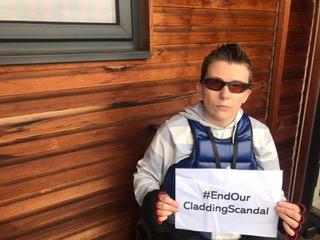
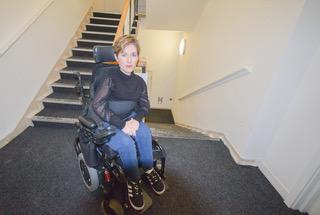
above – : Georgie and Sarah, founding members of CLADDAG
