
The first part of this article showed that the decision to cut ESA benefits for the WRAG (Work Related Activity Group) relied on the complexity of the system in order to drive cuts[1], which would be considered unacceptable, if people who should know better understood the system. BBC journalist Nick Robinson wrote on his blog before the cuts were announced:

He had to amend his blog after being told that nobody claiming ESA, either in the WRAG or Support Group, has been ever been ‘deemed capable of work’.
These cuts seem even more surprising in the light of the Government announcement that a record number of disabled people moved into work (a claim which will be scrutinised further in future), and of 3 million ESA claimants closing their claims since 2010. Furthermore, disabled people are the only group to have fared worse in terms of poverty[2]. There is a 2 percent point increase in disability poverty after taking into account housing costs, which is not surprising as 2/3 of households hit by the bedroom tax include a disabled person, and people in the WRAG are not exempted from the benefit cap. This is going to get worse.
Disability costs:
Disability is associated with higher costs. Somebody with limited mobility needs more heating and will have higher heating or electricity bills, another might need incontinence pads, dietary supplements, or the use of special transport or equipment.
There also would be repeated trips to the hospital or the GP
Higher insurance premiums because of disability
Over the counter medications
Extra bedding or clothes/shoes
Servicing of any aids or equipment etc.
Apart from the costs associated with disability, a Demos research paper [3]identifies the poverty drivers for disabled people:
- unsuitable accommodation
- private rented accommodation
- reliance on public transport
- no informal support from family and friends
- requiring higher levels of care and support
- unemployed
- living in London
- receiving Jobseeker’s Allowance
- no savings, in debt and no bank account
These are costs which will now have to be met on the equivalent of JSA, which is worth £73.10 per week for over 25s. It is what “the law says you need to live on each week” and according to DWP: ‘Benefits are not made up of separate amounts for specific items of expenditure such as food or fuel charges, and beneficiaries are free to spend their benefit as they see fit, in the light of their individual needs and preferences’[4].
The findings of a report by Scope[5] were that disabled people pay on average £550 per month on extra costs related to disability. How a £30 cut in ESA, bringing it to the level of JSA, will help disabled people assessed as unfit for work move into work is anybody’s guess, when it is likely to make them poorer and even more socially isolated that they already are.
In fact this cut in benefit has nothing to do with incentives or disencentives to move into work. The 2011 impact assessement of Time limit Contributory Employment and Support Allowance to one year for those in the Work-Related Activity Group[6] spells it out very clearly:
This is nothing more than a cost saving exercise, disguised as a policy realignment under the pretext that not enough disabled people have moved into work.
WCA failures:
The same document states: There may be an increased movement into work from people on ESA due to the change in emphasis towards ESA being a shorter-term benefit. The scale of this effect is very difficult to estimate at this stage.
Roughly, ESA is split into 2 groups:
The Support Group for the most severely disabled, or terminally ill people
The WRAG which is supposed to be a short-term benefit and which is also split into 2 groups for Work Programme purposes:
- ESA WRAG with 12 Month or longer prognosis, which means claimants are not expected to be work ready before 12 months or later, and their participation in the Work Programme is optional
- ESA (IR) WRAG with 3-6 Month prognosis, and claimants are mandated onto the Work Programme.
These distinctions between different types of ESA (SG and WRAG) and different types of WRAG (12 months and 3-6 months) assume from the Work Capability Assessment a level of sophistication greater that it actually has. There have been too many WCA failures to list here, but stories about terminally ill people, or people with degenerative illnesses being found fit for work or placed in the wrong group are numerous, as illustrated by the Work and Pensions Committee’s report on the WCA in 2014[7]:
More than 80,000 new ESA claimants and IB claimants undergoing reassessment, many of them with progressive conditions, have been placed in the WRAG since ESA was introduced, with a prognosis statement that a change in their functional abilities is unlikely in the longer term. The purpose of the WRAG is to provide work-related support for people who are expected to be fit for work in the short to medium term. Work-related conditionality accompanies this designation. We believe that it is wholly inappropriate to place people in the WRAG if they have a condition which is unlikely to improve and which makes their prospect of returning to work remote. We therefore recommend that DWP changes its practice so that claimants with this prognosis are allocated to the Support Group and not to the WRAG.
There is also the case of 4,900 claimants stuck on the WRAG for years, some since 2008 (like the FOI request shows below), or like Jon, placed in the WRAG since 2010, and who has been classified as being “unable to work in the longer term”. He is currently undergoing his 8th WCA[8].

The failures of the WCA have even been noticed by the OECD which addressed the issue of the small number of ESA claimants with a 3-6 months prognosis moving into work: ‘An improved WCA process may help to better identify claimants were [sic] a 3-6 months prognosis is justified, thus increasing the average health level of this group’. [9]
What George Osborne and his government are doing is cutting benefits for people who have been wrongly assessed as being work ready within 3 to 6 months, and who will have no possibility to offset the shortfall by working as they are unable to do so.
It is already tragic that so many unemployed people have to live on such a pittance as JSA, but the tragedy is compounded (if the OECD is right and there is no reason to believe it is not, as it has no political mileage to gain from not telling the truth as opposed to the government) by disabled people being wrongly assessed as almost work ready when they are not and having to meet the costs of disability on an ever shrinking allowance.
Higher level of conditionality
The last worrying aspect about singling out this group as needing incentives to move into work, apart from suggesting that disabled people prefer to languish on disability benefit rather than working, is the suggestion to consider a higher level of conditionality by the Reform report[10]. It is already obvious that the level of conditionality for this group is much too high: Over 3,000 sanctions were imposed in December 2014 on disabled people, 4.5 times more than in the same quarter in 2013[11]. Disabled people (and non disabled people) have been driven to homelessness, destitution and suicide by sanctions.
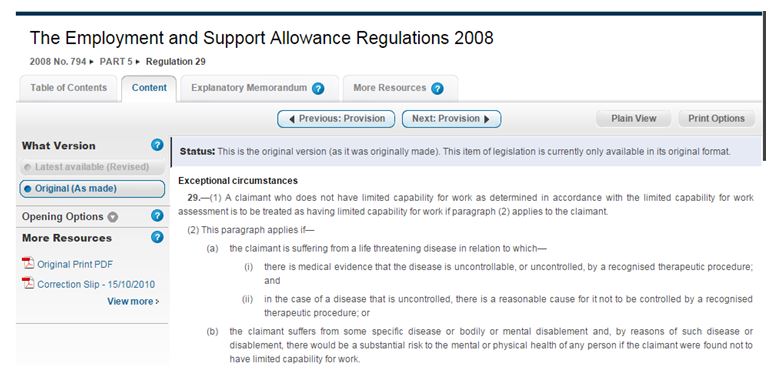
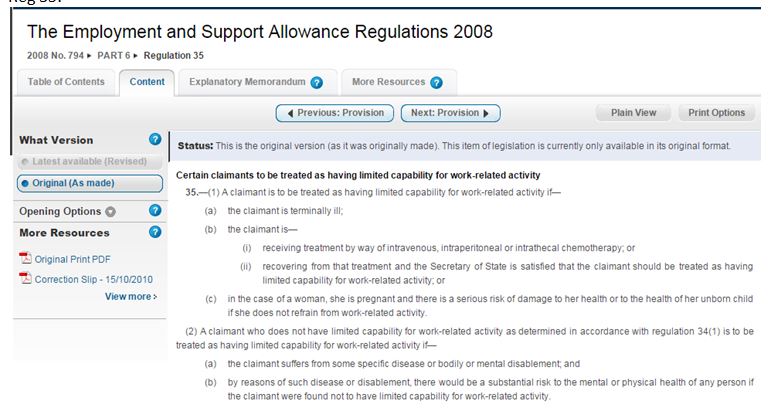
What the government may have not noticed, is that it has toxifed the Work Related Activity Group and that more and more claimants and their GPs realise that this group presents a real danger to claimants’ physical and mental health. It is on this basis that claimants should use Regs 29 and 35 to get the protection they need against a ruthless, ineffective and harmful regime.
Reg 29:[12]
Reg 35:[13]
Please contact a Welfare Adviser, CAB etc. about the use of these regulations.
[1] https://dpac.uk.net/2015/07/esa-claimants-not-incentised-enough-to-work-the-oecd-does-not-think-so/
[2] https://www.gov.uk/government/uploads/system/uploads/attachment_data/file/437246/households-below-average-income-1994-95-to-2013-14.pdf
[3] https://www.demos.co.uk/files/Counting_the_Cost_-_web.pdf?1292598960
[4] https://www.gov.uk/government/uploads/system/uploads/attachment_data/file/186931/foi-844-2013.pdf
[5] https://www.scope.org.uk/Scope/media/Images/Publication%20Directory/Priced-out.pdf
[6] https://www.gov.uk/government/uploads/system/uploads/attachment_data/file/220181/esa-time-limit-wr2011-ia-revised-apr2011.pdf
[7] https://www.publications.parliament.uk/pa/cm201415/cmselect/cmworpen/302/30206.htm
[8] https://dpac.uk.net/2015/07/the-paradox-of-esas-work-related-activity-group-and-nasty-plans-to-cut-it/
[9] https://books.google.co.uk/books?id=L9sGBAAAQBAJ&pg=PA72&lpg=PA72&dq=ex+ib+claiming+jsa&source=bl&ots=FmZ1pYubMx&sig=OVVelJOGG0v_k_B6Vb_jSnx7BWA&hl=fr&sa=X&ei=3eegVainAcTiUbnIkOgF&ved=0CFMQ6AEwBg#v=onepage&q=chapter%204&f=false (Page 214).
[10] https://www.reform.uk/wp-content/uploads/2015/06/HTRAC-WA-Welfare.pdf
[11] https://www.bbc.co.uk/news/uk-28776102
[12] https://www.legislation.gov.uk/uksi/2008/794/regulation/29/made
[13] https://www.legislation.gov.uk/uksi/2008/794/regulation/35/made

I was placed in WRAG in 2011. Due to the fact I have a teen aged daughter, This year I feel forced to take a part time job. The negative restrictive rules set through the job centre, as well as the rules have been embarrassing and depressing. On 2 occasions since July 2015 I have taken up work. The first was messed up by the ESA rules, so that I was unable to receive legitimate payment without forfeiting my benefit altogether. The second enforces a pitiful wage for under 16 hours a week which is less than £104. My seniority means that other employees earn more. It happens that I have a sympathetic boss who is perplexed by rules which means employing me after one year is out of the question as I have been in WRAG. What makes this a positive incentive to look for work? It has been embarrassing enough discussing all the restrictions placed on me with my boss and his payroll department. The fact is that the rules make ill people like myself feel even ilex, marginalised and embarrassed. Just because I have a progressive illness doesn’t mean I have to stay poor. It doesn’t mean I don’t have a brain, or have ambition. My hands are tied though, and U feel life under this regime is hideous. I have sought out job openings mysel but this counts for nothing! In fact by accepting my first
free lance job opportunity i was more or less accused of fraudulent activity by my job adviser…. The beat goes on….